EP0600214B2 - Verfahren und Vorrichtung zur fortlaufenden Herstellung eines Verbundrohres mit einem aussen im wesentlichen glatten Abschnitt - Google Patents
Verfahren und Vorrichtung zur fortlaufenden Herstellung eines Verbundrohres mit einem aussen im wesentlichen glatten Abschnitt Download PDFInfo
- Publication number
- EP0600214B2 EP0600214B2 EP93117224A EP93117224A EP0600214B2 EP 0600214 B2 EP0600214 B2 EP 0600214B2 EP 93117224 A EP93117224 A EP 93117224A EP 93117224 A EP93117224 A EP 93117224A EP 0600214 B2 EP0600214 B2 EP 0600214B2
- Authority
- EP
- European Patent Office
- Prior art keywords
- tube
- spigot
- external
- external tube
- internal
- Prior art date
- Legal status (The legal status is an assumption and is not a legal conclusion. Google has not performed a legal analysis and makes no representation as to the accuracy of the status listed.)
- Expired - Lifetime
Links
- 238000004519 manufacturing process Methods 0.000 title claims description 27
- 238000000034 method Methods 0.000 title claims description 12
- 239000002131 composite material Substances 0.000 title description 17
- 238000001125 extrusion Methods 0.000 claims description 5
- 238000000465 moulding Methods 0.000 claims description 4
- 230000015572 biosynthetic process Effects 0.000 claims description 3
- 238000002347 injection Methods 0.000 claims description 3
- 239000007924 injection Substances 0.000 claims description 3
- 239000000463 material Substances 0.000 claims 2
- 150000001875 compounds Chemical class 0.000 claims 1
- 238000011144 upstream manufacturing Methods 0.000 claims 1
- 238000005496 tempering Methods 0.000 description 6
- 230000007704 transition Effects 0.000 description 5
- 239000000155 melt Substances 0.000 description 4
- 239000007787 solid Substances 0.000 description 4
- 238000003466 welding Methods 0.000 description 4
- 239000007921 spray Substances 0.000 description 3
- 230000004323 axial length Effects 0.000 description 2
- 238000001816 cooling Methods 0.000 description 2
- 238000001746 injection moulding Methods 0.000 description 2
- 238000007711 solidification Methods 0.000 description 2
- 230000008023 solidification Effects 0.000 description 2
- 244000089486 Phragmites australis subsp australis Species 0.000 description 1
- 230000006835 compression Effects 0.000 description 1
- 238000007906 compression Methods 0.000 description 1
- 239000002826 coolant Substances 0.000 description 1
- 238000010438 heat treatment Methods 0.000 description 1
- 239000007788 liquid Substances 0.000 description 1
- 238000003825 pressing Methods 0.000 description 1
- 238000007789 sealing Methods 0.000 description 1
- 238000000926 separation method Methods 0.000 description 1
- 125000006850 spacer group Chemical group 0.000 description 1
Images



Classifications
-
- B—PERFORMING OPERATIONS; TRANSPORTING
- B29—WORKING OF PLASTICS; WORKING OF SUBSTANCES IN A PLASTIC STATE IN GENERAL
- B29D—PRODUCING PARTICULAR ARTICLES FROM PLASTICS OR FROM SUBSTANCES IN A PLASTIC STATE
- B29D99/00—Subject matter not provided for in other groups of this subclass
- B29D99/001—Producing wall or panel-like structures, e.g. for hulls, fuselages, or buildings
- B29D99/0014—Producing wall or panel-like structures, e.g. for hulls, fuselages, or buildings provided with ridges or ribs, e.g. joined ribs
-
- B—PERFORMING OPERATIONS; TRANSPORTING
- B29—WORKING OF PLASTICS; WORKING OF SUBSTANCES IN A PLASTIC STATE IN GENERAL
- B29C—SHAPING OR JOINING OF PLASTICS; SHAPING OF MATERIAL IN A PLASTIC STATE, NOT OTHERWISE PROVIDED FOR; AFTER-TREATMENT OF THE SHAPED PRODUCTS, e.g. REPAIRING
- B29C48/00—Extrusion moulding, i.e. expressing the moulding material through a die or nozzle which imparts the desired form; Apparatus therefor
- B29C48/03—Extrusion moulding, i.e. expressing the moulding material through a die or nozzle which imparts the desired form; Apparatus therefor characterised by the shape of the extruded material at extrusion
- B29C48/09—Articles with cross-sections having partially or fully enclosed cavities, e.g. pipes or channels
- B29C48/11—Articles with cross-sections having partially or fully enclosed cavities, e.g. pipes or channels comprising two or more partially or fully enclosed cavities, e.g. honeycomb-shaped
-
- B—PERFORMING OPERATIONS; TRANSPORTING
- B29—WORKING OF PLASTICS; WORKING OF SUBSTANCES IN A PLASTIC STATE IN GENERAL
- B29C—SHAPING OR JOINING OF PLASTICS; SHAPING OF MATERIAL IN A PLASTIC STATE, NOT OTHERWISE PROVIDED FOR; AFTER-TREATMENT OF THE SHAPED PRODUCTS, e.g. REPAIRING
- B29C48/00—Extrusion moulding, i.e. expressing the moulding material through a die or nozzle which imparts the desired form; Apparatus therefor
- B29C48/03—Extrusion moulding, i.e. expressing the moulding material through a die or nozzle which imparts the desired form; Apparatus therefor characterised by the shape of the extruded material at extrusion
- B29C48/13—Articles with a cross-section varying in the longitudinal direction, e.g. corrugated pipes
-
- B—PERFORMING OPERATIONS; TRANSPORTING
- B29—WORKING OF PLASTICS; WORKING OF SUBSTANCES IN A PLASTIC STATE IN GENERAL
- B29C—SHAPING OR JOINING OF PLASTICS; SHAPING OF MATERIAL IN A PLASTIC STATE, NOT OTHERWISE PROVIDED FOR; AFTER-TREATMENT OF THE SHAPED PRODUCTS, e.g. REPAIRING
- B29C48/00—Extrusion moulding, i.e. expressing the moulding material through a die or nozzle which imparts the desired form; Apparatus therefor
- B29C48/25—Component parts, details or accessories; Auxiliary operations
- B29C48/30—Extrusion nozzles or dies
- B29C48/303—Extrusion nozzles or dies using dies or die parts movable in a closed circuit, e.g. mounted on movable endless support
-
- B—PERFORMING OPERATIONS; TRANSPORTING
- B29—WORKING OF PLASTICS; WORKING OF SUBSTANCES IN A PLASTIC STATE IN GENERAL
- B29C—SHAPING OR JOINING OF PLASTICS; SHAPING OF MATERIAL IN A PLASTIC STATE, NOT OTHERWISE PROVIDED FOR; AFTER-TREATMENT OF THE SHAPED PRODUCTS, e.g. REPAIRING
- B29C49/00—Blow-moulding, i.e. blowing a preform or parison to a desired shape within a mould; Apparatus therefor
- B29C49/0015—Making articles of indefinite length, e.g. corrugated tubes
- B29C49/0021—Making articles of indefinite length, e.g. corrugated tubes using moulds or mould parts movable in a closed path, e.g. mounted on movable endless supports
-
- B—PERFORMING OPERATIONS; TRANSPORTING
- B29—WORKING OF PLASTICS; WORKING OF SUBSTANCES IN A PLASTIC STATE IN GENERAL
- B29C—SHAPING OR JOINING OF PLASTICS; SHAPING OF MATERIAL IN A PLASTIC STATE, NOT OTHERWISE PROVIDED FOR; AFTER-TREATMENT OF THE SHAPED PRODUCTS, e.g. REPAIRING
- B29C49/00—Blow-moulding, i.e. blowing a preform or parison to a desired shape within a mould; Apparatus therefor
- B29C49/0015—Making articles of indefinite length, e.g. corrugated tubes
- B29C49/0024—Making articles of indefinite length, e.g. corrugated tubes using varying mould speed
-
- B—PERFORMING OPERATIONS; TRANSPORTING
- B29—WORKING OF PLASTICS; WORKING OF SUBSTANCES IN A PLASTIC STATE IN GENERAL
- B29C—SHAPING OR JOINING OF PLASTICS; SHAPING OF MATERIAL IN A PLASTIC STATE, NOT OTHERWISE PROVIDED FOR; AFTER-TREATMENT OF THE SHAPED PRODUCTS, e.g. REPAIRING
- B29C49/00—Blow-moulding, i.e. blowing a preform or parison to a desired shape within a mould; Apparatus therefor
- B29C49/02—Combined blow-moulding and manufacture of the preform or the parison
- B29C49/04—Extrusion blow-moulding
-
- B—PERFORMING OPERATIONS; TRANSPORTING
- B29—WORKING OF PLASTICS; WORKING OF SUBSTANCES IN A PLASTIC STATE IN GENERAL
- B29C—SHAPING OR JOINING OF PLASTICS; SHAPING OF MATERIAL IN A PLASTIC STATE, NOT OTHERWISE PROVIDED FOR; AFTER-TREATMENT OF THE SHAPED PRODUCTS, e.g. REPAIRING
- B29C2791/00—Shaping characteristics in general
- B29C2791/004—Shaping under special conditions
- B29C2791/006—Using vacuum
-
- B—PERFORMING OPERATIONS; TRANSPORTING
- B29—WORKING OF PLASTICS; WORKING OF SUBSTANCES IN A PLASTIC STATE IN GENERAL
- B29C—SHAPING OR JOINING OF PLASTICS; SHAPING OF MATERIAL IN A PLASTIC STATE, NOT OTHERWISE PROVIDED FOR; AFTER-TREATMENT OF THE SHAPED PRODUCTS, e.g. REPAIRING
- B29C48/00—Extrusion moulding, i.e. expressing the moulding material through a die or nozzle which imparts the desired form; Apparatus therefor
- B29C48/001—Combinations of extrusion moulding with other shaping operations
- B29C48/0011—Combinations of extrusion moulding with other shaping operations combined with compression moulding
-
- B—PERFORMING OPERATIONS; TRANSPORTING
- B29—WORKING OF PLASTICS; WORKING OF SUBSTANCES IN A PLASTIC STATE IN GENERAL
- B29C—SHAPING OR JOINING OF PLASTICS; SHAPING OF MATERIAL IN A PLASTIC STATE, NOT OTHERWISE PROVIDED FOR; AFTER-TREATMENT OF THE SHAPED PRODUCTS, e.g. REPAIRING
- B29C48/00—Extrusion moulding, i.e. expressing the moulding material through a die or nozzle which imparts the desired form; Apparatus therefor
- B29C48/001—Combinations of extrusion moulding with other shaping operations
- B29C48/002—Combinations of extrusion moulding with other shaping operations combined with surface shaping
-
- B—PERFORMING OPERATIONS; TRANSPORTING
- B29—WORKING OF PLASTICS; WORKING OF SUBSTANCES IN A PLASTIC STATE IN GENERAL
- B29C—SHAPING OR JOINING OF PLASTICS; SHAPING OF MATERIAL IN A PLASTIC STATE, NOT OTHERWISE PROVIDED FOR; AFTER-TREATMENT OF THE SHAPED PRODUCTS, e.g. REPAIRING
- B29C48/00—Extrusion moulding, i.e. expressing the moulding material through a die or nozzle which imparts the desired form; Apparatus therefor
- B29C48/03—Extrusion moulding, i.e. expressing the moulding material through a die or nozzle which imparts the desired form; Apparatus therefor characterised by the shape of the extruded material at extrusion
- B29C48/09—Articles with cross-sections having partially or fully enclosed cavities, e.g. pipes or channels
-
- B—PERFORMING OPERATIONS; TRANSPORTING
- B29—WORKING OF PLASTICS; WORKING OF SUBSTANCES IN A PLASTIC STATE IN GENERAL
- B29C—SHAPING OR JOINING OF PLASTICS; SHAPING OF MATERIAL IN A PLASTIC STATE, NOT OTHERWISE PROVIDED FOR; AFTER-TREATMENT OF THE SHAPED PRODUCTS, e.g. REPAIRING
- B29C48/00—Extrusion moulding, i.e. expressing the moulding material through a die or nozzle which imparts the desired form; Apparatus therefor
- B29C48/03—Extrusion moulding, i.e. expressing the moulding material through a die or nozzle which imparts the desired form; Apparatus therefor characterised by the shape of the extruded material at extrusion
- B29C48/09—Articles with cross-sections having partially or fully enclosed cavities, e.g. pipes or channels
- B29C48/10—Articles with cross-sections having partially or fully enclosed cavities, e.g. pipes or channels flexible, e.g. blown foils
-
- B—PERFORMING OPERATIONS; TRANSPORTING
- B29—WORKING OF PLASTICS; WORKING OF SUBSTANCES IN A PLASTIC STATE IN GENERAL
- B29C—SHAPING OR JOINING OF PLASTICS; SHAPING OF MATERIAL IN A PLASTIC STATE, NOT OTHERWISE PROVIDED FOR; AFTER-TREATMENT OF THE SHAPED PRODUCTS, e.g. REPAIRING
- B29C48/00—Extrusion moulding, i.e. expressing the moulding material through a die or nozzle which imparts the desired form; Apparatus therefor
- B29C48/16—Articles comprising two or more components, e.g. co-extruded layers
- B29C48/18—Articles comprising two or more components, e.g. co-extruded layers the components being layers
- B29C48/22—Articles comprising two or more components, e.g. co-extruded layers the components being layers with means connecting the layers, e.g. tie layers or undercuts
-
- B—PERFORMING OPERATIONS; TRANSPORTING
- B29—WORKING OF PLASTICS; WORKING OF SUBSTANCES IN A PLASTIC STATE IN GENERAL
- B29C—SHAPING OR JOINING OF PLASTICS; SHAPING OF MATERIAL IN A PLASTIC STATE, NOT OTHERWISE PROVIDED FOR; AFTER-TREATMENT OF THE SHAPED PRODUCTS, e.g. REPAIRING
- B29C49/00—Blow-moulding, i.e. blowing a preform or parison to a desired shape within a mould; Apparatus therefor
- B29C49/0015—Making articles of indefinite length, e.g. corrugated tubes
- B29C49/0025—Making articles of indefinite length, e.g. corrugated tubes subsequent mould cavities being different, e.g. for making bells
-
- B—PERFORMING OPERATIONS; TRANSPORTING
- B29—WORKING OF PLASTICS; WORKING OF SUBSTANCES IN A PLASTIC STATE IN GENERAL
- B29L—INDEXING SCHEME ASSOCIATED WITH SUBCLASS B29C, RELATING TO PARTICULAR ARTICLES
- B29L2023/00—Tubular articles
- B29L2023/18—Pleated or corrugated hoses
-
- B—PERFORMING OPERATIONS; TRANSPORTING
- B29—WORKING OF PLASTICS; WORKING OF SUBSTANCES IN A PLASTIC STATE IN GENERAL
- B29L—INDEXING SCHEME ASSOCIATED WITH SUBCLASS B29C, RELATING TO PARTICULAR ARTICLES
- B29L2023/00—Tubular articles
- B29L2023/18—Pleated or corrugated hoses
- B29L2023/183—Pleated or corrugated hoses partially
-
- B—PERFORMING OPERATIONS; TRANSPORTING
- B29—WORKING OF PLASTICS; WORKING OF SUBSTANCES IN A PLASTIC STATE IN GENERAL
- B29L—INDEXING SCHEME ASSOCIATED WITH SUBCLASS B29C, RELATING TO PARTICULAR ARTICLES
- B29L2023/00—Tubular articles
- B29L2023/18—Pleated or corrugated hoses
- B29L2023/186—Pleated or corrugated hoses having a smooth internal wall
Definitions
- the invention relates to a method according to the preamble of claim 1 and a device according to the preamble of claim 4.
- pressure equalizing grooves on both sides of the respective main recess for producing a rib in a molding machine for producing a finned tube.
- These pressure equalizing grooves serve to equalize pressure peaks caused by the fact that the main recesses for producing ribs absorb liquid plastic to a considerable extent, with the result that pressure fluctuations occur to a considerable extent during a uniform extrusion of plastic over time.
- the pressure peaks occurring in this case should be compensated by the pressure equalizing grooves.
- the invention has for its object to provide a method of the generic type such that a full-surface welding of inner tube and outer tube is carried out under appropriate pressure, without causing damage to the tube, and to provide an apparatus for performing this method.
- a tab 5 is articulated by means of a Anlenkbolzens 6, which is also attached by means of such a Anlenkbolzens 6 at the appropriate location of the subsequent half-mold 2 and 2'.
- the chains 3, 3 'formed in this way are guided on their rearward end, seen in the direction of production 4, via guide wheels serving as so-called inlet rollers 7.
- the individual half-molds 2, 2 ' are pivoted in the circulation of the chains 3, 3' according to the direction of rotation arrows 8 and 8 'in a mold section 9, in each of which two half-molds 2, 2' are combined to form a mold pair, again in the production direction 4th successive mold pairs are close together.
- so-called closing rollers 10 are provided, which in the production direction 4 rear ends of the half-molds 2, 2 'merge accelerated.
- the inlet rollers 7 are rotatably mounted about axle journal 13 on the machine table 1.
- return rollers 14 are rotatably mounted about journals 15 around which the chains 3 and 3 'deflected and returned to the inlet rollers 7.
- the guide rails 12 end with guide rollers 11 already by the length of several half-molds 2 and 2 'in front of the return rollers 14, so that the half-molds 2 and 2' again moved away from each other and transverse to the production direction 4 from each other can be before they are pivoted by the return rollers 14.
- a toothing 16 is formed, wherein the two teeth 16 of the paired half-molds 2, 2' are aligned, so that from above a common drive pinion 17 can engage in this toothing 16, which the half-molds 2, 2 'in the forming section 9 as a closed mold by the forming section 9 pushes.
- the drive of this drive pinion 17 is effected in the usual manner by a motor, not shown, via a drive gear 18, which is fixed in a rotationally fixed manner on a shaft 19, which in turn carries the drive pinion 17.
- the shaft 19 is mounted in a bearing block 20 which is supported by spacer prisms 21 relative to the machine table and fixedly connected to the latter by means of screws 22.
- the tubes 23 will be described in more detail below.
- an extruder is provided, of which only the injection head 25, which will be described in more detail below, is indicated.
- the device described so far is known, for example from EP-A 0 065 729 (corresponding to US Pat. No. 4,492,551) and from DE 40 21 564 A1.
- a nozzle body 27 projecting into the molding section 9 is mounted on the spray head 25, in which an outer channel 28 and a Inner channel 29 are formed.
- the outer channel 28 terminates in an outer nozzle 30, the inner channel 29 terminates in an inner nozzle 31.
- the width a of the outer nozzle 30 and the width b of the inner nozzle 31 is in each case adjustable by a the respective nozzle 30 or 31 on the outside limiting nozzle ring 32 is adjustable by means of a nozzle ring nut 33 in the direction of the axis 26 and the production direction 4.
- the nozzle ring nut 33 is adjustable in each case on a corresponding thread 34 on the nozzle body 27.
- the nozzle body 27 is followed in the direction of production 4 by a calibration and tempering bell 35.
- This is provided with a likewise concentric with the axis 26 arranged in a conventional manner, provided substantially cylindrical Kalibrierzylinder 36 which is arranged on a tempering cylinder 37.
- a tempering channel 38 is formed, through which a tempering, so a cooling medium or a heating medium, can be passed.
- annular Formaus Principleung 39 is formed, which are connected in a known manner to partial-vacuum channels 40.
- the half-molds 2, 2 ' are formed so that in each case at predetermined intervals within the endlessly produced composite pipe 23 so-called spigot ends 46 are formed.
- a substantially cylindrical spigot recess 47 is formed in a pair of Halbkobllen 2, 2 ', which thus has a substantially cylindrical wall 48.
- a spigot 46 does not have to extend over the full length of a pair of half-shells 2, 2 'in the direction of production 4; it can also extend over only a part of this length.
- the diameter D of the cylindrical wall 48 is thus greater than the diameter d of the calibration cylinder 36 by twice the wall thickness c of the spigot end 46 to be produced.
- outer tube 41 and inner tube 43 takes place here only by the compression of the two tubes 41, 43 between the Kalibrierzylinder 36 and the wall 48 of the spigot recess 47.
- the speed of the mold can in this case by appropriate control of the drive motor for the Drive pinion 17 may have been withdrawn, so that more melt per unit length of the tube to be generated 23 passes into the spigot 46 than to produce the grooves 24 provided with composite pipe 23 so that the wall thickness c of the spigot end 46 is greater than the sum of the wall thicknesses e and f of outer tube 42 and inner tube 45.
- the compensation chambers may also extend parallel to the axis 26, but otherwise be the same size and connected to the partial vacuum channels.
- the compensation chambers 49 cause small circumferential web-like projections 53 to be formed on the outer wall 52 of a spigot end 46, the dimensions of which correspond at most to those of the compensation chamber 49.
- the width of the vacuum slots 50 is so small that melt can not get into it.
- the projections 53 become larger and wider in the opposite direction of the production direction 4. This is due to the fact that not all of the excess melt is pressed from the outset exclusively in the compensation chambers 49, but also partially backflows counter to the production direction 4, so that with increasing formation of a spigot, the relative melt abundance increases, with the result that more melt is pressed into the compensation chambers 49 and evades.
- a transition section 54 is further shown, the - in relation to the production direction 4 - front, i. is formed at the transition from provided with grooves 24 composite tube 23 to the spigot 46.
- This transition section 54 is separated out by means of two saw cuts 55, 56.
- a short pipe section formed by the transition section 54 is stepped out.
- a sleeve 57 is shown in phantom, which is formed by Aufmuffen the spigot end 46 - after separation of the transition portion 54. She also wears the projections 53 on its outside.
- the sleeve 57 is provided with a strong internal groove 58 for receiving a sealing ring.
- the inner diameter D 'of the cylindrical inner wall 59 of the sleeve 57 is approximately equal to or slightly greater than the outer diameter d' of the tube 23 with the grooves 24.
- the axial length I of the sleeve 57 through the Aufmuffen and in particular the formation of the inner groove 58 is less than the axial length L 'of the spigot end 46.
- Fig. 4 shows a connection of two tubes 23 with each other, in which the molded sleeve 57 is made in the manner described for Fig. 3 and width, ie the sleeve 57 via the grooved 24, provided with corrugated outer tube 42 and smooth inner tube 45 existing pipe 23 is pushed.
- a seal 60 is inserted in a groove 24, a seal 60 is inserted.
- Fig. 5 shows a composite pipe 23 with a sleeve 57 produced in the manner described, which is pushed onto a smooth-walled solid wall tube 61 or a pipe section in the form of a solid wall pipe.
- a seal 62 is arranged in the inner groove 58, which bears sealingly against the smooth cylindrical outer wall 63 of the solid wall tube 61.
Landscapes
- Engineering & Computer Science (AREA)
- Mechanical Engineering (AREA)
- Manufacturing & Machinery (AREA)
- Architecture (AREA)
- Civil Engineering (AREA)
- Structural Engineering (AREA)
- Extrusion Moulding Of Plastics Or The Like (AREA)
- Rigid Pipes And Flexible Pipes (AREA)
Description
- Die Erfindung betrifft ein Verfahren nach dem Oberbegriff des Anspruches 1 und eine Vorrichtung nach den Oberbegriff des Anspruches 4.
- Aus der EP-A 0 385 465 ist ein derartiges Verfahren bekannt, bei dem zur Herstellung des außen glattwandigen Abschnitts die Extrudiergeschwindigkeit verringert wird, wodurch die Wanddicke vergrößert werden soll. Dieser Abschnitt kann ein Spitzende oder nach entsprechendem Aufweiten eine Rohrmuffe bilden.
- Da die aus der EP-A 0 385 465 bekannte Herstellungstechnik erhebliche Probleme aufwirft, ist es aus dem DE 91 11 628 U1 bekanntgeworden, Spitzende und Rohrmuffen gesondert durch Spritzgießen herzustellen und an das Verbundrohr anzuspritzen bzw. anzuschweißen.
- Aus der EP-A 0 237 900 ist es bekannt, in einer Formmaschine zur Herstellung eines Rippenrohres Druckausgleichsnuten beiderseits der jeweiligen Hauptausnehmung zur Erzeugung einer Rippe anzuordnen. Diese Druckausgleichsnuten dienen dazu, Druckspitzen auszugleichen, die dadurch entstehen, daß die Hauptausnehmungen zur Erzeugung von Rippen in erheblichem Umfang flüssigen Kunststoff aufnehmen, was dazu führt, daß bei einer über der Zeit gleichmäßigen Extrusion von Kunststoff es in erheblichem Umfang zu Druckschwankungen kommt. Die hierbei auftretenden Druckspitzen sollen durch die Druckausgleichsnuten ausgeglichen werden.
- Aus der WO-A 88/05377 ist es bekannt, ein Verbundrohr der gattungsgemäßen Art herzustellen, wobei jeweils im Abstand voneinander im Prinzip glattwandige Muffen ausgebildet werden. Alle Wellenberge des Verbundrohres und auch die Außenwand der Muffe werden entlüftet.
- Aus der EP-A 0 271 598 ist es bekannt, eine durch Spritzgießen hergestellte Rohrmuffe in einem plastischen Verformungsvorgang mit dem Verbundrohr zu verbinden.
- Der Erfindung liegt die Aufgabe zugrunde, ein Verfahren der gattungsgemäßen Art so auszugestalten, daß ein vollflächiges Verschweißen von Innen-Schlauch und Außen- Schlauch unter entsprechender Druckausübung erfolgt, ohne daß eine Schädigung des Rohres eintritt, und eine Vorrichtung zur Durchführung dieses Verfahrens anzugeben.
- Die der Erfindung zugrundeliegende Aufgabe wird bei einem Verfahren durch die Merkmale des Anspruches 1 gelöst. Dadurch daß der auch außen glattwandige Abschnitt stellenweise druckentlastet wird, kann überschüssige Schmelze an diesen Stellen entweichen, so daß übermäßige Drücke beim Verschweißen von Innen-Schlauch und Außen-Schlauch vermieden werden, die zu Beschädigungen dieses Abschnittes führen können. Die auf diese Weise hergestellten Abschnitte werden anschließend zu Rohrmuffen aufgeweitet oder gegebenenfalls auch als Spitzende verwendet. Damit einerseits eine Druckentlastung erfolgt, andererseits aber die zum Verschweißen notwendigen Drücke erhalten bleiben, sind die Druckentlastungsstellen relativ Klein.
- Die Aufgabe wird weiterhin durch die Merkmale im Anspruch 4 gelöst. Dadurch daß überschüssige Schmelze in die Kompensationskammern entweichen kann, wird vermieden, daß durch die Kalibrier- und Temperierglocke die Formbacken sowie das Rohr beschädigt werden.
- Weitere vorteilhafte Merkmale ergeben sich aus den Unteransprüchen.
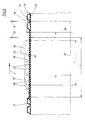
- Weitere Merkmale, Einzelheiten und Vorteile der Erfindung ergeben sich aus der nachfolgenden Beschreibung von Ausführungsbeispielen anhand der Zeichnung. Es zeigt
- Fig. 1
- eine Draufsicht auf eine Vorrichtung zur Herstellung von Kunststoff-Verbundrohren,
- Fig. 2
- einen vertikalen Teilschnitt durch die Vorrichtung mit einer Ausnehmung zur Herstellung eines Spitzendes an einem Verbundrohr,
- Fig. 3
- ein Verbundrohr, in dem fortlaufend ein Spitzende hergestellt wird,
- Fig. 4
- eine Rohrverbindung zwischen einem Rohr mit Muffe und einem gewellten Verbundrohr und
- Fig. 5
- eine Rohrverbindung zwischen einem Verbundrohr mit Rohrmuffe und einem glattwandigen Vollwandrohr.
- Wie Fig. 1 erkennen läßt, weist eine Vorrichtung zur Herstellung von Kunststoff-Verbundrohren mit Querrillen einen Maschinentisch 1 auf, auf dem Halbkokillen 2 bzw. 2' angeordnet sind, die jeweils zu zwei sogenannten Ketten 3 bzw. 3' miteinander verbunden sind. Hierzu ist an jeder Halbkokille 2 bzw. 2' in ihrem außerliegenden, in Produktionsrichtung 4 vorderen Bereich eine Lasche 5 mittels eines Anlenkbolzens 6 angelenkt, die an der entsprechenden Stelle der nachfolgenden Halbkokille 2 bzw. 2' ebenfalls mittels eines solchen Anlenkbolzens 6 angebracht ist. Die so gebildeten Ketten 3, 3' sind an ihrem in Produktionsrichtung 4 gesehen rückwärtigen Ende über als sogenannte Einlaufrollen 7 dienende Umlenkräder geführt. Die einzelnen Halbkokillen 2, 2' werden beim Umlauf der Ketten 3, 3' entsprechend den Umlaufrichtungspfeilen 8 bzw. 8' in eine Formstrecke 9 eingeschwenkt, in der jeweils zwei Halbkokillen 2, 2' zu einem Kokillenpaar vereinigt werden, wobei wiederum in Produktionsrichtung 4 hintereinanderfolgende Kokillenpaare dicht an dicht liegen. Um ein schnelles Schließen der Halbkokillen 2, 2' zu einer parallelen und aneinanderliegenden Stellung zu erreichen, sind sogenannte Schließrollen 10 vorgesehen, die die in Produktionsrichtung 4 hinteren Enden der Halbkokillen 2, 2' beschleunigt zusammenführen.
- In der Formstrecke 9 selber werden die aneinanderliegenden Halbkokillen 2, 2' mittels Führungsrollen 11, die in Führungsleisten 12 drehbar gelagert sind, gegeneinander gedrückt. Die Einlaufrollen 7 sind um Achszapfen 13 drehbar am Maschinentisch 1 angebracht. Am in Produktionsrichtung 4 vorderen Ende des Maschinentisches 1 sind ebenfalls als Umlenkräder dienende Rücklaufrollen 14 um Achszapfen 15 drehbar gelagert, um die die Ketten 3 bzw. 3' umgelenkt und zu den Einlaufrollen 7 zurückgeführt werden. Wie Fig. 1 zu entnehmen ist, enden die Führungsleisten 12 mit Führungsrollen 11 schon um die Länge mehrerer Halbkokillen 2 bzw. 2' vor den Rücklaufrollen 14, so daß die Halbkokillen 2 bzw. 2' wieder parallel zueinander und quer zur Produktionsrichtung 4 voneinander wegbewegt werden können, bevor sie von den Rücklaufrollen 14 verschwenkt werden.
- An der Oberseite der Halbkokillen 2,2' ist eine Verzahnung 16 ausgebildet, wobei die beiden Verzahnungen 16 der einander paarweise zugeordneten Halbkokillen 2, 2' miteinander fluchten, so daß von oben ein gemeinsames Antriebsritzel 17 in diese Verzahnung 16 eingreifen kann, das die Halbkokillen 2, 2' in der Formstrecke 9 als geschlossene Form durch die Formstrecke 9 schiebt. Der Antrieb dieses Antriebsritzels 17 erfolgt in üblicher Weise von einem nicht dargestellten Motor über ein Antriebszahnrad 18, das auf einer Welle 19 drehfest befestigt ist, die wiederum das Antriebsritzel 17 trägt. Die Welle 19 ist in einem Lagerbock 20 gelagert, der über Distanzprismen 21 gegenüber dem Maschinentisch abgestützt und mit letzterem mittels Schrauben 22 fest verbunden ist.
- Auf der dargestellten Vorrichtung werden Kunststoff-Rohre 23, und zwar sogenannte Verbundrohre, mit unter anderem einer Querprofilierung, d.h. mit über deren Umfang umlaufenden Rillen 24 hergestellt.
- Die Rohre 23 werden weiter unten noch genauer beschrieben. Hierzu ist ein Extruder vorgesehen, von dem nur der weiter unten noch genauer zu beschreibende Spritzkopf 25 angedeutet ist. Die bisher beschriebene Vorrichtung ist bekannt, und zwar beispielsweise aus der EP-A 0 065 729 (entsprechend US 4 492 551) und aus der DE 40 21 564 A1.
- Wie primär Fig. 2 zu entnehmen ist, ist konzentrisch zu einer gemeinsamen Mittel-Längs-Achse 26 des Spritzkopfes 25 und der Formstrecke 9 ist am Spritzkopf 25 ein in die Formstrecke 9 hineinragender Düsenkörper 27 angebracht, in dem ein Außen-Kanal 28 und ein Innen-Kanal 29 ausgebildet sind. Der Außen-Kanal 28 endet in einer Außen-Düse 30, der Innen-Kanal 29 endet in einer Innen-Düse 31. Die Weite a der Außen-Düse 30 und die Weite b der Innen-Düse 31 ist jeweils dadurch einstellbar, daß ein die jeweilige Düse 30 bzw. 31 auf der Außenseite begrenzender Düsenring 32 mittels einer Düsenringmutter 33 in Richtung der Achse 26 bzw. der Produktionsrichtung 4 verstellbar ist. Die Düsenringmutter 33 ist jeweils auf einem entsprechenden Gewinde 34 am Düsenkörper 27 verstellbar.
- An den Düsenkörper 27 schließt sich in Produktionsrichtung 4 eine Kalibrier-und Temperierglocke 35 an. Diese ist mit einem ebenfalls konzentrisch zur Achse 26 angeordneten in üblicher Weise ausgestalteten, im wesentlichen zylindrischen Kalibrierzylinder 36 versehen, der auf einem Temperierzylinder 37 angeordnet ist. An der Außenseite des Temperierzylinders 37, d.h. an der Innenseite des Kalibrierzylinders 36 ist ein Temperier-Kanal 38 ausgebildet, durch den ein Temperiermedium, also ein Kühlmedium oder ein Heizmedium, geleitet werden kann.
- Wie Fig. 2 erkennen läßt, sind in den Halbkokillen, von denen in Fig. 2 nur die Halbkobllen 2 dargestellt sind, ringförmige Formausnehmung 39 ausgebildet, die in bekannter Weise an Teil-Vakuum-Kanäle 40 angeschlossen sind.
- Die vom Extruder durch den Spritzkopf 25 zugeführte Kunststoffschmelze strömt zum Teil durch den Außen-Kanal 28 zur Außen-Düse 30, aus der ein Außen-Schlauch 41 extrudiert wird, der sich unter Formung eines mit den Querrillen 24 versehenen Schlauches aufgrund des Teilvakuums in die Formausnehmungen 39 legt. Er bildet nach entsprechender Abkühlung und Erstarrung das gewellte Außenrohr 42 des Rohres 23.
- Ein anderer Teil der Schmelze strömt durch den Innen-Kanal 29 zur Innen-Düse 31, aus der ein weiterer Schlauch, nämlich der Innen-Schlauch 43 austritt, der auf den Kalibrierzylinder 36 gelangt. Dieser erweitert sich von der Innen-Düse 31 in Produktionsrichtung 4 leicht nach außen bis der Innen-Schlauch 43 gegen die Wellentäler 44 des Außen-Schlauches 41 gelangt und hier mit diesen verschweißt wird. Der Innen-Schlauch 43 bildet nach Abkühlung unter Erstarrung das Innenrohr 45 des Verbundrohres 23.
- Wie aus Fig. 2 ersichtlich ist, sind die Halbkokillen 2, 2' so ausgebildet, daß jeweils in vorgegebenen Abständen innerhalb des endlos hergestellten Verbundrohres 23 sogenannte Spitzenden 46 ausgebildet werden. Hierzu ist in einem Paar von Halbkobllen 2, 2' eine im wesentlichen zylindrischen Spitzende-Ausnehmung 47 ausgebildet, die also eine im wesentlichen zylindrische Wand 48 aufweist. Ein Spitzende 46 muß sich naturgemäß nicht über die volle Länge eines Paares von Halbkokillen 2, 2' in Produktionsrichtung 4 erstrekken; sie kann sich auch nur über einen Teil dieser Länge erstrecken. Der Durchmesser D der zylindrischen Wand 48 ist also im Vergleich zum Durchmesser d des Kalibrierzylinders 36 um die doppelte Wanddicke c des zu erzeugenden Spitzendes 46 größer. Das Verschweißen von Außen-Schlauch 41 und Innen-Schlauch 43 erfolgt hierbei nur durch das Zusammenpressen der beiden Schläuche 41, 43 zwischen dem Kalibrierzylinder 36 und der Wand 48 der Spitzende-Ausnehmung 47. Die Geschwindigkeit der Form kann hierbei durch entsprechende Ansteuerung des Antriebsmotors für das Antriebsritzel 17 zurückgenommen worden sein, so daß mehr Schmelze pro Längeneinheit des zu erzeugenden Rohres 23 in das Spitzende 46 gelangt als zur Erzeugung des mit Rillen 24 versehenen Verbundrohres 23, so daß die Wanddicke c des Spitzendes 46 größer ist als die Summe der Wanddicken e und f von Außenrohr 42 und Innenrohr 45. Um Pressungen der Schmelze bei der Herstellung des Spitzendes 46 zwischen Wand 48 und Kalibrierzylinder 36 aufgrund nicht exakter Dosierung durch den Extruder zu vermeiden, sind in der zylindrischen Wand 48 der entsprechenden Halbkokillen 2, 2' in Form schmaler Ringe ausgebildete Kompensationskammern 49 ausgebildet, in die Vakuumschlitze 50 einmünden, die jeweils mit einem Teil-Vakuum-Kanal 40 verbunden. Die Kompensationskammern 49 sind also einerseits mit dem zur Ausformung eines Spitzendes 46 dienenden SpitzendeFormraum 51 offen und andererseits an einen Teil-Vakuum-Kanal 40 angeschlossen. In diese Kompensationskammern 49 kann überschüssige Schmelze, die zur Füllung des Spitzende-Formraums 51 nicht benötigt wird, ausweichen, ohne daß es zu Beschädigungen des Spitzendes 46 kommt. Derartige Beschädigungen können auch dadurch auftreten, daß aufgrund zu hohen Druckes im Spitzende-Formraum die Reibung zwischen Schmelze und Kalibrierzylinder 36 zu groß wird. Da die Kompensationskammern 49 an die Teil-Vakuum-Kanäle 40 angeschlossen sind, kann überschüssige Schmelze tatsächlich auch in diese eintreten. Die radial zur Achse 25 gemessene Tiefe g der Kompensationskammern 49 von der Wand 48 aus und deren Breite h in Produktionsrichtung 4 hängt wesentlich von den rheologischen Eigenschaften der Schmelze ab, und zwar primär von deren Viskosität. Ihre Dimensionierung hängt davon ab, daß einerseits die zum Verschweißen von Innen-Schlauch 45 und Außen-Schlauch 41 notwendigen Drücke erzeugt werden, ohne daß extreme Überdrücke durch eventuellen Überfluß an Schmelze im Spitzende-Formraum 51 aufgefangen werden müssen. Für die Breite h der Kompensationskammern 49 in Produktionsrichtung 4 im Vergleich zur Breite i der Vakuumschlitze 50 ebenfalls in Produktionsrichtung 4 gilt: h ≤ 2i.
- Die Kompensationskammern können sich auch parallel zur Achse 26 erstrecken, ansonsten aber gleich dimensioniert und an die Teil-Vakuum-Kanäle angeschlossen sein.
- Wie Fig. 3 entnehmbar ist, führen die Kompensationskammern 49 dazu, daß auf der Außenwand 52 eines Spitzendes 46 kleine umlaufende stegartige Vorsprünge 53 gebildet werden, deren Abmessungen maximal denen der Kompensationskammer 49 entsprechen. Es sei in diesem Zusammenhang darauf hingewiesen, daß die Breite der Vakuumschlitze 50 so klein ist, daß Schmelze nicht in diese gelangen kann. Wie Fig. 3 weiterhin entnehmbar ist, werden die Vorsprünge 53 entgegen der Produktionsrichtung 4 größer und breiter. Dies hat seine Ursache darin, daß nicht die gesamte überschüssige Schmelze von Anfang an ausschließlich in die Kompensationskammern 49 gedrückt wird, sondern auch teilweise entgegen der Produktionsrichtung 4 zurückstaut, so daß mit zunehmender Ausbildung eines Spitzendes der relative Schmelzeüberfluß zunimmt mit der Folge, daß mehr Schmelze in die Kompensationskammern 49 gedrückt wird bzw, ausweicht.
- In Fig. 3 ist weiterhin ein Übergangsabschnitt 54 gezeigt, der - bezogen auf die Produktionsrichtung 4 - vorn, d.h. am Übergang vom mit Rillen 24 versehenen Verbundrohr 23 zum Spitzende 46 ausgebildet ist. Dieser Übergangsabschnitt 54 wird mittels zweier Sägeschnitte 55, 56 herausgetrennt. Es wird also ein kurzer durch den Übergangsabschnitt 54 gebildeter Rohrabschnitt herausgeschritten.
- In Fig. 3 ist strichpunktiert eine Muffe 57 dargestellt, die durch Aufmuffen des Spitzendes 46 - nach Abtrennen des Übergangsabschnittes 54 geformt ist. Auch sie trägt die Vorsprünge 53 auf ihrer Außenseite. Die Muffe 57 ist mit einer stark ausgeprägten Innennut 58 zur Aufnahme eines Dichtungsringes versehen. Der Innendurchmesser D' der zylindrischen Innenwand 59 der Muffe 57 ist etwa gleich oder unwesentlich größer als der Außendurchmesser d' des Rohres 23 mit den Rillen 24. Wie aus Fig. 3 hervorgeht, ist die axiale Länge I der Muffe 57 durch das Aufmuffen und insbesondere das Ausbilden der Innennut 58 geringer als die axiale Länge L' des Spitzendes 46.
- Fig. 4 zeigt eine Verbindung von zwei Rohren 23 miteinander, bei denen die angeformte Muffe 57 in der zu Fig. 3 beschriebenen Art und Weite hergestellt ist, wobei also die Muffe 57 über das mit Rillen 24 versehene, aus gewelltem Außenrohr 42 und glattem Innenrohr 45 bestehende Rohr 23 geschoben ist. In eine Rille 24 ist eine Dichtung 60 eingelegt. Demgegenüber zeigt Fig. 5 ein Verbundrohr 23 mit einer in der geschilderten Weise hergestellten Muffe 57, die auf ein glattwandiges Vollwandrohr 61 oder einen Rohrabschnitt in Form eines Vollwandrohres aufgeschoben ist. Hierbei ist in der Innennut 58 eine Dichtung 62 angeordnet, die dichtend gegen die glatte zylindrische Außenwand 63 des Vollwandrohres 61 anliegt.
Claims (8)
- Verfahren zur fortlaufenden Herstellung eines aus einem glatten Innenrohr (45) mit durchgehend konstantem Innendurchmesser und aus einem mit diesem verschweißten, mit Querrillen (24) mit Wellentälern (44) versehenen Außenrohr (42) bestehenden Verbundrohres (23) aus Kunststoff mit einem außen im wesentlichen glattwandigen Spitzende (46), dessen Außendurchmesser kleiner ist als der Außendurchmesser der Querrillen (24), wobei- ein Außen-Schlauch (41) extrudiert wird,- der Außen-Schlauch (41) durch von außen aufgebrachtes Teil-Vakuum mit einer Wellung mitQuerrillen (24) mit Wellentälern (44) versehen wird,- ein Innen-Schlauch (43) in den Außen-Schlauch (41) extrudiert wird,- der Innen-Schlauch (43) gegen die Wellentäler (44) des Außen-Schlauches (41) gedrückt und dort mit dem Außen-Schlauch (41) verschweißt wird,- der Außen-Schlauch (41) in vorgegebenen Abständen zu einem im wesentlichen glattwandigen etwa zylindischen Spitzende (46) geformt wird und- der Innen-Schlauch (43) von innen vollflächig gegen den Außen-Schlauch (41) gedrückt wird,dadurch gekennzeichnet,- daß der Außen-Schlauch (41) unter Aufbringung eines Teil-Vakuums von außen zu dem Spitzende (46) geformt wird und- und daß die Außen-Wand (52) des Außen-Schlauches (41) im Bereich des Spitzendes (46) in kleinen Flächenbereichen druckentlastet wird und dadurch dort kleine Vorsprünge (53) als Kompensation für eine nicht exakte Dosierung bei der Extrusion des Kunststoffes gebildet werden.
- Verfahren nach Anspruch 1, dadurch gekennzeichnet, daß die Außenwand (52) in ringförmigen Zonen druckentlastet wird.
- Verfahren nach Anspruch 1 oder 2, dadurch gekennzeichnet, daß die kleinen Flächenbereiche durch Teil-Vakuum druckentlastet werden.
- Vorrichtung zur Durchführung des Verfahrens nach einem der Ansprüche 1 bis 3, wobei- mit ringförmigen Formausnehmungen (39) versehene, sich auf einer Formstrecke (9) jeweils paarweise zu einer Form mit einer Mittel-Längs-Achse (26) ergänzende Halbkokillen (2, 2') auf einem Maschinentisch (1) im Kreislauf und in Produktionsrichtung (4) geführt angeordnet sind,- die Formausnehmungen (39) an in den Halbkokillen (2, 2') ausgebildete Teil-Vakuum-Kanäle (40) angeschlossen sind,- der Formstrecke (9) ein Spritzkopf (25) eines Extruders vorgeordnet ist,- der Spritzkopf (25) mit einer Außen-Düse (30) zur Extrusion eines Außen-Schlauches (41) und in Produktionsrichtung (4) nachgeordnet mit einer Innen-Düse (31) zur Extrusion eines Innen-Schlauches (43) und an seinem in Produktionsrichtung (4) hintenliegenden Ende mit einer mit einem Kalibrierzylinder (36) versehenen Kalibrier- und Temperierglocke (35) versehen ist, und- mindestens ein Paar Halbkokillen (2, 2') mit einer Spitzende-Ausnehmung (47) mit einer im wesentlichen zylindrischen Wand (48) versehen ist,dadurch gekennzeichnet, daß in der im wesentlichen zylindrischen Wand (48) Kompensationskammern (49) zur Bildung von Vorsprüngen (53), deren Abmessungen maximal denen der Kompensationskammern (49) entsprechen, ausgebildet sind.
- Vorrichtung nach Anspruch 4, dadurch gekennzeichnet, daß die Kompensationskammern (49) in Form zur Mittel-Längs-Achse (26) konzentrisch angeordneter Ringe ausgebildet sind.
- Vorrichtung nach Anspruch 4 oder 5, dadurch gekennzeichnet, daß die Kompensationskammern (49) an Teil-Vakuum-Kanäle (40) angeschlossen sind.
- Vorrichtung nach Anspruch 6, dadurch gekennzeichnet, daß die Kompensationskammern (49) über Vakuumschlitze (50) an Teil-Vakuum-Kanäle (40) angeschlossen sind.
- Vorrichtung nach Anspruch 7, dadurch gekennzeichnet, daß für die Breite (h) der Kompensationskammern (49) im Vergleich zu der Breite (i) der Vakuum-Schlitze (50) jeweils in Produktionsrichtung (4) gilt: h ≤ 2i.
Applications Claiming Priority (2)
| Application Number | Priority Date | Filing Date | Title |
|---|---|---|---|
| DE4240268 | 1992-12-01 | ||
| DE4240268A DE4240268A1 (de) | 1992-12-01 | 1992-12-01 | Verfahren und Vorrichtung zur fortlaufenden Herstellung eines Verbundrohres mit einem außen im wesentlichen glatten Abschnitt |
Publications (3)
| Publication Number | Publication Date |
|---|---|
| EP0600214A1 EP0600214A1 (de) | 1994-06-08 |
| EP0600214B1 EP0600214B1 (de) | 1998-03-04 |
| EP0600214B2 true EP0600214B2 (de) | 2006-04-19 |
Family
ID=6474029
Family Applications (1)
| Application Number | Title | Priority Date | Filing Date |
|---|---|---|---|
| EP93117224A Expired - Lifetime EP0600214B2 (de) | 1992-12-01 | 1993-10-25 | Verfahren und Vorrichtung zur fortlaufenden Herstellung eines Verbundrohres mit einem aussen im wesentlichen glatten Abschnitt |
Country Status (6)
| Country | Link |
|---|---|
| US (1) | US5472659A (de) |
| EP (1) | EP0600214B2 (de) |
| CN (1) | CN1042712C (de) |
| CA (1) | CA2110360C (de) |
| DE (2) | DE4240268A1 (de) |
| ES (1) | ES2112943T3 (de) |
Cited By (8)
| Publication number | Priority date | Publication date | Assignee | Title |
|---|---|---|---|---|
| US7484535B2 (en) | 2005-03-14 | 2009-02-03 | Advanced Drainage Systems, Inc. | Corrugated pipe with outer layer |
| US7980841B2 (en) | 2007-02-26 | 2011-07-19 | Advanced Drainage Systems, Inc. | Defined ratio dual-wall pipe die |
| US7988438B2 (en) | 2008-02-11 | 2011-08-02 | Advanced Drainage Systems, Inc. | Extrusion die vacuum seals |
| US8114324B2 (en) | 2008-10-14 | 2012-02-14 | Advanced Drainage Systems, Inc. | Apparatus and method for pressing an outer wall of pipe |
| US8496460B2 (en) | 2007-02-26 | 2013-07-30 | Advanced Drainage Systems, Inc. | Pipe extrusion die flow path apparatus and method |
| US8550807B2 (en) | 2008-05-28 | 2013-10-08 | Advanced Drainage Systems, Inc. | In-mold punch apparatus and methods |
| US8733405B2 (en) | 2005-03-14 | 2014-05-27 | Advanced Drainage Systems, Inc. | Corrugated pipe with outer layer |
| US8820800B2 (en) | 2007-11-16 | 2014-09-02 | Advanced Drainage Systems, Inc. | Multi-wall corrugated pipe couplings and methods |
Families Citing this family (14)
| Publication number | Priority date | Publication date | Assignee | Title |
|---|---|---|---|---|
| DE19504501A1 (de) * | 1995-02-13 | 1996-08-14 | Wilhelm Hegler | Verfahren und Anlage zur Herstellung eines Mehrschicht-Rohres aus thermoplastischem Kunststoff, insbesondere Polyolefin |
| DE19604311A1 (de) * | 1996-02-07 | 1997-08-14 | Ralph Peter Dr Ing Hegler | Verbundrohr mit Muffe und Verfahren zu seiner Herstellung |
| DE19640928A1 (de) * | 1996-10-04 | 1998-04-09 | Ralph Peter Dr Ing Hegler | Vorrichtung zur Herstellung von Kunststoff-Verbund-Rohren |
| IT1290468B1 (it) * | 1997-03-21 | 1998-12-04 | Giancarlo Tamborini | Struttura di tubo di scarico a realizzazione semplificata particolarmente studiata per elettrodomestici e simili |
| DE19724113A1 (de) * | 1997-06-09 | 1998-12-10 | Ralph Peter Dr Hegler | Verbundrohr mit angeformter Rohr-Muffe und Verfahren zu dessen Herstellung |
| DE19848470A1 (de) | 1998-10-21 | 2000-04-27 | Ralph Peter Hegler | Verfahren zur fortlaufenden Herstellung eines Verbundrohres mit einer Rohr-Muffe und Vorrichtung zur Durchführung des Verfahrens |
| US6199592B1 (en) * | 1999-02-05 | 2001-03-13 | Hancor, Inc. | Pipe structure and method of manufacture |
| DE60111398T2 (de) * | 2000-09-11 | 2006-03-16 | Manfred Arno Alfred Thornhill Lupke | Rohrformvorrichtung mit einer regelung des kunststoffvolumens längs der rohrwandung |
| US6752955B2 (en) * | 2001-07-13 | 2004-06-22 | Trw Inc. | Method of manufacturing a boot seal |
| ES2290594T3 (es) * | 2004-07-03 | 2008-02-16 | Ralph-Peter Dr.-Ing. Hegler | Procedimiento para la fabricacion continua de un tubo corrugado de doble pared con una manguera, el tubo corrugado de doble pared y el aparato para llevar a cabo el procedimiento. |
| EP1916087A1 (de) * | 2006-10-26 | 2008-04-30 | Drossbach GmbH & Co. KG | Vorrichtung zur Aufbringung von Kunststoff auf ein Werkstück |
| WO2008139004A1 (es) * | 2007-05-14 | 2008-11-20 | Uralita Sistemas De Tuberias, S.A. | Procedimiento de fabricación de tubería corrugada tricapa, cabezal empleado en la fabricación y la tubería así obtenida |
| US8820801B2 (en) | 2007-11-16 | 2014-09-02 | Advanced Drainage System, Inc. | Multi-wall corrugated pipe couplings and methods |
| GB2474982B (en) * | 2008-08-06 | 2013-03-13 | Jain Irrigation Systems Ltd | A novel pipe with integral male and female ends, a novel jointmade using the same, and process of making the pipe and the joint |
Family Cites Families (7)
| Publication number | Priority date | Publication date | Assignee | Title |
|---|---|---|---|---|
| JPS6036143A (ja) * | 1983-08-08 | 1985-02-25 | Takiron Co Ltd | 継手部を有した二重壁パイプの製造方法 |
| JPS61148035A (ja) * | 1984-12-21 | 1986-07-05 | Takiron Co Ltd | 二重壁管の製造法 |
| JPS61293821A (ja) * | 1985-06-21 | 1986-12-24 | Takiron Co Ltd | コルゲ−ト管のスリ−ブの成形方法 |
| FI77405C (fi) * | 1986-03-20 | 1989-03-10 | Uponor Nv | Foerfarande och anordning foer framstaellning av kamflaensroer. |
| DE3701822A1 (de) * | 1987-01-22 | 1988-08-11 | Uponor Nv | Verfahren und anordnung zum strangpressen von kunststoffrohren |
| NL8701164A (nl) * | 1987-05-14 | 1988-12-01 | Wavin Bv | Kunststofbuis met aan het buitenoppervlak massieve dwarsribben, inrichting voor toepassing in een installatie voor het vormen van dergelijke buizen; installatie voor het vormen van buizen die een dergelijke inrichting omvat en werkwijze voor het vormen van een kunststofbuis onder toepassing van een dergelijke installatie. |
| DE4210482A1 (de) * | 1992-03-31 | 1993-10-07 | Wilhelm Hegler | Verfahren und Vorrichtung zur fortlaufenden Herstellung eines Verbundrohres mit Rohr-Muffe |
-
1992
- 1992-12-01 DE DE4240268A patent/DE4240268A1/de not_active Withdrawn
-
1993
- 1993-10-25 ES ES93117224T patent/ES2112943T3/es not_active Expired - Lifetime
- 1993-10-25 EP EP93117224A patent/EP0600214B2/de not_active Expired - Lifetime
- 1993-10-25 DE DE59308206T patent/DE59308206D1/de not_active Expired - Lifetime
- 1993-11-19 US US08/154,855 patent/US5472659A/en not_active Expired - Fee Related
- 1993-11-30 CA CA002110360A patent/CA2110360C/en not_active Expired - Fee Related
- 1993-11-30 CN CN93121112A patent/CN1042712C/zh not_active Expired - Fee Related
Cited By (8)
| Publication number | Priority date | Publication date | Assignee | Title |
|---|---|---|---|---|
| US7484535B2 (en) | 2005-03-14 | 2009-02-03 | Advanced Drainage Systems, Inc. | Corrugated pipe with outer layer |
| US8733405B2 (en) | 2005-03-14 | 2014-05-27 | Advanced Drainage Systems, Inc. | Corrugated pipe with outer layer |
| US7980841B2 (en) | 2007-02-26 | 2011-07-19 | Advanced Drainage Systems, Inc. | Defined ratio dual-wall pipe die |
| US8496460B2 (en) | 2007-02-26 | 2013-07-30 | Advanced Drainage Systems, Inc. | Pipe extrusion die flow path apparatus and method |
| US8820800B2 (en) | 2007-11-16 | 2014-09-02 | Advanced Drainage Systems, Inc. | Multi-wall corrugated pipe couplings and methods |
| US7988438B2 (en) | 2008-02-11 | 2011-08-02 | Advanced Drainage Systems, Inc. | Extrusion die vacuum seals |
| US8550807B2 (en) | 2008-05-28 | 2013-10-08 | Advanced Drainage Systems, Inc. | In-mold punch apparatus and methods |
| US8114324B2 (en) | 2008-10-14 | 2012-02-14 | Advanced Drainage Systems, Inc. | Apparatus and method for pressing an outer wall of pipe |
Also Published As
| Publication number | Publication date |
|---|---|
| CN1096480A (zh) | 1994-12-21 |
| DE59308206D1 (de) | 1998-04-09 |
| US5472659A (en) | 1995-12-05 |
| CA2110360C (en) | 2005-01-25 |
| CA2110360A1 (en) | 1994-06-02 |
| EP0600214A1 (de) | 1994-06-08 |
| CN1042712C (zh) | 1999-03-31 |
| EP0600214B1 (de) | 1998-03-04 |
| ES2112943T3 (es) | 1998-04-16 |
| DE4240268A1 (de) | 1994-06-09 |
Similar Documents
| Publication | Publication Date | Title |
|---|---|---|
| EP0600214B1 (de) | Verfahren und Vorrichtung zur fortlaufenden Herstellung eines Verbundrohres mit einem aussen im wesentlichen glatten Abschnitt | |
| EP0789176B1 (de) | Verbundrohr mit Muffe und Verfahren zu seiner Herstellung | |
| EP0890770B1 (de) | Verbundrohr mit angeformter Rohr-Muffe und Verfahren zu dessen Herstellung | |
| EP0301189B1 (de) | Verfahren und Vorrichtung zum Herstellen eines Rippen-Rohres aus Kunststoff | |
| DE4210482A1 (de) | Verfahren und Vorrichtung zur fortlaufenden Herstellung eines Verbundrohres mit Rohr-Muffe | |
| DE1704718A1 (de) | Verfahren und Vorrichtung zur Herstellung von Kunststoffrohren mit ring- oder schraubenlinienfoermig gerillter Aussenwand | |
| EP0834386B1 (de) | Vorrichtung zur Herstellung von Kunststoff-Verbund-Rohren | |
| DE2403618B2 (de) | Vorrichtung zum Herstellen eines doppelwandigen Kunststoffrohres | |
| EP2452803B1 (de) | Vorrichtung zur Herstellung von Wellrohren aus thermoplastischem Kunststoff | |
| EP2065159A1 (de) | Vorrichtung zur fortlaufenden Herstellung eines Verbundrohres mit Rohrmuffe | |
| EP0580984B1 (de) | Vorrichtung zum Herstellen eines Kunststoff-Rohres mit Querprofilierung | |
| EP0464411B1 (de) | Vorrichtung zur Herstellung von Kunststoff-Rohren | |
| DE2359746A1 (de) | Verfahren zur herstellung von rohrboegen aus thermoplastischem kunststoff und vorrichtung zur durchfuehrung des verfahrens | |
| DE2104294A1 (de) | ||
| EP1911565A2 (de) | Vorrichtung zur Herstellung von Verbund-Rohren | |
| DE19941160A1 (de) | Zylinder für einen Schneckenextruder mit Kanälen für ein Temperiermedium | |
| EP0855263A2 (de) | Verfahren und Vorrichtung zur Herstellung eines Hüll-Wellrohres mit einem in diesem befindlichen Medienrohr | |
| DE69415920T2 (de) | Verfahren und eine Form zum Herstellen einer Ausdehnung, wie z.b. einer Hülse, in einem Rohr und ein Kunststoffrohr | |
| DE102009035040B4 (de) | Verfahren zur fortlaufenden Herstellung eines Rohres und Vorrichtung zur Durchführung des Verfahrens | |
| EP3153296B1 (de) | Spritzkopf für eine vorrichtung zur herstellung eines verbundrohres | |
| DE3426680C2 (de) | ||
| DE3235146C2 (de) | Anschluß eines flexiblen Schlauches an ein Rohr und Verfahren zur Herstellung eines Anschlußrohrendes für den Anschluß eines Schlauches | |
| DE9321573U1 (de) | Vorrichtung zur fortlaufenden Herstellung eines Verbundrohres mit Rohr-Muffe | |
| EP2436504A2 (de) | Verfahren zur fortlaufenden Herstellung eines Verbundrohres mit Rohrmuffe, Verbundrohr mit Rohrmuffe und Vorrichtung zur Durchführung des Verfahrens und zur Herstellung des Verbundrohres | |
| DE2213561A1 (de) | Verfahren und vorrichtung zum anformen einer muffe mit darin umlaufender sicke an das ende eines rohres aus thermoplastischem kunststoff |
Legal Events
| Date | Code | Title | Description |
|---|---|---|---|
| PUAI | Public reference made under article 153(3) epc to a published international application that has entered the european phase |
Free format text: ORIGINAL CODE: 0009012 |
|
| AK | Designated contracting states |
Kind code of ref document: A1 Designated state(s): DE ES FR GB IT SE |
|
| 17P | Request for examination filed |
Effective date: 19940511 |
|
| 17Q | First examination report despatched |
Effective date: 19950905 |
|
| GRAG | Despatch of communication of intention to grant |
Free format text: ORIGINAL CODE: EPIDOS AGRA |
|
| GRAG | Despatch of communication of intention to grant |
Free format text: ORIGINAL CODE: EPIDOS AGRA |
|
| GRAH | Despatch of communication of intention to grant a patent |
Free format text: ORIGINAL CODE: EPIDOS IGRA |
|
| GRAH | Despatch of communication of intention to grant a patent |
Free format text: ORIGINAL CODE: EPIDOS IGRA |
|
| GRAA | (expected) grant |
Free format text: ORIGINAL CODE: 0009210 |
|
| AK | Designated contracting states |
Kind code of ref document: B1 Designated state(s): DE ES FR GB IT SE |
|
| GBT | Gb: translation of ep patent filed (gb section 77(6)(a)/1977) |
Effective date: 19980305 |
|
| REF | Corresponds to: |
Ref document number: 59308206 Country of ref document: DE Date of ref document: 19980409 |
|
| REG | Reference to a national code |
Ref country code: ES Ref legal event code: FG2A Ref document number: 2112943 Country of ref document: ES Kind code of ref document: T3 |
|
| ITF | It: translation for a ep patent filed | ||
| ET | Fr: translation filed | ||
| PG25 | Lapsed in a contracting state [announced via postgrant information from national office to epo] |
Ref country code: SE Free format text: LAPSE BECAUSE OF FAILURE TO SUBMIT A TRANSLATION OF THE DESCRIPTION OR TO PAY THE FEE WITHIN THE PRESCRIBED TIME-LIMIT Effective date: 19980604 |
|
| PLBQ | Unpublished change to opponent data |
Free format text: ORIGINAL CODE: EPIDOS OPPO |
|
| PLBI | Opposition filed |
Free format text: ORIGINAL CODE: 0009260 |
|
| PLBF | Reply of patent proprietor to notice(s) of opposition |
Free format text: ORIGINAL CODE: EPIDOS OBSO |
|
| 26 | Opposition filed |
Opponent name: CORMA INC. Effective date: 19981203 |
|
| PLBF | Reply of patent proprietor to notice(s) of opposition |
Free format text: ORIGINAL CODE: EPIDOS OBSO |
|
| PLBF | Reply of patent proprietor to notice(s) of opposition |
Free format text: ORIGINAL CODE: EPIDOS OBSO |
|
| PLBF | Reply of patent proprietor to notice(s) of opposition |
Free format text: ORIGINAL CODE: EPIDOS OBSO |
|
| RAP2 | Party data changed (patent owner data changed or rights of a patent transferred) |
Owner name: HEGLER, RALPH PETER, DR.-ING. |
|
| REG | Reference to a national code |
Ref country code: GB Ref legal event code: IF02 |
|
| PLBO | Opposition rejected |
Free format text: ORIGINAL CODE: EPIDOS REJO |
|
| PLBO | Opposition rejected |
Free format text: ORIGINAL CODE: EPIDOS REJO |
|
| PLAW | Interlocutory decision in opposition |
Free format text: ORIGINAL CODE: EPIDOS IDOP |
|
| APAC | Appeal dossier modified |
Free format text: ORIGINAL CODE: EPIDOS NOAPO |
|
| APAC | Appeal dossier modified |
Free format text: ORIGINAL CODE: EPIDOS NOAPO |
|
| PLBQ | Unpublished change to opponent data |
Free format text: ORIGINAL CODE: EPIDOS OPPO |
|
| PLAB | Opposition data, opponent's data or that of the opponent's representative modified |
Free format text: ORIGINAL CODE: 0009299OPPO |
|
| R26 | Opposition filed (corrected) |
Opponent name: CORMA INC. Effective date: 19981203 |
|
| REG | Reference to a national code |
Ref country code: GB Ref legal event code: 732E |
|
| PGFP | Annual fee paid to national office [announced via postgrant information from national office to epo] |
Ref country code: ES Payment date: 20041026 Year of fee payment: 12 |
|
| APAA | Appeal reference recorded |
Free format text: ORIGINAL CODE: EPIDOS REFN |
|
| APBU | Appeal procedure closed |
Free format text: ORIGINAL CODE: EPIDOSNNOA9O |
|
| APAH | Appeal reference modified |
Free format text: ORIGINAL CODE: EPIDOSCREFNO |
|
| PG25 | Lapsed in a contracting state [announced via postgrant information from national office to epo] |
Ref country code: IT Free format text: LAPSE BECAUSE OF NON-PAYMENT OF DUE FEES Effective date: 20051025 |
|
| PUAH | Patent maintained in amended form |
Free format text: ORIGINAL CODE: 0009272 |
|
| STAA | Information on the status of an ep patent application or granted ep patent |
Free format text: STATUS: PATENT MAINTAINED AS AMENDED |
|
| 27A | Patent maintained in amended form |
Effective date: 20060419 |
|
| AK | Designated contracting states |
Kind code of ref document: B2 Designated state(s): DE ES FR GB IT SE |
|
| GBTA | Gb: translation of amended ep patent filed (gb section 77(6)(b)/1977) | ||
| PG25 | Lapsed in a contracting state [announced via postgrant information from national office to epo] |
Ref country code: ES Free format text: LAPSE BECAUSE OF FAILURE TO SUBMIT A TRANSLATION OF THE DESCRIPTION OR TO PAY THE FEE WITHIN THE PRESCRIBED TIME-LIMIT Effective date: 20060730 |
|
| PGFP | Annual fee paid to national office [announced via postgrant information from national office to epo] |
Ref country code: DE Payment date: 20061129 Year of fee payment: 14 |
|
| ET3 | Fr: translation filed ** decision concerning opposition | ||
| PG25 | Lapsed in a contracting state [announced via postgrant information from national office to epo] |
Ref country code: DE Free format text: LAPSE BECAUSE OF THE APPLICANT RENOUNCES Effective date: 20070723 |
|
| REG | Reference to a national code |
Ref country code: FR Ref legal event code: ST Effective date: 20080630 |
|
| PGFP | Annual fee paid to national office [announced via postgrant information from national office to epo] |
Ref country code: FR Payment date: 20061020 Year of fee payment: 14 |
|
| PG25 | Lapsed in a contracting state [announced via postgrant information from national office to epo] |
Ref country code: FR Free format text: LAPSE BECAUSE OF NON-PAYMENT OF DUE FEES Effective date: 20071031 |
|
| PGFP | Annual fee paid to national office [announced via postgrant information from national office to epo] |
Ref country code: GB Payment date: 20081024 Year of fee payment: 16 |
|
| PG25 | Lapsed in a contracting state [announced via postgrant information from national office to epo] |
Ref country code: GB Free format text: LAPSE BECAUSE OF NON-PAYMENT OF DUE FEES Effective date: 20091025 |