EP0592105A2 - Reactive dyes - Google Patents
Reactive dyes Download PDFInfo
- Publication number
- EP0592105A2 EP0592105A2 EP93307045A EP93307045A EP0592105A2 EP 0592105 A2 EP0592105 A2 EP 0592105A2 EP 93307045 A EP93307045 A EP 93307045A EP 93307045 A EP93307045 A EP 93307045A EP 0592105 A2 EP0592105 A2 EP 0592105A2
- Authority
- EP
- European Patent Office
- Prior art keywords
- alkyl
- optionally substituted
- reactive dye
- parts
- stage
- Prior art date
- Legal status (The legal status is an assumption and is not a legal conclusion. Google has not performed a legal analysis and makes no representation as to the accuracy of the status listed.)
- Granted
Links
- 0 C*Nc(ccc(*(C1C(*)=C2C3)=C)c4OC1=C(*)C2=Nc1c3c([U])c(*(C)C)cc1)c4[U] Chemical compound C*Nc(ccc(*(C1C(*)=C2C3)=C)c4OC1=C(*)C2=Nc1c3c([U])c(*(C)C)cc1)c4[U] 0.000 description 2
Classifications
-
- C—CHEMISTRY; METALLURGY
- C09—DYES; PAINTS; POLISHES; NATURAL RESINS; ADHESIVES; COMPOSITIONS NOT OTHERWISE PROVIDED FOR; APPLICATIONS OF MATERIALS NOT OTHERWISE PROVIDED FOR
- C09B—ORGANIC DYES OR CLOSELY-RELATED COMPOUNDS FOR PRODUCING DYES, e.g. PIGMENTS; MORDANTS; LAKES
- C09B43/00—Preparation of azo dyes from other azo compounds
- C09B43/12—Preparation of azo dyes from other azo compounds by acylation of amino groups
- C09B43/136—Preparation of azo dyes from other azo compounds by acylation of amino groups with polyfunctional acylating agents
- C09B43/16—Preparation of azo dyes from other azo compounds by acylation of amino groups with polyfunctional acylating agents linking amino-azo or cyanuric acid residues
-
- C—CHEMISTRY; METALLURGY
- C09—DYES; PAINTS; POLISHES; NATURAL RESINS; ADHESIVES; COMPOSITIONS NOT OTHERWISE PROVIDED FOR; APPLICATIONS OF MATERIALS NOT OTHERWISE PROVIDED FOR
- C09B—ORGANIC DYES OR CLOSELY-RELATED COMPOUNDS FOR PRODUCING DYES, e.g. PIGMENTS; MORDANTS; LAKES
- C09B62/00—Reactive dyes, i.e. dyes which form covalent bonds with the substrates or which polymerise with themselves
- C09B62/44—Reactive dyes, i.e. dyes which form covalent bonds with the substrates or which polymerise with themselves with the reactive group not directly attached to a heterocyclic ring
- C09B62/503—Reactive dyes, i.e. dyes which form covalent bonds with the substrates or which polymerise with themselves with the reactive group not directly attached to a heterocyclic ring the reactive group being an esterified or non-esterified hydroxyalkyl sulfonyl or mercaptoalkyl sulfonyl group, a quaternised or non-quaternised aminoalkyl sulfonyl group, a heterylmercapto alkyl sulfonyl group, a vinyl sulfonyl or a substituted vinyl sulfonyl group, or a thiophene-dioxide group
Definitions
- This invention relates to reactive dyes, to a process for their preparation, to a process for the coloration of materials having amino or hydroxy groups and to such materials when coloured by the dyes.
- Reactive dyes containing a 1,3,5- s -triazine group having a labile chlorine atom at one or both of the 2- and 4-positions are known. Such dyes may be reacted with cellulosic textile materials under alkaline conditions to form a covalent bond between the triazine ring and the textile by nucleophilic displacement of the labile chlorine.
- a reactive dye comprising a 1,3,5- s -triazine group having a chromophoric group at two of the 2-, 4- and 6-positions and a substituent at the remaining 2-, 4- or 6-position selected from H, optionally substituted alkyl, optionally substituted phenyl, -CH(CO2R1)2, -NR1SO2R2 and -SO2R2, wherein each R1 is H or alkyl and R2 is alkyl.
- the chromophoric groups are preferably each independently of triphenodioxazine or more preferably of the azo, anthraquinone, formazan or phthalocyanine series. In one embodiment the two chromophoric groups are of the same series and in a second embodiment the two chromophoric groups are identical to each other.
- the substituent at the remaining 2-, 4- or 6-position is preferably H, optionally substituted alkyl or optionally substituted phenyl, more preferably H or C1 ⁇ 4-alkyl, especially H or methyl.
- the optional substituent which may be present on the substituent at the remaining 2-, 4- or 6-position is preferably selected from hydroxy, carboxy, sulpho and halo.
- R1 is preferably H or C1 ⁇ 4-alkyl.
- R2 is preferably C1 ⁇ 4-alkyl.
- the chromophoric groups are preferably connected to the triazine group through an ether, thioether or amino link.
- a preferred reactive dye according to the invention is of the Formula (1): wherein:
- Preferred dyes according to the invention are free from organic chlorine, that is to say the dyes do not contain any carbon chlorine covalent bonds. Such dyes are particularly friendly to the environment.
- Preferred chromophoric groups which may be represented by D1 and D2 are as hereinbefore described. In one embodiment D1 is identical to D2, in another embodiment D1 and D2 are different to each other.
- Examples of reactive dyes of Formula (1) wherein D1 and D2 are different to each other include dyes wherein D1 is an azo group and D2 is an anthraquinone, formazan, phthalocyanine or triphenodioxazine group.
- R3 and R4 are preferably H or methyl.
- T is preferably H, optionally substituted alkyl or optionally substituted phenyl, more preferably H or C1 ⁇ 4-alkyl, especially methyl, ethyl, n-propyl, isopropyl, n-butyl, sec-butyl or tert-butyl.
- the reactive dye is preferably soluble in water. Water solubility may be achieved by the reactive dye having one or more, preferably 2 to 12, more preferably 2 to 6 water solubilising groups selected from carboxy and sulpho.
- the reactive dye may be rendered reactive by the presence of one of more vinyl sulphonyl groups or groups which are convertible to vinyl sulphonyl groups on treatment with aqueous alkali.
- Reactive dyes according to the invention may be prepared by condensation of a 2,6-dihalo- s -triazine having one of the aforementioned substituents at the 4-position (for example as defined by T) with a chromophoric compound having a nucleophilic substituent, for example an amino group.
- Reactive dyes where the chromophoric groups at the 2- and 6-positions are identical may be prepared by condensing at least about two molecular equivalents of the chromophoric compound and one equivalent of the dihalo- s -triazine.
- Reactive dyes having different substituents at the 2- and 6-positions may be prepared by sequential condensation of the chromophoric compounds and the dihalo- s -triazine.
- An alternative method for preparing reactive dyes according to the invention is by condensation of a 2,6-dihalo- s -triazine having one of the aforementioned substituents at the 4-position (e.g. the group defined by T) with an aryl amine to give a coupling component, for example with an optionally substituted naphthylamine, followed by coupling with a diazonium salt, preferably a diazonium salt having a reactive substituent.
- the condensation is preferably performed as described above.
- Coupling with a diazonium salt may be achieved using general methods known per se in the dye art, for example an amine is converted to a diazonium salt by treatment with NaNO2 at 0-5°C in dilute mineral acid and the resultant diazonium salt stirred at below 5°C with the coupling component.
- the abovementioned condensation may conveniently be carried out in an aqueous medium, preferably in the presence of an acid-binding agent.
- the function of the acid-binding agent is to neutralise the hydrogen halide as it is formed during the reaction. Accordingly any acid-binding agent may be used provided that it is not present in such a concentration that it causes hydrolysis of the reactants or causes some other undesirable side-reaction. It is preferred to use an alkali metal carbonate or bicarbonate, added at such a rate that the pH of the mixture stays within the range of 2 to 8.
- the temperature of the condensation may be between 0°C and 100°C depending upon the stability of the 2,6-dihalo- s -triazine and the ease with which the reaction occurs, preferably between 0°C and 60°C, especially between 0°C and 10°C.
- Preferred reactive dyes according to the invention contain at least one chromophoric group of the azo series, for example one or both of D1 and D2 is a chromophore of the azo series.
- Examples of groups convertible to vinyl on treatment with aqueous alkali include -CH2CH2OSO3H, -CH2CH2SSO3H and salts thereof.
- the remaining chromophoric group is preferably of the anthraquinone, phthalocyanine, triphenodioxazine or formazan series.
- L1 and L2 are preferably each independently an optionally substituted pyrollidone, phenylene or naphthylene group.
- L1 is preferably optionally substituted pyrollidone or phenylene and L2 is preferably optionally substituted naphthylene.
- the optional substituents are preferably alkyl, especially C1 ⁇ 4-alkyl, more especially methyl; acylamino, especially acetylamino, benzamido or sulphonated benzamido; ureido; cyano; amino; sulpho; carboxy; hydroxy; or alkoxy, especially C1 ⁇ 4-alkoxy, more especially methoxy.
- groups represented by L1 there may be mentioned 1,4-phenylene, 1,3-phenylene, 2,6-naphthylene, 2,5-naphthylene and sulpho-2,5-naphthylene.
- a preferred optionally substituted naphthylene group represented by L2 is of the Formula (3): wherein:
- Preferred anthraquinone chromophoric groups are of the Formula (4): wherein the anthraquinone nucleus optionally contains a sulphonic acid group in one or more of the 5-, 6-, 7- and 8-positions and L3 is a divalent organic linking group, preferably C2 ⁇ 4-alkylene, more preferably a radical of the benzene series, for example a phenylene, diphenylene, 4,4'-divalent stilbene or azobenzene radical which is optionally sulphonated.
- Preferred phthalocyanine chromophoric groups are of the Formula (5): wherein Pc is a metallo-phthalocyanine nucleus, preferably copper or nickel phthalocyanine; each W independently is a hydroxy or a substituted or unsubstituted amino group; L3 is a divalent organic linking group as hereinbefore defined, preferably C2 ⁇ 4-alkylene, phenylene or sulphophenylene; and a and b each independently have a value of 1 to 3, provided that a+b is not greater than 4.
- Preferred triphenodioxazine chromophoric groups are of the Formula (6): wherein:
- Preferred formazan chromophoric groups are of the Formula (7): wherein:
- a and b each have a value of 1.
- D1 and D2 are both of Formula (2), L1 is phenylene, L2 is optionally substituted naphthalene (as described above), n is 1, and T, R3, R4 are as hereinbefore defined.
- dye formulae have been shown in the form of their free acid in this specification, the formulae are also intended to include such dyes in the salt form, particularly their salts with alkali metals such as the sodium, lithium or mixed sodium/lithium salt and optionally substituted ammonium salts.
- alkali metals such as the sodium, lithium or mixed sodium/lithium salt and optionally substituted ammonium salts.
- aryl as used in this specification includes heteroaryl.
- a further feature of the present invention provides a composition comprising an inert carrier and a dye according to the invention, preferably in a weight ratio of 1:99 to 99:1, more preferably 50:1 to 1:50, especially 20:1 to 1:20.
- the inert carrier preferably comprises inorganic salts and optionally a de-dusting agent.
- inorganic salts include alkali and alkaline earth metal halides, carbonates, bicarbonates, nitrates and mixtures thereof. Dodecylbenzene may be used as de-dusting agent.
- the reactive dyes of the present invention are suitable for colouring natural and artificial textile materials containing amino or hydroxyl groups, for example textile materials such as wool, silk and cellulosic materials.
- textile materials such as wool, silk and cellulosic materials.
- the textile materials are coloured bright shades and possess good fastness to light and to wet treatments such as washing and also have good wash off properties. The fastness in the perborate wet fade test is particularly good.
- the dyes are found to have good solubility in water.
- a further feature of the invention comprises a process for the coloration of a textile material, especially a cellulosic textile material, comprising applying thereto a reactive dye according to the invention.
- the dyes are preferably applied to the cellulosic textile material in conjunction with a treatment with an acid-binding agent, for example, sodium bicarbonate, sodium carbonate, sodium metasilicate, trisodium phosphate or sodium hydroxide, which may be applied to the cellulose textile material as an aqueous solution before, during or after the application of the dye.
- an acid-binding agent for example, sodium bicarbonate, sodium carbonate, sodium metasilicate, trisodium phosphate or sodium hydroxide
- a temperature of 20-200°C is preferred in this process, especially 30-80°C.
- the new dyes can be applied to textile materials containing amino groups, such as wool and polyamide textile materials, from a mildly alkaline, neutral or acid dyebath.
- the dyebath may contain substances which are commonly used in the dyeing of textile materials containing amino groups, for example ammonium acetate, sodium sulphate, ethyl tartrate, nonionic dispersing agents such as condensates of ethylene oxide with amines, fatty alcohols or phenols, surface-active cationic agents such as quaternary ammonium salts for example cetyl trimethylammonium bromide and cetyl pyridinium bromide and organic liquids such as n-butanol and benzyl alcohol.
- nonionic dispersing agents such as condensates of ethylene oxide with amines, fatty alcohols or phenols
- surface-active cationic agents such as quaternary ammonium salts for example cetyl trimethylammonium bromide and cetyl pyri
- This solution was added dropwise to a stirred suspension obtained by gradual addition of a solution of 2,6-dichloro- s -triazine (161 parts) in acetone (800 parts by volume) to ice-water (1000 parts) at 0-5°C, the pH of the suspension being allowed to fall to 3 and then maintained at this value by addition of 2N sodium carbonate.
- the resultant mixture was stirred for a further 1 hour at 0-5°C and pH 3 to give a coupling component solution.
- the salt of the title dye was applied to cotton by exhaust dyeing and was found to have very good fixation efficiency and wash-off properties.
- Example 1 The method of Example 1 was repeated except that in place of 2,6-dichloro- s -triazine (161 parts) there was used 2,6-dichloro-4-methyl- s -triazine (176 parts) to give the alkali metal salt of the title compound ( ⁇ max 536nm).
- the salt of the title compound was applied to cotton by exhaust dyeing and was found to have very good fastness to light and washing.
- the salt of the title compound was applied to cotton by exhaust dyeing and was found to have good fastness to light and washing.
- 6-Hydroxy-1-[2-(2-hydroxyethylamino)ethyl]-4-methyl-2-oxo-1,2-dihydro-pyridine-3-carbonitrile 225 parts was added to a stirred suspension obtained by gradual addition of a solution of 2,4-dichloro-6-methyl- s -triazine (164 parts) in acetone (1500 parts by volume) to ice-water (15000 parts) at 0-5°C and the resultant mixture stirred for 2.5 hours at 0-5°C whilst the pH of the solution was maintained at 6.0 to 6.5 by addition of 1N sodium carbonate as required.
- the title product was applied to cotton by exhaust dyeing and was found to have good washfastness.
- Example 4 The method of Example 4 may be repeated except that in place of the compound listed in Column I, there is used an equivalent amount of the compound listed in Column II:
- Example Column I Column II 5 4-aminophenyl- ⁇ -sulphatoethyl sulphone 3-aminophenyl- ⁇ -sulphatoethylsulphone 6 4-aminophenyl- ⁇ -sulphatoethyl sulphone 3-amino-4-methoxyphenyl - ⁇ -sulphatoethyl sulphone 7 2,4-dichloro-6-methyl- s -triazine 2,4-dichloro- s -triazine 8 2,4-dichloro-6-methyl- s -triazine 2,4-dichloro-6-ethyl- s -triazine 9 6-hydroxyl-1-[2-(2-hydroxyethyl amino)ethyl]-4-methyl-2-oxo-1,2-dihydropyr
- An azo product was prepared substantially as described in Example 3, Stages a) and b).
- the resultant mixture was cooled to room temperature and the product was precipitated by salting to 10% w/v with sodium chloride, collected by filtration, washed with 20% brine, and dried to give the alkali metal salt of the title compound ( ⁇ max 475nm).
- Example 10 The method of Example 10 may be repeated except that in place of the compound listed in Column I, there is used an equivalent amount of the compound listed in Column II:
- Example Column I Column II 11 4-aminophenyl- ⁇ -sulphatoethylsulphone 3-aminophenyl- ⁇ -sulphatoethylsulphone 12 2,4-dichloro-6-methyl- s -triazine 2,4-dichloro- s -triazine 13
- 4-N-(4'-aminophenyl)amino-1-aminoanthraquinone-2-sulphonic acid 4-N-(3'-aminophenyl-4'-sulphonic acid)amino-1-aminoanthraquinone-2-sulphonic acid
- the title product was applied to cotton by exhaust dyeing and was found to have good light fastness.
- Example 15 may be repeated except that in place of the compound listed in Column I, there is used an equivalent amount of the compound listed in Column II:
- Example Column I Column II 16 CuPc(SO3H) 2.5 (SO2NHCH2CH2NH2) 1.5 NiPc(SO3H) 2.5 (SO2NHCH2CH2NH2) 1.5 17 CuPc(SO3H) 2.5 (SO2NHCH2CH2NH2) 1.5 CuPc(SO3H) 1.4 (SO2NHC2H4NHC2H4OH) 2.6 18
- a solution of N-(2-aminoethyl)-4-aminoaniline-2-sulphonic acid (7.0g) in water (50ml) at pH 7 was added to a stirred mixture of the product from Stage a) (7.0g) in water (75ml) and methanol (75ml) at pH 6.5.
- the mixture was warmed to 45°C, stirred for 21 ⁇ 2 hours at pH 6.5-7, allowed to cool to room temperature and stirred for 20 hours.
- the dianilide product was collected by filtration, washed with methanol and cold water and dried.
- Example 20 The method of Example 20 may be repeated except that in place of the compound listed in Column I, there is used an equivalent amount of the compound listed in Column II: Example Column I Column II 21 Example 3, Stage b) Example 1, Stage a) 22 Example 3, Stage b) Example 25, Stage b) 23 2,4-dichloro-6-methyl- s -triazine 2,4-dichloro- s -triazine 24 Methyltrichloroquinone Tetrachloroquinone
- 4-Amino- ⁇ -sulphatoethylsulphone was diazotised using the general method of Example 3, Stage b).
- the resultant diazonium salt suspension was not isolated, instead it was added to the product of Stage a), the pH raised to 6 by addition of 2M sodium carbonate, and the mixture stirred for a further 2 hours at 0-5°C.
- the resultant azo product was precipitated by adding KCl, isolated by filtration and dried.
- Example 25 The method of Example 25 may be repeated except that in place of the compound listed in Column I, there is used an equivalent amount of the compound listed in Column II: Example Column I Column II 26 Example 25, Stage b) Example 3, Stage b) 27 Example 25, Stage b) Example 1, Stage a) 28 4-aminophenyl- ⁇ -sulphatoethyl sulphone 3-aminophenyl- ⁇ -sulphatoethylsulphone 29 2,4-dichloro-6-methyl- s -triazine 2,4-dichloro- s -triazine
- 4-Aminophenyl- ⁇ -sulphatoethylsulphone (1.97g) was diazotised using the general method of Example 3, Stage b).
- the resultant diazonium salt suspension was added to a solution of the product of Stage a) (31.78g) in ice-water (150ml) and the mixture stirred for 11 ⁇ 2 hours at 0-5°C, maintaining the pH at 6 to 6.5 by the addition of sodium carbonate as required.
- the product was precipitated by salting to 10% w/v with NaCl and then adding acetone (200ml).
- the product was collected by filtration washed with acetone and dried to give the alkali metal salt of the title compound ( ⁇ max 522nm).
- the title product was applied to cotton by exhaust dyeing and was found to have good washfastness.
- Example 3 The method of Example 3 was repeated in a similar manner except that in Stage a) 6-(N-methyl)amino-1-hydroxynaphthalene-3-sulphonic acid used in place of 6-amino-1-hydroxynaphthalene-3-sulphonic acid.
- the title product was obtained in the form of its alkali metal salt ( ⁇ max 479nm).
- the title product was applied to cotton by exhaust dyeing and was found to have good fixation.
- Example 3 The method of Example 3 was repeated in a similar manner except that in Stage a) 2,6-dichloro-4-methanesulphonmethylamido- s -triazine was used in place of 2,6-dichloro-4-methyl- s -triazine.
- the title product was obtained in the form of its alkali metal salt ( ⁇ max 484nm).
- Example 1 The method of Example 1 may be repeated except that in place of 2,6-dichloro- s -triazine there is used an equivalent amount of 2,6-dichloro-4-methanesulphonmethylamido- s -triazine.
- Example 4 The method of Example 4 may be repeated except that in place of 2,4-dichloro-6-methyl- s -triazine there is used an equivalent amount of 2,6-dichloro-4-methanesulphonmethylamido- s -triazine.
- Example 25 The method of Example 25 may be repeated except that in place of 2,4-dichloro-6-methyl- s -triazine there is used an equivalent amount of 2,6-dichloro-4-methanesulphonmethylamido- s -triazine.
Landscapes
- Chemical & Material Sciences (AREA)
- Organic Chemistry (AREA)
- Coloring (AREA)
- Luminescent Compositions (AREA)
- Lubricants (AREA)
- Macromonomer-Based Addition Polymer (AREA)
- Plural Heterocyclic Compounds (AREA)
- Pyrane Compounds (AREA)
- Organic Low-Molecular-Weight Compounds And Preparation Thereof (AREA)
Abstract
Description
- This invention relates to reactive dyes, to a process for their preparation, to a process for the coloration of materials having amino or hydroxy groups and to such materials when coloured by the dyes.
- Reactive dyes containing a 1,3,5-s-triazine group having a labile chlorine atom at one or both of the 2- and 4-positions are known. Such dyes may be reacted with cellulosic textile materials under alkaline conditions to form a covalent bond between the triazine ring and the textile by nucleophilic displacement of the labile chlorine.
- According to the present invention there is provided a reactive dye comprising a 1,3,5-s-triazine group having a chromophoric group at two of the 2-, 4- and 6-positions and a substituent at the remaining 2-, 4- or 6-position selected from H, optionally substituted alkyl, optionally substituted phenyl, -CH(CO₂R¹)₂, -NR¹SO₂R² and -SO₂R², wherein each R¹ is H or alkyl and R² is alkyl.
- The chromophoric groups are preferably each independently of triphenodioxazine or more preferably of the azo, anthraquinone, formazan or phthalocyanine series. In one embodiment the two chromophoric groups are of the same series and in a second embodiment the two chromophoric groups are identical to each other.
- The substituent at the remaining 2-, 4- or 6-position is preferably H, optionally substituted alkyl or optionally substituted phenyl, more preferably H or C₁₋₄-alkyl, especially H or methyl.
- The optional substituent which may be present on the substituent at the remaining 2-, 4- or 6-position is preferably selected from hydroxy, carboxy, sulpho and halo.
- R¹ is preferably H or C₁₋₄-alkyl. R² is preferably C₁₋₄-alkyl.
- The chromophoric groups are preferably connected to the triazine group through an ether, thioether or amino link.
- A preferred reactive dye according to the invention is of the Formula (1):

wherein: - D¹ and D
- ² are each independently chromophoric groups;
- R³ and R⁴
- are each independently H or C₁₋₄-alkyl; and
- T
- is H, optionally substituted alkyl, optionally substituted phenyl, -CH(CO₂R¹)₂, -NR¹SO₂R² or -SO₂R²; and
- R¹ and R²
- are as hereinbefore defined.
- Preferred dyes according to the invention are free from organic chlorine, that is to say the dyes do not contain any carbon chlorine covalent bonds. Such dyes are particularly friendly to the environment.
- Preferred chromophoric groups which may be represented by D¹ and D² are as hereinbefore described. In one embodiment D¹ is identical to D², in another embodiment D¹ and D² are different to each other.
- Examples of reactive dyes of Formula (1) wherein D¹ and D² are different to each other include dyes wherein D¹ is an azo group and D² is an anthraquinone, formazan, phthalocyanine or triphenodioxazine group.
- R³ and R⁴ are preferably H or methyl.
- T is preferably H, optionally substituted alkyl or optionally substituted phenyl, more preferably H or C₁₋₄-alkyl, especially methyl, ethyl, n-propyl, isopropyl, n-butyl, sec-butyl or tert-butyl.
- The reactive dye is preferably soluble in water. Water solubility may be achieved by the reactive dye having one or more, preferably 2 to 12, more preferably 2 to 6 water solubilising groups selected from carboxy and sulpho.
- The reactive dye may be rendered reactive by the presence of one of more vinyl sulphonyl groups or groups which are convertible to vinyl sulphonyl groups on treatment with aqueous alkali.
- Reactive dyes according to the invention may be prepared by condensation of a 2,6-dihalo-s-triazine having one of the aforementioned substituents at the 4-position (for example as defined by T) with a chromophoric compound having a nucleophilic substituent, for example an amino group. Reactive dyes where the chromophoric groups at the 2- and 6-positions are identical may be prepared by condensing at least about two molecular equivalents of the chromophoric compound and one equivalent of the dihalo-s-triazine. Reactive dyes having different substituents at the 2- and 6-positions may be prepared by sequential condensation of the chromophoric compounds and the dihalo-s-triazine.
- An alternative method for preparing reactive dyes according to the invention is by condensation of a 2,6-dihalo-s-triazine having one of the aforementioned substituents at the 4-position (e.g. the group defined by T) with an aryl amine to give a coupling component, for example with an optionally substituted naphthylamine, followed by coupling with a diazonium salt, preferably a diazonium salt having a reactive substituent. The condensation is preferably performed as described above. Coupling with a diazonium salt may be achieved using general methods known per se in the dye art, for example an amine is converted to a diazonium salt by treatment with NaNO₂ at 0-5°C in dilute mineral acid and the resultant diazonium salt stirred at below 5°C with the coupling component.
- The abovementioned condensation may conveniently be carried out in an aqueous medium, preferably in the presence of an acid-binding agent. The function of the acid-binding agent is to neutralise the hydrogen halide as it is formed during the reaction. Accordingly any acid-binding agent may be used provided that it is not present in such a concentration that it causes hydrolysis of the reactants or causes some other undesirable side-reaction. It is preferred to use an alkali metal carbonate or bicarbonate, added at such a rate that the pH of the mixture stays within the range of 2 to 8. The temperature of the condensation may be between 0°C and 100°C depending upon the stability of the 2,6-dihalo-s-triazine and the ease with which the reaction occurs, preferably between 0°C and 60°C, especially between 0°C and 10°C.
- Preferred reactive dyes according to the invention contain at least one chromophoric group of the azo series, for example one or both of D¹ and D² is a chromophore of the azo series. A preferred chromophore of the azo series is of Formula (2):
V-SO₂-L¹-(-N=N-L²-)n- (2)
wherein: - V
- is vinyl or a group convertible to vinyl on treatment with aqueous alkali;
- L¹ and each L²
- are each independently an optionally substituted mono- or dicyclic aryl or heteroaryl radical; and
- n
- is 1 or 2.
- Examples of groups convertible to vinyl on treatment with aqueous alkali include -CH₂CH₂OSO₃H, -CH₂CH₂SSO₃H and salts thereof.
- When only one of the chromophoric groups is of Formula (2) the remaining chromophoric group is preferably of the anthraquinone, phthalocyanine, triphenodioxazine or formazan series.
- L¹ and L² are preferably each independently an optionally substituted pyrollidone, phenylene or naphthylene group. L¹ is preferably optionally substituted pyrollidone or phenylene and L² is preferably optionally substituted naphthylene. The optional substituents are preferably alkyl, especially C₁₋₄-alkyl, more especially methyl; acylamino, especially acetylamino, benzamido or sulphonated benzamido; ureido; cyano; amino; sulpho; carboxy; hydroxy; or alkoxy, especially C₁₋₄-alkoxy, more especially methoxy.
- As examples of groups represented by L¹ there may be mentioned 1,4-phenylene, 1,3-phenylene, 2,6-naphthylene, 2,5-naphthylene and sulpho-2,5-naphthylene.
- A preferred optionally substituted naphthylene group represented by L² is of the Formula (3):

wherein: - q
- is 0 or 1.
- Preferred anthraquinone chromophoric groups are of the Formula (4):
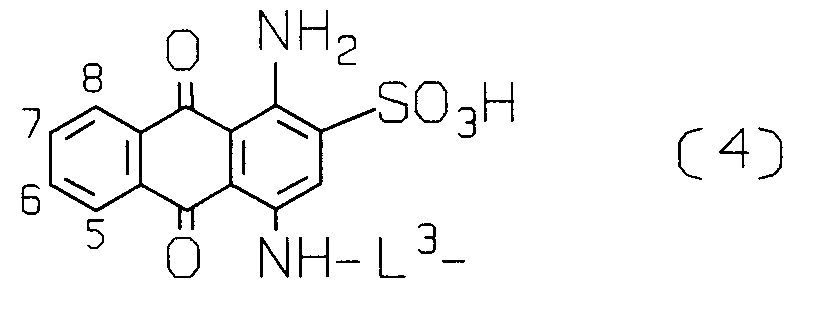
wherein the anthraquinone nucleus optionally contains a sulphonic acid group in one or more of the 5-, 6-, 7- and 8-positions and L³ is a divalent organic linking group, preferably C₂₋₄-alkylene, more preferably a radical of the benzene series, for example a phenylene, diphenylene, 4,4'-divalent stilbene or azobenzene radical which is optionally sulphonated. - Preferred phthalocyanine chromophoric groups are of the Formula (5):

wherein Pc is a metallo-phthalocyanine nucleus, preferably copper or nickel phthalocyanine; each W independently is a hydroxy or a substituted or unsubstituted amino group; L³ is a divalent organic linking group as hereinbefore defined, preferably C₂₋₄-alkylene, phenylene or sulphophenylene; and a and b each independently have a value of 1 to 3, provided that a+b is not greater than 4. - Preferred triphenodioxazine chromophoric groups are of the Formula (6):

wherein: - Z¹
- is H or a group of formula

- R¹
- is H or C₁₋₄-alkyl;
- Z
- is H, C₁₋₄-alkyl, phenyl or sulphophenyl;
- each Y
- independently is C₂₋₄-alkylene, phenylene or sulphophenylene;
- U
- is H or SO₃H;
- T² and T³
- are halo or C₁₋₄-alkyl; and
- q
- is 0 or 1.
- each Y
- is preferably -C₂H₄- or -C₃H₆-. U is preferably SO₃H.
- T² and T³
- are preferably Cl or C₁₋₄-alkyl, especially methyl.
- Preferred formazan chromophoric groups are of the Formula (7):

wherein: - X¹
- is H or SO₃H; and
- a and b
- each independently have a value of 0, 1 or 2;
- It is preferred that a and b each have a value of 1.
- In a preferred reactive dye of Formula (1), D¹ and D² are both of Formula (2), L¹ is phenylene, L² is optionally substituted naphthalene (as described above), n is 1, and T, R³, R⁴ are as hereinbefore defined.
- Although dye formulae have been shown in the form of their free acid in this specification, the formulae are also intended to include such dyes in the salt form, particularly their salts with alkali metals such as the sodium, lithium or mixed sodium/lithium salt and optionally substituted ammonium salts. The term aryl as used in this specification includes heteroaryl.
- A further feature of the present invention provides a composition comprising an inert carrier and a dye according to the invention, preferably in a weight ratio of 1:99 to 99:1, more preferably 50:1 to 1:50, especially 20:1 to 1:20. The inert carrier preferably comprises inorganic salts and optionally a de-dusting agent. Examples of inorganic salts include alkali and alkaline earth metal halides, carbonates, bicarbonates, nitrates and mixtures thereof. Dodecylbenzene may be used as de-dusting agent.
- The reactive dyes of the present invention are suitable for colouring natural and artificial textile materials containing amino or hydroxyl groups, for example textile materials such as wool, silk and cellulosic materials. The textile materials are coloured bright shades and possess good fastness to light and to wet treatments such as washing and also have good wash off properties. The fastness in the perborate wet fade test is particularly good. The dyes are found to have good solubility in water.
- A further feature of the invention comprises a process for the coloration of a textile material, especially a cellulosic textile material, comprising applying thereto a reactive dye according to the invention. For this purpose the dyes are preferably applied to the cellulosic textile material in conjunction with a treatment with an acid-binding agent, for example, sodium bicarbonate, sodium carbonate, sodium metasilicate, trisodium phosphate or sodium hydroxide, which may be applied to the cellulose textile material as an aqueous solution before, during or after the application of the dye. A temperature of 20-200°C is preferred in this process, especially 30-80°C.
- The new dyes can be applied to textile materials containing amino groups, such as wool and polyamide textile materials, from a mildly alkaline, neutral or acid dyebath. The dyebath may contain substances which are commonly used in the dyeing of textile materials containing amino groups, for example ammonium acetate, sodium sulphate, ethyl tartrate, nonionic dispersing agents such as condensates of ethylene oxide with amines, fatty alcohols or phenols, surface-active cationic agents such as quaternary ammonium salts for example cetyl trimethylammonium bromide and cetyl pyridinium bromide and organic liquids such as n-butanol and benzyl alcohol.
- The invention is illustrated but not limited by the following Examples in which all parts and percentages are by weight unless stated otherwise.
-

- 2N Sodium carbonate was added to a stirred suspension of 1-amino-8-hydroxynaphthalene-3,6-disulphonic acid (319 parts) in water (1000 parts) until a complete solution of approximately pH 6.0 was obtained.
- This solution was added dropwise to a stirred suspension obtained by gradual addition of a solution of 2,6-dichloro-s-triazine (161 parts) in acetone (800 parts by volume) to ice-water (1000 parts) at 0-5°C, the pH of the suspension being allowed to fall to 3 and then maintained at this value by addition of 2N sodium carbonate. The resultant mixture was stirred for a further 1 hour at 0-5°C and pH 3 to give a coupling component solution.
- To a stirred mixture of 4-aminophenyl-β-sulphatoethylsulphone (309 parts) in ice-water (2000 parts) at 0-5°C was added aqueous hydrochloric acid (34.5% strength, 568 parts by volume) followed by 2N sodium nitrite (568 parts by volume). The mixture was stirred for 30 minutes at 0-5°C before destroying excess nitrous acid by addition of sulphamic acid. The resultant diazonium salt suspension was added to the above coupling component solution, the pH raised to 6 by addition of sodium carbonate, and the mixture stirred for a further 2 hours at 0-5°C. The azo product was precipitated by salting with potassium chloride, isolated by filtration and dried to give a dry azo product.
- The above dry azo product (497 parts) and 1-amino-8-hydroxynaphthalene-3,6-disulphonic acid (219 parts) were stirred together in water (11,000 parts) for 20 hours at 50°C and pH 6.0 to 6.5, maintained by addition of 1N sodium carbonate as required. The resultant monoazo condensation product was precipitated by addition of potassium chloride and slow addition of acetone (3,300 parts by volume), isolated by filtration and dried.
- To a stirred mixture of 4-aminophenyl-β-sulphatoethyl sulphone (115 parts) in ice-water (425 parts) at 0-5°C was added aqueous hydrochloric acid (34.5% strength, 124 parts by volume) followed by 2N sodium nitrite (209 parts by volume). The mixture was stirred for 30 minutes at 0-5°C before destroying excess nitrous acid by addition of sulphamic acid. The resultant diazonium salt suspension was stirred with a solution of the above monoazo condensation product in water (850 parts) for 2 hours at 0-5°C and pH 6.0 to 6.5, maintained by addition of 2N sodium carbonate as required. The product was precipitated by addition of potassium chloride followed by acetone, filtered off and dried to give the alkali metal salt of the title compound (λmax 536nm).
- The salt of the title dye was applied to cotton by exhaust dyeing and was found to have very good fixation efficiency and wash-off properties.
- The method of Example 1 was repeated except that in place of 2,6-dichloro-s-triazine (161 parts) there was used 2,6-dichloro-4-methyl-s-triazine (176 parts) to give the alkali metal salt of the title compound (λmax 536nm).
- The salt of the title compound was applied to cotton by exhaust dyeing and was found to have very good fastness to light and washing.
-

- 2N Sodium hydroxide was added to a stirred suspension of 6-amino-1-hydroxynaphthalene-3-sulphonic acid (119.5 parts) in water (1500 parts) until a complete solution of pH 6.5 was obtained. This solution was added dropwise to a stirred suspension obtained by gradual addition of a solution of 2,6-dichloro-4-methyl-s-triazine (113 parts) in acetone (1250 parts by volume) to ice-water (1500 parts) at 0-5°C, the mixture being allowed to fall to pH 4 and then maintained at this pH by addition of 2N sodium carbonate. The resultant mixture was stirred for a further 2.5 hours to give a solution of the coupling component.
- To a stirred mixture of 4-aminophenyl-β-sulphatoethyl sulphone (140.5 parts) in ice-water (3000 parts) at 0-5°C was added aqueous hydrochloric acid (34.5% strength, 150 parts by volume) followed by 2N sodium nitrite (250 parts by volume). The mixture was stirred for 1 hour at 0-5°C before destroying excess nitrous acid by the addition of sulphamic acid. The resultant diazonium salt suspension was added to the above coupling component solution, the pH raised to 6 to 6.5 by addition of sodium carbonate, and the mixture stirred for a further 2 hours at 0-5°C. The azo product was precipitated by adding potassium chloride, isolated by filtration and dried.
- The above dry azo product (178 parts) and 6-amino-1-hydroxy naphthalene-3-sulphonic acid (64.5 parts) were stirred together in water (5500 parts) for 20 hours at 50°C and pH 6 to 6.5, maintained by addition of 1N sodium carbonate. The resultant solution was cooled to ambient temperature and the monoazo condensation product precipitated by salting with potassium chloride, isolated by filtration and dried.
- To a stirred mixture of 4-aminophenyl-β-sulphatoethyl sulphone (46.6 parts) in ice-water (1800 parts) and aqueous hydrochloric acid (34.5% strength, 50 parts by volume) at 0-5°C was added 2N sodium nitrite (10 parts by volume). The mixture was stirred for 1 hour at 0-5°C and then any excess of nitrous acid destroyed by addition of sulphamic acid. The resultant diazonium salt suspension was added to a solution of the above monoazo condensation product (143 parts) in water (5000 parts) and the mixture stirred at 0-5°C and pH 6-6.5 for 2 hours. The product was precipitated by adding potassium chloride, isolated by filtration and dried to give the alkali metal salt of the title compound having a λmax at 478nm.
- The salt of the title compound was applied to cotton by exhaust dyeing and was found to have good fastness to light and washing.
-
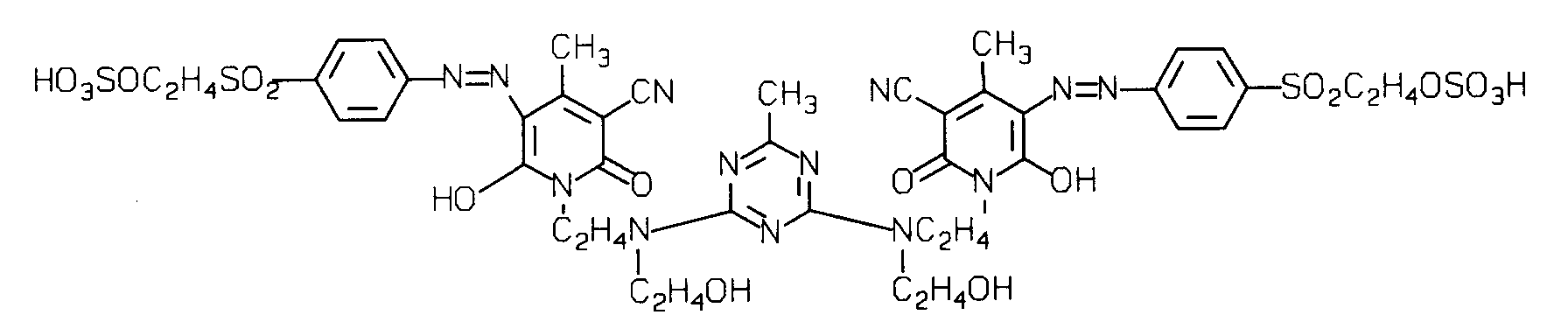
- 6-Hydroxy-1-[2-(2-hydroxyethylamino)ethyl]-4-methyl-2-oxo-1,2-dihydro-pyridine-3-carbonitrile (225 parts) was added to a stirred suspension obtained by gradual addition of a solution of 2,4-dichloro-6-methyl-s-triazine (164 parts) in acetone (1500 parts by volume) to ice-water (15000 parts) at 0-5°C and the resultant mixture stirred for 2.5 hours at 0-5°C whilst the pH of the solution was maintained at 6.0 to 6.5 by addition of 1N sodium carbonate as required. More 6-hydroxy-1-[2-(2-hydroxyethylamino)ethyl]-4-methyl-2-oxo-1,2-dihydro-pyridine-3-carbonitrile (225 parts) was added and the mixture heated to 65°C and held at this temperature for 2 hours whilst the pH of the solution was maintained at 6.0 to 6.5 to give a solution of a coupling component.
- To a stirred mixture of 4-aminophenyl-β-sulphatoethyl sulphone (562 parts), aqueous hydrochloric acid (34.5% strength, 1200 parts by volume) and ice-water (20000 parts) at 0-5°C was added 2N sodium nitrite (1100 parts by volume). The mixture was stirred for 45 minutes at 0-5°C before destroying excess nitrous acid by addition of sulphamic acid. The resultant diazonium salt suspension was added to the above coupling component solution and the resultant mixture stirred at 0-5°C for 2 hours whilst maintaining the pH at 5.5 by addition of 1N sodium carbonate as required. The disazo product was precipitated by adding KCl, isolated by filtration and dried to give the alkali metal salt of the title compound (λmax 427nm).
- The title product was applied to cotton by exhaust dyeing and was found to have good washfastness.
- The method of Example 4 may be repeated except that in place of the compound listed in Column I, there is used an equivalent amount of the compound listed in Column II:
Example Column I Column II 5 4-aminophenyl-β-sulphatoethyl sulphone 3-aminophenyl-β-sulphatoethylsulphone 6 4-aminophenyl-β-sulphatoethyl sulphone 3-amino-4-methoxyphenyl -β-sulphatoethyl sulphone 7 2,4-dichloro-6-methyl-s-triazine 2,4-dichloro-s-triazine 8 2,4-dichloro-6-methyl-s-triazine 2,4-dichloro-6-ethyl-s-triazine 9 6-hydroxyl-1-[2-(2-hydroxyethyl amino)ethyl]-4-methyl-2-oxo-1,2-dihydropyridine-3-carbonitrile 6-hydroxy-1-[2-(2-hydroxyethylamino) ethyl]-4-methyl-2-oxo-1,2-dihydropyridine-3-carbonamide -

- An azo product was prepared substantially as described in Example 3, Stages a) and b).
- The product from Stage a) (7.8g) and 4-N-(4'-aminophenyl)amino-1-aminoanthraquinone-2-sulphonic acid (2.8g) (prepared by the reaction of 1-amino-4-bromoanthraquinone-2-sulphonic acid with 1,4-diaminobenzene in the presence of sodium carbonate and copper sulphate) were stirred in water (300ml) at 45°C for 16 hours, during which the pH was maintained at 6.2 by adding sodium carbonate solution (2M) as required.
- The resultant mixture was cooled to room temperature and the product was precipitated by salting to 10% w/v with sodium chloride, collected by filtration, washed with 20% brine, and dried to give the alkali metal salt of the title compound (λmax 475nm).
- The method of Example 10 may be repeated except that in place of the compound listed in Column I, there is used an equivalent amount of the compound listed in Column II:
Example Column I Column II 11 4-aminophenyl-β-sulphatoethylsulphone 3-aminophenyl-β-sulphatoethylsulphone 12 2,4-dichloro-6-methyl-s-triazine 2,4-dichloro-s-triazine 13 4-N-(4'-aminophenyl)amino-1-aminoanthraquinone-2-sulphonic acid 4-N-(3'-aminophenyl-4'-sulphonic acid)amino-1-aminoanthraquinone-2-sulphonic acid 14 4-N-(4'-aminophenyl)amino-1-aminoanthraquinone-2-sulphonic acid 4-N-(3'-aminophenyl-4'-sulphonic acid)amino-1-amino-2-methyl-anthraquinone -

A mixture of copper phthalocyanine-N-β-aminoethylsulphonamidesulphonic acid (4.8g) (prepared as described in GB 805,562, Example 12), and the product of Example 3, Stage b) (7.8g) in water (300ml) was stirred at 45°C for 16 hours, during which the pH was maintained at 6.2 by the addition of sodium carbonate solution (2M) as required. The resultant mixture was allowed to cool to room temperature and the product was precipitated by the addition of acetone, collected by filtration, washed with acetone an dried to give the alkali metal salt of the title compound (λmax 669nm). - The title product was applied to cotton by exhaust dyeing and was found to have good light fastness.
- The method of Example 15 may be repeated except that in place of the compound listed in Column I, there is used an equivalent amount of the compound listed in Column II:
Example Column I Column II 16 CuPc(SO₃H)2.5(SO₂NHCH₂CH₂NH₂)1.5 NiPc(SO₃H)2.5(SO₂NHCH₂CH₂NH₂)1.5 17 CuPc(SO₃H)2.5(SO₂NHCH₂CH₂NH₂)1.5 CuPc(SO₃H)1.4(SO₂NHC₂H₄NHC₂H₄OH)2.6 18 Example 3, Stage b) Example 1, Stage a) 19 Example 3, Stage b) Example 25, Stage b) -

- A solution of aminobenzene-3-sulphonic acid (8.75g) in 50ml water at pH 5.5 was added dropwise, over a period of 30 minutes, to a stirred mixture of methyl trichloroquinone (13.1g) in methanol (750ml). The pH was maintained at 5 to 5.5 using sodium hydroxide solution (2M). The mixture was stirred overnight at room temperature and then filtered. The solution was evaporated to dryness, the residue re-stirred in water (550ml) and the monoanilide product filtered off, washed with water and dried.
- A solution of N-(2-aminoethyl)-4-aminoaniline-2-sulphonic acid (7.0g) in water (50ml) at pH 7 was added to a stirred mixture of the product from Stage a) (7.0g) in water (75ml) and methanol (75ml) at pH 6.5. The mixture was warmed to 45°C, stirred for 2½ hours at pH 6.5-7, allowed to cool to room temperature and stirred for 20 hours. The dianilide product was collected by filtration, washed with methanol and cold water and dried.
- The product from Stage b) (2.0g) was added to cold 10% oleum (25ml). Ammonium persulphate (1.0g) was added and the mixture was warmed to 45°C and stirred for 5 hours. The mixture was allowed to cool to room temperature and poured into ice-water (300ml). The resultant precipitate was collected by filtration, washed with water and acetone and dried, to give a triphenodioxazine dyebase.
- A mixture of the product from Stage c) (1.9g) and the product from Example 3, Stage b) (5.4g) in water (150ml) was stirred at 45°C for 16 hours, during which the pH was maintained at 6.2 by adding sodium carbonate solution (2M) as required. The resultant solution was cooled to room temperature and the product precipitated by the addition of acetone, collected by filtration, washed with acetone and dried to give the alkali metal salt of the title compound (λmax 489nm).
- The method of Example 20 may be repeated except that in place of the compound listed in Column I, there is used an equivalent amount of the compound listed in Column II:
Example Column I Column II 21 Example 3, Stage b) Example 1, Stage a) 22 Example 3, Stage b) Example 25, Stage b) 23 2,4-dichloro-6-methyl-s-triazine 2,4-dichloro-s-triazine 24 Methyltrichloroquinone Tetrachloroquinone -

- Sodium carbonate solution (2M) was added to a stirred suspension of 1-amino-8-hydroxynaphthalene-3,6-disulphonic acid (23.8g) in water (450ml) until a complete solution at approximately pH 6.0 was obtained. The solution was added dropwise to a stirred suspension obtained by gradual addition of a solution of 2,4-dichloro-6-methyl-s-triazine (13.21g) in acetone (150ml) to ice-water (450ml) at 0-5°C, the pH of the suspension being allowed to fall to 3 and then maintained at this value by addition of 2M sodium carbonate. The resultant mixture was stirred for a further 1 hour at 0-5°C and pH 3 to give a coupling component solution.
- 4-Amino-β-sulphatoethylsulphone was diazotised using the general method of Example 3, Stage b). The resultant diazonium salt suspension was not isolated, instead it was added to the product of Stage a), the pH raised to 6 by addition of 2M sodium carbonate, and the mixture stirred for a further 2 hours at 0-5°C. The resultant azo product was precipitated by adding KCl, isolated by filtration and dried.
- A mixture of the product from Stage b) (5.17g) and the copper salt of N-(2-hydroxy-5-sulpho-3-aminophenyl)-N'-(2-carboxy-4'-sulphophenyl)-ms-phenylformazan (21.22g) (obtained by coupling diazotised 6-acetylamino-2-aminophenol-4-sulphonic acid with the hydrazone from benzaldehyde and 2-carboxyphenylhydrazine-4-sulphonic acid, coppering and hydrolysing the acetyl group with dilute caustic soda) in water (150ml) was stirred for 5 hours at 50-55°C during which the pH was maintained at 6 to 6.5 by adding sodium carbonate solution (2M) as required. The solution was cooled to room temperature and the product was precipitated by the addition of acetone, collected by filtration, washed with acetone and dried to give the alkali metal salt of the title compound (λmax 550nm).
- The method of Example 25 may be repeated except that in place of the compound listed in Column I, there is used an equivalent amount of the compound listed in Column II:
Example Column I Column II 26 Example 25, Stage b) Example 3, Stage b) 27 Example 25, Stage b) Example 1, Stage a) 28 4-aminophenyl-β-sulphatoethyl sulphone 3-aminophenyl-β-sulphatoethylsulphone 29 2,4-dichloro-6-methyl-s-triazine 2,4-dichloro-s-triazine -

- A solution of the product from Example 25, Stage b) (10.35g) and 1-amino-8-hydroxynaphthalene-4,6-disulphonic acid (6.89g) in water (150ml) was stirred at 45°C for 5 hours, maintaining the pH at 6 to 6.5 by the addition of sodium carbonate solution (2M) as required. The solution was allowed to cool to room temperature and the product precipitated by the addition of acetone. The dyebase product was collected by filtration, washed with 15% w/v KCl solution and acetone, then dried.
- 4-Aminophenyl-β-sulphatoethylsulphone (1.97g) was diazotised using the general method of Example 3, Stage b). The resultant diazonium salt suspension was added to a solution of the product of Stage a) (31.78g) in ice-water (150ml) and the mixture stirred for 1½ hours at 0-5°C, maintaining the pH at 6 to 6.5 by the addition of sodium carbonate as required. The product was precipitated by salting to 10% w/v with NaCl and then adding acetone (200ml). The product was collected by filtration washed with acetone and dried to give the alkali metal salt of the title compound (λmax 522nm).
- The title product was applied to cotton by exhaust dyeing and was found to have good washfastness.
-

- The method of Example 3 was repeated in a similar manner except that in Stage a) 6-(N-methyl)amino-1-hydroxynaphthalene-3-sulphonic acid used in place of 6-amino-1-hydroxynaphthalene-3-sulphonic acid.
- The title product was obtained in the form of its alkali metal salt (λmax 479nm).
- The title product was applied to cotton by exhaust dyeing and was found to have good fixation.
-

- The method of Example 3 was repeated in a similar manner except that in Stage a) 2,6-dichloro-4-methanesulphonmethylamido-s-triazine was used in place of 2,6-dichloro-4-methyl-s-triazine.
- The title product was obtained in the form of its alkali metal salt (λmax 484nm).
- The method of Example 1 may be repeated except that in place of 2,6-dichloro-s-triazine there is used an equivalent amount of 2,6-dichloro-4-methanesulphonmethylamido-s-triazine.
- The method of Example 4 may be repeated except that in place of 2,4-dichloro-6-methyl-s-triazine there is used an equivalent amount of 2,6-dichloro-4-methanesulphonmethylamido-s-triazine.
- The method of Example 25 may be repeated except that in place of 2,4-dichloro-6-methyl-s-triazine there is used an equivalent amount of 2,6-dichloro-4-methanesulphonmethylamido-s-triazine.
Claims (10)
- A reactive dye comprising a 1,3,5- s-triazine group having a chromophoric group at two of the 2-, 4- and 6-positions and a substituent at the remaining 2-, 4- or 6-position selected from H, optionally substituted alkyl, optionally substituted phenyl, -CH(CO₂R¹)₂, -NR¹SO₂R³ and -SO₂R³, wherein R¹ is H or alkyl and and R² is alkyl.
- A reactive dye according to Claim 1 wherein the substituent at the remaining 2-, 4- or 6-position is H, optionally substituted alkyl or optionally substituted phenyl.
- A reactive dye according to Claim 1 wherein the substituent at the remaining 2-, 4- or 6-positions is H or C₁₋₄-alkyl.
- A reactive dye of the formula:
 D¹ and D² are each independently chromophoric groups;R³ and R⁴ are each independently H or C₁₋₄-alkyl; andT is H, optionally substituted alkyl, optionally substituted phenyl, -CH(CO₂R¹)₂, -NR¹SO₂R² or -SO₂R²;each R¹ is H or alkyl; andR² is alkyl.
 - A reactive dye according to any one of the preceding claims which is free from organic chlorine.
- A reactive dye according to Claim 4 wherein D¹ and D² are different to each other.
- A reactive dye according to Claim 4 wherein D¹ is an azo group and D² is an anthraquinone, formazan, phthalocyanine or triphenodioxazine group.
- A reactive dye according to Claim 4 or Claim 6 wherein D¹ and D² are of the Formula (2):
V-SO₂-L¹-(-N=N-L²-)n- (2)
wherein:V is vinyl or a group convertible to vinyl on treatment with aqueous alkali;L¹ and L² are each independently an optionally substituted mono- or dicyclic aryl or heteroaryl radical; andn is 1 or 2. - A reactive dye according to Claim 8 wherein L² is of Formula (3):
 q is 0 or 1.
 - A process for the coloration of a textile material comprising applying thereto a reactive dye according to any one of Claims 1, 4 and 8.
Applications Claiming Priority (2)
| Application Number | Priority Date | Filing Date | Title |
|---|---|---|---|
| GB9221140 | 1992-10-08 | ||
| GB929221140A GB9221140D0 (en) | 1992-10-08 | 1992-10-08 | Chemical compounds |
Publications (3)
| Publication Number | Publication Date |
|---|---|
| EP0592105A2 true EP0592105A2 (en) | 1994-04-13 |
| EP0592105A3 EP0592105A3 (en) | 1994-11-09 |
| EP0592105B1 EP0592105B1 (en) | 1999-04-14 |
Family
ID=10723136
Family Applications (1)
| Application Number | Title | Priority Date | Filing Date |
|---|---|---|---|
| EP93307045A Expired - Lifetime EP0592105B1 (en) | 1992-10-08 | 1993-09-07 | Reactive dyes |
Country Status (6)
| Country | Link |
|---|---|
| US (1) | US5420257A (en) |
| EP (1) | EP0592105B1 (en) |
| JP (1) | JPH06212085A (en) |
| AT (1) | ATE178928T1 (en) |
| DE (1) | DE69324430T2 (en) |
| GB (1) | GB9221140D0 (en) |
Cited By (1)
| Publication number | Priority date | Publication date | Assignee | Title |
|---|---|---|---|---|
| DE102009047183A1 (en) | 2008-12-19 | 2010-07-15 | Basf Se | Dye mixture, useful for coloring leather, comprises a first anionic dye, a second anionic dye, and third anionic dye, where the first and third anionic dye are azo dyes, and the second anionic dye is the azo dye or napthalene-azo dye |
Families Citing this family (3)
| Publication number | Priority date | Publication date | Assignee | Title |
|---|---|---|---|---|
| TW241289B (en) * | 1993-05-17 | 1995-02-21 | Ciba Geigy | |
| US5886159A (en) * | 1996-08-23 | 1999-03-23 | Sumitomo Chemical Company, Limited | Bisazo compound and method for dyeing or printing fibrous materials using the same |
| WO2013189813A1 (en) | 2012-06-18 | 2013-12-27 | Dystar Colours Distribution Gmbh | Reactive dyes, process for the production thereof and their use |
Family Cites Families (10)
| Publication number | Priority date | Publication date | Assignee | Title |
|---|---|---|---|---|
| DE551884C (en) * | 1930-02-20 | 1932-06-06 | Ig Farbenindustrie Ag | Process for the preparation of Kuepen dyes of the anthraquinone series |
| GB902101A (en) * | 1959-11-03 | 1962-07-25 | British Oxygen Co Ltd | Treatment of molten ferrous metal |
| CH407373A (en) * | 1960-10-28 | 1966-02-15 | Ciba Geigy | Process for the production of new dyes |
| NL278003A (en) * | 1960-10-28 | |||
| DE2748966C3 (en) * | 1977-11-02 | 1980-08-21 | Hoechst Ag, 6000 Frankfurt | Water-soluble dyes, processes for their production, their use as fiber-reactive dyes for dyeing and printing cellulose and polyamide fiber materials |
| DE2748965C3 (en) * | 1977-11-02 | 1981-10-01 | Hoechst Ag, 6000 Frankfurt | Water-soluble dyes, processes for their production, their use as fiber-reactive dyes for dyeing and printing fiber materials |
| CH636367A5 (en) * | 1978-05-17 | 1983-05-31 | Ciba Geigy Ag | METHOD FOR THE PRODUCTION OF KITCHEN COLORS. |
| DE4021067A1 (en) * | 1990-07-03 | 1992-01-09 | Hoechst Ag | DISAZO COMPOUNDS, METHOD FOR THE PRODUCTION THEREOF AND THEIR USE AS DYES |
| GB9021021D0 (en) | 1990-09-27 | 1990-11-07 | Gkn Cardantec | Double hookes universal joints |
| DE4107692A1 (en) * | 1991-03-09 | 1992-09-17 | Basf Ag | DOUBLE PHENYLAZO OR NAPHTHYLAZOBENZOLS WITH SEVERAL REACTIVE GROUPS AND THEIR INTERMEDIATES |
-
1992
- 1992-10-08 GB GB929221140A patent/GB9221140D0/en active Pending
-
1993
- 1993-09-07 EP EP93307045A patent/EP0592105B1/en not_active Expired - Lifetime
- 1993-09-07 DE DE69324430T patent/DE69324430T2/en not_active Expired - Fee Related
- 1993-09-07 AT AT93307045T patent/ATE178928T1/en not_active IP Right Cessation
- 1993-09-17 US US08/126,697 patent/US5420257A/en not_active Expired - Fee Related
- 1993-10-08 JP JP5252938A patent/JPH06212085A/en active Pending
Cited By (1)
| Publication number | Priority date | Publication date | Assignee | Title |
|---|---|---|---|---|
| DE102009047183A1 (en) | 2008-12-19 | 2010-07-15 | Basf Se | Dye mixture, useful for coloring leather, comprises a first anionic dye, a second anionic dye, and third anionic dye, where the first and third anionic dye are azo dyes, and the second anionic dye is the azo dye or napthalene-azo dye |
Also Published As
| Publication number | Publication date |
|---|---|
| EP0592105A3 (en) | 1994-11-09 |
| GB9221140D0 (en) | 1992-11-25 |
| EP0592105B1 (en) | 1999-04-14 |
| DE69324430D1 (en) | 1999-05-20 |
| DE69324430T2 (en) | 1999-09-30 |
| ATE178928T1 (en) | 1999-04-15 |
| US5420257A (en) | 1995-05-30 |
| JPH06212085A (en) | 1994-08-02 |
Similar Documents
| Publication | Publication Date | Title |
|---|---|---|
| JPS603109B2 (en) | Novel reactive dye and its manufacturing method | |
| GB2034343A (en) | Reactive dyestuffs | |
| JPS6014045B2 (en) | Reactive dye and its manufacturing method | |
| US2929809A (en) | New complex metal compounds of monoazo-dyestuffs | |
| JPH05125288A (en) | Reactive azo dye | |
| US4474697A (en) | Fluorotriazine-group-containing azo dyestuffs | |
| US5789557A (en) | Reactive azo dyes with a coupler of the aminonaphthalene series | |
| US4855411A (en) | Water-soluble, monoazo dyes containing a ureido group and two sulfonyl fiber-reactive groups | |
| US5149790A (en) | Bis chlorotriazine reactive dyes containing a benzylamine linking group | |
| US5623061A (en) | Benzene or naphthalene azo dyes containing SO2 X and triazinyl fiber reactive groups, use thereof to dye materials, and materials dyed therewith | |
| US5976197A (en) | Dyeing process and dyes | |
| EP0592105B1 (en) | Reactive dyes | |
| US5292870A (en) | Reactive azo dyes including a triazine ring and sulphatovinyl or sulphatoethyl substituents | |
| US4242259A (en) | Anthraquinone-azo reactive dyestuffs | |
| US5847111A (en) | Aluminum phthalocyanine reactive dyes | |
| US3438962A (en) | Monoazo-triazine containing dyestuffs | |
| US4129736A (en) | Triazinyl-antraquinone dyestuffs | |
| EP0611259A1 (en) | Fibre-reactive phthalocyanine dyes | |
| US5223607A (en) | Reactive azo dyes with at lest two reactive halotriazine groups | |
| JPS62283159A (en) | Water-soluble azoe compound, its production and use thereof as dye | |
| US6762288B2 (en) | Reactive azo dyes | |
| JPH0135955B2 (en) | ||
| US5451666A (en) | Reactive dyes having a triazine group which is substituted by hydrogen or an alkyl group | |
| GB2039289A (en) | Reactive dyestuffs | |
| US3546201A (en) | Reactive azo dyestuffs containing an n-omega methane sulfonic acid-n-triazinyl aniline group |
Legal Events
| Date | Code | Title | Description |
|---|---|---|---|
| PUAI | Public reference made under article 153(3) epc to a published international application that has entered the european phase |
Free format text: ORIGINAL CODE: 0009012 |
|
| AK | Designated contracting states |
Kind code of ref document: A2 Designated state(s): AT BE CH DE ES FR GB IT LI NL PT |
|
| PUAL | Search report despatched |
Free format text: ORIGINAL CODE: 0009013 |
|
| 17P | Request for examination filed |
Effective date: 19940905 |
|
| AK | Designated contracting states |
Kind code of ref document: A3 Designated state(s): AT BE CH DE ES FR GB IT LI NL PT |
|
| RAP1 | Party data changed (applicant data changed or rights of an application transferred) |
Owner name: BASF AKTIENGESELLSCHAFT |
|
| GRAG | Despatch of communication of intention to grant |
Free format text: ORIGINAL CODE: EPIDOS AGRA |
|
| 17Q | First examination report despatched |
Effective date: 19980518 |
|
| GRAG | Despatch of communication of intention to grant |
Free format text: ORIGINAL CODE: EPIDOS AGRA |
|
| GRAG | Despatch of communication of intention to grant |
Free format text: ORIGINAL CODE: EPIDOS AGRA |
|
| GRAH | Despatch of communication of intention to grant a patent |
Free format text: ORIGINAL CODE: EPIDOS IGRA |
|
| GRAH | Despatch of communication of intention to grant a patent |
Free format text: ORIGINAL CODE: EPIDOS IGRA |
|
| GRAA | (expected) grant |
Free format text: ORIGINAL CODE: 0009210 |
|
| AK | Designated contracting states |
Kind code of ref document: B1 Designated state(s): AT BE CH DE ES FR GB IT LI NL PT |
|
| PG25 | Lapsed in a contracting state [announced via postgrant information from national office to epo] |
Ref country code: NL Free format text: LAPSE BECAUSE OF FAILURE TO SUBMIT A TRANSLATION OF THE DESCRIPTION OR TO PAY THE FEE WITHIN THE PRESCRIBED TIME-LIMIT Effective date: 19990414 Ref country code: IT Free format text: LAPSE BECAUSE OF FAILURE TO SUBMIT A TRANSLATION OF THE DESCRIPTION OR TO PAY THE FEE WITHIN THE PRESCRIBED TIME-LIMIT;WARNING: LAPSES OF ITALIAN PATENTS WITH EFFECTIVE DATE BEFORE 2007 MAY HAVE OCCURRED AT ANY TIME BEFORE 2007. THE CORRECT EFFECTIVE DATE MAY BE DIFFERENT FROM THE ONE RECORDED. Effective date: 19990414 Ref country code: FR Free format text: LAPSE BECAUSE OF FAILURE TO SUBMIT A TRANSLATION OF THE DESCRIPTION OR TO PAY THE FEE WITHIN THE PRESCRIBED TIME-LIMIT Effective date: 19990414 Ref country code: ES Free format text: THE PATENT HAS BEEN ANNULLED BY A DECISION OF A NATIONAL AUTHORITY Effective date: 19990414 Ref country code: BE Free format text: LAPSE BECAUSE OF FAILURE TO SUBMIT A TRANSLATION OF THE DESCRIPTION OR TO PAY THE FEE WITHIN THE PRESCRIBED TIME-LIMIT Effective date: 19990414 Ref country code: AT Free format text: LAPSE BECAUSE OF FAILURE TO SUBMIT A TRANSLATION OF THE DESCRIPTION OR TO PAY THE FEE WITHIN THE PRESCRIBED TIME-LIMIT Effective date: 19990414 |
|
| REF | Corresponds to: |
Ref document number: 178928 Country of ref document: AT Date of ref document: 19990415 Kind code of ref document: T |
|
| REG | Reference to a national code |
Ref country code: CH Ref legal event code: EP |
|
| REF | Corresponds to: |
Ref document number: 69324430 Country of ref document: DE Date of ref document: 19990520 |
|
| PG25 | Lapsed in a contracting state [announced via postgrant information from national office to epo] |
Ref country code: PT Free format text: LAPSE BECAUSE OF FAILURE TO SUBMIT A TRANSLATION OF THE DESCRIPTION OR TO PAY THE FEE WITHIN THE PRESCRIBED TIME-LIMIT Effective date: 19990714 |
|
| NLV1 | Nl: lapsed or annulled due to failure to fulfill the requirements of art. 29p and 29m of the patents act | ||
| PG25 | Lapsed in a contracting state [announced via postgrant information from national office to epo] |
Ref country code: GB Free format text: LAPSE BECAUSE OF NON-PAYMENT OF DUE FEES Effective date: 19990907 |
|
| EN | Fr: translation not filed | ||
| PLBE | No opposition filed within time limit |
Free format text: ORIGINAL CODE: 0009261 |
|
| STAA | Information on the status of an ep patent application or granted ep patent |
Free format text: STATUS: NO OPPOSITION FILED WITHIN TIME LIMIT |
|
| 26N | No opposition filed | ||
| GBPC | Gb: european patent ceased through non-payment of renewal fee |
Effective date: 19990907 |
|
| PGFP | Annual fee paid to national office [announced via postgrant information from national office to epo] |
Ref country code: DE Payment date: 20010922 Year of fee payment: 9 |
|
| PGFP | Annual fee paid to national office [announced via postgrant information from national office to epo] |
Ref country code: CH Payment date: 20010925 Year of fee payment: 9 |
|
| PG25 | Lapsed in a contracting state [announced via postgrant information from national office to epo] |
Ref country code: LI Free format text: LAPSE BECAUSE OF NON-PAYMENT OF DUE FEES Effective date: 20020930 Ref country code: CH Free format text: LAPSE BECAUSE OF NON-PAYMENT OF DUE FEES Effective date: 20020930 |
|
| PG25 | Lapsed in a contracting state [announced via postgrant information from national office to epo] |
Ref country code: DE Free format text: LAPSE BECAUSE OF NON-PAYMENT OF DUE FEES Effective date: 20030401 |
|
| REG | Reference to a national code |
Ref country code: CH Ref legal event code: PL |