EP0587712B1 - Hydrobehandlung zur erhöhung des viskositätsindexes von schmierölen - Google Patents
Hydrobehandlung zur erhöhung des viskositätsindexes von schmierölen Download PDFInfo
- Publication number
- EP0587712B1 EP0587712B1 EP92912327A EP92912327A EP0587712B1 EP 0587712 B1 EP0587712 B1 EP 0587712B1 EP 92912327 A EP92912327 A EP 92912327A EP 92912327 A EP92912327 A EP 92912327A EP 0587712 B1 EP0587712 B1 EP 0587712B1
- Authority
- EP
- European Patent Office
- Prior art keywords
- catalyst
- precursor
- sulfide
- bulk
- ligand
- Prior art date
- Legal status (The legal status is an assumption and is not a legal conclusion. Google has not performed a legal analysis and makes no representation as to the accuracy of the status listed.)
- Expired - Lifetime
Links
Images
Classifications
-
- B—PERFORMING OPERATIONS; TRANSPORTING
- B01—PHYSICAL OR CHEMICAL PROCESSES OR APPARATUS IN GENERAL
- B01J—CHEMICAL OR PHYSICAL PROCESSES, e.g. CATALYSIS OR COLLOID CHEMISTRY; THEIR RELEVANT APPARATUS
- B01J27/00—Catalysts comprising the elements or compounds of halogens, sulfur, selenium, tellurium, phosphorus or nitrogen; Catalysts comprising carbon compounds
- B01J27/02—Sulfur, selenium or tellurium; Compounds thereof
- B01J27/04—Sulfides
- B01J27/047—Sulfides with chromium, molybdenum, tungsten or polonium
- B01J27/051—Molybdenum
- B01J27/0515—Molybdenum with iron group metals or platinum group metals
-
- C—CHEMISTRY; METALLURGY
- C10—PETROLEUM, GAS OR COKE INDUSTRIES; TECHNICAL GASES CONTAINING CARBON MONOXIDE; FUELS; LUBRICANTS; PEAT
- C10G—CRACKING HYDROCARBON OILS; PRODUCTION OF LIQUID HYDROCARBON MIXTURES, e.g. BY DESTRUCTIVE HYDROGENATION, OLIGOMERISATION, POLYMERISATION; RECOVERY OF HYDROCARBON OILS FROM OIL-SHALE, OIL-SAND, OR GASES; REFINING MIXTURES MAINLY CONSISTING OF HYDROCARBONS; REFORMING OF NAPHTHA; MINERAL WAXES
- C10G2400/00—Products obtained by processes covered by groups C10G9/00 - C10G69/14
- C10G2400/10—Lubricating oil
Definitions
- the Viscosity Index of lubricating and speciality oils can be increased by hydrotreating said oil employing as the hydrotreating catalyst a bulk Ni/Mn/Mo or Cr/Ni/Mo sulfide catalyst prepared from ligated, e.g. ethylene diamine metal complexes wherein the Ni/Mn/Mo sulfide catalyst is prepared from the oxide precursor with subsequent sulfiding while the Cr/Ni/Mo sulfide catalyst is prepared from the sulfide precursor in the presence of H 2 S/H 2 .
- Raffinate hydrotreating and hydrocracking processes to produce lube stocks are well known.
- these processes employ catalysts which comprise metal oxides or sulfides supported on alumina or silica-alumina.
- Metals usually include nickel, molybdenum, cobalt, manganese, tungsten, etc. and mixtures thereof in the oxide or sulfide state.
- the catalyst is in the oxide state the environment of use being one containing sulfur containing species converts the metal oxides into metal sulfides.
- the objectives in the hydrotreater are to increase VI and saturates levels.
- Catalysts used today in lubes hydrotreating do not perform this function very well insofar as they are employed principally for hydrodesulfurization, hydrodenitrogenation, color improvement and residual extraction solvent removal.
- High pressure hydrocracking of distillates or deasphalted oil is an acknowledged alternative to solvent extraction and, in the case of distillate hydrocracking all of the VI increase, saturates increase and aromatics decrease are achieved by the catalytic conversion.
- the major reactions which contribute to VI increase are of the ring opening type, whether the ring is aromatic or cyclic saturated. Hydrogenation will contribute to a lesser degree to VI increase. At low severity, hydrodesulfurization will give a 3-4 VI unit increase, most likely the result of ring opening that occurs with the hydrodesulfurization of thiophenic structures.
- US 4,650,563 teaches molybdenum and/or tungsten hydrotreating catalysts prepared from promoter metal thiomolybdate and/or thiotungstate complexes and their use as hydrotreating catalysts.
- the catalysts are prepared by heating one or more catalyst precursors under oxygen-free conditions in the presence of sulfur at a temperature of at least about 150°c.
- the catalyst precursors will be one or more compounds of the formula (ML)(Mo y W 1-y S 4 ) wherein M comprises one or more divalent promoter metals selected from the group consisting of Ni, Co, Zn, Cu and mixtures thereof, wherein y is any value ranging from 0 to 1 and wherein L is one or more neutral, nitrogen containing ligands at least one of which is a chelating polydentate ligand. L may be ethylene diamine.
- US 4,716,139 teaches a catalyst composition comprising an amorphous sulfide of trivalent chromium and at least one metal selected from the group consisting of (a) molybdenum, tungsten and mixtures thereof and (b) mixtures of (a) with iron, nickel, cobalt, manganese, copper, zinc and mixtures thereof.
- the catalyst is prepared by heating one or more precursors at a temperature of at least about 200°C under oxygen-free conditions in the presence of sulfur, wherein said precursor is selected from the group consisting of [Cr 1-z M z LX y ](MoS 4 ) n ,[Cr 1-z M z LX y ](WS 4 ) n and mixtures thereof wherein M is one or more divalent promoter metals selected from the group consisting of Mn, Fe, Co, Ni, Cu, Zn and mixtures thereof, wherein L is one or more neutral nitrogen-containing ligands, wherein ligand X is a singly-charged anionic species such as NO 2 - , OH - , Cl - , etc.
- the catalysts are good hydroprocessing catalysts, particularly hydrotreating catalysts. These catalysts were demonstrated for their HDS and HDN ability on light catalytic cycle oil (LCCO).
- U.S. 4,663,023 teaches hydrotreating with self promoted molybdenum and Tungsten sulfide catalysts.
- Catalysts are made from precursors which are one or more compounds of the formula ML(MoyW 1-y O 4 ) wherein M is one or more promoter metals selected from the group consisting essentially of Mn, Fe, Co, Ni, Cu, Zn and mixtures thereof 0 ⁇ y ⁇ 1 and L is a neutral nitrogen containing ligand.
- M is one or more promoter metals selected from the group consisting essentially of Mn, Fe, Co, Ni, Cu, Zn and mixtures thereof 0 ⁇ y ⁇ 1 and L is a neutral nitrogen containing ligand.
- This patent would, therefor, embrace Mn/Ni/Mo sulfide and Ni/Mo sulfide catalysts.
- U.S. 4,698,145 teaches the upgrading of hydrocarbon feeds by use of a supported self-promoted catalyst.
- the catalyst is prepared by heating a composite of support material and one or more catalyst precursor salts under oxygen-free conditions and in the presence of sulfur.
- the precursor salt or salts are of the general formula (HL)(Mo y W 1-y S 4 ) wherein M is one or more promoter metals selected from the group consisting essentially of Mn, Fe, Co, Ni, Zn and mixtures thereof, 0 ⁇ y ⁇ 1, and L is a neutral, nitrogen containing ligand.
- This patent would, therefore, embrace supported Mn/Ni/Mo sulfide and supported Ni/Mo sulfide catalysts.
- the claims recite lube oil as one of the hydrocarbon feeds treated using this class of catalysts in general.
- U.S. 4,595,672 is directed to a method for making self-promoted sulfide hydrotreating catalysts.
- the catalysts are made from precursors which are one or more compounds of the formula ML(Mo y W 1-y O 4 ) where M is one or more promoter metals selected from the group consisting essentially of Mn, Fe, Co, Ni, Cu, Zn and mixtures thereof an 0 ⁇ y ⁇ 1.
- M is one or more promoter metals selected from the group consisting essentially of Mn, Fe, Co, Ni, Cu, Zn and mixtures thereof an 0 ⁇ y ⁇ 1.
- This patent would, therefore, embrace Ni/Mn/Mo sulfide and Ni/Mo sulfide catalytic materials.
- L is a neutral nitrogen containing ligand.
- U.S. 4,668,376 teaches supported Mn sulfide promoted Mo and W sulfide hydroprocessing catalysts.
- the catalysts are made from thiometallate precursor salts of the formula (ML)(Mo y W 1-y S 4 ) where M comprises one or more divalent promoter metals selected from Mn and mixtures of Mn with one or more of Ni, Co, Cu, Zn or mixtures thereof any 0 ⁇ y ⁇ 1 and L is a neutral nitrogen containing ligand.
- This patent would, therefore, embrace Ni/Mn/Mo sulfide and Ni/Mo sulfide catalytic materials.
- the catalyst comprises a sulfide of (1) chromium, (2) Mo, W or mixtures thereof and (3) at least one metal selected from the group consisting of Ni, Co, Mn, Cu, Zn and mixtures thereof, and mixtures thereof with Fe.
- the catalysts are made by compositing a pre-selected quantity of support material with a precursor comprising a mixture of (1) hydrated oxide of trivalent chromium and (2) a salt containing a thiometallate anion of Mo or W and a cation comprising at least one divalent promoter metal.
- This patent would, therefore, embrace supported Cr/Ni/Mo sulfide catalyst and claims the use of these catalyst in general for hydroprocessing hydrocarbon feeds, including lube oil.
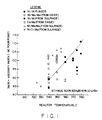
- Figure 1 compares the 360°C + product VI as a function of reactor temperature for five bulk metal catalysts and a Ni/W/F/Al 2 O 3 reference catalyst.
- Lubricating and/or specialty oil stocks such as deasphalted oil stocks, lube oil distillates, and solvent extracted lube oil raffinates can have their viscosity indexes increased by hydrotreating, employing specific bulk metal sulfide hydrotreating catalysts selected from the group consisting of bulk Cr/Ni/Mo sulfide catalyst, bulk Ni/Mo/Mn sulfide catalyst and mixtures thereof wherein the catalysts are prepared from specific metal complexes and wherein the Ni/Mn/Mo sulfide catalyst is prepared from the oxide precursor decomposed in an inert atmosphere such as N 2 and subsequently sulfided using H 2 S/H 2 and the Cr/Ni/Mo sulfide catalyst is prepared from the sulfide precursor and decomposed in a non-oxidizing, sulfur containing atmosphere.
- specific bulk metal sulfide hydrotreating catalysts selected from the group consisting of bulk Cr/Ni/Mo sulfide catalyst, bulk Ni
- the feed stocks are contacted with the catalyst under hydrotreating conditions comprising temperatures in the range of about 200 to 450°C, preferably about 300 to 380°C, pressures in the range of about 300 to 3000 psi (20.7 to 206.9 bar), preferably at least about 1000 psi (69 bar), space velocity in the range of about 0.1 to 5.0 v/v/hr., preferably about 0.5 to 2.0 v/v/hr.
- a treat gas rate in the range of about 200 to 20,000 SCF H 2 /bbl (35.6 to 3557.9 m 3 H 2 /m 3 feed), preferably about 700 to 5,000 SCF H 2 /bbl (124.5 to 889.5 m 3 H 2 /m 3 feed).
- the ligand or ligands L will generally have a denticity of six and will be one or more neutral, nitrogen containing ligands wherein at least one of said ligands is a multi-dentate chelating ligand which chelates the metal cation of the metal salt to form a chelated metal species such as [ML] 2+ , where M is Ni or Cr and Mn.
- ligand is used to designate functional coordinating groups which have one or more pairs of electrons available for the formation of coordinate bonds.
- Ligands that can form more than one bond with a metal ion are called polydentate while ligands that can form only one bond with a metal ion are called monodentate.
- Monodentate ligands are not capable of forming chelates.
- L will be one or more polydentate chelating ligands.
- the denticity of the ligand L will generally be six, because the promoter metal cations prefer six-fold coordination. Hence, if more than one species of ligand is employed in the precursor molecule, the denticity of the ligand species will usually add up to six. It should be understood that it is possible for ligand L to have a total denticity of less than six, but in most cases L will have a total denticity of six.
- L will be three bidentate ligands, two tridentate ligands, a mixture of a bidentate and a quadridentate ligand, a hexadentate ligand or a mixture of a polydentate ligand with monodentate ligands so long as the combination has a total denticity of six.
- the ligands useful in this invention include alkyl and aryl amines and nitrogen heterocycles. Illustrative but non-limiting examples of ligands useful in the catalyst precursors of this invention are set forth below.
- Monodentate ligands will include NH 3 as well as alkyl and aryl amines such as ethyl amine, dimethyl amine, pyridine, etc.
- Useful chelating bidentate amine ligands are illustrated by ethylenediamine, 2,2'-bipyridine, o-phenylene diamine, tetramethylethylenediamine and propane-1,3 diamine.
- useful chelating tridentate amine ligands are represented by terpyridine and diethylenetriamine while triethylenetetramine is illustrative of a useful chelating quadridentate amine ligands.
- Useful chelating pentadentate ligands include tetraethylenepentamine while sepulchrate (an octazacryptate) is illustrative of a suitable chelating hexadentate ligand.
- sepulchrate an octazacryptate
- polydentate alkyl amines for L.
- alkyl amines that are useful in the catalyst precursor of this invention include ethylenediamine, diethylenetriamine, and tetraethylenetetramine. It is particularly preferred to use bidentate and tridentate alkyl amines such as ethylenediamine, (en) and diethyleneriamine, (dien).
- the precursor salts useful in forming the catalysts of this invention and methods for preparing them are known in the art.
- An article by Diemann and Mueller titled Thio and Seleno Compounds of the Transition Metals With d o configuration published in COORD. CHEM. REV. 10:79-122 provides a review of known salts.
- the precursor salts useful for forming the catalysts useful in this invention may be prepared by mixing an aqueous solution of ammonium thiomolybdate with an aqueous solution of the chelated promoter metal cation [ML] 2+ which results in the formation of the precursor salt as a precipitate which is readily recovered.
- the chelating promoter cation is easily formed by, for example, mixing an aqueous solution of one or more water soluble promoter metal salts with the ligand or mixture of ligands.
- the water soluble salt may be any water soluble salt that is convenient to use such as a halide, sulfate, perchlorate, acetate, nitrate etc.
- an aqueous solution of ammonium thiomolybdate may be mixed with the ligand with the resulting solution mixed with an aqueous solution of promoter metal salt or the salt can be added to the ligand and dissolved into the solution of thiomolybdate and/or thiotungstate.
- the catalyst precursor preparation is not intended to be limited to aqueous media.
- the [Ni(L) 3 ](Mn(L) 3 )[MoO 4 ] 2 precursor is converted into the bulk catalyst by decomposing the precursor complex under inert conditions, such as in the presence of N 2 or an inert gas at 300 to 400°C.
- the decomposed material is subsequently sulfided using H 2 S/H 2 at 200 to 600°C, preferably 250-500°C, most preferably 200-400°C.
- a preferred ligand is ethylene diamine.
- the [Ni(L) 3 ](Cr(L) 3 )[MoS 4 ] 2-2.5 precursor is converted into the bulk sulfide catalyst by decomposing the precursor complex in a sulfur-containing non-oxidizing atmosphere, preferably at a temperature of at least 150°C, more preferably at least about 200°C, for a time sufficient to form the catalyst.
- a preferred ligand is ethylenediamine.
- the sulfur required during the formation of the catalyst may be that which is present in the precursor salt.
- the Ni/Cr/Mo catalyst composition used in this invention will be formed if no excess sulfur is present and if the oxygen-free atmosphere is relatively inert, such as nitrogen. It is preferred that the sulfur will be present in an amount in excess of that contained in the precursor salt. It is preferred that the catalyst be formed by heating the precursor in the presence of excess sulfur, it is also preferred that the excess sulfur be present in the form of a sulfur bearing compound which can be one or more solids, liquids, gases or mixtures thereof. Mixtures of hydrogen and H 2 S have been found to be particularly suitable. In general the temperature will range between from about 150°-600°C, preferably 250-500°C, and still more preferably from about 300°-400°C.
- the non-oxidizing atmosphere may be gaseous, liquid or mixture thereof.
- These bulk metal sulfide catalysts are relatively low surface area materials of about 50m 2 /gram.
- the catalyst is prepared in a two step operation. Appropriate salts of Ni, Cr, and Mn are reacted in the presence of excess ligand in combination with MoS 4 2- or MoO 4 2- . Methanol is used as the solvent. One recovers either (Ni(L) 3 )(Cr(L) 3 (MoS 4 ) 2.0 - 2.5 (Ni(L) 3 )(Mn(L) 3 )(MoO 4 ) 2 which are then decomposed as previously described.
- the bulk metal sulfide catalysts are most conveniently used as shaped pellets or extrudates.
- the bulk metal sulfide can be pelleted by the application of extremely high pressure.
- Bulk metal sulfide catalyst pellets have been prepared using what is believed to be this high pressure technique but the details are not known.
- Another technique involves preparing the bulk metal sulfide in the presence of colloidal silica or colloidal alumina, recovering the precipitate, drying, and grinding the recovered cake and pelletizing using polyvinyl alcohol, in accordance with the procedure of U.S. Patent 4,650,563 and U.S. Patent 4,591,429. It is possible that a preferred bulk metal sulfide catalyst pellet or extrudate is produced without the use of any silica or alumina solely by employing standard, commercial high pressure pelleting, but economics and cost effectiveness will become important issues.
- the precursor was then pelletized into a disk and then crushed into 20/40 (Tyler) mesh (840-420 ⁇ m) granules.
- Sulfiding of the precursor compound to bulk catalysts was done by heating under nitrogen for 50 minutes to 370°C, holding at 370°C for one hour, then heating under a stream of 10% H 2 S in hydrogen for ten minutes to 400°C and holding at that temperature under H 2 S/H 2 for two hours. Cooling over 1.5 hrs under H 2 S/H 2 to ⁇ 100°C was followed by cooling to room temperature under nitrogen and passivation at room temperature with a stream of 1% O 2 /N 2 for half an hour.
- Chromium containing catalyst can be prepared via two different chemistries, olation and chelation in non-rigorous terms. The following reported procedures are representative of the typical techniques employed in producing the material from the thiomolybdate.
- a Ni 0.5 -Cr 0.5 -Mo catalyst can be prepared as follows: 40g (NH 4 ) 2 MoS 4 was added to 82 ml of diethylenetriamine (dien) in a one liter flask. Distilled H 2 O was used twice to wash off any solution remaining on the sides of the flask. The resulting dark red solution was cooled to 0°C in an ice bath and kept in the bath for the duration of the preparation.
- a Ni 0.5 -Cr 0.5 -Mo 1.25 can be prepared as follows: 38 grams of (NH 4 ) 2 MoS 4 was dissolved in 100 ml degassed ethylene diamine and cooled in an ice bath. Previously prepared [Cr(en) 3 ]Cl 3 (16.4g) and [Ni(en) 3 ]Cl 2 (16.7g), synthesized in the conventional manner by methanol precipitation from an aqueous solution of NiCl 2 ⁇ H 2 O to which ethylene diamine had been added, were dissolved in a mixture of 150 ml water and 5 ml ethylene diamine. This solution was filtered.
- the catalyst precursor was pressed into 12-20 (Tyler) mesh (1410-840 ⁇ m) granules using a 2.25 inch (5.715 cm) die at 50,000 psi (3448.3 bar).
- 25 grams of the 12-20 (Tyler) mesh (1410-840 ⁇ m) Ni(en) 3 WS 4 was treated with 15% H 2 S (balance H 2 ) at 350°C for 2 hours then cooled and treated with N 2 bubbling through H 2 O to possibly for 1 hour.
- the procedure was repeated 4 times, then all the products were combined, re-pelleted and sieved to a 20/40 (Tyler) mesh (840-420 ⁇ m) size.
- Catalysts were tested on a partially dewaxed (+8°C pour) Isthmus 600N raffinate (82 VI@ -9°C pour)in a Micro Catalyst Screening Unit (MCSU).
- the 1.18 cm ID 347 stainless steel reactor contains a 0.32 cm OD thermowell.
- the reactor is heated by a Lindberg electric furnace.
- Typical catalyst bed height is 24 cm (23 ml charge), and the catalyst charge (20-28 (Tyler) mesh (840-590 ⁇ m) size unless stated otherwise) is supported in the hot zone by a 140 ⁇ m stainless steel filter.
- the unit operated isothermally in a down-flow mode, and cannot run waxy feeds.
- Inlet gas rate is'controlled by a Brooks mass flow meter, and reactor pressure is regulated by a 90W valve.
- the reactors are equipped with quick fit connections allowing them to be withdrawn and catalysts stored under H 2 or N 2 pressure, and re-installed later if desired. Operation is normally during regular working hours only.
- the sequence of events is: 1) Start feed and hydrogen flow at desired operating pressure. 2) Heat to target reactor temperature as quickly as possible. Sampling from the gas-liquid separator is carried out hourly, with gas and liquid flows and liquid product yield recorded at that time.
- the unit is shutdown as follows: 1) Cool down reactor as quickly as possible under gas and liquid flow, to less than 150°C.
- Feed characterization data is provided in Table 1. Operating conditions were 8.5 MPa H 2 ; 1.0 LHSV, and treat gas rate of 425 ml/minute ( ⁇ 6200 SCF/B ; 1103 m 3 gas/m 3 feed)) , with activity varied by reactor temperature between 325 and 380°C. Lined out total liquid product from each days run was blended and topped to give 360°C+ product in a HIVAC model C still. Operating conditions, yields and product characterizations for each of the five catalysts are contained in Tables 2 to 7.
- the Ni/W/Al 2 O 3 catalyst was activated by a procedure recommended by the vendor, as follows: The 20-28 (Tyler) mesh (840-590 ⁇ m) sized catalyst was calcined at 485°C for 1 hour prior to loading. Twenty-three cm 3 of catalyst was charged to the MCS unit reactor. Following cold pressure testing with N 2 and H 2 (8.5 MPa), the reactor was purged with N 2 (6 CF/hr; 0.17 m 3 /h) and heated to 420°C, pressure tested at 8.5 MPa, held at these conditions overnight, then cooled to 107°C.
- Treat gas was changed to 2% H 2 S in H 2 , and sulphiding feed was introduced (1.49 g dimethyl disulphide per 100 g CWO base) at maximum pump rate, 4.1 MPa pressure, and 136 ml/min (0.28 CF/hr; 0.05 m 3 /h) treat gas rate.
- feed rate was reduced to 1 LHSV, and the reactor quickly heated to 190°C, held for 3 hours, heated to 330°C at 47°C per hour, held for 1 hour, then cooled to 50°C with gas and liquid flow.
- In-situ fluoriding with 2-fluorotoluene is recommended by the catalyst vendor for Shell 454 Ni/W/Al 2 O 3 catalyst using 400-800 ppm fluoride in feed, but detailed procedures were not provided.
- Fluoride concentration was 1000 wppm (0.575 g 2-fluorotoluene per 100 g CWO base), and process conditions were 360°C, 4.0 LHSV, 8.5 MPa, 5000 SCF/B (889.5 m 3 gas/m 3 feed) treat gas rate.
- Catalyst activity was monitored by changes in Refractive Index. Through the first day of fluoriding, activity rapidly increased. After the overnight shutdown, activity was lower than at the end of the previous day, and increased again through the second day of fluoriding.
- Ni/Mn/Mo from oxide: molybdate
- the bulk Ni/Mn/Mo sulfide catalyst derived from the oxide shows outstanding start of run activity under these conditions exhibiting the production of oil of high VI at lower temperature than the other catalyst tested with the exception of the Ni/Cr/Mo bulk sulfide derived from the sulfide precursor.
- the catalyst is about 20°C more active than Ni/W/3-Al 2 O 3 in achieving the same VI.
- the plotted runs are those performed at a gas rate of 6200 SCF H 2 /bbl (1102.9 m 3 H 2 /m 3 feed).
- the catalyst is also active for aromatics saturation.
- the catalyst had a BET surface area of 61.7 m 2 /g.
- Ni/Mn/Mo from sulfide: thiomolybdate
- This material differs nominally from the first catalyst in the source of molybdenum used.
- This catalyst however, has very poor activity for both VI increase and aromatics saturation activity as indicated below: Catalyst Ni/Mn/Mo (from oxide) Ni/Mn/Mo (from sulfide) Ni/W/F-Al 2 O 3 Reactor Temp°C 340 340 340 Product VI 95 85 89 Product Saturates 85 60 72.5 wt% This catalyst had a BET surface area of 12.4 m 2 /g.
- the bulk nickel tungsten sulphide catalyst showed poorer activity for both VI increase and aromatics saturation.
- This catalyst had a BET surface area of 0.6 m 2 /g.
- this catalyst showed very high activity, comparable to the Ni/Mn/Mo (oxide precursor) catalyst. However, activity thereafter declined rapidly to a low level, suggestive of rapid poisoning of the active sites by some feed or product component, or possibly catalyst structural arrangement.
- This catalyst had a BET surface area of 50 m 2 /g.
- Ni/Cr/Mo from sulphide: thiomolybdate
- This catalyst also showed very promising activity, as indicated in Fig. 1.
- Activity for VI increase was similar to that of Ni Mn Mo (from oxide). Whereas the Ni/Mn/Mo (oxide precursor) catalyst appeared to lose activity somewhat during the course of the evaluation, the Ni/Cr/Mo catalyst activity appeared somewhat steadier. This catalyst showed less aromatics saturation activity than did Ni/Mn/Mo (from oxide: molybdate). This catalyst had a BET surface area of 7.9 m 2 /g.
Landscapes
- Chemical & Material Sciences (AREA)
- Engineering & Computer Science (AREA)
- Materials Engineering (AREA)
- Organic Chemistry (AREA)
- Chemical Kinetics & Catalysis (AREA)
- Catalysts (AREA)
- Organic Low-Molecular-Weight Compounds And Preparation Thereof (AREA)
- Production Of Liquid Hydrocarbon Mixture For Refining Petroleum (AREA)
Claims (5)
- Verfahren zur Erhöhung des Viskositätsindex von Schmier- und Spezialölen durch Kontaktieren mit einem Katalysator, bei dem ein Schmier- oder Spezialölmaterial unter Wasserstoffbehandlungsbedingungen mit einem spezifischen massiven Metallsulfid-Wasserstoffbehandlungskatalysator ausgewählt aus der Gruppe bestehend aus massivem Cr/Ni/Mo-Sulfidkatalysator, massivem Ni/Mo/Mn-Sulfidkatalysator und Mischungen derselben kontaktiert wird, wobei der Cr/Ni/Mo-Sulfidkatalysator durch Zersetzung von [Ni(L)3](Cr(L)3)[MoS4]2-2,5 Vorläuferkomplexen in einer nicht oxidierenden, schwefelhaltigen Atmosphäre hergestellt wird und der Ni/Mo/Mn-Sulfidkatalysator durch Zersetzung von [Ni(L)3](Mn(L)3[MoO4]2 Vorläuferkomplex in einer inerten Atmosphäre und nachfolgende Sulfidierung unter Verwendung von H2S/H2 hergestellt wird, wobei L ein neutraler, stickstoffhaltiger Ligand ist oder mehrere neutrale, stickstoffhaltige Liganden sind, von denen mindestens einer ein chelatbildender mehrzähniger Ligand ist.
- Verfahren nach Anspruch 1, bei dem die Wasserstoffbehandlungsbedingungen eine Temperatur im Bereich von 200 bis 450°C, einen Druck im Bereich von 300 bis 3 000 psi (20,69 bis 206,89 bar), eine Raumgeschwindigkeit im Bereich von etwa 0,1 bis 5,0 V/V/h und eine Behandlungsgasrate im Bereich von etwa 200 bis 20 000 SCF H2/bbl (35,58 bis 3557,86 m3 H2/m3 Einsatzmaterial) umfassen.
- Verfahren nach Anspruch 1 oder Anspruch 2, bei dem der [Ni(L)3](Mn(L)3[MoO4]2 Vorläufer durch Zersetzen des Vorläufers in Gegenwart einer inerten Atmosphäre bei 300 bis 400°C und Sulfidieren unter Verwendung von H2S/H2 bei 200 bis 600°C in den massiven Katalysator umgewandelt wird und der [Ni(L)3](Cr(L)2[MoS4]2-2,5 Vorläufer durch Zersetzen des Vorläufers in Gegenwart einer schwefelhaltigen Atmosphäre bei einer Temperatur von mindestens 150°C in den massiven Katalysator umgewandelt wird.
- Verfahren nach den Ansprüchen 1 bis 3, bei dem der Ligand Ethylendiamin ist.
- Verfahren nach den Ansprüchen 1 bis 4, bei dem der massive Metallsulfidkatalysator in Form von Pellets verwendet wird, die durch Verdichten von massivem Metallsulfid unter Druck hergestellt sind.
Applications Claiming Priority (3)
| Application Number | Priority Date | Filing Date | Title |
|---|---|---|---|
| US07/700,816 US5122258A (en) | 1991-05-16 | 1991-05-16 | Increasing VI of lube oil by hydrotreating using bulk Ni/Mn/Mo or Ni/Cr/Mo sulfide catalysts prepared from ligated metal complexes |
| PCT/US1992/003655 WO1992020758A1 (en) | 1991-05-16 | 1992-05-01 | Increasing vi of lube oil by hydrotreating |
| US700816 | 1996-08-21 |
Publications (3)
| Publication Number | Publication Date |
|---|---|
| EP0587712A1 EP0587712A1 (de) | 1994-03-23 |
| EP0587712A4 EP0587712A4 (en) | 1994-05-18 |
| EP0587712B1 true EP0587712B1 (de) | 1997-07-30 |
Family
ID=24814982
Family Applications (1)
| Application Number | Title | Priority Date | Filing Date |
|---|---|---|---|
| EP92912327A Expired - Lifetime EP0587712B1 (de) | 1991-05-16 | 1992-05-01 | Hydrobehandlung zur erhöhung des viskositätsindexes von schmierölen |
Country Status (6)
| Country | Link |
|---|---|
| US (1) | US5122258A (de) |
| EP (1) | EP0587712B1 (de) |
| JP (1) | JPH06507665A (de) |
| CA (1) | CA2109227C (de) |
| SG (1) | SG48401A1 (de) |
| WO (1) | WO1992020758A1 (de) |
Cited By (1)
| Publication number | Priority date | Publication date | Assignee | Title |
|---|---|---|---|---|
| US7569226B2 (en) | 2001-12-22 | 2009-08-04 | Henkel Kommanditgesellschaft Auf Aktien (Henkel Kgaa) | Alkaline protease from Bacillus sp. (DSM 14392) and washing and cleaning products comprising said alkaline protease |
Families Citing this family (33)
| Publication number | Priority date | Publication date | Assignee | Title |
|---|---|---|---|---|
| US5122258A (en) * | 1991-05-16 | 1992-06-16 | Exxon Research And Engineering Company | Increasing VI of lube oil by hydrotreating using bulk Ni/Mn/Mo or Ni/Cr/Mo sulfide catalysts prepared from ligated metal complexes |
| US5841013A (en) * | 1994-05-17 | 1998-11-24 | Exxon Research And Engineering Company | Aromatics hydrogenation with a new class of metal oxides |
| US5565086A (en) * | 1994-11-01 | 1996-10-15 | Exxon Research And Engineering Company | Catalyst combination for improved wax isomerization |
| JP3833250B2 (ja) * | 1994-11-22 | 2006-10-11 | エクソンモービル リサーチ アンド エンジニアリング カンパニー | 一体型混合粉末ペレット触媒およびそれを用いた蝋質供給原料の改質方法 |
| FR2758278B1 (fr) * | 1997-01-15 | 1999-02-19 | Inst Francais Du Petrole | Catalyseur comprenant un sulfure mixte et utilisation en hydroraffinage et hydroconversion d'hydrocarbures |
| US7229548B2 (en) * | 1997-07-15 | 2007-06-12 | Exxonmobil Research And Engineering Company | Process for upgrading naphtha |
| US7513989B1 (en) | 1997-07-15 | 2009-04-07 | Exxonmobil Research And Engineering Company | Hydrocracking process using bulk group VIII/Group VIB catalysts |
| US7288182B1 (en) | 1997-07-15 | 2007-10-30 | Exxonmobil Research And Engineering Company | Hydroprocessing using bulk Group VIII/Group VIB catalysts |
| US6162350A (en) * | 1997-07-15 | 2000-12-19 | Exxon Research And Engineering Company | Hydroprocessing using bulk Group VIII/Group VIB catalysts (HEN-9901) |
| US6783663B1 (en) | 1997-07-15 | 2004-08-31 | Exxonmobil Research And Engineering Company | Hydrotreating using bulk multimetallic catalysts |
| US6620313B1 (en) | 1997-07-15 | 2003-09-16 | Exxonmobil Research And Engineering Company | Hydroconversion process using bulk group VIII/Group VIB catalysts |
| US7232515B1 (en) | 1997-07-15 | 2007-06-19 | Exxonmobil Research And Engineering Company | Hydrofining process using bulk group VIII/Group VIB catalysts |
| US6059955A (en) | 1998-02-13 | 2000-05-09 | Exxon Research And Engineering Co. | Low viscosity lube basestock |
| US6562752B2 (en) | 1998-06-25 | 2003-05-13 | Institut Francais Du Petrole | Metallic sulphide catalysts, processes for synthesising said catalysts and use thereof |
| FR2780303B1 (fr) | 1998-06-25 | 2000-07-28 | Inst Francais Du Petrole | Procede de sulfuration de catalyseurs en milieu reducteur et utilisation du catalyseur sulfure dans des reactions de raffinage ou d'hydroconversion |
| FR2845622B1 (fr) * | 2002-10-15 | 2005-12-30 | Inst Francais Du Petrole | Catalyseur d'hydroraffinage et/ou d'hydroconversion prepare a partir d'une nouvelle phase active de type oxycarbonitrure |
| DK1954394T3 (en) * | 2005-10-26 | 2016-09-26 | Albemarle Netherlands Bv | Fremgangsmåde til fremstilling af en formet bulkkatalysator |
| DK2084246T3 (en) * | 2006-10-11 | 2018-04-23 | Exxonmobil Res & Eng Co | PROCEDURES FOR HYDROGEN PROCESSING BULK GROUP VIII / VIB METAL CATALOGS |
| CN101578352B (zh) * | 2006-10-11 | 2014-04-16 | 埃克森美孚研究工程公司 | 本体第viii族/第vib族金属催化剂及其制备方法 |
| US7951746B2 (en) * | 2006-10-11 | 2011-05-31 | Exxonmobil Research And Engineering Company | Bulk group VIII/group VIB metal catalysts and method of preparing same |
| AU2008318836B2 (en) * | 2007-10-31 | 2013-04-04 | Chevron U.S.A. Inc. | Hydroconversion processes employing multi-metallic catalysts and method for making thereof |
| US20090271306A1 (en) * | 2008-04-29 | 2009-10-29 | Iovation Inc. | System and Method to Facilitate Secure Payment of Digital Transactions |
| US8058203B2 (en) * | 2009-04-29 | 2011-11-15 | Chevron U.S.A. Inc. | Hydroconversion multi-metallic catalyst and method for making thereof |
| US7964525B2 (en) * | 2009-04-29 | 2011-06-21 | Chevron U.S.A. Inc. | Hydroconversion multi-metallic catalyst and method for making thereof |
| US7931799B2 (en) * | 2009-04-29 | 2011-04-26 | Chevron U.S.A. Inc. | Hydroconversion multi-metallic catalyst and method for making thereof |
| US7964524B2 (en) * | 2009-04-29 | 2011-06-21 | Chevron U.S.A. Inc. | Hydroconversion multi-metallic catalyst and method for making thereof |
| US7964526B2 (en) * | 2009-04-29 | 2011-06-21 | Chevron U.S.A. Inc. | Hydroconversion multi-metallic catalyst and method for making thereof |
| US8080492B2 (en) * | 2009-04-29 | 2011-12-20 | Chevron U.S.A. Inc. | Hydroconversion multi-metallic catalyst and method for making thereof |
| US8383543B2 (en) * | 2009-04-29 | 2013-02-26 | Chevron U.S.A. Inc. | Hydroconversion multi-metallic catalyst and method for making thereof |
| WO2011091193A2 (en) * | 2010-01-21 | 2011-07-28 | Shell Oil Company | Nano-tetrathiometallate or nano-tetraselenometallate material |
| US9327274B2 (en) | 2012-09-05 | 2016-05-03 | Chevron U.S.A. Inc. | Hydroconversion multi-metallic catalyst and method for making thereof |
| CN110586137B (zh) * | 2019-09-24 | 2022-04-01 | 河南师范大学 | 一种含有Mn0.5Cd0.5S和Au负载型光催化剂的制备方法 |
| KR20230048306A (ko) * | 2020-08-07 | 2023-04-11 | 토탈에너지스 원테크 | 화이트 오일의 제조 방법 |
Family Cites Families (16)
| Publication number | Priority date | Publication date | Assignee | Title |
|---|---|---|---|---|
| US4528089A (en) * | 1982-07-20 | 1985-07-09 | Exxon Research And Engineering Co. | Hydrogenation processes using carbon-containing molybdenum and tungsten sulfide catalysts |
| US4650563A (en) * | 1984-04-02 | 1987-03-17 | Exxon Research And Engineering Company | Transition metal sulfide promoted molybdenum or tungsten sulfide catalysts and their uses for hydroprocessing |
| US4663023A (en) * | 1984-04-02 | 1987-05-05 | Exxon Research And Engineering Company | Hydrotreating with self-promoted molybdenum and tungsten sulfide catalyst |
| US4595672A (en) * | 1984-04-25 | 1986-06-17 | Exxon Research And Engineering Co. | Method of making self-promoted hydrotreating catalysts |
| US4622128A (en) * | 1984-09-28 | 1986-11-11 | Exxon Research And Engineering Company | Hydrotreating catalysts comprising supported mixtures of a sulfide of trivalent chromium and molybdenum or tungsten |
| US4626339A (en) * | 1984-09-28 | 1986-12-02 | Exxon Research And Engineering Company | Supported chromium-molybdenum and tungsten sulfide catalysts |
| US4716139A (en) * | 1984-09-28 | 1987-12-29 | Exxon Research And Engineering Company | Amorphous sulfide catalysts of trivalent chromium and promoter metals and method of making same |
| US4721558A (en) * | 1984-09-28 | 1988-01-26 | Exxon Research And Engineering Company | Hydrotreating catalysts comprising a mixture of a sulfide of a promoter metal amorphous sulfide of trivalent chromium and microcrystalline molybdenum or tungsten sulfide |
| US4591429A (en) * | 1984-09-28 | 1986-05-27 | Exxon Research And Engineering Co. | Hydrotreating process employing catalysts comprising a supported mixture of a sulfide of a promoter metal, trivalent chromium and molybdenum or tungsten |
| US4705619A (en) * | 1984-12-28 | 1987-11-10 | Exxon Research And Engineering Company | Hydroprocessing with self-promoted molybdenum and tungsten sulfide catalyst |
| US4632747A (en) * | 1984-12-28 | 1986-12-30 | Exxon Research And Engineering Company | Hydrotreating process employing catalysts comprising a supported, mixed metal sulfide iron promoted Mo and W |
| US4698145A (en) * | 1984-12-28 | 1987-10-06 | Exxon Research And Engineering Company | Supported transition metal sulfide promoted molybdenum or tungsten sulfide catalysts and their uses for hydroprocessing |
| US4668376A (en) * | 1984-12-28 | 1987-05-26 | Exxon Research And Engineering Company | Supported, Mn sulfide promoted Mo and W sulfide hydroprocessing catalysts and uses thereof |
| AU592347B2 (en) * | 1985-07-10 | 1990-01-11 | Mobil Oil Corporation | Process for preparing a very high quality lube base stock oil |
| US4902404A (en) * | 1988-07-05 | 1990-02-20 | Exxon Research And Engineering Company | Hydrotreating process with catalyst staging |
| US5122258A (en) * | 1991-05-16 | 1992-06-16 | Exxon Research And Engineering Company | Increasing VI of lube oil by hydrotreating using bulk Ni/Mn/Mo or Ni/Cr/Mo sulfide catalysts prepared from ligated metal complexes |
-
1991
- 1991-05-16 US US07/700,816 patent/US5122258A/en not_active Expired - Lifetime
-
1992
- 1992-05-01 WO PCT/US1992/003655 patent/WO1992020758A1/en not_active Ceased
- 1992-05-01 CA CA002109227A patent/CA2109227C/en not_active Expired - Fee Related
- 1992-05-01 JP JP4511154A patent/JPH06507665A/ja active Pending
- 1992-05-01 SG SG1996009391A patent/SG48401A1/en unknown
- 1992-05-01 EP EP92912327A patent/EP0587712B1/de not_active Expired - Lifetime
Cited By (1)
| Publication number | Priority date | Publication date | Assignee | Title |
|---|---|---|---|---|
| US7569226B2 (en) | 2001-12-22 | 2009-08-04 | Henkel Kommanditgesellschaft Auf Aktien (Henkel Kgaa) | Alkaline protease from Bacillus sp. (DSM 14392) and washing and cleaning products comprising said alkaline protease |
Also Published As
| Publication number | Publication date |
|---|---|
| US5122258A (en) | 1992-06-16 |
| JPH06507665A (ja) | 1994-09-01 |
| EP0587712A4 (en) | 1994-05-18 |
| CA2109227A1 (en) | 1992-11-17 |
| SG48401A1 (en) | 1998-04-17 |
| EP0587712A1 (de) | 1994-03-23 |
| CA2109227C (en) | 1999-03-16 |
| WO1992020758A1 (en) | 1992-11-26 |
Similar Documents
| Publication | Publication Date | Title |
|---|---|---|
| US5122258A (en) | Increasing VI of lube oil by hydrotreating using bulk Ni/Mn/Mo or Ni/Cr/Mo sulfide catalysts prepared from ligated metal complexes | |
| CA1251193A (en) | Self-promoted hydrotreating catalysts | |
| CA1251194A (en) | Supported transition metal sulfide promoted molybdenum or tungsten sulfide catalysts and their uses in hydroprocessing | |
| US4801570A (en) | Process for preparing a supported, promoted molybdenum and/or tungsten sulfide hydroprocessing catalyst | |
| CA1251195A (en) | Transition metal sulfide promoted molybdenum or tungsten sulfide catalysts and their uses for hydroprocessing | |
| US4591429A (en) | Hydrotreating process employing catalysts comprising a supported mixture of a sulfide of a promoter metal, trivalent chromium and molybdenum or tungsten | |
| US4668376A (en) | Supported, Mn sulfide promoted Mo and W sulfide hydroprocessing catalysts and uses thereof | |
| US4721558A (en) | Hydrotreating catalysts comprising a mixture of a sulfide of a promoter metal amorphous sulfide of trivalent chromium and microcrystalline molybdenum or tungsten sulfide | |
| EP0133031B1 (de) | Molybdän- und Wolframsulfid-Auto-Promotorträgerkatalysatormassen aus Bis(tetrathiometallat)-Precursoren, ihre Herstellung und Verwendung zur Hydrobehandlung | |
| EP0181693B1 (de) | Chrom-, Molybdän- und Wolframsulfid-Trägerkatalysatoren | |
| US4902404A (en) | Hydrotreating process with catalyst staging | |
| US4795731A (en) | Transition metal sulfide promoted molybdenum or tungsten sulfide catalysts and their uses for hydroprocessing | |
| US4755496A (en) | Supported transition metal sulfide promoted molybdenum or tungsten sulfide catalysts and their uses for hydroprocessing | |
| US4824820A (en) | Hydrotreating catalysts comprising a mixture of a sulfide of a promoter metal, amorphous sulfide of trivalent chromium and microcrystalline molybdenum or tungsten sulfide | |
| EP0181035A2 (de) | Herstellung von hochaktiven Wasserstoffbehandlungskatalysatoren mit Kieselsäureträger und die so erhaltenen Katalysatoren | |
| US4705619A (en) | Hydroprocessing with self-promoted molybdenum and tungsten sulfide catalyst | |
| US4663023A (en) | Hydrotreating with self-promoted molybdenum and tungsten sulfide catalyst | |
| US4973397A (en) | Hydrotreating process with mixed catalysts | |
| CA1253131A (en) | Hydrotreating catalysts comprising a mixture of a sulfide of a promoter metal, amorphous sulfide of trivalent chromium and microcrystalline molybdenum or tungsten sulfide |
Legal Events
| Date | Code | Title | Description |
|---|---|---|---|
| PUAI | Public reference made under article 153(3) epc to a published international application that has entered the european phase |
Free format text: ORIGINAL CODE: 0009012 |
|
| 17P | Request for examination filed |
Effective date: 19931115 |
|
| AK | Designated contracting states |
Kind code of ref document: A1 Designated state(s): FR GB IT |
|
| A4 | Supplementary search report drawn up and despatched | ||
| AK | Designated contracting states |
Kind code of ref document: A4 Designated state(s): FR GB IT |
|
| 17Q | First examination report despatched |
Effective date: 19960312 |
|
| GRAG | Despatch of communication of intention to grant |
Free format text: ORIGINAL CODE: EPIDOS AGRA |
|
| GRAH | Despatch of communication of intention to grant a patent |
Free format text: ORIGINAL CODE: EPIDOS IGRA |
|
| GRAH | Despatch of communication of intention to grant a patent |
Free format text: ORIGINAL CODE: EPIDOS IGRA |
|
| GRAA | (expected) grant |
Free format text: ORIGINAL CODE: 0009210 |
|
| AK | Designated contracting states |
Kind code of ref document: B1 Designated state(s): FR GB IT |
|
| ET | Fr: translation filed | ||
| ITF | It: translation for a ep patent filed | ||
| PLBE | No opposition filed within time limit |
Free format text: ORIGINAL CODE: 0009261 |
|
| STAA | Information on the status of an ep patent application or granted ep patent |
Free format text: STATUS: NO OPPOSITION FILED WITHIN TIME LIMIT |
|
| 26N | No opposition filed | ||
| REG | Reference to a national code |
Ref country code: GB Ref legal event code: IF02 |
|
| PGFP | Annual fee paid to national office [announced via postgrant information from national office to epo] |
Ref country code: IT Payment date: 20080519 Year of fee payment: 17 |
|
| PGFP | Annual fee paid to national office [announced via postgrant information from national office to epo] |
Ref country code: GB Payment date: 20080407 Year of fee payment: 17 |
|
| GBPC | Gb: european patent ceased through non-payment of renewal fee |
Effective date: 20090501 |
|
| REG | Reference to a national code |
Ref country code: FR Ref legal event code: ST Effective date: 20100129 |
|
| PG25 | Lapsed in a contracting state [announced via postgrant information from national office to epo] |
Ref country code: FR Free format text: LAPSE BECAUSE OF NON-PAYMENT OF DUE FEES Effective date: 20090602 |
|
| PGFP | Annual fee paid to national office [announced via postgrant information from national office to epo] |
Ref country code: FR Payment date: 20080424 Year of fee payment: 17 |
|
| PG25 | Lapsed in a contracting state [announced via postgrant information from national office to epo] |
Ref country code: GB Free format text: LAPSE BECAUSE OF NON-PAYMENT OF DUE FEES Effective date: 20090501 |
|
| PG25 | Lapsed in a contracting state [announced via postgrant information from national office to epo] |
Ref country code: IT Free format text: LAPSE BECAUSE OF NON-PAYMENT OF DUE FEES Effective date: 20090501 |