EP0578539B1 - Dispositif et procédé de caractérisation ou de mesure par ultrasons de texture de produits - Google Patents
Dispositif et procédé de caractérisation ou de mesure par ultrasons de texture de produits Download PDFInfo
- Publication number
- EP0578539B1 EP0578539B1 EP93401695A EP93401695A EP0578539B1 EP 0578539 B1 EP0578539 B1 EP 0578539B1 EP 93401695 A EP93401695 A EP 93401695A EP 93401695 A EP93401695 A EP 93401695A EP 0578539 B1 EP0578539 B1 EP 0578539B1
- Authority
- EP
- European Patent Office
- Prior art keywords
- envelope
- texture
- signal
- probe
- ultrasonic waves
- Prior art date
- Legal status (The legal status is an assumption and is not a legal conclusion. Google has not performed a legal analysis and makes no representation as to the accuracy of the status listed.)
- Expired - Lifetime
Links
- 238000005259 measurement Methods 0.000 title claims abstract description 34
- 238000000034 method Methods 0.000 title claims description 37
- 238000012512 characterization method Methods 0.000 title abstract description 17
- 230000008569 process Effects 0.000 title description 9
- 239000000523 sample Substances 0.000 claims abstract description 51
- 238000012545 processing Methods 0.000 claims abstract description 25
- 235000013351 cheese Nutrition 0.000 claims abstract description 22
- 230000035515 penetration Effects 0.000 claims abstract description 8
- 235000013305 food Nutrition 0.000 claims abstract description 7
- 238000012417 linear regression Methods 0.000 claims description 27
- 238000010521 absorption reaction Methods 0.000 claims description 9
- 238000004519 manufacturing process Methods 0.000 abstract description 19
- 240000002129 Malva sylvestris Species 0.000 abstract description 10
- 235000006770 Malva sylvestris Nutrition 0.000 abstract description 10
- 239000003973 paint Substances 0.000 abstract description 2
- 229920003023 plastic Polymers 0.000 abstract description 2
- 239000004033 plastic Substances 0.000 abstract description 2
- 239000002537 cosmetic Substances 0.000 abstract 1
- 239000003814 drug Substances 0.000 abstract 1
- 239000000047 product Substances 0.000 description 28
- 238000002604 ultrasonography Methods 0.000 description 23
- 238000004364 calculation method Methods 0.000 description 17
- 208000031968 Cadaver Diseases 0.000 description 14
- 230000000875 corresponding effect Effects 0.000 description 10
- 230000003750 conditioning effect Effects 0.000 description 9
- 238000010586 diagram Methods 0.000 description 7
- 230000006870 function Effects 0.000 description 6
- 238000005070 sampling Methods 0.000 description 6
- 238000012360 testing method Methods 0.000 description 6
- 230000036760 body temperature Effects 0.000 description 5
- 230000015654 memory Effects 0.000 description 5
- 230000005540 biological transmission Effects 0.000 description 4
- 239000004020 conductor Substances 0.000 description 4
- 238000001228 spectrum Methods 0.000 description 4
- 241001415961 Gaviidae Species 0.000 description 3
- 238000004891 communication Methods 0.000 description 3
- 230000001066 destructive effect Effects 0.000 description 3
- 230000008030 elimination Effects 0.000 description 3
- 238000003379 elimination reaction Methods 0.000 description 3
- 230000007274 generation of a signal involved in cell-cell signaling Effects 0.000 description 3
- 238000003908 quality control method Methods 0.000 description 3
- 239000007787 solid Substances 0.000 description 3
- 241000283690 Bos taurus Species 0.000 description 2
- 238000013500 data storage Methods 0.000 description 2
- 230000003247 decreasing effect Effects 0.000 description 2
- 238000001514 detection method Methods 0.000 description 2
- 238000006073 displacement reaction Methods 0.000 description 2
- 238000009432 framing Methods 0.000 description 2
- 238000009533 lab test Methods 0.000 description 2
- 230000009467 reduction Effects 0.000 description 2
- 230000002123 temporal effect Effects 0.000 description 2
- 230000000007 visual effect Effects 0.000 description 2
- 238000012935 Averaging Methods 0.000 description 1
- 230000008901 benefit Effects 0.000 description 1
- 238000009529 body temperature measurement Methods 0.000 description 1
- 230000008859 change Effects 0.000 description 1
- 230000006835 compression Effects 0.000 description 1
- 238000007906 compression Methods 0.000 description 1
- 238000007796 conventional method Methods 0.000 description 1
- 230000002596 correlated effect Effects 0.000 description 1
- 235000013365 dairy product Nutrition 0.000 description 1
- 230000001934 delay Effects 0.000 description 1
- 238000002059 diagnostic imaging Methods 0.000 description 1
- 239000000284 extract Substances 0.000 description 1
- 239000004744 fabric Substances 0.000 description 1
- 238000001914 filtration Methods 0.000 description 1
- 239000011521 glass Substances 0.000 description 1
- 238000007542 hardness measurement Methods 0.000 description 1
- 238000003384 imaging method Methods 0.000 description 1
- 238000009434 installation Methods 0.000 description 1
- 239000004973 liquid crystal related substance Substances 0.000 description 1
- 238000007726 management method Methods 0.000 description 1
- 235000013372 meat Nutrition 0.000 description 1
- 230000000116 mitigating effect Effects 0.000 description 1
- 238000012544 monitoring process Methods 0.000 description 1
- 238000009659 non-destructive testing Methods 0.000 description 1
- 239000002245 particle Substances 0.000 description 1
- 230000000149 penetrating effect Effects 0.000 description 1
- 238000011002 quantification Methods 0.000 description 1
- 230000005855 radiation Effects 0.000 description 1
- 230000000717 retained effect Effects 0.000 description 1
- 230000002441 reversible effect Effects 0.000 description 1
- 230000035945 sensitivity Effects 0.000 description 1
- 229910001220 stainless steel Inorganic materials 0.000 description 1
- 239000010935 stainless steel Substances 0.000 description 1
- 239000013589 supplement Substances 0.000 description 1
- XLYOFNOQVPJJNP-UHFFFAOYSA-N water Substances O XLYOFNOQVPJJNP-UHFFFAOYSA-N 0.000 description 1
Images



Classifications
-
- G—PHYSICS
- G01—MEASURING; TESTING
- G01N—INVESTIGATING OR ANALYSING MATERIALS BY DETERMINING THEIR CHEMICAL OR PHYSICAL PROPERTIES
- G01N29/00—Investigating or analysing materials by the use of ultrasonic, sonic or infrasonic waves; Visualisation of the interior of objects by transmitting ultrasonic or sonic waves through the object
- G01N29/02—Analysing fluids
- G01N29/032—Analysing fluids by measuring attenuation of acoustic waves
-
- G—PHYSICS
- G01—MEASURING; TESTING
- G01N—INVESTIGATING OR ANALYSING MATERIALS BY DETERMINING THEIR CHEMICAL OR PHYSICAL PROPERTIES
- G01N29/00—Investigating or analysing materials by the use of ultrasonic, sonic or infrasonic waves; Visualisation of the interior of objects by transmitting ultrasonic or sonic waves through the object
- G01N29/22—Details, e.g. general constructional or apparatus details
- G01N29/32—Arrangements for suppressing undesired influences, e.g. temperature or pressure variations, compensating for signal noise
- G01N29/326—Arrangements for suppressing undesired influences, e.g. temperature or pressure variations, compensating for signal noise compensating for temperature variations
-
- G—PHYSICS
- G01—MEASURING; TESTING
- G01N—INVESTIGATING OR ANALYSING MATERIALS BY DETERMINING THEIR CHEMICAL OR PHYSICAL PROPERTIES
- G01N33/00—Investigating or analysing materials by specific methods not covered by groups G01N1/00 - G01N31/00
- G01N33/02—Food
- G01N33/04—Dairy products
-
- G—PHYSICS
- G01—MEASURING; TESTING
- G01N—INVESTIGATING OR ANALYSING MATERIALS BY DETERMINING THEIR CHEMICAL OR PHYSICAL PROPERTIES
- G01N2291/00—Indexing codes associated with group G01N29/00
- G01N2291/02—Indexing codes associated with the analysed material
- G01N2291/025—Change of phase or condition
- G01N2291/0251—Solidification, icing, curing composites, polymerisation
-
- G—PHYSICS
- G01—MEASURING; TESTING
- G01N—INVESTIGATING OR ANALYSING MATERIALS BY DETERMINING THEIR CHEMICAL OR PHYSICAL PROPERTIES
- G01N2291/00—Indexing codes associated with group G01N29/00
- G01N2291/02—Indexing codes associated with the analysed material
- G01N2291/028—Material parameters
- G01N2291/02827—Elastic parameters, strength or force
-
- G—PHYSICS
- G01—MEASURING; TESTING
- G01N—INVESTIGATING OR ANALYSING MATERIALS BY DETERMINING THEIR CHEMICAL OR PHYSICAL PROPERTIES
- G01N2291/00—Indexing codes associated with group G01N29/00
- G01N2291/04—Wave modes and trajectories
- G01N2291/042—Wave modes
- G01N2291/0421—Longitudinal waves
-
- G—PHYSICS
- G01—MEASURING; TESTING
- G01N—INVESTIGATING OR ANALYSING MATERIALS BY DETERMINING THEIR CHEMICAL OR PHYSICAL PROPERTIES
- G01N2291/00—Indexing codes associated with group G01N29/00
- G01N2291/10—Number of transducers
- G01N2291/101—Number of transducers one transducer
Definitions
- the invention relates mainly to a device and to a characterization or measurement process, using texture ultrasound products, especially food products such as cheeses.
- WO-A-8 404 167 describes the detection of the variation in the acoustic impedance of a medium. This measurement is carried out by a bar, for example made of glass, one end of which is provided with a electroacoustic transducer generating ultrasonic waves. Only the propagation of the ultrasonic waves in the bar is studied, the waves ultrasound penetrating into the medium not being detected.
- GB-A-2 160 974 implements a waveguide ultrasound passing through a medium to be studied. Attenuation of the waves ultrasonic between an emission transducer placed at one end and a receiving transducer placed at the opposite end, allows to determine the properties of the environment.
- the variation of the attenuation of the waves received in the waveguide is a function of the variation of the acoustic impedance of the medium and its difference compared to the acoustic impedance of the guide waves, the radiation of the latter in the medium to be studied constituting the losses causing this mitigation.
- the French patent 87 07795 describes an ultrasound device comprising a screen interposed between the emission-reception probe of an ultrasound beam and a body from which we want to obtain an image, this screen generating the delays of random phases at various points in the beam. Moving the screen relative to the beam eliminates noise from the elements diffusing ultrasonic energy other than structural elements to view.
- This document indicates the possibility of characterization of tissues or non-destructive testing of agro-food products such as products dairy, especially cheeses, and meats.
- the only example embodiment describes an imaging device which eliminates information characteristic of fabrics, as unwanted noise.
- the technique most often used is manual estimation texture by specially trained technicians.
- This method is based on the dexterity and sensitivity of technicians. It is not reproducible from one person to another and does not affect than a reduced number of products. However, it has the advantage of not being destructive.
- the main object of the invention is a measuring device and / or characterization of the texture of a body, characterized in that it includes a probe for transmitting and receiving ultrasonic waves, connected to a transmitter to generate an electrical signal converted to waves ultrasound by the probe and a receiver of the ultrasonic waves emanating of said body and captured by the probe as well as means for processing the signal for determining the attenuation in said body of ultrasonic waves depending on the reception time and therefore the penetration depth in the body and to deduce the texture, in particular the hardness of said body.
- the invention also relates to a device, characterized in what the probe further includes means for measuring the body temperature and in that the signal processing means take into account body temperature when determining the texture from the results of the wave absorption measurement ultrasonic.
- the invention also relates to a device, characterized in what the signal processing means calculate, from a succession ultrasonic signals picked up by the probe, a succession of envelopes signals received from said body to deduce an average envelope therefrom from which the attenuation of the ultrasonic waves in said said is determined body.
- the invention also relates to a device, characterized in what the signal processor automatically selects a time window in the signal picked up by the probe with the best ratio signal / noise.
- the invention also relates to a device, characterized in what the probe includes means for marking bodies whose texture is measured and / or characterized, or an acoustic coupler affixed so permanent on this body.
- the invention also relates to a method, characterized in what it involves a step of determining the body temperature of which we measure or characterize the texture and in that the determination of the texture, in particular hardness from attenuation of the waves ultrasound in the body, takes into account the temperature of said body.
- the invention also relates to a method, characterized in what it involves a step of selecting a time window in the signals picked up by the probe having the best signal / noise ratio.
- the invention also relates to a method, characterized in what said method is a method of measuring or characterizing the texture of a food product, especially cheese.
- the invention also relates to a method, characterized in what it includes a marking step with the body probe whose texture was measured or characterized or an acoustic coupler affixed permanently on this body, in particular by an imprint of the means marking the probe.
- FIGS. 1 to 18 the same references have been used for designate the same elements.
- FIG 2 we can see an example of an device according to the present invention comprising a probe 2 comprising a electroacoustic transducer 3 and a processing generation unit 4 signal.
- Unit 4 has an ultrasonic transmitter 5, an ultrasonic receiver 6, the signal conditioning circuit 7, a central unit 8, a device display 9 and advantageously a data storage device 10 as well as a communication link 11.
- Elements 2 to 11 are advantageously commercially available devices.
- the probe 2 is advantageously a piezoelectric transducer probe 3 used for single-element flat type transmission and reception, of the type described in French patent 87 07795 cited above, or comprising a plurality of piezoelectric transducers aligned or forming a sector allowing the beam focusing.
- the nominal frequency of the probe is chosen in depending on the structure of the product studied.
- the transducer 3 generates longitudinal ultrasonic vibrations in the medium to be studied.
- the transmitter 5 and the receiver 6 can be grouped in a commercially available ultrasonic transceiver, the transmitter generating example pulses of ⁇ 100 V or more in the form of pulses of almost zero durations (Dirac), pulses or wave trains. Frequency receiver sampling is greater than or equal to 5 times the frequency nominal probe.
- the central unit 8 is a microcomputer produced for example in the form of a VME card working for example in UNIX (registered trademark) operating system, personal computer running on the MS-DOS operating system (registered trademark) or a industrial automaton.
- the industrial automaton can be placed near the probe 2 on the production line in a relatively environment hostile. We can both implement a dedicated controller and connect the probe 2 to an automaton already present on the production line and ensuring other tasks.
- radio frequencies intended to generate ultrasound or generated by capture ultrasound by the probe 2 can be transmitted by a cable on distances that can reach and even exceed a hundred meters.
- unit 4 can be placed in a protected place, for example in a room, which makes it possible to set up a desktop computer which does not would not support the hostile environment of a production chain.
- a waterproof probe capable of operate in a hostile environment and be cleaned easily and completely to preserve the hygiene of the production line.
- Link can be made both analog and digital and can optionally be multiplexed.
- the device display 9 only have digital displays or alphanumeric indicating the measured values of the cycle stages of production and / or alarms.
- Visual alarms can possibly be supplemented by audible alarms.
- the display device 9 has a graphic screen associated with a display card.
- the data storage unit 10 includes, for example, a hard drive, floppy drive or electronic memories permanent type dynamic memories (RAM in English terminology) rescued, erasable programmable read-only memories electrically (EEPROM in Anglo-Saxon terminology) or memories bubbles.
- the measurement data are stored under a standard spreadsheet or database format for processing ulterior.
- the communication link 11 comprises, for example, a RS-232 serial port.
- the central unit 8 is connected to all the other elements of the signal generation and processing unit 4. On the other hand, it receives a external control signal 12.
- the transmitter 5 and the receiver 6 are connected to the probe 2.
- the receiver is connected to the signal conditioning circuit 7 and to the device display 9.
- the signal conditioning circuit 7 is connected to the device display 9.
- the storage device 10 is advantageously connected by a direct memory access (DMA in English terminology) to the link communication 11.
- DMA direct memory access
- a change in temperature can distort the results of texture measurement according to the invention by modifying the one-to-one correspondence between the hardness values and the ultrasonic attenuation values. For measurements that should be made within a range of restricted temperature, an initial calibration of the device according to the invention is sufficient.
- the choice of the table to be applied is either done manually by the operator who communicates, via a keyboard or a switch, the body temperature for which we want to measure or characterize the texture or hardness, either, advantageously, automatically by temperature acquisition means connected to the central unit 8 of signal management and processing unit 4.
- probe 2 comprising a temperature measurement device, for example example a thermocouple 13.
- the point sensitive i.e. the hot junction of the thermocouple
- the wall of the probe 2 is made of stainless steel.
- the probe 2 of Figure 3 is connected to a unit 4 of signal generation and processing of figure 4 by a first set electrical conductors carrying the pulses to be emitted and / or received signals and a second set of conductors carrying a signal with information on the body temperature you want know the texture to a temperature measuring device 14 (of the type known) of the signal generation and processing unit 4 of FIG. 4.
- a temperature measuring device 14 of the type known
- the conductors connected to the transmitter 5 and to the receiver 6 on the one hand, and those connected to the temperature measuring device 14 are grouped together in a single cable.
- the transmitter 5 When measuring or characterizing the texture, the transmitter 5 generates a medium voltage pulse which arrives at the transducer 3 of probe 2 which generates a pulse of mechanical vibrations of the transducer 3 at ultrasonic frequencies, for example between 0.05 and 50 MHz. Mechanical vibrations propagate, possibly at through an acoustic coupler 15 in a body 16 which we want to characterize or measure the texture, for example in a cheese during production or at the end of it.
- the probe When we send a mechanical pulse of duration ⁇ , the probe picks up a high frequency signal S whose amplitude varies with the time as illustrated in FIG. 5. This signal is converted by the transducer 3 of probe 2 into an electrical signal of the same shape which is transmitted to the receiver 6.
- FIG. 7 A first example of signal conditioning circuit 7 is illustrated in FIG. 7.
- This circuit 7 comprises connected in series between an input 19 and an output 20, an analog / digital converter 21, a time-setting circuit 22, a circuit for calculation of the fast Fourier transform 23 (FFT in English terminology), a circuit 24 for the elimination of imaginary components from the power spectrum and a circuit for calculating the inverse fast Fourier transform (FFT -1 in English terminology) Saxon).
- FFT fast Fourier transform
- the input 19 of the signal conditioning circuit 7 is connected to the receiver output 6.
- the analog / digital converter 21 ensures the digitization of the received signal.
- the temporal framing device 22 sends a control signal 26 to the receiver 6 determining the start and the end of the transmission of the signals received to the circuits 7.
- the circuits of calculation of the fast Fourier transform 23 carry out the calculations of the discrete Fourier transform (by the algorithm for calculating the transform fast Fourrier) and deliver a signal power spectrum to the circuit 24.
- Circuit 24 performs digital filtering eliminating the components power spectrum imaginaries.
- the transform calculation circuit of Reverse Fourrier 25 performs the discrete Fourier transform calculation inverse delivering a time envelope 17 of FIG. 6.
- a signal conditioning circuit 7 comprising connected in series with a circuit 26 signal rectifier and a low-pass filter 27.
- the signal rectifier circuit connected to the output of the receiver 6, eliminates signals corresponding to an amplitude negative.
- the low-pass filter 27 ensures the elimination of high and medium frequencies.
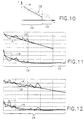
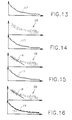
- FIG. 10 we can see the calculation of an envelope average, in FIG. 10, the principle of eliminating noise according to the invention, in FIGS. 11 and 12 of the results of real measurements and in FIGS. 13 to 16 the various processing steps according to the present invention.
- Probe 2 is placed in a first position relative to a cheese 16 for which we want to measure or characterize the texture. After emission of an ultrasonic pulse, a signal is collected back-broadcast which, processed by the conditioning circuit 7, becomes a first envelope 17. The measurement is repeated for a different position of the probe 2 compared to cheese 16 and so on until you get the number of envelopes 17 desired, for example until 100 envelopes are obtained. We calculate the average of all the values 17, to obtain an envelope mean used for further treatment.
- the device according to the present invention performs a temporal framing of the significant interval of the envelope 17 of the figure 6 by eliminating the parts of this curve which represents a noise significant acoustic and / or electrical, which allows for a calculation precise and reliable attenuation of ultrasound.
- Curve 17 in the lower part of Figure 11 corresponds the average of the envelopes measured.
- Logarithm 28 of envelope 17 and its maximum linear regression R corresponding to the window 29 retained are displayed in the upper part of figure 11.
- the average envelope 17 of FIG. 9 is illustrated on the figure 13.
- We calculate the logarithm 28 of the mean envelope 17 such as illustrated in figure 14.
- N1 being for example equal to N / 10.
- the regression coefficient R 1 is calculated for this first set of points.
- a point increment is added to the set of points on which the calculation is performed, this increment being for example equal to N / 10 and a second linear regression coefficient R 2 is calculated.
- the number of points for which the linear regression coefficient is maximum gives the number of useful points of the mean of the envelope and the linear regression coefficient of this set of points gives the attenuation.
- the presence of holes in a cheese results in a loss of precision in the measurement of attenuation. Selecting the maximum of the linear regression coefficient provides acceptable measurements. However, the maximum value of the linear regression coefficient in the case of a cheese with holes will be lower, for example equal to 94%.
- the value of the linear regression coefficient, above the minimum value is a reflection of the heterogeneities of the dough for a given wavelength of the ultrasonic probe.
- a modeled envelope 18 has been represented. which is an exponential of growth whose coefficient is proportional to modeled absorption.
- FIG. 17 we can see a flowchart of an example program implemented by a generation and processing unit signal 4 of the devices of FIGS. 1 and 3.
- the central unit 8 receives at permanently a sampling clock signal 31 providing the frequency analog signal sampling.
- the central unit 8 receives, on the other hand, of the measurement 32 trigger pulses.
- AND gate 33 triggers acquisition at the start of the first sampling clock period 31 following the presence of the acquisition trigger pulse 32.
- an ultrasound line is acquired, that is to say that the transmitter 5 sends an electrical pulse to the probe 2 and that the receiver 6 receives from the probe 2, a signal S such as for example illustrated in Figure 5.
- Signal S is digitized.
- the envelope 17 of the signal is calculated.
- the average of the envelopes is calculated received giving an average envelope as illustrated for example on the figure 9.
- the counter Nb is incremented by the number of points of the envelope with a value, for example equal to 5.
- the calculation of the attenuation m of the ultrasound is carried out which is the slope of the regression line for the number of points which gives the greatest regression coefficient.
- the attenuation and the regression coefficient are displayed.
- This display is adapted to the type of measurement carried out. For example, we use a digital and / or graphic display in a laboratory giving the complete curve, while on a production line, we will display directly if the quality of the product produced, for example cheese, is good or not. For example, you can indicate only with a red diode that an intervention is necessary and by a green diode that the process of manufacturing is going well. Likewise, it is possible to replace or supplement the display of result 43 by sending instructions commands by central unit 8 to production machines to ensure correcting the parameters of the process involved.
- storage is carried out, for example on a disk hard or on floppy disks, attenuation and regression coefficient possibly supplemented by data concerning the sample treated, the date and / or time.
- Attenuation measurement of ultrasonic waves inside certain cheeses, especially dry rind cheeses may be difficult without the use of an acoustic coupler.
- the acoustic coupler 15 must be as homogeneous as possible, and in particular not to contain micro-bubbles of air.
- the probe 2 includes marking means 48 making it possible to mark, for example by an imprint 49 the acoustic coupler 15 affixed to the cheese 16 or the rind of the cheese 16.
- marking means 48 making it possible, on the one hand, to ensure that this cheese has been checked on the production line, and on the other hand to provide consumers a guarantee of product quality.
- the means of marking 48 may correspond to a registered trademark of the manufacturer of cheeses, with the letter Q or with the "quality control" type of inscription. It is It is obvious that cheeses that have failed quality control are withdrawn from marketing, or, at the very least, the acoustic coupler 15 carrying the imprint 49 of the marking means 48.
- the invention applies to any industry requiring the characterization or measurement of texture, and in particular in the food industry, pharmaceutical, cosmetological, plastic and paint industries.
- the invention mainly applies to the manufacture of cheeses.
Landscapes
- Chemical & Material Sciences (AREA)
- Physics & Mathematics (AREA)
- Health & Medical Sciences (AREA)
- Life Sciences & Earth Sciences (AREA)
- Biochemistry (AREA)
- Analytical Chemistry (AREA)
- General Health & Medical Sciences (AREA)
- General Physics & Mathematics (AREA)
- Immunology (AREA)
- Pathology (AREA)
- Food Science & Technology (AREA)
- Engineering & Computer Science (AREA)
- Medicinal Chemistry (AREA)
- Acoustics & Sound (AREA)
- Investigating Or Analyzing Materials By The Use Of Ultrasonic Waves (AREA)
- Length Measuring Devices Characterised By Use Of Acoustic Means (AREA)
- Ultra Sonic Daignosis Equipment (AREA)
Description
- le logarithme népérien de l'enveloppe du signal reçu ;
- la régression linéaire R du logarithme de l'enveloppe du signal reçu pour les diverses parties de cette enveloppe;
- engendrer dans un corps des vibrations ultrasonores;
- capter les ondes ultrasonores émises par le corps ;
- déterminer l'atténuation des ondes ultrasonores en fonction du temps de réception et de la profondeur de pénétration dans le corps ;
- déduire de l'atténuation des ondes ultrasonores en fonction du temps dans le corps la texture du corps, notamment la dureté du corps.
- engendrer une succession de vibrations ultrasonores dans le corps dont on veut mesurer ou caractériser la texture ;
- capter les signaux ultrasonores émis par le corps ;
- calculer une succession d'enveloppes des signaux reçus;
- calculer une enveloppe moyenne des enveloppes reçues ;
- déterminer l'atténuation des ondes ultrasonores dans ledit corps à partir de ladite enveloppe moyenne.
- calculer le logarithme népérien de l'enveloppe du signal reçu;
- calculer la régression linéaire du logarithme népérien de l'enveloppe du signal reçu pour diverses parties de cette enveloppe;
- déterminer la fenêtre temporelle de l'enveloppe correspondant au maximum du coefficient de régression linéaire du logarithme népérien et de l'enveloppe;
- déterminer l'absorption des ondes ultrasonores par le corps uniquement à partir des signaux reçus dans ladite fenêtre temporelle.
- engendrer une succession de vibrations ultrasonores dans le corps dont on veut mesurer ou caractériser la texture ;
- capter les signaux ultrasonores émis par le corps ;
- calculer une succession d'enveloppes des signaux reçus ;
- calculer une enveloppe moyenne des enveloppes reçues ;
- calculer le logarithme népérien de l'enveloppe du signal reçu;
- calculer la régression linéaire du logarithme népérien de l'enveloppe du signal reçu pour diverses parties de cette enveloppe;
- déduire et quantifier la présence de trous, ouvertures et/ou hétérogénéités dans ledit corps à partir de la valeur du coefficient de régression.
- la figure 1 est une courbe expérimentale montrant la corrélation entre l'atténuation des ultrasons et les modules de Young de divers corps ;
- la figure 2 est un schéma d'un premier exemple de réalisation d'un dispositif selon la présente invention ;
- la figure 3 est un schéma d'une sonde susceptible d'être mise en oeuvre dans le dispositif selon la présente invention ;
- la figure 4 est un schéma d'un second exemple de réalisation d'un dispositif selon la présente invention ;
- la figure 5 est une courbe expérimentale d'un signal capté par le dispositif selon la présente invention ;
- la figure 6 est une courbe d'une enveloppe obtenue par calcul à partir de la courbe du signal de la figure 5 ;
- la figure 7 est un schéma d'un premier exemple de réalisation d'un dispositif d'élaboration d'enveloppe susceptible d'être mis en oeuvre dans le dispositif selon la présente invention ;
- la figure 8 est un schéma d'un deuxième exemple de réalisation d'un dispositif d'élaboration d'enveloppe susceptible d'être mis en oeuvre dans le dispositif selon la présente invention ;
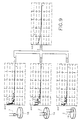
- la figure 9 est un schéma illustrant la sommation d'une pluralité d'enveloppes ;
- la figure 10 est une courbe très schématique illustrant le principe d'élimination de bruit permettant d'améliorer le rapport signal/bruit du dispositif selon la présente invention ;
- la figure 11 est une courbe expérimentale illustrant le traitement de réduction du bruit dans le dispositif selon la présente invention ;
- la figure 12 est une courbe illustrant la réduction du bruit dans le dispositif selon la présente invention ;
- les figures 13 à 16 illustrent les traitements mathématiques du signal capté ;
- la figure 17 est un organigramme d'un programme mis en oeuvre dans le dispositif selon la présente invention ;
- la figure 18 est une vue en perspective illustrant un test de qualité final selon la présente invention.
| Atténuation dB/micro-s | Dureté mesurée N/mm | Dureté modèlisée N/mm |
| 1.83 | 3.96 | 4.13 |
| 1.74 | 3.93 | 3.86 |
| 1.65 | 3.60 | 3.60 |
| 1.55 | 3.48 | 3.34 |
| 1.53 | 3.35 | 3.27 |
| 1.37 | 2.88 | 2.81 |
| 1.30 | 2.41 | 2.61 |
| ND | ATT | DUR | COHE | COLL | ELAS | MAST | PRG | G/S | MG | |
| ND | 1 | .93 | .74 | .85 | .94 | .74 | .95 | .71 | - | - |
| ATT | .93 | 1 | .70 | - | - | - | .97 | - | - | - |
| DUR | .74 | .70 | 1 | - | - | - | - | .76 | - | - |
| COHE | .85 | - | - | 1 | - | - | - | - | - | - |
| COLL | .94 | - | - | - | 1 | - | - | - | - | - |
| ELAS | .74 | - | - | - | - | 1 | - | - | - | - |
| MAST | .95 | .97 | - | - | - | - | 1 | - | - | - |
| PRG | .71 | - | .76 | - | - | - | - | 1 | .25 | .65 |
| G/S | - | - | - | - | - | - | - | .25 | 1 | - |
| MG | - | - | - | - | - | - | - | .65 | - | 1 |
| ND = Note Dosage (Humaine, visuelle) Note de texture ATT = Atténuation des Ultra-Sons DUR = Dureté INSTRON COHE = Cohésion INSTRON COLL = Collant INSTRON ELAS = Elasticité INSTRON MAST = Masticabilité INSTRON PRG = P R G (Test pénétration) G/S = Gras/Sec MG = Matières Grasses. Test ISOTKON = test double cycle en compression uniaxiable à vitesse constante. |
- gain récepteur : 41dB,
- gain de l'affichage : 41dB,
- fréquence d'échantillonnage : 50 MHz,
- délai d'affichage : 9,8 µs,
- gain de l'affichage : 0,1 V/division,
- déplacement de l'affichage : 0,04 division,
- point de départ de la ligne : 1,
- points de la ligne : 2048,
- points de l'enveloppe : 2048,
- incrément dans le calcul de régression linéaire R du logarithme 28 de l'enveloppe 17 : 10.
- points de la fenêtre de calcul 29 : 391,
- coefficient de régression : 97,340 %,
- pente de la régression : 2,7 dB/µs.
- gain récepteur: 46,4 dB,
- gain d'affichage : 46,4 dB,
- fréquence d'échantillonnage : 100 MHz,
- délais d'affichage : 9,2 µs,
- gains d'affichage : 0,1 V/division,
- déplacement de l'affichage: 0,04 division,
- point de départ de la ligne : 1,
- points de l'enveloppe : 2001,
- incrément dans le calcul de régression linéaire : 10.
- point de la régression : 11,
- coefficient de la régression : 95,617 %,
- pente de la régression : 3,6 dB/µs.

Claims (14)
- Dispositif de mesure et/ou de caractérisation de la texture d'un corps (16) caractérisé en ce qu'il comporte une sonde (2) d'émission et de réception d'ondes ultrasonores, reliée à un émetteur (5) pour générer un signal électrique converti en ondes ultrasonores par la sonde (2) et un récepteur (6) des ondes ultrasonores émanant dudit corps (16) et captées par la sonde (2) ainsi que des moyens de traitement du signal (7,8) pour déterminer l'atténuation dans ledit corps (16) des ondes ultrasonores en fonction du temps de réception et donc de la profondeur de pénétration dans le corps (16) et pour en déduire la texture, notamment la dureté dudit corps (16).
- Dispositif selon la revendication 1, caractérisé en ce que la sonde (2) comporte, en outre, des moyens (13, 14) de mesure de la température du corps (16) et en ce que les moyens de traitement du signal (7,8) tiennent compte de la température du corps (16) lors de la détermination de la texture à partir des résultats de la mesure d'absorption des ondes ultrasonores.
- Dispositif selon la revendication 1 ou 2, caractérisé en ce que les moyens de traitement du signal (7,8) calculent à partir d'une succession de signaux ultrasonores captés par la sonde (2), une succession d'enveloppes des signaux reçus dudit corps pour en déduire une enveloppe moyenne à partir de laquelle on détermine l'atténuation des ondes ultrasonores dans ledit corps.
- Dispositif selon l'une quelconque des revendications précédentes, caractérisé en ce que le dispositif de traitement du signal (7,8) sélectionne automatiquement une fenêtre temporelle (29) dans le signal capté par la sonde (2) ayant le meilleur rapport signal/bruit.
- Dispositif selon la revendication 4, caractérisé en ce que les moyens de traitement du signal (7,8) calculent :et déterminent la fenêtre temporelle (29) de l'enveloppe (17) correspondant au maximum du coefficient de régression linéaire (R) du logarithme (28) de l'enveloppe et en ce que les moyens de traitement du signal (7,8) déterminent l'absorption des ondes ultrasonores uniquement dans ladite fenêtre temporelle (29).le logarithme népérien de l'enveloppe du signal reçu ;la régression linéaire R du logarithme (28) de l'enveloppe (17) du signal reçu pour les diverses parties de cette enveloppe ;
- Dispositif selon l'une quelconque des revendications précédentes, caractérisé en ce que la sonde (2) comporte des moyens (48) de marquage des corps (16) dont la texture est mesurée et/ou caractérisée, ou d'un coupleur acoustique (15) apposé de façon permanente sur ce corps (16).
- Procédé de mesure et/ou de caractérisation de la texture, notamment de la dureté d'un corps (16), caractérisé en ce qu'il comporte les étapes consistant à :engendrer dans un corps (16) des vibrations ultrasonores ;capter les ondes ultrasonores émises par le corps (16) ;déterminer l'atténuation des ondes ultrasonores en fonction du temps de réception et de la profondeur de pénétration dans le corps (16) ;déduire de l'atténuation des ondes ultrasonores en fonction du temps dans le corps (16) la texture du corps, notamment la dureté du corps (16).
- Procédé selon la revendication 7, caractérisé en ce qu'il comporte une étape de détermination de la température du corps (16) dont on mesure ou caractérise la texture et en ce que la détermination de la texture, notamment de la dureté à partir de l'atténuation des ondes ultrasonores dans le corps (16), tient compte de la température dudit corps (16).
- Procédé selon la revendication 7 ou 8, caractérisé en ce qu'il comporte des étapes consistant à :engendrer une succession de vibrations ultrasonores dans le corps (16) dont on veut mesurer ou caractériser la texture ;capter les signaux ultrasonores émis par le corps (16) ;calculer une succession d'enveloppes (17) des signaux reçus (S) ;calculer une enveloppe moyenne des enveloppes reçues (17) ;déterminer l'atténuation des ondes ultrasonores dans ledit corps (16) à partir de ladite enveloppe moyenne.
- Procédé selon l'une quelconque des revendications 7 à 9, caractérisé en ce qu'il comporte une étape de sélection d'une fenêtre temporelle (29) dans les signaux captés (S) par la sonde (2) ayant le meilleur rapport signal/bruit.
- Procédé selon la revendication 10, caractérisé en ce qu'il comporte les étapes consistant à :calculer le logarithme népérien (28) de l'enveloppe du signal reçu ;calculer la régression linéaire (R) du logarithme népérien (28) de l'enveloppe (17) du signal (S) reçu pour diverses parties de cette enveloppe ;déterminer la fenêtre temporelle (29) de l'enveloppe (17) correspondant au maximum du coefficient de régression linéaire (R) du logarithme népérien (28) et de l'enveloppe ;déterminer l'absorption des ondes ultrasonores par le corps (16) uniquement à partir des signaux reçus dans ladite fenêtre temporelle (29).
- Procédé de mesure et/ou de caractérisation de la texture d'un corps (16) caractérisé en ce qu'il comporte les étapes consistant à :engendrer une succession de vibrations ultrasonores dans le corps (16) dont on veut mesurer ou caractériser la texture ;capter les signaux ultrasonores émis par le corps (16) ;calculer une succession d'enveloppes (17) des signaux reçus (S) ;calculer une enveloppe moyenne des enveloppes reçues (17) ;calculer le logarithme népérien (28) de l'enveloppe du signal reçu ;calculer la régression linéaire (R) du logarithme népérien (28) de l'enveloppe (17) du signal (S) reçu pour diverses parties de cette enveloppe ;déduire et quantifier la présence de trous, ouvertures et/ou hétérogénéités dans ledit corps à partir de la valeur du coefficient de régression.
- Procédé selon l'une quelconque des revendications 7 à 12, caractérisé en ce que ledit procédé est un procédé de mesure ou de caractérisation de la texture d'un produit alimentaire, notamment d'un fromage.
- Procédé selon l'une quelconque des revendications 7 à 13, caractérisé en ce qu'il comporte une étape de marquage avec la sonde (2) du corps (16) dont la texture a été mesurée ou caractérisée ou d'un coupleur acoustique (15) apposé de façon permanente sur ce corps, notamment par une empreinte (49) des moyens de marquage (48) de la sonde (2).
Applications Claiming Priority (2)
| Application Number | Priority Date | Filing Date | Title |
|---|---|---|---|
| FR9208220 | 1992-07-03 | ||
| FR929208220A FR2693270B1 (fr) | 1992-07-03 | 1992-07-03 | Dispositif et procédé de caractérisation ou de mesure par ultrasons de texture de produits. |
Publications (2)
| Publication Number | Publication Date |
|---|---|
| EP0578539A1 EP0578539A1 (fr) | 1994-01-12 |
| EP0578539B1 true EP0578539B1 (fr) | 1998-09-02 |
Family
ID=9431506
Family Applications (1)
| Application Number | Title | Priority Date | Filing Date |
|---|---|---|---|
| EP93401695A Expired - Lifetime EP0578539B1 (fr) | 1992-07-03 | 1993-06-30 | Dispositif et procédé de caractérisation ou de mesure par ultrasons de texture de produits |
Country Status (5)
| Country | Link |
|---|---|
| EP (1) | EP0578539B1 (fr) |
| AT (1) | ATE170629T1 (fr) |
| DE (1) | DE69320728T2 (fr) |
| ES (1) | ES2123625T3 (fr) |
| FR (1) | FR2693270B1 (fr) |
Families Citing this family (13)
| Publication number | Priority date | Publication date | Assignee | Title |
|---|---|---|---|---|
| FR2772482B1 (fr) * | 1997-12-12 | 2000-03-03 | Centre Nat Rech Scient | Procede et dispositif pour le suivi de transitions de phase |
| FR2772476B1 (fr) * | 1998-03-31 | 2000-03-03 | Centre Nat Rech Scient | Procede et dispositif pour le suivi de transitions de phase |
| ES2147141B1 (es) * | 1998-09-09 | 2001-03-01 | Univ Valencia Politecnica | Procedimiento y dispositivo para la clasificacion de quesos, mediante ultrasonidos. |
| ES2156698B1 (es) * | 1999-01-25 | 2002-02-01 | Univ Valencia Politecnica | Procedimiento para la fabricacion en continuo de turron de xixona mediante ultrasonidos, y dispositivo para su puesta en practica. |
| WO2002004938A2 (fr) * | 2000-07-10 | 2002-01-17 | University Of North Carolina At Charlotte | Appareil et procedes de determination des proprietes viscoelastiques des materiaux |
| ITVR20110123A1 (it) * | 2011-06-07 | 2012-12-08 | Hele All Adige | Dispositivo strumentato per una caratterizzazione di una struttura interna di un blocco di formaggio. |
| US9678015B2 (en) | 2014-09-26 | 2017-06-13 | Frito-Lay North America, Inc. | Method for elemental analysis of a snack food product in a dynamic production line |
| US10969316B2 (en) | 2015-09-24 | 2021-04-06 | Frito-Lay North America, Inc. | Quantitative in-situ texture measurement apparatus and method |
| US10070661B2 (en) | 2015-09-24 | 2018-09-11 | Frito-Lay North America, Inc. | Feedback control of food texture system and method |
| US10107785B2 (en) | 2015-09-24 | 2018-10-23 | Frito-Lay North America, Inc. | Quantitative liquid texture measurement apparatus and method |
| US11243190B2 (en) | 2015-09-24 | 2022-02-08 | Frito-Lay North America, Inc. | Quantitative liquid texture measurement method |
| US10598648B2 (en) | 2015-09-24 | 2020-03-24 | Frito-Lay North America, Inc. | Quantitative texture measurement apparatus and method |
| US9541537B1 (en) | 2015-09-24 | 2017-01-10 | Frito-Lay North America, Inc. | Quantitative texture measurement apparatus and method |
Family Cites Families (5)
| Publication number | Priority date | Publication date | Assignee | Title |
|---|---|---|---|---|
| GB1127231A (en) * | 1965-01-06 | 1968-09-18 | British Aluminium Co Ltd | Improvements in or relating to methods of and apparatus for testing molten metal |
| CS212352B1 (en) * | 1978-08-01 | 1982-03-26 | Jiri Docekal | Method of continuous measuring the changes of rheological properties of polymeres in the course of the polymerization process |
| FR2544499B1 (fr) * | 1983-04-12 | 1986-02-07 | Seram | Appareillage destine a mesurer la variation de la transmission ultrasonore a une interface |
| US4590803A (en) * | 1984-06-28 | 1986-05-27 | Westinghouse Electric Corp. | Acoustic waveguide monitoring |
| US5078011A (en) * | 1988-04-25 | 1992-01-07 | Krivorozhsky Gornorudny Institut | Method of monitoring parameters of solid phase of suspension and device therefor |
-
1992
- 1992-07-03 FR FR929208220A patent/FR2693270B1/fr not_active Expired - Fee Related
-
1993
- 1993-06-30 AT AT93401695T patent/ATE170629T1/de not_active IP Right Cessation
- 1993-06-30 DE DE69320728T patent/DE69320728T2/de not_active Expired - Fee Related
- 1993-06-30 ES ES93401695T patent/ES2123625T3/es not_active Expired - Lifetime
- 1993-06-30 EP EP93401695A patent/EP0578539B1/fr not_active Expired - Lifetime
Also Published As
| Publication number | Publication date |
|---|---|
| EP0578539A1 (fr) | 1994-01-12 |
| DE69320728T2 (de) | 1999-01-14 |
| FR2693270B1 (fr) | 1994-09-16 |
| ATE170629T1 (de) | 1998-09-15 |
| FR2693270A1 (fr) | 1994-01-07 |
| ES2123625T3 (es) | 1999-01-16 |
| DE69320728D1 (de) | 1998-10-08 |
Similar Documents
| Publication | Publication Date | Title |
|---|---|---|
| CA1323090C (fr) | Methode et dispositif a densitometre a ultrasons | |
| US6491635B1 (en) | Digital ultrasonic densitometer | |
| EP0480554B1 (fr) | Appareil de mesure de la densité à ultrason | |
| Mizrach et al. | Nondestructive ultrasonic determination of avocado softening process | |
| JPS63122923A (ja) | 超音波測温装置 | |
| US5029475A (en) | Measuring spatial distribution of spacings between point scatterers | |
| FR2971695A1 (fr) | Mesure de viscoelasticite en utilisant une onde a ultrason modulee par amplitude de phase | |
| Vasighi-Shojae et al. | Ultrasonic based determination of apple quality as a nondestructive technology | |
| EP0578539A1 (fr) | Dispositif et procédé de caractérisation ou de mesure par ultrasons de texture de produits | |
| JPWO2012029888A1 (ja) | 食感指標の測定方法及び測定装置 | |
| Mizrach et al. | Determination of avocado maturity by ultrasonic attenuation measurements | |
| US5589209A (en) | Method for a non-destructive determination of quality parameters in fresh produce | |
| YILDIZ et al. | Custom design fruit quality evaluation system with non-destructive testing (NDT) techniques | |
| WO2017121170A1 (fr) | Procédé et système de détection de paramètre de tissu | |
| Choe et al. | Maturity assessment of watermelon by acoustic method | |
| CN101169364A (zh) | 对离散状态颗粒粒度分布测量的方法及其装置 | |
| EP0577511B1 (fr) | Dispositif et procédé de détection de changement de phases d'un produit liquide, gelifié ou solide | |
| WO2006016520A1 (fr) | Méthode et système non-destructifs d’inspection à l’intérieur d’un arbre par tomographie acoustique | |
| Omari et al. | Signal to noise ratio comparisons for ultrasound attenuation slope estimation algorithms | |
| AU2018359026B2 (en) | Device and method for determining the elasticity of soft-solids | |
| KR100542651B1 (ko) | 비선형 음향반응을 이용한 비파괴 음향 탐사방법 | |
| US11112387B2 (en) | Method and system for measuring a wideband loop sensitivity for an acoustic transducer | |
| US10502718B2 (en) | Method and system for determining an optimum drive signal for an acoustic transducer | |
| EP3505927A1 (fr) | Procédé et système pour mesurer une sensibilité de boucle caractéristique pour un transducteur acoustique | |
| JPH0658917A (ja) | 超音波検査方法および装置 |
Legal Events
| Date | Code | Title | Description |
|---|---|---|---|
| PUAI | Public reference made under article 153(3) epc to a published international application that has entered the european phase |
Free format text: ORIGINAL CODE: 0009012 |
|
| AK | Designated contracting states |
Kind code of ref document: A1 Designated state(s): AT BE CH DE ES GB IT LI LU NL PT |
|
| 17P | Request for examination filed |
Effective date: 19940114 |
|
| 17Q | First examination report despatched |
Effective date: 19961115 |
|
| GRAG | Despatch of communication of intention to grant |
Free format text: ORIGINAL CODE: EPIDOS AGRA |
|
| GRAG | Despatch of communication of intention to grant |
Free format text: ORIGINAL CODE: EPIDOS AGRA |
|
| GRAH | Despatch of communication of intention to grant a patent |
Free format text: ORIGINAL CODE: EPIDOS IGRA |
|
| GRAH | Despatch of communication of intention to grant a patent |
Free format text: ORIGINAL CODE: EPIDOS IGRA |
|
| GRAA | (expected) grant |
Free format text: ORIGINAL CODE: 0009210 |
|
| AK | Designated contracting states |
Kind code of ref document: B1 Designated state(s): AT BE CH DE ES GB IT LI LU NL PT |
|
| REF | Corresponds to: |
Ref document number: 170629 Country of ref document: AT Date of ref document: 19980915 Kind code of ref document: T |
|
| REG | Reference to a national code |
Ref country code: CH Ref legal event code: EP |
|
| GBT | Gb: translation of ep patent filed (gb section 77(6)(a)/1977) |
Effective date: 19980903 |
|
| REG | Reference to a national code |
Ref country code: CH Ref legal event code: NV Representative=s name: ISLER & PEDRAZZINI AG |
|
| REF | Corresponds to: |
Ref document number: 69320728 Country of ref document: DE Date of ref document: 19981008 |
|
| PG25 | Lapsed in a contracting state [announced via postgrant information from national office to epo] |
Ref country code: PT Free format text: LAPSE BECAUSE OF FAILURE TO SUBMIT A TRANSLATION OF THE DESCRIPTION OR TO PAY THE FEE WITHIN THE PRESCRIBED TIME-LIMIT Effective date: 19981202 |
|
| REG | Reference to a national code |
Ref country code: ES Ref legal event code: FG2A Ref document number: 2123625 Country of ref document: ES Kind code of ref document: T3 |
|
| RAP2 | Party data changed (patent owner data changed or rights of a patent transferred) |
Owner name: BONGRAIN S.A. |
|
| REG | Reference to a national code |
Ref country code: CH Ref legal event code: PFA Free format text: BONGRAIN S.A.,7, RUE DE DAMPIERRE,F-78283 GUYANCOURT CEDEX (FR) TRANSFER- BONGRAIN S.A.,42, RUE RIEUSSEC,78223 VIRJOFLAY CEDEX (FR) |
|
| NLT2 | Nl: modifications (of names), taken from the european patent patent bulletin |
Owner name: BONGRAIN S.A. |
|
| PLBE | No opposition filed within time limit |
Free format text: ORIGINAL CODE: 0009261 |
|
| STAA | Information on the status of an ep patent application or granted ep patent |
Free format text: STATUS: NO OPPOSITION FILED WITHIN TIME LIMIT |
|
| 26N | No opposition filed | ||
| REG | Reference to a national code |
Ref country code: GB Ref legal event code: IF02 |
|
| PGFP | Annual fee paid to national office [announced via postgrant information from national office to epo] |
Ref country code: LU Payment date: 20040525 Year of fee payment: 12 Ref country code: ES Payment date: 20040525 Year of fee payment: 12 Ref country code: DE Payment date: 20040525 Year of fee payment: 12 |
|
| PGFP | Annual fee paid to national office [announced via postgrant information from national office to epo] |
Ref country code: CH Payment date: 20040526 Year of fee payment: 12 |
|
| PGFP | Annual fee paid to national office [announced via postgrant information from national office to epo] |
Ref country code: GB Payment date: 20040602 Year of fee payment: 12 |
|
| PGFP | Annual fee paid to national office [announced via postgrant information from national office to epo] |
Ref country code: BE Payment date: 20040608 Year of fee payment: 12 |
|
| PGFP | Annual fee paid to national office [announced via postgrant information from national office to epo] |
Ref country code: NL Payment date: 20040628 Year of fee payment: 12 |
|
| PGFP | Annual fee paid to national office [announced via postgrant information from national office to epo] |
Ref country code: AT Payment date: 20040630 Year of fee payment: 12 |
|
| PG25 | Lapsed in a contracting state [announced via postgrant information from national office to epo] |
Ref country code: LU Free format text: LAPSE BECAUSE OF NON-PAYMENT OF DUE FEES Effective date: 20050630 Ref country code: LI Free format text: LAPSE BECAUSE OF NON-PAYMENT OF DUE FEES Effective date: 20050630 Ref country code: IT Free format text: LAPSE BECAUSE OF NON-PAYMENT OF DUE FEES;WARNING: LAPSES OF ITALIAN PATENTS WITH EFFECTIVE DATE BEFORE 2007 MAY HAVE OCCURRED AT ANY TIME BEFORE 2007. THE CORRECT EFFECTIVE DATE MAY BE DIFFERENT FROM THE ONE RECORDED. Effective date: 20050630 Ref country code: GB Free format text: LAPSE BECAUSE OF NON-PAYMENT OF DUE FEES Effective date: 20050630 Ref country code: CH Free format text: LAPSE BECAUSE OF NON-PAYMENT OF DUE FEES Effective date: 20050630 Ref country code: BE Free format text: LAPSE BECAUSE OF NON-PAYMENT OF DUE FEES Effective date: 20050630 Ref country code: AT Free format text: LAPSE BECAUSE OF NON-PAYMENT OF DUE FEES Effective date: 20050630 |
|
| PG25 | Lapsed in a contracting state [announced via postgrant information from national office to epo] |
Ref country code: ES Free format text: LAPSE BECAUSE OF NON-PAYMENT OF DUE FEES Effective date: 20050701 |
|
| PG25 | Lapsed in a contracting state [announced via postgrant information from national office to epo] |
Ref country code: NL Free format text: LAPSE BECAUSE OF NON-PAYMENT OF DUE FEES Effective date: 20060101 |
|
| PG25 | Lapsed in a contracting state [announced via postgrant information from national office to epo] |
Ref country code: DE Free format text: LAPSE BECAUSE OF NON-PAYMENT OF DUE FEES Effective date: 20060103 |
|
| REG | Reference to a national code |
Ref country code: CH Ref legal event code: PL |
|
| GBPC | Gb: european patent ceased through non-payment of renewal fee |
Effective date: 20050630 |
|
| NLV4 | Nl: lapsed or anulled due to non-payment of the annual fee |
Effective date: 20060101 |
|
| REG | Reference to a national code |
Ref country code: ES Ref legal event code: FD2A Effective date: 20050701 |
|
| BERE | Be: lapsed |
Owner name: S.A. *BONGRAIN Effective date: 20050630 |