EP0575207B1 - Vitrage électrochrome architectural - Google Patents
Vitrage électrochrome architectural Download PDFInfo
- Publication number
- EP0575207B1 EP0575207B1 EP93401299A EP93401299A EP0575207B1 EP 0575207 B1 EP0575207 B1 EP 0575207B1 EP 93401299 A EP93401299 A EP 93401299A EP 93401299 A EP93401299 A EP 93401299A EP 0575207 B1 EP0575207 B1 EP 0575207B1
- Authority
- EP
- European Patent Office
- Prior art keywords
- glazing pane
- glass
- glazing
- pane according
- film
- Prior art date
- Legal status (The legal status is an assumption and is not a legal conclusion. Google has not performed a legal analysis and makes no representation as to the accuracy of the status listed.)
- Expired - Lifetime
Links
- 239000011521 glass Substances 0.000 claims abstract description 72
- 239000002131 composite material Substances 0.000 claims abstract description 14
- 229920000620 organic polymer Polymers 0.000 claims abstract description 11
- 229920005549 butyl rubber Polymers 0.000 claims abstract description 9
- 229920001021 polysulfide Polymers 0.000 claims abstract description 5
- QGLKJKCYBOYXKC-UHFFFAOYSA-N nonaoxidotritungsten Chemical compound O=[W]1(=O)O[W](=O)(=O)O[W](=O)(=O)O1 QGLKJKCYBOYXKC-UHFFFAOYSA-N 0.000 claims abstract description 3
- 229910001930 tungsten oxide Inorganic materials 0.000 claims abstract description 3
- 230000005540 biological transmission Effects 0.000 claims description 26
- 239000000463 material Substances 0.000 claims description 18
- 239000011888 foil Substances 0.000 claims description 7
- 230000002093 peripheral effect Effects 0.000 claims description 6
- 210000003298 dental enamel Anatomy 0.000 claims description 3
- 230000005855 radiation Effects 0.000 claims description 3
- 229910052751 metal Inorganic materials 0.000 claims description 2
- 239000002184 metal Substances 0.000 claims description 2
- 229920002037 poly(vinyl butyral) polymer Polymers 0.000 abstract description 18
- 238000001914 filtration Methods 0.000 abstract description 6
- 239000004814 polyurethane Substances 0.000 abstract description 6
- 229920002635 polyurethane Polymers 0.000 abstract description 5
- 239000010410 layer Substances 0.000 description 56
- XLYOFNOQVPJJNP-UHFFFAOYSA-N water Chemical compound O XLYOFNOQVPJJNP-UHFFFAOYSA-N 0.000 description 7
- NBIIXXVUZAFLBC-UHFFFAOYSA-N Phosphoric acid Chemical compound OP(O)(O)=O NBIIXXVUZAFLBC-UHFFFAOYSA-N 0.000 description 6
- 239000002346 layers by function Substances 0.000 description 6
- 239000000203 mixture Substances 0.000 description 6
- 239000000758 substrate Substances 0.000 description 6
- BQCADISMDOOEFD-UHFFFAOYSA-N Silver Chemical compound [Ag] BQCADISMDOOEFD-UHFFFAOYSA-N 0.000 description 5
- 239000003792 electrolyte Substances 0.000 description 5
- 238000000034 method Methods 0.000 description 5
- 229910052709 silver Inorganic materials 0.000 description 5
- 239000004332 silver Substances 0.000 description 5
- WEVYAHXRMPXWCK-UHFFFAOYSA-N Acetonitrile Chemical compound CC#N WEVYAHXRMPXWCK-UHFFFAOYSA-N 0.000 description 4
- 238000010521 absorption reaction Methods 0.000 description 4
- 229920000642 polymer Polymers 0.000 description 4
- -1 polyoxyéthylène Polymers 0.000 description 4
- 238000007650 screen-printing Methods 0.000 description 4
- 229910006404 SnO 2 Inorganic materials 0.000 description 3
- WYURNTSHIVDZCO-UHFFFAOYSA-N Tetrahydrofuran Chemical compound C1CCOC1 WYURNTSHIVDZCO-UHFFFAOYSA-N 0.000 description 3
- 230000008901 benefit Effects 0.000 description 3
- 238000010586 diagram Methods 0.000 description 3
- HTXDPTMKBJXEOW-UHFFFAOYSA-N dioxoiridium Chemical compound O=[Ir]=O HTXDPTMKBJXEOW-UHFFFAOYSA-N 0.000 description 3
- 239000007789 gas Substances 0.000 description 3
- 238000010438 heat treatment Methods 0.000 description 3
- 230000006872 improvement Effects 0.000 description 3
- 239000011229 interlayer Substances 0.000 description 3
- 229910000457 iridium oxide Inorganic materials 0.000 description 3
- 239000005077 polysulfide Substances 0.000 description 3
- 150000008117 polysulfides Polymers 0.000 description 3
- 230000004224 protection Effects 0.000 description 3
- 239000000243 solution Substances 0.000 description 3
- 239000002904 solvent Substances 0.000 description 3
- 230000037072 sun protection Effects 0.000 description 3
- 230000000475 sunscreen effect Effects 0.000 description 3
- 239000000516 sunscreening agent Substances 0.000 description 3
- 229920003171 Poly (ethylene oxide) Polymers 0.000 description 2
- 229910000831 Steel Inorganic materials 0.000 description 2
- ATJFFYVFTNAWJD-UHFFFAOYSA-N Tin Chemical compound [Sn] ATJFFYVFTNAWJD-UHFFFAOYSA-N 0.000 description 2
- 229910007717 ZnSnO Inorganic materials 0.000 description 2
- 239000002253 acid Substances 0.000 description 2
- 229910000147 aluminium phosphate Inorganic materials 0.000 description 2
- QVGXLLKOCUKJST-UHFFFAOYSA-N atomic oxygen Chemical compound [O] QVGXLLKOCUKJST-UHFFFAOYSA-N 0.000 description 2
- 230000015556 catabolic process Effects 0.000 description 2
- 238000004040 coloring Methods 0.000 description 2
- 230000000052 comparative effect Effects 0.000 description 2
- 238000006731 degradation reaction Methods 0.000 description 2
- 229910052738 indium Inorganic materials 0.000 description 2
- APFVFJFRJDLVQX-UHFFFAOYSA-N indium atom Chemical compound [In] APFVFJFRJDLVQX-UHFFFAOYSA-N 0.000 description 2
- 238000003780 insertion Methods 0.000 description 2
- 229910044991 metal oxide Inorganic materials 0.000 description 2
- 239000002808 molecular sieve Substances 0.000 description 2
- 230000003287 optical effect Effects 0.000 description 2
- 239000001301 oxygen Substances 0.000 description 2
- 229910052760 oxygen Inorganic materials 0.000 description 2
- 230000001681 protective effect Effects 0.000 description 2
- URGAHOPLAPQHLN-UHFFFAOYSA-N sodium aluminosilicate Chemical compound [Na+].[Al+3].[O-][Si]([O-])=O.[O-][Si]([O-])=O URGAHOPLAPQHLN-UHFFFAOYSA-N 0.000 description 2
- 125000006850 spacer group Chemical group 0.000 description 2
- 238000005507 spraying Methods 0.000 description 2
- 238000004544 sputter deposition Methods 0.000 description 2
- 239000010959 steel Substances 0.000 description 2
- YCKRFDGAMUMZLT-UHFFFAOYSA-N Fluorine atom Chemical compound [F] YCKRFDGAMUMZLT-UHFFFAOYSA-N 0.000 description 1
- UFHFLCQGNIYNRP-UHFFFAOYSA-N Hydrogen Chemical compound [H][H] UFHFLCQGNIYNRP-UHFFFAOYSA-N 0.000 description 1
- 229920002367 Polyisobutene Polymers 0.000 description 1
- 241000352262 Potato virus B Species 0.000 description 1
- 229910010413 TiO 2 Inorganic materials 0.000 description 1
- GWEVSGVZZGPLCZ-UHFFFAOYSA-N Titan oxide Chemical compound O=[Ti]=O GWEVSGVZZGPLCZ-UHFFFAOYSA-N 0.000 description 1
- 230000006750 UV protection Effects 0.000 description 1
- VVTSZOCINPYFDP-UHFFFAOYSA-N [O].[Ar] Chemical compound [O].[Ar] VVTSZOCINPYFDP-UHFFFAOYSA-N 0.000 description 1
- 239000000654 additive Substances 0.000 description 1
- 230000032683 aging Effects 0.000 description 1
- 238000004378 air conditioning Methods 0.000 description 1
- 229910052782 aluminium Inorganic materials 0.000 description 1
- XAGFODPZIPBFFR-UHFFFAOYSA-N aluminium Chemical compound [Al] XAGFODPZIPBFFR-UHFFFAOYSA-N 0.000 description 1
- 238000000429 assembly Methods 0.000 description 1
- 230000000712 assembly Effects 0.000 description 1
- 125000004429 atom Chemical group 0.000 description 1
- 150000001565 benzotriazoles Chemical class 0.000 description 1
- 230000008859 change Effects 0.000 description 1
- VNNRSPGTAMTISX-UHFFFAOYSA-N chromium nickel Chemical compound [Cr].[Ni] VNNRSPGTAMTISX-UHFFFAOYSA-N 0.000 description 1
- 239000011248 coating agent Substances 0.000 description 1
- 238000000576 coating method Methods 0.000 description 1
- 230000003750 conditioning effect Effects 0.000 description 1
- 229920001940 conductive polymer Polymers 0.000 description 1
- 238000001816 cooling Methods 0.000 description 1
- 238000007872 degassing Methods 0.000 description 1
- 238000000151 deposition Methods 0.000 description 1
- 239000002274 desiccant Substances 0.000 description 1
- 230000018109 developmental process Effects 0.000 description 1
- 230000009365 direct transmission Effects 0.000 description 1
- 238000002845 discoloration Methods 0.000 description 1
- 239000002019 doping agent Substances 0.000 description 1
- 230000000694 effects Effects 0.000 description 1
- 239000005329 float glass Substances 0.000 description 1
- 239000011737 fluorine Substances 0.000 description 1
- 229910052731 fluorine Inorganic materials 0.000 description 1
- 230000009477 glass transition Effects 0.000 description 1
- 239000001257 hydrogen Substances 0.000 description 1
- 229910052739 hydrogen Inorganic materials 0.000 description 1
- 125000004435 hydrogen atom Chemical group [H]* 0.000 description 1
- 229910003437 indium oxide Inorganic materials 0.000 description 1
- PJXISJQVUVHSOJ-UHFFFAOYSA-N indium(iii) oxide Chemical compound [O-2].[O-2].[O-2].[In+3].[In+3] PJXISJQVUVHSOJ-UHFFFAOYSA-N 0.000 description 1
- 238000009776 industrial production Methods 0.000 description 1
- 229910052500 inorganic mineral Inorganic materials 0.000 description 1
- 230000037431 insertion Effects 0.000 description 1
- 229910052741 iridium Inorganic materials 0.000 description 1
- GKOZUEZYRPOHIO-UHFFFAOYSA-N iridium atom Chemical compound [Ir] GKOZUEZYRPOHIO-UHFFFAOYSA-N 0.000 description 1
- 239000007788 liquid Substances 0.000 description 1
- 238000001755 magnetron sputter deposition Methods 0.000 description 1
- 238000004519 manufacturing process Methods 0.000 description 1
- 239000013521 mastic Substances 0.000 description 1
- 150000004706 metal oxides Chemical class 0.000 description 1
- 239000011707 mineral Substances 0.000 description 1
- 230000007935 neutral effect Effects 0.000 description 1
- 229910001120 nichrome Inorganic materials 0.000 description 1
- 230000035515 penetration Effects 0.000 description 1
- 229920001296 polysiloxane Polymers 0.000 description 1
- 238000002360 preparation method Methods 0.000 description 1
- 238000000197 pyrolysis Methods 0.000 description 1
- 230000009467 reduction Effects 0.000 description 1
- 238000002791 soaking Methods 0.000 description 1
- 239000006104 solid solution Substances 0.000 description 1
- 230000003068 static effect Effects 0.000 description 1
- 230000035882 stress Effects 0.000 description 1
- 238000006467 substitution reaction Methods 0.000 description 1
- YLQBMQCUIZJEEH-UHFFFAOYSA-N tetrahydrofuran Natural products C=1C=COC=1 YLQBMQCUIZJEEH-UHFFFAOYSA-N 0.000 description 1
- 229920001169 thermoplastic Polymers 0.000 description 1
- 239000004416 thermosoftening plastic Substances 0.000 description 1
- XOLBLPGZBRYERU-UHFFFAOYSA-N tin dioxide Chemical compound O=[Sn]=O XOLBLPGZBRYERU-UHFFFAOYSA-N 0.000 description 1
- 229910001887 tin oxide Inorganic materials 0.000 description 1
- OGIDPMRJRNCKJF-UHFFFAOYSA-N titanium oxide Inorganic materials [Ti]=O OGIDPMRJRNCKJF-UHFFFAOYSA-N 0.000 description 1
- 230000007704 transition Effects 0.000 description 1
- WFKWXMTUELFFGS-UHFFFAOYSA-N tungsten Chemical compound [W] WFKWXMTUELFFGS-UHFFFAOYSA-N 0.000 description 1
- 229910052721 tungsten Inorganic materials 0.000 description 1
- 239000010937 tungsten Substances 0.000 description 1
Images



Classifications
-
- B—PERFORMING OPERATIONS; TRANSPORTING
- B32—LAYERED PRODUCTS
- B32B—LAYERED PRODUCTS, i.e. PRODUCTS BUILT-UP OF STRATA OF FLAT OR NON-FLAT, e.g. CELLULAR OR HONEYCOMB, FORM
- B32B17/00—Layered products essentially comprising sheet glass, or glass, slag, or like fibres
- B32B17/06—Layered products essentially comprising sheet glass, or glass, slag, or like fibres comprising glass as the main or only constituent of a layer, next to another layer of a specific material
- B32B17/10—Layered products essentially comprising sheet glass, or glass, slag, or like fibres comprising glass as the main or only constituent of a layer, next to another layer of a specific material of synthetic resin
- B32B17/10005—Layered products essentially comprising sheet glass, or glass, slag, or like fibres comprising glass as the main or only constituent of a layer, next to another layer of a specific material of synthetic resin laminated safety glass or glazing
- B32B17/1055—Layered products essentially comprising sheet glass, or glass, slag, or like fibres comprising glass as the main or only constituent of a layer, next to another layer of a specific material of synthetic resin laminated safety glass or glazing characterized by the resin layer, i.e. interlayer
- B32B17/10761—Layered products essentially comprising sheet glass, or glass, slag, or like fibres comprising glass as the main or only constituent of a layer, next to another layer of a specific material of synthetic resin laminated safety glass or glazing characterized by the resin layer, i.e. interlayer containing vinyl acetal
-
- B—PERFORMING OPERATIONS; TRANSPORTING
- B32—LAYERED PRODUCTS
- B32B—LAYERED PRODUCTS, i.e. PRODUCTS BUILT-UP OF STRATA OF FLAT OR NON-FLAT, e.g. CELLULAR OR HONEYCOMB, FORM
- B32B17/00—Layered products essentially comprising sheet glass, or glass, slag, or like fibres
- B32B17/06—Layered products essentially comprising sheet glass, or glass, slag, or like fibres comprising glass as the main or only constituent of a layer, next to another layer of a specific material
- B32B17/10—Layered products essentially comprising sheet glass, or glass, slag, or like fibres comprising glass as the main or only constituent of a layer, next to another layer of a specific material of synthetic resin
- B32B17/10005—Layered products essentially comprising sheet glass, or glass, slag, or like fibres comprising glass as the main or only constituent of a layer, next to another layer of a specific material of synthetic resin laminated safety glass or glazing
- B32B17/10009—Layered products essentially comprising sheet glass, or glass, slag, or like fibres comprising glass as the main or only constituent of a layer, next to another layer of a specific material of synthetic resin laminated safety glass or glazing characterized by the number, the constitution or treatment of glass sheets
- B32B17/10036—Layered products essentially comprising sheet glass, or glass, slag, or like fibres comprising glass as the main or only constituent of a layer, next to another layer of a specific material of synthetic resin laminated safety glass or glazing characterized by the number, the constitution or treatment of glass sheets comprising two outer glass sheets
- B32B17/10045—Layered products essentially comprising sheet glass, or glass, slag, or like fibres comprising glass as the main or only constituent of a layer, next to another layer of a specific material of synthetic resin laminated safety glass or glazing characterized by the number, the constitution or treatment of glass sheets comprising two outer glass sheets with at least one intermediate layer consisting of a glass sheet
-
- B—PERFORMING OPERATIONS; TRANSPORTING
- B32—LAYERED PRODUCTS
- B32B—LAYERED PRODUCTS, i.e. PRODUCTS BUILT-UP OF STRATA OF FLAT OR NON-FLAT, e.g. CELLULAR OR HONEYCOMB, FORM
- B32B17/00—Layered products essentially comprising sheet glass, or glass, slag, or like fibres
- B32B17/06—Layered products essentially comprising sheet glass, or glass, slag, or like fibres comprising glass as the main or only constituent of a layer, next to another layer of a specific material
- B32B17/10—Layered products essentially comprising sheet glass, or glass, slag, or like fibres comprising glass as the main or only constituent of a layer, next to another layer of a specific material of synthetic resin
- B32B17/10005—Layered products essentially comprising sheet glass, or glass, slag, or like fibres comprising glass as the main or only constituent of a layer, next to another layer of a specific material of synthetic resin laminated safety glass or glazing
- B32B17/10009—Layered products essentially comprising sheet glass, or glass, slag, or like fibres comprising glass as the main or only constituent of a layer, next to another layer of a specific material of synthetic resin laminated safety glass or glazing characterized by the number, the constitution or treatment of glass sheets
- B32B17/10036—Layered products essentially comprising sheet glass, or glass, slag, or like fibres comprising glass as the main or only constituent of a layer, next to another layer of a specific material of synthetic resin laminated safety glass or glazing characterized by the number, the constitution or treatment of glass sheets comprising two outer glass sheets
- B32B17/10045—Layered products essentially comprising sheet glass, or glass, slag, or like fibres comprising glass as the main or only constituent of a layer, next to another layer of a specific material of synthetic resin laminated safety glass or glazing characterized by the number, the constitution or treatment of glass sheets comprising two outer glass sheets with at least one intermediate layer consisting of a glass sheet
- B32B17/10055—Layered products essentially comprising sheet glass, or glass, slag, or like fibres comprising glass as the main or only constituent of a layer, next to another layer of a specific material of synthetic resin laminated safety glass or glazing characterized by the number, the constitution or treatment of glass sheets comprising two outer glass sheets with at least one intermediate layer consisting of a glass sheet with at least one intermediate air space
-
- B—PERFORMING OPERATIONS; TRANSPORTING
- B32—LAYERED PRODUCTS
- B32B—LAYERED PRODUCTS, i.e. PRODUCTS BUILT-UP OF STRATA OF FLAT OR NON-FLAT, e.g. CELLULAR OR HONEYCOMB, FORM
- B32B17/00—Layered products essentially comprising sheet glass, or glass, slag, or like fibres
- B32B17/06—Layered products essentially comprising sheet glass, or glass, slag, or like fibres comprising glass as the main or only constituent of a layer, next to another layer of a specific material
- B32B17/10—Layered products essentially comprising sheet glass, or glass, slag, or like fibres comprising glass as the main or only constituent of a layer, next to another layer of a specific material of synthetic resin
- B32B17/10005—Layered products essentially comprising sheet glass, or glass, slag, or like fibres comprising glass as the main or only constituent of a layer, next to another layer of a specific material of synthetic resin laminated safety glass or glazing
- B32B17/10165—Functional features of the laminated safety glass or glazing
- B32B17/10174—Coatings of a metallic or dielectric material on a constituent layer of glass or polymer
-
- B—PERFORMING OPERATIONS; TRANSPORTING
- B32—LAYERED PRODUCTS
- B32B—LAYERED PRODUCTS, i.e. PRODUCTS BUILT-UP OF STRATA OF FLAT OR NON-FLAT, e.g. CELLULAR OR HONEYCOMB, FORM
- B32B17/00—Layered products essentially comprising sheet glass, or glass, slag, or like fibres
- B32B17/06—Layered products essentially comprising sheet glass, or glass, slag, or like fibres comprising glass as the main or only constituent of a layer, next to another layer of a specific material
- B32B17/10—Layered products essentially comprising sheet glass, or glass, slag, or like fibres comprising glass as the main or only constituent of a layer, next to another layer of a specific material of synthetic resin
- B32B17/10005—Layered products essentially comprising sheet glass, or glass, slag, or like fibres comprising glass as the main or only constituent of a layer, next to another layer of a specific material of synthetic resin laminated safety glass or glazing
- B32B17/10165—Functional features of the laminated safety glass or glazing
- B32B17/10293—Edge features, e.g. inserts or holes
- B32B17/10302—Edge sealing
-
- B—PERFORMING OPERATIONS; TRANSPORTING
- B32—LAYERED PRODUCTS
- B32B—LAYERED PRODUCTS, i.e. PRODUCTS BUILT-UP OF STRATA OF FLAT OR NON-FLAT, e.g. CELLULAR OR HONEYCOMB, FORM
- B32B17/00—Layered products essentially comprising sheet glass, or glass, slag, or like fibres
- B32B17/06—Layered products essentially comprising sheet glass, or glass, slag, or like fibres comprising glass as the main or only constituent of a layer, next to another layer of a specific material
- B32B17/10—Layered products essentially comprising sheet glass, or glass, slag, or like fibres comprising glass as the main or only constituent of a layer, next to another layer of a specific material of synthetic resin
- B32B17/10005—Layered products essentially comprising sheet glass, or glass, slag, or like fibres comprising glass as the main or only constituent of a layer, next to another layer of a specific material of synthetic resin laminated safety glass or glazing
- B32B17/10165—Functional features of the laminated safety glass or glazing
- B32B17/10431—Specific parts for the modulation of light incorporated into the laminated safety glass or glazing
- B32B17/10467—Variable transmission
- B32B17/10495—Variable transmission optoelectronic, i.e. optical valve
- B32B17/10513—Electrochromic layer
-
- E—FIXED CONSTRUCTIONS
- E06—DOORS, WINDOWS, SHUTTERS, OR ROLLER BLINDS IN GENERAL; LADDERS
- E06B—FIXED OR MOVABLE CLOSURES FOR OPENINGS IN BUILDINGS, VEHICLES, FENCES OR LIKE ENCLOSURES IN GENERAL, e.g. DOORS, WINDOWS, BLINDS, GATES
- E06B3/00—Window sashes, door leaves, or like elements for closing wall or like openings; Layout of fixed or moving closures, e.g. windows in wall or like openings; Features of rigidly-mounted outer frames relating to the mounting of wing frames
- E06B3/66—Units comprising two or more parallel glass or like panes permanently secured together
- E06B3/67—Units comprising two or more parallel glass or like panes permanently secured together characterised by additional arrangements or devices for heat or sound insulation or for controlled passage of light
- E06B3/6715—Units comprising two or more parallel glass or like panes permanently secured together characterised by additional arrangements or devices for heat or sound insulation or for controlled passage of light specially adapted for increased thermal insulation or for controlled passage of light
- E06B3/6722—Units comprising two or more parallel glass or like panes permanently secured together characterised by additional arrangements or devices for heat or sound insulation or for controlled passage of light specially adapted for increased thermal insulation or for controlled passage of light with adjustable passage of light
-
- G—PHYSICS
- G02—OPTICS
- G02F—OPTICAL DEVICES OR ARRANGEMENTS FOR THE CONTROL OF LIGHT BY MODIFICATION OF THE OPTICAL PROPERTIES OF THE MEDIA OF THE ELEMENTS INVOLVED THEREIN; NON-LINEAR OPTICS; FREQUENCY-CHANGING OF LIGHT; OPTICAL LOGIC ELEMENTS; OPTICAL ANALOGUE/DIGITAL CONVERTERS
- G02F1/00—Devices or arrangements for the control of the intensity, colour, phase, polarisation or direction of light arriving from an independent light source, e.g. switching, gating or modulating; Non-linear optics
- G02F1/01—Devices or arrangements for the control of the intensity, colour, phase, polarisation or direction of light arriving from an independent light source, e.g. switching, gating or modulating; Non-linear optics for the control of the intensity, phase, polarisation or colour
- G02F1/15—Devices or arrangements for the control of the intensity, colour, phase, polarisation or direction of light arriving from an independent light source, e.g. switching, gating or modulating; Non-linear optics for the control of the intensity, phase, polarisation or colour based on an electrochromic effect
- G02F1/153—Constructional details
-
- G—PHYSICS
- G02—OPTICS
- G02F—OPTICAL DEVICES OR ARRANGEMENTS FOR THE CONTROL OF LIGHT BY MODIFICATION OF THE OPTICAL PROPERTIES OF THE MEDIA OF THE ELEMENTS INVOLVED THEREIN; NON-LINEAR OPTICS; FREQUENCY-CHANGING OF LIGHT; OPTICAL LOGIC ELEMENTS; OPTICAL ANALOGUE/DIGITAL CONVERTERS
- G02F1/00—Devices or arrangements for the control of the intensity, colour, phase, polarisation or direction of light arriving from an independent light source, e.g. switching, gating or modulating; Non-linear optics
- G02F1/01—Devices or arrangements for the control of the intensity, colour, phase, polarisation or direction of light arriving from an independent light source, e.g. switching, gating or modulating; Non-linear optics for the control of the intensity, phase, polarisation or colour
- G02F1/15—Devices or arrangements for the control of the intensity, colour, phase, polarisation or direction of light arriving from an independent light source, e.g. switching, gating or modulating; Non-linear optics for the control of the intensity, phase, polarisation or colour based on an electrochromic effect
- G02F1/1514—Devices or arrangements for the control of the intensity, colour, phase, polarisation or direction of light arriving from an independent light source, e.g. switching, gating or modulating; Non-linear optics for the control of the intensity, phase, polarisation or colour based on an electrochromic effect characterised by the electrochromic material, e.g. by the electrodeposited material
- G02F1/1523—Devices or arrangements for the control of the intensity, colour, phase, polarisation or direction of light arriving from an independent light source, e.g. switching, gating or modulating; Non-linear optics for the control of the intensity, phase, polarisation or colour based on an electrochromic effect characterised by the electrochromic material, e.g. by the electrodeposited material comprising inorganic material
- G02F1/1525—Devices or arrangements for the control of the intensity, colour, phase, polarisation or direction of light arriving from an independent light source, e.g. switching, gating or modulating; Non-linear optics for the control of the intensity, phase, polarisation or colour based on an electrochromic effect characterised by the electrochromic material, e.g. by the electrodeposited material comprising inorganic material characterised by a particular ion transporting layer, e.g. electrolyte
-
- G—PHYSICS
- G02—OPTICS
- G02F—OPTICAL DEVICES OR ARRANGEMENTS FOR THE CONTROL OF LIGHT BY MODIFICATION OF THE OPTICAL PROPERTIES OF THE MEDIA OF THE ELEMENTS INVOLVED THEREIN; NON-LINEAR OPTICS; FREQUENCY-CHANGING OF LIGHT; OPTICAL LOGIC ELEMENTS; OPTICAL ANALOGUE/DIGITAL CONVERTERS
- G02F1/00—Devices or arrangements for the control of the intensity, colour, phase, polarisation or direction of light arriving from an independent light source, e.g. switching, gating or modulating; Non-linear optics
- G02F1/01—Devices or arrangements for the control of the intensity, colour, phase, polarisation or direction of light arriving from an independent light source, e.g. switching, gating or modulating; Non-linear optics for the control of the intensity, phase, polarisation or colour
- G02F1/15—Devices or arrangements for the control of the intensity, colour, phase, polarisation or direction of light arriving from an independent light source, e.g. switching, gating or modulating; Non-linear optics for the control of the intensity, phase, polarisation or colour based on an electrochromic effect
- G02F2001/1502—Devices or arrangements for the control of the intensity, colour, phase, polarisation or direction of light arriving from an independent light source, e.g. switching, gating or modulating; Non-linear optics for the control of the intensity, phase, polarisation or colour based on an electrochromic effect complementary cell
Definitions
- the invention relates to an electrochromic architectural glazing ; more specifically, the subject of the invention is a building glazing whose transmission factors, energy reflection and absorption can be changed by an electric control.
- glazing contributing as little as possible to the elevation of the temperature inside the building.
- architects turned to glazing with reflective sun protection glass obtained by depositing a mineral layer on clear ice or tinted in the mass, the deposit being made for example by a pyrolysis technique or a spraying technique cathodic under vacuum of a layer of metallic oxides.
- the sunshine conditions vary throughout the year and according to the time of day day. Approaching dusk or in winter in cold or temperate climates, the concern first is a high light transmission. On the other hand, in periods of strong sunshine, a luminosity sufficient can be achieved even with a transmission very dim light; the main thing then is reduction of the solar factor to decrease the cost of air conditioner. Finally, and independently of all sunshine conditions, it may be useful to cloud glazing, for example during a video projection.
- the first object of the present invention is a solar control glazing electrically controllable particularly suitable for a building configuration.
- Document EP-A-0 408 427 discloses glazing with variable electrocontrollable solar control, which comprises, starting from the exterior of the glazing, an exterior panel having a structure composite defined by a first outer glass sheet, a polymer organic assembly filtering ultraviolet, a second sheet of glass, an electrochromic variable transmission system composed of a stack functional layers, in particular a stack comprising a layer transparent electrically conductive, a layer of electrochromic material cathodic, an ion-conducting organic polymer, a layer of anodic electrochromic material and an electrically conductive layer transparent, and finally a third sheet of glass.
- the subject of the invention is an electrically controlled building glass with solar control made up of two panels spaced by a blade of an intermediate gas, an "exterior” panel and an "inside” sign, the sign facing the outside of the building being the panel with composite structure previously defined, and comprising the electrochromic type variable transmission system comprising two transparent substrates, constituted in particular by glass sheets, assembled by an ionic conductive organic polymer, coated on the assembly faces of transparent electrically conductive layers and layers of anodic and cathodic electrochromic materials.
- the building glazing according to the invention is a glazing laminated, which ensures greater security.
- the organic assembly polymer, bonded between the first and the second sheet of glass is for example of the type polyurethane or polyvinyl butyral (PVB), preferably chosen among those with the best filtration powers ultra-violet, that is to say more particularly those containing dopants "anti-U.V.” such as derivatives of benzo-phenols, benzo-triazoles or other derivatives tri-azolics.
- PVB polyvinyl butyral
- This composite structure thus ensures a very good protection for the conductive organic polymer ionic and the other layers of the system, especially the layer of electrochromic material and the counter electrode which may exhibit accelerated aging if strong exposure to ultraviolet light.
- the polyurethane or PVB type polymer or the first sheet of glass are colored which makes it possible to modify the appearance of the glazing.
- the solar factor of glazing-building according to the invention is very significantly improved if the face facing the gas slide intermediate at least one of panels is coated with a so-called low emissive layer, by example of the pyrolytic deposit type of a tin oxide and / or indium or even more efficiently metallic deposit, especially silver, sandwiched between two layers protective of metal oxides.
- the electrochromic system is placed in specific conditions specific to avoid its degradation, this in particular by using seals which simultaneously provide a seal rigorous while allowing electrical continuity between the electrochromic system and the exterior where is located in particular the power supply box allowing select the voltage applied between the transparent electroconductive layers and / or the time of switching, depending on the final coloring state desired color state before switching.
- the imperatives of industrial production make the stages of assembling the double glazing and electrochromic system preparation must be able to be spaced in time and space.
- the electrochromic system must therefore be relatively autonomous.
- the mounting configuration chosen must preferably be relatively simple and achievable by ordinary techniques for the production of building glazing.
- this is achieved by building glazing with solar control electrocontrollable formed by two panels spaced by a blade of an intermediate gas, the panel facing outwards of the building with a transmission system variable of the electrochromic type.
- Said exterior panel is constituted by a composite structure comprising, between two glass sheets, a stack of functional layers with in particular a transparent electroconductive layer, a layer of cathodic electrochromic material, a ion-conducting organic polymer, a layer of anodic electrochromic material and an electrically conductive layer transparent, this stack of functional layers being isolated from the outside by at least three seals.
- the glass sheet facing outward, laminated type glazing comprising at least two sheets of glass assembled by a organic polymer filtering ultraviolet.
- a configuration of assembly including in the composite assembly facing the outside a sheet of glass of reduced dimensions by compared to those of the two sheets that surrounds it so that delimit a peripheral groove serving as housing for the minus a peripheral seal.
- glass substrates used for the electrochromic system are 3 mm thick float glass sheets, planilux type clear ice (trademark registered by the SAINT-GOBAIN VITRAGE INTERNATIONAL), the factors luminous in transmission and in reflection being respectively of 91% and 8%, the solar factor of 89% and the factors energy in transmission, reflection and absorption 87%, 8% and 5% respectively.
- the solution is poured under an atmosphere with humidity controlled (less than or equal to 50 ppm water) by the film-pull method on the substrate covered with one or the other of the layers of electrochromic material. We evaporate then the solvent at room temperature under dry air for 20 h.
- the electrochromic system is assembled according to the teaching of the European patent application EP-A-477,065 that is, the superposition of the two substrates - or more precisely glass / electrically conductive layer assemblies transparent / electrochromic material and glass / layer transparent electrically conductive / electrochromic material / electrolyte - is preceded by a vacuuming step while these two sets are put in the assembly position and kept at a distance from each other.
- This spacing is advantageously obtained by means of a thermoplastic cord arranged at the periphery of the substrates, consisting butyl rubber and / or polyisobutylene, cord that goes creep at high temperature during assembly by heating and which will thus help to guarantee watertightness with water and water vapor from the electrochromic system.
- the electrochromic system thus produced has been mounted in different glazing units, the configurations of which are indicated in the following table, examples 1, 2 and 6 corresponding to double-glazing configurations, example 3 to a laminated configuration and examples 3 and 4. to mixed laminated / double-glazed configurations.
- the panels are numbered from the outside to the inside.
- the glass panels used are of the planilux light tint type.
- PVB is the conventional abbreviation for a polyvinyl butyral film.
- the interior glass panel is coated on its face in contact with the intermediate air layer with a metallic coating of the planitherm type (trademark registered by the company SAINT-GOBAIN VITRAGE INTERNATIONAL), based on a 10 nm metallic silver layer inserted in a glass / SnO 2 (40nm) / silver / NiCr (3 nm) / SnO 2 (40 nm) stack.
- planitherm type trademark registered by the company SAINT-GOBAIN VITRAGE INTERNATIONAL
- T L , T E , FS, d and P e respectively corresponding to the light transmission factors, energy transmission, the solar factor, the wavelength of the dominant hue (in nanometers) and color purity, these values having been obtained with an electrochromic system whose light transmission in the colored state is 7% and in the discolored state of 32% (for configurations 1 to 6) or 57% ( configuration 7).
- Configurations 2 and 5 are equivalent from the point of light transmission and solar factor view and can so be used interchangeably if we stick to optical criteria.
- configuration 5 presents the advantage of not being directly exposed to radiation of the electrochromic system which is protected and by the 3mm glass panel and by PVB film - which can if necessary - be chosen from among the PVBs with the most high filtration capacity of ultraviolet radiation.
- Configuration 6 which has a low layer emissive in contact with the interlayer air gap corresponds to the preferred configuration base because allowing to reach a solar factor in the colored state of only 11% and a sun factor in the discolored state of 24%.
- Example 7 is a repeat of configuration 5 but this time with an electrochromic system presenting a greater contrast, resulting in light transmission in the discolored state for the entire glazing of 51%.
- a double glazing is thus diagrammed corresponding to the preferred configuration comprising 4 glass panels, i.e. 8 faces numbered from 1 to 8, arranged as follows: first, a panel of 3 mm glass with side 1 on the front and side 2 glued to a 0.38 mm PVB 9 sheet; second, a panel of also 3 mm glass to which side 3 belongs similarly glued to the PVB sheet 9 and the side 4 coated with a transparent electroconductive layer of ITO then of a layer of iridium oxide. On this layer of iridium oxide adheres the ionic conductive polymer 10 with a thickness of 100 micrometers.
- the electrochromic system must also include elements for connection to a supply device proceeding from the electrical point of view as indicated in the EP patent application.
- electrically conductive layers which on one side are deposited to the edge of the panel and the other stop at for example 1 cm, the panels being mounted in opposition to so that the current supply strip 11, deposited by example by screen printing, on the marginal strip of one of panels is not facing the electrically conductive layer opposite panel, this to avoid short circuits.
- the film of electrolyte is preferably replaced by a seal 12 by example based on butyl rubber, seal which also plays a role in assembling the system by maintaining the two spaced panels during the degassing phase and contributes to protect the system from the penetration of liquid water or water vapour.
- This exterior set of 3 panels forming a complex composite structure is associated by a double glazing type assembly with a 4th glass panel of 6 mm which therefore carries the faces 7 and 8.
- the face 7, or possibly the face 6 is provided with a low emissive layer (typically based on silver but a fluorine doped ITO or SnO 2 type oxide layer can also be used although the emissivity performance is slightly lower).
- This association of the double-glazing type is carried out according to techniques well known in this art, for example by using a peripheral aluminum frame 13, glued to the glass by cords of butyl rubber 14 and doubled by a second seal 15 to polyurethane or polysulfide base.
- the air space for example, is 12 mm thick.
- ON / OFF states actually only correspond to two extreme states and that all the intermediate states can be obtained by playing for example on times or tensions of commutation.
- FIG. 2 illustrates the resulting advantage.
- the values of the light transmissions have been reported as a function of the solar factors (FS expressed in percentages) for a series of double glazing units (6 mm glass; 12 mm air space) ; 6 mm glass; the outer wall being constituted by a sun protection glazing marketed under the brand name COOL-LITE from the company GLACERIES DE SAINT-ROCH, this glazing being typically obtained by cathodic spraying under vacuum by making for example a stack of ZnSnO type / nitrided steel / TiO 2 or TiN the thickness of the ZnSnO layer varying between 10 and 100 nm depending on the desired shade, that of the nitrided steel layer between 15 and 45 nm (the thicknesses of the largest corresponding to the factors the smallest solar panels) and the titanium oxide layer being typically 10 nm, the sprayed layer is positioned towards the interlayer of air.
- this type of stack allows to scan a very wide range of performance but it should be noted that each point corresponds to a given stack and that for change the solar factor, there is no other possibility than replacing the glazing.
- the right 17 representative of a glazing according to the invention is obtained with a single glazing whose transmission light can vary between 7 and 50% from OFF state to state WE.
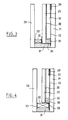
- Figures 3, 4 and 5 highlight another aspect important building glazing according to the invention, namely the mounting configuration chosen.
- Figure 5 shows a relatively complete assembly diagram, while the Figures 3 and 4 show two other possible configurations, the configuration of figure 3 taking again that proposed in Figure 1.
- the double glazing has four glass sheets, numbered 21, 22, 23 and 24 from the outside towards the interior of the building, the glass sheet 22 being systematically the smallest.
- Sheets 21 and 22 are assembled by an organic film 25 of PVB or PU type, containing anti-U.V additives.
- the three configurations essentially differ in the size and position of the plate 23.
- this plate 23 is of intermediate dimensions between those of the outer plate 21 and those of the plate 22 so that the plates 21 and 23 delimit an internal groove 30, in which a seal is injected for example of the polysulfide, polyurethane or silicone type and that the plates 24 and 21 for their part define an external groove 31 or a seal of the same type is injected.
- the seals 30 and 31 are separated by the spacer frame 32 which defines the thickness of the air gap between panels 23 and 24 and is glued panels 24 and 21 with thin mastic cords 33, for example based on butyl rubber.
- the spacer frame is placed directly between panels 23 and 24.
- the configuration of Figure 4 allows to interpose 4 thicknesses (instead of 3) seal between the electrochromic system. By however, it makes it relatively difficult to set up tinsel as will be seen later.
- the panel 23 is of the same dimensions as the panel 21, the groove defined by the inner panel 22 being filled with two seals superimposed 34 and 35 (the interior seal being for example a butyl rubber with molecular sieve and outer seal for example of the polysulfide type).
- the interior seal being for example a butyl rubber with molecular sieve and outer seal for example of the polysulfide type.
- the screen-printed parts 28 are two in number (one negative pole at the top and a positive pole at the bottom) extending in the vicinity of the edges by forming a horseshoe so as to authorize an arrival of the power supply box connections by the outside (it goes without saying that in the proposed diagrams, the part represented is essentially the part of the glazing mounted in the rebate and that the central part is not drawn on a reduced scale).
- the screen printing runs from one edge of the facing the full height of side 4. Electrical continuity with the negative pole of part 28 is ensured at using a metal U-shaped foil 29.
- the plate 23 is provided over its entire height of a screen-printed part 28 ", connected to the pole positive 28 by a foil 36 whose shape is in S ( Figures 3 and 4) or U-shaped.
- the 28 "screen printing must include a return on side 6 (side plate 23), although this device causes an additional constraint during screen printing, it ensures the absence of any short circuit whereas on the contrary, the position of the foil proposed Figure 4, causes such a risk.
- screen printed parts in contact with these seals are preferably coated with a protective enamel layer, made of an electrically non-conductive enamel.
- the solar factor of the glazing can be especially lowered with a layer of improvement of the thermal comfort, such as a low emissive layer or a so-called anti-solar layer.
- low emissivity it is understood a layer (or more exactly a stack of layers) whose emissivity is 0.11 (for example a system of the "Planitherm" type and by anti-solar, a layer whose emissivity is 0.04 (for example a two-layer silver type system).
- the lowest solar factors are obtained with a layer placed opposite 6. Furthermore, if the layer is placed opposite 2 or what amounts to the same on opposite 3, the energy absorption coefficient (A ON ), which leads to less heating of the glazing which must then withstand lower stresses. It is also possible to combine layers on face 2 and face 6 (with the layer on face 2 possibly using a reflective layer in the visible), which then allows very low solar factors but with a decrease in the light transmission in discolored state OFF.
- thermal comfort improvement layer placed in front 6 can be replaced by a stack electrochromic.
Landscapes
- Physics & Mathematics (AREA)
- Nonlinear Science (AREA)
- General Physics & Mathematics (AREA)
- Optics & Photonics (AREA)
- Engineering & Computer Science (AREA)
- Civil Engineering (AREA)
- Structural Engineering (AREA)
- Joining Of Glass To Other Materials (AREA)
- Electrochromic Elements, Electrophoresis, Or Variable Reflection Or Absorption Elements (AREA)
- Liquid Crystal (AREA)
- Laminated Bodies (AREA)
- Building Environments (AREA)
Description
- figure 1 : un schéma d'un vitrage conforme au mode de réalisation préféré de l'invention,
- figure 2 : une courbe comparative de la valeur de la transmission lumineuse en fonction du facteur solaire, obtenue par modélisation, dans un vitrage du type illustré à la figure 1 et de différents vitrages commerciaux de protection solaire.
- figure 3 : une vue simplifiée de la configuration de montage du vitrage schématisé à la figure 1,
- figure 4 * un autre exemple de configuration de montage selon l'invention,
- figure 5 : un troisième exemple de configuration de montage avec une représentation des éléments de connexion électrique.
- couches électroconductrices : oxyde d'indium dopé à l'étain, déposé par pulvérisation cathodique magnétron d'épaisseur 400 nanomètres et de résistance carrée inférieure ou égale à 5 ohms,
- matériau électrochrome cathodique : oxyde de tungstène WO3 déposé par pulvérisation cathodique magnétron réactive à partir d'une cible en tungstène en présence d'oxygène sous une pression de 50 millitors d'un mélange argon-oxygène (15%), pour une épaisseur de 300 nanomètres,
- matériau électrochrome anodique : oxyde d'iridium, déposé par pulvérisation cathodique assistée d'un champ magnétique, sous une pression de 6 millitorrs d'un mélange gazeux oxygène/hydrogène dans un rapport volumique 80/20, d'épaisseur 55 nanomètres, avec éventuellement une pré-insertion des protons par trempage dans un bain acide,
- électrolyte : solution solide d'acide phosphorique anhydre dans du polyoxyéthylène, d'épaisseur 100 micromètres, de conductivité à 20°C de 9.10-5 ohm-1.cm-1 et de transmission lumineuse supérieure à 85 %. Il est préparé de la manière suivante : dans des conditions anhydres, on dissout par litre de solvant de l'acide phosphorique anhydre (21,5 g) et du polyoxyéthylène de masse moléculaire 5 000 000 (densité 1,21 ; température de transition vitreuse -40°C ; rapport O/H du nombre d'atomes d'hydrogène de l'acide égal à 0,66). Le solvant est un mélange 60/40 en volume d'acétonitrile et de tétrahydrofurane.
| N° | Configuration | Etat | TL (%) | TE (%) | Facteur solaire | d (nm) | Pe (%) |
| 1 | verre 1 = 6 mm | ON | 7 | 4 | 0,51 | 481 | 25 |
| air = 12 mm | |||||||
| verre 2=électrochrome | OFF | 29 | 20 | 0,56 | 562 | 5 | |
| 2 | verre 1=électrochrome | ON | 7 | 4 | 0,15 | 481 | 25 |
| air = 12 mm | |||||||
| verre 2 = 6 mm | OFF | 29 | 20 | 0,29 | 562 | 5 | |
| 3 | verre 1 = 3 mm | ON | 7 | 4 | 0,27 | 481 | 25 |
| PVB = 0,38 mm | |||||||
| verre 2=électrochrome | OFF | 32 | 22 | 0,40 | 564 | 5 | |
| 4 | verre 1 = 6 mm | ON | 7 | 4 | 0,51 | 481 | 25 |
| air = 12 mm | |||||||
| verre 2 = 3 mm | |||||||
| PVB = 0,38 mm | OFF | 29 | 19 | 0,57 | 560 | 5 | |
| verre 3=électrochrome | |||||||
| 5 | verre 1 = 3 mm | ON | 7 | 4 | 0,15 | 481 | 25 |
| PVB = 0,38 mm | |||||||
| verre 2=électrochrome | |||||||
| air = 12 mm | OFF | 29 | 19 | 0,29 | 560 | 5 | |
| verre 3 = 6 mm | |||||||
| 6 | verre 1=électrochrome | ON | 6 | 3 | 0,11 | 482 | 24 |
| air = 12 mm | |||||||
| verre 2 = 6 mm + bas émissif | OFF | 26 | 15 | 0,24 | 561 | 6 | |
| 7 | verre 1 = 3 mm | ON | 7 | 4 | 0,15 | 481 | 25 |
| PVB = 0,38 mm | |||||||
| verre 2=électrochrome | |||||||
| air = 12 mm | OFF | 51 | 35 | 0,44 | 570 | 10 | |
| verre 3 = 6 mm |
| N° | Couche confort thermique | Face | TL ON | TL OFF | FS ON | FS OFF | A ON |
| 8 | Aucune | - | 6 | 47 | 0,15 | 0,44 | 0,88 |
| 9 | Bas émissif | 6 | 6 | 47 | 0,09 | 0,33 | 0,88 |
| 10 | Bas émissif | 7 | 6 | 47 | 0,11 | 0,37 | 0,88 |
| 11 | Anti-solaire | 6 | 6 | 47 | 0,08 | 0,33 | 0,88 |
| 12 | Anti-solaire | 7 | 6 | 47 | 0,11 | 0,33 | 0,88 |
| 13 | Anti-solaire | 2 | 6 | 47 | 0,12 | 0,33 | 0,69 |
Claims (17)
- Vitrage bâtiment à contrôle solaire électrocommandable, comportant un panneau (37) constitué par une structure composite (21, 22, 23), ladite structure comportant une première feuille de verre (21), un polymère organique d'assemblage (9, 25) filtrant les ultraviolets, une seconde feuille de verre (22), un système à transmission variable électrochrome composé d'un empilement (26) de couches fonctionnelles, avec notamment une couche électroconductrice transparente, une couche d'un matériau électrochrome cathodique, un polymère organique conducteur ionique, une couche d'un matériau électrochrome anodique et une couche électroconductrice transparente, et une troisième feuille de verre (23), caractérisé en ce qu'il comporte un second panneau intérieur (24) espacé dudit panneau (37) à structure composite (21, 22, 23) par une lame de gaz intercalaire, avec le panneau (37) à structure composite tourné vers l'extérieur de manière à ce que la première feuille de verre (21) soit la feuille de verre extérieure.
- Vitrage bâtiment selon la revendication 1, caractérisé en ce que l'empilement (26) de couches fonctionnelles de la structure composite est isolé de l'extérieur par une succession d'un minimum de 3 joints d'étanchéité (27, 34, 35).
- Vitrage selon l'une des revendications précédentes, caractérisé en ce que la seconde feuille de verre (22) de la structure composite (21, 22, 23) est plus petite que les deux feuilles de verre (21, 23) qui l'entourent, de façon à délimiter une gorge périphérique servant de logement à au moins un joint périphérique d'étanchéité (34, 35).
- Vitrage selon l'une des revendications 1 ou 2, caractérisé en ce que la troisième feuille (23) de la structure composite (21, 22, 23) est de dimensions intermédiaires entre celles de la première (21) et de la seconde (22), de sorte que la première et la troisième feuilles délimitent une gorge (30).
- Vitrage selon l'une des revendications 1 à 3, caractérisé en ce que la troisième feuille (23) de la structure composite (21, 22, 23) est de mêmes dimensions que la première (21).
- Vitrage selon les revendications 3 et 5, caractérisé en ce que la gorge périphérique (30) est remplie par deux joints superposés notamment un premier joint (34) en caoutchouc butyl recouvert d'un second (35) en polysulfure.
- Vitrage bâtiment selon l'une des revendications 1 à 6, caractérisé en ce que le panneau extérieur (37) est d'une taille identique à celle du panneau intérieur (24).
- Vitrage selon l'une des revendications précédentes, caractérisé en ce que le polymère organique (9, 25) d'assemblage filtrant les ultraviolets est coloré.
- Vitrage selon l'une des revendications précédentes, caractérisé en ce qu'il comporte des amenées de courant sérigraphiées électroconductrices (28, 28', 28 ").
- Vitrage selon la revendication 9, caractérisé en ce que les amenées de courant sérigraphiées en contact avec les joints d'étanchéité sont protégées par une couche d'émail non électroconductrice.
- Vitrage selon l'une des revendications 9 ou 10, caractérisé en ce que la connexion électrique des amenées de courant (28, 28', 28 ") est assurée à l'aide d'un clinquant métallique (36, 29) en forme de S ou de U.
- Vitrage selon la revendication 11, caractérisé en ce que le clinquant (36) est isolé à la fois du système électrochrome (26) et de l'extérieur par des joints (34, 35).
- Vitrage selon l'une des revendications précédentes, caractérisé en ce qu'il comporte une couche d'un matériau électrochrome cathodique à base d'oxyde de tungstène.
- Vitrage selon l'une des revendications précédentes, caractérisé par une couche à basse émissivité sur la face tournée vers la lame de gaz intercalaire d'au moins un des panneaux (37, 24).
- Vitrage selon la revendication 14, caractérisé en ce que ladite couche à basse émissivité est sur la face (6) tournée vers la lame de gaz intercalaire du panneau de verre extérieur (37).
- Vitrage selon l'une des revendications précédentes, caractérisé en ce qu'il comporte une couche à basse émissivité ou réfléchissante dans le visible sur une des faces (2, 3) en contact avec le polymère (9, 25) organique d'assemblage.
- Vitrage selon l'une des revendications précédentes, caractérisé en ce qu'il comporte deux empilements (26) de type électrochrome.
Priority Applications (1)
| Application Number | Priority Date | Filing Date | Title |
|---|---|---|---|
| EP97114549A EP0818600A3 (fr) | 1992-05-21 | 1993-05-19 | Vitrage électrochrome |
Applications Claiming Priority (2)
| Application Number | Priority Date | Filing Date | Title |
|---|---|---|---|
| FR9206172A FR2691550B1 (fr) | 1992-05-21 | 1992-05-21 | Vitrage électrochrome architectural. |
| FR9206172 | 1992-05-21 |
Related Child Applications (1)
| Application Number | Title | Priority Date | Filing Date |
|---|---|---|---|
| EP97114549A Division EP0818600A3 (fr) | 1992-05-21 | 1993-05-19 | Vitrage électrochrome |
Publications (2)
| Publication Number | Publication Date |
|---|---|
| EP0575207A1 EP0575207A1 (fr) | 1993-12-22 |
| EP0575207B1 true EP0575207B1 (fr) | 1998-08-26 |
Family
ID=9430013
Family Applications (2)
| Application Number | Title | Priority Date | Filing Date |
|---|---|---|---|
| EP93401299A Expired - Lifetime EP0575207B1 (fr) | 1992-05-21 | 1993-05-19 | Vitrage électrochrome architectural |
| EP97114549A Withdrawn EP0818600A3 (fr) | 1992-05-21 | 1993-05-19 | Vitrage électrochrome |
Family Applications After (1)
| Application Number | Title | Priority Date | Filing Date |
|---|---|---|---|
| EP97114549A Withdrawn EP0818600A3 (fr) | 1992-05-21 | 1993-05-19 | Vitrage électrochrome |
Country Status (9)
| Country | Link |
|---|---|
| US (2) | US5657149A (fr) |
| EP (2) | EP0575207B1 (fr) |
| JP (1) | JP2777045B2 (fr) |
| AT (1) | ATE170253T1 (fr) |
| CA (1) | CA2096707A1 (fr) |
| DE (1) | DE69320552T2 (fr) |
| DK (1) | DK0575207T3 (fr) |
| ES (1) | ES2121963T3 (fr) |
| FR (1) | FR2691550B1 (fr) |
Cited By (2)
| Publication number | Priority date | Publication date | Assignee | Title |
|---|---|---|---|---|
| DE10118614A1 (de) * | 2001-04-12 | 2002-10-24 | Flabeg Gmbh & Co Kg | Verglasungseinheit für Gebäude |
| DE10118617A1 (de) * | 2001-04-12 | 2002-11-07 | Flabeg Gmbh & Co Kg | Verglasungseinheit für Gebäude |
Families Citing this family (121)
| Publication number | Priority date | Publication date | Assignee | Title |
|---|---|---|---|---|
| US5239405A (en) * | 1991-09-06 | 1993-08-24 | Donnelly Corporation | Electrochemichromic solutions, processes for preparing and using the same, and devices manufactured with the same |
| FR2691550B1 (fr) * | 1992-05-21 | 1995-04-21 | Saint Gobain Vitrage Int | Vitrage électrochrome architectural. |
| US6231971B1 (en) * | 1995-06-09 | 2001-05-15 | Glaverbel | Glazing panel having solar screening properties |
| FR2751097B1 (fr) * | 1996-07-10 | 1998-09-11 | Saint Gobain Vitrage | Elements a proprietes optiques/energetiques variables |
| DE19631420B4 (de) * | 1996-08-06 | 2004-03-04 | Fraunhofer-Gesellschaft zur Förderung der angewandten Forschung e.V. | Verglasungselement |
| FR2752570B1 (fr) * | 1996-08-22 | 1998-10-02 | Saint Gobain Vitrage | Vitrage a proprietes optiques et/ou energetiques variables |
| FR2757737B1 (fr) * | 1996-12-19 | 1999-01-22 | Saint Gobain Vitrage | Vitrage a systeme thermiquement, electriquement et/ou electrochimiquement actif |
| DE69721175T2 (de) * | 1996-10-17 | 2004-05-19 | Saint-Gobain Glass France | Verglazung mit einer activen thermische, elektrische und/oder elektrochemische Einheit |
| US6356376B1 (en) * | 1997-04-02 | 2002-03-12 | Gentex Corporation | Electrochromic rearview mirror incorporating a third surface metal reflector and a display/signal light |
| DE19723596C1 (de) * | 1997-06-05 | 1998-10-01 | Webasto Systemkomponenten Gmbh | Lichtdurchlässiger Deckel für ein Fahrzeugdach |
| DE19810932A1 (de) | 1998-03-13 | 1999-09-16 | Bayer Ag | Elektrochrome Anordnung auf Basis von Poly-(3,4-ethylendioxy-thiophen)-Derivaten |
| DE19824186A1 (de) * | 1998-05-29 | 1999-12-02 | Bayer Ag | Elektrochrome Anordnung auf Basis von Poly-(3,4-ethylendioxy-thiophen)-Derivaten und Gel-Elektrolyt mit UV-Schutz |
| DE19824185A1 (de) | 1998-05-29 | 1999-12-02 | Bayer Ag | Elektrochrome Anordnung auf Basis von Poly-(3,4-ethylendioxy-thiophen)-Derivaten in Kombination mit einer Lithiumniobat-Gegenelektrode |
| DE19824215A1 (de) | 1998-05-29 | 1999-12-02 | Bayer Ag | Elektrochrome Anordnung auf Basis von Poly-(3,4-ethylendioxy-thiophen)-Derivaten in der elektrochromen und der ionenspeichernden Funktionsschicht |
| DE19824127A1 (de) | 1998-05-29 | 1999-12-02 | Bayer Ag | Elektrochrome Anordnung auf Basis von Poly-(3,4-ethylendioxy-thiophen)-Derivaten in Kombination mit einer Gegenelektrode, die Metalloxide aus der VI. oder VIII. Nebengruppe enthält |
| DE19824126A1 (de) * | 1998-05-29 | 1999-12-02 | Bayer Ag | UV-geschützte elektrochrome Anordnung auf Basis von Poly-(3,4-ethylendioxy-thiophen)-Derivaten |
| US6317248B1 (en) | 1998-07-02 | 2001-11-13 | Donnelly Corporation | Busbars for electrically powered cells |
| DE19845881A1 (de) | 1998-10-06 | 2000-04-13 | Bayer Ag | Anordnung auf Basis von Poly-(3,4,-dioxythiophen)-Derivaten, die mit Protonen elektrochrom geschaltet werden |
| US7009751B2 (en) * | 1999-05-14 | 2006-03-07 | Gentex Corporation | Electrochromic rearview mirror incorporating a third surface partially transmissive reflector |
| US20060158735A1 (en) * | 2004-02-20 | 2006-07-20 | Tonar William L | Electro-optic device having a self-cleaning hydrophilic coating |
| US6193378B1 (en) * | 1999-06-25 | 2001-02-27 | Gentex Corporation | Electrochromic device having a self-cleaning hydrophilic coating |
| US6597489B1 (en) | 1999-06-30 | 2003-07-22 | Gentex Corporation | Electrode design for electrochromic devices |
| BE1012766A3 (fr) * | 1999-06-30 | 2001-03-06 | Glaverbel | Vitrage notamment pour toit de vehicule. |
| US6643050B2 (en) * | 2000-06-13 | 2003-11-04 | Ppg Industries Ohio, Inc. | Colored electrochromic transparent window assemblies |
| DE10033535A1 (de) * | 2000-07-11 | 2002-01-31 | Ingbuero Dr Ing Harald Schulz | Doppelfassade |
| US6567708B1 (en) * | 2000-07-25 | 2003-05-20 | Gentex Corporation | System to interconnect, link, and control variable transmission windows and variable transmission window constructions |
| US6407847B1 (en) * | 2000-07-25 | 2002-06-18 | Gentex Corporation | Electrochromic medium having a color stability |
| US6640142B1 (en) | 2000-08-02 | 2003-10-28 | International Business Machines Corporation | System and method for controlling workspace environment |
| US6561460B2 (en) * | 2000-08-03 | 2003-05-13 | Ppg Industries Ohio, Inc. | Switchable electrochromic devices for use in aircraft transparency windows |
| BE1015440A3 (fr) * | 2003-03-25 | 2005-04-05 | Glaverbel | Vitrage pour vehicule. |
| US6939612B2 (en) * | 2003-06-03 | 2005-09-06 | Solutia Incorporated | Fluorinated polymer sheets |
| US20050094279A1 (en) * | 2003-10-30 | 2005-05-05 | Tonar William L. | Electrochromic device having a self-cleaning hydrophilic coating with an acid resistant under layer |
| US20050286132A1 (en) * | 2003-10-30 | 2005-12-29 | Tonar William L | Electrochromic device having a self-cleaning hydrophilic coating with a controlled surface morphology |
| US7008091B2 (en) | 2003-12-18 | 2006-03-07 | K.W. Muth Company, Inc. | Electromagnetic radiation assembly |
| US7241037B2 (en) * | 2005-03-23 | 2007-07-10 | K.W. Muth Company | Signaling assembly |
| US20080198584A1 (en) * | 2005-05-17 | 2008-08-21 | Nervecorp Limited | Building Structures Having Electrically Functional Architectural Surfaces |
| US7327321B2 (en) | 2005-06-27 | 2008-02-05 | K.W. Muth Company, Inc. | Electromagnetic radiation assembly |
| FR2899631B1 (fr) * | 2006-04-10 | 2010-02-26 | Saint Gobain | Vitrage feuillete et ses moyens d'etancheification et de renforcement peripherique |
| US7990603B2 (en) | 2006-06-09 | 2011-08-02 | Gentex Corporation | Variable transmission window system |
| FR2906832A1 (fr) * | 2006-10-09 | 2008-04-11 | Saint Gobain | Vitrage multiple a selectivite augmentee |
| US8216683B2 (en) * | 2007-08-03 | 2012-07-10 | Solutia Inc. | Interlayers comprising stabilized tungsten oxide agents |
| EP2036714A1 (fr) * | 2007-09-06 | 2009-03-18 | Schott AG | Elément avec un verre de protection contre le rayonnement ionisant |
| US7535614B1 (en) | 2008-05-27 | 2009-05-19 | Gentex Corporation | Electrical window control system and method thereof |
| US9782949B2 (en) | 2008-05-30 | 2017-10-10 | Corning Incorporated | Glass laminated articles and layered articles |
| US8514476B2 (en) | 2008-06-25 | 2013-08-20 | View, Inc. | Multi-pane dynamic window and method for making same |
| JP5812862B2 (ja) * | 2008-09-22 | 2015-11-17 | ピルキントン グループ リミテッド | 切換可能な窓ガラス |
| US10303035B2 (en) | 2009-12-22 | 2019-05-28 | View, Inc. | Self-contained EC IGU |
| US11314139B2 (en) | 2009-12-22 | 2022-04-26 | View, Inc. | Self-contained EC IGU |
| US9862640B2 (en) | 2010-01-16 | 2018-01-09 | Cardinal Cg Company | Tin oxide overcoat indium tin oxide coatings, coated glazings, and production methods |
| US10000965B2 (en) | 2010-01-16 | 2018-06-19 | Cardinal Cg Company | Insulating glass unit transparent conductive coating technology |
| US11155493B2 (en) | 2010-01-16 | 2021-10-26 | Cardinal Cg Company | Alloy oxide overcoat indium tin oxide coatings, coated glazings, and production methods |
| US10060180B2 (en) | 2010-01-16 | 2018-08-28 | Cardinal Cg Company | Flash-treated indium tin oxide coatings, production methods, and insulating glass unit transparent conductive coating technology |
| US10000411B2 (en) | 2010-01-16 | 2018-06-19 | Cardinal Cg Company | Insulating glass unit transparent conductivity and low emissivity coating technology |
| KR20130010899A (ko) | 2010-03-05 | 2013-01-29 | 세이지 일렉트로크로믹스, 인크. | 유리 기판에 전기변색 소자의 적층체 |
| FR2961609B1 (fr) | 2010-06-21 | 2012-06-01 | Saint Gobain | Dispositif a proprietes optiques et/ou energetiques electrocommandables |
| FR2962818B1 (fr) | 2010-07-13 | 2013-03-08 | Saint Gobain | Dispositif electrochimique a proprietes de transmission optique et/ou energetique electrocommandables. |
| FR2962682B1 (fr) | 2010-07-16 | 2015-02-27 | Saint Gobain | Vitrage electrochimique a proprietes optiques et/ou energetiques electrocommandables |
| US8270059B2 (en) | 2010-08-05 | 2012-09-18 | Soladigm, Inc. | Multi-pane electrochromic windows |
| FR2965641B1 (fr) | 2010-10-04 | 2013-10-11 | Saint Gobain | Vitrage multiple a diffusion variable par cristaux liquides, son procede de fabrication |
| US9958750B2 (en) | 2010-11-08 | 2018-05-01 | View, Inc. | Electrochromic window fabrication methods |
| US8164818B2 (en) | 2010-11-08 | 2012-04-24 | Soladigm, Inc. | Electrochromic window fabrication methods |
| FR2968414B1 (fr) * | 2010-12-06 | 2013-07-05 | Saint Gobain | Dipositif electrochimique a proprietes de transmission optique et/ou energetique electrococommandables |
| FR2968413B1 (fr) * | 2010-12-06 | 2012-12-07 | Saint Gobain | Dispositif electrochimique a proprietes de transmission optique et/ou energetique electrocommandables |
| US10180606B2 (en) | 2010-12-08 | 2019-01-15 | View, Inc. | Connectors for smart windows |
| US9442339B2 (en) | 2010-12-08 | 2016-09-13 | View, Inc. | Spacers and connectors for insulated glass units |
| EP2649490B1 (fr) | 2010-12-08 | 2018-07-11 | View, Inc. | Espaceurs améliorés destinés à des éléments de vitrage isolant |
| US8643933B2 (en) | 2011-12-14 | 2014-02-04 | View, Inc. | Connectors for smart windows |
| US10429712B2 (en) | 2012-04-20 | 2019-10-01 | View, Inc. | Angled bus bar |
| US9454055B2 (en) | 2011-03-16 | 2016-09-27 | View, Inc. | Multipurpose controller for multistate windows |
| US10175549B2 (en) | 2011-03-16 | 2019-01-08 | View, Inc. | Connectors for smart windows |
| PT2766774T (pt) * | 2011-10-10 | 2019-05-17 | Saint Gobain | Envidraçamento isolante electrocromático com superfície de comutação de sensores |
| US11048137B2 (en) | 2011-12-12 | 2021-06-29 | View, Inc. | Thin-film devices and fabrication |
| US12321075B2 (en) | 2011-12-12 | 2025-06-03 | View Operating Corporation | Electrochromic laminates |
| US10739658B2 (en) | 2011-12-12 | 2020-08-11 | View, Inc. | Electrochromic laminates |
| US10606142B2 (en) | 2011-12-12 | 2020-03-31 | View, Inc. | Thin-film devices and fabrication |
| US11719039B2 (en) | 2011-12-14 | 2023-08-08 | View, Inc. | Connectors for smart windows |
| FR2985328B1 (fr) | 2011-12-29 | 2013-12-20 | Saint Gobain | Vitrage multiple a diffusion variable par cristaux liquides |
| US9281672B2 (en) | 2012-01-20 | 2016-03-08 | Sage Electrochromics, Inc. | Electrical connectivity within architectural glazing frame systems |
| US11635666B2 (en) | 2012-03-13 | 2023-04-25 | View, Inc | Methods of controlling multi-zone tintable windows |
| US12153320B2 (en) | 2012-03-13 | 2024-11-26 | View, Inc. | Multi-zone EC windows |
| US9341912B2 (en) | 2012-03-13 | 2016-05-17 | View, Inc. | Multi-zone EC windows |
| US12578609B2 (en) | 2012-03-13 | 2026-03-17 | View Operating Corporation | Methods of controlling multi-zone tintable windows |
| US9405165B2 (en) | 2012-03-30 | 2016-08-02 | Gentex Corporation | Controller configured for an electro-optic device and method thereof |
| WO2013151660A1 (fr) | 2012-04-05 | 2013-10-10 | Sage Electrochromics, Inc. | Procédé et appareil pour la coupe sur traces au laser thermique pour la production de dispositif électrochrome ; panneau de verre coupé correspondant |
| US11255120B2 (en) | 2012-05-25 | 2022-02-22 | View, Inc. | Tester and electrical connectors for insulated glass units |
| HK1212003A1 (en) | 2012-08-23 | 2016-06-03 | View, Inc. | Photonic-powered ec devices |
| US8947759B2 (en) | 2012-10-12 | 2015-02-03 | Sage Electrochromics, Inc. | Partially tinted clear state for improved color and solar-heat gain control of electrochromic devices |
| PT2917159T (pt) * | 2012-11-08 | 2019-02-27 | Saint Gobain | Envidraçamento com propriedades óticas comutáveis |
| EP2965151B1 (fr) * | 2013-03-07 | 2022-05-04 | Solutia Canada Inc. | Joint d'étanchéité et système d'étanchéité pour dispositif en couches |
| DE102013206622B4 (de) * | 2013-04-13 | 2017-10-19 | Pr Germany Gmbh | Verschlusselement in Form eines Fensters oder einer Tür |
| RU2019101249A (ru) | 2013-06-18 | 2019-03-05 | Вью, Инк. | Электрохромные устройства непрямоугольных форм |
| WO2014204387A1 (fr) * | 2013-06-20 | 2014-12-24 | Chromogenics Ab | Dispositifs électrochromiques et procédés de fabrication associés |
| EP3052985B1 (fr) | 2013-10-04 | 2019-07-24 | Gentex Corporation | Système de fenêtre à transmittance variable |
| WO2015077313A1 (fr) | 2013-11-19 | 2015-05-28 | Gentex Corporation | Reduction de la condensation dans des systemes de hublot a intensite lumineuse reglable |
| US9586669B2 (en) | 2013-11-25 | 2017-03-07 | Gentex Corporation | Aerospace protective dust cover |
| WO2015089663A1 (fr) | 2013-12-19 | 2015-06-25 | Switch Materials Inc. | Objets commutables et procédés de fabrication |
| US10767143B2 (en) | 2014-03-06 | 2020-09-08 | Sage Electrochromics, Inc. | Particle removal from electrochromic films using non-aqueous fluids |
| EP3152111B1 (fr) | 2014-06-05 | 2020-07-29 | Gentex Corporation | Ensemble cache antipoussière avec une lumière périphérique |
| WO2016073848A1 (fr) | 2014-11-07 | 2016-05-12 | Gentex Corporation | Actionneur de miroir d'affichage plein écran |
| WO2016100075A1 (fr) | 2014-12-15 | 2016-06-23 | View, Inc. | Joints pour fenêtres électrochromiques |
| WO2016201087A1 (fr) | 2015-06-09 | 2016-12-15 | Gentex Corporation | Retenue d'un ensemble hublot électro-optique |
| WO2016201112A1 (fr) | 2015-06-09 | 2016-12-15 | Gentex Corporation | Lunette à pièces multiples pour ensemble fenêtre électro-optique |
| EP3359404A4 (fr) | 2015-10-07 | 2018-12-05 | Gentex Corporation | Toit ouvrant comprenant un élément électro-optique |
| CN109072666A (zh) | 2016-05-20 | 2018-12-21 | 金泰克斯公司 | 电光窗户控制系统 |
| CN106088419A (zh) * | 2016-08-09 | 2016-11-09 | 浙江金诺新能源科技有限公司 | 高寿命高透光多晶pvb夹层玻璃幕墙组件 |
| WO2018157057A1 (fr) | 2017-02-27 | 2018-08-30 | Sage Electrochromics, Inc. | Dispositif électrique comprenant un substrat et une couche conductrice transparente et son procédé de formation |
| US10866480B2 (en) | 2017-04-20 | 2020-12-15 | Cardinal Ig Company | High performance privacy glazing structures |
| CN107092148A (zh) * | 2017-06-26 | 2017-08-25 | 安徽鑫昊等离子显示器件有限公司 | 一种电致变色真空玻璃 |
| CN107367878A (zh) * | 2017-06-26 | 2017-11-21 | 安徽鑫昊等离子显示器件有限公司 | 一种电致变色真空玻璃 |
| MX2020000425A (es) | 2017-07-13 | 2020-07-13 | Cardinal Ig Co | Configuraciones de conexion electrica para estructuras de acristalamiento de privacidad. |
| WO2019090300A2 (fr) | 2017-11-06 | 2019-05-09 | Sage Electrochromics, Inc. | Article comprenant un dispositif non électroluminescent à transmission variable et un revêtement |
| EP3707555B1 (fr) | 2017-11-06 | 2025-05-07 | Cardinal Ig Company | Système de vitrage opaque à conducteur électrique distinct |
| EP3790735A1 (fr) | 2018-05-09 | 2021-03-17 | Cardinal Ig Company | Vitrage de confidentialité à commande électrique avec dispositif d'entraînement de recapture d'énergie |
| EP3837581B1 (fr) | 2018-08-17 | 2023-07-19 | Cardinal Ig Company | Structure de vitrage opaque dotée de décalages de vitre asymétriques pour configurations de connexion électrique |
| US11028012B2 (en) | 2018-10-31 | 2021-06-08 | Cardinal Cg Company | Low solar heat gain coatings, laminated glass assemblies, and methods of producing same |
| US11474385B1 (en) | 2018-12-02 | 2022-10-18 | Cardinal Ig Company | Electrically controllable privacy glazing with ultralow power consumption comprising a liquid crystal material having a light transmittance that varies in response to application of an electric field |
| EP3921152B1 (fr) | 2019-02-08 | 2026-05-06 | Cardinal Ig Company | Dispositif d'excitation à faible puissance pour les vitrages d'intimité |
| MX2021013261A (es) | 2019-04-29 | 2022-01-06 | Cardinal Ig Co | Control electrico de direccion escalonada de una pluralidad de estructuras de acristalamiento con privacidad electricamente controlable. |
| MX2021013262A (es) | 2019-04-29 | 2022-01-06 | Cardinal Ig Co | Deteccion y control de corriente de fuga para una o mas estructuras de acristalamiento con privacia electricamente controlable. |
| EP3963395A1 (fr) | 2019-04-29 | 2022-03-09 | Cardinal Ig Company | Systèmes et procédés pour faire fonctionner une ou plusieurs structures de vitrage teintées pouvant être commandées électriquement |
| US20240282875A1 (en) * | 2023-02-17 | 2024-08-22 | Clearvue Technologies Ltd | Window unit for a building or structure |
Family Cites Families (22)
| Publication number | Priority date | Publication date | Assignee | Title |
|---|---|---|---|---|
| US3046085A (en) * | 1959-09-16 | 1962-07-24 | Midland Ross Corp | Viscose spinning solution and process |
| US3406085A (en) * | 1964-05-11 | 1968-10-15 | Corning Glass Works | Photochromic window |
| US4380994A (en) * | 1979-06-28 | 1983-04-26 | Seemann Robert A | All season window |
| DE3125085A1 (de) * | 1981-06-26 | 1983-01-13 | Inefa Kunststoffe Ag, 2210 Itzehoe | Verglasung fuer fenster oder dergl. |
| DE3205056A1 (de) * | 1981-10-28 | 1983-08-18 | SCHÜCO Heinz Schürmann GmbH & Co, 4800 Bielefeld | Fenster oder tuer in rahmenbauweise mit einer durchsichtigen, mehrschichtigen fuellungsplatte und einer verdunklungsvorrichtung |
| DE3414172A1 (de) * | 1984-04-14 | 1985-10-24 | Sürget, Eksem M., 4000 Düsseldorf | Mehrfachglasscheibe |
| GB8422262D0 (en) * | 1984-09-04 | 1984-10-10 | Green M | Variable transmission optical device |
| JPS62215247A (ja) * | 1986-03-17 | 1987-09-21 | Sharp Corp | 光スイツチング素子 |
| US4902081A (en) * | 1987-05-22 | 1990-02-20 | Viracon, Inc. | Low emissivity, low shading coefficient low reflectance window |
| US4848875A (en) * | 1987-06-25 | 1989-07-18 | Allied-Signal Inc. | Dual-pane thermal window with liquid crystal shade |
| JPH01115725U (fr) * | 1988-01-29 | 1989-08-03 | ||
| US5115346A (en) * | 1988-02-12 | 1992-05-19 | Donnelly Corporation | Anti-scatter, ultraviolet protected, anti-misting, electro-optical rearview mirror |
| US5239406A (en) * | 1988-02-12 | 1993-08-24 | Donnelly Corporation | Near-infrared reflecting, ultraviolet protected, safety protected, electrochromic vehicular glazing |
| US4893908A (en) * | 1988-06-27 | 1990-01-16 | Allied-Signal Inc. | Adjustable tint window with electrochromic conductive polymer |
| CA1313562C (fr) * | 1988-08-17 | 1993-02-09 | Nikon Corporation | Dispositif electrochromique |
| US4988917A (en) * | 1988-12-16 | 1991-01-29 | Gte Products Corporation | Hooked electrode for arc lamp |
| FR2649691B1 (fr) * | 1989-07-11 | 1992-10-30 | Saint Gobain Vitrage Int | Vitrage electrochrome |
| FR2652037B1 (fr) * | 1989-09-18 | 1992-04-03 | Saint Gobain Vitrage Int | Vitrage feuillete chauffant. |
| US5103336A (en) * | 1989-09-25 | 1992-04-07 | General Electric Company | Multilayered security window structure |
| KR920704179A (ko) * | 1990-03-06 | 1992-12-19 | 리챠드 지. 워터맨 | 밀봉된 전기발색 장치(sealed electrochromic device) |
| US5076673A (en) * | 1990-08-10 | 1991-12-31 | Donnelly Corporation | Prolonged coloration electrochromic assembly |
| FR2691550B1 (fr) * | 1992-05-21 | 1995-04-21 | Saint Gobain Vitrage Int | Vitrage électrochrome architectural. |
-
1992
- 1992-05-21 FR FR9206172A patent/FR2691550B1/fr not_active Expired - Fee Related
-
1993
- 1993-05-19 EP EP93401299A patent/EP0575207B1/fr not_active Expired - Lifetime
- 1993-05-19 ES ES93401299T patent/ES2121963T3/es not_active Expired - Lifetime
- 1993-05-19 EP EP97114549A patent/EP0818600A3/fr not_active Withdrawn
- 1993-05-19 DK DK93401299T patent/DK0575207T3/da active
- 1993-05-19 AT AT93401299T patent/ATE170253T1/de not_active IP Right Cessation
- 1993-05-19 DE DE69320552T patent/DE69320552T2/de not_active Expired - Fee Related
- 1993-05-20 CA CA002096707A patent/CA2096707A1/fr not_active Abandoned
- 1993-05-20 US US08/063,947 patent/US5657149A/en not_active Expired - Fee Related
- 1993-05-21 JP JP5119952A patent/JP2777045B2/ja not_active Expired - Fee Related
-
1997
- 1997-06-12 US US08/873,863 patent/US5889608A/en not_active Expired - Fee Related
Cited By (3)
| Publication number | Priority date | Publication date | Assignee | Title |
|---|---|---|---|---|
| DE10118614A1 (de) * | 2001-04-12 | 2002-10-24 | Flabeg Gmbh & Co Kg | Verglasungseinheit für Gebäude |
| DE10118617A1 (de) * | 2001-04-12 | 2002-11-07 | Flabeg Gmbh & Co Kg | Verglasungseinheit für Gebäude |
| DE10118617B4 (de) * | 2001-04-12 | 2007-11-08 | Econtrol-Glas Gmbh & Co.Kg | Verglasungseinheit für Gebäude |
Also Published As
| Publication number | Publication date |
|---|---|
| ES2121963T3 (es) | 1998-12-16 |
| EP0818600A2 (fr) | 1998-01-14 |
| JPH0695170A (ja) | 1994-04-08 |
| US5889608A (en) | 1999-03-30 |
| DK0575207T3 (da) | 1999-05-25 |
| EP0818600A3 (fr) | 2000-09-20 |
| JP2777045B2 (ja) | 1998-07-16 |
| DE69320552T2 (de) | 1999-04-22 |
| EP0575207A1 (fr) | 1993-12-22 |
| US5657149A (en) | 1997-08-12 |
| CA2096707A1 (fr) | 1993-11-22 |
| ATE170253T1 (de) | 1998-09-15 |
| DE69320552D1 (de) | 1998-10-01 |
| FR2691550A1 (fr) | 1993-11-26 |
| FR2691550B1 (fr) | 1995-04-21 |
Similar Documents
| Publication | Publication Date | Title |
|---|---|---|
| EP0818600A2 (fr) | Vitrage électrochrome | |
| EP2350416B1 (fr) | Vitrage multiple incorporant au moins un revetement antireflet et utilisation d'un revetement antireflet dans un vitrage multiple | |
| EP1689690B1 (fr) | Substrat transparent utilisable alternativement ou cumulativement pour le controle thermique, le blindage electromagnetique et le vitrage chauffant. | |
| EP0638528B1 (fr) | Substrats transparents munis d'un empilement de couches minces, application aux vitrages d'isolation thermique et/ou de protection solaire | |
| US9963383B2 (en) | Ruggedized switchable glazing, and/or method of making the same | |
| US8199264B2 (en) | Ruggedized switchable glazing comprising a liquid crystal inclusive layer and a multi-layer low-E ultraviolet blocking coating | |
| EP1405135B1 (fr) | Dispositif electrocommandable electrochrome a proprietes optiques et/ou energetiques variables | |
| EP2470483B1 (fr) | Substrat muni d'un empilement a proprietes thermiques, en particulier pour realiser un vitrage chauffant | |
| EP2010384A1 (fr) | Vitrage feuilleté et ses moyens d'étanchéification et de renforcement périphérique | |
| EP0825478A1 (fr) | Vitrage à propriétés optiques et/ou énergétiques variables | |
| EP2217437B1 (fr) | Vitrage interchangeable robuste, et/ou son procédé de réalisation | |
| EP0368707B1 (fr) | Paroi vitrée chauffante | |
| EP3383813A1 (fr) | Substrat muni d'un empilement a proprietes thermiques comportant au moins une couche en oxyde de nickel | |
| FR3137084A1 (fr) | Article verrier transparent pour compartiment froid et vitrage multiple incorporant ledit article. | |
| FR2717171A1 (fr) | Substrats transparents munis d'un empilement de couches minces, application aux vitrages d'isolation thermique et/ou de protection solaire. | |
| EP4543818A1 (fr) | Article verrier transparent pour compartiment froid et vitrage multiple incorporant ledit article |
Legal Events
| Date | Code | Title | Description |
|---|---|---|---|
| PUAI | Public reference made under article 153(3) epc to a published international application that has entered the european phase |
Free format text: ORIGINAL CODE: 0009012 |
|
| AK | Designated contracting states |
Kind code of ref document: A1 Designated state(s): AT BE CH DE DK ES FR GB IT LI LU NL PT SE |
|
| 17P | Request for examination filed |
Effective date: 19940516 |
|
| 17Q | First examination report despatched |
Effective date: 19950830 |
|
| GRAG | Despatch of communication of intention to grant |
Free format text: ORIGINAL CODE: EPIDOS AGRA |
|
| GRAG | Despatch of communication of intention to grant |
Free format text: ORIGINAL CODE: EPIDOS AGRA |
|
| GRAH | Despatch of communication of intention to grant a patent |
Free format text: ORIGINAL CODE: EPIDOS IGRA |
|
| RAP1 | Party data changed (applicant data changed or rights of an application transferred) |
Owner name: SAINT-GOBAIN VITRAGE |
|
| GRAH | Despatch of communication of intention to grant a patent |
Free format text: ORIGINAL CODE: EPIDOS IGRA |
|
| GRAA | (expected) grant |
Free format text: ORIGINAL CODE: 0009210 |
|
| AK | Designated contracting states |
Kind code of ref document: B1 Designated state(s): AT BE CH DE DK ES FR GB IT LI LU NL PT SE |
|
| REF | Corresponds to: |
Ref document number: 170253 Country of ref document: AT Date of ref document: 19980915 Kind code of ref document: T |
|
| XX | Miscellaneous (additional remarks) |
Free format text: TEILANMELDUNG 97114549.5 EINGEREICHT AM 22/08/97. |
|
| REG | Reference to a national code |
Ref country code: CH Ref legal event code: EP |
|
| REF | Corresponds to: |
Ref document number: 69320552 Country of ref document: DE Date of ref document: 19981001 |
|
| REG | Reference to a national code |
Ref country code: CH Ref legal event code: NV Representative=s name: KIRKER & CIE SA |
|
| GBT | Gb: translation of ep patent filed (gb section 77(6)(a)/1977) |
Effective date: 19981110 |
|
| REG | Reference to a national code |
Ref country code: ES Ref legal event code: FG2A Ref document number: 2121963 Country of ref document: ES Kind code of ref document: T3 |
|
| REG | Reference to a national code |
Ref country code: PT Ref legal event code: SC4A Free format text: AVAILABILITY OF NATIONAL TRANSLATION Effective date: 19981112 |
|
| REG | Reference to a national code |
Ref country code: DK Ref legal event code: T3 |
|
| PLBE | No opposition filed within time limit |
Free format text: ORIGINAL CODE: 0009261 |
|
| STAA | Information on the status of an ep patent application or granted ep patent |
Free format text: STATUS: NO OPPOSITION FILED WITHIN TIME LIMIT |
|
| 26N | No opposition filed | ||
| REG | Reference to a national code |
Ref country code: GB Ref legal event code: IF02 |
|
| PGFP | Annual fee paid to national office [announced via postgrant information from national office to epo] |
Ref country code: LU Payment date: 20080509 Year of fee payment: 16 Ref country code: ES Payment date: 20080619 Year of fee payment: 16 Ref country code: DK Payment date: 20080515 Year of fee payment: 16 Ref country code: DE Payment date: 20080522 Year of fee payment: 16 Ref country code: CH Payment date: 20080527 Year of fee payment: 16 |
|
| PGFP | Annual fee paid to national office [announced via postgrant information from national office to epo] |
Ref country code: AT Payment date: 20080514 Year of fee payment: 16 |
|
| PGFP | Annual fee paid to national office [announced via postgrant information from national office to epo] |
Ref country code: PT Payment date: 20080430 Year of fee payment: 16 Ref country code: BE Payment date: 20080617 Year of fee payment: 16 |
|
| PGFP | Annual fee paid to national office [announced via postgrant information from national office to epo] |
Ref country code: SE Payment date: 20080509 Year of fee payment: 16 Ref country code: NL Payment date: 20080501 Year of fee payment: 16 |
|
| PGFP | Annual fee paid to national office [announced via postgrant information from national office to epo] |
Ref country code: IT Payment date: 20080528 Year of fee payment: 16 |
|
| PGFP | Annual fee paid to national office [announced via postgrant information from national office to epo] |
Ref country code: GB Payment date: 20080521 Year of fee payment: 16 |
|
| REG | Reference to a national code |
Ref country code: PT Ref legal event code: MM4A Free format text: LAPSE DUE TO NON-PAYMENT OF FEES Effective date: 20091119 |
|
| BERE | Be: lapsed |
Owner name: *SAINT-GOBAIN VITRAGE Effective date: 20090531 |
|
| REG | Reference to a national code |
Ref country code: CH Ref legal event code: PL |
|
| REG | Reference to a national code |
Ref country code: DK Ref legal event code: EBP |
|
| GBPC | Gb: european patent ceased through non-payment of renewal fee |
Effective date: 20090519 |
|
| PG25 | Lapsed in a contracting state [announced via postgrant information from national office to epo] |
Ref country code: LI Free format text: LAPSE BECAUSE OF NON-PAYMENT OF DUE FEES Effective date: 20090531 Ref country code: CH Free format text: LAPSE BECAUSE OF NON-PAYMENT OF DUE FEES Effective date: 20090531 Ref country code: AT Free format text: LAPSE BECAUSE OF NON-PAYMENT OF DUE FEES Effective date: 20090519 |
|
| NLV4 | Nl: lapsed or anulled due to non-payment of the annual fee |
Effective date: 20091201 |
|
| PG25 | Lapsed in a contracting state [announced via postgrant information from national office to epo] |
Ref country code: NL Free format text: LAPSE BECAUSE OF NON-PAYMENT OF DUE FEES Effective date: 20091201 |
|
| REG | Reference to a national code |
Ref country code: FR Ref legal event code: ST Effective date: 20100129 |
|
| PG25 | Lapsed in a contracting state [announced via postgrant information from national office to epo] |
Ref country code: PT Free format text: LAPSE BECAUSE OF NON-PAYMENT OF DUE FEES Effective date: 20091119 |
|
| PG25 | Lapsed in a contracting state [announced via postgrant information from national office to epo] |
Ref country code: FR Free format text: LAPSE BECAUSE OF NON-PAYMENT OF DUE FEES Effective date: 20090602 Ref country code: DK Free format text: LAPSE BECAUSE OF NON-PAYMENT OF DUE FEES Effective date: 20090531 |
|
| PGFP | Annual fee paid to national office [announced via postgrant information from national office to epo] |
Ref country code: FR Payment date: 20080516 Year of fee payment: 16 |
|
| PG25 | Lapsed in a contracting state [announced via postgrant information from national office to epo] |
Ref country code: GB Free format text: LAPSE BECAUSE OF NON-PAYMENT OF DUE FEES Effective date: 20090519 |
|
| PG25 | Lapsed in a contracting state [announced via postgrant information from national office to epo] |
Ref country code: DE Free format text: LAPSE BECAUSE OF NON-PAYMENT OF DUE FEES Effective date: 20091201 Ref country code: BE Free format text: LAPSE BECAUSE OF NON-PAYMENT OF DUE FEES Effective date: 20090531 |
|
| REG | Reference to a national code |
Ref country code: ES Ref legal event code: FD2A Effective date: 20090520 |
|
| PG25 | Lapsed in a contracting state [announced via postgrant information from national office to epo] |
Ref country code: ES Free format text: LAPSE BECAUSE OF NON-PAYMENT OF DUE FEES Effective date: 20090520 |
|
| PG25 | Lapsed in a contracting state [announced via postgrant information from national office to epo] |
Ref country code: IT Free format text: LAPSE BECAUSE OF NON-PAYMENT OF DUE FEES Effective date: 20090519 |
|
| PG25 | Lapsed in a contracting state [announced via postgrant information from national office to epo] |
Ref country code: LU Free format text: LAPSE BECAUSE OF NON-PAYMENT OF DUE FEES Effective date: 20090519 |
|
| PG25 | Lapsed in a contracting state [announced via postgrant information from national office to epo] |
Ref country code: SE Free format text: LAPSE BECAUSE OF NON-PAYMENT OF DUE FEES Effective date: 20090520 |