EP0572377B1 - Darlington transistor circuit - Google Patents
Darlington transistor circuit Download PDFInfo
- Publication number
- EP0572377B1 EP0572377B1 EP90911279A EP90911279A EP0572377B1 EP 0572377 B1 EP0572377 B1 EP 0572377B1 EP 90911279 A EP90911279 A EP 90911279A EP 90911279 A EP90911279 A EP 90911279A EP 0572377 B1 EP0572377 B1 EP 0572377B1
- Authority
- EP
- European Patent Office
- Prior art keywords
- voltage
- transistor
- collector
- base
- power transistor
- Prior art date
- Legal status (The legal status is an assumption and is not a legal conclusion. Google has not performed a legal analysis and makes no representation as to the accuracy of the status listed.)
- Expired - Lifetime
Links
- 230000015556 catabolic process Effects 0.000 claims description 28
- 238000001465 metallisation Methods 0.000 claims description 10
- VYPSYNLAJGMNEJ-UHFFFAOYSA-N Silicium dioxide Chemical compound O=[Si]=O VYPSYNLAJGMNEJ-UHFFFAOYSA-N 0.000 claims description 5
- 229910052814 silicon oxide Inorganic materials 0.000 claims description 5
- 239000000758 substrate Substances 0.000 claims description 3
- 230000001105 regulatory effect Effects 0.000 claims description 2
- 230000007774 longterm Effects 0.000 abstract description 4
- 239000011248 coating agent Substances 0.000 abstract 3
- 238000000576 coating method Methods 0.000 abstract 3
- 230000007306 turnover Effects 0.000 abstract 3
- 238000010586 diagram Methods 0.000 description 6
- 230000006641 stabilisation Effects 0.000 description 2
- 238000011105 stabilization Methods 0.000 description 2
- 239000002800 charge carrier Substances 0.000 description 1
- 230000007423 decrease Effects 0.000 description 1
- 238000009434 installation Methods 0.000 description 1
- 230000010354 integration Effects 0.000 description 1
- 229910052710 silicon Inorganic materials 0.000 description 1
- 239000010703 silicon Substances 0.000 description 1
Images

Classifications
-
- H—ELECTRICITY
- H03—ELECTRONIC CIRCUITRY
- H03F—AMPLIFIERS
- H03F3/00—Amplifiers with only discharge tubes or only semiconductor devices as amplifying elements
- H03F3/34—DC amplifiers in which all stages are DC-coupled
- H03F3/343—DC amplifiers in which all stages are DC-coupled with semiconductor devices only
- H03F3/3432—DC amplifiers in which all stages are DC-coupled with semiconductor devices only with bipolar transistors
- H03F3/3435—DC amplifiers in which all stages are DC-coupled with semiconductor devices only with bipolar transistors using Darlington amplifiers
-
- H—ELECTRICITY
- H03—ELECTRONIC CIRCUITRY
- H03F—AMPLIFIERS
- H03F1/00—Details of amplifiers with only discharge tubes, only semiconductor devices or only unspecified devices as amplifying elements
- H03F1/52—Circuit arrangements for protecting such amplifiers
Definitions
- the invention relates to a Darlington transistor circuit in a chip.
- a known Darlington transistor circuit (US-A-4 618 875) contains a power transistor and a driver transistor, the collector of which is connected to the collector of the power transistor and in which the power transistor and the driver transistor are in a common substrate forming the collector zones of the two transistors Chips are monolithically integrated in planar technology.
- a cover electrode metallization electrically insulated by a silicon oxide layer extends over the space charge zone, which is formed in the region of the pn junction on the chip top side between the base and the collector.
- a voltage divider is provided between the common collector and the base of the power transistor with a connection of the tap of the voltage divider to the cover electrode metallization.
- the transistor breakdown voltage can thus be influenced and made adjustable via the electrical potential of this cover electrode metallization, this potential being adjusted or choice of individual resistors of the voltage divider is determined.
- the base bleeder resistor prevents the current through the resistors of the voltage divider from opening the transistor through its base. If the breakdown voltage is plotted against a value of two voltage divider resistors (resistor 1 divided by the sum of resistors 1 and 2), there is an increasing left curve branch to a discontinuity and a right, falling curve branch.
- the divider tap is expediently set such that the transistor operating point lies in the left part of the curve for the breakdown voltage, since operating points in the right part of the curve lead to a highly unstable breakdown behavior.
- changes in the breakdown voltage are also possible if the working point is located in the left part of this curve. This can be caused, for example, by changes in the voltage divider ratio due to mechanical tension on the resistors. Other causes can also be changes in the breakdown voltage of the pn junction due to a temperature change in the junction or due to charge carriers which are incorporated into the silicon oxide during long operation. The stabilization of the breakdown voltage is not always sufficient due to these temperature dependencies, long-term drifts and the dependency on assembly.
- the resistors of the voltage divider are not only realized as fixed resistors, but the potential that determines the breakdown voltage is regulated via an additional reference voltage.
- the breakdown voltage behavior is thus determined by an independently implemented reference voltage, as a result of which the temperature dependency, long-term drift and installation dependency of the breakdown voltage values can be eliminated or reduced.
- This Circuit expansion will make it possible to use the known voltage limitation principle in future in applications for which it could not previously be used, for example due to very tight tolerance requirements for the voltage limitation. Due to the general dependence of the breakdown voltage behavior on the reference voltage to be implemented independently, other requirements for the breakdown voltage behavior can also be represented in this way, such as a defined temperature coefficient ⁇ 0.
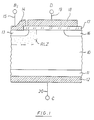
- a substrate 10 consists of n-type Silicon, to which an n+ region 11 with a collector metallization 12 connects at the bottom. From the main surface, a p-type base zone is diffused, over which a base metallization 14 is attached and on which a base connection 15 for the base B 1 of the power transistor T 1 of a Darlington circuit is shown schematically.
- a space charge zone RLZ is shown in broken lines.
- a diffused n+ zone 16 is also shown.
- the area between the zones 13 and 16 is covered over an insulating silicon oxide layer 17 by a metallization acting as a cover electrode 18, to which a schematic external connection 19 is also shown.
- a metallization acting as a cover electrode 18 is also shown.
- an external connection 20 is also on the collector metallization 12 to a common collector C of the power transistor T1 and the driver transistor T2 of the Darlington circuit.
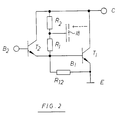
- Fig. 2 the electrical circuit diagram of the arrangement of FIG. 1 is shown supplemented by a voltage divider. It can be seen that between the common collector terminal C and between the base terminal B1 of the power transistor T1, a voltage divider from the resistors R1 and R2 is attached, the cover electrode 18 having connection to the center tap of this voltage divider. Through this connection, the cover electrode receives a potential that depends on the size of the resistors R1 and R2 and their ratio. From Fig. 1 it can be seen that the potential of the top electrode 18 acts on the space charge RLZ and thus influences and determines the collector-emitter breakdown voltage, a further dependency being given by the thickness of the silicon oxide layer 17.
- the uppermost point can be, for example, at 400 V and the start of the left curve branch, for example at 180 V.
- values T 1 and T 2 are each an operating point 1 and an operating point 2 at the corresponding breakdown voltages U CE1 and U CE2 in the left curve area. Working points in the right curve area lead to unstable conditions.
- the operating points shown are also not absolutely stable when choosing a circuit arrangement according to FIG. 2 and can change due to temperature dependencies, long-term drifts, tension during assembly, etc.
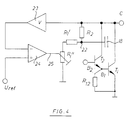
- a sufficient stabilization of the breakdown voltage U CE is made possible with the circuit expansion according to the invention according to FIG. 4, which can also be integrated on the Darlington chip.
- a voltage divider is provided, similar to that in Fig. 2, the resistor R2 with the collector C. and the divider tap 22 connected to the cover electrode 18 has connection.
- the resistor R1 is divided here into a fixed resistor R1 'and a controllable, variable resistor R1 ⁇ , which, however, is no longer connected to the base line to the power transistor, but to ground.
- the voltage applied to the collector C is suitably transformed, for example amplified via an amplifying element 23, and fed to a comparator or controller 24 as the actual value.
- a reference voltage U ref is applied to this regulator element 24 as the setpoint.
- a signal for adjustment is sent via a control line 25 of the resistance R1 ⁇ delivered. This changes the potential of the cover electrode 18 and thus also changes the breakdown voltage U CE .
- R1 ⁇ 0 ... R1 ⁇ Max R1 ′ + R1 ⁇ Max ⁇ R2.
- Fig. 4 the control circuit is shown in connection with the resistor R1. A control intervention via R2 is possible accordingly.
- FIG. 4 schematically represents the general control principle for setting the transistor breakdown voltage. Specific embodiments in which the circuit parts can be monolithically integrated in the Darlington chip are shown below in FIGS. 5 and 6.
- FIGS. 5 and 6 represent the circuits according to the invention.
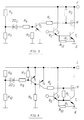
- Fig. 5 again the power transistor T1 with its base B1 and the driver transistor T2 with its base B2 can be seen.
- the voltage divider from the resistors R1 and R2 is similar to that in Fig. 4 with the resistor R2 connected to the collector C and the top electrode 18 on the divider tap.
- the resistor R1 is on the collector-emitter path of a transistor T3 to ground.
- a voltage divider from the resistors R5 and R6 is connected with its divider tap, the resistor R5 being connected to ground and following the resistor R6 a Z-diode ZD2, which in turn is connected to the voltage tap of a further voltage divider from the resistors R3 and R4 has connection.
- the resistor R3 is connected to ground, while the resistor R4 has the common collector C of the transistors T1 and T2 connection.
- the divider intervention on the voltage divider R1 / R2 takes place here the controlled current / voltage source from the collector-emitter voltage / current of the transistor T3.
- the breakdown voltage U CE is divided over the voltage divider from the resistors R3 and R4 and compared with a reference voltage.
- the voltage drop across the breakdown-operated Zener diode ZD2, the resistor R6 and the base-emitter voltage of the transistor T3 serves as the reference voltage.
- the value and the temperature behavior of the reference voltage can be optimized via the divider ratio of the resistors R5 and R6.
- the power transistor T1 with its base B1 and the driver transistor T2 with its base B2 and the common collector C can be seen.
- the voltage divider from the resistors R1 and R2 is provided with the connection of the divider tap to the cover electrode 18.
- the resistor R1 is here connected to the base of the power transistor T1
- the resistor R2 is the controlled current / voltage source as a collector-emitter - Voltage / current of the transistor T4 is connected downstream.
- the breakdown voltage U CE divided down by a voltage divider from the resistors R9 and R10 is also compared here with a reference voltage.
- the voltage drop across a Z-diode ZD3 and a Z-diode ZD3 connected downstream resistor R8 and the base-emitter voltage of a transistor T5 also serves as the reference voltage here.
- the resistor R8 is part of a voltage divider with a further resistor R7, which has a connection to the collector C.
- the value and the temperature behavior of the reference voltage can also be optimized here using the divider ratio R7 / R8.
Landscapes
- Engineering & Computer Science (AREA)
- Power Engineering (AREA)
- Bipolar Integrated Circuits (AREA)
- Bipolar Transistors (AREA)
- Amplifiers (AREA)
Abstract
Description
Die Erfindung betrifft eine Darlington-Transistorschaltung in einem Chip.The invention relates to a Darlington transistor circuit in a chip.
Eine bekannte Darlington-Transistorschaltung(US-A-4 618 875) enthält einen Leistungstransistor und einen Treibertransistor, dessen Kollektor an den Kollektor des Leistungstransistors angeschlossen ist und bei der der Leistungstransistor und der Treibertransistor in einem gemeinsamen, die Kollektorzonen der beiden Transistoren bildenden Substrat eines Chips in Planartechnik monolithisch integriert sind. Eine durch eine Siliziumoxidschicht elektrisch isolierte Deckelektroden-Metallisierung erstreckt sich über die Raumladungszone, die sich im Bereich des pn-Übergangs an der Chipoberseite zwischen Basis und Kollektor ausbildet.A known Darlington transistor circuit (US-A-4 618 875) contains a power transistor and a driver transistor, the collector of which is connected to the collector of the power transistor and in which the power transistor and the driver transistor are in a common substrate forming the collector zones of the two transistors Chips are monolithically integrated in planar technology. A cover electrode metallization electrically insulated by a silicon oxide layer extends over the space charge zone, which is formed in the region of the pn junction on the chip top side between the base and the collector.
Zusätzlich ist ein Spannungsteiler zwischen dem gemeinsamen Kollektor und der Basis des Leistungstransistors vorgesehen mit einer Verbindung des Abgriffs des Spannungsteilers mit der Deckelektroden-Metallisierung. Damit kann über das elektrische Potential dieser Deckelektroden-Metallisierung die Transistor-Durchbruchspannung beeinflußt und einstellbar gemacht werden, wobei dieses Potential durch die Einstellung bzw. Wahl der Einzelwiderstände des Spannungsteilers bestimmt ist. Durch den Basis-Ableitwiderstand wird verhindert, daß der Strom durch die Widerstände des Spannungsteilers den Transistor über seine Basis öffnet. Wenn die Durchbruchspannung gegenüber einem Wert von zwei Spannungsteilerwiderständen (Widerstand 1 geteilt durch die Summe der Widerstände 1 und 2) aufgetragen wird, ergibt sich ein ansteigender, linker Kurvenast bis zu einer Diskontinuität und ein rechter, abfallender Kurvenast. Zweckmäßig wird der Teilerabgriff so eingestellt, daß der Transistor-Arbeitspunkt im linken Teil der Kurve für die Durchbruchspannung liegt, da Arbeitspunkte im rechten Teil der Kurve zu einem stark instabilen Durchbruchverhalten führen.In addition, a voltage divider is provided between the common collector and the base of the power transistor with a connection of the tap of the voltage divider to the cover electrode metallization. The transistor breakdown voltage can thus be influenced and made adjustable via the electrical potential of this cover electrode metallization, this potential being adjusted or choice of individual resistors of the voltage divider is determined. The base bleeder resistor prevents the current through the resistors of the voltage divider from opening the transistor through its base. If the breakdown voltage is plotted against a value of two voltage divider resistors (resistor 1 divided by the sum of resistors 1 and 2), there is an increasing left curve branch to a discontinuity and a right, falling curve branch. The divider tap is expediently set such that the transistor operating point lies in the left part of the curve for the breakdown voltage, since operating points in the right part of the curve lead to a highly unstable breakdown behavior.
Aber auch bei einer Lage des Arbeitspunktes im linken Teil dieser Kurve sind Veränderungen der Durchbruchspannung möglich. Ursachen dafür können beispielsweise Änderungen des Spannungsteilerverhältnisses aufgrund von mechanischen Verspannungen an den Widerständen sein. Weitere Ursachen können auch Änderungen der Durchbruchspannung des pn-Übergangs aufgrund einer Temperaturänderung in der Sperrschicht oder aufgrund von Ladungsträgern, die bei längerem Betrieb in das. Siliziumoxid eingelagert werden, sein. Die Stabilisierung der Durchbruchspannung ist wegen dieser Temperaturabhängigkeiten, Langzeitdriften und der Montageabhängigkeit nicht immer ausreichend.However, changes in the breakdown voltage are also possible if the working point is located in the left part of this curve. This can be caused, for example, by changes in the voltage divider ratio due to mechanical tension on the resistors. Other causes can also be changes in the breakdown voltage of the pn junction due to a temperature change in the junction or due to charge carriers which are incorporated into the silicon oxide during long operation. The stabilization of the breakdown voltage is not always sufficient due to these temperature dependencies, long-term drifts and the dependency on assembly.
Bei der Darlington-Transistorschaltung mit den Merkmalen des Anspruchs 1 werden die Widerstände des Spannungsteilers nicht lediglich als Festwiderstände realisiert, sondern das Potential, das die Durchbruchspannung bestimmt, wird über eine zusätzliche Referenzspannung geregelt. Damit wird das Durchbruchspannungsverhalten von einer unabhängig zu realisierenden Referenzspannung bestimmt, wodurch die Temperaturabhängigkeit, Langzeitdrift und Montageabhängigkeit der Durchbruchspannungswerte beseitigt bzw. reduziert werden können. Diese Schaltungserweiterung ermöglicht es, das bekannte Spannungsbegrenzungsprinzip künftig auch in Applikationen einzusetzen, für die es bisher, z.B. aufgrund von sehr engen Toleranzanforderungen an die Spannungsbegrenzung, nicht einsetzbar war. Durch die allgemeine Abhängigkeit des Durchbruchspannungsverhaltens von der unabhängig zur realisierenden Referenzspannung lassen sich in dieser Weise auch andere Anforderungen an das Durchbruchspannungsverhalten darstellen, wie z.B ein definierter Temperaturkoeffizient ≠ 0.In the Darlington transistor circuit with the features of claim 1, the resistors of the voltage divider are not only realized as fixed resistors, but the potential that determines the breakdown voltage is regulated via an additional reference voltage. The breakdown voltage behavior is thus determined by an independently implemented reference voltage, as a result of which the temperature dependency, long-term drift and installation dependency of the breakdown voltage values can be eliminated or reduced. This Circuit expansion will make it possible to use the known voltage limitation principle in future in applications for which it could not previously be used, for example due to very tight tolerance requirements for the voltage limitation. Due to the general dependence of the breakdown voltage behavior on the reference voltage to be implemented independently, other requirements for the breakdown voltage behavior can also be represented in this way, such as a defined temperature coefficient ≠ 0.
Die Erfindung wird anhand der Zeichnung näher erläutert.The invention is explained in more detail with reference to the drawing.
Es zeigen:
- Fig. 1
- einen Ausschnitt aus dem Aufbau einer bekannten Darlington-Transistorschaltung,
- Fig. 2
- das elektrische Schaltbild der bekannten Darlington-Transistorschaltung nach Fig. 1,
- Fig. 3
- ein Diagramm der Kollektor-Emitter-Durchbruchspannung in Abhängigkeit von der Einstellung des Spannungsteilers aus Fig. 2,
- Fig. 4
- ein elektrisches Schaltbild des allgemeinen Regelprinzips zur Einstellung der Kollektor-Emitter-Durchbruchspannung,
- Fig. 5
- ein elektrisches Schaltbild einer ersten, konkreten Ausführungsform gemäß der Erfindung
- Fig. 6
- ein elektrisches Schaltbild einer zweiten, konkreten Ausführungsform gemäß der Erfindung.
- Fig. 1
- a section of the structure of a known Darlington transistor circuit,
- Fig. 2
- 1 shows the electrical circuit diagram of the known Darlington transistor circuit according to FIG. 1,
- Fig. 3
- 2 shows a diagram of the collector-emitter breakdown voltage as a function of the setting of the voltage divider from FIG. 2,
- Fig. 4
- an electrical circuit diagram of the general control principle for setting the collector-emitter breakdown voltage,
- Fig. 5
- an electrical circuit diagram of a first, specific embodiment according to the invention
- Fig. 6
- an electrical circuit diagram of a second specific embodiment according to the invention.
In Fig. 1 ist ein Schnitt durch das Layout einer Darlington-Schaltung dargestellt. Ein Substrat 10 besteht aus n⁻-leitendem Silizium, an das sich nach unten hin ein n⁺-Gebiet 11 mit einer Kollektor-Metallisierung 12 anschließt. Von der Hauptoberfläche ist eine p-leitende Basiszone eindiffundiert, über der eine Basis-Metallisierung 14 angebracht ist und an der schematisch ein Basis-Anschluß 15 für die Basis B₁ des Leistungstransistors T₁ einer Darlington-Schaltung dargestellt ist. Strichliert ist eine Raumladungszone RLZ eingezeichnet.1 shows a section through the layout of a Darlington circuit. A
Weiter ist eine eindiffundierte n⁺-Zone 16 dargestellt. Der Bereich zwischen den Zonen 13 und 16 wird über einer isolierenden Siliziumoxidschicht 17 von einer als Deckelektrode 18 wirkenden Metallisierung überdeckt, an der ebenfalls ein schematischer, externer Anschluß 19 dargestellt ist. Auch an der Kollektor-Metallisierung 12 ist ein externer Anschluß 20 zu einem gemeinsamen Kollektor C des Leistungstransistors T₁ und des Treibertransistors T₂ der Darlington-Schaltung eingezeichnet.A diffused n⁺
In Fig. 2 ist das elektrische Schaltbild der Anordnung nach Fig. 1 ergänzt um einen Spannungsteiler dargestellt. Es ist zu ersehen, daß zwischen dem gemeinsamen Kollektor-Anschluß C und zwischen dem Basis-Anschluß B₁ des Leistungstransistors T₁ ein Spannungsteiler aus den Widerständen R₁ und R₂ angebracht ist, wobei die Deckelektrode 18 mit dem Mittelabgriff dieses Spannungsteilers Verbindung hat. Über diese Verbindung erhält die Deckelektrode ein Potential, das von der Größe der Widerstände R₁ und R₂ und deren Verhältnis abhängt. Aus Fig. 1 ist zu ersehen, daß das Potential der Deckelektrode 18 auf die Raumladung RLZ wirkt und damit die Kollektor-Emitter-Durchbruchspannung beeinflußt und bestimmt, wobei eine weitere Abhängigkeit durch die Dicke der Siliziumoxidschicht 17 gegeben ist.In Fig. 2 the electrical circuit diagram of the arrangement of FIG. 1 is shown supplemented by a voltage divider. It can be seen that between the common collector terminal C and between the base terminal B₁ of the power transistor T₁, a voltage divider from the resistors R₁ and R₂ is attached, the
In Fig. 3 ist die Abhängigkeit dieser Durchbruchspannung UCE in Abhängigkeit des Teilerwertes T dargestellt, wobei
ist. Es zeigt sich dabei, daß für Werte bis T = 0,5 die ermittelte Kurve in einem linken Teil kontinuierlich ansteigt und darüber hinaus in einem rechten Teil wieder kontinuierlich abfällt. Der oberste Punkt kann beispielsweise bei 400 V liegen und der Beginn des linken Kurvenastes z.B. bei 180 V. Beispielhaft sind für Werte T₁ und T₂ je ein Arbeitspunkt 1 und ein Arbeitspunkt 2 bei den entsprechenden Durchbruchspannungen UCE1 und UCE2 im linken Kurvenbereich eingezeichnet. Arbeitspunkte im rechten Kurvenbereich führen zu instabilen Verhältnissen.3 shows the dependence of this breakdown voltage U CE as a function of the divider value T, wherein
is. It can be seen that for values up to T = 0.5, the curve determined rises continuously in a left-hand part and furthermore decreases continuously in a right-hand part. The uppermost point can be, for example, at 400 V and the start of the left curve branch, for example at 180 V. Examples of values T 1 and T 2 are each an operating point 1 and an
Die eingezeichneten Arbeitspunkte sind jedoch bei der Wahl einer Schaltungsanordnung nach Fig. 2 ebenfalls nicht absolut stabil und können sich aufgrund von Temperaturabhängigkeiten, Langzeitdriften, Verspannungen bei der Montage etc. ändern. Mit der erfindungsgemäßen Schaltungserweiterung nach Fig. 4, die auf dem Darlington-Chip mit integriert werden kann, wird eine ausreichende Stabilisierung der Durchbruchspannung UCE ermöglicht.However, the operating points shown are also not absolutely stable when choosing a circuit arrangement according to FIG. 2 and can change due to temperature dependencies, long-term drifts, tension during assembly, etc. A sufficient stabilization of the breakdown voltage U CE is made possible with the circuit expansion according to the invention according to FIG. 4, which can also be integrated on the Darlington chip.
In Fig. 4 sind wiederum der Leistungstransistor T₁ und der Treibertransistor T₂ mit ihren Basisanschlüssen B₁ und B₂ zu erkennen sowie mit ihren gemeinsamen Kollektoranschlüssen C. Auch hier ist ein Spannungsteiler, ähnlich wie in Fig. 2 vorgesehen, wobei der Widerstand R₂ mit dem Kollektor C und dem mit der Deckelektrode 18 verbundenen Teilerabgriff 22 Verbindung hat.In Fig. 4, in turn, the power transistor T₁ and the driver transistor T₂ with their base connections B₁ and B₂ can be seen and with their common collector connections C. Again, a voltage divider is provided, similar to that in Fig. 2, the resistor R₂ with the collector C. and the
Der Widerstand R₁ ist jedoch hier aufgeteilt in einen festen Widerstand R₁′ und einen steuerbaren, variablen Widerstand R₁˝, der aber hier nicht mehr mit der Basisleitung zum Leistungstransistor, sondern mit Masse Verbindung hat. Die am Kollektor C anliegende Spannung wird geeignet umgeformt, beispielsweise über ein Verstärkungsglied 23 verstärkt und einem Vergleicher bzw. Regler 24 als Istwert zugeführt. Als Sollwert wird dieses Reglerglied 24 mit einer Referenzspannung Uref beaufschlagt. Bei Abweichungen zwischen Istwert und Sollwert wird über eine Steuerleitung 25 ein Signal zur Verstellung des Widerstandes R₁˝ abgegeben. Damit wird das Potential der Deckelektrode 18 geändert und damit die Durchbruchspannung UCE ebenfalls verändert. Als Bedingung für eine geeignete Funktion des dargestellten Regelprinzips ergibt sich:

In Fig. 4 ist der Regelkreis in Verbindung mit dem Widerstand R₁ dargestellt. Ein Regeleingriff über R₂ ist entsprechend möglich.In Fig. 4 the control circuit is shown in connection with the resistor R₁. A control intervention via R₂ is possible accordingly.
Die Schaltungsanordnung in Fig. 4 stellt schematisch das allgemeine Regelprinzip zur Einstellung der Transistordurchbruchspannung dar. Konkrete Ausführungen, bei denen die Schaltungsteile im Darlington-Chip monolithisch integrierbar sind, werden nachfolgend in den Fig. 5 und 6 dargestellt.The circuit arrangement in FIG. 4 schematically represents the general control principle for setting the transistor breakdown voltage. Specific embodiments in which the circuit parts can be monolithically integrated in the Darlington chip are shown below in FIGS. 5 and 6.
Die Schaltungsanordnungen in Fig. 5 und 6 stellen die erfindungsgemäßen Schaltungen dar.The circuit arrangements in FIGS. 5 and 6 represent the circuits according to the invention.
In Fig. 5 is wiederum der Leistungstransistor T₁ mit seiner Basis B₁ und der Treibertransistor T₂ mit seiner Basis B₂ zu erkennen. Der Spannungsteiler aus den Widerständen R₁ und R₂ ist ähnlich wie in Fig. 4 mit dem Widerstand R₂ an den Kollektor C und die Deckelektrode 18 am Teilerabgriff angeschlossen. Der Widerstand R₁ liegt über die Kollektor-Emitter-Strecke eines Transistors T₃ an Masse. An der Basis dieses Transistors T₃ ist ein Spannungsteiler aus den Widerständen R₅ und R₆ mit seinem Teilerabgriff angeschlossen, wobei der Widerstand R₅ gegen Masse geführt ist und im Anschluß an den Widerstand R₆ eine Z-Diode ZD₂ liegt, die ihrerseits mit dem Spannungsabgriff eines weiteren Spannungsteilers aus den Widerständen R₃ und R₄ Verbindung hat. Der Widerstand R₃ ist dabei an Masse geführt, während der Widerstand R₄ mit dem gemeinsamen Kollektor C der Transistoren T₁ und T₂ Verbindung hat.In Fig. 5 again the power transistor T₁ with its base B₁ and the driver transistor T₂ with its base B₂ can be seen. The voltage divider from the resistors R₁ and R₂ is similar to that in Fig. 4 with the resistor R₂ connected to the collector C and the
Der Teilereingriff am Spannungsteiler R₁/R₂ erfolgt hier über die gesteuerte Strom-/Spannungsquelle aus Kollektor-Emitter-Spannung-/Strom des Transistors T₃. Die Druchbruchspannung UCE wird über den Spannungsteiler aus den Widerständen R₃ und R₄ heruntergeteilt und mit einer Referenzspannung verglichen. Als Referenzspannung dient der Spannungsabfall über der im Durchbruch betriebenen Z-Diode ZD₂, dem Widerstand R₆ und der Basis-Emitter-Spannung des Transistors T₃. Über das Teilerverhältnis der Widerstände R₅ und R₆ lassen sich der Wert und das Temperaturverhalten der Referenzspannung optimieren.The divider intervention on the voltage divider R₁ / R₂ takes place here the controlled current / voltage source from the collector-emitter voltage / current of the transistor T₃. The breakdown voltage U CE is divided over the voltage divider from the resistors R₃ and R₄ and compared with a reference voltage. The voltage drop across the breakdown-operated Zener diode ZD₂, the resistor R₆ and the base-emitter voltage of the transistor T₃ serves as the reference voltage. The value and the temperature behavior of the reference voltage can be optimized via the divider ratio of the resistors R₅ and R₆.
Auch in Fig. 6 ist der Leistungstransistor T₁ mit seiner Basis B₁ und der Treibertransistor T₂ mit seiner Basis B₂ sowie der gemeinsame Kollektor C zu erkennen. Auch hier ist der Spannungsteiler aus den Widerständen R₁ und R₂ vorgesehen mit der Verbindung des Teilerabgriffs zu der Deckelektrode 18. Der Widerstand R₁ ist jedoch hier mit der Basis des Leistungstransistors T₁ verbunden, während dem Widerstand R₂ die gesteuerte Strom-/Spannungsquelle als Kollektor-Emitter-Spannung-/Strom des Transistors T₄ nachgeschaltet ist. Die über einen Spannungsteiler aus den Widerständen R₉ und R₁₀ heruntergeteilte Durchbruchspannung UCE wird auch hier mit einer Referenzspannung verglichen. Als Referenzspannung dient hier der Spannungsabfall über ebenfalls einer im Durchbruch betriebenen Z-Diode ZD₃ und einem der Z-Diode ZD₃ nachgeschalteten Widerstand R₈ und der Basis-Emitter-Spannung eines Transistors T₅. Der Widerstand R₈ ist Teil eines Spannungsteilers mit einem weiteren Widerstand R₇, der mit dem Kollektor C Verbindung hat. Über das Teilerverhältnis R₇/R₈ lassen sich auch hier der Wert und das Temperaturverhalten der Referenzspannung optimieren.Also in Fig. 6, the power transistor T₁ with its base B₁ and the driver transistor T₂ with its base B₂ and the common collector C can be seen. Again, the voltage divider from the resistors R₁ and R₂ is provided with the connection of the divider tap to the
Eine monolithische Integration der Schaltungsrealisierungen nach den Fig. 5 und 6 ist möglich.A monolithic integration of the circuit implementations according to FIGS. 5 and 6 is possible.
Claims (2)
- Darlington transistor circuit having a power transistor (T₁) and having a driver transistor (T₂) whose collector is connected to the collector of the power transistor (T₁), in which the power transistor (T₁) and the driver transistor (T₂) are monolithically integrated into a common substrate (10), forming the collector zones of the two transistors (T₁, T₂), of a planar technology chip, having a base bleed resistor (R₁₂) which is arranged between the base (B₁) and the emitter (E) of the power transistor (T₁), having a covering electrode metallisation (18), which is made electrically insulating by means of a silicon oxide layer (17), over the space-charge zone (RLZ) which is constructed in the region of the pn-junction on the chip upper side between the base and the collector, having a voltage divider (resistors R₁ and R₂) with a connection of the pick-off of the voltage divider (R₁/R₂) to the covering electrode metallisation (18), the transistor breakdown voltage (collector-emitter breakdown voltage UCE) being adjustable via the electrical potential of the covering electrode metallisation (18) and this potential being determined by the setting of the voltage divider (R₁/R₂), characterised in that this potential and hence the breakdown voltage (UCE) are regulated via an additional reference voltage, the resistors (R₁, R₂) of the voltage divider being connected via a controllable current/voltage source to the base (B₁) of the power transistor (T₁) and to the common collector (C), respectively.
- Darlington transistor circuit according to Claim 1, characterised in that the current/voltage source consists of a transistor circuit (T₃; T₄, T₅) in whose base drive a Zener diode (ZD₂; ZD₃) is located, which is operated in the breakdown mode, and whose breakdown voltage is used, together with the voltage over a downstream resistor (R₆; R₈) and over the base-emitter junction of a transistor (T₃; T₅), as the reference voltage of the controlled current/voltage source with which the breakdown voltage (UCE), divided down via a further voltage divider (R₃ and R₄; R₉ and R₁₀) is compared.
Applications Claiming Priority (3)
| Application Number | Priority Date | Filing Date | Title |
|---|---|---|---|
| DE3926888A DE3926888A1 (en) | 1989-08-16 | 1989-08-16 | DARLINGTON TRANSISTOR CIRCUIT |
| DE3926888 | 1989-08-16 | ||
| PCT/DE1990/000575 WO1991003101A1 (en) | 1989-08-16 | 1990-07-27 | Darlington transistor circuit |
Publications (2)
| Publication Number | Publication Date |
|---|---|
| EP0572377A1 EP0572377A1 (en) | 1993-12-08 |
| EP0572377B1 true EP0572377B1 (en) | 1995-06-21 |
Family
ID=6387128
Family Applications (1)
| Application Number | Title | Priority Date | Filing Date |
|---|---|---|---|
| EP90911279A Expired - Lifetime EP0572377B1 (en) | 1989-08-16 | 1990-07-27 | Darlington transistor circuit |
Country Status (5)
| Country | Link |
|---|---|
| EP (1) | EP0572377B1 (en) |
| JP (1) | JPH04507331A (en) |
| KR (1) | KR920704417A (en) |
| DE (2) | DE3926888A1 (en) |
| WO (1) | WO1991003101A1 (en) |
Families Citing this family (1)
| Publication number | Priority date | Publication date | Assignee | Title |
|---|---|---|---|---|
| CN104460815B (en) * | 2014-04-30 | 2016-06-22 | 贵州航天凯山石油仪器有限公司 | A kind of high temperature width input high-precision power |
Family Cites Families (5)
| Publication number | Priority date | Publication date | Assignee | Title |
|---|---|---|---|---|
| IT1049596B (en) * | 1975-09-18 | 1981-02-10 | Ates Componenti Elettron | PROTECTION DEVICE FOR AN INTEGRATED CIRCUIT POWER ELEMENT |
| US4355341A (en) * | 1980-06-30 | 1982-10-19 | Rca Corporation | Power protection circuit for transistors |
| DE3227536A1 (en) * | 1982-01-20 | 1983-07-28 | Robert Bosch Gmbh, 7000 Stuttgart | DARLINGTON TRANSISTOR CIRCUIT |
| GB2138495B (en) * | 1983-03-26 | 1987-02-18 | Motorola Inc | Automotive ignition systems |
| JPS60126919A (en) * | 1983-12-14 | 1985-07-06 | Toshiba Corp | Darlington transistor circuit |
-
1989
- 1989-08-16 DE DE3926888A patent/DE3926888A1/en not_active Withdrawn
-
1990
- 1990-07-27 JP JP2510486A patent/JPH04507331A/en active Pending
- 1990-07-27 KR KR1019920700311A patent/KR920704417A/en not_active Withdrawn
- 1990-07-27 WO PCT/DE1990/000575 patent/WO1991003101A1/en not_active Ceased
- 1990-07-27 DE DE59009305T patent/DE59009305D1/en not_active Expired - Fee Related
- 1990-07-27 EP EP90911279A patent/EP0572377B1/en not_active Expired - Lifetime
Also Published As
| Publication number | Publication date |
|---|---|
| DE3926888A1 (en) | 1991-02-21 |
| KR920704417A (en) | 1992-12-19 |
| EP0572377A1 (en) | 1993-12-08 |
| JPH04507331A (en) | 1992-12-17 |
| DE59009305D1 (en) | 1995-07-27 |
| WO1991003101A1 (en) | 1991-03-07 |
Similar Documents
| Publication | Publication Date | Title |
|---|---|---|
| DE3141714C2 (en) | ||
| EP0281684B1 (en) | Over-voltage-protected darlington switch | |
| DE69508735T2 (en) | Circuit breakers protected against overcurrents | |
| DE69617369T2 (en) | Variable gain amplifier circuit | |
| DE4334513C1 (en) | CMOS circuit having increased voltage rating | |
| DE68928176T2 (en) | Power semiconductor device | |
| EP0144978A2 (en) | Circuit arrangement for controlling a thyristor with a phototransistor | |
| DE3227536A1 (en) | DARLINGTON TRANSISTOR CIRCUIT | |
| DE69325278T2 (en) | Non-volatile, electrically programmable semiconductor memory device with a voltage regulator | |
| EP0174473B1 (en) | Monolithic integrated power output stage | |
| DE69121254T2 (en) | Active bridging to prevent high frequency supply fluctuations in integrated circuits | |
| EP1284019B1 (en) | Semiconductor power component | |
| DE2635218A1 (en) | ARRANGEMENT FOR PROTECTING A TRANSISTOR | |
| DE4300953A1 (en) | Temp.-stabilised electronic ignition for IC engine - has series opposition Zener diodes between base of control transistor and earth | |
| DE69815289T2 (en) | VOLTAGE REGULATOR CIRCUITS AND SEMICONDUCTOR CIRCUIT | |
| DE10301693B4 (en) | MOSFET circuit with reduced output voltage oscillations at a shutdown | |
| DE102005010013B4 (en) | Current regulator with a transistor and a measuring resistor | |
| DE102020128289B4 (en) | semiconductor device | |
| DE19533637A1 (en) | Ignition stage | |
| DE3926888A1 (en) | DARLINGTON TRANSISTOR CIRCUIT | |
| EP0181355B1 (en) | Monolithic integrated planar semi-conductor device | |
| DE10139515C2 (en) | Bandgap circuit | |
| DE2722248C3 (en) | Electronic switch for inductive load | |
| DE1513364A1 (en) | High current regulator with negative resistance | |
| EP0990199B1 (en) | Regulating device |
Legal Events
| Date | Code | Title | Description |
|---|---|---|---|
| PUAI | Public reference made under article 153(3) epc to a published international application that has entered the european phase |
Free format text: ORIGINAL CODE: 0009012 |
|
| 17P | Request for examination filed |
Effective date: 19920117 |
|
| AK | Designated contracting states |
Kind code of ref document: A1 Designated state(s): DE FR GB IT |
|
| 17Q | First examination report despatched |
Effective date: 19940725 |
|
| GRAA | (expected) grant |
Free format text: ORIGINAL CODE: 0009210 |
|
| AK | Designated contracting states |
Kind code of ref document: B1 Designated state(s): DE FR GB IT |
|
| ET | Fr: translation filed | ||
| REF | Corresponds to: |
Ref document number: 59009305 Country of ref document: DE Date of ref document: 19950727 |
|
| ITF | It: translation for a ep patent filed | ||
| GBT | Gb: translation of ep patent filed (gb section 77(6)(a)/1977) |
Effective date: 19950829 |
|
| PLBE | No opposition filed within time limit |
Free format text: ORIGINAL CODE: 0009261 |
|
| STAA | Information on the status of an ep patent application or granted ep patent |
Free format text: STATUS: NO OPPOSITION FILED WITHIN TIME LIMIT |
|
| 26N | No opposition filed | ||
| REG | Reference to a national code |
Ref country code: GB Ref legal event code: IF02 |
|
| PGFP | Annual fee paid to national office [announced via postgrant information from national office to epo] |
Ref country code: GB Payment date: 20020711 Year of fee payment: 13 |
|
| PGFP | Annual fee paid to national office [announced via postgrant information from national office to epo] |
Ref country code: FR Payment date: 20020723 Year of fee payment: 13 |
|
| PG25 | Lapsed in a contracting state [announced via postgrant information from national office to epo] |
Ref country code: GB Free format text: LAPSE BECAUSE OF NON-PAYMENT OF DUE FEES Effective date: 20030727 |
|
| GBPC | Gb: european patent ceased through non-payment of renewal fee |
Effective date: 20030727 |
|
| PG25 | Lapsed in a contracting state [announced via postgrant information from national office to epo] |
Ref country code: FR Free format text: LAPSE BECAUSE OF NON-PAYMENT OF DUE FEES Effective date: 20040331 |
|
| REG | Reference to a national code |
Ref country code: FR Ref legal event code: ST |
|
| PG25 | Lapsed in a contracting state [announced via postgrant information from national office to epo] |
Ref country code: IT Free format text: LAPSE BECAUSE OF NON-PAYMENT OF DUE FEES;WARNING: LAPSES OF ITALIAN PATENTS WITH EFFECTIVE DATE BEFORE 2007 MAY HAVE OCCURRED AT ANY TIME BEFORE 2007. THE CORRECT EFFECTIVE DATE MAY BE DIFFERENT FROM THE ONE RECORDED. Effective date: 20050727 |
|
| PGFP | Annual fee paid to national office [announced via postgrant information from national office to epo] |
Ref country code: DE Payment date: 20050916 Year of fee payment: 16 |
|
| PG25 | Lapsed in a contracting state [announced via postgrant information from national office to epo] |
Ref country code: DE Free format text: LAPSE BECAUSE OF NON-PAYMENT OF DUE FEES Effective date: 20070201 |