EP0566040A2 - Verfahren zur selektiven Abscheidung einer Kupfer-Aluminium Legierung auf ein Substrat - Google Patents
Verfahren zur selektiven Abscheidung einer Kupfer-Aluminium Legierung auf ein Substrat Download PDFInfo
- Publication number
- EP0566040A2 EP0566040A2 EP93105865A EP93105865A EP0566040A2 EP 0566040 A2 EP0566040 A2 EP 0566040A2 EP 93105865 A EP93105865 A EP 93105865A EP 93105865 A EP93105865 A EP 93105865A EP 0566040 A2 EP0566040 A2 EP 0566040A2
- Authority
- EP
- European Patent Office
- Prior art keywords
- copper
- aluminum
- substrate
- temperature
- aminealane
- Prior art date
- Legal status (The legal status is an assumption and is not a legal conclusion. Google has not performed a legal analysis and makes no representation as to the accuracy of the status listed.)
- Withdrawn
Links
Images
Classifications
-
- H—ELECTRICITY
- H10—SEMICONDUCTOR DEVICES; ELECTRIC SOLID-STATE DEVICES NOT OTHERWISE PROVIDED FOR
- H10P—GENERIC PROCESSES OR APPARATUS FOR THE MANUFACTURE OR TREATMENT OF DEVICES COVERED BY CLASS H10
- H10P14/00—Formation of materials, e.g. in the shape of layers or pillars
- H10P14/40—Formation of materials, e.g. in the shape of layers or pillars of conductive or resistive materials
- H10P14/412—Deposition of metallic or metal-silicide materials
-
- C—CHEMISTRY; METALLURGY
- C23—COATING METALLIC MATERIAL; COATING MATERIAL WITH METALLIC MATERIAL; CHEMICAL SURFACE TREATMENT; DIFFUSION TREATMENT OF METALLIC MATERIAL; COATING BY VACUUM EVAPORATION, BY SPUTTERING, BY ION IMPLANTATION OR BY CHEMICAL VAPOUR DEPOSITION, IN GENERAL; INHIBITING CORROSION OF METALLIC MATERIAL OR INCRUSTATION IN GENERAL
- C23C—COATING METALLIC MATERIAL; COATING MATERIAL WITH METALLIC MATERIAL; SURFACE TREATMENT OF METALLIC MATERIAL BY DIFFUSION INTO THE SURFACE, BY CHEMICAL CONVERSION OR SUBSTITUTION; COATING BY VACUUM EVAPORATION, BY SPUTTERING, BY ION IMPLANTATION OR BY CHEMICAL VAPOUR DEPOSITION, IN GENERAL
- C23C14/00—Coating by vacuum evaporation, by sputtering or by ion implantation of the coating forming material
- C23C14/06—Coating by vacuum evaporation, by sputtering or by ion implantation of the coating forming material characterised by the coating material
- C23C14/14—Metallic material, boron or silicon
- C23C14/16—Metallic material, boron or silicon on metallic substrates or on substrates of boron or silicon
-
- C—CHEMISTRY; METALLURGY
- C23—COATING METALLIC MATERIAL; COATING MATERIAL WITH METALLIC MATERIAL; CHEMICAL SURFACE TREATMENT; DIFFUSION TREATMENT OF METALLIC MATERIAL; COATING BY VACUUM EVAPORATION, BY SPUTTERING, BY ION IMPLANTATION OR BY CHEMICAL VAPOUR DEPOSITION, IN GENERAL; INHIBITING CORROSION OF METALLIC MATERIAL OR INCRUSTATION IN GENERAL
- C23C—COATING METALLIC MATERIAL; COATING MATERIAL WITH METALLIC MATERIAL; SURFACE TREATMENT OF METALLIC MATERIAL BY DIFFUSION INTO THE SURFACE, BY CHEMICAL CONVERSION OR SUBSTITUTION; COATING BY VACUUM EVAPORATION, BY SPUTTERING, BY ION IMPLANTATION OR BY CHEMICAL VAPOUR DEPOSITION, IN GENERAL
- C23C16/00—Chemical coating by decomposition of gaseous compounds, without leaving reaction products of surface material in the coating, i.e. chemical vapour deposition [CVD] processes
- C23C16/04—Coating on selected surface areas, e.g. using masks
-
- C—CHEMISTRY; METALLURGY
- C23—COATING METALLIC MATERIAL; COATING MATERIAL WITH METALLIC MATERIAL; CHEMICAL SURFACE TREATMENT; DIFFUSION TREATMENT OF METALLIC MATERIAL; COATING BY VACUUM EVAPORATION, BY SPUTTERING, BY ION IMPLANTATION OR BY CHEMICAL VAPOUR DEPOSITION, IN GENERAL; INHIBITING CORROSION OF METALLIC MATERIAL OR INCRUSTATION IN GENERAL
- C23C—COATING METALLIC MATERIAL; COATING MATERIAL WITH METALLIC MATERIAL; SURFACE TREATMENT OF METALLIC MATERIAL BY DIFFUSION INTO THE SURFACE, BY CHEMICAL CONVERSION OR SUBSTITUTION; COATING BY VACUUM EVAPORATION, BY SPUTTERING, BY ION IMPLANTATION OR BY CHEMICAL VAPOUR DEPOSITION, IN GENERAL
- C23C16/00—Chemical coating by decomposition of gaseous compounds, without leaving reaction products of surface material in the coating, i.e. chemical vapour deposition [CVD] processes
- C23C16/06—Chemical coating by decomposition of gaseous compounds, without leaving reaction products of surface material in the coating, i.e. chemical vapour deposition [CVD] processes characterised by the deposition of metallic material
- C23C16/18—Chemical coating by decomposition of gaseous compounds, without leaving reaction products of surface material in the coating, i.e. chemical vapour deposition [CVD] processes characterised by the deposition of metallic material from metallo-organic compounds
-
- C—CHEMISTRY; METALLURGY
- C23—COATING METALLIC MATERIAL; COATING MATERIAL WITH METALLIC MATERIAL; CHEMICAL SURFACE TREATMENT; DIFFUSION TREATMENT OF METALLIC MATERIAL; COATING BY VACUUM EVAPORATION, BY SPUTTERING, BY ION IMPLANTATION OR BY CHEMICAL VAPOUR DEPOSITION, IN GENERAL; INHIBITING CORROSION OF METALLIC MATERIAL OR INCRUSTATION IN GENERAL
- C23C—COATING METALLIC MATERIAL; COATING MATERIAL WITH METALLIC MATERIAL; SURFACE TREATMENT OF METALLIC MATERIAL BY DIFFUSION INTO THE SURFACE, BY CHEMICAL CONVERSION OR SUBSTITUTION; COATING BY VACUUM EVAPORATION, BY SPUTTERING, BY ION IMPLANTATION OR BY CHEMICAL VAPOUR DEPOSITION, IN GENERAL
- C23C16/00—Chemical coating by decomposition of gaseous compounds, without leaving reaction products of surface material in the coating, i.e. chemical vapour deposition [CVD] processes
- C23C16/06—Chemical coating by decomposition of gaseous compounds, without leaving reaction products of surface material in the coating, i.e. chemical vapour deposition [CVD] processes characterised by the deposition of metallic material
- C23C16/18—Chemical coating by decomposition of gaseous compounds, without leaving reaction products of surface material in the coating, i.e. chemical vapour deposition [CVD] processes characterised by the deposition of metallic material from metallo-organic compounds
- C23C16/20—Deposition of aluminium only
-
- H—ELECTRICITY
- H10—SEMICONDUCTOR DEVICES; ELECTRIC SOLID-STATE DEVICES NOT OTHERWISE PROVIDED FOR
- H10P—GENERIC PROCESSES OR APPARATUS FOR THE MANUFACTURE OR TREATMENT OF DEVICES COVERED BY CLASS H10
- H10P14/00—Formation of materials, e.g. in the shape of layers or pillars
- H10P14/40—Formation of materials, e.g. in the shape of layers or pillars of conductive or resistive materials
- H10P14/42—Formation of materials, e.g. in the shape of layers or pillars of conductive or resistive materials using a gas or vapour
- H10P14/43—Chemical deposition, e.g. chemical vapour deposition [CVD]
- H10P14/432—Chemical deposition, e.g. chemical vapour deposition [CVD] using selective deposition
Definitions
- the present invention relates to a chemical vapor deposition (CVD) process for selectively depositing thin films of high purity aluminum onto silicon substrates.
- the invention relates to a low temperature process for sequentially depositing copper and aluminum films required in the manufacture of electronic devices.
- the invention relates to a process for forming copper aluminum alloy interconnects in integrated circuits by CVD at relatively low temperatures.
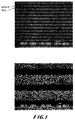
- FIG. 1 illustrates a plane view scanning electron micrograph of a patterned tungsten fine line test circuit onto which a layer of copper and aluminum has been selectively deposited.
- the top micrograph is presented in 1,000 X magnification while the bottom micrograph is presented in 5,000 X magnification.
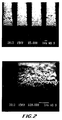
- FIG. 2 illustrates a cross-sectional view scanning electron micrograph of a patterned tungsten fine line test circuit onto which a layer of copper and aluminum has been selectively deposited.
- the top micrograph is presented in 5,000 X magnification while the bottom micrograph is presented in 20,000 X magnification.
- VLSI very large scale integrated circuits
- PVD physical vapor deposition
- CVD chemical vapor deposition
- a patterned CVD aluminum metallization can be accomplished in one of two ways.
- a blanket aluminum film can be deposited following by patterning and etching to form the desired aluminum pattern or a selective aluminum film can be deposited directly. The selective process is preferred because fewer processing steps are required.
- alkylaluminum compounds such as triisobutylaluminum, dimethylaluminum-hydride and diethylaluminumchloride.
- alkylaluminum compounds such as triisobutylaluminum, dimethylaluminum-hydride and diethylaluminumchloride.
- selective CVD of aluminum onto silicon, aluminum, and titanium silicide surfaces using alkylaluminum compounds has been demonstrated only at temperatures greater than 230°C. Thus, temperature sensitive substrates can not be coated using this process.
- alkyl-aluminum compounds are pyrophoric liquids and are therefore difficult to handle safely.
- Higashi and coworkers and Amazawa and coworkers disclose a CVD process for selectively depositing aluminum onto aluminum silicon and titanium silicide surfaces using triisobutylaluminum, (Ref. Higashi, et al. J. Vac. Sci. Technol ., 8 (1990); Amazawa, et al. IEDM-88, 442 (1988) and Shinzawa, et al. IEEE-VLSI Multilevel Interconnection Conference , p123 (1990) demonstrated selective deposition using dimethylaluminumhydride. Sasaoka, et al. Appl. Phys. Lett. 55, 741 (1989), using diethylaluminumchloride, disclose selective deposition onto silicon. Selective deposition occurred at temperatures greater than 230°C when the precursor was an alkylaluminum compound.
- U.S. Patent 4,948,623 discloses a process for depositing Cu and group IB metals such as silver and gold.
- the process comprises decomposing onto a substrate a vapor of a precursor comprising a cyclopentadienyl ring, a 2 electron donor ligand selected from the group consisting of trivalent phosphines, amines and arsines and the group IB metal which is present in the precursor in a +1 oxidation state.
- the present invention is a process for selectively depositing a high purity thin aluminum film onto a patterned silicon substrate formed by coating a silicon substrate with an oxide layer and subsequently etching away a portion of the oxide layer to form a pattern of exposed silicon.
- a copper base layer conforming to the previously existing pattern, is deposited on the surface of the silicon substrate by conventional methods such as chemical vapor deposition (CVD) or physical vapor deposition (PVD).
- CVD chemical vapor deposition
- PVD physical vapor deposition
- the substrate is subsequently contacted with vapors of an aminealane compound at a temperature from 25° to 180°C to selectively deposit aluminum onto the patterned copper base layer portion of the substrate.
- This process allows an aluminum film to be selectively deposited onto the copper surface of the substrate at temperatures lower than previously taught in the art and without using a corrosive activating agent such as titanium tetrachloride. Additionally, the deposited aluminum layer exhibits small grain size which is generally desirable in such operations.
- a copper aluminum alloy film is developed on a metallic or other electrically conducting substrate surface by sequential CVD operations at relatively low temperatures.
- the substrate onto which the alloy is selectively applied is normally a patterned diffusion barrier on a dielectric support.
- copper deposits are laid down by CVD using a copper (I) perfluoroalkyl- ⁇ -diketonate complexed with a suitable ligand such as an olefin or a silylolefin using temperatures at or below 200°C.
- aluminum is deposited by contacting the copper layer with a base adduct of alane under CVD conditions at a temperature ranging from 25 to 180°C.
- the copper and aluminum layers are subjected to temperatures which cause copper to migrate into the aluminum thereby forming the desired homogeneous alloy.
- a patterned substrate can be selectively deposited on a patterned substrate by using vapors of a base adduct of alane, specifically an aminealane, at low temperatures; i.e. from 25° to 180°C.
- the patterned substrate is formed by initially coating a silicon substrate with an oxide layer. The oxide layer is then etched to form the desired pattern of exposed silicon.
- a diffusion barrier coating is applied to the exposed silicon portion of the substrate to hinder diffusion of the subsequently applied copper base layer into the substrate. Any suitable diffusion barrier layer which prevents the diffusion of the base layer into the substrate can be used, with preferred examples including Ti, TiN, Ta, TaN, W and combinations thereof.
- a copper base layer is deposited on the substrate conforming to the previously existing substrate pattern.
- the copper base layer can be deposited conformally to the substrate pattern by any suitable technique known in the art including physical vapor deposition (PVD) or chemical vapor deposition (CVD). Copper is preferably deposited by CVD using one of the processes disclosed by U.S. 5,085,731, Norman et al. (1992) and U.S. 5,098,516, Norman et al. (1992), the disclosures of which are incorporated herein by reference.
- the copper precursor is a complex of copper (I) perfluoroalkyl- ⁇ -diketonate with either an olefin or a silylolefin.
- Suitable CVD conditions include a temperature at or below 200°C.
- Copper can be deposited onto the surface of a metallic substrate or other electrically conducting substrate such as tungsten, titanium, molybdenum, titanium nitride, tantalum, tantalum nitride, titanium platinum, platinum silicide, tantalum silicide, and the like, including combinations of such materials.
- substrates are typically in the form of a patterned diffusion barrier on a silicon oxide or silicon/silicon oxide substrate.
- the copper organometallic complex is activated by the metallic or other electrically conducting substrate at its surface so that metallic copper is deposited selectively onto this surface, presumably via a disproportionation mechanism.
- the organometallic copper (I)- ⁇ -diketonate is stabilized by the subject ligand such as an olefin or silylolefin ligand or the like.
- the silicon atom is connected to a carbon which is part of the olefinic double bond.
- An example of a preferred copper complex is Cu+1 (hexafluoroacetyl-acetonate) ⁇ 1 ⁇ trimethylvinylsilane.
- the organometallic copper complex can be represented by a structural formula as follows: wherein R1 and R3 are each independently C1 to C8 perfluoroalkyl, R2 is H, F or C1 to C8 perfluoroalkyl, each R4 is independently H, C1 to C8 alkyl or -Si(R6)3, each R5 is independently H, C1 to C8 alkyl or alkenyl or phenyl or both R5 groups can be joined to form a cycloolefin, including diolefins and bicycloolefins, and each R6 is independently phenyl or C1 to C8 alkyl, including both cis and trans isomers of this formula.
- R1 and R3 are CF3, R2 is H, one R4 is H and the other is -Si(R6)3 and each R5 is H or C1 to C8 alkyl.
- R6 is preferably methyl.
- olefin ligands examples include ethylene, isobutylene, 1-octane, styrene, stilbene, 1,5-cyclooctadiene, norbornadiene, cyclooctene, 1,3-hexadiene, cyclopentene, 1-decene, 1,5,9-cyclododecatriene, 2,5-bicycloheptadiene, 1-octadecene, methylene cyclohexane, and the like.
- silylolefin ligand examples include trimethylvinylsilane, diethylmethylvinylsilane, and the like.
- the substrate is contacted with vapors of an aminealane compound, preferably an alkylaminealane such as trimethylaminealane, at a temperature ranging from 25° to 180°C, preferably 25° to 145°C, to cause selective deposition of aluminum on the patterned copper base layer portion of the substrate.
- an annealing step such as rapid thermal annealing.
- suitable base adducts of alane include triethylaminealane, tetramethyl-ethylenediaminealane, trimethylphosphinealane, dimethylsulfidealane, and the like.
- the aminealanes are preferred.
- the copper layer is deposited under CVD conditions which are known and described in the Norman, et al. patents.
- the temperature of the overall two step process does not exceed 200°C, thereby permitting temperature sensitive substrates, such as polymers, to be used.
- temperatures for selectively depositing copper by CVD range from 120 to 200°C while temperatures for selectively depositing aluminum by CVD range from 100 to 145°C.
- the resulting copper and aluminum layers can be thermally annealed to accelerate diffusion of copper into the aluminum thereby forming a homogeneous alloy.
- Suitable annealing temperatures may be limited by the thermal stability of the substrate or supporting structure. Suitable annealing temperatures for forming a homogeneous alloy can be readily determined by one of ordinary skill in the art.
- Preferred temperatures for depositing copper using the complex with an olefin ligand are 110 to 190°C, and more preferably 130 to 180°C. Preferred temperatures for depositing copper using a complex formed with the silylolefin ligand range from 120 to 200°C.
- the aminealane compound to be contacted with the substrate is introduced into a carrier gas, preferably a carrier gas which is inert to the aminealane compound, such as argon, nitrogen, helium or hydrogen.
- the present invention is capable of depositing aluminum at relatively low temperatures and eliminates use of a corrosive activating agent such as titanium tetrachloride.
- the present process eliminates handling problems associated with pyrophoric liquid alkylaluminum compounds since the aminealanes used herein are nonpyrophoric solids.
- the instant process for selective depositing aluminum onto the substrate using a copper base layer results in an aluminum film which has a small grain size and which is generally free of carbon and oxygen impurities as confirmed by Auger electron spectroscopy. Since copper diffuses rapidly into aluminum, the selective CVD process of the present invention is capable of forming selectively deposited conformal copper aluminum alloys.
- the desired aluminum copper alloy copper will diffuse into the aluminum film at a given temperature to a level which does not exceed the solid solubility limit of copper in aluminum at that given temperature. Therefore, increased copper concentrations within the aluminum layer can be achieved by rapidly thermally annealing the structure.
- the final amount of copper introduced into the aluminum copper alloy can be controlled by adjusting the relative thicknesses of the copper and aluminum films and by controlling the annealing conditions.
- the mechanism by which trimethylaminealane selectively deposits aluminum onto a patterned copper surface at very low temperatures is not fully understood.
- the mechanism for depositing aluminum onto clean aluminum surfaces using trimethylaminealane has been studied and the rate limiting step is initially associated with cleavage of the aluminum nitrogen bond.
- a cold wall CVD reactor with two gas feed lines was used.
- trimethylaminealane was delivered to the reactor either under its own vapor pressure (ca. 2 torr at 25°C) or was transported to the reactor via a carrier gas.
- Either hydrogen or argon was used as a carrier gas.
- Inert gases other than argon, such as nitrogen or helium, are also effective in practicing the disclosed process.
- the second feed line was either not used or used to carry an argon or hydrogen diluent gas.
- the source was cooled to between 2°C and 15°C to prevent condensation of the organometallic precursor on the reactor walls and to decrease the delivery rate of trimethylaminealane.
- the reactor consisted of a four-way vacuum cross. The walls of the reactor were kept at room temperature during the runs of Examples 1-20.
- Substrates to be coated were placed on a resistively heated stainless steel susceptor situated inside the reactor and the susceptor and substrate were raised to the desired deposition temperature by a resistive heater which was imbedded in the susceptor.
- Substrate temperature was measured with a thermocouple positioned such that the tip of the thermocouple protruded slightly from the susceptor and was in contact with the substrate.
- the reactor was evacuated to a base pressure of 1 ⁇ 6 torr to minimize contamination of the growing film by adventitious water and oxygen.
- Films were typically analyzed by scanning electron microscopy to determine the grain size and thickness of the aluminum film. In some cases, films were analyzed by Auger electron spectroscopy to determine the degree of copper interdiffusion into the aluminum and to determine the film purity. Common impurities in CVD aluminum films are carbon and oxygen. One film was also analyzed by time-of-flight secondary ion mass spectrometry to detect low levels of copper in an unannealed film.
- Run 1 was carried out according to the general procedure set out above to selectively deposit an aluminum film onto a SiO2/Cu substrate pair using vapors of trimethylaminealane. Hydrogen was used as a carrier gas and the deposition step was carried out at 110°C. A thin aluminum film was formed on the copper base layer whereas the silicon oxide substrate remained almost completely uncoated during the experiment. Detailed reaction conditions and results for Examples 1-20 are set out below in Tables 1 and 2 respectively.
- Run 2 was conducted using conditions similar to those in Run 1 except a deposition temperature of 185°C was used. No selectivity was observed (a thick uniform coating on both the copper and silicon oxide surfaces) and the film had a larger grain size than in Run 1. This illustrates the effect of temperature on both selectivity and grain size. Increased deposition temperature typically caused a loss of selectivity and resulted in a larger grain size in the film.
- Runs 3 and 4 were conducted without using a carrier gas. Reaction conditions were similar except for the deposition temperature. No selectivity was observed in Run 3 meaning that a uniform coating was created on both substrates. In Run 4 there was a uniform fine-grained coating on the copper substrate while no coating was observed on the silicon oxide substrate. A time-of-flight secondary ion mass spectrum (TOF SIMS) of the film deposited in Run 4 confirmed that some copper had diffused to the top surface of the aluminum film.
- TOF SIMS time-of-flight secondary ion mass spectrum
- Runs 5 and 6 were repeated as Runs 7 and 8 except that a deposition temperature of 185°C was used. In both Runs 7 and 8, blanket deposition was observed on the silicon oxide/titanium nitride surface.
- tungsten does not promote the selective deposition of aluminum as does copper.
- the run for this Example was conducted in a cold wall CVD reactor as described above.
- Two gas lines fed the reactor In the first line the organometallic complex, either a betadiketonatocopper ⁇ (olefin) compound or an alkylaminealane, was delivered to the reactor under its own vapor pressure.
- Argon, nitrogen and helium are all effective carrier gases and could have been used.
- the second feed line was not used but could have been used to carry a diluent gas such as hydrogen, argon, nitrogen, or helium.
- the bubbler containing the organometallic complex was heated to a temperature at which a significant vapor pressure was observed.
- such temperatures ranged from 40-120°C.
- the alkylaminealane compounds exhibit sufficient volatility at room temperature and were not heated.
- the walls of the reactor were kept at a temperature equal to or higher than the bubbler temperature to prevent condensation of organometallic onto the reactor walls.
- the substrate was a patterned tungsten fine line test circuit (FLTC) consisting of a serpentine pattern of tungsten deposited on the silicon portion of a patterned silicon/silicon oxide substrate.
- FLTC patterned tungsten fine line test circuit
- Tungsten is an example of a diffusion barrier between silicon and an aluminum-copper metallization.
- the tungsten lines are 2, 3, 4, and 5 microns wide in this circuit.
- Copper was deposited selectively onto the tungsten portion of the FLTC and no appreciable deposition was observed on the silicon oxide portion of the substrate.
- the copper precursor used was hexafluoroacetylacetonatocopper ⁇ (cycloctadiene).
- the deposition conditions for the copper CVD were as follows: Deposition Temperature 150°C Bubbler Temperature 112°C Pressure 300 mtorr Duration of Run 37 minutes Copper film thickness 0.2 micron
- the now selectively copper coated FLTC was selectively metallized with aluminum using trimethylaminealane as the organometallic aluminum precursor.
- the deposition conditions for the selective aluminum CVD were as follows: Deposition Temperature 110°C Bubbler Temperature 20°C Pressure 300 mtorr Duration of Run 10 minutes Copper film thickness 0.4 micron
- a cross-section backscattered scanning electron micrograph and a secondary scanning electron micrograph were made of the product FLTC.
- Three metal layers, tungsten, copper and aluminum, were apparent from the cross-sectional micrograph while the secondary micrograph clearly demonstrated that both the copper and aluminum depositions had occurred selectively on the tungsten and no deposition had occurred on the silicon oxide portion of the substrate. It was previously shown that under such conditions, copper will diffuse into the growing aluminum layer to the solid solubility limit of copper in aluminum at that temperature. Also, complete interdiffusion of copper into the aluminum can be achieved by a rapid thermal anneal of the copper/aluminum structure.
- the run for this Example was conducted in a cold wall CVD reactor as described above.
- the substrate was a patterned tungsten fine line test circuit (FLTC) as described in Example 1 and hexafluoroacetylacetonatocopper(cyclooctadiene) was used as the copper precursor.
- Deposition conditions for forming the copper layer were: Deposition temperature: 150°C Bubbler temperature 40°C Pressure 100 mtorr Duration of Run 30 minutes Copper film thickness 0.5 micron Copper was deposited selectively onto the tungsten portion of the FLTC with essentially no copper being deposited onto the silicon oxide portion of the substrate.
- the now selectively copper coated FLTC was selectively metallized with aluminum using trimethylaminealane as the organometallic aluminum precursor under the following conditions: Deposition temperature: 110°C Bubbler temperature 25°C Pressure 300 mtorr Duration of Run 10 minutes Aluminum film thickness 0.5 micron
- FIG. 1 A plane view scanning electron micrograph of the coated FLTC prepared according to this experiment is shown in Fig. 1 and a cross-sectional scanning electron micrograph of the material is shown in Fig. 2. As demonstrated in both views, excellent selectivity was achieved using the instant process. Both the copper and aluminum depositions occurred selectively on the tungsten and no metals were deposited onto the silicon oxide portion of the substrate.
- Sequential CVD of copper and aluminum according to the invention provides a number of benefits.
- the process can operate entirely at temperatures at or below 200°C, thereby enabling the use of temperature sensitive substrates, such as polymers. These low operating temperatures are permitted without requiring a corrosive activating agent, such as titanium tetrachloride.
- aluminum is selectively deposited without using liquid alkylaluminum compounds which are pyrophoric and difficult to handle.
- the instant process enables selective deposition of copper aluminum alloy in films which have small grain size and are essentially free of carbon and oxygen impurities as demonstrated by Auger electron spectroscopy. These alloy films conform to and selectively coat very small features.
- the selective CVD process of this invention leads to formation of the desired copper aluminum alloy with a uniform distribution of copper in the aluminum film. Because copper also diffuses rapidly into silicon at low temperatures, it is important to have a diffusion barrier layer such as titanium nitride, tungsten, or other diffusion barrier which will prevent diffusion of copper into the silicon substrate. Finally, the copper CVD portion shows a strong selectivity to diffusion barrier surfaces.
Landscapes
- Chemical & Material Sciences (AREA)
- Chemical Kinetics & Catalysis (AREA)
- Engineering & Computer Science (AREA)
- Materials Engineering (AREA)
- Mechanical Engineering (AREA)
- Metallurgy (AREA)
- Organic Chemistry (AREA)
- General Chemical & Material Sciences (AREA)
- Chemical Vapour Deposition (AREA)
- Electrodes Of Semiconductors (AREA)
- Internal Circuitry In Semiconductor Integrated Circuit Devices (AREA)
Applications Claiming Priority (2)
| Application Number | Priority Date | Filing Date | Title |
|---|---|---|---|
| US07/867,599 US5273775A (en) | 1990-09-12 | 1992-04-13 | Process for selectively depositing copper aluminum alloy onto a substrate |
| US867599 | 1992-04-13 |
Publications (2)
| Publication Number | Publication Date |
|---|---|
| EP0566040A2 true EP0566040A2 (de) | 1993-10-20 |
| EP0566040A3 EP0566040A3 (en) | 1996-01-10 |
Family
ID=25350111
Family Applications (1)
| Application Number | Title | Priority Date | Filing Date |
|---|---|---|---|
| EP93105865A Withdrawn EP0566040A3 (en) | 1992-04-13 | 1993-04-08 | Process for selectively depositing copper aluminum alloy onto a substrate |
Country Status (4)
| Country | Link |
|---|---|
| US (1) | US5273775A (de) |
| EP (1) | EP0566040A3 (de) |
| JP (1) | JP2554306B2 (de) |
| KR (1) | KR960002119B1 (de) |
Cited By (2)
| Publication number | Priority date | Publication date | Assignee | Title |
|---|---|---|---|---|
| GB2297560A (en) * | 1995-02-06 | 1996-08-07 | Air Prod & Chem | Chemical vapor codeposition of copper and aluminium alloys |
| EP0808915A3 (de) * | 1996-05-23 | 1998-08-05 | Applied Materials, Inc. | Verfahren und Vorrichtung zur chemischen Gasphasenabscheidung und zum Sputtern |
Families Citing this family (27)
| Publication number | Priority date | Publication date | Assignee | Title |
|---|---|---|---|---|
| US6620460B2 (en) | 1992-04-15 | 2003-09-16 | Jet-Lube, Inc. | Methods for using environmentally friendly anti-seize/lubricating systems |
| TW289900B (de) | 1994-04-22 | 1996-11-01 | Gould Electronics Inc | |
| KR0147682B1 (ko) * | 1994-05-24 | 1998-11-02 | 구본준 | 반도체 소자의 금속배선 제조방법 |
| JPH08191054A (ja) * | 1995-01-10 | 1996-07-23 | Kawasaki Steel Corp | 半導体装置及びその製造方法 |
| US6001729A (en) * | 1995-01-10 | 1999-12-14 | Kawasaki Steel Corporation | Method of forming wiring structure for semiconductor device |
| US6077571A (en) * | 1995-12-19 | 2000-06-20 | The Research Foundation Of State University Of New York | Conformal pure and doped aluminum coatings and a methodology and apparatus for their preparation |
| US5677244A (en) * | 1996-05-20 | 1997-10-14 | Motorola, Inc. | Method of alloying an interconnect structure with copper |
| WO1997047783A1 (en) * | 1996-06-14 | 1997-12-18 | The Research Foundation Of State University Of New York | Methodology and apparatus for in-situ doping of aluminum coatings |
| US6534133B1 (en) | 1996-06-14 | 2003-03-18 | Research Foundation Of State University Of New York | Methodology for in-situ doping of aluminum coatings |
| JPH10204640A (ja) * | 1997-01-23 | 1998-08-04 | Sharp Corp | 銅プリカーサ化合物および化学気相成長銅を選択された表面に付与する方法 |
| US6130161A (en) | 1997-05-30 | 2000-10-10 | International Business Machines Corporation | Method of forming copper interconnections with enhanced electromigration resistance and reduced defect sensitivity |
| US6069068A (en) | 1997-05-30 | 2000-05-30 | International Business Machines Corporation | Sub-quarter-micron copper interconnections with improved electromigration resistance and reduced defect sensitivity |
| US6089184A (en) * | 1997-06-11 | 2000-07-18 | Tokyo Electron Limited | CVD apparatus and CVD method |
| US6090705A (en) * | 1998-01-20 | 2000-07-18 | Tokyo Electron Limited | Method of eliminating edge effect in chemical vapor deposition of a metal |
| US6037001A (en) * | 1998-09-18 | 2000-03-14 | Gelest, Inc. | Method for the chemical vapor deposition of copper-based films |
| US6066196A (en) * | 1998-09-18 | 2000-05-23 | Gelest, Inc. | Method for the chemical vapor deposition of copper-based films and copper source precursors for the same |
| US6204176B1 (en) * | 1998-11-10 | 2001-03-20 | Sharp Laboratories Of America, Inc. | Substituted phenylethylene precursor deposition method |
| EP1066416B9 (de) * | 1999-01-21 | 2006-01-04 | Midwest Research Institute | Passivierungsätzmittel für metallpartikel |
| JP2002536549A (ja) * | 1999-02-12 | 2002-10-29 | ゲレスト インコーポレイテッド | 窒化タングステンの化学蒸着 |
| DE19922557B4 (de) * | 1999-05-17 | 2004-11-04 | Infineon Technologies Ag | Verfahren zum Abscheiden einer TaN/Ta-Zweischicht-Diffusionsbarriere |
| US7049226B2 (en) | 2001-09-26 | 2006-05-23 | Applied Materials, Inc. | Integration of ALD tantalum nitride for copper metallization |
| US6911391B2 (en) | 2002-01-26 | 2005-06-28 | Applied Materials, Inc. | Integration of titanium and titanium nitride layers |
| US20040009665A1 (en) * | 2002-06-04 | 2004-01-15 | Applied Materials, Inc. | Deposition of copper films |
| KR20090035127A (ko) * | 2007-10-05 | 2009-04-09 | 주식회사 하이닉스반도체 | 반도체 소자의 금속배선 형성방법 |
| EP2208396A4 (de) * | 2007-10-16 | 2010-10-20 | Hcf Partners L P | Organische leuchtdioden mit elektrophosphoreszierend beschichteten emissiven quanten-dots |
| KR20100098380A (ko) * | 2007-11-06 | 2010-09-06 | 에이치시에프 파트너스, 엘.피. | 원자 층 증착 공정 |
| US9113583B2 (en) | 2012-07-31 | 2015-08-18 | General Electric Company | Electronic circuit board, assembly and a related method thereof |
Family Cites Families (11)
| Publication number | Priority date | Publication date | Assignee | Title |
|---|---|---|---|---|
| CA719231A (en) * | 1965-10-05 | Ethyl Corporation | Vapor deposition of aluminum from tertiary amine complex of aluminum hydride | |
| US3206326A (en) * | 1961-11-27 | 1965-09-14 | Ethyl Corp | Aluminum intermittent plating process |
| US3462288A (en) * | 1966-06-20 | 1969-08-19 | Dow Chemical Co | Aluminum plating process |
| BE758258A (fr) * | 1969-11-01 | 1971-04-01 | Sumitomo Chemical Co | Procede de depot d'aluminium |
| GB2195663B (en) * | 1986-08-15 | 1990-08-22 | Nippon Telegraph & Telephone | Chemical vapour deposition method and apparatus therefor |
| US4948623A (en) * | 1987-06-30 | 1990-08-14 | International Business Machines Corporation | Method of chemical vapor deposition of copper, silver, and gold using a cyclopentadienyl/metal complex |
| JPH0627327B2 (ja) * | 1987-06-30 | 1994-04-13 | インターナシヨナル・ビジネス・マシーンズ・コーポレーシヨン | Ib族金属の付着方法 |
| US4923717A (en) * | 1989-03-17 | 1990-05-08 | Regents Of The University Of Minnesota | Process for the chemical vapor deposition of aluminum |
| PT95232B (pt) * | 1989-09-09 | 1998-06-30 | Canon Kk | Processo de producao de uma pelicula de aluminio depositada |
| US5098516A (en) * | 1990-12-31 | 1992-03-24 | Air Products And Chemicals, Inc. | Processes for the chemical vapor deposition of copper and etching of copper |
| US5085731A (en) * | 1991-02-04 | 1992-02-04 | Air Products And Chemicals, Inc. | Volatile liquid precursors for the chemical vapor deposition of copper |
-
1992
- 1992-04-13 US US07/867,599 patent/US5273775A/en not_active Expired - Fee Related
-
1993
- 1993-04-08 EP EP93105865A patent/EP0566040A3/en not_active Withdrawn
- 1993-04-09 KR KR1019930005940A patent/KR960002119B1/ko not_active Expired - Fee Related
- 1993-04-13 JP JP5109913A patent/JP2554306B2/ja not_active Expired - Fee Related
Cited By (3)
| Publication number | Priority date | Publication date | Assignee | Title |
|---|---|---|---|---|
| GB2297560A (en) * | 1995-02-06 | 1996-08-07 | Air Prod & Chem | Chemical vapor codeposition of copper and aluminium alloys |
| GB2297560B (en) * | 1995-02-06 | 1998-05-13 | Air Prod & Chem | Process for using chemical vapor codeposition of copper and aluminium alloys |
| EP0808915A3 (de) * | 1996-05-23 | 1998-08-05 | Applied Materials, Inc. | Verfahren und Vorrichtung zur chemischen Gasphasenabscheidung und zum Sputtern |
Also Published As
| Publication number | Publication date |
|---|---|
| JPH0641747A (ja) | 1994-02-15 |
| KR960002119B1 (ko) | 1996-02-10 |
| JP2554306B2 (ja) | 1996-11-13 |
| EP0566040A3 (en) | 1996-01-10 |
| US5273775A (en) | 1993-12-28 |
| KR930021816A (ko) | 1993-11-23 |
Similar Documents
| Publication | Publication Date | Title |
|---|---|---|
| US5273775A (en) | Process for selectively depositing copper aluminum alloy onto a substrate | |
| US6534133B1 (en) | Methodology for in-situ doping of aluminum coatings | |
| EP0414267B1 (de) | Verfahren zum Anbringen einer Wolframschicht auf einem Halbleiterplättchen | |
| KR960011246B1 (ko) | 구리 필름의 화학 증착 방법 | |
| US5866205A (en) | Process for titanium nitride deposition using five- and six-coordinate titanium complexes | |
| KR100691870B1 (ko) | 동염기성 필름의 화학증착방법 및 그것을 위한 동원전구체 | |
| US5187300A (en) | Volatile precursors for copper CVD | |
| US5376409A (en) | Process and apparatus for the use of solid precursor sources in liquid form for vapor deposition of materials | |
| US6491978B1 (en) | Deposition of CVD layers for copper metallization using novel metal organic chemical vapor deposition (MOCVD) precursors | |
| US6281125B1 (en) | Methods for preparing ruthenium oxide films | |
| US6074945A (en) | Methods for preparing ruthenium metal films | |
| US5098516A (en) | Processes for the chemical vapor deposition of copper and etching of copper | |
| US6037001A (en) | Method for the chemical vapor deposition of copper-based films | |
| Raaijmakers | Low temperature metal-organic chemical vapor deposition of advanced barrier layers for the microelectronics industry | |
| US5464666A (en) | Process for chemical vapor codeposition of copper and aluminum alloys | |
| JP2001329367A (ja) | 新規な前駆体からの障壁の化学蒸着 | |
| KR20020089381A (ko) | 루테늄 금속막의 제조 방법 | |
| US5659057A (en) | Five- and six-coordinate precursors for titanium nitride deposition | |
| KR100624351B1 (ko) | 금속 필름의 화학적 증착 방법 | |
| KR0139718B1 (ko) | 금속막 선택영역 기상성장방법 | |
| WO1997047783A1 (en) | Methodology and apparatus for in-situ doping of aluminum coatings | |
| JP2670152B2 (ja) | 堆積膜形成法 | |
| Charatan et al. | Investigations of Tin and Ti Film Deposition by Plasma Activated Cvd Using Cyclopentadienyl Cycloheptatrienyl Titanium, a Low Oxidation State Precursor |
Legal Events
| Date | Code | Title | Description |
|---|---|---|---|
| PUAI | Public reference made under article 153(3) epc to a published international application that has entered the european phase |
Free format text: ORIGINAL CODE: 0009012 |
|
| AK | Designated contracting states |
Kind code of ref document: A2 Designated state(s): BE DE FR GB IT NL |
|
| PUAL | Search report despatched |
Free format text: ORIGINAL CODE: 0009013 |
|
| AK | Designated contracting states |
Kind code of ref document: A3 Designated state(s): BE DE FR GB IT NL |
|
| 17P | Request for examination filed |
Effective date: 19960226 |
|
| 17Q | First examination report despatched |
Effective date: 19960327 |
|
| 18D | Application deemed to be withdrawn |
Effective date: 19961008 |