EP0564945B1 - A method of controlling harmful insects - Google Patents
A method of controlling harmful insects Download PDFInfo
- Publication number
- EP0564945B1 EP0564945B1 EP93105148A EP93105148A EP0564945B1 EP 0564945 B1 EP0564945 B1 EP 0564945B1 EP 93105148 A EP93105148 A EP 93105148A EP 93105148 A EP93105148 A EP 93105148A EP 0564945 B1 EP0564945 B1 EP 0564945B1
- Authority
- EP
- European Patent Office
- Prior art keywords
- methyl
- dimethyl
- spp
- acid
- radical
- Prior art date
- Legal status (The legal status is an assumption and is not a legal conclusion. Google has not performed a legal analysis and makes no representation as to the accuracy of the status listed.)
- Expired - Lifetime
Links
- 0 CC(*(C1)I1(CCCS)C(C)=O)=C[N+]([O-])=O Chemical compound CC(*(C1)I1(CCCS)C(C)=O)=C[N+]([O-])=O 0.000 description 1
Classifications
-
- A—HUMAN NECESSITIES
- A01—AGRICULTURE; FORESTRY; ANIMAL HUSBANDRY; HUNTING; TRAPPING; FISHING
- A01N—PRESERVATION OF BODIES OF HUMANS OR ANIMALS OR PLANTS OR PARTS THEREOF; BIOCIDES, e.g. AS DISINFECTANTS, AS PESTICIDES OR AS HERBICIDES; PEST REPELLANTS OR ATTRACTANTS; PLANT GROWTH REGULATORS
- A01N25/00—Biocides, pest repellants or attractants, or plant growth regulators, characterised by their forms, or by their non-active ingredients or by their methods of application, e.g. seed treatment or sequential application; Substances for reducing the noxious effect of the active ingredients to organisms other than pests
- A01N25/34—Shaped forms, e.g. sheets, not provided for in any other sub-group of this main group
-
- A—HUMAN NECESSITIES
- A01—AGRICULTURE; FORESTRY; ANIMAL HUSBANDRY; HUNTING; TRAPPING; FISHING
- A01N—PRESERVATION OF BODIES OF HUMANS OR ANIMALS OR PLANTS OR PARTS THEREOF; BIOCIDES, e.g. AS DISINFECTANTS, AS PESTICIDES OR AS HERBICIDES; PEST REPELLANTS OR ATTRACTANTS; PLANT GROWTH REGULATORS
- A01N25/00—Biocides, pest repellants or attractants, or plant growth regulators, characterised by their forms, or by their non-active ingredients or by their methods of application, e.g. seed treatment or sequential application; Substances for reducing the noxious effect of the active ingredients to organisms other than pests
Definitions
- the present invention relates to a process for the treatment of individual plants with solid shaped plant treatment agents which are introduced into the sap conduction paths of the plants, new solid shaped plant treatment agents and their production.
- the method is limited to readily water-soluble active compounds having a systemic action. Handling of the method under conditions in practise, that is to say administering an adequate amount of active compound into the sap stream and thereby damaging the plant only minimally not only under experimental purposes on a very few plants, is unsatisfactory.
- the active compound is distributed in a suitable formulation as far as possible over the entire surface of the plants. It then either encounters directly the plant pests to be combated, or it has to penetrate the protective layers of the plants in order to arrive at the sites of action via the sap stream of the plant.
- These treatment methods are associated with a high loss of active compound.
- active compound formulations are used in the root region, in which the active compound is taken up via the roots and arrives at the site of action via the sap stream.
- the active compound must be present in the soil in a sufficiently high concentration for the plants to be able to absorb enough active compound.
- European patent application EP254196 A discloses devices for transcuticular application of an active agent to plants comprising a carrier impregnated with the active ingredient, one surface of which serves as a contact layer for delivery of the active ingredient to the surface of the plant.
- the carrier is a paper-based material and the device is a laminate comprising an impermeable backing layer and an adhesive layer.
- the Japanese patent application JP58039602 A discloses a device in the form of a rod or tablet for administering chemicals to trees by inserting it into holes previously drilled in the trunk of the tree.
- the polymeric matrix of the device comprises a water absorptive polymer (e.g.,starch-acrylamide or starch-acrylonitrile copolymer) and another hydrophilic polymer (e.g., ethylene-vinyl acetate copolymer).
- the present invention relates to:
- Solid shaped plant treatment agents which are adapted to be pressed or knocked into the sap conductions paths of individual plants in the form of nails, pegs, spikes, plugs, needles, hollow nails, clamps, wires, in which organic insecticides and/or fungicides are contained in the matrix of a polymeric carrier material, characterized in that the polymeric carrier material is selected from the group of poly- ⁇ -caprolactone and polyhydroxyalkanoates.
- the process according to the invention is suitable for the treatment of valuable individual plants.
- These include stock and ornamental plants.
- Stock and ornamental plants which may be mentioned are: herbaceous plants, annual and perennial shrubs and woody plants, such as bushes and trees.
- the herbaceous plants include vegetables, such as tomatoes, paprika, aubergines, cucumbers, melons, cabbage species, potatoes and tobacco.
- the perennial shrubs include tea and coffee.
- the woody plants include the known berry- and fruit-bearing woody plants, pomaceous/stone fruit, berries, bananas, citrous, grapevines, palms (for example oil trees), cacao, olives, hops, roses and rhododendron, and also the woody plants used in forestry, such as beech, oak, spruce and fir.
- Cuttings, slips, tubers, bulbs and parts of leaf used for propagration may furthermore be mentioned.
- Pests which may be mentioned are phytopathogenic insects, arachnids and nematodes, and also fungi and bacteria.
- insects include:
- Isopoda for example, Oniscus asellus, Armadillidium vulgare and Porcellio scaber.
- Diplopoda for example, Blaniulus guttulatus.
- Chilopoda for example, Geophilus carpophagus and Scutigera spec.
- Symphyla for example, Scutigerella immaculata.
- Thysanura for example, Lepisma saccharina.
- Collembola for example, Onychiurus armatus.
- Orthoptera for example, Blatta orientalis, Periplaneta americana, Leucophaea maderae, Blattella germanica, Acheta domesticus, Gryllotalpa spp., Locusta migratoria migratoioides, Melanoplus differentialis and Schistocerca gregaria.
- Dermaptera for example, Forficula auricularia.
- Isoptera for example, Reticulitermes spp.
- Anoplura for example, Phylloxera vastatrix, Pemphigus spp., Pediculus humanus corporis, Haematopinus spp.
- From the order of the Homoptera for example, Aleurodes brassicae, Bemisia tabaci, Trialeurodes vaporariorum, Aphis gossypii, Brevicoryne brassicae, Cryptomyzus ribis, Aphis fabae, Doralis pomi, Eriosoma lanigerum, Hyalopterus arundinis, Macrosiphum avenae, Myzus spp., Phorodon humuli, Rhopalosiphum padi, Empoasca spp., Euscelis bilobatus, Nephotettix cincticeps, Lecanium corni, Saissetia oleae, Laodelphax striatellus, Nilaparvata lugens, Aonidiella aurantii, Aspidiotus hederae, Pseudococcus spp. and Psylla spp.
- Bucculatrix thurberiella Phyllocnistis citrella, Agrotis spp., Euxoa spp., Feltia spp., Earias insulana, Heliothis spp., Spodoptera exigua, Mamestra brassicae, Panolis flammea, Prodenia litura, Spodoptera spp., Trichoplusia ni, Caprocapsa pomonella, Pieris spp., Chilo spp., Pyrausta nubilalis, Ephestia kuehniella, Galleria mellonella, Tineola bisselliella, Tinea pellionella, Hofmannophila pseudospretella, Cacoecia podana, Capua reticulana, Choristoneura fumiferana, Clysia ambiguella, Homona magnanima and Tortrix viridana.
- Hymenoptera From the order of the Hymenoptera, for example, Diprion spp., Hoplocampa spp., Lasius spp., Monomorium pharaonis and Vespa spp. From the order of the Diptera, for example, Aedes spp., Anopheles spp., Culex spp., Drosophila melanogaster, Musca spp., Fannia spp., Calliphora erythrocephala, Lucilia spp., Chrysomyia spp., Cuterebra spp., Gastrophilus spp., Hyppobosca spp., Stomoxys spp., Oestrus spp., Hypoderma spp., Tabanus spp., Tannia spp., Bibio hortulanus, Oscinella frit, Phorbia spp., Pegomyia hyscyami, Ceratiti
- Siphonaptera for example, Xenopsylla cheopis and Ceratophyllus spp.
- From the order of the Arachnida for example, Scorpio maurus and Latrodectus mactans.
- Acarina for example, Acarus siro, Argas spp., Ornithodoros spp., Dermanyssus gallinae, Eriophyes ribis, Phyllocoptruta olieivora, Boophilus spp., Rhipicephalus spp., Amblyomma spp., Hyalomma spp., Ixodes spp., Psoroptes spp., Chorioptes spp., Sarcoptes spp., Tarsonemus spp., Bryobia praetiosa, Panonychus spp. and Tetranychus spp.
- the phytoparasitic nematodes include Pratylenchus spp., Radopholus similis, Ditylenchus dipsaci, Typenchulus semipenetrans, Heterodera spp., Meoidogyne spp., Aphelenchoides spp., Longidorus spp., Xiphinema spp. and Trichodorus spp..
- the agents causing fungal and bacterial diseases include:
- the good toleration, by plants, of the active compounds, at the concentrations required for combating plant diseases, permits treatment of above-ground parts of plants, of vegetative propagation stock and seeds.
- the agents according to the invention are employed in the form of nails, pegs, spikes, plugs, needles, hollow nails, clamps or wires.
- the active compounds include, in particular, insecticides and fungicides.
- Insecticides which may be mentioned as preferred are organic phosphorus compounds, such as phosphoric acid esters, carbamates, pyrethroids, urea derivatives, such as benzoylureas, triazines, nitromethylenes and nitroguanidines. Juvenile hormones and juvenoid synthetic compounds, such as, for example, pyriproxyfen, methoprene and hydroprene, may also be mentioned.
- the pyrethoids include:
- Allethrin 2-methyl-4-oxo-3-(2-propenyl)-2-cyclopenten-1-yl 2,2-dimethyl-3-(2-methyl-1-propenyl)-cyclopropanecarboxylate.
- Barthrin (6-chloro-1,3-benzodioxol-5-yl)-methyl 2,2-dimethyl-3-(2-methyl-1-propenyl)-cyclopropane-carboxylate.
- Bioresmethrin [5-(phenyl-methyl)-3-furanyl]-methyl 2,2-dimethyl-3-(2-methyl-1-propenyl)-cyclopropane-carboxylate.
- Bromethrin (5-benzyl-3-furyl)-methyl 2-(2,2-dibromovinyl)-3,3-dimethylcyclopropane-carboxylate.
- Cycloethrin 3-(2-cyclopenten-1-yl)-2-methyl-4-oxo-2-cyclopenten-1-yl 2,2-dimethyl-3-(2-methyl-propenyl)cyclopropane-carboxylate.
- Dimethrin 2,4-dimethylbenzyl 2,2-dimethyl-3-(2-methyl-1-propenyl)-cyclopropane-carboxylate.
- Pyresmethrin (5-benzyl-3-furyl)-methyl trans-(+)-3-(2-methoxycarbonyl-1-propenyl)-2,2-dimethylcyclopropanecarboxylate.
- Resmethrin (5-benzyl-3-furyl)-methyl 2,2-dimethyl-3-(2-methyl-1-propenyl)-cyclopropane-carboxylate.
- Tetramethrin (1,3,4,5,6,7-hexahydro-1,3-di-oxo-2H-isoindol-2-yl)-methyl 2,2-dimethyl-3-(2-methyl-1-propenyl)-cyclopropane-carboxylate.
- K-othrin ⁇ -cyano-3-phenoxybenzyl cis-3-(2,2-dibromovinyl) 2,2-dimethylcyclopropane-carboxylate.
- FMC 33297 Permethrin (FMC 33297)
- NRDC 143 cis-trans-(+)-m-phenoxybenzyl 3-(2,2-dichlorovinyl)-2,2-dimethyl-cyclopropane-carboxylate.
- Cinerin I 2-(2-butenyl)-4-hydroxy-3-methyl-2-cyclopenten-1-one 2,2-dimethyl-3-(2-methyl-1-propenyl)-cyclopropane-carboxylate.
- Pyrethrin I 4-hydroxy-3-methyl-2-(2,4-pentadienyl)-2-cyclopenten-1-one 2,2-dimethyl-3-(2-methyl-1-propenyl)cyclopropane-carboxylate.
- Cinerin II 2-(2-butenyl)-4-hydroxy-3-methyl-2-cyclopenten-1-one 2,2-dimethyl-3-(2-methyl-1-propenyl)-cyclopropane-carboxylate.
- Pyrethrin II 4-hydroxy-3-methyl-2-(2,4-pentadienyl)-2-cyclopenten-1-one 2,2-dimethyl-3-(2-methyl-1-propenyl)cyclopropane-carboxylate.
- Jasmolin II 4',5'-dihydropyrethrin II.
- Biothanometrin (5-benzyl-3-furyl)-methyl 2,2-dimethyl-3-(2-cyclopentylvinyl)-cyclopropane-carboxylate.
- Bioethanomethrin (3-diphenyl ether)-methyl 2-(2,2-dichlorovinyl)-3,3-dimethyl-cyclopropane-carboxylate.
- Cypermethrin (3-diphenyl ether)-cyanomethyl 2-(2,2-dichlorovinyl)-3,3-dimethyl-cyclopropane-carboxylate.
- Decamethrin (3-diphenyl ether)-cyanomethyl 2-(2,2-dibromovinyl)-3,3-dimethyl-cyclopropane-carboxylate.
- ES-56 2,3-dihydrofuran 2,2-dimethyl-3-(2-methyl-1-propenyl)-cyclopropane-carboxylate.
- Fenpropanate (S-3206) (3-diphenyl ether)-cyanomethyl 2,2-dimethyl-3,3-dimethyl-cyclopropane-carboxylate.
- Fenvalerate (S-5602) (3-diphenyl ether)-cyanomethyl [(p-chlorophenyl)-(isopropyl)]-acetate.
- Cismethrin 5-benzyl-3-furylmethyl 2,2-dimethyl-3-(2-methyl-1-propenyl)-cyclopropane-carboxylate.
- Phenomethrin (3-phenoxyphenyl)-methyl 2,2-dimethyl-3-(2-methyl-1-propenyl)-cyclopropane-carboxylate.
- Cyfluthrin 4-fluoro-3-(diphenyl ether)-cyanomethylol 2-(2,2-dichlorovinyl)-3,3-dimethylcyclopropane-carboxylate.
- the carbamates include:
- Aldicarb 2-methyl-2-(methylthio)-propanal O-[(methylamino)carbonyl]oxime.
- Aldoxycarb 2-methyl-2-(methylsulphonyl)propanal O-[(methylamino)carbonyl]oxime.
- Aminocarb 4-dimethylamino-3-methylphenyl methylcarbamate.
- Bendiocarb 2,2-dimethyl-benzo-1,3-dioxol-4-yl N-methylcarbamate.
- Bufencarb 3-(1-methylbutyl)phenyl methylcarbamate and 3-(1-ethylpropyl)-phenyl methylcarbamate (3:1).
- Butacarb 3,5-bis-(1,1-dimethylethyl)phenyl methylcarbamate.
- Butocarboxime 3-methylthio-2-butane O-[(methylamino)carbonyl]oxime.
- Butoxycarboxime 3-methylsulphonyl-2-butanone O-[(methylamino)carbonyl]oxime.
- Carbanolate 2-chloro-4,5-dimethylphenyl methylcarbamate.
- Carbaryl 1-naphthalenyl methylcarbamate.
- Carbofuran 2,3-dihydro-2,2-dimethyl-7-benzofuranyl methylcarbamate.
- Cartap S,S'-[2-dimethylamino)-1,3-propanediyl] carbamethioate.
- Decarbofuran 2,3-dihydro-2-methylbenzofuran-7-yl methylcarbamate.
- Dimetilan 1-[(dimethylamino)carbonyl]-5-methyl-1H-pyrazol-3-yl dimethylcarbamate.
- Dioxacarb 2-(1,3-dioxolan-2-yl)phenyl methylcarbamate.
- Ethiofencarb 2-ethylthiomethylphenyl methylcarbamate.
- Fenethacarb 3,5-diethylphenyl methylcarbamate.
- Formetanate 3-dimethylaminoethylenaminophenyl methylcarbamate.
- Formparanate 3-methyl-4-dimethylamino-methylenaminophenyl methylcarbamate.
- Isoprocarb 2-isopropylphenyl methylcarbamate.
- Methiocarb 3,5-dimethyl-4-methylthiophenyl methylcarbamate.
- Methomyl methyl N-[[(methylamino)carbonyl]oxy]-ethanimidothioate.
- Mexacarbate 4-dimethylamino-3,5-dimethylphenyl methylcarbamate.
- Nabam disodium 1,2-ethanediylbis(carbamodithioate).
- Nitrilacarb (4,4-dimethyl-5-methylamino-carbonyloximino)pentanenitrile.
- ZnCl 2 ZnCl 2 .
- Oxamil methyl 2-(dimethylamino)-N-[[(methylamino)carbonyl]oxy]-2-oxoethanimidothioate.
- Pirimicarb 2-(dimethylamino)-5,6-dimethyl-4-pyrimidinyl dimethylcarbamate.
- Promecarb 3-methyl-5-(1-methylethyl)phenyl, methylcarbamate.
- Propoxur 2-(1-methylethoxy)phenyl methylcarbamate.
- Thiocarboxim 1-(2-cyanoethylthio)-ethylenaminomethyl carbamate.
- Trimethylphenyl methylcarbamate 3,4,5-trimethylphenyl methylcarbamate.
- 3,4-Xylylmethylcarbamate 3,4-dimethylphenyl methylcarbamate.
- the organophosphorus compounds include:
- Acephate O,S-dimethyl acetylphosphoroaminothioate.
- Amidithion S-(N-2-methoxyethylcarbamoylmethyl)-dimethylphosphorodithioate.
- Amiton S-[2-(diethylamino)ethyl] diethyl phosphorothioate.
- Athidation O,O-diethyl S-5-methoxy-2-oxo-1,3,4-thiadiazol-3-yl-methyl phosphorodithioate.
- Azinphos-ethyl O,O-diethyl S-[(4-oxo-1,2,3-benzotriazin-(4H)-yl)methyl] phosphorodithioate.
- Azinphos-methyl O,O-dimethyl S-[(4-oxo-1,2,3-benzotriazin-3(4H)yl)methyl] phosphorodithioate.
- Azothoate O,O-dimethyl O-[p-(p-chlorophenylazo)-phenyl] phosphorothioate.
- Bromophos O-(4-bromo-2,5-dichlorophenyl) O,O-dimethyl phosphorothioate.
- Bromophos-ethyl O-(4-bromo-2,5-dichlorophenyl) O,O-diethyl phosphorothioate.
- Butonate O,O-dimethyl (2,2,2-trichloro-1-hydroxyethyl)phosphonate.
- Carbophenothion S-[(4-chlorophenyl)thio]methyl O,O-diethyl phosphorodithioate.
- Chlorfenvinphos 2-chloro-1-(2,4-dichlorophenyl)-ethenyl diethyl phosphate.
- Chlormephos S-chloromethyl O,O-diethyl phosphorodithioate.
- Chlorphoxim 7-(2-chlorophenyl)-4-ethoxy-3,5-dioxa-6-aza-4-phosphaoct-6-ene-8-nitrile 4-sulphide.
- Chlorprazophos O,O-diethyl O-3-chloro-7-methyl-pyrazolo[1,5a]pyrimidin-2-yl phosphorothioate.
- Chlorpyrifos O,O-diethyl O-3,5,6-trichloro-2-pyridyl phosphorothioate.
- Chlorpyrifos-methyl O,O-dimethyl O-3,5,6-trichloro-2-pyridyl phosphorothioate.
- Chlorthiophos O-2,5-dichloro-4-(methylthio)-phenyl O,O-diethyl phosphorothioate.
- Cortoxyphos 1-phenylethyl (E)-3-[(dimethoxyphosphonyl)oxy]-2-butenoate.
- Crufomate 2-chloro-4-(1,1-dimethylethyl)phenyl methyl methylphosphoramidate.
- Cyanofenphos O-4-cyanophenyl O-ethyl phenylphosphonothioate.
- Cyanophos O-4-cyanophenyl O,O-dimethyl phosphorothioate.
- Cyanthoate O,O-diethyl S-[N-(1-cyano-1-methylethyl)]carbamoylmethyl phosphorothioate.
- Demephion O,O-dimethyl O-2-methylthioethyl phosphorothioate and O,O-dimethyl S-2-methylthioethyl phosphorothioate.
- Demeton O,O-diethyl O-2-ethylthioethyl phosphorothioate and O,O-diethyl S-2-ethylthioethyl phosphorothioate.
- Demeton-S-methyl O,O-dimethyl S-2-ethylthioethyl phosphorothioate.
- Demeton-S-methylsulphone S-2-ethylsulphonylethyl O,O-dimethyl phosphorothioate.
- Demeton-S O,O-diethyl S-[2-(ethylthio)ethyl] phosphorothioate.
- Demeton-O O,O-diethyl O-[2-(ethylthio)ethyl]phosphorothioate.
- Demeton-O-methyl O,O-dimethyl-O-[2-(ethylthio)ethyl] phosphorothioate.
- Dialifos S-[2-chloro-1-(1,3-dihydro-1,3-dioxy-2H-isoindol-2-yl)ethyl] O,O-diethyl phosphorodithioate.
- Diazinon O,O-diethyl O-[6-methyl-2-(1-methylethyl)-4-pyrimidinyl] phosphorothioate.
- Dichlorfenthion O,O-diethyl O-(2,4-dichlorophenyl) phosphorothioate.
- Dicrotophos dimethyl 3-(dimethylamino)-1-methyl-3-oxo-1-propenyl phosphate.
- Dimefox bis(dimethylamino)fluorophosphine oxide.
- Dimethoate O,O-dimethyl-S-[2-(methylamino)-2-oxo-ethyl] phosphorodithioate.
- 1,3-Di-(methoxycarbonyl)-1-propen-2-yl dimethyl phosphate dimethyl 3-[(dimethoxyphosphinyl)oxy]-2-pentenedioate.
- Dioxathion S,S'-1,4-dioxane-2,3-diyl O,O,O',O'-tetraethyl di-(phosphorodithioate).
- Disulphoton O,O-dhetyl S-2-ethylthioethyl phosphorodithioate.
- EPN O-ethyl O-4-nitrophenyl phenylphosphonothioate.
- Endothion O,O-dimethyl S-(5-methoxy-4-pyran-2-yl-methyl) phosphorothioate.
- Ethion O,O,O',O'-tetraethyl-S,S'-methylene di(phosphorodithioate).
- Ethoate-methyl O,O-dimethyl-S-(N-ethylcarbamoyl-methyl) phosphorodithioate.
- Ethoprophos O-ethyl S,S-dipropyl phosphorodithioate.
- Etrimfos O-(6-ethoxy-2-ethyl-4-pyrimidinyl) O,O-dimethyl phosphorothioate.
- Famphur O,O-dimethyl O-p-(dimethylsulphamoyl)-phenyl phosphorothioate.
- Fenchlorphos O,O-dimethyl O-(2,4,5-trichlorophenyl) phosphorothioate.
- Fensulphothion O,O-dimethyl O-4-(methylsulphinyl)phenyl phosphorothioate.
- Fenthion O,O-dimethyl O-[3-methyl-4-(methylthio)phenyl] phosphorothioate.
- Fonophos O-ethyl S-phenyl ethylphosphonodithioate.
- Formothion S-[2-(formylmethylamino)-2-oxoethyl] O,O-dimethyl phosphorodithioate.
- Fospirate dimethyl 3,5,6-trichloro-2-pyridyl phosphate.
- Fosthietan diethyl 1,3-dithietan-2-ylidenephosphoramidate.
- Heptenophos 7-chlorobicyclo[3,2,0]-hepta-2,6-dien-6-yl dimethyl phosphate.
- Iodofenphos O-2,5-dichloro-4-iodophenyl O,O-dimethyl phosphorothioate.
- Isofenphos 1-methylethyl 2-[[ethoxy-[(1-methylethyl)amino] phosphinothioyl]oxy]benzoate.
- Leptophos O-4-bromo-2,5-dichlorophenyl O-methylphenyl phosphonothioate.
- Lythidathion O,O-dimethyl S-(5-ethoxy-2,3-dihydro-2-oxo-1,3,4-thiadiazol-3-yl-methyl) phosphorodithioate.
- Malathion diethyl (dimethoxyphosphinothioyl)thiobutenedioate.
- Mecarbam ethyl [[(diethoxyphosphinothioyl)thio]acetyl]methylcarbamate.
- Mecarphon N-methylcarbonyl-N-methyl-carbamoyl-methyl O-methyl methylphosphonodithioate.
- Menazon S-[(4,6-diamino-1,3,5-triazin-2-yl)-methyl] O,O-dimethyl phosphorodithioate.
- Mephosfolan diethyl 4-methyl-1,3-dithiolan-2-ylidene-phosphoroamidate.
- Methamidophos O,S-dimethyl phosphoramidothioate.
- Methidathion S-[[5-methoxy-2-oxo-1,3,4-thiadiazol-3(2H)-yl]methyl] O,O-dimethyl phosphorodithioate.
- Methocrotophos dimethyl cis-2-(N-methoxy-N-methyl)carbamoyl)-1-methylvinyl phosphate.
- Methyl carbophenotion S-[[(4-chlorophenyl)thio]-methyl] O,O-dimethyl phosphorodithioate.
- Mevinphos methyl 3-[(dimethoxyphosphinyl)oxy]-2-butenoate.
- Monocrotophos dimethyl 1-methyl-3-(methylamino)-3-oxo-1-propenyl phosphate.
- Morphothion O,O-dimethyl S-(morpholino-carbonylmethyl) phosphorodithioate.
- Naled dimethyl 1,2-dibromo-2,2-dichloroethyl phosphate.
- Omethoate O,O-dimethyl S-[2-(methylamino)-2-oxo-ethyl] phosphorothioate.
- Oxydemeton-methyl S-[2-(ethylsulphinyl)ethyl] O,O-dimethyl phosphorothioate.
- Oxydisulphoton O,O-diethyl S-[2-(ethyl-sulphinyl)ethyl] phosphorodithioate.
- Parathion O,O-diethyl O-4-nitrophenyl phosphorothioate.
- Parathion-methyl O,O-dimethyl O-4-nitrophenyl phosphorothioate.
- Phenkapton O,O-diethyl S-(2,5-dichloro-phenylthiomethyl) phosphorodithioate.
- Phenthoate ethyl ⁇ -[(dimethoxyphosphinothioyl)thio]benzene-acetate.
- Phorate O,O-diethyl S-ethylthiomethyl phosphorodithioate.
- Phosalone S-[(6-chloro-2-oxo(2H)-benzoxazolyl]methyl] O-diethyl phosphorodithioate.
- Phospholan diethyl 1,3-dithiolan-2-ylidene phosphoramidate.
- Phosmet S-[(1,3-dihydro-1,3-dioxo-2H-isoindol-2-yl)methyl] O,O-dimethyl phosphorodithioate.
- Phosnichlor O,O-dimethyl O-4-chloro-3-nitrophenyl phosphorothioate.
- Phosphamidon 2-chloro-3-(diethylamino)-1-methyl-3-oxo-1-propenyl dimethyl phosphate.
- Phoxim ⁇ -[[diethoxyphosphinothioyl)oxy]imino)-benzene-acetonitrile.
- Pirimiphos-ethyl O-[2-(diethylamino)-6-methyl-4-pyrimidinyl] O,O-diethyl phosphorothioate.
- Pirimiphos-methyl O-[2-(diethylamino)-6-methyl-4-pyrimidinyl] O,O-dimethyl phosphorothioate.
- Profenofos O-(4-bromo-2-chlorophenyl) O-ethyl S-propyl phosphorothioate.
- Propetamphos (E)-1-methylethyl 3-[[(ethylamino)-methoxyphosphinothioyl]oxy]-2-butenoate.
- Prothidathion O,O-diethyl S-(2,3-dihydro-5-isopropyl-2-oxo-1,3,4-thiadiazol-3-yl-methyl) phosphorodithioate.
- Prothoate O,O-diethyl S-[2-(1-methylethyl)amino-2-oxoethyl] phosphorodithioate.
- Quinalphos O,O-diethyl O-2-quinoxalinyl phosphorothioate.
- Quintiofos O-ethyl O-8-quinolinoyl phenylphosphonothioate.
- Sophamide O,O-dimethyl S-(N-methoxy-methyl)-carbamoylmethyl phosphorodithioate.
- Sulfotepp tetraethyl thiodiphosphate.
- Sulprofos O-ethyl O-(4-methylthiophenyl) S-propyl phosphorodithioate.
- Temephos O,O'-(thiodi-4,1-phenylene) O,O,O',O'-tetramethyl di(phosphorodithioate).
- Tepp tetraethyl diphosphate
- Terbufos S-[(1,1-dimethylethyl)thiomethyl] O,O-diethyl phosphorodithioate.
- Tetrachlorvinphos dimethyl trans-2-chloro-1-(2,4,5-trichlorophenyl)vinyl phosphate.
- O,O,O',O'-tetrapropyl dithiopyrophosphate tetrapropyl thiodiphosphate.
- Thionazin O,O-diethyl O-pyrazinyl phosphorothioate.
- Triazophos O,O-diethyl O-(phenyl-1H-1,2,4-triazol-3-yl) phosphorothioate.
- Trichloronat O-ethyl O-2,4,5-trichlorophenyl ethylphosphonothioate.
- Trichlorphon dimethyl 1-hydroxy-2,2,2-trichloroethyl phosphonate.
- Vamidothion O,O-dimethyl S-[2-(1-methylcarbamoylethyleneethyl] phosphorothioate.
- the benzoylureas include compounds of the formula : wherein
- Benzoylureas which may be mentioned in particular are those of the formula:
- the triazines include compounds of the formula wherein
- nitromethylenes and nitroguanidines and cyanimides include compounds which can preferably be summarised under the general formula I in which
- heterocyclic ring examples include imidazolidine, tetrahydropyrimidine, thiazolidine, 2H-thiazine, hexahydro-1,3,5-triazine, pyrrolidine, piperidine, piperazine, hexymethyleneimine, morpholine and N-methylpiperazine.
- Preferred fungicides which may be mentioned are:
- Insecticides which may be mentioned as particularly preferred are:
- Poly- ⁇ -caprolactone and polyhydroxyalkanoates such as poly-3-hydroxybutyric acid (PHB) and copolymers of 3-hydroxybutyric with 3-hydroxyvaleric acid (PHBV), are the polymeric carrier material.
- Polyhydroxyalkanoates are polymers of aliphatic and aromatic hydroxycarboxylic acids which are formed by prokaryotic microorganisms and can be prepared by means of fermentative processes, such as are described, for example, in EP 0 015 669, 0 046 344 and 0 052 459.
- Suitable polyhydroxyalkanoates are, for example, polymers of 4-hydroxybutyric acid, 4-hydroxyvaleric acid and 5-hydroxyvaleric acid; of the 3-hydroxy derivatives of saturated carboxylic acids, such as, for example, propionic acid, butyric acid, valeric acid, hexanoic acid, heptanoic acid, octanoic acid, nonanoic acid, decanoic acid, undecanoic acid, dodecanoic acid, 4-methylhexanoic acid, 5-methylhexanoic acid, 5-methyloctanoic acid, 6-methyloctanoic acid and 7-methyloctanoic acid; of the 3-hydroxy derivatives of unsaturated carboxylic acids, such as, for example, crotonic acid, 4-pentenoic acid, 4-hexenoic acid, 5-hexenoic acid, 6-octenoic acid, 7-octenoic acid, 8-nonenoic acid, 9-decenoic acid, 6-
- the polymeric material can contain appropriate additives such as plasticizers.
- the plasticisers which are usually used for plasticising solid vinyl resins are suitable for production of the shaped articles based on polymers which can be processed as thermoplastics, such as, for example, polyvinyl resins.
- the plasticiser used depends on the resin aid its compatibility with the plasticiser.
- suitable plasticiser are esters of phosphoric acid, such as tricresyl phosphate, esters of phthalic acid, such as dimethyl phthalate and dioctyl phthalate, and esters of adipic acid, such as diisobutyl adipate.
- esters such as the esters of azelaic acid, maleic acid, ricinoleic acid, myristic acid, palmitic acid, oleic acid, sebacic acid, stearic acid and trimellitic acid, as well as complex linear polyesters, polymeric plasticisers and epoxidised soya bean oils.
- the amount of plasticiser is about 10 to 50 % by weight, preferably about 20 to 45 % by weight of the total composition.
- the shaped articles can also comprise further constituents, such as stabilising agents, lubricants, fillers, surface active agents and colouring agents, without the fundamental properties of the composition thereby being changed.
- stabilising agents are antioxidants and agents which protect the shaped article from ultraviolet radiation and undesirable degradation during working, such as extrusion.
- Lubricants which can be used are, for example, stearates, stearic acid and polyethylene of low molecular weight. These constituents can be used in a concentration of up to 20 % by weight of the total composition.
- Fillers and additives which the polymeric carrier materials contain are to be understood as meaning substances which are known per se, such as, for example, fillers and short fibres on an inorganic or organic basis, colouring agents, such as dyestuffs and coloured pigments, water-binding agents, surface-active solid substances or pH-stabilising agents.
- inorganic fillers examples are baryte, titanium dioxide, quartz sand, kaolin, carbon black and glass microbeads.
- organic fillers for example, powders based on polystyrene or pplyvinyl chloride can be employed.
- Possible short fibres are, for example, glass fibres of 0.1 to 1 mm length or fibres of an organic origin, such as, for example, polyester fibres or polyamide fibres.
- the dyestuffs or coloured pigments on an organic or inorganic basis which are known per se for colouring polymers can be used, such as, for example, iron oxide pigments or chromium oxide pigments or phthalocyanine- or monoazo-based pigments.
- the preferred water-binding agents are zeolites.
- Solid surface-active substances which may be mentioned are, for example, cellulose powder, active charcoal, silicic acid preparations and chrysotile asbestos.
- the various constituents can be mixed in the dry state by known mixing processes, and moulded by known extrusion or injection moulding processes.
- the solution is preferably forced through a die into a precipitating bath and the coagulating material formed is drawn off as filaments (wet spinning process).
- the precipitation is preferably carried out by means of the known dry and wet spinning processes.
- the choice of processing process for production of the shaped articles according to the invention in principle depends in industry on the rheological properties of the shaped article material and the shape of the desired structure.
- the processing processes can be adjusted according to the processing technology or according to the type of shaping. In the case of processing technology, the processes can be classified according to the rheological states passed through during them. Pouring, pressing, spraying and spreading accordingly are suitable for viscous shaped article materials, and injection moulding, extrusion, calendering, milling and if appropriate kneading are suitable for elastoviscous polymers.
- the shaped articles according to the invention can be produced by casting, dipping, compression moulding, injection moulding, extrusion calendering, embossing, bending, deep-drawing, spinning and the like.
- a) a mixture of 30.6 parts by weight of imidacloprid, 0.2 part by weight of triadimenol and 0.2 part by weight of precipitated silicic acid and b) 69 parts by weight of the polymeric carrier material copoly(hydroxybutyric acid/hydroxyvaleric acid) (Biopol) were metered separately into a twin screw extruder via differential balances. The components were homogenised in the extruder at 160°C in the course of 4 minutes, and the melt was extruded into a water bath at a throughput of 1 kg/h. After granulation and drying, the moulding composition containing active compound was shaped to rods, pins, strips and sheets with the aid of an injection moulding machine at 150°C.
- Example 1 In the manner described in Example 1, a) a mixture of 20 parts by weight of cyfluthrin, 0.1 part by weight of triadimenol, 80 parts by weight of beta -cyclodextrin and 50 parts by weight of Carbowax 20 M and b) 150 parts by weight of the polymeric carrier material copoly(hydroxybutyric acid/hydroxyvaleric acid) (Biopol) were extruded at 160°C and injection moulded to shaped articles.
- the polymeric carrier material copoly(hydroxybutyric acid/hydroxyvaleric acid) Biopol
- Example 1 In the manner described in Example 1, a) a mixture of 200 parts by weight of triadimenol and 2 parts by weight of precipitated silicic acid and b) 198 parts by weight of the polymeric carrier material copoly(hydroxybutyric acid/hydroxyvaleric acid) (Biopol) were extruded at 160°C and injection moulded to shaped articles.
- a mixture of 105 parts by weight of carbofuran, 0.2 part by weight of triadimenol and 2 parts by weight of precipitated silicic acid were extruded with 150 parts by weight of the polymeric carrier material poly( ⁇ -caprolactone) at 145°C.
- the melt strand was drawn off at a rate of 35 m/minute, so that a cable having a diameter of about 1 mm was formed, and, afer cooling in a water bath, was wound onto a bobbin.
- Pins 2 cm long were produced by subsequent cutting of the cable.
- Example 2 By the procedure described in Example 1, a mixture of 105 parts by weight of fenamiphos, 2 parts by weight of triadimenol and 2 parts by weight of precipitated silicic acid was processed with 295 parts by weight of poly( ⁇ -caprolactone) at 145°C to give a shaped strand.
- composition containing active compound was shaped in a press under a pressure of 200 bar and at 150°C to give sheets of 100 cm 2 surface area and 2 mm thickness.
Landscapes
- Life Sciences & Earth Sciences (AREA)
- General Health & Medical Sciences (AREA)
- Health & Medical Sciences (AREA)
- Dentistry (AREA)
- Pest Control & Pesticides (AREA)
- Plant Pathology (AREA)
- Toxicology (AREA)
- Engineering & Computer Science (AREA)
- Agronomy & Crop Science (AREA)
- Wood Science & Technology (AREA)
- Zoology (AREA)
- Environmental Sciences (AREA)
- Agricultural Chemicals And Associated Chemicals (AREA)
- Catching Or Destruction (AREA)
- Fertilizers (AREA)
- Cultivation Of Plants (AREA)
Abstract
Description
- The present invention relates to a process for the treatment of individual plants with solid shaped plant treatment agents which are introduced into the sap conduction paths of the plants, new solid shaped plant treatment agents and their production.
- It has already become known to inject solutions of certain insecticides or to implant pulverulent formulations into the trunks of deciduous and coniferous trees (Chemical Abstracts CA 108: 181 188w; CA 99: 83 692; CA 99: 181 184; and CA 87: 146 712).
- The method is limited to readily water-soluble active compounds having a systemic action. Handling of the method under conditions in practise, that is to say administering an adequate amount of active compound into the sap stream and thereby damaging the plant only minimally not only under experimental purposes on a very few plants, is unsatisfactory.
- It has already become known to embed active compounds in a polymer matrix, from which they are released again only slowly. Such slow-release shaped articles are used to release active compounds in the soil over a relatively long time (Chemical Abstract CA: 47 099 n; and US-P 32 69 900). Other polymer/active compound formulations are employed to release readily vapourisable active compounds uniformly into the atmosphere over a relatively long period of time (US-P 33 18 764). Yet other polymer/active compound formulations are employed to protect animals from parasites. For this, the active compound, which migrates to the polymer surface, is rubbed off mechanically by the coat of the animal and distributed over the animal (US-P3 852 416).
- In the customary treatment of plants by atomising, spraying, dusting and the like, the active compound is distributed in a suitable formulation as far as possible over the entire surface of the plants. It then either encounters directly the plant pests to be combated, or it has to penetrate the protective layers of the plants in order to arrive at the sites of action via the sap stream of the plant. These treatment methods are associated with a high loss of active compound. The same applies to methods where active compound formulations are used in the root region, in which the active compound is taken up via the roots and arrives at the site of action via the sap stream. Here also, the active compound must be present in the soil in a sufficiently high concentration for the plants to be able to absorb enough active compound.
- To match the amount of active compound to be applied as precisely as possible to the actual requirement of the plant, it would be desirable for the required amount of active compound to be introduced directly into the sap stream of the plant. Prerequisite here is, however, that the plant (for example valuable productive fruit trees) is not damaged even after several applications.
- European patent application EP254196 A discloses devices for transcuticular application of an active agent to plants comprising a carrier impregnated with the active ingredient, one surface of which serves as a contact layer for delivery of the active ingredient to the surface of the plant. Preferably the carrier is a paper-based material and the device is a laminate comprising an impermeable backing layer and an adhesive layer.
- The Japanese patent application JP58039602 A discloses a device in the form of a rod or tablet for administering chemicals to trees by inserting it into holes previously drilled in the trunk of the tree. The polymeric matrix of the device comprises a water absorptive polymer (e.g.,starch-acrylamide or starch-acrylonitrile copolymer) and another hydrophilic polymer (e.g., ethylene-vinyl acetate copolymer).
- The present invention relates to:
- Solid shaped plant treatment agents which are adapted to be pressed or knocked into the sap conductions paths of individual plants in the form of nails, pegs, spikes, plugs, needles, hollow nails, clamps, wires, in which organic insecticides and/or fungicides are contained in the matrix of a polymeric carrier material, characterized in that the polymeric carrier material is selected from the group of poly-ε-caprolactone and polyhydroxyalkanoates.
- The process according to the invention is suitable for the treatment of valuable individual plants. These include stock and ornamental plants. Stock and ornamental plants which may be mentioned are: herbaceous plants, annual and perennial shrubs and woody plants, such as bushes and trees.
- The herbaceous plants include vegetables, such as tomatoes, paprika, aubergines, cucumbers, melons, cabbage species, potatoes and tobacco. The perennial shrubs include tea and coffee. The woody plants include the known berry- and fruit-bearing woody plants, pomaceous/stone fruit, berries, bananas, citrous, grapevines, palms (for example oil trees), cacao, olives, hops, roses and rhododendron, and also the woody plants used in forestry, such as beech, oak, spruce and fir.
- Cuttings, slips, tubers, bulbs and parts of leaf used for propagration may furthermore be mentioned.
- Pests which may be mentioned are phytopathogenic insects, arachnids and nematodes, and also fungi and bacteria.
- From the order of the Isopoda, for example, Oniscus asellus, Armadillidium vulgare and Porcellio scaber.
From the order of the Diplopoda, for example, Blaniulus guttulatus.
From the order of the Chilopoda, for example, Geophilus carpophagus and Scutigera spec.
From the order of the Symphyla, for example, Scutigerella immaculata.
From the order of the Thysanura, for example, Lepisma saccharina.
From the order of the Collembola, for example, Onychiurus armatus.
From the order of the Orthoptera, for example, Blatta orientalis, Periplaneta americana, Leucophaea maderae, Blattella germanica, Acheta domesticus, Gryllotalpa spp., Locusta migratoria migratoioides, Melanoplus differentialis and Schistocerca gregaria.
From the order of the Dermaptera, for example, Forficula auricularia.
From the order of the Isoptera, for example, Reticulitermes spp.
From the order of the Anoplura, for example, Phylloxera vastatrix, Pemphigus spp., Pediculus humanus corporis, Haematopinus spp. and Linognathus spp.
From the order of the Mallophaga, for example, Trichodectes spp. and Damalinea spp.
From the order of the Thysanoptera, for example, Hercinothrips femoralis and Thrips tabaci.
From the order of the Heteroptera, for example, Eurygaster spp., Dysdercus intermedius, Piesma quadrata, Cimex lectularius, Rhodnius prolixus and Triatoma spp.
From the order of the Homoptera, for example, Aleurodes brassicae, Bemisia tabaci, Trialeurodes vaporariorum, Aphis gossypii, Brevicoryne brassicae, Cryptomyzus ribis, Aphis fabae, Doralis pomi, Eriosoma lanigerum, Hyalopterus arundinis, Macrosiphum avenae, Myzus spp., Phorodon humuli, Rhopalosiphum padi, Empoasca spp., Euscelis bilobatus, Nephotettix cincticeps, Lecanium corni, Saissetia oleae, Laodelphax striatellus, Nilaparvata lugens, Aonidiella aurantii, Aspidiotus hederae, Pseudococcus spp. and Psylla spp. - From the order to the Lepidoptera, for example, Pectinophora gossypiella, Bupalus piniarius, Cheimatobia brumata, Lithocolletis blancardella, Hyponomeuta padella, Plutella maculipennis, Malacosoma neustria, Euproctis chrysorrhoea, Lymantria spp. Bucculatrix thurberiella, Phyllocnistis citrella, Agrotis spp., Euxoa spp., Feltia spp., Earias insulana, Heliothis spp., Spodoptera exigua, Mamestra brassicae, Panolis flammea, Prodenia litura, Spodoptera spp., Trichoplusia ni, Caprocapsa pomonella, Pieris spp., Chilo spp., Pyrausta nubilalis, Ephestia kuehniella, Galleria mellonella, Tineola bisselliella, Tinea pellionella, Hofmannophila pseudospretella, Cacoecia podana, Capua reticulana, Choristoneura fumiferana, Clysia ambiguella, Homona magnanima and Tortrix viridana.
- From the order of the Coleoptera, for example, Anobium punctatum, Rhizopertha dominica, Bruchidius obtectus, Acanthoscelides obtectus, Hylotrupes bajulus, Agelastica alni, Leptinotarsa decemlineata, Phaedon cochleariae, Diabrotica spp., Psylliodes chrysocephala, Epilachna varivestis, Atomaria spp., Oryzaephilus surinamensis, Anthonomus spp., Sitophilus spp., Otiorrhynchus sulcatus, Cosmopolites sordidus, Ceuthorrhynchus assimilis, Hypera postica, Dermestes spp., Trogoderma spp., Anthrenus spp., Attagenus spp., Lyctus spp., Meligethes aeneus, Ptinus spp., Niptus hololeucus, Gibbium psylloides, Tribolium spp., Tenebrio molitor, Agriotes spp.,
Conoderus spp., Melolontha melolontha, Amphimallon solstitialis and Costelytra zealandica.
From the order of the Hymenoptera, for example, Diprion spp., Hoplocampa spp., Lasius spp., Monomorium pharaonis and Vespa spp.
From the order of the Diptera, for example, Aedes spp., Anopheles spp., Culex spp., Drosophila melanogaster, Musca spp., Fannia spp., Calliphora erythrocephala, Lucilia spp., Chrysomyia spp., Cuterebra spp., Gastrophilus spp., Hyppobosca spp., Stomoxys spp., Oestrus spp., Hypoderma spp., Tabanus spp., Tannia spp., Bibio hortulanus, Oscinella frit, Phorbia spp., Pegomyia hyscyami, Ceratitis capitata, Dacus oleae and Tipula paludosa. - From the order of the Siphonaptera, for example, Xenopsylla cheopis and Ceratophyllus spp.
From the order of the Arachnida, for example, Scorpio maurus and Latrodectus mactans. - From the order of the Acarina, for example, Acarus siro, Argas spp., Ornithodoros spp., Dermanyssus gallinae, Eriophyes ribis, Phyllocoptruta olieivora, Boophilus spp., Rhipicephalus spp., Amblyomma spp., Hyalomma spp., Ixodes spp., Psoroptes spp., Chorioptes spp., Sarcoptes spp., Tarsonemus spp., Bryobia praetiosa, Panonychus spp. and Tetranychus spp.
- The phytoparasitic nematodes include Pratylenchus spp., Radopholus similis, Ditylenchus dipsaci, Typenchulus semipenetrans, Heterodera spp., Meoidogyne spp., Aphelenchoides spp., Longidorus spp., Xiphinema spp. and Trichodorus spp..
- The agents causing fungal and bacterial diseases include:
- Xanthomonas species, such as, for example, Xanthomonas campestris pv. oryzae;
- Pseudomonas species, such as, for example, Pseudomonas syringae pv. lachrymans;
- Erwinia species, such as, for example, Erwinia amylovora;
- Pythium species, such as, for example, Pythium ultimum;
- Phytophthora species, such as, for example, Phytophthora infestans;
- Pseudoperonospora species, such as, for example, Pseudoperonospora humuli or Pseudoperonospora cubense;
- Plasmopara species, such as, for example, Plasmopara viticola;
- Peronospora species, such as, for example, Peronospora pisi or P. brassicae;
- Erysiphe species, such as, for example, Erysiphe graminis;
- Sphaerotheca species, such as, for example, Sphaerotheca fuliginea;
- Podosphaera species, such as, for example, Podosphaera leucotricha;
- Venturia species, such as, for example, Venturia inaequalis;
- Pyrenophora species, such as, for example, Pyrenophora teres or P. graminea (conidia form: Drechslera, syn: Helminthosporium);
- Cochliobolus species, such as, for example, Cochliobolus sativus (conidia form: Drechslera, syn: Helminthosporium);
- Uromyces species, such as, for example, Uromyces appendiculatus;
- Puccinia species, such as, for example, Puccinia recondita;
- Tilletia species, such as, for example, Tilletia caries;
- Ustilago species, such as, for example, Ustilago nuda or Ustilago avenae;
- Pellicularia species, such as, for example, Pellicularia sasakii;
- Pyricularia species, such as, for example, Pyricularia oryzae;
- Fusarium species, such as, for example, Fusarium culmorum;
- Botrytis species, such as, for example, Botrytis cinerea;
- Septoria species, such as, for example, Septoria nodorum;
- Leptosphaeria species, such as, for example, Leptosphaeria nodorum;
- Cercospora species, such as, for example, Cercospora canescens;
- Alternaria species, such as, for example, Alternaria brassicae and
- Pseudocercosporella species, such as, for example, Pseudocercosporella herpotrichoides.
-
- The good toleration, by plants, of the active compounds, at the concentrations required for combating plant diseases, permits treatment of above-ground parts of plants, of vegetative propagation stock and seeds.
- The agents according to the invention are employed in the form of nails, pegs, spikes, plugs, needles, hollow nails, clamps or wires.
- These are pressed or knocked into soft tissue.
- Application of the shaped articles using one of the commercially available nailing or tacking apparatuses, for example based on compressed air, may be mentioned in particular.
- The active compounds include, in particular, insecticides and fungicides.
- Insecticides which may be mentioned as preferred are organic phosphorus compounds, such as phosphoric acid esters, carbamates, pyrethroids, urea derivatives, such as benzoylureas, triazines, nitromethylenes and nitroguanidines. Juvenile hormones and juvenoid synthetic compounds, such as, for example, pyriproxyfen, methoprene and hydroprene, may also be mentioned.
- The pyrethoids include:
- Allethrin = 2-methyl-4-oxo-3-(2-propenyl)-2-cyclopenten-1-yl 2,2-dimethyl-3-(2-methyl-1-propenyl)-cyclopropanecarboxylate.
- Barthrin = (6-chloro-1,3-benzodioxol-5-yl)-methyl 2,2-dimethyl-3-(2-methyl-1-propenyl)-cyclopropane-carboxylate.
- Bioresmethrin = [5-(phenyl-methyl)-3-furanyl]-methyl 2,2-dimethyl-3-(2-methyl-1-propenyl)-cyclopropane-carboxylate.
- Bromethrin = (5-benzyl-3-furyl)-methyl 2-(2,2-dibromovinyl)-3,3-dimethylcyclopropane-carboxylate.
- Cycloethrin = 3-(2-cyclopenten-1-yl)-2-methyl-4-oxo-2-cyclopenten-1-yl 2,2-dimethyl-3-(2-methyl-propenyl)cyclopropane-carboxylate.
- Dimethrin = 2,4-dimethylbenzyl 2,2-dimethyl-3-(2-methyl-1-propenyl)-cyclopropane-carboxylate.
- Pyresmethrin = (5-benzyl-3-furyl)-methyl trans-(+)-3-(2-methoxycarbonyl-1-propenyl)-2,2-dimethylcyclopropanecarboxylate.
- Resmethrin = (5-benzyl-3-furyl)-methyl 2,2-dimethyl-3-(2-methyl-1-propenyl)-cyclopropane-carboxylate.
- Tetramethrin = (1,3,4,5,6,7-hexahydro-1,3-di-oxo-2H-isoindol-2-yl)-methyl 2,2-dimethyl-3-(2-methyl-1-propenyl)-cyclopropane-carboxylate.
- K-othrin = α-cyano-3-phenoxybenzyl cis-3-(2,2-dibromovinyl) 2,2-dimethylcyclopropane-carboxylate.
- Permethrin (FMC 33297) (NRDC 143) = cis-trans-(+)-m-phenoxybenzyl 3-(2,2-dichlorovinyl)-2,2-dimethyl-cyclopropane-carboxylate.
- Cinerin I = 2-(2-butenyl)-4-hydroxy-3-methyl-2-cyclopenten-1-one 2,2-dimethyl-3-(2-methyl-1-propenyl)-cyclopropane-carboxylate.
- Pyrethrin I = 4-hydroxy-3-methyl-2-(2,4-pentadienyl)-2-cyclopenten-1-one 2,2-dimethyl-3-(2-methyl-1-propenyl)cyclopropane-carboxylate.
- Cinerin II = 2-(2-butenyl)-4-hydroxy-3-methyl-2-cyclopenten-1-one 2,2-dimethyl-3-(2-methyl-1-propenyl)-cyclopropane-carboxylate.
- Pyrethrin II = 4-hydroxy-3-methyl-2-(2,4-pentadienyl)-2-cyclopenten-1-one 2,2-dimethyl-3-(2-methyl-1-propenyl)cyclopropane-carboxylate.
- Jasmolin I = 4',5'-dihydropyrethrin I.
- Jasmolin II = 4',5'-dihydropyrethrin II.
- Biothanometrin = (5-benzyl-3-furyl)-methyl 2,2-dimethyl-3-(2-cyclopentylvinyl)-cyclopropane-carboxylate.
- Bioethanomethrin = (3-diphenyl ether)-methyl 2-(2,2-dichlorovinyl)-3,3-dimethyl-cyclopropane-carboxylate.
- Cypermethrin = (3-diphenyl ether)-cyanomethyl 2-(2,2-dichlorovinyl)-3,3-dimethyl-cyclopropane-carboxylate.
- Decamethrin = (3-diphenyl ether)-cyanomethyl 2-(2,2-dibromovinyl)-3,3-dimethyl-cyclopropane-carboxylate.
- ES-56 = 2,3-dihydrofuran 2,2-dimethyl-3-(2-methyl-1-propenyl)-cyclopropane-carboxylate.
- Fenpropanate (S-3206) = (3-diphenyl ether)-cyanomethyl 2,2-dimethyl-3,3-dimethyl-cyclopropane-carboxylate.
- Fenvalerate (S-5602) = (3-diphenyl ether)-cyanomethyl [(p-chlorophenyl)-(isopropyl)]-acetate.
- .... (S-5439) = 3-diphenyl ether)-methyl [(p-chlorophenyl)-(isopropyl)-acetate.
- Cismethrin = 5-benzyl-3-furylmethyl 2,2-dimethyl-3-(2-methyl-1-propenyl)-cyclopropane-carboxylate.
- Phenomethrin = (3-phenoxyphenyl)-methyl 2,2-dimethyl-3-(2-methyl-1-propenyl)-cyclopropane-carboxylate.
- Cyfluthrin = 4-fluoro-3-(diphenyl ether)-cyanomethylol 2-(2,2-dichlorovinyl)-3,3-dimethylcyclopropane-carboxylate.
- The carbamates include:
- Aldicarb = 2-methyl-2-(methylthio)-propanal O-[(methylamino)carbonyl]oxime.
- Aldoxycarb = 2-methyl-2-(methylsulphonyl)propanal O-[(methylamino)carbonyl]oxime.
- Aminocarb = 4-dimethylamino-3-methylphenyl methylcarbamate.
- Bendiocarb = 2,2-dimethyl-benzo-1,3-dioxol-4-yl N-methylcarbamate.
- Bufencarb = 3-(1-methylbutyl)phenyl methylcarbamate and 3-(1-ethylpropyl)-phenyl methylcarbamate (3:1).
- Butacarb = 3,5-bis-(1,1-dimethylethyl)phenyl methylcarbamate.
- Butocarboxime = 3-methylthio-2-butane O-[(methylamino)carbonyl]oxime.
- Butoxycarboxime = 3-methylsulphonyl-2-butanone O-[(methylamino)carbonyl]oxime.
- 2-sec-Butylphenyl methylcarbamate = 2-(1-methylpropyl)phenyl methylcarbamate.
- Carbanolate = 2-chloro-4,5-dimethylphenyl methylcarbamate.
- Carbaryl = 1-naphthalenyl methylcarbamate.
- Carbofuran = 2,3-dihydro-2,2-dimethyl-7-benzofuranyl methylcarbamate.
- Cartap = S,S'-[2-dimethylamino)-1,3-propanediyl] carbamethioate.
- Decarbofuran = 2,3-dihydro-2-methylbenzofuran-7-yl methylcarbamate.
- Dimetilan = 1-[(dimethylamino)carbonyl]-5-methyl-1H-pyrazol-3-yl dimethylcarbamate.
- Dioxacarb = 2-(1,3-dioxolan-2-yl)phenyl methylcarbamate.
- Ethiofencarb = 2-ethylthiomethylphenyl methylcarbamate.
- Fenethacarb = 3,5-diethylphenyl methylcarbamate.
- Formetanate = 3-dimethylaminoethylenaminophenyl methylcarbamate.
- Formparanate = 3-methyl-4-dimethylamino-methylenaminophenyl methylcarbamate.
- Isoprocarb = 2-isopropylphenyl methylcarbamate.
- Methiocarb = 3,5-dimethyl-4-methylthiophenyl methylcarbamate.
- Methomyl = methyl N-[[(methylamino)carbonyl]oxy]-ethanimidothioate.
- Mexacarbate = 4-dimethylamino-3,5-dimethylphenyl methylcarbamate.
- Nabam = disodium 1,2-ethanediylbis(carbamodithioate). Nitrilacarb = (4,4-dimethyl-5-methylamino-carbonyloximino)pentanenitrile. ZnCl2.
- Oxamil = methyl 2-(dimethylamino)-N-[[(methylamino)carbonyl]oxy]-2-oxoethanimidothioate.
- Pirimicarb = 2-(dimethylamino)-5,6-dimethyl-4-pyrimidinyl dimethylcarbamate.
- Promecarb = 3-methyl-5-(1-methylethyl)phenyl, methylcarbamate.
- Propoxur = 2-(1-methylethoxy)phenyl methylcarbamate.
- Thiofanox = 3,3-dimethyl-(methylthio)-2-butanone O-[(methylamino)carbonyl]oxime.
- Thiocarboxim = 1-(2-cyanoethylthio)-ethylenaminomethyl carbamate.
- Thiram = tetramethylthioperoxy-dicarbonic diamide.
- Trimethylphenyl methylcarbamate = 3,4,5-trimethylphenyl methylcarbamate.
- 3,4-Xylylmethylcarbamate = 3,4-dimethylphenyl methylcarbamate.
- 3,5-Xylyl methylcarbamate = 3,5-dimethylphenyl methylcarbamate.
- The organophosphorus compounds include:
- Acephate = O,S-dimethyl acetylphosphoroaminothioate.
- Amidithion = S-(N-2-methoxyethylcarbamoylmethyl)-dimethylphosphorodithioate.
- Amiton = S-[2-(diethylamino)ethyl] diethyl phosphorothioate.
- Athidation = O,O-diethyl S-5-methoxy-2-oxo-1,3,4-thiadiazol-3-yl-methyl phosphorodithioate.
- Azinphos-ethyl = O,O-diethyl S-[(4-oxo-1,2,3-benzotriazin-(4H)-yl)methyl] phosphorodithioate.
- Azinphos-methyl = O,O-dimethyl S-[(4-oxo-1,2,3-benzotriazin-3(4H)yl)methyl] phosphorodithioate.
- Azothoate = O,O-dimethyl O-[p-(p-chlorophenylazo)-phenyl] phosphorothioate.
- Bromophos = O-(4-bromo-2,5-dichlorophenyl) O,O-dimethyl phosphorothioate.
- Bromophos-ethyl = O-(4-bromo-2,5-dichlorophenyl) O,O-diethyl phosphorothioate.
- Butonate = O,O-dimethyl (2,2,2-trichloro-1-hydroxyethyl)phosphonate.
- Carbophenothion = S-[(4-chlorophenyl)thio]methyl O,O-diethyl phosphorodithioate.
- Chlorfenvinphos = 2-chloro-1-(2,4-dichlorophenyl)-ethenyl diethyl phosphate.
- Chlormephos = S-chloromethyl O,O-diethyl phosphorodithioate.
- Chlorphoxim = 7-(2-chlorophenyl)-4-ethoxy-3,5-dioxa-6-aza-4-phosphaoct-6-ene-8-nitrile 4-sulphide.
- Chlorprazophos = O,O-diethyl O-3-chloro-7-methyl-pyrazolo[1,5a]pyrimidin-2-yl phosphorothioate.
- Chlorpyrifos =O,O-diethyl O-3,5,6-trichloro-2-pyridyl phosphorothioate.
- Chlorpyrifos-methyl = O,O-dimethyl O-3,5,6-trichloro-2-pyridyl phosphorothioate.
- Chlorthiophos = O-2,5-dichloro-4-(methylthio)-phenyl O,O-diethyl phosphorothioate.
- Coumaphos = O-3-chloro-4-methylcouramin-7-yl O,O-diethyl phosphorothioate.
- Coumithoate = O,O-diethyl O-(7,8,9,10-tetrahydro-6-oxo-6H-dibenzo[b,d]pyran-3-yl phosphorothioate.
- Cortoxyphos = 1-phenylethyl (E)-3-[(dimethoxyphosphonyl)oxy]-2-butenoate.
- Crufomate = 2-chloro-4-(1,1-dimethylethyl)phenyl methyl methylphosphoramidate.
- Cyanofenphos = O-4-cyanophenyl O-ethyl phenylphosphonothioate.
- Cyanophos =O-4-cyanophenyl O,O-dimethyl phosphorothioate.
- Cyanthoate = O,O-diethyl S-[N-(1-cyano-1-methylethyl)]carbamoylmethyl phosphorothioate.
- Demephion = O,O-dimethyl O-2-methylthioethyl phosphorothioate and O,O-dimethyl S-2-methylthioethyl phosphorothioate.
- Demeton = O,O-diethyl O-2-ethylthioethyl phosphorothioate and O,O-diethyl S-2-ethylthioethyl phosphorothioate.
- Demeton-S-methyl = O,O-dimethyl S-2-ethylthioethyl phosphorothioate.
- Demeton-S-methylsulphone = S-2-ethylsulphonylethyl O,O-dimethyl phosphorothioate.
- Demeton-S = O,O-diethyl S-[2-(ethylthio)ethyl] phosphorothioate.
- Demeton-O = O,O-diethyl O-[2-(ethylthio)ethyl]phosphorothioate.
- Demeton-O-methyl = O,O-dimethyl-O-[2-(ethylthio)ethyl] phosphorothioate.
- Dialifos = S-[2-chloro-1-(1,3-dihydro-1,3-dioxy-2H-isoindol-2-yl)ethyl] O,O-diethyl phosphorodithioate.
- Diazinon = O,O-diethyl O-[6-methyl-2-(1-methylethyl)-4-pyrimidinyl] phosphorothioate.
- Dichlorfenthion =O,O-diethyl O-(2,4-dichlorophenyl) phosphorothioate.
- O-2,4-dichlorophenyl O-ethylphenyl phosphonothioate.
- Dichlorvos = dimethyl 2,2-dichloroethenyl phosphate.
- Dicrotophos = dimethyl 3-(dimethylamino)-1-methyl-3-oxo-1-propenyl phosphate.
- Dimefox = bis(dimethylamino)fluorophosphine oxide.
- Dimethoate = O,O-dimethyl-S-[2-(methylamino)-2-oxo-ethyl] phosphorodithioate.
- 1,3-Di-(methoxycarbonyl)-1-propen-2-yl dimethyl phosphate = dimethyl 3-[(dimethoxyphosphinyl)oxy]-2-pentenedioate.
- Dioxathion = S,S'-1,4-dioxane-2,3-diyl O,O,O',O'-tetraethyl di-(phosphorodithioate).
- Disulphoton = O,O-dhetyl S-2-ethylthioethyl phosphorodithioate.
- EPN = O-ethyl O-4-nitrophenyl phenylphosphonothioate.
- Endothion = O,O-dimethyl S-(5-methoxy-4-pyran-2-yl-methyl) phosphorothioate.
- Ethion = O,O,O',O'-tetraethyl-S,S'-methylene di(phosphorodithioate).
- S-ethylsulphinylmethyl O,O-diisopropyl phosphorodithioate.
- Ethoate-methyl = O,O-dimethyl-S-(N-ethylcarbamoyl-methyl) phosphorodithioate.
- Ethoprophos = O-ethyl S,S-dipropyl phosphorodithioate.
- Etrimfos = O-(6-ethoxy-2-ethyl-4-pyrimidinyl) O,O-dimethyl phosphorothioate.
- Famphur = O,O-dimethyl O-p-(dimethylsulphamoyl)-phenyl phosphorothioate.
- Fenchlorphos = O,O-dimethyl O-(2,4,5-trichlorophenyl) phosphorothioate.
- Fensulphothion = O,O-dimethyl O-4-(methylsulphinyl)phenyl phosphorothioate.
- Fenthion = O,O-dimethyl O-[3-methyl-4-(methylthio)phenyl] phosphorothioate.
- Fonophos = O-ethyl S-phenyl ethylphosphonodithioate.
- Formothion = S-[2-(formylmethylamino)-2-oxoethyl] O,O-dimethyl phosphorodithioate.
- Fospirate = dimethyl 3,5,6-trichloro-2-pyridyl phosphate.
- Fosthietan = diethyl 1,3-dithietan-2-ylidenephosphoramidate.
- Heptenophos = 7-chlorobicyclo[3,2,0]-hepta-2,6-dien-6-yl dimethyl phosphate.
- Iodofenphos = O-2,5-dichloro-4-iodophenyl O,O-dimethyl phosphorothioate.
- Isofenphos = 1-methylethyl 2-[[ethoxy-[(1-methylethyl)amino] phosphinothioyl]oxy]benzoate.
- Leptophos = O-4-bromo-2,5-dichlorophenyl O-methylphenyl phosphonothioate.
- Lythidathion = O,O-dimethyl S-(5-ethoxy-2,3-dihydro-2-oxo-1,3,4-thiadiazol-3-yl-methyl) phosphorodithioate.
- Malathion = diethyl (dimethoxyphosphinothioyl)thiobutenedioate.
- Mazidox = N,N,N',N'-tetramethylphosphorodiamidic azide.
- Mecarbam = ethyl [[(diethoxyphosphinothioyl)thio]acetyl]methylcarbamate.
- Mecarphon = N-methylcarbonyl-N-methyl-carbamoyl-methyl O-methyl methylphosphonodithioate.
- Menazon = S-[(4,6-diamino-1,3,5-triazin-2-yl)-methyl] O,O-dimethyl phosphorodithioate.
- Mephosfolan = diethyl 4-methyl-1,3-dithiolan-2-ylidene-phosphoroamidate.
- Methamidophos = O,S-dimethyl phosphoramidothioate.
- Methidathion = S-[[5-methoxy-2-oxo-1,3,4-thiadiazol-3(2H)-yl]methyl] O,O-dimethyl phosphorodithioate.
- Methocrotophos = dimethyl cis-2-(N-methoxy-N-methyl)carbamoyl)-1-methylvinyl phosphate.
- The 2-sulphide of 2-methoxy-4H-benzo-1,3,2-dioxaphosphorin.
- Methyl carbophenotion = S-[[(4-chlorophenyl)thio]-methyl] O,O-dimethyl phosphorodithioate.
- Mevinphos = methyl 3-[(dimethoxyphosphinyl)oxy]-2-butenoate.
- Monocrotophos = dimethyl 1-methyl-3-(methylamino)-3-oxo-1-propenyl phosphate.
- Morphothion = O,O-dimethyl S-(morpholino-carbonylmethyl) phosphorodithioate.
- Naled = dimethyl 1,2-dibromo-2,2-dichloroethyl phosphate.
- Omethoate = O,O-dimethyl S-[2-(methylamino)-2-oxo-ethyl] phosphorothioate.
- Oxydemeton-methyl = S-[2-(ethylsulphinyl)ethyl] O,O-dimethyl phosphorothioate.
- Oxydisulphoton = O,O-diethyl S-[2-(ethyl-sulphinyl)ethyl] phosphorodithioate.
- Parathion = O,O-diethyl O-4-nitrophenyl phosphorothioate.
- Parathion-methyl = O,O-dimethyl O-4-nitrophenyl phosphorothioate.
- Phenkapton = O,O-diethyl S-(2,5-dichloro-phenylthiomethyl) phosphorodithioate..
- Phenthoate = ethyl α-[(dimethoxyphosphinothioyl)thio]benzene-acetate.
- Phorate = O,O-diethyl S-ethylthiomethyl phosphorodithioate.
- Phosalone = S-[(6-chloro-2-oxo(2H)-benzoxazolyl]methyl] O-diethyl phosphorodithioate.
- Phospholan = diethyl 1,3-dithiolan-2-ylidene phosphoramidate.
- Phosmet = S-[(1,3-dihydro-1,3-dioxo-2H-isoindol-2-yl)methyl] O,O-dimethyl phosphorodithioate.
- Phosnichlor = O,O-dimethyl O-4-chloro-3-nitrophenyl phosphorothioate.
- Phosphamidon = 2-chloro-3-(diethylamino)-1-methyl-3-oxo-1-propenyl dimethyl phosphate.
- Phoxim = α-[[diethoxyphosphinothioyl)oxy]imino)-benzene-acetonitrile.
- Pirimiphos-ethyl = O-[2-(diethylamino)-6-methyl-4-pyrimidinyl] O,O-diethyl phosphorothioate.
- Pirimiphos-methyl = O-[2-(diethylamino)-6-methyl-4-pyrimidinyl] O,O-dimethyl phosphorothioate.
- Profenofos = O-(4-bromo-2-chlorophenyl) O-ethyl S-propyl phosphorothioate.
- Propetamphos = (E)-1-methylethyl 3-[[(ethylamino)-methoxyphosphinothioyl]oxy]-2-butenoate.
- Prothidathion = O,O-diethyl S-(2,3-dihydro-5-isopropyl-2-oxo-1,3,4-thiadiazol-3-yl-methyl) phosphorodithioate.
- Prothoate = O,O-diethyl S-[2-(1-methylethyl)amino-2-oxoethyl] phosphorodithioate.
- Quinalphos = O,O-diethyl O-2-quinoxalinyl phosphorothioate.
- Quinothion = O,O-diethyl 2-methylquinolin-4-yl phosphorothioate.
- Quintiofos = O-ethyl O-8-quinolinoyl phenylphosphonothioate.
- Sophamide = O,O-dimethyl S-(N-methoxy-methyl)-carbamoylmethyl phosphorodithioate.
- Sulfotepp = tetraethyl thiodiphosphate.
- Sulprofos = O-ethyl O-(4-methylthiophenyl) S-propyl phosphorodithioate.
- Temephos = O,O'-(thiodi-4,1-phenylene) O,O,O',O'-tetramethyl di(phosphorodithioate).
- Tepp = tetraethyl diphosphate.
- Terbufos = S-[(1,1-dimethylethyl)thiomethyl] O,O-diethyl phosphorodithioate.
- Tetrachlorvinphos = dimethyl trans-2-chloro-1-(2,4,5-trichlorophenyl)vinyl phosphate.
- O,O,O',O'-tetrapropyl dithiopyrophosphate = tetrapropyl thiodiphosphate.
- Thiometon = O,O-dimethyl S-[2-(ethylthio)ethyl] phosphorodithioate.
- Thionazin = O,O-diethyl O-pyrazinyl phosphorothioate.
- Triazophos = O,O-diethyl O-(phenyl-1H-1,2,4-triazol-3-yl) phosphorothioate.
- Trichloronat = O-ethyl O-2,4,5-trichlorophenyl ethylphosphonothioate.
- Trichlorphon = dimethyl 1-hydroxy-2,2,2-trichloroethyl phosphonate.
- Vamidothion = O,O-dimethyl S-[2-(1-methylcarbamoylethyleneethyl] phosphorothioate.
- The benzoylureas include compounds of the formula :wherein

- R1
- represents halogen,
- R2
- represents hydrogen or halogen,
- R3
- represents hydrogen, halogen or C1-4-alkyl and
- R4
- represents halogen, 1-5-halogen-C1-4-alkyl, C1-4-alkoxy, 1-5-halogeno-C1-4-alkoxy, C1-4alkylthio, 1-5-halogeno-C1-4-alkylthio phenoxy or pyridyloxy which can optionally be substituted by halogen, C1-4-alkyl, l-5-halogeno-C1-4-alkyl, C1-4-alkoxy, 1-5-halogeno-C1-4-alkoxy, C1-4alkylthio, 1-5-halogeno-C1-C4-alkylthio.
- Benzoylureas which may be mentioned in particular are those of the formula:


- The triazines include compounds of the formulawherein

- R1
- represents cyclopropyl or isopropyl;
- R2
- denotes hydrogen, halogen, C1-C12-alkylcarbonyl, cyclopropylcarbonyl, C1-C12-alkylcarbamoyl, C1-C12-alkylthiocarbamoyl or C2-C6-alkenylcarbamoyl; and
- R3
- represents hydrogen, C1-C12-alkyl, cyclopropyl, C2-C6-alkenyl, C1-C12-alkylcarbonyl, cyclopropylcarbonyl, C1-C12-alkylcarbamoyl, C1-C12-alkylthiocarbamoyl or C2-C6-alkenylcarbamoyl, and acid addition salts thereof which are non-toxic to warm-blooded animals.
- Compounds which may be mentioned in particular are:
R1 R2 R3 Cyclopropyl H H Cyclopropyl H CH3 Cyclopropyl H C2H5 Cyclopropyl H C3H7-n Cyclopropyl H C4H9-n Cyclopropyl H C5H11-n Cyclopropyl H C6H13-n Cyclopropyl H C7H15-n Cyclopropyl H C8H17-n Cyclopropyl H C12H25-n Cyclopropyl H CH2-C4H9-t Cyclopropyl H CH2CH(CH3)C2H5 Cyclopropyl H CH2CH=CH2 Cyclopropyl Cl C2H5 Cyclopropyl Cl C6H13-n Cyclopropyl Cl C8H17-n Cyclopropyl Cl C12H25-n Cyclopropyl H Cyclopropyl Cyclopropyl H COCH3 Cyclopropyl H COCH3·HCl Cyclopropyl H COC2H5·HCl Cyclopropyl H COC2H5 Cyclopropyl H COC3H7-n Cyclopropyl H COC3H7-i Cyclopropyl H COC4H9-t·HCl Cyclopropyl H COC4H9-n Cyclopropyl H COC6H13-n Cyclopropyl H COC11-H23-n Cyclopropyl COCH3 COC2H5 Cyclopropyl COC3H7-n COC6H13-n Cyclopropyl COCH3 COC3H7-n Cyclopropyl COC2H5 COC3H7-n Cyclopropyl H COCyclopropyl Cyclopropyl COCylclopropyl COCyclopropyl Cyclopropyl COCH3 COCH3 Isopropyl H H Isopropyl H COCH3 Isopropyl H COC3H7-n Cyclopropyl H CONHCH3 Cyclopropyl H CONHC3H7-i Cyclopropyl CONHCH3 CONHCH3 Cyclopropyl H CSNHCH3 Cyclopropyl H CONHCH2CH=CH2 Cyclopropyl CONHCH2CH=CH2 CONHCH2CH=CH2 Cyclopropyl CSNHCH3 CSNHCH3 - The nitromethylenes and nitroguanidines and cyanimides include compounds which can preferably be summarised under the general formula Iin which

- R
- represents hydrogen or optionally substituted acyl, alkyl, aryl, aralkyl, heteroaryl or heteroarylalkyl radicals;
- A
- represents a monofunctional group from the series comprising hydrogen, acyl, alkyl and aryl, or represents a bifunctional group, which is linked to the radical Z;
- E
- represents an electron-withdrawing group, such as, for example, NO2 or CN;
- X
- represents the radicals -CH= or =N-, wherein the radical -CH= can be linked to the radical Z instead of an H atom; and
- Z
- represents a monofunctional group from the series
comprising alkyl, -O-R, -S-R or
or represents a bifunctional group, which is linked to the radical A or the radical X.

- Particularly preferred compounds of the formula are those in which the radicals having the following meaning:
- R
- represents hydrogen, or represents optionally
substituted radicals from the series comprising
acyl, alkyl, aryl, aralkyl, heteroaryl and heteroarylalkyl.
Acyl radicals which may be mentioned are formyl, alkylcarbonyl, arylcarbonyl, alkylsulphonyl, arylsulphonyl and (alkyl)- or (aryl)-phosphoryl, which can in turn be substituted.
Alkyl which may be mentioned is C1-10-alkyl, in particular C1-4-alkyl, specifically methyl, ethyl, i-propyl or sec- or t-butyl, which can in turn be substituted.
Aryl which may be mentioned is phenyl or naphthyl, in particular phenyl.
Aralkyl which may be mentioned is phenylmethyl or phenethyl.
Heteroaryl which may be mentioned is heteroaryl having up to 10 ring atoms and N, O or S, in particular N, as hetero atoms. Radicals which may be mentioned specifically are thiophenyl, furyl, thiazolyl, imidazolyl, pyridyl and benzothiazolyl.
Heteroarylalkyl which may be mentioned is heteroarylmethyl, or heteroarylethyl having up to 6 ring atoms and N, O and S, in particular N, as hetero atoms.
Substituents which may be mentioned as examples and as preferred are:
alkyl having preferably 1 to 4, in particular 1 or 2, carbon atoms, such as methyl, ethyl, n- and i-propyl and n-, i- and t-butyl; alkoxy having preferably 1 to 4, in particular 1 or 2, carbon atoms, such as methoxy, ethoxy, n- and i-propyloxy and n-, i- and t-butyloxy; alkylthio having preferably 1 to 4, in particular 1 or 2, carbon atoms, such as methylthio, ethylthio, n- and i-propylthio and n-, i- and t-butylthio; halogenoalkyl having preferably 1 to 4, in particular 1 or 2, carbon atoms and preferably 1 to 5, in particular 1 to 3, halogen atoms, the halogen atoms being identical or different and preferred halogen atoms being fluorine, chlorine or bromine, in particular fluorine, such as trifluoromethyl; hydroxyl; halogen, preferably fluorine, chlorine, bromine and iodine, in particular fluorine, chlorine and bromine; cyano; nitro; amino; monoalkyl- and dialkylamino having preferably 1 to 4, in particular 1 or 2, carbon atoms per alkyl group, such as methylamino, methylethyl-amino, n- and i-propylamino and methyl-n-butylamino; carboxyl; carbalkoxy having preferably 2 to 4, in particular 2 or 3, carbon atoms, such as carbomethoxy and carboethoxy; sulpho(-SO3H); alkylsulphonyl having preferably 1 to 4, in particular 1 or 2, carbon atoms, such as methylsulphonyl and ethylsulphonyl; arylsulphonyl having preferably 6 or 10 aryl carbon atoms, such as phenylsulphonyl; and heteroarylamino and heteroarylalkylamino, such as chloropyridylamino and chloropyridylmethylamino. - A
- represents hydrogen or optionally substituted radicals from the series comprising acyl, alkyl and aryl, which preferably have the abovementioned meanings. A furthermore represents a bifunctional group. Optionally substituted alkylene having 1 to 4, in particular 1-2, C atoms, substituents which may be mentioned being the substituents listed above, may be mentioned.
- A and Z,
- together with the atoms to which they are bonded, can form a saturated or unsaturated heterocyclic ring. The heterocyclic ring can contain a further 1 or 2 identical or different hetero atoms and/or hetero groups. Preferred hetero atoms are oxygen, sulphur or nitrogen, and hetero groups are N-alkyl, the alkyl of the N-alkyl group preferably containing 1 to 4, in particular 1 or 2, carbon atoms. Methyl, ethyl, n- and i-propyl and n-, i- and t-butyl may be mentioned as alkyl. The heterocyclic ring contains 5 to 7, preferably 5 or 6, ring members.
- Examples of the heterocyclic ring which may be mentioned are imidazolidine, tetrahydropyrimidine, thiazolidine, 2H-thiazine, hexahydro-1,3,5-triazine, pyrrolidine, piperidine, piperazine, hexymethyleneimine, morpholine and N-methylpiperazine.
- E
- represents an electron-withdrawing radical, No2 CN, halogenoalkylcarbonyl, such as 1-5-halogeno-C1-4-carbonyl, especially COCF3, being mentioned in particular.
- X
- represents -CH= or -N=.
- Z
- represents optionally substituted alkyl, -OR, -SR or -NRR radicals, wherein R and the substituents preferably have the abovementioned meaning.
- Z,
- together with the atom to which it is bonded and the
radical in the position of X, can form a saturated
or unsaturated heterocyclic ring. The heterocyclic
ring can contain a further 1 or 2 identical
or different hetero atoms and/or hetero groups.
Preferred hetero atoms are oxygen, sulphur or nitrogen, and hetero groups are N-alkyl, the alkyl of the N-alkyl group preferably containing 1 to 4, in particular 1 or 2, carbon atoms. Methyl, ethyl, n- and i-propyl and n-, i- and t-butyl may be mentioned as alkyl. The heterocyclic ring contains 5 to 7, preferably 5 or 6, ring members.
Examples of the heterocyclic ring which may be mentioned are imidazolidine, tetrahydropyrimidine, thiazolidine, 2H-thiazine, hexahydro-1,3,5-triazine, pyrrolidine, piperidine, piperazine, hexymethyleneimine, morpholine and N-methylpiperazine. - Compounds which may be mentioned as compounds which can especially preferably be used according to the invention are those of the general formulae II and III:in which
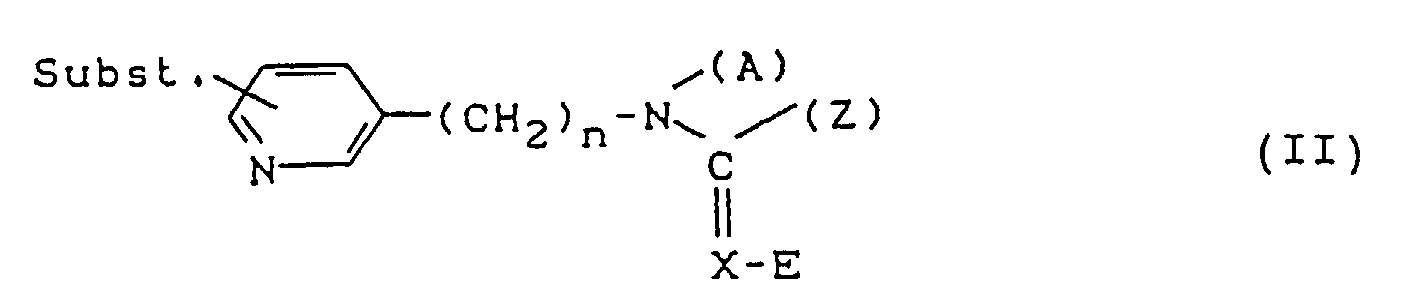
- n
- represents 1 or 2,
- Subst.
- represents one of the abovementioned substituents, in particular halogen, especially chlorine, and
- A, Z, X and E
- have the abovementioned meanings,
in which
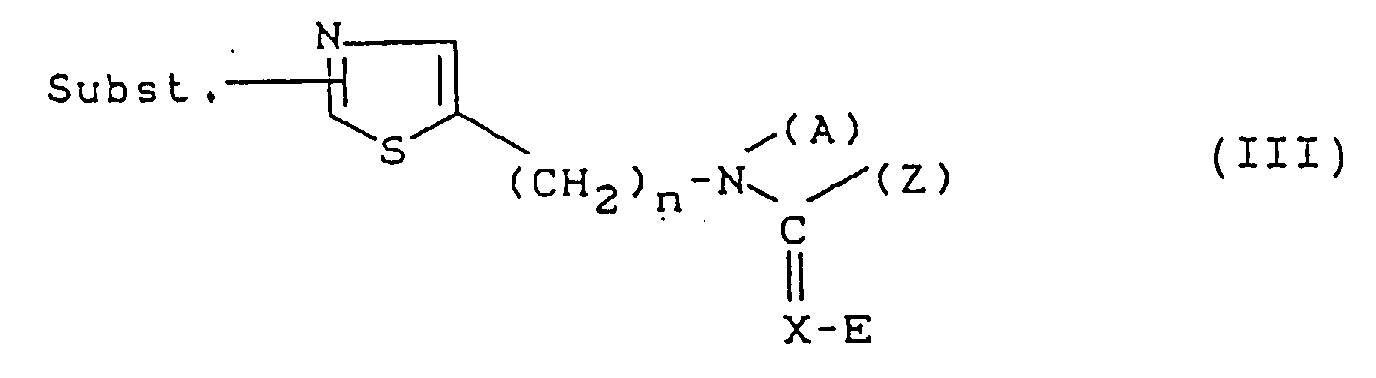
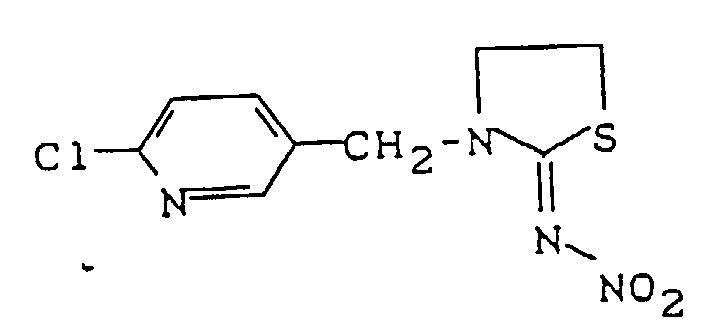
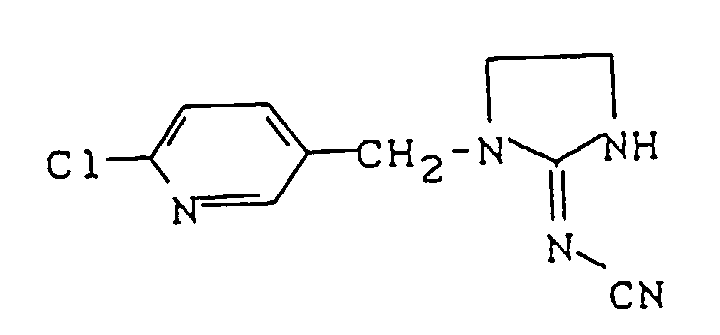
the radicals have the abovementioned meaning. - The following compounds may be mentioned specifically:


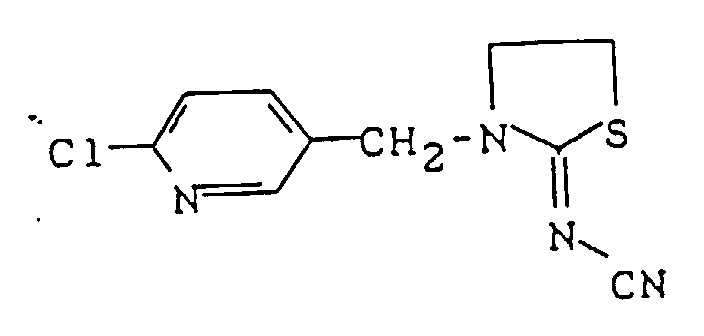


- These compounds are agonists or antagonists of the nicotinergic acetylcholine receptors of insects, and are known as such from the following publications:
- European Published Specifications No. 464 830, 428 941, 425 978, 386 565, 383 091, 375 907, 364 844, 315 826, 259 738, 254 859, 235 725, 212 600, 192 060, 163 855, 154 178, 136 636, 303 570, 302 833, 306 696, 189 972, 455 000, 135 956, 471 372 and 302 389;
German Offenlegungsschriften No. 3 639 877 and 3 712 307;
Japanese Published Specifications No. 03 220 176, 02 207 083, 63 307 857, 63 287 764, 03 246 283, 04 9371, 03 279 359 and 03 255 072;
U.S. Patent Specifications No. 5 034 524, 4 948 798, 4 918 086, 5 039 686 and 5 034 404;
PCT Applications No. WO 91/17 659 and 91/4965;
French Application No. 2 611 114; and
Brazilian Application No. 88 03 621. - Reference is expressly made here to the generic formulae and definitions described in these publications and to the individual compounds described therein.
- Preferred fungicides which may be mentioned are:
- Sulfenamides, such as dichlorfluanid (Euparen), tolylfluanid (Methyleuparen), folpet and fluorfolpet;
- benzimidazoles, such as carbendazim (MBC), benomyl, fuberidazole, thiabendazole or salts thereof;
- thiocyanates, such as thiocyanatomethylthiobenzothiazole (TCMTB) and methylene bisthiocyanate (MBT);
- quaternary ammonium compounds, such as benzyldimethyltetradecylammonium chloride, benzyl-dimethyl-dodecylammonium chloride and dodecyl-dimethyl-ammonium chloride; morpholine derivatives, such as C11-C14-4-alkyl-2,6-dimethyl-morpholine homologues (tridemorph), (±)-cis-4-[3-tert.-butylphenyl)-2-methylpropyl]-2,6-dimethylmorpholine (fenpropimorph) and falimorph;
- phenols, such as o-phenylphenol, tribromophenol, tetrachlorophenol, pentachlorophenol, 3-methyl-4-chlorophenol, di-chlorophen, chlorophen or salts thereof;
- azoles, such a triadimefon, triadimenol, bitertanol, tebuconazole, propiconazole, azaconazole, hexaconazole, prochloraz, cyproconazole, 1-(2-chlorophenyl)-2-(1-chlorocyclopropyl)-3-(1,2,4-triazol-1-yl)-propan-2-ol and 1-(2-chlorophenyl)-2-(1,2,4-triazol-1-yl-methyl)-3,3-dimethyl-butan-2-ol.
- Iodopropargyl derivatives, such as iodopropargyl butylcarbamate (IPBC), chlorophenylformal, phenylcarbamate, hexylcarbamate and cyclohexylcarbamate and iodopropargyloxyethyl phenylcarbamate;
- iodine derivatives, such as diiodomethyl-p-aryl-sulphones, for example diiodomethyl-p-tolyl-sulphone;
- bromine derivatives, such as bromopol;
- isothiazolines, such as N-methylisothiazolin-3-one, 5-chloro-N-methylisothiazolin-3-one, 4,5-dichloro-N-octylisothiazolin-3-one, N-octylisothiazolin-3-one (octilinone);
- benzisothiazolinones and cyclopentene-isothiazolines;
- pyridines, such as 1-hydroxy-2-pyridinethione and tetrachloro-4-methylsulphonylpyridine;
- nitriles, such as 2,4,5,6-tetrachloroisophthalonitrile (chlorothalonil) and the like, and microbicides having an activated halogen group, such as Cl-Ac, MCA, tectamer, bromopol and bromidox;
- benzothiazoles, such as 2-mercaptobenzothiazoles; ... dazomet; and
- quinolines, such as 8-hydroxyquinoline.
-
- Insecticides which may be mentioned as particularly preferred are:
- phosphoric acid esters, such as azinphos-ethyl, azinphosmethyl, 1-(4-chlorophenyl)-4-(O-ethyl-S-propyl)phosphoryloxypyrazole (TIA-230), chlorpyrifos, coumaphos, demeton, demeton-S-methyl, diazinon, dichlorvos, dimethoate, ethoprophos, etrimfos, fenitrothion, fention, heptenophos, parathion, parathion-methyl, phosalone, phoxion, pirimiphos-ethyl, pirimiphos-methyl, profenofos, prothiofos, sulprofos, triazophos and trichlorphon.
- Carbamates, such as aldicarb, bendiocarb, BPMC (2-(1-methylpropyl)phenyl methylcarbamate), butocarboxime, butoxycarboxime, carbaryl, carbofuran, carbosulphan, cloethocarb, isoprocarb, methomyl, oxamyl, pirimicarb, promecarb, propoxur and thiodicarb.
- Pyrethroids, such as allethrin, alphamethrin, bioresmethrin, byfenthrin, (FMC 54 800), cycloprothrin, cyfluthrin, decamethrion, cyhalothrin, cypermethrin, deltamethrin, alpha-cyano-3-phenyl-2-methylbenzyl 2,2-dimethyl-3-(2-chloro-2-trifluoromethylvinyl)cyclopropanecarboxylate, fenpropathrin, fenfluthrin, fenvalerate, flucythrinate, flumethrin, fluvalinate, permethrin and resmethrin; and nitroimino and nitroimides, such as 1-[(6-chloro-3-pyridinyl)-methyl]-4,5-dihydro-N-nitro-1H-imidazol-2-amine (imidacloprid).
-
- Poly-ε-caprolactone and polyhydroxyalkanoates, such as poly-3-hydroxybutyric acid (PHB) and copolymers of 3-hydroxybutyric with 3-hydroxyvaleric acid (PHBV), are the polymeric carrier material.
- Polyhydroxyalkanoates are polymers of aliphatic and aromatic hydroxycarboxylic acids which are formed by prokaryotic microorganisms and can be prepared by means of fermentative processes, such as are described, for example, in EP 0 015 669, 0 046 344 and 0 052 459.
- Suitable polyhydroxyalkanoates are, for example, polymers of 4-hydroxybutyric acid, 4-hydroxyvaleric acid and 5-hydroxyvaleric acid; of the 3-hydroxy derivatives of saturated carboxylic acids, such as, for example, propionic acid, butyric acid, valeric acid, hexanoic acid, heptanoic acid, octanoic acid, nonanoic acid, decanoic acid, undecanoic acid, dodecanoic acid, 4-methylhexanoic acid, 5-methylhexanoic acid, 5-methyloctanoic acid, 6-methyloctanoic acid and 7-methyloctanoic acid; of the 3-hydroxy derivatives of unsaturated carboxylic acids, such as, for example, crotonic acid, 4-pentenoic acid, 4-hexenoic acid, 5-hexenoic acid, 6-octenoic acid, 7-octenoic acid, 8-nonenoic acid, 9-decenoic acid, 6-dodecenoic acid, 5-tetradecenoic acid and 5,8-tetradecadienoic acid; and of the 3-hydroxy derivatives of halogenocarboxylic acids, such as 6-bromohexanoic acid, 6-chlorohexanoic acid, 7-fluoroheptanoic acid, 8-bromooctanoic acid, 8-chlorooctanoic acid, 9-fluorononanoic acid and 11-bromoundecanoic acid.
- The polymeric material can contain appropriate additives such as plasticizers.
The plasticisers which are usually used for plasticising solid vinyl resins are suitable for production of the shaped articles based on polymers which can be processed as thermoplastics, such as, for example, polyvinyl resins. The plasticiser used depends on the resin aid its compatibility with the plasticiser. Examples of suitable plasticiser are esters of phosphoric acid, such as tricresyl phosphate, esters of phthalic acid, such as dimethyl phthalate and dioctyl phthalate, and esters of adipic acid, such as diisobutyl adipate. It is also possible to use other esters, such as the esters of azelaic acid, maleic acid, ricinoleic acid, myristic acid, palmitic acid, oleic acid, sebacic acid, stearic acid and trimellitic acid, as well as complex linear polyesters, polymeric plasticisers and epoxidised soya bean oils. The amount of plasticiser is about 10 to 50 % by weight, preferably about 20 to 45 % by weight of the total composition. - The shaped articles can also comprise further constituents, such as stabilising agents, lubricants, fillers, surface active agents and colouring agents, without the fundamental properties of the composition thereby being changed. Suitable stabilising agents are antioxidants and agents which protect the shaped article from ultraviolet radiation and undesirable degradation during working, such as extrusion. Some stabilising agents, such as epoxidised soya bean oils, also act as secondary plasticisers. Lubricants which can be used are, for example, stearates, stearic acid and polyethylene of low molecular weight. These constituents can be used in a concentration of up to 20 % by weight of the total composition.
- Fillers and additives which the polymeric carrier materials contain, if appropriate, are to be understood as meaning substances which are known per se, such as, for example, fillers and short fibres on an inorganic or organic basis, colouring agents, such as dyestuffs and coloured pigments, water-binding agents, surface-active solid substances or pH-stabilising agents.
- Examples which may be mentioned of inorganic fillers are baryte, titanium dioxide, quartz sand, kaolin, carbon black and glass microbeads. Of the organic fillers, for example, powders based on polystyrene or pplyvinyl chloride can be employed.
- Possible short fibres are, for example, glass fibres of 0.1 to 1 mm length or fibres of an organic origin, such as, for example, polyester fibres or polyamide fibres. In order to impart the desired coloration to the polymeric carrier materials, the dyestuffs or coloured pigments on an organic or inorganic basis which are known per se for colouring polymers can be used, such as, for example, iron oxide pigments or chromium oxide pigments or phthalocyanine- or monoazo-based pigments. The preferred water-binding agents are zeolites. Solid surface-active substances which may be mentioned are, for example, cellulose powder, active charcoal, silicic acid preparations and chrysotile asbestos.
- For production of the shaped articles according to the invention, the various constituents can be mixed in the dry state by known mixing processes, and moulded by known extrusion or injection moulding processes.
- It is furthermore possible to mix the individual components by dissolving them in a common solvent, and then precipitating the mixture in a suitable non-solvent. In this procedure, the solution is preferably forced through a die into a precipitating bath and the coagulating material formed is drawn off as filaments (wet spinning process). The precipitation is preferably carried out by means of the known dry and wet spinning processes.
- The choice of processing process for production of the shaped articles according to the invention in principle depends in industry on the rheological properties of the shaped article material and the shape of the desired structure. The processing processes can be adjusted according to the processing technology or according to the type of shaping. In the case of processing technology, the processes can be classified according to the rheological states passed through during them. Pouring, pressing, spraying and spreading accordingly are suitable for viscous shaped article materials, and injection moulding, extrusion, calendering, milling and if appropriate kneading are suitable for elastoviscous polymers.
- Classified according to the type of shaping, the shaped articles according to the invention can be produced by casting, dipping, compression moulding, injection moulding, extrusion calendering, embossing, bending, deep-drawing, spinning and the like.
- These processing processes are known and do not require more detailed explanation.
- To produce shaped articles according to the invention containing active compound, a) a mixture of 30.6 parts by weight of imidacloprid, 0.2 part by weight of triadimenol and 0.2 part by weight of precipitated silicic acid and b) 69 parts by weight of the polymeric carrier material copoly(hydroxybutyric acid/hydroxyvaleric acid) (Biopol) were metered separately into a twin screw extruder via differential balances.
The components were homogenised in the extruder at 160°C in the course of 4 minutes, and the melt was extruded into a water bath at a throughput of 1 kg/h.
After granulation and drying, the moulding composition containing active compound was shaped to rods, pins, strips and sheets with the aid of an injection moulding machine at 150°C. - In the manner described in Example 1, a) a mixture of 20 parts by weight of cyfluthrin, 0.1 part by weight of triadimenol, 80 parts by weight of beta -cyclodextrin and 50 parts by weight of Carbowax 20 M and b) 150 parts by weight of the polymeric carrier material copoly(hydroxybutyric acid/hydroxyvaleric acid) (Biopol) were extruded at 160°C and injection moulded to shaped articles.
- In the manner described in Example 1, a) a mixture of 200 parts by weight of triadimenol and 2 parts by weight of precipitated silicic acid and b) 198 parts by weight of the polymeric carrier material copoly(hydroxybutyric acid/hydroxyvaleric acid) (Biopol) were extruded at 160°C and injection moulded to shaped articles.
- A mixture of 105 parts by weight of carbofuran, 0.2 part by weight of triadimenol and 2 parts by weight of precipitated silicic acid were extruded with 150 parts by weight of the polymeric carrier material poly(ε-caprolactone) at 145°C.
- The melt strand was drawn off at a rate of 35 m/minute, so that a cable having a diameter of about 1 mm was formed, and, afer cooling in a water bath, was wound onto a bobbin.
- Pins 2 cm long were produced by subsequent cutting of the cable.
- By the procedure described in Example 1, a mixture of 105 parts by weight of fenamiphos, 2 parts by weight of triadimenol and 2 parts by weight of precipitated silicic acid was processed with 295 parts by weight of poly(ε-caprolactone) at 145°C to give a shaped strand.
- 29.7 g (49.5 parts by weight) of poly(ε-caprolactone) were melted in a kneader of the Haake Rhoemix type at 150°C and 50 revolutions per minute, and a mixture of 20 g (33.3 parts by weight) of tolylfluanid, 5 g (8.3 parts by weight) of tebuconazole, 0.3 g (0.5 part by weight) of precipitated silicic acid and 5 g (8.3 parts by weight) of dextrin was added. For homogenisation, the mixture was kneaded for a further 5 minutes after the active compound formulation had been added.
- The resulting composition containing active compound was shaped in a press under a pressure of 200 bar and at 150°C to give sheets of 100 cm2 surface area and 2 mm thickness.
Claims (8)
- Solid shaped plant treatment agents which are adapted to be pressed or knocked into the sap conductions paths of individual plants in the form of nails, pegs, spikes, plugs, needles, hollow nails, clamps, wires, in which organic insecticides and/or fungicides are contained in the matrix of a polymeric carrier material characterized in that the polymeric material is selected from the group of poly-ε-caprolactone and polyhydroxyalkanoates.
- Agents according to claim 1, in which as insecticide organic phosphorous compounds, carbamates, pyrethroids, benzoylureas, triazines, nitromethylenes, nitroguanidines, cyanamides, juvenile hormones and juvenoid synthetic compounds are used.
- Agents according to claim 1, in which as fungicides sulfenamides, benzimidazoles, thiocyanates, quaternary ammonium compounds, phenols, azoles, iodopropargyl derivatives, isothiazolines, benzisothiazolinones and cyclopentene-isothiazolines, nitriles, benzothiazoles and quinolines are used.
- Agents according to claims 1 and 2, in which as insecticides azinphos-ethyl, azinphos-methyl, 1-(4-chlorophenyl)-4-(O-ethyl-S-propyl)-phosphoryloxypyrazole (TIA-230), chlorpyrifos, coumaphos, demeton, demeton-S-methyl, diazinon, dichlorvos, dimethoate, ethoprophos, etrimfos, fenitrothion, fention, heptenophos, parathion, parathion-methyl, phosalone, phoxion, pirimiphos-ethyl, pirimiphos-methyl, profenofos, prothiofos, sulprofos, triazophos, trichlorphon, aldicarb, bendiocarb, BPMC (2-(1-methylpropyl)-phenyl methylcarbamate), butocarboxime, butoxycarboxime, carbaryl, carbofuran, carbosulphan, cloethocarb, isoprocarb, methomyl, oxamyl, pirimicarb, promecarb, propoxur, thiodicarb, allethrin, alphamethrin, bioresmethrin, byfenthrin (FMC 54800), cycloprothrin, cyfluthrin, decamethrion, cyhalothrin, cypermethrin, deltamethrin, alpha-cyano-3-phenyl-2-methylbenzyl 2,2-dimethyl-3-(2-chloro-2-trifluoromethylvinyl)cyclopropanecarboxylate, fenpropathrin, fenfluthrin, fenvalerate, flucythrinate, flumethrin, fluvalinate, permethrin and resmethrin 1-[(6-chloro-3-pyridinyl)-methyl]-4,5-dihydro-N-nitro-1H-imidazol-2-amine (imidacloprid) are used.
- Agents according to claim 1, in which as insecticides are used nitromethylenes and nitroguanidines and cyanimides of the general formula Iin which
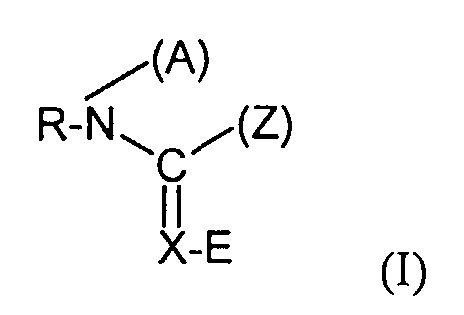
- R
- represents hyrogen or optionally substituted acyl, alkyl, aryl, aralkyl, heteroaryl or heteroarylalkyl radicals;
- A
- represents a monofunctional group from the series comprising hydrogen, acyl, alkyl and aryl, or represents a bifunctional group, which is linked to the radical Z;
- E
- represents NO2 or CN;
- X
- represents the radicals -CH= or =N-, wherein the radical -CH= can be linked to the radical Z instead of an H atom; and
- Z
- represents a monofunctional group from the series
comprising alkyl, -O-R, -S-R oror represents a bifunctional group, which is linked to the radical A or the radical X
- Agents according to claim 5, in which the insecticides are those of general formulae II and III:
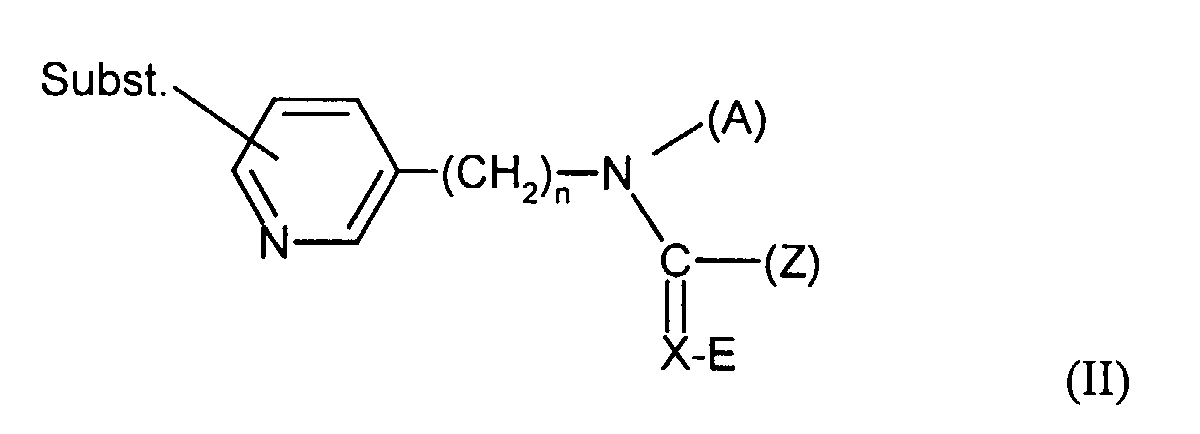 in which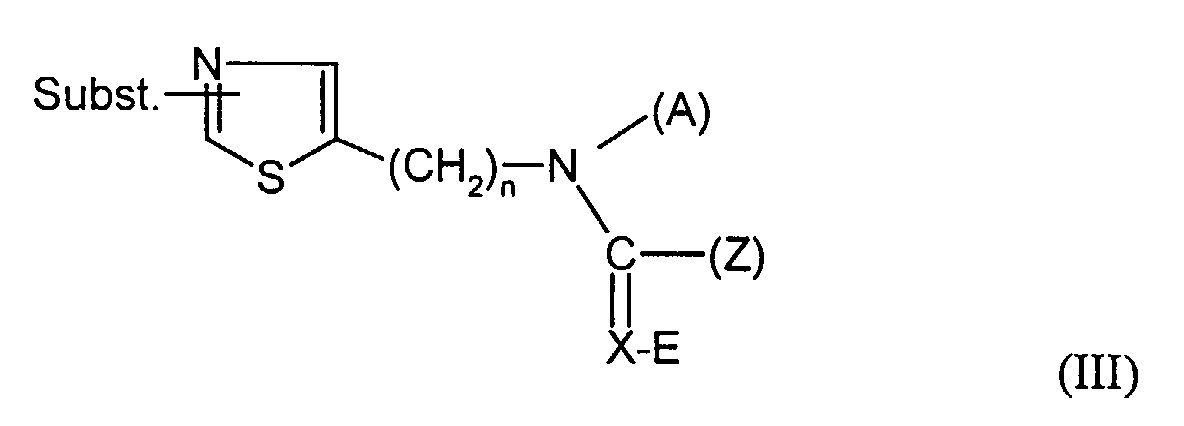
Subst. represents halogen- n
- represents 1 or 2,
- A
- represents monofunctional group from the series comprising hydrgen, acyl, alkyl and aryl, or represents a bifunctional group, which is linked to the radical Z;
- E
- represents NO2 or CN;
- X
- represents the radicals -CH= or =N-, wherein the radical -CH= can be linked to the radical Z instead of an H atom; and
- Z
- represents a monofunctional group from the series
comprising alkyl, -O-R, -S-R oror represents a bifunctional group, which is linked to the radical X,
- R
- represents hydrogen or optionally substituted acyl, alkyl, aryl, aralkyl, heteroaryl or heteroarylalkyl radicals.
- Rods and pins obtained by homogenizing 30.6 parts by weight of imidacloprid, 0.2 parts by weight of triadimenol, 0.2 parts by weight of precipitated silicic acid and 69 parts by weight of copoly(hydroxybutyric acid/hydroxyvaleric acid) at 160°C in the course of 4 minutes, extruding the result into a water bath, granulating, drying and shaping the so obtained moulding composition at 150°C.
- Use of solid shaped plant treatment agents according to claims 1-7 in the treatment of individual plants by introducing the agents into the sap conduction paths of the plants.
Applications Claiming Priority (3)
| Application Number | Priority Date | Filing Date | Title |
|---|---|---|---|
| JP11528392 | 1992-04-09 | ||
| JP04115283 | 1992-04-09 | ||
| JP115283/92 | 1992-04-09 |
Publications (2)
| Publication Number | Publication Date |
|---|---|
| EP0564945A1 EP0564945A1 (en) | 1993-10-13 |
| EP0564945B1 true EP0564945B1 (en) | 2001-01-24 |
Family
ID=14658831
Family Applications (1)
| Application Number | Title | Priority Date | Filing Date |
|---|---|---|---|
| EP93105148A Expired - Lifetime EP0564945B1 (en) | 1992-04-09 | 1993-03-29 | A method of controlling harmful insects |
Country Status (21)
| Country | Link |
|---|---|
| US (1) | US6063393A (en) |
| EP (1) | EP0564945B1 (en) |
| JP (1) | JPH0624903A (en) |
| KR (1) | KR100272899B1 (en) |
| CN (1) | CN1054261C (en) |
| AT (1) | ATE198817T1 (en) |
| AU (1) | AU665994B2 (en) |
| BR (1) | BR9301512A (en) |
| CA (1) | CA2093486C (en) |
| CZ (1) | CZ288719B6 (en) |
| DE (1) | DE69329884T2 (en) |
| DK (1) | DK0564945T3 (en) |
| ES (1) | ES2153833T3 (en) |
| GR (1) | GR3035630T3 (en) |
| HU (1) | HU215502B (en) |
| IL (1) | IL105323A (en) |
| NZ (1) | NZ247355A (en) |
| PT (1) | PT564945E (en) |
| SK (1) | SK282515B6 (en) |
| TW (1) | TW267926B (en) |
| ZA (1) | ZA932525B (en) |
Families Citing this family (37)
| Publication number | Priority date | Publication date | Assignee | Title |
|---|---|---|---|---|
| JP3363525B2 (en) * | 1993-06-08 | 2003-01-08 | バイエルクロップサイエンス株式会社 | Insecticide method |
| JP3509901B2 (en) * | 1993-07-20 | 2004-03-22 | バイエルクロップサイエンス株式会社 | Insecticidal method |
| DE19506095A1 (en) * | 1994-03-04 | 1995-09-21 | Bayer Agrochem Kk | Paste compsn. contg. pesticides or fungicides for use on plants |
| JPH07242501A (en) * | 1994-03-04 | 1995-09-19 | Nippon Bayeragrochem Kk | Method for treating plant |
| DE59707969D1 (en) * | 1996-03-01 | 2002-09-19 | Bayer Ag | HERBICIDE IMPLANTS FOR PLANTS |
| DE19622355A1 (en) * | 1996-06-04 | 1997-12-11 | Bayer Ag | Molded bodies that release agrochemicals |
| DE19624819A1 (en) * | 1996-06-21 | 1998-01-02 | Bayer Ag | Plant treatment pens |
| AU723108B2 (en) * | 1996-06-28 | 2000-08-17 | Research Association For Biotechnology Of Agricultural Chemicals | Biodegradable sustained-release preparation, biodegradable pheromone dispenser and biodegradable pest controlling agent |
| DE19645919A1 (en) * | 1996-11-07 | 1998-05-14 | Bayer Ag | Molded articles containing active ingredients based on biodegradable, thermoplastically processable polymers, process for their production and use |
| KR100461086B1 (en) * | 1996-12-27 | 2005-04-06 | 주식회사 엘지생활건강 | Insecticidal Microcapsules for Hydrogen Ion Phospholytic Cockroach Induced Toxicants and Methods for Manufacturing the Same |
| KR100457391B1 (en) * | 1996-12-27 | 2005-04-06 | 주식회사 엘지생활건강 | Microcapsules for Cockroach Induced Poisoning and Preparations |
| WO1998043483A1 (en) * | 1997-03-27 | 1998-10-08 | The Governing Council Of The University Of Toronto | Treatment for dutch elm disease |
| WO1999004630A1 (en) * | 1997-07-21 | 1999-02-04 | Rhone-Poulenc Agro | Agrochemical composition |
| DE19751631A1 (en) * | 1997-11-21 | 1999-05-27 | Bayer Ag | Use of cyclodextrin complexes of agrochemicals |
| JP4361152B2 (en) * | 1999-01-18 | 2009-11-11 | 大塚化学株式会社 | Small animal control resin composition and small animal control member formed by molding the resin composition |
| DE19911097A1 (en) * | 1999-03-12 | 2000-09-14 | Basf Ag | Process for the preparation of solid dosage forms containing cyclodextrin |
| US6396629B1 (en) * | 2000-08-24 | 2002-05-28 | Avanex Corporation | Multi-functional optical device utilizing multiple birefringent plates and a non-linear interferometer |
| DE10226222A1 (en) * | 2002-06-13 | 2004-01-08 | Bayer Cropscience Ag | Powder formulations |
| WO2007092632A2 (en) | 2006-02-09 | 2007-08-16 | Elevance Renawable Sciences, Inc. | Surface coating compositions and methods |
| MX2008010359A (en) * | 2006-02-09 | 2009-01-30 | Elevance Renewable Sciences | Antimicrobial compositions, methods and systems. |
| KR101548407B1 (en) | 2008-11-12 | 2015-08-28 | 벤타나 메디컬 시스템즈, 인코포레이티드 | Methods and apparatuses for heating slides carrying specimens |
| ES2365565B1 (en) * | 2010-03-26 | 2012-08-10 | Fertinyect S.L. | DEVICE FOR THE INJECTION OF AT LEAST A CHEMICAL SUBSTANCE AND / OR PREPARATION TO TREES AND / OR PALMS AND APPLICATION METHOD. |
| CN102258000B (en) * | 2011-04-11 | 2013-01-16 | 李翊玮 | Method for preventing and controlling cigarette beetle in cigarette factory |
| CN105284879A (en) * | 2015-11-26 | 2016-02-03 | 济南舜昊生物科技有限公司 | Insecticide composition containing etrimfos and ethyl-p-nitrophenyl phenylphosphonothioate and application |
| CN105325453A (en) * | 2015-11-30 | 2016-02-17 | 济南舜昊生物科技有限公司 | Insecticide composition containing naled and application |
| CN105248448A (en) * | 2015-11-30 | 2016-01-20 | 济南舜昊生物科技有限公司 | Composition containing thionazin and application |
| CN105594733A (en) * | 2015-11-30 | 2016-05-25 | 济南舜昊生物科技有限公司 | Water dispersible granule containing etrimfos and application thereof |
| CN105340957A (en) * | 2015-12-01 | 2016-02-24 | 济南舜昊生物科技有限公司 | Sulprofos-contained water dispersible granule and application thereof |
| CN105409940A (en) * | 2015-12-01 | 2016-03-23 | 济南舜昊生物科技有限公司 | Water dispersible granule containing etrimfos and carbophenothion and application thereof |
| CN105340959A (en) * | 2015-12-01 | 2016-02-24 | 济南舜昊生物科技有限公司 | Dioxathion-contained aqueous emulsion and application thereof |
| CN105340958A (en) * | 2015-12-01 | 2016-02-24 | 济南舜昊生物科技有限公司 | Dimethoate-contained aqueous emulsion and application thereof |
| CN105409930A (en) * | 2015-12-01 | 2016-03-23 | 济南舜昊生物科技有限公司 | EW (Emulsion in Water) containing mecarbam and etrimfos and application thereof |
| CN105409939A (en) * | 2015-12-01 | 2016-03-23 | 济南舜昊生物科技有限公司 | Water dispersible granule containing prothiofos and application |
| US10561137B1 (en) | 2016-09-06 | 2020-02-18 | Dennis R. Dullinger | Weed-e-bug |
| BR112019019112B1 (en) * | 2017-03-14 | 2024-01-02 | Board Of Trustees Of Michigan State University | Composite pesticide buffer and method for delivering a pesticide to a tree |
| WO2019197635A1 (en) * | 2018-04-13 | 2019-10-17 | Bayer Aktiengesellschaft | Formulation of insecticidal mixtures comprising propylene carbonate |
| CN111903675B (en) * | 2020-06-22 | 2023-02-21 | 内蒙古大学 | Attractant for pollinating insects and application of attractant for improving plant maturing rate |
Citations (5)
| Publication number | Priority date | Publication date | Assignee | Title |
|---|---|---|---|---|
| GB1380286A (en) * | 1970-11-16 | 1975-01-08 | Jenson C E | Tree medication capsule |
| US3971159A (en) * | 1975-02-05 | 1976-07-27 | Hercules Incorporated | Treatment of conifers |
| US4342176A (en) * | 1980-03-07 | 1982-08-03 | Wolfe Warren D | Unit dosage system for tree trunk implantation to control insect pests afflicting trees |
| JPS5839602A (en) * | 1981-09-03 | 1983-03-08 | Nitto Electric Ind Co Ltd | Device for administration of drug to trunk |
| US5086584A (en) * | 1989-10-12 | 1992-02-11 | Forestry Injection Company Fic Ab | Method and apparatus for applying herbicide and the like to trees |
Family Cites Families (11)
| Publication number | Priority date | Publication date | Assignee | Title |
|---|---|---|---|---|
| US1661577A (en) * | 1925-04-22 | 1928-03-06 | Renner Herbert | Composition for tree treatment |
| US3068087A (en) * | 1957-07-19 | 1962-12-11 | Wayne K Davis | Method and means for the application of chemicals to trees and other woody plants |
| US4401454A (en) * | 1969-10-24 | 1983-08-30 | Union Carbide Corporation | Growth regulation methods |
| SU948366A1 (en) * | 1979-02-26 | 1982-08-07 | Симферопольский государственный университет им.М.В.Фрунзе | Method of injecting biologically active subtances into plants |
| DE3337592A1 (en) * | 1983-10-15 | 1985-04-25 | Gesellschaft für Strahlen- und Umweltforschung mbH, 8000 München | ORGANIC MATERIAL CARRIER WITH INTEGRATED ACTIVE SUBSTANCES |
| EP0179588A3 (en) * | 1984-10-19 | 1987-08-26 | Pilkington Plc | Improvements in or relating to the treatment of trees and bushes |
| US4666706A (en) * | 1985-11-21 | 1987-05-19 | The Dow Chemical Company | Delayed release insecticidal composition and method of making same |
| US5201925A (en) * | 1986-07-17 | 1993-04-13 | Celaflor Gmbh | Device for transcuticular application of active substances to plants |
| EP0254196B1 (en) * | 1986-07-17 | 1992-09-16 | CELAFLOR GmbH | Device for applying active agents to plants through their stomata |
| JP2610988B2 (en) * | 1989-03-09 | 1997-05-14 | 日本バイエルアグロケム 株式会社 | New heterocyclic compounds and insecticides |
| US5157207A (en) * | 1990-02-06 | 1992-10-20 | Crop Genetics International | Modified plant containing a bacterial insculant |
-
1993
- 1993-03-25 JP JP5089513A patent/JPH0624903A/en active Pending
- 1993-03-29 DE DE69329884T patent/DE69329884T2/en not_active Expired - Lifetime
- 1993-03-29 PT PT93105148T patent/PT564945E/en unknown
- 1993-03-29 AT AT93105148T patent/ATE198817T1/en active
- 1993-03-29 ES ES93105148T patent/ES2153833T3/en not_active Expired - Lifetime
- 1993-03-29 EP EP93105148A patent/EP0564945B1/en not_active Expired - Lifetime
- 1993-03-29 DK DK93105148T patent/DK0564945T3/en active
- 1993-04-01 US US08/041,077 patent/US6063393A/en not_active Expired - Fee Related
- 1993-04-02 CZ CZ1993574A patent/CZ288719B6/en not_active IP Right Cessation
- 1993-04-05 IL IL10532393A patent/IL105323A/en not_active IP Right Cessation
- 1993-04-06 CA CA002093486A patent/CA2093486C/en not_active Expired - Lifetime
- 1993-04-06 KR KR1019930005718A patent/KR100272899B1/en not_active Expired - Fee Related
- 1993-04-07 NZ NZ247355A patent/NZ247355A/en not_active IP Right Cessation
- 1993-04-07 AU AU36803/93A patent/AU665994B2/en not_active Ceased
- 1993-04-08 ZA ZA932525A patent/ZA932525B/en unknown
- 1993-04-08 HU HU9301029A patent/HU215502B/en not_active IP Right Cessation
- 1993-04-09 SK SK333-93A patent/SK282515B6/en not_active IP Right Cessation
- 1993-04-09 TW TW082102630A patent/TW267926B/zh not_active IP Right Cessation
- 1993-04-09 CN CN93104083A patent/CN1054261C/en not_active Expired - Fee Related
- 1993-04-12 BR BR9301512A patent/BR9301512A/en not_active IP Right Cessation
-
2001
- 2001-03-23 GR GR20010400475T patent/GR3035630T3/en unknown
Patent Citations (5)
| Publication number | Priority date | Publication date | Assignee | Title |
|---|---|---|---|---|
| GB1380286A (en) * | 1970-11-16 | 1975-01-08 | Jenson C E | Tree medication capsule |
| US3971159A (en) * | 1975-02-05 | 1976-07-27 | Hercules Incorporated | Treatment of conifers |
| US4342176A (en) * | 1980-03-07 | 1982-08-03 | Wolfe Warren D | Unit dosage system for tree trunk implantation to control insect pests afflicting trees |
| JPS5839602A (en) * | 1981-09-03 | 1983-03-08 | Nitto Electric Ind Co Ltd | Device for administration of drug to trunk |
| US5086584A (en) * | 1989-10-12 | 1992-02-11 | Forestry Injection Company Fic Ab | Method and apparatus for applying herbicide and the like to trees |
Also Published As
| Publication number | Publication date |
|---|---|
| CA2093486C (en) | 2003-06-17 |
| HUT64673A (en) | 1994-02-28 |
| IL105323A (en) | 2000-12-06 |
| CA2093486A1 (en) | 1993-10-10 |
| IL105323A0 (en) | 1993-08-18 |
| ES2153833T3 (en) | 2001-03-16 |
| GR3035630T3 (en) | 2001-06-29 |
| SK33393A3 (en) | 1993-11-10 |
| US6063393A (en) | 2000-05-16 |
| HU9301029D0 (en) | 1993-07-28 |
| KR930021061A (en) | 1993-11-22 |
| CN1078850A (en) | 1993-12-01 |
| KR100272899B1 (en) | 2000-11-15 |
| AU665994B2 (en) | 1996-01-25 |
| CN1054261C (en) | 2000-07-12 |
| CZ57493A3 (en) | 1993-12-15 |
| NZ247355A (en) | 1995-11-27 |
| EP0564945A1 (en) | 1993-10-13 |
| TW267926B (en) | 1996-01-11 |
| DE69329884D1 (en) | 2001-03-01 |
| DK0564945T3 (en) | 2001-03-05 |
| JPH0624903A (en) | 1994-02-01 |
| BR9301512A (en) | 1993-11-16 |
| CZ288719B6 (en) | 2001-08-15 |
| ZA932525B (en) | 1993-11-08 |
| DE69329884T2 (en) | 2001-06-07 |
| PT564945E (en) | 2001-07-31 |
| ATE198817T1 (en) | 2001-02-15 |
| SK282515B6 (en) | 2002-10-08 |
| AU3680393A (en) | 1993-10-14 |
| HU215502B (en) | 1999-01-28 |
Similar Documents
| Publication | Publication Date | Title |
|---|---|---|
| US6063393A (en) | Plant treatment agents | |
| KR100365076B1 (en) | Insecticide fertilizer mixture | |
| KR101719012B1 (en) | Pesticidal control device with high load of active ingredient | |
| US5965150A (en) | Capsule preparations for plant treatment | |
| JPH09509163A (en) | N-pyrazolylanilines and N-pyrazolylaminopyridines as pest control agents | |
| EP0906014B1 (en) | Shaped bodies which release agrochemicals | |
| WO2000044228A1 (en) | Insecticidal compositions and insecticidal methods | |
| JP6938759B2 (en) | Agricultural and horticultural fungicide composition | |
| ITTO20010760A1 (en) | COMPOSITION OF PESTICIDE RESIN. | |
| AU729212B2 (en) | Shaped articles which comprise active compounds and are based on biologically degradable, thermoplastically processable polymers, processes for their production and their use | |
| KR20020035605A (en) | Active ingredient combinations having insecticidal and acaricidal properties | |
| KR100202152B1 (en) | How to get rid of fleas and preparations for rescue | |
| KR950006925B1 (en) | Insecticidal agent | |
| AU661401B2 (en) | Insecticide support material | |
| US5260312A (en) | Stabilized agrochemical compositions | |
| US20100015191A1 (en) | Device and method for controlling insects | |
| CA1289066C (en) | Carboximide containing agents for combating pests | |
| JP2008179625A (en) | Agrochemical granular composition and agrochemical mixed pharmaceutical formulation | |
| JPH0912408A (en) | Capsule preparation for treating plant | |
| DE3545060A1 (en) | Pesticides comprising flubenzimine | |
| JPH0640815A (en) | Insecticidal method | |
| HK1158451A (en) | Device and method for controlling insects | |
| JP2006282618A (en) | Poisonous feed for agriculture and horticulture |
Legal Events
| Date | Code | Title | Description |
|---|---|---|---|
| PUAI | Public reference made under article 153(3) epc to a published international application that has entered the european phase |
Free format text: ORIGINAL CODE: 0009012 |
|
| AK | Designated contracting states |
Kind code of ref document: A1 Designated state(s): AT BE CH DE DK ES FR GB GR IT LI NL PT SE |
|
| RAP3 | Party data changed (applicant data changed or rights of an application transferred) |
Owner name: NIHON BAYER AGROCHEM K.K. |
|
| 17P | Request for examination filed |
Effective date: 19931027 |
|
| 17Q | First examination report despatched |
Effective date: 19940428 |
|
| GRAG | Despatch of communication of intention to grant |
Free format text: ORIGINAL CODE: EPIDOS AGRA |
|
| 17Q | First examination report despatched |
Effective date: 19940428 |
|
| GRAG | Despatch of communication of intention to grant |
Free format text: ORIGINAL CODE: EPIDOS AGRA |
|
| GRAH | Despatch of communication of intention to grant a patent |
Free format text: ORIGINAL CODE: EPIDOS IGRA |
|
| GRAH | Despatch of communication of intention to grant a patent |
Free format text: ORIGINAL CODE: EPIDOS IGRA |
|
| GRAA | (expected) grant |
Free format text: ORIGINAL CODE: 0009210 |
|
| AK | Designated contracting states |
Kind code of ref document: B1 Designated state(s): AT BE CH DE DK ES FR GB GR IT LI NL PT SE |
|
| REF | Corresponds to: |
Ref document number: 198817 Country of ref document: AT Date of ref document: 20010215 Kind code of ref document: T |
|
| REG | Reference to a national code |
Ref country code: CH Ref legal event code: NV Representative=s name: E. BLUM & CO. PATENTANWAELTE Ref country code: CH Ref legal event code: EP |
|
| REF | Corresponds to: |
Ref document number: 69329884 Country of ref document: DE Date of ref document: 20010301 |
|
| REG | Reference to a national code |
Ref country code: DK Ref legal event code: T3 |
|
| REG | Reference to a national code |
Ref country code: ES Ref legal event code: FG2A Ref document number: 2153833 Country of ref document: ES Kind code of ref document: T3 |
|
| ITF | It: translation for a ep patent filed | ||
| ET | Fr: translation filed | ||
| REG | Reference to a national code |
Ref country code: PT Ref legal event code: SC4A Free format text: AVAILABILITY OF NATIONAL TRANSLATION Effective date: 20010424 |
|
| PLBE | No opposition filed within time limit |
Free format text: ORIGINAL CODE: 0009261 |
|
| REG | Reference to a national code |
Ref country code: GB Ref legal event code: IF02 |
|
| 26N | No opposition filed | ||
| REG | Reference to a national code |
Ref country code: CH Ref legal event code: PFA Owner name: NIHON BAYER AGROCHEM K.K. Free format text: NIHON BAYER AGROCHEM K.K.#10-8, TAKANAWA 4-CHOME MINATO-KU#TOKYO 108 (JP) -TRANSFER TO- NIHON BAYER AGROCHEM K.K.#10-8, TAKANAWA 4-CHOME MINATO-KU#TOKYO 108 (JP) |
|
| PGFP | Annual fee paid to national office [announced via postgrant information from national office to epo] |
Ref country code: DK Payment date: 20110310 Year of fee payment: 19 |
|
| PGFP | Annual fee paid to national office [announced via postgrant information from national office to epo] |
Ref country code: IT Payment date: 20110225 Year of fee payment: 19 Ref country code: NL Payment date: 20110321 Year of fee payment: 19 Ref country code: FR Payment date: 20110317 Year of fee payment: 19 Ref country code: PT Payment date: 20110307 Year of fee payment: 19 Ref country code: SE Payment date: 20110311 Year of fee payment: 19 Ref country code: CH Payment date: 20110314 Year of fee payment: 19 Ref country code: AT Payment date: 20110228 Year of fee payment: 19 |
|
| PGFP | Annual fee paid to national office [announced via postgrant information from national office to epo] |
Ref country code: GR Payment date: 20110218 Year of fee payment: 19 |
|
| PGFP | Annual fee paid to national office [announced via postgrant information from national office to epo] |
Ref country code: GB Payment date: 20110323 Year of fee payment: 19 Ref country code: BE Payment date: 20110311 Year of fee payment: 19 Ref country code: DE Payment date: 20110222 Year of fee payment: 19 Ref country code: ES Payment date: 20110318 Year of fee payment: 19 |
|
| BERE | Be: lapsed |
Owner name: *NIHON BAYER AGROCHEM K.K. Effective date: 20120331 |
|
| REG | Reference to a national code |
Ref country code: NL Ref legal event code: V1 Effective date: 20121001 Ref country code: PT Ref legal event code: MM4A Free format text: LAPSE DUE TO NON-PAYMENT OF FEES Effective date: 20121001 |
|
| REG | Reference to a national code |
Ref country code: SE Ref legal event code: EUG |
|
| PG25 | Lapsed in a contracting state [announced via postgrant information from national office to epo] |
Ref country code: SE Free format text: LAPSE BECAUSE OF NON-PAYMENT OF DUE FEES Effective date: 20120330 |
|
| REG | Reference to a national code |
Ref country code: CH Ref legal event code: PL |
|
| REG | Reference to a national code |
Ref country code: DK Ref legal event code: EBP |
|
| GBPC | Gb: european patent ceased through non-payment of renewal fee |
Effective date: 20120329 |
|
| REG | Reference to a national code |
Ref country code: GR Ref legal event code: ML Ref document number: 20010400475 Country of ref document: GR Effective date: 20121008 |
|
| REG | Reference to a national code |
Ref country code: AT Ref legal event code: MM01 Ref document number: 198817 Country of ref document: AT Kind code of ref document: T Effective date: 20120329 |
|
| REG | Reference to a national code |
Ref country code: FR Ref legal event code: ST Effective date: 20121130 |
|
| REG | Reference to a national code |
Ref country code: DE Ref legal event code: R119 Ref document number: 69329884 Country of ref document: DE Effective date: 20121002 |
|
| PG25 | Lapsed in a contracting state [announced via postgrant information from national office to epo] |
Ref country code: CH Free format text: LAPSE BECAUSE OF NON-PAYMENT OF DUE FEES Effective date: 20120331 Ref country code: LI Free format text: LAPSE BECAUSE OF NON-PAYMENT OF DUE FEES Effective date: 20120331 Ref country code: FR Free format text: LAPSE BECAUSE OF NON-PAYMENT OF DUE FEES Effective date: 20120402 Ref country code: BE Free format text: LAPSE BECAUSE OF NON-PAYMENT OF DUE FEES Effective date: 20120331 Ref country code: GB Free format text: LAPSE BECAUSE OF NON-PAYMENT OF DUE FEES Effective date: 20120329 Ref country code: AT Free format text: LAPSE BECAUSE OF NON-PAYMENT OF DUE FEES Effective date: 20120329 |
|
| PG25 | Lapsed in a contracting state [announced via postgrant information from national office to epo] |
Ref country code: PT Free format text: LAPSE BECAUSE OF NON-PAYMENT OF DUE FEES Effective date: 20121001 Ref country code: IT Free format text: LAPSE BECAUSE OF NON-PAYMENT OF DUE FEES Effective date: 20120329 Ref country code: GR Free format text: LAPSE BECAUSE OF NON-PAYMENT OF DUE FEES Effective date: 20121008 |
|
| PG25 | Lapsed in a contracting state [announced via postgrant information from national office to epo] |
Ref country code: NL Free format text: LAPSE BECAUSE OF NON-PAYMENT OF DUE FEES Effective date: 20121001 |
|
| REG | Reference to a national code |
Ref country code: PT Ref legal event code: MM4A Free format text: MAXIMUM VALIDITY LIMIT REACHED Effective date: 20130329 |
|
| PG25 | Lapsed in a contracting state [announced via postgrant information from national office to epo] |
Ref country code: DK Free format text: LAPSE BECAUSE OF NON-PAYMENT OF DUE FEES Effective date: 20120331 |
|
| REG | Reference to a national code |
Ref country code: ES Ref legal event code: FD2A Effective date: 20130710 |
|
| PG25 | Lapsed in a contracting state [announced via postgrant information from national office to epo] |
Ref country code: ES Free format text: LAPSE BECAUSE OF NON-PAYMENT OF DUE FEES Effective date: 20120330 |
|
| PG25 | Lapsed in a contracting state [announced via postgrant information from national office to epo] |
Ref country code: PT Free format text: LAPSE BECAUSE OF EXPIRATION OF PROTECTION Effective date: 20130409 |
|
| PG25 | Lapsed in a contracting state [announced via postgrant information from national office to epo] |
Ref country code: DE Free format text: LAPSE BECAUSE OF NON-PAYMENT OF DUE FEES Effective date: 20121002 |
|
| PG25 | Lapsed in a contracting state [announced via postgrant information from national office to epo] |
Ref country code: PT Free format text: LAPSE BECAUSE OF EXPIRATION OF PROTECTION Effective date: 20120329 |