EP0556846A1 - Abgasschalldämpfer für Dieselmotoren insbesondere von Nutzfahrzeugen - Google Patents
Abgasschalldämpfer für Dieselmotoren insbesondere von Nutzfahrzeugen Download PDFInfo
- Publication number
- EP0556846A1 EP0556846A1 EP93102662A EP93102662A EP0556846A1 EP 0556846 A1 EP0556846 A1 EP 0556846A1 EP 93102662 A EP93102662 A EP 93102662A EP 93102662 A EP93102662 A EP 93102662A EP 0556846 A1 EP0556846 A1 EP 0556846A1
- Authority
- EP
- European Patent Office
- Prior art keywords
- catalyst
- housing
- silencer according
- muffler
- catalytic converter
- Prior art date
- Legal status (The legal status is an assumption and is not a legal conclusion. Google has not performed a legal analysis and makes no representation as to the accuracy of the status listed.)
- Withdrawn
Links
Images

Classifications
-
- F—MECHANICAL ENGINEERING; LIGHTING; HEATING; WEAPONS; BLASTING
- F01—MACHINES OR ENGINES IN GENERAL; ENGINE PLANTS IN GENERAL; STEAM ENGINES
- F01N—GAS-FLOW SILENCERS OR EXHAUST APPARATUS FOR MACHINES OR ENGINES IN GENERAL; GAS-FLOW SILENCERS OR EXHAUST APPARATUS FOR INTERNAL-COMBUSTION ENGINES
- F01N13/00—Exhaust or silencing apparatus characterised by constructional features
- F01N13/14—Exhaust or silencing apparatus characterised by constructional features having thermal insulation
-
- F—MECHANICAL ENGINEERING; LIGHTING; HEATING; WEAPONS; BLASTING
- F01—MACHINES OR ENGINES IN GENERAL; ENGINE PLANTS IN GENERAL; STEAM ENGINES
- F01N—GAS-FLOW SILENCERS OR EXHAUST APPARATUS FOR MACHINES OR ENGINES IN GENERAL; GAS-FLOW SILENCERS OR EXHAUST APPARATUS FOR INTERNAL-COMBUSTION ENGINES
- F01N3/00—Exhaust or silencing apparatus having means for purifying, rendering innocuous, or otherwise treating exhaust
- F01N3/08—Exhaust or silencing apparatus having means for purifying, rendering innocuous, or otherwise treating exhaust for rendering innocuous
- F01N3/10—Exhaust or silencing apparatus having means for purifying, rendering innocuous, or otherwise treating exhaust for rendering innocuous by thermal or catalytic conversion of noxious components of exhaust
- F01N3/18—Exhaust or silencing apparatus having means for purifying, rendering innocuous, or otherwise treating exhaust for rendering innocuous by thermal or catalytic conversion of noxious components of exhaust characterised by methods of operation; Control
- F01N3/20—Exhaust or silencing apparatus having means for purifying, rendering innocuous, or otherwise treating exhaust for rendering innocuous by thermal or catalytic conversion of noxious components of exhaust characterised by methods of operation; Control specially adapted for catalytic conversion
- F01N3/2006—Periodically heating or cooling catalytic reactors, e.g. at cold starting or overheating
-
- F—MECHANICAL ENGINEERING; LIGHTING; HEATING; WEAPONS; BLASTING
- F01—MACHINES OR ENGINES IN GENERAL; ENGINE PLANTS IN GENERAL; STEAM ENGINES
- F01N—GAS-FLOW SILENCERS OR EXHAUST APPARATUS FOR MACHINES OR ENGINES IN GENERAL; GAS-FLOW SILENCERS OR EXHAUST APPARATUS FOR INTERNAL-COMBUSTION ENGINES
- F01N3/00—Exhaust or silencing apparatus having means for purifying, rendering innocuous, or otherwise treating exhaust
- F01N3/08—Exhaust or silencing apparatus having means for purifying, rendering innocuous, or otherwise treating exhaust for rendering innocuous
- F01N3/10—Exhaust or silencing apparatus having means for purifying, rendering innocuous, or otherwise treating exhaust for rendering innocuous by thermal or catalytic conversion of noxious components of exhaust
- F01N3/24—Exhaust or silencing apparatus having means for purifying, rendering innocuous, or otherwise treating exhaust for rendering innocuous by thermal or catalytic conversion of noxious components of exhaust characterised by constructional aspects of converting apparatus
- F01N3/28—Construction of catalytic reactors
- F01N3/2882—Catalytic reactors combined or associated with other devices, e.g. exhaust silencers or other exhaust purification devices
- F01N3/2885—Catalytic reactors combined or associated with other devices, e.g. exhaust silencers or other exhaust purification devices with exhaust silencers in a single housing
-
- F—MECHANICAL ENGINEERING; LIGHTING; HEATING; WEAPONS; BLASTING
- F01—MACHINES OR ENGINES IN GENERAL; ENGINE PLANTS IN GENERAL; STEAM ENGINES
- F01N—GAS-FLOW SILENCERS OR EXHAUST APPARATUS FOR MACHINES OR ENGINES IN GENERAL; GAS-FLOW SILENCERS OR EXHAUST APPARATUS FOR INTERNAL-COMBUSTION ENGINES
- F01N3/00—Exhaust or silencing apparatus having means for purifying, rendering innocuous, or otherwise treating exhaust
- F01N3/08—Exhaust or silencing apparatus having means for purifying, rendering innocuous, or otherwise treating exhaust for rendering innocuous
- F01N3/10—Exhaust or silencing apparatus having means for purifying, rendering innocuous, or otherwise treating exhaust for rendering innocuous by thermal or catalytic conversion of noxious components of exhaust
- F01N3/24—Exhaust or silencing apparatus having means for purifying, rendering innocuous, or otherwise treating exhaust for rendering innocuous by thermal or catalytic conversion of noxious components of exhaust characterised by constructional aspects of converting apparatus
- F01N3/28—Construction of catalytic reactors
- F01N3/2882—Catalytic reactors combined or associated with other devices, e.g. exhaust silencers or other exhaust purification devices
- F01N3/2889—Catalytic reactors combined or associated with other devices, e.g. exhaust silencers or other exhaust purification devices with heat exchangers in a single housing
-
- F—MECHANICAL ENGINEERING; LIGHTING; HEATING; WEAPONS; BLASTING
- F01—MACHINES OR ENGINES IN GENERAL; ENGINE PLANTS IN GENERAL; STEAM ENGINES
- F01N—GAS-FLOW SILENCERS OR EXHAUST APPARATUS FOR MACHINES OR ENGINES IN GENERAL; GAS-FLOW SILENCERS OR EXHAUST APPARATUS FOR INTERNAL-COMBUSTION ENGINES
- F01N3/00—Exhaust or silencing apparatus having means for purifying, rendering innocuous, or otherwise treating exhaust
- F01N3/08—Exhaust or silencing apparatus having means for purifying, rendering innocuous, or otherwise treating exhaust for rendering innocuous
- F01N3/10—Exhaust or silencing apparatus having means for purifying, rendering innocuous, or otherwise treating exhaust for rendering innocuous by thermal or catalytic conversion of noxious components of exhaust
- F01N3/24—Exhaust or silencing apparatus having means for purifying, rendering innocuous, or otherwise treating exhaust for rendering innocuous by thermal or catalytic conversion of noxious components of exhaust characterised by constructional aspects of converting apparatus
- F01N3/28—Construction of catalytic reactors
- F01N3/2892—Exhaust flow directors or the like, e.g. upstream of catalytic device
-
- F—MECHANICAL ENGINEERING; LIGHTING; HEATING; WEAPONS; BLASTING
- F01—MACHINES OR ENGINES IN GENERAL; ENGINE PLANTS IN GENERAL; STEAM ENGINES
- F01N—GAS-FLOW SILENCERS OR EXHAUST APPARATUS FOR MACHINES OR ENGINES IN GENERAL; GAS-FLOW SILENCERS OR EXHAUST APPARATUS FOR INTERNAL-COMBUSTION ENGINES
- F01N2230/00—Combination of silencers and other devices
- F01N2230/04—Catalytic converters
-
- F—MECHANICAL ENGINEERING; LIGHTING; HEATING; WEAPONS; BLASTING
- F01—MACHINES OR ENGINES IN GENERAL; ENGINE PLANTS IN GENERAL; STEAM ENGINES
- F01N—GAS-FLOW SILENCERS OR EXHAUST APPARATUS FOR MACHINES OR ENGINES IN GENERAL; GAS-FLOW SILENCERS OR EXHAUST APPARATUS FOR INTERNAL-COMBUSTION ENGINES
- F01N2470/00—Structure or shape of exhaust gas passages, pipes or tubes
- F01N2470/22—Inlet and outlet tubes being positioned on the same side of the apparatus
-
- F—MECHANICAL ENGINEERING; LIGHTING; HEATING; WEAPONS; BLASTING
- F02—COMBUSTION ENGINES; HOT-GAS OR COMBUSTION-PRODUCT ENGINE PLANTS
- F02B—INTERNAL-COMBUSTION PISTON ENGINES; COMBUSTION ENGINES IN GENERAL
- F02B3/00—Engines characterised by air compression and subsequent fuel addition
- F02B3/06—Engines characterised by air compression and subsequent fuel addition with compression ignition
-
- Y—GENERAL TAGGING OF NEW TECHNOLOGICAL DEVELOPMENTS; GENERAL TAGGING OF CROSS-SECTIONAL TECHNOLOGIES SPANNING OVER SEVERAL SECTIONS OF THE IPC; TECHNICAL SUBJECTS COVERED BY FORMER USPC CROSS-REFERENCE ART COLLECTIONS [XRACs] AND DIGESTS
- Y02—TECHNOLOGIES OR APPLICATIONS FOR MITIGATION OR ADAPTATION AGAINST CLIMATE CHANGE
- Y02A—TECHNOLOGIES FOR ADAPTATION TO CLIMATE CHANGE
- Y02A50/00—TECHNOLOGIES FOR ADAPTATION TO CLIMATE CHANGE in human health protection, e.g. against extreme weather
- Y02A50/20—Air quality improvement or preservation, e.g. vehicle emission control or emission reduction by using catalytic converters
-
- Y—GENERAL TAGGING OF NEW TECHNOLOGICAL DEVELOPMENTS; GENERAL TAGGING OF CROSS-SECTIONAL TECHNOLOGIES SPANNING OVER SEVERAL SECTIONS OF THE IPC; TECHNICAL SUBJECTS COVERED BY FORMER USPC CROSS-REFERENCE ART COLLECTIONS [XRACs] AND DIGESTS
- Y02—TECHNOLOGIES OR APPLICATIONS FOR MITIGATION OR ADAPTATION AGAINST CLIMATE CHANGE
- Y02T—CLIMATE CHANGE MITIGATION TECHNOLOGIES RELATED TO TRANSPORTATION
- Y02T10/00—Road transport of goods or passengers
- Y02T10/10—Internal combustion engine [ICE] based vehicles
- Y02T10/12—Improving ICE efficiencies
Definitions
- the invention relates to an exhaust gas silencer for diesel engines, in particular of commercial vehicles.
- the invention has for its object to accomplish the exhaust noise reduction and the pollutant reduction required for compliance with the applicable pollutant limit values in a simple manner.
- This solution consists in that an exhaust gas catalytic converter is integrated in the functional structure of the muffler as a functional part for muffling.
- this solution has the further advantage of the small space requirement.
- this solution has the further advantage of the small space requirement.
- In tractors with semitrailers there is particularly notoriously little space for an exhaust system.
- commercial vehicles are designed to cope with ever larger radius of action. By Correspondingly large fuel tanks have less and less space available for the exhaust system.
- Claim 2 ensures a special effectiveness of the catalyst as a functional part for sound absorption in the exhaust silencer.
- Claims 3 and 4 are directed to the design of the catalysts which can be used.
- the embodiment according to claim 6, on the other hand, is particularly suitable for engines with large displacements in which the noise reduction problem is greater than for engines with small displacements.
- This type of construction is primarily intended for mounting the exhaust silencer close to the engine.
- the exhaust gas flow is diverted to the gas outlet pipe within the muffler housing by approximately 180 ° opposite to the gas inlet pipe.
- the exhaust gases can also be used for additional heating of the catalyst carrier or the catalyst by action from outside.
- Claims 8 or 9 provide a particularly space-saving embodiment which is useful in terms of utilizing the exhaust gas heat for additionally heating the catalytic converter. Due to the usually circular cross-sectional shape of the housing and catalyst wall, the passage cross section between the free catalyst outer wall and the housing inner wall acquires a crescent-like shape that is sufficient for the exhaust gas passage and is advantageous for good heat exchange.
- the essentially cylindrical exhaust gas catalytic converter 2 is integrated within the essentially cylindrical housing 1. Its arrangement is such that it is effective as a functional part for sound absorption.
- the catalyst 2 is attached to the wall part 3 of the housing 1.
- the exhaust gases from the engine are fed to the catalytic converter 2 from the gas inlet pipe 4 in the flow direction 5. While maintaining the flow direction 5, the exhaust gases emerge from the catalytic converter 2.
- the exhaust gases enter a pipe bend 6, preferably a perforated U-pipe bend.
- the pipe bend 6 and the chamber adjoining it on its convex side and lined with absorption material 24 made of mineral fiber form the damping part 19.
- the exhaust gas flow is diverted by 180 ° in the opposite direction 8. In this opposite direction 8, it is fed to the outer skin of the catalytic converter housing or catalytic converter 2 along the gas outlet pipe 9, which has a parallel Axis next to the gas inlet pipe 4 is attached to a front end of the silencer housing 1.
- the exhaust gas also initially flows through the gas inlet pipe 4 parallel to the housing axis 10. It is first guided on the jacket of the catalytic converter housing or catalytic converter 2 to the closed other housing end. The passage of the hot exhaust gas flow in the feed-through direction 5 along the catalyst housing or along the catalyst 2 promotes its rapid heating. At the other end of the muffler housing 1, the still uncleaned exhaust gas flow undergoes a deflection by 180 ° in the region 11 of the muffler chamber, which, as in FIG. 1, is provided on the end face with a damping part 19 designed as a sound absorber.
- the deflected exhaust gas flow is led through the inlet connection 12 into the catalytic converter housing and in the opposite direction 8 parallel to the housing axis 10 through the catalytic converter 2.
- the catalytically cleaned exhaust gas then continues to flow to the outlet pipe 9 of the system.
- the catalytically cleaned exhaust gas leaves the catalyst space via an outlet funnel and is transported out of the silencer via outlet tube 9.
- the outlet pipe 9 is perforated within the silencer in the region of the damping chamber 25.
- the damping chamber 25 is filled with sound absorption material 24, with steel wool 30 on the inside and mineral fiber absorption material 31 on the outside.
- the relative position of inlet pipe 4 and outlet pipe 9 corresponds to that according to FIG. 1.
- the catalytic converter 2 is arranged directly adjacent to the deflection area 11.
- the exhaust gas flow enters the catalyst body 2 directly from the deflection region 11.
- the damping part 19 configured and effective analogously to FIG. 2 also contains absorption material on the inside made of steel wool and on the outside made of mineral fiber. It forms a gas-permeable sound absorber 32 that extends over the entire cross section of the housing 1.
- the exhaust gas flow is guided in the flow direction upstream or downstream of the catalytic converter 2 through funnel-like widened or constricted pipe areas which measure the difference in diameter between the catalytic converter 2 and the gas inlet or outlet pipe 4,9; Compensate for 17.18. In these areas it works in shape of a cone jacket designed gas guide cross section as a continuously broadband reflection point.
- the exhaust gas catalytic converter 13 is arranged between the two muffler chambers 14 in the muffler housing 15.
- the catalyst 13 forms a pipe section connecting the two chambers 14.
- the monolithic catalytic converter 13 divides the muffler housing 15 into the two chambers 14.
- the monolithic catalytic converter 13 has a sound-absorbing effect as the bulkhead partitioning the muffler chamber.
- the catalytic converter 13 is supported in the housing 15 by means of swelling mat or wire mesh 16.
- the input tube 17 is closed at the end by a bottom 26 and is mounted in the perforated bulkhead 27.
- the inlet pipe 17 is provided with a perforated field 28 for the gas entry into the damping chamber.
- FIG. 6 is a modified embodiment of a muffler with an integrated exhaust gas catalytic converter 13, the outer diameter of which, however, is significantly smaller than the diameter of the housing 15 in relation to the embodiment according to FIG. 5.
Landscapes
- Chemical & Material Sciences (AREA)
- Engineering & Computer Science (AREA)
- Chemical Kinetics & Catalysis (AREA)
- Combustion & Propulsion (AREA)
- Mechanical Engineering (AREA)
- General Engineering & Computer Science (AREA)
- Health & Medical Sciences (AREA)
- Toxicology (AREA)
- Exhaust Silencers (AREA)
- Exhaust Gas After Treatment (AREA)
Abstract
Bei einem Abgasschalldämpfer für Dieselmotoren insbesondere von Nutzfahrzeugen ist innerhalb des Schalldämpfergehäuses 1 ein Abgaskatalysator 2 als Funktionsteil für die Schalldämpfung wirksam. <IMAGE>
Description
- Die Erfindung betrifft einen Abgasschalldämpfer für Dieselmotoren insbesondere von Nutzfahrzeugen.
- Durch die im Zuge technischer Weiterentwicklung bessere Nutzung des Dieselöls in Verbindung mit dem Trend zu einer Verringerung seines Schwefelanteils ist der Anteil an Schadstoffen im Abgas rückläufig. Der Anteil an Festkörpern, nämlich Rußpartikeln, und deren Partikelgröße sind im Durchschnitt ebenfalls zurückgegangen. Da der gasförmige Schadstoffanteil weitgehend gleich geblieben ist, hat er prozentual infolge der Rückläufigkeit des Rußanteils zugenommen.
- Durch Optimierung des motorischen Verbrennungsverfahrens in Verbindung mit schwefelarmem Dieselkraftstoff ist der Rußpartikelausstoß bei modernen Fahrzeug-Dieselmotoren rückläufig. Dadurch wird es mittelfristig möglich sein, die geltenden Schadstoffgrenzwerte durch nur einen ungeregelten oder durch einen geregelten Abgaskatalysator entsprechend kleinerer Größe einzuhalten.
- Der Erfindung liegt die Aufgabe zugrunde, die Abgasschalldämpfung und die für die Einhaltung der geltenden Schadstoffgrenzwerte erforderliche Schadstoffreduzierung in einfacher Weise zu bewerkstelligen. Diese Lösung besteht darin, daß in den Funktionsaufbau des Schalldämpfers ein Abgaskatalysator als Funktionsteil für die Schalldämpfung integriert ist.
- Gerade bei Nutzfahrzeugen (LKW und Omnibus) hat diese Lösung den weiteren Vorteil des geringen Raumbedarfs. Bei solchen Nutzfahrzeugen ist nämlich für den Einbau der Abgasanlage vergleichsweise noch weniger Einbauraum vorhanden als bei PKWs. Bei Zugmaschinen mit Sattelauflegern ist besonders notorisch wenig Platz für eine Abgasanlage vorhanden. Zudem sind Nutzfahrzeuge zur Bewältigung immer größerer Aktionsradien bestimmt. Durch entsprechend groß dimensionierte Kraftstofftanks steht immer weniger Raum für die Abgasanlage zur Verfügung.
- Anspruch 2 gewährleistet eine besondere Wirksamkeit des Katalysators als Funktionsteil für die Schalldämpfung im Abgasschalldämpfer.
- Die Ansprüche 3 und 4 sind auf die Ausgestaltung der verwendbaren Katalysatoren gerichtet.
- Für die bauliche Ausgestaltung gibt es prinzipiell unterschiedliche Ausführungsformen. Bei der Ausführungsform nach Anspruch 5 wird eine schnelle Wärmezufuhr am Katalysator erreicht. Daraus resultiert ein schnelles Anspringen des Katalysators. Diese Bauform eignet sich insbesondere für einen fern vom Motor angeordneten Schalldämpfer.
- Die Ausführungsform nach Anspruch 6 hingegen eignet sich insbesondere für Motoren mit großen Hubräumen, bei denen das Schalldämpfproblem größer ist als bei Motoren mit kleinem Hubraum. Diese Bauart ist vor allen Dingen für eine motornahe Anbringung des Abgasschalldämpfers bestimmt.
- Bei beiden Systemen kann es im Interesse einer raumsparenden Unterbringung der Funktionsteile von Vorteil sein, wenn der Abgasstrom zum Gasaustrittsrohr innerhalb des Schalldämpfergehäuses um etwa 180° entgegengesetzt zum Gaseintrittsrohr umgelenkt wird. Dadurch können die Abgase zum zusätzlichen Aufheizen des Katalysatorträgers bzw. des Katalysators durch Einwirkung auch von außen genutzt werden.
- Durch die Ansprüche 8 oder 9 ist eine besonders raumsparende und hinsichtlich der Ausnutzung der Abgaswärme zum zusätzlichen Aufheizen des Katalysators nützliche Ausführungsform geschaffen. Durch die üblicherweise kreisrunde Querschnittsform von Gehäuse- und Katalysatorwand gewinnt der Durchtrittsquerschnitt zwischen der freien Katalysatoraußenwand und der Gehäuseinnenwand eine mondsichelartige Form, die für den Abgasdurchtritt ausreichend und für einen guten Wärmeaustausch vorteilhaft ist.
- Eine andere Bauform sieht die Anordnung des Abgaskatalysators zwischen zwei Schalldämpferkammern vor, wobei der Katalysator eine kammerverbindende Rohrstrecke und die Trennwand bildet.
- Zweckmäßig ist ein aus einem Keramikträger bestehender Abgaskatalysator zur Integration in den Schalldämpfer mittels Quellmatte oder Drahtgestrick im Schalldämpfergehäuse gelagert.
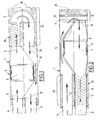
- Der Erfindungsgegenstand ist in den Figuren beispielsweise dargestellt. Es zeigen:
- Fig. 1
- einen Längsschnitt durch einen Abgasschalldämpfer mit integriertem Katalysator, der in Durchströmrichtung des Abgases erstes Dämpfungsglied im Funktionsaufbau ist,
- Fig. 2
- eine Lösung, bei welcher umgekehrt der Katalysator in Durchströmrichtung des Abgases im Funktionsaufbau nachgeordnetes Dämpfungsglied ist,
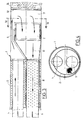
- Fig. 3
- eine modifizierte Ausführungsform der Lösung gemäß Fig. 2,
- Fig. 4
- einen Querschnitt durch das Schalldämpfergehäuse entsprechend der Linie IV-IV in Fig. 3,
- Fig. 5
- einen Längsschnitt analog Fig. 1 - 3, bei welchem sich der Katalysator zwischen zwei Schalldämpferkammern befindet, wobei eine gleichbleibende Durchströmrichtung für die Abgase vorliegt,
- Fig.6
- die Ausführungsform eines Schalldämpfers mit integriertem Abgaskatalysator kleineren Außendurchmessers,
- Fig. 7
- einen Querschnitt entlang der Linie VII-VII in Fig. 6.
- Innerhalb des im wesentlichen zylindrischen Gehäuses 1 ist der hinsichtlich seiner Umrißform ebenfalls im wesentlichen zylindrische Abgaskatalysator 2 integriert. Seine Anordnung ist dabei so getroffen, daß er als Funktionsteil für die Schalldämpfung wirksam ist. Der Katalysator 2 ist am Wandteil 3 des Gehäuses 1 befestigt. Die Abgase des Motors werden dem Katalysator 2 vom Gaseintrittsrohr 4 in Durchströmrichtung 5 zugeführt. Unter Beibehaltung der Durchströmrichtung 5 treten die Abgase aus dem Katalysator 2 aus. Am Ende des Gehäuses 1 treten die Abgase in einen Rohrkrümmer 6, vorzugsweise in einen perforierten U-Rohrkrümmer ein. Der Rohrkrümmer 6 und die an ihn auf seiner Konvexseite angrenzende, mit Absorptionsmaterial 24 aus Mineralfaser ausgekleidete Kammer bilden das Dämpfungsteil 19. Im Rohrkrümmer 6 wird der Abgasstrom um 180° in die Gegenrichtung 8 umgeleitet. In dieser Gegenrichtung 8 wird er an der Außenhaut des Katalysatorgehäuses bzw. des Katalysators 2 entlang dem Gasaustrittsrohr 9 zugeführt, welches mit paralleler Achse neben dem Gaseintrittsrohr 4 an einem Stirnende des Schalldämpfergehäuses 1 befestigt ist.
- Bei der Ausführungsform gemäß Fig. 2 strömt das Abgas durch das Gaseintrittsrohr 4 ebenfalls zunächst parallel zur Gehäuseachse 10. Es wird dabei zunächst am Mantel des Katalysatorgehäuses bzw. Katalysators 2 bis zu dem verschlossenen anderen Gehäuseende geführt. Das Entlangführen des heißen Abgasstromes in Durchführungsrichtung 5 am Katalysatorgehäuse bzw. am Katalysator 2 entlang begünstigt dessen schnelles Aufheizen. Am anderen Ende des Schalldämpfergehäuses 1 erfährt der noch ungereinigte Abgasstrom eine Umlenkung um 180° im Bereich 11 der Schalldämpferkammer, die analog Fig. 1 stirnseitig mit einem als Schallabsorber ausgebildeten Dämpfungsteil 19 versehen ist. Der umgelenkte Abgasstrom wird durch den Eingangsstutzen 12 in das Katalysatorgehäuse hinein und in Gegenrichtung 8 parallel zur Gehäuseachse 10 durch den Katalysator 2 hindurchgeführt. Das katalytisch gereinigte Abgas strömt dann weiter dem Ausgangsrohr 9 des Systems zu. Das katalytisch gereinigte Abgas verläßt den Katalysatorraum hierfür über einen Ausgangstrichter und wird über das Ausgangsrohr 9 aus dem Schalldämpfer abtransportiert. Das Ausgangsrohr 9 ist innerhalb des Schalldämpfers im Bereich der Dämpfungskammer 25 perforiert. Die Dämpfungskammer 25 ist mit Schallabsorptionsmaterial 24, und zwar innen mit Stahlwolle 30 und außen mit Absorptionsstoff 31 aus Mineralfaser ausgefüllt. Die Relativlage von Eingangsrohr 4 und Ausgangsrohr 9 entspricht bei der Ausführungsform gemäß Fig. 2 der gemäß Fig. 1.
- Bei der Ausführungsform gemäß Fig. 3 ist der Katalysator 2 unmittelbar angrenzend an den Umlenkbereich 11 angeordnet. Der Abgasstrom tritt unmittelbar aus dem Umlenkbereich 11 in den Katalysatorkörper 2 ein. Der analog Fig. 2 ausgestaltete und wirksame Dämpfungsteil 19 enthält hier ebenfalls Absorptionsmaterial auf der Innenseite aus Stahlwolle und außen aus Mineralfaser. Er bildet einen gasdurchlässigen, sich über den gesamten Querschnitt des Gehäuses 1 erstreckenden Schallabsorber 32.
- Bei den Ausführungsformen gemäß Fig. 1 - 3 ist der Abgasstrom in Durchströmrichtung vor oder hinter dem Katalysator 2 durch trichterartig aufgeweitete oder eingeschnürte Rohrbereiche geführt, die den Durchmesserunterschied zwischen Katalysator 2 und Gaseintritts- bzw. - austrittsrohr 4,9; 17,18 ausgleichen. In diesen Bereichen wirkt der in Form eines Kegelmantels gestaltete Gasführungsquerschnitt als kontinuierlich breitbandig wirkende Reflexionsstelle.
- Bei der Ausführungsform gemäß Fig. 5 ist der Abgaskatalysator 13 zwischen den beiden Schalldämpferkammern 14 im Schalldämpfergehäuse 15 angeordnet. Der Katalysator 13 bildet dabei eine die beiden Kammern 14 verbindende Rohrstrecke. Bei dieser Ausführungsform teilt der monolithische Katalysator 13 das Schalldämpfergehäuse 15 in die beiden Kammern 14 auf. Der monolithische Katalysator 13 ist dabei als die Schalldämpferkammer unterteilende Schottwand schalldämmend wirksam. Der Katalysator 13 ist bei dieser Bauform mittels Quellmatte oder Drahtgestrick 16 im Gehäuse 15 gelagert. Das Eingangsrohr 17 ist stirnseitig durch einen Boden 26 verschlossen und in der perforierten Schottwand 27 gelagert. Das Eingangsrohr 17 ist für den Gaseintritt in die Dämpfungskammer mit einem Lochfeld 28 versehen. Der Abgasstrom tritt über die perforierte Schottwand 27 in die Kammer 14 vor dem Katalysator 13, durchströmt ihn und mündet schließlich in die Kammer 14 hinter dem Katalysator. Der Endbereich des Schalldämpfers ist ein Wandresonator und ist mit mineralfaserartigem Absorptionsmaterial 24 ausgefüllt. Bei dieser Ausführungsform verläuft die Durchströmrichtung 5 zwischen Eingangsrohr 17 und Ausgangsrohr 18 parallel zur Gehäuseachse 10.
- Fig. 6 ist eine modifizierte Ausführungsform eines Schalldämpfers mit integriertem Abgaskatalysator 13, dessen Außendurchmesser allerdings im Verhältnis zur Ausführungsform gemäß Fig. 5 deutlich kleiner ist als der Durchmesser des Gehäuses 15.
- Fig. 7 zeigt eine Monolithanordnung, bei der kein Abgasstrom im Resonatorraum 22 zwischen dem Abgaskatalysator 13 und dem Gehäuse 15 auftritt. Der Resonatorraum 22 ist durch Öffnungen 23 in der Schottwand 20 an das System gekoppelt und als Helmholtz-Resonator wirksam.
-
- 1.
- Gehäuse
- 2.
- Katalysator
- 3.
- Wandteil
- 4.
- Gaseintrittsrohr
- 5.
- Durchströmrichtung
- 6.
- Rohrkrümmer
- 7.
- Quellmatte
- 8.
- Gegenrichtung
- 9.
- Gasaustrittsrohr
- 10.
- Gehäuseachse
- 11.
- Bereich
- 12.
- Eingangsstütze
- 13.
- Abgaskatalysator
- 14.
- Kammer
- 15.
- Gehäuse
- 16.
- Quellmatte
- 17.
- Gaseintrittsrohr
- 18.
- Gasaustrittsrohr
- 19.
- Dämpfungsteil
- 20.
- Schottwand
- 21.
- Schottwand
- 22.
- Resonatorraum
- 23.
- Öffnungen
- 24.
- Absorptionsmaterial
- 25.
- Dämpfungskammer
- 26.
- Boden
- 27.
- Schottwand
- 28.
- Lochfeld
- 29.
- Schottwand
- 30.
- Stahlwolle
- 31.
- Mineralfaser
- 32.
- Schallabsorber
Claims (15)
- Abgasschalldämpfer für Dieselmotoren insbesondere von Nutzfahrzeugen,
dadurch gekennzeichnet,
daß innerhalb des Schalldämpfergehäuses (1,15) ein Abgaskatalysator (2,13) als Funktionsteil für die Schalldämpfung wirksam ist. - Schalldämpfer nach Anspruch 1,
dadurch gekennzeichnet,
daß der Katalysator (2,13) im Bereich von 2/5 bis 4/5 der Längserstreckung des Schalldämpfergehäuses (1) oder der im Schalldämpfergehäuse (1) durchmessenen Abgaswegstrecke angeordnet ist. - Schalldämpfer nach Anspruch 1,
dadurch gekennzeichnet,
daß der für den Katalysator (2) eingesetzte Katalysatorträger von monolithischer Form ist. - Schalldämpfer nach mindestens einem der vorhergehenden Ansprüche,
dadurch gekennzeichnet,
daß der Katalysatorträger aus Metall oder Keramik in Wabenform hergestellt ist. - Schalldämpfer nach einem oder mehreren der vorhergehenden Ansprüche,
dadurch gekennzeichnet,
daß der Katalysator (2,13) ausgehend vom Gaseintrittsrohr (4,17) an dieses gekoppelt das in Richtung der Abgaswegstrecke erste Dämpfungsglied des Gesamtfunktionsaufbaus ist. - Schalldämpfer nach einem der Ansprüche 1 bis 4,
dadurch gekennzeichnet,
daß der Katalysator (2,13) ein in Richtung der Abgaswegstrecke nachgeschaltetes, an das Gasaustrittsrohr (9,18) angekoppeltes Dämpfungsglied des Gesamtfunktionsaufbaues ist. - Schalldämpfer nach Anspruch 5 oder 6,
dadurch gekennzeichnet,
daß der Abgasstrom im Gasaustrittsrohr (9) innerhalb des Schalldämpfergehäuses (1) um etwa 180° in Richtung entgegengesetzt zu der des Gaseintrittsrohres (4) umgelenkt ist und daß die ein katalysatorfreies Gasrohr (9 bzw. 4) durchströmenden Abgase zum Aufheizen des Katalysatorträgers bzw. des Katalysators (2) an diesem entlanggeführt sind. - Schalldämpfer nach Anspruch 7,
dadurch gekennzeichnet,- daß das Gehäuse (1) und der Katalysator (2) im wesentlichen eine Zylinderform bzw. eine Zylindermantelform aufweisen,- daß der Katalysatorquerschnitt kleiner ist als der Gehäusequerschnitt und- daß der Katalysatormantel in Anlage an einer Gehäuseinnenseite an dieser befestigt ist. - Schalldämpfer nach Anspruch 8,
dadurch gekennzeichnet,
daß der Katalysatormantel an der dem Gasaustrittsrohr (9) oder dem Gaseintrittsrohr (4) abgewandten Seite an der Gehäuseinnenseite befestigt ist. - Schalldämpfer nach einem oder mehreren der vorhergehenden Ansprüche,
dadurch gekennzeichnet,
daß der Katalysator (13) das Schalldämpfergehäuse (1,15) in mindestens zwei Schalldämpferkammern (14) unterteilt und im Funktionsaufbau des Schalldämpfers die das Gehäuse (1,15) unterteilende Schottwand sowie eine beide Schalldämpferkammern (14) verbindende Rohrstrecke bildet. - Schalldämpfer nach einem oder mehreren der vorhergehenden Ansprüche,
gekennzeichnet durch
einen Funktionsaufbau mit integriertem Katalysator (2) in Reflexionsbauweise. - Schalldämpfer nach einem der Ansprüche 1 bis 10,
gekennzeichnet durch
eine Funktionsauslegung mit integriertem Katalysator (2) in gemischter Reflexions-/Absorptionsbauweise. - Schalldämpfer nach einem der Ansprüche 1 bis 10,
gekennzeichnet durch
einen Funktionsaufbau mit integriertem Katalysator (2) in Absorptionsbauweise. - Schalldämpfer nach einem oder mehreren der vorhergehenden Ansprüche,
dadurch gekennzeichnet,- daß der Katalysator (13), mit kleinerem Querschnitt als das Schalldämpfergehäuse (15) in Schottwänden (20,21) am Gehäuse (15) gelagert ist,- daß keine Abgase durch den Zwischenraum (22) zwischen Katalysatorkörper (13) und Schalldämpfergehäuse (15) strömen und- daß Öffnungen (23) in einer gaseintrittsseitigen Schottwand (20) den Zwischenraum (22) an das Abgassystem derart koppeln, daß der Zwischenraum (22) als Helmholtz-Resonator schallenergievernichtend wirksam ist. - Schalldämpfer nach einem oder mehreren der vorhergehenden Ansprüche,
dadurch gekennzeichnet,
daß der integrierte Katalysator (2,13) in Monolithform mittels Quellmatte oder Drahtgestrick (7,16) im Schalldämpfergehäuse (1,15) gelagert ist.
Priority Applications (1)
| Application Number | Priority Date | Filing Date | Title |
|---|---|---|---|
| DE9314441U DE9314441U1 (de) | 1992-02-19 | 1993-02-19 | Abgasschalldämpfer für Dieselmotoren insbesondere von Nutzfahrzeugen |
Applications Claiming Priority (4)
| Application Number | Priority Date | Filing Date | Title |
|---|---|---|---|
| DE9202140U | 1992-02-19 | ||
| DE9202140 | 1992-02-19 | ||
| DE9205461U | 1992-04-22 | ||
| DE9205461 | 1992-04-22 |
Publications (1)
| Publication Number | Publication Date |
|---|---|
| EP0556846A1 true EP0556846A1 (de) | 1993-08-25 |
Family
ID=25959167
Family Applications (1)
| Application Number | Title | Priority Date | Filing Date |
|---|---|---|---|
| EP93102662A Withdrawn EP0556846A1 (de) | 1992-02-19 | 1993-02-19 | Abgasschalldämpfer für Dieselmotoren insbesondere von Nutzfahrzeugen |
Country Status (1)
| Country | Link |
|---|---|
| EP (1) | EP0556846A1 (de) |
Cited By (16)
| Publication number | Priority date | Publication date | Assignee | Title |
|---|---|---|---|---|
| WO1996016258A1 (en) * | 1994-11-18 | 1996-05-30 | Wci Outdoor Products, Inc. | Catalyst muffler system |
| WO1997035100A1 (de) * | 1996-03-21 | 1997-09-25 | J. Eberspächer Gmbh & Co | Schalldämpfer-anordnung |
| EP0744536A3 (de) * | 1995-05-19 | 1997-11-05 | Silentor A/S | Schalldämpfer |
| US6312650B1 (en) | 1996-05-15 | 2001-11-06 | Silentor Holding A/S | Silencer |
| US6332510B1 (en) | 1996-09-30 | 2001-12-25 | Silentor Holding A/S | Gas flow silencer |
| FR2820341A1 (fr) * | 2001-02-06 | 2002-08-09 | Bosch Gmbh Robert | Dispositif de traitement des gaz d'echappement d'un moteur a combustion interne comportant un catalyseur accumulateur |
| EP1170471A3 (de) * | 2000-07-03 | 2002-11-27 | Toyota Jidosha Kabushiki Kaisha | Abgasvorrichtung für eine Brennkraftmaschine |
| CN1100199C (zh) * | 1997-01-22 | 2003-01-29 | 本田技研工业株式会社 | 带催化剂的排气装置 |
| US6520286B1 (en) | 1996-09-30 | 2003-02-18 | Silentor Holding A/S | Silencer and a method of operating a vehicle |
| EP2017441A1 (de) | 2007-06-04 | 2009-01-21 | MAN Nutzfahrzeuge Österreich AG | Abgasanlage mit zwei parallel abgeordneten Schalldämpfern |
| CN101482045A (zh) * | 2009-02-03 | 2009-07-15 | 重庆隆鑫机车有限公司 | 全地形车消声器 |
| EP2458172A1 (de) * | 2010-11-24 | 2012-05-30 | CNH Italia S.p.A. | Mischrohr für SCR Schalldämpfer |
| WO2019166444A1 (de) * | 2018-03-01 | 2019-09-06 | Cpt Group Gmbh | Vorrichtung zur abgasnachbehandlung |
| CN112303030A (zh) * | 2019-07-29 | 2021-02-02 | 无锡小天鹅电器有限公司 | 消声器及衣物处理设备 |
| US11181027B2 (en) | 2018-04-02 | 2021-11-23 | Cummins Emission Solutions Inc. | Aftertreatment system including noise reducing components |
| US11486289B2 (en) | 2018-07-03 | 2022-11-01 | Cummins Emission Solutions Inc. | Body mixing decomposition reactor |
Citations (5)
| Publication number | Priority date | Publication date | Assignee | Title |
|---|---|---|---|---|
| US4209493A (en) * | 1977-07-11 | 1980-06-24 | Nelson Industries, Inc. | Combination catalytic converter and muffler for an exhaust system |
| CA1262869A (en) * | 1988-06-23 | 1989-11-14 | Glen Knight | Combined muffler and catalytic converter exhaust unit |
| EP0392575A2 (de) * | 1989-04-12 | 1990-10-17 | I.R.T.I. Istituto Di Ricerca E Trasferimenti Tecnologici Alle Imprese S.R.L. | Abgasreiniger mit katalytischer Aktivität und Schalldämpfer für Brennkraftmaschinen |
| EP0393257A1 (de) * | 1989-04-17 | 1990-10-24 | Emitec Gesellschaft für Emissionstechnologie mbH | Dieselrussfilter mit zusätzlicher Einrichtung zur Reduktion von Stickoxyden und/oder Oxydation von Kohlenmonoxyd |
| EP0457287A2 (de) * | 1990-05-18 | 1991-11-21 | Guiseppe Nieri | Umweltschutzvorrichtung zur Behandlung von Auspuffgasen aus Brennkraftmaschinen und Brennern im allgemeinen, wirkend auch als Auspuffschalldämpfer |
-
1993
- 1993-02-19 EP EP93102662A patent/EP0556846A1/de not_active Withdrawn
Patent Citations (5)
| Publication number | Priority date | Publication date | Assignee | Title |
|---|---|---|---|---|
| US4209493A (en) * | 1977-07-11 | 1980-06-24 | Nelson Industries, Inc. | Combination catalytic converter and muffler for an exhaust system |
| CA1262869A (en) * | 1988-06-23 | 1989-11-14 | Glen Knight | Combined muffler and catalytic converter exhaust unit |
| EP0392575A2 (de) * | 1989-04-12 | 1990-10-17 | I.R.T.I. Istituto Di Ricerca E Trasferimenti Tecnologici Alle Imprese S.R.L. | Abgasreiniger mit katalytischer Aktivität und Schalldämpfer für Brennkraftmaschinen |
| EP0393257A1 (de) * | 1989-04-17 | 1990-10-24 | Emitec Gesellschaft für Emissionstechnologie mbH | Dieselrussfilter mit zusätzlicher Einrichtung zur Reduktion von Stickoxyden und/oder Oxydation von Kohlenmonoxyd |
| EP0457287A2 (de) * | 1990-05-18 | 1991-11-21 | Guiseppe Nieri | Umweltschutzvorrichtung zur Behandlung von Auspuffgasen aus Brennkraftmaschinen und Brennern im allgemeinen, wirkend auch als Auspuffschalldämpfer |
Cited By (22)
| Publication number | Priority date | Publication date | Assignee | Title |
|---|---|---|---|---|
| WO1996016258A1 (en) * | 1994-11-18 | 1996-05-30 | Wci Outdoor Products, Inc. | Catalyst muffler system |
| EP0744536A3 (de) * | 1995-05-19 | 1997-11-05 | Silentor A/S | Schalldämpfer |
| US6220021B1 (en) | 1995-05-19 | 2001-04-24 | Silentor Notox A/S | Silencer with incorporated catalyst |
| WO1997035100A1 (de) * | 1996-03-21 | 1997-09-25 | J. Eberspächer Gmbh & Co | Schalldämpfer-anordnung |
| US6158214A (en) * | 1996-03-21 | 2000-12-12 | Microcompact Car Smart Gmbh | Exhaust silencer arrangement |
| US6312650B1 (en) | 1996-05-15 | 2001-11-06 | Silentor Holding A/S | Silencer |
| US6520286B1 (en) | 1996-09-30 | 2003-02-18 | Silentor Holding A/S | Silencer and a method of operating a vehicle |
| US6332510B1 (en) | 1996-09-30 | 2001-12-25 | Silentor Holding A/S | Gas flow silencer |
| CN1100199C (zh) * | 1997-01-22 | 2003-01-29 | 本田技研工业株式会社 | 带催化剂的排气装置 |
| EP1170471A3 (de) * | 2000-07-03 | 2002-11-27 | Toyota Jidosha Kabushiki Kaisha | Abgasvorrichtung für eine Brennkraftmaschine |
| US6588203B2 (en) | 2000-07-03 | 2003-07-08 | Toyota Jidosha Kabushiki Kaisha | Exhaust device of internal combustion engine |
| FR2820341A1 (fr) * | 2001-02-06 | 2002-08-09 | Bosch Gmbh Robert | Dispositif de traitement des gaz d'echappement d'un moteur a combustion interne comportant un catalyseur accumulateur |
| EP2017441A1 (de) | 2007-06-04 | 2009-01-21 | MAN Nutzfahrzeuge Österreich AG | Abgasanlage mit zwei parallel abgeordneten Schalldämpfern |
| CN101482045A (zh) * | 2009-02-03 | 2009-07-15 | 重庆隆鑫机车有限公司 | 全地形车消声器 |
| EP2458172A1 (de) * | 2010-11-24 | 2012-05-30 | CNH Italia S.p.A. | Mischrohr für SCR Schalldämpfer |
| WO2019166444A1 (de) * | 2018-03-01 | 2019-09-06 | Cpt Group Gmbh | Vorrichtung zur abgasnachbehandlung |
| CN111788373A (zh) * | 2018-03-01 | 2020-10-16 | 纬湃技术有限公司 | 用于排气后处理的设备 |
| US11174775B2 (en) | 2018-03-01 | 2021-11-16 | Vitesco Technologies GmbH | Exhaust gas aftertreatment device |
| US11181027B2 (en) | 2018-04-02 | 2021-11-23 | Cummins Emission Solutions Inc. | Aftertreatment system including noise reducing components |
| US11486289B2 (en) | 2018-07-03 | 2022-11-01 | Cummins Emission Solutions Inc. | Body mixing decomposition reactor |
| US11891937B2 (en) | 2018-07-03 | 2024-02-06 | Cummins Emission Solutions Inc. | Body mixing decomposition reactor |
| CN112303030A (zh) * | 2019-07-29 | 2021-02-02 | 无锡小天鹅电器有限公司 | 消声器及衣物处理设备 |
Similar Documents
| Publication | Publication Date | Title |
|---|---|---|
| EP0556846A1 (de) | Abgasschalldämpfer für Dieselmotoren insbesondere von Nutzfahrzeugen | |
| EP1108122B1 (de) | Einrichtung zur katalytischen abgasreinigung | |
| DE19955013B4 (de) | Abgasanlage einer Verbrennungskraftmaschine | |
| EP1184543B1 (de) | Abgasreinigungssystem für Kraftfahrzeuge, insbesondere Diesel-Nutzfahrzeuge | |
| DE69513092T2 (de) | Ein Verfahren zur Anwendung eines Schalldämpfers und eine Vorrichtung zur Anwendung des Verfahrens in einem grossen Dieselmotor | |
| DE112011103501T5 (de) | Auspuffanlage für Kraftfahrzeuge | |
| EP1379322B2 (de) | Abgassystem | |
| EP1179125B1 (de) | Vorrichtung zum reduzieren von schädlichen bestandteilen im abgas einer brennkraftmaschine, insbesondere einer diesel-brennkraftmaschine | |
| DE202007010435U1 (de) | Abgasanlage für Nutzfahrzeuge | |
| DE102005025045A1 (de) | Abgasanlage | |
| DE2539964A1 (de) | Einrichtung zum reinigen von auspuffgasen | |
| DE102004042454A1 (de) | Abgaswärmeübertrager, insbesondere Abgaskühler für Abgasrückführung in Kraftfahrzeugen | |
| DE202009012225U1 (de) | Schalldämpfung im Abgasweg eines Schienenfahrzeug-Verbrennungsmotors | |
| EP1475522A2 (de) | Kombinierte Abgasnachbehandlungs-/Schalldämpfungsvorrichtung im Abgasstrang einer Brennkraftmaschine | |
| AT396170B (de) | Auspuffanlage fuer zweitakt-brennkraftmaschinen | |
| EP4086439A1 (de) | Abgasbehandlungsmodul | |
| DE19802624A1 (de) | Abgasschalldämpfer für Verbrennungsmotoren | |
| EP0884460A2 (de) | Abgassystem, geeignet für die Nachrüstung von Abgaskatalysatoren bei Motorrädern | |
| EP1304152B1 (de) | Abgasanlage mit Partikelfilter für einen Verbrennungsmotor | |
| DE19626980A1 (de) | Schalldämpfer für Kraftfahrzeuge | |
| EP3704360B1 (de) | Abgasanlage zur kompakten und effizienten nachbehandlung und schalldämpfung des abgases | |
| DE9314441U1 (de) | Abgasschalldämpfer für Dieselmotoren insbesondere von Nutzfahrzeugen | |
| DE19952428A1 (de) | Verfahren und Vorrichtung zur kombinierten katalytischen NOx-Reduktion und Schalldämpfung von Abgas im Abgasstrang einer Brennkraftmaschine | |
| DE60214748T2 (de) | In einem abgassystem für einen verbrennungsmotor angeordnetes gehäuse | |
| EP1882090B1 (de) | Abgasanlage mit zwei abgasbehandlungseinheiten |
Legal Events
| Date | Code | Title | Description |
|---|---|---|---|
| PUAI | Public reference made under article 153(3) epc to a published international application that has entered the european phase |
Free format text: ORIGINAL CODE: 0009012 |
|
| AK | Designated contracting states |
Kind code of ref document: A1 Designated state(s): BE DE ES FR GB IT NL SE |
|
| STAA | Information on the status of an ep patent application or granted ep patent |
Free format text: STATUS: THE APPLICATION IS DEEMED TO BE WITHDRAWN |
|
| 18D | Application deemed to be withdrawn |
Effective date: 19940226 |