EP0554868A2 - Verfahren zur Reduzierung der NOx-Produktion bei Luft-Brennstoff-Verbrennungsprozessen - Google Patents
Verfahren zur Reduzierung der NOx-Produktion bei Luft-Brennstoff-Verbrennungsprozessen Download PDFInfo
- Publication number
- EP0554868A2 EP0554868A2 EP93101738A EP93101738A EP0554868A2 EP 0554868 A2 EP0554868 A2 EP 0554868A2 EP 93101738 A EP93101738 A EP 93101738A EP 93101738 A EP93101738 A EP 93101738A EP 0554868 A2 EP0554868 A2 EP 0554868A2
- Authority
- EP
- European Patent Office
- Prior art keywords
- fuel
- oxy
- combustion
- air
- burner
- Prior art date
- Legal status (The legal status is an assumption and is not a legal conclusion. Google has not performed a legal analysis and makes no representation as to the accuracy of the status listed.)
- Withdrawn
Links
Images




Classifications
-
- F—MECHANICAL ENGINEERING; LIGHTING; HEATING; WEAPONS; BLASTING
- F23—COMBUSTION APPARATUS; COMBUSTION PROCESSES
- F23D—BURNERS
- F23D17/00—Burners for combustion simultaneously or alternately of gaseous or liquid or pulverulent fuel
- F23D17/002—Burners for combustion simultaneously or alternately of gaseous or liquid or pulverulent fuel gaseous or liquid fuel
-
- F—MECHANICAL ENGINEERING; LIGHTING; HEATING; WEAPONS; BLASTING
- F23—COMBUSTION APPARATUS; COMBUSTION PROCESSES
- F23L—SUPPLYING AIR OR NON-COMBUSTIBLE LIQUIDS OR GASES TO COMBUSTION APPARATUS IN GENERAL ; VALVES OR DAMPERS SPECIALLY ADAPTED FOR CONTROLLING AIR SUPPLY OR DRAUGHT IN COMBUSTION APPARATUS; INDUCING DRAUGHT IN COMBUSTION APPARATUS; TOPS FOR CHIMNEYS OR VENTILATING SHAFTS; TERMINALS FOR FLUES
- F23L7/00—Supplying non-combustible liquids or gases, other than air, to the fire, e.g. oxygen, steam
-
- F—MECHANICAL ENGINEERING; LIGHTING; HEATING; WEAPONS; BLASTING
- F23—COMBUSTION APPARATUS; COMBUSTION PROCESSES
- F23D—BURNERS
- F23D2204/00—Burners adapted for simultaneous or alternative combustion having more than one fuel supply
- F23D2204/10—Burners adapted for simultaneous or alternative combustion having more than one fuel supply gaseous and liquid fuel
-
- Y—GENERAL TAGGING OF NEW TECHNOLOGICAL DEVELOPMENTS; GENERAL TAGGING OF CROSS-SECTIONAL TECHNOLOGIES SPANNING OVER SEVERAL SECTIONS OF THE IPC; TECHNICAL SUBJECTS COVERED BY FORMER USPC CROSS-REFERENCE ART COLLECTIONS [XRACs] AND DIGESTS
- Y02—TECHNOLOGIES OR APPLICATIONS FOR MITIGATION OR ADAPTATION AGAINST CLIMATE CHANGE
- Y02E—REDUCTION OF GREENHOUSE GAS [GHG] EMISSIONS, RELATED TO ENERGY GENERATION, TRANSMISSION OR DISTRIBUTION
- Y02E20/00—Combustion technologies with mitigation potential
- Y02E20/34—Indirect CO2mitigation, i.e. by acting on non CO2directly related matters of the process, e.g. pre-heating or heat recovery
Definitions
- the present invention pertains to air-fuel combustion processes.
- NOx nitrogen oxides
- the first is to remove the NOx from the exhaust gases before they exit into the atmosphere.
- Post-treatment of the exhaust gases from the combustion process can be carried out by selective catalytic or non-catalytic reduction and various combinations of oxidation, absorption and reduction processes to scrub out the NOx. These processes generally involve high cost and a need to shut down the combustion process in the event of failure with the post-treatment equipment.
- the second method or strategy is to minimize NOx formation in the first place by modifying the combustion process in some manner. Examples of this second strategy include water or steam injection into the flame, reduced excess air in the combustion process and so-called low NOx burner designs. These technologies provide the user with a penalty in reduced thermal efficiency or only minimal NOx reductions.
- the present invention provides a method of utilizing oxy-fuel combustion in combination with an existing air-fuel system to increase productivity while minimizing NOx formation.
- the oxy-fuel combustion is shielded by the air-fuel combustion and the oxy-fuel combustion is controlled so that the combustion takes place in a fuel-rich state.
- Figure 1 is a plot of pounds of NO produced per million BTUs against the percent oxygen in the oxidizer of a typical combustion process.
- Figure 2 is a longitudinal schematic of an apparatus used to verify the process of the present invention.
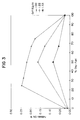
- Figure 3 is a plot of pounds of NO per million BTU produced against the percentage of the total combustion process that was from a source of oxy-fuel combustion.
- Figure 4 is a plot of pounds of NO per million BTU produced against oxygen concentration in the oxidizer for the test results of Figure 3.
- Figure 5 is a plot of pounds NO per million BTU produced against total oxygen in the oxidizer for three different oxygen-fuel ratios as predicted assuming the fuel and oxidizer are perfectly mixed and react adiabatically.
- Figure 1 shows the equilibrium predictions for NO for an adiabatic, stoichiometric, methane flame as a function of the oxygen concentration in an oxygen-nitrogen oxidizer, e.g. air.
- the units for nitric oxide or NO are pounds of NO per million BTUs gross firing rate of the fuel.
- Figure 1 shows that NO dramatically increases at low levels of oxygen enrichment which trend has been verified experimentally in numerous tests conducted with enrichment of conventional air-fuel burners.
- dual fuel air-fuel burner shown generally as 10 includes a first atomizing air passage 12 in the form of a tubular shape with an air inlet fitting 14 disposed concentrically around the first air tube is a fuel tube 16 having a fuel inlet 18 the fuel tube 16 being surrounded on its forward end with a concentric tube which defines a main combustion air inlet tube 20 with a combustion air inlet passage 22.
- a burner mounting flange 24 containing a burner tile 26, the burner tile being fabricated of a ceramic material.
- the forward end of the main combustion air passage 20 terminates in a plate 28 with a plurality of air passages 30 disposed on axes parallel to longitudinal axis of the fuel passage 32 which is in the form of an annulus disposed around the annular termination of the atomizing air passage 34.
- Disposed concentrically within air passage 12 is an oxy-fuel burner shown generally as 36.
- Oxy-fuel burner 36 is a concentric tube burner having an outer tube 38 concentrically disposed around an inner tube 40. The inner tube is spaced from the outer tube by a plurality of radially spaced spacers 42 proximate the front end 44 of the burner.
- the oxy-fuel burner is adapted so that in one embodiment, fuel is admitted through a fitting 46 and is conducted around the outside of the inner tube 40 and exits the front end of the burner 44. Oxygen is conducted down the center or oxidizer tube 40 by means of an oxidizer inlet fitting 48. Oxidizer tube 40 terminates at a location inwardly of the discharge end of the burner 36 so that proper combustion of the oxy-fuel mixture can take place. Alternatively, the oxygen and fuel passages can be reversed. Concentric oxy-fuel burners are well known in the art, one being a K-Tech burner offered for sale by Air Products and Chemicals, Inc. of Allentown, Pennsylvania.
- the burner 10 is set up so that natural gas is delivered through fitting 18 and primary combustion air delivered through fitting 22 so that combustion takes place forward of the front end of the oxy-fuel burner 36.
- the oxy-fuel burner is used to produce an oxy-fuel flame or combustion at the forward end 44 of the burner 36 by introducing oxygen into fitting 46 and fuel such as natural gas into fitting 48.
- the oxy-fuel burner is operated in a fuel-rich condition. Fuel-rich is taken to mean an equivalence ratio between 1.2 and 1.35 preferably at about 1.33 when the ratio of the oxygen in the oxy-fuel burner to the fuel is divided into the ratio of oxygen and the oxy-fuel burner as if the oxy-fuel burner were operating under conditions of stoichiometry.
- operation is conducted so that the oxy-fuel flame is shrouded by the air-fuel flame.
- this is easily accomplished by placing the oxy-fuel burner inside of the air-fuel burner so that the oxy-fuel combustion takes place inside of an envelope of the air-fuel combustion.
- Other configurations can be utilized wherein the oxy-fuel flame is separate from the air-fuel flame except that the two flames are merged after creation.
- Figure 4 shows the same data that was plotted in Figure 3 except that the data is presented in the terms of overall oxygen concentration in the oxidizer so the test can be evaluated as if the oxygen was premixed with the air. For example, if the total firing rate is split evenly between the air-fuel and the oxygen-fuel burners and both burners are at stoichiometric conditions, the equivalent oxygen concentration for oxygen premixed with air is 34.6%. This curve is instructive because it can be readily compared to the theoretical NOx curves shown in Figure 5.
- the curves of Figure 5 are the equilibrium predictions assuming fuel and oxidizer are perfectly mixed.
- the curves of Figure 5 shows that NOx is predicted to increase as the oxygen enrichment level increases toward 40%.
- the air-fuel burner tested had unusually low NOx because of its poor mixing characteristics. Most air-fuel burners are >0.1 lb NO/MMBtu which means the invention may be even better for other burners.
- the natural gas in the outer annulus of the oxy-fuel burner acts as a shroud which delays the inner high purity oxygen from reaching the nitrogen in the air-fuel burner. Since the flame is fuel-rich, most of the oxygen oxidizes the hydrocarbon fuel before it mixes with the air-fuel stream. It is believed that the combination of lower flame temperature, reducing conditions in the oxy-fuel flame temperature and shrouding of the inner high purity oxygen from the nitrogen in the air-fuel flame all contribute to the unexpected reduction of NOx in the exhaust gases. From the experimental data one could predict that the preferred conditions would occur when at least two thirds of the total firing rate is accomplished by virtue of using the oxy-fuel burner.
- the preferred operating conditions are running the oxy-fuel flame fuel-rich and the air-fuel flame approximately at stoichiometric conditions rather than the reverse.
- Using conditions reverse to the invention would only marginally reduce the flame temperature of the air-fuel flame and drastically increase the flame temperature of the oxy-fuel flame.
- thermal NOx production in flames increases exponentially with temperature
- the high peak flame temperatures that would result in the reverse practice of the invention would produce higher NOx than the invention.
- running both burners fuel-rich would reduce NOx, the thermal efficiency would suffer.
- oxygen enrichment has been proven to increase thermal efficiency, the present invention would enhance productivity even though the oxy-fuel flame is fuel rich because the reduction from being fuel-rich is far outweighed by oxygen enrichment.
- unburned hydrocarbon emissions will not be present due to air infiltration into the furnace and into the exhaust system which combusts any remaining fuel in the exhaust gases leaving the flame zone.
- the present invention can be easily retrofitted to existing systems at minimal cost.
- the present invention gives an incremental increase in productivity without the penalty of high NOx emissions which normally occur at low levels of oxygen enrichment.
- Oxy-fuel burners have previously been added to air-fuel furnaces to increase productivity, however, prior to the present discovery NOx emissions were not considered to be a problem.
Landscapes
- Engineering & Computer Science (AREA)
- Chemical & Material Sciences (AREA)
- Combustion & Propulsion (AREA)
- Mechanical Engineering (AREA)
- General Engineering & Computer Science (AREA)
Applications Claiming Priority (2)
| Application Number | Priority Date | Filing Date | Title |
|---|---|---|---|
| US07/831,149 US5308239A (en) | 1992-02-04 | 1992-02-04 | Method for reducing NOx production during air-fuel combustion processes |
| US831149 | 1997-04-01 |
Publications (2)
| Publication Number | Publication Date |
|---|---|
| EP0554868A2 true EP0554868A2 (de) | 1993-08-11 |
| EP0554868A3 EP0554868A3 (en) | 1993-12-01 |
Family
ID=25258395
Family Applications (1)
| Application Number | Title | Priority Date | Filing Date |
|---|---|---|---|
| EP19930101738 Withdrawn EP0554868A3 (en) | 1992-02-04 | 1993-02-04 | Method for reducing nox production during air-fuel combustion processes |
Country Status (10)
| Country | Link |
|---|---|
| US (1) | US5308239A (de) |
| EP (1) | EP0554868A3 (de) |
| JP (1) | JP2693101B2 (de) |
| KR (1) | KR970009487B1 (de) |
| CN (1) | CN1030103C (de) |
| CA (1) | CA2088339C (de) |
| MX (1) | MX9300554A (de) |
| MY (1) | MY108972A (de) |
| SG (1) | SG41923A1 (de) |
| TW (1) | TW211059B (de) |
Cited By (3)
| Publication number | Priority date | Publication date | Assignee | Title |
|---|---|---|---|---|
| EP2461097A1 (de) * | 2010-12-01 | 2012-06-06 | Linde Aktiengesellschaft | Verfahren und Vorrichtung zur verdünnten Verbrennung |
| WO2014053190A1 (en) * | 2012-10-05 | 2014-04-10 | Air Liquide Brasil Ltda | Lost wax process and calcination furnace for same |
| GB2586706A (en) * | 2019-08-21 | 2021-03-03 | Csk Inc | A burner for scrubbers |
Families Citing this family (35)
| Publication number | Priority date | Publication date | Assignee | Title |
|---|---|---|---|---|
| BR9404470A (pt) * | 1993-11-17 | 1997-03-11 | Praxair Technology Inc | Processo para conduçao de combustao com simultânea geraçao reduzida de oxidos de nitrogênio |
| US5601425A (en) * | 1994-06-13 | 1997-02-11 | Praxair Technology, Inc. | Staged combustion for reducing nitrogen oxides |
| US5543116A (en) * | 1994-07-15 | 1996-08-06 | The Babcock & Wilcox Company | Method for reducing NOx using atomizing steam injection control |
| US5611683A (en) * | 1995-08-04 | 1997-03-18 | Air Products And Chemicals, Inc. | Method and apparatus for reducing NOX production during air-oxygen-fuel combustion |
| US5993203A (en) * | 1995-11-01 | 1999-11-30 | Gas Research Institute | Heat transfer enhancements for increasing fuel efficiency in high temperature furnaces |
| DE19627203C2 (de) * | 1996-07-05 | 2000-11-09 | Loesche Gmbh | Brenner |
| JPH10110926A (ja) * | 1996-08-14 | 1998-04-28 | Nippon Sanso Kk | 燃焼式除害装置 |
| US5904475A (en) * | 1997-05-08 | 1999-05-18 | Praxair Technology, Inc. | Dual oxidant combustion system |
| US5954498A (en) * | 1998-02-26 | 1999-09-21 | American Air Liquide, Inc. | Oxidizing oxygen-fuel burner firing for reducing NOx emissions from high temperature furnaces |
| US6217681B1 (en) | 1998-04-14 | 2001-04-17 | Air Products And Chemicals, Inc. | Method for oxygen-enhanced combustion using a vent stream |
| US6206686B1 (en) * | 1998-05-01 | 2001-03-27 | North American Manufacturing Company | Integral low NOx injection burner |
| US5871343A (en) | 1998-05-21 | 1999-02-16 | Air Products And Chemicals, Inc. | Method and apparatus for reducing NOx production during air-oxygen-fuel combustion |
| US6699031B2 (en) | 2001-01-11 | 2004-03-02 | Praxair Technology, Inc. | NOx reduction in combustion with concentrated coal streams and oxygen injection |
| US20020127505A1 (en) | 2001-01-11 | 2002-09-12 | Hisashi Kobayashi | Oxygen enhanced low nox combustion |
| US6699030B2 (en) | 2001-01-11 | 2004-03-02 | Praxair Technology, Inc. | Combustion in a multiburner furnace with selective flow of oxygen |
| US6699029B2 (en) | 2001-01-11 | 2004-03-02 | Praxair Technology, Inc. | Oxygen enhanced switching to combustion of lower rank fuels |
| US6702569B2 (en) | 2001-01-11 | 2004-03-09 | Praxair Technology, Inc. | Enhancing SNCR-aided combustion with oxygen addition |
| US6551098B2 (en) * | 2001-02-22 | 2003-04-22 | Rheem Manufacturing Company | Variable firing rate fuel burner |
| WO2003098105A1 (en) | 2002-05-15 | 2003-11-27 | Praxair Technology, Inc. | Combustion with reduced carbon in the ash |
| PL212230B1 (pl) * | 2002-05-15 | 2012-08-31 | Praxair Technology Inc | Sposób spalania paliw węglowodorowych |
| US7117675B2 (en) | 2002-12-03 | 2006-10-10 | General Electric Company | Cooling of liquid fuel components to eliminate coking |
| US6918255B2 (en) * | 2002-12-03 | 2005-07-19 | General Electric Company | Cooling of liquid fuel components to eliminate coking |
| AU2004205796B2 (en) | 2003-01-21 | 2009-02-26 | L'air Liquide Societe Anonyme Pour L'etude Et L'exploitation Des Procedes Georges Claude | Process and apparatus for oxygen enrichment in fuel conveying gases |
| US7074033B2 (en) | 2003-03-22 | 2006-07-11 | David Lloyd Neary | Partially-open fired heater cycle providing high thermal efficiencies and ultra-low emissions |
| ITMI20061636A1 (it) * | 2006-08-22 | 2008-02-23 | Danieli & C Officine Meccaniche Spa | Bruciatore |
| US20080145281A1 (en) * | 2006-12-14 | 2008-06-19 | Jenne Richard A | Gas oxygen incinerator |
| DE102007025051B4 (de) * | 2007-05-29 | 2011-06-01 | Hitachi Power Europe Gmbh | Hüttengasbrenner |
| WO2010083410A1 (en) * | 2009-01-16 | 2010-07-22 | Air Products & Chemicals, Inc. | Multi-mode combustion device and method for using the device |
| US20110223549A1 (en) | 2010-05-31 | 2011-09-15 | Resource Rex, LLC | Laminar Flow Combustion System and Method for Enhancing Combustion Efficiency |
| US8991360B2 (en) * | 2012-06-27 | 2015-03-31 | Caterpillar Inc. | Coaxial quill assembly retainer and common rail fuel system using same |
| KR101730003B1 (ko) * | 2014-05-15 | 2017-04-26 | 한국생산기술연구원 | 석유코크스 연료 전소 및 혼소용 연소장치 |
| CN106940016A (zh) * | 2017-05-08 | 2017-07-11 | 程石 | 一种生物质、城市生活垃圾高温裂解炉裂解气部分燃烧纯氧烧嘴 |
| JP7292898B2 (ja) * | 2019-02-22 | 2023-06-19 | 三菱重工マリンマシナリ株式会社 | ボイラ |
| US11506381B2 (en) * | 2020-05-15 | 2022-11-22 | Zeeco, Inc. | Plug-resistant burner tip and method |
| US20250060095A1 (en) | 2023-08-14 | 2025-02-20 | Air Products And Chemicals, Inc. | Burner and Method of Operation |
Family Cites Families (10)
| Publication number | Priority date | Publication date | Assignee | Title |
|---|---|---|---|---|
| GB1143117A (en) * | 1966-10-14 | 1969-02-19 | Gas Council | Improvements relating to gas burners |
| JPS5228251B2 (de) * | 1974-03-05 | 1977-07-26 | ||
| US4395223A (en) * | 1978-06-09 | 1983-07-26 | Hitachi Shipbuilding & Engineering Co., Ltd. | Multi-stage combustion method for inhibiting formation of nitrogen oxides |
| JPS6045130B2 (ja) * | 1981-04-27 | 1985-10-08 | 科学技術庁無機材質研究所長 | 4NiO・6Fe↓2O↓3・9GeO↓2(Ni↓4Fe↓1↓2Ge↓9O↓4↓0)で示される単斜晶系に属する化合物およびその製造法 |
| JPS5987508U (ja) * | 1982-11-29 | 1984-06-13 | 石川島播磨重工業株式会社 | バ−ナ |
| DE3331989A1 (de) * | 1983-09-05 | 1985-04-04 | L. & C. Steinmüller GmbH, 5270 Gummersbach | Verfahren zur verminderung der no(pfeil abwaerts)x(pfeil abwaerts)-emission bei der verbrennung von stickstoffhaltigen brennstoffen |
| CN1007920B (zh) * | 1985-07-15 | 1990-05-09 | 美国氧化公司 | 烃类流体燃料燃烧、控制方法及装置 |
| JPS6413208U (de) * | 1987-07-15 | 1989-01-24 | ||
| BR8807917A (pt) * | 1988-09-02 | 1991-05-14 | American Combustion Inc | Processo e queimador para combustao de material combustivel |
| US5085156A (en) * | 1990-01-08 | 1992-02-04 | Transalta Resources Investment Corporation | Combustion process |
-
1992
- 1992-02-04 US US07/831,149 patent/US5308239A/en not_active Expired - Lifetime
-
1993
- 1993-01-28 CA CA002088339A patent/CA2088339C/en not_active Expired - Lifetime
- 1993-01-28 TW TW082100474A patent/TW211059B/zh active
- 1993-01-29 MY MYPI93000145A patent/MY108972A/en unknown
- 1993-02-02 MX MX9300554A patent/MX9300554A/es unknown
- 1993-02-02 KR KR1019930001374A patent/KR970009487B1/ko not_active Expired - Lifetime
- 1993-02-04 JP JP5040555A patent/JP2693101B2/ja not_active Expired - Lifetime
- 1993-02-04 CN CN93101244A patent/CN1030103C/zh not_active Expired - Fee Related
- 1993-02-04 SG SG1995000982A patent/SG41923A1/en unknown
- 1993-02-04 EP EP19930101738 patent/EP0554868A3/en not_active Withdrawn
Cited By (3)
| Publication number | Priority date | Publication date | Assignee | Title |
|---|---|---|---|---|
| EP2461097A1 (de) * | 2010-12-01 | 2012-06-06 | Linde Aktiengesellschaft | Verfahren und Vorrichtung zur verdünnten Verbrennung |
| WO2014053190A1 (en) * | 2012-10-05 | 2014-04-10 | Air Liquide Brasil Ltda | Lost wax process and calcination furnace for same |
| GB2586706A (en) * | 2019-08-21 | 2021-03-03 | Csk Inc | A burner for scrubbers |
Also Published As
| Publication number | Publication date |
|---|---|
| SG41923A1 (en) | 1997-08-15 |
| US5308239A (en) | 1994-05-03 |
| CA2088339A1 (en) | 1993-08-05 |
| JPH05340505A (ja) | 1993-12-21 |
| CN1075538A (zh) | 1993-08-25 |
| KR970009487B1 (ko) | 1997-06-13 |
| MY108972A (en) | 1996-11-30 |
| CA2088339C (en) | 1997-06-10 |
| EP0554868A3 (en) | 1993-12-01 |
| JP2693101B2 (ja) | 1997-12-24 |
| KR930017607A (ko) | 1993-09-20 |
| CN1030103C (zh) | 1995-10-18 |
| TW211059B (de) | 1993-08-11 |
| MX9300554A (es) | 1993-09-01 |
Similar Documents
| Publication | Publication Date | Title |
|---|---|---|
| US5308239A (en) | Method for reducing NOx production during air-fuel combustion processes | |
| CA2316655C (en) | Fuel dilution methods and apparatus for nox reduction | |
| US4779545A (en) | Apparatus and method of reducing nitrogen oxide emissions | |
| US5993203A (en) | Heat transfer enhancements for increasing fuel efficiency in high temperature furnaces | |
| Gupta et al. | Effect of air preheat temperature and oxygen concentration on flame structure and emission | |
| US4375949A (en) | Method of at least partially burning a hydrocarbon and/or carbonaceous fuel | |
| EP0877203B1 (de) | Verbrennungsverfahren mit zweifacher Oxidationsmitteleinfuhr | |
| EP1167878B1 (de) | Brennstoffverdünnungsverfahren und Vorrichtung zur NOx-Verminderung | |
| EP0959299B1 (de) | Verfahren und Vorrichtung zur Reduzierung von NOx-Emissionen bei Luft-Sauerstoff-Brennstoff-Verbrennungsverfahren | |
| EP0611433B1 (de) | NOx-ARME VERBRENNUNG, GESTEUERT DURCH NOx-ARME PILOTBRENNER | |
| US5908003A (en) | Nitrogen oxide reduction by gaseous fuel injection in low temperature, overall fuel-lean flue gas | |
| EP0601274A1 (de) | Hybrides Verfahren zur oxydierenden Verbrennung | |
| JP2942711B2 (ja) | 深段階的燃焼法 | |
| US5611683A (en) | Method and apparatus for reducing NOX production during air-oxygen-fuel combustion | |
| EP0668469A2 (de) | Super-Nichtstöchiametrisches Verbrennungsverfahren | |
| CA2088659C (en) | Apparatus and process for control of nitric oxide emissions from combustion devices using vortex rings and the like | |
| US5216876A (en) | Method for reducing nitrogen oxide emissions from gas turbines | |
| EP0668470A2 (de) | Verfahren zur Herabsetzung von durch die Verbrennung eines Brennstoffs entstehenden NOx | |
| Waibel | Ultra low NO x burners for industrial process heaters | |
| US5655899A (en) | Apparatus and method for NOx reduction by controlled mixing of fuel rich jets in flue gas | |
| EP2221535A2 (de) | Systeme zur gestuften Verbrennung von Luft und Brennstoff | |
| US5823124A (en) | Method and system to reduced NOx and fuel emissions from a furnace | |
| GB2226122A (en) | Reducing nitrogen oxide formation during combustion | |
| CA2178858C (en) | Staged combustion with reduced generation of both nitrogen oxides and carbon monoxide | |
| KR20080053908A (ko) | 연소로와 질소산화물의 저감방법 및 질소산화물 방출의제어방법 |
Legal Events
| Date | Code | Title | Description |
|---|---|---|---|
| PUAI | Public reference made under article 153(3) epc to a published international application that has entered the european phase |
Free format text: ORIGINAL CODE: 0009012 |
|
| 17P | Request for examination filed |
Effective date: 19930204 |
|
| AK | Designated contracting states |
Kind code of ref document: A2 Designated state(s): BE DE ES FR GB IT NL |
|
| PUAL | Search report despatched |
Free format text: ORIGINAL CODE: 0009013 |
|
| AK | Designated contracting states |
Kind code of ref document: A3 Designated state(s): BE DE ES FR GB IT NL |
|
| 17Q | First examination report despatched |
Effective date: 19950111 |
|
| GRAG | Despatch of communication of intention to grant |
Free format text: ORIGINAL CODE: EPIDOS AGRA |
|
| STAA | Information on the status of an ep patent application or granted ep patent |
Free format text: STATUS: THE APPLICATION HAS BEEN WITHDRAWN |
|
| 18W | Application withdrawn |
Withdrawal date: 19971022 |