EP0553371B1 - Epoxy resin molding material for sealing of electronic component - Google Patents
Epoxy resin molding material for sealing of electronic component Download PDFInfo
- Publication number
- EP0553371B1 EP0553371B1 EP92101362A EP92101362A EP0553371B1 EP 0553371 B1 EP0553371 B1 EP 0553371B1 EP 92101362 A EP92101362 A EP 92101362A EP 92101362 A EP92101362 A EP 92101362A EP 0553371 B1 EP0553371 B1 EP 0553371B1
- Authority
- EP
- European Patent Office
- Prior art keywords
- epoxy resin
- containing organopolysiloxane
- resin
- mixture
- group
- Prior art date
- Legal status (The legal status is an assumption and is not a legal conclusion. Google has not performed a legal analysis and makes no representation as to the accuracy of the status listed.)
- Expired - Lifetime
Links
Classifications
-
- H—ELECTRICITY
- H10—SEMICONDUCTOR DEVICES; ELECTRIC SOLID-STATE DEVICES NOT OTHERWISE PROVIDED FOR
- H10W—GENERIC PACKAGES, INTERCONNECTIONS, CONNECTORS OR OTHER CONSTRUCTIONAL DETAILS OF DEVICES COVERED BY CLASS H10
- H10W74/00—Encapsulations, e.g. protective coatings
- H10W74/40—Encapsulations, e.g. protective coatings characterised by their materials
- H10W74/47—Encapsulations, e.g. protective coatings characterised by their materials comprising organic materials, e.g. plastics or resins
- H10W74/473—Encapsulations, e.g. protective coatings characterised by their materials comprising organic materials, e.g. plastics or resins containing a filler
-
- C—CHEMISTRY; METALLURGY
- C08—ORGANIC MACROMOLECULAR COMPOUNDS; THEIR PREPARATION OR CHEMICAL WORKING-UP; COMPOSITIONS BASED THEREON
- C08G—MACROMOLECULAR COMPOUNDS OBTAINED OTHERWISE THAN BY REACTIONS ONLY INVOLVING UNSATURATED CARBON-TO-CARBON BONDS
- C08G59/00—Polycondensates containing more than one epoxy group per molecule; Macromolecules obtained by polymerising compounds containing more than one epoxy group per molecule using curing agents or catalysts which react with the epoxy groups
- C08G59/18—Macromolecules obtained by polymerising compounds containing more than one epoxy group per molecule using curing agents or catalysts which react with the epoxy groups ; e.g. general methods of curing
- C08G59/40—Macromolecules obtained by polymerising compounds containing more than one epoxy group per molecule using curing agents or catalysts which react with the epoxy groups ; e.g. general methods of curing characterised by the curing agents used
- C08G59/62—Alcohols or phenols
- C08G59/621—Phenols
-
- C—CHEMISTRY; METALLURGY
- C08—ORGANIC MACROMOLECULAR COMPOUNDS; THEIR PREPARATION OR CHEMICAL WORKING-UP; COMPOSITIONS BASED THEREON
- C08L—COMPOSITIONS OF MACROMOLECULAR COMPOUNDS
- C08L63/00—Compositions of epoxy resins; Compositions of derivatives of epoxy resins
Definitions
- the present invention relates to a process for the preparation of an epoxy resin molding materials for sealing electronic components, particularly, to a process for the preparation of epoxy resin molding materials which are excellent in thermal shock resistance, thermal stability and moldability and are particularly suitable for the plastic packaging of large scale integrated circuits (LSI) for surface mounting.
- LSI large scale integrated circuits
- Epoxy resin molding materials have been mainly and widely used for the sealing of electronic components, such as transistors and integrated circuits (IC).
- the reason for it is that epoxy resins have well-balanced properties including the electrical properties, thermal stability, mechanical strength and adhesive properties to inserts.
- the combination of o-cresol novolak epoxy resins and phenol novolak hardeners brings about especially well-balanced properties, and the use of base resins of such a combination has become the mainstream in the preparation of molding materials for sealing of integrated circuits.
- a known means of improving the thermal shock resistance of epoxy resin molding materials is the modification of epoxy resins with silicone polymers. Silicone polymers in general are immiscible in epoxy resins and disperse in the form of particulates, thereby improving the thermal shock resistance of the molding materials. Although liquid silicone polymers improve the thermal shock resistance of molding materials because of their immiscibility, they have the shortcoming of bleeding during molding, which causes flash (bleeding from the clearances in molds) and deteriorates of the appearance of molded products.
- the thinned integrated circuit packages for surface mounting they are different from the conventional packages for pin-insertion mounting in the method of mounting.
- the conventional packages for pin-insertion mounting are not exposed directly to high soldering temperatures since soldering of the pins are carried out from the reverse of a wiring board after the pins are inserted in the lead mounting holes of the wiring board.
- the packages for surface mounting are temporarily secured on the surface of a wiring board and are then connected by dip soldering, reflow soldering or the like on the same surface of the wiring board, they are directly exposed to the soldering temperature.
- the integrated circuit packages have absorbed moisture, rapid expansion of the hygroscopic moisture occurs during soldering, resulting in the cracking of the packages. This phenomenon has become a serious problem accompanying to surface-mounted integrated circuits.
- This phenomenon is also due to flexibilizers which are additives for reducing the stress generated in the interface between large scale integrated circuit chips and sealing materials.
- the conventional flexibilizers are siloxane compounds, which have high permeability of moisture and decrease the strength and the adhesive properties at high temperatures.
- the object of the present invention is to solve the problems described above and to provide a process for the preparation of an epoxy resin molding materials for sealing electronic components which apply little stress to semiconductor devices, have excellent thermal shock resistance and good moldability and enable the mounting of integrated circuits to be performed by soldering without any particular pretreatment.
- the present invention provides a process for the preparation of an epoxy resin molding material for sealing electronic components, which comprises mixing
- any one used generally in known epoxy resin molding materials for sealing of electronic components can be used.
- Typical examples are epoxidation products of novolak resins of phenols and aldehydes, such as phenol novolak epoxy resin and o-cresol novolak epoxy resin; diglycidyl ether epoxy resins which are obtainable from the reaction of phenols, such as bisphenol A, bisphenol F, bisphenol S and alkyl-substituted biphenol, and epichlorohydrin; glycidylamine epoxy resins which are obtainable from the reaction of polyamines, such as diaminodiphenylmethane and isocyanuric acid, and epichlorohydrin; linear aliphatic epoxy resins and alicyclic epoxy resins which are obtainable by oxidation of olefinic bonds with peracids, such as peracetic acid; and brominated epoxy resins
- epoxy resins may be used individually or in combination of two or more of them.
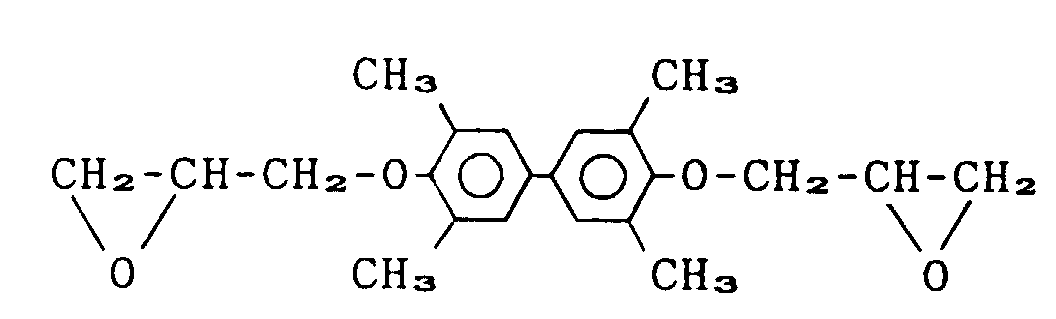
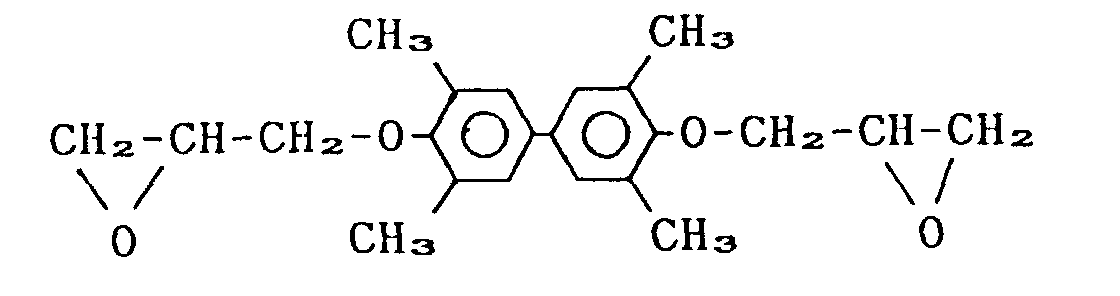
- a biphenyl structure epoxy resin represented by the following structural formula has a particularly excellent soldering resistance, and it is desirable that the epoxy resin in the epoxy resin molding material of the present invention contains at least 60 % by weight of the biphenyl structure epoxy resin based on total of the epoxy resin used.
- the epoxy resin containing 60 % by weight or more of the biphenyl structure epoxy resin the low water absorption and the adhesive properties of the molding material of the present invention is highly improved, thereby providing very high soldering resistance.
- This biphenyl structure epoxy resin can be obtained by the epoxidation of 4,4' -dihydroxy-3,3' ,5,5' -tetramethylbiphenyl with epichlorohydrin.
- the epoxy resin in the process for the preparation of an epoxy resin molding material of the present invention contains brominated epoxy resins, which improve the non-inflammability of the epoxy resin molding material.
- the amount of the brominated epoxy resins is generally 2 to 10 % by weight of the total of the epoxy resin molding material exclusive of the inorganic fillers.
- the hydrolyzable chlorine content is determined from a value measured by a potentiometric titration of a mixture which is prepared by refluxing for 30 minutes a mixture of a solution of 1 g of a sample of epoxy resins dissolved in 30 ml of dioxane and 5 ml of 1 N-KOH methanol solution.
- Typical examples of the component (B) to be used in the present invention are resins obtainable by condensation or polycondensation of phenols, such as phenol, creosol, xylenol, resorcinol, cathechol, bisphenol A and bisphenol F, or naphtols, such as ⁇ -naphtol, ⁇ -naphtol and dihydroxynaphthalene, and aldehydes, such as formaldehyde, acetaldehyde, propionaldehyde, benzaldehyde and salicylaldehyde, in the presence of acidic catalysts; polyparavinylphenol resins; phenol-aralkyl resins having xylylene groups which are synthesized from phenols, ⁇ , ⁇ ' -dimethoxy-p-xylene and Friedel-Crafts catalysts. These compounds may be
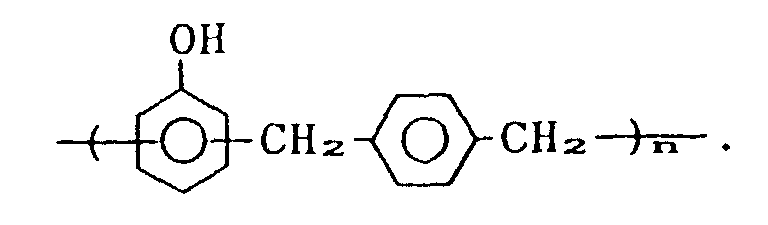
- a phenol resin represented by the following structural formula has a particularly excellent soldering resistance, and it is preferable that the phenolic compound in the epoxy resin molding material of the present invention contains at least 60 % by weight of the phenol resin based on total of the phenolic compound used.
- the phenolic compound containing 60 % by weight or more of the phenol resin the low water absorption and the adhesive properties of the molding material prepared by the process of the present invention is highly improved, thereby providing high soldering resistance.
- Using the above-described biphenyl structure epoxy resin and this phenol resin in combination further improves the soldering resistance of the epoxy resin molding material of the present invention.
- the equivalent ratio between total of the epoxy resin and total of the phenolic compound in the epoxy resin molding material is not particularly limited, but it is preferably from 0.7 to 1.3 in order to reduce the amounts of unreacted matters.
- the total volatile loss after heating at 105 °C for three hours of the vinyl group-containing organopolysiloxane and the ⁇ SiH group-containing organopolysiloxane to be used for the preparation of the component (C) should be not more than 3 % by weight.
- the volatile matters, which do not react and cure during the synthesis of the component (C) bleed on the surface of molded products to deteriorate the appearance of the surface of the molded products and to cause stain of molds, deterioration of marking properties and dropping of integrated circuit packages which are secured temporarily on wiring boards.
- the main chains of the organopolysiloxanes described above are not particularly limited, but it is preferable that these organopolysiloxanes are not visually miscible in the resins (components (A) and (B)).
- liquid organopolysiloxanes obtained by introducing vinyl groups or ⁇ SiH groups to the molecule ends or in the molecules of homopolymers or copolymers of siloxanes, such as dimethylsiloxane, methylphenylsiloxane and diphenylsiloxane.
- the molecular weights thereof are not particularly limited so far as their volatile losses are less than the value described above.
- the ratios of the vinyl group-containing organopolysiloxane and the ⁇ SiH group-containing organopolysiloxane used are not particularly limited, but the preferred equivalent ratio of vinyl groups to ⁇ SiH groups is from 1:1 to 1:2. If the equivalent ratio is beyond the range, unreacted organopolysiloxanes may increase so as to deteriorate the appearance of the molded products and the marking properties and to affects a bad influence upon the temporary securing to wiring boards, thereby inhibiting the achievement of the object of the present invention.
- the catalysts to be used for the curing reaction between these organopolysiloxanes may be conventional addition catalysts, for example platinum catalysts, such as platinic chloride.
- the resin mixture (C) wherein the cured reaction products of these organopolysiloxanes are dispersed in a dispersion medium in the state of particulates is obtained by dispersing, in the state of particulates, a mixture of these organopolysiloxanes in a dispersion medium, which is a portion or all of at least one of the epoxy resin and the phenolic compound to be used in the epoxy resin molding material, and then, according to demand, heating.
- Dispersion stabilizers may be added for stabilizing the particulates dispersion.
- Typical examples of the dispersion stabilizers which may be used include nonionic surfactants, such as polyoxyalkylenes, and polyoxyalkylene-modified organopolysiloxanes, which can be added to molding materials.
- the preferred volume ratio of the total of the organopolysiloxanes used as raw materials to the dispersion medium is from 1:2 to 1:10. If the volume ratio is more than 1:2, the organopolysiloxanes may become difficult to disperse in a state of particulates, and if it is less than 1:10, the increase in the amount of the dispersion medium will be unfavorable in the cost of production.
- the preferred weight ratio of the total of the organopolysiloxanes used as raw materials to the total of the epoxy resin and the phenolic resin in the epoxy resin molding material of the present invention is from 1:100 to 1:5, more preferably from 1:30 to 1:10.
- the method of dispersing the organopolysiloxane mixture is not particularly limited, and any apparatus capable of sufficient dispersing operation may be used, for example, reaction vessels equipped with agitating means, heating kneaders, static mixers and homogenizers.
- the preparation of the resin mixture (C) is carried out under heating to bring the dispersion medium into melted state, and when it is liquid at room temperature, the procedure may be carried out at room temperature.
- the organopolysiloxane mixture is dispersed thus in the dispersion medium in a state of particulates, the organopolysiloxane mixture is cured in the state of dispersed particulates by allowing it to react at room temperature to 150 °C for 10 minutes to 10 hours.
- the reaction step may be conducted in the same apparatus wherein the dispersion of the organopolysiloxane mixture was carried out, or may be conducted in another apparatus, such as a thermostat, after completion of the dispersing procedure.
- the particle size of the particulates of the reaction product of the organopolysiloxane mixture dispersed in the resin mixture (C) obtained thus it is preferable that at least 90 % by weight of the particulates have a particle size of 100 ⁇ m or less. Further, the preferred mean particle size is 50 ⁇ m or less.
- the particle size has effects on the moldability of the epoxy resin molding material at the time of sealing or packaging of electronic components. Generally, the gate size of molds for molding sealed electronic components, such as integrated circuits or transistors, is approximately 0.5 mm at the narrowest part, and there is danger of the gates becoming plugged unless 90 % by weight or more of the particulates have a particle size of not more than 100 ⁇ m. A particle size of not more than 100 ⁇ m is also desirable for preventing the bonding wire connecting a chip and leads from being tortured during molding. Particulates having a mean particle size of 50 ⁇ m or less have significant effects of improving the thermal shock resistance.
- the hardness of the particulates of the reaction products of the organopolysiloxanes can be adjusted to a desired degree by selecting the functional groups' equivalent weights and the ratios of the numbers of vinyl groups and ⁇ SiH groups of the two kinds of organopolysiloxanes to be used, and the softer the particulates are, the higher the resistance to package cracking is improved.
- Uniform dispersion of such soft solid particulates in molding materials brings about an outstanding improvement of the thermal shock resistance, typically the resistance to package cracking, without decreasing the glass transition temperature.
- Solid silicone particulates are further characterized by the excellent soldering resistance. While the addition of resins modified with the conventional silicone oils or reactive silicone oils decreases the strength of molded products and the adhesive strength to inserts, such as chips and islands, at soldering temperatures, the addition of solid particulates enables preservation of the high strength. In particular, when low melt viscosity resins, such as the above-described biphenyl structure epoxy resin, are used, the dispersibility of silicones is apt to decrease. On the other hand, the solid silicone particulates used in the present invention exhibit a stable dispersibility even in low melt viscosity resins since the particle size can be properly adjusted at the time of synthesis thereof.
- organopolysiloxanes are added after modified into solid particulates, but because the volatile loss of the raw organopolysiloxanes is little, molded products and molds are free from the problem accompanying the conventional epoxy resin molding materials modified with siloxane compounds, namely stain due to the bleeding of siloxane compounds during molding.
- the bleeding of siloxane compounds from molded products causes problems including deterioration of appearance and decreased marking properties, and the stain of molds necessitates cleaning of molds at frequent intervals. Particularly, cleaning of molds requires much labor and time, and the use of molding materials causing no stain is advantageous in productivity.
- the process for the preparation of an epoxy resin molding material for sealing of electronic components of the present invention may further use cure accelerators which accelerate the curing reaction of the epoxy resins and the phenolic compounds having phenolic hydroxyl groups.
- the cure accelerators are tertiary amines, such as 1,8-diazabicyclo(5,4,0)undecene-7, triethylenediamine, benzyldimethylamine, triethanolamine, dimethylaminoethanol and tris(dimethylaminomethyl)phenol; imidazoles, such as 2-methylimidazole, 2-phenylimidazole, 2-phenyl-4-methylimidazole and 2-heptadecylimidazole; organic phosphines, such as tributylphosphine, methyldiphenylphosphine, triphenylphosphine, diphenylphosphine and phenylphosphine; and tetraphenylborates, such as tetra
- an inorganic filler may be mixed in as a component (D).
- Typical examples of the inorganic filler are crushed or spherical (beaded) powder of fused silica, crystalline silica, alumina, zircon, calcium silicate, calcium carbonate, silicon carbide, silicon nitride, beryllia, zirconia; single crystal fiber of potassium titanate, silicon carbide, silicon nitride, alumina; and glass fiber.
- These inorganic fillers may be used individually or in combination of two or more of them.
- the amount of the inorganic fillers added is preferably at least 70 % by volume, more preferably from 70 to 80 % by volume of the total of the epoxy resin molding material.
- the preferred are fused silica from the viewpoint of decreasing the coefficient of thermal expansion, and alumina from the view point of high thermal conductivity.
- the shape of the inorganic fillers is preferably spherical for purposes of increasing the flowability of the molding materials and of preventing the abrasion of the molds during molding.
- the process for the preparation of an epoxy resin molding material for the sealing of electronic components of the present invention may also make use of release agents, such as higher fatty acids, metal salts of higher fatty acids, ester wax and polyethylene wax, coloring agents, such as carbon black, coupling agents, such as epoxysilanes, aminosilanes, alkylsilanes, vinylsilanes, organic titanates and aluminum alcoholates.
- release agents such as higher fatty acids, metal salts of higher fatty acids, ester wax and polyethylene wax
- coloring agents such as carbon black
- coupling agents such as epoxysilanes, aminosilanes, alkylsilanes, vinylsilanes, organic titanates and aluminum alcoholates.
- the process for the preparation of a molding material of the present invention may involve in general, mixing sufficiently the predetermined amounts of the components (A), (B), (C) and (D) described above with a mixer, kneading the mixture with heated rolls or an extruder, cooling the kneaded mixture, and then pulverizing the cooled mixture.
- the most general method of sealing electronic components with the molding material thus obtained is a low pressure transfer molding, and other techniques, such as injection molding, compression molding and casting, may also be employed.
- the epoxy resin molding material prepared according to the process of the present invention is excellent in soldering resistance, thermal shock resistance and moldability, and, as well, is advantageous in the preparation thereof. That is, according to the present invention, soft rubberty solid particulates having a particle size of not more than 100 ⁇ m can be blended in molding materials with a low cost. Generally, preparation of rubberty matters having particle size of not more than 100 ⁇ m from bulky rubberty matters by pulverization is difficult, and it requires high cost. Also, other known methods of preparing particulates of organopolysiloxanes by means of emulsion polymerization or suspension polymerization requires removal of dispersion mediums and removal of surfactants.
- the dispersion medium used in the present invention is the same resin as at least one of the base resins of the molding material, so that the dispersion medium can be incorporated together with the dispersed and cured organopolysiloxanes into the molding material. Therefore, the epoxy resin molding material prepared by the process of the present invention is also extremely advantageous in the aspect of cost. Further, there is no possibility of cohesion of the soft particulates since the particulates of the reacted and cured organopolysiloxane are not collected separately but are treated as they are dispersed in the dispersion medium.
- the epoxy resin molding material prepared according to the process of the present invention has excellent characteristics not only in the mechanical properties but also in the preparation thereof.
- the reason why the epoxy resin molding materials prepared by the process of the present invention are excellent in soldering resistance, thermal shock resistance, thermal stability and moldability is that a resin base comprising the epoxy resin (A) and the phenolic compound (B) is modified by a specific flexibilizer which is a resin mixture prepared by dispersing, in a dispersion medium which is at least one of the epoxy resin (A) and the phenolic compound (B), a mixture of reactive organopolysiloxanes which contain little volatile matters and are immiscible in the dispersion medium, and then allowing to react and cure the organopolysiloxanes dispersed in a state of particulates.
- a specific flexibilizer which is a resin mixture prepared by dispersing, in a dispersion medium which is at least one of the epoxy resin (A) and the phenolic compound (B), a mixture of reactive organopolysiloxanes which contain little volatile matters and are immiscible in the dispersion medium, and then allowing to react and
- reaction products of the organopolysiloxanes in the component (C) are solid rubberty particulates which are generally not more than 100 ⁇ m in particle size and which are uniformly dispersed in the molding material, excellent thermal shock resistance is brought about. Also, since the reaction products and the base resin are immiscible to form separated phase system in the molding material, the glass transition temperature innate in the base resin is not decreased, thereby bringing about good thermal stability.
- the epoxy resin molding material prepared according to the process of the present invention has excellent strength and adhesive properties at high temperatures, and therefore high soldering resistance is exhibited.
- epoxy resin molding material prepared by the process of the present invention is excellent in the properties including soldering resistance, thermal shock resistance, thermal stability and moldability for the reasons described above.
- the procedure of the preparation of the flexibilizer (1) was repeated with the exception that the dispersion medium was replaced by 120 g of a biphenyl structure epoxy resin having an epoxy equivalent weight of 188 and a melting point of 106 °C (Trade name: EPIKOTE YX-4000H produced by Yuka Shell Epoxy Kabushiki Kaisha) and the procedure was carried out at 110 °C , to obtain a flexibilizer (2).
- the dispersion medium was replaced by 120 g of a biphenyl structure epoxy resin having an epoxy equivalent weight of 188 and a melting point of 106 °C (Trade name: EPIKOTE YX-4000H produced by Yuka Shell Epoxy Kabushiki Kaisha) and the procedure was carried out at 110 °C , to obtain a flexibilizer (2).
- the procedure of the preparation of the flexibilizer (1) was repeated with the exception that the dispersion medium was replaced by 120 g of a phenol-aralkyl resin having a hydroxyl equivalent weight of 167 and a softening point of 70 °C (Trade name: MILEX XL-225 produced by Mitsui Toatsu Chemicals, Inc.), to obtain a flexibilizer (3).
- the dispersion medium was replaced by 120 g of a phenol-aralkyl resin having a hydroxyl equivalent weight of 167 and a softening point of 70 °C (Trade name: MILEX XL-225 produced by Mitsui Toatsu Chemicals, Inc.), to obtain a flexibilizer (3).
- the polysiloxane compounds used in the preparation of the flexibilizers (1) to (3) had previously been treated respectively at 150 °C for 5 hours at a pressure not higher than 10 mmHg to remove the volatile matters.
- the volatile losses of the treated polysiloxane compounds after further treatment at 105 °C for three hours were 0.5 % by weight with respect to the pendant vinyl group-modified polydimethylsiloxane and 1.5 % by weight with respect to the hydrogen terminated polydimethylsiloxane.
- the volatile loss of the pendant vinyl group-modified polydimethylsiloxane was 5.4 % by weight, and that of the hydrogen terminated polydimethylsiloxane was 7.2 % by weight, and the procedures of the preparation of the flexibilizer (1) and the preparation of the flexibilizer (2) were repeated with the exception that the siloxane compounds not treated to remove the volatile matters were used, to obtain a flexibilizer (4) and a flexibilizer (5), respectively.
- the isolated reaction products of the organopolysiloxanes were solid soft powder of an approximately spherical shape, and most of the particles were approximately 5 to 30 ⁇ m in diameter, and particles of 100 ⁇ m or more did not exist.
- the molding materials of Examples 1 to 5 and Comparative Examples 1 to 5 were prepared by mixing an o-cresol novolak epoxy resin having an epoxy equivalent weight of 220 and a softening point of 67 °C , a biphenyl structure epoxy resin having an epoxy equivalent weight of 188 and a melting point of 106 °C (EPIKOTE YX-4000H), a brominated bisphenol A epoxy resin having an epoxy equivalent weight of 375, a softening point of 80 °C and a bromine content of 48 % by weight, a phenol novolak resin having a hydroxyl group equivalent weight of 106 and a softening point of 83 °C , a phenol-aralkyl resin having a hydroxyl equivalent weight of 167 and a softening point of 70 °C (MILEX XL-225), 1,8-diazabicyclo(5,4,0)undecene-7, carnauba wax, antimony trioxide, carbon black, ⁇ -
Landscapes
- Chemical & Material Sciences (AREA)
- Health & Medical Sciences (AREA)
- Chemical Kinetics & Catalysis (AREA)
- Medicinal Chemistry (AREA)
- Polymers & Plastics (AREA)
- Organic Chemistry (AREA)
- Epoxy Resins (AREA)
- Structures Or Materials For Encapsulating Or Coating Semiconductor Devices Or Solid State Devices (AREA)
- Compositions Of Macromolecular Compounds (AREA)
Description



Claims (12)
- A process for the preparation of an epoxy resin molding material for the sealing of electronic components, which comprises mixing(A) an epoxy resin having at least two epoxy groups per molecule,(B) a phenolic compound having at least two phenolic hydroxyl groups per molecule,(C) a resin mixture obtained bydispersing, in the form of particulates, in a dispersion medium which is a portion or all of at least one of the epoxy resin and the phenolic compound, a mixture of a vinyl group-containing organopolysiloxane and a ≡SiH group-containing organopolysiloxane, andallowing the vinyl group-containing organopolysiloxane and the ≡SiH group-containing organopolysiloxane to react with each other and to cure, and(D) an inorganic filler, wherein said organopolysiloxane compounds have, prior to being dispersed, a total volatile loss after heating at 105 °C for three hours of not more than 3 % by weight.
- The process according to claim 1, wherein at least 70 % by volume of the inorganic filler (D) based on the total of the epoxy resin molding material, are added.
- The process according to claim 1 or 2, wherein at least 60 % by weight of the epoxy resin in the epoxy resin molding material is an epoxy resin represented by the following formulabased on the total amount of epoxy resin (A).
- The process according to any of the claims 1 to 3, wherein the phenolic compound is a phenol resin comprising the repeating unit represented by the following formula
- The process according to any of the claims 1 to 4, wherein the dispersion medium contained in the resin mixture (C) is an epoxy resin represented by the formulaand the volume ratio of the total volume of the vinyl group-containing organopolysiloxane and the ≡SiH group-containing organopolysiloxane used for the preparation of the resin mixture (C) to the volume of the epoxy resin in the resin mixture (C) is from 1:2 to 1:10.

- The process according to any of the claims 1 to 4, wherein the dispersion medium contained in the resin mixture (C) is a phenol resin comprising the repeating unit represented by the following formulaand the volume ratio of the total volume of the vinyl group-containing organopolysiloxane and the =SiH group-containing organopolysiloxane used for the preparation of the resin mixture (C) to the volume of the phenol resin in the resin mixture (C) is from 1:2 to 1:10.

- A process for the preparation of an epoxy resin molding material for sealing of an electronic component, which comprises mixing(A) an epoxy resin having at least two epoxy groups per molecule,(B) a phenolic compound having at least two phenolic hydroxyl groups per molecule,(C) a resin mixture obtained by dispersing a mixture of a vinyl group-containing organopolysiloxane and a ≡SiH group-containing organopolysiloxane in a dispersion medium which is at least one of an epoxy resin having at least two epoxy groups per molecule and a phenolic compound having at least two phenolic hydroxy groups per molecule so that the mixture of the vinyl group-containing organopolysiloxane and the ≡SiH group-containing organopolysiloxane is dispersed in the form of particulates in the dispersion medium, the mixture of the vinyl group-containing organopolysiloxane and the ≡SiH group-containing organopolysiloxane, prior to being dispersed, exhibiting a total volatile loss of not more than 3% by weight after heating at 105°C for three hours, the vinyl group-containing organopolysiloxane being a liquid organopolysiloxane obtained by introducing vinyl groups to the molecule ends or in the molecule of an organopolysiloxane selected from the group consisting of a homopolymer or a copolymer of dimethylsiloxane, methylphenylsiloxane, or of diphenylsiloxane, the ≡SiH group-containing organopolysiloxane being a liquid organopolysiloxane obtained by introducing ≡SiH groups to the molecule ends or in a molecule of an organopolysiloxane selected from the group consisting of a homopolymer or a copolymer of dimethysiloxane, of methylphenylsiloxane, or of diphenylsiloxane, the ratio of the amount of the vinyl group-containing organopolysiloxane to the amount of the ≡SiH group-containing organopolysiloxane being such that the equivalent ratio of vinyl groups to ≡SiH groups is from 1:1 to 1:2, and
by causing the vinyl group containing organopolysiloxane and the ≡SiH group-containing organopolysiloxane to react with each other and to cure, and(D) an inorganic filler,
at least 60% by weight of the epoxy resin in the epoxy resin molding material being an epoxy resin represented by the following formula:based on the total epoxy resin, and the phenolic compound being a phenol resin comprising the repeating units represented by the following general formula: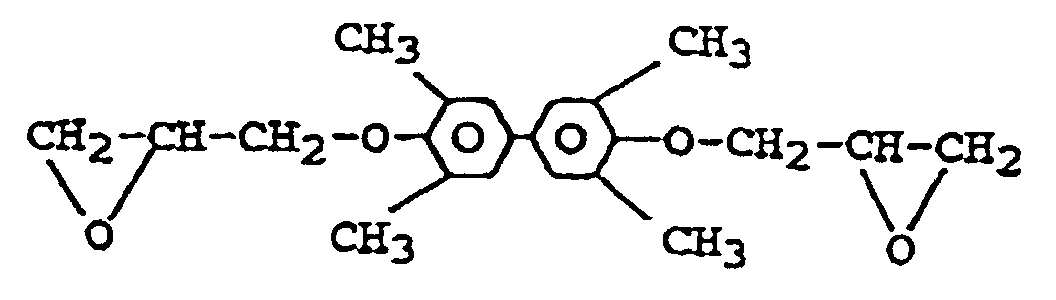

- The process of claim 7, wherein the volume ratio of the total of the organopolysiloxanes in the resin mixture (C) to the dispersion medium is from 1:2 to 1:10 and the weight ratio of the total of the organopolysiloxanes in the resin mixture (C) to the total of the epoxy resin (A), the phenolic resin (B) and the dispersion medium is from 1:100 to 1:5.
- The process of claim 7, wherein the vinyl group-containing organopolysiloxane is a pendant vinyl group-modified polydimethylsiloxane, and the ≡SiH group-containing organopolysiloxane is a hydrogen terminated polydimethylsiloxane.
- The process of claim 7, wherein the epoxy resin molding material contains from 70 to 80% by volume of the inorganic filler based on the volume of the epoxy resin molding material.
- The use of the material produced according to any of the claims 1 to 10 for sealing electronic components.
- The use according to claim 11, wherein an integrated circuit package is formed from the epoxy resin material.
Priority Applications (3)
| Application Number | Priority Date | Filing Date | Title |
|---|---|---|---|
| US07/826,512 US5319005A (en) | 1992-01-27 | 1992-01-27 | Epoxy resin molding material for sealing of electronic component |
| DE1992627299 DE69227299T2 (en) | 1992-01-28 | 1992-01-28 | Epoxy resin molding compound for encapsulating electronic components |
| EP92101362A EP0553371B1 (en) | 1992-01-27 | 1992-01-28 | Epoxy resin molding material for sealing of electronic component |
Applications Claiming Priority (2)
| Application Number | Priority Date | Filing Date | Title |
|---|---|---|---|
| US07/826,512 US5319005A (en) | 1992-01-27 | 1992-01-27 | Epoxy resin molding material for sealing of electronic component |
| EP92101362A EP0553371B1 (en) | 1992-01-27 | 1992-01-28 | Epoxy resin molding material for sealing of electronic component |
Publications (2)
| Publication Number | Publication Date |
|---|---|
| EP0553371A1 EP0553371A1 (en) | 1993-08-04 |
| EP0553371B1 true EP0553371B1 (en) | 1998-10-14 |
Family
ID=26130785
Family Applications (1)
| Application Number | Title | Priority Date | Filing Date |
|---|---|---|---|
| EP92101362A Expired - Lifetime EP0553371B1 (en) | 1992-01-27 | 1992-01-28 | Epoxy resin molding material for sealing of electronic component |
Country Status (2)
| Country | Link |
|---|---|
| US (1) | US5319005A (en) |
| EP (1) | EP0553371B1 (en) |
Families Citing this family (24)
| Publication number | Priority date | Publication date | Assignee | Title |
|---|---|---|---|---|
| JP3428699B2 (en) * | 1993-09-24 | 2003-07-22 | ジャパンエポキシレジン株式会社 | Epoxy resin composition |
| JP3923542B2 (en) * | 1994-04-08 | 2007-06-06 | 株式会社東芝 | Resin molded product and heavy electrical equipment using the same |
| JP3288185B2 (en) * | 1994-10-07 | 2002-06-04 | 日立化成工業株式会社 | Epoxy resin molding material for sealing electronic parts and semiconductor device using the same |
| KR100333452B1 (en) | 1994-12-26 | 2002-04-18 | 이사오 우치가사키 | Film-like organic die-bonding material and semiconductor device using the same |
| WO1996028496A1 (en) * | 1995-03-14 | 1996-09-19 | Nagase-Ciba Ltd. | Organopolysiloxane derivative |
| US6717242B2 (en) * | 1995-07-06 | 2004-04-06 | Hitachi Chemical Company, Ltd. | Semiconductor device and process for fabrication thereof |
| TW310481B (en) * | 1995-07-06 | 1997-07-11 | Hitachi Chemical Co Ltd | |
| EP0780435A1 (en) * | 1995-12-21 | 1997-06-25 | National Starch and Chemical Investment Holding Corporation | Flexible epoxy adhesives with low bleeding tendency |
| JPH1025417A (en) * | 1996-07-08 | 1998-01-27 | Toray Dow Corning Silicone Co Ltd | Curable liquid composition, cured product thereof, and electronic component |
| US5904984A (en) * | 1996-10-17 | 1999-05-18 | Siemens Westinghouse Power Corporation | Electrical insulation using liquid crystal thermoset epoxy resins |
| US6429238B1 (en) * | 1999-06-10 | 2002-08-06 | Shin-Etsu Chemical Co., Ltd. | Flip-chip type semiconductor device sealing material and flip-chip type semiconductor device |
| US6342303B1 (en) | 2000-02-23 | 2002-01-29 | Georgia-Pacific Resins, Inc. | Epoxy-functional polysiloxane modified phenolic resin compositions and composites |
| EP1172408A1 (en) * | 2000-07-14 | 2002-01-16 | Abb Research Ltd. | Volume modified casting masses based on polymer matrix resins |
| DE10057111C1 (en) * | 2000-11-16 | 2002-04-11 | Bosch Gmbh Robert | Casting composition for removing thermal energy from electrical or electronic device, comprises epoxide resin, silicone, filler and initiator and cures by chemical reaction, has specified thermal conductivity |
| TWI345576B (en) * | 2003-11-07 | 2011-07-21 | Dow Corning Toray Silicone | Curable silicone composition and cured product thereof |
| JP4931366B2 (en) * | 2005-04-27 | 2012-05-16 | 東レ・ダウコーニング株式会社 | Curable silicone composition and electronic component |
| US20060270808A1 (en) * | 2005-05-24 | 2006-11-30 | Shin-Etsu Chemical Co., Ltd. | Epoxy-silicone mixed resin composition, cured article thereof, and light-emitting semiconductor device |
| US20060293427A1 (en) * | 2005-06-10 | 2006-12-28 | Martens Marvin M | Thermally conductive polyamide-based components used in light emitting diode reflector applications |
| JP5285846B2 (en) * | 2006-09-11 | 2013-09-11 | 東レ・ダウコーニング株式会社 | Curable silicone composition and electronic component |
| JP5547369B2 (en) * | 2007-09-28 | 2014-07-09 | 東レ・ダウコーニング株式会社 | Curable liquid epoxy resin composition and cured product thereof |
| JP5578168B2 (en) * | 2009-03-11 | 2014-08-27 | 住友ベークライト株式会社 | Semiconductor sealing resin composition and semiconductor device |
| WO2011140402A2 (en) | 2010-05-05 | 2011-11-10 | Tyco Electronics Services Gmbh | Potting for electronic components |
| CN120442058B (en) * | 2025-07-07 | 2025-09-05 | 镇江高美新材料有限公司 | Silicone rubber composition for electrical insulation |
| CN120424507B (en) * | 2025-07-07 | 2025-09-02 | 镇江高美新材料有限公司 | A composition for preparing high-performance silicone rubber |
Family Cites Families (14)
| Publication number | Priority date | Publication date | Assignee | Title |
|---|---|---|---|---|
| JPS62270617A (en) * | 1986-05-20 | 1987-11-25 | Mitsui Toatsu Chem Inc | Resin composition for semiconductor sealing |
| DE3634084A1 (en) * | 1986-10-07 | 1988-04-21 | Hanse Chemie Gmbh | MODIFIED REACTION RESIN, METHOD FOR PRODUCING IT AND ITS USE |
| DE3738634C2 (en) * | 1986-11-13 | 1996-11-14 | Sunstar Engineering Inc | Epoxy resin composition with silicone resin particles dispersed therein |
| JPS63241021A (en) * | 1987-03-27 | 1988-10-06 | Hitachi Chem Co Ltd | Epoxy resin molding material for sealing electronic component |
| JPH01272619A (en) * | 1987-07-22 | 1989-10-31 | Mitsubishi Gas Chem Co Inc | epoxy resin composition |
| JPH01272624A (en) * | 1988-04-25 | 1989-10-31 | Hitachi Chem Co Ltd | Epoxy resin molding material for sealing electronic part |
| US5120803A (en) * | 1988-09-07 | 1992-06-09 | Mitsui Toatsu Chemicals, Inc. | Resin compositions for sealing semiconductor |
| JP2547245B2 (en) * | 1988-11-18 | 1996-10-23 | 宇部興産株式会社 | Epoxy resin composition |
| JP2675108B2 (en) * | 1988-12-08 | 1997-11-12 | 住友ベークライト株式会社 | Epoxy resin composition |
| JPH0662834B2 (en) * | 1989-01-20 | 1994-08-17 | 松下電工株式会社 | Epoxy resin composition |
| JPH02311520A (en) * | 1989-05-27 | 1990-12-27 | Toshiba Chem Corp | Epoxy resin composition |
| MY107113A (en) * | 1989-11-22 | 1995-09-30 | Sumitomo Bakelite Co | Epoxy resin composition for semiconductor sealing. |
| JPH03197528A (en) * | 1989-12-26 | 1991-08-28 | Hitachi Chem Co Ltd | Epoxy resin molding material for sealing electronic component |
| JP2890591B2 (en) * | 1990-01-19 | 1999-05-17 | 日立化成工業株式会社 | Epoxy resin molding compound for electronic parts encapsulation |
-
1992
- 1992-01-27 US US07/826,512 patent/US5319005A/en not_active Expired - Fee Related
- 1992-01-28 EP EP92101362A patent/EP0553371B1/en not_active Expired - Lifetime
Also Published As
| Publication number | Publication date |
|---|---|
| EP0553371A1 (en) | 1993-08-04 |
| US5319005A (en) | 1994-06-07 |
Similar Documents
| Publication | Publication Date | Title |
|---|---|---|
| US5319005A (en) | Epoxy resin molding material for sealing of electronic component | |
| KR0169828B1 (en) | Epoxy resin molding material for electronic component encapsulation and encapsulation semiconductor device using the same | |
| EP0218228B1 (en) | Epoxy resin composition | |
| KR100197044B1 (en) | Epoxy resin composition and semiconductor device | |
| JP2001131393A (en) | Epoxy resin molding material for sealing and electronic part device | |
| JPS6284147A (en) | epoxy resin composition | |
| JPH05175369A (en) | Epoxy resin molding material for sealing electronic component | |
| KR100429363B1 (en) | Epoxy resin composition for semiconductor device sealing | |
| JP2890591B2 (en) | Epoxy resin molding compound for electronic parts encapsulation | |
| JP2002097344A (en) | Epoxy resin composition and semiconductor device | |
| JP2559626B2 (en) | Epoxy resin composition for semiconductor encapsulation | |
| JP2559625B2 (en) | Epoxy resin composition | |
| JPH03210325A (en) | Semiconductor sealing epoxy resin molding material | |
| JP2836274B2 (en) | Epoxy resin composition | |
| JPH02166116A (en) | Epoxy resin molding material for sealing electronic component | |
| JP2874090B2 (en) | Epoxy resin composition and semiconductor device | |
| JP2552343B2 (en) | Epoxy resin composition | |
| JP3365065B2 (en) | Epoxy resin composition for sealing | |
| JP3279084B2 (en) | Epoxy resin composition for sealing | |
| JP2547245B2 (en) | Epoxy resin composition | |
| JP3104252B2 (en) | Epoxy resin molding compound for electronic parts encapsulation | |
| JP3102026B2 (en) | Epoxy resin molding compound for electronic parts encapsulation | |
| JP2812173B2 (en) | Epoxy resin composition and semiconductor device | |
| JPH06841B2 (en) | Epoxy resin molding material for electronic parts encapsulation | |
| JPH0647613B2 (en) | Epoxy resin molding material for electronic parts encapsulation |
Legal Events
| Date | Code | Title | Description |
|---|---|---|---|
| PUAI | Public reference made under article 153(3) epc to a published international application that has entered the european phase |
Free format text: ORIGINAL CODE: 0009012 |
|
| AK | Designated contracting states |
Kind code of ref document: A1 Designated state(s): DE FR GB NL |
|
| 17P | Request for examination filed |
Effective date: 19940117 |
|
| 17Q | First examination report despatched |
Effective date: 19960530 |
|
| GRAG | Despatch of communication of intention to grant |
Free format text: ORIGINAL CODE: EPIDOS AGRA |
|
| GRAG | Despatch of communication of intention to grant |
Free format text: ORIGINAL CODE: EPIDOS AGRA |
|
| GRAG | Despatch of communication of intention to grant |
Free format text: ORIGINAL CODE: EPIDOS AGRA |
|
| GRAH | Despatch of communication of intention to grant a patent |
Free format text: ORIGINAL CODE: EPIDOS IGRA |
|
| GRAH | Despatch of communication of intention to grant a patent |
Free format text: ORIGINAL CODE: EPIDOS IGRA |
|
| GRAA | (expected) grant |
Free format text: ORIGINAL CODE: 0009210 |
|
| AK | Designated contracting states |
Kind code of ref document: B1 Designated state(s): DE FR GB NL |
|
| REF | Corresponds to: |
Ref document number: 69227299 Country of ref document: DE Date of ref document: 19981119 |
|
| ET | Fr: translation filed | ||
| PLBE | No opposition filed within time limit |
Free format text: ORIGINAL CODE: 0009261 |
|
| STAA | Information on the status of an ep patent application or granted ep patent |
Free format text: STATUS: NO OPPOSITION FILED WITHIN TIME LIMIT |
|
| 26N | No opposition filed | ||
| PGFP | Annual fee paid to national office [announced via postgrant information from national office to epo] |
Ref country code: FR Payment date: 20001213 Year of fee payment: 10 |
|
| PGFP | Annual fee paid to national office [announced via postgrant information from national office to epo] |
Ref country code: NL Payment date: 20010131 Year of fee payment: 10 |
|
| PGFP | Annual fee paid to national office [announced via postgrant information from national office to epo] |
Ref country code: DE Payment date: 20010326 Year of fee payment: 10 |
|
| PGFP | Annual fee paid to national office [announced via postgrant information from national office to epo] |
Ref country code: GB Payment date: 20011218 Year of fee payment: 11 |
|
| REG | Reference to a national code |
Ref country code: GB Ref legal event code: IF02 |
|
| PG25 | Lapsed in a contracting state [announced via postgrant information from national office to epo] |
Ref country code: NL Free format text: LAPSE BECAUSE OF NON-PAYMENT OF DUE FEES Effective date: 20020801 Ref country code: DE Free format text: LAPSE BECAUSE OF NON-PAYMENT OF DUE FEES Effective date: 20020801 |
|
| PG25 | Lapsed in a contracting state [announced via postgrant information from national office to epo] |
Ref country code: FR Free format text: LAPSE BECAUSE OF NON-PAYMENT OF DUE FEES Effective date: 20020930 |
|
| NLV4 | Nl: lapsed or anulled due to non-payment of the annual fee |
Effective date: 20020801 |
|
| REG | Reference to a national code |
Ref country code: FR Ref legal event code: ST |
|
| PG25 | Lapsed in a contracting state [announced via postgrant information from national office to epo] |
Ref country code: GB Free format text: LAPSE BECAUSE OF NON-PAYMENT OF DUE FEES Effective date: 20030128 |
|
| GBPC | Gb: european patent ceased through non-payment of renewal fee |