EP0553274B1 - Ohrstöpsel aus polymerschaum - Google Patents
Ohrstöpsel aus polymerschaum Download PDFInfo
- Publication number
- EP0553274B1 EP0553274B1 EP91920305A EP91920305A EP0553274B1 EP 0553274 B1 EP0553274 B1 EP 0553274B1 EP 91920305 A EP91920305 A EP 91920305A EP 91920305 A EP91920305 A EP 91920305A EP 0553274 B1 EP0553274 B1 EP 0553274B1
- Authority
- EP
- European Patent Office
- Prior art keywords
- earplug
- section
- nose section
- recovery time
- earplug construction
- Prior art date
- Legal status (The legal status is an assumption and is not a legal conclusion. Google has not performed a legal analysis and makes no representation as to the accuracy of the status listed.)
- Expired - Lifetime
Links
- 239000006260 foam Substances 0.000 title claims abstract description 88
- 238000011084 recovery Methods 0.000 claims abstract description 89
- 238000010276 construction Methods 0.000 claims abstract description 53
- 210000000613 ear canal Anatomy 0.000 claims abstract description 48
- 230000001419 dependent effect Effects 0.000 claims abstract description 11
- 239000000203 mixture Substances 0.000 claims description 56
- 238000012360 testing method Methods 0.000 claims description 39
- 238000007906 compression Methods 0.000 claims description 31
- 230000006835 compression Effects 0.000 claims description 31
- 239000004800 polyvinyl chloride Substances 0.000 claims description 13
- 229920000915 polyvinyl chloride Polymers 0.000 claims description 13
- 230000036760 body temperature Effects 0.000 claims description 10
- 239000004816 latex Substances 0.000 claims description 9
- 229920000126 latex Polymers 0.000 claims description 9
- 229920005830 Polyurethane Foam Polymers 0.000 claims description 6
- 239000011496 polyurethane foam Substances 0.000 claims description 6
- 230000001413 cellular effect Effects 0.000 claims description 2
- 238000003780 insertion Methods 0.000 abstract description 23
- 230000037431 insertion Effects 0.000 abstract description 22
- 230000001681 protective effect Effects 0.000 abstract description 3
- 238000009472 formulation Methods 0.000 description 26
- 229920001944 Plastisol Polymers 0.000 description 12
- 239000000463 material Substances 0.000 description 12
- 239000004999 plastisol Substances 0.000 description 12
- 239000006261 foam material Substances 0.000 description 11
- 239000002131 composite material Substances 0.000 description 10
- 238000000034 method Methods 0.000 description 8
- 238000000465 moulding Methods 0.000 description 8
- 238000007664 blowing Methods 0.000 description 7
- 238000005520 cutting process Methods 0.000 description 7
- 230000006870 function Effects 0.000 description 6
- 239000002243 precursor Substances 0.000 description 6
- 239000004615 ingredient Substances 0.000 description 5
- 238000005470 impregnation Methods 0.000 description 4
- 230000000704 physical effect Effects 0.000 description 4
- 229920003023 plastic Polymers 0.000 description 4
- 239000004033 plastic Substances 0.000 description 4
- 239000004014 plasticizer Substances 0.000 description 4
- 239000003381 stabilizer Substances 0.000 description 4
- 239000004721 Polyphenylene oxide Substances 0.000 description 3
- VYPSYNLAJGMNEJ-UHFFFAOYSA-N Silicium dioxide Chemical compound O=[Si]=O VYPSYNLAJGMNEJ-UHFFFAOYSA-N 0.000 description 3
- NIXOWILDQLNWCW-UHFFFAOYSA-N acrylic acid group Chemical group C(C=C)(=O)O NIXOWILDQLNWCW-UHFFFAOYSA-N 0.000 description 3
- 238000004519 manufacturing process Methods 0.000 description 3
- 238000005259 measurement Methods 0.000 description 3
- 229920000570 polyether Polymers 0.000 description 3
- 210000003813 thumb Anatomy 0.000 description 3
- 239000004604 Blowing Agent Substances 0.000 description 2
- -1 Cabot Corporation Chemical compound 0.000 description 2
- 229920001730 Moisture cure polyurethane Polymers 0.000 description 2
- 239000000853 adhesive Substances 0.000 description 2
- 230000001070 adhesive effect Effects 0.000 description 2
- 229910000410 antimony oxide Inorganic materials 0.000 description 2
- 239000012298 atmosphere Substances 0.000 description 2
- 230000008901 benefit Effects 0.000 description 2
- 210000003850 cellular structure Anatomy 0.000 description 2
- 239000003086 colorant Substances 0.000 description 2
- XWVQUJDBOICHGH-UHFFFAOYSA-N dioctyl nonanedioate Chemical compound CCCCCCCCOC(=O)CCCCCCCC(=O)OCCCCCCCC XWVQUJDBOICHGH-UHFFFAOYSA-N 0.000 description 2
- 230000007613 environmental effect Effects 0.000 description 2
- 210000003811 finger Anatomy 0.000 description 2
- 238000005187 foaming Methods 0.000 description 2
- 210000005224 forefinger Anatomy 0.000 description 2
- 239000011521 glass Substances 0.000 description 2
- 239000003607 modifier Substances 0.000 description 2
- 230000003287 optical effect Effects 0.000 description 2
- VTRUBDSFZJNXHI-UHFFFAOYSA-N oxoantimony Chemical compound [Sb]=O VTRUBDSFZJNXHI-UHFFFAOYSA-N 0.000 description 2
- 229920003229 poly(methyl methacrylate) Polymers 0.000 description 2
- 239000004926 polymethyl methacrylate Substances 0.000 description 2
- 238000002360 preparation method Methods 0.000 description 2
- 238000012545 processing Methods 0.000 description 2
- 230000001012 protector Effects 0.000 description 2
- 238000005303 weighing Methods 0.000 description 2
- 238000003466 welding Methods 0.000 description 2
- RNFJDJUURJAICM-UHFFFAOYSA-N 2,2,4,4,6,6-hexaphenoxy-1,3,5-triaza-2$l^{5},4$l^{5},6$l^{5}-triphosphacyclohexa-1,3,5-triene Chemical compound N=1P(OC=2C=CC=CC=2)(OC=2C=CC=CC=2)=NP(OC=2C=CC=CC=2)(OC=2C=CC=CC=2)=NP=1(OC=1C=CC=CC=1)OC1=CC=CC=C1 RNFJDJUURJAICM-UHFFFAOYSA-N 0.000 description 1
- NBOCQTNZUPTTEI-UHFFFAOYSA-N 4-[4-(hydrazinesulfonyl)phenoxy]benzenesulfonohydrazide Chemical compound C1=CC(S(=O)(=O)NN)=CC=C1OC1=CC=C(S(=O)(=O)NN)C=C1 NBOCQTNZUPTTEI-UHFFFAOYSA-N 0.000 description 1
- 239000004925 Acrylic resin Substances 0.000 description 1
- 229920000178 Acrylic resin Polymers 0.000 description 1
- 239000004743 Polypropylene Substances 0.000 description 1
- 208000027418 Wounds and injury Diseases 0.000 description 1
- 230000001154 acute effect Effects 0.000 description 1
- 125000003118 aryl group Chemical group 0.000 description 1
- 230000009286 beneficial effect Effects 0.000 description 1
- 230000015572 biosynthetic process Effects 0.000 description 1
- 210000002421 cell wall Anatomy 0.000 description 1
- 150000001875 compounds Chemical class 0.000 description 1
- 238000001816 cooling Methods 0.000 description 1
- 238000004132 cross linking Methods 0.000 description 1
- 230000006378 damage Effects 0.000 description 1
- 229910001651 emery Inorganic materials 0.000 description 1
- 238000001125 extrusion Methods 0.000 description 1
- 238000013100 final test Methods 0.000 description 1
- 239000003063 flame retardant Substances 0.000 description 1
- 229920001821 foam rubber Polymers 0.000 description 1
- 229910021485 fumed silica Inorganic materials 0.000 description 1
- 239000000499 gel Substances 0.000 description 1
- 239000003292 glue Substances 0.000 description 1
- 229920001519 homopolymer Polymers 0.000 description 1
- 208000014674 injury Diseases 0.000 description 1
- 238000004898 kneading Methods 0.000 description 1
- 238000002844 melting Methods 0.000 description 1
- 230000008018 melting Effects 0.000 description 1
- 238000002156 mixing Methods 0.000 description 1
- 238000012986 modification Methods 0.000 description 1
- 230000004048 modification Effects 0.000 description 1
- 239000013518 molded foam Substances 0.000 description 1
- 235000019271 petrolatum Nutrition 0.000 description 1
- 239000003208 petroleum Substances 0.000 description 1
- 238000013031 physical testing Methods 0.000 description 1
- 229920000728 polyester Polymers 0.000 description 1
- 229920000642 polymer Polymers 0.000 description 1
- 229920001155 polypropylene Polymers 0.000 description 1
- 229920002635 polyurethane Polymers 0.000 description 1
- 239000004814 polyurethane Substances 0.000 description 1
- 230000001698 pyrogenic effect Effects 0.000 description 1
- 230000009467 reduction Effects 0.000 description 1
- 239000011347 resin Substances 0.000 description 1
- 229920005989 resin Polymers 0.000 description 1
- 230000004044 response Effects 0.000 description 1
- 238000005096 rolling process Methods 0.000 description 1
- 238000007789 sealing Methods 0.000 description 1
- 239000002904 solvent Substances 0.000 description 1
- 238000003860 storage Methods 0.000 description 1
- 239000000126 substance Substances 0.000 description 1
- 239000004094 surface-active agent Substances 0.000 description 1
- 238000012956 testing procedure Methods 0.000 description 1
- 229920001169 thermoplastic Polymers 0.000 description 1
- 239000004416 thermosoftening plastic Substances 0.000 description 1
- 238000005406 washing Methods 0.000 description 1
- XLYOFNOQVPJJNP-UHFFFAOYSA-N water Substances O XLYOFNOQVPJJNP-UHFFFAOYSA-N 0.000 description 1
- 239000002023 wood Substances 0.000 description 1
Images


Classifications
-
- A—HUMAN NECESSITIES
- A61—MEDICAL OR VETERINARY SCIENCE; HYGIENE
- A61F—FILTERS IMPLANTABLE INTO BLOOD VESSELS; PROSTHESES; DEVICES PROVIDING PATENCY TO, OR PREVENTING COLLAPSING OF, TUBULAR STRUCTURES OF THE BODY, e.g. STENTS; ORTHOPAEDIC, NURSING OR CONTRACEPTIVE DEVICES; FOMENTATION; TREATMENT OR PROTECTION OF EYES OR EARS; BANDAGES, DRESSINGS OR ABSORBENT PADS; FIRST-AID KITS
- A61F11/00—Methods or devices for treatment of the ears or hearing sense; Non-electric hearing aids; Methods or devices for enabling ear patients to achieve auditory perception through physiological senses other than hearing sense; Protective devices for the ears, carried on the body or in the hand
- A61F11/06—Protective devices for the ears
- A61F11/08—Protective devices for the ears internal, e.g. earplugs
- A61F11/10—Protective devices for the ears internal, e.g. earplugs inflatable or expandable
Definitions
- the present invention relates generally to hearing protective earplugs and is more particularly concerned with polymeric foam earplugs of the roll-down type.
- Such an earplug is utilized by first rolling it down between thumb and fingers to the extent that it is compressed in cross section to below the size of the ear canal into which it is to be inserted. In accordance with the instructions, the compressed earplug is then inserted into the ear canal and held at the inserted depth with a fingertip for enough time as to allow the polymeric foam to recover sufficiently to seat the plug within the ear canal.
- some users ignore or forget the instructions and tend either to not insert the compressed plug into the ear canal to an adequate depth and/or to release the inserted plug prematurely.
- the plug when the plug is released before such time as it seats itself within the ear canal it can slip to a lesser or greater depth of insertion. This can lead to inadequate acoustic sealing of the ear canal or to difficulty in removal of the plug. In accordance with the present invention, however, these problems have been substantially completely overcome.
- EP-A-0 108 728 there is disclosed a polymeric foam earplug having a first section for insertion into the ear canal and, coaxially affixed thereto, a second section.
- the first and second sections are each composed of a polymeric foam material.
- the polymeric foam material of the second section which is expressly defined as constituting a hand-grip for the introduction of the first section into the ear canal, is composed of a harder, more dense material than the foam material of the first section.
- Mechanical fixation of the first section to the second section is by surface interpenetration of the respective foam materials along their common boundary.
- the criteria attendant of the foam materials of the first and second sections of the earplug disclosed in EP 108 728 are density and hardness and that, contrary to the present invention, no significance attaches to the recovery times thereof.
- NL-A- 6907047 discloses an earplug of the push-in type comprising a soft elastic polymer foam "frame” or “carrier” which has been impregnated with a non-elastic, deformable and heat softenable plastic material.
- the non-elastic-heat softenable plastic material impregnant can be any one of a number of wax compositions and serves to stiffen the earplug structure sufficiently at room temperature so as to facilitate the push-in mode of insertion of the plug into the ear canal.
- the body heat of the ear canal causes softening of the non-elastic plastic material impregnant, thereby allowing the elastic polymeric foam "frame” or “carrier”, which is partially compressed by the ear canal wall acting as a die during the push-in insertion thereof into the ear canal, to expand and to occlude the ear canal.
- the earplug construction is essentially a hydraulic system whereby deformation of the plug by compression thereof does not result in a corresponding decrease in the volume of the plug.
- U.S. C-2,262,568 discloses a hearing protector composed of a body of porous latex foam, one end of said body being designated for insertion into the ear canal and being impregnated with an amorphous wax/petroleum jelly mixture having a melting point of about 51.6°C (125°F) (or at least above body temperature) and the other end of said body being designated to reside outside the ear canal and to be utilized as a means for holding the device for insertion and removal and being free of such wax impregnation.
- This earplug construction requires no kneading or adjustment prior to insertion.
- the wax impregnated section of this earplug device is inelastic in nature.
- each of the wax-impregnated devices of the cited prior art is designed as a push-in type earplug and both are absolutely dependent upon wax impregnation of an elastic polymeric foam body as the key modality by which to stiffen the device sufficiently to allow this push-in mode of insertion to be achieved.
- the wax filled cellular structures and the push-in type earplugs react to compression deformation thereof in the manner of hydraulic systems.
- the roll-down type earplug construction contemplated by the present invention is composed of polymeric foam materials whose cellular structures are gas-filled, thereby to avoid the hydraulic system responses to compression outlined above.
- the earplug construction hereof comprises a resilient polymeric foam body whose cellular volume is gas filled, the body having a nose section and a tail section.
- the nose section is composed of a slow recovery, viscoelastic, polymeric foam and is of a size and shape adapted to be compressed or rolled down and inserted into the human ear canal and there allowed to expand and obturate the ear canal.
- the essentials of the nose section are similar to those of the earplug disclosed and claimed in my prior U.S. Patent No. Re.
- the resilient polymeric foam tail section of the present construction which is coextensive with the nose section, remains outside the ear canal during use and is of considerably more elastic nature than the nose section.
- the relatively elastic tail section has a recovery time from 60 percent compression to 40 percent compression which is no greater than about 50% of the recovery time of the nose section and in no event exceeds 5 seconds.
- the nose section is composed of a viscoelastic foam composition which exhibits inversely temperature dependent recovery time properties, the recovery time of the nose section at room temperature (21-23°C) from 60 percent compression to 40 percent compression thereof being greater than 60 seconds and the recovery time of the nose section at body temperature (35.6°C) being less than (e.g., one-third or less) the recovery time at room temperature, and in no event, in excess of 90 seconds.
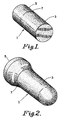
- Figure 1 hereof is a perspective view of an earplug in accordance with the invention and being producible by die cutting of a two-layer sheet foam composite.
- Figure 2 is a perspective view of another embodiment of an earplug in accordance with the invention and which is producible by molding of two polymeric foam precursor compositions deposited serially into a suitable mold.
- Figure 3 is a front view of the testing apparatus utilized in the working examples hereof to determine recovery time, equilibrium pressure and other properties of the specimen earplugs prepared therein.
- Figure 4 is a plot of attenuation as a function of frequency of an exemplary earplug in accordance with the invention.
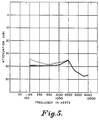
- Figure 5 is a plot of attenuation as a function of frequency of an exemplary earplug in accordance with a preferred embodiment of the invention and, for comparison purposes, of a commercially available polymeric foam earplug of the roll-down type as disclosed in U.S. Patent No. Re. 29,487.
- the polymeric foam earplug construction of the invention broadly comprises a resilient polymeric foam body 1 having a slow recovery viscoelastic nose section 3 and, coextensive therewith, a relatively substantially faster recovery, more elastic, tail section 5. Fixation of the nose section 3 to the tail section 5 can be achieved in any suitable manner, such as by means of a suitable adhesive, solvent welding or thermal welding of the respective sections.
- said fixation be achieved by direct bonding of the two polymeric foam sections together either by molding of two serially deposited polymeric foam purchaser compositions in a mold or by manufacture of a two-layer sheet of the earplug foam materials followed by die cutting of earplugs therefrom.
- By directly bonding the sections 3 and 5 together in other words, by avoiding the interposition of glues, adhesives, thermoplastic sheets and the like between said sections, there is generally avoided a parting line 7 which feels distinctly different from the polymeric foam sections themselves and this avoidance is desirable from the standpoint of maximizing the sensed comfort of the plug during its use.
- the molding technique outlined above inherently results in such direct bonding of the nose section 3 to the tail section 5. Suitable techniques by which to achieve such direct bonding of the nose section 3 foam material to the tail section 3 foam material in the preparation of two-layer composite foam sheets for die cutting purposes will appear hereinafter.
- Polyurethane foam compositions are generally preferred as the materials for the nose and tail sections 3 and 5 due to their formulation flexibility, easy processing characteristics and economics. Of these, polyether polyurethane foams are even further preferred due to the generally soft surface "hand" or feel of resilient foam wares produced therewith.
- the polyether polyurethane foam compositions based on polyurethane prepolymers blended with latex modifiers in accordance with the above-mentioned Wood patent have been found to be useful in the practice of the invention. Such polyether polyurethane prepolymers are currently available from W.R. Grace Company under the HYPOL® brand name.
- Suitable latex modifiers are available from Union Carbide Corporation under the UCAR® brand name and from Rohm and Haas Company under the RHOPLEX® brand name.
- viscoelastic foam compositions whose recovery times are temperature dependent can be produced from such latex modified polyurethane compositions.
- polyvinylchloride foam compositions again, due to their formulation flexibility, easy processing characteristics and economics. Polyvinylchloride foam compositions generally have stronger cell walls and tend to be more amenable to reuse and washing.
- the nose section 3 of the earplug of the invention has a recovery time of at least 1 second from 60 percent compression to 40% compression thereof. Unless otherwise stipulated herein, the recovery times mentioned herein are taken at about room temperature, meaning approximately 21-23°C (70-72°C). Where the polymeric foam composition employed for the nose section 3 is such that the recovery rate thereof is not markedly inversely temperature dependent, the maximum recovery time of said nose section 3 should not normally exceed 60 seconds and will preferably reside within a range of between 10 and 60 seconds. In a preferred embodiment of the invention, however, the polymeric foam composition employed for the nose section 3 is of a character such that the recovery time thereof is markedly and inversely temperature dependent.
- the 60-40 percent compression recovery time of the nose section 3 at room temperature 21-23°C should be greater than 60 seconds and the recovery time at body temperature, body temperature meaning approximately 35.6°C (96°F), should be substantially less than the recovery time at room temperature and, in any event, no greater than 90 seconds.
- substantially less is meant that the recovery time at body temperature should be a small fraction, e.g. two-thirds or less, of the recovery time at room temperature.
- the nose section 3 should recover about 1-1/2 times faster at body temperature than it does at room temperature.
- the nose section 3 of earplugs in accordance with this preferred embodiment of the invention generally need not be compressed greatly below the size of the ear canals into which they are to be inserted in order to assure adequate time in which to insert them and the user need not rush the insertion step in order to assure adequate depth of insertion thereof.
- the room temperature recovery time of the nose section 3 is greater than about 60 seconds and the body temperature recovery time in minutes multiplied by the density in kg/m 3 (pounds per cubic foot) squared is greater than about 10294 (40)
- the exceptional dynamic stiffness exhibited by such temperature dependent viscoelastic polymeric foam materials results in improved attenuation of this preferred embodiment of the earplug hearing protector in the lower range of audible frequencies (ca. 125-1000 Hz).
- resilient polymeric foam earplugs consisting solely of a nose section 3 composed of such a polymeric foam material exhibit the aforementioned low frequency attenuation benefits.
- the equilibrium pressure exerted by said nose section at 40% compression thereof, at room temperature reside within the range of from 1.4 to 8,9 kPa (0.2 to 1.3 p.s.i). and preferably reside within the range of from 2.4 kPa to 6.9 kPa (0.35 to 1.0 p.s.i.). Adherence to these criteria assures that the inserted and partially recovered nose section 3 of the earplug will achieve and maintain comfortable acoustic occlusion of the ear canal during use.
- the recovery time thereof from 60 percent compression to 40 percent compression thereof be substantially less than, i.e. shorter, that of nose section 3.
- substantially less is meant that, the recovery time of the tail section 5 should be no greater than 50 percent of the recovery time of the nose section 3 and, in any event, should be no greater than 5 seconds.
- the recovery time of said tail section 5 will be no greater than 2 seconds. It should be noted that many rapid recovery foam compositions meeting the above characteristics are well known to those skilled in the art and can be employed in the tail section 5.
- the tail section 5 of the earplug construction of the invention is intended to remain outside the ear canal during use. Consequently, the pressure exerted by said tail section 5 at 40% compression thereof is not critical. Nevertheless, it is desirable that the stiffness of the tail section 5 be no greater than about that of the nose section 3 and, even more desirably, will be substantially less as measured by either the Shore 00 or instant pressure methods, as described in greater detail further in the disclosure. By meeting either of these criteria, the roll-down step in utilizing the earplug construction of the invention can be facilitated.
- the nose section 3 and tail section 5 are of substantially different colorations so as to color code the respective sections of the earplug construction for ready identification by the user, such as when the earplug sections have been prepared with different acoustic attenuation values for different needs.
- the earplug construction of the invention is initially rolled down to below the size of the ear canal into which it is to be inserted, the tail section 5 thereof grasped between thumb and forefinger, and the slowly recovering nose section 3 thereof inserted into the ear canal to the full depth of the nose section, thereby establishing the tail section 5 outside the ear canal proper but within the concha.
- the tail section functions as a stop means to prevent over-insertion of the plug and, in many instances, will bear sufficiently upon the structure of the concha as to quickly and lightly secure the inserted nose section 3 of the earplug at a proper depth and position of insertion until such time as the relatively slow recovery viscoelastic nose section itself recovers to contact the enclosing ear canal wall and develop a stable acoustic seal therewith.
- the user of the earplug construction of the present invention will find substantial relief from the bother imposed by the prior art roll-down type polymeric foam earplugs wherein it is usually necessary to manually hold the inserted plug in position with a fingertip until seating of the inserted portion thereof occurs within the ear canal.
- the length of the nose section 3 is subject to considerable variation depending upon such parameters as the recovery properties of the particular viscoelastic polymeric foam composition selected therefore and the degree of hearing protection desired of the completed earplug construction.
- earplug constructions in which the length of the nose section 3 provides less than the optimum attenuation properties of which such earplug construction are capable.
- earplugs having nose sections 3 of from about 6.35 mm to about 19.05 mm (0.25 inch to about 0.75 inch) are generally useful in the practice of the invention.
- Optimum attenuation for a large segment of the population is generally provided when the length of the nose section 3 is from 12.7 mm to 15 mm (0.5 to 0.6 inch) , and as such, is preferred.
- the length thereof is not generally critical provided that it be sufficient to be readily grasped between thumb and forefinger and to adequately serve its purpose as a stop means to limit the depth of insertion of the nose section 3 into the ear canal. I have found that these functions can generally be served when the length of the tail section 5 is at least 2.54 mm (0.1 inch) with lengths between 5 mm (0.2 inch) and 10 mm (0.4 inch) being especially well suited. Where the length of the tail section 5 is greater than about 10 mm (0.4 inch) it can extend outside the concha during use.
- a tail section 5 length sufficient to cause protrusion thereof outside the concha is unnecessary to serve the contemplated functions of the tail section 5 and can be obtrusive or bothersome to the user, particularly during use of the earplug construction of the invention as a sleep aid wherein contact between the protruding tail section 5 and a pillow is likely to occur.
- a removable bridge 200 is supported at a fixed distance above the plate 101 by means of side supports 202.
- the bridge 200 and side plates 202 are sized such that the support for the bridge is established on the upper surface 103 of the balance 100.
- An adjustable flat upper plate 201 is suspended below the bridge 200 by means of a pair of axially adjustable vernier jackscrew support means 203 spaced equidistantly to either side of the center of the bridge 200.
- the side supports 202 thereof are not affixed to the balance.
- Specimen earplugs are die-stamped from polymeric foam sheets so as to produce cylinders having lengths generally within the range of from about 12.7 mm (0.5 inch) to about 22.9mm (0.9 inch).
- the apparatus described above is stationed in a laboratory environment and the temperature of the entire mass thereof allowed to equilibrate to the laboratory temperature.
- the upper plate 201 is adjusted to be parallel to and spaced from the plate 101 at a distance equivalent to 60% of the specimen earplug's diameter.
- An earplug specimen which has been stored for at least 24 hours at 50% relative humidity and at a temperature of from 21°C to 23°C is twirled lengthwise between the fingers for 20 seconds and with increasing force such that the earplug is reduced to a tight cylinder having a diameter of about 40% of its original diameter.
- the earplug is then inserted lengthwise and released between the parallel plates of the apparatus and the elapsed time between said release and the attainment of 75% line contact of the recovering plug with the plates measured with a stopwatch or other suitable timing device.
- the test apparatus is first stationed in a forced convection laboratory oven whose door has been replaced with a thick polymethylmethacrylate sheet having an access hatch through which wares may be introduced into the oven and manipulated therewithin.
- the set point oven temperature is 35.6°C (96°F.) and, preparatory to carrying out specimen testing, the test apparatus heated therein for a period sufficient to allow the entire mass of the test apparatus to equilibrate to the set point temperature.
- the recovery time may be taken for the nose section alone or for the entire earplug.
- the nose and tail sections can first be separated, such as by careful cutting of the plug along the parting line between the respective sections, and the recovery times of the separated sections determined individually.
- the equilibrium pressure test is accomplished during the course of the above recovery time testing procedure. Once the recovery time has been determined, the plug specimen is allowed to remain between the parallel plates and the force reading of the balance monitored until it reaches a maximum and stabilizes. This force is taken as the equilibrium force and is converted to a force per unit area value.
- the contact area of the specimen earplug with the constraining plates is determined by measuring the area of the "footprint" of the earplug on the parallel plates. One method of attaining the area of this footprint is by utilizing a sooted glass plate attached to the adjustable upper plate 201.
- the smudge created on the sooted glass plate by the plug upon recovery to 60% of its original diameter is traced and the area thereof measured with a planimeter to obtain the total contact area.
- the areas thereof can be calculated utilizing the original smudge area.
- the width of the original smudge is calculated by dividing the area thereof by the original plug specimen's length.
- the contact areas of the subsequent plug specimens of different lengths can be calculated by multiplying this calculated width by the measured length of the particular plug specimen of different length subsequently tested and taking this result to be the area of contact of the specimen on each plate.
- This parameter is defined as the instant force reading divided by the area of contact as measured during the course of the above equilibrium pressure test.
- the adjustable upper plate 201, bridge 200 and mass 300 are removed from the balance.
- the plug specimen residing on the lower plate 101 from the previous equilibrium pressure test is then allowed to recover fully to its original diameter.
- the upper plate 201, still adjusted to 60% of the plug specimen's original diameter and the associated bridge 200 without mass 300 are replaced firmly, but without impact, onto the balance and the force exerted on the lower plate 101 immediately taken.
- the instant pressure reading can be used as a suitable measure of stiffness.
- Shore OO Durometer hardness values of the specimen earplugs are determined by holding the Shore Durometer apparatus (available from the Shore Instrument Co., Jamaica, NY) and specimen in each hand and manually applying the indentor foot of the durometer to the nose section of the specimen without impact, but with rapid steady contact therewith. Readings were taken immediately upon application of the indentor foot to the specimen and 15 seconds thereafter and are reported in that order herein. Where the Shore OO Durometer values for tail sections of the earplug specimen were taken, a number of tail sections were first carefully cut from the nose sections of several specimen earplugs. The collected tail sections were then stacked one upon the other in order to provide an overall tail section specimen thickness of about 12.7 mm (1/2 inch). The indentor foot of the durometer was then applied to this stack in the manner previously indicated. As with the instant pressure test, the Shore 00 Durometer reading can also be used as a suitable measure of stiffness.
- Apparent Density Test Overall earplug specimen apparent density is determined by weighing the specimen and dividing the weight by the specimen volume as calculated from the dimensions thereof. The dimensions are determined by a contactless method utilizing light since contact methods of measuring the specimens tend to result in at least some compression of the material and can lead to inexact measurements. For instance, a backlighted thickness gauge can be used, contact of the specimen with said gauge being determined visually. An optical comparator may also be utilized for the dimensional measurements. The apparent densities of the respective nose and tail sections of the earplug specimens are determined by separating the nose and tail sections along the parting lines and carrying out the weighing, measuring and volume calculations for the separated sections in the manner outlined above.
- polyvinylchloride foam earplugs in accordance with the invention and appearing as in Figure 1 hereof are prepared by first preparing a two-layer free-blown, i.e. not in a molding press or the like, polyvinylchloride composite foam sheet followed by die cutting of cylindrical earplug specimens therefrom.
- the two-layer polyvinylchloride foam sheet is prepared as follows. Onto a release paper held flat by means of a vacuum plate there is deposited a polyvinylchloride plastisol formulation formulated to result in a relatively fast recovery, elastic foam layer. This plastisol formulation is drawn down with a Gardner knife held at a 0.635 mm (0.025 inch) spacing from the surface of the release paper. The release paper, containing the plastisol drawdown thereon, is then placed into an oven preheated to 213°C (415°F) for a period of 20 seconds in order to gel the plastisol drawdown.
- the release paper is then returned to the vacuum plate and, after cooling, a strip of about 6.35 mm (0.25 inch) width is cut away from each side of the gelled drawdown, the cutting being accomplished with due care so as to avoid injury to the underlying surface of the release paper.
- a second polyvinylchloride plastisol formulation formulated to produce a relatively slow recovery, viscoelastic foam layer, is deposited onto the gelled first plastisol drawdown and drawn down at a Gardner knife setting of 2.18 mm (0.086 inch) such that the knife is supported on the release paper and does not contact the underlying first gelled plastisol drawdown.
- the release paper is then removed from the vacuum plate and returned to the 213°C (415°F) oven for a period of 6.5 minutes in order to fuse and blow the superposed plastisol formulations.
- the resulting two-layer polyvinylchloride foam sheet is removed from the oven and cooled to room temperature.
- earplug specimens are die-stamped from the two-layer foam sheet using dies which produce cylindrical earplug specimens having nominal diameters of 13.59 mm (0.535 inch).
- the specimen plugs are then stored for at least 24 hours at a temperature of between 21°C and 23°C (70°F and 72°F) and at 50% relative humidity preceding testing thereof in accordance with the protocols set forth hereinabove.
- Earplug specimens in accordance with the invention were die-stamped from two-layer composite sheets of acrylic latex modified polyetherpolyurethane foams.
- the composite foam sheets were prepared as follows.
- the polyetherpolyurethane prepolymer formulation adapted to provide the relatively elastic and short recovery time foam layer for tail section 5 is placed onto a release paper held flat by a vacuum plate and drawn down with a polypropylene knife having an 0.5 cm (0.2 inch) deep blade.
- the prepolymer formulation is prepared by mixing of the ingredients in a variable high speed mixer set at as high a speed as possible without creating a vortex.
- the mixed formulation is then deposited onto the release paper and doctor bladed with the knife held at a sufficiently acute angle as to provide a resultant foam of the desired thickness.
- a second sheet of release paper is placed onto the top of the draw down and the system allowed to cure at ambient laboratory conditions.
- the polyetherpolyurethane prepolymer formulation adapted to provide the relatively viscoelastic and long recovery time foam layer is prepared, deposited onto a separate sheet of release paper and drawn down in the manner described above, but at a somewhat steeper knife angle, the spacing of the blade from the paper being sufficient to produce a foam of the desired thickness.
- the cover sheet release paper is removed from the already cured first draw down and said first draw down is laid, exposed face down, onto the fresh second draw down.
- the resulting two-layer composite system is then allowed to cure at ambient laboratory conditions, the release paper sheets removed from both sides thereof and the composite foam sheet material dried for two hours at 50°C.
- Specimen plugs of 0.535 nominal diameter are die-stamped from the cured and dried composite sheet material, the plugs dried for 1/2 hour at 50°C and then stored at room temperature and 50% relative humidity for at least 1 month prior to final testing thereof. This is done to ensure completeness of cure and crystallite formation.
- the prepolymer formulations employed and the physical test results for these specimen earplugs are set forth in Table 2, which follows. As will be noted therefrom the recover times of the nose sections 3 of the specimen earplugs, D/E and Z/E, are markedly inversely temperature dependent, each having a room temperature recover time of greater than one minute and having a recovery time and at 35.6°C (96°F) of only a small fraction of the room temperature recovery time of less than 90 seconds.
- earplug specimens are prepared consisting solely of a nose section 3 composed of an acrylic latex modified polyetherpolyurethane foam whose recovery time property is markedly inversely temperature dependent.
- the prepolymer formulation is prepared, placed onto release paper, doctor bladed and cured in the general manner outlined for the relatively rapid recovery elastic foam layer preparation in Example 2.
- the polyetherpolyurethane formulation employed in the present example was a simple two-component mixture consisting of 150 parts by weight of Hypol® 3000 polyetherpolyurethane prepolymer and 225 parts by weight of UCAR® 154 acrylic latex.
- Example 2 After drawing down and curing at ambient conditions, the resulting foam sheet was dried, die cut into earplug specimens, and the specimens re-dried and stored several months at laboratory temperature and 50% relative humidity prior to testing, as in Example 2.
- Table 3 The physical properties of the specimen earplugs of the instant example are reported in Table 3, below.
- Modified ANSI S12.6-84 attenuation testing thereof was performed as in Example 1 and the results thereof are plotted in Figure 5 as a solid line.
- attenuation test results of presently available commercial slow recovery foam roll-down type earplugs, E-A-R® Foam Earplugs, Cabot Safety Corporation, as determined for the same subjects at the same time, are also plotted in dotted line form.
- the experimental plugs of this example display improved low frequency attenuation characteristics over this state-of-the-art commercial earplug.
- 35.6°C (96°F) recovery time testing of the earplug specimens it was noted that the ends thereof recovered somewhat more rapidly than did the central regions.
- the density gradient feature spoken of with respect to the Z/E specimens of Example 2 was again noted. More specifically, the density of the foam was found to be substantially greater in the end regions of the specimens as compared to that of the central region intermediate ends.
- earplug constructions of the present invention can be employed effectively as ear stopples in an earphone device wherein an earplug such as described hereinbefore is modified by providing it with an axial bore therethrough, which bore is adapted to receive a sound conducting tube or miniature speaker therein.
- exemplary earplug constructions hereof where produced by die cutting from two-layer composite sheets prepared by free blowing of polymeric foam precursor formulations to the atmosphere
- the invention can also be realized by molding of suitable precursor polymeric foam compositions.
- the use of molding techniques can be beneficial when earplug constructions of complex shapes, such as shown in Figure 2, are desired.
- precursor polymeric foam formulations utilized for free blowing of foam sheets of specified recovery properties will not normally produce molded foam wares having equivalent recovery properties. For a given foam precursor formulation in-mold foaming, particularly closed mold foaming, tends to produce denser, more homogenous foam wares than does a free blowing technique.
Landscapes
- Health & Medical Sciences (AREA)
- Life Sciences & Earth Sciences (AREA)
- Biomedical Technology (AREA)
- Heart & Thoracic Surgery (AREA)
- Biophysics (AREA)
- Otolaryngology (AREA)
- Psychology (AREA)
- Engineering & Computer Science (AREA)
- Physics & Mathematics (AREA)
- Acoustics & Sound (AREA)
- Vascular Medicine (AREA)
- Animal Behavior & Ethology (AREA)
- General Health & Medical Sciences (AREA)
- Public Health (AREA)
- Veterinary Medicine (AREA)
- Manufacture Of Porous Articles, And Recovery And Treatment Of Waste Products (AREA)
- Helmets And Other Head Coverings (AREA)
Claims (21)
- Ohrstöpsel-Konstruktion vom Typ des Abrollens unter Zusammendrücken, umfassend einen elastischen polymeren Schaumkörper (1), wobei das Zellenvolumen des Schaumkörpers (1) mit Gas gefüllt ist, worin der Körper (1) ein Vorsprungsteilstück (3) und koextensiv damit ein Endteilstück (5) umfaßt,
wobei das Vorsprungsteilstück (3) aus einem sich langsam erholenden, viskoelastischen, polymeren Schaum besteht und von einer Größe und Form ist, die so angepaßt sind, daß es zusammengedrückt in den Kanal des menschlichen Ohrs eingeführt werden kann und dort sich ausdehnen und den Ohrkanal verschließen kann, wobei das Vorsprungsteilstück (3) eine Raumtemperatur-Erholungszeit von 60 % Kompression zu 40 % Kompression desselben von wenigstens 1 Sekunde und einen Gleichgewichtsdruck bei 40 % Kompression desselben von 1,4 kPa bis 8,9 kPa (0,2 bis 1,3 psi) hat,
wobei das Endteilstück (5) aus einem sich schneller erholenden, mehr elastischen, polymeren Schaum als dem des Vorsprungsteilstücks (3) besteht, worin das Endteilstück (5) eine Raumtemperatur-Erholungszeit von 60 % Kompression zu 40 % Kompression desselben von nicht mehr als 50 % der Erholungszeit des Vorsprungsteilstücks (3) und nicht mehr als 5 Sekunden hat. - Ohrstöpsel-Konstruktion gemäß Anspruch 1, worin die Erholungszeit des Vorsprungsteilstücks (3) relativ temperaturunempfindlich ist, und worin die Erholungszeit desselben bei Raumtemperatur zwischen 1 und 60 Sekunden beträgt.
- Ohrstöpsel-Konstruktion gemäß Anspruch 1, worin die Erholungszeit des Vorsprungsteilstücks (3) bei Raumtemperatur zwischen 10 und 60 Sekunden beträgt.
- Ohrstöpsel-Konstruktion gemäß Anspruch 1, worin die Erholungszeit des Vorsprungsteilstücks (3) in umgekehrter Weise von der Temperatur abhängig ist, und worin die Erholungszeit bei Raumtemperatur größer als 60 Sekunden ist, wobei die Erholungszeit bei Körpertemperatur nicht mehr als 90 Sekunden beträgt, und die Erholungszeit bei Körpertemperatur wesentlich geringer als die Erholungszeit bei Raumtemperatur ist.
- Ohrstöpsel-Konstruktion gemäß Anspruch 1, worin die Erholungszeit des Vorsprungsteilstücks (3) bei Körpertemperatur nicht mehr als 60 Sekunden beträgt.
- Ohrstöpsel-Konstruktion gemäß Anspruch 1, worin der Raumtemperatur-Gleichgewichtsdruck des Vorsprungsteilstücks (3) bei 40 % Kompression desselben im Bereich von 2,4 kPa bis 6,9 kPa (0,35 bis 1,0 psi) verbleibt.
- Ohrstöpsel-Konstruktion gemäß Anspruch 1, worin die Raumtemperatur-Steifheit des Endteilstücks (5) geringer als die des Vorsprungsteilstücks (3) ist, wie durch den Shore 00 Durometer-Test bestimmt wird.
- Ohrstöpsel-Konstruktion gemäß Anspruch 1, worin die Raumtemperatur-Steifheit des Endteilstücks (5) geringer als die des Vorsprungsteilstücks (3) ist, wie durch den sofortigen Drucktest bestimmt wird.
- Ohrstöpsel-Konstruktion gemäß Anspruch 1, worin die Raumtemperatur-Erholungszeit des Endteilstücks (5) nicht mehr als 2 Sekunden beträgt.
- Ohrstöpsel-Konstruktion gemäß Anspruch 1, worin die Länge des Vorsprungsteilstücks (3) innerhalb des Bereichs von 6,4 mm und 19,1 mm (0,25 und 0,75 inch) verbleibt.
- Ohrstöpsel-Konstruktion gemäß Anspruch 1, worin die Länge des Vorsprungsteilstücks (3) innerhalb des Bereichs von 12,8 mm und 15,3 mm (0,5 und 0,6 inch) verbleibt.
- Ohrstöpsel-Konstruktion gemäß Anspruch 1, worin das Vorsprungsteilstück (3) aus Polyvinylchloridschaum-Zusammensetzungen besteht.
- Ohrstöpsel-Konstruktion gemäß Anspruch 1, worin das Vorsprungsteilstück (3) aus Polyurethanschaum-Zusammensetzungen besteht.
- Ohrstöpsel-Konstruktion gemäß Anspruch 1, worin das Vorsprungsteilstuck (3) aus Polyetherpolyurethanschaum-Zusammensetzungen besteht.
- Ohrstöpsel-Konstruktion gemäß Anspruch 1, worin das Vorsprungsteilstück (3) aus latexmodifizierten Polyetherpolyurethanschaum-Zusammensetzungen besteht.
- Ohrstöpsel-Konstruktion gemäß Anspruch 1, worin das Endteilstück (5) aus Polyvinylchloridschaum-Zusammensetzungen besteht.
- Ohrstöpsel-Konstruktion gemäß Anspruch 1, worin das Endteilstück (5) aus Polyurethanschaum-Zusammensetzungen besteht.
- Ohrstöpsel-Konstruktion gemäß Anspruch 1, worin das Endteilstück (5) aus Polyetherpolyurethanschaum-Zusammensetzungen besteht.
- Ohrstöpsel-Konstruktion gemäß Anspruch 16, worin das Endteilstück (5) aus latexmodifizierten Polyetherpolyurethanschaum-Zusammensetzungen besteht.
- Ohrstöpsel-Konstruktion gemäß Anspruch 1, worin die Länge des Endteilstücks (5) größer als 2,5 mm (0,1 inch) ist.
- Ohrstöpsel-Konstruktion gemäß Anspruch 19, worin die Länge des Endteilstücks innerhalb des Bereichs von 5 und 10 mm (0,2 und 0,4 inch) verbleibt.
Applications Claiming Priority (3)
| Application Number | Priority Date | Filing Date | Title |
|---|---|---|---|
| US07/598,268 US5203352A (en) | 1990-10-16 | 1990-10-16 | Polymeric foam earplug |
| US598268 | 1990-10-16 | ||
| PCT/US1991/007418 WO1992006659A1 (en) | 1990-10-16 | 1991-10-08 | Polymeric foam earplug |
Publications (3)
| Publication Number | Publication Date |
|---|---|
| EP0553274A1 EP0553274A1 (de) | 1993-08-04 |
| EP0553274A4 EP0553274A4 (en) | 1993-09-15 |
| EP0553274B1 true EP0553274B1 (de) | 1996-11-20 |
Family
ID=24394892
Family Applications (1)
| Application Number | Title | Priority Date | Filing Date |
|---|---|---|---|
| EP91920305A Expired - Lifetime EP0553274B1 (de) | 1990-10-16 | 1991-10-08 | Ohrstöpsel aus polymerschaum |
Country Status (6)
| Country | Link |
|---|---|
| US (1) | US5203352A (de) |
| EP (1) | EP0553274B1 (de) |
| AU (1) | AU644323B2 (de) |
| CA (1) | CA2094120C (de) |
| DE (1) | DE69123259T2 (de) |
| WO (1) | WO1992006659A1 (de) |
Families Citing this family (74)
| Publication number | Priority date | Publication date | Assignee | Title |
|---|---|---|---|---|
| US5792998A (en) * | 1993-04-19 | 1998-08-11 | Cabot Safety Intermediate Corporation | Acoustical hearing protective devices utilizing dynamically stiff foam and methods of producing same |
| WO1995009082A1 (en) * | 1993-09-28 | 1995-04-06 | Bradford Industries, Inc. | Sound attenuation composite and method for forming same |
| US5452731A (en) * | 1994-10-25 | 1995-09-26 | Dickman; Donald E. | Disposable, hygroscopic ear plug including tear-away portion |
| US5601594A (en) * | 1995-09-14 | 1997-02-11 | Best; Barry D. | Nasal stent |
| DE19604201A1 (de) * | 1996-02-06 | 1997-08-07 | Braun Ag | Schutzkappe |
| US5809574A (en) * | 1996-08-15 | 1998-09-22 | Cabot Safety Intermediate Corporation | Hearing protection device |
| US5799658A (en) * | 1996-08-15 | 1998-09-01 | Cabot Safety Intermediate Corporation | Hearing protective device comprising a foam and a porous component and method of manufacture thereof |
| US6134333A (en) * | 1998-03-17 | 2000-10-17 | Sonic Innovations, Inc. | Disposable oleophobic and hydrophobic barrier for a hearing aid |
| US6105713A (en) * | 1998-09-17 | 2000-08-22 | Sonic Innovations, Inc. | Cover movable by rotation forming a cerumen barrier in a hearing aid |
| US6920956B1 (en) | 1999-01-07 | 2005-07-26 | Cabot Safety Intermediate Corporation | Detectable earplug and method of manufacture thereof |
| US6359993B2 (en) | 1999-01-15 | 2002-03-19 | Sonic Innovations | Conformal tip for a hearing aid with integrated vent and retrieval cord |
| WO2000054712A1 (en) | 1999-03-16 | 2000-09-21 | Cabot Safety Intermediate Corporation | Hearing protective device |
| US6135235A (en) * | 1999-04-06 | 2000-10-24 | Sonic Innovations, Inc. | Self-cleaning cerumen guard for a hearing device |
| US6129175A (en) * | 1999-05-07 | 2000-10-10 | Radians, Inc. | Acoustical control plastisol earpieces |
| US6179085B1 (en) | 1999-09-30 | 2001-01-30 | Sonic Innovations | Retention and extraction device for a hearing aid |
| US6105715A (en) * | 1999-11-05 | 2000-08-22 | Aearo Company | Multi-color variably attenuating earplug |
| US6456720B1 (en) | 1999-12-10 | 2002-09-24 | Sonic Innovations | Flexible circuit board assembly for a hearing aid |
| US6532295B1 (en) | 1999-12-10 | 2003-03-11 | Sonic Innovations, Inc. | Method for fitting a universal hearing device shell and conformal tip in an ear canal |
| US6319020B1 (en) | 1999-12-10 | 2001-11-20 | Sonic Innovations, Inc. | Programming connector for hearing devices |
| US6695093B1 (en) | 2000-01-13 | 2004-02-24 | Aearo Company | Earplug |
| CA2391776A1 (en) | 2000-05-31 | 2001-12-06 | Cabot Safety Intermediate Corporation | Process for applying a decorative pattern to earplugs |
| US7130437B2 (en) * | 2000-06-29 | 2006-10-31 | Beltone Electronics Corporation | Compressible hearing aid |
| US6459800B1 (en) | 2000-07-11 | 2002-10-01 | Sonic Innovations, Inc. | Modular hearing device receiver suspension |
| US6453476B1 (en) | 2000-09-27 | 2002-09-24 | Team Wendy, Llc | Protective helmet |
| US6408981B1 (en) | 2000-09-27 | 2002-06-25 | Saint-Gobain Performance Plastics Corporation | Extruded monolithic foam earplug |
| EP1192920A1 (de) | 2000-09-29 | 2002-04-03 | The Procter & Gamble Company | Bequeme Ohrstopfen auf Basis von Schaum |
| US20020124851A1 (en) * | 2000-11-28 | 2002-09-12 | Richard Knauer | Hearing protective device and method of making same |
| US6746444B2 (en) * | 2000-12-18 | 2004-06-08 | Douglas J. Key | Method of amplifying a beneficial selective skin response to light energy |
| US6622816B2 (en) | 2001-04-24 | 2003-09-23 | Cabot Safety Intermediate Corp. | Personal protective devices having an energy activated material |
| US20030059071A1 (en) * | 2001-09-24 | 2003-03-27 | John Dunham | Personal audio device with hearing protection |
| US20040045558A1 (en) | 2002-09-06 | 2004-03-11 | Duncan Taylor | Earplug and method of manufacturing an earplug |
| US7096872B2 (en) * | 2002-09-27 | 2006-08-29 | Ligon Sr James T | Ear plugs and method of forming same |
| US7362875B2 (en) * | 2003-04-03 | 2008-04-22 | Sonic Innovations, Inc. | Balloon-expandable hearing device fitting system and self-expanding hearing device |
| US20050056288A1 (en) * | 2003-09-11 | 2005-03-17 | Walter Schreiber | Earplug and a method of forming an earplug |
| US7078443B2 (en) * | 2003-10-22 | 2006-07-18 | Intellectual Property Holdings, Llc | Viscoelastic foam layer and composition |
| US20050224082A1 (en) * | 2004-04-05 | 2005-10-13 | Johnson Arthur A | Method for forming occlusive barrier over ear canal and kit for providing same |
| US7712469B2 (en) * | 2004-04-15 | 2010-05-11 | Sperian Hearing Protection, Llc | Detectable earplug and cord |
| US7475686B2 (en) * | 2004-10-15 | 2009-01-13 | Cabot Safety Intermediate Corporation | Earplug |
| US20080207790A1 (en) * | 2004-10-15 | 2008-08-28 | Knauer Richard E | Earplug |
| CA2596660C (en) * | 2005-02-04 | 2013-12-10 | Hearing Components, Inc. | User disposable member for use within the ear canal and methods for manufacturing the same |
| US20060202375A1 (en) * | 2005-03-14 | 2006-09-14 | Jenkins John A Jr | Extruded and shaped earplug |
| US20070039620A1 (en) * | 2005-04-14 | 2007-02-22 | Rick Sustello | Sealing arrangement for wearable article |
| US20070100300A1 (en) * | 2005-11-02 | 2007-05-03 | Hashemian Shohreh H | Ear fluid removal device |
| US20070125812A1 (en) * | 2005-11-14 | 2007-06-07 | Loretta Ivison | Pin moor |
| US8844777B2 (en) * | 2005-11-14 | 2014-09-30 | Loretta Ivison | Pin moor |
| USD650062S1 (en) | 2006-03-15 | 2011-12-06 | Just Plugs, Llc | Ear plug |
| US8002829B2 (en) * | 2008-03-07 | 2011-08-23 | Ascentia Health, Inc. | Ear insert for relief of TMJ discomfort |
| US20090277462A1 (en) * | 2008-05-09 | 2009-11-12 | 3M Innovative Properties Company | Foam earplug in deformable sheath |
| WO2010075130A2 (en) | 2008-12-23 | 2010-07-01 | 3M Innovative Properties Company | Transportation vehicle sound insulation process and device |
| KR20110105843A (ko) * | 2008-12-23 | 2011-09-27 | 쓰리엠 이노베이티브 프로퍼티즈 컴파니 | 청력 보호 방법 및 장치 |
| US20100195860A1 (en) * | 2009-02-05 | 2010-08-05 | Cher Becker | Soft shell in-ear earphones with miniature speaker inserts |
| US20100275931A1 (en) * | 2009-05-01 | 2010-11-04 | Saeed Seyed | Earplug For An Ear Canal |
| CN102596131B (zh) * | 2009-06-03 | 2014-07-09 | 斯博瑞安听觉保护有限责任公司 | 非搓式泡沫耳件 |
| JP5836941B2 (ja) | 2009-06-25 | 2015-12-24 | スリーエム イノベイティブ プロパティズ カンパニー | 可聴音響周波数管理のための音波バリア |
| US8249285B2 (en) * | 2009-06-26 | 2012-08-21 | Etymotic Research Inc. | Method and apparatus for producing non linear sound attenuation |
| WO2011017453A1 (en) | 2009-08-04 | 2011-02-10 | Hearing Components, Inc. | Foam compositions with enhanced sound attenuation |
| US8758436B2 (en) | 2009-09-17 | 2014-06-24 | Lawrence G. Clayton | Ear insert for relief of TMJ discomfort and headaches |
| USD636484S1 (en) | 2009-10-22 | 2011-04-19 | Sperian Hearing Protection, Llc | Earplug |
| US8649540B2 (en) * | 2009-10-30 | 2014-02-11 | Etymotic Research, Inc. | Electronic earplug |
| DE102010027561A1 (de) | 2010-07-19 | 2012-01-19 | Sms Logistiksysteme Gmbh | Schleifvorrichtung zum Schleifen eines metallischen Produkts |
| US20140352590A1 (en) * | 2010-12-29 | 2014-12-04 | Loretta Ivison | Pin moor |
| USD684253S1 (en) * | 2011-02-24 | 2013-06-11 | Moldex-Metric, Inc. | Cylinder earplug |
| USD717937S1 (en) | 2013-02-15 | 2014-11-18 | 3M Innovative Properties Company | Earplug |
| US9549855B2 (en) | 2013-02-15 | 2017-01-24 | 3M Innovative Properties Company | Earplug with tip cavity and methods of manufacturing the same |
| US9763832B2 (en) * | 2013-04-10 | 2017-09-19 | Howard S. Leight | Pull out earplug |
| US20160324692A1 (en) * | 2014-01-10 | 2016-11-10 | 3M Innovative Properties Company | Molded Foam Push-To-Fit Earplug, Method And Devices |
| USD739517S1 (en) * | 2014-04-23 | 2015-09-22 | Bumble BE Holdings, LLC | Earplug |
| USD760372S1 (en) | 2014-08-15 | 2016-06-28 | Nick Williams | Ear plug |
| WO2016025952A1 (en) * | 2014-08-15 | 2016-02-18 | Nick Williams | Ear plug with container |
| USD813373S1 (en) | 2015-08-26 | 2018-03-20 | One Off, LLC | Ear plug |
| US10940045B2 (en) * | 2016-08-02 | 2021-03-09 | Brown Innovation, Llc | Washable thermoplastic elastomer foam and articles incorporating same |
| US11173069B2 (en) | 2016-12-21 | 2021-11-16 | 3M Innovative Properties Company | Earplug with stem comprising a sleeve |
| USD901454S1 (en) * | 2019-04-10 | 2020-11-10 | Shure Acquisition Holdings, Inc. | Earphone |
| US12419369B2 (en) | 2021-05-06 | 2025-09-23 | 3M Innovative Properties Company | Systems and methods for improved respiratory protection devices |
Family Cites Families (14)
| Publication number | Priority date | Publication date | Assignee | Title |
|---|---|---|---|---|
| US2262568A (en) * | 1939-10-21 | 1941-11-11 | Kenneth L Wade | Ear protector |
| DE1766350C3 (de) * | 1968-05-08 | 1979-03-22 | Klosterfrau Berlin Chemische, Pharmazeutische, Kosmetische Und Diaetetische Erzeugnisse Gmbh, 1000 Berlin | Universeller Lärmschutzpfropfen |
| US3736929A (en) * | 1970-07-09 | 1973-06-05 | A Mills | Self-shaping earplugs |
| US3811437A (en) * | 1971-10-26 | 1974-05-21 | Cabot Corp | Earplugs |
| DE2325823A1 (de) * | 1973-05-22 | 1974-12-19 | Envac Ets | Gehoerschutz |
| US4158087A (en) * | 1977-05-27 | 1979-06-12 | W. R. Grace & Co. | Urethane foams having low resiliency |
| US4293355A (en) * | 1978-04-28 | 1981-10-06 | Cabot Corporation | Method for ultrasonically welding plasticized thermoplastic polymeric foam wares |
| US4193396A (en) * | 1978-04-28 | 1980-03-18 | E-A-R Corporation | Paired earplug construction |
| IT1156545B (it) * | 1982-11-08 | 1987-02-04 | Amplisilence Spa | Inserti auricolari fonoassorbenti in materiale polimerico espanso |
| US4579112A (en) * | 1984-05-17 | 1986-04-01 | Scott Robert T | Foam earplug |
| ZA86897B (en) * | 1985-03-29 | 1986-09-24 | Cabot Corp | Earplugs |
| US4774938A (en) * | 1987-04-09 | 1988-10-04 | Howard S. Leight & Associates, Inc. | Slow recovery earplug with largely impenetrable surface |
| DK159190C (da) * | 1988-05-24 | 1991-03-04 | Steen Barbrand Rasmussen | Oereprop til stoejbeskyttet kommunikation mellem brugeren af oereproppen og omgivelserne |
| DE3929060A1 (de) * | 1989-09-01 | 1991-03-07 | Bobertag Gmbh | Gehoerschutzstoepsel |
-
1990
- 1990-10-16 US US07/598,268 patent/US5203352A/en not_active Expired - Fee Related
-
1991
- 1991-10-08 DE DE69123259T patent/DE69123259T2/de not_active Expired - Fee Related
- 1991-10-08 WO PCT/US1991/007418 patent/WO1992006659A1/en not_active Ceased
- 1991-10-08 EP EP91920305A patent/EP0553274B1/de not_active Expired - Lifetime
- 1991-10-08 AU AU89015/91A patent/AU644323B2/en not_active Ceased
- 1991-10-08 CA CA002094120A patent/CA2094120C/en not_active Expired - Fee Related
Also Published As
| Publication number | Publication date |
|---|---|
| WO1992006659A1 (en) | 1992-04-30 |
| US5203352A (en) | 1993-04-20 |
| DE69123259T2 (de) | 1997-06-19 |
| EP0553274A4 (en) | 1993-09-15 |
| AU8901591A (en) | 1992-05-20 |
| CA2094120C (en) | 2002-01-29 |
| CA2094120A1 (en) | 1992-04-17 |
| DE69123259D1 (de) | 1997-01-02 |
| EP0553274A1 (de) | 1993-08-04 |
| AU644323B2 (en) | 1993-12-02 |
Similar Documents
| Publication | Publication Date | Title |
|---|---|---|
| US5203352A (en) | Polymeric foam earplug | |
| US5188123A (en) | Hearing protective earplug having alternative modes of insertion | |
| US3811437A (en) | Earplugs | |
| CA1294221C (en) | Hearing aid ear piece having disposable, compressible polymeric foam sleeve | |
| US5601594A (en) | Nasal stent | |
| US6027465A (en) | Method of immobilizing a body member using a composite article | |
| WO1997015257A1 (en) | Earplug containment device | |
| PT732907E (pt) | Material de moldagem ortopedico | |
| WO1991005446A1 (en) | Ear piece having disposable, compressible polymeric foam sleeve | |
| EP1294330B1 (de) | Gelenkiger ohrstöpsel | |
| JP7153692B2 (ja) | 成形発泡体製押込嵌め式耳栓、方法及び装置 | |
| AU640254B2 (en) | Hearing protective earplug | |
| EP0036422B1 (de) | Schutzstopfen für das ohr und verfahren zu seiner herstellung | |
| AU646995B2 (en) | Hearing protective earplug having alternative modes of insertion | |
| HK1013244B (en) | Hearing protective earplug having alternative modes of insertion | |
| MXPA98002965A (es) | Dispositivos de proteccion acustica del oido queutilizan espuma dinamicamente rigida y metodos para producirlos | |
| HK1055386B (en) | Articulating earplug | |
| HK1092679A (en) | Articulating earplug |
Legal Events
| Date | Code | Title | Description |
|---|---|---|---|
| PUAI | Public reference made under article 153(3) epc to a published international application that has entered the european phase |
Free format text: ORIGINAL CODE: 0009012 |
|
| 17P | Request for examination filed |
Effective date: 19930505 |
|
| AK | Designated contracting states |
Kind code of ref document: A1 Designated state(s): DE FR GB |
|
| A4 | Supplementary search report drawn up and despatched |
Effective date: 19930803 |
|
| AK | Designated contracting states |
Kind code of ref document: A4 Designated state(s): DE FR GB |
|
| 17Q | First examination report despatched |
Effective date: 19941114 |
|
| GRAH | Despatch of communication of intention to grant a patent |
Free format text: ORIGINAL CODE: EPIDOS IGRA |
|
| GRAH | Despatch of communication of intention to grant a patent |
Free format text: ORIGINAL CODE: EPIDOS IGRA |
|
| GRAA | (expected) grant |
Free format text: ORIGINAL CODE: 0009210 |
|
| AK | Designated contracting states |
Kind code of ref document: B1 Designated state(s): DE FR GB |
|
| REF | Corresponds to: |
Ref document number: 69123259 Country of ref document: DE Date of ref document: 19970102 |
|
| ET | Fr: translation filed | ||
| PLBE | No opposition filed within time limit |
Free format text: ORIGINAL CODE: 0009261 |
|
| STAA | Information on the status of an ep patent application or granted ep patent |
Free format text: STATUS: NO OPPOSITION FILED WITHIN TIME LIMIT |
|
| 26N | No opposition filed | ||
| PGFP | Annual fee paid to national office [announced via postgrant information from national office to epo] |
Ref country code: FR Payment date: 20010920 Year of fee payment: 11 Ref country code: DE Payment date: 20010920 Year of fee payment: 11 |
|
| PGFP | Annual fee paid to national office [announced via postgrant information from national office to epo] |
Ref country code: GB Payment date: 20010921 Year of fee payment: 11 |
|
| REG | Reference to a national code |
Ref country code: GB Ref legal event code: IF02 |
|
| PG25 | Lapsed in a contracting state [announced via postgrant information from national office to epo] |
Ref country code: GB Free format text: LAPSE BECAUSE OF NON-PAYMENT OF DUE FEES Effective date: 20021008 |
|
| PG25 | Lapsed in a contracting state [announced via postgrant information from national office to epo] |
Ref country code: DE Free format text: LAPSE BECAUSE OF NON-PAYMENT OF DUE FEES Effective date: 20030501 |
|
| GBPC | Gb: european patent ceased through non-payment of renewal fee |
Effective date: 20021008 |
|
| PG25 | Lapsed in a contracting state [announced via postgrant information from national office to epo] |
Ref country code: FR Free format text: LAPSE BECAUSE OF NON-PAYMENT OF DUE FEES Effective date: 20030630 |
|
| REG | Reference to a national code |
Ref country code: FR Ref legal event code: ST |