EP0541871B1 - Hydroconversion of a waste feedstock comprising highly reactive organic compounds - Google Patents
Hydroconversion of a waste feedstock comprising highly reactive organic compounds Download PDFInfo
- Publication number
- EP0541871B1 EP0541871B1 EP91310595A EP91310595A EP0541871B1 EP 0541871 B1 EP0541871 B1 EP 0541871B1 EP 91310595 A EP91310595 A EP 91310595A EP 91310595 A EP91310595 A EP 91310595A EP 0541871 B1 EP0541871 B1 EP 0541871B1
- Authority
- EP
- European Patent Office
- Prior art keywords
- hydrogen
- stream
- hydrogenated
- zone
- hydrogenation
- Prior art date
- Legal status (The legal status is an assumption and is not a legal conclusion. Google has not performed a legal analysis and makes no representation as to the accuracy of the status listed.)
- Expired - Lifetime
Links
- 150000002894 organic compounds Chemical class 0.000 title claims description 15
- 239000002699 waste material Substances 0.000 title description 4
- UFHFLCQGNIYNRP-UHFFFAOYSA-N Hydrogen Chemical compound [H][H] UFHFLCQGNIYNRP-UHFFFAOYSA-N 0.000 claims description 65
- 239000001257 hydrogen Substances 0.000 claims description 64
- 229910052739 hydrogen Inorganic materials 0.000 claims description 64
- 238000005984 hydrogenation reaction Methods 0.000 claims description 59
- 239000007788 liquid Substances 0.000 claims description 44
- 238000000034 method Methods 0.000 claims description 30
- 239000006096 absorbing agent Substances 0.000 claims description 28
- 150000001875 compounds Chemical class 0.000 claims description 22
- 150000002896 organic halogen compounds Chemical class 0.000 claims description 20
- 239000003054 catalyst Substances 0.000 claims description 18
- 238000009903 catalytic hydrogenation reaction Methods 0.000 claims description 14
- 229920000642 polymer Polymers 0.000 claims description 13
- 238000004519 manufacturing process Methods 0.000 claims description 11
- KDLHZDBZIXYQEI-UHFFFAOYSA-N Palladium Chemical compound [Pd] KDLHZDBZIXYQEI-UHFFFAOYSA-N 0.000 claims description 10
- 229910000039 hydrogen halide Inorganic materials 0.000 claims description 10
- 239000012433 hydrogen halide Substances 0.000 claims description 10
- 238000010521 absorption reaction Methods 0.000 claims description 8
- 239000006227 byproduct Substances 0.000 claims description 7
- 239000007792 gaseous phase Substances 0.000 claims description 7
- PPBRXRYQALVLMV-UHFFFAOYSA-N Styrene Chemical compound C=CC1=CC=CC=C1 PPBRXRYQALVLMV-UHFFFAOYSA-N 0.000 claims description 6
- YACLQRRMGMJLJV-UHFFFAOYSA-N chloroprene Chemical compound ClC(=C)C=C YACLQRRMGMJLJV-UHFFFAOYSA-N 0.000 claims description 5
- 229910052763 palladium Inorganic materials 0.000 claims description 5
- ISWSIDIOOBJBQZ-UHFFFAOYSA-N Phenol Chemical compound OC1=CC=CC=C1 ISWSIDIOOBJBQZ-UHFFFAOYSA-N 0.000 claims description 4
- RWGFKTVRMDUZSP-UHFFFAOYSA-N cumene Chemical compound CC(C)C1=CC=CC=C1 RWGFKTVRMDUZSP-UHFFFAOYSA-N 0.000 claims description 4
- 239000002243 precursor Substances 0.000 claims description 4
- 238000000926 separation method Methods 0.000 claims description 4
- 239000002904 solvent Substances 0.000 claims description 4
- CYTYCFOTNPOANT-UHFFFAOYSA-N Perchloroethylene Chemical group ClC(Cl)=C(Cl)Cl CYTYCFOTNPOANT-UHFFFAOYSA-N 0.000 claims description 3
- BZHJMEDXRYGGRV-UHFFFAOYSA-N Vinyl chloride Chemical compound ClC=C BZHJMEDXRYGGRV-UHFFFAOYSA-N 0.000 claims description 3
- PNEYBMLMFCGWSK-UHFFFAOYSA-N aluminium oxide Inorganic materials [O-2].[O-2].[O-2].[Al+3].[Al+3] PNEYBMLMFCGWSK-UHFFFAOYSA-N 0.000 claims description 3
- 238000005194 fractionation Methods 0.000 claims description 3
- 150000004820 halides Chemical class 0.000 claims description 3
- 239000002440 industrial waste Substances 0.000 claims description 3
- 239000000178 monomer Substances 0.000 claims description 3
- 239000004593 Epoxy Substances 0.000 claims description 2
- XSTXAVWGXDQKEL-UHFFFAOYSA-N Trichloroethylene Chemical group ClC=C(Cl)Cl XSTXAVWGXDQKEL-UHFFFAOYSA-N 0.000 claims description 2
- 150000002431 hydrogen Chemical class 0.000 claims description 2
- 238000004064 recycling Methods 0.000 claims description 2
- UBOXGVDOUJQMTN-UHFFFAOYSA-N trichloroethylene Natural products ClCC(Cl)Cl UBOXGVDOUJQMTN-UHFFFAOYSA-N 0.000 claims description 2
- 238000006243 chemical reaction Methods 0.000 description 13
- 229930195733 hydrocarbon Natural products 0.000 description 11
- 150000002430 hydrocarbons Chemical class 0.000 description 11
- 239000000047 product Substances 0.000 description 10
- ATUOYWHBWRKTHZ-UHFFFAOYSA-N Propane Chemical compound CCC ATUOYWHBWRKTHZ-UHFFFAOYSA-N 0.000 description 8
- VEXZGXHMUGYJMC-UHFFFAOYSA-N Hydrochloric acid Chemical compound Cl VEXZGXHMUGYJMC-UHFFFAOYSA-N 0.000 description 7
- IXCSERBJSXMMFS-UHFFFAOYSA-N hydrogen chloride Substances Cl.Cl IXCSERBJSXMMFS-UHFFFAOYSA-N 0.000 description 7
- 229910000041 hydrogen chloride Inorganic materials 0.000 description 7
- 239000000203 mixture Substances 0.000 description 7
- 239000007791 liquid phase Substances 0.000 description 6
- 239000004215 Carbon black (E152) Substances 0.000 description 5
- 230000003197 catalytic effect Effects 0.000 description 4
- 239000002131 composite material Substances 0.000 description 4
- 239000007789 gas Substances 0.000 description 4
- 229910052751 metal Inorganic materials 0.000 description 4
- 239000002184 metal Substances 0.000 description 4
- VNWKTOKETHGBQD-UHFFFAOYSA-N methane Chemical compound C VNWKTOKETHGBQD-UHFFFAOYSA-N 0.000 description 4
- 239000001294 propane Substances 0.000 description 4
- VZGDMQKNWNREIO-UHFFFAOYSA-N tetrachloromethane Chemical compound ClC(Cl)(Cl)Cl VZGDMQKNWNREIO-UHFFFAOYSA-N 0.000 description 4
- 150000001336 alkenes Chemical class 0.000 description 3
- 239000012876 carrier material Substances 0.000 description 3
- 238000005695 dehalogenation reaction Methods 0.000 description 3
- VLKZOEOYAKHREP-UHFFFAOYSA-N n-Hexane Chemical compound CCCCCC VLKZOEOYAKHREP-UHFFFAOYSA-N 0.000 description 3
- IJGRMHOSHXDMSA-UHFFFAOYSA-N Atomic nitrogen Chemical compound N#N IJGRMHOSHXDMSA-UHFFFAOYSA-N 0.000 description 2
- OTMSDBZUPAUEDD-UHFFFAOYSA-N Ethane Chemical compound CC OTMSDBZUPAUEDD-UHFFFAOYSA-N 0.000 description 2
- XEEYBQQBJWHFJM-UHFFFAOYSA-N Iron Chemical compound [Fe] XEEYBQQBJWHFJM-UHFFFAOYSA-N 0.000 description 2
- PXHVJJICTQNCMI-UHFFFAOYSA-N Nickel Chemical compound [Ni] PXHVJJICTQNCMI-UHFFFAOYSA-N 0.000 description 2
- VYPSYNLAJGMNEJ-UHFFFAOYSA-N Silicium dioxide Chemical compound O=[Si]=O VYPSYNLAJGMNEJ-UHFFFAOYSA-N 0.000 description 2
- 230000015572 biosynthetic process Effects 0.000 description 2
- 239000001273 butane Substances 0.000 description 2
- 238000004517 catalytic hydrocracking Methods 0.000 description 2
- 230000001419 dependent effect Effects 0.000 description 2
- 238000006477 desulfuration reaction Methods 0.000 description 2
- 230000023556 desulfurization Effects 0.000 description 2
- 238000010586 diagram Methods 0.000 description 2
- 230000000694 effects Effects 0.000 description 2
- 229910052736 halogen Inorganic materials 0.000 description 2
- 150000002367 halogens Chemical class 0.000 description 2
- 150000002739 metals Chemical class 0.000 description 2
- IJDNQMDRQITEOD-UHFFFAOYSA-N n-butane Chemical compound CCCC IJDNQMDRQITEOD-UHFFFAOYSA-N 0.000 description 2
- OFBQJSOFQDEBGM-UHFFFAOYSA-N n-pentane Natural products CCCCC OFBQJSOFQDEBGM-UHFFFAOYSA-N 0.000 description 2
- 230000000737 periodic effect Effects 0.000 description 2
- BASFCYQUMIYNBI-UHFFFAOYSA-N platinum Chemical compound [Pt] BASFCYQUMIYNBI-UHFFFAOYSA-N 0.000 description 2
- 150000003071 polychlorinated biphenyls Chemical class 0.000 description 2
- 238000006116 polymerization reaction Methods 0.000 description 2
- 238000000197 pyrolysis Methods 0.000 description 2
- 229920006395 saturated elastomer Polymers 0.000 description 2
- 239000000126 substance Substances 0.000 description 2
- 239000012808 vapor phase Substances 0.000 description 2
- XLYOFNOQVPJJNP-UHFFFAOYSA-N water Substances O XLYOFNOQVPJJNP-UHFFFAOYSA-N 0.000 description 2
- PDKAXHLOFWCWIH-UHFFFAOYSA-N 1,1-dichlorobuta-1,3-diene Chemical compound ClC(Cl)=CC=C PDKAXHLOFWCWIH-UHFFFAOYSA-N 0.000 description 1
- WKBOTKDWSSQWDR-UHFFFAOYSA-N Bromine atom Chemical compound [Br] WKBOTKDWSSQWDR-UHFFFAOYSA-N 0.000 description 1
- OKTJSMMVPCPJKN-UHFFFAOYSA-N Carbon Chemical compound [C] OKTJSMMVPCPJKN-UHFFFAOYSA-N 0.000 description 1
- ZAMOUSCENKQFHK-UHFFFAOYSA-N Chlorine atom Chemical compound [Cl] ZAMOUSCENKQFHK-UHFFFAOYSA-N 0.000 description 1
- VYZAMTAEIAYCRO-UHFFFAOYSA-N Chromium Chemical compound [Cr] VYZAMTAEIAYCRO-UHFFFAOYSA-N 0.000 description 1
- RYGMFSIKBFXOCR-UHFFFAOYSA-N Copper Chemical compound [Cu] RYGMFSIKBFXOCR-UHFFFAOYSA-N 0.000 description 1
- BRLQWZUYTZBJKN-UHFFFAOYSA-N Epichlorohydrin Chemical compound ClCC1CO1 BRLQWZUYTZBJKN-UHFFFAOYSA-N 0.000 description 1
- PXGOKWXKJXAPGV-UHFFFAOYSA-N Fluorine Chemical compound FF PXGOKWXKJXAPGV-UHFFFAOYSA-N 0.000 description 1
- DGAQECJNVWCQMB-PUAWFVPOSA-M Ilexoside XXIX Chemical compound C[C@@H]1CC[C@@]2(CC[C@@]3(C(=CC[C@H]4[C@]3(CC[C@@H]5[C@@]4(CC[C@@H](C5(C)C)OS(=O)(=O)[O-])C)C)[C@@H]2[C@]1(C)O)C)C(=O)O[C@H]6[C@@H]([C@H]([C@@H]([C@H](O6)CO)O)O)O.[Na+] DGAQECJNVWCQMB-PUAWFVPOSA-M 0.000 description 1
- WHXSMMKQMYFTQS-UHFFFAOYSA-N Lithium Chemical compound [Li] WHXSMMKQMYFTQS-UHFFFAOYSA-N 0.000 description 1
- ZOKXTWBITQBERF-UHFFFAOYSA-N Molybdenum Chemical compound [Mo] ZOKXTWBITQBERF-UHFFFAOYSA-N 0.000 description 1
- ZLMJMSJWJFRBEC-UHFFFAOYSA-N Potassium Chemical compound [K] ZLMJMSJWJFRBEC-UHFFFAOYSA-N 0.000 description 1
- KJTLSVCANCCWHF-UHFFFAOYSA-N Ruthenium Chemical compound [Ru] KJTLSVCANCCWHF-UHFFFAOYSA-N 0.000 description 1
- BQCADISMDOOEFD-UHFFFAOYSA-N Silver Chemical compound [Ag] BQCADISMDOOEFD-UHFFFAOYSA-N 0.000 description 1
- NINIDFKCEFEMDL-UHFFFAOYSA-N Sulfur Chemical compound [S] NINIDFKCEFEMDL-UHFFFAOYSA-N 0.000 description 1
- HCHKCACWOHOZIP-UHFFFAOYSA-N Zinc Chemical compound [Zn] HCHKCACWOHOZIP-UHFFFAOYSA-N 0.000 description 1
- 239000003463 adsorbent Substances 0.000 description 1
- 238000004458 analytical method Methods 0.000 description 1
- QVGXLLKOCUKJST-UHFFFAOYSA-N atomic oxygen Chemical compound [O] QVGXLLKOCUKJST-UHFFFAOYSA-N 0.000 description 1
- 238000009835 boiling Methods 0.000 description 1
- GDTBXPJZTBHREO-UHFFFAOYSA-N bromine Substances BrBr GDTBXPJZTBHREO-UHFFFAOYSA-N 0.000 description 1
- 229910052794 bromium Inorganic materials 0.000 description 1
- 229910052793 cadmium Inorganic materials 0.000 description 1
- BDOSMKKIYDKNTQ-UHFFFAOYSA-N cadmium atom Chemical compound [Cd] BDOSMKKIYDKNTQ-UHFFFAOYSA-N 0.000 description 1
- 229910052792 caesium Inorganic materials 0.000 description 1
- TVFDJXOCXUVLDH-UHFFFAOYSA-N caesium atom Chemical compound [Cs] TVFDJXOCXUVLDH-UHFFFAOYSA-N 0.000 description 1
- 229910052799 carbon Inorganic materials 0.000 description 1
- 239000003575 carbonaceous material Substances 0.000 description 1
- 238000001833 catalytic reforming Methods 0.000 description 1
- 239000007795 chemical reaction product Substances 0.000 description 1
- 239000000460 chlorine Substances 0.000 description 1
- 229910052801 chlorine Inorganic materials 0.000 description 1
- 229910052804 chromium Inorganic materials 0.000 description 1
- 239000011651 chromium Substances 0.000 description 1
- 229910017052 cobalt Inorganic materials 0.000 description 1
- 239000010941 cobalt Substances 0.000 description 1
- GUTLYIVDDKVIGB-UHFFFAOYSA-N cobalt atom Chemical compound [Co] GUTLYIVDDKVIGB-UHFFFAOYSA-N 0.000 description 1
- 239000000571 coke Substances 0.000 description 1
- 230000003750 conditioning effect Effects 0.000 description 1
- 239000000356 contaminant Substances 0.000 description 1
- 229910052802 copper Inorganic materials 0.000 description 1
- 239000010949 copper Substances 0.000 description 1
- -1 diolefin compounds Chemical class 0.000 description 1
- 238000004821 distillation Methods 0.000 description 1
- 238000005516 engineering process Methods 0.000 description 1
- 230000007613 environmental effect Effects 0.000 description 1
- 239000012530 fluid Substances 0.000 description 1
- 229910052731 fluorine Inorganic materials 0.000 description 1
- 239000011737 fluorine Substances 0.000 description 1
- 229910052730 francium Inorganic materials 0.000 description 1
- KLMCZVJOEAUDNE-UHFFFAOYSA-N francium atom Chemical compound [Fr] KLMCZVJOEAUDNE-UHFFFAOYSA-N 0.000 description 1
- PCHJSUWPFVWCPO-UHFFFAOYSA-N gold Chemical compound [Au] PCHJSUWPFVWCPO-UHFFFAOYSA-N 0.000 description 1
- 229910052737 gold Inorganic materials 0.000 description 1
- 239000010931 gold Substances 0.000 description 1
- 230000005484 gravity Effects 0.000 description 1
- 231100001261 hazardous Toxicity 0.000 description 1
- 239000002920 hazardous waste Substances 0.000 description 1
- 239000004615 ingredient Substances 0.000 description 1
- 229910052741 iridium Inorganic materials 0.000 description 1
- GKOZUEZYRPOHIO-UHFFFAOYSA-N iridium atom Chemical compound [Ir] GKOZUEZYRPOHIO-UHFFFAOYSA-N 0.000 description 1
- 229910052742 iron Inorganic materials 0.000 description 1
- 150000002605 large molecules Chemical class 0.000 description 1
- 229910052744 lithium Inorganic materials 0.000 description 1
- 239000010687 lubricating oil Substances 0.000 description 1
- 239000000463 material Substances 0.000 description 1
- QSHDDOUJBYECFT-UHFFFAOYSA-N mercury Chemical compound [Hg] QSHDDOUJBYECFT-UHFFFAOYSA-N 0.000 description 1
- 229910052753 mercury Inorganic materials 0.000 description 1
- 229910052750 molybdenum Inorganic materials 0.000 description 1
- 239000011733 molybdenum Substances 0.000 description 1
- 229910052759 nickel Inorganic materials 0.000 description 1
- 229910052757 nitrogen Inorganic materials 0.000 description 1
- 229910000510 noble metal Inorganic materials 0.000 description 1
- 239000003921 oil Substances 0.000 description 1
- JRZJOMJEPLMPRA-UHFFFAOYSA-N olefin Natural products CCCCCCCC=C JRZJOMJEPLMPRA-UHFFFAOYSA-N 0.000 description 1
- 239000010815 organic waste Substances 0.000 description 1
- 229910052762 osmium Inorganic materials 0.000 description 1
- SYQBFIAQOQZEGI-UHFFFAOYSA-N osmium atom Chemical compound [Os] SYQBFIAQOQZEGI-UHFFFAOYSA-N 0.000 description 1
- 239000001301 oxygen Substances 0.000 description 1
- 229910052760 oxygen Inorganic materials 0.000 description 1
- 229910052697 platinum Inorganic materials 0.000 description 1
- 229910052700 potassium Inorganic materials 0.000 description 1
- 239000011591 potassium Substances 0.000 description 1
- 239000012264 purified product Substances 0.000 description 1
- 238000011084 recovery Methods 0.000 description 1
- 229910052703 rhodium Inorganic materials 0.000 description 1
- 239000010948 rhodium Substances 0.000 description 1
- MHOVAHRLVXNVSD-UHFFFAOYSA-N rhodium atom Chemical compound [Rh] MHOVAHRLVXNVSD-UHFFFAOYSA-N 0.000 description 1
- 229910052701 rubidium Inorganic materials 0.000 description 1
- IGLNJRXAVVLDKE-UHFFFAOYSA-N rubidium atom Chemical compound [Rb] IGLNJRXAVVLDKE-UHFFFAOYSA-N 0.000 description 1
- 229910052707 ruthenium Inorganic materials 0.000 description 1
- 238000005201 scrubbing Methods 0.000 description 1
- 239000000377 silicon dioxide Substances 0.000 description 1
- 229910052709 silver Inorganic materials 0.000 description 1
- 239000004332 silver Substances 0.000 description 1
- 229910052708 sodium Inorganic materials 0.000 description 1
- 239000011734 sodium Substances 0.000 description 1
- 229910052717 sulfur Inorganic materials 0.000 description 1
- 239000011593 sulfur Substances 0.000 description 1
- 239000013589 supplement Substances 0.000 description 1
- 238000007669 thermal treatment Methods 0.000 description 1
- WFKWXMTUELFFGS-UHFFFAOYSA-N tungsten Chemical compound [W] WFKWXMTUELFFGS-UHFFFAOYSA-N 0.000 description 1
- 229910052721 tungsten Inorganic materials 0.000 description 1
- 239000010937 tungsten Substances 0.000 description 1
- 229910052725 zinc Inorganic materials 0.000 description 1
- 239000011701 zinc Substances 0.000 description 1
Images
Classifications
-
- A—HUMAN NECESSITIES
- A62—LIFE-SAVING; FIRE-FIGHTING
- A62D—CHEMICAL MEANS FOR EXTINGUISHING FIRES OR FOR COMBATING OR PROTECTING AGAINST HARMFUL CHEMICAL AGENTS; CHEMICAL MATERIALS FOR USE IN BREATHING APPARATUS
- A62D3/00—Processes for making harmful chemical substances harmless or less harmful, by effecting a chemical change in the substances
- A62D3/30—Processes for making harmful chemical substances harmless or less harmful, by effecting a chemical change in the substances by reacting with chemical agents
- A62D3/37—Processes for making harmful chemical substances harmless or less harmful, by effecting a chemical change in the substances by reacting with chemical agents by reduction, e.g. hydrogenation
-
- C—CHEMISTRY; METALLURGY
- C07—ORGANIC CHEMISTRY
- C07C—ACYCLIC OR CARBOCYCLIC COMPOUNDS
- C07C1/00—Preparation of hydrocarbons from one or more compounds, none of them being a hydrocarbon
- C07C1/20—Preparation of hydrocarbons from one or more compounds, none of them being a hydrocarbon starting from organic compounds containing only oxygen atoms as heteroatoms
- C07C1/22—Preparation of hydrocarbons from one or more compounds, none of them being a hydrocarbon starting from organic compounds containing only oxygen atoms as heteroatoms by reduction
-
- C—CHEMISTRY; METALLURGY
- C07—ORGANIC CHEMISTRY
- C07C—ACYCLIC OR CARBOCYCLIC COMPOUNDS
- C07C1/00—Preparation of hydrocarbons from one or more compounds, none of them being a hydrocarbon
- C07C1/26—Preparation of hydrocarbons from one or more compounds, none of them being a hydrocarbon starting from organic compounds containing only halogen atoms as hetero-atoms
-
- C—CHEMISTRY; METALLURGY
- C10—PETROLEUM, GAS OR COKE INDUSTRIES; TECHNICAL GASES CONTAINING CARBON MONOXIDE; FUELS; LUBRICANTS; PEAT
- C10G—CRACKING HYDROCARBON OILS; PRODUCTION OF LIQUID HYDROCARBON MIXTURES, e.g. BY DESTRUCTIVE HYDROGENATION, OLIGOMERISATION, POLYMERISATION; RECOVERY OF HYDROCARBON OILS FROM OIL-SHALE, OIL-SAND, OR GASES; REFINING MIXTURES MAINLY CONSISTING OF HYDROCARBONS; REFORMING OF NAPHTHA; MINERAL WAXES
- C10G65/00—Treatment of hydrocarbon oils by two or more hydrotreatment processes only
- C10G65/02—Treatment of hydrocarbon oils by two or more hydrotreatment processes only plural serial stages only
- C10G65/04—Treatment of hydrocarbon oils by two or more hydrotreatment processes only plural serial stages only including only refining steps
- C10G65/06—Treatment of hydrocarbon oils by two or more hydrotreatment processes only plural serial stages only including only refining steps at least one step being a selective hydrogenation of the diolefins
-
- A—HUMAN NECESSITIES
- A62—LIFE-SAVING; FIRE-FIGHTING
- A62D—CHEMICAL MEANS FOR EXTINGUISHING FIRES OR FOR COMBATING OR PROTECTING AGAINST HARMFUL CHEMICAL AGENTS; CHEMICAL MATERIALS FOR USE IN BREATHING APPARATUS
- A62D2101/00—Harmful chemical substances made harmless, or less harmful, by effecting chemical change
- A62D2101/20—Organic substances
-
- A—HUMAN NECESSITIES
- A62—LIFE-SAVING; FIRE-FIGHTING
- A62D—CHEMICAL MEANS FOR EXTINGUISHING FIRES OR FOR COMBATING OR PROTECTING AGAINST HARMFUL CHEMICAL AGENTS; CHEMICAL MATERIALS FOR USE IN BREATHING APPARATUS
- A62D2101/00—Harmful chemical substances made harmless, or less harmful, by effecting chemical change
- A62D2101/20—Organic substances
- A62D2101/22—Organic substances containing halogen
-
- A—HUMAN NECESSITIES
- A62—LIFE-SAVING; FIRE-FIGHTING
- A62D—CHEMICAL MEANS FOR EXTINGUISHING FIRES OR FOR COMBATING OR PROTECTING AGAINST HARMFUL CHEMICAL AGENTS; CHEMICAL MATERIALS FOR USE IN BREATHING APPARATUS
- A62D2203/00—Aspects of processes for making harmful chemical substances harmless, or less harmful, by effecting chemical change in the substances
- A62D2203/02—Combined processes involving two or more distinct steps covered by groups A62D3/10 - A62D3/40
-
- A—HUMAN NECESSITIES
- A62—LIFE-SAVING; FIRE-FIGHTING
- A62D—CHEMICAL MEANS FOR EXTINGUISHING FIRES OR FOR COMBATING OR PROTECTING AGAINST HARMFUL CHEMICAL AGENTS; CHEMICAL MATERIALS FOR USE IN BREATHING APPARATUS
- A62D2203/00—Aspects of processes for making harmful chemical substances harmless, or less harmful, by effecting chemical change in the substances
- A62D2203/10—Apparatus specially adapted for treating harmful chemical agents; Details thereof
-
- C—CHEMISTRY; METALLURGY
- C07—ORGANIC CHEMISTRY
- C07C—ACYCLIC OR CARBOCYCLIC COMPOUNDS
- C07C2521/00—Catalysts comprising the elements, oxides or hydroxides of magnesium, boron, aluminium, carbon, silicon, titanium, zirconium or hafnium
- C07C2521/02—Boron or aluminium; Oxides or hydroxides thereof
- C07C2521/04—Alumina
-
- C—CHEMISTRY; METALLURGY
- C07—ORGANIC CHEMISTRY
- C07C—ACYCLIC OR CARBOCYCLIC COMPOUNDS
- C07C2523/00—Catalysts comprising metals or metal oxides or hydroxides, not provided for in group C07C2521/00
- C07C2523/38—Catalysts comprising metals or metal oxides or hydroxides, not provided for in group C07C2521/00 of noble metals
- C07C2523/40—Catalysts comprising metals or metal oxides or hydroxides, not provided for in group C07C2521/00 of noble metals of the platinum group metals
- C07C2523/44—Palladium
Definitions
- the field of art to which this invention pertains is the production of a hydrogenated hydrocarbonaceous product from a waste stream comprising highly reactive organic compounds which have a tendency to readily form polymer compounds.
- US-A-4929781 discloses a process for the simultaneous hydroconversion of a first feedstock comprising unsaturated, halogenated organic compounds and a second feedstock comprising saturated, halogenated organic compounds which process comprises: contacting the first feedstock with hydrogen in a first hydrogenation zone operated at hydrogenation conditions selected to minimize the polymerization of unsaturated organic compounds and to produce a first hydrogenated hydrocarbonaceous stream; and contacting at least a portion of the first hydrogenated hydrocarbonaceous stream and the second feedstock with hydrogen in a second reaction zone operated at hydrogenation conditions selected to produce a second hydrogenated hydrocarbonaceous stream and to generate at least one water-soluble hydrogen halide compound.
- the present invention provides a process for the hydroconversion of a feedstock comprising halogenated diolefinic organic compounds which are polymer precursors and which process comprises:
- the third hydrogenated stream recovered in step (e) is contacted with a halide-lean absorber solution in an absorption zone.
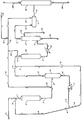
- the drawing is a simplified process flow diagram of a preferred embodiment of the present invention.
- the present invention provides an improved integrated process for the hydroconversion of a feedstock comprising organic compounds which are polymer precursors.
- a feedstock comprising organic compounds which are polymer precursors.
- any feedstock containing organic compounds which are polymer precursors may be processed in one of the preferred embodiments of the present invention, for purposes of convenience the present invention is described in detail while referring to a feedstock containing halogenated diolefinic organic compounds.
- a wide variety of halogenated organic compounds are candidates for feed streams in accordance with one embodiment of the present invention.
- Examples of organic streams comprising halogenated, diolefinic organic compounds which are suitable for treatment by the process of the present invention are by-products from organic monomer and polymer production, hydrocarbonaceous pyrolysis effluents from thermal treatment plants, used lubricating oils, used solvents, halogenated hydrocarbonaceous by-products, oils contaminated with polychlorinated biphenyls (PCB), halogenated wastes, petrochemical by-products, by-products from chlorinated solvent production and other halogenated hydrocarbonaceous industrial wastes.
- PCB polychlorinated biphenyls
- diolefinic, halogenated organic compounds When diolefinic, halogenated organic compounds are present, they may readily be processed in the integrated hydrogenation process of the present invention.
- the diolefinic, halogenated organic feed streams which are contemplated for use in the present invention may also contain organic compounds which include sulfur, oxygen, nitrogen or metal components which may be simultaneously hydrogenated to remove or convert such components as desired.
- the diolefinic, halogenated organic compounds may also contain hydrogen and are therefore then referred to as hydrocarbonaceous compounds.
- Preferred feedstocks containing diolefinic, halogenated organic compounds comprise a component selected from the group consisting of light by-products from the production of vinyl chloride monomer, fractionation column bottoms in the production of carbon tetrachloride, trichloroethylene and perchloroethylene, residues from the production of styrene, phenol and cumene, used chlorinated solvents, chloroprene, epoxy containing streams, thermal or pyrolysis process effluents and mixed industrial waste liquors.
- the diolefinic, halogenated organic compounds which are contemplated as feedstocks in the present invention preferably contain a halogen selected from the group consisting of chlorine, bromine and fluorine.
- a feedstock comprising diolefinic, halogenated organic compounds is introduced in admixture with a hydrogenated recycle liquid containing dissolved hydrogen into a first catalytic hydrogenation zone containing hydrogenation catalyst and maintained at mild hydrogenation conditions selected to minimize a hydrogen-rich gaseous phase and to selectively hydrogenate halogenated, diolefinic organic compounds.
- This selective hydrogenation reduces the concentration of diolefinic compounds, for example, which possess the greatest tendency to form polymers and other high molecular weight compounds. This permits the feedstock to be further treated by hydrogenation without experiencing undesirable polymerization and the concomitant plugging of the process equipment.
- This first catalytic hydrogenation zone may contain a fixed, ebullated or fluidized catalyst bed.
- This first zone is preferably maintained under liquid phase condition and operated at mild conditions which are chosen to selectively saturate diolefinic halogenated organic compounds while simultaneously preventing the formation of polymers or higher molecular weight carbonaceous material.
- the first reaction zone conditions include an imposed pressure from atmospheric (101.3 kPa gauge) to 2,000 psig (13895 kPa) and more preferably under a pressure from 100 psig (793 kPa) to 1800 psig (12515 kPa).
- the reaction is conducted with a maximum catalyst bed temperature in the range of 104°F (40°C) to 650°F (343°C) selected to perform the desired saturation of diolefinic, halogenated organic compounds in order to reduce or eliminate the propensity of the diolefinic feed stream to form polymers and gum which are undesirable for further use or processing of the resulting hydrocarbonaceous stream.
- a maximum catalyst bed temperature in the range of 104°F (40°C) to 650°F (343°C) selected to perform the desired saturation of diolefinic, halogenated organic compounds in order to reduce or eliminate the propensity of the diolefinic feed stream to form polymers and gum which are undesirable for further use or processing of the resulting hydrocarbonaceous stream.
- the operating conditions also include liquid hourly space velocities (LHSV) in the range from 0.05 to 40 h -1 and combined feed ratios (defined as the sum of the fresh feed rate and the hydrogenated recycle liquid rate divided by the fresh feed rate) from 0.1 to 100 and more preferably from 1 to 10.
- LHSV liquid hourly space velocities
- the resulting effluent from the first hydrogenation reaction zone is admixed with a hydrogen-rich gaseous stream to prepare a liquid containing dissolved hydrogen.
- This liquid is prepared in a saturator wherein at least a portion of the effluent is intimately contacted with a hydrogen-rich gas in the absence of a catalyst at operating conditions which preferably include a pressure which is essentially equal to the pressure maintained in the first hydrogenation reaction zone and at a temperature which prevents the boiling of the liquid.
- the amount of hydrogen-rich gas introduced into the saturator is not critical as long as a sufficient quantity is present to ensure the saturation of the liquid with hydrogen gas.
- a first portion of the resulting liquid containing dissolved hydrogen is introduced into the first catalytic hydrogenation zone in admixture with the fresh feedstock as described above.
- Another portion of the liquid containing dissolved hydrogen is introduced into a second catalytic hydrogenation zone containing hydrogenation catalyst and maintained at hydrogenation conditions.
- This second catalytic hydrogenation zone may contain a fixed, ebullated or fluidized catalyst bed.
- the second hydrogenation zone may contain one or more catalyst zones to aid in the temperature control of the highly exothermic hydrogenation reaction.
- the operating conditions selected for this catalytic hydrogenation zone are selected primarily to completely saturate and to dehalogenate the halogenated organic compounds which are introduced thereto and these operating conditions are generally more severe, i.e., promote greater hydrogenation than the operating conditions utilized in the first catalytic hydrogenation zone which conditions are selected to primarily hydrogenate diolefin compounds.
- This second catalytic hydrogenation zone is maintained under an imposed pressure from atmospheric (101.3 kPa) to 2000 psig (13895 kPa) and more preferably under a pressure from 100 psig (793 kPa gauge) to 1800 psig (13895 kPa).
- the reaction is conducted with a maximum catalyst bed temperature in the range of 122°F (50°C) to 850°F (454°C) selected to perform the desired hydrogenation and dehalogenation conversion to significantly reduce the concentration of halogenated organic compounds contained in the charge to this second hydrogenation zone.
- the desired hydrogenation conversion includes, for example, dehalogenation, desulfurization, denitrification, olefin saturation, oxygenate conversion and hydrocracking.
- the operating conditions also include LHSV in the range from 0.05 to 20 h.
- SCFB standard cubic feet per barrel
- the temperature of this stream may be adjusted either upward or downward in order to achieve the desired temperature in the catalytic hydrogenation zone.
- Such a temperature adjustment may be accomplished, for example, by either indirect heat exchange or by the addition of either cool or hot hydrogen.
- the hydrocarbonaceous effluent containing at least one water-soluble hydrogen halide compound from the second hydrogenation zone is contacted with an absorber solution to recover the water-soluble hydrogen halide compound and to provide a hydrogenated hydrocarbonaceous liquid phase and a hydrogen-rich gaseous phase.
- the contact of the hydrocarbonaceous effluent from the second hydrogenation zone with the absorber solution may be performed in any convenient manner and in one embodiment is preferably conducted by a countercurrent contacting of the hydrocarbonaceous effluent with water or a lean aqueous scrubbing solution in an absorber or an absorption zone.
- An absorber solution rich in water-soluble hydrogen halide is then recovered from the absorber and may be used as recovered or may be regenerated to provide a lean absorber solution which may be recycled to the absorber to accept additional water-soluble hydrogen halide.
- the absorber solution is preferably introduced into the absorber in an amount from 1 to 20 times the mass flow rate of the total feedstock charged to the second hydrogenation zone based on the composition of the effluent from the second hydrogenation zone.
- the absorber is preferably operated at conditions which include a temperature from 32°F (0°C) to 300°F (149°C) and a pressure from atmospheric (101.3 kPa) to 2000 psig (13895 kPa).
- the absorber is preferably operated at essentially the same pressure as the second hydrogenation zone subject to fluid flow pressure drop.
- the absorber solution is selected depending on the characteristics of the organic feed stream introduced into the second hydrogenation zone.
- the absorber solution preferably contains water or a lean aqueous absorber solution containing a water-soluble hydrogen halide. This permits the subsequent recovery and use of a desirable and valuable hydrogen halide compound.
- the final selection of the absorber solution is dependent upon the particular hydrogen halide compounds which are present and the desired end product.
- the resulting effluent from the absorber containing hydrogenated hydrocarbonaceous liquid phase and a hydrogen-rich gaseous phase is recovered and introduced into a vapor-liquid separator.
- the vapor-liquid separator is operated at conditions to provide a hydrogen-rich gaseous stream which is suitable for recycle and is preferably recycled together with fresh make-up hydrogen for further use in the process.
- a liquid hydrogenated hydrocarbonaceous stream is also recovered and removed from the vapor-liquid separator.
- the preferred catalytic composites disposed within the hereinabove described hydrogenation zones can be characterized as containing a metallic component having hydrogenation activity, which component is combined with a suitable refractory carrier material of either synthetic or natural origin.
- a suitable refractory carrier material of either synthetic or natural origin.
- Preferred carrier materials are alumina, silica, carbon and mixtures thereof.
- Suitable metallic components having hydrogenation activity are those selected from the group comprising the metals of Groups VI-B and VIII of the Periodic Table, as set forth in the Periodic Table of the Elements , E. H. Sargent and Company, 1964.
- the catalytic composites may comprise one or more metallic components from the group of molybdenum, tungsten, chromium, iron, cobalt, nickel, platinum, palladium, iridium, osmium, rhodium, ruthenium, and mixtures thereof.
- concentration of the catalytically active metallic component, or components is primarily dependent upon a particular metal as well as the physical and/or chemical characteristics of the particular organic feedstock.
- the metallic components of Group VI-B are generally present in an amount within the range of from 1 to 20 weight percent, the iron-group metals in an amount within the range of 0.2 to 10 weight percent, whereas the noble metals of Group VIII are preferably present in an amount within the range of from 0.1 to 5 weight percent, all of which are calculated as if these components existed within the catalytic composite in the elemental state.
- hydrogenation catalytic composites may comprise one or more of the following components: cesium, francium, lithium, potassium, rubidium, sodium, copper, gold, silver, cadmium, mercury and zinc.
- Preferred hydrogenation catalysts comprise alumina and palladium.
- the resulting hydrogenated hydrocarbonaceous liquid phase which preferably comprises less than about 0.1% of the halogenated organic compounds processed is in one embodiment of the present invention recovered from the hydrogen-rich gaseous phase in a separation zone as described hereinabove which is maintained at essentially the same pressure as the absorption zone and, as a consequence, contains dissolved hydrogen and low molecular weight normally gaseous hydrocarbons if present.
- the hydrogenated hydrocarbonaceous liquid phase comprising the hereinabove mentioned gases be stabilized in a convenient manner, such as, for example, by stripping or flashing to remove the normally gaseous components to provide a stable hydrogenated distillable hydrocarbonaceous product.
- a significant portion of the hydrogenated hydrocarbonaceous product may comprise methane, ethane, propane, butane, hexane and admixtures thereof.
- An adsorbent/stripper arrangement may conveniently be used to recover methane and ethane. Fractionation may conveniently be used to produce purified product streams such as liquid propane or LPG containing propane and butane.
- a diolefinic halogenated organic feed stream comprising halogenated organic compounds is introduced into the process via conduit 1 and is contacted with a hydrogenated recycle liquid containing dissolved hydrogen which is provided via conduit 8.
- the diolefinic, halogenated organic feed stream comprising halogenated organic compounds and the hydrogenated recycle liquid containing dissolved hydrogen are introduced into hydrogenation reaction zone 2 via conduit 1.
- the resulting hydrogenated organic stream having a reduced concentration of diolefinic compounds is removed from hydrogenation reaction zone 2 via conduit 3, is admixed with a hydrogen-rich gaseous recycle stream provided by conduit 18 and introduced into saturator 4 which is operated at a temperature and pressure sufficient to dissolve the required hydrogen.
- a portion of the hydrogenated liquid containing dissolved hydrogen gas is removed from saturator 4 via conduit 6, pump 7 and conduit 8 to provide the hydrogenated recycle liquid previously mentioned. Another portion of the hydrogenated liquid containing dissolved hydrogen is removed from saturator 4 via conduit 6, pump 7, conduit 9 and conduit 5, and introduced into hydrogenation zone 10.
- a hydrogen-rich gaseous stream is removed from saturator 4 via conduit 5 and introduced into hydrogenation zone 10.
- a hydrogen-rich gaseous recycle stream provided by conduit 18, 20 and 5 is also introduced into hydrogenation zone 10.
- the resulting hydrogenated hydrocarbonaceous stream is removed from hydrogenation reaction zone 10 via conduit 11, is cooled in heat exchanger 12 and introduced into absorber 13 via conduit 11.
- the hydrocarbonaceous stream is contacted in a countercurrent flow with a halide-lean absorber solution which is introduced via conduit 14.
- a halide-rich absorber solution is removed from absorber 13 via conduit 15.
- a resulting stream containing hydrogenated hydrocarbonaceous compounds is removed from absorber 13 via conduit 16 and introduced into high pressure vapor-liquid separator 17.
- a hydrogen-rich gaseous stream is removed from high pressure vapor-liquid separator 17 via conduit 18 and recycled to zones 10 and 4. Since hydrogen is lost in the process by means of a portion of the hydrogen being dissolved in the exiting liquid hydrocarbon and hydrogen being consumed during the hydrogenation reaction, it is necessary to supplement the hydrogen-rich gaseous stream with make-up hydrogen from some suitable external source, for example, a catalytic reforming unit or a hydrogen plant.
- Make-up hydrogen may be introduced into the system at any convenient and suitable point, and is introduced in the drawing via conduit 19.
- a liquid hydrogenated hydrocarbonaceous stream comprising hydrogen in solution is removed from high pressure vapor-liquid separator 17 via conduit 21 and is introduced into low pressure vapor-liquid separator 22.
- a gaseous stream comprising hydrogen and any normally gaseous hydrocarbons present is removed from low pressure vapor-liquid separator 22 via conduit 23 and recovered.
- a normally liquid distillable hydrogenated hydrocarbonaceous product is removed from low pressure vapor-liquid separator 22 via conduit 24 and recovered.
- the low pressure vapor-liquid separator 22 may be necessarily operated at a pressure in the range from 300 psig (2172 kPa) to 500 psig (3550 kPa).
- a diolefinic, halogenated organic feedstock having the characteristics presented in Table 1 is charged at a rate of 100 mass units per hour to a first hydrogenation zone together with a hydrogenated recycle liquid containing 0.3 mass units of dissolved hydrogen in an amount of 1400 mass units per hour (a corresponding combined feed ratio of 15).
- Table 1 Diolefinic, Halogenated Organic Feedstock Properties Specific Gravity @60°F (15°C) 1.37 Distillation, °C IBP 0 5 55 10 65 50 84 90 130 95 150 EP 200 % Over 99 % Residue 1 Composition, Weight Percent Chloroprene 6 Chlorinated Olefins 15 Chlorinated Saturates 78 Chlorinated Aromatics 1
- Table 2 Combined Feed to the First Hydrogenation Zone Composition, Weight Percent Chloroprene 0.4 Chlorinated Olefins 20.6 Chlorinated Saturates 78.0 Chlorinated Aromatics 1.0 Dissolved Hydrogen ⁇ 0.01
- the first hydrogenation zone contains a palladium hydrogenation catalyst and is operated at conditions which include a pressure of 955 psig (6688 kPa), a temperature of 185°F (85°C) and a LHSV of 2 hr -1 .
- the chloroprene component (1,3 dichloro butadiene) of the feedstock is selectively hydrogenated in a substantially liquid phase reaction.
- the resulting effluent from the first hydrogenation zone is contacted with a hydrogen-rich gaseous stream in the absence of a catalyst and under conditions selected to saturate the liquid with dissolved hydrogen and then is split into two portions, the first of which is used as the hereinabove described hydrogenated recycle liquid and the second portion (-100 mass units) of which is admixed with a hydrogen rich recycle gas stream and introduced into a second hydrogenation zone.
- the second hydrogenation zone is operated to dechlorinate the feedstock and to concomitantly produce hydrogen chloride with a palladium promoted catalyst at conditions which include a pressure of 945 psig (6619 kPa), an outlet temperature of 550°F (288°C) and LHSV of 0.15 hr -1 .
- the resulting effluent from the second hydrogenation zone (see Table 3) is in the vapor phase and is introduced into a hydrogen chloride absorption zone wherein the vapor phase is contacted with a halogen-lean absorber solution to remove and recover the hydrogen chloride in an amount of about 73 mass units.
- Table 3 Second Hydrogenation Zone Effluent Vapor Composition, Weight Percent Hydrogen Chloride 58.8 Hydrocarbon 20.4 Chlorinated Saturate 0.8 Hydrogen 20
- the hydrogen chloride absorber is operated at 900 psig (6309 kPa) and 200°F (93.3°C), and is greater than 99% efficient in the removal of hydrogen chloride.
- the resulting vapor leaving the hydrogen chloride absorber is chilled and the hydrocarbons are partially condensed in a high pressure separator.
- a hydrogen-rich gaseous phase is removed from the high pressure separator and recycled.
- the net hydrocarbon liquid is removed from the high pressure separator and introduced into a separation zone wherein the liquid hydrocarbon is further recovered from elemental hydrogen gas.
Landscapes
- Chemical & Material Sciences (AREA)
- Organic Chemistry (AREA)
- General Chemical & Material Sciences (AREA)
- Oil, Petroleum & Natural Gas (AREA)
- Chemical Kinetics & Catalysis (AREA)
- Engineering & Computer Science (AREA)
- Business, Economics & Management (AREA)
- Emergency Management (AREA)
- Health & Medical Sciences (AREA)
- Toxicology (AREA)
- General Health & Medical Sciences (AREA)
- Production Of Liquid Hydrocarbon Mixture For Refining Petroleum (AREA)
- Organic Low-Molecular-Weight Compounds And Preparation Thereof (AREA)
- Low-Molecular Organic Synthesis Reactions Using Catalysts (AREA)
- Fire-Extinguishing Compositions (AREA)
- Treating Waste Gases (AREA)
- Exhaust Gas Treatment By Means Of Catalyst (AREA)
- Separation, Recovery Or Treatment Of Waste Materials Containing Plastics (AREA)
Applications Claiming Priority (1)
| Application Number | Priority Date | Filing Date | Title |
|---|---|---|---|
| US07/430,394 US5068484A (en) | 1989-11-02 | 1989-11-02 | Process for the hydroconversion of a feedstock comprising organic compounds having a tendency to readily form polymer compounds |
Publications (2)
| Publication Number | Publication Date |
|---|---|
| EP0541871A1 EP0541871A1 (en) | 1993-05-19 |
| EP0541871B1 true EP0541871B1 (en) | 1996-08-21 |
Family
ID=23707374
Family Applications (1)
| Application Number | Title | Priority Date | Filing Date |
|---|---|---|---|
| EP91310595A Expired - Lifetime EP0541871B1 (en) | 1989-11-02 | 1991-11-15 | Hydroconversion of a waste feedstock comprising highly reactive organic compounds |
Country Status (8)
| Country | Link |
|---|---|
| US (1) | US5068484A (OSRAM) |
| EP (1) | EP0541871B1 (OSRAM) |
| JP (1) | JP2572175B2 (OSRAM) |
| AU (1) | AU642310B2 (OSRAM) |
| CA (1) | CA2055676C (OSRAM) |
| DE (1) | DE69121573T2 (OSRAM) |
| ES (1) | ES2090260T3 (OSRAM) |
| TW (1) | TW198019B (OSRAM) |
Families Citing this family (18)
| Publication number | Priority date | Publication date | Assignee | Title |
|---|---|---|---|---|
| DE19524969A1 (de) * | 1995-07-08 | 1997-01-09 | Huels Chemische Werke Ag | Verfahren zur Herstellung von 3.3.5-Trimethylcyclohexanon |
| CN1042528C (zh) * | 1993-04-24 | 1999-03-17 | 中国科学院大连化学物理研究所 | 卤代烃催化加氢脱卤反应 |
| US5401894A (en) * | 1994-06-07 | 1995-03-28 | Uop | Process for the treatment of halogenated organic feedstocks |
| DE4426391C1 (de) * | 1994-07-26 | 1995-12-14 | Leuna Katalysatoren Gmbh | Verfahren zur vollständigen Hydrodechlorierung von Chlorkohlenwasserstoffen |
| EP0714875A1 (en) * | 1994-11-28 | 1996-06-05 | The Dow Chemical Company | Hydrogenation of halogenated compounds |
| US5659108A (en) * | 1995-07-07 | 1997-08-19 | The Dow Chemical Company | Process for the complete saturation of halogenated hydrocarbon streams containing unsaturated compounds |
| WO1997003035A1 (en) * | 1995-07-07 | 1997-01-30 | The Dow Chemical Company | Integrated process for handling saturated and unsaturated chlorinated hydrocarbonaceous waste and by-products from allyl chloride and propylene oxide processes |
| DE19524971A1 (de) * | 1995-07-08 | 1997-01-09 | Huels Chemische Werke Ag | Verfahren zur katalytischen Selektivhydrierung von mehrfach ungesättigten organischen Substanzen |
| DE19524970A1 (de) * | 1995-07-08 | 1997-01-09 | Huels Chemische Werke Ag | Verfahren zur Herstellung von 2-Ethylhexanal |
| US5787206A (en) * | 1996-05-30 | 1998-07-28 | Xerox Corporation | Method and system for processing image information using expanded dynamic screening and error diffusion |
| US7128828B1 (en) | 2001-01-12 | 2006-10-31 | Uop Llc | Process for producing food grade wax |
| US7153807B2 (en) | 2003-03-04 | 2006-12-26 | Exxon Mobil Chemical Patents Inc. | Catalysts for selective hydrogenation of alkynes and alkadienes |
| US7038097B2 (en) | 2003-03-04 | 2006-05-02 | Exxonmobil Chemical Patents Inc. | Dual bed process using two different catalysts for selective hydrogenation of acetylene and dienes |
| FR3103822B1 (fr) * | 2019-12-02 | 2022-07-01 | Ifp Energies Now | Procede de traitement d’huiles de pyrolyse de plastiques en vue de leur valorisation dans une unite de vapocraquage |
| FR3107530B1 (fr) * | 2020-02-21 | 2022-02-11 | Ifp Energies Now | Procede optimise de traitement d’huiles de pyrolyse de plastiques en vue de leur valorisation |
| FR3122663B1 (fr) * | 2021-05-07 | 2024-04-26 | Ifp Energies Now | Procede integre de traitement d’huiles de pyrolyse de plastiques et/ou de combustibles solides de recuperation chargees en impuretes |
| GB2601407B (en) * | 2021-09-28 | 2024-04-24 | Clean Planet Energy A Trading Name Of Pyroplast Energy Ltd | Method of upgrading highly olefinic oils derived from waste plastic pyrolysis |
| FR3145000A1 (fr) * | 2023-01-12 | 2024-07-19 | Totalenergies Onetech | Procede de production de fluides |
Family Cites Families (16)
| Publication number | Priority date | Publication date | Assignee | Title |
|---|---|---|---|---|
| US2529590A (en) * | 1950-11-14 | Preparation of a hydrocarbon | ||
| US2328707A (en) * | 1937-06-10 | 1943-09-07 | Clar Carl | Dechlorination of hydrocarbon mixtures |
| US2504919A (en) * | 1946-06-18 | 1950-04-18 | Du Pont | Preparation of olefinic compounds |
| US2744940A (en) * | 1952-07-10 | 1956-05-08 | Universal Oil Prod Co | Chlorination of saturated hydrocarbons |
| US2886605A (en) * | 1954-10-11 | 1959-05-12 | Dow Chemical Co | Method of reducing the halogen content of halohydrocarbons |
| US3133013A (en) * | 1961-01-23 | 1964-05-12 | Universal Oil Prod Co | Hydrorefining of coke-forming hydrocarbon distillates |
| DE1184336B (de) * | 1963-07-10 | 1964-12-31 | Huels Chemische Werke Ag | Verfahren zur Entfernung von Methylacetylen und Propadien aus einem ueberwiegend Propen enthaltenden C-Kohlenwasserstoffgemisch |
| US3595931A (en) * | 1968-05-28 | 1971-07-27 | Gulf Research Development Co | Hydrogenolysis of aromatic halides |
| US3592864A (en) * | 1969-06-27 | 1971-07-13 | Universal Oil Prod Co | Hydrogenation of benzene to cyclohexane |
| DE3626227A1 (de) * | 1986-08-02 | 1988-02-04 | Basf Ag | Verfahren zur herstellung von indanen |
| US4747937A (en) * | 1986-11-24 | 1988-05-31 | Uop Inc. | Process for the removal of hydrogenatable hydrocarbonaceous compounds from a hydrocarbonaceous stream and hydrogenating these compounds |
| US4818368A (en) * | 1987-10-28 | 1989-04-04 | Uop Inc. | Process for treating a temperature-sensitive hydrocarbanaceous stream containing a non-distillable component to produce a hydrogenated distillable hydrocarbonaceous product |
| US4899001A (en) * | 1988-11-21 | 1990-02-06 | Uop | Process for the simultaneous hydroconversion of a first feedstock comprising unsaturated, halogenated organic compounds and a second feedstock comprising saturated, halogenated organic compounds |
| US4929781A (en) * | 1988-11-30 | 1990-05-29 | Uop | Process for the simultaneous hydroconversion of a first feedstock comprising unsaturated, halogenated organic compounds and a second feedstock comprising saturated, halogenated organic compounds |
| US4895995A (en) * | 1988-12-02 | 1990-01-23 | Uop | Process for the simultaneous hydroconversion of a first feedstock comprising unsaturated, halogenated organic compounds and a second feedstock comprising saturated, halogenated organic compounds |
| US5013424A (en) * | 1990-07-30 | 1991-05-07 | Uop | Process for the simultaneous hydrogenation of a first feedstock comprising hydrocarbonaceous compounds and having a non-distillable component and a second feedstock comprising halogenated organic compounds |
-
1989
- 1989-11-02 US US07/430,394 patent/US5068484A/en not_active Expired - Lifetime
-
1991
- 1991-11-15 EP EP91310595A patent/EP0541871B1/en not_active Expired - Lifetime
- 1991-11-15 DE DE69121573T patent/DE69121573T2/de not_active Expired - Fee Related
- 1991-11-15 ES ES91310595T patent/ES2090260T3/es not_active Expired - Lifetime
- 1991-11-15 CA CA002055676A patent/CA2055676C/en not_active Expired - Fee Related
- 1991-11-19 TW TW080109081A patent/TW198019B/zh active
- 1991-11-19 AU AU87988/91A patent/AU642310B2/en not_active Ceased
- 1991-11-25 JP JP3308980A patent/JP2572175B2/ja not_active Expired - Fee Related
Also Published As
| Publication number | Publication date |
|---|---|
| US5068484A (en) | 1991-11-26 |
| ES2090260T3 (es) | 1996-10-16 |
| CA2055676C (en) | 2002-01-22 |
| JP2572175B2 (ja) | 1997-01-16 |
| DE69121573D1 (de) | 1996-09-26 |
| CA2055676A1 (en) | 1993-05-16 |
| TW198019B (OSRAM) | 1993-01-11 |
| EP0541871A1 (en) | 1993-05-19 |
| AU8798891A (en) | 1993-05-27 |
| AU642310B2 (en) | 1993-10-14 |
| DE69121573T2 (de) | 1997-01-02 |
| JPH05137961A (ja) | 1993-06-01 |
Similar Documents
| Publication | Publication Date | Title |
|---|---|---|
| EP0432323B1 (en) | Simultaneous hydrodehalogenation of two streams containing halogenated organic compounds | |
| US4929781A (en) | Process for the simultaneous hydroconversion of a first feedstock comprising unsaturated, halogenated organic compounds and a second feedstock comprising saturated, halogenated organic compounds | |
| US4899001A (en) | Process for the simultaneous hydroconversion of a first feedstock comprising unsaturated, halogenated organic compounds and a second feedstock comprising saturated, halogenated organic compounds | |
| US5013424A (en) | Process for the simultaneous hydrogenation of a first feedstock comprising hydrocarbonaceous compounds and having a non-distillable component and a second feedstock comprising halogenated organic compounds | |
| CA2055676C (en) | Hydroconversion of a waste feedstock comprising highly reactive organic compounds | |
| US5401894A (en) | Process for the treatment of halogenated organic feedstocks | |
| US5354931A (en) | Process for hydrotreating an organic feedstock containing oxygen compounds and a halogen component | |
| US4818368A (en) | Process for treating a temperature-sensitive hydrocarbanaceous stream containing a non-distillable component to produce a hydrogenated distillable hydrocarbonaceous product | |
| AU666815B2 (en) | Suppression of carbonaceous deposits in a process for hydrotreating an organic feedstock containing unstable olefinic compounds | |
| EP0360406B1 (en) | Treating a temperature-sensitive hydrocarbonaceous stream containing a non-distillable component | |
| US5723706A (en) | Process for the treatment of halogenated organic feedstocks | |
| US4840721A (en) | Process for treating a temperature-sensitive hydrocarbonaceous stream containing a non-distillable component to produce a hydrogenated distillable hydrocarbonaceous product | |
| EP0306164B1 (en) | Hydrogenating a temperature sensitive hydrocarbonaceous waste stream | |
| US5384037A (en) | Integrated process for the production of distillate hydrocarbon | |
| US5316663A (en) | Process for the treatment of halogenated hydrocarbons | |
| US5004533A (en) | Process for treating an organic stream containing a non-distillable component to produce an organic vapor and a solid | |
| KR940009044B1 (ko) | 고반응성 유기 화합물로 이루어진 공급 원료의 수소화 전환방법 | |
| US5773549A (en) | Process for hydrotreating an organic feedstock containing a halogenated component and contaminated with distillable oxygen and nitrogen compounds having boiling points lower than the halogenated compounds | |
| EP0643123A2 (en) | Process for the treatment of halogenated hydrocarbons | |
| US5176816A (en) | Process to produce a hydrogenated distillable hydrocarbonaceous product | |
| US5552037A (en) | Process for the treatment of two halogenated hydrocarbon streams | |
| JP2569273B2 (ja) | 触媒への炭化物析出を抑制するハイドロトリーティング方法 | |
| EP0642810A2 (en) | Process for hydrotreating an organic feedstock containing olefinic compounds and a halogen component | |
| JPH08143479A (ja) | オレフィン系化合物及びハロゲン成分を含む有機フィードストックを水素化処理する方法 |
Legal Events
| Date | Code | Title | Description |
|---|---|---|---|
| PUAI | Public reference made under article 153(3) epc to a published international application that has entered the european phase |
Free format text: ORIGINAL CODE: 0009012 |
|
| AK | Designated contracting states |
Kind code of ref document: A1 Designated state(s): BE CH DE ES FR GB IT LI NL SE |
|
| 17P | Request for examination filed |
Effective date: 19931021 |
|
| 17Q | First examination report despatched |
Effective date: 19941115 |
|
| GRAH | Despatch of communication of intention to grant a patent |
Free format text: ORIGINAL CODE: EPIDOS IGRA |
|
| GRAH | Despatch of communication of intention to grant a patent |
Free format text: ORIGINAL CODE: EPIDOS IGRA |
|
| GRAA | (expected) grant |
Free format text: ORIGINAL CODE: 0009210 |
|
| AK | Designated contracting states |
Kind code of ref document: B1 Designated state(s): BE CH DE ES FR GB IT LI NL SE |
|
| REG | Reference to a national code |
Ref country code: CH Ref legal event code: NV Representative=s name: E. BLUM & CO. PATENTANWAELTE |
|
| ITF | It: translation for a ep patent filed | ||
| REF | Corresponds to: |
Ref document number: 69121573 Country of ref document: DE Date of ref document: 19960926 |
|
| ET | Fr: translation filed | ||
| REG | Reference to a national code |
Ref country code: ES Ref legal event code: FG2A Ref document number: 2090260 Country of ref document: ES Kind code of ref document: T3 |
|
| REG | Reference to a national code |
Ref country code: ES Ref legal event code: FG2A Ref document number: 2090260 Country of ref document: ES Kind code of ref document: T3 |
|
| PLBE | No opposition filed within time limit |
Free format text: ORIGINAL CODE: 0009261 |
|
| STAA | Information on the status of an ep patent application or granted ep patent |
Free format text: STATUS: NO OPPOSITION FILED WITHIN TIME LIMIT |
|
| 26N | No opposition filed | ||
| PGFP | Annual fee paid to national office [announced via postgrant information from national office to epo] |
Ref country code: CH Payment date: 19971126 Year of fee payment: 7 |
|
| PG25 | Lapsed in a contracting state [announced via postgrant information from national office to epo] |
Ref country code: LI Free format text: LAPSE BECAUSE OF NON-PAYMENT OF DUE FEES Effective date: 19981130 Ref country code: CH Free format text: LAPSE BECAUSE OF NON-PAYMENT OF DUE FEES Effective date: 19981130 |
|
| REG | Reference to a national code |
Ref country code: CH Ref legal event code: PL |
|
| REG | Reference to a national code |
Ref country code: GB Ref legal event code: IF02 |
|
| PGFP | Annual fee paid to national office [announced via postgrant information from national office to epo] |
Ref country code: NL Payment date: 20041018 Year of fee payment: 14 |
|
| PGFP | Annual fee paid to national office [announced via postgrant information from national office to epo] |
Ref country code: GB Payment date: 20041110 Year of fee payment: 14 |
|
| PGFP | Annual fee paid to national office [announced via postgrant information from national office to epo] |
Ref country code: FR Payment date: 20041119 Year of fee payment: 14 |
|
| PGFP | Annual fee paid to national office [announced via postgrant information from national office to epo] |
Ref country code: SE Payment date: 20041122 Year of fee payment: 14 |
|
| PGFP | Annual fee paid to national office [announced via postgrant information from national office to epo] |
Ref country code: ES Payment date: 20041209 Year of fee payment: 14 |
|
| PGFP | Annual fee paid to national office [announced via postgrant information from national office to epo] |
Ref country code: BE Payment date: 20041216 Year of fee payment: 14 |
|
| PGFP | Annual fee paid to national office [announced via postgrant information from national office to epo] |
Ref country code: DE Payment date: 20041230 Year of fee payment: 14 |
|
| PG25 | Lapsed in a contracting state [announced via postgrant information from national office to epo] |
Ref country code: IT Free format text: LAPSE BECAUSE OF NON-PAYMENT OF DUE FEES;WARNING: LAPSES OF ITALIAN PATENTS WITH EFFECTIVE DATE BEFORE 2007 MAY HAVE OCCURRED AT ANY TIME BEFORE 2007. THE CORRECT EFFECTIVE DATE MAY BE DIFFERENT FROM THE ONE RECORDED. Effective date: 20051115 Ref country code: GB Free format text: LAPSE BECAUSE OF NON-PAYMENT OF DUE FEES Effective date: 20051115 |
|
| PG25 | Lapsed in a contracting state [announced via postgrant information from national office to epo] |
Ref country code: SE Free format text: LAPSE BECAUSE OF NON-PAYMENT OF DUE FEES Effective date: 20051116 Ref country code: ES Free format text: LAPSE BECAUSE OF NON-PAYMENT OF DUE FEES Effective date: 20051116 |
|
| PG25 | Lapsed in a contracting state [announced via postgrant information from national office to epo] |
Ref country code: BE Free format text: LAPSE BECAUSE OF NON-PAYMENT OF DUE FEES Effective date: 20051130 |
|
| PG25 | Lapsed in a contracting state [announced via postgrant information from national office to epo] |
Ref country code: NL Free format text: LAPSE BECAUSE OF NON-PAYMENT OF DUE FEES Effective date: 20060601 Ref country code: DE Free format text: LAPSE BECAUSE OF NON-PAYMENT OF DUE FEES Effective date: 20060601 |
|
| EUG | Se: european patent has lapsed | ||
| GBPC | Gb: european patent ceased through non-payment of renewal fee |
Effective date: 20051115 |
|
| PG25 | Lapsed in a contracting state [announced via postgrant information from national office to epo] |
Ref country code: FR Free format text: LAPSE BECAUSE OF NON-PAYMENT OF DUE FEES Effective date: 20060731 |
|
| NLV4 | Nl: lapsed or anulled due to non-payment of the annual fee |
Effective date: 20060601 |
|
| REG | Reference to a national code |
Ref country code: FR Ref legal event code: ST Effective date: 20060731 |
|
| REG | Reference to a national code |
Ref country code: ES Ref legal event code: FD2A Effective date: 20051116 |
|
| BERE | Be: lapsed |
Owner name: *UOP Effective date: 20051130 |