EP0533889B1 - Verfahren und anlage zum vermindern von abstandsabhängiger spannungserhöhung bei parallelen hochfrequenzelektroden - Google Patents
Verfahren und anlage zum vermindern von abstandsabhängiger spannungserhöhung bei parallelen hochfrequenzelektroden Download PDFInfo
- Publication number
- EP0533889B1 EP0533889B1 EP92908716A EP92908716A EP0533889B1 EP 0533889 B1 EP0533889 B1 EP 0533889B1 EP 92908716 A EP92908716 A EP 92908716A EP 92908716 A EP92908716 A EP 92908716A EP 0533889 B1 EP0533889 B1 EP 0533889B1
- Authority
- EP
- European Patent Office
- Prior art keywords
- electrode
- compensating
- electrodes
- conductors
- distance
- Prior art date
- Legal status (The legal status is an assumption and is not a legal conclusion. Google has not performed a legal analysis and makes no representation as to the accuracy of the status listed.)
- Expired - Lifetime
Links
Images


Classifications
-
- H—ELECTRICITY
- H05—ELECTRIC TECHNIQUES NOT OTHERWISE PROVIDED FOR
- H05B—ELECTRIC HEATING; ELECTRIC LIGHT SOURCES NOT OTHERWISE PROVIDED FOR; CIRCUIT ARRANGEMENTS FOR ELECTRIC LIGHT SOURCES, IN GENERAL
- H05B6/00—Heating by electric, magnetic or electromagnetic fields
- H05B6/46—Dielectric heating
- H05B6/60—Arrangements for continuous movement of material
-
- D—TEXTILES; PAPER
- D21—PAPER-MAKING; PRODUCTION OF CELLULOSE
- D21F—PAPER-MAKING MACHINES; METHODS OF PRODUCING PAPER THEREON
- D21F5/00—Dryer section of machines for making continuous webs of paper
- D21F5/16—Drying webs by electrical heating
- D21F5/165—Inductive heating; Capacitive heating
-
- F—MECHANICAL ENGINEERING; LIGHTING; HEATING; WEAPONS; BLASTING
- F26—DRYING
- F26B—DRYING SOLID MATERIALS OR OBJECTS BY REMOVING LIQUID THEREFROM
- F26B3/00—Drying solid materials or objects by processes involving the application of heat
- F26B3/32—Drying solid materials or objects by processes involving the application of heat by development of heat within the materials or objects to be dried, e.g. by fermentation or other microbiological action
- F26B3/34—Drying solid materials or objects by processes involving the application of heat by development of heat within the materials or objects to be dried, e.g. by fermentation or other microbiological action by using electrical effects
- F26B3/347—Electromagnetic heating, e.g. induction heating or heating using microwave energy
-
- H—ELECTRICITY
- H05—ELECTRIC TECHNIQUES NOT OTHERWISE PROVIDED FOR
- H05B—ELECTRIC HEATING; ELECTRIC LIGHT SOURCES NOT OTHERWISE PROVIDED FOR; CIRCUIT ARRANGEMENTS FOR ELECTRIC LIGHT SOURCES, IN GENERAL
- H05B6/00—Heating by electric, magnetic or electromagnetic fields
- H05B6/46—Dielectric heating
- H05B6/54—Electrodes
Definitions
- Object of the present invention is a method and an apparatus for the reduction of distance-dependent voltage increase of electrodes occurring in an apparatus comprising parallel, rod-like electrodes connected to a high-frequency voltage source, according is the preamble of claims 1 and 7.
- Electrode structures of said type are used, for example, in heating and/or drying of various material webs, sheets or layers with high-frequency energy.
- the material to be treated in said machines is passed close to the rod-like electrodes, several of which are placed in parallel essentially transversely with respect to the travel direction of the material.
- the parallel electrodes are alternately connected to the high-frequency power supply for the purpose of forming an electromagnetic field between the electrodes to be directed to primarily influence the material to be treated. If the material to be treated contains moisture or otherwise possesses similar dielectric properties, the high-frequency electromagnetic field that is formed between two electrodes mainly is directed to the material to be treated. If the material also has a high dielectric loss factor, the high-frequency field generates a heating effect in the material, which, in turn, results in the desired heating and/or drying of the material.
- Examples of applications for apparatuses of this type are heating of paper web, wood veneer or textile materials with the aim of drying the material or equalizing their moisture content, heating of layers with which the material are coated or which are absorbed in it, after-treatment of bakery products proceeding on a transport conveyor, heating of a powdery or grainy stuff layer proceeding on a conveyor, etc.
- the material to be treated passes as a wide web or mat, across which the electrodes must reach in order to bring about the desired effect.
- Long electrodes are involved with the well known problem of standing waves causing an increase in the voltage with growing distance from the voltage supply point.
- size restrictions of the apparatus and similar structural factors enable voltage supply to the electrodes only from one end, at the most from both ends of the electrode, thus limiting the possibilities to eliminate the voltage increase.
- the above structures have provided a solution for the reduction of voltage increase, in which iductive coils are connected between adjacent electrodes at fixed intervals.
- This arrangement provides a serviceable solution for the reduction of voltage increase, in case it is applicable as far as the other apparatus structure is concerned.
- the solution In paper and wood veneer dryer, for instance, in which some 5-metre electrodes and an alternating voltage frequency of 13.56 MHz are used, the solution is capable of keeping the voltage within the range of ⁇ 5% of the initial voltage (1.5 kV) along the entire electrode. Said solution requires two inductive coil connections along the rods.
- the electrodes are combined into groups of two electrodes, and for them is arranged a common supply by using a supply conductor located between the electrodes at an equal distance from them.
- Supply points are favourably chosen at several points between the ends of the electrodes.
- Compensating of the electrode voltage is also influenced by the fact that the current of the supply cable and the current of the electrode at part of the electrode become opposite, and consequently the resulted induced magnetic fields are also opposite and partly effect in the compensating of the voltage occurring in the electrode.
- the same compensating effect of the opposite magnetic fields generated by the reverse currents in compensating of the electrode voltage is used as in publication FI 55922, although implemented in such a way that the restrictions characteristic of the system known from publication FI 55922 can be avoided.
- this can be achieved so that a magnetic field opposite to the magnetic field of the electrode is generated by arranging a return path for the electrode current from the compensating point at a distance from the electrode ensuring the avoidance of any electric discharges, and reaching to the distance to be compensated, and by connecting this return path essentially at its end with the corresponding return path of each adjacent electrode possessing an opposite potential.
- a compensating conductor is arranged in the vicinity of each electrode, the conductor passing at least at a distance from the electrode ensuring the avoidance of any electric discharge, and reaching over a part of the length of the electrode; that the compensating conductor is connected to the compensating point of the electrode at its end away from the current supply point of the electrode, and, at its other end, to the end of the corresponding compensating conductor of each adjacent electrode.
- Figure 1 illustrates a principal implementation of the method according to the invention for the heat treatment of web-like material
- Figure 2 illustrates a modification of the method.
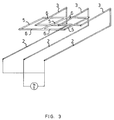
- Figure 3 shows a modification of the adjustment of the compensating coil.
- Figure 1 shows an apparatus intended for the heating treatment of material 1 passing as a continuous web.
- Material 1 can be supposed to be, for instance, paper web.
- the apparatus comprises electrodes 2 arranged to lie across the web and being alternately connected to the opposite potentials of the high-frequency power supply G.
- a conductor 3 is conducted from the opposite end of each electrode with respect to the power supply end, installed substantially parallel to the electrode.
- Conductor 3 is conducted at such a distance from its electrode 2 that the air gap that is formed guarantees a sufficient electric breakdown strength.
- Conductor 3 is stretched over a substantial part of the length of electrode 2, which in practice has proved to be at least two-thirds of the electrode length.
- short-circuit elements 4 are arranged, by which the conductor can be connected to the corresponding conductor of the adjacent electrode.
- Conductor 3 of two adjacent electrodes and the short-circuit element 4 connecting them to each other form a compensating coil.
- the short-circuit elements can be displaced in longitudinal direction with respect to conductors 3 in order to adjust the compensating inductance to be accurate in each case.
- the first basic factor is the mutual distance of the electrode rods 2 in the travel direction or web direction of the material to be processed.
- the need of voltage to be supplied to the electrodes increases with growing distance.
- the increased supply voltage influences the compensating inductances.
- the mutual distance of the electrodes may vary case by case from a few centimetres to tens of centimetres, for example, to dimensions of some 20-30 centimetres. A dimension of 10-15 centimetres can be considered a general value.
- the distance of the inductance coil from the electrodes is primarily determined according to the electric breakdown strength.
- the distance can also be used to affect the compensating inductance; at the greater a distance the inductance coil is located from the electrodes, the smaller the inductance effect is.
- This circumstance can be used for adjusting the compensation effect by varying the distance of the inductance conductors from the electrode at various points of the compensating range.
- a distance of some 20 centimetres can be considered the maximum distance between the electrode and the inductance conductor.
- the diameter of both the electrode and the inductance conductor also has its own effect on the dimensioning of the apparatus. The minimum diameter is determined by the heating caused by the current to be conducted.
- a diameter of some 10-40 mm can be considered conventional, although dimensions even up to some 100 mm occur.
- the electrode rods may also be connected over an inductance or a capacitance to the adjacent rod at the opposite end with respect to the current supply end in order to bring about a phase displacement between the rods.
- the arrangement can be applied in which compensating points are located in sequence over the length of several electrodes 2.
- the compensating inductance coil is formed by conductor 3 connected to the electrode at the compensating point, which is conducted at least at the distance of said electric breakdown strength from the electrode.
- the adjacent coil conductors 3 are connected to each other by an additional coil 7, which is equipped with a short-circuit element 4 provided for the adjustment of inductance at its end.
- the so-called transmission line theory can be applied as a numerical basis, by which, based on given simplifying assumptions, approximative values may be determined for the inductances, and diameter of the inductance conductors and distance from the electrode, if the approximative length according to the two-wire calculation model is known.
- the reducing effect of the inductance coil on the electrode inductance must be considered, which, in addition to other uncertainty factors, results in the need of adding some 10-20% to the calculated length of the inductance coil.
- the final adjustment of the inductance is carried out by experiments on the displacement of the short-circuit element 4.
- a stray-field electrode system is given, with which a 4-metre wide, thin material web, e.g. paper web is heated by using the current supply frequency of 13.56 MHz. Diameters of the electrodes are 50 mm and their mutual distance is 200 mm. The voltage value is assumed to be 5 kV. The required air gap between the inductance conductor and the electrode thus is 50 mm (1 kV/cm). A diameter of 15 mm is chosen for the conductors of the compensating inductances in order to keep the heat development in the conductors under control. The dimension of 3.5 m of the loop, parallel to the electrode, is numerically achieved. To this dimension, an adjusting margin of some 10% is to be added, and thus it can be established that the coil reaches over some 95% of the electrode length.
- Figure 3 shows an implementation alternative to this adjustment.
- a short-circuited inductance coil is located, which is arranged to be adjusted in the longitudinal direction of conductors 3 at its position. By this adjustment at position, the magnitude of the compensating inductance may be influenced.
Landscapes
- Electromagnetism (AREA)
- Physics & Mathematics (AREA)
- Engineering & Computer Science (AREA)
- Microbiology (AREA)
- Life Sciences & Earth Sciences (AREA)
- General Engineering & Computer Science (AREA)
- Biotechnology (AREA)
- Biomedical Technology (AREA)
- Molecular Biology (AREA)
- Mechanical Engineering (AREA)
- Health & Medical Sciences (AREA)
- Physical Or Chemical Processes And Apparatus (AREA)
- General Induction Heating (AREA)
- Solid State Image Pick-Up Elements (AREA)
- Electrostatic Spraying Apparatus (AREA)
- Plasma Technology (AREA)
- Discharge Heating (AREA)
- Medicinal Preparation (AREA)
- Pharmaceuticals Containing Other Organic And Inorganic Compounds (AREA)
- Constitution Of High-Frequency Heating (AREA)
- Drying Of Solid Materials (AREA)
Claims (11)
- Verfahren zur Kompensation eines durch die Entfernung zum Stromversorgungspunkt verursachten Spannungsanstiegs an den Elektroden (2) einer dielektrisches Material verarbeitenden Vorrichtung, die zumindest zwei stabförmige, benachbarte, parallele Elektroden (2) umfaßt, die an einem Ende mit einem jeweils entgegengesetzten Hochfrequenzpotential, zum Beispiel einem Radiofrequenzpotential, verbunden sind, bei dem zumindest entlang eines Abschnittes der Elektrode (2) ein gegenläufiges Magnetfeld in Wechselwirkung mit dem Magnetfeld der Elektrode (2) gebracht wird, dadurch gekennzeichnet, daß das dem Magnetfeld der Elek trode (2) gegenläufige Magnetfeld erzeugt wird durch Einrichten eines Rückweges (3) für den Elektrodenstrom vom Kompensationspunkt aus, der zumindest in einer Entfernung zur Elektrode (2) verläuft, um sicherzustellen, daß keine elektrischen Entladungen auftreten, und der sich über die zu kompensierende Entfernung erstreckt, und daß dieser Rückweg (3) an seinem Ende mit dem entsprechenden Rückweg (3) jeder benachbarten, ein entgegengesetztes Potential aufweisenden Elektrode verbunden ist.
- Verfahren nach Anspruch 1, dadurch gekennzeichnet, daß mehrere Kompensationspunkte entlang der Elektrode angeordnet sind.
- Verfahren nach Anspruch 1 oder 2, dadurch gekennzeichnet, daß ein Rückweg (3) pro Elektrode (2) an jedem Kompensationspunkt angeordnet ist.
- Verfahren nach Anspruch 1 oder 2 , dadurch gekennzeichnet, daß mehrere Rückleiter (3) pro Elektrode (2) an jedem Kompensationspunkt angeordnet sind.
- Verfahren nach einem oder mehreren der vorhergehenden Ansprüche, dadurch gekennzeichnet, daß die Rückwege (3) in verschiedenen Entfernungen von den Elektroden geführt werden.
- Verfahren nach einem oder mehreren der vorhergehenden Ansprüche, dadurch gekennzeichnet, daß die kompensierende Induktanz, die durch zwei benachbarte Rückwege (3) gebildet wird, unter Verwendung einer geschlossenen Induktionsspule angepaßt wird, deren Position in Längsrichtung bezüglich der Elektrode angepaßt wird, und die in gleicher Entfernung oberhalb oder unterhalb des Rückleiters (3) angeordnet ist.
- Vorrichtung zur Durchführung des Verfahrens nach Anspruch 1, die zumindest zwei benachbarte und parallele Elektroden (2) umfaßt, die an ihrem einen Ende mit den entgegengesetzten Polen einer Hochfrequenzspannungsquelle (G) verbunden sind, dadurch gekennzeichnet, daß in der Nachbarschaft einer jeden Elektrode ein kompensierender Leiter (3) angeordnet ist, der in einer Entfernung zur Elektrode verläuft, um sicherzustellen, daß keine elektrischen Entladungen auftreten, und der sich über einen Abschnitt der Elektrodenlänge (2) erstreckt, und daß der kompensierende Leiter (3) mit dem Kompensationspunkt der Elektrode (2) an dem von dem Stromversorgungspunkt der Elektrode (2) weggerichteten Ende verbunden ist, und an seinem anderen Ende mit dem Ende des entsprechenden kompensierenden Leiters (3) einer jeden benachbarten Elektrode (2) verbunden ist.
- Vorrichtung nach Anspruch 7, dadurch gekennzeichnet, daß zwei oder mehrere kompensierende Leiter (3) in Folge entlang der Elektrode (2) vorgesehen sind, und daß jeder der Leiter mit seinem eigenen sequentiellen Kompensationspunkt der Elektrode verbunden ist.
- Vorrichtung nach Anspruch 7 oder 8, dadurch gekennzeichnet, daß der gegenseitige Verbindungspunkt der Enden der kompensierenden Leiter (3) der benachbarten Elektroden (2) bezüglich der Länge des Leiters (3) anpaßbar ist.
- Vorrichtung nach Anspruch 7 oder 8, dadurch gekennzeichnet, daß die kompensierenden Leiter (3) zweier benachbarter Elektroden (2) über miteinander verbundene (4) Leiter (7) verbunden sind, die in induktiver Wechselwirkung zum benachbarten kompensierenden Leiter (3) geführt sind.
- Vorrichtung nach Anspruch 7, dadurch gekennzeichnet, daß eine Induktanzanpassungseinrichtung am gemeinsamen Verbindungspunkt der kompensierenden Leiter (3) der Elektroden (2) angeordnet ist, welche Stäbe (5), die parallel zu den kompensierenden Leitern (3) sind und in gleicher gegenseitiger Entfernung angeordnet sind, und die Stäbe an ihren Enden verbindende Leiter (6) umfaßt.
Applications Claiming Priority (3)
| Application Number | Priority Date | Filing Date | Title |
|---|---|---|---|
| FI911816 | 1991-04-15 | ||
| FI911816A FI87127C (fi) | 1991-04-15 | 1991-04-15 | Foerfarande foer minskande av avstaondsberoende spaenningsstigning i parallella hoegfrekvenselektroder |
| PCT/FI1992/000112 WO1992019082A1 (en) | 1991-04-15 | 1992-04-13 | Method and apparatus for the reduction of distance-dependent voltage increase of parallel high-frequency electrodes |
Publications (2)
| Publication Number | Publication Date |
|---|---|
| EP0533889A1 EP0533889A1 (de) | 1993-03-31 |
| EP0533889B1 true EP0533889B1 (de) | 1995-03-08 |
Family
ID=8532327
Family Applications (1)
| Application Number | Title | Priority Date | Filing Date |
|---|---|---|---|
| EP92908716A Expired - Lifetime EP0533889B1 (de) | 1991-04-15 | 1992-04-13 | Verfahren und anlage zum vermindern von abstandsabhängiger spannungserhöhung bei parallelen hochfrequenzelektroden |
Country Status (8)
| Country | Link |
|---|---|
| US (1) | US5300749A (de) |
| EP (1) | EP0533889B1 (de) |
| JP (1) | JPH05508052A (de) |
| AT (1) | ATE119733T1 (de) |
| CA (1) | CA2085227A1 (de) |
| DE (1) | DE69201617T2 (de) |
| FI (1) | FI87127C (de) |
| WO (1) | WO1992019082A1 (de) |
Families Citing this family (7)
| Publication number | Priority date | Publication date | Assignee | Title |
|---|---|---|---|---|
| DE29517204U1 (de) * | 1995-10-31 | 1997-03-06 | Pollerhoff, Holger, 45279 Essen | Schloß mit sehr hohem Aufbohrschutz |
| US6348679B1 (en) | 1998-03-17 | 2002-02-19 | Ameritherm, Inc. | RF active compositions for use in adhesion, bonding and coating |
| US6649888B2 (en) | 1999-09-23 | 2003-11-18 | Codaco, Inc. | Radio frequency (RF) heating system |
| TW462212B (en) * | 2000-01-12 | 2001-11-01 | Via Tech Inc | Structure and method for decreasing mutual inductance between the adjacent conduction wires on the substrate |
| IT1392998B1 (it) * | 2009-02-12 | 2012-04-02 | Viv Internat S P A | Linea e metodo per il trattamento superficiale di oggetti allungati |
| US10137486B1 (en) * | 2018-02-27 | 2018-11-27 | Chevron U.S.A. Inc. | Systems and methods for thermal treatment of contaminated material |
| CN109176740B (zh) * | 2018-09-30 | 2021-09-17 | 吉荣家具有限公司 | 利用高压气体固定夹合的木材切割悬磁牵引装置 |
Family Cites Families (8)
| Publication number | Priority date | Publication date | Assignee | Title |
|---|---|---|---|---|
| BE554517A (de) * | 1956-01-28 | |||
| CA780997A (en) * | 1964-01-23 | 1968-03-19 | M. Clark John | High frequency heating apparatus |
| DE1565005C3 (de) * | 1965-03-27 | 1975-06-26 | Philips Patentverwaltung Gmbh, 2000 Hamburg | Hochfrequenzerwärmungsgerät mit Hohlleiter |
| US3397454A (en) * | 1965-08-25 | 1968-08-20 | Talon Inc | Method and apparatus for forming composite electrical contacts |
| US3461263A (en) * | 1967-07-31 | 1969-08-12 | Radio Frequency Co Inc | Radio frequency heating apparatus |
| CA898902A (en) * | 1969-06-30 | 1972-04-25 | C. Clark James | H.f. heating apparatus |
| US4670634A (en) * | 1985-04-05 | 1987-06-02 | Iit Research Institute | In situ decontamination of spills and landfills by radio frequency heating |
| SE452077C (sv) * | 1986-03-04 | 1992-12-07 | Blixt Autovision | Anordning foer att reducera ooenskade laeckfaelt upptraedande framfoer katodstraaleroers bildskaerm |
-
1991
- 1991-04-15 FI FI911816A patent/FI87127C/fi not_active IP Right Cessation
-
1992
- 1992-04-13 JP JP92507672A patent/JPH05508052A/ja active Pending
- 1992-04-13 CA CA002085227A patent/CA2085227A1/en not_active Abandoned
- 1992-04-13 EP EP92908716A patent/EP0533889B1/de not_active Expired - Lifetime
- 1992-04-13 WO PCT/FI1992/000112 patent/WO1992019082A1/en not_active Ceased
- 1992-04-13 DE DE69201617T patent/DE69201617T2/de not_active Expired - Fee Related
- 1992-04-13 US US07/952,529 patent/US5300749A/en not_active Expired - Fee Related
- 1992-04-13 AT AT92908716T patent/ATE119733T1/de not_active IP Right Cessation
Also Published As
| Publication number | Publication date |
|---|---|
| CA2085227A1 (en) | 1992-10-16 |
| US5300749A (en) | 1994-04-05 |
| FI87127B (fi) | 1992-08-14 |
| EP0533889A1 (de) | 1993-03-31 |
| DE69201617T2 (de) | 1995-10-26 |
| FI911816A0 (fi) | 1991-04-15 |
| FI87127C (fi) | 1992-11-25 |
| WO1992019082A1 (en) | 1992-10-29 |
| ATE119733T1 (de) | 1995-03-15 |
| DE69201617D1 (de) | 1995-04-13 |
| JPH05508052A (ja) | 1993-11-11 |
| FI911816A7 (fi) | 1992-08-14 |
Similar Documents
| Publication | Publication Date | Title |
|---|---|---|
| US2546004A (en) | Progressive dielectric heating | |
| US4638571A (en) | Radio frequency nozzle bar dryer | |
| JPH10511539A (ja) | 電力の無接触誘導伝送装置 | |
| EP0533889B1 (de) | Verfahren und anlage zum vermindern von abstandsabhängiger spannungserhöhung bei parallelen hochfrequenzelektroden | |
| US6963056B1 (en) | Induction heating of a workpiece | |
| KR20030031112A (ko) | 유도결합을 사용하는 유전성 가열기 | |
| US2802085A (en) | Apparatus for the treatment of plastic materials | |
| GB802254A (en) | Improved method and apparatus for improving the adhesive properties of plastic materials | |
| US20230134296A1 (en) | Transformer Isolator Having RF Shield Structure for Effective Magnetic Power Transfer | |
| JPS6089523A (ja) | 方向性鋼の製造方法及び装置 | |
| US4629851A (en) | Apparatus for heating a layer of dielectric material using radio frequency waves | |
| US2503779A (en) | Device for radio frequency treatment of filamentary material | |
| US2562911A (en) | Dielectric heating system | |
| JP3213998B2 (ja) | 連続的に移送される平坦材料を熱処理するための共振高周波またはマイクロ波印加装置 | |
| CA2014289C (en) | Apparatus for heating a dielectric web or sheet material or for decreasing its moisture content | |
| US3495125A (en) | Quarter-wave transmission line radio frequency voltage step-up transformer | |
| US2765387A (en) | Dielectric heating system | |
| US5345065A (en) | Inductor with variable active length | |
| US3636637A (en) | Method and apparatus for drying liquid deposited on liquid receptive material | |
| DK174056B1 (da) | Fremgangsmåde og apparat til opvarmning af medier ved hjælp af højfrekvente elektromagnetiske bølger | |
| US5818013A (en) | Process and device for inductive cross-field heating of flat metallic material | |
| CA2231324C (en) | Induction load balancer for parallel heating of multiple parts | |
| US2783347A (en) | High-frequency heating systems and applicators | |
| US2583128A (en) | Dual electrode tuning units for electric bonding machines | |
| US2783345A (en) | High-frequency heating applicators |
Legal Events
| Date | Code | Title | Description |
|---|---|---|---|
| PUAI | Public reference made under article 153(3) epc to a published international application that has entered the european phase |
Free format text: ORIGINAL CODE: 0009012 |
|
| 17P | Request for examination filed |
Effective date: 19921202 |
|
| AK | Designated contracting states |
Kind code of ref document: A1 Designated state(s): AT BE CH DE DK ES FR GB GR IT LI LU MC NL SE |
|
| 17Q | First examination report despatched |
Effective date: 19940506 |
|
| GRAA | (expected) grant |
Free format text: ORIGINAL CODE: 0009210 |
|
| AK | Designated contracting states |
Kind code of ref document: B1 Designated state(s): AT BE CH DE DK ES FR GB GR IT LI LU MC NL SE |
|
| PG25 | Lapsed in a contracting state [announced via postgrant information from national office to epo] |
Ref country code: NL Free format text: LAPSE BECAUSE OF FAILURE TO SUBMIT A TRANSLATION OF THE DESCRIPTION OR TO PAY THE FEE WITHIN THE PRESCRIBED TIME-LIMIT Effective date: 19950308 Ref country code: MC Free format text: LAPSE BECAUSE OF NON-PAYMENT OF DUE FEES Effective date: 19950308 Ref country code: LI Effective date: 19950308 Ref country code: GR Free format text: LAPSE BECAUSE OF FAILURE TO SUBMIT A TRANSLATION OF THE DESCRIPTION OR TO PAY THE FEE WITHIN THE PRESCRIBED TIME-LIMIT Effective date: 19950308 Ref country code: ES Free format text: THE PATENT HAS BEEN ANNULLED BY A DECISION OF A NATIONAL AUTHORITY Effective date: 19950308 Ref country code: DK Effective date: 19950308 Ref country code: CH Effective date: 19950308 Ref country code: BE Effective date: 19950308 Ref country code: AT Effective date: 19950308 |
|
| REF | Corresponds to: |
Ref document number: 119733 Country of ref document: AT Date of ref document: 19950315 Kind code of ref document: T |
|
| REF | Corresponds to: |
Ref document number: 69201617 Country of ref document: DE Date of ref document: 19950413 |
|
| PGFP | Annual fee paid to national office [announced via postgrant information from national office to epo] |
Ref country code: DK Payment date: 19950425 Year of fee payment: 4 |
|
| PG25 | Lapsed in a contracting state [announced via postgrant information from national office to epo] |
Ref country code: LU Free format text: LAPSE BECAUSE OF NON-PAYMENT OF DUE FEES Effective date: 19950430 |
|
| ITF | It: translation for a ep patent filed | ||
| REG | Reference to a national code |
Ref country code: CH Ref legal event code: PL |
|
| ET | Fr: translation filed | ||
| NLV1 | Nl: lapsed or annulled due to failure to fulfill the requirements of art. 29p and 29m of the patents act | ||
| PLBE | No opposition filed within time limit |
Free format text: ORIGINAL CODE: 0009261 |
|
| 26N | No opposition filed | ||
| PGFP | Annual fee paid to national office [announced via postgrant information from national office to epo] |
Ref country code: GB Payment date: 19960313 Year of fee payment: 5 |
|
| PGFP | Annual fee paid to national office [announced via postgrant information from national office to epo] |
Ref country code: DE Payment date: 19960314 Year of fee payment: 5 |
|
| PGFP | Annual fee paid to national office [announced via postgrant information from national office to epo] |
Ref country code: FR Payment date: 19960318 Year of fee payment: 5 |
|
| PGFP | Annual fee paid to national office [announced via postgrant information from national office to epo] |
Ref country code: SE Payment date: 19960321 Year of fee payment: 5 |
|
| PG25 | Lapsed in a contracting state [announced via postgrant information from national office to epo] |
Ref country code: GB Effective date: 19970413 |
|
| PG25 | Lapsed in a contracting state [announced via postgrant information from national office to epo] |
Ref country code: SE Effective date: 19970414 |
|
| GBPC | Gb: european patent ceased through non-payment of renewal fee |
Effective date: 19970413 |
|
| PG25 | Lapsed in a contracting state [announced via postgrant information from national office to epo] |
Ref country code: FR Free format text: LAPSE BECAUSE OF NON-PAYMENT OF DUE FEES Effective date: 19971231 |
|
| PG25 | Lapsed in a contracting state [announced via postgrant information from national office to epo] |
Ref country code: DE Free format text: LAPSE BECAUSE OF NON-PAYMENT OF DUE FEES Effective date: 19980101 |
|
| EUG | Se: european patent has lapsed |
Ref document number: 92908716.1 |
|
| REG | Reference to a national code |
Ref country code: FR Ref legal event code: ST |
|
| PG25 | Lapsed in a contracting state [announced via postgrant information from national office to epo] |
Ref country code: IT Free format text: LAPSE BECAUSE OF NON-PAYMENT OF DUE FEES Effective date: 20050413 |