EP0532338A2 - Natursprachenverarbeitungsverfahren mit Rechner - Google Patents
Natursprachenverarbeitungsverfahren mit Rechner Download PDFInfo
- Publication number
- EP0532338A2 EP0532338A2 EP92308276A EP92308276A EP0532338A2 EP 0532338 A2 EP0532338 A2 EP 0532338A2 EP 92308276 A EP92308276 A EP 92308276A EP 92308276 A EP92308276 A EP 92308276A EP 0532338 A2 EP0532338 A2 EP 0532338A2
- Authority
- EP
- European Patent Office
- Prior art keywords
- sentence
- case
- meaning
- word
- imi
- Prior art date
- Legal status (The legal status is an assumption and is not a legal conclusion. Google has not performed a legal analysis and makes no representation as to the accuracy of the status listed.)
- Granted
Links
Images






























Classifications
-
- G—PHYSICS
- G06—COMPUTING OR CALCULATING; COUNTING
- G06F—ELECTRIC DIGITAL DATA PROCESSING
- G06F40/00—Handling natural language data
- G06F40/20—Natural language analysis
- G06F40/253—Grammatical analysis; Style critique
-
- G—PHYSICS
- G06—COMPUTING OR CALCULATING; COUNTING
- G06F—ELECTRIC DIGITAL DATA PROCESSING
- G06F40/00—Handling natural language data
- G06F40/20—Natural language analysis
- G06F40/237—Lexical tools
- G06F40/242—Dictionaries
-
- G—PHYSICS
- G06—COMPUTING OR CALCULATING; COUNTING
- G06F—ELECTRIC DIGITAL DATA PROCESSING
- G06F40/00—Handling natural language data
- G06F40/40—Processing or translation of natural language
- G06F40/55—Rule-based translation
Definitions
- the natural-language processing method proposed in this patent application does not use natural languages directly.
- the natural languages are first converted into data structures which are universal and which are not related to separate human languages, but which accurately express the meaning of each natural language.
- the various intellectual processes mentioned above can be carried out.
- the processing results are re-converted into natural languages so that human beings can easily understand them.
- a natural sentence has various basic characteristics, for example, the same meaning can be expressed in many ways using natural languages, and we must omit certain words which can be easily understood by a person being spoken to.
- words are omitted form a natural sentence because they are assumed to be understood by human beings, but when that natural sentence is converted into a data sentence which will be described later, it turns out that on certain occasions they are essential for carrying out questioning/answering, reasoning, translation, or knowledge acquisition on the computer.
- Questioning/answering and reasoning on a computer are usually performed using pattern-matching, although if various expressions are possible for one meaning, then when we carry out questioning/answering and reasoning regarding the content, we must compose all kinds of natural sentences which can be expressed, and must carry out pattern-matching using all of these sentences.
- the language structures of natural languages will be shown in the form of a multi-layered case-logic structure, as will be described later, in order to explain the language structure of a natural language. Diagrams have been prepared to ensure clarity. However, a data structure for computer use is needed for the actual storage of the letter line of a natural sentence in the computer. In order to make it easy to understand the language structure when it is shown in diagram form, the data structure for the computer corresponds with the language structure shown in the diagrams and the data structures for computer use have been divided into MW and PS.
- MW consists of the word information IMF-M-WD, which in turn consists of the elements WD and CNC, the particle information IMF-M-JO which consists of elements .jr, .jh, .jt, .jpu, .jxp, .jls, .jlg, .jgb, .jcs, .jos, and .jinx, the combination information IMF-CO which consists of elements .B, .N, .L, .MW, .F, .H, .MW, and .RP, and the language information IMF-M-MK which consists of elements .MK, .BK, .LOG, and .KY.
- PS conists of the case information IMF-P-CA which consists of elements -A, -T, -S, -O, -P, and -X, which store the various cases such as the Agent Case (Case A), Time case (Case T), Space Case (Case S), Object Case (Case O), Predicate Case (Case P), and Auxiliary Case (Case X), the particle information IMF-P-JO which consists of elements -jntn, -jn, -jm, and -jost, and the language information IMF-P-MK which consists of elements -MK, -NTN, and -KY.
- MW has many variables (elements).
- Each of the elements .B reads as "dot B", .L, .N, .MW, .F, and .H, stores MW-NO, which is the number of MWs adjoining each element.
- the arrow (-->) symbol shows that the element has a partner to combine with, and that the direction of the partner for combination exists.
- MW has six combination "hands," as shown in Fig. 3.
- the element .B (abbreviation of b efore) stores the number of MWs on the left side of the MW, and forms the relationship(s) of the combination(s) with the MW(s) on the left side of .B.
- the element .N (abbreviation of n ext) stores the number of MWs on the right side of .N, to form the relationship(s)for these combination(s).
- the element .MW stores the number of MWs adjoining the top of .MW, to form the combination relationships.
- the element .F stores the number of MWs or PSs which will be connected to an adverbial phrase, and .H stores the number of PSs or MWs of the object(s) used when expressing real intention, or used metaphorically, to form the relationship(s) for each combination.
- the previously mentioned arrow "-->" symbol shows that an element has a combination partner.
- the combination relationship in the vertical direction, or, in other words, the arrow symbol shows a case combination.
- the number of each combination partner, MW is stored in each element in the computer.
- the number of each MW is stored in each of elements .B, .N, .L, and .MW.
- the partners to be connected with elements .MW and .L are either MW or PS, and it is necessary to classify these.
- the data stored in element .BK is expressed as four digits in hexadecimal notation. When the first digit is "1”, the combination partner of L will be MW, and when the first digit is "e”, PS will be the combination partner for L. When the second digit is "1", MW will be the combination partner for MW, and when the second digit is "e", the combination partner will be PS. Therefore, the relationship for the combination shown in Fig. 4 can be expressed on the computer as shown in Fig. 6.
- MW consists of particles in the information IMF-M-WD, which includes various elements as follows: Element .MK stores information regarding the designation of word order and word position from the viewpoint of language structure, and the varieties of removable cases. Element .BK stores information which shows the classification of the types of partners to be connected with F, MW, and L, the establishment of insertion conditions, and the appropriateness of expressions. Element .LOG stores a variety of logic relationships; element .KY stores information regarding inflection, conjugation, and declention. Element .RP stores the number of each MW in which the same word is inserted, within the meaning frame IMI-FRM, as will be described later.
- Element .mw stores the number of preceeding MW(s) which already have stored word(s) regulated by the articles "ano” (that or “kono” (this) as in “ano Taro” (that Taro) or “kono bohru” (this ball).
- Element .WD which stores words, and element .CNC which regulated the concepts of the words to be inserted.
- the paraticle information IMF-M-JO include various elemnts as follows: .jr stores articles.
- Element .jh stores prefixes.
- Element .jpu stores the plural particles used to express the plural, such as "tachi”.
- Element .jxp stores the logic particles for expressing logical relationships, such as “igai” (there than), “dake” (only), and “nomi” (only).
- Element .jls stores the logic particles which express the logical relationships "to” (and) and “ya” (or).
- Element .jlg stores the logic particles which express the meaningful relationships "-ba” and "-node.”
- Element .jos stores stress particle such as "koso” which emphasize meaning.
- Element .jgb stores the inflective suffix particles which show the suffixes which vary according to the verb.
- Element .jcs stores case particles; and element .jinx stores the coordinates (jindx-x, jindx-y) in the table when case particles are designated using the case particle table JO-TBL.
- Fig. 2 shows the data structure of PS.
- Agent case (Case A, abbreviation of a gent case), the Time case (Case T, abbreviation of t ime case), Space case (Case S, abbreviation of s pace case), Object case (Case O, abbreviation of o bject case), Predicate case (Case P, abbreviation of p redicate case), Extra case (abbreviation of e xtra case), the Yes-No case (case Y, abbreviation of y es-no), and the Zentai case ("entire" case, Case Z, abbreviation of z entai).
- the PS has the elements -A (read as "bar A"), -T, -S, -O, -P, -X, -Y, and -Z, for the purpose of storing the number of each MW that is a partner to be connected by the case combination.
- PS has element -B which stores the number(s) of the MWs or PSs neighboring on its left side, element -N which stores the number of MWs or PSs neighboring on its right side, and element -L which stores the number(s) of the MWs or PSs neighboring below it.
- PS and MW store the number of each combination partner in the corresponding element, as shown by the arrow symbol .
- the PS1s of the combination partners and the varieties of their cases are stored in the element .L parts of MWs 1 - 6.
- Elements -A - -X of PS1 store the numbers of MW, MW1 - MW6 to be connected with.
- MW7 is stored in the element-L of PS1, to indicate that PS1 is vertically combined with MW7 which is located below PS1, and PS1 is stored in element .MW in order to show that MW7 is vertically combined with the PS1 above MW7.
- the above combination relationship(s) can be described as shown in Fig.
- Cases A - X of the PS are vertically connected to MWs 1 - 6. In other words, they are connected by case combinations. MW1 - MW6 are also connected to PS by case combinations, MW7 is connected to PS1 by a case combination, and PS1 is connected to MW7 by a case combination.
- Fig. 11 In Fig. 11, there is only one PS, but usually there are many PSs.
- PS module the group of MWs
- MW module the group of MWs
- PS1 connects vertically to MW7, which is below PS1, and therefore, "7" is entered in element -L.
- the variety of the case combined with is indicated by the first digit of the four hexadecimal digits of element MK, as shown below.
- Case A will be indicated by “1,” Case T will be indicated by “2,” Case S will be indicated by “3,” Case O will be indicated by “4,” Case P will be indicated by “5,” Case X will be indicated by “6,” Case Y will be indicated by “7,” Case Z will be indicated by “E.” Therefore, the MW module of MW1 becomes MK/0001 (The element is shown on the left side of /, and the data is shown on the right side of /.) BK/000e, and L/1, so we find from the above module that MW1 has a case combination relationship with Case A of PS1. MW7 is combined with the PS1 on top of MW7, and therefore, "1" is stored in element .MW.
- Fig. 1 shows the elements of the data structure, MW.
- Fig. 2 shows the elements of the data structure, PS.
- Fig. 3 shows the "combination hands" of the data structure, MW.
- Fig. 4 uses a diagram to indicate that MW1 and MW2 are connected by a logical combination, and that MW1 and MW3 are connected by a case combination.
- Fig. 5 shows the above combinations with their "combination hands”.
- Fig. 6 uses a data sentence to show the relationships for the combinations indicated in Fig. 4, and Fig. 7 shows this by using a structural sentence.
- Fig. 8 shows the combination hands for the data structure, PS.
- Fig. 9 shows the relationships between MW1 - MW7 and PS1, using the combination hands
- Fig. 10 is a diagram showing the relationships between the combinations indicated in Fig. 9.
- Fig. 11 uses a data sentence to show the relationships between the combinations shown in Fig. 10.
- Fig. 12 presents the natural sentence, ⁇ ano Taro ga kyo gurando de kono bohru wo nage ta ⁇ , using a diagrammatic structural sentence; and Fig. 13 presents the natural sentence of Fig. 12, using a data sentence.
- Fig. 14 shows the structural sentence when "Taro”, “kyo”, “gurando”, “bohru”, “nage”, and “nage ta koto" are fetched from the natural sentence mentioned above.
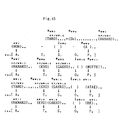
- Fig. 15 shows the natural sentence, ⁇ kyo gurando de bohru wo nage ta Taro ⁇ as a data sentence.
- Figs. 16 - 60 show the natural sentences as structural sentences.
- Fig. 61 shows the PTN-TBL which lists where the meaning frames of words are stored.
- Fig. 62 shows the PS modules of the meaning frame dictionary, and
- Fig. 63 shows the MW modules of the meaning frames.
- Fig. 64 shows the letter spelling dictionary, DIC-ST.
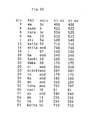
- Fig. 65 shows the word dictionary, DIC-WD,
- Fig. 66 shows the form dictionary, DIC-KT, Fig. 67 shows the form processing dictionary, DIC-KTPROC.
- Figs. 68 - 73 show WS tables.
- Fig. 74 shows an MK table.
- Fig. 75 shows a meaning analysis ( ) program.
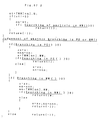
- Fig. 76 shows the AND-OR relationship ( ) program in the "C" language format.
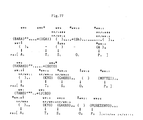
- Fig. 77 shows a natural sentence using a structural sentence;
- Fig. 78 shows the natural sentence described in Fig. 77 in a data sentence.
- Figs. 79 and 80 show MK table.
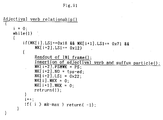
- Figs. 81 and 82 show the contents of the program in the "C" language format.
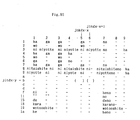
- Fig. 83 shows the "words to be sought and case particles" table, KWDJO-TBL.
- Fig. 84 shows the "words to be sought” table, KWD-TBL.
- Fig. 85 shows the case particle table, JO-TBL.
- Fig. 86 shows a structural sentence and the search path, SR-PT in the sentence;
- Fig. 87 shows this program in the "C" language format.
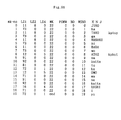
- Figs. 88 - 90 show MK tables.
- Fig. 91 shows a program in the "C" language format.
- Fig. 92 shows the natural sentence, ⁇ genki na Taro ga kyo gakko de shiroi bohru wo nage mashi ta ⁇ , in a data sentence.
- Fig. 93 shows the structural sentence for the above-mentioned natural sentence;
- Figs. 94 and 95 show the programs in the "C" language format.
- Fig. 96 shows the search path entered into the structural sentence.
- Figs. 97 and 98 show MK tables.
- Fig. 99 shows the structural sentence for the natural sentence, ⁇ Jiro ha Taro ga Hankao ni bara wo atae na katta toha omo wa na katta rashii yo ⁇
- Fig. 100 shows the data sentence for the natural sentence given in Fig. 99.
- Fig. 101 shows the search path written in the structural sentence.
- Fig. 102 shows the KWDJO-TBL
- Fig. 103 shows the MK table.
- Fig. 104 shows the data sentence for the natural sentence, ⁇ bara ha Jiro ni yotte Taro ni taishite Hanako ni atae sase rare na katta ⁇ , and Fig. 105 shows its structural sentence.
- Fig. 106 shows the KWDJO-TBL, and Fig. 107 shows the MK table.
- Fig. 108 shows the data sentence for the natural sentence, ⁇ Jiro ha Taro ga Hanako ni okane wo age ta node Hanako ga Tokyo e itta to omo tta ⁇ , and Fig. 109 shows its structural sentence.
- Figs. 110 and 111 show the search path written in the structural sentence
- Figs. 112 and 113 show the KWDJO-TBL
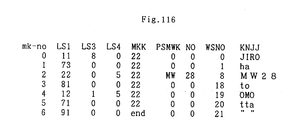
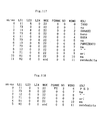
- Figs. 114 - 118 show the MK tables.
- Fig. 119 shows the structural sentence for the natural sentence, ⁇ Taro no Hanako e no bara no purezento wa ari ma sen de shita ⁇ , and Fig. 120 shows the data sentence for this natural sentence.
- Fig. 121 shows the search path written in the above-mentioned structural sentence, and Fig. 122 shows the KWDJO-TBL.
- Fig. 123 shows the natural sentence, ⁇ Taro ka Saburo ga Hanko to Akiko ni bara wo atae ma shita ka? ⁇ in the structural sentence.
- Fig. 124 shows the data sentence.
- Fig. 125 shows the search path written in the structural sentence, and
- Fig. 126 shows the search path divided into short search sections.
- Fig. 127 shows the structural sentence for the natural sentence, ⁇ Jiro ha taro ga Hanako ni bara wo atae na katta towa omo wa na katta rashii yo ⁇ , and Fig. 128 shows the data sentence for this natural sentence.
- Figs. 129 - 131 show the structural sentence.
- Fig. 132 shows the word order table, SQ-TBL.
- Figs 133 and 134 show the output paths written in the structural sentences.
- Fig. 135 shows the GOBI-TBL, which stores the suffix particles, jgb, which inflect according to the conjugation.
- Fig. 136 shows the NTN-TBL, which stores tense negative particles.
- Fig. 137 shows a structural sentence
- Fig. 138 shows its data sentence.
- Fig. 139 shows the structural sentence for the natural sentence, ⁇ Taro ga genki de are ba Taro ha kyo gakko de shiroi bohru wo nage ru ⁇ .
- Fig. 140 shows the structural sentence for the natural sentence, ⁇ X ga neko de are ba X wa shinu ⁇ .
- Fig. 7 shows the structural sentence for the natural sentence, ⁇ Taro ga kyo gakko de Hanako ni hon o atae ru ⁇ , using the PSMW data structure.
- each work is shown by spelling it in letters, such as "Taro.”
- the computer would need a very large memory capacity. Therefore, a code number is used to represent each word.
- the diagram in Fig. 12 shows the language structure of the natural sentence. I have therefore chosen to call this the "structural sentence.”
- the diagram in Fig. 13 shows the expression of a natural sentence using the previously mentioned data structure. I have chosen to call this the "data sentence DT-S.”
- each sentence is considered to be constituted by the above process.
- prohibition of an expression is indicated by the asterisk "*" symbol.
- "Taro,” “kyo,” and “gurando” are not considered to be moved from their positions in the first half of the sentence to the second half; it is considered that he expression of the words in the first half of the sentence is prohibited when creating the natural sentence form the structural sentence. It is not assumed that these words are not stored. These words are actually stored, but the expression of these words is considered to be prohibited. This is extremely important in this patent application. As will be described thoroughly later, when carrying out intellectual processing, such as questioning/answering, translation, reasoning, or acquisition of knowledge, pattern-matching is the main method used.
- each word to be inserted in the element -WD of each MW which is combined with each of the cases, A, T, S, O, and P, will be expressed by attaching numerals to the symbol which shows the case as A1, T1, S1, O1, and P1.
- the structural sentence is a universal language structure and can be used for any language.
- This structural sentence is applicable not only to Japanese but also to English, Chinese, and other languages. In other words, it is a common language structure applicable throughout the world. I am therefore constructing this language structure on a computer, and am using this structure to achieve translations, questioning/answering, knowledge acquisition, and reasoning.
- the natural sentence is constructed according to the previously explained process.
- a natural sentence is ultimately a sentence which stipulates meaning. I'll explain here how the meaning is constructed in the natural sentence, using some examples.
- PS-I is the sentence which shows the state ⁇ -wa -de aru (- is) ⁇ , and its structural sentence is as shown in Fig. 20 (b).
- PS-D is the sentence which shows that a thing or object exerts a certain influence or produces a certain result on another thing or object. This is ⁇ -ga -o suru ⁇ . When this is shown as a structural sentence, it appears as in Fig. 20 (c).
- hito person
- PS-E will correspond to the following natural sentence. ⁇ A1 ga jikan (time) T1 ni kukan (space) S1 de aru ⁇ This sentence, PS-E, is customarily expressed by changing the word order, as shown below. ⁇ Jikan T1 ni kukan S1 de A1 ga aru ⁇ When the expressions in the above sentence are changed to other expressions, it will appear as shown below.
- PS-I will be, ⁇ A1 wa jikan T1 kukan S1 de 01 to iu jutai (condition) de aru ⁇
- PS-I will be as shown below.
- ⁇ Hanako wa ima koko de bijin de aru ⁇ When the above sentence is shown as a structural sentence, this will be as seen in Fig. 21 (b).
- PS-D will be: ⁇ A1 ga jikan T1 kukan S1 de 01 o suru ⁇
- the sentence will be, ⁇ Taro ga ima koko de sore o suru ⁇
- Soshite is the "AND” logical relationship.
- the PS1, ⁇ Taro ga bohru o nage ta ⁇ , and the PS2, ⁇ Jiro ga bohru o nage ta ⁇ have a logical relationship which uses AND. Therefore, we set up MW11 below PS1 and MW12 below PS2, and combine these by the AND relationship, which is the language structure of the above-mentioned sentences.
- the logical relationship is shown using the arrow symbol, .
- the variety of the logical relationship is shown above the ; in this case, it is AND, and the logic particle "soshite" is shown below the arrow.
- Case O of PS-I When Case O of PS-I is changed, it can express a change in the situation (condition).
- Case S When the word to be inserted in Case S can be a conceptual space, and not necessarily a physical space, and when “Taro” is inserted in Case S1, the meaning concept “Taro” will be “Taro no tokoro.”
- “no tokoro” When "no tokoro” is stored as a particle in Case S1, the structural sentence becomes as shown in Fig. 27.
- PS1 When PS1 is inserted on the upper level in Case O2 of PS2 on the lower level, the mark is removed, and the MWs are lined up as they are, the sentence will be as shown below.
- A1 can be an idea or a concept instead of an object.
- ideas and concepts constitute a special content, and therefore it is necessary to stipulate or to indicate clearly that the word to be inserted is an ideal or concept.
- element .CNC in MW.
- the symbol for the idea or concept is stored in this CNC, and is expressed using the symbol CNC/"kangae, gainen".
- PS1 shows that the situation of A1 was initially in Sf, then it passed through Sh and finally existed in St, and it also shows that the action was done by A2 in time T2 and space S2 in the situation shown above.
- "Hakobu” (carry) is stored in element .WD of the MW in Case P2. This means the allotting of a label or symbol expressed by the letter line KNJ of "hakobu” in the meaning structure shown in Fig. 29 (a).
- the MW which can be expressed can sometimes be changed appropriately, as previously mentioned.
- a word cannot be directly inserted into an MW for which expression is prohibited.
- a word can be inserted in the MW for which expression was prohibited by copying the word which is inserted in the element .WD of the MW which can be expressed.
- the MW from which the word should be copied is shown by the element .RP, as previously mentioned.
- Fig. 32 and Fig. 33 both show RPs.
- Time T2 Space S2 spontaneously becomes the status "motte iru" (holding) and Time T3 and Space S3 creates the status "motte iru.” Therefore, T2 and S2 are naturally different from T3 and S3. I do not consider, however, that people use the expression "motte iru” according to rigid stipulations of time and space relationships, and therefore the same words are inserted, as previously mentioned. As mentioned above, the same word is sometimes used many times in the structural sentence in order to clearly stipulate the meaning structure.
- THis diagram shows the process of change for a PS1 which initially existed and then later did not exist. I assume that A2 caused this change in PS2, by time T2 and space S2.
- this meaning structure is "tsukuru” (create), and when it is considered to be CNC/"seimei” (life), “tsukuru” will be “umu” (bear).
- CNC/mono is changed to CNC/gainen (concept)
- the meaning structure will be "kangaeru” (think).
- More varied meaning structures can be created by combining various PSs with various words stipulated by the above-mentioned process.
- new words can be defined when a new word is allotted to the meaning constructed by the above process. For instance, "ukabu” (float) is assumed to have the meaning structure shown in Fig. 39. This is the meaning that ⁇ A2 itself is in a state of existence in or on a gas or liquid, in time T2 and space S2 ⁇ . This is known as an intransitive verb.
- the sentence ⁇ hana ga mizu ni ukabu ⁇ means ⁇ hana wa ⁇ hana ga mizu no ue ni aru ⁇ to iu jotai de aru ⁇ .
- Fig. 40 shows the structural sentence in which "saseru” has been combined with "ukabu.”
- PS3 which contains ⁇ - saseru ⁇ is combined below in the subject sentence ⁇ hana ga ima koko de mizu ni ukabu ⁇ .
- the meaning of this sentence becomes that A3 is done in Time T3 and Space S3 in the situation like this, by this combination with PS3.
- the expression of the causative verb does not actually express time and space rigidly. If I did not assume this, the number of cases in which a word can be inserted will be increased during meaning analysis, and therefore the meaning analysis would become ambiguous, as I will describe later. I have carried out the above-mentioned process here, but some words appear twice. Therefore, I consider the most important MW of the meaning is the MW at the lowest level, and I have designate the expression of T3 and S3 as possible, and prohibited the expression of T2 and S2.
- the meaning "shinu” is contained in the word “korosu,” and therefore the expression of "shinu” in A2 was prohibited.
- the passive voice will be formed by setting up PS-1 to express the ⁇ -reru ⁇ portion of the passive verb, below the root PS or, in other words, by placing the PS at the lowest level of the structural sentence of the subject sentence, and by inserting the entire sentence into its O case.
- Fig. 44 shows the structural sentence for PS-1 of ⁇ -reru ⁇ .
- T of the Time case and S of the Space case of the root PS of the subject sentence will be the same as TP of the Time case and SP of the Space case in this passive PS, just as for a causative verb.
- the words inserted in the "atae ru" structural sentence are the 5 words, "Taro,” “kyo,” “gakko,” “Hanako,” and “hon,” All of these words can be inserted in Case A (A4) of the passive sentence, but the meaning will be completely different for the different cases of the original MW, as I will explain below.
- Fig. 45 shows the structural sentence when "Hanako" of Case A2 is inserted in Case A4, and Fig. 46 shows the structural sentence when "Taro" of Case A3 is inserted in Case A4.
- the sentence in Fig. 45 is as shown below, and it accurately expresses the passive voice. ⁇ Hanako ha kyo gakko de Taro ni-yotte hon o atae rare ta ⁇
- This sentence can be understood as the passive voice version of ⁇ Hon wa - ni atae rare ta ⁇ , and it can also be understood as a potential, for example, as ⁇ Hon wa - ni ataeru koto ga deki ta ⁇ .
- Natural sentence input can be separated into individual words, particles, and symbols by sentence-structure analysis, and can finally be converted to the language structure information IMF-LS.
- Meaning analysis is the operation of creating the meaning frame IMI-FRM, based on this language structure information, and inserting each word, particle, and symbol into this meaning frame.
- the word WD inserted in Case A of the root PS should be inserted in an MW somewhere in that structural sentence; therefore, we must check into which MW the word WD can be correctly inserted.
- There are many ways to check this For instance, set an order of priority while searching the cases, search each empty case according to the order set, and insert the WD into each case according to the order in which the case was found.
- the ⁇ - rashii ⁇ sentence is assumed to have the meaning structure shown in Fig. 49.
- Four digits carrying hexadecimal data are stored in the element .BK of the MW, and these two structural sentences are synthesized by inserting the entire sentence involved into the MW which has an "a" as its 4th digit of data.
- the PS1 at the highest level means, ⁇ A2 (sentence concerned) has some uncertainty ⁇ .
- the PS2 below PS1 means ⁇ A2 (sentence concerned) is in a condition which has some uncertainty ⁇ . In other words, ⁇ A2 (the sentence concerned) is uncertain ⁇ .
- PS3 means ⁇ A4 (I) is (am) in the condition of having A3 (a certain idea) ⁇ . In other words, it means, ⁇ I am in the condition of having the idea that the sentence involved in uncertain ⁇ .
- PS4 means ⁇ in the above-mentioned condition at that time and in that place ⁇ .
- PS3 and PS4 have the same structural sentence, ⁇ - having the idea of - ⁇ or ⁇ think - ⁇ , as explained in Fig. 28.
- A4 is the "speaker," that is, "watashi (I),” Therefore, PS3 and PS4 become, ⁇ I have the idea that - ⁇ or ⁇ I think that - ⁇ . Therefore, ⁇ - rashii ⁇ will have the same meaning as ⁇ I have the idea that - is uncertain ⁇ or ⁇ I think that - is uncertain ⁇ .
- the word ⁇ -rashii ⁇ is considered to contain the meaning "Watashi ga (I),” and the expression “watashi (I)” is prohibited.
- the sentence, ⁇ Taro ga kyo gakko de Hanako ni hon o atae ta rashii ⁇ is the sentence created via a combination, inserting the sentence ⁇ Taro ga kyo gakko de Hanako ni hon o atae ta ⁇ into the MW of the ⁇ - rashii ⁇ sentence marked by "a".
- Fig. 50 shows this structural sentence. It is possible to combine these 2 sentences by writing the number for PS3 into the element .MW of MW20 which has "a" (as its first hexadecimal digit).
- the ⁇ - deki ru ⁇ sentence has the meaning structure shown in Fig. 52.
- the sentence which can be combined is inserted into the MW in Case A2.
- This A2 will then be inserted into Case S1, and therefore PS1 shows that ⁇ There is a possibility for A2 (sentence to be inserted). ⁇ .
- PS1 - PS2 show that ⁇ A2 is possible ⁇ . If the word inserted into the element .
- WD of Case A of the root PS of the sentence to be inserted is assumed to be inserted into the element .
- WD of Case A (MW7) of PS3, and Case T and Case S of the root PS of the sentence to be inserted are assumed to be inserted into Time case T3 and Space case S3; then multiple MWs with the same content will be created.
- Fig. 52 The 4th digit of the hexadecimal data for the element .BK of the root PS of ⁇ - deki ru ⁇ , shown in Fig. 52, is "6," and therefore the expression of Cases A, T, and S of the root PS of the sentence to be inserted is prohibited.
- PS3 shows that ⁇ A3 is such that the content of the sentence inserted is possible in Time case T3 and Space case S3.
- Fig. 51 shows the structural sentence of the following sentence.
- Case P6 of the root PS in Fig. 53 is (can) and Case O6 is ( ).
- Case P6 can be changed to (is) or (a)ru, while Case O6 can be changed to (able) or (kano)de, for the same reasons that apply to the process used for a Japanese sentence.
- Fig. 54 shows the structural sentence after the above-mentioned changes have been made. If a natural sentence is generated from that structural sentence, it will be as shown below.
- Fig. 57 shows the structural sentence of the sentence, ⁇ Hanako wa utsukushi i ⁇ . This meaning structure consists of two PS levels. PS1 shows the meaning, ⁇ Hanako no tokoro ni wa utsukushi sa ga aru ⁇ .
- PS2 shows, ⁇ Hanako wa sono youna jotai de aru ⁇ ; that is, this meaning structure shows ⁇ Hanako wa ⁇ Hanako no tokoro ni utsukushi sa ga aru ⁇ to iu jotai de aru ⁇ .
- "Hanako" is inserted in A2 and S1, so that, when the expression of "Hanako” is prohibited in S1 according to the order of priority, the meaning structure becomes ⁇ Hanako wa ⁇ utsukushi sa ga aru ⁇ to iu jotai de aru ⁇ .
- Fig. 58 shows the structural sentence ⁇ kyo wa atsui ⁇ . More accurately, the above sentence should be ⁇ Taiki wa kyo wa atsui (the air today is hot) ⁇ , however, ⁇ kyo wa atsui (Today is hot) ⁇ is the customary expression in daily use. Therefore, "taiki (air)” is considered to be omitted. In English, “it” is used. The Agent Case cannot be omitted in (standard) English, and therefore, the omitted word, "it” is inserted into the sentence. If PS1 in Fig.
- the verb becomes "motte iru". If this is applied, the above sentence will be, ⁇ Nabe wa takai ondo o motte iru (the pot has a high temperature) ⁇ .
- the expression ⁇ Nabe wa atsui ⁇ includes the expressions ⁇ nabe dewa ondo ga takai (the temperature in the pot is high) ⁇ , ⁇ Nabe wa ondo ga takai (the temperature of the pot is high) ⁇ , and ⁇ Nabe wa takai ondo o motte iru (the pot has a high temperature) ⁇ .
- Case A when Case A is extracted from PS-E which shows the existence of ⁇ - ga iru ⁇ , the sentence becomes as shown above. However, ⁇ otouto no Taro ⁇ is considered to have been extracted (Taro) from the sentence ⁇ Taro wa otouto de aru ⁇ . If this is shown using a structural sentence, it will be as seen in (c). In other words, Case A shall be regard to have been extracted from PS-I, which shows the condition ⁇ -wa -de aru (- is -) ⁇ . The sentence ⁇ A no B (B of A) ⁇ does not show that B of Case A was extracted either from PS-E or from PS-I.
- A is a word which shows an attribute, such as ⁇ otouto (younger brother) ⁇
- ⁇ otouto young brother
- ⁇ -no ⁇ is basically used for expressions that are quite vague, and therefore, when it is difficult to make a judgement about a word, the sentence shall be analyzed using PS-E. Then a method to increase the reliability of the analyzed result by engaging in reasoning, and then checking its rationality shall be used.
- Case P (Predicate case) is removed from the natural sentence ⁇ Ima koko ni hon ga sonzai suru ⁇ , it will be ⁇ ima koko deno hon no sonzai ⁇ , as previously explained. If this is shown with a structural sentence, it will be as given below. If the words "ima” and "koko” are removed, the sentence will then be as given below. Consequently, the sentence will be ⁇ hon no sonzai ⁇ . In addition, if "hon” is removed, the structural sentence will be as given below. and the expression becomes only ⁇ sonzai ⁇ . The phrase ⁇ hon no sonzai ⁇ is a concrete expression, but ⁇ sonzai ⁇ will be considered an abstract expression.
- Fig. 32 shows the ⁇ ataeru ⁇ meaning structure. No word is inserted into this meaning structure, and therefore ⁇ ataeru ⁇ is considered to express an abstract meaning, which will be as given below.
- ⁇ something (A1) existed someplace (A3) ⁇ , but at this moment, ⁇ something (A2) creates ⁇ the condition in which ⁇ something (A1) exists someplace (A2) ⁇ .
- the meaning structure ⁇ ataeru ⁇ consequently expresses the meaning that ⁇ something (A3) creates,at some time, someplace ⁇ the conditions that ⁇ something (A2) has something (A1) ⁇ ; that is, ⁇ something (A3) ataeru (gives) something (A1) to something (A2) sometime and somewhere ⁇ .
- the words “exist (sonzai)” and "has (motte iru)” are words which are not expressed in the natural sentence. (Particles and symbols of the MWs in which no word is inserted are usually not expressed.)
- the data structure, PS, of the meaning frame is stored in the DPS data area, and the data structure MW is stored in the DMW data area.
- the location of the meaning frame corresponding to each word is shown by the PTN table, PTN-TBL, provided in Fig. 61.
- DPS is stored in the PTN table from dps-st to dps-ed
- DMW is stored in the same table from dmw-st tp dmw-ed.
- a ptn-no is attached to each meaning frame, and the ptn-no is written into the element PTN of each word, WD.
- Figs. 62 and 63 show the meaning frames, using the data sentence DT-S.
- the meaning frame which stipulates the abstract meaning structure (concept) using word(s), particle(s), and symbol(s) which are not expressed in the natural sentence, is registered in the meaning frame dictionary, DIC-IMI, in advance.
- this meaning frame is read out and the meaning frames are combined according to the language structure information, IMF-LS, which can be obtained as the result of analyzing the structure of a sentence; thereafter, the abstract meaning frame of the input natural sentence shall be constructed; then the words, particles and symbols of the input natural sentence are input, to specify the meaning in a concrete way. After the above process has been completed, the meaning of the input natural sentence can be accurately expressed on the computer. This is the basic theme of this patent (application).
- the computer takes it as one letter line, KNJ, and checks each of the letter lines, one by one, beginning with the first letter line, to see whether or not these letter lines are registered in the word dictionary, DIC-WD (See Fig. 65.) and in the Keitai (form) dictionary, DIC-KT (See Fig. 66.). Then the analysis of the structure of the sentence shall be carried out by applying the following method.
- DIC-KT Certain letter lines and their connectable letter lines are entered in the form dictionary, DIC-KT.
- the letter lines in this dictionary are classified by their inflected forms as adjectives, verbs or adjectival verbs, and also by part of speech i.e. noun, auxiliary verb, etc. after they are retrieved from the word dictionary, DIC-WD.
- Retrieval is done using the form dictionary, DIC-KT; however, the classification names used to carry out such retrieval through the form dictionary, DIC-KT, are stored in the element .KY of the word dictionary, DIC-WD.
- the language structure information can be read out.
- the letter line(s) which can be connected with the retrieved letter line is/are mentioned in the section of the classification names shown in the element ndiv of the form dictionary, so that retrieval is carried out within that scope. If this retrieval has been successful, retrieval is continued, again using the previously mentioned method, according to the classification names in the element ndiv represented by the retrieved letter line(s). Retrieval will be continued until the end of the element ndiv. When the ndiv has reached the end, there is no other letter line with which to connect. Therefore, the retrieval of the rest of the input letter lines will be continued by the previously mentioned method, after returning to the retrieval process using the letter line dictionary, DIC-ST, as shown at the beginning.
- DIC-ST See Fig. 64
- Fig. 64 shows the letter line dictionary, DIC-ST, which is the minimum that is necessary for explanation here.
- "Taro" is registered in the letter line dictionary, DIC-ST, and therefore, if "Taro" is removed from the above natural sentence, it will be as shown below.
- the word which has the letter line, KNJ, for "Taro" in the letter line dictionary DIC-ST is WD-NO/1.
- Data regarding the "taro" of WD-NO/1 is mentioned in the word dictionary, DIC-WD. (See Fig. 65).
- Remove PTN which shows the location (address) of the meaning frame, which will be explained later.
- the language structure information, IMF-LS, from the word dictionary is stored with PTN in the WS table, shown in Fig. 68.
- the language structure symbol, LS, of DIC-WD is shown by separating LS into 3 symbols, LS1, LS3, and LS4.
- LS expressed in 4 hexadecimal digits, is divided into 3 parts; the first two digits referring to LS1, the third digit referring to LS3, and the final digit referring to LS4.
- the classification name for starting the retrieval process is shown in the element KY of the word dictionary, DIC-WD. This is required to start retrieval using the form dictionary, DIC-KT.
- the classification code for "Taro" is KT/ff20 (the last two digits are "div"), and therefore, we check to determine whether or not the letter line of the above-mentioned natural sentence ⁇ to Jiro wa - - - ⁇ is the letter line shown by the scope of div 20. As seen in Fig.
- ndiv of "shi" is 5a, which means that we proceed with the retrieval of the rest of the letter lines ⁇ ma shita ⁇ , using div/5a.
- ndiv of "ma” is 14; therefore, we retrieve the rest of the letter lines ⁇ shita ⁇ using div/14.
- Figs. 69-73 show the WS table converted to language structure information and dictionary information by analyzing the structures of the natural sentences shown below through the use of a similar method.
- analysis of the structure of a sentence converts the letter lines of the input natural sentence into language structure information lines, IMF-LSL, using the word dictionary, DIC-WD, and the form dictionary, DIC-KT.
- the meaning is analyzed by the method described below using the language structure information lines, IMF-LSL.
- the results of the meaning analysis are expressed by the PS data structure(s) and MW data structure(s) as the data sentence, DT-S.
- the MK table, MK-TBL which stores the intermediary progress of the meaning analysis, is prepared from the WS table, which stores the language structure information lines, IMF-LSL; then the meaning is analyzed using this MK table. This will be explained below using a concrete example.
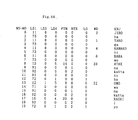
- Fig. 68 shows the WS table which stores the language structure symbol lines, LSL, which were converted from the letter lines obtained by analyzing the structure of the natural sentence, ⁇ Taro to Jiro wa Hanako tachi ni kyo gakko de bara dake o purezento shi ma shita ⁇ . Elements LS1, LS3, and LS4 of this WS table are copied into elements LS1, LS3, and LS4 of the MK table. (Fig. 74) Then the number, WS-NO, of the WS table, is stored in the element WSNO of the MK table. After this process, the information regarding the word(s) can be extracted easily from the element WD in the WS table, which is obtained according to WSNO.
- LSL language structure symbol lines
- the MK table contains elements MKK, PSMWK, and NO.
- the "end" marker, which indicates the final data, and the various items of data used to carry out a meaning analysis are stored in element MKK.
- Fig. 74 shows the MK table, MK-TBL, which was prepared by the above process.
- IMI-GRM meaning analysis grammar
- IMF-LSL language structure information line
- the meaning analysis introduced here uses an active method to carry out the analysis, beginning with the sections which can be analyzed, as mentioned above. Therefore, even though the meaning of some part of the sentence has been determined, often the conformity of each section to the entire context may not be perfect; which means that this imperfect part remains in the MK table as an intermediary result. Meaning analysis is then carried out on this intermediary result, by using the meaning analysis of the other language structure symbol line(s), LSL.
- Fig. 75 shows the program for the meaning analysis ( ) , written in the C Language format.
- ( ) will be added after the letter line, and each letter line will be underlined , to show that the letter line is the program or the function for carrying out various language processes, the detailed content of the meaning analysis grammar, IMI-GRM.
- This program consists of the following.
- Fig. 76 shows the content of the AND-OR relationship ( ) program in a "C” language format.
- the following rules are stored in the "if" (expression) which is in the ⁇ ⁇ of the "while (1) ⁇ ⁇ " of the AND-OR relationship ( ) program.
- the following section offers a simple explanation of the rules.
- this grammatical rule is applied to check whether the arrangement of the input natural sentence is : noun + logic particle + noun, in the element LS1 of the MK table.
- Fig. 77 shows the structural sentence after the meaning analysis of this input natural sentence has been completed
- Fig. 78 shows the data sentence, DT-S.
- the AND-OR combination ( ) executes the following processing.
- TMW data realm shown in Fig. 78 it ensures both TMW1 and TMW2, stores "Taro” in the element WD of TMW1, and stores "Jiro” in the element WD of TMW2. It then writes the "2" of TMW2 in the element N of TMW1, writes the "1" of TMW1 in the element B of TMW2, and writes "1000", a 4-digit hexadecimal number, in the element LOG of TMW1 to indicate that TMW1 and TMW2 are combined with "AND” of the logical relationship.
- TMW1(Taro) AND "to" --> TMW2 (Jiro) is determined by these processes. (See Fig. 77.)
- TMW1 (Taro) AND "to" --> TMW2 (Jiro) is already determined, but its meaning has not yet been determined in the context of the input natural sentence.
- TMW1 on the left side will remain as a representative, and the rest of the TMWs will be removed from the MK table.
- "MW” will be stored in the element PSMWK of No. 0 MK in order to show that MW remains, and its number, tmw-no/1, will be written in the element NO. In order to execute this, it should be written in "C" language as shown in Fig. 76, and as shown below.
- the LS1 which is next to the part of speech which is equivalent to a verb does not have 0 x 73, and therefore, the next process, Read out of IMI frame ( ) ; is executed. This process skips from WSNO/10 to the WS table shown in Fig.
- the PS data and MW data shown in Fig. 78 were copied from the DMW module in Fig. 62 and the DPS module shown in Fig. 63.
- the meaning frames for "purezento" are from 22 to 24 of the DPS module, and from 101 to 116 of the DMW module.
- the meaning frames from which "purezento” is read out include PS 1 to PS 3 and MW 7 to MW 23. "Purezento" is stored in the element .WD of the MW in Case P of the root PS of these meaning frames.
- Insertion of PS relationship particles ( ) is executed next.
- This program store the suffix particle jgb ("shi", here), of the verb, the tense-negative particle jntn ("ma” in this example) which expresses politeness, negativity and tense, the tense-negative-suffix particle jn ("shita” in this example) and the "zentai" (whole) particle jm, in each suitable location in the PS data and MW data in order to set the element MK of the MK tabel at "0", and also removes all stores particles from the MK table.
- the suffix particle jgb for verb conjugation is shown as "71" in the element LS1; the tense-negative particle, jntn, is shown as “91”; the tense-negative suffix particle, jn, is shown as “92”, and the Zentai particle, jm, is shown as "81”; therefore, if these particles are present, they can be found easily.
- "shi” was stored in the element .jgb of MW22 of Fig. 78(b)
- "ma” was stored in the element -jntn
- "shita” was stored in the element -jn of TPS3.
- Fig. 82 shows this program.
- the number of the MK table in which the verb is located is stored in "kpbot", as shown in Fig. 80. Using this as the starting point, analyze the MK table in one direction (or in reverse). First, as shown in Fig.
- the table KWDJO is prepared, to store the case particle which was confirmed in the meaning frame, and the noun which is the combination partner, that is, (noun + case particle).
- the stress particle, jos is also stored in the table.
- the same word cannot be inserted twice into a meaning frame, (IMI), and therefore only one word which has a case particle, WAK, whose existence has already been confirmed, will be accepted.
- Fig. 84 shows the KWD table.
- the word “kyo” is the only noun without a case particle in this text sentence.
- the noun + case particle combinations (KWDJO table) and the nouns alone (KWD table) which can be inserted into the meaning frames, are identified.
- the next problem is where these nouns and case particles will actually be inserted in the meaning frames.
- the next program inserts these nouns and case particles.
- the Insertion of words and case particles of the word - case particle table ( ) program is used for nouns + case particles, and the Insertion of word of the word table ( ) program is used for words alone.
- the KWDJO table and KWD table have been prepared so that the priority order can be freely selected when inserting each word.
- the combination is extracted from the bottom of the KWDJO table for insertion, and the individual word for insertion is extracted from the top of the KWDJO table.
- a case which is stipulated within a language structure has its own proper case particle to express the case by its function and position. However, there is not only one case particle; there are often multiple case particles within a language structure. Also, when the language structure is changed by the synthesis of that language structure with another lan guage structure, the original function and position of the case in its original language structure is relatively changed in the total language structure, and therefore, such a case particle may sometimes change to express the changed function and position of the case.
- a proper case has a certain number of case particles, which are clearly stipulated by their positions and functions in the case language structure. Therefore, a case particle can be specified by describing the position and function of the case.
- each word is inserted into the meaning (IMI) frame, IMI-FRM, according to this basic theory.
- jindx-x and jindx-y are already stored in the element .jinx of the meaning (IMI) frame, and its case particles are stipulated.
- the third and fourth digits of the 4-digit hexadecimal show jindx-y, while its first and second digits show ndx-x.
- case particle table JO-TBL.
- two case particles are designated by the two positions, (jindx-x, jindx-y) and (jindx-x+1, jindx-y), in the JO table.
- a combination of noun + case particle is inserted into the meaning frame through the following method.
- a searching path, SR-PT is set up in the structural sentence which was converted from the input natural sentence, and each MW is traced along its searching path.
- SR-PT A searching path
- the searching path, SR-PT, set up for the "purezento" meaning frame, is shown in Fig. 86, using a line marked by arrows.
- two case particles are shown using ( ) ( ).
- the former ( ) shows the case particle at (jindx-x, jindx-y), while the latter shows the case particle at (jindx-x+1, jindx-y).
- Root PS (PS3) is given as the starting point, then the case selection order in the basic sentence PS is determined.
- the order of cases has been determined as ATSOP.
- the order of cases in Fig. 86 has been arranged in the ATSOP order to make it easy to understand.
- the case particle (jindx-x, jindx-y) is checked, and if the above-mentioned MW cannot be found on that path, the search traces the same path once again, and checks (jindx-x+1, jindx-y). If an MW satisfies the previously mentioned insertion conditions, insert the word into the element .WD of that MW, and insert the case particle, WAK, at this time into the element .jcs of that MW.
- This data can be inserted, as has been confirmed by the program : Is only one case particle designated by WAK present in the IMI-FRM ? ( ) . Therefore, all of the nouns and case particles in the KWDJO table can supposedly be inserted.
- trace the cases in the order, APOST to search for the case particle.
- the search path is established by the above-mentioned method. While moving along this search path, find the MW on the path which has the same case particle letter line as that stored in the KWDJO table, and into which the insertion of a word is allowed (although no word has yet been inserted); then, insert the word and case particle into that MW.
- Fig. 77 shows, in a structural sentence, the results of an MW into which a word and case particle have been inserted via this process, while Fig. 78 shows these results in a data sentence.
- Words are inserted into only the KWD table by the Insertion of Word of Table word ( ) program, after the noun + case particle has been processed, tracing the same search path and search for an MW which is available for word insertion but into which no word has yet been inserted. Then, insert each word into each MW, in order, beginning with the MW which was found first.
- the sentence, ⁇ genki na Taro ga kyo gakko de shiroi bohru o nage ma shita ⁇ is synthesized form 3 sentences, ⁇ Taro wa genki de aru ⁇ , ⁇ bohru wa shiroi ⁇ , and ⁇ Taro wa kyo gakko de bohru o nage ma shita ⁇ , as previously explained.
- an explanation is provided for the meaning analysis of a synthesized sentence such as the one above.
- Fig. 88 shows the MK table prepared from this WS table.
- the modules read out are PS3 to PS4, and MW9 to MW17, shown in Fig. 92.
- This search path along the structural sentence of the ⁇ genki de aru ⁇ meaning frame is shown as a solid line in Fig. 96.
- MW4 was found first, and the word "Taro" was inserted into the element .WD of this MW4.
- Fig. 92 shows the results of the meaning analysis of the input sentence in a data sentence
- Fig. 93 shows the results of analysis of the input sentence in a structural sentence.
- the input sentence, ⁇ Jiro wa Taro ga Hanako ni bara o atae na katta to wa omo wa na katta rashi i yo ⁇ is considered to be the sentence created when the words and case particles "Jiro wa", “Taro ga”, “Hanako ni” and “bara o” are inserted into the meaning frame, "atae ru to omou rashi i", which was created by synthesizing the "atae ru", “omou” and "rashi i” meaning frames.
- the WS table shown in Fig. 69 can be obtained.
- the MK table prepared from this WS table is shown in Fig. 98.
- the Read-out of IMI frame ( ) is used for access to the "atae” meaning (IMI) frame: this is stored in the PS data realm and the MW data realm. As shown ni Fig. 100, the data from PS1 to PS3 and from MW1 to MW16 are (in) the PS and MW modules of the "atae” meaning (IMI) frame.
- This program sets up the search path in the "omo u" meaning frame, and while tracing each MW, searches for the MW into which the meaning frame can be inserted.
- "a###” is written in the element .BK of the MW ("#” indicates a random hexadecimal digit, and "a###” indicates that the 4th digit from the right in the hexadecimal is "a", while the other digits can be any numeral or letter) the word will be preferentially inserted into the element .MW of that MW.
- the data which indicates the content of the processing is written in advance into each element .BK of the MWs in Case A, Case T, and Case S, in the root PS on the lower level, identifying the type of processing. For instance, when “6###” is shown, it prohibits the expression of the cases on the upper level and allows the expression of the cases on the lower level, and when “9###” is shown, the expression of the cases on the upper level is allowed and the expression of the cases on the lower level is prohibited.
- the particles related to the "omo" PS that is, the suffix particle "wa”, the tense-negative particle "na”, and the tense-negative suffix particle “katta”, are fetched and inserted into element .jgb, element .jntn, and element .jn, of the root PS of the meaning frame, using the Insertion of PS-related particles ( ) ; program.
- Fig. 100 shows the results of the above processing. After this program has been executed, return to the starting point once more, and execute the program in the ⁇ ⁇ of "while (1) ⁇ ⁇ " seen in Fig. 81 (identified by the marker, "/*B*/").
- IMI frame ( ) Execute the Read-out of IMI frame ( ) ; program, fetch the "rashi i” meaning frame, and write “rashi i" immediately after the synthesized "atae ru to omo u” meaning frame in the PS data realm and the MW data realm, as shown in Fig 100.
- the PS module and the MW module of the "rashi i" meaning frame are form PS6 to PS9 and from MW25 to MW38.
- Fig. 99 shows the structural sentence for the synthesized meaning frame that allows for easy understanding.
- Fig. 101 shows the search path, using case particles and solid lines. The places where insertion of a word is possible, obtained by the previously indicate method, are also simultaneously shown using shading (/////).
- Insertion of word(s) into IMI frame(s) ( ) has already been explained.
- Insertion of words will start from the bottom of the KWDJO table. First, search for the MW in which the "ha" of "Jiro ha" is stored, follow this search path, and when MW20 is found, insert "Jiro ha".
- Fig. 99 shows the results of the above-mentioned processing in a structural sentence
- Fig. 100 shows the results in a data sentence.
- the WS table shown in Fig. 70 can be obtained. If the MK table is prepared on the basis of this WS table, it will be as shown in Fig. 103.
- the case particle in the root PS particularly the case particle of Case A of the meaning frame to be combined, will be changed as shown below.
- ⁇ Taro ga Hanako ni bara o atae ta ⁇ is converted to the causative, it will be, ⁇ Jiro ga Taro ni taishite Hanako ni bara o atae sase ta ⁇ or ⁇ Jiro ga Taro ni Hanako ni bara o atae sase ta ⁇ .
- the case particle(s) will be changed; for example, “Taro ga” will be changed to “Taro ni taishite " or "Taro ni ". Therefore, when the meaning frame is changed to the causative, the case particle of the meaning frame must be changed.
- a meaning frame is used individually, its case particle is indicated in advance by the element .jinx, although the case particle will be changed when that frame is combined with another meaning frame. Therefore, the case particle must be changed when meaning frames are combined.
- the causative case particle is stored in the "jindx-y+1" position from the position in which that case particle is stored in the JO table, JO-TBL, where the case particles are stored.
- "wa” and "ga” are designated as the case particles at (jindx-x/1, jindx-y/7) and (jindx-x+1/2, jindx-y/7) in the JO-TBL by the element .jindx of the MW.
- the case particles changed to causative forms are stored in the JO-TBL, where "jindx-y" is changed to "jindx-y+1".
- the causative case particles are stored at (jindx-x/1, jindx-y+1/8) and (jindx-x+1/2, jindx-y/8). Therefore, the "jindx-y" component of the element .jindx of the MW in Case A3 must be changed by adding "+1".
- the 4-digit hexadecimal is,written in the element .jindx.
- the meaning frame which was synthesized by the above-mentioned processing also represents the meaning structure of the sentence, "atae sase rare ru". So that this may be understood easily, the sentence written using the structural sentence is shown in Fig. 105.
- the MWs required to explain the insertion of word(s), that is, only the MWs into which a word can be inserted, are shown by using the //// marker with the case particle.
- the KWDJO table in Fig. 106 is prepared using this program. At this time, there is no word in the KWD table (not illustrated). In this KWDJO table, each MW in which a case particle exists is sought along the designated search path.
- the WS table shown in Fig. 71 can be obtained.
- the MK table prepared from this WS table is shown in Fig. 107.
- the "age ru" IMI frame (PTN/14) is fetched form the IMI frame dictionary using the Read-out of IMI frame ( ) ; program, and the PS modules ( from PS1 to PS3) and the MW modules (from MW1 to MW16) are written into the PS data realm and the MW data realm, as shown ni Fig. 108.
- the suffix particle jgb "ta” is inserted into the element .jgb of MW16, and the tense-negative particle jntn" " (" " indicates that there is no letter line) is inserted into the element -jntn in PS3.
- Fig. 113 shows the KWDJO table prepared by this program.
- Fig. 111 shows the structural sentence of the "omo u" IMI frame. (The structural sentence shown, which includes the case particle(s), is in a state in which words have already been inserted by meaning analysis.) The search path is indicated by the solid line. The case particle, "to”, is in the "omo u” IMI frame, and therefore, MW28 is inserted into that IMI frame, as shown in Fig. 111 or Fig. 109.
- Fig. 72 presents the analysis of the structure of the previous sentence. If the MK table is prepared from the WS table in Fig. 72, it will be as shown in Fig. 117. When the Meaning analysis ( ) program shown in fig.
- This program changes the case particles, for example, from “ha” to “no”, from “ni” to “eno” and from “wo” to “no”, in order to make the entire "purezento” IMI frame function as a noun (word).
- the case particle when it exists, is written in jindx-x (jindx-x is a variable, and its value is "7".) which is the JO table, JO-TBL, (see Fig. 85) of the case particle table. Therefore, the jindx-x (value) for all case particles in the IMI frame is defined as "7". (See Fig. 120.) In this way, the particles can be designated during nominalization.
- Fig. 121 shows the structural sentence with the "purezento" IMI frame and the changed case particle, and also indicates the search path, which will be mentioned later, as a solid line.
- Fig. 122 shows the KWDJO table prepared here, in which the case particle, "no", is shown twice, and two MWs (MW1 and MW12) have "no" in their IMI frames. Therefore, it is not clear which "no" should be inserted where.
- set the search priority order for each word to be sought in the KWDJO table then set up a search path for which the priority order is designated, and find the MWs that contain the case particles being sought, along the path, using the method of inserting the words in the order in which each word was found.
- the case particle to be used will be determined by the order in the KWDJO table as well as the order on the search path. If the processing carried out to this point is shown as a natural sentence, it will be, ⁇ Taro no Haruko eno bara no purezento ⁇ , since the sentence, ⁇ Taro ga Hanako ni bara o purezento shita ⁇ is handled as a single word. If the input sentence is ⁇ bara no Hanako eno Taro no purezento ⁇ , and the meaning analysis of the input sentence is carried out using the same method, it will be ⁇ bara ga Hanako ni Taro wo purezento shita ⁇ .
- each natural sentence must be converted to a data sentence, DT-S.
- questioning/answering can easily be carried out using a computer, as shown by the following explanation.
- questioning/answering can be done very easily using the method in this patent application.
- the text sentence including the following sentence: ⁇ Jiro ha Taro ga Hanako ni bara wo atae na katta toha omo wa na katta rashi i yo ⁇
- ⁇ Taro ka Saburo ga Hanako to Akiko ni bara o atae ma shita ka ? ⁇ How to prepare the answer sentence will be explained below.
- many sets of sentences are shown as text sentences, not just the one text sentence mentioned above. To simplify the explanation here, though, only the text sentence above is used.
- Fig. 100 shows the structural sentence for the text sentence above;
- Fig. 123 shows the structural sentence for the question sentence above, and
- Fig. 124 shows the data sentence for the question sentence.
- pattern-matching for the text sentence is carried out using the question sentence as a template.
- the answer sentence is prepared centering on the sentence, from among the text sentences, which best matches the question sentence. Strictly speaking, pattern-matching can be divided into the following three stages:
- the preliminary evaluation is carried out as shown below.
- TPS and TMW each PS and MW in the text sentence will be abbreviated as TPS and TMW
- QPS and QMW each PS and MW in the answer sentence
- APS and AMW each PS and MW in the answer sentence.
- search path observing the priority order in the question sentence, and trace each QMW along the search path, to find each QMW into which a word is inserted, then prepare the Searched Word table, SRWD-TBL, by placing these in order.
- Various methods are used to establish a search path.
- the search path here has been set up using a solid line, as shown in Fig. 125, and the order for tracing cases in PS has been determined to be APOST.
- the search begins with the root PS according to the "up-right" rule.
- the "up-right" rule holds that when one MW is connected with another MW on the upper level, that is, when a data item is written in the element .MW, it is necessary to move up to the PS or MW on the upper level. If the MW is not connected with anything on the upper level, move to the MW which is connected on the MW's right side -- that is, move to an MW which has a data item written in its element .N. This is the "up-right" rule.
- the SRWD-TBL of the question sentence retrieved using the above-mentioned search path will be [Taro, Saburo, atae, Hanako, Akiko, bara]. The words listed first are considered to be more important.
- the root PS of the meaning frame is called the base PS
- the base PS BASE-PS
- the natural sentence ⁇ atae ta to omo tta rashii ⁇ is synthesized by combining the IMI frames, "atae ta,” “omotta” and "rashi i,” which have been read out from the IMI frame dictionary.
- each IMI frame read out from the IMI frame dictionary is shown by the "1" used as the first digit of the hexadecimal (0x1###) in the element .MK in TPS, and its lower limit is shown by the "e” at the same location (0xee###).
- the "1," which is the 4th digits from the right in “100e” in the element .MK of TPS1 shows the upper limit of the "atae ru” IMI frame and "e", the 4th digit from the right in "e00e” of the element .MK of TPS3, shows its lowest limit.
- Base PS is TPS3.
- the scope of the PS module and the MW module of the "atae ru" IMI frame can be recognized via this hexadecimal data.
- the "1" and “e” used as the 4th digit from the right in each element .MK shows that the TPS module of the "omo u" IMI frame is TPS4 - TPS5, (Base PS is TPS5) and that the TPS module of the "rashii" IMI frame is TPS6 - TPS9. (Base PS is TPS9.)
- the base PS in the structural sentence can be found at a glance. Pattern-matching is carried out using the IMI frame, which is registered in the IMI frame dictionary, as its basic unit.
- the base PS of the IMI frame, in which that word exists must be obtained.
- the base PS of this question sentence that is, the root PS of the IMI frame in which "Taro" exists, is QPS3.
- the base PS of the text sentence will be TPS3, as shown in Fig. 99. Therefore, the question sentence is as shown below.
- Fig. 126(a) shows the structural sentence for the text sentence
- Fig. 126(b) shows the structural sentence for the question sentence.
- the search paths are also shown in these diagrams. As will be mentioned later, the search paths are divided into certain short sections, and a number is attached to each section as shown. First, a search path with a designated priority order is set up for the question sentence, while an identical search path is simultaneously set up for the text sentence.
- the search for words in the text sentence will be advanced by being synchronized with the advancement of the search along the search path in the text sentence in order to check whether or not the words existing in the question sentence also exist in the text sentence.
- the evaluation points will be according to the position of the TMW in which that word exists -- that is, depending on the TPS number and the type of case, the conformity of the pattern-matching of the two sentences will be evaluated by the total number of evaluation points.
- the search path will be divided into a certain number of sections, and set up so that it is synchronized with the progress of the two searches.
- One case in a PS will be determined as the starting point of the search section, and when a PS such as, for example, ⁇ genki na Taro ⁇ is found in the search path, it will be taken as a dividing marker, and the section between one PS and the next will be denoted as the search section.
- a PS such as, for example, ⁇ genki na Taro ⁇
- Each search section will then be set up in the same case in the base PS in the question sentence and the text sentence to check whether or not each word, which exists in the search section of the question sentence, also exists in the search section of the text sentence.
- the first section to be searched in the question sentence is shown below, as seen in Fig. 126 (b).
- the starting point of the search section above is Case A3 of QPS3.
- the search section of the text sentence corresponding to the above-mentioned search section of the question sentence, is shown below.
- the section number is (1).
- "Taro" which is the word being sought in the question sentence, is also in the text sentence.
- the evaluation points at this time are assumed, for the sake of this example, to be 5 points.
- "Saburo" in the question sentence is not in the text sentence, zero points are added to the evaluation points.
- the next search section on the search path is Section (2), which starts from Case P3 of QPS3.
- This search section is as shown below QMW20 (atae) (2)
- the search section in the text sentence which corresponds to the above section, is the following section, (2), starting from Case P3 of TPS3.
- TMW16(atae) (2) "atae” also exists in the text sentence, and therefore if it is assumed that the evaluation points here are "4", there will be a total of 9 evaluation points for conformity.
- the next search section is section (3), which uses Case O3 as its starting point.
- QMW19 ( ) (3) TMW15 ( ) (3) There are no words in these sections; and no evaluation is done. Therefore, the next search path is traced.
- the next search section in the question sentence will be the following section, (4), with the starting points of Case A2 in the previously mentioned QPS2 and Case A2 in TPS2.
- QMW11 ( ) and the search section, (4), in the text sentence is as shown below.
- TMW11 (Hanako) (4) "Hanako" in the question sentence also exists in the text sentence, and therefore, it is considered that there are 5 evaluation points at this time,which means that there will be a total of 14 conformity evaluation points.
- certain conformity evaluation points which show the degree of pattern-matching of these two sentences, can be obtained.
- the text sentence with the highest number of conformity evaluation points can be obtained.
- the prepared answer sentence is based mainly on this text sentence.
- the text sentence, ⁇ Taro ga Hanako ni bara wo atae na katta ⁇ is extracted from the sentence, ⁇ Jiro ha Taro ga Hanako ni bara wo atae na katta toha omo wa na katta rashii ⁇ .
- the content described in the text sentence is not ⁇ - atae na katta ⁇ : it is ⁇ - atae na katta towa omo wa na katta rashii ⁇ . Therefore, this entire sentence must be used to prepare the answer sentence. In preparing the answer sentence with this entire sentence, the PS at the lowest level of text sentence must be obtained.
- the “left-down” rule first checks if there is another kind of PS or MW to the left of the PS or MW. If there is, it shows that there is a search path designated by the element .B (the numbers of element .B, except 0, are identified as PS or MW). And if there is no PS or MW on the left, move to the neighboring PS or MW below, as designated by the element .L. Trace the element .L and the element .B of the TPS and TMW along the search path established by this rule, to obtain a PS which does not have a neighboring PS below it.
- the base PS of the text sentence which is designated in preparation for the answer sentence is TPS3; however, PTS3 has no element .B and its element .L is TMW17 as shown in Fig. 100, which means that the path moves to TMW17.
- the element .B of TMW17 is "0" and the element .L is TPS4 : therefore the search moves to TPS4.
- TPS4 has no element .B, and the element .L is TMW23 : therefore the search moves to TMW23.
- the element .B of TMW23 is "0" and the element .L is TPS5; therefore, the search moves to TPS5.
- the element .B of TPS5 is "0" and the element .L is TMW28, so the search moves to TMW28.
- the element .B of TMW28 is "0" and the element .L is TPS7; therefore, the search moves to TPS7.
- the element .B of TPS7 is "0" and the element .L is TMW 31; therefore, the search moves to TMW31.
- the element .B of TMW31 is "0" and the element .L is. TPS8; therefore, the search moves to TPS8.
- No PS or MW is connected before or below TPS9; therefore, this will be the root PS, and the prepared answer sentence will be based on this root PS.
- This data sentence is copied once into the answer sentence area.
- TPS module from TPS1-TPS9 and the TMW module from TMW1 to TMW38 are copied and defined as APS1-APS9 and AMW1-AMW38 respectively (See Fig. 128.). If this data sentence is converted into a natural sentence, it will be ⁇ Jiro ha Taro ga Hanako ni bara wo atae na katta toha omo wa na katta rashii ⁇ . (See Fig. 127.)
- the words of the question sentence and the words of the answer sentence correspond to each other; therefore, the position of the word in the answer sentence, which corresponds to the position of the word in the question sentence, can easily be recognized. If no word is inserted into the element .WD in the question sentence, that is, in the case of .WD/0, the AMW of the answer sentence which corresponds to it, can easily be obtained.
- the expression of the AMW is prohibited, that is, when the 4th digit from the right (the first in the hexadecimal) for the element .BK is set as "e" (0xe###), that word can be removed from the natural sentence through the above processing, and the previously mentioned natural sentence will be as shown below.
- an answer sentence such as, ⁇ Hanako ni bara wo atae ta noha Taro de aru ⁇ is also sometimes prepared in order to emphasize the word which corresponds to the word, "dare".
- Such an answer sentence can easily be prepare by the following process. That is as shown in Fig. 131 (b), combine PS-I (APS4) of ⁇ ha - de aru ⁇ beneath the sentence ⁇ Taro ga Hanako ni bara wo atae ta ⁇ , then combine PS-I (APS4) with AMW17 in Case A of the above sentence, and insert "Taro" into element .WD of AMW20 of Case O. At this stage, "Taro: appears twice : therefore, prohibit the expression of "Taro" (AMW12) in the above sentence. If the data sentence is prepared by the above-mentioned processing, the answer sentence shown above can be obtained.
- a PS or MW must be designated as the starting point, to prepare the natural sentence, then the natural sentence preparation path PR-PT can be set up from that starting point.
- This preparation path is established using the same method used to establish the search path. In the pattern-matching carried out for the previously mentioned questioning/answering, the search path was set up assuming that the priority order of the cases in the PSs of the basic sentence was APOST; however, the word order in the natural sentence preparation path will vary depending on whether the language is Japanese, English, or Chinese. Therefore, a preparation path which can prepare the natural sentence in the languages used by each nation must be established.
- the standard word order for cases in the PS of a basic sentence in Japanese is ATSOP, while in English, it is APOST, and in Chinese, ATSPO.
- a PS has Case X, Case Y, and Case Z, in addition to the above-mentioned ATSOP, and there are also various particles, jntn, jn, jm, jost, and symbols, j1 and j2.
- Fig. 132 Natural sentence preparation word order table SQ-TBL, shows the word order for Japanese, including all the items mentioned above.
- the variable, sqx which is on the horizontal axis in the SQ-TBL, shows the case-fetching order and a natural sentence is prepared according to this order.
- the variable, sqy which is on the vertical axis, shows the word order designation number, which designates the word order. This number is stored as the third digit from the right if the hexadecimal numeral of the element .MK of the PS. Here, if this value is "0", the datum shows the default value, which is the standard word order. If a special word order is designated, the word order specification number will be written in this table.
- the MW word order can be specified by the table in the same way as the PS word order, although in this case, the MW word order is designated by the program. If a natural sentence is generate in Japanese, for instance, the data is output in the order: article jr, prefix jh, MW, F, word WD, suffix jt, plural particle jpu, logical particle3 jxp, logical particle2 j1s, word stress particle jos, logical particle1 jlg, case particle jcs, suffix particle jgb, and sentence stress particle jost.
- Element .MW, element .F and element .H are used to generate the path. Thereafter, the generated path passes through MW, F, and H, and returns to this MW. After it returns to this point, the above-mentioned word WD, suffix jtl, - - - etc., are output immediately. Words, particles, and symbols were previously shown using letter lines in Japanese and English, in the data sentences and structural sentences, to make them easier to understand; however, these words, particles, and symbols are actually stored in the computer using code numbers for all of them. It is therefore necessary to convert these code numbers into letter lines.
- each word is converted from its code number to an individual letter line corresponding to the word, using the Japanese word dictionary, DIC-WD, and when the sentence is in English, each code number is converted into an individual English letter line using the English word dictionary, EDIC-WD.
- the word dictionary/dictionaries can be used to convert the code numbers into letter lines; however, if the particles and symbols are mentioned in the particle dictionaries, the code numbers will be converted to letter lines using all four dictionaries : the word dictionary for Japanese, DiC-WD, the word dictionary for English, EDIC-WD, the particle dictionary for Japanese, DIC-WA, and the particle dictionary for English, EDIC-WA.
- Fig. 133 shows the generation path for the natural sentence, ⁇ Jiro ha Taro ga Hanako ni bara wo atae ta to omo tta ⁇ , in Japanese.
- This sentence when written in English, will be as shown in Fig. 134.
- the basic word order is different in English and Japanese; therefore, the Japanese sentence is illustrated in the order, ATSOP, and the English sentence appears in the order, APOST.
- the generation path is established with the root PS (PS5) as its starting point, and the natural sentence is generated along this path.
- PS5 the root PS
- "0xe431” which is entered in the element .WD of MW20, which is combined with Case A of PS5, is converted into a letter line.
- the Inflection suffix table, GOBI-TBL is shown in Fig. 135. However, only a minimum of the suffix inflections needed for the explanation are mentioned here. All forms of the inflections of the suffix particle, jgb, and the tense negative suffix particle, jn, which can be taken by the various inflective forms, ky, are arranged vertically. If the inflective form, ky, and the inflection number, kx, are specified, the inflective suffix particle, jgb or jn, can be obtained from (kx, ky).
- Fig. 136 shows the NTN-TBL of tense negative particles, jntn and tense negative suffix particles, jn.
- NTN-TBL also shows the inflection KY.
- the data from the 4-digit hexadecimal are written in KY. The first two digits are the inflection number, kx, while the last two digits are the inflective form, ky.
- Fig. 137 The structural sentence, ⁇ atae ru ⁇ is shown on the left in Fig. 137, and the ⁇ iku ⁇ structural sentence is shown on the right in Fig. 137.
- Fig. 138 shows the data sentences for ⁇ atae ru ⁇ and ⁇ iku ⁇ .
- a letter line which has no inflective changes is shown by ( )
- a letter line which has an inflective change (or changes) is shown by ⁇ >.
- the letter lines needed to generate a natural sentence from this structural sentence are shown below.
- the inflective change of the suffix particle is determined by the inflection information, KY, consisting of the word(s) or particle(s) located before and after that suffix particle or by the information which consists of a combination of the above-mentioned inflection information.
- the tense negative particle, jntn, indicating tense and negativity, and the tense negative suffix particle, jn generally follow a word such as a verb.
- the jntn and jn are shown in the NTN-TBL, so that these can be fetched directly from this table.
- the suffix particle, ⁇ jgb>, located between (WD) and (jntn), is, however, determined according to both values (kx, ky), after "ky/0b” has been fetched from the inflection information KY/ff0b, "atae", located before the suffix particle, and "kx” has been fetched form the inflection information, NTN.
- This KY will be changed according to the content of the NTN in the NTN-TBL, as shown below.
- NTN is determined to be "0001" (negative present)
- jntn/"na” and jn/"i" are obtained from JO-TBL, so that jntn and jn are determined.
- jgb is determined by both inflection information items, "atae” and NTN/0001.
- the KY of NTN/0001 is “0513” and the KY of "atae” is “ff0b”; therefore, if ky/0b is fetched from “atae” and kx/05 is fetched from NTN, jgb/" " can be obtained from (kx/05, ky/0b) in the JO-TBL.
- jgb/"ru is determined from (kx/01, ky/0b) in the JO-TBL, so the sentence will be as shown below. (atae) ⁇ ru> (na) ⁇ " ">, that is, ⁇ atae ru na ⁇ .
- the sentences, ⁇ atae ta node i tta ⁇ and ⁇ atae na kereba iku ⁇ are generated when one sentence, ⁇ atae ru ⁇ , and another sentence, ⁇ iku ⁇ , are logically combined with the addition of the various meanings of each of the tenses, present, past, affirmative, negative, and ordinary or polite expressions.
- the next section explains how to select the suffix particles for the above sentence.
- Fig. 137 shows the structural sentence for the sentence in which ⁇ atae ru ⁇ and another sentence, ⁇ iku ⁇ , have been logically combined. The following shows only the letter lines involved when the above structural sentence is converted into a natural sentence. (atae) ⁇ jgb> ⁇ jntn) ⁇ jn> (jlg) (iku) ⁇ jgb> (jntn) ⁇ jn>
- Inflection information, KY, for verbs and nouns, is shown as "ff##".
- the individual verb or noun does not affect any of the suffix particles (attached to other words) which come before it. Therefore, the above-mentioned kx/ff is used to give the indication regarding the inflection.
- (iku) does not affect ⁇ >, which is located before (iku). If the sentence from (iku) to the end is omitted, the sentence will be as shown below, (atae) ⁇ jgb> (jntn) ⁇ jn> (jlg); therefore, only the above sentence must be considered.
- jgb will be determined by its verb, "atae", and by NTN.
- the logical particle, jlg has its own particular inflection information, KY; therefore, jn will be determined by kx from this logical particle's own KY, and ky from the KY of NTN, as shown below.
- ⁇ jn> is determined by ky/00 from KY/0500 of NTN/0011 of the preceding particle, jntn, and by kx/04 from KY/0400 of the following particle, jlg/"node", and is determined as (kx/04, ky/00).
- kx or ky is "0"
- jn will not be determined by the above data. That is, the letter lines will not be changed at all, but rather will remain as jn/"katta” of NTN/0011. Consequently, the letter lines will be as shown below.
- the particle jn is determined to be jn/" ", from (kx/08, ky/ff), which means that the letter line will be, (atae) ⁇ ru > ("-") ⁇ "-"> (ba), that is, ⁇ atae ru ba ⁇ ; however, there is no such expression.
- the "01ff" of "ff” indicates that jntn and jn of NTN are null, and that jlg acts directly on jgb, and jn is selected by applying the previous method. That is, (kx/0b, ky/08) is obtained from KY/0800 of (ba) of the logical particle and KY/ff0b of (atae), while jgb ⁇ re> is obtained from the JO-TBL, so that the letter line is consequently determined as shown below. (atae) ⁇ re> (" ") ⁇ " "> (ba), that is, ⁇ atae re ba ⁇ .
- the suffix particle jgb or jn Before obtaining the suffix particle jgb or jn, obtain the inflection information for the preceding word or particle, obtain ky from KY, and then obtain kx from the inflection in information, KY, of the following word or particle.
- the suffix particle, jgb or jn is determined from the JO-TBL according to (kx, ky), which is a combination of the above information items. If KY is ##ff (KY/##ff), the inflection information regarding the preceding word or particle is nullified, and the inflection information, KY, for the word before the preceding word or particle, is used for the combination, the suffix particle must be changed.
- KY/ee## (kx/ee) shows an expression which is not used in the natural sentence.
- PS and MW are unified in the data structure PSMW, and therefore PSMW will have both PS and MW elements. That is, PSMW has -WD and -CNC as elements of word information, IMF-P-WD: it has -jr, -jh, -jt, -jpu, -jxp, -jls, -jlg, -jgv, -jcs, -jos, -jinx, -jntn, -jn, -jm, and -jost as elements of particle information, IMF-P-JO; it has -B, -N, -L, -MW, -F, -H, -mw, and -RP as elements of the combination information, IMF-P-CO; it has -MK, -BK, -LOG, -KY, and -NTN, as elements of language information, IMF-P-CO; it has -MK, -BK,
- the case variety such as the Agent Case (Case A), Time Case (Case T), Space Case (Case S), Object Case (Case O), Predicate Case (Case P), Auxiliary Case (Case X), Yes-No Case (Case Y), or the Zentai (whole) Case (Case Z), is written in this element -CASE.
- Fig. 33 shows the structural sentence for the natural sentence, ⁇ Taro ga kyo gakko de Hanako ni hon wo atae ru ⁇ , using the compound MW and PS data structure. If this sentence is shown using only the PSMW data structure, it will be as shown in Fig. 7. At this time, the order of the cases between the PSMWs in the basic sentence PS is specified as ATSOP, and the sentence is illustrated according to this order, with the order of cases shown using the symbol2 -->, for clarification. The case variety is shown under the parentheses, and the relationships shown by the --> symbols are stipulated by entering the number of each partner PSMW in the element -N and element -B.
- the data structure becomes simple; however, the number of PSMW elements increases, and therefore a larger memory capacity is needed.
- the output order for the cases in the basic sentence must be changed from ATSOP to APOST.
- the order of cases is stipulated by the data written in the element -N and element -B in the PSMW data structure, and therefore, to change the order of output of the cases, this data must be rewritten, a task requiring much labor and time.
- the PSs and MWs are placed separately in the data structure, the order of the cases can be changed easily using the program, as previously mentioned.
- Case order must be designated to establish the search path, and this processing can be done easily if this compound data structure is used.
- the order of the cases is changed often.
- Data regarding the combination information, IMF-P-CO, such as -MW, -L, -B, or -N, must be changed whenever the order of the cases is changed, and there is a possibility that multiple problems will occur, including the miswriting of data. Therefore, a compound data structure is far more advantageous for processing.
- This system accurately expresses the meaning of the natural sentence input into the computer, via processing which reaches meanings using various words, including those words which are not expressed in the natural sentence, from the previously constructed meaning frames in the meaning frame dictionary, DIC-IMI.
- the system constructs meaning structures which are expressed by the input natural sentence using data structures, by combining these meaning frames, and storing the words, particles, and symbols of the natural sentence, Therefore, this system can generate accurate answers for the question sentences, using words which are not expressed in the input sentence, as shown below.
- the ⁇ atae ru ⁇ meaning structure contains the meaning that ⁇ A1 was in the place A3 ⁇ at the beginning, and that at this point in time, ⁇ A1 is in the place A2 ⁇ or that ⁇ A2 has A1 ⁇ .
- the natural sentence, ⁇ -ga dekiru ⁇ is stored in the computer as, ⁇ -ga kano de aru ⁇ and ⁇ -niha kanosei ga aru ⁇ , as shown in Figs. 52 and 51.
- the natural sentence, ⁇ Taro ha kyo gakko de Hanako ni hon o atae ru koto ga deki ru ⁇ , is stored in the computer as the structural sentence shown in Fig.
- Fig. 53 shows the above natural Japanese sentences in English.
- the words written in the data sentence are actually (expressed here as) numerical codes.
- the same numerical code is used for words that have the same meaning regardless of the different languages involved, whether Japanese, English, Chines or some other language.
- Figs. 51 and 53 or the data sentences presented as the structural sentences in these diagrams are almost the same.
- a Japanese sentence can basically be translated into an English sentence by fetching the English letter lines according to the individual code numbers; therefore, Fig. 51 can be used.
- the data sentence for Japanese is actually converted into the data sentence for English.
- the data sentence for Japanese though, has basically the same data content as the data sentence for English, (with the data necessary for carrying out pattern-matching) so that the data sentences for English and Japanese can be handled as the same data sentence. Therefore, after the text sentence has been written in Japanese, it is very easy to form questions in English, and answer in English or Japanese.
- the sentence will be, ⁇ X ga genki de aru node, X ha shiroi bohru wo nage ru ⁇ . If the implicative relationship is determined to be the "for" of the objective, and the logical particle, jlg, is determined to be tameni", the sentence will be, ⁇ X ga genki de aru tameni, X ha shiroi bohru wo nage ru ⁇ .
- the sentence, ⁇ neko no Mike ga shinda ⁇ arises from the sentence ⁇ Mike wa neko de aru ⁇ and the sentence ⁇ Mike ga shinda ⁇ , as can be understood easily from the previous explanations. If these 2 sentences are connected using the subjunctive "if", which indicates an implicative relationship, and the logical particle, jlg, is determined to be "naraba”, the sentence will be, ⁇ Mike ga neko de aru nara ba, Mike ha shinda ⁇ . If ⁇ shinda ⁇ is converted into the present tense, the sentence will then be, ⁇ Mike ga neko de aru nara ba, Mike ha shinu ⁇ .
Landscapes
- Engineering & Computer Science (AREA)
- Theoretical Computer Science (AREA)
- Health & Medical Sciences (AREA)
- Artificial Intelligence (AREA)
- Audiology, Speech & Language Pathology (AREA)
- Computational Linguistics (AREA)
- General Health & Medical Sciences (AREA)
- Physics & Mathematics (AREA)
- General Engineering & Computer Science (AREA)
- General Physics & Mathematics (AREA)
- Machine Translation (AREA)
Applications Claiming Priority (3)
| Application Number | Priority Date | Filing Date | Title |
|---|---|---|---|
| JP310292/91 | 1991-09-11 | ||
| JP31029291 | 1991-09-11 | ||
| JP31029291A JP3811902B2 (ja) | 1991-09-11 | 1991-09-11 | コンピュータにおける自然言語処理法 |
Publications (3)
| Publication Number | Publication Date |
|---|---|
| EP0532338A2 true EP0532338A2 (de) | 1993-03-17 |
| EP0532338A3 EP0532338A3 (en) | 1993-10-27 |
| EP0532338B1 EP0532338B1 (de) | 2002-08-14 |
Family
ID=18003466
Family Applications (1)
| Application Number | Title | Priority Date | Filing Date |
|---|---|---|---|
| EP92308276A Expired - Lifetime EP0532338B1 (de) | 1991-09-11 | 1992-09-11 | Natursprachenverarbeitungsverfahren mit Rechner |
Country Status (3)
| Country | Link |
|---|---|
| US (1) | US6126306A (de) |
| EP (1) | EP0532338B1 (de) |
| JP (1) | JP3811902B2 (de) |
Cited By (1)
| Publication number | Priority date | Publication date | Assignee | Title |
|---|---|---|---|---|
| EP1265172A3 (de) * | 2001-05-18 | 2004-05-12 | Kabushiki Kaisha Square Enix (also trading as Square Enix Co., Ltd.) | Dateneingabestation, Verfahren zur Informationsbetrachtung, Verfahren zur Informationsbetrachtung eines Informationsserversystems und Datenaufzeichnungsmedium |
Families Citing this family (47)
| Publication number | Priority date | Publication date | Assignee | Title |
|---|---|---|---|---|
| US5822720A (en) | 1994-02-16 | 1998-10-13 | Sentius Corporation | System amd method for linking streams of multimedia data for reference material for display |
| US5624456A (en) * | 1996-02-07 | 1997-04-29 | Hellenkamp; Johann F. | Automatic surgical device for cutting a cornea |
| US6782510B1 (en) * | 1998-01-27 | 2004-08-24 | John N. Gross | Word checking tool for controlling the language content in documents using dictionaries with modifyable status fields |
| US7716163B2 (en) | 2000-06-06 | 2010-05-11 | Microsoft Corporation | Method and system for defining semantic categories and actions |
| US7770102B1 (en) | 2000-06-06 | 2010-08-03 | Microsoft Corporation | Method and system for semantically labeling strings and providing actions based on semantically labeled strings |
| US7421645B2 (en) * | 2000-06-06 | 2008-09-02 | Microsoft Corporation | Method and system for providing electronic commerce actions based on semantically labeled strings |
| US7788602B2 (en) | 2000-06-06 | 2010-08-31 | Microsoft Corporation | Method and system for providing restricted actions for recognized semantic categories |
| US7712024B2 (en) | 2000-06-06 | 2010-05-04 | Microsoft Corporation | Application program interfaces for semantically labeling strings and providing actions based on semantically labeled strings |
| US7032174B2 (en) * | 2001-03-27 | 2006-04-18 | Microsoft Corporation | Automatically adding proper names to a database |
| US7778816B2 (en) | 2001-04-24 | 2010-08-17 | Microsoft Corporation | Method and system for applying input mode bias |
| US7130861B2 (en) | 2001-08-16 | 2006-10-31 | Sentius International Corporation | Automated creation and delivery of database content |
| US7209876B2 (en) * | 2001-11-13 | 2007-04-24 | Groove Unlimited, Llc | System and method for automated answering of natural language questions and queries |
| US7325194B2 (en) * | 2002-05-07 | 2008-01-29 | Microsoft Corporation | Method, system, and apparatus for converting numbers between measurement systems based upon semantically labeled strings |
| US20050108195A1 (en) * | 2002-05-07 | 2005-05-19 | Microsoft Corporation | Method, system, and apparatus for processing information based on the discovery of semantically labeled strings |
| US7707496B1 (en) | 2002-05-09 | 2010-04-27 | Microsoft Corporation | Method, system, and apparatus for converting dates between calendars and languages based upon semantically labeled strings |
| US7707024B2 (en) | 2002-05-23 | 2010-04-27 | Microsoft Corporation | Method, system, and apparatus for converting currency values based upon semantically labeled strings |
| US7742048B1 (en) * | 2002-05-23 | 2010-06-22 | Microsoft Corporation | Method, system, and apparatus for converting numbers based upon semantically labeled strings |
| US7827546B1 (en) | 2002-06-05 | 2010-11-02 | Microsoft Corporation | Mechanism for downloading software components from a remote source for use by a local software application |
| US7281245B2 (en) | 2002-06-05 | 2007-10-09 | Microsoft Corporation | Mechanism for downloading software components from a remote source for use by a local software application |
| US7356537B2 (en) | 2002-06-06 | 2008-04-08 | Microsoft Corporation | Providing contextually sensitive tools and help content in computer-generated documents |
| US7003522B1 (en) | 2002-06-24 | 2006-02-21 | Microsoft Corporation | System and method for incorporating smart tags in online content |
| US7716676B2 (en) | 2002-06-25 | 2010-05-11 | Microsoft Corporation | System and method for issuing a message to a program |
| US7392479B2 (en) | 2002-06-27 | 2008-06-24 | Microsoft Corporation | System and method for providing namespace related information |
| US7209915B1 (en) | 2002-06-28 | 2007-04-24 | Microsoft Corporation | Method, system and apparatus for routing a query to one or more providers |
| US7783614B2 (en) | 2003-02-13 | 2010-08-24 | Microsoft Corporation | Linking elements of a document to corresponding fields, queries and/or procedures in a database |
| US20040193557A1 (en) * | 2003-03-25 | 2004-09-30 | Olsen Jesse Dale | Systems and methods for reducing ambiguity of communications |
| US7711550B1 (en) | 2003-04-29 | 2010-05-04 | Microsoft Corporation | Methods and system for recognizing names in a computer-generated document and for providing helpful actions associated with recognized names |
| US7558841B2 (en) | 2003-05-14 | 2009-07-07 | Microsoft Corporation | Method, system, and computer-readable medium for communicating results to a data query in a computer network |
| US7739588B2 (en) | 2003-06-27 | 2010-06-15 | Microsoft Corporation | Leveraging markup language data for semantically labeling text strings and data and for providing actions based on semantically labeled text strings and data |
| US7487515B1 (en) | 2003-12-09 | 2009-02-03 | Microsoft Corporation | Programmable object model for extensible markup language schema validation |
| US7178102B1 (en) | 2003-12-09 | 2007-02-13 | Microsoft Corporation | Representing latent data in an extensible markup language document |
| US7404195B1 (en) | 2003-12-09 | 2008-07-22 | Microsoft Corporation | Programmable object model for extensible markup language markup in an application |
| US7434157B2 (en) | 2003-12-09 | 2008-10-07 | Microsoft Corporation | Programmable object model for namespace or schema library support in a software application |
| US7509573B1 (en) | 2004-02-17 | 2009-03-24 | Microsoft Corporation | Anti-virus security information in an extensible markup language document |
| JP4452541B2 (ja) * | 2004-04-01 | 2010-04-21 | 本田技研工業株式会社 | シミュレーション装置 |
| US7930169B2 (en) * | 2005-01-14 | 2011-04-19 | Classified Ventures, Llc | Methods and systems for generating natural language descriptions from data |
| US20060195313A1 (en) * | 2005-02-25 | 2006-08-31 | Microsoft Corporation | Method and system for selecting and conjugating a verb |
| JP4635659B2 (ja) * | 2005-03-14 | 2011-02-23 | 富士ゼロックス株式会社 | 質問応答システム、およびデータ検索方法、並びにコンピュータ・プログラム |
| US7992085B2 (en) | 2005-09-26 | 2011-08-02 | Microsoft Corporation | Lightweight reference user interface |
| US7788590B2 (en) | 2005-09-26 | 2010-08-31 | Microsoft Corporation | Lightweight reference user interface |
| US8706477B1 (en) | 2008-04-25 | 2014-04-22 | Softwin Srl Romania | Systems and methods for lexical correspondence linguistic knowledge base creation comprising dependency trees with procedural nodes denoting execute code |
| US8762131B1 (en) | 2009-06-17 | 2014-06-24 | Softwin Srl Romania | Systems and methods for managing a complex lexicon comprising multiword expressions and multiword inflection templates |
| US8762130B1 (en) | 2009-06-17 | 2014-06-24 | Softwin Srl Romania | Systems and methods for natural language processing including morphological analysis, lemmatizing, spell checking and grammar checking |
| GB2531720A (en) * | 2014-10-27 | 2016-05-04 | Ibm | Automatic question generation from natural text |
| US10210317B2 (en) | 2016-08-15 | 2019-02-19 | International Business Machines Corporation | Multiple-point cognitive identity challenge system |
| US10255271B2 (en) * | 2017-02-06 | 2019-04-09 | International Business Machines Corporation | Disambiguation of the meaning of terms based on context pattern detection |
| US11568153B2 (en) | 2020-03-05 | 2023-01-31 | Bank Of America Corporation | Narrative evaluator |
Family Cites Families (1)
| Publication number | Priority date | Publication date | Assignee | Title |
|---|---|---|---|---|
| US4914590A (en) * | 1988-05-18 | 1990-04-03 | Emhart Industries, Inc. | Natural language understanding system |
-
1991
- 1991-09-11 JP JP31029291A patent/JP3811902B2/ja not_active Expired - Fee Related
-
1992
- 1992-09-10 US US07/943,401 patent/US6126306A/en not_active Expired - Fee Related
- 1992-09-11 EP EP92308276A patent/EP0532338B1/de not_active Expired - Lifetime
Cited By (3)
| Publication number | Priority date | Publication date | Assignee | Title |
|---|---|---|---|---|
| EP1265172A3 (de) * | 2001-05-18 | 2004-05-12 | Kabushiki Kaisha Square Enix (also trading as Square Enix Co., Ltd.) | Dateneingabestation, Verfahren zur Informationsbetrachtung, Verfahren zur Informationsbetrachtung eines Informationsserversystems und Datenaufzeichnungsmedium |
| US7620683B2 (en) | 2001-05-18 | 2009-11-17 | Kabushiki Kaisha Square Enix | Terminal device, information viewing method, information viewing method of information server system, and recording medium |
| US8370438B2 (en) | 2001-05-18 | 2013-02-05 | Kabushiki Kaisha Square Enix | Terminal device, information viewing method, information viewing method of information server system, and recording medium |
Also Published As
| Publication number | Publication date |
|---|---|
| EP0532338B1 (de) | 2002-08-14 |
| JP3811902B2 (ja) | 2006-08-23 |
| US6126306A (en) | 2000-10-03 |
| EP0532338A3 (en) | 1993-10-27 |
| JPH06119375A (ja) | 1994-04-28 |
Similar Documents
| Publication | Publication Date | Title |
|---|---|---|
| EP0532338B1 (de) | Natursprachenverarbeitungsverfahren mit Rechner | |
| CA1301935C (en) | System and method for natural language parsing by initiating processing prior to entry of complete sentences | |
| Von Stechow | Against LF pied-piping | |
| Bárány | Person, case, and agreement: The morphosyntax of inverse agreement and global case splits | |
| Stroik | Locality in minimalist syntax | |
| US5610812A (en) | Contextual tagger utilizing deterministic finite state transducer | |
| Potts | The logic of conventional implicatures | |
| Kay | A Igo rithm Schemata and Data Structures in Syntactic Processing | |
| Berwick | Principle-based parsing | |
| JPH0782498B2 (ja) | 機械翻訳システム | |
| Harper et al. | Extensions to constraint dependency parsing for spoken language processing | |
| JPH08292955A (ja) | 言語処理方法及びそれを適用するデータ処理装置 | |
| Sanders et al. | Syntactic parsing: A survey | |
| Boitet | PROs and CONs of the pivot and transfer approaches in multilingual Machine Translation | |
| Rudnev | Dependency and discourse-configurationality: A study of Avar | |
| Allen et al. | Logic primer | |
| Earl | The resolution of syntactic ambiguity in automatic language processing | |
| Vermeulen | Incremental semantics for propositional texts. | |
| Assini | Natural language processing and the mohawk language: creating a finite state morphological parser of mohawk formal nouns | |
| Rahman et al. | Dense word representation utilization in Indonesian dependency parsing | |
| Sigurd | Using Referent Grammar (RG) in computer analysis, generation and translation of sentences | |
| Cremers et al. | Meaning versus Grammar: an inquiry into the computation of meaning and the incompleteness of grammar | |
| Ahmed | Developing an Arabic parser in a multilingual machine translation system | |
| Steedman | The Combinatory Manifesto (Draft, November 1, 2000) | |
| Higman | Towards an ALGOL translator |
Legal Events
| Date | Code | Title | Description |
|---|---|---|---|
| PUAI | Public reference made under article 153(3) epc to a published international application that has entered the european phase |
Free format text: ORIGINAL CODE: 0009012 |
|
| AK | Designated contracting states |
Kind code of ref document: A2 Designated state(s): CH DE ES FR GB IT LI NL SE |
|
| PUAL | Search report despatched |
Free format text: ORIGINAL CODE: 0009013 |
|
| AK | Designated contracting states |
Kind code of ref document: A3 Designated state(s): CH DE ES FR GB IT LI NL SE |
|
| 17P | Request for examination filed |
Effective date: 19940418 |
|
| 17Q | First examination report despatched |
Effective date: 19980901 |
|
| RIC1 | Information provided on ipc code assigned before grant |
Free format text: 7G 06F 17/27 A, 7G 06F 17/28 B |
|
| GRAG | Despatch of communication of intention to grant |
Free format text: ORIGINAL CODE: EPIDOS AGRA |
|
| GRAG | Despatch of communication of intention to grant |
Free format text: ORIGINAL CODE: EPIDOS AGRA |
|
| GRAH | Despatch of communication of intention to grant a patent |
Free format text: ORIGINAL CODE: EPIDOS IGRA |
|
| GRAH | Despatch of communication of intention to grant a patent |
Free format text: ORIGINAL CODE: EPIDOS IGRA |
|
| RBV | Designated contracting states (corrected) |
Designated state(s): GB |
|
| GRAA | (expected) grant |
Free format text: ORIGINAL CODE: 0009210 |
|
| REG | Reference to a national code |
Ref country code: DE Ref legal event code: 8566 |
|
| AK | Designated contracting states |
Kind code of ref document: B1 Designated state(s): GB |
|
| REG | Reference to a national code |
Ref country code: GB Ref legal event code: FG4D |
|
| PLBE | No opposition filed within time limit |
Free format text: ORIGINAL CODE: 0009261 |
|
| 26N | No opposition filed |
Effective date: 20030515 |
|
| PGFP | Annual fee paid to national office [announced via postgrant information from national office to epo] |
Ref country code: GB Payment date: 20080820 Year of fee payment: 17 |
|
| GBPC | Gb: european patent ceased through non-payment of renewal fee |
Effective date: 20090911 |
|
| PG25 | Lapsed in a contracting state [announced via postgrant information from national office to epo] |
Ref country code: GB Free format text: LAPSE BECAUSE OF NON-PAYMENT OF DUE FEES Effective date: 20090911 |