EP0531372B2 - A cellulase preparation comprising an endoglucanase enzyme - Google Patents
A cellulase preparation comprising an endoglucanase enzyme Download PDFInfo
- Publication number
- EP0531372B2 EP0531372B2 EP91909971A EP91909971A EP0531372B2 EP 0531372 B2 EP0531372 B2 EP 0531372B2 EP 91909971 A EP91909971 A EP 91909971A EP 91909971 A EP91909971 A EP 91909971A EP 0531372 B2 EP0531372 B2 EP 0531372B2
- Authority
- EP
- European Patent Office
- Prior art keywords
- enzyme
- endoglucanase
- protease
- dna
- cellulase preparation
- Prior art date
- Legal status (The legal status is an assumption and is not a legal conclusion. Google has not performed a legal analysis and makes no representation as to the accuracy of the status listed.)
- Expired - Lifetime
Links
- 108010059892 Cellulase Proteins 0.000 title claims abstract description 160
- 229940106157 cellulase Drugs 0.000 title claims abstract description 64
- 238000002360 preparation method Methods 0.000 title claims abstract description 46
- 239000004744 fabric Substances 0.000 claims abstract description 50
- 229920002678 cellulose Polymers 0.000 claims abstract description 23
- 239000001913 cellulose Substances 0.000 claims abstract description 23
- 238000011282 treatment Methods 0.000 claims abstract description 17
- 238000005352 clarification Methods 0.000 claims abstract description 11
- 229920001131 Pulp (paper) Polymers 0.000 claims abstract description 9
- 108020004414 DNA Proteins 0.000 claims description 73
- 102000004190 Enzymes Human genes 0.000 claims description 66
- 108090000790 Enzymes Proteins 0.000 claims description 66
- 229940088598 enzyme Drugs 0.000 claims description 62
- 238000000034 method Methods 0.000 claims description 58
- 239000000203 mixture Substances 0.000 claims description 53
- 239000003599 detergent Substances 0.000 claims description 47
- 230000000694 effects Effects 0.000 claims description 38
- 210000004027 cell Anatomy 0.000 claims description 27
- 108091005804 Peptidases Proteins 0.000 claims description 24
- 239000004365 Protease Substances 0.000 claims description 24
- 150000001413 amino acids Chemical group 0.000 claims description 19
- 239000000654 additive Substances 0.000 claims description 17
- 230000000996 additive effect Effects 0.000 claims description 16
- 241000223221 Fusarium oxysporum Species 0.000 claims description 13
- 239000007788 liquid Substances 0.000 claims description 11
- 241000223198 Humicola Species 0.000 claims description 10
- 108091028043 Nucleic acid sequence Proteins 0.000 claims description 10
- 108010022999 Serine Proteases Proteins 0.000 claims description 10
- 102000012479 Serine Proteases Human genes 0.000 claims description 10
- 238000005406 washing Methods 0.000 claims description 10
- 230000008569 process Effects 0.000 claims description 8
- 241000193422 Bacillus lentus Species 0.000 claims description 7
- 229920000742 Cotton Polymers 0.000 claims description 7
- 239000013604 expression vector Substances 0.000 claims description 7
- 102000013142 Amylases Human genes 0.000 claims description 6
- 108010065511 Amylases Proteins 0.000 claims description 6
- 241000228212 Aspergillus Species 0.000 claims description 6
- 240000006439 Aspergillus oryzae Species 0.000 claims description 6
- 235000019418 amylase Nutrition 0.000 claims description 6
- 239000004382 Amylase Substances 0.000 claims description 5
- 235000002247 Aspergillus oryzae Nutrition 0.000 claims description 5
- CKLJMWTZIZZHCS-REOHCLBHSA-N L-aspartic acid Chemical compound OC(=O)[C@@H](N)CC(O)=O CKLJMWTZIZZHCS-REOHCLBHSA-N 0.000 claims description 5
- 108010056079 Subtilisins Proteins 0.000 claims description 5
- 102000005158 Subtilisins Human genes 0.000 claims description 5
- 230000014509 gene expression Effects 0.000 claims description 5
- 241000894007 species Species 0.000 claims description 5
- UHPMCKVQTMMPCG-UHFFFAOYSA-N 5,8-dihydroxy-2-methoxy-6-methyl-7-(2-oxopropyl)naphthalene-1,4-dione Chemical compound CC1=C(CC(C)=O)C(O)=C2C(=O)C(OC)=CC(=O)C2=C1O UHPMCKVQTMMPCG-UHFFFAOYSA-N 0.000 claims description 4
- 241000194108 Bacillus licheniformis Species 0.000 claims description 4
- 241000223218 Fusarium Species 0.000 claims description 4
- 241001149959 Fusarium sp. Species 0.000 claims description 4
- WHUUTDBJXJRKMK-UHFFFAOYSA-N Glutamic acid Natural products OC(=O)C(N)CCC(O)=O WHUUTDBJXJRKMK-UHFFFAOYSA-N 0.000 claims description 4
- 102000004882 Lipase Human genes 0.000 claims description 4
- 108090001060 Lipase Proteins 0.000 claims description 4
- 239000004367 Lipase Substances 0.000 claims description 4
- 102000003992 Peroxidases Human genes 0.000 claims description 4
- 230000001747 exhibiting effect Effects 0.000 claims description 4
- 235000019421 lipase Nutrition 0.000 claims description 4
- 238000012986 modification Methods 0.000 claims description 4
- 230000004048 modification Effects 0.000 claims description 4
- 108040007629 peroxidase activity proteins Proteins 0.000 claims description 4
- OZDAOHVKBFBBMZ-UHFFFAOYSA-N 2-aminopentanedioic acid;hydrate Chemical compound O.OC(=O)C(N)CCC(O)=O OZDAOHVKBFBBMZ-UHFFFAOYSA-N 0.000 claims description 3
- 102100027612 Kallikrein-11 Human genes 0.000 claims description 3
- 241000203619 Nocardiopsis dassonvillei Species 0.000 claims description 3
- 240000004808 Saccharomyces cerevisiae Species 0.000 claims description 3
- 235000014680 Saccharomyces cerevisiae Nutrition 0.000 claims description 3
- 101710152431 Trypsin-like protease Proteins 0.000 claims description 3
- 235000003704 aspartic acid Nutrition 0.000 claims description 3
- OQFSQFPPLPISGP-UHFFFAOYSA-N beta-carboxyaspartic acid Natural products OC(=O)C(N)C(C(O)=O)C(O)=O OQFSQFPPLPISGP-UHFFFAOYSA-N 0.000 claims description 3
- 238000010410 dusting Methods 0.000 claims description 3
- 235000013922 glutamic acid Nutrition 0.000 claims description 3
- 239000008187 granular material Substances 0.000 claims description 3
- 239000001963 growth medium Substances 0.000 claims description 3
- 238000002791 soaking Methods 0.000 claims description 3
- 241000228245 Aspergillus niger Species 0.000 claims description 2
- 241000223259 Trichoderma Species 0.000 claims description 2
- 238000012258 culturing Methods 0.000 claims description 2
- 230000002538 fungal effect Effects 0.000 claims description 2
- 210000005253 yeast cell Anatomy 0.000 claims description 2
- 102100037486 Reverse transcriptase/ribonuclease H Human genes 0.000 claims 8
- 241000835535 Gliocephalotrichum humicola Species 0.000 claims 1
- 241000235648 Pichia Species 0.000 claims 1
- 241000235070 Saccharomyces Species 0.000 claims 1
- LFQSCWFLJHTTHZ-UHFFFAOYSA-N Ethanol Chemical compound CCO LFQSCWFLJHTTHZ-UHFFFAOYSA-N 0.000 description 51
- 238000006243 chemical reaction Methods 0.000 description 45
- 239000002299 complementary DNA Substances 0.000 description 42
- 108090000623 proteins and genes Proteins 0.000 description 39
- XLYOFNOQVPJJNP-UHFFFAOYSA-N water Substances O XLYOFNOQVPJJNP-UHFFFAOYSA-N 0.000 description 39
- 108091034117 Oligonucleotide Proteins 0.000 description 38
- KFZMGEQAYNKOFK-UHFFFAOYSA-N Isopropanol Chemical compound CC(C)O KFZMGEQAYNKOFK-UHFFFAOYSA-N 0.000 description 31
- 239000000243 solution Substances 0.000 description 26
- 239000000523 sample Substances 0.000 description 25
- 102000004169 proteins and genes Human genes 0.000 description 24
- 235000018102 proteins Nutrition 0.000 description 23
- JLCPHMBAVCMARE-UHFFFAOYSA-N [3-[[3-[[3-[[3-[[3-[[3-[[3-[[3-[[3-[[3-[[3-[[5-(2-amino-6-oxo-1H-purin-9-yl)-3-[[3-[[3-[[3-[[3-[[3-[[5-(2-amino-6-oxo-1H-purin-9-yl)-3-[[5-(2-amino-6-oxo-1H-purin-9-yl)-3-hydroxyoxolan-2-yl]methoxy-hydroxyphosphoryl]oxyoxolan-2-yl]methoxy-hydroxyphosphoryl]oxy-5-(5-methyl-2,4-dioxopyrimidin-1-yl)oxolan-2-yl]methoxy-hydroxyphosphoryl]oxy-5-(6-aminopurin-9-yl)oxolan-2-yl]methoxy-hydroxyphosphoryl]oxy-5-(6-aminopurin-9-yl)oxolan-2-yl]methoxy-hydroxyphosphoryl]oxy-5-(6-aminopurin-9-yl)oxolan-2-yl]methoxy-hydroxyphosphoryl]oxy-5-(6-aminopurin-9-yl)oxolan-2-yl]methoxy-hydroxyphosphoryl]oxyoxolan-2-yl]methoxy-hydroxyphosphoryl]oxy-5-(5-methyl-2,4-dioxopyrimidin-1-yl)oxolan-2-yl]methoxy-hydroxyphosphoryl]oxy-5-(4-amino-2-oxopyrimidin-1-yl)oxolan-2-yl]methoxy-hydroxyphosphoryl]oxy-5-(5-methyl-2,4-dioxopyrimidin-1-yl)oxolan-2-yl]methoxy-hydroxyphosphoryl]oxy-5-(5-methyl-2,4-dioxopyrimidin-1-yl)oxolan-2-yl]methoxy-hydroxyphosphoryl]oxy-5-(6-aminopurin-9-yl)oxolan-2-yl]methoxy-hydroxyphosphoryl]oxy-5-(6-aminopurin-9-yl)oxolan-2-yl]methoxy-hydroxyphosphoryl]oxy-5-(4-amino-2-oxopyrimidin-1-yl)oxolan-2-yl]methoxy-hydroxyphosphoryl]oxy-5-(4-amino-2-oxopyrimidin-1-yl)oxolan-2-yl]methoxy-hydroxyphosphoryl]oxy-5-(4-amino-2-oxopyrimidin-1-yl)oxolan-2-yl]methoxy-hydroxyphosphoryl]oxy-5-(6-aminopurin-9-yl)oxolan-2-yl]methoxy-hydroxyphosphoryl]oxy-5-(4-amino-2-oxopyrimidin-1-yl)oxolan-2-yl]methyl [5-(6-aminopurin-9-yl)-2-(hydroxymethyl)oxolan-3-yl] hydrogen phosphate Polymers Cc1cn(C2CC(OP(O)(=O)OCC3OC(CC3OP(O)(=O)OCC3OC(CC3O)n3cnc4c3nc(N)[nH]c4=O)n3cnc4c3nc(N)[nH]c4=O)C(COP(O)(=O)OC3CC(OC3COP(O)(=O)OC3CC(OC3COP(O)(=O)OC3CC(OC3COP(O)(=O)OC3CC(OC3COP(O)(=O)OC3CC(OC3COP(O)(=O)OC3CC(OC3COP(O)(=O)OC3CC(OC3COP(O)(=O)OC3CC(OC3COP(O)(=O)OC3CC(OC3COP(O)(=O)OC3CC(OC3COP(O)(=O)OC3CC(OC3COP(O)(=O)OC3CC(OC3COP(O)(=O)OC3CC(OC3COP(O)(=O)OC3CC(OC3COP(O)(=O)OC3CC(OC3COP(O)(=O)OC3CC(OC3COP(O)(=O)OC3CC(OC3CO)n3cnc4c(N)ncnc34)n3ccc(N)nc3=O)n3cnc4c(N)ncnc34)n3ccc(N)nc3=O)n3ccc(N)nc3=O)n3ccc(N)nc3=O)n3cnc4c(N)ncnc34)n3cnc4c(N)ncnc34)n3cc(C)c(=O)[nH]c3=O)n3cc(C)c(=O)[nH]c3=O)n3ccc(N)nc3=O)n3cc(C)c(=O)[nH]c3=O)n3cnc4c3nc(N)[nH]c4=O)n3cnc4c(N)ncnc34)n3cnc4c(N)ncnc34)n3cnc4c(N)ncnc34)n3cnc4c(N)ncnc34)O2)c(=O)[nH]c1=O JLCPHMBAVCMARE-UHFFFAOYSA-N 0.000 description 22
- 239000013598 vector Substances 0.000 description 22
- 241001480714 Humicola insolens Species 0.000 description 21
- 239000013615 primer Substances 0.000 description 21
- 239000000872 buffer Substances 0.000 description 19
- HEDRZPFGACZZDS-UHFFFAOYSA-N Chloroform Chemical compound ClC(Cl)Cl HEDRZPFGACZZDS-UHFFFAOYSA-N 0.000 description 18
- 102000035195 Peptidases Human genes 0.000 description 16
- 239000008367 deionised water Substances 0.000 description 16
- 229910021641 deionized water Inorganic materials 0.000 description 16
- 239000000047 product Substances 0.000 description 15
- KCXVZYZYPLLWCC-UHFFFAOYSA-N EDTA Chemical compound OC(=O)CN(CC(O)=O)CCN(CC(O)=O)CC(O)=O KCXVZYZYPLLWCC-UHFFFAOYSA-N 0.000 description 14
- FAPWRFPIFSIZLT-UHFFFAOYSA-M Sodium chloride Chemical compound [Na+].[Cl-] FAPWRFPIFSIZLT-UHFFFAOYSA-M 0.000 description 14
- 238000011534 incubation Methods 0.000 description 14
- 239000012634 fragment Substances 0.000 description 13
- PEDCQBHIVMGVHV-UHFFFAOYSA-N Glycerine Chemical compound OCC(O)CO PEDCQBHIVMGVHV-UHFFFAOYSA-N 0.000 description 12
- TWRXJAOTZQYOKJ-UHFFFAOYSA-L Magnesium chloride Chemical compound [Mg+2].[Cl-].[Cl-] TWRXJAOTZQYOKJ-UHFFFAOYSA-L 0.000 description 12
- 239000008188 pellet Substances 0.000 description 12
- QKNYBSVHEMOAJP-UHFFFAOYSA-N 2-amino-2-(hydroxymethyl)propane-1,3-diol;hydron;chloride Chemical compound Cl.OCC(N)(CO)CO QKNYBSVHEMOAJP-UHFFFAOYSA-N 0.000 description 11
- -1 Fusarium oxysporum Chemical compound 0.000 description 9
- 239000002585 base Substances 0.000 description 9
- 238000005119 centrifugation Methods 0.000 description 9
- 238000004520 electroporation Methods 0.000 description 9
- 238000012360 testing method Methods 0.000 description 9
- 229920002527 Glycogen Polymers 0.000 description 8
- 235000001014 amino acid Nutrition 0.000 description 8
- 229940096919 glycogen Drugs 0.000 description 8
- 238000000746 purification Methods 0.000 description 8
- 239000000758 substrate Substances 0.000 description 8
- 229920002134 Carboxymethyl cellulose Polymers 0.000 description 7
- 108010014303 DNA-directed DNA polymerase Proteins 0.000 description 7
- 102000016928 DNA-directed DNA polymerase Human genes 0.000 description 7
- 239000007983 Tris buffer Substances 0.000 description 7
- 238000004458 analytical method Methods 0.000 description 7
- 230000015572 biosynthetic process Effects 0.000 description 7
- 238000010367 cloning Methods 0.000 description 7
- 230000001461 cytolytic effect Effects 0.000 description 7
- SUYVUBYJARFZHO-RRKCRQDMSA-N dATP Chemical compound C1=NC=2C(N)=NC=NC=2N1[C@H]1C[C@H](O)[C@@H](COP(O)(=O)OP(O)(=O)OP(O)(O)=O)O1 SUYVUBYJARFZHO-RRKCRQDMSA-N 0.000 description 7
- SUYVUBYJARFZHO-UHFFFAOYSA-N dATP Natural products C1=NC=2C(N)=NC=NC=2N1C1CC(O)C(COP(O)(=O)OP(O)(=O)OP(O)(O)=O)O1 SUYVUBYJARFZHO-UHFFFAOYSA-N 0.000 description 7
- 239000002609 medium Substances 0.000 description 7
- 238000012216 screening Methods 0.000 description 7
- 239000011780 sodium chloride Substances 0.000 description 7
- LENZDBCJOHFCAS-UHFFFAOYSA-N tris Chemical compound OCC(N)(CO)CO LENZDBCJOHFCAS-UHFFFAOYSA-N 0.000 description 7
- 108010054576 Deoxyribonuclease EcoRI Proteins 0.000 description 6
- ZMXDDKWLCZADIW-UHFFFAOYSA-N N,N-Dimethylformamide Chemical compound CN(C)C=O ZMXDDKWLCZADIW-UHFFFAOYSA-N 0.000 description 6
- AVKUERGKIZMTKX-NJBDSQKTSA-N ampicillin Chemical compound C1([C@@H](N)C(=O)N[C@H]2[C@H]3SC([C@@H](N3C2=O)C(O)=O)(C)C)=CC=CC=C1 AVKUERGKIZMTKX-NJBDSQKTSA-N 0.000 description 6
- 229960000723 ampicillin Drugs 0.000 description 6
- 239000001768 carboxy methyl cellulose Substances 0.000 description 6
- 235000010948 carboxy methyl cellulose Nutrition 0.000 description 6
- 239000008112 carboxymethyl-cellulose Substances 0.000 description 6
- 238000009396 hybridization Methods 0.000 description 6
- PHTQWCKDNZKARW-UHFFFAOYSA-N isoamylol Chemical compound CC(C)CCO PHTQWCKDNZKARW-UHFFFAOYSA-N 0.000 description 6
- 229910001629 magnesium chloride Inorganic materials 0.000 description 6
- 239000013612 plasmid Substances 0.000 description 6
- 238000003786 synthesis reaction Methods 0.000 description 6
- 102000012410 DNA Ligases Human genes 0.000 description 5
- 108010061982 DNA Ligases Proteins 0.000 description 5
- WQZGKKKJIJFFOK-GASJEMHNSA-N Glucose Natural products OC[C@H]1OC(O)[C@H](O)[C@@H](O)[C@@H]1O WQZGKKKJIJFFOK-GASJEMHNSA-N 0.000 description 5
- 239000007836 KH2PO4 Substances 0.000 description 5
- 102000003960 Ligases Human genes 0.000 description 5
- 108090000364 Ligases Proteins 0.000 description 5
- 241000699666 Mus <mouse, genus> Species 0.000 description 5
- 241000283973 Oryctolagus cuniculus Species 0.000 description 5
- 229920002684 Sepharose Polymers 0.000 description 5
- VMHLLURERBWHNL-UHFFFAOYSA-M Sodium acetate Chemical compound [Na+].CC([O-])=O VMHLLURERBWHNL-UHFFFAOYSA-M 0.000 description 5
- WQZGKKKJIJFFOK-VFUOTHLCSA-N beta-D-glucose Chemical compound OC[C@H]1O[C@@H](O)[C@H](O)[C@@H](O)[C@@H]1O WQZGKKKJIJFFOK-VFUOTHLCSA-N 0.000 description 5
- 229940041514 candida albicans extract Drugs 0.000 description 5
- YTRQFSDWAXHJCC-UHFFFAOYSA-N chloroform;phenol Chemical compound ClC(Cl)Cl.OC1=CC=CC=C1 YTRQFSDWAXHJCC-UHFFFAOYSA-N 0.000 description 5
- 239000008103 glucose Substances 0.000 description 5
- 238000003780 insertion Methods 0.000 description 5
- 230000037431 insertion Effects 0.000 description 5
- 229940059904 light mineral oil Drugs 0.000 description 5
- 239000000463 material Substances 0.000 description 5
- 108020004999 messenger RNA Proteins 0.000 description 5
- 229910000402 monopotassium phosphate Inorganic materials 0.000 description 5
- 239000002773 nucleotide Substances 0.000 description 5
- 125000003729 nucleotide group Chemical group 0.000 description 5
- GNSKLFRGEWLPPA-UHFFFAOYSA-M potassium dihydrogen phosphate Chemical compound [K+].OP(O)([O-])=O GNSKLFRGEWLPPA-UHFFFAOYSA-M 0.000 description 5
- 238000001556 precipitation Methods 0.000 description 5
- 239000011541 reaction mixture Substances 0.000 description 5
- 230000000717 retained effect Effects 0.000 description 5
- 238000012163 sequencing technique Methods 0.000 description 5
- 239000001632 sodium acetate Substances 0.000 description 5
- 235000017281 sodium acetate Nutrition 0.000 description 5
- 238000002415 sodium dodecyl sulfate polyacrylamide gel electrophoresis Methods 0.000 description 5
- 239000012138 yeast extract Substances 0.000 description 5
- 108091032973 (ribonucleotides)n+m Proteins 0.000 description 4
- 241000588724 Escherichia coli Species 0.000 description 4
- CSNNHWWHGAXBCP-UHFFFAOYSA-L Magnesium sulfate Chemical compound [Mg+2].[O-][S+2]([O-])([O-])[O-] CSNNHWWHGAXBCP-UHFFFAOYSA-L 0.000 description 4
- ISWSIDIOOBJBQZ-UHFFFAOYSA-N Phenol Chemical compound OC1=CC=CC=C1 ISWSIDIOOBJBQZ-UHFFFAOYSA-N 0.000 description 4
- 238000005299 abrasion Methods 0.000 description 4
- 125000000539 amino acid group Chemical group 0.000 description 4
- 238000000137 annealing Methods 0.000 description 4
- 238000009990 desizing Methods 0.000 description 4
- 238000010790 dilution Methods 0.000 description 4
- 239000012895 dilution Substances 0.000 description 4
- BNIILDVGGAEEIG-UHFFFAOYSA-L disodium hydrogen phosphate Chemical compound [Na+].[Na+].OP([O-])([O-])=O BNIILDVGGAEEIG-UHFFFAOYSA-L 0.000 description 4
- 229910000397 disodium phosphate Inorganic materials 0.000 description 4
- 108010074605 gamma-Globulins Proteins 0.000 description 4
- 238000004128 high performance liquid chromatography Methods 0.000 description 4
- 238000002955 isolation Methods 0.000 description 4
- 244000005700 microbiome Species 0.000 description 4
- 238000002156 mixing Methods 0.000 description 4
- 238000010369 molecular cloning Methods 0.000 description 4
- 108020004707 nucleic acids Proteins 0.000 description 4
- 102000039446 nucleic acids Human genes 0.000 description 4
- 150000007523 nucleic acids Chemical class 0.000 description 4
- 239000008363 phosphate buffer Substances 0.000 description 4
- 229920001223 polyethylene glycol Polymers 0.000 description 4
- 230000004044 response Effects 0.000 description 4
- 239000003381 stabilizer Substances 0.000 description 4
- 238000003860 storage Methods 0.000 description 4
- 230000009466 transformation Effects 0.000 description 4
- 239000012137 tryptone Substances 0.000 description 4
- 229920000936 Agarose Polymers 0.000 description 3
- 108010008885 Cellulose 1,4-beta-Cellobiosidase Proteins 0.000 description 3
- GUBGYTABKSRVRQ-CUHNMECISA-N D-Cellobiose Chemical compound O[C@@H]1[C@@H](O)[C@H](O)[C@@H](CO)O[C@H]1O[C@@H]1[C@@H](CO)OC(O)[C@H](O)[C@H]1O GUBGYTABKSRVRQ-CUHNMECISA-N 0.000 description 3
- 238000002965 ELISA Methods 0.000 description 3
- 108060003951 Immunoglobulin Proteins 0.000 description 3
- 102100034343 Integrase Human genes 0.000 description 3
- 241000237502 Ostreidae Species 0.000 description 3
- DNIAPMSPPWPWGF-UHFFFAOYSA-N Propylene glycol Chemical compound CC(O)CO DNIAPMSPPWPWGF-UHFFFAOYSA-N 0.000 description 3
- 108091034057 RNA (poly(A)) Proteins 0.000 description 3
- 108020004511 Recombinant DNA Proteins 0.000 description 3
- 238000012300 Sequence Analysis Methods 0.000 description 3
- HEMHJVSKTPXQMS-UHFFFAOYSA-M Sodium hydroxide Chemical compound [OH-].[Na+] HEMHJVSKTPXQMS-UHFFFAOYSA-M 0.000 description 3
- 150000001720 carbohydrates Chemical class 0.000 description 3
- 235000014633 carbohydrates Nutrition 0.000 description 3
- 108010085318 carboxymethylcellulase Proteins 0.000 description 3
- 239000003795 chemical substances by application Substances 0.000 description 3
- KRKNYBCHXYNGOX-UHFFFAOYSA-N citric acid Chemical compound OC(=O)CC(O)(C(O)=O)CC(O)=O KRKNYBCHXYNGOX-UHFFFAOYSA-N 0.000 description 3
- 230000000295 complement effect Effects 0.000 description 3
- 238000010276 construction Methods 0.000 description 3
- NHVNXKFIZYSCEB-XLPZGREQSA-N dTTP Chemical compound O=C1NC(=O)C(C)=CN1[C@@H]1O[C@H](COP(O)(=O)OP(O)(=O)OP(O)(O)=O)[C@@H](O)C1 NHVNXKFIZYSCEB-XLPZGREQSA-N 0.000 description 3
- 238000001914 filtration Methods 0.000 description 3
- 210000004408 hybridoma Anatomy 0.000 description 3
- 102000018358 immunoglobulin Human genes 0.000 description 3
- 238000004519 manufacturing process Methods 0.000 description 3
- 235000020636 oyster Nutrition 0.000 description 3
- 239000000123 paper Substances 0.000 description 3
- 239000001488 sodium phosphate Substances 0.000 description 3
- 238000010561 standard procedure Methods 0.000 description 3
- 238000006467 substitution reaction Methods 0.000 description 3
- 239000006228 supernatant Substances 0.000 description 3
- 239000000725 suspension Substances 0.000 description 3
- RYFMWSXOAZQYPI-UHFFFAOYSA-K trisodium phosphate Chemical compound [Na+].[Na+].[Na+].[O-]P([O-])([O-])=O RYFMWSXOAZQYPI-UHFFFAOYSA-K 0.000 description 3
- 230000004580 weight loss Effects 0.000 description 3
- OPIFSICVWOWJMJ-AEOCFKNESA-N 5-bromo-4-chloro-3-indolyl beta-D-galactoside Chemical compound O[C@@H]1[C@@H](O)[C@@H](O)[C@@H](CO)O[C@H]1OC1=CNC2=CC=C(Br)C(Cl)=C12 OPIFSICVWOWJMJ-AEOCFKNESA-N 0.000 description 2
- KDCGOANMDULRCW-UHFFFAOYSA-N 7H-purine Chemical compound N1=CNC2=NC=NC2=C1 KDCGOANMDULRCW-UHFFFAOYSA-N 0.000 description 2
- DLFVBJFMPXGRIB-UHFFFAOYSA-N Acetamide Chemical compound CC(N)=O DLFVBJFMPXGRIB-UHFFFAOYSA-N 0.000 description 2
- 229920001817 Agar Polymers 0.000 description 2
- USFZMSVCRYTOJT-UHFFFAOYSA-N Ammonium acetate Chemical compound N.CC(O)=O USFZMSVCRYTOJT-UHFFFAOYSA-N 0.000 description 2
- 239000005695 Ammonium acetate Substances 0.000 description 2
- 206010003445 Ascites Diseases 0.000 description 2
- IJGRMHOSHXDMSA-UHFFFAOYSA-N Atomic nitrogen Chemical compound N#N IJGRMHOSHXDMSA-UHFFFAOYSA-N 0.000 description 2
- 241000193744 Bacillus amyloliquefaciens Species 0.000 description 2
- 241001302160 Escherichia coli str. K-12 substr. DH10B Species 0.000 description 2
- ZHNUHDYFZUAESO-UHFFFAOYSA-N Formamide Chemical compound NC=O ZHNUHDYFZUAESO-UHFFFAOYSA-N 0.000 description 2
- 108010010803 Gelatin Proteins 0.000 description 2
- 101000976075 Homo sapiens Insulin Proteins 0.000 description 2
- 125000000899 L-alpha-glutamyl group Chemical group [H]N([H])[C@]([H])(C(=O)[*])C([H])([H])C([H])([H])C(O[H])=O 0.000 description 2
- OUYCCCASQSFEME-QMMMGPOBSA-N L-tyrosine Chemical compound OC(=O)[C@@H](N)CC1=CC=C(O)C=C1 OUYCCCASQSFEME-QMMMGPOBSA-N 0.000 description 2
- 108010086093 Mung Bean Nuclease Proteins 0.000 description 2
- 241000699670 Mus sp. Species 0.000 description 2
- 108020005187 Oligonucleotide Probes Proteins 0.000 description 2
- 238000012408 PCR amplification Methods 0.000 description 2
- 239000013616 RNA primer Substances 0.000 description 2
- 108010092799 RNA-directed DNA polymerase Proteins 0.000 description 2
- CDBYLPFSWZWCQE-UHFFFAOYSA-L Sodium Carbonate Chemical compound [Na+].[Na+].[O-]C([O-])=O CDBYLPFSWZWCQE-UHFFFAOYSA-L 0.000 description 2
- PMZURENOXWZQFD-UHFFFAOYSA-L Sodium Sulfate Chemical compound [Na+].[Na+].[O-]S([O-])(=O)=O PMZURENOXWZQFD-UHFFFAOYSA-L 0.000 description 2
- 239000008272 agar Substances 0.000 description 2
- 239000011543 agarose gel Substances 0.000 description 2
- 238000000246 agarose gel electrophoresis Methods 0.000 description 2
- 235000019257 ammonium acetate Nutrition 0.000 description 2
- 229940043376 ammonium acetate Drugs 0.000 description 2
- BFNBIHQBYMNNAN-UHFFFAOYSA-N ammonium sulfate Chemical compound N.N.OS(O)(=O)=O BFNBIHQBYMNNAN-UHFFFAOYSA-N 0.000 description 2
- 229910052921 ammonium sulfate Inorganic materials 0.000 description 2
- 239000001166 ammonium sulphate Substances 0.000 description 2
- 235000011130 ammonium sulphate Nutrition 0.000 description 2
- 230000003321 amplification Effects 0.000 description 2
- 239000003945 anionic surfactant Substances 0.000 description 2
- 230000001580 bacterial effect Effects 0.000 description 2
- 230000008033 biological extinction Effects 0.000 description 2
- 239000007844 bleaching agent Substances 0.000 description 2
- KGBXLFKZBHKPEV-UHFFFAOYSA-N boric acid Chemical compound OB(O)O KGBXLFKZBHKPEV-UHFFFAOYSA-N 0.000 description 2
- 239000004327 boric acid Substances 0.000 description 2
- 230000015556 catabolic process Effects 0.000 description 2
- 239000006285 cell suspension Substances 0.000 description 2
- 238000012512 characterization method Methods 0.000 description 2
- 239000003153 chemical reaction reagent Substances 0.000 description 2
- 238000007796 conventional method Methods 0.000 description 2
- 230000009089 cytolysis Effects 0.000 description 2
- 238000006731 degradation reaction Methods 0.000 description 2
- 238000012217 deletion Methods 0.000 description 2
- 230000037430 deletion Effects 0.000 description 2
- 238000004925 denaturation Methods 0.000 description 2
- 230000036425 denaturation Effects 0.000 description 2
- ZPWVASYFFYYZEW-UHFFFAOYSA-L dipotassium hydrogen phosphate Chemical compound [K+].[K+].OP([O-])([O-])=O ZPWVASYFFYYZEW-UHFFFAOYSA-L 0.000 description 2
- 229910000396 dipotassium phosphate Inorganic materials 0.000 description 2
- 238000001035 drying Methods 0.000 description 2
- 230000002255 enzymatic effect Effects 0.000 description 2
- 238000002474 experimental method Methods 0.000 description 2
- 230000002349 favourable effect Effects 0.000 description 2
- 238000000855 fermentation Methods 0.000 description 2
- 230000004151 fermentation Effects 0.000 description 2
- 239000012530 fluid Substances 0.000 description 2
- 238000004108 freeze drying Methods 0.000 description 2
- 229930182830 galactose Natural products 0.000 description 2
- 239000000499 gel Substances 0.000 description 2
- 238000001502 gel electrophoresis Methods 0.000 description 2
- 239000008273 gelatin Substances 0.000 description 2
- 229920000159 gelatin Polymers 0.000 description 2
- 235000019322 gelatine Nutrition 0.000 description 2
- 235000011852 gelatine desserts Nutrition 0.000 description 2
- 230000003053 immunization Effects 0.000 description 2
- 238000002649 immunization Methods 0.000 description 2
- PBGKTOXHQIOBKM-FHFVDXKLSA-N insulin (human) Chemical compound C([C@@H](C(=O)N[C@@H](CC(C)C)C(=O)N[C@H]1CSSC[C@H]2C(=O)N[C@H](C(=O)N[C@@H](CO)C(=O)N[C@H](C(=O)N[C@H](C(N[C@@H](CO)C(=O)N[C@@H](CC(C)C)C(=O)N[C@@H](CC=3C=CC(O)=CC=3)C(=O)N[C@@H](CCC(N)=O)C(=O)N[C@@H](CC(C)C)C(=O)N[C@@H](CCC(O)=O)C(=O)N[C@@H](CC(N)=O)C(=O)N[C@@H](CC=3C=CC(O)=CC=3)C(=O)N[C@@H](CSSC[C@H](NC(=O)[C@H](C(C)C)NC(=O)[C@H](CC(C)C)NC(=O)[C@H](CC=3C=CC(O)=CC=3)NC(=O)[C@H](CC(C)C)NC(=O)[C@H](C)NC(=O)[C@H](CCC(O)=O)NC(=O)[C@H](C(C)C)NC(=O)[C@H](CC(C)C)NC(=O)[C@H](CC=3NC=NC=3)NC(=O)[C@H](CO)NC(=O)CNC1=O)C(=O)NCC(=O)N[C@@H](CCC(O)=O)C(=O)N[C@@H](CCCNC(N)=N)C(=O)NCC(=O)N[C@@H](CC=1C=CC=CC=1)C(=O)N[C@@H](CC=1C=CC=CC=1)C(=O)N[C@@H](CC=1C=CC(O)=CC=1)C(=O)N[C@@H]([C@@H](C)O)C(=O)N1[C@@H](CCC1)C(=O)N[C@@H](CCCCN)C(=O)N[C@@H]([C@@H](C)O)C(O)=O)C(=O)N[C@@H](CC(N)=O)C(O)=O)=O)CSSC[C@@H](C(N2)=O)NC(=O)[C@H](CCC(N)=O)NC(=O)[C@H](CCC(O)=O)NC(=O)[C@H](C(C)C)NC(=O)[C@@H](NC(=O)CN)[C@@H](C)CC)[C@@H](C)CC)[C@@H](C)O)NC(=O)[C@H](CCC(N)=O)NC(=O)[C@H](CC(N)=O)NC(=O)[C@@H](NC(=O)[C@@H](N)CC=1C=CC=CC=1)C(C)C)C1=CN=CN1 PBGKTOXHQIOBKM-FHFVDXKLSA-N 0.000 description 2
- 238000004255 ion exchange chromatography Methods 0.000 description 2
- 238000001155 isoelectric focusing Methods 0.000 description 2
- BPHPUYQFMNQIOC-NXRLNHOXSA-N isopropyl beta-D-thiogalactopyranoside Chemical compound CC(C)S[C@@H]1O[C@H](CO)[C@H](O)[C@H](O)[C@H]1O BPHPUYQFMNQIOC-NXRLNHOXSA-N 0.000 description 2
- 239000002655 kraft paper Substances 0.000 description 2
- JVTAAEKCZFNVCJ-UHFFFAOYSA-N lactic acid Chemical compound CC(O)C(O)=O JVTAAEKCZFNVCJ-UHFFFAOYSA-N 0.000 description 2
- 229910052943 magnesium sulfate Inorganic materials 0.000 description 2
- 238000005259 measurement Methods 0.000 description 2
- 238000002844 melting Methods 0.000 description 2
- 230000008018 melting Effects 0.000 description 2
- ZBJVLWIYKOAYQH-UHFFFAOYSA-N naphthalen-2-yl 2-hydroxybenzoate Chemical compound OC1=CC=CC=C1C(=O)OC1=CC=C(C=CC=C2)C2=C1 ZBJVLWIYKOAYQH-UHFFFAOYSA-N 0.000 description 2
- 229910052757 nitrogen Inorganic materials 0.000 description 2
- 238000003199 nucleic acid amplification method Methods 0.000 description 2
- 239000002751 oligonucleotide probe Substances 0.000 description 2
- 239000010893 paper waste Substances 0.000 description 2
- 239000002304 perfume Substances 0.000 description 2
- 229920000642 polymer Polymers 0.000 description 2
- SCVFZCLFOSHCOH-UHFFFAOYSA-M potassium acetate Chemical compound [K+].CC([O-])=O SCVFZCLFOSHCOH-UHFFFAOYSA-M 0.000 description 2
- 239000000843 powder Substances 0.000 description 2
- 239000002244 precipitate Substances 0.000 description 2
- 239000002243 precursor Substances 0.000 description 2
- 210000001938 protoplast Anatomy 0.000 description 2
- 230000010076 replication Effects 0.000 description 2
- 239000007974 sodium acetate buffer Substances 0.000 description 2
- 239000002689 soil Substances 0.000 description 2
- 235000000346 sugar Nutrition 0.000 description 2
- 239000004094 surface-active agent Substances 0.000 description 2
- 239000001226 triphosphate Substances 0.000 description 2
- 235000011178 triphosphate Nutrition 0.000 description 2
- UNXRWKVEANCORM-UHFFFAOYSA-N triphosphoric acid Chemical compound OP(O)(=O)OP(O)(=O)OP(O)(O)=O UNXRWKVEANCORM-UHFFFAOYSA-N 0.000 description 2
- 229910000406 trisodium phosphate Inorganic materials 0.000 description 2
- 235000019801 trisodium phosphate Nutrition 0.000 description 2
- 230000001810 trypsinlike Effects 0.000 description 2
- 238000000108 ultra-filtration Methods 0.000 description 2
- FQVLRGLGWNWPSS-BXBUPLCLSA-N (4r,7s,10s,13s,16r)-16-acetamido-13-(1h-imidazol-5-ylmethyl)-10-methyl-6,9,12,15-tetraoxo-7-propan-2-yl-1,2-dithia-5,8,11,14-tetrazacycloheptadecane-4-carboxamide Chemical compound N1C(=O)[C@@H](NC(C)=O)CSSC[C@@H](C(N)=O)NC(=O)[C@H](C(C)C)NC(=O)[C@H](C)NC(=O)[C@@H]1CC1=CN=CN1 FQVLRGLGWNWPSS-BXBUPLCLSA-N 0.000 description 1
- GEYOCULIXLDCMW-UHFFFAOYSA-N 1,2-phenylenediamine Chemical compound NC1=CC=CC=C1N GEYOCULIXLDCMW-UHFFFAOYSA-N 0.000 description 1
- NGYHUCPPLJOZIX-XLPZGREQSA-N 5-methyl-dCTP Chemical compound O=C1N=C(N)C(C)=CN1[C@@H]1O[C@H](COP(O)(=O)OP(O)(=O)OP(O)(O)=O)[C@@H](O)C1 NGYHUCPPLJOZIX-XLPZGREQSA-N 0.000 description 1
- QTBSBXVTEAMEQO-UHFFFAOYSA-M Acetate Chemical compound CC([O-])=O QTBSBXVTEAMEQO-UHFFFAOYSA-M 0.000 description 1
- 102100034035 Alcohol dehydrogenase 1A Human genes 0.000 description 1
- 244000153158 Ammi visnaga Species 0.000 description 1
- 235000010585 Ammi visnaga Nutrition 0.000 description 1
- 241000351920 Aspergillus nidulans Species 0.000 description 1
- 241000193830 Bacillus <bacterium> Species 0.000 description 1
- 241000894006 Bacteria Species 0.000 description 1
- 229920002498 Beta-glucan Polymers 0.000 description 1
- 101100002951 Caenorhabditis elegans asp-17 gene Proteins 0.000 description 1
- 229920002299 Cellodextrin Polymers 0.000 description 1
- 108700010070 Codon Usage Proteins 0.000 description 1
- 108020004635 Complementary DNA Proteins 0.000 description 1
- WQZGKKKJIJFFOK-QTVWNMPRSA-N D-mannopyranose Chemical compound OC[C@H]1OC(O)[C@@H](O)[C@@H](O)[C@@H]1O WQZGKKKJIJFFOK-QTVWNMPRSA-N 0.000 description 1
- 229920002271 DEAE-Sepharose Polymers 0.000 description 1
- 102000053602 DNA Human genes 0.000 description 1
- 108010017826 DNA Polymerase I Proteins 0.000 description 1
- 102000004594 DNA Polymerase I Human genes 0.000 description 1
- 230000004544 DNA amplification Effects 0.000 description 1
- 239000003155 DNA primer Substances 0.000 description 1
- 101710200103 Endo-beta-1,4-glucanase B Proteins 0.000 description 1
- 101710163640 Endoglucanase 12 Proteins 0.000 description 1
- 101710156495 Endoglucanase B Proteins 0.000 description 1
- 102100031780 Endonuclease Human genes 0.000 description 1
- 108010042407 Endonucleases Proteins 0.000 description 1
- 108700007698 Genetic Terminator Regions Proteins 0.000 description 1
- 101000892220 Geobacillus thermodenitrificans (strain NG80-2) Long-chain-alcohol dehydrogenase 1 Proteins 0.000 description 1
- 241000204888 Geobacter sp. Species 0.000 description 1
- 229920001503 Glucan Polymers 0.000 description 1
- 208000032843 Hemorrhage Diseases 0.000 description 1
- 101000780443 Homo sapiens Alcohol dehydrogenase 1A Proteins 0.000 description 1
- 101001018097 Homo sapiens L-selectin Proteins 0.000 description 1
- DGAQECJNVWCQMB-PUAWFVPOSA-M Ilexoside XXIX Chemical compound C[C@@H]1CC[C@@]2(CC[C@@]3(C(=CC[C@H]4[C@]3(CC[C@@H]5[C@@]4(CC[C@@H](C5(C)C)OS(=O)(=O)[O-])C)C)[C@@H]2[C@]1(C)O)C)C(=O)O[C@H]6[C@@H]([C@H]([C@@H]([C@H](O6)CO)O)O)O.[Na+] DGAQECJNVWCQMB-PUAWFVPOSA-M 0.000 description 1
- 101710203526 Integrase Proteins 0.000 description 1
- 239000005909 Kieselgur Substances 0.000 description 1
- 102100033467 L-selectin Human genes 0.000 description 1
- QIVBCDIJIAJPQS-VIFPVBQESA-N L-tryptophane Chemical compound C1=CC=C2C(C[C@H](N)C(O)=O)=CNC2=C1 QIVBCDIJIAJPQS-VIFPVBQESA-N 0.000 description 1
- 241001465754 Metazoa Species 0.000 description 1
- 241000226677 Myceliophthora Species 0.000 description 1
- 125000001429 N-terminal alpha-amino-acid group Chemical group 0.000 description 1
- BAWFJGJZGIEFAR-NNYOXOHSSA-N NAD zwitterion Chemical compound NC(=O)C1=CC=C[N+]([C@H]2[C@@H]([C@H](O)[C@@H](COP([O-])(=O)OP(O)(=O)OC[C@@H]3[C@H]([C@@H](O)[C@@H](O3)N3C4=NC=NC(N)=C4N=C3)O)O2)O)=C1 BAWFJGJZGIEFAR-NNYOXOHSSA-N 0.000 description 1
- 238000000636 Northern blotting Methods 0.000 description 1
- 241000228143 Penicillium Species 0.000 description 1
- 241000222385 Phanerochaete Species 0.000 description 1
- 235000008331 Pinus X rigitaeda Nutrition 0.000 description 1
- 235000011613 Pinus brutia Nutrition 0.000 description 1
- 241000018646 Pinus brutia Species 0.000 description 1
- 206010035226 Plasma cell myeloma Diseases 0.000 description 1
- 239000002202 Polyethylene glycol Substances 0.000 description 1
- 239000004372 Polyvinyl alcohol Substances 0.000 description 1
- 101710147484 Probable endo-beta-1,4-glucanase B Proteins 0.000 description 1
- CZPWVGJYEJSRLH-UHFFFAOYSA-N Pyrimidine Chemical compound C1=CN=CN=C1 CZPWVGJYEJSRLH-UHFFFAOYSA-N 0.000 description 1
- 238000002123 RNA extraction Methods 0.000 description 1
- 241000222480 Schizophyllum Species 0.000 description 1
- 229920005654 Sephadex Polymers 0.000 description 1
- 239000012507 Sephadex™ Substances 0.000 description 1
- MTCFGRXMJLQNBG-UHFFFAOYSA-N Serine Natural products OCC(N)C(O)=O MTCFGRXMJLQNBG-UHFFFAOYSA-N 0.000 description 1
- VYPSYNLAJGMNEJ-UHFFFAOYSA-N Silicium dioxide Chemical compound O=[Si]=O VYPSYNLAJGMNEJ-UHFFFAOYSA-N 0.000 description 1
- 108020004682 Single-Stranded DNA Proteins 0.000 description 1
- 108091081024 Start codon Proteins 0.000 description 1
- 241000187747 Streptomyces Species 0.000 description 1
- GSEJCLTVZPLZKY-UHFFFAOYSA-N Triethanolamine Chemical compound OCCN(CCO)CCO GSEJCLTVZPLZKY-UHFFFAOYSA-N 0.000 description 1
- QIVBCDIJIAJPQS-UHFFFAOYSA-N Tryptophan Natural products C1=CC=C2C(CC(N)C(O)=O)=CNC2=C1 QIVBCDIJIAJPQS-UHFFFAOYSA-N 0.000 description 1
- 240000004922 Vigna radiata Species 0.000 description 1
- 235000010721 Vigna radiata var radiata Nutrition 0.000 description 1
- 235000011469 Vigna radiata var sublobata Nutrition 0.000 description 1
- 238000002835 absorbance Methods 0.000 description 1
- 238000010521 absorption reaction Methods 0.000 description 1
- 238000010306 acid treatment Methods 0.000 description 1
- 230000009471 action Effects 0.000 description 1
- 239000012190 activator Substances 0.000 description 1
- 239000008186 active pharmaceutical agent Substances 0.000 description 1
- 239000002671 adjuvant Substances 0.000 description 1
- 238000001042 affinity chromatography Methods 0.000 description 1
- 238000013019 agitation Methods 0.000 description 1
- 238000007605 air drying Methods 0.000 description 1
- 229910052783 alkali metal Inorganic materials 0.000 description 1
- 150000004996 alkyl benzenes Chemical class 0.000 description 1
- LUEWUZLMQUOBSB-ZLBHSGTGSA-N alpha-maltotetraose Chemical compound O[C@@H]1[C@@H](O)[C@H](O)[C@@H](CO)O[C@@H]1O[C@@H]1[C@@H](CO)O[C@H](O[C@@H]2[C@H](O[C@H](O[C@@H]3[C@H](O[C@H](O)[C@H](O)[C@H]3O)CO)[C@H](O)[C@H]2O)CO)[C@H](O)[C@H]1O LUEWUZLMQUOBSB-ZLBHSGTGSA-N 0.000 description 1
- 101150069003 amdS gene Proteins 0.000 description 1
- 229940025131 amylases Drugs 0.000 description 1
- 238000005571 anion exchange chromatography Methods 0.000 description 1
- 125000000129 anionic group Chemical group 0.000 description 1
- 230000000692 anti-sense effect Effects 0.000 description 1
- 239000000427 antigen Substances 0.000 description 1
- 102000036639 antigens Human genes 0.000 description 1
- 108091007433 antigens Proteins 0.000 description 1
- 238000003556 assay Methods 0.000 description 1
- 238000000211 autoradiogram Methods 0.000 description 1
- 108010058966 bacteriophage T7 induced DNA polymerase Proteins 0.000 description 1
- 108010005774 beta-Galactosidase Proteins 0.000 description 1
- 230000000740 bleeding effect Effects 0.000 description 1
- 238000009835 boiling Methods 0.000 description 1
- GHXRKGHKMRZBJH-UHFFFAOYSA-N boric acid Chemical compound OB(O)O.OB(O)O GHXRKGHKMRZBJH-UHFFFAOYSA-N 0.000 description 1
- 210000004899 c-terminal region Anatomy 0.000 description 1
- 238000010804 cDNA synthesis Methods 0.000 description 1
- 244000309466 calf Species 0.000 description 1
- 125000002091 cationic group Chemical group 0.000 description 1
- 210000002421 cell wall Anatomy 0.000 description 1
- FYGDTMLNYKFZSV-ZWSAEMDYSA-N cellotriose Chemical compound O[C@@H]1[C@@H](O)[C@H](O)[C@@H](CO)O[C@H]1O[C@@H]1[C@@H](CO)O[C@@H](O[C@@H]2[C@H](OC(O)[C@H](O)[C@H]2O)CO)[C@H](O)[C@H]1O FYGDTMLNYKFZSV-ZWSAEMDYSA-N 0.000 description 1
- 230000002759 chromosomal effect Effects 0.000 description 1
- 210000000349 chromosome Anatomy 0.000 description 1
- 230000004186 co-expression Effects 0.000 description 1
- 238000001816 cooling Methods 0.000 description 1
- 238000005260 corrosion Methods 0.000 description 1
- ATDGTVJJHBUTRL-UHFFFAOYSA-N cyanogen bromide Chemical compound BrC#N ATDGTVJJHBUTRL-UHFFFAOYSA-N 0.000 description 1
- HAAZLUGHYHWQIW-KVQBGUIXSA-N dGTP Chemical compound C1=NC=2C(=O)NC(N)=NC=2N1[C@H]1C[C@H](O)[C@@H](COP(O)(=O)OP(O)(=O)OP(O)(O)=O)O1 HAAZLUGHYHWQIW-KVQBGUIXSA-N 0.000 description 1
- 230000003247 decreasing effect Effects 0.000 description 1
- 230000002950 deficient Effects 0.000 description 1
- 239000002761 deinking Substances 0.000 description 1
- 238000013461 design Methods 0.000 description 1
- 238000001514 detection method Methods 0.000 description 1
- 238000000502 dialysis Methods 0.000 description 1
- 235000014113 dietary fatty acids Nutrition 0.000 description 1
- 235000019621 digestibility Nutrition 0.000 description 1
- 230000029087 digestion Effects 0.000 description 1
- 229940079919 digestives enzyme preparation Drugs 0.000 description 1
- VHJLVAABSRFDPM-QWWZWVQMSA-N dithiothreitol Chemical compound SC[C@@H](O)[C@H](O)CS VHJLVAABSRFDPM-QWWZWVQMSA-N 0.000 description 1
- 238000006911 enzymatic reaction Methods 0.000 description 1
- ZMMJGEGLRURXTF-UHFFFAOYSA-N ethidium bromide Chemical compound [Br-].C12=CC(N)=CC=C2C2=CC=C(N)C=C2[N+](CC)=C1C1=CC=CC=C1 ZMMJGEGLRURXTF-UHFFFAOYSA-N 0.000 description 1
- 229960005542 ethidium bromide Drugs 0.000 description 1
- 238000011156 evaluation Methods 0.000 description 1
- 239000000194 fatty acid Substances 0.000 description 1
- 229930195729 fatty acid Natural products 0.000 description 1
- 150000004665 fatty acids Chemical class 0.000 description 1
- YAGKRVSRTSUGEY-UHFFFAOYSA-N ferricyanide Chemical compound [Fe+3].N#[C-].N#[C-].N#[C-].N#[C-].N#[C-].N#[C-] YAGKRVSRTSUGEY-UHFFFAOYSA-N 0.000 description 1
- 239000000706 filtrate Substances 0.000 description 1
- 235000013312 flour Nutrition 0.000 description 1
- 102000035122 glycosylated proteins Human genes 0.000 description 1
- 108091005608 glycosylated proteins Proteins 0.000 description 1
- 230000013595 glycosylation Effects 0.000 description 1
- 238000006206 glycosylation reaction Methods 0.000 description 1
- 230000007062 hydrolysis Effects 0.000 description 1
- 238000006460 hydrolysis reaction Methods 0.000 description 1
- 239000005457 ice water Substances 0.000 description 1
- 238000007654 immersion Methods 0.000 description 1
- 238000003119 immunoblot Methods 0.000 description 1
- 230000000984 immunochemical effect Effects 0.000 description 1
- 229940072221 immunoglobulins Drugs 0.000 description 1
- 239000004615 ingredient Substances 0.000 description 1
- 239000004310 lactic acid Substances 0.000 description 1
- 235000014655 lactic acid Nutrition 0.000 description 1
- 238000009630 liquid culture Methods 0.000 description 1
- 238000011068 loading method Methods 0.000 description 1
- 239000012139 lysis buffer Substances 0.000 description 1
- UEGPKNKPLBYCNK-UHFFFAOYSA-L magnesium acetate Chemical compound [Mg+2].CC([O-])=O.CC([O-])=O UEGPKNKPLBYCNK-UHFFFAOYSA-L 0.000 description 1
- 239000011654 magnesium acetate Substances 0.000 description 1
- 235000011285 magnesium acetate Nutrition 0.000 description 1
- 229940069446 magnesium acetate Drugs 0.000 description 1
- 239000003550 marker Substances 0.000 description 1
- 239000012528 membrane Substances 0.000 description 1
- 229910052751 metal Inorganic materials 0.000 description 1
- 239000002184 metal Substances 0.000 description 1
- 108010020132 microbial serine proteinases Proteins 0.000 description 1
- 230000035772 mutation Effects 0.000 description 1
- 201000000050 myeloid neoplasm Diseases 0.000 description 1
- 125000006501 nitrophenyl group Chemical group 0.000 description 1
- 239000002736 nonionic surfactant Substances 0.000 description 1
- 239000003605 opacifier Substances 0.000 description 1
- 238000013492 plasmid preparation Methods 0.000 description 1
- 239000004033 plastic Substances 0.000 description 1
- 229920003023 plastic Polymers 0.000 description 1
- 238000003752 polymerase chain reaction Methods 0.000 description 1
- 229920005862 polyol Polymers 0.000 description 1
- 150000003077 polyols Chemical class 0.000 description 1
- 235000010482 polyoxyethylene sorbitan monooleate Nutrition 0.000 description 1
- 229920001184 polypeptide Polymers 0.000 description 1
- 229920000053 polysorbate 80 Polymers 0.000 description 1
- 229920002451 polyvinyl alcohol Polymers 0.000 description 1
- 239000001267 polyvinylpyrrolidone Substances 0.000 description 1
- 229920000036 polyvinylpyrrolidone Polymers 0.000 description 1
- 235000013855 polyvinylpyrrolidone Nutrition 0.000 description 1
- 235000011056 potassium acetate Nutrition 0.000 description 1
- 230000001376 precipitating effect Effects 0.000 description 1
- 230000037452 priming Effects 0.000 description 1
- 102000004196 processed proteins & peptides Human genes 0.000 description 1
- 108090000765 processed proteins & peptides Proteins 0.000 description 1
- 238000012545 processing Methods 0.000 description 1
- BDERNNFJNOPAEC-UHFFFAOYSA-N propan-1-ol Chemical compound CCCO BDERNNFJNOPAEC-UHFFFAOYSA-N 0.000 description 1
- 238000001742 protein purification Methods 0.000 description 1
- 239000013014 purified material Substances 0.000 description 1
- 230000002285 radioactive effect Effects 0.000 description 1
- 230000009257 reactivity Effects 0.000 description 1
- 238000003259 recombinant expression Methods 0.000 description 1
- 230000008929 regeneration Effects 0.000 description 1
- 238000011069 regeneration method Methods 0.000 description 1
- 230000003362 replicative effect Effects 0.000 description 1
- 239000012465 retentate Substances 0.000 description 1
- 238000004007 reversed phase HPLC Methods 0.000 description 1
- 150000003839 salts Chemical class 0.000 description 1
- 238000003118 sandwich ELISA Methods 0.000 description 1
- 239000003352 sequestering agent Substances 0.000 description 1
- 210000002966 serum Anatomy 0.000 description 1
- 239000011734 sodium Substances 0.000 description 1
- 229910052708 sodium Inorganic materials 0.000 description 1
- 229910000029 sodium carbonate Inorganic materials 0.000 description 1
- 229910000162 sodium phosphate Inorganic materials 0.000 description 1
- 235000011008 sodium phosphates Nutrition 0.000 description 1
- 229910052938 sodium sulfate Inorganic materials 0.000 description 1
- 235000011152 sodium sulphate Nutrition 0.000 description 1
- 230000003381 solubilizing effect Effects 0.000 description 1
- 210000000952 spleen Anatomy 0.000 description 1
- 230000003019 stabilising effect Effects 0.000 description 1
- 238000010186 staining Methods 0.000 description 1
- 239000008223 sterile water Substances 0.000 description 1
- 238000003756 stirring Methods 0.000 description 1
- 239000011550 stock solution Substances 0.000 description 1
- 239000000126 substance Substances 0.000 description 1
- 150000005846 sugar alcohols Chemical class 0.000 description 1
- LSNNMFCWUKXFEE-UHFFFAOYSA-L sulfite Chemical compound [O-]S([O-])=O LSNNMFCWUKXFEE-UHFFFAOYSA-L 0.000 description 1
- 150000003871 sulfonates Chemical class 0.000 description 1
- 239000008399 tap water Substances 0.000 description 1
- 235000020679 tap water Nutrition 0.000 description 1
- 238000010998 test method Methods 0.000 description 1
- 230000000930 thermomechanical effect Effects 0.000 description 1
- 210000001541 thymus gland Anatomy 0.000 description 1
- 230000002103 transcriptional effect Effects 0.000 description 1
- 238000000844 transformation Methods 0.000 description 1
- 150000003641 trioses Chemical class 0.000 description 1
- PIEPQKCYPFFYMG-UHFFFAOYSA-N tris acetate Chemical compound CC(O)=O.OCC(N)(CO)CO PIEPQKCYPFFYMG-UHFFFAOYSA-N 0.000 description 1
- 229960004418 trolamine Drugs 0.000 description 1
- OUYCCCASQSFEME-UHFFFAOYSA-N tyrosine Natural products OC(=O)C(N)CC1=CC=C(O)C=C1 OUYCCCASQSFEME-UHFFFAOYSA-N 0.000 description 1
- 230000000007 visual effect Effects 0.000 description 1
- 239000011800 void material Substances 0.000 description 1
- 238000001262 western blot Methods 0.000 description 1
- NWONKYPBYAMBJT-UHFFFAOYSA-L zinc sulfate Chemical compound [Zn+2].[O-]S([O-])(=O)=O NWONKYPBYAMBJT-UHFFFAOYSA-L 0.000 description 1
- 229910000368 zinc sulfate Inorganic materials 0.000 description 1
- 239000011686 zinc sulphate Substances 0.000 description 1
- 239000004711 α-olefin Substances 0.000 description 1
Images

Classifications
-
- C—CHEMISTRY; METALLURGY
- C11—ANIMAL OR VEGETABLE OILS, FATS, FATTY SUBSTANCES OR WAXES; FATTY ACIDS THEREFROM; DETERGENTS; CANDLES
- C11D—DETERGENT COMPOSITIONS; USE OF SINGLE SUBSTANCES AS DETERGENTS; SOAP OR SOAP-MAKING; RESIN SOAPS; RECOVERY OF GLYCEROL
- C11D3/00—Other compounding ingredients of detergent compositions covered in group C11D1/00
- C11D3/16—Organic compounds
- C11D3/38—Products with no well-defined composition, e.g. natural products
- C11D3/386—Preparations containing enzymes, e.g. protease or amylase
- C11D3/38645—Preparations containing enzymes, e.g. protease or amylase containing cellulase
-
- C—CHEMISTRY; METALLURGY
- C12—BIOCHEMISTRY; BEER; SPIRITS; WINE; VINEGAR; MICROBIOLOGY; ENZYMOLOGY; MUTATION OR GENETIC ENGINEERING
- C12N—MICROORGANISMS OR ENZYMES; COMPOSITIONS THEREOF; PROPAGATING, PRESERVING, OR MAINTAINING MICROORGANISMS; MUTATION OR GENETIC ENGINEERING; CULTURE MEDIA
- C12N15/00—Mutation or genetic engineering; DNA or RNA concerning genetic engineering, vectors, e.g. plasmids, or their isolation, preparation or purification; Use of hosts therefor
- C12N15/09—Recombinant DNA-technology
- C12N15/63—Introduction of foreign genetic material using vectors; Vectors; Use of hosts therefor; Regulation of expression
- C12N15/79—Vectors or expression systems specially adapted for eukaryotic hosts
- C12N15/80—Vectors or expression systems specially adapted for eukaryotic hosts for fungi
-
- C—CHEMISTRY; METALLURGY
- C12—BIOCHEMISTRY; BEER; SPIRITS; WINE; VINEGAR; MICROBIOLOGY; ENZYMOLOGY; MUTATION OR GENETIC ENGINEERING
- C12N—MICROORGANISMS OR ENZYMES; COMPOSITIONS THEREOF; PROPAGATING, PRESERVING, OR MAINTAINING MICROORGANISMS; MUTATION OR GENETIC ENGINEERING; CULTURE MEDIA
- C12N9/00—Enzymes; Proenzymes; Compositions thereof; Processes for preparing, activating, inhibiting, separating or purifying enzymes
- C12N9/14—Hydrolases (3)
- C12N9/24—Hydrolases (3) acting on glycosyl compounds (3.2)
- C12N9/2402—Hydrolases (3) acting on glycosyl compounds (3.2) hydrolysing O- and S- glycosyl compounds (3.2.1)
- C12N9/2405—Glucanases
- C12N9/2434—Glucanases acting on beta-1,4-glucosidic bonds
- C12N9/2437—Cellulases (3.2.1.4; 3.2.1.74; 3.2.1.91; 3.2.1.150)
-
- C—CHEMISTRY; METALLURGY
- C12—BIOCHEMISTRY; BEER; SPIRITS; WINE; VINEGAR; MICROBIOLOGY; ENZYMOLOGY; MUTATION OR GENETIC ENGINEERING
- C12Q—MEASURING OR TESTING PROCESSES INVOLVING ENZYMES, NUCLEIC ACIDS OR MICROORGANISMS; COMPOSITIONS OR TEST PAPERS THEREFOR; PROCESSES OF PREPARING SUCH COMPOSITIONS; CONDITION-RESPONSIVE CONTROL IN MICROBIOLOGICAL OR ENZYMOLOGICAL PROCESSES
- C12Q1/00—Measuring or testing processes involving enzymes, nucleic acids or microorganisms; Compositions therefor; Processes of preparing such compositions
- C12Q1/68—Measuring or testing processes involving enzymes, nucleic acids or microorganisms; Compositions therefor; Processes of preparing such compositions involving nucleic acids
- C12Q1/6876—Nucleic acid products used in the analysis of nucleic acids, e.g. primers or probes
- C12Q1/6888—Nucleic acid products used in the analysis of nucleic acids, e.g. primers or probes for detection or identification of organisms
- C12Q1/6895—Nucleic acid products used in the analysis of nucleic acids, e.g. primers or probes for detection or identification of organisms for plants, fungi or algae
-
- C—CHEMISTRY; METALLURGY
- C12—BIOCHEMISTRY; BEER; SPIRITS; WINE; VINEGAR; MICROBIOLOGY; ENZYMOLOGY; MUTATION OR GENETIC ENGINEERING
- C12Y—ENZYMES
- C12Y302/00—Hydrolases acting on glycosyl compounds, i.e. glycosylases (3.2)
- C12Y302/01—Glycosidases, i.e. enzymes hydrolysing O- and S-glycosyl compounds (3.2.1)
- C12Y302/01004—Cellulase (3.2.1.4), i.e. endo-1,4-beta-glucanase
-
- C—CHEMISTRY; METALLURGY
- C12—BIOCHEMISTRY; BEER; SPIRITS; WINE; VINEGAR; MICROBIOLOGY; ENZYMOLOGY; MUTATION OR GENETIC ENGINEERING
- C12Y—ENZYMES
- C12Y302/00—Hydrolases acting on glycosyl compounds, i.e. glycosylases (3.2)
- C12Y302/01—Glycosidases, i.e. enzymes hydrolysing O- and S-glycosyl compounds (3.2.1)
- C12Y302/01039—Glucan endo-1,3-beta-D-glucosidase (3.2.1.39)
-
- C—CHEMISTRY; METALLURGY
- C12—BIOCHEMISTRY; BEER; SPIRITS; WINE; VINEGAR; MICROBIOLOGY; ENZYMOLOGY; MUTATION OR GENETIC ENGINEERING
- C12Y—ENZYMES
- C12Y302/00—Hydrolases acting on glycosyl compounds, i.e. glycosylases (3.2)
- C12Y302/01—Glycosidases, i.e. enzymes hydrolysing O- and S-glycosyl compounds (3.2.1)
- C12Y302/01091—Cellulose 1,4-beta-cellobiosidase (3.2.1.91)
-
- D—TEXTILES; PAPER
- D06—TREATMENT OF TEXTILES OR THE LIKE; LAUNDERING; FLEXIBLE MATERIALS NOT OTHERWISE PROVIDED FOR
- D06M—TREATMENT, NOT PROVIDED FOR ELSEWHERE IN CLASS D06, OF FIBRES, THREADS, YARNS, FABRICS, FEATHERS OR FIBROUS GOODS MADE FROM SUCH MATERIALS
- D06M16/00—Biochemical treatment of fibres, threads, yarns, fabrics, or fibrous goods made from such materials, e.g. enzymatic
- D06M16/003—Biochemical treatment of fibres, threads, yarns, fabrics, or fibrous goods made from such materials, e.g. enzymatic with enzymes or microorganisms
-
- D—TEXTILES; PAPER
- D06—TREATMENT OF TEXTILES OR THE LIKE; LAUNDERING; FLEXIBLE MATERIALS NOT OTHERWISE PROVIDED FOR
- D06P—DYEING OR PRINTING TEXTILES; DYEING LEATHER, FURS OR SOLID MACROMOLECULAR SUBSTANCES IN ANY FORM
- D06P5/00—Other features in dyeing or printing textiles, or dyeing leather, furs, or solid macromolecular substances in any form
- D06P5/13—Fugitive dyeing or stripping dyes
- D06P5/137—Fugitive dyeing or stripping dyes with other compounds
-
- D—TEXTILES; PAPER
- D06—TREATMENT OF TEXTILES OR THE LIKE; LAUNDERING; FLEXIBLE MATERIALS NOT OTHERWISE PROVIDED FOR
- D06P—DYEING OR PRINTING TEXTILES; DYEING LEATHER, FURS OR SOLID MACROMOLECULAR SUBSTANCES IN ANY FORM
- D06P5/00—Other features in dyeing or printing textiles, or dyeing leather, furs, or solid macromolecular substances in any form
- D06P5/15—Locally discharging the dyes
- D06P5/158—Locally discharging the dyes with other compounds
-
- D—TEXTILES; PAPER
- D21—PAPER-MAKING; PRODUCTION OF CELLULOSE
- D21H—PULP COMPOSITIONS; PREPARATION THEREOF NOT COVERED BY SUBCLASSES D21C OR D21D; IMPREGNATING OR COATING OF PAPER; TREATMENT OF FINISHED PAPER NOT COVERED BY CLASS B31 OR SUBCLASS D21G; PAPER NOT OTHERWISE PROVIDED FOR
- D21H17/00—Non-fibrous material added to the pulp, characterised by its constitution; Paper-impregnating material characterised by its constitution
- D21H17/005—Microorganisms or enzymes
-
- D—TEXTILES; PAPER
- D21—PAPER-MAKING; PRODUCTION OF CELLULOSE
- D21H—PULP COMPOSITIONS; PREPARATION THEREOF NOT COVERED BY SUBCLASSES D21C OR D21D; IMPREGNATING OR COATING OF PAPER; TREATMENT OF FINISHED PAPER NOT COVERED BY CLASS B31 OR SUBCLASS D21G; PAPER NOT OTHERWISE PROVIDED FOR
- D21H21/00—Non-fibrous material added to the pulp, characterised by its function, form or properties; Paper-impregnating or coating material, characterised by its function, form or properties
- D21H21/06—Paper forming aids
- D21H21/10—Retention agents or drainage improvers
Definitions
- the present invention concerns a cellulase preparation comprising a single-component endoglucanase, a detergent additive comprising the cellulase preparation, a detergent composition containing the cellulase preparation as well as methods of treating cellulose-containing fabrics with the cellulase preparation.
- Cellulytic enzymes may furthermore be used in the brewing industry for the degradation of ⁇ -glucans, in the baking industry for improving the properties of flour, in paper pulp processing for removing the non-crystalline parts of cellulose, thus increasing the proportion of crystalline cellulose in the pulp, and for improving the drainage properties of pulp, and in animal feed for improving the digestibility of glucans.
- cellulase preparations may be remedied by using preparations comprising a higher amount of endoglucanases.
- a cellulase preparation enriched in endoglucanase activity Is disclosed in WO 89/00069.
- the present invention relates to a cellulase preparation consisting essentially of a homo-genous enzyme exhibiting endoglucanase activity, which enzyme has the amino acid sequence shown in the appended Sequence Listing ID#2 or ID#4 or is a derivative of either.
- this particular endoglucanase component of cellulase is advantageous for the treatment of cellutose-containing materials is of considerable practical significance: it permits a cost-effective production of the cellulase, e.g. by employing recombinant DNA techniques for producing the active component, and makes the actual effective application of the enzyme feasible in that a smaller quantity of the cellulase preparation is requested to produce the desired effect on cellulosic materials.
- the cellulase preparation of the invention is advantageously one in which the endoglucanase component exhibits a CMC-endoase activity of at least about 50 CMC-endoase units per mg of total protein.
- CMC-endoase activity refers to the endoglucanase activity of the endogtucanase component in terms of its ability to degrade cellulose to glucose, cellobiose and triose, as determined by a viscosity decrease of a solution of carboxymethyl cellulose (CMC) after incubation with the cellulase preparation of the invention, as described in detail below.
- Preferred cellulase preparations of the invention are those in which the endoglucanase component exhibits a CMC-endoase activity of at least about 60, in particular at least about 90, CMC-endoase units per mg of total protein.
- a preferred endoglucanase component exhibits a CMC-endoase activity of at least 100 CMC-endoase units per mg of total protein.
- the CMC-endoase (endoglucanase) activity can be determined from the viscosity decrease of CMC, as follows:
- a substrate solution is prepared, containing 35 g/l CMC (Hercules 7 LED) in 0.1 M tris buffer at pH 9.0.
- the enzyme sample to be analyzed is dissolved in the same buffer.
- Viscosity readings are taken as soon as possible after mixing and again 30 minutes later.
- the amount of enzyme that reduces the viscosity to one half under these conditions is defined as 1 unit of CMC-endoase activity.
- SDS polyacrylamide gel electrophoresis SDS-PAGE
- isoelectric focusing with marker proteins in a manner known to persons skilled in the art were used to determine the molecular weight and isoelectric point (pl), respectively, of the endoglucanase component in the cellulase preparation of the invention.
- the molecular weight of a specific endoglucanase component was determined to be ⁇ 43 kD.
- the isoelectric point of this endoglucanase was determined to be about 5.1.
- the immunochemical characterization of the endoglucanase was carried out substantially as described in WO 89/00069, establishing that the endoglucanase is immunoreactive with an antibody raised against highly purified ⁇ 43 kD endoglucanase from Humicola insolens , DSM 1800.
- the cellobiohydrolase activity may be defined as the activity towards cellobiose p-nitrophenyl. The activity is determined as ⁇ mole nitrophenyl released per minute at 37°C and pH 7.0.
- the present endoglucanase component was found to have essentially no cellobiohydrolase activity.
- the endoglucanase component in the cellulase preparation of the invention has initially been isolated by extensive purification procedures, i.a. involving reverse phase HPLC purification of a crude H. insolens cellulase mixture according to US 4,435,307 (cf. Example 1 below). This procedure has surprisingly resulted in the isolation of a ⁇ 43 kD endoglucanase as a single component with unexpectedly favourable properties due to a surprisingly high endoglucanase activity.
- the present invention relates to an enzyme exhibiting endogtucanase activity (in the following referred to as an "endoglucanase enzyme"), which enzyme has the amino acid sequence shown in the appended Sequence Listing ID#2, or a homologue thereof exhibiting endoglucanase activity.
- the term "homologue” is intended to indicate a polypeptide encoded by DNA which hybridizes to the same probe as the DNA coding for the endoglucanase enzyme with this amino acid sequence under certain specified conditions (such as presoaking in 5xSSC and prehybridizing for 1 h at ⁇ 40°C in a solution of 20% formamide, 5xDenhardt's solution, 50 mM sodium phosphate, pH 6.8, and 50 ⁇ g of denatured sonicated calf thymus DNA, followed by hybridization in the same solution supplemented with 100 ⁇ M ATP for 18 h at ⁇ 40°C).
- certain specified conditions such as presoaking in 5xSSC and prehybridizing for 1 h at ⁇ 40°C in a solution of 20% formamide, 5xDenhardt's solution, 50 mM sodium phosphate, pH 6.8, and 50 ⁇ g of denatured sonicated calf thymus DNA, followed by hybridization in the same solution supplement
- the term is intended to include derivatives of the aforementioned sequence obtained by addition of one or more amino acid residues to either or both the C- and N-terminal of the native sequence, substitution of one or more amino acid residues at one or more sites in the native sequence, deletion of one or more amino acid residues at either or both ends of the native amino acid sequence or at one or more sites within the native sequence, or insertion of one or more amino acid residues at one or more sites in the native sequence.
- the endoglucanase enzyme of the invention may be one producible by species of Humicola such as Humicola insolens e.g strain DSM 1800, deposited on 1 October 1981 at the Deutsche Sammlung von Mikroorganismen, Mascheroder Weg 1B, D-3300 Braunschweig, FRG, in accordance with the provisions of the Budapest Treaty on the International Recognition of the Deposit of Microorganisms for the Purposes of Patent Procedure (the Budapest Treaty).
- Humicola such as Humicola insolens e.g strain DSM 1800, deposited on 1 October 1981 at the Deutsche Sammlung von Mikroorganismen, Mascheroder Weg 1B, D-3300 Braunschweig, FRG, in accordance with the provisions of the Budapest Treaty on the International Recognition of the Deposit of Microorganisms for the Purposes of Patent Procedure (the Budapest Treaty).
- the endoglucanase enzyme may be one producible by a species of Fusarium , such as Fusarium oxysporum , e.g. strain DSM 2672, deposited on 6 June 1983 at the Deutsche Sammlung von Mikroorganismen, Mascheroder Weg 1B, D-3300 Braunschweig, FRG, in accordance with the provisions of the Budapest Treaty.
- Fusarium oxysporum e.g. strain DSM 2672, deposited on 6 June 1983 at the Deutsche Sammlung von Mikroorganismen, Mascheroder Weg 1B, D-3300 Braunschweig, FRG, in accordance with the provisions of the Budapest Treaty.
- homologous endoglucanases may be derived from other microorganisms producing DCtutolytic enzymes, e.g. species of Trichoderma , Myceliophthora , Phanerochaete , Schizophyllum , Penicillium , Aspergillus , and Geotricum .
- the present invention also relates to a DNA construct comprising a DNA sequence encoding an endoglucanase enzyme as described above, or a precursor form of the enzyme,
- the DNA construct has a DNA sequence as shown in the appended Sequence Listings ID#1 or ID#3, or a modification thereof.
- suitable modifications of the DNA sequence are nucleotide substitutions which do not give rise to another amino acid sequence of the endoglucanase, but which correspond to the codon usage of the host organism into which the DNA construct is introduced or nucleotide substitutions which do give rise to a different amino acid sequence and therefore, possibly, a different protein structure which might give rise to an endoglucanase mutant with different properties than the native enzyme.
- Other examples of possible modifications are insertion of one or more nucleotides into the sequence, addition of one or more nucleotides at either end of the sequence, or deletion of one or more nucleotides at either end or within the sequence.
- the DNA construct of the invention encoding the endoglucanase enzyme may be prepared synthetically by established standard methods, e.g. the phosphoamidite method described by S.L. Beaucage and M.H. Caruthers, Tetrahedron Letters 22 , 1981, pp. 1859-1869, or the method described by Matthes et al., EMBO Journal 3 , 1984, pp. 801-805.
- phosphoamidite method oligonucleotides are synthesized, e.g. in an automatic DNA synthesizer, purified, annealed, ligated and cloned in suitable vectors.
- a DNA construct encoding the endoglucanase enzyme or a precursor thereof may, for instance, be isolated by establishing a cDNA or genomic library of a cellulase-producing microorganism, such as Humicola insolens , DSM 1800, and screening for positive clones by conventional procedures such as by hybridization using oligonucleotide probes synthesized on the basis of the full or partial amino acid sequence of the endoglucanase in accordance with standard techniques (cf. Sambrook et al., Molecular Cloning: A Laboratory Manual , 2nd. Ed., Cold Spring Harbor, 1989), or by selecting for clones expressing the appropriate enzyme activity (i.e. CMC-endoase activity as defined above), or by selecting for clones producing a protein which is reactive with an antibody against a native cellulase (endoglucanase).
- a cellulase-producing microorganism such as Humicola insolens , DSM 1800
- the DNA construct may be of mixed synthetic and genomic, mixed synthetic and cDNA or mixed genomic and cDNA origin prepared by ligating fragments of synthetic, genomic or cDNA origin (as appropriate), the fragments corresponding to various parts of the entire DNA construct, in accordance with standard techniques.
- the DNA construct may also be prepared by polymerase chain reaction using specific primers, for instance as described in US 4,683,202 or R.K. Saiki et al., Science 239 , 1988, pp. 487-491.
- the invention further relates to a recombinant expression vector into which the DNA construct of the invention is inserted.
- This may be any vector which may conveniently be subjected to recombinant DNA procedures, and the choice of vector will often depend on the host cell into which it is to be introduced.
- the vector may be an autonomously replicating vector, i.e. a vector which exists as an extrachromosomal entity, the replication of which is independent of chromosomal replication, e.g. a plasmid.
- the vector may be one which, when introduced into a host cell, is integrated into the host cell genome and replicated together with the chromosome(s) into which it has been integrated.
- the DNA sequence encoding the endoglucanase should be operably connected to a suitable promoter and terminator sequence.
- the promoter may be any DNA sequence which shows transcriptional activity in the host cell of choice and may be derived from genes encoding proteins either homologous or heterologous to the host cell.
- the procedures used to ligate the DNA sequences coding for the endoglucanase, the promoter and the terminator, respectively, and to insert them into suitable vectors are well known to persons skilled in the art (cf., for instance, Sambrook et al., op.cit .).
- the invention also relates to a host cell which is transformed with the DNA construct or the expression vector of the invention.
- the host cell may for instance belong to a species of Aspergillus, most preferably Aspergillus oryzae or Aspergillus niger .
- Fungal cells may be transformed by a process involving protoplast formation and transformation of the protoplasts followed by regeneration of the cell wall in a manner known per se .
- Aspergillus as a host microorganism is described in EP 238,023 (of Novo Industri A/S), the contents of which are hereby incorporated by reference.
- the host cell may also be a yeast cell, e.g. a strain of Saccharomyces cerevisiae.
- the host organism may be a bacterium, in particular strains of Streptomyces and Bacillus, and E . coli .
- the transformation of bacterial cells may be performed according to conventional methods, e.g. as described in Sambrook et al., Molecular Cloning: A Laboratory Manual , Cold Spring Harbor, 1989.
- the present invention further relates to a process for producing an endoglucanase enzyme of the invention, the process comprising culturing a a host cell as described above in a suitable culture medium under conditions permitting the expression of the endoglucanase enzyme, and recovering the endoglucanase enzyme from the culture.
- the medium used to culture the transformed host cells may be any conventional medium suitable for growing the host cells in question.
- the expressed endoglucanase may conveniently be secreted into the culture medium and may be recovered therefrom by well-known procedures including separating the cells from the medium by centrifugation or filtration, precipitating proteinaceous components of the medium by means of a salt such as ammonium sulphate, followed by chromatographic procedures such as ion exchange chromatography, affinity chromatography, or the like.
- the cellulase preparation of the invention may conveniently be added to cellulose-containing fabrics together with other detergent materials during soaking, washing or rinsing operations.
- the invention relates to a detergent additive comprising the cellulase preparation of the invention.
- the detergent additive may suitably be in the form of a non-dusting granulate, stabilized liquid or protected enzyme.
- Non-dusting granulates may be produced e.g. according to US 4,106,991 and 4,661,452 (both to Novo Industri A/S) and may optionally be coated by methods known in the art.
- Liquid enzyme preparations may, for instance, be stabilized by adding a polyol such as propylene glycol, a sugar or sugar alcohol, lactic acid or boric acid according to established methods.
- a polyol such as propylene glycol, a sugar or sugar alcohol, lactic acid or boric acid according to established methods.
- Other enzyme stabilizers are well known in the art.
- Protected enzymes may be prepared according to the method disclosed in EP 238,216.
- the detergent additive may suitably contain 1 - 500, preferably 5 - 250, most preferably 10 - 100 mg of enzyme protein per gram of the additive. It will be understood that the detergent additive may further include one or more other enzymes, such as a protease, lipase, peroxidase or amylase, conventionally included in detergent additives.
- a protease with a higher degree of specificity than B. lentus serine protease is one which degrades human insulin to fewer components than does the B. lentus serine protease under the following conditions: 0.5 ml of a 1 mg/ml solution of human insulin in B and R buffer, pH 9.5, is incubated with 75 ⁇ l enzyme solution of 0.6 CPU [cf. Novo Nordisk Analysis Methods No. AF 228/1] per litre for 120 min.
- subtilisin Novo or a variant thereof (e.g. a variant described in US 4,914,031), a protease derivable from Nocardia Bergonvillei NRRL 18133 (described In WO 88/03947), a serine protease specific for glutamic and aspartic acid, producible by Bacillus licheniformis (this protease is described in detail in co-pending International patent application No. PCT/DK91/00067), or a trypsin-like protease producible by Fusarium sp. DSM 2672 (this protease is described in detail in WO 89/06270).
- the invention relates to a detergent composition comprising the cellulase preparation of the invention.
- Detergent compositions of the invention additionally comprise surfactants which may be of the anionic, non-ionic, cationic, amphoteric, or zwitterionic type as well as mixtures of these surfactant classes.
- anionic surfactants are linear alkyl benzene sulfonates (LAS), alpha olefin sulfonates (AOS), alcohol ethoxy sulfates (AES) and alkali metal salts of natural fatty acids.
- the endogtucanase is less stable in the presence of anionic detergents and that, on the other hand, it is more stable in the presence of non-ionic detergents or certain polymeric compounds such as polyvinylpyrrolidone, polyethylene glycol or polyvinyl alcohol. Consequently, the detergent composition may contain a low concentration of anionic detergent and/or a certain amount of non-ionic detergent or stabilising polymer as indicated above.
- Detergent compositions of the invention may contain other detergent ingredients known in the art as e.g. builders, bleaching agents, bleach activators, anti-corrosion agents, sequestering agents, anti soil-redeposition agents, perfumes, enzyme stabilizers, etc.
- the detergent composition of the invention may be formulated in any convenient form, e.g. as a powder or liquid.
- the enzyme may be stabilized in a liquid detergent by inclusion of enzyme stabilizers as indicated above.
- the pH of a solution of the detergent composition of the invention will be 7-12 and in some instances 7.0-10.5.
- Other detergent enzymes such as proteases, lipases or amylases may be included the detergent compositions of the invention, either separately or in a combined additive as described above.
- the softening, soil removal and colour clarification effects obtainable by means of the cellulase preparation of the invention generally require a concentration of the cellulase preparation in the washing solution of 0.0001 - 100, preferably 0.0005 - 60, and most preferably 0.01 - 20 mg of enzyme protein per liter.
- the detergent composition of the invention is typically employed in concentrations of 0.5 - 20 g/l in the washing solution. In general, it is most convenient to add the detergent additive in amounts of 0.1 - 5% w/w or, preferably, in amounts of 0.2 - 2% of the detergent composition.
- the present invention relates to a method of reducing the rate at which cellulose-containing fabrics become harsh or of reducing the harshness of cellulose-containing fabrics, the method comprising treating cellulose-containing fabrics with a cellulase preparation as described above.
- the present invention further relates to a method providing colour clarification of coloured cellulose-containing fabrics, the method comprising treating coloured cellulose-containing fabrics with a cellulase preparation, and a method of providing a localized variation in colour of coloured cellulose-containing fabrics, the method comprising treating coloured cellulose-containing fabrics with a cellulase preparation of the invention.
- the methods of the invention may be carried out by treating cellulose-containing fabrics during washing. However, if desired, treatment of the fabrics may also be carried out during soaking or rinsing or simply by adding the cellulase preparation to water in which the fabrics are or will be immersed.
- the present invention further relates to a method of improving the drainage properties of pulp, the method comprising treating paper pulp with a cellulase preparation according to the invention.
- pulps which may be treated by this method are waste paper pulp, recycled cardboard pulp, kraft pulp, sulphite pulp, or thermomechanical pulp and other high-yield pulps.
- Cellulase was produced by cultivating Humicola insolens DSM 1800, as described in US 4,435,307, Example 6. The crude cellulase was recovered from the culture broth by filtration on diatomaceous earth, ultrafiltration and freeze-drying of the retentate, cf. Examples 1 and 6 of US 4,435,307.
- the crude cellulase was purified as described in WO 89/09259, resulting in the fraction F1P1C2 which was used for the immunization of mice.
- the immunization was carried out 5 times at bi-weekly intervals, each time using 25 ⁇ g protein including Freund's Adjuvant.
- Hybridoma cell lines were established as described in Ed Harlow and David Lane, Antibodies. A Laboratory Manual , Cold Spring Harbor Laboratory 1988. The procedure may briefly be described as follows:
- the spleen was removed and homogenized and then mixed with PEG and Fox-river myeloma cells from Hyclone, Utah, USA.
- the hybridomas were selected according to the established HAT screening procedure.
- the recloned hybridoma cell lines were stabilized.
- the antibodies produced by these cell lines were screened and selected for belonging to the IgG1 subclass using a commercial mouse monoclonal typing kit from Serotec, Oxford, England. Positive antibodies were then screened for reactivity with F1P1C2 in a conventional ELISA, resulting in the selection of F4, F15 and F41 as they were all very good in EUSA response but were found to have different response in immunoblotting using crude H . insolens , DSM 1800, cellulase in SDS-PAGE followed by Western Blot, indicating that they recognized different epitopes.
- the three antibodies were produced in large quantities in the ascites fluid of CRBF 1 mice.
- the mouse gammaglobulin was purified from ascites fluid by protein A purification using protein A coupled to Sepharose (Kem.En.Tek., Copenhagen, Denmark).
- the different monoclonal gammaglobulins were tested for response in a sandwich ELISA using each monoclonal antibody as the catching antibody, various HPLC fractions of Celluzyme as the antigen, and a rabbit antibody raised against endoglucanase B from Celluzyme as the detection antibody.
- the purified mouse gammaglobulin F41 was coupled to 43 g of CNBr-activated Sepharose 4B as described by the manufacturer (Pharmacia, Sweden) followed by washing.
- H. insolens cellulase mixture (as described above) was diluted to 3% dry matter, and the pH was adjusted to 3.5 in 15 min. at 4 °C. The precipitate was removed by filtration after adjusting the pH to 7.5. Then sodium sulphate was added to precipitate the active enzyme and this was done at 40°C (260 gram per kg at pH 5.5). The precipitate was solubilized with water and filtered. The acid treatment was repeated. Finally, the product was filtered and concentrated by ultrafiltration using a polyvinylsulphonate membrane with a 10.000 Mw cut-off.
- the cellulase product was then diluted to 3% dry matter, adjusting the pH to 9.0, and subjected to anion exchange chromatography on a DEAE-Sepharose column as recommended by the manufacturer (Pharmacia, Sweden).
- protease-free cellulase product was applied on the F 41 gammaglobulin-coupled Sepharose column described above at pH 8.0 in sodium phoshate buffer.
- Total yield 25 mg with an endoglucanase activity of 1563 CMC-endoase units.
- the eluted protein migrates as a single band in SDS-PAGE with an apparent MW of ⁇ 43 kD and a pl after isoelectric focusing of about 5.0 to 5.2.
- Inactive protein was removed by reverse phase purification.
- Inactive and active protein was separated by HPLC using a gradient of 2-propanol. Inactive protein elutes at about 25% 2-propanol and the active ⁇ 43 kD endoglucanase elutes at 30% 2-propanol, the active endoglucanase being detectable by a CMC-Congo Red clearing zone.
- the ⁇ 43 kD endoglucanase was recovered by first freeze-drying to remove the TFA and propanol and then solubilizing in phosphate buffer.
- the endoglucanase activity of the purified material was 156 CMC-endoase units per mg protein and the total yield including freze-drying was 65% of the endoglucanase activity.
- Amino acid composition Using total hydrolysis, the following composition was obtained after amino acid analysis: Asp 17 Asn 15 Thr 25 Ser 29 Glu 6 Gln 13 Pro 21 Gly 32 Ala 23 Cys 20 Val 14 Met 1 Ile 7 Leu 8 Tyr 6 Phe 15 Lys 9 His 2 Trp 9 Arg 12
- the Mw of the non-glycosylated protein was estimated to be 30,069 based on the amino acid composition.
- the glycosylation was measured to Galactose 10 Mannose 28 corresponding to a Mw of 6,840, resulting in a total Mw of the endoglucanase of 36,900 (+/- 2,400).
- the extinction coefficient per mole was estimated as follows: Tryptophan 9 times 5690 Tyrosine 6 times 1280 Cysteins 20 times 120 total 61290 per mole. Extinction coefficients are 1.66 at 280 nm corresponding to 1 mg protein per ml. (Reference: S.C.Gill and P. Hippel, Anal . Biochemistry 182 , 312-326 (1989).)
- amino acid sequence was determined on an Applied Biosystems 475A Protein Sequenator using Edman degradation. Only one sequence indicated the purity of the protein. The amino acid sequence is shown in the appended Sequence Listing ID#2.
- the enzyme is stable between pH 3 and 9.5.
- the enzyme does not degrade highly crystalline cellulose or the substrate cellobiose ⁇ -p-nitrophenyl, (Cellobiohydrolase substrate), but degrades amorphous cellulose mainly to cellobiose, cellotriose and cellotetraose, indicating that the enzyme may be used to produce cellodextrins from insoluble amorphous cellulose.
- the enzyme is active between pH 6.0 and 10.0 with a maximum activity at about 50 °C.
- a cDNA library was made from Humicola insolens strain DSM 1800 mRNA (Kaplan et al. (1979) Biochem.J. 183, 181-184) according to the method of Okayama and Berg (1982) Mol. Cell. Biol. 2, 161-170.
- This library was screened by hybridization with radioactively labelled oligonucleotides to filters with immobilized DNA from the recombinants (Gergen et al. (1979) Nucleic Acids Res. 7, 2115-2136).
- the oligonucleotide probes were made on the basis of amino acid sequences of tryptic fragments of the purified ⁇ 43 kD endoglucanase.
- a colony was found to hybridize to three different probes (NOR 1251, 2048, and 2050) and was isolated. The sequence showed that the inserted 680 bp cDNA coded for the C-terminal 181 amino acids of the ⁇ 43 kD protein and the 3' nontranslated mRNA.
- a 237 bp long Pvu I -Xho I fragment from this clone was used to probe a Northern blot (as described in Sambrook et al, op. cit. , p. 7.40-7.42 and p. 7.46-7.48.) with H. insolens mRNA and it was shown that the entire ⁇ 43 kD mRNA has a length of app. 1100 bp. The same 237 bp fragment was used to probe a genomic library from the same strain.
- a Humicola insolens strain DSM 1800 genomic library was made from total DNA prepared by the method of Yelton (M. M. Yelton et al. (1984) Proc. Natl. Acad. Sci. USA. 81 . 1470-1474) and partially digested with Sau 3A. Fragments larger than 4 kb were isolated from an agarose gel and ligated to pBR 322 digested with Bam H1 and dephosphorylated. The ligation products was transformed into E. coli MC1000 (Casadaban and Cohen (1980). J. Mol. Biol., 138 , 179-207) made r - m + by conventional methods.
- the genomic gene was amplified by the PCR method using a Perkin-Elmer/Cetus DNA Amplification System according to the manufacturer's instructions.
- the primer NOR 2378 was used in the 5' end of the gene.
- This primer is a 25 mer matching the 5' untranslated end of the gene except for one C to T replacement generating a Bcl I site.
- the primer NOR 2389 was used in the 3' end of the gene.
- This primer is a 26 mer of which 21 bases match the 3' untranslated part of the gene and the 5 bases in the 5' end of the primer completes a Sal I site.
- the Aspergillus expression vector pToC 68 was constructed from plasmid p775 (the construction of which is described in EP 238 023) by insertion of the following linkers The construction of pToC is shown in the appended Fig. 1.
- PCR fragment obtained above was digested with Bcl I and Sal I and inserted into pToC 68 digested with Bam HI and Xho I.
- the insert of the resulting plasmid (pCaHj 109) was sequenced and shown to be identical to the original clone.
- First strand cDNA was synthesized from a specific primer within the known sequence (NOR 2153), and second strand synthesis was made by the method described by Gubler and Hoffman (1983) GENE 25 , 263-269.
- the sequence of the genomic gene made it possible to design a PCR primer to catch the 5' part of the mRNA and at the same time introduce a Bam HI site right in front of the ATG start codon (NOR 2334). By using this primer at the 5' end and NOR 2153 again at the 3' end PCR was performed on the double stranded cDNA product.
- the full length coding part of the PCR-cDNA was then constructed by cloning the 5' Barn HI - Pvu I fragment from the PCR reaction together with the 3' Pvu I - Eco 0109, filled out with Klenow polymerase to make it blunt ended, into Bam HI - Nru I cut Aspergillus expression vector pToC 68 (Fig. 1), and the sequence of the inserted DNA was checked (pSX 320) (cf. Fig. 2).
- the sequence of the full length cDNA is shown in the appended Sequence Listing ID#1.
- Oligonucleotide primers used:
- the plasmid pSX 320 was transformed into Aspergillus oryzae A1560-T40, a protease deficient derivative of A. oryzae IFO 4177, using selection on acetamide by cotransformation with pToC 90 harboring the amdS gene from A. nidulans as a 2.7 kb Xba I fragment (Corrick et al. (1987), GENE 53 , 63-71) on a pUC 19 vector (Yannisch-Perron et al. (1985), GENE 33 , 103-119). Transformation was performed as described in the published EP patent application No. 238 023. A number of transformants were screened for co-expression of ⁇ 43 kD endoglucanase. Transformants were evaluated by SDS-PAGE (p.3) and CMC endoglucanase activity.
- the plasmid containing the genomic gene (pCaHj 109) was transformed into Aspergillus oryzae A1560-T40 by the same procedure. Evaluation of the transformants showed that the level of expression was similar to that of the cDNA transformants.
- the purified ⁇ 43 kD endoglucanase was analysed for its N-terminal sequence and carbohydrate content.
- the N-terminal amino acid sequence was shown to be identical to that of the HPLC purified ⁇ 43 kD endoglucanase.
- the carbohydrate content differs from that of the HPLC purified ⁇ 43 kD enzyme in that the recombinant enzyme contains 10 +/- 8 galactose sugars per mol rather than glucose.
- a freeze-dried culture of Fusarium oxysporum was reconstituted with phosphate buffer, spotted 5 times on each of 5 FOX medium plates (6% yeast extract, 1.5% K 2 HPO 4 , 0.75% MgSO 4 7H 2 O, 22.5% glucose, 1.5% agar, pH 5.6) and incubated at 37°C. After 6 days of incubation the colonies were scraped from the plates into 15 ml of 0.001 % Tween-80 which resulted in a thick and cloudy suspension.
- the thoroughly mixed suspension was incubated in a 65 °C waterbath for 1 hour and then spun for 10 minutes at 4000 RPM and 5°C in a bench-top centrifuge. The supernatant was decanted and EtOH precipitated. After 1 hour on ice the solution was spun at 19,000 rpm for 20 minutes. The supernatant was decanted and isopropanol precipitated. Following centrifugation at 10,000 rpm for 10 minutes, the supernatant was decanted and the pellets allowed to dry.
- TER solution 10 mM Tris-HCl, pH 7.4, 1mM EDTA 2000 100 ⁇ g RNAseA
- the tubes were pooled and placed in a 65 °C waterbath for 30 minutes to suspend non-dissolved DNA.
- the solution was extracted twice with phenol/CHCl 3 /isoamyl alcohol, twice with CHCl 3 /isoamyl alcohol and then ethanol precipitated.
- the pellet was allowed to settle and the EtOH was removed. 70% EtOH was added and the DNA was stored overnight at -20 °C. After decanting and drying, 1 ml of TER was added and the DNA was dissolved by incubating the tubes at 65 ° C for 1 hour. The preparation yielded 1.5 mg of genomic DNA.
- PCR was used to isolate partial length cDNA and genomic fragments of the 43 kD homologue. Seven different combinations of highly degenerate oligonucleotides (see table below) were used in PCR reactions with either cDNA or genomic DNA as templates. Only one combination yielded partial clones of the Fusarium 43kd homologue. Two separate sets of PCR conditions were used for each oligonucleotide pair; the first set was designed to make very little product but with very high specificity.
- the annealing temperature of 65°C was very high for these oligonucleotides; the time at annealing temperature was set for only 30 seconds; 20 picomoles of each degenerate primer mixture was used per 100 ⁇ l reaction.
- the oligonucleotides used contained only the degenerate region without a "cloning element"; 1 unit of Amplitaq TM polymerase (Perkin-Elmer Cetus) was used per 100 ⁇ l reaction; and EDTA was added to reaction tubes at the end of the final 10 minute 72 °C incubation to prevent extension from mismatched primers at cooler temperatures following the PCR cycles.
- the second set of amplifications was, however, designed to efficiently amplify products from the first set.
- Factors ensuring this include: lowering the annealing temperature to 55°C; lengthening the time of annealing to 1 minute; increasing the amount of oligonucleotides to 100 picomoles of each mixture per 100 ⁇ l reaction; utilizing a different set of oligonucleotides which include a "Prime” cloning element along with the degenerate portion (increasing the melting melting temperature dramatically) and by using 2.5 units of Amplitaq polymerase per 100 ⁇ l reaction.
- PCR reactions were set up as recommended by Perkin-Elmer Cetus.
- a master mix was made for each of 2 DNA sources, genomic and cDNA. This was comprised of 1X PCR buffer (10 mM Tris/HCl pH 8.3, 50 mM KCl, 1.5 mM MgCl 2 , 0.01% gelatin, Perkin-Elmer Cetus), 0.2 mM deoxynucleotides (UltrapureTM dNTP 100 mM solution, Pharmacia), 1 unit AmplitaqTM polymerase (Perkin Elmer Cetus) and 0.5 ⁇ g genomic DNA or 50 ng cDNA per 100 ⁇ l reaction mixture volume, and deionized water to bring volume up to 98 ⁇ l per 100 ⁇ l reaction.
- 1X PCR buffer 10 mM Tris/HCl pH 8.3, 50 mM KCl, 1.5 mM MgCl 2 , 0.01% gelatin, Perkin-Elmer Cetus
- DNA was purified from the reaction mixtures by isopropyl alcohol precipitation for use in the second set of cycles. Most of the light mineral oil was removed from the top of each sample before transferring the sample to a new labeled tube. Each tube was then extracted with an equal volume PCI (49% phenol: 49% chloroform: 2% isoamyl alcohol) and then with an equal volume of chloroform. DNA was then precipitated from the reactions by adding: 75 ⁇ l 7.5 M ammonium acetate, 1 ⁇ l glycogen and 226 ⁇ l isopropyl alcohol. Pellets were resuspended in 20 ⁇ l deionized water.
- PCR fragments were cloned into pBS sk-'vector was constructed by first digesting pBluescript II sk- (Stratagene, La Jolla, CA) with Eco RI and gel purifying cut plasmid from 0.8% seaplaque GTGTM agarose (FMC) with a Pre-A-GeneTM kit (BioRad) following the manufacturer's instructions.
- Oligonucleotides ZC1773 and ZC1774 (Table 1) were anealed by mixing 2 picomoles of each oligonucleotide, bringing up the reaction volume to 4 ⁇ l with deionized water then adding 0.5 ⁇ l anealing buffer (200mM Tris-HCl pH 7.6, 50mM MgCl 2 ) and bringing the temperature up to 65°C for 30 seconds and slowly cooling to 20°C in 20 minutes in a Perkin-Elmer Cetus PCR thermocycler.
- anealing buffer 200mM Tris-HCl pH 7.6, 50mM MgCl 2
- the oligonucleotides were then ligated into the Eco RI digested pBluescript vector by mixing: 5.5 ⁇ l deionized water, 2 ⁇ l anealed oligonucleotides, 1 ⁇ l of a 1:3 dilution in deionized water of digested vector, 1 ⁇ l 10X T4 DNA ligase buffer (Boehringer-Mannheim Biochemicals, Indianapolis IN) and 0.5 T4 DNA ligase (Gibco-BRL), and incubating the mixture at 16 °C for 2.5 hours. The ligation mixture was then brought up to a volume of 100 ⁇ l with deionized water and extracted with PCl and chloroform.
- DNA was then precipitated with 50 ⁇ l ammonium acetate, 1 ⁇ l glycogen and 151 ⁇ l isopropanol.
- One microliter of a 10 ⁇ l resuspension in deionized water was electroporated into E. coli DH10-B electromax cells (Gibco-BRL) using manufacturer's instructions, in a Bio-Rad electroporation apparatus.
- 1 ml of 2XYT per liter: 16 g tryptone, 10 g yeast extract, 10 g NaCl
- DNA was isolated by alkaline lysis and PEG precipitation (Sambrook et al., Molecular Cloning 2nd ed., 1.38-1.41, 1989). Sequence analysis showed the correct oligonucleotide to be inserted while maintaining the ⁇ -galactosidase gene present in pBluescript vectors in frame with the promoter. Fifty micrograms of the DNA preparation was digested with Eco RI, PCI and chloroform extracted, and precipitated with sodium acetate and ethanol. The DNA pellet was resuspended in 50 ⁇ l deionized water.
- T4 DNA polymerase (Gibco-BRL) by adding 40 ⁇ l 10 X T4 DNA polymerase buffer (0.33M Tri/acetate pH 8.0, 0.66M potassium acetate, 0.1M magnesium acetate, 5mM dithiotheretiol, 5mM BSA (New England Biolabs) 260 ⁇ l deionized water, 40 ⁇ l 1mM dTTP (UltrapureTM, Pharmacia) and 40 ⁇ l T4 DNA polymerase (1 U/ ⁇ l)(Gibco-BRL) to 20 ⁇ l of 1mg/ml vector DNA.
- 10 X T4 DNA polymerase buffer (0.33M Tri/acetate pH 8.0, 0.66M potassium acetate, 0.1M magnesium acetate, 5mM dithiotheretiol, 5mM BSA (New England Biolabs) 260 ⁇ l deionized water
- 40 ⁇ l 1mM dTTP (UltrapureTM, Pharmacia)
- the mixture was incubated at 12°C for 15 minutes, then at 75 °C for 10 minutes.
- To prepare the DNA for use in ligation it was PCI and chloroform extracted and precipitated with sodium acetate and ethanol. The pellet was resuspended in 200 ⁇ l deionized water, producing a concentration of 0.1 ⁇ g/ ⁇ l.
- DNA samples of 7.5 ⁇ l were ligated into 0.1 ⁇ g cut back pBS sk-' (0.1 ⁇ g/ ⁇ l) with 1 ⁇ l 10X ligase buffer (Boehringer-Mannheim) and 0.5 ⁇ l of T 4 DNA ligase (Boehringer-Mannheim).
- the ligation mixtures were then brought up to a volume of 150 ⁇ l with deionized water and extracted with PCI and chloroform.
- DNA was then precipitated with 15 ⁇ l sodium acetate, 1 ⁇ l glycogen and 166 ⁇ l isopropanol.
- One microliter of a 10 ⁇ l resuspension in deionized water was electroporated into E.
- Fusarium oxysporum was grown by fermentation and samples were withdrawn at various times for RNA extraction and cellulase activity analysis.
- the activity analysis included an assay for total cellulase activity as well as one for colour clarification. Fusarium oxysporum samples demonstrating maximal colour clarification were extracted for total RNA from which poly(A) + RNA was isolated.
- first-strand cDNA was synthesized in two reactions, one with and the other without radiolabelled dATP.
- a 2.5X reaction mixture was prepared at room temperature by mixing the following reagents in the following order: 10 ⁇ l of 5X reverse transcriptase buffer (Gibco-BRL, Gaithersburg, Maryland) 2.5 ⁇ l 200 mM dithiothreitol (made fresh or from a stock solution stored at - 70 ° C), and 2.5 ⁇ l of a mixture containing 10 mM of each deoxynucleotide triphosphate, (dATP, dGTP, dTTP and 5-methyl dCTP, obtained from Pharmacia LKB Biotechnology, Alameda, CA).
- the reaction mixture was divided into each of two tubes of 7.5 ⁇ l, 1.3 ⁇ l of 10 ⁇ Ci/ ⁇ l 32p ⁇ -dATP (Amersham, Arlington Heights, IL) was added to one tube and 1.3 ⁇ l of water to the other. Seven microliters of each mixture was transferred to final reaction tubes.
- 5 ⁇ g of Fusarium oxysporum poly (A) + RNA in 14 ⁇ l of 5 mM Tris-HCl pH 7.4, 50 ⁇ M EDTA was mixed with 2 ⁇ l of 1 ⁇ g/ ⁇ l first strand primer (ZC2938 GACAGAGCACAGAATTCACTAGTGAGCTCT 15 ).
- RNA-primer mixture was heated at 65°C for 4 minutes, chilled in ice water, and centrifuged briefly in a microfuge. Eight microliters of the RNA-primer mixture was added to the final reaction tubes. Five microliters of 200 U/ ⁇ l SuperscriptTM reverse transcriptase (Gibco-BRL) was added to each tube. After gentle agitation, the tubes were incubated at 45 °C for 30 minutes. Eighty microliters of 10 mM Tris-HCl pH 7.4, 1 mM EDTA was added to each tube, the samples were vortexed, and briefly centrifuged. Three microliters was removed from each tube to determine counts incorporated by TCA precipitation and the total counts in the reaction.
- SuperscriptTM reverse transcriptase Gibco-BRL
- a 2 ⁇ l sample from each tube was analyzed by gel electrophoresis. The remainder of each sample was ethanol precipitated in the presence of oyster glycogen. The nucleic acids were pelleted by centrifugation, and the pellets were washed with 80% ethanol. Following the ethanol wash, the samples were air dried for 10 minutes. The first strand synthesis yielded 1.6 ⁇ g of Fusarium oxysporum cDNA, a 33% conversion of poly(A) + RNA into DNA.
- Second strand cDNA synthesis was performed on the RNA-DNA hybrid from the first strand reactions under conditions which encouraged first strand priming of second strand synthesis resulting in hairpin DNA.
- the first strand products from each of the two first strand reactions were resuspended in 71 ⁇ l of water.
- the following reagents were added, at room temperature, to the reaction tubes: 20 ⁇ l of 5X second strand buffer (100 mM Tris pH 7.4, 450 mM KCI, 23 mM MgCl 2 , and 50 mM (NH 4 ) 2 (SO 4 ), 3 ⁇ l of 5 mM ⁇ -NAD, and ⁇ l of a deoxynucleotide triphosphate mixture with each at 10 mM.
- ⁇ - 32p dATP was added to the reaction mixture which received unlabeled dATP for the first strand synthesis while the tube which received labeled dATP for first strand synthesis received 1 ⁇ l of water.
- Each tube then received 0.6 ⁇ l of 7 U/ ⁇ l E. coli DNA ligase (Boehringer-Mannheim, Indianapolis, IN), 3.1 ⁇ l of 8 U/ ⁇ l E. coli DNA polymerase I (Amersham), and 1 ⁇ l 2 U/ ⁇ l of RNase H (Gibco-BRL). The reactions were incubated at 16 °C for 2 hours.
- Mung bean nuclease treatment was used to clip the single-stranded DNA of the hair-pin.
- Each cDNA pellet was resuspended in 15 ⁇ l of water and 2.5 ⁇ l of 10X mung bean buffer (0.3 M NaAc pH 4.6, 3 M NaCl, and 10 mM ZnSO 4 ), 2.5 ⁇ l of 10 mM DTT, 2.5 ⁇ l of 50% glycerol, and 2.5 ⁇ l of 10 U/ ⁇ l mung bean nuclease (New England Biolabs, Beverly, MA) were added to each tube. The reactions were incubated at 30 °C for 30 minutes and 75 ⁇ l of 10 mM Tris-HCl pH 7.4 and 1 mM EDTA was added to each tube.
- the cDNA ends were blunted by treatment with T4 DNA polymerase.
- DNA from the two samples were combined after resuspension in a total volume of 24 ⁇ l of water.
- 10X T4 buffer 330 mM Tris-acetate pH 7.9, 670 mM KAc, 100 mM MgAc, and 1 mg/ml gelatin
- 4 ⁇ l of 1 mM dNTP 4 ⁇ l 50 mM DTT
- 4 ⁇ l of 1 U/ ⁇ l T4 DNA polymerase Boehringer-Mannheim
- Eco RI adapters were added to the blunted DNA.
- 1 ⁇ g/ ⁇ l Eco RI adapter (Invitrogen, San Diego, CA Cat. # N409-20)
- 1 ⁇ l of 10X ligase buffer (0.5 M Tris pH 7.8 and 50 mM MgCl 2 )
- 0.5 ⁇ l of 10 mM ATP 0.5 ⁇ l of 100 mM DTT
- 1 ⁇ l of 1 U/ ⁇ l T4 DNA ligase Boehringer-Mannheim
- the Sst I cloning site encoded by the first strand primer was exposed by digestion with Sst I endonuclease. Thirty-three microliters of water, 5 ⁇ l of 10X Sst I buffer (0.5 M Tris pH 8.0, 0.1 M MgCl 2 , and 0.5 M NaCl), and 2 ⁇ l of 5 U/ ⁇ l Sst I were added to the DNA, and the samples were incubated at 37 ° C for 2 hours. One hundred and fifty microliters of 10 mM Tris-HCl pH 7.4, 1 mM EDTA was added, the sample was phenol-chloroform extracted, and the DNA was isopropanol precipitated.
- 10X Sst I buffer 0.5 M Tris pH 8.0, 0.1 M MgCl 2 , and 0.5 M NaCl
- 2 ⁇ l of 5 U/ ⁇ l Sst I were added to the DNA, and the samples were incubated at 37 ° C for 2 hours.
- the cDNA was chromatographed on a Sepharose CL 2B (Pharmacia LKB Biotechnology) column to size-select the cDNA and to remove free adapters.
- a 1.1 ml column of Sepharose CL 2B was poured into a 1 ml plastic disposable pipet and the column was washed with 50 column volumes of buffer (10 mM Tris pH 7.4 and 1 mM EDTA). The sample was applied, one-drop fractions were collected, and the DNA in the void volume was pooled. The fractionated DNA was isopropanol precipitated. After centrifugation the DNA was washed with 80% ethanol and air dried.
- a Fusarium oxysporum cDNA library was established by ligating the cDNA to the vector pYcDE8' (cf. WO 90/10698) which had been digested with Eco RI and Sst I. Three hundred and ninety nanograms of vector was ligated to 400 ng of cDNA in a 80 ⁇ l ligation reaction containing 8 ⁇ l of 10 X ligase buffer, 4 ⁇ l of 10 mM ATP, 4 ⁇ l 200 mM DTT, and 1 unit of T4 DNA ligase (Boehringer-Mannheim.
- the library background (vector without insert) was established at aproximately 1 % by ligating the vector without insert and titering the number of clones after electroporation.
- Colonies were fairly congested so a few separate colonies in the area of the radioactive signal were single colony isolated on 150 mm LB plates with 70 ⁇ g/ml ampicillin. These were tested by PCR for homologues to the ⁇ 43 kD endoglucanase with the oligonucleotides ZC3709 and ZC3710 as described for the first level of screening except that colonies were picked by toothpick into 25 ⁇ l of mastermix. Bands of the expected size were obtained for 7 of the 9 clones. Cultures of these were started in 20 ml of Terrific Broth with 150 ⁇ g/ml ampicillin. DNA was isolated by alkaline lysis and PEG precipitation as above.
- the cDNAs were sequenced in the yeast expression vector pYCDE8'.
- the dideoxy chain termination method (F. Sanger et al., Proc. Natl. Acad. Sci. USA 74 , 1977, pp. 5463-5467) using @35-S dATP from New England Nuclear (cf. M.D. Biggin et al., Proc. Natl. Acad. Sci. USA 80 , 1983, pp. 3963-3965) was used for all sequencing reactions.
- the reactions were catalysed by modified t7 DNA polymerase from Pharmacia (cf. S. Tabor and C.C. Richardson, Proc. Natl. Acad. Sci. USA 84 , 1987, pp.
- oligonucleotide complementary to the ADH1 promoter ZC996: ATT GTT CTC GTT CCC TTT CTT
- ZC3635 TGT ACG CAT GTA ACA TTA
- Double stranded templates were denatured with NaOH (E.Y. Chen and P.H. Seeburg, DNA 4 , 1985, pp. 165-170) prior to hybridizing with a sequencing oligonucleotide.
- Oligonucleotides were synthesized on an Applied Biosystems Model 380A DNA synthesizer. The oligonucleotides used for the sequencing reactions are listed in the sequencing oligonucleotide table below:
- the Humicola ⁇ 43 kD endoglucanase (a mixture of 30 purification runs) was compared in a colour clarification test with the H. insolens cellulase preparation described in US 4,435,307, Example 6.
- Old worn black cotton swatches are used as the test material.
- the clarification test is made in a Terg-O-tometer making three repeated washes. Between each wash the swatches are dried overnight.
- composition of the detergent was as follows:
- the two enzymes are dosed in 63 and 125 CMC-endoase units/l.
- the ⁇ 43 kD endoglucanase is shown to have an about 30 times better performance than the prior art H. insolens cellulase mixture and an about 6 times better performance than the cellulase preparation according to WO 89/09259.
- the residual activity of the endoglucanase after 7 days of incubation with the respective proteases was determined in terms of its CMCase activity (CMCU).
- the CMCase activity was determined as follows:
- a substrate solution of 30 g/l CMC (Hercules 7 LFD) in deionized water was prepared.
- the enzyme sample to be determined was dissolved in 0.01 M phosphate buffer, pH 7.5.
- the mixture was incubated at 40°C for 20 minutes, after which the reaction was stopped by adding 2.0 ml of 0.125 M trisodium phosphate.12H 2 O.
- a blind sample was prepared without incubation.
- a ferricyanide solution (1.60 g of potassium ferricyanide and 14.0 g of trisodium phosphate.12H 2 O in 1 l of deionized water) was added to a test sample as well as to a blind immediately followed by immersion in boiling water and incubation for 10 minutes. After incubation, the samples were cooled with tap water. The absorbance at 420 nm was measured, and a standard curve was prepared with glucose solution.
- CMCase unit is defined as the amount of enzyme which, under the conditions specified above, forms an amount of reducing carbohydrates corresponding to 1 ⁇ mol of glucose per minute.
- the storage stability of the endoglucanase of the invention was determined as its residual activity (in CMCU%) under the conditions indicated above. Protease Residual Activity (%) + boric acid - boric acid Glu/Asp specific 105 93 Trypsin-like 77 63 B. lentus serine 57 24 Subtilisin Novo 63 55 These results indicate that the storage stability in liquid detergent of the endoglucanase of the invention is improved when a protease with a higher degree of specificity than Savinase is included in the detergent composition.
- Denim jeans were subjected to treatment with the ⁇ 43 kD endoglucanase in a 12 kg "Wascator" FL120 wash extractor with a view to imparting a localized variation in the surface colour of the jeans approximating a "stonewashed” appearance.
- the experimental conditions were as follows.
- the weight loss of the fabric samples was measured before and after treatment.
- the weight loss is expressed in % and is related to the desized fabric.
- Fabric thickness was measured by means of a thickness measurer L&W, type 22/1. 2 swatches of the fabric (10 x 6 cm) were measured, and 5 measurements in ⁇ m were recorded for each swatch. The swatch was measured at a pressure of 98.07 kPa. The retained thickness is expressed in % in relation to the desized fabric.
- Fabric strength was measured by means of a tearing tester (Elmendorf 09). 6 swatches (10 x 6 cm) were cut in the warp direction and 6 swatches (10 x 6 cm) in the weft direction. The tear strength was measured in mN in accordance with ASTM D 1424. The fabric strength of the enzyme-treated fabric is expressed in % in relation to the desized fabric.
- Fabric stiffness was measured by means of a King Fabric Stiffness Tester. 4 swatches (10 x 20 cm; 10 cm in the warp direction) are cut from the fabric, and each swatch is folded back to back (10 x 10 cm) and placed on a table provided with an open ring in the middle. A piston pushes the fabric through the ring using a certain power expressed in grammes. The determination is made according to the ASTM D 4032 Circular Bend Test Method. Retained fabric stiffness is expressed in % in relation to the desized fabric.
- the ⁇ 43 kD endoglucanase was used for the treatment of several types of paper pulp with a view to investigating the effect of the enzyme on pulp drainage.
- the experimental conditions were as follows.
- CEVU cellulase activity
- the enzyme sample to be determined is dissolved in the same buffer.
- 10 ml substrate solution and 0.5 ml enzyme solution are mixed and transferred to a viscosimeter (Haake VT 181, NV sensor, 181 rpm) thermostated at 40 °C.
- a viscosimeter Haake VT 181, NV sensor, 181 rpm
- One Cellulase Viscosity Unit is defined in Novo Nordisk Analytical Method No. AF 253 (available from Novo Nordisk).
- the Schopper-Riegler number is determined according to ISO standard 5267 (part 1) on a homogenous pulp with a consistency of 2 g/l. A known volume of pulp is allowed to drain through a metal sieve into a funnel. The funnel is provided with an axial hole and a side hole. The volume of filtrate that passes through the side hole is measured in a vessel graduated in Schopper-Riegler units.
- a preparation of the ⁇ 43 kD endoglucanase was diluted to 7 CEVU/ml and added to each of the pulps indicated above (50 g DS, consistency 3%).
- the enzyme dose was 2400 CEVU/kg dry pulp.
- the enzymatic treatment was conducted at a pH of 7.5 and at 40 °C with gentle stirring for 60 minutes. A sample was taken after 30 minutes to monitor the progression of the reaction. After 60 minutes, the pulp was diluted to a consistency of 0.5% with cold water (+4°C) in order to stop the reaction.
- Drainage of the wet pulp was determined as described above and assigned Schopper-Riegler (SR) values.
- the drainage time (DT) under vacuum was also determined.
- Paper sheets were made from the various pulps on a Rapid Köthen device and measured for strength according to different parameters (including breaking length). No decrease in strength properties due to enzyme action was observed.
Landscapes
- Chemical & Material Sciences (AREA)
- Life Sciences & Earth Sciences (AREA)
- Engineering & Computer Science (AREA)
- Organic Chemistry (AREA)
- Health & Medical Sciences (AREA)
- Genetics & Genomics (AREA)
- Wood Science & Technology (AREA)
- Zoology (AREA)
- Bioinformatics & Cheminformatics (AREA)
- Biochemistry (AREA)
- General Engineering & Computer Science (AREA)
- General Health & Medical Sciences (AREA)
- Microbiology (AREA)
- Biotechnology (AREA)
- Biomedical Technology (AREA)
- Molecular Biology (AREA)
- Proteomics, Peptides & Aminoacids (AREA)
- Analytical Chemistry (AREA)
- Textile Engineering (AREA)
- Physics & Mathematics (AREA)
- Chemical Kinetics & Catalysis (AREA)
- Biophysics (AREA)
- Mycology (AREA)
- General Chemical & Material Sciences (AREA)
- Botany (AREA)
- Plant Pathology (AREA)
- Medicinal Chemistry (AREA)
- Oil, Petroleum & Natural Gas (AREA)
- Immunology (AREA)
- Enzymes And Modification Thereof (AREA)
- Detergent Compositions (AREA)
- Micro-Organisms Or Cultivation Processes Thereof (AREA)
- Chemical Or Physical Treatment Of Fibers (AREA)
- Paper (AREA)
- Measuring Or Testing Involving Enzymes Or Micro-Organisms (AREA)
- Medicines That Contain Protein Lipid Enzymes And Other Medicines (AREA)
- Medicines Containing Material From Animals Or Micro-Organisms (AREA)
- Preparation Of Compounds By Using Micro-Organisms (AREA)
Abstract
Description
- The present invention concerns a cellulase preparation comprising a single-component endoglucanase, a detergent additive comprising the cellulase preparation, a detergent composition containing the cellulase preparation as well as methods of treating cellulose-containing fabrics with the cellulase preparation.
- It is well known in the art that repeated washing of cotton-containing fabrics generally causes a pronounced, unpleasant harshness in the fabric, and several methods for overcoming this problem have previously been suggested in the art. For example GB 1,368,599 of Unilever Ltd. teaches the use of cellulytic enzymes for reducing the harshness of cotton-containing fabrics. Also, US 4,435,307 (of Novo industri A/S) teaches the use of a cellulytic enzyme derived from Humicola insolens as well as a fraction thereof, designated ACxI, as a harshness reducing detergent additive. Other uses of cellulytic enzymes mentioned in the art involve soil removal from and colour clarification of fabric (cf. for instance EP 220 016), providing increasing water absorption (JP-B-52-48236) and providing a localized variation in colour to give the treated fabrics a "stone-washed" appearance (EP 307,564). Cellulytic enzymes may furthermore be used in the brewing industry for the degradation of β-glucans, in the baking industry for improving the properties of flour, in paper pulp processing for removing the non-crystalline parts of cellulose, thus increasing the proportion of crystalline cellulose in the pulp, and for improving the drainage properties of pulp, and in animal feed for improving the digestibility of glucans.
- The practical exploitation of cellulytic enzymes has, to some extent, been set back by the nature of the known cellulase preparations which are often complex mixtures. It is difficult to optimise the production of multiple enzyme systems and thus to implement industrial cost-effective production of cellulytic enzymes, and their actual use has been hampered by difficulties arising from the need to apply rather large quantities of the cellulytic enzymes to achieve the desired effect on cellulosic fabrics.
- The drawbacks of previously suggested cellulase preparations may be remedied by using preparations comprising a higher amount of endoglucanases. A cellulase preparation enriched in endoglucanase activity Is disclosed in WO 89/00069.
- A single endoglucanase component has now been isolated which exhibits favourable activity levels relative to cellulose-containing materials.
- Accordingly, the present invention relates to a cellulase preparation consisting essentially of a homo-genous enzyme exhibiting endoglucanase activity, which enzyme has the amino acid sequence shown in the appended Sequence Listing ID#2 or ID#4 or is a derivative of either.
- The finding that this particular endoglucanase component of cellulase is advantageous for the treatment of cellutose-containing materials is of considerable practical significance: it permits a cost-effective production of the cellulase, e.g. by employing recombinant DNA techniques for producing the active component, and makes the actual effective application of the enzyme feasible in that a smaller quantity of the cellulase preparation is requested to produce the desired effect on cellulosic materials.
- The cellulase preparation of the invention is advantageously one in which the endoglucanase component exhibits a CMC-endoase activity of at least about 50 CMC-endoase units per mg of total protein.
- In the present context, the term "CMC-endoase activity" refers to the endoglucanase activity of the endogtucanase component in terms of its ability to degrade cellulose to glucose, cellobiose and triose, as determined by a viscosity decrease of a solution of carboxymethyl cellulose (CMC) after incubation with the cellulase preparation of the invention, as described in detail below.
- Preferred cellulase preparations of the invention are those in which the endoglucanase component exhibits a CMC-endoase activity of at least about 60, in particular at least about 90, CMC-endoase units per mg of total protein. In particular, a preferred endoglucanase component exhibits a CMC-endoase activity of at least 100 CMC-endoase units per mg of total protein.
- The CMC-endoase (endoglucanase) activity can be determined from the viscosity decrease of CMC, as follows:
- A substrate solution is prepared, containing 35 g/l CMC (Hercules 7 LED) in 0.1 M tris buffer at pH 9.0. The enzyme sample to be analyzed is dissolved in the same buffer.
- 10 ml substrate solution and 0.5 ml enzyme solution are mixed and transferred to a viscosimeter (e.g. Haake VT 181, NV sensor, 181 rpm), thermostated at 40°C.
- Viscosity readings are taken as soon as possible after mixing and again 30 minutes later. The amount of enzyme that reduces the viscosity to one half under these conditions is defined as 1 unit of CMC-endoase activity.
- SDS polyacrylamide gel electrophoresis (SDS-PAGE) and isoelectric focusing with marker proteins in a manner known to persons skilled in the art were used to determine the molecular weight and isoelectric point (pl), respectively, of the endoglucanase component in the cellulase preparation of the invention. In this way, the molecular weight of a specific endoglucanase component was determined to be ≈ 43 kD. The isoelectric point of this endoglucanase was determined to be about 5.1. The immunochemical characterization of the endoglucanase was carried out substantially as described in WO 89/00069, establishing that the endoglucanase is immunoreactive with an antibody raised against highly purified ~43 kD endoglucanase from Humicola insolens, DSM 1800. The cellobiohydrolase activity may be defined as the activity towards cellobiose p-nitrophenyl. The activity is determined as µmole nitrophenyl released per minute at 37°C and pH 7.0. The present endoglucanase component was found to have essentially no cellobiohydrolase activity.
- The endoglucanase component in the cellulase preparation of the invention has initially been isolated by extensive purification procedures, i.a. involving reverse phase HPLC purification of a crude H. insolens cellulase mixture according to US 4,435,307 (cf. Example 1 below). This procedure has surprisingly resulted in the isolation of a ~43 kD endoglucanase as a single component with unexpectedly favourable properties due to a surprisingly high endoglucanase activity.
- In another aspect, the present invention relates to an enzyme exhibiting endogtucanase activity (in the following referred to as an "endoglucanase enzyme"), which enzyme has the amino acid sequence shown in the appended Sequence Listing ID#2, or a homologue thereof exhibiting endoglucanase activity. In the present context, the term "homologue" is intended to indicate a polypeptide encoded by DNA which hybridizes to the same probe as the DNA coding for the endoglucanase enzyme with this amino acid sequence under certain specified conditions (such as presoaking in 5xSSC and prehybridizing for 1 h at ~40°C in a solution of 20% formamide, 5xDenhardt's solution, 50 mM sodium phosphate, pH 6.8, and 50 µg of denatured sonicated calf thymus DNA, followed by hybridization in the same solution supplemented with 100 µM ATP for 18 h at ~40°C). The term is intended to include derivatives of the aforementioned sequence obtained by addition of one or more amino acid residues to either or both the C- and N-terminal of the native sequence, substitution of one or more amino acid residues at one or more sites in the native sequence, deletion of one or more amino acid residues at either or both ends of the native amino acid sequence or at one or more sites within the native sequence, or insertion of one or more amino acid residues at one or more sites in the native sequence.
- The endoglucanase enzyme of the invention may be one producible by species of Humicola such as Humicola insolens e.g strain DSM 1800, deposited on 1 October 1981 at the Deutsche Sammlung von Mikroorganismen, Mascheroder Weg 1B, D-3300 Braunschweig, FRG, in accordance with the provisions of the Budapest Treaty on the International Recognition of the Deposit of Microorganisms for the Purposes of Patent Procedure (the Budapest Treaty).
- Alternatively, the endoglucanase enzyme may be one producible by a species of Fusarium, such as Fusarium oxysporum, e.g. strain DSM 2672, deposited on 6 June 1983 at the Deutsche Sammlung von Mikroorganismen, Mascheroder Weg 1B, D-3300 Braunschweig, FRG, in accordance with the provisions of the Budapest Treaty.
- Furthermore, it is contemplated that homologous endoglucanases may be derived from other microorganisms producing ceitutolytic enzymes, e.g. species of Trichoderma, Myceliophthora, Phanerochaete, Schizophyllum, Penicillium, Aspergillus, and Geotricum.
- The present invention also relates to a DNA construct comprising a DNA sequence encoding an endoglucanase enzyme as described above, or a precursor form of the enzyme, In particular, the DNA construct has a DNA sequence as shown in the appended Sequence
Listings ID# 1 orID# 3, or a modification thereof. Examples of suitable modifications of the DNA sequence are nucleotide substitutions which do not give rise to another amino acid sequence of the endoglucanase, but which correspond to the codon usage of the host organism into which the DNA construct is introduced or nucleotide substitutions which do give rise to a different amino acid sequence and therefore, possibly, a different protein structure which might give rise to an endoglucanase mutant with different properties than the native enzyme. Other examples of possible modifications are insertion of one or more nucleotides into the sequence, addition of one or more nucleotides at either end of the sequence, or deletion of one or more nucleotides at either end or within the sequence. - The DNA construct of the invention encoding the endoglucanase enzyme may be prepared synthetically by established standard methods, e.g. the phosphoamidite method described by S.L. Beaucage and M.H. Caruthers, Tetrahedron Letters 22, 1981, pp. 1859-1869, or the method described by Matthes et al., EMBO Journal 3, 1984, pp. 801-805. According to the phosphoamidite method, oligonucleotides are synthesized, e.g. in an automatic DNA synthesizer, purified, annealed, ligated and cloned in suitable vectors.
- A DNA construct encoding the endoglucanase enzyme or a precursor thereof may, for instance, be isolated by establishing a cDNA or genomic library of a cellulase-producing microorganism, such as Humicola insolens, DSM 1800, and screening for positive clones by conventional procedures such as by hybridization using oligonucleotide probes synthesized on the basis of the full or partial amino acid sequence of the endoglucanase in accordance with standard techniques (cf. Sambrook et al., Molecular Cloning: A Laboratory Manual, 2nd. Ed., Cold Spring Harbor, 1989), or by selecting for clones expressing the appropriate enzyme activity (i.e. CMC-endoase activity as defined above), or by selecting for clones producing a protein which is reactive with an antibody against a native cellulase (endoglucanase).
- Finally, the DNA construct may be of mixed synthetic and genomic, mixed synthetic and cDNA or mixed genomic and cDNA origin prepared by ligating fragments of synthetic, genomic or cDNA origin (as appropriate), the fragments corresponding to various parts of the entire DNA construct, in accordance with standard techniques. The DNA construct may also be prepared by polymerase chain reaction using specific primers, for instance as described in US 4,683,202 or R.K. Saiki et al., Science 239, 1988, pp. 487-491.
- The invention further relates to a recombinant expression vector into which the DNA construct of the invention is inserted. This may be any vector which may conveniently be subjected to recombinant DNA procedures, and the choice of vector will often depend on the host cell into which it is to be introduced. Thus, the vector may be an autonomously replicating vector, i.e. a vector which exists as an extrachromosomal entity, the replication of which is independent of chromosomal replication, e.g. a plasmid. Alternatively, the vector may be one which, when introduced into a host cell, is integrated into the host cell genome and replicated together with the chromosome(s) into which it has been integrated.
- In the vector, the DNA sequence encoding the endoglucanase should be operably connected to a suitable promoter and terminator sequence. The promoter may be any DNA sequence which shows transcriptional activity in the host cell of choice and may be derived from genes encoding proteins either homologous or heterologous to the host cell. The procedures used to ligate the DNA sequences coding for the endoglucanase, the promoter and the terminator, respectively, and to insert them into suitable vectors are well known to persons skilled in the art (cf., for instance, Sambrook et al., op.cit.).
- The invention also relates to a host cell which is transformed with the DNA construct or the expression vector of the invention. The host cell may for instance belong to a species of Aspergillus, most preferably Aspergillus oryzae or Aspergillus niger. Fungal cells may be transformed by a process involving protoplast formation and transformation of the protoplasts followed by regeneration of the cell wall in a manner known per se. The use of Aspergillus as a host microorganism is described in EP 238,023 (of Novo Industri A/S), the contents of which are hereby incorporated by reference. The host cell may also be a yeast cell, e.g. a strain of Saccharomyces cerevisiae.
- Alternatively, the host organism may be a bacterium, in particular strains of Streptomyces and Bacillus, and E. coli. The transformation of bacterial cells may be performed according to conventional methods, e.g. as described in Sambrook et al., Molecular Cloning: A Laboratory Manual, Cold Spring Harbor, 1989.
- The present invention further relates to a process for producing an endoglucanase enzyme of the invention, the process comprising culturing a a host cell as described above in a suitable culture medium under conditions permitting the expression of the endoglucanase enzyme, and recovering the endoglucanase enzyme from the culture. The medium used to culture the transformed host cells may be any conventional medium suitable for growing the host cells in question. The expressed endoglucanase may conveniently be secreted into the culture medium and may be recovered therefrom by well-known procedures including separating the cells from the medium by centrifugation or filtration, precipitating proteinaceous components of the medium by means of a salt such as ammonium sulphate, followed by chromatographic procedures such as ion exchange chromatography, affinity chromatography, or the like.
- By employing recombinant DNA techniques as indicated above, techniques of protein purification, techniques of fermentation and mutation or other techniques which are well known in the art, it is possible to provide endoglucanases of a high purity.
- The cellulase preparation of the invention may conveniently be added to cellulose-containing fabrics together with other detergent materials during soaking, washing or rinsing operations. Accordingly, in another aspect, the invention relates to a detergent additive comprising the cellulase preparation of the invention. The detergent additive may suitably be in the form of a non-dusting granulate, stabilized liquid or protected enzyme. Non-dusting granulates may be produced e.g. according to US 4,106,991 and 4,661,452 (both to Novo Industri A/S) and may optionally be coated by methods known in the art. Liquid enzyme preparations may, for instance, be stabilized by adding a polyol such as propylene glycol, a sugar or sugar alcohol, lactic acid or boric acid according to established methods. Other enzyme stabilizers are well known in the art. Protected enzymes may be prepared according to the method disclosed in EP 238,216.
- The detergent additive may suitably contain 1 - 500, preferably 5 - 250, most preferably 10 - 100 mg of enzyme protein per gram of the additive. it will be understood that the detergent additive may further include one or more other enzymes, such as a protease, lipase, peroxidase or amylase, conventionally included in detergent additives.
- According to the invention, it has been found that when the protease is one which has a higher degree of specificity than Bacillus lentus serine protease, an increased storage stability of the endoglucanase enzyme is obtained. (For the present purpose, a protease with a higher degree of specificity than B. lentus serine protease is one which degrades human insulin to fewer components than does the B. lentus serine protease under the following conditions: 0.5 ml of a 1 mg/ml solution of human insulin in B and R buffer, pH 9.5, is incubated with 75 µl enzyme solution of 0.6 CPU [cf. Novo Nordisk Analysis Methods No. AF 228/1] per litre for 120 min. at 37°C, and the reaction is quenched with 50 µl 1N HCl). Examples of such proteases are subtilisin Novo or a variant thereof (e.g. a variant described in US 4,914,031), a protease derivable from Nocardia dassonvillei NRRL 18133 (described In WO 88/03947), a serine protease specific for glutamic and aspartic acid, producible by Bacillus licheniformis (this protease is described in detail in co-pending International patent application No. PCT/DK91/00067), or a trypsin-like protease producible by Fusarium sp. DSM 2672 (this protease is described in detail in WO 89/06270).
- In a still further aspect, the invention relates to a detergent composition comprising the cellulase preparation of the invention.
- Detergent compositions of the invention additionally comprise surfactants which may be of the anionic, non-ionic, cationic, amphoteric, or zwitterionic type as well as mixtures of these surfactant classes. Typical examples of anionic surfactants are linear alkyl benzene sulfonates (LAS), alpha olefin sulfonates (AOS), alcohol ethoxy sulfates (AES) and alkali metal salts of natural fatty acids. It has, however, been observed that the endogtucanase is less stable in the presence of anionic detergents and that, on the other hand, it is more stable in the presence of non-ionic detergents or certain polymeric compounds such as polyvinylpyrrolidone, polyethylene glycol or polyvinyl alcohol. Consequently, the detergent composition may contain a low concentration of anionic detergent and/or a certain amount of non-ionic detergent or stabilising polymer as indicated above.
- Detergent compositions of the invention may contain other detergent ingredients known in the art as e.g. builders, bleaching agents, bleach activators, anti-corrosion agents, sequestering agents, anti soil-redeposition agents, perfumes, enzyme stabilizers, etc.
- The detergent composition of the invention may be formulated in any convenient form, e.g. as a powder or liquid. The enzyme may be stabilized in a liquid detergent by inclusion of enzyme stabilizers as indicated above. Usually, the pH of a solution of the detergent composition of the invention will be 7-12 and in some instances 7.0-10.5. Other detergent enzymes such as proteases, lipases or amylases may be included the detergent compositions of the invention, either separately or in a combined additive as described above.
- The softening, soil removal and colour clarification effects obtainable by means of the cellulase preparation of the invention generally require a concentration of the cellulase preparation in the washing solution of 0.0001 - 100, preferably 0.0005 - 60, and most preferably 0.01 - 20 mg of enzyme protein per liter. The detergent composition of the invention is typically employed in concentrations of 0.5 - 20 g/l in the washing solution. In general, it is most convenient to add the detergent additive in amounts of 0.1 - 5% w/w or, preferably, in amounts of 0.2 - 2% of the detergent composition.
- In a still further aspect, the present invention relates to a method of reducing the rate at which cellulose-containing fabrics become harsh or of reducing the harshness of cellulose-containing fabrics, the method comprising treating cellulose-containing fabrics with a cellulase preparation as described above. The present invention further relates to a method providing colour clarification of coloured cellulose-containing fabrics, the method comprising treating coloured cellulose-containing fabrics with a cellulase preparation, and a method of providing a localized variation in colour of coloured cellulose-containing fabrics, the method comprising treating coloured cellulose-containing fabrics with a cellulase preparation of the invention. The methods of the invention may be carried out by treating cellulose-containing fabrics during washing. However, if desired, treatment of the fabrics may also be carried out during soaking or rinsing or simply by adding the cellulase preparation to water in which the fabrics are or will be immersed.
- According to the invention, it has been found that the drainage properties of paper pulp may be significantly improved by treatment with the endoglucanase preparation of the invention without any significant concurrent loss of strength. Consequently, the present invention further relates to a method of improving the drainage properties of pulp, the method comprising treating paper pulp with a cellulase preparation according to the invention. Examples of pulps which may be treated by this method are waste paper pulp, recycled cardboard pulp, kraft pulp, sulphite pulp, or thermomechanical pulp and other high-yield pulps.
- The present invention is described in further detail with reference to currently preferred embodiments in the following examples which are not intended to limit the scope of the invention in any way.
- Cellulase was produced by cultivating Humicola insolens DSM 1800, as described in US 4,435,307, Example 6. The crude cellulase was recovered from the culture broth by filtration on diatomaceous earth, ultrafiltration and freeze-drying of the retentate, cf. Examples 1 and 6 of US 4,435,307.
- The crude cellulase was purified as described in WO 89/09259, resulting in the fraction F1P1C2 which was used for the immunization of mice. The immunization was carried out 5 times at bi-weekly intervals, each time using 25 µg protein including Freund's Adjuvant.
- Hybridoma cell lines were established as described in Ed Harlow and David Lane, Antibodies. A Laboratory Manual, Cold Spring Harbor Laboratory 1988. The procedure may briefly be described as follows:
- After bleeding the mouse and showing that the mouse serum reacts with proteins present in the F1P1C2 fraction, the spleen was removed and homogenized and then mixed with PEG and Fox-river myeloma cells from Hyclone, Utah, USA.
- The hybridomas were selected according to the established HAT screening procedure.
- The recloned hybridoma cell lines were stabilized. The antibodies produced by these cell lines were screened and selected for belonging to the IgG1 subclass using a commercial mouse monoclonal typing kit from Serotec, Oxford, England. Positive antibodies were then screened for reactivity with F1P1C2 in a conventional ELISA, resulting in the selection of F4, F15 and F41 as they were all very good in EUSA response but were found to have different response in immunoblotting using crude H. insolens, DSM 1800, cellulase in SDS-PAGE followed by Western Blot, indicating that they recognized different epitopes.
- The three antibodies were produced in large quantities in the ascites fluid of CRBF1 mice. The mouse gammaglobulin was purified from ascites fluid by protein A purification using protein A coupled to Sepharose (Kem.En.Tek., Copenhagen, Denmark).
- The different monoclonal gammaglobulins were tested for response in a sandwich ELISA using each monoclonal antibody as the catching antibody, various HPLC fractions of Celluzyme as the antigen, and a rabbit antibody raised against endoglucanase B from Celluzyme as the detection antibody.
- To visualize binding in the ELISA, a porcine antibody against rabbit IgG covalently coupled to peroxidase from Dakopatts (Copenhagen, Denmark) and was visualized with OPD(1,2-phenylenediamine, dihydrochoride)/H2O2.
- The highest ELISA response was obtained with the monoclonal antibody F41 which was therefore used in the immunoaffinity purification steps.
- The purified mouse gammaglobulin F41 was coupled to 43 g of CNBr-activated Sepharose 4B as described by the manufacturer (Pharmacia, Sweden) followed by washing.
- H. insolens cellulase mixture (as described above) was diluted to 3% dry matter, and the pH was adjusted to 3.5 in 15 min. at 4 °C. The precipitate was removed by filtration after adjusting the pH to 7.5. Then sodium sulphate was added to precipitate the active enzyme and this was done at 40°C (260 gram per kg at pH 5.5). The precipitate was solubilized with water and filtered. The acid treatment was repeated. Finally, the product was filtered and concentrated by ultrafiltration using a polyvinylsulphonate membrane with a 10.000 Mw cut-off.
- The cellulase product was then diluted to 3% dry matter, adjusting the pH to 9.0, and subjected to anion exchange chromatography on a DEAE-Sepharose column as recommended by the manufacturer (Pharmacia, Sweden).
- The protease-free cellulase product was applied on the F 41 gammaglobulin-coupled Sepharose column described above at pH 8.0 in sodium phoshate buffer.
- After application the column was washed with the same buffer containing 0.5 M sodium chloride. The column was then washed with 0.1 M sodium acetate buffer containing 0.5 M sodium chloride, pH 4.5, after which the column was washed in 5 mM sodium acetate buffer, pH 4.5. Finally, the ~43 kD endoglucanase was eluted with 0.1 M citric acid.
- Total yield: 25 mg with an endoglucanase activity of 1563 CMC-endoase units.
- The eluted protein migrates as a single band in SDS-PAGE with an apparent MW of ~43 kD and a pl after isoelectric focusing of about 5.0 to 5.2.
- Inactive protein was removed by reverse phase purification.
- Inactive and active protein was separated by HPLC using a gradient of 2-propanol. Inactive protein elutes at about 25% 2-propanol and the active ~43 kD endoglucanase elutes at 30% 2-propanol, the active endoglucanase being detectable by a CMC-Congo Red clearing zone.
- In this way, a total of 0.78 mg active protein was recovered with 122 CMC endoase units. This procedure was repeated 30 times.
- The ~43 kD endoglucanase was recovered by first freeze-drying to remove the TFA and propanol and then solubilizing in phosphate buffer.
- The endoglucanase activity of the purified material was 156 CMC-endoase units per mg protein and the total yield including freze-drying was 65% of the endoglucanase activity.
- The thus obtained ~43 kD enzyme was used to immunise rabbits according to the procedure described by N. Axelsen et al. in A Manual of Quantitative Immunolelectrophoresis, Blackwell Scientific Publications, 1973, Chapter 23. Purified immunoglobulins were recovered from the antisera by ammonium sulphate precipitation followed by dialysis and ion exchange chromatography on DEAE-Sephadex in a manner known per se. Binding of purified immunoglobulin to the endoglucanase was determined, and the rabbit immunoglobulin AS 169 was selected for further studies.
- Amino acid composition: Using total hydrolysis, the following composition was obtained after amino acid analysis:
Asp 17 Asn 15 Thr 25 Ser 29 Glu 6 Gln 13 Pro 21 Gly 32 Ala 23 Cys 20 Val 14 Met 1 Ile 7 Leu 8 Tyr 6 Phe 15 Lys 9 His 2 Trp 9 Arg 12 - The Mw of the non-glycosylated protein was estimated to be 30,069 based on the amino acid composition. The glycosylation was measured to
Galactose 10 Mannose 28 Tryptophan 9 times 5690 Tyrosine 6 times 1280 Cysteins 20 times 120 total 61290 per mole. - The amino acid sequence was determined on an Applied Biosystems 475A Protein Sequenator using Edman degradation. Only one sequence indicated the purity of the protein. The amino acid sequence is shown in the appended Sequence Listing ID#2.
- The enzyme is stable between
pH 3 and 9.5. - The enzyme does not degrade highly crystalline cellulose or the substrate cellobiose β-p-nitrophenyl, (Cellobiohydrolase substrate), but degrades amorphous cellulose mainly to cellobiose, cellotriose and cellotetraose, indicating that the enzyme may be used to produce cellodextrins from insoluble amorphous cellulose.
- The enzyme is active between pH 6.0 and 10.0 with a maximum activity at about 50 °C.
- A cDNA library was made from Humicola insolens strain DSM 1800 mRNA (Kaplan et al. (1979) Biochem.J. 183, 181-184) according to the method of Okayama and Berg (1982) Mol. Cell. Biol. 2, 161-170. This library was screened by hybridization with radioactively labelled oligonucleotides to filters with immobilized DNA from the recombinants (Gergen et al. (1979) Nucleic Acids Res. 7, 2115-2136). The oligonucleotide probes were made on the basis of amino acid sequences of tryptic fragments of the purified ~43 kD endoglucanase. A colony was found to hybridize to three different probes (NOR 1251, 2048, and 2050) and was isolated. The sequence showed that the inserted 680 bp cDNA coded for the C-terminal 181 amino acids of the ~43 kD protein and the 3' nontranslated mRNA. A 237 bp long Pvu I -Xho I fragment from this clone was used to probe a Northern blot (as described in Sambrook et al, op. cit., p. 7.40-7.42 and p. 7.46-7.48.) with H. insolens mRNA and it was shown that the entire ~43 kD mRNA has a length of app. 1100 bp. The same 237 bp fragment was used to probe a genomic library from the same strain.
- A Humicola insolens strain DSM 1800 genomic library was made from total DNA prepared by the method of Yelton (M. M. Yelton et al. (1984) Proc. Natl. Acad. Sci. USA. 81. 1470-1474) and partially digested with Sau 3A. Fragments larger than 4 kb were isolated from an agarose gel and ligated to pBR 322 digested with Bam H1 and dephosphorylated. The ligation products was transformed into E. coli MC1000 (Casadaban and Cohen (1980). J. Mol. Biol., 138, 179-207) made r-m+ by conventional methods. 40.000 recombinants were screened with the 237 bp Pvu I -Xho I partial cDNA fragment described in the paragraph "partial cDNA". 2 colonies that contained the entire ~43 kD endoglucanase sequence were selected and the gene was sequenced by the dideoxy method using the Sequenase® kit (United States Biochemical Corporation) according to the manufacturer's instructions. The sequence was identical to the sequence of the full length cDNA gene (see the paragraph "full length cDNA" below) except for one intron in the genomic gene.
- The genomic gene was amplified by the PCR method using a Perkin-Elmer/Cetus DNA Amplification System according to the manufacturer's instructions. In the 5' end of the gene the primer NOR 2378 was used. This primer is a 25 mer matching the 5' untranslated end of the gene except for one C to T replacement generating a Bcl I site. In the 3' end of the gene the primer NOR 2389 was used. This primer is a 26 mer of which 21 bases match the 3' untranslated part of the gene and the 5 bases in the 5' end of the primer completes a Sal I site.
- The Aspergillus expression vector pToC 68 was constructed from plasmid p775 (the construction of which is described in EP 238 023) by insertion of the following linkersThe construction of pToC is shown in the appended Fig. 1.

- The PCR fragment obtained above was digested with Bcl I and Sal I and inserted into pToC 68 digested with Bam HI and Xho I. The insert of the resulting plasmid (pCaHj 109) was sequenced and shown to be identical to the original clone.
- First strand cDNA was synthesized from a specific primer within the known sequence (NOR 2153), and second strand synthesis was made by the method described by Gubler and Hoffman (1983) GENE 25, 263-269. The sequence of the genomic gene made it possible to design a PCR primer to catch the 5' part of the mRNA and at the same time introduce a Bam HI site right in front of the ATG start codon (NOR 2334). By using this primer at the 5' end and NOR 2153 again at the 3' end PCR was performed on the double stranded cDNA product. The full length coding part of the PCR-cDNA was then constructed by cloning the 5' Barn HI - Pvu I fragment from the PCR reaction together with the 3' Pvu I - Eco 0109, filled out with Klenow polymerase to make it blunt ended, into Bam HI - Nru I cut Aspergillus expression vector pToC 68 (Fig. 1), and the sequence of the inserted DNA was checked (pSX 320) (cf. Fig. 2). The sequence of the full length cDNA is shown in the appended Sequence
Listing ID# 1. -

-
- Y:
- Pyrimidine (C + T)
- R:
- Purine (A + G)
- N:
- All four bases
- Enhanced:
- Changes or insertions relative to original sequence.
- Underlined:
- Restriction site introduced by PCR.
- The plasmid pSX 320 was transformed into Aspergillus oryzae A1560-T40, a protease deficient derivative of A. oryzae IFO 4177, using selection on acetamide by cotransformation with pToC 90 harboring the amdS gene from A. nidulans as a 2.7 kb Xba I fragment (Corrick et al. (1987), GENE 53, 63-71) on a pUC 19 vector (Yannisch-Perron et al. (1985), GENE 33, 103-119). Transformation was performed as described in the published EP patent application No. 238 023. A number of transformants were screened for co-expression of ~43 kD endoglucanase. Transformants were evaluated by SDS-PAGE (p.3) and CMC endoglucanase activity.
- The plasmid containing the genomic gene (pCaHj 109) was transformed into Aspergillus oryzae A1560-T40 by the same procedure. Evaluation of the transformants showed that the level of expression was similar to that of the cDNA transformants.
- The purified ~43 kD endoglucanase was analysed for its N-terminal sequence and carbohydrate content. The N-terminal amino acid sequence was shown to be identical to that of the HPLC purified ~43 kD endoglucanase. The carbohydrate content differs from that of the HPLC purified ~43 kD enzyme in that the recombinant enzyme contains 10 +/- 8 galactose sugars per mol rather than glucose.
- A freeze-dried culture of Fusarium oxysporum was reconstituted with phosphate buffer, spotted 5 times on each of 5 FOX medium plates (6% yeast extract, 1.5% K2HPO4, 0.75% MgSO4 7H2O, 22.5% glucose, 1.5% agar, pH 5.6) and incubated at 37°C. After 6 days of incubation the colonies were scraped from the plates into 15 ml of 0.001 % Tween-80 which resulted in a thick and cloudy suspension.
- Four 1-liter flasks, each containing 300 ml of liquid FOX medium, were inoculated with 2 ml of the spore suspension and were incubated at 30 °C and 240 rpm. On the 4th day of incubation, the cultures were filtered through 4 layers of sterile gauze and washed with sterile water. The mycelia were dried on Whatman filter paper, frozen in liquid nitrogen, ground into a fine powder in a cold morter and added to 75 ml of fresh lysis buffer (10 mM Tris-Cl 7.4, 1% SDS, 50 mM EDTA, 100 µl DEPC). The thoroughly mixed suspension was incubated in a 65 °C waterbath for 1 hour and then spun for 10 minutes at 4000 RPM and 5°C in a bench-top centrifuge. The supernatant was decanted and EtOH precipitated. After 1 hour on ice the solution was spun at 19,000 rpm for 20 minutes. The supernatant was decanted and isopropanol precipitated. Following centrifugation at 10,000 rpm for 10 minutes, the supernatant was decanted and the pellets allowed to dry.
- One milliliter of TER solution (10 mM Tris-HCl, pH 7.4, 1mM EDTA 2000 100 µg RNAseA) was added to each tube, and the tubes were stored at 4 °C for two days. The tubes were pooled and placed in a 65 °C waterbath for 30 minutes to suspend non-dissolved DNA. The solution was extracted twice with phenol/CHCl3/isoamyl alcohol, twice with CHCl3/isoamyl alcohol and then ethanol precipitated. The pellet was allowed to settle and the EtOH was removed. 70% EtOH was added and the DNA was stored overnight at -20 °C. After decanting and drying, 1 ml of TER was added and the DNA was dissolved by incubating the tubes at 65 ° C for 1 hour. The preparation yielded 1.5 mg of genomic DNA.
- To isolate the Fusarium homologue to the Humicola ~43 kD endoglucanase, a fragment was first obtained by PCR (as described IN US 4,683,195 and US 4,683,202) and cloned. This product was then sequenced and primers to be used as library probes and for PCR amplification were constructed. These oligonucleotides were used to isolate the corresponding clone from a cDNA library.
- PCR was used to isolate partial length cDNA and genomic fragments of the 43 kD homologue. Seven different combinations of highly degenerate oligonucleotides (see table below) were used in PCR reactions with either cDNA or genomic DNA as templates. Only one combination yielded partial clones of the Fusarium 43kd homologue. Two separate sets of PCR conditions were used for each oligonucleotide pair; the first set was designed to make very little product but with very high specificity. Various factors ensured specificity in this set of 28 cycles: The annealing temperature of 65°C was very high for these oligonucleotides; the time at annealing temperature was set for only 30 seconds; 20 picomoles of each degenerate primer mixture was used per 100 µl reaction. The oligonucleotides used contained only the degenerate region without a "cloning element"; 1 unit of Amplitaq ™ polymerase (Perkin-Elmer Cetus) was used per 100 µl reaction; and EDTA was added to reaction tubes at the end of the final 10 minute 72 °C incubation to prevent extension from mismatched primers at cooler temperatures following the PCR cycles. Products of the first set of cycles would not be expected to be visible by ethidium bromide staining in agarose gel electrophoresis due to the low efficiency of amplification required to ensure high specificity: The second set of amplifications was, however, designed to efficiently amplify products from the first set. Factors ensuring this include: lowering the annealing temperature to 55°C; lengthening the time of annealing to 1 minute; increasing the amount of oligonucleotides to 100 picomoles of each mixture per 100 µl reaction; utilizing a different set of oligonucleotides which include a "Prime" cloning element along with the degenerate portion (increasing the melting melting temperature dramatically) and by using 2.5 units of Amplitaq polymerase per 100 µl reaction.
- PCR reactions were set up as recommended by Perkin-Elmer Cetus. A master mix was made for each of 2 DNA sources, genomic and cDNA. This was comprised of 1X PCR buffer (10 mM Tris/HCl pH 8.3, 50 mM KCl, 1.5 mM MgCl2, 0.01% gelatin, Perkin-Elmer Cetus), 0.2 mM deoxynucleotides (Ultrapure™ dNTP 100 mM solution, Pharmacia), 1 unit Amplitaq™ polymerase (Perkin Elmer Cetus) and 0.5 µg genomic DNA or 50 ng cDNA per 100 µl reaction mixture volume, and deionized water to bring volume up to 98 µl per 100 µl reaction. To labeled 0.5 tubes (Eppendorf) were added 20 picomoles (1 µl of a 20 picomole/µl concentration) of each oligonucleotide mixture (see table below). These were placed in a Perkin-Elmer Cetus thermocycler at 75°C along with the master mixes and light mineral oil also in 0.5 ml tubes. Ninety eight microliters of the appropriate master mix and 55 µl light mineral oil were added to each tube with oligonucleotides. The reactions were then started in a step-cycle file (see chart below for parameters). At the end of the final 72 °C incubation, 50 µl of a 10 mM EDTA pH 8.0 solution was added to each tube and incubated for a further 5 minutes at 72 °C.
Table of oligonucleotide pairs used in 43 kD homologue PCR: reaction oligos for first set oligos for second set
degenerate only "prime"expected size in
degenerate pairscDNA with genomic base 1 11 ZC3485 vs ZC3558 ZC3486 vs ZC3559 288 2 12 ZC3485 vs ZC3560 ZC3486 vs ZC3561 510 3 13 ZC3485 vs ZC3264 ZC3486 vs ZC3254 756 4 14 ZC3556 vs ZC3560 ZC3557 vs ZC3561 159 5 15 ZC3556 vs ZC3264 ZC3557 vs ZC3254 405 6 16 ZC3556 vs ZC3465 ZC3557 vs ZC3466 405 7 17 ZC3485 vs ZC3465 ZC3486 vs ZC3466 756 Note: See oligonucleotide table for oligonucleotide sequences Conditions for PCR step-cycle file were: SET 1: SET 2: 28 X 94° C 1 min 28 X 94° C 1 min 65°C 30 sec 55° C 1 min 72°C 2 min 72°C 2 min 72°C 10 min 72°C 10 min - Following the first set of PCR cycles, DNA was purified from the reaction mixtures by isopropyl alcohol precipitation for use in the second set of cycles. Most of the light mineral oil was removed from the top of each sample before transferring the sample to a new labeled tube. Each tube was then extracted with an equal volume PCI (49% phenol: 49% chloroform: 2% isoamyl alcohol) and then with an equal volume of chloroform. DNA was then precipitated from the reactions by adding: 75 µl 7.5 M ammonium acetate, 1 µl glycogen and 226 µl isopropyl alcohol. Pellets were resuspended in 20 µl deionized water. Two microliters of each resuspension were placed into labeled tubes for the second round of PCR amplifications along with 100 picomoles (5µl of a 20 picomole/µl concentration ) of each new primer mixture (see table above). A master mix was made as described above except for excluding Alegenomic and cDNA templates and compensating for increased oligonucleotide and DNA volumes in the reaction tubes by decreasing the volume of water added. Reactions and cycles were set up as described above (see table above).
- After the 28 cycles were completed, light mineral oil was removed from the tops of the samples, and the PCR mixtures were removed to new tubes. Ten microliters of each sample were spotted onto parafilm and incubated at 45 °C for approximately 5 minutes to allow the sample to decrease in volume and to allow the parafilm to absorb any residual light mineral oil. The drops were then combined with 2µl 6X loading dye and electrophoresed on 1% agarose (Seakem GTG™, FMC, Rockland, ME) gel. A single band of approximately 550 base pairs was found in reaction number 2 where the template was cDNA. A band of approximately 620 base pairs in reaction number 12 where the template was genomic DNA. These reactions were primed with oligonucleotides ZC3486 and ZC3561 (Table 1). This was very close to the 510 base pair PCR product predicted from comparison with the Humicola 43kD sequence. The synthesis of a larger product in the reaction with genomic template is due to the presence of an intron within this region. The agarose containing these 2 bands was excised and DNA was extracted utilizing a Prep-A-Gene™ kit (BioRad) following manufacturers instructions. DNA was eluted with 50 µl deionized water and precipitated with 5 µl 3M sodium acetate, 1 µl glycogen and 140 µl ethanol. The DNA pellet was dried and resuspended in a volume of 7 µl TE (10 mM Tris-HCL pH 8.0, 1mM EDTA).
- The PCR fragments were cloned into pBS sk-'vector was constructed by first digesting pBluescript II sk- (Stratagene, La Jolla, CA) with Eco RI and gel purifying cut plasmid from 0.8% seaplaque GTG™ agarose (FMC) with a Pre-A-Gene™ kit (BioRad) following the manufacturer's instructions. Oligonucleotides ZC1773 and ZC1774 (Table 1) were anealed by mixing 2 picomoles of each oligonucleotide, bringing up the reaction volume to 4 µl with deionized water then adding 0.5 µl anealing buffer (200mM Tris-HCl pH 7.6, 50mM MgCl2) and bringing the temperature up to 65°C for 30 seconds and slowly cooling to 20°C in 20 minutes in a Perkin-Elmer Cetus PCR thermocycler. The oligonucleotides were then ligated into the Eco RI digested pBluescript vector by mixing: 5.5 µl deionized water, 2µl anealed oligonucleotides, 1µl of a 1:3 dilution in deionized water of digested vector, 1µl 10X T4 DNA ligase buffer (Boehringer-Mannheim Biochemicals, Indianapolis IN) and 0.5 T4 DNA ligase (Gibco-BRL), and incubating the mixture at 16 °C for 2.5 hours. The ligation mixture was then brought up to a volume of 100 µl with deionized water and extracted with PCl and chloroform. To increase electroporation efficiency, DNA was then precipitated with 50 µl ammonium acetate, 1 µl glycogen and 151 µl isopropanol. One microliter of a 10 µl resuspension in deionized water was electroporated into E. coli DH10-B electromax cells (Gibco-BRL) using manufacturer's instructions, in a Bio-Rad electroporation apparatus. Immediately following the electroporation, 1 ml of 2XYT (per liter: 16 g tryptone, 10 g yeast extract, 10 g NaCl) broth was added to the cuvet and mixed. Various dilutions were plated onto 100 mm LB plates (per liter: 10 g tryptone, 8 g yeast extract, 5 g NaCl, 14.5 g agar) with 100 µg/ml ampicillin, and coated with 100 µl of 20 mg/ml X-Gal (5-Bromo-4 Chloro-3-Indolyl-b-D-galactropyranoside; Sigma, St. Louis, MO) in dimethylformamide and 20 µl of 1 M IPTG (Sigma). After overnight growth various blue and white colonies were analyzed by PCR for small inserts using the oligonucleotides ZC3424 (bluescript reverse primer) and ZC3425 (T7 promoter primer) (Table 1), following conditions outlined above for screening bacterial plugs. After an initial 1 minute 45 seconds at 94 °C denaturation, 30 cycles of 94°C for 45 seconds, 40° for 30 seconds and 72 °C for 1 minute were performed. Upon agarose gel electrophoresis of the PCR products, 1 blue colony giving a PCR band consistant with a small insert in the pBluescript cloning region was chosen for DNA purification and was grown up overnight in a 100 ml liquid culture in TB (per liter: 12 g tryptone, 24 g yeast extract, 4 ml glycerol, autoclave. Then add 100 ml of 0.17M KH2PO4, 0.72M K2HPO4; Sambrook et al., Molecular Cloning, 2nd Ed., 1989, A.2) with 150 µg/ml ampicillin. DNA was isolated by alkaline lysis and PEG precipitation (Sambrook et al., Molecular Cloning 2nd ed., 1.38-1.41, 1989). Sequence analysis showed the correct oligonucleotide to be inserted while maintaining the β-galactosidase gene present in pBluescript vectors in frame with the promoter. Fifty micrograms of the DNA preparation was digested with Eco RI, PCI and chloroform extracted, and precipitated with sodium acetate and ethanol. The DNA pellet was resuspended in 50 µl deionized water. Digested pBS sk-' was cut back with T4 DNA polymerase (Gibco-BRL) by adding 40 µl 10 X T4 DNA polymerase buffer (0.33M Tri/acetate pH 8.0, 0.66M potassium acetate, 0.1M magnesium acetate, 5mM dithiotheretiol, 5mM BSA (New England Biolabs) 260 µl deionized water, 40 µl 1mM dTTP (Ultrapure™, Pharmacia) and 40 µl T4 DNA polymerase (1 U/µl)(Gibco-BRL) to 20 µl of 1mg/ml vector DNA. The mixture was incubated at 12°C for 15 minutes, then at 75 °C for 10 minutes. To prepare the DNA for use in ligation, it was PCI and chloroform extracted and precipitated with sodium acetate and ethanol. The pellet was resuspended in 200 µl deionized water, producing a concentration of 0.1 µg/µl.
- To prepare the 43kd homologue PCR products for insertion into the cut-back pBS sk-' vector, they were cut back with T4 DNA polymerase (Gibco-BRL) in reaction volumes of 10 µl with the inclusion of dATP instead of dTTP. The resulting DNA solutions were PCI and chloroform extracted and precipitated with sodium acetate, glycogen and ethanol. The DNA pellets were resuspended in 15 µl deionized water. DNA samples of 7.5 µl were ligated into 0.1 µg cut back pBS sk-' (0.1 µg/µl) with 1 µl 10X ligase buffer (Boehringer-Mannheim) and 0.5µl of T4DNA ligase (Boehringer-Mannheim). The ligation mixtures were then brought up to a volume of 150 µl with deionized water and extracted with PCI and chloroform. To increase electroporatoin efficiency, DNA was then precipitated with 15 µl sodium acetate, 1 µl glycogen and 166 µl isopropanol. One microliter of a 10 µl resuspension in deionized water was electroporated into E. coli DH10-B electromax cells (BRL) using a Bio-Rad electroporation apparatus, according to manufacturer's instructions. Immediately following the electroporation, 1 ml of SOB broth (per liter: 20 g tryptone, 5 g yeast extract, 10 ml 1M NaCl, 2.5 ml 1M KCl. Autoclave then add 10 ml 1 M MgCl2 and 10 ml 1M MgSO4) was added to the cuvet, and the cell mixture was transferred to a 100 mm tube and incubated at 37°C for 1 hour with airation. Various dilutions were plated onto 100 mm LB plates containing 100 µg/ml ampicillin and coated with 100 µl of 20 mg/ml X-Gal (Sigma) in dimethylformamide and 20 µl of 1 M IPTG (Sigma). Three white colonies of each of the 2 transformations, cDNA and genomic, were picked for sequencing. Sequence analysis showed the inserts to be highly homologous to the Humicola 43 kD cellulase. The genomic insert was identical to the cDNA except for the presence of an intron. Two 42-mer ologonucleotides ZC3709 and ZC3710 (Table 1) were designed from the sequence for use as library probes and PCR primers. The oligonucleotides were from opposite ends of the PCR product and were designed to hybridize opposite strands of the DNA so that they could be used as primers in a PCR reaction to test potential clones in the library screening.
- Fusarium oxysporum was grown by fermentation and samples were withdrawn at various times for RNA extraction and cellulase activity analysis. The activity analysis included an assay for total cellulase activity as well as one for colour clarification. Fusarium oxysporum samples demonstrating maximal colour clarification were extracted for total RNA from which poly(A) + RNA was isolated.
- To construct a Fusarium oxysporum cDNA library, first-strand cDNA was synthesized in two reactions, one with and the other without radiolabelled dATP. A 2.5X reaction mixture was prepared at room temperature by mixing the following reagents in the following order: 10 µl of 5X reverse transcriptase buffer (Gibco-BRL, Gaithersburg, Maryland) 2.5 µl 200 mM dithiothreitol (made fresh or from a stock solution stored at - 70 ° C), and 2.5 µl of a mixture containing 10 mM of each deoxynucleotide triphosphate, (dATP, dGTP, dTTP and 5-methyl dCTP, obtained from Pharmacia LKB Biotechnology, Alameda, CA). The reaction mixture was divided into each of two tubes of 7.5 µl, 1.3 µl of 10 µCi/µl 32p α-dATP (Amersham, Arlington Heights, IL) was added to one tube and 1.3 µl of water to the other. Seven microliters of each mixture was transferred to final reaction tubes. In a separate tube, 5 µg of Fusarium oxysporum poly (A)+ RNA in 14 µl of 5 mM Tris-HCl pH 7.4, 50 µM EDTA was mixed with 2 µl of 1 µg/µl first strand primer (ZC2938 GACAGAGCACAGAATTCACTAGTGAGCTCT15). The RNA-primer mixture was heated at 65°C for 4 minutes, chilled in ice water, and centrifuged briefly in a microfuge. Eight microliters of the RNA-primer mixture was added to the final reaction tubes. Five microliters of 200 U/µl SuperscriptTM reverse transcriptase (Gibco-BRL) was added to each tube. After gentle agitation, the tubes were incubated at 45 °C for 30 minutes. Eighty microliters of 10 mM Tris-HCl pH 7.4, 1 mM EDTA was added to each tube, the samples were vortexed, and briefly centrifuged. Three microliters was removed from each tube to determine counts incorporated by TCA precipitation and the total counts in the reaction. A 2 µl sample from each tube was analyzed by gel electrophoresis. The remainder of each sample was ethanol precipitated in the presence of oyster glycogen. The nucleic acids were pelleted by centrifugation, and the pellets were washed with 80% ethanol. Following the ethanol wash, the samples were air dried for 10 minutes. The first strand synthesis yielded 1.6 µg of Fusarium oxysporum cDNA, a 33% conversion of poly(A) + RNA into DNA.
- Second strand cDNA synthesis was performed on the RNA-DNA hybrid from the first strand reactions under conditions which encouraged first strand priming of second strand synthesis resulting in hairpin DNA. The first strand products from each of the two first strand reactions were resuspended in 71 µl of water. The following reagents were added, at room temperature, to the reaction tubes: 20 µl of 5X second strand buffer (100 mM Tris pH 7.4, 450 mM KCI, 23 mM MgCl2, and 50 mM (NH4)2(SO4), 3 µl of 5 mM β-NAD, and µl of a deoxynucleotide triphosphate mixture with each at 10 mM. One microliter of α-32p dATP was added to the reaction mixture which received unlabeled dATP for the first strand synthesis while the tube which received labeled dATP for first strand synthesis received 1 µl of water. Each tube then received 0.6 µl of 7 U/µl E. coli DNA ligase (Boehringer-Mannheim, Indianapolis, IN), 3.1 µl of 8 U/µl E. coli DNA polymerase I (Amersham), and 1 µl 2 U/µl of RNase H (Gibco-BRL). The reactions were incubated at 16 °C for 2 hours. After incubation, 2µl from each reaction was used to determine TCA precipitable counts and total counts in the reaction, and 2 µl from each reaction was analyzed by gel electrophoresis. To the remainder of each sample, 2 µl of 2.5 µg/µl oyster glycogen, 5 µl of 0.5 EDTA and 200 µl of 10 mM Tris-HCl pH 7.4, 1 mM EDTA were added. The samples were phenol-chloroform extracted and isopropanol precipitated. After centrifugation the pellets were washed with 100 µl of 80% ethanol and air dried. The yield of double stranded cDNA in each of the reactions was approximately 2.5 µg.
- Mung bean nuclease treatment was used to clip the single-stranded DNA of the hair-pin. Each cDNA pellet was resuspended in 15 µl of water and 2.5 µl of 10X mung bean buffer (0.3 M NaAc pH 4.6, 3 M NaCl, and 10 mM ZnSO4), 2.5 µl of 10 mM DTT, 2.5 µl of 50% glycerol, and 2.5 µl of 10 U/µl mung bean nuclease (New England Biolabs, Beverly, MA) were added to each tube. The reactions were incubated at 30 °C for 30 minutes and 75 µl of 10 mM Tris-HCl pH 7.4 and 1 mM EDTA was added to each tube. Two-microliter aliquots were analyzed by alkaline agarose gel analysis. One hundred microliters of 1 M Tris-HCl pH 7.4 was added to each tube and the samples were phenol-chloroform extracted twice. The DNA was isopropanol precipitated and pelleted by centrifugation. After centrifugation, the DNA pellet was washed with 80% ethanol and air dried. The yield was approximately 2 µg of DNA from each of the two reactions.
- The cDNA ends were blunted by treatment with T4 DNA polymerase. DNA from the two samples were combined after resuspension in a total volume of 24 µl of water. Four microliters of 10X T4 buffer (330 mM Tris-acetate pH 7.9, 670 mM KAc, 100 mM MgAc, and 1 mg/ml gelatin), 4 µl of 1 mM dNTP, 4 µl 50 mM DTT, and 4 µl of 1 U/µl T4 DNA polymerase (Boehringer-Mannheim) were added to the DNA. The samples were incubated at 15°C for 1 hour. After incubation, 160 µl of 10 mM Tris-HCl pH 7.4, 1 mM EDTA was added, and the sample was phenol-chloroform extracted. The DNA was isopropanol precipitated and pelleted by centrifugation. After centrifugation the DNA was washed with 80% ethanol and air dried.
- After resuspension of the DNA in 6.5 µl water, Eco RI adapters were added to the blunted DNA. One microliter of 1 µg/µl Eco RI adapter (Invitrogen, San Diego, CA Cat. # N409-20), 1 µl of 10X ligase buffer (0.5 M Tris pH 7.8 and 50 mM MgCl2), 0.5 µl of 10 mM ATP, 0.5 µl of 100 mM DTT, and 1 µl of 1 U/µl T4 DNA ligase (Boehringer-Mannheim) were added to the DNA. After the sample was incubated overnight at room temperature, the ligase was heat denatured at 65 ° C for 15 minutes.
- The Sst I cloning site encoded by the first strand primer was exposed by digestion with Sst I endonuclease. Thirty-three microliters of water, 5 µl of 10X Sst I buffer (0.5 M Tris pH 8.0, 0.1 M MgCl2, and 0.5 M NaCl), and 2 µl of 5 U/µl Sst I were added to the DNA, and the samples were incubated at 37 ° C for 2 hours. One hundred and fifty microliters of 10 mM Tris-HCl pH 7.4, 1 mM EDTA was added, the sample was phenol-chloroform extracted, and the DNA was isopropanol precipitated.
- The cDNA was chromatographed on a Sepharose CL 2B (Pharmacia LKB Biotechnology) column to size-select the cDNA and to remove free adapters. A 1.1 ml column of Sepharose CL 2B was poured into a 1 ml plastic disposable pipet and the column was washed with 50 column volumes of buffer (10 mM Tris pH 7.4 and 1 mM EDTA). The sample was applied, one-drop fractions were collected, and the DNA in the void volume was pooled. The fractionated DNA was isopropanol precipitated. After centrifugation the DNA was washed with 80% ethanol and air dried.
- A Fusarium oxysporum cDNA library was established by ligating the cDNA to the vector pYcDE8' (cf. WO 90/10698) which had been digested with Eco RI and Sst I. Three hundred and ninety nanograms of vector was ligated to 400 ng of cDNA in a 80 µl ligation reaction containing 8 µl of 10 X ligase buffer, 4 µl of 10 mM ATP, 4 µl 200 mM DTT, and 1 unit of T4 DNA ligase (Boehringer-Mannheim. After overnight incubation at room temperature, 5 µg of oyster glycogen and 120 µl of 10 mM Tris-HCl and 1 mM EDTA were added and the sample was phenol-chloroform extracted. The DNA was ethanol precipitated, centrifuged, and the DNA pellet washed with 80% ethanol. After air drying, the DNA was resuspended in 3 µl of water. Thirty seven microliters of electroporation competent DH10B cells (Gibco-BRL) was added to the DNA, and electroporation was completed with a Bio-Rad Gene Pulser (Model #1652076) and Bio-Rad Pulse Controller (Model #1652098) electroporation unit (Bio-Rad Laboratories, Richmond, CA). Four milliliters of SOC (Hanahan, J. Mol. Biol. 166 (1983), 557-580) was added to the electroporated cells, and 400 µl of the cell suspension was spread on each of ten 150 mm LB amipicillin plates. After an overnight incubation, 10 ml of LB amp media was added to each plate, and the cells were scraped into the media. Glycerol stocks and plasmid preparations were made from each plate. The library background (vector without insert) was established at aproximately 1 % by ligating the vector without insert and titering the number of clones after electroporation.
- To isolate full length cDNA clones of the 43 kD homologue a library of 1,100,000 clones was plated out onto 150 mm LB plates with 100 µg/ml ampicillin. One hundred thousand clones were plated out from glycerol stocks onto each of 10 plates and 20,000 clones were plated out on each of 5 plates. Lifts were taken in duplicate as described above. Prehydridization, hybridization and washing were also carried out as described above. Two end labeled 42-mer oligonucleotides, ZC3709 and ZC3710 (which are specific for the 43kD homologue), were used in the hybridization. Filters were washed once for 20 minutes with TMACL at 77°C. Twenty two spots showing up on duplicate filters were found. Corresponding areas on the plates were picked with the large end of a pipet into 1 ml of 1 X PCR buffer. These isolated analyses by PCR were with 2 sets of oligonucleotides for each isolate. One set contained the two 43 kD specific oligonucleotides used as hybridization probes and the other contained one 43 kD specific oligonucleotide, ZC3709, and one vector specific oligonucleotide, ZC3634. PCR was conducted as before by Perkin Elmer Cetus directions. Twenty picomoles of each primer and 5 µl of the cell suspension were used in each reaction of 50 µl. After an initial 1 minute 30 second denaturation at 94 °C 30 cycles of 1 minute at 94 °C and 2 minutes at 72°C were employed, with a final extension time of 10 minutes at 72 °C. Results showed 17 of the 22 to contain the 2 43 kD specific oligonucleotide recognition sites. The remaining 5 clones contained one of the 2 sites, ZC3709, but were shown by PCR with the vector specific primer to be truncated and not long enough to contain the other site. The 9 longest clones were chosen for single colony isolation through another level of screening. Five 10 fold dilutions of each were plated out and processed as described above for the first set of lifts. All of the nine had signals on autoradiograms of the second level of screening. Colonies were fairly congested so a few separate colonies in the area of the radioactive signal were single colony isolated on 150 mm LB plates with 70 µg/ml ampicillin. These were tested by PCR for homologues to the ∼43 kD endoglucanase with the oligonucleotides ZC3709 and ZC3710 as described for the first level of screening except that colonies were picked by toothpick into 25 µl of mastermix. Bands of the expected size were obtained for 7 of the 9 clones. Cultures of these were started in 20 ml of Terrific Broth with 150 µg/ml ampicillin. DNA was isolated by alkaline lysis and PEG precipitation as above.
- The cDNAs were sequenced in the yeast expression vector pYCDE8'. The dideoxy chain termination method (F. Sanger et al., Proc. Natl. Acad. Sci. USA 74, 1977, pp. 5463-5467) using @35-S dATP from New England Nuclear (cf. M.D. Biggin et al., Proc. Natl. Acad. Sci. USA 80, 1983, pp. 3963-3965) was used for all sequencing reactions. The reactions were catalysed by modified t7 DNA polymerase from Pharmacia (cf. S. Tabor and C.C. Richardson, Proc. Natl. Acad. Sci. USA 84, 1987, pp. 4767-4771) and were primed with an oligonucleotide complementary to the ADH1 promoter (ZC996: ATT GTT CTC GTT CCC TTT CTT), complementary to the CYC1 terminator (ZC3635: TGT ACG CAT GTA ACA TTA) or with oligonucleotides complementary to the DNA of interest. Double stranded templates were denatured with NaOH (E.Y. Chen and P.H. Seeburg, DNA 4, 1985, pp. 165-170) prior to hybridizing with a sequencing oligonucleotide. Oligonucleotides were synthesized on an Applied Biosystems Model 380A DNA synthesizer. The oligonucleotides used for the sequencing reactions are listed in the sequencing oligonucleotide table below:

- The Humicola ~43 kD endoglucanase (a mixture of 30 purification runs) was compared in a colour clarification test with the H. insolens cellulase preparation described in US 4,435,307, Example 6.
- Old worn black cotton swatches are used as the test material. The clarification test is made in a Terg-O-tometer making three repeated washes. Between each wash the swatches are dried overnight.
- 2 g/I of liquid detergent at 40°C for 30 min. and a water hardness of 9°dH. The swatch size is 10x15 cm, and there are two swatches in each beaker.
- The composition of the detergent was as follows:
- 10% anionic surfactant (Nansa 1169/p)
- 15% non-ionic surfactant (Berol 160)
- 10% ethanol
- 5% triethanol amine
- 60% water pH adjusted to 8.0 with HCl.
-
- The two enzymes are dosed in 63 and 125 CMC-endoase units/l.
- The results were evaluted by a panel of 22 persons who rated the swatches on a scale from 1 to 7 points. The higher the score, the more colour clarification obtained.
Enzyme CMC-endoase/l Protein mg/l PSU No enzyme 1.4 ± 1.0 H. insolens cellulase mixture 63 14 5.8 ± 1.0 125 28 6.1 ± 1.0 Invention 63 0.4 4.6 ± 0.9 125 0.8 6.2 ± 0.8 - The ~43 kD endoglucanase is shown to have an about 30 times better performance than the prior art H. insolens cellulase mixture and an about 6 times better performance than the cellulase preparation according to WO 89/09259.
- The storage stability of the ~43 kD endoglucanase in liquid detergent in the presence of different proteases was determined under the following conditions:
-
- ~43 kD endoglucanase of the invention
- Glu/Asp specific B. licheniformis serine protease
- Trypsin-like Fusarium sp. DSM 2672 protease
- B. lentus serine protease
- Subtilisin Novo
-
- US commercial liquid detergent not containing any opacifier, perfume or enzymes (apart from those added in the experiment). + /- 1% (w/w) boric acid as enzyme stabiliser.
-
Endoglucanase 12 CMCU/g of detergent Proteases 0.2 mg/g of detergent - 7 days at 35 ° C
- The residual activity of the endoglucanase after 7 days of incubation with the respective proteases was determined in terms of its CMCase activity (CMCU). The CMCase activity was determined as follows:
- A substrate solution of 30 g/l CMC (Hercules 7 LFD) in deionized water was prepared. The enzyme sample to be determined was dissolved in 0.01 M phosphate buffer, pH 7.5. 1.0 ml of the enzyme solution and 2.0 ml of a 0.1 M phosphate buffer, pH 7.5, were mixed in a test tube, and an enzyme reaction was initiated by adding 1.0 ml of the substrate solution to the test tube. The mixture was incubated at 40°C for 20 minutes, after which the reaction was stopped by adding 2.0 ml of 0.125 M trisodium phosphate.12H2O. A blind sample was prepared without incubation.
- 2.0 ml of a ferricyanide solution (1.60 g of potassium ferricyanide and 14.0 g of trisodium phosphate.12H2O in 1 l of deionized water) was added to a test sample as well as to a blind immediately followed by immersion in boiling water and incubation for 10 minutes. After incubation, the samples were cooled with tap water. The absorbance at 420 nm was measured, and a standard curve was prepared with glucose solution.
- One CMCase unit (CMCU) is defined as the amount of enzyme which, under the conditions specified above, forms an amount of reducing carbohydrates corresponding to 1 µmol of glucose per minute.
- The storage stability of the endoglucanase of the invention was determined as its residual activity (in CMCU%) under the conditions indicated above.
Protease Residual Activity (%) + boric acid - boric acid Glu/Asp specific 105 93 Trypsin-like 77 63 B. lentus serine 57 24 Subtilisin Novo 63 55 - Denim jeans were subjected to treatment with the ~43 kD endoglucanase in a 12 kg "Wascator" FL120 wash extractor with a view to imparting a localized variation in the surface colour of the jeans approximating a "stonewashed" appearance.
- Four pairs of jeans were used per machine load. The experimental conditions were as follows.
-
- 40 l water
- 100 ml B. amyloliquefaciens amylase*, 120 L
- 70 g KH2PO4
- 30 g Na2HPO4
- 55°C
- 10 minutes
- pH 6.8 The desizing process was followed by draining.
-
-
- 40 l water
- 120 g H. insolens cellulase mixture or x g ~43 kD endoglucanase
- 70 g KH2PO4
- 30 g Na2HPO4
- 55°C
- 75 minutes
- pH 6.6 The abrasion process was followed by draining, rinsing, after-washing and rinsing.
-
- The results were evaluated by judging the visual appearance of the jeans.
- Different dosages of ~43 kD endoglucanase were used to obtain an abrasion level which was equivalent to that obtained with 120 g H. insolens cellulase mixture. Such an equivalent level was obtained with 1.0-1.25 g of ~43 kD endoglucanase. Measurements of the tear strength of the treated garments showed no significant difference between the two enzyme treatments.
- Woven, 100% cotton fabric was treated with the ~43 kD endoglucanase in a 12 kg "Wascator" FL120 wash extractor with a view to investigating the ability of the enzyme to impart a greater degree of softness to new fabric.
- The experimental conditions were as follows.
- Woven, 100% cotton fabric obtained from Nordisk Textil, bleached (NT2116-b) or unbleached (NT2116-ub). 400 g of fabric were used per machine load.
-
- 40 l water
- 200 ml B. amyloliquefaciens amylase, 120 L
- 60 g KH2PO4
- 20 g Na2HPO4
- 60°C
- 10 minutes
- pH 6.4
-
-
- 40 l water
- 0-600 g H. insolens cellulase mixture or x g ~43 kD endoglucanase
- 60 g KH2PO4
- 40 g Na2HPO4
- 60°C
- 60 minutes
- pH 6.7 The abrasion step was followed by draining.
-
-
- 40 l water
- 40 g Na2CO3
- 10 g Berol 08
- 80°C
- 15 minutes
- pH 10.1 The afterwash was followed rinsing.
-
- Three different concentrations of the ~43 kD endoglucanase were added in the main wash.
- The weight loss of the fabric samples was measured before and after treatment. The weight loss is expressed in % and is related to the desized fabric.
- Fabric thickness was measured by means of a thickness measurer L&W, type 22/1. 2 swatches of the fabric (10 x 6 cm) were measured, and 5 measurements in µm were recorded for each swatch. The swatch was measured at a pressure of 98.07 kPa. The retained thickness is expressed in % in relation to the desized fabric.
- Fabric strength was measured by means of a tearing tester (Elmendorf 09). 6 swatches (10 x 6 cm) were cut in the warp direction and 6 swatches (10 x 6 cm) in the weft direction. The tear strength was measured in mN in accordance with ASTM D 1424. The fabric strength of the enzyme-treated fabric is expressed in % in relation to the desized fabric.
- Fabric stiffness was measured by means of a King Fabric Stiffness Tester. 4 swatches (10 x 20 cm; 10 cm in the warp direction) are cut from the fabric, and each swatch is folded back to back (10 x 10 cm) and placed on a table provided with an open ring in the middle. A piston pushes the fabric through the ring using a certain power expressed in grammes. The determination is made according to the ASTM D 4032 Circular Bend Test Method. Retained fabric stiffness is expressed in % in relation to the desized fabric.
- The results of these tests appear from the following table:
Enzyme
Dosage EUG/1Weight Loss % Retained Thickness % Retained Strength % Retained Stiffness % 0 0 100 100 100 13 4.0 95.3 85.4 88.6 50 5.1 94.5 73.3 85.0 150 7.7 91.9 70.7 79.3 - The ~43 kD endoglucanase was used for the treatment of several types of paper pulp with a view to investigating the effect of the enzyme on pulp drainage.
- The experimental conditions were as follows.
-
- 1. Waste paper mixture: composed of 33% newsprint, 33% magazines and 33% computer paper. With or without deinking chemicals (WPC or WP, respectively)
- 2. Recycled cardboard containers (RCC).
- 3. Bleached kraft: made from pine (BK).
- 4. Unbleached thermomechanical: made from fir (TMP).
-
- A substrate solution containing 33.3 g/l CMC (Hercules 7 LFD) in Tris-buffer, pH 9.0, is prepared. The enzyme sample to be determined is dissolved in the same buffer. 10 ml substrate solution and 0.5 ml enzyme solution are mixed and transferred to a viscosimeter (Haake VT 181, NV sensor, 181 rpm) thermostated at 40 °C. One Cellulase Viscosity Unit (CEVU) is defined in Novo Nordisk Analytical Method No. AF 253 (available from Novo Nordisk).
- The Schopper-Riegler number (SR) is determined according to ISO standard 5267 (part 1) on a homogenous pulp with a consistency of 2 g/l. A known volume of pulp is allowed to drain through a metal sieve into a funnel. The funnel is provided with an axial hole and a side hole. The volume of filtrate that passes through the side hole is measured in a vessel graduated in Schopper-Riegler units.
- A preparation of the ~43 kD endoglucanase was diluted to 7 CEVU/ml and added to each of the pulps indicated above (50 g DS,
consistency 3%). The enzyme dose was 2400 CEVU/kg dry pulp. The enzymatic treatment was conducted at a pH of 7.5 and at 40 °C with gentle stirring for 60 minutes. A sample was taken after 30 minutes to monitor the progression of the reaction. After 60 minutes, the pulp was diluted to a consistency of 0.5% with cold water (+4°C) in order to stop the reaction. - Drainage of the wet pulp was determined as described above and assigned Schopper-Riegler (SR) values. The drainage time (DT) under vacuum was also determined.
- The results are summarized in the following table.


- It appears from the table that the ~43 kD endoglucanase treatment causes a significant decrease in SR values and significantly improves drainage of pulps used in papermaking.
- Paper sheets were made from the various pulps on a Rapid Köthen device and measured for strength according to different parameters (including breaking length). No decrease in strength properties due to enzyme action was observed.
-
- (1) GENERAL INFORMATION:
- (i) APPLICANT: NOVO NORDISK A/S, N N
- (ii) TTTLE OF INVENTION: A Cellulase Preparation
- (iii) NUMBER OF SEQUENCES: 4
- (iv) CORRESPCNOENCE ADDRESS:
- (A) ADDRESSEE: NOVO NORDISK A/S, Patent Department
- (B) STREET: Novo Alle
- (C) CTTY: Bagsvaerd
- (E) COUNTRY: DENMARK
- (F) ZIP: DK-2880
- (v) COMPUTER READABLE FORM:
- (A) MEDIUM TYPE: Floppy disk
- (B) COMPUTER: IBM PC compatible
- (C) OPERATING SYSTEM: PC-DOS/MS-DOS
- (D) SOFTWARE: PatentIn Release #1.0, Version #1.25
- (vi) CURRENT APPLICATION DATA:
- (A) APPLICATION NUMBER:
- (B) FILING DATE:
- (C) CLASSIFICATION:
- (viii) ATTORNEY/AGENT INFORMATION:
- (A) NAME: Thalsoe-Madsen, Birgit
- (ix) TELECOMMUNICATION INFORMATION:
- (A) TELEPHONE: +45 4444 8888
- (B) TELEFAX: +45 4449 3256
- (C) TELEX: 37304
- (2) INFORMATION FOR SEQ ID NO:1:
- (i) SEQUENCE CHARACTERISTICS:
- (A) LENGTH: 1060 base pairs
- (B) TYPE: nucleic acid
- (C) STRANDEDNESS: single
- (D) TOPOLOGY: linear
- (ii) MOLECULE TYPE: cDNA
- (iii) HYPOTHETICAL: NO
- (vi) ORIGINAL SOURCE:
- (A) ORGANISM: Humicola insolens
- (B) STRAIN: DSM 1800
- (ix) FEATURE:
- (A) NAME/KEY: mat_peptide
- (B) LOCATION: 73..927
- (ix) FEATURE:
- (A) NAME/KEY: sig_peptide
- (B) LOCATION: 10..72
- (ix) FEATURE:
- (A) NAME/KEY: CDS
- (B) LOCATION: 10..927
- (xi) SEQUENCE DESCRIPTION: SEQ ID NO:1:


- (2) INFORMATION FOR SEQ ID NO:2:
- (i) SEQUENCE CHARACTERISTICS:
- (A) LENGTH: 305 amino acids
- (B) TYPE: amino acid
- (D) TOPOLOGY: linear
- (ii) MOLECULE TYPE: protein
- (xi) SEQUENCE DESCRIPTION: SEQ ID NO:2:

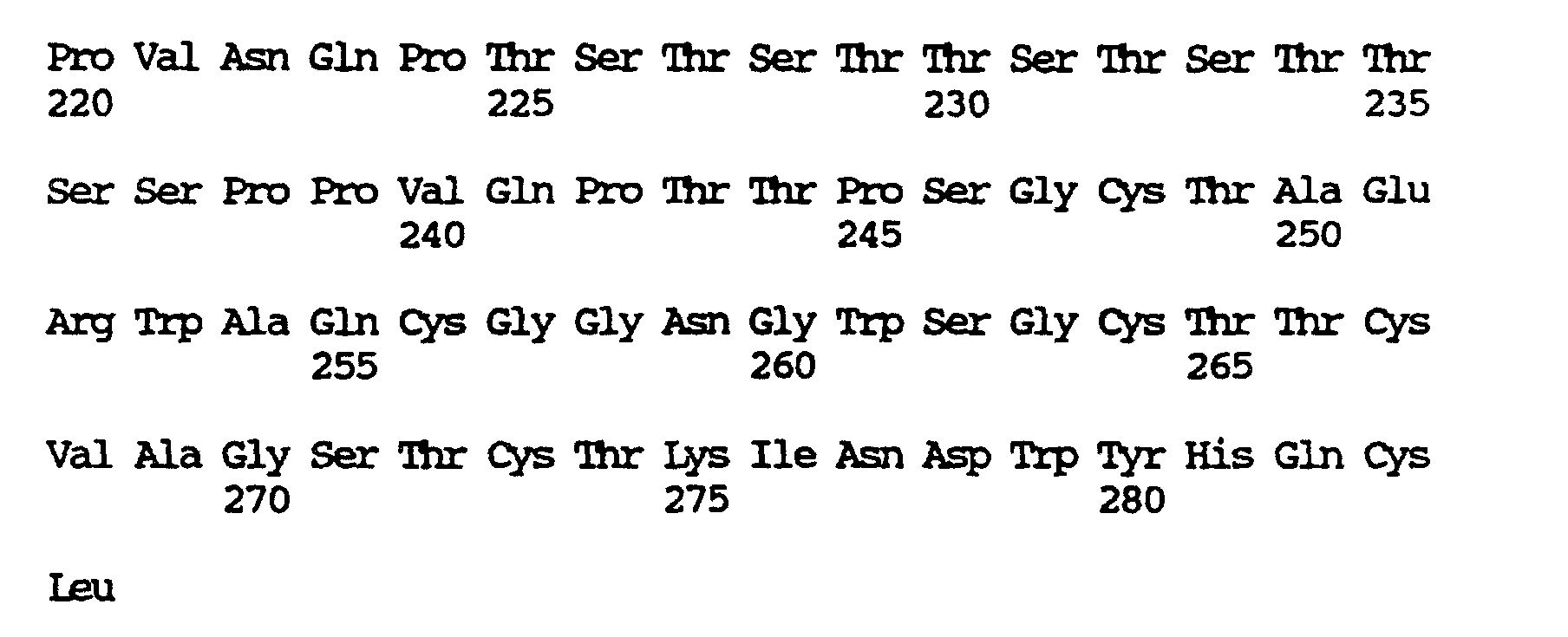
- (2) INFORMATION FOR SEQ ID NO:3:
- (i) SEQUENCE CHARACTERISTICS:
- (A) LENGTH: 1473 base pairs
- (B) TYPE: nucleic acid
- (C) STRANDEDNESS: single
- (D) TOPOLOGY: linear
- (ii) MOLECULE TYPE: cDNA
- (iii) HYPOTHETICAL: NO
- (iv) ANTI-SENSE: NO
- (vi) ORIGINAL SOURCE:
- (A) ORGANISM: Fusarium oxysporum
- (B) STRAIN: DSM 2672
- (ix) FEATURE:
- (A) NAME/KEY: CD6
- (B) IDCATION: 97..1224
- (xi) SEQUENCE DESCRIPTION: SEQ ID NO:3:

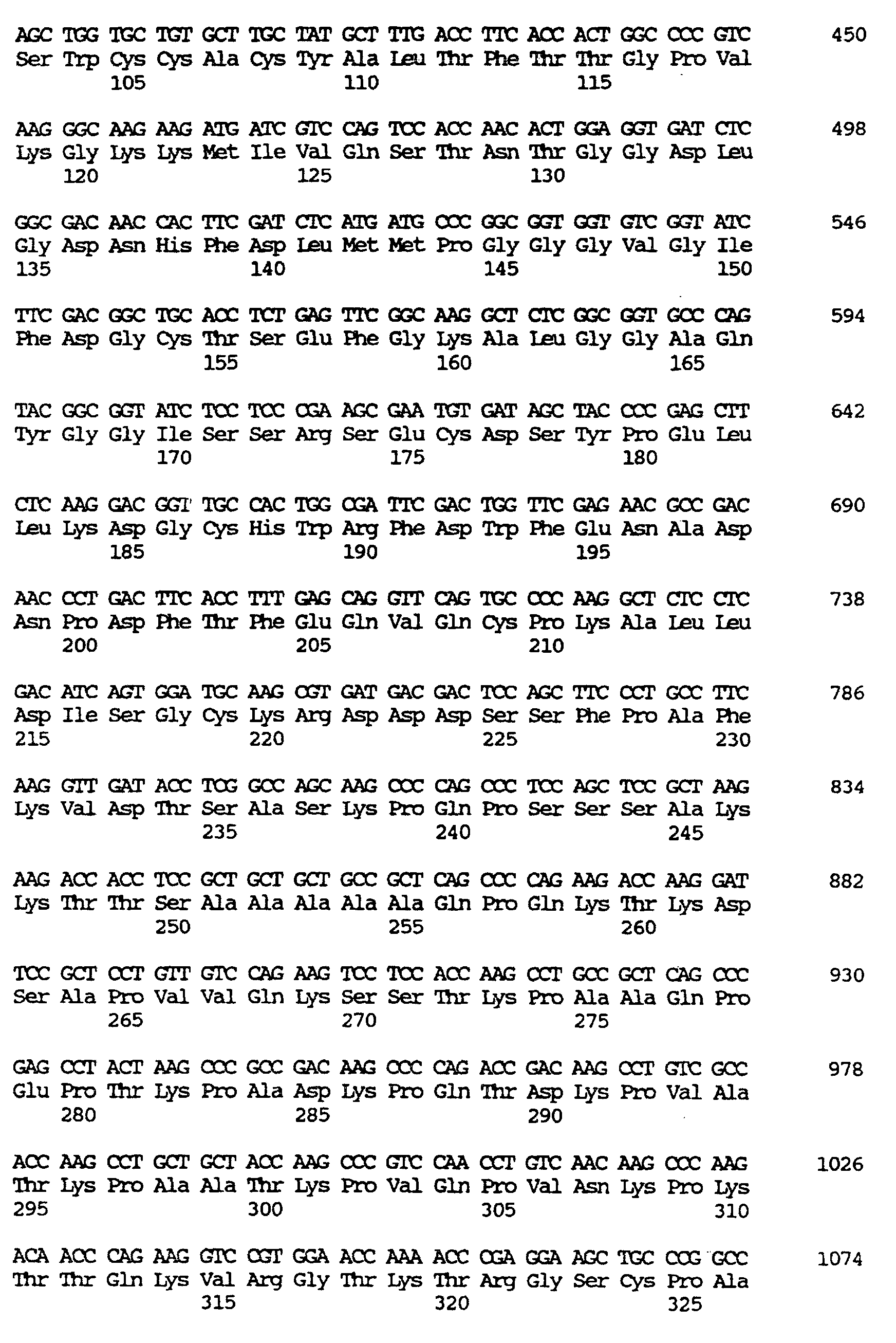
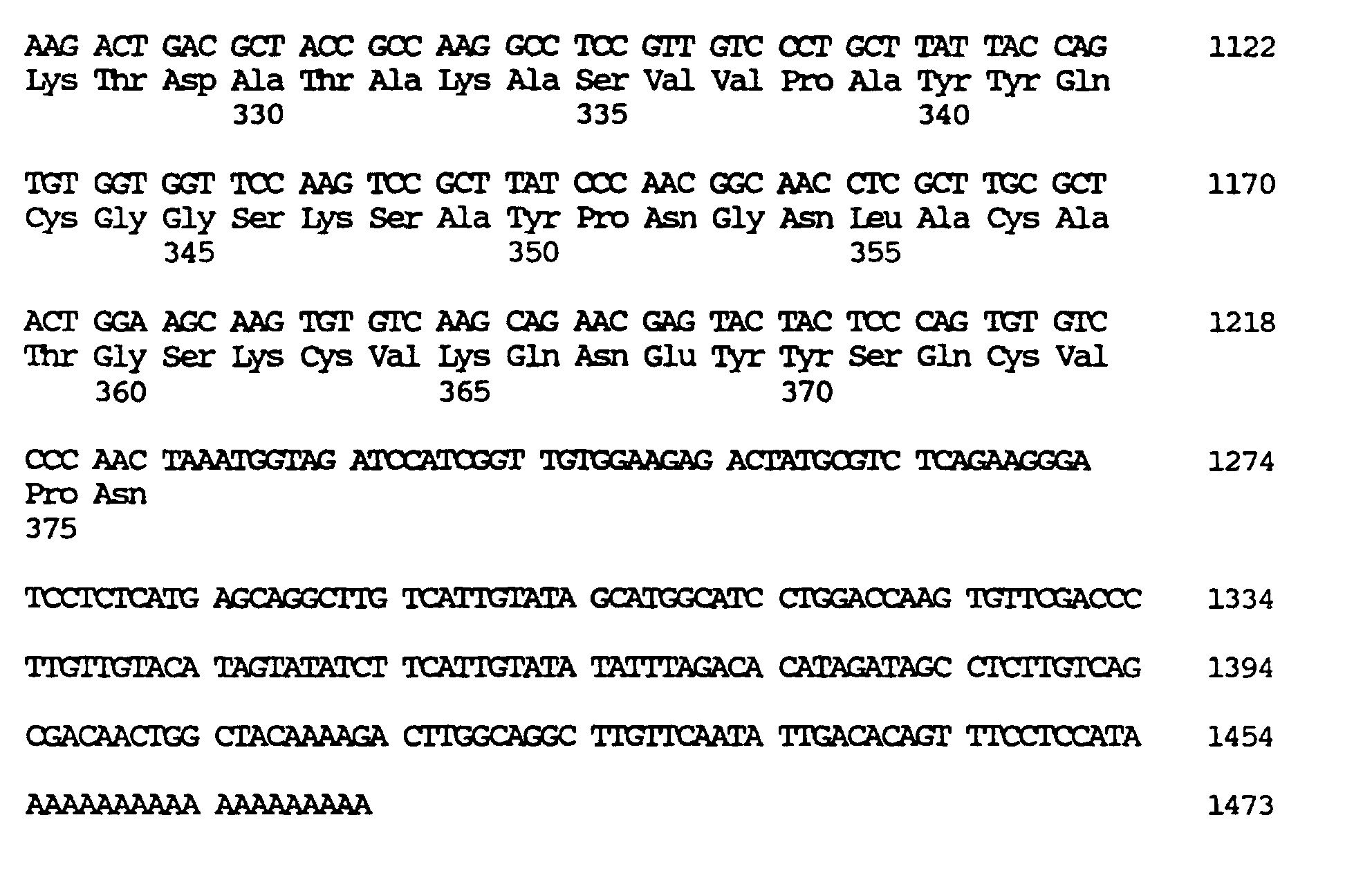
- (2) INFORMATION FOR SEQ ID NO:4:
- (i) SEQUENCE CHARACTERISTICS:
- (A) LENGTH: 376 amino acids
- (B) TYPE: amino acid
- (D) TOPOLOGY: linear
- (ii) MOLECULE TYPE: protein
- (xi) SEQUENCE DESCRIPTION: SEQ ID NO:4:

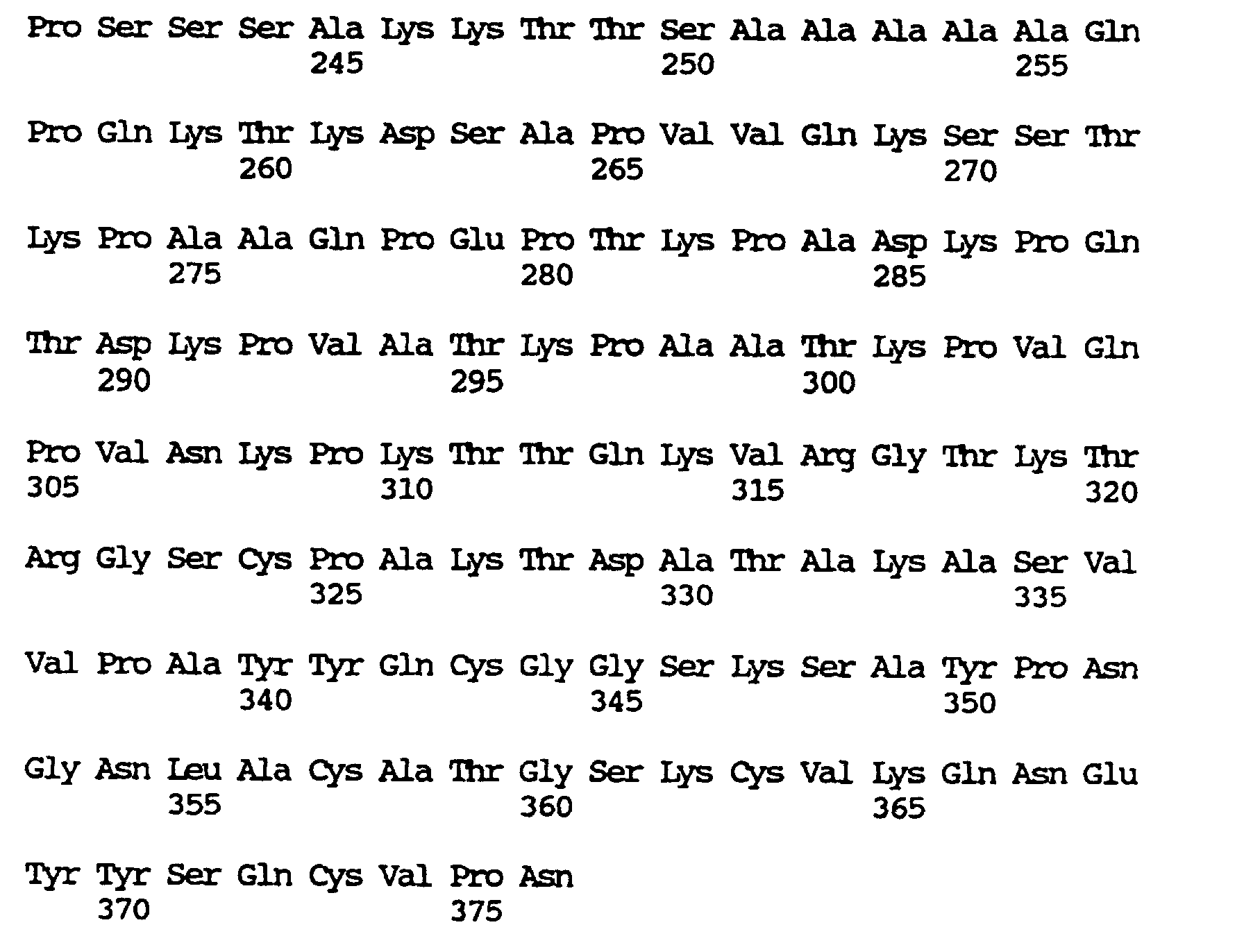
-
Claims (25)
- A cellulase preparation consisting essentially of a homogeneous enzyme exhibiting endoglucanase activity, which enzyme has the amino acid sequence shown in the appended Sequence Listing ID #2 or ID #4 or is a derivative of either.
- A cellulase preparation according to claim 1 which is producible by a species of Humicola, e.g. Humicola insolens.
- A cellulase preparation according to claim 1 which is producible by a species of Fusarium, e.g. Fusarium oxysporum.
- A DNA construct comprising a DNA sequence encoding an endoglucanase enzyme as claimed in any of claims 1-3.
- A DNA construct according to claim 4, wherein the DNA sequence is as shown in the appended Sequence Listings ID #1 or ID #3 or a modification thereof.
- An expression vector which carries an inserted DNA sequence according to claim 4 or 5.
- A cell which is transformed with a DNA construct according to claim 4 or 5 or with an expression vector according to claim 6.
- A cell according to claim 7 which is a fungal cell, e.g. belonging to a strain of Trichoderma or Aspergillus, in particular Aspergillus oryzae or Aspergillus niger, or a yeast cell, e.g. belonging to a strain of Hansenula or Saccharomyces, e.g. Saccharomyces cerevisiae.
- A process for producing an endoglucanase enzyme as defined in any of claims 1-3, the process comprising culturing a cell according to claim 7 or 8 in a suitable culture medium under conditions permitting the expression of the endoglucanase enzyme, and recovering the endoglucanase enzyme from the culture.
- A detergent additive containing a cellulase preparation according to any of claims 1-3, preferably in the form of a non-dusting granulate, stabilized liquid or protected enzyme.
- A detergent additive according to claim 10 which contains 1-500, preferably 5-250, most preferably 10-100, mg of enzyme protein per gram of the additive.
- A detergent additive according to claim 10 which additionally comprises another enzyme such as a protease, lipase, peroxidase and/or amylase.
- A detergent additive according to claim 12, wherein the protease is one which has a higher degree of specificity than Bacillus lentus serine protease.
- A detergent additive according to claim 12, wherein the protease is subtilisin Novo or a variant thereof, a protease derivable from Nocardia dassonvillei NRRL 18133, a serine protease specific for glutamic and aspartic acid, producible by Bacillus licheniformis, or a trypsin-like protease producible by Fusarium sp. DSM 2672.
- A detergent composition comprising a cellulase preparation according to any of claims 1-3.
- A detergent composition according to claim 15, which additionally comprises another enzyme such as a protease, lipase, peroxidase and/or amylase.
- A detergent composition according to claim 16, wherein the protease is one which has a higher degree of specificity than Bacillus lentus serine protease.
- A detergent composition according to claim 17, wherein the protease is subtilisin Novo or a variant thereof, a protease derivable from Nocardia dassonvillei NRRL 18133, a serine protease specific for glutamic and aspartic acid, producible by Bacillus licheniformis, or a trypsin-like protease producible by Fusarium sp. DSM 2672.
- A detergent composition according to claim 18, wherein endoglucanase enzyme is present in a concentration corresponding to 0.01-100, preferably 0.05-60, and most preferably 0.1-20, mg of enzyme protein per liter washing solution.
- A detergent composition comprising a detergent additive according to any of claims 10-14.
- A method of reducing the rate at which cellulose-containing fabrics become harsh or of reducing the harshness of cellulose-containing fabrics, the method comprising treating cellulose-containing fabrics with a cellulase preparation according to any of claims 1-3.
- A method of providing colour clarification of coloured cellulose-containing fabrics, the method comprising treating coloured cotton-containing fabrics with a cellulase preparation according to any of claims 1-3.
- A method of providing a localized variation in colour of coloured cellulose-containing fabrics, the method comprising treating coloured cotton-containing fabrics with a cellulase preparation according to any of claims 1-3.
- A method according to any of claims 21, 22 or 23, wherein the treatment of the fabrics with the cellulase preparation is carried out during soaking, washing or rinsing of the fabrics.
- A method of improving the drainage properties of pulp, the method comprising treating paper pulp with a cellulase preparation according to any of claims 1-3.
Applications Claiming Priority (7)
| Application Number | Priority Date | Filing Date | Title |
|---|---|---|---|
| DK1159/90 | 1990-05-09 | ||
| DK115990 | 1990-05-09 | ||
| DK115990A DK115990D0 (en) | 1990-05-09 | 1990-05-09 | enzyme preparation |
| DK736/91 | 1991-04-22 | ||
| DK73691A DK73691D0 (en) | 1991-04-22 | 1991-04-22 | enzyme preparation |
| DK73691 | 1991-04-22 | ||
| PCT/DK1991/000123 WO1991017243A1 (en) | 1990-05-09 | 1991-05-08 | A cellulase preparation comprising an endoglucanase enzyme |
Publications (3)
| Publication Number | Publication Date |
|---|---|
| EP0531372A1 EP0531372A1 (en) | 1993-03-17 |
| EP0531372B1 EP0531372B1 (en) | 1995-02-15 |
| EP0531372B2 true EP0531372B2 (en) | 2004-04-14 |
Family
ID=26064550
Family Applications (1)
| Application Number | Title | Priority Date | Filing Date |
|---|---|---|---|
| EP91909971A Expired - Lifetime EP0531372B2 (en) | 1990-05-09 | 1991-05-08 | A cellulase preparation comprising an endoglucanase enzyme |
Country Status (13)
| Country | Link |
|---|---|
| US (2) | US5948672A (en) |
| EP (1) | EP0531372B2 (en) |
| JP (4) | JP3110452B2 (en) |
| KR (1) | KR100237148B1 (en) |
| AT (1) | ATE118545T1 (en) |
| AU (1) | AU639570B2 (en) |
| BR (1) | BR9106435A (en) |
| CA (1) | CA2082279C (en) |
| DE (1) | DE69107455T3 (en) |
| DK (1) | DK0531372T4 (en) |
| ES (1) | ES2068586T5 (en) |
| FI (1) | FI103985B1 (en) |
| WO (1) | WO1991017243A1 (en) |
Cited By (1)
| Publication number | Priority date | Publication date | Assignee | Title |
|---|---|---|---|---|
| US9023620B2 (en) | 1995-03-17 | 2015-05-05 | Novozymes A/S | Method of providing color clarification of laundry |
Families Citing this family (868)
| Publication number | Priority date | Publication date | Assignee | Title |
|---|---|---|---|---|
| US5536661A (en) * | 1987-03-10 | 1996-07-16 | Novo Nordisk A/S | Process for the production of protein products in aspergillus |
| US5766912A (en) | 1986-03-17 | 1998-06-16 | Novo Nordisk A/S | Humicola lipase produced in aspergillus |
| US5290474A (en) * | 1990-10-05 | 1994-03-01 | Genencor International, Inc. | Detergent composition for treating cotton-containing fabrics containing a surfactant and a cellulase composition containing endolucanase III from trichoderma ssp |
| CA2093422C (en) * | 1990-10-05 | 2001-04-03 | Genencor International, Inc. | Detergent compositions containing cellulase compositions deficient in cbh i type components |
| US5650322A (en) * | 1990-10-05 | 1997-07-22 | Genencor International, Inc. | Methods for stonewashing fabrics using endoglucanases |
| DE69133035T2 (en) * | 1991-01-16 | 2003-02-13 | The Procter & Gamble Company, Cincinnati | Compact detergent compositions with highly active cellulases |
| US5520838A (en) * | 1991-01-16 | 1996-05-28 | The Procter & Gamble Company | Compact detergent compositions with high activity cellulase |
| EP0580719A4 (en) * | 1991-03-29 | 1995-01-18 | Genencor Int | METHODS FOR TREATING TISSUES CONTAINING COTTON WITH CELLULASE. |
| DE69117490T2 (en) * | 1991-04-12 | 1996-09-26 | Procter & Gamble | Compact detergent containing polyvinylpyrrolidone |
| DK73791D0 (en) * | 1991-04-22 | 1991-04-22 | Novo Nordisk As | detergent |
| DK73891D0 (en) * | 1991-04-22 | 1991-04-22 | Novo Nordisk As | ENZYME TREATMENT |
| JPH06507071A (en) * | 1991-05-01 | 1994-08-11 | ノボザイムス アクティーゼルスカブ | stabilizing enzyme |
| US5610129A (en) * | 1991-11-06 | 1997-03-11 | The Proctor & Gamble Company | Dye transfer inhibiting compositions |
| US5668073A (en) * | 1991-11-06 | 1997-09-16 | The Procter & Gamble Company | Detergent compounds with high activity cellulase and quaternary ammonium compounds |
| EP0540784B1 (en) * | 1991-11-06 | 2000-01-19 | The Procter & Gamble Company | Dye transfer inhibiting compositions |
| MX9206979A (en) * | 1991-12-04 | 1993-07-01 | Novo Nordisk As | CLONING METHOD FOR PROTEINS IN YEAST |
| ES2076794T3 (en) * | 1991-12-04 | 1995-11-01 | Procter & Gamble | LIQUID DETERGENT COMPOSITIONS FOR WASHING CLOTHES WITH CITRIC ACID, CELLULASE, AND BORICO-DIOL ACID COMPLEX TO INHIBIT PROTEOLYTIC ENZYME. |
| AU662120B2 (en) * | 1992-02-18 | 1995-08-24 | Procter & Gamble Company, The | Detergent compositions with high activity cellulase and softening clays |
| AU2244992A (en) * | 1992-02-18 | 1993-09-03 | Procter & Gamble Company, The | Detergent compositions with high activity cellulase and quaternary ammonium compounds |
| DK41992D0 (en) * | 1992-03-27 | 1992-03-27 | Novo Nordisk As | |
| JPH07505670A (en) * | 1992-04-13 | 1995-06-22 | ザ、プロクター、エンド、ギャンブル、カンパニー | Applications of modified polyester for cleaning cotton-containing fabrics |
| US6251144B1 (en) * | 1992-06-12 | 2001-06-26 | Genencor International, Inc. | Enzymatic compositions and methods for producing stonewashed look on indigo-dyed denim fabric and garments |
| DK87592D0 (en) * | 1992-07-03 | 1992-07-03 | Novo Nordisk As | ENZYME |
| WO1994012578A1 (en) * | 1992-11-30 | 1994-06-09 | Novo Nordisk A/S | A process for the treatment of cellulosic fabrics with cellulases |
| US5565006A (en) * | 1993-01-20 | 1996-10-15 | Novo Nordisk A/S | Method for the treatment of dyed fabric |
| WO1994019527A1 (en) * | 1993-02-18 | 1994-09-01 | Meiji Seika Kabushiki Kaisha | Cellulase preparation and method of treating cellulosic fiber therewith |
| EP0702713B1 (en) * | 1993-06-11 | 2002-01-30 | Genencor International, Inc. | Enzymatic methods and use of enzymes for producing stonewashed look on indigo-dyed denim fabric |
| US5883066A (en) * | 1993-06-28 | 1999-03-16 | The Procter & Gamble Company | Liquid detergent compositions containing cellulase and amine |
| DK0633311T3 (en) * | 1993-06-28 | 2000-08-07 | Procter & Gamble | Hydrophobic Amines for Cellulase Stabilization in Liquid Detergent Compositions Containing Anionic Surfactant |
| CN1129011A (en) * | 1993-07-12 | 1996-08-14 | 诺沃挪第克公司 | Detergent composition comprising two cellulase components |
| US5599786A (en) * | 1993-08-12 | 1997-02-04 | The Procter & Gamble Company | Cellulase fabric-conditioning compositions |
| US5616553A (en) * | 1993-08-12 | 1997-04-01 | The Procter & Gamble Company | Fabric conditioning compositions |
| CA2173329C (en) | 1993-10-08 | 2011-07-12 | Henrik Bisgard-Frantzen | Amylase variants |
| DE69434635D1 (en) | 1993-10-08 | 2006-04-27 | Novo Nordisk As | Amylasevarianten |
| DE69536145D1 (en) | 1994-03-08 | 2011-04-07 | Novozymes As | Novel alkaline cellulases |
| US5912157A (en) * | 1994-03-08 | 1999-06-15 | Novo Nordisk A/S | Alkaline cellulases |
| DE69521250T2 (en) * | 1994-03-18 | 2002-05-02 | Genencor International, Inc. | METHOD FOR TREATING COTTON-FREE FABRICS WITH CELLULASES |
| WO1995026398A1 (en) * | 1994-03-28 | 1995-10-05 | Novo Nordisk A/S | A modified cellulase and an enzyme preparation comprising a modified cellulase |
| CA2186592C (en) | 1994-03-29 | 2008-02-19 | Helle Outtrup | Alkaline bacillus amylase |
| JPH10500456A (en) * | 1994-04-29 | 1998-01-13 | ザ、プロクター、エンド、ギャンブル、カンパニー | Cellulase fabric conditioning composition |
| US5445747A (en) * | 1994-08-05 | 1995-08-29 | The Procter & Gamble Company | Cellulase fabric-conditioning compositions |
| TR199500988A2 (en) * | 1994-08-15 | 1996-06-21 | Nova Nordisk As | A method for removing matrix in fabrics containing cellulose. |
| US5919691A (en) * | 1994-10-06 | 1999-07-06 | Novo Nordisk A/S | Enzyme and enzyme preparation with endoglucanase activity |
| AU4298796A (en) * | 1994-12-22 | 1996-07-10 | Novo Nordisk A/S | An enzyme preparation with cellulytic activity |
| AR000862A1 (en) | 1995-02-03 | 1997-08-06 | Novozymes As | VARIANTS OF A MOTHER-AMYLASE, A METHOD TO PRODUCE THE SAME, A DNA STRUCTURE AND A VECTOR OF EXPRESSION, A CELL TRANSFORMED BY SUCH A DNA STRUCTURE AND VECTOR, A DETERGENT ADDITIVE, DETERGENT COMPOSITION, A COMPOSITION FOR AND A COMPOSITION FOR THE ELIMINATION OF |
| EP0813584B1 (en) * | 1995-03-03 | 2000-05-24 | The Procter & Gamble Company | Laundry composition containing dye fixatives and cellulase |
| US6313081B1 (en) | 1995-04-28 | 2001-11-06 | Henkel Kommanditgesellschaft Auf Aktien (Kgaa) | Detergents comprising cellulases |
| US5958083A (en) * | 1995-09-08 | 1999-09-28 | Novo Nordisk A/A | Prevention of back-staining in stone washing |
| ES2200070T5 (en) | 1995-09-08 | 2012-03-27 | Novozymes A/S | Prevention of retroactive coloring in stone washing |
| US6723549B2 (en) | 1995-10-17 | 2004-04-20 | Ab Enzymes Oy | Cellulases, the genes encoding them and uses thereof |
| US6184019B1 (en) | 1995-10-17 | 2001-02-06 | Röhm Enzyme Finland OY | Cellulases, the genes encoding them and uses thereof |
| WO1997018286A1 (en) | 1995-11-15 | 1997-05-22 | Novo Nordisk A/S | A process for combined desizing and 'stone-washing' of dyed denim |
| WO1997020026A1 (en) * | 1995-11-27 | 1997-06-05 | Unilever N.V. | Enzymatic detergent compositions |
| EP0883672A1 (en) * | 1995-11-27 | 1998-12-16 | Unilever N.V. | Enzymatic detergent compositions |
| WO1997024421A2 (en) * | 1995-12-29 | 1997-07-10 | The Procter & Gamble Company | Detergent compositions comprising immobilized enzymes |
| EP1605050A3 (en) | 1996-01-19 | 2006-03-22 | Novozymes Biotech, Inc. | Morphological mutants of filamentous fungi |
| WO1997027363A1 (en) * | 1996-01-26 | 1997-07-31 | Novo Nordisk A/S | Production of sanitary paper |
| AUPN909696A0 (en) * | 1996-04-03 | 1996-04-26 | Participant Project Ip Limited | Paper pulp drainage aid |
| EP0904360B1 (en) | 1996-04-30 | 2013-07-31 | Novozymes A/S | alpha-AMYLASE MUTANTS |
| WO1997042282A1 (en) | 1996-05-03 | 1997-11-13 | The Procter & Gamble Company | Detergent compositions comprising polyamine polymers with improved soil dispersancy |
| EP0898618B1 (en) | 1996-05-10 | 2007-10-31 | Novozymes A/S | Method of providing novel dna sequences |
| CN100432099C (en) | 1996-07-05 | 2008-11-12 | 诺沃奇梅兹有限公司 | Transcription factor |
| CN1154739C (en) * | 1996-07-24 | 2004-06-23 | 明治制果株式会社 | System for mass production of proteins or prptides by microorganisms of genus humicola |
| ATE338111T1 (en) * | 1996-07-24 | 2006-09-15 | Meiji Seika Co | ENDOGLUCANASE ENZYME AND CELLULASE COMPOSITIONS CONTAINING SAME |
| AU6953796A (en) * | 1996-08-16 | 1998-03-06 | Procter & Gamble Company, The | Detergent compositions comprising antibody controlled cellulolytic activity |
| CN1198939C (en) * | 1996-09-13 | 2005-04-27 | 明治制果株式会社 | Regulatory sequence of cellulase cbh1 gene from Trichoderma viride and mass production system of protein or polypeptide using the sequence |
| BR9711479B1 (en) | 1996-09-17 | 2009-08-11 | cellulase variant having increased resistance to anion voltage. | |
| WO1998017854A1 (en) * | 1996-10-21 | 1998-04-30 | Kao Corporation | Method for modifying moisture absorbing/releasing properties of cellulosic fibers |
| ATE235544T1 (en) | 1996-10-30 | 2003-04-15 | Procter & Gamble | FABRIC PLASTICIZER COMPOSITIONS |
| FI964691A0 (en) * | 1996-11-25 | 1996-11-25 | Primalco Ltd | Cellulose weaving process |
| WO1998028991A2 (en) * | 1996-12-11 | 1998-07-09 | Gist-Brocades B.V. | Cloudy fruit juices and methods for making same |
| WO1998029530A2 (en) * | 1996-12-31 | 1998-07-09 | The Procter & Gamble Company | Laundry detergent compositions with polyamide-polyamines |
| US5866407A (en) * | 1997-03-18 | 1999-02-02 | Iogen Corporation | Method and enzyme mixture for improved depilling of cotton goods |
| US6060441A (en) * | 1997-04-10 | 2000-05-09 | Henkel Corporation | Cleaning compositions having enhanced enzyme activity |
| WO1998051803A1 (en) | 1997-05-16 | 1998-11-19 | Novo Nordisk Biotech, Inc. | Polypeptides having prolyl pipeptidyl aminopeptidase activity and nucleic acids encoding same |
| US6146494A (en) * | 1997-06-12 | 2000-11-14 | The Procter & Gamble Company | Modified cellulosic fibers and fibrous webs containing these fibers |
| US6440911B1 (en) * | 1997-08-14 | 2002-08-27 | Procter & Gamble Company | Enzymatic cleaning compositions |
| US6294366B1 (en) | 1997-09-19 | 2001-09-25 | Clariant Finance (Bvi) Limited | Compositions and methods for treating cellulose containing fabrics using truncated cellulase enzyme compositions |
| AU9434398A (en) | 1997-10-13 | 1999-05-03 | Novo Nordisk A/S | Alpha-amylase mutants |
| EP2386568B1 (en) | 1997-10-30 | 2014-08-06 | Novozymes A/S | Alpha-amylase mutants |
| DE69942995D1 (en) | 1998-02-27 | 2011-01-13 | Novozymes As | MALTOGENIC ALPHA-AMYLASE VARIANTS |
| AU757658B2 (en) | 1998-03-09 | 2003-02-27 | Zealand Pharma A/S | Pharmacologically active peptide conjugates having a reduced tendency towards enzymatic hydrolysis |
| SE9801571D0 (en) | 1998-05-05 | 1998-05-05 | Wapharm Ab | Melanocortin-1 receptor selective compounds |
| EP2284272B1 (en) | 1998-06-10 | 2014-08-13 | Novozymes A/S | Mannanases |
| US6635146B2 (en) | 1998-07-08 | 2003-10-21 | Kimberly-Clark Worldwide, Inc. | Enzymatic treatment of pulp to increase strength using truncated hydrolytic enzymes |
| AU6188599A (en) | 1998-10-26 | 2000-05-15 | Novozymes A/S | Constructing and screening a dna library of interest in filamentous fungal cells |
| CA2715086A1 (en) | 1998-11-27 | 2000-06-08 | Novozymes A/S | Lipolytic enzyme variants |
| ATE504651T1 (en) | 1998-12-18 | 2011-04-15 | Novozymes As | SUBTILASE ENZYMES OF THE I-S1 AND I-S2 SUBGROUPS WITH AN ADDITIONAL AMINO ACID RESIDUE IN AN ACTIVE LOOP REGION |
| ES2618608T3 (en) | 1999-03-30 | 2017-06-21 | Novozymes A/S | Alpha-amylase variants |
| ES2532606T3 (en) | 1999-03-31 | 2015-03-30 | Novozymes A/S | Polypeptides with alkaline alpha-amylase activity and nucleic acids encoding them |
| WO2000060058A2 (en) | 1999-03-31 | 2000-10-12 | Novozymes A/S | Polypeptides having alkaline alpha-amylase activity and nucleic acids encoding same |
| EP1183337B1 (en) | 1999-05-20 | 2008-09-17 | Novozymes A/S | Subtilase enzymes of the i-s1 and i-s2 sub-groups having at least one additional amino acid residue between positions 132 and 133 |
| WO2000071691A1 (en) | 1999-05-20 | 2000-11-30 | Novozymes A/S | Subtilase enzymes of the i-s1 and i-s2 sub-groups having at least one additional amino acid residue between positions 125 and 126 |
| WO2000071690A1 (en) | 1999-05-20 | 2000-11-30 | Novozymes A/S | Subtilase enzymes of the i-s1 and i-s2 sub-groups having at least one additional amino acid residue between positions 128 and 129 |
| EP1183341B2 (en) | 1999-05-20 | 2012-05-02 | Novozymes A/S | Subtilase enzymes of the i-s1 and i-s2 sub-groups having at least one additional amino acid residue between positions 127 and 128 |
| AU4392800A (en) | 1999-05-20 | 2000-12-12 | Novozymes A/S | Subtilase enzymes of the i-s1 and i-s2 sub-groups having at least one additionalamino acid residue between positions 126 and 127 |
| AU4392700A (en) | 1999-05-20 | 2000-12-12 | Novozymes A/S | Subtilase enzymes of the i-s1 and i-s2 sub-groups having at least one additionalamino acid residue between positions 129 and 130 |
| US7256030B1 (en) | 1999-05-28 | 2007-08-14 | Novozymes A/S | Family 9 endo-β-1,4-glucanases |
| AU5805700A (en) | 1999-07-09 | 2001-01-30 | Novozymes A/S | Glucoamylase variant |
| EP1076066A1 (en) | 1999-07-12 | 2001-02-14 | Zealand Pharmaceuticals A/S | Peptides for lowering blood glucose levels |
| NZ517409A (en) | 1999-08-31 | 2004-05-28 | Novozymes As | RP-II properties with amino acid substitutions used in detergent compositions and additives |
| WO2001021499A1 (en) | 1999-09-22 | 2001-03-29 | The Procter & Gamble Company | A hand-held liquid container |
| AR026433A1 (en) | 1999-11-10 | 2003-02-12 | Novozymes As | FUNGAMYL TYPE ALFA-AMYLASE VARIANTS |
| US6350599B1 (en) | 2000-01-12 | 2002-02-26 | Novozymes A/S | Pullulanase variants and methods for preparing such variants with predetermined properties |
| EP1263942B1 (en) | 2000-03-08 | 2013-11-06 | Novozymes A/S | Variants with altered properties |
| JP2004501651A (en) | 2000-06-23 | 2004-01-22 | ノボザイムス アクティーゼルスカブ | Methods for stable chromosomal multicopy integration of genes |
| CA2702204C (en) | 2000-08-01 | 2011-09-06 | Novozymes A/S | Alpha-amylase mutants with altered properties |
| WO2002016547A2 (en) | 2000-08-21 | 2002-02-28 | Novozymes A/S | Subtilase enzymes |
| GB0021483D0 (en) * | 2000-09-01 | 2000-10-18 | Unilever Plc | Fabric care composition |
| WO2002022943A1 (en) * | 2000-09-14 | 2002-03-21 | Meiji Seika Kaisha, Ltd. | Method of deinking waste paper by using cellulase without lowering paper strength and method of evaluating the same |
| US6808595B1 (en) | 2000-10-10 | 2004-10-26 | Kimberly-Clark Worldwide, Inc. | Soft paper products with low lint and slough |
| EP1975229A3 (en) | 2000-10-13 | 2009-03-18 | Novozymes A/S | Alpha-amylase variant with altered properties |
| WO2002031133A1 (en) | 2000-10-13 | 2002-04-18 | Novozymes A/S | Subtilase variants |
| EP1241112A3 (en) | 2001-03-15 | 2003-02-26 | The Procter & Gamble Company | Flexible multiple compartment pouch |
| US7498158B2 (en) | 2001-05-15 | 2009-03-03 | Novozymes A/S | Alpha-amylase variant with altered properties |
| NZ528260A (en) | 2001-05-18 | 2005-09-30 | Danisco | Method of improving dough and bread quality with the addition of an enzyme that hydrolyses a glycolipid and a phospholipid and incapable of hydrolysing a triglyceride or monoglyceride |
| JP4242761B2 (en) | 2001-06-06 | 2009-03-25 | ノボザイムス アクティーゼルスカブ | Endo-β-1,4-glucanase |
| US7041488B2 (en) | 2001-06-06 | 2006-05-09 | Novozymes A/S | Endo-beta-1,4-glucanase from bacillus |
| DK2277997T3 (en) | 2001-06-26 | 2013-12-02 | Novozymes As | Polypeptides with cellobiohydrolase I activity and the same coding polynucleotides |
| DK200101090A (en) | 2001-07-12 | 2001-08-16 | Novozymes As | Subtilase variants |
| US7063962B2 (en) | 2001-07-20 | 2006-06-20 | Novozymes A/S | DNA sequences for regulating transcription |
| US7153820B2 (en) | 2001-08-13 | 2006-12-26 | Ecolab Inc. | Solid detergent composition and method for solidifying a detergent composition |
| EP1840211A1 (en) | 2001-10-31 | 2007-10-03 | Danisco A/S | Pyranosone dehydratase from phanerochaete chrysosporium |
| US7138261B2 (en) | 2001-12-18 | 2006-11-21 | Meiji Seika Kaisha, Ltd. | Cellulase preparations containing reducing agent and method of processing fiber |
| AU2003214037A1 (en) | 2002-03-27 | 2003-10-08 | Novozymes A/S | Granules with filamentous coatings |
| ATE420161T1 (en) | 2002-07-01 | 2009-01-15 | Novozymes As | MONOPROPYLENE GLYCOL AS A FERMENTATION ADDITIVE |
| EP1549745B1 (en) | 2002-10-01 | 2011-01-05 | Novozymes A/S | Family gh 61 polypeptides |
| WO2004033482A2 (en) | 2002-10-08 | 2004-04-22 | Genencor International, Inc. | Phenolic binding peptides |
| TWI319007B (en) | 2002-11-06 | 2010-01-01 | Novozymes As | Subtilase variants |
| US20060035800A1 (en) * | 2002-12-11 | 2006-02-16 | Novozymes A/S | Detergent composition |
| US7348168B2 (en) | 2002-12-20 | 2008-03-25 | Novozymes A/S | Polypeptides having cellobiohydrolase II activity and polynucleotides encoding same |
| EP3323887A3 (en) | 2003-01-17 | 2018-09-12 | DuPont Nutrition Biosciences ApS | Method for the in situ production of an emulsifier in a foodstuff |
| DE602004026032D1 (en) | 2003-01-27 | 2010-04-29 | Novozymes As | ENZYME STABILIZATION |
| EP1597344A2 (en) | 2003-02-18 | 2005-11-23 | Novozymes A/S | Detergent compositions |
| JP4638418B2 (en) | 2003-03-31 | 2011-02-23 | ノボザイムス,インコーポレイティド | Methods for producing biological material in enzyme-deletion mutants of Aspergillus niger |
| US7393664B2 (en) | 2003-05-02 | 2008-07-01 | Novozymes, Inc. | Methods for producing secreted polypeptides |
| DK2228440T3 (en) | 2003-05-02 | 2013-01-02 | Novozymes Inc | Variants of beta-glucosidases |
| AU2004252572B2 (en) | 2003-06-25 | 2011-09-08 | Novozymes A/S | Polypeptides having alpha-amylase activity and polypeptides encoding same |
| JP2007526748A (en) | 2003-06-25 | 2007-09-20 | ノボザイムス アクティーゼルスカブ | Starch processing enzyme |
| ES2517245T3 (en) | 2003-06-25 | 2014-11-03 | Novozymes A/S | Enzymes for the treatment of starch |
| BRPI0412279A (en) | 2003-07-02 | 2006-09-19 | Diversa Corp | glucanases, nucleic acids encoding the same and methods for preparing and applying them |
| CA2535526C (en) | 2003-08-11 | 2015-09-29 | Diversa Corporation | Laccases, nucleic acids encoding them and methods for making and using them |
| EP2377931B1 (en) | 2003-08-25 | 2013-05-08 | Novozymes Inc. | Variants of glycoside hydrolases |
| EP2284259A3 (en) | 2003-10-10 | 2011-06-15 | Novozymes A/S | Protease variants |
| WO2005040372A1 (en) | 2003-10-23 | 2005-05-06 | Novozymes A/S | Protease with improved stability in detergents |
| EP1682656B1 (en) | 2003-10-28 | 2013-09-18 | Novozymes Inc. | Polypeptides having beta-glucosidase activity and polynucleotides encoding same |
| ATE457034T1 (en) | 2003-10-28 | 2010-02-15 | Novozymes North America Inc | HYBRID ENZYMES |
| CN1902315B (en) | 2003-12-03 | 2012-05-02 | 明治制果药业株式会社 | Endoglucanase STCE and cellulase preparation containing the same |
| CN1890367B (en) | 2003-12-08 | 2012-11-14 | 明治制果药业株式会社 | Surfactant-resistant cellulase and modification method thereof |
| KR101169265B1 (en) | 2003-12-24 | 2012-08-02 | 대니스코 에이/에스 | Proteins |
| WO2005066339A2 (en) | 2004-01-06 | 2005-07-21 | Novozymes A/S | Polypeptides of alicyclobacillus sp. |
| ATE489457T1 (en) | 2004-01-16 | 2010-12-15 | Novozymes Inc | METHOD FOR DEGRADING LIGNOCELLULOSE MATERIALS |
| ES2468366T3 (en) | 2004-01-30 | 2014-06-16 | Novozymes Inc. | Polypeptides with cellulolytic enhancement activity and polynucleotides that encode them |
| EP2305821A3 (en) | 2004-02-13 | 2011-04-13 | Novozymes A/S | Protease variants |
| GB0405637D0 (en) | 2004-03-12 | 2004-04-21 | Danisco | Protein |
| US7148404B2 (en) | 2004-05-04 | 2006-12-12 | Novozymes A/S | Antimicrobial polypeptides |
| CA2591858C (en) | 2004-06-21 | 2015-05-05 | Novozymes A/S | Proteases derived from norcardiopsis |
| EP3620523A3 (en) | 2004-07-05 | 2020-08-19 | Novozymes A/S | Alpha-amylase variants with altered properties |
| EA014985B1 (en) | 2004-07-16 | 2011-04-29 | Даниско А/С | A process of enzymatic degumming edible oils by hydration and use lipid acyltransferase for carrying out the process |
| EP1794295B1 (en) | 2004-09-21 | 2011-11-16 | Novozymes A/S | Subtilases |
| ATE499439T1 (en) | 2004-09-21 | 2011-03-15 | Novozymes As | SUBTILATE |
| DK1794296T3 (en) | 2004-09-21 | 2012-07-30 | Novozymes As | subtilases |
| GB0421598D0 (en) | 2004-09-29 | 2004-10-27 | Cambridge Advanced Tech | Modification of plant development and morphology |
| EP2298872A3 (en) | 2004-09-30 | 2011-08-10 | Novozymes A/S | Polypeptides having lipase activity and polynucleotides encoding same |
| GB0422052D0 (en) | 2004-10-04 | 2004-11-03 | Dansico As | Enzymes |
| GB0423139D0 (en) | 2004-10-18 | 2004-11-17 | Danisco | Enzymes |
| GB0424940D0 (en) | 2004-11-11 | 2004-12-15 | Danisco | Transcription factors |
| ES2543131T3 (en) | 2004-12-22 | 2015-08-14 | Novozymes North America, Inc. | Enzymes for starch treatment |
| EP1838860B1 (en) | 2005-01-10 | 2011-03-23 | Novozymes A/S | Process for the production of fatty acid alkyl esters from triglycerides and alcohols employing a combination of two lipolytic enzymes |
| NZ594810A (en) * | 2005-03-15 | 2012-12-21 | Verenium Corp | Cellulases, nucleic acids encoding them and methods for making and using them |
| AR053066A1 (en) | 2005-04-26 | 2007-04-18 | Novozymes As | ARABINOFURANOSIDASAS |
| EP1877551B2 (en) | 2005-04-27 | 2014-02-26 | Novozymes, Inc. | Polypeptides having endoglucanase activity and polynucleotides encoding same |
| ATE529505T1 (en) | 2005-07-08 | 2011-11-15 | Novozymes As | SUBTLE VARIANTS |
| CN101243182B (en) | 2005-08-16 | 2014-08-06 | 诺维信公司 | Subtilases |
| WO2007019859A2 (en) | 2005-08-16 | 2007-02-22 | Novozymes A/S | Polypeptides of strain bacillus sp. p203 |
| AU2005335905C1 (en) | 2005-08-26 | 2011-12-22 | Abbvie Inc. | Therapeutically active alpha-MSH analogues |
| US9303256B2 (en) | 2005-09-30 | 2016-04-05 | Novozymes A/S | Immobilization of enzymes |
| EP2385110A3 (en) | 2005-09-30 | 2011-11-16 | Novozymes, Inc. | Methods for enhancing the degradation or conversion of cellulosic material |
| WO2007057418A1 (en) | 2005-11-16 | 2007-05-24 | Novozymes A/S | Polypeptides having endoglucanase activity and polynucleotides encoding same |
| US20080280328A1 (en) | 2005-11-18 | 2008-11-13 | Novozymes A/S | Glucoamylase Variants |
| WO2007071820A1 (en) | 2005-12-22 | 2007-06-28 | Ab Enzymes Oy | Novel enzymes |
| US7256032B2 (en) * | 2005-12-22 | 2007-08-14 | Ab Enzymes Oy | Enzymes |
| FI120045B (en) | 2005-12-22 | 2009-06-15 | Roal Oy | Treatment of cellulose materials and enzymes useful therein |
| NZ595501A (en) | 2006-02-10 | 2013-05-31 | Verenium Corp | Cellulolytic enzymes, nucleic acids encoding them and methods for making and using them |
| WO2007098756A1 (en) | 2006-03-02 | 2007-09-07 | Novozymes A/S | High capacity encapsulation process |
| EP1998793A1 (en) | 2006-03-22 | 2008-12-10 | Novozymes A/S | Use of polypeptides having antimicrobial activity |
| EP2383330A1 (en) | 2006-03-31 | 2011-11-02 | Novozymes A/S | A stabilized liquid enzyme composition |
| EP2041278B1 (en) | 2006-06-21 | 2017-08-09 | Novozymes North America, Inc. | Desizing and scouring process |
| US8546106B2 (en) | 2006-07-21 | 2013-10-01 | Novozymes, Inc. | Methods of increasing secretion of polypeptides having biological activity |
| DK2069389T3 (en) | 2006-08-04 | 2015-01-12 | Bp Corp North America Inc | Glucanases, nucleic acids encoding them, and processes for their preparation and use |
| US8383097B2 (en) | 2006-08-11 | 2013-02-26 | Novozymes Biologicals, Inc | Bacteria cultures and compositions comprising bacteria cultures |
| ES2419234T5 (en) | 2006-10-06 | 2017-05-05 | Novozymes A/S | Detergent compositions and use of enzyme combinations in them |
| BRPI0722093A2 (en) | 2006-12-21 | 2014-04-01 | Danisco Us Inc Genencor Div | COMPOSITIONS AND USES FOR A BACILLUS ALPHA AMILASE POLYPEPTIDE 195 |
| JP5239159B2 (en) * | 2006-12-28 | 2013-07-17 | 日油株式会社 | Method for producing mushroom extract having proteolytic activity |
| AU2007344910B2 (en) | 2007-01-25 | 2013-03-28 | Dupont Nutrition Biosciences Aps | Production of a lipid acyltransferase from transformed Bacillus licheniformis cells |
| NZ578309A (en) * | 2007-01-30 | 2012-06-29 | Verenium Corp | Enzymes for the treatment of lignocellulosics, nucleic acids encoding them and methods for making and using them |
| US8143046B2 (en) | 2007-02-07 | 2012-03-27 | Danisco Us Inc., Genencor Division | Variant Buttiauxella sp. phytases having altered properties |
| US8093200B2 (en) | 2007-02-15 | 2012-01-10 | Ecolab Usa Inc. | Fast dissolving solid detergent |
| WO2008112459A2 (en) | 2007-03-09 | 2008-09-18 | Danisco Us Inc., Genencor Division | Alkaliphilic bacillus species a-amylase variants, compositions comprising a-amylase variants, and methods of use |
| EP2137307B1 (en) | 2007-03-09 | 2014-07-30 | Novozymes A/S | Thermostable asparaginases |
| DK2135944T3 (en) | 2007-03-12 | 2016-02-08 | Meiji Seika Pharma Co Ltd | PPCE endoglucanase cellulase AND CONTAINING SAME |
| DE102007013217A1 (en) | 2007-03-15 | 2008-09-18 | Clariant International Ltd. | Anionic Soil Release Polymers |
| JP5427041B2 (en) | 2007-03-23 | 2014-02-26 | ノボザイムス バイオロジカルズ,インコーポレイティド | Prevention and reduction of biofilm formation and plankton-like growth |
| DE102007016139A1 (en) | 2007-03-30 | 2008-10-02 | Jenabios Gmbh | Method for regioselective oxygenation of N-heterocycles |
| SG148934A1 (en) | 2007-06-11 | 2009-01-29 | Novozymes As | A process for combined biopolishing and bleach clean-up |
| JP2009072102A (en) * | 2007-09-20 | 2009-04-09 | Toyota Central R&D Labs Inc | Protein screening method for degrading biomass |
| DE102007047433A1 (en) | 2007-10-04 | 2009-04-09 | Lanxess Deutschland Gmbh | Liquid washing and liquid cleaning agents |
| AU2008313267B2 (en) | 2007-10-18 | 2013-09-19 | Ecolab Inc. | Pressed, waxy, solid cleaning compositions and methods of making them |
| EP2215110B1 (en) | 2007-11-05 | 2025-07-16 | Danisco US Inc. | Alpha-amylase variants with altered properties |
| JP5520828B2 (en) | 2007-11-05 | 2014-06-11 | ダニスコ・ユーエス・インク | Bacillus sp. TS-23 alpha-amylase variants with altered characteristics |
| BRPI0820647A8 (en) * | 2007-11-30 | 2017-06-06 | Novozymes As | CONSTRUCTION OF NUCLEIC ACID, RECOMBINANT HOST MICROBIAL CELL, METHODS FOR PRODUCING THE POLYPEPTIDE HAVING ALPHA-LARABINOFURANOSIDASE ACTIVITY, AND FOR DEGRADING A XYLANE CONTAINING MATERIAL |
| AU2008343105A1 (en) | 2007-12-19 | 2009-07-09 | Novozymes A/S | Polypeptides having cellulolytic enhancing activity and polynucleotides encoding same |
| NZ585870A (en) | 2007-12-21 | 2012-04-27 | Danisco | Process for edible oil refining using a lipid acyltransferase |
| CA2713582C (en) | 2008-02-04 | 2017-02-21 | Danisco Us Inc. | Ts23 alpha-amylase variants with altered properties |
| MX2010009146A (en) | 2008-02-19 | 2010-09-22 | Novozymes As | Method for stonewashing fabrics using cellulase. |
| EP2247720A2 (en) * | 2008-02-29 | 2010-11-10 | The Procter & Gamble Company | Detergent composition comprising lipase |
| EP2281034B1 (en) | 2008-04-30 | 2015-10-21 | DuPont Nutrition Biosciences ApS | Process using Pseudoglucanobacter saccharoketogenes alcohol dehydrogenase |
| JP5702714B2 (en) | 2008-04-30 | 2015-04-15 | ダニスコ・ユーエス・インク | Novel chimeric alpha amylase mutant |
| DE102008023803A1 (en) | 2008-05-15 | 2009-11-26 | Clariant International Ltd. | Additives for detergents and cleaners |
| WO2009149283A1 (en) | 2008-06-06 | 2009-12-10 | Danisco Us Inc. | Saccharification enzyme composition |
| JP5560266B2 (en) | 2008-06-06 | 2014-07-23 | ダニスコ・ユーエス・インク | Production of glucose from starch using alpha-amylase from B. subtilis |
| WO2009149130A2 (en) | 2008-06-06 | 2009-12-10 | Danisco Us Inc. | Geobacillus stearothermophilus alpha-amylase (amys) variants with improved properties |
| WO2009149419A2 (en) | 2008-06-06 | 2009-12-10 | Danisco Us Inc. | Variant alpha-amylases from bacillus subtilis and methods of use, thereof |
| GB0812318D0 (en) | 2008-07-04 | 2008-08-13 | Terranol As | Microorganism |
| EP2149786A1 (en) | 2008-08-01 | 2010-02-03 | Unilever PLC | Improvements relating to detergent analysis |
| US8394237B2 (en) | 2008-09-02 | 2013-03-12 | BASF SE Ludwigshafen | Method for manufacturing paper, cardboard and paperboard using endo-beta-1,4-glucanases as dewatering means |
| CN202181298U (en) | 2008-09-12 | 2012-04-04 | 荷兰联合利华有限公司 | Dispenser and preconditioner for viscous liquids |
| EP2337837B2 (en) | 2008-09-25 | 2016-10-26 | Danisco US Inc. | Alpha-amylase blends and methods for using said blends |
| RU2524118C2 (en) | 2008-10-15 | 2014-07-27 | Новозимс А/С | Brewage method |
| ES2667812T3 (en) | 2008-11-20 | 2018-05-14 | Novozymes Inc. | Polypeptides having amylolytic enhancing activity and polynucleotides encoding them |
| WO2010065830A1 (en) | 2008-12-04 | 2010-06-10 | Novozymes, Inc. | Polypeptides having cellulolytic enhancing activity and polynucleotides encoding same |
| US20110296557A1 (en) | 2008-12-12 | 2011-12-01 | Novozymes, Inc. | Polypeptides Having Lipase Activity And Polynucleotides Encoding Same |
| GB0822937D0 (en) | 2008-12-16 | 2009-01-21 | Terranol As | Microorganism |
| US8337663B2 (en) | 2008-12-19 | 2012-12-25 | Novozymes, Inc. | Methods for increasing hydrolysis of cellulosic material |
| US8338121B2 (en) | 2008-12-19 | 2012-12-25 | Novozymes, Inc. | Methods for determining cellulolytic enhancing activity of a polypeptide |
| CN102325879A (en) | 2008-12-19 | 2012-01-18 | 诺维信股份有限公司 | Method of increasing hydrolysis of cellulosic material in the presence of cellobiose dehydrogenase |
| EP2379732A2 (en) | 2008-12-19 | 2011-10-26 | Novozymes Inc. | Methods for increasing enzymatic hydrolysis of cellulosic material in the presence of a peroxidase |
| EP2202290A1 (en) | 2008-12-23 | 2010-06-30 | Unilever PLC | A flowable laundry composition and packaging therefor |
| US8604277B2 (en) | 2009-01-28 | 2013-12-10 | Novozymes, Inc. | Polypeptides having beta-glucosidase activity and polynucleotides encoding same |
| US8629324B2 (en) | 2009-01-30 | 2014-01-14 | Novozymes, Inc. | Polypeptides having expansin activity and polynucleotides encoding same |
| EP2401371A1 (en) | 2009-02-27 | 2012-01-04 | Novozymes A/S | Mutant cells having reduced expression of metallopeptidase, suitable for recombinant polypeptide production |
| US20120172275A1 (en) | 2009-03-10 | 2012-07-05 | Danisco Us Inc. | Bacillus Megaterium Strain DSM90-Related Alpha-Amylases, and Methods of Use, Thereof |
| CN102361972A (en) | 2009-03-23 | 2012-02-22 | 丹尼斯科美国公司 | Cal a-related acyltransferases and methods of use, thereof |
| EP2411511B1 (en) | 2009-03-24 | 2018-08-08 | Novozymes A/S | Polypeptides having acetyl xylan esterase activity and polynucleotides encoding same |
| CA2757343A1 (en) | 2009-04-01 | 2010-10-07 | Danisco Us Inc. | Compositions and methods comprising alpha-amylase variants with altered properties |
| US8877479B2 (en) | 2009-04-08 | 2014-11-04 | Danisco Us Inc. | Halomonas strain WDG195-related alpha-amylases, and methods of use, thereof |
| GB0908770D0 (en) | 2009-04-24 | 2009-07-01 | Danisco | Method |
| WO2010138754A1 (en) | 2009-05-29 | 2010-12-02 | Novozymes, Inc. | Methods for enhancing the degradation or conversion of cellulosic material |
| WO2010141325A1 (en) | 2009-06-02 | 2010-12-09 | Novozymes, Inc. | Polypeptides having cellobiohydrolase activity and polynucleotides encoding same |
| KR20120103431A (en) | 2009-06-25 | 2012-09-19 | 대니스코 에이/에스 | Protein |
| US8143021B2 (en) | 2009-07-07 | 2012-03-27 | Novozymes, Inc. | Polypeptides having cellulolytic enhancing activity and polynucleotides encoding same |
| BR112012000531A2 (en) | 2009-07-09 | 2019-09-24 | Procter & Gamble | catalytic laundry detergent composition comprising relatively low levels of water-soluble electrolyte |
| CN102471729A (en) | 2009-07-09 | 2012-05-23 | 宝洁公司 | A catalytic laundry detergent composition comprising relatively low levels of water-soluble electrolyte |
| EP2451922A1 (en) | 2009-07-09 | 2012-05-16 | The Procter & Gamble Company | Method of laundering fabric using a compacted liquid laundry detergent composition |
| CN102471738B (en) | 2009-07-09 | 2015-11-25 | 宝洁公司 | Mildly alkaline low built solids fabric treatment detergent composition comprising phthalimidopercaproic acid |
| US8545907B2 (en) | 2009-08-07 | 2013-10-01 | Danisco Us Inc. | Alpha-amylase blend for starch processing and method of use thereof |
| ES2581916T5 (en) | 2009-08-13 | 2022-11-07 | Procter & Gamble | Method for washing fabrics at low temperature |
| WO2011035027A2 (en) | 2009-09-17 | 2011-03-24 | Novozymes, Inc. | Polypeptides having cellulolytic enhancing activity and polynucleotides encoding same |
| WO2011035029A1 (en) | 2009-09-18 | 2011-03-24 | Novozymes, Inc. | Polypeptides having beta-glucosidase activity and polynucleotides encoding same |
| JP5932648B2 (en) | 2009-09-23 | 2016-06-15 | ダニスコ・ユーエス・インク | Novel glycosyl hydrolase enzymes and uses thereof |
| MX339581B (en) | 2009-09-25 | 2016-06-01 | Novozymes As | Subtilase variants. |
| CN102648277B (en) | 2009-09-25 | 2015-05-20 | 诺维信公司 | Use of protease variants |
| US8211665B2 (en) | 2009-09-29 | 2012-07-03 | Novozymes, Inc. | Polypeptides having xylanase activity and polynucleotides encoding same |
| DK2483295T3 (en) | 2009-09-29 | 2016-02-22 | Novozymes Inc | Polypeptides having cellulolytic enhancing activity and polynucleotides encoding them |
| CN102666846A (en) | 2009-09-30 | 2012-09-12 | 诺维信公司 | Polypeptides having cellulolytic enhancing activity and polynucleotides encoding same |
| CN108165542A (en) | 2009-09-30 | 2018-06-15 | 诺维信股份有限公司 | Polypeptide with cellulolytic enhancing activity and the polynucleotides for encoding the polypeptide |
| IN2012DN02731A (en) | 2009-10-23 | 2015-09-11 | Danisco Us Inc | |
| US8541651B2 (en) | 2009-10-23 | 2013-09-24 | Novozymes, Inc. | Cellobiohydrolase variants and polynucleotides encoding same |
| CA2776336A1 (en) | 2009-10-29 | 2011-05-19 | Novozymes, Inc. | Polypeptides having cellobiohydrolase activity and polynucleotides encoding same |
| EP2496693B1 (en) | 2009-11-06 | 2017-10-25 | Novozymes, Inc. | Polypeptides having cellobiohydrolase activity and polynucleotides encoding same |
| EP2496692B1 (en) | 2009-11-06 | 2016-03-16 | Novozymes, Inc. | Polypeptides having xylanase activity and polynucleotides encoding same |
| GB0920089D0 (en) | 2009-11-17 | 2009-12-30 | Danisco | Method |
| US8871702B2 (en) | 2009-11-27 | 2014-10-28 | Clariant Finance (Bvi) Limited | Soil-release polymers having a grey-inhibiting effect and having high stability in solution |
| JP5721737B2 (en) | 2009-11-27 | 2015-05-20 | クラリアント・ファイナンス・(ビーブイアイ)・リミテッド | Polyester concentrates with high dissolution stability and anti-greying effect |
| PH12012500999A1 (en) | 2009-12-23 | 2013-02-11 | Danisco Us Inc | Methods for improving the efficiency of simultaneous saccharification and fermentation reactions |
| WO2011080267A2 (en) | 2009-12-29 | 2011-07-07 | Novozymes A/S | Polypetides having detergency enhancing effect |
| CA2785624A1 (en) | 2010-01-22 | 2011-07-28 | Dupont Nutrition Biosciences Aps | Methods for producing amino-substituted glycolipid compounds |
| MX369096B (en) | 2010-02-10 | 2019-10-29 | Novozymes As | Variants and compositions comprising variants with high stability in presence of a chelating agent. |
| EP2357220A1 (en) | 2010-02-10 | 2011-08-17 | The Procter & Gamble Company | Cleaning composition comprising amylase variants with high stability in the presence of a chelating agent |
| WO2011100667A1 (en) | 2010-02-14 | 2011-08-18 | Ls9, Inc. | Surfactant and cleaning compositions comprising microbially produced branched fatty alcohols |
| WO2011102933A1 (en) | 2010-02-18 | 2011-08-25 | Danisco Us Inc. | Amylase from nesterenkonia and methods of use, thereof |
| EP2539447B1 (en) | 2010-02-25 | 2017-07-26 | Novozymes A/S | Variants of a lysozyme and polynucleotides encoding same |
| EP2363456A1 (en) | 2010-03-01 | 2011-09-07 | The Procter & Gamble Company | Solid laundry detergent composition comprising brightener in micronized particulate form |
| EP2377914B1 (en) | 2010-04-19 | 2016-11-09 | The Procter & Gamble Company | Mildly alkaline, low-built, solid fabric treatment detergent composition comprising perhydrolase |
| EP2365058A1 (en) | 2010-03-01 | 2011-09-14 | The Procter & Gamble Company | Solid laundry detergent composition having an excellent anti-encrustation profile |
| EP2365054A1 (en) | 2010-03-01 | 2011-09-14 | The Procter & Gamble Company | Solid laundry detergent composition comprising secondary alcohol-based detersive surfactant |
| EP2380957A1 (en) | 2010-04-19 | 2011-10-26 | The Procter & Gamble Company | Solid laundry detergent composition having a dynamic in-wash ph profile |
| EP2365059A1 (en) | 2010-03-01 | 2011-09-14 | The Procter & Gamble Company | Solid laundry detergent composition comprising C.I. fluorescent brightener 260 in alpha-crystalline form |
| WO2011114251A1 (en) | 2010-03-18 | 2011-09-22 | Danisco A/S | Foodstuff |
| BR112012020503A2 (en) | 2010-03-31 | 2015-09-15 | Novozymes Inc | isolated cellobiohydrolase precursor variant, isolated polypeptide, nucleic acid construct, expression vector, host cell, method of producing a precursor cellobiohydrolase variant, methods to obtain the variant, to degrade precursor cellobiohydrolase variant, methods of obtaining the variant, to degrade or convert a cellulosic material, to produce a fermentation product and to ferment a cellulosic material, and an enzyme composition. |
| US20110257069A1 (en) | 2010-04-19 | 2011-10-20 | Stephen Joseph Hodson | Detergent composition |
| US20110257060A1 (en) | 2010-04-19 | 2011-10-20 | Robert Richard Dykstra | Laundry detergent composition comprising bleach particles that are suspended within a continuous liquid phase |
| US20110257062A1 (en) | 2010-04-19 | 2011-10-20 | Robert Richard Dykstra | Liquid laundry detergent composition comprising a source of peracid and having a ph profile that is controlled with respect to the pka of the source of peracid |
| MX2012012096A (en) | 2010-04-26 | 2012-12-17 | Novozymes As | Enzyme granules. |
| CA2797133C (en) | 2010-04-27 | 2019-08-06 | Zealand Pharma A/S | Peptide conjugates of glp-1 receptor agonists and gastrin and their use |
| PL3575389T3 (en) | 2010-05-06 | 2025-06-02 | The Procter & Gamble Company | Consumer products with protease variants |
| EP2395071A1 (en) | 2010-06-10 | 2011-12-14 | The Procter & Gamble Company | Solid detergent composition comprising lipase of bacterial origin |
| ES2394066T3 (en) | 2010-06-24 | 2013-01-16 | The Procter & Gamble Company | Stable compositions comprising cationic cellulose polymer and cellulase |
| DK2588604T3 (en) | 2010-06-30 | 2016-09-26 | Novozymes Inc | Polypeptides having beta-glucosidase activity and polynucleotides encoding them |
| GB201011513D0 (en) | 2010-07-08 | 2010-08-25 | Danisco | Method |
| US9273335B2 (en) | 2010-08-12 | 2016-03-01 | Novozymes, Inc. | Compositions comprising a polypeptide having cellulolytic enhancing activity and a quinone compound and uses thereof |
| WO2012030858A2 (en) | 2010-08-30 | 2012-03-08 | Novozymes A/S | Polypeptides having hemicellulolytic activity and polynucleotides encoding same |
| WO2012030844A1 (en) | 2010-08-30 | 2012-03-08 | Novozymes A/S | Polypeptides having endoglucanase activity and polynucleotides encoding same |
| WO2012030811A1 (en) | 2010-08-30 | 2012-03-08 | Novozymes A/S | Polypeptides having cellobiohydrolase activity and polynucleotides encoding same |
| BR112013003845A2 (en) | 2010-08-30 | 2016-07-05 | Novozymes As | "two-immersion object cleaning method" |
| US8624082B2 (en) | 2010-08-30 | 2014-01-07 | Novozymes A/S | Polypeptides having xylanase activity and polynucleotides encoding same |
| WO2012030845A2 (en) | 2010-08-30 | 2012-03-08 | Novozymes A/S | Polypeptides having beta-glucosidase activity, beta-xylosidase activity, or beta-glucosidase and beta-xylosidase activity and polynucleotides encoding same |
| DK2735611T3 (en) | 2010-08-30 | 2019-01-28 | Novozymes As | POLYPEPTIDES WITH CELLULOLYSE INCREASING ACTIVITY AND POLYNUCLEOTIDES CODING THEM |
| EP2611898A1 (en) | 2010-08-30 | 2013-07-10 | Novozymes A/S | A concentrated soak wash |
| EP2616483A1 (en) | 2010-09-16 | 2013-07-24 | Novozymes A/S | Lysozymes |
| WO2012044835A1 (en) | 2010-09-30 | 2012-04-05 | Novozymes, Inc. | Variants of polypeptides having cellulolytic enhancing activity and polynucleotides encoding same |
| CN103237891B (en) | 2010-09-30 | 2017-07-14 | 诺维信股份有限公司 | Polypeptide variants having cellulolytic enhancing activity and polynucleotides encoding the same |
| ES2563209T3 (en) | 2010-10-01 | 2016-03-11 | Novozymes, Inc. | Variants of beta-glucosidase and polynucleotides that encode them |
| BR112013009817B1 (en) | 2010-10-26 | 2020-02-04 | Novozymes As | methods to degrade or convert sugar cane refuse, to produce a fermentation product, and to ferment sugar cane refuse |
| EP2635689B1 (en) | 2010-11-02 | 2015-04-15 | Novozymes, Inc. | Methods of pretreating cellulosic material with a gh61 polypeptide |
| US9212354B2 (en) | 2010-11-04 | 2015-12-15 | Novozymes Inc. | Polypeptides having cellobiohydrolase activitiy and polynucleotides encoding same |
| US9139823B2 (en) | 2010-11-12 | 2015-09-22 | Novozymes, Inc. | Polypeptides having endoglucanase activity and polynucleotides encoding same |
| BR112013010129A2 (en) | 2010-11-18 | 2016-07-05 | Novozymes Inc | isolated chimeric gh61 polypeptide, isolated polynucleotide, host cell, methods for producing a chimeric gh61 polypeptide, for degrading or converting a cellulostic material, for synthesizing a fermentation product, for fermenting a cellulosic material and for cleaning or washing a hard surface or clothing for washing, transgenic plant, part of plant or plant cell, use of chimeric gh61 polypeptide, detergent composition, and broth formulation or whole cell culture composition |
| EP2649188A1 (en) | 2010-12-06 | 2013-10-16 | Novozymes North America, Inc. | Methods of hydrolyzing oligomers in hemicellulosic liquor |
| DE102010063457A1 (en) * | 2010-12-17 | 2012-06-21 | Henkel Ag & Co. Kgaa | Storage stable liquid washing or cleaning agent containing protease and cellulase |
| US8802423B2 (en) | 2010-12-30 | 2014-08-12 | Novozymes A/S | Method for treating textile with endoglucanase |
| US9080161B2 (en) | 2011-01-26 | 2015-07-14 | Novozymes, Inc. | Polypeptides having cellobiohydrolase activity and polynucleotides encoding same |
| CN103534348B (en) | 2011-01-26 | 2018-04-10 | 诺维信公司 | Polypeptide having cellobiohydrolase activity and polynucleotide encoding the polypeptide |
| MX2013007720A (en) | 2011-01-26 | 2013-08-09 | Novozymes As | Polypeptides having cellobiohydrolase activity and polynucleotides encoding same. |
| MX337913B (en) | 2011-01-26 | 2016-03-28 | Novozymes As | Polypeptides having cellobiohydrolase activity and polynucleotides encoding same. |
| WO2012103322A1 (en) | 2011-01-26 | 2012-08-02 | Novozymes A/S | Polypeptides having endoglucanase activity and polynucleotides encoding same |
| BR112013019324B1 (en) | 2011-01-31 | 2021-06-08 | Novozymes North America, Inc | processes for enzymatic refinement of a pretreated cellulosic material |
| BR112013020264A2 (en) | 2011-02-09 | 2016-09-20 | Novozymes As | bobbin elimination composition, use of the bobbin elimination composition, and genetically modified microbe |
| KR102004375B1 (en) | 2011-02-15 | 2019-07-29 | 노보자임스 바이오로지컬스 인코포레이티드 | Mitigation of odor in cleaning machines and cleaning processes |
| CN103476916A (en) | 2011-02-16 | 2013-12-25 | 诺维信公司 | Detergent compositions comprising M7 or M35 metalloproteases |
| MX2013009178A (en) | 2011-02-16 | 2013-08-29 | Novozymes As | Detergent compositions comprising metalloproteases. |
| JP2014511409A (en) | 2011-02-16 | 2014-05-15 | ノボザイムス アクティーゼルスカブ | Detergent composition containing metalloprotease |
| MX2013007997A (en) | 2011-02-23 | 2013-08-21 | Novozymes Inc | Polypeptides having cellulolytic enhancing activity and polynucleotides encoding same. |
| EP2683830A1 (en) | 2011-03-09 | 2014-01-15 | Novozymes A/S | Methods of increasing the cellulolytic enhancing activity of a polypeptide |
| WO2012122477A1 (en) | 2011-03-10 | 2012-09-13 | Novozymes A/S | Polypeptides having cellulolytic enhancing activity and polynucleotides encoding same |
| MX2013010510A (en) | 2011-03-17 | 2013-10-07 | Danisco Inc | Glycosyl hydrolase enzymes and uses thereof for biomass hydrolysis. |
| MX2013010512A (en) | 2011-03-17 | 2013-10-07 | Danisco Inc | Method for reducing viscosity in saccharification process. |
| US9879294B2 (en) | 2011-03-25 | 2018-01-30 | Novozymes A/S | Methods for degrading or converting cellulosic material |
| US9410136B2 (en) | 2011-03-31 | 2016-08-09 | Novozymes, Inc. | Methods for enhancing the degradation or conversion of cellulosic material |
| WO2012135719A1 (en) | 2011-03-31 | 2012-10-04 | Novozymes, Inc. | Cellulose binding domain variants and polynucleotides encoding same |
| US20140031272A1 (en) | 2011-04-08 | 2014-01-30 | Danisco Us Inc. | Compositions |
| EP2697356B1 (en) | 2011-04-15 | 2020-06-10 | Novozymes A/S | Method for production of brewers wort |
| US9926547B2 (en) | 2011-04-28 | 2018-03-27 | Novozymes, Inc. | Polypeptides having endoglucanase activity and polynucleotides encoding same |
| CN103797126A (en) | 2011-04-29 | 2014-05-14 | 诺维信股份有限公司 | Methods for enhancing the degradation or conversion of cellulosic material |
| US20140141471A1 (en) | 2011-05-19 | 2014-05-22 | Novozymes, Inc. | Methods for Enhancing the Degradation of Cellulosic Material with Chitin Binding Proteins |
| WO2012159009A1 (en) | 2011-05-19 | 2012-11-22 | Novozymes, Inc. | Methods for enhancing the degradation of cellulosic material with chitin binding proteins |
| US8758520B2 (en) | 2011-05-20 | 2014-06-24 | Ecolab Usa Inc. | Acid formulations for use in a system for warewashing |
| AU2012260575B2 (en) | 2011-05-20 | 2015-09-03 | Ecolab Usa Inc. | Non-phosphate detergents and non-phosphoric acids in an alternating alkali/acid system for warewashing |
| EP2527448A1 (en) | 2011-05-23 | 2012-11-28 | Novozymes A/S | Simultaneous site-specific integrations of multiple gene-copies in filamentous fungi |
| EP2527432A1 (en) | 2011-05-23 | 2012-11-28 | Novozymes A/S | Bi-directional cytosine deaminase-encoding selection marker |
| EP2537918A1 (en) | 2011-06-20 | 2012-12-26 | The Procter & Gamble Company | Consumer products with lipase comprising coated particles |
| CN107475235B (en) | 2011-06-20 | 2022-09-13 | 诺维信公司 | Particulate composition |
| EP2723858B1 (en) | 2011-06-24 | 2017-04-12 | Novozymes A/S | Polypeptides having protease activity and polynucleotides encoding same |
| ES2834102T3 (en) | 2011-06-30 | 2021-06-16 | Novozymes As | Alpha-amylase variants |
| CN103703124B (en) | 2011-06-30 | 2021-01-15 | 诺维信公司 | Method for screening alpha-amylase |
| IN2014CN00700A (en) | 2011-07-01 | 2015-04-03 | Novozymes As | |
| GB201112091D0 (en) | 2011-07-14 | 2011-08-31 | Gt Biolog Ltd | Bacterial strains isolated from pigs |
| DK2734633T3 (en) | 2011-07-22 | 2019-06-11 | Novozymes North America Inc | PROCEDURES FOR PREPARING CELLULOSE MATERIALS AND IMPROVING HYDROLYSIS THEREOF |
| EP2551335A1 (en) | 2011-07-25 | 2013-01-30 | The Procter & Gamble Company | Enzyme stabilized liquid detergent composition |
| US8859227B2 (en) | 2011-08-04 | 2014-10-14 | Novozymes, Inc. | Polypeptides having xylanase activity and polynucleotides encoding same |
| CN103703125B (en) | 2011-08-04 | 2016-09-07 | 诺维信公司 | Polypeptides with endoglucanase activity and polynucleotides encoding them |
| US9000138B2 (en) | 2011-08-15 | 2015-04-07 | Novozymes A/S | Expression constructs comprising a Terebella lapidaria nucleic acid encoding a cellulase, host cells, and methods of making the cellulase |
| ES2641039T3 (en) | 2011-08-19 | 2017-11-07 | Novozymes A/S | Polypeptides with protease activity |
| EP2756091A1 (en) | 2011-09-13 | 2014-07-23 | Novozymes North America, Inc. | Methods of hydrolyzing and fermenting cellulosic material |
| US20140308705A1 (en) | 2011-09-20 | 2014-10-16 | Novozymes A/S | Polypeptides Having Cellulolytic Enhancing Activity And Polynucleotides Encoding Same |
| ES2628190T3 (en) | 2011-09-22 | 2017-08-02 | Novozymes A/S | Polypeptides with protease activity and polynucleotides encoding them |
| WO2013089889A2 (en) | 2011-09-30 | 2013-06-20 | Novozymes, Inc. | Chimeric polypeptides having beta-glucosidase activity and polynucleotides encoding same |
| GB201117313D0 (en) | 2011-10-07 | 2011-11-16 | Gt Biolog Ltd | Bacterium for use in medicine |
| CN103917642A (en) | 2011-10-28 | 2014-07-09 | 丹尼斯科美国公司 | Variant into maltohexaose alpha-amylase variant |
| DK2773656T3 (en) | 2011-10-31 | 2019-09-09 | Novozymes Inc | POLYPEPTIDES WITH CELLULOLYSE ENHANCING ACTIVITY AND POLYNUCLEOTIDES CODING THEM |
| TW201326194A (en) | 2011-11-03 | 2013-07-01 | Zealand Pharma As | GLP-1 gastrin receptor agonist peptide conjugates |
| US9562222B2 (en) | 2011-11-18 | 2017-02-07 | Novozymes A/S | Polypeptides having beta-glucosidase activity, beta-xylosidase activity, or beta-glucosidase and beta-xylosidase activity and polynucleotides encoding same |
| EP3597736A1 (en) | 2011-11-21 | 2020-01-22 | Novozymes A/S | Gh61 polypeptide variants and polynucleotides encoding same |
| EP2782998B1 (en) | 2011-11-22 | 2018-01-10 | Novozymes Inc. | Polypeptides having beta-xylosidase activity and polynucleotides encoding same |
| CN103957929B (en) | 2011-11-25 | 2017-06-30 | 诺维信公司 | Polypeptides having lysozyme activity and polynucleotides encoding said polypeptides |
| EP2782988A1 (en) | 2011-11-25 | 2014-10-01 | Novozymes A/S | Subtilase variants and polynucleotides encoding same |
| DK2785732T3 (en) | 2011-12-01 | 2017-06-19 | Novozymes Inc | POLYPEPTIDES WITH BETA-XYLOSIDASE ACTIVITY AND POLYNUCLEOTIDES CODING THEM |
| JP6014163B2 (en) | 2011-12-13 | 2016-10-25 | エコラボ ユーエスエー インコーポレイティド | Concentrated article cleaning composition and method |
| WO2013087027A1 (en) | 2011-12-16 | 2013-06-20 | Novozymes, Inc. | Polypeptides having laccase activity and polynucleotides encoding same |
| EP2794870A4 (en) | 2011-12-19 | 2015-06-17 | Novozymes Inc | POLYPEPTIDES HAVING CATALASE ACTIVITY AND POLYNUCLEOTIDES ENCODING SAME |
| US20140342038A1 (en) | 2011-12-19 | 2014-11-20 | Novozymes A/S | Processes and Compositions For Increasing The Digestibility of Cellulosic Materials |
| EP2607468A1 (en) | 2011-12-20 | 2013-06-26 | Henkel AG & Co. KGaA | Detergent compositions comprising subtilase variants |
| CN104011204A (en) | 2011-12-20 | 2014-08-27 | 诺维信公司 | Subtilase Variants And Polynucleotides Encoding Same |
| US10036050B2 (en) | 2011-12-20 | 2018-07-31 | Novozymes, Inc. | Cellobiohydrolase variants and polynucleotides encoding same |
| US20150017670A1 (en) | 2011-12-21 | 2015-01-15 | Novozymes, Inc. | Methods For Determining The Degradation Of A Biomass Material |
| CN104024407A (en) | 2011-12-22 | 2014-09-03 | 丹尼斯科美国公司 | Compositions and methods comprising lipolytic enzyme variant |
| EP2794867A1 (en) | 2011-12-22 | 2014-10-29 | Danisco US Inc. | Variant alpha-amylases and methods of use, thereof |
| AU2012360992B2 (en) | 2011-12-28 | 2018-08-09 | Novozymes A/S | Polypeptides having protease activity |
| US9809787B2 (en) | 2011-12-29 | 2017-11-07 | Novozymes A/S | Detergent compositions comprising lipase |
| MX2014008764A (en) | 2012-01-26 | 2014-08-27 | Novozymes As | Use of polypeptides having protease activity in animal feed and detergents. |
| EP2814956B1 (en) | 2012-02-17 | 2017-05-10 | Novozymes A/S | Subtilisin variants and polynucleotides encoding same |
| EP2628785B1 (en) | 2012-02-17 | 2016-05-18 | Henkel AG & Co. KGaA | Detergent compositions comprising subtilase variants |
| EP2823026A1 (en) | 2012-03-07 | 2015-01-14 | Novozymes A/S | Detergent composition and substitution of optical brighteners in detergent compositions |
| US10087401B2 (en) | 2012-03-16 | 2018-10-02 | Monosol, Llc | Water soluble compositions incorporating enzymes, and method of making same |
| US20150291922A1 (en) | 2012-03-29 | 2015-10-15 | Novozymes A/S | Use of Enzymes For Preparing Water Soluble Films |
| US9394092B2 (en) | 2012-04-16 | 2016-07-19 | Monosol, Llc | Powdered pouch and method of making same |
| CN104245930A (en) | 2012-04-23 | 2014-12-24 | 诺维信公司 | Polypeptides having glucuronyl esterase activity and polynucleotides encoding same |
| WO2013160248A2 (en) | 2012-04-23 | 2013-10-31 | Novozymes A/S | Polypeptides having alpha-glucuronidase activity and polynucleotides encoding same |
| CN119193513A (en) | 2012-04-27 | 2024-12-27 | 诺维信股份有限公司 | GH61 polypeptide variants and polynucleotides encoding the same |
| US9458441B2 (en) | 2012-05-07 | 2016-10-04 | Novozymes A/S | Polypeptides having xanthan degrading activity and polynucleotides encoding same |
| JP2015518707A (en) | 2012-05-11 | 2015-07-06 | ダニスコ・ユーエス・インク | Use of ASPERGILLUSCLAVATUS-derived alpha amylase for saccharification |
| RU2014150072A (en) | 2012-05-11 | 2016-07-10 | Новозимс А/С | BREWING METHOD |
| CN104302753A (en) | 2012-05-16 | 2015-01-21 | 诺维信公司 | Compositions comprising lipase and methods of use thereof |
| DK4026902T3 (en) | 2012-06-08 | 2025-07-14 | Danisco Us Inc | VARIANT ALPHA-AMYLASES WITH INCREASED ACTIVITY ON STARCH POLYMERS |
| EP2861749A1 (en) | 2012-06-19 | 2015-04-22 | Novozymes Bioag A/S | Enzymatic reduction of hydroperoxides |
| BR112014031882A2 (en) | 2012-06-20 | 2017-08-01 | Novozymes As | use of an isolated polypeptide, polypeptide, composition, isolated polynucleotide, nucleic acid construct or expression vector, recombinant expression host cell, methods for producing a polypeptide, for enhancing the nutritional value of an animal feed, and for the treatment of protein, use of at least one polypeptide, animal feed additive, animal feed, and detergent composition |
| MX356957B (en) | 2012-07-23 | 2018-06-20 | Zealand Pharma As | Glucagon analogues. |
| CA2879352A1 (en) | 2012-07-26 | 2014-01-30 | The Procter & Gamble Company | Low ph liquid cleaning compositions with enzymes |
| MX2015001818A (en) | 2012-08-16 | 2015-05-07 | Danisco Inc | Process for producing glucose from starch employing the aspergillus clavatus alpha-amylase and a pullulanase. |
| MX357022B (en) | 2012-08-22 | 2018-06-25 | Novozymes As | Metalloproteases from alicyclobacillus sp. |
| CN104603265A (en) | 2012-08-22 | 2015-05-06 | 诺维信公司 | Detergent compositions comprising metalloproteases |
| EP2888361A1 (en) | 2012-08-22 | 2015-07-01 | Novozymes A/S | Metalloprotease from exiguobacterium |
| US9745543B2 (en) | 2012-09-10 | 2017-08-29 | Ecolab Usa Inc. | Stable liquid manual dishwashing compositions containing enzymes |
| TWI608013B (en) | 2012-09-17 | 2017-12-11 | 西蘭製藥公司 | Glucagon analog |
| EP2898068A2 (en) | 2012-09-19 | 2015-07-29 | Novozymes, Inc. | Methods for enhancing the degradation or conversion of cellulosic material |
| US10005988B2 (en) | 2012-10-05 | 2018-06-26 | Novozymes A/S | Reducing adhesion of bacteria to a surface or releasing bacteria from a surface to which they adhere using endo-beta-A,4-glucanases |
| US10035996B2 (en) | 2012-10-08 | 2018-07-31 | Novozymes, Inc. | Polypeptides having cellulolytic enhancing activity and polynucleotides encoding same |
| CN104718289A (en) | 2012-10-17 | 2015-06-17 | 诺维信公司 | Method for producing beer wort |
| EP2909230B1 (en) | 2012-10-19 | 2019-05-22 | Danisco US Inc. | Stabilization of biomimetic membranes |
| US20150275194A1 (en) | 2012-10-24 | 2015-10-01 | Novozymes A/S | Polypeptides Having Cellulolytic Enhancing Activity And Polynucleotides Encoding Same |
| US20150291656A1 (en) | 2012-11-01 | 2015-10-15 | Novozymes A/S | Method for removal of dna |
| EP2922951B1 (en) | 2012-11-20 | 2017-08-23 | Danisco US Inc. | Amylase with maltogenic properties |
| WO2014086659A2 (en) | 2012-12-06 | 2014-06-12 | Ahmedabad Textile Industry's Research Association | Method for enzymatical preparation of textiles |
| WO2014087011A1 (en) | 2012-12-07 | 2014-06-12 | Novozymes A/S | Preventing adhesion of bacteria |
| WO2014092960A1 (en) | 2012-12-11 | 2014-06-19 | Danisco Us Inc. | Trichoderma reesei host cells expressing a glucoamylase from aspergillus fumigatus and methods of use thereof |
| WO2014093835A1 (en) | 2012-12-14 | 2014-06-19 | Novozymes A/S | Polypeptides having cellulolytic enhancing activity and polynucleotides encoding same |
| WO2014090940A1 (en) | 2012-12-14 | 2014-06-19 | Novozymes A/S | Removal of skin-derived body soils |
| US9765374B2 (en) | 2012-12-14 | 2017-09-19 | Danisco Us Inc | Method of using α-amylase from Aspergillus fumigatus and isoamylase for saccharification |
| WO2014099798A1 (en) | 2012-12-19 | 2014-06-26 | Novozymes A/S | Polypeptides having cellulolytic enhancinc activity and polynucleotides encoding same |
| US20160010128A1 (en) | 2012-12-20 | 2016-01-14 | Danisco Us Inc. | Method of using alpha-amylase from aspergillus terreus and pullulanase for saccharification |
| WO2014099525A1 (en) | 2012-12-21 | 2014-06-26 | Danisco Us Inc. | Paenibacillus curdlanolyticus amylase, and methods of use, thereof |
| DK3354728T3 (en) | 2012-12-21 | 2020-07-27 | Danisco Us Inc | ALPHA-amylase variants |
| US9551042B2 (en) | 2012-12-21 | 2017-01-24 | Novozymes A/S | Polypeptides having protease activity and polynucleotides encoding same |
| WO2014101753A1 (en) | 2012-12-24 | 2014-07-03 | Novozymes A/S | Polypeptides having endoglucanase activity and polynucleotides encoding same |
| US9902946B2 (en) | 2013-01-03 | 2018-02-27 | Novozymes A/S | Alpha-amylase variants and polynucleotides encoding same |
| CN110628749A (en) | 2013-03-08 | 2019-12-31 | 诺维信公司 | Cellobiohydrolase variants and polynucleotides encoding them |
| EP2970931B1 (en) | 2013-03-11 | 2017-12-06 | Danisco US Inc. | Alpha-amylase combinatorial variants |
| EP2970830B1 (en) | 2013-03-14 | 2017-12-13 | Novozymes A/S | Enzyme and inhibitor contained in water-soluble films |
| MX360759B (en) | 2013-03-21 | 2018-11-15 | Novozymes As | Polypeptides with lipase activity and polynucleotides encoding same. |
| GB201306536D0 (en) | 2013-04-10 | 2013-05-22 | Gt Biolog Ltd | Polypeptide and immune modulation |
| EP3569611A1 (en) | 2013-04-23 | 2019-11-20 | Novozymes A/S | Liquid automatic dish washing detergent compositions with stabilised subtilisin |
| EP2992076B1 (en) | 2013-05-03 | 2018-10-24 | Novozymes A/S | Microencapsulation of detergent enzymes |
| DK2994529T3 (en) | 2013-05-10 | 2019-03-04 | Novozymes As | Polypeptides with xylanase activity and polynucleotides encoding them |
| MY192746A (en) | 2013-05-14 | 2022-09-06 | Novozymes As | Detergent compositions |
| WO2014183921A1 (en) | 2013-05-17 | 2014-11-20 | Novozymes A/S | Polypeptides having alpha amylase activity |
| US10538751B2 (en) | 2013-06-06 | 2020-01-21 | Novozymes A/S | Alpha-amylase variants and polynucleotides encoding same |
| AU2014280111B2 (en) | 2013-06-12 | 2018-04-05 | Earth Alive Clean Technologies Inc. | Dust suppressant |
| WO2014200657A1 (en) | 2013-06-13 | 2014-12-18 | Danisco Us Inc. | Alpha-amylase from streptomyces xiamenensis |
| WO2014200656A1 (en) | 2013-06-13 | 2014-12-18 | Danisco Us Inc. | Alpha-amylase from streptomyces umbrinus |
| WO2014200658A1 (en) | 2013-06-13 | 2014-12-18 | Danisco Us Inc. | Alpha-amylase from promicromonospora vindobonensis |
| US20160130571A1 (en) | 2013-06-17 | 2016-05-12 | Danisco Us Inc. | Alpha-Amylase from Bacillaceae Family Member |
| EP3013955A1 (en) | 2013-06-27 | 2016-05-04 | Novozymes A/S | Subtilase variants and polynucleotides encoding same |
| US10378001B2 (en) | 2013-06-27 | 2019-08-13 | Novozymes A/S | Subtilase variants and compositions comprising same |
| RU2015156280A (en) | 2013-07-04 | 2017-08-09 | Новозимс А/С | POLYEPEPTIDES HAVING AN EFFECT AGAINST RESETITATION AND POLYNUCLEOTIDES CODING THEM |
| CN105339492A (en) | 2013-07-09 | 2016-02-17 | 诺维信公司 | Polypeptides having lipase activity and polynucleotides encoding them |
| EP3447113B1 (en) | 2013-07-12 | 2021-06-02 | The Procter & Gamble Company | Structured liquid compositions |
| EP3696264B1 (en) | 2013-07-19 | 2023-06-28 | Danisco US Inc. | Compositions and methods comprising a lipolytic enzyme variant |
| US11981942B2 (en) | 2013-07-23 | 2024-05-14 | International N&H Denmark Aps | Xylanases for solubilizing arabinoxylan-containing material |
| CN117904081A (en) | 2013-07-29 | 2024-04-19 | 诺维信公司 | Protease variants and polynucleotides encoding the same |
| EP2832853A1 (en) | 2013-07-29 | 2015-02-04 | Henkel AG&Co. KGAA | Detergent composition comprising protease variants |
| BR112016004818B1 (en) | 2013-09-04 | 2022-05-31 | Novozymes A/S | A PROCESS FOR DEGRADING A CELLULOSIC MATERIAL, A PROCESS FOR PRODUCTION OF A FERMENTATION PRODUCT, A PROCESS FOR FERMENTING A CELLULOSIC MATERIAL AND A COMPOSITION OF ENZYMES |
| WO2015049370A1 (en) | 2013-10-03 | 2015-04-09 | Novozymes A/S | Detergent composition and use of detergent composition |
| US20160186102A1 (en) | 2013-10-03 | 2016-06-30 | Danisco Us Inc. | Alpha-amylases from exiguobacterium, and methods of use, thereof |
| US20160160199A1 (en) | 2013-10-03 | 2016-06-09 | Danisco Us Inc. | Alpha-amylases from exiguobacterium, and methods of use, thereof |
| US9988429B2 (en) | 2013-10-17 | 2018-06-05 | Zealand Pharma A/S | Glucagon analogues |
| LT3057984T (en) | 2013-10-17 | 2018-12-27 | Zealand Pharma A/S | Acylated glucagon analogues |
| WO2015057517A1 (en) | 2013-10-17 | 2015-04-23 | Danisco Us Inc. | Use of hemicellulases to improve ethanol production |
| WO2015066669A1 (en) | 2013-11-04 | 2015-05-07 | Danisco Us Inc. | Proteases in corn processing |
| WO2015066667A1 (en) | 2013-11-04 | 2015-05-07 | Danisco Us Inc. | Proteases in wheat processing |
| KR102310392B1 (en) | 2013-11-06 | 2021-10-13 | 질랜드 파마 에이/에스 | Glucagon-glp-1-gip triple agonist compounds |
| AU2014345569B2 (en) | 2013-11-06 | 2020-08-13 | Zealand Pharma A/S | GIP-GLP-1 dual agonist compounds and methods |
| JP6560214B2 (en) | 2013-11-20 | 2019-08-14 | ダニスコ・ユーエス・インク | Mutant α-amylase with reduced sensitivity to protease cleavage and method of use thereof |
| EP4163305B1 (en) | 2013-12-16 | 2024-07-10 | Nutrition & Biosciences USA 4, Inc. | Use of poly alpha-1,3-glucan ethers as viscosity modifiers |
| KR102410391B1 (en) | 2013-12-18 | 2022-06-16 | 뉴트리션 앤드 바이오사이언시스 유에스에이 4, 인크. | Cationic poly alpha-1,3-glucan ethers |
| WO2015094714A1 (en) | 2013-12-19 | 2015-06-25 | Danisco Us Inc. | Proteases in grain processing |
| WO2015094809A1 (en) | 2013-12-19 | 2015-06-25 | Danisco Us Inc. | Chimeric fungal alpha-amylases comprising carbohydrate binding module and the use thereof |
| CA2934039A1 (en) | 2013-12-19 | 2015-06-25 | Danisco Us Inc. | Use of hydrophobins to increase gas transferin aerobic fermentation processes |
| CN105814200A (en) | 2013-12-20 | 2016-07-27 | 诺维信公司 | Polypeptides having protease activity and polynucleotides encoding same |
| US10287563B2 (en) | 2014-01-07 | 2019-05-14 | Novozymes A/S | Process for degrading mannan-containing cellulosic materials |
| WO2015109972A1 (en) | 2014-01-22 | 2015-07-30 | Novozymes A/S | Polypeptides with lipase activity and polynucleotides encoding same |
| CN106103707B (en) | 2014-01-31 | 2022-06-17 | 丹尼斯科美国公司 | Method for improving by-products of fermentation processes using xylanases |
| GB201401648D0 (en) | 2014-01-31 | 2014-03-19 | Dupont Nutrition Biosci Aps | Protein |
| EP3104717B1 (en) | 2014-02-13 | 2020-05-27 | Danisco US Inc. | Sucrose reduction and generation of insoluble fiber in juices |
| EP3105256A1 (en) | 2014-02-14 | 2016-12-21 | E. I. du Pont de Nemours and Company | Poly-alpha-1,3-1,6-glucans for viscosity modification |
| EP3114272A1 (en) | 2014-03-05 | 2017-01-11 | Novozymes A/S | Compositions and methods for improving properties of cellulosic textile materials with xyloglucan endotransglycosylase |
| US20160348035A1 (en) | 2014-03-05 | 2016-12-01 | Novozymes A/S | Compositions and Methods for Improving Properties of Non-Cellulosic Textile Materials with Xyloglucan Endotransglycosylase |
| EP3116914B8 (en) | 2014-03-11 | 2021-04-21 | E. I. du Pont de Nemours and Company | Oxidized poly alpha-1,3-glucan as detergent builder |
| WO2015135464A1 (en) | 2014-03-12 | 2015-09-17 | Novozymes A/S | Polypeptides with lipase activity and polynucleotides encoding same |
| EP3126479A1 (en) | 2014-04-01 | 2017-02-08 | Novozymes A/S | Polypeptides having alpha amylase activity |
| WO2015150372A1 (en) | 2014-04-01 | 2015-10-08 | Dupont Nutrition Biosciences Aps | Method for increasing crude palm oil yields |
| RU2737535C2 (en) | 2014-04-11 | 2020-12-01 | Новозимс А/С | Detergent composition |
| EP3131921B1 (en) | 2014-04-15 | 2020-06-10 | Novozymes A/S | Polypeptides with lipase activity and polynucleotides encoding same |
| CN106459937B (en) | 2014-05-27 | 2024-09-10 | 诺维信公司 | Method for producing lipase |
| WO2015181119A2 (en) | 2014-05-27 | 2015-12-03 | Novozymes A/S | Lipase variants and polynucleotides encoding same |
| CN106414729A (en) | 2014-06-12 | 2017-02-15 | 诺维信公司 | Alpha-amylase variants and polynucleotides encoding same |
| WO2015195777A1 (en) | 2014-06-19 | 2015-12-23 | E. I. Du Pont De Nemours And Company | Compositions containing one or more poly alpha-1,3-glucan ether compounds |
| US9714403B2 (en) | 2014-06-19 | 2017-07-25 | E I Du Pont De Nemours And Company | Compositions containing one or more poly alpha-1,3-glucan ether compounds |
| WO2016001319A1 (en) | 2014-07-03 | 2016-01-07 | Novozymes A/S | Improved stabilization of non-protease enzyme |
| EP3739029A1 (en) | 2014-07-04 | 2020-11-18 | Novozymes A/S | Subtilase variants and polynucleotides encoding same |
| EP3140399B1 (en) | 2014-07-04 | 2018-03-28 | Novozymes A/S | Subtilase variants and polynucleotides encoding same |
| EP3186373B1 (en) | 2014-08-28 | 2020-12-16 | Renescience A/S | Solubilization of msw with blend enzymes |
| EP3594335B1 (en) | 2014-09-05 | 2024-05-01 | Novozymes A/S | Carbohydrate binding module variants and polynucleotides encoding same |
| KR102544927B1 (en) | 2014-10-03 | 2023-06-16 | 모노졸, 엘엘씨 | Degradable materials and packaging made from same |
| US20170306360A1 (en) | 2014-10-24 | 2017-10-26 | Danisco Us Inc. | Method for producing alcohol by use of a tripeptidyl peptidase |
| AU2015334890B2 (en) | 2014-10-24 | 2021-12-23 | Dupont Nutrition Biosciences Aps | Proline tolerant tripeptidyl peptidases and uses thereof |
| RU2716985C2 (en) | 2014-10-29 | 2020-03-17 | Зилэнд Фарма А/С | Gip agonist compounds and methods |
| WO2016079110A2 (en) | 2014-11-19 | 2016-05-26 | Novozymes A/S | Use of enzyme for cleaning |
| WO2016079305A1 (en) | 2014-11-20 | 2016-05-26 | Novozymes A/S | Alicyclobacillus variants and polynucleotides encoding same |
| RU2710720C2 (en) | 2014-12-04 | 2020-01-10 | Новозимс А/С | Subtilase variants and polynucleotides encoding same |
| US10457921B2 (en) | 2014-12-05 | 2019-10-29 | Novozymes A/S | Lipase variants and polynucleotides encoding same |
| PL3608403T3 (en) | 2014-12-15 | 2025-06-23 | Henkel Ag & Co. Kgaa | Detergent composition comprising subtilase variants |
| CN107002049A (en) | 2014-12-16 | 2017-08-01 | 诺维信公司 | Polypeptide with N acerylglucosamine oxidase actives |
| DK3234083T3 (en) | 2014-12-19 | 2019-04-01 | Dupont Nutrition Biosci Aps | RECOVERY OF OIL FROM PALM SUSPENSION |
| EP3234123B1 (en) | 2014-12-19 | 2020-06-03 | Novozymes A/S | Protease variants and polynucleotides encoding same |
| WO2016097352A1 (en) | 2014-12-19 | 2016-06-23 | Novozymes A/S | Protease variants and polynucleotides encoding same |
| PL3065748T3 (en) | 2014-12-23 | 2018-07-31 | 4D Pharma Research Limited | A bacteroides thetaiotaomicron strain and its use in reducing inflammation |
| KR20170091157A (en) | 2014-12-23 | 2017-08-08 | 4디 파마 리서치 리미티드 | Pirin polypeptide and immune modulation |
| DK3262165T3 (en) | 2015-02-24 | 2020-08-24 | Novozymes As | CELLOBIOHYDROLASE VARIANTS AND POLYNUCLEOTIDES ENCODING THEM |
| WO2016138315A1 (en) | 2015-02-25 | 2016-09-01 | Danisco Us Inc | Alpha-glucosidase, compositions & methods |
| TN2017000319A1 (en) | 2015-03-12 | 2019-01-16 | Beta Renewable Spa | Enzymatic hydrolysis with hemicellulolytic enzymes |
| WO2016145350A1 (en) | 2015-03-12 | 2016-09-15 | Novozymes A/S | Multi-stage enzymatic hydrolysis of lignocellulosic biomass |
| EP3268486A1 (en) | 2015-03-12 | 2018-01-17 | Novozymes A/S | Multi-stage enzymatic hydrolysis of lignocellulosic biomass employing an oxidoreductase with an aa9 polypeptide |
| EP3067428A1 (en) | 2015-03-12 | 2016-09-14 | BETA RENEWABLES S.p.A. | A process for producing a hydrolyzed mixture from a pre-treated ligno-cellulosic slurry comprising a slurry liquid and slurry solids |
| WO2016162510A1 (en) | 2015-04-08 | 2016-10-13 | Novozymes A/S | Process for extraction of palm oil using enzymes |
| MY186688A (en) | 2015-04-08 | 2021-08-06 | Novozymes As | Process for extraction of palm oil using enzymes |
| CN107636134A (en) | 2015-04-10 | 2018-01-26 | 诺维信公司 | Detergent composition |
| EP3280791A1 (en) | 2015-04-10 | 2018-02-14 | Novozymes A/S | Laundry method, use of dnase and detergent composition |
| JP6989385B2 (en) | 2015-04-16 | 2022-01-05 | ジーランド ファーマ アクティーゼルスカブ | Acylated glucagon analog |
| CN107835853B (en) | 2015-05-19 | 2021-04-20 | 诺维信公司 | Odor reduction |
| EP3303578B1 (en) | 2015-05-27 | 2020-07-08 | Novozymes A/S | Polypeptides having cellobiohydrolase activity and polynucleotides encoding same |
| US10738266B2 (en) | 2015-06-01 | 2020-08-11 | Dupont Industrial Biosciences Usa, Llc | Structured liquid compositions comprising colloidal dispersions of poly alpha-1,3-glucan |
| MA41010B1 (en) | 2015-06-15 | 2020-01-31 | 4D Pharma Res Ltd | Compositions comprising bacterial strains |
| MA41060B1 (en) | 2015-06-15 | 2019-11-29 | 4D Pharma Res Ltd | Compositions comprising bacterial strains |
| SI3240554T1 (en) | 2015-06-15 | 2019-12-31 | 4D Pharma Research Limited, | Blautia stercosis and wexlerae for use in the treatment of inflammatory and autoimmune diseases |
| EA201890050A1 (en) | 2015-06-15 | 2018-06-29 | 4Д Фарма Рисёрч Лимитед | COMPOSITIONS CONTAINING BACTERIAL STRAINS |
| MD3650033T2 (en) | 2015-06-15 | 2022-08-31 | 4D Pharma Res Ltd | Compositions comprising bacterial strains |
| EP3310908B1 (en) | 2015-06-16 | 2020-08-05 | Novozymes A/S | Polypeptides with lipase activity and polynucleotides encoding same |
| WO2016202785A1 (en) | 2015-06-17 | 2016-12-22 | Novozymes A/S | Container |
| EP3106508B1 (en) | 2015-06-18 | 2019-11-20 | Henkel AG & Co. KGaA | Detergent composition comprising subtilase variants |
| EP3310912B1 (en) | 2015-06-18 | 2021-01-27 | Novozymes A/S | Subtilase variants and polynucleotides encoding same |
| CA2990822A1 (en) | 2015-06-26 | 2016-12-29 | Dupont Nutrition Biosciences Aps | Aminopeptidases for protein hydrlyzates |
| US20180171271A1 (en) | 2015-06-30 | 2018-06-21 | Novozymes A/S | Laundry detergent composition, method for washing and use of composition |
| CA3175255A1 (en) | 2015-07-01 | 2017-01-05 | Novozymes A/S | Methods of reducing odor |
| EP3320089B1 (en) | 2015-07-06 | 2021-06-16 | Novozymes A/S | Lipase variants and polynucleotides encoding same |
| US20180216089A1 (en) | 2015-07-24 | 2018-08-02 | Novozymes, Inc. | Polypeptides Having Beta-Xylosidase Activity And Polynucleotides Encoding Same |
| US10577594B2 (en) | 2015-07-24 | 2020-03-03 | Novozymes, Inc. | Polypeptides having arabinofuranosidase activity and polynucleotides encoding same |
| DK3329001T3 (en) | 2015-07-28 | 2021-12-20 | Danisco Us Inc | RE-EDITING SYSTEMS AND APPLICATION PROCEDURES |
| CN107949637A (en) | 2015-09-04 | 2018-04-20 | 诺维信公司 | Suppress the method for the inactivation of the AA9 dissolubility polysaccharide monooxygenase catalysis of enzymatic compositions |
| WO2017046260A1 (en) | 2015-09-17 | 2017-03-23 | Novozymes A/S | Polypeptides having xanthan degrading activity and polynucleotides encoding same |
| ES2794837T3 (en) | 2015-09-17 | 2020-11-19 | Henkel Ag & Co Kgaa | Detergent Compositions Comprising Polypeptides Having Xanthan Degrading Activity |
| WO2017050242A1 (en) | 2015-09-22 | 2017-03-30 | Novozymes A/S | Polypeptides having cellobiohydrolase activity and polynucleotides encoding same |
| WO2017060475A2 (en) | 2015-10-07 | 2017-04-13 | Novozymes A/S | Polypeptides |
| WO2017060662A1 (en) | 2015-10-07 | 2017-04-13 | The Secretary Of State For Health | Method for providing a control for use in a screen for pathogenic virus |
| EP3362556B1 (en) | 2015-10-14 | 2024-07-10 | Novozymes A/S | Polypeptide variants |
| CN108291215A (en) | 2015-10-14 | 2018-07-17 | 诺维信公司 | Polypeptide with proteinase activity and encode their polynucleotides |
| CN108367251A (en) | 2015-10-14 | 2018-08-03 | 诺维信公司 | The cleaning of water filtration membrane |
| WO2017070219A1 (en) | 2015-10-20 | 2017-04-27 | Novozymes A/S | Lytic polysaccharide monooxygenase (lpmo) variants and polynucleotides encoding same |
| MX388896B (en) | 2015-10-28 | 2025-03-20 | Novozymes As | DETERGENT COMPOSITION INCLUDING VARIANTS OF AMYLASE AND PROTEASE. |
| CN108136452A (en) | 2015-11-02 | 2018-06-08 | 雷内科学有限公司 | Dissolving municipal solid waste with mixed enzymes |
| WO2017083226A1 (en) | 2015-11-13 | 2017-05-18 | E. I. Du Pont De Nemours And Company | Glucan fiber compositions for use in laundry care and fabric care |
| WO2017083229A1 (en) | 2015-11-13 | 2017-05-18 | E. I. Du Pont De Nemours And Company | Glucan fiber compositions for use in laundry care and fabric care |
| JP7045313B2 (en) | 2015-11-13 | 2022-03-31 | ニュートリション・アンド・バイオサイエンシーズ・ユーエスエー・フォー,インコーポレイテッド | Glucan fiber composition for use in laundry care and textile care |
| AU2016357554B2 (en) | 2015-11-20 | 2019-04-04 | Cj Bioscience, Inc. | Compositions comprising bacterial strains |
| GB201520497D0 (en) | 2015-11-20 | 2016-01-06 | 4D Pharma Res Ltd | Compositions comprising bacterial strains |
| GB201520631D0 (en) | 2015-11-23 | 2016-01-06 | 4D Pharma Res Ltd | Compositions comprising bacterial strains |
| GB201520638D0 (en) | 2015-11-23 | 2016-01-06 | 4D Pharma Res Ltd | Compositions comprising bacterial strains |
| EP3380608A1 (en) | 2015-11-24 | 2018-10-03 | Novozymes A/S | Polypeptides having protease activity and polynucleotides encoding same |
| WO2017093318A1 (en) | 2015-12-01 | 2017-06-08 | Novozymes A/S | Methods for producing lipases |
| WO2017097861A1 (en) | 2015-12-07 | 2017-06-15 | Henkel Ag & Co. Kgaa | Dishwashing compositions comprising polypeptides having beta-glucanase activity and uses thereof |
| BR112018011567A2 (en) | 2015-12-09 | 2018-11-27 | Basf Se | purification method of a protein of interest, and, use of a method. |
| EP3901257A1 (en) | 2015-12-09 | 2021-10-27 | Danisco US Inc. | Alpha-amylase combinatorial variants |
| GB201522603D0 (en) | 2015-12-22 | 2016-02-03 | Dupont Nutrition Biosci Aps | Composition |
| WO2017117089A1 (en) | 2015-12-28 | 2017-07-06 | Novozymes Bioag A/S | Heat priming of bacterial spores |
| CN119120430A (en) | 2015-12-30 | 2024-12-13 | 诺维信公司 | Enzyme variants and polynucleotides encoding them |
| CA3007148A1 (en) | 2016-01-29 | 2017-08-03 | Novozymes A/S | Beta-glucanase variants and polynucleotides encoding same |
| CA3013383A1 (en) | 2016-02-25 | 2017-08-31 | Dupont Nutrition Biosciences Aps | Method for producing a protein hydrolysate employing an aspergillus fumigatus tripeptidyl peptidase |
| EP4410974A3 (en) | 2016-03-02 | 2025-04-02 | Novozymes A/S | Cellobiohydrolase variants and polynucleotides encoding same |
| GB201612191D0 (en) | 2016-07-13 | 2016-08-24 | 4D Pharma Plc | Compositions comprising bacterial strains |
| EP3520801A1 (en) | 2016-03-04 | 2019-08-07 | 4D Pharma Plc | Compositions comprising bacterial blautia strains for treating visceral hypersensitivity |
| BR112018069220A2 (en) | 2016-03-23 | 2019-01-22 | Novozymes As | use of polypeptide that has dnase activity for tissue treatment |
| CN109072209A (en) | 2016-03-24 | 2018-12-21 | 诺维信公司 | Cellobiohydrolase variant and the polynucleotides for encoding it |
| WO2017173190A2 (en) | 2016-04-01 | 2017-10-05 | Danisco Us Inc. | Alpha-amylases, compositions & methods |
| WO2017173324A2 (en) | 2016-04-01 | 2017-10-05 | Danisco Us Inc. | Alpha-amylases, compositions & methods |
| CN109312270B (en) | 2016-04-08 | 2022-01-28 | 诺维信公司 | Detergent composition and use thereof |
| WO2017182667A1 (en) | 2016-04-22 | 2017-10-26 | Novozymes A/S | Enzyme-assisted oil extraction using sterilizer condensate |
| WO2017182666A1 (en) | 2016-04-22 | 2017-10-26 | Novozymes A/S | Use of phospholipase c in palm oil milling |
| MX391044B (en) | 2016-04-29 | 2025-03-21 | Novozymes As | DETERGENT COMPOSITIONS AND THEIR USES. |
| CN109415421B (en) | 2016-05-03 | 2023-02-28 | 诺维信公司 | Alpha-amylase variants and polynucleotides encoding same |
| US11186833B2 (en) | 2016-05-09 | 2021-11-30 | Novozymes A/S | Variant polypeptides with improved performance and use of the same |
| WO2017205535A1 (en) | 2016-05-27 | 2017-11-30 | Novozymes, Inc. | Polypeptides having endoglucanase activity and polynucleotides encoding same |
| EP3464538A1 (en) | 2016-05-31 | 2019-04-10 | Novozymes A/S | Stabilized liquid peroxide compositions |
| EP3464582A1 (en) | 2016-06-03 | 2019-04-10 | Novozymes A/S | Subtilase variants and polynucleotides encoding same |
| CN114381342A (en) | 2016-06-23 | 2022-04-22 | 诺维信公司 | Uses, compositions and methods for soil removal of enzymes |
| US11203732B2 (en) | 2016-06-30 | 2021-12-21 | Novozymes A/S | Lipase variants and compositions comprising surfactant and lipase variant |
| WO2018002261A1 (en) | 2016-07-01 | 2018-01-04 | Novozymes A/S | Detergent compositions |
| CN109715794A (en) | 2016-07-05 | 2019-05-03 | 诺维信公司 | Pectin lyase enzyme variants and the polynucleotides for encoding them |
| WO2018007573A1 (en) | 2016-07-08 | 2018-01-11 | Novozymes A/S | Detergent compositions with galactanase |
| TW201821093A (en) | 2016-07-13 | 2018-06-16 | 英商4D製藥有限公司 | Composition comprising a bacterial strain |
| WO2018011277A1 (en) | 2016-07-13 | 2018-01-18 | Novozymes A/S | Bacillus cibi dnase variants |
| DK3484996T3 (en) | 2016-07-14 | 2020-12-07 | Basf Se | FERMENTATION MEDIUM INCLUDING A CHELATING AGENT |
| WO2018015295A1 (en) | 2016-07-18 | 2018-01-25 | Novozymes A/S | Lipase variants, polynucleotides encoding same and the use thereof |
| WO2018026868A1 (en) | 2016-08-01 | 2018-02-08 | Novozymes, Inc. | Polypeptides having endoglucanase activity and polynucleotides encoding same |
| AU2017317563B8 (en) | 2016-08-24 | 2023-03-23 | Henkel Ag & Co. Kgaa | Detergent compositions comprising xanthan lyase variants I |
| US11072765B2 (en) | 2016-08-24 | 2021-07-27 | Novozymes A/S | GH9 endoglucanase variants and polynucleotides encoding same |
| WO2018037061A1 (en) | 2016-08-24 | 2018-03-01 | Novozymes A/S | Xanthan lyase variants and polynucleotides encoding same |
| WO2018037065A1 (en) | 2016-08-24 | 2018-03-01 | Henkel Ag & Co. Kgaa | Detergent composition comprising gh9 endoglucanase variants i |
| DE102016216014A1 (en) | 2016-08-25 | 2018-03-01 | Henkel Ag & Co. Kgaa | Method for evaluating cellulases for fiber care |
| US20190284647A1 (en) | 2016-09-29 | 2019-09-19 | Novozymes A/S | Spore Containing Granule |
| CN110023474A (en) | 2016-09-29 | 2019-07-16 | 诺维信公司 | Purposes, washing methods and utensil washing composition of the enzyme for washing |
| WO2018077938A1 (en) | 2016-10-25 | 2018-05-03 | Novozymes A/S | Detergent compositions |
| US11753605B2 (en) | 2016-11-01 | 2023-09-12 | Novozymes A/S | Multi-core granules |
| WO2018085370A1 (en) | 2016-11-02 | 2018-05-11 | Novozymes A/S | Processes for reducing production of primeverose during enzymatic saccharification of lignocellulosic material |
| MX2019006425A (en) | 2016-12-01 | 2019-08-14 | Basf Se | Stabilization of enzymes in compositions. |
| SG10201911851VA (en) | 2016-12-09 | 2020-02-27 | Zealand Pharma As | Acylated glp-1/glp-2 dual agonists |
| EP3551740B1 (en) | 2016-12-12 | 2021-08-11 | Novozymes A/S | Use of polypeptides |
| GB201621123D0 (en) | 2016-12-12 | 2017-01-25 | 4D Pharma Plc | Compositions comprising bacterial strains |
| ES2969518T3 (en) | 2017-02-13 | 2024-05-21 | Unilever Ip Holdings B V | Garment washing system |
| CN110662836B (en) | 2017-03-31 | 2024-04-12 | 丹尼斯科美国公司 | Alpha-amylase combination variants |
| EP3601552A4 (en) | 2017-03-31 | 2022-01-12 | Novozymes A/S | POLYPEPTIDES EXHIBITING DNASE ACTIVITY |
| US11208639B2 (en) | 2017-03-31 | 2021-12-28 | Novozymes A/S | Polypeptides having DNase activity |
| WO2018177936A1 (en) | 2017-03-31 | 2018-10-04 | Novozymes A/S | Polypeptides having dnase activity |
| CN114480034A (en) | 2017-04-04 | 2022-05-13 | 诺维信公司 | Glycosyl hydrolase |
| WO2018185150A1 (en) | 2017-04-04 | 2018-10-11 | Novozymes A/S | Polypeptides |
| EP3385362A1 (en) | 2017-04-05 | 2018-10-10 | Henkel AG & Co. KGaA | Detergent compositions comprising fungal mannanases |
| EP3385361B1 (en) | 2017-04-05 | 2019-03-27 | Henkel AG & Co. KGaA | Detergent compositions comprising bacterial mannanases |
| EP3607042A1 (en) | 2017-04-06 | 2020-02-12 | Novozymes A/S | Cleaning compositions and uses thereof |
| EP3607037A1 (en) | 2017-04-06 | 2020-02-12 | Novozymes A/S | Cleaning compositions and uses thereof |
| DK3478811T3 (en) | 2017-04-06 | 2020-01-27 | Novozymes As | Cleaning compositions and uses thereof |
| CN110651030B (en) | 2017-04-06 | 2023-10-13 | 诺维信公司 | Cleaning compositions and their uses |
| EP3967756B1 (en) | 2017-04-06 | 2025-03-05 | Novozymes A/S | Detergent compositions and uses thereof |
| CN110662829B (en) | 2017-04-06 | 2022-03-01 | 诺维信公司 | Cleaning compositions and their uses |
| CN110651038B (en) | 2017-05-05 | 2025-02-18 | 诺维信公司 | Composition comprising lipase and sulfite |
| EP3401385A1 (en) | 2017-05-08 | 2018-11-14 | Henkel AG & Co. KGaA | Detergent composition comprising polypeptide comprising carbohydrate-binding domain |
| EP3622063A1 (en) | 2017-05-08 | 2020-03-18 | Novozymes A/S | Mannanase variants and polynucleotides encoding same |
| WO2018206535A1 (en) | 2017-05-08 | 2018-11-15 | Novozymes A/S | Carbohydrate-binding domain and polynucleotides encoding the same |
| EP3622064B1 (en) | 2017-05-08 | 2025-05-14 | Novozymes A/S | Mannanase variants and polynucleotides encoding same |
| JP7212945B2 (en) | 2017-05-22 | 2023-01-26 | フォーディー ファーマ リサーチ リミテッド | Compositions containing bacterial strains |
| TW201907931A (en) | 2017-05-24 | 2019-03-01 | 英商4D製藥研究有限公司 | Composition comprising a bacterial strain |
| CN115813955A (en) | 2017-06-14 | 2023-03-21 | 4D制药研究有限公司 | Compositions comprising bacterial strains |
| WO2018229188A1 (en) | 2017-06-14 | 2018-12-20 | 4D Pharma Research Limited | Compositions comprising bacterial strains |
| MD3804737T2 (en) | 2017-06-14 | 2022-10-31 | 4D Pharma Res Limited | Compositions comprising bacterial strains |
| EP3645692B1 (en) | 2017-06-30 | 2025-12-31 | Novozymes A/S | ENZYME SLUDGE COMPOSITION |
| EP3665267A1 (en) | 2017-08-07 | 2020-06-17 | Novozymes A/S | Use of fca control based on ph |
| MX2020001606A (en) | 2017-08-18 | 2020-08-03 | Danisco Us Inc | Alpha-amylase variants. |
| US11624059B2 (en) | 2017-08-24 | 2023-04-11 | Henkel Ag & Co. Kgaa | Detergent compositions comprising GH9 endoglucanase variants II |
| EP3673060A1 (en) | 2017-08-24 | 2020-07-01 | Henkel AG & Co. KGaA | Detergent composition comprising xanthan lyase variants ii |
| WO2019038058A1 (en) | 2017-08-24 | 2019-02-28 | Novozymes A/S | Gh9 endoglucanase variants and polynucleotides encoding same |
| CA3071078A1 (en) | 2017-08-24 | 2019-02-28 | Novozymes A/S | Xanthan lyase variants and polynucleotides encoding same |
| WO2019047199A1 (en) | 2017-09-11 | 2019-03-14 | Danisco Us Inc. | Glucoamylase and methods of use, thereof |
| WO2019055940A1 (en) | 2017-09-18 | 2019-03-21 | Dupont Nutrition Biosciences Aps | Riboflavinase enzymes and their use to prevent off flavor in brewing |
| EP3684897A1 (en) | 2017-09-20 | 2020-07-29 | Novozymes A/S | Use of enzymes for improving water absorption and/or whiteness |
| EP3684899A1 (en) | 2017-09-22 | 2020-07-29 | Novozymes A/S | Novel polypeptides |
| CA3073362A1 (en) | 2017-09-27 | 2019-04-04 | Novozymes A/S | Lipase variants and microcapsule compositions comprising such lipase variants |
| CA3072932C (en) | 2017-09-27 | 2023-09-26 | The Procter & Gamble Company | Detergent compositions comprising lipases |
| US11732221B2 (en) | 2017-10-02 | 2023-08-22 | Novozymes A/S | Polypeptides having mannanase activity and polynucleotides encoding same |
| CN111417725A (en) | 2017-10-02 | 2020-07-14 | 诺维信公司 | Polypeptides having mannanase activity and polynucleotides encoding same |
| WO2019074828A1 (en) | 2017-10-09 | 2019-04-18 | Danisco Us Inc | Cellobiose dehydrogenase variants and methods of use thereof |
| CN111542589A (en) | 2017-10-16 | 2020-08-14 | 诺维信公司 | Low powdering particles |
| WO2019076833A1 (en) | 2017-10-16 | 2019-04-25 | Novozymes A/S | Low dusting granules |
| WO2019076800A1 (en) | 2017-10-16 | 2019-04-25 | Novozymes A/S | Cleaning compositions and uses thereof |
| US11866748B2 (en) | 2017-10-24 | 2024-01-09 | Novozymes A/S | Compositions comprising polypeptides having mannanase activity |
| CN111542604A (en) | 2017-10-27 | 2020-08-14 | 诺维信公司 | DNase variants |
| PL3476936T3 (en) | 2017-10-27 | 2022-04-11 | The Procter & Gamble Company | Detergent compositions comprising polypeptide variants |
| DE102017125560A1 (en) | 2017-11-01 | 2019-05-02 | Henkel Ag & Co. Kgaa | CLEANSING COMPOSITIONS CONTAINING DISPERSINE III |
| EP3704220B1 (en) | 2017-11-01 | 2026-04-15 | Novozymes A/S | Methods for cleaning medical devices |
| BR112020008737A2 (en) | 2017-11-01 | 2020-10-13 | Novozymes A/S | polypeptides and compositions comprising such polypeptides |
| DE102017125558A1 (en) | 2017-11-01 | 2019-05-02 | Henkel Ag & Co. Kgaa | CLEANING COMPOSITIONS CONTAINING DISPERSINE I |
| DE102017125559A1 (en) | 2017-11-01 | 2019-05-02 | Henkel Ag & Co. Kgaa | CLEANSING COMPOSITIONS CONTAINING DISPERSINE II |
| CN111479919A (en) | 2017-11-01 | 2020-07-31 | 诺维信公司 | Polypeptides and compositions comprising such polypeptides |
| WO2019091822A1 (en) | 2017-11-09 | 2019-05-16 | Basf Se | Coatings of enzyme particles comprising organic white pigments |
| EP3710580A1 (en) | 2017-11-14 | 2020-09-23 | Danisco US Inc. | Alpha-amylase, composition and method |
| US11725197B2 (en) | 2017-12-04 | 2023-08-15 | Novozymes A/S | Lipase variants and polynucleotides encoding same |
| AU2018387151B2 (en) | 2017-12-19 | 2024-05-02 | International N&H Denmark Aps | Improved enzymatic modification of phospholipids in food |
| CN111712320A (en) | 2017-12-20 | 2020-09-25 | 雀巢产品有限公司 | Process for preparing Pickering emulsion-forming granules by derivatizing cellulose-rich dietary fiber with enzymes and the resulting emulsion |
| CN111757930A (en) | 2018-02-08 | 2020-10-09 | 诺维信公司 | Lipase variants and compositions thereof |
| EP3749761A1 (en) | 2018-02-08 | 2020-12-16 | Novozymes A/S | Lipases, lipase variants and compositions thereof |
| US20210102184A1 (en) | 2018-02-23 | 2021-04-08 | Henkel Ag & Co. Kgaa | Detergent composition comprising xanthan lyase and endoglucanase variants |
| CA3093378A1 (en) | 2018-03-09 | 2019-09-12 | Danisco Us Inc | Glucoamylases and methods of use thereof |
| US20210002588A1 (en) | 2018-03-13 | 2021-01-07 | Novozymes A/S | Microencapsulation Using Amino Sugar Oligomers |
| WO2019180111A1 (en) | 2018-03-23 | 2019-09-26 | Novozymes A/S | Subtilase variants and compositions comprising same |
| EP3775190A1 (en) | 2018-03-29 | 2021-02-17 | Novozymes A/S | Mannanase variants and polynucleotides encoding same |
| EP3781660A1 (en) | 2018-04-17 | 2021-02-24 | Novozymes A/S | Polypeptides comprising carbohydrate binding activity in detergent compositions and their use in reducing wrinkles in textile or fabric |
| CN118530973A (en) | 2018-04-19 | 2024-08-23 | 诺维信公司 | Stabilized cellulase variants |
| CN118460512A (en) | 2018-04-19 | 2024-08-09 | 诺维信公司 | Stabilized cellulase variants |
| US11732250B2 (en) | 2018-04-26 | 2023-08-22 | Basf Se | Lipase enzymes |
| EP3814472A1 (en) | 2018-06-28 | 2021-05-05 | Novozymes A/S | Detergent compositions and uses thereof |
| WO2020002255A1 (en) | 2018-06-29 | 2020-01-02 | Novozymes A/S | Subtilase variants and compositions comprising same |
| WO2020002608A1 (en) | 2018-06-29 | 2020-01-02 | Novozymes A/S | Detergent compositions and uses thereof |
| EP3818139A1 (en) | 2018-07-02 | 2021-05-12 | Novozymes A/S | Cleaning compositions and uses thereof |
| PL3818138T3 (en) | 2018-07-03 | 2025-11-03 | Henkel Ag & Co. Kgaa | Cleaning compositions and uses thereof |
| WO2020008024A1 (en) | 2018-07-06 | 2020-01-09 | Novozymes A/S | Cleaning compositions and uses thereof |
| EP3818140A1 (en) | 2018-07-06 | 2021-05-12 | Novozymes A/S | Cleaning compositions and uses thereof |
| US20210315238A1 (en) | 2018-07-31 | 2021-10-14 | Dupont Nutrition Biosciences Aps | Proline specific endopeptidases |
| MX2021001213A (en) | 2018-07-31 | 2021-08-24 | Danisco Us Inc | VARIANTS OF ALPHA-AMYLASES THAT HAVE AMINO ACID SUBSTITUTIONS THAT LOWER THE PKA OF THE GENERAL ACID. |
| US20210340466A1 (en) | 2018-10-01 | 2021-11-04 | Novozymes A/S | Detergent compositions and uses thereof |
| WO2020070209A1 (en) | 2018-10-02 | 2020-04-09 | Novozymes A/S | Cleaning composition |
| EP3861094A1 (en) | 2018-10-02 | 2021-08-11 | Novozymes A/S | Cleaning composition |
| WO2020070014A1 (en) | 2018-10-02 | 2020-04-09 | Novozymes A/S | Cleaning composition comprising anionic surfactant and a polypeptide having rnase activity |
| CN113056476A (en) | 2018-10-03 | 2021-06-29 | 诺维信公司 | Polypeptides having alpha-mannan degrading activity and polynucleotides encoding same |
| WO2020070249A1 (en) | 2018-10-03 | 2020-04-09 | Novozymes A/S | Cleaning compositions |
| WO2020074498A1 (en) | 2018-10-09 | 2020-04-16 | Novozymes A/S | Cleaning compositions and uses thereof |
| EP3864123A1 (en) | 2018-10-09 | 2021-08-18 | Novozymes A/S | Cleaning compositions and uses thereof |
| US20220033739A1 (en) | 2018-10-11 | 2022-02-03 | Novozymes A/S | Cleaning compositions and uses thereof |
| CN113166745B (en) | 2018-10-12 | 2025-07-18 | 丹尼斯科美国公司 | Alpha-amylase with mutations that enhance stability in the presence of chelators |
| EP3647397A1 (en) | 2018-10-31 | 2020-05-06 | Henkel AG & Co. KGaA | Cleaning compositions containing dispersins iv |
| ES2981999T3 (en) | 2018-10-31 | 2024-10-14 | Henkel Ag & Co Kgaa | Cleaning compositions containing dispersins V |
| WO2020114968A1 (en) | 2018-12-03 | 2020-06-11 | Novozymes A/S | Powder detergent compositions |
| WO2020114965A1 (en) | 2018-12-03 | 2020-06-11 | Novozymes A/S | LOW pH POWDER DETERGENT COMPOSITION |
| US12385027B2 (en) | 2018-12-12 | 2025-08-12 | Novozymes A/S | Polypeptides having xylanase activity and polynucleotides encoding same |
| EP3898919A1 (en) | 2018-12-21 | 2021-10-27 | Novozymes A/S | Detergent pouch comprising metalloproteases |
| US10927358B2 (en) | 2019-01-16 | 2021-02-23 | Fornia Biosolutions, Inc. | Endoglucanase compositions and methods |
| MX2021010234A (en) | 2019-02-25 | 2021-12-10 | Dupont Nutrition Biosci Aps | PROTEIN HYDROLYZATES WITH HIGHER YIELD OF N-TERMINAL AMINO ACID. |
| EP3702452A1 (en) | 2019-03-01 | 2020-09-02 | Novozymes A/S | Detergent compositions comprising two proteases |
| CA3122942A1 (en) | 2019-03-21 | 2020-09-24 | Novozymes A/S | Alpha-amylase variants and polynucleotides encoding same |
| US20220169953A1 (en) | 2019-04-03 | 2022-06-02 | Novozymes A/S | Polypeptides having beta-glucanase activity, polynucleotides encoding same and uses thereof in cleaning and detergent compositions |
| EP3953462A1 (en) | 2019-04-10 | 2022-02-16 | Novozymes A/S | Polypeptide variants |
| MX2021012289A (en) | 2019-04-12 | 2021-11-12 | Novozymes As | Stabilized glycoside hydrolase variants. |
| EP3994148A1 (en) | 2019-07-01 | 2022-05-11 | Basf Se | Peptide acetals for stabilising enzymes |
| WO2021001400A1 (en) | 2019-07-02 | 2021-01-07 | Novozymes A/S | Lipase variants and compositions thereof |
| WO2021009067A1 (en) | 2019-07-12 | 2021-01-21 | Novozymes A/S | Enzymatic emulsions for detergents |
| CN114207101B (en) | 2019-07-31 | 2024-05-31 | 埃科莱布美国股份有限公司 | Deliming agent composition for eliminating the need for personal protective equipment |
| WO2021037878A1 (en) | 2019-08-27 | 2021-03-04 | Novozymes A/S | Composition comprising a lipase |
| WO2021037895A1 (en) | 2019-08-27 | 2021-03-04 | Novozymes A/S | Detergent composition |
| US20220315866A1 (en) | 2019-09-19 | 2022-10-06 | Novozymes A/S | Detergent Composition |
| WO2021064068A1 (en) | 2019-10-03 | 2021-04-08 | Novozymes A/S | Polypeptides comprising at least two carbohydrate binding domains |
| CN110564713B (en) * | 2019-10-22 | 2021-02-09 | 怀化学院 | Artificial synthetic gene of cellulose endonuclease, expression vector and protein thereof |
| CN110564748B (en) * | 2019-10-22 | 2021-02-09 | 怀化学院 | Poria cocos cellulose endonuclease gene and expression vector and protein thereof |
| CN110592121B (en) * | 2019-10-22 | 2021-02-09 | 怀化学院 | A highly expressed cellulose endonuclease gene and its recombinant vector and protein |
| US20220403359A1 (en) | 2019-10-24 | 2022-12-22 | Danisco Us Inc | Variant maltopentaose/maltohexaose-forming alpha-amylases |
| BR112021021050A2 (en) | 2019-11-29 | 2022-09-13 | Basf Se | COMPOSITION, USE OF A COMPOSITION, POLYMER, PROCESS FOR PREPARING POLYMERS, AND, METHOD FOR IMPROVING CLEANING PERFORMANCE OF A LIQUID DETERGENT COMPOSITION |
| KR20220119608A (en) | 2019-12-20 | 2022-08-30 | 헨켈 아게 운트 코. 카게아아 | Cleaning Composition Comprising Dispersin VIII |
| EP4077656A2 (en) | 2019-12-20 | 2022-10-26 | Novozymes A/S | Polypeptides having proteolytic activity and use thereof |
| AU2020404593B2 (en) | 2019-12-20 | 2026-05-14 | Henkel Ag & Co. Kgaa | Cleaning compositions comprising dispersins VI |
| KR20220121235A (en) | 2019-12-20 | 2022-08-31 | 헨켈 아게 운트 코. 카게아아 | Cleaning Composition Comprising Dispersin and Carbohydrase |
| EP4077617B1 (en) | 2019-12-20 | 2026-03-18 | Novozymes A/S | Stabilized liquid boron-free enzyme compositions |
| EP4081626A1 (en) | 2019-12-23 | 2022-11-02 | The Procter & Gamble Company | Compositions comprising enzymes |
| US20240228913A1 (en) | 2019-12-23 | 2024-07-11 | Novozymes A/S | Enzyme compositions and uses thereof |
| EP4093842A1 (en) | 2020-01-23 | 2022-11-30 | Novozymes A/S | Enzyme compositions and uses thereof |
| US12497606B2 (en) | 2020-01-31 | 2025-12-16 | Novozymes A/S | Mannanase variants and polynucleotides encoding same |
| EP4097227A1 (en) | 2020-01-31 | 2022-12-07 | Novozymes A/S | Mannanase variants and polynucleotides encoding same |
| EP3892708A1 (en) | 2020-04-06 | 2021-10-13 | Henkel AG & Co. KGaA | Cleaning compositions comprising dispersin variants |
| EP4133066A1 (en) | 2020-04-08 | 2023-02-15 | Novozymes A/S | Carbohydrate binding module variants |
| CA3175633A1 (en) | 2020-04-17 | 2021-10-21 | Danisco Us Inc. | Glucoamylase and methods of use thereof |
| EP3907271A1 (en) | 2020-05-07 | 2021-11-10 | Novozymes A/S | Cleaning composition, use and method of cleaning |
| WO2021259099A1 (en) | 2020-06-24 | 2021-12-30 | Novozymes A/S | Use of cellulases for removing dust mite from textile |
| EP3936593A1 (en) | 2020-07-08 | 2022-01-12 | Henkel AG & Co. KGaA | Cleaning compositions and uses thereof |
| EP4204551B1 (en) | 2020-08-25 | 2025-09-17 | Novozymes A/S | Variants of a family 44 xyloglucanase |
| US20230404088A1 (en) | 2020-09-21 | 2023-12-21 | Dupont Nutrition Biosciences Aps | Combination of nonmaltogenic exoamylase and glucoamylase for improving bread resilience and reducing amount of added sugars |
| WO2022063699A1 (en) | 2020-09-22 | 2022-03-31 | Basf Se | Improved combination of protease and protease inhibitor with secondary enzyme |
| US20250346879A1 (en) | 2020-10-07 | 2025-11-13 | Novozymes A/S | Alpha-amylase variants |
| US20240035005A1 (en) | 2020-10-29 | 2024-02-01 | Novozymes A/S | Lipase variants and compositions comprising such lipase variants |
| WO2022103725A1 (en) | 2020-11-13 | 2022-05-19 | Novozymes A/S | Detergent composition comprising a lipase |
| EP4251747A1 (en) | 2020-11-25 | 2023-10-04 | DuPont Nutrition Biosciences ApS | Bacterium with reduced sensitivity to bacteriophage |
| CN112375753A (en) * | 2020-11-27 | 2021-02-19 | 苏州埃斯腾特生物科技有限公司 | Pulping enzyme preparation for electrostatic copying paper and preparation method and application thereof |
| EP4032966A1 (en) | 2021-01-22 | 2022-07-27 | Novozymes A/S | Liquid enzyme composition with sulfite scavenger |
| EP4039806A1 (en) | 2021-02-04 | 2022-08-10 | Henkel AG & Co. KGaA | Detergent composition comprising xanthan lyase and endoglucanase variants with im-proved stability |
| EP4291646A2 (en) | 2021-02-12 | 2023-12-20 | Novozymes A/S | Alpha-amylase variants |
| US20250075152A1 (en) | 2021-02-12 | 2025-03-06 | Novozymes A/S | Stabilized biological detergents |
| WO2022178214A1 (en) | 2021-02-19 | 2022-08-25 | Dupont Nutrition Biosciences Aps | Compositions for gut health |
| EP4053256A1 (en) | 2021-03-01 | 2022-09-07 | Novozymes A/S | Use of enzymes for improving fragrance deposition |
| EP4305146A1 (en) | 2021-03-12 | 2024-01-17 | Novozymes A/S | Polypeptide variants |
| EP4060036A1 (en) | 2021-03-15 | 2022-09-21 | Novozymes A/S | Polypeptide variants |
| US20240060061A1 (en) | 2021-03-15 | 2024-02-22 | Novozymes A/S | Dnase variants |
| CN117083370A (en) | 2021-03-26 | 2023-11-17 | 诺维信公司 | Detergent compositions with reduced polymer content |
| EP4071763A1 (en) | 2021-04-08 | 2022-10-12 | DuPont Nutrition Biosciences ApS | A method for measuring galactooligosaccharides |
| EP4359518A1 (en) | 2021-06-23 | 2024-05-01 | Novozymes A/S | Alpha-amylase polypeptides |
| EP4363543A1 (en) | 2021-06-30 | 2024-05-08 | Henkel AG & Co. KGaA | Composition with improved moisture management performance |
| WO2023274925A1 (en) | 2021-06-30 | 2023-01-05 | Henkel Ag & Co. Kgaa | Cleaning composition with improved anti-gray performance and/or anti-pilling performance |
| EP4384536A1 (en) | 2021-08-12 | 2024-06-19 | International N&H Denmark ApS | Compositions and methods for controlling adaptive immunity in bacteria |
| EP4416280A1 (en) | 2021-10-15 | 2024-08-21 | Danisco Us Inc | Glucoamylase variants and methods for use thereof |
| WO2023114988A2 (en) | 2021-12-16 | 2023-06-22 | Danisco Us Inc. | Variant maltopentaose/maltohexaose-forming alpha-amylases |
| EP4453160A1 (en) | 2021-12-21 | 2024-10-30 | Novozymes A/S | Composition comprising a lipase and a booster |
| WO2023118015A1 (en) | 2021-12-21 | 2023-06-29 | Basf Se | Environmental attributes for care composition ingredients |
| EP4486873A1 (en) | 2021-12-24 | 2025-01-08 | Danisco US Inc. | Hybrid glucoamylases and methods of use thereof |
| EP4206309A1 (en) | 2021-12-30 | 2023-07-05 | Novozymes A/S | Protein particles with improved whiteness |
| WO2023138837A1 (en) | 2022-01-20 | 2023-07-27 | Unilever Ip Holdings B.V. | Use |
| WO2023138838A1 (en) | 2022-01-20 | 2023-07-27 | Unilever Ip Holdings B.V. | Composition |
| WO2023144071A1 (en) | 2022-01-28 | 2023-08-03 | Unilever Ip Holdings B.V. | Laundry composition |
| WO2023144110A1 (en) | 2022-01-28 | 2023-08-03 | Unilever Ip Holdings B.V. | Laundry composition |
| EP4234664A1 (en) | 2022-02-24 | 2023-08-30 | Evonik Operations GmbH | Composition comprising glucolipids and enzymes |
| WO2023165507A1 (en) | 2022-03-02 | 2023-09-07 | Novozymes A/S | Use of xyloglucanase for improvement of sustainability of detergents |
| WO2023165950A1 (en) | 2022-03-04 | 2023-09-07 | Novozymes A/S | Dnase variants and compositions |
| JP2025511813A (en) | 2022-04-08 | 2025-04-16 | ノボザイムス アクティーゼルスカブ | Hexosaminidase variants and compositions |
| WO2023209070A1 (en) | 2022-04-29 | 2023-11-02 | Novozymes A/S | Production of fatty acid alkyl esters |
| CA3253394A1 (en) | 2022-05-17 | 2023-11-23 | International N&H Denmark Aps | Feed additive comprising enzyme combinations |
| DE102022205594A1 (en) | 2022-06-01 | 2023-12-07 | Henkel Ag & Co. Kgaa | PERFORMANCE-IMPROVED AND STORAGE-STABLE PROTEASE VARIANTS |
| DE102022205588A1 (en) | 2022-06-01 | 2023-12-07 | Henkel Ag & Co. Kgaa | DETERGENT AND CLEANING AGENTS WITH IMPROVED ENZYME STABILITY |
| DE102022205591A1 (en) | 2022-06-01 | 2023-12-07 | Henkel Ag & Co. Kgaa | DETERGENT AND CLEANING AGENTS WITH IMPROVED ENZYME STABILITY |
| DE102022205593A1 (en) | 2022-06-01 | 2023-12-07 | Henkel Ag & Co. Kgaa | DETERGENT AND CLEANING AGENTS WITH IMPROVED ENZYME STABILITY |
| WO2023247348A1 (en) | 2022-06-21 | 2023-12-28 | Novozymes A/S | Mannanase variants and polynucleotides encoding same |
| US20250368924A1 (en) | 2022-06-24 | 2025-12-04 | Novozymes A/S | Lipase variants and compositions comprising such lipase variants |
| PE20251180A1 (en) | 2022-07-15 | 2025-04-23 | Int Nandh Denmark Aps | ENHANCED ENZYMATIC MODIFICATION OF PHOSPHOLIPIDS IN FOODS |
| US20260055347A1 (en) | 2022-08-11 | 2026-02-26 | Basf Se | Amylase variants |
| WO2024033135A2 (en) | 2022-08-11 | 2024-02-15 | Basf Se | Amylase variants |
| DE102022208891A1 (en) | 2022-08-16 | 2024-02-22 | Henkel Ag & Co. Kgaa | PERFORMANCE IMPROVED PROTEASE VARIANTS |
| WO2024037686A1 (en) | 2022-08-16 | 2024-02-22 | Henkel Ag & Co. Kgaa | Performance-enhanced protease variants x |
| DE102022208890A1 (en) | 2022-08-16 | 2024-02-22 | Henkel Ag & Co. Kgaa | PERFORMANCE IMPROVED PROTEASE VARIANTS IX |
| CN119731316A (en) | 2022-08-16 | 2025-03-28 | 汉高股份有限及两合公司 | Performance enhanced protease variant ix |
| EP4324900A1 (en) | 2022-08-17 | 2024-02-21 | Henkel AG & Co. KGaA | Detergent composition comprising enzymes |
| WO2024046952A1 (en) | 2022-08-30 | 2024-03-07 | Novozymes A/S | Improvements in or relating to organic compounds |
| DE102022209245A1 (en) | 2022-09-06 | 2024-03-07 | Henkel Ag & Co. Kgaa | DETERGENT AND CLEANING PRODUCT CONTAINING TANNASE I |
| DE102022209246A1 (en) | 2022-09-06 | 2024-03-07 | Henkel Ag & Co. Kgaa | DETERGENT AND CLEANING PRODUCT CONTAINING TANNASE II |
| DE102022211482A1 (en) | 2022-10-28 | 2024-05-08 | Henkel Ag & Co. Kgaa | Natural dye coloring with improved color intensity |
| WO2024094733A1 (en) | 2022-11-04 | 2024-05-10 | Basf Se | Polypeptides having protease activity for use in detergent compositions |
| CN120153068A (en) | 2022-11-04 | 2025-06-13 | 巴斯夫欧洲公司 | Polypeptides having protease activity for use in detergent compositions |
| CN120693402A (en) | 2022-11-04 | 2025-09-23 | 巴斯夫欧洲公司 | Polypeptides having protease activity for use in detergent compositions |
| DE102022211856A1 (en) | 2022-11-09 | 2024-05-16 | Henkel Ag & Co. Kgaa | Two-stage dyeing process with natural dyes with improved color intensity |
| DE102022131732A1 (en) | 2022-11-30 | 2024-06-06 | Henkel Ag & Co. Kgaa | Improved washing performance through the use of a protease fused with a special adhesion promoter peptide |
| CN120225643A (en) | 2022-12-05 | 2025-06-27 | 诺维信公司 | Compositions comprising lipase and peptide |
| JP2026508744A (en) | 2022-12-05 | 2026-03-12 | ノボザイムス アクティーゼルスカブ | Protease variants and the polynucleotides that encode them |
| DE102022213538A1 (en) | 2022-12-13 | 2024-06-13 | Henkel Ag & Co. Kgaa | WASHING AND CLEANING PRODUCTS CONTAINING PROTEASE |
| DE102022213537A1 (en) | 2022-12-13 | 2024-06-13 | Henkel Ag & Co. Kgaa | WASHING AND CLEANING PRODUCTS CONTAINING PROTEASE |
| EP4634355A1 (en) | 2022-12-14 | 2025-10-22 | Novozymes A/S | Improved lipase (gcl1) variants |
| EP4389864A1 (en) | 2022-12-20 | 2024-06-26 | Basf Se | Cutinases |
| JP2026501223A (en) | 2022-12-23 | 2026-01-14 | ノボザイムス アクティーゼルスカブ | Detergent composition containing catalase and amylase |
| EP4642244A2 (en) | 2022-12-29 | 2025-11-05 | International N&H Denmark ApS | Methods for producing plant based food alternatives |
| DE102023200106A1 (en) | 2023-01-10 | 2024-07-11 | Henkel Ag & Co. Kgaa | ENZYME-CONTAINING WASHING AND CLEANING AGENTS |
| EP4655371A1 (en) | 2023-01-23 | 2025-12-03 | Novozymes A/S | Cleaning compositions and uses thereof |
| EP4658747A1 (en) | 2023-02-01 | 2025-12-10 | International N&H Denmark ApS | Novel methods and compositions for improving mash filterability and yield in brewing |
| EP4414443A1 (en) | 2023-02-09 | 2024-08-14 | Henkel AG & Co. KGaA | Cleaning composition comprising polyesterase |
| DE102023201696A1 (en) | 2023-02-24 | 2024-08-29 | Henkel Ag & Co. Kgaa | WASHING AND CLEANING PRODUCTS WITH DISPERSIN |
| DE102023201692A1 (en) | 2023-02-24 | 2024-08-29 | Henkel Ag & Co. Kgaa | WASHING AND CLEANING PRODUCTS WITH DISPERSIN AND FRAGRANCE |
| DE102023201695A1 (en) | 2023-02-24 | 2024-08-29 | Henkel Ag & Co. Kgaa | WASHING AND CLEANING PRODUCTS WITH DISPERSIN |
| CN120882843A (en) | 2023-03-21 | 2025-10-31 | 诺维信公司 | Detergent compositions based on biosurfactants |
| WO2024213513A1 (en) | 2023-04-12 | 2024-10-17 | Novozymes A/S | Compositions comprising polypeptides having alkaline phosphatase activity |
| AU2024263329A1 (en) | 2023-04-26 | 2025-09-25 | Novozymes A/S | Cleaning composition and cleaning method |
| DE102023204055A1 (en) | 2023-05-03 | 2024-11-07 | Henkel Ag & Co. Kgaa | PERFORMANCE-ENHANCED PROTEASE VARIANTS |
| EP4461796A1 (en) | 2023-05-10 | 2024-11-13 | Novozymes A/S | Detergent composition comprising laccase |
| EP4461795A1 (en) | 2023-05-10 | 2024-11-13 | Novozymes A/S | Detergent composition comprising laccase |
| EP4709830A1 (en) | 2023-05-11 | 2026-03-18 | Novozymes A/S | Automatic dishwashing detergent compositions comprising a lipase |
| WO2024250142A1 (en) | 2023-06-05 | 2024-12-12 | The Procter & Gamble Company | Laundry detergent composition containing cellulase and graft copolymer |
| DE102023205632A1 (en) | 2023-06-15 | 2024-12-19 | Henkel Ag & Co. Kgaa | PEPTIDES WITH DIRT-REMOVING EFFECT FOR WASHING AND CLEANING AGENTS |
| CN121420051A (en) | 2023-07-07 | 2026-01-27 | 诺维信公司 | Washing methods for removing protein stains |
| EP4742908A1 (en) | 2023-07-12 | 2026-05-20 | Int N&H Denmark Aps | IMPROVED METHODS FOR GOS STABILIZATION IN YOGURT |
| WO2025017069A1 (en) | 2023-07-19 | 2025-01-23 | Novozymes A/S | Enzyme assisted juice extraction from sugar cane |
| WO2025036642A1 (en) | 2023-08-15 | 2025-02-20 | Evonik Operations Gmbh | Improved method for cleaning |
| WO2025045955A1 (en) | 2023-08-30 | 2025-03-06 | Unilever Ip Holdings B.V. | Solid laundry composition |
| AU2024331645A1 (en) | 2023-09-01 | 2026-03-12 | International N&H Denmark Aps | Proteases and aldc enzymes for beer haze and diacetyl reduction |
| AU2024344435A1 (en) | 2023-09-20 | 2026-02-19 | Danisco Us Inc. | Composition comprising an atp degrading enzyme and uses thereof |
| AU2024360371A1 (en) | 2023-10-13 | 2026-02-26 | Danisco Usa Inc. | Methods and compositions for aging and mitochondrial health |
| WO2025088003A1 (en) | 2023-10-24 | 2025-05-01 | Novozymes A/S | Use of xyloglucanase for replacement of optical brightener |
| WO2025093368A1 (en) | 2023-11-02 | 2025-05-08 | Basf Se | Enzyme stabilization in compositions containing a protease inhibitor |
| DE102023211746A1 (en) | 2023-11-24 | 2025-05-28 | Henkel Ag & Co. Kgaa | WASHING AND CLEANING AGENTS CONTAINING ANTIMICROBIAL PEPTIDE |
| WO2025113890A1 (en) | 2023-11-28 | 2025-06-05 | Henkel Ag & Co. Kgaa | Washing and cleaning composition with protease |
| WO2025113889A1 (en) | 2023-11-28 | 2025-06-05 | Henkel Ag & Co. Kgaa | Washing and cleaning composition with protease |
| WO2025114053A1 (en) | 2023-11-30 | 2025-06-05 | Novozymes A/S | Biopolymers for use in detergent |
| DE102023212361A1 (en) | 2023-12-07 | 2025-06-12 | Henkel Ag & Co. Kgaa | PROTEASE VARIANTS WITH IMPROVED BLEACH STABILITY |
| DE102023212456A1 (en) | 2023-12-11 | 2025-06-12 | Henkel Ag & Co. Kgaa | Improved textile care through detergents containing copolymers |
| WO2025132258A1 (en) | 2023-12-20 | 2025-06-26 | Basf Se | Stabilized enzyme composition comprising a protease |
| WO2025129507A1 (en) | 2023-12-20 | 2025-06-26 | The Procter & Gamble Company | Liquid detergent compositions |
| WO2025153046A1 (en) | 2024-01-19 | 2025-07-24 | Novozymes A/S | Detergent compositions and uses thereof |
| WO2025178939A1 (en) | 2024-02-22 | 2025-08-28 | International N&H Denmark Aps | Method for reducing cocoa component of cake while maintaining chocolate flavor |
| EP4624572A1 (en) | 2024-03-27 | 2025-10-01 | Basf Se | Polypeptides having protease activity for use in detergent compositions |
| WO2025202369A1 (en) | 2024-03-27 | 2025-10-02 | Basf Se | Polypeptides having protease activity for use in detergent compositions |
| WO2025202372A1 (en) | 2024-03-27 | 2025-10-02 | Basf Se | Polypeptides having protease activity for use in detergent compositions |
| WO2025202379A1 (en) | 2024-03-27 | 2025-10-02 | Basf Se | Polypeptides having protease activity for use in detergent compositions |
| WO2025202374A1 (en) | 2024-03-27 | 2025-10-02 | Basf Se | Polypeptides having protease activity for use in detergent compositions |
| WO2025202370A1 (en) | 2024-03-27 | 2025-10-02 | Basf Se | Polypeptides having protease activity for use in detergent compositions |
| WO2025257254A1 (en) | 2024-06-12 | 2025-12-18 | Novozymes A/S | Lipases and lipase variants and the use thereof |
| WO2026015601A1 (en) | 2024-07-12 | 2026-01-15 | International N&H Denmark Aps | Method for enhancing the nutritional value of plant-based beverages employing a combination of phytase and xylanase |
| EP4692292A1 (en) | 2024-08-06 | 2026-02-11 | Evonik Operations GmbH | Improved method for germinating bacterial spores |
| WO2026032783A1 (en) | 2024-08-06 | 2026-02-12 | Evonik Operations Gmbh | Bacillus velezensis strains in cleaning and animal feeding |
| WO2026046881A1 (en) | 2024-08-26 | 2026-03-05 | Novozymes A/S | Compositions comprising a hexosaminidase and a protease |
| WO2026060195A2 (en) | 2024-09-13 | 2026-03-19 | International N&H Denmark Aps | Glutaminase and methods of use thereof |
| WO2026060197A1 (en) | 2024-09-13 | 2026-03-19 | International N&H Denmark Aps | Novel protein glutaminase for plant based beverages |
| WO2026068782A1 (en) | 2024-09-30 | 2026-04-02 | Novozymes A/S | Protease variants and polynucleotides encoding same |
| WO2026093440A1 (en) | 2024-11-04 | 2026-05-07 | Novozymes A/S | Protease variants and compositions comprising same |
| DE102024133317A1 (en) | 2024-11-14 | 2026-05-21 | Henkel Ag & Co. Kgaa | POWERFUL PROTEASE VARIANTS |
Family Cites Families (2)
| Publication number | Priority date | Publication date | Assignee | Title |
|---|---|---|---|---|
| DK187280A (en) * | 1980-04-30 | 1981-10-31 | Novo Industri As | RUIT REDUCING AGENT FOR A COMPLETE LAUNDRY |
| JP2728531B2 (en) * | 1988-03-24 | 1998-03-18 | ノボ ノルディスク アクティーゼルスカブ | Cellulase preparation |
-
1991
- 1991-05-08 CA CA002082279A patent/CA2082279C/en not_active Expired - Lifetime
- 1991-05-08 EP EP91909971A patent/EP0531372B2/en not_active Expired - Lifetime
- 1991-05-08 BR BR919106435A patent/BR9106435A/en not_active IP Right Cessation
- 1991-05-08 JP JP03509707A patent/JP3110452B2/en not_active Expired - Lifetime
- 1991-05-08 DE DE69107455T patent/DE69107455T3/en not_active Expired - Lifetime
- 1991-05-08 AU AU78874/91A patent/AU639570B2/en not_active Expired
- 1991-05-08 ES ES91909971T patent/ES2068586T5/en not_active Expired - Lifetime
- 1991-05-08 DK DK91909971T patent/DK0531372T4/en active
- 1991-05-08 WO PCT/DK1991/000123 patent/WO1991017243A1/en not_active Ceased
- 1991-05-08 KR KR1019920702788A patent/KR100237148B1/en not_active Expired - Fee Related
- 1991-05-08 AT AT91909971T patent/ATE118545T1/en not_active IP Right Cessation
-
1992
- 1992-11-09 FI FI925079A patent/FI103985B1/en active
-
1995
- 1995-02-14 US US08/389,423 patent/US5948672A/en not_active Expired - Lifetime
-
1998
- 1998-11-10 US US09/189,028 patent/US6423524B1/en not_active Expired - Fee Related
-
1999
- 1999-12-22 JP JP11365341A patent/JP2000217583A/en active Pending
-
2000
- 2000-07-06 JP JP2000205757A patent/JP3330123B2/en not_active Expired - Lifetime
-
2002
- 2002-06-05 JP JP2002164868A patent/JP2003070489A/en active Pending
Cited By (1)
| Publication number | Priority date | Publication date | Assignee | Title |
|---|---|---|---|---|
| US9023620B2 (en) | 1995-03-17 | 2015-05-05 | Novozymes A/S | Method of providing color clarification of laundry |
Also Published As
| Publication number | Publication date |
|---|---|
| KR930700649A (en) | 1993-03-15 |
| JP2000217583A (en) | 2000-08-08 |
| AU639570B2 (en) | 1993-07-29 |
| US5948672A (en) | 1999-09-07 |
| FI103985B (en) | 1999-10-29 |
| JP2001057894A (en) | 2001-03-06 |
| DK0531372T3 (en) | 1995-07-10 |
| FI925079L (en) | 1992-11-09 |
| JP3330123B2 (en) | 2002-09-30 |
| DE69107455T2 (en) | 1995-10-12 |
| AU7887491A (en) | 1991-11-27 |
| US6423524B1 (en) | 2002-07-23 |
| EP0531372A1 (en) | 1993-03-17 |
| JP2003070489A (en) | 2003-03-11 |
| BR9106435A (en) | 1993-05-04 |
| ATE118545T1 (en) | 1995-03-15 |
| FI103985B1 (en) | 1999-10-29 |
| KR100237148B1 (en) | 2000-01-15 |
| FI925079A0 (en) | 1992-11-09 |
| DE69107455D1 (en) | 1995-03-23 |
| CA2082279C (en) | 2007-09-04 |
| WO1991017243A1 (en) | 1991-11-14 |
| DE69107455T3 (en) | 2004-09-23 |
| EP0531372B1 (en) | 1995-02-15 |
| DK0531372T4 (en) | 2004-08-09 |
| ES2068586T5 (en) | 2004-12-01 |
| JP3110452B2 (en) | 2000-11-20 |
| CA2082279A1 (en) | 1991-11-10 |
| ES2068586T3 (en) | 1995-04-16 |
| JPH05509223A (en) | 1993-12-22 |
Similar Documents
| Publication | Publication Date | Title |
|---|---|---|
| EP0531372B1 (en) | A cellulase preparation comprising an endoglucanase enzyme | |
| CA2232245C (en) | Cellulases, the genes encoding them and uses thereof | |
| EP0815209B2 (en) | Novel endoglucanases | |
| EP1632557A2 (en) | Novel alkaline cellulases | |
| BRPI0620318A2 (en) | enzymes | |
| JPH06502226A (en) | Method for treating cotton-containing fabrics with cellulase | |
| US6723549B2 (en) | Cellulases, the genes encoding them and uses thereof | |
| JP2001504352A (en) | Thermostable endo-β-1,4-glucanase | |
| JPH06506829A (en) | Method for treating cotton-containing fabrics with cellulase | |
| US6184019B1 (en) | Cellulases, the genes encoding them and uses thereof | |
| US20010036910A1 (en) | Cellulase preparation comprising an endoglucanase enzyme | |
| JPWO2002042474A1 (en) | Endoglucanase enzyme from zygomycetes lacking the cellulose binding domain | |
| AU4229893A (en) | Methods for treating cotton-containing fabrics with cbh i enriched cellulase | |
| CN101346464B (en) | Novel enzymes | |
| JPH06506359A (en) | Method for treating cotton-containing fabrics with cellulase | |
| BRPI9611114B1 (en) | METHOD FOR THE BIOTRATING WITH STONES, METHOD FOR THE BIOACCURATION, DETERGENT COMPOSITION, METHOD FOR THE TREATMENT OF TEXTILE MATERIAL CONTAINING CELLULOSE FIBER AND METHOD FOR THE TREATMENT OF WOOD PULP OR FIBER DERIVED FROM WOOD |
Legal Events
| Date | Code | Title | Description |
|---|---|---|---|
| PUAI | Public reference made under article 153(3) epc to a published international application that has entered the european phase |
Free format text: ORIGINAL CODE: 0009012 |
|
| 17P | Request for examination filed |
Effective date: 19921027 |
|
| AK | Designated contracting states |
Kind code of ref document: A1 Designated state(s): AT BE CH DE DK ES FR GB GR IT LI LU NL SE |
|
| 17Q | First examination report despatched |
Effective date: 19930624 |
|
| GRAA | (expected) grant |
Free format text: ORIGINAL CODE: 0009210 |
|
| AK | Designated contracting states |
Kind code of ref document: B1 Designated state(s): AT BE CH DE DK ES FR GB GR IT LI LU NL SE |
|
| PG25 | Lapsed in a contracting state [announced via postgrant information from national office to epo] |
Ref country code: LI Effective date: 19950215 Ref country code: CH Effective date: 19950215 Ref country code: GR Free format text: LAPSE BECAUSE OF FAILURE TO SUBMIT A TRANSLATION OF THE DESCRIPTION OR TO PAY THE FEE WITHIN THE PRESCRIBED TIME-LIMIT Effective date: 19950215 |
|
| REF | Corresponds to: |
Ref document number: 118545 Country of ref document: AT Date of ref document: 19950315 Kind code of ref document: T |
|
| REF | Corresponds to: |
Ref document number: 69107455 Country of ref document: DE Date of ref document: 19950323 |
|
| REG | Reference to a national code |
Ref country code: ES Ref legal event code: FG2A Ref document number: 2068586 Country of ref document: ES Kind code of ref document: T3 |
|
| ET | Fr: translation filed | ||
| ITF | It: translation for a ep patent filed | ||
| PG25 | Lapsed in a contracting state [announced via postgrant information from national office to epo] |
Ref country code: SE Effective date: 19950515 |
|
| PG25 | Lapsed in a contracting state [announced via postgrant information from national office to epo] |
Ref country code: LU Free format text: LAPSE BECAUSE OF NON-PAYMENT OF DUE FEES Effective date: 19950531 |
|
| REG | Reference to a national code |
Ref country code: CH Ref legal event code: PL |
|
| ET1 | Fr: translation filed ** revision of the translation of the patent or the claims | ||
| REG | Reference to a national code |
Ref country code: DK Ref legal event code: T3 |
|
| PLBI | Opposition filed |
Free format text: ORIGINAL CODE: 0009260 |
|
| PLAV | Examination of admissibility of opposition |
Free format text: ORIGINAL CODE: EPIDOS OPEX |
|
| 26 | Opposition filed |
Opponent name: GENENCOR INTERNATIONAL INC., Effective date: 19951115 Opponent name: UNILEVER N.V., ROTTERDAM PATENT DIVISION Effective date: 19951114 |
|
| PLAV | Examination of admissibility of opposition |
Free format text: ORIGINAL CODE: EPIDOS OPEX |
|
| PLBF | Reply of patent proprietor to notice(s) of opposition |
Free format text: ORIGINAL CODE: EPIDOS OBSO |
|
| NLR1 | Nl: opposition has been filed with the epo |
Opponent name: GENENCOR INTERNATIONAL INC., Opponent name: UNILEVER N.V., ROTTERDAM PATENT DIVISION |
|
| PLBF | Reply of patent proprietor to notice(s) of opposition |
Free format text: ORIGINAL CODE: EPIDOS OBSO |
|
| PLBF | Reply of patent proprietor to notice(s) of opposition |
Free format text: ORIGINAL CODE: EPIDOS OBSO |
|
| PLBF | Reply of patent proprietor to notice(s) of opposition |
Free format text: ORIGINAL CODE: EPIDOS OBSO |
|
| PLBF | Reply of patent proprietor to notice(s) of opposition |
Free format text: ORIGINAL CODE: EPIDOS OBSO |
|
| PLAW | Interlocutory decision in opposition |
Free format text: ORIGINAL CODE: EPIDOS IDOP |
|
| APAC | Appeal dossier modified |
Free format text: ORIGINAL CODE: EPIDOS NOAPO |
|
| APAE | Appeal reference modified |
Free format text: ORIGINAL CODE: EPIDOS REFNO |
|
| APAC | Appeal dossier modified |
Free format text: ORIGINAL CODE: EPIDOS NOAPO |
|
| REG | Reference to a national code |
Ref country code: ES Ref legal event code: PC2A |
|
| RAP2 | Party data changed (patent owner data changed or rights of a patent transferred) |
Owner name: NOVOZYMES A/S |
|
| NLT2 | Nl: modifications (of names), taken from the european patent patent bulletin |
Owner name: NOVOZYMES A/S |
|
| REG | Reference to a national code |
Ref country code: FR Ref legal event code: TP |
|
| REG | Reference to a national code |
Ref country code: GB Ref legal event code: 732E |
|
| NLS | Nl: assignments of ep-patents |
Owner name: NOVOZYMES A/S |
|
| REG | Reference to a national code |
Ref country code: GB Ref legal event code: IF02 |
|
| APAC | Appeal dossier modified |
Free format text: ORIGINAL CODE: EPIDOS NOAPO |
|
| PUAH | Patent maintained in amended form |
Free format text: ORIGINAL CODE: 0009272 |
|
| STAA | Information on the status of an ep patent application or granted ep patent |
Free format text: STATUS: PATENT MAINTAINED AS AMENDED |
|
| 27A | Patent maintained in amended form |
Effective date: 20040414 |
|
| AK | Designated contracting states |
Kind code of ref document: B2 Designated state(s): AT BE CH DE DK ES FR GB GR IT LI LU NL SE |
|
| NLR2 | Nl: decision of opposition |
Effective date: 20040414 |
|
| NLR3 | Nl: receipt of modified translations in the netherlands language after an opposition procedure | ||
| REG | Reference to a national code |
Ref country code: DK Ref legal event code: T4 |
|
| REG | Reference to a national code |
Ref country code: ES Ref legal event code: DC2A Date of ref document: 20040707 Kind code of ref document: T5 |
|
| ET3 | Fr: translation filed ** decision concerning opposition | ||
| APAH | Appeal reference modified |
Free format text: ORIGINAL CODE: EPIDOSCREFNO |
|
| PGFP | Annual fee paid to national office [announced via postgrant information from national office to epo] |
Ref country code: DK Payment date: 20080528 Year of fee payment: 18 |
|
| PGFP | Annual fee paid to national office [announced via postgrant information from national office to epo] |
Ref country code: AT Payment date: 20080514 Year of fee payment: 18 |
|
| PGFP | Annual fee paid to national office [announced via postgrant information from national office to epo] |
Ref country code: NL Payment date: 20080403 Year of fee payment: 18 |
|
| REG | Reference to a national code |
Ref country code: DK Ref legal event code: EBP |
|
| PG25 | Lapsed in a contracting state [announced via postgrant information from national office to epo] |
Ref country code: AT Free format text: LAPSE BECAUSE OF NON-PAYMENT OF DUE FEES Effective date: 20090508 |
|
| NLV4 | Nl: lapsed or anulled due to non-payment of the annual fee |
Effective date: 20091201 |
|
| PG25 | Lapsed in a contracting state [announced via postgrant information from national office to epo] |
Ref country code: NL Free format text: LAPSE BECAUSE OF NON-PAYMENT OF DUE FEES Effective date: 20091201 |
|
| REG | Reference to a national code |
Ref country code: FR Ref legal event code: ST Effective date: 20100129 |
|
| PG25 | Lapsed in a contracting state [announced via postgrant information from national office to epo] |
Ref country code: DK Free format text: LAPSE BECAUSE OF NON-PAYMENT OF DUE FEES Effective date: 20090531 Ref country code: FR Free format text: LAPSE BECAUSE OF NON-PAYMENT OF DUE FEES Effective date: 20090602 |
|
| PGFP | Annual fee paid to national office [announced via postgrant information from national office to epo] |
Ref country code: FR Payment date: 20080514 Year of fee payment: 18 |
|
| PGFP | Annual fee paid to national office [announced via postgrant information from national office to epo] |
Ref country code: GB Payment date: 20100329 Year of fee payment: 20 |
|
| PGFP | Annual fee paid to national office [announced via postgrant information from national office to epo] |
Ref country code: ES Payment date: 20100611 Year of fee payment: 20 |
|
| PGFP | Annual fee paid to national office [announced via postgrant information from national office to epo] |
Ref country code: IT Payment date: 20100515 Year of fee payment: 20 Ref country code: DE Payment date: 20100512 Year of fee payment: 20 |
|
| PGFP | Annual fee paid to national office [announced via postgrant information from national office to epo] |
Ref country code: BE Payment date: 20100518 Year of fee payment: 20 |
|
| REG | Reference to a national code |
Ref country code: DE Ref legal event code: R071 Ref document number: 69107455 Country of ref document: DE |
|
| BE20 | Be: patent expired |
Owner name: *NOVOZYMES A/S Effective date: 20110508 |
|
| REG | Reference to a national code |
Ref country code: GB Ref legal event code: PE20 Expiry date: 20110507 |
|
| PG25 | Lapsed in a contracting state [announced via postgrant information from national office to epo] |
Ref country code: GB Free format text: LAPSE BECAUSE OF EXPIRATION OF PROTECTION Effective date: 20110507 |
|
| PG25 | Lapsed in a contracting state [announced via postgrant information from national office to epo] |
Ref country code: DE Free format text: LAPSE BECAUSE OF EXPIRATION OF PROTECTION Effective date: 20110508 |
|
| REG | Reference to a national code |
Ref country code: ES Ref legal event code: FD2A Effective date: 20130719 |
|
| PG25 | Lapsed in a contracting state [announced via postgrant information from national office to epo] |
Ref country code: ES Free format text: LAPSE BECAUSE OF EXPIRATION OF PROTECTION Effective date: 20110509 |