EP0528268B1 - Optisch aktive Phenoxi-propionsäureester - Google Patents
Optisch aktive Phenoxi-propionsäureester Download PDFInfo
- Publication number
- EP0528268B1 EP0528268B1 EP92113314A EP92113314A EP0528268B1 EP 0528268 B1 EP0528268 B1 EP 0528268B1 EP 92113314 A EP92113314 A EP 92113314A EP 92113314 A EP92113314 A EP 92113314A EP 0528268 B1 EP0528268 B1 EP 0528268B1
- Authority
- EP
- European Patent Office
- Prior art keywords
- optically active
- active compound
- groups
- compound
- compounds
- Prior art date
- Legal status (The legal status is an assumption and is not a legal conclusion. Google has not performed a legal analysis and makes no representation as to the accuracy of the status listed.)
- Expired - Lifetime
Links
- 0 **[N+]([O-])O*N Chemical compound **[N+]([O-])O*N 0.000 description 6
Classifications
-
- C—CHEMISTRY; METALLURGY
- C08—ORGANIC MACROMOLECULAR COMPOUNDS; THEIR PREPARATION OR CHEMICAL WORKING-UP; COMPOSITIONS BASED THEREON
- C08G—MACROMOLECULAR COMPOUNDS OBTAINED OTHERWISE THAN BY REACTIONS ONLY INVOLVING UNSATURATED CARBON-TO-CARBON BONDS
- C08G63/00—Macromolecular compounds obtained by reactions forming a carboxylic ester link in the main chain of the macromolecule
- C08G63/02—Polyesters derived from hydroxycarboxylic acids or from polycarboxylic acids and polyhydroxy compounds
- C08G63/60—Polyesters derived from hydroxycarboxylic acids or from polycarboxylic acids and polyhydroxy compounds derived from the reaction of a mixture of hydroxy carboxylic acids, polycarboxylic acids and polyhydroxy compounds
-
- C—CHEMISTRY; METALLURGY
- C07—ORGANIC CHEMISTRY
- C07C—ACYCLIC OR CARBOCYCLIC COMPOUNDS
- C07C69/00—Esters of carboxylic acids; Esters of carbonic or haloformic acids
- C07C69/66—Esters of carboxylic acids having esterified carboxylic groups bound to acyclic carbon atoms and having any of the groups OH, O—metal, —CHO, keto, ether, acyloxy, groups, groups, or in the acid moiety
- C07C69/67—Esters of carboxylic acids having esterified carboxylic groups bound to acyclic carbon atoms and having any of the groups OH, O—metal, —CHO, keto, ether, acyloxy, groups, groups, or in the acid moiety of saturated acids
- C07C69/708—Ethers
- C07C69/712—Ethers the hydroxy group of the ester being etherified with a hydroxy compound having the hydroxy group bound to a carbon atom of a six-membered aromatic ring
-
- C—CHEMISTRY; METALLURGY
- C07—ORGANIC CHEMISTRY
- C07C—ACYCLIC OR CARBOCYCLIC COMPOUNDS
- C07C69/00—Esters of carboxylic acids; Esters of carbonic or haloformic acids
- C07C69/76—Esters of carboxylic acids having a carboxyl group bound to a carbon atom of a six-membered aromatic ring
- C07C69/84—Esters of carboxylic acids having a carboxyl group bound to a carbon atom of a six-membered aromatic ring of monocyclic hydroxy carboxylic acids, the hydroxy groups and the carboxyl groups of which are bound to carbon atoms of a six-membered aromatic ring
- C07C69/92—Esters of carboxylic acids having a carboxyl group bound to a carbon atom of a six-membered aromatic ring of monocyclic hydroxy carboxylic acids, the hydroxy groups and the carboxyl groups of which are bound to carbon atoms of a six-membered aromatic ring with etherified hydroxyl groups
-
- C—CHEMISTRY; METALLURGY
- C07—ORGANIC CHEMISTRY
- C07C—ACYCLIC OR CARBOCYCLIC COMPOUNDS
- C07C69/00—Esters of carboxylic acids; Esters of carbonic or haloformic acids
- C07C69/76—Esters of carboxylic acids having a carboxyl group bound to a carbon atom of a six-membered aromatic ring
- C07C69/94—Esters of carboxylic acids having a carboxyl group bound to a carbon atom of a six-membered aromatic ring of polycyclic hydroxy carboxylic acids, the hydroxy groups and the carboxyl groups of which are bound to carbon atoms of six-membered aromatic rings
-
- C—CHEMISTRY; METALLURGY
- C08—ORGANIC MACROMOLECULAR COMPOUNDS; THEIR PREPARATION OR CHEMICAL WORKING-UP; COMPOSITIONS BASED THEREON
- C08F—MACROMOLECULAR COMPOUNDS OBTAINED BY REACTIONS ONLY INVOLVING CARBON-TO-CARBON UNSATURATED BONDS
- C08F20/00—Homopolymers and copolymers of compounds having one or more unsaturated aliphatic radicals, each having only one carbon-to-carbon double bond, and only one being terminated by only one carboxyl radical or a salt, anhydride, ester, amide, imide or nitrile thereof
- C08F20/02—Monocarboxylic acids having less than ten carbon atoms, Derivatives thereof
- C08F20/10—Esters
- C08F20/26—Esters containing oxygen in addition to the carboxy oxygen
- C08F20/30—Esters containing oxygen in addition to the carboxy oxygen containing aromatic rings in the alcohol moiety
-
- C—CHEMISTRY; METALLURGY
- C09—DYES; PAINTS; POLISHES; NATURAL RESINS; ADHESIVES; COMPOSITIONS NOT OTHERWISE PROVIDED FOR; APPLICATIONS OF MATERIALS NOT OTHERWISE PROVIDED FOR
- C09K—MATERIALS FOR MISCELLANEOUS APPLICATIONS, NOT PROVIDED FOR ELSEWHERE
- C09K19/00—Liquid crystal materials
- C09K19/52—Liquid crystal materials characterised by components which are not liquid crystals, e.g. additives with special physical aspect: solvents, solid particles
- C09K19/58—Dopants or charge transfer agents
- C09K19/586—Optically active dopants; chiral dopants
Definitions
- the invention further relates to polymers II which are characterized in that they are prepared from compounds of the formula I or contain these as a constituent.
- the invention relates to low-molecular, glass-like solidifying compounds XI, which are characterized in that they carry several groups which are derived from the compounds of the formula I as substituents.
- Liquid crystals have recently found their way into a wide variety of technical fields in which electro-optical and display device properties are required (e.g. in watch, calculator and typewriter displays). These display devices are based on the dielectric alignment effects in the nematic, cholesteric and / or smectic phases of the liquid-crystalline compounds, the molecular longitudinal axis of the compounds assuming a specific alignment in an applied electric field, caused by the dielectric anisotropy. The usual switching times for these display devices are rather too long for many other potential fields of application of liquid crystals, which in themselves are very promising chemical compounds due to their unique properties.
- ferroelectric smectic liquid crystal phases have also become increasingly important for practical applications in recent years.
- Chiral tilted smectic liquid crystalline phases with ferroelectric properties can be produced by adding a suitable chiral dopant to base mixtures with one or more tilted smectic phases (LA Beresnev et al., Mol. Cryst. Liq. Cryst. 89, 327 (1982 ); HR Brand et al., J. Physique 44, (lett.) L-771 (1983)).
- Such phases can be used as dielectrics for fast-switching displays based on the principle of SSFLC technology described by Clark and Lagerwall (NA Clark and ST Lagerwall, Appl. Phys. Lett.
- the elongated molecules are arranged in layers, the molecules having a tilt angle to the layer normal.
- the tilt direction changes by a small angle with respect to an axis perpendicular to the layers, so that a helical structure is formed.
- the smectic layers are arranged perpendicular to the plates of the cell. The helical arrangement of the tilt direction of the molecules is suppressed by a very small distance between the plates (approx. 1 to 2 ⁇ m).
- Clark and Lagerwall were able to show that the use of such liquid crystal systems in very thin cells leads to optoelectric switching or display elements which, compared to conventional TN ("twisted nematic") cells, have up to a factor of 1000 faster switching times (cf. For example, Lagerwall et al. "Ferroelectric Liquid Crystals for Displays", SID Symposium, October Meeting 1985, San Diego, Ca., USA). Because of these and other beneficial properties, e.g. the bistable switching options and the almost independent viewing angle contrast, ferroelectric liquid crystals are basically for the above-mentioned fields of application, e.g. via a matrix control, well suited.
- DE-A-3 930 667 describes a process for the reversible or irreversible formation of an image by the imagewise action of energy on a recording layer in the presence or absence of an electrical and / or magnetic field, as a result of which an imagewise action occurs on the surface of the recording layer the pattern corresponding to the energy results from surface charges.
- Chiral, liquid-crystalline polymers are used here.
- the invention was therefore based on the object of finding new stable liquid-crystalline compounds which are suitable as components of liquid-crystalline phases or can be used to build up liquid-crystalline polymers which form liquid-crystalline phases with a layer structure and have very short switching times.
- Ph in the following means a 1,4-phenylene group, in which one or two CH groups can also be replaced by N.
- Z 1 and Z 2 each denote a group Z, where Z 1 and Z 2 may be the same or different from one another.
- m is preferably 1 or 2.
- the compounds of the formula Ib include, for example, those of the sub-formulas Ib1 to Ib6:
- the two groups A 1 can be identical or different from one another.
- Compounds of the formula I in which Z or Z 1 and Z 2 are -CO-O-, -O-CO- or a single bond are particularly preferred.
- a 3 preferably represents an unsubstituted or one or two substituents S 1 and S 2 carrying phenyl group, S 1 and S 2 preferably and independently of one another C 1 -C 10 alkyl, C 1 -C 10 alkoxy, fluorine, chlorine or Mean bromine.
- the alkyl radicals R in which a CH 2 group can also be replaced by an O atom, are preferably straight-chain. They preferably have 5 to 11 carbon atoms and accordingly mean pentyl, hexyl, heptyl, octyl, nonyl, decyl, undecyl, pentoxy, hexoxy, heptoxy, octoxy, nonoxy, decoxy or undecoxy.
- polymers II particular preference is given to those compounds which are prepared by polymerization (for example free-radical polymerization, polycondensation, polymer-analogous reaction) from those compounds of the formula I in which the radicals R are substituted by terminally chemically reactive groups R 1 .
- Examples of such preferred polymers II are listed in the formulas IIa1 to IId6.
- the index n is a natural number that identifies the chain length of the main polymer chain.
- a 5 denotes a radical of the formula IV where l is a natural number from 1 to 20.
- a 6 denotes a radical of the formula V.
- the compounds I and II according to the invention are prepared by processes known per se, as described, for example, in DE-A-38 23 154, EP-A-258 898, EP-A-274 128, DE-A-38 27 601 and DE-A-39 17 196 are specified.
- the chiral phenoxypropionic acid VII is used directly as the acid or acid chloride and the chiral carbon atom is thus incorporated.
- the low molecular weight, glassy solidifying compounds XI according to the invention can be obtained by chemical reaction of multi-reactive compounds Z 3 with those optically active compounds I which carry reactive groups R 1 . They can be obtained, for example, by esterifying the compounds I according to the invention with polyvalent acids or alcohols or by adding the compounds I to polyvalent isocyanates.
- a 8 denotes a radical of the formula XII:
- the compounds of the formulas I, II and XI according to the invention are used as components of chiral tilted smectic liquid-crystalline phases.
- the polymerization was carried out in a Schlenk vessel under an inert gas atmosphere.
- the chromatographed and repeatedly recrystallized monomers were dissolved in concentrations of 0.1-0.01 mol / l in absolute THF (Merck,> 99.5%, molecular sieve 4 ⁇ ).
- argon was introduced into the solution over 15 minutes, 1-40 mol% of 2,2'-azo-bis- (2-isobutyronitrile) (recrystallized from methanol below 40 ° C.) was added, and argon was introduced over a further 15 minutes .
- the solution was then thermostatted to 50 ° C., the Schlenk vessel was closed and kept at this temperature for 100-140 h.
- the reaction mixture was then filtered off with suction through Millipore filters (type FG, pore size 0.2 ⁇ m), precipitated with methanol (Merck,> 99.8%), filtered off, the residue was redissolved in THF and with petroleum ether (Ligroin, Sdp. 30 - 75 ° C). This process was repeated several times. The residue was freed from solvent residues in a high vacuum.
Landscapes
- Chemical & Material Sciences (AREA)
- Organic Chemistry (AREA)
- Health & Medical Sciences (AREA)
- Chemical Kinetics & Catalysis (AREA)
- Medicinal Chemistry (AREA)
- Polymers & Plastics (AREA)
- Crystallography & Structural Chemistry (AREA)
- Engineering & Computer Science (AREA)
- Materials Engineering (AREA)
- Organic Low-Molecular-Weight Compounds And Preparation Thereof (AREA)
- Hydrogenated Pyridines (AREA)
- Liquid Crystal Substances (AREA)
Description
- Die Erfindung betrifft optisch aktive Verbindungen der Formel I

- R
- eine C1-C12-Alkyl- oder -Perfluoralkyl-Gruppe, in der auch eine oder zwei nicht benachbarte CH2- bzw. CF2-Gruppen durch O-Atome und/oder -CO-Gruppen und/oder -CO-O-Gruppen und/oder -CH=CH-Gruppen und/oder -CH-Halogen- und/oder -CHCN-Gruppen und/oder -O-CO-CH-Halogen- und/oder -O-CO-CHCN-Gruppen ersetzt sein können, oder eine C1-C12-Alkylgruppe, die endständig eine chemisch reaktive Gruppe tragen kann und in der eine CH2-Gruppe durch ein O-Atom ersetzt sein kann,
- A1 und A2
- unabhängig voneinander unsubstituiertes oder durch ein oder zwei F- und/oder Cl- und/oder Br-Atome und/oder CH3-Gruppen und/oder CN-Gruppen substituiertes 1,4-Phenylen, worin auch eine oder zwei CH-Gruppen durch N ersetzt sein können, 1,4-Cyclohexylen, worin auch eine oder zwei nicht benachbarte CH2-Gruppen durch O-Atome und/oder S-Atome ersetzt sein können, Piperidin-1,4-diyl, 1,4-Bicyclo(2,2,2)octylen, Naphthalin-2,6-diyl, Decahydronaphthalin-2,6-diyl oder 1,2,3,4-Tetrahydronaphthalin-2,6-diyl,
- A3
- gegebenenfalls substituiertes Phenyl,
- Z
- -CO-O-, -O-CO-, -CH2CH2-, -OCH2-, -CH2O- -C≡C- oder eine Einfachbindung und
- m
- 0, 1, 2 oder 3,
- Weiterhin betrifft die Erfindung Polymere II, die dadurch gekennzeichnet sind, daß sie aus Verbindungen der Formel I hergestellt werden oder diese als Bestandteil enthalten.
- Außerdem betrifft die Erfindung niedermolekulare, glasartig erstarrende Verbindungen XI, die dadurch gekennzeichnet sind, daß sie mehrere Gruppen, die sich von den Verbindungen der Formel I ableiten, als Substituenten tragen.
- Flüssigkristalle haben in jüngerer Zeit Eingang in verschiedenste technische Gebiete gefunden, in denen elektrooptische und Anzeigevorrichtungs-Eigenschaften gefragt sind (z.B. in Uhren-, Taschenrechner- und Schreibmaschinenanzeigen). Diese Anzeigevorrichtungen beruhen auf den dielektrischen Ausrichtungseffekten in den nematischen, cholesterischen und/oder smektischen Phasen der flüssigkristallinen Verbindungen, wobei - verursacht durch die dielektrische Anisotropie - die molekulare Längsachse der Verbindungen eine bestimmte Ausrichtung in einem angelegten elektrischen Feld einnimmt. Die üblichen Schaltzeiten bei diesen Anzeigevorrichtungen sind für viele andere potentielle Anwendungsgebiete von Flüssigkristallen, die an sich für die Technik wegen ihrer einzigartigen Eigenschaften sehr vielversprechende chemische Verbindungen sind, eher zu lang. Dieser Nachteil macht sich insbesondere dann bemerkbar, wenn - was bei größeren Anzeigeelementflächen zwangsläufig der Fall ist - eine große Anzahl von Bildpunkten angesteuert werden muß, wodurch die Bildwiederholfrequenz und somit die Bildqualität von Geräten mit größeren Flächen wie Videogeräten, Oszillographen oder Fernseh-, Radar-, EDV- oder Schreibautomaten-Bildschirmen zu niedrig wären.
- Neben den nematischen und cholesterischen Flüssigkristallen haben seit einigen Jahren in zunehmendem Maß für Praxisanwendungen auch ferroelektrische smektische Flüssigkristall-Phasen an Bedeutung gewonnen.
- Chirale getiltete smektische flüssigkristalline Phasen mit ferroelektrischen Eigenschaften können hergestellt werden, indem man Basis-Mischungen mit einer oder mehreren getilteten smektischen Phasen mit einem geeigneten chiralen Dotierstoff versetzt (L.A. Beresnev et al., Mol. Cryst. Liq. Cryst. 89, 327 (1982); H.R. Brand et al., J. Physique 44, (lett.) L-771 (1983)). Solche Phasen können als Dielektrika für schnell schaltende Displays verwendet werden, die auf dem von Clark und Lagerwall beschriebenen Prinzip der SSFLC-Technologie (N.A. Clark und S.T. Lagerwall, Appl. Phys. Lett. 36, 899 (1980); US-A-4 367 924) auf der Basis der ferroelektrischen Eigenschaften der chiral getilteten Phase beruhen. In dieser Phase sind die langgestreckten Moleküle in Schichten angeordnet, wobei die Moleküle einen Tiltwinkel zur Schichtennormalen aufweisen. Beim Fortschreiten von Schicht zu Schicht ändert sich die Tiltrichtung um einen kleinen Winkel bezüglich einer senkrecht zu den Schichten stehenden Achse, so daß eine Helixstruktur ausgebildet wird. In Displays, die auf dem Prinzip der SSFLC-Technologie beruhen, sind die smektischen Schichten senkrecht zu den Platten der Zelle angeordnet. Die helixartige Anordnung der Tiltrichtung der Moleküle wird durch einen sehr geringen Abstand der Platten (ca. 1 bis 2 µm) unterdrückt. Dadurch werden die Längsachsen der Moleküle gezwungen, sich in einer Ebene parallel zu den Platten der Zelle anzuordnen, wodurch zwei elektrisch und optisch unterscheidbare Tiltorientierungen entstehen. Durch Anlegen eines geeigneten elektrischen Wechselfeldes kann in der eine spontane Polarisation aufweisenden flüssigkristallinen Phase zwischen diesen beiden Zuständen hin- und hergeschaltet werden. Dieser Schaltvorgang ist wesentlich schneller als bei herkömmlichen verdrillten Zellen (TN-LCD's), die auf nematischen Flüssigkristallen basieren.
- Clark und Lagerwall konnten zeigen, daß die Verwendung solcher Flüssigkristallsysteme in sehr dünnen Zellen zu optoelektrischen Schalt- oder Anzeigeelementen führt, die im Vergleich zu den herkömmlichen TN ("twisted nematic")-Zellen um bis zu etwa einem Faktor 1000 schnellere Schaltzeiten haben (vgl. z.B. Lagerwall et al. "Ferroelectric Liquid Crystals for Displays", SID Symposium, October Meeting 1985, San Diego, Ca., USA). Aufgrund dieser und anderer günstiger Eigenschaften, z.B. der bistabilen Schaltmöglichkeiten und des nahezu blickwinkelunabhängigen Kontrastes, sind ferroelektrische Flüssigkristalle grundsätzlich für die obengenannten Anwendungsgebiete, z.B. über eine Matrixansteuerung, gut geeignet.
- In der DE-A-3 930 667 wird ein Verfahren zur reversiblen oder irreversiblen Erzeugung einer Abbildung durch bildmäßige Einwirkung von Energie auf eine Aufzeichnungsschicht in Anwesenheit oder Abwesenheit eines elektrischen und/oder magnetischen Feldes beschrieben, wodurch auf der Oberfläche der Aufzeichnungsschicht ein der bildmäßigen Einwirkung der Energie entsprechendes Muster aus Oberflächenladungen resultiert. Hierbei werden chirale, flüssigkristalline Polymere eingesetzt.
- Für die praktische Verwendung von ferroelektrischen Flüssigkristallen in optoelektrischen Anzeigen sind aber die Schaltzeiten der bisher bekannten Verbindungen noch zu lang. Es besteht daher ein Bedarf an neuen Verbindungen mit wesentlich kürzeren Schaltzeiten.
- Der Erfindung lag daher die Aufgabe zugrunde, neue stabile flüssigkristalline Verbindungen zu finden, die als Komponenten flüssigkristalliner Phasen geeignet sind oder zum Aufbau von flüssigkristallinen Polymeren dienen können, die flüssigkristalline Phasen mit Schichtstruktur bilden und sehr kurze Schaltzeiten aufweisen.
- Diese Aufgabe konnte durch die erfindungsgemäßen Verbindungen I, II und XI gelöst werden.
- Der Einfachheit halber bedeuten im folgenden Ph eine 1,4-Phenylengruppe, worin auch eine oder zwei CH-Gruppen durch N ersetzt sein können.
- Vor- und nachstehend haben R, m, A1, A2, A3, Ph und Z die oben angegebene Bedeutung, sofern nicht ausdrücklich etwas anderes vermerkt ist. In den nachstehenden Formeln bezeichnen Z1 und Z2 jeweils eine Gruppe Z, wobei Z1 und Z2 gleich oder voneinander verschieden sein können.
- m bedeutet vorzugsweise 1 oder 2.
- Die Verbindungen der Formel I umfassen dementsprechend insbesondere Verbindungen der Formeln Ia und Ib (m = 1 bzw. m = 2):

- Unter diesen Verbindungen sind diejenigen der Formeln Ib besonders bevorzugt. Die Verbindungen der Formel Ib umfassen beispielsweise solche der Teilformeln Ib1 bis Ib6:

- In den Verbindungen der Formel (Ib3) können die beiden Gruppen A1 gleich oder voneinander verschieden sein. Besonders bevorzugt sind Verbindungen der Formel I, in denen Z bzw. Z1 und Z2 -CO-O-, -O-CO- oder eine Einfachbindung bedeuten.
- A3 steht bevorzugt für eine unsubstituierte oder einen oder zwei Substituenten S1 und S2 tragende Phenylgruppe, wobei S1 und S2 vorzugsweise und unabhängig voneinander C1-C10-Alkyl, C1-C10-Alkoxy, Fluor, Chlor oder Brom bedeuten.
- In den vor- und nachstehenden Formeln für die Verbindungen gemäß Formel I sind die Alkylreste R, in denen auch eine CH2-Gruppe durch ein O-Atom ersetzt sein kann, vorzugsweise geradkettig. Bevorzugt haben sie 5 bis 11 C-Atome und bedeuten demnach Pentyl, Hexyl, Heptyl, Octyl, Nonyl, Decyl, Undecyl, Pentoxy, Hexoxy, Heptoxy, Octoxy, Nonoxy, Decoxy oder Undecoxy.
- Die vorangehend beschriebenen Alkylreste R sind endständig zur Verknüpfungsstelle vorzugsweise durch reaktive Gruppen R1 substituiert, wie etwa
CH2=CH-, HO-, Cl-, Br-,
- R2
- bedeutet in den oben angegebenen Formeln H, CH3 oder C2H5,
- R3
- bedeutet in den oben angegebenen Formeln -OH oder -Cl,
- R4
- bedeutet in den oben angegebenen Formeln H, Cl, CH3,
- Unter den Polymeren II sind solche Verbindungen besonders bevorzugt, die durch Polymerisierung (beispielsweise radikalische Polymerisation, Polykondensation, polymeranaloge Reaktion) aus solchen Verbindungen der Formel I, in denen die Reste R mit endständigen chemisch reaktiven Gruppen R1 substituiert sind, hergestellt werden.
- Beispiele solcher bevorzugter Polymerer II sind in den Formeln IIa1 bis IId6 aufgeführt. Der Index n ist dabei eine natürliche Zahl, die die Kettenlänge der Polymerhauptkette kennzeichnet.
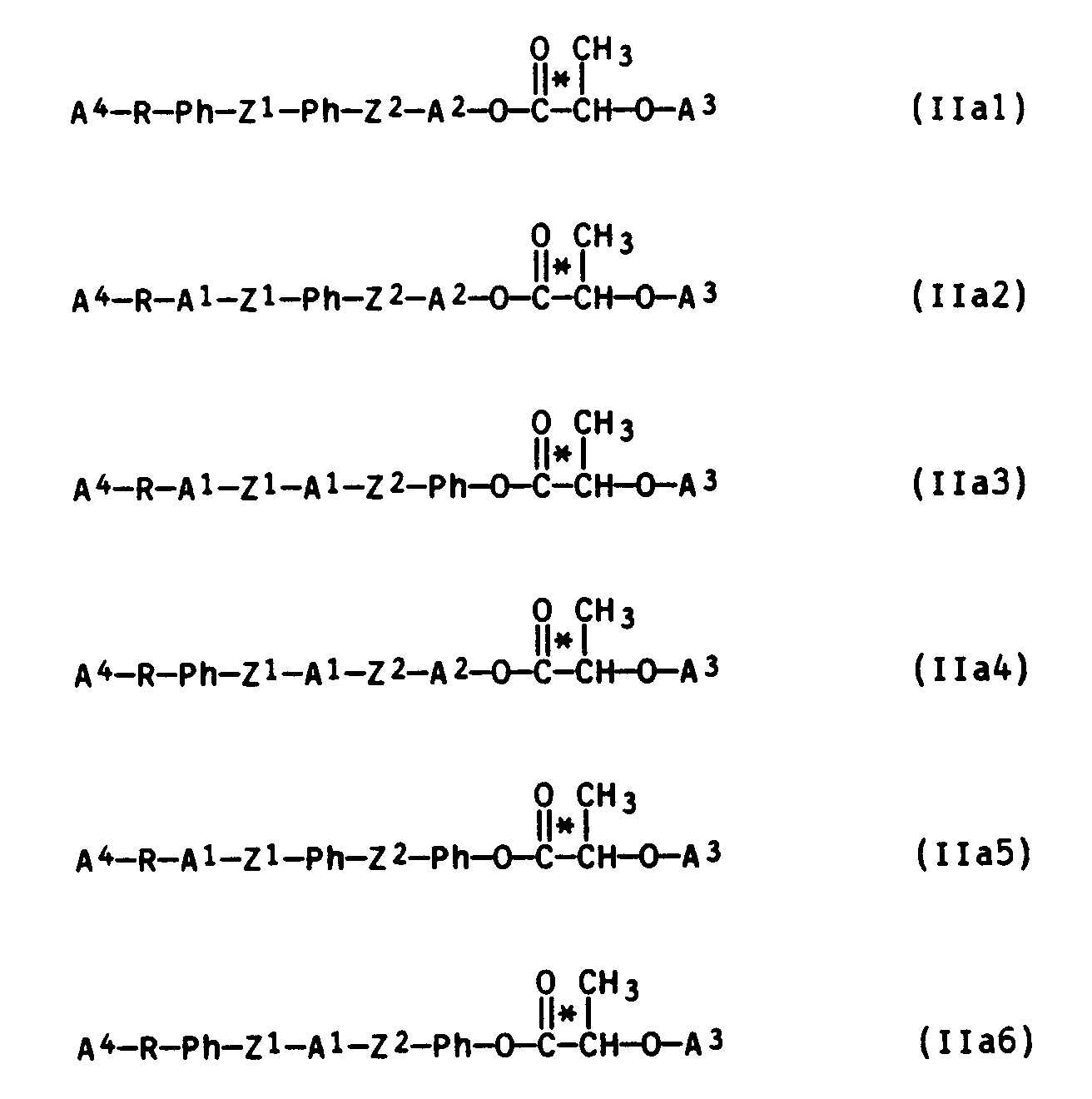
- In den Formeln (IIa1) bis (IIa6) bedeutet A4 einen Rest der Formel (III)


- In den Formeln (IIb1) bis (IIb6) bedeutet A5 einen Rest der Formel IV


- In den Formeln (IIc1) bis (IIc6) bedeutet A6 einen Rest der Formel V

- Ganz besonders bevorzugt sind Verbindungen der Formeln (IId1) bis (IId6), in denen A7 für einen Rest der Formel (VI) steht.

- Die Herstellung der erfindungsgemäßen Verbindungen I und II erfolgt nach an sich bekannten Verfahren, wie sie beispielsweise in der DE-A-38 23 154, EP-A-258 898, EP-A-274 128, DE-A-38 27 601 und DE-A-39 17 196 angegeben sind.
- Dabei wird beispielsweise bei der Herstellung der Verbindungen (Ib7) und (IId7) die chirale Phenoxypropionsäure VII direkt als Säure oder Säurechlorid eingesetzt und so das chirale Kohlenstoffatom eingebaut.
-

-
Darin haben die verwendeten Abkürzungen die folgende Bedeutung: - AIBN
- 2,2'-Azo-bis-(isobutyronitril)
- DCC
- Dicyclohexylcarbodiimid
- EtOH
- Ethanol
- PP
- Pyrrolidino-pyridin
- RaNi
- Raney-Nickel
- THF
- Tetrahydrofuran
- Die erfindungsgemäßen niedermolekularen, glasartig erstarrenden Verbindungen XI sind durch chemische Reaktion von mehrfach reaktiven Verbindungen Z3 mit solchen optisch aktiven Verbindungen I erhältlich, die reaktive Gruppen R1 tragen. Sie können beispielsweise durch Veresterung der erfindungsgemäßen Verbindungen I mit mehrwertigen Säuren oder Alkoholen oder durch Addition der Verbindungen I an mehrwertige Isocyanate gewonnen werden.
- Die zentralen Gruppen der Verbindung XI leiten sich beispielsweise von folgenden Verbindungen Z3 ab:
- von aliphatischen Alkoholen wie
- Glycerin,
- 1,2,4-Butantriol,
- 2-Methyl-2-hydroxymethyl-1,3-propandiol,
- 2-Ethyl-2-hydroxymethyl-1,3-propandiol,
- 1,2,3,4-Butantetraol,
- Pentaerythrit,
- Xylit,
- Mannit und
- Sorbit,
- von aliphatischen Carbonsäuren wie
- 1,2,3-Propantricarbonsäure,
- 1,1,4-Butantricarbonsäure,
- 1,2,3,4-Butantetracarbonsäure,
- Zitronensäure und
- 2-Hydroxy-nonadecyl-1,2,3-tricarbonsäure,
- von cycloaliphatischen Alkoholen mit 5- oder 6-Ringgliedern wie
- 1,2,3,4-Tetrahydroxy-cyclopentan,
- 1,2,3-Trihydroxy-cyclohexan,
- 1,2,4-Trihydroxy-cyclohexan,
- 1,3,5-Trihydroxy-cyclohexan,
- 1,2,3,4-Tetrahydroxy-cyclohexan,
- 1,2,3,5-Tetrahydroxy-cyclohexan,
- 1,2,4,5-Tetrahydroxy-cyclohexan,
- 1,2,3,4,5-Pentahydroxy-cyclohexan und
- 1,2,3,4,5,6-Hexahydroxy-cyclohexan,
- von cycloaliphatischen Carbonsäuren mit 5- oder 6-Ringgliedern wie
- 1,2,3-Cyclopentantricarbonsäure,
- 1,2,4-Cyclopentantricarbonsäure,
- 2-Methyl-1,2,3-cyclopentantricarbonsäure,
- 3-Methyl-1,2,4-cyclopentantricarbonsäure,
- 1,1,2,2-Cyclopentantetracarbonsäure,
- 1,2,2,4-Cyclopentantetracarbonsäure,
- 1,1,3,3-Cyclopentantetracarbonsäure,
- 1,2,3,4-Cyclopentantetracarbonsäure,
- 1,2,3,4,5-Cyclopentanpentacarbonsäure,
- 1,1,4-Cyclohexantricarbonsäure,
- 1,2,4-Cyclohexantricarbonsäure,
- 1,3,5-Cyclohexantricarbonsäure,
- 1,1,3,3-Cyclohexantetracarbonsäure,
- 1,1,4,4-Cyclohexantetracarbonsäure,
- 1,2,3,4-Cyclohexantetracarbonsäure,
- 1,2,4,5-Cyclohexantetracarbonsäure,
- 1,1,3,3,5-Cyclohexanpentacarbonsäure und
- 1,2,3,4,5,6-Cyclohexanhexacarbonsäure,
- von Alkoholaminen wie
- Triethanolamin,
- Triisopropanolamin und
- Aminoethylethanolamin,
- von Triazinderivaten wie
- Cyanursäure,
- Thiocyanursäure,
- Melamin und
- Trishydroxyethylisocyanurat,
- von Isocyanaten wie
- Tetramethylendiisocyanat,
- Hexamethylendiisocyanat (HDI),
- Dodecamethylendiisocyanat,
- 1,4-Diisocyanatocyclohexan,
- 1-Isocyanato-3,5,5-trimethyl-5-isocyanatomethylcyclohexan (Isophoron diisocyanat, IPDI),
- 4,4'-Diisocyanatodicyclohexylmethan (HMDI),
- 4,4'-Diisocyanatodicyclohexylpropan-(2,2),
- 1,4-Diisocyanatobenzol,
- 2,4-Diisocyanatotoluol,
- 2,6-Diisocyanatotoluol,
- 4,4'-Diisocyanatodiphenylmethan,
- p-Xylylendiisocyanat sowie
- die aus der Polyurethanchemie bekannten höherfunktionellen Polyisocyanate.
- Beispiele bevorzugter Verbindungen XI sind in den Formeln (XIa1)-(XId6) aufgeführt:

- In den besonders bevorzugten Formeln (XIa1)-(XIa6) bedeutet A8 einen Rest der Formel XII:


- In den Formeln (XIb1)-(XIb6) bedeutet A9 einen Rest der Formel XIII:


- In den Formeln (XIc1)-(XIc6) bedeutet A10 einen Rest der Formel XIV:

- In den Formeln (XId1)-(XId6) bedeutet A11 einen Rest der Formel XV:

- Die erfindungsgemäßen Verbindungen der Formeln I, II und XI finden als Komponenten chiraler getilteter smektischer flüssigkristalliner Phasen Verwendung.
- Beispielhaft sind im folgenden konkrete Synthesen aufgeführt:
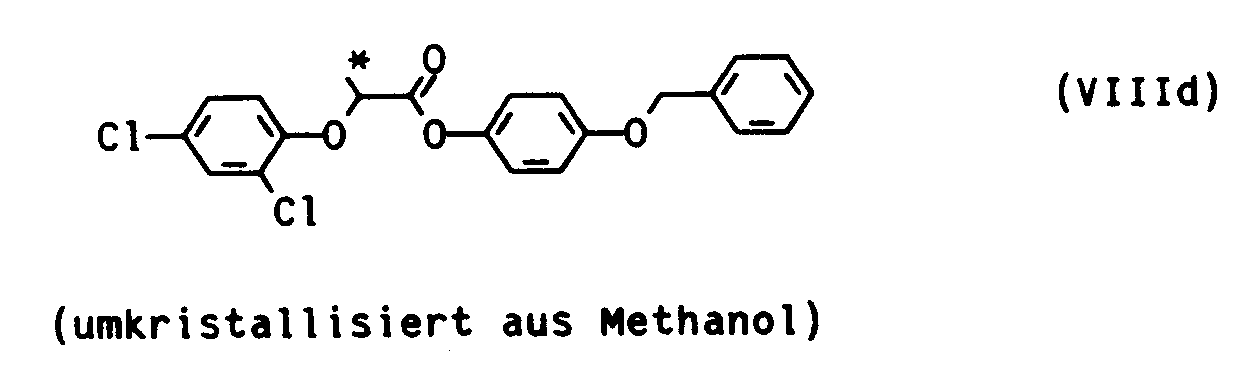
- 20 g (Benzyloxi)-phenol (100 mmol) wurden in 500 ml Tetrahydrofuran nacheinander mit 16,4 g D-Phenoxipropionsäure VII (100 mmol), 1,48 g 4-Pyrrolidino-pyridin (10 mmol) und 37,1 g Dicyclohexylcarbodiimid (180 mmol) bei einer Temperatur von 5 - 10°C versetzt. Anschließend wurde das Reaktionsgemisch bis zur vollständigen Umsetzung bei Raumtemperatur weitergerührt (DC-Kontrolle). Der entstandene Niederschlag wurde abgetrennt, das Lösungsmittel unter vermindertem Druck entfernt, der Rückstand in Essigsäureethylester aufgenommen, die organische Phase mehrmals mit Wasser gewaschen, getrocknet und unter vermindertem Druck eingeengt. Das Rohprodukt wurde aus Isopropanol umkristallisiert.
Ausbeute: 30 g (≙ 87 %).
- In analoger Weise wurden hergestellt:
- Ausbeute: 39 g (≙ 85 %)

- Ausbeute: 35 g (≙ 87 %)

- Ausbeute: 37 g (≙ 88 %)
-

-
16,5 g der Verbindung VIIIa (47,4 mmol) wurden in 250 ml Ethanol mit Raney-Nickel versetzt und mit Wasserstoffgas bei Normaldruck debenzyliert.
Ausbeute: 11 g (≙ 90 %).
Fp.: 144°C - In analoger Weise wurden hergestellt:
- aus Verbindung VIIIb:
Ausbeute: 10 g (≙ 60 %)
- aus Verbindung VIIIc:
Ausbeute: 10 g (≙ 70 %)
- 20,2 g der Verbindung der Formel X (46,1 mmol) wurden in Tetrahydrofuran bei 0 - 5°C unter Rühren mit 12 g der Verbindung IXa (46,5 mmol), 0,62 g Pyrrolidino-pyridin (4,2 mmol) und 13,6 g Dicyclohexylcarbodiimid (66 mmol) versetzt und bei Raumtemperatur bis zur vollständigen Umsetzung (DC-Kontrolle) weiter gerührt. Der gebildete Niederschlag wurde entfernt, das Lösungsmittel unter vermindertem Druck entfernt, der Rückstand in Methylenchlorid aufgenommen, mit Wasser ausgeschüttelt, die organische Phase getrocknet, das Lösungsmittel unter vermindertem Druck entfernt, und der Rückstand an Kieselgel mit Toluol/Essigester = 10:1 v/v chromatographiert und aus Methanol umkristallisiert.
Ausbeute: 6,0 g (≙ 20 %)
1H-NMR (CDCl3; δ in ppm):
1,0-2,0 (m, 21 al-H), 3,8-4,2 (m, 4H, -OCH2-), 5,0 (m, 1H, -OCOCHMeO-), 6,8-8,3 (m, 17 ar-H und 3H, -CH=CH2)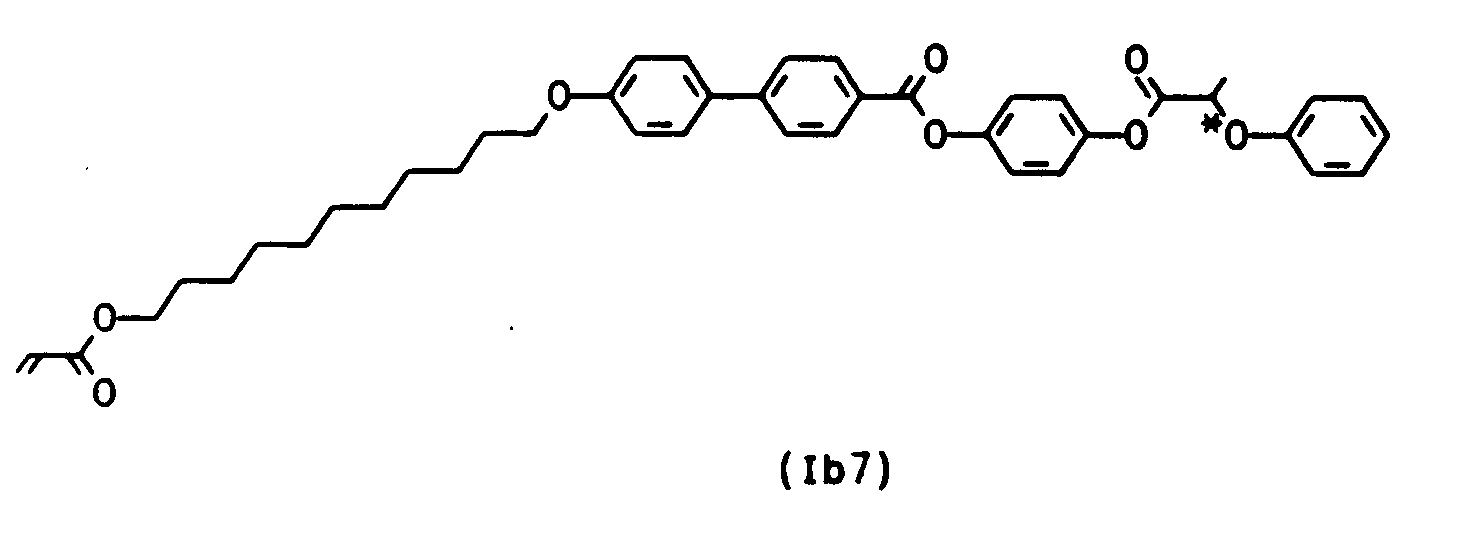
- In analoger Weise wurden hergestellt:
- aus Verbindung IXa:
Ausbeute: 7,2 g (≙ 30 %)
1H-NMR (CDCl3; δ in ppm):
1,0-2,0 (m, 11al-H), 3,9-4,3 (m, 4H, -OCH2-), 5,0 (m, 1H, -OCOCHMeO-), 6,7-8,2 (m, 13ar-H und 3H, -CH=CH2)
- aus Verbindung IXb:
Ausbeute: 0,2 g (≙ 3 %)
Klärtemperatur: 181°C
- aus Verbindung IXc:
Ausbeute: 6,1 g (≙ 21 %)
1H-NMR (CDCl3; δ in ppm):
1,0-2,0 (m, 18 al-H), 2,3 (s, 3H, -CH3), 3,8-4,3 (m, 4H, -OCH2-), 5,0 (m, 1H, -OCOCHMeO-), 5,8 (d, 1H, -CH=CH2), 6,1 (dd, 1H, -CH=CH2), 6,4 (d, 1H, -CH=CH2), 6,7-8,3 (m, 15 ar-H)
- aus Verbindung IXb:
Ausbeute: 5,7 g (≙ 17 %)
1H-NMR (CDCl3; δ in ppm):
1,0-2,0 (m, 21 al-H), 3,8 (s, 3H, -OCH3-), 4,0-4,3 (m, 4H, -CH2O-), 4,9 (q, 1H, -OCOCHMeO-), 5,8 (d, 1H, -CH=CH2), 6,1 (dd, 1H, -CH=CH2), 6,4 (d, 1H, -CH=CH2), 6,8-8,3 (m, 16 ar-H)
- Allgemeine Verfahrensvorschrift für die Herstellung von Polyacrylaten:
- Die Polymerisation erfolgte in einem Schlenkgefäß unter Schutzgasatmosphäre. Die chromatographierten und mehrfach umkristallisierten Monomere wurden in Konzentrationen von 0,1 - 0,01 mol/l in absolutem THF (Merck, > 99,5 %, Molekular-Sieb 4 Å) gelöst. Dann wurde in die Lösung während 15 Minuten Argon eingeleitet, 1 - 40 Mol.-% 2,2'-Azo-bis-(2-isobutyronitril) (aus Methanol unterhalb 40°C umkristallisiert) zugegeben, und während weiterer 15 Minuten Argon eingeleitet.
- Die Lösung wurde nun auf 50°C thermostatisiert, das Schlenkgefäß verschlossen und 100 - 140 h bei dieser Temperatur gehalten. Anschließend wurde die Reaktionsmischung über Millipore Filter (Typ FG, Porengröße 0,2 µm) abgesaugt, mit Methanol (Merck, > 99,8 %) ausgefällt, abgesaugt, der Rückstand erneut in THF gelöst und mit Petroläther (Ligroin, Sdp. 30 - 75°C) gefällt. Dieser Vorgang wurde mehrere Male wiederholt. Der Rückstand wurde im Hochvakuum von Lösungsmittelresten befreit.
- Nach dem obigen Verfahren wurden die folgenden Verbindungen hergestellt:
- aus Verbindung Ib7:
Ausbeute: 1,1 g
Klärtemperatur: 171°C
- aus Verbindung Ia1:
Ausbeute: 1,2 g
Glastemperatur: 40°C
- aus Verbindung Ib9:
Ausbeute: 0,9 g
Klärtemperatur: 192°C
Claims (13)
- Optisch aktive Verbindungen der Formel I
 R eine C1-C12-Alkyl- oder -Perfluoralkyl-Gruppe, in der auch eine oder zwei nicht benachbarte CH2- bzw. CF2-Gruppen durch O-Atome und/oder -CO-Gruppen und/oder -CO-O-Gruppen und/oder -CH=CH-Gruppen und/oder -CH-Halogen- und/oder -CHCN-Gruppen und/oder -O-CO-CH-Halogen- und/oder -O-CO-CHCN-Gruppen ersetzt sein können, oder eine C1-C12-Alkylgruppe, die endständig eine chemisch reaktive Gruppe tragen kann und in der eine CH2-Gruppe durch ein O-Atom ersetzt sein kann,A1 und A2 unabhängig voneinander unsubstituiertes oder durch ein oder zwei F- und/oder Cl- und/oder Br-Atome und/oder CH3-Gruppen und/oder CN-Gruppen substituiertes 1,4-Phenylen, worin auch eine oder zwei CH-Gruppen durch N ersetzt sein können, 1,4-Cyclohexylen, worin auch eine oder zwei nicht benachbarte CH2-Gruppen durch O-Atome und/oder S-Atome ersetzt sein können, Piperidin-1,4-diyl, 1,4-Bicyclo(2,2,2)octylen, Naphthalin-2,6-diyl, Decahydronaphthalin-2,6-diyl oder 1,2,3,4-Tetrahydronaphthalin-2,6-diyl,A3 gegebenenfalls substituiertes Phenyl,Z -CO-O-, -O-CO-, -CH2CH2-, -OCH2-, -CH2O-, -C≡C- oder eine Einfachbindung undm 0, 1, 2 oder 3,mit der Maßgabe, daß für den Fall, daß m = 2 oder 3 ist, die Reste A1 bzw. Z in den einzelnen Gruppen -(A1-Z) unabhängig voneinander jeweils gleich oder verschieden sein können.
 - Optisch aktive Verbindungen nach Anspruch 1, dadurch gekennzeichnet, daß m 1 oder 2 bedeutet.
- Optisch aktive Verbindungen nach Anspruch 2, dadurch gekennzeichnet, daß m 2 bedeutet.
- Optisch aktive Verbindungen nach Anspruch 1, dadurch gekennzeichnet, daß Z -CO-O-, -O-CO- oder eine Einfachbindung bedeutet.
- Optisch aktive Verbindungen nach Anspruch 1, dadurch gekennzeichnet, daß R für einen C5-C11-Alkyl oder einen C5-C11-Alkoxyrest steht.
- Optisch aktive Verbindungen nach Anspruch 5, dadurch gekennzeichnet, daß R endständig eine chemisch reaktive Gruppe R1 trägt.
- Optisch aktive Verbindungen nach Anspruch 6, dadurch gekennzeichnet, daß R1 für eine Acrylat-, Methacrylat-, Chloracrylat-, Ethenyl- oder eine Hydroxygruppe steht.
- Optisch aktive Verbindungen nach Anspruch 1, dadurch gekennzeichnet, daß A1 und A2 für eine 1,4-Phenylengruppe stehen.
- Optisch aktive Verbindungen nach Anspruch 1, dadurch gekennzeichnet, daß A3 für eine Phenylgruppe steht.
- Optisch aktive Verbindungen nach Anspruch 1, dadurch gekennzeichnet, daß A3 für eine Phenylgruppe steht, die ein oder zwei voneinander unabhängige C1-C10-Alkyl-, C1-C10-Alkoxy-, Brom- oder Chlorsubstituenten trägt.
- Polymere II, dadurch gekennzeichnet, daß sie optisch aktive Verbindungen I gemäß einem der Ansprüche 1 bis 10 einpolymerisiert enthalten.
- Niedermolekulare, glasartig erstarrende Verbindungen, erhältlich durch chemische Reaktion von mehrfach reaktiven Verbindungen Z3 mit solchen optisch aktiven Verbindungen I, die reaktive Gruppen R1 tragen, wobei Z3 eine mehrfach reaktive Verbindung aus der Gruppe der aliphatischen Alkohole, aliphatischen Carbonsäuren, cycloaliphatischen Alkohole mit 5 bis 6 Ringgliedern, cycloaliphatischen Carbonsäuren mit 5 bis 6 Ringgliedern, Alkoholamine, Triazinderivate oder Isocyanate bedeutet.
- Verwendung der erfindungsgemäßen Verbindungen gemäß einem der Ansprüche 1 bis 12 allein, in Mischungen untereinander und mit anderen flüssigkristallinen und/oder nicht flüssigkristallinen Verbindungen in Form fester oder flüssigkristalliner optisch anisotroper Medien für die Darstellung und Speicherung von Information.
Applications Claiming Priority (2)
| Application Number | Priority Date | Filing Date | Title |
|---|---|---|---|
| DE4126996 | 1991-08-16 | ||
| DE4126996A DE4126996A1 (de) | 1991-08-16 | 1991-08-16 | Optisch aktive phenoxi-propionsaeureester |
Publications (3)
| Publication Number | Publication Date |
|---|---|
| EP0528268A2 EP0528268A2 (de) | 1993-02-24 |
| EP0528268A3 EP0528268A3 (de) | 1994-01-05 |
| EP0528268B1 true EP0528268B1 (de) | 1997-01-08 |
Family
ID=6438361
Family Applications (1)
| Application Number | Title | Priority Date | Filing Date |
|---|---|---|---|
| EP92113314A Expired - Lifetime EP0528268B1 (de) | 1991-08-16 | 1992-08-05 | Optisch aktive Phenoxi-propionsäureester |
Country Status (4)
| Country | Link |
|---|---|
| US (2) | US5350873A (de) |
| EP (1) | EP0528268B1 (de) |
| JP (1) | JPH05201926A (de) |
| DE (2) | DE4126996A1 (de) |
Families Citing this family (4)
| Publication number | Priority date | Publication date | Assignee | Title |
|---|---|---|---|---|
| DE19520704A1 (de) * | 1995-06-09 | 1996-12-12 | Basf Ag | Polymerisierbare chirale Verbindungen und deren Verwendung |
| US6677475B2 (en) | 2001-01-22 | 2004-01-13 | Mitsubishi Gas Chemical Co., Inc. | Optically active compound and liquid crystal composition containing the compound |
| KR20020079442A (ko) | 2001-04-13 | 2002-10-19 | 미츠비시 가스 가가쿠 가부시키가이샤 | 광학 활성화합물 및 그것을 함유하는 액정조성물 |
| DE102009027744A1 (de) | 2009-07-15 | 2011-01-20 | Deutsches Institut Für Ernährungsforschung Potsdam-Rehbrücke | Prekursor-Verbindungen von Süßrezeptor-Antagonisten zur Prävention oder Behandlung von Krankheiten |
Family Cites Families (10)
| Publication number | Priority date | Publication date | Assignee | Title |
|---|---|---|---|---|
| DE2623558C2 (de) * | 1976-05-26 | 1984-12-06 | Hoechst Ag, 6230 Frankfurt | 2-[4'-Phenoxy-phenoxy]propionsäure-Derivate, Verfahren zu ihrer Herstellung und sie enthaltende herbizide Mittel |
| US4367924A (en) * | 1980-01-08 | 1983-01-11 | Clark Noel A | Chiral smectic C or H liquid crystal electro-optical device |
| US4764619A (en) * | 1985-03-26 | 1988-08-16 | Asahi Glass Company Ltd. | Optically active compounds, smectic liquid crystal compositions containing them and smectic liquid crystal display devices |
| SE8504763D0 (sv) * | 1985-10-14 | 1985-10-14 | Wojciech Kuczynski | Fast-switching low-temperature ferroelectric liquid crystal mixtures |
| EP0258898B1 (de) * | 1986-09-04 | 1992-04-22 | Idemitsu Kosan Company Limited | Flüssigkristallpolymere |
| EP0274128B1 (de) * | 1986-12-29 | 1999-03-31 | Idemitsu Kosan Company Limited | Flüssigkristallines Polymer |
| EP0331367B1 (de) * | 1988-02-29 | 1993-12-08 | Showa Shell Sekiyu Kabushiki Kaisha | Flüssigkristall-Verbindungen mit Fluoroalkylradikalen |
| DE3823154A1 (de) * | 1988-07-08 | 1990-01-11 | Hoechst Ag | Neue ferroelektrische fluessigkristalline polymere |
| DE3827601A1 (de) * | 1988-08-13 | 1990-02-15 | Hoechst Ag | Ferroelektrische fluessigkristalline si-enthaltende polymere |
| DE3930667A1 (de) * | 1989-09-14 | 1991-03-28 | Basf Ag | Reversible oder irreversible erzeugung einer abbildung |
-
1991
- 1991-08-16 DE DE4126996A patent/DE4126996A1/de not_active Withdrawn
-
1992
- 1992-07-24 JP JP4198394A patent/JPH05201926A/ja not_active Withdrawn
- 1992-08-05 DE DE59207831T patent/DE59207831D1/de not_active Expired - Lifetime
- 1992-08-05 EP EP92113314A patent/EP0528268B1/de not_active Expired - Lifetime
- 1992-08-13 US US07/928,568 patent/US5350873A/en not_active Expired - Lifetime
-
1994
- 1994-04-22 US US08/231,409 patent/US5455325A/en not_active Expired - Lifetime
Also Published As
| Publication number | Publication date |
|---|---|
| US5350873A (en) | 1994-09-27 |
| US5455325A (en) | 1995-10-03 |
| DE59207831D1 (de) | 1997-02-20 |
| EP0528268A2 (de) | 1993-02-24 |
| DE4126996A1 (de) | 1993-03-25 |
| JPH05201926A (ja) | 1993-08-10 |
| EP0528268A3 (de) | 1994-01-05 |
Similar Documents
| Publication | Publication Date | Title |
|---|---|---|
| EP0227717B1 (de) | Stickstoffhaltige heterocyclische ester | |
| EP0140133B1 (de) | Flüssig-kristalline Phasen bildende Polymere | |
| DE3789740T2 (de) | Fluorenthaltende chirale smektische Flüssigkristalle. | |
| DE3627443C2 (de) | ||
| DE3752264T2 (de) | Flüssigkristallines Polymer | |
| DE69426358T2 (de) | Verbindungen zur verwendung in flüssigkristallzusammensetzungen | |
| DE3629446C2 (de) | ||
| DE3801799A1 (de) | Ferroelektrische fluessigkristalle | |
| EP0423179B1 (de) | Ferroelektrische flüssigkristalline polymere, ein verfahren zu ihrer herstellung und ihre verwendung in elektrooptischen bauteilen | |
| DD252196A5 (de) | Smektische fluessigkristalline phase mit mindenstens zwei fluessigkristallinen komponenten | |
| EP0321504B1 (de) | Chirale aryloxypropionsäureester und ihre verwendung als dotierstoff in flüssigkristall-phasen | |
| DE4024190C2 (de) | ||
| DE19630068A1 (de) | Neue flüssigkristalline Verbindungen und deren Vorprodukte | |
| EP0520292A1 (de) | Chirale Azetidinon-Derivate und ihre Verwendung als Dotierstoffe in Flüssigkristallmischungen | |
| EP0504660B1 (de) | Flüssigkristalline Verbindungen | |
| EP0720641A1 (de) | Flüssigkristalline verbindungen | |
| EP0552658B1 (de) | Derivate der 3-Cyclohexylpropionsäure und ihre Verwendung in ferroelektrischen Flüssigkristallmischungen | |
| EP0528268A2 (de) | Optisch aktive Phenoxi-propionsäureester | |
| DE69632697T2 (de) | Naphtholverbindung sowie Flüssigkristallzusammensetzung und Flüssigkristallelement, die diese Verbindung enthalten | |
| DE69309198T2 (de) | Flüssigkristallverbindung | |
| WO1989011496A1 (fr) | Polymeres a chaines laterales | |
| DE69115377T2 (de) | Fluorierte Pyrimidin-Phenyl optisch aktive Verbindungen und sie enthaltende flüssigkristalline Zusammensetzungen | |
| DE69010147T2 (de) | Esterverbindungen und sie enthaltende flüssigkristalline Zusammensetzungen. | |
| EP0272301B1 (de) | Polymerisierbare flüssigkristallmaterialien und flüssigkristalline phasen aufweisende polymere | |
| EP0750656B1 (de) | Chirale verbindungen |
Legal Events
| Date | Code | Title | Description |
|---|---|---|---|
| PUAI | Public reference made under article 153(3) epc to a published international application that has entered the european phase |
Free format text: ORIGINAL CODE: 0009012 |
|
| AK | Designated contracting states |
Kind code of ref document: A2 Designated state(s): CH DE FR GB IT LI NL |
|
| PUAL | Search report despatched |
Free format text: ORIGINAL CODE: 0009013 |
|
| AK | Designated contracting states |
Kind code of ref document: A3 Designated state(s): CH DE FR GB IT LI NL |
|
| 17P | Request for examination filed |
Effective date: 19940211 |
|
| 17Q | First examination report despatched |
Effective date: 19950404 |
|
| GRAG | Despatch of communication of intention to grant |
Free format text: ORIGINAL CODE: EPIDOS AGRA |
|
| GRAH | Despatch of communication of intention to grant a patent |
Free format text: ORIGINAL CODE: EPIDOS IGRA |
|
| GRAH | Despatch of communication of intention to grant a patent |
Free format text: ORIGINAL CODE: EPIDOS IGRA |
|
| GRAA | (expected) grant |
Free format text: ORIGINAL CODE: 0009210 |
|
| AK | Designated contracting states |
Kind code of ref document: B1 Designated state(s): CH DE FR GB IT LI NL |
|
| REG | Reference to a national code |
Ref country code: CH Ref legal event code: EP |
|
| GBT | Gb: translation of ep patent filed (gb section 77(6)(a)/1977) |
Effective date: 19970125 |
|
| REF | Corresponds to: |
Ref document number: 59207831 Country of ref document: DE Date of ref document: 19970220 |
|
| ITF | It: translation for a ep patent filed | ||
| ET | Fr: translation filed | ||
| PLBE | No opposition filed within time limit |
Free format text: ORIGINAL CODE: 0009261 |
|
| 26N | No opposition filed | ||
| PGFP | Annual fee paid to national office [announced via postgrant information from national office to epo] |
Ref country code: GB Payment date: 19980803 Year of fee payment: 7 |
|
| PGFP | Annual fee paid to national office [announced via postgrant information from national office to epo] |
Ref country code: CH Payment date: 19980805 Year of fee payment: 7 |
|
| PGFP | Annual fee paid to national office [announced via postgrant information from national office to epo] |
Ref country code: NL Payment date: 19980819 Year of fee payment: 7 |
|
| PG25 | Lapsed in a contracting state [announced via postgrant information from national office to epo] |
Ref country code: GB Free format text: LAPSE BECAUSE OF NON-PAYMENT OF DUE FEES Effective date: 19990805 |
|
| PG25 | Lapsed in a contracting state [announced via postgrant information from national office to epo] |
Ref country code: CH Free format text: LAPSE BECAUSE OF NON-PAYMENT OF DUE FEES Effective date: 19990831 Ref country code: LI Free format text: LAPSE BECAUSE OF NON-PAYMENT OF DUE FEES Effective date: 19990831 |
|
| PG25 | Lapsed in a contracting state [announced via postgrant information from national office to epo] |
Ref country code: NL Free format text: LAPSE BECAUSE OF NON-PAYMENT OF DUE FEES Effective date: 20000301 |
|
| GBPC | Gb: european patent ceased through non-payment of renewal fee |
Effective date: 19990805 |
|
| REG | Reference to a national code |
Ref country code: CH Ref legal event code: PL |
|
| NLV4 | Nl: lapsed or anulled due to non-payment of the annual fee |
Effective date: 20000301 |
|
| PGFP | Annual fee paid to national office [announced via postgrant information from national office to epo] |
Ref country code: FR Payment date: 20040810 Year of fee payment: 13 |
|
| PG25 | Lapsed in a contracting state [announced via postgrant information from national office to epo] |
Ref country code: IT Free format text: LAPSE BECAUSE OF NON-PAYMENT OF DUE FEES;WARNING: LAPSES OF ITALIAN PATENTS WITH EFFECTIVE DATE BEFORE 2007 MAY HAVE OCCURRED AT ANY TIME BEFORE 2007. THE CORRECT EFFECTIVE DATE MAY BE DIFFERENT FROM THE ONE RECORDED. Effective date: 20050805 |
|
| PG25 | Lapsed in a contracting state [announced via postgrant information from national office to epo] |
Ref country code: FR Free format text: LAPSE BECAUSE OF NON-PAYMENT OF DUE FEES Effective date: 20060428 |
|
| REG | Reference to a national code |
Ref country code: FR Ref legal event code: ST Effective date: 20060428 |
|
| PGFP | Annual fee paid to national office [announced via postgrant information from national office to epo] |
Ref country code: DE Payment date: 20090730 Year of fee payment: 18 |
|
| REG | Reference to a national code |
Ref country code: DE Ref legal event code: R119 Ref document number: 59207831 Country of ref document: DE Effective date: 20110301 |
|
| PG25 | Lapsed in a contracting state [announced via postgrant information from national office to epo] |
Ref country code: DE Free format text: LAPSE BECAUSE OF NON-PAYMENT OF DUE FEES Effective date: 20110301 |