EP0528246B1 - Verfahren und Anlage zur Wiederverwertung von Abfällen mit Kunststoff - Google Patents
Verfahren und Anlage zur Wiederverwertung von Abfällen mit Kunststoff Download PDFInfo
- Publication number
- EP0528246B1 EP0528246B1 EP19920113202 EP92113202A EP0528246B1 EP 0528246 B1 EP0528246 B1 EP 0528246B1 EP 19920113202 EP19920113202 EP 19920113202 EP 92113202 A EP92113202 A EP 92113202A EP 0528246 B1 EP0528246 B1 EP 0528246B1
- Authority
- EP
- European Patent Office
- Prior art keywords
- mass
- materials
- fraction
- bodies
- plastics
- Prior art date
- Legal status (The legal status is an assumption and is not a legal conclusion. Google has not performed a legal analysis and makes no representation as to the accuracy of the status listed.)
- Expired - Lifetime
Links
Images
Classifications
-
- B—PERFORMING OPERATIONS; TRANSPORTING
- B29—WORKING OF PLASTICS; WORKING OF SUBSTANCES IN A PLASTIC STATE IN GENERAL
- B29B—PREPARATION OR PRETREATMENT OF THE MATERIAL TO BE SHAPED; MAKING GRANULES OR PREFORMS; RECOVERY OF PLASTICS OR OTHER CONSTITUENTS OF WASTE MATERIAL CONTAINING PLASTICS
- B29B17/00—Recovery of plastics or other constituents of waste material containing plastics
- B29B17/04—Disintegrating plastics, e.g. by milling
- B29B17/0412—Disintegrating plastics, e.g. by milling to large particles, e.g. beads, granules, flakes, slices
-
- B—PERFORMING OPERATIONS; TRANSPORTING
- B29—WORKING OF PLASTICS; WORKING OF SUBSTANCES IN A PLASTIC STATE IN GENERAL
- B29B—PREPARATION OR PRETREATMENT OF THE MATERIAL TO BE SHAPED; MAKING GRANULES OR PREFORMS; RECOVERY OF PLASTICS OR OTHER CONSTITUENTS OF WASTE MATERIAL CONTAINING PLASTICS
- B29B13/00—Conditioning or physical treatment of the material to be shaped
- B29B13/10—Conditioning or physical treatment of the material to be shaped by grinding, e.g. by triturating; by sieving; by filtering
-
- B—PERFORMING OPERATIONS; TRANSPORTING
- B29—WORKING OF PLASTICS; WORKING OF SUBSTANCES IN A PLASTIC STATE IN GENERAL
- B29K—INDEXING SCHEME ASSOCIATED WITH SUBCLASSES B29B, B29C OR B29D, RELATING TO MOULDING MATERIALS OR TO MATERIALS FOR MOULDS, REINFORCEMENTS, FILLERS OR PREFORMED PARTS, e.g. INSERTS
- B29K2105/00—Condition, form or state of moulded material or of the material to be shaped
- B29K2105/06—Condition, form or state of moulded material or of the material to be shaped containing reinforcements, fillers or inserts
- B29K2105/12—Condition, form or state of moulded material or of the material to be shaped containing reinforcements, fillers or inserts of short lengths, e.g. chopped filaments, staple fibres or bristles
-
- B—PERFORMING OPERATIONS; TRANSPORTING
- B29—WORKING OF PLASTICS; WORKING OF SUBSTANCES IN A PLASTIC STATE IN GENERAL
- B29K—INDEXING SCHEME ASSOCIATED WITH SUBCLASSES B29B, B29C OR B29D, RELATING TO MOULDING MATERIALS OR TO MATERIALS FOR MOULDS, REINFORCEMENTS, FILLERS OR PREFORMED PARTS, e.g. INSERTS
- B29K2105/00—Condition, form or state of moulded material or of the material to be shaped
- B29K2105/06—Condition, form or state of moulded material or of the material to be shaped containing reinforcements, fillers or inserts
- B29K2105/16—Fillers
-
- Y—GENERAL TAGGING OF NEW TECHNOLOGICAL DEVELOPMENTS; GENERAL TAGGING OF CROSS-SECTIONAL TECHNOLOGIES SPANNING OVER SEVERAL SECTIONS OF THE IPC; TECHNICAL SUBJECTS COVERED BY FORMER USPC CROSS-REFERENCE ART COLLECTIONS [XRACs] AND DIGESTS
- Y02—TECHNOLOGIES OR APPLICATIONS FOR MITIGATION OR ADAPTATION AGAINST CLIMATE CHANGE
- Y02W—CLIMATE CHANGE MITIGATION TECHNOLOGIES RELATED TO WASTEWATER TREATMENT OR WASTE MANAGEMENT
- Y02W30/00—Technologies for solid waste management
- Y02W30/50—Reuse, recycling or recovery technologies
- Y02W30/62—Plastics recycling; Rubber recycling
-
- Y—GENERAL TAGGING OF NEW TECHNOLOGICAL DEVELOPMENTS; GENERAL TAGGING OF CROSS-SECTIONAL TECHNOLOGIES SPANNING OVER SEVERAL SECTIONS OF THE IPC; TECHNICAL SUBJECTS COVERED BY FORMER USPC CROSS-REFERENCE ART COLLECTIONS [XRACs] AND DIGESTS
- Y10—TECHNICAL SUBJECTS COVERED BY FORMER USPC
- Y10S—TECHNICAL SUBJECTS COVERED BY FORMER USPC CROSS-REFERENCE ART COLLECTIONS [XRACs] AND DIGESTS
- Y10S241/00—Solid material comminution or disintegration
- Y10S241/38—Solid waste disposal
Definitions
- the present invention relates in general to the problem of recovering or recycling waste materials including plastics materials.
- thermoplastic materials from recovery plastics wherein a fine powder is produced from the recovery plastics. The powder is then heated in a mixer, with the possible addition of thermoplastics.
- FR-A-2 149 263 concerns the powder being comprised of small elements in the form of filaments of fibers.
- cement cement or the like is contemplated, especially in view of manufacturing floor coverings.
- thermoplastic waste materials wherein the plastics waste material are mixed with wastes of textile nature.
- a compact, highly dispersed quasi-homogeneous mass is then formed through deformation and heating.
- Such a mass is then cooled and comminuted through extrusion or blow-moulding or reduced in the form of webs, cut to pieces in order to produce articles therefrom.
- Non-reinforcing fillers may be added.
- US-A-2 464 746 generally discloses a method of manufacturing thermoplastic pellets.
- thermosetting plastics materials plastics materials with very high softening points, for example higher than 250°C, wood, paper, rubber, aluminium, fabric, etc.
- thermosetting plastics materials plastics materials with very high softening points, for example higher than 250°C, wood, paper, rubber, aluminium, fabric, etc.
- the object of the present invention is to provide means for enabling these materials which, in the methods of the prior art had to be eliminated, to be used for the purposes of the recovery operation.
- this object is achieved by virtue of a method having the characteristics recited in the following claims.
- a further subject of the invention is a system for carrying-out this method as called for in Claim 35.
- the present invention is based on the recognition of the fact that materials such as thermosetting plastics materials, thermoplastics materials with high softening points, wood, paper, rubber, aluminium, etc., which are usually present in industrial refuse and, particularly, in solid urban refuse, may to advantage be used, after they have been reduced to small pieces by scraping or shaving, as fillers and fibrous reinforcements for plastics materials within a process for recovering the plastics materials present in such waste in general.
- materials such as thermosetting plastics materials, thermoplastics materials with high softening points, wood, paper, rubber, aluminium, etc.
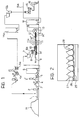
- Figure 1 shows, as a whole, the structure of a system for recovering and recycling industrial refuse or solid urban refuse which operates according to the invention.
- the system is intended to be supplied with a mass of waste material M which, for simplicity, will be assumed to be constituted by a mass of solid urban refuse resulting from the differentiated collection of various kinds of waste.
- composition of the waste M is not absolutely uniform since it may vary, even to a quite considerable extent, in dependence on particular local customs, on the type of usage, and on consumption trends.
- the waste material M is sent onto a separator belt 1 to undergo a separation step, the object of which is essentially to remove from the mass which is to be sent towards the main branch of the system materials (more correctly, one should say articles) such as large motor-vehicle parts, items of furniture, domestic electrical appliances, etc. which are quite often found in differentiated solid urban refuse as a result of inappropriate disposal.
- the material which remains on the belt 1 after this initial rough sorting step (material which may also correspond to the material supplied to the plant by the bodies which collect solid urban refuse) is intended to be sent to a first step in which it is broken up.
- the material is passed in front of a unit 2 of known type for removing metals (typically by a magnetic action), the function of which is essentially to indicate the presence of large metallic or ferrous-metal bodies which could cause damage during the processing cycles further downstream so that such bodies can be removed, also automatically.
- the material which passes the unit 2 for removing metals is sent to a further conveyor 3 (typically a belt conveyor) which supplies a first grinding unit 4, the function of which is to break up the material coming from the belt 3 to effect a first dimensional regularisation of the material to be treated.
- a further conveyor 3 typically a belt conveyor
- a first grinding unit 4 the function of which is to break up the material coming from the belt 3 to effect a first dimensional regularisation of the material to be treated.
- the device 4 is constituted by a grinder which operates at a slow speed and may, to advantage, be constituted by a geared grinder of the type with a worm screw and a helical gear with two or more shafts which contrarotate at different speeds and on each of which a respective group of grinders is mounted which intersects a group of grinders carried by another shaft.
- Grinding devices of the type specified above are available, for example, as model G5 and G10 grinders from Sant'Andrea Novara S.p.A., of Novara (Italy).
- the role of the grinder 4 is essentially to break up coarsely the material to be treated by breaking the largest items, for example, containers or tanks of medium-large dimensions (10-50 and 100 litres), pallets and articles of various large dimensions to form bulk pieces having minimum dimensions of the order of 4-5 cm.
- the material resulting from this breaking-up operation is passed in front of a further unit 2' for removing metals, the function of which is essentially to detect the presence of any remaining metal bodies of a certain size so as to be able to stop the operation of the system (at least in the downstream portions) to remove such metal bodies, preventing the risk of damage to the system.
- a further grinding unit 5 Downstream of the grinder 4 and the unit 2' for removing metals is a further grinding unit 5 constituted essentially by a fast blade mill.
- this may be a mill or granulator of the type currently used to granulate plastics materials and derivatives for other production processes. These are usually mills with central rotors of the TRIAL type which further break up the material coming from the grinder 4 to produce a uniform granular mass with a maximum individual particle size of the order of 10 mm.
- Mills suitable for carrying out this operation are currently available as Series M, Series L, Series P, and Series GP mills from the company Previero of Alzate Brianza (Como) - Italy.
- the material resulting from the grinding achieved by the mill 5 may be sent directly to the further steps of the process or, according to a solution which has been found preferable as regards the general economy of the running of the system, stored, for example, in storage silos 6.
- This selection is preferable since it enables a reserve to be formed between the portion of the system situated upstream of the silos 6 (which is intended primarily to operate on batches of material M) and the portion of the plant situated downstream (which is intended, in principle, to operate with a generally continuous cycle with a constant speed of advance).
- the material taken from the silos 6 (or, alternatively, the material coming from the mill 5) is sent to a heat processing unit, the function of which is essentially to cause an initial softening of the thermoplastics materials included in the material M.
- Extruders of this type are available from and produced by, for example, Bausano & Figli S.p.A., of Rivarolo Canavese (Turin) - Italy, or Icma - San Giorgio, S.p.A., of San Giorgio Su Legnano (Milan) - Italy.
- the granulated material is mixed and brought to the softening point (for example, about 150-200°C) without forced mixing, the operation of the extruder and, in particular, of its screw or screws, being regulated, however, so as simply to achieve a transporting action, so that the heterogeneous product is heated and compacted but mechanical and/or heat stresses and the degradation of the heat-sensitive products are avoided.
- the softening point for example, about 150-200°C
- the extruder 8 is shown end-on with the axis of its screw oriented in a plane perpendicular to the plane of the drawing.
- the function of the extruder 8 is to form, at its output, an extruded strip or band having dimensions, for example, of the order of 30 x 100 mm cross-section.
- This strip is cut by a blade unit 8a (for example, a guillotine or a cutting unit with rotary blades), the function of which is to form short pieces for loading into an underlying compactor unit 10.
- This compactor unit into which the intermediate material (shown in the drawing in the form of pieces M' produced from the strip or band formed by the extruder 8) is loaded by means of a pusher 9 operated by a jack, may be compared to a kind of static die or extruder for forming, from the pieces M', sheets of extruded material which are subjected, in a conveyor unit 11 situated downstream (typically a conveyor unit with rollers) to the cooling action of water jets 11a, the function of which is essentially to reduce the temperature of the material to about 50° from the level of 150-200°C at which it emerges from the extruder 8.
- a conveyor unit 11 situated downstream (typically a conveyor unit with rollers) to the cooling action of water jets 11a, the function of which is essentially to reduce the temperature of the material to about 50° from the level of 150-200°C at which it emerges from the extruder 8.
- a calender constituted by a pair of contrarotating cylinders or rollers, to produce a sheet of the desired dimensions.
- the sheet produced as a further intermediate product has a rough appearance since it is constituted by a matrix of thermoplastics materials which have been softened in the extruder 8, in which is suspended a continuous granular mass constituted by all the materials (for example, thermosetting plastics materials, high-melting thermoplastics materials, aluminium, etc.) which, whilst they have been broken up by the devices 4 and 5, have passed through the extruder 8 practically unchanged.
- the dimensions of the cooling unit 11a are such as to satisfy two requirements.
- the material M'' In the first place, it is desirable for the material M'' to remain in the cooling unit 11a long enough for its temperature to be reduced to a level of the order of 50°C.
- the tunnel 11 also preferably forms a kind of reserve which enables the unit constituted by the extruder 8 and the die 10 to operate independently - at least as regards its medium and long-term behaviour - of the downstream processing unit constituted, for example, by a drawing calender 12 which supplies the sheet material M'' to a shaver or scraper device 13 which constitutes the heart of the system.
- the function of the device 13 is essentially to subject the sheet material 12 to a shaving or scraping action, to produce from the sheet M'' a new granulated mass composed essentially of granules and fibres of small particle size, in the manner which will be described further below.
- the scraper unit 12 thus bears a certain similarity (except for its speed of movement) to the so-called crushers used in the hygiene-sanitary products industry for producing, from sheets of fibrous cellulose, the mass of microfibres currently defined as aerofelt or fluff for use in producing the absorbent pads of such products.
- the shaver device may be produced in the form of a rotary roller, the outer surface of which has a covering of abrasive material with a surface structure of the type shown in Figure 2, in which the support for the abrasive material (in practice, the surface of the rotary roller or a substrate fabric or strip fixed thereto) is indicated 25, a continuous aggregate of abrasive granules 27 being applied thereto with the interposition of a first layer of glue 26 and being fixed firmly to the substrate by a further layer of glue 28 which seals off the lower portions of the granules, leaving their head portions free.
- a rotary roller the outer surface of which has a covering of abrasive material with a surface structure of the type shown in Figure 2, in which the support for the abrasive material (in practice, the surface of the rotary roller or a substrate fabric or strip fixed thereto) is indicated 25, a continuous aggregate of abrasive granules 27 being applied thereto with the interposition of a first layer
- abrasive strips sold by the company Ekamant of Markaryd has been found to be particularly advantageous for putting the invention into practice.
- the abrasive material is constituted by aluminium oxide or silicon carbide with the use of adhesive resins, particularly phenolic resins, as the glue.
- the abrasive strip may be in the form of an endless strip passing around two rollers, at least one of which is driven.
- the shaver or scraper element may be in the form of a mill over which the sheet material M'' coming from the calender 12 is intended to pass.
- the shaver element could be constituted by a mill or another device (possibly with reciprocating motion) covered with corundum or a material containing diamonds.
- the function of the scraper device is essentially to break down and pulverise the sheet material M'' (which is constituted by both thermoplastics materials which have been softened in the extruder 8 and granules, flakes, etc. of materials which are unaffected by such treatment), reducing it to a powder which has a particle size variable from 50 microns to about 1000 microns and includes a certain quantity of fibres having transverse dimensions of from 100 microns to 400 microns and lengths varying from 1 to 6 mm.
- the sheet material M'' which is constituted by both thermoplastics materials which have been softened in the extruder 8 and granules, flakes, etc. of materials which are unaffected by such treatment
- the speed of movement of the shaver element 13 that is, in practice, the speed at which the shaving elements - for example, the granules 27 of Figure 2 - move relative to the sheet M''
- the speed of movement of the shaver element 13 that is, in practice, the speed at which the shaving elements - for example, the granules 27 of Figure 2 - move relative to the sheet M''
- the speed of movement of the shaver element 13 that is, in practice, the speed at which the shaving elements - for example, the granules 27 of Figure 2 - move relative to the sheet M''
- thermoplastics material As stated, as a result of the scraping or shaving, all the materials which were previously inert and unaffected by the softening action, such as the high-melting thermoplastic materials, the thermosetting materials, the rubber, the wood, the aluminium, the paper, the card, the fabrics, present in the waste materials M are reduced to a powdered mass with particles of various shapes and sizes, that is, to an aggregate which, in spite of its intrinsically non-homogeneous nature, has been found surprisingly suitable for use as a reinforcing structure for a mass of thermoplastics material.
- the high-melting thermoplastic materials such as the high-melting thermoplastic materials, the thermosetting materials, the rubber, the wood, the aluminium, the paper, the card, the fabrics, present in the waste materials M are reduced to a powdered mass with particles of various shapes and sizes, that is, to an aggregate which, in spite of its intrinsically non-homogeneous nature, has been found surprisingly suitable for use as a reinforcing structure for a mass
- This material is therefore very suitable for use as a filler and, from this point of view, is thus preferable to conventional mineral fillers both as regards its lower specific weight and because of its intrinsic characteristic that, on average, it has greater physical strength (in fact it should be remembered that this material includes a considerable percentage of fibres).
- the particle size and the general morphology of the product resulting from the shaving or scraping action may be modified widely by the variation of the characteristics of the shaving or scraping means.
- the proportion of fibres or microfibres present may be increased in comparison with the rest of the granules which are substantially comparable to a powder, or the shaving action may even be arranged so as to form actual chips such as those resulting from machining operations.
- the material produced by the scraping or shaving action may be collected in a silo 14 or another storage device in order to be mixed in larger or smaller proportions with other plastics materials, which may generally be defined as "better-quality" materials, in a mixer 15.
- the better-quality plastics material may be constituted either by material originating outside the system, supplied to the mixer 15 on an input line 15a (in this case this could be either virgin plastics material, or recovered plastics material from other sources) or, according to a particularly advantageous solution, by plastics material produced in a secondary line of the system.
- This line is supplied with the large articles which are removed from the mass M of waste processed on the separator belt 1 and are then sent to be broken down by a grinding unit 4a and a mill 5a substantially comparable to the grinder 4 and the mill 5 described above and then stored in a silo 14a for supply to the mixer 15 on a line 15b.
- the product of the shaving or scraping operation is thus compounded or mixed with the better-quality plastics material in the mixer 15.
- the relative proportions will depend - as stated - on the characteristics to be imparted to the final products.
- the scraping or shaving is such as to reduce the particle sizes of the components which cannot give rise to the formation of fibres to a minimum, so that these non-fibrous components can give rise to a mineral filler which is nevertheless useful in the final material produced and, in any case - precisely because of their small particle size - are not such as to trigger fractures in the final product.
- the mixture produced in the mixer 15 is preferably discharged in a continuous flow into an underlying extruder, indicated 16, which has a die with a granulating head so as to produce a granular product which can be cooled and then stored ready for use in a moulding line or bagged and sold to external users.
- the material output by the extruder 16 may undergo any cube-, thread-, or granule-forming process or may be moulded directly.
- the material produced according to the invention has been found very suitable for producing containers such as bins and the like for collecting solid urban refuse and for producing sub-floor slabs and other building products, as well as for producing components such as pallets and containers for the transportation of various goods.
Landscapes
- Engineering & Computer Science (AREA)
- Mechanical Engineering (AREA)
- Environmental & Geological Engineering (AREA)
- Processing And Handling Of Plastics And Other Materials For Molding In General (AREA)
- Processing Of Solid Wastes (AREA)
- Separation, Recovery Or Treatment Of Waste Materials Containing Plastics (AREA)
Claims (35)
- Verfahren zur Wiederverwertung einer Menge von Abfällen mit einem ersten Bestandteil thermoschmelzender Kunststoffe und einem zweiten Bestandteil von Materialien, die von Thermoschmelzverfahren im wesentlichen unbeeinflußt bleiben, gekennzeichnet durch die Verfahrensschritte:Anwenden eines Zerkleinerungsverfahrens (4, 5) auf die Menge (M), um daraus eine Menge körnigen Materials (6) herzustellen,Verursachen einer Erweichung des ersten Bestandteiles thermoschmelzender Kunststoffe und Anwenden eines Verfestigungs- oder Verdichtungsverfahrens (8, 9) auf die Menge des körnigen Materials, um Körper (M'') mit mechanischen Bindungseigenschaften herzustellen, wobei die Körper (M'') aus einer Matrix des ersten Bestandteiles thermoschmelzender Kunststoffe, die erwacht worden sind, und einer darin suspendierten beständig körnigen Masse, die aus dem zweiten Bestandteil von Materialien besteht, bestehen, undAnwenden eines Abschabungs- oder Spanungsverfahrens (13) auf die Körper (M''), um eine Menge von Schnitzeln oder Spänen von kleiner Partikelgröße zu bewirken, in der der zweite Bestandteil in der Form eines feinen Puders und/oder von Fasern vorliegt, wobei die Menge der Schnitzel oder Späne als Füllmittel zur Beimengung (15) zu Kunststoffen verwendbar ist.
- Verfahren nach Anspruch 1,
dadurch gekennzeichnet,
daß der zweite Bestandteil Materialien aus der folgenden Gruppe enthält: wärmeaushärtende Kunststoffe, hochschmelzende Kunststoffe, Metalle, Holz, Papier, Textilien und Mischungen der selben. - Verfahren nach Anspruch 1 oder 2,
dadurch gekennzeichnet,
daß das Verfestigungs- oder Verdichtungsverfahren durch Erhitzen des körnigen Materials ausgeführt wird, um den ersten Bestandteil zu erweichen. - Verfahren nach Anspruch 1,
dadurch gekennzeichnet,
daß das Zerkleinerungsverfahren den ersten Bestandteil und den zweiten Bestandteil gemeinsam verkleinert, um eine körnige Menge mit einer maximalen Partikelgröße in der Größenordnung von 10 mm zu bilden. - Verfahren nach Anspruch 1 oder 4,
dadurch gekennzeichnet,
daß das Zerkleinerungsverfahren zumindest zwei aufeinanderfolgende Schritte enthält. - Verfahren nach Anspruch 5,
dadurch gekennzeichnet,
daß das Zerkleinerungsverfahren den Verfahrensschritt zur Überprüfung (2') des Vorhandenseins von großen metallischen Rückständen in der behandelten Menge zwischen den beiden aufeinanderfolgenden Schritten enthält, um das Verfahren zu stoppen, wenn Rückstände vorhanden sing, die einen Schaden verursachen können. - Verfahren nach Anspruch 5 oder 6,
dadurch gekennzeichnet,
daß der erste Schritt des Zerkleinerungsverfahrens die ersten und zweiten Bestandteile auf eine Menge mit Teilen in der Größenordnung von 4 - 5 cm zerkleinert. - Verfahren nach Anspruch 5,
dadurch gekennzeichnet,
daß der erste Schritt des Zerkleinerungsverfahrens durch eine Brechvorrichtung mit im Kreis drehenden Blättern oder Klingen (4) ausgeführt wird. - Verfahren nach Anspruch 5 oder 8,
dadurch gekennzeichnet,
daß der zweite Schritt des Zerkleinerungsverfahrens durch eine Mühle, typischerweise eine Mühle mit drehenden Blättern oder Klingen, aus geführt wird. - Verfahren nach einem der vorhergehenden Ansprüche,
dadurch gekennzeichnet,
daß das körnige Material nach dem Zerkleinerungsverfahren (4, 5) zumindest zeitweilig gelagert wird (6). - Verfahren nach einem der vorhergehenden Ansprüche,
dadurch gekennzeichnet,
daß das Verfestigungs- oder Verdichtungsverfahren zumindest teilweise in einer Strangpress (8) ausgeführt wird. - Verfahren nach Anspruch 1 oder 11,
dadurch gekennzeichnet,
daß das Verfestigungs- oder Verdichtungsverfahren im wesentlichen ohne die Anwendung von aufwertbaren mechanischen und/oder Wärmespannungen auf die behandelte Menge ausgeführt wird. - Verfahren nach Anspruch 3,
dadurch gekennzeichnet,
daß das Körper (M'') mit mechanischen Bindungseigenschaften nach dem Verfestigungs- oder Verdichtungsverfahren abgekühlt werden (11a). - Verfahren nach einem der vorhergehenden Ansprüche,
dadurch gekennzeichnet,
daß das Verfestigungs- oder Verdichtungsverfahren durch Erhitzen der Menge des körnigen Materials auf eine Temperatur von etwa 150 - 200° C ausgeführt wird. - Verfahren nach Anspruch 13 oder 14,
dadurch gekennzeichnet,
daß das Abkühlen durchgeführt wird, bis die abgekühlten Körper (M'') eine Temperatur von etwa 50° C erreichen. - Verfahren nach einem der vorhergehenden Ansprüche,
dadurch gekennzeichnet,
daß das Verfestigungs- oder Verdichtungsverfahren zur Bildung der Körper in Form von dünnen Platten oder Streifen (M'') zum Abschaben oder Spanen (13) führt. - Verfahren nach Anspruch 16,
dadurch gekennzeichnet,
daß das Körper in Form von dünnen Platten oder Streifen (M'') durch einen Stempel bzw. eine Druckplatte (10) gebildet werden. - Verfahren nach Anspruch 16,
dadurch gekennzeichnet,
daß das Körper in Form von dünnen Platten oder Streifen (M'') durch einen Kalander gebildet werden. - Verfahren nach einem der Ansprüche 17 bis 18,
dadurch gekennzeichnet,
daß das Körper in Form von dünnen Platten oder Streifen (M'') unter der Wirkung eines Verdichtungselementes (9) mit einem Kolben gebildet werden. - Verfahren nach einem der Ansprüche 16 bis 19,
dadurch gekennzeichnet,
daß das Material vor der Zerkleinerung zu dünnen Platten oder Streifen (M'') durch einen Schneid-Arbeitsgang (8a) in Bruchstücke (M') geteilt werden. - Verfahren nach einem der vorhergehenden Ansprüche,
dadurch gekennzeichnet,
daß das Abschabungs- oder Spanungsverfahren (13) durch einen Körper bewirkt wird, der abschleifende Gebilde (27) trägt und relativ zu den Körpern (M'') mit mechanischen Bindungskräften bewegt wird. - Verfahren nach Anspruch 21,
dadurch gekennzeichnet,
daß das Körper mit Körnern (27) von schleifendem Material bedeckt ist. - Verfahren nach Anspruch 22,
dadurch gekennzeichnet,
daß das schleifende Material in den Körnern (27) aus der Gruppe der Siliziumcarbide und Siliziumoxide ausgewählt wird. - Verfahren nach einem der Ansprüche 21 bis 23,
dadurch gekennzeichnet,
daß das Körper mit den schleifenden Gebilden (27) durch eine drehende Trommel gebildet wird. - Verfahren nach Anspruch 21,
dadurch gekennzeichnet,
daß das Körper durch eine Mühle gebildet wird. - Verfahren nach einem der Ansprüche 21 bis 23,
dadurch gekennzeichnet,
daß das Körper durch ein Endlosband gebildet wird. - Verfahren nach einem der vorhergehenden Ansprüche,
dadurch gekennzeichnet,
daß das Abschabungs- oder Spanungsverfahren (13) eine Menge von Schnitzel oder Spänen bildet, die aus einem Puder mit einer Partikelgröße von im wesentlichen zwischen 50 und 1000 Mikrometern mit einer bestimmten Menge von Fasern gebildet wird. - Verfahren nach Anspruch 27,
dadurch gekennzeichnet,
daß die Fasern Querschnittsabmessungen von im wesentlichen 100 bis 400 Mikrometern und Längen zwischen ungefähr 1 und 6 mm haben. - Verfahren nach Anspruch 1,
dadurch gekennzeichnet,
daß das Abschabung- oder Spanungsverfahren (13) zumindest einige Späne-artige Strukturen bilden soll. - Verfahren nach einem der vorhergehenden Ansprüche,
dadurch gekennzeichnet,
daß die Menge der Schnitzel oder Späne (13) zeitweise gelagert wird (14). - Verfahren nach einem der vorhergehenden Ansprüche,
dadurch gekennzeichnet,
daß die Menge der Schnitzel oder Späne (13) mit einem Kunststoff zur Vermischung gemischt wird (15). - Verfahren nach Anspruch 31,
dadurch gekennzeichnet,
daß zumindest ein Teil des Kunststoffes von einer externen Quelle (15a) stammt. - Verfahren nach Anspruch 31 oder 32,
dadurch gekennzeichnet,
daß zumindest ein Teil des Kunststoffes durch das Verfahren hergestellt wird. - Verfahren nach Anspruch 1 und Anspruch 33,
gekennzeichnet durch
die Verfahrensschritte:Trennen der Kunststoffanteile wesentlicher Größe von der Menge (M) vor dem Zerkleinerungsverfahren (4, 5), undAnwenden eines entsprechenden Zerkleinerungsverfahrens (4a, 5a) auf diese, welches grundsätzlich von dem Zerkleinerungsverfahren, welches auf die ersten und die zweiten Bestandteile angewendet wird, getrennt ist, um einen körnigen Kunststoff herzustellen, bei dem der zweite Bestandteil im wesentlichen fehlt, undVerwenden des körnigen Kunststoffes durch Vermischen des selben (15) mit der Menge der Schnitzel oder Späne (13). - Anlage zum Wiederverwerten einer Menge (M) Von Abfall mit einem ersten Bestandteil thermoschmelzender Kunststoffe und einem zweiten Bestandteil von Materialien, die im wesentlichen durch Thermoschmelzverfahren unbeeinflußt bleiben, mitMittein zum Zerkleinern (4, 5) der Menge (M), um eine Menge von körnigem Material daraus herzustellen,Mitteln (5, 8) zur Erweichung des ersten Bestandteiles thermoschmelzender Kunststoffe und Mittel mm Verfestigen oder Verdichten der Menge des körnigen Material, um Körper (M'') mit mechanischen Bindungseigenschaften herzustellen, wobei die Körper (M'') aus einer Matrix des ersten Bestandteiles thermoschmelzender Kunststoffe, die erweicht worden sind, und einer darin suspendierten beständig körnigen Menge, die aus dem zweiten Bestandteil von Materialien besteht, bestehen, undMittel zum Abschaben oder Spanen (12) der Körper (M''), um eine Menge von Schnitzel oder Spänen von kleiner Partikelgröße zu bewirken, in der der zweite Bestandteil in der Form eines feinen Puders und/oder von Fasern vorhanden ist, wobei die Menge der Schnitzel oder Späne als Füllmittel zur Beimengung (15) zu Kunststoffen verwendet wird.
Applications Claiming Priority (2)
| Application Number | Priority Date | Filing Date | Title |
|---|---|---|---|
| IT91TO646 IT1249986B (it) | 1991-08-12 | 1991-08-12 | Procedimento per il riciclaggio di materiali di scarto contenenti materie plastiche e relativo impianto. |
| ITTO910646 | 1991-08-12 |
Publications (3)
| Publication Number | Publication Date |
|---|---|
| EP0528246A2 EP0528246A2 (de) | 1993-02-24 |
| EP0528246A3 EP0528246A3 (en) | 1993-05-26 |
| EP0528246B1 true EP0528246B1 (de) | 1998-04-22 |
Family
ID=11409559
Family Applications (1)
| Application Number | Title | Priority Date | Filing Date |
|---|---|---|---|
| EP19920113202 Expired - Lifetime EP0528246B1 (de) | 1991-08-12 | 1992-08-03 | Verfahren und Anlage zur Wiederverwertung von Abfällen mit Kunststoff |
Country Status (6)
| Country | Link |
|---|---|
| US (1) | US5279465A (de) |
| EP (1) | EP0528246B1 (de) |
| AT (1) | ATE165268T1 (de) |
| CA (1) | CA2075275C (de) |
| DE (1) | DE69225176T2 (de) |
| IT (1) | IT1249986B (de) |
Families Citing this family (17)
| Publication number | Priority date | Publication date | Assignee | Title |
|---|---|---|---|---|
| DE4301066A1 (de) * | 1993-01-16 | 1994-07-21 | Igu Umweltschutzanlagen | Verfahren und Vorrichtung zum Aufbereiten von Kunststoffabfall |
| US5482216A (en) * | 1993-04-21 | 1996-01-09 | Alfa Loop Inc. | Method for reclaiming plastic which contains undesirable contaminants |
| US5566888A (en) * | 1993-05-21 | 1996-10-22 | Fuji Jukogyo Kabushiki Kaisha | Method and an apparatus for recycling a resin component |
| US5554297A (en) * | 1993-12-29 | 1996-09-10 | Tanii Industries Co., Ltd. | Process of removing surfactant from uncured concrete by flotation |
| RU2057013C1 (ru) | 1994-02-07 | 1996-03-27 | Акционерное общество закрытого типа "Родан" | Способ получения порошка из полимерного материала и устройство для его осуществления |
| DE4415905C2 (de) * | 1994-05-06 | 1996-08-22 | Thyssen Industrie | Verfahren und Anlage zur Aufbereitung von bei Zerkleinerungsprozessen entstehenden heterogenen Stoffgemischen |
| JP3177403B2 (ja) * | 1995-04-12 | 2001-06-18 | 富士重工業株式会社 | 塗装樹脂製品の塗膜剥離除去装置 |
| US5566894A (en) * | 1995-09-01 | 1996-10-22 | Xerox Corporation | Slab breaking apparatus and method of use |
| US5935536A (en) * | 1997-03-14 | 1999-08-10 | Badger; Berkley C. | Recovery of recycled plastics in granular form |
| US5891403A (en) * | 1997-07-17 | 1999-04-06 | Badger; Berkley C. | Apparatus and method for disposal of expanded polystyrene waste |
| US6986854B2 (en) | 1997-12-26 | 2006-01-17 | Kyoraku Co. Ltd. | Molded article laminated with fabric and method for reprocessing the same |
| ES2187350B1 (es) * | 2001-06-07 | 2004-08-01 | Ivan Alvarez Martinez | Procedimiento de elaboracion de un material de plastico reciclado y elemento resistente asi obtenido. |
| FR2940165B1 (fr) * | 2008-12-22 | 2010-12-31 | Rotteleur Composites | Utilisation d'un broyat de composite thermodurcissable comme charge de renforcement dans une composition de moulage d'un composite du meme type, la composition de moulage et procede de moulage correspondant |
| ES2394704B1 (es) * | 2010-08-04 | 2013-12-12 | Pedro Campos Torralba | Sistema portatil de reciclado |
| NL2008059C2 (en) * | 2011-12-30 | 2013-07-03 | Cato Composite Innovations B V | MOLDING PROCESS FOR FIBER CLEANING FORCED THERMOPLASTICS. |
| US20150165701A1 (en) * | 2013-12-18 | 2015-06-18 | Gaudreau Environnement Inc. | Method of Manufacturing Paving Slabs |
| PL449535A1 (pl) * | 2024-08-19 | 2026-02-23 | Reveninte Spółka Z Ograniczoną Odpowiedzialnością | Granulat polimerowo‐tekstylny, sposób wytworzenia granulatu polimerowo‐tekstylnego oraz zastosowanie granulatu polimerowo‐tekstylnego |
Family Cites Families (9)
| Publication number | Priority date | Publication date | Assignee | Title |
|---|---|---|---|---|
| US2464746A (en) * | 1946-10-17 | 1949-03-15 | Gering Products Inc | Method of manufacturing thermoplastic pellets |
| US2959362A (en) * | 1957-02-12 | 1960-11-08 | American Biltrite Rubber Compa | Process of making resinous granules |
| US3797761A (en) * | 1971-03-18 | 1974-03-19 | Standard Oil Co | Material handling system for plastic film |
| FR2149263A2 (en) * | 1971-08-13 | 1973-03-30 | Lamort Pierre | Thermoplastic binder resins - comprising recovered resins as partially fused ribbon shaped particles |
| IL46416A (en) * | 1974-01-22 | 1978-09-29 | Paturle Sa Ets | Construction material containing plastics and process and apparatus for its production |
| DD146911A1 (de) * | 1979-11-19 | 1981-03-11 | Fritz Endler | Verfahren und einrichtung zur aufbereitung von thermoplastabfaellen,insbesondere haushaltplastabfaellen |
| NL190634C (nl) * | 1980-12-24 | 1994-06-01 | Orfa Ag | Werkwijze voor het verwerken van afval tot ondermeer vezelachtig materiaal. |
| DE3475283D1 (en) * | 1983-10-17 | 1988-12-29 | Renato Fornasero | Process for recovery of heterogeneous waste plastic materials, and apparatus usable in carrying out the same |
| US5080291A (en) * | 1989-10-30 | 1992-01-14 | Bloom Dennis R | Method of recycling automobile waste residue |
-
1991
- 1991-08-12 IT IT91TO646 patent/IT1249986B/it active IP Right Grant
-
1992
- 1992-08-03 EP EP19920113202 patent/EP0528246B1/de not_active Expired - Lifetime
- 1992-08-03 AT AT92113202T patent/ATE165268T1/de not_active IP Right Cessation
- 1992-08-03 DE DE69225176T patent/DE69225176T2/de not_active Expired - Fee Related
- 1992-08-04 CA CA 2075275 patent/CA2075275C/en not_active Expired - Fee Related
- 1992-08-10 US US07/927,620 patent/US5279465A/en not_active Expired - Lifetime
Also Published As
| Publication number | Publication date |
|---|---|
| ITTO910646A1 (it) | 1993-02-12 |
| IT1249986B (it) | 1995-03-30 |
| EP0528246A2 (de) | 1993-02-24 |
| CA2075275C (en) | 2001-01-23 |
| EP0528246A3 (en) | 1993-05-26 |
| DE69225176D1 (de) | 1998-05-28 |
| US5279465A (en) | 1994-01-18 |
| ATE165268T1 (de) | 1998-05-15 |
| CA2075275A1 (en) | 1993-02-13 |
| DE69225176T2 (de) | 1998-08-13 |
| ITTO910646A0 (it) | 1991-08-12 |
Similar Documents
| Publication | Publication Date | Title |
|---|---|---|
| US5279465A (en) | Method and a system for recycling waste materials including plastic materials | |
| US5503788A (en) | Automobile shredder residue-synthetic plastic material composite, and method for preparing the same | |
| EP0728565B1 (de) | Verfahren und System zur Wiederverwertung von Teppichen | |
| US5268074A (en) | Method for recycling polymeric film | |
| EP1572429B1 (de) | Pulversierungsverfahren eines vulkanisierten gummimaterials | |
| US7052635B2 (en) | Methods and apparatus for recycling asphalt shingle material into shaped products | |
| JPH07505587A (ja) | 延伸された合成物質を含んでいる廃棄物を捕集し,選別する方法及び装置 | |
| WO1992011987A1 (en) | Manufacture of molded composite products from scrap plastics | |
| US5312052A (en) | Method for reclaiming fiber reinforcement from a composite | |
| WO1999036178A1 (en) | Reclaiming waste carpet materials | |
| US6743313B2 (en) | Methods and apparatus for recycling asphalt shingle material into landscaping, ground cover and erosion control products | |
| US3966125A (en) | Method and facility for the production of rubber flours and/or rubber granules from vehicle ties | |
| US20020066813A1 (en) | Methods and apparatus for recycling asphalt shingle material | |
| CA2106649A1 (en) | Roller unit for comminuting synthetic materials | |
| US5482216A (en) | Method for reclaiming plastic which contains undesirable contaminants | |
| KR101002982B1 (ko) | 자동차시트용 재생스크랩 컴파운드의 제조방법 및 그의 제조장치 | |
| CA2350760A1 (en) | Granulate and method and device for the production thereof | |
| US6374753B1 (en) | Pallet and process for making thereof | |
| US5662994A (en) | Molded part and method of its production | |
| Mikulionok | Pretreatment of recycled polymer raw material | |
| US6692669B2 (en) | Methods and apparatus for recycling asphalt shingle material into composite board products | |
| CN105710994A (zh) | 废弃塑料的再利用方法 | |
| KR100441835B1 (ko) | 폐 섬유사를 이용한 재활용 칩의 제조방법 | |
| KR100190159B1 (ko) | 자동차용 폐 메트(mat) 재활용 방법 | |
| DE4202095C2 (de) | Verfahren und Vorrichtungen zur Erfassung und Aufbereitung von verstreckte Kunststoffe enthaltenden Abfällen |
Legal Events
| Date | Code | Title | Description |
|---|---|---|---|
| PUAI | Public reference made under article 153(3) epc to a published international application that has entered the european phase |
Free format text: ORIGINAL CODE: 0009012 |
|
| AK | Designated contracting states |
Kind code of ref document: A2 Designated state(s): AT BE CH DE DK ES FR GB GR IE IT LI LU MC NL PT SE |
|
| PUAL | Search report despatched |
Free format text: ORIGINAL CODE: 0009013 |
|
| AK | Designated contracting states |
Kind code of ref document: A3 Designated state(s): AT BE CH DE DK ES FR GB GR IE IT LI LU MC NL PT SE |
|
| 17P | Request for examination filed |
Effective date: 19931106 |
|
| 17Q | First examination report despatched |
Effective date: 19950302 |
|
| GRAG | Despatch of communication of intention to grant |
Free format text: ORIGINAL CODE: EPIDOS AGRA |
|
| GRAH | Despatch of communication of intention to grant a patent |
Free format text: ORIGINAL CODE: EPIDOS IGRA |
|
| GRAH | Despatch of communication of intention to grant a patent |
Free format text: ORIGINAL CODE: EPIDOS IGRA |
|
| GRAA | (expected) grant |
Free format text: ORIGINAL CODE: 0009210 |
|
| AK | Designated contracting states |
Kind code of ref document: B1 Designated state(s): AT BE CH DE DK ES FR GB GR IE IT LI LU MC NL PT SE |
|
| PG25 | Lapsed in a contracting state [announced via postgrant information from national office to epo] |
Ref country code: BE Free format text: LAPSE BECAUSE OF FAILURE TO SUBMIT A TRANSLATION OF THE DESCRIPTION OR TO PAY THE FEE WITHIN THE PRESCRIBED TIME-LIMIT Effective date: 19980422 Ref country code: AT Free format text: LAPSE BECAUSE OF FAILURE TO SUBMIT A TRANSLATION OF THE DESCRIPTION OR TO PAY THE FEE WITHIN THE PRESCRIBED TIME-LIMIT Effective date: 19980422 Ref country code: ES Free format text: THE PATENT HAS BEEN ANNULLED BY A DECISION OF A NATIONAL AUTHORITY Effective date: 19980422 Ref country code: GR Free format text: LAPSE BECAUSE OF FAILURE TO SUBMIT A TRANSLATION OF THE DESCRIPTION OR TO PAY THE FEE WITHIN THE PRESCRIBED TIME-LIMIT Effective date: 19980422 |
|
| REF | Corresponds to: |
Ref document number: 165268 Country of ref document: AT Date of ref document: 19980515 Kind code of ref document: T |
|
| REG | Reference to a national code |
Ref country code: CH Ref legal event code: EP Ref country code: CH Ref legal event code: NV Representative=s name: JACOBACCI & PERANI S.A. |
|
| ITF | It: translation for a ep patent filed | ||
| REF | Corresponds to: |
Ref document number: 69225176 Country of ref document: DE Date of ref document: 19980528 |
|
| ET | Fr: translation filed | ||
| PG25 | Lapsed in a contracting state [announced via postgrant information from national office to epo] |
Ref country code: SE Free format text: LAPSE BECAUSE OF FAILURE TO SUBMIT A TRANSLATION OF THE DESCRIPTION OR TO PAY THE FEE WITHIN THE PRESCRIBED TIME-LIMIT Effective date: 19980722 Ref country code: DK Free format text: LAPSE BECAUSE OF FAILURE TO SUBMIT A TRANSLATION OF THE DESCRIPTION OR TO PAY THE FEE WITHIN THE PRESCRIBED TIME-LIMIT Effective date: 19980722 Ref country code: PT Free format text: LAPSE BECAUSE OF FAILURE TO SUBMIT A TRANSLATION OF THE DESCRIPTION OR TO PAY THE FEE WITHIN THE PRESCRIBED TIME-LIMIT Effective date: 19980722 |
|
| REG | Reference to a national code |
Ref country code: IE Ref legal event code: FG4D Free format text: 79889 |
|
| PLBE | No opposition filed within time limit |
Free format text: ORIGINAL CODE: 0009261 |
|
| STAA | Information on the status of an ep patent application or granted ep patent |
Free format text: STATUS: NO OPPOSITION FILED WITHIN TIME LIMIT |
|
| 26N | No opposition filed | ||
| REG | Reference to a national code |
Ref country code: GB Ref legal event code: IF02 |
|
| PGFP | Annual fee paid to national office [announced via postgrant information from national office to epo] |
Ref country code: DE Payment date: 20080814 Year of fee payment: 17 Ref country code: NL Payment date: 20080803 Year of fee payment: 17 Ref country code: CH Payment date: 20080912 Year of fee payment: 17 Ref country code: LU Payment date: 20080826 Year of fee payment: 17 |
|
| PGFP | Annual fee paid to national office [announced via postgrant information from national office to epo] |
Ref country code: FR Payment date: 20080818 Year of fee payment: 17 Ref country code: IE Payment date: 20080818 Year of fee payment: 17 Ref country code: MC Payment date: 20080731 Year of fee payment: 17 |
|
| PGFP | Annual fee paid to national office [announced via postgrant information from national office to epo] |
Ref country code: GB Payment date: 20080813 Year of fee payment: 17 |
|
| PG25 | Lapsed in a contracting state [announced via postgrant information from national office to epo] |
Ref country code: MC Free format text: LAPSE BECAUSE OF NON-PAYMENT OF DUE FEES Effective date: 20090831 |
|
| REG | Reference to a national code |
Ref country code: CH Ref legal event code: PL Ref country code: NL Ref legal event code: V1 Effective date: 20100301 |
|
| GBPC | Gb: european patent ceased through non-payment of renewal fee |
Effective date: 20090803 |
|
| PG25 | Lapsed in a contracting state [announced via postgrant information from national office to epo] |
Ref country code: CH Free format text: LAPSE BECAUSE OF NON-PAYMENT OF DUE FEES Effective date: 20090831 Ref country code: LI Free format text: LAPSE BECAUSE OF NON-PAYMENT OF DUE FEES Effective date: 20090831 |
|
| REG | Reference to a national code |
Ref country code: FR Ref legal event code: ST Effective date: 20100430 |
|
| REG | Reference to a national code |
Ref country code: IE Ref legal event code: MM4A |
|
| PG25 | Lapsed in a contracting state [announced via postgrant information from national office to epo] |
Ref country code: IE Free format text: LAPSE BECAUSE OF NON-PAYMENT OF DUE FEES Effective date: 20090803 Ref country code: FR Free format text: LAPSE BECAUSE OF NON-PAYMENT OF DUE FEES Effective date: 20090831 Ref country code: DE Free format text: LAPSE BECAUSE OF NON-PAYMENT OF DUE FEES Effective date: 20100302 Ref country code: NL Free format text: LAPSE BECAUSE OF NON-PAYMENT OF DUE FEES Effective date: 20100301 |
|
| PG25 | Lapsed in a contracting state [announced via postgrant information from national office to epo] |
Ref country code: GB Free format text: LAPSE BECAUSE OF NON-PAYMENT OF DUE FEES Effective date: 20090803 |
|
| PG25 | Lapsed in a contracting state [announced via postgrant information from national office to epo] |
Ref country code: LU Free format text: LAPSE BECAUSE OF NON-PAYMENT OF DUE FEES Effective date: 20090803 |
|
| PGFP | Annual fee paid to national office [announced via postgrant information from national office to epo] |
Ref country code: IT Payment date: 20110816 Year of fee payment: 20 |