EP0514740B1 - Auflöseverfahren für zu deinkendes Altpapier - Google Patents
Auflöseverfahren für zu deinkendes Altpapier Download PDFInfo
- Publication number
- EP0514740B1 EP0514740B1 EP19920107952 EP92107952A EP0514740B1 EP 0514740 B1 EP0514740 B1 EP 0514740B1 EP 19920107952 EP19920107952 EP 19920107952 EP 92107952 A EP92107952 A EP 92107952A EP 0514740 B1 EP0514740 B1 EP 0514740B1
- Authority
- EP
- European Patent Office
- Prior art keywords
- water
- paper
- wetting
- process according
- wetted
- Prior art date
- Legal status (The legal status is an assumption and is not a legal conclusion. Google has not performed a legal analysis and makes no representation as to the accuracy of the status listed.)
- Expired - Lifetime
Links
Images
Classifications
-
- D—TEXTILES; PAPER
- D21—PAPER-MAKING; PRODUCTION OF CELLULOSE
- D21C—PRODUCTION OF CELLULOSE BY REMOVING NON-CELLULOSE SUBSTANCES FROM CELLULOSE-CONTAINING MATERIALS; REGENERATION OF PULPING LIQUORS; APPARATUS THEREFOR
- D21C5/00—Other processes for obtaining cellulose, e.g. cooking cotton linters ; Processes characterised by the choice of cellulose-containing starting materials
- D21C5/02—Working-up waste paper
- D21C5/025—De-inking
-
- D—TEXTILES; PAPER
- D21—PAPER-MAKING; PRODUCTION OF CELLULOSE
- D21B—FIBROUS RAW MATERIALS OR THEIR MECHANICAL TREATMENT
- D21B1/00—Fibrous raw materials or their mechanical treatment
- D21B1/04—Fibrous raw materials or their mechanical treatment by dividing raw materials into small particles, e.g. fibres
- D21B1/12—Fibrous raw materials or their mechanical treatment by dividing raw materials into small particles, e.g. fibres by wet methods, by the use of steam
- D21B1/30—Defibrating by other means
- D21B1/32—Defibrating by other means of waste paper
- D21B1/325—Defibrating by other means of waste paper de-inking devices
-
- Y—GENERAL TAGGING OF NEW TECHNOLOGICAL DEVELOPMENTS; GENERAL TAGGING OF CROSS-SECTIONAL TECHNOLOGIES SPANNING OVER SEVERAL SECTIONS OF THE IPC; TECHNICAL SUBJECTS COVERED BY FORMER USPC CROSS-REFERENCE ART COLLECTIONS [XRACs] AND DIGESTS
- Y02—TECHNOLOGIES OR APPLICATIONS FOR MITIGATION OR ADAPTATION AGAINST CLIMATE CHANGE
- Y02W—CLIMATE CHANGE MITIGATION TECHNOLOGIES RELATED TO WASTEWATER TREATMENT OR WASTE MANAGEMENT
- Y02W30/00—Technologies for solid waste management
- Y02W30/50—Reuse, recycling or recovery technologies
- Y02W30/64—Paper recycling
Definitions
- the invention relates to a method for dissolving waste paper material, in particular for waste paper contaminated with printing inks, for producing an aqueous, pumpable suspension with paper fibers contained in the material, which suspension for subsequent processing with thinking and for processing on a paper machine to a paper web of the desired Quality with light, in particular white, ink is provided, in which dissolving process the printing inks are to be detached from the paper fibers and for which purpose at least a portion of the filtrate, the so-called backwater, which is obtained during the reprocessing and on the paper machine is used. This backwater is part of a circulating amount of water in this paper production.
- the dissolving is carried out in a pulper, which is followed by further processing steps, including a deinking plant.
- Known process steps are used to produce a desired stock suspension to be processed on a paper machine from the waste paper material.
- the purpose of the pulper is to dissolve the waste paper material to create a more or less speck-free, pumpable suspension, with the printing inks detaching from the paper fibers.
- the water to be used in the pulper is replaced by chemicals supporting the inks, e.g. Sodium hydroxide solution, water glass and / or surfactants are added before the waste paper material is introduced.
- the water to be used in the pulper is usually the backwater that is produced in the manufacturing process and is used more or less unpurified.
- US-A-4 360 402 describes a dissolution process with subsequent thickening and deinking process. Clarified water or fresh water, possibly together with chemicals, should be used for the entire dissolution.
- the more or less unpurified backwater contains a lot of fine to finely dispersed ink particles, which e.g. is easy to prove by a precipitation. Since when the pulp is dissolved, the waste paper is soaked and the ink particles detach essentially at the same time, the number of ink particles in the suspension increases. The particles that are introduced with the backwater add up with the freshly detached from the paper fibers and accumulate strongly. The finest ink particles penetrate with the water into the originally dry lumen during the dissolution process, i.e. into the cell cavities of the fibers, from where they can no longer be removed in the subsequent stock preparation. This process is referred to in technical jargon as "lumen loading".
- the object is to prevent this graying of the material, if possible without requiring too much clear or fresh water to dissolve.
- a part of the return water using known means e.g. by precipitation and subsequent microflotation, is processed into water which is free of any microscopic ink particles and color-removing chemicals, which water is used in the wetting stage to soak and wet the waste paper material. This leads the water cycle in the paper manufacturing process to the wetting stage.
- the amount of water circulated in the manufacturing process must be replenished regularly to compensate for the inevitable losses. It is advantageous if, in order to supplement the amount of water circulating in the paper production from waste paper material, the clean, pure fresh water to be supplied as required is introduced into the wetting step according to the invention, in order to be used there at least in part for soaking, wetting.
- the amount of water required to fill the lumen of the paper fibers to be wetted corresponds approximately to the otro weight of the paper fibers.
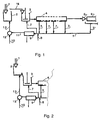
- FIG. 1 of the drawing represents a plant for paper production from waste paper material in a simplified diagram.
- the waste paper material 1 to be processed is delivered in a dry state. It is introduced into a device for wetting 2, where it is wetted and soaked with water which is free of any to microscopic, finest printing ink particles and color-removing chemicals.
- the wetting process lasts until at least the lumen, i.e. the cell cavities of the paper fibers are filled with said pure water. Longer procedures are unnecessary.
- the amount of water required for wetting corresponds approximately to the otro weight of the paper fibers.
- the water prescribed for wetting is introduced into the wetting stage from line 13.
- the pretreated material with the cavities of the cells of the paper fibers filled with the pure water is added to the actual dissolving 3 in a known pulper, where the dissolving takes place with the addition of backwater 7.
- the more or less unpurified backwater 7 also contains finely dispersed ink particles and detachment-supporting chemicals, which are added to the backwater as required via a line 8.
- Dissolving 3 creates a more or less speck-free, pumpable suspension, which is processed in a stock preparation system 4 using a deinking process. Since in the waste paper material treated in the wetting 2 process step, the cavities of the paper fiber cells are already filled with the pure water, no more ink particles present in the suspension can penetrate during the dissolution, thereby preventing the irreversible graying of the material.
- the suspension produced by the dissolving 3 is processed in a known manner in a subsequent stock preparation system 4 for the material of the desired quality for transfer via a headbox 5 for a paper machine 6.
- Such a system is composed of known apparatuses for the purpose and is operated according to a known technology for producing a paper pulp suspension of the desired quality.
- the amount of water required in the manufacturing process circulates in a circuit as described. There are unavoidable water losses that have to be replaced again and again by supplying clean fresh water in order to maintain the circulation.
- at least a portion of the fresh water required can be introduced from a line 10 via the valve 12 and line 13 into the wetting stage and used there for impregnating, wetting the waste paper material.
- wetting 2 with pure fresh water 10, with purified and pure water 11 from the return water 7 and with a mixture of fresh water 10 and purified water 11, which mixture in the mixing valve 12 arises and reaches the wetting device 2 via line 13.
- Figure 2 shows schematically the first part of the method according to the invention in a varied embodiment according to claims 7 or 9.
Landscapes
- Engineering & Computer Science (AREA)
- Life Sciences & Earth Sciences (AREA)
- Wood Science & Technology (AREA)
- Mechanical Engineering (AREA)
- Paper (AREA)
Applications Claiming Priority (2)
| Application Number | Priority Date | Filing Date | Title |
|---|---|---|---|
| DE19914116917 DE4116917C1 (enExample) | 1991-05-24 | 1991-05-24 | |
| DE4116917 | 1991-05-24 |
Publications (2)
| Publication Number | Publication Date |
|---|---|
| EP0514740A1 EP0514740A1 (de) | 1992-11-25 |
| EP0514740B1 true EP0514740B1 (de) | 1995-09-06 |
Family
ID=6432300
Family Applications (1)
| Application Number | Title | Priority Date | Filing Date |
|---|---|---|---|
| EP19920107952 Expired - Lifetime EP0514740B1 (de) | 1991-05-24 | 1992-05-12 | Auflöseverfahren für zu deinkendes Altpapier |
Country Status (3)
| Country | Link |
|---|---|
| EP (1) | EP0514740B1 (enExample) |
| AT (1) | ATE127551T1 (enExample) |
| DE (2) | DE4116917C1 (enExample) |
Families Citing this family (1)
| Publication number | Priority date | Publication date | Assignee | Title |
|---|---|---|---|---|
| DE102009047156A1 (de) | 2009-11-26 | 2011-06-01 | Voith Patent Gmbh | Auflösung |
Family Cites Families (3)
| Publication number | Priority date | Publication date | Assignee | Title |
|---|---|---|---|---|
| US4360402A (en) * | 1979-03-27 | 1982-11-23 | J. M. Voith Gmbh | Process and apparatus for preparing waste paper for reuse |
| CH653395A5 (de) * | 1981-09-25 | 1985-12-31 | Escher Wyss Gmbh | Verfahren zum betrieb einer gesamtanlage zur herstellung von papier sowie gesamtanlage zur ausfuehrung des verfahrens. |
| FR2567930B1 (fr) * | 1984-07-17 | 1986-08-29 | Centre Tech Ind Papier | Procede et installation pour le recyclage de vieux papiers imprimes |
-
1991
- 1991-05-24 DE DE19914116917 patent/DE4116917C1/de not_active Expired - Fee Related
-
1992
- 1992-05-12 DE DE59203525T patent/DE59203525D1/de not_active Expired - Fee Related
- 1992-05-12 EP EP19920107952 patent/EP0514740B1/de not_active Expired - Lifetime
- 1992-05-12 AT AT92107952T patent/ATE127551T1/de not_active IP Right Cessation
Also Published As
| Publication number | Publication date |
|---|---|
| DE4116917C1 (enExample) | 1992-11-19 |
| DE59203525D1 (de) | 1995-10-12 |
| EP0514740A1 (de) | 1992-11-25 |
| ATE127551T1 (de) | 1995-09-15 |
Similar Documents
| Publication | Publication Date | Title |
|---|---|---|
| EP0538603B1 (de) | Verfahren zur Entfernung von feinen Verunreinigungen aus Altpapierfaserstoff | |
| DE3934772C2 (de) | Verfahren zum Deinken von Altpapier | |
| DE3877028T2 (de) | Verfahren und anlage zur wiedergewinnung von bedruckten altpapieren. | |
| DE69104566T2 (de) | Verfahren zum De-inken von bedruckten Papieren. | |
| DE69325098T2 (de) | Verfahren zur behandlung von altpapier und wiedergewonnenes papier | |
| DE69507165T2 (de) | Verfahren zum bleichen von sekundärfasern | |
| DE3200893C1 (de) | Verfahren und Anlage zur Herstellung von gereinigtem Faserstoff aus Altpapier | |
| DE2805445C2 (de) | Verfahren zur Wiederaufbereitung von hochwertigem Altpapier | |
| EP0514740B1 (de) | Auflöseverfahren für zu deinkendes Altpapier | |
| DE2947862C2 (de) | Verfahren und Anlage zur Herstellung einer Faserstoffsuspension aus Altpapier | |
| DE10135699A1 (de) | Verfahren zur Aufbereitung von Trockenausschuss | |
| EP1077281B1 (de) | Verfahren zur Aufbereitung eines holzstoffhaltigen Papierfaser-Rohstoffes | |
| DE2803804C2 (de) | Verfahren zur Steigerung des Weißgrades deinkter Altpapierstoffe | |
| DE3148749C2 (de) | Papiere, vorzugsweise für den Bogendruck, hergestellt aus aufbereitetem Altpapier, und Verfahren zu deren Herstellung | |
| DE4341412C2 (de) | Verfahren zur Aufbereitung von flüllstoffhaltigem Altpapier | |
| DE3118192A1 (de) | Verfahren zum deinken von altpapier | |
| DE102008013458A1 (de) | Verfahren zur Entfernung von Störstoffen aus einer wässrigen Faserstoffsuspension | |
| DE3320526A1 (de) | Verfahren zur herstellung von papieren, papier und dessen verwendung | |
| EP1847645A2 (de) | Verfahren zur Dispergierung von Papierfaserstoff | |
| EP0615020A1 (de) | Verfahren zur Aufbereitung von Altpapier für die Papierherstellung | |
| WO2011064023A1 (de) | Verfahren zur auflösung von altpapier | |
| DE3831668C2 (enExample) | ||
| DE10303646B4 (de) | Verfahren zur Entfernung von Störstoffen aus einer wässrigen Papierfasersuspension | |
| DE2303827C3 (de) | Flotationsverfahren zur Regenerierung von Altpapier | |
| EP0828026A1 (de) | Verfahren zur Reinigung einer Suspension aus Primärfaserstoff |
Legal Events
| Date | Code | Title | Description |
|---|---|---|---|
| PUAI | Public reference made under article 153(3) epc to a published international application that has entered the european phase |
Free format text: ORIGINAL CODE: 0009012 |
|
| 17P | Request for examination filed |
Effective date: 19920512 |
|
| AK | Designated contracting states |
Kind code of ref document: A1 Designated state(s): AT DE FR GB SE |
|
| 17Q | First examination report despatched |
Effective date: 19940419 |
|
| RAP1 | Party data changed (applicant data changed or rights of an application transferred) |
Owner name: VOITH SULZER STOFFAUFBEREITUNG GMBH |
|
| GRAA | (expected) grant |
Free format text: ORIGINAL CODE: 0009210 |
|
| AK | Designated contracting states |
Kind code of ref document: B1 Designated state(s): AT DE FR GB SE |
|
| REF | Corresponds to: |
Ref document number: 127551 Country of ref document: AT Date of ref document: 19950915 Kind code of ref document: T |
|
| REF | Corresponds to: |
Ref document number: 59203525 Country of ref document: DE Date of ref document: 19951012 |
|
| ET | Fr: translation filed | ||
| GBT | Gb: translation of ep patent filed (gb section 77(6)(a)/1977) |
Effective date: 19951102 |
|
| PLBE | No opposition filed within time limit |
Free format text: ORIGINAL CODE: 0009261 |
|
| STAA | Information on the status of an ep patent application or granted ep patent |
Free format text: STATUS: NO OPPOSITION FILED WITHIN TIME LIMIT |
|
| 26N | No opposition filed | ||
| PGFP | Annual fee paid to national office [announced via postgrant information from national office to epo] |
Ref country code: GB Payment date: 19970418 Year of fee payment: 6 |
|
| PGFP | Annual fee paid to national office [announced via postgrant information from national office to epo] |
Ref country code: AT Payment date: 19970423 Year of fee payment: 6 |
|
| PGFP | Annual fee paid to national office [announced via postgrant information from national office to epo] |
Ref country code: FR Payment date: 19970516 Year of fee payment: 6 |
|
| PGFP | Annual fee paid to national office [announced via postgrant information from national office to epo] |
Ref country code: SE Payment date: 19970527 Year of fee payment: 6 |
|
| PGFP | Annual fee paid to national office [announced via postgrant information from national office to epo] |
Ref country code: DE Payment date: 19970623 Year of fee payment: 6 |
|
| PG25 | Lapsed in a contracting state [announced via postgrant information from national office to epo] |
Ref country code: GB Free format text: LAPSE BECAUSE OF NON-PAYMENT OF DUE FEES Effective date: 19980512 Ref country code: AT Free format text: LAPSE BECAUSE OF NON-PAYMENT OF DUE FEES Effective date: 19980512 |
|
| PG25 | Lapsed in a contracting state [announced via postgrant information from national office to epo] |
Ref country code: SE Free format text: LAPSE BECAUSE OF NON-PAYMENT OF DUE FEES Effective date: 19980513 |
|
| PG25 | Lapsed in a contracting state [announced via postgrant information from national office to epo] |
Ref country code: FR Free format text: LAPSE BECAUSE OF NON-PAYMENT OF DUE FEES Effective date: 19980531 |
|
| GBPC | Gb: european patent ceased through non-payment of renewal fee |
Effective date: 19980512 |
|
| EUG | Se: european patent has lapsed |
Ref document number: 92107952.1 |
|
| PG25 | Lapsed in a contracting state [announced via postgrant information from national office to epo] |
Ref country code: DE Free format text: LAPSE BECAUSE OF NON-PAYMENT OF DUE FEES Effective date: 19990302 |
|
| REG | Reference to a national code |
Ref country code: FR Ref legal event code: ST |