EP0509356B1 - Verbundanker mit wasserhärtender Polymerzubereitung - Google Patents
Verbundanker mit wasserhärtender Polymerzubereitung Download PDFInfo
- Publication number
- EP0509356B1 EP0509356B1 EP92105891A EP92105891A EP0509356B1 EP 0509356 B1 EP0509356 B1 EP 0509356B1 EP 92105891 A EP92105891 A EP 92105891A EP 92105891 A EP92105891 A EP 92105891A EP 0509356 B1 EP0509356 B1 EP 0509356B1
- Authority
- EP
- European Patent Office
- Prior art keywords
- anchor
- composite
- bis
- polyurethane resin
- composite anchor
- Prior art date
- Legal status (The legal status is an assumption and is not a legal conclusion. Google has not performed a legal analysis and makes no representation as to the accuracy of the status listed.)
- Expired - Lifetime
Links
- 239000000203 mixture Substances 0.000 title description 15
- 150000001875 compounds Chemical class 0.000 title description 11
- 229920000642 polymer Polymers 0.000 title description 7
- 238000004873 anchoring Methods 0.000 title 1
- 239000002131 composite material Substances 0.000 claims description 22
- 229920005749 polyurethane resin Polymers 0.000 claims description 16
- 238000001723 curing Methods 0.000 claims description 12
- 239000000463 material Substances 0.000 claims description 11
- 239000004753 textile Substances 0.000 claims description 10
- 239000004567 concrete Substances 0.000 claims description 7
- 238000004519 manufacturing process Methods 0.000 claims description 6
- 238000000034 method Methods 0.000 claims description 6
- 239000000835 fiber Substances 0.000 claims description 4
- 238000013008 moisture curing Methods 0.000 claims description 4
- 229920002994 synthetic fiber Polymers 0.000 claims description 2
- 229910052500 inorganic mineral Inorganic materials 0.000 claims 1
- 239000007769 metal material Substances 0.000 claims 1
- 239000011707 mineral Substances 0.000 claims 1
- 239000011435 rock Substances 0.000 claims 1
- 239000005056 polyisocyanate Substances 0.000 description 26
- 229920001228 polyisocyanate Polymers 0.000 description 26
- 239000004744 fabric Substances 0.000 description 15
- 229920002635 polyurethane Polymers 0.000 description 11
- 239000004814 polyurethane Substances 0.000 description 11
- 229920005989 resin Polymers 0.000 description 11
- 239000011347 resin Substances 0.000 description 11
- 239000003365 glass fiber Substances 0.000 description 9
- IQPQWNKOIGAROB-UHFFFAOYSA-N isocyanate group Chemical group [N-]=C=O IQPQWNKOIGAROB-UHFFFAOYSA-N 0.000 description 7
- 239000004570 mortar (masonry) Substances 0.000 description 7
- 238000002360 preparation method Methods 0.000 description 7
- RTZKZFJDLAIYFH-UHFFFAOYSA-N Diethyl ether Chemical compound CCOCC RTZKZFJDLAIYFH-UHFFFAOYSA-N 0.000 description 6
- 239000012876 carrier material Substances 0.000 description 6
- 239000000853 adhesive Substances 0.000 description 5
- 230000001070 adhesive effect Effects 0.000 description 5
- 230000000181 anti-adherent effect Effects 0.000 description 5
- 239000006260 foam Substances 0.000 description 5
- 125000002887 hydroxy group Chemical group [H]O* 0.000 description 5
- 229920000570 polyether Polymers 0.000 description 5
- 239000004721 Polyphenylene oxide Substances 0.000 description 4
- 239000000654 additive Substances 0.000 description 4
- 125000004432 carbon atom Chemical group C* 0.000 description 4
- 239000003054 catalyst Substances 0.000 description 4
- 238000000576 coating method Methods 0.000 description 4
- 239000011521 glass Substances 0.000 description 4
- 239000012948 isocyanate Substances 0.000 description 4
- 150000002513 isocyanates Chemical class 0.000 description 4
- NIMLQBUJDJZYEJ-UHFFFAOYSA-N isophorone diisocyanate Chemical compound CC1(C)CC(N=C=O)CC(C)(CN=C=O)C1 NIMLQBUJDJZYEJ-UHFFFAOYSA-N 0.000 description 4
- 239000011505 plaster Substances 0.000 description 4
- 229920005862 polyol Polymers 0.000 description 4
- 150000003077 polyols Chemical class 0.000 description 4
- ZWEHNKRNPOVVGH-UHFFFAOYSA-N 2-Butanone Chemical compound CCC(C)=O ZWEHNKRNPOVVGH-UHFFFAOYSA-N 0.000 description 3
- 229920000742 Cotton Polymers 0.000 description 3
- YMWUJEATGCHHMB-UHFFFAOYSA-N Dichloromethane Chemical compound ClCCl YMWUJEATGCHHMB-UHFFFAOYSA-N 0.000 description 3
- XEKOWRVHYACXOJ-UHFFFAOYSA-N Ethyl acetate Chemical compound CCOC(C)=O XEKOWRVHYACXOJ-UHFFFAOYSA-N 0.000 description 3
- LYCAIKOWRPUZTN-UHFFFAOYSA-N Ethylene glycol Chemical compound OCCO LYCAIKOWRPUZTN-UHFFFAOYSA-N 0.000 description 3
- WSFSSNUMVMOOMR-UHFFFAOYSA-N Formaldehyde Chemical compound O=C WSFSSNUMVMOOMR-UHFFFAOYSA-N 0.000 description 3
- -1 Hydrocarbon radical Chemical class 0.000 description 3
- YXFVVABEGXRONW-UHFFFAOYSA-N Toluene Chemical compound CC1=CC=CC=C1 YXFVVABEGXRONW-UHFFFAOYSA-N 0.000 description 3
- 150000001412 amines Chemical class 0.000 description 3
- 238000006243 chemical reaction Methods 0.000 description 3
- 239000011248 coating agent Substances 0.000 description 3
- 229910052602 gypsum Inorganic materials 0.000 description 3
- 239000010440 gypsum Substances 0.000 description 3
- 229910052751 metal Inorganic materials 0.000 description 3
- 239000002184 metal Substances 0.000 description 3
- 238000012986 modification Methods 0.000 description 3
- 230000004048 modification Effects 0.000 description 3
- 229920003023 plastic Polymers 0.000 description 3
- 239000004033 plastic Substances 0.000 description 3
- 239000000047 product Substances 0.000 description 3
- CSCPPACGZOOCGX-UHFFFAOYSA-N Acetone Chemical compound CC(C)=O CSCPPACGZOOCGX-UHFFFAOYSA-N 0.000 description 2
- PAYRUJLWNCNPSJ-UHFFFAOYSA-N Aniline Chemical compound NC1=CC=CC=C1 PAYRUJLWNCNPSJ-UHFFFAOYSA-N 0.000 description 2
- HEDRZPFGACZZDS-UHFFFAOYSA-N Chloroform Chemical compound ClC(Cl)Cl HEDRZPFGACZZDS-UHFFFAOYSA-N 0.000 description 2
- 239000005057 Hexamethylene diisocyanate Substances 0.000 description 2
- 239000005058 Isophorone diisocyanate Substances 0.000 description 2
- GWEVSGVZZGPLCZ-UHFFFAOYSA-N Titan oxide Chemical compound O=[Ti]=O GWEVSGVZZGPLCZ-UHFFFAOYSA-N 0.000 description 2
- ZJCCRDAZUWHFQH-UHFFFAOYSA-N Trimethylolpropane Chemical compound CCC(CO)(CO)CO ZJCCRDAZUWHFQH-UHFFFAOYSA-N 0.000 description 2
- 239000012963 UV stabilizer Substances 0.000 description 2
- OHJMTUPIZMNBFR-UHFFFAOYSA-N biuret Chemical compound NC(=O)NC(N)=O OHJMTUPIZMNBFR-UHFFFAOYSA-N 0.000 description 2
- 150000001718 carbodiimides Chemical class 0.000 description 2
- 125000005442 diisocyanate group Chemical group 0.000 description 2
- 230000000694 effects Effects 0.000 description 2
- 238000005516 engineering process Methods 0.000 description 2
- 150000002148 esters Chemical group 0.000 description 2
- RRAMGCGOFNQTLD-UHFFFAOYSA-N hexamethylene diisocyanate Chemical compound O=C=NCCCCCCN=C=O RRAMGCGOFNQTLD-UHFFFAOYSA-N 0.000 description 2
- 239000012442 inert solvent Substances 0.000 description 2
- ZFSLODLOARCGLH-UHFFFAOYSA-N isocyanuric acid Chemical compound OC1=NC(O)=NC(O)=N1 ZFSLODLOARCGLH-UHFFFAOYSA-N 0.000 description 2
- 239000000123 paper Substances 0.000 description 2
- 229920002647 polyamide Polymers 0.000 description 2
- 229920000728 polyester Polymers 0.000 description 2
- 229920005906 polyester polyol Polymers 0.000 description 2
- 230000000379 polymerizing effect Effects 0.000 description 2
- KCTAWXVAICEBSD-UHFFFAOYSA-N prop-2-enoyloxy prop-2-eneperoxoate Chemical compound C=CC(=O)OOOC(=O)C=C KCTAWXVAICEBSD-UHFFFAOYSA-N 0.000 description 2
- 150000003254 radicals Chemical class 0.000 description 2
- XLYOFNOQVPJJNP-UHFFFAOYSA-N water Substances O XLYOFNOQVPJJNP-UHFFFAOYSA-N 0.000 description 2
- DNIAPMSPPWPWGF-GSVOUGTGSA-N (R)-(-)-Propylene glycol Chemical compound C[C@@H](O)CO DNIAPMSPPWPWGF-GSVOUGTGSA-N 0.000 description 1
- UOCLXMDMGBRAIB-UHFFFAOYSA-N 1,1,1-trichloroethane Chemical compound CC(Cl)(Cl)Cl UOCLXMDMGBRAIB-UHFFFAOYSA-N 0.000 description 1
- PCHXZXKMYCGVFA-UHFFFAOYSA-N 1,3-diazetidine-2,4-dione Chemical compound O=C1NC(=O)N1 PCHXZXKMYCGVFA-UHFFFAOYSA-N 0.000 description 1
- ALQLPWJFHRMHIU-UHFFFAOYSA-N 1,4-diisocyanatobenzene Chemical compound O=C=NC1=CC=C(N=C=O)C=C1 ALQLPWJFHRMHIU-UHFFFAOYSA-N 0.000 description 1
- UPMLOUAZCHDJJD-UHFFFAOYSA-N 4,4'-Diphenylmethane Diisocyanate Chemical compound C1=CC(N=C=O)=CC=C1CC1=CC=C(N=C=O)C=C1 UPMLOUAZCHDJJD-UHFFFAOYSA-N 0.000 description 1
- ZMSQJSMSLXVTKN-UHFFFAOYSA-N 4-[2-(2-morpholin-4-ylethoxy)ethyl]morpholine Chemical compound C1COCCN1CCOCCN1CCOCC1 ZMSQJSMSLXVTKN-UHFFFAOYSA-N 0.000 description 1
- 229910002012 Aerosil® Inorganic materials 0.000 description 1
- 241001136792 Alle Species 0.000 description 1
- DKPFZGUDAPQIHT-UHFFFAOYSA-N Butyl acetate Natural products CCCCOC(C)=O DKPFZGUDAPQIHT-UHFFFAOYSA-N 0.000 description 1
- NLZUEZXRPGMBCV-UHFFFAOYSA-N Butylhydroxytoluene Chemical compound CC1=CC(C(C)(C)C)=C(O)C(C(C)(C)C)=C1 NLZUEZXRPGMBCV-UHFFFAOYSA-N 0.000 description 1
- 239000004215 Carbon black (E152) Substances 0.000 description 1
- 239000004593 Epoxy Substances 0.000 description 1
- IAYPIBMASNFSPL-UHFFFAOYSA-N Ethylene oxide Chemical compound C1CO1 IAYPIBMASNFSPL-UHFFFAOYSA-N 0.000 description 1
- UFHFLCQGNIYNRP-UHFFFAOYSA-N Hydrogen Chemical compound [H][H] UFHFLCQGNIYNRP-UHFFFAOYSA-N 0.000 description 1
- 229920001730 Moisture cure polyurethane Polymers 0.000 description 1
- CTQNGGLPUBDAKN-UHFFFAOYSA-N O-Xylene Chemical compound CC1=CC=CC=C1C CTQNGGLPUBDAKN-UHFFFAOYSA-N 0.000 description 1
- 239000004952 Polyamide Substances 0.000 description 1
- GOOHAUXETOMSMM-UHFFFAOYSA-N Propylene oxide Chemical compound CC1CO1 GOOHAUXETOMSMM-UHFFFAOYSA-N 0.000 description 1
- VYPSYNLAJGMNEJ-UHFFFAOYSA-N Silicium dioxide Chemical compound O=[Si]=O VYPSYNLAJGMNEJ-UHFFFAOYSA-N 0.000 description 1
- 229910000831 Steel Inorganic materials 0.000 description 1
- LNWBFIVSTXCJJG-UHFFFAOYSA-N [diisocyanato(phenyl)methyl]benzene Chemical compound C=1C=CC=CC=1C(N=C=O)(N=C=O)C1=CC=CC=C1 LNWBFIVSTXCJJG-UHFFFAOYSA-N 0.000 description 1
- 150000001252 acrylic acid derivatives Chemical class 0.000 description 1
- 150000001338 aliphatic hydrocarbons Chemical group 0.000 description 1
- 229940037003 alum Drugs 0.000 description 1
- 229910052782 aluminium Inorganic materials 0.000 description 1
- 150000004945 aromatic hydrocarbons Chemical group 0.000 description 1
- 238000005452 bending Methods 0.000 description 1
- PASDCCFISLVPSO-UHFFFAOYSA-N benzoyl chloride Chemical compound ClC(=O)C1=CC=CC=C1 PASDCCFISLVPSO-UHFFFAOYSA-N 0.000 description 1
- BMRWNKZVCUKKSR-UHFFFAOYSA-N butane-1,2-diol Chemical compound CCC(O)CO BMRWNKZVCUKKSR-UHFFFAOYSA-N 0.000 description 1
- 235000012241 calcium silicate Nutrition 0.000 description 1
- 239000006229 carbon black Substances 0.000 description 1
- 210000003850 cellular structure Anatomy 0.000 description 1
- 239000007795 chemical reaction product Substances 0.000 description 1
- 239000003795 chemical substances by application Substances 0.000 description 1
- 150000008280 chlorinated hydrocarbons Chemical class 0.000 description 1
- NEHMKBQYUWJMIP-NJFSPNSNSA-N chloro(114C)methane Chemical compound [14CH3]Cl NEHMKBQYUWJMIP-NJFSPNSNSA-N 0.000 description 1
- 238000009833 condensation Methods 0.000 description 1
- 230000005494 condensation Effects 0.000 description 1
- 239000004035 construction material Substances 0.000 description 1
- 229920001577 copolymer Polymers 0.000 description 1
- 238000013461 design Methods 0.000 description 1
- 238000011161 development Methods 0.000 description 1
- KORSJDCBLAPZEQ-UHFFFAOYSA-N dicyclohexylmethane-4,4'-diisocyanate Chemical compound C1CC(N=C=O)CCC1CC1CCC(N=C=O)CC1 KORSJDCBLAPZEQ-UHFFFAOYSA-N 0.000 description 1
- 235000013870 dimethyl polysiloxane Nutrition 0.000 description 1
- CZZYITDELCSZES-UHFFFAOYSA-N diphenylmethane Chemical class C=1C=CC=CC=1CC1=CC=CC=C1 CZZYITDELCSZES-UHFFFAOYSA-N 0.000 description 1
- 238000005553 drilling Methods 0.000 description 1
- 230000002349 favourable effect Effects 0.000 description 1
- 229920002313 fluoropolymer Polymers 0.000 description 1
- 239000004811 fluoropolymer Substances 0.000 description 1
- 239000011888 foil Substances 0.000 description 1
- DYDNPESBYVVLBO-UHFFFAOYSA-N formanilide Chemical compound O=CNC1=CC=CC=C1 DYDNPESBYVVLBO-UHFFFAOYSA-N 0.000 description 1
- 125000000524 functional group Chemical group 0.000 description 1
- 238000010438 heat treatment Methods 0.000 description 1
- FUZZWVXGSFPDMH-UHFFFAOYSA-M hexanoate Chemical compound CCCCCC([O-])=O FUZZWVXGSFPDMH-UHFFFAOYSA-M 0.000 description 1
- 229930195733 hydrocarbon Natural products 0.000 description 1
- 150000002430 hydrocarbons Chemical group 0.000 description 1
- 229910052739 hydrogen Inorganic materials 0.000 description 1
- 239000001257 hydrogen Substances 0.000 description 1
- 230000002209 hydrophobic effect Effects 0.000 description 1
- 238000007654 immersion Methods 0.000 description 1
- 238000005470 impregnation Methods 0.000 description 1
- UQSXHKLRYXJYBZ-UHFFFAOYSA-N iron oxide Inorganic materials [Fe]=O UQSXHKLRYXJYBZ-UHFFFAOYSA-N 0.000 description 1
- 235000013980 iron oxide Nutrition 0.000 description 1
- VBMVTYDPPZVILR-UHFFFAOYSA-N iron(2+);oxygen(2-) Chemical class [O-2].[Fe+2] VBMVTYDPPZVILR-UHFFFAOYSA-N 0.000 description 1
- 150000002576 ketones Chemical class 0.000 description 1
- 239000000314 lubricant Substances 0.000 description 1
- VPKDCDLSJZCGKE-UHFFFAOYSA-N methanediimine Chemical compound N=C=N VPKDCDLSJZCGKE-UHFFFAOYSA-N 0.000 description 1
- 238000002156 mixing Methods 0.000 description 1
- 239000000178 monomer Substances 0.000 description 1
- DNIAPMSPPWPWGF-UHFFFAOYSA-N monopropylene glycol Natural products CC(O)CO DNIAPMSPPWPWGF-UHFFFAOYSA-N 0.000 description 1
- 229910052757 nitrogen Inorganic materials 0.000 description 1
- IJGRMHOSHXDMSA-UHFFFAOYSA-N nitrogen Substances N#N IJGRMHOSHXDMSA-UHFFFAOYSA-N 0.000 description 1
- QJGQUHMNIGDVPM-UHFFFAOYSA-N nitrogen group Chemical group [N] QJGQUHMNIGDVPM-UHFFFAOYSA-N 0.000 description 1
- 239000004745 nonwoven fabric Substances 0.000 description 1
- 150000002894 organic compounds Chemical class 0.000 description 1
- 230000000399 orthopedic effect Effects 0.000 description 1
- 230000035515 penetration Effects 0.000 description 1
- 239000000049 pigment Substances 0.000 description 1
- 229920000435 poly(dimethylsiloxane) Polymers 0.000 description 1
- 239000004417 polycarbonate Substances 0.000 description 1
- 229920000515 polycarbonate Polymers 0.000 description 1
- 229920006149 polyester-amide block copolymer Polymers 0.000 description 1
- 229920001223 polyethylene glycol Polymers 0.000 description 1
- 239000002952 polymeric resin Substances 0.000 description 1
- 229920000098 polyolefin Polymers 0.000 description 1
- 229920006324 polyoxymethylene Polymers 0.000 description 1
- 229920001451 polypropylene glycol Polymers 0.000 description 1
- 229920001296 polysiloxane Polymers 0.000 description 1
- 229920006295 polythiol Polymers 0.000 description 1
- 230000008092 positive effect Effects 0.000 description 1
- 239000000843 powder Substances 0.000 description 1
- 235000013772 propylene glycol Nutrition 0.000 description 1
- 238000007586 pull-out test Methods 0.000 description 1
- 239000011541 reaction mixture Substances 0.000 description 1
- 230000003716 rejuvenation Effects 0.000 description 1
- 238000007127 saponification reaction Methods 0.000 description 1
- 238000000926 separation method Methods 0.000 description 1
- 239000002904 solvent Substances 0.000 description 1
- 239000010959 steel Substances 0.000 description 1
- 238000003860 storage Methods 0.000 description 1
- 239000000126 substance Substances 0.000 description 1
- 150000005846 sugar alcohols Polymers 0.000 description 1
- 229920003002 synthetic resin Polymers 0.000 description 1
- 239000008399 tap water Substances 0.000 description 1
- 235000020679 tap water Nutrition 0.000 description 1
- 239000013008 thixotropic agent Substances 0.000 description 1
- 239000004408 titanium dioxide Substances 0.000 description 1
- RUELTTOHQODFPA-UHFFFAOYSA-N toluene 2,6-diisocyanate Chemical compound CC1=C(N=C=O)C=CC=C1N=C=O RUELTTOHQODFPA-UHFFFAOYSA-N 0.000 description 1
- 230000007704 transition Effects 0.000 description 1
- 238000005829 trimerization reaction Methods 0.000 description 1
- 229920006337 unsaturated polyester resin Polymers 0.000 description 1
- AVWRKZWQTYIKIY-UHFFFAOYSA-N urea-1-carboxylic acid Chemical compound NC(=O)NC(O)=O AVWRKZWQTYIKIY-UHFFFAOYSA-N 0.000 description 1
- 239000001993 wax Substances 0.000 description 1
- 238000009736 wetting Methods 0.000 description 1
- 239000008096 xylene Substances 0.000 description 1
Images
Classifications
-
- F—MECHANICAL ENGINEERING; LIGHTING; HEATING; WEAPONS; BLASTING
- F16—ENGINEERING ELEMENTS AND UNITS; GENERAL MEASURES FOR PRODUCING AND MAINTAINING EFFECTIVE FUNCTIONING OF MACHINES OR INSTALLATIONS; THERMAL INSULATION IN GENERAL
- F16B—DEVICES FOR FASTENING OR SECURING CONSTRUCTIONAL ELEMENTS OR MACHINE PARTS TOGETHER, e.g. NAILS, BOLTS, CIRCLIPS, CLAMPS, CLIPS OR WEDGES; JOINTS OR JOINTING
- F16B13/00—Dowels or other devices fastened in walls or the like by inserting them in holes made therein for that purpose
- F16B13/14—Non-metallic plugs or sleeves; Use of liquid, loose solid or kneadable material therefor
- F16B13/141—Fixing plugs in holes by the use of settable material
- F16B13/142—Fixing plugs in holes by the use of settable material characterised by the composition of the setting material or mixture
-
- F—MECHANICAL ENGINEERING; LIGHTING; HEATING; WEAPONS; BLASTING
- F16—ENGINEERING ELEMENTS AND UNITS; GENERAL MEASURES FOR PRODUCING AND MAINTAINING EFFECTIVE FUNCTIONING OF MACHINES OR INSTALLATIONS; THERMAL INSULATION IN GENERAL
- F16B—DEVICES FOR FASTENING OR SECURING CONSTRUCTIONAL ELEMENTS OR MACHINE PARTS TOGETHER, e.g. NAILS, BOLTS, CIRCLIPS, CLAMPS, CLIPS OR WEDGES; JOINTS OR JOINTING
- F16B13/00—Dowels or other devices fastened in walls or the like by inserting them in holes made therein for that purpose
- F16B13/14—Non-metallic plugs or sleeves; Use of liquid, loose solid or kneadable material therefor
- F16B13/141—Fixing plugs in holes by the use of settable material
- F16B2013/147—Grout with reinforcing elements or with fillers, e.g. fibres, flakes, balls, wires
-
- F—MECHANICAL ENGINEERING; LIGHTING; HEATING; WEAPONS; BLASTING
- F16—ENGINEERING ELEMENTS AND UNITS; GENERAL MEASURES FOR PRODUCING AND MAINTAINING EFFECTIVE FUNCTIONING OF MACHINES OR INSTALLATIONS; THERMAL INSULATION IN GENERAL
- F16B—DEVICES FOR FASTENING OR SECURING CONSTRUCTIONAL ELEMENTS OR MACHINE PARTS TOGETHER, e.g. NAILS, BOLTS, CIRCLIPS, CLAMPS, CLIPS OR WEDGES; JOINTS OR JOINTING
- F16B13/00—Dowels or other devices fastened in walls or the like by inserting them in holes made therein for that purpose
- F16B13/14—Non-metallic plugs or sleeves; Use of liquid, loose solid or kneadable material therefor
- F16B13/141—Fixing plugs in holes by the use of settable material
- F16B2013/148—Means for inhibiting adhesion between dowel or anchor bolt parts and the surrounding grouting composition
-
- Y—GENERAL TAGGING OF NEW TECHNOLOGICAL DEVELOPMENTS; GENERAL TAGGING OF CROSS-SECTIONAL TECHNOLOGIES SPANNING OVER SEVERAL SECTIONS OF THE IPC; TECHNICAL SUBJECTS COVERED BY FORMER USPC CROSS-REFERENCE ART COLLECTIONS [XRACs] AND DIGESTS
- Y10—TECHNICAL SUBJECTS COVERED BY FORMER USPC
- Y10S—TECHNICAL SUBJECTS COVERED BY FORMER USPC CROSS-REFERENCE ART COLLECTIONS [XRACs] AND DIGESTS
- Y10S285/00—Pipe joints or couplings
- Y10S285/915—Mastic
Definitions
- the invention relates to water-hardening polymer preparations which can be glued in composite anchors for use in concrete or masonry, a method for producing corresponding composite anchors and their use.
- DE-C-629 335 a method for fastening screws, hooks, nails or the like in previously made boreholes of the masonry by means of tissue interspersed with plaster is known.
- One possibility of fastening is that the screw or nail shaft is wrapped with a gypsum-containing tissue and this wrapped screw or nail is then introduced into the prefabricated borehole.
- the gypsum-containing tissue can be produced in a simple manner by, for example, sprinkling a piece of cotton fabric evenly with gypsum powder, to which other chemical substances such as alum can be added for better binding, as is the case in orthopedics known Plaster bandages are the case.
- the screws, hooks or nails fastened using this method have only a limited load capacity.
- the plaster takes a long time to harden properly and working with plaster is technically complex.
- the composite anchors according to the invention consist of a metal rod, the anchor rod, which is coated with a textile material which is impregnated with a moisture-curing polyurethane resin.
- This composite anchor according to the invention is activated by immersion in water and can then be placed in a correspondingly dimensioned bore.
- the curing time of the polyurethane resin determines the length of time after which the anchor can be loaded. After hardening, the anchor has the required load capacity.
- the resin cannot foam freely due to the volume limited by the bore. After the available free volume has been filled, a foam pressure builds up, which on the one hand causes a good wetting and penetration of the bore surface, and on the other hand counteracts further inflation. Only a slight uniaxial expansion is only possible in the edge zones of the bond. The inevitably lower shear stiffness caused by this has a positive effect in terms of reducing stress peaks due to the large load-bearing length of the bond. This improves the load-bearing behavior of the adhesive as well as the metal anchor.
- the previously known composite anchor systems are based on polymerizable compositions, which are sold separately in monomer and catalyst in two-chamber glass cartridges. These so-called mortar cartridges are placed in the borehole. Then the anchor rod is driven in using an impact drill. The glass of the mortar cartridge is smashed and the setting reaction is started by intimately mixing the components (cf. e.g. literature 1. Mauthe, P., New generation of composite anchors with epoxy acrylate, Swiss engineer and architect (1987) H. 13, 2. Lang, G., Strength Properties of Composite Anchor Systems, Bauingenieur 54 (1979), pp. 41-46, 3. Sell R., About Skill and Deformation concrete anchor with reaction resin mortar cartridges, connection technology 5 (1973), H. 8., pp. 11-16, 4.
- the textile carrier material impregnated with the polyurethane resin according to the invention reinforces the resin and counteracts creep under load. This effect is particularly pronounced when e.g. Glass fibers are used.
- the sheathing of the armature is simpler in terms of production technology than the production of the two-chamber glass ampoules.
- the composite anchors according to the invention are not limited to use in blind holes, but can e.g. can also be used in through holes.
- the anchors do not need to be set with the drilling machine, they can also be used in places that are difficult to access. In addition, there is greater freedom in the shape of the anchor, for example hooks and eyes can be executed.
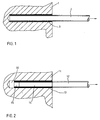
- the 1st variant (Fig. 1) uses a conventional tie rod with a thread that extends over the entire length, for example.
- a particularly favorable load-bearing behavior can be achieved if a separating layer allows sliding between the anchor rod and the polyurethane resin, so that the tensile force in the anchor rod is guided up to a head inside the bore (variant according to FIG. 2).
- the introduction of force from the anchor rod to the resin-impregnated casing is ensured by a positive connection on the head of the anchor rod.
- This separation layer mentioned above represents an anti-adhesive finish.
- This anti-adhesive finish can be a coating of the anchor rod. All materials that are adhesive for polymethane resins can be used, in particular polyolefins, silicones, fluoropolymers and waxes of synthetic or natural origin.
- the antiadhesive finish can consist of a thin-walled sleeve which is slidable with respect to the anchor rod and which prevents direct contact of the polymethane resin with the anchor rod .
- This sleeve can consist of coated paper, plastic or metal foils, hoses or tubes, for example.
- Suitable low molecular weight polyisocyanates of this type are, for example, hexamethylene diisocyanate, 1,12-dodecane diisocyanate, cyclobutane-1,3-diisocyanate, cyclohexane-1,3- and -1,4-diisocyanate and any mixtures of these isomers, 1-isocyanato-3,3,5 -trimethyl-5-isocyanatomethylcyclohexane, 2,4- and 2,6-hexahydrotoluylene diisocyanate and any mixtures of these isomers, hexahydro-1,3- and / or -1,4-phenylene diisocyanate, perhydro-2,4'- and / or - 4,4'-diphenylmethane diisocyanate, 1,3- and 1,4-phenylene diisocyanate, 2,4- and 2,6-tolylene diisocyanate and any mixtures of these iso
- Suitable higher molecular weight polyisocyanates are modification products of such simple polyisocyanates, ie polyisocyanates with, for example, isocyanurate, carbodiimide, allophanate, biuret or uretdione structural units, such as those obtained by known processes of the prior art from the simple polyisocyanates of the above-mentioned general examples given as examples Formula can be made.
- the prepolymers known from polyurethane chemistry with terminal isocyanate groups in the molecular weight range 400 to 10,000, preferably 600 to 8,000 and in particular 800 to 5,000 are of particular interest.
- These compounds are prepared in a manner known per se by reacting excess amounts simple polyisocyanates of the type mentioned by way of example with organic compounds having at least two groups which are reactive toward isocyanate groups, in particular organic polyhydroxyl compounds.
- Suitable polyhydroxyl compounds of this type are both simple polyhydric alcohols such as, for example, ethylene glycol, trimethylolpropane, 1,2-propanediol or 1,2-butanediol, but in particular higher molecular weight polyether polyols and / or polyester polyols of the type known per se from polyurethane chemistry with molecular weights of 600 to 8,000, preferably 800 to 4,000, the at least two in the Rule 2 to 8, but preferably 2 to 4, have primary and / or secondary hydroxyl groups.
- NCO prepolymers which consist, for example, of low molecular weight polyisocyanates of the type mentioned by way of example and less preferred compounds with groups which are reactive toward isocyanate groups, such as, for example, polythioether polyols, Hydroxyl group-containing polyacetals, polyhydroxy polycarbonates, hydroxyl group-containing polyester amides or hydroxyl group-containing copolymers of olefinically unsaturated compounds have been obtained.
- Compounds suitable for the preparation of the NCO prepolymers and having groups which are reactive toward isocyanate groups, in particular hydroxyl groups are, for example, the compounds disclosed by way of example in US Pat. No. 4,218,543, column 7, line 29 to column 9, line 25.
- NCO prepolymers In the preparation of the NCO prepolymers, these compounds are reacted with groups that are reactive toward isocyanate groups with simple polyisocyanates of the type exemplified above, while maintaining an NCO / OH equivalent ratio of> 1.
- the NCO prepolymers generally have an NCO content of 2.5 to 30, preferably 6 to 25,% by weight. From this it can already be seen that, in the context of the present invention, under “NCO prepolymers” or under “prepolymers with terminal isocyanate groups” both the reaction products as such and their mixtures with excess amounts of unreacted starting polyisocyanates, which are often also called “semiprepolymer” are to be understood.
- polyisocyanate components are the technical polyisocyanates customary in polyurethane chemistry, i.e. Hexamethylene diisocyanate, 1-isocyanato-3,3,5-trimethyl-5-isocyanatomethyl-cyclohexane (isophorone diisocyanate, abbreviated: IPDI), 4,4'-diisocyanato-dicyclohexylmethane, 4,4'-diisocyanatodiphenylmethane, the mixtures thereof with the corresponding 2, 4'- and 2,2'-isomers, polyisocyanate mixtures of the diphenylmethane series, as can be obtained by phosgenation of aniline / formaldehyde condensates in a manner known per se, the modification products of these technical polyisocyanates, which contain biuret or isocyanurate groups, and in particular NCO prepolymers of the aforementioned Type based on these technical polyisocyanates on the
- Isocyanates with aromatically bound NCO groups are preferred according to the invention.
- a particularly preferred polyisocyanate component is partially carbodiimidized diisocyanatodiphenylmethane, which also has uretonimine groups due to the addition of monomeric diisocyanate to the carbodiimide structure.
- the water-curing polyurethanes can contain catalysts known per se. In particular, this can be tert. Be amines that catalyze the isocyanate / water reaction and not a self-reaction (trimerization, allophanatization) (DE-A 23 57 931). Examples include tert. amine-containing polyethers (DE-A 26 51 089), low molecular weight tert. Amines like or dimorpholine diethyl ether or bis (2,6-dimethylmorpholino) diethyl ether (WO 86/01397).
- the catalyst content, based on the tertiary nitrogen, is generally 0.05 to 0.5% by weight, based on the polymer resin.
- the water-curing polymer preparations can contain additives known per se, such as e.g. Leveling agents, thixotropic agents, defoamers and lubricants.
- plastic resins can be colored or, if desired, contain UV stabilizers.
- additives examples include: polydimethylsiloxanes, calcium silicates of the aerosil type, polywaxes (polyethylene glycols), UV stabilizers of the ionol type (DE-A 29 21 163), color pigments such as carbon black, iron oxides, titanium dioxide or phthalocyanines.
- additives which are particularly suitable for polyurethane prepolymers are described in the Plastics Manual, Volume 7, Polyurethanes, pages 100 to 109 (1983). They are generally added in an amount of 0.5 to 5% (based on the resin).
- the carrier material is coated and / or impregnated with an amount of 25 to 200% by weight, preferably 30 to 180% by weight, of water-curing polymer preparation, based on the entire material.
- the invention also relates to a process for producing water-curing polymer preparations for construction materials, which is characterized in that a water-curing reactive resin is mixed with catalysts and other auxiliaries and additives and then homogeneously distributed over the surface of the carrier material.
- the support materials thus obtained which are coated with water-curing polyurethane resin, are then rolled up onto the cut anchor rods and sealed in an airtight and watertight film (for example made of plastic-aluminum laminate) or other completely sealed containers, as described in DE-A 23 57 931 and DE-A 26 51 089 are described.
- an airtight and watertight film for example made of plastic-aluminum laminate
- the polymer preparation can be dissolved in an inert solvent, which is removed again after the coating process.
- Inert solvents can be, for example, chlorinated hydrocarbons such as methylene chloride, trichloroethane or chloroform, ketones such as acetone and methyl ethyl ketone, esters such as ethyl acetate and butyl acetate, aromatics such as toluene, xylene or corresponding derivatized types which have no Zerewitinoff-active hydrogen.
- chlorinated hydrocarbons such as methylene chloride, trichloroethane or chloroform
- ketones such as acetone and methyl ethyl ketone
- esters such as ethyl acetate and butyl acetate
- aromatics such as toluene, xylene or corresponding derivatized types which have no Zerewitinoff-active hydrogen.
- a roll of the mixture is impregnated with a quantity of the amount of the polymethane resin from Example 1, dissolved in methyl chloride, that is 150% by weight (based on the non-resinous carrier material) .
- the solvent is then removed in vacuo. This creates a resinous glass fiber mixture that can only be wound to prepare the composite anchors according to the invention previously cut and prepared anchor rods.
- FIG. 2 a composite anchor of variant 2 (FIG. 2) was used with the same resin-coated glass fabric.
- the anchor rod used had the following dimensions: Anchor head: 10 mm long 12 mm diameter Rejuvenation: 80 mm total length from that 70 mm adhesive 8 mm diameter Thread: M 10 DIN 13, B1. 1 40 mm long overall length 130 mm
- the breaking force here was 28.1 kN.
- the break occurred in the steel material of the anchor rod at the transition to the head in the innermost part of the hole.
- a siliconized paper was glued with the siliconized side outwards using an adhesive strip according to the drawing around the tapered point of the anchor rod.
Landscapes
- Engineering & Computer Science (AREA)
- General Engineering & Computer Science (AREA)
- Mechanical Engineering (AREA)
- Polyurethanes Or Polyureas (AREA)
- Laminated Bodies (AREA)
- Treatments For Attaching Organic Compounds To Fibrous Goods (AREA)
- Compositions Of Macromolecular Compounds (AREA)
- Reinforced Plastic Materials (AREA)
Description
- Die Erfindung betrifft mit Hilfe wasserhärtender Polymerzubereitungen einklebbare Verbundanker für die Verwendung in Beton oder Mauerwerk, ein Verfahren zur Herstellung entsprechender Verbundanker sowie ihre Verwendung.
- Aus DE-C-629 335 ist ein Verfahren zur Befestigung von Schrauben, Haken, Nägeln oder dergleichen in vorher hergestellten Bohrlöchern des Mauerwerkes mittels mit Gips durchsetzten Gewebes bekannt. Eine Möglichkeit der Befestigung besteht darin, daß der Schrauben- bzw. Nagelschaft mit einem gipshaltigen Gewebe umwickelt wird und diese umwickelte Schraube bzw. dieser umwickelte Nagel dann in das vorgefertigte Bohrloch eingebracht wird. Nach der Lehre von DE 629 335 kann das gipshaltige Gewebe in einfacher Weise dadurch hergestellt werden, daß beispielsweise ein Baumwollgewebestück gleichmäßig mit Gipspulver eingestreut wird, dem zur besseren Anbindung noch andere chemische Stoffe wie z.B. Alaun zugesetzt werden können, wie dies bei den in der Orthopädie bekannten Gipsbinden der Fall ist. Die nach diesem Verfahren befestigten Schrauben, Haken oder Nägel besitzen jedoch nur eine beschränkte Belastbarkeit. Außerdem braucht der Gips längere Zeit um richtig auszuhärten und das Arbeiten mit Gips ist technisch aufwendig.
- Die erfindungsgemäßen Verbundanker bestehen aus einem Metallstab, der Ankerstange, der mit einem textilen Material ummantelt ist, welches mit einem feuchtigkeitshärtenden Polyurethanharz getränkt ist. Dieser erfindungsgemäße Verbundanker wird durch Eintauchen in Wasser aktiviert und kann dann in eine entsprechend dimensionierte Bohrung gesetzt werden. Die Aushärtezeit des Polyurethanharzes bestimmt die Länge der Zeit, nach welcher der Anker belastet werden kann. Nach dem Aushärten besitzt der Anker die geforderte Belastbarkeit.
- Das ist für den Fachmann um so bemerkenswerter, als wasserhärtende Polyurethansysteme eines bestimmten Isocyanatgehaltes im allgemeinen bedingt durch die CO₂-Entwicklung zum Schäumen neigen. Die zellige Struktur des Schaumes hat dann meist eine drastische Reduzierung der Festigkeitseigenschaften zur Folge.
- Im vorliegenden Anwendungsfall jedoch kann das Harz wegen des durch die Bohrung begrenzten Volumens nicht frei aufschäumen. Nachdem das verfügbare freie Volumen ausgefüllt worden ist, baut sich ein Schäumdruck auf, der zum einen eine gute Benetzung und Penetration der Bohrungsoberfläche bewirkt, zum anderen einem weiteren Aufblähen entgegenwirkt. Lediglich in den Randzonen der Klebung ist eine allerdings geringe einachsige Expansion möglich. Die hierdurch zwangsläufig bewirkte geringere Schubsteifigkeit wirkt sich wegen der großen tragenden Länge der Klebung eher positiv im Sinne eines Abbaues von Spannungsspitzen aus. Dies verbessert sowohl das Tragverhalten der Klebung als auch des Metallankers.
- Die bisher bekannten Verbundankersysteme beruhen auf polymerisierbaren Massen, welche nach Monomer und Katalysator getrennt in Zweikammer-Glaspatronen in den Handel kommen. Diese sogenannten Mörtelpatronen werden in das Bohrloch eingebracht. Dann wird die Ankerstange mit Hilfe einer Schlagbohrmaschine eingetrieben. Dabei wird das Glas der Mörtelpatrone zertrümmert und durch inniges Vermischen der Komponenten die Abbindereaktion gestartet (vergl. z.B. Literatur 1. Mauthe, P., Neue Verbundanker-Generation mit Epoxyacrylat, Schweizer Ingenieur und Architekt (1987) H. 13, 2. Lang, G., Festigkeitseigenschaften von Verbundanker-Systemen, Bauingenieur 54 (1979), S. 41-46, 3. Sell R., Über Fertigkeit und Verformung mit Reaktionsharzmörtelpatronen versetzter Betonanker, Verbindungstechnik 5 (1973), H. 8., S. 11-16, 4. Klöker, W., Auf Reaktionsharzbasis spreizdruckfrei verankern, Verbindungstechnik 9 (1977) H. 9., S. 37-42, 5. Schuermann, F. et. al., Die Weiterentwicklung des Klebeankers, Glück auf, 106, (1970) 24, S. 1145-1151).
- Derzeit sind in der Praxis zwei chemisch unterschiedliche Systeme im Einsatz:
- a) radikalisch polymerisierende ungesättigte Polyesterharze
- b) radikalisch polymerisierende Epoxyacrylate
- Das erfindungsgemäß mit dem Polyurethanharz getränkte textile Trägermaterial verstärkt das Harz und wirkt einem Kriechen unter Last entgegen. Dieser Effekt ist besonders ausgeprägt, wenn z.B. Glasfasern eingesetzt werden.
- Das Ummanteln des Ankers ist fertigungstechnisch einfacher als die Herstellung der Zweikammer-Glasampullen.
- Bei den konventionellen Systemen kann es bei unsorgfältiger Arbeit zu Fehlern durch exzentrisches Einfügen des Ankers kommen. Der textile Träger der erfindungsgemäßen Anker bewirkt hingegen eine sichere Zentrierung.
- Durch falsche Lagerung oder Beschädigung angelierte konventionelle Mörtelpatronen sind nur bei sorgfältiger Kontrolle erkennbar. Die erfindungsgemäßen Anker können hingegen in einem analogen Fall wegen der Aushärtung und Volumenzunahme des Harzes unmöglich gesetzt werden. Fehlklebungen werden dadurch sicher vermieden.
- Bei den konventionellen Mörtelpatronen muß die zum Eintreiben dienende Bohrmaschine bei Erreichen des Bohrlochtiefsten sofort abgestellt werden. Geschieht dies zu früh, sitzt der Anker falsch und der Klebemörtel ist nicht hinreichend vermischt; geschieht dies zu spät, wird der Mörtel aus der Bohrung herausgefördert.
- Die erfindungsgemäßen Verbundanker sind im Unterschied zu der üblichen Technik nicht auf den Einsatz in Sacklöchern beschränkt, sondern können z.B. auch in durchgehenden Bohrungen eingesetzt werden.
- Da die Anker nicht mit der Bohrmaschine gesetzt werden brauchen, ist auch der Einsatz an schwer zugänglichen Stellen möglich. Zudem besteht größere Freiheit bei der Gestalt der Anker, So sind z.B. Haken und Ösen ausführbar.
- Für die konstruktive Ausführung des Verbundankers kommen zwei unterschiedliche Varianten in Frage. Bei der 1. Variante (Fig. 1) wird eine konventionelle Zugankerstange mit einem z.B, über die gesamte Länge reichenden Gewinde verwendet.
- Ein besonders günstiges Tragverhalten läßt sich erreichen, wenn zwischen Ankerstange und Polyurethanharz eine Trennschicht ein Abgleiten ermöglicht, so daß die Zugkraft in der Ankerstange bis zu einem Kopf im Innersten der Bohrung geleitet wird (Variante gemäß Fig. 2). Die Krafteinleitung von der Ankerstange zur harzgetränkten Ummantelung wird durch einen Formschluß am Kopf der Ankerstange gewährleistet. Beim Anziehen der Verschraubung oder durch eine betriebsmäßig auftretende Zugkraft wird die an der Wandung des Bohrloches haftende Ummantelung gestaucht und hierdurch analog zu mechanischen Spreizdübeln eine Klemmwirkung außerhalb der wegen möglicher Zugbiegespannungen kritischen äußeren Randzone bewirkt.
- Diese oben erwähnte Trennschicht stellt eine antiadhäsive Ausrüstung dar. Diese antiadhäsive Ausrüstung kann eine Beschichtung der Ankerstange sein. Dafür kommen alle Materialien in Frage, die für Polymethanharze adhäsiv sind, insbesondere Polyolefine, Silicone, Fluorpolymere sowie Wachse synthetischer oder natürlicher Herkunft. Außerdem kann die antiadhäsive Ausrüstung in einer gegenüber der Ankerstange gleitfähigen, dünnwandigen Hülse bestehen, die einen direkten Kontakt des Polymethanharzes zur Ankerstange verhindert. Diese Hülse kann z.B. bestehen aus beschichtetem Papier, Kunststoff- oder Metallfolien, Schläuchen oder Röhrchen.
- Schematisch sollen die beiden Systeme anhand der Fig. 1 und 2 näher erläutert werden.
- Dabei bedeuten in Fig. 1
- 1 Beton bzw. Mauerwerk
- 2 Gewindestange (Ankerstange)
- 3 faserverstärktes Polyurethanharz
- 11 Beton bzw. Mauerwerk
- 12 Gewindestange (Ankerstange)
- 13 faserverstärktes Polyurethanharz
- 14 antiadhäsive Ausrüstung
- 15 Adhäsionsbereich
- 16 Ankerkopf
- n
- 2 bis 4, vorzugsweise 2 bis 3, und
- Q
- einen aliphatischen Kohlenwasserstoffrest mit 2 bis 18, vorzugsweise 6 bis 10 C-Atomen, einen cycloaliphatischen Kohlenwasserstoffrest mit 4 bis 15, vorzugsweise 5 bis 10 C-Atomen, einen aromatischen Kohlenwasserstoffrest mit 6 bis 15, vorzugsweise 6 bis 13 C-Atomen oder einen araliphatischen Kohlenwasserstoffrest mit 8 bis 15, vorzugsweise 8 bis 13 C-Atomen
- Geeignete derartige niedermolekulare Polyisocyanate sind z.B. Hexamethylendiisocyanat, 1,12-Dodecandiisocyanat, Cyclobutan-1,3-diisocyanat, Cyclohexan-1,3- und -1,4-diisocyanat sowie beliebige Gemische dieser Isomeren, 1-Isocyanato-3,3,5-trimethyl-5-isocyanatomethylcyclohexan, 2,4- und 2,6-Hexahydrotoluylendiisocyanat sowie beliebige Gemische dieser Isomeren, Hexahydro-1,3- und/oder -1,4-phenylendiisocyanat, Perhydro-2,4'- und/oder -4,4'-diphenylmethan-diisocyanat, 1,3- und 1,4-Phenylendiisocyanat, 2,4- und 2,6-Toluylendiisocyanat sowie beliebige Gemische dieser Isomeren, Diphenylmethan-2,4'- und/oder -4,4'-diisocyanat, Naphthylen-1,5-diisocyanat, Triphenylmethan-4,4',4''-triisocyanat oder Polyphenyl-polymethylenpolyisocyanate, wie sie durch Anilin-Formaldehyd-Kondensation und anschließende Phosgenierung erhalten werden.
- Geeignete höhermolekulare Polyisocyanate sind Modifizierungsprodukte derartiger einfacher Polyisocyanate, d.h. Polyisocyanate mit z.B. Isocyanurat-, Carbodiimid-, Allophanat-, Biuret- oder Uretdion-Struktureinheiten, wie sie nach an sich bekannten Verfahren des Standes der Technik aus den beispielhaft genannten einfachen Polyisocyanaten der oben genannten allgemeinen Formel hergestellt werden können. Unter den höhermolekularen, modifizierten Polyisocyanaten sind insbesondere die aus der Polyurethanchemie bekannten Prepolymeren mit endständigen Isocyanatgruppen des Molekulargewichtsbereichs 400 bis 10.000, vorzugsweise 600 bis 8.000 und insbesondere 800 bis 5.000, von Interesse, Diese Verbindungen werden in an sich bekannter Weise durch Umsetzung von überschüssigen Mengen an einfachen Polyisocyanaten der beispielhaft genannten Art mit organischen Verbindungen mit mindestens zwei gegenüber Isocyanatgruppen reaktionsfähigen Gruppen, insbesondere organischen Polyhydroxylverbindungen hergestellt. Geeignete derartige Polyhydroxylverbindungen sind sowohl einfache mehrwertige Alkohole wie z.B. Ethylenglykol, Trimethylolpropan, Propandiol-1,2 oder Butandiol-1,2, insbesondere jedoch höhermolekulare Polyetherpolyole und/oder Polyesterpolyole der aus der Polyurethanchemie an sich bekannten Art mit Molekulargewichten von 600 bis 8.000, vorzugsweise 800 bis 4.000, die mindestens zwei, in der Regel 2 bis 8, vorzugsweise aber 2 bis 4 primäre und/oder sekundäre Hydroxylgruppen aufweisen, Selbstverständlich können auch solche NCO-Prepolymere eingesetzt werden, die beispielsweise aus niedermolekularen Polyisocyanaten der beispielhaft genannten Art und weniger bevorzugten Verbindungen mit gegenüber Isocyanatgruppen reaktionsfähigen Gruppen wie z.B. Polythioetherpolyolen, Hydroxylgruppen aufweisenden Polyacetalen, Polyhydroxypolycarbonaten, Hydroxylgruppen aufweisenden Polyesteramiden oder Hydroxylgruppen aufweisenden Copolymerisaten olefinisch ungesättigter Verbindungen erhalten worden sind. Zur Herstellung der NCO-Prepolymeren geeignete Verbindungen mit gegenüber Isocyanatgruppen reaktionsfähigen Gruppen, insbesondere Hydroxylgruppen, sind beispielsweise die in US 4 218 543, Kolonne 7, Zeile 29 bis Kolonne 9, Zeile 25 beispielhaft offenbarten Verbindungen. Bei der Herstellung der NCO-Prepolymeren werden diese Verbindungen mit gegenüber Isocyanatgruppen reaktionsfähigen Gruppen mit einfachen Polyisocyanaten der oben beispielhaft genannten Art unter Einhaltung eines NCO/OH-Äquivalentverhältnisses von >1 zur Umsetzung gebracht. Die NCO-Prepolymeren weisen im allgemeinen einen NCO-Gehalt von 2,5 bis 30, vorzugsweise 6 bis 25 Gew.-% auf. Hieraus geht bereits hervor, daß im Rahmen der vorliegenden Erfindung unter "NCO-Prepolymeren" bzw. unter "Prepolymeren mit endständigen Isocyanatgruppen" sowohl die Umsetzungsprodukte als solche als auch ihre Gemische mit überschüssigen Mengen an nicht umgesetzten Ausgangspolyisocyanaten, die oft auch als "Semiprepolymer" bezeichnet werden, zu verstehen sind.
- Besonders bevorzugte Polyisocyanatkomponenten sind die in der Polyurethanchemie üblichen technischen Polyisocyanate, d.h. Hexamethylendiisocyanat, 1-Isocyanato-3,3,5-trimethyl-5-isocyanatomethyl-cyclohexan (Isophorondiisocyanat, abgekürzt: IPDI), 4,4'-Diisocyanato-dicyclohexylmethan, 4,4'-Diisocyanatodiphenylmethan, dessen Gemische mit den entsprechenden 2,4'- und 2,2'-Isomeren, Polyisocyanatgemische der Diphenylmethanreihe wie sie durch Phosgenierung von Anilin/Formaldehyd-Kondensaten in an sich bekannter Weise gewonnen werden können, die Biuret- oder Isocyanuratgruppen aufweisenden Modifizierungsprodukte dieser technischen Polyisocyanate und insbesondere NCO-Prepolymere der genannten Art auf Basis dieser technischen Polyisocyanate einerseits und den beispielhaft genannten einfachen Polyolen und/oder Polyetherpolyolen und/oder Polyesterpolyolen andererseits, sowie beliebige Gemische derartiger Polyisocyanate. Isocyanate mit aromatisch gebundenen NCO-Gruppen sind erfindungsgemäß bevorzugt. Eine besonders bevorzugte Polyisocyanat-Komponente stellt teilweise carbodiimidisiertes Diisocyanatodiphenylmethan dar, welches infolge Anlagerung von monomerem Diisocyanat an die Carbodiimid-Struktur auch Uretonimingruppen aufweist.
- Die wasserhärtenden Polyurethane können an sich bekannte Katalysatoren enthalten. Insbesondere können dies tert. Amine sein, die die Isocyanat/Wasser-Reaktion und nicht eine Selbstreaktion (Trimerisierung, Allophanatisierung) katalysieren (DE-A 23 57 931). Als Beispiele seien genannt tert. aminhaltige Polyether (DE-A 26 51 089), niedermolekulare tert. Amine, wie

oder Dimorpholindiethylether oder Bis-(2,6-dimethylmorpholino)-diethylether (WO 86/01397). Der Gehalt an Katalysator bezogen auf den tert.-Stickstoff beträgt im allgemeinen 0,05 bis 0,5 Gew.-% bezogen auf das Polymerharz. - Die wasserhärtenden Polymerzubereitungen können an sich bekannte Zusatzmittel enthalten, wie z.B. Verlaufshilfsmittel, Thixotropiermittel, Entschäumer und Gleit mittel.
- Weiterhin können die Kunststoffharze eingefärbt sein oder, falls erwünscht, UV-Stabilisatoren enthalten.
- Als Zusatzmittel seien beispielsweise genannt: Polydimethylsiloxane, Calciumsilikate vom Aerosil-Typ, Polywachse (Polyethylenglykole), UV-Stabilisatoren vom Ionol-Typ (DE-A 29 21 163), Farbpigmente, wie Ruß, Eisenoxide, Titandioxid oder Phthalocyanine.
- Die insbesondere für Polyurethan-Prepolymere geeigneten Zusatzmittel sind im Kunststoff-Handbuch, Band 7, Polyurethane, Seiten 100 bis 109 (1983) beschrieben. Sie werden im allgemeinen in einer Menge von 0,5 bis 5 % (bezogen auf das Harz) zugesetzt.
- Als Trägermaterialien kommen poröse Folien oder auch Schaumstoffe aus natürlichen oder synthetischen Materialien (z.B. Polyurethan), in erster Linie Gebilde auf textiler Basis in Betracht, vorzugsweise mit einem Flächengewicht von 20 bis 1.000 g/m², insbesondere von 30 bis 500 g/m². Als textile Gebilde seien beispielsweise genannt:
- 1. Textile Gewebe, Gewirke oder Gestricke eines Flächengewichts von 20 bis 200 g/m², vorzugsweise 40 bis 100 g/m², mit einer Fadenzahl von vorzugsweise 2 bis 20 Fäden je laufenden Zentimeter in der Längs- und Querrichtung. Das textile Gewebe oder Gewirke kann aus beliebigen natürlichen oder synthetischen Garnen hergestellt sein, Vorzugsweise werden jedoch Gewebe oder Gewirke eingesetzt, die aus Baumwollgarnen oder aus Mischgarnen hergestellt worden sind, die ihrerseits sowohl aus hydrophoben Fäden bzw. Fasern eines hohen E-Moduls (beispielsweise Polyester) und hydrophilen natürlichen oder synthetischen Fäden bzw. Fasern (beispielsweise Baumwolle oder Polyamid) erhalten worden sind.
- 2. Glasfasergewebe, -gewirke oder -gestricke eines Flächengewichts von 60 bis 500 g/m², vorzugsweise 100 bis 400 g/m², hergestellt aus Glasfasergarnen mit einem E-Modul von 7.000 bis 9.000 (daN/mm²), und einer Fadenzahl von 3 bis 10, bevorzugt 5 bis 7 in Längsrichtung und mit einer Fadenzahl von 3 bis 10, bevorzugt 4 bis 6 in Querrichtung je Zentimeter Glasfasergewebe, die durch eine spezielle Art der Hitzebehandlung eine Längenelastizität von 10 bis 30 % besitzen, sind bevorzugt. Die Gewirke können sowohl geschlichtet als auch ungeschlichtet sein.
- 3. Nicht gebundene oder gebundene oder genadelte Vliese auf Basis von anorganischen und vorzugsweise organischen Fasern eines Flächengewichts von 30 bis 400 g/m², vorzugsweise 50 bis 200 g/m².
- Bei den erfindungsgemäßen mit wasserhärtenden Polyurethanharzen beschichteten Verbundankern ist das Trägermaterial mit einer Menge von 25 bis 200 Gew.-%, bevorzugt von 30 bis 180 Gew.-%, an wasserhärtender Polymerzubereitung, bezogen auf das gesamte Material, beschichtet und/oder imprägniert.
- Gegenstand der Erfindung ist auch ein Verfahren zur Herstellung wasserhärtender Polymerzubereitungen für Konstruktionsmaterialien, welches dadurch gekennzeichnet ist, daß man ein wasserhärtendes Reaktivharz mit Katalysatoren und weiteren Hilfs- und Zusatzmitteln vermischt und dann homogen über die Fläche des Trägermaterials verteilt.
- Die so erhaltenen, mit wasserhärtendem Polyurethanharz beschichteten Trägermaterialien werden dann auf die zugeschnittenen Ankerstangen aufgerollt und in einer luft- und wasserdichten Folie (z.B. aus Kunststoff-Aluminium-Laminat) oder anderen völlig dichten Behältern versiegelt, wie sie in der DE-A 23 57 931 und DE-A 26 51 089 beschrieben werden.
- Es ist ebenfalls möglich, die mit dem Trägermaterial umwickelte Ankerstange zwecks Beschichtung mit dem wasserhärtenden Polyurethanharz in dasselbe Polyurethanharz einzutauchen und überschüssiges, anhaftendes Harz abfließen zu lassen.
- Bei beiden erfindungsgemäßen Verfahren arbeitet man unter Ausschluß von Feuchtigkeit. Bevorzugt wird bei einer relativen Feuchte < 1 % (bei 21°C), besonders bevorzugt bei < 0,5 % (bei 21°C), gearbeitet.
- Für die Beschichtung bzw. Imprägnierung kann die Polymerzubereitung in einem inerten Lösungsmittel gelöst sein, das nach dem Beschichtungsvorgang wieder abgezogen wird.
- Inerte Lösungsmittel können beispielsweise chlorierte Kohlenwasserstoffe, wie Methylenchlorid, Trichlorethan oder Chloroform, Ketone wie Aceton und Methylethylketon, Ester wie Essigsäureethylester und Butylacetat, Aromaten wie Toluol, Xylol oder entsprechende derivatisierte Typen, die keinen Zerewitinoff-aktiven Wasserstoff besitzen, sein.
- Der Gegenstand der Erfindung soll anhand der folgenden Beispiele näher erläutert werden:
- 220 Teile 4,4'-Bisisocyanatodiphenylmethan, welches Carbodimid-Anteile enthält (NCO-Gehalt 30 %), werden bei Raumtemperatur zugegeben zu einem Gemisch von 56 Teilen eines Polypropylenglykols der OH-Zahl 112, 38 Teile eines auf Trimethylolpropan gestarteten Polyethers, propoxyliert mit 3,2 % Propylenoxid und anschließend ethoxyliert mit 96,8 % Ethylenoxid, 0,1 Teil Benzoylchlorid und 6 Teilen 2,2'-Dimorpholinodiethylether. Das Reaktionsgemisch erwärmt sich von selbst und wird gerührt, bis der Isocyanatgehalt 15,6 % beträgt. Das fertige Prepolymer hat eine Dichte von 1,1 g/cm³ und eine Viskosität η₂₅ von 3686 mPa.s.
- Zur Herstellung eines erfindungsgemäßen polyurethanharzgetränkten Glasfasergemisches (unbehandelt: 9 cm Breite, Quadratmetergewicht 200 g/m²) wird eine Rolle des Gemisches mit einer 150 % des Gewichtes (bezogen auf das unbeharzte Trägermaterial) betragende der Menge des Polymethanharzes aus Beispiel 1, gelöst in Methylchlorid getränkt. Im Anschluß wird das Lösungsmittel im Vakuum abgezogen. Auf diese Weise entsteht ein beharztes Glasfasergemisch, das zur Herstellung der erfindungsgemäßen Verbundanker nur vorher zugeschnittene und vorbereitete Ankerstangen gewickelt werden kann.
- In einen Betonwürfel der Festigkeitsklasse B 350 (Kantenlänge 20 cm) wurde zentrisch zu einer Würfelfläche eine Bohrung von 90 mm Tiefe und 12 mm Durchmesser eingebracht. Eine konventionelle Ankerstange gemäß Fig. 1 mit Gewinde M 10 (DIN 13), Gesamtlänge 130 mm, wurde mit einem gemäß Beispiel 2 hergestellten harzgetränkten Glasfasergewinde umwickelt, so daß die Ankerstange mit umwickeltem polymethanharzgetränktem Glasfasergewebe eine Dicke von 12 mm erreichte (Kontrolle durch Schieblehre), 5 sec lang in Leitungswasser getaucht und sofort 90 mm tief in das Bohrloch eingeführt. Nach 24 Stunden wurde beim Ausziehversuch eine Bruchkraft von 34,5 kN ermittelt. Der Bruch trat in Form eines kegeligen Ausbruchs im Beton auf.
- Auf analoge Weise wurde mit dem gleichen beharzten Glasgewirke ein Verbundanker der Variante 2 (Fig. 2) eingesetzt. Die verwendete Ankerstange hatte folgende Abmessungen:
Ankerkopf: 10 mm lang 12 mm Durchmesser Verjüngung: 80 mm Gesamtlänge davon 70 mm adhäsiv ausgerüstet 8 mm Durchmesser Gewinde: M 10 DIN 13, B1. 1 40 mm lang Gesamtlänge 130 mm - Die Bruchkraft betrug hier 28,1 kN. Der Bruch erfolgte im Stahlmaterial der Ankerstange am Übergang zum Kopf im Innersten der Bohrung. Als antiadhäsive Ausrüstung wurde ein silikonisiertes Papier mit der silikonisierten Seite nach außen mittels eines Klebestreifens entsprechend der Zeichnung um die verjüngte Stelle der Ankerstange geklebt.
Q (NCO)n,
in der
Claims (8)
- Verbundanker, bestehend aus einem Stab (2, 12) der im Fügebereich mit einem tränkbaren Material (3, 13) ummantelt ist, welches mit einem feuchtigkeitshärtenden Polyurethanharz getränkt ist.
- Verbundanker gemäß Anspruch 1, dadurch gekennzeichnet, daß das tränkbare Material (3, 13) ein textiles Gewebe, Gewirke, Gestricke oder Vlies aus natürlichen oder synthetischen Fasern ist.
- Verbundanker gemäß Anspruch 2, dadurch gekennzeichnet, daß das tränkbare Material (3, 13) aus metallischen oder mineralischen Fasern besteht.
- Verbundanker gemäß den Ansprüchen 1 bis 3, dadurch gekennzeichnet, daß der Stab (2, 12) aus einem metallischen Werkstoff oder aus einem Faserverbundwerkstoff besteht.
- Verbundanker gemäß den Ansprüchen 1 bis 4, dadurch gekennzeichnet, daß der Stab (2) im gesamten Fügebereich Formschluß mit dem feuchtigkeitshärtenden Polyurethanharz und dem tränkbaren Material (3) besitzt.
- Verbundanker gemäß den Ansprüchen 1 bis 4, dadurch gekennzeichnet, daß der Stab (12) nur im Innersten der Bohrung die Kraft durch einen Formschluß (15, 16) in das ausgehärtete Polyurethanharz sowie das tränkbare Material (13) einleitet: im übrigen Bereich (14) jedoch antiadhäsiv ausgerüstet ist.
- Verfahren zur Herstellung von Verbundankern gemäß Anspruch 1 bis 6, dadurch gekennzeichnet: daß man ein wasserhärtendes Polyurethanharz homogen auf das den Verbundanker umgebende Material aufbringt und den Verbundanker wasserdicht verpackt.
- Verwendung von Verbundankern gemäß Anspruch 1 bis 6 bei Beton, Mauerwerk oder Fels.
Applications Claiming Priority (2)
| Application Number | Priority Date | Filing Date | Title |
|---|---|---|---|
| DE4112531A DE4112531A1 (de) | 1991-04-17 | 1991-04-17 | Verbundanker mit wasserhaertender polymerzubereitung |
| DE4112531 | 1991-04-17 |
Publications (3)
| Publication Number | Publication Date |
|---|---|
| EP0509356A2 EP0509356A2 (de) | 1992-10-21 |
| EP0509356A3 EP0509356A3 (en) | 1992-12-16 |
| EP0509356B1 true EP0509356B1 (de) | 1995-08-30 |
Family
ID=6429783
Family Applications (1)
| Application Number | Title | Priority Date | Filing Date |
|---|---|---|---|
| EP92105891A Expired - Lifetime EP0509356B1 (de) | 1991-04-17 | 1992-04-06 | Verbundanker mit wasserhärtender Polymerzubereitung |
Country Status (4)
| Country | Link |
|---|---|
| US (1) | US5249898A (de) |
| EP (1) | EP0509356B1 (de) |
| CA (1) | CA2065932C (de) |
| DE (2) | DE4112531A1 (de) |
Cited By (1)
| Publication number | Priority date | Publication date | Assignee | Title |
|---|---|---|---|---|
| EP1439155B2 (de) † | 2002-12-24 | 2016-06-22 | fischerwerke GmbH & Co. KG | Verwendung eines Reaktionsharzmörtes für Zeikomponentensysteme |
Families Citing this family (23)
| Publication number | Priority date | Publication date | Assignee | Title |
|---|---|---|---|---|
| DE4139069A1 (de) * | 1991-04-13 | 1992-10-15 | Koch Marmorit Gmbh | Verfahren und mittel zum verankern von schrauben in bohrloechern |
| FR2770431B1 (fr) * | 1997-11-05 | 1999-12-31 | Marie Christine Curreno | Procede de fixation d'un organe de guidage sur un support, dispositif de guidage obtenu par ce procede et appareil de marquage comprenant un tel dispositif |
| US5987787A (en) * | 1998-02-11 | 1999-11-23 | Wright Equipment Company (Proprietary) Limited | Ground engaging tool components |
| JP2000296363A (ja) * | 1999-04-13 | 2000-10-24 | Nisshinbo Ind Inc | 焼付き防止処理された金属材料及びその製造方法 |
| GB9913987D0 (en) * | 1999-06-17 | 1999-08-18 | Stephenson Alan | Method and means for securing screws and bolts in |
| US6481102B1 (en) | 1999-12-02 | 2002-11-19 | Tommie D. Hill | Attachment devices, systems, and methods for a tendon, rod, or other elongated member |
| US6837018B1 (en) * | 2003-06-10 | 2005-01-04 | Simpson Strong-Tie Company, Inc. | Connection and method for setting a composite anchor with an apertured screen in a substrate |
| CN102206404B (zh) * | 2003-12-17 | 2013-12-04 | 泰拉西米科股份有限公司 | 涂敷的采矿锚杆 |
| US20060075836A1 (en) * | 2004-10-13 | 2006-04-13 | Anis Zribi | Pressure sensor and method of operation thereof |
| DE102004052570A1 (de) * | 2004-10-29 | 2006-05-04 | Fischerwerke Artur Fischer Gmbh & Co. Kg | Verankerungsanordnung |
| EP1662156A1 (de) * | 2004-11-30 | 2006-05-31 | HILTI Aktiengesellschaft | Ankerelement |
| DE102005055214A1 (de) * | 2005-11-19 | 2007-05-24 | Mkt Metall-Kunststoff-Technik Gmbh & Co. Kg | Verfahren und Vorrichtung zum Setzen von länglichen Befestigungselementen |
| US20070199653A1 (en) * | 2006-02-27 | 2007-08-30 | Lockwood James D | Adhesive Impregnated Carrier |
| DE102006025248A1 (de) * | 2006-05-29 | 2007-12-06 | Beltec Industrietechnik Gmbh | Faserverstärkter Kunststoff-Bohranker |
| DE102006000363A1 (de) * | 2006-07-21 | 2008-01-24 | Hilti Ag | Befestigungselement |
| US8092128B1 (en) | 2007-02-20 | 2012-01-10 | Bray Alan V | Self-sealing fasteners |
| RU2513734C2 (ru) * | 2009-01-09 | 2014-04-20 | Геопиэр Фаундейшн Компани, Инк. | Устройство и способ проверки параметра конструкции |
| US8517641B2 (en) * | 2009-07-21 | 2013-08-27 | Illinois Tool Works Inc. | Anchoring adhesive combination and integrated method of applying it |
| EP2384391B1 (de) * | 2009-09-01 | 2015-06-24 | FCI Holdings Delaware, Inc. | Nachgiebiger bolzen und anordnung damit |
| CA2816864A1 (en) * | 2010-11-02 | 2012-05-10 | Systems And Materials Research Corporation | Method and apparatus for making and using a self-sealing fastener |
| US8690485B2 (en) | 2011-10-18 | 2014-04-08 | Eric W. Smith | Rock bolt sealing system |
| US9574318B2 (en) | 2015-01-12 | 2017-02-21 | Inventure Civil, Llc | System and method for protective coating of reinforcement |
| EP4043738A1 (de) * | 2021-02-16 | 2022-08-17 | fischerwerke GmbH & Co. KG | Ankerset und verfahren zum einkleben einer ankerstange des ankersets in ein ankerloch |
Family Cites Families (11)
| Publication number | Priority date | Publication date | Assignee | Title |
|---|---|---|---|---|
| DE629335C (de) * | 1934-09-25 | 1936-04-28 | Georg Jarecki Dr | Verfahren zur Befestigung von Schrauben, Haken, Naegeln o. dgl. in vorher hergestellten Bohrloechern des Mauerwerks |
| GB470761A (en) * | 1936-02-18 | 1937-08-18 | Plastic Wallplug & Bolt Co Ltd | Improvements in or relating to wall and like plugs |
| US2321761A (en) * | 1940-08-05 | 1943-06-15 | Phillips Petroleum Co | Process for plugging formations |
| US3052583A (en) * | 1959-05-28 | 1962-09-04 | Hoeganaes Dev Co Ltd | Method for manufacturing resinbonded products made from inorganic fibers |
| BE795928A (fr) * | 1970-04-27 | 1973-06-18 | Celtite Sa | Perfectionnements aux tiges de scellement |
| DE2525579A1 (de) * | 1975-06-09 | 1976-12-30 | Hilti Ag | Klebeanker |
| DE2625492A1 (de) * | 1976-06-05 | 1977-12-15 | Josef Buchholz | Anordnung zum befestigen eines duebels |
| DE3221046A1 (de) * | 1982-06-04 | 1983-12-08 | Wonisch AtV GmbH, 8860 Nördlingen | Pulver auf kunststoffbasis zur formlosen veruebelung |
| GB8300166D0 (en) * | 1983-01-05 | 1983-02-09 | Fosroc International Ltd | Anchoring capsule |
| US5048608A (en) * | 1989-01-31 | 1991-09-17 | Atlantic Richfield Company | Consolidation of hydraulic fractures employing a polyurethane resin |
| DE4010051C1 (de) * | 1990-03-29 | 1991-08-08 | Upat Gmbh & Co, 7830 Emmendingen, De |
-
1991
- 1991-04-17 DE DE4112531A patent/DE4112531A1/de not_active Withdrawn
-
1992
- 1992-04-06 EP EP92105891A patent/EP0509356B1/de not_active Expired - Lifetime
- 1992-04-06 DE DE59203419T patent/DE59203419D1/de not_active Expired - Fee Related
- 1992-04-13 CA CA002065932A patent/CA2065932C/en not_active Expired - Fee Related
- 1992-04-14 US US07/868,384 patent/US5249898A/en not_active Expired - Fee Related
Cited By (1)
| Publication number | Priority date | Publication date | Assignee | Title |
|---|---|---|---|---|
| EP1439155B2 (de) † | 2002-12-24 | 2016-06-22 | fischerwerke GmbH & Co. KG | Verwendung eines Reaktionsharzmörtes für Zeikomponentensysteme |
Also Published As
| Publication number | Publication date |
|---|---|
| DE4112531A1 (de) | 1992-10-22 |
| CA2065932C (en) | 2002-10-08 |
| US5249898A (en) | 1993-10-05 |
| EP0509356A3 (en) | 1992-12-16 |
| CA2065932A1 (en) | 1992-10-18 |
| DE59203419D1 (de) | 1995-10-05 |
| EP0509356A2 (de) | 1992-10-21 |
Similar Documents
| Publication | Publication Date | Title |
|---|---|---|
| EP0509356A2 (de) | Verbundanker mit wasserhärtender Polymerzubereitung | |
| EP2265685B1 (de) | Verwendung definierter kunstharze beim befestigen von schrauben und ähnlichen verankerungsmitteln, entsprechende verfahren und kunstharze | |
| DE4210277C5 (de) | Kleb- und Dichtstoff und dessen Verwendung | |
| DE2536319B2 (de) | Haertbare masse und verfahren zu deren haertung | |
| EP3447078A1 (de) | Chemischer dübel und dessen verwendung | |
| DE3521618A1 (de) | In wasser dispergierbare polyisocyanat-zubereitung und ihre verwendung als zusatzmittel fuer waessrige klebstoffe | |
| DE3602669A1 (de) | Federnder ueberzug fuer eine direktverbindungs-schwelle | |
| EP0351728A2 (de) | Verfahren zur Erzeugung eines Dicht- und Klebmittelstranges. | |
| WO2013020950A2 (de) | Verfahren zur verstärkung eines gebäudeteils | |
| EP0608304B1 (de) | Verfahren zur herstellung von fugenschaum | |
| EP0305804A2 (de) | Wasserhärtende Polymerzubereitung | |
| EP0006515B1 (de) | Verfahren zur Verankerung von Zuggliedern | |
| DE202007019130U1 (de) | Kunstharze zum Befestigen von Schrauben und ähnlichen Verankerungsmitteln | |
| AU674162B2 (en) | Process for using a synthetic resin system | |
| DE3200201C1 (de) | Verfahren zur Befestigung von Ankerstangen in Bohrloechern | |
| EP0085829B1 (de) | Verfahren zum Verkleben von Ankerstangen in Bohrlöchern | |
| EP0052301A1 (de) | Verfahren zum Abdichten von Bauwerken | |
| EP0401591B1 (de) | Stützverbände mit stark verringerter Schaumbildung | |
| DE3915426A1 (de) | Verfahren zur herstellung von hochelastischen, chemikalienbestaendigen polyurethankunststoffen und -beschichtungen | |
| DE102011051658A1 (de) | Schaumkleber unter Nutzung einer Aerosoldose zur Aufbewahrung und Verarbeitung | |
| WO1993021249A1 (de) | Organomineralprodukte, verfahren zu ihrer herstellung und ihre verwendung | |
| DE4105908A1 (de) | Stuetzverbaende | |
| WO2024110202A1 (de) | Mehrkomponenten-harzsystem umfassend isocyanat, dmtda und detda | |
| EP1396512A1 (de) | Verwendung von Polyurenthan-Vergussmassen für kraft-und momentübertragende Verbindungen zu Materialien, die Feuchtigkeit enthalten können und so erhaltene Konstruktionen | |
| EP3415567B1 (de) | Bauteil, verfahren zum herstellen eines bauteils, kit und verfahren zum verbinden von bauteilen |
Legal Events
| Date | Code | Title | Description |
|---|---|---|---|
| PUAI | Public reference made under article 153(3) epc to a published international application that has entered the european phase |
Free format text: ORIGINAL CODE: 0009012 |
|
| AK | Designated contracting states |
Kind code of ref document: A2 Designated state(s): BE CH DE FR GB LI NL |
|
| PUAL | Search report despatched |
Free format text: ORIGINAL CODE: 0009013 |
|
| AK | Designated contracting states |
Kind code of ref document: A3 Designated state(s): BE CH DE FR GB LI NL |
|
| 17P | Request for examination filed |
Effective date: 19930303 |
|
| 17Q | First examination report despatched |
Effective date: 19940125 |
|
| GRAA | (expected) grant |
Free format text: ORIGINAL CODE: 0009210 |
|
| AK | Designated contracting states |
Kind code of ref document: B1 Designated state(s): BE CH DE FR GB LI NL |
|
| GBT | Gb: translation of ep patent filed (gb section 77(6)(a)/1977) |
Effective date: 19950830 |
|
| REF | Corresponds to: |
Ref document number: 59203419 Country of ref document: DE Date of ref document: 19951005 |
|
| ET | Fr: translation filed | ||
| PLBE | No opposition filed within time limit |
Free format text: ORIGINAL CODE: 0009261 |
|
| STAA | Information on the status of an ep patent application or granted ep patent |
Free format text: STATUS: NO OPPOSITION FILED WITHIN TIME LIMIT |
|
| 26N | No opposition filed | ||
| REG | Reference to a national code |
Ref country code: GB Ref legal event code: IF02 |
|
| PGFP | Annual fee paid to national office [announced via postgrant information from national office to epo] |
Ref country code: DE Payment date: 20020315 Year of fee payment: 11 |
|
| PGFP | Annual fee paid to national office [announced via postgrant information from national office to epo] |
Ref country code: GB Payment date: 20020404 Year of fee payment: 11 |
|
| PGFP | Annual fee paid to national office [announced via postgrant information from national office to epo] |
Ref country code: FR Payment date: 20020411 Year of fee payment: 11 |
|
| PGFP | Annual fee paid to national office [announced via postgrant information from national office to epo] |
Ref country code: CH Payment date: 20020417 Year of fee payment: 11 |
|
| PGFP | Annual fee paid to national office [announced via postgrant information from national office to epo] |
Ref country code: BE Payment date: 20020425 Year of fee payment: 11 |
|
| PGFP | Annual fee paid to national office [announced via postgrant information from national office to epo] |
Ref country code: NL Payment date: 20020430 Year of fee payment: 11 |
|
| PG25 | Lapsed in a contracting state [announced via postgrant information from national office to epo] |
Ref country code: GB Free format text: LAPSE BECAUSE OF NON-PAYMENT OF DUE FEES Effective date: 20030406 |
|
| PG25 | Lapsed in a contracting state [announced via postgrant information from national office to epo] |
Ref country code: LI Free format text: LAPSE BECAUSE OF NON-PAYMENT OF DUE FEES Effective date: 20030430 Ref country code: CH Free format text: LAPSE BECAUSE OF NON-PAYMENT OF DUE FEES Effective date: 20030430 Ref country code: BE Free format text: LAPSE BECAUSE OF NON-PAYMENT OF DUE FEES Effective date: 20030430 |
|
| BERE | Be: lapsed |
Owner name: *BAYER A.G. Effective date: 20030430 |
|
| PG25 | Lapsed in a contracting state [announced via postgrant information from national office to epo] |
Ref country code: NL Free format text: LAPSE BECAUSE OF NON-PAYMENT OF DUE FEES Effective date: 20031101 Ref country code: DE Free format text: LAPSE BECAUSE OF NON-PAYMENT OF DUE FEES Effective date: 20031101 |
|
| GBPC | Gb: european patent ceased through non-payment of renewal fee |
Effective date: 20030406 |
|
| NLV4 | Nl: lapsed or anulled due to non-payment of the annual fee |
Effective date: 20031101 |
|
| REG | Reference to a national code |
Ref country code: CH Ref legal event code: PL |
|
| PG25 | Lapsed in a contracting state [announced via postgrant information from national office to epo] |
Ref country code: FR Free format text: LAPSE BECAUSE OF NON-PAYMENT OF DUE FEES Effective date: 20031231 |
|
| REG | Reference to a national code |
Ref country code: FR Ref legal event code: ST |