EP0506196A1 - Method for sealing the joint between two road parts which are movable relative to each other and are provided with an asphalt road surface, in particular the joint between two bridge roadway parts or between a bridge roadway part and a land-abutment part - Google Patents
Method for sealing the joint between two road parts which are movable relative to each other and are provided with an asphalt road surface, in particular the joint between two bridge roadway parts or between a bridge roadway part and a land-abutment part Download PDFInfo
- Publication number
- EP0506196A1 EP0506196A1 EP92200837A EP92200837A EP0506196A1 EP 0506196 A1 EP0506196 A1 EP 0506196A1 EP 92200837 A EP92200837 A EP 92200837A EP 92200837 A EP92200837 A EP 92200837A EP 0506196 A1 EP0506196 A1 EP 0506196A1
- Authority
- EP
- European Patent Office
- Prior art keywords
- join
- recess
- hot
- elastic
- layer
- Prior art date
- Legal status (The legal status is an assumption and is not a legal conclusion. Google has not performed a legal analysis and makes no representation as to the accuracy of the status listed.)
- Granted
Links
- 239000010426 asphalt Substances 0.000 title claims abstract description 72
- 238000007789 sealing Methods 0.000 title claims abstract description 15
- 238000000034 method Methods 0.000 title claims description 18
- 239000012528 membrane Substances 0.000 claims abstract description 25
- 239000000463 material Substances 0.000 claims abstract description 7
- 239000002184 metal Substances 0.000 claims abstract description 5
- 239000000839 emulsion Substances 0.000 claims description 21
- 239000000203 mixture Substances 0.000 claims description 14
- 239000011230 binding agent Substances 0.000 claims description 10
- 239000004575 stone Substances 0.000 claims description 9
- BFMKFCLXZSUVPI-UHFFFAOYSA-N ethyl but-3-enoate Chemical compound CCOC(=O)CC=C BFMKFCLXZSUVPI-UHFFFAOYSA-N 0.000 claims description 7
- 229920000468 styrene butadiene styrene block copolymer Polymers 0.000 claims description 7
- 238000007792 addition Methods 0.000 claims description 6
- 229920003052 natural elastomer Polymers 0.000 claims description 6
- 229920001194 natural rubber Polymers 0.000 claims description 6
- 239000002245 particle Substances 0.000 claims description 6
- 239000004576 sand Substances 0.000 claims description 5
- 229920003048 styrene butadiene rubber Polymers 0.000 claims description 4
- 244000043261 Hevea brasiliensis Species 0.000 claims description 3
- FACXGONDLDSNOE-UHFFFAOYSA-N buta-1,3-diene;styrene Chemical compound C=CC=C.C=CC1=CC=CC=C1.C=CC1=CC=CC=C1 FACXGONDLDSNOE-UHFFFAOYSA-N 0.000 claims description 3
- 229920001971 elastomer Polymers 0.000 claims description 3
- 239000000806 elastomer Substances 0.000 claims description 3
- 239000000945 filler Substances 0.000 claims description 3
- 239000003365 glass fiber Substances 0.000 claims description 3
- 239000008187 granular material Substances 0.000 claims description 3
- 229910052500 inorganic mineral Inorganic materials 0.000 claims description 3
- 239000004816 latex Substances 0.000 claims description 3
- 229920000126 latex Polymers 0.000 claims description 3
- 239000011707 mineral Substances 0.000 claims description 3
- 229920000642 polymer Polymers 0.000 claims description 3
- 229920002635 polyurethane Polymers 0.000 claims description 3
- 239000004814 polyurethane Substances 0.000 claims description 3
- 239000005060 rubber Substances 0.000 claims description 3
- 239000012815 thermoplastic material Substances 0.000 claims 1
- 230000002411 adverse Effects 0.000 abstract description 2
- 239000010410 layer Substances 0.000 description 47
- XLYOFNOQVPJJNP-UHFFFAOYSA-N water Substances O XLYOFNOQVPJJNP-UHFFFAOYSA-N 0.000 description 7
- 235000019778 Stone Grit Nutrition 0.000 description 6
- -1 adhesion improvers Substances 0.000 description 2
- HQQADJVZYDDRJT-UHFFFAOYSA-N ethene;prop-1-ene Chemical group C=C.CC=C HQQADJVZYDDRJT-UHFFFAOYSA-N 0.000 description 2
- 229920001169 thermoplastic Polymers 0.000 description 2
- 239000004416 thermosoftening plastic Substances 0.000 description 2
- 239000002174 Styrene-butadiene Substances 0.000 description 1
- 230000015572 biosynthetic process Effects 0.000 description 1
- 238000005336 cracking Methods 0.000 description 1
- 239000013013 elastic material Substances 0.000 description 1
- 239000011229 interlayer Substances 0.000 description 1
- 238000004519 manufacturing process Methods 0.000 description 1
- 239000004033 plastic Substances 0.000 description 1
- 229920003023 plastic Polymers 0.000 description 1
- 230000000717 retained effect Effects 0.000 description 1
- 230000007704 transition Effects 0.000 description 1
Images
Classifications
-
- E—FIXED CONSTRUCTIONS
- E01—CONSTRUCTION OF ROADS, RAILWAYS, OR BRIDGES
- E01C—CONSTRUCTION OF, OR SURFACES FOR, ROADS, SPORTS GROUNDS, OR THE LIKE; MACHINES OR AUXILIARY TOOLS FOR CONSTRUCTION OR REPAIR
- E01C11/00—Details of pavings
- E01C11/22—Gutters; Kerbs ; Surface drainage of streets, roads or like traffic areas
- E01C11/224—Surface drainage of streets
- E01C11/225—Paving specially adapted for through-the-surfacing drainage, e.g. perforated, porous; Preformed paving elements comprising, or adapted to form, passageways for carrying off drainage
- E01C11/226—Coherent pavings
-
- E—FIXED CONSTRUCTIONS
- E01—CONSTRUCTION OF ROADS, RAILWAYS, OR BRIDGES
- E01C—CONSTRUCTION OF, OR SURFACES FOR, ROADS, SPORTS GROUNDS, OR THE LIKE; MACHINES OR AUXILIARY TOOLS FOR CONSTRUCTION OR REPAIR
- E01C11/00—Details of pavings
- E01C11/22—Gutters; Kerbs ; Surface drainage of streets, roads or like traffic areas
- E01C11/224—Surface drainage of streets
- E01C11/225—Paving specially adapted for through-the-surfacing drainage, e.g. perforated, porous; Preformed paving elements comprising, or adapted to form, passageways for carrying off drainage
-
- E—FIXED CONSTRUCTIONS
- E01—CONSTRUCTION OF ROADS, RAILWAYS, OR BRIDGES
- E01D—CONSTRUCTION OF BRIDGES, ELEVATED ROADWAYS OR VIADUCTS; ASSEMBLY OF BRIDGES
- E01D19/00—Structural or constructional details of bridges
- E01D19/06—Arrangement, construction or bridging of expansion joints
- E01D19/067—Flat continuous joints cast in situ
Definitions
- the invention relates to a method for sealing the join between two road parts which are movable relative to each other and are provided with an asphalt road surface, in particular the join between two bridge roadway parts or between a bridge roadway part and a land-abutment part, comprising:
- the recess should be filled with an aggregate of stone chippings in a rubber-type binder essentially composed of bitumen, pitch, pitch-tar, or tar.
- the volume percentage of stone chippings lies between 40 and 70%.
- This solution is not suitable for road surfaces in which the top layer is made of a very open-textured hot-rolled asphalt.
- Such a water-permeable, sound-deadening material is being used increasingly to promote safety when it rains, and to reduce noise nuisance.
- the object of the invention is to solve this problem and provide a water-permeable or water-draining and low-noise filling of the recess at the site of the join, without the elasticity and flexibility of said filling, which is necessary in order to avoid cracks forming, being adversely affected.
- the method is to this end characterised in that at least the bottom of the recess is covered with an elastic sealing membrane layer and a hard strip, for example of metal, is placed in said layer above the join, the membrane layer extending over the strip, and in that the recess above the membrane layer is filled with elastic hot-rolled asphalt of which at least the top layer is made of very open-textured elastic hot-rolled asphalt.
- the metal strip prevents material from sinking in the join.
- the elastic sealing membrane provides the water seal and ensures the spread of the movement in the join, with the result that stress concentrations in the layers lying above are prevented.
- the elastic hot-rolled asphalt can absorb movements in the ground below, without giving way.
- This elastic material is preferably composed of a bottom layer of dense hot-rolled asphalt and a top layer of very open-textured hot-rolled asphalt.
- the elastic very open-textured hot-rolled asphalt of the join seal abuts the very open-textured hot-rolled asphalt of the connecting road, so that there is no difference in sound production, and the horizontal water conveyance through the open-textured layer, viewed in the lengthwise direction of the road, is not interrupted.
- the elastic dense hot-rolled asphalt ensures that water is retained and can be drained through the elastic very open-textured hot-rolled asphalt.
- the recess can be made right into the material of the road parts which are movable relative to each other. Space is then produced for a layer of elastic dense hot-rolled asphalt. If movements are very small, such a layer of dense hot-rolled asphalt is not necessary.
- Securing means projecting into the join are used to prevent shifting of the hard strip, without said strip being fixed.
- the elastic sealing membrane can be made of a 3 to 30 mm thick layer of a bitumen emulsion or a plastic modified bitumen emulsion mixed with fine stone grit. Another possibility is for the elastic sealing membrane to be made up of a 3 to 30 mm thick layer of an emulsion based on polyurethane alone or mixed with a fine stone grit.
- the elastic sealing membrane prefferably be composed of several layers, in which case little or none of said emulsion is applied in the stone grit between the layers. This produces a very low shear strength between the two layers, with the result that the stresses in the elastic very open-textured hot-rolled asphalt lying above will be minimal.
- Another embodiment is to apply a one to five millimetre thick emulsion layer between the above-mentioned two layers, which also achieves a low shear strength.
- the elastic, very open-textured hot-rolled asphalt can have the following composition: stone chippings: 65-90 mass per cent, particle size 8-16 mm sand: 0-20 mass per cent, granule size 0-3 mm filler: 0-10 mass per cent, size ⁇ 63 ⁇ m binder: 4-25 mass per cent additions: 0-1 mass per cent, the binder being composed of a mixture of bitumen and a natural rubber or elastomer, or a thermoplastic.
- the admixture to the bitumen can be styrene butadiene styrene polymer (SBS), styrene butadiene rubber (SBR) or ethyl vinyl acetate (EVA), or ethylene propylene dimonomer (EPDM).
- SBS styrene butadiene styrene polymer
- SBR styrene butadiene rubber
- EVA ethyl vinyl acetate
- EPDM ethylene propylene dimonomer
- the above-mentioned additions (0-1 mass per cent) can contain glass fibres, mineral fibres, rubber particles, adhesion improvers, latex emulsions and bitumen emulsions.
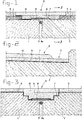
- Figure 1 shows a longitudinal section through two bridge roadway parts which are movable relative to each other.
- Figure 2 shows a cross-section along the line II - II in Figure 1.
- Figure 3 shows a longitudinal section through two bridge roadway parts which are movable relative to each other, in which the join seal is of a different type.
- the figures show two bridge roadway parts 1, 2 which are separated from each other by a join 3.
- the normal road surface on the bridge roadway parts in Figure 1 comprises a bottom layer 4 of dense hot-rolled asphalt and a top layer 5 of very open-textured hot-rolled asphalt.
- the layer 4 is not present in Figure 3.
- the road surface on the bridge roadway parts abuts the ordinary road surface composed of a bottom layer of dense hot-rolled asphalt and a top layer of very open-textured hot-rolled asphalt.
- the dense hot-rolled asphalt of the ordinary road surface is not continued on the bridge roadway parts, but lies with the end face against the vertical boundary of a bridge roadway part.
- An elastic sealing membrane layer 7 covers the bottom of the recess, and a metal strip 8 is placed in said membrane layer above the join 3, which strip is connected to securing means such as a cord 8a, which prevents shifting of the strip.
- the membrane extends over the top surface of the strip.
- the recess 6 is also filled with a bottom layer 9 of elastic dense hot-rolled asphalt and a top layer 10 of elastic very open-textured hot-rolled asphalt.
- the open-textured layers 5 and 10 are the same thickness and abut each other accurately, so that the water seeping through said layers can flow away in the lengthwise direction of the road. It can be seen from the cross-section of Figure 2 that water which has collected on the top surface of the elastic dense hot-rolled asphalt layer can flow away in the crosswise direction through the elastic very open-textured hot-rolled asphalt to a channel 11 formed through the layer 10 not running through to the side boundary of said bridge roadway part 2.
- layer 5 it is also possible for layer 5 to have the composition of layer 10, and for these layers 5 and 10 to be applied in one go over the whole or part of the bridge roadway.
- the membrane layer 7 runs through at the ends to the transition between the elastic dense hot-rolled asphalt and the elastic very open-textured hot-rolled asphalt.
- the watertight membrane layer 7 can be a stress-absorbing membrane interlayer (SAMI) which is characterised not only by its watertightness, but also by a great elasticity, even at low temperatures.
- SAMI stress-absorbing membrane interlayer
- the membrane is composed of at least one layer of a bitumen emulsion mixed with fine stone grit, in order to create a layer thickness.
- the layer thickness varies between 3 and 30 mm. If the membrane is made of at least two of these layers, a very low shear strength can be created between the two layers by applying the stone grit in a suitable manner, with the result that lower stresses in the very open-textured hot-rolled asphalt lying above this will be produced. In the zone of low shear strength hardly any bitumen emulsion is present between the stone grit, or an emulsion layer one to five millimetres thick is applied.
- the bitumen emulsion can be composed of a mixture of bitumen with SBS or bitumen with EVA, SBR or EPDM.
- bitumen emulsion Another possibility is to replace the bitumen emulsion by polyurethane-based mixtures.
- the elastic very open-textured hot-rolled asphalt has the following composition: stone chippings: 65-90 mass per cent, particle size 8-16 mm sand: 5-20 mass per cent, granule size 0-3 mm filler: 4-10 mass per cent, size ⁇ 63 ⁇ m binder: 4-10 mass per cent additions: 0-1 mass per cent.
- the binder can be composed of a mixture of bitumen with natural rubber or elastomer, or a thermoplastic, in particular with styrene butadiene styrene polymer (SBS) or with styrene butadiene rubber (SBR) or with ethyl vinyl acetate (EVA), or with ethylene propylene dimonomer (EPDM).
- SBS styrene butadiene styrene polymer
- SBR styrene butadiene rubber
- EVA ethyl vinyl acetate
- EPDM ethylene propylene dimonomer
- the additions can contain glass fibres, mineral fibres, rubber particles, adhesion improvers, latex emulsions and bitumen emulsions. What is essential is that the mixture after compacting should have hollow spaces between 15 and 35 volume per cent.
- the elastic dense hot-rolled asphalt differs from the elastic very open-textured hot-rolled asphalt in that the spaces between the larger pieces of chippings are filled with smaller pieces and sand.
- the mixture will therefore contain more sand and more smaller stone chipping parts than is the case with the elastic very open-textured hot-rolled asphalt.
- join seal described is that the very open hot-rolled asphalt runs over the join in such a way that the water drainage through this open-textured hot-rolled asphalt layer in the lengthwise direction of the road is uninterrupted and no noise peak is produced on passing over the join. This advantage is obtained without detriment to the resistance to crack formation at the site of the join.
Landscapes
- Engineering & Computer Science (AREA)
- Architecture (AREA)
- Civil Engineering (AREA)
- Structural Engineering (AREA)
- Road Paving Structures (AREA)
Abstract
Description
- The invention relates to a method for sealing the join between two road parts which are movable relative to each other and are provided with an asphalt road surface, in particular the join between two bridge roadway parts or between a bridge roadway part and a land-abutment part, comprising:
- making a recess at the site of the join in at least the hot-rolled asphalt covering said parts, and
- placing a material with elastic properties in the recess.
- Such a method is known from EP-B-000642.
- In order to prevent the road surface from cracking at the site of the join, it is proposed in this publication that the recess should be filled with an aggregate of stone chippings in a rubber-type binder essentially composed of bitumen, pitch, pitch-tar, or tar. The volume percentage of stone chippings lies between 40 and 70%. This solution is not suitable for road surfaces in which the top layer is made of a very open-textured hot-rolled asphalt. Such a water-permeable, sound-deadening material is being used increasingly to promote safety when it rains, and to reduce noise nuisance. Use of the filling of the recess known from the above-mentioned European patent in water-permeable road surfaces would lead to an unsafe situation in which, when it rained, the motorist could suddenly be faced with a pool of water on the road surface before, after and above the join. There would also be greatly increased tyre noise when passing over the join.
- The object of the invention is to solve this problem and provide a water-permeable or water-draining and low-noise filling of the recess at the site of the join, without the elasticity and flexibility of said filling, which is necessary in order to avoid cracks forming, being adversely affected.
- According to the invention, the method is to this end characterised in that at least the bottom of the recess is covered with an elastic sealing membrane layer and a hard strip, for example of metal, is placed in said layer above the join, the membrane layer extending over the strip, and in that the recess above the membrane layer is filled with elastic hot-rolled asphalt of which at least the top layer is made of very open-textured elastic hot-rolled asphalt.
- The metal strip prevents material from sinking in the join. The elastic sealing membrane provides the water seal and ensures the spread of the movement in the join, with the result that stress concentrations in the layers lying above are prevented. The elastic hot-rolled asphalt can absorb movements in the ground below, without giving way. This elastic material is preferably composed of a bottom layer of dense hot-rolled asphalt and a top layer of very open-textured hot-rolled asphalt. The elastic very open-textured hot-rolled asphalt of the join seal abuts the very open-textured hot-rolled asphalt of the connecting road, so that there is no difference in sound production, and the horizontal water conveyance through the open-textured layer, viewed in the lengthwise direction of the road, is not interrupted. The elastic dense hot-rolled asphalt ensures that water is retained and can be drained through the elastic very open-textured hot-rolled asphalt.
- If the vertical distance between the top surface of the road and the top surface of the bridge roadway part corresponds to the thickness of the very open-textured hot-rolled asphalt, the recess can be made right into the material of the road parts which are movable relative to each other. Space is then produced for a layer of elastic dense hot-rolled asphalt. If movements are very small, such a layer of dense hot-rolled asphalt is not necessary.
- Securing means projecting into the join are used to prevent shifting of the hard strip, without said strip being fixed.
- The elastic sealing membrane can be made of a 3 to 30 mm thick layer of a bitumen emulsion or a plastic modified bitumen emulsion mixed with fine stone grit. Another possibility is for the elastic sealing membrane to be made up of a 3 to 30 mm thick layer of an emulsion based on polyurethane alone or mixed with a fine stone grit.
- It is also possible for the elastic sealing membrane to be composed of several layers, in which case little or none of said emulsion is applied in the stone grit between the layers. This produces a very low shear strength between the two layers, with the result that the stresses in the elastic very open-textured hot-rolled asphalt lying above will be minimal.
- Another embodiment is to apply a one to five millimetre thick emulsion layer between the above-mentioned two layers, which also achieves a low shear strength.
- There are practical advantages if the recess narrows stepwise from top to bottom. This step form is not necessary.
- The elastic, very open-textured hot-rolled asphalt can have the following composition:
stone chippings: 65-90 mass per cent, particle size 8-16 mm
sand: 0-20 mass per cent, granule size 0-3 mm
filler: 0-10 mass per cent, size < 63 µm
binder: 4-25 mass per cent
additions: 0-1 mass per cent,
the binder being composed of a mixture of bitumen and a natural rubber or elastomer, or a thermoplastic. - The admixture to the bitumen can be styrene butadiene styrene polymer (SBS), styrene butadiene rubber (SBR) or ethyl vinyl acetate (EVA), or ethylene propylene dimonomer (EPDM).
- The above-mentioned additions (0-1 mass per cent) can contain glass fibres, mineral fibres, rubber particles, adhesion improvers, latex emulsions and bitumen emulsions.
- The invention will now be explained in greater detail with reference to the figures.
- Figure 1 shows a longitudinal section through two bridge roadway parts which are movable relative to each other.
- Figure 2 shows a cross-section along the line II - II in Figure 1.
- Figure 3 shows a longitudinal section through two bridge roadway parts which are movable relative to each other, in which the join seal is of a different type.
- The figures show two
bridge roadway parts join 3. The normal road surface on the bridge roadway parts in Figure 1 comprises abottom layer 4 of dense hot-rolled asphalt and atop layer 5 of very open-textured hot-rolled asphalt. Thelayer 4 is not present in Figure 3. In both cases the road surface on the bridge roadway parts abuts the ordinary road surface composed of a bottom layer of dense hot-rolled asphalt and a top layer of very open-textured hot-rolled asphalt. In Figure 3 the dense hot-rolled asphalt of the ordinary road surface is not continued on the bridge roadway parts, but lies with the end face against the vertical boundary of a bridge roadway part. - In Figure 1 a
recess 6 is made in the asphalt above thejoin 3. In Figure 2 thisrecess 6 continues over the hot-rolled asphalt of the bridge roadway parts. - An elastic
sealing membrane layer 7 covers the bottom of the recess, and ametal strip 8 is placed in said membrane layer above thejoin 3, which strip is connected to securing means such as acord 8a, which prevents shifting of the strip. The membrane extends over the top surface of the strip. - The
recess 6 is also filled with abottom layer 9 of elastic dense hot-rolled asphalt and atop layer 10 of elastic very open-textured hot-rolled asphalt. - The open-
textured layers channel 11 formed through thelayer 10 not running through to the side boundary of saidbridge roadway part 2. - Depending on the circumstances, it is also possible for
layer 5 to have the composition oflayer 10, and for theselayers - The
membrane layer 7 runs through at the ends to the transition between the elastic dense hot-rolled asphalt and the elastic very open-textured hot-rolled asphalt. - It is possible in the absence of the dense hot-rolled asphalt on the bridge for the layer of elastic very open-textured hot-rolled asphalt to be placed directly on the
membrane layer 7. In other words, in certain circumstances (very small changes in the width of the join) thelayer 9 in Figure 3 can be omitted. - The
watertight membrane layer 7 can be a stress-absorbing membrane interlayer (SAMI) which is characterised not only by its watertightness, but also by a great elasticity, even at low temperatures. - The membrane is composed of at least one layer of a bitumen emulsion mixed with fine stone grit, in order to create a layer thickness. The layer thickness varies between 3 and 30 mm. If the membrane is made of at least two of these layers, a very low shear strength can be created between the two layers by applying the stone grit in a suitable manner, with the result that lower stresses in the very open-textured hot-rolled asphalt lying above this will be produced. In the zone of low shear strength hardly any bitumen emulsion is present between the stone grit, or an emulsion layer one to five millimetres thick is applied. The bitumen emulsion can be composed of a mixture of bitumen with SBS or bitumen with EVA, SBR or EPDM.
- Another possibility is to replace the bitumen emulsion by polyurethane-based mixtures.
- The elastic very open-textured hot-rolled asphalt has the following composition:
stone chippings: 65-90 mass per cent, particle size 8-16 mm
sand: 5-20 mass per cent, granule size 0-3 mm
filler: 4-10 mass per cent, size < 63 µm
binder: 4-10 mass per cent
additions: 0-1 mass per cent. - The binder can be composed of a mixture of bitumen with natural rubber or elastomer, or a thermoplastic, in particular with styrene butadiene styrene polymer (SBS) or with styrene butadiene rubber (SBR) or with ethyl vinyl acetate (EVA), or with ethylene propylene dimonomer (EPDM). The additions can contain glass fibres, mineral fibres, rubber particles, adhesion improvers, latex emulsions and bitumen emulsions. What is essential is that the mixture after compacting should have hollow spaces between 15 and 35 volume per cent.
- The elastic dense hot-rolled asphalt differs from the elastic very open-textured hot-rolled asphalt in that the spaces between the larger pieces of chippings are filled with smaller pieces and sand. The mixture will therefore contain more sand and more smaller stone chipping parts than is the case with the elastic very open-textured hot-rolled asphalt.
- The main advantage of the join seal described is that the very open hot-rolled asphalt runs over the join in such a way that the water drainage through this open-textured hot-rolled asphalt layer in the lengthwise direction of the road is uninterrupted and no noise peak is produced on passing over the join. This advantage is obtained without detriment to the resistance to crack formation at the site of the join.
Claims (14)
- Method for sealing the join between two road parts which are movable relative to each other and are provided with, or are to be provided with, an asphalt road surface, in particular the join between two bridge roadway parts or between a bridge roadway part and a land-abutment part, comprising:- making a recess at the site of the join in at least the hot-rolled asphalt covering said parts, and- placing a material with elastic properties in the recess, characterised in that at least the bottom of the recess is covered with an elastic sealing membrane layer and a hard strip, for example of metal, is placed in said layer above the join, the membrane layer extending over the strip, and in that the recess above the membrane layer is filled with elastic hot-rolled asphalt of which at least the top layer is made of very open-textured elastic hot-rolled asphalt.
- Method according to Claim 1, characterised in that the elastic hot-rolled asphalt in the recess has a bottom layer of dense hot-rolled asphalt or a dense join structure.
- Method according to Claim 1 or 2, characterised in that the recess is made right into the material of the road parts which are movable relative to each other.
- Method according to one of the preceding claims, characterised by securing means projecting into the join to prevent shifting of the hard strip without fixing the strip.
- Method according to one of the preceding claims, characterised in that the elastic sealing membrane is composed of a one to thirty millimetre thick layer of a bitumen emulsion or modified bitumen emulsion mixed with stone.
- Method according to Claims 1 to 4, characterised in that the elastic sealing membrane is composed of a one to thirty millimetre thick layer of an emulsion based on polyurethane mixed with a stone.
- Method according to Claim 5 or 6, characterised in that the elastic sealing membrane is composed of several layers, and little or none of said emulsion is applied in the stones between the layers.
- Method according to Claim 7, characterised in that a one to five millimetre thick layer of said emulsion is applied between the layers.
- Method according to one of the preceding claims, characterised in that the recess is narrowed stepwise from top to bottom.
- Method according to one of the preceding claims, characterised in that the elastic very open-textured hot-rolled asphalt has the following composition:
stone chippings: 65-90 mass per cent, particle size 8-16 mm
sand: 0-20 mass per cent, granule size 0-3 mm
filler: 0-10 mass per cent, size < 63 µm
binder: 4-25 mass per cent
additions: 0-1 mass per cent,
the binder being composed of a mixture of bitumen and a natural rubber or elastomer, or a thermoplastic material. - Method according to Claim 9, characterised in that the binder is composed of a mixture of bitumen and styrene butadiene styrene polymer (SBS).
- Method according to Claim 9, characterised in that the binder is composed of a mixture of bitumen and styrene butadiene rubber (SBR).
- Method according to Claim 9, characterised in that the binder is composed of a mixture of bitumen with ethyl vinyl acetate (EVA).
- Method according to one of Claims 9 - 12, characterised in that the additions are composed of glass fibres and/or mineral fibres and/or rubber particles and/or adhesion improvers and/or latex emulsions and/or bitumen emulsions.
Applications Claiming Priority (2)
| Application Number | Priority Date | Filing Date | Title |
|---|---|---|---|
| NL9100524A NL9100524A (en) | 1991-03-25 | 1991-03-25 | METHOD FOR CLOSING THE JOINT BETWEEN TWO MOVABLE PATHS ON AN ASPHALT ROAD SURFACE, IN PARTICULAR THE JOINT BETWEEN TWO BRIDGE PARTS OR BETWEEN A BRIDGE PART AND A MAIN PART. |
| NL9100524 | 1991-03-25 |
Publications (2)
| Publication Number | Publication Date |
|---|---|
| EP0506196A1 true EP0506196A1 (en) | 1992-09-30 |
| EP0506196B1 EP0506196B1 (en) | 1995-11-22 |
Family
ID=19859054
Family Applications (1)
| Application Number | Title | Priority Date | Filing Date |
|---|---|---|---|
| EP19920200837 Expired - Lifetime EP0506196B1 (en) | 1991-03-25 | 1992-03-23 | Method for sealing the joint between two road parts which are movable relative to each other and are provided with an asphalt road surface, in particular the joint between two bridge roadway parts or between a bridge roadway part and a land-abutment part |
Country Status (4)
| Country | Link |
|---|---|
| EP (1) | EP0506196B1 (en) |
| DE (1) | DE69206179T2 (en) |
| DK (1) | DK0506196T3 (en) |
| NL (1) | NL9100524A (en) |
Cited By (16)
| Publication number | Priority date | Publication date | Assignee | Title |
|---|---|---|---|---|
| FR2696764A1 (en) * | 1992-10-14 | 1994-04-15 | Colas Sa | Filling material for viscoelastic joint in civil engineering structure - made from homogenous and self-compacting mixt. based on bitumen, cellulose fibres, crushed sand and gravel |
| EP0687773A1 (en) * | 1994-06-17 | 1995-12-20 | Autostrade Concessioni E Costruzioni Autostrade S.P.A. | Spring Bedding |
| NL1005198C2 (en) * | 1997-02-06 | 1998-08-07 | Heijmans Wegenbouwmij | Method for coating a joint transition in a road surface, as well as the joint transition thus obtained. |
| US5991077A (en) * | 1996-02-29 | 1999-11-23 | 3M Innovative Properties Company | Multilayer polarizer having a continuous and disperse phase |
| KR100469473B1 (en) * | 2002-09-25 | 2005-01-31 | (주) 세일콘 | Structure of flexible join for road construction and method of constructing flexible join and method of repairs thereof |
| WO2005071165A1 (en) * | 2004-01-26 | 2005-08-04 | TPA Gesellschaft für Qualitätssicherung und Innovation GmbH | Joint filling material for joints and transitions in coverings of travel surfaces |
| CN102121222A (en) * | 2011-01-06 | 2011-07-13 | 耿志军 | Method for treating seams between cement concrete pavement and asphalt concrete pavement and between asphalt concrete pavements |
| EP2108739A3 (en) * | 2008-04-10 | 2013-01-02 | DENSO-Holding GmbH & Co. | Road construction system for sealing joints |
| CN106480798A (en) * | 2016-11-21 | 2017-03-08 | 晓健科技(大连)有限公司 | Self-adhesive asphalt modules for road repair |
| ITUA20163685A1 (en) * | 2016-05-23 | 2017-11-23 | Vincenzo Robertiello | Expansion joint for road structures and relative method of construction. |
| CN110670473A (en) * | 2019-10-15 | 2020-01-10 | 北京市政路桥管理养护集团有限公司 | Connecting structure of prefabricated steel-concrete composite beam and construction method thereof |
| WO2020078160A1 (en) * | 2018-10-16 | 2020-04-23 | 中冶南方工程技术有限公司 | Construction joint structure in deep-excavation reverse construction |
| CN111877141A (en) * | 2020-07-08 | 2020-11-03 | 唐峰 | Novel pier structure |
| CN111997098A (en) * | 2020-08-31 | 2020-11-27 | 中建五局华东建设有限公司 | Deformation joint seepage-proofing structure |
| CN112900191A (en) * | 2021-01-20 | 2021-06-04 | 广东中隆建业建设有限公司 | Garden road laying structure that water permeability is high |
| WO2023110603A1 (en) * | 2021-12-13 | 2023-06-22 | Mageba Services & Technology Ag | Drivable construction |
Families Citing this family (1)
| Publication number | Priority date | Publication date | Assignee | Title |
|---|---|---|---|---|
| CN223088279U (en) * | 2024-08-27 | 2025-07-11 | 北京新桥技术发展有限公司 | Bridge deck expansion joint-free paving structure |
Citations (5)
| Publication number | Priority date | Publication date | Assignee | Title |
|---|---|---|---|---|
| GB1318805A (en) * | 1971-10-08 | 1973-05-31 | Invernizzi L | Expansion joints in pre-stressed reinforced concrete bridges |
| DE3611199A1 (en) * | 1986-04-04 | 1987-10-15 | Deutag Mischwerke Gmbh | Paving for traffic surfaces |
| DE3712461A1 (en) * | 1986-04-16 | 1987-10-22 | Luginbuehl Ag Geb | Hard covering |
| EP0296377A2 (en) * | 1987-06-23 | 1988-12-28 | H. Lafrentz GmbH & Co. | Method and cover-strip for the preparation of a roadway-joint over a structural or settlement joint |
| GB2218437A (en) * | 1988-03-17 | 1989-11-15 | Sho Bond Const | Expansion joint for roads and bridges |
-
1991
- 1991-03-25 NL NL9100524A patent/NL9100524A/en not_active Application Discontinuation
-
1992
- 1992-03-23 EP EP19920200837 patent/EP0506196B1/en not_active Expired - Lifetime
- 1992-03-23 DE DE1992606179 patent/DE69206179T2/en not_active Expired - Fee Related
- 1992-03-23 DK DK92200837T patent/DK0506196T3/en active
Patent Citations (5)
| Publication number | Priority date | Publication date | Assignee | Title |
|---|---|---|---|---|
| GB1318805A (en) * | 1971-10-08 | 1973-05-31 | Invernizzi L | Expansion joints in pre-stressed reinforced concrete bridges |
| DE3611199A1 (en) * | 1986-04-04 | 1987-10-15 | Deutag Mischwerke Gmbh | Paving for traffic surfaces |
| DE3712461A1 (en) * | 1986-04-16 | 1987-10-22 | Luginbuehl Ag Geb | Hard covering |
| EP0296377A2 (en) * | 1987-06-23 | 1988-12-28 | H. Lafrentz GmbH & Co. | Method and cover-strip for the preparation of a roadway-joint over a structural or settlement joint |
| GB2218437A (en) * | 1988-03-17 | 1989-11-15 | Sho Bond Const | Expansion joint for roads and bridges |
Non-Patent Citations (3)
| Title |
|---|
| HIGHWAYS vol. 54, no. 1917, September 1986, CROYDON page 26; 'Flexible buried joints resists deformation' * |
| PT/CIVIELE TECHNIEK vol. 42, no. 2, June 1987, RIJSWIJK pages 28 - 30; RIEMENS: 'Elastische voegovergangen' * |
| WEGEN vol. 64, no. 6, June 1990, EDE pages 30 - 31; VAN BOCHOVE: 'Nieuw concept voor zeer open asfaltbeton' * |
Cited By (23)
| Publication number | Priority date | Publication date | Assignee | Title |
|---|---|---|---|---|
| BE1006676A5 (en) * | 1992-10-14 | 1994-11-16 | Colas Sa | Mass for filling viscoelastic joint work of art for continuous concrete and joint comprising viscoelastic filling mass. |
| CH684698A5 (en) * | 1992-10-14 | 1994-11-30 | Colas S A Colas S A | Filling mass for a continuous viscoelastic seal for concrete structure and viscoelastic seal including this filling mass |
| ES2081753A1 (en) * | 1992-10-14 | 1996-03-01 | Colas S A Y Colas S A | Filling material for viscoelastic joint in civil engineering structure - made from homogenous and self-compacting mixt. based on bitumen, cellulose fibres, crushed sand and gravel |
| FR2696764A1 (en) * | 1992-10-14 | 1994-04-15 | Colas Sa | Filling material for viscoelastic joint in civil engineering structure - made from homogenous and self-compacting mixt. based on bitumen, cellulose fibres, crushed sand and gravel |
| EP0687773A1 (en) * | 1994-06-17 | 1995-12-20 | Autostrade Concessioni E Costruzioni Autostrade S.P.A. | Spring Bedding |
| US5991077A (en) * | 1996-02-29 | 1999-11-23 | 3M Innovative Properties Company | Multilayer polarizer having a continuous and disperse phase |
| NL1005198C2 (en) * | 1997-02-06 | 1998-08-07 | Heijmans Wegenbouwmij | Method for coating a joint transition in a road surface, as well as the joint transition thus obtained. |
| EP0857824A1 (en) | 1997-02-06 | 1998-08-12 | Heijmans Infrastructuur & Milieu B.V. | Method for covering a joining interface in a road surface, and also the joining interface thus obtained |
| KR100469473B1 (en) * | 2002-09-25 | 2005-01-31 | (주) 세일콘 | Structure of flexible join for road construction and method of constructing flexible join and method of repairs thereof |
| WO2005071165A1 (en) * | 2004-01-26 | 2005-08-04 | TPA Gesellschaft für Qualitätssicherung und Innovation GmbH | Joint filling material for joints and transitions in coverings of travel surfaces |
| EP2108739A3 (en) * | 2008-04-10 | 2013-01-02 | DENSO-Holding GmbH & Co. | Road construction system for sealing joints |
| CN102121222A (en) * | 2011-01-06 | 2011-07-13 | 耿志军 | Method for treating seams between cement concrete pavement and asphalt concrete pavement and between asphalt concrete pavements |
| ITUA20163685A1 (en) * | 2016-05-23 | 2017-11-23 | Vincenzo Robertiello | Expansion joint for road structures and relative method of construction. |
| WO2017203548A1 (en) * | 2016-05-23 | 2017-11-30 | TANTONE, Rossella | Expansion joint for road structures and construction method thereof |
| CN106480798A (en) * | 2016-11-21 | 2017-03-08 | 晓健科技(大连)有限公司 | Self-adhesive asphalt modules for road repair |
| CN106480798B (en) * | 2016-11-21 | 2018-11-30 | 江西省交通工程集团有限公司 | Method for making self-adhesive asphalt modules for road repair |
| WO2020078160A1 (en) * | 2018-10-16 | 2020-04-23 | 中冶南方工程技术有限公司 | Construction joint structure in deep-excavation reverse construction |
| CN110670473A (en) * | 2019-10-15 | 2020-01-10 | 北京市政路桥管理养护集团有限公司 | Connecting structure of prefabricated steel-concrete composite beam and construction method thereof |
| CN111877141A (en) * | 2020-07-08 | 2020-11-03 | 唐峰 | Novel pier structure |
| CN111997098A (en) * | 2020-08-31 | 2020-11-27 | 中建五局华东建设有限公司 | Deformation joint seepage-proofing structure |
| CN112900191A (en) * | 2021-01-20 | 2021-06-04 | 广东中隆建业建设有限公司 | Garden road laying structure that water permeability is high |
| CN112900191B (en) * | 2021-01-20 | 2022-10-04 | 广东中隆建业建设有限公司 | Gardens road laying structure that water permeability is high |
| WO2023110603A1 (en) * | 2021-12-13 | 2023-06-22 | Mageba Services & Technology Ag | Drivable construction |
Also Published As
| Publication number | Publication date |
|---|---|
| DE69206179D1 (en) | 1996-01-04 |
| DE69206179T2 (en) | 1996-05-02 |
| EP0506196B1 (en) | 1995-11-22 |
| DK0506196T3 (en) | 1996-02-26 |
| NL9100524A (en) | 1992-10-16 |
Similar Documents
| Publication | Publication Date | Title |
|---|---|---|
| EP0506196B1 (en) | Method for sealing the joint between two road parts which are movable relative to each other and are provided with an asphalt road surface, in particular the joint between two bridge roadway parts or between a bridge roadway part and a land-abutment part | |
| CA2036673C (en) | Bridge joint construction | |
| CA1225269A (en) | Expansion joint | |
| CN215714342U (en) | Old cement road surface reforms transform structure | |
| US4265563A (en) | Road pavement and repair | |
| US5282691A (en) | Structural material and drain | |
| CN107476164B (en) | Embedded ultra-thin wear layer for road upper layer and construction method thereof | |
| CN103288385A (en) | Expansion joint material for bridge and expansion joint structure | |
| CN117328310A (en) | Composite structure and modification method of asphalt pavement to suppress reflection cracks | |
| CN114940599A (en) | Leaching-attachable ultrathin noise reduction gravel seal coat and construction method thereof | |
| KR101541045B1 (en) | Using reinforcement layer drainage asphalt pavement durability enhancement method | |
| CN211815272U (en) | Anti-skid durable tunnel pavement structure | |
| CN119241139A (en) | A kind of open-graded asphalt mixture with large void ratio and its preparation method and application | |
| EP0444236A1 (en) | Expansion joint between two adjacent elements of a road bridge | |
| CN217948640U (en) | Old cement road surface top facing structure | |
| KR102588880B1 (en) | Middle layer composition of asphalt paved road, and method for middle layer constructing using the same | |
| US5613797A (en) | Anhydrous viscoelastic buffer joint | |
| CN205617243U (en) | Durable cement concrete bridge deck pavement structure with drainage function of making an uproar is fallen | |
| CN214143297U (en) | Steel bridge deck pavement structure | |
| Vanelstraete et al. | Crack prevention and use of overlay systems | |
| CN217556597U (en) | Noise-reduction drainage pavement structure | |
| JP2849347B2 (en) | Drainage channel for permeable pavement | |
| CN215829175U (en) | Pavement structure | |
| EP0795059B1 (en) | A method of providing a road surface with an overlay | |
| KR102930182B1 (en) | A method for extending and maintaining the life of a pavement using an asphalt pavement surface treatment agent |
Legal Events
| Date | Code | Title | Description |
|---|---|---|---|
| PUAI | Public reference made under article 153(3) epc to a published international application that has entered the european phase |
Free format text: ORIGINAL CODE: 0009012 |
|
| AK | Designated contracting states |
Kind code of ref document: A1 Designated state(s): BE DE DK GB LU NL |
|
| 17P | Request for examination filed |
Effective date: 19930330 |
|
| 17Q | First examination report despatched |
Effective date: 19940901 |
|
| GRAA | (expected) grant |
Free format text: ORIGINAL CODE: 0009210 |
|
| AK | Designated contracting states |
Kind code of ref document: B1 Designated state(s): BE DE DK GB LU NL |
|
| REF | Corresponds to: |
Ref document number: 69206179 Country of ref document: DE Date of ref document: 19960104 |
|
| REG | Reference to a national code |
Ref country code: DK Ref legal event code: T3 |
|
| PLBE | No opposition filed within time limit |
Free format text: ORIGINAL CODE: 0009261 |
|
| STAA | Information on the status of an ep patent application or granted ep patent |
Free format text: STATUS: NO OPPOSITION FILED WITHIN TIME LIMIT |
|
| 26N | No opposition filed | ||
| REG | Reference to a national code |
Ref country code: GB Ref legal event code: IF02 |
|
| PGFP | Annual fee paid to national office [announced via postgrant information from national office to epo] |
Ref country code: DK Payment date: 20040123 Year of fee payment: 13 |
|
| PGFP | Annual fee paid to national office [announced via postgrant information from national office to epo] |
Ref country code: GB Payment date: 20040310 Year of fee payment: 13 |
|
| PGFP | Annual fee paid to national office [announced via postgrant information from national office to epo] |
Ref country code: BE Payment date: 20040323 Year of fee payment: 13 |
|
| PGFP | Annual fee paid to national office [announced via postgrant information from national office to epo] |
Ref country code: LU Payment date: 20040326 Year of fee payment: 13 |
|
| PGFP | Annual fee paid to national office [announced via postgrant information from national office to epo] |
Ref country code: DE Payment date: 20040413 Year of fee payment: 13 |
|
| PG25 | Lapsed in a contracting state [announced via postgrant information from national office to epo] |
Ref country code: LU Free format text: LAPSE BECAUSE OF NON-PAYMENT OF DUE FEES Effective date: 20050323 Ref country code: GB Free format text: LAPSE BECAUSE OF NON-PAYMENT OF DUE FEES Effective date: 20050323 |
|
| PG25 | Lapsed in a contracting state [announced via postgrant information from national office to epo] |
Ref country code: DK Free format text: LAPSE BECAUSE OF NON-PAYMENT OF DUE FEES Effective date: 20050331 Ref country code: BE Free format text: LAPSE BECAUSE OF NON-PAYMENT OF DUE FEES Effective date: 20050331 |
|
| BERE | Be: lapsed |
Owner name: HOLLANDSCHE *BETON GROEP N.V. Effective date: 20050331 |
|
| PG25 | Lapsed in a contracting state [announced via postgrant information from national office to epo] |
Ref country code: DE Free format text: LAPSE BECAUSE OF NON-PAYMENT OF DUE FEES Effective date: 20051001 |
|
| GBPC | Gb: european patent ceased through non-payment of renewal fee |
Effective date: 20050323 |
|
| REG | Reference to a national code |
Ref country code: DK Ref legal event code: EBP |
|
| PGFP | Annual fee paid to national office [announced via postgrant information from national office to epo] |
Ref country code: NL Payment date: 20070330 Year of fee payment: 16 |
|
| BERE | Be: lapsed |
Owner name: HOLLANDSCHE *BETON GROEP N.V. Effective date: 20050331 |
|
| PG25 | Lapsed in a contracting state [announced via postgrant information from national office to epo] |
Ref country code: NL Free format text: LAPSE BECAUSE OF NON-PAYMENT OF DUE FEES Effective date: 20081001 |
|
| NLV4 | Nl: lapsed or anulled due to non-payment of the annual fee |
Effective date: 20081001 |