EP0502193B1 - Method of fixing fishhook to fishline and fishhook fitted with fishline - Google Patents
Method of fixing fishhook to fishline and fishhook fitted with fishline Download PDFInfo
- Publication number
- EP0502193B1 EP0502193B1 EP91908644A EP91908644A EP0502193B1 EP 0502193 B1 EP0502193 B1 EP 0502193B1 EP 91908644 A EP91908644 A EP 91908644A EP 91908644 A EP91908644 A EP 91908644A EP 0502193 B1 EP0502193 B1 EP 0502193B1
- Authority
- EP
- European Patent Office
- Prior art keywords
- shank
- leader
- fishhook
- metallic wire
- slanting face
- Prior art date
- Legal status (The legal status is an assumption and is not a legal conclusion. Google has not performed a legal analysis and makes no representation as to the accuracy of the status listed.)
- Expired - Lifetime
Links
- 238000000034 method Methods 0.000 title claims abstract description 19
- 230000001070 adhesive effect Effects 0.000 claims abstract description 17
- 239000000853 adhesive Substances 0.000 claims abstract description 16
- 238000004804 winding Methods 0.000 claims description 11
- 229910001209 Low-carbon steel Inorganic materials 0.000 claims description 3
- 239000004677 Nylon Substances 0.000 claims description 2
- 229920001778 nylon Polymers 0.000 claims description 2
- 238000004519 manufacturing process Methods 0.000 description 3
- 238000005520 cutting process Methods 0.000 description 2
- 238000001035 drying Methods 0.000 description 2
- 230000000717 retained effect Effects 0.000 description 2
- 239000004840 adhesive resin Substances 0.000 description 1
- 229920006223 adhesive resin Polymers 0.000 description 1
- 230000006735 deficit Effects 0.000 description 1
- 238000005242 forging Methods 0.000 description 1
- 238000007711 solidification Methods 0.000 description 1
- 230000008023 solidification Effects 0.000 description 1
- 229920003002 synthetic resin Polymers 0.000 description 1
- 239000000057 synthetic resin Substances 0.000 description 1
- 239000002966 varnish Substances 0.000 description 1
Images
Classifications
-
- A—HUMAN NECESSITIES
- A01—AGRICULTURE; FORESTRY; ANIMAL HUSBANDRY; HUNTING; TRAPPING; FISHING
- A01K—ANIMAL HUSBANDRY; AVICULTURE; APICULTURE; PISCICULTURE; FISHING; REARING OR BREEDING ANIMALS, NOT OTHERWISE PROVIDED FOR; NEW BREEDS OF ANIMALS
- A01K91/00—Lines
- A01K91/03—Connecting devices
- A01K91/04—Connecting devices for connecting lines to hooks or lures
-
- A—HUMAN NECESSITIES
- A01—AGRICULTURE; FORESTRY; ANIMAL HUSBANDRY; HUNTING; TRAPPING; FISHING
- A01K—ANIMAL HUSBANDRY; AVICULTURE; APICULTURE; PISCICULTURE; FISHING; REARING OR BREEDING ANIMALS, NOT OTHERWISE PROVIDED FOR; NEW BREEDS OF ANIMALS
- A01K83/00—Fish-hooks
-
- Y—GENERAL TAGGING OF NEW TECHNOLOGICAL DEVELOPMENTS; GENERAL TAGGING OF CROSS-SECTIONAL TECHNOLOGIES SPANNING OVER SEVERAL SECTIONS OF THE IPC; TECHNICAL SUBJECTS COVERED BY FORMER USPC CROSS-REFERENCE ART COLLECTIONS [XRACs] AND DIGESTS
- Y10—TECHNICAL SUBJECTS COVERED BY FORMER USPC
- Y10T—TECHNICAL SUBJECTS COVERED BY FORMER US CLASSIFICATION
- Y10T24/00—Buckles, buttons, clasps, etc.
- Y10T24/47—Strap-end-attaching devices
- Y10T24/4791—Enlarged end epoxy
Definitions
- the present invention relates to a method of attaching a leader to a fishhook, and fishhooks having a leader attached thereto for use in fishing.
- the method of attaching a leader to a fishhook differs with the shape of the so-called eye at the shank end of the fishhook, so that various attaching methods are conventionally available.
- These methods include, for example, a method of firmly attaching a leader to a fishhook by placing the leader close to the shank end of the fishhook along the shank, and winding a thin thread around the leader and the shank.
- the wound thin thread is thereafter treated, for example, by manually tying the leading end and the terminal end of the thread together, or by covering the winding of the thread directly with adhesive or synthetic resin.
- the procedure for covering the thread winding with adhesive or the like is suited to the automation of the manufacturing process since the thread need not be tied manually. In this case, however, it is likely that the thread winding will loosen while the adhesive applied solidifies from the state of a gel. This results in the drawback of impairing the joint strength between the leader and the fishhook.
- the independent patent claims 1 and 3 proceed from a state of the art as is disclosed in the FR-A-1 437 660.
- the FR-A-1 437 660 shows an attachment of the shank of a fish-hook to a leader by disposing the leader along the shank which is provided with a plurality of small transverse notches and winding a thin wire around the shank and the leader.
- the coiled portion is provided with a varnish layer.
- An object of the present invention is to provide a method of attaching a leader to a fishhook by attaching the leader to the shank of the fishhook extremely easily and yet firmly with good stability, and fishhooks having a leader thus attached thereto.
- leader of nylon or the like
- metallic wire As shown in FIG. 1, the leader 2 is attached at its leading end to the end of shank 4 of the fishhook 1.
- the portion of the shank 4 to which the leader 2 is attached is provided with a slanting face as is later described in detail with reference to the figures 2 to 5.
- the leader 2 is positioned close to the inner side of the shank 4 so as to extend along the shank 4.
- the curving-in side of the fishhook 1 is referred to as the "inner side,” and the opposite side thereof as the "outer side.”
- the metallic wire 3 is wound around the combination of the shank 4 and the leader 2 in the form of a coil.
- the metallic wire 3 is continuously wound around the combination of the shank 4 and the leader 2.
- the metallic wire 3 to be used in the present embodiments is one having plasticity sufficient to retain its wound state when wound around the leader 2 and shank 4, for example, a wire of mild steel.
- an adhesive 6 is applied to the entire periphery of the coil portion 5 to enclose the coil portion 6 with the adhesive.
- the metallic wire 3 is cut off at opposite ends of the coil portion.
- the adhesive 6 is thereafter allowed to stand for drying and solidification, whereby the leader 2 is completely attached to the fishhook 1.
- the metallic wire 3 retains the wound state around the shank 4 and the leader 2, so that the coil portion 5 of the wound wire is almost unlikely to loosen before the adhesive 6 dries and solidifies. Consequently, the coil portion exhibits a great fastening force with high stability unlike the conventional thread winding. This almost completely eliminates the likelihood of producing rejects.
- the wound metallic wire 3 is thereafter treated only by cutting off the wire 3 and applying the adhesive 6 without necessitating the prior-art procedure of thread tying. This assures a greatly simplified attaching procedure and also makes it possible to automate the entire process including the metallic wire winding procedure.
- FIG. 2 shows in detail a first embodiment of the present invention.
- indicated at 7 and 8 are slanting faces formed on the inner and outer sides of the shank 4.
- the slanting faces 7, 8 are formed by cutting or forging the shank 4 at the portion thereof where the coil portion 5 is to be provided.
- the slanting faces 7, 8 are so formed as to incline radially of the shank 4 as they extend toward the shank end axially thereof.
- the leader 2 is positioned in contact with the slanting face 7, and the metallic wire 3 is wound around the shank 4 formed with the slanting face 7 and the leader 2, whereby the leader is attached to the shank as in the first embodiment.
- FIGS. 3 to 5 show a second embodiment of the invention.
- an accommodating groove 9 which is formed in the end of the shank 4 on the inner side thereof in parallel to the axis of the shank 4.
- the leader 2 is accommodated in the groove 9 as seen in FIGS. 4 and 5 and is thereafter attached to the shank in the same manner as in the first embodiment.
- the bottom face of the accommodating groove 9 is so formed as to incline radially of the shank 4 as it extends toward the end of the shank 4 axially thereof. While the accommodating groove 9 is so shaped as shown in FIG. 4 or FIG. 5 in cross section, the groove may be otherwise shaped as desired insofar as the leader 2 can be retained therein.
- an adhesive is applied to the resulting coil portion of the metallic wire to cover the coil portion.
- the metallic wire is thereafter cut off at opposite ends of the coil portion.
- the metallic wire has plasticity sufficient to retain the wound state when wound around the leader and the shank.
- mild steel has such nature.
- the wire coil will loosen before the adhesive dries and solidifies unlike the conventional thread winding.
- the wound metallic wire which has plasticity as stated above, exhibits a stabilized fastening force over the entire area of the coil portion, that is, every turn of the winding exhibits such a force.
- the wound metallic wire is almost unlikely to loosen over the coil portion before the adhesive solidifies on drying, so that the coil portion can be enclosed with the adhesive while retaining the fastening force without impairment. Consequently, the leader can be attached to the fishhook firmly by a simple procedure with high stability.
- the wire 3 is cut off after the application of the adhesive 6 according to the foregoing embodiments, the wire 3 may be cut off conversely before the application of the adhesive 6 provided that the metallic wire 3 can be retained in the wound state satisfactorily.
- the present invention can be used in the fishing tackle manufacturing industry.
Landscapes
- Life Sciences & Earth Sciences (AREA)
- Environmental Sciences (AREA)
- Animal Husbandry (AREA)
- Biodiversity & Conservation Biology (AREA)
- Holders For Apparel And Elements Relating To Apparel (AREA)
Abstract
Description
- The present invention relates to a method of attaching a leader to a fishhook, and fishhooks having a leader attached thereto for use in fishing.
- The method of attaching a leader to a fishhook differs with the shape of the so-called eye at the shank end of the fishhook, so that various attaching methods are conventionally available.
- These methods include, for example, a method of firmly attaching a leader to a fishhook by placing the leader close to the shank end of the fishhook along the shank, and winding a thin thread around the leader and the shank. In this method, the wound thin thread is thereafter treated, for example, by manually tying the leading end and the terminal end of the thread together, or by covering the winding of the thread directly with adhesive or synthetic resin.
- With the prior art described, however, the leading and terminal thread ends must be tied together invariably by a manual procedure as mentioned above, so that this has been an obstacle to the automation of the manufacturing process. Furthermore, fishhooks of smaller size require a great skill for the thread tying procedure.
- On the other hand, the procedure for covering the thread winding with adhesive or the like is suited to the automation of the manufacturing process since the thread need not be tied manually. In this case, however, it is likely that the thread winding will loosen while the adhesive applied solidifies from the state of a gel. This results in the drawback of impairing the joint strength between the leader and the fishhook.
- The independent patent claims 1 and 3 proceed from a state of the art as is disclosed in the FR-A-1 437 660. The FR-A-1 437 660 shows an attachment of the shank of a fish-hook to a leader by disposing the leader along the shank which is provided with a plurality of small transverse notches and winding a thin wire around the shank and the leader. The coiled portion is provided with a varnish layer.
- An object of the present invention is to provide a method of attaching a leader to a fishhook by attaching the leader to the shank of the fishhook extremely easily and yet firmly with good stability, and fishhooks having a leader thus attached thereto.
- This object is achieved by the features of
claims 1 and 3. -
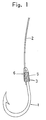
- FIG. 1 is an overall side elevation of a fishhook having a leader attached thereto according to the embodiments of the invention;
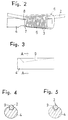
- FIG. 2 is an enlarged side elevation showing a first embodiment of the invention, i.e., a fishhook having a leader attached thereto;
- FIG. 3 is a side elevation of the shank of a fishhook showing a second embodiment of the invention; and
- FIG. 4 and FIG. 5 are views in section taken along the line A-A in FIG. 3.
- Embodiments of the present invention will be described below with reference to the drawings.
- In the drawings, indicated at 1 is a fishhook, at 2 a fishline (leader) of nylon or the like, and at 3 a metallic wire. As shown in FIG. 1, the
leader 2 is attached at its leading end to the end ofshank 4 of the fishhook 1. The portion of theshank 4 to which theleader 2 is attached is provided with a slanting face as is later described in detail with reference to the figures 2 to 5. - How to attach the
leader 2 to theshank 4 according to the embodiments of the invention will be described below stepwise. First, theleader 2 is positioned close to the inner side of theshank 4 so as to extend along theshank 4. (The curving-in side of the fishhook 1 is referred to as the "inner side," and the opposite side thereof as the "outer side.") Themetallic wire 3 is wound around the combination of theshank 4 and theleader 2 in the form of a coil. Preferably, themetallic wire 3 is continuously wound around the combination of theshank 4 and theleader 2. Themetallic wire 3 to be used in the present embodiments is one having plasticity sufficient to retain its wound state when wound around theleader 2 andshank 4, for example, a wire of mild steel. - Next, when a
coil portion 5 has been formed by winding themetallic wire 3 over a predetermined length along the axis of the shank, an adhesive 6 is applied to the entire periphery of thecoil portion 5 to enclose thecoil portion 6 with the adhesive. - Finally, the
metallic wire 3 is cut off at opposite ends of the coil portion. Theadhesive 6 is thereafter allowed to stand for drying and solidification, whereby theleader 2 is completely attached to the fishhook 1. - With the present embodiments wherein the
leader 2 is attached to the fishhook 1 in this way, themetallic wire 3 retains the wound state around theshank 4 and theleader 2, so that thecoil portion 5 of the wound wire is almost unlikely to loosen before the adhesive 6 dries and solidifies. Consequently, the coil portion exhibits a great fastening force with high stability unlike the conventional thread winding. This almost completely eliminates the likelihood of producing rejects. - Furthermore, the wound
metallic wire 3 is thereafter treated only by cutting off thewire 3 and applying theadhesive 6 without necessitating the prior-art procedure of thread tying. This assures a greatly simplified attaching procedure and also makes it possible to automate the entire process including the metallic wire winding procedure. - FIG. 2 shows in detail a first embodiment of the present invention. With reference to this drawing, indicated at 7 and 8 are slanting faces formed on the inner and outer sides of the
shank 4. Theslanting faces shank 4 at the portion thereof where thecoil portion 5 is to be provided. Theslanting faces shank 4 as they extend toward the shank end axially thereof. With the present embodiment, theleader 2 is positioned in contact with theslanting face 7, and themetallic wire 3 is wound around theshank 4 formed with theslanting face 7 and theleader 2, whereby the leader is attached to the shank as in the first embodiment. - Next, FIGS. 3 to 5 show a second embodiment of the invention. Indicated at 9 in these drawings is an
accommodating groove 9 which is formed in the end of theshank 4 on the inner side thereof in parallel to the axis of theshank 4. With the present embodiment, theleader 2 is accommodated in thegroove 9 as seen in FIGS. 4 and 5 and is thereafter attached to the shank in the same manner as in the first embodiment. - Like the
slanting faces accommodating groove 9 is so formed as to incline radially of theshank 4 as it extends toward the end of theshank 4 axially thereof. While theaccommodating groove 9 is so shaped as shown in FIG. 4 or FIG. 5 in cross section, the groove may be otherwise shaped as desired insofar as theleader 2 can be retained therein. - According to a further aspect of the invention, after the metallic wire has been wound over a suitable distance along the shank axis, an adhesive is applied to the resulting coil portion of the metallic wire to cover the coil portion. The metallic wire is thereafter cut off at opposite ends of the coil portion.
- The metallic wire has plasticity sufficient to retain the wound state when wound around the leader and the shank. For example, mild steel has such nature.
- Therefore, it is almost unlikely that the wire coil will loosen before the adhesive dries and solidifies unlike the conventional thread winding. Moreover, the wound metallic wire, which has plasticity as stated above, exhibits a stabilized fastening force over the entire area of the coil portion, that is, every turn of the winding exhibits such a force.
- Thus, the wound metallic wire is almost unlikely to loosen over the coil portion before the adhesive solidifies on drying, so that the coil portion can be enclosed with the adhesive while retaining the fastening force without impairment. Consequently, the leader can be attached to the fishhook firmly by a simple procedure with high stability.
- Although the
metallic wire 3 is cut off after the application of theadhesive 6 according to the foregoing embodiments, thewire 3 may be cut off conversely before the application of theadhesive 6 provided that themetallic wire 3 can be retained in the wound state satisfactorily. - Further the present invention is not limited to the above embodiments.
- The present invention can be used in the fishing tackle manufacturing industry.
Claims (6)
- A method of attaching a leader to a fish-hook comprising the steps of:(a) forming at least one slanting face (7) at the shank (4) of the fish-hook, the inclination of said slanting face (7) being formed such that the end of said slanting face (7) on the side of the hook portion of the fish-hook is deeper in the radial direction of said shank (4) than the end of said slanting face (8) on the end side of said shank (4),(b) positioning the leader (2) in contact with said slanting face (8) along the shank (4),(c) winding a metallic wire (3) around the shank (4) and the leader (3) in the form of a coil at a portion of the at least one slanting face (7),(d) causing the metallic wire by its plasticity to retain the wound state, and(e) applying an adhesive (6) to the coil portion (5) of the metallic wire (3) to cover the coil portion (5).
- A method according to claim 1, characterized in that the slanting face (7) in step (a) is formed as the bottom face of an accomodating groove (9) being formed in the shank (4) along the shank (4) for accomodating the leader (2).
- A fish-hook having a leader attached thereto, said leader (2) being positioned in contact with an end of the shank (4) of said fish-hook (1) along said shank (4), a metallic wire (3) being wound around the combination of the shank (4) and the leader (2) in the form of a coil and retaining the wound state, said coil portion (5) of the metallic wire (3) being covered with an adhesive (6),
said fish-hook being characterized in that
said shank (4) is provided with at least one slanting face (7) at a portion of said shank (4) where said coil portion (5) is located, the inclination of said slanting face (7) being such that the end of said slanting face (7) on the side of the hook portion of the fish-hook is deeper in the radial direction of said shank (4) than the end of said slanting face (7) on the end side of said shank (4), and said leader (2) being attached to said shank (4) in contact with said slanting face (7). - A fishhook according to claim 3, characterized in that the metallic wire (3) is made of mild steel.
- A fishhook according to claim 3 or 4, characterized in that the leader (2) is made of nylon.
- A fishhook according any of claims 3, 4, or 5 characterized in that the slanting face (7) is constituted by the bottom face of an accomodating groove (9) being formed in the shank (4) along the shank (4) for accomodating the leader (2).
Applications Claiming Priority (3)
| Application Number | Priority Date | Filing Date | Title |
|---|---|---|---|
| JP2116339A JP2535431B2 (en) | 1990-05-02 | 1990-05-02 | Method of connecting fishing line and fishing line and fishing line with fishing line |
| JP116339/90 | 1990-05-02 | ||
| PCT/JP1991/000568 WO1991016816A1 (en) | 1990-05-02 | 1991-04-25 | Method of fixing fishhook to fishline and fishhook fitted with fishline |
Publications (3)
| Publication Number | Publication Date |
|---|---|
| EP0502193A1 EP0502193A1 (en) | 1992-09-09 |
| EP0502193A4 EP0502193A4 (en) | 1992-10-28 |
| EP0502193B1 true EP0502193B1 (en) | 1996-04-03 |
Family
ID=14684502
Family Applications (1)
| Application Number | Title | Priority Date | Filing Date |
|---|---|---|---|
| EP91908644A Expired - Lifetime EP0502193B1 (en) | 1990-05-02 | 1991-04-25 | Method of fixing fishhook to fishline and fishhook fitted with fishline |
Country Status (8)
| Country | Link |
|---|---|
| US (1) | US5241775A (en) |
| EP (1) | EP0502193B1 (en) |
| JP (1) | JP2535431B2 (en) |
| KR (1) | KR920702605A (en) |
| CA (1) | CA2062964A1 (en) |
| DE (1) | DE69118510T2 (en) |
| ES (1) | ES2086539T3 (en) |
| WO (1) | WO1991016816A1 (en) |
Cited By (2)
| Publication number | Priority date | Publication date | Assignee | Title |
|---|---|---|---|---|
| WO2012143538A2 (en) | 2011-04-21 | 2012-10-26 | Angelzubehör MaNe UG (haftungsbeschränkt) | Multipurpose device |
| DE102011076288A1 (en) | 2011-05-23 | 2012-11-29 | Angelzubehör MaNe UG (haftungsbeschränkt) | Threading aid for fishing hook of multi-purpose device for e.g. fishing, has recess comprising opening running along surface line, insert inserted into recess, and another recess formed at front end of body and comprising opening |
Families Citing this family (15)
| Publication number | Priority date | Publication date | Assignee | Title |
|---|---|---|---|---|
| US5524385A (en) * | 1994-08-17 | 1996-06-11 | Longo; Vincent M. | Fish hook and method of attaching leader |
| US6029390A (en) * | 1995-09-13 | 2000-02-29 | Kaminsky; Mark | Metal fishing lure |
| US6434799B1 (en) | 1999-08-20 | 2002-08-20 | Stephen D. Kuslich | Pigtail fastener |
| US6959470B2 (en) | 1999-08-20 | 2005-11-01 | Pigtail Fastener Company | Pigtail fastener |
| USD487913S1 (en) | 2003-04-30 | 2004-03-30 | Gamakatsu Co., Ltd. | Fishhook |
| CA2571422A1 (en) * | 2006-01-20 | 2007-07-20 | Robert More | Fish hook and method of attaching to fishing tackle |
| US7272907B1 (en) | 2006-04-28 | 2007-09-25 | Andrews James S | Method of attaching a leader to a snelled fly |
| JP3135264U (en) * | 2007-06-28 | 2007-09-06 | 株式会社土肥富 | Fishhook |
| JP5501016B2 (en) * | 2010-02-09 | 2014-05-21 | 株式会社シントワ | Fishhook |
| JP5651886B2 (en) * | 2011-08-16 | 2015-01-14 | 脇 リギオ | Fishhook removal tool |
| US8910416B2 (en) * | 2012-12-31 | 2014-12-16 | Gary Bennis | Fish hook with bait and fish retention features |
| KR200474974Y1 (en) * | 2014-06-18 | 2014-10-28 | 남영모 | Fishing tool |
| USD773602S1 (en) * | 2015-05-20 | 2016-12-06 | Il Han Kim | Fish hook |
| KR101951141B1 (en) * | 2018-04-04 | 2019-02-21 | 장석연 | UV fish hook |
| CN108818608B (en) * | 2018-08-24 | 2024-02-13 | 上海哲谦应用科技有限公司 | Parallel three-degree-of-freedom humanoid robot joint |
Family Cites Families (23)
| Publication number | Priority date | Publication date | Assignee | Title |
|---|---|---|---|---|
| US831211A (en) * | 1906-04-21 | 1906-09-18 | R M Mullett | Fish-hook. |
| US1093000A (en) * | 1913-12-05 | 1914-04-14 | George Kinsey | Snell-fastening for fish-hooks. |
| US2333503A (en) * | 1941-02-18 | 1943-11-02 | R B Worden | Snelled hook |
| GB604822A (en) * | 1946-08-26 | 1948-07-09 | Harold James Hedderwick | Improvements in the construction of fishing casts |
| US2792664A (en) * | 1954-06-04 | 1957-05-21 | Schwarzer Fred | Barbless fishhook |
| US3218753A (en) * | 1963-04-16 | 1965-11-23 | George W Wylie | Combined fish hook and leader |
| FR1437660A (en) * | 1965-03-26 | 1966-05-06 | Improvement in hooks, their method of attachment to a stack of line, and hooks mounted by such a method | |
| FR1431327A (en) * | 1965-03-27 | 1966-03-11 | Method of fixing fishing lines on hooks | |
| JPS52148785U (en) * | 1976-05-07 | 1977-11-11 | ||
| BE879341A (en) * | 1979-10-11 | 1980-02-01 | Vanhoovels Paul | HENGELHAAK |
| GB2095521A (en) * | 1981-02-07 | 1982-10-06 | Minitex Ltd | Fish hook |
| JPS59119160A (en) * | 1982-12-27 | 1984-07-10 | 株式会社荏原製作所 | Method of preventing crystallization of absorption refrigerator |
| JPS59119160U (en) * | 1983-01-28 | 1984-08-11 | 中川 勝敏 | fishing hook |
| JPS60194969U (en) * | 1984-06-05 | 1985-12-25 | 田尻 隼人 | hanging needle |
| US4621449A (en) * | 1984-09-20 | 1986-11-11 | Katsutoshi Nakagawa | Fishing hook |
| JPS61158166A (en) * | 1984-12-29 | 1986-07-17 | Matsushita Electric Ind Co Ltd | Manufacture of substrate for bump metal formation |
| JP2724999B2 (en) * | 1985-03-22 | 1998-03-09 | セイコーエプソン株式会社 | Printing equipment |
| JPS61158166U (en) * | 1985-03-25 | 1986-10-01 | ||
| JPS621570U (en) * | 1985-06-21 | 1987-01-07 | ||
| JPS63148171A (en) * | 1986-12-10 | 1988-06-21 | Hitachi Cable Ltd | Electric application displaying method for power cable |
| JPS63148171U (en) * | 1987-03-20 | 1988-09-29 | ||
| JPS6443015A (en) * | 1987-08-06 | 1989-02-15 | Toshiba Corp | 3-phase batch gas-insulated bus |
| JPH0355529Y2 (en) * | 1987-09-07 | 1991-12-11 |
-
1990
- 1990-05-02 JP JP2116339A patent/JP2535431B2/en not_active Expired - Lifetime
-
1991
- 1991-04-25 EP EP91908644A patent/EP0502193B1/en not_active Expired - Lifetime
- 1991-04-25 KR KR1019910701890A patent/KR920702605A/en not_active Ceased
- 1991-04-25 ES ES91908644T patent/ES2086539T3/en not_active Expired - Lifetime
- 1991-04-25 WO PCT/JP1991/000568 patent/WO1991016816A1/en not_active Ceased
- 1991-04-25 DE DE69118510T patent/DE69118510T2/en not_active Expired - Fee Related
- 1991-04-25 CA CA002062964A patent/CA2062964A1/en not_active Abandoned
- 1991-04-25 US US07/778,053 patent/US5241775A/en not_active Expired - Fee Related
Cited By (3)
| Publication number | Priority date | Publication date | Assignee | Title |
|---|---|---|---|---|
| WO2012143538A2 (en) | 2011-04-21 | 2012-10-26 | Angelzubehör MaNe UG (haftungsbeschränkt) | Multipurpose device |
| DE102011076288A1 (en) | 2011-05-23 | 2012-11-29 | Angelzubehör MaNe UG (haftungsbeschränkt) | Threading aid for fishing hook of multi-purpose device for e.g. fishing, has recess comprising opening running along surface line, insert inserted into recess, and another recess formed at front end of body and comprising opening |
| DE102011076288B4 (en) * | 2011-05-23 | 2013-03-07 | Angelzubehör MaNe UG (haftungsbeschränkt) | Threading aid for fishhooks |
Also Published As
| Publication number | Publication date |
|---|---|
| DE69118510D1 (en) | 1996-05-09 |
| ES2086539T3 (en) | 1996-07-01 |
| EP0502193A4 (en) | 1992-10-28 |
| KR920702605A (en) | 1992-10-06 |
| DE69118510T2 (en) | 1996-09-05 |
| WO1991016816A1 (en) | 1991-11-14 |
| JP2535431B2 (en) | 1996-09-18 |
| EP0502193A1 (en) | 1992-09-09 |
| CA2062964A1 (en) | 1991-11-03 |
| US5241775A (en) | 1993-09-07 |
| JPH0416137A (en) | 1992-01-21 |
Similar Documents
| Publication | Publication Date | Title |
|---|---|---|
| EP0502193B1 (en) | Method of fixing fishhook to fishline and fishhook fitted with fishline | |
| US6240672B1 (en) | Fishing lure dressing keeper | |
| US4198966A (en) | Intrauterine contraceptive and method of manufacturing the same | |
| US5218780A (en) | Dead bait tackle | |
| US4589601A (en) | Method of winding braze strip material | |
| JP2839403B2 (en) | Metal wire winding spool | |
| US3778920A (en) | Fishing bait retainer | |
| JPH077728Y2 (en) | Harris fitting | |
| CA2002685A1 (en) | Fishhook device and method of making same | |
| JP3100205B2 (en) | Fishing rod and method of manufacturing the same | |
| JPH0130050Y2 (en) | ||
| JPS6319124Y2 (en) | ||
| JPH09208132A (en) | A jig for attaching a wire rod end to a reel and a method for winding a wire rod on a reel using the jig | |
| JP3720407B2 (en) | Electric fence insulator | |
| JPH112742A (en) | Optical fiber cable with connector | |
| JPS635899Y2 (en) | ||
| JPH0714870U (en) | Harris stop | |
| JPS6118677Y2 (en) | ||
| JPH0660356U (en) | Lure | |
| JPH10210912A (en) | Tackle-spool for fishing trip | |
| JPH04690Y2 (en) | ||
| KR900001189Y1 (en) | A spool of spinning reels for a fishing | |
| JP2525135B2 (en) | Weight for fishing industry | |
| JPH0541549Y2 (en) | ||
| JPH0142472Y2 (en) |
Legal Events
| Date | Code | Title | Description |
|---|---|---|---|
| PUAI | Public reference made under article 153(3) epc to a published international application that has entered the european phase |
Free format text: ORIGINAL CODE: 0009012 |
|
| 17P | Request for examination filed |
Effective date: 19911230 |
|
| AK | Designated contracting states |
Kind code of ref document: A1 Designated state(s): DE ES FR GB IT NL SE |
|
| A4 | Supplementary search report drawn up and despatched |
Effective date: 19920909 |
|
| AK | Designated contracting states |
Kind code of ref document: A4 Designated state(s): DE ES FR GB IT NL SE |
|
| 17Q | First examination report despatched |
Effective date: 19931111 |
|
| GRAA | (expected) grant |
Free format text: ORIGINAL CODE: 0009210 |
|
| AK | Designated contracting states |
Kind code of ref document: B1 Designated state(s): DE ES FR GB IT NL SE |
|
| PGFP | Annual fee paid to national office [announced via postgrant information from national office to epo] |
Ref country code: GB Payment date: 19960409 Year of fee payment: 6 |
|
| PGFP | Annual fee paid to national office [announced via postgrant information from national office to epo] |
Ref country code: FR Payment date: 19960416 Year of fee payment: 6 |
|
| PGFP | Annual fee paid to national office [announced via postgrant information from national office to epo] |
Ref country code: NL Payment date: 19960430 Year of fee payment: 6 Ref country code: ES Payment date: 19960430 Year of fee payment: 6 |
|
| REF | Corresponds to: |
Ref document number: 69118510 Country of ref document: DE Date of ref document: 19960509 |
|
| PGFP | Annual fee paid to national office [announced via postgrant information from national office to epo] |
Ref country code: DE Payment date: 19960531 Year of fee payment: 6 |
|
| ITF | It: translation for a ep patent filed | ||
| REG | Reference to a national code |
Ref country code: ES Ref legal event code: FG2A Ref document number: 2086539 Country of ref document: ES Kind code of ref document: T3 |
|
| ET | Fr: translation filed | ||
| GRAH | Despatch of communication of intention to grant a patent |
Free format text: ORIGINAL CODE: EPIDOS IGRA |
|
| PLBE | No opposition filed within time limit |
Free format text: ORIGINAL CODE: 0009261 |
|
| STAA | Information on the status of an ep patent application or granted ep patent |
Free format text: STATUS: NO OPPOSITION FILED WITHIN TIME LIMIT |
|
| 26N | No opposition filed | ||
| PG25 | Lapsed in a contracting state [announced via postgrant information from national office to epo] |
Ref country code: GB Effective date: 19970425 |
|
| PG25 | Lapsed in a contracting state [announced via postgrant information from national office to epo] |
Ref country code: ES Free format text: LAPSE BECAUSE OF NON-PAYMENT OF DUE FEES Effective date: 19970426 |
|
| PG25 | Lapsed in a contracting state [announced via postgrant information from national office to epo] |
Ref country code: NL Effective date: 19971101 |
|
| GBPC | Gb: european patent ceased through non-payment of renewal fee |
Effective date: 19970425 |
|
| PG25 | Lapsed in a contracting state [announced via postgrant information from national office to epo] |
Ref country code: FR Free format text: LAPSE BECAUSE OF NON-PAYMENT OF DUE FEES Effective date: 19971231 |
|
| PG25 | Lapsed in a contracting state [announced via postgrant information from national office to epo] |
Ref country code: DE Free format text: LAPSE BECAUSE OF NON-PAYMENT OF DUE FEES Effective date: 19980101 |
|
| NLV4 | Nl: lapsed or anulled due to non-payment of the annual fee |
Effective date: 19971101 |
|
| REG | Reference to a national code |
Ref country code: FR Ref legal event code: ST |
|
| PGFP | Annual fee paid to national office [announced via postgrant information from national office to epo] |
Ref country code: SE Payment date: 19980422 Year of fee payment: 8 |
|
| PG25 | Lapsed in a contracting state [announced via postgrant information from national office to epo] |
Ref country code: SE Free format text: LAPSE BECAUSE OF NON-PAYMENT OF DUE FEES Effective date: 19990426 |
|
| REG | Reference to a national code |
Ref country code: ES Ref legal event code: FD2A Effective date: 19990503 |
|
| EUG | Se: european patent has lapsed |
Ref document number: 91908644.7 |
|
| PG25 | Lapsed in a contracting state [announced via postgrant information from national office to epo] |
Ref country code: IT Free format text: LAPSE BECAUSE OF NON-PAYMENT OF DUE FEES Effective date: 20050425 |