EP0500533B1 - Herstellung von kupferverbindungen - Google Patents
Herstellung von kupferverbindungen Download PDFInfo
- Publication number
- EP0500533B1 EP0500533B1 EP90911864A EP90911864A EP0500533B1 EP 0500533 B1 EP0500533 B1 EP 0500533B1 EP 90911864 A EP90911864 A EP 90911864A EP 90911864 A EP90911864 A EP 90911864A EP 0500533 B1 EP0500533 B1 EP 0500533B1
- Authority
- EP
- European Patent Office
- Prior art keywords
- solution
- copper
- salt
- oxygen
- ammine
- Prior art date
- Legal status (The legal status is an assumption and is not a legal conclusion. Google has not performed a legal analysis and makes no representation as to the accuracy of the status listed.)
- Expired - Lifetime
Links
- 239000005749 Copper compound Substances 0.000 title claims abstract description 8
- 150000001880 copper compounds Chemical class 0.000 title claims abstract description 8
- 238000004519 manufacturing process Methods 0.000 title description 6
- 239000010949 copper Substances 0.000 claims abstract description 77
- RYGMFSIKBFXOCR-UHFFFAOYSA-N Copper Chemical compound [Cu] RYGMFSIKBFXOCR-UHFFFAOYSA-N 0.000 claims abstract description 67
- 229910052802 copper Inorganic materials 0.000 claims abstract description 64
- QGZKDVFQNNGYKY-UHFFFAOYSA-N Ammonia Chemical compound N QGZKDVFQNNGYKY-UHFFFAOYSA-N 0.000 claims abstract description 48
- 239000000243 solution Substances 0.000 claims abstract description 45
- 238000006243 chemical reaction Methods 0.000 claims abstract description 32
- 238000000034 method Methods 0.000 claims abstract description 30
- 150000003839 salts Chemical class 0.000 claims abstract description 28
- QVGXLLKOCUKJST-UHFFFAOYSA-N atomic oxygen Chemical compound [O] QVGXLLKOCUKJST-UHFFFAOYSA-N 0.000 claims abstract description 24
- 239000001301 oxygen Substances 0.000 claims abstract description 24
- 229910052760 oxygen Inorganic materials 0.000 claims abstract description 24
- XLYOFNOQVPJJNP-UHFFFAOYSA-N water Substances O XLYOFNOQVPJJNP-UHFFFAOYSA-N 0.000 claims abstract description 14
- 229910021529 ammonia Inorganic materials 0.000 claims abstract description 12
- 230000015572 biosynthetic process Effects 0.000 claims abstract description 11
- 239000007789 gas Substances 0.000 claims abstract description 10
- 150000003863 ammonium salts Chemical class 0.000 claims abstract description 8
- 150000001450 anions Chemical class 0.000 claims abstract description 7
- 239000007864 aqueous solution Substances 0.000 claims abstract description 5
- 238000000354 decomposition reaction Methods 0.000 claims abstract description 5
- 239000002253 acid Substances 0.000 claims description 23
- 239000004135 Bone phosphate Substances 0.000 claims description 21
- 239000002184 metal Substances 0.000 claims description 15
- 229910052751 metal Inorganic materials 0.000 claims description 15
- 239000007787 solid Substances 0.000 claims description 14
- NLXLAEXVIDQMFP-UHFFFAOYSA-N Ammonia chloride Chemical compound [NH4+].[Cl-] NLXLAEXVIDQMFP-UHFFFAOYSA-N 0.000 claims description 6
- BFNBIHQBYMNNAN-UHFFFAOYSA-N ammonium sulfate Chemical group N.N.OS(O)(=O)=O BFNBIHQBYMNNAN-UHFFFAOYSA-N 0.000 claims description 5
- 229910052921 ammonium sulfate Inorganic materials 0.000 claims description 4
- 239000001166 ammonium sulphate Substances 0.000 claims description 4
- 235000011130 ammonium sulphate Nutrition 0.000 claims description 4
- 238000001914 filtration Methods 0.000 claims description 4
- PAWQVTBBRAZDMG-UHFFFAOYSA-N 2-(3-bromo-2-fluorophenyl)acetic acid Chemical compound OC(=O)CC1=CC=CC(Br)=C1F PAWQVTBBRAZDMG-UHFFFAOYSA-N 0.000 claims description 3
- 235000019270 ammonium chloride Nutrition 0.000 claims description 3
- 238000010924 continuous production Methods 0.000 claims description 2
- 241000234282 Allium Species 0.000 claims 1
- 235000002732 Allium cepa var. cepa Nutrition 0.000 claims 1
- 239000012429 reaction media Substances 0.000 claims 1
- 229910000069 nitrogen hydride Inorganic materials 0.000 abstract description 8
- 229910017717 NH4X Inorganic materials 0.000 abstract 1
- 150000001412 amines Chemical class 0.000 abstract 1
- ARUVKPQLZAKDPS-UHFFFAOYSA-L copper(II) sulfate Chemical compound [Cu+2].[O-][S+2]([O-])([O-])[O-] ARUVKPQLZAKDPS-UHFFFAOYSA-L 0.000 description 13
- QAOWNCQODCNURD-UHFFFAOYSA-N Sulfuric acid Chemical compound OS(O)(=O)=O QAOWNCQODCNURD-UHFFFAOYSA-N 0.000 description 6
- 235000011149 sulphuric acid Nutrition 0.000 description 6
- 239000000047 product Substances 0.000 description 5
- 239000001117 sulphuric acid Substances 0.000 description 5
- VHUUQVKOLVNVRT-UHFFFAOYSA-N Ammonium hydroxide Chemical compound [NH4+].[OH-] VHUUQVKOLVNVRT-UHFFFAOYSA-N 0.000 description 4
- 239000008346 aqueous phase Substances 0.000 description 4
- 239000002585 base Substances 0.000 description 4
- XTVVROIMIGLXTD-UHFFFAOYSA-N copper(II) nitrate Chemical compound [Cu+2].[O-][N+]([O-])=O.[O-][N+]([O-])=O XTVVROIMIGLXTD-UHFFFAOYSA-N 0.000 description 4
- 239000007788 liquid Substances 0.000 description 4
- 239000002244 precipitate Substances 0.000 description 4
- HEMHJVSKTPXQMS-UHFFFAOYSA-M Sodium hydroxide Chemical compound [OH-].[Na+] HEMHJVSKTPXQMS-UHFFFAOYSA-M 0.000 description 3
- 238000013019 agitation Methods 0.000 description 3
- 239000012736 aqueous medium Substances 0.000 description 3
- 229910000366 copper(II) sulfate Inorganic materials 0.000 description 3
- 238000010438 heat treatment Methods 0.000 description 3
- 239000012044 organic layer Substances 0.000 description 3
- JJLJMEJHUUYSSY-UHFFFAOYSA-L Copper hydroxide Chemical compound [OH-].[OH-].[Cu+2] JJLJMEJHUUYSSY-UHFFFAOYSA-L 0.000 description 2
- JPVYNHNXODAKFH-UHFFFAOYSA-N Cu2+ Chemical compound [Cu+2] JPVYNHNXODAKFH-UHFFFAOYSA-N 0.000 description 2
- RAHZWNYVWXNFOC-UHFFFAOYSA-N Sulphur dioxide Chemical compound O=S=O RAHZWNYVWXNFOC-UHFFFAOYSA-N 0.000 description 2
- 238000005273 aeration Methods 0.000 description 2
- 150000001879 copper Chemical class 0.000 description 2
- 229910001431 copper ion Inorganic materials 0.000 description 2
- 238000013461 design Methods 0.000 description 2
- 238000006073 displacement reaction Methods 0.000 description 2
- 150000002500 ions Chemical class 0.000 description 2
- 238000012423 maintenance Methods 0.000 description 2
- 150000002739 metals Chemical class 0.000 description 2
- 238000010979 pH adjustment Methods 0.000 description 2
- 229920000573 polyethylene Polymers 0.000 description 2
- 238000005086 pumping Methods 0.000 description 2
- 239000000126 substance Substances 0.000 description 2
- 238000005406 washing Methods 0.000 description 2
- ATRRKUHOCOJYRX-UHFFFAOYSA-N Ammonium bicarbonate Chemical compound [NH4+].OC([O-])=O ATRRKUHOCOJYRX-UHFFFAOYSA-N 0.000 description 1
- VEXZGXHMUGYJMC-UHFFFAOYSA-M Chloride anion Chemical compound [Cl-] VEXZGXHMUGYJMC-UHFFFAOYSA-M 0.000 description 1
- 239000005750 Copper hydroxide Substances 0.000 description 1
- QPLDLSVMHZLSFG-UHFFFAOYSA-N Copper oxide Chemical compound [Cu]=O QPLDLSVMHZLSFG-UHFFFAOYSA-N 0.000 description 1
- 239000005751 Copper oxide Substances 0.000 description 1
- 239000005752 Copper oxychloride Substances 0.000 description 1
- 229910021592 Copper(II) chloride Inorganic materials 0.000 description 1
- 241000220317 Rosa Species 0.000 description 1
- 229910000831 Steel Inorganic materials 0.000 description 1
- QAOWNCQODCNURD-UHFFFAOYSA-L Sulfate Chemical compound [O-]S([O-])(=O)=O QAOWNCQODCNURD-UHFFFAOYSA-L 0.000 description 1
- 150000007513 acids Chemical class 0.000 description 1
- 239000000654 additive Substances 0.000 description 1
- 230000000996 additive effect Effects 0.000 description 1
- 238000005276 aerator Methods 0.000 description 1
- 239000003513 alkali Substances 0.000 description 1
- 239000001099 ammonium carbonate Substances 0.000 description 1
- 235000012501 ammonium carbonate Nutrition 0.000 description 1
- 239000003674 animal food additive Substances 0.000 description 1
- 238000013459 approach Methods 0.000 description 1
- 238000007664 blowing Methods 0.000 description 1
- 229910052933 brochantite Inorganic materials 0.000 description 1
- 239000003153 chemical reaction reagent Substances 0.000 description 1
- HKMOPYJWSFRURD-UHFFFAOYSA-N chloro hypochlorite;copper Chemical compound [Cu].ClOCl HKMOPYJWSFRURD-UHFFFAOYSA-N 0.000 description 1
- 150000001875 compounds Chemical class 0.000 description 1
- 239000000356 contaminant Substances 0.000 description 1
- 229910001956 copper hydroxide Inorganic materials 0.000 description 1
- 229910000431 copper oxide Inorganic materials 0.000 description 1
- ORTQZVOHEJQUHG-UHFFFAOYSA-L copper(II) chloride Chemical compound Cl[Cu]Cl ORTQZVOHEJQUHG-UHFFFAOYSA-L 0.000 description 1
- JZCCFEFSEZPSOG-UHFFFAOYSA-L copper(II) sulfate pentahydrate Chemical compound O.O.O.O.O.[Cu+2].[O-]S([O-])(=O)=O JZCCFEFSEZPSOG-UHFFFAOYSA-L 0.000 description 1
- AEJIMXVJZFYIHN-UHFFFAOYSA-N copper;dihydrate Chemical compound O.O.[Cu] AEJIMXVJZFYIHN-UHFFFAOYSA-N 0.000 description 1
- 239000013078 crystal Substances 0.000 description 1
- 125000004122 cyclic group Chemical group 0.000 description 1
- 239000003814 drug Substances 0.000 description 1
- 238000001035 drying Methods 0.000 description 1
- 230000000694 effects Effects 0.000 description 1
- -1 electric batteries Substances 0.000 description 1
- 238000002474 experimental method Methods 0.000 description 1
- 239000000446 fuel Substances 0.000 description 1
- 239000000417 fungicide Substances 0.000 description 1
- XLYOFNOQVPJJNP-UHFFFAOYSA-M hydroxide Chemical compound [OH-] XLYOFNOQVPJJNP-UHFFFAOYSA-M 0.000 description 1
- 239000012535 impurity Substances 0.000 description 1
- 230000003993 interaction Effects 0.000 description 1
- 239000000543 intermediate Substances 0.000 description 1
- 239000002609 medium Substances 0.000 description 1
- 239000003595 mist Substances 0.000 description 1
- 239000012452 mother liquor Substances 0.000 description 1
- 239000000575 pesticide Substances 0.000 description 1
- 239000003208 petroleum Substances 0.000 description 1
- 238000011084 recovery Methods 0.000 description 1
- 239000000523 sample Substances 0.000 description 1
- 238000009751 slip forming Methods 0.000 description 1
- 239000002002 slurry Substances 0.000 description 1
- 239000002689 soil Substances 0.000 description 1
- 229910001220 stainless steel Inorganic materials 0.000 description 1
- 239000010935 stainless steel Substances 0.000 description 1
- 239000010959 steel Substances 0.000 description 1
- 229910021653 sulphate ion Inorganic materials 0.000 description 1
- 235000010269 sulphur dioxide Nutrition 0.000 description 1
- 239000004291 sulphur dioxide Substances 0.000 description 1
- 239000000725 suspension Substances 0.000 description 1
Images


Classifications
-
- C—CHEMISTRY; METALLURGY
- C01—INORGANIC CHEMISTRY
- C01G—COMPOUNDS CONTAINING METALS NOT COVERED BY SUBCLASSES C01D OR C01F
- C01G3/00—Compounds of copper
-
- B—PERFORMING OPERATIONS; TRANSPORTING
- B01—PHYSICAL OR CHEMICAL PROCESSES OR APPARATUS IN GENERAL
- B01J—CHEMICAL OR PHYSICAL PROCESSES, e.g. CATALYSIS OR COLLOID CHEMISTRY; THEIR RELEVANT APPARATUS
- B01J19/00—Chemical, physical or physico-chemical processes in general; Their relevant apparatus
- B01J19/18—Stationary reactors having moving elements inside
-
- C—CHEMISTRY; METALLURGY
- C01—INORGANIC CHEMISTRY
- C01G—COMPOUNDS CONTAINING METALS NOT COVERED BY SUBCLASSES C01D OR C01F
- C01G3/00—Compounds of copper
- C01G3/04—Halides
- C01G3/06—Oxychlorides
-
- C—CHEMISTRY; METALLURGY
- C01—INORGANIC CHEMISTRY
- C01G—COMPOUNDS CONTAINING METALS NOT COVERED BY SUBCLASSES C01D OR C01F
- C01G3/00—Compounds of copper
- C01G3/08—Nitrates
-
- C—CHEMISTRY; METALLURGY
- C01—INORGANIC CHEMISTRY
- C01G—COMPOUNDS CONTAINING METALS NOT COVERED BY SUBCLASSES C01D OR C01F
- C01G3/00—Compounds of copper
- C01G3/10—Sulfates
-
- C—CHEMISTRY; METALLURGY
- C01—INORGANIC CHEMISTRY
- C01G—COMPOUNDS CONTAINING METALS NOT COVERED BY SUBCLASSES C01D OR C01F
- C01G3/00—Compounds of copper
- C01G3/14—Complexes with ammonia
-
- B—PERFORMING OPERATIONS; TRANSPORTING
- B01—PHYSICAL OR CHEMICAL PROCESSES OR APPARATUS IN GENERAL
- B01J—CHEMICAL OR PHYSICAL PROCESSES, e.g. CATALYSIS OR COLLOID CHEMISTRY; THEIR RELEVANT APPARATUS
- B01J2219/00—Chemical, physical or physico-chemical processes in general; Their relevant apparatus
- B01J2219/00049—Controlling or regulating processes
- B01J2219/00051—Controlling the temperature
- B01J2219/00054—Controlling or regulating the heat exchange system
- B01J2219/00056—Controlling or regulating the heat exchange system involving measured parameters
- B01J2219/00058—Temperature measurement
- B01J2219/00063—Temperature measurement of the reactants
-
- B—PERFORMING OPERATIONS; TRANSPORTING
- B01—PHYSICAL OR CHEMICAL PROCESSES OR APPARATUS IN GENERAL
- B01J—CHEMICAL OR PHYSICAL PROCESSES, e.g. CATALYSIS OR COLLOID CHEMISTRY; THEIR RELEVANT APPARATUS
- B01J2219/00—Chemical, physical or physico-chemical processes in general; Their relevant apparatus
- B01J2219/00049—Controlling or regulating processes
- B01J2219/00051—Controlling the temperature
- B01J2219/00074—Controlling the temperature by indirect heating or cooling employing heat exchange fluids
- B01J2219/00087—Controlling the temperature by indirect heating or cooling employing heat exchange fluids with heat exchange elements outside the reactor
-
- B—PERFORMING OPERATIONS; TRANSPORTING
- B01—PHYSICAL OR CHEMICAL PROCESSES OR APPARATUS IN GENERAL
- B01J—CHEMICAL OR PHYSICAL PROCESSES, e.g. CATALYSIS OR COLLOID CHEMISTRY; THEIR RELEVANT APPARATUS
- B01J2219/00—Chemical, physical or physico-chemical processes in general; Their relevant apparatus
- B01J2219/00049—Controlling or regulating processes
- B01J2219/00164—Controlling or regulating processes controlling the flow
-
- B—PERFORMING OPERATIONS; TRANSPORTING
- B01—PHYSICAL OR CHEMICAL PROCESSES OR APPARATUS IN GENERAL
- B01J—CHEMICAL OR PHYSICAL PROCESSES, e.g. CATALYSIS OR COLLOID CHEMISTRY; THEIR RELEVANT APPARATUS
- B01J2219/00—Chemical, physical or physico-chemical processes in general; Their relevant apparatus
- B01J2219/00049—Controlling or regulating processes
- B01J2219/00177—Controlling or regulating processes controlling the pH
-
- B—PERFORMING OPERATIONS; TRANSPORTING
- B01—PHYSICAL OR CHEMICAL PROCESSES OR APPARATUS IN GENERAL
- B01J—CHEMICAL OR PHYSICAL PROCESSES, e.g. CATALYSIS OR COLLOID CHEMISTRY; THEIR RELEVANT APPARATUS
- B01J2219/00—Chemical, physical or physico-chemical processes in general; Their relevant apparatus
- B01J2219/00049—Controlling or regulating processes
- B01J2219/00182—Controlling or regulating processes controlling the level of reactants in the reactor vessel
-
- B—PERFORMING OPERATIONS; TRANSPORTING
- B01—PHYSICAL OR CHEMICAL PROCESSES OR APPARATUS IN GENERAL
- B01J—CHEMICAL OR PHYSICAL PROCESSES, e.g. CATALYSIS OR COLLOID CHEMISTRY; THEIR RELEVANT APPARATUS
- B01J2219/00—Chemical, physical or physico-chemical processes in general; Their relevant apparatus
- B01J2219/18—Details relating to the spatial orientation of the reactor
- B01J2219/185—Details relating to the spatial orientation of the reactor vertical
Definitions
- the present invention relates to the treatment of metallic copper to produce intermediates which may themselves be readily processed into a wide range of copper compounds.
- One such copper compound is copper sulphate.
- Copper sulphate (CuSO4.5H2O) is a compound used extensively in such areas as agriculture (as a soil additive in pesticides and as a feed additive), medicine, electric batteries, steel manufacture and the petroleum industry.
- the difficulty in providing a starting point for manufacture of copper chemicals has always been the relative inactivity of the metal.
- the metal can be oxidised by heating in air, but this is expensive and slow, and the resultant oxide is not satisfactory as a source of cupric salts.
- copper sulphate has been manufactured by reacting copper metal, usually copper scraps, with dilute (25%) sulphuric acid, in the presence of excess air, utilising the reaction:- Cu + H2SO4 + 1 ⁇ 2O2 ⁇ CuSO4 + H2O (1)
- the reaction is endothermic and will not proceed at a satisfactory rate unless the temperature of the solution is maintained at a minimum of 70°C, and usually at more than 80°, for example to a temperature in the range 80°C to 90°C.
- the reaction is usually carried out by pumping the acid through towers packed with scrap copper, through which air is blown, or in submerged reactors, where the acid is agitated in a tank packed with scrap, and air is introduced by submerged aerators.
- Air addition rates are usually required to be 7 to 10 times the stoichiometric amount, based on its oxygen content, giving an oxygen level of 7 times the stoichiometric amount.
- the reaction is usually conducted batchwise, and is complete when the residual acid level falls to an acceptable level.
- the resultant copper sulphate solution is cooled and the copper sulphate crystallises out and subsequently removed, usually by centrifuge.
- the crystals are dried and packed and the mother liquid is usually returned after acid enrichment, to the next batch.
- energy costs may amount to in excess of $50/t of product.
- Copper ammines are produced, according to the equations: Cu + 1 ⁇ 2O2 + 4NH3 + H2O ⁇ Cu (NH3)4(OH)2 (2) and Cu + 1 ⁇ 2O2 + 2NH3 + 2NH4X ⁇ Cu (NH3)4 X2 + H2O (3) or Cu + 1 ⁇ 2O2 + 2NH3 + (NH4)2Y ⁇ Cu (NH3)4Y H2O (4) in the case of dibasic acid salts.
- US-A-3,760,070 discloses a process in which a reaction according to equation 3 is carried out.
- the copper ammine solution is then heated to produce copper oxide, and the ammonia and ammonium salt are recycled.
- An alternative ammonia/ammonium salt process uses organic strippers.
- the organic layer is then separated for re-use, while the aqueous phase is evaporated, cooled, and the copper sulphate recovered in the usual way.
- the invention provides, a method of producing copper compounds comprising contacting metallic copper with oxygen or an oxygen containing gas and an aqueous solution consisting essentially of a soluble ammonium salt and ammonia, said salt being present in said solution in a concentration up to the solubility limit thereof, said ammonia being present in an amount such that initially said solution is alkaline whereby as a result of said contact, said metallic copper dissolves to form a copper ammine and the concentration of said copper ammine in solution increases until the saturation concentration of said copper ammine in solution is reached, whereafter said copper ammine continuously breaks down to form a water insoluble tribasic salt and water soluble decomposition products, said water soluble decomposition products being available for further reaction with said metallic copper and said oxygen or oxygen containing gas to thereby continuously form further copper ammine to maintain the concentration of said copper ammine in solution substantially at said saturation concentration until said solution becomes exhausted of the anion of said soluble ammonium salt.
- the invention also provides apparatus for carrying out a method of producing copper compounds, including
- a cylindrical reaction tank fitted with a circular screen such that copper metal is confined to the area between the screen and the tank walls, and having a bladed agitator located inside the screen driven at a minimum tip speed of 500 metres/minute, and also providing for the introduction of an oxygen containing gas at or near the agitator blades; said tank being provided with means of adding acid at a controlled rate; and said tank being fitted with a solids removal system such that the said water insoluble tribasic copper salt is removed from the reacting solution at a controlled rate.
- an aqueous solution of an ammonium salt of any of the common acids for example sulphuric, hydrochloric or nitric
- this solution is made alkaline with aqueous ammonia, preferably to a pH of 7.0 to 8.0, and this solution is then allowed to react with copper metal in the presence of oxygen, then an aqueous medium is produced, which is capable of rapid conversion of copper metal, in the presence of oxygen, into the insoluble tribasic salt, under certain minimum conditions of agitation and aeration, until all the acid ions contained in the original aqueous solution are exhausted.
- the nett effect is a continuous process for conversion of copper metal into solid 3Cu(OH)2.CuSO4 (Brochantite) in the case of ammonium sulphate, 3Cu(OH)2.CuC12 (Atacamite or copper oxychloride) in the case of ammonium chloride, or 3Cu(OH)2.Cu(NO3)2 in the case of ammonium nitrate.
- tribasic salts can easily be converted into the relevant acid salt by addition of a stoichiometric quantity of the relevant acid, according to the equation 3Cu(OH)2 Cu X2 + 6HX ⁇ 4CuX2 + 6H2O (5) or 3Cu(OH)2CuY + 3H2Y ⁇ 4CuY + 6H2O (6) in the case of a dibasic acid.
- This process can be controlled, if necessary, to produce direct crystalline salts, by use of the acid in concentrated form.
- the tribasic salt can easily be converted to copper hydroxide by addition of a stoichiometric quantity of an alkali such as sodium hydroxide, according to the equation 3Cu(OH)2 Cu X2 + 2NaOH ⁇ 4Cu(OH)2 + 2NaX (7) and 3Cu(OH)2 Cu Y2 + 2NaOH ⁇ 4Cu(OH)2 + 2NaY (8) the insoluble hydroxide can be recovered by filtration and washing.
- an alkali such as sodium hydroxide
- tribasic salts themselves, particularly the sulphate and chloride, find direct application as fungicides.
- the invention thus also provides a direct method for the manufacture of such tribasic salts.
- reaction continues to produce tribasic copper salt, while maintaining the copper ammine level in the reaction liquor at the saturation concentration.
- reaction can plainly be seen to only continue whilst sufficient acid anions are available for formation of the tribasic salt, because only 75% of the anion is released.
- the process of the present invention involves the exposure of copper metal to the reacting solution in the presence of oxygen or an oxygen containing gas, and depends on a reaction between these components at the copper surface.
- Such reactions are usually conducted by either pumping the reacting solution through a vessel containing the copper metal, into which oxygen or air is blown, or by agitating the reaction solution in a vessel in which the copper metal is placed, whilst blowing oxygen or air into the solution.
- reaction of this invention involves the formation of solids in suspension in the reacting solution, resulting in changes in solution viscosity and density, the latter method is preferred, to avoid such problems as tower blockage, channelling and the like.
- a preferred reactor to carry out the process of the present invention has been designed.
- a laboratory model constructed to the design is shown in Fig. 1.
- the reactor 10 has a circular body 12 (preferably formed from a 13cm length of 10cm diameter PVC pipe) with a solid base 14 (preferably also of PVC) and a screw top lip 16 preferably also of PVC.
- the internal volume was one litre, and is fitted with a circular screen 36.
- Agitation of the contents is effected by an agitator 20 (preferably bladed, preferably of 2cm diameter and being preferably a polythene turbo agitator located axially) driven by a motor (not shown), preferably a 12v DC motor capable of being located beneath the reactor 10.
- a preferred speed for the agitator 20 is up to 9,000 rpm.
- Air entry ports 22,24 are located close to agitator 20 and preferably diametrically opposite one another, towards the base 14 of the reactor 10.
- the points 22,24 are serviced by, preferably, a constant speed positive displacement air pump (not shown) located outside reactor 10.
- Other air supply means may be used. For example, air could be introduced through the agitator shaft 38.
- thermometer 26 and pH probe 28 external through lid 16 so that they are immersed in the liquid 30.
- An air vent 32 is also located in lid 16.
- copper scrap (for example copper wire) 34 is placed between screen 36 and walls 12, to a depth of 2cm, and the reactor charged with 400ml of reaction solution. Air was supplied at the rate of 1 litre/minute from a positive displacement air pump (not shown) and introduced into the solution at a point adjacent to the agitator blades.
- a standard initial liquor temperature of 15°C was used, as this is the average temperature likely to be encountered in practical operations.
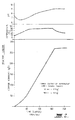
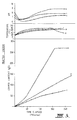
- the minimum pH period corresponded to the period of initial solid formation in the liquor, at a copper content of 28 g/l.
- the solid precipitate formed in the liquor, representing the insoluble copper content, was recovered by filtration, washing and drying.
- Example No. 1 This was identical to Example No. 1, except that an agitator speed of 6000 rpm was used. The results are shown in Fig. 3, line C.
- the reactor 100 is formed from a generally circular tank 102, preferably formed from stainless steel. Preferred dimensions are 1.5m diameter and 1.5m in depth.
- Tank 102 has a top portion 104, with an exhaust vent 106 therein.
- An agitator 114 has a shaft 112 driven by a drive 108, preferably an electric motor.
- the shaft 112 is located within a tube 116 into which air from a blower or the like is introduced via an inlet 110. Air exits from the base of tube 116 as indicated by the arrows near the base of tank 102.
- the preferred-dimension tank has a capacity of 1500l, and the agitator design may be scaled up from the Fig. 1 arrangement to suit that capacity.
- the agitator speed is adjusted so that the tip speed is identical with the reactor of Fig. 1, used in Examples 1 to 5.
- a generally cylindrical screen 118 is located in tank 102, and copper scrap 122 (in the form of copper wire or the like) is located in reaction liquor 120 between screen 118 and tank walls 102.
- the reactor was charged with 3/4 tonne of copper scrap in the form of wire, bales and cut piping, which was confined between the tank walls and a circular screen, 1500 litres of 150 g/l ammonium sulphate was introduced into the reactor, and the liquor pH was adjusted to 7.3 using aqueous ammonia.
- the reactor was operated for 3 hours and the pH, temperature and copper content of the liquor were monitored. The results were identical to those shown in Fig. 2.
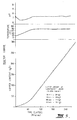
- Example No. 7 was repeated, but after the pH had risen to 7.3 (80 minutes elapsed time) the pH was monitored to 7.3 ⁇ 0.1 by addition of concentrated sulphuric acid, run in from a head tank through a control valve. The example was operated for a total of 4 hours and the results appear in Fig. 5.
- the final copper liquor was a very thick slurry which became difficult to agitate.
- the final copper content was 480 g/l, of which only 28g/l was present as soluble copper.
- a reaction rate of 153 g/l copper/hour was achieved, after pH adjustment was introduced.
- the solid precipitate formed was identified as 3Cu(OH)2.CuSO4 It should be noted that the present invention could be considered as a fuel cell, that is, a process or device which produces energy from the interaction of certain substances.
Landscapes
- Chemical & Material Sciences (AREA)
- Organic Chemistry (AREA)
- Inorganic Chemistry (AREA)
- Chemical Kinetics & Catalysis (AREA)
- Manufacture And Refinement Of Metals (AREA)
- Conductive Materials (AREA)
- Chemically Coating (AREA)
Claims (7)
- Verfahren zur Herstellung von Kupferverbindungen, das umfaßt
das Inkontaktbringen von metallischem Kupfer mit Sauerstoff oder einem Sauerstoff enthaltenden Gas und einer wäßrigen Lösung, die im wesentlichen besteht aus einem löslichen Ammoniumsalz und Ammoniak, wobei das Salz in der genannten Lösung in einer Konzentration bis zu seiner Löslichkeitsgrenze vorhanden ist und der Ammoniak in einer solchen Menge vorhanden ist, daß die genannte Lösung von Anfang an alkalisch ist,
wobei sich als Ergebnis des genannten Kontakts das genannte metallische Kupfer auflöst unter Bildung eines Kupferammins, wobei die Konzentration des genannten Kupferammins in der Lösung ansteigt, bis die Sättigungskonzentration des genannten Kupferammins in der Lösung erreicht ist,
wonach das genannte Kupferammin kontinuierlich zerfällt unter Bildung eines in Wasser unlöslichen tribasischen Salzes und wasserlöslicher Zersetzungsprodukte,
wobei die genannten wasserlöslichen Zersetzungsprodukte für eine weitere Umsetzung mit dem genannten metallischen Kupfer und dem genannten Sauerstoff oder Sauerstoff enthaltenden Gas zur Verfügung stehen, wodurch kontinuierlich weiteres Kupferammin gebildet wird, um die Konzentration an dem genannten Kupferammin in der Lösung im wesentlichen bei der genannten Sättigungskonzentrtion zu halten, bis die genannte Lösung an dem Anion des genannten löslischen Ammoniumsalzes erschöpft ist. - Verfahren nach Anspruch 1, wobei Ammoniak in der genannten Lösung vorhanden ist und die genannte Lösung von Anfang an einen pH-Wert von 8,0 oder weniger hat.
- Verfahren nach Anspruch 1 oder 2, das außerdem die Stufe der Abtrennung des genannten tribasischen Salzes von der genannten Lösung umfaßt.
- Verfahren nach Anspruch 3, wobei das genannte tribasische Salz von der genannten Lösung durch Filtrieren abgetrennt und gewaschen und getrocknet wird.
- Verfahren nach Anspruch 3 oder 4, wobeia) das genannte Anion in der genannten Lösung kontinuierlich ersetzt wird, wenn es durch die Bildung des genannten tribasischen Salzes entfernt wird, durch Zugabe einer Säure, die das genannte Anion enthält, in einer äquivalenten Rate;b) das genannte tribasische Salz mit einer Geschwindigkeit aus der genannten Lösung entfernt wird, die ausreicht, um einen akzeptablen Gehalt an Feststoffen in dem Reaktionsmedium aufrechtzuerhalten, so daß das genannte tribasische Salz kontinuierlich gebildet wird.
- Verfahren nach Anspruch 4 oder 5, wobeia) die genannte Lösung in einem zylindrischen Reaktionsbehälter enthalten ist, der mit einem zylindrischen Sieb ausgestattet ist, so daß das Kupfermetall auf den Bereich zwischen dem Sieb und den Behälterwänden begrenzt ist und der einen im Innern des Siebs angeordneten Schaufelrührer aufweist, der mit einer Minimum-Spitzengeschwindigkeit von 500 m/min angetrieben wird und der eine Einrichtung aufweist für die Einführung von Sauerstoff oder Sauerstoff enthaltendem Gas an oder in der Nähe der Rührschaufeln;b) der genannte Behälter mit Einrichtungen für die Zugabe der genannten Säure mit einer kontrollierten Geschwindigkeit ausgestattet ist undc) der genannte Behälter mit einem solchen System zur Entfernung von Feststoffen ausgestattet ist, daß das genannte tribasische Salz mit einer kontrollierten Geschwindigkeit aus der genannten Lösung entfernt wird.
- Verfahren nach einem der vorhergehenden Ansprüche, bei dem das genannte Ammoniumsalz ausgewählt wird aus Ammoniumsulfat, Ammoniumchlorid oder Ammoniumnitrat.
Applications Claiming Priority (5)
| Application Number | Priority Date | Filing Date | Title |
|---|---|---|---|
| AU5552/89 | 1989-08-01 | ||
| AUPJ555289 | 1989-08-01 | ||
| AU58043/90 | 1990-06-29 | ||
| AU58043/90A AU635943B2 (en) | 1989-08-01 | 1990-06-29 | Production of copper compounds |
| PCT/AU1990/000323 WO1991001942A1 (en) | 1989-08-01 | 1990-08-01 | Production of copper compounds |
Publications (3)
| Publication Number | Publication Date |
|---|---|
| EP0500533A1 EP0500533A1 (de) | 1992-09-02 |
| EP0500533A4 EP0500533A4 (en) | 1992-10-28 |
| EP0500533B1 true EP0500533B1 (de) | 1995-04-12 |
Family
ID=25631909
Family Applications (1)
| Application Number | Title | Priority Date | Filing Date |
|---|---|---|---|
| EP90911864A Expired - Lifetime EP0500533B1 (de) | 1989-08-01 | 1990-08-01 | Herstellung von kupferverbindungen |
Country Status (5)
| Country | Link |
|---|---|
| US (1) | US5310533A (de) |
| EP (1) | EP0500533B1 (de) |
| AT (1) | ATE121055T1 (de) |
| AU (1) | AU635943B2 (de) |
| DE (1) | DE69018645T2 (de) |
Families Citing this family (7)
| Publication number | Priority date | Publication date | Assignee | Title |
|---|---|---|---|---|
| AU642895B2 (en) * | 1989-08-01 | 1993-11-04 | Australian Copper Company Pty. Ltd. | Production of copper compounds |
| US5492681A (en) * | 1993-03-22 | 1996-02-20 | Hickson Corporation | Method for producing copper oxide |
| US6294146B1 (en) * | 1999-08-09 | 2001-09-25 | Gabriel Benet | Continuous chemical reaction under continuous pressure and turbulence |
| US20070207076A1 (en) * | 2006-03-06 | 2007-09-06 | Osmose Inc. | Method of preparing metal-containing wood preserving compositions |
| CN102230083B (zh) * | 2011-07-11 | 2012-11-07 | 湖南宇腾有色金属股份有限公司 | 一种从铅冰铜中分离铜的方法 |
| CN102994747B (zh) * | 2011-09-13 | 2014-03-26 | 郴州市金贵银业股份有限公司 | 一种从高铅铜锍中回收金属铜的工艺 |
| US9590247B2 (en) | 2012-06-20 | 2017-03-07 | Arizona Board Of Regents, A Body Corporate Of The State Of Arizona Acting For And On Behalf Of Arizona State University | Transition metal hydroxy-anion electrode materials for lithium-ion battery cathodes |
Family Cites Families (11)
| Publication number | Priority date | Publication date | Assignee | Title |
|---|---|---|---|---|
| US1937728A (en) * | 1927-05-16 | 1933-12-05 | Du Pont | Catalyst |
| US2046937A (en) * | 1933-08-11 | 1936-07-07 | Leo P Curtin | Process for the preparation of copper compounds from metallic copper |
| FR793932A (fr) * | 1934-11-10 | 1936-02-04 | Carbonates Francais Sa Des | Procédé de fabrication de carbonate basique de cuivre et d'hydrate d'oxyde cuivrique |
| US2104754A (en) * | 1935-11-30 | 1938-01-11 | Daniel W Marsh | Processes for the manufacture of complex metallic salt |
| US2536096A (en) * | 1947-09-02 | 1951-01-02 | Mountain Copper Company Ltd | Process for manufacture of copper compounds |
| US2536097A (en) * | 1948-12-27 | 1951-01-02 | Mountain Copper Company Ltd | Continuous process for manufacture of basic copper ammonium sulfate |
| US2817579A (en) * | 1953-03-19 | 1957-12-24 | Glidden Co | Catalytic process for preparing red cuprous oxide |
| GB1368602A (en) * | 1970-09-24 | 1974-10-02 | Albright & Wilson | Manufacture of copper oxide |
| US3961908A (en) * | 1974-02-27 | 1976-06-08 | Freeport Minerals Company | Autoclave system for leaching sulfide concentrates |
| DE3606920A1 (de) * | 1986-03-04 | 1987-09-10 | Norddeutsche Affinerie | Verfahren zur herstellung von kupferhydroxid |
| AU642895B2 (en) * | 1989-08-01 | 1993-11-04 | Australian Copper Company Pty. Ltd. | Production of copper compounds |
-
1990
- 1990-06-29 AU AU58043/90A patent/AU635943B2/en not_active Ceased
- 1990-08-01 DE DE69018645T patent/DE69018645T2/de not_active Expired - Fee Related
- 1990-08-01 EP EP90911864A patent/EP0500533B1/de not_active Expired - Lifetime
- 1990-08-01 AT AT90911864T patent/ATE121055T1/de not_active IP Right Cessation
-
1992
- 1992-04-01 US US07/862,631 patent/US5310533A/en not_active Expired - Fee Related
Also Published As
| Publication number | Publication date |
|---|---|
| DE69018645D1 (de) | 1995-05-18 |
| EP0500533A4 (en) | 1992-10-28 |
| DE69018645T2 (de) | 1996-01-18 |
| ATE121055T1 (de) | 1995-04-15 |
| AU635943B2 (en) | 1993-04-08 |
| EP0500533A1 (de) | 1992-09-02 |
| AU5804390A (en) | 1991-02-07 |
| US5310533A (en) | 1994-05-10 |
Similar Documents
| Publication | Publication Date | Title |
|---|---|---|
| CA2476643C (en) | Process for the dissolution of copper metal | |
| EP0284577B1 (de) | Verfahren zur Erzeugung von Chlordioxyd | |
| CA2518846C (en) | Process for the dissolution of copper metal | |
| US5492681A (en) | Method for producing copper oxide | |
| EP0500533B1 (de) | Herstellung von kupferverbindungen | |
| US8454929B2 (en) | Continuous process for preparation of calcium thiosulfate liquid solution | |
| US4276268A (en) | Process for preparing manganese nitrate solution | |
| US3347628A (en) | Production of chlorine dioxide | |
| CA1150952A (en) | Process for extracting titanium values from titaniferous bearing material | |
| EP0127999A1 (de) | Oxydation in der flüssigen Phase | |
| US4490337A (en) | Preparation of cupric hydroxide | |
| WO1991001942A1 (en) | Production of copper compounds | |
| AU642895B2 (en) | Production of copper compounds | |
| CA1105877A (en) | Process for producing chlorine dioxide | |
| US6531108B1 (en) | Process for producing free hydroxylamine aqueous solution | |
| US5433938A (en) | Chlorine-destruct method | |
| US3058808A (en) | Production of chlorine dioxide | |
| US4251489A (en) | Process for producing a copper sulfate solution | |
| US3225026A (en) | Method of producing azobisformamides | |
| US3077383A (en) | Process for the production of hydrazine hydrate | |
| EP0535113B1 (de) | Chlordioxid-herstellungsverfahren wobei methanol angewendet wird | |
| US3443893A (en) | Recovery of copper and cyanide values from cuprous cyanides | |
| JP3641148B2 (ja) | ポリ硫酸第二鉄の製造方法 | |
| FI70200C (fi) | Framstaellning av arsensyra | |
| JPS6148428A (ja) | 炭酸ナトリウム水溶液の製造法及びその製造装置 |
Legal Events
| Date | Code | Title | Description |
|---|---|---|---|
| PUAI | Public reference made under article 153(3) epc to a published international application that has entered the european phase |
Free format text: ORIGINAL CODE: 0009012 |
|
| 17P | Request for examination filed |
Effective date: 19920331 |
|
| AK | Designated contracting states |
Kind code of ref document: A1 Designated state(s): AT BE CH DE DK ES FR GB IT LI LU NL SE |
|
| RIN1 | Information on inventor provided before grant (corrected) |
Inventor name: BROWNE, CHRISTOPHER, JOHN |
|
| A4 | Supplementary search report drawn up and despatched |
Effective date: 19920909 |
|
| AK | Designated contracting states |
Kind code of ref document: A4 Designated state(s): AT BE CH DE DK ES FR GB IT LI LU NL SE |
|
| 17Q | First examination report despatched |
Effective date: 19930714 |
|
| GRAA | (expected) grant |
Free format text: ORIGINAL CODE: 0009210 |
|
| AK | Designated contracting states |
Kind code of ref document: B1 Designated state(s): AT BE CH DE DK ES FR GB IT LI LU NL SE |
|
| PG25 | Lapsed in a contracting state [announced via postgrant information from national office to epo] |
Ref country code: ES Free format text: THE PATENT HAS BEEN ANNULLED BY A DECISION OF A NATIONAL AUTHORITY Effective date: 19950412 Ref country code: DK Effective date: 19950412 Ref country code: IT Free format text: LAPSE BECAUSE OF FAILURE TO SUBMIT A TRANSLATION OF THE DESCRIPTION OR TO PAY THE FEE WITHIN THE PRE;WARNING: LAPSES OF ITALIAN PATENTS WITH EFFECTIVE DATE BEFORE 2007 MAY HAVE OCCURRED AT ANY TIME BEFORE 2007. THE CORRECT EFFECTIVE DATE MAY BE DIFFERENT FROM THE ONE RECORDED.SCRIBED TIME-LIMIT Effective date: 19950412 Ref country code: CH Effective date: 19950412 Ref country code: AT Effective date: 19950412 Ref country code: BE Effective date: 19950412 Ref country code: LI Effective date: 19950412 Ref country code: NL Free format text: LAPSE BECAUSE OF NON-PAYMENT OF DUE FEES Effective date: 19950412 |
|
| REF | Corresponds to: |
Ref document number: 121055 Country of ref document: AT Date of ref document: 19950415 Kind code of ref document: T |
|
| REF | Corresponds to: |
Ref document number: 69018645 Country of ref document: DE Date of ref document: 19950518 |
|
| PG25 | Lapsed in a contracting state [announced via postgrant information from national office to epo] |
Ref country code: SE Effective date: 19950712 |
|
| REG | Reference to a national code |
Ref country code: CH Ref legal event code: PL |
|
| ET | Fr: translation filed | ||
| PG25 | Lapsed in a contracting state [announced via postgrant information from national office to epo] |
Ref country code: LU Free format text: LAPSE BECAUSE OF NON-PAYMENT OF DUE FEES Effective date: 19950831 |
|
| NLV1 | Nl: lapsed or annulled due to failure to fulfill the requirements of art. 29p and 29m of the patents act | ||
| PLBE | No opposition filed within time limit |
Free format text: ORIGINAL CODE: 0009261 |
|
| STAA | Information on the status of an ep patent application or granted ep patent |
Free format text: STATUS: NO OPPOSITION FILED WITHIN TIME LIMIT |
|
| 26N | No opposition filed | ||
| PGFP | Annual fee paid to national office [announced via postgrant information from national office to epo] |
Ref country code: GB Payment date: 19960715 Year of fee payment: 7 |
|
| PGFP | Annual fee paid to national office [announced via postgrant information from national office to epo] |
Ref country code: FR Payment date: 19960716 Year of fee payment: 7 |
|
| PGFP | Annual fee paid to national office [announced via postgrant information from national office to epo] |
Ref country code: DE Payment date: 19960722 Year of fee payment: 7 |
|
| PG25 | Lapsed in a contracting state [announced via postgrant information from national office to epo] |
Ref country code: GB Free format text: LAPSE BECAUSE OF NON-PAYMENT OF DUE FEES Effective date: 19970801 |
|
| GBPC | Gb: european patent ceased through non-payment of renewal fee |
Effective date: 19970801 |
|
| PG25 | Lapsed in a contracting state [announced via postgrant information from national office to epo] |
Ref country code: FR Free format text: LAPSE BECAUSE OF NON-PAYMENT OF DUE FEES Effective date: 19980430 |
|
| PG25 | Lapsed in a contracting state [announced via postgrant information from national office to epo] |
Ref country code: DE Free format text: LAPSE BECAUSE OF NON-PAYMENT OF DUE FEES Effective date: 19980501 |
|
| REG | Reference to a national code |
Ref country code: FR Ref legal event code: ST |