EP0495702B1 - Postwaage mit verschiedenen Betriebsarten - Google Patents
Postwaage mit verschiedenen Betriebsarten Download PDFInfo
- Publication number
- EP0495702B1 EP0495702B1 EP92400079A EP92400079A EP0495702B1 EP 0495702 B1 EP0495702 B1 EP 0495702B1 EP 92400079 A EP92400079 A EP 92400079A EP 92400079 A EP92400079 A EP 92400079A EP 0495702 B1 EP0495702 B1 EP 0495702B1
- Authority
- EP
- European Patent Office
- Prior art keywords
- weight
- mode
- article
- recited
- variation
- Prior art date
- Legal status (The legal status is an assumption and is not a legal conclusion. Google has not performed a legal analysis and makes no representation as to the accuracy of the status listed.)
- Expired - Lifetime
Links
Images


Classifications
-
- G—PHYSICS
- G07—CHECKING-DEVICES
- G07B—TICKET-ISSUING APPARATUS; FARE-REGISTERING APPARATUS; FRANKING APPARATUS
- G07B17/00—Franking apparatus
- G07B17/00459—Details relating to mailpieces in a franking system
- G07B17/00661—Sensing or measuring mailpieces
-
- G—PHYSICS
- G01—MEASURING; TESTING
- G01G—WEIGHING
- G01G19/00—Weighing apparatus or methods adapted for special purposes not provided for in the preceding groups
- G01G19/002—Weighing apparatus or methods adapted for special purposes not provided for in the preceding groups for postal parcels and letters
- G01G19/005—Weighing apparatus or methods adapted for special purposes not provided for in the preceding groups for postal parcels and letters with electric or electronic computing means
-
- G—PHYSICS
- G07—CHECKING-DEVICES
- G07B—TICKET-ISSUING APPARATUS; FARE-REGISTERING APPARATUS; FRANKING APPARATUS
- G07B17/00—Franking apparatus
- G07B17/00185—Details internally of apparatus in a franking system, e.g. franking machine at customer or apparatus at post office
- G07B17/00314—Communication within apparatus, personal computer [PC] system, or server, e.g. between printhead and central unit in a franking machine
- G07B2017/00322—Communication between components/modules/parts, e.g. printer, printhead, keyboard, conveyor or central unit
-
- G—PHYSICS
- G07—CHECKING-DEVICES
- G07B—TICKET-ISSUING APPARATUS; FARE-REGISTERING APPARATUS; FRANKING APPARATUS
- G07B17/00—Franking apparatus
- G07B17/00459—Details relating to mailpieces in a franking system
- G07B17/00661—Sensing or measuring mailpieces
- G07B2017/00701—Measuring the weight of mailpieces
Definitions
- the present invention relates to the field of postage scales. More specifically, the invention provides an improved postage scale with variable modes of operation.
- Postage scales and meters are commonplace in mail rooms everywhere. Such postage systems have become ever more sophisticated in their ability to provide a large variety of services to a user. For example, many postage systems today weigh an article, provide a user with a selection of postage options (such as first class, express mail, and the like). The user selects the desired mail service from the various options. The user then selects from optional services (registered mail and the like) and enters the destination of the item via a zip or zone code. From the above information the postage scale indicates the postage amount needed and/or issues postage for the required amount.
- U.S. Patent Nos. 4,484,307 (Quatse et al .), 4,644,142 (Payn), and 4,742,469 (Haines) (all assigned to the assignee of the present invention) disclose such postage systems.
- a postage scale weighs a package quickly and indicate the weight to the user in only a coarse scale. For example, a particular user may wish to have a particular package weighed only in 14,18 g (0.5 ounce) increments. In some cases a postage scale may be able to weigh the package more quickly to this degree of accuracy, although it may occasionally result in the application of slightly more than the required amount of postage.
- a user may need to weigh a package to a finer scale or a coarser scale.
- NTEP National Type Evaluation Program
- US-A-4 864 251 discloses a system comprising the features of the preamble of claim 1.
- the present invention provides a system as defined in claim 1 and a method as defined in claim 11.
- a user selects between these modes by pressing a button or other suitable interface on the scale.
- the scale In a first mode, the scale outputs the weight only to a first, coarse scale.
- the weight In a second mode the weight is output in a second, finer scale.
- the second, finer scale indicates the weight to within a smaller variation in weight than the first, coarser scale.
- the scale in the first mode the scale may indicate the weight in 14,18 g (0.5 ounce) increments, while in the second mode the scale may indicate the weight in 2,83 g (0.1 ounce) increments.
- the invention provides a system for determining the weight of an article to be mailed.
- the system includes a scale and processing means connected to an output of the scale, the processing means having at least a first mode and a second mode of operation selectable by a user, the processing means having a coarse output precision based on the output of the scale in the first mode and a fine output precision based on the output of the scale in the second mode, the output of the processing means indicating the weight of an article to be mailed.
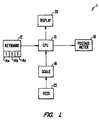
- Fig. 1 illustrates the hardware components of the postage scale system 1 disclosed herein.
- the system operates under the direction of a CPU 10 which may be, for example, discrete logic or one or more microprocessors known to those of skill in the art such as a model no. 8088 made by Intel.
- the invention is illustrated herein primarily with reference to a single CPU 10, but the invention could readily be carried out using multiple logic devices within multiple components of the system. For example, a portion of the function herein may be conducted in the scale or postage meter. Alternatively, discrete logic may be used to perform all or part of the functionality herein.
- a user interfaces with the CPU via a keyboard or other input device 12.
- the invention is illustrated with regard to the use of discrete keys for selection of modes, but it will be understood that a variety of input systems could be utilized.
- the system could obtain input from a video display and mouse, or a generic keypad.
- the keypad includes mode selection keys 14a, 14b, and 14c.
- Fig. 1 illustrates three mode selection keys, but the present invention is applicable to systems with more or fewer modes for selection.
- the CPU 10 also receives input from scale 16.
- the input to CPU 10 from the scale 16 will generally be a digital representation of the weight on the scale. This value will often fluctuate rapidly when the user places an article on the scale, but the value will generally settle to some relatively constant value after a time.
- the system feeds articles to the scale automatically in some embodiments using an automatic feeding system 22, although in some embodiments a user feeds the scale manually. In one preferred embodiment, the user selects between a manual feed and an automatic feed mode.
- the CPU Based on selections made by the user at the keyboard 12 and input from the scale 16, the CPU provides output to a display 20 and, optionally, to postage meter 18 for issuance of postage.
- the form of the output will vary widely from one application to another.
- the output may take the form of a binary representation of the weight on a series of data pins in the CPU.
- the specific value of the output from the CPU will vary depending upon the mode selected by the user. In one embodiment the user selects between a first mode and a second mode.
- the output from the CPU is coarse.
- coarse refers to operations in which the scale determines the weight of the article to within a variation in weight which is relatively less precise than a second mode.
- second mode sometimes referred to herein as the "commercial mode”
- the system determines the weight of the article to within a variation in weight which is fine.
- fine means relatively more precise weight output than the first mode. For example, in the first (coarse) mode the scale may output weight in 14,18 g (0.5 ounce) increments while in the second (fine) mode the weight is output in 2,83 g (0.1 ounce) increments.
- the system outputs a weight in which the coarseness or fineness of the output depends on the weight of the article on the scale.
- the output of the scale is relatively more coarse when the article on the scale is relatively heavy, and the output of the scale is relatively more fine when the article is relatively light.
- the first mode of operation outputs the weight in 14,18 g (0.5 ounce) increments if the article weighs less than 2270 g (5 pounds), but outputs the weight in 28,375g (1 ounce) increments if the weight of the article is greater than 2270g (5 pounds).
- the second mode of operation outputs the weight of the article in 2,83g (0.1 ounce) increments if the article weighs less than 2270g (5 pounds), and outputs the weight in 14,18g (0.5 ounce) increments if the article weighs more than 2270g (5 pounds). Accordingly, one mode of operation will meet the standards set forth by an agency such as NTEP, while another mode of operation outputs information much less precisely.
- Table 1 summarizes the output of the scale according to one preferred embodiment based on weight and mode of operation. Table 1 Output Parameters Based on Mode and Weight Mode Weight Fine (commercial) Coarse (shipping) Less than (5 lbs) 2270g (0.1 ounce) 2,83g increments (0.5 ounce) 14,18g increments Greater than (5 lbs) 2270g (0.5 ounce) 14,18g increments (1 ounce) 28,375g increments
- the scale has a third mode of operation.
- the user selects the third mode of operation (referred to herein as the fast weighing mode) by pressing the third mode selection key 14c.
- the system selects the fast weighing mode automatically when the automatic feed is activated.
- the CPU monitors the weight output by the scale many times per second.
- the CPU selects the weight when the maximum and minimum fluctuations meet some tolerance limit (e.g., ⁇ 28,3g ( ⁇ 1 oz)).
- the tolerance limit varies depending on the weight range and type of carrier in preferred embodiments. Table 2 provides illustrative tolerances for various weights/carriers which are used in one specific embodiment.
- the scale is set to a relatively more coarse display increment.
- Fig. 2 is an overall flow chart illustrating one embodiment of the software in CPU 20.
- the functionality described herein will often be carried out in multiple processors in the system, or partially or wholly in discrete logic in the system. A single CPU is illustrated herein for the sake of simplicity.
- the system initializes the software to set various default values, and the like.
- the system initializes the mode to a preselected value (preferably the shipping mode).
- the system operates in this default mode when the user does not strike a mode key.
- the system tests to determine if a mode key is depressed. If so, a variable is set to identify the selected mode is set at step 104. In the particular embodiment shown herein, the variable is set to M 1 if key number 14a is depressed, M 2 if key number 14b is depressed, and M 3 if key 14c is depressed.
- step 106 If a mode key is not currently depressed, or after setting the mode to the desired value, the system then tests the scale to determine if an article has been placed on the scale at step 106. If an article has not been placed on the scale, the system recycles to step 102. If an article has been placed on the scale the system then proceeds to step 108 (if the mode variable is M 1 ), or step 110 if the mode variable is M 2 , or step 112 if the mode variable is M 3 .
- the system determines if the currently indicated weight of the article is greater than some test weight for the first mode, which in the embodiment herein is the shipping mode. This value may be, for example, 2270g (5 pounds). If the weight of the article is less than 2270g (five pounds), the output increment is set to S 1 (e.g., 2,83g (0.1 ounces)) at step 114. If the weight of the article is greater than 2270g (five pounds), the output increment is set to S 2 (e.g., 14,18g (0.5 ounces)) at step 116. At step 118, the system then determines if the weight of the article has stabilized to within a weight variability S 1 or S 2 and, if so, outputs the weight at step 120. If not, the system returns to step 108 and repeats.
- S 1 e.g. 2,83g (0.1 ounces)
- a similar process is conducted using different weight increments at steps 122 and 124 if mode M 2 has been selected.
- the same or a different weight stabilization test is then conducted at step 126 using the different increments C 1 or C 2 .
- the weight is output at step 128, and the system returns to the start step. If the weight has not stabilized to within the increment, the system returns to step 110 and repeats.
- mode M 3 the fast weighing mode
- a slightly different procedure is conducted. After checking the currently indicated weight of the article against the test weight at step 112, the system checks which carrier the user has selected at step 125 or 127, and then sets the tolerance limit to F 1 , F 2 , F 3 or F 4 at step 130, 131, 132 or 133. A weight stabilization test is conducted at step 136. Step 136 is repeated until the successive weight fluctuation is within the tolerance limit. The weight is output at step 138 and the system returns to the start step.
- the invention provides substantially more flexibility, versatility, and speed in a postage scale system.
- the above description is illustrative and not restrictive. Many variations of the invention will become apparent to those of skill in the art upon review of this disclosure. The scope of the invention should, therefore, be determined not with reference to the above description, but instead should be determined with reference to the appended claims.
Landscapes
- Physics & Mathematics (AREA)
- General Physics & Mathematics (AREA)
- Mathematical Physics (AREA)
- Devices For Checking Fares Or Tickets At Control Points (AREA)
- Cash Registers Or Receiving Machines (AREA)
Claims (20)
- System zur Bestimmung des Gewichts eines Poststücks in einer Mehrzahl von Gewichtsbereichen, mit einer Waage (16) und Datenverarbeitungsmitteln (10), die an einem Ausgang das Gewicht eines Poststücks angeben und die an einen Ausgang der Waage angeschlossen sind, wobei die Verarbeitungsmittel mindestens eine erste und eine zweite Betriebsart aufweisen, dadurch gekennzeichnet, daß das System weiter Eingabemittel (12) aufweist, die es einem Benutzer erlauben, für jeden einer Mehrzahl von Gewichtsbereichen eine erste Gewichtsvariation einzugeben, d.h. für eine erste Betriebsart ein erstes Gewichtsinkrement oder eine erste Toleranz bzw. für eine zweite Betriebsart eine zweite Gewichtsvariation, d.h. ein zweites Gewichtsinkrement oder eine zweite Toleranz einzugeben, deren Wert geringer als in der ersten Betriebsart ist.
- System nach Anspruch 1, in dem der gewählte Wert der Gewichtsvariation größer ist, wenn das Gewicht des Poststücks über einem vorgegebenen Wert liegt, bzw. kleiner, wenn das Gewicht des Poststücks unter einem vorgegebenen Wert liegt.
- System nach Anspruch 1, das weiter eine dritte Betriebsart für automatische Wägeoperationen enthält, wobei diese dritte Betriebsart den Wert der ersten Gewichtsvariation für jeden der Wägebereiche auswählt.
- System nach Anspruch 3, in dem die Datenverarbeitungsmittel den größeren Wert der ersten Gewichtsvariation einstellen, wenn eine Serie von Poststücken in den automatischen Wiegeoperationen Gewichte haben, die in bestimmten Grenzen liegen.
- System nach Anspruch 1, in dem mindestens bei der ersten oder zweiten Betriebsart Gewichte im Einklang mit einer Normvorschrift ausgegeben werden.
- System nach Anspruch 1, das das Gewicht eines Poststücks in Schritten von etwa 14,18 g in der ersten Betriebsart anzeigt, wenn das Poststück weniger als 2270 g wiegt.
- System nach Anspruch 1, das das Gewicht eines Poststücks in Schritten von etwa 28,375 g in der ersten Betriebsart anzeigt, wenn das Poststück mehr als 2270 g wiegt.
- System nach Anspruch 1, das das Gewicht eines Poststücks in Schritten von etwa 2,83 g in der zweiten Betriebsart anzeigt, wenn das Poststück weniger als 2270 g wiegt.
- System nach Anspruch 1, das das Gewicht eines Poststücks in Schritten von etwa 14,18 g in der zweiten Betriebsart anzeigt, wenn das Poststück mehr als 2270 g wiegt.
- System nach Anspruch 1, in dem das Gewicht eines Poststücks gemäß folgender Tabelle angegeben wird:

- Methode zur Angabe des Gewichts eines Poststücks in mehreren Gewichtsbereichen für ein Postabfertigungssystem, wobei die Methode die folgenden Schritte aufweist:a) ein Poststück wird gewogen,b) für jeden von mehreren Gewichtsbereichen wird eine gewünschte Betriebsart durch Auswahl aus mindestens einer ersten Betriebsart entsprechend einer ersten Gewichtsvariation, d.h. einem ersten Gewichtinkrement oder einer ersten Toleranz und einer zweiten Betriebsart entsprechend einer zweiten Gewichtsvariation, d.h. einem zweiten Gewichtsinkrement oder einer zweiten Toleranz eingegeben, deren Wert geringer als in der ersten Betriebsart ist,c) die Verarbeitungsmittel geben das Gewicht gemäß dem ausgewählten Wert der Gewichtsvariation für die Freimachung des Poststücks aus.
- Methode nach Anspruch 11, die weiter den Schritt enthält, den Wert für die ausgewählte Gewichtsvariation zu vergrößern, wenn das Poststück ein vorbestimmtes Gewicht übersteigt, oder zu verkleinern, wenn das Poststück unter einem vorbestimmten Gewicht bleibt.
- Methode nach Anspruch 11, die weiter eine dritte Betriebsart für automatische Wiegeoperationen enthält, bei der der Wert der ersten Gewichtsvariation für jeden Gewichtsbereich ausgewählt wird.
- Methode nach Anspruch 11, bei der die Datenverarbeitungsmittel den Wert für die erste Gewichtsvariation vergrößern, wenn eine Reihe von Poststücken bei der automatischen Wiegeoperation in vorbestimmten Gewichtsgrenzen liegen.
- Methode nach Anspruch 11, bei der Gewichte im Einklang mit einer Vorschriftennorm ausgegeben werden.
- Methode nach Anspruch 11, bei der ein Gewicht eines Poststücks bis auf eine Gewichtsvariation von 14,18 g genau in der ersten Betriebsart angezeigt wird, wenn das Poststück weniger als 2270 g wiegt.
- Methode nach Anspruch 11, bei der ein Gewicht eines Poststücks bis auf eine Gewichtsvariation von 28,375 g genau in der ersten Betriebsart angezeigt wird, wenn das Poststück mehr als 2270 g wiegt.
- Methode nach Anspruch 11, bei der ein Gewicht eines Poststücks bis auf eine Gewichtsvariation von 2,83 g genau in der zweiten Betriebsart angezeigt wird, wenn das Poststück weniger als 2270 g wiegt.
- Methode nach Anspruch 11, bei der ein Gewicht eines Poststücks bis auf eine Gewichtsvariation von 14,18 g genau in der ersten Betriebsart angezeigt wird, wenn das Poststück mehr als 2270 g wiegt.
- Methode nach Anspruch 11, bei der das Gewicht eines Poststücks im Einklang mit der folgenden Tabelle angezeigt wird:

Applications Claiming Priority (2)
| Application Number | Priority Date | Filing Date | Title |
|---|---|---|---|
| US640671 | 1991-01-14 | ||
| US07/640,671 US5174398A (en) | 1991-01-14 | 1991-01-14 | Multimode postage scale |
Publications (3)
| Publication Number | Publication Date |
|---|---|
| EP0495702A2 EP0495702A2 (de) | 1992-07-22 |
| EP0495702A3 EP0495702A3 (en) | 1993-02-10 |
| EP0495702B1 true EP0495702B1 (de) | 1997-04-09 |
Family
ID=24569228
Family Applications (1)
| Application Number | Title | Priority Date | Filing Date |
|---|---|---|---|
| EP92400079A Expired - Lifetime EP0495702B1 (de) | 1991-01-14 | 1992-01-13 | Postwaage mit verschiedenen Betriebsarten |
Country Status (3)
| Country | Link |
|---|---|
| US (1) | US5174398A (de) |
| EP (1) | EP0495702B1 (de) |
| DE (1) | DE69218806T2 (de) |
Cited By (1)
| Publication number | Priority date | Publication date | Assignee | Title |
|---|---|---|---|---|
| EP2362196A2 (de) | 2010-02-26 | 2011-08-31 | Siemens Aktiengesellschaft | Verfahren und Vorrichtung zum Wiegen von Gegenständen unterschiedlicher Gewichtsklassen |
Families Citing this family (3)
| Publication number | Priority date | Publication date | Assignee | Title |
|---|---|---|---|---|
| US5586037A (en) * | 1991-04-01 | 1996-12-17 | Pi Electronics, Inc. | Automated self-service mail processing and storing systems |
| US20050228760A1 (en) * | 2004-03-31 | 2005-10-13 | Pitney Bowes Incorporated | Special service mail electronic uploads with automatic return of legal electronic proof of induction / acceptance |
| US20110209923A1 (en) * | 2010-02-26 | 2011-09-01 | Siemens Aktiengesellschaft | Method and Device for Weighing Objects of Different Weight Classes |
Family Cites Families (21)
| Publication number | Priority date | Publication date | Assignee | Title |
|---|---|---|---|---|
| US1101390A (en) * | 1913-02-24 | 1914-06-23 | William Alfred Benton | Weight-indicating weighing apparatus. |
| US1392827A (en) * | 1916-08-14 | 1921-10-04 | Toledo Scale Co | Weighing-scale |
| US3279552A (en) * | 1965-01-25 | 1966-10-18 | Howe Richardson Scale Co | Automatic tare control system for weighing apparatus |
| US3530949A (en) * | 1969-04-14 | 1970-09-29 | Brookline Instr Co | Hydraulic weight totalizing apparatus with electric re-balancing |
| US3951221A (en) * | 1974-09-30 | 1976-04-20 | National Controls, Inc. | Computing postal scale |
| US4326254A (en) * | 1979-03-07 | 1982-04-20 | Tokyo Electric Co., Ltd. | Postal charge processing system |
| US4484307A (en) * | 1979-05-09 | 1984-11-20 | F.M.E. Corporation | Electronic postage meter having improved security and fault tolerance features |
| CH637210A5 (de) * | 1979-07-06 | 1983-07-15 | Mettler Instrumente Ag | Digital anzeigende waage. |
| DE2945940A1 (de) * | 1979-11-14 | 1981-05-21 | Battelle-Institut E.V., 6000 Frankfurt | Verfahren und vorrichtung zum automatischen waegen |
| US4325440A (en) * | 1980-05-27 | 1982-04-20 | Pitney Bowes Inc. | Method and system for computing special fees in a parcel postage metering system |
| CH665025A5 (de) * | 1984-06-29 | 1988-04-15 | Mettler Instrumente Ag | Elektromagnetisch kraftkompensierende waage sowie verfahren zum betrieb dieser waage. |
| JPS61246631A (ja) * | 1985-04-25 | 1986-11-01 | Tokyo Electric Co Ltd | マルチレンジロ−ドセル秤 |
| JPH0638055B2 (ja) * | 1985-09-17 | 1994-05-18 | 東京電気株式会社 | マルチレンジロ−ドセル秤の計量方法 |
| US4742469A (en) * | 1985-10-31 | 1988-05-03 | F.M.E. Corporation | Electronic meter circuitry |
| US4644142A (en) * | 1985-11-06 | 1987-02-17 | F.M.E. Corporation | Modular universal postage meter |
| US4849918A (en) * | 1987-12-30 | 1989-07-18 | Pitney Bowes Inc. | Weighing instrument having adaptive breakpoints |
| US4864521A (en) * | 1987-12-30 | 1989-09-05 | Pitney Bowes Inc. | Multiranging scale with blanking of rate display |
| DE3800848A1 (de) * | 1988-01-14 | 1989-07-27 | Franz Kirchberger | Verfahren zur bestimmung einer sich aendernden physikalischen groesse |
| US4842085A (en) * | 1988-03-28 | 1989-06-27 | Gse, Incorporated | Multiple range electronic weigh scale |
| CH675158A5 (de) * | 1988-06-14 | 1990-08-31 | Mettler Toledo Ag | |
| US4981187A (en) * | 1988-09-13 | 1991-01-01 | Tokyo Electric Co., Ltd. | Load cell weighing apparatus |
-
1991
- 1991-01-14 US US07/640,671 patent/US5174398A/en not_active Expired - Lifetime
-
1992
- 1992-01-13 EP EP92400079A patent/EP0495702B1/de not_active Expired - Lifetime
- 1992-01-13 DE DE69218806T patent/DE69218806T2/de not_active Expired - Fee Related
Cited By (1)
| Publication number | Priority date | Publication date | Assignee | Title |
|---|---|---|---|---|
| EP2362196A2 (de) | 2010-02-26 | 2011-08-31 | Siemens Aktiengesellschaft | Verfahren und Vorrichtung zum Wiegen von Gegenständen unterschiedlicher Gewichtsklassen |
Also Published As
| Publication number | Publication date |
|---|---|
| EP0495702A2 (de) | 1992-07-22 |
| DE69218806D1 (de) | 1997-05-15 |
| DE69218806T2 (de) | 1997-10-02 |
| EP0495702A3 (en) | 1993-02-10 |
| US5174398A (en) | 1992-12-29 |
Similar Documents
| Publication | Publication Date | Title |
|---|---|---|
| CA2198286C (en) | Custom class selection in automated mail processing | |
| DE69016039T2 (de) | Verfahren und vorrichtung für ein postverarbeitungssystem. | |
| US4632254A (en) | Method for adjusting weight breaks reactive to changes in distribution of object weight | |
| EP1517273B1 (de) | Verfahren und System zur automatischen Korrektur des Portos für übrig gebliebene Poststücke | |
| US4778016A (en) | Weighing method by multirange load cell balance | |
| GB1596679A (en) | Methof of averaging weight values | |
| US5174398A (en) | Multimode postage scale | |
| US4694920A (en) | Combination weighing system and method | |
| CN112844216A (zh) | 一种多秤称量混料的补料方法及混料设备 | |
| US4645019A (en) | Method of weighting and counting | |
| US5040625A (en) | Inequality confined combination weigher | |
| EP1424542B1 (de) | Kombinationswaage | |
| US5199517A (en) | Counting articles | |
| JPS59198324A (ja) | 組合せ計量方法 | |
| US5024282A (en) | Electronic postal rating scale operable in metric and avoirdupois weight units | |
| US20090070277A1 (en) | System and method for real time adaptive class and special services determination | |
| JPH0643011A (ja) | 動的計量装置の計量条件決定装置 | |
| EP0180429B1 (de) | Kombinatorisches Wiegesystem | |
| US4727947A (en) | Span adjustment system and method | |
| US4649494A (en) | Method for maintaining zero calibration values in article sorting machine | |
| JPH03197826A (ja) | 組合せ秤 | |
| GB1596244A (en) | Scale for commercial applications | |
| EP0342561A2 (de) | Industrielle Wägesysteme und Apparate zur Erreichung einer Verbesserung | |
| JP3056547B2 (ja) | 組合せ秤ラインへの物品配分装置 | |
| EP0354044A2 (de) | Zählen von kontinuierlich zugeführten Gegenständen |
Legal Events
| Date | Code | Title | Description |
|---|---|---|---|
| PUAI | Public reference made under article 153(3) epc to a published international application that has entered the european phase |
Free format text: ORIGINAL CODE: 0009012 |
|
| AK | Designated contracting states |
Kind code of ref document: A2 Designated state(s): DE FR GB |
|
| PUAL | Search report despatched |
Free format text: ORIGINAL CODE: 0009013 |
|
| AK | Designated contracting states |
Kind code of ref document: A3 Designated state(s): DE FR GB |
|
| RAP1 | Party data changed (applicant data changed or rights of an application transferred) |
Owner name: NEOPOST INDUSTRIE |
|
| 17P | Request for examination filed |
Effective date: 19930618 |
|
| 17Q | First examination report despatched |
Effective date: 19951005 |
|
| GRAG | Despatch of communication of intention to grant |
Free format text: ORIGINAL CODE: EPIDOS AGRA |
|
| GRAH | Despatch of communication of intention to grant a patent |
Free format text: ORIGINAL CODE: EPIDOS IGRA |
|
| GRAH | Despatch of communication of intention to grant a patent |
Free format text: ORIGINAL CODE: EPIDOS IGRA |
|
| GRAA | (expected) grant |
Free format text: ORIGINAL CODE: 0009210 |
|
| AK | Designated contracting states |
Kind code of ref document: B1 Designated state(s): DE FR GB |
|
| REF | Corresponds to: |
Ref document number: 69218806 Country of ref document: DE Date of ref document: 19970515 |
|
| ET | Fr: translation filed | ||
| PLBQ | Unpublished change to opponent data |
Free format text: ORIGINAL CODE: EPIDOS OPPO |
|
| PLBI | Opposition filed |
Free format text: ORIGINAL CODE: 0009260 |
|
| PLBF | Reply of patent proprietor to notice(s) of opposition |
Free format text: ORIGINAL CODE: EPIDOS OBSO |
|
| 26 | Opposition filed |
Opponent name: PITNEY BOWES, INC. Effective date: 19980109 |
|
| PLBF | Reply of patent proprietor to notice(s) of opposition |
Free format text: ORIGINAL CODE: EPIDOS OBSO |
|
| PLBO | Opposition rejected |
Free format text: ORIGINAL CODE: EPIDOS REJO |
|
| APAC | Appeal dossier modified |
Free format text: ORIGINAL CODE: EPIDOS NOAPO |
|
| APAE | Appeal reference modified |
Free format text: ORIGINAL CODE: EPIDOS REFNO |
|
| APAC | Appeal dossier modified |
Free format text: ORIGINAL CODE: EPIDOS NOAPO |
|
| APAE | Appeal reference modified |
Free format text: ORIGINAL CODE: EPIDOS REFNO |
|
| APAC | Appeal dossier modified |
Free format text: ORIGINAL CODE: EPIDOS NOAPO |
|
| REG | Reference to a national code |
Ref country code: GB Ref legal event code: IF02 |
|
| PLBN | Opposition rejected |
Free format text: ORIGINAL CODE: 0009273 |
|
| STAA | Information on the status of an ep patent application or granted ep patent |
Free format text: STATUS: OPPOSITION REJECTED |
|
| 27O | Opposition rejected |
Effective date: 20011122 |
|
| APAH | Appeal reference modified |
Free format text: ORIGINAL CODE: EPIDOSCREFNO |
|
| PGFP | Annual fee paid to national office [announced via postgrant information from national office to epo] |
Ref country code: DE Payment date: 20090122 Year of fee payment: 18 |
|
| PGFP | Annual fee paid to national office [announced via postgrant information from national office to epo] |
Ref country code: GB Payment date: 20090122 Year of fee payment: 18 |
|
| PGFP | Annual fee paid to national office [announced via postgrant information from national office to epo] |
Ref country code: FR Payment date: 20090115 Year of fee payment: 18 |
|
| GBPC | Gb: european patent ceased through non-payment of renewal fee |
Effective date: 20100113 |
|
| REG | Reference to a national code |
Ref country code: FR Ref legal event code: ST Effective date: 20100930 |
|
| PG25 | Lapsed in a contracting state [announced via postgrant information from national office to epo] |
Ref country code: FR Free format text: LAPSE BECAUSE OF NON-PAYMENT OF DUE FEES Effective date: 20100201 |
|
| PG25 | Lapsed in a contracting state [announced via postgrant information from national office to epo] |
Ref country code: DE Free format text: LAPSE BECAUSE OF NON-PAYMENT OF DUE FEES Effective date: 20100803 |
|
| PG25 | Lapsed in a contracting state [announced via postgrant information from national office to epo] |
Ref country code: GB Free format text: LAPSE BECAUSE OF NON-PAYMENT OF DUE FEES Effective date: 20100113 |