EP0495258A1 - Detergent compositions with high activity cellulase and softening clays - Google Patents
Detergent compositions with high activity cellulase and softening clays Download PDFInfo
- Publication number
- EP0495258A1 EP0495258A1 EP91202880A EP91202880A EP0495258A1 EP 0495258 A1 EP0495258 A1 EP 0495258A1 EP 91202880 A EP91202880 A EP 91202880A EP 91202880 A EP91202880 A EP 91202880A EP 0495258 A1 EP0495258 A1 EP 0495258A1
- Authority
- EP
- European Patent Office
- Prior art keywords
- detergent composition
- cellulase
- composition according
- endoglucanase
- clay
- Prior art date
- Legal status (The legal status is an assumption and is not a legal conclusion. Google has not performed a legal analysis and makes no representation as to the accuracy of the status listed.)
- Withdrawn
Links
Classifications
-
- C—CHEMISTRY; METALLURGY
- C12—BIOCHEMISTRY; BEER; SPIRITS; WINE; VINEGAR; MICROBIOLOGY; ENZYMOLOGY; MUTATION OR GENETIC ENGINEERING
- C12N—MICROORGANISMS OR ENZYMES; COMPOSITIONS THEREOF; PROPAGATING, PRESERVING, OR MAINTAINING MICROORGANISMS; MUTATION OR GENETIC ENGINEERING; CULTURE MEDIA
- C12N9/00—Enzymes; Proenzymes; Compositions thereof; Processes for preparing, activating, inhibiting, separating or purifying enzymes
- C12N9/14—Hydrolases (3)
- C12N9/24—Hydrolases (3) acting on glycosyl compounds (3.2)
- C12N9/2402—Hydrolases (3) acting on glycosyl compounds (3.2) hydrolysing O- and S- glycosyl compounds (3.2.1)
- C12N9/2405—Glucanases
- C12N9/2434—Glucanases acting on beta-1,4-glucosidic bonds
- C12N9/2437—Cellulases (3.2.1.4; 3.2.1.74; 3.2.1.91; 3.2.1.150)
-
- C—CHEMISTRY; METALLURGY
- C11—ANIMAL OR VEGETABLE OILS, FATS, FATTY SUBSTANCES OR WAXES; FATTY ACIDS THEREFROM; DETERGENTS; CANDLES
- C11D—DETERGENT COMPOSITIONS; USE OF SINGLE SUBSTANCES AS DETERGENTS; SOAP OR SOAP-MAKING; RESIN SOAPS; RECOVERY OF GLYCEROL
- C11D1/00—Detergent compositions based essentially on surface-active compounds; Use of these compounds as a detergent
- C11D1/38—Cationic compounds
- C11D1/62—Quaternary ammonium compounds
-
- C—CHEMISTRY; METALLURGY
- C11—ANIMAL OR VEGETABLE OILS, FATS, FATTY SUBSTANCES OR WAXES; FATTY ACIDS THEREFROM; DETERGENTS; CANDLES
- C11D—DETERGENT COMPOSITIONS; USE OF SINGLE SUBSTANCES AS DETERGENTS; SOAP OR SOAP-MAKING; RESIN SOAPS; RECOVERY OF GLYCEROL
- C11D1/00—Detergent compositions based essentially on surface-active compounds; Use of these compounds as a detergent
- C11D1/38—Cationic compounds
- C11D1/65—Mixtures of anionic with cationic compounds
-
- C—CHEMISTRY; METALLURGY
- C11—ANIMAL OR VEGETABLE OILS, FATS, FATTY SUBSTANCES OR WAXES; FATTY ACIDS THEREFROM; DETERGENTS; CANDLES
- C11D—DETERGENT COMPOSITIONS; USE OF SINGLE SUBSTANCES AS DETERGENTS; SOAP OR SOAP-MAKING; RESIN SOAPS; RECOVERY OF GLYCEROL
- C11D17/00—Detergent materials or soaps characterised by their shape or physical properties
- C11D17/06—Powder; Flakes; Free-flowing mixtures; Sheets
- C11D17/065—High-density particulate detergent compositions
-
- C—CHEMISTRY; METALLURGY
- C11—ANIMAL OR VEGETABLE OILS, FATS, FATTY SUBSTANCES OR WAXES; FATTY ACIDS THEREFROM; DETERGENTS; CANDLES
- C11D—DETERGENT COMPOSITIONS; USE OF SINGLE SUBSTANCES AS DETERGENTS; SOAP OR SOAP-MAKING; RESIN SOAPS; RECOVERY OF GLYCEROL
- C11D3/00—Other compounding ingredients of detergent compositions covered in group C11D1/00
- C11D3/02—Inorganic compounds ; Elemental compounds
- C11D3/12—Water-insoluble compounds
- C11D3/124—Silicon containing, e.g. silica, silex, quartz or glass beads
- C11D3/1246—Silicates, e.g. diatomaceous earth
- C11D3/1253—Layer silicates, e.g. talcum, kaolin, clay, bentonite, smectite, montmorillonite, hectorite or attapulgite
-
- C—CHEMISTRY; METALLURGY
- C11—ANIMAL OR VEGETABLE OILS, FATS, FATTY SUBSTANCES OR WAXES; FATTY ACIDS THEREFROM; DETERGENTS; CANDLES
- C11D—DETERGENT COMPOSITIONS; USE OF SINGLE SUBSTANCES AS DETERGENTS; SOAP OR SOAP-MAKING; RESIN SOAPS; RECOVERY OF GLYCEROL
- C11D3/00—Other compounding ingredients of detergent compositions covered in group C11D1/00
- C11D3/16—Organic compounds
- C11D3/38—Products with no well-defined composition, e.g. natural products
- C11D3/386—Preparations containing enzymes, e.g. protease or amylase
- C11D3/38627—Preparations containing enzymes, e.g. protease or amylase containing lipase
-
- C—CHEMISTRY; METALLURGY
- C11—ANIMAL OR VEGETABLE OILS, FATS, FATTY SUBSTANCES OR WAXES; FATTY ACIDS THEREFROM; DETERGENTS; CANDLES
- C11D—DETERGENT COMPOSITIONS; USE OF SINGLE SUBSTANCES AS DETERGENTS; SOAP OR SOAP-MAKING; RESIN SOAPS; RECOVERY OF GLYCEROL
- C11D3/00—Other compounding ingredients of detergent compositions covered in group C11D1/00
- C11D3/16—Organic compounds
- C11D3/38—Products with no well-defined composition, e.g. natural products
- C11D3/386—Preparations containing enzymes, e.g. protease or amylase
- C11D3/38645—Preparations containing enzymes, e.g. protease or amylase containing cellulase
-
- C—CHEMISTRY; METALLURGY
- C12—BIOCHEMISTRY; BEER; SPIRITS; WINE; VINEGAR; MICROBIOLOGY; ENZYMOLOGY; MUTATION OR GENETIC ENGINEERING
- C12Y—ENZYMES
- C12Y302/00—Hydrolases acting on glycosyl compounds, i.e. glycosylases (3.2)
- C12Y302/01—Glycosidases, i.e. enzymes hydrolysing O- and S-glycosyl compounds (3.2.1)
- C12Y302/01004—Cellulase (3.2.1.4), i.e. endo-1,4-beta-glucanase
-
- C—CHEMISTRY; METALLURGY
- C11—ANIMAL OR VEGETABLE OILS, FATS, FATTY SUBSTANCES OR WAXES; FATTY ACIDS THEREFROM; DETERGENTS; CANDLES
- C11D—DETERGENT COMPOSITIONS; USE OF SINGLE SUBSTANCES AS DETERGENTS; SOAP OR SOAP-MAKING; RESIN SOAPS; RECOVERY OF GLYCEROL
- C11D1/00—Detergent compositions based essentially on surface-active compounds; Use of these compounds as a detergent
- C11D1/02—Anionic compounds
- C11D1/12—Sulfonic acids or sulfuric acid esters; Salts thereof
- C11D1/14—Sulfonic acids or sulfuric acid esters; Salts thereof derived from aliphatic hydrocarbons or mono-alcohols
-
- C—CHEMISTRY; METALLURGY
- C11—ANIMAL OR VEGETABLE OILS, FATS, FATTY SUBSTANCES OR WAXES; FATTY ACIDS THEREFROM; DETERGENTS; CANDLES
- C11D—DETERGENT COMPOSITIONS; USE OF SINGLE SUBSTANCES AS DETERGENTS; SOAP OR SOAP-MAKING; RESIN SOAPS; RECOVERY OF GLYCEROL
- C11D1/00—Detergent compositions based essentially on surface-active compounds; Use of these compounds as a detergent
- C11D1/02—Anionic compounds
- C11D1/12—Sulfonic acids or sulfuric acid esters; Salts thereof
- C11D1/22—Sulfonic acids or sulfuric acid esters; Salts thereof derived from aromatic compounds
Definitions
- the present invention relates to detergent compositions comprising a high activity cellulase in combination with a softening clay.
- the cellulase comprises a cellulase of high activity defined by the C14CMC-method.
- the detergent composition comprises a softening clay together with a clay flocculating agent and in case of liquid composition an anti-settling agent for the clay.
- the present invention relates to detergent compositions comprising a high activity cellulase in combination with a softening clay.
- cellulolytic enzymes i.e. cellulases
- GB-A-2,075,028, GB-A-2,095,275 and GB-A-2,094,826, disclose detergent compositions with cellulase for improved cleaning performance
- GB-A-1,368,599 discloses the use of cellulase for reducing the harshness of cotton-containing fabrics
- U.S. 4,435,307 teaches the use of a cellulolytic enzyme derived from Humicola insolens as well as a fraction thereof, designated ACXI, as a harshness-reducing detergent additive.
- EP-A-0 269 168 discloses optimized detergent compositions containing cellulase, which are formulated at a mild alkaline pH range and provide combined fabric cleaning, fabric softening, and fabric care performance.
- WO 89109259 have been disclosed cellulase preparations useful for reducing the harshness of cotton-containing fabrics, comprising an endoglucanase component with a high endoase activity and affinity towards cellulose.
- cellulase preparation consisting essentially of a homogeneous endoglucanase component which is immunoreactive with a monoclonal antibody raised against a partially purified about 43kD cellulase derived from Humicola insolens DM1800.
- EP-A-381 397 discloses the effect of low ionic-strength on enzyme performance, in particular for lipase. However, it has been surprisingly found, that the effect of a compact matrix on the selected enzymes of the present invention is much larger than what could be expected from state of the art cellulases such as disclosed in EP-A-381 397.
- EP-A-177 165 the use of softening clay together with cellulase in detergent compositions has been disclosed.
- the invention of this disclosure is based on the lack of prior art disclosing the combination of two principal softening or hashness reducing detergent compounds.
- EP-A-177 165 recognizes that there is no reason to exclude clay or cellulase from detergent compositions comprising the respective other compound.
- EP-A-177 165 does not recognize that for the selected group of highly active cellulase according to the present invention, the combination with clay is advantageous beyond the additive performance which otherwise could be expected of two softening ingredients.
- detergent compositions comprising a high activity cellulase and softening clay, which detergent compositions exhibit an optimum softening performance.
- An additional objective is to provide such detergent compositions in liquid or granulate form.
- An additional objective of the present invention is to provide detergent compositions which further exhibit good stain removal and cleaning performance particularly at temperatures of about 60°C or below.
- An even further objective of the present invention is to provide detergent compositions, be it liquid or granular comprising in addition to the essential compounds a clay flocculating agent to additionally aid the softening clay deposition on fibres.
- the present invention relates to detergent compositions containing a surface active agent, a builder system and a cellulase wherein said cellulase is characterized by providing at least 10% removal of immobilized, radio-active labelled carboxymethylcellulose according to the C14CMC-method, which is described in detail below, and further characterized in that said detergent composition also comprises a softening clay.
- detergent compositions in which the cellulase consists essentially of a homogeous endoglucanase component which is immuno-reactive with an anti-body raised against a highly purified endoglucanase, being a cellulase of about 43 Kd, derived from Humicola insolens , DSM 1800 or a homologous to the about 43kD cellulase.
- detergent compositions comprising softening clay and cellulase being an endoglucanase enzyme with the aminoacid sequences shown in the listings ID No. 2 and ID No.4 or homologues thereof have been found to provide the desired synergetic fabric treatment benefits, particularly softening, according to the present invention.
- the present detergent compositions can be in granular or liquid form.
- the form depends upon the desired application for example as a softening-through-the-wash detergent, at low or high temperatures, in an automatic washing machine or in a semi-automatic hand washing procedure.
- the desired form of the detergent will strongly influence the selection and amounts of compounds of surfactant, builder, cellulase, softening clays and especially optional ingredients for the particular composition.
- an anti-settling agent for the softening clay is desirable and not contradictive with flocculating agents used to aid clay deposition on fibres for liquid or granular compositions.
- the detailed description of all individual compounds and the examples will enable the man skilled in the art to formulate detergent compositions according to the present invention.
- a wide range of surfactants can be used in the detergent compositions.
- anionic surfactants are particularly suitable herein, especially mixtures of sulphonate and sulphate surfactants in a weight ratio of from 5:1 to 1:2, preferably from 3:1 to 2:3, more preferably from 3:1 to 1:1.
- Preferred sulphonates include alkyl benzene sulphonates having from 9 to 15, especially 11 to 13 carbon atoms in the alkyl radical, and alpha-sulphonated methyl fatty acid esters in which the fatty acid is derived from a C12-C18 fatty source preferably from a C16-C18 fatty source.
- the cation is an alkali metal, preferably sodium.
- Preferred sulphate surfactants are alkyl sulphates having from 12 to 18 carbon atoms in the alkyl radical, optionally in admixture with ethoxy sulphates having from 10 to 20, preferably 10 to 16 carbon atoms in the alkyl radical and an average degree of ethoxylation of 1 to 6.
- alkyl sulphates herein are tallow alkyl sulphate, coconut alkyl sulphate, and C14-15 alkyl sulphates.
- the cation in each instance is again an alkali metal cation, preferably sodium.
- One class of nonionic surfactants useful in the present invention are condensates of ethylene oxide with a hydrophobic moiety to provide a surfactant having an average hydrophilic-lipophilic balance (HLB) in the range from 8 to 17, preferably from 9.5 to 13.5, more preferably from 10 to 12.5.
- HLB hydrophilic-lipophilic balance
- the hydrophobic (lipophilic) moiety may be aliphatic or aromatic in nature and the length of the polyoxyethylene group which is condensed with any particular hydrophobic group can be readily adjusted to yield a water-soluble compound having the desired degree of balance between hydrophilic and hydrophobic elements.
- Especially preferred nonionic surfactants of this type are the C9-C15 primary alcohol ethoxylates containing 3-8 moles of ethylene oxide per mole of alcohol, particularly the C14-C15 primary alcohols containing 6-8 moles of ethylene oxide per mole of alcohol and the C12-C14 primary alcohols containing 3-5 moles of ethylene oxide per mole of alcohol.
- Nonionic surfactants comprises alkyl polyglucoside compounds of general formula RO (C n H 2n O) t Z x wherein Z is a moiety derived from glucose; R is a saturated hydrophobic alkyl group that contains from 12 to 18 carbon atoms; t is from 0 to 10 and n is 2 or 3; x is from 1.3 to 4, the compounds including less than 10% unreacted fatty alcohol and less than 50% short chain alkyl polyglucosides.
- Compounds of this type and their use in detergent are disclosed in EP-B 0 070 077, 0 075 996 and 0 094 118.
- nonionic surfactants are poly hydroxy fatty acid amide surfactants of the formula wherein R1 is H, or R1 is C1 ⁇ 4 hydrocarbyl, 2-hydroxy ethyl, 2-hydroxy propyl or a mixture thereof, R2 is C5 ⁇ 31 hydrocarbyl, and Z is a polyhydroxyhydrocarbyl having a linear hydrocarbyl chain with at least 3 hydroxyls directly connected to the chain, or an alkoxylated derivative thereof.
- R1 is methyl
- R2 is a straight C11 ⁇ 15 alkyl or alkenyl chain such as coconut alkyl or mixtures thereof
- Z is derived from a reducing sugar such as glucose, fructose, maltose, lactose, in a reductive amination reaction.
- a further class of surfactants are the semi-polar surfactants such as amine oxides.
- Suitable amine oxides are selected from mono C8-C20, preferably C10-C14 N-alkyl or alkenyl amine oxides and propylene-1,3-diamine dioxides wherein the remaining N positions are substituted by methyl, hydroxyethyl or hydroxypropyl groups.
- amphoteric surfactants such as polyamine-based species.
- Cationic surfactants can also be used in the detergent compositions herein and suitable quaternary ammonium surfactants are selected from mono C8-C16, preferably C10-C14 N-alkyl or alkenyl ammonium surfactants wherein remaining N positions are substituted by methyl, hydroxyethyl or hydroxypropyl groups.
- the detergent compositions can comprise from 1%-70% by weight of surfactant, but usually the surfactant is present in the compositions herein an amount of from 1% to 30%, more preferably from 10-25% by weight.
- Builder materials will typically be present at from 10% to 60% of the detergent compositions herein.
- the compositions herein are free or substantially free of phosphate-containing builders (substantially free being herein defined to constitute less than 1% of the total detergent builder system), and the builder system herein consists of water-soluble builders, water-insoluble builders, or mixtures thereof.
- Water insoluble builders can be an inorganic ion exchange material,commonly an inorganic hydrated aluminosilicate material, more particularly a hydrated synthetic zeolite such as hydrated Zeolite A, X, B or HS.
- Preferred aluminosilicate ion-exchange materials have the unit cell formula M Z [(A102) z (SiO2) y ] xH2O wherein M is a calcium-exchange cation, z and y are at least 6; the molar ratio of z to y is from 1.0 to 0.5 and x is at least 5, preferably from 7.5 to 276, more preferably from 10 to 264.
- the aluminosilicate materials are in hydrated form and are preferably crystalline containing from 10% to 28%, more preferably from 18% to 22% water.
- the above aluminosilicate ion exchange materials are further charaterized by a particle size diameter of from 0.1 to 10 micrometers, preferably from 0.2 to 4 micrometers.
- particle size diameter herein represents the average particle size diameter of a given ion exchange material as determined by conventional analytical techniques such as, for example, microscopic determination utilizing a scanning electron microscope.
- the aluminosilicate ion exchange materials are further characterized by their calcium ion exchange capacity, which is at least 200 mg equivalent of CaCO3 water hardness/g of aluminosilicate, calculated on an anhydrous basis, and which generally is in the range of from 300 mg eq./g to 352 mg eq./g.
- the aluminosilicate ion exchange materials herein are still further characterized by their calcium ion exchange rate which is described in detail in GB-1,429,143.
- Aluminosilicate ion exchange materials useful in the practice of this invention are commercially available and can be naturally occurring materials, but are preferably synthetically derived. A method for producing aluminosilicate ion exchange materials is discussed in US Patent No. 3,985,669.
- Preferred synthetic crystalline aluminosilicate ion exchange materials useful herein are available under the designation Zeolite A, Zeolite B, Zeolite X, Zeolite HS and mixtures thereof.
- the crystalline aluminosilicate ion exchange material is Zeolite A and has the formula Na12[(A102)12 (SiO2)12] xH2O wherein x is from 20 to 30, especially 27.
- Zeolite X of formula Na86 [(A102)86(SiO2)106] - 10 .276H2O is also suitable, as well as Zeolite HS of formula Na6 [(A102)6(SiO2)6] 7.5 H2O).
- SKS-6 is a crystalline layered silicate consisting of sodium silicate (Na2Si2O5).
- the high Ca++/Mg++ binding capacity is mainly a cation exchange mechanism. In hot water, the material becomes more soluble.
- the water-soluble builder can be a monomeric or oligomeric carboxylate chelating agent.
- Suitable carboxylates containing one carboxy group include lactic acid, glycollic acid and ether derivatives thereof as disclosed in Belgian Patent Nos. 831,368, 821,369 and 821,370.
- Polycarboxylates containing two carboxy groups include the water-soluble salts of succinic acid, malonic acid, (ethylenedioxy) diacetic acid, maleic acid, diglycollic acid, tartaric acid, tartronic acid and fumaric acid, as well as the ether carboxylates described in German offenlegenschrift 2,446,686, and 2,446,687 and U.S. Patent No. 3,935,257 and the sulfinyl carboxylates described in Belgian Patent No. 840,623.
- Polycarboxylates containing three carboxy groups include, in particular, water-soluble citrates, aconitrates and citraconates as well as succinate derivatives such as the carboxymethyloxysuccinates described in British Patent No. 1,379,241, lactoxysuccinates described in Netherlands Application 7205873, and the oxypolycarboxylate materials such as 2-oxa-1,1,3-propane tricarboxylates described in British Patent No. 1,387,447.
- Polycarboxylates containing four carboxy groups include oxydisuccinates disclosed in British Patent No. 1,261,829, 1,1,2,2-ethane tetracarboxylates, 1,1,3,3-propane tetracarboxylates and 1,1,2,3-propane tetracarboxylates.
- Polycarboxylates containing sulfo substituents include the sulfosuccinate derivatives disclosed in British Patent Nos. 1,398,421 and 1,398,422 and in U.S. Patent No. 3,936,448, and the sulfonated pyrolysed citrates described in British Patent No. 1,082,179, while polycarboxylates containing phosphone substituents are disclosed in British Patent No. 1,439,000.
- Alicyclic and heterocyclic polycarboxylates include cyclopentane-cis,cis,cis-tetracarboxylates, cyclopentadienide pentacarboxylates, 2,3,4,5-tetrahydrofuran - cis, cis, cis-tetracarboxylates, 2,5-tetrahydrofuran -cis - dicarboxylates, 2,2,5,5-tetrahydrofuran - tetracarboxylates, 1,2,3,4,5,6-hexane -hexacarboxylates and and carboxymethyl derivatives of polyhydric alcohols such as sorbitol, mannitol and xylitol.
- Aromatic polycarboxylates include mellitic acid, pyromellitic acid and the phtalic acid derivatives disclosed in British Patent No. 1,425,343.
- the preferred polycarboxylates are hydroxycarboxylates containing up to three carboxy groups per molecule, more particularly citrates.
- Preferred builder systems for use in the present compositions include a mixture of a water-insoluble aluminosilicate builder such as zeolite A, and a water-soluble carboxylate chelating agent such as citric acid. Additionally, builder systems further comprizing polycarboxylate polymers have been found beneficial for the builder system but also for aiding in the softening performance of detergent compositions according to the present invention. Polycarboxylate polymers have been disclosed in detail in the prior art for example in EP-A-137 669.
- builder materials that can form part of the builder system for the purposes of the invention include inorganic materials such as alkali metal carbonates, bicarbonates, silicates, and organic materials such as the organic phosphonates, amino polyalkylene phosphonates and amino polycarboxylates.
- EP-A-350098 The method described in EP-A-350098, has been developed to be and to have a predictive correlation for the ranking of cellulase activity in laundry detergent compositions.
- the present invention therefore uses the method disclosed in EP-A-350098 to screen cellulases in order to distinguish cellulases which are useful in the present invention and those which would not provide the objectives of the present invention.
- the screening method hereinafter referred to as C14CMC-Method, which has been adopted from the method disclosed in EP-A-350098, can be described as follows :
- the principle of the C14CMC-Method for screening is to measure at a defined cellulase concentration in a wash solution the removal of immobilized carboxy methyl cellulose (CMC) from a cloth substrate.
- the removal of CMC is measured by radio-active labelling of some of the CMC by using C14 radio-active carbon. Simple counting of the amount of radio-active C14 on the cloth substrate before and after the cellulase treatment allows the evaluation of the cellulase activity.
- the radio-active CMC stock solution is prepared according to Table I.
- the radio-active CMC can be obtained by methods referred to in EP-A-350098.
- Fabric substrates are muslin cotton swatches having a size of 5 cm x 5 cm. They are inocculated with 0.35 ml of the radio-active labelled CMC stock solution in their center. The muslin cotton swatches are then airdried.
- Immobilization of CMC To immobilize the radio-active labelled CMC on the muslin cotton swatches, laundero-meter equipment " Linitest Original Haunau " made by Original Haunau, Germany, is used. A metal jar of the laundero-meter is filled with 400 ml of hard water (4 mmol/liter of Ca++ ions). A maximum number of 13 swatches can be used per jar. The jar is then incubated in a heat-up cycle from 20°C to 60°C over 40 minutes in the laundero-meter equipment. After incubation the swatches are rinsed under running city water for 1 minute. They are squeezed and allowed to airdry for at least 30 minutes. According to EP-A-350098 samples of the swatches with immobilized radio-active CMC can also be measured as "blank samples" without washing.
- Laundry test solution The laundry test solution is prepared according to the composition of Table II. It is balanced to pH 7.5. The laundry test solution is the basis to which a cellulase test sample is added. Care should be taken to not dilute the laundry test solution by adding water to a 100% balance prior to having determined the amount of cellulase to be added. The amount of cellulase which is used in this screening test should be added to provide 25 x 10 ⁇ 6 weight percent of cellulase protein in the laundry test solution (equivalent to 0.25 milligram/liter at 14.5 °C).
- Wash procedure The swatches thus inocculated with radio-active labelled CMC are then treated in a laundry simulation process.
- the laundry process is simulated in the laundero-meter type equipment," Linitest, Original Haunau", by Original Haunau, Haunau Germany.
- An individual swatch is put into a 20 cm3 glass vial.
- the vial is filled with 10 ml of the laundry test solution and then sealed liquid tight.
- Up to 5 vials are put into each laundero-meter jar.
- the jar is filled with water as a heat tranfer medium for the laundering simulation.
- the laundering simulation is conducted as a heat-up cycle from 20°C to 60°C over 40 minutes.
- each swatch is taken out of its vial, rinsed in a beaker under running soft water, squeezed and allowed to airdry for at least 30 minutes.
- a scintillation counter for example, a LKB 1210 Ultrabeta Scintillation Counter
- the instruction manual for optimum operation of the particular scintillation counter should be followed.
- the LKB 1210 Ultrabeta Scintillation Counter the following procedure should be followed.
- the swatch to be measured is put into a plastic vial filled with 12 ml of scintillator liquid (e.g. scintillator 299 from Packard). The swatch is then allowed to stabilize for at least 30 minutes.
- the vial is then put into the LKB 1210 Ultrabeta Scintillation Counter and the respective radio-activity counts for the swatch is obtained.
- a measurement of a swatch which has been inocculated at the same time but has been treated in the laundry test solution without cellulase is necessary.
- the activity of the cellulase is then expressed as percent of radio-active labelled CMC removal. This percentage is calculated by the following formula : Wherein XO is the radioactivity scintillation count of a swatch treated with the laundry test solution without cellulase XC is the radioactivity scintillation count of a swatch treated with the laundry test solution containing the cellulase to be evaluated
- the described screening test does provide a fast, unique and reliable method to identify cellulases which satisfy the activity criteria of the present invention versus cellulases which are not part of the present invention.
- Radioactive C14 labelled CMC stock solution (all percentages by weight of total solution)
- Total CMC* (CMC should be detergent grade CMC with a degree of substitution from about 0.47 to about 0.7) 99.2 x 10 ⁇ 3% Ethanol 14985.12 x 10 ⁇ 3% Deionized Water 84915.68 x 10 ⁇ 3% Total : 100% *
- Total CMC contains non-radio-active and radio-active CMC to provide a radio-activity which allows sufficiently clear readings on the scintillation counter used.
- the radio-active CMC can have an activity of 0.7 millicurie/g and be mixed with non-radio-active CMC at a ratio of 1:6.7.
- a cellulase preparation useful in the compositions of the invention can consist essentially of a homogeneous endoglucanase component, which is immunoreactive with an antibody raised against a highly purified 43kD cellulase derived from Humicola insolens , DSM 1800, or which is homologous to said 43kD endoglucanase.
- Cellulase preparations particularly useful in the compositions of the invention are those in which in addition to the screening test, the endoglucanase component exhibits a CMC-endoase activity of at least about 50, preferably at least about 60, in particular at least about 90 CMC-endoase units per mg of total protein.
- a preferred endoglucanase component exhibits a CMC-endoase activity of at least 100 CMC-endoase units per mg of total protein.
- CMC-endoase activity refers to the endoglucanase activity of the endoglucanase component in terms of its ability to degrade cellulose to glucose, cellobiose and triose, as determined by a viscosity decrease of a solution of carboxymethyl cellulose (CMC) after incubation with the cellulase preparation of the invention, as described in detail below.
- the CMC-endoase (endoglucanase) activity can be determined from the viscosity decrease of CMC, as follows : A substrate solution is prepared, containing 35 g/l CMC (Hercules 7 LFD) in 0.1 M tris buffer at pH 9.0. The enzyme sample to be analyzed is dissolved in the same buffer. 10 ml substrate solution and 0.5 ml enzyme solution are mixed and transferred to a viscosimeter (e.g. Haake VT 181, NV sensor, 181 rpm), thermostated at 40°C. Viscosity readings are taken as soon as possible after mixing and again 30 minutes later. The amount of enzyme that reduces the viscosity to one half under these conditions is defined as 1 unit of CMC-endoase activity, or CEVU/liter.
- a viscosimeter e.g. Haake VT 181, NV sensor, 181 rpm
- SDS polyacrylamide gel electrophoresis SDS-PAGE
- isoelectric focusing with marker proteins in a manner known to persons skilled in the art were used to determine the molecular weight and isolelectric point (pI), respectively, of the endoglucanase component in the cellulase preparation useful in the present context.
- pI isolelectric point
- the molecular weight of a specific endoglucanase component was determined to be 43kD.
- the isoelectric point of this endoglucanase was determined to be about 5.1.
- the cellobiohydrolase activity may be defined as the activity towards cellobiose p-nitrophenyl. The activity is determined as 10 ⁇ 6 mole nitrophenyl released per minute at 37°C and pH 7.0. The present endoglucanase component was found to have essentially no cellobiohydrolase activity.
- the endoglucanase component in the cellulase preparation herein has initially been isolated by extensive purification procedures, i.a. involving reverse phase HPLC purification of a crude H. insolens cellulase mixture according to U.S. 4,435,307. This procedure has surprisingly resulted in the isolation of a 43kD endoglucanase as a single component with unexpectedly favourable properties due to a surprisingly high endoglucanase activity.
- the cellulase enzymes useful in the present compositions can further be defined as enzymes exhibiting endoglucanase activity (in the following referred to as an "endoglucanase enzyme"), which enzymes have the amino acid sequence shown in the appended Sequence Listing ID#2, or a homologue thereof exhibiting endoglucanase activity.
- the term "homologue” is intended to indicate a polypeptide encoded by DNA which hybridizes to the same probe as the DNA coding for the endoglucanase enzyme with this amino acid sequence under certain specified conditions (such as presoaking in 5xSSC and prehybridizing for 1 h at 40°C in a solution of 20% formamide, 5xDenhardt's solution, 50 mM sodium phosphate, pH 6.8, and 50 ug of denatured sonicated calf thymus DNA, followed by hybridization in the same solution supplemented with 100 uM ATP for 18 h at 40°C).
- certain specified conditions such as presoaking in 5xSSC and prehybridizing for 1 h at 40°C in a solution of 20% formamide, 5xDenhardt's solution, 50 mM sodium phosphate, pH 6.8, and 50 ug of denatured sonicated calf thymus DNA, followed by hybridization in the same solution supplemented with 100 u
- the term is intended to include derivatives of the aforementioned sequence obtained by addition of one or more amino acid residues to either or both the C- and N-terminal of the native sequence, substitution of one or more amino acid residues at one or more sites in the native sequence, deletion of one or more amino acid residues at either or both ends of the native amino acid sequence or at one or more sites within the native sequence, or insertion of one or more amino acid residues at one or more sites in the native sequence.
- the endoglucanase enzyme herein may be one producible by species of Humicola such as Humicola insolens e.g. strain DSM 1800, deposited on October 1, 1981 at the Deutsche Sammlung von Mikroorganismen, Mascheroder Weg 1B, D-3300 Braunschweig, FRG, in accordance with the provisions of the Budapest Treaty on the International Recognition of the Deposit of Microorganisms for the Purposes of Patent Procedure (the Budapest Treaty).
- Humicola insolens e.g. strain DSM 1800, deposited on October 1, 1981 at the Deutsche Sammlung von Mikroorganismen, Mascheroder Weg 1B, D-3300 Braunschweig, FRG, in accordance with the provisions of the Budapest Treaty on the International Recognition of the Deposit of Microorganisms for the Purposes of Patent Procedure (the Budapest Treaty).
- the cellulase enzymes useful herein can be defined, in addition to the screening test, as endoglucanase enzymes which have the amino acid sequence shown in the appended Sequence Listing ID#4, or a homologue thereof (as defined above) exhibiting endoglucanase activity.
- Said endoglucanase enzyme may be one producible by a species of Fusarium , such as Fusarium oxysporum , e.g. strain DSM 2672, deposited on June 6, 1983 at the Deutsche Sammlung von Mikroorganismen, Mascheroder Weg 1B, D-3300 Braunschweig, FRG, in accordance with the provisions of the Budapest Treaty.
- homologous endoglucanases may be derived from other microorganisms producing cellulolytic enzymes, e.g. species of Trichoderma , Myceliophthora , Phanerochaete , Schizophyllum , Penicillium , Aspergillus , and Geotricum .
- the endoglucanase component may thus be one which is producible by a method comprising cultivating a host cell transformed with a recombinant DNA vector which carries a DNA sequence encoding said endoglucanase component or a precursor of said endoglucanase component as well as DNA sequences encoding functions permitting the expression of the DNA sequence encoding the endoglucanase component or precursor thereof, in a culture medium under conditions permitting the expression of the endoglucanase component or precursor thereof and recovering the endoglucanase component from the culture.
- DNA constructs comprising a DNA sequence encoding an endoglucanase enzyme as described above, or a precursor form of the enzyme, include the DNA constructs having a DNA sequence as shown in the appended Sequence Listings ID#1 or ID#3, or a modification thereof.
- suitable mofidications of the DNA sequence are nucleotide substitutions which do not give rise to another amino acid sequence of the endoglucanase, but which correspond to the codon usage of the host organism into which the DNA construct is introduced or nucleotide substitutions which do give rise to a different amino acid sequence and therefore, possibly, a different protein structure which might give rise to an endoglucanase mutant with different properties than the native enzyme.
- Other examples of possible modifications are insertion of one or more nucleotides at either end of the sequence, or deletion of one or more nucleotides at either end or within the sequence.
- DNA constructs encoding endoglucanase enzymes useful herein may be prepared synthetically by established standard methods, e.g. the phosphoamidite method described by S.L. Beaucage and M.H. Caruthers, Tetrahedron Letters 22 , 1981, pp. 1859-1869, or the method described by Matthes et al., EMBO Journal 3 , 1984, pp. 801-805.
- phosphoamidite method oligonucleotides are synthesized, e.g. in an automatic DNA synthesizer, purified, annealed, ligated and cloned in suitable vectors.
- a DNA construct encoding the endoglucanase enzyme or a precursor thereof may, for instance, be isolated by establishing a cDNA or genomic library of a cellulase-producing microorganism, such as Humicola insolens , DSM 1800, and screening for positive clones by conventional procedures such as by hybridization using oligonucleotide probes sythesized on the basis of the full or partial amino acid sequence of the endoglucanase in accordance with standard techniques (cf. Sambrook et al, Molecular Cloning : A Laboratory Manual, 2nd Ed. Cold Spring Harbor, 1989), or by selecting for clones expressing the appropriate enzyme activity (i.e. CMC-endoase activity as defined above), or by selecting for clones producing a protein which is reactive with an anti-body against a native cellulase (endoglucanase)
- the DNA construct may be of mixed synthetic and genomic, mixed synthetic and cDNA or mixed genomic and cDNA origin prepared by ligating fragments of synthetic, genomic or cDNA origin (as appropriate), the fragments corresponding to various parts of the entire DNA construct, in accordance with standard techniques.
- the DNA construct may also be prepared by polymerase chain reaction using specific primers, for instance as described in US 4,683,202 or R. K. Saiki et al, Science 239 , 1988, pp. 487-491.
- Recombinant expression vectors into which the above DNA constructs are inserted include any vector which may conveniently be subjected to recombinant DNA procedures, and the choice of vector will often depend on the host cell into which it is to be introduced.
- the vector may be an autonomously replicating vector, i.e. a vector which exists as an extrachromosomal entity, the replication of which is independent of chromosomal replication, e.g. a plasmid.
- the vector may be one which, when introduced into a host cell, is integrated into the host cell genome and replicated together with the chromosome(s) into wich it has been integrated.
- the DNA sequence encoding the endoglucanase should be operably connected to a suitable promoter and terminator sequence.
- the promoter may be any DNA sequence which shows transcriptional activity in the host cell of choice and may be derived from genes encoding proteins either homologous or heterologous to the host cell.
- the procedures used to ligate the DNA sequences coding for the endoglucanase, the promoter and the terminator, respectively, and to insert them into suitable vectors are well known to persons skilled in the art (cf., for instance, Sambrook et al., op.cit. ).
- Host cells which are transformed with the above DNA constructs or the above expression vectors may be for instance belong to a species of Aspergillus , most preferably Aspergillys oryzae or Aspergillus niger .
- Fungal cells may be transformed by a process involving protoplast formation and transformation of the protoplasts followed by regeneration of the cell wall in a manner known per se.
- Aspergillus as a host microorganism is described in EP 238 023 (of Novo Industri A/S), the contents of which are hereby incorporated by reference.
- the host cell may also be a yeast cell, e.g. a strain of Saccharomyces cerevisiae .
- the host organism may be a bacterium, in particular strains of Streptomyces and Bacillus , and E . coli .
- the transformation of bacterial cells may be performed according to conventional methods, e.g. as described in Sambrook et al., Molecular Cloning: A Laboratory Manual , Cold Spring Harbor, 1989.
- the medium used to cultivate the transformed host cells may be any conventional medium suitable for growing the host cells in question.
- the expressed endoglucanase may conveniently be secreted into the culture medium and may be recovered therefrom by well-known procedures including separating the cells from the medium by centrifugation or filtration, precipitating proteinaceous components of the medium by means of a salt such as ammonium sulphate, followed by chromatographic procedures such as ion exchange chromatography, affinity chromatography, or the like.
- the level in the present composition of cellulase described above should be such that the amount of enzyme protein to be delivered in the wash solution is from 0.005 to 40 mg/liter of wash solution, preferably 0.01 to 10 mg/liter of wash solution.
- One essential component of the present detergent compositions is a softening clay.
- smectite clays exhibit a cation-exchange capacity of at least 50 meq per 100 grams of clay, which corresponds to a layer charge of 0.2 to 0.6.
- clays which have a particle size in the 5-50 micrometer range.
- the value of (x+y) is the layer charge of the hectorite clay.
- the hectorite clays suitable for the detergent compositions of the present invention have a layer charge distribution such that at least 50% is in the range of from 0.23 to 0.31.
- hectorite clays of natural origin having a layer charge distribution such that at least 65% is in the range of from 0.23 to 0.31.
- fabric softening smectite clay minerals are :
- Barasym LIH 200 R The amount of softening clay useful in the present invention depends upon the form of the detergent composition. In general, it can range from lower limits of 0.5%, 1% or 8% to upper limits of 50%, 20% or 15%.
- Clay flocculating agents are not commonly used in fabric treatment compositions. On the contrary, one is inclined to use clay dispersants, which aid in removing clay stains from fabrics. Clay flocculating agents are, however, very well known in other industries like oil well drilling, and for ore flotation in metallurgy. Most of these materials are fairly long chain polymers and copolymers derived from such monomers as ethylene oxide, acrylamide, acrylic acid, dimethylamino ethyl methacrylate, vinyl alcohol, vinyl pyrrolidone, ethylene imine. Gums, like guar gum, are suitable as well.
- polymers of ethylene oxide, acryl amide, or acrylic acid are in the range of from 100,000 to 10 million.
- the most preferred polymer is poly-(ethylene-oxide).
- Molecular weight distributions can be readily determined using gel permeation chromatography, against standards of poly-(ethylene-oxide) of narrow molecular weight distributions.
- the amount of clay flocculating agent ranges from 0% to 20%.
- clay flocculating agents having a (weight average) molecular weight of less than 800,000 the preferred amount is from 2% to 20% of the clay.
- (weight average) molecular weight above 800,000 the preferred amount is from 0.005% to 2% of the clay.
- Another preferred optional ingredient is substituted polysiloxane the amount of siloxane ranges from 0% to 50% by weight of the clay, preferably from 0.1% to 20%, most preferably from 1.0% to 10%.
- siloxanes useful in the present invention can be described as softening, straight or branched, organo-functional polydi-C1 ⁇ 4-alkyl siloxane having the general formula : wherein R is C1 ⁇ 4-alkyl; R' is R or a polyether of (C2-3-oxides)1 ⁇ 50, with a capping group of H or R; R'' is branched or straight C1 ⁇ 4-alkyl; q1 and q2 are integers; m and (q1 + q2) are integers from 4 to 1700; n is an integer from 0 to 6; Y is a polyether of (C2 ⁇ 3-oxides) k , where k has an average value from 7 to 100, with a capping group of H or C1 ⁇ 4-alkyl; or Y is : whereby X and V are selected from -H; -C1 ⁇ 30-alkyl, -C-aryl; -C5 ⁇ 6-cycloal
- T and P are selected from -H, -COOH, -CO-O-C1 ⁇ 2-alkyl, or epoxy-C5 ⁇ 6-cycloalkyl
- Preferred siloxanes of said general formula are characterized by (q1 + q2) being an integer from 50 to 1500 and m being an integer from 4 to 100.
- a suitable antisettling agent must provide a fully activated support matrix to suspend particles within the liquid detergent composition.
- Particles in this sense are granules or droplets of suspendable size for the desired properties of the liquid detergent composition. Usually the particle size will be less than 200 micrometers.
- the individual particles can comprise one or more of the essential or optional compounds of the detergent composition.
- an acceptable antisettling agent must not adversely effect the viscosity, elasticity or aesthetics of the product.
- antisettling agents are used in the compositions of the present invention at levels of from 0.25% to 5%.
- Organophillic quaternized ammonium-clay compounds for example of the Bentone R family of clays and also fumed silicas are examples of antisettling agents suitable for use in the present invention.
- Bentone R rheological additives are described as the products of a clay which contains a negative layer-lattice and an organic compound which contains a cation and at least one alkyl group containing at least 10 carbon atoms. Bentones R have the property of swelling in certain organic liquids.
- Organophillic quaternized ammonium-clay compounds are preferred antisettling agents as described in U.S. patent 4,287,086. Fumed silicas also provide excellent antisettling characteristics to the compositions of the present invention.
- Fumed silicas are generally defined as a colloidal form of silica made by combustion of silicon tetrachloride in a hydrogen-oxygen furnace. Fumed silicas are normally used as thickener, thixotropic and reinforcing agents in inks, resins, rubber, paints and cosmetics.
- CAB-O-SIL (R) fumed silicas are suitable antisettling agents for use in this invention. Mixtures of Bentone (R) clays, fumed silicas or cellulosic suspending agents are also suitable antisettling agents.
- the rheological characteristics of the resulting liquid compositions are very important to a commercially acceptable product.
- a liquid which can be described as stringy (i.e., elastic), thick or lumpy is undesirable.
- the antisettling agents described above avoid these undesirable rheological properties while maintaining a pourable, homogeneous product with good consumer appeal.
- a viscosity in the range of from about 100 to about 1000 kg/(ms) is desirable.
- liquid composition it is also desirable for the liquid composition to exhibit plastic rheology. Materials that exhibit plastic flow characteristics will flow only after an applied shearing stress exceeds a critical minimum value.
- compositions will typically include optional ingredients that normally form part of detergent compositions.
- Antiredeposition and soil suspension agents, optical brighteners, bleaches, bleach activators, suds suppressors, anticacking agents, dyes and pigments are examples of such optional ingredients and can be added in varying amounts as desired.
- Antiredeposition and soil suspension agents suitable herein include cellulose derivatives such as methylcellulose, carboxymethylcellulose and hydroxyethylcellulose. These materials are normally used at levels of from 0.5% to 10% by weight, more preferably from 0.75% to 8%, most preferably from 1% to 6% by weight of the composition. They can be used in granular detergent compositions but also to supplement the above-mentioned suspending agents for liquid detergent compositions.
- Preferred optical brighteners are anionic in character, examples of which are disodium 4,41-bis-(2-diethanolamino-4-anilino -s- triazin-6-ylamino)stilbene-2:21 disulphonate, disodium 4, - 41-bis-(2-morpholino-4-anilino-s-triazin-6-ylaminostilbene-2:21 - disulphonate, disodium 4,41 - bis-(2,4-dianilino-s-triazin-6-ylamino)stilbene-2:21 - disulphonate, monosodium 41,411 -bis-(2,4-dianilino-s-triazin-6 ylamino)stilbene-2-sulphonate, disodium 4,41 -bis-(2-anilino-4-(N-methyl-N-2-hydroxyethylamino)-s-triazin-6-ylamino)stilbene-2,21 -disulphonate, disodium 4,
- any particulate inorganic perhydrate bleach can be used, in an amount of from 3% to 40% by weight, more preferably from 8% to 25% by weight and most preferably from 12% to 20% by weight of the compositions.
- Preferred examples of such bleaches are sodium perborate monohydrate and tetrahydrate, percarbonate, and mixtures thereof.
- Another preferred separately mixed ingredient is a peroxy carboxylic acid bleach percursor, commonly referred to as a bleach activator, which is preferably added in a prilled or agglomerated form in granular detergents.
- a bleach activator a peroxy carboxylic acid bleach percursor
- suitable compounds of this type are disclosed in British Patent Nos. 1586769 and 2143231 and a method for their formation into a prilled form is described in European Published Patent Application No. 0 062 523.
- Preferred examples of such compounds are tetracetyl ethylene diamine and sodium 3, 5, 5 trimethyl hexanoyloxybenzene sulphonate.
- Bleach activators are normally employed at levels of from 0.5% to 10% by weight, more frequently from 1% to 8% and preferably from 2% to 6% by weight of the composition.
- a suds suppressor exemplified by silicones, and silica-silicone mixtures.
- Silicones can be generally represented by alkylated polysiloxane materials while silica is normally used in finely divided forms exemplified by silica aerogels and xerogels and hydrophobic silicas of various types. These materials can be incorporated as particulates in which the suds suppressor is advantageously releasably incorporated in a water-soluble or water-dispersible, substantially non-surface-active detergent impermeable carrier.
- the suds suppressor can be dissolved or dispersed in a liquid carrier and applied by spraying on to one or more of the other components.
- useful silicone suds controlling agents can comprise a mixture of an alkylated siloxane, of the type referred to hereinbefore, and solid silica. Such mixtures are prepared by affixing the silicone to the surface of the solid silica.
- a preferred silicone suds controlling agent is represented by a hydrophobic silanated (most preferably trimethyl-silanated) silica having a particle size in the range from 10 millimicrons to 20 millimicrons and a specific surface area above 50 m2/g intimately admixed with dimethyl silicone fluid having a molecular weight in the range from about 500 to about 200,000 at a weight ratio of silicone to silanated silica of from about 1:1 to about 1:2.
- a preferred silicone suds controlling agent is disclosed in Bartollota et al. U.S. Patent 3,933,672.
- Other particularly useful suds suppressors are the self-emulsifying silicone suds suppressors, described in German Patent Application DTOS 2,646,126 published April 28, 1977.
- An example of such a compound is DC-544, commercially availably from Dow Corning, which is a siloxane/glycol copolymer.
- the suds suppressors described above are normally employed at levels of from 0.001% to 2% by weight of the composition, preferably from 0.01% to 1% by weight.
- the incorporation of the suds mofidiers is preferably made as separate particulates, and this permits the inclusion therein of other suds controlling materials such as C20-C24 fatty acids, microcrystalline waxes and high MW copolymers of ethylene oxide and propylene oxide which would otherwise adversely affect the dispersibility of the matrix.
- Techniques for forming such suds modifying particulates are disclosed in the previously mentioned Bartolotta et al U.S. Patent No. 3,933,672.
- polyethylene glycols particularly those of molecular weight 1000-10000, more particularly 2000 to 8000 and most preferably about 4000. These are used at levels of from 0.20% to 5% more preferably from 0.25% to 2.5% by weight. These polymers as well as the previously mentioned homo- or co-polymeric polycarboxylate polymers are valuable for improving whiteness maintenance, fabric ash deposition, and cleaning performance on clay, proteinaceous and oxidizable soils in the presence of transition metal impurities.
- Soil release agents useful in compositions of the present invention are conventionally copolymers or terpolymers of terephthalic acid with ethylene glycol and/or propylene glycol units in various arrangements. Examples of such polymers are disclosed in the commonly assigned US Patent Nos. 4116885 and 4711730 and European Published Patent Application No. 0 272 033.
- a particular preferred polymer in accordance with EP-A-0 272 033 has the formula (CH3(PEG)43) 0.75 (POH) 0.25 [T-PO) 2.8 (T-PEG) 0.4 ]T(PO-H) 0.25 ((PEG)43CH3) 0.75 where PEG is -(OC2H4)O-,PO is (OC3H6O) and T is (pcOC6H4CO).
- Certain polymeric materials such as polyvinyl pyrrolidones typically of MW 5000-20000, preferably 10000-15000, also form useful agents in preventing the transfer of labile dyestuffs between fabrics during the washing process.
- fabric softening agents can also be incorporated into detergent compositions in accordance with the present invention. These agents may be inorganic or organic in type.
- Organic fabric softening agents include the water-insoluble tertiary amines as disclosed in GB-A-1514276 and EP-B-0 011 340 and their combination with mono C12-C14 quaternary ammonium salts are disclosed in EP-B-0 026 527 and EP-B-0 026 528 and di-long-chain amides as disclosed in EP-B-0 242 919.
- Other useful organic ingredients of fabric softening systems include high molecular weight polyethylene oxide materials as disclosed in EP-A-0 299 575 and 0 313 146.
- Organic fabric softening agents such as the water-insoluble tertiary amines or di-long-chain amide materials are incorporated at levels of from 0.5% to 5% by weight, normally from 1% to 3% by weight whilst the high molecular weight polyethylene oxide materials and the water-soluble cationic materials are added at levels of from 0.1% to 2%, normally from 0.15% to 1.5% by weight.
- these materials are normally added to the spray dried portion of the composition, although in some instances it may be more convenient to add them as a dry mixed particulate, or spray them as a molten liquid on to other solid components of the composition.
- Enzymes other than the specific cellulase preparation herein can be present in the composition herein, such as proteases, lipases and amylases.
- compositions according to the present invention can be made via a variety of methods including liquid mixing according to a temperature and pH time profile, melting, dissolving, dry mixing, spray drying, agglomeration and granulation and combinations of any of these techniques.
- a preferred method of making granular detergent compositions involves a combination of spray drying, agglomeration in a high speed mixer and dry mixing.
- a first granular component containing a relatively insoluble anionic surfactant is spray dried and part of the spray dried product is diverted and subjected to a low level of nonionic surfactant spray-on before being reblended with the remainder.
- a second granular component is made by dry neutralisation of an anionic surfactant acid using sodium carbonate as the neutralising agent in a continuous high speed blender such as a Lodige KM mixer.
- the first and second components together with other dry mix ingredients such as the carboxylate chelating agent, inorganic peroxygen bleach, bleach activator, soil suspension agent, silicate and the polycarboxylate polymer and enzyme are then fed to a conveyor belt from which they are transferred to a horizontally rotating drum in which perfume and silicone suds suppressor are sprayed-on to the product.
- a further drum mixing step is employed in which a low (approx. 2%) level of finely divided crystalline aluminosilicate is introduced to increase density and improve granular flow characteristics.
- liquid detergent compositions are advantageously prepared when pH and temperature are always kept constant or are reduced during production of the liquid detergent.
- compositions III through XII of Table V provide examples which include softening clay as well as high activity cellulase and have been found to perform in accordance with the objectives of the present invention, providing especially good fabric treatment performance.
- Clay in these compositions was montmorillonite or hectorite clay at levels of 10% for compositions III to VI and IX, 12% for compositions VII, VIII and X and 8.6% for compositions XI and XII.
- Composition IX also contained an anti-settling agent of the Bentone (R) family such that settling of the clay is prevented.
- the cellulase is generally added from 0.01 to 10.0, preferably o.1 to 0.5, mg/liter of wash solution.
Landscapes
- Chemical & Material Sciences (AREA)
- Organic Chemistry (AREA)
- Life Sciences & Earth Sciences (AREA)
- Engineering & Computer Science (AREA)
- Wood Science & Technology (AREA)
- Oil, Petroleum & Natural Gas (AREA)
- Chemical Kinetics & Catalysis (AREA)
- Health & Medical Sciences (AREA)
- Bioinformatics & Cheminformatics (AREA)
- Genetics & Genomics (AREA)
- Zoology (AREA)
- General Health & Medical Sciences (AREA)
- General Engineering & Computer Science (AREA)
- Biochemistry (AREA)
- Medicinal Chemistry (AREA)
- Molecular Biology (AREA)
- Biomedical Technology (AREA)
- Biotechnology (AREA)
- Microbiology (AREA)
- Inorganic Chemistry (AREA)
- Detergent Compositions (AREA)
Abstract
Description
- The present invention relates to detergent compositions comprising a high activity cellulase in combination with a softening clay. In the detergent compositions herein, the cellulase comprises a cellulase of high activity defined by the C14CMC-method. Preferably the detergent composition comprises a softening clay together with a clay flocculating agent and in case of liquid composition an anti-settling agent for the clay.
- The present invention relates to detergent compositions comprising a high activity cellulase in combination with a softening clay. In the
- The need for detergent compositions which exhibit not only good cleaning properties, but also good fabric-softening performance, and other fabric care benefits, is well-established in the art.
- The efficiency of cellulolytic enzymes, i.e. cellulases, in terms of textile cleaning and harshness-reducing agent for fabrics has been recognized for some time; GB-A-2,075,028, GB-A-2,095,275 and GB-A-2,094,826, disclose detergent compositions with cellulase for improved cleaning performance; GB-A-1,368,599 discloses the use of cellulase for reducing the harshness of cotton-containing fabrics; U.S. 4,435,307 teaches the use of a cellulolytic enzyme derived from Humicola insolens as well as a fraction thereof, designated ACXI, as a harshness-reducing detergent additive.
- EP-A-0 269 168 discloses optimized detergent compositions containing cellulase, which are formulated at a mild alkaline pH range and provide combined fabric cleaning, fabric softening, and fabric care performance.
- In WO 89109259 have been disclosed cellulase preparations useful for reducing the harshness of cotton-containing fabrics, comprising an endoglucanase component with a high endoase activity and affinity towards cellulose.
- The practical exploitation of cellulases has however, been set back by the fact that cellulase preparations such as those disclosed in the above-mentioned prior art documents, are complex mixtures, of which only a certain fraction is effective in the fabric-care context; it was thus difficult to implement cost effective industrial production of cellulase for the detergent industry; and large quantities of such cellulase preparations would need to be applied, in order to obtain the desired effect on fabrics.
- Improvements in cellulase production also often have not proven to be sufficiently identifiable in terms of applicability in detergents. Defining a cellulase selection criterium relevant for detergent application of cellulase was made possible by the C14CMC-method disclosed in EP-A-350 098. A minimum of 10% removal of immobilized radioactive labelled carboxymethylcellulose has now been found to provide high activity cellulase. A preferred group of cellulase falling under the high activity definition according to the present invention has been disclosed in copending Danish Patent Application No. : 1159/90 filed May 5, 1990. There is amongst others disclosed a cellulase preparation consisting essentially of a homogeneous endoglucanase component which is immunoreactive with a monoclonal antibody raised against a partially purified about 43kD cellulase derived from Humicola insolens DM1800.
- The finding that this particular endoglucanase component of cellulase is advantageous for the treatment of cellulose-containing materials now permits to produce the cellulase cost-effectively, e.g. by employing recombinant DNA techniques, and allows to apply only a small quantity of the cellulase preparation, and obtain the desired effect on fabrics.
- EP-A-381 397 discloses the effect of low ionic-strength on enzyme performance, in particular for lipase. However, it has been surprisingly found, that the effect of a compact matrix on the selected enzymes of the present invention is much larger than what could be expected from state of the art cellulases such as disclosed in EP-A-381 397.
- In EP-A-177 165 the use of softening clay together with cellulase in detergent compositions has been disclosed. The invention of this disclosure is based on the lack of prior art disclosing the combination of two principal softening or hashness reducing detergent compounds. EP-A-177 165 recognizes that there is no reason to exclude clay or cellulase from detergent compositions comprising the respective other compound. However, EP-A-177 165 does not recognize that for the selected group of highly active cellulase according to the present invention, the combination with clay is advantageous beyond the additive performance which otherwise could be expected of two softening ingredients.
- Accordingly, it is an objective of the present invention to provide detergent compositions comprising a high activity cellulase and softening clay, which detergent compositions exhibit an optimum softening performance. An additional objective is to provide such detergent compositions in liquid or granulate form.
- It is another objective of the present invention to provide detergent compositions containing high activity cellulase together with softening clay which provide excellent colour rejuvenation and whiteness maintenance for fabrics especially for those which comprise cellulose fibres. An additional objective of the present invention is to provide detergent compositions which further exhibit good stain removal and cleaning performance particularly at temperatures of about 60°C or below.
- It is a further object of the present invention to provide such detergent compositions in a compact form, having a relatively high density and containing a low amount of inorganic filler salt, which exhibit optimum softening performance.
- It is yet another objective of the present invention to provide liquid detergent compositions comprising, in addition to the essential compounds of the present invention, an anti-settling agent to provide a storage stable clay suspension matrix. An even further objective of the present invention is to provide detergent compositions, be it liquid or granular comprising in addition to the essential compounds a clay flocculating agent to additionally aid the softening clay deposition on fibres.
- The present invention relates to detergent compositions containing a surface active agent, a builder system and a cellulase wherein said cellulase is characterized by providing at least 10% removal of immobilized, radio-active labelled carboxymethylcellulose according to the C14CMC-method, which is described in detail below, and further characterized in that said detergent composition also comprises a softening clay.
- Further preferred are such detergent compositions in which the cellulase consists essentially of a homogeous endoglucanase component which is immuno-reactive with an anti-body raised against a highly purified endoglucanase, being a cellulase of about 43 Kd, derived from Humicola insolens, DSM 1800 or a homologous to the about 43kD cellulase. Additionally, detergent compositions comprising softening clay and cellulase being an endoglucanase enzyme with the aminoacid sequences shown in the listings ID No. 2 and ID No.4 or homologues thereof have been found to provide the desired synergetic fabric treatment benefits, particularly softening, according to the present invention.
- Unless stated otherwise, the following definitions will be used hereinafter :
- percentages are percent by weight
- softening refers to a range of fabric treatments other than cleaning; in particular it includes softening, colour rejuvenation and whiteness maintenance, anti-wrinkling, anti-static and ease of ironing treatments.
- The present detergent compositions can be in granular or liquid form. The form depends upon the desired application for example as a softening-through-the-wash detergent, at low or high temperatures, in an automatic washing machine or in a semi-automatic hand washing procedure.
- The desired form of the detergent will strongly influence the selection and amounts of compounds of surfactant, builder, cellulase, softening clays and especially optional ingredients for the particular composition. For liquid compositions an anti-settling agent for the softening clay is desirable and not contradictive with flocculating agents used to aid clay deposition on fibres for liquid or granular compositions. However, the detailed description of all individual compounds and the examples will enable the man skilled in the art to formulate detergent compositions according to the present invention.
- A wide range of surfactants can be used in the detergent compositions. A typical listing of anionic, nonionic, ampholytic and zwitterionic classes, and species of these surfactants, is given in US Patent 3,664,961 issued to Norris on May 23, 1972.
- Mixtures of anionic surfactants are particularly suitable herein, especially mixtures of sulphonate and sulphate surfactants in a weight ratio of from 5:1 to 1:2, preferably from 3:1 to 2:3, more preferably from 3:1 to 1:1. Preferred sulphonates include alkyl benzene sulphonates having from 9 to 15, especially 11 to 13 carbon atoms in the alkyl radical, and alpha-sulphonated methyl fatty acid esters in which the fatty acid is derived from a C₁₂-C₁₈ fatty source preferably from a C₁₆-C₁₈ fatty source. In each instance the cation is an alkali metal, preferably sodium. Preferred sulphate surfactants are alkyl sulphates having from 12 to 18 carbon atoms in the alkyl radical, optionally in admixture with ethoxy sulphates having from 10 to 20, preferably 10 to 16 carbon atoms in the alkyl radical and an average degree of ethoxylation of 1 to 6. Examples of preferred alkyl sulphates herein are tallow alkyl sulphate, coconut alkyl sulphate, and C₁₄-₁₅ alkyl sulphates. The cation in each instance is again an alkali metal cation, preferably sodium.
- One class of nonionic surfactants useful in the present invention are condensates of ethylene oxide with a hydrophobic moiety to provide a surfactant having an average hydrophilic-lipophilic balance (HLB) in the range from 8 to 17, preferably from 9.5 to 13.5, more preferably from 10 to 12.5. The hydrophobic (lipophilic) moiety may be aliphatic or aromatic in nature and the length of the polyoxyethylene group which is condensed with any particular hydrophobic group can be readily adjusted to yield a water-soluble compound having the desired degree of balance between hydrophilic and hydrophobic elements.
- Especially preferred nonionic surfactants of this type are the C₉-C₁₅ primary alcohol ethoxylates containing 3-8 moles of ethylene oxide per mole of alcohol, particularly the C₁₄-C₁₅ primary alcohols containing 6-8 moles of ethylene oxide per mole of alcohol and the C₁₂-C₁₄ primary alcohols containing 3-5 moles of ethylene oxide per mole of alcohol.
- Another class of nonionic surfactants comprises alkyl polyglucoside compounds of general formula
RO (CnH2nO)tZx
wherein Z is a moiety derived from glucose; R is a saturated hydrophobic alkyl group that contains from 12 to 18 carbon atoms; t is from 0 to 10 and n is 2 or 3; x is from 1.3 to 4, the compounds including less than 10% unreacted fatty alcohol and less than 50% short chain alkyl polyglucosides. Compounds of this type and their use in detergent are disclosed in EP-B 0 070 077, 0 075 996 and 0 094 118. - Also suitable as nonionic surfactants are poly hydroxy fatty acid amide surfactants of the formula

wherein R¹ is H,
or R¹ is C₁₋₄ hydrocarbyl, 2-hydroxy ethyl, 2-hydroxy propyl or a mixture thereof, R² is C₅₋₃₁ hydrocarbyl, and Z is a polyhydroxyhydrocarbyl having a linear hydrocarbyl chain with at least 3 hydroxyls directly connected to the chain, or an alkoxylated derivative thereof. Preferably, R¹ is methyl, R² is a straight C₁₁₋₁₅ alkyl or alkenyl chain such as coconut alkyl or mixtures thereof, and Z is derived from a reducing sugar such as glucose, fructose, maltose, lactose, in a reductive amination reaction. - A further class of surfactants are the semi-polar surfactants such as amine oxides. Suitable amine oxides are selected from mono C₈-C₂₀, preferably C₁₀-C₁₄ N-alkyl or alkenyl amine oxides and propylene-1,3-diamine dioxides wherein the remaining N positions are substituted by methyl, hydroxyethyl or hydroxypropyl groups.
- Another class of surfactants are amphoteric surfactants, such as polyamine-based species.
- Cationic surfactants can also be used in the detergent compositions herein and suitable quaternary ammonium surfactants are selected from mono C₈-C₁₆, preferably C₁₀-C₁₄ N-alkyl or alkenyl ammonium surfactants wherein remaining N positions are substituted by methyl, hydroxyethyl or hydroxypropyl groups.
- Mixtures of surfactant types are preferred, more especially anionic-nonionic and also anionic-nonionic-cationic mixtures. Particularly preferred mixtures are described in British Patent No. 2040987 and European Published Application No. 0 087 914. The detergent compositions can comprise from 1%-70% by weight of surfactant, but usually the surfactant is present in the compositions herein an amount of from 1% to 30%, more preferably from 10-25% by weight.
- Builder materials will typically be present at from 10% to 60% of the detergent compositions herein. The compositions herein are free or substantially free of phosphate-containing builders (substantially free being herein defined to constitute less than 1% of the total detergent builder system), and the builder system herein consists of water-soluble builders, water-insoluble builders, or mixtures thereof.
- Water insoluble builders can be an inorganic ion exchange material,commonly an inorganic hydrated aluminosilicate material, more particularly a hydrated synthetic zeolite such as hydrated Zeolite A, X, B or HS.
- Preferred aluminosilicate ion-exchange materials have the unit cell formula
MZ [(A10₂)z (SiO₂)y] xH₂O
wherein M is a calcium-exchange cation, z and y are at least 6; the molar ratio of z to y is from 1.0 to 0.5 and x is at least 5, preferably from 7.5 to 276, more preferably from 10 to 264. The aluminosilicate materials are in hydrated form and are preferably crystalline containing from 10% to 28%, more preferably from 18% to 22% water. - The above aluminosilicate ion exchange materials are further charaterized by a particle size diameter of from 0.1 to 10 micrometers, preferably from 0.2 to 4 micrometers. The term "particle size diameter" herein represents the average particle size diameter of a given ion exchange material as determined by conventional analytical techniques such as, for example, microscopic determination utilizing a scanning electron microscope. The aluminosilicate ion exchange materials are further characterized by their calcium ion exchange capacity, which is at least 200 mg equivalent of CaCO₃ water hardness/g of aluminosilicate, calculated on an anhydrous basis, and which generally is in the range of from 300 mg eq./g to 352 mg eq./g. The aluminosilicate ion exchange materials herein are still further characterized by their calcium ion exchange rate which is described in detail in GB-1,429,143.
- Aluminosilicate ion exchange materials useful in the practice of this invention are commercially available and can be naturally occurring materials, but are preferably synthetically derived. A method for producing aluminosilicate ion exchange materials is discussed in US Patent No. 3,985,669. Preferred synthetic crystalline aluminosilicate ion exchange materials useful herein are available under the designation Zeolite A, Zeolite B, Zeolite X, Zeolite HS and mixtures thereof. In an especially preferred embodiment, the crystalline aluminosilicate ion exchange material is Zeolite A and has the formula
Na₁₂[(A10₂)₁₂ (SiO₂)₁₂] xH₂O
wherein x is from 20 to 30, especially 27. Zeolite X of formula Na₈₆ [(A10₂)₈₆(SiO₂)₁₀₆] - 10 .276H₂O is also suitable, as well as Zeolite HS of formula Na₆ [(A10₂)₆(SiO₂)₆] 7.5 H₂O). - Another suitable water-insoluble, inorganic builder material is layered silicate, e.g. SKS-6 (Hoechst). SKS-6 is a crystalline layered silicate consisting of sodium silicate (Na₂Si₂O₅). The high Ca⁺⁺/Mg⁺⁺ binding capacity is mainly a cation exchange mechanism. In hot water, the material becomes more soluble.
- The water-soluble builder can be a monomeric or oligomeric carboxylate chelating agent.
- Suitable carboxylates containing one carboxy group include lactic acid, glycollic acid and ether derivatives thereof as disclosed in Belgian Patent Nos. 831,368, 821,369 and 821,370. Polycarboxylates containing two carboxy groups include the water-soluble salts of succinic acid, malonic acid, (ethylenedioxy) diacetic acid, maleic acid, diglycollic acid, tartaric acid, tartronic acid and fumaric acid, as well as the ether carboxylates described in German offenlegenschrift 2,446,686, and 2,446,687 and U.S. Patent No. 3,935,257 and the sulfinyl carboxylates described in Belgian Patent No. 840,623. Polycarboxylates containing three carboxy groups include, in particular, water-soluble citrates, aconitrates and citraconates as well as succinate derivatives such as the carboxymethyloxysuccinates described in British Patent No. 1,379,241, lactoxysuccinates described in Netherlands Application 7205873, and the oxypolycarboxylate materials such as 2-oxa-1,1,3-propane tricarboxylates described in British Patent No. 1,387,447.
- Polycarboxylates containing four carboxy groups include oxydisuccinates disclosed in British Patent No. 1,261,829, 1,1,2,2-ethane tetracarboxylates, 1,1,3,3-propane tetracarboxylates and 1,1,2,3-propane tetracarboxylates. Polycarboxylates containing sulfo substituents include the sulfosuccinate derivatives disclosed in British Patent Nos. 1,398,421 and 1,398,422 and in U.S. Patent No. 3,936,448, and the sulfonated pyrolysed citrates described in British Patent No. 1,082,179, while polycarboxylates containing phosphone substituents are disclosed in British Patent No. 1,439,000.
- Alicyclic and heterocyclic polycarboxylates include cyclopentane-cis,cis,cis-tetracarboxylates, cyclopentadienide pentacarboxylates, 2,3,4,5-tetrahydrofuran - cis, cis, cis-tetracarboxylates, 2,5-tetrahydrofuran -cis - dicarboxylates, 2,2,5,5-tetrahydrofuran - tetracarboxylates, 1,2,3,4,5,6-hexane -hexacarboxylates and and carboxymethyl derivatives of polyhydric alcohols such as sorbitol, mannitol and xylitol. Aromatic polycarboxylates include mellitic acid, pyromellitic acid and the phtalic acid derivatives disclosed in British Patent No. 1,425,343.
- Of the above, the preferred polycarboxylates are hydroxycarboxylates containing up to three carboxy groups per molecule, more particularly citrates.
- Preferred builder systems for use in the present compositions include a mixture of a water-insoluble aluminosilicate builder such as zeolite A, and a water-soluble carboxylate chelating agent such as citric acid. Additionally, builder systems further comprizing polycarboxylate polymers have been found beneficial for the builder system but also for aiding in the softening performance of detergent compositions according to the present invention. Polycarboxylate polymers have been disclosed in detail in the prior art for example in EP-A-137 669.
- Other builder materials that can form part of the builder system for the purposes of the invention include inorganic materials such as alkali metal carbonates, bicarbonates, silicates, and organic materials such as the organic phosphonates, amino polyalkylene phosphonates and amino polycarboxylates.
- The activity of enzymes and particularly the activity of cellulase enzyme has been defined for various applications by different analytical methods. These methods all attempt to provide a realistic assessment of the expected in use performance or at least a measurement correlating with the in use performance. As has been detailed in European Patent Application EP-A-350098, many of the methods, particularly these frequently used by cellulase manufacturers, are not sufficiently correlated with the in use performance of cellulase in laundry detergent compositions. This is due to the various other usage conditions for which these activity measurement methods have been developed.
- The method described in EP-A-350098, has been developed to be and to have a predictive correlation for the ranking of cellulase activity in laundry detergent compositions.
- The present invention therefore uses the method disclosed in EP-A-350098 to screen cellulases in order to distinguish cellulases which are useful in the present invention and those which would not provide the objectives of the present invention. The screening method, hereinafter referred to as C14CMC-Method, which has been adopted from the method disclosed in EP-A-350098, can be described as follows :
- The principle of the C14CMC-Method for screening is to measure at a defined cellulase concentration in a wash solution the removal of immobilized carboxy methyl cellulose (CMC) from a cloth substrate. The removal of CMC is measured by radio-active labelling of some of the CMC by using C14 radio-active carbon. Simple counting of the amount of radio-active C14 on the cloth substrate before and after the cellulase treatment allows the evaluation of the cellulase activity.
- CMC preparation : The radio-active CMC stock solution is prepared according to Table I. The radio-active CMC can be obtained by methods referred to in EP-A-350098.
- Fabric substrates : The fabric substrates are muslin cotton swatches having a size of 5 cm x 5 cm. They are inocculated with 0.35 ml of the radio-active labelled CMC stock solution in their center. The muslin cotton swatches are then airdried.
- Immobilization of CMC : To immobilize the radio-active labelled CMC on the muslin cotton swatches, laundero-meter equipment " Linitest Original Haunau " made by Original Haunau, Germany, is used. A metal jar of the laundero-meter is filled with 400 ml of hard water (4 mmol/liter of Ca⁺⁺ ions). A maximum number of 13 swatches can be used per jar. The jar is then incubated in a heat-up cycle from 20°C to 60°C over 40 minutes in the laundero-meter equipment. After incubation the swatches are rinsed under running city water for 1 minute. They are squeezed and allowed to airdry for at least 30 minutes.
According to EP-A-350098 samples of the swatches with immobilized radio-active CMC can also be measured as "blank samples" without washing. - Laundry test solution : The laundry test solution is prepared according to the composition of Table II. It is balanced to pH 7.5. The laundry test solution is the basis to which a cellulase test sample is added. Care should be taken to not dilute the laundry test solution by adding water to a 100% balance prior to having determined the amount of cellulase to be added. The amount of cellulase which is used in this screening test should be added to provide 25 x 10⁻⁶ weight percent of cellulase protein in the laundry test solution (equivalent to 0.25 milligram/liter at 14.5 °C).
- Wash procedure : The swatches thus inocculated with radio-active labelled CMC are then treated in a laundry simulation process. The laundry process is simulated in the laundero-meter type equipment," Linitest, Original Haunau", by Original Haunau, Haunau Germany. An individual swatch is put into a 20 cm³ glass vial. The vial is filled with 10 ml of the laundry test solution and then sealed liquid tight. Up to 5 vials are put into each laundero-meter jar. The jar is filled with water as a heat tranfer medium for the laundering simulation. The laundering simulation is conducted as a heat-up cycle from 20°C to 60°C over 40 minutes.
- After the processing of the samples the vials are submerged in cold water and subsequently each swatch is taken out of its vial, rinsed in a beaker under running soft water, squeezed and allowed to airdry for at least 30 minutes.
- In order to measure radio-active labelled CMC removal, a scintillation counter, for example, a LKB 1210 Ultrabeta Scintillation Counter, is used. In order to obtain most accurate results, the instruction manual for optimum operation of the particular scintillation counter should be followed. For example, for the LKB 1210 Ultrabeta Scintillation Counter, the following procedure should be followed. The swatch to be measured is put into a plastic vial filled with 12 ml of scintillator liquid (e.g. scintillator 299 from Packard). The swatch is then allowed to stabilize for at least 30 minutes. The vial is then put into the LKB 1210 Ultrabeta Scintillation Counter and the respective radio-activity counts for the swatch is obtained.
- In order to measure the amount of CMC removal due only to the cellulase, a measurement of a swatch which has been inocculated at the same time but has been treated in the laundry test solution without cellulase, is necessary. The activity of the cellulase is then expressed as percent of radio-active labelled CMC removal. This percentage is calculated by the following formula :

Wherein
XO is the radioactivity scintillation count of a swatch treated with the laundry test solution without cellulase
XC is the radioactivity scintillation count of a swatch treated with the laundry test solution containing the cellulase to be evaluated - In order to provide statistically sound results, standard statistical analysis should be employed. For the given example, using the LKB 1210 Ultrabeta Scintillation Counter, it has been found that a sample size of 3 swatches for each radioactivity scintillation count can be used.
- In order to confirm the procedure by internal crosschecking, measurement and calculation of the "blank sample" according to EP-A-350098 are recommended. This will allow to detect and eliminate errors.
- The described screening test does provide a fast, unique and reliable method to identify cellulases which satisfy the activity criteria of the present invention versus cellulases which are not part of the present invention.
- It has been found that a removal of 10% or more of the immobilized radioactive labelled CMC according to the above C14CMC-method, indicates that the respective cellulase satisfies the requirements of the invention.
- It will be obvious to those skilled in the art that removal percentages above 10% indicate a higher activity for the respective cellulase. It therefore is contemplated that cellulase providing above 25% or preferably above 50% removal of radioactive labelled CMC, at the protein concentration in the laundry test solution according to the C14CMC-method, would provide indication of an even better performance of the cellulase for use in laundry detergents.
- It also has been contemplated that usage of higher concentrations of cellulase for C14CMC-method, would provide higher removal percentages. However, there exists no linear proven correlation between cellulase concentration and removal percentage obtained by it.
- It also has been contemplated that usage of higher concentrations of cellulase for C14CMC-method, would provide higher removal percentages.
TABLE I Radioactive C₁₄ labelled CMC stock solution (all percentages by weight of total solution) Total CMC* (CMC should be detergent grade CMC with a degree of substitution from about 0.47 to about 0.7) 99.2 x 10⁻³% Ethanol 14985.12 x 10⁻³% Deionized Water 84915.68 x 10⁻³% Total : 100% * Total CMC contains non-radio-active and radio-active CMC to provide a radio-activity which allows sufficiently clear readings on the scintillation counter used. For example, the radio-active CMC can have an activity of 0.7 millicurie/g and be mixed with non-radio-active CMC at a ratio of 1:6.7. 
- According to the present invention, preferred cellulases are those as described in Danish Patent Application 1159/90. For example, a cellulase preparation useful in the compositions of the invention can consist essentially of a homogeneous endoglucanase component, which is immunoreactive with an antibody raised against a highly purified 43kD cellulase derived from Humicola insolens, DSM 1800, or which is homologous to said 43kD endoglucanase.
- It should be stressed that all cellulase enzymes according to the present invention have to meet the criteria of the above mentioned screening test. However, in the Danish Patent Application 1159/90 additional criteria are established allowing to identify preferred cellulase enzymes in combination with the present screening test.
- Cellulase preparations particularly useful in the compositions of the invention are those in which in addition to the screening test, the endoglucanase component exhibits a CMC-endoase activity of at least about 50, preferably at least about 60, in particular at least about 90 CMC-endoase units per mg of total protein. In particular, a preferred endoglucanase component exhibits a CMC-endoase activity of at least 100 CMC-endoase units per mg of total protein.
- In the present context, the term "CMC-endoase activity" refers to the endoglucanase activity of the endoglucanase component in terms of its ability to degrade cellulose to glucose, cellobiose and triose, as determined by a viscosity decrease of a solution of carboxymethyl cellulose (CMC) after incubation with the cellulase preparation of the invention, as described in detail below.
- The CMC-endoase (endoglucanase) activity can be determined from the viscosity decrease of CMC, as follows : A substrate solution is prepared, containing 35 g/l CMC (Hercules 7 LFD) in 0.1 M tris buffer at pH 9.0. The enzyme sample to be analyzed is dissolved in the same buffer. 10 ml substrate solution and 0.5 ml enzyme solution are mixed and transferred to a viscosimeter (e.g. Haake VT 181, NV sensor, 181 rpm), thermostated at 40°C. Viscosity readings are taken as soon as possible after mixing and again 30 minutes later. The amount of enzyme that reduces the viscosity to one half under these conditions is defined as 1 unit of CMC-endoase activity, or CEVU/liter.
- SDS polyacrylamide gel electrophoresis (SDS-PAGE) and isoelectric focusing with marker proteins in a manner known to persons skilled in the art were used to determine the molecular weight and isolelectric point (pI), respectively, of the endoglucanase component in the cellulase preparation useful in the present context. In this way, the molecular weight of a specific endoglucanase component was determined to be 43kD. The isoelectric point of this endoglucanase was determined to be about 5.1.
- The cellobiohydrolase activity may be defined as the activity towards cellobiose p-nitrophenyl. The activity is determined as 10⁻⁶ mole nitrophenyl released per minute at 37°C and pH 7.0. The present endoglucanase component was found to have essentially no cellobiohydrolase activity.
- The endoglucanase component in the cellulase preparation herein has initially been isolated by extensive purification procedures, i.a. involving reverse phase HPLC purification of a crude H. insolens cellulase mixture according to U.S. 4,435,307. This procedure has surprisingly resulted in the isolation of a 43kD endoglucanase as a single component with unexpectedly favourable properties due to a surprisingly high endoglucanase activity.
- Also, in addition to the screening test, the cellulase enzymes useful in the present compositions can further be defined as enzymes exhibiting endoglucanase activity (in the following referred to as an "endoglucanase enzyme"), which enzymes have the amino acid sequence shown in the appended Sequence Listing ID#2, or a homologue thereof exhibiting endoglucanase activity.
- In the present context, the term "homologue" is intended to indicate a polypeptide encoded by DNA which hybridizes to the same probe as the DNA coding for the endoglucanase enzyme with this amino acid sequence under certain specified conditions (such as presoaking in 5xSSC and prehybridizing for 1 h at 40°C in a solution of 20% formamide, 5xDenhardt's solution, 50 mM sodium phosphate, pH 6.8, and 50 ug of denatured sonicated calf thymus DNA, followed by hybridization in the same solution supplemented with 100 uM ATP for 18 h at 40°C). The term is intended to include derivatives of the aforementioned sequence obtained by addition of one or more amino acid residues to either or both the C- and N-terminal of the native sequence, substitution of one or more amino acid residues at one or more sites in the native sequence, deletion of one or more amino acid residues at either or both ends of the native amino acid sequence or at one or more sites within the native sequence, or insertion of one or more amino acid residues at one or more sites in the native sequence.
- The endoglucanase enzyme herein may be one producible by species of Humicola such as Humicola insolens e.g. strain DSM 1800, deposited on October 1, 1981 at the Deutsche Sammlung von Mikroorganismen, Mascheroder Weg 1B, D-3300 Braunschweig, FRG, in accordance with the provisions of the Budapest Treaty on the International Recognition of the Deposit of Microorganisms for the Purposes of Patent Procedure (the Budapest Treaty).
- In still a further aspect, the cellulase enzymes useful herein can be defined, in addition to the screening test, as endoglucanase enzymes which have the amino acid sequence shown in the appended Sequence Listing ID#4, or a homologue thereof (as defined above) exhibiting endoglucanase activity. Said endoglucanase enzyme may be one producible by a species of Fusarium, such as Fusarium oxysporum, e.g. strain DSM 2672, deposited on June 6, 1983 at the Deutsche Sammlung von Mikroorganismen, Mascheroder Weg 1B, D-3300 Braunschweig, FRG, in accordance with the provisions of the Budapest Treaty.
- Furthermore, it is contemplated that homologous endoglucanases may be derived from other microorganisms producing cellulolytic enzymes, e.g. species of Trichoderma, Myceliophthora, Phanerochaete, Schizophyllum, Penicillium, Aspergillus, and Geotricum.
- For industrial production of the cellulase preparation herein, however, it is preferred to employ recombinant DNA techniques or other techniques involving adjustements of fermentations or mutation of the microorganisms involved to ensure overproduction of the desired enzymatic activities. Such methods and techniques are known in the art and may readily be carried out by persons skilled in the art.
- The endoglucanase component may thus be one which is producible by a method comprising cultivating a host cell transformed with a recombinant DNA vector which carries a DNA sequence encoding said endoglucanase component or a precursor of said endoglucanase component as well as DNA sequences encoding functions permitting the expression of the DNA sequence encoding the endoglucanase component or precursor thereof, in a culture medium under conditions permitting the expression of the endoglucanase component or precursor thereof and recovering the endoglucanase component from the culture.
- DNA constructs comprising a DNA sequence encoding an endoglucanase enzyme as described above, or a precursor form of the enzyme, include the DNA constructs having a DNA sequence as shown in the appended Sequence Listings ID#1 or ID#3, or a modification thereof. Examples of suitable mofidications of the DNA sequence are nucleotide substitutions which do not give rise to another amino acid sequence of the endoglucanase, but which correspond to the codon usage of the host organism into which the DNA construct is introduced or nucleotide substitutions which do give rise to a different amino acid sequence and therefore, possibly, a different protein structure which might give rise to an endoglucanase mutant with different properties than the native enzyme. Other examples of possible modifications are insertion of one or more nucleotides at either end of the sequence, or deletion of one or more nucleotides at either end or within the sequence.
- DNA constructs encoding endoglucanase enzymes useful herein may be prepared synthetically by established standard methods, e.g. the phosphoamidite method described by S.L. Beaucage and M.H. Caruthers, Tetrahedron Letters 22, 1981, pp. 1859-1869, or the method described by Matthes et al., EMBO Journal 3, 1984, pp. 801-805. According to the phosphoamidite method, oligonucleotides are synthesized, e.g. in an automatic DNA synthesizer, purified, annealed, ligated and cloned in suitable vectors.
- A DNA construct encoding the endoglucanase enzyme or a precursor thereof may, for instance, be isolated by establishing a cDNA or genomic library of a cellulase-producing microorganism, such as Humicola insolens, DSM 1800, and screening for positive clones by conventional procedures such as by hybridization using oligonucleotide probes sythesized on the basis of the full or partial amino acid sequence of the endoglucanase in accordance with standard techniques (cf. Sambrook et al, Molecular Cloning : A Laboratory Manual, 2nd Ed. Cold Spring Harbor, 1989), or by selecting for clones expressing the appropriate enzyme activity (i.e. CMC-endoase activity as defined above), or by selecting for clones producing a protein which is reactive with an anti-body against a native cellulase (endoglucanase)
- Finally, the DNA construct may be of mixed synthetic and genomic, mixed synthetic and cDNA or mixed genomic and cDNA origin prepared by ligating fragments of synthetic, genomic or cDNA origin (as appropriate), the fragments corresponding to various parts of the entire DNA construct, in accordance with standard techniques. The DNA construct may also be prepared by polymerase chain reaction using specific primers, for instance as described in US 4,683,202 or R. K. Saiki et al, Science 239, 1988, pp. 487-491.
- Recombinant expression vectors into which the above DNA constructs are inserted include any vector which may conveniently be subjected to recombinant DNA procedures, and the choice of vector will often depend on the host cell into which it is to be introduced. Thus, the vector may be an autonomously replicating vector, i.e. a vector which exists as an extrachromosomal entity, the replication of which is independent of chromosomal replication, e.g. a plasmid. Alternatively, the vector may be one which, when introduced into a host cell, is integrated into the host cell genome and replicated together with the chromosome(s) into wich it has been integrated.
- In the vector, the DNA sequence encoding the endoglucanase should be operably connected to a suitable promoter and terminator sequence. The promoter may be any DNA sequence which shows transcriptional activity in the host cell of choice and may be derived from genes encoding proteins either homologous or heterologous to the host cell. The procedures used to ligate the DNA sequences coding for the endoglucanase, the promoter and the terminator, respectively, and to insert them into suitable vectors are well known to persons skilled in the art (cf., for instance, Sambrook et al., op.cit.).
- Host cells which are transformed with the above DNA constructs or the above expression vectors may be for instance belong to a species of Aspergillus, most preferably Aspergillys oryzae or Aspergillus niger. Fungal cells may be transformed by a process involving protoplast formation and transformation of the protoplasts followed by regeneration of the cell wall in a manner known per se. The use of Aspergillus as a host microorganism is described in EP 238 023 (of Novo Industri A/S), the contents of which are hereby incorporated by reference. The host cell may also be a yeast cell, e.g. a strain of Saccharomyces cerevisiae.
- Alternatively, the host organism may be a bacterium, in particular strains of Streptomyces and Bacillus, and E. coli. The transformation of bacterial cells may be performed according to conventional methods, e.g. as described in Sambrook et al., Molecular Cloning: A Laboratory Manual, Cold Spring Harbor, 1989.
- The screening of appropriate DNA sequences and construction of vectors may also be carried out by standard procedures, cf. Sambrook et al., op.cit.
- The medium used to cultivate the transformed host cells may be any conventional medium suitable for growing the host cells in question. The expressed endoglucanase may conveniently be secreted into the culture medium and may be recovered therefrom by well-known procedures including separating the cells from the medium by centrifugation or filtration, precipitating proteinaceous components of the medium by means of a salt such as ammonium sulphate, followed by chromatographic procedures such as ion exchange chromatography, affinity chromatography, or the like.
- By employing recombinant DNA techniques as indicated above, techniques of protein purification, techniques of fermentation and mutation or other techniques which are well known in the art, it is possible to provide endoglucanases of a high purity.
- The level in the present composition of cellulase described above should be such that the amount of enzyme protein to be delivered in the wash solution is from 0.005 to 40 mg/liter of wash solution, preferably 0.01 to 10 mg/liter of wash solution.
- One essential component of the present detergent compositions is a softening clay.
- Any clay used in the art or mixtures thereof can be used in the present invention. Preferred examples have been disclosed in GB 1.400.898 or US 5.019.292.
- Included among such clays are various heat-treated kaolins and various multi-layer smectites. As known from the art, preferred smectite clays exhibit a cation-exchange capacity of at least 50 meq per 100 grams of clay, which corresponds to a layer charge of 0.2 to 0.6.
- Further preferred are clays which have a particle size in the 5-50 micrometer range.
- Additionally preferred smectite clays are hectorite clays of the general formula

wherein y=0; or, if y0, MeIII is Al, Fe, or B; Mn+ is a monovalent (n=1) or divalent (n=2) metal ion, for example selected from Na, K, Mg, Ca, Sr. The value of (x+y) is the layer charge of the hectorite clay. The hectorite clays suitable for the detergent compositions of the present invention have a layer charge distribution such that at least 50% is in the range of from 0.23 to 0.31.
- Preferred are hectorite clays of natural origin having a layer charge distribution such that at least 65% is in the range of from 0.23 to 0.31.
- Specific non-limiting examples of fabric softening smectite clay minerals are :
- Borck (R)
Volclay BC (R)
Gelwhite GP (R)
Thixo-Jel (R)
Ben-A-Gel (R) - Veegum F (R)
Laponite SP (R) - Barasym NAS 100 (R)
- Soft Clark (R)
Gelwhite L (R)
Imvite K (R)
CSM-Clay (R) from Kimoulos - Barasym LIH 200 R
The amount of softening clay useful in the present invention depends upon the form of the detergent composition. In general, it can range from lower limits of 0.5%, 1% or 8% to upper limits of 50%, 20% or 15%. - Clay flocculating agents are not commonly used in fabric treatment compositions. On the contrary, one is inclined to use clay dispersants, which aid in removing clay stains from fabrics. Clay flocculating agents are, however, very well known in other industries like oil well drilling, and for ore flotation in metallurgy. Most of these materials are fairly long chain polymers and copolymers derived from such monomers as ethylene oxide, acrylamide, acrylic acid, dimethylamino ethyl methacrylate, vinyl alcohol, vinyl pyrrolidone, ethylene imine. Gums, like guar gum, are suitable as well.
- Preferred are polymers of ethylene oxide, acryl amide, or acrylic acid. It has been found that these polymers dramatically enhance the deposition of a clay if their molecular weights (weight average) are in the range of from 100,000 to 10 million. Preferred are such polymers having a (weight average) molecular weight of from 150.000 to 5 million, more preferably from 150,000 to 800,000.
- The most preferred polymer is poly-(ethylene-oxide). Molecular weight distributions can be readily determined using gel permeation chromatography, against standards of poly-(ethylene-oxide) of narrow molecular weight distributions.
- The amount of clay flocculating agent, expressed as percent of the clay, ranges from 0% to 20%. For clay flocculating agents having a (weight average) molecular weight of less than 800,000, the preferred amount is from 2% to 20% of the clay. For (weight average) molecular weight above 800,000 the preferred amount is from 0.005% to 2% of the clay.
Another preferred optional ingredient is substituted polysiloxane the amount of siloxane ranges from 0% to 50% by weight of the clay, preferably from 0.1% to 20%, most preferably from 1.0% to 10%. - The siloxanes useful in the present invention can be described as softening, straight or branched, organo-functional polydi-C₁₋₄-alkyl siloxane having the general formula :

wherein R is C₁₋₄-alkyl;
R' is R or a polyether of (C₂-₃-oxides)₁₋₅₀, with a capping group of H or R;
R'' is branched or straight C₁₋₄-alkyl;
q₁ and q₂ are integers;
m and (q₁ + q₂) are integers from 4 to 1700;
n is an integer from 0 to 6;
Y is a polyether of (C₂₋₃-oxides)k, where k has an average value from 7 to 100, with a capping group of H or C₁₋₄-alkyl;
or Y is :
whereby X and V are selected from -H;
-C₁₋₃₀-alkyl, -C-aryl;
-C₅₋₆-cycloalkyl; -C₁₋₆-NH₂;
-COR; with the proviso that the nitrogen can be quaternized such as to represent :
whereby W can be selected from X and V.
or Y is
whereby T and P are selected from -H,
-COOH, -CO-O-C₁₋₂-alkyl, or epoxy-C₅₋₆-cycloalkyl
Preferred siloxanes of said general formula are characterized by
(q₁ + q₂) being an integer from 50 to 1500 and m being an integer from 4 to 100. - The most preferred siloxanes of said general formula are characterized by either of the following
- R, R' is methyl and R'' is propyl and (q₁ + q₂) is 329 and m is 21 and n is 1 and y is a polyether consisting of 12 ethyl oxides and an acetic acid capping group or
- R, R' is methyl and R'' is propyl and (q₁ + q₂) is 485 and m is 15 and n is 1 and y is a polyether consisting of 12 ethyl oxides and acetic acid capping group or
- R, R' is methyl and R'' is methyl-2-propyl (q₁ + q₂) is 1470 and m is 30 and n is 1 and y is an -(amino ethyl)amine
- A suitable antisettling agent must provide a fully activated support matrix to suspend particles within the liquid detergent composition.
- Particles in this sense are granules or droplets of suspendable size for the desired properties of the liquid detergent composition. Usually the particle size will be less than 200 micrometers. The individual particles can comprise one or more of the essential or optional compounds of the detergent composition.
- Finally, an acceptable antisettling agent must not adversely effect the viscosity, elasticity or aesthetics of the product.
- These antisettling agents, or mixtures thereof, are used in the compositions of the present invention at levels of from 0.25% to 5%.
- Organophillic quaternized ammonium-clay compounds for example of the Bentone R family of clays and also fumed silicas are examples of antisettling agents suitable for use in the present invention. Bentone R rheological additives are described as the products of a clay which contains a negative layer-lattice and an organic compound which contains a cation and at least one alkyl group containing at least 10 carbon atoms. Bentones R have the property of swelling in certain organic liquids. Organophillic quaternized ammonium-clay compounds are preferred antisettling agents as described in U.S. patent 4,287,086.
Fumed silicas also provide excellent antisettling characteristics to the compositions of the present invention. Fumed silicas are generally defined as a colloidal form of silica made by combustion of silicon tetrachloride in a hydrogen-oxygen furnace. Fumed silicas are normally used as thickener, thixotropic and reinforcing agents in inks, resins, rubber, paints and cosmetics. CAB-O-SIL(R) fumed silicas are suitable antisettling agents for use in this invention. Mixtures of Bentone(R) clays, fumed silicas or cellulosic suspending agents are also suitable antisettling agents. - The rheological characteristics of the resulting liquid compositions are very important to a commercially acceptable product. A liquid which can be described as stringy (i.e., elastic), thick or lumpy is undesirable. The antisettling agents described above avoid these undesirable rheological properties while maintaining a pourable, homogeneous product with good consumer appeal. A viscosity in the range of from about 100 to about 1000 kg/(ms) is desirable.
- It is also desirable for the liquid composition to exhibit plastic rheology. Materials that exhibit plastic flow characteristics will flow only after an applied shearing stress exceeds a critical minimum value.
- The present compositions will typically include optional ingredients that normally form part of detergent compositions. Antiredeposition and soil suspension agents, optical brighteners, bleaches, bleach activators, suds suppressors, anticacking agents, dyes and pigments are examples of such optional ingredients and can be added in varying amounts as desired.
- Antiredeposition and soil suspension agents suitable herein include cellulose derivatives such as methylcellulose, carboxymethylcellulose and hydroxyethylcellulose. These materials are normally used at levels of from 0.5% to 10% by weight, more preferably from 0.75% to 8%, most preferably from 1% to 6% by weight of the composition. They can be used in granular detergent compositions but also to supplement the above-mentioned suspending agents for liquid detergent compositions.
- Preferred optical brighteners are anionic in character, examples of which are disodium 4,4¹-bis-(2-diethanolamino-4-anilino -s- triazin-6-ylamino)stilbene-2:2¹ disulphonate, disodium 4, - 4¹-bis-(2-morpholino-4-anilino-s-triazin-6-ylaminostilbene-2:2¹ - disulphonate, disodium 4,4¹ - bis-(2,4-dianilino-s-triazin-6-ylamino)stilbene-2:2¹ - disulphonate, monosodium 4¹,4¹¹ -bis-(2,4-dianilino-s-triazin-6 ylamino)stilbene-2-sulphonate, disodium 4,4¹ -bis-(2-anilino-4-(N-methyl-N-2-hydroxyethylamino)-s-triazin-6-ylamino)stilbene-2,2¹ -disulphonate, disodium 4,4¹ -bis-(4-phenyl-2,1,3-triazol-2-yl)-stilbene-2,2¹ disulphonate, disodium 4,4¹bis(2-anilino-4-(1-methyl-2-hydroxyethylamino)-s-triazin-6-ylamino)stilbene-2,2¹disulphonate and sodium 2(stilbyl-4¹¹-(naphtho-1¹,2¹:4,5)-1,2,3 - triazole-2¹¹-sulphonate.
- Any particulate inorganic perhydrate bleach can be used, in an amount of from 3% to 40% by weight, more preferably from 8% to 25% by weight and most preferably from 12% to 20% by weight of the compositions. Preferred examples of such bleaches are sodium perborate monohydrate and tetrahydrate, percarbonate, and mixtures thereof.
- Another preferred separately mixed ingredient is a peroxy carboxylic acid bleach percursor, commonly referred to as a bleach activator, which is preferably added in a prilled or agglomerated form in granular detergents. Examples of suitable compounds of this type are disclosed in British Patent Nos. 1586769 and 2143231 and a method for their formation into a prilled form is described in European Published Patent Application No. 0 062 523. Preferred examples of such compounds are tetracetyl ethylene diamine and sodium 3, 5, 5 trimethyl hexanoyloxybenzene sulphonate.
- Bleach activators are normally employed at levels of from 0.5% to 10% by weight, more frequently from 1% to 8% and preferably from 2% to 6% by weight of the composition.
- Another optional ingredient is a suds suppressor, exemplified by silicones, and silica-silicone mixtures. Silicones can be generally represented by alkylated polysiloxane materials while silica is normally used in finely divided forms exemplified by silica aerogels and xerogels and hydrophobic silicas of various types. These materials can be incorporated as particulates in which the suds suppressor is advantageously releasably incorporated in a water-soluble or water-dispersible, substantially non-surface-active detergent impermeable carrier. Alternatively the suds suppressor can be dissolved or dispersed in a liquid carrier and applied by spraying on to one or more of the other components.
- As mentioned above, useful silicone suds controlling agents can comprise a mixture of an alkylated siloxane, of the type referred to hereinbefore, and solid silica. Such mixtures are prepared by affixing the silicone to the surface of the solid silica. A preferred silicone suds controlling agent is represented by a hydrophobic silanated (most preferably trimethyl-silanated) silica having a particle size in the range from 10 millimicrons to 20 millimicrons and a specific surface area above 50 m²/g intimately admixed with dimethyl silicone fluid having a molecular weight in the range from about 500 to about 200,000 at a weight ratio of silicone to silanated silica of from about 1:1 to about 1:2.
- A preferred silicone suds controlling agent is disclosed in Bartollota et al. U.S. Patent 3,933,672. Other particularly useful suds suppressors are the self-emulsifying silicone suds suppressors, described in German Patent Application DTOS 2,646,126 published April 28, 1977. An example of such a compound is DC-544, commercially availably from Dow Corning, which is a siloxane/glycol copolymer.
- The suds suppressors described above are normally employed at levels of from 0.001% to 2% by weight of the composition, preferably from 0.01% to 1% by weight. The incorporation of the suds mofidiers is preferably made as separate particulates, and this permits the inclusion therein of other suds controlling materials such as C20-C24 fatty acids, microcrystalline waxes and high MW copolymers of ethylene oxide and propylene oxide which would otherwise adversely affect the dispersibility of the matrix. Techniques for forming such suds modifying particulates are disclosed in the previously mentioned Bartolotta et al U.S. Patent No. 3,933,672.
- Other useful polymeric materials are the polyethylene glycols, particularly those of molecular weight 1000-10000, more particularly 2000 to 8000 and most preferably about 4000. These are used at levels of from 0.20% to 5% more preferably from 0.25% to 2.5% by weight. These polymers as well as the previously mentioned homo- or co-polymeric polycarboxylate polymers are valuable for improving whiteness maintenance, fabric ash deposition, and cleaning performance on clay, proteinaceous and oxidizable soils in the presence of transition metal impurities.
- Soil release agents useful in compositions of the present invention are conventionally copolymers or terpolymers of terephthalic acid with ethylene glycol and/or propylene glycol units in various arrangements. Examples of such polymers are disclosed in the commonly assigned US Patent Nos. 4116885 and 4711730 and European Published Patent Application No. 0 272 033. A particular preferred polymer in accordance with EP-A-0 272 033 has the formula
(CH₃(PEG)₄₃)0.75(POH)0.25[T-PO)2.8(T-PEG)0.4]T(PO-H)0.25((PEG)₄₃CH₃)0.75
where PEG is -(OC₂H₄)O-,PO is (OC₃H₆O) and T is (pcOC₆H₄CO).
- Certain polymeric materials such as polyvinyl pyrrolidones typically of MW 5000-20000, preferably 10000-15000, also form useful agents in preventing the transfer of labile dyestuffs between fabrics during the washing process.
- Other fabric softening agents can also be incorporated into detergent compositions in accordance with the present invention. These agents may be inorganic or organic in type. Organic fabric softening agents include the water-insoluble tertiary amines as disclosed in GB-A-1514276 and EP-B-0 011 340 and their combination with mono C12-C14 quaternary ammonium salts are disclosed in EP-B-0 026 527 and EP-B-0 026 528 and di-long-chain amides as disclosed in EP-B-0 242 919. Other useful organic ingredients of fabric softening systems include high molecular weight polyethylene oxide materials as disclosed in EP-A-0 299 575 and 0 313 146.
- Organic fabric softening agents such as the water-insoluble tertiary amines or di-long-chain amide materials are incorporated at levels of from 0.5% to 5% by weight, normally from 1% to 3% by weight whilst the high molecular weight polyethylene oxide materials and the water-soluble cationic materials are added at levels of from 0.1% to 2%, normally from 0.15% to 1.5% by weight. For granular detergents these materials are normally added to the spray dried portion of the composition, although in some instances it may be more convenient to add them as a dry mixed particulate, or spray them as a molten liquid on to other solid components of the composition.
- Enzymes other than the specific cellulase preparation herein can be present in the composition herein, such as proteases, lipases and amylases.
- Compositions according to the present invention, depending on whether they are liquid or granular, can be made via a variety of methods including liquid mixing according to a temperature and pH time profile, melting, dissolving, dry mixing, spray drying, agglomeration and granulation and combinations of any of these techniques.
- A preferred method of making granular detergent compositions, particularly those having a high density (compact) herein involves a combination of spray drying, agglomeration in a high speed mixer and dry mixing.
- A first granular component containing a relatively insoluble anionic surfactant is spray dried and part of the spray dried product is diverted and subjected to a low level of nonionic surfactant spray-on before being reblended with the remainder. A second granular component is made by dry neutralisation of an anionic surfactant acid using sodium carbonate as the neutralising agent in a continuous high speed blender such as a Lodige KM mixer. The first and second components together with other dry mix ingredients such as the carboxylate chelating agent, inorganic peroxygen bleach, bleach activator, soil suspension agent, silicate and the polycarboxylate polymer and enzyme are then fed to a conveyor belt from which they are transferred to a horizontally rotating drum in which perfume and silicone suds suppressor are sprayed-on to the product. In highly preferred compositions, a further drum mixing step is employed in which a low (approx. 2%) level of finely divided crystalline aluminosilicate is introduced to increase density and improve granular flow characteristics.
- For a preferred method of making the liquid detergent compositions according to the present invention, it has been found that liquid detergent compositions are advantageously prepared when pH and temperature are always kept constant or are reduced during production of the liquid detergent.
- The following examples illustrate the invention and facilitate its understanding.
- The abbreviations for the individual ingredients have the following meaning :
- LAS:
- sodium salt of linear dodecyl benzene sulfonate
- TAS:
- sodium salt of tallow alcohol sulfate
- AS:
- sodium salt of alkyl (C₁₄-C₁₅) sulfate
- AO:
- C₁₂-C₁₄ alkyl dimethylamine oxide
- FA25E7:
- fatty alcohol (C₁₂-C₁₅) ethoxylated with about 7 moles of ethylene oxide
- CAT:
- C₁₂-C₁₄ trimethyl(or dimethyl (hydroxyethyl)) ammonium chloride
- Clay:
- montmorillonite clay
- Zeolite 4A:
- sodium salt of zeolite 4A with average particle size between 1 - 10 micrometer
- SKS-6:
- crystalline layered silicate (Hoechst)
- AA/MA:
- copolymeric polycarboxylate polymer of acrylic acid and maleic acid
- PAP:
- polyacrylic polymer, MW 1000 -> 10000
- CMC:
- carboxymethylcellulose
- Phosphonate:
- sodium salt of ethylenediamine tetramethylene phosphonic acid
- AOS :
- A-Olefin (C₁₂-C₁₈) sulfonate, sodium salt
- NMN :
- N-methyl N-1-deoxyglycithyl (C₁₂-C₁₈) alkyl amide
- EDTA:
- sodium salt of ethylenediamine tetra acetate
- PB1:
- NaBO2.H2O2
- PB4:
- NaBO2.H2O2.3H2O
- TAED:
- tetra acetyl ethylene diamine
- NOBS:
- - nonanoyl oxybenzene sodium sulfonate
- P.A.:
- sulphonated zinc phthalocyanine Silicate ( R = n ): SiO₂ / Na₂O = n
- Amylase:
- Termamyl 60T ( Novo-Nordisk )
- Lipase:
- Lipolase 100T ( Novo-Nordisk )
- Protease:
- Savinase 4T ( Novo-Nordisk )
- SP300 :
- Celluzyme SP300 - (prior art cellulase by Novo Nordisk)
- 43kD :
- about 43kD cellulase according to the cellulase defined in the present invention
- SSS :
- Suds Suppressing System (silica/silicone mixture)
- NTA :
- Sodium salt of nitrilotriacetate
- TAE-11 :
- Tallow alcohol ethoxylated with about 11 moles of ethylene oxide
- DTMA :
- Ditallow methyl amine
- CFA :
- Coconut fatty acid
- HFA :
- Hydrogenated C16-22 fatty acid
- Compositions III through XII of Table V provide examples which include softening clay as well as high activity cellulase and have been found to perform in accordance with the objectives of the present invention, providing especially good fabric treatment performance.
Clay in these compositions was montmorillonite or hectorite clay at levels of 10% for compositions III to VI and IX, 12% for compositions VII, VIII and X and 8.6% for compositions XI and XII. Composition IX also contained an anti-settling agent of the Bentone(R) family such that settling of the clay is prevented. The cellulase is generally added from 0.01 to 10.0, preferably o.1 to 0.5, mg/liter of wash solution.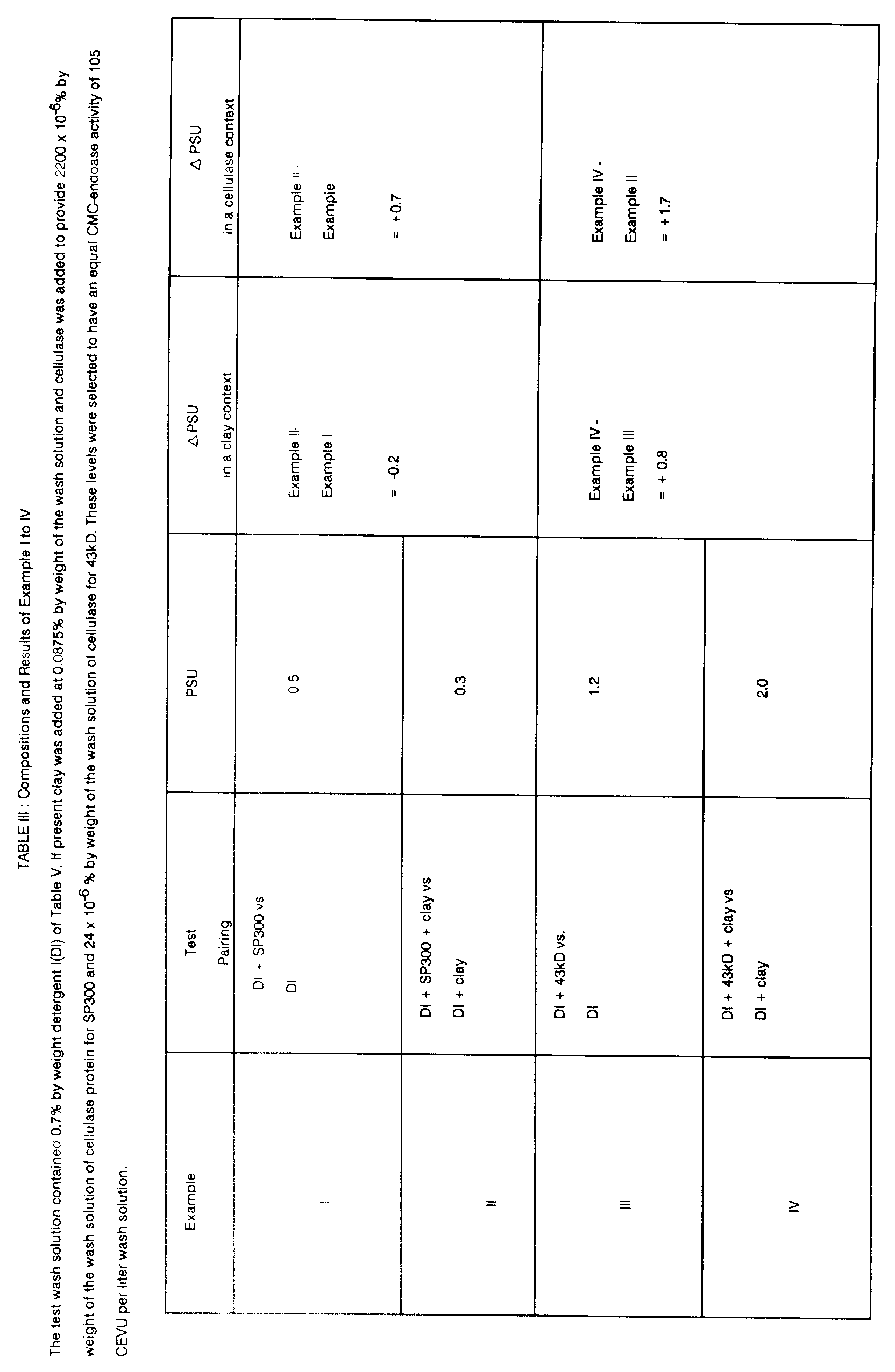


To facilitate a softness comparison, the following test procedure was used :
3.5 kg of clean fabric laundry loads are washed in an automatic drum washing machine MieleR 423 at 60°C for 1.5 hours. The hardness of the water was 2.5 mmol of Ca²⁺/Mg²⁺ per liter and the composition concentration was 0.7% in the wash liquid. For softness evaluation swatches of terry towel softness tracers were added. The softness tracers were line dried prior to assessment of softness.
Evaluation of test results was done with two methods:
Comparative softness assessment was done by expert judges using a scale of 0 to 4 panel-score-units (PSU). In this scale 0 is given for no difference and 4 is given for maximum difference. In this scale 0 is given for no difference and 4 is given for maximum difference. Softness was assessed after eight wash cycles on aged terry swatches, as defined below.
Another softness assessment is done by using a laboratory softness measurement device, the Kawabata KES - FB1 machine, Kato Tech Corporation Ltd. Japan.
In this machine the softness tracers are placed between two clamps which are movable relative to each other. Comparative softness was measured after eight wash cycles by shear hysteresis at 5 degree angle (2HG 5). A decrease in shear hysteresis reflects increased softness performance. Measurements are means of 3 user aged terry swatches. User aged is defined by a minimum of 10 normal washes.
EXAMPLES I TO IV : A basic detergent composition is evaluated to indicate the unexpected effect of higher-than-additive softening performance of the selected compositions vs. closest prior art which is considered to be EP-A-177 165.
Examples I and II supports the prior art theory of not creating an adverse effect by combining softening clay with cellulase. However, the result also indicates that this does not provide any benefit. In fact, since the combination of clay and cellulase of this prior art disclosure provides no benefit it may be speculated that the ecological and economical burden it creates, is the reason for its lack of commercial success.
Examples III and IV, IV being according to the invention, clearly indicate that the performance of softening clay and cellulase provides more-than-additive benefits.
From Example II the benefit of clay, in a prior art cellulase environment can be found to be 0.3 PSU. Turning to Example IV, which is tested in a 43kD cellulase environment, the result jumps to more than 6 times that number, reaching 2 PSU.
Full test results of Examples I to IV can be found in Table III. The detergent composition used is based on composition I of Table V. In the last two columns of Table III the dependence of the overall superiority of the present invention on the selected cellulase in combination with softening clay can be seen. However, this is even clearer exemplified in the following examples.
Examples V to VIII : A basic detergent composition, composition II of Table V, is evaluated in above described test procedure and measured with the Kawabata machine.
The reduction, expressing the softening, of the measurement for clay alone is 5%, for high activity cellulase alone is 15%. The expected value for the combination should therefore be about 20% which surprisingly is surpassed by this combination and reaches 39%, i.e. about twice the expected value.
Claims (24)
- A detergent composition comprizing a surface active agent, a builder system, a softening clay and a cellulase characterized in that said cellulase provides at least 10% removal of immobilized, radio-active labelled carboxylmethylcellulose according to the C14CMC-method at 25 x 10⁻⁶% by weight of cellulase protein in the laundry test solution.
- A detergent composition according to claim 1 characterized in that the cellulase compound consists essentially of a homogenous endoglucanase component which is immunoreactive with an antibody raised against a highly purified, about 43kD cellulase derived from Humicola insolens, DSM 1800, or which is homologous to said about 43kD endoglucanase.
- A detergent composition according to claim 2 wherein the endoglucanase component of said cellulase has an isoelectric point of about 5.1.
- A detergent composition according to claims 2 or 3 wherein said endoglucanase component is producible by a method comprising cultivating a host cell transformed with a recombinant DNA vector carrying a DNA sequence encoding said endoglucanase component or a precursor of said endoglucanase component, as well as DNA sequences encoding functions permitting the expression of the DNA sequence encoding the endoglucanase component, or a precursor thereof, in a culture medium under conditions permitting the expression of the endoglucanase component or precursor thereof and recovering the endoglucanase component from the culture.
- A detergent composition according to claim 1 characterized in that the cellulase compound is an endoglucanase enzyme having the amino acid sequence shown in the appended listing ID#2, or is a homologue thereof exhibiting endoglucanase activity.
- A detergent composition according to claim 5 wherein said endoglucanase enzyme is producible by a species of Humicola insolens.
- A detergent composition according to claim 1 characterized in that the cellulase compound is an endoglucanase enzyme having the amino acid sequence shown in the appended sequence listing ID#4, or is a homologue thereof exhibiting endoglucanase activity.
- A detergent composition according to claim 7 wherein said endoglucanase enzyme is producible by a species of Fusarium, e.g. Fusarium oxysporum.
- A detergent composition according to any of the claims 5 to 8 wherein said enzyme is produced by a DNA construct comprising a DNA sequence encoding the enzyme.
- A detergent composition according to claim 9 wherein the DNA sequence is as shown in the appended sequence listings ID # 1 or ID # 3.
- A detergent composition according to any of the claims 5 to 10 wherein said host cell is a strain of a fungus such as Tricloderuca or Aspergillus, preferably Aspergillus oryzae or Aspergillus niger, or a yeast cell belonging to a strain of Hansenula or Saccharomyces, e.g. a strain of Saccachomyces cerevisae.
- A detergent composition according to any of the claims 5 to 10 wherein said host cell is a strain of a bacterium, e.g. Bacillus, Streptomyces or E. coli.
- A detergent composition according to any of the preceding claims characterized in that said cellulase is present in an amount such that the amount of enzyme protein delivered to the wash solution is 0.005 to 40 mg/liter of wash solution, preferably 0.01 to 10 mg/liter of wash solution.
- A detergent composition according to any of the preceding claims characterized in that the amount of softening clay is from 0.5% to 50%, preferably from 5% to 20%, most preferably from 8% to 15%, by weight of the detergent composition.
- A detergent composition according to any of the preceding claims characterized in that said softening clay is a smectite, preferably a montmorillonite or hectorite, clay with a cation exchange capacity of at least 50 meq/100 g.
- A detergent composition according to any of the preceding claims characterized in that it further comprises up to 20% by weight of said clay of said detergent composition of a polymeric clay flocculating agent.
- A detergent composition according to claim 16 characterized in that it furter comprises up to 50%, preferably 0.1% to 20% by weight of said clay of said detergent composition of a substituted polysiloxane.
- A detergent composition according to any of the preceding claims which is a granular detergent.
- A detergent composition according to claim 18 wherein said composition contains no more than 15% by weight of inorganic filler salt and having a density of 550 to 950 g/liter of composition.
- A detergent composition according to claim 19 wherein said inorganic filler salt is selected from alkali and alkaline-earth metal salts of sulphate and chloride.
- A detergent composition in accordance with claims 19 or 20 which does not contain more than 10% by weight of inorganic filler salt.
- A detergent composition in accordance with claim 21 which does not contain more than 5% by weight of inorganic filler salt.
- A detergent composition according to any of the claims 19 to 22 which has a density of 650 to 850 g/liter.
- A detergent composition according to any of the preceding claims which is substantially free of phosphate compounds, and wherein said builder in addition to said polycarboxylate polymers further comprises compounds selected from aluminosilicate ion exchangers, citrates, carbonates and mixtures thereof.
Priority Applications (11)
| Application Number | Priority Date | Filing Date | Title |
|---|---|---|---|
| CA 2100554 CA2100554C (en) | 1991-01-16 | 1992-01-13 | Detergent compositions with high activity cellulase and softening clays |
| US08/090,013 US5443750A (en) | 1991-01-16 | 1992-01-13 | Detergent compositions with high activity cellulase and softening clays |
| BR9205428A BR9205428A (en) | 1991-01-16 | 1992-01-13 | Detergent compositions with high activity cellulase and softening clays |
| JP4506597A JPH06509122A (en) | 1991-01-16 | 1992-01-13 | Detergent composition containing highly active cellulase and softening clay |
| PH43773A PH30937A (en) | 1991-01-16 | 1992-01-14 | Detergent compositions with high activity cellulase and softening clays. |
| MA22673A MA22388A1 (en) | 1991-01-16 | 1992-01-15 | DETERGENT COMPOSITIONS COMPRISING HIGH ACTIVITY CELLULASE AND SOFTENING CLAYS |
| IE920117A IE920117A1 (en) | 1991-01-16 | 1992-01-15 | Detergent compositions with high activity cellulase and¹softening clays |
| PT10002992A PT100029B (en) | 1991-01-16 | 1992-01-16 | PROCESS FOR PREPARING A GRANULAR OR LIQUID DETERGENT COMPOSITION WITH HIGH CELLULOSE AND LOOSE CLAY |
| MX9200198A MX9200198A (en) | 1991-01-16 | 1992-01-16 | DETERGENT COMPOSITIONS WITH HIGH ACTIVITY CELLULA AND SOFTENING CLAYS. |
| IN34DE1992 IN185872B (en) | 1991-01-16 | 1992-01-16 | |
| TW081102736A TW260704B (en) | 1991-01-16 | 1992-04-09 |
Applications Claiming Priority (2)
| Application Number | Priority Date | Filing Date | Title |
|---|---|---|---|
| EP91870006.3A EP0495344A1 (en) | 1991-01-16 | Compact detergent compositions | |
| EP91870006 | 1991-01-16 |
Publications (1)
| Publication Number | Publication Date |
|---|---|
| EP0495258A1 true EP0495258A1 (en) | 1992-07-22 |
Family
ID=8209007
Family Applications (3)
| Application Number | Title | Priority Date | Filing Date |
|---|---|---|---|
| EP91202880A Withdrawn EP0495258A1 (en) | 1991-01-16 | 1991-11-06 | Detergent compositions with high activity cellulase and softening clays |
| EP91202879A Expired - Lifetime EP0495257B1 (en) | 1991-01-16 | 1991-11-06 | Compact detergent compositions with high activity cellulase |
| EP92904540A Ceased EP0646165A1 (en) | 1991-01-16 | 1992-01-16 | Detergent compositions containing lipase and water-soluble quaternary ammonium compounds |
Family Applications After (2)
| Application Number | Title | Priority Date | Filing Date |
|---|---|---|---|
| EP91202879A Expired - Lifetime EP0495257B1 (en) | 1991-01-16 | 1991-11-06 | Compact detergent compositions with high activity cellulase |
| EP92904540A Ceased EP0646165A1 (en) | 1991-01-16 | 1992-01-16 | Detergent compositions containing lipase and water-soluble quaternary ammonium compounds |
Country Status (22)
| Country | Link |
|---|---|
| EP (3) | EP0495258A1 (en) |
| JP (1) | JP2996726B2 (en) |
| KR (1) | KR100229561B1 (en) |
| AT (1) | ATE219136T1 (en) |
| AU (1) | AU661672B2 (en) |
| BR (2) | BR9205451A (en) |
| CA (1) | CA2100097A1 (en) |
| CZ (1) | CZ284448B6 (en) |
| DE (1) | DE69133035T2 (en) |
| ES (1) | ES2174820T3 (en) |
| FI (1) | FI933224L (en) |
| HU (1) | HU212981B (en) |
| IE (1) | IE920118A1 (en) |
| MA (1) | MA22389A1 (en) |
| NO (1) | NO304235B1 (en) |
| PL (1) | PL172961B1 (en) |
| PT (1) | PT100030B (en) |
| RU (1) | RU2108374C1 (en) |
| SG (1) | SG52693A1 (en) |
| SK (1) | SK72493A3 (en) |
| TW (1) | TW260704B (en) |
| WO (3) | WO1992013053A2 (en) |
Cited By (16)
| Publication number | Priority date | Publication date | Assignee | Title |
|---|---|---|---|---|
| WO1995000635A1 (en) * | 1993-06-28 | 1995-01-05 | The Procter & Gamble Company | Liquid detergent compositions containing cellulase and amine |
| WO1995024471A1 (en) * | 1994-03-08 | 1995-09-14 | Novo Nordisk A/S | Novel alkaline cellulases |
| WO1995027036A1 (en) * | 1994-03-30 | 1995-10-12 | The Procter & Gamble Company | Laundry detergent bars containing fabric softening clay and cellulase enzyme |
| WO1996008554A1 (en) * | 1994-09-16 | 1996-03-21 | Henkel Kommanditgesellschaft Auf Aktien | Enzyme-containing washing and bleaching agent in powder form |
| US5624835A (en) * | 1992-03-27 | 1997-04-29 | Novo Nordisk A/S | Endo-β-1,4-glucanase and a DNA sequence |
| US5707951A (en) * | 1995-03-03 | 1998-01-13 | The Procter & Gamble Company | Laundry composition containing dye fixatives and cellulase |
| WO1999009129A1 (en) * | 1997-08-14 | 1999-02-25 | The Procter & Gamble Company | Detergent compositions comprising a mannanase and a clay |
| US5883066A (en) * | 1993-06-28 | 1999-03-16 | The Procter & Gamble Company | Liquid detergent compositions containing cellulase and amine |
| GB2331305A (en) * | 1997-11-12 | 1999-05-19 | Mcbride Robert Ltd | Fabric softening granules |
| US5912157A (en) * | 1994-03-08 | 1999-06-15 | Novo Nordisk A/S | Alkaline cellulases |
| US6713442B2 (en) | 2001-10-10 | 2004-03-30 | Unilever Home & Personal Care Usa Division Of Conopco, Inc. | Detergent compositions |
| US6794349B2 (en) | 2001-10-10 | 2004-09-21 | Unilever Home & Personal Care Usa, Division Of Conopco, Inc. | Detergent compositions |
| WO2007071820A1 (en) | 2005-12-22 | 2007-06-28 | Ab Enzymes Oy | Novel enzymes |
| US7256032B2 (en) | 2005-12-22 | 2007-08-14 | Ab Enzymes Oy | Enzymes |
| EP2319920A1 (en) | 2005-12-22 | 2011-05-11 | ROAL Oy | Treatment of cellulosic material and enzymes useful therein |
| EP3293250A1 (en) * | 2016-09-07 | 2018-03-14 | The Procter & Gamble Company | A liquid detergent composition comprising cellulosic polymers and cellulase |
Families Citing this family (696)
| Publication number | Priority date | Publication date | Assignee | Title |
|---|---|---|---|---|
| CA2117997A1 (en) * | 1992-04-13 | 1993-10-28 | Robin G. Hall | Use of modified polyesters for the washing of cotton-containing fabrics |
| EP0686186B1 (en) * | 1993-02-26 | 1998-04-22 | The Procter & Gamble Company | Detergent compositions comprising high active enzyme granulates |
| US5443656A (en) * | 1993-07-30 | 1995-08-22 | Thetford Coporation | Cellulase, sodium bicarbonate and citric acid cleaning solution and methods of use |
| DE4325880A1 (en) * | 1993-08-02 | 1995-02-09 | Henkel Kgaa | Enzymatic detergent cobuilder |
| US5866525A (en) * | 1993-09-07 | 1999-02-02 | Colgate-Palmolive Company | Laundry detergent compositions containing lipase and soil release polymer |
| ATE318304T1 (en) | 1993-10-08 | 2006-03-15 | Novozymes As | AMYLASE VARIANTS |
| DE69411282T2 (en) * | 1993-10-22 | 1998-11-05 | Unilever Nv | TISSUE SOFTENING COMPOSITION |
| USH1468H (en) | 1994-04-28 | 1995-08-01 | Costa Jill B | Detergent compositions containing cellulase enzyme and selected perfumes for improved odor and stability |
| GB9426458D0 (en) * | 1994-12-31 | 1995-03-01 | Procter & Gamble | A detergent compositions comprising cellulytic enzyme |
| US5919271A (en) * | 1994-12-31 | 1999-07-06 | Procter & Gamble Company | Detergent composition comprising cellulase enzyme and nonionic cellulose ether |
| GB2297978A (en) † | 1995-02-15 | 1996-08-21 | Procter & Gamble | Detergent compositions containing amylase |
| EP2431462A3 (en) * | 1995-03-17 | 2012-05-23 | Novozymes A/S | Novel endoglucanases |
| EP0756001A1 (en) * | 1995-07-24 | 1997-01-29 | The Procter & Gamble Company | Detergent compositions comprising specific amylase and a specific surfactant system |
| CN1207759A (en) * | 1995-11-17 | 1999-02-10 | 普罗格特-甘布尔公司 | Laundry detergent compositions containing lipolytic enzymes and selected quaternary ammonium compounds |
| CA2255594C (en) * | 1996-05-17 | 2002-07-23 | The Procter & Gamble Company | Detergent composition |
| ZA974226B (en) * | 1996-05-17 | 1998-12-28 | Procter & Gamble | Detergent composition |
| WO1998004663A1 (en) * | 1996-07-30 | 1998-02-05 | The Procter & Gamble Company | Detergent composition comprising two cellulase components, with and without a cellulose-binding domain |
| WO1998017790A1 (en) * | 1996-10-17 | 1998-04-30 | Novo Nordisk A/S | Lipase, process for producing the same, microorganism producing the same, and use of the lipase |
| JP3739409B2 (en) * | 1996-10-18 | 2006-01-25 | ザ プロクター アンド ギャンブル カンパニー | Detergent composition |
| GB2323370A (en) * | 1997-03-20 | 1998-09-23 | Procter & Gamble | Detergent compositions |
| GB2323379A (en) * | 1997-03-20 | 1998-09-23 | Procter & Gamble | Detergent compositions |
| WO1998017755A1 (en) * | 1996-10-18 | 1998-04-30 | The Procter & Gamble Company | Detergent compositions comprising a mixture of cationic, anionic and nonionic surfactants |
| GB2323374A (en) * | 1997-03-20 | 1998-09-23 | Procter & Gamble | Detergent compositions |
| GB2323373A (en) * | 1997-03-20 | 1998-09-23 | Procter & Gamble | Detergent compositions |
| KR100591553B1 (en) | 1996-11-04 | 2006-06-19 | 노보자임스 에이/에스 | Subtilase variants and composition |
| CA2270593C (en) | 1996-11-04 | 2005-06-07 | Novo Nordisk A/S | Subtilase variants and compositions |
| WO1998028991A2 (en) * | 1996-12-11 | 1998-07-09 | Gist-Brocades B.V. | Cloudy fruit juices and methods for making same |
| WO1999002636A1 (en) * | 1997-07-11 | 1999-01-21 | The Procter & Gamble Company | Detergent compositions comprising a specific cellulase and a nil-phosphate containing chelant |
| RU2258735C2 (en) * | 1998-02-19 | 2005-08-20 | Колгейт-Палмолив Компани | Stable composition for softening textiles in glycerol monostearate softener-mediated rinsing cycle |
| EP2284272B1 (en) | 1998-06-10 | 2014-08-13 | Novozymes A/S | Mannanases |
| EP2302044A1 (en) | 1998-11-27 | 2011-03-30 | Novozymes A/S | Lipolytic enzyme variants |
| DE69943346D1 (en) | 1998-12-18 | 2011-05-19 | Novozymes As | Subtilase enzymes of the I-S1 and I-S2 subgroups with an additional amino acid residue in an active loop region |
| DE60041536D1 (en) | 1999-03-31 | 2009-03-26 | Novozymes As | POLYPEPTIDES WITH ALKALINE ALPHA AMYLASE ACTIVITY AND NUCLEIC ACIDS CODED FOR THESE |
| EP2011864B1 (en) | 1999-03-31 | 2014-12-31 | Novozymes A/S | Polypeptides having alkaline alpha-amylase activity and nucleic acids encoding same |
| US6565613B1 (en) * | 1999-04-29 | 2003-05-20 | Genencor International, Inc. | Cellulase detergent matrix |
| EP1183342B2 (en) | 1999-05-20 | 2012-06-13 | Novozymes A/S | Subtilase enzymes of the i-s1 and i-s2 sub-groups having at least one additional amino acid residue between positions 128 and 129 |
| ATE408678T1 (en) | 1999-05-20 | 2008-10-15 | Novozymes As | SUBTILASE ENZYMES OF THE I-S1 AND I-S2 SUBGROUPS WITH AT LEAST ONE ADDITIONAL AMINO ACID BETWEEN POSITIONS 129 AND 130 |
| DE60040149D1 (en) | 1999-05-20 | 2008-10-16 | Novozymes As | SUBTILASE ENZYMES OF I-S1 AND I-S2 SUB-GROUPS WITH AT LEAST ONE ADDITIONAL AMINO ACID RESISTANCE BETWEEN POSITIONS 126 AND 127 |
| DE60040282D1 (en) | 1999-05-20 | 2008-10-30 | Novozymes As | SUBTILASE ENZYMES OF I-S1 AND I-S2 SUB-GROUPS WITH AT LEAST ONE ADDITIONAL AMINO ACID BETWEEN POSITIONS 132 AND 133 |
| AU4392900A (en) | 1999-05-20 | 2000-12-12 | Novozymes A/S | Subtilase enzymes of the i-s1 and i-s2 sub-groups having at least one additionalamino acid residue between positions 127 and 128 |
| AU4393100A (en) | 1999-05-20 | 2000-12-12 | Novozymes A/S | Subtilase enzymes of the i-s1 and i-s2 sub-groups having at least one additionalamino acid residue between positions 125 and 126 |
| EP2206786A1 (en) | 1999-08-31 | 2010-07-14 | Novozymes A/S | Novel proteases and variants thereof |
| WO2002016547A2 (en) | 2000-08-21 | 2002-02-28 | Novozymes A/S | Subtilase enzymes |
| US20040091994A1 (en) | 2000-10-13 | 2004-05-13 | Carsten Andersen | Alpha-amylase variant with altered properties |
| EP2333055A1 (en) | 2000-10-13 | 2011-06-15 | Novozymes A/S | Subtilase variants |
| EP1241112A3 (en) | 2001-03-15 | 2003-02-26 | The Procter & Gamble Company | Flexible multiple compartment pouch |
| EP3000881A3 (en) | 2001-05-15 | 2016-07-20 | Novozymes A/S | Alpha-amylase variant with altered properties |
| DK2295544T3 (en) | 2001-06-26 | 2016-09-26 | Novozymes As | Polypeptides with cellobiohydrolase I activity and the same coding polynucleotides |
| DK200101090A (en) | 2001-07-12 | 2001-08-16 | Novozymes As | Subtilase variants |
| AU2003214037A1 (en) | 2002-03-27 | 2003-10-08 | Novozymes A/S | Granules with filamentous coatings |
| EP1520012B1 (en) | 2002-07-01 | 2009-01-07 | Novozymes A/S | Monopropylene glycol added to fermentation |
| ATE540108T1 (en) | 2002-10-01 | 2012-01-15 | Novozymes As | FAMILY GH 61 POLYPEPTIDES |
| TWI319007B (en) | 2002-11-06 | 2010-01-01 | Novozymes As | Subtilase variants |
| CN1738899A (en) | 2002-12-11 | 2006-02-22 | 诺和酶股份有限公司 | Detergent composition |
| WO2004056981A2 (en) | 2002-12-20 | 2004-07-08 | Novozymes A/S | Polypeptides having cellobiohydrolase ii activity and polynucleotides encoding same |
| JP2006517990A (en) | 2003-01-27 | 2006-08-03 | ノボザイムス アクティーゼルスカブ | Stabilization of granules |
| DE10303130A1 (en) * | 2003-01-28 | 2004-07-29 | Clariant Gmbh | Aqueous liquid detergent dispersion useful as a laundry detergent comprises anionic surfactant, builder and quaternary alkyl hydroxyethyl ammonium salt |
| CN1751116A (en) | 2003-02-18 | 2006-03-22 | 诺和酶股份有限公司 | Detergent compositions |
| ATE471370T1 (en) | 2003-05-02 | 2010-07-15 | Novozymes Inc | VARIANTS OF BETA-GLUCOSIDASES |
| EP1639106B1 (en) | 2003-06-19 | 2010-05-26 | Novozymes A/S | Proteases |
| AU2004252572B2 (en) | 2003-06-25 | 2011-09-08 | Novozymes A/S | Polypeptides having alpha-amylase activity and polypeptides encoding same |
| ES2538824T3 (en) | 2003-08-25 | 2015-06-24 | Novozymes, Inc. | Variants of glycoside hydrolases |
| BRPI0414959A (en) | 2003-10-10 | 2006-11-07 | Novozymes As | precursor protease variant, isolated nucleic acid sequence, recombinant nucleic acid construct, expression vector, and host cell, methods for producing the protease variant, for enhancing the nutritional value of an animal feed, and for treating proteins, a transgenic plant , or part of plant, transgenic, non-human animal, or products, or elements thereof, animal feed additive and composition, use of protease variant and / or composition, protease, and, 3d structure |
| WO2005040372A1 (en) | 2003-10-23 | 2005-05-06 | Novozymes A/S | Protease with improved stability in detergents |
| DK1682656T3 (en) | 2003-10-28 | 2013-11-18 | Novozymes Inc | Polypeptides with beta-glucosidase activity and polynucleotides encoding them |
| US7985569B2 (en) | 2003-11-19 | 2011-07-26 | Danisco Us Inc. | Cellulomonas 69B4 serine protease variants |
| WO2005052161A2 (en) | 2003-11-19 | 2005-06-09 | Genencor International, Inc. | Serine proteases, nucleic acids encoding serine enzymes and vectors and host cells incorporating same |
| WO2005066339A2 (en) | 2004-01-06 | 2005-07-21 | Novozymes A/S | Polypeptides of alicyclobacillus sp. |
| DK1713825T3 (en) | 2004-01-30 | 2012-11-05 | Novozymes Inc | Polypeptides with cellulolytically increasing activity and polynucleotides encoding the same |
| EP2325318A1 (en) | 2004-02-13 | 2011-05-25 | Novozymes A/S | Protease variants |
| US7148404B2 (en) | 2004-05-04 | 2006-12-12 | Novozymes A/S | Antimicrobial polypeptides |
| CN101014704A (en) | 2004-06-21 | 2007-08-08 | 诺维信公司 | protease |
| CA2571864C (en) | 2004-07-05 | 2014-09-23 | Novozymes A/S | Alpha-amylase variants with altered properties |
| DK1794296T3 (en) | 2004-09-21 | 2012-07-30 | Novozymes As | subtilases |
| WO2006032277A1 (en) | 2004-09-21 | 2006-03-30 | Novozymes A/S | Subtilases |
| DE602005026541D1 (en) | 2004-09-21 | 2011-04-07 | Novozymes As | SUBTILASES |
| US7666630B2 (en) | 2004-09-30 | 2010-02-23 | Novozymes, Inc. | Polypeptides having lipase activity and polynucleotides encoding same |
| WO2006063155A2 (en) | 2004-12-09 | 2006-06-15 | Dow Global Technologies, Inc. | Enzyme stabilization |
| CA2606475C (en) | 2005-04-27 | 2015-06-16 | Novozymes, Inc. | Polypeptides having endoglucanase activity and polynucleotides encoding same |
| EP2385111B1 (en) | 2005-07-08 | 2016-09-07 | Novozymes A/S | Subtilase variants |
| US8119387B2 (en) | 2005-08-16 | 2012-02-21 | Novozymes A/S | Polypeptides of strain Bacillus sp. P203 |
| CN101243182B (en) | 2005-08-16 | 2014-08-06 | 诺维信公司 | Subtilases |
| WO2007036235A1 (en) | 2005-09-30 | 2007-04-05 | Novozymes A/S | Immobilization of enzymes |
| EP1941023B1 (en) | 2005-09-30 | 2017-04-05 | Novozymes Inc. | Methods for enhancing the degradation or conversion of cellulosic material |
| EP1994130A1 (en) | 2006-03-02 | 2008-11-26 | Novozymes A/S | High capacity encapsulation process |
| WO2007107573A1 (en) | 2006-03-22 | 2007-09-27 | Novozymes A/S | Use of polypeptides having antimicrobial activity |
| EP2004789B1 (en) | 2006-03-31 | 2012-08-29 | Novozymes A/S | A stabilized liquid enzyme composition |
| JP5102198B2 (en) * | 2006-03-31 | 2012-12-19 | 花王株式会社 | Soft detergent composition |
| CA2649267C (en) | 2006-04-14 | 2014-08-12 | Genencor International, Inc. | One-step treatment of textiles |
| US20080015135A1 (en) * | 2006-05-05 | 2008-01-17 | De Buzzaccarini Francesco | Compact fluid laundry detergent composition |
| PT2041278T (en) | 2006-06-21 | 2017-10-17 | Novozymes North America Inc | Desizing and scouring process |
| WO2008057637A2 (en) | 2006-07-21 | 2008-05-15 | Novozymes, Inc. | Methods of increasing secretion of polypeptides having biological activity |
| EP2066785B1 (en) | 2006-08-11 | 2023-02-01 | Novozymes Biologicals, Inc. | Bacteria cultures and compositions comprising bacteria cultures |
| WO2008088493A2 (en) | 2006-12-21 | 2008-07-24 | Danisco Us, Inc., Genencor Division | Compositions and uses for an alpha-amylase polypeptide of bacillus species 195 |
| CN101617035A (en) | 2007-02-20 | 2009-12-30 | 诺维信公司 | Enzyme Foam Treatment for Laundry |
| BRPI0808513A2 (en) | 2007-03-09 | 2014-08-19 | Danisco Us Inc Genencor Div | ALPHA-AMILASE VARIANTS OF ALKALIFYL BACILLUS SPECIES, COMPOSITIONS UNDERSTANDING ALPHA-AMYLASE VARIANTS AND METHODS OF USE |
| WO2008118749A2 (en) | 2007-03-23 | 2008-10-02 | Novozymes Biologicals, Inc. | Preventing and reducing biofilm formation and planktonic proliferation |
| DE102007016139A1 (en) | 2007-03-30 | 2008-10-02 | Jenabios Gmbh | Method for regioselective oxygenation of N-heterocycles |
| SG148934A1 (en) | 2007-06-11 | 2009-01-29 | Novozymes As | A process for combined biopolishing and bleach clean-up |
| DE102007047433A1 (en) | 2007-10-04 | 2009-04-09 | Lanxess Deutschland Gmbh | Liquid washing and liquid cleaning agents |
| US7618801B2 (en) | 2007-10-30 | 2009-11-17 | Danison US Inc. | Streptomyces protease |
| EP2235173A2 (en) | 2007-12-19 | 2010-10-06 | Novozymes A/S | Polypeptides having cellulolytic enhancing activity and polynucleotides encoding same |
| WO2009095425A1 (en) | 2008-02-01 | 2009-08-06 | Novozymes A/S | Liquid enzyme composition |
| JP5973166B2 (en) | 2008-03-26 | 2016-08-23 | ノボザイムス アクティーゼルスカブ | Stabilized liquid enzyme composition |
| US20090253612A1 (en) | 2008-04-02 | 2009-10-08 | Symrise Gmbh & Co Kg | Particles having a high load of fragrance or flavor oil |
| MX2010011721A (en) | 2008-04-30 | 2010-11-30 | Danisco Inc | New chimeric alpha-amylase variants. |
| JP5599113B2 (en) | 2008-06-06 | 2014-10-01 | ダニスコ・ユーエス・インク | Saccharification enzyme composition and saccharification method thereof |
| BRPI0913378A2 (en) | 2008-06-06 | 2015-09-01 | Danisco Us Inc | Glucose production from starch using bacillus subtilis alpha-amylase |
| BRPI0915681A2 (en) | 2008-06-06 | 2015-08-04 | Danisco Us Inc | Compositions and methods comprising variant microbial proteases |
| MX350760B (en) | 2008-06-06 | 2017-09-18 | Danisco Us Inc | Variant alpha-amylases from bacillus subtilis and methods of use, thereof. |
| WO2010003934A1 (en) | 2008-07-07 | 2010-01-14 | Basf Se | Enzyme composition comprising enzyme containing polymer particles |
| EP2149786A1 (en) | 2008-08-01 | 2010-02-03 | Unilever PLC | Improvements relating to detergent analysis |
| DE212009000119U1 (en) | 2008-09-12 | 2011-12-30 | Unilever N.V. | Dispenser and pretreatment agent for viscous liquids |
| CA2738447C (en) | 2008-09-25 | 2019-01-08 | Danisco Us Inc. | Alpha-amylase blends and methods for using said blends |
| BRPI0922083A2 (en) | 2008-11-11 | 2017-05-30 | Danisco Us Inc | proteases comprising one or more combinable mutations |
| CN103396904B (en) | 2008-11-11 | 2015-12-23 | 宝洁公司 | Comprise composition and the method for serine protease variants |
| US8183024B2 (en) | 2008-11-11 | 2012-05-22 | Danisco Us Inc. | Compositions and methods comprising a subtilisin variant |
| BRPI0920925A2 (en) | 2008-11-11 | 2015-08-18 | Danisco Us Inc | Compositions and methods comprising a subtilisin variant |
| WO2010059413A2 (en) | 2008-11-20 | 2010-05-27 | Novozymes, Inc. | Polypeptides having amylolytic enhancing activity and polynucleotides encoding same |
| JP4494516B1 (en) * | 2008-11-21 | 2010-06-30 | 花王株式会社 | Liquid detergent composition |
| US7771983B2 (en) | 2008-12-04 | 2010-08-10 | Novozymos, Inc. | Polypeptides having cellulolytic enhancing activity and polynucleotides encoding same |
| US20110296557A1 (en) | 2008-12-12 | 2011-12-01 | Novozymes, Inc. | Polypeptides Having Lipase Activity And Polynucleotides Encoding Same |
| EP2379733A2 (en) | 2008-12-19 | 2011-10-26 | Novozymes Inc. | Methods for increasing hydrolysis of cellulosic material |
| US8338121B2 (en) | 2008-12-19 | 2012-12-25 | Novozymes, Inc. | Methods for determining cellulolytic enhancing activity of a polypeptide |
| CA2747056A1 (en) | 2008-12-19 | 2010-07-15 | Novozymes, Inc. | Methods for increasing enzymatic hydrolysis of cellulosic material in the presence of a peroxidase |
| CN107190030A (en) | 2008-12-19 | 2017-09-22 | 诺维信股份有限公司 | Increase the method for cellulosic material hydrolysis in the presence of cellobiose dehydrogenase |
| EP2202290A1 (en) | 2008-12-23 | 2010-06-30 | Unilever PLC | A flowable laundry composition and packaging therefor |
| BRPI0924180A8 (en) | 2008-12-24 | 2017-12-05 | Danisco Us Inc | LACCASES AND METHODS OF USE IN LOW TEMPERATURES |
| WO2010088387A1 (en) | 2009-01-28 | 2010-08-05 | Novozymes, Inc. | Polypeptides having beta-glucosidase activity and polynucleotides encoding same |
| WO2010088463A2 (en) | 2009-01-30 | 2010-08-05 | Novozymes, Inc. | Polypeptides having expansin activity and polynucleotides encoding same |
| WO2010097436A1 (en) | 2009-02-27 | 2010-09-02 | Novozymes A/S | Mutant cells having reduced expression of metallopeptidase, suitable for recombinant polypeptide production |
| KR20110139206A (en) | 2009-03-03 | 2011-12-28 | 다니스코 유에스 인크. | Oxidative Decolorization of Dyes with Enzymatically Generated Peracids-Kits of Methods, Compositions, and Parts |
| US20120172275A1 (en) | 2009-03-10 | 2012-07-05 | Danisco Us Inc. | Bacillus Megaterium Strain DSM90-Related Alpha-Amylases, and Methods of Use, Thereof |
| CN102365360A (en) | 2009-03-24 | 2012-02-29 | 诺维信公司 | Polypeptides having acetyl xylan esterase activity and polynucleotides encoding same |
| CN102388131B (en) | 2009-04-08 | 2014-04-30 | 丹尼斯科美国公司 | Halomonas strain WDG195-related alpha-amylases, and methods of use thereof |
| EP2435561B1 (en) | 2009-05-29 | 2018-08-08 | Novozymes Inc. | Methods for enhancing the degradation or conversion of cellulosic material |
| ES2534078T3 (en) | 2009-06-02 | 2015-04-17 | Novozymes Inc. | Polypeptides with cellobiohydrolase activity and polynucleotides encoding them |
| CA2767169A1 (en) | 2009-07-07 | 2011-01-13 | Novozymes, Inc. | Polypeptides having cellulolytic enhancing activity and polynucleotides encoding same |
| BR112012000492A2 (en) | 2009-07-09 | 2019-09-24 | Procter & Gamble | moderately alkaline, low adjuvant detergent composition comprising peroxycaproic phitalimide acid for solid tissue treatment |
| MX2012000480A (en) | 2009-07-09 | 2012-01-27 | Procter & Gamble | A catalytic laundry detergent composition comprising relatively low levels of water-soluble electrolyte. |
| JP2012532246A (en) | 2009-07-09 | 2012-12-13 | ザ プロクター アンド ギャンブル カンパニー | Catalytic laundry detergent composition comprising a relatively low concentration of a water-soluble electrolyte |
| EP2451922A1 (en) | 2009-07-09 | 2012-05-16 | The Procter & Gamble Company | Method of laundering fabric using a compacted liquid laundry detergent composition |
| PL2292725T5 (en) | 2009-08-13 | 2022-11-07 | The Procter And Gamble Company | Method of laundering fabrics at low temperature |
| MX2011008848A (en) | 2009-08-27 | 2011-09-29 | Danisco Us Inc | Combined textile abrading and color modification. |
| DK3269804T3 (en) | 2009-09-17 | 2020-11-23 | Novozymes Inc | POLYPEPTIDES WITH CELLULOLYSIS IMPROVING ACTIVITY AND POLYNUCLEOTIDES ENCODING THEM |
| EP2478095A1 (en) | 2009-09-18 | 2012-07-25 | Novozymes Inc. | Polypeptides having beta-glucosidase activity and polynucleotides encoding same |
| EP2480650B1 (en) | 2009-09-25 | 2017-03-22 | Novozymes A/S | Subtilase variants |
| CN102648277B (en) | 2009-09-25 | 2015-05-20 | 诺维信公司 | Use of protease variants |
| WO2011041397A1 (en) | 2009-09-29 | 2011-04-07 | Novozymes, Inc. | Polypeptides having cellulolytic enhancing activity and polynucleotides encoding same |
| CA2775347A1 (en) | 2009-09-29 | 2011-04-07 | Novozymes A/S | Polypeptides having xylanase activity and polynucleotides encoding same |
| WO2011039319A1 (en) | 2009-09-30 | 2011-04-07 | Novozymes A/S | Polypeptides having cellulolytic enhancing activity and polynucleotides encoding same |
| BR112012007375A2 (en) | 2009-09-30 | 2016-11-22 | Novozymes As | isolated polypeptide, isolated polynucleotide, methods for making a polypeptide, for producing a precursor cell mutant, for inhibiting expression of a polypeptide, for producing a protein, for degrading or converting a cellulosic material, for producing a fermentation product, and for ferment a cellulosic material, transgenic plant, transformed plant part or plant cell, double stranded inhibitory rna molecule, and detergent composition |
| WO2011050037A1 (en) | 2009-10-23 | 2011-04-28 | Novozymes, Inc. | Cellobiohydrolase variants and polynucleotides encoding same |
| CA2778471A1 (en) | 2009-10-23 | 2011-04-28 | Danisco Us Inc. | Methods for reducing blue saccharide |
| WO2011059740A1 (en) | 2009-10-29 | 2011-05-19 | Novozymes, Inc. | Polypeptides having cellobiohydrolase activity and polynucleotides encoding same |
| CN103068976A (en) | 2009-11-06 | 2013-04-24 | 诺维信股份有限公司 | Polypeptides having cellobiohydrolase activity and polynucleotides encoding same |
| DK2496692T3 (en) | 2009-11-06 | 2016-06-27 | Novozymes Inc | POLYPEPTIDES WITH xylanase AND POLYNUCLEOTIDES ENCODING THEM |
| CN102762222B (en) | 2009-12-09 | 2015-11-25 | 丹尼斯科美国公司 | Compositions and methods comprising protease variants |
| US20120258507A1 (en) | 2009-12-21 | 2012-10-11 | Danisco Us Inc. | Detergent compositions containing thermobifida fusca lipase and methods of use thereof |
| WO2011084417A1 (en) | 2009-12-21 | 2011-07-14 | Danisco Us Inc. | Detergent compositions containing geobacillus stearothermophilus lipase and methods of use thereof |
| BR112012017056A2 (en) | 2009-12-21 | 2016-11-22 | Danisco Us Inc | "Bacillus subtilis lipase-containing detergent compositions and methods for using them" |
| US20120220513A1 (en) | 2009-12-29 | 2012-08-30 | Novozymes A/S | Polypeptides Having Detergency Enhancing Effect |
| RU2012136133A (en) | 2010-01-22 | 2014-02-27 | ДюПон НЬЮТРИШН БАЙОСАЙЕНСИЗ АпС | METHODS FOR PRODUCING AMINO SUBSTITUTED GLYCOLIPID COMPOUNDS |
| EP2357220A1 (en) | 2010-02-10 | 2011-08-17 | The Procter & Gamble Company | Cleaning composition comprising amylase variants with high stability in the presence of a chelating agent |
| EP3892709A3 (en) | 2010-02-10 | 2022-01-19 | Novozymes A/S | Variants and compositions comprising variants with high stability in presence of a chelating agent |
| WO2011100667A1 (en) | 2010-02-14 | 2011-08-18 | Ls9, Inc. | Surfactant and cleaning compositions comprising microbially produced branched fatty alcohols |
| EP2536832B1 (en) | 2010-02-18 | 2015-02-25 | Danisco US Inc. | Amylase from nesterenkonia and methods of use thereof |
| JP5833576B2 (en) | 2010-02-25 | 2015-12-16 | ノボザイムス アクティーゼルスカブ | Variant of lysozyme and polynucleotide encoding the same |
| EP2363456A1 (en) | 2010-03-01 | 2011-09-07 | The Procter & Gamble Company | Solid laundry detergent composition comprising brightener in micronized particulate form |
| EP2380957A1 (en) | 2010-04-19 | 2011-10-26 | The Procter & Gamble Company | Solid laundry detergent composition having a dynamic in-wash ph profile |
| EP2365054A1 (en) | 2010-03-01 | 2011-09-14 | The Procter & Gamble Company | Solid laundry detergent composition comprising secondary alcohol-based detersive surfactant |
| EP2377914B1 (en) | 2010-04-19 | 2016-11-09 | The Procter & Gamble Company | Mildly alkaline, low-built, solid fabric treatment detergent composition comprising perhydrolase |
| EP2365058A1 (en) | 2010-03-01 | 2011-09-14 | The Procter & Gamble Company | Solid laundry detergent composition having an excellent anti-encrustation profile |
| EP2365059A1 (en) | 2010-03-01 | 2011-09-14 | The Procter & Gamble Company | Solid laundry detergent composition comprising C.I. fluorescent brightener 260 in alpha-crystalline form |
| WO2011123450A1 (en) | 2010-03-31 | 2011-10-06 | Novozymes, Inc. | Cellobiohydrolase variants and polynucleotides encoding same |
| CN102858970B (en) | 2010-04-15 | 2017-07-21 | 丹尼斯科美国公司 | Composition and method comprising misfolded proteins enzyme |
| US20110257069A1 (en) | 2010-04-19 | 2011-10-20 | Stephen Joseph Hodson | Detergent composition |
| US20110257062A1 (en) | 2010-04-19 | 2011-10-20 | Robert Richard Dykstra | Liquid laundry detergent composition comprising a source of peracid and having a ph profile that is controlled with respect to the pka of the source of peracid |
| US20110257060A1 (en) | 2010-04-19 | 2011-10-20 | Robert Richard Dykstra | Laundry detergent composition comprising bleach particles that are suspended within a continuous liquid phase |
| RU2573907C2 (en) | 2010-04-26 | 2016-01-27 | Новозимс А/С | Granule for use in powder detergents and composition of granule detergent |
| WO2011140316A1 (en) | 2010-05-06 | 2011-11-10 | The Procter & Gamble Company | Consumer products with protease variants |
| AR081423A1 (en) | 2010-05-28 | 2012-08-29 | Danisco Us Inc | DETERGENT COMPOSITIONS WITH STREPTOMYCES GRISEUS LIPASE CONTENT AND METHODS TO USE THEM |
| EP2395071A1 (en) | 2010-06-10 | 2011-12-14 | The Procter & Gamble Company | Solid detergent composition comprising lipase of bacterial origin |
| ES2394066T3 (en) | 2010-06-24 | 2013-01-16 | The Procter & Gamble Company | Stable compositions comprising cationic cellulose polymer and cellulase |
| EP2588604B1 (en) | 2010-06-30 | 2016-06-29 | Novozymes, Inc. | Polypeptides having beta-glucosidase activity and polynucleotides encoding same |
| WO2012021401A1 (en) | 2010-08-12 | 2012-02-16 | Novozymes, Inc. | Compositions comprising a polypeptide having cellulolytic enhancing activity and a bicyclic compound and uses thereof |
| EP2616483A1 (en) | 2010-09-16 | 2013-07-24 | Novozymes A/S | Lysozymes |
| EP2622068B1 (en) | 2010-09-30 | 2016-07-20 | Novozymes, Inc. | Variants of polypeptides having cellulolytic enhancing activity and polynucleotides encoding same |
| EP2622070B1 (en) | 2010-09-30 | 2016-08-03 | Novozymes, Inc. | Variants of polypeptides having cellulolytic enhancing activity and polynucleotides encoding same |
| WO2012054485A1 (en) | 2010-10-18 | 2012-04-26 | Danisco Us Inc. | Local color modification of dyed fabrics using a laccase system |
| WO2012068509A1 (en) | 2010-11-18 | 2012-05-24 | Novozymes, Inc. | Chimeric polypeptides having cellulolytic enhancing activity and polynucleotides encoding same |
| US8927235B2 (en) | 2010-12-06 | 2015-01-06 | Novozymes A/S | Methods of hydrolyzing oligomers in hemicellulosic liquor |
| US9157075B2 (en) | 2011-01-26 | 2015-10-13 | Novozymes, Inc. | Polypeptides having cellobiohydrolase activity and polynucleotides encoding same |
| WO2012103322A1 (en) | 2011-01-26 | 2012-08-02 | Novozymes A/S | Polypeptides having endoglucanase activity and polynucleotides encoding same |
| DK2670853T3 (en) | 2011-01-31 | 2017-08-28 | Novozymes North America Inc | Process for enzymatic refining of pretreated cellulosic material for sugars |
| CA2827405C (en) | 2011-02-15 | 2023-01-10 | Novozymes Biologicals, Inc. | Mitigation of odor in cleaning machines and cleaning processes |
| JP2014506945A (en) | 2011-02-16 | 2014-03-20 | ノボザイムス アクティーゼルスカブ | Detergent composition containing metalloprotease |
| JP2014511409A (en) | 2011-02-16 | 2014-05-15 | ノボザイムス アクティーゼルスカブ | Detergent composition containing metalloprotease |
| US20140024103A1 (en) | 2011-02-16 | 2014-01-23 | Astrid Benie | Detergent Compositions Comprising Metalloproteases |
| EP2678352B1 (en) | 2011-02-23 | 2017-12-06 | Novozymes, Inc. | Polypeptides having cellulolytic enhancing activity and polynucleotides encoding same |
| US9879294B2 (en) | 2011-03-25 | 2018-01-30 | Novozymes A/S | Methods for degrading or converting cellulosic material |
| WO2012135659A2 (en) | 2011-03-31 | 2012-10-04 | Novozymes A/S | Methods for enhancing the degradation or conversion of cellulosic material |
| EP2694537A1 (en) | 2011-04-08 | 2014-02-12 | Danisco US Inc. | Compositions |
| EP2702152A1 (en) | 2011-04-29 | 2014-03-05 | Danisco US Inc. | Detergent compositions containing bacillus sp. mannanase and methods of use thereof |
| DK2702162T3 (en) | 2011-04-29 | 2020-05-18 | Novozymes Inc | PROCEDURES FOR IMPROVING THE DEGRADATION OR CONVERSION OF CELLULOSE SUBSTANCES |
| EP2712363A1 (en) | 2011-04-29 | 2014-04-02 | Danisco US Inc. | Detergent compositions containing geobacillus tepidamans mannanase and methods of use thereof |
| CN103608356A (en) | 2011-04-29 | 2014-02-26 | 丹尼斯科美国公司 | Detergent compositions containing bacillus agaradhaerens mannanase and methods of use thereof |
| CN106065381B (en) | 2011-05-05 | 2019-07-26 | 宝洁公司 | Composition and method comprising serine protease variants |
| CA3194062A1 (en) | 2011-05-05 | 2012-11-08 | Danisco Us Inc. | Compositions and methods comprising serine protease variants |
| EP2537918A1 (en) | 2011-06-20 | 2012-12-26 | The Procter & Gamble Company | Consumer products with lipase comprising coated particles |
| CN107475235B (en) | 2011-06-20 | 2022-09-13 | 诺维信公司 | Particulate composition |
| CN103620029B (en) | 2011-06-24 | 2017-06-09 | 诺维信公司 | Polypeptide and their polynucleotides of coding with proteinase activity |
| EP2726500B1 (en) | 2011-06-30 | 2019-03-20 | Novozymes A/S | Method for screening alpha-amylases |
| BR112013033816A2 (en) | 2011-07-01 | 2017-02-14 | Novozymes A / S | boron free liquid detergent composition |
| BR112013033811A2 (en) | 2011-07-01 | 2017-02-14 | Novozymes A / S | composition, method of preparing the composition, and |
| US10711262B2 (en) | 2011-07-12 | 2020-07-14 | Novozymes A/S | Storage-stable enzyme granules |
| EP2744898A1 (en) | 2011-08-15 | 2014-06-25 | Novozymes A/S | Polypeptides having cellulase activity and polynucleotides encoding same |
| US20140295027A1 (en) | 2011-08-19 | 2014-10-02 | Novozymes A/S | Polypeptides Having Protease Activity |
| CN103781903A (en) | 2011-08-31 | 2014-05-07 | 丹尼斯科美国公司 | Compositions and methods comprising a lipolytic enzyme variant |
| EP2756091A1 (en) | 2011-09-13 | 2014-07-23 | Novozymes North America, Inc. | Methods of hydrolyzing and fermenting cellulosic material |
| ES2628190T3 (en) | 2011-09-22 | 2017-08-02 | Novozymes A/S | Polypeptides with protease activity and polynucleotides encoding them |
| EP3845641A1 (en) | 2011-10-28 | 2021-07-07 | Danisco US Inc. | Variant maltohexaose-forming alpha-amylase variants |
| CN103958672A (en) | 2011-11-21 | 2014-07-30 | 诺维信股份有限公司 | GH61 polypeptide variants and polynucleotides encoding same |
| US20140342433A1 (en) | 2011-11-25 | 2014-11-20 | Novozymes A/S | Subtilase Variants and Polynucleotides Encoding Same |
| JP6105615B2 (en) | 2011-11-25 | 2017-03-29 | ノボザイムス アクティーゼルスカブ | Polypeptide having lysozyme activity and polynucleotide encoding the same |
| WO2013087027A1 (en) | 2011-12-16 | 2013-06-20 | Novozymes, Inc. | Polypeptides having laccase activity and polynucleotides encoding same |
| MX2014007446A (en) | 2011-12-20 | 2014-08-01 | Novozymes As | Subtilase variants and polynucleotides encoding same. |
| EP2607468A1 (en) | 2011-12-20 | 2013-06-26 | Henkel AG & Co. KGaA | Detergent compositions comprising subtilase variants |
| EP2794866A1 (en) | 2011-12-22 | 2014-10-29 | Danisco US Inc. | Compositions and methods comprising a lipolytic enzyme variant |
| EP2794867A1 (en) | 2011-12-22 | 2014-10-29 | Danisco US Inc. | Variant alpha-amylases and methods of use, thereof |
| ES2667318T3 (en) | 2011-12-28 | 2018-05-10 | Novozymes A/S | Polypeptides with protease activity |
| ES2887576T3 (en) | 2011-12-29 | 2021-12-23 | Novozymes As | Detergent compositions with lipase variants |
| US9801398B2 (en) | 2012-01-26 | 2017-10-31 | Novozymes A/S | Use of polypeptides having protease activity in animal feed and detergents |
| MX350713B (en) | 2012-02-17 | 2017-09-14 | Novozymes As | Subtilisin variants and polynucleotides encoding same. |
| EP2628785B1 (en) | 2012-02-17 | 2016-05-18 | Henkel AG & Co. KGaA | Detergent compositions comprising subtilase variants |
| US10087401B2 (en) | 2012-03-16 | 2018-10-02 | Monosol, Llc | Water soluble compositions incorporating enzymes, and method of making same |
| WO2013148492A1 (en) | 2012-03-29 | 2013-10-03 | Novozymes A/S | Use of enzymes for preparing water soluble films |
| US9394092B2 (en) | 2012-04-16 | 2016-07-19 | Monosol, Llc | Powdered pouch and method of making same |
| EP2841570B1 (en) | 2012-04-23 | 2017-12-20 | Novozymes A/S | Polypeptides having glucuronyl esterase activity and polynucleotides encoding same |
| US9446102B2 (en) | 2012-04-23 | 2016-09-20 | Novozymes A/S | Polypeptides having alpha-glucuronidase activity and polynucleotides encoding same |
| CN104245926B (en) | 2012-04-27 | 2021-05-07 | 诺维信股份有限公司 | GH61 polypeptide variants and polynucleotides encoding same |
| CN113201519A (en) | 2012-05-07 | 2021-08-03 | 诺维信公司 | Polypeptides having xanthan degrading activity and nucleotides encoding same |
| JP2015518707A (en) | 2012-05-11 | 2015-07-06 | ダニスコ・ユーエス・インク | Use of ASPERGILLUSCLAVATUS-derived alpha amylase for saccharification |
| WO2013171241A1 (en) | 2012-05-16 | 2013-11-21 | Novozymes A/S | Compositions comprising lipase and methods of use thereof |
| ES2909509T3 (en) | 2012-06-08 | 2022-05-06 | Danisco Us Inc | Alpha-amylases variant with higher activity on starch polymers |
| EP2861749A1 (en) | 2012-06-19 | 2015-04-22 | Novozymes Bioag A/S | Enzymatic reduction of hydroperoxides |
| MX364390B (en) | 2012-06-20 | 2019-04-25 | Novozymes As | Use of polypeptides having protease activity in animal feed and detergents. |
| CN104583394B (en) | 2012-08-16 | 2019-06-07 | 诺维信公司 | Textile treating method with endoglucanases |
| US20150218606A1 (en) | 2012-08-16 | 2015-08-06 | Danisco Us Inc. | Method of using alpha-amylase from aspergillus clavatus and pullulanase for saccharification |
| WO2014029820A1 (en) | 2012-08-22 | 2014-02-27 | Novozymes A/S | Detergent compositions comprising metalloproteases |
| MX2015002211A (en) | 2012-08-22 | 2015-05-08 | Novozymes As | Metalloprotease from exiguobacterium. |
| US9315791B2 (en) | 2012-08-22 | 2016-04-19 | Novozymes A/S | Metalloproteases from alicyclobacillus |
| CN110093330B (en) | 2012-10-12 | 2023-11-28 | 丹尼斯科美国公司 | Compositions and methods comprising lipolytic enzyme variants |
| EP2914611B1 (en) | 2012-11-01 | 2018-08-29 | Novozymes A/S | Method for removal of dna |
| EP2914720B1 (en) | 2012-11-05 | 2022-08-31 | Danisco US Inc. | Compositions and methods comprising thermolysin protease variants |
| EP2922951B1 (en) | 2012-11-20 | 2017-08-23 | Danisco US Inc. | Amylase with maltogenic properties |
| WO2014086659A2 (en) | 2012-12-06 | 2014-06-12 | Ahmedabad Textile Industry's Research Association | Method for enzymatical preparation of textiles |
| TR201910918T4 (en) | 2012-12-07 | 2019-08-21 | Novozymes As | Prevention of bacterial adhesion. |
| EP3321353A1 (en) | 2012-12-11 | 2018-05-16 | Danisco US Inc. | Yeast host cells epxressing a glucoamylase from aspergillus fumigatus and methods of use thereof |
| EP2931911A1 (en) | 2012-12-14 | 2015-10-21 | Danisco US Inc. | Method of using alpha-amylase from aspergillus fumigatus and isoamylase for saccharification |
| WO2014090940A1 (en) | 2012-12-14 | 2014-06-19 | Novozymes A/S | Removal of skin-derived body soils |
| WO2014100018A1 (en) | 2012-12-19 | 2014-06-26 | Danisco Us Inc. | Novel mannanase, compositions and methods of use thereof |
| WO2014099415A1 (en) | 2012-12-20 | 2014-06-26 | Danisco Us Inc. | Method of using alpha-amylase from aspergillus terreus and pullulanase for saccharification |
| US9551042B2 (en) | 2012-12-21 | 2017-01-24 | Novozymes A/S | Polypeptides having protease activity and polynucleotides encoding same |
| WO2014099525A1 (en) | 2012-12-21 | 2014-06-26 | Danisco Us Inc. | Paenibacillus curdlanolyticus amylase, and methods of use, thereof |
| US20160053243A1 (en) | 2012-12-21 | 2016-02-25 | Danisco Us Inc. | Alpha-amylase variants |
| EP3321360A3 (en) | 2013-01-03 | 2018-06-06 | Novozymes A/S | Alpha-amylase variants and polynucleotides encoding same |
| ES2676895T5 (en) | 2013-03-11 | 2022-04-27 | Danisco Us Inc | Combinatorial variants of alpha-amylase |
| US20160024440A1 (en) | 2013-03-14 | 2016-01-28 | Novozymes A/S | Enzyme and Inhibitor Containing Water-Soluble Films |
| US9631164B2 (en) | 2013-03-21 | 2017-04-25 | Novozymes A/S | Polypeptides with lipase activity and polynucleotides encoding same |
| WO2014173980A2 (en) | 2013-04-23 | 2014-10-30 | Novozymes A/S | Liquid automatic dish washing detergent compositions |
| CN105164244B (en) | 2013-05-03 | 2019-08-20 | 诺维信公司 | Microencapsulation of detergent enzymes |
| MX392247B (en) | 2013-05-14 | 2025-03-24 | Novozymes As | DETERGENT COMPOSITIONS. |
| US20160083703A1 (en) | 2013-05-17 | 2016-03-24 | Novozymes A/S | Polypeptides having alpha amylase activity |
| EP3004314B1 (en) | 2013-05-29 | 2018-06-20 | Danisco US Inc. | Novel metalloproteases |
| JP2016526880A (en) | 2013-05-29 | 2016-09-08 | ダニスコ・ユーエス・インク | Novel metalloprotease |
| EP3260538B1 (en) | 2013-05-29 | 2021-04-14 | Danisco US Inc. | Novel metalloproteases |
| EP3004342B1 (en) | 2013-05-29 | 2023-01-11 | Danisco US Inc. | Novel metalloproteases |
| WO2014191170A1 (en) | 2013-05-30 | 2014-12-04 | Novozymes A/S | Particulate enzyme composition |
| CN114634921B (en) | 2013-06-06 | 2024-09-10 | 诺维信公司 | Alpha-amylase variants and polynucleotides encoding same |
| PE20160799A1 (en) | 2013-06-12 | 2016-09-03 | Earth Alive Clean Tech Inc | DUST SUPPRESSOR |
| WO2014200656A1 (en) | 2013-06-13 | 2014-12-18 | Danisco Us Inc. | Alpha-amylase from streptomyces umbrinus |
| WO2014200658A1 (en) | 2013-06-13 | 2014-12-18 | Danisco Us Inc. | Alpha-amylase from promicromonospora vindobonensis |
| WO2014200657A1 (en) | 2013-06-13 | 2014-12-18 | Danisco Us Inc. | Alpha-amylase from streptomyces xiamenensis |
| EP3011020A1 (en) | 2013-06-17 | 2016-04-27 | Danisco US Inc. | Alpha-amylase from bacillaceae family member |
| WO2014207227A1 (en) | 2013-06-27 | 2014-12-31 | Novozymes A/S | Subtilase variants and polynucleotides encoding same |
| WO2014207224A1 (en) | 2013-06-27 | 2014-12-31 | Novozymes A/S | Subtilase variants and polynucleotides encoding same |
| RU2696500C9 (en) | 2013-07-03 | 2019-10-31 | Басф Се | Gel-like polymer composition obtained by polymerisation of acid group-containing monomer in presence of polyether compound |
| JP2016523098A (en) | 2013-07-04 | 2016-08-08 | ノボザイムス アクティーゼルスカブ | Polypeptide having anti-reattachment effect and polynucleotide encoding the same |
| WO2015004102A1 (en) | 2013-07-09 | 2015-01-15 | Novozymes A/S | Polypeptides with lipase activity and polynucleotides encoding same |
| EP2824170B1 (en) | 2013-07-12 | 2018-11-14 | The Procter & Gamble Company | Structured liquid compositions |
| ES2956266T3 (en) | 2013-07-19 | 2023-12-18 | Danisco Us Inc | Compositions and methods comprising a lipolytic enzyme variant |
| CN105358686A (en) | 2013-07-29 | 2016-02-24 | 诺维信公司 | Protease variants and polynucleotides encoding same |
| EP3027747B1 (en) | 2013-07-29 | 2018-02-07 | Novozymes A/S | Protease variants and polynucleotides encoding same |
| EP2832853A1 (en) | 2013-07-29 | 2015-02-04 | Henkel AG&Co. KGAA | Detergent composition comprising protease variants |
| BR112016005286A2 (en) | 2013-09-12 | 2017-09-12 | Danisco Us Inc | compositions and methods comprising lg12 clade protease variants |
| WO2015049370A1 (en) | 2013-10-03 | 2015-04-09 | Novozymes A/S | Detergent composition and use of detergent composition |
| WO2015050724A1 (en) | 2013-10-03 | 2015-04-09 | Danisco Us Inc. | Alpha-amylases from a subset of exiguobacterium, and methods of use, thereof |
| EP3060659B1 (en) | 2013-10-03 | 2019-05-29 | Danisco US Inc. | Alpha-amylases from exiguobacterium, and methods of use, thereof |
| JP6560214B2 (en) | 2013-11-20 | 2019-08-14 | ダニスコ・ユーエス・インク | Mutant α-amylase with reduced sensitivity to protease cleavage and method of use thereof |
| EP3514230B1 (en) | 2013-12-13 | 2021-09-22 | Danisco US Inc. | Serine proteases of bacillus species |
| EP3910057A1 (en) | 2013-12-13 | 2021-11-17 | Danisco US Inc. | Serine proteases of the bacillus gibsonii-clade |
| EP4163305B1 (en) | 2013-12-16 | 2024-07-10 | Nutrition & Biosciences USA 4, Inc. | Use of poly alpha-1,3-glucan ethers as viscosity modifiers |
| KR102410391B1 (en) | 2013-12-18 | 2022-06-16 | 뉴트리션 앤드 바이오사이언시스 유에스에이 4, 인크. | Cationic poly alpha-1,3-glucan ethers |
| WO2015094809A1 (en) | 2013-12-19 | 2015-06-25 | Danisco Us Inc. | Chimeric fungal alpha-amylases comprising carbohydrate binding module and the use thereof |
| EP3453757B1 (en) | 2013-12-20 | 2020-06-17 | Novozymes A/S | Polypeptides having protease activity and polynucleotides encoding same |
| EP3097112B1 (en) | 2014-01-22 | 2020-05-13 | Novozymes A/S | Polypeptides with lipase activity and polynucleotides encoding same |
| EP3105256A1 (en) | 2014-02-14 | 2016-12-21 | E. I. du Pont de Nemours and Company | Poly-alpha-1,3-1,6-glucans for viscosity modification |
| CN106062270A (en) | 2014-03-05 | 2016-10-26 | 诺维信公司 | Compositions and methods for improving the properties of non-cellulosic textile materials using endo-xyloglucan glycosyltransferases |
| CN106062271A (en) | 2014-03-05 | 2016-10-26 | 诺维信公司 | Compositions and methods for improving properties of cellulosic textile materials with xyloglucan endotransglycosylase |
| US9695253B2 (en) | 2014-03-11 | 2017-07-04 | E I Du Pont De Nemours And Company | Oxidized poly alpha-1,3-glucan |
| US10155935B2 (en) | 2014-03-12 | 2018-12-18 | Novozymes A/S | Polypeptides with lipase activity and polynucleotides encoding same |
| US20170096653A1 (en) | 2014-03-21 | 2017-04-06 | Danisco Us Inc. | Serine proteases of bacillus species |
| WO2015150457A1 (en) | 2014-04-01 | 2015-10-08 | Novozymes A/S | Polypeptides having alpha amylase activity |
| CN106164236B (en) | 2014-04-11 | 2021-02-02 | 诺维信公司 | Detergent composition |
| US10030215B2 (en) | 2014-04-15 | 2018-07-24 | Novozymes A/S | Polypeptides with lipase activity and polynucleotides encoding same |
| EP3149178B1 (en) | 2014-05-27 | 2020-07-15 | Novozymes A/S | Lipase variants and polynucleotides encoding same |
| AR100605A1 (en) | 2014-05-27 | 2016-10-19 | Novozymes As | METHODS FOR LIPASE PRODUCTION |
| US20170121695A1 (en) | 2014-06-12 | 2017-05-04 | Novozymes A/S | Alpha-amylase variants and polynucleotides encoding same |
| US9714403B2 (en) | 2014-06-19 | 2017-07-25 | E I Du Pont De Nemours And Company | Compositions containing one or more poly alpha-1,3-glucan ether compounds |
| WO2015195777A1 (en) | 2014-06-19 | 2015-12-23 | E. I. Du Pont De Nemours And Company | Compositions containing one or more poly alpha-1,3-glucan ether compounds |
| WO2016001319A1 (en) | 2014-07-03 | 2016-01-07 | Novozymes A/S | Improved stabilization of non-protease enzyme |
| EP3739029A1 (en) | 2014-07-04 | 2020-11-18 | Novozymes A/S | Subtilase variants and polynucleotides encoding same |
| EP3327122B1 (en) | 2014-07-04 | 2021-02-17 | Novozymes A/S | Subtilase variants and polynucleotides encoding same |
| EP2963100B1 (en) | 2014-07-04 | 2018-09-19 | Kolb Distribution Ltd. | Liquid rinse aid compositions |
| EP2979682B1 (en) | 2014-07-30 | 2018-09-05 | Symrise AG | A fragrance composition |
| KR102544927B1 (en) | 2014-10-03 | 2023-06-16 | 모노졸, 엘엘씨 | Degradable materials and packaging made from same |
| DK3207129T3 (en) | 2014-10-17 | 2020-02-24 | Danisco Us Inc | SERIN PROTEAS OF THE BACILLUS ART |
| EP3212782B1 (en) | 2014-10-27 | 2019-04-17 | Danisco US Inc. | Serine proteases |
| WO2016069552A1 (en) | 2014-10-27 | 2016-05-06 | Danisco Us Inc. | Serine proteases |
| WO2016069557A1 (en) | 2014-10-27 | 2016-05-06 | Danisco Us Inc. | Serine proteases of bacillus species |
| US20170335306A1 (en) | 2014-10-27 | 2017-11-23 | Danisco Us Inc. | Serine proteases |
| EP4403631A3 (en) | 2014-10-27 | 2024-10-30 | Danisco US Inc. | Serine proteases |
| WO2016079110A2 (en) | 2014-11-19 | 2016-05-26 | Novozymes A/S | Use of enzyme for cleaning |
| WO2016079305A1 (en) | 2014-11-20 | 2016-05-26 | Novozymes A/S | Alicyclobacillus variants and polynucleotides encoding same |
| MX2017006695A (en) | 2014-12-04 | 2017-08-21 | Novozymes As | SUBTILASS AND POLYNUCLEOTID VARIANTS CODING THEM. |
| EP3227442B1 (en) | 2014-12-05 | 2022-02-16 | Novozymes A/S | Lipase variants and polynucleotides encoding same |
| PL3608403T3 (en) | 2014-12-15 | 2025-06-23 | Henkel Ag & Co. Kgaa | Detergent composition comprising subtilase variants |
| US20180000076A1 (en) | 2014-12-16 | 2018-01-04 | Novozymes A/S | Polypeptides Having N-Acetyl Glucosamine Oxidase Activity |
| EP3741849A3 (en) | 2014-12-19 | 2021-03-17 | Novozymes A/S | Protease variants and polynucleotides encoding same |
| WO2016097352A1 (en) | 2014-12-19 | 2016-06-23 | Novozymes A/S | Protease variants and polynucleotides encoding same |
| DK3268471T3 (en) | 2015-03-12 | 2019-12-02 | Danisco Us Inc | COMPOSITIONS AND METHODS OF COMPREHENSIVE LG12 CLADE PROTEASE VARIETIES |
| WO2016162556A1 (en) | 2015-04-10 | 2016-10-13 | Novozymes A/S | Laundry method, use of dnase and detergent composition |
| CN107636134A (en) | 2015-04-10 | 2018-01-26 | 诺维信公司 | Detergent composition |
| EP3872174B1 (en) | 2015-05-13 | 2023-03-01 | Danisco US Inc. | Aprl-clade protease variants and uses thereof |
| WO2016184944A1 (en) | 2015-05-19 | 2016-11-24 | Novozymes A/S | Odor reduction |
| WO2016196021A1 (en) | 2015-06-01 | 2016-12-08 | E I Du Pont De Nemours And Company | Structured liquid compositions comprising colloidal dispersions of poly alpha-1,3-glucan |
| WO2016201040A1 (en) | 2015-06-09 | 2016-12-15 | Danisco Us Inc. | Water-triggered enzyme suspension |
| WO2016201069A1 (en) | 2015-06-09 | 2016-12-15 | Danisco Us Inc | Low-density enzyme-containing particles |
| US20180134997A1 (en) | 2015-06-09 | 2018-05-17 | Danisco Us Inc. | Osmotic burst encapsulates |
| EP3310908B1 (en) | 2015-06-16 | 2020-08-05 | Novozymes A/S | Polypeptides with lipase activity and polynucleotides encoding same |
| EP3310688A1 (en) | 2015-06-17 | 2018-04-25 | Novozymes A/S | Container |
| EP4234693A3 (en) | 2015-06-17 | 2023-11-01 | Danisco US Inc | Bacillus gibsonii-clade serine proteases |
| CN121406620A (en) | 2015-06-18 | 2026-01-27 | 诺维信公司 | Bacillus subtilis enzyme variants and the polynucleotides encoding them |
| EP3106508B1 (en) | 2015-06-18 | 2019-11-20 | Henkel AG & Co. KGaA | Detergent composition comprising subtilase variants |
| WO2016135351A1 (en) | 2015-06-30 | 2016-09-01 | Novozymes A/S | Laundry detergent composition, method for washing and use of composition |
| CA2987160C (en) | 2015-07-01 | 2022-12-13 | Novozymes A/S | Methods of reducing odor |
| CN114292829A (en) | 2015-07-06 | 2022-04-08 | 诺维信公司 | Lipase variants and polynucleotides encoding them |
| CN104987961A (en) * | 2015-07-20 | 2015-10-21 | 徐文欢 | Anti-pilling laundry powder for clothes and preparation method thereof |
| EP3347445B1 (en) | 2015-09-08 | 2024-10-30 | Symrise AG | Fragrance mixtures |
| CA2991114A1 (en) | 2015-09-17 | 2017-03-23 | Novozymes A/S | Polypeptides having xanthan degrading activity and polynucleotides encoding same |
| EP3350303B1 (en) | 2015-09-17 | 2020-04-08 | Henkel AG & Co. KGaA | Detergent compositions comprising polypeptides having xanthan degrading activity |
| WO2017060475A2 (en) | 2015-10-07 | 2017-04-13 | Novozymes A/S | Polypeptides |
| CN108291212A (en) | 2015-10-14 | 2018-07-17 | 诺维信公司 | Polypeptide variants |
| US20180171318A1 (en) | 2015-10-14 | 2018-06-21 | Novozymes A/S | Polypeptides Having Protease Activity and Polynucleotides Encoding Same |
| US10675589B2 (en) | 2015-10-14 | 2020-06-09 | Novozymes A/S | Cleaning of water filtration membranes |
| ES3069936T3 (en) | 2015-10-28 | 2026-06-11 | Novozymes As | Detergent composition comprising amylase and protease variants |
| EP4483721A3 (en) | 2015-11-05 | 2025-04-16 | Danisco US Inc. | Paenibacillus and bacillus spp. mannanases |
| JP7364331B2 (en) | 2015-11-05 | 2023-10-18 | ダニスコ・ユーエス・インク | Paenibacillus sp. mannanase |
| WO2017083228A1 (en) | 2015-11-13 | 2017-05-18 | E. I. Du Pont De Nemours And Company | Glucan fiber compositions for use in laundry care and fabric care |
| WO2017083226A1 (en) | 2015-11-13 | 2017-05-18 | E. I. Du Pont De Nemours And Company | Glucan fiber compositions for use in laundry care and fabric care |
| WO2017083229A1 (en) | 2015-11-13 | 2017-05-18 | E. I. Du Pont De Nemours And Company | Glucan fiber compositions for use in laundry care and fabric care |
| US11001821B2 (en) | 2015-11-24 | 2021-05-11 | Novozymes A/S | Polypeptides having protease activity and polynucleotides encoding same |
| EP3384019B1 (en) | 2015-12-01 | 2020-06-24 | Novozymes A/S | Methods for producing lipases |
| WO2017097434A1 (en) | 2015-12-06 | 2017-06-15 | Symrise Ag | A fragrance composition |
| ES2932192T3 (en) | 2015-12-07 | 2023-01-16 | Henkel Ag & Co Kgaa | Dishwashing compositions comprising polypeptides having beta-glucanase activity and their uses |
| DK3387124T3 (en) | 2015-12-09 | 2021-08-23 | William Cuevas | COMBINATORY ALFA AMYLASE VARIANTS |
| WO2017097869A1 (en) | 2015-12-09 | 2017-06-15 | Basf Se | Method of purifying a protein from fermentation solids under desorbing conditions |
| CN108699543B (en) | 2015-12-18 | 2023-07-14 | 丹尼斯科美国公司 | Polypeptides having endoglucanase activity and uses thereof |
| US20190002819A1 (en) | 2015-12-28 | 2019-01-03 | Novozymes Bioag A/S | Heat priming of bacterial spores |
| CN108603185B (en) | 2015-12-30 | 2022-05-17 | 诺维信公司 | Enzyme variants and polynucleotides encoding them |
| US20210171927A1 (en) | 2016-01-29 | 2021-06-10 | Novozymes A/S | Beta-glucanase variants and polynucleotides encoding same |
| EP3433347B1 (en) | 2016-03-23 | 2020-05-06 | Novozymes A/S | Use of polypeptide having dnase activity for treating fabrics |
| WO2017173324A2 (en) | 2016-04-01 | 2017-10-05 | Danisco Us Inc. | Alpha-amylases, compositions & methods |
| WO2017173190A2 (en) | 2016-04-01 | 2017-10-05 | Danisco Us Inc. | Alpha-amylases, compositions & methods |
| EP3440180B1 (en) | 2016-04-08 | 2020-11-11 | Novozymes A/S | Detergent compositions and uses of the same |
| US10626354B2 (en) | 2016-04-29 | 2020-04-21 | Novozymes A/S | Detergent compositions and uses thereof |
| US20240218340A1 (en) | 2016-05-03 | 2024-07-04 | Novozymes A/S | Enzyme Variants and Polynucleotides Encoding Same |
| US20190194636A1 (en) | 2016-05-03 | 2019-06-27 | Danisco Us Inc | Protease variants and uses thereof |
| WO2017192300A1 (en) | 2016-05-05 | 2017-11-09 | Danisco Us Inc | Protease variants and uses thereof |
| JP6985295B2 (en) | 2016-05-09 | 2021-12-22 | ノボザイムス アクティーゼルスカブ | Mutant polypeptides with improved performance and their use |
| JP7609549B2 (en) | 2016-05-31 | 2025-01-07 | ダニスコ・ユーエス・インク | Protease variants and uses thereof |
| WO2017210188A1 (en) | 2016-05-31 | 2017-12-07 | Novozymes A/S | Stabilized liquid peroxide compositions |
| WO2017207762A1 (en) | 2016-06-03 | 2017-12-07 | Novozymes A/S | Subtilase variants and polynucleotides encoding same |
| CN109563497A (en) | 2016-06-17 | 2019-04-02 | 丹尼斯科美国公司 | Ease variants and application thereof |
| CN109563449B (en) | 2016-06-23 | 2022-01-25 | 诺维信公司 | Use of enzymes, compositions and methods for removing soils |
| CN117721095A (en) | 2016-06-30 | 2024-03-19 | 诺维信公司 | Lipase variants and compositions comprising surfactants and lipase variants |
| WO2018002261A1 (en) | 2016-07-01 | 2018-01-04 | Novozymes A/S | Detergent compositions |
| CN109715794A (en) | 2016-07-05 | 2019-05-03 | 诺维信公司 | Pectin lyase enzyme variants and the polynucleotides for encoding them |
| WO2018007573A1 (en) | 2016-07-08 | 2018-01-11 | Novozymes A/S | Detergent compositions with galactanase |
| CN109415708A (en) | 2016-07-13 | 2019-03-01 | 宝洁公司 | Food bacillus deoxyribonuclease variant and application thereof |
| EP3484996B1 (en) | 2016-07-14 | 2020-09-09 | Basf Se | Fermentation medium comprising chelating agent |
| CN109790525A (en) | 2016-07-18 | 2019-05-21 | 诺维信公司 | Lipase Variant, the polynucleotides for encoding it and application thereof |
| EP4603149A3 (en) | 2016-08-20 | 2025-12-24 | Symrise AG | A preservative mixture |
| AU2017317564B2 (en) | 2016-08-24 | 2021-09-30 | Henkel Ag & Co. Kgaa | Detergent composition comprising GH9 endoglucanase variants I |
| EP3504330A1 (en) | 2016-08-24 | 2019-07-03 | Novozymes A/S | Gh9 endoglucanase variants and polynucleotides encoding same |
| WO2018037064A1 (en) | 2016-08-24 | 2018-03-01 | Henkel Ag & Co. Kgaa | Detergent compositions comprising xanthan lyase variants i |
| US11512300B2 (en) | 2016-08-24 | 2022-11-29 | Novozymes A/S | Xanthan lyase variants and polynucleotides encoding same |
| CN110023474A (en) | 2016-09-29 | 2019-07-16 | 诺维信公司 | Purposes, washing methods and utensil washing composition of the enzyme for washing |
| US20190284647A1 (en) | 2016-09-29 | 2019-09-19 | Novozymes A/S | Spore Containing Granule |
| US20210284933A1 (en) | 2016-10-25 | 2021-09-16 | Novozymes A/S | Detergent compositions |
| US11753605B2 (en) | 2016-11-01 | 2023-09-12 | Novozymes A/S | Multi-core granules |
| WO2018085524A2 (en) | 2016-11-07 | 2018-05-11 | Danisco Us Inc | Laundry detergent composition |
| KR20190086540A (en) | 2016-12-01 | 2019-07-22 | 바스프 에스이 | Stabilization of enzymes in the composition |
| WO2018108865A1 (en) | 2016-12-12 | 2018-06-21 | Novozymes A/S | Use of polypeptides |
| CN110312794B (en) | 2016-12-21 | 2024-04-12 | 丹尼斯科美国公司 | Bacillus gibsonii clade serine protease |
| US20200392477A1 (en) | 2016-12-21 | 2020-12-17 | Danisco Us Inc. | Protease variants and uses thereof |
| EP3580316B1 (en) | 2017-02-13 | 2023-11-01 | Unilever IP Holdings B.V. | Garment laundering system |
| EP3583210B1 (en) | 2017-03-15 | 2021-07-07 | Danisco US Inc. | Trypsin-like serine proteases and uses thereof |
| CN110651040A (en) | 2017-03-31 | 2020-01-03 | 诺维信公司 | Polypeptides with DNase activity |
| EP3601549B1 (en) | 2017-03-31 | 2026-07-01 | Novozymes A/S | Polypeptides having dnase activity |
| WO2018184004A1 (en) | 2017-03-31 | 2018-10-04 | Danisco Us Inc | Alpha-amylase combinatorial variants |
| CN110651041A (en) | 2017-03-31 | 2020-01-03 | 诺维信公司 | Polypeptides having DNase activity |
| WO2018185152A1 (en) | 2017-04-04 | 2018-10-11 | Novozymes A/S | Polypeptide compositions and uses thereof |
| CN110651029B (en) | 2017-04-04 | 2022-02-15 | 诺维信公司 | glycosyl hydrolase |
| EP3607039A1 (en) | 2017-04-04 | 2020-02-12 | Novozymes A/S | Polypeptides |
| EP3385361B1 (en) | 2017-04-05 | 2019-03-27 | Henkel AG & Co. KGaA | Detergent compositions comprising bacterial mannanases |
| EP3385362A1 (en) | 2017-04-05 | 2018-10-10 | Henkel AG & Co. KGaA | Detergent compositions comprising fungal mannanases |
| EP3607044B1 (en) | 2017-04-06 | 2024-11-13 | Novozymes A/S | Cleaning compositions and uses thereof |
| WO2018184818A1 (en) | 2017-04-06 | 2018-10-11 | Novozymes A/S | Cleaning compositions and uses thereof |
| DK3478811T3 (en) | 2017-04-06 | 2020-01-27 | Novozymes As | Cleaning compositions and uses thereof |
| US10968416B2 (en) | 2017-04-06 | 2021-04-06 | Novozymes A/S | Cleaning compositions and uses thereof |
| WO2018184817A1 (en) | 2017-04-06 | 2018-10-11 | Novozymes A/S | Cleaning compositions and uses thereof |
| US11499121B2 (en) | 2017-04-06 | 2022-11-15 | Novozymes A/S | Detergent compositions and uses thereof |
| US20200032170A1 (en) | 2017-04-06 | 2020-01-30 | Novozymes A/S | Cleaning compositions and uses thereof |
| WO2018202846A1 (en) | 2017-05-05 | 2018-11-08 | Novozymes A/S | Compositions comprising lipase and sulfite |
| WO2018206535A1 (en) | 2017-05-08 | 2018-11-15 | Novozymes A/S | Carbohydrate-binding domain and polynucleotides encoding the same |
| EP3622064B1 (en) | 2017-05-08 | 2025-05-14 | Novozymes A/S | Mannanase variants and polynucleotides encoding same |
| EP3401385A1 (en) | 2017-05-08 | 2018-11-14 | Henkel AG & Co. KGaA | Detergent composition comprising polypeptide comprising carbohydrate-binding domain |
| CA3058095A1 (en) | 2017-05-08 | 2018-11-15 | Novozymes A/S | Mannanase variants and polynucleotides encoding same |
| US20200181542A1 (en) | 2017-06-30 | 2020-06-11 | Novozymes A/S | Enzyme Slurry Composition |
| WO2019006077A1 (en) | 2017-06-30 | 2019-01-03 | Danisco Us Inc | Low-agglomeration, enzyme-containing particles |
| EP3665267A1 (en) | 2017-08-07 | 2020-06-17 | Novozymes A/S | Use of fca control based on ph |
| DE202017007679U1 (en) | 2017-08-09 | 2024-03-15 | Symrise Ag | 1,2-Alkanediols |
| US20210085579A1 (en) | 2017-08-09 | 2021-03-25 | Symrise Ag | 1,2-alkanediols and a process for their production |
| EP3668973A2 (en) | 2017-08-18 | 2020-06-24 | Danisco US Inc. | Alpha-amylase variants |
| US20210130744A1 (en) | 2017-08-24 | 2021-05-06 | Henkel Ag & Co. Kgaa | Detergent composition comprising xanthan lyase variants ii |
| CN111344404A (en) | 2017-08-24 | 2020-06-26 | 诺维信公司 | Xanthan lyase variants and polynucleotides encoding the same |
| WO2019038058A1 (en) | 2017-08-24 | 2019-02-28 | Novozymes A/S | Gh9 endoglucanase variants and polynucleotides encoding same |
| EP3673056A1 (en) | 2017-08-24 | 2020-07-01 | Henkel AG & Co. KGaA | Detergent compositions comprising gh9 endoglucanase variants ii |
| CN111247235A (en) | 2017-09-20 | 2020-06-05 | 诺维信公司 | Use of enzymes to improve water absorption and/or whiteness |
| US11414814B2 (en) | 2017-09-22 | 2022-08-16 | Novozymes A/S | Polypeptides |
| CN118910005A (en) | 2017-09-27 | 2024-11-08 | 诺维信公司 | Lipase variants and microcapsule compositions comprising such lipase variants |
| MX2020003779A (en) | 2017-09-27 | 2020-08-03 | Procter & Gamble | Detergent compositions comprising lipases. |
| US11746310B2 (en) | 2017-10-02 | 2023-09-05 | Novozymes A/S | Polypeptides having mannanase activity and polynucleotides encoding same |
| CN111373036A (en) | 2017-10-02 | 2020-07-03 | 诺维信公司 | Polypeptides having mannanase activity and polynucleotides encoding same |
| WO2019076833A1 (en) | 2017-10-16 | 2019-04-25 | Novozymes A/S | Low dusting granules |
| WO2019076800A1 (en) | 2017-10-16 | 2019-04-25 | Novozymes A/S | Cleaning compositions and uses thereof |
| CN122465671A (en) | 2017-10-16 | 2026-07-28 | 诺维信公司 | Low dusting granules |
| EP3701001B1 (en) | 2017-10-24 | 2026-06-10 | Novozymes A/S | Compositions comprising polypeptides having mannanase activity |
| PL3476936T3 (en) | 2017-10-27 | 2022-04-11 | The Procter & Gamble Company | Detergent compositions comprising polypeptide variants |
| WO2019081724A1 (en) | 2017-10-27 | 2019-05-02 | Novozymes A/S | Dnase variants |
| WO2019086530A1 (en) | 2017-11-01 | 2019-05-09 | Novozymes A/S | Polypeptides and compositions comprising such polypeptides |
| DE102017125560A1 (en) | 2017-11-01 | 2019-05-02 | Henkel Ag & Co. Kgaa | CLEANSING COMPOSITIONS CONTAINING DISPERSINE III |
| US20200291330A1 (en) | 2017-11-01 | 2020-09-17 | Novozymes A/S | Polypeptides and Compositions Comprising Such Polypeptides |
| DE102017125558A1 (en) | 2017-11-01 | 2019-05-02 | Henkel Ag & Co. Kgaa | CLEANING COMPOSITIONS CONTAINING DISPERSINE I |
| DE102017125559A1 (en) | 2017-11-01 | 2019-05-02 | Henkel Ag & Co. Kgaa | CLEANSING COMPOSITIONS CONTAINING DISPERSINE II |
| WO2019086532A1 (en) | 2017-11-01 | 2019-05-09 | Novozymes A/S | Methods for cleaning medical devices |
| CN111315879A (en) | 2017-11-09 | 2020-06-19 | 巴斯夫欧洲公司 | Enzyme particle coating comprising organic white pigment |
| US20200354708A1 (en) | 2017-11-29 | 2020-11-12 | Danisco Us Inc. | Subtilisin variants having improved stability |
| US11725197B2 (en) | 2017-12-04 | 2023-08-15 | Novozymes A/S | Lipase variants and polynucleotides encoding same |
| CN111742041B (en) | 2017-12-21 | 2023-06-06 | 丹尼斯科美国公司 | Enzyme-containing hot-melt granules containing a heat-resistant desiccant |
| US20210071155A1 (en) | 2018-02-08 | 2021-03-11 | Novozymes A/S | Lipase Variants and Compositions Thereof |
| US20210123033A1 (en) | 2018-02-08 | 2021-04-29 | Novozymes A/S | Lipases, Lipase Variants and Compositions Thereof |
| BR112020016068A2 (en) | 2018-02-08 | 2020-12-08 | Danisco Us Inc. | THERMALLY RESISTANT MATRIX WAX PARTICLES FOR ENZYME ENCAPSULATION |
| KR20200124258A (en) | 2018-02-23 | 2020-11-02 | 헨켈 아게 운트 코. 카게아아 | Detergent composition comprising xanthan lyase and endoglucanase variant |
| EP3765185B1 (en) | 2018-03-13 | 2023-07-19 | Novozymes A/S | Microencapsulation using amino sugar oligomers |
| US12188064B2 (en) | 2018-03-23 | 2025-01-07 | Novozymes A/S | Subtilase variants and compositions comprising same |
| WO2019185726A1 (en) | 2018-03-29 | 2019-10-03 | Novozymes A/S | Mannanase variants and polynucleotides encoding same |
| EP3781660A1 (en) | 2018-04-17 | 2021-02-24 | Novozymes A/S | Polypeptides comprising carbohydrate binding activity in detergent compositions and their use in reducing wrinkles in textile or fabric |
| CN112272701B (en) | 2018-04-19 | 2024-05-14 | 诺维信公司 | Stabilized cellulase variants |
| US11566239B2 (en) | 2018-04-19 | 2023-01-31 | Novozymes A/S | Stabilized cellulase variants |
| US11732250B2 (en) | 2018-04-26 | 2023-08-22 | Basf Se | Lipase enzymes |
| EP3799601A1 (en) | 2018-06-19 | 2021-04-07 | Danisco US Inc. | Subtilisin variants |
| EP3810767B1 (en) | 2018-06-19 | 2026-07-15 | Danisco US Inc. | Subtilisin variants |
| EP3814472A1 (en) | 2018-06-28 | 2021-05-05 | Novozymes A/S | Detergent compositions and uses thereof |
| EP3814473A1 (en) | 2018-06-29 | 2021-05-05 | Novozymes A/S | Detergent compositions and uses thereof |
| US20210189297A1 (en) | 2018-06-29 | 2021-06-24 | Novozymes A/S | Subtilase variants and compositions comprising same |
| WO2020007863A1 (en) | 2018-07-02 | 2020-01-09 | Novozymes A/S | Cleaning compositions and uses thereof |
| ES3027666T3 (en) | 2018-07-03 | 2025-06-16 | Henkel Ag & Co Kgaa | Cleaning compositions and uses thereof |
| WO2020008024A1 (en) | 2018-07-06 | 2020-01-09 | Novozymes A/S | Cleaning compositions and uses thereof |
| US20210253981A1 (en) | 2018-07-06 | 2021-08-19 | Novozymes A/S | Cleaning compositions and uses thereof |
| EP3824058A1 (en) | 2018-07-18 | 2021-05-26 | Symrise AG | A detergent composition |
| WO2020028443A1 (en) | 2018-07-31 | 2020-02-06 | Danisco Us Inc | Variant alpha-amylases having amino acid substitutions that lower the pka of the general acid |
| WO2020046613A1 (en) | 2018-08-30 | 2020-03-05 | Danisco Us Inc | Compositions comprising a lipolytic enzyme variant and methods of use thereof |
| EP3844255A1 (en) | 2018-08-30 | 2021-07-07 | Danisco US Inc. | Enzyme-containing granules |
| KR102837846B1 (en) | 2018-09-20 | 2025-07-23 | 시므라이즈 아게 | Composition comprising odorless 1,2-pentanediol |
| EP3856882A1 (en) | 2018-09-27 | 2021-08-04 | Danisco US Inc. | Compositions for medical instrument cleaning |
| WO2020070063A2 (en) | 2018-10-01 | 2020-04-09 | Novozymes A/S | Detergent compositions and uses thereof |
| WO2020070209A1 (en) | 2018-10-02 | 2020-04-09 | Novozymes A/S | Cleaning composition |
| WO2020070011A1 (en) | 2018-10-02 | 2020-04-09 | Novozymes A/S | Cleaning composition |
| WO2020070014A1 (en) | 2018-10-02 | 2020-04-09 | Novozymes A/S | Cleaning composition comprising anionic surfactant and a polypeptide having rnase activity |
| WO2020070249A1 (en) | 2018-10-03 | 2020-04-09 | Novozymes A/S | Cleaning compositions |
| CN113056476A (en) | 2018-10-03 | 2021-06-29 | 诺维信公司 | Polypeptides having alpha-mannan degrading activity and polynucleotides encoding same |
| WO2020074498A1 (en) | 2018-10-09 | 2020-04-16 | Novozymes A/S | Cleaning compositions and uses thereof |
| EP3864123A1 (en) | 2018-10-09 | 2021-08-18 | Novozymes A/S | Cleaning compositions and uses thereof |
| EP3864124A1 (en) | 2018-10-11 | 2021-08-18 | Novozymes A/S | Cleaning compositions and uses thereof |
| US20210355469A1 (en) | 2018-10-12 | 2021-11-18 | Danisco Us Inc | Alpha-amylases with mutations that improve stability in the presence of chelants |
| EP3647397A1 (en) | 2018-10-31 | 2020-05-06 | Henkel AG & Co. KGaA | Cleaning compositions containing dispersins iv |
| ES2981999T3 (en) | 2018-10-31 | 2024-10-14 | Henkel Ag & Co Kgaa | Cleaning compositions containing dispersins V |
| WO2020094244A1 (en) | 2018-11-08 | 2020-05-14 | Symrise Ag | An antimicrobial surfactant based composition |
| US12509672B2 (en) | 2018-11-28 | 2025-12-30 | Danisco Us Inc. | Subtilisin variants having improved stability |
| WO2020114965A1 (en) | 2018-12-03 | 2020-06-11 | Novozymes A/S | LOW pH POWDER DETERGENT COMPOSITION |
| EP3891277A1 (en) | 2018-12-03 | 2021-10-13 | Novozymes A/S | Powder detergent compositions |
| EP3898919A1 (en) | 2018-12-21 | 2021-10-27 | Novozymes A/S | Detergent pouch comprising metalloproteases |
| EP3898962A2 (en) | 2018-12-21 | 2021-10-27 | Novozymes A/S | Polypeptides having peptidoglycan degrading activity and polynucleotides encoding same |
| EP3702452A1 (en) | 2019-03-01 | 2020-09-02 | Novozymes A/S | Detergent compositions comprising two proteases |
| EP3938054A1 (en) | 2019-03-11 | 2022-01-19 | Symrise AG | A method for improving the performance of a fragrance or a fragrance mixture |
| BR112021018731A2 (en) | 2019-03-21 | 2021-12-21 | Novozymes As | Alpha-amylase variants and polynucleotides encoding them |
| CN113785039B (en) | 2019-04-03 | 2024-06-18 | 诺维信公司 | Polypeptides having beta-glucanase activity, polynucleotides encoding the same, and their use in cleaning and detergent compositions |
| US12247237B2 (en) | 2019-04-10 | 2025-03-11 | Novozymes A/S | Polypeptide variants |
| MX2021012289A (en) | 2019-04-12 | 2021-11-12 | Novozymes As | Stabilized glycoside hydrolase variants. |
| CN114174504B (en) | 2019-05-24 | 2026-04-17 | 丹尼斯科美国公司 | Subtilis protease variants and usage methods |
| EP3980517A1 (en) | 2019-06-06 | 2022-04-13 | Danisco US Inc. | Methods and compositions for cleaning |
| US20220306791A1 (en) | 2019-06-14 | 2022-09-29 | Basf Se | Aqueous polymer dispersions suitable as opacifiers in liquid formulations |
| WO2021001244A1 (en) | 2019-07-01 | 2021-01-07 | Basf Se | Peptide acetals for stabilising enzymes |
| EP3994255A1 (en) | 2019-07-02 | 2022-05-11 | Novozymes A/S | Lipase variants and compositions thereof |
| CN114364778B (en) | 2019-07-12 | 2024-08-13 | 诺维信公司 | Enzymatic emulsions for detergents |
| WO2021037895A1 (en) | 2019-08-27 | 2021-03-04 | Novozymes A/S | Detergent composition |
| CN114555769A (en) | 2019-08-27 | 2022-05-27 | 诺维信公司 | Composition containing lipase |
| WO2021043585A1 (en) | 2019-09-04 | 2021-03-11 | Symrise Ag | A perfume oil mixture |
| CN114616312A (en) | 2019-09-19 | 2022-06-10 | 诺维信公司 | Detergent composition |
| EP4038170A1 (en) | 2019-10-03 | 2022-08-10 | Novozymes A/S | Polypeptides comprising at least two carbohydrate binding domains |
| WO2021073774A1 (en) | 2019-10-16 | 2021-04-22 | Symrise Ag | Polyurea microcapsules and liquid surfactant systems containing them |
| BR112022007697A2 (en) | 2019-10-24 | 2022-07-12 | Danisco Us Inc | VARIANT ALPHA-AMYLASE THAT FORMS MALTOPENTAOSE/MALTOHEXAOSE |
| CN113891931A (en) | 2019-11-29 | 2022-01-04 | 巴斯夫欧洲公司 | Compositions and polymers useful in such compositions |
| WO2021122120A2 (en) | 2019-12-20 | 2021-06-24 | Henkel Ag & Co. Kgaa | Cleaning compositions comprising dispersins viii |
| EP4077656A2 (en) | 2019-12-20 | 2022-10-26 | Novozymes A/S | Polypeptides having proteolytic activity and use thereof |
| CN114829564A (en) | 2019-12-20 | 2022-07-29 | 汉高股份有限及两合公司 | Cleaning compositions comprising dispersible protein and carbohydrase |
| US20230048546A1 (en) | 2019-12-20 | 2023-02-16 | Henkel Ag & Co. Kgaa | Cleaning compositions comprising dispersins vi |
| EP4752205A3 (en) | 2019-12-20 | 2026-08-19 | Novozymes A/S | Stabilized liquid boron-free enzyme compositions |
| US20240228913A1 (en) | 2019-12-23 | 2024-07-11 | Novozymes A/S | Enzyme compositions and uses thereof |
| CN114761527B (en) | 2019-12-23 | 2025-04-01 | 宝洁公司 | Enzyme-containing composition |
| EP4090727A1 (en) | 2020-01-13 | 2022-11-23 | Danisco US Inc. | Compositions comprising a lipolytic enzyme variant and methods of use thereof |
| EP4093842A1 (en) | 2020-01-23 | 2022-11-30 | Novozymes A/S | Enzyme compositions and uses thereof |
| WO2021152123A1 (en) | 2020-01-31 | 2021-08-05 | Novozymes A/S | Mannanase variants and polynucleotides encoding same |
| EP4097226A1 (en) | 2020-01-31 | 2022-12-07 | Novozymes A/S | Mannanase variants and polynucleotides encoding same |
| EP3892708A1 (en) | 2020-04-06 | 2021-10-13 | Henkel AG & Co. KGaA | Cleaning compositions comprising dispersin variants |
| GB202005073D0 (en) | 2020-04-06 | 2020-05-20 | Mellizyme Biotechnology Ltd | Enzymatic degradation of plastics |
| EP4133066A1 (en) | 2020-04-08 | 2023-02-15 | Novozymes A/S | Carbohydrate binding module variants |
| CN115516071A (en) | 2020-04-21 | 2022-12-23 | 诺维信公司 | Cleaning compositions comprising polypeptides having fructan degrading activity |
| EP3907271A1 (en) | 2020-05-07 | 2021-11-10 | Novozymes A/S | Cleaning composition, use and method of cleaning |
| WO2021228352A1 (en) | 2020-05-11 | 2021-11-18 | Symrise Ag | A fragrance composition |
| WO2021259099A1 (en) | 2020-06-24 | 2021-12-30 | Novozymes A/S | Use of cellulases for removing dust mite from textile |
| EP3936593A1 (en) | 2020-07-08 | 2022-01-12 | Henkel AG & Co. KGaA | Cleaning compositions and uses thereof |
| JP7885201B2 (en) | 2020-08-25 | 2026-07-06 | ノボザイムス アクティーゼルスカブ | Mutants of Family 44 xyloglucanases |
| CN116323935A (en) | 2020-08-27 | 2023-06-23 | 丹尼斯科美国公司 | Enzymes and enzyme compositions for cleaning |
| JP2023544111A (en) | 2020-09-22 | 2023-10-20 | ビーエーエスエフ ソシエタス・ヨーロピア | Improved combinations of proteases and protease inhibitors, including a second enzyme |
| CN116507725A (en) | 2020-10-07 | 2023-07-28 | 诺维信公司 | Alpha-amylase variant |
| EP4232539A2 (en) | 2020-10-20 | 2023-08-30 | Novozymes A/S | Use of polypeptides having dnase activity |
| WO2022090361A2 (en) | 2020-10-29 | 2022-05-05 | Novozymes A/S | Lipase variants and compositions comprising such lipase variants |
| EP4244325A1 (en) | 2020-11-13 | 2023-09-20 | Novozymes A/S | Detergent composition comprising a lipase |
| PL4096618T3 (en) | 2020-12-09 | 2025-08-11 | Symrise Ag | A mixture comprising 1,2-alkanediols |
| WO2023225459A2 (en) | 2022-05-14 | 2023-11-23 | Novozymes A/S | Compositions and methods for preventing, treating, supressing and/or eliminating phytopathogenic infestations and infections |
| EP4032966A1 (en) | 2021-01-22 | 2022-07-27 | Novozymes A/S | Liquid enzyme composition with sulfite scavenger |
| EP4284906A1 (en) | 2021-01-29 | 2023-12-06 | Danisco US Inc. | Compositions for cleaning and methods related thereto |
| EP4039806A1 (en) | 2021-02-04 | 2022-08-10 | Henkel AG & Co. KGaA | Detergent composition comprising xanthan lyase and endoglucanase variants with im-proved stability |
| US20250075152A1 (en) | 2021-02-12 | 2025-03-06 | Novozymes A/S | Stabilized biological detergents |
| WO2022171780A2 (en) | 2021-02-12 | 2022-08-18 | Novozymes A/S | Alpha-amylase variants |
| EP4053256A1 (en) | 2021-03-01 | 2022-09-07 | Novozymes A/S | Use of enzymes for improving fragrance deposition |
| WO2022184247A1 (en) | 2021-03-03 | 2022-09-09 | Symrise Ag | Toilet rim blocks with scent change |
| EP4305146A1 (en) | 2021-03-12 | 2024-01-17 | Novozymes A/S | Polypeptide variants |
| US20240060061A1 (en) | 2021-03-15 | 2024-02-22 | Novozymes A/S | Dnase variants |
| EP4060036A1 (en) | 2021-03-15 | 2022-09-21 | Novozymes A/S | Polypeptide variants |
| WO2022199418A1 (en) | 2021-03-26 | 2022-09-29 | Novozymes A/S | Detergent composition with reduced polymer content |
| RU2762509C1 (en) * | 2021-04-15 | 2021-12-21 | Общество с ограниченной ответственностью "Синергетик" | Composition for softening fabrics with caring additives |
| EP4083050A1 (en) | 2021-05-01 | 2022-11-02 | Analyticon Discovery GmbH | Microbial glycolipids |
| EP4359518A1 (en) | 2021-06-23 | 2024-05-01 | Novozymes A/S | Alpha-amylase polypeptides |
| CN117597424A (en) | 2021-06-30 | 2024-02-23 | 汉高股份有限及两合公司 | Compositions with improved moisture management properties |
| EP4363544A1 (en) | 2021-06-30 | 2024-05-08 | Henkel AG & Co. KGaA | Cleaning composition with improved anti-gray performance and/or anti-pilling performance |
| WO2023278297A1 (en) | 2021-06-30 | 2023-01-05 | Danisco Us Inc | Variant lipases and uses thereof |
| CN117916354A (en) | 2021-09-03 | 2024-04-19 | 丹尼斯科美国公司 | Laundry detergent compositions for cleaning |
| WO2023039270A2 (en) | 2021-09-13 | 2023-03-16 | Danisco Us Inc. | Bioactive-containing granules |
| WO2023088551A1 (en) | 2021-11-17 | 2023-05-25 | Symrise Ag | Fragrances and fragrance mixtures |
| EP4448750A2 (en) | 2021-12-16 | 2024-10-23 | Danisco US Inc. | Subtilisin variants and uses thereof |
| CN118679252A (en) | 2021-12-16 | 2024-09-20 | 丹尼斯科美国公司 | Subtilisin variants and methods of use |
| CN118647716A (en) | 2021-12-16 | 2024-09-13 | 丹尼斯科美国公司 | Maltopentaose/maltohexaose variant α-amylase |
| US20250051748A1 (en) | 2021-12-16 | 2025-02-13 | Danisco Us Inc. | Subtilisin variants and methods of use |
| US20250028926A1 (en) | 2021-12-21 | 2025-01-23 | Basf Se | Apparatus for generating a digital access element |
| CN118871559A (en) | 2021-12-21 | 2024-10-29 | 诺维信公司 | Composition comprising lipase and a enhancer |
| EP4206309A1 (en) | 2021-12-30 | 2023-07-05 | Novozymes A/S | Protein particles with improved whiteness |
| CN118647704A (en) | 2022-01-28 | 2024-09-13 | 联合利华知识产权控股有限公司 | Laundry composition |
| EP4469545B8 (en) | 2022-01-28 | 2025-10-15 | Unilever IP Holdings B.V. | Laundry composition |
| EP4473079A1 (en) | 2022-02-04 | 2024-12-11 | Symrise AG | A fragrance mixture |
| EP4234664A1 (en) | 2022-02-24 | 2023-08-30 | Evonik Operations GmbH | Composition comprising glucolipids and enzymes |
| WO2023160805A1 (en) | 2022-02-25 | 2023-08-31 | Symrise Ag | Fragrances with methoxy acetate structure |
| EP4486858A1 (en) | 2022-03-01 | 2025-01-08 | Danisco US Inc. | Enzymes and enzyme compositions for cleaning |
| CN118660951A (en) | 2022-03-02 | 2024-09-17 | 诺维信公司 | Use of xyloglucanases to improve the sustainability of detergents |
| EP4486876A1 (en) | 2022-03-04 | 2025-01-08 | Novozymes A/S | Dnase variants and compositions |
| AU2023250091A1 (en) | 2022-04-08 | 2024-10-03 | Novozymes A/S | Hexosaminidase variants and compositions |
| CN119317695A (en) | 2022-05-04 | 2025-01-14 | 西姆莱斯股份公司 | Spice mixture (V) |
| DE102022205594A1 (en) | 2022-06-01 | 2023-12-07 | Henkel Ag & Co. Kgaa | PERFORMANCE-IMPROVED AND STORAGE-STABLE PROTEASE VARIANTS |
| DE102022205593A1 (en) | 2022-06-01 | 2023-12-07 | Henkel Ag & Co. Kgaa | DETERGENT AND CLEANING AGENTS WITH IMPROVED ENZYME STABILITY |
| WO2023232245A1 (en) | 2022-06-01 | 2023-12-07 | Symrise Ag | Fragrances with cyclopropyl structure |
| WO2023232242A1 (en) | 2022-06-01 | 2023-12-07 | Symrise Ag | Fragrance mixture |
| WO2023232243A1 (en) | 2022-06-01 | 2023-12-07 | Symrise Ag | A fragrance mixture (v) |
| DE102022205591A1 (en) | 2022-06-01 | 2023-12-07 | Henkel Ag & Co. Kgaa | DETERGENT AND CLEANING AGENTS WITH IMPROVED ENZYME STABILITY |
| DE102022205588A1 (en) | 2022-06-01 | 2023-12-07 | Henkel Ag & Co. Kgaa | DETERGENT AND CLEANING AGENTS WITH IMPROVED ENZYME STABILITY |
| EP4544016A1 (en) | 2022-06-21 | 2025-04-30 | Danisco US Inc. | Methods and compositions for cleaning comprising a polypeptide having thermolysin activity |
| EP4544036A1 (en) | 2022-06-21 | 2025-04-30 | Novozymes A/S | Mannanase variants and polynucleotides encoding same |
| WO2023247664A2 (en) | 2022-06-24 | 2023-12-28 | Novozymes A/S | Lipase variants and compositions comprising such lipase variants |
| WO2024027922A1 (en) | 2022-08-05 | 2024-02-08 | Symrise Ag | A fragrance mixture (ii) |
| JP2025526738A (en) | 2022-08-11 | 2025-08-15 | ビーエーエスエフ ソシエタス・ヨーロピア | Amylase variants |
| US20260055347A1 (en) | 2022-08-11 | 2026-02-26 | Basf Se | Amylase variants |
| DE102022208891A1 (en) | 2022-08-16 | 2024-02-22 | Henkel Ag & Co. Kgaa | PERFORMANCE IMPROVED PROTEASE VARIANTS |
| CN119731316A (en) | 2022-08-16 | 2025-03-28 | 汉高股份有限及两合公司 | Performance enhanced protease variant ix |
| CN119731317A (en) | 2022-08-16 | 2025-03-28 | 汉高股份有限及两合公司 | Performance enhanced protease variant X |
| DE102022208890A1 (en) | 2022-08-16 | 2024-02-22 | Henkel Ag & Co. Kgaa | PERFORMANCE IMPROVED PROTEASE VARIANTS IX |
| EP4324900A1 (en) | 2022-08-17 | 2024-02-21 | Henkel AG & Co. KGaA | Detergent composition comprising enzymes |
| WO2024037712A1 (en) | 2022-08-17 | 2024-02-22 | Symrise Ag | 1-cyclooctylpropan-2-one as a fragrance |
| EP4331564A1 (en) | 2022-08-29 | 2024-03-06 | Analyticon Discovery GmbH | Antioxidant composition comprising 5-deoxyflavonoids |
| JP2025530094A (en) | 2022-08-30 | 2025-09-11 | ノボザイムス アクティーゼルスカブ | Improvement of organic compounds or improvements related to organic compounds |
| CN119855892A (en) | 2022-09-02 | 2025-04-18 | 丹尼斯科美国公司 | Detergent compositions and methods relating thereto |
| EP4581137A1 (en) | 2022-09-02 | 2025-07-09 | Danisco Us Inc | Mannanase variants and methods of use |
| CN120112635A (en) | 2022-09-02 | 2025-06-06 | 丹尼斯科美国公司 | Subtilisin variants and methods related thereto |
| EP4584351A1 (en) | 2022-09-06 | 2025-07-16 | Symrise AG | A fragrance mixture (iii) |
| DE102022209246A1 (en) | 2022-09-06 | 2024-03-07 | Henkel Ag & Co. Kgaa | DETERGENT AND CLEANING PRODUCT CONTAINING TANNASE II |
| DE102022209245A1 (en) | 2022-09-06 | 2024-03-07 | Henkel Ag & Co. Kgaa | DETERGENT AND CLEANING PRODUCT CONTAINING TANNASE I |
| EP4602141A1 (en) | 2022-10-10 | 2025-08-20 | Symrise AG | A fragrance mixture (vi) |
| DE102022211482A1 (en) | 2022-10-28 | 2024-05-08 | Henkel Ag & Co. Kgaa | Natural dye coloring with improved color intensity |
| WO2024094735A1 (en) | 2022-11-04 | 2024-05-10 | Basf Se | Polypeptides having protease activity for use in detergent compositions |
| EP4612286A1 (en) | 2022-11-04 | 2025-09-10 | Basf Se | Polypeptides having protease activity for use in detergent compositions |
| WO2024094733A1 (en) | 2022-11-04 | 2024-05-10 | Basf Se | Polypeptides having protease activity for use in detergent compositions |
| DE102022211856A1 (en) | 2022-11-09 | 2024-05-16 | Henkel Ag & Co. Kgaa | Two-stage dyeing process with natural dyes with improved color intensity |
| CN120303400A (en) | 2022-11-09 | 2025-07-11 | 丹尼斯科美国公司 | Subtilisin variants and methods of use |
| DE102022131732A1 (en) | 2022-11-30 | 2024-06-06 | Henkel Ag & Co. Kgaa | Improved washing performance through the use of a protease fused with a special adhesion promoter peptide |
| CN120989059A (en) | 2022-12-05 | 2025-11-21 | 诺维信公司 | Protease variants and the polynucleotides encoding them |
| US20260201280A1 (en) | 2022-12-05 | 2026-07-16 | Novozymes A/S | A Composition Comprising A Lipase and a Peptide |
| DE102022213538A1 (en) | 2022-12-13 | 2024-06-13 | Henkel Ag & Co. Kgaa | WASHING AND CLEANING PRODUCTS CONTAINING PROTEASE |
| DE102022213537A1 (en) | 2022-12-13 | 2024-06-13 | Henkel Ag & Co. Kgaa | WASHING AND CLEANING PRODUCTS CONTAINING PROTEASE |
| EP4634355A1 (en) | 2022-12-14 | 2025-10-22 | Novozymes A/S | Improved lipase (gcl1) variants |
| EP4389864A1 (en) | 2022-12-20 | 2024-06-26 | Basf Se | Cutinases |
| KR20250130619A (en) | 2022-12-23 | 2025-09-02 | 노보자임스 에이/에스 | Detergent composition comprising catalase and amylase |
| DE102023200106A1 (en) | 2023-01-10 | 2024-07-11 | Henkel Ag & Co. Kgaa | ENZYME-CONTAINING WASHING AND CLEANING AGENTS |
| CN120435539A (en) | 2023-01-23 | 2025-08-05 | 诺维信公司 | Cleaning compositions and uses thereof |
| US20260209631A1 (en) | 2023-01-23 | 2026-07-23 | Symrise Ag | A fragrance composition |
| EP4658776A1 (en) | 2023-02-01 | 2025-12-10 | Danisco US Inc. | Subtilisin variants and methods of use |
| EP4414443A1 (en) | 2023-02-09 | 2024-08-14 | Henkel AG & Co. KGaA | Cleaning composition comprising polyesterase |
| DE102023201692A1 (en) | 2023-02-24 | 2024-08-29 | Henkel Ag & Co. Kgaa | WASHING AND CLEANING PRODUCTS WITH DISPERSIN AND FRAGRANCE |
| DE102023201696A1 (en) | 2023-02-24 | 2024-08-29 | Henkel Ag & Co. Kgaa | WASHING AND CLEANING PRODUCTS WITH DISPERSIN |
| DE102023201695A1 (en) | 2023-02-24 | 2024-08-29 | Henkel Ag & Co. Kgaa | WASHING AND CLEANING PRODUCTS WITH DISPERSIN |
| WO2024186819A1 (en) | 2023-03-06 | 2024-09-12 | Danisco Us Inc. | Subtilisin variants and methods of use |
| CN120882843A (en) | 2023-03-21 | 2025-10-31 | 诺维信公司 | Detergent compositions based on biosurfactants |
| AU2024252152A1 (en) | 2023-04-12 | 2025-10-23 | Novozymes A/S | Compositions comprising polypeptides having alkaline phosphatase activity |
| JP2026515834A (en) | 2023-04-26 | 2026-05-19 | ノボザイムス アクティーゼルスカブ | Cleaning composition and cleaning method |
| DE102023204055A1 (en) | 2023-05-03 | 2024-11-07 | Henkel Ag & Co. Kgaa | PERFORMANCE-ENHANCED PROTEASE VARIANTS |
| EP4461795A1 (en) | 2023-05-10 | 2024-11-13 | Novozymes A/S | Detergent composition comprising laccase |
| EP4461796A1 (en) | 2023-05-10 | 2024-11-13 | Novozymes A/S | Detergent composition comprising laccase |
| CN121057807A (en) | 2023-05-11 | 2025-12-02 | 诺维信公司 | Automatic dishwashing detergent composition containing lipase |
| WO2024250142A1 (en) | 2023-06-05 | 2024-12-12 | The Procter & Gamble Company | Laundry detergent composition containing cellulase and graft copolymer |
| DE102023205632A1 (en) | 2023-06-15 | 2024-12-19 | Henkel Ag & Co. Kgaa | PEPTIDES WITH DIRT-REMOVING EFFECT FOR WASHING AND CLEANING AGENTS |
| WO2025011933A1 (en) | 2023-07-07 | 2025-01-16 | Novozymes A/S | Washing method for removing proteinaceous stains |
| WO2025036643A1 (en) | 2023-08-15 | 2025-02-20 | Evonik Operations Gmbh | Biosurfactant for washing wool |
| WO2025045955A1 (en) | 2023-08-30 | 2025-03-06 | Unilever Ip Holdings B.V. | Solid laundry composition |
| EP4774359A1 (en) | 2023-09-07 | 2026-07-15 | Symrise AG | A fragrance pastille |
| WO2025071996A1 (en) | 2023-09-28 | 2025-04-03 | Danisco Us Inc. | Variant cutinase enzymes with improved solubility and uses thereof |
| WO2025085351A1 (en) | 2023-10-20 | 2025-04-24 | Danisco Us Inc. | Subtilisin variants and methods of use |
| CN122029266A (en) | 2023-10-24 | 2026-05-12 | 诺维信公司 | Use of xyloglucanases for replacing optical brighteners |
| CN122095066A (en) | 2023-11-02 | 2026-05-26 | 巴斯夫欧洲公司 | Enzymes in compositions containing protease inhibitors are stable. |
| DE102023211746A1 (en) | 2023-11-24 | 2025-05-28 | Henkel Ag & Co. Kgaa | WASHING AND CLEANING AGENTS CONTAINING ANTIMICROBIAL PEPTIDE |
| WO2025113890A1 (en) | 2023-11-28 | 2025-06-05 | Henkel Ag & Co. Kgaa | Washing and cleaning composition with protease |
| WO2025113889A1 (en) | 2023-11-28 | 2025-06-05 | Henkel Ag & Co. Kgaa | Washing and cleaning composition with protease |
| WO2025114053A1 (en) | 2023-11-30 | 2025-06-05 | Novozymes A/S | Biopolymers for use in detergent |
| DE102023212361A1 (en) | 2023-12-07 | 2025-06-12 | Henkel Ag & Co. Kgaa | PROTEASE VARIANTS WITH IMPROVED BLEACH STABILITY |
| CN122422502A (en) | 2023-12-20 | 2026-07-17 | 巴斯夫欧洲公司 | Stable enzyme composition comprising protease |
| WO2025129507A1 (en) | 2023-12-20 | 2025-06-26 | The Procter & Gamble Company | Liquid detergent compositions |
| CN122555763A (en) | 2024-01-19 | 2026-08-11 | 诺维信公司 | Detergent composition and use thereof |
| EP4624572A1 (en) | 2024-03-27 | 2025-10-01 | Basf Se | Polypeptides having protease activity for use in detergent compositions |
| WO2025202370A1 (en) | 2024-03-27 | 2025-10-02 | Basf Se | Polypeptides having protease activity for use in detergent compositions |
| WO2025202374A1 (en) | 2024-03-27 | 2025-10-02 | Basf Se | Polypeptides having protease activity for use in detergent compositions |
| WO2025202369A1 (en) | 2024-03-27 | 2025-10-02 | Basf Se | Polypeptides having protease activity for use in detergent compositions |
| WO2025202379A1 (en) | 2024-03-27 | 2025-10-02 | Basf Se | Polypeptides having protease activity for use in detergent compositions |
| WO2025202372A1 (en) | 2024-03-27 | 2025-10-02 | Basf Se | Polypeptides having protease activity for use in detergent compositions |
| WO2025257254A1 (en) | 2024-06-12 | 2025-12-18 | Novozymes A/S | Lipases and lipase variants and the use thereof |
| WO2026024922A1 (en) | 2024-07-25 | 2026-01-29 | Danisco Us Inc. | Subtilisin variants and methods of use |
| EP4692292A1 (en) | 2024-08-06 | 2026-02-11 | Evonik Operations GmbH | Improved method for germinating bacterial spores |
| WO2026032785A1 (en) | 2024-08-06 | 2026-02-12 | Evonik Operations Gmbh | Bacillus licheniformis strains in cleaning and animal feeding |
| WO2026046881A1 (en) | 2024-08-26 | 2026-03-05 | Novozymes A/S | Compositions comprising a hexosaminidase and a protease |
| WO2026050315A1 (en) | 2024-08-29 | 2026-03-05 | Danisco Us Inc. | Subtilisin variants and methods of use |
| WO2026068782A1 (en) | 2024-09-30 | 2026-04-02 | Novozymes A/S | Protease variants and polynucleotides encoding same |
| EP4732825A1 (en) | 2024-10-25 | 2026-04-29 | BRAIN Biotech AG | An antioxidant composition comprising a cinnamic acid derivative |
| WO2026093440A1 (en) | 2024-11-04 | 2026-05-07 | Novozymes A/S | Protease variants and compositions comprising same |
| DE102024133317A1 (en) | 2024-11-14 | 2026-05-21 | Henkel Ag & Co. Kgaa | POWERFUL PROTEASE VARIANTS |
| WO2026128769A1 (en) | 2024-12-13 | 2026-06-18 | Danisco Usa Inc. | Cleaning compositions comprising bacterial fermentate extracts and methods related thereof |
| WO2026128766A1 (en) | 2024-12-13 | 2026-06-18 | Danisco Usa Inc. | Malodor control compostions comprising bacterial fermentate extracts and methods related thereof |
| DE102025101949A1 (en) | 2025-01-21 | 2026-07-23 | Henkel Ag & Co. Kgaa | Peptides with textile-conditioning properties for textile detergents |
Citations (11)
| Publication number | Priority date | Publication date | Assignee | Title |
|---|---|---|---|---|
| EP0177165A2 (en) * | 1984-08-29 | 1986-04-09 | Unilever Plc | Detergent composition |
| EP0269168A2 (en) * | 1986-11-21 | 1988-06-01 | The Procter & Gamble Company | Softening detergent compositions containing cellulase |
| FR2610947A1 (en) * | 1987-02-13 | 1988-08-19 | Roehm Gmbh | LIQUID FORMULATIONS OF ENZYMES |
| WO1989004862A1 (en) * | 1987-11-19 | 1989-06-01 | Novo-Nordisk A/S | Detergent compositions containing cellulase granulates |
| EP0328182A2 (en) * | 1988-02-10 | 1989-08-16 | The Procter & Gamble Company | Stable liquid laundry detergent-fabric conditioning composition |
| WO1989009259A1 (en) * | 1988-03-24 | 1989-10-05 | Novo-Nordisk A/S | A cellulase preparation |
| EP0350098A1 (en) * | 1988-07-05 | 1990-01-10 | The Procter & Gamble Company | Method for evaluating detergent cellulases |
| EP0367339A2 (en) * | 1988-11-02 | 1990-05-09 | Unilever N.V. | Process for preparing a high bulk density granular detergent composition |
| EP0368589A2 (en) * | 1988-11-08 | 1990-05-16 | Unilever Plc | Enzyme-containing detergent compositions |
| EP0381487A1 (en) * | 1989-02-02 | 1990-08-08 | BP Chemicals Limited | Detergent formulations |
| EP0381397A2 (en) * | 1989-01-30 | 1990-08-08 | Unilever Plc | Particulate detergent compositions and their use |
Family Cites Families (26)
| Publication number | Priority date | Publication date | Assignee | Title |
|---|---|---|---|---|
| US269169A (en) * | 1882-12-19 | Windmill | ||
| ES473663A1 (en) * | 1977-09-26 | 1980-04-01 | Procter & Gamble | A PROCEDURE FOR PREPARING A TISSUE CONDITIONING-DETERGENT CONTAINING A QUA-TERNARY AMMONIUM COMPOUND |
| DK187280A (en) * | 1980-04-30 | 1981-10-31 | Novo Industri As | RUIT REDUCING AGENT FOR A COMPLETE LAUNDRY |
| US4427558A (en) * | 1981-05-08 | 1984-01-24 | Lever Brothers Company | Fabric conditioning materials |
| US4507219A (en) * | 1983-08-12 | 1985-03-26 | The Proctor & Gamble Company | Stable liquid detergent compositions |
| GB8414877D0 (en) * | 1984-06-11 | 1984-07-18 | Procter & Gamble | Fabric softener agglomerates |
| DE3519012A1 (en) * | 1985-05-25 | 1986-11-27 | Henkel KGaA, 4000 Düsseldorf | DETERGENT WITH ADDITIVES TO PREVENT DYE AND BRIGHTENER TRANSFER |
| JPS61276897A (en) * | 1985-05-31 | 1986-12-06 | 花王株式会社 | Detergent composition |
| DK163591C (en) * | 1985-10-08 | 1992-08-24 | Novo Nordisk As | PROCEDURE FOR TREATING A TEXTILE SUBSTANCE WITH A CELLULASE |
| GB8525269D0 (en) * | 1985-10-14 | 1985-11-20 | Unilever Plc | Detergent composition |
| US4637890A (en) * | 1986-01-23 | 1987-01-20 | The Procter & Gamble Company | Detergent composition providing rinse cycle suds and turbidity control containing a soap, quaternary ammonium salt and a silicone |
| US4806260A (en) * | 1986-02-21 | 1989-02-21 | Colgate-Palmolive Company | Built nonaqueous liquid nonionic laundry detergent composition containing acid terminated nonionic surfactant and quarternary ammonium softener and method of use |
| JP2787941B2 (en) * | 1986-09-12 | 1998-08-20 | 花王株式会社 | High density granular detergent composition containing enzymes |
| GB8627915D0 (en) * | 1986-11-21 | 1986-12-31 | Procter & Gamble | Detergent compositions |
| US4822516A (en) * | 1986-12-08 | 1989-04-18 | Kao Corporation | Detergent composition for clothing incorporating a cellulase |
| GB8629536D0 (en) * | 1986-12-10 | 1987-01-21 | Unilever Plc | Enzymatic detergent composition |
| DE3885801T2 (en) * | 1987-06-30 | 1994-05-19 | Procter & Gamble | Hectorite clay detergent / fabric softener compositions. |
| US4931195A (en) * | 1987-07-15 | 1990-06-05 | Colgate-Palmolive Company | Low viscosity stable non-aqueous suspension containing organophilic clay and low density filler |
| GB8727659D0 (en) * | 1987-11-26 | 1987-12-31 | Unilever Plc | Machine dishwashing compositions |
| WO1989008695A1 (en) * | 1988-03-14 | 1989-09-21 | Novo-Nordisk A/S | Stabilized particulate composition |
| JPH0633439B2 (en) * | 1988-07-28 | 1994-05-02 | 花王株式会社 | High-density granular concentrated detergent composition |
| US4973422A (en) * | 1989-01-17 | 1990-11-27 | The Procter & Gamble Company | Perfume particles for use in cleaning and conditioning compositions |
| US5002681A (en) * | 1989-03-03 | 1991-03-26 | The Procter & Gamble Company | Jumbo particulate fabric softner composition |
| EP0496783B1 (en) * | 1989-10-19 | 1995-12-27 | Genencor International, Inc. | Degradation resistant detergent compositions |
| ES2047400T3 (en) * | 1990-03-01 | 1994-02-16 | Novo Nordisk As | PROCEDURE FOR PROCESSING TEXTILE MATERIALS. |
| ES2068586T5 (en) * | 1990-05-09 | 2004-12-01 | Novozymes A/S | A CELLULASE PREPARATION THAT INCLUDES AN ENDOGLUCANASA ENZYME. |
-
1991
- 1991-11-06 DE DE69133035T patent/DE69133035T2/en not_active Expired - Lifetime
- 1991-11-06 SG SG1996007961A patent/SG52693A1/en unknown
- 1991-11-06 AT AT91202879T patent/ATE219136T1/en not_active IP Right Cessation
- 1991-11-06 EP EP91202880A patent/EP0495258A1/en not_active Withdrawn
- 1991-11-06 EP EP91202879A patent/EP0495257B1/en not_active Expired - Lifetime
- 1991-11-06 ES ES91202879T patent/ES2174820T3/en not_active Expired - Lifetime
-
1992
- 1992-01-13 WO PCT/US1992/000190 patent/WO1992013053A2/en not_active Ceased
- 1992-01-15 WO PCT/US1992/000203 patent/WO1992013057A1/en not_active Ceased
- 1992-01-15 BR BR9205451A patent/BR9205451A/en not_active IP Right Cessation
- 1992-01-15 MA MA22674A patent/MA22389A1/en unknown
- 1992-01-15 IE IE011892A patent/IE920118A1/en unknown
- 1992-01-16 EP EP92904540A patent/EP0646165A1/en not_active Ceased
- 1992-01-16 WO PCT/US1992/000073 patent/WO1992013054A1/en not_active Ceased
- 1992-01-16 KR KR1019930702124A patent/KR100229561B1/en not_active Expired - Fee Related
- 1992-01-16 AU AU12305/92A patent/AU661672B2/en not_active Ceased
- 1992-01-16 BR BR9205427A patent/BR9205427A/en not_active Application Discontinuation
- 1992-01-16 RU RU93052400A patent/RU2108374C1/en active
- 1992-01-16 PL PL92300105A patent/PL172961B1/en unknown
- 1992-01-16 HU HU9302065A patent/HU212981B/en not_active IP Right Cessation
- 1992-01-16 JP JP50445392A patent/JP2996726B2/en not_active Expired - Lifetime
- 1992-01-16 PT PT100030A patent/PT100030B/en not_active IP Right Cessation
- 1992-01-16 FI FI933224A patent/FI933224L/en unknown
- 1992-01-16 SK SK724-93A patent/SK72493A3/en unknown
- 1992-01-16 CA CA002100097A patent/CA2100097A1/en not_active Abandoned
- 1992-01-16 CZ CS931410A patent/CZ284448B6/en not_active IP Right Cessation
- 1992-04-09 TW TW081102736A patent/TW260704B/zh active
-
1993
- 1993-07-12 NO NO932527A patent/NO304235B1/en unknown
Patent Citations (11)
| Publication number | Priority date | Publication date | Assignee | Title |
|---|---|---|---|---|
| EP0177165A2 (en) * | 1984-08-29 | 1986-04-09 | Unilever Plc | Detergent composition |
| EP0269168A2 (en) * | 1986-11-21 | 1988-06-01 | The Procter & Gamble Company | Softening detergent compositions containing cellulase |
| FR2610947A1 (en) * | 1987-02-13 | 1988-08-19 | Roehm Gmbh | LIQUID FORMULATIONS OF ENZYMES |
| WO1989004862A1 (en) * | 1987-11-19 | 1989-06-01 | Novo-Nordisk A/S | Detergent compositions containing cellulase granulates |
| EP0328182A2 (en) * | 1988-02-10 | 1989-08-16 | The Procter & Gamble Company | Stable liquid laundry detergent-fabric conditioning composition |
| WO1989009259A1 (en) * | 1988-03-24 | 1989-10-05 | Novo-Nordisk A/S | A cellulase preparation |
| EP0350098A1 (en) * | 1988-07-05 | 1990-01-10 | The Procter & Gamble Company | Method for evaluating detergent cellulases |
| EP0367339A2 (en) * | 1988-11-02 | 1990-05-09 | Unilever N.V. | Process for preparing a high bulk density granular detergent composition |
| EP0368589A2 (en) * | 1988-11-08 | 1990-05-16 | Unilever Plc | Enzyme-containing detergent compositions |
| EP0381397A2 (en) * | 1989-01-30 | 1990-08-08 | Unilever Plc | Particulate detergent compositions and their use |
| EP0381487A1 (en) * | 1989-02-02 | 1990-08-08 | BP Chemicals Limited | Detergent formulations |
Non-Patent Citations (2)
| Title |
|---|
| RESEARCH DISCLOSURE vol. 292, August 1988, pages 598-603, New York, US; ANONYMOUS: "Cellulase in fabric washing compositions" * |
| WORLD PATENTS INDEX LATEST accession no. 87-096693, week 8714, Derwent Publications Ltd., London, GB; & JP - A - 62043500 (KAO CORP) 25.02.1987 * |
Cited By (23)
| Publication number | Priority date | Publication date | Assignee | Title |
|---|---|---|---|---|
| US5624835A (en) * | 1992-03-27 | 1997-04-29 | Novo Nordisk A/S | Endo-β-1,4-glucanase and a DNA sequence |
| WO1995000635A1 (en) * | 1993-06-28 | 1995-01-05 | The Procter & Gamble Company | Liquid detergent compositions containing cellulase and amine |
| US5883066A (en) * | 1993-06-28 | 1999-03-16 | The Procter & Gamble Company | Liquid detergent compositions containing cellulase and amine |
| US6117664A (en) * | 1994-03-03 | 2000-09-12 | Novo Nordisk A/S | Alkaline cellulases |
| US5912157A (en) * | 1994-03-08 | 1999-06-15 | Novo Nordisk A/S | Alkaline cellulases |
| WO1995024471A1 (en) * | 1994-03-08 | 1995-09-14 | Novo Nordisk A/S | Novel alkaline cellulases |
| WO1995027036A1 (en) * | 1994-03-30 | 1995-10-12 | The Procter & Gamble Company | Laundry detergent bars containing fabric softening clay and cellulase enzyme |
| WO1996008554A1 (en) * | 1994-09-16 | 1996-03-21 | Henkel Kommanditgesellschaft Auf Aktien | Enzyme-containing washing and bleaching agent in powder form |
| US5707951A (en) * | 1995-03-03 | 1998-01-13 | The Procter & Gamble Company | Laundry composition containing dye fixatives and cellulase |
| WO1999009129A1 (en) * | 1997-08-14 | 1999-02-25 | The Procter & Gamble Company | Detergent compositions comprising a mannanase and a clay |
| GB2331305A (en) * | 1997-11-12 | 1999-05-19 | Mcbride Robert Ltd | Fabric softening granules |
| US6713442B2 (en) | 2001-10-10 | 2004-03-30 | Unilever Home & Personal Care Usa Division Of Conopco, Inc. | Detergent compositions |
| US6794349B2 (en) | 2001-10-10 | 2004-09-21 | Unilever Home & Personal Care Usa, Division Of Conopco, Inc. | Detergent compositions |
| EP2319920A1 (en) | 2005-12-22 | 2011-05-11 | ROAL Oy | Treatment of cellulosic material and enzymes useful therein |
| US7256032B2 (en) | 2005-12-22 | 2007-08-14 | Ab Enzymes Oy | Enzymes |
| WO2007071820A1 (en) | 2005-12-22 | 2007-06-28 | Ab Enzymes Oy | Novel enzymes |
| EP2453014A1 (en) | 2005-12-22 | 2012-05-16 | ROAL Oy | Treatment of cellulosic material and enzymes useful therein |
| EP2453013A1 (en) | 2005-12-22 | 2012-05-16 | ROAL Oy | Treatment of cellulosic material and enzymes useful therein |
| US8409836B2 (en) | 2005-12-22 | 2013-04-02 | Roal Oy | Treatment of cellulosic material and enzymes useful therein |
| US9593324B2 (en) | 2005-12-22 | 2017-03-14 | Roal Oy | Treatment of cellulosic material and enzymes useful therein |
| US9758777B2 (en) | 2005-12-22 | 2017-09-12 | Roal Oy | Treatment of cellulosic material and enzymes useful therein |
| EP3293250A1 (en) * | 2016-09-07 | 2018-03-14 | The Procter & Gamble Company | A liquid detergent composition comprising cellulosic polymers and cellulase |
| WO2018048670A1 (en) * | 2016-09-07 | 2018-03-15 | The Procter & Gamble Company | A liquid detergent composition comprising cellulosic polymers and cellulase |
Also Published As
Similar Documents
| Publication | Publication Date | Title |
|---|---|---|
| US5443750A (en) | Detergent compositions with high activity cellulase and softening clays | |
| EP0495257B1 (en) | Compact detergent compositions with high activity cellulase | |
| EP0508358B1 (en) | Laundry detergent composition | |
| HK1001345B (en) | Laundry detergent composition | |
| US5520838A (en) | Compact detergent compositions with high activity cellulase | |
| EP0495554A1 (en) | Detergent compositions with high activity cellulase and quaternary ammonium compounds | |
| WO1995002675A1 (en) | A detergent composition comprising two cellulase components | |
| CA2165771C (en) | Liquid detergent compositions containing cellulase and amine | |
| JPH10509474A (en) | Detergent composition containing specific lipolytic enzyme | |
| CZ43099A3 (en) | Detergents containing pectolytic enzymes being active in basic medium | |
| EP0586354B1 (en) | Use of modified polyesters for the removal of grease of fabrics | |
| AU4279393A (en) | Use of modified polyesters for the washing of cotton-containing fabrics | |
| CA2100554C (en) | Detergent compositions with high activity cellulase and softening clays | |
| AU662736B2 (en) | Compact detergent compositions with high activity cellulase | |
| US5883066A (en) | Liquid detergent compositions containing cellulase and amine | |
| AU662120B2 (en) | Detergent compositions with high activity cellulase and softening clays | |
| HK1014540A (en) | Detergent compositions with high activity cellulase and softening clays | |
| KR100259725B1 (en) | Detergent compositions with high activity cellulose and softening clays | |
| NZ241642A (en) | Detergents containing high activity cellulase, a softening clay, a surface active agent and a builder system | |
| EP0708819A1 (en) | A detergent composition comprising two cellulase components |
Legal Events
| Date | Code | Title | Description |
|---|---|---|---|
| PUAI | Public reference made under article 153(3) epc to a published international application that has entered the european phase |
Free format text: ORIGINAL CODE: 0009012 |
|
| AK | Designated contracting states |
Kind code of ref document: A1 Designated state(s): AT BE CH DE DK ES FR GB GR IT LI LU NL SE |
|
| 17P | Request for examination filed |
Effective date: 19930120 |
|
| 17Q | First examination report despatched |
Effective date: 19961113 |
|
| STAA | Information on the status of an ep patent application or granted ep patent |
Free format text: STATUS: THE APPLICATION IS DEEMED TO BE WITHDRAWN |
|
| 18D | Application deemed to be withdrawn |
Effective date: 20021128 |
|
| REG | Reference to a national code |
Ref country code: HK Ref legal event code: WD Ref document number: 1014540 Country of ref document: HK |