EP0491386B1 - Disperse dye mixture and dyeing method employing it - Google Patents
Disperse dye mixture and dyeing method employing it Download PDFInfo
- Publication number
- EP0491386B1 EP0491386B1 EP91121725A EP91121725A EP0491386B1 EP 0491386 B1 EP0491386 B1 EP 0491386B1 EP 91121725 A EP91121725 A EP 91121725A EP 91121725 A EP91121725 A EP 91121725A EP 0491386 B1 EP0491386 B1 EP 0491386B1
- Authority
- EP
- European Patent Office
- Prior art keywords
- dye
- disperse dye
- formula
- weight
- dyeing
- Prior art date
- Legal status (The legal status is an assumption and is not a legal conclusion. Google has not performed a legal analysis and makes no representation as to the accuracy of the status listed.)
- Expired - Lifetime
Links
- 239000000986 disperse dye Substances 0.000 title claims description 64
- 238000004043 dyeing Methods 0.000 title claims description 60
- 239000000203 mixture Substances 0.000 title claims description 47
- 238000000034 method Methods 0.000 title claims description 7
- 239000000975 dye Substances 0.000 claims description 43
- 229920000728 polyester Polymers 0.000 claims description 9
- 239000000835 fiber Substances 0.000 claims description 8
- -1 phenoxyethoxycarbonyl group Chemical group 0.000 claims description 7
- 125000005843 halogen group Chemical group 0.000 claims description 4
- 125000000217 alkyl group Chemical group 0.000 claims description 3
- 125000004435 hydrogen atom Chemical group [H]* 0.000 claims description 3
- 125000000449 nitro group Chemical group [O-][N+](*)=O 0.000 claims description 3
- 125000001424 substituent group Chemical group 0.000 claims description 3
- 125000004178 (C1-C4) alkyl group Chemical group 0.000 claims description 2
- 125000001997 phenyl group Chemical group [H]C1=C([H])C([H])=C(*)C([H])=C1[H] 0.000 claims description 2
- 125000003277 amino group Chemical group 0.000 claims 1
- 239000007859 condensation product Substances 0.000 description 14
- 239000004744 fabric Substances 0.000 description 10
- QTBSBXVTEAMEQO-UHFFFAOYSA-N Acetic acid Chemical compound CC(O)=O QTBSBXVTEAMEQO-UHFFFAOYSA-N 0.000 description 9
- 229920005610 lignin Polymers 0.000 description 7
- HEMHJVSKTPXQMS-UHFFFAOYSA-M Sodium hydroxide Chemical compound [OH-].[Na+] HEMHJVSKTPXQMS-UHFFFAOYSA-M 0.000 description 6
- 239000004576 sand Substances 0.000 description 6
- 238000001694 spray drying Methods 0.000 description 6
- XLYOFNOQVPJJNP-UHFFFAOYSA-N water Substances O XLYOFNOQVPJJNP-UHFFFAOYSA-N 0.000 description 6
- 239000003086 colorant Substances 0.000 description 5
- 238000011156 evaluation Methods 0.000 description 4
- NVVZQXQBYZPMLJ-UHFFFAOYSA-N formaldehyde;naphthalene-1-sulfonic acid Chemical compound O=C.C1=CC=C2C(S(=O)(=O)O)=CC=CC2=C1 NVVZQXQBYZPMLJ-UHFFFAOYSA-N 0.000 description 4
- 239000000463 material Substances 0.000 description 4
- 238000000859 sublimation Methods 0.000 description 4
- 230000008022 sublimation Effects 0.000 description 4
- 238000012360 testing method Methods 0.000 description 4
- VMHLLURERBWHNL-UHFFFAOYSA-M Sodium acetate Chemical compound [Na+].CC([O-])=O VMHLLURERBWHNL-UHFFFAOYSA-M 0.000 description 3
- 150000001450 anions Chemical class 0.000 description 3
- 239000003795 chemical substances by application Substances 0.000 description 3
- 238000005859 coupling reaction Methods 0.000 description 3
- 239000001632 sodium acetate Substances 0.000 description 3
- 235000017281 sodium acetate Nutrition 0.000 description 3
- 238000004140 cleaning Methods 0.000 description 2
- 238000007796 conventional method Methods 0.000 description 2
- 230000008878 coupling Effects 0.000 description 2
- 238000010168 coupling process Methods 0.000 description 2
- GRWZHXKQBITJKP-UHFFFAOYSA-L dithionite(2-) Chemical compound [O-]S(=O)S([O-])=O GRWZHXKQBITJKP-UHFFFAOYSA-L 0.000 description 2
- 239000001048 orange dye Substances 0.000 description 2
- 239000004094 surface-active agent Substances 0.000 description 2
- 125000004209 (C1-C8) alkyl group Chemical group 0.000 description 1
- WYRNRZQRKCXPLA-UHFFFAOYSA-N 3-(n-ethylanilino)propanenitrile Chemical compound N#CCCN(CC)C1=CC=CC=C1 WYRNRZQRKCXPLA-UHFFFAOYSA-N 0.000 description 1
- DQZNQXJGUTZORD-UHFFFAOYSA-N 3-[n-(2-phenylmethoxyethyl)anilino]propanenitrile Chemical compound C=1C=CC=CC=1N(CCC#N)CCOCC1=CC=CC=C1 DQZNQXJGUTZORD-UHFFFAOYSA-N 0.000 description 1
- TYMLOMAKGOJONV-UHFFFAOYSA-N 4-nitroaniline Chemical compound NC1=CC=C([N+]([O-])=O)C=C1 TYMLOMAKGOJONV-UHFFFAOYSA-N 0.000 description 1
- WKBOTKDWSSQWDR-UHFFFAOYSA-N Bromine atom Chemical group [Br] WKBOTKDWSSQWDR-UHFFFAOYSA-N 0.000 description 1
- 229920000742 Cotton Polymers 0.000 description 1
- 150000001448 anilines Chemical class 0.000 description 1
- 125000000751 azo group Chemical group [*]N=N[*] 0.000 description 1
- 125000006267 biphenyl group Chemical group 0.000 description 1
- 229910052801 chlorine Inorganic materials 0.000 description 1
- 125000001309 chloro group Chemical group Cl* 0.000 description 1
- 230000000052 comparative effect Effects 0.000 description 1
- 150000001875 compounds Chemical class 0.000 description 1
- 238000001816 cooling Methods 0.000 description 1
- BIXZHMJUSMUDOQ-UHFFFAOYSA-N dichloran Chemical compound NC1=C(Cl)C=C([N+]([O-])=O)C=C1Cl BIXZHMJUSMUDOQ-UHFFFAOYSA-N 0.000 description 1
- 239000002270 dispersing agent Substances 0.000 description 1
- 238000001035 drying Methods 0.000 description 1
- 230000000694 effects Effects 0.000 description 1
- 125000001495 ethyl group Chemical group [H]C([H])([H])C([H])([H])* 0.000 description 1
- 238000001914 filtration Methods 0.000 description 1
- 125000001449 isopropyl group Chemical group [H]C([H])([H])C([H])(*)C([H])([H])[H] 0.000 description 1
- 125000002496 methyl group Chemical group [H]C([H])([H])* 0.000 description 1
- 238000002156 mixing Methods 0.000 description 1
- 125000004108 n-butyl group Chemical group [H]C([H])([H])C([H])([H])C([H])([H])C([H])([H])* 0.000 description 1
- 125000003136 n-heptyl group Chemical group [H]C([H])([H])C([H])([H])C([H])([H])C([H])([H])C([H])([H])C([H])([H])C([H])([H])* 0.000 description 1
- 125000001280 n-hexyl group Chemical group C(CCCCC)* 0.000 description 1
- 125000000740 n-pentyl group Chemical group [H]C([H])([H])C([H])([H])C([H])([H])C([H])([H])C([H])([H])* 0.000 description 1
- 125000004123 n-propyl group Chemical group [H]C([H])([H])C([H])([H])C([H])([H])* 0.000 description 1
- 238000002360 preparation method Methods 0.000 description 1
- 239000000047 product Substances 0.000 description 1
- 238000011160 research Methods 0.000 description 1
- 125000000999 tert-butyl group Chemical group [H]C([H])([H])C(*)(C([H])([H])[H])C([H])([H])[H] 0.000 description 1
Classifications
-
- C—CHEMISTRY; METALLURGY
- C09—DYES; PAINTS; POLISHES; NATURAL RESINS; ADHESIVES; COMPOSITIONS NOT OTHERWISE PROVIDED FOR; APPLICATIONS OF MATERIALS NOT OTHERWISE PROVIDED FOR
- C09B—ORGANIC DYES OR CLOSELY-RELATED COMPOUNDS FOR PRODUCING DYES, e.g. PIGMENTS; MORDANTS; LAKES
- C09B67/00—Influencing the physical, e.g. the dyeing or printing properties of dyestuffs without chemical reactions, e.g. by treating with solvents grinding or grinding assistants, coating of pigments or dyes; Process features in the making of dyestuff preparations; Dyestuff preparations of a special physical nature, e.g. tablets, films
- C09B67/0033—Blends of pigments; Mixtured crystals; Solid solutions
-
- C—CHEMISTRY; METALLURGY
- C09—DYES; PAINTS; POLISHES; NATURAL RESINS; ADHESIVES; COMPOSITIONS NOT OTHERWISE PROVIDED FOR; APPLICATIONS OF MATERIALS NOT OTHERWISE PROVIDED FOR
- C09B—ORGANIC DYES OR CLOSELY-RELATED COMPOUNDS FOR PRODUCING DYES, e.g. PIGMENTS; MORDANTS; LAKES
- C09B67/00—Influencing the physical, e.g. the dyeing or printing properties of dyestuffs without chemical reactions, e.g. by treating with solvents grinding or grinding assistants, coating of pigments or dyes; Process features in the making of dyestuff preparations; Dyestuff preparations of a special physical nature, e.g. tablets, films
- C09B67/0033—Blends of pigments; Mixtured crystals; Solid solutions
- C09B67/0046—Mixtures of two or more azo dyes
- C09B67/0051—Mixtures of two or more azo dyes mixture of two or more monoazo dyes
-
- Y—GENERAL TAGGING OF NEW TECHNOLOGICAL DEVELOPMENTS; GENERAL TAGGING OF CROSS-SECTIONAL TECHNOLOGIES SPANNING OVER SEVERAL SECTIONS OF THE IPC; TECHNICAL SUBJECTS COVERED BY FORMER USPC CROSS-REFERENCE ART COLLECTIONS [XRACs] AND DIGESTS
- Y10—TECHNICAL SUBJECTS COVERED BY FORMER USPC
- Y10S—TECHNICAL SUBJECTS COVERED BY FORMER USPC CROSS-REFERENCE ART COLLECTIONS [XRACs] AND DIGESTS
- Y10S8/00—Bleaching and dyeing; fluid treatment and chemical modification of textiles and fibers
- Y10S8/92—Synthetic fiber dyeing
- Y10S8/922—Polyester fiber
Definitions
- the present invention relates to a disperse dye mixture. More particularly, it relates to an orange disperse dye mixture which is excellent in the dyeing affinity by carrier dyeing and which is also excellent in the temperature dependency and the high temperature dispersibility during high temperature dyeing.
- C. I. Disp. Orange-29 and C. I. Disp. Orange-30 have been known as orange dyes excellent in the high temperature dyeing properties, but they have a problem in the dyeing properties by carrier dyeing in which a carrier is used so that polyester fibers can be dyed at a temperature lower than the temperature for usual dyeing conditions.
- the orange disperse dye of the following formula (A): is known as a dye which provides light fastness when polyester fibers are thereby dyed.
- this disperse dye can not be said to have adequate dyeing affinity by carrier dyeing.
- the reddish color hue is so strong that the application range is relatively narrow as an orange dye for the three primary colors for general purpose, and the sublimation fastness is inadequate and the high temperature dispersibility is poor.
- the present inventors have conducted extensive researches and, as a result, have found it possible to improve the dyeing properties remarkably over the case where the dye is used alone, by using the dye of the formula (A) and a dye having a certain specific structure in the form of a mixture.
- the present invention provides a disperse dye mixture comprising from 20 to 80% by weight of an orange disperse dye of the following formula (A) and from 20 to 80% by weight of an orange disperse dye of the following formula (B), as dye components:
- the present invention also provides a method for dyeing polyester fibers with such a disperse dye mixture.
- the dyes of the formulas (A) and (B) are per se known from Japanese Examined Patent Publication No. 4212/1968.
- the disperse dyes of the formulas (A) and (B) are mixed, and their blend ratio is selected within such a range that the component (A) is from 20 to 80% by weight and the component (B) is from 20 to 80% by weight.
- a preferred blend ratio of the component (B) to the component (A) is from 0.2 to 2 times by weight, more preferably from 0.3 to 1.5 times by weight. If the amount of the component (B) is too small or too large, the effects for improving the carrier dyeing properties, the temperature dependency, the high temperature dispersibility, etc. will be inadequate, and the color hue will not be close to C. I. Disp. Orange-29 or C. I. Disp. Orange-30 having excellent high temperature dyeing properties, and there will be a drawback that the applicability will be low.
- the disperse dye mixture of the present invention may further contain a yellow disperse dye of the following formula (C): wherein X is a hydrogen atom or a nitro group, Y is a halogen atom, a phenoxyethoxycarbonyl group or a phenylsulfonyloxy group, and R is a C 1-8 linear or branched alkyl group.
- C yellow disperse dye of the following formula (C): wherein X is a hydrogen atom or a nitro group, Y is a halogen atom, a phenoxyethoxycarbonyl group or a phenylsulfonyloxy group, and R is a C 1-8 linear or branched alkyl group.
- the dye of the formula (C) is per se known from Japanese Examined Patent Publication No. 18549/1972.
- the halogen atom for Y in the formula (C) is usually a chlorine atom or a bromine atom. It is preferred that substituent Y is located at the 3- or 4-position to the azo group in the benzene ring. (Substituent X is located at the 2-position.)
- the C 1-8 alkyl group for R may, for example, be methyl, ethyl, n-propyl, i-propyl, n-butyl, t-butyl, n-pentyl, n-hexyl, n-heptyl or n-octyl. Particularly preferred is a C 1-4 alkyl group.
- the blend ratio is preferably selected within such a range that the dye component (A) is from 20 to 80% by weight, the component (B) is from 20 to 80% by weight and the component (C) is more than 0 and up to 30% by weight. Further, the ratio of the component (C) to the total amount of the components (A) and (B) is preferably not more than 0.5 time by weight, preferably from 0.1 to 0.4 time by weight.
- the dye of the formula (C) may be incorporated alone or two or more of them may be used in combination.
- the disperse dye mixture of the present invention comprises the above two types of disperse dyes in combination as orange components, and if necessary, the above-mentioned yellow component may also be incorporated. Further, in order to attain a desired color hue, a blue component and a red component may further be incorporated.
- the disperse dye of the above formula (A) to be used in the present invention can be readily prepared in accordance with a conventional method, for example, by diazotizing 2,6-dichloro-4-nitroaniline, followed by coupling with N-ethyl-N-cyanoethylaminobenzene.
- the disperse dye of the above formula (B) can be readily prepared by diazotizing p-nitroaniline, followed by coupling with N-cyanoethyl-N-benzyloxyethylaminobenzene.
- the disperse dye of the above formula (C) can be readily be prepared by diazotizing an aniline derivative of the following formula: and subjecting the diazotized product to a coupling reaction with a compound of the following formula:
- the respective dye components are mixed with a conventional anion dispersant such as a naphthalene sulfonic acid-formalin condensation product or a lignin sulfonic acid-formalin condensation product in accordance with a conventional method, and the respective dye cakes are subjected to dispersing treatment, followed by mixing, or the respective dye components are firstly mixed, followed by similar dispersing treatment to prepare a disperse dye composition.
- a conventional anion dispersant such as a naphthalene sulfonic acid-formalin condensation product or a lignin sulfonic acid-formalin condensation product
- the disperse dye mixture of the present invention may be used primarily for dyeing polyester fibers.
- the polyester fibers may be employed alone or in combination with other fibers.
- the exhaustion dyeing may be carrier dyeing wherein a carrier is used, and there is no particular restriction as to the dyeing conditions.
- the dyeing temperature is usually from 95 to 140°C, and the pH of the dyeing bath is at a level of from 4 to 9.5.
- the disperse dye mixture of the present invention comprising the orange disperse dye of the formula (A) and the orange disperse dye of the formula (B), has improved dyeing affinity by the carrier dyeing and improved temperature dependency compared with the orange disperse dye of the formula (A) and the orange disperse dye of the formula (B) respectively while maintaining the excellent property of the light-fastness of the orange disperse dye of the formula (A), and it also has high temperature dispersibility. Thus, it is practically very useful.
- a disperse dye mixture having a dye of the formula (C) incorporated to the disperse dye mixture comprising the orange disperse dye of the formula (A) and the orange disperse dye of the formula (B), is also excellent in the carrier dyeing property, the temperature dependency, light- and sublimation-fastness, and high temperature dispersibility, and such a disperse dye mixture is also very useful.
- the disperse dye compositions A, B and C-1 to C-4 prepared in Reference Example were blended in the proportions as identified in Table 2 to obtain dye mixtures. Using such dye mixtures, dyeing tests were conducted for evaluation, respectively, in accordance with the following methods. The results are shown in Table 2.
- a polyester spun-cloth was dyed at a dyeing concentration of 1/1N, 2/1N or 1/2N at a bath ratio of 1:10 at 135°C for 30 minutes using a dyeing bath containing 1 g/l of an anion leveling agent and adjusted to pH 5.0 ⁇ 0.5 by acetic acid and sodium acetate.
- the dyed cloth thereby obtained was subjected to reduction cleaning at 80°C for 10 minutes by means of 2 g/l of sodium hydroxide, 2 g/l of hydrosulfite and 1 g/l of a special anion-nonion surfactant.
- a polyester spun-cloth was dyed at a dyeing concentration of 2/1N at a bath ratio of 1:10 at 98°C for 60 minutes using a dyeing bath contaiing 1 g/l of an anion leveling agent and 8% o.w. f. of a diphenyl derivative carrier and adjusted to pH5.0 ⁇ 0.5 by acetic acid and sodium acetate.
- the dyed cloth thereby obtained was subjected to reduction cleaning at 80°C for 10 minutes by means of 2 g/l of sodium hydroxide, 2 g/l of hydrosulfite and 1 g/l of a special anion-nonion surfactant, followed by heat drying treatment at 160°C for 2 minutes to remove the carrier.
- Carrier dyeing property (The surface density of the dyed cloth by the carrier dyeing/The surface density of the dyed cloth by the high temperature dyeing) x 100 (%)
- Example 3 Example Nos. Dyes employed and their blend ratios Carrier dyeing property (%) Temp. dependency (%) Light fastness (grade) Sublimation fastness (grade) High temp. dispersibility (grade)
- Example 12 (A)+(B)+ (C-2) 40+35+25 90 95 5-6 3-4 3
Landscapes
- Chemical & Material Sciences (AREA)
- Chemical Kinetics & Catalysis (AREA)
- Organic Chemistry (AREA)
- Coloring (AREA)
- Pigments, Carbon Blacks, Or Wood Stains (AREA)
Description
- The present invention relates to a disperse dye mixture. More particularly, it relates to an orange disperse dye mixture which is excellent in the dyeing affinity by carrier dyeing and which is also excellent in the temperature dependency and the high temperature dispersibility during high temperature dyeing.
- Heretofore, C. I. Disp. Orange-29 and C. I. Disp. Orange-30 have been known as orange dyes excellent in the high temperature dyeing properties, but they have a problem in the dyeing properties by carrier dyeing in which a carrier is used so that polyester fibers can be dyed at a temperature lower than the temperature for usual dyeing conditions.
- On the other hand, the orange disperse dye of the following formula (A):

- It is an object of the present invention to improve the dyeing affinity by carrier dyeing, temperature dependency, high temperature dispersibility and sublimation fastness while maintaining excellent light fastness of the orange disperse dye of the above formula (A).
- Under these circumstances, the present inventors have conducted extensive researches and, as a result, have found it possible to improve the dyeing properties remarkably over the case where the dye is used alone, by using the dye of the formula (A) and a dye having a certain specific structure in the form of a mixture.
- Namely, the present invention provides a disperse dye mixture comprising from 20 to 80% by weight of an orange disperse dye of the following formula (A) and from 20 to 80% by weight of an orange disperse dye of the following formula (B), as dye components:


- The present invention also provides a method for dyeing polyester fibers with such a disperse dye mixture.
- Now, the present invention will be described in detail with reference to the preferred embodiments.
- The dyes of the formulas (A) and (B) are per se known from Japanese Examined Patent Publication No. 4212/1968.
- In the present invention, the disperse dyes of the formulas (A) and (B) are mixed, and their blend ratio is selected within such a range that the component (A) is from 20 to 80% by weight and the component (B) is from 20 to 80% by weight. A preferred blend ratio of the component (B) to the component (A) is from 0.2 to 2 times by weight, more preferably from 0.3 to 1.5 times by weight. If the amount of the component (B) is too small or too large, the effects for improving the carrier dyeing properties, the temperature dependency, the high temperature dispersibility, etc. will be inadequate, and the color hue will not be close to C. I. Disp. Orange-29 or C. I. Disp. Orange-30 having excellent high temperature dyeing properties, and there will be a drawback that the applicability will be low.
- The disperse dye mixture of the present invention may further contain a yellow disperse dye of the following formula (C):

- The dye of the formula (C) is per se known from Japanese Examined Patent Publication No. 18549/1972.
- The halogen atom for Y in the formula (C) is usually a chlorine atom or a bromine atom. It is preferred that substituent Y is located at the 3- or 4-position to the azo group in the benzene ring. (Substituent X is located at the 2-position.)
- The C1-8 alkyl group for R may, for example, be methyl, ethyl, n-propyl, i-propyl, n-butyl, t-butyl, n-pentyl, n-hexyl, n-heptyl or n-octyl. Particularly preferred is a C1-4 alkyl group.
- When the yellow disperse dye of the formula (C) is to be incorporated, the blend ratio is preferably selected within such a range that the dye component (A) is from 20 to 80% by weight, the component (B) is from 20 to 80% by weight and the component (C) is more than 0 and up to 30% by weight. Further, the ratio of the component (C) to the total amount of the components (A) and (B) is preferably not more than 0.5 time by weight, preferably from 0.1 to 0.4 time by weight.
- When the dye mixture of the present invention contains the dye of the formula (C), the dye of the formula (C) may be incorporated alone or two or more of them may be used in combination.
- The disperse dye mixture of the present invention comprises the above two types of disperse dyes in combination as orange components, and if necessary, the above-mentioned yellow component may also be incorporated. Further, in order to attain a desired color hue, a blue component and a red component may further be incorporated.
- The disperse dye of the above formula (A) to be used in the present invention can be readily prepared in accordance with a conventional method, for example, by diazotizing 2,6-dichloro-4-nitroaniline, followed by coupling with N-ethyl-N-cyanoethylaminobenzene. The disperse dye of the above formula (B) can be readily prepared by diazotizing p-nitroaniline, followed by coupling with N-cyanoethyl-N-benzyloxyethylaminobenzene.
- The disperse dye of the above formula (C) can be readily be prepared by diazotizing an aniline derivative of the following formula:


- To use the disperse dye mixture of the present invention, the respective dye components are mixed with a conventional anion dispersant such as a naphthalene sulfonic acid-formalin condensation product or a lignin sulfonic acid-formalin condensation product in accordance with a conventional method, and the respective dye cakes are subjected to dispersing treatment, followed by mixing, or the respective dye components are firstly mixed, followed by similar dispersing treatment to prepare a disperse dye composition.
- The disperse dye mixture of the present invention may be used primarily for dyeing polyester fibers. The polyester fibers may be employed alone or in combination with other fibers.
- Various methods may be employed for dyeing. However, when applied to an exhaustion dyeing method, the present invention provides excellent dyeing affinity and temperature dependency as well as high temperature dispersibility. The exhaustion dyeing may be carrier dyeing wherein a carrier is used, and there is no particular restriction as to the dyeing conditions. However, the dyeing temperature is usually from 95 to 140°C, and the pH of the dyeing bath is at a level of from 4 to 9.5.
- The disperse dye mixture of the present invention comprising the orange disperse dye of the formula (A) and the orange disperse dye of the formula (B), has improved dyeing affinity by the carrier dyeing and improved temperature dependency compared with the orange disperse dye of the formula (A) and the orange disperse dye of the formula (B) respectively while maintaining the excellent property of the light-fastness of the orange disperse dye of the formula (A), and it also has high temperature dispersibility. Thus, it is practically very useful.
- Further, a disperse dye mixture having a dye of the formula (C) incorporated to the disperse dye mixture comprising the orange disperse dye of the formula (A) and the orange disperse dye of the formula (B), is also excellent in the carrier dyeing property, the temperature dependency, light- and sublimation-fastness, and high temperature dispersibility, and such a disperse dye mixture is also very useful.
- Now, the present invention will be described in further detail with reference to Examples. However, it should be understood that the present invention is by no means restricted to such specific Examples.
-
- (1) 52 g of a disperse dye of the formula (A) was pulverized in a wet system for 5 hours together with 30 g of a lignin sulfonic acid-formalin condensation product, 18 g of a naphthalene sulfonic acid-formalin condensation product and 300 g of water by a sand grinder, followed by spray drying to obtain a powdery dye composition A.
- (2) 47 g of the disperse dye of the formula (B) was pulverized in a wet system for 5 hours together with 50 g of a lignin sulfonic acid-formalin condensation product, 3 g of a naphthalene sulfonic acid-formalin condensation product and 300 g of water by a sand grinder, followed by spray drying to obtain a powdery dye composition B.
- (3) 54 g of a disperse dye of C-1 in the following Table 1 was pulverized in a wet system for 5 hours together with 34 g of a lignin sulfonic acid-formalin condensation product, 12 g of a cresol-formalin condensation product and 300 g of water by a sand grinder, followed by spray drying to obtain a powdery dye composition C-1.
- (4) 47 g of a disperse dye of C-2 in the following Table 1 was pulverized in a wet system for 5 hours together with 27 g of a lignin sulfonic acid-formalin condensation product, 26 g of a naphthalenesulfonic acid-formalin condensation product and 300 g of water by a sand grinder, followed by spray drying to obtain a powdery dye composition C-2.
- (5) 39 g of a disperse dye of C-3 in the following Table 1 was pulverized in a wet system for 5 hours together with 35 g of a lignin sulfonic acid-formalin condensation product, 26 g of a cresol-formalin condensation product and 300 g of water by a sand grinder, followed by spray drying to obtain a powdery dye composition C-3.
- (6) 54 g of a disperse dye of C-4 in the following Table 1 was pulverised in a wet system for 5 hours together with 34 g of a lignin sulfonic acid-formalin condensation product, 12 g of a cresol-formalin condensation product and 300 g of water by a sand grinder, followed by spray drying to obtain a powdery dye composition C-4.

- The disperse dye compositions A, B and C-1 to C-4 prepared in Reference Example were blended in the proportions as identified in Table 2 to obtain dye mixtures. Using such dye mixtures, dyeing tests were conducted for evaluation, respectively, in accordance with the following methods. The results are shown in Table 2.
- A polyester spun-cloth was dyed at a dyeing concentration of 1/1N, 2/1N or 1/2N at a bath ratio of 1:10 at 135°C for 30 minutes using a dyeing bath containing 1 g/ℓ of an anion leveling agent and adjusted to pH 5.0±0.5 by acetic acid and sodium acetate. The dyed cloth thereby obtained was subjected to reduction cleaning at 80°C for 10 minutes by means of 2 g/ℓ of sodium hydroxide, 2 g/ℓ of hydrosulfite and 1 g/ℓ of a special anion-nonion surfactant.
- A polyester spun-cloth was dyed at a dyeing concentration of 2/1N at a bath ratio of 1:10 at 98°C for 60 minutes using a dyeing bath contaiing 1 g/ℓ of an anion leveling agent and 8% o.w. f. of a diphenyl derivative carrier and adjusted to pH5.0±0.5 by acetic acid and sodium acetate. The dyed cloth thereby obtained was subjected to reduction cleaning at 80°C for 10 minutes by means of 2 g/ℓ of sodium hydroxide, 2 g/ℓ of hydrosulfite and 1 g/ℓ of a special anion-nonion surfactant, followed by heat drying treatment at 160°C for 2 minutes to remove the carrier.
- The surface densities of the respective dyed clothes obtained by the high temperature dyeing and the carrier dyeing at a dyeing concentration of 2/1N, were measured, and the carrier dyeing property was evaluated in accordance with the following formula.
- Carrier dyeing property = (The surface density of the dyed cloth by the carrier dyeing/The surface density of the dyed cloth by the high temperature dyeing) x 100 (%)
- The surface densities of the cloths dyed at dyeing temperatures of 135°C and 120°C, respectively, at a dyeing concentration of 2/lN by high temperature dyeing, were measured, and the temperature dependency was evaluated in accordance with the following formula.
- Temperature dependency = (Surface density of the cloth dyed at a dyeing temperature of 120°C/Surface density of the cloth dyed at a dyeing temperature of 135°) x 100 (%)
- Using a cloth dyed at a dyeing concentration of 1/2N by high temperature dyeing, the evaluation was conducted in accordance with JIS L0842-1971.
- Using a cloth dyed at a dyeing concentration of 1/1N by high temperature dyeing, the evaluation was conducted in accordance with JIS L0879-1968.
- 200 ml of a dyeing bath containing 1.6 g of a dye and 1 g/ℓ of a leveling agent and adjusted to pH5 by acetic acid and sodium acetate (corresponding to dyeing conditions such that the dyeing ratio is 1:10 and a dyeing concentration of 4/1N), was boiled at 130°C for 60 minutes. After cooling, it was separated into portions of 100 ml at 90°C, which were filtered under suction through a cotton blord #40 (70 mm in diameter) and Toyo filter paper No. 5-A (70 mm in diameter), whereupon the amounts of the colorants remaining on the filter materials were visually evaluated in accordance with the following standards:
- Grade 3 (good):No colorant remained on the filter material
- Grade 2 (slightly poor):Some colorant remained on the filter material
- Grade 1 (Poor):Colorant remained on the filter material in a substantial amount.


- Tests were conducted in the same manner as in Example 2 except that the blend ratio of the dyes (A), (B) and (C-2) were changed as shown in Table 3, whereupon the results as shown in Table 3 were obtained.
Table 3 Example Nos. Dyes employed and their blend ratios Carrier dyeing property (%) Temp. dependency (%) Light fastness (grade) Sublimation fastness (grade) High temp. dispersibility (grade) Example 10 (A)+(B)+ (C-2)=75+15+10 90 95 5-6 3-4- 3 Example 11 (A)+(B)+ (C-2)=30+60+10 85 90 5+ 3-4+ 3 Example 12 (A)+(B)+ (C-2)=40+35+25 90 95 5-6 3-4 3
Claims (10)
- A disperse dye mixture comprising from 20 to 80% by weight of an orange disperse dye of the following formula (A) and from 20 to 80% by weight of an orange disperse dye of the following formula (B), as dye components:


- The disperse dye mixture according to Claim 1, wherein the orange disperse dye of the formula (A) is from 30 to 70% by weight and the orange disperse dye of the formula (B) is from 30 to 70% by weight.
- The disperse dye mixture according to Claim 1, which further contains a yellow disperse dye of the following formula (C), and which comprises from 20 to 80% by weight of the orange disperse dye of the formula (A), from 20 to 80% by weight of the orange disperse dye of the formula (B) and more than 0 and up to 30% by weight of the yellow disperse dye of the formula (C), as dye components:

- The disperse dye mixture according to Claim 3, wherein the blend ratio of the dye of the formula (B) to the dye of the formula (A) is from 0.2 to 2 times by weight, and the blend ratio of the dye of the formula (C) to the total amount of the dyes of the formulas (A) and (B) is not more than 0.5 time by weight.
- The disperse dye mixture according to Claim 3, wherein the blend ratio of the dye of the formula (B) to the dye of the formula (A) is from 0.3 to 1.5 times by weight, and the blend ratio of the dye of the formula (C) to the total amount of the dyes of the formulas (A) and (B) is from 0.1 to 0.4 time by weight.
- The disperse dye mixture according to Claim 3, wherein R in the formula (C) is a C1-4 alkyl group.
- The disperse dye mixture according to Claim 3, wherein the dye of the formula (C) has the substituent Y at the 3- or 4-position to the amino group in the benzene ring.
- The disperse dye mixture according to Claim 3, wherein the dye of the formula (C) is at least one member selected from the group consisting of dyes of the following formulas (C-1), (C-2), (C-3) and (C-4):

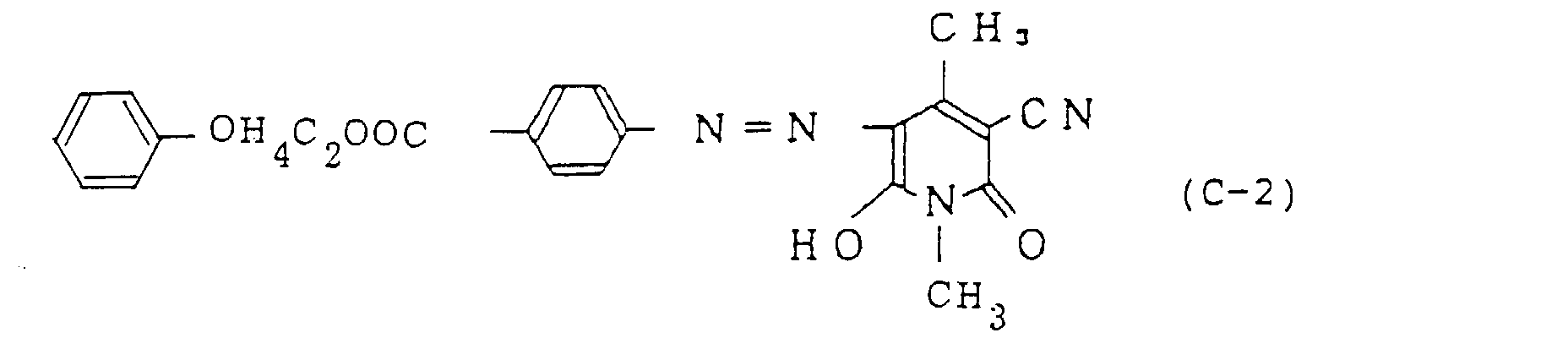


- A method for dyeing polyester fibers with a dye mixture, wherein the disperse dye mixture comprises from 20 to 80% by weight of an orange disperse dye of the following formula (A) and from 20 to 80% by weight of an orange disperse dye of the following formula (B), as dye components:


- A method for dyeing polyester fibers with a dye mixture, wherein the disperse dye mixture comprises from 20 to 80% by weight of a orange disperse dye of the following formula (A), from 20 to 80% by weight of an orange disperse dye of the following formula (B) and more than 0 and up to 30% by weight of a yellow disperse dye of the following formula (C), as dye components:


Applications Claiming Priority (2)
| Application Number | Priority Date | Filing Date | Title |
|---|---|---|---|
| JP40339190 | 1990-12-18 | ||
| JP403391/90 | 1990-12-18 |
Publications (2)
| Publication Number | Publication Date |
|---|---|
| EP0491386A1 EP0491386A1 (en) | 1992-06-24 |
| EP0491386B1 true EP0491386B1 (en) | 1996-11-06 |
Family
ID=18513129
Family Applications (1)
| Application Number | Title | Priority Date | Filing Date |
|---|---|---|---|
| EP91121725A Expired - Lifetime EP0491386B1 (en) | 1990-12-18 | 1991-12-18 | Disperse dye mixture and dyeing method employing it |
Country Status (7)
| Country | Link |
|---|---|
| US (1) | US5201922A (en) |
| EP (1) | EP0491386B1 (en) |
| JP (1) | JP2506592B2 (en) |
| KR (1) | KR0168851B1 (en) |
| CA (1) | CA2057631A1 (en) |
| DE (1) | DE69123031T2 (en) |
| ES (1) | ES2095900T3 (en) |
Cited By (3)
| Publication number | Priority date | Publication date | Assignee | Title |
|---|---|---|---|---|
| CN102516815A (en) * | 2011-12-30 | 2012-06-27 | 吴江市绿洲染料化工有限公司 | Disperse orange dye mixture |
| CN102660146A (en) * | 2012-04-28 | 2012-09-12 | 浙江万丰化工有限公司 | Oxidation-resistant disperse dye composition and preparation and application thereof |
| CN103509372A (en) * | 2013-09-07 | 2014-01-15 | 张家港市杨舍丝印工艺厂 | Yellow dye composition and preparation method thereof |
Families Citing this family (8)
| Publication number | Priority date | Publication date | Assignee | Title |
|---|---|---|---|---|
| US5630849A (en) * | 1995-03-14 | 1997-05-20 | Mitsui Toatsu Chemicals, Inc. | Dyeing method |
| DE19954398A1 (en) * | 1999-11-12 | 2001-05-17 | Dystar Textilfarben Gmbh & Co | Mixtures of disperse monoazo dyes |
| GB0022697D0 (en) * | 2000-09-15 | 2000-11-01 | Basf Ag | Azo disperse dye mixtures |
| CN102634233A (en) * | 2012-03-27 | 2012-08-15 | 江苏之江化工有限公司 | Orange mix |
| KR101416893B1 (en) * | 2012-06-08 | 2014-07-08 | 공명도 | Orange disperse dye composition having excellent moisture resistance |
| CN104371361B (en) * | 2013-12-30 | 2017-02-15 | 阮偶娟 | Yellow disperse dye composition and disperse dye and preparation method and use thereof |
| CN104371363B (en) * | 2013-12-30 | 2016-12-28 | 阮偶娟 | A kind of Yellow disperse dye, its preparation method and purposes |
| CN104530757B (en) * | 2014-12-31 | 2017-02-22 | 浙江闰土股份有限公司 | Yellow disperse dye combination, disperse dye and preparation method and application of disperse dye |
Citations (1)
| Publication number | Priority date | Publication date | Assignee | Title |
|---|---|---|---|---|
| JPH034212B2 (en) * | 1986-10-21 | 1991-01-22 | Yokokawa Medeikaru Shisutemu Kk |
Family Cites Families (3)
| Publication number | Priority date | Publication date | Assignee | Title |
|---|---|---|---|---|
| EP0085823B1 (en) * | 1982-02-10 | 1986-02-05 | Ciba-Geigy Ag | Dye mixture, process for its preparation and its use in dyeing and printing hydrophobic textile material |
| GB8805690D0 (en) * | 1988-03-10 | 1988-04-07 | Ici Plc | Disperse dyes |
| US4917769A (en) * | 1988-05-02 | 1990-04-17 | Oo Chemicals, Inc. | Distillation apparatus for removal of volatile acids from aqueous solutions |
-
1991
- 1991-12-12 US US07/805,676 patent/US5201922A/en not_active Expired - Fee Related
- 1991-12-16 JP JP3332331A patent/JP2506592B2/en not_active Expired - Lifetime
- 1991-12-17 CA CA002057631A patent/CA2057631A1/en not_active Abandoned
- 1991-12-18 EP EP91121725A patent/EP0491386B1/en not_active Expired - Lifetime
- 1991-12-18 DE DE69123031T patent/DE69123031T2/en not_active Expired - Fee Related
- 1991-12-18 ES ES91121725T patent/ES2095900T3/en not_active Expired - Lifetime
- 1991-12-18 KR KR1019910023330A patent/KR0168851B1/en not_active Expired - Fee Related
Patent Citations (1)
| Publication number | Priority date | Publication date | Assignee | Title |
|---|---|---|---|---|
| JPH034212B2 (en) * | 1986-10-21 | 1991-01-22 | Yokokawa Medeikaru Shisutemu Kk |
Cited By (3)
| Publication number | Priority date | Publication date | Assignee | Title |
|---|---|---|---|---|
| CN102516815A (en) * | 2011-12-30 | 2012-06-27 | 吴江市绿洲染料化工有限公司 | Disperse orange dye mixture |
| CN102660146A (en) * | 2012-04-28 | 2012-09-12 | 浙江万丰化工有限公司 | Oxidation-resistant disperse dye composition and preparation and application thereof |
| CN103509372A (en) * | 2013-09-07 | 2014-01-15 | 张家港市杨舍丝印工艺厂 | Yellow dye composition and preparation method thereof |
Also Published As
| Publication number | Publication date |
|---|---|
| KR0168851B1 (en) | 1999-01-15 |
| EP0491386A1 (en) | 1992-06-24 |
| CA2057631A1 (en) | 1992-06-19 |
| US5201922A (en) | 1993-04-13 |
| JPH0532910A (en) | 1993-02-09 |
| DE69123031D1 (en) | 1996-12-12 |
| JP2506592B2 (en) | 1996-06-12 |
| ES2095900T3 (en) | 1997-03-01 |
| DE69123031T2 (en) | 1997-03-06 |
| KR920012316A (en) | 1992-07-25 |
Similar Documents
| Publication | Publication Date | Title |
|---|---|---|
| EP0548715B1 (en) | Disperse dye mixtures | |
| EP0519459B1 (en) | Disperse dye mixture | |
| US7005507B2 (en) | Azo dyes, a process for their preparation and their use in the dyeing or printing of hydrophobic fiber materials | |
| JPH06207117A (en) | Dye mixture | |
| US5201922A (en) | Disperse dye mixture and dyeing method employing it: orange and yellow azo disperse dye mixture for polyester fibers | |
| JP2672338B2 (en) | Dye composition, dyeing method for polyester or polyester blended fiber material | |
| US4690686A (en) | Light-fast yellow disperse dye composition for polyester | |
| EP0661352A1 (en) | Method for dyeing hydrophobic fibers black and dye useful for the method | |
| EP0491387A2 (en) | Disperse dye mixture and method for dyeing polyester fibers | |
| JPS6245792A (en) | Dyeing of polyester fiber having fine denier | |
| EP0801114A2 (en) | Dye compositions for polyamides and reactive dyes | |
| JPH08100133A (en) | Disperse dye mixture | |
| JP2913254B2 (en) | Water-insoluble disperse dye composition and method for dyeing polyester fiber using the same | |
| US4916769A (en) | Disperse mono-azo dye mixture for dyeing synthetic textiles | |
| CN108795086B (en) | Dye compound, dye composition and application thereof | |
| EP0102729B1 (en) | Nitrothiazoleazo compounds, their preparation and use in dyeing synthetic fibers | |
| EP0442477B1 (en) | Disperse dye mixture | |
| JP4224146B2 (en) | Disperse dye mixture | |
| JPH11302555A (en) | Disperse dye mixture | |
| JPH02115274A (en) | Water-insoluble monoazo dye, its preparation, method of using it, and its mixture | |
| JPH0445540B2 (en) | ||
| JPS6381169A (en) | Disazo dye mixture | |
| JPH059401A (en) | Disperse dye mixture | |
| JPS60221462A (en) | Monoazo compound and method of dyeing using it | |
| JPH0788473B2 (en) | Monoazo compound and dyeing method for hydrophobic fiber using the same |
Legal Events
| Date | Code | Title | Description |
|---|---|---|---|
| PUAI | Public reference made under article 153(3) epc to a published international application that has entered the european phase |
Free format text: ORIGINAL CODE: 0009012 |
|
| AK | Designated contracting states |
Kind code of ref document: A1 Designated state(s): BE CH DE ES FR GB IT LI |
|
| 17P | Request for examination filed |
Effective date: 19921102 |
|
| RAP1 | Party data changed (applicant data changed or rights of an application transferred) |
Owner name: DYSTAR JAPAN LTD. |
|
| 17Q | First examination report despatched |
Effective date: 19951201 |
|
| GRAH | Despatch of communication of intention to grant a patent |
Free format text: ORIGINAL CODE: EPIDOS IGRA |
|
| GRAH | Despatch of communication of intention to grant a patent |
Free format text: ORIGINAL CODE: EPIDOS IGRA |
|
| GRAA | (expected) grant |
Free format text: ORIGINAL CODE: 0009210 |
|
| AK | Designated contracting states |
Kind code of ref document: B1 Designated state(s): BE CH DE ES FR GB IT LI |
|
| ITF | It: translation for a ep patent filed | ||
| REG | Reference to a national code |
Ref country code: CH Ref legal event code: NV Representative=s name: A. BRAUN, BRAUN, HERITIER, ESCHMANN AG PATENTANWAE |
|
| REF | Corresponds to: |
Ref document number: 69123031 Country of ref document: DE Date of ref document: 19961212 |
|
| ET | Fr: translation filed | ||
| REG | Reference to a national code |
Ref country code: ES Ref legal event code: FG2A Ref document number: 2095900 Country of ref document: ES Kind code of ref document: T3 |
|
| PLBE | No opposition filed within time limit |
Free format text: ORIGINAL CODE: 0009261 |
|
| STAA | Information on the status of an ep patent application or granted ep patent |
Free format text: STATUS: NO OPPOSITION FILED WITHIN TIME LIMIT |
|
| 26N | No opposition filed | ||
| PGFP | Annual fee paid to national office [announced via postgrant information from national office to epo] |
Ref country code: GB Payment date: 19981110 Year of fee payment: 8 Ref country code: FR Payment date: 19981110 Year of fee payment: 8 |
|
| PGFP | Annual fee paid to national office [announced via postgrant information from national office to epo] |
Ref country code: CH Payment date: 19981202 Year of fee payment: 8 |
|
| PGFP | Annual fee paid to national office [announced via postgrant information from national office to epo] |
Ref country code: ES Payment date: 19981218 Year of fee payment: 8 |
|
| PGFP | Annual fee paid to national office [announced via postgrant information from national office to epo] |
Ref country code: DE Payment date: 19990108 Year of fee payment: 8 |
|
| PGFP | Annual fee paid to national office [announced via postgrant information from national office to epo] |
Ref country code: BE Payment date: 19990215 Year of fee payment: 8 |
|
| PG25 | Lapsed in a contracting state [announced via postgrant information from national office to epo] |
Ref country code: GB Free format text: LAPSE BECAUSE OF NON-PAYMENT OF DUE FEES Effective date: 19991218 |
|
| PG25 | Lapsed in a contracting state [announced via postgrant information from national office to epo] |
Ref country code: LI Free format text: LAPSE BECAUSE OF NON-PAYMENT OF DUE FEES Effective date: 19991231 Ref country code: CH Free format text: LAPSE BECAUSE OF NON-PAYMENT OF DUE FEES Effective date: 19991231 Ref country code: BE Free format text: LAPSE BECAUSE OF NON-PAYMENT OF DUE FEES Effective date: 19991231 |
|
| BERE | Be: lapsed |
Owner name: DYSTAR JAPAN LTD Effective date: 19991231 |
|
| GBPC | Gb: european patent ceased through non-payment of renewal fee |
Effective date: 19991218 |
|
| PG25 | Lapsed in a contracting state [announced via postgrant information from national office to epo] |
Ref country code: FR Free format text: LAPSE BECAUSE OF NON-PAYMENT OF DUE FEES Effective date: 20000831 |
|
| REG | Reference to a national code |
Ref country code: FR Ref legal event code: ST |
|
| PG25 | Lapsed in a contracting state [announced via postgrant information from national office to epo] |
Ref country code: DE Free format text: LAPSE BECAUSE OF NON-PAYMENT OF DUE FEES Effective date: 20001101 |
|
| PG25 | Lapsed in a contracting state [announced via postgrant information from national office to epo] |
Ref country code: ES Free format text: LAPSE BECAUSE OF NON-PAYMENT OF DUE FEES Effective date: 20001219 |
|
| REG | Reference to a national code |
Ref country code: ES Ref legal event code: FD2A Effective date: 20010113 |
|
| PG25 | Lapsed in a contracting state [announced via postgrant information from national office to epo] |
Ref country code: IT Free format text: LAPSE BECAUSE OF NON-PAYMENT OF DUE FEES;WARNING: LAPSES OF ITALIAN PATENTS WITH EFFECTIVE DATE BEFORE 2007 MAY HAVE OCCURRED AT ANY TIME BEFORE 2007. THE CORRECT EFFECTIVE DATE MAY BE DIFFERENT FROM THE ONE RECORDED. Effective date: 20051218 |