EP0489890B1 - Procede de codage a parametres ajustables d'un champ de mouvement dans une sequence d'images animees - Google Patents
Procede de codage a parametres ajustables d'un champ de mouvement dans une sequence d'images animees Download PDFInfo
- Publication number
- EP0489890B1 EP0489890B1 EP91912186A EP91912186A EP0489890B1 EP 0489890 B1 EP0489890 B1 EP 0489890B1 EP 91912186 A EP91912186 A EP 91912186A EP 91912186 A EP91912186 A EP 91912186A EP 0489890 B1 EP0489890 B1 EP 0489890B1
- Authority
- EP
- European Patent Office
- Prior art keywords
- vectors
- image
- movement
- coding
- blocks
- Prior art date
- Legal status (The legal status is an assumption and is not a legal conclusion. Google has not performed a legal analysis and makes no representation as to the accuracy of the status listed.)
- Expired - Lifetime
Links
Images

Classifications
-
- H—ELECTRICITY
- H04—ELECTRIC COMMUNICATION TECHNIQUE
- H04N—PICTORIAL COMMUNICATION, e.g. TELEVISION
- H04N19/00—Methods or arrangements for coding, decoding, compressing or decompressing digital video signals
- H04N19/50—Methods or arrangements for coding, decoding, compressing or decompressing digital video signals using predictive coding
- H04N19/503—Methods or arrangements for coding, decoding, compressing or decompressing digital video signals using predictive coding involving temporal prediction
- H04N19/51—Motion estimation or motion compensation
- H04N19/53—Multi-resolution motion estimation; Hierarchical motion estimation
-
- G—PHYSICS
- G06—COMPUTING OR CALCULATING; COUNTING
- G06T—IMAGE DATA PROCESSING OR GENERATION, IN GENERAL
- G06T7/00—Image analysis
- G06T7/20—Analysis of motion
-
- H—ELECTRICITY
- H04—ELECTRIC COMMUNICATION TECHNIQUE
- H04N—PICTORIAL COMMUNICATION, e.g. TELEVISION
- H04N19/00—Methods or arrangements for coding, decoding, compressing or decompressing digital video signals
- H04N19/90—Methods or arrangements for coding, decoding, compressing or decompressing digital video signals using coding techniques not provided for in groups H04N19/10-H04N19/85, e.g. fractals
- H04N19/96—Tree coding, e.g. quad-tree coding
-
- H—ELECTRICITY
- H04—ELECTRIC COMMUNICATION TECHNIQUE
- H04N—PICTORIAL COMMUNICATION, e.g. TELEVISION
- H04N19/00—Methods or arrangements for coding, decoding, compressing or decompressing digital video signals
- H04N19/90—Methods or arrangements for coding, decoding, compressing or decompressing digital video signals using coding techniques not provided for in groups H04N19/10-H04N19/85, e.g. fractals
- H04N19/98—Adaptive-dynamic-range coding [ADRC]
-
- H—ELECTRICITY
- H04—ELECTRIC COMMUNICATION TECHNIQUE
- H04N—PICTORIAL COMMUNICATION, e.g. TELEVISION
- H04N5/00—Details of television systems
- H04N5/14—Picture signal circuitry for video frequency region
- H04N5/144—Movement detection
- H04N5/145—Movement estimation
Definitions
- the present invention relates to a coding method with adjustable parameters of a motion field in a sequence of moving images.
- the analysis of movement in a sequence of moving images, especially in television, is an operation which is fundamentally important in the chain of operations carried out to process the images.
- motion field coding for more specific applications such as television can be found in the articles entitled: "HDMAC coding for MAC compatible Broadcasting of HDTV signals” FWP VREESWIJK and Dr. MR HAGHIRI - 3rd International workshop or HDTV - 30th August 1989 - Torino and "Coding of motion information on signal processing of HDTV” JP HENOT - 2rd International workshop on signal processing of HDTV - 29 february-2 march 1988 - L'Aquila.
- a coding of the motion vectors represented only about 10% of the total digital bit rate. Under these conditions, it therefore does not require specific development.
- the methods used are then the same as for image coding and consist in performing variable length coding adapted to differential methods with respect to the neighbors of the current point or with respect to the average of the neighborhood, or also adapted to methods by entropy, the latter requiring the calculation of a histogram.
- Some solutions also use, in addition to a decomposition by a coding tree to group the homogeneous areas of the image.
- the object of the invention is to overcome the aforementioned drawbacks.
- the subject of the invention is a method of coding with adjustable parameters a motion field in a sequence of moving images, characterized in that it consists in decomposing each motion field of the image according to a tree. coding carried out by successive steps of cutting the image into blocks of determined size, each image block obtained being cut again until a homogeneous block is obtained, that is to say a zone of image with uniform motion and to be identified, from a menu of vectors (Vect i ) containing the value of the motion vectors (Vect i ) present in the image and of code words (MC i ) giving the address of these vectors in the menus, the vectors (Vect i ) corresponding to these homogeneous zones.
- the method according to the invention has the advantage that it offers the possibility of regulating the bit rate, of performing coding by spatial and temporal coding tree taking into account the movement on 2 consecutive images. It also offers the possibility of having code words of variable length as a function of the number of vectors per macroblock, of limiting the information to be coded by deleting the least occurring vectors instead of analyzing the information spatially, it makes it possible to 'have a maximum limit for the flow, and finally it makes it possible to code the tree as a specific "vector" or to code the tree separately.
- the method according to the invention also has the advantage of being able to be used on any image processing device which requires a reduction in information rate. It can be applied in particular to the coding of motion fields in high definition television, to the image coding as to the digital coding of television assistance signals of the television system known under the designation HDMAC. It allows the user to choose, according to his constraints, the coding parameters which will give him the best compromise between speed and quality, and this dynamically (that is to say differently according to the images and according to the speed or quality obtained) or static (that is, once and for all, at the start).
- the idea of the invention is to combine this information in order to obtain a vector field with blocks as large as possible corresponding to the homogeneous areas of the image. This amounts to determining a coding tree defined by the homogeneous areas of the image and to linking this coding to the coding of a motion field by taking account of variable parameters to obtain a good compromise resolution-bit rate.
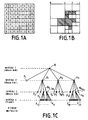
- the decomposition into a coding tree consists, as shown in FIGS. 1A, 1B and 1C, of dividing an image into homogeneous blocks of size n ⁇ n as large as possible, then of associating with the division obtained a tree (FIG. 1C) whose root R represents the image, the nodes (N1 to N7), the blocks of size 2nx2n, non-homogeneous which are decomposed into four sub-blocks of size nxn and the sheets F1 to F25 of the homogeneous nxn blocks.
- FIGS. 1A, 1B and 1C of dividing an image into homogeneous blocks of size n ⁇ n as large as possible, then of associating with the division obtained a tree (FIG. 1C) whose root R represents the image, the nodes (N1 to N7), the blocks of size 2nx2n, non-homogeneous which are decomposed into four sub-blocks of size nxn and the sheets F1
- a first level corresponds to a block of size 8 ⁇ 8 pixels forming the root
- a second level brings up 4 blocks of 4x4 pixel size
- a third level is made up of 9 blocks of 2x2 pixels
- the fourth level is made up of the remaining pixels.
- the method according to the invention makes it possible to obtain a division into zones where the information to be coded is identical (represented by the sheets).
- the information to be coded is the value of the displacement vector obtained to which is added a coding of the nodes necessary for the construction of the tree for decoding in the form of a "vector "specific.
- one of the characteristics of the invention is to produce a menu of vectors containing all the vectors present in the image. Under these conditions the information to be coded is no longer the value of the vector, but a relative addressing in the menu.
- the Vect i fields represent the vectors present in the image and the MC i fields represent the code words representing either a node or the number of a vector in the menu.
- the previous decomposition of the motion vectors into a coding tree takes advantage of the strong two-dimensional spatial correlation existing between the motion vectors, it does not take into account the temporal correlation which exists from one image to another and which suddenly safe can reduce flow.
- This problem is solved by the invention by a decomposition into a coding tree which is no longer done on one image but on two successive images and which leads to using only one tree for two images. Under these conditions, a homogeneous block must be spatially so on two consecutive images with the same vector.
- the number of vectors in the menu is then equal to the number of vectors different from the current image and from the previous or next image and the number of combinations is equal to the number of vectors different from the current image multiplied by the number of vectors. different from the previous or next image.
- the field DEB contains the number N1 of vectors of the current image, the number N2 of vectors of the previous image (or following), the number of different vectors (N) in the current image and in the previous (or next) image and the number of MC code words.
- the menu of vectors VECT1 ... VECT n is then transmitted in the manner shown in FIG. 4, taking into account similar vectors in the vectors N1 and N2 which it is not useful to transmit twice in the menu.
- the method according to the invention has the advantage that it allows the coding of any field of motion whatever the bit rate fixed.
- a good compromise between bit rate and quality can be obtained by adapting the size of the blocks. For example, instead of descending into the decomposition of the coding tree up to the pixel, it is always possible to stop at a block size of 2x2 or 4x4 ... etc, with a vector associated with each elementary size , the flow rate under these conditions becomes lower. It is also possible to adjust the amplitude of the vectors.
- bit rate can be reduced very significantly and only the vector menu is to be modified due to the relative addressing.
- Another method of reducing the bit rate may also consist in limiting the number of vectors per image and consequently the number of bits per code word, but however this process amounts to prohibiting certain vectors in the image.
- the number of vectors can be reduced in each macro-block while retaining for the whole image the possibility of having all the possible vectors.
- the method according to the invention is advantageously applicable to the coding of television pictures of the HDMAC standard.
- the coding takes place on the basis of blocks 16 ⁇ 16 pixels every 40 ms by considering each time two interlaced frames.
- each block is defined according to three modes, an 80 ms mode for fixed blocks for which the movement is zero, a 40 ms mode for blocks in movement of amplitude less than 6 pixels and a 20 ms mode for moving blocks greater than ⁇ 6 pixels. Only the 40 ms mode which uses displacement vectors is compensated for in movement and on 80 ms corresponding to the duration of two interlaced images only the following combinations are authorized (80-80, 40-40, 40-20, 20-40, 20 -20).
- the coding method according to the invention takes into account this reduction in the number of possible combinations, the 40 ms mode using motion compensation only one frame out of two.
- the information to be coded in 16 ⁇ 16 blocks is that of the mode obtained with the vector possibly associated with a maximum bit rate of 1 Mbit / s.
- the start word DEB of each macroblock contains under these conditions for each successive image 1 and 2: N1 vectors of image 1 (N1 between 0 and 64) N2 vectors of image 2 (N2 between 0 and 64) N different vectors in images 1 and 2 (N being equal to the maximum of the sum of N1 plus N2 vectors). and n code words (n between 1 and 64).
- N1 x N2 x N x n 34 881 600 possible combinations representable by a code word DEB of 26 bits. (This information being necessary for decoding to find the code words among the bit stream).
- Amplitude vectors ⁇ 6 pixels require 8 bits to be coded.
- the theoretical maximum bit rate is equal in these conditions to the product of the number of transmitted macroblocks (99) by the sum of the bits making up the word DEB (26), the bits making up the vector menu (2x64x8), and the word bits of code (64x13) the result of the product obtained being multiplied again by the frequency 12.5 Hz corresponding to a transmission of this packet of bits every 80 ms.
- the resulting bit rate is 2328975 bits / s.
- the number of vectors must be limited to 13 per macroblock (out of the 64 possible).
- the normal size of the blocks which is 16 ⁇ 16 in the HDMAC coding can possibly be reduced since the method of the invention can always be applied regardless of the size of the larger or smaller blocks chosen.
- a node In order to reduce the bit rate, it is better to no longer code a node as a specific "vector" (in order to reconstruct the tree on decoding) but to transmit a "TREE" field as represented in FIG. 5, which represents l 'code tree.
- Each bit of this field indicates a node or a leaf, the first bit indicates the state of the root (block of size nxn, leaf or node), the second, the third, the fourth and the fifth the state of the 4 sub -blocks of size n / 2, xn / 2, etc ... until the penultimate level possible.
- the code words (MC i ) now only represent one of the mode / vector combinations.
- the case represented by FIG. 3 can be used for the case where the tree is completely decomposed. This guarantees the same maximum speed than previously (the word "TREE" is not transmitted).
Landscapes
- Engineering & Computer Science (AREA)
- Multimedia (AREA)
- Signal Processing (AREA)
- Computer Vision & Pattern Recognition (AREA)
- Physics & Mathematics (AREA)
- General Physics & Mathematics (AREA)
- Theoretical Computer Science (AREA)
- Compression Or Coding Systems Of Tv Signals (AREA)
- Compression, Expansion, Code Conversion, And Decoders (AREA)
- Color Television Systems (AREA)
- Investigating Or Analysing Materials By Optical Means (AREA)
Applications Claiming Priority (3)
| Application Number | Priority Date | Filing Date | Title |
|---|---|---|---|
| FR9008299 | 1990-06-29 | ||
| FR9008299A FR2664117B1 (fr) | 1990-06-29 | 1990-06-29 | Procede de codage a parametres ajustables d'un champ de mouvement dans une sequence d'images animees. |
| PCT/FR1991/000505 WO1992000651A1 (fr) | 1990-06-29 | 1991-06-25 | Procede de codage a parametres ajustables d'un champ de mouvement dans une sequence d'images animees |
Publications (2)
| Publication Number | Publication Date |
|---|---|
| EP0489890A1 EP0489890A1 (fr) | 1992-06-17 |
| EP0489890B1 true EP0489890B1 (fr) | 1995-08-23 |
Family
ID=9398205
Family Applications (1)
| Application Number | Title | Priority Date | Filing Date |
|---|---|---|---|
| EP91912186A Expired - Lifetime EP0489890B1 (fr) | 1990-06-29 | 1991-06-25 | Procede de codage a parametres ajustables d'un champ de mouvement dans une sequence d'images animees |
Country Status (10)
| Country | Link |
|---|---|
| US (1) | US5296927A (da) |
| EP (1) | EP0489890B1 (da) |
| JP (1) | JPH05502564A (da) |
| AT (1) | ATE126959T1 (da) |
| DE (1) | DE69112362T2 (da) |
| DK (1) | DK0489890T3 (da) |
| ES (1) | ES2076537T3 (da) |
| FR (1) | FR2664117B1 (da) |
| GR (1) | GR3017635T3 (da) |
| WO (1) | WO1992000651A1 (da) |
Families Citing this family (9)
| Publication number | Priority date | Publication date | Assignee | Title |
|---|---|---|---|---|
| FR2697706B1 (fr) * | 1992-11-03 | 1994-11-25 | Thomson Csf | Procédé et dispositif de réduction de débit pour l'enregistrement d'images sur magnétoscope. |
| FR2700037B1 (fr) * | 1992-12-24 | 1995-01-27 | Thomson Csf | Dispositif d'estimation hiérarchique du mouvement de séquence d'images. |
| US5444489A (en) * | 1993-02-11 | 1995-08-22 | Georgia Tech Research Corporation | Vector quantization video encoder using hierarchical cache memory scheme |
| JP3846642B2 (ja) * | 1994-01-31 | 2006-11-15 | ソニー株式会社 | 動き量検出方法及び動き量検出装置 |
| US6633611B2 (en) * | 1997-04-24 | 2003-10-14 | Mitsubishi Denki Kabushiki Kaisha | Method and apparatus for region-based moving image encoding and decoding |
| FR2783123B1 (fr) * | 1998-09-04 | 2000-11-24 | France Telecom | Procede d'estimation du mouvement entre deux images |
| US6919901B2 (en) * | 2002-01-15 | 2005-07-19 | International Business Machines Corporation | Graphics system register data generation |
| JP5622613B2 (ja) * | 2011-02-25 | 2014-11-12 | 三菱電機株式会社 | 動画像符号化装置、動画像符号化方法及び動画像符号化プログラム |
| TWI482099B (zh) * | 2012-09-07 | 2015-04-21 | Altek Corp | 影像處理紀錄系統及其影像處理紀錄方法 |
Family Cites Families (3)
| Publication number | Priority date | Publication date | Assignee | Title |
|---|---|---|---|---|
| EP0309669B1 (de) * | 1987-09-30 | 1992-12-30 | Siemens Aktiengesellschaft | Verfahren zur szenenmodellgestützten Bilddatenreduktion für digitale Fernsehsignale |
| FR2631768B1 (fr) * | 1988-05-20 | 1990-08-17 | Labo Electronique Physique | Systeme d'emission et reception de television a haute definition a debit de donnees reduit |
| FR2633468B1 (fr) * | 1988-06-24 | 1990-11-09 | France Etat | Procede de codage de donnees d'assistance a la reconstruction d'images electroniques animees sous-echantillonnees |
-
1990
- 1990-06-29 FR FR9008299A patent/FR2664117B1/fr not_active Expired - Fee Related
-
1991
- 1991-06-25 DE DE69112362T patent/DE69112362T2/de not_active Expired - Fee Related
- 1991-06-25 AT AT91912186T patent/ATE126959T1/de not_active IP Right Cessation
- 1991-06-25 EP EP91912186A patent/EP0489890B1/fr not_active Expired - Lifetime
- 1991-06-25 ES ES91912186T patent/ES2076537T3/es not_active Expired - Lifetime
- 1991-06-25 DK DK91912186.3T patent/DK0489890T3/da active
- 1991-06-25 WO PCT/FR1991/000505 patent/WO1992000651A1/fr not_active Ceased
- 1991-06-25 US US07/834,263 patent/US5296927A/en not_active Expired - Fee Related
- 1991-06-25 JP JP3511380A patent/JPH05502564A/ja active Pending
-
1995
- 1995-10-04 GR GR950402748T patent/GR3017635T3/el unknown
Also Published As
| Publication number | Publication date |
|---|---|
| JPH05502564A (ja) | 1993-04-28 |
| FR2664117B1 (fr) | 1996-06-21 |
| GR3017635T3 (en) | 1996-01-31 |
| ATE126959T1 (de) | 1995-09-15 |
| FR2664117A1 (fr) | 1992-01-03 |
| US5296927A (en) | 1994-03-22 |
| DK0489890T3 (da) | 1995-12-27 |
| WO1992000651A1 (fr) | 1992-01-09 |
| DE69112362D1 (de) | 1995-09-28 |
| EP0489890A1 (fr) | 1992-06-17 |
| DE69112362T2 (de) | 1996-02-08 |
| ES2076537T3 (es) | 1995-11-01 |
Similar Documents
| Publication | Publication Date | Title |
|---|---|---|
| EP0675652B1 (fr) | Procédé et circuit d'estimation de mouvement entre images à deux trames entrelacées, et dispositif de codage de signaux numériques comprenant un tel circuit | |
| FR2782437A1 (fr) | Procede de commutation de flux mpeg | |
| FR2764156A1 (fr) | Dispositif de pretraitement pour codage mpeg ii | |
| EP0022713A1 (fr) | Installation de codage et de décodage d'un signal visiophonique numérique | |
| WO2002060184A1 (fr) | Procede de codage et de decodage d'images, dispositifs et applications correspondants | |
| JP2015501580A (ja) | 受信されたビデオの安定化 | |
| EP0347325B1 (fr) | Procédé et installation de diffusion de programmes de télévision haute définition compatible | |
| WO1992000651A1 (fr) | Procede de codage a parametres ajustables d'un champ de mouvement dans une sequence d'images animees | |
| EP0410892B1 (fr) | Procédé de traitement et de transmission par un canal comportant une voie analogique et une voie numérique d'une séquence de couples d'images de télévision stéréoscopique | |
| FR2768003A1 (fr) | Procede de codage d'un signal de forme binaire | |
| EP2368367B1 (fr) | Système et procédé interactif pour la transmission sur un réseau bas débit d'images clefs sélectionnées dans un flux video | |
| EP2410749A1 (fr) | Procédé d'encodage adaptatif d'un flux vidéo numérique, notamment pour diffusion sur ligne xDSL | |
| EP3490255A1 (fr) | Compression intelligente de contenus vidéo grainés | |
| FR2783388A1 (fr) | Procede de compression d'images et dispositif pour la mise en oeuvre de ce procede | |
| WO2001093594A1 (fr) | Procede de codage d'un flux d'images video | |
| EP0546141A1 (fr) | Procede de conversion du rythme temporel d'une sequence d'images animees | |
| FR2860940A1 (fr) | Dispositif et procede de reduction de bruit d'un signal video | |
| WO1990000846A1 (fr) | Codage et decodage d'images de television a haute definition | |
| FR2769784A1 (fr) | Methode de codage de mode dans un codage de forme binaire | |
| FR2886787A1 (fr) | Procede et dispositif de codage et de decodage d'une sequence d'images | |
| EP1202577A9 (fr) | Procédé de traítement de données vidéo | |
| WO1994022267A1 (fr) | Codage/decodage compatibles sous-bandes d'images de television | |
| FR2638926A1 (fr) | Procede, dispositif de codage numerique d'images de tele a haute definition; dispositif de decodage correspondant, systeme de transmission d'images equipe d'un etage d'emission et d'un de reception incluant un tel dispositif de codage ou de decodage; etages d'emission et de reception comprenant de tels dispositifs | |
| WO2014096638A1 (fr) | Procédé et dispositif de transmission d'une séquence d'images basé sur un codage région adaptatif | |
| WO2004032510A1 (fr) | Embrouillage adaptatif et progressif de flux video |
Legal Events
| Date | Code | Title | Description |
|---|---|---|---|
| PUAI | Public reference made under article 153(3) epc to a published international application that has entered the european phase |
Free format text: ORIGINAL CODE: 0009012 |
|
| 17P | Request for examination filed |
Effective date: 19920125 |
|
| AK | Designated contracting states |
Kind code of ref document: A1 Designated state(s): AT BE CH DE DK ES FR GB GR IT LI LU NL SE |
|
| RAP1 | Party data changed (applicant data changed or rights of an application transferred) |
Owner name: THOMSON-CSF |
|
| 17Q | First examination report despatched |
Effective date: 19940427 |
|
| GRAA | (expected) grant |
Free format text: ORIGINAL CODE: 0009210 |
|
| AK | Designated contracting states |
Kind code of ref document: B1 Designated state(s): AT BE CH DE DK ES FR GB GR IT LI LU NL SE |
|
| REF | Corresponds to: |
Ref document number: 126959 Country of ref document: AT Date of ref document: 19950915 Kind code of ref document: T |
|
| REF | Corresponds to: |
Ref document number: 69112362 Country of ref document: DE Date of ref document: 19950928 |
|
| ITF | It: translation for a ep patent filed | ||
| REG | Reference to a national code |
Ref country code: ES Ref legal event code: FG2A Ref document number: 2076537 Country of ref document: ES Kind code of ref document: T3 |
|
| GBT | Gb: translation of ep patent filed (gb section 77(6)(a)/1977) |
Effective date: 19951106 |
|
| REG | Reference to a national code |
Ref country code: DK Ref legal event code: T3 |
|
| REG | Reference to a national code |
Ref country code: GR Ref legal event code: FG4A Free format text: 3017635 |
|
| PLBE | No opposition filed within time limit |
Free format text: ORIGINAL CODE: 0009261 |
|
| STAA | Information on the status of an ep patent application or granted ep patent |
Free format text: STATUS: NO OPPOSITION FILED WITHIN TIME LIMIT |
|
| 26N | No opposition filed | ||
| PGFP | Annual fee paid to national office [announced via postgrant information from national office to epo] |
Ref country code: DE Payment date: 19970901 Year of fee payment: 7 |
|
| PGFP | Annual fee paid to national office [announced via postgrant information from national office to epo] |
Ref country code: GB Payment date: 19980505 Year of fee payment: 8 |
|
| PGFP | Annual fee paid to national office [announced via postgrant information from national office to epo] |
Ref country code: FR Payment date: 19980608 Year of fee payment: 8 |
|
| PGFP | Annual fee paid to national office [announced via postgrant information from national office to epo] |
Ref country code: DK Payment date: 19980624 Year of fee payment: 8 |
|
| PGFP | Annual fee paid to national office [announced via postgrant information from national office to epo] |
Ref country code: SE Payment date: 19980625 Year of fee payment: 8 Ref country code: BE Payment date: 19980625 Year of fee payment: 8 |
|
| PGFP | Annual fee paid to national office [announced via postgrant information from national office to epo] |
Ref country code: AT Payment date: 19980626 Year of fee payment: 8 |
|
| PGFP | Annual fee paid to national office [announced via postgrant information from national office to epo] |
Ref country code: NL Payment date: 19980629 Year of fee payment: 8 |
|
| PGFP | Annual fee paid to national office [announced via postgrant information from national office to epo] |
Ref country code: GR Payment date: 19980630 Year of fee payment: 8 Ref country code: ES Payment date: 19980630 Year of fee payment: 8 |
|
| PGFP | Annual fee paid to national office [announced via postgrant information from national office to epo] |
Ref country code: CH Payment date: 19980701 Year of fee payment: 8 |
|
| PGFP | Annual fee paid to national office [announced via postgrant information from national office to epo] |
Ref country code: LU Payment date: 19980824 Year of fee payment: 8 |
|
| PG25 | Lapsed in a contracting state [announced via postgrant information from national office to epo] |
Ref country code: DE Free format text: LAPSE BECAUSE OF NON-PAYMENT OF DUE FEES Effective date: 19990401 |
|
| PG25 | Lapsed in a contracting state [announced via postgrant information from national office to epo] |
Ref country code: LU Free format text: LAPSE BECAUSE OF NON-PAYMENT OF DUE FEES Effective date: 19990625 Ref country code: GB Free format text: LAPSE BECAUSE OF NON-PAYMENT OF DUE FEES Effective date: 19990625 Ref country code: AT Free format text: LAPSE BECAUSE OF NON-PAYMENT OF DUE FEES Effective date: 19990625 |
|
| PG25 | Lapsed in a contracting state [announced via postgrant information from national office to epo] |
Ref country code: ES Free format text: THE PATENT HAS BEEN ANNULLED BY A DECISION OF A NATIONAL AUTHORITY Effective date: 19990626 |
|
| PG25 | Lapsed in a contracting state [announced via postgrant information from national office to epo] |
Ref country code: SE Free format text: THE PATENT HAS BEEN ANNULLED BY A DECISION OF A NATIONAL AUTHORITY Effective date: 19990629 |
|
| PG25 | Lapsed in a contracting state [announced via postgrant information from national office to epo] |
Ref country code: LI Free format text: LAPSE BECAUSE OF NON-PAYMENT OF DUE FEES Effective date: 19990630 Ref country code: GR Free format text: LAPSE BECAUSE OF NON-PAYMENT OF DUE FEES Effective date: 19990630 Ref country code: FR Free format text: THE PATENT HAS BEEN ANNULLED BY A DECISION OF A NATIONAL AUTHORITY Effective date: 19990630 Ref country code: DK Free format text: LAPSE BECAUSE OF NON-PAYMENT OF DUE FEES Effective date: 19990630 Ref country code: CH Free format text: LAPSE BECAUSE OF NON-PAYMENT OF DUE FEES Effective date: 19990630 Ref country code: BE Free format text: LAPSE BECAUSE OF NON-PAYMENT OF DUE FEES Effective date: 19990630 |
|
| BERE | Be: lapsed |
Owner name: THOMSON-CSF Effective date: 19990630 |
|
| PG25 | Lapsed in a contracting state [announced via postgrant information from national office to epo] |
Ref country code: NL Free format text: LAPSE BECAUSE OF NON-PAYMENT OF DUE FEES Effective date: 20000101 |
|
| REG | Reference to a national code |
Ref country code: CH Ref legal event code: PL |
|
| GBPC | Gb: european patent ceased through non-payment of renewal fee |
Effective date: 19990625 |
|
| EUG | Se: european patent has lapsed |
Ref document number: 91912186.3 |
|
| NLV4 | Nl: lapsed or anulled due to non-payment of the annual fee |
Effective date: 20000101 |
|
| REG | Reference to a national code |
Ref country code: DK Ref legal event code: EBP |
|
| REG | Reference to a national code |
Ref country code: FR Ref legal event code: ST |
|
| REG | Reference to a national code |
Ref country code: ES Ref legal event code: FD2A Effective date: 20020204 |
|
| PG25 | Lapsed in a contracting state [announced via postgrant information from national office to epo] |
Ref country code: IT Free format text: LAPSE BECAUSE OF NON-PAYMENT OF DUE FEES;WARNING: LAPSES OF ITALIAN PATENTS WITH EFFECTIVE DATE BEFORE 2007 MAY HAVE OCCURRED AT ANY TIME BEFORE 2007. THE CORRECT EFFECTIVE DATE MAY BE DIFFERENT FROM THE ONE RECORDED. Effective date: 20050625 |