EP0488573A2 - Verfahren zur Herstellung eines supraleitenden Artikels - Google Patents
Verfahren zur Herstellung eines supraleitenden Artikels Download PDFInfo
- Publication number
- EP0488573A2 EP0488573A2 EP91310676A EP91310676A EP0488573A2 EP 0488573 A2 EP0488573 A2 EP 0488573A2 EP 91310676 A EP91310676 A EP 91310676A EP 91310676 A EP91310676 A EP 91310676A EP 0488573 A2 EP0488573 A2 EP 0488573A2
- Authority
- EP
- European Patent Office
- Prior art keywords
- core material
- cladding
- extrusion
- slug
- silver
- Prior art date
- Legal status (The legal status is an assumption and is not a legal conclusion. Google has not performed a legal analysis and makes no representation as to the accuracy of the status listed.)
- Granted
Links
- 238000000034 method Methods 0.000 title claims abstract description 44
- 239000011162 core material Substances 0.000 claims abstract description 73
- 239000000463 material Substances 0.000 claims abstract description 57
- 238000005253 cladding Methods 0.000 claims abstract description 44
- 239000002887 superconductor Substances 0.000 claims abstract description 43
- 229910044991 metal oxide Inorganic materials 0.000 claims abstract description 26
- 229910052751 metal Inorganic materials 0.000 claims abstract description 21
- 239000002184 metal Substances 0.000 claims abstract description 21
- 239000006185 dispersion Substances 0.000 claims abstract description 19
- 229910052799 carbon Inorganic materials 0.000 claims abstract description 9
- OKTJSMMVPCPJKN-UHFFFAOYSA-N Carbon Chemical compound [C] OKTJSMMVPCPJKN-UHFFFAOYSA-N 0.000 claims abstract description 6
- 229910001092 metal group alloy Inorganic materials 0.000 claims abstract description 4
- 239000004332 silver Substances 0.000 claims description 24
- 239000008188 pellet Substances 0.000 claims description 23
- 229910052709 silver Inorganic materials 0.000 claims description 23
- 238000010438 heat treatment Methods 0.000 claims description 21
- 238000005245 sintering Methods 0.000 claims description 14
- 239000000843 powder Substances 0.000 claims description 13
- PXHVJJICTQNCMI-UHFFFAOYSA-N Nickel Chemical compound [Ni] PXHVJJICTQNCMI-UHFFFAOYSA-N 0.000 claims description 10
- 238000007906 compression Methods 0.000 claims description 10
- 230000006835 compression Effects 0.000 claims description 10
- 239000010949 copper Substances 0.000 claims description 10
- 230000002706 hydrostatic effect Effects 0.000 claims description 10
- RYGMFSIKBFXOCR-UHFFFAOYSA-N Copper Chemical compound [Cu] RYGMFSIKBFXOCR-UHFFFAOYSA-N 0.000 claims description 9
- 229910052802 copper Inorganic materials 0.000 claims description 9
- 239000002131 composite material Substances 0.000 claims description 8
- NDVLTYZPCACLMA-UHFFFAOYSA-N silver oxide Chemical compound [O-2].[Ag+].[Ag+] NDVLTYZPCACLMA-UHFFFAOYSA-N 0.000 claims description 8
- 238000012545 processing Methods 0.000 claims description 6
- 229910052759 nickel Inorganic materials 0.000 claims description 5
- 239000002002 slurry Substances 0.000 claims description 5
- 239000002904 solvent Substances 0.000 claims description 5
- CXKCTMHTOKXKQT-UHFFFAOYSA-N cadmium oxide Inorganic materials [Cd]=O CXKCTMHTOKXKQT-UHFFFAOYSA-N 0.000 claims description 4
- CFEAAQFZALKQPA-UHFFFAOYSA-N cadmium(2+);oxygen(2-) Chemical compound [O-2].[Cd+2] CFEAAQFZALKQPA-UHFFFAOYSA-N 0.000 claims description 4
- 235000021463 dry cake Nutrition 0.000 claims description 4
- 239000000706 filtrate Substances 0.000 claims description 4
- 229910001923 silver oxide Inorganic materials 0.000 claims description 4
- 238000002156 mixing Methods 0.000 claims description 3
- 239000011368 organic material Substances 0.000 claims description 3
- 238000000498 ball milling Methods 0.000 claims description 2
- 238000001035 drying Methods 0.000 claims description 2
- 239000011812 mixed powder Substances 0.000 claims 1
- 238000003825 pressing Methods 0.000 claims 1
- 238000001125 extrusion Methods 0.000 abstract description 71
- 238000000886 hydrostatic extrusion Methods 0.000 abstract description 7
- 239000006259 organic additive Substances 0.000 abstract description 6
- BQCADISMDOOEFD-UHFFFAOYSA-N Silver Chemical compound [Ag] BQCADISMDOOEFD-UHFFFAOYSA-N 0.000 description 20
- QVGXLLKOCUKJST-UHFFFAOYSA-N atomic oxygen Chemical compound [O] QVGXLLKOCUKJST-UHFFFAOYSA-N 0.000 description 14
- 229910052760 oxygen Inorganic materials 0.000 description 14
- 239000001301 oxygen Substances 0.000 description 14
- YMWUJEATGCHHMB-UHFFFAOYSA-N Dichloromethane Chemical compound ClCCl YMWUJEATGCHHMB-UHFFFAOYSA-N 0.000 description 12
- 238000004519 manufacturing process Methods 0.000 description 9
- 238000000137 annealing Methods 0.000 description 5
- 241000237858 Gastropoda Species 0.000 description 4
- 239000011230 binding agent Substances 0.000 description 4
- 239000000919 ceramic Substances 0.000 description 4
- 239000000203 mixture Substances 0.000 description 4
- 239000004014 plasticizer Substances 0.000 description 4
- 239000004698 Polyethylene Substances 0.000 description 3
- 238000007792 addition Methods 0.000 description 3
- 238000001816 cooling Methods 0.000 description 3
- 230000000694 effects Effects 0.000 description 3
- 238000009472 formulation Methods 0.000 description 3
- 238000003754 machining Methods 0.000 description 3
- 150000002739 metals Chemical class 0.000 description 3
- 238000003801 milling Methods 0.000 description 3
- -1 polyethylene Polymers 0.000 description 3
- 229920000573 polyethylene Polymers 0.000 description 3
- 239000007787 solid Substances 0.000 description 3
- 238000005491 wire drawing Methods 0.000 description 3
- IJGRMHOSHXDMSA-UHFFFAOYSA-N Atomic nitrogen Chemical compound N#N IJGRMHOSHXDMSA-UHFFFAOYSA-N 0.000 description 2
- MCMNRKCIXSYSNV-UHFFFAOYSA-N Zirconium dioxide Chemical compound O=[Zr]=O MCMNRKCIXSYSNV-UHFFFAOYSA-N 0.000 description 2
- 239000002253 acid Substances 0.000 description 2
- PNEYBMLMFCGWSK-UHFFFAOYSA-N aluminium oxide Inorganic materials [O-2].[O-2].[O-2].[Al+3].[Al+3] PNEYBMLMFCGWSK-UHFFFAOYSA-N 0.000 description 2
- 235000012970 cakes Nutrition 0.000 description 2
- 238000006243 chemical reaction Methods 0.000 description 2
- 238000000641 cold extrusion Methods 0.000 description 2
- 238000000280 densification Methods 0.000 description 2
- 238000013461 design Methods 0.000 description 2
- 238000009826 distribution Methods 0.000 description 2
- 238000005553 drilling Methods 0.000 description 2
- 238000005530 etching Methods 0.000 description 2
- 239000012535 impurity Substances 0.000 description 2
- 239000002245 particle Substances 0.000 description 2
- 231100000572 poisoning Toxicity 0.000 description 2
- 230000000607 poisoning effect Effects 0.000 description 2
- 238000012935 Averaging Methods 0.000 description 1
- 206010008428 Chemical poisoning Diseases 0.000 description 1
- 102100023774 Cold-inducible RNA-binding protein Human genes 0.000 description 1
- 101000906744 Homo sapiens Cold-inducible RNA-binding protein Proteins 0.000 description 1
- GRYLNZFGIOXLOG-UHFFFAOYSA-N Nitric acid Chemical compound O[N+]([O-])=O GRYLNZFGIOXLOG-UHFFFAOYSA-N 0.000 description 1
- 229910000971 Silver steel Inorganic materials 0.000 description 1
- 229910001315 Tool steel Inorganic materials 0.000 description 1
- 229910003098 YBa2Cu3O7−x Inorganic materials 0.000 description 1
- 239000000654 additive Substances 0.000 description 1
- 239000003575 carbonaceous material Substances 0.000 description 1
- 229910010293 ceramic material Inorganic materials 0.000 description 1
- 238000012512 characterization method Methods 0.000 description 1
- 238000002144 chemical decomposition reaction Methods 0.000 description 1
- 229910052729 chemical element Inorganic materials 0.000 description 1
- 150000001875 compounds Chemical class 0.000 description 1
- 230000000593 degrading effect Effects 0.000 description 1
- 230000002939 deleterious effect Effects 0.000 description 1
- 238000001739 density measurement Methods 0.000 description 1
- 230000001419 dependent effect Effects 0.000 description 1
- 238000011161 development Methods 0.000 description 1
- 239000002270 dispersing agent Substances 0.000 description 1
- 238000006073 displacement reaction Methods 0.000 description 1
- 238000011067 equilibration Methods 0.000 description 1
- 238000001914 filtration Methods 0.000 description 1
- 239000008187 granular material Substances 0.000 description 1
- 238000001192 hot extrusion Methods 0.000 description 1
- 230000001771 impaired effect Effects 0.000 description 1
- 238000003780 insertion Methods 0.000 description 1
- 230000037431 insertion Effects 0.000 description 1
- 230000001788 irregular Effects 0.000 description 1
- 239000007788 liquid Substances 0.000 description 1
- 229910017604 nitric acid Inorganic materials 0.000 description 1
- 229910052757 nitrogen Inorganic materials 0.000 description 1
- 239000003960 organic solvent Substances 0.000 description 1
- RVTZCBVAJQQJTK-UHFFFAOYSA-N oxygen(2-);zirconium(4+) Chemical compound [O-2].[O-2].[Zr+4] RVTZCBVAJQQJTK-UHFFFAOYSA-N 0.000 description 1
- 239000002574 poison Substances 0.000 description 1
- 231100000614 poison Toxicity 0.000 description 1
- 229920001084 poly(chloroprene) Polymers 0.000 description 1
- 239000000047 product Substances 0.000 description 1
- 238000011160 research Methods 0.000 description 1
- 238000012827 research and development Methods 0.000 description 1
- 230000000717 retained effect Effects 0.000 description 1
- 238000005204 segregation Methods 0.000 description 1
- 229920002545 silicone oil Polymers 0.000 description 1
- 239000006104 solid solution Substances 0.000 description 1
- 239000000243 solution Substances 0.000 description 1
- 239000010935 stainless steel Substances 0.000 description 1
- 229910001220 stainless steel Inorganic materials 0.000 description 1
- 238000005482 strain hardening Methods 0.000 description 1
- 239000000126 substance Substances 0.000 description 1
- UONOETXJSWQNOL-UHFFFAOYSA-N tungsten carbide Chemical compound [W+]#[C-] UONOETXJSWQNOL-UHFFFAOYSA-N 0.000 description 1
- 238000009827 uniform distribution Methods 0.000 description 1
- 238000000304 warm extrusion Methods 0.000 description 1
- XLYOFNOQVPJJNP-UHFFFAOYSA-N water Substances O XLYOFNOQVPJJNP-UHFFFAOYSA-N 0.000 description 1
- 229910001928 zirconium oxide Inorganic materials 0.000 description 1
- 238000004857 zone melting Methods 0.000 description 1
Images
Classifications
-
- H—ELECTRICITY
- H10—SEMICONDUCTOR DEVICES; ELECTRIC SOLID-STATE DEVICES NOT OTHERWISE PROVIDED FOR
- H10N—ELECTRIC SOLID-STATE DEVICES NOT OTHERWISE PROVIDED FOR
- H10N60/00—Superconducting devices
- H10N60/01—Manufacture or treatment
- H10N60/0268—Manufacture or treatment of devices comprising copper oxide
- H10N60/0801—Manufacture or treatment of filaments or composite wires
Definitions
- the invention relates to the field of methods for the production of bodies comprising metallic oxide superconductor material.
- extrusion of metal-clad powder reported extrusion of metal-clad powder at even higher extrusion ratios of 15 at an extrusion temperature of 850°C.
- extrusion at temperatures substantially greater than about 800°C, and even at temperatures substantially greater than about 450°C is not generally desirable because, inter alia, at least some commnonly used hydrostatic quids for pressure distribution during hydrostatic extrusion are difficult or impossible to use at such temperatures.
- investigators have sought, hitherto without success, a method for extrusively forming, at temperatures below about 800°C, and especially at temperatures below about 450°C (exclusive of adiabatic heating during extrusion), elongated bodies that comprise metallic oxide superconductor material that is substantially free of organic additives, and is diluted by less than about 30 vol.% non-superconductor material.
- investigators have also sought, hitherto without success, an extrusive method for forming, at such relatively low temperatures, Bodies that are substantially free of elemental carbon or organic additives, and that have experienced an extrusion ratio greater than about nine.
- the invention is a method for making a superconducting article comprising metallic oxide superconductor material by hydrostatic extrusion.
- Core material which comprises the metallic oxide superconductor material, is provided in the form of at least one slug or pellet.
- no elemental carbon or organic additive e.g., organic binder or organic plasticizer, is added to the core material.
- the core material includes less than 30 vol.% inorganic, non-superconductor material.
- the slug (or pellets) is enclosed within a hollow cylinder comprising a cladding material.
- the equivalent density of the pellets or slug, just prior to assembly of the billet should be at least about 55% of the full (i.e., fused) density of the metallic oxide superconductor.
- “equivalent density” is meant that portion of the density that is attributable to the metallic oxide superconductor.
- the core material contains metallic oxide superconductor having a volume fraction v ox and also contains one or more additives having densities d 1 , d 2 , etc.
- the billet is heated to a temperature less than about 800°C and, preferably, less than about 450°C, and hydrostatically compressed such that a composite extrudate, comprising core material surrounded by cladding material, is produced.
- the core material may initially be provided in powderform.
- the initial core material powder may be formed into a slug or pellets by, e.g., isostatic compression followed by sintering.
- the cladding material comprises a dispersion strengthened metal or a dispersion strengthened metal alloy.
- Finely dispersed silver is optionally added to the metallic oxide superconductor material for the purpose, e.g., of improving the extrusion characteristics of the superconductor material.
- the total amount of silver added is preferably less than 30 vol.% of the core material.
- the invention further involves a combination of steps for adding finely dispersed silver to the oxide superconductor material while it is still in the initial powdered form.
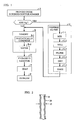
- Such steps include: mixing powdered oxide superconductor with powdered silver oxide, ball milling the mixture in an appropriate solvent, exemplarily methylene chloride, such that a slurry is formed, vacuum filtering the slurry such that a filtrate is retained, drying the filtrate such that dry cake is formed, and heating the dry cake for about two hours at about 400°C.
- an appropriate solvent exemplarily methylene chloride
- the core material consists of metallic oxide superconductor material (here referred to as "oxide superconductor”) to which finely dispersed silver is optionally added.
- the total fraction of core material that is not metallic oxide superconductor material is preferably less than 30 vol.%.
- the core material should be substantially free of elemental carbon or organic materials. It is believed that any metallic oxide superconductor material can be used.
- An exemplary, specific metallic oxide superconductor material is Ba 2 y C U3 0 7 . For illustrative purposes, the following process steps are described with reference to this particular oxide superconductor compound.
- the oxide superconductor is initially provided (step A) in the form of a powder, having an average grain size of, e.g., 10 - 100 ⁇ m.
- a powder having an average grain size of, e.g., 10 - 100 ⁇ m.
- Methods for producing an appropriate powder are well known in the art. An exemplary method is described in D. W. Johnson, et al., "Fabrication of Ceramic Articles from High T c Superconducting Oxides," Advanced Ceramic Materials vol. 2, No. 3-B (1987) p. 364.
- the oxide superconductor is characterized, inter alia, by its density (or equivalent density, discussed above).
- the density is expressed here as a relative density, i.e., as a percentage of a reference density corresponding to the density of fused oxide superconductor as measured by the method of Archimedes.
- the reference density (also referred to as "full density") of Ba 2 YCu 3 O 7 was determined to be 6.2 g/cm 2 . (However, it should be noted that small variations are generally expected between density measurements made by different investigators, using different equipment, of the same fused oxide superconductor. As a consequence, absolute determinations of the reference density are expected to vary somewhat between laboratories.)
- the core material Prior to extrusion, the core material is formed (step B) into partially densified pellets, or, preferably, a partially densified slug, by, e.g., isostatic compression (B1) followed, e.g., by sintering (B2).
- Densification by, e.g., sintering is necessary because if the equivalent density of the core material is less than about 55%, the walls of the canister will tend to collapse against the (relatively compressible) core material during extrusion, resulting in accordion-like corrugations in the cladding.
- the equivalent density of the pellets is typically about 30% - 35%. Sintering typically raises this density to about 55% - 65%.
- pellets or slug are loaded (step D) into a bore hole drilled in a metal canister.
- the diameter of the pellets or slug is slightly smaller than the diameter of the bore hole, and is typically 0.3 inches (0.76 cm).
- the length of the canister, and concomitantly of the bore hole that is filled with core material is typically 4 inches (10.16 cm) (depending on the size of the extrusion press).
- the slug if used, is typically 4 inches (10.6 cm) long.
- Pellets, if used are typically made about 0.5 inches (1.27 cm) thick.
- the loaded canister is subsequently heated (step E) and extruded (step F).
- the interfaces between the stacked pellets in the canister may give rise to a spatial instability during extrusion.
- the effect of this instability is to create constrictions 10 in the extruded core 20 at irregular intervals.
- the constrictions may also appear in the outer surface of the extruded jacket 30.
- the core and possibly also the jacket
- the core may assume a wavy, or sausage-like, appearance.
- the use of an integral slug is preferred.
- the instability can be mitigated, and even eliminated, by adding finely divided silver (step C of FIG. 1) to the core material, as noted above and discussed in greater detail below.
- the instability is dependent on the die angle. That is, certain samples were observed to exhibit instability when extruded at a die angle of 60°. However, when identical samples were extruded at a die angle of 75°, the instability was less apparent, and at a die angle of 90°, it was undetectable, at least to the unaided eye.
- core material is first provided, typically having a grain size ranging from about 10 ⁇ m to about 100 f,.lm. (The grain size is not critical.)
- the core material is placed in a mold for isostatic compression and pressed into pellets at a pressure, typically, of 50 ksi (345 MPa). Isostatic compression may be at room temperature or at elevated temperatures that are readily apparent to practitioners in the art.
- the pellets or slugs are then sintered in an oxygen atmosphere in order to further densify them and to achieve optimal oxygen stoichiometry. As noted, further densification is desirable in order to avoid corrugating the cladding.
- the oxygen stoichiometry is important because at relatively high temperatures, e.g. above about 450°C for Ba 2 y C U3 0 7 , metallic oxide superconductors tend to evolve oxygen, and as a consequence the stoichiometric coeffcient of oxygen remaining behind in the oxide falls below its nominal value. When this occurs, the superconductive electronic properties of the material may be impaired.
- the presence of an oxygen atmosphere during sintering tends to shift the thermodynamic equilibrium such that oxygen evolution is less favored.
- the pellets or slugs are sintered for about 24 hours at about 930°C, and then cooled to room temperature at a constant rate for about 48 hours. As noted, such a sintering process typically increases the equivalent density of the core material to about 55% - 65%.
- finely divided silver is mixed into the core material. It has been discovered that the addition of silver mitigates or eliminates the spatial instability discussed above. Moreover, it has been discovered that the addition of silver may reduce the pressure required to achieve a given extrusion ratio.
- a currently preferred embodiment includes a sequence of steps that are effective for dispersing silver in the initial metallic oxide powder while avoiding such segregation and maintaining a uniform distribution of silver during sintering.
- the first steps are mixing (step C1 of FIG. 1) and milling (step C2), using, e.g., methylene chloride (also called dichloromethane, formula CH 2 CI 2 ) as the milling solvent.
- methylene chloride also called dichloromethane, formula CH 2 CI 2
- a quantity of powdered oxide superconductor e.g., 100 g of Ba 2 y C U3 0 7
- Methylene chloride is added until the bottle is filled to 75% of capacity.
- Large zirconium oxide balls, for milling, are then added until the bottle is filled to capacity.
- the bottle is then agitated on a horizontal roller at 60 rpm for 4 hours.
- the resulting slurry is removed from the bottle and vacuum filtered (C3), and the resulting cake is baked for about 12 hours in a vacuum oven at 60°C to dry it (C4).
- the dried cake is placed in a zirconia boat and heated in a tube furnace for two hours at 400°C (step C5).
- the resulting material is then isostatically compressed and sintered as described above. It has been found that this treatment produces a dispersion of silver particles averaging 1 - 2.5 f..lm in size before sintering, and 3 - 5 f..lm in size after sintering for 16 hours at 925°C, followed by furnace cooling in oxygen.
- the equivalent density of the material before sintering is about 30% - 35%, and after sintering it is about 55% - 65%.
- the corresponding extrudate has been found to have an equivalent density of about 92% - 96%.
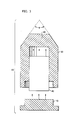
- the canister 50 is exemplarily formed by drilling and machining a solid metal cylinder.
- the metal of the cylinder is here referred to as the "cladding metal.”
- the cladding metal should be relatively ductile, such that it can be extruded to form the cladding of the extrudate, at the desired extrusion ratios, without suffering fractures or tears.
- the cladding metal should be capable of flowing relatively smoothly through the die during extrusion, without sticking to the inner die surface and stalling the extrusion press.
- the cladding metal should have a relatively high thermal conductivity in order to readily distribute heat generated by adiabatic heating during extrusion.
- a cladding metal that is chemically compatible with the superconductor material. That is, certain chemical elements, including copper and nickel, are capable of chemically reacting with metallic oxide superconductors with the result that the desirable superconductive electrical properties of the metallic oxide superconductors are degraded or eliminated. This may present a problem because the extrusion process often impairs the same desirable electrical properties, and the extrudate is typically annealed to restore those properties. If incompatible elements are present in the cladding, chemical reactions that poison the superconductor may take place during annealing. Thus, cladding materials are preferable that are relatively free of such incompatible elements.
- a cladding that contains incompatible element is readily stripped away, prior to etching, by conventional processes such as acid etching.
- One appropriate acid solvent for this purpose is a 50% solution of nitric acid in water. It has been observed that this solvent can be used without a signicant deleterious effect on the core material.) Thus, chemical incompatibility is less important when, for example, the extruded core is intended to be used without a cladding.
- the cladding material is too soft, it may notform an acceptable cladding.
- some materials such as pure silver, tend to flow away from the advancing front end of the extrudate during extrusion.
- the core bare of any cladding, may advance a relatively short distance and then break.
- this flow behavior tends to remove cladding metal from around the core material as it is being extruded.
- the cross sectional area of the core is reduced by a smaller factor than would be expected by simply comparing the cladding outer diameter before and after extrusion.
- dispersion hardened metals or dispersion hardened metal alloys are especially useful as cladding materials.
- a dispersion hardened metal is one that is hardened by dispersing insoluble solid particles within the metal.
- Dispersion hardened metals are generally better for this purpose than metals hardened by other processes, e.g., by forming solid solutions, because at elevated temperatures, they exhibit higher strain-hardening rates. This is an important property because extrusion is typically carried out at a temperature of 600° F, (316°C) and adiabatic heating may raise the temperature during extrusion by as much as about 400°F (204°C).
- a preferred cladding material is silver that is dispersion hardened with cadmium oxide at a concentration of, e.g., 10 mole%. This material is preferred because it is chemically compatible with many, if not all, currently known metallic oxide superconductors.
- exemplary cladding materials are silver that is dispersion hardened with nickel at a concentration of 10 mole%, and dispersion strengthened copper.
- exemplary formulations of dispersion strengthened copper that are useful as cladding materials are the alumina-dispersed copper formulations going under the Copper Development Association designations C15715 (0.3 Wt.% alumina) and C15760 (1.1 Wt.% alumina). These formulations are commercially available as GlidCop, a registered trademark of SCM Metal Products, Inc., of Cleveland, Ohio.
- the canister is exemplarily made by drilling and machining a solid metal cylinder.
- the outer diameter of the canister depends on the chamber size of the extrusion press to be used.
- the chamber has an inside diameter of 0.625 inches (1.59 cm), and a corresponding canister should have an outside diameter of about 0.620 inches (1.57 cm).
- the corresponding bore hole diameter in the canister ranges, typically, from about 0.250 inches (0.635 cm) to about 0.435 inches (1.10 cm).
- the slug or pellets fit within the bore hole with a clearance of no more than about 10 mils (0.254 mm) relative to the inner walls of the canister.
- the closed end of the canister is desirably formed into a conical taper 60, exemplarily by machining.
- the taper may be a separate piece that is soldered onto the end of the canister.
- the taper may end bluntly, or it may optionally converge to a point.
- the full vertex angle 0 of the cone is substantially the same as the extrusion angle (which is determined by the selection of the die to be used).
- the borehole preferably does not extend into the taper region.
- the end cover is typically made of the cladding material, and comprises at least one disk-shaped portion having an outer diameter equal to that of the canister.
- a currently preferred end cover has a T-shaped cross section, such that a lower portion comprising a disk of relatively small diameter can be inserted in a plug-like manner into the open end of the canister, while an upper portion, comprising a disk of greater diameter, presses against, and is sealed to, the canister material.
- the cover is initially assembled on the canister by press fitting, and a final seal is made by compression in the extrusion press.
- cover designs can readily be used, such as a disk of uniform outer diameter that is compression sealed to the canister, or a cover that is both T-shaped and threaded, and that is screwed into place.
- the fully assembled canister 80, including the slug and the cover, is here referred to as a "billet.”
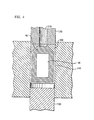
- the closed end 90 of the canister is situated adjacent to a die 100 having an inward-facing bevel that is tapered at the so-called die angle.
- the bevel surrounds an aperture 110 through which the extrudate emerges during extrusion.
- the die angle has been found to affect the extrusion process. That is, die angles ranging from about 60° to about 90° may be usefully employed. However, as noted above, when the core material is in pellet form it is desirable to use a die angle of at least about 75°. Moreover, it has been observed that when the core material is in the form of an integral slug, the highest extrusion ratios are achieved at a given pressure when the die angle is about 70° - 75°, and thus, in at least this case, a die angle of about 70° - 75° is preferred.
- An exemplary hydrostatic extrusion apparatus that is commercially available is the 0.625- inch (1.59 cm) bore, 4-inch (10.16 cm) length, hydrostatic extrusion facility manufactured by Naples Research and Manufactwing Company of Naples, Florida. This apparatus is designed to reach a maximum hydrostatic pressure of 325,000 psi (2240 MPa), and it can be electrically heated to about 316°C by an electrical heating coil surrounding the chamber.
- the hydrostatic quid used is a silicone oil sold by Amoco under the tradename Synthalube, and also sold by Naples Research and Development under the tradename JCT Extroil 111.
- the chamber has adequate heat resistance up to 316°C - 371 °C.
- the die 100 is made of tool steel, and the ram 120 and die stem 130 are made of tungsten carbide. The use of such an extrusion press is well known to those skilled in the art, and is described only briefly here.
- the hydrostatic quid 140 Prior to insertion of the billet, a small quantity of the hydrostatic quid 140 is placed within the (preheated) chamber such that during extrusion, the billet will be substantially surrounded by the quid and as a resultwill be subjected to hydrostatic or quasi-hydrostatic pressure.
- the diameter of the billet is smaller than the diameter of the chamber by at least about 5 mils (0. 127 mm), but not more than about 15 - 20 mils (0.381 - 0.508 mm).
- the slug (or, alternatively, a stack of pellets) is first assembled in the canister.
- the cover of the canister is then press fit or screwed over the open end of the canister.
- the loaded canister is referred to here as the billet.
- the billet and the empty chamber are separately preheated to the extrusion temperature. Hydrostatic quid is placed within the chamber, as noted, above.
- the preheated billet is then placed within the chamber, and the die is placed over the billet.
- the ram is then advanced until the die engages the die stem and is properly aligned and set over the taper of the canister.
- a short period of time typically about 30 seconds, is allowed for temperature equilibration before extrusion commences.
- Extrusion is commenced by advancing the ram of the extrusion press against the die stem.
- Typical strain rates are 0.08 - 0.2 inches/second (0.2 - 0.5 cm/second). It should be noted in this regard that adiabatic heating is more pronounced when higher strain rates are used.
- the extrusion temperature is typically about 316°C, is preferably less than about 800°C, and is still more preferably less than about 450°C, as explained below. (These temperatures do not include the additional temperature increment due to adiabatic heating during extrusion.) It has been observed that heating even to such relatively low temperatures results in a dramatic, and quite surprising, reduction in the pressures required to achieve extrusion.
- the core material is sealed within a canister that is substantially non-reactive toward oxygen at the process temperatures and pressures, and the core material is substantially free of readily oxidizable impurities, e.g., organic plasticizers or binders. As a result, most of the oxygen that may be evolved is confined within the canister.
- extrusion is initiated.
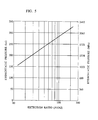
- pressures in the range 100 - 350 ksi (690 - 241 MPa) are generally required.
- FIG. 5 shows the relationship between pressure and extrusion ratio for an illustrative series of extrusions.
- the maximum pressure that can be used is limited by the design of the extrusion press to be used. Extrusion ratios greater than 4, and, in fact, ranging up to 100 and even more, are readily achieved by this method.
- the superconductor material of the core may be so flawed by shear strain that it is no longer superconductive.
- superconductivity is readily restored by annealing.
- superconductivity in Ba 2 YCu a 0 7 is readily restored by heating for 2 - 5 hours at 925°C, followed by cooling to room temperature at a rate of about 10°C/hour.
- the core material is sealed within a cladding that is substantially non-reactive toward oxygen at the process temperatures and pressures, and the core material is substantially free of readily oxidizable impurities, e.g., organic plasticizers or binders.
- most of the oxygen that may be evolved during annealing after extrusion is confined within the core.
- the annealing conditions may also promote chemical poisoning of the superconductor.
- poisoning of Ba 2 YCu a 0 7 by copper may begin at temperatures as low as about 700°C, at which copper acquires significant diffusive mobility. Such poisoning is readily avoided by stripping away the cladding prior to annealing.
- a slug of Ba 2 YCu a 0 7 containing 28 vol.% dispersed silver was prepared by the method described above.
- the slug was 0.325 inches (0.826 cm) in diameter.
- the slug was loaded into a canister of silver that was dispersion hardened with 10 mole% cadmium oxide.
- the canister was of one piece, including a pointed taper machined at the die angle of 70°. Using a die with a circular aperture and a pressure of about 1890 MPa, an extrusion ratio of 100 was achieved. No obvious porosity was observed on subsequent metallographic examination of the extruded core material.
Landscapes
- Engineering & Computer Science (AREA)
- Manufacturing & Machinery (AREA)
- Superconductors And Manufacturing Methods Therefor (AREA)
- Extrusion Of Metal (AREA)
- Pressure Welding/Diffusion-Bonding (AREA)
- Powder Metallurgy (AREA)
Applications Claiming Priority (2)
| Application Number | Priority Date | Filing Date | Title |
|---|---|---|---|
| US62097590A | 1990-11-30 | 1990-11-30 | |
| US620975 | 1990-11-30 |
Publications (3)
| Publication Number | Publication Date |
|---|---|
| EP0488573A2 true EP0488573A2 (de) | 1992-06-03 |
| EP0488573A3 EP0488573A3 (en) | 1992-11-04 |
| EP0488573B1 EP0488573B1 (de) | 1996-04-24 |
Family
ID=24488194
Family Applications (1)
| Application Number | Title | Priority Date | Filing Date |
|---|---|---|---|
| EP91310676A Expired - Lifetime EP0488573B1 (de) | 1990-11-30 | 1991-11-20 | Verfahren zur Herstellung eines supraleitenden Artikels |
Country Status (3)
| Country | Link |
|---|---|
| EP (1) | EP0488573B1 (de) |
| JP (1) | JP3426610B2 (de) |
| DE (1) | DE69119039T2 (de) |
Family Cites Families (3)
| Publication number | Priority date | Publication date | Assignee | Title |
|---|---|---|---|---|
| DE3851070T3 (de) * | 1987-02-28 | 2006-12-28 | Sumitomo Electric Industries, Ltd. | Verfahren zur Herstellung eines Oxid-Verbindungssupraleiterfadens. |
| US4952554A (en) * | 1987-04-01 | 1990-08-28 | At&T Bell Laboratories | Apparatus and systems comprising a clad superconductive oxide body, and method for producing such body |
| AT388393B (de) * | 1987-11-09 | 1989-06-12 | Plansee Metallwerk | Verfahren zur herstellung eines supraleitenden drahtes mit perovskit-phase |
-
1991
- 1991-11-20 EP EP91310676A patent/EP0488573B1/de not_active Expired - Lifetime
- 1991-11-20 DE DE69119039T patent/DE69119039T2/de not_active Expired - Lifetime
- 1991-11-29 JP JP31608391A patent/JP3426610B2/ja not_active Expired - Fee Related
Also Published As
| Publication number | Publication date |
|---|---|
| DE69119039T2 (de) | 1996-11-28 |
| JP3426610B2 (ja) | 2003-07-14 |
| DE69119039D1 (de) | 1996-05-30 |
| EP0488573A3 (en) | 1992-11-04 |
| EP0488573B1 (de) | 1996-04-24 |
| JPH0543959A (ja) | 1993-02-23 |
Similar Documents
| Publication | Publication Date | Title |
|---|---|---|
| EP0285319B1 (de) | Vorrichtungen und Systeme mit einem supraleitenden Körper und Verfahren zur Herstellung dieses Körpers | |
| KR940010162B1 (ko) | 초전도체 선구물질(precursor) 제조방법 | |
| US5081075A (en) | Method of producing a superconductive body, and apparatus and systems comprising the body | |
| US5210071A (en) | Method of forming superconductive articles by hydrostatic extrusion | |
| US5223478A (en) | Hot isostatic processing of high current density high temperature conductors | |
| EP0045584B1 (de) | Verfahren zur Herstellung eines mehradrigen Supraleiters | |
| US6191074B1 (en) | Fabrication of superconducting wires and rods | |
| US4999338A (en) | Preparation of metal/superconducting oxide composites | |
| EP0488573B1 (de) | Verfahren zur Herstellung eines supraleitenden Artikels | |
| US5284823A (en) | Superplastic forming of YBa2 Cu3 O7-x ceramic superconductors with or without silver addition | |
| EP0456182B1 (de) | Supraleitendes Oxid und Verfahren zu seiner Herstellung | |
| US5304602A (en) | Process for producing sintered ceramic wire | |
| CA1340010C (en) | Superconducting composite | |
| CA1327119C (en) | Method of producing a superconductive oxide conductor | |
| WO1989010633A1 (en) | Superconductive cable and method of manufacturing a superconductive cable | |
| Mamalis et al. | Fabrication of multi-layered steel/superconductive ceramic (Y Ba K Cu O)/silver rods by explosive powder compaction and extrusion | |
| EP0549567A2 (de) | Supraleitender Draht | |
| US5145836A (en) | Method for producing shaped parts from high temperature oxide metal superconductive composites | |
| CA1330702C (en) | Method of producing long functional oxide objects | |
| RU2042655C1 (ru) | Способ получения длинномерного изделия из высокотемпературного сверхпроводника | |
| JP2564897B2 (ja) | 高臨界電流密度を有する超電導線材およびコイルの製造法 | |
| JP3033606B2 (ja) | 酸化物超電導線材の製造方法 | |
| JPH01298607A (ja) | 酸化物系超電導線材 | |
| Holmes et al. | Bronze for superconducting wires: The powder metallurgy approach | |
| MacLeod | AN INVESTIGATION OF HYDROSTATIC EXTRUSION AND OTHER DEFORMATION MODES FOR THE FABRICATION OF MULTI-FILAMENTARY NIOBIUM-TIN SUPERCONDUCTORS BY A POWDER METALLURGY APPROACH |
Legal Events
| Date | Code | Title | Description |
|---|---|---|---|
| PUAI | Public reference made under article 153(3) epc to a published international application that has entered the european phase |
Free format text: ORIGINAL CODE: 0009012 |
|
| AK | Designated contracting states |
Kind code of ref document: A2 Designated state(s): DE GB |
|
| PUAL | Search report despatched |
Free format text: ORIGINAL CODE: 0009013 |
|
| AK | Designated contracting states |
Kind code of ref document: A3 Designated state(s): DE GB |
|
| 17P | Request for examination filed |
Effective date: 19930422 |
|
| RAP3 | Party data changed (applicant data changed or rights of an application transferred) |
Owner name: AT&T CORP. |
|
| 17Q | First examination report despatched |
Effective date: 19941005 |
|
| GRAA | (expected) grant |
Free format text: ORIGINAL CODE: 0009210 |
|
| AK | Designated contracting states |
Kind code of ref document: B1 Designated state(s): DE GB |
|
| REF | Corresponds to: |
Ref document number: 69119039 Country of ref document: DE Date of ref document: 19960530 |
|
| PLBE | No opposition filed within time limit |
Free format text: ORIGINAL CODE: 0009261 |
|
| STAA | Information on the status of an ep patent application or granted ep patent |
Free format text: STATUS: NO OPPOSITION FILED WITHIN TIME LIMIT |
|
| 26N | No opposition filed | ||
| REG | Reference to a national code |
Ref country code: GB Ref legal event code: IF02 |
|
| PGFP | Annual fee paid to national office [announced via postgrant information from national office to epo] |
Ref country code: DE Payment date: 20091120 Year of fee payment: 19 |
|
| PGFP | Annual fee paid to national office [announced via postgrant information from national office to epo] |
Ref country code: GB Payment date: 20091119 Year of fee payment: 19 |
|
| GBPC | Gb: european patent ceased through non-payment of renewal fee |
Effective date: 20101120 |
|
| REG | Reference to a national code |
Ref country code: DE Ref legal event code: R119 Ref document number: 69119039 Country of ref document: DE Effective date: 20110601 Ref country code: DE Ref legal event code: R119 Ref document number: 69119039 Country of ref document: DE Effective date: 20110531 |
|
| PG25 | Lapsed in a contracting state [announced via postgrant information from national office to epo] |
Ref country code: DE Free format text: LAPSE BECAUSE OF NON-PAYMENT OF DUE FEES Effective date: 20110531 |
|
| PG25 | Lapsed in a contracting state [announced via postgrant information from national office to epo] |
Ref country code: GB Free format text: LAPSE BECAUSE OF NON-PAYMENT OF DUE FEES Effective date: 20101120 |