EP0484155B1 - Zweirollen-Biegevorrichtung für Rohre - Google Patents
Zweirollen-Biegevorrichtung für Rohre Download PDFInfo
- Publication number
- EP0484155B1 EP0484155B1 EP91310063A EP91310063A EP0484155B1 EP 0484155 B1 EP0484155 B1 EP 0484155B1 EP 91310063 A EP91310063 A EP 91310063A EP 91310063 A EP91310063 A EP 91310063A EP 0484155 B1 EP0484155 B1 EP 0484155B1
- Authority
- EP
- European Patent Office
- Prior art keywords
- bending
- pipe
- former
- axis
- arm
- Prior art date
- Legal status (The legal status is an assumption and is not a legal conclusion. Google has not performed a legal analysis and makes no representation as to the accuracy of the status listed.)
- Expired - Lifetime
Links
- 238000005452 bending Methods 0.000 claims abstract description 64
- 238000006243 chemical reaction Methods 0.000 claims description 13
- 238000003462 Bender reaction Methods 0.000 description 6
- 239000000463 material Substances 0.000 description 6
- 238000000034 method Methods 0.000 description 4
- 229910000831 Steel Inorganic materials 0.000 description 3
- 239000010959 steel Substances 0.000 description 3
- 210000002969 egg yolk Anatomy 0.000 description 2
- 239000012530 fluid Substances 0.000 description 2
- 230000002093 peripheral effect Effects 0.000 description 2
- 238000005096 rolling process Methods 0.000 description 2
- 230000037303 wrinkles Effects 0.000 description 2
- 239000012141 concentrate Substances 0.000 description 1
- 230000007547 defect Effects 0.000 description 1
- 230000006698 induction Effects 0.000 description 1
- 230000000750 progressive effect Effects 0.000 description 1
- 230000000630 rising effect Effects 0.000 description 1
- 230000000007 visual effect Effects 0.000 description 1
- 238000011179 visual inspection Methods 0.000 description 1
- 238000003466 welding Methods 0.000 description 1
- 230000037373 wrinkle formation Effects 0.000 description 1
Images





Classifications
-
- B—PERFORMING OPERATIONS; TRANSPORTING
- B21—MECHANICAL METAL-WORKING WITHOUT ESSENTIALLY REMOVING MATERIAL; PUNCHING METAL
- B21D—WORKING OR PROCESSING OF SHEET METAL OR METAL TUBES, RODS OR PROFILES WITHOUT ESSENTIALLY REMOVING MATERIAL; PUNCHING METAL
- B21D7/00—Bending rods, profiles, or tubes
- B21D7/02—Bending rods, profiles, or tubes over a stationary forming member; by use of a swinging forming member or abutment
- B21D7/024—Bending rods, profiles, or tubes over a stationary forming member; by use of a swinging forming member or abutment by a swinging forming member
-
- B—PERFORMING OPERATIONS; TRANSPORTING
- B21—MECHANICAL METAL-WORKING WITHOUT ESSENTIALLY REMOVING MATERIAL; PUNCHING METAL
- B21D—WORKING OR PROCESSING OF SHEET METAL OR METAL TUBES, RODS OR PROFILES WITHOUT ESSENTIALLY REMOVING MATERIAL; PUNCHING METAL
- B21D7/00—Bending rods, profiles, or tubes
- B21D7/06—Bending rods, profiles, or tubes in press brakes or between rams and anvils or abutments; Pliers with forming dies
- B21D7/063—Pliers with forming dies
Definitions
- the invention pertains to pipe bending and more particularly to an apparatus and method for bending pipe using at least two means for exerting pressure against an inside former.
- Severe kinking is usually experienced with C350 grade pipe in conventional formers with a radius of bend of approximately three times the diameter of the pipe. There have been attempts to avoid this by increasing the former radius from three diameters to four diameters and by making the former tighter on the pipe, even to the point of having the pipe squeeze into the former. It is intended that this grip in the former will stop the pipe rising out of the former at the point of bend and allow a kink to form. These measures are successful on some types of pipe and in most cases kinking is not found while flattening and wrinkling are only minor.
- draw benders Certain more effective and also more complex and expensive benders are referred to as draw benders. They are arranged to start the bend at a predetermined point and progressively bend this section around a former in one direction only. This is usually done by providing a fixed inside former, with one reaction point also fixed. Bending is achieved by a sliding or rolling outside former following an arc concentric with the inside former's shape. This allows the reaction point to be kept relatively close to the actual point of bend at all times and high former contact pressure is maintained. This tends to minimise wrinkling. However, with some extra light wall sections, wrinkling is still encountered with considerably flattening around the outside of the bend.
- Draw benders are usually arranged to make a bend progressively in one direction from a start point, by engaging the pipe to be bent between a fixed reaction point, a fixed inside former and a movable outside member which is attached pivotally at the centre of the fixed former.
- Some variations use a fixed outside member and an inside former and clamping reaction member that rotate together pulling the pipe around the bend.
- a pipe bender comprising a base, a former mounted on the base and having a former surface extending angularly at a fixed radius about a bending axis, said former surface being provided to engage a length of pipe to be bent to conform to at least a portion of the length of said former surface; a bending arm pivotally mounted on said base for pivotting movement about said axis; a bending assembly mounted on said arm, said assembly includes two deforming rollers rotatably mounted for movement about an axes parallel to said bending axis, and spaced radially outwardly of said surface, said rollers being adapted to engage said length of pipe to cause bending thereof as it is moved angularly about said axis; said roller being substantially co-extensive with one roller being positioned radi
- the two rollers are mounted for movement at constant radii, the leading roller having a larger radius.
- the two deforming rollers are rotatably mounted on a flange which is pivotally supported by said bending arm.
- a conventional fixed post bender 10 uses a rigid, curved former 11 which controls both the cross-sectional profile of the section and the radius of the bend. Fixed posts 12 are set apart while the former 11 is forced into the section between the posts to create the bend.
- Fig. 2 Illustrates a variant of a conventional fixed post bender which allows the reaction points 13 to be kept fairly close to the point of the bend while also allowing them to move outwards (in the direction of the arrows 14) as bending progresses. This is done by mounting rollers 15 on each of two pivotted arms 16.
- Fig. 3 illustrates a prior art induction bender 20. A fixed inside former 21 cooperates with a sliding or rolling outside former 22.
- leading outside former 57 applies the bending force as a moment and that the trailing outside former 58 applies a force to the material to contain and control the shape of material in the inside former 50. It is preferred that the trailing outside former 58 be located at or near the point of bend. The trailing outside former 58 need not be located precisely at the point of bend. In a preferred embodiment, a gap of several millimeters is left between the outside diameter of the trailing former end the outside diameter of the inside former. This ensures that the pressure exerted by the trailing edge former is also exerted onto the section or pipe being bent and not transmitted directly onto the inside former.
- the distance separating the two outside formers could vary greatly so that the contact they have with the material being bent could be very close or quite distant.
- the two outside formers while preferably mounted on a common pivotting carriage, could be moved into and out of position by separate means. Hydraulic, pneumatic, electrical, magnetic or mechanical devices can be used to move each outside former into and out of position independent of the other outside formers.
- the pivot point 56 of the carriage 55 can be moved relative to the rotational centres of the outside formers to as to vary the geometry and hence the contact pressure exerted by the trailing outside former 58.
- rollers and cradle 55 rotate with respect to the centre of the inside former or whether the former and section being bent rotate with respect to a fixed set of outside formers.
- rollers or other means for exerting pressure may be mounted on a rotating arm or urged into position in other suitable ways.
- two pairs of outside formers could be located to allow bending to proceed around the inside former in opposite directions and simultaneously.
- Fig. 6 illustrates an example of a pipe bending apparatus 60 utilizing tandem rollers 61 as disclosed with reference to Fig. 5.
- the rollers 62 are mounted on a common cradle 63 which rotates about a pivot point 64.
- the cradle 63 pivots with respect to an arm 65 which rotates about the centre 66 of the inside former 67.
- a central post 68 to which the inside former is mounted also bears an arm 69 which provides a fixed reaction point 70 for the material which is being bent 71.
- a hydraulic cylinder 72 in combination with a link mechanism 73 allows the arm 65 to be rotated at least 180° with respect to the inside former. This particular arrangement for rotating the arm 65 is described more completely in Australian Patent Application No. 58906/90.
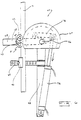
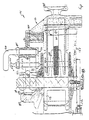
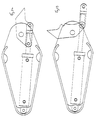
- FIG. 7 to 13 of the accompanying drawings there is schematically depicted a pipe bender 110.
- the bender 110 has a base 111 from which there extends legs 112 to support the base 111 on a ground surface.
- the base 111 is basically a hollow housing which pivotally supports an arm 113 for pivotting movement about a generally vertical axis defined by the main pin 114.
- a bending assembly 115 which includes a carriage 116.
- the carriage 116 is slidably mounted on the arm 113 for longitudinal movement relative thereto. This movement is effected by means of a threaded shaft 117 provided at its outer end with an adjustment wheel or lever 118.
- the shaft 117 threadably engages a threaded passage 119 formed in the arm 113.
- the bending assembly 115 further includes a roller support 120 pivotally mounted by means of a secondary pin 140.
- the support 120 co-operates with a pair of vertically spaced generally horizontal flanges 121 to support two or more rollers.
- two rollers 122 and 123 are provided.
- the flanges 121 are joined by means of a handle 124 which is pivotally supported by passing through a passage in the support 120.
- the rollers are each supported by means of a pin 125.
- the roller 122 is positioned at the point of bending and the roller 123 is positioned forward thereof.
- the roller 123 is located angularly forward of and radially further out than the roller 122, relative to the bending axis.
- a hydraulic ram 126 having a cylinder 127 pivotally mounted at one end by means of a pin 145.
- the ram 126 has a piston rod 129 terminating with a yolk 128.
- the yolk 128 is pivotally attached to a link 129 by means of a pin 130.
- the other end of the link 129 is pivotally attached to the arm 113 by means of a pin 131.
- the arm 113 is also provided with a socket 146 which receives the pin 130 during various phases of movement of the arm 113 about the pin 114.
- a former 132 which is provided with a former surface 133 which extends angularly about the pin 114, at a generally constant radius.
- the former surface 132 is concave in transverse cross-section.
- a length of pipe 134 to be deformed by the bender 110 is bended to generally conform to the surface 132 and therefore the pin 114 also defines the bending axis about which the pipe 134 is bent.
- the hydraulic ram 126 is controlled in its movement by means of a spool valve 135, operated by means of a lever 136 extending upwardly through the base 111.
- the spool valve 135 receives hydraulic fluid under pressure and delivers it to the cylinder 127.
- hydraulic fluid under pressure is delivered to the cylinder 127 to cause the piston rod 129 to telescopically extend from within the cylinder 127.
- This telescopic movement commenced from when the hydraulic ram 126 is configured as shown in Figure 4.
- the arm 113 is caused to pivot due to engagement of the pin 130 with the socket 132. This continues until the arm 113 has reached the position depicted in Figure 6. At this position, the arm 113 pivots to remove the pin 130 from contact within the socket 146. However the arm 113 continues to pivot due to the force being applied to the arm 113 via the link 129.
- the spool valve 135 has a cam follower 136 which engages a cam 137 fixed to the arm 113 (via the pin 125) so as to rotate with the arm 113.
- the cam 137 Is adjustable to return the spool valve 135 to the start position and/or to cause the spool valve 135 to return the arm 113 to the start position. Accordingly, the cam 137 can be used to govern the angle through which the pipe 134 is bent.
- the former 132 is mounted on the pin 114 but is removable. This enables formers of various sizes to be used so that varying radii may be produced.
- the former 132 has a rear recess 139 which engages a projection 140 on the base 111, so that the former 132 is held stationary during operation.
- a pipe support 141 which engages the pipe 134 to retain one portion stationary with respect to the base 111 during bending.
- the bender 110 is described as bending in one predetermined direction. However it should be appreciated that bending can take place in the reverse direction. This is achieved by removing the former 132. Thereafter, the lever 136 is removed together with the cam 137 by release of the bolt 138. The handle 118 is then rotated to remove the bending assembly 115. Next the main pin 114 is removed which enables the arm 113 to be pulled from within the base 111. This is achieved by telescopic movement of the piston rod 127 outwardly with respect to the cylinder 127. Thereafter, the arm 113, link 129 and piston rod 127 are rotated about the axis of the piston rod 127, through 180°.
- the handle 118 is rotated in order to move the rollers 122 radially with respect to the pin 114, in order to accommodate pipes of different diameters. It should further be appreciated that two or more rollers 122 may be employed, with one of the rollers being positioned at the point of deformation of the pipe 134.
Landscapes
- Engineering & Computer Science (AREA)
- Mechanical Engineering (AREA)
- Bending Of Plates, Rods, And Pipes (AREA)
- Machines For Manufacturing Corrugated Board In Mechanical Paper-Making Processes (AREA)
Claims (10)
- Rohrbieger mit einer Basis (111), einem auf der Basis angebrachten Former (132) mit einer Formeroberfläche (133), die sich in konstantem Radius über einen Winkel um eine Biegeachse (114) erstreckt und für den Eingriff mit einer Länge eines Rohres (134) vorgesehen ist, um diese in die Form wenigstens eines Teils der Länge der genannten Formeroberfläche zu biegen,
einem Biegearm (113), der zur Schwenkung um die genannte Achse auf das genannten Basis schwenkbar angebracht ist,
einem auf dem genannten Arm angebrachten Biegeaggregat (115), das zwei Verformungsrollen (122,123) umfaßt, die zur Bewegung um zu der genannten Biegeachse parallele Achsen drehbar angebracht sind, mit Abstand von der genannten Oberfläche radial nach außen angeordnet sind und für den Eingriff mit der genannten Rohrlänge ausgebildet sind, um bei der Winkelbewegung um die genannte Achse die Biegung der Rohrlänge zu bewirken,
wobei die genannten Rollen im wesentlichen von gleicher Ausdehnung sind und eine Rolle zu der genannten Biegeachse radial angeordnet ist, so daß sie sich beim Betrieb etwa am Biegepunkt des Rohres befindet, und die andere Rolle winkelmäßig mit Abstand vor der genannten Rolle und radial weiter von der Biegeachse entfernt als die genannte eine Rolle angeordnet ist, und
einer Antriebseinrichtung zur Bewirkung der Winkelbewegung des genannten Arms um die genannte Achse zwecks Bewegung der genannten Rolle zur Verformung des Rohres, dadurch gekennzeichnet, daß
die genannten zwei Verformungsrollen auf einem Flansch (121) drehbar angebracht sind, der auf dem genannten Biegearm schwenkbar gelagert ist. - Rohrbieger nach Anspruch 1, der ferner ein auf der genannten Basis angebrachtes Gegendruckelement (141) aufweist, das für den Eingriff mit der genannten Rohrlänge während ihrer Biegung und das Halten eines gebogenen Teils der Rohrlänge in Berührung mit der genannten Formeroberfläche ausgebildet ist.
- Rohrbieger nach Anspruch 1 oder Anspruch 2, bei dem der genannte Biegearm Mittel (116) zur Wahl der radialen Anordnung des Biegeaggregats relativ zu der genannten Oberfläche aufweist.
- Rohrbieger nach einem der vorhergehenden Ansprüche, bei dem die genannte Antriebseinrichtung einen hydraulischen Stempel (127) umfaßt, der an einem Ende an der Basis schwenkbar angebracht ist und an dem anderen Ende mit dem genannten Biegearm schwenkbar verbunden ist.
- Rohrbieger nach Anspruch 4, bei dem das genannte andere Ende des hydraulischen Stempels durch einen Bolzen (130) mit einem Zwischenglied (129) schwenkbar verbunden ist, das seinerseits mit dem Biegearm schwenkbar verbunden ist, und bei dem der genannte Bolzen so ausgebildet ist, daß er während wenigstens eines Teils der Schwenkdrehung des Biegearms mit einer Fassung (146) des Biegearms Kontakt erhält.
- Rohrbieger nach Anspruch 4 oder Anspruch 5, der ferner einen auf der Basis angebrachten Anschlag aufweist, um ein Mittel zur Begrenzung des Winkels zu schaffen, über den der hydraulische Stempel schwenken kann.
- Rohrbieger nach Anspruch 5 oder Anspruch 6, bei dem der Arm, das Zwischenglied und der hydraulische Stempel um 180° um die Achse des hydraulischen Stempels gedreht werden können, so daß der Rohrbieger in der Gegenrichtung arbeiten kann.
- Rohrbieger nach einem der vorhergehenden Ansprüche, der ferner ein Spulenventil (135) mit einem Nockenstößel (136) hat, der an einem an dem Biegearm befestigten Nocken (137) angreift, wobei der Nocken zur Zusammenarbeit mit dem genannten Spulenventil einstellbar ist, so daß ein Winkel bestimmt wird, über den die Rohrlänge gebogen wird.
- Rohrbieger nach einem der vorhergehenden Ansprüche, bei dem der Former entfernbar ist, so daß er durch Former mit verschiedenen Durchmessern ersetzt werden kann.
- Rohrbieger nach einem der vorhergehenden Ansprüche, bei dem der Former eine Vertiefung hat, die mit einem Vorsprung (140) auf der Basis zusammenwirken kann, wodurch der Former während des Betriebs relativ zur Basis stationär gehalten werden kann.
Applications Claiming Priority (4)
| Application Number | Priority Date | Filing Date | Title |
|---|---|---|---|
| AUPK311090 | 1990-10-31 | ||
| AU3110/90 | 1990-10-31 | ||
| AU7805/91 | 1991-08-16 | ||
| AUPK780591 | 1991-08-16 |
Publications (3)
| Publication Number | Publication Date |
|---|---|
| EP0484155A2 EP0484155A2 (de) | 1992-05-06 |
| EP0484155A3 EP0484155A3 (en) | 1992-07-29 |
| EP0484155B1 true EP0484155B1 (de) | 1995-01-25 |
Family
ID=25643962
Family Applications (1)
| Application Number | Title | Priority Date | Filing Date |
|---|---|---|---|
| EP91310063A Expired - Lifetime EP0484155B1 (de) | 1990-10-31 | 1991-10-31 | Zweirollen-Biegevorrichtung für Rohre |
Country Status (8)
| Country | Link |
|---|---|
| US (1) | US5390522A (de) |
| EP (1) | EP0484155B1 (de) |
| AT (1) | ATE117601T1 (de) |
| BR (1) | BR9104750A (de) |
| CA (1) | CA2054557A1 (de) |
| DE (1) | DE69107016T2 (de) |
| ES (1) | ES2070443T3 (de) |
| NZ (1) | NZ240419A (de) |
Families Citing this family (17)
| Publication number | Priority date | Publication date | Assignee | Title |
|---|---|---|---|---|
| AUPM279293A0 (en) * | 1993-12-03 | 1994-01-06 | Dircks, Robert Alexander | Pipe bending apparatus |
| US6097012A (en) * | 1998-01-14 | 2000-08-01 | Hajime Yoshida | Induction-heating bender |
| CA2678716C (en) | 2007-02-21 | 2012-09-18 | Nippon Steel Corporation | Apparatus and method for ram bending of tube material |
| ES2367489B1 (es) | 2008-04-04 | 2012-09-07 | Rothenberger, S.A. | Curvatubos de accionamiento manual. |
| US8234898B1 (en) | 2008-12-12 | 2012-08-07 | Wilson Brian S | Bending assembly for extruded stock material |
| US9375773B2 (en) | 2010-05-05 | 2016-06-28 | Textron Innovations Inc. | Circuit for conduit bender |
| USD645061S1 (en) * | 2010-11-05 | 2011-09-13 | Textron Innovations Inc. | Frame for a conduit bender |
| USD687546S1 (en) * | 2010-12-14 | 2013-08-06 | Poly Medicure Limited | Kink preventing device for I.V. sets |
| US9156075B2 (en) | 2013-01-25 | 2015-10-13 | Irwin Industrial Tool Company | Lever bender and related method of use |
| US9718108B2 (en) * | 2014-09-11 | 2017-08-01 | Huskie Tools, Inc. | Powered bending tool |
| KR102679983B1 (ko) * | 2015-12-27 | 2024-06-28 | 카스턴 매뉴팩츄어링 코오포레이숀 | 보다 강하고 보다 유연하며 보다 가벼운 재료를 갖는 골프 클럽 헤드 |
| JP7025955B2 (ja) * | 2018-02-22 | 2022-02-25 | 三桜工業株式会社 | 曲げ型へのチューブ自動嵌め込み装置 |
| US10702323B2 (en) * | 2018-03-29 | 2020-07-07 | Aesculap Ag | Spinal fixation rod bending instrument |
| CN111571223A (zh) * | 2020-04-25 | 2020-08-25 | 齐云龙 | 一种板材自动卷圆机 |
| CN113102577A (zh) * | 2021-04-01 | 2021-07-13 | 白红涛 | 一种笔记本电脑散热铜管成型装置 |
| CN113477763B (zh) * | 2021-07-27 | 2023-06-02 | 温州国乐不锈钢管业有限公司 | 一种不锈钢管自动弯管设备及弯管加工工艺 |
| CN113458202B (zh) * | 2021-08-05 | 2022-11-29 | 中国科学院合肥物质科学研究院 | 一种便于调节角度的弯管装置 |
Family Cites Families (16)
| Publication number | Priority date | Publication date | Assignee | Title |
|---|---|---|---|---|
| US2346371A (en) * | 1942-01-30 | 1944-04-11 | Trimble & Fink Mfg Company | Tube bender |
| US2620848A (en) * | 1949-08-08 | 1952-12-09 | Paoli Louis De | Pipe bender |
| US2656872A (en) * | 1950-03-23 | 1953-10-27 | Hossfeld Mfg Company | Iron bending machine |
| US2754880A (en) * | 1954-10-19 | 1956-07-17 | Tal Bender Inc | Combination pipe bending apparatus and auxiliary pivoted tube bender |
| US3236082A (en) * | 1961-07-24 | 1966-02-22 | Crawford Fitting Co | Tube bending tools |
| US3380283A (en) * | 1965-01-11 | 1968-04-30 | Parker Hannifin Corp | Tube bending tool |
| US3613430A (en) * | 1969-07-25 | 1971-10-19 | Silas R Crees | Wire bending apparatus |
| CH545143A (fr) * | 1971-11-25 | 1973-12-15 | Miescher Marcel | Appareil pour couder les tubes en métal tendre |
| GB1463522A (en) * | 1974-09-11 | 1977-02-02 | Russel Bowen Systems Ltd | Bending machines |
| US3949584A (en) * | 1974-12-23 | 1976-04-13 | Greenlee Bros. & Co. | Bending apparatus having a roller support unit for E.M.T., conduit and thin wall tubing |
| SE435025B (sv) * | 1976-05-06 | 1984-09-03 | Arenco Parts Ab | Anordning for bockning av ror till slingor med stigning |
| SU627885A1 (ru) * | 1977-05-24 | 1978-10-15 | Бийский Котельный Завод | Трубогибочный станок |
| US4180997A (en) * | 1978-04-17 | 1980-01-01 | Applied Power Inc. | Single piece self-supporting shoe for use in a conduit bender |
| SU884789A1 (ru) * | 1979-11-22 | 1981-11-30 | Всесоюзный Научно-Исследовательский Институт По Монтажным И Специальным Строительным Работам | Устройство дл гибки труб |
| US4546632A (en) * | 1982-04-14 | 1985-10-15 | Applied Power Inc. | Portable conduit bending apparatus |
| US4938050A (en) * | 1989-06-22 | 1990-07-03 | Usui Kokusai Sangyo Kaisha Ltd. | Small-diameter metallic conduit bending machine |
-
1991
- 1991-10-30 CA CA002054557A patent/CA2054557A1/en not_active Abandoned
- 1991-10-31 AT AT91310063T patent/ATE117601T1/de not_active IP Right Cessation
- 1991-10-31 BR BR919104750A patent/BR9104750A/pt not_active Application Discontinuation
- 1991-10-31 NZ NZ240419A patent/NZ240419A/en unknown
- 1991-10-31 ES ES91310063T patent/ES2070443T3/es not_active Expired - Lifetime
- 1991-10-31 EP EP91310063A patent/EP0484155B1/de not_active Expired - Lifetime
- 1991-10-31 DE DE69107016T patent/DE69107016T2/de not_active Expired - Fee Related
-
1993
- 1993-12-28 US US08/175,472 patent/US5390522A/en not_active Expired - Fee Related
Also Published As
| Publication number | Publication date |
|---|---|
| BR9104750A (pt) | 1992-06-16 |
| US5390522A (en) | 1995-02-21 |
| EP0484155A2 (de) | 1992-05-06 |
| CA2054557A1 (en) | 1992-05-01 |
| ES2070443T3 (es) | 1995-06-01 |
| EP0484155A3 (en) | 1992-07-29 |
| DE69107016D1 (de) | 1995-03-09 |
| ATE117601T1 (de) | 1995-02-15 |
| DE69107016T2 (de) | 1995-10-12 |
| NZ240419A (en) | 1994-05-26 |
Similar Documents
| Publication | Publication Date | Title |
|---|---|---|
| EP0484155B1 (de) | Zweirollen-Biegevorrichtung für Rohre | |
| US4706488A (en) | Method of roll forming cylindrical pipe | |
| US5499521A (en) | Tube bender apparatus | |
| CA2281300A1 (en) | Apparatus and method for smoothing a welded seam of steel pipe | |
| CN116372451B (zh) | 一种带有定位功能的焊管焊接设备 | |
| EP0733428B1 (de) | Vorrichtung und Verfahren zum Schneiden und Perforieren von Rohren | |
| JPS5910854B2 (ja) | シ−ム溶接された金属管を製造する方法 | |
| JPS6154487B2 (de) | ||
| KR100806775B1 (ko) | 싱글타입 언코일러 | |
| AU657705B2 (en) | Tandem roller pipe bender | |
| US6655182B2 (en) | Apparatus and method for reshaping tubes | |
| CA2220869A1 (en) | Multipurpose head forming and finishing apparatus | |
| US20190374989A1 (en) | Sheet metal bending machine with variable roller geometry | |
| CA2243702C (en) | Process and device for producing pipes as per the uoe-process | |
| US4628721A (en) | Method of roll forming cylindrical pipe | |
| JPH0679356A (ja) | 直列ローラ式管曲げ機 | |
| CN220072924U (zh) | 一种用于洗衣机内筒生产的辊铆装置 | |
| JP3035025B2 (ja) | 型材曲げ機 | |
| JPH0429471B2 (de) | ||
| US4909056A (en) | Method and an apparatus for cold-roll forming of annular workpieces | |
| CN110193535A (zh) | 一种金属弯管矫直设备及其矫直方法 | |
| US3222905A (en) | Method of forming tubular metal products by extrusive rolling | |
| CN109985937B (zh) | 一种卷板机卷圆纵缝对接辅助设备 | |
| IE49621B1 (en) | A process and machine for producing seamless pipe bends | |
| EP0626222A1 (de) | Verfahren und Vorrichtung zum Formen eines rechteckigen Kragens an einem Rohrende |
Legal Events
| Date | Code | Title | Description |
|---|---|---|---|
| PUAI | Public reference made under article 153(3) epc to a published international application that has entered the european phase |
Free format text: ORIGINAL CODE: 0009012 |
|
| AK | Designated contracting states |
Kind code of ref document: A2 Designated state(s): AT BE CH DE DK ES FR GB GR IT LI LU NL SE |
|
| PUAL | Search report despatched |
Free format text: ORIGINAL CODE: 0009013 |
|
| AK | Designated contracting states |
Kind code of ref document: A3 Designated state(s): AT BE CH DE DK ES FR GB GR IT LI LU NL SE |
|
| 17P | Request for examination filed |
Effective date: 19930129 |
|
| 17Q | First examination report despatched |
Effective date: 19930805 |
|
| GRAA | (expected) grant |
Free format text: ORIGINAL CODE: 0009210 |
|
| AK | Designated contracting states |
Kind code of ref document: B1 Designated state(s): AT BE CH DE DK ES FR GB GR IT LI LU NL SE |
|
| PG25 | Lapsed in a contracting state [announced via postgrant information from national office to epo] |
Ref country code: NL Effective date: 19950125 Ref country code: LI Effective date: 19950125 Ref country code: GR Free format text: LAPSE BECAUSE OF FAILURE TO SUBMIT A TRANSLATION OF THE DESCRIPTION OR TO PAY THE FEE WITHIN THE PRESCRIBED TIME-LIMIT Effective date: 19950125 Ref country code: DK Effective date: 19950125 Ref country code: CH Effective date: 19950125 Ref country code: BE Effective date: 19950125 Ref country code: AT Effective date: 19950125 |
|
| REF | Corresponds to: |
Ref document number: 117601 Country of ref document: AT Date of ref document: 19950215 Kind code of ref document: T |
|
| REF | Corresponds to: |
Ref document number: 69107016 Country of ref document: DE Date of ref document: 19950309 |
|
| ITF | It: translation for a ep patent filed | ||
| PG25 | Lapsed in a contracting state [announced via postgrant information from national office to epo] |
Ref country code: SE Effective date: 19950425 |
|
| REG | Reference to a national code |
Ref country code: CH Ref legal event code: PL |
|
| REG | Reference to a national code |
Ref country code: ES Ref legal event code: FG2A Ref document number: 2070443 Country of ref document: ES Kind code of ref document: T3 |
|
| ET | Fr: translation filed | ||
| NLV1 | Nl: lapsed or annulled due to failure to fulfill the requirements of art. 29p and 29m of the patents act | ||
| PG25 | Lapsed in a contracting state [announced via postgrant information from national office to epo] |
Ref country code: LU Free format text: LAPSE BECAUSE OF NON-PAYMENT OF DUE FEES Effective date: 19951031 |
|
| PLBE | No opposition filed within time limit |
Free format text: ORIGINAL CODE: 0009261 |
|
| STAA | Information on the status of an ep patent application or granted ep patent |
Free format text: STATUS: NO OPPOSITION FILED WITHIN TIME LIMIT |
|
| 26N | No opposition filed | ||
| PGFP | Annual fee paid to national office [announced via postgrant information from national office to epo] |
Ref country code: GB Payment date: 19961029 Year of fee payment: 6 Ref country code: FR Payment date: 19961029 Year of fee payment: 6 |
|
| PGFP | Annual fee paid to national office [announced via postgrant information from national office to epo] |
Ref country code: ES Payment date: 19961030 Year of fee payment: 6 |
|
| PG25 | Lapsed in a contracting state [announced via postgrant information from national office to epo] |
Ref country code: GB Free format text: LAPSE BECAUSE OF NON-PAYMENT OF DUE FEES Effective date: 19971031 Ref country code: FR Free format text: THE PATENT HAS BEEN ANNULLED BY A DECISION OF A NATIONAL AUTHORITY Effective date: 19971031 |
|
| PG25 | Lapsed in a contracting state [announced via postgrant information from national office to epo] |
Ref country code: ES Free format text: LAPSE BECAUSE OF NON-PAYMENT OF DUE FEES Effective date: 19971101 |
|
| GBPC | Gb: european patent ceased through non-payment of renewal fee |
Effective date: 19971031 |
|
| REG | Reference to a national code |
Ref country code: FR Ref legal event code: ST |
|
| PGFP | Annual fee paid to national office [announced via postgrant information from national office to epo] |
Ref country code: DE Payment date: 20010626 Year of fee payment: 10 |
|
| PG25 | Lapsed in a contracting state [announced via postgrant information from national office to epo] |
Ref country code: DE Free format text: LAPSE BECAUSE OF NON-PAYMENT OF DUE FEES Effective date: 20020702 |
|
| REG | Reference to a national code |
Ref country code: ES Ref legal event code: FD2A Effective date: 19981113 |
|
| PG25 | Lapsed in a contracting state [announced via postgrant information from national office to epo] |
Ref country code: IT Free format text: LAPSE BECAUSE OF NON-PAYMENT OF DUE FEES;WARNING: LAPSES OF ITALIAN PATENTS WITH EFFECTIVE DATE BEFORE 2007 MAY HAVE OCCURRED AT ANY TIME BEFORE 2007. THE CORRECT EFFECTIVE DATE MAY BE DIFFERENT FROM THE ONE RECORDED. Effective date: 20051031 |