EP0478401A2 - Verfahren zur Herstellung von Nahrungsmittelfasern aus Karotten und durch dieses Verfahren erhaltene Fasern - Google Patents
Verfahren zur Herstellung von Nahrungsmittelfasern aus Karotten und durch dieses Verfahren erhaltene Fasern Download PDFInfo
- Publication number
- EP0478401A2 EP0478401A2 EP91402240A EP91402240A EP0478401A2 EP 0478401 A2 EP0478401 A2 EP 0478401A2 EP 91402240 A EP91402240 A EP 91402240A EP 91402240 A EP91402240 A EP 91402240A EP 0478401 A2 EP0478401 A2 EP 0478401A2
- Authority
- EP
- European Patent Office
- Prior art keywords
- pressing
- marc
- juice
- carrots
- water
- Prior art date
- Legal status (The legal status is an assumption and is not a legal conclusion. Google has not performed a legal analysis and makes no representation as to the accuracy of the status listed.)
- Withdrawn
Links
Images
Classifications
-
- A—HUMAN NECESSITIES
- A23—FOODS OR FOODSTUFFS; TREATMENT THEREOF, NOT COVERED BY OTHER CLASSES
- A23L—FOODS, FOODSTUFFS OR NON-ALCOHOLIC BEVERAGES, NOT OTHERWISE PROVIDED FOR; PREPARATION OR TREATMENT THEREOF
- A23L33/00—Modifying nutritive qualities of foods; Dietetic products; Preparation or treatment thereof
- A23L33/20—Reducing nutritive value; Dietetic products with reduced nutritive value
- A23L33/21—Addition of substantially indigestible substances, e.g. dietary fibres
- A23L33/22—Comminuted fibrous parts of plants, e.g. bagasse or pulp
-
- A—HUMAN NECESSITIES
- A23—FOODS OR FOODSTUFFS; TREATMENT THEREOF, NOT COVERED BY OTHER CLASSES
- A23L—FOODS, FOODSTUFFS OR NON-ALCOHOLIC BEVERAGES, NOT OTHERWISE PROVIDED FOR; PREPARATION OR TREATMENT THEREOF
- A23L19/00—Products from fruits or vegetables; Preparation or treatment thereof
- A23L19/01—Instant products; Powders; Flakes; Granules
Definitions
- the present invention relates to methods of preparing dietary fiber from carrots and to dietary fiber obtained by these methods.
- the insoluble polysaccharide fraction of carrots is a raw material of choice for the manufacture of dietary fiber, due to its high content of pectins and hemicelluloses.
- the invention relates to a process for the preparation of light-colored, odorless dietary fibers, without carrot aftertaste, and with a high water retention power, involving only water treatments, excluding any treatment with solvents or chemical bleaching agents and making it possible to considerably reduce the volume of water used, since a fraction of the water from the juices obtained by pressing can be recycled thanks to a successive separation of the colored insoluble fraction, of the soluble fraction, then of the water solubles.
- the process according to the invention advantageously consists in shredding carrots into particles of dimensions between 0.2 and 2 mm, followed by a treatment making it possible to inhibit the enzymatic systems of the carrot then in subjecting the shredded carrots to repeated operations pressing, resumption in suspension by water or by an exhausted juice and repressing, until obtaining, in addition to juice, a marc of fibers having, calculated on the dry matter, a content by weight in soluble sugars less than 20% and, preferably, less than 5%, then drying the fiber marc,
- the preliminary stage of the process involves shredding carrots.
- This shredding which can be carried out by grinding, bursts the walls of the cells and thus makes it possible then to extract, by simple pressing, both sucrose, glucose, fructose, and the other soluble substances, as well as fine particles. insoluble including the grana rich in nitrogenous matter, in lipids, and containing in addition the carotenoid pigments.
- the first stage of the process can be carried out by means of a rotary grater, such as a fruit grater, a crown mill or any other equipment or combination of equipment capable of producing particles with the above-mentioned characteristics.
- the comminuted material flows by creep through the slots of the screen of the helical screw presses and, if it is greater than 2 mm, the sugar removal is imperfect because there is no not enough exploded cells,
- an acidifying agent is used to bring the pH to around 4.3.
- Acidification can be carried out using any acid authorized in the food industry and devoid of taste such as phosphoric, citric, ascorbic, malic acid; citric acid is preferred for its calcium complexing capacities, which allows better release of soluble pectins.
- live steam is immediately injected into the ground material in order to bring its temperature as quickly as possible to 90 ° C., followed by rapid cooling to a temperature of the order of 60 ° C. in a heat exchanger. plate heat.
- this same enzyme deactivation treatment is also carried out to avoid the development of tastes, undesirable flavors as well as parasitic coloring due to enzymatic browning.
- the second stage of the process consists in subjecting the carrots, preferably shredded, to pressing operations and resumption of suspension in water, until a fiber marc having a weight content of sugars is obtained.
- soluble sucrose, glucose and fructose
- the pressing can be carried out either with screw presses, filter presses or any other equipment allowing to express a juice from a marc.
- This treatment is intended to carry out a training of the terpenes constituting the essential oil of carrot present in small quantities both in the white carrot and in the red carrot and, in the latter case, to complete the oxidation of the carotenes and to lead to vapor volatile oxidation products such as beta-ionone.
- both the volatile constituents of carrot essential oil (daucol, carotol) and the volatile products carotene oxidation, such as beta-ionone are responsible for a sui generis aroma which limits the possibilities of using carrot fiber.
- the treatment is carried out by passing preferably dry steam (to avoid condensation of water on the fibers) superheated at 120 ° C., through a thin layer (less than 1 cm) of wet carrot fiber (20 % MS) for a period of 10 to 30 seconds.
- This de-aromatization and deodorization operation can be carried out with a turbo-cooker, steam whitener or any other equipment making it possible to entrain, by an accumulation of air and vapor, the volatile compounds responsible for the taste and odor of the fibers.
- the last stage of the process consists in drying the fiber marc.
- the moisture in the dried fiber pomace must never be less than 10% by weight, otherwise the water retention capacity of the fibers decreases significantly: from 20 to 25 g / g for a fiber with 10 to 12% moisture content, this power drops to 10 g / g for fibers with less than 5% residual moisture.
- the temperature of the fibers should not exceed 85 ° C to avoid shriveling which has a detrimental effect on their rehydration capacity.
- a co-current fluidized bed hot air dryer is used by mechanical internal stirring.
- the temperature of the marc at the inlet of the dryer is 50 to 60 ° C
- the temperature of the drying air is between 110 and 160 ° C and by adjusting the air flow, we control the maximum temperature reached by the fiber.
- the separation of steam and dry fiber is done by cycloning at a temperature higher than the dew temperature.
- the residence time of a particle of fiber in the dryer and the cyclone is around 20 to 30 seconds.
- One of the characteristics of the process consists in recycling the juices of the first and second pressing, stripped of their color and of most of the insoluble particles and of the soluble products by microfiltration, followed by a step of reverse osmosis or of concentration.
- the process uses only the constitutional water from the carrot for the four successive suspended occasions. Excess water is eliminated in the dryer vapors, in the microfiltration and reverse osmosis retentates.
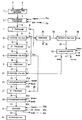
- the method comprises a shredding operation 1 of the carrots brought in through a pipe 2, in the presence of citric acid brought in through a pipe 3.
- the shredded carrots go through a line 4 to an operation 5 of steam treatment brought in through a pipe 5a , followed by cooling in a plate exchanger with cold water (20 ° C) supplied via a pipe 5b.
- the ground product thus treated is led, via line 6, to a first pressing operation 7 making it possible to separate a sweet juice, which is rejected by a conduit 8, and a first marc which is sent, by a line 9, to a mixer 10 in which is added by a conduit 11 the sweet juice coming from the conduit 20 of the pressing 19.
- the pulp obtained goes, by a line 12, at a second pressing 13 where the pulp is separated into a sweet juice which is discharged through a conduit 14 and into a marc which is sent, by a line 15, to a mixer 16 receiving, by a line 17, the sweet juice coming from the line 28 of the pressing 27.
- the pulp obtained goes, by a line 18, to a third pressing operation 19 giving a sweet juice which is rejected by a line 20 and a marc which is sent, by a line 21, to a hot water treatment operation 22 to which water is sent, coming from the treatment by microfiltration then by reverse osmosis and / or evaporation of the juices 8 and 14, via a conduit 23.
- the marc after resuspension can undergo a first aromatization treatment 25, which consi ste to heat the steam supplied through a pipe 25a the product in an enclosure under a vacuum corresponding to a boiling temperature of water of 70 ° C.
- the dried fibers of the conduit 33 could be more finely ground (operation 34).
- the vapors are rejected by a conduit 25b and the pulp, resulting from operation 25, is sent, by a line 26, to a fourth pressing operation 27 where and the is separated into a juice which is rejected by a conduit 28 and in a marc which is sent, by a line 29 to a treatment operation 30 with live steam 30 brought by a conduit 30a whose vapors are evacuated by a conduit 30b; the carrot fibers thus treated are sent through a conduit 31 to a drying 32 receiving steam (conduit 32a) and hot air (conduit 32b) and rejecting steams (conduit 32c) and dietary fibers by a line 33
- the juices from the pressing operations 7 and 13 coming from the conduits 8 and 14 can be treated by a screening operation 34.
- the large particles (> 500 ⁇ ) are thus evacuated through a conduit 35 and the clarified juices pass into a conduit 36 to undergo a microfiltration operation 37 from which a colored carotene concentrate and a colorless sweet juice are evacuated via a conduit 38.
- the latter undergoes a concentration operation 40 which makes it possible to recover via a conduit 41 the amount of water equivalent to that which enters via line 23.
- the concentrated sweet juices are evacuated through line 42 to go to a distillery in order to produce alcohol.
- This ground product is pressed a first time (first stage), the marc (238 kg) is re-soaked with the spent carrot juice from the third pressing stage (498 kg). It is pressed a second time (second stage), the resulting marc (207 kg) is re-soaked with spent carrot juice from the fourth pressing stage (475 kg), then it is pressed a third time (third stage - 172 kg ).
- the pressing is carried out in three helical screw presses and the rebimbing is carried out "continuously" in centrifugal mixers. This treatment takes 20 minutes and is carried out at a temperature between 50 and 60 ° C.
- the marc from the third pressing stage is mixed with 250 liters of carrot juice from the first and second stages, previously microfiltered and freed of soluble sugars by treatment in reverse osmosis. It is then brought to 80 ° C.
- the mixture is placed in a container fitted with an effective agitator making it possible to ensure the suspension of the fiber contained in the marc, maintained under a pressure corresponding to the vapor pressure of water at 70 ° C for at least 10 minutes and less than an hour. This operation allows a first flavoring of the carrot fiber.
- the content of the pulper is used to feed a fourth helical screw press which provides grounds (162 kg at around 20% of total dry matter). Pressing juice is used for resuspending the marc from the second pressing stage.
- the hot marc (50-60 ° C) is then placed in a thin layer (less than 1 cm and preferably equal to 5 mm) between two textile or metal fabrics crossed by a continuous flow of superheated steam at 120 ° C for 1 minute , then introduced into a co-current hot air dryer with a fluidized bed.
- the energy required for drying is provided by heating outside the dryer chamber, by steam at 12.105 Pascal (160 ° C) and by hot air at 165 ° C.
- a carrot fiber having the composition and the characteristics given in Table 1 is collected by cycloning at 80 ° C.
- the juices from the first and second pressing (about 1100 liters) are freed from coarse insoluble fractions (creep through the sieve). About 5% of the juice flow is thus removed with a centrifuge or a vibrating sieve. The rest of the juice is directed to a micro-filtration device. This operation makes it possible to separate, with a filter with a pore size close to 0.2 ⁇ , the sugars from the insolubles responsible for the color.
- the insoluble particles of carrot juice can thus be concentrated between 25 to 50 times (from 10 kg to 20 kg of concentrate).
- the filtered carrot juice (approximately 1000 kg) is concentrated using an evaporator until 250 liters of water have been recovered necessary for diluting the third pressing marc.
- the rest of the juice (about 850 kg) serves as a fermentation substrate for alcohol production.
- the dietary fiber content was measured according to the official AOAC method (Association of Official Analytic Chemist, published by PROSKY. L. et al., J. Assoc. Off. Anal. Chem. (1984), 67, 1044-1052) .
- CRE water retention capacity
- the ion exchange capacity is determined according to the following protocol:
- CEC cation exchange capacity
Landscapes
- Life Sciences & Earth Sciences (AREA)
- Health & Medical Sciences (AREA)
- Nutrition Science (AREA)
- Chemical & Material Sciences (AREA)
- Engineering & Computer Science (AREA)
- Food Science & Technology (AREA)
- Polymers & Plastics (AREA)
- Botany (AREA)
- Mycology (AREA)
- Preparation Of Fruits And Vegetables (AREA)
- Coloring Foods And Improving Nutritive Qualities (AREA)
Applications Claiming Priority (2)
| Application Number | Priority Date | Filing Date | Title |
|---|---|---|---|
| FR9010427 | 1990-08-17 | ||
| FR9010427A FR2665825B1 (fr) | 1990-08-17 | 1990-08-17 | Procede de production de fibres alimentaires a partir de carottes et fibres obtenues par ce procede. |
Publications (2)
| Publication Number | Publication Date |
|---|---|
| EP0478401A2 true EP0478401A2 (de) | 1992-04-01 |
| EP0478401A3 EP0478401A3 (de) | 1992-04-08 |
Family
ID=9399714
Family Applications (1)
| Application Number | Title | Priority Date | Filing Date |
|---|---|---|---|
| EP19910402240 Withdrawn EP0478401A3 (de) | 1990-08-17 | 1991-08-13 | Verfahren zur Herstellung von Nahrungsmittelfasern aus Karotten und durch dieses Verfahren erhaltene Fasern |
Country Status (2)
| Country | Link |
|---|---|
| EP (1) | EP0478401A3 (de) |
| FR (1) | FR2665825B1 (de) |
Cited By (5)
| Publication number | Priority date | Publication date | Assignee | Title |
|---|---|---|---|---|
| WO2000044235A3 (en) * | 1999-01-29 | 2001-03-29 | Ajanta Pharma Ltd | Nutrients rich low fat high fiber carrot product |
| WO2002021935A3 (en) * | 2000-09-17 | 2002-12-19 | Lycored Natural Prod Ind Ltd | Tomato fiber composition, uses thereof and process for its preparation |
| EP1560975B1 (de) | 2002-11-06 | 2015-09-16 | Fiberstar Bio-Ingredient Technologies, Inc. | Hochgemahlene fasermasse, verfahren zur herstellung und produkte die die fasern beinhalten |
| WO2018114452A1 (en) * | 2016-12-23 | 2018-06-28 | Unilever N.V. | Composition comprising a structured continuous oil phase |
| US11337436B2 (en) | 2016-12-23 | 2022-05-24 | Conopco Inc. | Water-in-oil emulsion |
Family Cites Families (3)
| Publication number | Priority date | Publication date | Assignee | Title |
|---|---|---|---|---|
| US2785981A (en) * | 1951-03-24 | 1957-03-19 | Dinesen Laurits | Method of manufacturing a crispy carrot product |
| JPS61177948A (ja) * | 1985-02-05 | 1986-08-09 | Nisshin Seika Kk | 洋菓子類 |
| US4877627A (en) * | 1986-08-19 | 1989-10-31 | Nutrilite Products, Inc. | Balanced fiber composition |
-
1990
- 1990-08-17 FR FR9010427A patent/FR2665825B1/fr not_active Expired - Lifetime
-
1991
- 1991-08-13 EP EP19910402240 patent/EP0478401A3/de not_active Withdrawn
Cited By (10)
| Publication number | Priority date | Publication date | Assignee | Title |
|---|---|---|---|---|
| WO2000044235A3 (en) * | 1999-01-29 | 2001-03-29 | Ajanta Pharma Ltd | Nutrients rich low fat high fiber carrot product |
| GB2362799A (en) * | 1999-01-29 | 2001-12-05 | Ajanta Pharma Ltd | Nutrients rich low fat high fiber carrot product |
| US6361818B2 (en) | 1999-01-29 | 2002-03-26 | Milind Kesharlal Biyani | Nutrient rich, low fat, high fiber, carrot product, and process of making |
| GB2362799B (en) * | 1999-01-29 | 2002-07-10 | Ajanta Pharma Ltd | Nutrients rich low fat high fiber carrot product |
| WO2002021935A3 (en) * | 2000-09-17 | 2002-12-19 | Lycored Natural Prod Ind Ltd | Tomato fiber composition, uses thereof and process for its preparation |
| US7166315B2 (en) | 2000-09-17 | 2007-01-23 | Lycored Natural Products Industries Ltd. | Tomato fiber composition, uses thereof and process for its preparation |
| CN100456955C (zh) * | 2000-09-17 | 2009-02-04 | 利库德天然产品工业有限公司 | 番茄纤维组合物,其用途及其制备方法 |
| EP1560975B1 (de) | 2002-11-06 | 2015-09-16 | Fiberstar Bio-Ingredient Technologies, Inc. | Hochgemahlene fasermasse, verfahren zur herstellung und produkte die die fasern beinhalten |
| WO2018114452A1 (en) * | 2016-12-23 | 2018-06-28 | Unilever N.V. | Composition comprising a structured continuous oil phase |
| US11337436B2 (en) | 2016-12-23 | 2022-05-24 | Conopco Inc. | Water-in-oil emulsion |
Also Published As
| Publication number | Publication date |
|---|---|
| FR2665825A1 (fr) | 1992-02-21 |
| FR2665825B1 (fr) | 1992-10-30 |
| EP0478401A3 (de) | 1992-04-08 |
Similar Documents
| Publication | Publication Date | Title |
|---|---|---|
| US20100196563A1 (en) | Industrial tomoato process and product obtained thereof | |
| FR2716079A1 (fr) | Procédé d'extraction de matières solubles de fèves ou graines d'oléagineux, notamment procédé de production de "lait" de soja. | |
| CZ252697A3 (en) | Water soluble chicory powder, process of its preparation and apparatus for making the same | |
| CN109181847A (zh) | 一种油菜籽高效榨油方法 | |
| US8084075B1 (en) | Process for preparing a melon extract and concentrate and product produced by the process | |
| FR2665825A1 (fr) | Procede de production de fibres alimentaires a partir de carottes et fibres obtenues par ce procede. | |
| EP0223703A2 (de) | Verfahren zur Herstellung von Ernährungsfasern, so erhaltene Fasern und diese enthaltende Nahrungsmittel | |
| RU2175844C1 (ru) | Способ получения пищевого волокна из свекловичного жома | |
| EP0090734A1 (de) | Verfahren zur Klärung von Getränken | |
| JP4233200B2 (ja) | 紫サツマイモ乾燥フレーク及びその製造方法、並びに、紫サツマイモ濃縮エキス及びその製造方法 | |
| EP0398786A1 (de) | Verfahren zur Herstellung von Diätfasern aus Rüben und durch dieses Verfahren gewonnene Fasern | |
| US2890961A (en) | Food products | |
| FR2839856A1 (fr) | Procede d'obtention de produits derives de bananes, notamment de liquefaction de la banane en vue d'obtenir un pur-jus | |
| EP0545944B1 (de) | Verfahren zur gewinnung von naturtrüben frucht- und gemüsesäften | |
| AT401776B (de) | Mehrstufiges verfahren zur zuckergewinnung aus zuckerrüben | |
| RU2409280C1 (ru) | Способ получения порошкового продукта столовой свеклы | |
| EP0401117A1 (de) | Verfahren zur Herstellung von stärkefreiem und phytinsäurefreiem Getreideweizen und das dabei erhaltene Erzeugnis | |
| RU2060691C1 (ru) | Способ получения пищевых волокон из растительного сырья | |
| CH622820A5 (en) | Process for the production of wine | |
| RU2492704C1 (ru) | Способ получения пищевых волокон из жома топинамбура | |
| RU2321639C2 (ru) | Способ производства пектинсодержащего порошка из свекловичного жома | |
| SU672729A1 (ru) | Способ получени картофелепродукта | |
| RU2745570C1 (ru) | Нардек с горчицей | |
| SU1747005A1 (ru) | Способ получени сока и пюре из овощей | |
| RU2428885C1 (ru) | Способ получения сухого экстракта из цикория корневого обыкновенного |
Legal Events
| Date | Code | Title | Description |
|---|---|---|---|
| PUAI | Public reference made under article 153(3) epc to a published international application that has entered the european phase |
Free format text: ORIGINAL CODE: 0009012 |
|
| PUAL | Search report despatched |
Free format text: ORIGINAL CODE: 0009013 |
|
| AK | Designated contracting states |
Kind code of ref document: A2 Designated state(s): AT BE CH DE DK ES FR GB GR IT LI LU NL SE |
|
| AK | Designated contracting states |
Kind code of ref document: A3 Designated state(s): AT BE CH DE DK ES FR GB GR IT LI LU NL SE |
|
| STAA | Information on the status of an ep patent application or granted ep patent |
Free format text: STATUS: THE APPLICATION IS DEEMED TO BE WITHDRAWN |
|
| 18D | Application deemed to be withdrawn |
Effective date: 19921009 |