EP0477123A2 - Verfahren zur Verwaltung von Werkstückidentifizierern in einem verteilten Transaktionsverarbeitungssystem - Google Patents
Verfahren zur Verwaltung von Werkstückidentifizierern in einem verteilten Transaktionsverarbeitungssystem Download PDFInfo
- Publication number
- EP0477123A2 EP0477123A2 EP91480126A EP91480126A EP0477123A2 EP 0477123 A2 EP0477123 A2 EP 0477123A2 EP 91480126 A EP91480126 A EP 91480126A EP 91480126 A EP91480126 A EP 91480126A EP 0477123 A2 EP0477123 A2 EP 0477123A2
- Authority
- EP
- European Patent Office
- Prior art keywords
- transaction
- subtree
- nodes
- identifier
- tree
- Prior art date
- Legal status (The legal status is an assumption and is not a legal conclusion. Google has not performed a legal analysis and makes no representation as to the accuracy of the status listed.)
- Granted
Links
Images



Classifications
-
- G—PHYSICS
- G06—COMPUTING OR CALCULATING; COUNTING
- G06F—ELECTRIC DIGITAL DATA PROCESSING
- G06F11/00—Error detection; Error correction; Monitoring
- G06F11/07—Responding to the occurrence of a fault, e.g. fault tolerance
- G06F11/14—Error detection or correction of the data by redundancy in operations
- G06F11/1402—Saving, restoring, recovering or retrying
-
- Y—GENERAL TAGGING OF NEW TECHNOLOGICAL DEVELOPMENTS; GENERAL TAGGING OF CROSS-SECTIONAL TECHNOLOGIES SPANNING OVER SEVERAL SECTIONS OF THE IPC; TECHNICAL SUBJECTS COVERED BY FORMER USPC CROSS-REFERENCE ART COLLECTIONS [XRACs] AND DIGESTS
- Y10—TECHNICAL SUBJECTS COVERED BY FORMER USPC
- Y10S—TECHNICAL SUBJECTS COVERED BY FORMER USPC CROSS-REFERENCE ART COLLECTIONS [XRACs] AND DIGESTS
- Y10S707/00—Data processing: database and file management or data structures
- Y10S707/99951—File or database maintenance
- Y10S707/99952—Coherency, e.g. same view to multiple users
- Y10S707/99953—Recoverability
Definitions
- the invention is related to database and transaction processing systems generally and, in particular, to a method of managing unit-of-work identifiers which uses two-phase commit and backout protocols to insure that database consistency is maintained.
- Sync Point managers provide an operating system service that makes it possible for distributed transaction programs (TPs) to perform atomic transactions, i.e., logical units of work (LUWs) consisting of data updates that are either all committed (made permanent) or all backed out (undone).
- An atomic transaction is identified by a logical unit of work identifier, called an LUWID in this description. All accesses to data involved in a transaction are associated with its LUWID.
- a database manager when asked by an SPM to commit a transaction, uses the LUWID to identify the data updates that are to be made permanent.
- each transaction (LUW) is explicitly started and terminated by a TP and a new LUWID for each transaction is sent by its associated SPM to the SPMs of other TPs involved in the transaction.
- Unchained transactions are used when not all work of the programs need to be treated as part of an atomic transaction. Thus the work that occurs between the end of one transaction and the explicit start of the next cannot be backed out or committed in a coordinated fashion.
- there tends to be a fixed hierarchical relationship between programs since the protocols for distributing the LUWID require that the LUWID always flow down the tree of TPs, that is, the tree where each branch is created when a program creates a connection to another program.
- Chained transaction systems are those in which the end of a transaction at any TP inherently marks the beginning of the next transaction at that TP. Thus, there is no need for any TP to explicitly start the next. With chained transactions, all work performed by any program in a tree is part of an atomic transaction. Since this is the case, the LUWID for a new transaction is generated implicitly by incrementing the LUWID for the last transaction without any explicit actions by TPs or any messages sent between SPMs. There is no required fixed hierarchical relationship between programs involved in the transaction.
- partner TPs can exist in different nodes of the system connected by communications links or within one node of the system. These TPs form a tree of programs whose data updates will either commit or backout together.
- OS operating system
- the conventional method of solving this problem is by dismantling all nodes of both severed subtrees after the tree break occurs. A new tree can then be rebuilt. While this works to prevent data damage, it is very expensive in terms of the amount of work that must be performed and the resulting system time lost in recreating the connections. Therefore a need exists to ensure that Subtrees separated for any reason will proceed with different unit-of-work identifiers without completely dismantling the tree.
- the above problems are solved in a method of managing unit-of-work identifiers in a chained distributed transaction system.
- the system has a plurality of processing nodes which are logically connected to form a tree, Normally, each node automatically increments its present identifier at the end of processing each transaction to derive the next transaction identifier.
- each node automatically increments its present identifier at the end of processing each transaction to derive the next transaction identifier.
- the distributed databases that now reside in the first and second subtrees that result from the severance are forced to consistent states.
- the transaction identifier is incremented in each of the nodes of the first subtree.
- Transaction work in the first subtree then proceeds with the incremented identifier.
- the second subtree is dismantled.
- the distributed database in the first and second subtrees that result from the nonfailure severance is committed to a permanent state.
- the transaction identifier in each of the nodes of the first subtree is incremented.
- Transaction work in the first subtree then proceeds with the incremented identifier.
- a new transaction identifier is generated and propagated to all nodes of the second subtree.
- Transaction work in the second subtree then proceeds with the new identifier.
- the present transaction is backed out in the subtree that includes the root node of the original tree (hereafter called the allocator subtree). This subtree is left intact. All nodes in the subtree increment their LUWIDs and continue as normal. The transaction is also backed out in the subtree on the other side of the severance, hereafter called the nonallocator subtree. However, in the process of backing out, all connections between nodes are dropped, thereby dismantling the nonallocator subtree.
- Each transaction program in the dismantled subtree generates a new and unique LUWID for use with any subsequent work that it performs.
- the backout on both sides is required because programs in disconnected subtrees can begin work on a new transaction before they each generate different LUWIDs. Therefore it is possible for programs in disconnected subtrees to start work with the same LUWID. To avoid damage caused by this, both subtrees backout any work performed after the tree breakage that used the old LUWID that is no longer valid.
- the invention automatically handles cases in which both failure and nonfailure breakages occur in the same tree within the same transaction. This ensures that a node that is processing a nonfailure tree breakage follows the rules for a failure breakage if it receives a message during the two-phase commit flows that indicates that a failure breakage has occurred elsewhere in the tree. This ensures that multiple breakages will not result in disconnected subtrees proceeding with the same identifier.
- the invention ensures that appropriate LUWIDs are used to support coordinated update commit protocols and deadlock avoidance in distributed chained transactions where a program can indepently start work on a transaction, and any program can cause a commit operation to begin.
- a logical unit of work (LUW) in a database system is a sequence of actions performed to take a set of resources, typically database records, from one consistent state to another in such a way that the LUW appears to be atomic. If a failure occurs during a LUW, the changes made as part of the LUW are undone, so that the resources return to the consistent state that existed at the start of the LUW.
- Fig. 1 shows a simple node tree consisting of nodes 100, 102 and 104. Nodes 100 and 102 are connected by a conversation 106. Nodes 102 and 104 are connected by a conversation 108.
- This tree is referred to as an allocation tree.
- the allocation tree refers to the fixed relationship among programs that is established when connections are created. That is, the creator of a connection is higher up the allocation tree than its partner program.
- a transaction tree can change for each transaction depending on the node that initiates a commit operation.
- node 102 starts a commit, it becomes the root of the transaction tree, with child nodes 100 and 104.
- node 100 is always the root node with child nodes 102 and 104. How allocation trees are established is described in more detail below. Now, assuming that node 102 initiates a commit operation, this means that the TP issued a command to start a two-phase commit operation. At this point node 102 sends a PREPARE TO COMMIT message to both nodes 100 and 104, thereby becoming the commit coordinator. Each node 100 and 104 decide individually if operations have proceeded satisfactorily from their point of view and each return a vote.
- both nodes 100 and 104 return an AGREE message to node 102.
- node 102 After receiving the AGREE from nodes 100 and 104, node 102 sends a COMMIT message to nodes 100 and 104 and the data modifications performed at each of the nodes are made permanent. FORGET messages are then returned to node 102 in this example as acknowledgements to the COMMIT message.
- each of the nodes increment their LUWIDs and proceed to new work.
- node 102 If either of nodes 100 or 104 returns a BACKOUT response to the PREPARE TO COMMIT, node 102 sends a BACKOUT message to the node which did not return a BACKOUT and each node then returns its data to the consistent state that existed at the beginning of the present transaction. Each node then increments its LUWID in a chained system and proceeds with new work.
- This simple example has many variations depending on the specific two-phase commit protocol that is used by a system and on the specific transaction tree in use. Other protocol responses relevant to the invention will be discussed at the appropriate points below.
- Resynchronization is a service performed automatically by SPMs after detection of a conversation failure during a commit operation.
- SPMs adjacent to the break exchange information so that they can take the same action, either to commit or backout, even though their subtrees are severed.
- the resynchronization will continue indefinitely until the exchange has been achieved or until manual intervention terminates it.
- An RIP (resynchronization in progress) indicator attached to a FORGET or BACKOUT message means that there is an incomplete resynchronization in the tree.
- a CEB indicator attached to a message means that the conversation over which the message flows is to be deallocated (terminated) immediately.
- This indicator flows with the last two-phase commit message (e.g., FORGET) if the TP requests that the conversation be deallocated.
- a heuristic mixed message indicates that data inconsistency has occurred because some sync point managers involved in a distributed LUW backout the LUW and other sync point managers commit the LUW. This occurs when an operator forces local resources to commit or backout without waiting for the commit operation to conclude normally. This can occur, for example, when a TP that is excessively delayed waiting for a resynchronization operation holds locks on system resources for which there is heavy demand. Heuristic damage is always a danger when an operator forces completion in this way.
- the invention is described in terms of IBM's SNA logical unit (LU) 6.2 architecture, although it will be apparent that the invention is not limited to this environment.
- the LU 6.2 logical-unit-of-work identifier (LUWID) consists of three components: the identity of the LU that initially generates the LUWID (field 200), a transaction instance number (field 202), which is unique at the generating LU, and a sequence number (field 204) which starts at 1 and is incremented automatically by 1 at each LU participating in a transaction following each commit or backout. This is the chained operation mentioned above.
- the inclusion of the identity of the generating LU in LUWIDs guarantees the uniqueness of the LUWIDs for individual transactions, since the LU identity field 200 of the LUWID differentiates all LUWIDs generated by one LU from all LUWIDs generated by other LUs.
- the transaction number is generated using a date-time stamp.
- Fig. 3 shows one illustrative transaction tree consisting of nodes 300-1 through 300-6.
- the network of which this tree is a part might include many other nodes.
- Each node contains an SPM 307, at least one transaction program (TP) 302, a resource such as database 304 and a logical unit (LU) 306 by means of which a TP can communicate with other TPs.
- TP transaction program
- LU logical unit
- Fig. 3 shows one TP at each node, it should be understood that in the general case, a node may contain multiple TPs all interacting with themselves and other nodes via LUs to effect resource transactions.
- Resources may be viewed as including virtually anything available at a node for use by a TP, such as local files and devices. However, for the purposes of this disclosure, such resources will be considered to be databases for simplicity.
- An LU executes communication verbs issued by a local TP and a synchronization point manager (SYNCPT manager or SPM). Some of the verbs issued by a TP and executed by the LU serving it include those for allocating and deallocating (initiating and releasing) conversations with other TPs on sessions between LUs, both local and remote. Other verbs allow one TP to send or receive data to or from another TP.
- the SPM executes SYNCPT (commit) or BACKOUT verbs issued by a transaction program. The SPMs are responsible for committing or backing-out a transaction at all nodes on request of a TP.
- a transaction program (TP) 302-1 at node 300-1 is initially activated.
- the activation of the first TP within an allocation tree to be established is product specific and irrelevant to the invention.
- a given initial TP might be automatically started each time a given node is brought on-line, or an initial TP might be started on request of an operator.
- this initial TP 302-1 allocates a conversation 308 with TP 302-2 at node 300-2.
- TP 302-2 further allocates conversations 310 and 312 with the TPs at nodes 300-3 and 300-4, respectively, and so on.
- a conversation is allocated on a session between nodes in response to the issuance of the ALLOCATE verb by a TP to an LU connected to the session.
- an conversation ATTACH message is sent to the remote LU attached to the other end of the session.
- the ATTACH includes the name of the TP to which the conversation is to be attached.
- TP 302-1 initially issues an ALLOCATE verb to LU 306-1.
- LU 306-1 issues the ATTACH to LU 306-2.
- This ATTACH includes the name of TP 302-2. It also includes the logical-unit-of-work identifier (LUWID) assigned as explained above with respect to Fig. 2.
- This LUWID is the LUWID assigned at the root of the allocation tree, which is node 300-1 in this example.
- TP 302-2 allocates a conversation to TP 302-3, the ATTACH message from LU 306-2 to LU 306-3 includes the same LUWID.
- the resources at any or all of the tree nodes may be used to complete any given transaction.
- Tree breakage can result from a communications failure.
- a TP may intentionally and normally break a tree when it wishes to remove nodes below it from the tree. This is accomplished by the issuance of a DEALLOCATE TYPE(SYNC_LEVEL) verb by a TP.
- the SYNC_LEVEL part of this verb defers deallocating the conversation until a SYNCPT verb is issued to cause a commit operation to occur.
- Breakage may also be caused intentionally when a TP or LU detects some type of processing error. This latter type of deallocation is called an abnormal deallocation and is initiated by a DEALLOCATE(ABEND) message from one node to another. The ABEND part of this message stands for "abnormal ending".
- a new LUWID is created and propagated in one of the subtrees. Both subtrees remain intact.
- the subtree on the side of the conversation to be deallocated that eventually receives a COMMIT message generates a new LUWID for its subtree and propagates it to the remaining nodes or TPs of its subtree, since it retains communication with the remaining nodes.
- the other subtree merely increments its present LUWID and proceeds with new work. To always achieve this result, the rule is imposed that normal conversation deallocation cannot occur without first performing a commit operation.
- DEALLOCATE TYPE(SYNC_LEVEL) followed by a SYNCPT verb is the only normal deallocation type allowed; if a SYNCPT verb results in the LUW being backed out, the conversation is not deallocated.
- an LU sends HM or FORGET in reply to PREPARE TO COMMIT, it cannot receive an updated LUWID if there is a D(S) break above it in the transaction tree as part of phase 2 of a commit operation. Therefore its commit initiator will have to send it a NEW_LUWID message at the beginning of the next LUW if there is a change.
- a NEW_LUWID message is a message that flows along with the other two-phase commit messages.
- This message informs a receiving partner that the new LUWID included in the message should be used for the next transaction, since the old LUWID is obsolete.
- the NEW_LUWID message is sent following a COMMIT message, preferably in the same message flow. It is sent when a TP receives a COMMIT message from a partner that is being deallocated as part of the commit flows.
- the LUWID has the LU name of the sync point manager that generated it in the LU identity field 200 of the LUWID.
- the commit operation must complete, perhaps with resynchronization, and then the next LUW is backed-out to make sure that no work has occurred in the separate subtrees with the incremented LUWID.
- the LUWID that is used by each subtree must be made different. To achieve this, the rules are different in the two severed subtrees.
- the sync point manager of the node detecting the failure backs out all resource modifications in the adjacent nodes of that subtree, which propagate the BACKOUT to their adjacent nodes, and so on.
- the LUWID is automatically incremented at all nodes in this subtree and work can continue with the incremented LUWID.
- TPs in either subtree may have already started work with the old LUWID, work associated with that LUWID must be backed out in both subtrees.
- the sync point manager of the first node in the nonallocator subtree i.e., the node nearest the break, deallocates all conversations that it allocated. Recall that this is achieved with the DEALLOCATE TYPE(ABEND) verb, which disconnects the conversation and causes both sides of the disconnected conversation to backout the LUW.
- SPM 307-2 sends a BACKOUT message to both nodes 300-1 and 300-3.
- LU 306-4 sends a DEALLOCATE TYPE(ABEND) message to both nodes 300-5 and 300-6.
- the sync point manager in the nonallocator subtree After it propagates the abnormal deallocation, the sync point manager in the nonallocator subtree provides a new LUWID for any work started by its TP, with its own LU name in the LU identity field 200 of the LUWID. This permits the TP safely to begin new work.
- each LU farther down the nonallocator subtree tree performs the same logical operations in response to DEALLOCATE TYPE(ABEND), so that the entire nonallocator subtree is dismantled, and each TP in the nonallocator subtree is given its own unique LUWID using its own LU identity for further access to resources.
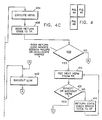
- Step 400 receives a verb issued by a TP.
- Step 402 determines if the verb is a SYNCPT (commit) or a BACKOUT verb. If not, the LU executes the verb in the normal way at step 404. Part of this normal processing is to determine the result of executing the verb.
- a return code that represents this result is returned to the TP at step 406.
- Step 408 next determines if the return code indicates that a communications failure has been detected with a partner TP or if a DEALLOCATE(ABEND) message has been received from a partner TP.
- step 400 the LU returns (via program exit and entry B in Fig. 4) to a state at step 400 awaiting the next verb issuance by the TP in question. Note that the present LUWID is not incremented. This only occurs after a SYNCPT or BACKOUT operation. If, at step 408, the return code indicates a communications failure or a DEALLOCATE(ABEND) message is received, step 410 enters a state awaiting the next verb from the TP in question. At this point a backout operation is required, which the TP can initiate with either a SYNCPT or BACKOUT verb. The SYNCPT verb in this case is processed as a BACKOUT verb.
- step 412 determines if the verb is a SYNCPT or BACKOUT verb. If not, this means that the TP has issued a verb that cannot be processed. In this case, step 414 returns a "check state" return code to the TP to inform it of an inconsistency and then returns to step 410 to await a SYNCPT or BACKOUT verb.
- step 440 determines if this LU resides in the nonallocator subtree. In this case, step 418 initiates the dismantling of the subtree. This is done by the LU sending a DEALLOCATE TYPE(ABEND) message to its partner LUs via conversations that it originally allocated.
- TP 302-2 sends a DEALLOCATE TYPE(ABEND) to LU 306-4 or if a communications failure occurs on conversation 312, LU 306-4 at node 300-4 eventually initiates at step 418 the dismantling of the subtree of which it is a member by sending a DEALLOCATE TYPE(ABEND) to nodes 300-5 and 300-6.
- Node 300-4 generates a new LUWID for TP 300-4 at step 420 and proceeds with its work at step 400.
- LUs 300-5 and 300-6 at their respective nodes receive the DEALLOCATE TYPE(ABEND) verbs from LU 300-4, step 408 in Fig.
- the LUWID generated by each dismantled mode includes its own LU identity in field 200.
- step 424 initiates the execution of the verb by sending it to the SPM.
- Step 426 next determines during execution of the above SYNCPT or BACKOUT if a communications failure is detected or a DEALLOCATE TYPE(ABEND) message has been received with or from a partner TP. Normally, the answer is no and step 428 determines if the verb under execution is BACKOUT. If the verb is BACKOUT, the verb execution is completed and return is made to step 400 via program exit and entry A in Fig. 4. Note that step 422 at entry A increments the present LUWID before proceeding at step 400 with the next verb issuance by the TP.
- step 434 next determines if this conversation is to be deallocated normally at the end of the commit operation. If not, the program proceeds to step 432. If so, steps 436 and 438 must generate a new LUWID, because the allocation tree is being split, and propagate it to all other partner SPMs in this subtree. This includes partners that replied FORGET to PREPARE TO COMMIT, indicating an abstention vote since they have made no changes that need to be committed. Thus, all SPMs in this subtree will proceed with the same LUWID. The SPM now waits for the next verb to arrive from its TP at step 400. Note that the new LUWID is not incremented before proceeding to step 400, since it already has a unique LUWID for the next transaction from step 436.
- step 432 if the SPM in question receives a HM(CEB) or a FORGET(RIP, CEB), this means that a failure break has occurred in the allocation tree somewhere other than adjacent to this SPM.
- the CEB indicator means that the node containing this SPM is to be split from the allocation tree, thereby forming a subtree than cannot thereafter communicate with the rest of the allocation tree. Therefore, special action must be taken to dismantle or backout this subtree to respond to the remote tree breakage. If step 416 determines that the conversation being deallocated is the one that allocated this SPM, then the remaining nodes or SPMs are dismantled at step 418.
- Step 420 This is initiated by sending a DEALLOCATE TYPE(ABEND) to all partner SPMs.
- Step 420 generates a new LUWID for this subtree for subsequent work. If the conversation being deallocated is not the one that allocated the TP served by this SPM, then the subtree containing this SPM is left intact and backed-out (step 442). At step 432, if the HM(CEB) or FORGET(RIP, CEB) is not received, then this is a normal commit operation. Step 422 increments the LUWID and proceeds with new work.
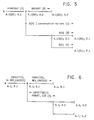
- Figs. 5 through 11 show the message flows between the nodes of Fig. 3 resulting from the execution of the program in Fig. 4 at each of the nodes. These Figs. use some shorthand that is explained below.
- the nomenclature is specific to LU 6.2 and reference should be made to IBM publication SNA LU 6.2 REFERENCE: PEER PROTOCOLS (SC31-6808) for further details.
- D(S) DEALLOCATE TYPE(SYNC_LEVEL): deallocate a conversation after committing.
- D(A) DEALLOCATE TYPE(ABEND): deallocate a conversation because of an abnormal occurrence such as a protocol violation or program detected error.
- INIT the sync point initiator (commit coordinator).
- a through F are used to represent the Fig. 3 nodes 300-1 through 6, respectively. Under each node in the Figs. is the sequence of LUWIDs, starting with A.1, that it is using whenever it returns control to the TP.
- the letter in the LUWID, e.g., A indicates the node that created it, while the number indicates a sequence number relative to the start of events shown in the figure. Therefore, A.1 indicates that the root node A of the allocation tree initiated the first LUWID used for commit processing.
- a sequence such as "A.1; A.2(BO); A.3” is read: "The sequence number in A.1 is incremented to A.2; the A.2 LUW is backed out (BO); A.3 is the LUWID resulting from LUWID management flows.”
- the flows are marked with occurrence numbers thus: "flow(occurrence-number).”
- flow(occurrence-number) In each example, it is assumed that all members of the entire distributed transaction start with LUWID A.1.
- a conversation that fails in a Fig. is denoted with an "X”.
- Fig. 5 illustrates the case of a conversation failure or D(A) occurring in other than a commit operation.
- the TPs at B and D are in a state where only SYNCPT or BACKOUT verbs will be accepted.
- BACKOUT messages are sent to A and C; A, B, and C all back out the LUW identified by A.1, and increment the LUWID to proceed with a new LUW.
- the SPM issues DEALLOCATE TYPE(ABEND) on each of its remaining conversations, backs out the LUW identified by A.1, and generates a new LUWID so that it can proceed with a new transaction.
- E and F perform the same operations when they receive the DEALLOCATE TYPE(ABEND) from D.
- A.1 has been backed out at each node and each of the four disconnected subtrees (A-B-C, D, E, and F) proceeds with a different LUWID.
- Fig. 6 illustrates the message flows following a normal conversation deallocation which occurs after a commit operation following a DEALLOCATE TYPE(SYNC_LEVEL) verb.
- LU E is the commit initiator.
- the conversation between B and D is deallocated when the commit operation completes.
- B receives the COMMIT message from D, it generates a new LUWID for its subtree and propagates it to A and C along with the COMMIT message. Then it sends FORGET, CEB to D to finish the sync point operation.
- D, E, and F increment the original LUWID to generate the LUWID for the next LUW.
- LUWID A.1 has been committed at all nodes, and the two separated subtrees (A-B-C and D-E-F) are proceeding with different LUWIDs. Notice that the LUWID used by the D-E-F subtree continues to have the LU name for A in it, even though A is no longer connected to the subtree. This is not a problem, since the only purpose of the LU name in the LUWID is to ensure uniqueness, and LU A will ensure that it does not generate another LUWID that duplicates the A.1 it was using at the start of this example.
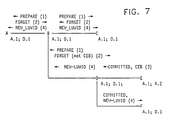
- Fig. 7 illustrates the case in which a FORGET without a CEB is issued in answer to a PREPARE TO COMMIT message.
- LU E is the commit initiator.
- the A-B-C subtree votes FORGET in answer,to PREPARE, indicating that no changes have been made to resources during the A.1 LUW.
- the sync point manager does not return control to the TPs in A, B, or C until the next message is received. This example shows why this is necessary.
- a deallocated conversation elsewhere in the transaction tree (between E and D) requires D to propagate a new LUWID to its subtree. A, B, and C cannot be allowed to continue until the new LUWID has arrived.
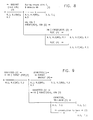
- Fig. 8 illustrates the case in which HM CEB or FORGET, RIP CEB is sent down the allocation tree.
- LU E is the commit initiator.
- the conversation between B and C fails in the middle of the second phase of a commit operation. For simplicity, the early messages are not shown.
- B sends BACKOUT to A, since the TP at A may already have proceeded with LUWID A.2, which is also being used by transaction programs at E and F.
- Fig. 9 illustrates the case in which HM CEB or FORGET, RIP CEB is sent up the allocation tree.
- LU A is the commit initiator.
- D detects a conversation failure with F while propagating the COMMIT message to E and F. For simplicity, the early messages are not shown. Resynchronization with F either fails or reveals that heuristic damage has occurred.
- D sends this information to B with the end conversation indicator (CEB) set. Since D's conversation with B is deallocated as part of the commit operation, D sends a new LUWID to E as part of the normal commit flow.
- CEB end conversation indicator
- B Since B was the allocator of the conversation with D, when it receives the HM or FORGET, RIP message, it is responsible for backing out the next LUW to ensure that no node in its separated subtree is also working with LUWID A.2. Thus B backs out locally and sends a BACKOUT message to C. Since A will perform the same actions when it receives the HM or FORGET, RIP message from B, it is unnecessary for B to send BACKOUT to A. At the end of the operation, LUWID A.1 has been committed, LUWID A.2 has been backed out, and the'separated subtrees (A-B-C, D-E, and F) all proceed with different LUWIDs. E uses the LUWID that D propagated to it in the normal commit processing.
- Fig. 10 illustrates the case of a conversation failure between nodes B and D during a commit operation. For simplicity, the entire commit sequence is not shown. In this example, which node is the commit initiator does not matter.
- BACKOUT is sent to A and C
- DEALLOCATE TYPE(ABEND) is propagated to E and F.
- LUW A.1 either backs out or commits, depending on the normal protocols governing resynchronization
- LUW A.2 is backed out at all participants, and the separated subtrees (A-B-C, D, E, F) proceed with different LUWIDs.
Landscapes
- Engineering & Computer Science (AREA)
- Theoretical Computer Science (AREA)
- Quality & Reliability (AREA)
- Physics & Mathematics (AREA)
- General Engineering & Computer Science (AREA)
- General Physics & Mathematics (AREA)
- Information Retrieval, Db Structures And Fs Structures Therefor (AREA)
- Computer And Data Communications (AREA)
Applications Claiming Priority (2)
| Application Number | Priority Date | Filing Date | Title |
|---|---|---|---|
| US58354290A | 1990-09-17 | 1990-09-17 | |
| US583542 | 1990-09-17 |
Publications (3)
| Publication Number | Publication Date |
|---|---|
| EP0477123A2 true EP0477123A2 (de) | 1992-03-25 |
| EP0477123A3 EP0477123A3 (en) | 1993-05-12 |
| EP0477123B1 EP0477123B1 (de) | 1997-06-18 |
Family
ID=24333537
Family Applications (1)
| Application Number | Title | Priority Date | Filing Date |
|---|---|---|---|
| EP91480126A Expired - Lifetime EP0477123B1 (de) | 1990-09-17 | 1991-08-13 | Verfahren zur Verwaltung von Arbeitseinheitidentifizierern in einem verteilten Transaktionsverarbeitungssystem |
Country Status (4)
| Country | Link |
|---|---|
| US (1) | US5371886A (de) |
| EP (1) | EP0477123B1 (de) |
| JP (1) | JP2837288B2 (de) |
| DE (1) | DE69126587T2 (de) |
Cited By (2)
| Publication number | Priority date | Publication date | Assignee | Title |
|---|---|---|---|---|
| EP0593062A3 (en) * | 1992-10-16 | 1995-08-30 | Siemens Ind Automation Inc | Redundant networked database system |
| WO1996041262A1 (en) * | 1995-06-07 | 1996-12-19 | International Business Machines Corporation | Reduction of logging in distributed systems |
Families Citing this family (30)
| Publication number | Priority date | Publication date | Assignee | Title |
|---|---|---|---|---|
| JP2675968B2 (ja) * | 1992-08-20 | 1997-11-12 | インターナショナル・ビジネス・マシーンズ・コーポレイション | 加入者分散2相コミット・プロトコルの拡張機能 |
| US5414841A (en) * | 1992-10-19 | 1995-05-09 | International Business Machines Corporation | Computerized system for representing data items using token identifiers |
| DE69304928T2 (de) * | 1992-12-23 | 1997-04-03 | Taligent Inc | Atomares befehlsystem |
| US6259446B1 (en) | 1992-12-23 | 2001-07-10 | Object Technology Licensing Corporation | Menu state system |
| FR2705803B1 (fr) * | 1993-05-26 | 1995-07-07 | Gemplus Card Int | Procédé d'écriture d'informations dans une mémoire non-volatile. |
| EP0673523B1 (de) * | 1993-10-08 | 1999-02-10 | International Business Machines Corporation | Nachrichtenübertragung über ein netzwerk |
| EP0694838A1 (de) * | 1994-07-25 | 1996-01-31 | International Business Machines Corporation | Stufenweises Transaktionsrücksetzverfahren |
| US6205464B1 (en) * | 1994-09-16 | 2001-03-20 | International Businesss Machines Corporation | System for building optimal commit trees in a distributed transaction processing system |
| US5553234A (en) * | 1994-09-23 | 1996-09-03 | International Business Machines Corporation | System and method for including stored procedures, user-defined functions, and trigger processing in an existing unit of work |
| US5745687A (en) * | 1994-09-30 | 1998-04-28 | Hewlett-Packard Co | System for distributed workflow in which a routing node selects next node to be performed within a workflow procedure |
| US5768582A (en) * | 1995-06-07 | 1998-06-16 | International Business Machines Corporation | Computer program product for domained incremental changes storage and retrieval |
| GB2303474A (en) * | 1995-07-19 | 1997-02-19 | Ibm | Optimized synchronisation procedure |
| US5799305A (en) * | 1995-11-02 | 1998-08-25 | Informix Software, Inc. | Method of commitment in a distributed database transaction |
| US6031978A (en) * | 1996-06-28 | 2000-02-29 | International Business Machines Corporation | System, method and program for enabling a client to reconnect to a same server in a network of computer systems after the server has moved to a different network address |
| US5884327A (en) * | 1996-09-25 | 1999-03-16 | International Business Machines Corporation | System, method and program for performing two-phase commit with a coordinator that performs no logging |
| EP0876023A1 (de) | 1997-04-30 | 1998-11-04 | Sony Corporation | Sender und Übertragugnsverfahren, Empfänger und Empfangsverfahren, und Sender/Empfänger und Sende/Empfangsverfahren |
| JP3498887B2 (ja) | 1997-04-30 | 2004-02-23 | ソニー株式会社 | 送信装置および送信方法、並びに受信装置および受信方法 |
| US6061714A (en) * | 1997-05-07 | 2000-05-09 | International Business Machines Corporation | Persistent cache synchronization and start up system |
| US6014669A (en) * | 1997-10-01 | 2000-01-11 | Sun Microsystems, Inc. | Highly-available distributed cluster configuration database |
| US7159005B1 (en) | 1998-10-16 | 2007-01-02 | International Business Machines Corporation | Methods, systems and computer program products for restartable multiplexed file transfers |
| US6243715B1 (en) | 1998-11-09 | 2001-06-05 | Lucent Technologies Inc. | Replicated database synchronization method whereby primary database is selected queries to secondary databases are referred to primary database, primary database is updated, then secondary databases are updated |
| US6279041B1 (en) | 1998-11-13 | 2001-08-21 | International Business Machines Corporation | Methods, systems and computer program products for differencing data communications using a message queue |
| US6401136B1 (en) | 1998-11-13 | 2002-06-04 | International Business Machines Corporation | Methods, systems and computer program products for synchronization of queue-to-queue communications |
| US6874104B1 (en) | 1999-06-11 | 2005-03-29 | International Business Machines Corporation | Assigning recoverable unique sequence numbers in a transaction processing system |
| US6915515B2 (en) * | 2000-12-21 | 2005-07-05 | International Business Machines Corporation | Method for creating path-sensitive branch registry for cyclic distributed transactions |
| US7236967B2 (en) * | 2002-06-03 | 2007-06-26 | Hewlett-Packard Development Company, L.P. | Methods and systems for maintaining transaction semantics in a computer system |
| GB0428109D0 (en) * | 2004-12-23 | 2005-01-26 | Ibm | A method for determining participation in a distributed transaction |
| US9110712B2 (en) * | 2005-06-10 | 2015-08-18 | International Business Machines Corporation | Method for encapsulating logical units of work using business objects |
| US8874390B2 (en) | 2011-03-23 | 2014-10-28 | Hach Company | Instrument and method for processing a doppler measurement signal |
| JP6515753B2 (ja) | 2015-09-07 | 2019-05-22 | 富士通株式会社 | データベース制御プログラム、データベース制御方法及びデータベース制御装置 |
Family Cites Families (1)
| Publication number | Priority date | Publication date | Assignee | Title |
|---|---|---|---|---|
| US4665520A (en) * | 1985-02-01 | 1987-05-12 | International Business Machines Corporation | Optimistic recovery in a distributed processing system |
-
1991
- 1991-05-10 JP JP3135748A patent/JP2837288B2/ja not_active Expired - Lifetime
- 1991-08-13 DE DE69126587T patent/DE69126587T2/de not_active Expired - Lifetime
- 1991-08-13 EP EP91480126A patent/EP0477123B1/de not_active Expired - Lifetime
-
1993
- 1993-12-09 US US08/164,656 patent/US5371886A/en not_active Expired - Lifetime
Cited By (3)
| Publication number | Priority date | Publication date | Assignee | Title |
|---|---|---|---|---|
| EP0593062A3 (en) * | 1992-10-16 | 1995-08-30 | Siemens Ind Automation Inc | Redundant networked database system |
| US5615364A (en) * | 1992-10-16 | 1997-03-25 | Siemens Energy & Automation, Inc. | Apparatus and method for performing the backup of a primary database using a back up database |
| WO1996041262A1 (en) * | 1995-06-07 | 1996-12-19 | International Business Machines Corporation | Reduction of logging in distributed systems |
Also Published As
| Publication number | Publication date |
|---|---|
| DE69126587D1 (de) | 1997-07-24 |
| EP0477123B1 (de) | 1997-06-18 |
| JPH04230541A (ja) | 1992-08-19 |
| JP2837288B2 (ja) | 1998-12-14 |
| US5371886A (en) | 1994-12-06 |
| EP0477123A3 (en) | 1993-05-12 |
| DE69126587T2 (de) | 1998-01-15 |
Similar Documents
| Publication | Publication Date | Title |
|---|---|---|
| US5371886A (en) | System for managing unit-of-work identifiers when a chained, distributed, two phase commit transaction system is severed | |
| EP0657813B1 (de) | Verteiltes Datenbankverarbeitungssystem | |
| US6934727B2 (en) | Dynamic synchronization of tables | |
| US5261089A (en) | Optimization of commit procedures by utilizing a two-phase commit procedure only when necessary | |
| US7194518B2 (en) | Methods and systems for managing state changes during an arbitration cycle when multiple computer nodes request changes of shared data | |
| US7149761B2 (en) | System and method for managing the synchronization of replicated version-managed databases | |
| US5964838A (en) | Method for sequential and consistent startup and/or reload of multiple processor nodes in a multiple node cluster | |
| EP0457109A2 (de) | Koordinierte Behandlung von Fehlerkodierungen und Fehler beschreibende Informationen in einem Freigabeverfahren | |
| EP0457096A2 (de) | Eintragung von Betriebsmitteln für Freigabeverfahren | |
| EP0457112A2 (de) | Asynchrone Wiedersynchronisierung eines Freigabeverfahrens | |
| EP0457111A2 (de) | Rücksetzungseinrichtung für unvollständige Gleichzeitigkeitspunkte für eine verteilte Anwendung | |
| EP0457108A2 (de) | Verwaltung geschützter Betriebsmittel mittels koordinierten Gleichzeitigkeitspunkten | |
| EP0457117A2 (de) | Lokaler und globaler, den Arbeitseinheiten angemessener Freigabegültigkeitsbereich | |
| JPH04229359A (ja) | コンピュータ・ネットワーク | |
| JP2002500791A (ja) | 分散形データベース内でトランザクションをするための方法 | |
| US5258982A (en) | Method of excluding inactive nodes from two-phase commit operations in a distributed transaction processing system | |
| EP0694838A1 (de) | Stufenweises Transaktionsrücksetzverfahren | |
| US6842763B2 (en) | Method and apparatus for improving message availability in a subsystem which supports shared message queues | |
| US6799172B2 (en) | Method and system for removal of resource manager affinity during restart in a transaction processing system | |
| JPH09185539A (ja) | 分散トランザクションのコミット制御方法 | |
| JPS6352263A (ja) | 分散処理システムのデツドロツク検出方式 | |
| JPS638845A (ja) | 更新処理方式 | |
| JPH01186034A (ja) | オンラインシステムにおける通信装置接続方式 |
Legal Events
| Date | Code | Title | Description |
|---|---|---|---|
| PUAI | Public reference made under article 153(3) epc to a published international application that has entered the european phase |
Free format text: ORIGINAL CODE: 0009012 |
|
| AK | Designated contracting states |
Kind code of ref document: A2 Designated state(s): DE FR GB |
|
| 17P | Request for examination filed |
Effective date: 19920817 |
|
| PUAL | Search report despatched |
Free format text: ORIGINAL CODE: 0009013 |
|
| AK | Designated contracting states |
Kind code of ref document: A3 Designated state(s): DE FR GB |
|
| 17Q | First examination report despatched |
Effective date: 19950606 |
|
| GRAG | Despatch of communication of intention to grant |
Free format text: ORIGINAL CODE: EPIDOS AGRA |
|
| GRAH | Despatch of communication of intention to grant a patent |
Free format text: ORIGINAL CODE: EPIDOS IGRA |
|
| GRAH | Despatch of communication of intention to grant a patent |
Free format text: ORIGINAL CODE: EPIDOS IGRA |
|
| GRAA | (expected) grant |
Free format text: ORIGINAL CODE: 0009210 |
|
| AK | Designated contracting states |
Kind code of ref document: B1 Designated state(s): DE FR GB |
|
| REF | Corresponds to: |
Ref document number: 69126587 Country of ref document: DE Date of ref document: 19970724 |
|
| ET | Fr: translation filed | ||
| PLBE | No opposition filed within time limit |
Free format text: ORIGINAL CODE: 0009261 |
|
| STAA | Information on the status of an ep patent application or granted ep patent |
Free format text: STATUS: NO OPPOSITION FILED WITHIN TIME LIMIT |
|
| 26N | No opposition filed | ||
| REG | Reference to a national code |
Ref country code: GB Ref legal event code: IF02 |
|
| REG | Reference to a national code |
Ref country code: GB Ref legal event code: 746 Effective date: 20090714 |
|
| PGFP | Annual fee paid to national office [announced via postgrant information from national office to epo] |
Ref country code: FR Payment date: 20100818 Year of fee payment: 20 Ref country code: DE Payment date: 20100826 Year of fee payment: 20 |
|
| PGFP | Annual fee paid to national office [announced via postgrant information from national office to epo] |
Ref country code: GB Payment date: 20100819 Year of fee payment: 20 |
|
| REG | Reference to a national code |
Ref country code: DE Ref legal event code: R071 Ref document number: 69126587 Country of ref document: DE |
|
| REG | Reference to a national code |
Ref country code: DE Ref legal event code: R071 Ref document number: 69126587 Country of ref document: DE |
|
| REG | Reference to a national code |
Ref country code: GB Ref legal event code: PE20 Expiry date: 20110812 |
|
| PG25 | Lapsed in a contracting state [announced via postgrant information from national office to epo] |
Ref country code: GB Free format text: LAPSE BECAUSE OF EXPIRATION OF PROTECTION Effective date: 20110812 |
|
| PG25 | Lapsed in a contracting state [announced via postgrant information from national office to epo] |
Ref country code: DE Free format text: LAPSE BECAUSE OF EXPIRATION OF PROTECTION Effective date: 20110814 |