EP0472195A2 - Textiles Mitläuferband für die Trennung von nicht-vulkanisierten Gummimischungensbändern und -produkten - Google Patents
Textiles Mitläuferband für die Trennung von nicht-vulkanisierten Gummimischungensbändern und -produkten Download PDFInfo
- Publication number
- EP0472195A2 EP0472195A2 EP91114079A EP91114079A EP0472195A2 EP 0472195 A2 EP0472195 A2 EP 0472195A2 EP 91114079 A EP91114079 A EP 91114079A EP 91114079 A EP91114079 A EP 91114079A EP 0472195 A2 EP0472195 A2 EP 0472195A2
- Authority
- EP
- European Patent Office
- Prior art keywords
- coating
- threads
- fibers
- belt according
- follower belt
- Prior art date
- Legal status (The legal status is an assumption and is not a legal conclusion. Google has not performed a legal analysis and makes no representation as to the accuracy of the status listed.)
- Withdrawn
Links
- 239000004744 fabric Substances 0.000 title claims abstract description 20
- 239000004753 textile Substances 0.000 title claims abstract description 5
- 238000000926 separation method Methods 0.000 title claims description 3
- 239000000203 mixture Substances 0.000 title abstract description 7
- -1 polypropylene Polymers 0.000 claims abstract description 35
- 239000011248 coating agent Substances 0.000 claims abstract description 31
- 238000000576 coating method Methods 0.000 claims abstract description 31
- 239000004698 Polyethylene Substances 0.000 claims abstract description 23
- 239000000835 fiber Substances 0.000 claims abstract description 21
- 229920000573 polyethylene Polymers 0.000 claims abstract description 19
- 229920003023 plastic Polymers 0.000 claims abstract description 18
- 239000004033 plastic Substances 0.000 claims abstract description 18
- 239000000463 material Substances 0.000 claims abstract description 17
- 239000004743 Polypropylene Substances 0.000 claims abstract description 16
- 229920001155 polypropylene Polymers 0.000 claims abstract description 15
- 239000004636 vulcanized rubber Substances 0.000 claims description 3
- 150000001875 compounds Chemical class 0.000 claims description 2
- 239000004020 conductor Substances 0.000 claims 1
- 229920001971 elastomer Polymers 0.000 abstract description 7
- 239000005060 rubber Substances 0.000 abstract description 7
- 239000004745 nonwoven fabric Substances 0.000 abstract 1
- 229920001059 synthetic polymer Polymers 0.000 abstract 1
- 239000002759 woven fabric Substances 0.000 abstract 1
- 229920000728 polyester Polymers 0.000 description 16
- 239000004952 Polyamide Substances 0.000 description 7
- 229920002647 polyamide Polymers 0.000 description 7
- 229920003235 aromatic polyamide Polymers 0.000 description 3
- 238000003475 lamination Methods 0.000 description 3
- 239000004810 polytetrafluoroethylene Substances 0.000 description 3
- 229920001343 polytetrafluoroethylene Polymers 0.000 description 3
- 229920002635 polyurethane Polymers 0.000 description 3
- 239000004814 polyurethane Substances 0.000 description 3
- 239000004760 aramid Substances 0.000 description 2
- 238000010030 laminating Methods 0.000 description 2
- 230000000704 physical effect Effects 0.000 description 2
- 229920002994 synthetic fiber Polymers 0.000 description 2
- 239000012209 synthetic fiber Substances 0.000 description 2
- 229920000742 Cotton Polymers 0.000 description 1
- 239000002033 PVDF binder Substances 0.000 description 1
- 239000004693 Polybenzimidazole Substances 0.000 description 1
- 239000004372 Polyvinyl alcohol Substances 0.000 description 1
- 229920000297 Rayon Polymers 0.000 description 1
- 239000002318 adhesion promoter Substances 0.000 description 1
- 230000004888 barrier function Effects 0.000 description 1
- 230000015572 biosynthetic process Effects 0.000 description 1
- 239000003365 glass fiber Substances 0.000 description 1
- 238000004519 manufacturing process Methods 0.000 description 1
- 230000000737 periodic effect Effects 0.000 description 1
- 229920006255 plastic film Polymers 0.000 description 1
- 239000002985 plastic film Substances 0.000 description 1
- 229920002480 polybenzimidazole Polymers 0.000 description 1
- 229920002451 polyvinyl alcohol Polymers 0.000 description 1
- 229920002981 polyvinylidene fluoride Polymers 0.000 description 1
- 230000001681 protective effect Effects 0.000 description 1
- 239000002964 rayon Substances 0.000 description 1
- 230000002787 reinforcement Effects 0.000 description 1
- 239000012783 reinforcing fiber Substances 0.000 description 1
Images
Classifications
-
- B—PERFORMING OPERATIONS; TRANSPORTING
- B29—WORKING OF PLASTICS; WORKING OF SUBSTANCES IN A PLASTIC STATE IN GENERAL
- B29D—PRODUCING PARTICULAR ARTICLES FROM PLASTICS OR FROM SUBSTANCES IN A PLASTIC STATE
- B29D29/00—Producing belts or bands
-
- B—PERFORMING OPERATIONS; TRANSPORTING
- B29—WORKING OF PLASTICS; WORKING OF SUBSTANCES IN A PLASTIC STATE IN GENERAL
- B29C—SHAPING OR JOINING OF PLASTICS; SHAPING OF MATERIAL IN A PLASTIC STATE, NOT OTHERWISE PROVIDED FOR; AFTER-TREATMENT OF THE SHAPED PRODUCTS, e.g. REPAIRING
- B29C37/00—Component parts, details, accessories or auxiliary operations, not covered by group B29C33/00 or B29C35/00
- B29C37/0067—Using separating agents during or after moulding; Applying separating agents on preforms or articles, e.g. to prevent sticking to each other
-
- B—PERFORMING OPERATIONS; TRANSPORTING
- B29—WORKING OF PLASTICS; WORKING OF SUBSTANCES IN A PLASTIC STATE IN GENERAL
- B29C—SHAPING OR JOINING OF PLASTICS; SHAPING OF MATERIAL IN A PLASTIC STATE, NOT OTHERWISE PROVIDED FOR; AFTER-TREATMENT OF THE SHAPED PRODUCTS, e.g. REPAIRING
- B29C70/00—Shaping composites, i.e. plastics material comprising reinforcements, fillers or preformed parts, e.g. inserts
- B29C70/04—Shaping composites, i.e. plastics material comprising reinforcements, fillers or preformed parts, e.g. inserts comprising reinforcements only, e.g. self-reinforcing plastics
- B29C70/06—Fibrous reinforcements only
- B29C70/08—Fibrous reinforcements only comprising combinations of different forms of fibrous reinforcements incorporated in matrix material, forming one or more layers, and with or without non-reinforced layers
- B29C70/086—Fibrous reinforcements only comprising combinations of different forms of fibrous reinforcements incorporated in matrix material, forming one or more layers, and with or without non-reinforced layers and with one or more layers of pure plastics material, e.g. foam layers
-
- B—PERFORMING OPERATIONS; TRANSPORTING
- B29—WORKING OF PLASTICS; WORKING OF SUBSTANCES IN A PLASTIC STATE IN GENERAL
- B29D—PRODUCING PARTICULAR ARTICLES FROM PLASTICS OR FROM SUBSTANCES IN A PLASTIC STATE
- B29D30/00—Producing pneumatic or solid tyres or parts thereof
- B29D30/06—Pneumatic tyres or parts thereof (e.g. produced by casting, moulding, compression moulding, injection moulding, centrifugal casting)
- B29D30/38—Textile inserts, e.g. cord or canvas layers, for tyres; Treatment of inserts prior to building the tyre
- B29D30/44—Stretching or treating the layers before application on the drum
-
- B—PERFORMING OPERATIONS; TRANSPORTING
- B29—WORKING OF PLASTICS; WORKING OF SUBSTANCES IN A PLASTIC STATE IN GENERAL
- B29K—INDEXING SCHEME ASSOCIATED WITH SUBCLASSES B29B, B29C OR B29D, RELATING TO MOULDING MATERIALS OR TO MATERIALS FOR MOULDS, REINFORCEMENTS, FILLERS OR PREFORMED PARTS, e.g. INSERTS
- B29K2023/00—Use of polyalkenes or derivatives thereof as moulding material
- B29K2023/04—Polymers of ethylene
- B29K2023/06—PE, i.e. polyethylene
-
- B—PERFORMING OPERATIONS; TRANSPORTING
- B29—WORKING OF PLASTICS; WORKING OF SUBSTANCES IN A PLASTIC STATE IN GENERAL
- B29K—INDEXING SCHEME ASSOCIATED WITH SUBCLASSES B29B, B29C OR B29D, RELATING TO MOULDING MATERIALS OR TO MATERIALS FOR MOULDS, REINFORCEMENTS, FILLERS OR PREFORMED PARTS, e.g. INSERTS
- B29K2023/00—Use of polyalkenes or derivatives thereof as moulding material
- B29K2023/10—Polymers of propylene
- B29K2023/12—PP, i.e. polypropylene
-
- B—PERFORMING OPERATIONS; TRANSPORTING
- B29—WORKING OF PLASTICS; WORKING OF SUBSTANCES IN A PLASTIC STATE IN GENERAL
- B29K—INDEXING SCHEME ASSOCIATED WITH SUBCLASSES B29B, B29C OR B29D, RELATING TO MOULDING MATERIALS OR TO MATERIALS FOR MOULDS, REINFORCEMENTS, FILLERS OR PREFORMED PARTS, e.g. INSERTS
- B29K2105/00—Condition, form or state of moulded material or of the material to be shaped
- B29K2105/06—Condition, form or state of moulded material or of the material to be shaped containing reinforcements, fillers or inserts
- B29K2105/08—Condition, form or state of moulded material or of the material to be shaped containing reinforcements, fillers or inserts of continuous length, e.g. cords, rovings, mats, fabrics, strands or yarns
- B29K2105/0809—Fabrics
-
- B—PERFORMING OPERATIONS; TRANSPORTING
- B29—WORKING OF PLASTICS; WORKING OF SUBSTANCES IN A PLASTIC STATE IN GENERAL
- B29K—INDEXING SCHEME ASSOCIATED WITH SUBCLASSES B29B, B29C OR B29D, RELATING TO MOULDING MATERIALS OR TO MATERIALS FOR MOULDS, REINFORCEMENTS, FILLERS OR PREFORMED PARTS, e.g. INSERTS
- B29K2223/00—Use of polyalkenes or derivatives thereof as reinforcement
- B29K2223/04—Polymers of ethylene
- B29K2223/06—PE, i.e. polyethylene
-
- B—PERFORMING OPERATIONS; TRANSPORTING
- B29—WORKING OF PLASTICS; WORKING OF SUBSTANCES IN A PLASTIC STATE IN GENERAL
- B29K—INDEXING SCHEME ASSOCIATED WITH SUBCLASSES B29B, B29C OR B29D, RELATING TO MOULDING MATERIALS OR TO MATERIALS FOR MOULDS, REINFORCEMENTS, FILLERS OR PREFORMED PARTS, e.g. INSERTS
- B29K2223/00—Use of polyalkenes or derivatives thereof as reinforcement
- B29K2223/10—Polymers of propylene
- B29K2223/12—PP, i.e. polypropylene
Definitions
- the invention relates to a textile idler belt for the separation of non-vulcanized rubber compound belts and products or also certain plastic products that are still sticky (green tack), such as are used in the rubber and plastic film industry, but also as light Support bands, e.g. for barrier films, lining films, tarpaulins, protective (clothing) films, find use.
- Known idler fabrics are made from knitted, woven, nonwoven or the like. Synthetic fiber tapes, which are optionally laminated or laminated on one or both sides with a compatible plastic.
- the synthetic fibers used are often polyethylene, polypropylene, polyester, aramid, polyamide or similar plastics, while the coating generally consists of polyethylene, polypropylene or polyester but also of PTFE, polyurethane, polyamide or the like.
- Sufficiently satisfactory strength of the base tape (knitted fabric, knitted fabric, fabric, fleece or the like) and, if necessary Connection to the coating make it necessary that inexpensive strong threads and possibly not too thin laminations are provided at high temperatures. This in turn makes the resulting tape comparatively stiff.
- the stiffness also depends on the thickness of the base tape and possibly the coating. This depends on the requirements of strength. Nevertheless, there is a need to make the idler belt relatively softer without making it more expensive, with the same properties of use.
- the invention is accordingly based on the object of further developing the idler belt mentioned at the outset in such a way that the softness of the idler belt is increased and the "grip" is improved with a given strength and separability and value for money.
- the invention proposes in the textile idler belt outlined at the outset that only part of the fibers or threads of the base or support belt consist of the same or a similar plastic as the coating.
- the baseband only part of the fibers or threads serve as adhesion promoters for coating, while the other part inexpensively ensures the necessary physical properties, such as strength, elasticity and the like.
- the threads or fibers serve to impart adhesion.
- the other threads or fibers consisting of a plastic with sufficient affinity for the coating are able to produce an overall sufficiently high bond to the coating even at moderate temperatures and laminating pressure. The result of this is an inexpensive idler band which is improved in terms of its softness and feel, while its mechanical properties are otherwise unchanged.
- the proportion of fibers or threads whose affinity for coating is good can be up to 80, possibly only up to 60, 40 or even only 20% by weight or 3% of the baseband face.
- plastic tapes which, in addition to plastic threads or fibers made of isotactic polypropylene, also have glass fibers for reinforcement, is known per se (US Pat. No. 3,489,639).
- Such belts coated on one side with polypropylene are not suitable as idler belts.
- Conveyor belts or tarpaulins made of basic fabrics or fabrics made of mixed fibers or different threads are also widely known, but in addition to antibonding properties and given other mechanical properties, they are not important for this softness and feel. All of these materials are not suitable as idler belts.
- the or each surface of the belt complements a particular surface design of the unvulcanized rubber article.
- the formation of the idler belt according to the invention also provides such configurations in which the thickness is distributed differently in the direction of the width or length of the belt. So the edge strips can be raised than the central area or a periodic corrugation can be provided in the longitudinal direction. This is achieved by appropriately designing the thickness of the base tape and / or the coating.
- the new idler belt therefore consists only - preferably of a small proportion - of threads which have the same composition as the plastic of the coating and which ensure a good bond to the coating.
- the necessary strength is generated by other threads or fibers, which are less common per se for idler belts, because their affinity for the still unvulcanized rubber raw tape is too high.
- Woven ribbons can be crossed or straight woven.
- Suitable materials for the strength and the necessary elongation-causing threads are mixtures of aramids, cotton, rayon, polyamide, PVA, PVDF, PP, polyester, PBI, polyethylene, PTFE or similar fiber or thread systems, which are coated with polypropylene, polyethylene , Polyester, polyamide, PTFE, polyurethane and the like can be reinforced.
- reinforcing fibers or threads made of aramid, polyamide, polyester and the like gives the tape the required strength as is expected from a base fabric, while the other part of the threads or fibers, in particular made of polypropylene, polyester or polyethylene, if necessary, polyurethane, ensure the sufficient bond to the coating or laminating layer, so that the idler tape has the required strength, flexibility, softness and the desired grip in addition to the other usually required physical properties and value for money.
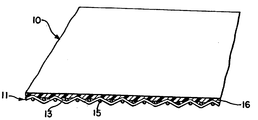
- a section of an idler belt 10 according to the invention is shown in an oblique perspective, the base fabric 11 of which consists of weft threads 13 and warp threads 15 and which is provided on one side with a coating 16.
- the warp threads consist of two components, one of which is polyethylene, but also polypropylene can be, while the other thread component can preferably consist of polyester, but also of polyamide.
- the proportion of polyethylene or polypropylene in the total weight of the base fabric is 12 to 60, preferably 3 to 40% by weight. The proportion should be low if possible.
- the warp threads are single or multiple threads and consist of a different material, also preferably of polyethylene or polyamide.
- the ratio of the thread materials of the two components to one another could be such that 100% consist of the material of the first component, but also less, up to 20%.
- the polyethylene portion of the total weight of the web should be at least about 2 to 3 or 5% by weight.
- the coating or lamination 16 consists of polyethylene, polypropylene or a mixture thereof, which is matched to the essential adhesion-promoting component of the first thread component.
- the materials should be the same so that the necessary bond between the base sheet and the coating is brought about via this. Weft and warp threads can change as desired, i.e. it is not necessary to provide a 1: 1 binding, but one or two threads can alternate or double threads can be laid.
- the base fabric consisted of 167/2 dtex textured polyester (PET) warp threads (78 g / m2) and 30Nm weft threads made of 50% polyester and 50% polyethylene, which with a textured weft thread 167 / 2dtex per weft (pick à pick) changed.
- PET dtex textured polyester
- 30Nm weft threads made of 50% polyester and 50% polyethylene, which with a textured weft thread 167 / 2dtex per weft (pick à pick) changed.
- warp threads made of 167/2 dtex textured polyester yarn and 30Nm weft threads made of 75% polyester and 25% polyethylene were used.
- a third embodiment which is similar to the first, 167/2 dtex polyester threads (25 g / m2) and 30 Nm PET / PE (50% PTE and 50% PE) / 22 g / m2) were used alternately in the weft, so . that the proportion of polyethylene in the total weight was 9% by weight.
- the weft consisted only of 30Nm PET / PE (50% PTE and 50% PE) yarn (45 g / m2), so that the polyethylene content of the total weight was 18% by weight.
- the yarns used can be spun, textured, knitted, swirled, coated or core-spun.
Landscapes
- Engineering & Computer Science (AREA)
- Mechanical Engineering (AREA)
- Chemical & Material Sciences (AREA)
- Composite Materials (AREA)
- Textile Engineering (AREA)
- Woven Fabrics (AREA)
- Laminated Bodies (AREA)
- Belt Conveyors (AREA)
Abstract
Description
- Die Erfindung betrifft ein textiles Mitläuferband für die Trennung von nicht-vulkanisierten Gummimischungsbändern und -produkten oder auch gewissen Kunststoffprodukten, die noch klebrig sind (green tack), wie sie in der Gummi- und Kunststoffolien-Industrie verwendet werden, wie sie aber auch als leichte Unterstützungsbänder, z.B. für Sperrfolien, Auskleidungsfolien, Zeltplanen, Schutz(kleidungs)folien, Einsatz finden.
- Mitläuferbänder werden in großem Umfang in der Gummiindustrie angewandt, um insbes. nicht-vulkanisierte Kautschukbänder aufwickeln und abwickeln zu können, weil sie im aufgewickelten Zustand für den Transport und bei der Weiterverarbeitung leichter handhabbar sind. Die einzelnen Lagen eines solchen Wickels würden aneinanderkleben und sich nicht einwandfrei trennen, wenn nicht Zwischenschichten, die keine Bindung zu den Lagen entfalten, eingesetzt würden.
- Bekannte Mitläufergewebe sind aus gewirkten, gewebten, gevliesten oder dergl. Kunstfaserbändern hergestellt, die gegebenenfalls auf einer oder beiden Seiten mit einem verträglichen Kunststoff kaschiert oder laminiert sind. Die eingesetzten Kunstfasern sind vielfach Polyethylen, Polypropylen, Polyester, Aramid, Polyamid oder ähnliche Kunststoffe, während die Beschichtung im allgemeinen aus Polyethylen, Polypropylen oder Polyester aber auch aus PTFE, Polyurethan, Polyamid oder dergl. besteht. Eine hinreichend befriedigende Festigkeit des Grundbands (Gewirk, Gestrick, Gewebe, Vlies oder dergl.) und gegebenenfalls Verbindung zur Beschichtung machen es erforderlich, daß preiswürdige starke Fäden und gegebenenfalls bei hohen Temperaturen nicht zu dünne Kaschierungen vorgesehen werden. Dies wiederum macht das resultierende Band vergleichsweise steif. Natürlich hängt die Steifheit auch von der Dicke des Grundbands und gegebenenfalls der Beschichtung ab. Diese richtet sich nach den Anforderungen der Festigkeit. Dennoch besteht das Bedürfnis, bei gleichen Gebrauchseigenschaften das Mitläuferband relativ weicher auszubilden ohne es zu verteuern.
- Der Erfindung liegt demgemäß die Aufgabe zugrunde, das eingangs genannte Mitläuferband dahingehend fortzuentwickeln, daß bei vorgegebener Festigkeit und Trennvermögen und Preiswürdigkeit die Weichheit des Mitläuferband erhöht und der "Griff" verbessert ist.
- Zur Lösung dieser Aufgabe schlägt die Erfindung bei dem eingangs umrissenen textilen Mitläuferband vor, daß nur ein Teil der Fasern oder Fäden des Grund- oder Stützbands aus dem gleichen oder einem ähnlichen Kunststoff besteht, wie die Beschichtung. Im Grundband dient nur ein Teil der Fasern oder Fäden als Haftungsvermittler zur Beschichtung, während der andere Teil die erforderlichen physikalischen Eigenschaften, wie Festigkeit, Dehnbarkeit und dergl., preiswert gewährleistet.
- Für die Sicherstellung einer ausreichenden Bindung zwischen der aufkaschierten oder aufgeschmolzenen Beschichtung und dem Grundband genügt es überraschenderweise, wenn nur ein Teil der Fasern des Grundbandes, insbes. nur ein - möglichst geringer - Teil der zu dessen Herstellung verwendeten Fäden, aus einem Kunststoff besteht, der sich gut mit der Beschichtung unter mäßigem Druck und niedriger Hitze verbinden läßt. Bisher waren erhebliche Drucke und Temperaturen zur Sicherstellung einer guten Bindung erforderlich, um bei ausreichend festen Fäden oder Fasern ein befriedigendes Produkt zu erzielen, auch dann, wenn Fäden und Beschichtung aus Polyethylen, Polyester oder Polypropylen bestehen, was zu vergleichsweise steifen Mitläuferbändern führte. Gemäß der Erfindung lassen sich hochfeste Fasern oder Fäden im Grundgewebe oder Band einsetzen, die sich weniger gut mit der Beschichtung verbinden. Zur Haftungsvermittlung dienen die Fäden oder Fasern, deren Werkstoff dem der Beschichtung gleicht. Die anderen, aus einem Kunststoff ausreichender Affinität zur Beschichtung bestehenden Fäden oder Fasern vermögen eine insgesamt ausreichend hohe Bindung zur Beschichtung auch bei mäßigen Temperaturen und Kaschierdruck herzustellen. Es resultiert hieraus ein in seinen Eigenschaften hinsichtlich Weichheit und Griff bei im übrigen unveränderten mechanischen Eigenschaften verbessertes preiswürdiges Mitläuferband.
- Der Anteil der Fasern oder Fäden, deren Affinität zur Beschichtung gut ist, also im allgemeinen die gleiche Zusammensetzung hat, kann bis zu 80, gegebenenfalls nur bis zu 60, 40 oder gar nur 20 Gew.-% oder 3 % des Grundbandgesichts betragen.
- Die Kaschierung von Kunststoffbändern, die neben Kunststoffäden oder -fasern aus isotaktischem Polypropylen auch Glasfasern zur Verstärkung aufweisen, ist an sich bekannt (US-PS 3 489 639). Derartige einseitig mit Polypropylen beschichtete Bänder eigenen sich jedoch nicht als Mitläuferbänder. Auch Transportbänder oder Planen aus Grundgeweben oder -stoffen aus Mischfasern oder unterschiedlichen Fäden sind vielfältig bekannt, doch sind bei diesen Weichheit und Griff neben antibindenden Eigenschaften bei vorgegebenen anderen mechanischen Eigenschaften nicht von Bedeutung. Alle diese Materialien eignen sich nicht als Mitläuferbänder.
- Es ist vielfach erwünscht, daß die oder jede Oberfläche des Bandes einer besonderen Oberflächengestaltung des unvulkanisierten Gummigegenstandes komplementär entspricht. Die erfindungsgemäße Ausbildung des Mitläuferbandes sieht auch solche Ausgestaltungen vor, bei denen die Dicke in Richtung der Breite oder der Länge des Bandes unterschiedliche verteilt ist. So können die Randstreifen erhabener als der Mittelbereich sein oder kann in Längsrichtung eine periodische Wellung vorgesehen werden. Dies wird durch entsprechende Ausbildung der Dicke des Grundbandes und/oder der Beschichtung erreicht.
- Das neue Mitläuferband besteht also nur zum - vorzugsweise geringen - Anteil aus Fäden, die die gleiche Zusammensetzung wie der Kunststoff der Beschichtung haben und die für eine gute Bindung zur Beschichtung sorgen. Andererseits wird die notwendige Festigkeit durch andere Fäden oder Fasern erzeugt, wie sie an sich für Mitläuferbänder weniger üblich sind, weil ihre Affinität zum noch unvulkanisierten Gummirohband zu hoch ist. Gewebte Bänder können gekreuzt gewebt oder gerade gewebt sein. Geeignete Materialien für die Festigkeit und die erforderliche Dehnung bewirkende Fäden sind Mischungen aus Aramiden, Baumwolle, Rayon, Polyamid, PVA, PVDF, PP, Polyester, PBI, Polyethylen, PTFE oder ähnliche Faser- bzw. Fadensysteme, die mit Beschichtungen aus Polypropylen, Polyethylen, Polyester, Polyamid, PTFE, Polyurethan und dergl. verstärkt sein können. Die Verwendung von Verstärkungsfasern bzw. -fäden aus Aramid, Polyamid, Polyester und dergl. verleihen dem Band die erforderliche Festigkeit, wie sie von einem Grundgewebe erwartet wird, während der andere Teil der Fäden oder Fasern, insbes. aus Polypropylen, Polyester oder Polyethylen, gegebenenfalls Polyurethan, für die ausreichende Bindung zur Beschichtung oder Kaschierschicht sorgen, so daß das Mitläuferband insgesamt die erforderliche Festigkeit, Biegsamkeit, Weichheit und den erwünschten Griff neben den weiteren üblicherweise geforderten physikalischen Eigenschaften und Preiswürdigkeit hat.
- In der beigefügten Zeichnung ist in Schrägperspektive ein Ausschnitt eines erfindungsgemäßen Mitläuferbandes 10 dargestellt, dessen Grundgewebe 11 aus Schußfäden 13 und aus Kettfäden 15 besteht und das einseitig mit einer Beschichtung 16 versehen ist. Die Kettfäden bestehen aus zwei Komponenten, von denen die eine Fadenkomponente Polyethylen ist, aber auch Polypropylen sein kann, während die andere Fadenkomponente vorzugsweise aus Polyester, aber auch aus Polyamid, bestehen kann. Der Anteil des Polyethylens oder Polypropylens am Gesamtgewicht des Grundgewebes beträgt 12 bis 60, vorzugsweise 3 bis 40 Gew.-%. Der Anteil sollte nach Möglichkeit gering sein. Die Kettfäden sind ein- oder mehrfädig und bestehen aus einem anderen Werkstoff, ebenfalls vorzugsweise aus Polyethylen oder Polyamid. Das Verhältnis der Fadenmaterialien der beiden Komponenten zueinander könnte derart sein, daß 100 % aus dem Material der ersten Komponente bestehen, aber auch weniger, bis zu 20 %. Wenigstens ca. 2 bis 3 oder 5 Gew.-% sollte der Polyethylenanteil am Gesamtgewicht der Bahn betragen.
- Die Beschichtung bzw. Kaschierung 16 besteht aus Polyethylen, Polypropylen oder einer Mischung daraus, die abgestimmt ist auf wesentliche haftvermittelnde Komponente der ersten Fadenkomponente. Die Werkstoffe sollen gleich sein, damit die notwendige Bindung zwischen der Grundbahn und der Beschichtung über diese bewirkt wird. Schuß- und Kettfäden können an sich beliebig wechseln, d.h. es muß nicht eine 1 : 1-Bindung vorgesehen sein, sondern es können auch jeweils ein oder zwei Fäden abwechseln oder jeweils Doppelfäden gelegt sein.
- Bei einem ersten Ausführungsbeispiel bestand das Grundgewebe aus 167/2 dtex texturierten Polyester(PET)-Kettfäden (78 g/m²) und 30Nm Schußfäden aus 50 % Polyester und 50 % Polyethylen, der mit einem texturierten Schußfaden 167/2dtex je Schuß (pick à pick) wechselte.
- Bei einem zweitenen Ausführungsbeispiel wurden Kettfäden aus 167/2 dtex texturiertem Polyestergarn und 30Nm Schußfäden aus 75 % Polyester und 25 % Polyethylen verwendet.
- Bei einem dritten Ausführungsbeispiel, das dem ersten ähnelt, wurden im Schuß abwechselnd 167/2 dtex Polyester-Fäden (25 g/m²) und 30Nm PET/PE (50 % PTE und 50 % PE) /22 g/m²) eingesetzt, so. daß der Polyethylenanteil am Gesamtgewicht 9 Gew.-% betrug.
- Bei einem vierten Ausführungsbeispiel bestand gegenüber dem vorhergehenden Beispiel der Schuß nur aus 30Nm PET/PE (50 % PTE und 50 % PE) Garn (45 g/m²) so daß der Polyethylenanteil am Gesamtgewicht 18 Gew.-% ausmachte.
- Diese Grundgewebe wurden kaschiert oder heißbeschichtet mit einer Polyethylenmischung, die hohe Weichheit und guten Griff sicherstellte, wie er in der Gummi- oder Kunststoffindustrie für nicht-ausvulkanisierte oder ausgehärtete Gummi- oder Kunststoffprodukte erwünscht ist.
- Die verwendeten Garne können gesponnen, texturiert, gewirkt, verwirbelt, ummantelt oder kerngesponnen sein.
Claims (10)
- Textiles Mitläuferband für die Trennung von nicht-vulkanisierten Gummimischungsbändern und -produkten aus einem mit Polyethylen bzw. Polypropylen u.ä. beschichtetem bandförmigen Grundstoff (Gewebe, Gestrick, Gewirk, Vlies) aus Kunststoffasern, insbes. auch aus Polyethylen bzw. Polypropylen,
dadurch gekennzeichnet,
daß nur ein Teil der Fasern oder Fäden der Grundbahn (11) aus dem gleichen Kunststoff wie die Beschichtung (16) besteht und die Haftung zur Beschichtung sicherstellt, während der andere Teil der Fasern oder Fäden die Festigkeit des Bandes bestimmt. - Mitläuferband nach Anspruch 1,
dadurch gekennzeichnet,
daß bei Verwendung eines Grundgewebes entweder die Kette oder der Schuß aus Zweikomponentengarnen oder zwei Garnen unterschiedlichen Materials besteht, von denen die eine Komponente aus gleichem Grundwerkstoff besteht wie die Beschichtung und die andere Komponente eine die Garnfestigkeit bestimmende andere Komponente, insbes. Polypropylen ist. - Mitläuferband nach Anspruch 1 oder 2,
dadurch gekennzeichnet,
daß bis zu 80 Gew.-% der Fasern oder Fäden des Grundstoffs (11) aus gleichem Kunststoff wie die Beschichtung (16) bestehen. - Mitläuferband nach Anspruch 1 oder 2,
dadurch gekennzeichnet,
daß bis zu 60 Gew.-% der Fasern oder Fäden des Grundstoffs (11) aus gleichem Kunststoff wie die Beschichtung (16) bestehen. - Mitläuferband nach Anspruch 1 oder 2,
dadurch gekennzeichnet,
daß bis zu 40 Gew.-% der Fasern oder Fäden des Grundstoffs (11) aus gleichem Kunststoff wie die Beschichtung (16) bestehen. - Mitläuferband nach Anspruch 1 oder 2,
dadurch gekennzeichnet,
daß bis zu 20 Gew.-% der Fasern oder Fäden des Grundstoffs (11) aus gleichem Kunststoff wie die Beschichtung (16) bestehen. - Mitläuferband nach einem der Ansprüche 1 bis 6,
dadurch gekennzeichnet,
daß die Stärke des Bandes (10) in Querrichtung ungleichmäßig verteilt ist, insbes. an den Rändern stärker oder dünner als im Mittelbereich ist. - Mitläuferband nach einem der Ansprüche 1 bis 6,
dadurch gekennzeichnet,
daß die Stärke des Bandes (10) in Längsrichtung wechselt. - Mitläuferband nach einem der Ansprüche 1 bis 8,
dadurch gekennzeichnet,
daß die Beschichtung (16) des Bandes (10) in Längs- oder Querrichtung unterschiedlich stark ausgebildet ist, um dem Band ein angepaßtes Profil zu geben. - Mitläuferband nach einem der Ansprüche 1 bis 9,
dadurch gekennzeichnet,
daß eine Komponente der Fäden zur Verbesserung der Ableitfähigkeit elektrischer Ladungen aus einem leitenden Werkstoff besteht.
Applications Claiming Priority (2)
| Application Number | Priority Date | Filing Date | Title |
|---|---|---|---|
| DE4026671 | 1990-08-23 | ||
| DE19904026671 DE4026671C1 (de) | 1990-08-23 | 1990-08-23 |
Publications (2)
| Publication Number | Publication Date |
|---|---|
| EP0472195A2 true EP0472195A2 (de) | 1992-02-26 |
| EP0472195A3 EP0472195A3 (en) | 1992-05-06 |
Family
ID=6412757
Family Applications (1)
| Application Number | Title | Priority Date | Filing Date |
|---|---|---|---|
| EP19910114079 Withdrawn EP0472195A3 (en) | 1990-08-23 | 1991-08-22 | Textile runner cloth for the separation of non-vulcanised rubber-mixture tyres and products |
Country Status (2)
| Country | Link |
|---|---|
| EP (1) | EP0472195A3 (de) |
| DE (1) | DE4026671C1 (de) |
Cited By (1)
| Publication number | Priority date | Publication date | Assignee | Title |
|---|---|---|---|---|
| EP0567147A1 (de) * | 1992-04-24 | 1993-10-27 | Bridgestone Corporation | Mitläufer für das Aufwickeln des nichtvulkanisierten Kautschukmaterials |
Family Cites Families (5)
| Publication number | Priority date | Publication date | Assignee | Title |
|---|---|---|---|---|
| BE640846A (de) * | 1962-12-05 | 1964-06-05 | ||
| US3686046A (en) * | 1969-10-30 | 1972-08-22 | Richard P Crowley | Method of producing a needle punched non-cellular backed carpet |
| US4069359A (en) * | 1976-06-14 | 1978-01-17 | The Goodyear Tire & Rubber Company | Means and method of separating lengths of flattened flexible polymeric tube |
| US4522203A (en) * | 1984-03-09 | 1985-06-11 | Chicopee | Water impervious materials |
| JPH01297239A (ja) * | 1988-05-26 | 1989-11-30 | Bridgestone Corp | 未加硫ゴム部材の巻き取りライナー |
-
1990
- 1990-08-23 DE DE19904026671 patent/DE4026671C1/de not_active Expired - Lifetime
-
1991
- 1991-08-22 EP EP19910114079 patent/EP0472195A3/de not_active Withdrawn
Cited By (1)
| Publication number | Priority date | Publication date | Assignee | Title |
|---|---|---|---|---|
| EP0567147A1 (de) * | 1992-04-24 | 1993-10-27 | Bridgestone Corporation | Mitläufer für das Aufwickeln des nichtvulkanisierten Kautschukmaterials |
Also Published As
| Publication number | Publication date |
|---|---|
| DE4026671C1 (de) | 1991-08-29 |
| EP0472195A3 (en) | 1992-05-06 |
Similar Documents
| Publication | Publication Date | Title |
|---|---|---|
| DE69616556T2 (de) | Elastischer verband | |
| US4679519A (en) | Laminated cloth construction | |
| EP0967422B1 (de) | Packungsgarn aus Graphit- und Plastikfolie | |
| DE2305693A1 (de) | Nicht-gewebte struktur | |
| DE4113360B4 (de) | Treibriemen | |
| EP0240861A2 (de) | Antriebsriemen | |
| EP0382801B1 (de) | Laminate aus textilen flächengebilden und atmungsaktiven folien | |
| EP1342562A1 (de) | Verfahren zur Herstellung einer luftdurchlässigen Verbundfolie mit textiler Oberfläche, die elastische und nichtelastische Bereiche aufweist | |
| WO2004026576A1 (de) | Stumpf verschweissbares transportband | |
| WO2020187371A1 (de) | Verfahren zum herstellen eines selbstverstärkten thermoplastischen kompositwerkstoffs | |
| EP3573824B1 (de) | Transfersystem für ein verbundmaterial | |
| DE3706404C2 (de) | ||
| EP0281643B1 (de) | Verstärkter Vliesstoff | |
| EP0407715A1 (de) | Transportriemen für Garne | |
| EP0472195A2 (de) | Textiles Mitläuferband für die Trennung von nicht-vulkanisierten Gummimischungensbändern und -produkten | |
| DE1479995C3 (de) | Glasfaserhaltige gewebte Textilschicht zur Herstellung von Laminaten mit verbesserter innerer Haftung | |
| DE69813725T2 (de) | Band für eine Schuhpresse und Verfahren zu seiner Herstellung | |
| EP1601827B1 (de) | Gelege aus kunststoffbändchen sowie verfahren und vorrichtung zu dessen herstellung | |
| DE102019203986A1 (de) | Vliesstoffartikel | |
| EP0602471B1 (de) | In einzelne Bänder einer Doppelpolware zerschneidbares textiles Flächengebilde für Composite | |
| EP0408830B1 (de) | Textiles Flächengebilde | |
| DE202011000326U1 (de) | Verstärktes Segeltuch mit UHMWP-Strängen | |
| DE2503612A1 (de) | Polyolefinbandgarngewebe | |
| DE2407118A1 (de) | Hochverzugsriemchen | |
| WO1996013374A1 (de) | Prozessband zum verdichten von schüttgutmaterialien |
Legal Events
| Date | Code | Title | Description |
|---|---|---|---|
| PUAI | Public reference made under article 153(3) epc to a published international application that has entered the european phase |
Free format text: ORIGINAL CODE: 0009012 |
|
| AK | Designated contracting states |
Kind code of ref document: A2 Designated state(s): AT BE CH DE DK ES FR GB GR IT LI LU NL SE |
|
| PUAL | Search report despatched |
Free format text: ORIGINAL CODE: 0009013 |
|
| AK | Designated contracting states |
Kind code of ref document: A3 Designated state(s): AT BE CH DE DK ES FR GB GR IT LI LU NL SE |
|
| 17P | Request for examination filed |
Effective date: 19921106 |
|
| 17Q | First examination report despatched |
Effective date: 19940617 |
|
| GRAG | Despatch of communication of intention to grant |
Free format text: ORIGINAL CODE: EPIDOS AGRA |
|
| GRAH | Despatch of communication of intention to grant a patent |
Free format text: ORIGINAL CODE: EPIDOS IGRA |
|
| RTI1 | Title (correction) | ||
| STAA | Information on the status of an ep patent application or granted ep patent |
Free format text: STATUS: THE APPLICATION IS DEEMED TO BE WITHDRAWN |
|
| 18D | Application deemed to be withdrawn |
Effective date: 19961015 |