EP0472091A1 - Synergistische Mittel zur Regulierung des Pflanzenwachstums - Google Patents
Synergistische Mittel zur Regulierung des Pflanzenwachstums Download PDFInfo
- Publication number
- EP0472091A1 EP0472091A1 EP91113554A EP91113554A EP0472091A1 EP 0472091 A1 EP0472091 A1 EP 0472091A1 EP 91113554 A EP91113554 A EP 91113554A EP 91113554 A EP91113554 A EP 91113554A EP 0472091 A1 EP0472091 A1 EP 0472091A1
- Authority
- EP
- European Patent Office
- Prior art keywords
- alkyl
- alkoxy
- methyl
- salts
- alkylthio
- Prior art date
- Legal status (The legal status is an assumption and is not a legal conclusion. Google has not performed a legal analysis and makes no representation as to the accuracy of the status listed.)
- Granted
Links
- 239000000203 mixture Substances 0.000 title claims 10
- 230000008635 plant growth Effects 0.000 title claims 8
- 230000002195 synergetic effect Effects 0.000 title claims 8
- 230000033228 biological regulation Effects 0.000 title 1
- -1 C 1 -C 4 alkoxy Chemical group 0.000 claims 10
- 125000004767 (C1-C4) haloalkoxy group Chemical group 0.000 claims 7
- 125000004765 (C1-C4) haloalkyl group Chemical group 0.000 claims 7
- 230000001105 regulatory effect Effects 0.000 claims 7
- 239000000654 additive Substances 0.000 claims 6
- 125000003282 alkyl amino group Chemical group 0.000 claims 6
- 239000003795 chemical substances by application Substances 0.000 claims 6
- 229910052739 hydrogen Inorganic materials 0.000 claims 6
- 239000001257 hydrogen Substances 0.000 claims 6
- UFHFLCQGNIYNRP-UHFFFAOYSA-N Hydrogen Chemical compound [H][H] UFHFLCQGNIYNRP-UHFFFAOYSA-N 0.000 claims 5
- 125000005843 halogen group Chemical group 0.000 claims 5
- VHOVSQVSAAQANU-UHFFFAOYSA-M mepiquat chloride Chemical compound [Cl-].C[N+]1(C)CCCCC1 VHOVSQVSAAQANU-UHFFFAOYSA-M 0.000 claims 4
- 125000000217 alkyl group Chemical group 0.000 claims 3
- 125000002490 anilino group Chemical group [H]N(*)C1=C([H])C([H])=C([H])C([H])=C1[H] 0.000 claims 3
- JUZXDNPBRPUIOR-UHFFFAOYSA-N chlormequat Chemical class C[N+](C)(C)CCCl JUZXDNPBRPUIOR-UHFFFAOYSA-N 0.000 claims 3
- 150000001875 compounds Chemical class 0.000 claims 3
- 229910052736 halogen Inorganic materials 0.000 claims 3
- 150000002367 halogens Chemical class 0.000 claims 3
- 125000002887 hydroxy group Chemical group [H]O* 0.000 claims 3
- 125000002636 imidazolinyl group Chemical group 0.000 claims 3
- NNCAWEWCFVZOGF-UHFFFAOYSA-N mepiquat Chemical class C[N+]1(C)CCCCC1 NNCAWEWCFVZOGF-UHFFFAOYSA-N 0.000 claims 3
- 125000000951 phenoxy group Chemical group [H]C1=C([H])C([H])=C(O*)C([H])=C1[H] 0.000 claims 3
- 125000001997 phenyl group Chemical group [H]C1=C([H])C([H])=C(*)C([H])=C1[H] 0.000 claims 3
- 150000003242 quaternary ammonium salts Chemical class 0.000 claims 3
- 125000003545 alkoxy group Chemical group 0.000 claims 2
- 229960002715 nicotine Drugs 0.000 claims 2
- 125000004642 (C1-C12) alkoxy group Chemical group 0.000 claims 1
- 125000005913 (C3-C6) cycloalkyl group Chemical group 0.000 claims 1
- BABDBQPWZQXOOR-UHFFFAOYSA-N 1,1-dimethyldiazinan-1-ium Chemical class C[N+]1(C)CCCCN1 BABDBQPWZQXOOR-UHFFFAOYSA-N 0.000 claims 1
- GARJMFRQLMUUDD-UHFFFAOYSA-N 1,1-dimethylpyrrolidin-1-ium Chemical class C[N+]1(C)CCCC1 GARJMFRQLMUUDD-UHFFFAOYSA-N 0.000 claims 1
- CABMTIJINOIHOD-UHFFFAOYSA-N 2-[4-methyl-5-oxo-4-(propan-2-yl)-4,5-dihydro-1H-imidazol-2-yl]quinoline-3-carboxylic acid Chemical compound N1C(=O)C(C(C)C)(C)N=C1C1=NC2=CC=CC=C2C=C1C(O)=O CABMTIJINOIHOD-UHFFFAOYSA-N 0.000 claims 1
- 229920000742 Cotton Polymers 0.000 claims 1
- PQBAWAQIRZIWIV-UHFFFAOYSA-N N-methylpyridinium Chemical class C[N+]1=CC=CC=C1 PQBAWAQIRZIWIV-UHFFFAOYSA-N 0.000 claims 1
- 150000003863 ammonium salts Chemical class 0.000 claims 1
- 235000013339 cereals Nutrition 0.000 claims 1
- UHZZMRAGKVHANO-UHFFFAOYSA-M chlormequat chloride Chemical compound [Cl-].C[N+](C)(C)CCCl UHZZMRAGKVHANO-UHFFFAOYSA-M 0.000 claims 1
- 125000004995 haloalkylthio group Chemical group 0.000 claims 1
- 125000004435 hydrogen atom Chemical group [H]* 0.000 claims 1
- 150000002462 imidazolines Chemical class 0.000 claims 1
- 239000005648 plant growth regulator Substances 0.000 claims 1
- 150000003839 salts Chemical class 0.000 claims 1
- 125000001424 substituent group Chemical group 0.000 claims 1
Classifications
-
- A—HUMAN NECESSITIES
- A01—AGRICULTURE; FORESTRY; ANIMAL HUSBANDRY; HUNTING; TRAPPING; FISHING
- A01N—PRESERVATION OF BODIES OF HUMANS OR ANIMALS OR PLANTS OR PARTS THEREOF; BIOCIDES, e.g. AS DISINFECTANTS, AS PESTICIDES OR AS HERBICIDES; PEST REPELLANTS OR ATTRACTANTS; PLANT GROWTH REGULATORS
- A01N43/00—Biocides, pest repellants or attractants, or plant growth regulators containing heterocyclic compounds
- A01N43/48—Biocides, pest repellants or attractants, or plant growth regulators containing heterocyclic compounds having rings with two nitrogen atoms as the only ring hetero atoms
- A01N43/50—1,3-Diazoles; Hydrogenated 1,3-diazoles
-
- A—HUMAN NECESSITIES
- A01—AGRICULTURE; FORESTRY; ANIMAL HUSBANDRY; HUNTING; TRAPPING; FISHING
- A01N—PRESERVATION OF BODIES OF HUMANS OR ANIMALS OR PLANTS OR PARTS THEREOF; BIOCIDES, e.g. AS DISINFECTANTS, AS PESTICIDES OR AS HERBICIDES; PEST REPELLANTS OR ATTRACTANTS; PLANT GROWTH REGULATORS
- A01N25/00—Biocides, pest repellants or attractants, or plant growth regulators, characterised by their forms, or by their non-active ingredients or by their methods of application, e.g. seed treatment or sequential application; Substances for reducing the noxious effect of the active ingredients to organisms other than pests
- A01N25/08—Biocides, pest repellants or attractants, or plant growth regulators, characterised by their forms, or by their non-active ingredients or by their methods of application, e.g. seed treatment or sequential application; Substances for reducing the noxious effect of the active ingredients to organisms other than pests containing solids as carriers or diluents
- A01N25/10—Macromolecular compounds
Definitions
- the invention further relates to methods for regulating plant growth using these agents.
- Quaternary ammonium compounds are known from the literature as plant growth regulators (DE-A 22 07 575).
- imidazole derivatives are described as herbicides in the literature (DE-A 31 21 736).
- the object of the present invention was new effective synergistic mixtures for regulating plant growth.
- Synergistic agents for regulating plant growth are particularly preferred which contain N, N-dimethylpiperidinium salts or N, N, N-trimethyl-N-2-chloroethylammonium salts as the quaternary ammonium salt which acts as a growth regulator.
- the active compounds can be applied together or separately, at the same time or in succession, before, during or after emergence of the plants.
- the proportion of ammonium salt I to imidazoline derivative II is 0.1: 1 to 1000: 1 parts by weight, preferably 1: 1 to 950: 1 parts by weight and in particular 1.5: 1 to 920: 1 Parts by weight.
- the agents according to the invention can be used, for example, in the form of directly sprayable solutions, powders, suspensions, also high-proof aqueous, oily or other suspensions or dispersions, emulsions, oil dispersions, pastes, dusts, sprinkling agents or granules by spraying, atomizing, dusting, scattering or pouring .
- the application forms depend on the purposes; in any case, they should ensure the finest possible distribution of the active compounds according to the invention.
- the compounds 1 and II are generally suitable for the preparation of directly sprayable solutions, emulsions, pastes or oil dispersions.
- Mineral oil fractions of medium to high boiling point such as kerosene or diesel oil, furthermore coal tar oils as well as oils of vegetable or animal origin, aliphatic, cyclic and aromatic hydrocarbons, e.g.
- Aqueous use forms can be prepared from emulsion concentrates, dispersions, pastes, wettable powders or water-dispersible granules by adding water.
- emulsions, pastes or oil dispersions the substrates as such or dissolved in an oil or solvent can be homogenized in water by means of wetting agents, adhesives, dispersants or emulsifiers.
- concentrates consisting of an active substance, wetting agent, tackifier, dispersant or emulsifier and possibly solvent or oil, which are suitable for dilution with water.
- the surface-active substances are the alkali metal, alkaline earth metal and ammonium salts of aromatic sulfonic acids, for example lignin, phenol, naphthalene and dibutylnaphthalenesulfonic acid, and of fatty acids, alkyl and alkylarylsulfonates, alkyl, lauryl ether and fatty alcohol sulfates, and salts of sulfated hexa- , Hepta and octadecanols, as well as of fatty alcohol glycol ether, condensation products of sulfonated naphthalene and its derivatives with formaldehyde, condensation products of naphthalene or naphthalenesulfonic acids with phenol and formaldehyde, polyoxyethylene octylphenol ether, ethoxylated isooctyl, octyl or nonylphenol, alkylphenyl alcohol, fatty alcohol,
- Powders, materials for broadcasting and dusts can be prepared by mixing or grinding the active substances together with a solid carrier.
- Granules e.g. Coated, impregnated and homogeneous granules can be produced by binding the active ingredients to solid carriers.
- Solid carriers are mineral soils such as silica gel, silicas, silica gels, silicates, talc, kaolin, limestone, lime, chalk, bolus, loess, clay, dolomite, diatomaceous earth, calcium and magnesium sulfate, magnesium oxide, ground plastics, fertilizers such as ammonium sulfate, ammonium phosphate, Ammonium nitrate, ureas and vegetable products, such as cereal flour, tree bark, wood and nutshell flour, cellulose powder or other solid carriers.
- the formulations contain between 0.1 and 95% by weight, preferably between 0.5 and 90% by weight, of the active ingredients.
- the active ingredients are used in a purity of 90% to 100%, preferably 95% to 100% (according to the NMR spectrum).
- the growth regulating agents or the active ingredients can be applied pre- or post-emergence. If the active ingredients are less compatible with certain crop plants, application techniques can be used in which the herbicidal compositions are sprayed with the aid of sprayers in such a way that the leaves of the sensitive crop plants are not struck wherever possible, while the active ingredients are applied to the leaves of undesirable plants growing below them or the uncovered floor area (post-directed, lay-by).
- the application rates of the active ingredient mixture are 0.01 + 0.01 to 2 + 0.001, preferably 0.03 + 0.02 to 1 + 0.001 kg / ha of active substance (a.S.).
- the vegetative growth of the plants can be strongly inhibited, which manifests itself in particular in a reduction in the growth in length.
- a reduced intensity of the growth of grasses on roadsides, hedges, canal embankments and on lawns such as parks, sports and orchards, ornamental lawns and airfields has proven to be advantageous in practice, so that the labor-intensive and costly lawn cutting can be reduced.
- the growth regulators can save cutting costs.
- the lateral branching of the plants can also be increased or inhibited. This is of interest if, for example, the development of side shoots (stinging shoots) in favor of leaf growth is to be inhibited in tobacco plants.
- frost resistance can also be increased considerably in winter rape.
- the growth in length and the development of a lush (and therefore particularly susceptible to frost) leaf or plant mass are inhibited.
- the young rapeseed plants are held back after sowing and before the onset of winter frosts, despite favorable growth conditions in the vegetative development stage. This also eliminates the risk of frost for plants that tend to prematurely degrade flowering and switch to the generative phase.
- other cultures e.g. Winter cereals, it is advantageous if the stocks are well stocked by treatment with compounds according to the invention in autumn, but do not go into the winter too abundantly.
- the synergistic means can increase yields by interfering with plant metabolism or by promoting or inhibiting vegetative and / or generative growth.
- plant growth regulators can both shorten or lengthen the development stages and accelerate or delay the ripeness of the harvested parts of the plant before or after the harvest.
- Ease of harvest for example, is of economic interest, which is made possible by the time-related falling or decreasing of the adhesive strength on the tree in the case of citrus fruits, olives or other types and varieties of pome, stone and nuts.
- the same mechanism that is, the promotion of the formation of separating tissue between the fruit or leaf and shoot part of the plant is also essential for a well controllable defoliation of useful plants such as cotton.
- the synergistic agents according to the invention can be added to the crop plants both from the seed (as a seed dressing agent) and via the soil, i.e. through the root and - particularly preferably - by spraying over the leaf.
- the agents according to the invention can be used in cereal crops and cotton.
- the difference between the expected value E according to Colby and the measured value shows whether there is a synergy mus (increase of the effect or increase of the effect) or an antagonism (weakening of the effect or reduction of the effect), or if both values agree, that only additive effects are effective.
- the agents according to the invention were applied in a post-emergence process (3.5 bar, 400 l / ha water).
Landscapes
- Life Sciences & Earth Sciences (AREA)
- General Health & Medical Sciences (AREA)
- Health & Medical Sciences (AREA)
- Wood Science & Technology (AREA)
- Pest Control & Pesticides (AREA)
- Plant Pathology (AREA)
- Engineering & Computer Science (AREA)
- Dentistry (AREA)
- Agronomy & Crop Science (AREA)
- Zoology (AREA)
- Environmental Sciences (AREA)
- Toxicology (AREA)
- Agricultural Chemicals And Associated Chemicals (AREA)
- Plural Heterocyclic Compounds (AREA)
- Cultivation Of Plants (AREA)
Abstract
Description
- Die vorliegende Erfindung betrifft Mittel zur Regulierung des Pflanzenwachstums, enthaltend eine synergistische Mischung aus mindestens einem wachstumsregulatorisch wirksamen quarternären Ammoniumsalz aus der Gruppe der Verbindungen I, umfassend: N,N-Dimethyl-azacycloheptaniumsalze, N,N-Dimethyl-piperidiniumsalze, N,N-Dimethyl-tetrahydropyridaziniumsalze, N,N,N-Trimethyl-N-2-chlorethylam- moniumsalze, N-Methyl-pyridiniumsalze und N,N-Dimethyl-pyrrolidiniumsalze und einem Imidazolinylderivat der allgemeinen Formel II

- R1 C1-C4-Alkyl;
- R2 C1-C4-Alkyl oder C3-C6-Cycloalkyl;
- R3 Wasserstoff; Hydroxyl; C1-C12-Alkyl; C1-C12-Alkoxy; C1-C12-Alkylamino; Di-C1-C12-alkylamino; Phenyl, Phenoxy oder Phenylamino, wobei die aromatischen Reste ein bis fünf Halogenatome und/oder ein bis drei der folgenden Gruppen tragen können: C1-C4-Aklyl, C1-C4-Halogenalkyl, C1-C4-Alkoxy, C1-C4-Halogenalkoxy, C1-C4-Alkylthio und C1-C4-Halogenalkylthio;
- R4 Wasserstoff; Halogen; C1-C4-Alkyl; C1-C4-Halogenalkyl; C1-C4-Alkoxy; C1-C4-Halogenalkoxy; C1-C4-Alkylthio oder C1-C4-Halogenalkylthio;
- R5 und R6 unabhängig voneinander eine der bei R4 genannten Gruppen oder gemeinsam eine 1,3-Butadien-1,4-diylgruppe, welche ein bis vier Halogenatome und/oder ein bis drei der folgenden Gruppen tragen kann: C1-C4-Aklyl, C1-C4-Halogenalkyl, C1-C4-Alkoxy, C1-C4-Halogenalkoxy, C1-C4-Alkylthio und C1-C4-Halogenalkylthio; sowie inerte Zusatzstoffe.
- Des weiteren betrifft die Erfindung Verfahren zu Regulierung des Pflanzenwachstums mit diesen Mitteln.
- Quartäre Ammoniumverbindungen sind aus der Literatur als Pflanzenwachstumsregulatoren bekannt (DE-A 22 07 575). Außerdem werden in der Literatur Imidazolderivate als Herbizide beschrieben (DE-A 31 21 736). Weiterhin sind Mischungen aus N,N,N-Trimethyl-N-2-chlorethylammoniumsalzen und 2-(4-Isopropyl-4-methyl-5-oxo-2-imidazolin-2-yl)-3-chinolin-carbonsäure mit wachstumsregulierenden Eigenschaften bekannt (EP-A 149 083).
- Aufgabe der vorliegenden Erfindung waren neue wirksame synergistische Mischungen zur Regulierung des Pflanzenwachstums.
- Demgemäß wurden die eingangs definierten synergistischen Mischungen gefunden. Außerdem wurden Verfahren zur Verwendung dieser Mischungen als Pflanzenwachstumsregulatoren gefunden.
- Im Hinblick auf die bestimmungsgemäße Verwendung in den erfindungsgemäßen synergistischen wachstumsregulierenden Mittel kommen als Substituenten der Verbindungen II folgende Reste in Betracht:
- R1 C1-C4-Alkyl wie Methyl, Ethyl, Propyl, 1-Methylethyl, Butyl, 1-Methylpropyl, 2-Methylpropyl und 1,1-Dimethylethyl, vorzugsweise Methyl, Ethyl und 1-Methylethyl, insbesondere Methyl und 1-Methylethyl;
- R2 C1-C4-Alkyl wie Methyl, Ethyl, Propyl, 1-Methylethyl, Butyl, 1-Methylpropyl, 2-Methylpropyl und 1,1-Dimethylethyl, vorzugsweise Methyl und Ethyl, insbesondere Methyl; oder C3-C6-Cycloalkyl wie Cyclopropyl, Cyclobutyl, Cyclopentyl und Cyclohexyl, vorzugsweise Cyclopropyl und Cyclopentyl, insbesondere Cyclopropyl;
- R3 Wasserstoff;
- C1-C12-Alkyl, vorzugsweise verzweigtes oder unverzweigtes Ci-C6-Alkyl wie Methyl, Ethyl, Propyl, 1-Methylethyl, Butyl, 1-Methyl-propyl, 2-Methyl-propyl, 1,1-Dimethylethyl, Pentyl, 1-Methylbutyl, 2-Methylbutyl, 3-Methylbutyl, 2,2-Dimethylpropyl, 1-Ethylpropyl, Hexyl, 1,1-Dimethylpropyl, 1,2-Dimethylpropyl, 1-Methylpentyl, 2-Methylpentyl, 3-Methylpentyl, 4-Methylpentyl, 1,1-Dimethylbutyl, 1,2-Dimethylbutyl, 1,3-Dimethylbutyl, 2,2-Dimethylbutyl, 2,3-Dimethylbutyl, 3,3-Dimethylbutyl, 1-Ethylbutyl, 2-Ethylbutyl, 1,1,2-Trimethylpropyl, 1,2,2-Trimethylpropyl, 1-Ethyl-1-methylpropyl und 1-Ethyl-2-methylpropyl, insbesondere verzweigtes oder unverzweigtes C1-C4-Alkyl wie Methyl, Ethyl, Propyl, 1-Methylethyl, Butyl, 1-Methyl- propyl, 2-Methylpropyl und 1,1-Dimethylethyl;
- C1-C12-Alkoxy, vorzugsweise verzweigtes oder unverzweigtes C1-C6-Alkoxy wie Methoxy, Ethoxy, Propyloxy, 1-Methylethoxy, Butyloxy, 1-Methylpropyloxy, 2-Methylpropyloxy, 1,1-Dimethylethyloxy, Pentyloxy, 1-Methylbutyloxy, 2-Methylbutyloxy, 3-Methylbutyloxy, 2,2-Dimethylpropyloxy, 1-Ethylpropyloxy, Hexyloxy, 1,1-Dimethylpropyloxy, 1,2-Dimethylpropyloxy, 1-Methylpentyloxy, 2-Methylpentyloxy, 3-Methylpentyloxy, 4-Methylpentyloxy, 1,1-Dimethylbutyloxy, 1,2-Dimethylbutyloxy, 1,3-Dimethylbutyloxy, 2,2-Dimethylbutyloxy, 2,3-Dimethylbutyloxy, 3,3-Dimethylbutyloxy, 1-Ethylbutyloxy, 2-Ethylbutyloxy, 1,1,2-Trimethylpropyloxy, 1,2,2-Trimethylpropyloxy, 1-Ethyl-1-methylpropyloxy und 1-Ethyl-2-methylpropyloxy, insbesondere verzweigtes oder unverzweigtes C,-C4-Alkoxy wie Methoxy, Ethoxy, Propyloxy, 1-Methylethoxy, Butyloxy, 1-Methyl-propyloxy, 2-Methylpropyloxy und 1,1-Dimethylethyloxy;
- C1-C12-Alkylamino, besonders Ci-C6-Alkylamino wie Methylamino, Ethylamino, Propylamino, 1-Methylethylamino, Butylamino, 1-Methylpropylamino, 2-Methylpropylamino, 1,1-Dimethylethylamino, Pentylamino, 1-Methylbutylamino, 2-Methylbutylamino, 3-Methylbutylamino, 2,2-Dimethylpropylamino, 1-Ethylpropylamino, Hexylamino, 1,1-Dimethylpropylamino, 1,2-Dimethylpropylamino, 1-Methylpentylamino, 2-Methylpentylamino, 3-Methylpentylamino, 4-Methylpentylamino, 1,1-Dimethylbutylamino, 1,2-Dimethylbutylamino, 1,3-Dimethylbutylamino, 2,2-Dimethylbutylamino, 2,3-Dimethylbutylamino, 3,3-Dimethylbutylamino, 1-Ethylbutylamino, 2-Ethylbutylamino, 1,1,2-Trimethylpropylamino, 1,2,2-Trimethylpropylamino, 1-Ethyl-1-methylpropylamino und 1-Ethyl-2-methylpropylamino;
- Di-C1-C12-alkylamino, besonders Di-Ci -C6-alkylamino, vorzugsweise Di-Ci -C4-alkylamino wie N,N-Dimethy- lamino, N,N-Diethylamino, N,N-Dipropylamino, N,N-Di-(1-methylethyl)amino, N,N-Dibutylamino, N,N-Di-(1-methylpropyl)amino, N,N-Di-(2-methylpropyl)amino, N,N-Di-(1,1-dimethylethyl)amino, N-Ethyl-N-methylamino, N-Methyl-N-propylamino, N-Methyl-N-(1-methylethyl)amino, N-Butyl-N-methylamino, N-Methyl-N-(1-methylpropyl)amino, N-Methyl-N-(2-methylpropyl)amino, N-(1,1-Dimethylethyl)-N-methylamino, N-Ethyl-N-propylamino, N-Ethyl-N-(1-methyl-ethyl)amino, N-Butyl-N-ethylamino, N-Ethyl-N-(1-methyl-propyl)amino, N-Ethyl-N-(2-methylpropyl)amino, N-Ethyl-N-(1,1-dimethylethyl)amino, N-(1-Methylethyl)-N-propylamino, N-Butyl-N-propylamino, N-(1-Methylpropyl)-N-propylamino, N-(2-Methylpropyl)-N-propylamino, N-(1,1-Dimethylethyl)-N-propylamino, N-Butyl-N-(1-methylethyl)amino, N-(1-Methylethyl)-N-(1-methylpropyl)amino, N-(1-Methylethyl)-N-(2-methylpropyl)amino, N-(1,1-Di-methylethyl)-N-(1-methylethyl)amino, N-Butyl-N-(1-methyl- propyl)amino, N-Butyl-N-(2-methylpropyl)amino, N-Butyl-N-(1,1-dimethylethyl)amino, N-(1-Methylpropyl)-N-(2-methylpropyl)amino, N-(1,1-Dimethylethyl)-N-(1-methylpropyl)amino und N-(1,1-Dimethylethyl)-N-(2-methylpropyl)amino;
- Phenyl, Phenoxy oder Phenylamino, wobei die aromatischen Reste ein bis fünf Halogenatome wie Fluor, Chlor, Brom und Jod, vorzugsweise Fluor, Chlor und Brom, insbesondere Fluor und Chlor;
- und/oder ein bis drei der folgenden Gruppen tragen können: C1-C4-Alkyl wie Methyl, Ethyl, Propyl, 1-Methylethyl, Butyl, 1-Methylpropyl, 2-Methylpropyl und 1,1-Dimethylethyl, vorzugsweise Methyl, Ethyl und 1-Methylethyl, insbesondere Methyl;
- C1-C4-Halogenalkyl, besonders C1-C2-Halogenalkyl wie Chlormethyl, Dichlormethyl, Trichlormethyl, Fluormethyl, Difluormethyl, Trifluormethyl, Chlorfluormethyl, Dichlorfluormethyl, Chlordifluormethyl, 1-Fluorethyl, 2-Fluorethyl, 2,2-Difluorethyl, 2,2,2-Trifluorethyl, 2-Chlor-2-fluorethyl, 2-Chlor-2,2-difluorethyl, 2,2-Dichlor-2-fluorethyl, 2,2,2-Trichlorethyl und Pentafluorethyl, vorzugsweise Difluormethyl und Trifluormethyl, insbesondere Trifluormethyl;
- C,-C4-Alkoxy wie Methoxy, Ethoxy, Propyloxy, 1-Methylethoxy, Butyloxy, 1-Methylpropyloxy, 2-Methylpropyloxy und 1,1-Dimethylethoxy, vorzugsweise Methoxy, Ethoxy, 1-Methylethoxy und 1,1-Dimethylethoxy, insbesondere Methoxy und 1-Methylethoxy;
- C1-C4-Halogenalkoxy, besonders C1-C2-Halogenalkoxy wie Chlormethyloxy, Dichlormethyloxy, Trichlormethyloxy, Fluormethyloxy, Difluormethyloxy, Trifluormethyloxy, Chlorfluormethyloxy, Dichlorfluormethyloxy, Chlordifluormethyloxy, 1-Fluorethyloxy, 2-Fluorethyloxy, 2,2-Difluorethyloxy, 2,2,2-Trifluorethyloxy, 2-Chlor-2-fluorethyloxy, 2-Chlor-2,2-difluorethyloxy, 2,2-Dichlor-2-fluorethyloxy, 2,2,2-Trichlorethyloxy und Pentafluorethyloxy, vorzugsweise Difluormethoxy und Trifluormethoxy;
- Cl-C4-Alkylthio wie Methylthio, Ethylthio, Propylthio, 1-Methylethylthio, Butylthio, 1-Methylpropylthio, 2-Methylpropylthio und 1,1-Dimethylethylthio, vorzugsweise Methylthio;
- oder C1-C4-Halogenalkylthio, besonders Ci-C2-Halogenalkylthio wie Chlormethylthio, Dichlormethylthio, Trichlormethylthio, Fluormethylthio, Difluormethylthio, Trifluormethylthio, Chlorfluormethylthio, Dichlorfluormethylthio, Chlordifluormethylthio, 1-Fluorethylthio, 2-Fluorethylthio, 2,2-Difluorethylthio, 2,2,2-Trifluorethylthio, 2-Chlor-2-fluorethylthio, 2-Chlor-2,2-difluorethylthio, 2,2-Dichlor-2-fluorethylthio, 2,2,2-Trichlorethylthio und Pentafluorethylthio, vorzugsweise Difluormethylthio;
- R4 Wasserstoff;
- Halogen wie Fluor, Chlor, Brom und Jod, vorzugsweise Fluor, Chlor und Brom, insbesondere Fluor und Chlor;
- C1-C4-Alkyl wie Methyl, Ethyl, Propyl, 1-Methylethyl, Butyl, 1-Methylpropyl, 2-Methylpropyl und 1,1-Dimethylethyl, vorzugsweise Methyl, Ethyl, 1-Methylethyl und 1,1-Dimethylethyl;
- C1-C4-Halogenalkyl, besonders C1-C2-Halogenalkyl wie Chlormethyl, Dichlormethyl, Trichlormethyl, Fluormethyl, Difluormethyl, Trifluormethyl, Chlorfluormethyl, Dichlorfluormethyl, Chlordifluormethyl, 1-Fluorethyl, 2-Fluorethyl, 2,2-Difluorethyl, 2,2,2-Trifluorethyl, 2-Chlor-2-fluorethyl, 2-Chlor-2,2-difluorethyl, 2,2-Dichlor-2-fluorethyl, 2,2,2-Trichlorethyl und Pentafluorethyl, vorzugsweise Difluormethyl und Trifluormethyl; C,-C4-Alkoxy wie Methoxy, Ethoxy, Propyloxy, 1-Methylethoxy, Butyloxy, 1-Methylpropyloxy, 2-Methylpropyloxy und 1,1-Dimethylethoxy, vorzugsweise Methoxy, Ethoxy, 1-Methylethoxy und 1,1-Dimethylethoxy, insbesondere Methoxy und 1,1-Dimethylethoxy;
- C1-C4-Halogenalkoxy, besonders C1-C2-Halogenalkoxy wie Chlormethyloxy, Dichlormethyloxy, Trichlormethyloxy, Fluormethyloxy, Difluormethyloxy, Trifluormethyloxy, Chlorfluormethyloxy, Dichlorfluormethyloxy, Chlordifluormethyloxy, 1-Fluorethyloxy, 2-Fluorethyloxy, 2,2-Difluorethyloxy, 2,2,2-Trifluorethyloxy, 2-Chlor-2-fluorethyloxy, 2-Chlor-2,2-difluorethyloxy, 2,2-Dichlor-2-fluorethyloxy, 2,2,2-Trichlorethyloxy und Pentafluorethyloxy, vorzugsweise Difluormethoxy und Trifluormethoxy;
- Cl-C4-Alkylthio wie Methylthio, Ethylthio, Propylthio, 1-Methylethylthio, Butylthio, 1-Methylpropylthio, 2-Methylpropylthio und 1,1-Dimethylethylthio, vorzugsweise Methylthio und Ethylthio;
- oder C1-C4-Halogenalkylthio, besonders Ci-C2-Halogenalkylthio wie Chlormethylthio, Dichlormethylthio, Trichlormethylthio, Fluormethylthio, Difluormethylthio, Trifluormethylthio, Chlorfluormethylthio, Dichlorfluormethylthio, Chlordifluormethylthio, 1-Fluorethylthio, 2-Fluorethylthio, 2,2-Difluorethylthio, 2,2,2-Trifluorethylthio, 2-Chlor-2-fluorethylthio, 2-Chlor-2,2-difluorethylthio, 2,2-Dichlor-2-fluorethylthio, 2,2,2-Trichlorethylthio und Pentafluorethylthio, vorzugsweise Difluormethylthio;
- R5 und R6 unabhängig voneinander
- eine der im allgemeinen und in besonderen bei R4 genannten Gruppen oder gemeinsam eine 1,3-Butadien-1,4-diylgruppe, welche ein bis vier Halogenatome wie Fluor, Chlor, Brom und Jod, vorzugsweise Fluor, Chlor und Brom, insbesondere Fluor und Chlor;
- und/oder ein bis drei der folgenden Gruppen tragen kann: C1-C4-Alkyl wie Methyl, Ethyl, Propyl, 1-Methylethyl, Butyl, 1-Methylpropyl, 2-Methylpropyl und 1,1-Dimethylethyl, vorzugsweise Methyl, Ethyl und 1-Methylethyl;
- C1-C4-Halogenalkyl, besonders C1-C2-Halogenalkyl wie Chlormethyl, Dichlormethyl, Trichlormethyl, Fluormethyl, Difluormethyl, Trifluormethyl, Chlorfluormethyl, Dichlorfluormethyl, Chlordifluormethyl, 1-Fluorethyl, 2-Fluorethyl, 2,2-Difluorethyl, 2,2,2-Trifluorethyl, 2-Chlor-2-fluorethyl, 2-Chlor-2,2-difluorethyl, 2,2-Dichlor-2-fluorethyl, 2,2,2-Trichlorethyl und Pentafluorethyl, vorzugsweise Difluormethyl und Trifluormethyl; C,-C4-Alkoxy wie Methoxy, Ethoxy, Propyloxy, 1-Methylethoxy, Butyloxy, 1-Methylpropyloxy, 2-Methylpropyloxy und 1,1-Dimethylethoxy, vorzugsweise Methoxy, Ethoxy, 1-Methylethoxy und 1,1-Dimethylethoxy; C1-C4-Halogenalkoxy, besonders C1-C2-Halogenalkoxy wie Chlormethyloxy, Dichlormethyloxy, Trichlormethyloxy, Fluormethyloxy, Difluormethyloxy, Trifluormethyloxy, Chlorfluormethyloxy, Dichlorfluormethyloxy, Chlordifluormethyloxy, 1-Fluorethyloxy, 2-Fluorethyloxy, 2,2-Difluorethyloxy, 2,2,2-Trifluorethyloxy, 2-Chlor-2-fluorethyloxy, 2-Chlor-2,2-difluorethyloxy, 2,2-Dichlor-2-fluorethyloxy, 2,2,2-Trichlorethyloxy und Pentafluorethyloxy, vorzugsweise Difluormethoxy und Trifluormethoxy;
- Cl-C4-Alkylthio wie Methylthio, Ethylthio, Propylthio, 1-Methylethylthio, Butylthio, 1-Methylpropylthio, 2-Methylpropylthio und 1,1-Dimethylethylthio, vorzugsweise Methylthio und Ethylthio;
- oder C1-C4-Halogenalkylthio, besonders Ci-C2-Halogenalkylthio wie Chlormethylthio, Dichlormethylthio, Trichlormethylthio, Fluormethylthio, Difluormethylthio, Trifluormethylthio, Chlorfluormethylthio, Dichlorfluormethylthio, Chlordifluormethylthio, 1-Fluorethylthio, 2-Fluorethylthio, 2,2-Difluorethylthio, 2,2,2-Trifluorethylthio, 2-Chlor-2-fluorethylthio, 2-Chlor-2,2-difluorethylthio, 2,2-Dichlor-2-fluorethylthio, 2,2,2-Trichlorethylthio und Pentafluorethylthio, vorzugsweise Difluormethylthio.
- Im Hinblick auf die bestimmungsgemäße Verwendung in den synergistischen Mitteln sind insbesondere solche Verbindungen II bevorzugt, in denen die Substituenten folgende Bedeutung haben:
-
- R1 C1-C4-Alkyl wie vorstehend genannt, insbesondere Methyl;
- R2 C1-C4-Alkyl wie vorstehend genannt, insbesondere Methyl und 1-Methylethyl; oder C3-C6-Cycloalkyl wie vorstehend genannt, insbesondere Cyclopropyl;
- R3 Wasserstoff; Hydroxyl;
- C1-C8-Alkyl wie vorstehend genannt, insbesondere verzweigtes oder unverzweigtes C1-C6-Alkyl wie vorstehend genannt;
- C1-C8-Alkoxy wie vorstehend genannt, insbesondere verzweigtes oder unverzweigtes Ci-C6-Alkoxy wie vorstehend genannt;
- C1-C8-Alkylamino wie vorstehend genannt, insbesondere C1-C6-Alkylamino wie vorstehend genannt; Di-C1-C8-alkylamino wie vorstehend genannt, insbesondere Di-C1-C4-alkylamino wie vorstehend genannt; Phenyl, Phenoxy oder Phenylamino, wobei die aromatischen Reste ein bis fünf Halogenatome wie vorstehend genannt, insbesondere Fluor und Chlor,
- und/oder ein bis drei der folgenden Gruppen tragen können:
- C1-C4-Aklyl wie vorstehend genannt, insbesondere Methyl;
- C1-C4-Halogenalkyl wie vorstehend genannt, insbesondere Difluormethyl und Trifluormethyl;
- C1-C4-Alkoxy wie vorstehend genannt, insbesondere Methoxy, Ethoxy, 1-Methylethoxy und 1,1-Dimethylethoxy;
- C1-C4-Halogenalkoxy wie vorstehend genannt, insbesondere Difluormethoxy und Trifluormethoxy; C1-C4-Alkylthio wie vorstehend genannt, insbesondere Methylthio und Ethylthio;
- und C1-C4-Halogenalkylthio wie vorstehend genannt, insbesondere Difluormethylthio; R4
- Wasserstoff;
- Halogen wie vorstehend genannt, insbesondere Fluor und Chlor;
- C1-C4-Alkyl wie vorstehend genannt, insbesondere Methyl und 1,1-Dimethylethyl;
- C1-C4-Halogenalkyl wie vorstehend genannt, insbesondere Difluormethyl und Trifluormethyl;
- C1-C4-Alkoxy wie vorstehend genannt, insbesondere Methoxy und 1,1-Dimethylethoxy; C1-C4-Halogenalkoxy wie vorstehend genannt, insbesondere Difluormethoxy und Trifluormethoxy; C1-C4-Alkylthio wie vorstehend genannt, insbesondere Methylthio und Ethylthio;
- oder C1-C4-Halogenalkylthio wie vorstehend genannt, insbesondere Difluormethylthio;
- R5 und R6 unabhängig voneinander
- eine der im allgemeinen und im besonderen bei R4 genannten Gruppen oder gemeinsam eine 1,3-Butadien-1,4-diylgruppe, welche ein bis vier Halogenatome wie vorstehend genannt, insbesondere Fluor und Chlor;
- und/oder ein bis drei der folgenden Gruppen tragen kann:
- C1-C4-Alkyl wie vorstehend genannt, insbesondere Methyl;
- C1-C4-Halogenalkyl wie vorstehend genannt, insbesondere Trifluormethyl;
- C1-C4-Alkoxy wie vorstehend genannt, insbesondere Methoxy;
- C1-C4-Halogenalkoxy wie vorstehend genannt, insbesondere Difluormethoxy und Trifluormethoxy; C1-C4-Alkylthio wie vorstehend genannt, insbesondere Methylthio;
- und C1-C4-Halogenalkylthio wie vorstehend genannt, insbesondere Difluormethylthio.
- Besonders bevorzugt sind synergistisches Mittel zur Regulierung des Pflanzenwachstums die als wachstumsregulatorisch wirksames quarternäres Ammoniumsalz N,N-Dimethyl-piperidiniumsalze oder N,N,N-Trimethyl-N-2-chlorethylammoniumsalze enthalten.
- Von diesen synergistischen Mitteln sind insbesondere solche bevorzugt, in denen neben den N,N-Dimethyl-piperidiniumsalzen oder N,N,N-Trimethyl-N-2-chlorethylammoniumsalzen ein Imidazolinylderivat der allgemeinen Formel II enthalten ist, in der die Substituenten folgende Bedeutung haben:
-
- R1 C1-C4-Alkyl wie vorstehend genannt, insbesondere Methyl;
- R2 C1-C4-Alkyl wie vorstehend genannt, insbesondere Methyl und 1-Methylethyl; oder C3-C6-Cycloalkyl wie vorstehend genannt, insbesondere Cyclopropyl;
- R3 Wasserstoff; Hydroxyl;
- C1-C8-Alkyl wie vorstehend genannt, insbesondere verzweigtes oder unverzweigtes C1-C6-Alkyl wie vorstehend genannt;
- C1-C8-Alkoxy wie vorstehend genannt, insbesondere verzweigtes oder unverzweigtes Ci-C6-Alkoxy wie vorstehend genannt;
- C1-C8-Alkylamino wie vorstehend genannt, insbesondere C1-C6-Alkylamino wie vorstehend genannt; Di-C1-C8-alkylamino wie vorstehend genannt, insbesondere Di-C1-C4-alkylamino wie vorstehend genannt; Phenyl, Phenoxy oder Phenylamino, wobei die aromatischen Reste ein bis fünf Halogenatome wie vorstehend genannt, insbesondere Fluor und Chlor;
- und/oder ein bis drei der folgenden Gruppen tragen können:
- C1-C4-Alkyl wie vorstehend genannt, insbesondere Methyl;
- C1-C4-Halogenalkyl wie vorstehend genannt, insbesondere Difluormethyl und Trifluormethyl;
- C1-C4-Alkoxy wie vorstehend genannt, insbesondere Methoxy und Ethoxy;
- C1-C4-Halogenalkoxy wie vorstehend genannt, insbesondere Difluormethoxy und Trifluormethoxy; C1-C4-Alkylthio wie vorstehend genannt, insbesondere Methylthio und Ethylthio;
- und C1-C4-Halogenalkylthio wie vorstehend genannt, insbesondere Difluormethylthio; R4
- Wasserstoff;
- oder Halogen wie vorstehend genannt, insbesondere Fluor und Chlor;
- R5 und R6 unabhängig voneinander
- Wasserstoff;
- Halogen wie vorstehend genannt, insbesondere Fluor und Chlor;
- C1-C4-Alkyl wie vorstehend genannt, insbesondere Methyl;
- C1-C4-Halogenalkyl wie vorstehend genannt, insbesondere Trifluormethyl;
- C1-C4-Alkoxy wie vorstehend genannt, insbesondere Methoxy und 1,1-Dimethylethoxy; C1-C4-Halogenalkoxy wie vorstehend genannt, insbesondere Difluormethoxy und Trifluormethoxy; C1-C4-Alkylthio wie vorstehend genannt, insbesondere Methylthio;
- und C1-C4-Halogenalkylthio wie vorstehend genannt, insbesondere Difluormethylthio;
- oder gemeinsam eine 1,3-Butadien-1,4-diylgruppe, welche ein bis vier Halogenatome wie vorstehend genannt, insbesondere Fluor und Chlor;
- und/oder eine der folgenden Gruppen tragen kann:
- C1-C4-Aklyl wie vorstehend genannt, insbesondere Methyl;
- C1-C4-Halogenalkyl wie vorstehend genannt, insbesondere Trifluormethyl;
- C1-C4-Alkoxy wie vorstehend genannt, insbesondere Methoxy;
- C1-C4-Halogenalkoxy wie vorstehend genannt, insbesondere Difluormethoxy und Trifluormethoxy; C1-C4-Alkylthio wie vorstehend genannt, insbesondere Methylthio;
- und C1-C4-Halogenalkylthio wie vorstehend genannt, insbesondere Difluormethylthio.
- Die Wirkstoffe können gemeinsam oder getrennt, zur gleichen Zeit oder nacheinander, vor, während oder nach dem Auflaufen der Pflanzen ausgebracht werden.
- In den synergistischen Mitteln beträgt das Anteilsverhältnis von Ammoniumsalz I zu Imidazolinderivat II 0,1:1 bis 1000:1 Gew.-Teile, vorzugsweise 1:1 bis 950:1 Gew.-Teile und insbesondere 1,5:1 bis 920:1 Gew.-Teile.
- Die erfindungsgemäßen Mittel können beispielsweise in Form von direkt versprühbaren Lösungen, Pulvern, Suspensionen, auch hochprozentigen wäßrigen, öligen oder sonstigen Suspensionen oder Dispersionen, Emulsionen, Öldispersionen, Pasten, Stäubemitteln, Streumitteln oder Granulaten durch Versprühen, Vernebeln, Verstäuben, Verstreuen oder Gießen angewendet werden. Die Anwendungformen richten sich nach den Verwendungszwecken; sie sollten in jedem Fall möglichst die feinste Verteilung der erfindungsgemäßen Wirkstoffe gewährleisten.
- Die Verbindungen 1 und II eignen sich allgemein zur Herstellung von direkt versprühbaren Lösungen, Emulsionen, Pasten oder Öldispersionen. Als inerte Zusatzstoffe kommen Mineralölfraktionen von mittlerem bis hohem Siedepunkt, wie Kerosin oder Dieselöl, ferner Kohlenteeröle sowie Öle pflanzlichen oder tierischen Ursprungs, aliphatische, cyclische und aromatische Kohlenwasserstoffe, z.B. Toluol, Xylol, Paraffin, Tetrahydronaphthalin, alkylierte Naphthaline oder deren Derivate, Methanol, Ethanol, Propanol, Butanol, Cyclohexanol, Cyclohexanon, Chlorbenzol, Isophoron oder stark polare Lösungsmittel wie N,N-Dimethylformamid, Dimethylsulfoxid, N-Methylpyrrolidon oder Wasser in Betracht.
- Wäßrige Anwendungsformen können aus Emulsionskonzentraten, Dispersionen, Pasten, netzbaren Pulvern oder wasserdispergierbaren Granulaten durch Zusatz von Wasser bereitet werden. Zur Herstellung von Emulsionen, Pasten oder Öldispersionen können die Substrate als solche oder in einem Öl oder Lösungsmittel gelöst, mittels Netz-, Haft-, Dispergier- oder Emulgiermittel in Wasser homogenisiert werden. Es können aber auch aus wirksamer Substanz, Netz-, Haft-, Dispergier- oder Emulgiermittel und eventuell Lösungsmittel oder Öl bestehende Konzentrate hergestellt werden, die zur Verdünnung mit Wasser geeignet sind.
- Als oberflächenaktive Stoffe kommen die Alkali-, Erdalkali-, Ammoniumsalze von aromatischen Sulfonsäuren, z.B. Lignin-, Phenol-, Naphthalin- und Dibutylnaphthalinsulfonsäure, sowie von Fettsäuren, Alkyl-und Alkylarylsulfonaten, Alkyl-, Laurylether- und Fettalkoholsulfaten, sowie Salze sulfatierter Hexa-, Hepta-und Octadecanolen, sowie von Fettalkoholglykolether, Kondensationsprodukte von sulfoniertem Naphthalin und seiner Derivate mit Formaldehyd, Kondensationsprodukte des Naphthalins bzw. der Naphthalinsulfonsäuren mit Phenol und Formaldehyd, Polyoxyethylenoctylphenolether, ethoxyliertes Isooctyl-, Octyl- oder Nonylphenol, Alkylphenol-, Tributylphenylpolyglykolether, Alkylarylpolyetheralkohole, Isotridecylalkohol, Fettalkoholethylenoxid-Kondensate, ethoxyliertes Rizinusöl, Polyoxyethylenalkylether oder Polyoxypropylen, Laurylalkoholpolyglykoletheracetat, Sorbitester, Lignin-Sulfitablaugen oder Methylcellulose in Betracht.
- Pulver-, Streu- und Stäubemittel können durch Mischen oder gemeinsames Vermahlen der wirksamen Substanzen mit einem festen Trägerstoff hergestellt werden.
- Granulate, z.B. Umhüllungs-, Imprägnierungs- und Homogengranulate können durch Bindung der Wirkstoffe an feste Trägerstoffe hergestellt werden. Feste Trägerstoffe sind Mineralerden wie Silicagel, Kieselsäuren, Kieselgele, Silikate, Talkum, Kaolin, Kalkstein, Kalk, Kreide, Bolus, Löß, Ton, Dolomit, Diatomeenerde, Calcium- und Magnesiumsulfat, Magnesiumoxid, gemahlene Kunststoffe, Düngemittel, wie Ammoniumsulfat, Ammoniumphosphat, Ammoniumnitrat, Harnstoffe und pflanzliche Produkte, wie Getreidemehl, Baumrinden-, Holz- und Nußschalenmehl, Cellulosepulver oder andere feste Trägerstoffe.
- Die Formulierungen enthalten zwischen 0,1 und 95 Gew.%, vorzugsweise zwischen 0,5 und 90 Gew.% der Wirkstoffe. Die Wirkstoffe werden dabei in einer Reinheit von 90 % bis 100 %, vorzugsweise 95 % bis 100 % (nach NMR-Spektrum) eingesetzt.
- Die Applikation der wachstumsregulierenden Mittel bzw. der Wirkstoffe kann im Vorauflauf- oder im Nachauflaufverfahren erfolgen. Sind die Wirkstoffe für gewisse Kulturpflanzen weniger verträglich, so können Ausbringungstechniken angewandt werden, bei welchen die herbiziden Mittel mit Hilfe der Spritzgeräte so gespritzt werden, daß die Blätter der empfindlichen Kulturpflanzen nach Möglichkeit nicht getroffen werden, während die Wirkstoffe auf die Blätter darunter wachsender unerwünschter Pflanzen oder die unbedeckte Bodenfläche gelangen (post-directed, lay-by).
- Die Aufwandmengen an Wirkstoffmischung betragen je nach Jahreszeit, Zielpflanzen und Wachstumsstadium 0,01 + 0,01 bis 2 + 0,001, vorzugsweise 0,03 + 0,02 bis 1 + 0,001 kg/ha aktive Substanz (a.S.).
- Die synergistischen Mischungen können praktisch alle Entwicklungsstadien einer Pflanze verschiedenartig beeinflussen und werden deshalb als Wachstumsregulatoren eingesetzt. Die Wirkungsvielfalt der Pflanzenwachstumsregulatoren hängt ab vor allem
- a) von der Pflanzenart und -sorte,
- b) von dem Zeitpunkt der Applikation, bezogen auf das Entwicklungsstadium der Pflanze und von der Jahreszeit,
- c) von dem Applikationsort und -verfahren (z.B. Samenbeize, Bodenbehandlung, Blattapplikation oder Stamminjektion bei Bäumen)
- d) von klimatischen Faktoren, z.B. Temperatur, Niederschlagsmenge, außerdem auch Tageslänge und Lichtintensität
- e) von der Bodenbeschaffenheit (einschließlich Düngung),
- f) von der Formulierung bzw. Anwendungsform des Wirkstoffs und schließlich
- g) von den angewendeten Konzentrationen der aktiven Substanz.
- Aus der Reihe der verschiedenartigen Anwendungsmöglichkeiten der erfindungsgemäßen Mittel im Pflanzenanbau, in der Landwirtschaft und im Gartenbau, werden einige nachstehend erwähnt.
- A. Mit den erfindungsgemäß verwendbaren Verbindungen läßt sich das vegetative Wachstum der Pflanzen stark hemmen, was sich insbesondere in einer Reduzierung des Längenwachstums äußert. Die behandelten Pflanzen weisen demgemäß einen gedrungenen Wuchs auf; außerdem ist eine dunklere Blattfärbung zu beobachten.
- Als vorteilhaft für die Praxis erweist sich eine verminderte Intensität des Wachstums von Gräsern an Straßenrändern, Hecken, Kanalböschungen und auf Rasenflächen wie Park-, Sport- und Obstanlagen, Zierrasen und Flugplätzen, so daß der Arbeits- und kostenaufwendige Rasenschnitt reduziert werden kann.
- Von wirtschaftlichem Interesse ist auch die Erhöhung der Standfestigkeit von lageranfälligen Kulturen wie Getreide, Mais, Sonnenblumen und Soja. Die dabei verursachte Halmverkürzung und Halmverstärkung verringern oder beseitigen die Gefahr des "Lagerns" (des Umknickens) von Pflanzen unter ungünstigen Witterungsbedingungen vor der Ernte.
- Wichtig ist auch die Anwendung von Wachstumsregulatoren zur Hemmung des Längenwachstums und zur zeitlichen Veränderung des Reifeverlaufs bei Baumwolle. Damit wird ein vollständig mechanisiertes Beernten dieser wichtigen Kulturpflanze ermöglicht.
- Bei Obst- und anderen Bäumen lassen sich mit den Wachstumsregulatoren Schnittkosten einsparen.
- Außerdem kann die Alternanz von Obstbäumen durch Wachstumsregulatoren gebrochen werden.
- Durch Anwendung von Wachstumsregulatoren kann auch die seitliche Verzweigung der Pflanzen vermehrt oder gehemmt werden. Daran besteht Interesse, wenn z.B. bei Tabakpflanzen die Ausbildung von Seitentrieben (Geiztrieben) zugunsten des Blattwachstums gehemmt werden soll.
- Mit Wachstumsregulatoren läßt sich beispielsweise bei Winterraps auch die Frostresistenz erheblich erhöhen. Dabei werden einerseits das Längenwachstum und die Entwicklung einer zu üppigen (und dadurch besonders frostanfälligen) Blatt- bzw. Pflanzenmasse gehemmt. Andererseits werden die jungen Rapspflanzen nach der Aussaat und vor dem Einsetzen der Winterfröste trotz günstiger Wachstumsbedingungen im vegetativen Entwicklungsstadium zurückgehalten. Dadurch wird auch die Frostgefährdung solcher Pflanzen beseitigt, die zum vorzeitigen Abbau der Blühhemmung und zum Übergang in die generativen Phase neigen. Auch bei anderen Kulturen, z.B. Wintergetreide ist es vorteilhaft, wenn die Bestände durch Behandlung mit erfindungsgemäßen Verbindungen im Herbst zwar gut bestockt werden, aber nicht zu üppig in den Winter hineingehen. Dadurch kann der erhöhten Frostempfindlichkeit und - wegen der relativ geringen Blatt- bzw. Pflanzenmasse - dem Befall mit verschiedenen Krankheiten (z.B. Pilzkrankheit) vorgebeugt werden. Die Hemmung des vegetativen Wachstums ermöglicht außerdem bei vielen Kulturpflanzen eine dichtere Bepflanzung des Bodens, so daß ein Mehrertrag bezogen auf die Bodenfläche erzielt werden kann. B. Mit den Wachstumsregulatoren lassen sich Mehrerträge sowohl an Pflanzenteilen als auch an Pflanzeninhaltsstoffen erzielen. So ist es beispielsweise möglich, das Wachstum größerer Mengen an Knospen, Blüten, Blättern, Früchten, Samenkörnern, Wurzeln und Knollen zu induzieren, den Gehalt an Zucker in Zuckerrüben, Zuckerrohr sowie Zitrusfrüchten zu erhöhen, den Proteingehalt in Getreide oder Soja zu steigern oder Gummibäume zum vermehrten Latexfluß zu stimulieren.
- Dabei können die synergistischen Mittel Ertragssteigerungen durch Eingriffe in den pflanzlichen Stoffwechsel bzw. durch Förderung oder Hemmung des vegetativen und/oder des generativen Wachstums verursachen.
- C. Mit Pflanzenwachstumsregulatoren lassen sich schließlich sowohl eine Verkürzung bzw. Verlängerung der Entwicklungsstadien als auch eine Beschleunigung bzw. Verzögerung der Reife der geernteten Pflanzenteile vor oder nach der Ernte erreichen.
- Von wirtschaftlichem Interesse ist beispielsweise die Ernteerleichterung, die durch das zeitlich konzentrierte Abfallen oder Vermindern der Haftfestigkeit am Baum bei Zitrusfrüchten, Oliven oder bei anderen Arten und Sorten von Kern-, Stein- und Schalenobst ermöglicht wird. Derselbe Mechanismus, das heißt die Förderung der Ausbildung von Trenngewebe zwischen Frucht- bzw. Blatt- und Sproßteil der Pflanze ist auch für ein gut kontrollierbares Entblättern von Nutzpflanzen wie beispielsweise Baumwolle wesentlich.
- D. Mit Wachstumsregulatoren kann weiterhin der Wasserverbrauch von Pflanzen reduziert werden. Dies ist besonders wichtig für landwirtschaftliche Nutzflächen, die unter einem hohen Kostenaufwand künstlich bewässert werden müssen, z.B. in ariden oder semiariden Gebieten. Durch den Einsatz der erfindungsgemäßen Substanzen läßt sich die Intensität der Bewässerung reduzieren und damit eine kostengünstigere Bewirtschaftung durchführen. Unter dem Einfluß von Wachstumsregulatoren kommt es zu einer besseren Ausnutzung des vorhandenen Wassers, weil u.a.
- - die Öffnungsweite der Stomata reduziert wird
- - eine dickere Epidermis und Cuticula ausgebildet werden
- - die Durchwurzelung des Bodens verbessert wird und
- - das Mikroklima im Kulturpflanzenbestand durch einen kompakteren Wuchs günstig beeinflußt wird.
- Die erfindungsgemäßen synergistischen Mittel können den Kulturpflanzen sowohl vom Samen her (als Saatgutbeizmittel) als auch über den Boden, d.h. durch die Wurzel sowie - besonders bevorzugt - durch Spritzung über das Blatt zugeführt werden.
- Infolge der hohen Pflanzenverträglichkeit kann die Aufwandmenge stark variiert werden.
- In Anbetracht der Vielseitigkeit der Applikationsmethoden können die erfindungsgemäßen Mittel in Getreidekulturen und Baumwolle eingesetzt werden.
- Der synergistische Effekt läßt sich gemäß der Formel von S. R. Colby (Weeds 15, 20-22 (1967))

- X Der meßbare Effekt des Wirkstoffs 1 bei einer Aufwandmenge [a]
- Y Der meßbare Effekt des Wirkstoffs 11 bei einer Aufwandmenge [b]
- E Der erwartete meßbare Effekt einer Mischung des Wirkstoffs 1 bei der Aufwandmenge [a] und des Wirkstoffs II bei der Aufwandmenge [b]
- Aus der Differenz des Erwartungswerts E nach Colby und des Meßwerts ergibt sich, ob ein Synergismus (Verstärkung des Effekts bzw. Steigerung der Wirkung) oder ein Antagonismus (Abschwächung des Effekts bzw. Herabsetzung der Wirkung) vorliegt, bzw. sofern beide Werte übereinstimmen, daß lediglich additive Effekte bei der Wirkung zum tragen kommen.
- Die verbesserte biologische Wirkung der Mischungen im Vergleich mit den Einzelsubstanzen bei Getreidekulturen und Baumwolle ließ sich im Feldversuch zeigen.
- Untersucht wurden verschiedene Mischungen der folgenden Verbindungen:
- A N,N,N-Trimethyl-N-2-chlorethylammoniumchlorid (Chlormequat-chlorid)
- B N,N-Dimethylpiperidiniumchlorid (Mepiquat-chlorid)
- C 2-(4-Isopropyl-4-methyl-5-oxo-2-imidazolin-2-yl)-3-chinolin-carbonsäure (Imazaquin)
- D 2-(4-Isopropyl-4-methyl-5-oxo-2-imidazolin-2-yl)-3-nicotincarbonsäure-isopropylaminsalz (Imazapyr)
- E 5-Ethyl-2-(4-isopropyl-4-methyl-5-oxo-2-imidazolin-2-yl)-3-nicotincarbonsäure (Imazethapyr)
- Die Versuche wurden auf Parzellen von jeweils 12,5 qm (Getreide) bzw. 50 qm (Baumwolle) mit jeweils 4-facher Wiederholung durchgeführt. Anbau, Düngung und Verwendung von Pflanzenschutzmitteln gegen Verkrautung, Pilz- und Schadinsektenbefall geschah in standortüblicher Weise.
- Die erfindungsgemäßen Mittel wurden im Nachauflaufverfahren aufgebracht (3.5 bar, 400 1/ha Wasser).
- Anhand vorgenannter Getreideversuche wird nachgewiesen, daß die erfindungsgemäßen Mischungen der bekannten Mischung A + C (EP-A-149 083) deutlich überlegen sind. Der Tabelle 2 ist auch zu entnehmen, daß eine Mischung bestehend aus zwei verschiedenen quaternären Ammoniumverbindungen mit einem Triazol die Wirkung der bekannten Kombination aus A + C übertrifft.


- Anhand von Gerste wird die synergistische Wirkung der Mischung A + D nachgewiesen. Es fällt auf, daß Zugaben > 10 g/ha Wirkstoff der Substanz D zu Pflanzenschäden führen können.
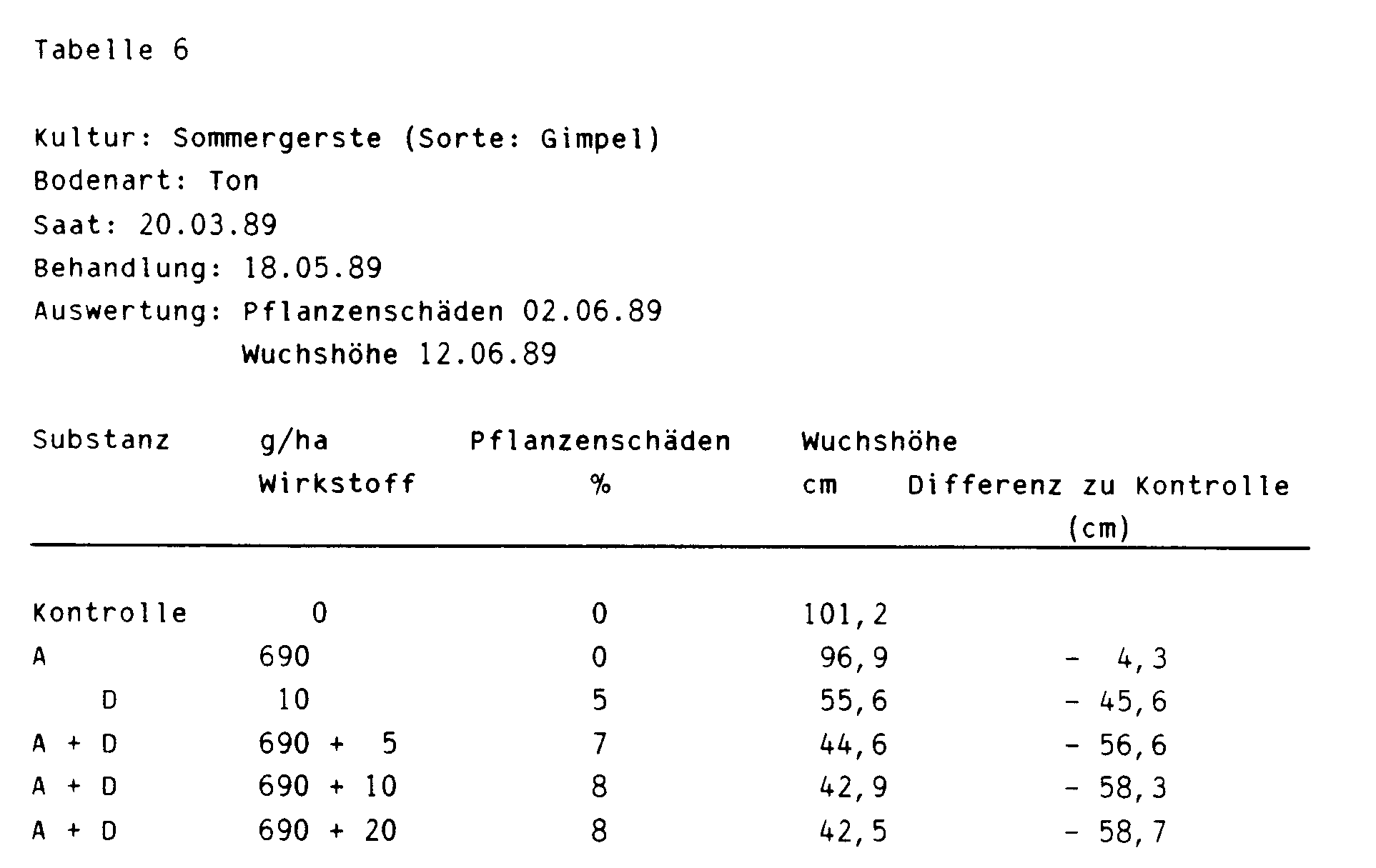

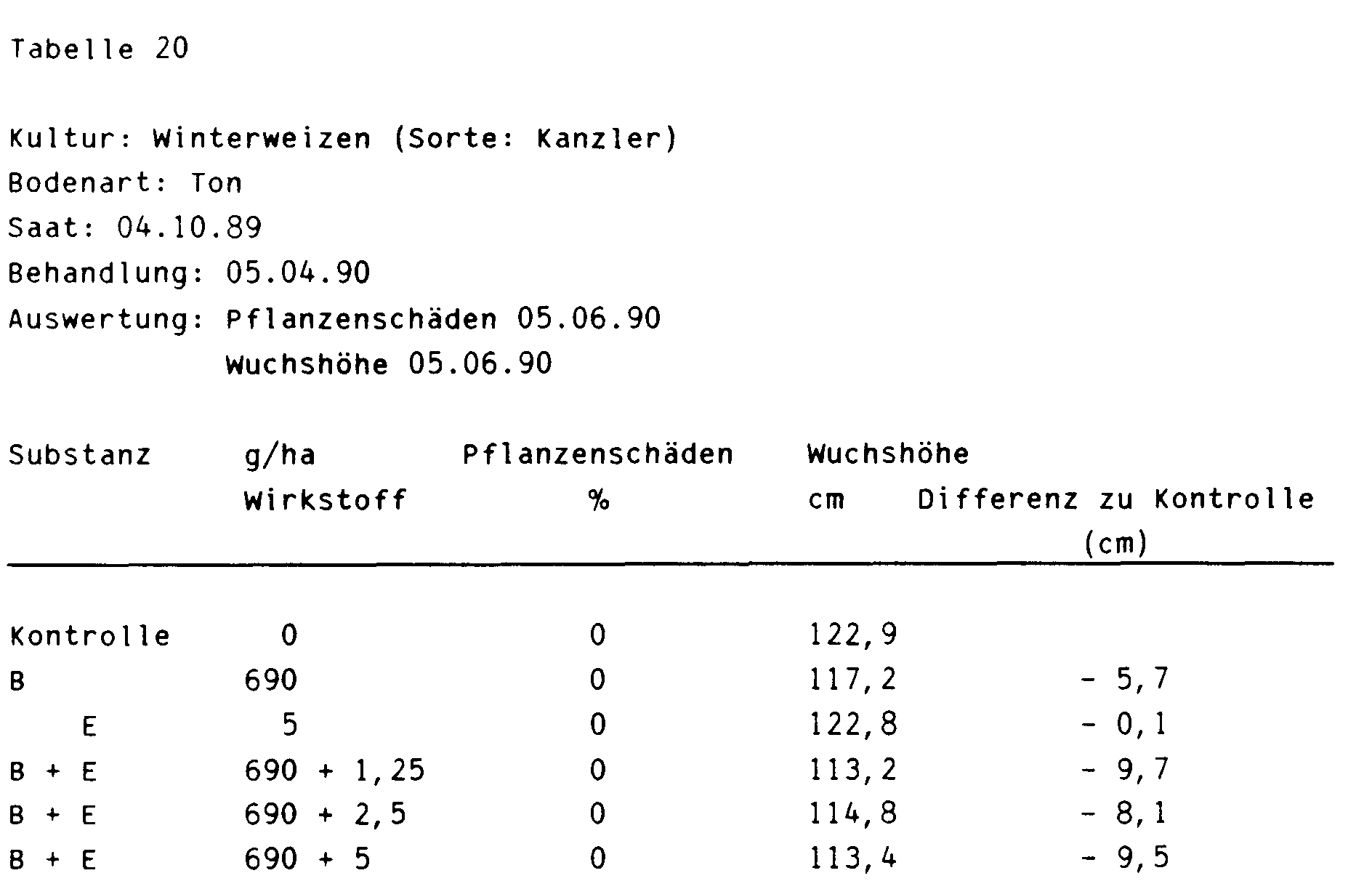
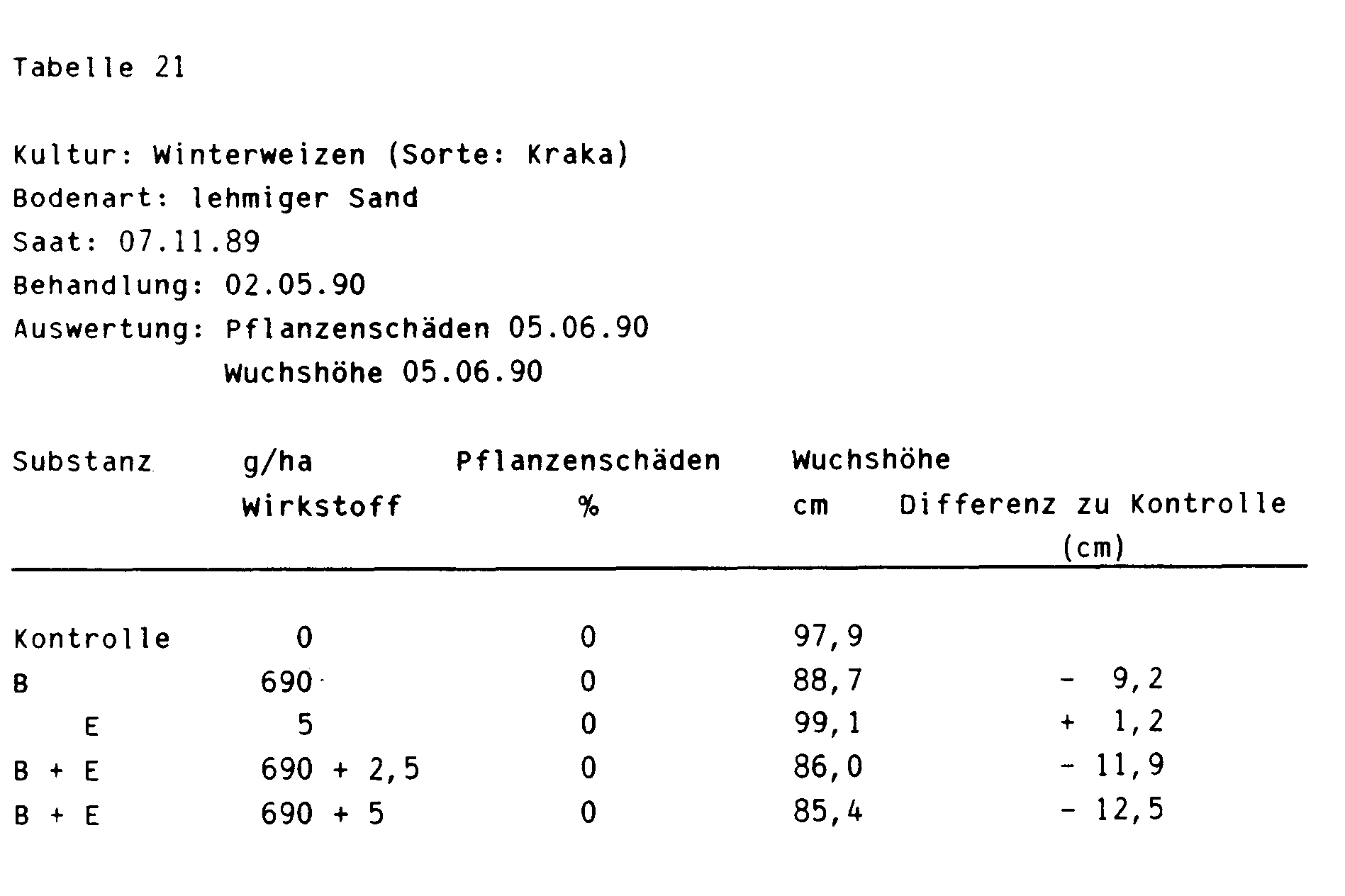
- Bei Weizen und Gerste führt auch die Mischung A + E zur synergistischen Halmverkürzung, verbesserten Standfestigkeit und entsprechenden Mehrerträgen.


- Mischungen bestehend aus den Verbindungen B + C führen bei Gerste, Weizen und Baumwolle zu synergistischen Wuchshemmungen. Die daraus resultierende verbesserte Standfestigkeit wird am Beispiel 13 verdeutlicht.


- Auch Mischungen der Substanzen B + D führen bei Gerste, Weizen und Baumwolle zu einer verkürzten Pflanzenhöhe und Mehrerträgen.


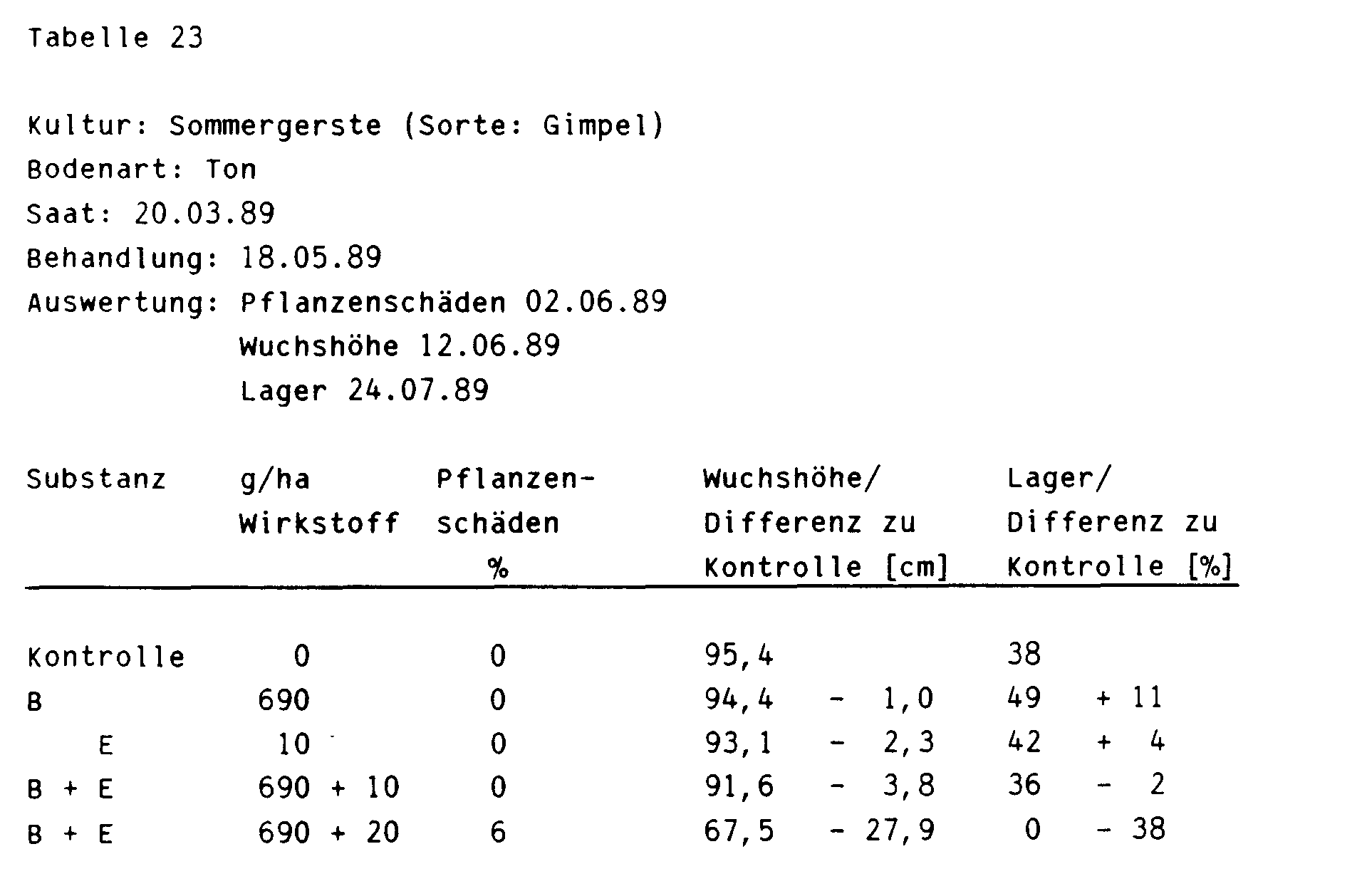
- Bei Gerste, Hafer, Weizen und Baumwolle konnte ebenfalls durch Mischungen der Substanzen B + E die Wuchshöhe verkürzt, das Lager verringert bzw. der Ertrag erhöht werden.




Claims (11)

Applications Claiming Priority (2)
| Application Number | Priority Date | Filing Date | Title |
|---|---|---|---|
| DE4026530A DE4026530A1 (de) | 1990-08-22 | 1990-08-22 | Synergistische mittel zur regulierung des pflanzenwachstums |
| DE4026530 | 1990-08-22 |
Publications (2)
| Publication Number | Publication Date |
|---|---|
| EP0472091A1 true EP0472091A1 (de) | 1992-02-26 |
| EP0472091B1 EP0472091B1 (de) | 1994-11-23 |
Family
ID=6412682
Family Applications (1)
| Application Number | Title | Priority Date | Filing Date |
|---|---|---|---|
| EP91113554A Expired - Lifetime EP0472091B1 (de) | 1990-08-22 | 1991-08-13 | Synergistische Mittel zur Regulierung des Pflanzenwachstums |
Country Status (14)
| Country | Link |
|---|---|
| EP (1) | EP0472091B1 (de) |
| JP (1) | JPH05124915A (de) |
| KR (1) | KR920003857A (de) |
| CN (1) | CN1059633A (de) |
| AU (1) | AU8260891A (de) |
| CA (1) | CA2048275A1 (de) |
| CS (1) | CS248891A3 (de) |
| DE (2) | DE4026530A1 (de) |
| DK (1) | DK0472091T3 (de) |
| ES (1) | ES2064833T3 (de) |
| HU (1) | HU206433B (de) |
| PL (1) | PL167128B1 (de) |
| RU (1) | RU2050136C1 (de) |
| UA (1) | UA26391A (de) |
Cited By (1)
| Publication number | Priority date | Publication date | Assignee | Title |
|---|---|---|---|---|
| US7495103B2 (en) | 2004-06-24 | 2009-02-24 | Vertex Pharmaceuticals Incorporated | Modulators of ATP-binding cassette transporters |
Families Citing this family (11)
| Publication number | Priority date | Publication date | Assignee | Title |
|---|---|---|---|---|
| JP2001158702A (ja) * | 1999-09-21 | 2001-06-12 | Fuji Kagaku Kk | 薬剤担持資材 |
| CN1332606C (zh) * | 2003-09-19 | 2007-08-22 | 沈阳化工研究院 | 一种光稳定的除草制剂 |
| US8354427B2 (en) | 2004-06-24 | 2013-01-15 | Vertex Pharmaceutical Incorporated | Modulators of ATP-binding cassette transporters |
| DK3219705T3 (da) | 2005-12-28 | 2020-04-14 | Vertex Pharma | Farmaceutiske sammensætninger af den amorfe form af n-[2,4-bis(1,1-dimethylethyl)-5-hydroxyphenyl]-1,4-dihydro-4-oxoquinolin-3-carboxamid |
| US20100074949A1 (en) | 2008-08-13 | 2010-03-25 | William Rowe | Pharmaceutical composition and administration thereof |
| US12458635B2 (en) | 2008-08-13 | 2025-11-04 | Vertex Pharmaceuticals Incorporated | Pharmaceutical composition and administrations thereof |
| CN102271510B (zh) * | 2009-01-07 | 2014-10-22 | 巴斯夫欧洲公司 | 农药混合物 |
| KR101727762B1 (ko) | 2009-03-20 | 2017-04-17 | 버텍스 파마슈티칼스 인코포레이티드 | 낭성 섬유증 막횡단 전도도 조절자의 조정자의 제조 방법 |
| US8802700B2 (en) | 2010-12-10 | 2014-08-12 | Vertex Pharmaceuticals Incorporated | Modulators of ATP-Binding Cassette transporters |
| JP2015511583A (ja) | 2012-02-27 | 2015-04-20 | バーテックス ファーマシューティカルズ インコーポレイテッドVertex Pharmaceuticals Incorporated | 薬学的組成物およびその投与 |
| CN107250113B (zh) | 2014-10-07 | 2019-03-29 | 弗特克斯药品有限公司 | 囊性纤维化跨膜传导调节蛋白的调节剂的共晶 |
Citations (3)
| Publication number | Priority date | Publication date | Assignee | Title |
|---|---|---|---|---|
| FR2172418A1 (de) * | 1972-02-18 | 1973-09-28 | Basf Ag | |
| EP0149083A2 (de) * | 1984-01-13 | 1985-07-24 | American Cyanamid Company | Pflanzenwachstumsregulierende Zusammensetzung |
| EP0190666A2 (de) * | 1985-02-04 | 1986-08-13 | American Cyanamid Company | Zusammensetzungen zur Behandlung von Rasengräsern |
-
1990
- 1990-08-22 DE DE4026530A patent/DE4026530A1/de not_active Withdrawn
-
1991
- 1991-08-01 CA CA002048275A patent/CA2048275A1/en not_active Abandoned
- 1991-08-12 CS CS912488A patent/CS248891A3/cs unknown
- 1991-08-13 EP EP91113554A patent/EP0472091B1/de not_active Expired - Lifetime
- 1991-08-13 DK DK91113554.9T patent/DK0472091T3/da active
- 1991-08-13 DE DE59103571T patent/DE59103571D1/de not_active Expired - Lifetime
- 1991-08-13 ES ES91113554T patent/ES2064833T3/es not_active Expired - Lifetime
- 1991-08-19 JP JP3206675A patent/JPH05124915A/ja not_active Withdrawn
- 1991-08-21 PL PL91291484A patent/PL167128B1/pl not_active IP Right Cessation
- 1991-08-21 HU HU912757A patent/HU206433B/hu not_active IP Right Cessation
- 1991-08-21 KR KR1019910014399A patent/KR920003857A/ko not_active Ceased
- 1991-08-21 RU SU915001325A patent/RU2050136C1/ru not_active IP Right Cessation
- 1991-08-21 UA UA5001325A patent/UA26391A/uk unknown
- 1991-08-21 AU AU82608/91A patent/AU8260891A/en not_active Abandoned
- 1991-08-22 CN CN91105922A patent/CN1059633A/zh active Pending
Patent Citations (3)
| Publication number | Priority date | Publication date | Assignee | Title |
|---|---|---|---|---|
| FR2172418A1 (de) * | 1972-02-18 | 1973-09-28 | Basf Ag | |
| EP0149083A2 (de) * | 1984-01-13 | 1985-07-24 | American Cyanamid Company | Pflanzenwachstumsregulierende Zusammensetzung |
| EP0190666A2 (de) * | 1985-02-04 | 1986-08-13 | American Cyanamid Company | Zusammensetzungen zur Behandlung von Rasengräsern |
Cited By (1)
| Publication number | Priority date | Publication date | Assignee | Title |
|---|---|---|---|---|
| US7495103B2 (en) | 2004-06-24 | 2009-02-24 | Vertex Pharmaceuticals Incorporated | Modulators of ATP-binding cassette transporters |
Also Published As
| Publication number | Publication date |
|---|---|
| EP0472091B1 (de) | 1994-11-23 |
| UA26391A (uk) | 1999-08-30 |
| CN1059633A (zh) | 1992-03-25 |
| PL291484A1 (en) | 1992-08-10 |
| PL167128B1 (pl) | 1995-07-31 |
| ES2064833T3 (es) | 1995-02-01 |
| DE59103571D1 (de) | 1995-01-05 |
| DE4026530A1 (de) | 1992-02-27 |
| HU912757D0 (en) | 1992-01-28 |
| KR920003857A (ko) | 1992-03-27 |
| CA2048275A1 (en) | 1992-02-23 |
| AU8260891A (en) | 1992-02-27 |
| DK0472091T3 (da) | 1995-03-13 |
| HU206433B (en) | 1992-11-30 |
| CS248891A3 (en) | 1992-03-18 |
| HUT58462A (en) | 1992-03-30 |
| RU2050136C1 (ru) | 1995-12-20 |
| JPH05124915A (ja) | 1993-05-21 |
Similar Documents
| Publication | Publication Date | Title |
|---|---|---|
| EP0346789B1 (de) | Salicylsäurederivate und deren Schwefelanaloge | |
| EP0388871B1 (de) | Herbizide und pflanzenwachstumsregulierende Azolylmethyloxirane | |
| DD283995A5 (de) | Verfahren zur herstellung eines benzamid-derivats | |
| EP0472091B1 (de) | Synergistische Mittel zur Regulierung des Pflanzenwachstums | |
| EP0414058B1 (de) | Carbonsäurederivate | |
| EP0490060A1 (de) | Salicylsäurederivate | |
| EP0400356B1 (de) | Sulfonamide | |
| EP0422537B1 (de) | Cyclohexenonverbindungen, Verfahren zu ihrer Herstellung sowie ihre Verwendung als Herbizide oder das Pflanzenwachstum regulierende Mittel | |
| EP0031114B1 (de) | Phenylpropylammoniumsalze, Verfahren zu ihrer Herstellung und diese Verbindungen enthaltende Mittel | |
| EP0350693B1 (de) | Azetidinderivate, Verfahren zu ihrer Herstellung und ihre Verwendung zur Regulierung des Pflanzenwachstums | |
| EP0554661B1 (de) | Thiocarbonsäurederivate, Verfahren und Zwischenprodukte zu ihrer Herstellung | |
| EP0232724A2 (de) | Cyclohexenonderivate, ein Verfahren zu ihrer Herstellung sowie ihre Verwendung als herbizide und das Pflanzenwachstum regulierende Mittel | |
| EP0469423B1 (de) | Oxalyl-bishydroxamsäurederivate, ihre Herstellung und sie enthaltende Mittel zur Regulierung des Pflanzenwachstums | |
| EP0373472B1 (de) | Substituierte Sulfonylharnstoffe | |
| EP0293817B1 (de) | Cyclohexenonverbindungen, ein Verfahren zu ihrer Herstellung sowie ihre Verwendung als Herbizide oder das Pflanzenwachstum regulierende Mittel | |
| EP0230260B1 (de) | Cyclohexenonderivate, Verfahren zu ihrer Herstellung und ihre Verwendung als herbizide und das Pflanzenwachstum regulierende Mittel | |
| EP0465986B1 (de) | Oxalsäurederivate, ihre Herstellung und sie enthaltende Mittel zur Regulierung des Pflanzenwachstums | |
| EP0582926B1 (de) | Piperazin-2,3-dione als Pflanzenwachstumsregulatoren | |
| DE2842639A1 (de) | Alpha -isocyano-carbonsaeureamide, verfahren zu ihrer herstellung und ihre verwendung als pflanzenwachstumsregulatoren | |
| WO1995007266A1 (de) | Substituierte milchsäurederivate mit einem n-organischen rest in beta-position, deren herstellung und deren verwendung als herbizide und antidote | |
| DE3822501A1 (de) | Pflanzenwuchsregulierende mittel | |
| DE3531773A1 (de) | 3,5 disubstituierte 4-pyridone | |
| DE3916364A1 (de) | Azetidinderivate, verfahren zu ihrer herstellung und ihre verwendung zur regulierung des pflanzenwachstums | |
| EP0469374A2 (de) | Oxalsäurederivate, ihre Herstellung und sie enthaltende Mittel zur Regulierung des Pflanzenwachstums | |
| EP0345637A1 (de) | N-substituierte 3,4,5,6-Tetrahydrophthalimid-Derivate |
Legal Events
| Date | Code | Title | Description |
|---|---|---|---|
| PUAI | Public reference made under article 153(3) epc to a published international application that has entered the european phase |
Free format text: ORIGINAL CODE: 0009012 |
|
| AK | Designated contracting states |
Kind code of ref document: A1 Designated state(s): CH DE DK ES FR GB GR IT LI NL |
|
| 17P | Request for examination filed |
Effective date: 19911231 |
|
| 17Q | First examination report despatched |
Effective date: 19931025 |
|
| GRAA | (expected) grant |
Free format text: ORIGINAL CODE: 0009210 |
|
| AK | Designated contracting states |
Kind code of ref document: B1 Designated state(s): CH DE DK ES FR GB GR IT LI NL |
|
| GBT | Gb: translation of ep patent filed (gb section 77(6)(a)/1977) |
Effective date: 19941206 |
|
| REF | Corresponds to: |
Ref document number: 59103571 Country of ref document: DE Date of ref document: 19950105 |
|
| ITF | It: translation for a ep patent filed | ||
| REG | Reference to a national code |
Ref country code: GR Ref legal event code: FG4A Free format text: 3014096 |
|
| REG | Reference to a national code |
Ref country code: ES Ref legal event code: FG2A Ref document number: 2064833 Country of ref document: ES Kind code of ref document: T3 |
|
| REG | Reference to a national code |
Ref country code: DK Ref legal event code: T3 |
|
| ET | Fr: translation filed | ||
| PLBE | No opposition filed within time limit |
Free format text: ORIGINAL CODE: 0009261 |
|
| STAA | Information on the status of an ep patent application or granted ep patent |
Free format text: STATUS: NO OPPOSITION FILED WITHIN TIME LIMIT |
|
| 26N | No opposition filed | ||
| REG | Reference to a national code |
Ref country code: GB Ref legal event code: IF02 |
|
| PGFP | Annual fee paid to national office [announced via postgrant information from national office to epo] |
Ref country code: ES Payment date: 20080922 Year of fee payment: 18 |
|
| PGFP | Annual fee paid to national office [announced via postgrant information from national office to epo] |
Ref country code: IT Payment date: 20080827 Year of fee payment: 18 |
|
| PGFP | Annual fee paid to national office [announced via postgrant information from national office to epo] |
Ref country code: GR Payment date: 20080716 Year of fee payment: 18 |
|
| REG | Reference to a national code |
Ref country code: ES Ref legal event code: FD2A Effective date: 20090814 |
|
| PG25 | Lapsed in a contracting state [announced via postgrant information from national office to epo] |
Ref country code: GR Free format text: LAPSE BECAUSE OF NON-PAYMENT OF DUE FEES Effective date: 20100303 |
|
| PGFP | Annual fee paid to national office [announced via postgrant information from national office to epo] |
Ref country code: NL Payment date: 20100825 Year of fee payment: 20 Ref country code: CH Payment date: 20100831 Year of fee payment: 20 |
|
| PGFP | Annual fee paid to national office [announced via postgrant information from national office to epo] |
Ref country code: FR Payment date: 20100915 Year of fee payment: 20 |
|
| PGFP | Annual fee paid to national office [announced via postgrant information from national office to epo] |
Ref country code: GB Payment date: 20100831 Year of fee payment: 20 |
|
| PGFP | Annual fee paid to national office [announced via postgrant information from national office to epo] |
Ref country code: DK Payment date: 20100823 Year of fee payment: 20 |
|
| PGFP | Annual fee paid to national office [announced via postgrant information from national office to epo] |
Ref country code: DE Payment date: 20101029 Year of fee payment: 20 |
|
| PG25 | Lapsed in a contracting state [announced via postgrant information from national office to epo] |
Ref country code: IT Free format text: LAPSE BECAUSE OF NON-PAYMENT OF DUE FEES Effective date: 20090813 |
|
| REG | Reference to a national code |
Ref country code: DE Ref legal event code: R071 Ref document number: 59103571 Country of ref document: DE |
|
| REG | Reference to a national code |
Ref country code: DE Ref legal event code: R071 Ref document number: 59103571 Country of ref document: DE |
|
| REG | Reference to a national code |
Ref country code: CH Ref legal event code: PL |
|
| REG | Reference to a national code |
Ref country code: NL Ref legal event code: V4 Effective date: 20110813 |
|
| REG | Reference to a national code |
Ref country code: DK Ref legal event code: EUP |
|
| REG | Reference to a national code |
Ref country code: GB Ref legal event code: PE20 Expiry date: 20110812 |
|
| PG25 | Lapsed in a contracting state [announced via postgrant information from national office to epo] |
Ref country code: ES Free format text: LAPSE BECAUSE OF NON-PAYMENT OF DUE FEES Effective date: 20090814 |
|
| PG25 | Lapsed in a contracting state [announced via postgrant information from national office to epo] |
Ref country code: GB Free format text: LAPSE BECAUSE OF EXPIRATION OF PROTECTION Effective date: 20110812 |
|
| PG25 | Lapsed in a contracting state [announced via postgrant information from national office to epo] |
Ref country code: NL Free format text: LAPSE BECAUSE OF EXPIRATION OF PROTECTION Effective date: 20110813 |
|
| PG25 | Lapsed in a contracting state [announced via postgrant information from national office to epo] |
Ref country code: DE Free format text: LAPSE BECAUSE OF EXPIRATION OF PROTECTION Effective date: 20110814 |