EP0470548B1 - Verfahren zur Kontrolle der Dämpfung bei einem digitalen Freisprechtelefonapparat - Google Patents
Verfahren zur Kontrolle der Dämpfung bei einem digitalen Freisprechtelefonapparat Download PDFInfo
- Publication number
- EP0470548B1 EP0470548B1 EP91113133A EP91113133A EP0470548B1 EP 0470548 B1 EP0470548 B1 EP 0470548B1 EP 91113133 A EP91113133 A EP 91113133A EP 91113133 A EP91113133 A EP 91113133A EP 0470548 B1 EP0470548 B1 EP 0470548B1
- Authority
- EP
- European Patent Office
- Prior art keywords
- average
- send
- moy
- receive
- channel
- Prior art date
- Legal status (The legal status is an assumption and is not a legal conclusion. Google has not performed a legal analysis and makes no representation as to the accuracy of the status listed.)
- Expired - Lifetime
Links
- 238000000034 method Methods 0.000 title claims description 12
- 230000002238 attenuated effect Effects 0.000 claims description 16
- 238000004364 calculation method Methods 0.000 claims description 11
- 230000008859 change Effects 0.000 claims description 4
- 238000001914 filtration Methods 0.000 claims description 2
- 230000005540 biological transmission Effects 0.000 abstract description 28
- 230000006870 function Effects 0.000 description 9
- 238000010586 diagram Methods 0.000 description 6
- 238000006243 chemical reaction Methods 0.000 description 4
- 230000004913 activation Effects 0.000 description 2
- 230000003321 amplification Effects 0.000 description 2
- 230000006835 compression Effects 0.000 description 2
- 238000007906 compression Methods 0.000 description 2
- 238000003199 nucleic acid amplification method Methods 0.000 description 2
- 238000007792 addition Methods 0.000 description 1
- 230000008878 coupling Effects 0.000 description 1
- 238000010168 coupling process Methods 0.000 description 1
- 238000005859 coupling reaction Methods 0.000 description 1
- 230000003247 decreasing effect Effects 0.000 description 1
- 238000001514 detection method Methods 0.000 description 1
- 230000000694 effects Effects 0.000 description 1
- 238000011156 evaluation Methods 0.000 description 1
- 238000004519 manufacturing process Methods 0.000 description 1
- 230000008569 process Effects 0.000 description 1
- 230000007704 transition Effects 0.000 description 1
Images


Classifications
-
- H—ELECTRICITY
- H04—ELECTRIC COMMUNICATION TECHNIQUE
- H04M—TELEPHONIC COMMUNICATION
- H04M9/00—Arrangements for interconnection not involving centralised switching
- H04M9/08—Two-way loud-speaking telephone systems with means for conditioning the signal, e.g. for suppressing echoes for one or both directions of traffic
- H04M9/085—Two-way loud-speaking telephone systems with means for conditioning the signal, e.g. for suppressing echoes for one or both directions of traffic using digital techniques
Definitions
- the present invention relates to a method for controlling attenuation for digital telephone apparatus of “hands-free” type operation.
- a "hands-free" telephone set is a set for which a sensitive microphone and a loudspeaker, both associated with high gain amplifiers, are integrated into the housing of this set, which eliminates the need for the user to maintain a combined in close proximity to the mouth and ear.
- the analog processing which is implemented in these known devices has the drawback of not allowing a fairly rapid detection and comparison of the signals present on the transmission and reception channels.
- Document GB-A-2 174 578 also discloses a digital telephone apparatus comprising a microcontroller for processing digital data, a coder-decoder or codec circuit ensuring the conversion of analog speech signals into digital form and vice versa , a microphone and a speaker with their respective amplification circuits, which allows it to offer a so-called "hands-free" function.
- the microcontroller continuously determines by calculation an average over a predetermined number of successive digital speech samples for the signals simultaneously present in each of the transmission and reception channels so as to determine which channel must be transmitted or continue to be transmitted without attenuation and correlatively the one that needs to be mitigated.
- the invention proposes a method of controlling the attenuation for digital telephone apparatus in hands-free operation provided with a microcontroller ensuring the processing of digital data, of a circuit, of the coding-decoder filtering type called cofidec, for the conversion of analog speech signals into digital form and vice versa, of at least one microphone and one speaker connected to the circuit cofidec by amplification circuits associated with them, said microcontroller having means of calculation making it possible in particular to permanently establish an average over a predetermined number of successive digital samples obtained from the signals present simultaneously on each of the transmission and reception channels of signals at the level of inputs of the microcontroller, said means also making it possible to deduce that of the transmission or reception channels which must be or continue to be transmitted without attenuation and correlatively that which must be attenuated.
- a microcontroller ensuring the processing of digital data, of a circuit, of the coding-decoder filtering type called cofidec, for the conversion of analog speech signals into digital form and vice versa, of
- the method comprises a determination, by means of the microcontroller calculation means, of the position, in Cartesian coordinates, of the point representing the averages of the transmission and reception channels with respect to three zones constituted by a hysteresis zone separating a zone, called switching on the transmission channel, for which the transmission channel is provided without attenuation and a zone, called switching on the reception channel, for which the reception channel is provided without attenuation, the possible attenuation for each of these channels being established as a function of tables of respectively attenuated and non-attenuated values of the microcontroller.
- a manual switch 18 is connected to one of the ports of the microcontroller 1, in order to manually select either the "hands-free” function or the "use of the handset” function. Note that such a switch is conventionally provided on the keyboard of analog hands-free stations of the known art.
- the speech values are digitized via the COFIDEC circuit.
- This code for example the successive samples according to a compression law, the best known being that known as of type "A” presented here or that known as of type mu.
- the data are presented on the bus of the "line" interface 2 (that is to say the bus comprising channels 4 and 5) every 125 microseconds.
- the microcontroller 1 In operation with the handset, the microcontroller 1 is transparent: it faithfully reproduces the data supplied by COFIDEC and by the telephone line. In hands-free mode, on the contrary, it processes these digital signals in order to make a switching decision capable of favoring, in accordance with the principle of half-talk, the transmission channel or the reception channel.
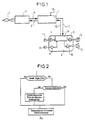
- the telephone set in FIG. 1 therefore works, like the analog sets of the known art, in alternation, therefore according to the same general principle, but carried out in digital mode and with some peculiarities, as will now be explained with reference to Figures 2 to 6.
- the microcontroller first tests the position of the switch 18. If the latter is not in hands-free mode, the set functions as a conventional digital set using the handset with microphone 11 and earpiece 12.
- this switch 18 If, on the contrary, this switch 18 is in the hands-free position, the microcontroller makes successive additions of the digitized speech samples, available every 125 microseconds for example, which are present at the respective transmit 16 and receive 4 inputs of the microcontroller 1 A sum is made each time on sixteen successive samples and in the same way on the two channels 16 and 4.
- the particular way in which such a sum is carried out is shown diagrammatically in FIG. 3 and will be detailed below.
- the microcontroller 1 deduces therefrom the average relating to these 16 samples, while taking, as will be seen during the explanation of FIG. 4, a special precaution in order to avoid switching untimely paths between the words of the same sentence, which would result in "chopping up" the conversation.
- the two averages (one on each channel) being determined, the microcontroller performs, according to the method which will be explained below with reference to FIGS. 5 and 6, the decision making on the channel which alone must be validated (emission channel OR channel reception) and the digital implementation of the attenuations which must consequently be applied on the two channels: in this example 0 dB on the validated channel and 36 dB on the non-validated channel.
- FIG. 3 represents, in the form of an algorithm, the calculation of the average amplitudes of the transmission and reception signals, the calculation method being the same for these two channels.
- the samples, arriving every 125 microseconds, are supplemented so as to obtain the coded values compressed without inversion in accordance with the particular law of coding of the COFIDEC circuit (law of compression known as of type "A"). They are made positive by setting the most significant bit to 1, then summed up to a maximum of 16 samples. This sum divided by 16 becomes the average of the track scanned. Note that this number 16 is particularly advantageous because it allows a good evaluation of the signal mean while being very practical to implement by programming. This sum being available every 2 milliseconds (16 successive samples each appearing every 125 microseconds), this hands-free module is able to validate one of the two channels every 2 milliseconds approximately, which is ten times faster than the analog devices of the known art.
- FIG. 4 shows how the new average NM is calculated as a function of the previously calculated average MP.
- the calculator determines (FIG. 4) whether the sum which it has just calculated on these 16 samples is, when it is divided by 16, greater or less than the previous average MP. If it is higher, it means that we are not at the end of the word, and the new average NM is taken quite normally equal to this sum divided by 16. If it is lower, speech is in progress to fall and, to limit this decrease, the new average is taken equal to the previous average MP decreased only by one unit: thus artificially instituting a time to maintain the level between the words, which avoids the phenomenon of "hashing" cited above.
- the computer determines the channel to be attenuated: it is the final decision-making and attenuation phase on one of the channels, which will now be explained with reference to Figures 5 and 6.
- FIG. 5 is a graph in Cartesian coordinates, with the above-defined “Reception” averages plotted on the abscissa and the “Transmission” averages plotted on the ordinate.
- zone E symbolizes the activation of the send channel
- zone R activation of the reception channel and zone H a zone which favors the validated channel over that attenuated and which is delimited by two transition curves: reception to transmission and transmission to reception.
- two threshold values Se and Sr delimit a difference in the processing mode of the decision-making operation.
- variable Rmoy is greater than 2 times the variable Emoy plus the unit, the reception mode is validated, that is to say is not attenuated, and the transmission mode is inhibited, that is to say is attenuated by (in this example) 36 dB.
- COFIDEC 15 provides 127 positive and negative levels, distributed according to the above-mentioned coding law "A". This law is known mathematically, and it is easy to determine the correspondence between the value of the analog signal and the code supplied or received by COFIDEC. Two tables are therefore calculated in such a way that the values coming from the line or from COFIDEC indicate to the microcontroller the jump in the chosen attenuation table.
- the code extracted from the table represents the code of the attenuated value of 0 or 36 dB.
- this variable Rmoy is not greater than 2Emoy + 1, it is necessary to know whether or not one is in the hysteresis zone.
- the Emoy variable is then compared to the value 4Rmoy + 5. If it is higher, it means that we are in the hysteresis zone, and there is consequently no change. If it is lower, there is switching to transmission mode, and the transmission channel is not attenuated, while the reception channel is attenuated by 36 dB thanks to the aforementioned digital tables.
- the assembly is reset as indicated at the bottom of FIG. 6, and all these digital operations can start again with a view to making a new decision on the following 16 samples.
- telephone set is meant both a telephone set proper as well as any other telephone terminal capable of receiving and transmitting speech, such as for example an answering machine.
Landscapes
- Engineering & Computer Science (AREA)
- Signal Processing (AREA)
- Telephone Function (AREA)
- Cable Transmission Systems, Equalization Of Radio And Reduction Of Echo (AREA)
- Transmission Systems Not Characterized By The Medium Used For Transmission (AREA)
- Reduction Or Emphasis Of Bandwidth Of Signals (AREA)
- Telephone Set Structure (AREA)
- Mobile Radio Communication Systems (AREA)
- Interconnected Communication Systems, Intercoms, And Interphones (AREA)
- Numerical Control (AREA)
Claims (3)
- Verfahren zur Kontrolle der Dämpfung für einen digitalen Telefonapparat, der eine Freisprechfunktion besitzt, mit einem Mikrokontrollorgan (1), das die digitalen Daten verarbeitet, mit einer Kodier-Dekodier-Filterschaltung (15), auch Cofidec genannt, die die analogen Sprachsignale in digitale Form und umgekehrt umwandelt, mit mindestens einem Mikrophon (13) und einem Lautsprecher (14), die an die Cofidec-Schaltung über ihnen zugeordnete Verstärkungsschaltungen (7 bis 10) angeschlossen sind, wobei das Mikrokontrollorgan Rechenmittel enthält, die insbesondere permanent einen Mittelwert über eine vorgegebene Anzahl von aufeinanderfolgenden digitalen Tastproben aufgrund der Signale berechnen, die gleichzeitig auf dem Sende- und dem Empfangskanal für Signale in Höhe der Eingänge (16 und 4) des Mikrokontrollorgans vorliegen, wobei diese Mittel auch den Sendekanal oder den Empfangskanal auswählen können, der ohne Dämpfung übertragen oder weiterübertragen soll, sowie dementsprechend denjenigen, der gedämpft werden soll, dadurch gekennzeichnet, daß mithilfe der Rechenmittel des Mikrokontrollorgans die Lage des für die Mittelwerte (Emoy und Rmoy) des Sendekanals und des Empfangskanals repräsentativen Punkts in einem kartesischen Koordinatensystem bezüglich drei Zonen bestimmt wird, die eine Hysteresiszone (H) zwischen einer Zone (E), in der die Umschaltung auf den Sendekanal erfolgt, also der Sendekanal ungedämpft sein soll, und einer Zone (R) enthält, in der eine Umschaltung auf den Empfangskanal erfolgt, d.h. der Empfangskanal ungedämpft vorliegen soll, wobei die eventuelle Dämpfung für jeden dieser Kanäle abhängig von Tabellen des Mikrokontrollorgans mit gedämpften bzw. ungedämpften Werten gesteuert wird.
- Verfahren nach Anspruch 1, dadurch gekennzeichnet, daß mit Hilfe der Rechenmittel des Mikrokontrollorgans die Lage des für die Mittelwert repräsentativen Punkts bezüglich einer Zone kleiner Mittelwerte bestimmt wird, die durch zwei Schwellwerte (Se und Sr) definiert sind, und daß eine Entscheidung über die Dämpfung des Sendekanals und die Nichtdämpfung des Empfangskanals erfolgt, wenn der fragliche Punkt sich in der Zone kleiner Mittelwerte befindet und wenn der Empfangsmittelwert (Rmoy) größer als zweimal der Sendemittelwert (Emoy) plus eine Einheit ist, während eine Entscheidung betreffend die Dämpfung des Empfangskanals und die Nichtdämpfung des Sendekanals getroffen wird, wenn der betreffende Punkt sich in der Zone mit kleinen Mittelwerten befindet, wenn zudem der Empfangsmittelwert (Rmoy) kleiner oder gleich zweimal dem Sendemittelwert (Emoy) plus eine Einheit ist und wenn der Sendemittelwert kleiner als viermal der Empfangsmittelwert (Rmoy) plus fünf Einheiten ist, und daß eine Entscheidung, die beiden Kanäle nicht umzuschalten, getroffen wird, wenn der betreffende Punkt sich in der Zone kleiner Mittelwerte befindet, wenn der Empfangsmittelwert (Rmoy) kleiner als zweimal der Sendemittelwert (Emoy) plus eine Einheit ist und wenn dieser Sendemittelwert größer als viermal der Empfangsmittelwert (Rmoy) plus fünf Einheiten ist, wobei diese Entscheidung von den Rechenmitteln des Mikrokontrollorgans getroffen wird.
- Verfahren nach Anspruch 2, dadurch gekennzeichnet, daß eine Entscheidung über die Dämpfung des Sendekanals und die Nichtdämpfung des Empfangskanals erfolgt, wenn der fragliche Punkt sich außerhalb der Zone kleiner Mittelwerte befindet und wenn der Empfangsmittelwert (Rmoy) größer als zweimal der Sendemittelwert (Emoy) ist, daß eine Entscheidung betreffend die Dämpfung des Empfangskanals und die Nichtdämpfung des Sendekanals getroffen wird, wenn der betreffende Punkt sich außerhalb der Zone mit kleinen Mittelwerten befindet, wenn zudem der Empfangsmittelwert (Rmoy) kleiner oder gleich zweimal dem Sendemittelwert (Emoy) ist und wenn dieser Sendemittelwert größer als sechsmal der Empfangsmittelwert (Rmoy) ist, und daß eine Entscheidung, die Dämpfung der beiden Kanäle nicht zu verändern, getroffen wird, wenn der betreffende Punkt sich außerhalb der Zone kleiner Mittelwerte befindet, wenn zudem der Empfangsmittelwert (Rmoy) kleiner oder gleich zweimal der Sendemittelwert (Emoy) ist und wenn dieser Sendemittelwert größer als sechsmal der Empfangsmittelwert (Rmoy) ist, wobei diese Entscheidung von den Rechenmitteln des Mikrokontrollorgans getroffen wird.
Applications Claiming Priority (2)
| Application Number | Priority Date | Filing Date | Title |
|---|---|---|---|
| FR9010123A FR2665807B1 (fr) | 1990-08-08 | 1990-08-08 | Appareil telephonique "main libre". |
| FR9010123 | 1990-08-08 |
Publications (2)
| Publication Number | Publication Date |
|---|---|
| EP0470548A1 EP0470548A1 (de) | 1992-02-12 |
| EP0470548B1 true EP0470548B1 (de) | 1996-09-25 |
Family
ID=9399528
Family Applications (1)
| Application Number | Title | Priority Date | Filing Date |
|---|---|---|---|
| EP91113133A Expired - Lifetime EP0470548B1 (de) | 1990-08-08 | 1991-08-05 | Verfahren zur Kontrolle der Dämpfung bei einem digitalen Freisprechtelefonapparat |
Country Status (9)
| Country | Link |
|---|---|
| US (1) | US5255316A (de) |
| EP (1) | EP0470548B1 (de) |
| JP (1) | JP2618137B2 (de) |
| AT (1) | ATE143551T1 (de) |
| AU (1) | AU644460B2 (de) |
| CA (1) | CA2048457C (de) |
| DE (1) | DE69122334T2 (de) |
| ES (1) | ES2092530T3 (de) |
| FR (1) | FR2665807B1 (de) |
Families Citing this family (3)
| Publication number | Priority date | Publication date | Assignee | Title |
|---|---|---|---|---|
| DE4130045A1 (de) * | 1991-09-10 | 1993-03-18 | Standard Elektrik Lorenz Ag | Schaltungsanordnung zur dynamiksteuerung eines sprachendgeraetes |
| US5982755A (en) * | 1997-03-06 | 1999-11-09 | Nortel Networks Corporation | System and method for providing high terminal coupling loss in a handsfree terminal |
| CN105448306B (zh) * | 2015-11-05 | 2019-02-19 | 湖南工业大学 | 语音环路检测方法 |
Family Cites Families (12)
| Publication number | Priority date | Publication date | Assignee | Title |
|---|---|---|---|---|
| JPS5797262A (en) * | 1980-12-09 | 1982-06-16 | Nippon Telegr & Teleph Corp <Ntt> | Loud speaker telephone set system |
| DE3137314C2 (de) * | 1981-09-16 | 1984-03-29 | Siemens AG, 1000 Berlin und 8000 München | Schaltungsanordnung für sprachgesteuerte Freisprechgeräte |
| FR2518854B1 (fr) * | 1981-12-18 | 1986-08-08 | Thomson Csf Mat Tel | Poste telephonique a amplificateurs de parole |
| US4677661A (en) * | 1983-10-07 | 1987-06-30 | Baccaret Teledex, Inc. | Microprocessor controlled telephone unit |
| US4604501A (en) * | 1984-10-09 | 1986-08-05 | Moscow K. Richmond | Voice communication system |
| US4715062A (en) * | 1985-03-22 | 1987-12-22 | Tie/Communications, Inc. | Speakerphone control circuit having low gain states and method for controlling gain of speakerphone |
| GB2174578B (en) * | 1985-05-04 | 1988-11-09 | Stc Plc | Loud speaking telephone |
| JPH0671281B2 (ja) * | 1986-10-22 | 1994-09-07 | 株式会社大興電機製作所 | デジタル電話装置のハンズフリ−回路 |
| EP0290952B1 (de) * | 1987-05-15 | 1992-11-04 | Alcatel SEL Aktiengesellschaft | Schaltungsanordnung zur Sprachsteuerung für ein Endgerät der Nachrichtentechnik |
| JPH051168Y2 (de) * | 1988-07-13 | 1993-01-13 | ||
| FR2636797B1 (fr) * | 1988-09-16 | 1990-11-09 | Sgs Thomson Microelectronics | Circuit integre pour poste telephonique avec detecteur d'enveloppe de signal |
| US5075687A (en) * | 1990-09-27 | 1991-12-24 | Advanced Micro Devices, Inc. | Echo suppression with both digital and analog variable attenuators |
-
1990
- 1990-08-08 FR FR9010123A patent/FR2665807B1/fr not_active Expired - Fee Related
-
1991
- 1991-07-29 AU AU81443/91A patent/AU644460B2/en not_active Ceased
- 1991-07-31 US US07/739,598 patent/US5255316A/en not_active Expired - Fee Related
- 1991-08-05 ES ES91113133T patent/ES2092530T3/es not_active Expired - Lifetime
- 1991-08-05 DE DE69122334T patent/DE69122334T2/de not_active Expired - Fee Related
- 1991-08-05 AT AT91113133T patent/ATE143551T1/de not_active IP Right Cessation
- 1991-08-05 EP EP91113133A patent/EP0470548B1/de not_active Expired - Lifetime
- 1991-08-06 CA CA002048457A patent/CA2048457C/fr not_active Expired - Fee Related
- 1991-08-08 JP JP3287393A patent/JP2618137B2/ja not_active Expired - Lifetime
Also Published As
| Publication number | Publication date |
|---|---|
| ES2092530T3 (es) | 1996-12-01 |
| ATE143551T1 (de) | 1996-10-15 |
| AU644460B2 (en) | 1993-12-09 |
| US5255316A (en) | 1993-10-19 |
| CA2048457A1 (fr) | 1992-02-09 |
| FR2665807A1 (fr) | 1992-02-14 |
| EP0470548A1 (de) | 1992-02-12 |
| DE69122334D1 (de) | 1996-10-31 |
| FR2665807B1 (fr) | 1994-06-03 |
| JP2618137B2 (ja) | 1997-06-11 |
| AU8144391A (en) | 1992-02-13 |
| DE69122334T2 (de) | 1997-02-06 |
| CA2048457C (fr) | 1995-06-13 |
| JPH06350682A (ja) | 1994-12-22 |
Similar Documents
| Publication | Publication Date | Title |
|---|---|---|
| CA1260068A (fr) | Systeme de radiotelephone, notamment pour vehicule automobile | |
| EP0702481B1 (de) | Detektor für Trägerverlust in einem Faksimile-Modem | |
| FR2502871A1 (fr) | Systeme de commutation et de combinaison de signaux pour un systeme de communication radio | |
| EP0812504B1 (de) | Lautsprecher-verstärkungseinstellung für ein freisprech-telekommunikationsendgerät | |
| EP0421897B1 (de) | Vorrichtung zum Extrahieren von digitalen Daten aus einem Video-Signal | |
| EP0364312B1 (de) | Integrierte Schaltung für Telefonapparat mit Signalhüllkurvendetektor | |
| FR2568014A1 (fr) | Dispositif de detection de parasites en forme d'impulsion et dispositif de suppression de parasites en forme d'impulsion muni d'un dispositif de detection de parasites en forme d'impulsion | |
| EP0470548B1 (de) | Verfahren zur Kontrolle der Dämpfung bei einem digitalen Freisprechtelefonapparat | |
| JPH06504890A (ja) | Dtmf信号検出装置 | |
| EP0359633B1 (de) | Logarithmischer Hüllkurvendetektor für ein analoges Signal | |
| CA2261198A1 (fr) | Procede de transmission d'une commande d'un dispositif de commande a distance vers un appareil audio, dispositif de commande a distance et appareil audio correspondants | |
| EP0288353B1 (de) | Verfahren zur Umschaltung von asynchronen digitalen Signalen und Einrichtung zur Durchführung dieses Verfahrens | |
| FR2482348A1 (fr) | Circuit detecteur de parole et commande de gain associee pour un systeme d'imbrication de signaux de parole a allocation de temps | |
| CA2086696A1 (fr) | Telecopieur videotex | |
| EP0301957A1 (de) | Verfahren und Schaltung für Audiokonferenzsteuerung | |
| FR2724512A1 (fr) | Dispositif d'identification d'une sequence predeterminee de signaux dans un modem | |
| EP0113615B1 (de) | Einrichtung zur Sprachsignalbehandlung in einer Sender-Empfänger-Radioausrüstung, anwendbar für Sprachsignalübertragung und -empfang | |
| EP0271386B1 (de) | Doppelgerichtete Übertragungsschaltung mit symmetrischen Mitteln zur automatischen Verstärkungsänderung nach der Übertragungsrichtung | |
| EP1492312B1 (de) | Vorrichtung zur Erzeugung von durch Telephoniebenutzer vernehmbaren Alarmen | |
| EP0098200A1 (de) | Datenwechsel-, Lade- und Beratungsverfahren und Schaltungskreis zwischen einem Terminal und einer Datenbank | |
| EP0685836A1 (de) | Verfahren und Gerät zum Vorverarbeitung von einem akoustischen Signal vor der Sprachcodierung | |
| FR2618626A1 (fr) | Dispositif de commande pour poste telephonique " mains libres " | |
| EP0637417A1 (de) | Datenübertragungseinrichtung und verfahren für funknetz | |
| FR2582885A1 (fr) | Circuit de transmission a double sens muni de moyens de reglage automatique du gain selon le sens de transmission. | |
| FR2742951A1 (fr) | Procede et dispositif pour detecter la presence d'un signal periodique de periode connue |
Legal Events
| Date | Code | Title | Description |
|---|---|---|---|
| PUAI | Public reference made under article 153(3) epc to a published international application that has entered the european phase |
Free format text: ORIGINAL CODE: 0009012 |
|
| AK | Designated contracting states |
Kind code of ref document: A1 Designated state(s): AT BE CH DE DK ES FR GB IT LI NL SE |
|
| 17P | Request for examination filed |
Effective date: 19920803 |
|
| 17Q | First examination report despatched |
Effective date: 19940607 |
|
| GRAG | Despatch of communication of intention to grant |
Free format text: ORIGINAL CODE: EPIDOS AGRA |
|
| GRAH | Despatch of communication of intention to grant a patent |
Free format text: ORIGINAL CODE: EPIDOS IGRA |
|
| GRAH | Despatch of communication of intention to grant a patent |
Free format text: ORIGINAL CODE: EPIDOS IGRA |
|
| GRAA | (expected) grant |
Free format text: ORIGINAL CODE: 0009210 |
|
| AK | Designated contracting states |
Kind code of ref document: B1 Designated state(s): AT BE CH DE DK ES FR GB IT LI NL SE |
|
| PG25 | Lapsed in a contracting state [announced via postgrant information from national office to epo] |
Ref country code: NL Free format text: LAPSE BECAUSE OF FAILURE TO SUBMIT A TRANSLATION OF THE DESCRIPTION OR TO PAY THE FEE WITHIN THE PRESCRIBED TIME-LIMIT Effective date: 19960925 Ref country code: DK Effective date: 19960925 |
|
| REF | Corresponds to: |
Ref document number: 143551 Country of ref document: AT Date of ref document: 19961015 Kind code of ref document: T |
|
| REG | Reference to a national code |
Ref country code: CH Ref legal event code: NV Representative=s name: GEC ALSTHOM (SUISSE) S.A. DEPARTEMENT DES BREVETS |
|
| GBT | Gb: translation of ep patent filed (gb section 77(6)(a)/1977) |
Effective date: 19961004 |
|
| REF | Corresponds to: |
Ref document number: 69122334 Country of ref document: DE Date of ref document: 19961031 |
|
| ITF | It: translation for a ep patent filed | ||
| REG | Reference to a national code |
Ref country code: ES Ref legal event code: FG2A Ref document number: 2092530 Country of ref document: ES Kind code of ref document: T3 |
|
| PG25 | Lapsed in a contracting state [announced via postgrant information from national office to epo] |
Ref country code: SE Effective date: 19961225 |
|
| NLV1 | Nl: lapsed or annulled due to failure to fulfill the requirements of art. 29p and 29m of the patents act | ||
| PLBE | No opposition filed within time limit |
Free format text: ORIGINAL CODE: 0009261 |
|
| STAA | Information on the status of an ep patent application or granted ep patent |
Free format text: STATUS: NO OPPOSITION FILED WITHIN TIME LIMIT |
|
| PG25 | Lapsed in a contracting state [announced via postgrant information from national office to epo] |
Ref country code: BE Free format text: LAPSE BECAUSE OF NON-PAYMENT OF DUE FEES Effective date: 19970831 |
|
| 26N | No opposition filed | ||
| BERE | Be: lapsed |
Owner name: ALCATEL BUSINESS SYSTEMS Effective date: 19970831 |
|
| PGFP | Annual fee paid to national office [announced via postgrant information from national office to epo] |
Ref country code: GB Payment date: 20000717 Year of fee payment: 10 Ref country code: CH Payment date: 20000717 Year of fee payment: 10 |
|
| PGFP | Annual fee paid to national office [announced via postgrant information from national office to epo] |
Ref country code: AT Payment date: 20000724 Year of fee payment: 10 |
|
| PGFP | Annual fee paid to national office [announced via postgrant information from national office to epo] |
Ref country code: FR Payment date: 20000801 Year of fee payment: 10 |
|
| PGFP | Annual fee paid to national office [announced via postgrant information from national office to epo] |
Ref country code: DE Payment date: 20000802 Year of fee payment: 10 |
|
| PGFP | Annual fee paid to national office [announced via postgrant information from national office to epo] |
Ref country code: ES Payment date: 20000825 Year of fee payment: 10 |
|
| PG25 | Lapsed in a contracting state [announced via postgrant information from national office to epo] |
Ref country code: GB Free format text: LAPSE BECAUSE OF NON-PAYMENT OF DUE FEES Effective date: 20010805 Ref country code: AT Free format text: LAPSE BECAUSE OF NON-PAYMENT OF DUE FEES Effective date: 20010805 |
|
| PG25 | Lapsed in a contracting state [announced via postgrant information from national office to epo] |
Ref country code: ES Free format text: LAPSE BECAUSE OF NON-PAYMENT OF DUE FEES Effective date: 20010806 |
|
| PG25 | Lapsed in a contracting state [announced via postgrant information from national office to epo] |
Ref country code: LI Free format text: LAPSE BECAUSE OF NON-PAYMENT OF DUE FEES Effective date: 20010831 Ref country code: CH Free format text: LAPSE BECAUSE OF NON-PAYMENT OF DUE FEES Effective date: 20010831 |
|
| GBPC | Gb: european patent ceased through non-payment of renewal fee |
Effective date: 20010805 |
|
| REG | Reference to a national code |
Ref country code: CH Ref legal event code: PL |
|
| PG25 | Lapsed in a contracting state [announced via postgrant information from national office to epo] |
Ref country code: FR Free format text: LAPSE BECAUSE OF NON-PAYMENT OF DUE FEES Effective date: 20020430 |
|
| PG25 | Lapsed in a contracting state [announced via postgrant information from national office to epo] |
Ref country code: DE Free format text: LAPSE BECAUSE OF NON-PAYMENT OF DUE FEES Effective date: 20020501 |
|
| REG | Reference to a national code |
Ref country code: FR Ref legal event code: ST |
|
| REG | Reference to a national code |
Ref country code: ES Ref legal event code: FD2A Effective date: 20020911 |
|
| PG25 | Lapsed in a contracting state [announced via postgrant information from national office to epo] |
Ref country code: IT Free format text: LAPSE BECAUSE OF NON-PAYMENT OF DUE FEES;WARNING: LAPSES OF ITALIAN PATENTS WITH EFFECTIVE DATE BEFORE 2007 MAY HAVE OCCURRED AT ANY TIME BEFORE 2007. THE CORRECT EFFECTIVE DATE MAY BE DIFFERENT FROM THE ONE RECORDED. Effective date: 20050805 |