EP0470466A2 - Halogenalkyl-azolyl-Derivate - Google Patents
Halogenalkyl-azolyl-Derivate Download PDFInfo
- Publication number
- EP0470466A2 EP0470466A2 EP91112642A EP91112642A EP0470466A2 EP 0470466 A2 EP0470466 A2 EP 0470466A2 EP 91112642 A EP91112642 A EP 91112642A EP 91112642 A EP91112642 A EP 91112642A EP 0470466 A2 EP0470466 A2 EP 0470466A2
- Authority
- EP
- European Patent Office
- Prior art keywords
- formula
- halogen
- carbon atoms
- haloalkyl
- steht
- Prior art date
- Legal status (The legal status is an assumption and is not a legal conclusion. Google has not performed a legal analysis and makes no representation as to the accuracy of the status listed.)
- Withdrawn
Links
- 238000000034 method Methods 0.000 claims abstract description 68
- 150000003839 salts Chemical class 0.000 claims abstract description 40
- 229910052736 halogen Inorganic materials 0.000 claims abstract description 31
- 150000002367 halogens Chemical class 0.000 claims abstract description 31
- 239000002253 acid Substances 0.000 claims abstract description 29
- 229910052751 metal Chemical class 0.000 claims abstract description 25
- 239000002184 metal Chemical class 0.000 claims abstract description 25
- 239000000463 material Substances 0.000 claims abstract description 20
- IJGRMHOSHXDMSA-UHFFFAOYSA-N Atomic nitrogen Chemical compound N#N IJGRMHOSHXDMSA-UHFFFAOYSA-N 0.000 claims abstract description 19
- 125000000217 alkyl group Chemical group 0.000 claims abstract description 18
- 125000001997 phenyl group Chemical group [H]C1=C([H])C([H])=C(*)C([H])=C1[H] 0.000 claims abstract description 14
- 238000002360 preparation method Methods 0.000 claims abstract description 14
- 125000002252 acyl group Chemical group 0.000 claims abstract description 11
- 125000003342 alkenyl group Chemical group 0.000 claims abstract description 11
- 239000001257 hydrogen Substances 0.000 claims abstract description 10
- 229910052739 hydrogen Inorganic materials 0.000 claims abstract description 10
- 229910052757 nitrogen Inorganic materials 0.000 claims abstract description 9
- 125000003710 aryl alkyl group Chemical group 0.000 claims abstract description 8
- 230000003641 microbiacidal effect Effects 0.000 claims abstract description 6
- 229940124561 microbicide Drugs 0.000 claims abstract description 3
- 150000001875 compounds Chemical class 0.000 claims description 44
- 125000004432 carbon atom Chemical group C* 0.000 claims description 28
- WKBOTKDWSSQWDR-UHFFFAOYSA-N Bromine atom Chemical compound [Br] WKBOTKDWSSQWDR-UHFFFAOYSA-N 0.000 claims description 16
- ZAMOUSCENKQFHK-UHFFFAOYSA-N Chlorine atom Chemical compound [Cl] ZAMOUSCENKQFHK-UHFFFAOYSA-N 0.000 claims description 16
- 239000003085 diluting agent Substances 0.000 claims description 15
- PXGOKWXKJXAPGV-UHFFFAOYSA-N Fluorine Chemical compound FF PXGOKWXKJXAPGV-UHFFFAOYSA-N 0.000 claims description 13
- GDTBXPJZTBHREO-UHFFFAOYSA-N bromine Substances BrBr GDTBXPJZTBHREO-UHFFFAOYSA-N 0.000 claims description 11
- 229910052794 bromium Inorganic materials 0.000 claims description 11
- 239000000460 chlorine Substances 0.000 claims description 11
- 229910052801 chlorine Inorganic materials 0.000 claims description 11
- 150000001345 alkine derivatives Chemical class 0.000 claims description 10
- 244000005700 microbiome Species 0.000 claims description 9
- 229910052731 fluorine Inorganic materials 0.000 claims description 8
- 239000011737 fluorine Substances 0.000 claims description 8
- 125000003545 alkoxy group Chemical group 0.000 claims description 7
- 229910052727 yttrium Inorganic materials 0.000 claims description 7
- 125000005843 halogen group Chemical group 0.000 claims description 6
- 125000004093 cyano group Chemical group *C#N 0.000 claims description 5
- 239000004606 Fillers/Extenders Substances 0.000 claims description 4
- 239000013543 active substance Substances 0.000 claims description 4
- 125000004453 alkoxycarbonyl group Chemical group 0.000 claims description 3
- 125000004414 alkyl thio group Chemical group 0.000 claims description 3
- 125000000753 cycloalkyl group Chemical group 0.000 claims description 3
- 125000004438 haloalkoxy group Chemical group 0.000 claims description 3
- 125000001188 haloalkyl group Chemical group 0.000 claims description 3
- 239000002855 microbicide agent Substances 0.000 claims description 3
- 125000000449 nitro group Chemical group [O-][N+](*)=O 0.000 claims description 3
- 125000000951 phenoxy group Chemical group [H]C1=C([H])C([H])=C(O*)C([H])=C1[H] 0.000 claims description 3
- 125000003884 phenylalkyl group Chemical group 0.000 claims description 3
- 125000004995 haloalkylthio group Chemical group 0.000 claims description 2
- 125000004435 hydrogen atom Chemical class [H]* 0.000 claims 3
- 239000000126 substance Substances 0.000 abstract description 18
- UFHFLCQGNIYNRP-UHFFFAOYSA-N Hydrogen Chemical compound [H][H] UFHFLCQGNIYNRP-UHFFFAOYSA-N 0.000 abstract description 7
- 150000002431 hydrogen Chemical class 0.000 abstract description 5
- -1 haloalkyl radical Chemical class 0.000 description 36
- YMWUJEATGCHHMB-UHFFFAOYSA-N Dichloromethane Chemical compound ClCCl YMWUJEATGCHHMB-UHFFFAOYSA-N 0.000 description 27
- 238000006243 chemical reaction Methods 0.000 description 19
- RTZKZFJDLAIYFH-UHFFFAOYSA-N Diethyl ether Chemical compound CCOCC RTZKZFJDLAIYFH-UHFFFAOYSA-N 0.000 description 18
- 239000000203 mixture Substances 0.000 description 14
- WYURNTSHIVDZCO-UHFFFAOYSA-N Tetrahydrofuran Chemical compound C1CCOC1 WYURNTSHIVDZCO-UHFFFAOYSA-N 0.000 description 12
- 239000003960 organic solvent Substances 0.000 description 12
- 241000196324 Embryophyta Species 0.000 description 11
- VEXZGXHMUGYJMC-UHFFFAOYSA-N Hydrochloric acid Chemical compound Cl VEXZGXHMUGYJMC-UHFFFAOYSA-N 0.000 description 10
- ZMXDDKWLCZADIW-UHFFFAOYSA-N N,N-Dimethylformamide Chemical compound CN(C)C=O ZMXDDKWLCZADIW-UHFFFAOYSA-N 0.000 description 9
- YXFVVABEGXRONW-UHFFFAOYSA-N Toluene Chemical compound CC1=CC=CC=C1 YXFVVABEGXRONW-UHFFFAOYSA-N 0.000 description 9
- 239000002585 base Substances 0.000 description 9
- 239000000243 solution Substances 0.000 description 9
- 239000002904 solvent Substances 0.000 description 9
- XLYOFNOQVPJJNP-UHFFFAOYSA-N water Substances O XLYOFNOQVPJJNP-UHFFFAOYSA-N 0.000 description 9
- 150000000475 acetylene derivatives Chemical group 0.000 description 8
- 150000007513 acids Chemical class 0.000 description 8
- VLKZOEOYAKHREP-UHFFFAOYSA-N n-Hexane Chemical compound CCCCCC VLKZOEOYAKHREP-UHFFFAOYSA-N 0.000 description 8
- 239000012074 organic phase Substances 0.000 description 8
- 239000004480 active ingredient Substances 0.000 description 7
- 239000003995 emulsifying agent Substances 0.000 description 7
- 150000002170 ethers Chemical class 0.000 description 7
- 238000009472 formulation Methods 0.000 description 7
- 150000002366 halogen compounds Chemical class 0.000 description 7
- 238000012360 testing method Methods 0.000 description 7
- QTBSBXVTEAMEQO-UHFFFAOYSA-N Acetic acid Chemical compound CC(O)=O QTBSBXVTEAMEQO-UHFFFAOYSA-N 0.000 description 6
- CSCPPACGZOOCGX-UHFFFAOYSA-N Acetone Chemical compound CC(C)=O CSCPPACGZOOCGX-UHFFFAOYSA-N 0.000 description 6
- WEVYAHXRMPXWCK-UHFFFAOYSA-N Acetonitrile Chemical compound CC#N WEVYAHXRMPXWCK-UHFFFAOYSA-N 0.000 description 6
- UHOVQNZJYSORNB-UHFFFAOYSA-N Benzene Chemical compound C1=CC=CC=C1 UHOVQNZJYSORNB-UHFFFAOYSA-N 0.000 description 6
- HEDRZPFGACZZDS-UHFFFAOYSA-N Chloroform Chemical compound ClC(Cl)Cl HEDRZPFGACZZDS-UHFFFAOYSA-N 0.000 description 6
- XEKOWRVHYACXOJ-UHFFFAOYSA-N Ethyl acetate Chemical compound CCOC(C)=O XEKOWRVHYACXOJ-UHFFFAOYSA-N 0.000 description 6
- 241000233866 Fungi Species 0.000 description 6
- 241000228453 Pyrenophora Species 0.000 description 6
- 239000008187 granular material Substances 0.000 description 6
- 239000000843 powder Substances 0.000 description 6
- VZGDMQKNWNREIO-UHFFFAOYSA-N tetrachloromethane Chemical compound ClC(Cl)(Cl)Cl VZGDMQKNWNREIO-UHFFFAOYSA-N 0.000 description 6
- YLQBMQCUIZJEEH-UHFFFAOYSA-N tetrahydrofuran Natural products C=1C=COC=1 YLQBMQCUIZJEEH-UHFFFAOYSA-N 0.000 description 6
- SUNMBRGCANLOEG-UHFFFAOYSA-N 1,3-dichloroacetone Chemical compound ClCC(=O)CCl SUNMBRGCANLOEG-UHFFFAOYSA-N 0.000 description 5
- ZWEHNKRNPOVVGH-UHFFFAOYSA-N 2-Butanone Chemical group CCC(C)=O ZWEHNKRNPOVVGH-UHFFFAOYSA-N 0.000 description 5
- IAZDPXIOMUYVGZ-UHFFFAOYSA-N Dimethylsulphoxide Chemical compound CS(C)=O IAZDPXIOMUYVGZ-UHFFFAOYSA-N 0.000 description 5
- WSFSSNUMVMOOMR-UHFFFAOYSA-N Formaldehyde Chemical compound O=C WSFSSNUMVMOOMR-UHFFFAOYSA-N 0.000 description 5
- 238000001035 drying Methods 0.000 description 5
- 239000000047 product Substances 0.000 description 5
- VYPSYNLAJGMNEJ-UHFFFAOYSA-N silicon dioxide Inorganic materials O=[Si]=O VYPSYNLAJGMNEJ-UHFFFAOYSA-N 0.000 description 5
- 239000007787 solid Substances 0.000 description 5
- 239000007858 starting material Substances 0.000 description 5
- ZVOJDNBIWZSDOP-UHFFFAOYSA-N 1,3-bis(1h-pyrrol-2-yl)propan-2-one Chemical compound C=1C=CNC=1CC(=O)CC1=CC=CN1 ZVOJDNBIWZSDOP-UHFFFAOYSA-N 0.000 description 4
- GQHTUMJGOHRCHB-UHFFFAOYSA-N 2,3,4,6,7,8,9,10-octahydropyrimido[1,2-a]azepine Chemical compound C1CCCCN2CCCN=C21 GQHTUMJGOHRCHB-UHFFFAOYSA-N 0.000 description 4
- NLXLAEXVIDQMFP-UHFFFAOYSA-N Ammonia chloride Chemical compound [NH4+].[Cl-] NLXLAEXVIDQMFP-UHFFFAOYSA-N 0.000 description 4
- 241001600093 Coniophora Species 0.000 description 4
- 241000371644 Curvularia ravenelii Species 0.000 description 4
- 241000221787 Erysiphe Species 0.000 description 4
- LFQSCWFLJHTTHZ-UHFFFAOYSA-N Ethanol Chemical compound CCO LFQSCWFLJHTTHZ-UHFFFAOYSA-N 0.000 description 4
- XEEYBQQBJWHFJM-UHFFFAOYSA-N Iron Chemical compound [Fe] XEEYBQQBJWHFJM-UHFFFAOYSA-N 0.000 description 4
- JRNVZBWKYDBUCA-UHFFFAOYSA-N N-chlorosuccinimide Chemical compound ClN1C(=O)CCC1=O JRNVZBWKYDBUCA-UHFFFAOYSA-N 0.000 description 4
- 241000736122 Parastagonospora nodorum Species 0.000 description 4
- NBIIXXVUZAFLBC-UHFFFAOYSA-N Phosphoric acid Chemical compound OP(O)(O)=O NBIIXXVUZAFLBC-UHFFFAOYSA-N 0.000 description 4
- KWYUFKZDYYNOTN-UHFFFAOYSA-M Potassium hydroxide Chemical compound [OH-].[K+] KWYUFKZDYYNOTN-UHFFFAOYSA-M 0.000 description 4
- JUJWROOIHBZHMG-UHFFFAOYSA-N Pyridine Chemical compound C1=CC=NC=C1 JUJWROOIHBZHMG-UHFFFAOYSA-N 0.000 description 4
- CDBYLPFSWZWCQE-UHFFFAOYSA-L Sodium Carbonate Chemical compound [Na+].[Na+].[O-]C([O-])=O CDBYLPFSWZWCQE-UHFFFAOYSA-L 0.000 description 4
- QAOWNCQODCNURD-UHFFFAOYSA-N Sulfuric acid Chemical compound OS(O)(=O)=O QAOWNCQODCNURD-UHFFFAOYSA-N 0.000 description 4
- 229910052783 alkali metal Inorganic materials 0.000 description 4
- LLEMOWNGBBNAJR-UHFFFAOYSA-N biphenyl-2-ol Chemical compound OC1=CC=CC=C1C1=CC=CC=C1 LLEMOWNGBBNAJR-UHFFFAOYSA-N 0.000 description 4
- 229910052799 carbon Inorganic materials 0.000 description 4
- 150000001721 carbon Chemical group 0.000 description 4
- 239000000969 carrier Substances 0.000 description 4
- 239000012141 concentrate Substances 0.000 description 4
- 230000000694 effects Effects 0.000 description 4
- 125000001495 ethyl group Chemical group [H]C([H])([H])C([H])([H])* 0.000 description 4
- 239000007788 liquid Substances 0.000 description 4
- BWHMMNNQKKPAPP-UHFFFAOYSA-L potassium carbonate Chemical compound [K+].[K+].[O-]C([O-])=O BWHMMNNQKKPAPP-UHFFFAOYSA-L 0.000 description 4
- 238000012545 processing Methods 0.000 description 4
- 230000001681 protective effect Effects 0.000 description 4
- YXIWHUQXZSMYRE-UHFFFAOYSA-N 1,3-benzothiazole-2-thiol Chemical compound C1=CC=C2SC(S)=NC2=C1 YXIWHUQXZSMYRE-UHFFFAOYSA-N 0.000 description 3
- RYHBNJHYFVUHQT-UHFFFAOYSA-N 1,4-Dioxane Chemical compound C1COCCO1 RYHBNJHYFVUHQT-UHFFFAOYSA-N 0.000 description 3
- BMYNFMYTOJXKLE-UHFFFAOYSA-N 3-azaniumyl-2-hydroxypropanoate Chemical compound NCC(O)C(O)=O BMYNFMYTOJXKLE-UHFFFAOYSA-N 0.000 description 3
- CFKMVGJGLGKFKI-UHFFFAOYSA-N 4-chloro-m-cresol Chemical compound CC1=CC(O)=CC=C1Cl CFKMVGJGLGKFKI-UHFFFAOYSA-N 0.000 description 3
- ZCYVEMRRCGMTRW-UHFFFAOYSA-N 7553-56-2 Chemical compound [I] ZCYVEMRRCGMTRW-UHFFFAOYSA-N 0.000 description 3
- 241000223600 Alternaria Species 0.000 description 3
- WVDDGKGOMKODPV-UHFFFAOYSA-N Benzyl alcohol Chemical compound OCC1=CC=CC=C1 WVDDGKGOMKODPV-UHFFFAOYSA-N 0.000 description 3
- 0 CC(*)(*)C*1*=CN=C1 Chemical compound CC(*)(*)C*1*=CN=C1 0.000 description 3
- OKKJLVBELUTLKV-UHFFFAOYSA-N Methanol Chemical compound OC OKKJLVBELUTLKV-UHFFFAOYSA-N 0.000 description 3
- JCXJVPUVTGWSNB-UHFFFAOYSA-N Nitrogen dioxide Chemical class O=[N]=O JCXJVPUVTGWSNB-UHFFFAOYSA-N 0.000 description 3
- OFBQJSOFQDEBGM-UHFFFAOYSA-N Pentane Chemical compound CCCCC OFBQJSOFQDEBGM-UHFFFAOYSA-N 0.000 description 3
- 241000589516 Pseudomonas Species 0.000 description 3
- HEMHJVSKTPXQMS-UHFFFAOYSA-M Sodium hydroxide Chemical compound [OH-].[Na+] HEMHJVSKTPXQMS-UHFFFAOYSA-M 0.000 description 3
- ZMANZCXQSJIPKH-UHFFFAOYSA-N Triethylamine Chemical compound CCN(CC)CC ZMANZCXQSJIPKH-UHFFFAOYSA-N 0.000 description 3
- 239000000853 adhesive Substances 0.000 description 3
- 230000001070 adhesive effect Effects 0.000 description 3
- 150000001338 aliphatic hydrocarbons Chemical class 0.000 description 3
- 125000002877 alkyl aryl group Chemical group 0.000 description 3
- 229910052782 aluminium Inorganic materials 0.000 description 3
- XAGFODPZIPBFFR-UHFFFAOYSA-N aluminium Chemical compound [Al] XAGFODPZIPBFFR-UHFFFAOYSA-N 0.000 description 3
- 150000003851 azoles Chemical class 0.000 description 3
- 239000011230 binding agent Substances 0.000 description 3
- KRKNYBCHXYNGOX-UHFFFAOYSA-N citric acid Chemical compound OC(=O)CC(O)(C(O)=O)CC(O)=O KRKNYBCHXYNGOX-UHFFFAOYSA-N 0.000 description 3
- 238000001914 filtration Methods 0.000 description 3
- 239000000417 fungicide Substances 0.000 description 3
- 229910052740 iodine Inorganic materials 0.000 description 3
- 239000011630 iodine Substances 0.000 description 3
- 125000002496 methyl group Chemical group [H]C([H])([H])* 0.000 description 3
- 229920000151 polyglycol Polymers 0.000 description 3
- 239000010695 polyglycol Substances 0.000 description 3
- 150000003254 radicals Chemical class 0.000 description 3
- 239000011541 reaction mixture Substances 0.000 description 3
- 239000011435 rock Substances 0.000 description 3
- 239000002689 soil Substances 0.000 description 3
- 238000005507 spraying Methods 0.000 description 3
- 239000000725 suspension Substances 0.000 description 3
- 239000002023 wood Substances 0.000 description 3
- RFFLAFLAYFXFSW-UHFFFAOYSA-N 1,2-dichlorobenzene Chemical compound ClC1=CC=CC=C1Cl RFFLAFLAYFXFSW-UHFFFAOYSA-N 0.000 description 2
- TUBQDCKAWGHZPF-UHFFFAOYSA-N 1,3-benzothiazol-2-ylsulfanylmethyl thiocyanate Chemical compound C1=CC=C2SC(SCSC#N)=NC2=C1 TUBQDCKAWGHZPF-UHFFFAOYSA-N 0.000 description 2
- NJFAOSLXYNRHAX-UHFFFAOYSA-N 1-chloro-2-(4-chlorophenyl)but-3-yn-2-ol Chemical compound ClCC(C#C)(O)C1=CC=C(C=C1)Cl NJFAOSLXYNRHAX-UHFFFAOYSA-N 0.000 description 2
- UEITWVYDEIDHJH-UHFFFAOYSA-N 1h-benzimidazol-2-ylmethylcarbamic acid Chemical compound C1=CC=C2NC(CNC(=O)O)=NC2=C1 UEITWVYDEIDHJH-UHFFFAOYSA-N 0.000 description 2
- VLCZVVWSKKWWKN-UHFFFAOYSA-N 2-(4-chlorophenyl)-1-(1,2,4-triazol-1-yl)but-3-yn-2-ol Chemical compound ClC1=CC=C(C=C1)C(C#C)(CN1N=CN=C1)O VLCZVVWSKKWWKN-UHFFFAOYSA-N 0.000 description 2
- NCDBYAPSWOPDRN-UHFFFAOYSA-N 2-[dichloro(fluoro)methyl]sulfanylisoindole-1,3-dione Chemical compound C1=CC=C2C(=O)N(SC(Cl)(Cl)F)C(=O)C2=C1 NCDBYAPSWOPDRN-UHFFFAOYSA-N 0.000 description 2
- 125000000094 2-phenylethyl group Chemical group [H]C1=C([H])C([H])=C(C([H])=C1[H])C([H])([H])C([H])([H])* 0.000 description 2
- 229940061334 2-phenylphenol Drugs 0.000 description 2
- 125000003903 2-propenyl group Chemical group [H]C([*])([H])C([H])=C([H])[H] 0.000 description 2
- CBQYNPHHHJTCJS-UHFFFAOYSA-N Alline Chemical compound C1=CC=C2C3(O)CCN(C)C3NC2=C1 CBQYNPHHHJTCJS-UHFFFAOYSA-N 0.000 description 2
- 241000223602 Alternaria alternata Species 0.000 description 2
- 241001149961 Alternaria brassicae Species 0.000 description 2
- 241000228212 Aspergillus Species 0.000 description 2
- 241000228245 Aspergillus niger Species 0.000 description 2
- 241000223651 Aureobasidium Species 0.000 description 2
- 241000223678 Aureobasidium pullulans Species 0.000 description 2
- 241000894006 Bacteria Species 0.000 description 2
- 241000221198 Basidiomycota Species 0.000 description 2
- 241000190150 Bipolaris sorokiniana Species 0.000 description 2
- 241001480061 Blumeria graminis Species 0.000 description 2
- 241001465180 Botrytis Species 0.000 description 2
- OKTJSMMVPCPJKN-UHFFFAOYSA-N Carbon Chemical compound [C] OKTJSMMVPCPJKN-UHFFFAOYSA-N 0.000 description 2
- CURLTUGMZLYLDI-UHFFFAOYSA-N Carbon dioxide Chemical compound O=C=O CURLTUGMZLYLDI-UHFFFAOYSA-N 0.000 description 2
- 241000906476 Cercospora canescens Species 0.000 description 2
- 241000221955 Chaetomium Species 0.000 description 2
- 241001515917 Chaetomium globosum Species 0.000 description 2
- KZBUYRJDOAKODT-UHFFFAOYSA-N Chlorine Chemical compound ClCl KZBUYRJDOAKODT-UHFFFAOYSA-N 0.000 description 2
- 241000228437 Cochliobolus Species 0.000 description 2
- RYGMFSIKBFXOCR-UHFFFAOYSA-N Copper Chemical class [Cu] RYGMFSIKBFXOCR-UHFFFAOYSA-N 0.000 description 2
- 241000195493 Cryptophyta Species 0.000 description 2
- XDTMQSROBMDMFD-UHFFFAOYSA-N Cyclohexane Chemical compound C1CCCCC1 XDTMQSROBMDMFD-UHFFFAOYSA-N 0.000 description 2
- LCGLNKUTAGEVQW-UHFFFAOYSA-N Dimethyl ether Chemical compound COC LCGLNKUTAGEVQW-UHFFFAOYSA-N 0.000 description 2
- 241000588694 Erwinia amylovora Species 0.000 description 2
- 241000588722 Escherichia Species 0.000 description 2
- 241000588724 Escherichia coli Species 0.000 description 2
- LYCAIKOWRPUZTN-UHFFFAOYSA-N Ethylene glycol Chemical compound OCCO LYCAIKOWRPUZTN-UHFFFAOYSA-N 0.000 description 2
- 239000005789 Folpet Substances 0.000 description 2
- VZCYOOQTPOCHFL-OWOJBTEDSA-N Fumaric acid Chemical compound OC(=O)\C=C\C(O)=O VZCYOOQTPOCHFL-OWOJBTEDSA-N 0.000 description 2
- 241000223218 Fusarium Species 0.000 description 2
- 241000223194 Fusarium culmorum Species 0.000 description 2
- UQSXHKLRYXJYBZ-UHFFFAOYSA-N Iron oxide Chemical compound [Fe]=O UQSXHKLRYXJYBZ-UHFFFAOYSA-N 0.000 description 2
- 241000222418 Lentinus Species 0.000 description 2
- 241000222451 Lentinus tigrinus Species 0.000 description 2
- 241000228457 Leptosphaeria maculans Species 0.000 description 2
- HBBGRARXTFLTSG-UHFFFAOYSA-N Lithium ion Chemical compound [Li+] HBBGRARXTFLTSG-UHFFFAOYSA-N 0.000 description 2
- 241001330975 Magnaporthe oryzae Species 0.000 description 2
- FYYHWMGAXLPEAU-UHFFFAOYSA-N Magnesium Chemical compound [Mg] FYYHWMGAXLPEAU-UHFFFAOYSA-N 0.000 description 2
- NTIZESTWPVYFNL-UHFFFAOYSA-N Methyl isobutyl ketone Chemical compound CC(C)CC(C)=O NTIZESTWPVYFNL-UHFFFAOYSA-N 0.000 description 2
- UIHCLUNTQKBZGK-UHFFFAOYSA-N Methyl isobutyl ketone Natural products CCC(C)C(C)=O UIHCLUNTQKBZGK-UHFFFAOYSA-N 0.000 description 2
- LRHPLDYGYMQRHN-UHFFFAOYSA-N N-Butanol Chemical compound CCCCO LRHPLDYGYMQRHN-UHFFFAOYSA-N 0.000 description 2
- MZRVEZGGRBJDDB-UHFFFAOYSA-N N-Butyllithium Chemical compound [Li]CCCC MZRVEZGGRBJDDB-UHFFFAOYSA-N 0.000 description 2
- PCLIMKBDDGJMGD-UHFFFAOYSA-N N-bromosuccinimide Chemical compound BrN1C(=O)CCC1=O PCLIMKBDDGJMGD-UHFFFAOYSA-N 0.000 description 2
- 238000005481 NMR spectroscopy Methods 0.000 description 2
- PXHVJJICTQNCMI-UHFFFAOYSA-N Nickel Chemical compound [Ni] PXHVJJICTQNCMI-UHFFFAOYSA-N 0.000 description 2
- GRYLNZFGIOXLOG-UHFFFAOYSA-N Nitric acid Chemical compound O[N+]([O-])=O GRYLNZFGIOXLOG-UHFFFAOYSA-N 0.000 description 2
- CTQNGGLPUBDAKN-UHFFFAOYSA-N O-Xylene Chemical compound CC1=CC=CC=C1C CTQNGGLPUBDAKN-UHFFFAOYSA-N 0.000 description 2
- 241001668536 Oculimacula yallundae Species 0.000 description 2
- 241000228143 Penicillium Species 0.000 description 2
- 241001123663 Penicillium expansum Species 0.000 description 2
- 241000201565 Peronospora viciae f. sp. pisi Species 0.000 description 2
- 241000233622 Phytophthora infestans Species 0.000 description 2
- 241001281803 Plasmopara viticola Species 0.000 description 2
- 241000317981 Podosphaera fuliginea Species 0.000 description 2
- 241001337928 Podosphaera leucotricha Species 0.000 description 2
- 229920003171 Poly (ethylene oxide) Polymers 0.000 description 2
- 241000222640 Polyporus Species 0.000 description 2
- ATUOYWHBWRKTHZ-UHFFFAOYSA-N Propane Chemical compound CCC ATUOYWHBWRKTHZ-UHFFFAOYSA-N 0.000 description 2
- 241000682843 Pseudocercosporella Species 0.000 description 2
- 241000589517 Pseudomonas aeruginosa Species 0.000 description 2
- 241000521936 Pseudomonas amygdali pv. lachrymans Species 0.000 description 2
- 241001281805 Pseudoperonospora cubensis Species 0.000 description 2
- 241000342307 Pseudoperonospora humuli Species 0.000 description 2
- 241001123569 Puccinia recondita Species 0.000 description 2
- 241000228454 Pyrenophora graminea Species 0.000 description 2
- 241000520648 Pyrenophora teres Species 0.000 description 2
- 241000231139 Pyricularia Species 0.000 description 2
- KAESVJOAVNADME-UHFFFAOYSA-N Pyrrole Chemical compound C=1C=CNC=1 KAESVJOAVNADME-UHFFFAOYSA-N 0.000 description 2
- 241000918584 Pythium ultimum Species 0.000 description 2
- 206010037888 Rash pustular Diseases 0.000 description 2
- 241001533598 Septoria Species 0.000 description 2
- 241000191940 Staphylococcus Species 0.000 description 2
- 241000191967 Staphylococcus aureus Species 0.000 description 2
- 241000907561 Sydowia polyspora Species 0.000 description 2
- 241001617088 Thanatephorus sasakii Species 0.000 description 2
- 241000722093 Tilletia caries Species 0.000 description 2
- 241000222355 Trametes versicolor Species 0.000 description 2
- 241000223259 Trichoderma Species 0.000 description 2
- 241000223261 Trichoderma viride Species 0.000 description 2
- 241000221577 Uromyces appendiculatus Species 0.000 description 2
- 241000514371 Ustilago avenae Species 0.000 description 2
- 241000007070 Ustilago nuda Species 0.000 description 2
- 241000228452 Venturia inaequalis Species 0.000 description 2
- 241000589652 Xanthomonas oryzae Species 0.000 description 2
- HCHKCACWOHOZIP-UHFFFAOYSA-N Zinc Chemical class [Zn] HCHKCACWOHOZIP-UHFFFAOYSA-N 0.000 description 2
- 229960000583 acetic acid Drugs 0.000 description 2
- 125000002777 acetyl group Chemical group [H]C([H])([H])C(*)=O 0.000 description 2
- AZDRQVAHHNSJOQ-UHFFFAOYSA-N alumane Chemical class [AlH3] AZDRQVAHHNSJOQ-UHFFFAOYSA-N 0.000 description 2
- 229910000147 aluminium phosphate Inorganic materials 0.000 description 2
- 235000019270 ammonium chloride Nutrition 0.000 description 2
- 125000001797 benzyl group Chemical group [H]C1=C([H])C([H])=C(C([H])=C1[H])C([H])([H])* 0.000 description 2
- 230000015572 biosynthetic process Effects 0.000 description 2
- CODNYICXDISAEA-UHFFFAOYSA-N bromine monochloride Chemical compound BrCl CODNYICXDISAEA-UHFFFAOYSA-N 0.000 description 2
- BVKZGUZCCUSVTD-UHFFFAOYSA-N carbonic acid Chemical class OC(O)=O BVKZGUZCCUSVTD-UHFFFAOYSA-N 0.000 description 2
- 230000003197 catalytic effect Effects 0.000 description 2
- 150000001768 cations Chemical class 0.000 description 2
- MVPPADPHJFYWMZ-UHFFFAOYSA-N chlorobenzene Chemical compound ClC1=CC=CC=C1 MVPPADPHJFYWMZ-UHFFFAOYSA-N 0.000 description 2
- CRQQGFGUEAVUIL-UHFFFAOYSA-N chlorothalonil Chemical compound ClC1=C(Cl)C(C#N)=C(Cl)C(C#N)=C1Cl CRQQGFGUEAVUIL-UHFFFAOYSA-N 0.000 description 2
- 239000005068 cooling lubricant Substances 0.000 description 2
- 229910052802 copper Inorganic materials 0.000 description 2
- 239000010949 copper Substances 0.000 description 2
- ORTQZVOHEJQUHG-UHFFFAOYSA-L copper(II) chloride Chemical compound Cl[Cu]Cl ORTQZVOHEJQUHG-UHFFFAOYSA-L 0.000 description 2
- 239000012043 crude product Substances 0.000 description 2
- JHIVVAPYMSGYDF-UHFFFAOYSA-N cyclohexanone Chemical compound O=C1CCCCC1 JHIVVAPYMSGYDF-UHFFFAOYSA-N 0.000 description 2
- 230000006378 damage Effects 0.000 description 2
- 238000011161 development Methods 0.000 description 2
- WURGXGVFSMYFCG-UHFFFAOYSA-N dichlofluanid Chemical compound CN(C)S(=O)(=O)N(SC(F)(Cl)Cl)C1=CC=CC=C1 WURGXGVFSMYFCG-UHFFFAOYSA-N 0.000 description 2
- 201000010099 disease Diseases 0.000 description 2
- 208000037265 diseases, disorders, signs and symptoms Diseases 0.000 description 2
- 239000002270 dispersing agent Substances 0.000 description 2
- 239000000975 dye Substances 0.000 description 2
- 150000002148 esters Chemical class 0.000 description 2
- 125000003754 ethoxycarbonyl group Chemical group C(=O)(OCC)* 0.000 description 2
- 238000011156 evaluation Methods 0.000 description 2
- HKIOYBQGHSTUDB-UHFFFAOYSA-N folpet Chemical compound C1=CC=C2C(=O)N(SC(Cl)(Cl)Cl)C(=O)C2=C1 HKIOYBQGHSTUDB-UHFFFAOYSA-N 0.000 description 2
- 125000002485 formyl group Chemical group [H]C(*)=O 0.000 description 2
- 239000003292 glue Substances 0.000 description 2
- 150000008282 halocarbons Chemical class 0.000 description 2
- 238000011081 inoculation Methods 0.000 description 2
- 229910052742 iron Inorganic materials 0.000 description 2
- RBTARNINKXHZNM-UHFFFAOYSA-K iron trichloride Chemical compound Cl[Fe](Cl)Cl RBTARNINKXHZNM-UHFFFAOYSA-K 0.000 description 2
- 238000002955 isolation Methods 0.000 description 2
- 125000001449 isopropyl group Chemical group [H]C([H])([H])C([H])(*)C([H])([H])[H] 0.000 description 2
- 150000002576 ketones Chemical class 0.000 description 2
- JVTAAEKCZFNVCJ-UHFFFAOYSA-N lactic acid Chemical compound CC(O)C(O)=O JVTAAEKCZFNVCJ-UHFFFAOYSA-N 0.000 description 2
- 239000010985 leather Substances 0.000 description 2
- 229940006487 lithium cation Drugs 0.000 description 2
- 239000011777 magnesium Substances 0.000 description 2
- 229910052749 magnesium Inorganic materials 0.000 description 2
- WPBNNNQJVZRUHP-UHFFFAOYSA-L manganese(2+);methyl n-[[2-(methoxycarbonylcarbamothioylamino)phenyl]carbamothioyl]carbamate;n-[2-(sulfidocarbothioylamino)ethyl]carbamodithioate Chemical class [Mn+2].[S-]C(=S)NCCNC([S-])=S.COC(=O)NC(=S)NC1=CC=CC=C1NC(=S)NC(=O)OC WPBNNNQJVZRUHP-UHFFFAOYSA-L 0.000 description 2
- 238000004519 manufacturing process Methods 0.000 description 2
- 238000002844 melting Methods 0.000 description 2
- 230000008018 melting Effects 0.000 description 2
- LWJROJCJINYWOX-UHFFFAOYSA-L mercury dichloride Chemical compound Cl[Hg]Cl LWJROJCJINYWOX-UHFFFAOYSA-L 0.000 description 2
- 150000002739 metals Chemical class 0.000 description 2
- JWZXKXIUSSIAMR-UHFFFAOYSA-N methylene bis(thiocyanate) Chemical compound N#CSCSC#N JWZXKXIUSSIAMR-UHFFFAOYSA-N 0.000 description 2
- 125000004108 n-butyl group Chemical group [H]C([H])([H])C([H])([H])C([H])([H])C([H])([H])* 0.000 description 2
- 125000004123 n-propyl group Chemical group [H]C([H])([H])C([H])([H])C([H])([H])* 0.000 description 2
- XTEGVFVZDVNBPF-UHFFFAOYSA-N naphthalene-1,5-disulfonic acid Chemical compound C1=CC=C2C(S(=O)(=O)O)=CC=CC2=C1S(O)(=O)=O XTEGVFVZDVNBPF-UHFFFAOYSA-N 0.000 description 2
- 229910017604 nitric acid Inorganic materials 0.000 description 2
- 235000010292 orthophenyl phenol Nutrition 0.000 description 2
- 239000003973 paint Substances 0.000 description 2
- 239000003208 petroleum Substances 0.000 description 2
- 229910000027 potassium carbonate Inorganic materials 0.000 description 2
- 208000029561 pustule Diseases 0.000 description 2
- UMJSCPRVCHMLSP-UHFFFAOYSA-N pyridine Natural products COC1=CC=CN=C1 UMJSCPRVCHMLSP-UHFFFAOYSA-N 0.000 description 2
- YGSDEFSMJLZEOE-UHFFFAOYSA-N salicylic acid Chemical compound OC(=O)C1=CC=CC=C1O YGSDEFSMJLZEOE-UHFFFAOYSA-N 0.000 description 2
- 229910000029 sodium carbonate Inorganic materials 0.000 description 2
- JOXIMZWYDAKGHI-UHFFFAOYSA-N toluene-4-sulfonic acid Chemical compound CC1=CC=C(S(O)(=O)=O)C=C1 JOXIMZWYDAKGHI-UHFFFAOYSA-N 0.000 description 2
- VZCYOOQTPOCHFL-UHFFFAOYSA-N trans-butenedioic acid Natural products OC(=O)C=CC(O)=O VZCYOOQTPOCHFL-UHFFFAOYSA-N 0.000 description 2
- 125000002023 trifluoromethyl group Chemical group FC(F)(F)* 0.000 description 2
- 239000008096 xylene Substances 0.000 description 2
- 229910052725 zinc Inorganic materials 0.000 description 2
- 239000011701 zinc Chemical class 0.000 description 2
- MIOPJNTWMNEORI-GMSGAONNSA-N (S)-camphorsulfonic acid Chemical compound C1C[C@@]2(CS(O)(=O)=O)C(=O)C[C@@H]1C2(C)C MIOPJNTWMNEORI-GMSGAONNSA-N 0.000 description 1
- WSLDOOZREJYCGB-UHFFFAOYSA-N 1,2-Dichloroethane Chemical compound ClCCCl WSLDOOZREJYCGB-UHFFFAOYSA-N 0.000 description 1
- SGUVLZREKBPKCE-UHFFFAOYSA-N 1,5-diazabicyclo[4.3.0]-non-5-ene Chemical compound C1CCN=C2CCCN21 SGUVLZREKBPKCE-UHFFFAOYSA-N 0.000 description 1
- ZVJHJDDKYZXRJI-UHFFFAOYSA-N 1-Pyrroline Chemical compound C1CC=NC1 ZVJHJDDKYZXRJI-UHFFFAOYSA-N 0.000 description 1
- DURPTKYDGMDSBL-UHFFFAOYSA-N 1-butoxybutane Chemical compound CCCCOCCCC DURPTKYDGMDSBL-UHFFFAOYSA-N 0.000 description 1
- 238000005160 1H NMR spectroscopy Methods 0.000 description 1
- QCQTTYRQVWMUMM-UHFFFAOYSA-N 3,3,4,4-tetrachloro-2-(4-chlorophenyl)-1-(1,2,4-triazol-1-yl)butan-2-ol Chemical compound C=1C=C(Cl)C=CC=1C(C(Cl)(Cl)C(Cl)Cl)(O)CN1C=NC=N1 QCQTTYRQVWMUMM-UHFFFAOYSA-N 0.000 description 1
- MBYNFPWEACXUIT-UHFFFAOYSA-N 4,5-dibromo-2-(2,4-dichlorophenyl)-1-(1,2,4-triazol-1-yl)pent-4-en-2-ol Chemical compound C=1C=C(Cl)C=C(Cl)C=1C(CC(Br)=CBr)(O)CN1C=NC=N1 MBYNFPWEACXUIT-UHFFFAOYSA-N 0.000 description 1
- GSMDZZGDJGEAMB-UHFFFAOYSA-N 4,5-dichloro-2-(2,4-dichlorophenyl)-1-(1,2,4-triazol-1-yl)pent-4-en-2-ol Chemical compound C=1C=C(Cl)C=C(Cl)C=1C(CC(Cl)=CCl)(O)CN1C=NC=N1 GSMDZZGDJGEAMB-UHFFFAOYSA-N 0.000 description 1
- NSPMIYGKQJPBQR-UHFFFAOYSA-N 4H-1,2,4-triazole Chemical compound C=1N=CNN=1 NSPMIYGKQJPBQR-UHFFFAOYSA-N 0.000 description 1
- UHPMCKVQTMMPCG-UHFFFAOYSA-N 5,8-dihydroxy-2-methoxy-6-methyl-7-(2-oxopropyl)naphthalene-1,4-dione Chemical compound CC1=C(CC(C)=O)C(O)=C2C(=O)C(OC)=CC(=O)C2=C1O UHPMCKVQTMMPCG-UHFFFAOYSA-N 0.000 description 1
- 244000215068 Acacia senegal Species 0.000 description 1
- RGCKGOZRHPZPFP-UHFFFAOYSA-N Alizarin Natural products C1=CC=C2C(=O)C3=C(O)C(O)=CC=C3C(=O)C2=C1 RGCKGOZRHPZPFP-UHFFFAOYSA-N 0.000 description 1
- 108700028369 Alleles Proteins 0.000 description 1
- QGZKDVFQNNGYKY-UHFFFAOYSA-O Ammonium Chemical compound [NH4+] QGZKDVFQNNGYKY-UHFFFAOYSA-O 0.000 description 1
- VHUUQVKOLVNVRT-UHFFFAOYSA-N Ammonium hydroxide Chemical class [NH4+].[OH-] VHUUQVKOLVNVRT-UHFFFAOYSA-N 0.000 description 1
- 241000235349 Ascomycota Species 0.000 description 1
- 208000035143 Bacterial infection Diseases 0.000 description 1
- 241000895523 Blumeria graminis f. sp. hordei Species 0.000 description 1
- 241000895502 Blumeria graminis f. sp. tritici Species 0.000 description 1
- ZOXJGFHDIHLPTG-UHFFFAOYSA-N Boron Chemical compound [B] ZOXJGFHDIHLPTG-UHFFFAOYSA-N 0.000 description 1
- BYRJENIPYZSHPQ-UHFFFAOYSA-N C#C[ClH](C[n]1ncnc1)(c(cc1)ccc1Cl)O Chemical compound C#C[ClH](C[n]1ncnc1)(c(cc1)ccc1Cl)O BYRJENIPYZSHPQ-UHFFFAOYSA-N 0.000 description 1
- 229910021532 Calcite Inorganic materials 0.000 description 1
- 229920002134 Carboxymethyl cellulose Polymers 0.000 description 1
- 241001157813 Cercospora Species 0.000 description 1
- 241000760356 Chytridiomycetes Species 0.000 description 1
- 244000060011 Cocos nucifera Species 0.000 description 1
- 235000013162 Cocos nucifera Nutrition 0.000 description 1
- 229910021592 Copper(II) chloride Inorganic materials 0.000 description 1
- 240000008067 Cucumis sativus Species 0.000 description 1
- 235000010799 Cucumis sativus var sativus Nutrition 0.000 description 1
- FEWJPZIEWOKRBE-JCYAYHJZSA-N Dextrotartaric acid Chemical compound OC(=O)[C@H](O)[C@@H](O)C(O)=O FEWJPZIEWOKRBE-JCYAYHJZSA-N 0.000 description 1
- XTHFKEDIFFGKHM-UHFFFAOYSA-N Dimethoxyethane Chemical compound COCCOC XTHFKEDIFFGKHM-UHFFFAOYSA-N 0.000 description 1
- 241000588698 Erwinia Species 0.000 description 1
- 241000221785 Erysiphales Species 0.000 description 1
- 229920000084 Gum arabic Polymers 0.000 description 1
- 240000005979 Hordeum vulgare Species 0.000 description 1
- 235000007340 Hordeum vulgare Nutrition 0.000 description 1
- DGAQECJNVWCQMB-PUAWFVPOSA-M Ilexoside XXIX Chemical compound C[C@@H]1CC[C@@]2(CC[C@@]3(C(=CC[C@H]4[C@]3(CC[C@@H]5[C@@]4(CC[C@@H](C5(C)C)OS(=O)(=O)[O-])C)C)[C@@H]2[C@]1(C)O)C)C(=O)O[C@H]6[C@@H]([C@H]([C@@H]([C@H](O6)CO)O)O)O.[Na+] DGAQECJNVWCQMB-PUAWFVPOSA-M 0.000 description 1
- 229910021578 Iron(III) chloride Inorganic materials 0.000 description 1
- 239000005909 Kieselgur Substances 0.000 description 1
- 241000228456 Leptosphaeria Species 0.000 description 1
- BZLVMXJERCGZMT-UHFFFAOYSA-N Methyl tert-butyl ether Chemical compound COC(C)(C)C BZLVMXJERCGZMT-UHFFFAOYSA-N 0.000 description 1
- ZOKXTWBITQBERF-UHFFFAOYSA-N Molybdenum Chemical compound [Mo] ZOKXTWBITQBERF-UHFFFAOYSA-N 0.000 description 1
- 208000031888 Mycoses Diseases 0.000 description 1
- SVYKKECYCPFKGB-UHFFFAOYSA-N N,N-dimethylcyclohexylamine Chemical compound CN(C)C1CCCCC1 SVYKKECYCPFKGB-UHFFFAOYSA-N 0.000 description 1
- 244000061176 Nicotiana tabacum Species 0.000 description 1
- 235000002637 Nicotiana tabacum Nutrition 0.000 description 1
- 241000233654 Oomycetes Species 0.000 description 1
- 240000007594 Oryza sativa Species 0.000 description 1
- 235000007164 Oryza sativa Nutrition 0.000 description 1
- 241001223281 Peronospora Species 0.000 description 1
- 241000233614 Phytophthora Species 0.000 description 1
- 241001503460 Plasmodiophorida Species 0.000 description 1
- 241000233626 Plasmopara Species 0.000 description 1
- 241000896242 Podosphaera Species 0.000 description 1
- 239000004372 Polyvinyl alcohol Substances 0.000 description 1
- NPYPAHLBTDXSSS-UHFFFAOYSA-N Potassium ion Chemical compound [K+] NPYPAHLBTDXSSS-UHFFFAOYSA-N 0.000 description 1
- OFOBLEOULBTSOW-UHFFFAOYSA-N Propanedioic acid Natural products OC(=O)CC(O)=O OFOBLEOULBTSOW-UHFFFAOYSA-N 0.000 description 1
- XBDQKXXYIPTUBI-UHFFFAOYSA-M Propionate Chemical compound CCC([O-])=O XBDQKXXYIPTUBI-UHFFFAOYSA-M 0.000 description 1
- 241001281802 Pseudoperonospora Species 0.000 description 1
- 241000221300 Puccinia Species 0.000 description 1
- 241000233639 Pythium Species 0.000 description 1
- 241000813090 Rhizoctonia solani Species 0.000 description 1
- 240000004808 Saccharomyces cerevisiae Species 0.000 description 1
- 206010039509 Scab Diseases 0.000 description 1
- 239000004113 Sepiolite Substances 0.000 description 1
- PMZURENOXWZQFD-UHFFFAOYSA-L Sodium Sulfate Chemical compound [Na+].[Na+].[O-]S([O-])(=O)=O PMZURENOXWZQFD-UHFFFAOYSA-L 0.000 description 1
- UIIMBOGNXHQVGW-DEQYMQKBSA-M Sodium bicarbonate-14C Chemical compound [Na+].O[14C]([O-])=O UIIMBOGNXHQVGW-DEQYMQKBSA-M 0.000 description 1
- 241000579741 Sphaerotheca <fungi> Species 0.000 description 1
- KDYFGRWQOYBRFD-UHFFFAOYSA-N Succinic acid Natural products OC(=O)CCC(O)=O KDYFGRWQOYBRFD-UHFFFAOYSA-N 0.000 description 1
- LSNNMFCWUKXFEE-UHFFFAOYSA-N Sulfurous acid Chemical compound OS(O)=O LSNNMFCWUKXFEE-UHFFFAOYSA-N 0.000 description 1
- FEWJPZIEWOKRBE-UHFFFAOYSA-N Tartaric acid Natural products [H+].[H+].[O-]C(=O)C(O)C(O)C([O-])=O FEWJPZIEWOKRBE-UHFFFAOYSA-N 0.000 description 1
- 241000722133 Tilletia Species 0.000 description 1
- ATJFFYVFTNAWJD-UHFFFAOYSA-N Tin Chemical compound [Sn] ATJFFYVFTNAWJD-UHFFFAOYSA-N 0.000 description 1
- GWEVSGVZZGPLCZ-UHFFFAOYSA-N Titan oxide Chemical compound O=[Ti]=O GWEVSGVZZGPLCZ-UHFFFAOYSA-N 0.000 description 1
- 235000021307 Triticum Nutrition 0.000 description 1
- 244000098338 Triticum aestivum Species 0.000 description 1
- 241000221576 Uromyces Species 0.000 description 1
- 241000221566 Ustilago Species 0.000 description 1
- 241000317942 Venturia <ichneumonid wasp> Species 0.000 description 1
- BZHJMEDXRYGGRV-UHFFFAOYSA-N Vinyl chloride Chemical class ClC=C BZHJMEDXRYGGRV-UHFFFAOYSA-N 0.000 description 1
- FZNCGRZWXLXZSZ-CIQUZCHMSA-N Voglibose Chemical compound OCC(CO)N[C@H]1C[C@](O)(CO)[C@@H](O)[C@H](O)[C@H]1O FZNCGRZWXLXZSZ-CIQUZCHMSA-N 0.000 description 1
- 241000589634 Xanthomonas Species 0.000 description 1
- 240000008042 Zea mays Species 0.000 description 1
- 235000005824 Zea mays ssp. parviglumis Nutrition 0.000 description 1
- 235000002017 Zea mays subsp mays Nutrition 0.000 description 1
- OCBFFGCSTGGPSQ-UHFFFAOYSA-N [CH2]CC Chemical compound [CH2]CC OCBFFGCSTGGPSQ-UHFFFAOYSA-N 0.000 description 1
- CIUQDSCDWFSTQR-UHFFFAOYSA-N [C]1=CC=CC=C1 Chemical class [C]1=CC=CC=C1 CIUQDSCDWFSTQR-UHFFFAOYSA-N 0.000 description 1
- 239000000205 acacia gum Substances 0.000 description 1
- 235000010489 acacia gum Nutrition 0.000 description 1
- 230000000895 acaricidal effect Effects 0.000 description 1
- 239000000642 acaricide Substances 0.000 description 1
- 239000000370 acceptor Substances 0.000 description 1
- KXKVLQRXCPHEJC-UHFFFAOYSA-N acetic acid trimethyl ester Natural products COC(C)=O KXKVLQRXCPHEJC-UHFFFAOYSA-N 0.000 description 1
- 239000000654 additive Substances 0.000 description 1
- 239000000443 aerosol Substances 0.000 description 1
- 150000001298 alcohols Chemical class 0.000 description 1
- 150000001337 aliphatic alkines Chemical class 0.000 description 1
- 125000001931 aliphatic group Chemical group 0.000 description 1
- HFVAFDPGUJEFBQ-UHFFFAOYSA-M alizarin red S Chemical compound [Na+].O=C1C2=CC=CC=C2C(=O)C2=C1C=C(S([O-])(=O)=O)C(O)=C2O HFVAFDPGUJEFBQ-UHFFFAOYSA-M 0.000 description 1
- 229910000288 alkali metal carbonate Inorganic materials 0.000 description 1
- 150000008041 alkali metal carbonates Chemical class 0.000 description 1
- 229910001508 alkali metal halide Inorganic materials 0.000 description 1
- 150000008045 alkali metal halides Chemical class 0.000 description 1
- 229910000102 alkali metal hydride Inorganic materials 0.000 description 1
- 150000008046 alkali metal hydrides Chemical class 0.000 description 1
- 150000008044 alkali metal hydroxides Chemical class 0.000 description 1
- 150000008055 alkyl aryl sulfonates Chemical class 0.000 description 1
- 150000008051 alkyl sulfates Chemical class 0.000 description 1
- 229940045714 alkyl sulfonate alkylating agent Drugs 0.000 description 1
- 150000008052 alkyl sulfonates Chemical class 0.000 description 1
- HSFWRNGVRCDJHI-UHFFFAOYSA-N alpha-acetylene Natural products C#C HSFWRNGVRCDJHI-UHFFFAOYSA-N 0.000 description 1
- 239000004411 aluminium Substances 0.000 description 1
- 235000012211 aluminium silicate Nutrition 0.000 description 1
- 235000011114 ammonium hydroxide Nutrition 0.000 description 1
- 125000000129 anionic group Chemical group 0.000 description 1
- 150000001450 anions Chemical class 0.000 description 1
- 150000004982 aromatic amines Chemical class 0.000 description 1
- 150000004945 aromatic hydrocarbons Chemical class 0.000 description 1
- 125000003118 aryl group Chemical group 0.000 description 1
- 229960000892 attapulgite Drugs 0.000 description 1
- 125000003943 azolyl group Chemical group 0.000 description 1
- 235000019445 benzyl alcohol Nutrition 0.000 description 1
- 230000001588 bifunctional effect Effects 0.000 description 1
- 229910052796 boron Inorganic materials 0.000 description 1
- MZJUGRUTVANEDW-UHFFFAOYSA-N bromine fluoride Chemical compound BrF MZJUGRUTVANEDW-UHFFFAOYSA-N 0.000 description 1
- 230000001680 brushing effect Effects 0.000 description 1
- 239000001273 butane Substances 0.000 description 1
- KDYFGRWQOYBRFD-NUQCWPJISA-N butanedioic acid Chemical compound O[14C](=O)CC[14C](O)=O KDYFGRWQOYBRFD-NUQCWPJISA-N 0.000 description 1
- 239000001569 carbon dioxide Substances 0.000 description 1
- 229910002092 carbon dioxide Inorganic materials 0.000 description 1
- 239000001768 carboxy methyl cellulose Substances 0.000 description 1
- 235000010948 carboxy methyl cellulose Nutrition 0.000 description 1
- 150000001735 carboxylic acids Chemical class 0.000 description 1
- 239000008112 carboxymethyl-cellulose Substances 0.000 description 1
- 239000011111 cardboard Substances 0.000 description 1
- 230000015556 catabolic process Effects 0.000 description 1
- 235000013339 cereals Nutrition 0.000 description 1
- 239000007795 chemical reaction product Substances 0.000 description 1
- 239000003795 chemical substances by application Substances 0.000 description 1
- 150000008280 chlorinated hydrocarbons Chemical class 0.000 description 1
- 150000008422 chlorobenzenes Chemical class 0.000 description 1
- 125000000068 chlorophenyl group Chemical group 0.000 description 1
- 229960004106 citric acid Drugs 0.000 description 1
- 238000004140 cleaning Methods 0.000 description 1
- 239000008199 coating composition Substances 0.000 description 1
- 239000010941 cobalt Substances 0.000 description 1
- 229910017052 cobalt Inorganic materials 0.000 description 1
- GUTLYIVDDKVIGB-UHFFFAOYSA-N cobalt atom Chemical compound [Co] GUTLYIVDDKVIGB-UHFFFAOYSA-N 0.000 description 1
- 238000007796 conventional method Methods 0.000 description 1
- 239000000498 cooling water Substances 0.000 description 1
- 235000005822 corn Nutrition 0.000 description 1
- 238000002425 crystallisation Methods 0.000 description 1
- 230000008025 crystallization Effects 0.000 description 1
- 230000006735 deficit Effects 0.000 description 1
- 238000006731 degradation reaction Methods 0.000 description 1
- GUJOJGAPFQRJSV-UHFFFAOYSA-N dialuminum;dioxosilane;oxygen(2-);hydrate Chemical compound O.[O-2].[O-2].[O-2].[Al+3].[Al+3].O=[Si]=O.O=[Si]=O.O=[Si]=O.O=[Si]=O GUJOJGAPFQRJSV-UHFFFAOYSA-N 0.000 description 1
- 125000004188 dichlorophenyl group Chemical group 0.000 description 1
- 235000014113 dietary fatty acids Nutrition 0.000 description 1
- 125000004177 diethyl group Chemical group [H]C([H])([H])C([H])([H])* 0.000 description 1
- MTHSVFCYNBDYFN-UHFFFAOYSA-N diethylene glycol Chemical compound OCCOCCO MTHSVFCYNBDYFN-UHFFFAOYSA-N 0.000 description 1
- XXBDWLFCJWSEKW-UHFFFAOYSA-N dimethylbenzylamine Chemical compound CN(C)CC1=CC=CC=C1 XXBDWLFCJWSEKW-UHFFFAOYSA-N 0.000 description 1
- 239000010459 dolomite Substances 0.000 description 1
- 229910000514 dolomite Inorganic materials 0.000 description 1
- 238000010410 dusting Methods 0.000 description 1
- 235000013399 edible fruits Nutrition 0.000 description 1
- 230000001804 emulsifying effect Effects 0.000 description 1
- 239000000839 emulsion Substances 0.000 description 1
- 238000005538 encapsulation Methods 0.000 description 1
- 238000005516 engineering process Methods 0.000 description 1
- BEFDCLMNVWHSGT-UHFFFAOYSA-N ethenylcyclopentane Chemical compound C=CC1CCCC1 BEFDCLMNVWHSGT-UHFFFAOYSA-N 0.000 description 1
- 125000002534 ethynyl group Chemical group [H]C#C* 0.000 description 1
- 239000000194 fatty acid Substances 0.000 description 1
- 229930195729 fatty acid Natural products 0.000 description 1
- 239000003337 fertilizer Substances 0.000 description 1
- 235000013312 flour Nutrition 0.000 description 1
- OMRRUNXAWXNVFW-UHFFFAOYSA-N fluoridochlorine Chemical compound ClF OMRRUNXAWXNVFW-UHFFFAOYSA-N 0.000 description 1
- 239000006260 foam Substances 0.000 description 1
- 238000005187 foaming Methods 0.000 description 1
- 239000004088 foaming agent Substances 0.000 description 1
- 239000001530 fumaric acid Substances 0.000 description 1
- 229960002598 fumaric acid Drugs 0.000 description 1
- 230000002538 fungal effect Effects 0.000 description 1
- 230000000855 fungicidal effect Effects 0.000 description 1
- 239000007789 gas Substances 0.000 description 1
- 239000003630 growth substance Substances 0.000 description 1
- 150000004820 halides Chemical class 0.000 description 1
- 239000004009 herbicide Substances 0.000 description 1
- GNOIPBMMFNIUFM-UHFFFAOYSA-N hexamethylphosphoric triamide Chemical compound CN(C)P(=O)(N(C)C)N(C)C GNOIPBMMFNIUFM-UHFFFAOYSA-N 0.000 description 1
- 150000004678 hydrides Chemical class 0.000 description 1
- 229930195733 hydrocarbon Natural products 0.000 description 1
- 150000002430 hydrocarbons Chemical class 0.000 description 1
- 150000002440 hydroxy compounds Chemical class 0.000 description 1
- WGCNASOHLSPBMP-UHFFFAOYSA-N hydroxyacetaldehyde Natural products OCC=O WGCNASOHLSPBMP-UHFFFAOYSA-N 0.000 description 1
- 230000001771 impaired effect Effects 0.000 description 1
- 238000000338 in vitro Methods 0.000 description 1
- 239000012770 industrial material Substances 0.000 description 1
- 239000012442 inert solvent Substances 0.000 description 1
- 229910052500 inorganic mineral Inorganic materials 0.000 description 1
- 239000001023 inorganic pigment Substances 0.000 description 1
- 239000002917 insecticide Substances 0.000 description 1
- PNDPGZBMCMUPRI-UHFFFAOYSA-N iodine Chemical compound II PNDPGZBMCMUPRI-UHFFFAOYSA-N 0.000 description 1
- 239000004310 lactic acid Substances 0.000 description 1
- 235000014655 lactic acid Nutrition 0.000 description 1
- 229960000448 lactic acid Drugs 0.000 description 1
- 229920000126 latex Polymers 0.000 description 1
- 239000000787 lecithin Substances 0.000 description 1
- 235000010445 lecithin Nutrition 0.000 description 1
- 229920005610 lignin Polymers 0.000 description 1
- VZCYOOQTPOCHFL-UPHRSURJSA-N maleic acid Chemical compound OC(=O)\C=C/C(O)=O VZCYOOQTPOCHFL-UPHRSURJSA-N 0.000 description 1
- 239000011976 maleic acid Substances 0.000 description 1
- 229940098895 maleic acid Drugs 0.000 description 1
- 239000004579 marble Substances 0.000 description 1
- 229920000609 methyl cellulose Polymers 0.000 description 1
- SYBYTAAJFKOIEJ-UHFFFAOYSA-N methyl iso-propyl ketone Natural products CC(C)C(C)=O SYBYTAAJFKOIEJ-UHFFFAOYSA-N 0.000 description 1
- 239000001923 methylcellulose Substances 0.000 description 1
- 235000010981 methylcellulose Nutrition 0.000 description 1
- 230000000813 microbial effect Effects 0.000 description 1
- 235000010755 mineral Nutrition 0.000 description 1
- 239000002480 mineral oil Substances 0.000 description 1
- 238000002156 mixing Methods 0.000 description 1
- 229910052750 molybdenum Inorganic materials 0.000 description 1
- 239000011733 molybdenum Substances 0.000 description 1
- 229910052901 montmorillonite Inorganic materials 0.000 description 1
- IJDNQMDRQITEOD-UHFFFAOYSA-N n-butane Chemical compound CCCC IJDNQMDRQITEOD-UHFFFAOYSA-N 0.000 description 1
- 229940042880 natural phospholipid Drugs 0.000 description 1
- 229920005615 natural polymer Polymers 0.000 description 1
- 229910052759 nickel Inorganic materials 0.000 description 1
- 150000002825 nitriles Chemical class 0.000 description 1
- 235000015097 nutrients Nutrition 0.000 description 1
- 230000003287 optical effect Effects 0.000 description 1
- 239000011368 organic material Substances 0.000 description 1
- 150000001451 organic peroxides Chemical class 0.000 description 1
- 150000002924 oxiranes Chemical class 0.000 description 1
- TWNQGVIAIRXVLR-UHFFFAOYSA-N oxo(oxoalumanyloxy)alumane Chemical compound O=[Al]O[Al]=O TWNQGVIAIRXVLR-UHFFFAOYSA-N 0.000 description 1
- 125000003854 p-chlorophenyl group Chemical group [H]C1=C([H])C(*)=C([H])C([H])=C1Cl 0.000 description 1
- 229910052625 palygorskite Inorganic materials 0.000 description 1
- FJKROLUGYXJWQN-UHFFFAOYSA-N papa-hydroxy-benzoic acid Natural products OC(=O)C1=CC=C(O)C=C1 FJKROLUGYXJWQN-UHFFFAOYSA-N 0.000 description 1
- 239000000123 paper Substances 0.000 description 1
- 239000011087 paperboard Substances 0.000 description 1
- 239000006072 paste Substances 0.000 description 1
- 244000052769 pathogen Species 0.000 description 1
- 230000000737 periodic effect Effects 0.000 description 1
- 239000012071 phase Substances 0.000 description 1
- 239000003444 phase transfer catalyst Substances 0.000 description 1
- 150000002989 phenols Chemical class 0.000 description 1
- DJFBJKSMACBYBD-UHFFFAOYSA-N phosphane;hydrate Chemical class O.P DJFBJKSMACBYBD-UHFFFAOYSA-N 0.000 description 1
- 150000003904 phospholipids Chemical class 0.000 description 1
- XYFCBTPGUUZFHI-UHFFFAOYSA-O phosphonium Chemical compound [PH4+] XYFCBTPGUUZFHI-UHFFFAOYSA-O 0.000 description 1
- 150000004714 phosphonium salts Chemical class 0.000 description 1
- 239000001007 phthalocyanine dye Substances 0.000 description 1
- 230000003032 phytopathogenic effect Effects 0.000 description 1
- 239000004033 plastic Substances 0.000 description 1
- 229920003023 plastic Polymers 0.000 description 1
- 239000002798 polar solvent Substances 0.000 description 1
- 239000011118 polyvinyl acetate Substances 0.000 description 1
- 229920002689 polyvinyl acetate Polymers 0.000 description 1
- 229920002451 polyvinyl alcohol Polymers 0.000 description 1
- 239000001294 propane Substances 0.000 description 1
- 239000003380 propellant Substances 0.000 description 1
- FVSKHRXBFJPNKK-UHFFFAOYSA-N propionitrile Chemical compound CCC#N FVSKHRXBFJPNKK-UHFFFAOYSA-N 0.000 description 1
- 239000003531 protein hydrolysate Substances 0.000 description 1
- 239000008262 pumice Substances 0.000 description 1
- GRJJQCWNZGRKAU-UHFFFAOYSA-N pyridin-1-ium;fluoride Chemical compound F.C1=CC=NC=C1 GRJJQCWNZGRKAU-UHFFFAOYSA-N 0.000 description 1
- 239000010453 quartz Substances 0.000 description 1
- 125000001453 quaternary ammonium group Chemical group 0.000 description 1
- 238000001953 recrystallisation Methods 0.000 description 1
- 238000010992 reflux Methods 0.000 description 1
- 235000009566 rice Nutrition 0.000 description 1
- CVHZOJJKTDOEJC-UHFFFAOYSA-N saccharin Chemical compound C1=CC=C2C(=O)NS(=O)(=O)C2=C1 CVHZOJJKTDOEJC-UHFFFAOYSA-N 0.000 description 1
- 229940081974 saccharin Drugs 0.000 description 1
- 235000019204 saccharin Nutrition 0.000 description 1
- 239000000901 saccharin and its Na,K and Ca salt Substances 0.000 description 1
- 229960004889 salicylic acid Drugs 0.000 description 1
- 239000012266 salt solution Substances 0.000 description 1
- 229920006395 saturated elastomer Polymers 0.000 description 1
- 229910052624 sepiolite Inorganic materials 0.000 description 1
- 235000019355 sepiolite Nutrition 0.000 description 1
- 239000000741 silica gel Substances 0.000 description 1
- 229910002027 silica gel Inorganic materials 0.000 description 1
- 150000004760 silicates Chemical class 0.000 description 1
- 239000000377 silicon dioxide Substances 0.000 description 1
- 229910052708 sodium Inorganic materials 0.000 description 1
- 239000011734 sodium Substances 0.000 description 1
- 229910052938 sodium sulfate Inorganic materials 0.000 description 1
- 235000011152 sodium sulphate Nutrition 0.000 description 1
- 239000004334 sorbic acid Substances 0.000 description 1
- 235000010199 sorbic acid Nutrition 0.000 description 1
- 229940075582 sorbic acid Drugs 0.000 description 1
- 241000894007 species Species 0.000 description 1
- 125000001424 substituent group Chemical group 0.000 description 1
- 150000003460 sulfonic acids Chemical class 0.000 description 1
- YBBRCQOCSYXUOC-UHFFFAOYSA-N sulfuryl dichloride Chemical compound ClS(Cl)(=O)=O YBBRCQOCSYXUOC-UHFFFAOYSA-N 0.000 description 1
- 239000004094 surface-active agent Substances 0.000 description 1
- 238000003786 synthesis reaction Methods 0.000 description 1
- 229920001059 synthetic polymer Polymers 0.000 description 1
- 239000000454 talc Substances 0.000 description 1
- 229910052623 talc Inorganic materials 0.000 description 1
- 239000011975 tartaric acid Substances 0.000 description 1
- 229960001367 tartaric acid Drugs 0.000 description 1
- 235000002906 tartaric acid Nutrition 0.000 description 1
- 125000000999 tert-butyl group Chemical group [H]C([H])([H])C(*)(C([H])([H])[H])C([H])([H])[H] 0.000 description 1
- 150000003510 tertiary aliphatic amines Chemical class 0.000 description 1
- 239000004753 textile Substances 0.000 description 1
- KUAZQDVKQLNFPE-UHFFFAOYSA-N thiram Chemical compound CN(C)C(=S)SSC(=S)N(C)C KUAZQDVKQLNFPE-UHFFFAOYSA-N 0.000 description 1
- 229960002447 thiram Drugs 0.000 description 1
- 229910052718 tin Inorganic materials 0.000 description 1
- 239000011135 tin Substances 0.000 description 1
- OGIDPMRJRNCKJF-UHFFFAOYSA-N titanium oxide Inorganic materials [Ti]=O OGIDPMRJRNCKJF-UHFFFAOYSA-N 0.000 description 1
- 238000012546 transfer Methods 0.000 description 1
- IMNIMPAHZVJRPE-UHFFFAOYSA-N triethylenediamine Chemical compound C1CN2CCN1CC2 IMNIMPAHZVJRPE-UHFFFAOYSA-N 0.000 description 1
- 125000005034 trifluormethylthio group Chemical group FC(S*)(F)F 0.000 description 1
- 125000000876 trifluoromethoxy group Chemical group FC(F)(F)O* 0.000 description 1
- 235000015112 vegetable and seed oil Nutrition 0.000 description 1
- 239000008158 vegetable oil Substances 0.000 description 1
- 235000013311 vegetables Nutrition 0.000 description 1
- 238000005406 washing Methods 0.000 description 1
- 235000014101 wine Nutrition 0.000 description 1
- 150000003751 zinc Chemical class 0.000 description 1
Classifications
-
- C—CHEMISTRY; METALLURGY
- C07—ORGANIC CHEMISTRY
- C07D—HETEROCYCLIC COMPOUNDS
- C07D249/00—Heterocyclic compounds containing five-membered rings having three nitrogen atoms as the only ring hetero atoms
- C07D249/02—Heterocyclic compounds containing five-membered rings having three nitrogen atoms as the only ring hetero atoms not condensed with other rings
- C07D249/08—1,2,4-Triazoles; Hydrogenated 1,2,4-triazoles
-
- A—HUMAN NECESSITIES
- A01—AGRICULTURE; FORESTRY; ANIMAL HUSBANDRY; HUNTING; TRAPPING; FISHING
- A01N—PRESERVATION OF BODIES OF HUMANS OR ANIMALS OR PLANTS OR PARTS THEREOF; BIOCIDES, e.g. AS DISINFECTANTS, AS PESTICIDES OR AS HERBICIDES; PEST REPELLANTS OR ATTRACTANTS; PLANT GROWTH REGULATORS
- A01N43/00—Biocides, pest repellants or attractants, or plant growth regulators containing heterocyclic compounds
- A01N43/64—Biocides, pest repellants or attractants, or plant growth regulators containing heterocyclic compounds having rings with three nitrogen atoms as the only ring hetero atoms
- A01N43/647—Triazoles; Hydrogenated triazoles
- A01N43/653—1,2,4-Triazoles; Hydrogenated 1,2,4-triazoles
-
- C—CHEMISTRY; METALLURGY
- C07—ORGANIC CHEMISTRY
- C07D—HETEROCYCLIC COMPOUNDS
- C07D231/00—Heterocyclic compounds containing 1,2-diazole or hydrogenated 1,2-diazole rings
- C07D231/02—Heterocyclic compounds containing 1,2-diazole or hydrogenated 1,2-diazole rings not condensed with other rings
- C07D231/10—Heterocyclic compounds containing 1,2-diazole or hydrogenated 1,2-diazole rings not condensed with other rings having two or three double bonds between ring members or between ring members and non-ring members
- C07D231/12—Heterocyclic compounds containing 1,2-diazole or hydrogenated 1,2-diazole rings not condensed with other rings having two or three double bonds between ring members or between ring members and non-ring members with only hydrogen atoms, hydrocarbon or substituted hydrocarbon radicals, directly attached to ring carbon atoms
-
- C—CHEMISTRY; METALLURGY
- C07—ORGANIC CHEMISTRY
- C07D—HETEROCYCLIC COMPOUNDS
- C07D233/00—Heterocyclic compounds containing 1,3-diazole or hydrogenated 1,3-diazole rings, not condensed with other rings
- C07D233/54—Heterocyclic compounds containing 1,3-diazole or hydrogenated 1,3-diazole rings, not condensed with other rings having two double bonds between ring members or between ring members and non-ring members
- C07D233/56—Heterocyclic compounds containing 1,3-diazole or hydrogenated 1,3-diazole rings, not condensed with other rings having two double bonds between ring members or between ring members and non-ring members with only hydrogen atoms or radicals containing only hydrogen and carbon atoms, attached to ring carbon atoms
Definitions
- the present invention relates to new haloalkyl-azolyl derivatives, several processes for their preparation and their use as microbicides in crop protection and in material protection.
- the compounds of the formula (I) contain at least one asymmetrically substituted carbon atom and can therefore be obtained in optical isomer forms.
- the present invention relates to both the isomer mixtures and the individual isomers.
- Preferred substances according to the invention are also addition products of acids and haloalkyl-azolyl Derivatives of the formula (I) in which R 1 , R 2 , X 1 , X 2 , Y and n have the meanings which have already been mentioned as preferred or particularly preferred for these radicals and the index n.
- the acids that can be added preferably include hydrohalic acids, e.g. hydrochloric acid and hydrobromic acid, in particular hydrochloric acid, also phosphoric acid, nitric acid, sulfuric acid, mono- and bifunctional carboxylic acids and hydroxycarboxylic acids, e.g. Acetic acid, maleic acid, succinic acid, fumaric acid, tartaric acid, citric acid, salicylic acid, sorbic acid and lactic acid as well as sulfonic acids, e.g. p-toluenesulfonic acid, 1,5-naphthalenedisulfonic acid, camphorsulfonic acid or saccharin.
- hydrohalic acids e.g. hydrochloric acid and hydrobromic acid, in particular hydrochloric acid, also phosphoric acid, nitric acid, sulfuric acid, mono- and bifunctional carboxylic acids and hydroxycarboxylic acids, e.g. Acetic acid, maleic acid, succinic acid, fuma
- preferred compounds according to the invention are addition products from salts of metals of the II. To IV. Main group and of I. and II. And IV. To VIII. Subgroup of the periodic table of the elements and haloalkyl-azolyl derivatives of the formula (I), in which R 1 , R 2 , X 1 , X 2 , Y and n have the meanings which have already been mentioned as preferred or particularly preferred for these radicals and the index n.
- Salts of copper, zinc, manganese, magnesium, tin, iron and nickel are particularly preferred.
- Anions of these salts are those which are derived from acids which lead to physiologically tolerable addition products. Particularly preferred acids in this connection are the hydrohalic acids, such as, for example, hydrochloric acid and hydrobromic acid, and also phosphoric acid, nitric acid and sulfuric acid.
- azolylmethyl ketones of the formula (III) required as starting materials when carrying out process (a) are known or can be prepared in a simple manner by processes which are known in principle (cf. DE-OS 2 431 407 and EP-OS 0 353 558). .
- Formula (IV) provides a general definition of the acetylene salts required as reaction components when carrying out process (a), variant a.
- Me is preferably a lithium cation or for an equivalent of a cerium (III) cation.
- inert organic solvents customary for such reactions can be used as diluents when carrying out the first stage of process (a), variant a.
- Ethers such as tetrahydrofuran or diethyl ether, and also hydrocarbons, such as n-hexane, are preferred.
- reaction temperatures can be varied within a relatively wide range when carrying out the first stage of process (a), variant a. In general, temperatures between -78 ° C and + 30 C, preferably at temperatures between -70 C and + 20 C.
- the procedure is generally such that the acetylene salts are prepared first and then with an equivalent amount, or an excess or deficit, of azolyl without prior isolation -methyl ketone of the formula (III) is implemented.
- the processing takes place according to usual methods.
- the general procedure is to firstly react the reaction mixture with an aqueous salt solution, e.g. Ammonium chloride solution, added, then shaken several times with an organic solvent which is sparingly soluble in water, and the combined organic phases are concentrated after drying under reduced pressure.
- an aqueous salt solution e.g. Ammonium chloride solution
- reaction temperatures can be varied within a relatively wide range. In general, temperatures between -80 C and + 100 C, preferably at temperatures between -70 C and + 60 C.
- the procedure is generally such that 1 to 2 mol of propargyl halide of the formula (V) are reacted on 1 mol of azolyl-methyl-ketone of the formula (III) and 1 to 1.5 moles of aluminum and catalytic amounts of mercury (II) chloride and iodine.
- the resulting products are isolated using customary methods.
- R 3 in the compounds of the formula (IIb) is preferably an alkali metal cation, such as a sodium or potassium cation, or a quaternary ammonium or phosphonium cation.
- Formula (VI) provides a general definition of the halogen compounds required as reaction components when carrying out the third stage of process (a).
- R 4 preferably represents the meanings which have already been mentioned in connection with the description of the substances of the formula (I) according to the invention for the substituent R 2 , with the exception of the meaning of hydrogen.
- halogen compounds of the formula (VI) are known or can be prepared by methods known in principle.
- Inert organic solvents are suitable as diluents when carrying out the second and third stages of process (a).
- Ethers such as diethyl ether or dioxane can preferably be used; aromatic hydrocarbons such as benzene; in some cases also chlorinated hydrocarbons, such as chloroform, methylene chloride or carbon tetrachloride; and hexamethylphosphoric triamide.
- reaction temperatures can be varied within a substantial range when carrying out the second and third stages of process (a). In general, temperatures between 0 C and 120 ° C, preferably between 20 C and 100 ° C.
- the procedure in the second and third stages of process (a) is expediently carried out by starting from a hydroxy compound of the formula (Ila), the latter in a suitable organic solvent using alkali metal hydride or alkali metal amide Alkali metal alcoholate is converted and the latter is immediately reacted with a halogen compound of the formula (VI) without isolation, the compounds of the formula (11) being obtained in one operation with the emergence of alkali metal halide.
- the preparation of the alcoholates and the reaction with a halogen compound of the formula (VI) are advantageously carried out in a two-phase system, such as, for example, aqueous sodium hydroxide solution or potassium hydroxide solution / toluene or methylene chloride, with the addition of 0.01 to 1 mol of a phase Transfer catalyst, such as ammonium or phosphonium compounds, carried out, the alcoholates being reacted with the halides in the organic phase in the organic phase or at the interface.
- a phase Transfer catalyst such as ammonium or phosphonium compounds
- Formula (VII) provides a general definition of the chloromethyl ketones required as starting materials in carrying out process (b).
- R 1 preferably has those meanings which have preferably been mentioned for this radical in connection with the description of the substances of the formula (I) according to the invention.
- the chloromethyl ketones of the formula (VII) are known or can be prepared by methods known in principle (cf. DE-OS 3,049,461).
- Formula (VIII) provides a general definition of the acetylenes required as reaction components in process (b), variant a.
- R 5 preferably represents hydrogen, a lithium cation or an equivalent of a magnesium or cerium (III) cation.
- Suitable bases for carrying out the first stage of process (b), variant a are all strong bases customary for such reactions.
- Alkali metal hydroxides, such as potassium hydroxide, are preferably usable.
- reaction temperatures can be varied within a relatively wide range when carrying out the first stage of process (b), variant a. In general, temperatures between -78 C and + 50 C, preferably between -78 C and + 40 C.
- the first stage of method (b), variant ⁇ is carried out under the conditions which are also used when the first stage of method (a), variant ⁇ is carried out.
- hydroxyalkynes of formula (IX) can be directly reacted further with azoles of formula (X). However, they can also first be converted into oxiranes and then reacted with azoles of the formula (X).
- Alkali metal carbonates and hydrogen carbonates such as sodium carbonate, potassium carbonate or sodium bicarbonate
- Alkali metal carbonates and hydrogen carbonates are preferably usable, furthermore tertiary aliphatic or aromatic amines, such as triethylamine, N, N-dimethyl-cyclohexyl-amine, N, N-dimethyl-benzylamine and pyridine, and also cyclic amines, such as 1,5-diaza-bicyclo [4.3.0] non-5-ene (DBN), 1,8-diaza-bicyclo [5.4.0] undec-7-ene (DBU) and 1,4-diaza-bicyclo [ 2.2.2] octane (DABCO).
- DBN 1,5-diaza-bicyclo [4.3.0] non-5-ene
- DBU 1,8-diaza-bicyclo [5.4.0] undec-7-ene
- DBU 1,4-diaza-bicyclo [ 2.2.2] oc
- Suitable diluents for carrying out the second stage of process (b) are all inert organic solvents.
- Aliphatic and aromatic, optionally halogenated hydrocarbons such as pentane, hexane, cyclohexane, petroleum ether, gasoline, ligroin, benzene, toluene, xylene, methylene chloride, ethylene chloride, chloroform, carbon tetrachloride, chlorobenzene and o-dichlorobenzene, ethers such as diethyl and dibutyl ether, are preferably usable.
- tert-butyl methyl ether glycol dimethyl ether and diglycol dimethyl ether, tetrahydrofuran and dioxane, ketones such as acetone, methyl ethyl, methyl isopropyl and methyl isobutyl ketone, esters such as methyl acetate and ethyl acetate, and nitriles such as, for example Acetonitrile and propionitrile, and pyridine.
- reaction temperatures can also be carried out when carrying out the second stage of process (b) can be varied within a wide range. In general, temperatures between 0 C and 200 C, preferably between 20 C and 150 ° C.
- the procedure is generally such that an equivalent amount or an excess of azole of the formula (X) and 2 to 3 mol are added to 1 mol of hydroxyalkyne of the formula (IX) Acid binder used.
- the processing takes place according to usual methods.
- the optionally desired further reaction of the alkynes of the formula (Ila) takes place in process (b) in the same way as in process (a).
- Suitable halogens for carrying out the process according to the invention are preferably fluorine, chlorine and bromine as reaction components, furthermore mixed halogens such as chlorine (I) fluoride, bromine (I) fluoride or bromine (I) chloride, (see Methodicum Chimicum , F. Korte, Vol. 7, p. 842 (1976)).
- Halogen-providing compounds which can be used are, for example, sulfuryl chloride, N-bromosuccinimide with hydrochloric acid, N-chlorosuccinimide with hydrobromic acid or N-chlorosuccinimide with hydrogen fluoride / pyridine (see Synthesis 1973, 780).
- halogens to the alkynes of the formula (11) can be effected by the action of light, by heat, by radical-forming substances, such as organic peroxides, by surface-active substances, such as activated carbon, or metal salts, such as copper (II) chloride or iron (III ) chloride, are favored.
- Halogenated aliphatic hydrocarbons such as methylene chloride, chloroform and carbon tetrachloride, can preferably be used.
- temperatures can be varied within a certain range when carrying out the method according to the invention. In general, temperatures between -10 ° C and + 120 ° C, preferably between -5 ° C and + 80 C.
- haloalkyl-azolyl derivatives of the formula (I) in which X 1 and X 2 are different, it is expedient to proceed by firstly adding 1 mol of a particular halogen to the alkyne of the formula (II) added and then added in a second step 1 mole of another halogen.
- the processing takes place according to usual methods.
- the general procedure is to dilute with an organic solvent which is sparingly soluble in water, to wash with water and to concentrate the organic phase after drying.
- the resulting products can optionally be further purified using customary methods.
- haloalkyl-azolyl derivatives of the formula (I) obtainable by the process according to the invention can be converted into acid addition salts or metal salt complexes.
- the acid addition salts of the compounds of formula (I) can be easily prepared by conventional salt formation methods, e.g. by dissolving a compound of formula (I) in a suitable inert solvent and adding the acid, e.g. Hydrochloric acid can be obtained and in a known manner, e.g. by filtration, isolated and, if necessary, cleaned by washing with an inert organic solvent.
- a suitable inert solvent e.g. Hydrochloric acid
- metal salt complexes of the compounds of formula (I) preference is given to those salts of metals which have already been mentioned as preferred metal salts in connection with the description of the metal salt complexes according to the invention.
- the metal salt complexes of the compounds of formula (I) can be obtained in a simple manner by conventional methods, e.g. by dissolving the metal salt in alcohol, e.g. Ethanol and adding to compounds of formula (I).
- Metal salt complexes can be prepared in a known manner, e.g. by filtering, isolating and, if necessary, cleaning by recrystallization.
- the active compounds according to the invention have a strong microbicidal action and can be used to combat unwanted microorganisms, such as fungi and bacteria, in crop protection and in material protection.
- Fungicides are used in crop protection to combat Plasmodiophoromycetes, Oomycetes, Chytridiomycetes, Zygomycetes, Ascomycetes, Basidiomycetes, Deuteromycetes.
- the active compounds according to the invention are particularly suitable for combating cereal and rice diseases, such as pseudocercosporella, erysiphe, fusarium, pyrenophora, cochliobolus, septoria, pyricularia and pellicularia, as well as for combating cucumber mildew and apple scab and also for combating botrytis in fruit and wine and vegetable growing. They also have a good and broad in vitro effect and are suitable for controlling powdery mildew fungi such as Rhizoctonia solani.
- the substances according to the invention can be used to protect technical materials against attack and destruction by undesired microorganisms.
- technical materials are to be understood as non-living materials that have been prepared for use in technology.
- technical materials which are to be protected against microbial change or destruction by active substances according to the invention can be adhesives, glues, paper and cardboard, textiles, leather, wood, paints and plastic articles, cooling lubricants and other materials which can be attacked or decomposed by microorganisms .
- parts of production systems for example cooling water circuits, are also mentioned which can be impaired by the multiplication of microorganisms.
- technical materials are preferably adhesives, glues, papers and cartons, leather, wood, paints, cooling lubricants and heat transfer liquids, particularly preferably wood.
- Bacteria, fungi, yeasts, algae and mucilaginous organisms may be mentioned as microorganisms which can cause degradation or a change in the technical materials.
- the active compounds according to the invention preferably act against fungi, in particular mold, wood-discoloring and wood-destroying fungi (Basidiomycetes) and against slime organisms and algae.
- the active ingredients can be converted into customary formulations, such as solutions, emulsions, suspensions, powders, foams, pastes, granules, aerosols, very fine encapsulations in polymeric substances and in coating compositions for seeds, and ULV Cold and warm fog formulations.
- formulations are made in a known manner, e.g. by mixing the active ingredients with extenders, that is to say liquid solvents, pressurized liquefied gases and / or solid carriers, if appropriate using surface-active agents, that is to say emulsifiers and / or dispersants and / or foam-generating agents. If water is used as an extender, e.g. organic solvents can also be used as auxiliary solvents.
- extenders that is to say liquid solvents, pressurized liquefied gases and / or solid carriers, if appropriate using surface-active agents, that is to say emulsifiers and / or dispersants and / or foam-generating agents.
- surface-active agents that is to say emulsifiers and / or dispersants and / or foam-generating agents.
- water e.g. organic solvents can also be used as auxiliary solvents.
- aromatics such as xylene, toluene, or alkylnaphthalenes
- chlorinated aromatics or chlorinated aliphatic hydrocarbons such as chlorobenzenes, chlorethylenes or methylene chloride
- aliphatic hydrocarbons such as cyclohexane or paraffins, e.g.
- Petroleum fractions Petroleum fractions, alcohols, such as butanol or glycol, and their ethers and esters, ketones, such as acetone, methyl ethyl ketone, methyl isobutyl ketone or cyclohexanone, strongly polar solvents, such as dimethylformamide and dimethyl sulfoxide, and water;
- liquefied gaseous extenders or carriers mean liquids which are gaseous at normal temperature and pressure, e.g. Aerosol propellants, such as halogenated hydrocarbons and butane, propane, nitrogen and carbon dioxide; solid carriers are possible: e.g.
- natural rock powders such as kaolins, clays, talc, chalk, quartz, attapulgite, montmorillonite or diatomaceous earth and synthetic rock powders such as highly disperse silica, aluminum oxide and silicates; as solid carriers for granules are possible: e.g. broken and fractionated natural rocks such as calcite, marble, pumice, sepiolite, dolomite and synthetic granules from inorganic and organic flours and granules from organic material such as sawdust, coconut shells, corn cobs and tobacco stems; as emulsifying and foaming agents are possible: e.g.
- nonionic and anionic emulsifiers such as polyoxyethylene fatty acid esters, polyoxyethylene fatty alcohol ethers, e.g. Alkylaryl polyglycol ethers, alkyl sulfonates, alkyl sulfates, aryl sulfonates and protein hydrolyzates;
- Possible dispersants are: e.g. Lignin sulfite liquor and methyl cellulose.
- Adhesives such as carboxymethyl cellulose, natural and synthetic polymers in the form of powders, granules or latices, such as gum arabic, polyvinyl alcohol, polyvinyl acetate, and also natural phospholipids, such as cephalins and lecithins, and synthetic phospholipids can be used in the formulations.
- Other additives can be mineral and vegetable oils.
- Dyes such as inorganic pigments, e.g. Iron oxide, titanium oxide, ferrocyan blue and organic dyes such as alizarin, azo and metal phthalocyanine dyes and trace nutrients such as salts of iron, manganese, boron, copper, cobalt, molybdenum and zinc can be used.
- the formulations In crop protection, the formulations generally contain between 0.1 and 95 percent by weight of active compound, preferably between 0.5 and 90%.
- the active compounds according to the invention can be present in the formulations in a mixture with other known active compounds, such as fungicides, insecticides, acaricides and herbicides, and in mixtures with fertilizers and growth regulators.
- the active compounds When used in crop protection, the active compounds can be used as such, in the form of their formulations or in the use forms prepared therefrom, such as ready-to-use solutions, suspensions, wettable powders, pastes, soluble powders, dusts and granules. They are used in the usual way, e.g. by pouring, spraying, atomizing, scattering, dusting, foaming, brushing, etc. It is also possible to apply the active ingredients by the ultra-low-volume process or to inject the active ingredient preparation or the active ingredient into the soil itself. The seeds of the plants can also be treated.
- the active compound concentrations in the use forms can be varied within a substantial range. They are generally between 1 and 0.0001% by weight, preferably between 0.5 and 0.001%.
- active compound 0.001 to 50 g per kilogram of seed, preferably 0.01 to 10 g, are generally required.
- active ingredient concentrations of 0.00001 to 0.1% by weight, preferably 0.0001 to 0.02%, are required at the site of action.
- microbicidal agents used to protect industrial materials generally contain the active compounds in an amount of from 1 to 95% by weight, preferably from 10 to 75% by weight.
- the application concentrations of active substances according to the invention depend on the type and occurrence of the microorganisms to be controlled and on the composition of the material to be protected.
- the optimal amount can be determined by test series.
- the application concentrations are in the range from 0.001 to 5% by weight, preferably from 0.05 to 1.0% by weight, based on the material to be protected.
- the active compounds according to the invention can also be used in a mixture with other known active compounds.
- active compound 1 part by weight of active compound is mixed with the stated amounts of solvent and emulsifier and the concentrate is diluted with water to the desired concentration.
- the plants are placed in a greenhouse at a temperature of approx. 20 C and a relative humidity of approx. 80% in order to promote the development of mildew pustules.
- Evaluation is carried out 7 days after the inoculation.
- the substances (1-1), (1-2), (1-4) and (1-5) according to the invention show a significantly better activity than the comparison substances (A) and (B).
- active compound 1 part by weight of active compound is mixed with the stated amounts of solvent and emulsifier and the concentrate is diluted with water to the desired concentration.
- the plants are placed in a greenhouse at a temperature of approx. 20 C and a relative humidity of approx. 80% in order to promote the development of mildew pustules.
- Evaluation is carried out 7 days after the inoculation.
- the compounds (1-1), (1-2), (1-4) and (1-5) according to the invention show a significantly better activity than the comparison substances (A) and (B).
Landscapes
- Organic Chemistry (AREA)
- Chemical & Material Sciences (AREA)
- Life Sciences & Earth Sciences (AREA)
- Dentistry (AREA)
- Health & Medical Sciences (AREA)
- Engineering & Computer Science (AREA)
- Plant Pathology (AREA)
- General Health & Medical Sciences (AREA)
- Wood Science & Technology (AREA)
- Zoology (AREA)
- Environmental Sciences (AREA)
- Pest Control & Pesticides (AREA)
- Agronomy & Crop Science (AREA)
- Agricultural Chemicals And Associated Chemicals (AREA)
- Plural Heterocyclic Compounds (AREA)
Abstract
Neue Halogenalkyl-azolyl-Derivate der Formel
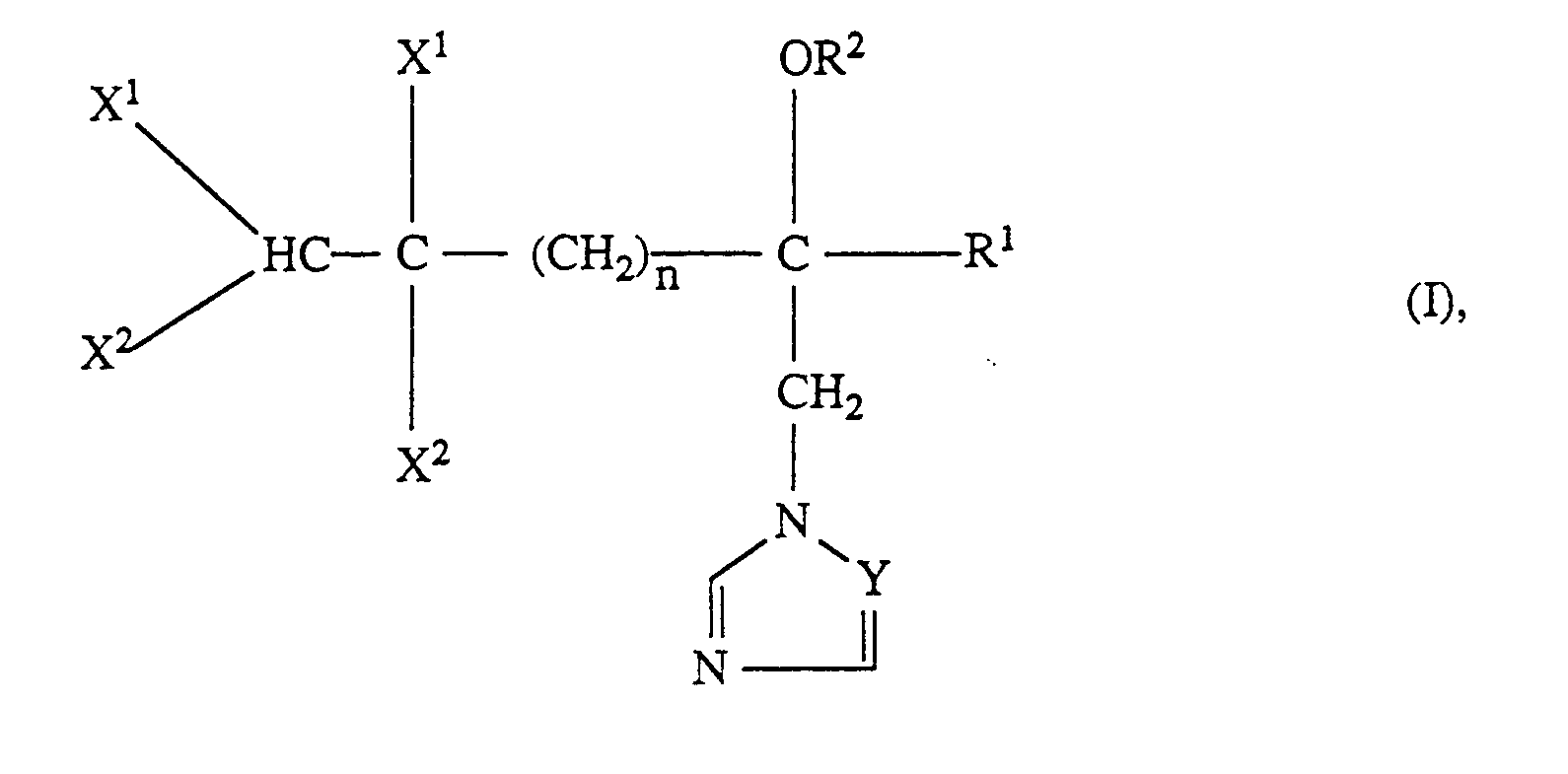
in welcher
- R1 für gegebenenfalls substituiertes Phenyl steht,
- R2 für Wasserstoff, Alkyl, Alkenyl, Acyl oder Aralkyl steht,
- X1 für Halogen steht,
- X 2 für Halogen steht,
- n für 0 oder 1 steht und
- Y für Stickstoff oder eine CH-Gruppe steht,
sowie deren Säureadditions-Salze und Metallsalz-Komplexe, mehrere Verfahren zur Herstellung der neuen Stoffe und deren Verwendung als Mikrobizide im Pflanzenschutz und im Materialschutz.
Description
- Die vorliegende Erfindung betrifft neue Halogenalkyl-azolyl-Derivate, mehrere Verfahren zu deren Herstellung und deren Verwendung als Mikrobizide im Pflanzenschutz und im Materialschutz.
- Es ist bekannt geworden, daß bestimmte Dihalogen-allyl-triazolyl-Derivate fungizide Eigenschaften besitzen (vgl. EP-OS 0 097 425). So lassen sich z.B. 4-(2,4-Dichlor-phenyl)-1,2-dibrom-4-hydroxy-5-(1,2,4-triazol-1-yl)-pent-1-en und 4-(2,4-Dichlor-phenyl)-1,2-dichlor-4-hydroxy-5-(1,2,4-triazol-1-yl)-pent-1-en zur Bekämpfung von Pilzen einsetzen. Die Wirkung dieser Stoffe ist gut, läßt aber bei niedrigen Aufwandmengen in manchen Fällen zu wünschen übrig.
- Weiterhin ist schon bekannt, daß bestimmte Halogenalkyl-triazolyl-Derivate, die am zentralen Kohlenstoffatom einen gegebenenfalls substituierten Phenylrest enthalten, als Fungizide gegen phytopathogene Pilze geeignet sind (vgl. EP-OS 0 380 277). Entsprechende Verbindungen, die einen Halogenalkyl-Rest enthalten, der in Nachbarstellung zum zentralen Kohlenstoffatom zweifach halogeniert ist, werden jedoch nicht beschrieben. Ferner werden auch keine Stoffe dieses Typs offenbart, die am zentralen Kohlenstoffatom einen n-Propyl-Rest aufweisen, der in der 2- und der 3-Position jeweils zweifach halogeniert ist.
- Es wurden nun neue Halogenalkyl-azolyl-Derivate der Formel

- R1 für gegebenenfalls substituiertes Phenyl steht,
- R2 für Wasserstoff, Alkyl, Alkenyl, Acyl oder Aralkyl steht,
- X1 für Halogen steht,
- X 2 für Halogen steht,
- n für 0 oder 1 steht und
- Y für Stickstoff oder eine CH-Gruppe steht,
- Die Verbindungen der Formel (I) enthalten mindestens ein asymmetrisch substituiertes Kohlenstoffatom und können deshalb in optischen Isomerenformen anfallen. Die vorliegende Erfindung betrifft sowohl die Isomerengemische als auch die einzelnen Isomeren.
- Weiterhin wurde gefunden, daß man Halogenalkyl-azolyl-Derivate der Formel (I) sowie deren Säureadditions-Salze und Metallsalzkomplexe erhält, wenn man Alkine der Formel

- R1, R2, Y und n die oben angegebenen Bedeutungen haben,
- mit Halogen oder Halogen liefernden Verbindungen in Gegenwart eines Verdünnungsmittels umsetzt,
- Schließlich wurde gefunden, daß die neuen Halogenalkylazolyl-Derivate der Formel (I) sowie deren Säureadditions-Salze und Metallsalz-Komplexe starke mikrobizide Eigenschaften besitzen und sowohl im Pflanzenschutz als auch im Materialschutz eingesetzt werden können.
- Überraschenderweise besitzen die erfindungsgemäßen Stoffe sowohl im Pflanzenschutz als auch im Materialschutz eine bessere mikrobizide Wirksamkeit als die konstitutionell ähnlichsten vorbekannten Verbindungen gleicher Wirkungsrichtung. In den Verbindungen der Formeln (I) und (11) steht
- R1 vorzugsweise für Phenyl, das einfach bis dreifach, gleichartig oder verschieden substituiert sein kann durch Halogen, Alkyl mit 1 bis 4 Kohlenstoffatomen, Alkoxy mit 1 bis 4 Kohlenstoffatomen, Alkylthio mit 1 bis 4 Kohlenstoffatomen, Halogenalkyl mit 1 oder 2 Kohlenstoffatomen und 1 bis 5 gleichen oder verschiedenen Halogenatomen, Halogenalkoxy mit 1 oder 2 Kohlenstoffatomen und 1 bis 5 gleichen oder verschiedenen Halogenatomen, Halogenalkylthio mit 1 oder 2 Kohlenstoffatomen und 1 bis 5 gleichen oder verschiedenen Halogenatomen, Cycloalkyl mit 3 bis 7 Kohlenstoffatomen, gegebenenfalls einfach oder zweifach, gleichartig oder verschieden, durch Halogen substituiertes Phenyl, gegebenenfalls einfach oder zweifach, gleichartig oder verschieden, durch Halogen substituiertes Phenoxy, Alkoxycarbonyl mit 1 bis 4 Kohlenstoffatomen im Alkoxyteil, Alkoximinoalkyl mit 1 bis 4 Kohlenstoffatomen im Alkoxyteil und 1 bis 4 Kohlenstoffatomen im Alkylteil, Nitro und/oder Cyano.
- R2 steht vorzugsweise für Wasserstoff, Alkyl mit 1 bis 6 Kohlenstoffatomen, Alkenyl mit 3 bis 6 Kohlenstoffatomen, Acyl mit 1 bis 4 Kohlenstoffatomen oder Phenylalkyl mit 1 bis 4 Kohlenstoffatomen im Alkylteil.
- X1 steht vorzugsweise für Fluor, Chlor oder Brom.
- X2 steht vorzugsweise für Fluor, Chlor oder Brom.
- Besonders bevorzugt steht
- R1 für Phenyl, das einfach bis dreifach, gleichartig oder verschieden substituiert sein kann durch Fluor, Chlor, Brom, Methyl, Ethyl, tert.-Butyl, Methoxy, Ethoxy, Methylthio, Trifluormethyl, Trifluormethoxy, Trifluormethylthio, Chlordifluormethoxy, Chlordifluormethylthio, Phenyl, Chlorphenyl, Dichlorphenyl, Phenoxy, Chlorphenoxy, Dichlorphenoxy, Methoxycarbonyl, Ethoxycarbonyl, Methoximinomethyl, 1-Methoximinoethyl, Nitro und/oder Cyano.
- R2 steht besonders bevorzugt für Wasserstoff, Methyl, Ethyl, n-Propyl, Isopropyl, n-Butyl, Allyl, Formyl, Acetyl, Benzyl oder Phenethyl.
- X1 steht besonders bevorzugt für Fluor, Chlor oder Brom.
- X2 steht besonders bevorzugt für Fluor, Chlor oder Brom.
- Der Index n steht für 0 oder 1.
- Y steht für Stickstoff oder eine CH-Gruppe.
- Bevorzugte erfindungsgemäße Stoffe sind auch Additionsprodukte aus Säuren und Halogenalkyl-azolyl-Derivaten der Formel (I), in denen R1, R2, X1, X2, Y und n die Bedeutungen haben, die bereits als bevorzugt oder besonders bevorzugt für diese Reste und den Index n genannt wurden.
- Zu den Säuren, die addiert werden können, gehören vorzugsweise Halogenwasserstoffsäuren, wie z.B. die Chlorwasserstoffsäure und die Bromwasserstoffsäure, insbesondere die Chlorwasserstoffsäure, ferner Phosphorsäure, Salpetersäure, Schwefelsäure, mono- und bifünktionelle Carbonsäuren und Hydroxycarbonsäuren, wie z.B. Essigsäure, Maleinsäure, Bernsteinsäure, Fumarsäure, Weinsäure, Zitronensäure, Salizylsäure, Sorbinsäure und Milchsäure sowie Sulfonsäuren, wie z.B. p-Toluolsulfonsäure, 1,5-Naphthalindisulfonsäure, Camphersulfonsäure oder Saccharin.
- Außerdem bevorzugte erfindungsgemäße Verbindungen sind Additionsprodukte aus Salzen von Metallen der II. bis IV. Haupt- und der I. und II. sowie IV. bis VIII. Nebengruppe des Periodensystems der Elemente und Halogenalkyl-azolyl-Derivaten der Formel (I), in denen R1, R2, X1, X2, Y und n die Bedeutungen haben, die bereits als bevorzugt oder besonders bevorzugt für diese Reste und den Index n genannt wurden. Hierbei sind Salze des Kupfers, Zinks, Mangans, Magnesiums, Zinns, Eisens und des Nickels besonders bevorzugt. Als Anionen dieser Salze kommen solche in Betracht, die sich von solchen Säuren ableiten, die zu physiologisch verträglichen Additionsprodukten führen. Besonders bevorzugte derartige Säuren sind in diesem Zusammenhang die Halogenwasserstoffsäuren, wie z.B. die Chlorwasserstoffsäure und die Bromwasserstoffsäure, ferner Phosphorsäure, Salpetersäure und Schwefelsäure.
- Als Beispiele für erfindungsgemäße Stoffe seien die in der folgenden Tabelle aufgeführten Halogenalkyl-azolyl-Derivate genannt.


- Verwendet man 3-(4-Chlorphenyl)-3-hydroxy-4-(1,2,4-triazol-1-yl)-but-1-in als Ausgangsstoff und Chlorgas als Reaktionskomponente, so kann der Verlauf des erfindungsgemäßen Verfahrens (a) durch das folgende Formelschema veranschaulicht werden:
-

- Die bei der Durchführung des erfindungsgemäßen Verfahrens als Ausgangsstoffe benötigten Alkine der Formel (II) sind teilweise bekannt (vgl. EP-OS 0 096 786 und EP-OS 0 353 558). Sie lassen sich herstellen, indem man
- a) Azolyl-methyl-ketone der Formel

- a) mit Acetylen-Salzen der Formel

- Me für ein Äquivalent eines Metallkations steht,
- in Gegenwart eines Verdünnungsmittels umsetzt, oder
- β) mit Propargylhalogeniden der Formel

- Hal für Chlor oder Brom steht,
- in Gegenwart von aktiviertem Aluminium und in Gegenwart eines Verdünnungsmittels umsetzt, und gegebenenfalls die dabei entstehenden Alline der Formel

- R1, Y und n die oben angegebenen Bedeutungen haben, mit starken Basen in Gegenwart eines Verdünnungsmittels umsetzt und die dabei entstehenden Alkoholate der Formel

- R1, Y und n die oben angegebenen Bedeutungen haben und
- R3 für einen kationischen Rest einer Base steht,
- mit Halogen-Verbindungen der Formel

- R4 für Alkyl, Alkenyl, Acyl oder Aralkyl seht und
- Hal' für Chlor, Brom der lod steht, in Gegenwart eines Verdünnungsmittels umsetzt, oder
- a) mit Acetylen-Salzen der Formel
- b) Chlormethylketone der Formel

- a) mit Acetylenen der Formel

- R5 für Wasserstoff oder ein Äquivalent eines Metallkations steht,
- gegebenenfalls in Gegenwart einer Base und in Gegenwart eines Verdünnungsmittels umsetzt, oder
- β) mit Propargylhalogeniden der Formel

- Hal die oben angegebene Bedeutung hat,
- unter den Bedingungen des Verfahrens (a), Variante β, umsetzt,
- und dann die dabei entstehenden Hydroxyalkine der Formel

- R1 und n die oben angegebenen Bedeutungen haben,
- mit Azolen der Formel

- Y die oben angegebene Bedeutung hat,
- in Gegenwart eines Säurebindemittels und in Gegenwart eines Verdünnungsmittels umsetzt und gegebenenfalls die dabei entstehenden Alkine der Formel

- R1, Y und n die oben angegebenen Bedeutungen haben,
- gemäß Verfahren (a) weiter umsetzt.
- a) mit Acetylenen der Formel
- Die bei der Durchführung des Verfahrens (a) als Ausgangsstoffe benötigten Azolylmethyl-ketone der Formel (III) sind bekannt oder lassen sich nach prinzipiell bekannten Verfahren in einfacher Weise herstellen (vgl. DE-OS 2 431 407 und EP-OS 0 353 558).
- Die bei der Durchführung des Verfahrens (a), Variante a, als Reaktionskomponenten benötigten Acetylen-Salze sind durch die Formel (IV) allgemein definiert. In dieser Formel steht Me vorzugsweise für ein Lithiumkation oder für ein Äquivalent eines Cer(III)-Kations.
- Die Acetylen-Salze der Formel (IV) sind bekannt (vgl. Houben-Weyl, "Methoden der Organischen Chemie", Bd. V/2a, Seiten 509 ff., Georg Thieme Verlag, Stuttgart 1977 und Tetrahedron Letters 25, (1984)-4233).
- Als Verdünnungsmittel können bei der Durchführung der ersten Stufe des Verfahrens (a), Variante a, alle für derartige Umsetzungen üblichen inerten organischen Solventien verwendet werden. Vorzugsweise in Frage kommen Ether, wie Tetrahydrofuran oder Diethylether, und außerdem Kohlenwasserstoffe, wie n-Hexan.
- Die Reaktionstemperaturen können bei der Durchführung der ersten Stufe des Verfahrens (a), Variante a, innerhalb eines größeren Bereiches variiert werden. Im allgemeinen arbeitet man bei Temperaturen zwischen -78° C und + 30 C, vorzugsweise bei Temperaturen zwischen -70 C und + 20 C.
- Bei der Durchführung des Verfahrens (a) arbeitet man ebenso wie bei der Durchführung des erfindungsgemäßen Verfahrens und des Verfahrens (b) im allgemeinen unter Normaldruck.
- Man geht bei der Durchführung der ersten Stufe des Verfahrens (a), Variante a, im allgemeinen so vor, daß man zunächst die Acetylen-Salze herstellt und diese dann ohne vorherige Isolierung mit einer äquivalenten Menge, bzw. einem Über- oder Unterschuß an Azolyl-methyl-keton der Formel (III) umsetzt. Die Aufarbeitung erfolgt nach üblichen Methoden. Im allgemeinen geht man so vor, daß man das Reaktionsgemisch zunächst mit einer wäßrigen Salz-Lösung, z.B. Ammoniumchlorid-Lösung, versetzt, dann mehrfach mit einem in Wasser wenig löslichen organischen Solvens ausschüttelt und die vereinigten organischen Phasen nach dem Trocknen unter vermindertem Druck einengt.
- Die bei der Durchführung des Verfahrens (a), Variante β, als Reaktionskomponenten benötigten Propargylhalogenide der Formel (V) sind bekannt.
- Als Verdünnungsmittel können bei der Durchführung der ersten Stufe des Verfahrens (a), Variante ß, alle für derartige Umsetzungen üblichen inerten organischen Solventien verwendet werden. Vorzugsweise in Frage kommen Ether, wie Tetrahydrofuran oder Diethylether.
- Bei der Durchführung der ersten Stufe des Verfahrens (a), Variante β, arbeitet man in Gegenwart von aktiviertem Aluminium. Dieses wird hergestellt, indem man zu Aluminium-Schuppen katalytische Mengen an Quecksilber-(II)-chlorid und lod zugibt.
- Die Reaktionstemperaturen können bei der Durchführung der ersten Stufe des Verfahrens (a), Variante ß, innerhalb eines größeren Bereiches variiert werden. Im allgemeinen arbeitet man bei Temperaturen zwischen -80 C und + 100 C, vorzugsweise bei Temperaturen zwischen -70 C und + 60 C.
- Man geht bei der Durchführung der ersten Stufe des Verfahrens (a), Variante β, im allgemeinen so vor, daß man auf 1 Mol an Azolyl-methyl-keton der Formel (III) 1 bis 2 Mol Propargyl-halogenid der Formel (V) und 1 bis 1,5 Mol Aluminium und katalytische Mengen an Quecksilber-(II)-chlorid und lod einsetzt. Die Isolierung der entstehenden Produkte erfolgt nach üblichen Methoden.
- Bei der Durchführung der zweiten Stufe des Verfahrens (a) erfolgt die Überführung der Alkine der Formel (Ila) in die entsprechenden Alkoholate, indem man mit geeigneten starken Basen, wie Alkalimetallamiden oder -hydriden, quarternären Ammonium-hydroxiden oder Phosphonium-hydroxiden in einem inerten Verdünnungsmittel, wie z.B. Dioxan, bei Raumtemperatur umsetzt. Demgemäß steht R3 in den Verbindungen der Formel (Ilb) vorzugsweise für ein Alkalimetallkation, wie ein Natrium- oder Kaliumkation, oder für ein quarternäres Ammonium- oder Phosphoniumkation.
- Die bei der Durchführung der dritten Stufe des Verfahrens (a) als Reaktionskomponenten benötigten Halogen-Verbindungen sind durch die Formel (VI) allgemein definiert. In dieser Formel steht R4 vorzugsweise für die Bedeutungen, die bereits im Zusammenhang mit der Beschreibung der erfindungsgemäßen Stoffe der Formel (I) für den Substituenten R2 genannt wurden mit Ausnahme der Bedeutung von Wasserstoff. Hal' steht für Chlor, Brom oder lod.
- Die Halogenverbindungen der Formel (VI) sind bekannt oder lassen sich nach im Prinzip bekannten Methoden herstellen.
- Als Verdünnungsmittel kommen bei der Durchführung der zweiten und dritten Stufe des Verfahrens (a) inerte organische Lösungsmittel in Frage. Vorzugsweise verwendbar sind Ether, wie Diethylether oder Dioxan; aromatische Kohlenwasserstoffe, wie Benzol; in einzelnen Fällen auch chlorierte Kohlenwasserstoffe, wie Chloroform, Methylenchlorid oder Tetrachlorkohlenstoff; sowie Hexamethylphosphorsäuretriamid.
- Die Reaktionstemperaturen können bei der Durchführung der zweiten und dritten Stufe des Verfahrens (a) in einem größeren Bereich variiert werden. Im allgemeinen arbeitet man bei Temperaturen zwischen 0 C und 120°C, vorzugsweise zwischen 20 C und 100°C.
- Bei der Durchführung der zweiten Stufe des Verfahrens (a) setzt man zunächst Alkine der Formel (Ila) mit starken Basen zu den entsprechenden Alkoholaten der Formel (Ilb) um. In der folgenden dritten Stufe setzt man auf 1 Mol eines Alkoholates der Formel (Ilb) vorzugsweise 1 bis 2 Mol Halogenverbindung der Formel (VI) ein. Zur Isolierung der Endprodukte wird das Reaktionsgemisch vom Lösungsmittel befreit und der Rückstand mit Wasser und einem organischen Lösungsmittel versetzt. Die organische Phase wird abgetrennt, in üblicher Weise aufgearbeitet und gereinigt.
- In einer bevorzugten Ausführungsform wird in der zweiten und dritten Stufe des Verfahrens (a) zweckmäßigerweise so verfahren, daß man von einer Hydroxy-Verbindung der Formel (Ila) ausgeht, letztere in einem geeigneten organischen Lösungsmittel mittels Alkalimetall-hydrid oder Alkalimetall-amid in das Alkalimetallalkoholat überführt und letzteres ohne Isolierung sofort mit einer Halogenverbindung der Formel (VI) umsetzt, wobei unter Austritt von Alkalimetallhalogenid die Verbindungen der Formel (11) in einem Arbeitsgang erhalten werden.
- Nach einer weiteren bevorzugten Ausführungsform werden zweckmäßigerweise die Herstellung der Alkoholate sowie die Umsetzung mit einer Halogenverbindung der Formel (VI) in einem Zweiphasensystem, wie beispielsweise wäßrige Natron- oder Kalilauge/Toluol oder Methylenchlorid, unter Zusatz von 0,01 bis 1 Mol eines Phasen-Transfer-Katalysators, wie beispielsweise Ammonium- oder Phosphoniumverbindungen, durchgeführt, wobei in der organischen Phase oder an der Grenzfläche die Alkoholate mit den in der organischen Phase befindlichen Halogeniden umgesetzt werden.
- Die bei der Durchfürung des Verfahrens (b) als Ausgangsstoffe benötigten Chlormethylketone sind durch die Formel (VII) allgemein definiert. In dieser Formel hat R1 vorzugsweise diejenigen Bedeutungen, die bereits im Zusammenhang mit der Beschreibung der erfindungsgemäßen Stoffe der Formel (I) vorzugsweise für diesen Rest genannt wurden.
- Die Chlormethylketone der Formel (VII) sind bekannt oder lassen sich nach prinzipiell bekannten Methoden herstellen (vgl. DE-OS 3 049 461).
- Die bei dem Verfahren (b), Variante a, als Reaktionskomponenten benötigten Acetylene sind durch die Formel (VIII) allgemein definiert. In dieser Formel steht R5 vorzugsweise für Wasserstoff, ein Lithium-kation oder ein Äquivalent eines Magnesium- oder Cer (III)-Kations.
- Die Acetylene der Formel (VIII) sind bekannt.
- Als Basen kommt bei der Durchführung der ersten Stufe des Verfahrens (b), Variante a, alle für derartige Umsetzungen üblichen starken Basen in Betracht. Vorzugsweise verwendbar sind Alkalimetallhydroxide, wie Kaliumhydroxid.
- Als Verdünnungsmittel können bei der Durchführung der ersten Stufe des Verfahrens (b), Variante a, alle für derartige Umsetzungen üblichen inerten organischen Solventien verwendet werden. Vorzugsweise in Frage kommen, Ether, wie Tetrahydrofuran oder Diethylether.
- Die Reaktionstemperaturen können bei der Durchführung der ersten Stufe des Verfahrens (b), Variante a, innerhalb eines größeren Bereichs variiert werden. Im allgemeinen arbeitet man bei Temperaturen zwischen -78 C und + 50 C, vorzugsweise zwischen -78 C und + 40 C.
- Bei der Durchführung der ersten Stufe des Verfahrens (b), Variante a, geht man im allgemeinen so vor, daß man Chlormethylketone der Formel (VII) und Acetylene der Formel (VIII) in angenähert äquivalenten Mengen umsetzt. Es ist jedoch auch möglich, die eine oder andere Komponente in einem Überschuß zu verwenden. Die Aufarbeitung erfolgt nach üblichen Methoden.
- Die Durchführung der ersten Stufe des Verfahrens (b), Variante β, erfolgt unter den Bedingungen, die auch bei der Durchführung der ersten Stufe des Verfahrens (a), Variante β, angewandt werden.
- Die Hydroxyalkine der Formel (IX) können direkt weiter umgesetzt werden mit Azolen der Formel (X). Sie können aber auch zunächst in Oxirane überführt werden und dann mit Azolen der Formel (X) umgesetzt werden.
- Bei der Durchführung der zweiten Stufe des Verfahrens (b) kommen als Säurebindemittel alle üblichen Säureakzeptoren in Frage. Vorzugsweise verwendbar sind Alkalimetallcarbonate und Hydrogencarbonate, wie Natriumcarbonat, Kaliumcarbonat oder Natriumhydrogencarbonat, ferner tertiäre aliphatische oder aromatische Amine, wie Triethylamin, N,N-Dimethyl-cyclohexyl-amin, N,N-Dimethyl-benzylamin und Pyridin, und außerdem cyclische Amine, wie 1,5-Diaza-bicyclo[4.3.0]non-5-en (DBN), 1,8-Diaza-bicyclo[5.4.0]undec-7-en (DBU) und 1,4-Diaza-bicyclo[2.2.2]octan (DABCO).
- Als Verdünnungsmittel kommen bei der Durchführung der zweiten Stufe des Verfahrens (b) alle inerten organischen Solventien in Betracht. Vorzugsweise verwendbar sind aliphatische und aromatische, gegebenenfalls halogenierte Kohlenwasserstoffe wie Pentan, Hexan, Cyclohexan, Petrolether, Benzin, Ligroin, Benzol, Toluol, Xylol, Methylenchlorid, Ethylenchlorid, Chloroform, Tetrachlorkohlenstoff, Chlorbenzol und o-Dichlorbenzol, Ether wie Diethyl- und Dibutylether, sowie tert.-Butylmethylether, Glykoldimethylether und Diglykoldimethylether, Tetrahydrofuran und Dioxan, Ketone wie Aceton, Methyl-ethyl-, Methyl-isopropyl- und Methyl-isobutyl-keton, Ester wie Essigsäuremethylester und -ethylester, Nitrile wie z.B. Acetonitril und Propionitril, und Pyridin.
- Die Reaktionstemperaturen können auch bei der Durchführung der zweiten Stufe des Verfahrens (b) innerhalb eines größeren Bereiches variiert werden. Im allgemeinen arbeitet man bei Temperaturen zwischen 0 C und 200 C, vorzugsweise zwischen 20 C und 150° C.
- Bei der Durchführung der zweiten Stufe des Verfahrens (b) geht man im allgemeinen so vor, daß man auf 1 Mol an Hydroxyalkin der Formel (IX) eine äquivalente Menge oder auch einen Überschuß an Azol der Formel (X) sowie 2 bis 3 Mol an Säurebindemittel einsetzt. Die Aufarbeitung erfolgt nach üblichen Methoden. Die gegebenenfalls gewünschte weitere Umsetzung der Alkine der Formel (Ila) erfolgt bei dem Verfahren (b) in gleicher Weise wie bei dem Verfahren (a).
- Als Halogene kommen bei der Durchführung des erfindungsgemäßen Verfahrens vorzugsweise Fluor, Chlor und Brom als Reaktionskomponenten in Betracht, ferner gemischte Halogene wie Chlor(I)-fluorid, Brom(I)-fluorid oder Brom(I)-chlorid, (s. Methodicum Chimicum, F.Korte, Bd. 7, S. 842 (1976)).
- Als Halogen liefernde Verbindungen können beispielsweise Sulfurylchlorid, N-Bromsuccinimid mit Salzsäure, N-Chlorsuccinimid mit Bromwasserstoffsäure oder N-Chlorsuccinimid mit Fluorwasserstoff/Pyridin (s. Synthesis 1973, 780) verwendet werden.
- Die Addition der Halogene an die Alkine der Formel (11) kann durch Einwirkung von Licht, durch Wärme, durch radikalbildende Substanzen, wie organische Peroxide, durch oberflächenaktive Stoffe, wie Aktivkohle, oder Metallsalze,wie Kupfer(II)-chlorid oder Eisen(III)-chlorid, begünstigt werden.
- Als Verdünnungsmittel können bei der Durchführung des erfindungsgemäßen Verfahrens alle für derartige Umsetzungen üblichen inerten organischen Solventien eingesetzt werden. Vorzugsweise verwendbar sind halogenierte aliphatische Kohlenwasserstoffe, wie Methylenchlorid, Chloroform und Tetrachlorkohlenstoff.
- Die Temperaturen können bei der Durchführung des erfindungsgemäßen Verfahrens innerhalb eines bestimmten Bereiches variiert werden. Im allgemeinen arbeitet man bei Temperaturen zwischen -10°C und + 120°C, vorzugsweise zwischen -5 °C und + 80 C.
- Bei der Durchführung des erfindungsgemäßen Verfahrens setzt man auf 1 Mol an Alkin der Formel (11) im allgemeinen eine äquivalente Menge oder einen Überschuß an Halogen bzw. Halogen liefernder Verbindung ein. Wenn es beabsichtigt ist, Halogenalkyl-azolyl-Derivate der Formel (I) herzustellen, in denen X1 und X2 verschieden sind, so geht man zweckmäßigerweise so vor, daß man zunächst 1 Mol eines bestimmten Halogens an das Alkin der Formel (II) addiert und danach in einem zweiten Schritt 1 Mol eines anderen Halogens addiert. Die Aufarbeitung erfolgt nach üblichen Methoden. Im allgemeinen geht man so vor, daß man mit einem in Wasser wenig löslichen organischen Solvens verdünnt, mit Wasser wäscht und die organische Phase nach dem Trocknen einengt. Es ist jedoch auch möglich, das Reaktionsgemisch nach beendeter Umsetzung direkt durch Abziehen der flüchtigen Komponenten unter vermindertem Druck einzuengen. Die entstehenden Produkte können gegebenenfalls nach üblichen Methoden weiter gereinigt werden.
- Die nach dem erfindungsgemäßen Verfahren erhältlichen Halogenalkyl-azolyl-Derivate der Formel (I) können in Säureadditions-Salze oder Metallsalz-Komplexe überführt werden.
- Zur Herstellung von Säureadditions-Salzen der Verbindungen der Formel (I) kommen vorzugsweise diejenigen Säuren in Frage, die bereits im Zusammenhang mit der Beschreibung der erfindungsgemäßen Säureadditions-Salze als bevorzugte Säuren genannt wurden.
- Die Säureadditions-Salze der Verbindungen der Formel (I) können in einfacher Weise nach üblichen Salzbildungsmethoden, z.B. durch Lösen einer Verbindung der Formel (I) in einem geeigneten inerten Lösungsmittel und Hinzufügen der Säure, z.B. Chlorwasserstoffsäure, erhalten werden und in bekannter Weise, z.B. durch Abfiltrieren, isoliert und gegebenenfalls durch Waschen mit einem inerten organischen Lösungsmittel gereinigt werden.
- Zur Herstellung von Metallsalz-Komplexen der Verbindungen der Formel (I) kommen vorzugsweise diejenigen Salze von Metallen in Frage, die bereits im Zusammenhang mit der Beschreibung der erfindungsgemäßen Metallsalz-Komplexe als bevorzugte Metallsalze genannt wurden.
- Die Metallsalz-Komplexe der Verbindungen der Formel (I) können in einfacher Weise nach üblichen Verfahren erhalten werden, so z.B. durch Lösen des Metallsalzes in Alkohol, z.B. Ethanol und Hinzufügen zu Verbindungen der Formel (I). Man kann Metallsalz-Komplexe in bekannter Weise, z.B. durch Abfiltrieren, isolieren und gegebenenfalls durch Umkristallisation reinigen.
- Die erfindungsgemäßen Wirkstoffe weisen eine starke mikrobizide Wirkung auf und können zur Bekämpfung unerwünschter Mikroorganismen, wie Fungi und Bakterien, im Pflanzenschutz und im Materialschutz eingesetzt werden.
- Fungizide werden im Pflanzenschutz eingesetzt zur Bekämpfung von Plasmodiophoromycetes, Oomycetes, Chytridiomycetes, Zygomycetes, Ascomycetes, Basidiomycetes, Deuteromycetes.
- Beispielhaft aber nicht begrenzend seien einige Erreger von pilzlichen und bakteriellen Erkrankungen, die unter die oben aufgezählten Oberbegriffe fallen, genannt:
- Xanthomonas-Arten, wie Xanthomonas oryzae;
- Pseudomonas-Arten, wie Pseudomonas lachrymans;
- Erwinia-Arten, wie Erwinia amylovora;
- Pythium-Arten, wie Pythium ultimum;
- Phytophthora-Arten, wie Phytophthora infestans;
- Pseudoperonospora-Arten, wie Pseudoperonospora humuli oder Pseudoperonospora cubensis; Plasmopara-Arten, wie Plasmopara viticola;
- Peronospora-Arten, wie Peronospora pisi oder P. brassicae;
- Erysiphe-Arten, wie Erysiphe graminis;
- Sphaerotheca-Arten, wie Sphaerotheca fuliginea;
- Podosphaera-Arten, wie Podosphaera leucotricha;
- Venturia-Arten, wie Venturia inaequalis;
- Pyrenophora-Arten, wie Pyrenophora teres oder P. graminea;
- (Konidienform: Drechslera, Syn: Helminthosporium);
- Cochliobolus-Arten, wie Cochliobolus sativus;
- (Kondienform: Drechslera, Syn: Helminthosporium);
- Uromyces-Arten, wie Uromyces appendiculatus;
- Puccinia-Arten, wie Puccinia recondita;
- Tilletia-Arten, wie Tilletia caries;
- Ustilago-Arten, wie Ustilago nuda oder Ustilago avenae;
- Pellicularia-Arten, wie Pellicularia sasakii;
- Pyricularia-Arten, wie Pyricularia oryzae;
- Fusarium-Arten, wie Fusarium culmorum;
- Botrytis-Arten, wie Botryrtis cinerea;
- Septoria-Arten, wie Septoria nodorum;
- Leptosphaeria-Arten, wie Leptosphaeria nodorum;
- Cercospora-Arten, wie Cercospora canescens;
- Alternaria-Arten, wie Alternaria brassicae;
- Pseudocercosporella-Arten, wie Pseudocercosporella herpotrichoides.
- Die gute Pflanzenverträglichkeit der Wirkstoffe in den zur Bekämpfung von Pflanzenkrankheiten notwendigen Konzentrationen erlaubt eine Behandlung von oberirdischen Pflanzenteilen, von Pflanz- und Saatgut und des Bodens.
- Die erfindungsgemäßen Wirkstoffe eignen sich insbesondere zur Bekämpfung von Getreide- und Reiskrankheiten, wie Pseudocercosporella, Erysiphe, Fusarium, Pyrenophora, Cochliobolus, Septoria, Pyricularia und Pellicularia, sowie zur Bekämpfung von Gurkenmehltau und Apfelschorf und außerdem zur Bekämpfung von Botrytis im Obst-, Wein- und Gemüsebau. Sie besitzen außerdem eine gute und breite in - vitro - Wirkung und eignen sich zur Bekämpfung echter Mehltaupilze, wie Rhizoctonia solani.
- Im Materialschutz lassen sich die erfindungsgemäßen Stoffe zum Schutz von technischen Materialien gegen Befall und Zerstörung durch unerwünschte Mikroorganismen einsetzen.
- Unter technischen Materialien sind im vorliegenden Zusammenhang nicht-lebende Materialien zu verstehen, die für die Verwendung in der Technik zubereitet worden sind. Beispielsweise können technische Materialien, die durch erfindungsgemäße Wirkstoffe vor mikrobieller Veränderung oder Zerstörung geschützt werden sollen, Klebstoffe, Leime, Papier und Karton, Textilien, Leder, Holz, Anstrichmittel und Kunststoffartikel, Kühlschmierstoffe und andere Materialien sein, die von Mikroorganismen befallen oder zersetzt werden können. Im Rahmen der zu schützenden Materialien seien auch Teile von Produktionsanlagen, beispielsweise Kühlwasserkreisläufe, genannt, die durch Vermehrung von Mikroorganismen beeinträchtigt werden können. Im Rahmen der vorliegenden Erfindung seien als technische Materialien vorzugsweise Klebstoffe, Leime, Papiere und Kartone, Leder, Holz, Anstrichmittel, Kühlschmiermittel und Wärmeübertragungsflüssigkeiten genannt, besonders bevorzugt Holz.
- Als Mikroorganismen, die einen Abbau oder eine Veränderung der technischen Materialien bewirken können, seien beispielsweise Bakterien, Pilze, Hefen, Algen und Schleimorganismen genannt. Vorzugsweise wirken die erfindungsgemäßen Wirkstoffe gegen Pilze, insbesondere Schimmelpilze, holzverfärbende und holzzerstörende Pilze (Basidiomyceten) sowie gegen Schleimorganismen und Algen.
- Es seien beispielsweise Mikroorganismen der folgenden Gattungen genannt:
- Alternaria, wie Alternaria tenuis,
- Aspergillus, wie Aspergillus niger,
- Chaetomium, wie Chaetomium globosum,
- Coniophora, wie Coniophora puetana,
- Lentinus, wie Lentinus tigrinus,
- Penicillium, wie Penicillium glaucum,
- Polyporus, wie Polyporus versicolor,
- Aureobasidium, wie Aureobasidium pullulans,
- Sclerophoma, wie Sclerophoma pityophila,
- Trichoderma, wie Trichoderma viride,
- Escherichia, wie Escherichia coli,
- Pseudomonas, wie Pseudomonas aeruginosa
- Staphylococcus, wie Staphylococcus aureus.
- Die Wirkstoffe können in Abhängigkeit von ihren jeweiligen physikalischen und/oder chemischen Eigenschaften in übliche Formulierungen übergeführt werden, wie Lösungen, Emulsionen, Suspensionen, Pulver, Schäume, Pasten, Granulate, Aerosole, Feinstverkapselungen in polymeren Stoffen und in Hüllmassen für Saatgut, sowie ULV-Kalt- und Warmnebel-Formulierungen.
- Diese Formulierungen werden in bekannter Weise hergestellt, z.B. durch Vermischen der Wirkstoffe mit Streckmitteln, also flüssigen Lösungsmitteln, unter Druck stehenden verflüssigten Gasen und/oder festen Trägerstoffen, gegebenenfalls unter Verwendung von oberflächenaktiven Mitteln, also Emulgiermitteln und/oder Dispergiermitteln und/oder schaumerzeugenden Mitteln. Im Falle der Benutzung von Wasser als Streckmittel können z.B. auch organische Lösungsmittel als Hilfslösungsmittel verwendet werden. Als flüssige Lösungsmittel kommen im wesentlichen in Frage: Aromaten, wie Xylol, Toluol, oder Alkylnaphthaline, chlorierte Aromaten oder chlorierte aliphatische Kohlenwasserstoffe, wie Chlorbenzole, Chlorethylene oder Methylenchlorid, aliphatische Kohlenwasserstoffe, wie Cyclohexan oder Paraffine, z.B. Erdölfraktionen, Alkohole, wie Butanol oder Glycol sowie deren Ether und Ester, Ketone, wie Aceton, Methylethylketon, Methylisobutylketon oder Cyclohexanon, stark polare Lösungsmittel, wie Dimethylformamid und Dimethylsulfoxid, sowie Wasser; mit verflüssigten gasförmigen Streckmitteln oder Trägerstoffen sind solche Flüssigkeiten gemeint, welche bei normaler Temperatur und unter Normaldruck gasförmig sind, z.B. Aerosol-Treibgase, wie Halogenkohlenwasserstoffe sowie Butan, Propan, Stickstoff und Kohlendioxid; als feste Trägerstoffe kommen in Frage: z.B. natürliche Gesteinsmehle, wie Kaoline, Tonerden, Talkum, Kreide, Quarz, Attapulgit, Montmorillonit oder Diatomeenerde und synthetische Gesteinsmehle, wie hochdisperse Kieselsäure, Aluminiumoxid und Silikate; als feste Trägerstoffe für Granulate kommen in Frage: z.B. gebrochene und fraktionierte natürliche Gesteine wie Calcit, Marmor, Bims, Sepiolith, Dolomit sowie synthetische Granulate aus anorganischen und organischen Mehlen sowie Granulate aus organischem Material wie Sägemehl, Kokosnußschalen, Maiskolben und Tabakstengel; als Emulgier- und schaumerzeugende Mittel kommen in Frage: z.B. nichtionogene und anionische Emulgatoren, wie Polyoxyethylen-Fettsäure-Ester, Polyoxyethylen-Fettalkohol-Ether, z.B. Alkylarylpolyglykol-Ether, Alkylsulfonate, Alkylsulfate, Arylsulfonate sowie Eiweißhydrolysate; als Dispergiermittel kommen in Frage: z.B. Lignin-Sulfitablaugen und Methylcellulose.
- Es können in den Formulierungen Haftmittel wie Carboxymethylcellulose, natürliche und synthetische pulverige, körnige oder latexförmige Polymere verwendet werden, wie Gummiarabicum, Polyvinylalkohol,Polyvinylacetat, sowie natürliche Phospholipide, wie Kephaline und Lecithine, und synthetische Phospholipide. Weitere Additive können mineralische und vegetabile Öle sein.
- Es können Farbstoffe wie anorganische Pigmente, z.B. Eisenoxid, Titanoxid, Ferrocyanblau und organische Farbstoffe, wie Alizarin-, Azo- und Metallphthalocyaninfarbstoffe und Spurennährstoffe wie Salze von Eisen, Mangan, Bor, Kupfer, Kobalt, Molybdän und Zink verwendet werden.
- Die Formulierungen enthalten im Pflanzenschutz im allgemeinen zwischen 0,1 und 95 Gewichtsprozent Wirkstoff, vorzugsweise zwischen 0,5 und 90 %.
- Die erfindungsgemäßen Wirkstoffe können bei Verwendung im Pflanzenschutz in den Formulierungen in Mischung mit anderen bekannten Wirkstoffen vorliegen wie Fungizide, Insektizide, Akarizide und Herbizide sowie in Mischungen mit Düngemitteln und Wachstumsregulatoren.
- Die Wirkstoffe können bei Verwendung im Pflanzenschutz als solche, in Form ihrer Formulierungen oder den daraus bereiteten Anwendungsformen wie gebrauchsfertige Lösungen, Suspensionen, Spritzpulver, Pasten, lösliche Pulver, Stäubemittel und Granulate angewendet werden. Die Anwendung geschieht in üblicher Weise, z.B. durch Gießen, Verspritzen, Versprühen, Verstreuen, Verstäuben, Verschäumen, Bestreichen usw.. Es ist ferner möglich, die Wirkstoffe nach dem Ultra-Low-Volume-Verfahren auszubringen oder die Wirkstoffzubereitung oder den Wirkstoff selbst in den Boden zu injizieren. Es kann auch das Saatgut der Pflanzen behandelt werden.
- Bei der Behandlung von Pflanzenteilen können die Wirkstoffkonzentrationen in den Anwendungsformen in einem größeren Bereich variiert werden. Sie liegen im allgemeinen zwischen 1 und 0,0001 Gew.-%, vorzugsweise zwischen 0,5 und 0,001 %.
- Bei der Saatgutbehandlung werden im allgemeinen Wirkstoffmengen von 0,001 bis 50 g je Kilogramm Saatgut, vorzugsweise 0,01 bis 10 g benötigt.
- Bei Behandlung des Bodens sind Wirkstoffkonzentrationen von 0,00001 bis 0,1 Gew.-%, vorzugsweise von 0,0001 bis 0,02 % am Wirkungsort erforderlich.
- Die zum Schutz technischer Materialien verwendeten mikrobiziden Mittel enthalten die Wirkstoffe im allgemeinen in einer Menge von 1 bis 95 Gew.-%, bevorzugt von 10 bis 75 Gew.-%.
- Beim Einsatz im Materialschutz richten sich die Anwendungskonzentrationen an erfindungsgemäßen Wirkstoffen nach der Art und dem Vorkommen der zu bekämpfenden Mikroorganismen sowie nach der Zusammensetzung des zu schützenden Materials. Die optimale Einsatzmenge kann durch Testreihen ermittelt werden. Im allgemeinen liegen die Anwendungskonzentrationen im Bereich von 0,001 bis 5 Gew.- %, vorzugsweise von 0,05 bis 1,0 Gew.-%, bezogen auf das zu schützende Material.
- Auch beim Einsatz im Materialschutz können die erfindungsgemäßen Wirkstoffe in Mischung mit anderen bekannten Wirkstoffen angewendet werden.
- Beispielsweise seien die folgenden Wirkstoffe genannt:
- Benzylalkoholmono(poly)hemiformal und andere Formaldehyd abspaltende Verbindungen, Benzimidazolylmethylcarbamate, Tetramethylthiuramdisulfid, Zinksalze von Dialkyldithiocarbamaten, 2,4,5,6-Tetrachlorisophthalonitril, Thiazolylbenzimidazol, Mercaptobenzthiazol, 2-Thiocyanatomethylthiobenzthiazol, Methylenbisthiocyanat, Phenolderivate wie 2-Phenylphenol, (2,2'-Dihydroxy-5,5'-dichlor)-diphenylmethan und 3-Methyl-4-chlor-phenol, Organo-Zinnverbindungen, Trihalogenmethylthio-Verbindungen wie Folpet, Fluorfolpet, Dichlofluanid.
- Die Herstellung und die Verwendung der erfindungsgemäßen Wirkstoffe werden durch die folgenden Beispiele veranschaulicht.
-

- 2,5 g(10 mMol) 3-(4-Chlorphenyl)-3-hydroxy-4-(1,2,4-triazol-1-yl)-but-1-in werden in 50 ml Methylenchlorid bei 10°C unter Belichtung mit einer 300 Watt UV-Lampe durch Einleiten von Chlorgas innerhalb von 30 Stunden chloriert. Die dabei entstehende Suspension wird zur Aufarbeitung mit Methylenchlorid verdünnt und mit wäßriger Natriumcarbonat-Lösung ausgeschüttelt. Die organische Phase wird nach dem Trocknen über Natriumsulfat unter vermindertem Druck eingeengt. Man erhält auf diese Weise 3,8 g (97 % der Theorie) an 3-(4-Chlorphenyl)-3-hydroxy-4-(1,2,4-triazol-1-yl)-1,1,2,2-tetrachlorbutan in Form einer Festsubstanz vom Schmelzpunkt 168 bis 169°C.
- 1H-NMR (200 MHz; DMSO): 0 = 5,05 und 5,45 (AB-System; 2H), 6,4(s; 1 H), 7,1 (OH), 7,35 und 7,7 (4H), 7,75(s; 1 H), 8,35(s;1 H).
-

- 5,0 g (23,2 mMol) 4-Chlor-3-(4-chlorphenyl)-3-hydroxy-1-butin werden in 50 ml abs. Acetonitril mit 1,6 g (23,3 mMol) 1,2,4-Triazol und 6,4 g (46,4 mMol) wasserfreiem Kaliumcarbonat 5,5 Stunden unter Rückfluß erhitzt. Dann verdünnt man mit Dichlormethan und schüttelt mehrfach mit Wasser aus. Nach dem Trocknen und Einengen der organischen Phase erhält man 5,8 g Rohprodukt, das nach Filtration mit Essigsäureethylester über 100 g Kieselgel und erneutem Einengen kristallisiert. Man erhält auf diese Weise 3-(4-Chlorphenyl)-3-hydroxy-4-(1,2,4-triazolyl-1)-1-butin in Form einer Festsubstanz vom Schmelzpunkt 90-94 C.
- 1H-NMR (CDCl3): δ 2,65 (s, 1 H), 4,4 (AB, 2H), 5,8 (OH), 7,35 und 7,45 (4H), 7,85 (s, 1 H), 8,15 (s, 1 H).

- Zu der Lösung von 5,2 g (0,2 Mol) Acetylen in 200 ml absolutem Tetrahydrofuran bei 70°C werden 80 ml (0,2 Mol) 23 % Butyllithiumlösung in Hexan zugetropft. Nach 10 Minuten wird die Lösung von 28,35 g (0,15 Mol) 4,ω-Dichloracetophenon in 100 ml absolutem Tetrahydrofuran eingetragen. Es wird 2 Stunden bei -70 C nachgerührt, und durch Zutropfen des Gemischs aus 20 ml Methanol und 20 ml Essigsäure abgestoppt. Das Lösungsmittel wird im Vakuum abgezogen und der Rest nach Lösen in Dichlormethan mit gesättigter, wäßriger Ammoniumchloridlösung mehrfach ausgeschüttelt. Nach Trocknen und Abdestillieren der organischen Phase erhält man 27,8 g Rohprodukt mit einem Gehalt von 76,3 % 4-Chlor-3-(4- chlorphenyl)-3-hydroxy-1-butin und 17,6 % Ausgangsmaterial, das nach Kristallisation abgesaugt wird.
- 1H-NMR (CDCl3): δ = (2,8(s, 1H) ,3,4(OH) ,375 (AB, 2H),7,4 und 7,65(4H).
- Nach der im Beispiel 1 angegebenen Methode werden auch die in der folgenden Tabelle formelmäßig aufgeführten Stoffe hergestellt:


- In den folgenden Verwendungsbeispielen wurden die Verbindungen der nachstehend aufgeführten Formeln als Vergleichssubstanzen eingesetzt:


-
- Lösungsmittel: 100 Gewichtsteile Dimethylformamid
- Emulgator: 0,25 Gewichtsteile Alkylarylpolyglykolether
- Zur Herstellung einer zweckmäßigen Wirkstoffzubereitung vermischt man 1 Gewichtsteil Wirkstoff mit den angegebenen Mengen Lösungsmittel und Emulgator und verdünnt das Konzentrat mit Wasser auf die gewünschte Konzentration.
- Zur Prüfung auf protektive Wirksamkeit besprüht man junge Pflanzen mit der Wirkstoffzubereitung taufeucht. Nach Antrocknen des Spritzbelages werden die Pflanzen mit Sporen von Erysiphe graminis f.sp.hordei bestäubt.
- Die Pflanzen werden in einem Gewächshaus bei einer Temperatur von ca. 20 C und einer relativen Luftfeuchtigkeit von ca 80 % aufgestellt, um die Entwicklung von Mehltaupusteln zu begünstigen.
- 7 Tage nach der Inokulation erfolgt die Auswertung.
- In diesem Test zeigen die erfindungsgemäßen Stoffe (1-1), (1-2), (1-4) und (1-5) eine wesentlich bessere Wirksamkeit als die Vergleichssubstanzen (A) und (B).
- Lösungsmittel: 100 Gewichtsteile Dimethylformamid Emulgator: 0,25 Gewichtsteile Alkylarylpolyglykolether
- Zur Herstellung einer zweckmäßigen Wirkstoffzubereitung vermischt man 1 Gewichtsteil Wirkstoff mit den angegebenen Mengen Lösungsmittel und Emulgator und verdünnt das Konzentrat mit Wasser auf die gewünschte Konzentration.
- Zur Prüfung auf protektive Wirksamkeit besprüht man junge Pflanzen mit der Wirkstoffzubereitung taufeucht. Nach Antrocknen des Spritzbelages werden die Pflanzen mit Sporen von Erysiphe graminis f.sp.tritici bestäubt.
- Die Pflanzen werden in einem Gewächshaus bei einer Temperatur von ca. 20 C und einer relativen Luftfeuchtigkeit von ca. 80 % aufgestellt, um die Entwicklung von Mehltaupusteln zu begünstigen.
- 7 Tage nach der Inokulation erfolgt die Auswertung.
- In diesem Test zeigen die erfindungsgemäßen Verbindungen (1-1), (1-2), (1-4) und (1-5) eine wesentlich bessere Wirksamkeit als die Vergleichssubstanzen (A) und (B).
sowie deren Säureadditions-Salze und Metallsalz-Komplexe gefunden.
und gegebenenfalls anschließend an die so erhaltenen Verbindungen der Formel (I) eine Säure oder ein Metallsalz addiert.
Claims (7)
1. Halogenalkyl-azolyl-Derivate der Formel

in welcher
sowie deren Säureadditions-Salze und Metallsalz-Komplexe.
R1 für gegebenenfalls substituiertes Phenyl steht,
R2 für Wasserstoff, Alkyl, Alkenyl, Acyl oder Aralkyl steht,
X1 für Halogen steht,
X 2 für Halogen steht,
n für 0 oder 1 steht und
Y für Stickstoff oder eine CH-Gruppe steht,
sowie deren Säureadditions-Salze und Metallsalz-Komplexe.
2. Halogenalkyl-azolyl-Derivate der Formel (I) gemäß Anspruch 1, in denen
R1 für Phenyl steht, das einfach bis dreifach, gleichartig oder verschieden substituiert sein kann durch Halogen, Alkyl mit 1 bis 4 Kohlenstoffatomen, Alkoxy mit 1 bis 4 Kohlenstoffatomen, Alkylthio mit 1 bis 4 Kohlenstoffatomen, Halogenalkyl mit 1 oder 2 Kohlenstoffatomen und 1 bis 5 gleichen oder verschiedenen Halogenatomen, Halogenalkoxy mit 1 oder 2 Kohlenstoffatomen und 1 bis 5 gleichen oder verschiedenen Halogenatomen, Halogenalkylthio mit 1 oder 2 Kohlenstoffatomen und 1 bis 5 gleichen oder verschiedenen Halogenatomen, Cycloalkyl mit 3 bis 7 Kohlenstoffatomen, gegebenenfalls einfach oder zweifach, gleichartig oder verschieden durch Halogen substituiertes Phenyl, gegebenenfalls einfach oder zweifach, gleichartig oder verschieden durch Halogen substituiertes Phenoxy, Alkoxycarbonyl mit 1 bis 4 Kohlenstoffatomen im Alkoxyteil, Alkoximinoalkyl mit 1 bis 4 Kohlenstoffatomen im Alkoxyteil und 1 bis 4 Kohlenstoffatomen im Alkylteil, Nitro und/oder Cyano,
R2 für Wasserstoff, Alkyl mit 1 bis 6 Kohlenstoffatomen, Alkenyl mit 3 bis 6 Kohlenstoffatomen, Acyl mit 1 bis 4 Kohlenstoffatomen oder Phenylalkyl mit 1 bis 4 Kohlenstoffatomen im Alkylteil steht,
X1 für Fluor, Chlor oder Brom steht,
X2 für Fluor, Chlor oder Brom steht,
n für 0 oder 1 steht und
Y für Stickstoff oder eine CH-Gruppe steht.
3. Verfahren zur Herstellung von Halogenalkyl-azolyl-Derivaten der Formel

in welcher
sowie von deren Säureadditions-Salzen und Metallsalz-Komplexen,
dadurch gekennzeichnet, daß man
und gegebenenfalls anschließend an die so erhaltenen Verbindungen der Formel (I) eine Säure oder ein Metallsalz addiert.
R1 für gegebenenfalls substituiertes Phenyl steht,
R2 für Wasserstoff, Alkyl, Alkenyl, Acyl oder Aralkyl steht,
X1 für Halogen steht,
X 2 für Halogen steht,
n für 0 oder 1 steht und
Y für Stickstoff oder eine CH-Gruppe steht,
sowie von deren Säureadditions-Salzen und Metallsalz-Komplexen,
dadurch gekennzeichnet, daß man
Alkine der Formel

in welcher
in welcher
R1, R2, Y und n die oben angegebenen Bedeutungen haben,
mit Halogen oder Halogen liefernden Verbindungen in Gegenwart eines Verdünnungsmittels umsetzt,
und gegebenenfalls anschließend an die so erhaltenen Verbindungen der Formel (I) eine Säure oder ein Metallsalz addiert.
4. Mikrobizide Mittel, gekennzeichnet durch einen Gehalt an mindestens einem Halogenalkyl-azolyl-Derivat der Formel (I) gemäß Anspruch 1 bzw. an einem Säureadditions-Salz oder Metallsalz-Komplex eines Halogenalkyl-azolyl-Derivates der Formel (I).
5. Verwendung von Halogenalkyl-azolyl-Derivaten der Formel (I) gemäß Anspruch 1 bzw. von deren Säureadditions-Salzen und Metallsalz-Komplexen als Mikrobizide im Pflanzenschutz und im Materialschutz.
6. Verfahren zur Bekämpfung von unerwünschten Mikroorganismen im Pflanzenschutz und im Materialschutz, dadurch gekennzeichnet, daß man Halogenalkyl-azolyl-Derivate der Formel (I) gemäß Anspruch 1 bzw. deren Säureadditions-Salze oder Metallsalz-Komplexe auf die Mikroorganismen und/oder ihren Lebensraum ausbringt.
7. Verfahren zur Herstellung von mikrobiziden Mitteln, dadurch gekennzeichnet, daß man Halogenalkyl- azolyl-Derivate der Formel (I) gemäß Anspruch 1 bzw. deren Säureadditionssalze oder Metallsalz- Komplexe mit Streckmitteln und/oder oberflächenaktiven Stoffen vermischt.
Applications Claiming Priority (4)
| Application Number | Priority Date | Filing Date | Title |
|---|---|---|---|
| DE4025204 | 1990-08-09 | ||
| DE4025204A DE4025204A1 (de) | 1990-08-09 | 1990-08-09 | Halogenalkyl-azolyl-derivate |
| DE19914100516 DE4100516A1 (de) | 1991-01-10 | 1991-01-10 | Halogenalkyl-azolyl-derivate |
| DE4100516 | 1991-01-10 |
Publications (2)
| Publication Number | Publication Date |
|---|---|
| EP0470466A2 true EP0470466A2 (de) | 1992-02-12 |
| EP0470466A3 EP0470466A3 (en) | 1992-07-29 |
Family
ID=25895764
Family Applications (1)
| Application Number | Title | Priority Date | Filing Date |
|---|---|---|---|
| EP19910112642 Withdrawn EP0470466A3 (en) | 1990-08-09 | 1991-07-27 | Halogenalkyl-azolyl derivatives |
Country Status (4)
| Country | Link |
|---|---|
| EP (1) | EP0470466A3 (de) |
| JP (1) | JPH04230667A (de) |
| KR (1) | KR920004361A (de) |
| BR (1) | BR9103414A (de) |
Cited By (32)
| Publication number | Priority date | Publication date | Assignee | Title |
|---|---|---|---|---|
| WO1995019971A1 (de) * | 1994-01-25 | 1995-07-27 | Bayer Aktiengesellschaft | Halogenalkenyl-azolyl mikrobizide |
| WO2013007767A1 (en) | 2011-07-13 | 2013-01-17 | Basf Se | Fungicidal substituted 2-[2-halogenalkyl-4-(phenoxy)-phenyl]-1-[1,2,4]triazol-1-yl-ethanol compounds |
| WO2013010862A1 (en) | 2011-07-15 | 2013-01-24 | Basf Se | Fungicidal alkyl-substituted 2-[2-chloro-4-(4-chloro-phenoxy)-phenyl]-1-[1,2,4]triazol-1-yl-ethanol compounds |
| WO2013010885A1 (en) | 2011-07-15 | 2013-01-24 | Basf Se | Fungicidal alkyl- and aryl-substituted 2-[2-chloro-4-(dihalo-phenoxy)-phenyl]-1-[1,2,4]triazol-1-yl-ethanol compounds |
| WO2013024077A1 (en) * | 2011-08-15 | 2013-02-21 | Basf Se | Fungicidal substituted 1-{2-[2-halo-4-(4-halogen-phenoxy)-phenyl]-2-alkoxy-3-methyl-butyl}-1h-[1,2,4]triazole compounds |
| WO2013024081A1 (en) * | 2011-08-15 | 2013-02-21 | Basf Se | Fungicidal substituted 1-{2-[2-halo-4-(4-halogen-phenoxy)-phenyl]-2-alkoxy-hexyl}-1h [1,2,4]triazole compounds |
| WO2014095672A1 (en) | 2012-12-19 | 2014-06-26 | Basf Se | Substituted [1,2,4]triazole compounds and their use as fungicides |
| WO2014095548A1 (en) | 2012-12-19 | 2014-06-26 | Basf Se | Substituted [1,2,4]triazole compounds and their use as fungicides |
| EP2952512A1 (de) * | 2014-06-06 | 2015-12-09 | Basf Se | Substituierte [1,2,4]Triazolverbindungen |
| EP2952507A1 (de) * | 2014-06-06 | 2015-12-09 | Basf Se | Substituierte [1,2,4]Triazolverbindungen |
| WO2015185708A1 (en) * | 2014-06-06 | 2015-12-10 | Basf Se | Substituted [1,2,4]triazole compounds |
| US9247746B2 (en) | 2011-08-15 | 2016-02-02 | Basf Se | Fungicidal substituted 1-{2-cyclyloxy-2-[2-halo-4-(4-halogen-phenoxy)-phenyl]-ethyl}-1H-[1,2,4]triazole compounds |
| US9247747B2 (en) | 2011-08-15 | 2016-02-02 | Basf Se | Fungicidal substituted 1-{2-[2-halo-4-(4-halogen-phenoxy)-phenyl]-2-alkoxy-2-alkynyl/alkenyl-ethyl}-1H-[1,2,4]triazole compounds |
| WO2018054829A1 (en) | 2016-09-22 | 2018-03-29 | Bayer Cropscience Aktiengesellschaft | Novel triazole derivatives and their use as fungicides |
| WO2018054832A1 (en) | 2016-09-22 | 2018-03-29 | Bayer Cropscience Aktiengesellschaft | Novel triazole derivatives |
| WO2018145934A1 (en) | 2017-02-08 | 2018-08-16 | Bayer Cropscience Aktiengesellschaft | Novel triazole derivatives |
| WO2018145921A1 (en) | 2017-02-10 | 2018-08-16 | Bayer Aktiengesellschaft | Composition for controlling harmful microorganisms comprising 1 -(phenoxy-pyridinyl)-2-(1,2,4-triazol-1 -yl)-ethanol derivatives |
| WO2018145933A1 (en) | 2017-02-08 | 2018-08-16 | Bayer Aktiengesellschaft | Triazolethione derivatives |
| WO2018145932A1 (en) | 2017-02-08 | 2018-08-16 | Bayer Cropscience Aktiengesellschaft | Triazole derivatives and their use as fungicides |
| US10053432B2 (en) | 2013-12-12 | 2018-08-21 | Basf Se | Substituted [1,2,4]triazole and imidazole compounds |
| US10112913B2 (en) | 2014-05-13 | 2018-10-30 | Basf Se | Substituted [1,2,4]triazole and imidazole compounds as fungicides |
| EP3421460A1 (de) | 2018-03-15 | 2019-01-02 | Bayer Aktiengesellschaft | 2-[(4-alkylphenoxy)-pyridinyl]-1-(1,2,4-triazol-1-yl)alkan-2-ol fungizide |
| US10212934B2 (en) | 2014-06-25 | 2019-02-26 | BASF Agro B.V. | Pesticidal compositions |
| US10512267B2 (en) | 2013-07-08 | 2019-12-24 | BASF Agro, B.V. | Compositions comprising a triazole compound and a biopesticide |
| US10519122B2 (en) | 2013-01-09 | 2019-12-31 | BASF Agro B.V. | Process for the preparation of substituted oxiranes and triazoles |
| WO2020020813A1 (en) | 2018-07-25 | 2020-01-30 | Bayer Aktiengesellschaft | Fungicidal active compound combinations |
| EP3620053A1 (de) | 2018-12-14 | 2020-03-11 | Bayer Aktiengesellschaft | Wirkstoffkombinationen von fungiziden |
| US10759767B2 (en) | 2012-12-20 | 2020-09-01 | BASF Agro B.V. | Compositions comprising a triazole compound |
| US10779536B2 (en) | 2014-11-07 | 2020-09-22 | Basf Se | Pesticidal mixtures |
| US10905122B2 (en) | 2016-03-16 | 2021-02-02 | Basf Se | Use of tetrazolinones for combating resistant phytopathogenic fungi on cereals |
| US11241012B2 (en) | 2016-03-16 | 2022-02-08 | Basf Se | Use of tetrazolinones for combating resistant phytopathogenic fungi on soybean |
| US11425909B2 (en) | 2016-03-16 | 2022-08-30 | Basf Se | Use of tetrazolinones for combating resistant phytopathogenic fungi on fruits |
Family Cites Families (3)
| Publication number | Priority date | Publication date | Assignee | Title |
|---|---|---|---|---|
| US4616027A (en) * | 1982-08-14 | 1986-10-07 | Pfizer Inc. | Antifungal 1-aryl-1-fluoroalkyl-2-(1H-1,2,4-triazol-1-yl)ethanols |
| FR2622582B1 (fr) * | 1987-10-29 | 1990-01-19 | Rhone Poulenc Agrochimie | Composes a groupe imidazole ou triazole, utilisation de ceux-ci a titre de fongicide, procede de preparation |
| KR910700237A (ko) * | 1989-01-23 | 1991-03-14 | 리챠드 지. 워터맨 | 치환된 트리아졸, 그의 제조방법 및 살진균제로서 사용하기 위한 조성물 |
-
1991
- 1991-07-27 EP EP19910112642 patent/EP0470466A3/de not_active Withdrawn
- 1991-08-05 JP JP3218090A patent/JPH04230667A/ja active Pending
- 1991-08-07 KR KR1019910013616A patent/KR920004361A/ko not_active Withdrawn
- 1991-08-08 BR BR919103414A patent/BR9103414A/pt not_active Application Discontinuation
Cited By (43)
| Publication number | Priority date | Publication date | Assignee | Title |
|---|---|---|---|---|
| WO1995019971A1 (de) * | 1994-01-25 | 1995-07-27 | Bayer Aktiengesellschaft | Halogenalkenyl-azolyl mikrobizide |
| WO2013007767A1 (en) | 2011-07-13 | 2013-01-17 | Basf Se | Fungicidal substituted 2-[2-halogenalkyl-4-(phenoxy)-phenyl]-1-[1,2,4]triazol-1-yl-ethanol compounds |
| US10358426B2 (en) | 2011-07-13 | 2019-07-23 | BASF Agro B.V. | Fungicidal substituted 2-[2-halogenalkyl-4-(phenoxy)-phenyl]-1-[1,2,4]triazol-1-yl-ethanol compounds |
| US9137996B2 (en) | 2011-07-15 | 2015-09-22 | Basf Se | Fungicidal alkyl- and aryl-substituted 2[-2-chloro-4-(dihalo-phenoxy)-phenyl]-1-[1,2,4]triazol-1-yl-ethanol compounds |
| WO2013010885A1 (en) | 2011-07-15 | 2013-01-24 | Basf Se | Fungicidal alkyl- and aryl-substituted 2-[2-chloro-4-(dihalo-phenoxy)-phenyl]-1-[1,2,4]triazol-1-yl-ethanol compounds |
| WO2013010862A1 (en) | 2011-07-15 | 2013-01-24 | Basf Se | Fungicidal alkyl-substituted 2-[2-chloro-4-(4-chloro-phenoxy)-phenyl]-1-[1,2,4]triazol-1-yl-ethanol compounds |
| US9173402B2 (en) | 2011-07-15 | 2015-11-03 | Basf Se | Fungicidal alkyl-substituted 2[2-chloro-4-(4-chioro-phenoxy)-phenyl]-1[1,2,4]triazol-1-yl-ethanol compounds |
| WO2013024077A1 (en) * | 2011-08-15 | 2013-02-21 | Basf Se | Fungicidal substituted 1-{2-[2-halo-4-(4-halogen-phenoxy)-phenyl]-2-alkoxy-3-methyl-butyl}-1h-[1,2,4]triazole compounds |
| WO2013024081A1 (en) * | 2011-08-15 | 2013-02-21 | Basf Se | Fungicidal substituted 1-{2-[2-halo-4-(4-halogen-phenoxy)-phenyl]-2-alkoxy-hexyl}-1h [1,2,4]triazole compounds |
| CN103748082A (zh) * | 2011-08-15 | 2014-04-23 | 巴斯夫欧洲公司 | 杀真菌的取代的1-{2-[2-卤代-4-(4-卤代苯氧基)苯基]-2-烷氧基-3-甲基丁基}-1h-[1,2,4]三唑化合物 |
| US9247746B2 (en) | 2011-08-15 | 2016-02-02 | Basf Se | Fungicidal substituted 1-{2-cyclyloxy-2-[2-halo-4-(4-halogen-phenoxy)-phenyl]-ethyl}-1H-[1,2,4]triazole compounds |
| US9295259B2 (en) | 2011-08-15 | 2016-03-29 | Basf Se | Fungicidal substituted 1-{2-[2-halo-4-(4-halogen-phenoxy)-phenyl]-2-alkoxy-3-methyl-butyl}-1H [1,2,4]triazole compounds |
| CN103748082B (zh) * | 2011-08-15 | 2016-03-02 | 巴斯夫欧洲公司 | 杀真菌的取代的1-{2-[2-卤代-4-(4-卤代苯氧基)苯基]-2-烷氧基-3-甲基丁基}-1h-[1,2,4]三唑化合物 |
| US9247747B2 (en) | 2011-08-15 | 2016-02-02 | Basf Se | Fungicidal substituted 1-{2-[2-halo-4-(4-halogen-phenoxy)-phenyl]-2-alkoxy-2-alkynyl/alkenyl-ethyl}-1H-[1,2,4]triazole compounds |
| WO2014095672A1 (en) | 2012-12-19 | 2014-06-26 | Basf Se | Substituted [1,2,4]triazole compounds and their use as fungicides |
| WO2014095548A1 (en) | 2012-12-19 | 2014-06-26 | Basf Se | Substituted [1,2,4]triazole compounds and their use as fungicides |
| US10071971B2 (en) | 2012-12-19 | 2018-09-11 | Basf Se | Substituted [1,2,4]triazole compounds and their use as fungicides |
| EP3173406A1 (de) | 2012-12-19 | 2017-05-31 | Basf Se | Substituierte [1,2,4-]triazol-verbindungen und verwendung davon als fungizide |
| EP3181558A1 (de) | 2012-12-19 | 2017-06-21 | Basf Se | Substituierte [1,2,4-]triazol-verbindungen und verwendung davon als fungizide |
| US10759767B2 (en) | 2012-12-20 | 2020-09-01 | BASF Agro B.V. | Compositions comprising a triazole compound |
| US10519122B2 (en) | 2013-01-09 | 2019-12-31 | BASF Agro B.V. | Process for the preparation of substituted oxiranes and triazoles |
| US10512267B2 (en) | 2013-07-08 | 2019-12-24 | BASF Agro, B.V. | Compositions comprising a triazole compound and a biopesticide |
| US10053432B2 (en) | 2013-12-12 | 2018-08-21 | Basf Se | Substituted [1,2,4]triazole and imidazole compounds |
| US10112913B2 (en) | 2014-05-13 | 2018-10-30 | Basf Se | Substituted [1,2,4]triazole and imidazole compounds as fungicides |
| EA035041B1 (ru) * | 2014-06-06 | 2020-04-21 | Басф Се | Замещенные [1,2,4]триазольные соединения |
| US10450279B2 (en) | 2014-06-06 | 2019-10-22 | Basf Se | Substituted [1,2,4]triazole compounds |
| WO2015185708A1 (en) * | 2014-06-06 | 2015-12-10 | Basf Se | Substituted [1,2,4]triazole compounds |
| EP2952512A1 (de) * | 2014-06-06 | 2015-12-09 | Basf Se | Substituierte [1,2,4]Triazolverbindungen |
| EP2952507A1 (de) * | 2014-06-06 | 2015-12-09 | Basf Se | Substituierte [1,2,4]Triazolverbindungen |
| US10212934B2 (en) | 2014-06-25 | 2019-02-26 | BASF Agro B.V. | Pesticidal compositions |
| US10779536B2 (en) | 2014-11-07 | 2020-09-22 | Basf Se | Pesticidal mixtures |
| US11425909B2 (en) | 2016-03-16 | 2022-08-30 | Basf Se | Use of tetrazolinones for combating resistant phytopathogenic fungi on fruits |
| US11241012B2 (en) | 2016-03-16 | 2022-02-08 | Basf Se | Use of tetrazolinones for combating resistant phytopathogenic fungi on soybean |
| US10905122B2 (en) | 2016-03-16 | 2021-02-02 | Basf Se | Use of tetrazolinones for combating resistant phytopathogenic fungi on cereals |
| WO2018054832A1 (en) | 2016-09-22 | 2018-03-29 | Bayer Cropscience Aktiengesellschaft | Novel triazole derivatives |
| WO2018054829A1 (en) | 2016-09-22 | 2018-03-29 | Bayer Cropscience Aktiengesellschaft | Novel triazole derivatives and their use as fungicides |
| WO2018145932A1 (en) | 2017-02-08 | 2018-08-16 | Bayer Cropscience Aktiengesellschaft | Triazole derivatives and their use as fungicides |
| WO2018145933A1 (en) | 2017-02-08 | 2018-08-16 | Bayer Aktiengesellschaft | Triazolethione derivatives |
| WO2018145934A1 (en) | 2017-02-08 | 2018-08-16 | Bayer Cropscience Aktiengesellschaft | Novel triazole derivatives |
| WO2018145921A1 (en) | 2017-02-10 | 2018-08-16 | Bayer Aktiengesellschaft | Composition for controlling harmful microorganisms comprising 1 -(phenoxy-pyridinyl)-2-(1,2,4-triazol-1 -yl)-ethanol derivatives |
| EP3421460A1 (de) | 2018-03-15 | 2019-01-02 | Bayer Aktiengesellschaft | 2-[(4-alkylphenoxy)-pyridinyl]-1-(1,2,4-triazol-1-yl)alkan-2-ol fungizide |
| WO2020020813A1 (en) | 2018-07-25 | 2020-01-30 | Bayer Aktiengesellschaft | Fungicidal active compound combinations |
| EP3620053A1 (de) | 2018-12-14 | 2020-03-11 | Bayer Aktiengesellschaft | Wirkstoffkombinationen von fungiziden |
Also Published As
| Publication number | Publication date |
|---|---|
| KR920004361A (ko) | 1992-03-27 |
| JPH04230667A (ja) | 1992-08-19 |
| BR9103414A (pt) | 1992-05-19 |
| EP0470466A3 (en) | 1992-07-29 |
Similar Documents
| Publication | Publication Date | Title |
|---|---|---|
| EP0440950B1 (de) | Halogenallyl-azolyl-Derivate | |
| EP0470466A2 (de) | Halogenalkyl-azolyl-Derivate | |
| EP0461502B1 (de) | Azolyl-propanol-Derivate | |
| DE4025204A1 (de) | Halogenalkyl-azolyl-derivate | |
| EP0297352B1 (de) | (Azolyl-vinyl)-phenol-alkenylether | |
| EP0470463B1 (de) | Halogenalkyl-azolyl-Derivate | |
| EP0301393A1 (de) | 1,4-Disubstituierte 1-Azolyl-3,3-dimethylbutan-Derivate | |
| EP0556671A2 (de) | Triazolo-pyridin-Derivate, Verfahren zu deren Herstellung und deren Verwendung als Mikrobizide | |
| EP0440949B1 (de) | Halogenallyl-azolyl-Derivate | |
| EP0226916A2 (de) | 1,4-Disubstituierte 1-Azolyl-3,3-dimethyl-butan-2-on- und -ol-Derivate | |
| EP0353558B1 (de) | Halogenvinyl-azol-Derivate | |
| EP0594963A1 (de) | Substituierte Hydroxyalkylpyridine | |
| DE3921481A1 (de) | Hydroxyethyl-cyclopropyl-azolyl-derivate | |
| EP0405240B1 (de) | Verwendung von substituierten Bis-azolyl-Derivaten zur Bekämpfung von Pilzen im Pflanzenschutz | |
| DE3824434A1 (de) | Substituierte 1-aryl-3-cycloalkyl-4-(1,2,4-triazol-1-yl)-but-1-in-3-ole, verfahren sowie substituierte 2-arylethinyl-2-cycloalkyl-oxirane und cycloalkyl-arylethinylketone als zwischenprodukte zu ihrer herstellung, und ihre verwendung in fungiziden mitteln | |
| EP0438686A2 (de) | Triazolylmethyl-cyclopropyl-Derivate | |
| DE3627071A1 (de) | Substituierte hydroxypropylamin-derivate | |
| DE3813253A1 (de) | Substituierte triazolylmethylcarbinole | |
| EP0565961A2 (de) | Ethyl-triazolyl-Derivate | |
| DE4100516A1 (de) | Halogenalkyl-azolyl-derivate | |
| EP0290906A2 (de) | Azolyl-tetrahydrofuran-2-yliden-methane | |
| EP0327899A2 (de) | Substituierte Vinylazole | |
| EP0405264A1 (de) | Hydroxy-keto-azole | |
| DE4100515A1 (de) | Halogenalkyl-azolyl-derivate | |
| DE3921502A1 (de) | Imidazolyl-propin-derivate |
Legal Events
| Date | Code | Title | Description |
|---|---|---|---|
| PUAI | Public reference made under article 153(3) epc to a published international application that has entered the european phase |
Free format text: ORIGINAL CODE: 0009012 |
|
| AK | Designated contracting states |
Kind code of ref document: A2 Designated state(s): BE CH DE DK ES FR GB IT LI NL |
|
| PUAL | Search report despatched |
Free format text: ORIGINAL CODE: 0009013 |
|
| AK | Designated contracting states |
Kind code of ref document: A3 Designated state(s): BE CH DE DK ES FR GB IT LI NL |
|
| 17P | Request for examination filed |
Effective date: 19921027 |
|
| STAA | Information on the status of an ep patent application or granted ep patent |
Free format text: STATUS: THE APPLICATION HAS BEEN WITHDRAWN |
|
| 18W | Application withdrawn |
Withdrawal date: 19940706 |