EP0470152B1 - Machine for forming a package from a blank - Google Patents
Machine for forming a package from a blank Download PDFInfo
- Publication number
- EP0470152B1 EP0470152B1 EP19900907211 EP90907211A EP0470152B1 EP 0470152 B1 EP0470152 B1 EP 0470152B1 EP 19900907211 EP19900907211 EP 19900907211 EP 90907211 A EP90907211 A EP 90907211A EP 0470152 B1 EP0470152 B1 EP 0470152B1
- Authority
- EP
- European Patent Office
- Prior art keywords
- carton
- blank
- product
- conveyor
- guide
- Prior art date
- Legal status (The legal status is an assumption and is not a legal conclusion. Google has not performed a legal analysis and makes no representation as to the accuracy of the status listed.)
- Expired - Lifetime
Links
- 238000004806 packaging method and process Methods 0.000 claims abstract description 37
- 230000033001 locomotion Effects 0.000 claims description 10
- 230000015572 biosynthetic process Effects 0.000 claims description 8
- 230000005484 gravity Effects 0.000 claims description 7
- 230000000750 progressive effect Effects 0.000 claims description 6
- 238000011144 upstream manufacturing Methods 0.000 claims description 2
- 235000013305 food Nutrition 0.000 description 12
- 239000000796 flavoring agent Substances 0.000 description 6
- 235000019634 flavors Nutrition 0.000 description 6
- 235000013618 yogurt Nutrition 0.000 description 6
- 239000000853 adhesive Substances 0.000 description 5
- 230000001070 adhesive effect Effects 0.000 description 5
- 230000007246 mechanism Effects 0.000 description 3
- 238000000034 method Methods 0.000 description 3
- 230000010006 flight Effects 0.000 description 2
- 238000004080 punching Methods 0.000 description 2
- 239000007787 solid Substances 0.000 description 2
- 239000004831 Hot glue Substances 0.000 description 1
- 238000010276 construction Methods 0.000 description 1
- 230000014759 maintenance of location Effects 0.000 description 1
- 239000000463 material Substances 0.000 description 1
- 239000002184 metal Substances 0.000 description 1
- 238000007493 shaping process Methods 0.000 description 1
Images
Classifications
-
- B—PERFORMING OPERATIONS; TRANSPORTING
- B65—CONVEYING; PACKING; STORING; HANDLING THIN OR FILAMENTARY MATERIAL
- B65B—MACHINES, APPARATUS OR DEVICES FOR, OR METHODS OF, PACKAGING ARTICLES OR MATERIALS; UNPACKING
- B65B11/00—Wrapping, e.g. partially or wholly enclosing, articles or quantities of material, in strips, sheets or blanks, of flexible material
- B65B11/06—Wrapping articles, or quantities of material, by conveying wrapper and contents in common defined paths
- B65B11/08—Wrapping articles, or quantities of material, by conveying wrapper and contents in common defined paths in a single straight path
- B65B11/10—Wrapping articles, or quantities of material, by conveying wrapper and contents in common defined paths in a single straight path to fold the wrappers in tubular form about contents
- B65B11/105—Wrapping articles, or quantities of material, by conveying wrapper and contents in common defined paths in a single straight path to fold the wrappers in tubular form about contents the axis of the tube being parallel to the conveying direction
Definitions
- This invention relates to a carton packaging machine which is operable to cause progressive erection of carton forming blanks, to permit loading of the partly erected blanks with products. to complete the formation of each carton and to close the latter with the product located therein and to discharge each closed carton from the machine.
- the invention is particularly concerned with a machine for use in forming carton sleeves, such machines being known as "sleeving machines".
- a stack of blanks is supplied to the machine, and the blanks are fed singularly to the machine and then undergo progressive erection, loading with product, final formation into sleeve form, and then discharge of the sleeve product.
- the present invention is concerned with a carton packaging machine of a general type which is disclosed in more detail in WO-A-88/04259 and to which reference is directed.
- the carton packaging machine disclosed therein is operable to cause progressive erection of carton sleeves from a supply of blanks, to permit loading of partly erected blanks with product, to complete the formation of a sleeve around each product and to close the latter with the product located therein and to discharge the loaded sleeve from the machine, in which the machine comprises: an endless conveyor moveable progressively through a blank-supply station, an erection station, a product loading station, a folding station and a discharge station; a magazine arranged at the blank-supply station for holding a stack of blanks; a suction device arranged to cooperate with the magazine and to operate in timed sequence with the operation of the conveyor in order to engage and to draw blanks individually in turn, in flat form, into the path of travel of the conveyor for engagement thereby; a shaping device arranged at the ere
- This carton packaging machine therefore enables the product to be loaded downwardly. This permits the product to be located in desired positions readily especially when loading takes place by hand.
- the present invention is concerned with the carton packaging machine of the general type referred to above, and which forms the subject of WO-A-88/04259, but seeks to improve this carton packaging machine in a number of respects, as will become apparent from the subsequent detailed description of the preferred embodimentof the invention herein.
- the carton packaging machine of the invention has been developed primarily though not exclusively, with a view to providing improved loading of cartons derived from blanks which are provided with circular apertures into which plastic pots, such as yoghurt pots can be suspended, and in which the blank is erected into a U-shape and then the side flaps are folded inwardly consecutively so as to overlie the tops of the product containers.
- the carton packaging machine of the invention may also provide improved loading of cartons formed from blanks which form a solid base to the cartons.
- Containers of any shape may be loaded onto the base of the container before the blank is folded to form a complete carton.
- the first aspect of the invention seeks to provide an improved carton packaging machine which is able to handle in an automatic manner blanks which can be readily folded into the required shape, and which provides a secure containment of the products in the packaging.
- a carton packaging machine which is operable to cause progressive erection of carton sleeves from a supply of blanks, each blank comprising a base and a pair of side flaps which can be folded inwardly so as to overlie the base when loaded with product
- the machine comprises: an endless conveyor moveable progressively through a blank-supply station; a product-loading station, at which products can be loaded onto respective bases; an erection and folding station; and a discharge station; a magazine arranged at the blank-supply station for holding a stack of blanks, and for delivering the blanks individually in turn, in flat form into the path of travel of the conveyor; a folding device arranged at the folding station and engageable by each blank in order to form the blank into a U-shape with the base thereof extending substantially horizontally and the pair of side flaps extending upwardly therefrom and to fold the side flaps inwardly into overlapping relation in order to complete the formation of the carton sleeve;
- the blanks can be supported reliably throughout the process at the various stations of the machine and particularly when the product is loaded into the base when the entire weight of the product is borne by the base of the blank.
- the machine is a "two-lane" machine, in which each lane of product can be arranged on a respective side of the elongate support. Further support for the blank during its travel through the various stations of the machine may be provided by means of generally horizontal rails extending alongside and above the upper run of the endless conveyor.
- the invention may be used in a machine having an automatic loading device, or with other types of loading devices, or with machines in which the loading is carried out by hand.
- a machine according to the second aspect of the invention may be used with blanks which are provided with circular apertures into which pots can be suspended or with blanks used to form cartons having a solid base.
- An automatic loading device is able to load each blank with the product automatically, and with the loading station being arranged at any convenient position along the length of the conveyor.
- the loading device has a first guide which extends transversely towards the conveyor, and preferably perpendicularly thereof, and which runs into a second guide which guides the product into movement in a direction generally parallel to the conveyor, whereby the product can then fall under gravity off the end of the second guide and onto the base of each underlying blank as it is conveyed through the loading station.
- the loading device has a first guide which extends transversely toward the conveyor, and which runs into a second guide which guides the product into movement in a direction generally parallel to the conveyor and further comprising ramp means located on the conveyor and positioned substantially below the second guide. The blank thus engages with the product before the product has fallen off the end of the second guide.
- each blank comprises a base having at least a pair of circular apertures to receive product to be suspended therein, and the automatic loading is arranged to guide two separate lanes of product towards respective products.
- carton blanks are supplied with at least two pairs of apertures, in which case the machine is provided with a further loading station arranged downstream of the first mentioned loading station, and having its own loading device.
- the first loading station can therefore fill the first pair of blank apertures with product (which may be the same product eg. the same flavour yoghurt, or two different flavours) and then the second loading station can fill the second pair of blank apertures with further products, which can be different from each other and/or different from the product(s) loaded at the first station if desired.
- This provides a flexible arrangement which will be of advantage to food manufacturers, as there will be four supply lanes which can be loaded with any required products eg to provide four yoghurt pots of the same flavour in each carton sleeve, or any desired combinations of flavour in a single carton sleeve.
- each loading device includes a pair of rotary indexing devices which are capable of advancing the products individually from each of the lanes from the first guide to the second guide, and conveniently each indexing device takes the form of a so called "star wheel” which is a rotary device having a plurality of circumferentially spaced sockets or pockets each shaped to be able to receive and to advance the product.
- the shape of the pockets will of course be determined by the shape of the product which is supplied.
- Very generally the product will be circular in cross sections, being of cylindrical or frusto-conical form.
- a carton-packaging machine which is operable to cause progressive erection of carton sleeves from a supply of blanks, each blank comprising a base and a pair of side flaps which can be folded inwardly so as to overlie the base when loaded with product
- the machine comprises: an endless conveyor moveable progressively through: a blank-supply station; a product loading station at which products can be loaded onto respective bases and an erection; and folding station; and a discharge station; a magazine arranged at the blank-supply station for holding a stack of blanks, and for delivering the blanks indivdually in turn in flat form, into the path of travel of the conveyor for engagement by flights carried by the conveyor; a folding device arranged at the folding station and engageable by each blank in order to form the blank into a U-shape with the base thereof extending substantially horizontally and a pair of side flaps extending upwardly therefrom and to fold the side flaps inwardly into overlapping relation in order to
- one of the side flaps is a short side flap and the other is a longer side flap which is capable of overlying the short side flap and also the entire base.
- a jet of hot melt adhesive may be applied to the upper side of the inwardly folded first flap and the subsequently folded longer flap is then pressed downwardly into adhesive engagement with the first folded short flap.
- additional means may be provided for securing the longer flap downwardly onto the base. This may involve the use of additional adhesive applied to the upper surface of the base, or alternatively a mechanical interlock may be provided.
- the mechanical interlock may be provided by punching a locking flap downwardly from the long overlapping sideflap and through a preformed locking recessing base.
- the conveyance of the loaded and folded cartons may be caused by means of variable speed endless driving belts which are pressed downwardly into engagement with the upper surfaces of the cartons.
- This arrangement may operate at a greater speed than that of the conveyor, so that loaded product can be rapidly discharged from the machine, thereby avoiding any risk of "bunching" of cartons taking place at entry to and during transit through, the folding station.
- the endless belts may be pressed downwardly by elongate rods, and the speed of the belts may be varied to suit requirements, by providing a V-belt and a variable pulley engagement therewith.
- the erection station may be operable to partially erect the cartons before the product is loaded into them.
- the erection station may be operable to erect the cartons after the product is loaded onto them.
- the machine further comprises sensing means positioned down stream of the loading station.
- the sensing means are positioned such that the absence of one or more products may be detected, as well as the absence of the blank. If the sensing means detect such the absence, of a product they will cause the endless conveyor to stop in order that the missing product may be replaced.
- a blank-supply station 11 is arranged at the upstream end of the machine, and includes the magazine 12 (not show in detail) which can hold a stack of blanks and permit supply of blanks individually in turn in flat form into the path of travel from the blank supply station 11 and through a product loading station 15, an erection station, a folding station and a discharge station, all of which can be of conventional form, and which are shown schematically by reference 16.
- the erection and folding mechanism may be as disclosed in more detail in UK Patent application number 8909783.6 filed on 28 April 1989 in the name of Bonar Cooke Carton Limited.
- each blank 17 has first and second pairs of apertures 18 and 19 into which food product, such as yoghurt containers can be loaded so as to be suspended therefrom.
- the apertures are arranged in the base 20 of the blank 17, and short side flap 21 and longer side flap 22 extend away from the base 20.
- blank 17 is discharged in flat form onto the conveyer 14 by the magazine 12, and in this form it is advanced through loading station 15 so as to receive in its apertures product from a two lane automatic loading device provided at the loading station 15.
- the automatic loading device is able to load the first pair of apertures 18 with product, and downstream of this first loading station 15, there is a further loading station 23 which is able to supply automatically two further lanes of product which are fed towards the conveyor perpendicularly thereof, and then guided along the length of the conveyor, finally to fall under gravity into the second pair of apertures 19.
- each loading station comprises an automatic loading device having a first guide 24 which guides product 25 along two lanes 26 which are side by side in a direction perpendicular to the general direction of the conveyor 14 and then the first guide 24 merges or runs into a second guide 27 which guides the product 25 via a curved portion 28 to move generally along the length of the conveyor, whereby the product can then fall under gravity off the free end 29 of a rectiliniar portion 27a of the second guide 27 and into the awaiting apertures of each blank.
- the products 25 are received by the first pair of apertures 18, whereas the automatic loading device at the second loading station 23 is able to guide two lanes of product into the second pair of apertures 19.
- each blank 17 After issue from the second loading station 23, each blank 17 has four products 25 received in its base apertures, and the blank is still in flat form.
- the conveyor 14 then conveys the loaded blanks towards the station 16, at which the side flaps 21 and 22 of the blanks are erected into a substantially vertical position, and then the upper edges of the side flaps are engaged and guided inwardly into overlapping relation and sealed closed in any convenient manner.
- the two loading stations 15 and 23 can enable each blank to be loaded with any desired combinations of product, such as a single flavour of yoghurt or different flavours, to meet the requirements of the food manufacturer. Different product runs can therefore readily be accommodated merely by change of supply of the products to the four supply lanes of the two loading devices.
- the product will preferably move under gravity along the first guide 24, and the rectilinear portions 27a of the second guide 27.
- power driven feeding devices are provided, as will now be described with reference to figure 2.
- Each lane 26 has associated therewith a rotary indexing device 31 which is able to engage and to advance the products 25 individually along the curve portion 28 and on to the rectilinear portion 27a of the second guide 27 and these products are advanced in timed sequence with the movement of the conveyor 14 so that the products fall under gravity off the end of the second guide 27 into the apertures 18 or 19 at the stations 15 and 23.
- Each indexing device 31 has a plurality of circumferentially spaced pockets 32 in which the products 25 are received, and effectively the devices 31 comprise so called "star wheels".
- Figure 3 shows in side view the portion 27a of the second guide 27, and suitable trip mechanisms will be arranged to ensure that product 25 can fall off the end and into the awaiting apertures at the correct time. Also, though not shown trip mechanisms may be arranged at or near the exit ends of the lanes 26, so that product can be advanced to the indexing devices 31 each time a fresh blank is advanced through the loading stations.
- FIG 3a an alternative arrangement of the second guide and the conveyor 14, is shown wherein the product 25 does not fall off the second guide until it has engaged in the blank 7.
- the end portion 29 of the second guide 27 holds the product in a position such that it is generally perpendicular to the conveyor 14.
- On the conveyor are positioned three ramps (only one of which is shown). As the blank 17 moves along the conveyor 14 it is raised up by the ramps 35. The product 25 is thus engaged in the blank 17 before it falls off the second guide 29.
- a mid-region 40 of the base 20 of each blank is supported by an elongate support 41 which extends longitudinally of the upper run of the conveyor and just out of engagement with the conveying surface of the conveyor.
- the flights 13 are shaped as shown in figure 4, so as not to engage the support 41 during movement of the conveyor.
- the support provided by the elongate support 41 provides rigidity to the base of each blank during transit through the various stations of the machine, and this is particularly useful during the loading of the base with food product which is suspended therefrom.
- Additional support for the base of each blank is provided by longitudinally extending side rails (not shown) arranged above the upper run of the conveyor 14, and this may be somewhat similar to the rail support provided in the carton packaging machine disclosed in international publication number WO88/04259.
- an overhead guide 50 is arranged downstream of the loading station as shown in figure 5, and applies gentle downward pressure onto the upper ends of the food containers.
- the guide may be hinged along its upper end 50a, and may thus may act as a safety device, causing the conveyor 14 to stop when the guide 50 is moved.
- the blanks Prior to the blanks arriving underneath the guide 50, the blanks pass beneath sensors 60. As shown in figure 6, there are 5 sensors 60. Four of the sensors 60 are each positioned so that they may sense the presence of a respective food product, and the fifth senser 60 is positioned so that it may sense the presence of the blank. In the event of one or more of the sensors 60 detecting the absence of a food product, the conveyor 14 will stop.
- each blank with product located is advanced to a folding device (not shown in detail), and which may take the form of conventional "ploughs", which apply consecutively inward folding of the short flap 21 and then the longer flap 22, but with the application of hot metal adhesive onto the upper side of short flap 21 immediately prior to application of longer flap 22 which is then adhesively pressed downwardly thereon.
- a folding device not shown in detail
- this will provide an acceptable form of packaging for this food product, although if additional rigidity is required for the assembled sleeve form of each blank (base plus overlapping side flap 21 and side flap 22), additional adhesive may be applied on the base 20.
- a mechanical interlock may be provided, by punching downwardly a locking tab out of the side flap and through a preformed locking recess in the base (20).
Landscapes
- Engineering & Computer Science (AREA)
- Mechanical Engineering (AREA)
- Supplying Of Containers To The Packaging Station (AREA)
Abstract
Description
- This invention relates to a carton packaging machine which is operable to cause progressive erection of carton forming blanks, to permit loading of the partly erected blanks with products. to complete the formation of each carton and to close the latter with the product located therein and to discharge each closed carton from the machine.
- The invention is particularly concerned with a machine for use in forming carton sleeves, such machines being known as "sleeving machines". In machines of this type, a stack of blanks is supplied to the machine, and the blanks are fed singularly to the machine and then undergo progressive erection, loading with product, final formation into sleeve form, and then discharge of the sleeve product.
- Existing designs of sleeving machines wrap the blank around the product by drawing the blank downwardly onto the top of the product and by folding sides of the blank downwardly so as to lie alongside the product, and then by folding the lower margins of the side of the blank under the product, followed by sealed closure. This manipulation of the blank is somewhat complicated and it is a particularly difficult part of the operation to ensure that the blank is folded under the product and then secured by adhesive in a satisfactory manner.
- The present invention is concerned with a carton packaging machine of a general type which is disclosed in more detail in WO-A-88/04259 and to which reference is directed. The carton packaging machine disclosed therein is operable to cause progressive erection of carton sleeves from a supply of blanks, to permit loading of partly erected blanks with product, to complete the formation of a sleeve around each product and to close the latter with the product located therein and to discharge the loaded sleeve from the machine, in which the machine comprises:
an endless conveyor moveable progressively through a blank-supply station, an erection station, a product loading station, a folding station and a discharge station;
a magazine arranged at the blank-supply station for holding a stack of blanks;
a suction device arranged to cooperate with the magazine and to operate in timed sequence with the operation of the conveyor in order to engage and to draw blanks individually in turn, in flat form, into the path of travel of the conveyor for engagement thereby;
a shaping device arranged at the erection station and engageable by each blank in order to form the blank into a U-shape having a base and a pair of side flaps extending upwardly from the base, each U-shaped blank being then advanced by the conveyor to the loading station at which product can be loaded onto the base;
and a folding device arranged at the folding station above the conveyor and engageable with the upper portion of the side flaps, as each loaded blank is advanced to the folding station so as to fold side flaps inwardly into overlapping relation in order to complete the formation of the carton sleeve. - This carton packaging machine therefore enables the product to be loaded downwardly. This permits the product to be located in desired positions readily especially when loading takes place by hand.
- The formation of the carton sleeve is thus completed by inwardly folding the side flaps over the top of the product, and this operation is much more readily carried out in a satisfactory and repeatable manner, than by the known technique of underside closure.
- The present invention is concerned with the carton packaging machine of the general type referred to above, and which forms the subject of WO-A-88/04259, but seeks to improve this carton packaging machine in a number of respects, as will become apparent from the subsequent detailed description of the preferred embodimentof the invention herein.
- In particular, the carton packaging machine of the invention has been developed primarily though not exclusively, with a view to providing improved loading of cartons derived from blanks which are provided with circular apertures into which plastic pots, such as yoghurt pots can be suspended, and in which the blank is erected into a U-shape and then the side flaps are folded inwardly consecutively so as to overlie the tops of the product containers.
- The carton packaging machine of the invention may also provide improved loading of cartons formed from blanks which form a solid base to the cartons. Containers of any shape may be loaded onto the base of the container before the blank is folded to form a complete carton.
- Food manufacturers who use carton sleeves to package their products naturally wish to use the smallest amount of cardboard material, consistent with providing safe retention of the products in the packaging, and also with providing packaging which can be readily handled and stacked. However, by providing food products such as yoghurts, which are freely suspended in the manner set out above, with the side flaps inwardly folded so as to overlie the tops of the product containers, this provides a somewhat "floppy" packaging, with the load of the products being born by the base of each blank.
- The first aspect of the invention seeks to provide an improved carton packaging machine which is able to handle in an automatic manner blanks which can be readily folded into the required shape, and which provides a secure containment of the products in the packaging.
- According to a first aspect of the invention, there is provided a carton packaging machine which is operable to
cause progressive erection of carton sleeves from a supply of blanks, each blank comprising a base and a pair of side flaps which can be folded inwardly so as to overlie the base when loaded with product, and in which the machine comprises:
an endless conveyor moveable progressively through a blank-supply station; a product-loading station, at which products can be loaded onto respective bases; an erection and folding station; and a discharge station;
a magazine arranged at the blank-supply station for holding a stack of blanks, and for delivering the blanks individually in turn, in flat form into the path of travel of the conveyor;
a folding device arranged at the folding station and engageable by each blank in order to form the blank into a U-shape with the base thereof extending substantially horizontally and the pair of side flaps extending upwardly therefrom and to fold the side flaps inwardly into overlapping relation in order to complete the formation of the carton sleeve; characterised in that the machine further comprises an elongate support extending along the length of the conveyor and arranged to engage the underside of a mid-region of the base of each blank during advancing movement of the blank from the blank-supply station to the discharge station. - By providing the elongate support, the blanks can be supported reliably throughout the process at the various stations of the machine and particularly when the product is loaded into the base when the entire weight of the product is borne by the base of the blank.
- Conveniently the machine is a "two-lane" machine, in which each lane of product can be arranged on a respective side of the elongate support. Further support for the blank during its travel through the various stations of the machine may be provided by means of generally horizontal rails extending alongside and above the upper run of the endless conveyor.
- The invention may be used in a machine having an automatic loading device, or with other types of loading devices, or with machines in which the loading is carried out by hand.
- A machine according to the second aspect of the invention may be used with blanks which are provided with circular apertures into which pots can be suspended or with blanks used to form cartons having a solid base.
- An automatic loading device is able to load each blank with the product automatically, and with the loading station being arranged at any convenient position along the length of the conveyor. Preferably the loading device has a first guide which extends transversely towards the conveyor, and preferably perpendicularly thereof, and which runs into a second guide which guides the product into movement in a direction generally parallel to the conveyor, whereby the product can then fall under gravity off the end of the second guide and onto the base of each underlying blank as it is conveyed through the loading station.
- Conveniently, the loading device has a first guide which extends transversely toward the conveyor, and which runs into a second guide which guides the product into movement in a direction generally parallel to the conveyor and further comprising ramp means located on the conveyor and positioned substantially below the second guide. The blank thus engages with the product before the product has fallen off the end of the second guide.
- Conveniently, each blank comprises a base having at least a pair of circular apertures to receive product to be suspended therein, and the automatic loading is arranged to guide two separate lanes of product towards respective products.
- In a preferred mode of use, carton blanks are supplied with at least two pairs of apertures, in which case the machine is provided with a further loading station arranged downstream of the first mentioned loading station, and having its own loading device. The first loading station can therefore fill the first pair of blank apertures with product (which may be the same product eg. the same flavour yoghurt, or two different flavours) and then the second loading station can fill the second pair of blank apertures with further products, which can be different from each other and/or different from the product(s) loaded at the first station if desired.
- This provides a flexible arrangement which will be of advantage to food manufacturers, as there will be four supply lanes which can be loaded with any required products eg to provide four yoghurt pots of the same flavour in each carton sleeve, or any desired combinations of flavour in a single carton sleeve.
- Preferably the or each loading device includes a pair of rotary indexing devices which are capable of advancing the products individually from each of the lanes from the first guide to the second guide, and conveniently each indexing device takes the form of a so called "star wheel" which is a rotary device having a plurality of circumferentially spaced sockets or pockets each shaped to be able to receive and to advance the product. The shape of the pockets will of course be determined by the shape of the product which is supplied. Very generally the product will be circular in cross sections, being of cylindrical or frusto-conical form.
- According to a second aspect of the invention there is provided a carton-packaging machine which is operable to cause progressive erection of carton sleeves from a supply of blanks, each blank comprising a base and a pair of side flaps which can be folded inwardly so as to overlie the base when loaded with product, and in which the machine comprises:
an endless conveyor moveable progressively through: a blank-supply station; a product loading station at which products can be loaded onto respective bases and an erection; and folding station; and a discharge station;
a magazine arranged at the blank-supply station for holding a stack of blanks, and for delivering the blanks indivdually in turn in flat form, into the path of travel of the conveyor for engagement by flights carried by the conveyor;
a folding device arranged at the folding station and engageable by each blank in order to form the blank into a U-shape with the base thereof extending substantially horizontally and a pair of side flaps extending upwardly therefrom and to fold the side flaps inwardly into overlapping relation in order to complete the formation of the carton sleeve;
an elongate support extending along the length of the conveyor and arranged to engage the underside of a mid-region of the base of each blank during advancing movement of the blank from the blank supply station to the discharge station.
Usually, one of the side flaps is a short side flap and the other is a longer side flap which is capable of overlying the short side flap and also the entire base. A jet of hot melt adhesive may be applied to the upper side of the inwardly folded first flap and the subsequently folded longer flap is then pressed downwardly into adhesive engagement with the first folded short flap. - To further improve the rigidity of the sleeve formed from the blank, additional means may be provided for securing the longer flap downwardly onto the base. This may involve the use of additional adhesive applied to the upper surface of the base, or alternatively a mechanical interlock may be provided.
- Conveniently the mechanical interlock may be provided by punching a locking flap downwardly from the long overlapping sideflap and through a preformed locking recessing base.
- The conveyance of the loaded and folded cartons may be caused by means of variable speed endless driving belts which are pressed downwardly into engagement with the upper surfaces of the cartons. This arrangement may operate at a greater speed than that of the conveyor, so that loaded product can be rapidly discharged from the machine, thereby avoiding any risk of "bunching" of cartons taking place at entry to and during transit through, the folding station. The endless belts may be pressed downwardly by elongate rods, and the speed of the belts may be varied to suit requirements, by providing a V-belt and a variable pulley engagement therewith.
- In a machine according to the invention, the erection station may be operable to partially erect the cartons before the product is loaded into them. Alternatively, the erection station may be operable to erect the cartons after the product is loaded onto them.
- Preferably, the machine further comprises sensing means positioned down stream of the loading station. The sensing means are positioned such that the absence of one or more products may be detected, as well as the absence of the blank. If the sensing means detect such the absence, of a product they will cause the endless conveyor to stop in order that the missing product may be replaced.
- An embodiment of the invention will now be described by way of example only with reference to the accompanying drawings in which;
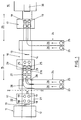
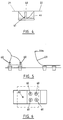
- figure 1 is a schematic plan view of the embodiment of a carton packaging machine according to the invention;
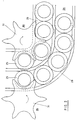
- figure 2 is a detailed plan view, to an enlarged scale, of the operating components of an automatic product loading device used at one or a pair of product loading stations arranged along the length of the conveyor sshown in figure 1.
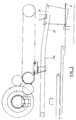
- figure 3 is a detailed side view, to an enlarged scale, showing the means by which product is fed and then guided to fall under gravity into apertured blanks as they are advanced by the conveyor through each loading station;
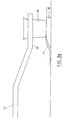
- figure 3a is a schematic side view showing an alternative arrangement, by which product is located in the blanks prior to falling off the second guide;
- figure 4 is a cross-section on line II-II of figure 1 showing the elongate support member;
- figure 5 shows a side view of a loaded blank before transit through the erection station: and
- figure 6 is a plan view of a portion of the machine of figure 1 illustrating the position of the sensors.
- Referring to the figure 1, a schematic plan view of an embodiment of a carton-packaging machine according to the invention is shown and is designated generally by the
reference 10. A blank-supply station 11 is arranged at the upstream end of the machine, and includes the magazine 12 (not show in detail) which can hold a stack of blanks and permit supply of blanks individually in turn in flat form into the path of travel from theblank supply station 11 and through aproduct loading station 15, an erection station, a folding station and a discharge station, all of which can be of conventional form, and which are shown schematically byreference 16. By way of example only, the erection and folding mechanism may be as disclosed in more detail in UK Patent application number 8909783.6 filed on 28 April 1989 in the name of Bonar Cooke Carton Limited. - In the illustrated arrangement, each blank 17 has first and second pairs of
apertures short side flap 21 andlonger side flap 22 extend away from the base 20. As shown in figure 1, blank 17 is discharged in flat form onto theconveyer 14 by themagazine 12, and in this form it is advanced throughloading station 15 so as to receive in its apertures product from a two lane automatic loading device provided at theloading station 15. - At the
loading station 15, the automatic loading device is able to load the first pair ofapertures 18 with product, and downstream of thisfirst loading station 15, there is afurther loading station 23 which is able to supply automatically two further lanes of product which are fed towards the conveyor perpendicularly thereof, and then guided along the length of the conveyor, finally to fall under gravity into the second pair ofapertures 19. - The
loading stations first guide 24 which guidesproduct 25 along twolanes 26 which are side by side in a direction perpendicular to the general direction of theconveyor 14 and then thefirst guide 24 merges or runs into asecond guide 27 which guides theproduct 25 via acurved portion 28 to move generally along the length of the conveyor, whereby the product can then fall under gravity off thefree end 29 of arectiliniar portion 27a of thesecond guide 27 and into the awaiting apertures of each blank. In respect of theloading station 15, theproducts 25 are received by the first pair ofapertures 18, whereas the automatic loading device at thesecond loading station 23 is able to guide two lanes of product into the second pair ofapertures 19. - After issue from the
second loading station 23, each blank 17 has fourproducts 25 received in its base apertures, and the blank is still in flat form. In this form theconveyor 14 then conveys the loaded blanks towards thestation 16, at which the side flaps 21 and 22 of the blanks are erected into a substantially vertical position, and then the upper edges of the side flaps are engaged and guided inwardly into overlapping relation and sealed closed in any convenient manner. - The two
loading stations first guide 24, and therectilinear portions 27a of thesecond guide 27. However, to feed the products from thefirst guide 24 to thesecond guide 27, preferably power driven feeding devices are provided, as will now be described with reference to figure 2. - Each
lane 26 has associated therewith arotary indexing device 31 which is able to engage and to advance theproducts 25 individually along thecurve portion 28 and on to therectilinear portion 27a of thesecond guide 27 and these products are advanced in timed sequence with the movement of theconveyor 14 so that the products fall under gravity off the end of thesecond guide 27 into theapertures stations indexing device 31 has a plurality of circumferentially spacedpockets 32 in which theproducts 25 are received, and effectively thedevices 31 comprise so called "star wheels". - Figure 3 shows in side view the
portion 27a of thesecond guide 27, and suitable trip mechanisms will be arranged to ensure thatproduct 25 can fall off the end and into the awaiting apertures at the correct time. Also, though not shown trip mechanisms may be arranged at or near the exit ends of thelanes 26, so that product can be advanced to theindexing devices 31 each time a fresh blank is advanced through the loading stations. - Referring to figure 3a, an alternative arrangement of the second guide and the
conveyor 14, is shown wherein theproduct 25 does not fall off the second guide until it has engaged in the blank 7. Theend portion 29 of thesecond guide 27 holds the product in a position such that it is generally perpendicular to theconveyor 14. On the conveyor, are positioned three ramps (only one of which is shown). As the blank 17 moves along theconveyor 14 it is raised up by theramps 35. Theproduct 25 is thus engaged in the blank 17 before it falls off thesecond guide 29. - Once the blanks have been loaded they progress along the
endless conveyor 14. During the movement of the blanks through the various stations of the machine. amid-region 40 of the base 20 of each blank is supported by anelongate support 41 which extends longitudinally of the upper run of the conveyor and just out of engagement with the conveying surface of the conveyor. Theflights 13 are shaped as shown in figure 4, so as not to engage thesupport 41 during movement of the conveyor. The support provided by theelongate support 41 provides rigidity to the base of each blank during transit through the various stations of the machine, and this is particularly useful during the loading of the base with food product which is suspended therefrom. Additional support for the base of each blank is provided by longitudinally extending side rails (not shown) arranged above the upper run of theconveyor 14, and this may be somewhat similar to the rail support provided in the carton packaging machine disclosed in international publication number WO88/04259. - To provide improved location of any improperly located food product, an
overhead guide 50 is arranged downstream of the loading station as shown in figure 5, and applies gentle downward pressure onto the upper ends of the food containers. The guide may be hinged along itsupper end 50a, and may thus may act as a safety device, causing theconveyor 14 to stop when theguide 50 is moved. Prior to the blanks arriving underneath theguide 50, the blanks pass beneathsensors 60. As shown in figure 6, there are 5sensors 60. Four of thesensors 60 are each positioned so that they may sense the presence of a respective food product, and thefifth senser 60 is positioned so that it may sense the presence of the blank. In the event of one or more of thesensors 60 detecting the absence of a food product, theconveyor 14 will stop. The problem may then be solved before the process is continued. If however, neither food product, nor blank is present, theconveyor 14 will continue. After the blanks have passed beneath theguide 50, each blank with product located is advanced to a folding device (not shown in detail), and which may take the form of conventional "ploughs", which apply consecutively inward folding of theshort flap 21 and then thelonger flap 22, but with the application of hot metal adhesive onto the upper side ofshort flap 21 immediately prior to application oflonger flap 22 which is then adhesively pressed downwardly thereon. - For certain uses, this will provide an acceptable form of packaging for this food product, although if additional rigidity is required for the assembled sleeve form of each blank (base plus overlapping
side flap 21 and side flap 22), additional adhesive may be applied on the base 20. - Alternatively, a mechanical interlock may be provided, by punching downwardly a locking tab out of the side flap and through a preformed locking recess in the base (20).
Claims (16)
- A carton packaging machine (10) which is operable to cause progressive erection of carton sleeves from a supply of blanks, each blank (17) comprising a base (20) and a pair of side flaps (21,22) which can be folded inwardly so as to overlie the base when loaded with product, and in which the machine comprises:
an endless conveyor (14) moveable progressively through a blank-supply station (11); a product-loading station (16), at which products can be loaded onto respective bases; an erection and folding station (16); and a discharge station;
a magazine (12) arranged at the blank-supply station for holding a stack of blanks, and for delivering the blanks individually in turn, in flat form into the path of travel of the conveyor;
a folding device arranged at the folding station and engageable by each blank in order to form the blank into a U-shape with the base thereof extending substantially horizontally and the pair of side flaps extending upwardly therefrom and to fold the side flaps inwardly into overlapping relation in order to complete the formation of the carton sleeve; characterised in that the machine further comprises an elongate support (41) extending along the length of the conveyor and arranged to engage the underside of a mid-region (40) of the base of each blank during advancing movement of the blank from the blank-supply station to the discharge station. - A carton-packaging machine as claimed in claim 1 wherein the machine is a "two-lane" machine in which each lane of product can be arranged on a respective side of the elongate support.
- A carton-packaging machine as claimed in claim 1 or claim 2 comprising generally horizontal rails extending alongside and above the upper run of the endless conveyor.
- A carton-packaging machine as claimed in any one of claims 1 to 3 wherein each blank comprises a base (17) having at least a pair of circular apertures (18) to receive product to be suspended therein.
- A carton-packaging machine as claimed in any one of claims 1 to 4 wherein the loading station comprises an automatic loading device (24,27) arranged to guide at least one lane of product towards the conveyor and to load each blank with respective product as the blank is advanced by the conveyor through the loading station.
- A carton-packaging machine as claimed in claim 5 wherein the loading device has a first guide (24) which extends transversely towards the conveyor, and which runs into a second guide (27) which guides the product into movement in a direction generally parallel to the conveyor whereby the product can fall under gravity off the end of the second guide and onto the base of each underlying blank as it is conveyed through the loading station.
- A carton-packaging machine as claimed in claim 5 wherein the loading device has a first guide (24) which extends transversely toward the conveyor, and which runs into a second guide (27) which guides the product into movement in a direction generally parallel to the conveyor and further comprising ramp means (35) located on the conveyor (14) and positioned substantially below the second guide.
- A carton-packaging machine as claimed in claim 6 wherein each blank comprises a base having at least two pairs of circular apertures (18,19), the machine further comprising a second loading station (23) arranged downstream of the first loading station and having its own loading device.
- A carton-packaging machine as claimed in any one of claims 6,7, and 8 wherein the or each loading device includes a pair of rotary indexing devices (31) which are capable of advancing the products individually from the or each of the lanes from the first guide to the second guide.
- A carton-packaging machine as claimed in claim 9 wherein each indexing device takes the form of a so-called "star wheel" which is a rotary device having a plurality of circumferentially spaced sockets or pockets (32) each shaped to be able to receive and to advance the product.
- A carton-packaging device according to any one of claims 1 to 10 further comprising an overhead guide (50) arranged at the folding station upstream of the folding device, said guide being engageable with the tops of the products to locate products securely in position.
- A carton-packaging machine as claimed in claim 11 wherein the guide comprises a guide plate (50) which extends downwardly and rearwardly with respect to the direction of travel of the conveyor, so as to engage firmly with the tops of the product containers.
- A carton-packaging machine as claimed in claim 11 or claim 12 further comprising a safety interlock device.
- A carton-packaging machine as claimed in any one of the preceding claims wherein one of the side flaps (18) is a short side flap, and the other (19) is a longer side flap which is capable of overlying the short side flap and also the entire base.
- A carton-packaging machine as claimed in any one of the preceding claims further comprising additional means for securing the longer flap downwardly onto the base.
- A carton-packaging machine as claimed in claim 15 wherein the additional securing means is a mechanical interlock.
Applications Claiming Priority (4)
| Application Number | Priority Date | Filing Date | Title |
|---|---|---|---|
| GB8909783 | 1989-04-28 | ||
| GB898909783A GB8909783D0 (en) | 1989-04-28 | 1989-04-28 | Carton packaging machine |
| GB898923160A GB8923160D0 (en) | 1989-10-13 | 1989-10-13 | Carton packaging machine |
| GB8923160 | 1989-10-13 |
Publications (2)
| Publication Number | Publication Date |
|---|---|
| EP0470152A1 EP0470152A1 (en) | 1992-02-12 |
| EP0470152B1 true EP0470152B1 (en) | 1994-02-09 |
Family
ID=26295285
Family Applications (1)
| Application Number | Title | Priority Date | Filing Date |
|---|---|---|---|
| EP19900907211 Expired - Lifetime EP0470152B1 (en) | 1989-04-28 | 1990-04-30 | Machine for forming a package from a blank |
Country Status (3)
| Country | Link |
|---|---|
| EP (1) | EP0470152B1 (en) |
| DE (1) | DE69006596D1 (en) |
| WO (1) | WO1990013486A1 (en) |
Cited By (1)
| Publication number | Priority date | Publication date | Assignee | Title |
|---|---|---|---|---|
| DE102023209591A1 (en) * | 2023-09-29 | 2025-04-03 | ZWi Technologies GmbH | packaging machine |
Family Cites Families (3)
| Publication number | Priority date | Publication date | Assignee | Title |
|---|---|---|---|---|
| US2817197A (en) * | 1956-02-03 | 1957-12-24 | Gardner Board & Carton Co | Can packaging apparatus |
| FR1542725A (en) * | 1967-09-06 | 1968-10-18 | Cartonnages Du Val De Seine | Group packaging and machine for its automatic production |
| GB8333706D0 (en) * | 1983-12-19 | 1984-01-25 | Mead Corp | Packaging machine method |
-
1990
- 1990-04-30 EP EP19900907211 patent/EP0470152B1/en not_active Expired - Lifetime
- 1990-04-30 WO PCT/GB1990/000667 patent/WO1990013486A1/en not_active Ceased
- 1990-04-30 DE DE90907211T patent/DE69006596D1/en not_active Expired - Lifetime
Cited By (2)
| Publication number | Priority date | Publication date | Assignee | Title |
|---|---|---|---|---|
| DE102023209591A1 (en) * | 2023-09-29 | 2025-04-03 | ZWi Technologies GmbH | packaging machine |
| DE102023209591A8 (en) | 2023-09-29 | 2025-05-28 | ZWi Technologies GmbH | packaging machine |
Also Published As
| Publication number | Publication date |
|---|---|
| EP0470152A1 (en) | 1992-02-12 |
| DE69006596D1 (en) | 1994-03-24 |
| WO1990013486A1 (en) | 1990-11-15 |
Similar Documents
| Publication | Publication Date | Title |
|---|---|---|
| CA2215965C (en) | Packaging machine for multi-packs | |
| EP0387336B1 (en) | Article separating and loading apparatus | |
| EP0268611B1 (en) | Method and apparatus for feeding containers to a carrier sleeve | |
| EP0817748B1 (en) | Carrier feeder mechanism and apparatus for loading containers into open-bottomed carrier | |
| US5943847A (en) | Packaging machine for multi-packs | |
| KR101501768B1 (en) | Wrap around caser continuously bundling the numerous bottles | |
| EP0149351B1 (en) | Packaging machine and method | |
| US4443995A (en) | Metering device and method | |
| US4571916A (en) | Secondary packaging machine | |
| US5481848A (en) | Method for feeding and preparing information leaflets on a product packaging line and a system for implementing this method | |
| US4709538A (en) | Apparatus for feeding and opening a beverage carrier | |
| GB2141093A (en) | Erecting trays about their contents | |
| CA1141646A (en) | Packaging machine | |
| US10829250B2 (en) | Methods and machine for packaging primary containers in secondary containers and a shipping tray | |
| WO1990013486A1 (en) | Machine for forming a package from a blank | |
| EP0092402A2 (en) | Improved carton packing apparatus | |
| KR20170014981A (en) | feeder supply to autofold innerbox wherein autopackage system with sliging box package | |
| EP0270528B1 (en) | Method and apparatus for erecting, filling and sealing a packing blank, and packing blank | |
| EP0337997B1 (en) | Carton packaging machine | |
| CA1316446C (en) | Carton packaging machine | |
| CA2295360A1 (en) | Machine for folding a downwardly directed bottom section of a packing box beneath a product being packaged |
Legal Events
| Date | Code | Title | Description |
|---|---|---|---|
| PUAI | Public reference made under article 153(3) epc to a published international application that has entered the european phase |
Free format text: ORIGINAL CODE: 0009012 |
|
| 17P | Request for examination filed |
Effective date: 19911127 |
|
| AK | Designated contracting states |
Kind code of ref document: A1 Designated state(s): DE ES FR GB IT NL |
|
| 17Q | First examination report despatched |
Effective date: 19921112 |
|
| GRAA | (expected) grant |
Free format text: ORIGINAL CODE: 0009210 |
|
| AK | Designated contracting states |
Kind code of ref document: B1 Designated state(s): DE ES FR GB IT NL |
|
| PG25 | Lapsed in a contracting state [announced via postgrant information from national office to epo] |
Ref country code: IT Free format text: LAPSE BECAUSE OF FAILURE TO SUBMIT A TRANSLATION OF THE DESCRIPTION OR TO PAY THE FEE WITHIN THE PRE;WARNING: LAPSES OF ITALIAN PATENTS WITH EFFECTIVE DATE BEFORE 2007 MAY HAVE OCCURRED AT ANY TIME BEFORE 2007. THE CORRECT EFFECTIVE DATE MAY BE DIFFERENT FROM THE ONE RECORDED.SCRIBED TIME-LIMIT Effective date: 19940209 Ref country code: NL Effective date: 19940209 Ref country code: DE Effective date: 19940209 Ref country code: FR Free format text: THE PATENT HAS BEEN ANNULLED BY A DECISION OF A NATIONAL AUTHORITY Effective date: 19940209 Ref country code: ES Free format text: THE PATENT HAS BEEN ANNULLED BY A DECISION OF A NATIONAL AUTHORITY Effective date: 19940209 |
|
| REF | Corresponds to: |
Ref document number: 69006596 Country of ref document: DE Date of ref document: 19940324 |
|
| PG25 | Lapsed in a contracting state [announced via postgrant information from national office to epo] |
Ref country code: GB Effective date: 19940509 |
|
| EN | Fr: translation not filed | ||
| NLV1 | Nl: lapsed or annulled due to failure to fulfill the requirements of art. 29p and 29m of the patents act | ||
| PLBE | No opposition filed within time limit |
Free format text: ORIGINAL CODE: 0009261 |
|
| STAA | Information on the status of an ep patent application or granted ep patent |
Free format text: STATUS: NO OPPOSITION FILED WITHIN TIME LIMIT |
|
| GBPC | Gb: european patent ceased through non-payment of renewal fee |
Effective date: 19940509 |
|
| 26N | No opposition filed |