EP0464880A1 - Bleaching composition - Google Patents
Bleaching composition Download PDFInfo
- Publication number
- EP0464880A1 EP0464880A1 EP19910201260 EP91201260A EP0464880A1 EP 0464880 A1 EP0464880 A1 EP 0464880A1 EP 19910201260 EP19910201260 EP 19910201260 EP 91201260 A EP91201260 A EP 91201260A EP 0464880 A1 EP0464880 A1 EP 0464880A1
- Authority
- EP
- European Patent Office
- Prior art keywords
- alkyl
- cationic
- cationic nitrile
- group
- anion
- Prior art date
- Legal status (The legal status is an assumption and is not a legal conclusion. Google has not performed a legal analysis and makes no representation as to the accuracy of the status listed.)
- Granted
Links
- 238000004061 bleaching Methods 0.000 title claims abstract description 14
- 239000000203 mixture Substances 0.000 title claims description 53
- -1 cationic nitriles Chemical class 0.000 claims abstract description 82
- 239000002243 precursor Substances 0.000 claims abstract description 43
- 239000007844 bleaching agent Substances 0.000 claims abstract description 28
- 239000003599 detergent Substances 0.000 claims abstract description 23
- 150000001450 anions Chemical class 0.000 claims abstract description 13
- 239000004094 surface-active agent Substances 0.000 claims abstract description 12
- 125000004432 carbon atom Chemical group C* 0.000 claims abstract description 11
- 125000000217 alkyl group Chemical group 0.000 claims abstract description 10
- 125000001997 phenyl group Chemical group [H]C1=C([H])C([H])=C(*)C([H])=C1[H] 0.000 claims abstract description 7
- 125000005037 alkyl phenyl group Chemical group 0.000 claims abstract description 5
- 125000002947 alkylene group Chemical group 0.000 claims abstract description 5
- 150000005215 alkyl ethers Chemical class 0.000 claims abstract description 4
- 150000001875 compounds Chemical class 0.000 claims description 24
- 150000002978 peroxides Chemical class 0.000 claims description 14
- 125000002496 methyl group Chemical group [H]C([H])([H])* 0.000 claims description 12
- 125000004178 (C1-C4) alkyl group Chemical group 0.000 claims description 6
- 239000011149 active material Substances 0.000 claims description 5
- 125000001424 substituent group Chemical group 0.000 claims description 5
- 125000003342 alkenyl group Chemical group 0.000 claims description 4
- 125000001273 sulfonato group Chemical group [O-]S(*)(=O)=O 0.000 claims description 4
- 150000001335 aliphatic alkanes Chemical class 0.000 claims description 3
- 125000005011 alkyl ether group Chemical group 0.000 claims description 3
- 229910052799 carbon Inorganic materials 0.000 claims description 3
- 159000000000 sodium salts Chemical class 0.000 claims description 3
- 229910021653 sulphate ion Inorganic materials 0.000 claims description 3
- 125000006686 (C1-C24) alkyl group Chemical group 0.000 claims description 2
- 125000004209 (C1-C8) alkyl group Chemical group 0.000 claims description 2
- QTDIEDOANJISNP-UHFFFAOYSA-N 2-dodecoxyethyl hydrogen sulfate Chemical compound CCCCCCCCCCCCOCCOS(O)(=O)=O QTDIEDOANJISNP-UHFFFAOYSA-N 0.000 claims description 2
- 239000002253 acid Substances 0.000 claims description 2
- YRIUSKIDOIARQF-UHFFFAOYSA-N dodecyl benzenesulfonate Chemical compound CCCCCCCCCCCCOS(=O)(=O)C1=CC=CC=C1 YRIUSKIDOIARQF-UHFFFAOYSA-N 0.000 claims description 2
- 125000002768 hydroxyalkyl group Chemical group 0.000 claims description 2
- 239000012188 paraffin wax Substances 0.000 claims description 2
- 125000004076 pyridyl group Chemical group 0.000 claims description 2
- JOXIMZWYDAKGHI-UHFFFAOYSA-M toluene-4-sulfonate Chemical compound CC1=CC=C(S([O-])(=O)=O)C=C1 JOXIMZWYDAKGHI-UHFFFAOYSA-M 0.000 claims description 2
- 239000011872 intimate mixture Substances 0.000 claims 1
- 238000000034 method Methods 0.000 abstract description 13
- 150000002825 nitriles Chemical class 0.000 abstract description 7
- 239000000463 material Substances 0.000 description 24
- MHAJPDPJQMAIIY-UHFFFAOYSA-N Hydrogen peroxide Chemical compound OO MHAJPDPJQMAIIY-UHFFFAOYSA-N 0.000 description 22
- WEVYAHXRMPXWCK-UHFFFAOYSA-N Acetonitrile Chemical compound CC#N WEVYAHXRMPXWCK-UHFFFAOYSA-N 0.000 description 21
- 239000000047 product Substances 0.000 description 18
- 229910052708 sodium Inorganic materials 0.000 description 17
- 239000011734 sodium Substances 0.000 description 17
- 239000007787 solid Substances 0.000 description 17
- DGAQECJNVWCQMB-PUAWFVPOSA-M Ilexoside XXIX Chemical compound C[C@@H]1CC[C@@]2(CC[C@@]3(C(=CC[C@H]4[C@]3(CC[C@@H]5[C@@]4(CC[C@@H](C5(C)C)OS(=O)(=O)[O-])C)C)[C@@H]2[C@]1(C)O)C)C(=O)O[C@H]6[C@@H]([C@H]([C@@H]([C@H](O6)CO)O)O)O.[Na+] DGAQECJNVWCQMB-PUAWFVPOSA-M 0.000 description 16
- 238000005481 NMR spectroscopy Methods 0.000 description 15
- OKKJLVBELUTLKV-UHFFFAOYSA-N Methanol Chemical compound OC OKKJLVBELUTLKV-UHFFFAOYSA-N 0.000 description 12
- GETQZCLCWQTVFV-UHFFFAOYSA-N trimethylamine Chemical compound CN(C)C GETQZCLCWQTVFV-UHFFFAOYSA-N 0.000 description 12
- 150000004965 peroxy acids Chemical class 0.000 description 11
- LFQSCWFLJHTTHZ-UHFFFAOYSA-N Ethanol Chemical compound CCO LFQSCWFLJHTTHZ-UHFFFAOYSA-N 0.000 description 9
- 239000007788 liquid Substances 0.000 description 9
- BGJSXRVXTHVRSN-UHFFFAOYSA-N 1,3,5-trioxane Chemical compound C1OCOCO1 BGJSXRVXTHVRSN-UHFFFAOYSA-N 0.000 description 8
- 238000003556 assay Methods 0.000 description 8
- 239000000344 soap Substances 0.000 description 8
- 239000000243 solution Substances 0.000 description 8
- 239000000654 additive Substances 0.000 description 7
- 238000006243 chemical reaction Methods 0.000 description 7
- 235000014113 dietary fatty acids Nutrition 0.000 description 7
- 239000000194 fatty acid Substances 0.000 description 7
- 229930195729 fatty acid Natural products 0.000 description 7
- QLAJNZSPVITUCQ-UHFFFAOYSA-N 1,3,2-dioxathietane 2,2-dioxide Chemical compound O=S1(=O)OCO1 QLAJNZSPVITUCQ-UHFFFAOYSA-N 0.000 description 6
- 125000000129 anionic group Chemical group 0.000 description 6
- 150000003839 salts Chemical class 0.000 description 6
- PLXBWEPPAAQASG-UHFFFAOYSA-N 2-(Dimethylamino)acetonitrile Chemical compound CN(C)CC#N PLXBWEPPAAQASG-UHFFFAOYSA-N 0.000 description 5
- IAYPIBMASNFSPL-UHFFFAOYSA-N Ethylene oxide Chemical compound C1CO1 IAYPIBMASNFSPL-UHFFFAOYSA-N 0.000 description 5
- 230000000996 additive effect Effects 0.000 description 5
- 150000001298 alcohols Chemical class 0.000 description 5
- 230000015572 biosynthetic process Effects 0.000 description 5
- 125000002091 cationic group Chemical group 0.000 description 5
- 239000007795 chemical reaction product Substances 0.000 description 5
- 238000002474 experimental method Methods 0.000 description 5
- 150000004665 fatty acids Chemical class 0.000 description 5
- 238000005342 ion exchange Methods 0.000 description 5
- OYPRJOBELJOOCE-UHFFFAOYSA-N Calcium Chemical compound [Ca] OYPRJOBELJOOCE-UHFFFAOYSA-N 0.000 description 4
- RTZKZFJDLAIYFH-UHFFFAOYSA-N Diethyl ether Chemical compound CCOCC RTZKZFJDLAIYFH-UHFFFAOYSA-N 0.000 description 4
- FAPWRFPIFSIZLT-UHFFFAOYSA-M Sodium chloride Chemical compound [Na+].[Cl-] FAPWRFPIFSIZLT-UHFFFAOYSA-M 0.000 description 4
- HEDRZPFGACZZDS-MICDWDOJSA-N Trichloro(2H)methane Chemical compound [2H]C(Cl)(Cl)Cl HEDRZPFGACZZDS-MICDWDOJSA-N 0.000 description 4
- 239000002585 base Substances 0.000 description 4
- 239000011575 calcium Substances 0.000 description 4
- 229910052791 calcium Inorganic materials 0.000 description 4
- 125000003438 dodecyl group Chemical group [H]C([H])([H])C([H])([H])C([H])([H])C([H])([H])C([H])([H])C([H])([H])C([H])([H])C([H])([H])C([H])([H])C([H])([H])C([H])([H])C([H])([H])* 0.000 description 4
- MOTZDAYCYVMXPC-UHFFFAOYSA-N dodecyl hydrogen sulfate Chemical compound CCCCCCCCCCCCOS(O)(=O)=O MOTZDAYCYVMXPC-UHFFFAOYSA-N 0.000 description 4
- 238000009472 formulation Methods 0.000 description 4
- CDBYLPFSWZWCQE-UHFFFAOYSA-L sodium carbonate Substances [Na+].[Na+].[O-]C([O-])=O CDBYLPFSWZWCQE-UHFFFAOYSA-L 0.000 description 4
- 229960001922 sodium perborate Drugs 0.000 description 4
- 239000000758 substrate Substances 0.000 description 4
- 238000012360 testing method Methods 0.000 description 4
- XLYOFNOQVPJJNP-UHFFFAOYSA-N water Substances O XLYOFNOQVPJJNP-UHFFFAOYSA-N 0.000 description 4
- GQJKKKULUSFWSC-UHFFFAOYSA-N 2-(dimethylamino)propanenitrile Chemical compound N#CC(C)N(C)C GQJKKKULUSFWSC-UHFFFAOYSA-N 0.000 description 3
- PUAQLLVFLMYYJJ-UHFFFAOYSA-N 2-aminopropiophenone Chemical compound CC(N)C(=O)C1=CC=CC=C1 PUAQLLVFLMYYJJ-UHFFFAOYSA-N 0.000 description 3
- CSCPPACGZOOCGX-UHFFFAOYSA-N Acetone Chemical compound CC(C)=O CSCPPACGZOOCGX-UHFFFAOYSA-N 0.000 description 3
- UHOVQNZJYSORNB-UHFFFAOYSA-N Benzene Chemical class C1=CC=CC=C1 UHOVQNZJYSORNB-UHFFFAOYSA-N 0.000 description 3
- IAZDPXIOMUYVGZ-UHFFFAOYSA-N Dimethylsulphoxide Chemical compound CS(C)=O IAZDPXIOMUYVGZ-UHFFFAOYSA-N 0.000 description 3
- LYCAIKOWRPUZTN-UHFFFAOYSA-N Ethylene glycol Chemical compound OCCO LYCAIKOWRPUZTN-UHFFFAOYSA-N 0.000 description 3
- PEDCQBHIVMGVHV-UHFFFAOYSA-N Glycerine Chemical compound OCC(O)CO PEDCQBHIVMGVHV-UHFFFAOYSA-N 0.000 description 3
- HEMHJVSKTPXQMS-UHFFFAOYSA-M Sodium hydroxide Chemical compound [OH-].[Na+] HEMHJVSKTPXQMS-UHFFFAOYSA-M 0.000 description 3
- BGRWYDHXPHLNKA-UHFFFAOYSA-N Tetraacetylethylenediamine Chemical compound CC(=O)N(C(C)=O)CCN(C(C)=O)C(C)=O BGRWYDHXPHLNKA-UHFFFAOYSA-N 0.000 description 3
- MWCHNHCXSRTHRF-UHFFFAOYSA-N acetonitrile;trimethylazanium;chloride Chemical compound [Cl-].CC#N.C[NH+](C)C MWCHNHCXSRTHRF-UHFFFAOYSA-N 0.000 description 3
- 229910052783 alkali metal Inorganic materials 0.000 description 3
- 229910000323 aluminium silicate Inorganic materials 0.000 description 3
- 150000001408 amides Chemical class 0.000 description 3
- ONANWDUDFJIIGP-UHFFFAOYSA-N carbamoyl carbamoperoxoate Chemical compound NC(=O)OOC(N)=O ONANWDUDFJIIGP-UHFFFAOYSA-N 0.000 description 3
- KRKNYBCHXYNGOX-UHFFFAOYSA-N citric acid Chemical compound OC(=O)CC(O)(C(O)=O)CC(O)=O KRKNYBCHXYNGOX-UHFFFAOYSA-N 0.000 description 3
- 235000019864 coconut oil Nutrition 0.000 description 3
- 239000003240 coconut oil Substances 0.000 description 3
- VTIIJXUACCWYHX-UHFFFAOYSA-L disodium;carboxylatooxy carbonate Chemical compound [Na+].[Na+].[O-]C(=O)OOC([O-])=O VTIIJXUACCWYHX-UHFFFAOYSA-L 0.000 description 3
- POULHZVOKOAJMA-UHFFFAOYSA-M dodecanoate Chemical compound CCCCCCCCCCCC([O-])=O POULHZVOKOAJMA-UHFFFAOYSA-M 0.000 description 3
- 239000004744 fabric Substances 0.000 description 3
- 230000003301 hydrolyzing effect Effects 0.000 description 3
- 239000004615 ingredient Substances 0.000 description 3
- 229940070765 laurate Drugs 0.000 description 3
- 230000000269 nucleophilic effect Effects 0.000 description 3
- 239000000843 powder Substances 0.000 description 3
- 150000003254 radicals Chemical class 0.000 description 3
- 229940045872 sodium percarbonate Drugs 0.000 description 3
- YKLJGMBLPUQQOI-UHFFFAOYSA-M sodium;oxidooxy(oxo)borane Chemical compound [Na+].[O-]OB=O YKLJGMBLPUQQOI-UHFFFAOYSA-M 0.000 description 3
- 238000003786 synthesis reaction Methods 0.000 description 3
- CIOXZGOUEYHNBF-UHFFFAOYSA-N (carboxymethoxy)succinic acid Chemical class OC(=O)COC(C(O)=O)CC(O)=O CIOXZGOUEYHNBF-UHFFFAOYSA-N 0.000 description 2
- RIDGSEGTBIWFTK-UHFFFAOYSA-N 2-(dimethylamino)-2-methylpropanenitrile Chemical compound CN(C)C(C)(C)C#N RIDGSEGTBIWFTK-UHFFFAOYSA-N 0.000 description 2
- PAGHXXKYFBGJEH-UHFFFAOYSA-N 2-(dimethylamino)-2-phenylacetonitrile Chemical compound CN(C)C(C#N)C1=CC=CC=C1 PAGHXXKYFBGJEH-UHFFFAOYSA-N 0.000 description 2
- XSVSPKKXQGNHMD-UHFFFAOYSA-N 5-bromo-3-methyl-1,2-thiazole Chemical compound CC=1C=C(Br)SN=1 XSVSPKKXQGNHMD-UHFFFAOYSA-N 0.000 description 2
- 244000060011 Cocos nucifera Species 0.000 description 2
- 235000013162 Cocos nucifera Nutrition 0.000 description 2
- KCXVZYZYPLLWCC-UHFFFAOYSA-N EDTA Chemical class OC(=O)CN(CC(O)=O)CCN(CC(O)=O)CC(O)=O KCXVZYZYPLLWCC-UHFFFAOYSA-N 0.000 description 2
- 102000004190 Enzymes Human genes 0.000 description 2
- 108090000790 Enzymes Proteins 0.000 description 2
- KFZMGEQAYNKOFK-UHFFFAOYSA-N Isopropanol Chemical compound CC(C)O KFZMGEQAYNKOFK-UHFFFAOYSA-N 0.000 description 2
- 229910002651 NO3 Inorganic materials 0.000 description 2
- NHNBFGGVMKEFGY-UHFFFAOYSA-N Nitrate Chemical compound [O-][N+]([O-])=O NHNBFGGVMKEFGY-UHFFFAOYSA-N 0.000 description 2
- 229910019142 PO4 Inorganic materials 0.000 description 2
- PMZURENOXWZQFD-UHFFFAOYSA-L Sodium Sulfate Chemical compound [Na+].[Na+].[O-]S([O-])(=O)=O PMZURENOXWZQFD-UHFFFAOYSA-L 0.000 description 2
- 239000001083 [(2R,3R,4S,5R)-1,2,4,5-tetraacetyloxy-6-oxohexan-3-yl] acetate Substances 0.000 description 2
- DNVWJWSHVBHFKS-UHFFFAOYSA-N acetonitrile N-methylmethanamine Chemical compound C(C)#N.CNC DNVWJWSHVBHFKS-UHFFFAOYSA-N 0.000 description 2
- HFVYXBUPSBLINW-UHFFFAOYSA-N acetonitrile;4-methylbenzenesulfonate;trimethylazanium Chemical compound CC#N.C[NH+](C)C.CC1=CC=C(S([O-])(=O)=O)C=C1 HFVYXBUPSBLINW-UHFFFAOYSA-N 0.000 description 2
- GHDBLWVVUWTQCG-UHFFFAOYSA-N acetonitrile;n,n-dimethylmethanamine Chemical compound CC#N.CN(C)C GHDBLWVVUWTQCG-UHFFFAOYSA-N 0.000 description 2
- 239000012190 activator Substances 0.000 description 2
- 150000001340 alkali metals Chemical class 0.000 description 2
- 239000012670 alkaline solution Substances 0.000 description 2
- 150000003863 ammonium salts Chemical class 0.000 description 2
- 239000007864 aqueous solution Substances 0.000 description 2
- SRSXLGNVWSONIS-UHFFFAOYSA-N benzenesulfonic acid Chemical class OS(=O)(=O)C1=CC=CC=C1 SRSXLGNVWSONIS-UHFFFAOYSA-N 0.000 description 2
- 239000003795 chemical substances by application Substances 0.000 description 2
- 238000004140 cleaning Methods 0.000 description 2
- POULHZVOKOAJMA-UHFFFAOYSA-N dodecanoic acid Chemical compound CCCCCCCCCCCC(O)=O POULHZVOKOAJMA-UHFFFAOYSA-N 0.000 description 2
- 238000007580 dry-mixing Methods 0.000 description 2
- 238000001035 drying Methods 0.000 description 2
- 229960001484 edetic acid Drugs 0.000 description 2
- 230000000694 effects Effects 0.000 description 2
- 229940088598 enzyme Drugs 0.000 description 2
- 125000001495 ethyl group Chemical group [H]C([H])([H])C([H])([H])* 0.000 description 2
- 238000001704 evaporation Methods 0.000 description 2
- 239000007850 fluorescent dye Substances 0.000 description 2
- 229910052739 hydrogen Inorganic materials 0.000 description 2
- 230000007062 hydrolysis Effects 0.000 description 2
- 238000006460 hydrolysis reaction Methods 0.000 description 2
- SUMDYPCJJOFFON-UHFFFAOYSA-N isethionic acid Chemical compound OCCS(O)(=O)=O SUMDYPCJJOFFON-UHFFFAOYSA-N 0.000 description 2
- YDSWCNNOKPMOTP-UHFFFAOYSA-N mellitic acid Chemical class OC(=O)C1=C(C(O)=O)C(C(O)=O)=C(C(O)=O)C(C(O)=O)=C1C(O)=O YDSWCNNOKPMOTP-UHFFFAOYSA-N 0.000 description 2
- MGFYIUFZLHCRTH-UHFFFAOYSA-N nitrilotriacetic acid Chemical compound OC(=O)CN(CC(O)=O)CC(O)=O MGFYIUFZLHCRTH-UHFFFAOYSA-N 0.000 description 2
- TWNQGVIAIRXVLR-UHFFFAOYSA-N oxo(oxoalumanyloxy)alumane Chemical compound O=[Al]O[Al]=O TWNQGVIAIRXVLR-UHFFFAOYSA-N 0.000 description 2
- 125000005342 perphosphate group Chemical group 0.000 description 2
- 235000021317 phosphate Nutrition 0.000 description 2
- 239000002244 precipitate Substances 0.000 description 2
- 230000001376 precipitating effect Effects 0.000 description 2
- 238000012545 processing Methods 0.000 description 2
- FVSKHRXBFJPNKK-UHFFFAOYSA-N propionitrile Chemical compound CCC#N FVSKHRXBFJPNKK-UHFFFAOYSA-N 0.000 description 2
- 239000003352 sequestering agent Substances 0.000 description 2
- 229910000029 sodium carbonate Inorganic materials 0.000 description 2
- 239000011780 sodium chloride Substances 0.000 description 2
- 235000019832 sodium triphosphate Nutrition 0.000 description 2
- 239000007790 solid phase Substances 0.000 description 2
- 241000894007 species Species 0.000 description 2
- 238000001228 spectrum Methods 0.000 description 2
- 239000007858 starting material Substances 0.000 description 2
- 125000000547 substituted alkyl group Chemical group 0.000 description 2
- 150000003467 sulfuric acid derivatives Chemical class 0.000 description 2
- 239000003760 tallow Substances 0.000 description 2
- 238000005406 washing Methods 0.000 description 2
- 239000010457 zeolite Substances 0.000 description 2
- 239000004711 α-olefin Substances 0.000 description 2
- CFPOJWPDQWJEMO-UHFFFAOYSA-N 2-(1,2-dicarboxyethoxy)butanedioic acid Chemical class OC(=O)CC(C(O)=O)OC(C(O)=O)CC(O)=O CFPOJWPDQWJEMO-UHFFFAOYSA-N 0.000 description 1
- CAGISDHALCVYJO-UHFFFAOYSA-N 2-(dimethylamino)butanenitrile Chemical compound CCC(C#N)N(C)C CAGISDHALCVYJO-UHFFFAOYSA-N 0.000 description 1
- FRIBMENBGGCKPD-UHFFFAOYSA-N 3-(2,3-dimethoxyphenyl)prop-2-enal Chemical compound COC1=CC=CC(C=CC=O)=C1OC FRIBMENBGGCKPD-UHFFFAOYSA-N 0.000 description 1
- QDDADYIRBDHPRY-UHFFFAOYSA-N 3-(carboxymethoxy)-3-oxopropanoic acid Chemical compound OC(=O)COC(=O)CC(O)=O QDDADYIRBDHPRY-UHFFFAOYSA-N 0.000 description 1
- MTPJEFOSTIKRSS-UHFFFAOYSA-N 3-(dimethylamino)propanenitrile Chemical compound CN(C)CCC#N MTPJEFOSTIKRSS-UHFFFAOYSA-N 0.000 description 1
- YTWUZAQZEVOPGG-UHFFFAOYSA-N 3-acetyl-1-phenylimidazolidine-2,4-dione Chemical compound O=C1N(C(=O)C)C(=O)CN1C1=CC=CC=C1 YTWUZAQZEVOPGG-UHFFFAOYSA-N 0.000 description 1
- BFNQEPXIHHFTOO-UHFFFAOYSA-N 4-methylbenzenesulfonate;propanenitrile;trimethylazanium Chemical compound CCC#N.C[NH+](C)C.CC1=CC=C(S([O-])(=O)=O)C=C1 BFNQEPXIHHFTOO-UHFFFAOYSA-N 0.000 description 1
- QGZKDVFQNNGYKY-UHFFFAOYSA-O Ammonium Chemical compound [NH4+] QGZKDVFQNNGYKY-UHFFFAOYSA-O 0.000 description 1
- 102000013142 Amylases Human genes 0.000 description 1
- 108010065511 Amylases Proteins 0.000 description 1
- CPELXLSAUQHCOX-UHFFFAOYSA-M Bromide Chemical compound [Br-] CPELXLSAUQHCOX-UHFFFAOYSA-M 0.000 description 1
- WFVBUMXBBHLYOD-UHFFFAOYSA-N CC#N.CN(C)C.CCCCCCCCCCCCC1=CC=CC=C1 Chemical compound CC#N.CN(C)C.CCCCCCCCCCCCC1=CC=CC=C1 WFVBUMXBBHLYOD-UHFFFAOYSA-N 0.000 description 1
- BMDATSAUAFBAGX-UHFFFAOYSA-N CCC#N.CC1=CC=C(S(O)(=O)=O)C=C1 Chemical compound CCC#N.CC1=CC=C(S(O)(=O)=O)C=C1 BMDATSAUAFBAGX-UHFFFAOYSA-N 0.000 description 1
- PROUSLLJIJGKTD-UHFFFAOYSA-N CCCC#N.CC1=CC=C(C=C1)S(O)(=O)=O Chemical compound CCCC#N.CC1=CC=C(C=C1)S(O)(=O)=O PROUSLLJIJGKTD-UHFFFAOYSA-N 0.000 description 1
- UXVMQQNJUSDDNG-UHFFFAOYSA-L Calcium chloride Chemical compound [Cl-].[Cl-].[Ca+2] UXVMQQNJUSDDNG-UHFFFAOYSA-L 0.000 description 1
- CURLTUGMZLYLDI-UHFFFAOYSA-N Carbon dioxide Chemical compound O=C=O CURLTUGMZLYLDI-UHFFFAOYSA-N 0.000 description 1
- 102000005575 Cellulases Human genes 0.000 description 1
- 108010084185 Cellulases Proteins 0.000 description 1
- VEXZGXHMUGYJMC-UHFFFAOYSA-M Chloride anion Chemical compound [Cl-] VEXZGXHMUGYJMC-UHFFFAOYSA-M 0.000 description 1
- FBPFZTCFMRRESA-FSIIMWSLSA-N D-Glucitol Natural products OC[C@H](O)[C@H](O)[C@@H](O)[C@H](O)CO FBPFZTCFMRRESA-FSIIMWSLSA-N 0.000 description 1
- FBPFZTCFMRRESA-JGWLITMVSA-N D-glucitol Chemical compound OC[C@H](O)[C@@H](O)[C@H](O)[C@H](O)CO FBPFZTCFMRRESA-JGWLITMVSA-N 0.000 description 1
- PIICEJLVQHRZGT-UHFFFAOYSA-N Ethylenediamine Chemical compound NCCN PIICEJLVQHRZGT-UHFFFAOYSA-N 0.000 description 1
- 239000005639 Lauric acid Substances 0.000 description 1
- 239000004367 Lipase Substances 0.000 description 1
- 102000004882 Lipase Human genes 0.000 description 1
- 108090001060 Lipase Proteins 0.000 description 1
- ONNXINSZGXOWAQ-UHFFFAOYSA-N N,N-dimethylmethanamine propanenitrile Chemical compound CCC#N.CN(C)C ONNXINSZGXOWAQ-UHFFFAOYSA-N 0.000 description 1
- SUZRRICLUFMAQD-UHFFFAOYSA-N N-Methyltaurine Chemical compound CNCCS(O)(=O)=O SUZRRICLUFMAQD-UHFFFAOYSA-N 0.000 description 1
- 102000035195 Peptidases Human genes 0.000 description 1
- 108091005804 Peptidases Proteins 0.000 description 1
- 229930182556 Polyacetal Natural products 0.000 description 1
- 229920000388 Polyphosphate Polymers 0.000 description 1
- ZLMJMSJWJFRBEC-UHFFFAOYSA-N Potassium Chemical compound [K] ZLMJMSJWJFRBEC-UHFFFAOYSA-N 0.000 description 1
- GOOHAUXETOMSMM-UHFFFAOYSA-N Propylene oxide Chemical compound CC1CO1 GOOHAUXETOMSMM-UHFFFAOYSA-N 0.000 description 1
- 239000004365 Protease Substances 0.000 description 1
- DWAQJAXMDSEUJJ-UHFFFAOYSA-M Sodium bisulfite Chemical compound [Na+].OS([O-])=O DWAQJAXMDSEUJJ-UHFFFAOYSA-M 0.000 description 1
- DBMJMQXJHONAFJ-UHFFFAOYSA-M Sodium laurylsulphate Chemical compound [Na+].CCCCCCCCCCCCOS([O-])(=O)=O DBMJMQXJHONAFJ-UHFFFAOYSA-M 0.000 description 1
- 239000004902 Softening Agent Substances 0.000 description 1
- KDYFGRWQOYBRFD-UHFFFAOYSA-N Succinic acid Natural products OC(=O)CCC(O)=O KDYFGRWQOYBRFD-UHFFFAOYSA-N 0.000 description 1
- QAOWNCQODCNURD-UHFFFAOYSA-L Sulfate Chemical compound [O-]S([O-])(=O)=O QAOWNCQODCNURD-UHFFFAOYSA-L 0.000 description 1
- ULUAUXLGCMPNKK-UHFFFAOYSA-N Sulfobutanedioic acid Chemical class OC(=O)CC(C(O)=O)S(O)(=O)=O ULUAUXLGCMPNKK-UHFFFAOYSA-N 0.000 description 1
- QAOWNCQODCNURD-UHFFFAOYSA-N Sulfuric acid Chemical class OS(O)(=O)=O QAOWNCQODCNURD-UHFFFAOYSA-N 0.000 description 1
- 244000269722 Thea sinensis Species 0.000 description 1
- UAOKXEHOENRFMP-ZJIFWQFVSA-N [(2r,3r,4s,5r)-2,3,4,5-tetraacetyloxy-6-oxohexyl] acetate Chemical compound CC(=O)OC[C@@H](OC(C)=O)[C@@H](OC(C)=O)[C@H](OC(C)=O)[C@@H](OC(C)=O)C=O UAOKXEHOENRFMP-ZJIFWQFVSA-N 0.000 description 1
- ZYPMNZKYVVSXOJ-YNEHKIRRSA-N [(2r,3s,4r)-2,3,4-triacetyloxy-5-oxopentyl] acetate Chemical compound CC(=O)OC[C@@H](OC(C)=O)[C@H](OC(C)=O)[C@@H](OC(C)=O)C=O ZYPMNZKYVVSXOJ-YNEHKIRRSA-N 0.000 description 1
- 239000003082 abrasive agent Substances 0.000 description 1
- DPXJVFZANSGRMM-UHFFFAOYSA-N acetic acid;2,3,4,5,6-pentahydroxyhexanal;sodium Chemical compound [Na].CC(O)=O.OCC(O)C(O)C(O)C(O)C=O DPXJVFZANSGRMM-UHFFFAOYSA-N 0.000 description 1
- TXPHBYCDQIFPTL-UHFFFAOYSA-M acetonitrile;4-methylbenzenesulfonate;trimethyl(phenyl)azanium Chemical compound CC#N.C[N+](C)(C)C1=CC=CC=C1.CC1=CC=C(S([O-])(=O)=O)C=C1 TXPHBYCDQIFPTL-UHFFFAOYSA-M 0.000 description 1
- KPFNLUVDCHBPDY-UHFFFAOYSA-N acetonitrile;dodecanoate;trimethylazanium Chemical compound CC#N.C[NH+](C)C.CCCCCCCCCCCC([O-])=O KPFNLUVDCHBPDY-UHFFFAOYSA-N 0.000 description 1
- UIQMFUOCCXCTHL-UHFFFAOYSA-N acetonitrile;dodecyl sulfate;trimethylazanium Chemical compound CC#N.C[NH+](C)C.CCCCCCCCCCCCOS([O-])(=O)=O UIQMFUOCCXCTHL-UHFFFAOYSA-N 0.000 description 1
- 150000007513 acids Chemical class 0.000 description 1
- 125000002252 acyl group Chemical group 0.000 description 1
- 238000005054 agglomeration Methods 0.000 description 1
- 230000002776 aggregation Effects 0.000 description 1
- 125000001931 aliphatic group Chemical group 0.000 description 1
- 150000004973 alkali metal peroxides Chemical class 0.000 description 1
- 150000001336 alkenes Chemical class 0.000 description 1
- 229920013820 alkyl cellulose Polymers 0.000 description 1
- 235000019418 amylase Nutrition 0.000 description 1
- 229940025131 amylases Drugs 0.000 description 1
- 239000003945 anionic surfactant Substances 0.000 description 1
- 150000005840 aryl radicals Chemical class 0.000 description 1
- 239000012298 atmosphere Substances 0.000 description 1
- JXLHNMVSKXFWAO-UHFFFAOYSA-N azane;7-fluoro-2,1,3-benzoxadiazole-4-sulfonic acid Chemical compound N.OS(=O)(=O)C1=CC=C(F)C2=NON=C12 JXLHNMVSKXFWAO-UHFFFAOYSA-N 0.000 description 1
- 230000009286 beneficial effect Effects 0.000 description 1
- AQOITUVWAVXUIH-UHFFFAOYSA-N benzenesulfonyl hexaneperoxoate Chemical compound CCCCCC(=O)OOS(=O)(=O)C1=CC=CC=C1 AQOITUVWAVXUIH-UHFFFAOYSA-N 0.000 description 1
- 239000011230 binding agent Substances 0.000 description 1
- QAOWNCQODCNURD-UHFFFAOYSA-M bisulphate group Chemical group S([O-])(O)(=O)=O QAOWNCQODCNURD-UHFFFAOYSA-M 0.000 description 1
- 238000009835 boiling Methods 0.000 description 1
- RZLMWKCPLUKMQV-UHFFFAOYSA-N butanenitrile N,N-dimethylmethanamine Chemical compound CN(C)C.CCCC#N RZLMWKCPLUKMQV-UHFFFAOYSA-N 0.000 description 1
- YAUOKYRSWOZHOZ-UHFFFAOYSA-N butanenitrile;dodecanoic acid Chemical compound CCCC#N.CCCCCCCCCCCC(O)=O YAUOKYRSWOZHOZ-UHFFFAOYSA-N 0.000 description 1
- 239000006227 byproduct Substances 0.000 description 1
- 239000001110 calcium chloride Substances 0.000 description 1
- 229910001628 calcium chloride Inorganic materials 0.000 description 1
- 150000004649 carbonic acid derivatives Chemical class 0.000 description 1
- 239000001768 carboxy methyl cellulose Substances 0.000 description 1
- 150000007942 carboxylates Chemical class 0.000 description 1
- 150000001733 carboxylic acid esters Chemical class 0.000 description 1
- 239000012876 carrier material Substances 0.000 description 1
- 150000001767 cationic compounds Chemical class 0.000 description 1
- 150000001768 cations Chemical class 0.000 description 1
- 238000009833 condensation Methods 0.000 description 1
- 230000005494 condensation Effects 0.000 description 1
- 239000007859 condensation product Substances 0.000 description 1
- 238000001816 cooling Methods 0.000 description 1
- 239000013078 crystal Substances 0.000 description 1
- 238000000354 decomposition reaction Methods 0.000 description 1
- 230000001419 dependent effect Effects 0.000 description 1
- HNPSIPDUKPIQMN-UHFFFAOYSA-N dioxosilane;oxo(oxoalumanyloxy)alumane Chemical compound O=[Si]=O.O=[Al]O[Al]=O HNPSIPDUKPIQMN-UHFFFAOYSA-N 0.000 description 1
- 238000004851 dishwashing Methods 0.000 description 1
- 230000007613 environmental effect Effects 0.000 description 1
- 150000002148 esters Chemical class 0.000 description 1
- 150000002170 ethers Chemical class 0.000 description 1
- 238000001125 extrusion Methods 0.000 description 1
- 125000000524 functional group Chemical group 0.000 description 1
- 230000002070 germicidal effect Effects 0.000 description 1
- 239000008233 hard water Substances 0.000 description 1
- XMBWDFGMSWQBCA-UHFFFAOYSA-N hydrogen iodide Chemical compound I XMBWDFGMSWQBCA-UHFFFAOYSA-N 0.000 description 1
- 238000007654 immersion Methods 0.000 description 1
- 238000010348 incorporation Methods 0.000 description 1
- 239000002563 ionic surfactant Substances 0.000 description 1
- 229940045996 isethionic acid Drugs 0.000 description 1
- ZFSLODLOARCGLH-UHFFFAOYSA-N isocyanuric acid Chemical compound OC1=NC(O)=NC(O)=N1 ZFSLODLOARCGLH-UHFFFAOYSA-N 0.000 description 1
- 235000019421 lipase Nutrition 0.000 description 1
- 229940057995 liquid paraffin Drugs 0.000 description 1
- 150000004668 long chain fatty acids Chemical class 0.000 description 1
- 208000020442 loss of weight Diseases 0.000 description 1
- 238000004519 manufacturing process Methods 0.000 description 1
- 229910052751 metal Inorganic materials 0.000 description 1
- 239000002184 metal Substances 0.000 description 1
- AIXYHMWIAPSTQG-UHFFFAOYSA-N methyl 2-dodecylbenzenesulfonate Chemical compound CCCCCCCCCCCCC1=CC=CC=C1S(=O)(=O)OC AIXYHMWIAPSTQG-UHFFFAOYSA-N 0.000 description 1
- VUQUOGPMUUJORT-UHFFFAOYSA-N methyl 4-methylbenzenesulfonate Chemical compound COS(=O)(=O)C1=CC=C(C)C=C1 VUQUOGPMUUJORT-UHFFFAOYSA-N 0.000 description 1
- JZMJDSHXVKJFKW-UHFFFAOYSA-M methyl sulfate(1-) Chemical compound COS([O-])(=O)=O JZMJDSHXVKJFKW-UHFFFAOYSA-M 0.000 description 1
- 150000004682 monohydrates Chemical class 0.000 description 1
- 230000003472 neutralizing effect Effects 0.000 description 1
- 239000002736 nonionic surfactant Substances 0.000 description 1
- 239000003921 oil Substances 0.000 description 1
- 235000019198 oils Nutrition 0.000 description 1
- JRZJOMJEPLMPRA-UHFFFAOYSA-N olefin Natural products CCCCCCCC=C JRZJOMJEPLMPRA-UHFFFAOYSA-N 0.000 description 1
- 150000002894 organic compounds Chemical class 0.000 description 1
- 150000001451 organic peroxides Chemical class 0.000 description 1
- MPQXHAGKBWFSNV-UHFFFAOYSA-N oxidophosphanium Chemical group [PH3]=O MPQXHAGKBWFSNV-UHFFFAOYSA-N 0.000 description 1
- 239000002304 perfume Substances 0.000 description 1
- JRKICGRDRMAZLK-UHFFFAOYSA-L persulfate group Chemical group S(=O)(=O)([O-])OOS(=O)(=O)[O-] JRKICGRDRMAZLK-UHFFFAOYSA-L 0.000 description 1
- 239000003208 petroleum Substances 0.000 description 1
- 150000002989 phenols Chemical class 0.000 description 1
- VVTMNCICAIKIRN-UHFFFAOYSA-N phenyl benzoate;sodium Chemical compound [Na].C=1C=CC=CC=1C(=O)OC1=CC=CC=C1 VVTMNCICAIKIRN-UHFFFAOYSA-N 0.000 description 1
- 125000005496 phosphonium group Chemical group 0.000 description 1
- 150000003013 phosphoric acid derivatives Chemical class 0.000 description 1
- 239000002798 polar solvent Substances 0.000 description 1
- 229920000642 polymer Polymers 0.000 description 1
- 229920005862 polyol Polymers 0.000 description 1
- 150000003077 polyols Chemical class 0.000 description 1
- 229920006324 polyoxymethylene Polymers 0.000 description 1
- 239000001205 polyphosphate Substances 0.000 description 1
- 235000011176 polyphosphates Nutrition 0.000 description 1
- 229920001296 polysiloxane Polymers 0.000 description 1
- 229910052700 potassium Inorganic materials 0.000 description 1
- 239000011591 potassium Substances 0.000 description 1
- 159000000001 potassium salts Chemical class 0.000 description 1
- 238000002360 preparation method Methods 0.000 description 1
- 125000001453 quaternary ammonium group Chemical group 0.000 description 1
- 239000011541 reaction mixture Substances 0.000 description 1
- 238000011160 research Methods 0.000 description 1
- 229920006395 saturated elastomer Polymers 0.000 description 1
- 235000019812 sodium carboxymethyl cellulose Nutrition 0.000 description 1
- 229920001027 sodium carboxymethylcellulose Polymers 0.000 description 1
- 239000001509 sodium citrate Substances 0.000 description 1
- NLJMYIDDQXHKNR-UHFFFAOYSA-K sodium citrate Chemical compound O.O.[Na+].[Na+].[Na+].[O-]C(=O)CC(O)(CC([O-])=O)C([O-])=O NLJMYIDDQXHKNR-UHFFFAOYSA-K 0.000 description 1
- BTURAGWYSMTVOW-UHFFFAOYSA-M sodium dodecanoate Chemical compound [Na+].CCCCCCCCCCCC([O-])=O BTURAGWYSMTVOW-UHFFFAOYSA-M 0.000 description 1
- 239000004289 sodium hydrogen sulphite Substances 0.000 description 1
- 235000010267 sodium hydrogen sulphite Nutrition 0.000 description 1
- 229940082004 sodium laurate Drugs 0.000 description 1
- 235000019333 sodium laurylsulphate Nutrition 0.000 description 1
- 239000012418 sodium perborate tetrahydrate Substances 0.000 description 1
- 229940048086 sodium pyrophosphate Drugs 0.000 description 1
- 229910052938 sodium sulfate Inorganic materials 0.000 description 1
- 235000011152 sodium sulphate Nutrition 0.000 description 1
- IBDSNZLUHYKHQP-UHFFFAOYSA-N sodium;3-oxidodioxaborirane;tetrahydrate Chemical compound O.O.O.O.[Na+].[O-]B1OO1 IBDSNZLUHYKHQP-UHFFFAOYSA-N 0.000 description 1
- 239000013042 solid detergent Substances 0.000 description 1
- 239000002904 solvent Substances 0.000 description 1
- 239000000600 sorbitol Substances 0.000 description 1
- 238000001694 spray drying Methods 0.000 description 1
- 239000003381 stabilizer Substances 0.000 description 1
- 238000003860 storage Methods 0.000 description 1
- 239000000126 substance Substances 0.000 description 1
- 239000013589 supplement Substances 0.000 description 1
- 229920002994 synthetic fiber Polymers 0.000 description 1
- 150000003512 tertiary amines Chemical class 0.000 description 1
- CIHOLLKRGTVIJN-UHFFFAOYSA-N tert‐butyl hydroperoxide Chemical compound CC(C)(C)OO CIHOLLKRGTVIJN-UHFFFAOYSA-N 0.000 description 1
- RYCLIXPGLDDLTM-UHFFFAOYSA-J tetrapotassium;phosphonato phosphate Chemical compound [K+].[K+].[K+].[K+].[O-]P([O-])(=O)OP([O-])([O-])=O RYCLIXPGLDDLTM-UHFFFAOYSA-J 0.000 description 1
- 239000004753 textile Substances 0.000 description 1
- YXFVVABEGXRONW-UHFFFAOYSA-N toluene Substances CC1=CC=CC=C1 YXFVVABEGXRONW-UHFFFAOYSA-N 0.000 description 1
- JOXIMZWYDAKGHI-UHFFFAOYSA-N toluene-4-sulfonic acid Chemical class CC1=CC=C(S(O)(=O)=O)C=C1 JOXIMZWYDAKGHI-UHFFFAOYSA-N 0.000 description 1
- UNXRWKVEANCORM-UHFFFAOYSA-I triphosphate(5-) Chemical compound [O-]P([O-])(=O)OP([O-])(=O)OP([O-])([O-])=O UNXRWKVEANCORM-UHFFFAOYSA-I 0.000 description 1
- LWIHDJKSTIGBAC-UHFFFAOYSA-K tripotassium phosphate Chemical compound [K+].[K+].[K+].[O-]P([O-])([O-])=O LWIHDJKSTIGBAC-UHFFFAOYSA-K 0.000 description 1
- RYFMWSXOAZQYPI-UHFFFAOYSA-K trisodium phosphate Chemical compound [Na+].[Na+].[Na+].[O-]P([O-])([O-])=O RYFMWSXOAZQYPI-UHFFFAOYSA-K 0.000 description 1
- AQLJVWUFPCUVLO-UHFFFAOYSA-N urea hydrogen peroxide Chemical compound OO.NC(N)=O AQLJVWUFPCUVLO-UHFFFAOYSA-N 0.000 description 1
Classifications
-
- G—PHYSICS
- G11—INFORMATION STORAGE
- G11C—STATIC STORES
- G11C11/00—Digital stores characterised by the use of particular electric or magnetic storage elements; Storage elements therefor
- G11C11/21—Digital stores characterised by the use of particular electric or magnetic storage elements; Storage elements therefor using electric elements
- G11C11/34—Digital stores characterised by the use of particular electric or magnetic storage elements; Storage elements therefor using electric elements using semiconductor devices
- G11C11/40—Digital stores characterised by the use of particular electric or magnetic storage elements; Storage elements therefor using electric elements using semiconductor devices using transistors
- G11C11/401—Digital stores characterised by the use of particular electric or magnetic storage elements; Storage elements therefor using electric elements using semiconductor devices using transistors forming cells needing refreshing or charge regeneration, i.e. dynamic cells
-
- C—CHEMISTRY; METALLURGY
- C11—ANIMAL OR VEGETABLE OILS, FATS, FATTY SUBSTANCES OR WAXES; FATTY ACIDS THEREFROM; DETERGENTS; CANDLES
- C11D—DETERGENT COMPOSITIONS; USE OF SINGLE SUBSTANCES AS DETERGENTS; SOAP OR SOAP-MAKING; RESIN SOAPS; RECOVERY OF GLYCEROL
- C11D3/00—Other compounding ingredients of detergent compositions covered in group C11D1/00
- C11D3/39—Organic or inorganic per-compounds
- C11D3/3902—Organic or inorganic per-compounds combined with specific additives
- C11D3/3905—Bleach activators or bleach catalysts
- C11D3/3907—Organic compounds
- C11D3/3917—Nitrogen-containing compounds
- C11D3/3925—Nitriles; Isocyanates or quarternary ammonium nitriles
-
- C—CHEMISTRY; METALLURGY
- C07—ORGANIC CHEMISTRY
- C07C—ACYCLIC OR CARBOCYCLIC COMPOUNDS
- C07C255/00—Carboxylic acid nitriles
- C07C255/01—Carboxylic acid nitriles having cyano groups bound to acyclic carbon atoms
- C07C255/24—Carboxylic acid nitriles having cyano groups bound to acyclic carbon atoms containing cyano groups and singly-bound nitrogen atoms, not being further bound to other hetero atoms, bound to the same saturated acyclic carbon skeleton
-
- C—CHEMISTRY; METALLURGY
- C07—ORGANIC CHEMISTRY
- C07C—ACYCLIC OR CARBOCYCLIC COMPOUNDS
- C07C255/00—Carboxylic acid nitriles
- C07C255/01—Carboxylic acid nitriles having cyano groups bound to acyclic carbon atoms
- C07C255/24—Carboxylic acid nitriles having cyano groups bound to acyclic carbon atoms containing cyano groups and singly-bound nitrogen atoms, not being further bound to other hetero atoms, bound to the same saturated acyclic carbon skeleton
- C07C255/25—Aminoacetonitriles
-
- C—CHEMISTRY; METALLURGY
- C07—ORGANIC CHEMISTRY
- C07C—ACYCLIC OR CARBOCYCLIC COMPOUNDS
- C07C255/00—Carboxylic acid nitriles
- C07C255/01—Carboxylic acid nitriles having cyano groups bound to acyclic carbon atoms
- C07C255/32—Carboxylic acid nitriles having cyano groups bound to acyclic carbon atoms having cyano groups bound to acyclic carbon atoms of a carbon skeleton containing at least one six-membered aromatic ring
- C07C255/42—Carboxylic acid nitriles having cyano groups bound to acyclic carbon atoms having cyano groups bound to acyclic carbon atoms of a carbon skeleton containing at least one six-membered aromatic ring the carbon skeleton being further substituted by singly-bound nitrogen atoms, not being further bound to other hetero atoms
Definitions
- This invention relates to cationic nitriles and to an improved bleach composition and a bleaching detergent composition containing said cationic nitrile to serve as a peroxyacid bleach precursor.
- bleach activity of hydrogen peroxide bleach compounds can be improved so as to become effective at lower wash temperatures, i.e. at or below 60 C, by the use of peroxyacid bleach precursors, often also referred to as bleach activators.
- peroxyacid bleach precursors Numerous substances have been disclosed and proposed in the art as usable peroxyacid bleach precursors. Conventionally, these precursors are reactive organic compounds having an O-acyl or N-acyl group, such as carboxylic acid esters, that in alkaline solutions containing a source of hydrogen peroxide will generate the corresponding peroxyacids, a reaction which is also referred to as perhydrolysis. They can be represented by the following general formula : wherein R can be any suitable radical forming the RCO (acyl) radical and L is a suitable leaving group. It is believed that the reaction with hydrogen peroxide proceeds as follows :
- a leaving group is thus any group that is displaced from the peroxyacid bleach precursor as a consequence of nucleophilic attack on the precursor by the hydroperoxide anion. This, i.e. the perhydrolysis reaction, results in the formation of the peroxyacid.
- a group to be a suitable leaving group it must exert an electron-attracting effect, which facilitates expulsion of the leaving group from the tetrahydral intermediate formed by nucleophilic attack by the hydroperoxide anion.
- Many and diverse leaving group structures have been described in the patent literature (see, for example, EP-A-0120591). Not only do leaving groups add extra weight to bleach precursors of the conventional type but, once expelled from the precursor as a consequence of nucleophilic attack, they will remain as substantially useless by-products in the bleach solution.
- Examples of the most representative precursors of this broad class include N,N,N',N'-tetraacetyl ethylene diamine (TAED), glucose pentaacetate (GPA), xylose tetraacetate (TAX), sodium-4-benzoyloxy benzene sulphonate (SBOBS), sodiumtrimethyl hexanoyloxy benzene sulphonate (STHOBS), tetraacetyl glucoluril (TAGU), tetraacetyl cyanuric acid (TACA), di-N-acetyldimethyl glyoxine (ADMG) and 1-phenyl-3- acetylhydantoin (PAH) - see, for example, GB-A-836,988; GB-A-907,356; EP-A-0098129 and EP-A-0120591, which represent only a small part of the large amount of patent literature disclosing precursors.
- TAED N,N
- cationic peroxyacid precursors have attracted interest of Research workers as substantive and highly effective bleach activators.
- the same above-indicated general formula also applies to the general class of cationic peroxyacid precursors, but with the special feature of R being a radical containing a quaternary ammonium or quaternary phosphonium group, i.e.
- Such cationic peroxyacid precursors are described in, for example, GB-A-1,382,594; US-A-4,751,015; EP-A-0284292 and EP-A-0331229.
- Cationic nitriles form a special class of cationic peroxyacid precursors. These compounds are described in EP-A-0303520 and are said to have at least one of the following groups (a) and (b) :
- cationic nitriles just like any other cationic compound, require in their existence the presence of a counter-anion X-, such as CI-, I - , NO 3 - and the like, CI- being the most common anion.
- a counter-anion X- such as CI-, I - , NO 3 - and the like, CI- being the most common anion.
- a cationic nitrile with a counter-anion selected from the group consistina of: wherein R is a straight or branched chain, optionally substituted alkyl, alkylether or alkylene group contaning 4 to 20 carbon atoms, preferably 6 to 18 carbon atoms; or a phenyl or alkylphenyl group containing 6 to 20 carbon atoms, preferably from 7 to 18 carbon atoms, and 4) any other surfactant anions not falling under the groups 1), 2) and 3).
- R is a straight or branched chain, optionally substituted alkyl, alkylether or alkylene group contaning 4 to 20 carbon atoms, preferably 6 to 18 carbon atoms; or a phenyl or alkylphenyl group containing 6 to 20 carbon atoms, preferably from 7 to 18 carbon atoms, and 4) any other surfactant anions not falling under the groups 1), 2) and 3).
- surfactant anion is meant here the anionic surfactant moiety without a salt- or acid-forming cation, such as an alkylbenzene sulphonate-, a sulpho-fatty acid- and a sulphosuccinate-anion.
- the cationic nitriles usable herein as peroxyacid bleach precursor with the above-defined counter anion are compounds having at least one of the following cationic groups (A) and (B) wherein R 1 and R 2 are each individually H, or a substituent group containing at least one carbon atom.
- Suitable substituent groups are, for example, straight or branched chain C 1 -C 8 alkyl, alkenyl and alkylether groups; phenyl, C 1 -C 3 alkylphenyl and pyridyl groups, preferably methyl and phenyl groups.
- the improved cationic nitriles of the invention are thus compounds of the general formula :
- R' is C 1 -C 4 alkyl or a -CR 1 R 2 CN group
- R" and R''' are each C 1 -C 4 alkyl; with particular preference to R', R" and R''' being methyl, thus forming cationic nitriles having a trimethyl ammonium group.
- the invention provides an improved novel cationic peroxyacid precursor in the form of a cationic nitrile having a counter-anion selected from R-SO 3 -, R-SO 4 -, R-C0 2 - and surfactant anions, as defined hereinbefore.
- Suitable counter-anions are alkane and paraffin sulphonates; p-toluene sulphonate; dodecyl benzene sulphonate; C 12 -C 18 primary alcohol sulphates, such as lauryl sulphate; lauryl ether sulphate; and C 8 -Ci 7 alkyl carboxylic acid anions.
- a means for characterizing the hygroscopicity of cationic nitriles is by measuring the equilibrium-relative humidity; this is the RH of the headspace at which the sample commences to take up water and deliquiesce at a temperature of 28° C.
- Preferred counter-anions within the above-defined classes are those which bring the equilibrium RH of the cationic nitrile to a value of at least 60%, preferably at least 70%.
- Particularly preferred counter-anions are surfactant anions and R-SO 3 - wherein R is an alkylphenyl group, such as a tosylate anion, i.e. p-toluene sulphonate ion.
- the invention provides a bleaching (detergent) composition
- a bleaching (detergent) composition comprising a peroxide compound bleach and a cationic peroxyacid bleach precursor, wherein said precursor is a cationic nitrile having a counter-anion selected from R-SO 3 -, R-SO 4 -, R-C0 2 - and surfactant anions as defined hereinbefore.
- the cationic nitrile peroxyacid precursor of the invention can be utilized with hydrogen peroxide or a hydrogen peroxide source in the form of solid peroxide compound, such as sodium perborate and sodium percarbonate, in molar ratios of hydrogen peroxide to cationic nitrile precursor of at least 1:1, at pH of at least 7.5 and already at a temperature of as low as 10° C.
- hydrogen peroxide or a hydrogen peroxide source in the form of solid peroxide compound, such as sodium perborate and sodium percarbonate, in molar ratios of hydrogen peroxide to cationic nitrile precursor of at least 1:1, at pH of at least 7.5 and already at a temperature of as low as 10° C.
- the cationic nitrile bleach precursor of the invention is used in the bleaching composition of the invention at molar ratios of peroxide to nitrile from about 2:1 to 20:1, preferably from 5:1 to 12:1, said bleaching composition having a 1-5 g/I solution pH of between 8 and 12, preferably from 8.5 to 10.5, and at a temperature of from about 20 C to about 60 C, preferably from 30° C to 50° C.
- peroxyimidic acid which is the active bleaching species, occurs almost instantaneously within a few seconds, followed by a relatively slower decay to the corresponding amide : via hydrolysis or by mutual decomposition with hydrogen peroxide.
- Optimum bleaching performance is achieved at peroxide to nitrile molar ratio of ⁇ 5:1, at pH 9 and at a temperature of about 40° C.
- peroxide bleach level i.e. at lower peroxide/nitrile molar ratios
- hydrolytic instability which is suppressed by increasing the peroxide level (i.e. increasing ratio peroxide to nitrile).
- yields of peroxyimidic acid decrease, owing to insufficient perhydrolysis and the maximum in bleach performance at 40° C results from (excessive) increase of bleach instability at temperatures of above 40 C.
- novel cationic nitrile of the invention can be prepared according to the following synthesis routes, diagrammatically written by way of illustration :
- R 1 is alkyl or H; and R 2 and R are alkyl groups.
- An alternative to the ion-exchange route is by intimately dry-mixing the sodium salt of RSO 3 -, RSO 4 -, RC0 2 - or surfactant with a cationic nitrile with common anion at molar ratios of from 0.5:1 to 10:1.
- mixtures thus prepared are of an amorphous nature different from the crystalline salts obtained by solvent ion-exchange, though mixtures as obtained from 1:1 mixtures with primary alcohol sulphate or tosylate salts still have equilibrium RH >70%. Mixtures thus obtained and use thereof are therefore also within the purview of the present invention.
- the formulation in addition to the essential peroxide compound and cationic nitrile bleach precursor, will usually contain a surface-active material, and desirably also detergency builders and other known ingredients commonly used in detergent compositions.
- Peroxide bleach compounds usable in the present invention include the alkali metal peroxides, organic peroxides such as urea peroxide, and inorganic persalts, such as the alkali metal perborates, percarbonates, perphosphates, persilicates and persulphates. Mixtures of two or more such compounds may also be suitable. Particularly preferred are sodium perborate tetrahydrate and, especially, sodium perborate monohydrate. Sodium perborate monohydrate is preferred because it has excellent storage stability while also dissolving very quickly in aqueous solutions. Sodium percarbonate may be preferred for environmental reasons.
- Alkylhydroperoxides are another suitable class of peroxygen compounds. Examples of these materials include cumene hydroperoxide and t-butyl hydroperoxide.
- the novel cationic nitrile peroxyacid precursor of the invention may be present at a level ranging from about 0.1% to 20% by weight, preferably from 0.5% to 10% by weight, particularly from 1% to 7.5% by weight, together with a peroxide bleaching compound, e.g. sodium perborate tetra- or monohydrate and sodium percarbonate, the amount of which is usually within the range of from about 2% to 40%, preferably from about 4% to 30%, particularly from about 10% to 25% by weight.
- a peroxide bleaching compound e.g. sodium perborate tetra- or monohydrate and sodium percarbonate
- the surface-active material may be naturally derived, such as soap, or a synthetic material selected from anionic, nonionic, amphoteric, zwitterionic, cationic actives and mixtures thereof. Many suitable actives are commercially available and are fully described in literature, for example in "Surface Active Agents and Detergents", Volumes I and II, by Schwartz, Perry and Berch.
- the total level of the surface-active material may range up to 50% by weight, preferably being from about 1% to 40% by weight of the composition, most preferably 4 to 25%.
- Synthetic anionic surface-actives are usually water-soluble alkali metal salts of organic sulphates and sulphonates having alkyl radicals containing from about 8 to about 22 carbon atoms, the term alkyl being used to include the alkyl portion of higher aryl radicals.
- suitable synthetic anionic detergent compounds are sodium and ammonium alkyl sulphates, especially those obtained by sulphating higher (C 8 -C 18 ) alcohols produced, for example, from tallow or coconut oil; sodium and ammonium alkyl (C 3 -C 23 ) benzene sulphonates, particularly sodium linear secondary alkyl (C 10 -C 15 ) benzene sulphonates; sodium alkyl glyceryl ether sulphates, especially those esters of the higher alcohols derived from tallow or coconut oil and synthetic alcohols derived from petroleum; sodium coconut oil fatty acid monoglyceride sulphates and sulphonates; sodium and ammonium salts of sulphuric acid esters of higher (C 9 -C 18 ) fatty alcohol alkylene oxide, particularly ethylene oxide, reaction products; the reaction products of fatty acids such as coconut fatty acids esterified with isethionic acid and neutralized with sodium hydroxide; sodium and ammonium salts of
- the preferred anionic detergent compounds are sodium (C 11 -C 15 ) alkylbenzene sulphonates, sodium (C 16 -C 1S ) alkyl sulphates and sodium (C 16 -C 18 ) alkyl ether sulphates.
- nonionic surface-active compounds which may be used, preferably together with the anionic surface-active compounds, include in particular the reaction products of alkylene oxides, usually ethylene oxide, with alkyl (C 6 -C 22 ) phenols, generally 5-25 EO, i.e. 5-25 units of ethylene oxides per molecule; the condensation products of aliphatic (C 8 -C 18 ) primary or secondary linear or branched alcohols with ethylene oxide, generally 6-30 EO, and products made by condensation of ethylene oxide with the reaction products of propylene oxide and ethylene diamine.
- alkylene oxides usually ethylene oxide
- alkyl (C 6 -C 22 ) phenols generally 5-25 EO, i.e. 5-25 units of ethylene oxides per molecule
- condensation products of aliphatic (C 8 -C 18 ) primary or secondary linear or branched alcohols with ethylene oxide generally 6-30 EO
- nonionic surface-actives include alkyl polyglycosides, long chain
- Amounts of amphoteric or zwitterionic surface-active compounds can also be used in the compositions of the invention but this is not normally desired owing to their relatively high cost. If any amphoteric or zwitterionic detergent compounds are used, it is generally in small amounts in compositions based on the much more commonly used synthetic anionic and nonionic actives.
- soaps may also be incorporated in the compositions of the invention, preferably at a level of less than 25% by weight. They are particularly useful at low levels in binary (soap/anionic) or ternary mixtures together with nonionic or mixed synthetic anionic and nonionic compounds. Soaps which are used are preferably the sodium, or, less desirably, potassium salts of saturated or unsaturated C 10 -C 24 fatty acids or mixtures thereof. The amount of such soaps can be varied between about 0.5% and about 25% by weight, with lower amounts of about 0.5% to about 5% being generally sufficient for lather control. Amounts of soap between about 2% and about 20%, especially between about 5% and about 10%, are used to give a beneficial effect on detergency. This is particularly valuable in compositions used in hard water when the soap acts as a supplementary builder.
- the detergent compositions of the invention will normally also contain a detergency builder.
- Builder materials may be selected from 1) calcium sequestrant materials, 2) precipitating materials, 3) calcium ion-exchange materials and 4) mixtures thereof.
- Examples of calcium sequestrant builder materials include alkali metal polyphosphates, such as sodium tripolyphosphate; nitrilotriacetic acid and its water-soluble salts; the akali metal salts of carboxymethyloxy succinic acid, ethylene diamine tetraacetic acid, oxydisuccinic acid, mellitic acid, benzene polycarboxylic acids, citric acid; and polyacetal carboxylates as disclosed in US patents 4,144,226 and 4,146,495.
- alkali metal polyphosphates such as sodium tripolyphosphate
- nitrilotriacetic acid and its water-soluble salts the akali metal salts of carboxymethyloxy succinic acid, ethylene diamine tetraacetic acid, oxydisuccinic acid, mellitic acid, benzene polycarboxylic acids, citric acid
- polyacetal carboxylates as disclosed in US patents 4,144,226 and 4,146,495.
- precipitating builder materials examples include sodium orthophosphate, sodium carbonate and long chain fatty acid soaps.
- Examples of calcium ion-exchange builder materials include the various types of water-insoluble crystalline or amorphous aluminosilicates, of which zeolites are the best known representatives.
- compositions of the invention may contain any one of the organic or inorganic builder materials, such as sodium or potassium tripolyphosphate, sodium or potassium pyrophosphate, sodium or potassium orthophosphate, sodium carbonate, the sodium salt of nitrilotriacetic acid, sodium citrate, carboxymethyl malonate, carboxymethyloxy succinate and the water-insoluble crystalline or amorphous aluminosilicate builder materials, or mixtures thereof.
- organic or inorganic builder materials such as sodium or potassium tripolyphosphate, sodium or potassium pyrophosphate, sodium or potassium orthophosphate, sodium carbonate, the sodium salt of nitrilotriacetic acid, sodium citrate, carboxymethyl malonate, carboxymethyloxy succinate and the water-insoluble crystalline or amorphous aluminosilicate builder materials, or mixtures thereof.
- These builder materials may be present at a level of, for example, from 5 to 80% by weight, preferably from 10 to 60% by weight.
- the detergent compositions of the invention can contain any of the conventional additives in the amounts in which such materials are normally employed in fabric washing detergent compositions.
- these additives include lather boosters, such as alkanolamides, particularly the monoethanol amides derived from palmkernel fatty acids and coconut fatty acids, lather depressants, such as alkyl phosphates and silicones, anti-redeposition agents, such as sodium carboxymethyl cellulose and alkyl or substituted alkyl cellulose ethers, other stabilizers, such as ethylene diamine tetraacetic acid, fabric softening agents, inorganic salts, such as sodium sulphate, and, usually present in very small amounts, fluorescent agents, perfumes, enzymes, such as proteases, cellulases, lipases and amylases, germicides and colourants.
- lather boosters such as alkanolamides, particularly the monoethanol amides derived from palmkernel fatty acids and coconut fatty acids
- peroxyacid bleach precursors described herein are useful in a variety of cleaning products. These include laundry detergents, laundry bleaches, hard surface cleaners, toilet bowl cleaners, automatic dishwashing compositions and also denture cleaners. Precursors of the present invention can be introduced in a variety of product forms including powders, on sheets or other substrates, in pouches, in tablets or in non-aqueous liquids, such as liquid nonionic detergents.
- the bleach precursors will advantageously be presented in the form of particulate bodies comprising said bleach precursor and a binder or agglomerating agent.
- Many and diverse methods of prepraring such precursor particulates have been described in various patent literature documents, such as e.g. in Canadian Patent N 1,102,966; GB Patent N 1,561,333; US Patent N 4,087,369; EP-A-0,240,057; EP-A-0,241,962; EP-A-0,101,634 and EP-A-0,062,523. Each of these methods may be selected and applied to the bleach precursor of the invention.
- Particulates incorporating the precursors of the present invention are normally added to the detergent base composition with the other dry-mix ingredients, such as enzymes, inorganic peroxygen bleaches and suds depressants.
- the detergent composition to which the precursor particulates are added may itself be made in a variety of ways, such as spray-drying, part-part processing, non-tower route processing, dry-mixing, agglomeration extrusion, flaking etc., such ways being well known to those skilled in the art and not forming the essence of the present invention.
- the peroxyacid precursors of the present invention can also be incorporated in detergent additive products.
- Such additive products are intended to supplement or boost the performance of conventional detergent compositions and may contain any of the components of such compositions, although they will not comprise all of the components present in a fully formulated detergent composition.
- Additive products in accordance with this aspect of the invention will normally be added to an aqueous liquor containing a source of (alkaline) hydrogen peroxide, although in certain circumstances a source of alkaline hydrogen peroxide may be included in the product.
- Additive products in accordance with this aspect of the invention may comprise the compound alone in combination with a carrier, such as a compatible particulate substrate, a flexible non-particulate substrate or a container (e.g. pouch or sachet).
- a carrier such as a compatible particulate substrate, a flexible non-particulate substrate or a container (e.g. pouch or sachet).
- compatible particulate substrates include inert materials, such as clays and other aluminosilicates including zeolites both natural and synthetic of origin.
- Other compatible particulate carrier materials include hydratable inorganic salts, such as phosphates, carbonates and sulphates.
- Additive products enclosed in bags or containers can be manufactured such that the containers prevent egress of their contents when dry but are adapted to release their contents on immersion in an aqueous solution.
- the peroxyacid precursors of the invention are particularly suitable for incorporation in so-called non-aqueous liquid laundry detergent compositions together with a peroxide bleaching compound, e.g. sodium perborate, to impart an effective cleaning and stain-removing capacity to the products on fabrics and textiles.
- a peroxide bleaching compound e.g. sodium perborate
- Non-aqueous liquid detergent compositions including paste-like and gelatinous detergent compositions in which the precursor compounds can be incorporated are known from the art and various formulations have been proposed, e.g. in US Patents 2,864,770; 2,940,938; 4,772,412; 3,368,977; GB-A-1,205,711; 1,270,040; 1,292,352; 1,370,377; 2,194,536; DE-A-2,233,771; and EP-A-0,028,849.
- compositions which normally comprise a non-aqueous liquid medium with or without a solid phase dispersed therein.
- the non-aqueous liquid medium may be a liquid surfactant, preferably a liquid nonionic surfactant; a non-polar liquid medium, e.g. liquid paraffin; a polar solvent, e.g. polyols, such as glycerol, sorbitol, ethylene glycol, optionally combined with low-molecular monohydric alcohols, e.g. ethanol or isopropanol; or mixtures thereof.
- the solid phase can be builders, alkalis, abrasives, polymers, clays, other solid ionic surfactants, bleaches, fluorescent agents and other usual solid detergent ingredients.
- Example illustrates the manufacture of various cationic nitrile peroxyacid precursor compounds according to the invention.
- Dimethylamino acetonitrile (4.2 g, 0.05 mole) was dissolved in dry acetonitrile (50 ml) in a 100 ml RB flask provided with condenser, calcium chloride drying tube, and anti-bumping granules.
- Methyl p-toluene sulphonate (9.3 g, 0.05 mole) was added and the solution refluxed for 5 hours.
- This material was prepared, using a method analogous to that in (i) vide supra, except that 2-dimethylamino-2-methyl propionitrile was used instead of dimethylamino acetonitrile.
- the reaction mixture was cooled in acetone/cardice and a white crystalline solid was filtered off and vacuum-dried (5.3 g). A further fraction was obtained by evaporating off the acetonitrile, and ether-extracting the residual solid (8.3 g, total yield 93%).
- This material was prepared, using a method analogous to that in (vi), vide supra, except that 2-dimethylamino propionitrile was used instead of dimethylamine acetonitrile.
- the product would not crystallize from acetonitrile, and so it was evaporated off and the sticky solid was sonicated with dry ether to remove unreacted starting materials. The solid was vacuum-dried over P 2 0 5 to give 5.45 product, yield 62%.
- Trimethylammonium acetonitrile chloride (1.0 g, 0.007435 mole) was dissolved in methanol (20 ml) in a test tube. Sodium laurate (1.65 g, 0.007435 mole) was dissolved in boiling methanol (50 ml) and the two solutions mixed. The solution was evaporated to dryness and the solid heated with ethanol (60 ml). A granular precipitate of sodium chloride settled out and was filtered off, but less than the theorectical amount was obtained. The ethanolic solution was evaporated to dryness, azeotroped twice with IPA to give a lumpy solid containing white and fawn components (2.08 g, yield 93%).
- Trimethylammonium acetonitrile (1.0 g, 0.007435 mole) and sodium dodecyl sulphate (2.14 g, 0.007435 mole) were weighed into a 250 ml rotary evaporator flask. Methanol (100 ml) was added and the mixture heated until a clear solution was obtained. The methanol was evaporated off and IPA (150 ml) was added, and the mixture warmed. A granular precipitate of sodium chloride separated out and was filtered off. The amount obtained was less than the theoretical amount. The IPA-soluble fraction was evaporated to dryness to give 3.4 g of solid and this was further dried under vacuum.
- the equilibrium RH is the relative humidity of the headspace at which the sample commences to take up water and deliquesce.
- a cationic nitrile of formula : was used in model experiments with sodium perborate at peroxide to nitrile mole ratio of 10:1, in 30 minutes' isothermal washes at 20, 40 and 60° C at pH 10 using tea-stained test cloths.
Landscapes
- Chemical & Material Sciences (AREA)
- Organic Chemistry (AREA)
- Engineering & Computer Science (AREA)
- Oil, Petroleum & Natural Gas (AREA)
- Life Sciences & Earth Sciences (AREA)
- Chemical Kinetics & Catalysis (AREA)
- Inorganic Chemistry (AREA)
- Wood Science & Technology (AREA)
- Microelectronics & Electronic Packaging (AREA)
- Computer Hardware Design (AREA)
- Detergent Compositions (AREA)
- Organic Low-Molecular-Weight Compounds And Preparation Thereof (AREA)
- Power Sources (AREA)
Abstract
Description
- This invention relates to cationic nitriles and to an improved bleach composition and a bleaching detergent composition containing said cationic nitrile to serve as a peroxyacid bleach precursor.
- It is known that the bleach activity of hydrogen peroxide bleach compounds, such as the perborates, percarbonates, persilicates and perphosphates, can be improved so as to become effective at lower wash temperatures, i.e. at or below 60 C, by the use of peroxyacid bleach precursors, often also referred to as bleach activators.
- Numerous substances have been disclosed and proposed in the art as usable peroxyacid bleach precursors. Conventionally, these precursors are reactive organic compounds having an O-acyl or N-acyl group, such as carboxylic acid esters, that in alkaline solutions containing a source of hydrogen peroxide will generate the corresponding peroxyacids, a reaction which is also referred to as perhydrolysis. They can be represented by the following general formula :

wherein R can be any suitable radical forming the RCO (acyl) radical and L is a suitable leaving group. It is believed that the reaction with hydrogen peroxide proceeds as follows :
- A leaving group is thus any group that is displaced from the peroxyacid bleach precursor as a consequence of nucleophilic attack on the precursor by the hydroperoxide anion. This, i.e. the perhydrolysis reaction, results in the formation of the peroxyacid. Generally, for a group to be a suitable leaving group, it must exert an electron-attracting effect, which facilitates expulsion of the leaving group from the tetrahydral intermediate formed by nucleophilic attack by the hydroperoxide anion. Many and diverse leaving group structures have been described in the patent literature (see, for example, EP-A-0120591). Not only do leaving groups add extra weight to bleach precursors of the conventional type but, once expelled from the precursor as a consequence of nucleophilic attack, they will remain as substantially useless by-products in the bleach solution.
- Examples of the most representative precursors of this broad class include N,N,N',N'-tetraacetyl ethylene diamine (TAED), glucose pentaacetate (GPA), xylose tetraacetate (TAX), sodium-4-benzoyloxy benzene sulphonate (SBOBS), sodiumtrimethyl hexanoyloxy benzene sulphonate (STHOBS), tetraacetyl glucoluril (TAGU), tetraacetyl cyanuric acid (TACA), di-N-acetyldimethyl glyoxine (ADMG) and 1-phenyl-3- acetylhydantoin (PAH) - see, for example, GB-A-836,988; GB-A-907,356; EP-A-0098129 and EP-A-0120591, which represent only a small part of the large amount of patent literature disclosing precursors.
- Recently, cationic peroxyacid precursors have attracted interest of Research workers as substantive and highly effective bleach activators. The same above-indicated general formula also applies to the general class of cationic peroxyacid precursors, but with the special feature of R being a radical containing a quaternary ammonium or quaternary phosphonium group, i.e.

- Such cationic peroxyacid precursors are described in, for example, GB-A-1,382,594; US-A-4,751,015; EP-A-0284292 and EP-A-0331229.
- Cationic nitriles form a special class of cationic peroxyacid precursors. These compounds are described in EP-A-0303520 and are said to have at least one of the following groups (a) and (b) :

- It is suggested here that the presence of the cationic group = N -CH2CN is essential for the compound to exert its function as effective peroxyacid precursor.
- An advantage of these compounds is that they do not contain a leaving group as has routinely been the convention. It is believed that, upon perhydrolysis, they generate a peroxyimidic acid as the highly reactive bleaching species, without the loss of weight involved in having an attached leaving group, as diagrammatically illustrated in the following reaction :

- A serious drawback of the cationic nitriles of the art, however, is their highly hygroscopic nature. It has been observed that the cationic nitriles of the art, e.g. (CH3)3N -CH2CN CI-, take up water fairly quickly and deliquesce already upon exposure to an atmosphere of relative humidity of less than about 30% at ambient temperatures. Eventually they will hydrolyze and form the corresponding inactive amide, e.g.

- It is therefore an object of the invention to provide an improved and effective cationic peroxyacid precursor without a leaving group, wherein the above drawback is mitigated or even removed, thereby enabling its commercial exploitation.
- Having a cationic group, cationic nitriles, just like any other cationic compound, require in their existence the presence of a counter-anion X-, such as CI-, I-, NO3 - and the like, CI- being the most common anion.
- It has now surprisingly been discovered that the type and size of the counter-ion X- play an important rôle in controlling the hygroscopic properties of cationic nitriles.
- The above and other objects, which will be apparent in the further description, can be achieved according to the invention by providing a cationic nitrile with a counter-anion selected from the group consistina of:

wherein R is a straight or branched chain, optionally substituted alkyl, alkylether or alkylene group contaning 4 to 20 carbon atoms, preferably 6 to 18 carbon atoms; or a phenyl or alkylphenyl group containing 6 to 20 carbon atoms, preferably from 7 to 18 carbon atoms, and 4) any other surfactant anions not falling under the groups 1), 2) and 3). By surfactant anion is meant here the anionic surfactant moiety without a salt- or acid-forming cation, such as an alkylbenzene sulphonate-, a sulpho-fatty acid- and a sulphosuccinate-anion. - The cationic nitriles usable herein as peroxyacid bleach precursor with the above-defined counter anion are compounds having at least one of the following cationic groups (A) and (B)

wherein R1 and R2 are each individually H, or a substituent group containing at least one carbon atom. Suitable substituent groups are, for example, straight or branched chain C1-C8 alkyl, alkenyl and alkylether groups; phenyl, C1-C3 alkylphenyl and pyridyl groups, preferably methyl and phenyl groups. - The improved cationic nitriles of the invention are thus compounds of the general formula :

- wherein R1 and R2 are as defined above; R' can be any suitable substituent including a straight or branched chain C1-C24 alkyl, alkenyl or alkylether group, or -CR1R2CN; R" and R'" are each individually a C1-C4 alkyl or hydroxyalkyl group; or R" can also be
-
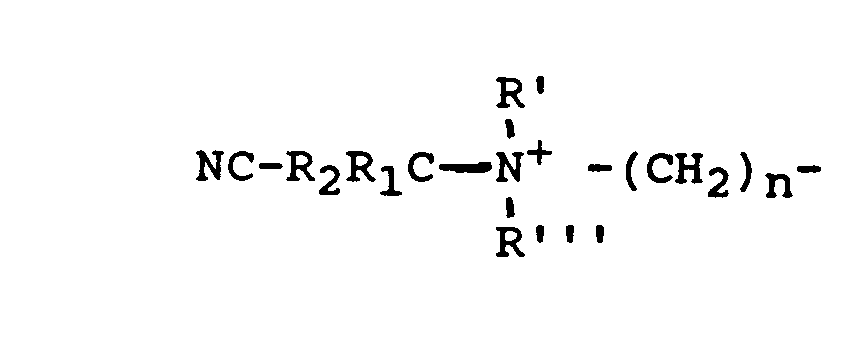
- Preferably, R' is C1-C4 alkyl or a -CR1R2CN group, and R" and R''' are each C1-C4 alkyl; with particular preference to R', R" and R''' being methyl, thus forming cationic nitriles having a trimethyl ammonium group.
- Accordingly, in one aspect the invention provides an improved novel cationic peroxyacid precursor in the form of a cationic nitrile having a counter-anion selected from R-SO3-, R-SO4-, R-C02- and surfactant anions, as defined hereinbefore.
- Examples of suitable counter-anions are alkane and paraffin sulphonates; p-toluene sulphonate; dodecyl benzene sulphonate; C12-C18 primary alcohol sulphates, such as lauryl sulphate; lauryl ether sulphate; and C8-Ci7 alkyl carboxylic acid anions.
- A means for characterizing the hygroscopicity of cationic nitriles is by measuring the equilibrium-relative humidity; this is the RH of the headspace at which the sample commences to take up water and deliquiesce at a temperature of 28° C.
- Whereas cationic nitriles with conventional counter-anions, such as chloride, bromide, iodide, nitrate, sulphate and methylsulphate, show equilibrium-relative humidity (RH) of only up to about 40%, it is surprising that with the counter-anions of the present invention the equilibrium RH of the cationic nitrile peroxyacid precursors can be increased to a substantial degree.
- Preferred counter-anions within the above-defined classes are those which bring the equilibrium RH of the cationic nitrile to a value of at least 60%, preferably at least 70%.
- Particularly preferred counter-anions are surfactant anions and R-SO3- wherein R is an alkylphenyl group, such as a tosylate anion, i.e. p-toluene sulphonate ion.
- In another aspect, the invention provides a bleaching (detergent) composition comprising a peroxide compound bleach and a cationic peroxyacid bleach precursor, wherein said precursor is a cationic nitrile having a counter-anion selected from R-SO3-, R-SO4-, R-C02- and surfactant anions as defined hereinbefore.
- The cationic nitrile peroxyacid precursor of the invention can be utilized with hydrogen peroxide or a hydrogen peroxide source in the form of solid peroxide compound, such as sodium perborate and sodium percarbonate, in molar ratios of hydrogen peroxide to cationic nitrile precursor of at least 1:1, at pH of at least 7.5 and already at a temperature of as low as 10° C.
- Advantageously, the cationic nitrile bleach precursor of the invention is used in the bleaching composition of the invention at molar ratios of peroxide to nitrile from about 2:1 to 20:1, preferably from 5:1 to 12:1, said bleaching composition having a 1-5 g/I solution pH of between 8 and 12, preferably from 8.5 to 10.5, and at a temperature of from about 20 C to about 60 C, preferably from 30° C to 50° C.
- Examination of the mechanism of the reaction between hydrogen peroxide and cationic nitriles has shown that, when cationic nitriles are added to alkaline solutions containing a source of hydrogen peroxide, various reactions are taking place which compete with each other, the rates of which will be dependent on the reaction conditions.
- Without wishing to be bound to any theory, it is believed that the formation of peroxyimidic acid, which is the active bleaching species, occurs almost instantaneously within a few seconds, followed by a relatively slower decay to the corresponding amide :

via hydrolysis or by mutual decomposition with hydrogen peroxide. - Optimum bleaching performance is achieved at peroxide to nitrile molar ratio of ≧ 5:1, at pH 9 and at a temperature of about 40° C.
- Decrease of peroxide bleach level (i.e. at lower peroxide/nitrile molar ratios) enhances hydrolytic instability, which is suppressed by increasing the peroxide level (i.e. increasing ratio peroxide to nitrile). Below pH 9, yields of peroxyimidic acid decrease, owing to insufficient perhydrolysis and the maximum in bleach performance at 40° C results from (excessive) increase of bleach instability at temperatures of above 40 C.
- The novel cationic nitrile of the invention can be prepared according to the following synthesis routes, diagrammatically written by way of illustration :
-

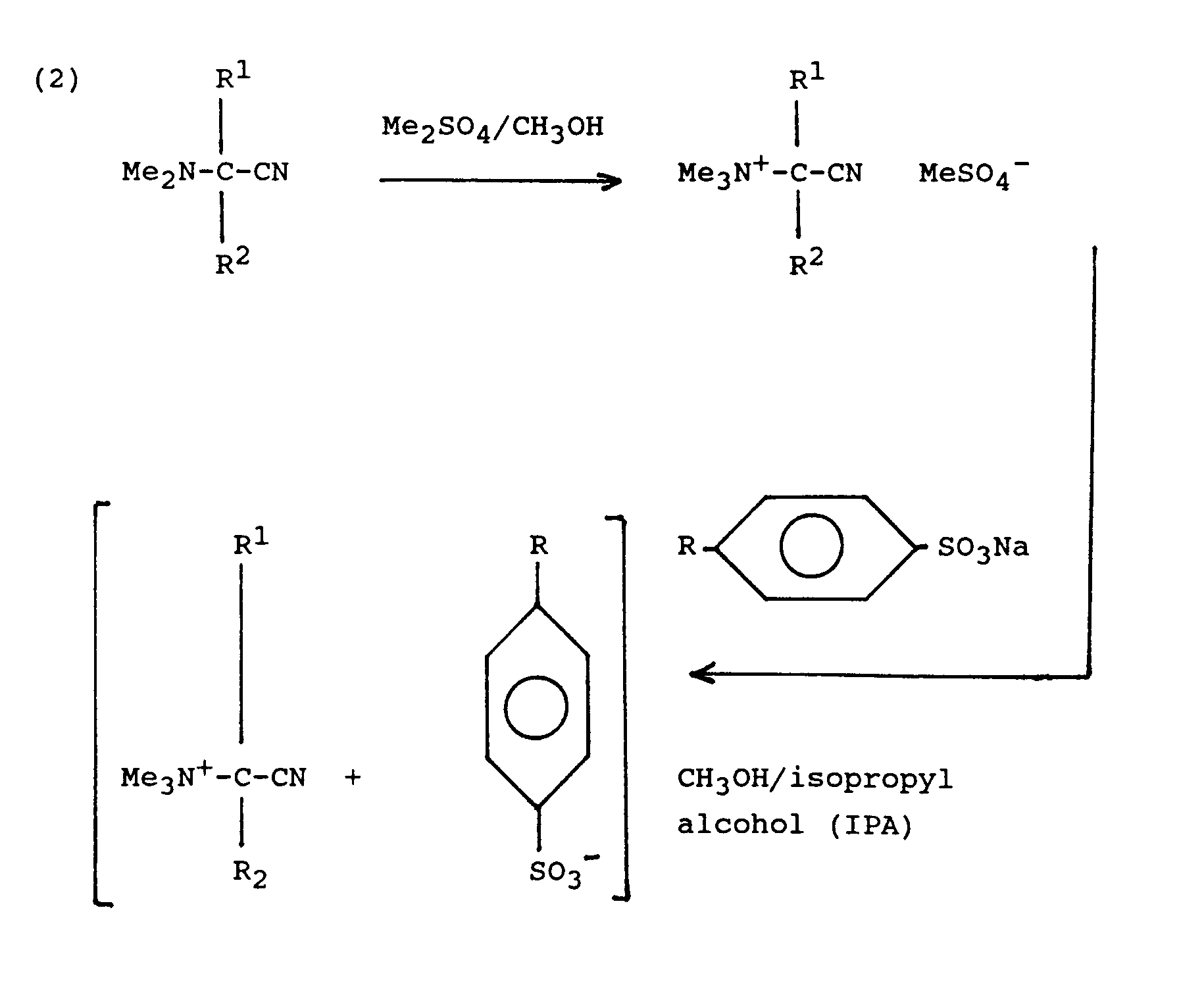
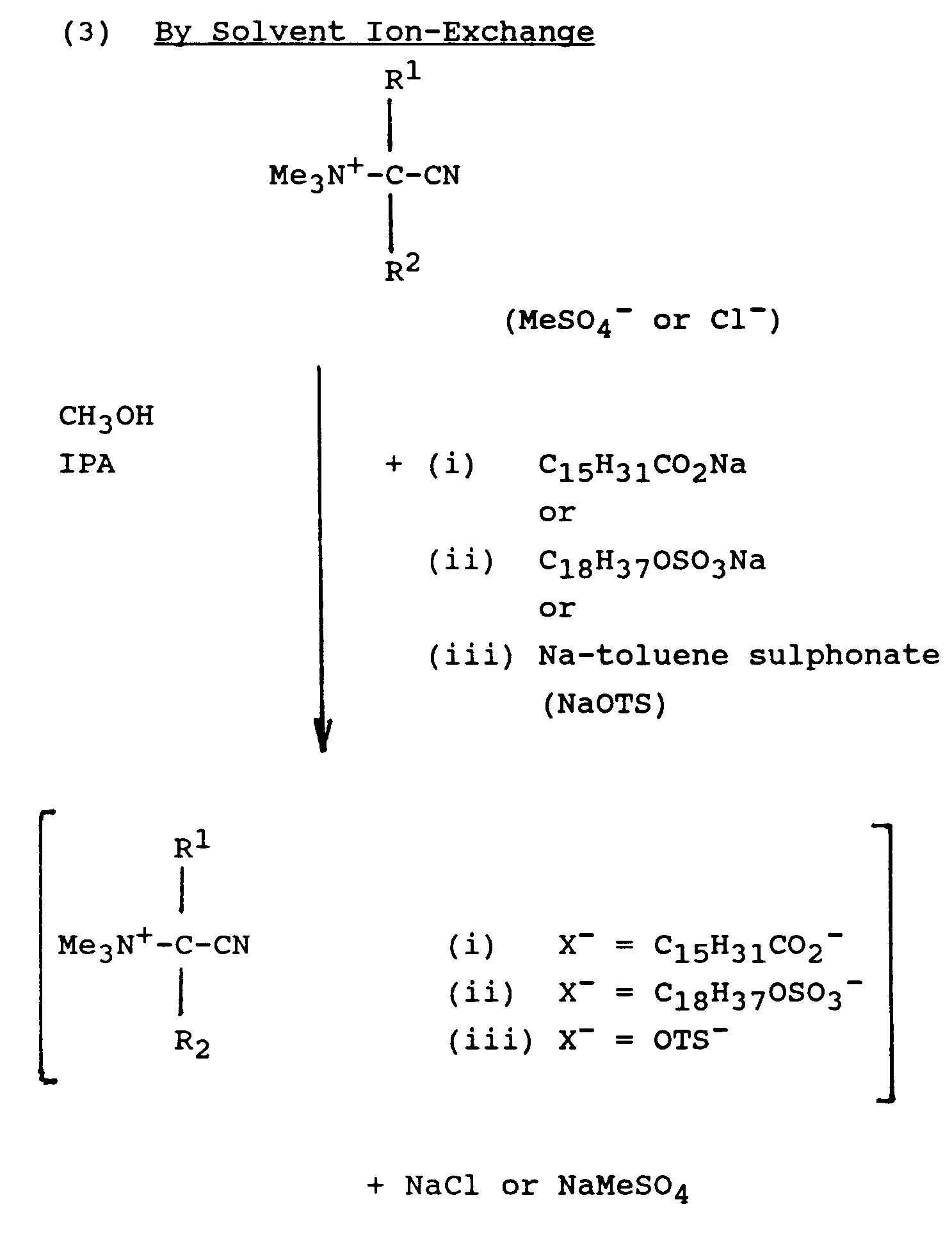
wherein R1 is alkyl or H; and R2 and R are alkyl groups. - An alternative to the ion-exchange route is by intimately dry-mixing the sodium salt of RSO3-, RSO4-, RC02- or surfactant with a cationic nitrile with common anion at molar ratios of from 0.5:1 to 10:1. Generally, mixtures thus prepared are of an amorphous nature different from the crystalline salts obtained by solvent ion-exchange, though mixtures as obtained from 1:1 mixtures with primary alcohol sulphate or tosylate salts still have equilibrium RH >70%. Mixtures thus obtained and use thereof are therefore also within the purview of the present invention.
- When the invention is applied to bleaching detergent compositions, the formulation, in addition to the essential peroxide compound and cationic nitrile bleach precursor, will usually contain a surface-active material, and desirably also detergency builders and other known ingredients commonly used in detergent compositions.
- Peroxide bleach compounds usable in the present invention include the alkali metal peroxides, organic peroxides such as urea peroxide, and inorganic persalts, such as the alkali metal perborates, percarbonates, perphosphates, persilicates and persulphates. Mixtures of two or more such compounds may also be suitable. Particularly preferred are sodium perborate tetrahydrate and, especially, sodium perborate monohydrate. Sodium perborate monohydrate is preferred because it has excellent storage stability while also dissolving very quickly in aqueous solutions. Sodium percarbonate may be preferred for environmental reasons.
- Alkylhydroperoxides are another suitable class of peroxygen compounds. Examples of these materials include cumene hydroperoxide and t-butyl hydroperoxide.
- In such formulations the novel cationic nitrile peroxyacid precursor of the invention may be present at a level ranging from about 0.1% to 20% by weight, preferably from 0.5% to 10% by weight, particularly from 1% to 7.5% by weight, together with a peroxide bleaching compound, e.g. sodium perborate tetra- or monohydrate and sodium percarbonate, the amount of which is usually within the range of from about 2% to 40%, preferably from about 4% to 30%, particularly from about 10% to 25% by weight.
- The surface-active material may be naturally derived, such as soap, or a synthetic material selected from anionic, nonionic, amphoteric, zwitterionic, cationic actives and mixtures thereof. Many suitable actives are commercially available and are fully described in literature, for example in "Surface Active Agents and Detergents", Volumes I and II, by Schwartz, Perry and Berch. The total level of the surface-active material may range up to 50% by weight, preferably being from about 1% to 40% by weight of the composition, most preferably 4 to 25%.
- Synthetic anionic surface-actives are usually water-soluble alkali metal salts of organic sulphates and sulphonates having alkyl radicals containing from about 8 to about 22 carbon atoms, the term alkyl being used to include the alkyl portion of higher aryl radicals.
- Examples of suitable synthetic anionic detergent compounds are sodium and ammonium alkyl sulphates, especially those obtained by sulphating higher (C8-C18) alcohols produced, for example, from tallow or coconut oil; sodium and ammonium alkyl (C3-C23) benzene sulphonates, particularly sodium linear secondary alkyl (C10-C15) benzene sulphonates; sodium alkyl glyceryl ether sulphates, especially those esters of the higher alcohols derived from tallow or coconut oil and synthetic alcohols derived from petroleum; sodium coconut oil fatty acid monoglyceride sulphates and sulphonates; sodium and ammonium salts of sulphuric acid esters of higher (C9-C18) fatty alcohol alkylene oxide, particularly ethylene oxide, reaction products; the reaction products of fatty acids such as coconut fatty acids esterified with isethionic acid and neutralized with sodium hydroxide; sodium and ammonium salts of fatty acid amides of methyl taurine; alkane monosulphonates such as those derived by reacting alpha-olefins (C8-C20) with sodium bisulphite and those derived by reacting paraffins with S02 and C12 and then hydrolyzing with a base to produce a random sulphonate; sodium and ammonium C7-C12 dialkyl sulphosuccinates; and olefin sulphonates, which term is used to describe the material made by reacting olefins, particularly C10-C20 alpha-olefins, with S03 and then neutralizing and hydrolyzing the reaction product. The preferred anionic detergent compounds are sodium (C11-C15) alkylbenzene sulphonates, sodium (C16-C1S) alkyl sulphates and sodium (C16-C18) alkyl ether sulphates.
- Examples of suitable nonionic surface-active compounds which may be used, preferably together with the anionic surface-active compounds, include in particular the reaction products of alkylene oxides, usually ethylene oxide, with alkyl (C6-C22) phenols, generally 5-25 EO, i.e. 5-25 units of ethylene oxides per molecule; the condensation products of aliphatic (C8-C18) primary or secondary linear or branched alcohols with ethylene oxide, generally 6-30 EO, and products made by condensation of ethylene oxide with the reaction products of propylene oxide and ethylene diamine. Other so-called nonionic surface-actives include alkyl polyglycosides, long chain tertiary amine oxides, long chain tertiary phosphine oxides and dialkyl sulphoxides.
- Amounts of amphoteric or zwitterionic surface-active compounds can also be used in the compositions of the invention but this is not normally desired owing to their relatively high cost. If any amphoteric or zwitterionic detergent compounds are used, it is generally in small amounts in compositions based on the much more commonly used synthetic anionic and nonionic actives.
- As stated above, soaps may also be incorporated in the compositions of the invention, preferably at a level of less than 25% by weight. They are particularly useful at low levels in binary (soap/anionic) or ternary mixtures together with nonionic or mixed synthetic anionic and nonionic compounds. Soaps which are used are preferably the sodium, or, less desirably, potassium salts of saturated or unsaturated C10-C24 fatty acids or mixtures thereof. The amount of such soaps can be varied between about 0.5% and about 25% by weight, with lower amounts of about 0.5% to about 5% being generally sufficient for lather control. Amounts of soap between about 2% and about 20%, especially between about 5% and about 10%, are used to give a beneficial effect on detergency. This is particularly valuable in compositions used in hard water when the soap acts as a supplementary builder.
- The detergent compositions of the invention will normally also contain a detergency builder. Builder materials may be selected from 1) calcium sequestrant materials, 2) precipitating materials, 3) calcium ion-exchange materials and 4) mixtures thereof.
- Examples of calcium sequestrant builder materials include alkali metal polyphosphates, such as sodium tripolyphosphate; nitrilotriacetic acid and its water-soluble salts; the akali metal salts of carboxymethyloxy succinic acid, ethylene diamine tetraacetic acid, oxydisuccinic acid, mellitic acid, benzene polycarboxylic acids, citric acid; and polyacetal carboxylates as disclosed in US patents 4,144,226 and 4,146,495.
- Examples of precipitating builder materials include sodium orthophosphate, sodium carbonate and long chain fatty acid soaps.
- Examples of calcium ion-exchange builder materials include the various types of water-insoluble crystalline or amorphous aluminosilicates, of which zeolites are the best known representatives.
- In particular, the compositions of the invention may contain any one of the organic or inorganic builder materials, such as sodium or potassium tripolyphosphate, sodium or potassium pyrophosphate, sodium or potassium orthophosphate, sodium carbonate, the sodium salt of nitrilotriacetic acid, sodium citrate, carboxymethyl malonate, carboxymethyloxy succinate and the water-insoluble crystalline or amorphous aluminosilicate builder materials, or mixtures thereof.
- These builder materials may be present at a level of, for example, from 5 to 80% by weight, preferably from 10 to 60% by weight.
- Apart from the components already mentioned, the detergent compositions of the invention can contain any of the conventional additives in the amounts in which such materials are normally employed in fabric washing detergent compositions. Examples of these additives include lather boosters, such as alkanolamides, particularly the monoethanol amides derived from palmkernel fatty acids and coconut fatty acids, lather depressants, such as alkyl phosphates and silicones, anti-redeposition agents, such as sodium carboxymethyl cellulose and alkyl or substituted alkyl cellulose ethers, other stabilizers, such as ethylene diamine tetraacetic acid, fabric softening agents, inorganic salts, such as sodium sulphate, and, usually present in very small amounts, fluorescent agents, perfumes, enzymes, such as proteases, cellulases, lipases and amylases, germicides and colourants. The peroxyacid bleach precursors described herein are useful in a variety of cleaning products. These include laundry detergents, laundry bleaches, hard surface cleaners, toilet bowl cleaners, automatic dishwashing compositions and also denture cleaners. Precursors of the present invention can be introduced in a variety of product forms including powders, on sheets or other substrates, in pouches, in tablets or in non-aqueous liquids, such as liquid nonionic detergents.
- Generally, for reasons of stability and handling, the bleach precursors will advantageously be presented in the form of particulate bodies comprising said bleach precursor and a binder or agglomerating agent. Many and diverse methods of prepraring such precursor particulates have been described in various patent literature documents, such as e.g. in Canadian Patent N 1,102,966; GB Patent N 1,561,333; US Patent N 4,087,369; EP-A-0,240,057; EP-A-0,241,962; EP-A-0,101,634 and EP-A-0,062,523. Each of these methods may be selected and applied to the bleach precursor of the invention.
- Particulates incorporating the precursors of the present invention are normally added to the detergent base composition with the other dry-mix ingredients, such as enzymes, inorganic peroxygen bleaches and suds depressants. It will be appreciated, however, that the detergent composition to which the precursor particulates are added may itself be made in a variety of ways, such as spray-drying, part-part processing, non-tower route processing, dry-mixing, agglomeration extrusion, flaking etc., such ways being well known to those skilled in the art and not forming the essence of the present invention.
- The peroxyacid precursors of the present invention can also be incorporated in detergent additive products. Such additive products are intended to supplement or boost the performance of conventional detergent compositions and may contain any of the components of such compositions, although they will not comprise all of the components present in a fully formulated detergent composition. Additive products in accordance with this aspect of the invention will normally be added to an aqueous liquor containing a source of (alkaline) hydrogen peroxide, although in certain circumstances a source of alkaline hydrogen peroxide may be included in the product.
- Additive products in accordance with this aspect of the invention may comprise the compound alone in combination with a carrier, such as a compatible particulate substrate, a flexible non-particulate substrate or a container (e.g. pouch or sachet).
- Examples of compatible particulate substrates include inert materials, such as clays and other aluminosilicates including zeolites both natural and synthetic of origin. Other compatible particulate carrier materials include hydratable inorganic salts, such as phosphates, carbonates and sulphates.
- Additive products enclosed in bags or containers can be manufactured such that the containers prevent egress of their contents when dry but are adapted to release their contents on immersion in an aqueous solution.
- In a further specific embodiment, the peroxyacid precursors of the invention are particularly suitable for incorporation in so-called non-aqueous liquid laundry detergent compositions together with a peroxide bleaching compound, e.g. sodium perborate, to impart an effective cleaning and stain-removing capacity to the products on fabrics and textiles.
- Non-aqueous liquid detergent compositions including paste-like and gelatinous detergent compositions in which the precursor compounds can be incorporated are known from the art and various formulations have been proposed, e.g. in US Patents 2,864,770; 2,940,938; 4,772,412; 3,368,977; GB-A-1,205,711; 1,270,040; 1,292,352; 1,370,377; 2,194,536; DE-A-2,233,771; and EP-A-0,028,849.
- These are compositions which normally comprise a non-aqueous liquid medium with or without a solid phase dispersed therein. The non-aqueous liquid medium may be a liquid surfactant, preferably a liquid nonionic surfactant; a non-polar liquid medium, e.g. liquid paraffin; a polar solvent, e.g. polyols, such as glycerol, sorbitol, ethylene glycol, optionally combined with low-molecular monohydric alcohols, e.g. ethanol or isopropanol; or mixtures thereof.
- The solid phase can be builders, alkalis, abrasives, polymers, clays, other solid ionic surfactants, bleaches, fluorescent agents and other usual solid detergent ingredients.
- The following non-limiting Examples will more fully illustrate the embodiments of the invention.
- The following Example illustrates the manufacture of various cationic nitrile peroxyacid precursor compounds according to the invention.
- Dimethylamino acetonitrile (4.2 g, 0.05 mole) was dissolved in dry acetonitrile (50 ml) in a 100 ml RB flask provided with condenser, calcium chloride drying tube, and anti-bumping granules. Methyl p-toluene sulphonate (9.3 g, 0.05 mole) was added and the solution refluxed for 5 hours. The flask was cooled in ice, and the white solid crystalline solid filtered off, washed with ice-cold dry acetonitrile and then vacuum-dried to give 10.65 g of product, yield 78.8%: 'H NMR (0, D20) 2.4 (s, 3H, CH3-Ar), 3.4 (s, 9H, (CH3)3N 7.4 + 7.7 (dd, 4H, ArH) ppm.
- This material was prepared, using a method analogous to that in (i) vide supra, except that 2-dimethyl aminopropionitrile was used instead of dimethylamine acetonitrile, and further fractions were obtained by evaporating off the acetonitrile and sonicating with ether. A white solid, 7.99 g yield, was obtained: 'H NMR assay (D20, trioxan) 98% (0, D20) 1.9 (s, 3H, CH3-C), 2.4 (s, 3H, CH3-Ar), 3.35 (s, 9H (CH3)3N 7.4-7.7 (2d, 4H, ArH) ppm.
- This material was prepared, using a method analogous to that in (i) vide supra, except that 2 dimethylamino butyronitrile was used instead of dimethylamino acetonitrile. Three product fractions (18.6 g, yield 100%) were obtained. 'H NMR assay (D20, trioxan) 97.5% (0, D20) 1.2 (t, 3H, CH3-CH2), 2.1 + 2.3 (m, 2H, CH2), 2.4 (s, 3H (CH3-Ar) 3.4 (s, 9H, (CH3)3-N 7.75 (2d, 4H, ArH) ppm.
- This material was prepared, using a method analogous to that in (i) vide supra, except that 2-dimethylamino-2-methyl propionitrile was used instead of dimethylamino acetonitrile. The reaction mixture was cooled in acetone/cardice and a white crystalline solid was filtered off and vacuum-dried (5.3 g). A further fraction was obtained by evaporating off the acetonitrile, and ether-extracting the residual solid (8.3 g, total yield 93%). 'H NMR assay (D20, trioxan) 73% and 86%, respectively (0, D20) 2.0 (s, 6H, CH3)2-C), 2.4 (s, 3H, CH3-Ar), 3.35 (s, 9H (CH3)3N 7.4-7.7 (2d, 4H, ArH) ppm.
- This material was prepared, using a method analogous to that in (i), vide supra, except that phenyl dimethylamino acetonitrile was used instead of dimethylamino acetonitrile. A white solid (11.88 g, yield 68%) was obtained: 'H NMR assay (D20, trioxan) 102.9% (0, D20) 2.4 (s, 3H, CH3-Ar), 3.3 (s, 9H, CH33N+), 7.4 (d, 2H, 7.65-7.85 (m, 7H, ArH) ppm.
- Dimethylamino acetonitrile (2.1 g, 0.025 mole) was dissolved in dry acetonitrile (50 ml) in a 100 ml RB flask provided with condenser , drying tube and anti-bumping granules. Methyl dodecylbenzene sulphonate (8.5 g, 0.025 mole) was added, and the solution refluxed for 8 hours. On cooling to room temperature, white crystals were formed and were filtered off, washed with a little cold acetonitrile and vacuum-dried at room temperature to give 6.3 g product, yield 59%. 'H NMR assay (D20, trioxan) 93%, (0, D) 0.6-1.6 (complex unresolved, 24H, C12H25), 2.4 (m, 1H,
-

- This material was prepared, using a method analogous to that in (vi), vide supra, except that 2-dimethylamino propionitrile was used instead of dimethylamine acetonitrile. The product would not crystallize from acetonitrile, and so it was evaporated off and the sticky solid was sonicated with dry ether to remove unreacted starting materials. The solid was vacuum-dried over P205 to give 5.45 product, yield 62%. 'H NMR assay (D20, trioxan) 91% (0, D20) 0.6-1.6 (complex unresolved, 24H, C12H25), 1.7 (s, 3H, CH3-CH), 3.2 (s, 9H, (CH3)3N+)
- 2.5 (m, 1 H, Ar -
-

- This material was prepared, using a method analogous to that in (vi), vide supra, except that dimethylamino phenyl acetonitrile was used instead of dimethylamino propionitrile. A white solid (7.66 g, yield 76%) was obtained. 'H NMR assay (CDCl3, trioxan) 99% (0, CDCl3) 0.7-1.7 (complex unresolved, 24H, C12H25), 2.5 + 2.7
-

- This material was prepared, using a method analogous to that in (vii), vide supra, except that 2-dimethylamino-2-methyl propionitrile was used instead of 2-dimethylamino propionitrile. A white solid, 5.51 g, yield 61 %, was obtained. 'H NMR assay (D20 trioxan) 83.6% (0, D20) 0.6-1.5 (complex unresolved, 24H, C12H25), 1.8 (s, 6H,
- (CH3)2-C) 2.5 (m, 1 H,
-

- 7.2-7.8 (2d, 4H, ArH) ppm.
- Trimethylammonium acetonitrile chloride (1.0 g, 0.007435 mole) was dissolved in methanol (20 ml) in a test tube. Sodium laurate (1.65 g, 0.007435 mole) was dissolved in boiling methanol (50 ml) and the two solutions mixed. The solution was evaporated to dryness and the solid heated with ethanol (60 ml). A granular precipitate of sodium chloride settled out and was filtered off, but less than the theorectical amount was obtained. The ethanolic solution was evaporated to dryness, azeotroped twice with IPA to give a lumpy solid containing white and fawn components (2.08 g, yield 93%). 'H NMR (0, D20) 0.85 (t, 3H, CH3-) 1.3 (s, 16H, CH3-(CH2)8), 1.55 (m, 2H, CH2CH2CO-) 3.4 (s, 9H, (CH3)3N+) ppm. The ratio of quat to laurate was 1.3:1.
- This material was prepared, using a method analogous to that in (a), vide supra, except that 2-trimethylammonium propionitrile methosulphate was used instead of trimethylammonium acetonitrile. IPA was used instead of ethanol as sodium methosulphate is even less soluble in it, while the quaternary salt is soluble. Less than the theoretical amount of sodium methosulphate was obtained, and more than the theoretical amount of product was obtained (1.53 g). On preparing a sample for NMR analysis in D20, a white insoluble solid separated out and the spectrum showed the presence of quat only. This was attributed to lauric acid being formed from the action of bisulphate, the hydrolysis product of methosulphate. When the NMR was repeated in DMSO, the spectra were consistent and the ratio of quat:laurate was 1:1. Similar problems were found with the 2-trimethylammonium butyronitrile laurate preparation.
- Trimethylammonium acetonitrile (1.0 g, 0.007435 mole) and sodium dodecyl sulphate (2.14 g, 0.007435 mole) were weighed into a 250 ml rotary evaporator flask. Methanol (100 ml) was added and the mixture heated until a clear solution was obtained. The methanol was evaporated off and IPA (150 ml) was added, and the mixture warmed. A granular precipitate of sodium chloride separated out and was filtered off. The amount obtained was less than the theoretical amount. The IPA-soluble fraction was evaporated to dryness to give 3.4 g of solid and this was further dried under vacuum. 'H NMR (0, D20) 0.9 (t, 3H, CH3-C), 1.3 (m, 18H, CH3(CH9) 1.7 (m, 2H, CH2CH2SO4-), 3.4 (s, 9H, (CH3)3N 4.1 ppm (t, 2H, -CH2SO4-) ppm. The ratio of quaternary to dodecyl sulphate was 1.03:1.
- This material was prepared, using a method analogous to that in (c), vide supra, except that 2-trimethylammonium propionitrile methosulphate was used instead of trimethylammonium acetonitrile chloride. A clear viscous oil (1.65 g) was obtained (yield 985). 'H NMR (0, D20) 0.85 (t, 3H, CH3CH2), 1.3 (m, 18H, CH3(CH2)9-), 1.7 (m, 2H, CH2CH2SO4-), 1.85 (d, 3H, CH3-CH), 3.3 (s, 9H, (CH3)3N+) 4.0 (t, 2H, CH2SO4-), 5.0 (q, 1 H, CH) ppm. The ratio of quaternary to dodecyl sulphate was 1:1.
- This material was prepared, using a method analogous to that in (c), vide supra, except that trimethylammonium butyronitrile methasulphate was used instead of trimethylammonium acetonitrile chloride. The starting material was not pure and an amount, more than expected, of the known sticky solid was obtained. Methosulphate was still present in the product fraction (28%). 'H NMR (0, D20) 0.85 (t, 3H, CH3-(CH2)9 -), H (t, 3H, CH3CH2-) 1.3 (m, 18H, CH3(CH2)9-, 1.7 (m, 2H, CH2CH2SO4 -), 2.1-2.3 (2m, CH3CH2 -) 3.35 (s, 9H, (CH3)3-N+), 3.75 (s, 3h, CH3SO3 -), 4.0 (t, 2H, CH2SO4 -) 4.9 (q, 1H, CH) ppm. The ratio of quaternary to dodecyl sulphate was 1:1.06.
- These Examples show the influence of counter anions on the equilibrium Relative Humidity of cationic nitriles. The experiments were carried out with samples in closed containers at 28 C, in which the relative humidity can be adjusted and varied.
- The equilibrium RH is the relative humidity of the headspace at which the sample commences to take up water and deliquesce.
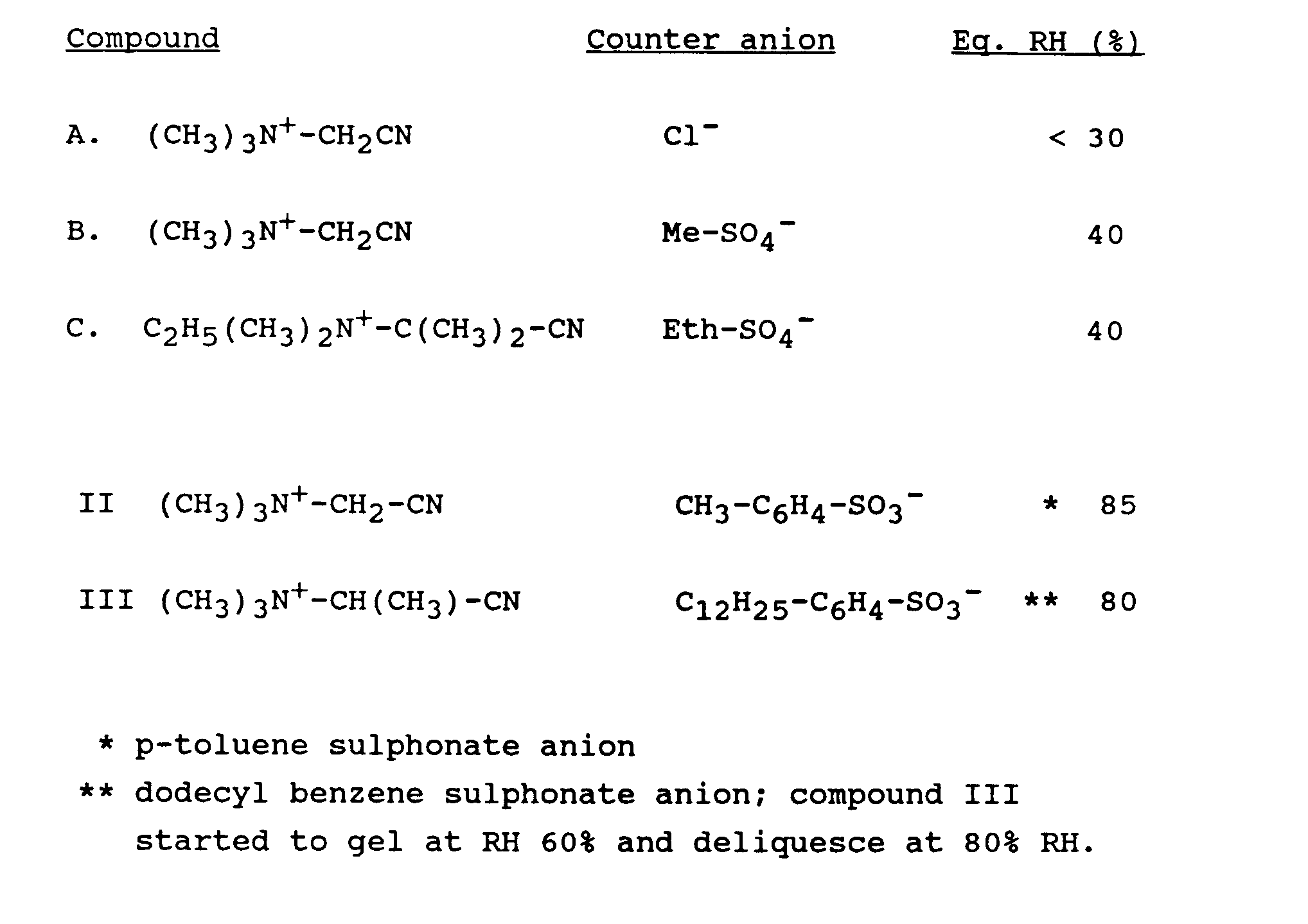
- A cationic nitrile of formula :

was used in model experiments with sodium perborate at peroxide to nitrile mole ratio of 10:1, in 30 minutes' isothermal washes at 20, 40 and 60° C at pH 10 using tea-stained test cloths. - The results obtained from repeated tests expressed as ΔR460* (reflectance) are as follows :

- These are similar to the results of control experiments using a cationic nitrile [(CH3)3 N -CH2CN CI-] of the art.
- Similar bleaching results were observed when the experiments were repeated with the following other tosylate anion cationic nitriles :


- The following two cationic nitriles (a) and (b) were used in Tergotometer washing experiments with a base powder formulation (A).

- (a) Trimethyl ammonium acetonitrile p-toluene sulphonate
-
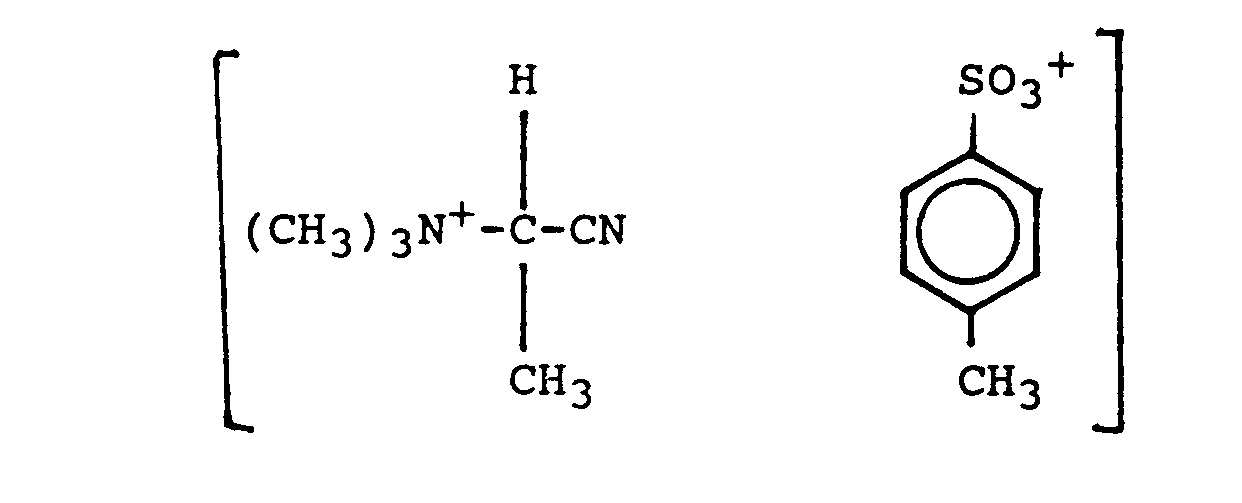

- Conditions: Tea-stained test cloths; base powder dosage: 4 g/I; time : 30 minutes; temperature : 40° C isothermal. [Nitrile] = 1.2 mmol/I; [TAED] = 0.6 mmol/I; peroxide : precursor ratio 10:1.
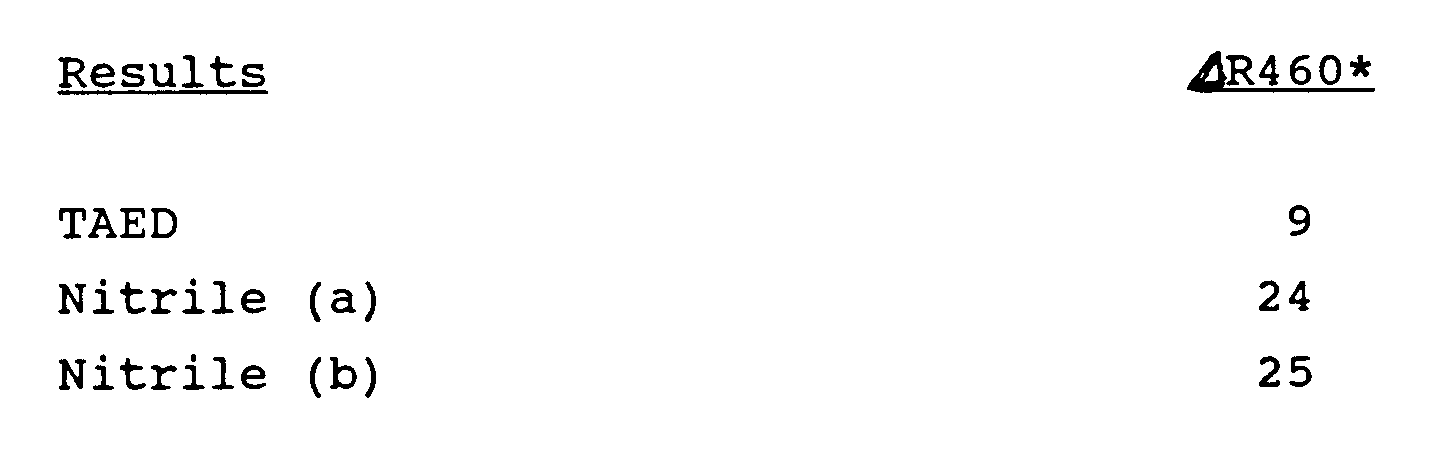
Claims (14)

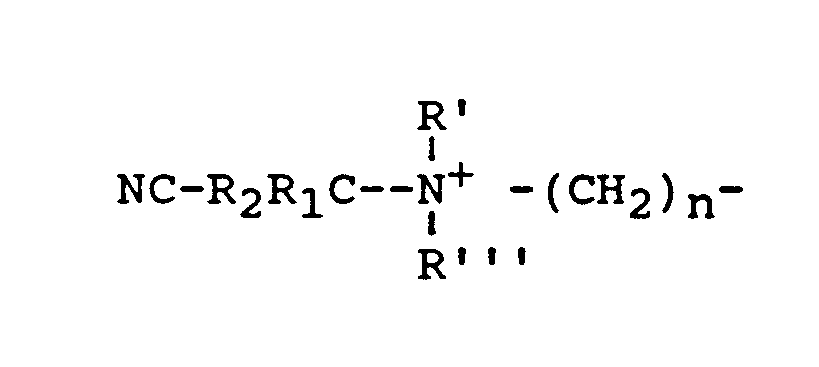
Applications Claiming Priority (2)
| Application Number | Priority Date | Filing Date | Title |
|---|---|---|---|
| GB9012001 | 1990-05-30 | ||
| GB909012001A GB9012001D0 (en) | 1990-05-30 | 1990-05-30 | Bleaching composition |
Publications (2)
| Publication Number | Publication Date |
|---|---|
| EP0464880A1 true EP0464880A1 (en) | 1992-01-08 |
| EP0464880B1 EP0464880B1 (en) | 1994-12-14 |
Family
ID=10676739
Family Applications (1)
| Application Number | Title | Priority Date | Filing Date |
|---|---|---|---|
| EP91201260A Expired - Lifetime EP0464880B1 (en) | 1990-05-30 | 1991-05-28 | Bleaching composition |
Country Status (12)
| Country | Link |
|---|---|
| US (1) | US5281361A (en) |
| EP (1) | EP0464880B1 (en) |
| JP (1) | JPH0832672B2 (en) |
| KR (2) | KR950002601B1 (en) |
| AU (1) | AU635842B2 (en) |
| BR (1) | BR9102223A (en) |
| CA (1) | CA2043210A1 (en) |
| DE (1) | DE69105836D1 (en) |
| GB (1) | GB9012001D0 (en) |
| IN (1) | IN172906B (en) |
| NO (1) | NO912036L (en) |
| ZA (1) | ZA914149B (en) |
Cited By (55)
| Publication number | Priority date | Publication date | Assignee | Title |
|---|---|---|---|---|
| US5259982A (en) * | 1992-01-17 | 1993-11-09 | Lever Brothers Company, Division Of Conopco, Inc. | Detergent compositions |
| US5259981A (en) * | 1992-01-17 | 1993-11-09 | Lever Brothers Company | Detergent compositions |
| WO1996007650A1 (en) * | 1994-09-02 | 1996-03-14 | Basf Aktiengesellschaft | Process for producing quaternary glycine nitriles |
| US5599781A (en) * | 1995-07-27 | 1997-02-04 | Haeggberg; Donna J. | Automatic dishwashing detergent having bleach system comprising monopersulfate, cationic bleach activator and perborate or percarbonate |
| EP0790244A1 (en) | 1996-02-15 | 1997-08-20 | Hoechst Aktiengesellschaft | Ammonium nitriles and use thereof as bleach activators |
| US5741437A (en) * | 1995-06-07 | 1998-04-21 | The Clorox Company | N-alkyl ammonium acetonitrile bleach activators |
| WO1998023719A3 (en) * | 1996-11-29 | 1998-07-30 | Henkel Kgaa | Acetonitrile derivatives as bleaching activators in detergents |
| US5792218A (en) * | 1995-06-07 | 1998-08-11 | The Clorox Company | N-alkyl ammonium acetonitrile activators in dense gas cleaning and method |
| US5814242A (en) * | 1995-06-07 | 1998-09-29 | The Clorox Company | Mixed peroxygen activator compositions |
| US5850086A (en) * | 1996-06-21 | 1998-12-15 | Regents Of The University Of Minnesota | Iron complexes for bleach activation and stereospecific oxidation |
| EP0897974A1 (en) * | 1997-08-21 | 1999-02-24 | Henkel Kommanditgesellschaft auf Aktien | Use of quaternary acetonitrile compounds as activators for washing compositions |
| WO1999014302A1 (en) * | 1997-09-16 | 1999-03-25 | Clariant Gmbh | Bleaching activators in the form of granules |
| WO1999014296A1 (en) * | 1997-09-16 | 1999-03-25 | Clariant Gmbh | Bleaching activators based on ammonium nitrile in the form of coated granules |
| US5888419A (en) * | 1995-06-07 | 1999-03-30 | The Clorox Company | Granular N-alkyl ammonium acetontrile compositions |
| WO1999063038A1 (en) * | 1998-06-03 | 1999-12-09 | Henkel Kommanditgesellschaft Auf Aktien | Detergents containing amylase and acetonitrile |
| US6010994A (en) * | 1995-06-07 | 2000-01-04 | The Clorox Company | Liquid compositions containing N-alkyl ammonium acetonitrile salts |
| WO2000050553A1 (en) * | 1999-02-25 | 2000-08-31 | Henkel Kommanditgesellschaft Auf Aktien | Compounded acetonitrile derivatives used as bleach activators in cleaning agents |
| WO2000060037A3 (en) * | 1999-03-31 | 2000-12-28 | Henkel Kgaa | Detergent forms with special bleach activators |
| WO2000060035A3 (en) * | 1999-03-31 | 2001-01-04 | Henkel Kgaa | Single or multi-phase detergent forms with special bleach activators |
| EP1036070A4 (en) * | 1996-11-29 | 2001-01-31 | Clorox Co | N-alkyl ammonium acetonitrile salts, methods therefor and compositions therewith |
| US6183665B1 (en) | 1995-06-07 | 2001-02-06 | The Clorox Company | Granular N-alkyl ammonium acetonitrile compositions |
| US6221824B1 (en) * | 1999-02-25 | 2001-04-24 | Henkel Kommanditgesellschaft Auf Aktien | Process for the production of compounded acetonitrile derivatives |
| WO2000060036A3 (en) * | 1999-03-31 | 2001-04-26 | Henkel Kgaa | Detergents containing an enzyme and bleach activator agents |
| US6235218B1 (en) | 1995-06-07 | 2001-05-22 | The Clorox Company | Process for preparing N-alkyl ammonium acetonitrile compounds |
| WO2002012426A1 (en) * | 2000-08-04 | 2002-02-14 | Henkel Kommanditgesellchaft Auf Aktien | Enclosed bleach activators |
| WO2002012425A1 (en) * | 2000-08-04 | 2002-02-14 | Henkel Kommanditgesellschaft Auf Aktien | Particle-shaped acetonitrile derivatives as bleach activators in solid detergents |
| WO2002012427A1 (en) * | 2000-08-04 | 2002-02-14 | Reckitt Benckiser N.V. | Use of new bleach activators in dishwashing detergents |
| DE10038844A1 (en) * | 2000-08-04 | 2002-02-21 | Henkel Kgaa | Bleach-containing detergent compositions for use in laundry or hard surfaces, include a quaternary ammonium acetonitrile bleach activator in cumenesulfonate form |
| WO2002012175A3 (en) * | 2000-08-04 | 2002-04-11 | Clariant Gmbh | Method for producing hydrolysis-stable ammonium nitriles |
| WO2002051973A1 (en) * | 2000-12-22 | 2002-07-04 | Henkel Kommanditgesellschaft Auf Aktien | Liquid detergent and/or cleanser |
| US6498133B2 (en) | 2000-11-17 | 2002-12-24 | Clariant Gmbh | Particulate bleach activators based on acetonitriles |
| US6551977B2 (en) | 2001-03-14 | 2003-04-22 | Unilever Home & Personal Care Usa, A Division Of Conopco, Inc. | Air bleaching catalysts with enhancer and moderating agent |
| US6586383B2 (en) | 2001-03-14 | 2003-07-01 | Unilever Home & Personal Care Usa, Division Of Conopco, Inc. | Air bleaching catalysts with moderating agent |
| WO2003078561A1 (en) * | 2002-03-15 | 2003-09-25 | Clariant Gmbh | Ammonium nitriles and the use thereof as hydrophobic bleaching activators |
| WO2003101940A3 (en) * | 2002-05-31 | 2004-02-26 | Henkel Kgaa | Deodorisation of cationic ammonium acetonitrile derivatives |
| WO2004029187A1 (en) * | 2002-09-20 | 2004-04-08 | Henkel Kommanditgesellschaft Auf Aktien | Dishwasher compositions (mgsm) provided with specially formulated bleach activators (iii) |
| US6764613B2 (en) | 1995-06-07 | 2004-07-20 | Mid-America Commercialization Corporation | N-alkyl ammonium acetonitrile salts, methods therefor and compositions therewith |
| DE10314442A1 (en) * | 2003-03-31 | 2004-11-04 | Henkel Kgaa | Detergent portions, especially for automatic dishwasher, contain cationic, quaternized aminoacetonitrile in deep-drawn, cast or injection molded, water-soluble or water-dispersible container, |
| WO2004060856A3 (en) * | 2002-12-18 | 2004-12-09 | Procter & Gamble | Organic activator |
| WO2006024434A1 (en) * | 2004-08-28 | 2006-03-09 | Clariant Produkte (Deutschland) Gmbh | Diethyl methyl ammonium nitriles and detergents and cleaning agents containing said ammonium nitriles |
| WO2007110163A1 (en) * | 2006-03-24 | 2007-10-04 | Clariant International Ltd | Improved method for producing sodium chloride-free ammonium nitriles |
| WO2007110162A1 (en) * | 2006-03-24 | 2007-10-04 | Clariant International Ltd | Method for producing ammonium nitriles |
| WO2007110161A1 (en) * | 2006-03-24 | 2007-10-04 | Clariant International Ltd | Improved method for producing sodium chloride-free ammonium nitriles |
| DE102007028310A1 (en) | 2007-06-20 | 2008-12-24 | Clariant International Ltd. | Surfactant mixtures with synergistic properties |
| WO2012000846A1 (en) | 2010-06-28 | 2012-01-05 | Basf Se | Metal free bleaching composition |
| WO2012080088A1 (en) | 2010-12-13 | 2012-06-21 | Basf Se | Bleach catalysts |
| WO2014202954A1 (en) | 2013-06-20 | 2014-12-24 | Chemsenti Limited | Bleach and oxidation catalyst |
| WO2017076771A1 (en) | 2015-11-03 | 2017-05-11 | Basf Se | Bleach catalysts |
| EP3176157A1 (en) | 2015-12-01 | 2017-06-07 | Basf Se | Bleach catalysts |
| WO2017182295A1 (en) | 2016-04-18 | 2017-10-26 | Basf Se | Liquid cleaning compositions |
| WO2017186480A1 (en) | 2016-04-26 | 2017-11-02 | Basf Se | Metal free bleaching composition |
| EP3372663A1 (en) | 2017-03-10 | 2018-09-12 | Basf Se | Bleach catalysts |
| US10370621B2 (en) | 2013-08-16 | 2019-08-06 | Chemsenti Limited | Bleaching formulations comprising particles and transition metal ion-containing bleaching catalysts |
| EP3524347A1 (en) | 2008-04-09 | 2019-08-14 | Basf Se | Use of metal hydrazide complex compounds as oxidation catalysts |
| WO2021170840A1 (en) | 2020-02-28 | 2021-09-02 | Catexel Technologies Limited | Degradative method |
Families Citing this family (18)
| Publication number | Priority date | Publication date | Assignee | Title |
|---|---|---|---|---|
| US6019797A (en) * | 1996-06-10 | 2000-02-01 | Procter & Gamble Company | Laundry bleaching with improved safety to fabrics |
| EP0812907A1 (en) * | 1996-06-10 | 1997-12-17 | The Procter & Gamble Company | Laundry bleaching with improved safety to fabrics |
| DE19807771C1 (en) * | 1998-02-24 | 1999-04-15 | Duerkopp Adler Ag | Buttonhole sewing machine |
| JP3847955B2 (en) * | 1998-05-25 | 2006-11-22 | Juki株式会社 | Buttonhole sewing machine |
| US6602836B2 (en) | 2000-05-11 | 2003-08-05 | Unilever Home & Personal Care Usa, A Division Of Conopco, Inc. | Machine dishwashing compositions containing cationic bleaching agents and water-soluble polymers incorporating cationic groups |
| DE10142124A1 (en) | 2001-08-30 | 2003-03-27 | Henkel Kgaa | Coated active ingredient preparation for use in particulate detergents and cleaning agents |
| DE10159386A1 (en) | 2001-12-04 | 2003-06-12 | Henkel Kgaa | Process for the production of bleach activator granules |
| DE10161766A1 (en) * | 2001-12-15 | 2003-06-26 | Clariant Gmbh | Bleach co-granules |
| US20040029757A1 (en) * | 2002-08-08 | 2004-02-12 | Ecolab Inc. | Hand dishwashing detergent composition and methods for manufacturing and using |
| DE10334046A1 (en) * | 2003-07-25 | 2005-02-10 | Clariant Gmbh | Process for the preparation of granulated acyloxybenzenesulfonates or acyloxybenzenecarboxylic acids and their salts |
| DE102004012915A1 (en) * | 2004-03-17 | 2005-10-13 | Clariant Gmbh | Solid preparations containing a sensitive active ingredient |
| DE102004020015A1 (en) * | 2004-04-21 | 2005-11-10 | Henkel Kgaa | Textile Care |
| DE102004028494A1 (en) * | 2004-06-11 | 2005-12-29 | Clariant Gmbh | Mixtures of ammonium nitrile bleach activators and amino acids |
| US7737102B2 (en) * | 2004-11-01 | 2010-06-15 | The Procter & Gamble Company | Ionic liquids derived from functionalized anionic surfactants |
| JP2007172716A (en) * | 2005-12-20 | 2007-07-05 | Sony Corp | REPRODUCTION DEVICE, REPRODUCTION METHOD AND REPRODUCTION PROGRAM, RECORDING MEDIUM AND DATA STRUCTURE, AND AUTHORING DEVICE, AUTHORING METHOD, AND AUTHORING PROGRAM |
| CN106687572A (en) | 2014-09-10 | 2017-05-17 | 巴斯夫欧洲公司 | Encapsulated Cleansing Composition |
| US20190085273A1 (en) | 2016-03-09 | 2019-03-21 | Basf Se | Encapsulated laundry cleaning composition |
| GB202014070D0 (en) | 2020-09-08 | 2020-10-21 | Alborz Chemicals Ltd | Polymorph |
Citations (3)
| Publication number | Priority date | Publication date | Assignee | Title |
|---|---|---|---|---|
| DE2234080A1 (en) * | 1971-07-19 | 1973-02-01 | Dow Chemical Co | QUATERAL AMMONIUM COMPOUNDS WITH SUBSTITUTED PHENOXYALKYL RESIDUE |
| EP0049577A1 (en) * | 1980-10-03 | 1982-04-14 | Ici Australia Limited | Alpha-cyanophenoxybenzylamine derivatives, processes for preparing them, and their use as intermediates for the preparation of pyrethroid insecticides |
| EP0303520A2 (en) * | 1987-08-14 | 1989-02-15 | Kao Corporation | Bleaching composition |
Family Cites Families (9)
| Publication number | Priority date | Publication date | Assignee | Title |
|---|---|---|---|---|
| US3932664A (en) * | 1971-07-19 | 1976-01-13 | The Dow Chemical Company | Substituted phenoxyalkyl quaternary ammonium compounds as antiarrhythemic agents |
| US3882035A (en) * | 1973-03-21 | 1975-05-06 | American Cyanamid Co | Iminodiacetonitrile derivatives as peroxygen bleach activators |
| US4120809A (en) * | 1973-07-24 | 1978-10-17 | Colgate-Palmolive Company | Washing and bleaching with composition containing bleach activator and a nitrilotricarboxylic acid compound |
| US4049814A (en) * | 1974-07-01 | 1977-09-20 | The Dow Chemical Company | Substituted phenoxyalkyl quaternary ammonium compounds as antiarrhythemic agents |
| US4199466A (en) * | 1978-08-21 | 1980-04-22 | Shell Oil Company | Activated bleaching process and compositions therefor |
| JPS6490296A (en) * | 1987-09-30 | 1989-04-06 | Kao Corp | Detergent composition |
| JP2523817B2 (en) * | 1988-09-20 | 1996-08-14 | 花王株式会社 | Bleaching agent and bleaching detergent composition |
| JPH02131296A (en) * | 1988-11-11 | 1990-05-21 | Hiroseseizaburou Shoten:Kk | Sound insulation concrete board having sound absorbing performance |
| GB9011618D0 (en) * | 1990-05-24 | 1990-07-11 | Unilever Plc | Bleaching composition |
-
1990
- 1990-05-30 GB GB909012001A patent/GB9012001D0/en active Pending
-
1991
- 1991-05-24 CA CA002043210A patent/CA2043210A1/en not_active Abandoned
- 1991-05-27 NO NO91912036A patent/NO912036L/en unknown
- 1991-05-27 AU AU77319/91A patent/AU635842B2/en not_active Ceased
- 1991-05-28 DE DE69105836T patent/DE69105836D1/en not_active Expired - Lifetime
- 1991-05-28 EP EP91201260A patent/EP0464880B1/en not_active Expired - Lifetime
- 1991-05-29 US US07/706,818 patent/US5281361A/en not_active Expired - Fee Related
- 1991-05-29 IN IN159BO1991 patent/IN172906B/en unknown
- 1991-05-29 BR BR919102223A patent/BR9102223A/en unknown
- 1991-05-30 KR KR1019910008841A patent/KR950002601B1/en not_active Expired - Lifetime
- 1991-05-30 JP JP3228150A patent/JPH0832672B2/en not_active Expired - Lifetime
- 1991-05-30 ZA ZA914149A patent/ZA914149B/en unknown
- 1991-05-30 KR KR1019910008841A patent/KR910020164A/en active Granted
Patent Citations (3)
| Publication number | Priority date | Publication date | Assignee | Title |
|---|---|---|---|---|
| DE2234080A1 (en) * | 1971-07-19 | 1973-02-01 | Dow Chemical Co | QUATERAL AMMONIUM COMPOUNDS WITH SUBSTITUTED PHENOXYALKYL RESIDUE |
| EP0049577A1 (en) * | 1980-10-03 | 1982-04-14 | Ici Australia Limited | Alpha-cyanophenoxybenzylamine derivatives, processes for preparing them, and their use as intermediates for the preparation of pyrethroid insecticides |
| EP0303520A2 (en) * | 1987-08-14 | 1989-02-15 | Kao Corporation | Bleaching composition |
Cited By (74)
| Publication number | Priority date | Publication date | Assignee | Title |
|---|---|---|---|---|
| US5259981A (en) * | 1992-01-17 | 1993-11-09 | Lever Brothers Company | Detergent compositions |
| US5259982A (en) * | 1992-01-17 | 1993-11-09 | Lever Brothers Company, Division Of Conopco, Inc. | Detergent compositions |
| US5763639A (en) * | 1994-09-02 | 1998-06-09 | Basf Aktiengesellschaft | Process for producing quarternary glycine nitriles |
| WO1996007650A1 (en) * | 1994-09-02 | 1996-03-14 | Basf Aktiengesellschaft | Process for producing quaternary glycine nitriles |
| US5888419A (en) * | 1995-06-07 | 1999-03-30 | The Clorox Company | Granular N-alkyl ammonium acetontrile compositions |
| US6235218B1 (en) | 1995-06-07 | 2001-05-22 | The Clorox Company | Process for preparing N-alkyl ammonium acetonitrile compounds |
| US6010994A (en) * | 1995-06-07 | 2000-01-04 | The Clorox Company | Liquid compositions containing N-alkyl ammonium acetonitrile salts |
| US6764613B2 (en) | 1995-06-07 | 2004-07-20 | Mid-America Commercialization Corporation | N-alkyl ammonium acetonitrile salts, methods therefor and compositions therewith |
| US5792218A (en) * | 1995-06-07 | 1998-08-11 | The Clorox Company | N-alkyl ammonium acetonitrile activators in dense gas cleaning and method |
| US5814242A (en) * | 1995-06-07 | 1998-09-29 | The Clorox Company | Mixed peroxygen activator compositions |
| US5958289A (en) * | 1995-06-07 | 1999-09-28 | The Clorox Company | N-alkyl ammonium acetonitrile bleach activators |
| US5741437A (en) * | 1995-06-07 | 1998-04-21 | The Clorox Company | N-alkyl ammonium acetonitrile bleach activators |
| US5877315A (en) * | 1995-06-07 | 1999-03-02 | The Clorox Company | Dimeric N-Alkyl ammonium acetonitrile bleach activators |
| US6183665B1 (en) | 1995-06-07 | 2001-02-06 | The Clorox Company | Granular N-alkyl ammonium acetonitrile compositions |
| US5959104A (en) * | 1995-06-07 | 1999-09-28 | The Clorox Company | N-alkyl ammonium acetonitrile bleach activators |
| US6046150A (en) * | 1995-06-07 | 2000-04-04 | The Clorox Company | Liquid compositions containing N-alkyl ammonium acetonitrile salts |
| US5599781A (en) * | 1995-07-27 | 1997-02-04 | Haeggberg; Donna J. | Automatic dishwashing detergent having bleach system comprising monopersulfate, cationic bleach activator and perborate or percarbonate |
| EP0790244A1 (en) | 1996-02-15 | 1997-08-20 | Hoechst Aktiengesellschaft | Ammonium nitriles and use thereof as bleach activators |
| US5850086A (en) * | 1996-06-21 | 1998-12-15 | Regents Of The University Of Minnesota | Iron complexes for bleach activation and stereospecific oxidation |
| US6107528A (en) * | 1996-06-21 | 2000-08-22 | Regents Of The University Of Minnesota | Iron complexes for bleach activation and stereospecific oxidation |
| EP1036070A4 (en) * | 1996-11-29 | 2001-01-31 | Clorox Co | N-alkyl ammonium acetonitrile salts, methods therefor and compositions therewith |
| US6225274B1 (en) | 1996-11-29 | 2001-05-01 | Henkel Kommandigesellschaft Auf Aktien | Acetonitrile derivatives as bleaching activators in detergents |
| EP0948455A4 (en) * | 1996-11-29 | 2002-03-13 | Clorox Co | Mixed peroxygen activator compositions |
| WO1998023719A3 (en) * | 1996-11-29 | 1998-07-30 | Henkel Kgaa | Acetonitrile derivatives as bleaching activators in detergents |
| EP1138754A1 (en) * | 1996-11-29 | 2001-10-04 | Henkel Kommanditgesellschaft auf Aktien | Acetonitrile derivatives as bleach activators in cleaning compositions |
| EP0897974A1 (en) * | 1997-08-21 | 1999-02-24 | Henkel Kommanditgesellschaft auf Aktien | Use of quaternary acetonitrile compounds as activators for washing compositions |
| WO1999014296A1 (en) * | 1997-09-16 | 1999-03-25 | Clariant Gmbh | Bleaching activators based on ammonium nitrile in the form of coated granules |
| US6063750A (en) * | 1997-09-16 | 2000-05-16 | Clariant Gmbh | Bleach activator granules |
| WO1999014302A1 (en) * | 1997-09-16 | 1999-03-25 | Clariant Gmbh | Bleaching activators in the form of granules |
| US6133216A (en) * | 1997-09-16 | 2000-10-17 | Clariant Gmbh | Coated ammonium nitrile bleach activator granules |
| WO1999063038A1 (en) * | 1998-06-03 | 1999-12-09 | Henkel Kommanditgesellschaft Auf Aktien | Detergents containing amylase and acetonitrile |
| US6221824B1 (en) * | 1999-02-25 | 2001-04-24 | Henkel Kommanditgesellschaft Auf Aktien | Process for the production of compounded acetonitrile derivatives |
| WO2000050553A1 (en) * | 1999-02-25 | 2000-08-31 | Henkel Kommanditgesellschaft Auf Aktien | Compounded acetonitrile derivatives used as bleach activators in cleaning agents |
| WO2000060036A3 (en) * | 1999-03-31 | 2001-04-26 | Henkel Kgaa | Detergents containing an enzyme and bleach activator agents |
| WO2000060035A3 (en) * | 1999-03-31 | 2001-01-04 | Henkel Kgaa | Single or multi-phase detergent forms with special bleach activators |
| WO2000060037A3 (en) * | 1999-03-31 | 2000-12-28 | Henkel Kgaa | Detergent forms with special bleach activators |
| WO2002012427A1 (en) * | 2000-08-04 | 2002-02-14 | Reckitt Benckiser N.V. | Use of new bleach activators in dishwashing detergents |
| WO2002012426A1 (en) * | 2000-08-04 | 2002-02-14 | Henkel Kommanditgesellchaft Auf Aktien | Enclosed bleach activators |
| WO2002012425A1 (en) * | 2000-08-04 | 2002-02-14 | Henkel Kommanditgesellschaft Auf Aktien | Particle-shaped acetonitrile derivatives as bleach activators in solid detergents |
| WO2002012175A3 (en) * | 2000-08-04 | 2002-04-11 | Clariant Gmbh | Method for producing hydrolysis-stable ammonium nitriles |
| GB2368586A (en) * | 2000-08-04 | 2002-05-08 | Reckitt Benckiser Nv | Use of new bleach activators in dishwashing detergents |
| US7005534B2 (en) | 2000-08-04 | 2006-02-28 | Clariant Gmbh | Method for producing hydrolysis-stable ammonium nitriles |
| GB2368586B (en) * | 2000-08-04 | 2002-11-06 | Reckitt Benckiser Nv | Use of new bleach activators in dishwashing detergents |
| DE10038844A1 (en) * | 2000-08-04 | 2002-02-21 | Henkel Kgaa | Bleach-containing detergent compositions for use in laundry or hard surfaces, include a quaternary ammonium acetonitrile bleach activator in cumenesulfonate form |
| US6498133B2 (en) | 2000-11-17 | 2002-12-24 | Clariant Gmbh | Particulate bleach activators based on acetonitriles |
| WO2002051973A1 (en) * | 2000-12-22 | 2002-07-04 | Henkel Kommanditgesellschaft Auf Aktien | Liquid detergent and/or cleanser |
| US6586383B2 (en) | 2001-03-14 | 2003-07-01 | Unilever Home & Personal Care Usa, Division Of Conopco, Inc. | Air bleaching catalysts with moderating agent |
| US6551977B2 (en) | 2001-03-14 | 2003-04-22 | Unilever Home & Personal Care Usa, A Division Of Conopco, Inc. | Air bleaching catalysts with enhancer and moderating agent |
| WO2003078561A1 (en) * | 2002-03-15 | 2003-09-25 | Clariant Gmbh | Ammonium nitriles and the use thereof as hydrophobic bleaching activators |
| AU2003219043B2 (en) * | 2002-03-15 | 2008-06-12 | Clariant Produkte (Deutschland) Gmbh | Ammonium nitriles and the use thereof as hydrophobic bleaching activators |
| WO2003101940A3 (en) * | 2002-05-31 | 2004-02-26 | Henkel Kgaa | Deodorisation of cationic ammonium acetonitrile derivatives |
| US7008593B2 (en) | 2002-05-31 | 2006-03-07 | Henkel Kommanditgesellschaft Auf Aktien | Deodorization of cationic acetonitrile derivatives |
| WO2004029187A1 (en) * | 2002-09-20 | 2004-04-08 | Henkel Kommanditgesellschaft Auf Aktien | Dishwasher compositions (mgsm) provided with specially formulated bleach activators (iii) |
| US7030075B2 (en) | 2002-12-18 | 2006-04-18 | Procter & Gamble Company | Organic activator |
| WO2004060856A3 (en) * | 2002-12-18 | 2004-12-09 | Procter & Gamble | Organic activator |
| DE10314442A1 (en) * | 2003-03-31 | 2004-11-04 | Henkel Kgaa | Detergent portions, especially for automatic dishwasher, contain cationic, quaternized aminoacetonitrile in deep-drawn, cast or injection molded, water-soluble or water-dispersible container, |
| WO2006024434A1 (en) * | 2004-08-28 | 2006-03-09 | Clariant Produkte (Deutschland) Gmbh | Diethyl methyl ammonium nitriles and detergents and cleaning agents containing said ammonium nitriles |
| WO2007110163A1 (en) * | 2006-03-24 | 2007-10-04 | Clariant International Ltd | Improved method for producing sodium chloride-free ammonium nitriles |
| WO2007110162A1 (en) * | 2006-03-24 | 2007-10-04 | Clariant International Ltd | Method for producing ammonium nitriles |
| WO2007110161A1 (en) * | 2006-03-24 | 2007-10-04 | Clariant International Ltd | Improved method for producing sodium chloride-free ammonium nitriles |
| DE102007028310A1 (en) | 2007-06-20 | 2008-12-24 | Clariant International Ltd. | Surfactant mixtures with synergistic properties |
| EP3524347A1 (en) | 2008-04-09 | 2019-08-14 | Basf Se | Use of metal hydrazide complex compounds as oxidation catalysts |
| WO2012000846A1 (en) | 2010-06-28 | 2012-01-05 | Basf Se | Metal free bleaching composition |
| WO2012080088A1 (en) | 2010-12-13 | 2012-06-21 | Basf Se | Bleach catalysts |
| EP2805942A1 (en) | 2010-12-13 | 2014-11-26 | Basf Se | Bleach catalysts |
| WO2014202954A1 (en) | 2013-06-20 | 2014-12-24 | Chemsenti Limited | Bleach and oxidation catalyst |
| US10370621B2 (en) | 2013-08-16 | 2019-08-06 | Chemsenti Limited | Bleaching formulations comprising particles and transition metal ion-containing bleaching catalysts |
| WO2017076771A1 (en) | 2015-11-03 | 2017-05-11 | Basf Se | Bleach catalysts |
| EP3176157A1 (en) | 2015-12-01 | 2017-06-07 | Basf Se | Bleach catalysts |
| WO2017182295A1 (en) | 2016-04-18 | 2017-10-26 | Basf Se | Liquid cleaning compositions |
| WO2017186480A1 (en) | 2016-04-26 | 2017-11-02 | Basf Se | Metal free bleaching composition |
| EP3372663A1 (en) | 2017-03-10 | 2018-09-12 | Basf Se | Bleach catalysts |
| WO2021170840A1 (en) | 2020-02-28 | 2021-09-02 | Catexel Technologies Limited | Degradative method |
| US12568971B2 (en) | 2020-02-28 | 2026-03-10 | Catexel Technologies Limited | Degradative method |
Also Published As
| Publication number | Publication date |
|---|---|
| ZA914149B (en) | 1993-01-27 |
| AU635842B2 (en) | 1993-04-01 |
| KR950002601B1 (en) | 1995-03-23 |
| EP0464880B1 (en) | 1994-12-14 |
| JPH0832672B2 (en) | 1996-03-29 |
| NO912036L (en) | 1991-12-02 |
| NO912036D0 (en) | 1991-05-27 |
| US5281361A (en) | 1994-01-25 |
| IN172906B (en) | 1994-01-01 |
| KR910020164A (en) | 1991-12-19 |
| BR9102223A (en) | 1992-01-07 |
| CA2043210A1 (en) | 1991-12-01 |
| DE69105836D1 (en) | 1995-01-26 |
| GB9012001D0 (en) | 1990-07-18 |
| JPH04253947A (en) | 1992-09-09 |
| AU7731991A (en) | 1991-12-05 |
| KR920001524A (en) | 1992-01-30 |
Similar Documents
| Publication | Publication Date | Title |
|---|---|---|
| US5281361A (en) | Bleaching composition | |
| US5236616A (en) | Bleaching composition | |
| US4904406A (en) | Quaternary ammonium compounds for use in bleaching systems | |
| EP0399584B1 (en) | Bleach activation and bleaching compositions | |
| EP0284132B1 (en) | Quaternary ammonium or phosphonium peroxy carbonic acid precursors and their use in detergent bleach compositions | |
| US4818426A (en) | Quaternary ammonium or phosphonium substituted peroxy carbonic acid precursors and their use in detergent bleach compositions | |
| JP2575350B2 (en) | Bleach activator compound | |
| AU671813B2 (en) | Acylated citrate esters as peracid precursors | |
| US4259200A (en) | Bleaching and cleaning compositions | |
| US5069812A (en) | Bleach/builder precursors | |
| US5952282A (en) | Sulfonylimine derivatives as bleach catalysts | |
| US5877325A (en) | Quaternary ammonium compounds as bleach activators and their preparation | |
| US5969171A (en) | Metal complexes as bleach activators | |
| US5360573A (en) | Bleach precursors | |
| US3183266A (en) | Sulfonamide compouunds | |
| AU607846B2 (en) | Bleach precursors and their use in bleaching and/or detergent compositions | |
| JPH1046194A (en) | Cyanopyridinium compound as bleaching activator | |
| JP2008511701A (en) | Diethylmethylammonium nitrile and detergents and detergents containing this ammonium nitrile |
Legal Events
| Date | Code | Title | Description |
|---|---|---|---|
| PUAI | Public reference made under article 153(3) epc to a published international application that has entered the european phase |
Free format text: ORIGINAL CODE: 0009012 |
|
| 17P | Request for examination filed |
Effective date: 19911028 |
|
| AK | Designated contracting states |
Kind code of ref document: A1 Designated state(s): CH DE ES FR GB IT LI NL SE |
|
| RAP3 | Party data changed (applicant data changed or rights of an application transferred) |
Owner name: UNILEVER N.V. Owner name: UNILEVER PLC |
|
| 17Q | First examination report despatched |
Effective date: 19930706 |
|
| GRAA | (expected) grant |
Free format text: ORIGINAL CODE: 0009210 |
|
| AK | Designated contracting states |
Kind code of ref document: B1 Designated state(s): CH DE ES FR GB IT LI NL SE |
|
| PG25 | Lapsed in a contracting state [announced via postgrant information from national office to epo] |
Ref country code: IT Free format text: LAPSE BECAUSE OF FAILURE TO SUBMIT A TRANSLATION OF THE DESCRIPTION OR TO PAY THE FEE WITHIN THE PRE;WARNING: LAPSES OF ITALIAN PATENTS WITH EFFECTIVE DATE BEFORE 2007 MAY HAVE OCCURRED AT ANY TIME BEFORE 2007. THE CORRECT EFFECTIVE DATE MAY BE DIFFERENT FROM THE ONE RECORDED.SCRIBED TIME-LIMIT Effective date: 19941214 Ref country code: ES Free format text: THE PATENT HAS BEEN ANNULLED BY A DECISION OF A NATIONAL AUTHORITY Effective date: 19941214 Ref country code: NL Effective date: 19941214 Ref country code: FR Effective date: 19941214 |
|
| REF | Corresponds to: |
Ref document number: 69105836 Country of ref document: DE Date of ref document: 19950126 |
|
| PG25 | Lapsed in a contracting state [announced via postgrant information from national office to epo] |
Ref country code: SE Effective date: 19950314 |
|
| PG25 | Lapsed in a contracting state [announced via postgrant information from national office to epo] |
Ref country code: DE Effective date: 19950315 |
|
| EN | Fr: translation not filed | ||
| NLV1 | Nl: lapsed or annulled due to failure to fulfill the requirements of art. 29p and 29m of the patents act | ||
| PG25 | Lapsed in a contracting state [announced via postgrant information from national office to epo] |
Ref country code: GB Effective date: 19950528 |
|
| PG25 | Lapsed in a contracting state [announced via postgrant information from national office to epo] |
Ref country code: CH Effective date: 19950531 Ref country code: LI Effective date: 19950531 |
|
| PLBE | No opposition filed within time limit |
Free format text: ORIGINAL CODE: 0009261 |
|
| STAA | Information on the status of an ep patent application or granted ep patent |
Free format text: STATUS: NO OPPOSITION FILED WITHIN TIME LIMIT |
|
| 26N | No opposition filed | ||
| GBPC | Gb: european patent ceased through non-payment of renewal fee |
Effective date: 19950528 |
|
| REG | Reference to a national code |
Ref country code: CH Ref legal event code: PL |