EP0464633A1 - Catalyst and process for producing unsaturated ester - Google Patents
Catalyst and process for producing unsaturated ester Download PDFInfo
- Publication number
- EP0464633A1 EP0464633A1 EP91110562A EP91110562A EP0464633A1 EP 0464633 A1 EP0464633 A1 EP 0464633A1 EP 91110562 A EP91110562 A EP 91110562A EP 91110562 A EP91110562 A EP 91110562A EP 0464633 A1 EP0464633 A1 EP 0464633A1
- Authority
- EP
- European Patent Office
- Prior art keywords
- catalyst
- carrier
- unsaturated ester
- carried
- producing
- Prior art date
- Legal status (The legal status is an assumption and is not a legal conclusion. Google has not performed a legal analysis and makes no representation as to the accuracy of the status listed.)
- Granted
Links
Images



Classifications
-
- C—CHEMISTRY; METALLURGY
- C07—ORGANIC CHEMISTRY
- C07C—ACYCLIC OR CARBOCYCLIC COMPOUNDS
- C07C67/00—Preparation of carboxylic acid esters
- C07C67/04—Preparation of carboxylic acid esters by reacting carboxylic acids or symmetrical anhydrides onto unsaturated carbon-to-carbon bonds
- C07C67/05—Preparation of carboxylic acid esters by reacting carboxylic acids or symmetrical anhydrides onto unsaturated carbon-to-carbon bonds with oxidation
- C07C67/055—Preparation of carboxylic acid esters by reacting carboxylic acids or symmetrical anhydrides onto unsaturated carbon-to-carbon bonds with oxidation in the presence of platinum group metals or their compounds
-
- B—PERFORMING OPERATIONS; TRANSPORTING
- B01—PHYSICAL OR CHEMICAL PROCESSES OR APPARATUS IN GENERAL
- B01J—CHEMICAL OR PHYSICAL PROCESSES, e.g. CATALYSIS OR COLLOID CHEMISTRY; THEIR RELEVANT APPARATUS
- B01J23/00—Catalysts comprising metals or metal oxides or hydroxides, not provided for in group B01J21/00
- B01J23/38—Catalysts comprising metals or metal oxides or hydroxides, not provided for in group B01J21/00 of noble metals
- B01J23/40—Catalysts comprising metals or metal oxides or hydroxides, not provided for in group B01J21/00 of noble metals of the platinum group metals
-
- B—PERFORMING OPERATIONS; TRANSPORTING
- B01—PHYSICAL OR CHEMICAL PROCESSES OR APPARATUS IN GENERAL
- B01J—CHEMICAL OR PHYSICAL PROCESSES, e.g. CATALYSIS OR COLLOID CHEMISTRY; THEIR RELEVANT APPARATUS
- B01J23/00—Catalysts comprising metals or metal oxides or hydroxides, not provided for in group B01J21/00
- B01J23/38—Catalysts comprising metals or metal oxides or hydroxides, not provided for in group B01J21/00 of noble metals
- B01J23/48—Silver or gold
- B01J23/52—Gold
-
- B—PERFORMING OPERATIONS; TRANSPORTING
- B01—PHYSICAL OR CHEMICAL PROCESSES OR APPARATUS IN GENERAL
- B01J—CHEMICAL OR PHYSICAL PROCESSES, e.g. CATALYSIS OR COLLOID CHEMISTRY; THEIR RELEVANT APPARATUS
- B01J23/00—Catalysts comprising metals or metal oxides or hydroxides, not provided for in group B01J21/00
- B01J23/38—Catalysts comprising metals or metal oxides or hydroxides, not provided for in group B01J21/00 of noble metals
- B01J23/54—Catalysts comprising metals or metal oxides or hydroxides, not provided for in group B01J21/00 of noble metals combined with metals, oxides or hydroxides provided for in groups B01J23/02 - B01J23/36
- B01J23/66—Silver or gold
-
- B—PERFORMING OPERATIONS; TRANSPORTING
- B01—PHYSICAL OR CHEMICAL PROCESSES OR APPARATUS IN GENERAL
- B01J—CHEMICAL OR PHYSICAL PROCESSES, e.g. CATALYSIS OR COLLOID CHEMISTRY; THEIR RELEVANT APPARATUS
- B01J2235/00—Indexing scheme associated with group B01J35/00, related to the analysis techniques used to determine the catalysts form or properties
-
- B—PERFORMING OPERATIONS; TRANSPORTING
- B01—PHYSICAL OR CHEMICAL PROCESSES OR APPARATUS IN GENERAL
- B01J—CHEMICAL OR PHYSICAL PROCESSES, e.g. CATALYSIS OR COLLOID CHEMISTRY; THEIR RELEVANT APPARATUS
- B01J35/00—Catalysts, in general, characterised by their form or physical properties
- B01J35/50—Catalysts, in general, characterised by their form or physical properties characterised by their shape or configuration
-
- B—PERFORMING OPERATIONS; TRANSPORTING
- B01—PHYSICAL OR CHEMICAL PROCESSES OR APPARATUS IN GENERAL
- B01J—CHEMICAL OR PHYSICAL PROCESSES, e.g. CATALYSIS OR COLLOID CHEMISTRY; THEIR RELEVANT APPARATUS
- B01J35/00—Catalysts, in general, characterised by their form or physical properties
- B01J35/50—Catalysts, in general, characterised by their form or physical properties characterised by their shape or configuration
- B01J35/55—Cylinders or rings
Definitions
- the present invention relates to a carrier used for a catalyst for producing unsaturated esters by gas-phase reaction.
- the invention further relates to a catalyst utilizing said carrier, for producing unsaturated esters by gas-phase reaction, and also to a process for producing unsaturated esters by gas-phase reaction using said catalyst.
- the carrier used for the catalyst generally has a spherical shape.
- a carrier having a cylindrical shape with rectangular front view and a cylindrical carrier with its both ends being round or hemispherical Japanese Patent Application Laid-open No. 228940/1989.
- the catalytic activity is hereinafter evaluated by whether high or low the space time yield is.
- the first reason to increase the volume of raw material gas is to prevent formation of hot spots on the catalyst, which is caused by increase of catalytic activity because the formation reaction of unsaturated ester is exothermic.
- the second reason is to maintain the conversion of oxygen within an appropriate range while maintaining the oxygen gas content in the gas below a certain level in order to keep the gas composition outside the range of explosion. Then, an increase in the volume of raw material gas naturally creates a problem of increasing pressure loss in the catalyst layer.
- a catalyst comprising a carrier having at least one passing-through channel, in particular having the shape of a cylinder with a hollow channel therein (hereinafter referred to as "hollow cylinder").
- the carrier used in the present invention may assume any shape, as long as it has at least one passing-through channel, and its examples include a hollow cylinder, a ring, honeycombs having one or at least 2 passing-through channels, a block having a cross-shaped passing-through channel and the like, their examples being shown in FIGURES 1 through 11.
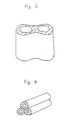
- FIGURES 1 and 2 show carriers with one passing-through channel
- FIGURE 3 shows a carrier with 2 passing-through channels
- FIGURES 4 and 5 show those with 3 passing-through channels
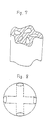
- FIGURES 6 and 7 show carriers with a multiplicity of passing-through channels
- FIGURE 8 shows one with a cross-shaped passing-through channel.
- FIGURES 9 through 11 show examples of a carrier having the shape of hollow cylinder, wherein D, d, h and I represent outside diameter, inside diameter, i.e. diameter of hollow space, wall thickness, i.e. the width of solid part in the cross section and height, respectively.
- the wall thickness (h) and the height (I) need not be uniform and wall shapes having projections and/or concaves are, naturally, also included in the scope of the present invention. It is preferred for the size of this hollow cylinder that the outside diameter (D), inside diameter (d), wall thickness (h) and height (I) be within ranges of 3 to 10 mm, at least 1 mm, not more than 3 mm and 2 to 10 mm, respectively, but the sizes principally satisfying these conditions may also be suitably used. If the outside diameter (D) and the height (I) exceed these ranges, a multiplicity of such carrier pellets will be difficult to appropriately pack in a reaction tube of a fixed bed reactor.
- the wall thickness (h) is preferably as thin as possible within the range that permits the strength of the carrier to be industrially usable. If the inside diameter (d) is less than 1 mm, the pressure loss will increase, thereby lowering the effect of the present invention.
- the carrier may be of any material, but is preferably made of silica and/or alumina.
- the carrier preferably has a specific surface area as measured by BET method of 50 to 200 m 2 /g, and is formed of micropores having a pore volume as measured by mercury porosimetry of 0.3 to 1.0 ml/g, of which at least 50% have a diameter of 40 to 400 angstroms.
- the carrier may be formed by any process including, for example, molding and pressing.
- the catalyst of the present invention comprises an active catalyst agent of at least one element selected from Group VIII of the periodic table or compounds thereof carried on the above-described carrier having at least one passing-through channel. It is preferred that the catalyst of the present invention comprises, besides the active catalyst agent, a promoter (I) which comprises at least one element selected from Group Ib of the periodic table or compounds thereof. It is still more preferred that the catalyst of the present invention further comprises, besides the active catalyst agent and the promoter (I), an active agent component (hereinafter referred to as "promoter (II)”) which is an alkali metal compound comprising an element belonging to Group la of the periodic table.
- promoter (I) an active agent component
- Preferred among the above element selected from Group VIII of the periodic table and the element selected from Group Ib of the periodic table are palladium and gold, respectively.
- All the salts and complexes of palladium and gold can be used, among which preferably selected are those being soluble in water or solvents suited for catalyst and, when to be used in the form of metal in a catalyst, being readily reducible into metal form.
- Preferred among these are carboxylates, and more particularly, salts or sodium salts of chlorides of aliphatic monocarboxylic acids having 2 to 5 carbon atoms, such as acetates, propionates and butyrates.
- Particularly preferred among these palladium compounds are palladium acetate and palladium sodium chloride in view of solubility and availability.
- a preferred gold compound is chloroauric acid (tetrachloroauric acid).
- Palladium or its compound is contained in the catalyst in an amount as palladium of 1 to 20 g/I, preferably 2 to 10 g/I; and gold or its compound is contained in an amount as gold of 0.1 to 10 g/I, preferably 0.2 to 5 g/I.
- the catalyst of the present invention preferably comprises an alkali metal compound as promoter (II).
- alkali metal compounds are alkali carboxylates such as potassium acetate, sodium acetate, lithium acetate and sodium propionate. Also usable are hydroxides, oxides and carbonates of alkali metals that convert to carboxylates under the reaction conditions.
- the promoter (II) is generally added in an amount of 5 to 80 g/I, preferably 10 to 50 g/I.
- the combination of palladium, gold and an alkali metal compound is particularly preferred among combinations of the above active catalyst agent, promoter (I) and promoter (II).
- the active catalyst agent and the promoter (I) (hereinafter the two in combination or, only the former when the latter is not used, are referred to as “carried substance”) can be carried on a carrier uniformly (hereinafter this state is referred to as "uniform carrying") by for example immersing the carrier in a solution comprising the carried substance and then, if necessary, reducing it.
- the carried substance can be surface-carried by, for example, a process which comprises immersing the carrier in a solution containing a small portion of the carried substance, reducing it if necessary, re-immersing the carrier in a solution containing the rest of the carried substance, a process which comprises spraying a solution containing the carried substance onto the carrier, followed by the reduction thereof, or like processes.
- a carrier In impregnating a carrier with a carried substance, it is advantageous to immerse the carrier in a solution containing the carried substance and having a volume equal to the integrated pore volume of the carrier and then mix the solution sufficiently.
- the carried substance is uniformly carried on all the particles of the carrier material. Agitation is an advantageous method for sufficient mixing.
- the immersion and the mixing can be conducted simultaneously in, for example, a rotating drum or a drum drier.
- a process which comprises immersing the catalyst having completed impregnation of the carried substance in a solution containing a reducing agent and allowing the mixture to stand still for a prescribed time.
- Hydrazine * hydrate is a suitable reducing agent in view of availability.
- a process which comprises diluting a gas such as hydrogen, methanol, formaldehyde, ethylene or propylene with an inert gas such as nitrogen or carbon dioxide, and conduct reduction at an elevated temperature of 50 to 100° C.
- the promoter (II) can be carried on a carrier in the same manner as in the case of impregnation with the carried substance.
- the activity of a catalyst is evaluated by for example the measurement of surface area of carried metal (hereinafter referred to as "MSA") by determining the CO absorbability. See HANDBOOK OF CATALYST EXPERIMENT, an extra number of "CATALYST COURSE” edited by Japan Catalyst Association, 1986, pages 183-185.
- the catalyst comprising the carrier of the present invention having at least one passing-through channel gives clearly higher MSA than those of catalysts comprising a round or cylindrical carrier having the same outside shape and no hollow channels.
- the catalyst of the present invention exhibits particularly marked catalytic activity when the carried substance is surface-carried, especially on the vicinity of the surface layer of the outside surface and that of the surface of the inner wall of the passing-through channel, i.e. all surface layers of all the surfaces of the carrier.
- the process for producing unsaturated esters of the present invention comprises using a catalyst comprising the above-described carrier having at least one passing-through channel with a carried substance and, preferably, promoter (II) carried thereon and conducting reaction in the gas phase containing an olefin, an organic carboxylic acid and oxygen at 100 to 220 C, preferably 120 to 200 C and under a pressure of 1 to 25 atmospheres, preferably 1 to 15 atmospheres, through a fixed bed catalyst reactor.
- promoter (II) carried thereon and conducting reaction in the gas phase containing an olefin, an organic carboxylic acid and oxygen at 100 to 220 C, preferably 120 to 200 C and under a pressure of 1 to 25 atmospheres, preferably 1 to 15 atmospheres, through a fixed bed catalyst reactor.
- components remaining unreacted can be recycled.
- the space velocity used is preferably in a range of from 2000 to 5000 hr- 1 ; and in the present invention stable production operation is possible with the space velocity of not less than 3000 hr- 1 .
- olefin examples include ethylene, propylene, butene, pentene, hexene and the like, among which ethylene and propylene are particularly preferred.
- organic carboxylic acid examples include formic acid, acetic acid, propionic acid and the like, among which acetic acid is particularly preferred.
- the gas phase used for the reaction and comprising an olefin, an organic carboxylic acid and oxygen should maintain the oxygen concentration outside the explosion limit under the applied conditions.
- the process for producing unsaturated esters of the present invention is suitably used for the production of vinyl esters such as vinyl formate, vinyl acetate and vinyl propionate and allyl esters such as allyl formate, allyl acetate and allyl propionate, among which particularly suitable are the production of vinyl acetate and allyl acetate.
- the catalyst comprising a carrier having at least one passing-through channel used in the present invention has been found to overcome all the unsatisfactory points associated with the prior art.
- the use of a catalyst comprising a carried substance and, preferably, a promoter (II) carried on a carrier having at least one passing-through channel, particularly one having the shape of hollow cylinder, significantly increases the space time yield of the resulting unsaturated esters. Thanks to small pressure loss in the catalyst layer, employment of reaction conditions including increased space velocity is possible, whereby the space time yield is significantly increased without lowering the selectivity to the desired product. Furthermore, formation of byproducts is suppressed.
- the advantages of the process of the present invention are as follows:
- the volume of the reactor can be decreased, thereby significantly reducing the equipment cost; or, when an existing apparatus is used, the production can substantially be increased without increasing the capacity of the existing reaction vessel, thereby saving the expense for expanding the apparatus which would otherwise be required for increasing the production.
- this catalyst significantly higher selectivity to the desired product can be attained in the production than in the case of using conventional catalyst and with the same space time yield, thereby greatly cutting down the amount of olefin consumed.
- a carrier formed principally of silica, having a hollow cylindrical shape and having the below-described dimensions was used.
- Catalysts were prepared using this carrier as follows.
- the above carrier was impregnated with an aqueous solution containing palladium sodium chloride (PdCl 2 •2NaCl) as a palladium salt and tetrachloroaurate as a gold salt, and then the noble metal salts were reduced with a reducing agent of hydrazine. hydrate which is capable of reducing palladium salts and gold salts to the metals. Thereafter the carrier with the metals were washed with water, then impregnated again with potassium acetate (KOAc) as an alkali metal acetate, and dried.
- PdCl 2 •2NaCl palladium sodium chloride
- tetrachloroaurate as a gold salt
- the amounts of the noble metals carried were adjusted to a Pd content of 5.0 g/I and an Au content of 0.5 g/I, and KOAc was adjusted to a content of 20 g/I.
- the amount of high-boiling-point byproducts formed is shown in terms of an index based on 100 of the amount formed per space time yield in the case of surface-carried catalyst. This applies also to the cases of Examples and Comparative Examples that follow.
- the pressure loss was 0.2 kg/cm 2 for both cases.
- the amount of high-boiling-point byproducts formed was compared by using the ratio of the area of gas chromatographical peaks, obtained by the below-described gas chromatography, which were thought to be from those having a boiling point of at least 130° C.
- Example 1 was repeated except for using a spherical carrier having the same composition as that of Example 1, to effect reaction.
- the results are shown in Table 1.
- the space time yield was lower and the pressure loss was larger than in the case of Example 1.
- the MSA was 70 g/m 2 for surface-carried catalyst.
- Comparative Example 1 was repeated except for using a cylindrical carrier with no channels having an outside diameter (D) of 5.1 mm and a height (I) of 4.1 mm, to effect reaction.
- the results are shown in Table 1.
- the MSA was 81 m 2 /g for surface-carried catalyst.
- Comparative Example 1 was repeated except for using a cylindrical carrier having semispherical ends, to effect reaction. The results are shown in Table 1.
- Synthesis reaction was effected using the same catalyst and apparatus as used in Example 1 except that the space velocity of the raw material gas was 3000 hr -1 , i.e. 1.5 times that in the case of Example 1.
- Comparative Examples 1 through 3 were repeated except that the space velocity of the raw material gas was changed to 3000 hr- 1 , i.e. 1.5 times that used in these Comparative Examples, to be Comparative Examples 4 through 6, respectively.
- the results are shown in Table 2.
- Example 1 was repeated except for using propylene as an olefin instead of ethylene, changing the space velocity, pressure of raw material gas and the temperature of the cooling jacket side to 2,000 hr -1 , 5 atm and 140°C, respectively, using a catalyst comprising no gold and changing the raw material gas composition as follows.
- the space time yield of the resulting allyl acetate was 190 g/I' hr and the selectivity was 97%.
Landscapes
- Chemical & Material Sciences (AREA)
- Organic Chemistry (AREA)
- Engineering & Computer Science (AREA)
- Materials Engineering (AREA)
- Chemical Kinetics & Catalysis (AREA)
- Organic Low-Molecular-Weight Compounds And Preparation Thereof (AREA)
- Catalysts (AREA)
- Low-Molecular Organic Synthesis Reactions Using Catalysts (AREA)
Abstract
Description
- The present invention relates to a carrier used for a catalyst for producing unsaturated esters by gas-phase reaction. The invention further relates to a catalyst utilizing said carrier, for producing unsaturated esters by gas-phase reaction, and also to a process for producing unsaturated esters by gas-phase reaction using said catalyst.
- There is known a process for producing unsaturated esters which comprises conducting reaction in a gas containing olefin, organic carboxylic acid and oxygen in the presence of a catalyst comprising palladium and/or a palladium compound as essential component, gold and/or a gold compound and an alkali metal compound, which are adsorbed (hereinafter referred to as "carried") on a carrier. Further it is known that higher catalytic activity is obtained by permitting the above noble metals and/or their compounds to be carried concentratively on a specific portion of a carrier. Thus, in the production of unsaturated esters, higher activity is obtained when the catalyst agents are mostly carried on regions close to the surface layer of a carrier (hereinafter this state is referred to as "surface-carrying"). See, for example Japanese Patent Publication Nos. 10135/1973 and 12434/1979.
- The carrier used for the catalyst generally has a spherical shape. In recent years there have also been proposed a carrier having a cylindrical shape with rectangular front view and a cylindrical carrier with its both ends being round or hemispherical (Japanese Patent Application Laid-open No. 228940/1989).
- It is necessary, for the purpose of producing an unsaturated ester advantageously on industrial scale, to increase the volume of raw material gas comprised of olefin, organic carboxylic acid and oxygen as the catalytic activity increases. (The catalytic activity is hereinafter evaluated by whether high or low the space time yield is.) The first reason to increase the volume of raw material gas is to prevent formation of hot spots on the catalyst, which is caused by increase of catalytic activity because the formation reaction of unsaturated ester is exothermic. The second reason is to maintain the conversion of oxygen within an appropriate range while maintaining the oxygen gas content in the gas below a certain level in order to keep the gas composition outside the range of explosion. Then, an increase in the volume of raw material gas naturally creates a problem of increasing pressure loss in the catalyst layer. This phenomenon of increasing pressure loss has been a barrier against advantageous commercial production of unsaturated esters, in particular when it is attempted to employ a highly active catalyst while using existing equipment. While in the prior art the catalytic activity has been improved by employment of surface-carrying, modification of carrier shape or the like, it has been a large obstacle to the economically advantageous production of unsaturated esters that the increase in the volume of raw material gas to make efficient use of thus increased catalyst activity increases pressure loss in the catalyst layer.
- An object of the present invention is to provide a carrier used for a catalyst for producing unsaturated esters by gas-phase reaction that minimizes the problem mentioned above. Another object of the present invention is to provide a catalyst for the same purpose, and still another object of the present invention is to provide a process for the same purpose.
- FIGURE 1 is a schematic view of a carrier with one passing-through channel.
- FIGURE 2 is a schematic view of another carrier with one passing-through channel.
- FIGURE 3 is a schematic view of a carrier with 2 passing-through channels.
- FIGURES 4 is a schematic view of a carrier with 3 passing-through channels.
- FIGURE 5 is a schematic view of another carrier with 3 passing-through channels.
- FIGURE 6 is a schematic view of a carrier with a multiplicity of passing-through channels.
- FIGURE 7 is a schematic view of another carrier with a multiplicity of passing-through channels.
- FIGURE 8 is a schematic view of a carrier with a cross-shaped passing-through channel.
- FIGURES 9 is a front view of a carrier having the shape of hollow cylinder.
- FIGURE 10 is a top view of the carrier shown in FIGURE 9.
- FIGURE 11 is a schematic view of the carrier shown in FIGURES 9 and 10.
- Numerical figures in the drawings represent:
- 1: outside diameter (D)
- 2: inside diameter (d)
- 3: wall thickness (h)
- 4: height (I)
- As a result of an intensive study to obtain a catalyst with high activity for producing unsaturated esters that can prevent the above-mentioned pressure loss in the catalyst layer from increasing, it has been found that this object can be achieved by a catalyst comprising a carrier having at least one passing-through channel, in particular having the shape of a cylinder with a hollow channel therein (hereinafter referred to as "hollow cylinder").
- It has further been found that the use of a catalyst comprising the carrier of the present invention decreases the amount of byproducts with high boiling point. The invention is described in detail hereinbelow.
- The carrier used in the present invention may assume any shape, as long as it has at least one passing-through channel, and its examples include a hollow cylinder, a ring, honeycombs having one or at least 2 passing-through channels, a block having a cross-shaped passing-through channel and the like, their examples being shown in FIGURES 1 through 11.
- FIGURES 1 and 2 show carriers with one passing-through channel, FIGURE 3 shows a carrier with 2 passing-through channels and FIGURES 4 and 5 show those with 3 passing-through channels. FIGURES 6 and 7 show carriers with a multiplicity of passing-through channels and FIGURE 8 shows one with a cross-shaped passing-through channel. FIGURES 9 through 11 show examples of a carrier having the shape of hollow cylinder, wherein D, d, h and I represent outside diameter, inside diameter, i.e. diameter of hollow space, wall thickness, i.e. the width of solid part in the cross section and height, respectively. In this case the wall thickness (h) and the height (I) need not be uniform and wall shapes having projections and/or concaves are, naturally, also included in the scope of the present invention. It is preferred for the size of this hollow cylinder that the outside diameter (D), inside diameter (d), wall thickness (h) and height (I) be within ranges of 3 to 10 mm, at least 1 mm, not more than 3 mm and 2 to 10 mm, respectively, but the sizes principally satisfying these conditions may also be suitably used. If the outside diameter (D) and the height (I) exceed these ranges, a multiplicity of such carrier pellets will be difficult to appropriately pack in a reaction tube of a fixed bed reactor. On the other hand, if these dimensions are smaller than the above ranges, the pressure loss will be too large to meet the object of the present invention. The wall thickness (h) is preferably as thin as possible within the range that permits the strength of the carrier to be industrially usable. If the inside diameter (d) is less than 1 mm, the pressure loss will increase, thereby lowering the effect of the present invention.
- The carrier may be of any material, but is preferably made of silica and/or alumina.
- Specific surface area, pore volume and pore diameter are known property items for carriers suited for catalysts for the production of unsaturated esters. In this invention, the carrier preferably has a specific surface area as measured by BET method of 50 to 200 m2/g, and is formed of micropores having a pore volume as measured by mercury porosimetry of 0.3 to 1.0 ml/g, of which at least 50% have a diameter of 40 to 400 angstroms.
- The carrier may be formed by any process including, for example, molding and pressing.
- The catalyst of the present invention is now described.
- The catalyst of the present invention comprises an active catalyst agent of at least one element selected from Group VIII of the periodic table or compounds thereof carried on the above-described carrier having at least one passing-through channel. It is preferred that the catalyst of the present invention comprises, besides the active catalyst agent, a promoter (I) which comprises at least one element selected from Group Ib of the periodic table or compounds thereof. It is still more preferred that the catalyst of the present invention further comprises, besides the active catalyst agent and the promoter (I), an active agent component (hereinafter referred to as "promoter (II)") which is an alkali metal compound comprising an element belonging to Group la of the periodic table.
- Preferred among the above element selected from Group VIII of the periodic table and the element selected from Group Ib of the periodic table are palladium and gold, respectively. All the salts and complexes of palladium and gold can be used, among which preferably selected are those being soluble in water or solvents suited for catalyst and, when to be used in the form of metal in a catalyst, being readily reducible into metal form. Preferred among these are carboxylates, and more particularly, salts or sodium salts of chlorides of aliphatic monocarboxylic acids having 2 to 5 carbon atoms, such as acetates, propionates and butyrates. Particularly preferred among these palladium compounds are palladium acetate and palladium sodium chloride in view of solubility and availability. For the same reason, a preferred gold compound is chloroauric acid (tetrachloroauric acid).
- Palladium or its compound is contained in the catalyst in an amount as palladium of 1 to 20 g/I, preferably 2 to 10 g/I; and gold or its compound is contained in an amount as gold of 0.1 to 10 g/I, preferably 0.2 to 5 g/I.
- The catalyst of the present invention preferably comprises an alkali metal compound as promoter (II). Examples of preferred alkali metal compounds are alkali carboxylates such as potassium acetate, sodium acetate, lithium acetate and sodium propionate. Also usable are hydroxides, oxides and carbonates of alkali metals that convert to carboxylates under the reaction conditions. The promoter (II) is generally added in an amount of 5 to 80 g/I, preferably 10 to 50 g/I.
- The combination of palladium, gold and an alkali metal compound is particularly preferred among combinations of the above active catalyst agent, promoter (I) and promoter (II). In this case, it is preferred that palladium and gold be contained in the catalyst as metals or their compounds, and the alkali metal compound be contained as carboxylate of an alkali metal, particularly potassium.
- The active catalyst agent and the promoter (I) (hereinafter the two in combination or, only the former when the latter is not used, are referred to as "carried substance") can be carried on a carrier uniformly (hereinafter this state is referred to as "uniform carrying") by for example immersing the carrier in a solution comprising the carried substance and then, if necessary, reducing it. Or, the carried substance can be surface-carried by, for example, a process which comprises immersing the carrier in a solution containing a small portion of the carried substance, reducing it if necessary, re-immersing the carrier in a solution containing the rest of the carried substance, a process which comprises spraying a solution containing the carried substance onto the carrier, followed by the reduction thereof, or like processes.
- In impregnating a carrier with a carried substance, it is advantageous to immerse the carrier in a solution containing the carried substance and having a volume equal to the integrated pore volume of the carrier and then mix the solution sufficiently. By this method the carried substance is uniformly carried on all the particles of the carrier material. Agitation is an advantageous method for sufficient mixing. The immersion and the mixing can be conducted simultaneously in, for example, a rotating drum or a drum drier.
- In conducting reduction of a palladium compound or a gold compound, generally employed is a process which comprises immersing the catalyst having completed impregnation of the carried substance in a solution containing a reducing agent and allowing the mixture to stand still for a prescribed time. Hydrazine* hydrate is a suitable reducing agent in view of availability. There may also be employed a process which comprises diluting a gas such as hydrogen, methanol, formaldehyde, ethylene or propylene with an inert gas such as nitrogen or carbon dioxide, and conduct reduction at an elevated temperature of 50 to 100° C.
- The promoter (II) can be carried on a carrier in the same manner as in the case of impregnation with the carried substance.
- The activity of a catalyst is evaluated by for example the measurement of surface area of carried metal (hereinafter referred to as "MSA") by determining the CO absorbability. See HANDBOOK OF CATALYST EXPERIMENT, an extra number of "CATALYST COURSE" edited by Japan Catalyst Association, 1986, pages 183-185. The catalyst comprising the carrier of the present invention having at least one passing-through channel gives clearly higher MSA than those of catalysts comprising a round or cylindrical carrier having the same outside shape and no hollow channels.
- The catalyst of the present invention exhibits particularly marked catalytic activity when the carried substance is surface-carried, especially on the vicinity of the surface layer of the outside surface and that of the surface of the inner wall of the passing-through channel, i.e. all surface layers of all the surfaces of the carrier.
- The process for producing unsaturated esters according to the present invention is described next.
- The process for producing unsaturated esters of the present invention comprises using a catalyst comprising the above-described carrier having at least one passing-through channel with a carried substance and, preferably, promoter (II) carried thereon and conducting reaction in the gas phase containing an olefin, an organic carboxylic acid and oxygen at 100 to 220 C, preferably 120 to 200 C and under a pressure of 1 to 25 atmospheres, preferably 1 to 15 atmospheres, through a fixed bed catalyst reactor. Here components remaining unreacted can be recycled.
- There is no specifical limit as to the space velocity used, but it is preferably in a range of from 2000 to 5000 hr-1; and in the present invention stable production operation is possible with the space velocity of not less than 3000 hr-1.
- Examples of the olefin are ethylene, propylene, butene, pentene, hexene and the like, among which ethylene and propylene are particularly preferred.
- Examples of the organic carboxylic acid are formic acid, acetic acid, propionic acid and the like, among which acetic acid is particularly preferred.
- The gas phase used for the reaction and comprising an olefin, an organic carboxylic acid and oxygen should maintain the oxygen concentration outside the explosion limit under the applied conditions.
- It is advantageous to dilute the gas with an inert gas such as nitrogen or carbon dioxide under a prescribed condition. Of the two, carbon dioxide is more suited for the dilution in a circulating system, since carbon dioxide forms in a small amount during reaction. A part of the olefin used is consumed in combustion reaction, i.e. reaction with oxygen. This combustion reaction is accelerated as the temperature is elevated, and hence it is preferred to suppress the elevation of gas temperature on the catalyst as low as possible.
- While several byproducts other than carbon dioxide have been observed, generation of byproducts other than the desired product and having a low or high boiling point should be suppressed to as low an extent as possible, since they are difficult to separate. Byproducts, particularly those having a high boiling point, contain compounds having a structure comprising the desired product with acetic acid added thereto. From this fact, it is considered that secondary addition reaction proceeds as the desired reaction proceeds. It is preferred for the purpose of suppressing the secondary addition reaction not to prolong the time of contact with catalyst longer than necessary.
- The process for producing unsaturated esters of the present invention is suitably used for the production of vinyl esters such as vinyl formate, vinyl acetate and vinyl propionate and allyl esters such as allyl formate, allyl acetate and allyl propionate, among which particularly suitable are the production of vinyl acetate and allyl acetate.
- The catalyst comprising a carrier having at least one passing-through channel used in the present invention has been found to overcome all the unsatisfactory points associated with the prior art.
- Thus, its advantages over conventional carriers of spherical or cylindrical shape with no channels are as follows:
- ① can increase space time yield;
- ② can increase the space velocity of raw material gas, thanks to small pressure loss in the catalyst layer;
- ③ can keep high selectivity to the desired product even at high space time yield, since the temperature elevation in the catalyst layer is suppressed by increasing the space velocity; and
- ④ can suppress formation of byproducts caused by secondary addition reaction, since the time of contact with the catalyst is maintained as short as possible by increasing the space velocity even at high space time yield.
- As is apparent from the following Examples, the use of a catalyst comprising a carried substance and, preferably, a promoter (II) carried on a carrier having at least one passing-through channel, particularly one having the shape of hollow cylinder, significantly increases the space time yield of the resulting unsaturated esters. Thanks to small pressure loss in the catalyst layer, employment of reaction conditions including increased space velocity is possible, whereby the space time yield is significantly increased without lowering the selectivity to the desired product. Furthermore, formation of byproducts is suppressed.
- The advantages of the process of the present invention are as follows: By using the catalyst of the present invention, when an apparatus for producing unsaturated esters is newly constructed, the volume of the reactor can be decreased, thereby significantly reducing the equipment cost; or, when an existing apparatus is used, the production can substantially be increased without increasing the capacity of the existing reaction vessel, thereby saving the expense for expanding the apparatus which would otherwise be required for increasing the production. Furthermore, by using this catalyst, significantly higher selectivity to the desired product can be attained in the production than in the case of using conventional catalyst and with the same space time yield, thereby greatly cutting down the amount of olefin consumed.
- Hereinbelow the present invention is described in more detail with reference to Examples. In the Examples "%" means "% by weight" unless otherwise specified.
- A carrier formed principally of silica, having a hollow cylindrical shape and having the below-described dimensions was used.
- Dimensions: outside diameter (D) 5.1 mm
- inside diameter (d) 2.0 mm
- wall thickness (h) 1.55 mm
- height (I) 4.1 mm
- The above carrier was impregnated with an aqueous solution containing palladium sodium chloride (PdCl2•2NaCl) as a palladium salt and tetrachloroaurate as a gold salt, and then the noble metal salts were reduced with a reducing agent of hydrazine. hydrate which is capable of reducing palladium salts and gold salts to the metals. Thereafter the carrier with the metals were washed with water, then impregnated again with potassium acetate (KOAc) as an alkali metal acetate, and dried.
- The amounts of the noble metals carried were adjusted to a Pd content of 5.0 g/I and an Au content of 0.5 g/I, and KOAc was adjusted to a content of 20 g/I.
- In the same manner as in the case of preparing uniformly-carried catalyst, 0.2 g/I of Pd and 0.09 g/I of Au were firstly carried, and similar procedure was repeated to permit 5.0 g/I of Pd and 0.5 g/I of Au to be finally carried. Further 20 g/I of KOAc was carried. The catalyst thus prepared was tested by X-ray microanalysis to show that at least 95% of Pd and Au extended less than 0.5 mm from the surface. The MSA was 90 m2/g for the surface-carried catalyst.
- Two sets of a multiplicity of the thus prepared uniformly-carried catalyst and surface-carried catalyst were each packed in a reaction tube equipped with jacket and having an inside diameter and a length of 25 mm and 6 m respectively. A gas containing 72% by volume of ethylene, 8% by volume of oxygen and 20% by volume of acetic acid was passed through the catalyst layer thus prepared at an oil temperature of the cooling jacket side of 160° C and under a pressure of 10 atm and at a space velocity (hereinafter referred to as "SV") of 2000 hr-1, to permit reaction to take place. The space time yield of vinyl acetate formed, selectivity to vinyl acetate based on ethylene amount and ratio of high-boiling-point byproducts formed are shown in Table 1.
- The amount of high-boiling-point byproducts formed is shown in terms of an index based on 100 of the amount formed per space time yield in the case of surface-carried catalyst. This applies also to the cases of Examples and Comparative Examples that follow. The pressure loss was 0.2 kg/cm2 for both cases.
- The amount of high-boiling-point byproducts formed was compared by using the ratio of the area of gas chromatographical peaks, obtained by the below-described gas chromatography, which were thought to be from those having a boiling point of at least 130° C.
- Apparatus: GC-6A(1), made by Shimadzu Corporation
- Column: inside
diameter 3 mm, length 3 m, glass - Packings: FAL-M 25%/carrier Chromosolve W-AW, DMCS, H3P04 80 to 100 mesh
- Measuring condition: column temperature 95 C
- Detector: FID 210 C
- Carrier gas: N2 30 ml/min
- Example 1 was repeated except for using a spherical carrier having the same composition as that of Example 1, to effect reaction. The results are shown in Table 1. The space time yield was lower and the pressure loss was larger than in the case of Example 1. The MSA was 70 g/m2 for surface-carried catalyst.
- Comparative Example 1 was repeated except for using a cylindrical carrier with no channels having an outside diameter (D) of 5.1 mm and a height (I) of 4.1 mm, to effect reaction. The results are shown in Table 1. The MSA was 81 m2/g for surface-carried catalyst.
- Comparative Example 1 was repeated except for using a cylindrical carrier having semispherical ends, to effect reaction. The results are shown in Table 1.

- Synthesis reaction was effected using the same catalyst and apparatus as used in Example 1 except that the space velocity of the raw material gas was 3000 hr-1, i.e. 1.5 times that in the case of Example 1.
- Both the space time yield and the selectivity were high, with small increase in pressure loss and small amount of byproducts formed.
- Comparative Examples 1 through 3 were repeated except that the space velocity of the raw material gas was changed to 3000 hr-1, i.e. 1.5 times that used in these Comparative Examples, to be Comparative Examples 4 through 6, respectively. The results are shown in Table 2.
- It was found that, in Comparative Examples 4 through 6 where the space velocity was 3000 hr-1, the pressure loss was larger than in Example 2, which is not preferred from the viewpoint of commercial production for vinyl acetate.

- Example 1 was repeated except for using propylene as an olefin instead of ethylene, changing the space velocity, pressure of raw material gas and the temperature of the cooling jacket side to 2,000 hr-1, 5 atm and 140°C, respectively, using a catalyst comprising no gold and changing the raw material gas composition as follows.
- Propylene: 12% by volume, nitrogen: 72% by volume
- Oxygen: 7% by volume, acetic acid: 9% by volume
- The space time yield of the resulting allyl acetate was 190 g/I' hr and the selectivity was 97%.
Claims (15)
Applications Claiming Priority (2)
| Application Number | Priority Date | Filing Date | Title |
|---|---|---|---|
| JP17712590 | 1990-07-03 | ||
| JP177125/90 | 1990-07-03 |
Publications (2)
| Publication Number | Publication Date |
|---|---|
| EP0464633A1 true EP0464633A1 (en) | 1992-01-08 |
| EP0464633B1 EP0464633B1 (en) | 1994-01-19 |
Family
ID=16025609
Family Applications (1)
| Application Number | Title | Priority Date | Filing Date |
|---|---|---|---|
| EP91110562A Expired - Lifetime EP0464633B1 (en) | 1990-07-03 | 1991-06-26 | Catalyst and process for producing unsaturated ester |
Country Status (3)
| Country | Link |
|---|---|
| US (1) | US5371277A (en) |
| EP (1) | EP0464633B1 (en) |
| DE (1) | DE69101032T2 (en) |
Cited By (38)
| Publication number | Priority date | Publication date | Assignee | Title |
|---|---|---|---|---|
| TR24329A (en) * | 1989-02-23 | 1991-09-01 | Philip Morris Prod | A YOENTEM FOR WRAPPING PAPER AND ITS PREPARATION FOR ICIM SUBSTANCES |
| TR24960A (en) * | 1988-10-06 | 1992-07-29 | Goodyear Tire & Rubber | HIGH MODULE RUBBER COMPOSITION |
| WO1994008714A1 (en) * | 1992-10-14 | 1994-04-28 | Hoechst Celanese Corporation | Vinyl acetate catalyst preparation method |
| WO1994008715A1 (en) * | 1992-10-14 | 1994-04-28 | Hoechst Celanese Corporation | Vinyl acetate catalyst preparation method |
| EP0678331A1 (en) * | 1994-04-05 | 1995-10-25 | Montecatini Tecnologie S.R.L. | Catalyst in granular form for 1,2-dichloroethane synthesis and fixed-bed process for ethylene oxachlorination using said catalyst |
| EP0732146A1 (en) * | 1995-03-14 | 1996-09-18 | Montecatini Tecnologie S.R.L. | Catalysts and catalyst carriers obtained by tabletting |
| EP0790313A2 (en) | 1996-02-13 | 1997-08-20 | Hoechst Aktiengesellschaft | Nucleic acid constructs for the cell cycle regulated expression of genes, cells comprising said constructs and their use for the preparation of medical compositions |
| WO1997036679A1 (en) * | 1996-04-02 | 1997-10-09 | Hoechst Celanese Corporation | Honeycomb catalyst for vinyl acetate synthesis |
| WO1998052688A1 (en) * | 1997-05-22 | 1998-11-26 | Celanese Gmbh | Method for producing vinyl acetate |
| CN1044573C (en) * | 1992-10-06 | 1999-08-11 | 蒙泰卡蒂尼技术股份公司 | Catalyst granules, in particular for the oxidative dehydrogenation of methanol in order to yield formaldehyde |
| EP0987058A1 (en) * | 1998-06-26 | 2000-03-22 | Degussa-Hüls Aktiengesellschaft | Shaped body on basis of silicon dioxide |
| WO2000044496A1 (en) * | 1999-01-29 | 2000-08-03 | Celanese Chemicals Europe Gmbh | Catalyst on the basis of palladium and cadmium and method for producing vinyl acetate |
| US6235526B1 (en) | 1996-05-03 | 2001-05-22 | Aventis Pharma Deutschland Gmbh | Nucleic acid constructs containing genes encoding transport signals |
| WO2001058590A1 (en) * | 2000-02-10 | 2001-08-16 | Süd-Chemie AG | Catalyst for hydrogenating unsaturated hydrocarbons |
| DE10005775A1 (en) * | 2000-09-28 | 2001-08-16 | Sued Chemie Ag | Catalyst for the hydrogenation of unsaturated hydrocarbons |
| WO2003013725A1 (en) * | 2001-08-01 | 2003-02-20 | Shell Internationale Research Maatschappij, B.V. | Shaped trilobal particles |
| EP1323469A3 (en) * | 2001-12-21 | 2003-09-24 | Degussa AG | Supported Catalyst |
| WO2006052615A1 (en) * | 2004-11-03 | 2006-05-18 | Velocys, Inc. | Process and apparatus for improved methods for making vinyl acetate monomer (vam) |
| DE102005019596A1 (en) * | 2005-04-27 | 2006-11-02 | Süd-Chemie AG | Cylindrical catalyst body, used for steam reforming hydrocarbons, comprises extent surface, which is parallel to longitudinal axis of catalyst body running grooves and between grooves exhibiting running webs |
| EP2045008A2 (en) | 2007-10-04 | 2009-04-08 | Evonik Degussa GmbH | Catalyst |
| US7563745B2 (en) | 2002-06-07 | 2009-07-21 | Shell Oil Company | Shaped catalyst particles for hydrocarbon synthesis |
| WO2010029324A1 (en) | 2008-09-12 | 2010-03-18 | Johnson Matthey Plc | Shaped heterogeneous catalysts |
| US7811966B2 (en) | 2007-01-18 | 2010-10-12 | Shell Oil Company | Catalyst, catalyst precursor, and catalyst carrier |
| US7811963B2 (en) | 2002-11-04 | 2010-10-12 | Shell Oil Company | Elongated shaped particles use as a catalyst or support thereof |
| US7998899B2 (en) | 2007-11-27 | 2011-08-16 | Shell Oil Company | Catalyst with support structure |
| WO2011104170A1 (en) | 2010-02-24 | 2011-09-01 | Evonik Degussa Gmbh | Thermally and mechanically stable precious metal-loaded catalysts |
| US8168564B2 (en) | 2007-11-27 | 2012-05-01 | Coen Willem Johannes Pieterse | Catalyst support |
| US8410014B2 (en) | 2006-12-13 | 2013-04-02 | Wacker Chemie Ag | Method for producing catalysts and their use for the gas phase oxidation of olefins |
| CN103058863A (en) * | 2011-10-24 | 2013-04-24 | 中国石油化工股份有限公司 | Process for the preparation of allyl acetate |
| RU2492925C2 (en) * | 2008-03-10 | 2013-09-20 | Сд Лиценцфервертунгсгезелльшафт Мбх Унд Ко.Кг | Geometrically classified solid carrier for olefin epoxidation catalyst, which has definite form |
| US8557729B2 (en) | 2008-09-12 | 2013-10-15 | Johnson Matthey Plc | Shaped heterogeneous catalysts |
| US8557728B2 (en) | 2008-09-12 | 2013-10-15 | Johnson Matthey Plc | Shaped heterogeneous catalysts |
| WO2016097997A1 (en) * | 2014-12-16 | 2016-06-23 | Sabic Global Technologies B.V. | Engineered inert media for use in fixed bed dehydrogenation reactors |
| WO2016156042A1 (en) | 2015-03-27 | 2016-10-06 | Basf Se | Shaped catalyst body for the catalytic oxidation of so2 into so3 |
| EP3431178A1 (en) | 2017-07-20 | 2019-01-23 | Basf Se | Catalysts and method for the catalytic oxidation of so2 to so3 |
| WO2019170406A1 (en) | 2018-03-07 | 2019-09-12 | Basf Se | Shaped catalyst body in the form of tetralobes of uniform wall thickness |
| WO2019170514A1 (en) | 2018-03-07 | 2019-09-12 | Basf Se | Shaped catalytic body in the form of a tetralobe with central passage |
| EP3569308A1 (en) | 2018-05-18 | 2019-11-20 | Basf Se | Shaped body in the form of multi-lobes |
Families Citing this family (18)
| Publication number | Priority date | Publication date | Assignee | Title |
|---|---|---|---|---|
| DE4120492A1 (en) * | 1991-06-21 | 1992-12-24 | Hoechst Ag | METHOD FOR PRODUCING VINYL ACETATE |
| US5861353A (en) * | 1992-10-06 | 1999-01-19 | Montecatini Tecnologie S.R.L. | Catalyst in granular form for 1,2-dichloroethane synthesis |
| DE19639103A1 (en) | 1996-09-24 | 1998-03-26 | Hoechst Ag | DNA construct with inhibitory mutation and corrective mutation |
| GB9817362D0 (en) | 1998-08-11 | 1998-10-07 | Bp Chem Int Ltd | Improved process for the production if vinyl acetate |
| DE69918672T2 (en) | 1999-05-21 | 2005-07-21 | Evc Technology Ag | Catalyst and oxychlorination process using the same |
| CN1115323C (en) * | 1999-12-02 | 2003-07-23 | 中国石化上海石油化工股份有限公司 | Ethylene process of preparing vinyl acetate |
| DE19959413A1 (en) | 1999-12-09 | 2001-06-21 | Consortium Elektrochem Ind | Supported catalysts and their use in the gas phase oxidation of hydrocarbons |
| US7381682B1 (en) | 2004-10-28 | 2008-06-03 | Nanostellar, Inc. | Method for producing heterogeneous catalysts containing metal nanoparticles |
| US7381683B1 (en) | 2004-10-28 | 2008-06-03 | Nanostellar, Inc. | Method of producing multi-component catalysts |
| DE102005056866A1 (en) * | 2005-11-29 | 2007-05-31 | Süd-Chemie AG | Molded catalyst, useful e.g. for the production of maleic acid anhydride, comprises mixed oxides of vanadium and phosphorus as the catalyst component |
| JP5258119B2 (en) * | 2006-11-20 | 2013-08-07 | ナノステラー インコーポレイテッド | Method for producing a heterogeneous catalyst comprising metal nanoparticles |
| US8067634B2 (en) | 2009-10-30 | 2011-11-29 | Lyondell Chemical Technology, L.P. | Process for producing allyl acetate |
| DE102014223268A1 (en) * | 2014-11-14 | 2016-05-19 | Wacker Chemie Ag | Catalyst shaped body for the production of vinyl acetate |
| US10112830B2 (en) * | 2014-12-08 | 2018-10-30 | Clariant Corporation | Shaped catalyst for sour gas shift reactions and methods for using them |
| DE102015205254A1 (en) * | 2015-03-24 | 2016-09-29 | Wacker Chemie Ag | Catalyst shaped body for the production of vinyl acetate |
| RU2722157C1 (en) | 2015-07-22 | 2020-05-27 | Басф Корпорейшн | Catalysts with high geometrical surface area for producing vinyl acetate monomer |
| WO2020120078A1 (en) * | 2018-12-12 | 2020-06-18 | Haldor Topsøe A/S | Catalyst particle shape |
| WO2024083780A1 (en) * | 2022-10-18 | 2024-04-25 | Basf Se | Improved catalyst shapes for heat transfer and pressure-drop in the syngas conversion |
Citations (4)
| Publication number | Priority date | Publication date | Assignee | Title |
|---|---|---|---|---|
| US3822308A (en) * | 1968-02-01 | 1974-07-02 | Bayer Ag | Process for the production of vinyl esters |
| EP0004079A2 (en) * | 1978-03-15 | 1979-09-19 | Hoechst Aktiengesellschaft | Support catalyst for the preparation of vinyl acetate from ethylene, acetic acid and oxygen in the gaseous phase. |
| EP0083791A2 (en) * | 1982-01-09 | 1983-07-20 | Bayer Ag | Shaped articles containing silica, processes for their preparation and their use |
| EP0102641A2 (en) * | 1982-09-06 | 1984-03-14 | Nippon Shokubai Kagaku Kogyo Co., Ltd | Catalyst for manufacturing methacrolein |
Family Cites Families (3)
| Publication number | Priority date | Publication date | Assignee | Title |
|---|---|---|---|---|
| JPS5412434A (en) * | 1977-06-30 | 1979-01-30 | Tokyo Electric Power Co Inc:The | Protective relay system |
| DE3445289A1 (en) * | 1984-12-12 | 1986-06-19 | Basf Ag, 6700 Ludwigshafen | SHAPED CATALYST FOR HETEROGENIC CATALYZED REACTIONS |
| DE3803900A1 (en) * | 1988-02-09 | 1989-08-17 | Hoechst Ag | METHOD FOR PRODUCING VINYL ACETATE |
-
1991
- 1991-06-26 EP EP91110562A patent/EP0464633B1/en not_active Expired - Lifetime
- 1991-06-26 DE DE69101032T patent/DE69101032T2/en not_active Expired - Lifetime
-
1994
- 1994-04-14 US US08/227,700 patent/US5371277A/en not_active Expired - Lifetime
Patent Citations (4)
| Publication number | Priority date | Publication date | Assignee | Title |
|---|---|---|---|---|
| US3822308A (en) * | 1968-02-01 | 1974-07-02 | Bayer Ag | Process for the production of vinyl esters |
| EP0004079A2 (en) * | 1978-03-15 | 1979-09-19 | Hoechst Aktiengesellschaft | Support catalyst for the preparation of vinyl acetate from ethylene, acetic acid and oxygen in the gaseous phase. |
| EP0083791A2 (en) * | 1982-01-09 | 1983-07-20 | Bayer Ag | Shaped articles containing silica, processes for their preparation and their use |
| EP0102641A2 (en) * | 1982-09-06 | 1984-03-14 | Nippon Shokubai Kagaku Kogyo Co., Ltd | Catalyst for manufacturing methacrolein |
Cited By (55)
| Publication number | Priority date | Publication date | Assignee | Title |
|---|---|---|---|---|
| TR24960A (en) * | 1988-10-06 | 1992-07-29 | Goodyear Tire & Rubber | HIGH MODULE RUBBER COMPOSITION |
| TR24329A (en) * | 1989-02-23 | 1991-09-01 | Philip Morris Prod | A YOENTEM FOR WRAPPING PAPER AND ITS PREPARATION FOR ICIM SUBSTANCES |
| CN1044573C (en) * | 1992-10-06 | 1999-08-11 | 蒙泰卡蒂尼技术股份公司 | Catalyst granules, in particular for the oxidative dehydrogenation of methanol in order to yield formaldehyde |
| WO1994008714A1 (en) * | 1992-10-14 | 1994-04-28 | Hoechst Celanese Corporation | Vinyl acetate catalyst preparation method |
| WO1994008715A1 (en) * | 1992-10-14 | 1994-04-28 | Hoechst Celanese Corporation | Vinyl acetate catalyst preparation method |
| EP0678331A1 (en) * | 1994-04-05 | 1995-10-25 | Montecatini Tecnologie S.R.L. | Catalyst in granular form for 1,2-dichloroethane synthesis and fixed-bed process for ethylene oxachlorination using said catalyst |
| EP0732146A1 (en) * | 1995-03-14 | 1996-09-18 | Montecatini Tecnologie S.R.L. | Catalysts and catalyst carriers obtained by tabletting |
| CN1071140C (en) * | 1995-03-14 | 2001-09-19 | 蒙泰卡蒂尼技术有限公司 | Catalysts and catalyst carriers obtained by tableting |
| EP0790313A2 (en) | 1996-02-13 | 1997-08-20 | Hoechst Aktiengesellschaft | Nucleic acid constructs for the cell cycle regulated expression of genes, cells comprising said constructs and their use for the preparation of medical compositions |
| WO1997036679A1 (en) * | 1996-04-02 | 1997-10-09 | Hoechst Celanese Corporation | Honeycomb catalyst for vinyl acetate synthesis |
| US6235526B1 (en) | 1996-05-03 | 2001-05-22 | Aventis Pharma Deutschland Gmbh | Nucleic acid constructs containing genes encoding transport signals |
| WO1998052688A1 (en) * | 1997-05-22 | 1998-11-26 | Celanese Gmbh | Method for producing vinyl acetate |
| SG82006A1 (en) * | 1998-06-26 | 2001-07-24 | Degussa | Moulding based on silica |
| EP0987058A1 (en) * | 1998-06-26 | 2000-03-22 | Degussa-Hüls Aktiengesellschaft | Shaped body on basis of silicon dioxide |
| US6316383B1 (en) | 1998-06-26 | 2001-11-13 | Degussa Ag | Moldings based on silica |
| WO2000044496A1 (en) * | 1999-01-29 | 2000-08-03 | Celanese Chemicals Europe Gmbh | Catalyst on the basis of palladium and cadmium and method for producing vinyl acetate |
| US7169736B2 (en) | 2000-02-10 | 2007-01-30 | Süd-Chemie AG | Catalyst for hydrogenation of unsaturated hydrocarbons |
| WO2001058590A1 (en) * | 2000-02-10 | 2001-08-16 | Süd-Chemie AG | Catalyst for hydrogenating unsaturated hydrocarbons |
| RU2239495C2 (en) * | 2000-02-10 | 2004-11-10 | Зюд-Хеми Аг | Catalyst for hydrogenation of unsaturated hydrocarbons |
| DE10005775A1 (en) * | 2000-09-28 | 2001-08-16 | Sued Chemie Ag | Catalyst for the hydrogenation of unsaturated hydrocarbons |
| WO2003013725A1 (en) * | 2001-08-01 | 2003-02-20 | Shell Internationale Research Maatschappij, B.V. | Shaped trilobal particles |
| EP1323469A3 (en) * | 2001-12-21 | 2003-09-24 | Degussa AG | Supported Catalyst |
| US7563745B2 (en) | 2002-06-07 | 2009-07-21 | Shell Oil Company | Shaped catalyst particles for hydrocarbon synthesis |
| US7811963B2 (en) | 2002-11-04 | 2010-10-12 | Shell Oil Company | Elongated shaped particles use as a catalyst or support thereof |
| US7468455B2 (en) | 2004-11-03 | 2008-12-23 | Velocys, Inc. | Process and apparatus for improved methods for making vinyl acetate monomer (VAM) |
| US8029748B2 (en) | 2004-11-03 | 2011-10-04 | Velocys, Inc | Process and apparatus for improved methods for making vinyl acetate monomer (VAM) |
| EP3025777A1 (en) * | 2004-11-03 | 2016-06-01 | Velocys Inc. | Apparatus for the production of vinyl acetate monomer (vam) |
| WO2006052615A1 (en) * | 2004-11-03 | 2006-05-18 | Velocys, Inc. | Process and apparatus for improved methods for making vinyl acetate monomer (vam) |
| TWI399244B (en) * | 2004-11-03 | 2013-06-21 | Velocys Inc | Process and apparatus for improved methods for making vinyl acetate monomer (vam) |
| DE102005019596A1 (en) * | 2005-04-27 | 2006-11-02 | Süd-Chemie AG | Cylindrical catalyst body, used for steam reforming hydrocarbons, comprises extent surface, which is parallel to longitudinal axis of catalyst body running grooves and between grooves exhibiting running webs |
| US8410014B2 (en) | 2006-12-13 | 2013-04-02 | Wacker Chemie Ag | Method for producing catalysts and their use for the gas phase oxidation of olefins |
| US7811966B2 (en) | 2007-01-18 | 2010-10-12 | Shell Oil Company | Catalyst, catalyst precursor, and catalyst carrier |
| EP2045008A2 (en) | 2007-10-04 | 2009-04-08 | Evonik Degussa GmbH | Catalyst |
| DE102007047430A1 (en) | 2007-10-04 | 2009-04-09 | Evonik Degussa Gmbh | catalyst |
| US7998899B2 (en) | 2007-11-27 | 2011-08-16 | Shell Oil Company | Catalyst with support structure |
| US8168564B2 (en) | 2007-11-27 | 2012-05-01 | Coen Willem Johannes Pieterse | Catalyst support |
| RU2492925C2 (en) * | 2008-03-10 | 2013-09-20 | Сд Лиценцфервертунгсгезелльшафт Мбх Унд Ко.Кг | Geometrically classified solid carrier for olefin epoxidation catalyst, which has definite form |
| US8563460B2 (en) | 2008-09-12 | 2013-10-22 | Johnson Matthey Plc | Shaped heterogeneous catalysts |
| WO2010029324A1 (en) | 2008-09-12 | 2010-03-18 | Johnson Matthey Plc | Shaped heterogeneous catalysts |
| RU2488444C2 (en) * | 2008-09-12 | 2013-07-27 | Джонсон Мэтти Плс | Moulded heterogeneous catalysts |
| US8557729B2 (en) | 2008-09-12 | 2013-10-15 | Johnson Matthey Plc | Shaped heterogeneous catalysts |
| US8557728B2 (en) | 2008-09-12 | 2013-10-15 | Johnson Matthey Plc | Shaped heterogeneous catalysts |
| KR20110057228A (en) * | 2008-09-12 | 2011-05-31 | 존슨 맛쎄이 퍼블릭 리미티드 컴파니 | Molded Heterogeneous Catalyst |
| WO2011104170A1 (en) | 2010-02-24 | 2011-09-01 | Evonik Degussa Gmbh | Thermally and mechanically stable precious metal-loaded catalysts |
| CN103058863A (en) * | 2011-10-24 | 2013-04-24 | 中国石油化工股份有限公司 | Process for the preparation of allyl acetate |
| CN103058863B (en) * | 2011-10-24 | 2015-01-07 | 中国石油化工股份有限公司 | Preparation method of allyl acetate |
| WO2016097997A1 (en) * | 2014-12-16 | 2016-06-23 | Sabic Global Technologies B.V. | Engineered inert media for use in fixed bed dehydrogenation reactors |
| WO2016156042A1 (en) | 2015-03-27 | 2016-10-06 | Basf Se | Shaped catalyst body for the catalytic oxidation of so2 into so3 |
| US10307741B2 (en) | 2015-03-27 | 2019-06-04 | Basf Se | Shaped catalyst body for the catalytic oxidation of SO2 into SO3 |
| EP3431178A1 (en) | 2017-07-20 | 2019-01-23 | Basf Se | Catalysts and method for the catalytic oxidation of so2 to so3 |
| WO2019170406A1 (en) | 2018-03-07 | 2019-09-12 | Basf Se | Shaped catalyst body in the form of tetralobes of uniform wall thickness |
| WO2019170514A1 (en) | 2018-03-07 | 2019-09-12 | Basf Se | Shaped catalytic body in the form of a tetralobe with central passage |
| US11642666B2 (en) | 2018-03-07 | 2023-05-09 | Basf Se | Shaped catalyst body in the form of tetralobes of uniform wall thickness |
| EP3569308A1 (en) | 2018-05-18 | 2019-11-20 | Basf Se | Shaped body in the form of multi-lobes |
| WO2019219917A1 (en) | 2018-05-18 | 2019-11-21 | Basf Se | Shaped bodies in the form of multilobes |
Also Published As
| Publication number | Publication date |
|---|---|
| US5371277A (en) | 1994-12-06 |
| DE69101032D1 (en) | 1994-03-03 |
| DE69101032T2 (en) | 1994-08-11 |
| EP0464633B1 (en) | 1994-01-19 |
Similar Documents
| Publication | Publication Date | Title |
|---|---|---|
| US5371277A (en) | Carrier, catalyst and process for producing unsaturated ester | |
| US6472556B2 (en) | Catalyst and use thereof in the production of vinyl acetate | |
| US5347046A (en) | Catalyst and process for using same for the preparation of unsaturated carboxylic acid esters | |
| US5691267A (en) | Two step gold addition method for preparing a vinyl acetate catalyst | |
| KR100455846B1 (en) | Improved process for the production of supported palladium-gold catalysts | |
| KR0142192B1 (en) | Process for preparation of allyl acetate | |
| EP0839793B1 (en) | Prcess for the production of vinyl acetate and process for the preparation of a catalyst | |
| EP1091803B1 (en) | Preparation of a vinyl acetate catalyst comprising metallic palladium, copper and gold | |
| EP0654301A1 (en) | Process for the preparation of catalysts for use in the production of vinyl acetate | |
| US20050181940A1 (en) | Methods of making alkenyl alkanoates | |
| AU3291800A (en) | Catalysts for the gas-phase oxidation of ethylene and acetic acid to vinyl acetate and method for the production and use thereof | |
| US6114573A (en) | Catalyst, process for producing the catalyst and process for preparing vinyl acetate using the catalyst | |
| AU734360B2 (en) | A process for preparing vinyl acetate utilizing a catalyst comprising palladium, gold, and any of certain third metals | |
| AU712296B2 (en) | A two step gold addition method for preparing a vinyl acetate catalyst | |
| JP2690408B2 (en) | Method for producing unsaturated ester | |
| US4647690A (en) | Process for the production of allyl acetate | |
| US4169099A (en) | Catalyst and process for producing ethylene oxide | |
| AU2004311903A1 (en) | Rhodium containing catalysts | |
| JPS59227831A (en) | Production of oxygen-containing hydrocarbon compound | |
| MXPA99004722A (en) | Catalyst and use of the same in the production of vinacetate | |
| JPH01294644A (en) | Production of oxygen-containing compound comprising acetaldehyde as main component | |
| JPS6049612B2 (en) | Method for producing oxygen-containing hydrocarbon compound |
Legal Events
| Date | Code | Title | Description |
|---|---|---|---|
| PUAI | Public reference made under article 153(3) epc to a published international application that has entered the european phase |
Free format text: ORIGINAL CODE: 0009012 |
|
| 17P | Request for examination filed |
Effective date: 19911030 |
|
| AK | Designated contracting states |
Kind code of ref document: A1 Designated state(s): BE DE FR GB IT |
|
| 17Q | First examination report despatched |
Effective date: 19920708 |
|
| GRAA | (expected) grant |
Free format text: ORIGINAL CODE: 0009210 |
|
| AK | Designated contracting states |
Kind code of ref document: B1 Designated state(s): BE DE FR GB IT |
|
| REF | Corresponds to: |
Ref document number: 69101032 Country of ref document: DE Date of ref document: 19940303 |
|
| ET | Fr: translation filed | ||
| ITF | It: translation for a ep patent filed | ||
| PLBE | No opposition filed within time limit |
Free format text: ORIGINAL CODE: 0009261 |
|
| STAA | Information on the status of an ep patent application or granted ep patent |
Free format text: STATUS: NO OPPOSITION FILED WITHIN TIME LIMIT |
|
| 26N | No opposition filed | ||
| REG | Reference to a national code |
Ref country code: GB Ref legal event code: IF02 |
|
| PGFP | Annual fee paid to national office [announced via postgrant information from national office to epo] |
Ref country code: FR Payment date: 20100709 Year of fee payment: 20 |
|
| PGFP | Annual fee paid to national office [announced via postgrant information from national office to epo] |
Ref country code: IT Payment date: 20100617 Year of fee payment: 20 |
|
| PGFP | Annual fee paid to national office [announced via postgrant information from national office to epo] |
Ref country code: BE Payment date: 20100615 Year of fee payment: 20 |
|
| PGFP | Annual fee paid to national office [announced via postgrant information from national office to epo] |
Ref country code: GB Payment date: 20100623 Year of fee payment: 20 Ref country code: DE Payment date: 20100625 Year of fee payment: 20 |
|
| REG | Reference to a national code |
Ref country code: DE Ref legal event code: R071 Ref document number: 69101032 Country of ref document: DE |
|
| REG | Reference to a national code |
Ref country code: DE Ref legal event code: R071 Ref document number: 69101032 Country of ref document: DE |
|
| BE20 | Be: patent expired |
Owner name: *KURARAY CO. LTD Effective date: 20110626 |
|
| REG | Reference to a national code |
Ref country code: GB Ref legal event code: PE20 Expiry date: 20110625 |
|
| PG25 | Lapsed in a contracting state [announced via postgrant information from national office to epo] |
Ref country code: GB Free format text: LAPSE BECAUSE OF EXPIRATION OF PROTECTION Effective date: 20110625 |
|
| PG25 | Lapsed in a contracting state [announced via postgrant information from national office to epo] |
Ref country code: DE Free format text: LAPSE BECAUSE OF EXPIRATION OF PROTECTION Effective date: 20110627 |