DE69918672T2 - Catalyst and oxychlorination process using the same - Google Patents
Catalyst and oxychlorination process using the same Download PDFInfo
- Publication number
- DE69918672T2 DE69918672T2 DE69918672T DE69918672T DE69918672T2 DE 69918672 T2 DE69918672 T2 DE 69918672T2 DE 69918672 T DE69918672 T DE 69918672T DE 69918672 T DE69918672 T DE 69918672T DE 69918672 T2 DE69918672 T2 DE 69918672T2
- Authority
- DE
- Germany
- Prior art keywords
- catalyst
- catalyst according
- carrier
- hollow cylinder
- pellets
- Prior art date
- Legal status (The legal status is an assumption and is not a legal conclusion. Google has not performed a legal analysis and makes no representation as to the accuracy of the status listed.)
- Expired - Lifetime
Links
Classifications
-
- B—PERFORMING OPERATIONS; TRANSPORTING
- B01—PHYSICAL OR CHEMICAL PROCESSES OR APPARATUS IN GENERAL
- B01J—CHEMICAL OR PHYSICAL PROCESSES, e.g. CATALYSIS OR COLLOID CHEMISTRY; THEIR RELEVANT APPARATUS
- B01J23/00—Catalysts comprising metals or metal oxides or hydroxides, not provided for in group B01J21/00
- B01J23/70—Catalysts comprising metals or metal oxides or hydroxides, not provided for in group B01J21/00 of the iron group metals or copper
- B01J23/72—Copper
-
- C—CHEMISTRY; METALLURGY
- C07—ORGANIC CHEMISTRY
- C07C—ACYCLIC OR CARBOCYCLIC COMPOUNDS
- C07C17/00—Preparation of halogenated hydrocarbons
- C07C17/093—Preparation of halogenated hydrocarbons by replacement by halogens
- C07C17/15—Preparation of halogenated hydrocarbons by replacement by halogens with oxygen as auxiliary reagent, e.g. oxychlorination
- C07C17/152—Preparation of halogenated hydrocarbons by replacement by halogens with oxygen as auxiliary reagent, e.g. oxychlorination of hydrocarbons
-
- B—PERFORMING OPERATIONS; TRANSPORTING
- B01—PHYSICAL OR CHEMICAL PROCESSES OR APPARATUS IN GENERAL
- B01J—CHEMICAL OR PHYSICAL PROCESSES, e.g. CATALYSIS OR COLLOID CHEMISTRY; THEIR RELEVANT APPARATUS
- B01J27/00—Catalysts comprising the elements or compounds of halogens, sulfur, selenium, tellurium, phosphorus or nitrogen; Catalysts comprising carbon compounds
- B01J27/06—Halogens; Compounds thereof
- B01J27/08—Halides
- B01J27/122—Halides of copper
-
- B—PERFORMING OPERATIONS; TRANSPORTING
- B01—PHYSICAL OR CHEMICAL PROCESSES OR APPARATUS IN GENERAL
- B01J—CHEMICAL OR PHYSICAL PROCESSES, e.g. CATALYSIS OR COLLOID CHEMISTRY; THEIR RELEVANT APPARATUS
- B01J35/00—Catalysts, in general, characterised by their form or physical properties
- B01J35/50—Catalysts, in general, characterised by their form or physical properties characterised by their shape or configuration
- B01J35/55—Cylinders or rings
-
- C—CHEMISTRY; METALLURGY
- C07—ORGANIC CHEMISTRY
- C07C—ACYCLIC OR CARBOCYCLIC COMPOUNDS
- C07C17/00—Preparation of halogenated hydrocarbons
- C07C17/093—Preparation of halogenated hydrocarbons by replacement by halogens
- C07C17/15—Preparation of halogenated hydrocarbons by replacement by halogens with oxygen as auxiliary reagent, e.g. oxychlorination
- C07C17/152—Preparation of halogenated hydrocarbons by replacement by halogens with oxygen as auxiliary reagent, e.g. oxychlorination of hydrocarbons
- C07C17/156—Preparation of halogenated hydrocarbons by replacement by halogens with oxygen as auxiliary reagent, e.g. oxychlorination of hydrocarbons of unsaturated hydrocarbons
Landscapes
- Chemical & Material Sciences (AREA)
- Organic Chemistry (AREA)
- Engineering & Computer Science (AREA)
- Materials Engineering (AREA)
- Chemical Kinetics & Catalysis (AREA)
- Organic Low-Molecular-Weight Compounds And Preparation Thereof (AREA)
- Catalysts (AREA)
- Low-Molecular Organic Synthesis Reactions Using Catalysts (AREA)
Description
Diese Erfindung betrifft einen neuen Katalysator, der für die Oxychlorierung von Kohlenwasserstoffen geeignet ist. Sie betrifft insbesondere einen Katalysator für die Oxychlorierung von Ethylen zu 1,2-Dichlorethan (EDC).These The invention relates to a novel catalyst suitable for oxychlorination of hydrocarbons is suitable. It concerns in particular a catalyst for the oxychlorination of ethylene to 1,2-dichloroethane (EDC).
Die Dampfphasen-Oxychlorierung von Ethylen zu EDC unter Verwendung eines Festbettreaktors, der einen getragenen Katalysator, gewöhnlich einen getragenen Kupferkatalysator, enthält, wird kommerziell breit angewendet; beispielsweise als Teil des Verfahrens zur Herstellung von Vinylchloridmonomer (VCM). Die Industrie sucht fortwährend nach Verbesserungen des Verfahrens und zahlreiche Arbeiten über die Wirkungen, die die verschiedenen Katalysatoren auf die Verfahren ausüben, wurden mitgeteilt. Somit wurde sowohl die Zusammensetzung als auch die körperliche Form des Katalysators untersucht. Die vorliegende Erfindung ist insbesondere auf die körperliche Gestalt des Katalysators gerichtet.The Vapor phase oxychlorination of ethylene to EDC using a Fixed bed reactor containing a supported catalyst, usually one supported copper catalyst, is widely used commercially; for example, as part of the process for producing vinyl chloride monomer (VCM). The industry is constantly searching after improvements of the procedure and numerous works over the Effects that the different catalysts have on the process exercise, were communicated. Thus, both the composition and the physical Form of the catalyst studied. The present invention is particularly on the physical Directed shape of the catalyst.
In den letzten Jahren wurde über Verbesserungen in der katalytischen Leistung, die durch eine geeignete Modifizierung der Form und/oder Größe von Katalysatoren in Pelletform erhalten wurden, berichtet. Solche Eigenschaften beeinflussen einige der wichtigsten Eigenschaften des katalytischen Betts in Festbettreaktoren, wie i) den Widerstand des Reaktantenstroms (Druckabfall), welcher den maximal möglichen Fluss durch den Reaktor bestimmt, ii) die Wirksamkeit des Wärmetauschs, der die Abführung von Wärme aus der stark exothermen Oxychlorierungsreaktion erlaubt, und iii) die Wirksamkeit des Pellets insofern, als sie die Diffusion von Reaktanten und Reaktionsprodukte innerhalb der Pellets betrifft.In the last few years has been over Improvements in catalytic performance by a suitable Modification of the shape and / or size of catalysts in pellet form were reported. Such properties affect some the most important properties of the catalytic bed in fixed bed reactors, as i) the resistance of the reactant stream (pressure drop), which the maximum possible Flow through the reactor, ii) the effectiveness of the heat exchange, the exhaustion of heat allowed from the highly exothermic oxychlorination reaction, and iii) the effectiveness of the pellet in that it reduces the diffusion of Regarding reactants and reaction products within the pellets.
Ein geringer Druckabfall kann den Fluss durch das katalytische Bett und deshalb die Produktivität der industriellen Reaktoren erhöhen. Da andererseits ein Grund für das Ersetzen der Katalysatoren in Industriereaktoren die Erhöhung des Druckabfalls mit der Katalysatoreinsatzdauer ist, erlaubt ein anfänglicher niedriger Druckabfall einen größeren Druckabfallbereich und folglich eine längere Verwendung der Katalysatoren, bevor sie ersetzt werden müssen. Ausgehend von gewöhnlichen kugel- oder zylinderförmigen Katalysatoren wurde ein niedrigerer Druckabfall über das katalytische Bett durch Entwickeln von Katalysatoren erreicht, die auf säulenförmigen hohlen Pellets mit kreisförmigen oder kleeblattförmigen Querschnitten basieren, welche katalytische Betten mit höherem Leerraumanteil ergeben.One low pressure drop can affect the flow through the catalytic bed and therefore the productivity of industrial reactors increase. On the other hand, a reason for replacing the catalysts in industrial reactors increasing the Pressure drop with the catalyst operating time is allowed, an initial low pressure drop a larger pressure drop range and consequently a longer one Use of the catalysts before they have to be replaced. outgoing from ordinary spherical or cylindrical Catalysts were subjected to a lower pressure drop across the catalytic bed Developing catalysts obtained on columnar hollow pellets with circular or cloverleaf Cross sections are based on which catalytic beds with a higher void fraction result.
Katalysatoren dieses Typs zur Verwendung in Oxychlorierungsreaktionen wurden beispielsweise in den nachstehenden Patentbeschreibungen beschrieben. US-A-4366093 beschreibt einen Hohlzylinderkatalysator mit einem Außendurchmesser De im Bereich von 3–6 mm, einem Innendurchmesser Di ≥ 1 mm, einer Wanddicke von maximal 1,5 mm und einer Länge L im Bereich von 3–6 mm.Catalysts of this type for use in oxychlorination reactions have been described, for example, in the following patent specifications. US-A-4366093 describes a hollow cylinder catalyst having an outer diameter D e in the range of 3-6 mm, an inner diameter D i ≥ 1 mm, a wall thickness of at most 1.5 mm and a length L in the range of 3-6 mm.
US-A-4382021 und EP-A-054674 berichten von einem Hohlzylinderkatalysator mit den Abmessungen De = 5–12 mm, Di = 3–8 mm und L = 3–12 mm.US-A-4382021 and EP-A-054674 report a hollow cylinder catalyst having dimensions D e = 5-12 mm, D i = 3-8 mm and L = 3-12 mm.
US-A-4740644 beansprucht ein neues Verfahren zum Herstellen von Hohlzylinderkatalysatoren und gibt beispielhaft Katalysatoren mit De = 5 mm, Di = 1,8 mm und L = 5 mm an.US-A-4740644 claims a novel process for producing hollow cylinder catalysts and exemplifies catalysts with D e = 5 mm, D i = 1.8 mm and L = 5 mm.
In US-A-5166120 wird ein Katalysator, hergestellt über Extrusion und geformt als ein Hohlzylinder mit De = 4–6 mm, Di = 1–2 mm und L = 1,7–3,75 De, beschrieben.US-A-5166120 describes a catalyst prepared by extrusion and shaped as a hollow cylinder with D e = 4-6 mm, D i = 1-2 mm and L = 1.7-3.75 D e .
WO 96/40431 beschreibt einen Katalysator zur Ethylenoxychlorierung, welcher als ein Hohlzylinder mit inneren Stützflügeln geformt ist, mit De ≥ 6,5 mm, Wanddicke im Bereich von 0,1–0,3, De und L = 0,5–5,0 De.WO 96/40431 describes a catalyst for ethylene oxychlorination, which is shaped as a hollow cylinder with inner support wings, with D e ≥ 6.5 mm, wall thickness in the range of 0.1-0.3, D e and L = 0.5- 5.0 D e .
Hohlzylinderpellets haben ein höheres S/V (geometrische Oberfläche-zu-Volumen-Verhältnis) als Kugeln und Festzylinder, und dies, zusammen mit einem höheren katalytischen Bettleerraum, ergibt einen wirksameren Wärmetausch. Somit werden bessere Temperatursteuerung über das katalytische Bett und verminderte Hot-Spot- Temperaturen erzielt: Auf diese Weise wird eine längere Katalysatorlebensdauer erreicht und die Reaktion ergibt verminderte Bildung von chlorierten Nebenprodukten und Verbrennungsprodukten.Hollow cylinder pellets have a higher one S / V (geometric surface-to-volume ratio) as Balls and solid cylinders, and this, together with a higher catalytic Bettleerraum, results in a more effective heat exchange. Thus, become better Temperature control over the catalytic bed and reduced hot-spot temperatures achieved: In this way will be a longer one Catalyst life reached and the reaction results in reduced Formation of chlorinated by-products and combustion products.
Ein weiterer Vorteil von Hohlzylinderpellets aufgrund der höheren geometrischen Oberfläche, kombiniert mit einer niedrigeren Wanddicke der Pellets, ist die höhere Wirksamkeit der Pellets, weil die Reaktion nur in einer dünnen Außenschicht stattfindet. Darüber hinaus wird die Bildung von kohlenstoffartigen Abscheidungen innerhalb des Kerns der Pelletwand, was Pelletbruch und ansteigenden Druckabfall während des industriellen Einsatzes verursacht, vermindert. Folglich kann eine weitere Erhöhung der Produktivität und Katalysatorlebensdauer erzielt werden.One Another advantage of hollow cylinder pellets due to the higher geometric Surface, combined with a lower wall thickness of the pellets, is the higher Effectiveness of the pellets, because the reaction only in a thin outer layer takes place. About that In addition, the formation of carbonaceous deposits within the core of the pellet wall, causing pellet breakage and increasing pressure drop while caused by industrial use. Consequently, can another increase productivity and catalyst life.
Trotz der vorstehend beschriebenen Vorteile muss ein Hohlpellet sorgfältig entwikkelt werden, da andererseits verschiedene Nachteile deutlich werden. Wenn beispielsweise das Di/De-Verhältnis eines Hohlzylinders größer als ein bestimmter Wert ist, wird das Pellet zu brüchig, ohne weiteren Vorteil bezüglich der Wirksamkeit. Darüber hinaus sinkt die scheinbare Schüttdichte des Katalysators, was einen niedrigeren Umsatz pro Volumeneinheit des Katalysatorbetts, aufgrund des niedrigeren gesamten aktiven Phasengehalts, ergibt. Dieser letzte Effekt kann auch die Katalysatorlebensdauer beeinflussen, weil der Katalysator in der Regel aktive Phasenverbindungen in der Reaktionsumgebung verliert. Eine Lösung für dieses Problem ist die Erhöhung der aktiven Phasenkonzentration von frischem Katalysator, auch weil ein Überschuss an aktiven Phasenverbindungen, selbst wenn er nicht direkt zur Katalysatoraktivität beiträgt, als Reservoir für das Pellet unter Erhöhung der Katalysatorlebensdauer wirken kann. Jedoch kann die Cu-Konzentration nicht über ein bestimmtes Maß erhöht werden, weil der anschließende Verlust an Katalysatoroberfläche einen Verlust an Aktivität verursacht.Despite the advantages described above, a hollow pellet must be carefully designed because, on the other hand, various disadvantages become apparent. For example, if the D i / D e ratio of a hollow cylinder is greater than a certain value, the pellet becomes too brittle, with no further benefit in terms of effectiveness. In addition, the apparent bulk density of the catalyst decreases, resulting in a lower conversion per unit volume of the catalyst bed due to the lower total active phase content. This latter effect may also affect catalyst life because the catalyst typically loses active phase compounds in the reaction environment. One solution to this problem is to increase the active phase concentration of fresh catalyst, also because an excess of active phase compounds, even if it does not contribute directly to catalyst activity, can act as a reservoir for the pellet to increase catalyst life. However, the Cu concentration can not be increased above a certain level because the subsequent loss of catalyst surface causes a loss of activity.
Den vorstehend beschriebenen Problemen kann man auch begegnen, wenn ein günstigerer Druckabfall von als Hohlzylinder geformtem Katalysator durch Erhöhen von De oder L mit einem konstanten Di/De-Verhältnis verfolgt wird. Ein weiterer Nachteil diese Ansatzes ist, dass eine zu starke Erhöhung von De oder L eine inhomogene Beschickung des Katalysators im Reaktor verursachen kann.The problems described above can also be met by following a more favorable pressure drop of a hollow cylinder shaped catalyst by increasing D e or L at a constant D i / D e ratio. Another disadvantage of this approach is that excessive increase of D e or L can cause inhomogeneous loading of the catalyst in the reactor.
Die vorstehenden Anmerkungen machen deutlich, dass man bezüglich der Oxykatalysatoren in Pelletform berücksichtigen muss, dass jede Veränderung, die etwas Verbesserung in der katalytischen Leistung ergeben kann, auch unerwünschte nachteilige Wirkungen verursachen kann, insbesondere, wenn die Veränderungen nicht sorgfältig durch die gleichzeitige Modifizierung anderer Eigenschaften ausgeglichen werden. Um einen ausgezeichneten Oxykatalysator zu erhalten, ist es somit nicht ausreichend, eine einzige Eigenschaft zu optimieren, alle Eigenschaften im Ganzen, die für die verschiedenen Wirkungen verantwortlich sind, müssen sorgfältig ausgeglichen werden.The The above comments make it clear that you have to talk about the Oxycatalysts in pellet form must take into account that each Change, which can give some improvement in catalytic performance, also unwanted can cause adverse effects, especially if the changes not carefully balanced by the simultaneous modification of other properties become. To obtain an excellent oxycatalyst is it is therefore not sufficient to optimize a single property all properties as a whole, those for the different effects responsible careful be compensated.
Erste Aufgabe der vorliegenden Erfindung ist die Bereitstellung eines Katalysators zur wirksamen Verwendung in Oxychlorierungsreaktionen. Eine weitere Aufgabe der Erfindung besteht darin, einen Katalysator bereitzustellen, der den vorstehend beschriebenen Erfordernissen eines geringeren Druckabfalls im katalytischen Bett, besseren Wärmetauschs und guter Wirksamkeit, ohne die vorstehend angeführten Nachteile, genügt.First Object of the present invention is to provide a Catalyst for effective use in oxychlorination reactions. Another object of the invention is to provide a catalyst the above-described requirements of a lesser Pressure drop in the catalytic bed, better heat exchange and good efficiency, without the above Disadvantages, that's enough.
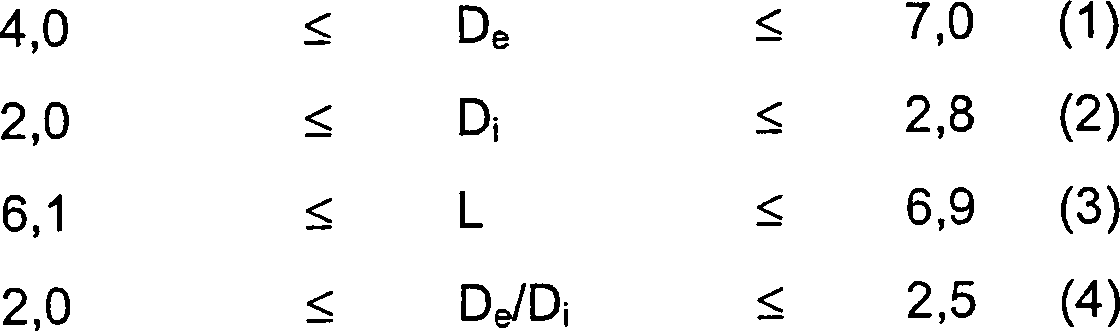
Gemäß der Erfindung
wird ein Katalysator bereitgestellt, umfassend einen Träger und
ein katalytisch aktives Material, welches darauf getragenes Kupfer
umfasst, wobei das Kupfer in einer Menge von 1–12 Gewichtsprozent hinsichtlich
des trockenen Katalysators vorhanden ist, wobei der Katalysator
in Form eines Hohlzylinders mit den folgenden Abmessungen vorliegt: 
Die Erfindung stellt auch die Verwendung eines solchen Katalysators bei der Oxychlorierung von Kohlenwasserstoffen, insbesondere der Dampfphasenoxychlorierung von Ethylen zu EDC, bereit.The Invention also provides the use of such a catalyst in the oxychlorination of hydrocarbons, in particular the Vapor phase oxychlorination of ethylene to EDC.
In der bevorzugten Form des erfindungsgemäßen Katalysators haben die Hohlzylinderpellets die Abmessungen De = 4,5 bis 5,5 mm, Di = 2,0 bis 2,6 mm und L = 6,2 bis 6,6 mm und De/Di liegt im Bereich 2,1 bis 2,3. Die erfindungsgemäßen Katalysatoren sind besonders wirksam, wenn sie in Röhrenreaktoren mit Durchmessern im Bereich von 25 bis 50 mm verwendet werden.In the preferred form of the catalyst according to the invention, the hollow cylindrical pellets have the dimensions D e = 4.5 to 5.5 mm, D i = 2.0 to 2.6 mm and L = 6.2 to 6.6 mm and D e / D i is in the range 2.1 to 2.3. The catalysts of the invention are particularly effective when used in tubular reactors having diameters ranging from 25 to 50 mm.
Das Trägermaterial des erfindungsgemäßen Katalysators kann jedes der zum Herstellen von auf Kupfer getragenen Katalysatoren bekannten Materialien sein. Beispiele schließen Siliziumdioxid, Bimsstein, Diatomeenerde, Aluminiumoxid und andere Aluminiumhydroxoverbindungen, wie Boehmit und Bayerit, ein. Die bevorzugten Trägermaterialien sind γ-Aluminiumoxid und Boehmit, wobei das Letztere normalerweise vorheizbehandelt wird, um es zu Aluminiumoxid umzuwandeln. Das Trägermaterial hat geeigneterweise eine Oberfläche (BET) von 50–350 m2/g.The support material of the catalyst of the present invention may be any of the materials known for preparing copper supported catalysts. Examples include silica, pumice, diatomaceous earth, alumina, and other aluminum hydroxo compounds such as boehmite and bayerite. The preferred support materials are γ-alumina and boehmite, the latter usually being preheated to convert it to alumina. The support material suitably has a surface area (BET) of 50-350 m 2 / g.
Das katalytisch aktive Material, das auf dem Träger getragen wird, enthält Kupfer in einer Menge von 1–12 Gewichtsprozent, bezogen auf das Gewicht des trockenen Katalysators. Das Kupfer wird normalerweise auf den Träger in Form eines Salzes, insbesondere eines Halogenids und vorzugsweise als Kupferchlorid, abgeschieden.The catalytically active material carried on the carrier contains copper in an amount of 1-12 Percent by weight, based on the weight of the dry catalyst. The copper is normally applied to the carrier in the form of a salt, in particular a halide, and preferably as copper chloride.
Das Kupfer kann in Kombination mit anderen Metallionen verwendet werden, um beim Beibehalten der gewünschten Selektivität und Umsatzleistung zu unterstützen. Solche anderen Metalle schließen beispielsweise Alkalimetalle (wie Li, Na, K, Ru, Cs), Erdalkalimetalle (wie Mg, Ca, Ba), Metalle der Gruppe IIB (wie Zn und Cd) und Lanthanide (wie La, Ce usw.) oder eine geeignete Kombination derselben ein. Diese zusätzlichen Metallionen können als Salze oder Oxide zugesetzt werden, wobei die gesamte Menge an Zusätzen geeigneterweise im Bereich von 0–10 Gewichtsprozent liegt. Sie können zusammen mit dem Kupfer oder alternativ einer oder mehrere von ihnen (auch alle), nach oder auch vor dem Kupfer zugesetzt werden. Im letzten Fall kann deren Zugabe eine zwischenzeitliche Wärmebehandlung folgen. Bevorzugte Alkalimetalle sind Li und K, und sie werden vorzugsweise als Chloride zugesetzt, wobei jedes von ihnen im Bereich von 0–6 Gewichtsprozent liegt. Das bevorzugte Erdalkalimetall ist Mg, zugesetzt im Bereich von 0–6 Gewichtsprozent. Bevorzugte Lanthanide sind La und Ce, wobei jedes davon im Bereich von 0–6 Gewichtsprozent zugesetzt wird.The Copper can be used in combination with other metal ions while maintaining the desired selectivity and to support sales performance. Close such other metals for example, alkali metals (such as Li, Na, K, Ru, Cs), alkaline earth metals (such as Mg, Ca, Ba), Group IIB metals (such as Zn and Cd) and lanthanides (such as La, Ce, etc.) or a suitable combination thereof. This extra Metal ions can be added as salts or oxides, the total amount of additives suitably in the range of 0-10% by weight. You can together with the copper or alternatively one or more of them (also all), after or even added to the copper. in the In the latter case, their addition can be an intermediate heat treatment consequences. Preferred alkali metals are Li and K, and they preferably become as chlorides, each of which is in the range of 0-6 weight percent. The preferred alkaline earth metal is Mg, added in the range of 0-6 weight percent. Preferred lanthanides are La and Ce, each of them in the range from 0-6 Weight percent is added.
Die Zugabe der katalytisch aktiven Komponenten kann durch Verfahren, die dem Fachmann der Katalysatorherstellung gut bekannt sind, ausgeführt werden. Es können beispielsweise Trockenimprägnierung, Nasskurzzeitimprägnierung oder Tauchen, unter Anwendung einer geeigneten Lösung von zuzusetzenden Verbindungen, beispielsweise eine wässrige Lösung, die gegebenenfalls auch Säuren, wie HCl, enthält, erwähnt werden.The Addition of the catalytically active components can be achieved by methods which are well known to the person skilled in the art of catalyst preparation. It can for example dry impregnation, wet short time impregnation or dipping, using a suitable solution of compounds to be added, for example, an aqueous Solution, the optionally also acids, like HCl, contains mentioned become.
Die Zugabe der aktiven Komponenten kann teilweise oder vollständig, vor oder nach der Bildung der Hohlpellets, ausgeführt werden. Vorzugsweise werden die Katalysatoren durch Imprägnierung des bereits gebildeten Trägers hergestellt.The Addition of the active components may be partial or complete or after the formation of the hollow pellets. Preferably the catalysts by impregnation of the already formed carrier produced.
Das Formen des Trägers oder des Katalysators kann durch gut bekannte Verfahren, wie Tablettieren und Extrusion, ausgeführt werden. Diese Vorgänge werden in der üblichen Weise ausgeführt, gegebenenfalls unter Anwendung von Zusätzen, wie Gleitmittel und/oder Bindemittel. Vorzugsweise werden die geformten Pellets durch Tablettieren erhalten, um eine gleichförmigere Pelletgröße, -dichte und höhere mechanische Beständigkeit zu erreichen. Die Vorgänge schließen übliche thermische Behandlung, wie Calcinierung des Trägers bei 500–1100°K, vorzugsweise bei 750–950°K, ein, wenn der aktive Teil zu dem Träger nach dem Formverfahren zugesetzt wird, und Trocknen bei 330–500°K nach der Zugabe der aktiven Komponenten.The Shapes of the vehicle or the catalyst can be prepared by well-known methods such as tabletting and Extrusion, executed become. These processes be in the usual Way, optionally with the use of additives such as lubricants and / or Binder. Preferably, the shaped pellets are tabletted get a more uniform Pellet size, density and higher mechanical resistance to reach. The processes close usual thermal Treatment, such as calcination of the carrier at 500-1100 ° K, preferably at 750-950 ° K, a, if the active part to the carrier is added after the molding process, and drying at 330-500 ° K after Addition of the active components.
In den beigefügten Figuren istIn the attached Figures is
Mit
Bezug auf
Die
Katalysatorpellets werden in den in
Die nachstehenden Beispiele und Vergleichsbeispiele werden zur Erläuterung, jedoch nicht zur Begrenzung der Erfindung angegeben.The the following examples and comparative examples are given by way of explanation, but not for the purpose of limiting the invention.
Experimentelle Ausrüstung und Beispieleexperimental equipment and examples
Die
Auswahl des zum katalytischen Aktivitätstest verwendeten Verfahrens
ist sehr wichtig, weil die Unterschiede bezüglich Umsatz und Selektivität zu verschiedenen
Produkten, die durch verschiedene Katalysatoren aufgezeigt sind,
gewöhnlich
klein sind, jedoch bei der Dichlorethanproduktion im großen Maßstab von hoher
Bedeutung sind. Der einzige Weg zum Erhalten von Ergebnissen, die
für den
industriellen Reaktor wirklich repräsentativ sind, besteht darin,
den Test unter Verwendung eines Rohrs mit der gleichen Größe wie ein industrielles
auszuführen
und die gleichen Bedingungen (Temperatur, Druck, Zuführungszusammensetzung, Strom,
usw.), wie jene, die in dem industriellen Reaktor verwendet werden,
zu übernehmen.
Die nach stehend angeführten
Daten wurden in einer Pilotanlage unter Verwendung eines Rohrs mit
der gleichen Größe wie ein typisches
industrielles, und unter einer Vielzahl von verschiedenen Reaktionsbedingungen,
die jene abdecken, die während
eines typischen Industrieversuchs vorkommen, erhalten. Siehe
Der verwendete Reaktor war ein Nickelrohr, 8 m lang, mit einem Innendurchmesser von 27,75 mm. Ein äußerer Mantel mit zirkulierendem Dampf wurde zum Steuern des Temperaturprofils verwendet. Der Reaktor wurde mit einem Schutzrohr für Thermoelemente mit einem äußeren Durchmesser von 6 mm, enthaltend 12 Thermoelemente zum Aufzeichnen des Temperaturprofils während der Tests, ausgestattet. Zwei On-line-Gaschromatographen wurden am Eingang und am Ausgang des Reaktors zum Steuern der Reaktion verwendet. Das EDC wurde in einem Gefäß gesammelt, das Isopropylalkohol bei etwa 0°C enthielt und dann analysiert. Diese Technik erlaubt das Sammeln auch der niedrig siedenden und der in Wasser löslichen Verbindungen (Chlorethanol, Chloral, usw.) sowie des nichtumgesetzten HCl. Die Reaktorzuführung war: 5200 Nl/h Ethylen, 600 Nl/h O2, 2300 Nl/h HCl, 1000 Nl/h N2. Der Sauerstoff war 6,5 Volumenprozent (die Entflammbarkeitsgrenze bei 210°C und bei 6 barg (bar Überdruck) ist ca. 8%). Der Druck am Eingang des Reaktors war 6 barg und die Temperatur des Kühlmittels war 220°C.The reactor used was a nickel tube, 8 meters long, with an inside diameter of 27.75 mm. An outer jacket of circulating steam was used to control the temperature profile. The reactor was equipped with a thermocouple thermowell having an outer diameter of 6 mm containing 12 thermocouples for recording the temperature profile during the tests. Two on-line gas chromatographs were used at the entrance and exit of the reactor to control the reaction. The EDC was collected in a vessel containing isopropyl alcohol at about 0 ° C and then analyzed. This technique allows the collection of low-boiling and water-soluble compounds (chloroethanol, chloral, etc.) as well as unreacted HCl. The reactor feed was: 5200 Nl / h ethylene, 600 Nl / h O 2 , 2300 Nl / h HCl, 1000 Nl / h N 2 . The oxygen was 6.5% by volume (the flammability limit at 210 ° C and at 6 barg (bar overpressure) is about 8%). The pressure at the inlet of the reactor was 6 barg and the temperature of the coolant was 220 ° C.
Vier verschiedene Katalysatorarten in Form von Hohlzylinderpellets mit den in Tabelle 1 gezeigten Formen und Größen und den in Tabelle 2 gezeigten Zusammensetzungen wurden auf der Grundlage des vorstehend beschriebenen Verfahrens hergestellt. Insbesondere wurde Aluminiumstearat als Gleitmittel zu Boehmit gegeben, und das Gemisch wurde unter Verwendung einer Tablettiermaschine zu Teilchen mit einer in Tabelle 1 gezeigten Form und Größe geformt. Katalysator A wurde gemäß der vorliegenden Erfindung, Katalysator B gemäß US-A-4366093, Katalysator C gemäß US-A-4740644 und Katalysator D gemäß US-A-5166120 gebildet.Four various types of catalysts in the form of hollow cylinder pellets with the shapes and sizes shown in Table 1 and those shown in Table 2 Compositions were based on that described above Process produced. In particular, aluminum stearate was used as Lubricant was added to boehmite, and the mixture was used of a tabletting machine into particles having one shown in Table 1 Shaped shape and size. Catalyst A was prepared according to the present invention Invention, catalyst B according to US-A-4366093, Catalyst C according to US-A-4740644 and Catalyst D according to US-A-5166120 educated.
Die Trägerpellets wurden dann bei 500–600°C für 5 Stunden calciniert, um Pellets, hergestellt aus γ-Al2O3, mit der geforderten Oberfläche zu erhalten. Der Träger wurde durch das Anfangs-Feuchtigkeitsverfahren mit Lösungen, die die geeignete Kon zentration der aktiven Verbindungen enthalten, imprägniert, um die Katalysatoren mit den in Tabelle 2 ausgewiesenen Zusammensetzungen zu erhalten.The carrier pellets were then calcined at 500-600 ° C for 5 hours to obtain pellets made of γ-Al 2 O 3 having the required surface area. The carrier was impregnated by the initial moisture method with solutions containing the appropriate concentration of the active compounds to obtain the catalysts having the compositions shown in Table 2.
Tabelle
1 
Tabelle
2 
Das verwendete Reaktorbeladungsmuster, das gleiche für die verschiedenen Arten von getesteten Katalysatoren, wurde aus fünf Schichten gebildet. Von der Spitze bis zum Boden der Schichten war es wie nachstehend: 1) 1200 mm lang, enthaltend einen Katalysator mit 9,5 Gewichtsprozent CuCl2 und 5,7 Gewichtsprozent KCl, ver dünnt auf 30 Volumenprozent mit Graphit (Zylinder mit Durchmesser von 5 mm und Länge 6,2 mm); 2) 1200 mm lang, enthaltend einen Katalysator mit 9,5 Gewichtsprozent CuCl2 und 5,7 Gewichtsprozent KCl, verdünnt auf 40 Volumenprozent; 3) 1200 mm lang, enthaltend einen Katalysator mit 9,5 Gewichtsprozent CuCl2 und 5,7 Gewichtsprozent KCl, verdünnt auf 60 Volumenprozent; 4) 1000 mm lang, enthaltend einen Katalysator mit 17,0 Gewichtsprozent CuCl2 und 1,5 Gewichtsprozent KCl, verdünnt auf 45 Volumenprozent; 5) 2400 mm lang, enthaltend einen Katalysator mit 17,0 Gewichtsprozent CuCl2 und 1,5 Gewichtsprozent KCl, nicht verdünnt. Das gesamte katalytische Bett war 7 m lang.The reactor charge pattern used, the same for the different types of catalysts tested, was formed from five layers. From the top to the bottom of the layers, it was as follows: 1) 1200 mm long, containing a catalyst with 9.5 wt.% CuCl 2 and 5.7 wt.% KCl diluted to 30 volume percent with graphite (cylinder with diameter of 5 mm and length 6.2 mm); 2) 1200 mm long, containing a catalyst with 9.5 weight percent CuCl 2 and 5.7 weight percent KCl diluted to 40 volume percent; 3) 1200 mm long, containing a catalyst with 9.5 weight percent CuCl 2 and 5.7 weight percent KCl diluted to 60 volume percent; 4) 1000 mm long, containing a catalyst containing 17.0% by weight CuCl 2 and 1.5% by weight KCl diluted to 45% by volume; 5) 2400 mm long, containing a catalyst containing 17.0 weight percent CuCl 2 and 1.5 weight percent KCl, not diluted. The entire catalytic bed was 7 meters long.
Eine große Anzahl von Tests wurde ausgeführt und die Hauptergebnisse werden in Tabelle 3 angeführt. Es wird deutlich, dass der erfindungsgemäße Katalysator (A) in der Leistung überlegen ist, wobei die bessere Kombination bezüglich Selektivität, HCl-Umsatz, Druckabfall und Hot-Spot-Temperaturen, verglichen mit anderen Katalysatoren, erzielt wird. Der niedrigere HCl-Umsatz des Katalysators D bezieht sich auf eine sehr niedrige Menge an Katalysator in dem Reaktor infolge von zu hohem Katalysatorbettleerraum, und selbst wenn man versucht, die Aktivphase und Additivgewichtsprozentsätze in dem Katalysator zu erhöhen, um die niedrigere Katalysatormenge auszugleichen, ist der erhaltene experimentelle HCl-Umsatz wiederum niedriger, auf Grund der erhaltenen niedrigen Oberfläche (unter 90 m2/g). Darüber hinaus ist der gemessene Druckabfall des Katalysators D höher, als auf der Grundlage der Katalysatoreigenschaften erwartet, weil der unvermeidbare Bruch während der Beladung dieses Katalysators über Extrusion gebildet wird.A large number of tests were carried out and the main results are given in Table 3. It will be appreciated that catalyst (A) of the present invention is superior in performance, with the better combination of selectivity, HCl conversion, pressure drop, and hot spot temperatures, as compared to other catalysts. The lower HCl conversion of Catalyst D refers to a very low amount of catalyst in the reactor due to too much catalyst bed space, and even if one tries to increase the active phase and additive weight percentages in the catalyst to make up for the lower amount of catalyst, then The experimental HCl conversion, in turn, was lower because of the low surface area (below 90 m 2 / g) obtained. Moreover, the measured pressure drop of the catalyst D is higher than expected on the basis of the catalyst properties, because the unavoidable breakage is formed during the loading of this catalyst via extrusion.
Tabelle
3 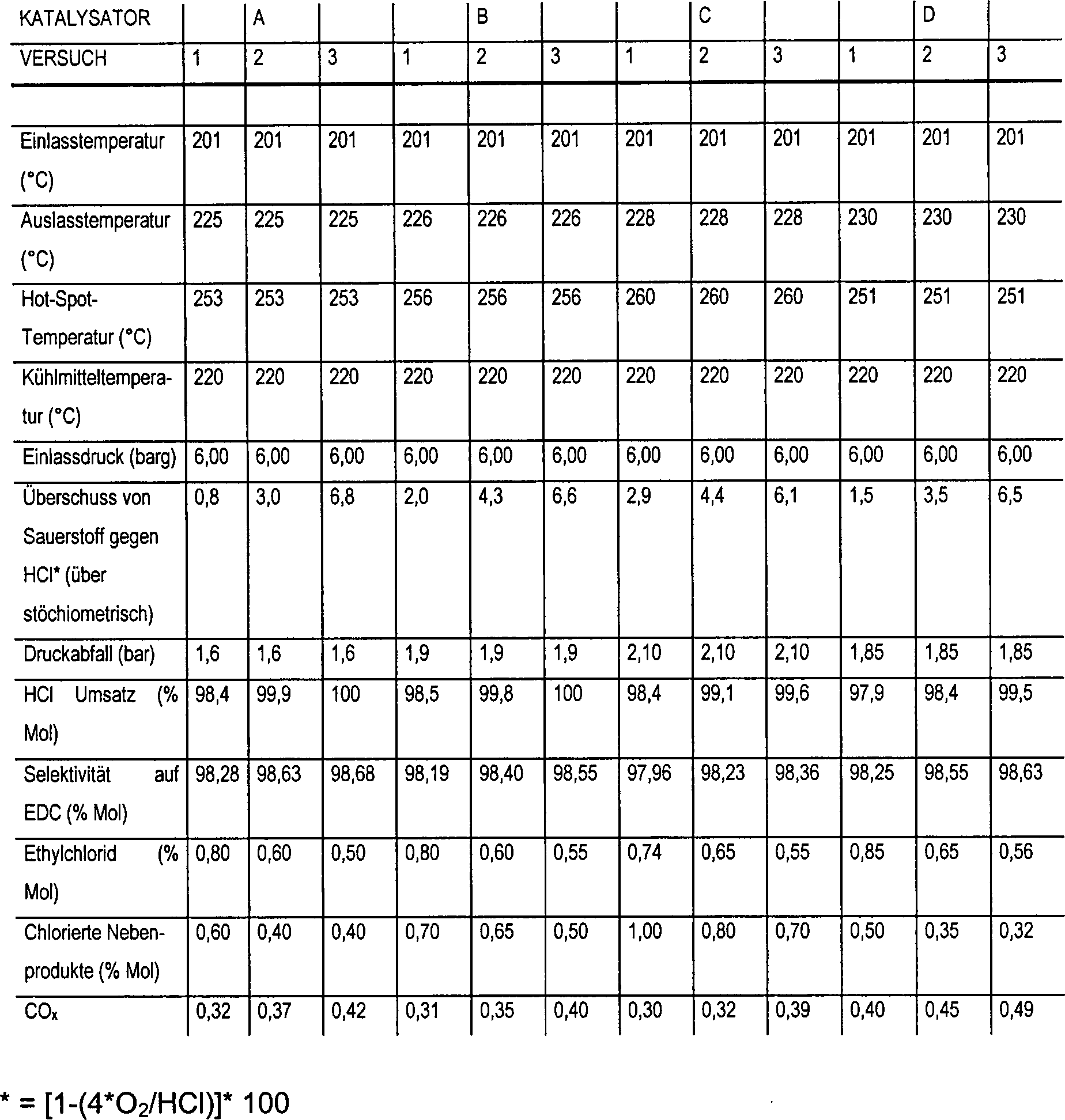
Es wird angenommen, dass die Gründe für die überlegene Leistung der erfindungsgemäßen Katalysatoren wie nachstehend sind.
- (i) Im Vergleich mit Katalysator B, d.h. der Katalysator von US-A-4366093, sind die vorliegenden Katalysatoren etwas länger (6,1 – 6–9 mm gegen 3–6 mm), was einen Anstieg des Bettleerraums in den Reaktoren erlaubt. Als eine Folge werden ein verminderter Druckabfall des Katalysatorbetts, ein besserer Wärmetausch (deshalb niedrigere Hot-Spot-Temperaturen), eine erhöhte Katalysatorlebensdauer und verminderte Nebenproduktbildung, wie in der vorstehenden Tabelle 3 gezeigt, erreicht. Die niedrigere Menge an aktiver Phase pro Volumen an Reaktor kann mit einer Erhöhung der aktiven Phase bei Werten, die signifikant den Wert der Oberfläche des fertigen Katalysators nicht beeinflussen, ausgeglichen werden.
- (ii) US-A-4740644 (vorstehend beispielhaft durch Katalysator C angegeben) berichtet über die Verwendung eines Katalysators in Pellets mit einem ähnlichen Außendurchmesser (5 mm) und einer kürzeren Länge (5 mm anstelle von 6,1 – 6–9 mm). Die größere Länge des neuen Katalysators erlaubt einen höheren Bettleerraum und die folgenden Verbesserungen bezüglich geringerem Druckabfall und besserem Wärmetausch, wie in Tabelle 3 gezeigt.
- (iii) Im Fall der Katalysatoren von US-A-5166120 (Katalysator D vorstehend) sind die Pellets länger als jene der vorliegenden Erfindung, wobei die Beispiele Pellets mit einer Länge von 11 ± 2 mm betreffen. Pellets mit einer solchen Länge und mit einer variablen Länge wegen ihres Herstellungsverfahrens (Extrusion) ergeben in industriellen Oxychlorierungsrohren Beladungsprobleme, folglich ohne homogenen und reproduzierbaren Druckabfall und Katalysatormenge unter den Röhren des Reaktors. Weiterhin impliziert diese größere Pelletlänge eine starke Verminderung des aktiven Phasengehalts pro Volumen des Reaktors (verglichen mit dem erfindungsgemäßen Katalysator), die nicht einfach nur durch Erhöhen des aktiven Phasengehalts der Pellets ausgeglichen werden kann.
- (i) Compared to Catalyst B, ie the catalyst of US-A-4366093, the present catalysts are slightly longer (6.1-6-9 mm vs. 3-6 mm), allowing an increase in the bed space in the reactors , As a result, reduced catalyst bed pressure drop, better heat exchange (therefore lower hot spot temperatures), increased catalyst life, and reduced by-product formation, as shown in Table 3 above, are achieved. The lower amount of active phase per volume of reactor can be balanced with an increase in the active phase at values that do not significantly affect the value of the surface of the finished catalyst.
- (ii) US-A-4740644 (exemplified above by Catalyst C) reports the use of a catalyst in pellets having a similar outside diameter (5 mm) and a shorter length (5 mm instead of 6.1-6-9 mm). , The longer length of the new catalyst allows for a higher bed space and the following improvements in lower pressure drop and better heat exchange, as shown in Table 3.
- (iii) In the case of the catalysts of US-A-5166120 (catalyst D above), the pellets are longer than those of the present invention, the examples relating to pellets having a length of 11 ± 2 mm. Pellets of such length and variable length due to their manufacturing process (extrusion) give rise to loading problems in industrial oxychlorination tubes, thus without homogeneous and reproducible zable pressure drop and amount of catalyst under the tubes of the reactor. Furthermore, this larger pellet length implies a large reduction in the active phase content per volume of the reactor (as compared to the catalyst of the invention), which can not be compensated simply by increasing the active phase content of the pellets.
Claims (10)

Applications Claiming Priority (1)
| Application Number | Priority Date | Filing Date | Title |
|---|---|---|---|
| EP99303973A EP1053789B1 (en) | 1999-05-21 | 1999-05-21 | Catalyst and oxychlorination process using it |
Publications (2)
| Publication Number | Publication Date |
|---|---|
| DE69918672D1 DE69918672D1 (en) | 2004-08-19 |
| DE69918672T2 true DE69918672T2 (en) | 2005-07-21 |
Family
ID=8241404
Family Applications (1)
| Application Number | Title | Priority Date | Filing Date |
|---|---|---|---|
| DE69918672T Expired - Lifetime DE69918672T2 (en) | 1999-05-21 | 1999-05-21 | Catalyst and oxychlorination process using the same |
Country Status (8)
| Country | Link |
|---|---|
| US (1) | US6465701B1 (en) |
| EP (1) | EP1053789B1 (en) |
| JP (1) | JP4638975B2 (en) |
| KR (1) | KR100613656B1 (en) |
| CZ (1) | CZ296101B6 (en) |
| DE (1) | DE69918672T2 (en) |
| ES (1) | ES2226288T3 (en) |
| TW (1) | TWI282749B (en) |
Families Citing this family (23)
| Publication number | Priority date | Publication date | Assignee | Title |
|---|---|---|---|---|
| DE10024928A1 (en) * | 2000-05-19 | 2001-11-22 | Basf Ag | Catalysts for heterogeneously catalyzed reactions |
| US6936906B2 (en) | 2001-09-26 | 2005-08-30 | Applied Materials, Inc. | Integration of barrier layer and seed layer |
| EP1386664B1 (en) | 2002-07-31 | 2016-05-11 | Ineos Technologies (Vinyls) Limited | A hollow parallelepiped pellet suitable as carrier of catalysts for selective exothermic reactions |
| DE102005023955A1 (en) * | 2005-05-20 | 2006-11-23 | Basf Ag | Inert material for use in exothermic reactions |
| JP5256036B2 (en) * | 2005-08-18 | 2013-08-07 | アルベマール・ネーザーランズ・ベー・ブイ | Catalytic oxychlorination |
| EP2198958B1 (en) | 2008-12-17 | 2017-11-08 | Clariant Prodotti (Italia) SpA | Catalysts for oxychlorination of ethylene to 1.2-dichloroethane |
| EP2208528A1 (en) | 2008-12-23 | 2010-07-21 | Süd Chemie - Catalysts Italia S.R.L. | Catalysts for fixed bed oxychlorination of ethylene to 1.2-dichloroethane |
| JP5595005B2 (en) * | 2009-10-19 | 2014-09-24 | 日揮触媒化成株式会社 | Method for producing catalyst for oxychlorination |
| GB201017804D0 (en) | 2010-10-21 | 2010-12-01 | Telecomm Res Inst | Catalyst system |
| US9707530B2 (en) | 2012-08-21 | 2017-07-18 | Uop Llc | Methane conversion apparatus and process using a supersonic flow reactor |
| US9656229B2 (en) | 2012-08-21 | 2017-05-23 | Uop Llc | Methane conversion apparatus and process using a supersonic flow reactor |
| US9370757B2 (en) | 2012-08-21 | 2016-06-21 | Uop Llc | Pyrolytic reactor |
| US8927769B2 (en) | 2012-08-21 | 2015-01-06 | Uop Llc | Production of acrylic acid from a methane conversion process |
| US8937186B2 (en) | 2012-08-21 | 2015-01-20 | Uop Llc | Acids removal and methane conversion process using a supersonic flow reactor |
| US9327265B2 (en) | 2012-08-21 | 2016-05-03 | Uop Llc | Production of aromatics from a methane conversion process |
| US9689615B2 (en) | 2012-08-21 | 2017-06-27 | Uop Llc | Steady state high temperature reactor |
| US9023255B2 (en) | 2012-08-21 | 2015-05-05 | Uop Llc | Production of nitrogen compounds from a methane conversion process |
| US8933275B2 (en) | 2012-08-21 | 2015-01-13 | Uop Llc | Production of oxygenates from a methane conversion process |
| US9434663B2 (en) | 2012-08-21 | 2016-09-06 | Uop Llc | Glycols removal and methane conversion process using a supersonic flow reactor |
| US9308513B2 (en) | 2012-08-21 | 2016-04-12 | Uop Llc | Production of vinyl chloride from a methane conversion process |
| US9205398B2 (en) | 2012-08-21 | 2015-12-08 | Uop Llc | Production of butanediol from a methane conversion process |
| JP2015098443A (en) * | 2013-11-18 | 2015-05-28 | 東ソー株式会社 | Catalyst system for producing 1,2-dichloroethane and method for producing 1,2-dichloroethane using the same |
| JP6422764B2 (en) * | 2014-12-19 | 2018-11-14 | 住友化学株式会社 | Catalyst filling method |
Family Cites Families (17)
| Publication number | Priority date | Publication date | Assignee | Title |
|---|---|---|---|---|
| US2408164A (en) | 1942-04-25 | 1946-09-24 | Phillips Petroleum Co | Catalyst preparation |
| US3966644A (en) | 1973-08-03 | 1976-06-29 | American Cyanamid Company | Shaped catalyst particles |
| JPS56141842A (en) * | 1980-04-07 | 1981-11-05 | Kanegafuchi Chem Ind Co Ltd | Catalyst formed in novel cylindrical shape |
| US4283307A (en) | 1980-06-02 | 1981-08-11 | Denka Chemical Corporation | Catalyst structure for the partial oxidation of n-butane to produce maleic anhydride |
| DE3046407A1 (en) | 1980-12-10 | 1982-07-15 | Basf Ag, 6700 Ludwigshafen | CARRIER CATALYST CONTAINING COPPER AND ALKALI METALS AND THE USE THEREOF FOR PRODUCING 1,2-DICHLORETHANE BY OXICHLORATION OF ETHANE |
| JPS58119346A (en) | 1982-01-06 | 1983-07-15 | Nippon Shokubai Kagaku Kogyo Co Ltd | Catalyst for oxidizing propylene |
| JPS58166939A (en) * | 1982-03-30 | 1983-10-03 | Nippon Shokubai Kagaku Kogyo Co Ltd | Catalyst for synthesis of acrylic acid |
| JPS5946132A (en) * | 1982-09-06 | 1984-03-15 | Nippon Shokubai Kagaku Kogyo Co Ltd | Catalyst for synthesis of methacrolein |
| DE3522473A1 (en) * | 1985-06-22 | 1987-01-02 | Basf Ag | MOLDED CATALYST, METHOD FOR THE PRODUCTION THEREOF, AND THE USE THEREOF IN OXICHLORATING ETHYLENE TO 1,2-DICHLORETHANE |
| DE3522474A1 (en) * | 1985-06-22 | 1987-01-02 | Basf Ag | METHOD FOR PRODUCING 1,2-DICHLORETHANE BY OXICHLORATION OF ETHYLENE ON CARRIER CONTAINERS CONTAINING COPPER |
| DE3607449A1 (en) * | 1986-03-07 | 1987-09-10 | Basf Ag | SHAPED CARRIER CATALYST AND ITS USE IN OXICHLORATING ETHYLENE |
| FR2635987B1 (en) | 1988-09-02 | 1993-10-15 | Rhone Poulenc Chimie | CATALYSTS FOR THE TREATMENT OF GASEOUS EFFLUENTS AND METHOD FOR THE TREATMENT OF SUCH EFFLUENTS |
| DE3930533C1 (en) | 1989-09-13 | 1991-05-08 | Degussa Ag, 6000 Frankfurt, De | |
| DE4018512A1 (en) * | 1990-06-09 | 1991-12-12 | Wacker Chemie Gmbh | CYLINDRICAL SHAPED CATALYST AND ITS USE IN THE OXICHLORATION OF ETHYLENE |
| DE69101032T2 (en) | 1990-07-03 | 1994-08-11 | Kuraray Co | Catalyst and process for the production of unsaturated esters. |
| JPH11506113A (en) * | 1995-06-07 | 1999-06-02 | ザ ダウ ケミカル カンパニー | Oxychlorination catalysts and methods |
| IT1276155B1 (en) * | 1995-11-21 | 1997-10-27 | Montecatini Tecnologie Srl | CATALYSTS FOR THE OXYCHLORURATION OF ETHYLENE, PROCEDURE FOR THEIR PREPARATION AND PROCEDURE FOR OXYCHLORURATION USING THE |
-
1999
- 1999-05-21 DE DE69918672T patent/DE69918672T2/en not_active Expired - Lifetime
- 1999-05-21 EP EP99303973A patent/EP1053789B1/en not_active Revoked
- 1999-05-21 ES ES99303973T patent/ES2226288T3/en not_active Expired - Lifetime
-
2000
- 2000-04-12 TW TW089106790A patent/TWI282749B/en not_active IP Right Cessation
- 2000-04-21 CZ CZ20001490A patent/CZ296101B6/en not_active IP Right Cessation
- 2000-05-01 KR KR1020000023236A patent/KR100613656B1/en not_active Expired - Lifetime
- 2000-05-08 US US09/567,282 patent/US6465701B1/en not_active Expired - Lifetime
- 2000-05-09 JP JP2000135406A patent/JP4638975B2/en not_active Expired - Lifetime
Also Published As
| Publication number | Publication date |
|---|---|
| US6465701B1 (en) | 2002-10-15 |
| EP1053789B1 (en) | 2004-07-14 |
| HK1030183A1 (en) | 2001-04-27 |
| EP1053789A1 (en) | 2000-11-22 |
| DE69918672D1 (en) | 2004-08-19 |
| ES2226288T3 (en) | 2005-03-16 |
| KR100613656B1 (en) | 2006-08-21 |
| CZ20001490A3 (en) | 2001-01-17 |
| TWI282749B (en) | 2007-06-21 |
| JP4638975B2 (en) | 2011-02-23 |
| KR20010049309A (en) | 2001-06-15 |
| CZ296101B6 (en) | 2006-01-11 |
| JP2000342979A (en) | 2000-12-12 |
Similar Documents
| Publication | Publication Date | Title |
|---|---|---|
| EP1159244B1 (en) | Method for the catalytic gas phase oxidation of propene into acrolein | |
| US6465701B1 (en) | Catalyst and oxychlorination process using it | |
| DE69409536T2 (en) | EPOXYDING CATALYST AND METHOD | |
| DE2128341C3 (en) | Catalyst for the production of fluorinated or chlorofluorinated hydrocarbons and its use | |
| DE69310831T3 (en) | Catalyst and process for the oxychlorination of ethylene in dichloroethane | |
| DE69516163T2 (en) | ONE-STEP TEST BED TOXYCHLORATION OF ETHYLENE | |
| EP0461431B1 (en) | Cylindrically shaped catalyst and use thereof for the oxychloration of ethylen | |
| DE69400034T2 (en) | Process for the fluorination of perchlorethylene or pentachloroethane. | |
| DE10101695A1 (en) | Heterogeneous catalyzed gas phase production of (meth)acrolein and/or meth(acrylic acid) using mixed oxide catalyst formed into geometrically shaped article of specific geometric characteristics | |
| DE3113179A1 (en) | "CYLINDRICALLY SHAPED CATALYST" | |
| DE10009017A1 (en) | Molded catalysts | |
| EP3068754B1 (en) | Process for preparing an unsaturated aldehyde and/or an unsaturated carboxylic acid | |
| DE69508637T2 (en) | Granulated catalyst for the synthesis of 1,2-dichloroethane and process for fixed bed oxychlorination of ethylene using this catalyst | |
| DE3782121T2 (en) | CATALYST AND METHOD FOR OXYCHLORIZING ON THE FLUID BED OF ETHYLENE IN DICHLORETHANE. | |
| DE1937110C3 (en) | Catalyst for the fluorination and chlorofluorination of hydrocarbon compounds in the gas phase, a process for its preparation and its use | |
| DE2935903C2 (en) | Oxidation catalyst and its use in the manufacture of methacrolein | |
| DE1542327B2 (en) | Process for the manufacture of catalysts | |
| DE69901676T2 (en) | CATALYST, METHOD FOR THE PRODUCTION AND USE THEREOF FOR THE SYNTHESIS OF 1,2-DICHLOROETHANE | |
| DE69821947T2 (en) | Catalyst containing copper for the oxychlorination of ethylene in 1,2-dichloroethane | |
| WO2005097715A1 (en) | Catalyst used for the oxidation of hydrogen, and method for the dehydrogenation of hydrocarbons | |
| EP0240714B1 (en) | Shaped catalyst and its use in the oxychlorination of ethylene | |
| WO2010040469A1 (en) | Multi-stage method for the production of chlorine | |
| DE60208295T2 (en) | Catalysts containing copper and magnesium for the oxychlorination of ethylene in 1,2-dichloroethane | |
| EP0206265A1 (en) | Formed catalyst, process for its production and its use in the oxychloruration of ethylene into 1,2-dichloroethane | |
| DE60303612T2 (en) | COMBINATION OF CUTTING BED AND COPPER-BASED CATALYST BED |
Legal Events
| Date | Code | Title | Description |
|---|---|---|---|
| 8363 | Opposition against the patent | ||
| 8327 | Change in the person/name/address of the patent owner |
Owner name: INEOS VINYLS UK LTD., RUNCORN, CHESHIRE, GB |
|
| 8327 | Change in the person/name/address of the patent owner |
Owner name: INEOS TECHNOLOGIES (VINYLS) LTD., LYNDHURST, H, GB |