EP0464488A2 - Optisch aktive N-aplha-Fluoracryloylaminosäure-Derivate, ihre Herstellung, die daraus hergestellten optisch aktiven Polymeren und deren Verwendung zur Spaltung von Racematen - Google Patents
Optisch aktive N-aplha-Fluoracryloylaminosäure-Derivate, ihre Herstellung, die daraus hergestellten optisch aktiven Polymeren und deren Verwendung zur Spaltung von Racematen Download PDFInfo
- Publication number
- EP0464488A2 EP0464488A2 EP91110142A EP91110142A EP0464488A2 EP 0464488 A2 EP0464488 A2 EP 0464488A2 EP 91110142 A EP91110142 A EP 91110142A EP 91110142 A EP91110142 A EP 91110142A EP 0464488 A2 EP0464488 A2 EP 0464488A2
- Authority
- EP
- European Patent Office
- Prior art keywords
- alkyl
- carbon atoms
- optically active
- formula
- cycloalkyl
- Prior art date
- Legal status (The legal status is an assumption and is not a legal conclusion. Google has not performed a legal analysis and makes no representation as to the accuracy of the status listed.)
- Granted
Links
Classifications
-
- B—PERFORMING OPERATIONS; TRANSPORTING
- B01—PHYSICAL OR CHEMICAL PROCESSES OR APPARATUS IN GENERAL
- B01J—CHEMICAL OR PHYSICAL PROCESSES, e.g. CATALYSIS OR COLLOID CHEMISTRY; THEIR RELEVANT APPARATUS
- B01J20/00—Solid sorbent compositions or filter aid compositions; Sorbents for chromatography; Processes for preparing, regenerating or reactivating thereof
- B01J20/30—Processes for preparing, regenerating, or reactivating
- B01J20/32—Impregnating or coating ; Solid sorbent compositions obtained from processes involving impregnating or coating
- B01J20/3231—Impregnating or coating ; Solid sorbent compositions obtained from processes involving impregnating or coating characterised by the coating or impregnating layer
- B01J20/3242—Layers with a functional group, e.g. an affinity material, a ligand, a reactant or a complexing group
- B01J20/3268—Macromolecular compounds
- B01J20/327—Polymers obtained by reactions involving only carbon to carbon unsaturated bonds
-
- B—PERFORMING OPERATIONS; TRANSPORTING
- B01—PHYSICAL OR CHEMICAL PROCESSES OR APPARATUS IN GENERAL
- B01D—SEPARATION
- B01D15/00—Separating processes involving the treatment of liquids with solid sorbents; Apparatus therefor
- B01D15/08—Selective adsorption, e.g. chromatography
- B01D15/26—Selective adsorption, e.g. chromatography characterised by the separation mechanism
- B01D15/38—Selective adsorption, e.g. chromatography characterised by the separation mechanism involving specific interaction not covered by one or more of groups B01D15/265 and B01D15/30 - B01D15/36, e.g. affinity, ligand exchange or chiral chromatography
- B01D15/3833—Chiral chromatography
-
- B—PERFORMING OPERATIONS; TRANSPORTING
- B01—PHYSICAL OR CHEMICAL PROCESSES OR APPARATUS IN GENERAL
- B01J—CHEMICAL OR PHYSICAL PROCESSES, e.g. CATALYSIS OR COLLOID CHEMISTRY; THEIR RELEVANT APPARATUS
- B01J20/00—Solid sorbent compositions or filter aid compositions; Sorbents for chromatography; Processes for preparing, regenerating or reactivating thereof
- B01J20/22—Solid sorbent compositions or filter aid compositions; Sorbents for chromatography; Processes for preparing, regenerating or reactivating thereof comprising organic material
- B01J20/26—Synthetic macromolecular compounds
- B01J20/261—Synthetic macromolecular compounds obtained by reactions only involving carbon to carbon unsaturated bonds
-
- B—PERFORMING OPERATIONS; TRANSPORTING
- B01—PHYSICAL OR CHEMICAL PROCESSES OR APPARATUS IN GENERAL
- B01J—CHEMICAL OR PHYSICAL PROCESSES, e.g. CATALYSIS OR COLLOID CHEMISTRY; THEIR RELEVANT APPARATUS
- B01J20/00—Solid sorbent compositions or filter aid compositions; Sorbents for chromatography; Processes for preparing, regenerating or reactivating thereof
- B01J20/22—Solid sorbent compositions or filter aid compositions; Sorbents for chromatography; Processes for preparing, regenerating or reactivating thereof comprising organic material
- B01J20/26—Synthetic macromolecular compounds
- B01J20/265—Synthetic macromolecular compounds modified or post-treated polymers
-
- B—PERFORMING OPERATIONS; TRANSPORTING
- B01—PHYSICAL OR CHEMICAL PROCESSES OR APPARATUS IN GENERAL
- B01J—CHEMICAL OR PHYSICAL PROCESSES, e.g. CATALYSIS OR COLLOID CHEMISTRY; THEIR RELEVANT APPARATUS
- B01J20/00—Solid sorbent compositions or filter aid compositions; Sorbents for chromatography; Processes for preparing, regenerating or reactivating thereof
- B01J20/281—Sorbents specially adapted for preparative, analytical or investigative chromatography
- B01J20/282—Porous sorbents
- B01J20/285—Porous sorbents based on polymers
-
- B—PERFORMING OPERATIONS; TRANSPORTING
- B01—PHYSICAL OR CHEMICAL PROCESSES OR APPARATUS IN GENERAL
- B01J—CHEMICAL OR PHYSICAL PROCESSES, e.g. CATALYSIS OR COLLOID CHEMISTRY; THEIR RELEVANT APPARATUS
- B01J20/00—Solid sorbent compositions or filter aid compositions; Sorbents for chromatography; Processes for preparing, regenerating or reactivating thereof
- B01J20/281—Sorbents specially adapted for preparative, analytical or investigative chromatography
- B01J20/29—Chiral phases
-
- C—CHEMISTRY; METALLURGY
- C07—ORGANIC CHEMISTRY
- C07C—ACYCLIC OR CARBOCYCLIC COMPOUNDS
- C07C233/00—Carboxylic acid amides
- C07C233/01—Carboxylic acid amides having carbon atoms of carboxamide groups bound to hydrogen atoms or to acyclic carbon atoms
- C07C233/45—Carboxylic acid amides having carbon atoms of carboxamide groups bound to hydrogen atoms or to acyclic carbon atoms having the nitrogen atom of at least one of the carboxamide groups bound to a carbon atom of a hydrocarbon radical substituted by carboxyl groups
- C07C233/46—Carboxylic acid amides having carbon atoms of carboxamide groups bound to hydrogen atoms or to acyclic carbon atoms having the nitrogen atom of at least one of the carboxamide groups bound to a carbon atom of a hydrocarbon radical substituted by carboxyl groups with the substituted hydrocarbon radical bound to the nitrogen atom of the carboxamide group by an acyclic carbon atom
- C07C233/49—Carboxylic acid amides having carbon atoms of carboxamide groups bound to hydrogen atoms or to acyclic carbon atoms having the nitrogen atom of at least one of the carboxamide groups bound to a carbon atom of a hydrocarbon radical substituted by carboxyl groups with the substituted hydrocarbon radical bound to the nitrogen atom of the carboxamide group by an acyclic carbon atom having the carbon atom of the carboxamide group bound to a carbon atom of an acyclic unsaturated carbon skeleton
-
- C—CHEMISTRY; METALLURGY
- C08—ORGANIC MACROMOLECULAR COMPOUNDS; THEIR PREPARATION OR CHEMICAL WORKING-UP; COMPOSITIONS BASED THEREON
- C08F—MACROMOLECULAR COMPOUNDS OBTAINED BY REACTIONS ONLY INVOLVING CARBON-TO-CARBON UNSATURATED BONDS
- C08F20/00—Homopolymers and copolymers of compounds having one or more unsaturated aliphatic radicals, each having only one carbon-to-carbon double bond, and only one being terminated by only one carboxyl radical or a salt, anhydride, ester, amide, imide or nitrile thereof
- C08F20/02—Monocarboxylic acids having less than ten carbon atoms, Derivatives thereof
- C08F20/52—Amides or imides
- C08F20/54—Amides, e.g. N,N-dimethylacrylamide or N-isopropylacrylamide
-
- B—PERFORMING OPERATIONS; TRANSPORTING
- B01—PHYSICAL OR CHEMICAL PROCESSES OR APPARATUS IN GENERAL
- B01J—CHEMICAL OR PHYSICAL PROCESSES, e.g. CATALYSIS OR COLLOID CHEMISTRY; THEIR RELEVANT APPARATUS
- B01J2220/00—Aspects relating to sorbent materials
- B01J2220/50—Aspects relating to the use of sorbent or filter aid materials
- B01J2220/54—Sorbents specially adapted for analytical or investigative chromatography
-
- C—CHEMISTRY; METALLURGY
- C07—ORGANIC CHEMISTRY
- C07C—ACYCLIC OR CARBOCYCLIC COMPOUNDS
- C07C2601/00—Systems containing only non-condensed rings
- C07C2601/12—Systems containing only non-condensed rings with a six-membered ring
- C07C2601/14—The ring being saturated
-
- C—CHEMISTRY; METALLURGY
- C07—ORGANIC CHEMISTRY
- C07C—ACYCLIC OR CARBOCYCLIC COMPOUNDS
- C07C2602/00—Systems containing two condensed rings
- C07C2602/36—Systems containing two condensed rings the rings having more than two atoms in common
- C07C2602/42—Systems containing two condensed rings the rings having more than two atoms in common the bicyclo ring system containing seven carbon atoms
Definitions
- the invention relates to new optically active N-a-fluoroacryloyl amino acid derivatives, a process for their preparation, their polymerization into optically active polymers and the use of these optically active polymers as adsorbents for the chromatographic separation of racemates into their enantiomers.
- polymeric fluoroacrylic acid derivatives according to the invention unexpectedly result in adsorbents for the chromatographic resolution, which differ significantly in their properties from the corresponding (meth) acrylamides.
- R 1 may be mentioned as examples of optionally substituted straight-chain or branched C 1 -C 6 alkyl of methyl, ethyl, i-propyl, n-propyl, n-butyl, i-butyl, t-butyl, 1-hydroxymethyl, 1- Hydroxyethyl, 3-acetylaminopropyl, 4-benzoylaminobutyl, t-butoxymethyl, benzyloxymethyl, 2-methoxycarbonylmethyl, 3-methoxycarbonylethyl, 4-t-butoxycarbonylpropyl radical or, for example, the 2-cyclohexylethyl radical; for optionally substituted CrC12 aralkyl, the benzyl, 1-naphthylmethyl, 2-naphthylmethyl, 3-indolylmethyl, 4-hydroxybenzyl, 2-phenylbutyl, 3-phenylbutyl and 4-phenylbutyl radicals; for optionally
- radicals R 4 which may be mentioned are the hydrogen, methyl, ethyl, n-propyl, i-propyl, n-butyl and the i-butyl radical, while the optionally substituted ring is, for example, the pyrrolidinyl, piperidinyl -, Morpholinyl, 2-alkoxycarbonylpyrrolidinyl and the 2-alkoxymethylpyrrolidinyl radical may be mentioned, each with 1 to 4 carbon atoms in the alkoxy group.
- radicals R 2 are optionally halogen- or alkoxy- (C 1 -C 4 ) -substituted straight-chain or branched C 1 -C 22 -alkyl radicals such as methyl, ethyl, trifluoroethyl, 2-chloroethyl, n-propyl -, i-propyl, hexafluoroisopropyl, 2-methoxy-ethyl, 2-t-butoxy-ethyl, n-butyl, i-butyl, t-butyl, 2-octyl, 2-nonyl Residue, stearyl and the behenyl residue; optionally substituted C 7 -C 12 aralkyl radicals such as the benzyl, 1-phenylethyl and the 1-naphthylethyl radical; optionally halogen, alkoxy (C i -C 4 ) or alkyl (C i
- fluoroacryloyl compound (III) can be released by splitting off AZ, AZ preferably signifying HF, HCl, HBr, Br 2 or C12.
- ⁇ -Fluoroacryloyl derivatives of the formula (III) or their precursors (IV) can be prepared by processes known per se [Zh. Org. Khim. 28, 1173 (1983)] and optionally also as acid anhydrides,
- optically active amino acid esters of the formula (II) used as starting compounds are known or can be prepared by processes known per se (see Bull. Chem. Soc. Jap. 37 (1964), 191).
- Suitable acid addition compounds of the amino acids to be used as starting compounds are salts of these amino acids with inorganic or organic acids.
- Mineral acids such as hydrochloric acid, hydrobromic acid, sulfuric acid, phosphoric acid or organic acids such as acetic acid, methane, ethane, benzene or toluenesulfonic acid are preferred.
- Suitable solvents are all organic solvents which are inert under the reaction conditions. Preference is given to hydrocarbons such as benzene, toluene, xylene or petroleum fractions, or halogenated hydrocarbons such as di-, tri- or tetrachloromethane, dichloroethane or trichlorethylene or ethers such as tert-butyl methyl ether or tert-amyl ethyl ether.
- hydrocarbons such as benzene, toluene, xylene or petroleum fractions
- halogenated hydrocarbons such as di-, tri- or tetrachloromethane, dichloroethane or trichlorethylene or ethers such as tert-butyl methyl ether or tert-amyl ethyl ether.
- the usual inorganic or organic bases are particularly suitable as acid binders; alkali or alkaline earth metal hydroxides such as sodium, potassium, lithium, calcium or barium hydroxide, alkali metal or alkaline earth metal carbonates such as sodium or potassium carbonate or sodium bicarbonate, alkali metal alcoholates such as sodium methylate, ethylate, potassium methylate, ethylate, t-butoxide or Amines such as triethylamine or pyridine are used.
- alkali or alkaline earth metal hydroxides such as sodium, potassium, lithium, calcium or barium hydroxide
- alkali metal or alkaline earth metal carbonates such as sodium or potassium carbonate or sodium bicarbonate
- alkali metal alcoholates such as sodium methylate, ethylate, potassium methylate, ethylate, t-butoxide
- Amines such as triethylamine or pyridine are used.
- reaction of the a-fluoroacryloyl derivatives of the formula (III) with the amino acid derivatives of the formula (II) is preferably carried out at temperatures from -78 to + 100 C, in particular from -20 C to + 60 C.
- the invention also relates to the optically active polymers and copolymers obtainable by polymerization or copolymerization of the optically active Na-fluoroacryloyl amino acid derivatives of the formula (I), which contain at least 40 mol%, preferably at least 50 mol%, of structural units of the formula (V) contain, in which R 1, R 2 , R 3 and X have the meaning given under formula (I).
- optically active polymers of the formula (V) according to the invention are preferably in the form of crosslinked insoluble or swellable bead polymers or in finely divided inorganic support materials such as e.g. Silica gel bound form. They can also be prepared as linear polymers which are soluble in suitable organic solvents. It is also possible to copolymerize various N-a-fluoroacryloyl amino acid derivatives of the formula (I) according to the invention and to incorporate 0.1 to 60, preferably 0.1 to 20 mol% of copolymerizable, other monomers into the polymer.
- the crosslinked polymers are preferably in the form of small particles (beads) with 5 to 200 ⁇ m particle diameter. You will e.g. by suspension polymerization of the optically active Na-fluoroacryloyl amino acid derivatives of the formula (I) with 0.5 to 50 mol%, preferably 1 to 30 mol%, particularly preferably 3 to 20 mol% (based on the total amount [mol] of the used monomers) of a suitable crosslinker in a manner known per se.
- crosslinking agents allow the degree of swelling of the (pearl) polymers to be adjusted by customary methods.
- the degree of swelling Q is determined as follows:
- crosslinking agents are alkanediol diacrylates such as 1,6-hexanediol diacrylate, 1,4-butanediol diacrylate, 1,3-propanediol diacrylate or 1,2-ethylene glycol diacrylate, or alkanediol methacrylates such as 1,4-butanediol dimethacrylate, 1,3-butanediol dimethacrylate, 2,3-butanediol dimethacrylate 1,3-propanediol or 1,2-ethylene glycol dimethacrylate, aromatic divinyl compounds such as divinylbenzene, divinyltoluene or divinylchlorobenzene, Dicarbonklarevinylester as divinyl adipate, Benzoldicarbonklaredivinylester, divinyl terephthalate, N, N'-Al
- radical formers are suitable as radical formers.
- Peroxides such as dibenzoyl peroxide, dilauroyl peroxide or di-orthotolyl peroxide or azo compounds such as azobisisobutyronitrile (AIBN) are preferred. Mixtures of different radical formers can also be used.
- the polymerization components are in a water-immiscible organic solvent, preferably an aliphatic or aromatic hydrocarbon such as hexane, heptane, isododecane, benzene or toluene, a halogenated hydrocarbon such as di-, tri-, tetrachloromethane or 1,2-dichloroethane or an ester such as ethyl acetate or butyl acetate dissolved.
- a water-immiscible organic solvent preferably an aliphatic or aromatic hydrocarbon such as hexane, heptane, isododecane, benzene or toluene, a halogenated hydrocarbon such as di-, tri-, tetrachloromethane or 1,2-dichloroethane or an ester such as ethyl acetate or butyl acetate dissolved.
- the organic phase is uniformly distributed using an effective stirrer in the aqueous solution of a protective colloid, preferably in an aqueous solution of polyvinyl alcohol, polyvinylpyrrolidone or a copolymer of methacrylic acid and methyl methacrylate.
- a protective colloid preferably in an aqueous solution of polyvinyl alcohol, polyvinylpyrrolidone or a copolymer of methacrylic acid and methyl methacrylate.
- About 1 to 20, preferably 2 to 10 parts by weight of aqueous phase are used per part by weight of organic phase.
- the polymerization mixture is heated to temperatures of 30 ° C. to 150 ° C., preferably 40 ° C. to 80 ° C., with stirring in an inert gas atmosphere, preferably under nitrogen.
- the polymerization time is between 2 and 24, preferably 4 and 12 hours.
- the copolymer obtained in this way is separated from the liquid phase by filtration, purified by thorough washing with water and with organic solvents such as methanol, ethanol, benzene, toluene, di-, trichloromethane or acetone and then dried.
- organic solvents such as methanol, ethanol, benzene, toluene, di-, trichloromethane or acetone
- optically active polymers according to the invention are preferably used in a form bound to finely divided inorganic supports.
- Such optically active chromatography phases can be produced, for example, by the processes described in DE-A 3 706 890.
- Polymerization of the optically active Na-fluoroacryloyl amino acid derivatives of the formula (I) in the presence of vinyl silica gels or of silica gel diol phases which have been esterified with (meth) acrylic acid is preferred.
- the polymerization can be carried out in the absence of solvents or in the presence of solvents or of precipitants for the poly-Na-fluoroacrylamides.
- the free radical formers used to prepare the bead polymers can also be used as initiators will.
- the polymer-modified silica gels preferably contain 1 to 40% by weight, in particular 5 to 30% by weight, of optically active polymer (V), based on the total weight. They are washed intensively with solvents for the polymer and dried in vacuo.
- V optically active polymer
- the invention further relates to the use of the poly-N-a-fluoroacrylamides of the formula (V) according to the invention as such or in crosslinked form or bound to silica gel for the chromatographic separation of racemic mixtures into the optical antipodes.
- Easily separable racemates are, for example, oxazepam, binaphthol, benzoin, chlorothalidone, thalidomide, N-3,5-dinitrobenzoylleucine, 1- (9-anthryl) -2,2,2-trifluoroethanol as well as tetrahydro or hexahydrocarbazole derivatives such as e.g.
- composition of the flow agent can be selected and optimized in the usual way depending on the type and property of the racemate to be separated.
- the poly-N-a-fluoroacryloyl amino acid derivatives according to the invention bound to silica gel can be used for chromatographic racemate separations under HPLC conditions.
- t1 (2) retention time of the first eluted enantiomer 1 or of the later eluted enantiomer 2
- the preparative separation of racemic mixtures into their optical antipodes using the polymers according to the invention is preferably carried out by column chromatography.
- column chromatography it is particularly advantageous to carry out the chromatographic separation using bead polymers of a certain particle size distribution; good separation performances are obtained with bead polymers with a particle size distribution of 5 to 200 ⁇ m, preferably 15 to 100 ⁇ m.
- the working methodology of column chromatographic separation is known.
- the polymer is usually suspended in the flow agent and the suspension is filled into a glass column. After the eluent has run off, the racemate to be separated, dissolved in as little eluent as possible, is applied to the column. Then eluting with eluent and the enantiomers in the eluate are detected photometrically and / or polarimetrically by means of suitable flow cells.
- the mixture is allowed to come to room temperature and is then worked up in an aqueous manner as usual.
- a solution of 0.1 mol of an amino acid ester or amide hydrochloride of the formula (II) in 300 ml of dichloromethane is initially added dropwise at 0 ° C with 0.2 mol of triethylamine and then at -10 ° C with a solution of 0.1 mol a -Fluoroacrylic acid chloride in 25 ml dichloromethane.
- the mixture is stirred for 30 minutes without a cooling bath, washed successively with water, 1 N HCl and saturated NaHC0 3 solution, dried over magnesium sulfate and freed from the solvent on a rotary evaporator.
- the product obtained after drying in a high vacuum is recrystallized or purified by chromatography on silica gel.
- silica gel modified with 1,2-diol groups average grain size: 5 ⁇ m
- 25 g of silica gel modified with 1,2-diol groups average grain size: 5 ⁇ m
- 16 ml of methacrylic anhydride and 12.5 ml of triethylamine are added to the suspension.
- the mixture is stirred at room temperature for 1 hour and kept at room temperature for 24 hours.
- the silica gel over a Aspirated glass frit (G4), mixed 3 times with 500 ml of dioxane for 30 minutes and vacuumed well in between.
- the silica gel modified by methacryloyl groups is dried at room temperature in a vacuum ⁇ 0.005 at.
- the silica gel is filtered off with suction through a glass frit (G4), stirred twice with 50 ml of chloroform, once with 50 ml of toluene and once with 50 ml of isopropanol for 30 minutes and sucked off in between.
- the silica gel is then dried at room temperature in a vacuum ⁇ 0.005 at.
- the bead polymer is freed from fine grain (polymer with a grain size of ⁇ 10 ⁇ m) by suspending it in water 3 to 4 times and decanting the liquid phase, and after intensive washing with acetone at 60 ° C. it is dried to constant weight.
- the chromatograms below show the surprisingly good separation effect of the polymers according to the invention.
- the abscissa indicates the elution time in minutes.
- the detection is carried out by UV absorption.
Landscapes
- Chemical & Material Sciences (AREA)
- Organic Chemistry (AREA)
- Analytical Chemistry (AREA)
- Chemical Kinetics & Catalysis (AREA)
- Health & Medical Sciences (AREA)
- Medicinal Chemistry (AREA)
- Polymers & Plastics (AREA)
- Organic Low-Molecular-Weight Compounds And Preparation Thereof (AREA)
- Solid-Sorbent Or Filter-Aiding Compositions (AREA)
- Pyridine Compounds (AREA)
- Addition Polymer Or Copolymer, Post-Treatments, Or Chemical Modifications (AREA)
Abstract

Description
- Die Erfindung betrifft neue optisch aktive N-a-Fluoracryloyl-aminosäure-Derivate, ein Verfahren zu ihrer Herstellung, ihre Polymerisation zu optisch aktiven Polymeren und die Verwendung dieser optisch aktiven Polymere als Adsorbentien für die chromatographische Trennung von Racematen in ihre Enantiomere.
- In den letzten Jahren gewinnt die Trennung von Wirkstoff-Racematen zunehmend an Bedeutung, weil sich gezeigt hat, daß die Enantiomere eines Wirkstoff-Racemats sich häufig in ihren biologischen Wirkungen und Nebenwirkungen unterscheiden.
- Neben den klassischen Verfahren zur Racematspaltung hat sich in letzter Zeit die chromatographische Racemattrennung besonders bewährt. Neben Naturstoff-Derivaten z.B. auf Cellulose-Basis sind vermehrt synthetische optisch aktive polymere (Meth)acrylamide als Adsorbentien eingesetzt worden (Übersicht: G. Blaschke, Chromatogr. Sci. 1988, 40, 179-198).
- Bei der Anwendung der bekannten Methoden hat sich jedoch gezeigt, daß diese entweder nur eine unzureichende Wirkung aufweisen oder nur eine auf bestimmte Racemate begrenzte Wirksamkeit aufweisen.
- Es wurde nun überraschend gefunden, daß Polymere aus optisch aktiven a-Fluoracrylsäureamiden von Aminosäureestern bzw. Aminosäureamiden Adsorbentien mit sehr guten Racemattrenneigenschaften darstellen.
- Überraschenderweise führt der Ersatz des Wasserstoffatoms bzw. der Methylgruppe in den (Meth)-acrylamiden durch das stark elektronegative Fluoratom nicht zu einem Verlust an Trennwirkung, wie man aufgrund des gegensätzlichen elektronischen Effekts und der Nähe des Fluoratoms zur Amidgruppe, die ja über Wasserstoffbrücken mit den Enantiomeren des zu trennenden Racemats wechselwirken muß, annehmen würde.
- Man beobachtet vielmehr, daß solche neuen polymeren Fluoracrylamide in vielen Fällen Racemate in die Enantiomere trennen können, die das entsprechende polymere (Meth)acrylamid-Adsorbens ungetrennt passieren.
- Somit kommt man in unerwarteter Weise durch die erfindungsgemäßen polymeren Fluoracrylsäure-Derivate zu Adsorbentien für die chromatographische Racemattrennung, die sich in ihren Eigenschaften von den entsprechenden (Meth)acrylamiden deutlich unterscheiden.
- Die Erfindung betrifft N-a-Fluoracryloylaminosäurederivate der Formel (I)

in der - R1 für einen geradkettigen oder verzweigten Ci-C8-Alkyl-, einen C7-C12-Aralkyl-, einen C3-C10-Cycloalkyl-, einen C6-C14-Aryl- oder einen Furyl-, Thienyl- oder Pyridylrest steht, die gegebenenfalls durch Benzyloxycarbonyl, Alkoxycarbonyl mit bis zu 6 C-Atomen, Hydroxyl, Alkyl, Cycloalkyl oder Alkoxy mit jeweils bis zu 6 C-Atomen, Halogen, Phenoxy, Benzoxy, Acylamino mit bis zu 8 C-Atomen oder durch Carbonylalkoxy mit bis zu 6 C-Atomen substituiert sind,
- R3 für Wasserstoff oder C1-C4-Alkyl steht oder zusammen mit R1 eine Tri- oder Tetramethylengruppe bildet,
- X Sauerstoff oder eine NR4-Gruppe bedeutet, in der
- R4 für Wasserstoff oder geradkettiges oder verzweigtes C1-C4-Alkyl steht oder zusammen mit R2 und dem Stickstoffatom einem 5- bis 7-gliedrigen Ring bildet, der gegebenenfalls durch eine Alkoxycarbonylgruppe mit bis zu 6 Kohlenstoffatomen oder durch ein oder zwei Alkylgruppen mit je 1 bis 4 Kohlenstoffatomen substituiert ist,
- R2 einen geradkettigen oder verzweigten C1-C22-Alkyl-, C7-C12-Aralkyl-, C3-Clo-Cycloalkyl-, C6-C14-Aryl- oder einen Terpenylrest darstellt, die gegebenenfalls substituiert sind durch Halogen, Alkyl oder Alkoxy mit jeweils 1 bis 4 C-Atomen, oder
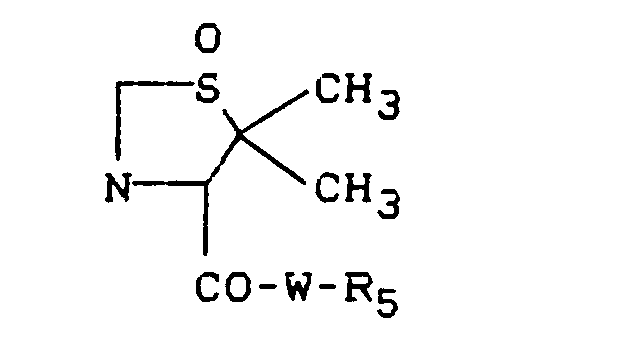
- R1 zusammen mit der Gruppe X-R2 für den Rest
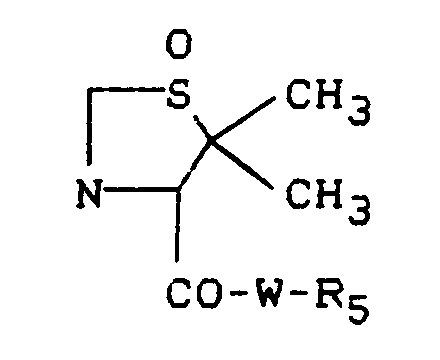
steht, - Als Reste R1 seien beispielhaft genannt für gegebenenfalls substituiertes geradkettiges oder verzweigtes C1-Cg-Alkyl der Methyl, Ethyl, i-Propyl, n-Propyl, n-Butyl, i-Butyl, t-Butyl, 1-Hydroxymethyl, 1-Hydroxyethyl, 3-Acetylaminopropyl-, 4-Benzoyl-aminobutyl, t-Butoxymethyl, Benzyloxymethyl-, 2-Methoxycarbonylmethyl-, 3-Methoxycarbonylethyl-, 4-t-Butoxycarbonylpropyl-Rest oder beispielsweise der 2-Cyclohexylethyl-Rest; für gegebenenfalls substituiertes CrC12-Aralkyl der Benzyl-, 1-Naphthylmethyl-, 2-Naphthylmethyl-, 3-Indolylmethyl-, 4-Hydroxybenzyl-, 2-Phenylbutyl-, 3-Phenylbutyl- und der 4-Phenylbutyl-Rest; für gegebenenfalls substituiertes geradkettiges oder verzweigtes C4-C10-Cycloalkyl der Cyclopropyl-, Cyclobutyl-, Cyclopentyl-, Cyclohexyl-oder Decahydronaphthyl-Rest; für einen gegebenenfalls substituierten C6-C14-Aryl-Rest der Phenyl-, der 1-Naphthyl- und der 2-Naphthyl-Rest.
- Als Reste R4 seien beispielhaft der Wasserstoff-, Methyl-, Ethyl-, n-Propyl-, i-Propyl-, n-Butyl- und der i-Butyl-Rest genannt, während als gegebenenfalls substituierter Ring exemplarisch der Pyrrolidinyl-, Piperidinyl-, Morpholinyl-, 2-Alkoxycarbonylpyrrolidinyl- und der 2-Alkoxymethylpyrrolidinyl-Rest angeführt seien, mit jeweils 1 bis 4 C-Atomen in der Alkoxygruppe.
- Beispiele für Reste R2 sind gegebenenfalls halogen- oder alkoxy-(C1-C4)-substituierte geradkettige oder verzweigte C1-C22-Alkylreste wie der Methyl-, Ethyl-, Trifluorethyl-,2-Chlorethyl-, n-Propyl-, i-Propyl-, Hexafluorisopropyl-, 2-Methoxy-ethyl-, 2-t-Butoxy-ethyl-, n-Butyl-, i-Butyl-, t-Butyl-, 2-Octyl-, 2-Nonyl-Rest, Stearyl- und der Behenyl-Rest; gegebenenfalls substituierte C7-C12-Aralkyl-Reste wie der Benzyl-, 1-Phenylethyl- und der 1-Naphthylethyl-Rest; gegebenenfalls halogen-, alkoxy-(Ci-C4)- oder alkyl-(Ci-C4)-substituierte C4-C10-Cycloalkyl-Reste wie der Cyclobutyl-, Cyclopentyl-, Cyclohexyl-, 2,6-Dimethylcyclohexyl-, 3,5-Dimethylcyclohexyl-,4-t-Butylcyclohexyl- oder der Decahydronaphthyl-Rest; gegebenenfalls halogen-, -alkoxy-(C1-C4)- oder alkyl-(C1-C4)-substituierte C6-C14-Arylreste wie der Phenyl- sowie der 1-Naphthyl- und der 2-Naphthyl-Rest; ferner racemische oder vorteilhafterweise optisch aktive Terpenylreste wie der Menthyl-, 8-Phenylmenthyl-, Neomenthyl-, Isomenthyl-, Bornyl-, Fenchyl-, Pinanyl- und Isopinocamphyl-Rest. Reste R2 die chiral sind, können in racemischer Form oder vorteilhafterweise in optisch aktiver Form eingesetzt werden.
- Von besonderem Interesse sind Verbindungen der allgemeinen Formel (I), in welcher
- R1 für Alkyl mit 1 bis 4 C-Atomen, Benzyl, Cycloalkyl mit 3 bis 7 C-Atomen, Phenyl, Indolylmethyl, Naphthyl, Naphthylmethyl, Furyl, Thienyl oder Pyridyl steht, wobei die genannten Alkyl- und Aryl-Reste gegebenenfalls ein- oder zweifach substituiert sind durch Hydroxy, Methoxy, Halogen, Alkyl, Cycloalkyl mit bis zu 6 C-Atomen, Phenoxy, Benzoxy, Acetylamino, Benzyloxycarbonyl oder Alkoxycarbonyl mit bis zu 4 C-Atomen,
- R3 für Wasserstoff, Methyl oder Ethyl steht oder zusammen mit R1 eine Tri- oder Tetramethylengruppe bildet,
- X für Sauerstoff oder eine NR4-Gruppe steht, in welcher
- R4 für Wasserstoff oder Alkyl mit 1 bis 4 C-Atomen steht oder gemeinsam mit R2 und dem Stickstoffatom einen 5- bis 7-gliedrigen Ring bildet, der gegebenenfalls durch Alkyl oder Alkoxycarbonyl mit jeweils bis zu 4 C-Atomen substituiert ist und
- R2 für Alkyl mit bis zu 12 C-Atomen, Benzyl, Cycloalkyl mit 3 bis 7 C-Atomen, Phenyl oder Terpenyl steht, wobei die genannten Reste gegebenenfalls substituiert sind durch Fluor, Chlor oder Brom oder durch Alkyl oder Alkoxy mit jeweils bis zu 2 C-Atomen oder
- R1 zusammen mit der Gruppe X-R2 für den Rest

steht, - Die erfindungsgemäßen optisch aktiven N-a-Fluoracryloylaminosäure-Derivate der Formel (I) leiten sich vorzugsweise von optisch aktiven Aminosäuren wie Alanin, Aminobuttersäure, Valin, Norvalin, Leucin, Isoleucin, Terleucin, Phenylglycin, Naphthylglycin, Phenylalanin, Thienylalanin, Pyridylalanin, Naphthylalanin, Cyclohexylglycin, Cyclohexylalanin, Tyrosin, Tryptophan, Serin, Asparaginsäure, Glutaminsäure, Ornithin, Lysin, Prolin oder 6-Aminopenicillansäure ab, das heißt, R1 steht vorzugsweise für Alkyl mit 1 bis 4 C-Atomen, Benzyl, Cyclohexyl, Phenyl, Indolylmethy
l, N aphth yl, Napht hylmethyl, Thi eny l oder Pyridyl, wobei die genannten Alkyl- und Aryl-Reste gegebenenfalls einfach substituiert sein können durch Hydroxy, Phenoxy, Benzoxy, Acetylamino, Benzyloxycarbonyl oder Alkoxycarbonyl mit bis zu 4 C-Atomen, oder - R1 bildet mit R3 eine Trimethylengruppe, die durch C1-C4-Alkoxycarbonyl substituiert ist oder
- R1 bildet mit X-R2 den Rest

- Die erfindungsgemäßen optisch aktiven N-Fluoracryloylaminosäure-Derivate der Formel (I) werden erhalten entweder
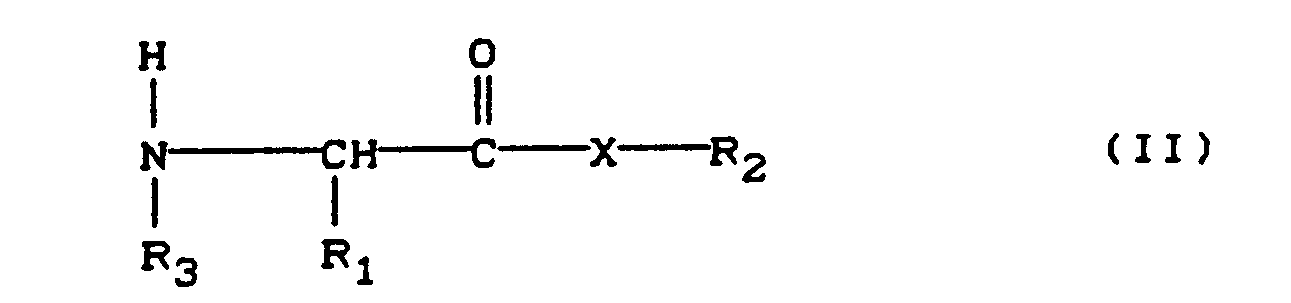
- A) durch Umsetzung von optisch aktiven Aminosäure-Derivaten der Formel

in der - Ri, R2 und R3 die unter Formel (I) angegebene Bedeutung haben,
- oder deren Säureadditionsprodukten
- mit Fluoracryloyl-Derivaten der Formel

in der - Y für Fluor, Chlor oder Brom steht,
- gegebenenfalls in Gegenwart eines Säurebindemittels in inerten organischen Lösungsmitteln oder
- B) durch Umsetzung von Verbindungen der Formel (11) mit einer Fluorverbindung der Formel

in der - Y die oben angegebene Bedeutung hat, und
- A und Z jeweils für Wasserstoff, Fluor, Chlor oder Brom stehen, wobei A und Z nie gleichzeitig
- Wasserstoff bedeuten, so daß die Fluoracryloyl-Verbindung (III) durch AZ-Abspaltung freigesetzt werden kann, wobei AZ bevorzugt HF, HCI, HBr, Br2 oder C12 bedeutet. a-Fluoracryloyl-Derivate der Formel (III) oder deren Vorstufen (IV) können nach an sich bekannten Verfahren hergestellt werden [Zh. Org. Khim. 28, 1173 (1983)] und gegebenenfalls auch als Säureanhydride eingesetzt werden,
- Die als Ausgangsverbindungen verwendeten optisch aktiven Aminosäureester der Formel (II) sind bekannt oder können nach an sich bekannten Verfahren hergestellt werden (siehe Bull. Chem. Soc. Jap. 37 (1964),191).
- Geeignete Säureadditionsverbindungen der als Ausgangsverbindungen zu verwendenden Aminosäuren sind Salze dieser Aminosäuren mit anorganischen oder organischen Säuren. Bevorzugt sind Mineralsäuren wie Salzsäure, Bromwasserstoffsäure, Schwefelsäure, Phosphorsäure oder organische Säuren wie Essigsäure, Methan-, Ethan-, Benzol- oder Toluolsulfonsäure.
- Als Lösungsmittel eignen sich alle unter den Reaktionsbedingungen inerten organischen Lösungsmittel' Bevorzugt sind Kohlenwasserstoffe wie Benzol, Toluol, Xylol oder Erdölfraktionen, oder Halogenkohlenwasserstoffe wie Di-, Tri- oder Tetrachlormethan, Dichlorethan oder Trichlorethylen oder Ether wie tert.-Butylmethylether oder tert.-Amyl-ethylether.
- Als Säurebindemittel kommen vor allem die üblichen anorganischen oder organischen Basen in Betracht; bevorzugt werden Alkali- oder Erdalkalihydroxide wie Natrium-, Kalium-, Lithium-, Calcium- oder Bariumhydroxid, Alkali- oder Erdalkalicarbonate wie Natrium- oder Kaliumcarbonat oder Natriumbicarbonat, Alkalialkoholate wie Natriummethylat, -ethylat, Kaliummethylat, -ethylat, -t-butylat oder Amine wie Triethylamin oder Pyridin, verwendet.
- Die Umsetzung der a-Fluoracryloyl-Derivate der Formel (III) mit den Aminosäure-Derivaten der Formel (II) wird bevorzugt bei Temperaturen von -78 bis + 100 C, insbesondere von -20 C bis + 60 C vorgenommen.
- Die Erfindung betrifft auch die durch Polymerisation bzw. Copolymerisation der optisch aktiven N-a-Fluoracryloylaminosäure-Derivate der Formel (I) erhältlichen optisch aktiven Polymere und Copolymere, die mindestens 40 Mol-%, vorzugsweise mindestens 50 Mol-% Struktureinheiten der Formel (V)

enthalten, in der Ri, R2, R3 und X die unter Formel (I) angegebene Bedeutung haben. - Die erfindungsgemäßen optisch aktiven Polymere der Formel (V) liegen vorzugsweise in Form von vernetzten unlöslichen oder quellbaren Perl-Polymerisaten oder in an feinteilige anorganische Trägermaterialien wie z.B. Kieselgel gebundener Form vor. Sie können auch als lineare, in geeigneten organischen Lösungsmitteln lösliche Polymere hergestellt werden. Es ist ferner möglich, verschiedene erfindungsgemäße N-a-Fluoracryloylaminosäure-Derivate der Formel (I) cozupolymerisieren, sowie 0,1 bis 60, vorzugsweise 0,1 bis 20 Mol-% copolymerisierbarer, anderer Monomere in das Polymere einzubauen.
- Die vernetzten Polymerisate liegen vorzugsweise in Form kleiner Teilchen (Perlen) mit 5 bis 200 um Teilchendurchmesser vor. Sie werden z.B. durch Suspensionspolymerisation der optisch aktiven N-a-Fluoracryloylaminosäure-Derivate der Formel (I) mit 0,5 bis 50 Mol-%, vorzugsweise 1 bis 30 Mol-%, besonders bevorzugt 3 bis 20 Mol-% (bezogen auf die Gesamtmenge [Mol] der eingesetzten Monomere) eines geeigneten Vernetzers in an sich bekannter Weise hergestellt.
- Durch die Art und Menge der Vernetzer läßt sich der Quellungsgrad der (Perl)Polymerisate nach üblichen Methoden einstellen.
- Bei der praktischen Verwendung haben sich (Perl)Polymerisate mit einem Quellungsgrad (Q) von 1.1 bis 10, bevorzugt von 2.0 bis 7.0 bewährt.
- Der Quellungsgrad Q wird wie folgt bestimmt:

- Als Vernetzungsmittel kommen Verbindungen in Frage, die mindestens zwei polymerisierbare Vinylgruppen enthalten. Bevorzugte Vernetzungsmittel sind Alkandioldiacrylate wie 1,6-Hexandioldiacrylat, 1,4-Butandioldiacrylat, 1,3-Propandioldiacrylat oder 1,2-Ethylenglykoldiacrylat, oder Alkandiolmethacrylate wie 1,4-Butandioldimethacrylat, 1,3-Butandioldimethacrylat, 2,3-Butandioldimethacrylat, 1,3-Propandioldimethacrylat oder 1,2-Ethylenglykoldimethacrylat, aromatische Divinylverbindungen wie beispielsweise Divinylbenzol, Divinylchlorbenzol oder Divinyltoluol, Dicarbonsäurevinylester wie Adipinsäuredivinylester, Benzoldicarbonsäuredivinylester, Terephthalsäuredivinylester, N,N'-Alkylendiacrylamide wie N,N'-Methylendiacrylamid, N,N'-Ethylendiacrylamid, N,N'-Methylendimethacrylamidoder N,N'-Ethylendimethacry- lamid.
- Als Radikalbildner kommen die üblichen Radikalbildner in Frage. Bevorzugt sind Peroxide wie beispielsweise Dibenzoylperoxid, Dilauroylperoxid oder Di-orthotolylperoxid oder Azoverbindungen wie beispielsweise Azobisisobuttersäurenitril (AIBN). Auch Gemische verschiedener Radikalbildner sind verwendbar.
- Die Polymerisationskomponenten werden in einem nicht mit Wasser mischbaren organischen Lösungsmittel, vorzugsweise einem aliphatischen oder aromatischen Kohlenwasserstoff wie Hexan, Heptan, Isododecan, Benzol oder Toluol, einem Halogenkohlenwasserstoff wie Di-, Tri-, Tetrachlormethan oder 1,2-Dichlorethan oder einem Ester wie Essigsäureethylester bzw. Essigsäurebutylester gelöst.
- Die organische Phase wird mit Hilfe eines wirksamen Rührers in der wäßrigen Lösung eines Schutzkolloids, bevorzugt in einer wäßrigen Lösung von Polyvinylalkohol, Polyvinylpyrrolidon oder eines Copolymers aus Methacrylsäure und Methylmethacrylat, gleichmäßig verteilt. Je Gewichtsteil organische Phase verwendet man etwa 1 bis 20, bevorzugt 2 bis 10 Gew.-Teile wäßrige Phase. Das Polymerisationsgemisch wird unter Rühren in einer Inertgasatmosphäre, vorzugsweise unter Stickstoff, auf Temperaturen von 30 C bis 150°C, vorzugsweise 40 C bis 80 C erhitzt. Die Polymerisationsdauer beträgt zwischen 2 und 24, bevorzugt 4 und 12 Stunden. Das auf diese Weise erhaltene Copolymerisat wird durch Filtration von der flüssigen Phase getrennt, durch gründliches Waschen mit Wasser und mit organischen Lösungsmitteln wie Methanol, Ethanol, Benzol, Toluol, Di-, Trichlormethan oder Aceton gereinigt und anschließend getrocknet.
- Insbesondere für analytische Anwendungen werden die erfindungsgemäßen optisch aktiven Polymere vorzugsweise in an feinteilige anorganische Träger gebundener Form eingesetzt. Die Herstellung solcher optisch aktiver Chromatographiephasen kann beispielsweise nach den in DE-A 3 706 890 beschriebenen Verfahren erfolgen.
- Bevorzugt ist die Polymerisation der optisch aktiven N-a-Fluoracryloylaminosäure-Derivate der Formel (I) in Gegenwart von Vinylkieselgelen oder von Kieselgel-Diolphasen, die mit (Meth)acrylsäure verestert wurden. Die Polymerisation kann dabei in Abwesenheit von Lösungsmitteln oder in Gegenwart von Lösungsmitteln oder von Fällungsmitteln für die Poly-N-a-fluoracrylamide durchgeführt werden. Als Initiatoren können die zur Herstellung der Perlpolymerisate verwendeten Radikalbildner ebenfalls eingesetzt werden.
- Die polymermodifizierten Kieselgele enthalten vorzugsweise 1 bis 40 Gew.-%, insbesondere 5 bis 30 Gew.-% an optisch aktivem Polymer (V), bezogen auf das Gesamtgewicht. Sie werden intensiv mit Lösungsmitteln für das Polymere gewaschen und im Vakuum getrocknet.
- Selbstverständlich können auch hier Gemische von zwei oder mehreren der erfindungsgemäßen N-a-Fluoracryloylaminosäure-Derivate, gegebenenfalls auch mit weiteren copolymerisierbaren Monomeren eingesetzt werden.
- Die Erfindung betrifft ferner die Verwendung der erfindungsgemäßen Poly-N-a-fluoracrylamide der Formel (V) als solche oder in vernetzter bzw. an Kieselgel gebundener Form zur chromatographischen Trennung von racemischen Gemischen in die optischen Antipoden. Gut trennbare Racemate sind beispielsweise Oxazepam, Binaphthol, Benzoin, Chlorthalidon, Thalidomid, N-3,5-Dinitrobenzoylleucin, 1-(9-Anthryl)-2,2,2-trifluorethanol sowie Tetrahydro- bzw. Hexahydrocarbazolderivate wie z.B. 3-(4-Chlorphenylsulfonami- do)-9-(2-carboxyethyl)-1,2,3,4-tetrahydrocarbazol, 3-r-(Benzol-sulfonamido)-9-(2-carboxyethyl)-1,2,3,4,4a,9a-hexahydrocarbazol, 1-(Carboxymethyl)-6-fluor-9-(4-chlorbenzyl)-1,2,3,4-tetrahydrocarbazol, Hydroxyalkylazolderivate wie z.B. 2-(4-Chlorphenyl)-3-methoxyimino-3-methyl-1-(1,2,4-triazolyl-1)-2-butanol und a-(4-Fluorphenyl)-a-(1-cyancydopropyl)-1H-(1,2,4-triazolyl-1)-ethanol und 1,4-Dihydropyridin-Derivate wie z.B. 1,4-Dihydro-2,6-dimethyl-4-(2-trifluormethylphenyl)-3,5-dicarbonsäure-5-ethylester.
- Die Zusammensetzung des Fließmittels kann je nach Art und Eigenschaft des zu trennenden Racemates in üblicher Weise ausgewählt und optimiert werden. Die an Kieselgel gebundenen erfindungsgemäßen Poly-N-a-fluoracryloylaminosäurederivate können für chromatographische Racemattrennungen unter HPLC-Bedingungen eingesetzt werden.
- Die Fähigkeit der Polymerisate zur Racemattrennung wird durch die Kapazitätsverhältnisse (k',(2)-Werte) für die beiden Enantiomere (1) und (2) und den daraus resultierenden Enantioselektivitätswert a ausgedrückt. Diese chromatographischen Parameter sind wie folgt definiert:


to = Totzeit der Säule - t1(2) = Retentionszeit des zuerst eluierten Enantiomers 1 bzw. des später eluierten Enantiomers 2 Die präparative Trennung von racemischen Gemischen in ihre optischen Antipoden unter Verwendung der erfindungsgemäßen Polymerisate wird vorzugsweise säulenchromatographisch vorgenommen. Besonders vorteilhaft ist es hierfür, die chromatographische Trennung mit Perlpolymerisaten einer bestimmten Korngrößenverteilung vorzunehmen; gute Trennleistungen werden mit Perlpolymerisaten einer Korngrößenverteilung von 5 bis 200 um, bevorzugt 15 bis 100 um erhalten.
- Die Arbeitsmethodik der säulenchromatographischen Trennung ist bekannt. Üblicherweise wird das Polymerisat im Fließmittel suspendiert und die Suspension in eine Glassäule gefüllt. Nach Ablaufen des Fließmittels wird das zu trennende Racemat, gelöst in möglichst wenig Fließmittel, auf die Säule aufgebracht. Dann wird mit Fließmittel eluiert und die Enantiomeren im Eluat photometrisch und/oder polarimetrisch mittels geeigneter Durchflußzellen detektiert.
- Als Fließmittel werden übliche organische Lösungsmittel bzw. Lösungsmittelgemische verwendet, die das als Adsorbens eingesetzte Polymerisat anquellen und das zu trennende Racemat lösen. Beispielsweise seien genannt:
- Kohlenwasserstoffe wie Benzol, Toluol oder Xylol, Ether wie Diethylether, t-Butylmethylether, Dioxan oder Tetrahedronfuran, Halogenkohlenwasserstoffe wie Di- oder Trichlormethan, Aceton, Acetonitril oder Essigester, Alkohole wie Methanol, Ethanol, n-Propanol, Isopropanol oder n-Butanol, oder aber Gemische der genannten Lösungsmittel. Als besonders geeignet haben sich Mischungen aus Toluol mit Tetrahydrofuran, Dioxan oder Isopropanol erwiesen.
- Beispiele I. Herstellungsmethode der N-a-Fluoracryloylaminosäurederivate (Monomere)
- Methode a) ausgehend von 2,3-Difluorpropionsäurechlorid
- Man legt eine Lösung von 0,2 Mol 2,3-Difluorpropionylchlorid in 200 ml abs. Dichlormethan vor, tropft bei 0°C 0,205 Mol Triethylamin zu und rührt 30 Minuten bei 0°C nach.
- Zu dieser Lösung tropft man dann bei -10°C eine Mischung aus 0,2 Mol Aminosäure-Derivat und 0,2 Mol Triethylamin in 200 ml abs. Dichlormethan.
- Man läßt auf Raumtemperatur kommen und arbeitet dann wie üblich wäßrig auf.
- Methode b) unter Verwendung von a-Fluoracrylsäurechlorid
- Zu einer Lösung von 0,1 Mol eines Aminosäureesters bzw. -amidhydrochlorids der Formel (II) in 300 ml Dichlormethan tropft man bei 0°C zunächst 0,2 Mol Triethylamin und anschließend bei -10°C eine Lösung von 0,1 Mol a-Fluoracrylsäurechlorid in 25 ml Dichlormethan. Man rührt 30 Minuten ohne Kühlbad nach, wäscht sukzessive mit Wasser, 1 N HCI und gesättigter NaHC03-Lösung, trocknet über Magnesiumsulfat und befreit am Rotationsverdampfer vom Solvens. Das nach Trocknen im Hochvakuum erhaltene Produkt kristallisiert man um oder reinigt durch Chromatographie an Kieselgel.
- Setzt man einen freien Aminosäureester bzw. -amid ein, so reduziert man die Triethylamin-Menge auf die Hälfte. Die so hergestellten N-a-Fluoracryloylaminosäurederivate sind in der Tabelle I zusammengestellt.

- II. Polymerisation der N-a-Fluoracryloylaminosäure-Derivate (I)
- a) 25 g mit 1,2-Diolgruppen modifiziertes Kieselgel (mittlere Korngröße: 5 um) werden unter Feuchtigkeitsausschluß und unter Stickstoff in 500 ml Dioxan suspendiert. Die Suspension wird mit 16 ml Methacrylsäureanhydrid und 12,5 ml Triethylamin versetzt. Die Mischung wird 1 Stunde bei Raumtemperatur gerührt und 24 Stunden bei Raumtemperatur aufbewahrt. Dann wird das Kieselgel über eine Glasfritte (G4) abgesaugt, 3 mal mit je 500 ml Dioxan 30 Minuten lang verrührt und zwischendurch gut trockengesaugt. Das durch Methacryloylgruppen modifizierte Kieselgel wird bei Raumtemperatur im Vakuum <0,005 at getrocknet.
- Ausbeute 24,8 g
- Elementaranalyse: C: 9,2 %; H: 1,7 %
- Werte des mit Diolgruppen modifizierten Kieselgels:
- C: 7,7 %; H: 1,5 %
- b) In einem mit Rückflußkühler und Magnetrührer versehenen 100 ml-Rundkolben werden 3 g des mit Methacryloylgruppen modifizierten Kieselgels, dessen Herstellung unter a) beschrieben ist, 6,0 g optisch aktives N-a-Fluoracryloyl-aminosäure-Derivat und 60 mg Azobisisobutyronitril in 25 ml trockenem Toluol gelöst bzw. suspendiert. Die Apparatur wird durch dreimaliges Evakuieren und mit Stickstofffüllen von Luft befreit und anschließend mit Stickstoff gefüllt. Das Polymerisationsgemisch wird 1 Stunde bei Raumtemperatur gerührt und dann rasch auf 80 C erhitzt Nach 45-minütigem Rühren bei 80 C werden 200 mg 2,6-Di-tert.-butyl-4-methylphenol zugesetzt und das Reaktionsgemisch rasch abgekühlt. Das Kieselgel wird über eine Glasfritte (G4) abgesaugt, mit Toluol gewaschen und 2 mal mit je 50 ml Chloroform, einmal mit 50 ml Toluol und einmal mit 50 ml Isopropanol je 30 Minuten verrührt und zwischendurch abgesaugt. Das Kieselgel wird abschließend bei Raumtemperatur im Vakuum <0,005 at getrocknet. In der nachstehenden Tabelle 11 sind die auf das modifizierte Kieselgel aufpolymerisierten N-a-Fluoracryloyl-aminosäure-Derivate, die Ausbeuten an optisch aktive Verbindungen enthaltendem Kieselgel, dessen Stickstoffgehalt und dessen Gehalt an gebundenem Polymer zusammengestellt.
- c) In der unter b) beschriebenen Apparatur werden 3,0 g des mit Methacryloylgruppen modifizierten Kieselgels, dessen Herstellung unter a) beschrieben ist, 6,0 g optisch aktives N-a-Fluoracryloyl- aminosäure-Derivat und 60 mg Azobisisobutyronitril in 25 ml trockenem Trichlormethan gelöst bzw. suspendiert. Die Apparatur wird durch dreimaliges abwechselndes Evakuieren und mit Stickstoffüllen von Luft befreit und abschließend mit Stickstoff gefüllt. Das Reaktionsgemisch wird 1 Stunde bei Raumtemperatur und 1 Stunde unter Rückfluß gerührt. Nach Zugabe von 200 mg 2,6-Di-tert.-butyl-4-methylphenol wird der Ansatz rasch abgekühlt. Das Kieselgel wird über eine Glasfritte (G4) abgesaugt, zweimal mit je 50 ml Chloroform, einmal mit 50 ml Toluol und einmal mit 50 ml Isopropanol je 30 Minuten verrührt und zwischendurch abgesaugt. Das Kieselgel wird abschließend bei Raumtemperatur im Vakuum <0,005 at getrocknet.

- Die Lösung von 13,5 g optisch aktivem N-a-Fluoracryloylaminosäure-Derivat, 1,5 g Ethylenglykoldimethacrylat und 0,3 g Azobisisobutyronitril in 37,5 g Trichlormethan wird unter Rühren (350 bis 500 U/min) in einer Lösung von 3 g Polyvinylalkohol in 130 ml entmineralisiertem Wasser dispergiert. Die Apparatur wird mehrmals evakuiert und mit Stickstoff gefüllt. Das Polymerisationsgemisch wird unter Stickstoff zunächst 30 Minuten bei Raumtemperatur und anschließend 16 Stunden bei 55°C (Innentemperatur) gerührt. Das Polymerisationsgemisch wird dann in 2 bis 3 I Wasser eingerührt und die flüssige Phase nach dem Absitzen des Perlpolymerisates dekantiert. Das Perlpolymerisat wird durch 3 bis 4-maliges Suspendieren in Wasser und Abdekantieren der flüssigen Phase vom Feinkorn (Polymerisat mit einer Korngröße von <10 µm) befreit und nach intensivem Waschen mit Aceton bei 60 C bis zur Gewichtskonstanz getrocknet.
- In der nachstehenden Tabelle III sind die für die Polymerisation verwendeten N-a-Fluoracryloylaminosäure-Derivate, die Rührgeschwindigkeit, bei der die Polymerisation durchgeführt wurde, die Ausbeuten, in denen die Polymerisate erhalten wurden, deren Korngröße und das Volumen der erhaltenen Perlpolymerisate in trockenem (Vs) und gequollenem (Vq) Zustand (Quellmittel: Toluol = T bzw. Toluol/THF 3:2 v/v-Gemisch = T/T) zusammengestellt.

- III. Verwendung der N-a-Fluoracryloylaminosäure-Derivate (I) als Adsorbentien für die Racemattrennung
- Für die chromatographischen Trennungen wurden folgende Testracemate verwendet:
- Racemat Nr. 1: Oxazepam
- Racemat Nr. 2: Binaphthol
- Racemat Nr. 3: Chlorthalidon
- Racemat Nr. 4: Thalidomid
- Racemat Nr. 5: N-3,5-Dinitrobenzoylleucin
- Racemat Nr. 6: 3-r-(Benzol-sulfonamido)-9-(2-carboxyethyl)-1 ,2,3,4,4a,9a-hexahydrocarbazol
- Die an Kieselgel gebundenen Polymerisate wurden in Stahlsäulen (Innendurchmesser: 4 mm, Länge: 25 cm) eingesetzt. Eluiert wurde mit n-Heptan-Tetrahydrofuran-Gemischen 3:2 = Elutionsmittel a, 1:1 = Elutionsmittel b, 1:2 = Elutionsmittel c; die Fließmittelgeschwindigkeit betrug 1 ml/min.
- Die nachstehenden Chromatogramme zeigen die überraschend gute Trennwirkung der erfindungsgemäßen Polymeren. Die Abszisse gibt die Elutionszeit in Minuten an. Die Detektion erfolgt durch UV-Absorption.
- Im Vergleich zu den erfindungsgemäßen Polymeren wurde versucht, an einer mit N-Acryloyl-phenylalaninethylester belegten Kieselgelsäule (Chiraspher@ von Merck) die Trennung der Testracemate 2 und 4 im Elutionsmittel a und des Testracemats 3 im Elutionsmittel b durchzuführen. In allen Fällen wurde bei UV-Detektion keine Enantiomerentrennung beobachtet, die Enantioselektivität a betrug 1,00, obwohl das eingesetzte Polymer sich nur durch die fehlende Fluorsubstitution vom Polymer des Beispiels 11 unterscheidet
- Abbildung 1
- Racemat Nr. 1
- Adsorbens gemäß Beispiel 17
- Elutionsmittel: a
- Abbildung 2
- Racemat Nr. 2
- Adsorbens gemäß Beispiel 11
- Elutionsmittel: a
- Abbildung 3
- Racemat Nr. 2
- Adsorbens gemäß Beispiel 16
- Elutionsmittel: a
- Abbildung 4
- Racemat Nr. 3
- Adsorbens gemäß Beispiel 11
- Elutionsmittel: b
- Abbildung 5
- Racemat Nr. 4
- Adsorbens gemäß Beispiel 11
- Elutionsmittel: c
- Abbildung 6
- Racemat Nr' 4
- Adsorbens gemäß Beispiel 18
- Elutionsmittel: a
- Abbildung 7
- Racemat Nr. 5
- Adsorbens gemäß Beispiel 17
- Elutionsmittel: a
- Abbildung 8
- Racemat Nr. 6
- Adsorbens gemäß Beispiel 16
- Elutionsmittel: a
- Abbildung 9
- Racemat Nr. 6
- Adsorbens gemäß Beispiel 18
- Elutionsmittel: a
wobei W-Rs die für X-R2 angegebene Bedeutung hat.
wobei W-Rs für Benzyloxy steht.
Claims (9)

in der
steht,

steht,

in der

steht, wobei W-Rs die für X-R2 angegebene Bedeutung hat,
dadurch gekennzeichnet, daß man
in der

in der


in welcher
Applications Claiming Priority (2)
| Application Number | Priority Date | Filing Date | Title |
|---|---|---|---|
| DE4021108 | 1990-07-03 | ||
| DE4021108A DE4021108A1 (de) | 1990-07-03 | 1990-07-03 | Optisch aktive n-(alpha)-fluoracryloyl-aminosaeure-derivate, ihre herstellung, die daraus hergestellten optisch aktiven polymeren und deren verwendung zur spaltung von racematen |
Publications (3)
| Publication Number | Publication Date |
|---|---|
| EP0464488A2 true EP0464488A2 (de) | 1992-01-08 |
| EP0464488A3 EP0464488A3 (en) | 1993-07-14 |
| EP0464488B1 EP0464488B1 (de) | 1995-09-27 |
Family
ID=6409542
Family Applications (1)
| Application Number | Title | Priority Date | Filing Date |
|---|---|---|---|
| EP91110142A Expired - Lifetime EP0464488B1 (de) | 1990-07-03 | 1991-06-20 | Optisch aktive N-aplha-Fluoracryloylaminosäure-Derivate, ihre Herstellung, die daraus hergestellten optisch aktiven Polymeren und deren Verwendung zur Spaltung von Racematen |
Country Status (9)
| Country | Link |
|---|---|
| US (2) | US5354884A (de) |
| EP (1) | EP0464488B1 (de) |
| JP (1) | JP2965752B2 (de) |
| AT (1) | ATE128457T1 (de) |
| CA (1) | CA2045972C (de) |
| DE (2) | DE4021108A1 (de) |
| DK (1) | DK0464488T3 (de) |
| ES (1) | ES2079521T3 (de) |
| GR (1) | GR3017541T3 (de) |
Cited By (4)
| Publication number | Priority date | Publication date | Assignee | Title |
|---|---|---|---|---|
| EP0576949A1 (de) * | 1992-07-02 | 1994-01-05 | Bayer Ag | Optisch aktive Aminosäuresulfoxid- und -sulfon-Derivate, ihre Herstellung, ihre Polymerisation und Verwendung als Adsorbentien für die chromatographische Racematspaltung |
| EP0584664A1 (de) * | 1992-08-25 | 1994-03-02 | Bayer Ag | Polymerisierbare Dipeptide:Synthese, Polymerisation und Verwendung der Polymere zur chromatographischen Enantiomerentrennung |
| EP0780408A2 (de) | 1995-12-11 | 1997-06-25 | Bayer Ag | Chirale stationäre Phasen für die chromatographische Trennung von optischen Isomeren |
| US6277782B1 (en) | 1992-12-03 | 2001-08-21 | Eka Nobel Ab | Chiral adsorbents and preparation thereof as well as compounds on which the adsorbents are based and preparation of these compounds |
Families Citing this family (5)
| Publication number | Priority date | Publication date | Assignee | Title |
|---|---|---|---|---|
| JPH11507402A (ja) * | 1995-05-26 | 1999-06-29 | アイジェン・インコーポレーテッド | 分子的にインプリントされた粒状ポリマー及び同ポリマーのペルフロオロカーボン液中における安定化懸濁重合 |
| US5994560A (en) * | 1996-08-29 | 1999-11-30 | Hoechst Celanese Corp. | Resolution of racemic mixtures using polymers containing chiral units |
| US7854924B2 (en) * | 2004-03-30 | 2010-12-21 | Relypsa, Inc. | Methods and compositions for treatment of ion imbalances |
| MY200252A (en) | 2016-04-18 | 2023-12-16 | Sarepta Therapeutics Inc | Antisense oligomers and methods of using the same for treating diseases associated with the acid alpha-glucosidase gene |
| CN116183740B (zh) * | 2022-12-02 | 2025-04-29 | 广电计量检测(杭州)有限公司 | 一种测定棉织物中[3-[(羟甲基)氨基]-3-羰基丙基]-膦酸二甲酯的方法 |
Family Cites Families (8)
| Publication number | Priority date | Publication date | Assignee | Title |
|---|---|---|---|---|
| NL6509157A (de) * | 1964-07-24 | 1966-01-25 | ||
| US3452182A (en) * | 1964-07-24 | 1969-06-24 | Polaroid Corp | Photographic products and processes |
| CH618320A5 (de) * | 1975-09-30 | 1980-07-31 | Ciba Geigy Ag | |
| AU543804B2 (en) * | 1980-10-31 | 1985-05-02 | Takeda Chemical Industries Ltd. | Amides having bicyclic substituents on nitrogen |
| JPS62164692A (ja) * | 1986-01-14 | 1987-07-21 | Nippon Kayaku Co Ltd | α−アスパルチル−フエニルアラニンエステルの新しい製造法 |
| DE3706890A1 (de) * | 1987-03-04 | 1988-09-15 | Bayer Ag | Optisch aktive (meth)acrylamide, verfahren zu ihrer herstellung und ihre verwendung zur racematspaltung |
| JPS63270652A (ja) * | 1987-04-30 | 1988-11-08 | Nippon Kayaku Co Ltd | β−アスパルテ−ムの製造法 |
| DE59009485D1 (de) * | 1989-01-26 | 1995-09-14 | Bayer Ag | Optisch aktive (Meth)Acrylsäure-Derivate, ihre Herstellung, ihre Polymerisation zu optisch aktiven Polymeren und deren Verwendung. |
-
1990
- 1990-07-03 DE DE4021108A patent/DE4021108A1/de not_active Withdrawn
-
1991
- 1991-06-20 DK DK91110142.6T patent/DK0464488T3/da active
- 1991-06-20 DE DE59106571T patent/DE59106571D1/de not_active Expired - Lifetime
- 1991-06-20 EP EP91110142A patent/EP0464488B1/de not_active Expired - Lifetime
- 1991-06-20 AT AT91110142T patent/ATE128457T1/de not_active IP Right Cessation
- 1991-06-20 ES ES91110142T patent/ES2079521T3/es not_active Expired - Lifetime
- 1991-06-27 JP JP3181655A patent/JP2965752B2/ja not_active Expired - Fee Related
- 1991-06-28 CA CA002045972A patent/CA2045972C/en not_active Expired - Fee Related
-
1992
- 1992-10-01 US US07/955,225 patent/US5354884A/en not_active Expired - Lifetime
- 1992-11-13 US US07/976,246 patent/US5292924A/en not_active Expired - Lifetime
-
1995
- 1995-09-28 GR GR950402368T patent/GR3017541T3/el unknown
Cited By (9)
| Publication number | Priority date | Publication date | Assignee | Title |
|---|---|---|---|---|
| EP0576949A1 (de) * | 1992-07-02 | 1994-01-05 | Bayer Ag | Optisch aktive Aminosäuresulfoxid- und -sulfon-Derivate, ihre Herstellung, ihre Polymerisation und Verwendung als Adsorbentien für die chromatographische Racematspaltung |
| US5357001A (en) * | 1992-07-02 | 1994-10-18 | Bayer Aktiengesellschaft | Optically active amino acid sulphoxide and amino acid sulphone derivatives, their preparation, their polymerisation and use as adsorbents for chromatographic resolution of racemates |
| US5481026A (en) * | 1992-07-02 | 1996-01-02 | Bayer Aktiengesellschaft | Optically active amino acid sulphoxide and amino acid sulphone derivatives |
| EP0584664A1 (de) * | 1992-08-25 | 1994-03-02 | Bayer Ag | Polymerisierbare Dipeptide:Synthese, Polymerisation und Verwendung der Polymere zur chromatographischen Enantiomerentrennung |
| US6559334B1 (en) | 1992-08-25 | 2003-05-06 | Bayer Aktiengesellschaft | Polymers chromatographic separation of enantiomers |
| US6277782B1 (en) | 1992-12-03 | 2001-08-21 | Eka Nobel Ab | Chiral adsorbents and preparation thereof as well as compounds on which the adsorbents are based and preparation of these compounds |
| US6333426B1 (en) | 1992-12-03 | 2001-12-25 | Eka Nobel Ab | Chiral adsorbents and preparation thereof as well as compounds on which the absorbents are based and preparation of the compounds |
| EP0671975B2 (de) † | 1992-12-03 | 2002-07-03 | Eka Chemicals AB | Chirale adsorbentien und deren herstellung, sowie verbindungen auf welche die adsorbetntien sich gründen und die herstellung dieser verbindungen |
| EP0780408A2 (de) | 1995-12-11 | 1997-06-25 | Bayer Ag | Chirale stationäre Phasen für die chromatographische Trennung von optischen Isomeren |
Also Published As
| Publication number | Publication date |
|---|---|
| JP2965752B2 (ja) | 1999-10-18 |
| CA2045972A1 (en) | 1992-01-04 |
| GR3017541T3 (en) | 1995-12-31 |
| EP0464488B1 (de) | 1995-09-27 |
| DK0464488T3 (da) | 1996-02-12 |
| ES2079521T3 (es) | 1996-01-16 |
| US5292924A (en) | 1994-03-08 |
| US5354884A (en) | 1994-10-11 |
| DE4021108A1 (de) | 1992-01-09 |
| ATE128457T1 (de) | 1995-10-15 |
| DE59106571D1 (de) | 1995-11-02 |
| CA2045972C (en) | 2003-08-19 |
| JPH04230350A (ja) | 1992-08-19 |
| EP0464488A3 (en) | 1993-07-14 |
Similar Documents
| Publication | Publication Date | Title |
|---|---|---|
| EP0379917B1 (de) | Optisch aktive (Meth)Acrylsäure-Derivate, ihre Herstellung, ihre Polymerisation zu optisch aktiven Polymeren und deren Verwendung | |
| EP0282770B1 (de) | Optisch aktive (Meth)acrylamide, Verfahren zu ihrer Herstellung und ihre Verwendung zur Racematspaltung | |
| EP0249078B1 (de) | Optisch aktive Adsorbentien | |
| EP0828767B1 (de) | Molekular geprägten perl polymere und stabilisierte suspensionspolymerisation von diesen in perfluorkohlstoff flussigkeiten | |
| EP0780408A2 (de) | Chirale stationäre Phasen für die chromatographische Trennung von optischen Isomeren | |
| EP0218089B1 (de) | Optisch aktive (Meth)-Acrylamide, Polymere daraus, Verfahren zu ihrer Herstellung und ihre Verwendung zur Racematspaltung | |
| EP0464488B1 (de) | Optisch aktive N-aplha-Fluoracryloylaminosäure-Derivate, ihre Herstellung, die daraus hergestellten optisch aktiven Polymeren und deren Verwendung zur Spaltung von Racematen | |
| EP0520242B1 (de) | Optisch aktive schwefelhaltige Aminosäure-Derivate, ihre Herstellung, ihre Polymerisation zu optisch aktiven Polymeren und deren Verwendung | |
| DE19804518C2 (de) | Verfahren zur Herstellung von perlförmigen Mischpolymerisaten auf Acrylatbasis, danach hergestellte Trägerpolymermaterialien und deren Verwendung | |
| EP0576949B1 (de) | Optisch aktive Aminosäuresulfoxid- und -sulfon-Derivate, ihre Herstellung, ihre Polymerisation und Verwendung als Adsorbentien für die chromatographische Racematspaltung | |
| EP0545168B1 (de) | Füllstoffhaltige, optisch aktive Perlpolymerisate | |
| DE2500523C2 (de) | Vernetzte Polymerisate, Verfahren zu ihrer Herstellung und ihre Verwendung | |
| WO1998045230A1 (de) | Chromatographische enantiomerentrennung von lactonen | |
| AT404099B (de) | Polymeres trennmaterial | |
| EP0464487A1 (de) | Optische aktive Alpha-Fluoracrylsäureamide, ihre Herstellung, ihre Polymerisation zu optisch aktiven Polymeren und deren Verwendung zur Trennung von Racematen | |
| EP0584664B1 (de) | Polymerisierbare Dipeptide:Synthese, Polymerisation und Verwendung der Polymere zur chromatographischen Enantiomerentrennung |
Legal Events
| Date | Code | Title | Description |
|---|---|---|---|
| PUAI | Public reference made under article 153(3) epc to a published international application that has entered the european phase |
Free format text: ORIGINAL CODE: 0009012 |
|
| AK | Designated contracting states |
Kind code of ref document: A2 Designated state(s): AT BE CH DE DK ES FR GB GR IT LI LU NL SE |
|
| PUAL | Search report despatched |
Free format text: ORIGINAL CODE: 0009013 |
|
| AK | Designated contracting states |
Kind code of ref document: A3 Designated state(s): AT BE CH DE DK ES FR GB GR IT LI LU NL SE |
|
| 17P | Request for examination filed |
Effective date: 19931207 |
|
| 17Q | First examination report despatched |
Effective date: 19940421 |
|
| GRAA | (expected) grant |
Free format text: ORIGINAL CODE: 0009210 |
|
| AK | Designated contracting states |
Kind code of ref document: B1 Designated state(s): AT BE CH DE DK ES FR GB GR IT LI LU NL SE |
|
| REF | Corresponds to: |
Ref document number: 128457 Country of ref document: AT Date of ref document: 19951015 Kind code of ref document: T |
|
| REF | Corresponds to: |
Ref document number: 59106571 Country of ref document: DE Date of ref document: 19951102 |
|
| ITF | It: translation for a ep patent filed | ||
| ET | Fr: translation filed | ||
| REG | Reference to a national code |
Ref country code: GR Ref legal event code: FG4A Free format text: 3017541 |
|
| GBT | Gb: translation of ep patent filed (gb section 77(6)(a)/1977) |
Effective date: 19951117 |
|
| REG | Reference to a national code |
Ref country code: ES Ref legal event code: FG2A Ref document number: 2079521 Country of ref document: ES Kind code of ref document: T3 |
|
| REG | Reference to a national code |
Ref country code: DK Ref legal event code: T3 |
|
| PLBE | No opposition filed within time limit |
Free format text: ORIGINAL CODE: 0009261 |
|
| STAA | Information on the status of an ep patent application or granted ep patent |
Free format text: STATUS: NO OPPOSITION FILED WITHIN TIME LIMIT |
|
| 26N | No opposition filed | ||
| PGFP | Annual fee paid to national office [announced via postgrant information from national office to epo] |
Ref country code: GR Payment date: 20010522 Year of fee payment: 11 |
|
| PGFP | Annual fee paid to national office [announced via postgrant information from national office to epo] |
Ref country code: AT Payment date: 20010620 Year of fee payment: 11 |
|
| PGFP | Annual fee paid to national office [announced via postgrant information from national office to epo] |
Ref country code: LU Payment date: 20010629 Year of fee payment: 11 |
|
| REG | Reference to a national code |
Ref country code: GB Ref legal event code: IF02 |
|
| PG25 | Lapsed in a contracting state [announced via postgrant information from national office to epo] |
Ref country code: LU Free format text: LAPSE BECAUSE OF NON-PAYMENT OF DUE FEES Effective date: 20020620 Ref country code: AT Free format text: LAPSE BECAUSE OF NON-PAYMENT OF DUE FEES Effective date: 20020620 |
|
| PG25 | Lapsed in a contracting state [announced via postgrant information from national office to epo] |
Ref country code: GR Free format text: LAPSE BECAUSE OF NON-PAYMENT OF DUE FEES Effective date: 20021231 |
|
| PG25 | Lapsed in a contracting state [announced via postgrant information from national office to epo] |
Ref country code: IT Free format text: LAPSE BECAUSE OF NON-PAYMENT OF DUE FEES;WARNING: LAPSES OF ITALIAN PATENTS WITH EFFECTIVE DATE BEFORE 2007 MAY HAVE OCCURRED AT ANY TIME BEFORE 2007. THE CORRECT EFFECTIVE DATE MAY BE DIFFERENT FROM THE ONE RECORDED. Effective date: 20050620 |
|
| PGFP | Annual fee paid to national office [announced via postgrant information from national office to epo] |
Ref country code: ES Payment date: 20050728 Year of fee payment: 15 |
|
| REG | Reference to a national code |
Ref country code: GB Ref legal event code: 732E |
|
| REG | Reference to a national code |
Ref country code: CH Ref legal event code: PUE Owner name: DAICEL CHEMICAL INDUSTRIES, LTD Free format text: BAYER AKTIENGESELLSCHAFT# #D-51368 LEVERKUSEN (DE) -TRANSFER TO- DAICEL CHEMICAL INDUSTRIES, LTD#2-18-1, KONAN#108-8230 MINATO-KU, TOKYO (JP) |
|
| NLS | Nl: assignments of ep-patents |
Owner name: DAICEL CHEMICAL INDUSTRIES, LTD Effective date: 20061017 |
|
| REG | Reference to a national code |
Ref country code: FR Ref legal event code: TP |
|
| REG | Reference to a national code |
Ref country code: FR Ref legal event code: RM |
|
| PGFP | Annual fee paid to national office [announced via postgrant information from national office to epo] |
Ref country code: SE Payment date: 20070607 Year of fee payment: 17 |
|
| PGFP | Annual fee paid to national office [announced via postgrant information from national office to epo] |
Ref country code: NL Payment date: 20070617 Year of fee payment: 17 |
|
| PGFP | Annual fee paid to national office [announced via postgrant information from national office to epo] |
Ref country code: DK Payment date: 20070618 Year of fee payment: 17 |
|
| REG | Reference to a national code |
Ref country code: CH Ref legal event code: PFA Owner name: DAICEL CHEMICAL INDUSTRIES, LTD Free format text: DAICEL CHEMICAL INDUSTRIES, LTD#2-18-1, KONAN#108-8230 MINATO-KU, TOKYO (JP) -TRANSFER TO- DAICEL CHEMICAL INDUSTRIES, LTD#2-18-1, KONAN#108-8230 MINATO-KU, TOKYO (JP) |
|
| BECA | Be: change of holder's address |
Owner name: *DAICEL CHEMICAL INDUSTRIES LTDJR SHINAGAWA EAST B Effective date: 20061004 |
|
| BECH | Be: change of holder |
Owner name: *DAICEL CHEMICAL INDUSTRIES LTD Effective date: 20061004 |
|
| PGFP | Annual fee paid to national office [announced via postgrant information from national office to epo] |
Ref country code: BE Payment date: 20070817 Year of fee payment: 17 |
|
| REG | Reference to a national code |
Ref country code: ES Ref legal event code: FD2A Effective date: 20070621 |
|
| PG25 | Lapsed in a contracting state [announced via postgrant information from national office to epo] |
Ref country code: ES Free format text: LAPSE BECAUSE OF NON-PAYMENT OF DUE FEES Effective date: 20070621 |
|
| BERE | Be: lapsed |
Owner name: *DAICEL CHEMICAL INDUSTRIES LTD Effective date: 20080630 |
|
| REG | Reference to a national code |
Ref country code: DK Ref legal event code: EBP |
|
| EUG | Se: european patent has lapsed | ||
| NLV4 | Nl: lapsed or anulled due to non-payment of the annual fee |
Effective date: 20090101 |
|
| PG25 | Lapsed in a contracting state [announced via postgrant information from national office to epo] |
Ref country code: BE Free format text: LAPSE BECAUSE OF NON-PAYMENT OF DUE FEES Effective date: 20080630 |
|
| PG25 | Lapsed in a contracting state [announced via postgrant information from national office to epo] |
Ref country code: NL Free format text: LAPSE BECAUSE OF NON-PAYMENT OF DUE FEES Effective date: 20090101 |
|
| PG25 | Lapsed in a contracting state [announced via postgrant information from national office to epo] |
Ref country code: DK Free format text: LAPSE BECAUSE OF NON-PAYMENT OF DUE FEES Effective date: 20090106 |
|
| PG25 | Lapsed in a contracting state [announced via postgrant information from national office to epo] |
Ref country code: DK Free format text: LAPSE BECAUSE OF NON-PAYMENT OF DUE FEES Effective date: 20080630 |
|
| PG25 | Lapsed in a contracting state [announced via postgrant information from national office to epo] |
Ref country code: SE Free format text: LAPSE BECAUSE OF NON-PAYMENT OF DUE FEES Effective date: 20080621 |
|
| PGFP | Annual fee paid to national office [announced via postgrant information from national office to epo] |
Ref country code: FR Payment date: 20100709 Year of fee payment: 20 |
|
| PGFP | Annual fee paid to national office [announced via postgrant information from national office to epo] |
Ref country code: CH Payment date: 20100614 Year of fee payment: 20 |
|
| PGFP | Annual fee paid to national office [announced via postgrant information from national office to epo] |
Ref country code: GB Payment date: 20100616 Year of fee payment: 20 Ref country code: DE Payment date: 20100616 Year of fee payment: 20 |
|
| REG | Reference to a national code |
Ref country code: DE Ref legal event code: R071 Ref document number: 59106571 Country of ref document: DE |
|
| REG | Reference to a national code |
Ref country code: DE Ref legal event code: R071 Ref document number: 59106571 Country of ref document: DE |
|
| REG | Reference to a national code |
Ref country code: CH Ref legal event code: PL |
|
| REG | Reference to a national code |
Ref country code: GB Ref legal event code: PE20 Expiry date: 20110619 |
|
| PG25 | Lapsed in a contracting state [announced via postgrant information from national office to epo] |
Ref country code: GB Free format text: LAPSE BECAUSE OF EXPIRATION OF PROTECTION Effective date: 20110619 |
|
| PG25 | Lapsed in a contracting state [announced via postgrant information from national office to epo] |
Ref country code: DE Free format text: LAPSE BECAUSE OF EXPIRATION OF PROTECTION Effective date: 20110621 |