EP0462558A2 - Sprachkodiersystem - Google Patents
Sprachkodiersystem Download PDFInfo
- Publication number
- EP0462558A2 EP0462558A2 EP91109946A EP91109946A EP0462558A2 EP 0462558 A2 EP0462558 A2 EP 0462558A2 EP 91109946 A EP91109946 A EP 91109946A EP 91109946 A EP91109946 A EP 91109946A EP 0462558 A2 EP0462558 A2 EP 0462558A2
- Authority
- EP
- European Patent Office
- Prior art keywords
- vector
- optimum
- code vector
- code
- perceptually weighted
- Prior art date
- Legal status (The legal status is an assumption and is not a legal conclusion. Google has not performed a legal analysis and makes no representation as to the accuracy of the status listed.)
- Granted
Links
Images








Classifications
-
- G—PHYSICS
- G10—MUSICAL INSTRUMENTS; ACOUSTICS
- G10L—SPEECH ANALYSIS TECHNIQUES OR SPEECH SYNTHESIS; SPEECH RECOGNITION; SPEECH OR VOICE PROCESSING TECHNIQUES; SPEECH OR AUDIO CODING OR DECODING
- G10L19/00—Speech or audio signals analysis-synthesis techniques for redundancy reduction, e.g. in vocoders; Coding or decoding of speech or audio signals, using source filter models or psychoacoustic analysis
- G10L19/04—Speech or audio signals analysis-synthesis techniques for redundancy reduction, e.g. in vocoders; Coding or decoding of speech or audio signals, using source filter models or psychoacoustic analysis using predictive techniques
- G10L19/08—Determination or coding of the excitation function; Determination or coding of the long-term prediction parameters
- G10L19/10—Determination or coding of the excitation function; Determination or coding of the long-term prediction parameters the excitation function being a multipulse excitation
- G10L19/107—Sparse pulse excitation, e.g. by using algebraic codebook
-
- G—PHYSICS
- G10—MUSICAL INSTRUMENTS; ACOUSTICS
- G10L—SPEECH ANALYSIS TECHNIQUES OR SPEECH SYNTHESIS; SPEECH RECOGNITION; SPEECH OR VOICE PROCESSING TECHNIQUES; SPEECH OR AUDIO CODING OR DECODING
- G10L19/00—Speech or audio signals analysis-synthesis techniques for redundancy reduction, e.g. in vocoders; Coding or decoding of speech or audio signals, using source filter models or psychoacoustic analysis
- G10L2019/0001—Codebooks
- G10L2019/0002—Codebook adaptations
-
- G—PHYSICS
- G10—MUSICAL INSTRUMENTS; ACOUSTICS
- G10L—SPEECH ANALYSIS TECHNIQUES OR SPEECH SYNTHESIS; SPEECH RECOGNITION; SPEECH OR VOICE PROCESSING TECHNIQUES; SPEECH OR AUDIO CODING OR DECODING
- G10L19/00—Speech or audio signals analysis-synthesis techniques for redundancy reduction, e.g. in vocoders; Coding or decoding of speech or audio signals, using source filter models or psychoacoustic analysis
- G10L2019/0001—Codebooks
- G10L2019/0003—Backward prediction of gain
-
- G—PHYSICS
- G10—MUSICAL INSTRUMENTS; ACOUSTICS
- G10L—SPEECH ANALYSIS TECHNIQUES OR SPEECH SYNTHESIS; SPEECH RECOGNITION; SPEECH OR VOICE PROCESSING TECHNIQUES; SPEECH OR AUDIO CODING OR DECODING
- G10L19/00—Speech or audio signals analysis-synthesis techniques for redundancy reduction, e.g. in vocoders; Coding or decoding of speech or audio signals, using source filter models or psychoacoustic analysis
- G10L2019/0001—Codebooks
- G10L2019/0011—Long term prediction filters, i.e. pitch estimation
Definitions
- the present invention relates to a speech coding system, more particularly to a speech coding system which performs a high quality compression of speech information signals with the using a vector quantization technique.
- a vector quantization method of compressing speech information signal while maintaining the speech quality is employed.
- the vector quantization method first a reproduced signal is obtained by applying a prediction weighting to each signal vector in a codebook, and then an error power between the reproduced signal and an input speech signal is evaluated to determine a number, i.e., index, of the signal vector which provides a minimum error power. Nevertheless a more advanced vector quantization method is now needed to realize a greater compression of the speech information.
- the problem with the CELP coding lies in the massive amount of digital calculations required for encoding speech, which makes it extremely difficult to conduct a speech communication in real time.
- the realization of such a speech coding apparatus enabling real time speech communication is possible, but a supercomputer would be required for the above digital calculations, and accordingly in practice it would be impossible to obtain compact (handy type) speech coding apparatus.
- Figure 1 is a block diagram of a known sequential optimization CELP coding system and Figure 2 is a block diagram of a known simultaneous optimization CELP coding system.
- an adaptive codebook 1 stores therein N-dimensional pitch prediction residual vectors corresponding to N samples delayed by a pitch period of one sample.
- a sparse-stochastic codebook 2 stores therein 2 m -pattern each 1 of which code vectors is created by using N-dimensional white noise corresponding to N samples similar to the above samples.
- the codebook 2 is represented by a sparse-stochastic codebook in which some sample data, in each code vector, having a magnitude lower than a predetermined threshold level, e.g., N/4 samples among N samples is replaced by zero. Therefore, the codebook is called a sparse (thinning)-stochastic codebook.
- Each code vector is normalized such that a power of the N-dimensional elements becomes constant.
- Both the linear prediction reproduced signal vector gAC and the above-mentioned pitch prediction error signal vector AY are applied to a subtracting unit 9, to find an error signal vector E therebetween.
- An evaluation unit 11 selects an optimum code vector C from the codebook 2 for every frame, such that the power of the error signal vector E is at a minimum, according to the following equation (2).
- the unit 11 also selects the corresponding optimum gain g. E
- 2
- the gain b and the gain g are controlled separately under the sequential optimization CELP coding system shown in Fig. 1.
- An evaluation unit 16 selects a code vector C from the sparse-stochastic codebook 2, which code vector C can minimize the power of the vector E.
- the evaluation unit 16 also simultaneously controls the selection of the corresponding optimum gains b and g.
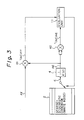
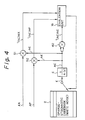
- Figure 3 is a block diagram conceptually expressing an optimization algorithm under the sequential optimization CELP coding method and Figure 4 is a block diagram for conseptually expressing an optimization algorithm under the simultaneous optimization CELP coding method.
- the evaluation unit 16 simultaneously selects the optimum code vector C and the optimum gains b and g which can make minimize the error signal vector E with respect to the perceptually weighted input speech signal vector AX, according to the above-recited equation (5), by using the above mentioned correlation values, i.e., t (AC)AX, t (AC)AP and t (AC)AC.
- the code vector C1 is formed by a composite vector of e1 + (-e2).
- the vector AC can be generated merely by picking up both the element n and the element m of the matrix and then subtracting one from the other, and if the thus-generated vector AC is used for performing a correlation operation at multiplying units 41 and 42, the computation amount can be greatly reduced.
- FIG. 8 is a block diagram showing another principle of the construction based on the sequential optimization coding according to the present invention.
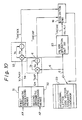
- the autocorrelation value t (AC)AC to be input to the evaluation unit 11 is calculated, as in Fig. 6, by a combination of both of the filters 4 and 42, and the correlation value t (AC)AY to be input, to the evaluation unit 11 is generated by first transforming the pitch prediction error signal vector AY, at an arithmetic processing means 21, into t AAY, and then applying the code vector C from the hexagonal lattice stochastic codebook 20, as is, to a multiplying unit 22.
- This enables the related operation to be carried out by making good use of the advantage of the hexagonal lattice codebook 20 as is, and thus the computation amount becomes smaller than in the case of Fig. 6.
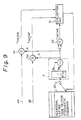
- the present invention can be applied to not only the above-mentioned sequential and simultaneous optimization CELP codings, but also to a gain optimization CELP coding as shown in Fig. 7C, but the best results by the present invention are produced when it is applied to the optimization CELP coding shown in Fig. 5C. This will be explained below in detail.
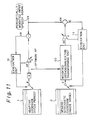
- Figure 12 is a block diagram showing a principle of the construction based on the orthogonalization transfer CELP coding to which the present invention is applied.
- the conventional sparse-stochastic codebook 2 is replaced by the hexagonal lattice code vector stochastic codebook 20.
- the orthogonalization transforming unit 60 generates the perceptually weighted reproduced code vector AC' which is orthogonal to the optimum pitch prediction vector AP among the code vectors C from the hexagonal lattice stochastic codebook 2 which are perceptually weighted by A.
- the final vector AC' can be calculated by very simple equation, as follows.
- the vector t AAX is then applied to a time-reversed orthogonalization transforming unit 71 to generate a time-reversed perceptually weighted orthogonally transformed input speech signal vector t (AH)AX with respect to the optimum perceptually weighted pitch prediction residual vector AP.
- both the thus generated time-reversed perceptually weighted orthogonally transformed input speech signal vector t (AH)AX and each code vector C of the hexagonal lattice stochastic codebook 20 are multiplied at the multiplying unit 65, to generate the correlation value t (AHC)AX therebetween.
- the orthogonalization transforming unit 72 calculates, as in the case of Fig. 12, the perceptually weighted orthogonally transformed code vector AHC relative to the optimum perceptually weighted pitch prediction residual vector AP, which AHC is then sent to the multiplying unit 66 to find the related autocorrelation t (AHC)AHC.
- the autocorrelation value t (AC')AC' of the code vector AC' can be obtained only by taking out the three elements (n, n), (n, m) and (m, m) from the above matrix, which code vector AC' is a perceptually weighted and orthogonally transformed code vector relative to the optimum perceptually weighted pitch prediction residual vector AP.
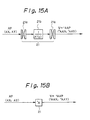
- Figure 15A and 15B illustrate first and second examples of the arithmetic processing means shown in Figs. 8, 10, 13 and 14.
- the arithmetic processing means is comprised of members 21a, 21b and 21c.
- the member 21a is a time-reversed unit which rearranges the input signal (optimum AP) inversely along a time axis.
- the member 21c is another time-reversed unit which arranges again the output signal from the filter 21b inversely along a time axis, and thus the arithmetic sub-vector is generated thereby.
- IIR infinite impulse response
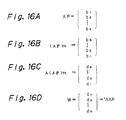
- the matrix A corresponds to a reversed matrix of a transpose matrix, t A, and therefore, the A(AP) TR can be returned to its original form by rearranging the elements inversely along a time axis, and thus the vector of Fig. 16D is obtained.
- the arithmetic processing means may be constructed by using a finite impulse response (FIR) perceptual weighting filter which multiplies the input vector AP with a transpose matrix, i.e., t A.
- FIR finite impulse response
- Figures 17A to 17C depict an embodiment of the arithmetic processing means shown in Fig. 15B in more detail and from a mathematical viewpoint.
- the FIR perceptual weighting filter matrix is set as A and the transpose matrix t A of the matrix A is an N-dimensional matrix, as shown in Fig. 7A, corresponding to the number of dimensions N of the codebook
- the perceptually weighted pitch prediction residual vector AP is formed as shown in Fig. 17B (this corresponds to a time-reversed vector of Fig. 16B)
- the time-reversed perceptual weighting pitch prediction residual vector t AAP becomes a vector as shown in Fig.
- the filter matrix A is formed as the IIR filter, it is also possible to use the FIR filter therefor. If the FIR filter is used, however the overall number of calculations becomes N2/2 (plus 2N times shift operations) as in the embodiment of Figs. 17A to 17C. Conversely, if the IIR filter is used, and assuming that a tenth order linear prediction analysis is achieved as an example, just 10N calculations plus 2N shift operations need be used for the related arithmetic processing.
- Figure 18 is a block diagram showing a first embodiment based on the structure of Fig. 11 to which the hexagonal lattice codebook is applied.
- the construction is basically the same as that of Fig. 11, except that the conventional sparse-codebook 2 is replaced by the hexagonal lattice vector codebook 20 of the present invention.
- each circle mark represents a vector operation and each triangle mark represents a scalar operation.
- a parallel component of the code vector C relative to the vector V is obtained by multiplying the unit vector (V/ t VV) of the vector V with the inner product t CV therebetween, and the result becomes t CV(V/ t VV).
- the thus-obtained vector C' is applied to the perceptual weighting filter 63 to produce the vector AC'.
- the optimum code vector C and gain g can be selected by applying the above vector AC' to the sequential optimization CELP coding shown in Fig. 3.
- Figure 20 is a block diagram showing a second embodiment, based on the structure of Fig. 11, to which the hexagonal lattice codebook is applied.
- the construction (based on Fig. 12) is basically the same as that of Fig. 18, except that an orthogonalization transformer 64 is employed instead of the orthogonalization transformer 62.
- the vector B is expressed as follows.
- B V -
- the algorithm of the householder transform will be explained.
- the arithmetic sub-vector V is folded, with respect to a folding line, to become the parallel component of the vector D, and thus a vector (
- represents a unit vector of the direction D.
- the thus-created D direction vector is used to create another vector in a direction reverse to the D direction, i.e., -D direction, which vector is expressed as -(
- a component of the vector C projected onto the vector B is found as follows, as shown in Fig. 19A. ⁇ ( t CB)/( t BB) ⁇ B
- the thus found vector is doubled in an opposite direction, i.e., and added to the vector C, and as a result the vector C' is obtained which is orthogonal to the vector V.
- the vector C' is created and is applied with the perceptual weighting A to obtain the code vector AC' which is orthogonal to the optimum vector AP.
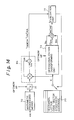
- Figure 21 is a block diagram showing an embodiment based on the principle construction shown in Fig. 14 according to the present invention.
- the arithmetic processing means 70 of Fig. 14 can be comprised of the transpose matrix t A, as in the aforesaid arithmetic processing means 21 (Fig. 15B), but in the embodiment of Fig. 21, the arithmetic processing means 70 is comprised of a time-reversing type filter which achieves an inverse operation in time.
- the above vector V is transformed, at the arithmetic processor 32b including the perceptual weighting matrix A, into three vectors B, uB and AB by using the vector D, as an input, which is orthogonal to all of the code vectors of the hexagonal lattice sparse-stochastic codebook 20.
- the vectors B and uB of the above three vectors are sent to a time-reversing orthogonalization transforming unit 71, and the unit 71 applies a time-reversing householder transform to the vector t AAX from the arithmetic processing means 70, to generate .
- t HW W - (WB)(u t B) This is realized by the arithmetic construction as shown in the figure.
- the above vector t(AH)AX is multiplied, at the multiplier 65, by the hexagonal lattice code vector C from the codebook 20, to obtain a correlation value R XC which is expressed as shown below.
- the value R XC is sent to the evaluation unit 11.
- the thus-generated autocorrelation matrix t (AH)AH, G is stored in the arithmetic processor 73d to produce, when the hexagonal lattice code vector C of the codebook 20 is sent thereto, the vector t (AHC)AHC, which is written as follows, as previously shown.
- the evaluation unit 11 receives two correlation values, and by using same, selects the optimum code vector and the gain.
- the use of the hexagonal lattice codebook according to the present invention can drastically reduce the multiplication number to about 1/200.
- the ordinate thereof indicates a sequential SNR in computer Simulation (dB).
Landscapes
- Engineering & Computer Science (AREA)
- Physics & Mathematics (AREA)
- Theoretical Computer Science (AREA)
- Computational Linguistics (AREA)
- Mathematical Analysis (AREA)
- Mathematical Optimization (AREA)
- Mathematical Physics (AREA)
- Pure & Applied Mathematics (AREA)
- Algebra (AREA)
- General Physics & Mathematics (AREA)
- Signal Processing (AREA)
- Health & Medical Sciences (AREA)
- Audiology, Speech & Language Pathology (AREA)
- Human Computer Interaction (AREA)
- Acoustics & Sound (AREA)
- Multimedia (AREA)
- Compression, Expansion, Code Conversion, And Decoders (AREA)
- Transmission Systems Not Characterized By The Medium Used For Transmission (AREA)
Applications Claiming Priority (2)
| Application Number | Priority Date | Filing Date | Title |
|---|---|---|---|
| JP161042/90 | 1990-06-18 | ||
| JP2161042A JPH0451200A (ja) | 1990-06-18 | 1990-06-18 | 音声符号化方式 |
Publications (3)
| Publication Number | Publication Date |
|---|---|
| EP0462558A2 true EP0462558A2 (de) | 1991-12-27 |
| EP0462558A3 EP0462558A3 (en) | 1992-08-12 |
| EP0462558B1 EP0462558B1 (de) | 1998-05-13 |
Family
ID=15727495
Family Applications (1)
| Application Number | Title | Priority Date | Filing Date |
|---|---|---|---|
| EP91109946A Expired - Lifetime EP0462558B1 (de) | 1990-06-18 | 1991-06-18 | Sprachkodiersystem |
Country Status (5)
| Country | Link |
|---|---|
| US (1) | US5245662A (de) |
| EP (1) | EP0462558B1 (de) |
| JP (1) | JPH0451200A (de) |
| CA (1) | CA2044751C (de) |
| DE (1) | DE69129385T2 (de) |
Cited By (5)
| Publication number | Priority date | Publication date | Assignee | Title |
|---|---|---|---|---|
| EP0497479A1 (de) * | 1991-01-28 | 1992-08-05 | AT&T Corp. | Verfahren und Vorrichtung zur Erzeugung von Hilfsinformationen zur Ausführung einer Suche in einem Kodebuch mit geringer Dichte |
| EP0476614A3 (en) * | 1990-09-18 | 1993-05-05 | Fujitsu Limited | Speech coding and decoding system |
| EP0803117A4 (de) * | 1993-08-27 | 1997-10-29 | ||
| US6018707A (en) * | 1996-09-24 | 2000-01-25 | Sony Corporation | Vector quantization method, speech encoding method and apparatus |
| US9190066B2 (en) | 1998-09-18 | 2015-11-17 | Mindspeed Technologies, Inc. | Adaptive codebook gain control for speech coding |
Families Citing this family (13)
| Publication number | Priority date | Publication date | Assignee | Title |
|---|---|---|---|---|
| JP3077944B2 (ja) * | 1990-11-28 | 2000-08-21 | シャープ株式会社 | 信号再生装置 |
| WO1994025959A1 (en) * | 1993-04-29 | 1994-11-10 | Unisearch Limited | Use of an auditory model to improve quality or lower the bit rate of speech synthesis systems |
| US5488665A (en) * | 1993-11-23 | 1996-01-30 | At&T Corp. | Multi-channel perceptual audio compression system with encoding mode switching among matrixed channels |
| KR960009530B1 (en) * | 1993-12-20 | 1996-07-20 | Korea Electronics Telecomm | Method for shortening processing time in pitch checking method for vocoder |
| US5797118A (en) * | 1994-08-09 | 1998-08-18 | Yamaha Corporation | Learning vector quantization and a temporary memory such that the codebook contents are renewed when a first speaker returns |
| DE69629485T2 (de) * | 1995-10-20 | 2004-06-09 | America Online, Inc. | Kompressionsystem für sich wiederholende töne |
| EP0967594B1 (de) | 1997-10-22 | 2006-12-13 | Matsushita Electric Industrial Co., Ltd. | Audiokodierer und -dekodierer |
| US7092885B1 (en) * | 1997-12-24 | 2006-08-15 | Mitsubishi Denki Kabushiki Kaisha | Sound encoding method and sound decoding method, and sound encoding device and sound decoding device |
| US6584437B2 (en) | 2001-06-11 | 2003-06-24 | Nokia Mobile Phones Ltd. | Method and apparatus for coding successive pitch periods in speech signal |
| JP4722782B2 (ja) * | 2006-06-30 | 2011-07-13 | 株式会社日立ハイテクインスツルメンツ | プリント基板支持装置 |
| JP5159279B2 (ja) * | 2007-12-03 | 2013-03-06 | 株式会社東芝 | 音声処理装置及びそれを用いた音声合成装置。 |
| PL2515299T3 (pl) | 2009-12-14 | 2018-11-30 | Fraunhofer-Gesellschaft zur Förderung der angewandten Forschung e.V. | Urządzenie do kwantyzacji wektorowej, urządzenie do kodowania głosu, sposób kwantyzacji wektorowej i sposób kodowania głosu |
| CN113948085B (zh) * | 2021-12-22 | 2022-03-25 | 中国科学院自动化研究所 | 语音识别方法、系统、电子设备和存储介质 |
Family Cites Families (1)
| Publication number | Priority date | Publication date | Assignee | Title |
|---|---|---|---|---|
| IL94119A (en) * | 1989-06-23 | 1996-06-18 | Motorola Inc | Digital speech coder |
-
1990
- 1990-06-18 JP JP2161042A patent/JPH0451200A/ja active Pending
-
1991
- 1991-06-17 CA CA002044751A patent/CA2044751C/en not_active Expired - Fee Related
- 1991-06-18 US US07/716,882 patent/US5245662A/en not_active Expired - Fee Related
- 1991-06-18 DE DE69129385T patent/DE69129385T2/de not_active Expired - Fee Related
- 1991-06-18 EP EP91109946A patent/EP0462558B1/de not_active Expired - Lifetime
Cited By (6)
| Publication number | Priority date | Publication date | Assignee | Title |
|---|---|---|---|---|
| EP0476614A3 (en) * | 1990-09-18 | 1993-05-05 | Fujitsu Limited | Speech coding and decoding system |
| EP0497479A1 (de) * | 1991-01-28 | 1992-08-05 | AT&T Corp. | Verfahren und Vorrichtung zur Erzeugung von Hilfsinformationen zur Ausführung einer Suche in einem Kodebuch mit geringer Dichte |
| EP0803117A4 (de) * | 1993-08-27 | 1997-10-29 | ||
| US6018707A (en) * | 1996-09-24 | 2000-01-25 | Sony Corporation | Vector quantization method, speech encoding method and apparatus |
| US9190066B2 (en) | 1998-09-18 | 2015-11-17 | Mindspeed Technologies, Inc. | Adaptive codebook gain control for speech coding |
| US9269365B2 (en) | 1998-09-18 | 2016-02-23 | Mindspeed Technologies, Inc. | Adaptive gain reduction for encoding a speech signal |
Also Published As
| Publication number | Publication date |
|---|---|
| DE69129385T2 (de) | 1998-10-08 |
| DE69129385D1 (de) | 1998-06-18 |
| JPH0451200A (ja) | 1992-02-19 |
| CA2044751A1 (en) | 1991-12-19 |
| CA2044751C (en) | 1996-01-16 |
| EP0462558A3 (en) | 1992-08-12 |
| US5245662A (en) | 1993-09-14 |
| EP0462558B1 (de) | 1998-05-13 |
Similar Documents
| Publication | Publication Date | Title |
|---|---|---|
| US5245662A (en) | Speech coding system | |
| EP0476614A2 (de) | Sprachkodierungs- und Dekodierungssystem | |
| EP0462559B1 (de) | System zur Sprachcodierung und -decodierung | |
| US5323486A (en) | Speech coding system having codebook storing differential vectors between each two adjoining code vectors | |
| US6393392B1 (en) | Multi-channel signal encoding and decoding | |
| EP0405584B1 (de) | Gerät zur Verstärkungs/Form-Vektorquantifizierung | |
| US5187745A (en) | Efficient codebook search for CELP vocoders | |
| JP7419388B2 (ja) | 回転の補間と量子化による空間化オーディオコーディング | |
| EP0704836B1 (de) | Vorrichtung zur Vektorquantisierung | |
| US20250356873A1 (en) | Loss conditional training and use of a neural network for processing of audio using said neural network | |
| EP0550657B1 (de) | Methode und gerät zur codierung von analogen signalen | |
| JP3541680B2 (ja) | 音声音楽信号の符号化装置および復号装置 | |
| WO1996011468A1 (en) | Vector encoding method and encoder/decoder using the method | |
| US5119423A (en) | Signal processor for analyzing distortion of speech signals | |
| JPH0944195A (ja) | 音声符号化装置 | |
| EP0868031B1 (de) | Vorrichtung und Verfahren zur Signalcodierung | |
| JP3100082B2 (ja) | 音声符号化・復号化方式 | |
| JP3285185B2 (ja) | 音響信号符号化方法 | |
| EP0405548B1 (de) | Verfahren und Einrichtung zur Sprachcodierung | |
| JP3099876B2 (ja) | 多チャネル音声信号符号化方法及びその復号方法及びそれを使った符号化装置及び復号化装置 | |
| JP3471892B2 (ja) | ベクトル量子化方法及び装置 | |
| JP3526417B2 (ja) | ベクトル量子化方法と音声符号化方法および装置 | |
| JPH08320700A (ja) | 音声符号化装置 | |
| JP3267308B2 (ja) | 統計励振コードベクトルの最適化方法、多段コード励振線形予測符号化器及び多段コード励振線形予測復号化器 | |
| JP3049574B2 (ja) | 利得形状ベクトル量子化法 |
Legal Events
| Date | Code | Title | Description |
|---|---|---|---|
| PUAI | Public reference made under article 153(3) epc to a published international application that has entered the european phase |
Free format text: ORIGINAL CODE: 0009012 |
|
| AK | Designated contracting states |
Kind code of ref document: A2 Designated state(s): DE FR GB |
|
| PUAL | Search report despatched |
Free format text: ORIGINAL CODE: 0009013 |
|
| AK | Designated contracting states |
Kind code of ref document: A3 Designated state(s): DE FR GB |
|
| 17P | Request for examination filed |
Effective date: 19921215 |
|
| 17Q | First examination report despatched |
Effective date: 19950817 |
|
| GRAG | Despatch of communication of intention to grant |
Free format text: ORIGINAL CODE: EPIDOS AGRA |
|
| GRAG | Despatch of communication of intention to grant |
Free format text: ORIGINAL CODE: EPIDOS AGRA |
|
| GRAH | Despatch of communication of intention to grant a patent |
Free format text: ORIGINAL CODE: EPIDOS IGRA |
|
| GRAH | Despatch of communication of intention to grant a patent |
Free format text: ORIGINAL CODE: EPIDOS IGRA |
|
| GRAA | (expected) grant |
Free format text: ORIGINAL CODE: 0009210 |
|
| AK | Designated contracting states |
Kind code of ref document: B1 Designated state(s): DE FR GB |
|
| REF | Corresponds to: |
Ref document number: 69129385 Country of ref document: DE Date of ref document: 19980618 |
|
| ET | Fr: translation filed | ||
| PLBE | No opposition filed within time limit |
Free format text: ORIGINAL CODE: 0009261 |
|
| STAA | Information on the status of an ep patent application or granted ep patent |
Free format text: STATUS: NO OPPOSITION FILED WITHIN TIME LIMIT |
|
| 26N | No opposition filed | ||
| REG | Reference to a national code |
Ref country code: GB Ref legal event code: IF02 |
|
| PGFP | Annual fee paid to national office [announced via postgrant information from national office to epo] |
Ref country code: FR Payment date: 20040608 Year of fee payment: 14 |
|
| PGFP | Annual fee paid to national office [announced via postgrant information from national office to epo] |
Ref country code: GB Payment date: 20040616 Year of fee payment: 14 |
|
| PGFP | Annual fee paid to national office [announced via postgrant information from national office to epo] |
Ref country code: DE Payment date: 20040701 Year of fee payment: 14 |
|
| PG25 | Lapsed in a contracting state [announced via postgrant information from national office to epo] |
Ref country code: GB Free format text: LAPSE BECAUSE OF NON-PAYMENT OF DUE FEES Effective date: 20050618 |
|
| PG25 | Lapsed in a contracting state [announced via postgrant information from national office to epo] |
Ref country code: DE Free format text: LAPSE BECAUSE OF NON-PAYMENT OF DUE FEES Effective date: 20060103 |
|
| PG25 | Lapsed in a contracting state [announced via postgrant information from national office to epo] |
Ref country code: FR Free format text: LAPSE BECAUSE OF NON-PAYMENT OF DUE FEES Effective date: 20060228 |
|
| GBPC | Gb: european patent ceased through non-payment of renewal fee |
Effective date: 20050618 |
|
| REG | Reference to a national code |
Ref country code: FR Ref legal event code: ST Effective date: 20060228 |