EP0462082B1 - Verfahren zur Bindung biologischer katalytischer Aktivitäten an gesinterte expandierte Tone und dadurch erhaltene Produkte - Google Patents
Verfahren zur Bindung biologischer katalytischer Aktivitäten an gesinterte expandierte Tone und dadurch erhaltene Produkte Download PDFInfo
- Publication number
- EP0462082B1 EP0462082B1 EP19910830258 EP91830258A EP0462082B1 EP 0462082 B1 EP0462082 B1 EP 0462082B1 EP 19910830258 EP19910830258 EP 19910830258 EP 91830258 A EP91830258 A EP 91830258A EP 0462082 B1 EP0462082 B1 EP 0462082B1
- Authority
- EP
- European Patent Office
- Prior art keywords
- substrate
- catalyst
- activity
- biological catalytic
- preparation
- Prior art date
- Legal status (The legal status is an assumption and is not a legal conclusion. Google has not performed a legal analysis and makes no representation as to the accuracy of the status listed.)
- Expired - Lifetime
Links
Images
Classifications
-
- C—CHEMISTRY; METALLURGY
- C02—TREATMENT OF WATER, WASTE WATER, SEWAGE, OR SLUDGE
- C02F—TREATMENT OF WATER, WASTE WATER, SEWAGE, OR SLUDGE
- C02F3/00—Biological treatment of water, waste water, or sewage
- C02F3/02—Aerobic processes
- C02F3/10—Packings; Fillings; Grids
- C02F3/105—Characterized by the chemical composition
- C02F3/108—Immobilising gels, polymers or the like
-
- C—CHEMISTRY; METALLURGY
- C02—TREATMENT OF WATER, WASTE WATER, SEWAGE, OR SLUDGE
- C02F—TREATMENT OF WATER, WASTE WATER, SEWAGE, OR SLUDGE
- C02F3/00—Biological treatment of water, waste water, or sewage
- C02F3/02—Aerobic processes
- C02F3/10—Packings; Fillings; Grids
-
- C—CHEMISTRY; METALLURGY
- C02—TREATMENT OF WATER, WASTE WATER, SEWAGE, OR SLUDGE
- C02F—TREATMENT OF WATER, WASTE WATER, SEWAGE, OR SLUDGE
- C02F3/00—Biological treatment of water, waste water, or sewage
- C02F3/34—Biological treatment of water, waste water, or sewage characterised by the microorganisms used
- C02F3/342—Biological treatment of water, waste water, or sewage characterised by the microorganisms used characterised by the enzymes used
-
- C—CHEMISTRY; METALLURGY
- C12—BIOCHEMISTRY; BEER; SPIRITS; WINE; VINEGAR; MICROBIOLOGY; ENZYMOLOGY; MUTATION OR GENETIC ENGINEERING
- C12N—MICROORGANISMS OR ENZYMES; COMPOSITIONS THEREOF; PROPAGATING, PRESERVING, OR MAINTAINING MICROORGANISMS; MUTATION OR GENETIC ENGINEERING; CULTURE MEDIA
- C12N11/00—Carrier-bound or immobilised enzymes; Carrier-bound or immobilised microbial cells; Preparation thereof
- C12N11/14—Enzymes or microbial cells immobilised on or in an inorganic carrier
-
- C—CHEMISTRY; METALLURGY
- C12—BIOCHEMISTRY; BEER; SPIRITS; WINE; VINEGAR; MICROBIOLOGY; ENZYMOLOGY; MUTATION OR GENETIC ENGINEERING
- C12N—MICROORGANISMS OR ENZYMES; COMPOSITIONS THEREOF; PROPAGATING, PRESERVING, OR MAINTAINING MICROORGANISMS; MUTATION OR GENETIC ENGINEERING; CULTURE MEDIA
- C12N11/00—Carrier-bound or immobilised enzymes; Carrier-bound or immobilised microbial cells; Preparation thereof
- C12N11/18—Multi-enzyme systems
-
- Y—GENERAL TAGGING OF NEW TECHNOLOGICAL DEVELOPMENTS; GENERAL TAGGING OF CROSS-SECTIONAL TECHNOLOGIES SPANNING OVER SEVERAL SECTIONS OF THE IPC; TECHNICAL SUBJECTS COVERED BY FORMER USPC CROSS-REFERENCE ART COLLECTIONS [XRACs] AND DIGESTS
- Y02—TECHNOLOGIES OR APPLICATIONS FOR MITIGATION OR ADAPTATION AGAINST CLIMATE CHANGE
- Y02W—CLIMATE CHANGE MITIGATION TECHNOLOGIES RELATED TO WASTEWATER TREATMENT OR WASTE MANAGEMENT
- Y02W10/00—Technologies for wastewater treatment
- Y02W10/10—Biological treatment of water, waste water, or sewage
Definitions
- the present invention relates to a method for binding biological catalytic activities (enzymes, cells cellular organelles) to substrates formed by sintered expanded clays as well as the products obtained from said method which can be used in agriculture as catalysts of processes adapted to change and improve the efficiency of not very fertile lands, in the decontamination operations, in the city and industrial waste dumps, in the industrial processes for depurating mud and waste water, and generally in any field where transformation reactions should be catalyzed.
- biological catalytic activities enzyme, cells cellular organelles
- Transformation of agricultural, industrial, and city wastes is one of the most delicate problems to be solved at present. Hitherto made attempts have been aiming at the solution of particular cases. Moreover the biotechnology applied to this field has not given any expected result so far because, even if genetically modified microorganisms having the capability of degrading the poison and yet harmful waste materials have been developed, the use of such microorganisms in agriculture or in decontamination operations is subjected to the release thereof into the environment, which is causing many problems also due to the risk of transferring the modified genetic characteristics to other organisms.
- binding techniques has been achieved either by covalent bonding with insoluble or made insoluble "functionalized” polymers, or by the absorption on organic or inorganic insoluble substrates, or by the entrapping within gelatinous matrices or semipermeable microcapsules.
- the first one is that the enzymes can have in this way a considerable operative advantage over the free enzymes; the second one is that the chemical and physical characteristics of the enzymes can be selectively modified; the third one is that the enzymes can act as models of natural systems and enzymatic activities bound to the walls or to cellular organelles.
- Cross-linking methods are base upon the covalent bonding of the molecules of the enzyme and bi- or multifunctional reactants so that threedimensional reticular aggregates completely insoluble in water are formed without using insoluble substrates.
- the method provides the addition of an appropriate quantity of cross-linking agent to an enzymatic solution under the most suitable conditions to form the insoluble derivative.
- the disadvantages of such preparation method essentially consist both in the difficulty of controlling the intermolecular cross-linking which can form large enzyme aggregates having a high activity and in that a gelatinous structure is formed which cannot assure a good mechanical resistance and then a good flow characteristic in the continuous processes.
- the physical absorption of the enzyme is carried out by mixing it with the substrate under suitable conditions. Subsequently, after a convenient period of time is elapsed, the enzymatic insoluble compound is separated from the starting material by centrifugation or filtration. As no chemical reaction occurs in such method of preparation, the composition of the enzymes does not change.
- the main drawback of such preparation method is that the bonding forces between enzyme and substrate are generally weak so that the enzyme can be desorbed in use. As a consequence, the mean life of such preparations may be short so that they cannot be used in long-time processes.
- Methods leading to the ionic bonding are mainly based upon ionic interactions between the enzymatic protein and the solid substrate having residues adapted to exchange ions. Bonds due to the ionic bonds cooperate to the formation of the resulting compounds.
- the main difference between such preparation methods and those based upon the physical absorption of the proteins consists in the bonding force between enzyme and substrate.
- the compound is formed by contacting the substrate with the enzyme solution under softer reaction conditions than those of covalent bonding.
- the used substrates are generally polymers or compositions used in ion-exchange chromatography.
- the complexing with transition metals is based upon the chelating properties of the transition metals, in particular titanium and zirconium.
- the enzymes are made insoluble by activation of molecular groups at the surface of some substrates through such metals.
- organic substrates such as cellulose and chitin
- inorganic substrates such as silica and glass wool have been used but in the latter case the results have not ever been good.
- such method allows high specific activities of the compounds to be held, however, the continuous activity of such compounds has a variable stability.
- the covalent bonding for binding enzymes to organic and/or inorganic substrates is the most complex among the techniques leading to the bonding between the two above mentioned components as the reaction conditions for the bonding are generally harder and the manipulations to be carried out are more complicated. What is important in such preparations is that the aminoacids of the enzymes essential for the catalytic activity are not involved in the bonding with the substrate. Sometimes the protection has been obtained by the addition of the substrate or a competitive inhibitor of the enzyme activity to the reaction mixture. The easiest way for obtaining insoluble derivatives of enzymes and substrates is that the enzyme react in a solution upon the substrate already including the suitable reactants but this is only seldom possible because the substrate does not generally include them. In fact the substrate materials which are mostly used include in most cases hydroxyl groups, carboxyl groups, amino groups, and amide groups, and these groups should be activated by preliminary reactions with the aminoacid residues of the enzymes.
- the entrapping methods are based upon the mixing of the enzymes with the latex of a polymer matrix or upon the storing thereof within semipermeable membranes having pores which are small enough to prevent proteins from going lost and at the same time large enough to allow substrates and products to pass through. Such methods can be applied to any enzyme having not very neutralized activities at least in comparison with the methods requiring chemical reactions.
- Gel entrapping methods are based upon the enzyme entrapping within the interstitial spaces of cross-linked polymer gels insoluble in water.
- the polymer reticulum can be obtained by monomer, oligomer or polymer precursors by changing the solubility variables such as solvent, temperature, ionic force, and pH.
- a different binding method leading to the entrapping of the enzyme into micro-cavities is the physical entrapping of an enzyme by dissolving a polymer adapted to form fibers (for example cellulose triacetate) in an organic solvent insoluble in water (for example, chloroform, methylene chloride, carbon tetrachloride) and by emulsifying such solution with the acqueous solution of the enzyme.
- the solution is poured in a liquid coalescent (for example, toluol or petroleum ether) which precipitates the emulsion under the form of a filament including microdrops of enzymatic solution.
- a liquid coalescent for example, toluol or petroleum ether
- Such preparation is limited to enzymes acting on substrates having a low molecular weight because of the difficulty due to the steric hindrance of the large substrates.
- Other problems originate from the necessity of using liquids insoluble in water as solvent of the polymer.
- the enzymes can also be entrapped within microcapsules prepared along with organic polymers.
- the membranes enclosing the enzymes are semipermeable in comparison with substrate and products.
- the main disadvantages consist, however, in that such method cannot be applied to enzyme activities which catalyze reactions on substrates of high molecular weight, and that the disactivation may occur during the preparation.
- the type of biological catalytic activites which can be used is limited only by the availability of the same in the nature as they may also include natural cells or cells modified by biotechnological processes, natural or modified microorganisms, organelles or subcellular elements. This assures that the problem of the degradation, transformation and use of the residues, or other compositions which cannot be considered as residues, can on principle be solved independently of the nature and composition of the substrate by a further development and adaptation. This also allows a variety of materials to be used by only changing slightly the parameters of the preparation of the product which is flexible and easy to modify in accordance with the requirements.
- the biological catalytic activities of interest are absorbed in the liquid phase on the sintered expanded clay after being previously dissolved in a buffer solution of suitable pH and molarity.
- the obtained product can be in turn entrapped within a link of biologically inactive compositions resisting to degradation and formed by polymerization and/or copolymerization of simple or complex phenolic molecules, which is more convenient from the economic point of view and responsive to the characteristic of the natural compositions than a link formed, for example, by copolymerization of acryloamide and bis-acryloamide.
- Catechol, pyrogallic acid, resorcinol or similar phenolic compositions can be used as phenolic monomers being adapted to generate radicals or ions stabilized by resonance and involving aromatic structures.
- biological catalytic activities can be copolymerized together with such link so that the link itself is formed by active and non-active catalytic parts which are protective against degradation.
- the copolymerization of the phenol and the catalytic activity can take place both by enzyme catalysis (for example by laccase, tyrosinase, peroxidase and hydrogen peroxide) adapted to promote the formation of radicals and/or ions, and by inorganic catalysis (for example by MnO 2 , ammonium persulfate) and further by organic catalysis (for example by TEMED, light-activated tetramethylethyldiamina).
- enzyme catalysis for example by laccase, tyrosinase, peroxidase and hydrogen peroxide
- inorganic catalysis for example by MnO 2 , ammonium persulfate
- organic catalysis for example by TEMED, light-activated tetramethylethyldiamina
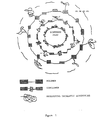
- Fig. 1 illustrating a diagram of the distribution of the biological catalytic activities on the particles of sintered clay.
- This chain of catalytic material of biological kind appears as a succession of layers (only one layer may be provided) surrounding the substrate, thus forming sintetically metabolic ways adapted to operate on different, simple and complex residues.
- a further feature of the invention is that of catalyzing reactions having molecule of different molecular weight as substrate.
- the described method allows the biological catalytic activities both outside and inside the system to be bound, in the latter case the inflow of the substrates by diffusion through the links is provided and controlled in accordance to the size of the links.
- the substrate formed of sintered clay (for example LECA by Laterlite) of different sizes was washed with 1N NaOH and then with distilled H 2 O until the washing water gave neutral reaction. It was dried then in oven at 110°C. 10 ml of a solution of acid phosphatase (extracted from wheat germ and having the activity of 2.3 EU/mg) purchased from the Company Fluka and obtained by dissolving 0.9 mg of enzyme in a buffer of 10 ml of 0.5M acetate at pH 4.75, was added to 10 grams of said material in a flask. The total quantity of enzyme to be absorbed on to the substrate was 2.07 EU corresponding to 0.207 EU per gram of sintered clay. The reaction mixture was placed into a refrigerator at 5°C overnight.
- the acid phosphatase bound to the sintered clay was washed three times with a buffer of 0.5M acetate at pH 4.75, and the washing water was collected to determine the non-bound acid phosphatase activity.
- the preparation was stored in a refrigerator at 5°C. Each time a test to ascertain the bound activity of the acid phosphatase had to be effected, the preparation was removed from the refrigerator, washed with a buffer of 0.5M acetate at pH 4.75, and placed into the reaction mixture. At the end of the test the preparation was washed again with a buffer of 0.5M acetate at pH 4.75 and stored into the refrigerator at 5°C till a new test.
- the determination of the activity of the preparation was carried out by adding 1 ml of p-nitrophenylphosphate (PNP) at the concentration of 1000 ⁇ g/ml and 4 ml of a buffer of 0.5M acetate at pH 4.75 to 10 grams of the preparation.
- PNP p-nitrophenylphosphate
- the quantity of the product p-nitrophenol (PNF) was determined after 3 hours of reaction at 37°C by adding 1 ml of 0.5M CaCl 2 and 4 ml of 0.5N NaOH to 1 ml of the reaction mixture. After the development of the coloration the solution was passed into the spectrophotometer at 398 m ⁇ against a white body.
- Example 2 A test with the acid phosphatase bound to sintered clay and prepared as in Example 1 was carried out by keeping the preparation over the duration of the test at room temperature instead of in the refrigerator at 5°C. All analysis and detection methods are similar to those described in Example 1. TABLE 2. Activity of the acid phosphatase bound to sintered clay in the time. Time (days) Residual activity (%) Time (days) Residual activity (%) O 82 153 45 2 81 222 47 8 100 254 33 13 84 320 31 20 80 389 24 55 73 442 27 119 43 504 22
- Example 1 After having taken earth from the soil classed as sandy loam according to the FAO's nomenclature, dried in the atmosphere, sieved to provide particles of maximum size up to 2 mm, and partially sterilized by heating at 150°C for 5 hours, 5 grams were weighed to which 5 grams of the preparation of Example 1 were added. 1 ml of p-nitrophenilphosphate (PNP) dissolved in a buffer of 0.5M acetate at pH 4.75 and 10 ml of a buffer of 0.5M acetate at pH 4.75 were added to 10 grams of the mixture. After stirring for 3 hours at 37°C the reaction mixture was filtered and 1 ml thereof was taken out.
- PNP p-nitrophenilphosphate
- the substrate formed of sintered clay of several sizes was washed with 1N NaOH and distilled H 2 O until the washing water gave neutral reaction, then it was dried in oven at 110°C.
- 100 ml of a solution of ⁇ -glucosidase (extracted from sweet almond paste and having the activity of 4.4 EU/mg) purchased from the Company BDH and obtained by dissolving 50 mg of enzyme in 250 ml of a buffer of 0.1M acetate at pH 5.0, was added to 100 grams of the above material in a flask.
- the total quantity of enzyme to be absorbed on the substrate was 8.8 EU corresponding to 0.88 EU/gram of sintered clay.
- the reaction mixture was reacted in a refrigerator at 5°C overnight.
- the ⁇ -glucosidase bound to sintered clay was washed with a buffer of 0.1M acetate at pH 5.0, and the washing water was collected in order to determine the non-absorbed ⁇ -gluosidase activity.
- the preparation was stored in a refrigerator at 5°C. Each time a test to ascertain the bound ⁇ -glucosidase activity had to be effected, the preparation was removed from the refrigerator, washed with a buffer of 0.5M of acetate at pH 5.0, and placed into the reaction mixture. At the end of the test the preparation was washed again with a buffer of 0.1M acetate at pH 5.0 and placed into the refrigerator at 5°C till a new test.
- the determination of the activity of the preparation was carried out by adding 4 ml of salicin at the concentration of 1% in a buffer of 0.1M acetate at pH 5.0 to 100 milligrams of the preparation. After 1 hour incubation at 37°C the reaction mixture was separated from the solid phase and brought for 5 minutes at 100°C, then placed in ice until the room temperature was reached. After such period of time 0.1 ml was taken and analyzed for the reducing sugars according to the method of Nelson and Somogyi by a readout with a spectrophotometer at 520 m ⁇ against a white body.
- Example 4 After having taken earth from the soil classed as sandy loam according to the FAO's nomenclature, dried in the atmosphere, sieved to provide particles of maximum size up to 2 mm, and sterilized by heating at 150°C for 48 hours, 5 grams were weighed to which 5 grams of the preparation of Example 4 were added. 4 ml of salicin at the concentration of 1% in a buffer of 0.1M acetate at pH 5.0 and 6 ml of a buffer of 0.5M acetate at pH 5.0 were added to 10 grams of the mixture. After stirring for 1 hour at 37°C the reaction mixture was filtered and 0.1 ml thereof was taken out. The reducing sugars were determined on the above quantity as in Example 4. The results are shown in Table 6.
- the substrate formed of sintered clay of several sizes was washed with 1N NaOH and distilled H 2 O until the washing water gave neutral reaction. Finally it was dried in oven at 110°C.
- the total quantity of enzyme to be absorbed onto the substrate was 2.0 EU corresponding to 0.02 EU/gram of sintered clay.
- the reaction mixture was reacted in a refrigerator at 5°C overnight.
- the cellulase bound to sintered clay was washed three times with a buffer of 0.1M acetate at pH 5.0, and the washing water was collected in order to determine the non-absorbed cellulase activity.
- the preparation was stored in a refrigerator at 5°C. Each time a test to ascertain the activity of the bound cellulase had to be effected, the preparation was removed from the refrigerator, washed with a buffer of 0.1M of acetate ad pH 5.0, and placed into the reaction mixture. At the end of the test the preparation was washed again with a buffer of 0.1M acetate at pH 5.0 and stored into the refrigerator at 5°C till a new test.
- the determination of the activity of the preparation was carried out by adding 5 ml of carboxymethil cellulose (CMC) at the concentration of 1% in a buffer of 0.1M acetate at pH 5.0, and 3 ml of a buffer of 0.1M acetate at pH 5.0 to 10 grams of the preparation. After 1 hour incubation at 37°C the reaction mixture was separated from the solid phase and added to 1 ml of 0.5M NaOH. Then 1 ml was taken and analyzed for the reducing sugars according to the method of Nelson and Somogyi by a readout with a spectrophotometer at 520 m ⁇ against a white body.
- CMC carboxymethil cellulose
- the activity of the bound cellulase corresponds to 5.25% of that contained in the enzyme solution used for the preparation of the bound cellulase.
- Example 7 One hundred grams of cellulase bound to sintered clay was prepared as described in Example 7. Such preparation was stored at room temperature and 10 grams thereof was taken out at predetermined time in order to carry out the test of the duration of the activity by comparing the latter with the activity of the cellulase bound to freshly prepared sintered clay as described in Example 7. In Table 8 the results of the test are listed. TABLE 8. Activity of the cellulase bound to sintered clay and stored at room temperature for different times. Storing time (days) 22 38 Time (days) Activity (%) Time (days) Activity (%) 0 100 0 100 16 42 14 40 30 26 51 16 67 9 --- ---
- Fifty grams of ⁇ -glucosidase bound to sintered clay were prepared as described in Example 4. 7.5 ml of a solution containing pyrogallic acid (25 mg/100 ml), 10 ml of a solution containing peroxidase (25 mg/250 ml) and 2.5 ml of 0.06% H 2 O 2 were added to 5 grams of the above preparation. Then 5 ml of a solution of acid phosphatase (18 mg/200 ml of a buffer of 0.1M acetate at pH 5.0) was added to such preparation. After slow stirring for 2 hours the preparation was filtered and washed with distilled water, and then stored in refrigerator at 5°C.
- Fifty grams of ⁇ -glucosidase bound to sintered clay were prepared as described in Example 5. 0.5 ml of a solution containing pyrogallic acid (25 mg/100 ml) and 10 ml of a solution containing persulfate (100 mg/100 ml) were added to 5 grams of the above preparation. Then 5 ml of a solution of acid phosphatase (18 mg/200 ml of a buffer of 0.1M acetate at pH 5.0) was added to such preparation.
Landscapes
- Life Sciences & Earth Sciences (AREA)
- Chemical & Material Sciences (AREA)
- Engineering & Computer Science (AREA)
- Organic Chemistry (AREA)
- Microbiology (AREA)
- Health & Medical Sciences (AREA)
- Zoology (AREA)
- Wood Science & Technology (AREA)
- Genetics & Genomics (AREA)
- Bioinformatics & Cheminformatics (AREA)
- Water Supply & Treatment (AREA)
- Environmental & Geological Engineering (AREA)
- Biodiversity & Conservation Biology (AREA)
- Hydrology & Water Resources (AREA)
- Biotechnology (AREA)
- Biomedical Technology (AREA)
- Biochemistry (AREA)
- General Engineering & Computer Science (AREA)
- General Health & Medical Sciences (AREA)
- General Chemical & Material Sciences (AREA)
- Chemical Kinetics & Catalysis (AREA)
- Inorganic Chemistry (AREA)
- Catalysts (AREA)
- Immobilizing And Processing Of Enzymes And Microorganisms (AREA)
- Compounds Of Unknown Constitution (AREA)
- Porous Artificial Stone Or Porous Ceramic Products (AREA)
Claims (24)
- Verfahren zur Bindung biologischer katalytischer Aktivitäten an einen Festträger,
dadurch gekennzeichnet,
daß es folgenden ersten Schritt aufweist:- Absorbieren einer oder mehrerer biologischer katalytischer Aktivitäten auf der Oberfläche eines aus gesintertem expandierten Ton hergestellten Festträgers; und als zweiten Schritt:- Polymerisieren und/oder Copolymerisieren einfacher oder komplexer Moleküle vom Phenoltyp auf die Oberfläche des behandelten Festträgers, wobei die Moleküle Radikale oder Ionen darstellen, die durch Resonanz stabilisiert sind und aromatische Strukturen aufweisen, so daß die biologischen katalytischen Aktivitäten in einer gegen Abbau beständigen Verknüpfung aus biologisch inaktiven Zusammensetzungen eingeschlossen sind. - Verfahren nach Anspruch 1,
dadurch gekennzeichnet,
daß der zweite Schritt in der Copolymerisierung einer oder mehrerer biologischer katalytischer Aktivitäten an die Oberfläche des behandelten Festträgers besteht, wobei sich diese Aktivitäten von den vorher auf die Oberfläche des gleichen Festträgers aus gesintertem expandierten Ton absorbierten vorherigen Aktivitäten unterscheiden oder ihnen gleichen, wobei die Phenolverbindungen als Monomere in Polymerisations- oder Copolymerisationsreaktionen vom Radikaltyp oder Ionentyp wirken. - Verfahren zur Bindung biologischer katalytischer Aktivitäten an einen Festträger, gekennzeichnet durch das Copolymerisieren der interessierenden biologischen katalytischen Aktivitäten mit Phenolverbindungen, die als Monomere in Polymerisations- oder Copolymerisationsreaktionen vom Radikal- oder Ionentyp an einen Festträger aus gesintertem expandierten Ton wirken, um eine aus aktivierten oder nicht aktivierten katalytischen Teilen gebildete Phenolverknüpfung zu erhalten, die gegen Abbau schützt.
- Verfahren nach einem der vorhergehenden Ansprüche,
dadurch gekennzeichnet,
daß der gesinterte expandierte Ton eine Porosität von 25% bis 75% aufweist. - Verfahren nach einem der Ansprüche 1 bis 3,
dadurch gekennzeichnet,
daß das Gewichtsverhältnis zwischen dem Phenolmonomer und den Einheiten der biologischen katalytischen Aktivitäten im Bereich von 1:0,01 bis 1:250 liegt. - Verfahren nach einem der Ansprüche 1 bis 3,
dadurch gekennzeichnet,
daß die Copolymer-Phenol-biologische katalytische Aktivität (eine oder mehr als eine) durch Enzymkatalyse gebildet wird, die zur Bildung von Radikalen oder Ionen ausgelegt ist. - Verfahren nach Anspruch 6, wobei Laccase, Tyrosinase, Peroxidase und Wasserstoffperoxid bei der Enzymkatalyse verwendet werden.
- Verfahren nach einem der Ansprüche 1 bis 3,
dadurch gekennzeichnet,
daß die Copolymer-Phenol-biologische katalytische Aktivität (einer oder mehr als eine) durch anorganische Katalyse durch Zugabe des Katalysators gebildet wird, um einen unterschiedlichen Anteil von 1:1:0,01 bis 1:100:2500, ausgedrückt in Grammgewicht der anorganischen Verbindung, Grammgewicht der Phenolverbindung und Einheiten der biologischen katalytischen Aktivität, zu erhalten. - Verfahren nach Anspruch 8,
dadurch gekennzeichnet,
daß der Katalysator Ammoniumpersulfat ist. - Verfahren nach Anspruch 8,
dadurch gekennzeichnet,
daß der Katalysator Mangandioxid ist. - Verfahren nach einem der Ansprüche 1 bis 3,
dadurch gekennzeichnet,
daß die Copolymer-Phenol-biologische katalytische Aktivität (eine oder mehr als eine) durch organische Katalyse durch Zugabe des Katalysators gebildet wird, um einen unterschiedlichen Anteil von 0,1:1:0,01 bis 0,1:100:2500, ausgedrückt in Grammgewicht der organischen Verbindung, Grammgewicht der Phenolverbindung und Einheiten der biologischen katalytischen Aktivität, zu erhalten. - Verfahren nach Anspruch 11,
dadurch gekennzeichnet,
daß der organische Katalysator TEMED ist. - Träger für die Transformationsreaktion der unterschiedlichen Zusammensetzungen,
dadurch gekennzeichnet,
daß er durch das Verfahren nach Anspruch 1 erhalten wird. - Träger für die Transformationsreaktion der unterschiedlichen Zusammensetzungen,
dadurch gekennzeichnet,
daß er durch das Verfahren nach Anspruch 2 erhalten wird. - Träger für die Transformationsreaktion der unterschiedlichen Zusammensetzungen,
dadurch gekennzeichnet,
daß er durch das Verfahren nach Anspruch 3 erhalten wird. - Verwendung des Trägers nach einem der Ansprüche 13 bis 15 als Katalysator in Verfahren zur Modifizierung und Verbesserung der Effizienz von nicht sehr fruchtbarem Boden, zu dem Abfall- oder Wiederherstellungsprodukte zugegeben werden.
- Verwendung des Trägers nach einem der Ansprüche 13 bis 15 als Katalysator bei Dekontaminationsverfahren in der Landwirtschaft und auf dem Forst- und Umweltgebiet.
- Verwendung des Trägers nach einem der Ansprüche 13 bis 15 als Katalysator bei Dekontaminierungsprozessen auf zivilem Gebiet, beispielsweise bei Stadtmüll und bei Unfällen, bei denen giftige, schädliche Ausflüsse auftreten.
- Verwendung des Trägers nach einem der Ansprüche 13 bis 15 als Katalysator in Dekontaminierungsprozessen auf industriellem Gebiet, beispielsweise bei Tanklecks oder bei Prozessen zur Verringerung der Verschmutzung durch Reinigungstanks und ähnliche Prozesse.
- Verwendung des Trägers nach einem der Ansprüche 13 bis 15 als Katalysator bei Reaktionen zur Reinigung von Schlämmen und/oder Abwasser aus Industrieanlagen.
- Verwendung des Trägers nach einem der Ansprüche 13 bis 15 als Katalysator bei Prozessen zur Reinigung von Mineralund Nicht-Mineralöl durch Abbau der Kontaminanten.
- Verwendung des Trägers nach einem der Ansprüche 13 bis 15 als Katalysator in Prozessen zur Reinigung von Brauchund Industriewasser durch die Bildung geeigneter Bette oder Vorrichtungen.
- Verwendung des Trägers nach einem der Ansprüche 13 bis 15 als Katalysator in Prozessen zur Herstellung und Reinigung von Zusammensetzungen auf industriellem Gebiet.
- Verwendung des Trägers nach einem der Ansprüche 13 bis 15 als Katalysator in Prozessen zur Reinigung von Ölzusammensetzungen in Erd-, Fluß-, See- und Meerumgebung.
Applications Claiming Priority (2)
| Application Number | Priority Date | Filing Date | Title |
|---|---|---|---|
| IT4805890 | 1990-06-13 | ||
| IT4805890A IT1241985B (it) | 1990-06-13 | 1990-06-13 | Procedimento per l'immobilizzazione di attivita' catalitiche biologiche su argille espanse sinterizzate e prodotto cosi' ottenuto |
Publications (3)
| Publication Number | Publication Date |
|---|---|
| EP0462082A2 EP0462082A2 (de) | 1991-12-18 |
| EP0462082A3 EP0462082A3 (en) | 1992-05-20 |
| EP0462082B1 true EP0462082B1 (de) | 1997-04-02 |
Family
ID=11264255
Family Applications (1)
| Application Number | Title | Priority Date | Filing Date |
|---|---|---|---|
| EP19910830258 Expired - Lifetime EP0462082B1 (de) | 1990-06-13 | 1991-06-11 | Verfahren zur Bindung biologischer katalytischer Aktivitäten an gesinterte expandierte Tone und dadurch erhaltene Produkte |
Country Status (4)
| Country | Link |
|---|---|
| EP (1) | EP0462082B1 (de) |
| AT (1) | ATE151108T1 (de) |
| DE (1) | DE69125418D1 (de) |
| IT (1) | IT1241985B (de) |
Families Citing this family (1)
| Publication number | Priority date | Publication date | Assignee | Title |
|---|---|---|---|---|
| ES2167277B1 (es) * | 2000-10-23 | 2003-08-16 | Univ Murcia | Extracto de alcachofa (cynara scolymus, l.) y su empleo en la descontaminacion de medios contaminados con fenoles, aminas aromaticas, haluros organicos y/o metales pesados. |
Citations (1)
| Publication number | Priority date | Publication date | Assignee | Title |
|---|---|---|---|---|
| US395975A (en) * | 1889-01-08 | Attachment for chairs |
Family Cites Families (3)
| Publication number | Priority date | Publication date | Assignee | Title |
|---|---|---|---|---|
| US4001085A (en) * | 1973-09-10 | 1977-01-04 | Owens-Illinois, Inc. | Immobilization of enzymes on an inorganic matrix |
| DE2633259C3 (de) * | 1975-07-23 | 1984-11-15 | Japan Atomic Energy Research Institute, Tokio/Tokyo | Verfahren zum Unbeweglichmachen von Enzymen oder enzymhaltigen Zellen |
| JPS63146791A (ja) * | 1986-12-08 | 1988-06-18 | Hitachi Ltd | 酵素の固定化方法 |
-
1990
- 1990-06-13 IT IT4805890A patent/IT1241985B/it active IP Right Grant
-
1991
- 1991-06-11 EP EP19910830258 patent/EP0462082B1/de not_active Expired - Lifetime
- 1991-06-11 DE DE69125418T patent/DE69125418D1/de not_active Expired - Lifetime
- 1991-06-11 AT AT91830258T patent/ATE151108T1/de not_active IP Right Cessation
Patent Citations (1)
| Publication number | Priority date | Publication date | Assignee | Title |
|---|---|---|---|---|
| US395975A (en) * | 1889-01-08 | Attachment for chairs |
Also Published As
| Publication number | Publication date |
|---|---|
| IT9048058A1 (it) | 1991-12-13 |
| DE69125418D1 (de) | 1997-05-07 |
| ATE151108T1 (de) | 1997-04-15 |
| IT9048058A0 (it) | 1990-06-13 |
| EP0462082A3 (en) | 1992-05-20 |
| EP0462082A2 (de) | 1991-12-18 |
| IT1241985B (it) | 1994-02-02 |
Similar Documents
| Publication | Publication Date | Title |
|---|---|---|
| Dinçer et al. | Immobilization of tyrosinase on chitosan–clay composite beads | |
| Chang et al. | Activities, stabilities, and reaction kinetics of three free and chitosan–clay composite immobilized enzymes | |
| US4226938A (en) | Method for immobilizing enzymes | |
| Caldwell et al. | Detoxification of organophosphate pesticides using a nylon based immobilized phosphotriesterase from Pseudomonas diminuta | |
| Chen et al. | A poly (N-isopropylacrylamide-co-N-acryloxysuccinimide-co-2-hydroxyethyl methacrylate) composite hydrogel membrane for urease immobilization to enhance urea hydrolysis rate by temperature swing☆ | |
| US20110117596A1 (en) | Composite sorbent material, its preparation and its use | |
| Alhakawati et al. | Removal of copper from aqueous solution by Ascophyllum nodosum immobilised in hydrophilic polyurethane foam | |
| JPS6029474B2 (ja) | 固定された蛋白質及びその製造法 | |
| Chang et al. | Stability and catalytic kinetics of acid phosphatase immobilized on composite beads of chitosan and activated clay | |
| JP2678341B2 (ja) | 固定化リパーゼ | |
| Kalita et al. | Immobilization of acid phosphatase in agar-agar and gelatin: comparative characterization | |
| JPH11123076A (ja) | 生物処理用担体 | |
| CA1129358A (en) | High loading of immobilized enzymes on activated carbon supports | |
| US5443975A (en) | Method of binding enzymes to sintered expanded clays | |
| Bayramoğlu et al. | Preparation and application of spacer-arm-attached poly (hydroxyethyl methacrylate-co-glycidyl methacrylate) films for urease immobilisation | |
| Kunduru et al. | Armored urease: Enzyme-bioconjugated poly (acrylamide) hydrogel as a storage and sensing platform | |
| Ozmen et al. | Pretreatment of Candida rugosa lipase with soybean oil before immobilization on β-cyclodextrin-based polymer | |
| EP0462082A2 (de) | Verfahren zur Bindung biologischer katalytischer Aktivitäten an gesinterte expandierte Tone und dadurch erhaltene Produkte | |
| Chang et al. | Stability and reactivity of acid phosphatase immobilized on composite beads of chitosan and ZrO2 powders | |
| Meena et al. | Immobilization of Saccharomyces cerevisiae cells by gel entrapment using various metal alginates | |
| EP1227065B1 (de) | Verfahren zur Entfernung exogener das endokrine System unterbrechender Stoffen(Umwelt Hormonsubstanzen) aus Wasser | |
| KR100684603B1 (ko) | 미생물 고정화 담체의 제조방법 및 그에 의해 제조된미생물 고정화 담체 | |
| Yeon et al. | Urease immobilization on an ion‐exchange textile for urea hydrolysis | |
| Hamdy et al. | Immobilization of urease on (HEMA/IA) hydrogel prepared by gamma radiation | |
| PL102119B1 (pl) | A process of producing the base for immobilizing enzymes |
Legal Events
| Date | Code | Title | Description |
|---|---|---|---|
| PUAI | Public reference made under article 153(3) epc to a published international application that has entered the european phase |
Free format text: ORIGINAL CODE: 0009012 |
|
| AK | Designated contracting states |
Kind code of ref document: A2 Designated state(s): AT BE CH DE DK ES FR GB GR IT LI LU NL SE |
|
| PUAL | Search report despatched |
Free format text: ORIGINAL CODE: 0009013 |
|
| AK | Designated contracting states |
Kind code of ref document: A3 Designated state(s): AT BE CH DE DK ES FR GB GR IT LI LU NL SE |
|
| 17P | Request for examination filed |
Effective date: 19921116 |
|
| 17Q | First examination report despatched |
Effective date: 19941017 |
|
| GRAH | Despatch of communication of intention to grant a patent |
Free format text: ORIGINAL CODE: EPIDOS IGRA |
|
| GRAH | Despatch of communication of intention to grant a patent |
Free format text: ORIGINAL CODE: EPIDOS IGRA |
|
| GRAA | (expected) grant |
Free format text: ORIGINAL CODE: 0009210 |
|
| AK | Designated contracting states |
Kind code of ref document: B1 Designated state(s): AT BE CH DE DK ES FR GB GR IT LI LU NL SE |
|
| PG25 | Lapsed in a contracting state [announced via postgrant information from national office to epo] |
Ref country code: IT Free format text: LAPSE BECAUSE OF FAILURE TO SUBMIT A TRANSLATION OF THE DESCRIPTION OR TO PAY THE FEE WITHIN THE PRE;WARNING: LAPSES OF ITALIAN PATENTS WITH EFFECTIVE DATE BEFORE 2007 MAY HAVE OCCURRED AT ANY TIME BEFORE 2007. THE CORRECT EFFECTIVE DATE MAY BE DIFFERENT FROM THE ONE RECORDED.SCRIBED TIME-LIMIT Effective date: 19970402 Ref country code: GR Free format text: LAPSE BECAUSE OF FAILURE TO SUBMIT A TRANSLATION OF THE DESCRIPTION OR TO PAY THE FEE WITHIN THE PRESCRIBED TIME-LIMIT Effective date: 19970402 Ref country code: AT Effective date: 19970402 Ref country code: DK Effective date: 19970402 Ref country code: NL Effective date: 19970402 Ref country code: CH Free format text: LAPSE BECAUSE OF FAILURE TO SUBMIT A TRANSLATION OF THE DESCRIPTION OR TO PAY THE FEE WITHIN THE PRESCRIBED TIME-LIMIT Effective date: 19970402 Ref country code: BE Effective date: 19970402 Ref country code: ES Free format text: THE PATENT HAS BEEN ANNULLED BY A DECISION OF A NATIONAL AUTHORITY Effective date: 19970402 Ref country code: FR Effective date: 19970402 Ref country code: LI Free format text: LAPSE BECAUSE OF FAILURE TO SUBMIT A TRANSLATION OF THE DESCRIPTION OR TO PAY THE FEE WITHIN THE PRESCRIBED TIME-LIMIT Effective date: 19970402 |
|
| REF | Corresponds to: |
Ref document number: 151108 Country of ref document: AT Date of ref document: 19970415 Kind code of ref document: T |
|
| REG | Reference to a national code |
Ref country code: CH Ref legal event code: EP |
|
| REF | Corresponds to: |
Ref document number: 69125418 Country of ref document: DE Date of ref document: 19970507 |
|
| PG25 | Lapsed in a contracting state [announced via postgrant information from national office to epo] |
Ref country code: LU Free format text: LAPSE BECAUSE OF NON-PAYMENT OF DUE FEES Effective date: 19970611 |
|
| PG25 | Lapsed in a contracting state [announced via postgrant information from national office to epo] |
Ref country code: GB Free format text: LAPSE BECAUSE OF NON-PAYMENT OF DUE FEES Effective date: 19970702 Ref country code: SE Effective date: 19970702 |
|
| PG25 | Lapsed in a contracting state [announced via postgrant information from national office to epo] |
Ref country code: DE Effective date: 19970703 |
|
| EN | Fr: translation not filed | ||
| NLV1 | Nl: lapsed or annulled due to failure to fulfill the requirements of art. 29p and 29m of the patents act | ||
| REG | Reference to a national code |
Ref country code: CH Ref legal event code: PL |
|
| PLBE | No opposition filed within time limit |
Free format text: ORIGINAL CODE: 0009261 |
|
| STAA | Information on the status of an ep patent application or granted ep patent |
Free format text: STATUS: NO OPPOSITION FILED WITHIN TIME LIMIT |
|
| GBPC | Gb: european patent ceased through non-payment of renewal fee |
Effective date: 19970702 |
|
| 26N | No opposition filed |