EP0461273B1 - Process for producing laminate - Google Patents
Process for producing laminate Download PDFInfo
- Publication number
- EP0461273B1 EP0461273B1 EP91901632A EP91901632A EP0461273B1 EP 0461273 B1 EP0461273 B1 EP 0461273B1 EP 91901632 A EP91901632 A EP 91901632A EP 91901632 A EP91901632 A EP 91901632A EP 0461273 B1 EP0461273 B1 EP 0461273B1
- Authority
- EP
- European Patent Office
- Prior art keywords
- laminate
- layer
- producing
- adhesive
- paper
- Prior art date
- Legal status (The legal status is an assumption and is not a legal conclusion. Google has not performed a legal analysis and makes no representation as to the accuracy of the status listed.)
- Expired - Lifetime
Links
Images


Classifications
-
- B—PERFORMING OPERATIONS; TRANSPORTING
- B32—LAYERED PRODUCTS
- B32B—LAYERED PRODUCTS, i.e. PRODUCTS BUILT-UP OF STRATA OF FLAT OR NON-FLAT, e.g. CELLULAR OR HONEYCOMB, FORM
- B32B37/00—Methods or apparatus for laminating, e.g. by curing or by ultrasonic bonding
- B32B37/14—Methods or apparatus for laminating, e.g. by curing or by ultrasonic bonding characterised by the properties of the layers
- B32B37/15—Methods or apparatus for laminating, e.g. by curing or by ultrasonic bonding characterised by the properties of the layers with at least one layer being manufactured and immediately laminated before reaching its stable state, e.g. in which a layer is extruded and laminated while in semi-molten state
- B32B37/153—Methods or apparatus for laminating, e.g. by curing or by ultrasonic bonding characterised by the properties of the layers with at least one layer being manufactured and immediately laminated before reaching its stable state, e.g. in which a layer is extruded and laminated while in semi-molten state at least one layer is extruded and immediately laminated while in semi-molten state
-
- B—PERFORMING OPERATIONS; TRANSPORTING
- B32—LAYERED PRODUCTS
- B32B—LAYERED PRODUCTS, i.e. PRODUCTS BUILT-UP OF STRATA OF FLAT OR NON-FLAT, e.g. CELLULAR OR HONEYCOMB, FORM
- B32B15/00—Layered products comprising a layer of metal
- B32B15/04—Layered products comprising a layer of metal comprising metal as the main or only constituent of a layer, which is next to another layer of the same or of a different material
- B32B15/12—Layered products comprising a layer of metal comprising metal as the main or only constituent of a layer, which is next to another layer of the same or of a different material of paper or cardboard
-
- B—PERFORMING OPERATIONS; TRANSPORTING
- B32—LAYERED PRODUCTS
- B32B—LAYERED PRODUCTS, i.e. PRODUCTS BUILT-UP OF STRATA OF FLAT OR NON-FLAT, e.g. CELLULAR OR HONEYCOMB, FORM
- B32B27/00—Layered products comprising a layer of synthetic resin
- B32B27/06—Layered products comprising a layer of synthetic resin as the main or only constituent of a layer, which is next to another layer of the same or of a different material
- B32B27/08—Layered products comprising a layer of synthetic resin as the main or only constituent of a layer, which is next to another layer of the same or of a different material of synthetic resin
-
- B—PERFORMING OPERATIONS; TRANSPORTING
- B32—LAYERED PRODUCTS
- B32B—LAYERED PRODUCTS, i.e. PRODUCTS BUILT-UP OF STRATA OF FLAT OR NON-FLAT, e.g. CELLULAR OR HONEYCOMB, FORM
- B32B27/00—Layered products comprising a layer of synthetic resin
- B32B27/06—Layered products comprising a layer of synthetic resin as the main or only constituent of a layer, which is next to another layer of the same or of a different material
- B32B27/10—Layered products comprising a layer of synthetic resin as the main or only constituent of a layer, which is next to another layer of the same or of a different material of paper or cardboard
-
- B—PERFORMING OPERATIONS; TRANSPORTING
- B32—LAYERED PRODUCTS
- B32B—LAYERED PRODUCTS, i.e. PRODUCTS BUILT-UP OF STRATA OF FLAT OR NON-FLAT, e.g. CELLULAR OR HONEYCOMB, FORM
- B32B27/00—Layered products comprising a layer of synthetic resin
- B32B27/16—Layered products comprising a layer of synthetic resin specially treated, e.g. irradiated
-
- B—PERFORMING OPERATIONS; TRANSPORTING
- B32—LAYERED PRODUCTS
- B32B—LAYERED PRODUCTS, i.e. PRODUCTS BUILT-UP OF STRATA OF FLAT OR NON-FLAT, e.g. CELLULAR OR HONEYCOMB, FORM
- B32B27/00—Layered products comprising a layer of synthetic resin
- B32B27/32—Layered products comprising a layer of synthetic resin comprising polyolefins
-
- B—PERFORMING OPERATIONS; TRANSPORTING
- B32—LAYERED PRODUCTS
- B32B—LAYERED PRODUCTS, i.e. PRODUCTS BUILT-UP OF STRATA OF FLAT OR NON-FLAT, e.g. CELLULAR OR HONEYCOMB, FORM
- B32B38/00—Ancillary operations in connection with laminating processes
- B32B38/0008—Electrical discharge treatment, e.g. corona, plasma treatment; wave energy or particle radiation
-
- B—PERFORMING OPERATIONS; TRANSPORTING
- B32—LAYERED PRODUCTS
- B32B—LAYERED PRODUCTS, i.e. PRODUCTS BUILT-UP OF STRATA OF FLAT OR NON-FLAT, e.g. CELLULAR OR HONEYCOMB, FORM
- B32B7/00—Layered products characterised by the relation between layers; Layered products characterised by the relative orientation of features between layers, or by the relative values of a measurable parameter between layers, i.e. products comprising layers having different physical, chemical or physicochemical properties; Layered products characterised by the interconnection of layers
- B32B7/04—Interconnection of layers
- B32B7/12—Interconnection of layers using interposed adhesives or interposed materials with bonding properties
-
- B—PERFORMING OPERATIONS; TRANSPORTING
- B32—LAYERED PRODUCTS
- B32B—LAYERED PRODUCTS, i.e. PRODUCTS BUILT-UP OF STRATA OF FLAT OR NON-FLAT, e.g. CELLULAR OR HONEYCOMB, FORM
- B32B2307/00—Properties of the layers or laminate
- B32B2307/30—Properties of the layers or laminate having particular thermal properties
- B32B2307/31—Heat sealable
-
- B—PERFORMING OPERATIONS; TRANSPORTING
- B32—LAYERED PRODUCTS
- B32B—LAYERED PRODUCTS, i.e. PRODUCTS BUILT-UP OF STRATA OF FLAT OR NON-FLAT, e.g. CELLULAR OR HONEYCOMB, FORM
- B32B2307/00—Properties of the layers or laminate
- B32B2307/70—Other properties
- B32B2307/718—Weight, e.g. weight per square meter
-
- B—PERFORMING OPERATIONS; TRANSPORTING
- B32—LAYERED PRODUCTS
- B32B—LAYERED PRODUCTS, i.e. PRODUCTS BUILT-UP OF STRATA OF FLAT OR NON-FLAT, e.g. CELLULAR OR HONEYCOMB, FORM
- B32B2309/00—Parameters for the laminating or treatment process; Apparatus details
- B32B2309/02—Temperature
-
- B—PERFORMING OPERATIONS; TRANSPORTING
- B32—LAYERED PRODUCTS
- B32B—LAYERED PRODUCTS, i.e. PRODUCTS BUILT-UP OF STRATA OF FLAT OR NON-FLAT, e.g. CELLULAR OR HONEYCOMB, FORM
- B32B2309/00—Parameters for the laminating or treatment process; Apparatus details
- B32B2309/08—Dimensions, e.g. volume
- B32B2309/10—Dimensions, e.g. volume linear, e.g. length, distance, width
- B32B2309/105—Thickness
-
- B—PERFORMING OPERATIONS; TRANSPORTING
- B32—LAYERED PRODUCTS
- B32B—LAYERED PRODUCTS, i.e. PRODUCTS BUILT-UP OF STRATA OF FLAT OR NON-FLAT, e.g. CELLULAR OR HONEYCOMB, FORM
- B32B2310/00—Treatment by energy or chemical effects
- B32B2310/14—Corona, ionisation, electrical discharge, plasma treatment
-
- B—PERFORMING OPERATIONS; TRANSPORTING
- B32—LAYERED PRODUCTS
- B32B—LAYERED PRODUCTS, i.e. PRODUCTS BUILT-UP OF STRATA OF FLAT OR NON-FLAT, e.g. CELLULAR OR HONEYCOMB, FORM
- B32B2311/00—Metals, their alloys or their compounds
- B32B2311/24—Aluminium
-
- B—PERFORMING OPERATIONS; TRANSPORTING
- B32—LAYERED PRODUCTS
- B32B—LAYERED PRODUCTS, i.e. PRODUCTS BUILT-UP OF STRATA OF FLAT OR NON-FLAT, e.g. CELLULAR OR HONEYCOMB, FORM
- B32B2317/00—Animal or vegetable based
- B32B2317/12—Paper, e.g. cardboard
-
- B—PERFORMING OPERATIONS; TRANSPORTING
- B32—LAYERED PRODUCTS
- B32B—LAYERED PRODUCTS, i.e. PRODUCTS BUILT-UP OF STRATA OF FLAT OR NON-FLAT, e.g. CELLULAR OR HONEYCOMB, FORM
- B32B2323/00—Polyalkenes
- B32B2323/04—Polyethylene
- B32B2323/046—LDPE, i.e. low density polyethylene
-
- B—PERFORMING OPERATIONS; TRANSPORTING
- B32—LAYERED PRODUCTS
- B32B—LAYERED PRODUCTS, i.e. PRODUCTS BUILT-UP OF STRATA OF FLAT OR NON-FLAT, e.g. CELLULAR OR HONEYCOMB, FORM
- B32B2367/00—Polyesters, e.g. PET, i.e. polyethylene terephthalate
-
- B—PERFORMING OPERATIONS; TRANSPORTING
- B32—LAYERED PRODUCTS
- B32B—LAYERED PRODUCTS, i.e. PRODUCTS BUILT-UP OF STRATA OF FLAT OR NON-FLAT, e.g. CELLULAR OR HONEYCOMB, FORM
- B32B2439/00—Containers; Receptacles
- B32B2439/70—Food packaging
Definitions
- This invention relates to a process for producing laminates, more particularly to a process for producing laminates by coextrusion that are suitable for use as constituent materials for beverage containers, etc.
- the use of the constituent materials described above has the problem associated with polyolefins, that is, polyolefins will adsorb or be permeable to the flavor ingredients of beverages and hence are unable to maintain the inherent aroma and taste of beverages.
- the constituent materials described above are prepared by extrusion coating of polyolefins, oxidation is likely to occur to produce a malodor.
- JP-A-57/109 649 the use of a coextruded laminate for the formation of packages such as beverage containers is disclosed, which consist of an outer polyolefin layer being adjacent to an inner low-density polyolefin layer.
- An object, therefore, of the present invention is to provide a process for producing a laminate that has satisfactory adhesion, that is inexpensive and that has good processability experiencing smaller amounts of meandering and neck-in.
- the present inventors conducted intensive studies and found that the above-stated object of the present invention could be attained by a process for producing a laminate comprising the steps of coextruding a polyester resin, an adhesive resin and a polyolefin under a temperature condition of 250 to 280°C, applying a corona discharge treatment to the surface of the polyolefin layer and, immediately thereafter, bonding the surface of said polyolefin layer and an adhesive-coated substrate in-line and in a continuous manner.
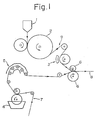
- Fig. 1 is a schematic cross-sectional view showing an example of the process for producing a laminate in accordance with the present invention.
- a polyester resin, an adhesive resin and a polyolefin are individually melted in an extruder and converge at a point either before or within or immediately after a T-die to form three molten layers which are superposed in the order written.
- the layers are then coextruded from the T-die 1 and cooled to solidify on chill rollers 2 to produce a three-layered film 9.
- the coextrusion step must be performed within a temperature range of 250 - 280°C. If the coextrusion is performed at temperatures higher than 280°C, the polyethylene, etc.
- the surface of the three-layer film on the polyolefin side is subjected to a corona discharge treatment with a corona discharge device 3 and, immediately thereafter, i.e., in-line, the corona-discharge treated surface is combined with a substrate 7 that is preliminarily coated with an adhesive 4 and dried in an oven 5 to form an adhesive layer, and the assembly is compressed with pressure rollers 6 to obtain a laminate 8.
- in-line means performance within a continuous single step as contrasted with "off-line” which means a separate step.
- the method employed in the present invention is such that, as described above, a film that is already obtained by coextrusion is combined with a substrate and this method is called "coextrusion laminating".
- the surface of the polyolefin layer in the film coextruded at a temperature of from 250 to 280°C has few polar groups because of its chemical structure and have no affinity for the adhesive coated on the substrate.
- the surface of the polyolefin layer is subjected to a preliminary surface treatment by corona discharge.
- Fig. 2 is a schematic cross-sectional view showing an example of the corona discharge device to be used in the present invention.
- a high-frequency oscillator 13 produces a high voltage of high frequency that is applied between an insulated electrode 11 and a dielectric roller 10 connected to the ground 15, whereupon the air gap is ionized by dielectric breakdown to produce a corona discharge 12 through which a three-layer film 16 is passed to undergo surface treatment.
- the polyolefin layer of the film after the corona discharge treatment preferably has a surface tension of at least 36 dynes/cm, more preferably at least 38 dynes/cm.
- the corona discharge device preferably generates a working power of at least 4 watts/m 2 ⁇ min, more preferably at least 6 watts/m 2 ⁇ min.
- Figs. 3 - 5 are schematic diagrams showing part of the process of coextrusion in preferred embodiments.
- Fig. 3 depicts a feed block method in which molten resin streams converge before the die;
- Fig. 4 depicts a multi-manifold method in which molten resin streams converge within the die;
- Fig. 5 depicts a multi-slot method in which molten resin streams converge outside the die.
- a polyolefin, an adhesive resin and a polyester resin are melted in associated extruders 17 and passed through feed blocks 18 to be extruded from the T die 1.
- Fig. 3 depicts a feed block method in which molten resin streams converge before the die
- Fig. 4 depicts a multi-manifold method in which molten resin streams converge within the die
- Fig. 5 depicts a multi-slot method in which molten resin streams converge outside the die.
- a polyolefin, an adhesive resin and a polyester resin
- the three molten resins are combined at point X before the die where the feed blocks converge and are thereafter extruded from the T-die; in the case shown in Fig. 4, the three molten resins are combined at point X within the T-die and are thereafter extruded; and in the case shown in Fig. 5, the respective molten resins are combined at point X immediately after they are extruded.
- Fig. 6 is a schematic cross-sectional view showing an example of the laminate produced by the present invention.
- the laminate of the present invention is chiefly composed of a substrate 29, as well as a polyolefin layer 24, an adhesive resin layer 25 and a polyester resin layer 26 that are provided together with an intervening adhesive or primer coating layer 23 present.
- the substrate 29 is chiefly composed of a paper base 19, a metal foil 21 provided together with, for example, an intervening ionomer layer 20 present, and a biaxially drawn polyester resin 22 provided on said metal foil 21.
- a layer such as a polyethylene layer 27 is provided, as required, on the paper base 19 which is opposite to the side where the biaxially drawn polyester resin 22 is formed, and a predetermined printed pattern 28 may be applied onto the polyethylene layer 27.
- the ionomer layer 20 is provided for bonding the paper to the metal foil and in place of an ionomer, polyethylene, ethylene-methacrylic acid copolymer, etc. may be used.
- the polyester resin layer 26 is provided in order to suppress the permeation of beverages, etc. and to insure cleanness without causing any adverse effects such as adsorption or permeation of flavor ingredients.
- the polyester resin making up the polyester resin layer is preferably a heat-sealable polyester resin having good heat sealability.
- Heat-sealable polyester resins may be exemplified by low-crystallinity or non-crystalline polyester resins having a solubility index of at least 9.5 and a glass transition temperature Tg of 50 - 150°C. If polyester resins having Tg less than 50°C are used, they will soften and become sticky during the processing or storage of package materials and troubles such as blocking will occur to cause operational problems. If polyester resins having Tg higher than 150°C are used, the bag- or box-making operation becomes difficult during heat sealing. Another problem with highly crystalline polyester resins is their lower heat sealability and increased brittleness.
- the polyester resin described above comprises a copolymer of a polybasic acid and a polyhydric alcohol.
- Preferred polybasic acids are those which contain terephthalic acid as a main component and preferred polyhydric alcohols are those which contain ethylene glycol as a main component.
- the polybasic acid and polyhydric alcohol described above may contain other polybasic acids and polyhydric alcohols as comonomer components.
- dibasic acids that can be contained as comonomer components with terephthalic acid include: aromatic dicarboxylic acids such as isophthalic acid, naphthalenedicarboxylic acid, diphenyldicarboxylic acid, diphenoxyethanedicarboxylic acid, diphenyletherdicarboxylic acid and diphenylsulfonedicarboxylic acid; alicyclic dicarboxylic acids such as hexahydroterephthalic acid and hexahydroisophthalic acid; aliphatic dicarboxylic acids such as adipic acid, sebacic acid and azelaic acid; and oxyacids such as p- ⁇ -hydroxyethoxybenzoic acid, p-oxybenzoic acid and ⁇ -oxycaproic acid.
- aromatic dicarboxylic acids such as isophthalic acid, naphthalenedicarboxylic acid, diphenyldicarboxylic acid, diphenoxyethane
- Diols may be exemplified by glycoles such as ethylene glycol, propylene glycol, 1,4-butanediol, 1,4-dicyclohexanedimethanol, trimethylene glycol, tetramethylene glycol, hexamethylene glycol, decamethylene glycol, neopentylene glycol, diethylene glycol, 1,1-cyclohexanedimethylol, 1,4-cyclohexanedimethylol, 2,2-bis(4- ⁇ -hydroxyethoxyphenyl)propane, bis-(4- ⁇ -hydroxyethoxyphenyl)sulfonecyclohexanediol, 1,4-bis( ⁇ -hydroxyethoxy)benzene, and 1,3-bis( ⁇ -hydroxyethoxy)benzene.
- glycoles such as ethylene glycol, propylene glycol, 1,4-butanediol, 1,4-dicyclohexanedimethanol, trimethylene glycol
- modified polyolefin examples include copolymers of ethylene and unsaturated carboxylic acids or esters thereof, as well as ionomers.
- exemplary unsaturated carboxylic acids or polyesters thereof include acrylic acid, methacrylic acid, methyl acrylate, methyl methacrylate, ethyl acrylate, ethyl methacrylate, etc.
- the copolymers of ethylene and unsaturated carboxylic acids or esters thereof preferably contain unsaturated carboxylic acids in amounts of 3 - 20 wt%. In the case of esters, the ester component is preferably contained in an amount of 1 - 20 wt%.
- the polyester resin described above may incorporate nucleating agents or various additives such as lubricating agents, anti-blocking agents, stabilizers, anti-haze agents and colorants.
- the fine particles of polyolefins or inorganic materials having particle sizes of 2 - 10 ⁇ m are used as such nucleating agents.
- Exemplary polyolefins include low-density polyethylene, high-density polyethylene, linear low-density polyethylene, polypropylene, etc.
- exemplary inorganic materials include carbon black, talc, gypsum, silica, alumina, calcium carbonate, titanium dioxide, graphite, glass powder, metal powders, etc.
- the polyester resin layer may of any thickness and it may be used over the range of, for example, 3 - 100 ⁇ m.
- the polyolefin layer to be used in the present invention serves to cooperate with the adhesive resin layer to support the polyester resin layer not only to suppress meandering or neck-in during coextrusion but also to improve the adhesion to the substrate.
- Examples of the polyolefin that forms the polyolefin layer include polyethylene, polypropylene, etc.
- the polyolefin layer to be used in the present invention may be of any thickness but it may be used over the range of, say, 3 - 100 ⁇ m.
- the adhesive resin layer provided in order to enhance the adhesion between the polyester resin layer and the polyolefin layer may be of any thickness but it may be used over the range of, say, 3 - 50 ⁇ m. It should however be noted that in order for the adhesive resin layer to work as the support of the polyester resin layer, the total thickness of the polyolefin layer and the adhesive resin layer is preferably within the range of 10 - 150 ⁇ m.
- Examples of the adhesive resin which forms the adhesive resin layer described above include ethylene- ⁇ -olefin copolymers (density ⁇ 0.910), polyolefins modified by copolymerization or graft polymerization with a carboxylic acid monomer, an anhydride or ester thereof.
- Exemplary polyolefins include polyethylene, polypropylene, polybutene, ethylene-vinyl acetate copolymer, ethylene-acrylic acid copolymer, ethylene-methacrylic acid copolymer, ethylene- ⁇ -olefinic acid copolymer, etc.
- carboxylic acid monomer, an anhydride or ester thereof examples include methacrylic acid, maleic acid, fumaric acid, methacrylic acid anhydride, maleic anhydride, ethyl methacrylate, glycidyl acrylate, diglycidyl methacrylate.
- the substrate must be coated with an adhesive by a suitable method such as gravure roll coating before the three-layer film described above is compressed onto the substrate.
- the adhesive examples include one- or two-part reactive urethane based adhesives, a polyester based adhesives, acrylic-urethane based adhesives, epoxy-urethane based adhesives, etc. These adhesives are preferably coated in amounts ranging from 0.5 g/m 2 to 10 g/m 2 .
- the substrate may be of any type selected from among paper, nonwoven fabrics, aluminum foils, plastic films, etc.
- a drawn plastic layer is preferably provided on the side contacting the polyolefin layer.
- Drawn plastics are preferably biaxially drawn polyester or nylon resins that are obtained by shaping polyester or nylon resins, then drawing in the machine direction by a factor of 4 - 6 and in the transverse direction by a factor of 4 - 6, and finally heat setting the biaxially drawn resin.
- the drawn plastic layer preferably has a thickness of 9 - 25 ⁇ m.
- the polyester resin which forms the biaxially drawn polyester resin comprises a copolymer of a polybasic acid and a polyhydric alcohol.
- Preferred polybasic acids are those which contain terephthalic acid as a chief component and preferred polyhydric alcohols are those which contain ethylene glycol as a chief component.
- the polybasic acid and polyhydric alcohol described above may contain other polybasic acids and polyhydric alcohols as comonomer components.
- polybasic acids that can be used as comonomer components include: aromatic dicarboxylic acids such as isophthalic acid, naphthalenedicaboxylic acid, diphenyldicarboxylic acid, diphenoxyethanedicarboxylic acid, diphenyletherdicarboxylic acid and diphenylsulfonedicarboxylic acid; alicyclic dicarboxylic acids such as hexahydroterephthalic acid and hexahydroisophthalic acid; aliphatic dicarboxylic acids such as adipic acid, sebacic acid and azelaic acid; oxyacids such as p- ⁇ -hydroxybenzoic acid, p-oxybenzoic acid and ⁇ -oxycaproic acid; aromatic polybasic acids such as trimellitic acid, trimesic acid and 3,3',5,5'-tetracarboxydiphenyl; aliphatic polybasic acids such as butanetetracarboxylic acid;
- polyhydric alcohols that can be used as comonomer components include: glycols such as trimethylene glycol, tetramethylene glycol, hexamethylene glycol, decamethylene glycol, neopentylene glycol, diethylene glycol, 1,1-cyclohexanedimethylol, 1,4-cyclohexanedimethylol, 2,2-bis(4- ⁇ -hydroxyethoxyphenyl)propane, bis-(4- ⁇ -hydroxyethoxyphenyl)sulfonecyclohexane, 1,4-bis( ⁇ -hydroxyethoxy)benzene, and 1,3-bis( ⁇ -hydroxyethoxy)benzene; and polyhydric alcohols such as fluoroglycine, 1,2,4,5-tetrahydroxybenzene, glycerin, trimethylolethane, trimethylolpropane and pentaerythritol.
- glycols such as trimethylene glycol, tetramethylene glycol,
- the polyester resin may incorporate nucleating agents or various additives such as lubricants, anti-blocking agents, stabilizers, anti-haze agents and colorants of the same types as used in the polyester resin layer already described above.
- the substrate of the laminate according to the present invention is not limited to any particular type as long as it can be used as a structural support for containers but those substrates which contain paper in the layer arrangement are preferred.
- Preferred examples of the paper that forms the substrate include white board paper, raw paper for milk carton, acid-proof paper, etc. that have basis weights of 100 - 400 g/m 2 .
- the paper described above is usually provided with a metal foil for such purposes as protection against the permeation of beverages, and a preferred metal foil is an aluminum foil having a thickness of 6 - 20 ⁇ m.
- Metal foils may be provided on the paper with the aid of polyethylene, an ethylene-methacrylic acid copolymer, an ionomer resin, etc. If desired, a layer composed of polyethylene, etc. may be provided on the paper opposite the metal foil.
- the laminated material of the present invention may adopt various layer arrangements within the scope of the present invention and an example is the combination of printing ink/polyethylene/paper/ionomer/aluminum foil/biaxially drawn polyester resin/adhesive/polyolefin/adhesive resin/polyester resin.
- the laminate of the present invention may be produced by the following method: (1) extrusion-coating polyethylene onto paper and applying printing onto said polyethylene; in a separate step, (2) dry-laminating a biaxially drawn polyester resin onto an aluminum foil; (3) bonding the surface of paper in (1) to the surface of aluminum foil in (2) together with an intervening polyethylene, ionomer resin, ethylene-methacrylic acid copolymer present, whereby a substrate is prepared; (4) applying an adhesive onto the surface of the biaxially drawn polyester resin in (2) by gravure roll coating and drying the applied coat in an oven to provide an adhesive layer on the substrate; and (5) preparing a three-layer film by the coextrusion method described hereinabove, performing a corona discharge treatment on the surface of the polyolefin layer in the film and, immediately thereafter, compressing the adhesive layer of (4) onto the film in-line, thereby forming a laminate.
- Containers to which the laminate of the present invention can advantageously be applied are those in various forms which are intended to contain highly permeable liquid beverages including sake , whiskeys, juice, coffee, ptisan, oolong, mineral water, soup, etc. and which are exemplified by such containers as Tetrapacks, blocks, etc. that are shown generally in Figs. 7 and 8.
- the first step comprises forming a sleeve 30 as shown in Fig. 9.
- the sleeve must be formed in such a way that the end faces of constituent materials of the container will not be exposed on its inner surface to contact the beverage in it.
- a bottom portion 31 is formed and, in the third step, the container fabricated in the first and the second steps is filled with the contents. Finally, in the fourth step, a top portion 32 is formed to fabricate a completed container.
- a roll of the laminate of the present invention may be filled with the contents, with a container being formed by heat sealing two polyester layers facing each other.
- the laminate of the present invention is characterized by its nature of less adsorbing pharmaceutically active ingredients such as menthol and camphor, so it is capable of retaining such pharmaceutically active ingredients in an effective way and hence can be used as a cataplasm packaging material. Further, the laminate is also usable in other applications such as an aroma packaging material, a bath preparation packaging material and a packaging material for preventing the permeation and evaporation of flavors.
- Fig. 1 is a schematic cross-sectional view showing an example of the process for producing a laminate in accordance with the present invention
- Fig. 2 is a schematic partial cross-sectional view showing an example of the corona discharge device to be used in the present invention
- Figs. 3 - 5 are schematic diagrams showing part of the process of coextrusion in different embodiments of the present invention
- Fig. 6 is a schematic cross-sectional view showing an example of the laminate produced by the present invention
- Figs. 7 and 8 are perspective views showing examples of the container that is fabricated using the laminate of the present invention
- Fig. 9 is a perspective view showing the step of preparing a sleeve in the fabrication of the containers shown in Figs. 7 and 8.
- a polybasic acid consisting of 60 mol% terephthalic acid and 40 mol% isophthalic acid was copolycondensed with an equimolar amount of ethylene glycol to obtain a copolycondensed polyester resin (glass transition temperature Tg 58°C; solubility index 10.3).
- the resulting copolycondensed polyester resin, an ethylene-maleic acid copolymer and a low-density polyethylene (density 0.924) were respectively supplied into an extruder, coextruded at a temperature of 280°C and cooled to obtain a three-layer film.
- the individual layers in the obtained three-layer film had the following thicknesses: copolycondensed polyester resin layer, 15 ⁇ m; ethylene-maleic anhydride copolymer layer, 10 ⁇ m; low-density polyethylene layer, 15 ⁇ m.
- a sheet substrate was prepared from a biaxially drawn polyester resin 12 ⁇ m thick and an aluminum foil 9 ⁇ m thick.
- a two-part reactive urethane based adhesive was applied onto the biaxially drawn polyester resin surface to give a coating weight of 5 g/m 2 by gravure roll coating and the applied coating was dried in an oven to form an adhesive layer on the substrate.
- the surface of the low-density polyethylene layer in the already prepared three-layer film was subjected to a corona discharge treatment at a working power of 8 watts/m 2 ⁇ min.
- the three-layer film was compressed in-line onto the surface of the adhesive layer on the substrate so as to obtain a laminate.
- the low-density polyethylene after the corona discharge treatment had a surface tension of 40 dynes/cm.
- the obtained laminate was measured for the degree of meandering or neck-in on one side of the film, adhesive strength and heat seal strength by the following methods. Meandering: The width of variation at end of the extruded three-layer film was measured. Neck-in: The difference on one side of the constricted portion of the extruded three-layer film was measured. Measurement of adhesive strength: The laminate was cut into a strip 15 mm wide and the low-density polyethylene layer was peeled off the substrate at a tensile speed of 300 mm/min to measure the adhesive strength. Measurement of heat seal strength: The laminate was cut into two strips 15 mm wide.
- the two strips were superposed on each other in such a way that the copolycondensed polyester resin layer in one strip contacted the same layer in the other strip.
- the superposed strips were heat-sealed at a seal bar temperature of 180°C for a seal time of 1 second at a seal pressure of 2.81 kg/cm 2 . Thereafter, one strip was peeled off the other at a tensile speed of 300 mm/min to measure the adhesive strength.
- a substrate having an adhesive layer thereon was prepared as in Example 1.
- the copolycondensed polyester resin prepared in Example 1 was extruded in a single layer at a temperature of 280°C. Without a corona discharge treatment, the copolycondensed polyester resin in a molten state was compressed against the surface of the adhesive layer on the substrate and cooled to obtain a laminate.
- the copolycondensed polyester resin layer in the obtained laminate had a thickness of 40 ⁇ m.
- the laminate was subjected to the same measurements as in Example 1. The results are shown in Table 2.
- Substrates having an adhesive layer thereon were prepared as in Example 1.
- the copolycondensed polyester resin prepared in Example 1, an ethylene-maleic anhydride copolymer and a low-density polyethylene were coextruded at a temperature of 280°C or 320°C to form three-layer molten films. Without a corona discharge treatment, the surface of the molten low-density polyethylene layer was compressed against the surface of the adhesive layer on the substrate and cooled to obtain laminates for comparison.
- the individual layers in each laminate had the same thicknesses as in Example 1.
- the obtained laminates were subjected to the same measurements as in Example 1. The results are shown in Table 2.
- a three-layer film was prepared as in Example 1. After applying a corona discharge treatment onto the low-density polyethylene surface at a working power of 8 watts/m 2 ⁇ min, the film was wound up. A two-part reactive urethane based adhesive was applied by gravure roll coating onto a substrate of the same composition as used in Example 1 to give a coating weight of 8 g/m 2 . The applied coating was dried in an oven to form an adhesive layer on the substrate. Subsequently, the surface of the low-density polyethylene layer in the three-layer film that had been wound up was compressed against the surface of the adhesive layer on the substrate to effect dry laminating, thereby obtaining a laminate.
- Example 1 The surface tension and adhesive strength of the low-density polyethylene were measured by the same methods as in Example 1. The results are shown in Table 3 together with the results of Example 1. Table 3 Surface tension dyne/cm Adhesive strength g/15 mm Example 1 40 550 - 600 Comparative Example 4 35 - 37 280 - 400
- a further problem with the laminate produced off-line was as follows: when the laminate was wound up for storage, the low-density polyethylene surface that had been subjected to corona discharge treatment was placed under high pressure to undergo pseudo-bonding to the polyester resin surface and the resulting blocking required a peeling force in the subsequent rewinding of the three-layer film, which not only caused difficulty in controlling the tension to be applied during the laminating operation but also reduced the laminating speed.
- a polymer alloy consisting of 80 wt% polyethylene terephthalate and 20 wt% ethylene-methacrylic acid copolymer, an ethylene- ⁇ -olefin copolymer (density, 0.901) and a low-density polyethylene (density, 0.925) were respectively supplied into an extruder, coextruded at a temperature of 280°C and cooled to obtain a three-layered film.
- the indiviual layers in the obtained three-layer film had the following thicknesses: polymer alloy, 20 ⁇ m; ethylene- ⁇ -olefin copolymer, 10 ⁇ m; and low-density polyethylene, 30 ⁇ m.
- polyethylene was extrusion-coated onto acid-proof paper having a basis weight of 310 g/m 2 to form a polyethylene layer in a thickness of 20 ⁇ m.
- a 9- ⁇ m aluminum foil preliminarily dry-laminated with a 12- ⁇ m biaxially drawn polyester resin was bonded to the paper with an intervening ionomer resin present, thereby preparing a substrate.
- the resulting substrate was provided with an adhesive layer as in Example 1.
- the ionomer resin layer had a thickness of 15 ⁇ m.
- the surface of the low-density polyethylene layer in the already prepared three-layer film was subjected to a corona discharge treatment at a working power of 8 watts/m 2 ⁇ min and, immediately thereafter, the three-layer film was compressed in-line against the surface of the adhesive layer on the substrate to form a laminate.
- the low-density polyethylene after the corona discharge treatment had a surface tension of 40 dynes/cm.
- a container having a capacity of 1000 ml was fabricated as shown in Fig. 7 in accordance with the step of sleeve making shown in Fig. 9.
- the container was filled with 100% pure orange juice and sealed for storage. Two weeks later, the container was opened and the quantity of limonene which was a flavor ingredient of the orange juice in the container was determined by gas chromatography. The residual amount of limonene was 96% of the initial filling. This showed that the laminate obtained by the present invention was not adsorptive of the flavor ingredient.
- the present invention enabled the production of a laminate at low cost since a polyolefin was used in place of the heretofore used expensive adhesive polyolefins and because the number of process steps was reduced.
- the present invention provides a process for producing a laminate that has good processability experiencing smaller amounts of meandering and neck-in, that has satisfactory adhesion and that yet is inexpensive.
- the laminate produced by the process of the present invention is applicable as a constituent material for beverage containers that are to be formed by coextrusion, in particular, various containers that are intended to contain highly permeable liquid beverages including sake , whiskeys, juice, coffee, ptisan, oolong, mineral water, soup, etc.
Landscapes
- Physics & Mathematics (AREA)
- Engineering & Computer Science (AREA)
- Plasma & Fusion (AREA)
- Thermal Sciences (AREA)
- Laminated Bodies (AREA)
- Extrusion Moulding Of Plastics Or The Like (AREA)
- Lining Or Joining Of Plastics Or The Like (AREA)
- Treatments Of Macromolecular Shaped Articles (AREA)
Abstract
Description
- This invention relates to a process for producing laminates, more particularly to a process for producing laminates by coextrusion that are suitable for use as constituent materials for beverage containers, etc.
- Beverages such as sake and whiskey have a strong tendency to permeate through the constituent materials of their containers, so containers of such beverages have conventionally been formed of paper that is coated with an ionomer layer or the like which in turn is overlaid with a metal foil such as an aluminum foil in order to prevent the permeation of beverages. However, the use of metal foils presents the problem of cracking, particularly in bent portions of the container and in order to prevent it, a biaxially drawn polyester film has usually been provided on the metal foil. Further, in the case of such beverage containers, various considerations including cleanness, water resistance, moisture resistance and heat sealability have made it conventional to apply polyolefins or the like onto the biaxially drawn polyester film, namely, the portion that forms the inner surface of the container.
- However, the use of the constituent materials described above has the problem associated with polyolefins, that is, polyolefins will adsorb or be permeable to the flavor ingredients of beverages and hence are unable to maintain the inherent aroma and taste of beverages. In addition, when the constituent materials described above are prepared by extrusion coating of polyolefins, oxidation is likely to occur to produce a malodor.
- With a view to solving these problems, constituent materials for containers of the type described above that replace polyolefins by polyesters have come to be used recently.
- In JP-A-57/109 649, the use of a coextruded laminate for the formation of packages such as beverage containers is disclosed, which consist of an outer polyolefin layer being adjacent to an inner low-density polyolefin layer.
- As temperature for performing the coextrusion of the two-layered laminate 230°C is suggested.
- An example of this approach is described in Japanese Patent Application Kokai Hei No. 1-139337 which reports a laminate obtained by combining a coextruded film of a polyester resin, an adhesive polyolefin resin and a polyolefin resin with a biaxially drawn polyester resin. However, strong adhesion is not attained by an assembly of resins combined with the biaxially drawn polyester resin after they are worked into a film. Further, the combining operation must be performed off-line (in a separate step), which leads to a higher production cost. Hence, it has long been desired to develop a process for producing a laminate in a way that satisfies the aforementioned requirements and that is economical.
- An object, therefore, of the present invention is to provide a process for producing a laminate that has satisfactory adhesion, that is inexpensive and that has good processability experiencing smaller amounts of meandering and neck-in.
- Under the circumstances described above, the present inventors conducted intensive studies and found that the above-stated object of the present invention could be attained by a process for producing a laminate comprising the steps of coextruding a polyester resin, an adhesive resin and a polyolefin under a temperature condition of 250 to 280°C, applying a corona discharge treatment to the surface of the polyolefin layer and, immediately thereafter, bonding the surface of said polyolefin layer and an adhesive-coated substrate in-line and in a continuous manner.
- The present invention is described below in greater detail.
- Fig. 1 is a schematic cross-sectional view showing an example of the process for producing a laminate in accordance with the present invention. Referring to Fig. 1, a polyester resin, an adhesive resin and a polyolefin are individually melted in an extruder and converge at a point either before or within or immediately after a T-die to form three molten layers which are superposed in the order written. The layers are then coextruded from the T-die 1 and cooled to solidify on
chill rollers 2 to produce a three-layered film 9. It is to be noted that the coextrusion step must be performed within a temperature range of 250 - 280°C. If the coextrusion is performed at temperatures higher than 280°C, the polyethylene, etc. are oxidized to give off an "oxidation" odor, which makes them unsuitable for use as constituent materials for beverage containers. Further, in a long-run operation, the polyester will partly decompose to cause deterioration in such aspects as physical properties and heat sealability. The surface of the three-layer film on the polyolefin side is subjected to a corona discharge treatment with a corona discharge device 3 and, immediately thereafter, i.e., in-line, the corona-discharge treated surface is combined with a substrate 7 that is preliminarily coated with an adhesive 4 and dried in anoven 5 to form an adhesive layer, and the assembly is compressed withpressure rollers 6 to obtain alaminate 8. The term "in-line" as used herein means performance within a continuous single step as contrasted with "off-line" which means a separate step. Also in contrast with the coextrusion coating in which multiple molten layers are coextruded onto a substrate and combined together in a molten state, the method employed in the present invention is such that, as described above, a film that is already obtained by coextrusion is combined with a substrate and this method is called "coextrusion laminating". - In the present invention, the surface of the polyolefin layer in the film coextruded at a temperature of from 250 to 280°C has few polar groups because of its chemical structure and have no affinity for the adhesive coated on the substrate. To compensate for the resulting poor adhesion, the surface of the polyolefin layer is subjected to a preliminary surface treatment by corona discharge.
- Fig. 2 is a schematic cross-sectional view showing an example of the corona discharge device to be used in the present invention. Referring to Fig. 2, a high-
frequency oscillator 13 produces a high voltage of high frequency that is applied between an insulated electrode 11 and adielectric roller 10 connected to theground 15, whereupon the air gap is ionized by dielectric breakdown to produce acorona discharge 12 through which a three-layer film 16 is passed to undergo surface treatment. To attain satisfactory adhesion strength, the polyolefin layer of the film after the corona discharge treatment preferably has a surface tension of at least 36 dynes/cm, more preferably at least 38 dynes/cm. Depending on various factors including its efficiency, the corona discharge device preferably generates a working power of at least 4 watts/m2·min, more preferably at least 6 watts/m2·min. - Figs. 3 - 5 are schematic diagrams showing part of the process of coextrusion in preferred embodiments. Fig. 3 depicts a feed block method in which molten resin streams converge before the die; Fig. 4 depicts a multi-manifold method in which molten resin streams converge within the die; and Fig. 5 depicts a multi-slot method in which molten resin streams converge outside the die. In each of Figs. 3 - 5, a polyolefin, an adhesive resin and a polyester resin are melted in associated
extruders 17 and passed throughfeed blocks 18 to be extruded from the T die 1. In the case shown in Fig. 3, the three molten resins are combined at point X before the die where the feed blocks converge and are thereafter extruded from the T-die; in the case shown in Fig. 4, the three molten resins are combined at point X within the T-die and are thereafter extruded; and in the case shown in Fig. 5, the respective molten resins are combined at point X immediately after they are extruded. - Fig. 6 is a schematic cross-sectional view showing an example of the laminate produced by the present invention. Referring to Fig. 6, the laminate of the present invention is chiefly composed of a
substrate 29, as well as a polyolefin layer 24, an adhesive resin layer 25 and apolyester resin layer 26 that are provided together with an intervening adhesive orprimer coating layer 23 present. Thesubstrate 29 is chiefly composed of apaper base 19, ametal foil 21 provided together with, for example, an interveningionomer layer 20 present, and a biaxially drawnpolyester resin 22 provided on saidmetal foil 21. A layer such as apolyethylene layer 27 is provided, as required, on thepaper base 19 which is opposite to the side where the biaxially drawnpolyester resin 22 is formed, and a predetermined printedpattern 28 may be applied onto thepolyethylene layer 27. Theionomer layer 20 is provided for bonding the paper to the metal foil and in place of an ionomer, polyethylene, ethylene-methacrylic acid copolymer, etc. may be used. - The
polyester resin layer 26 is provided in order to suppress the permeation of beverages, etc. and to insure cleanness without causing any adverse effects such as adsorption or permeation of flavor ingredients. Considering its use as a constituent material for containers, the polyester resin making up the polyester resin layer is preferably a heat-sealable polyester resin having good heat sealability. Heat-sealable polyester resins may be exemplified by low-crystallinity or non-crystalline polyester resins having a solubility index of at least 9.5 and a glass transition temperature Tg of 50 - 150°C. If polyester resins having Tg less than 50°C are used, they will soften and become sticky during the processing or storage of package materials and troubles such as blocking will occur to cause operational problems. If polyester resins having Tg higher than 150°C are used, the bag- or box-making operation becomes difficult during heat sealing. Another problem with highly crystalline polyester resins is their lower heat sealability and increased brittleness. - The polyester resin described above comprises a copolymer of a polybasic acid and a polyhydric alcohol. Preferred polybasic acids are those which contain terephthalic acid as a main component and preferred polyhydric alcohols are those which contain ethylene glycol as a main component. The polybasic acid and polyhydric alcohol described above may contain other polybasic acids and polyhydric alcohols as comonomer components.
- Specific examples of the heat-sealable polyester for use in the present invention include: (1) a co-condensation polymer of at least two dibasic acids containing terephthalic acid as a chief component and a diol; (2) a co-condensation polymer of terephthalic acid and at least two diols; and (3) a polymer alloy of polyethylene terephthalate or the co-condensation polymer (1) or (2) with a modified polyolefin.
- Other dibasic acids that can be contained as comonomer components with terephthalic acid include: aromatic dicarboxylic acids such as isophthalic acid, naphthalenedicarboxylic acid, diphenyldicarboxylic acid, diphenoxyethanedicarboxylic acid, diphenyletherdicarboxylic acid and diphenylsulfonedicarboxylic acid; alicyclic dicarboxylic acids such as hexahydroterephthalic acid and hexahydroisophthalic acid; aliphatic dicarboxylic acids such as adipic acid, sebacic acid and azelaic acid; and oxyacids such as p-β-hydroxyethoxybenzoic acid, p-oxybenzoic acid and ε-oxycaproic acid.
- Diols may be exemplified by glycoles such as ethylene glycol, propylene glycol, 1,4-butanediol, 1,4-dicyclohexanedimethanol, trimethylene glycol, tetramethylene glycol, hexamethylene glycol, decamethylene glycol, neopentylene glycol, diethylene glycol, 1,1-cyclohexanedimethylol, 1,4-cyclohexanedimethylol, 2,2-bis(4-β-hydroxyethoxyphenyl)propane, bis-(4-β-hydroxyethoxyphenyl)sulfonecyclohexanediol, 1,4-bis(β-hydroxyethoxy)benzene, and 1,3-bis(β-hydroxyethoxy)benzene.
- Examples of the modified polyolefin that is preferably used in the present invention include copolymers of ethylene and unsaturated carboxylic acids or esters thereof, as well as ionomers. Exemplary unsaturated carboxylic acids or polyesters thereof include acrylic acid, methacrylic acid, methyl acrylate, methyl methacrylate, ethyl acrylate, ethyl methacrylate, etc. The copolymers of ethylene and unsaturated carboxylic acids or esters thereof preferably contain unsaturated carboxylic acids in amounts of 3 - 20 wt%. In the case of esters, the ester component is preferably contained in an amount of 1 - 20 wt%.
- In the present invention, the polyester resin described above may incorporate nucleating agents or various additives such as lubricating agents, anti-blocking agents, stabilizers, anti-haze agents and colorants. The fine particles of polyolefins or inorganic materials having particle sizes of 2 - 10 µm are used as such nucleating agents. Exemplary polyolefins include low-density polyethylene, high-density polyethylene, linear low-density polyethylene, polypropylene, etc., and exemplary inorganic materials include carbon black, talc, gypsum, silica, alumina, calcium carbonate, titanium dioxide, graphite, glass powder, metal powders, etc.
- The polyester resin layer may of any thickness and it may be used over the range of, for example, 3 - 100 µm.
- The polyolefin layer to be used in the present invention serves to cooperate with the adhesive resin layer to support the polyester resin layer not only to suppress meandering or neck-in during coextrusion but also to improve the adhesion to the substrate. Examples of the polyolefin that forms the polyolefin layer include polyethylene, polypropylene, etc. The polyolefin layer to be used in the present invention may be of any thickness but it may be used over the range of, say, 3 - 100 µm.
- The adhesive resin layer provided in order to enhance the adhesion between the polyester resin layer and the polyolefin layer may be of any thickness but it may be used over the range of, say, 3 - 50 µm. It should however be noted that in order for the adhesive resin layer to work as the support of the polyester resin layer, the total thickness of the polyolefin layer and the adhesive resin layer is preferably within the range of 10 - 150 µm.
- Examples of the adhesive resin which forms the adhesive resin layer described above include ethylene-α-olefin copolymers (density≤0.910), polyolefins modified by copolymerization or graft polymerization with a carboxylic acid monomer, an anhydride or ester thereof. Exemplary polyolefins include polyethylene, polypropylene, polybutene, ethylene-vinyl acetate copolymer, ethylene-acrylic acid copolymer, ethylene-methacrylic acid copolymer, ethylene-α-olefinic acid copolymer, etc. Specific examples of a carboxylic acid monomer, an anhydride or ester thereof include methacrylic acid, maleic acid, fumaric acid, methacrylic acid anhydride, maleic anhydride, ethyl methacrylate, glycidyl acrylate, diglycidyl methacrylate.
- In the present invention, the substrate must be coated with an adhesive by a suitable method such as gravure roll coating before the three-layer film described above is compressed onto the substrate.
- Examples of the adhesive include one- or two-part reactive urethane based adhesives, a polyester based adhesives, acrylic-urethane based adhesives, epoxy-urethane based adhesives, etc. These adhesives are preferably coated in amounts ranging from 0.5 g/m2 to 10 g/m2.
- The substrate may be of any type selected from among paper, nonwoven fabrics, aluminum foils, plastic films, etc. In order to prevent the permeation of the contents through cracks in the metal foil, a drawn plastic layer is preferably provided on the side contacting the polyolefin layer. Drawn plastics are preferably biaxially drawn polyester or nylon resins that are obtained by shaping polyester or nylon resins, then drawing in the machine direction by a factor of 4 - 6 and in the transverse direction by a factor of 4 - 6, and finally heat setting the biaxially drawn resin. The drawn plastic layer preferably has a thickness of 9 - 25 µm.
- The polyester resin which forms the biaxially drawn polyester resin comprises a copolymer of a polybasic acid and a polyhydric alcohol. Preferred polybasic acids are those which contain terephthalic acid as a chief component and preferred polyhydric alcohols are those which contain ethylene glycol as a chief component. The polybasic acid and polyhydric alcohol described above may contain other polybasic acids and polyhydric alcohols as comonomer components.
- Other polybasic acids that can be used as comonomer components include: aromatic dicarboxylic acids such as isophthalic acid, naphthalenedicaboxylic acid, diphenyldicarboxylic acid, diphenoxyethanedicarboxylic acid, diphenyletherdicarboxylic acid and diphenylsulfonedicarboxylic acid; alicyclic dicarboxylic acids such as hexahydroterephthalic acid and hexahydroisophthalic acid; aliphatic dicarboxylic acids such as adipic acid, sebacic acid and azelaic acid; oxyacids such as p-β-hydroxybenzoic acid, p-oxybenzoic acid and ε-oxycaproic acid; aromatic polybasic acids such as trimellitic acid, trimesic acid and 3,3',5,5'-tetracarboxydiphenyl; aliphatic polybasic acids such as butanetetracarboxylic acid; and oxypolycarboxylic acids such as tartaric acid and malic acid.
- Other polyhydric alcohols that can be used as comonomer components include: glycols such as trimethylene glycol, tetramethylene glycol, hexamethylene glycol, decamethylene glycol, neopentylene glycol, diethylene glycol, 1,1-cyclohexanedimethylol, 1,4-cyclohexanedimethylol, 2,2-bis(4-β-hydroxyethoxyphenyl)propane, bis-(4-β-hydroxyethoxyphenyl)sulfonecyclohexane, 1,4-bis(β-hydroxyethoxy)benzene, and 1,3-bis(β-hydroxyethoxy)benzene; and polyhydric alcohols such as fluoroglycine, 1,2,4,5-tetrahydroxybenzene, glycerin, trimethylolethane, trimethylolpropane and pentaerythritol.
- In the present invention, the polyester resin may incorporate nucleating agents or various additives such as lubricants, anti-blocking agents, stabilizers, anti-haze agents and colorants of the same types as used in the polyester resin layer already described above.
- The substrate of the laminate according to the present invention is not limited to any particular type as long as it can be used as a structural support for containers but those substrates which contain paper in the layer arrangement are preferred. Preferred examples of the paper that forms the substrate include white board paper, raw paper for milk carton, acid-proof paper, etc. that have basis weights of 100 - 400 g/m2.
- The paper described above is usually provided with a metal foil for such purposes as protection against the permeation of beverages, and a preferred metal foil is an aluminum foil having a thickness of 6 - 20 µm. Metal foils may be provided on the paper with the aid of polyethylene, an ethylene-methacrylic acid copolymer, an ionomer resin, etc. If desired, a layer composed of polyethylene, etc. may be provided on the paper opposite the metal foil.
- The laminated material of the present invention may adopt various layer arrangements within the scope of the present invention and an example is the combination of printing ink/polyethylene/paper/ionomer/aluminum foil/biaxially drawn polyester resin/adhesive/polyolefin/adhesive resin/polyester resin.
- The laminate of the present invention may be produced by the following method: (1) extrusion-coating polyethylene onto paper and applying printing onto said polyethylene; in a separate step, (2) dry-laminating a biaxially drawn polyester resin onto an aluminum foil; (3) bonding the surface of paper in (1) to the surface of aluminum foil in (2) together with an intervening polyethylene, ionomer resin, ethylene-methacrylic acid copolymer present, whereby a substrate is prepared; (4) applying an adhesive onto the surface of the biaxially drawn polyester resin in (2) by gravure roll coating and drying the applied coat in an oven to provide an adhesive layer on the substrate; and (5) preparing a three-layer film by the coextrusion method described hereinabove, performing a corona discharge treatment on the surface of the polyolefin layer in the film and, immediately thereafter, compressing the adhesive layer of (4) onto the film in-line, thereby forming a laminate.
- Containers to which the laminate of the present invention can advantageously be applied are those in various forms which are intended to contain highly permeable liquid beverages including sake, whiskeys, juice, coffee, ptisan, oolong, mineral water, soup, etc. and which are exemplified by such containers as Tetrapacks, blocks, etc. that are shown generally in Figs. 7 and 8. In order to fabricate a container of the type shown in Fig. 7 using the laminate of the present invention, the first step comprises forming a
sleeve 30 as shown in Fig. 9. In this step, the sleeve must be formed in such a way that the end faces of constituent materials of the container will not be exposed on its inner surface to contact the beverage in it. To meet this need, two side edge portions of the polyester forming the inner layer, or the surfaces one side edge portion of which is folded back to be superposed on the other portion for subsequent sealing, are subjected to a flame treatment to be sealed. In the ensuing second step, abottom portion 31 is formed and, in the third step, the container fabricated in the first and the second steps is filled with the contents. Finally, in the fourth step, atop portion 32 is formed to fabricate a completed container. - In an alternative method, a roll of the laminate of the present invention may be filled with the contents, with a container being formed by heat sealing two polyester layers facing each other.
- As a further advantage, the laminate of the present invention is characterized by its nature of less adsorbing pharmaceutically active ingredients such as menthol and camphor, so it is capable of retaining such pharmaceutically active ingredients in an effective way and hence can be used as a cataplasm packaging material. Further, the laminate is also usable in other applications such as an aroma packaging material, a bath preparation packaging material and a packaging material for preventing the permeation and evaporation of flavors.
- Fig. 1 is a schematic cross-sectional view showing an example of the process for producing a laminate in accordance with the present invention; Fig. 2 is a schematic partial cross-sectional view showing an example of the corona discharge device to be used in the present invention; Figs. 3 - 5 are schematic diagrams showing part of the process of coextrusion in different embodiments of the present invention; Fig. 6 is a schematic cross-sectional view showing an example of the laminate produced by the present invention; Figs. 7 and 8 are perspective views showing examples of the container that is fabricated using the laminate of the present invention; and Fig. 9 is a perspective view showing the step of preparing a sleeve in the fabrication of the containers shown in Figs. 7 and 8.
- The following examples are provided for the purpose of further illustrating the present invention.
- A polybasic acid consisting of 60 mol% terephthalic acid and 40 mol% isophthalic acid was copolycondensed with an equimolar amount of ethylene glycol to obtain a copolycondensed polyester resin (glass transition temperature Tg = 58°C; solubility index 10.3). The resulting copolycondensed polyester resin, an ethylene-maleic acid copolymer and a low-density polyethylene (density 0.924) were respectively supplied into an extruder, coextruded at a temperature of 280°C and cooled to obtain a three-layer film. The individual layers in the obtained three-layer film had the following thicknesses: copolycondensed polyester resin layer, 15 µm; ethylene-maleic anhydride copolymer layer, 10 µm; low-density polyethylene layer, 15 µm.
- In a separate step, a sheet substrate was prepared from a biaxially drawn
polyester resin 12 µm thick and an aluminum foil 9 µm thick. A two-part reactive urethane based adhesive was applied onto the biaxially drawn polyester resin surface to give a coating weight of 5 g/m2 by gravure roll coating and the applied coating was dried in an oven to form an adhesive layer on the substrate. Subsequently, the surface of the low-density polyethylene layer in the already prepared three-layer film was subjected to a corona discharge treatment at a working power of 8 watts/m2·min. Immediately thereafter, the three-layer film was compressed in-line onto the surface of the adhesive layer on the substrate so as to obtain a laminate. The low-density polyethylene after the corona discharge treatment had a surface tension of 40 dynes/cm. - The obtained laminate was measured for the degree of meandering or neck-in on one side of the film, adhesive strength and heat seal strength by the following methods.
Meandering: The width of variation at end of the extruded three-layer film was measured.
Neck-in: The difference on one side of the constricted portion of the extruded three-layer film was measured.
Measurement of adhesive strength: The laminate was cut into astrip 15 mm wide and the low-density polyethylene layer was peeled off the substrate at a tensile speed of 300 mm/min to measure the adhesive strength.
Measurement of heat seal strength: The laminate was cut into twostrips 15 mm wide. The two strips were superposed on each other in such a way that the copolycondensed polyester resin layer in one strip contacted the same layer in the other strip. The superposed strips were heat-sealed at a seal bar temperature of 180°C for a seal time of 1 second at a seal pressure of 2.81 kg/cm2. Thereafter, one strip was peeled off the other at a tensile speed of 300 mm/min to measure the adhesive strength. - The results are shown in Table 2.
- A substrate having an adhesive layer thereon was prepared as in Example 1. In a separate step, the copolycondensed polyester resin prepared in Example 1 was extruded in a single layer at a temperature of 280°C. Without a corona discharge treatment, the copolycondensed polyester resin in a molten state was compressed against the surface of the adhesive layer on the substrate and cooled to obtain a laminate. The copolycondensed polyester resin layer in the obtained laminate had a thickness of 40 µm. The laminate was subjected to the same measurements as in Example 1. The results are shown in Table 2.
- Substrates having an adhesive layer thereon were prepared as in Example 1. The copolycondensed polyester resin prepared in Example 1, an ethylene-maleic anhydride copolymer and a low-density polyethylene were coextruded at a temperature of 280°C or 320°C to form three-layer molten films. Without a corona discharge treatment, the surface of the molten low-density polyethylene layer was compressed against the surface of the adhesive layer on the substrate and cooled to obtain laminates for comparison. The individual layers in each laminate had the same thicknesses as in Example 1. The obtained laminates were subjected to the same measurements as in Example 1. The results are shown in Table 2. In Comparative Example 3 where coextrusion was performed at a temperature of 320°C, the viscosity of the copolycondensed polyester resin decreased to cause uneveness in the thicknesses of individual layers and 3 hours after the start of extrusion, a gelled insoluble matter flowed out of the T-die from both sides, making it impossible to continue the production in a consistent manner.
Table 1 Resins to be extruded Temperature (°C) Corona discharge treatment Method of forming laminate Type Thickness (µm) Example 1 copolycondensed polyester resin ethylene-maleic anhydride copolymer low- density polyethylene 15 coextrusion laminating 10 280 yes 15 Comparative Example 1 copolycondensed polyester resin single-layer extrusion coating 40 280 no Comparative Example 2 copolycondensed polyester resin ethylene-maleic anhydride copolymer low- density polyethylene 15 coextrusion coating 10 280 no 15 Table 2 Meandering (mm) Neck-in (mm) Adhesive strength (g/15 mm) Heat seal strength (kg/15 mm) Example 1 2∼3 20∼25 550∼600 2.6∼2.9 Comparative Example 1 20∼40 65∼90 300∼350 3.3 Comparative Example 2 2∼3 20∼25 50∼70 0.8 - A three-layer film was prepared as in Example 1. After applying a corona discharge treatment onto the low-density polyethylene surface at a working power of 8 watts/m2·min, the film was wound up. A two-part reactive urethane based adhesive was applied by gravure roll coating onto a substrate of the same composition as used in Example 1 to give a coating weight of 8 g/m2. The applied coating was dried in an oven to form an adhesive layer on the substrate. Subsequently, the surface of the low-density polyethylene layer in the three-layer film that had been wound up was compressed against the surface of the adhesive layer on the substrate to effect dry laminating, thereby obtaining a laminate. The surface tension and adhesive strength of the low-density polyethylene were measured by the same methods as in Example 1. The results are shown in Table 3 together with the results of Example 1.
Table 3 Surface tension dyne/cm Adhesive strength g/15 mm Example 1 40 550 - 600 Comparative Example 4 35 - 37 280 - 400 - As is clear from Table 3, the surface tension of the low-density polyethylene was the highest immediately after corona discharge treatment and decreased thereafter upon storage and the adhesive strength decreased accordingly to cause a potential problem in practical applications.
- A further problem with the laminate produced off-line was as follows: when the laminate was wound up for storage, the low-density polyethylene surface that had been subjected to corona discharge treatment was placed under high pressure to undergo pseudo-bonding to the polyester resin surface and the resulting blocking required a peeling force in the subsequent rewinding of the three-layer film, which not only caused difficulty in controlling the tension to be applied during the laminating operation but also reduced the laminating speed.
- A polymer alloy consisting of 80 wt% polyethylene terephthalate and 20 wt% ethylene-methacrylic acid copolymer, an ethylene-α-olefin copolymer (density, 0.901) and a low-density polyethylene (density, 0.925) were respectively supplied into an extruder, coextruded at a temperature of 280°C and cooled to obtain a three-layered film. The indiviual layers in the obtained three-layer film had the following thicknesses: polymer alloy, 20 µm; ethylene-α-olefin copolymer, 10 µm; and low-density polyethylene, 30 µm.
- In a separate step, polyethylene was extrusion-coated onto acid-proof paper having a basis weight of 310 g/m2 to form a polyethylene layer in a thickness of 20 µm. A 9-µm aluminum foil preliminarily dry-laminated with a 12-µm biaxially drawn polyester resin was bonded to the paper with an intervening ionomer resin present, thereby preparing a substrate. The resulting substrate was provided with an adhesive layer as in Example 1. The ionomer resin layer had a thickness of 15 µm. Subsequently, the surface of the low-density polyethylene layer in the already prepared three-layer film was subjected to a corona discharge treatment at a working power of 8 watts/m2·min and, immediately thereafter, the three-layer film was compressed in-line against the surface of the adhesive layer on the substrate to form a laminate. The low-density polyethylene after the corona discharge treatment had a surface tension of 40 dynes/cm.
- Using the laminate with the polyester resin layer serving as the innermost layer, a container having a capacity of 1000 ml was fabricated as shown in Fig. 7 in accordance with the step of sleeve making shown in Fig. 9. The container was filled with 100% pure orange juice and sealed for storage. Two weeks later, the container was opened and the quantity of limonene which was a flavor ingredient of the orange juice in the container was determined by gas chromatography. The residual amount of limonene was 96% of the initial filling. This showed that the laminate obtained by the present invention was not adsorptive of the flavor ingredient.
- As described in detail on the foregoing pages, the present invention enabled the production of a laminate at low cost since a polyolefin was used in place of the heretofore used expensive adhesive polyolefins and because the number of process steps was reduced. Hence, the present invention provides a process for producing a laminate that has good processability experiencing smaller amounts of meandering and neck-in, that has satisfactory adhesion and that yet is inexpensive.
- In short, the laminate produced by the process of the present invention is applicable as a constituent material for beverage containers that are to be formed by coextrusion, in particular, various containers that are intended to contain highly permeable liquid beverages including sake, whiskeys, juice, coffee, ptisan, oolong, mineral water, soup, etc.
Claims (12)
- A process for producing a laminate comprising the steps of coextruding a polyester resin, an adhesive resin and a polyolefin under a temperature condition of 250 - 280°C,
, applying a corona discharge treatment to the surface of the polyolefin layer and, immediately thereafter, bonding the surface of said polyolefin layer and an adhesive-coated substrate in-line and in a continuous manner. - A process for producing a laminate as recited in claim 1 wherein said corona discharge treatment is performed under a working power condition of at least 6 watts/m2·min.
- A process for producing a laminate as recited in claim 1 wherein said polyester resin is a heat-sealable polyester resin having a glass transition temperature of 50 - 150°C.
- A process for producing a laminate as recited in claim 1, wherein said adhesive resin is an ethylene-α-olefin copolymer or a polyolefin modified by copolymerization or graft polymerization with a carboxylic acid monomer, an anhydride or ester thereof.
- A process for producing a laminate as recited in claim 1 wherein the total thickness of the layer made of said adhesive resin and the layer made of said polyolefin is in the range of 10 - 150 µm.
- A process for producing a laminate as recited in claim 1 wherein said substrate contains paper in its layer arrangement.
- A process for producing a laminate as recited in claim 6 wherein said paper has a basis weight of 100 - 400 g/m2.
- A process for producing a laminate as recited in claim 6 wherein said paper is white board paper, raw paper for milk carton or acid-proof paper.
- A process for producing a laminate as recited in claim 6 wherein said substrate contains paper and an aluminum foil on said paper in its layer arrangement.
- A process for producing a laminate as recited in claim 1 wherein said substrate has a drawn plastic layer on the surface of the side contacting said polyolefin.
- A process for producing a laminate as recited in claim 1 which has a layer arrangement consisting of printed ink/polyethylene/paper/ionomer/aluminum foil/biaxially drawn polyester resin/adhesive/polyolefin/adhesive resin/polyester resin.
- A process for producing a laminate which comprises the steps of: (1) extrusion-coating polyethylene onto paper and applying printing onto said polyethylene; in a separate step, (2) dry-laminating a biaxially drawn polyester resin onto an aluminum foil; thereafter (3) bonding the surface of paper in (1) to the surface of aluminum foil in (2) together with an intervening polyethylene, ionomer resin, ethylene-methacrylic acid copolymer present, whereby a substrate is prepared; further, (4) applying an adhesive onto the surface of the biaxially drawn polyester resin in (2) by gravure roll coating and drying the applied coat in an oven to provide an adhesive layer on the substrate; and thereafter (5) coextruding a polyester resin, an adhesive resin and a polyolefin under a temperature condition of 250 - 280°C to form a three-layered film, performing a corona discharge treatment on the surface of the polyolefin layer in said film and, immediately thereafter, compressing the adhesive layer of (4) onto the film in-line.
Applications Claiming Priority (3)
| Application Number | Priority Date | Filing Date | Title |
|---|---|---|---|
| JP340524/89 | 1989-12-29 | ||
| JP1340524A JPH0745236B2 (en) | 1989-12-29 | 1989-12-29 | Method for manufacturing laminated body |
| PCT/JP1990/001721 WO1991009730A1 (en) | 1989-12-29 | 1990-12-27 | Process for producing laminate |
Publications (3)
| Publication Number | Publication Date |
|---|---|
| EP0461273A1 EP0461273A1 (en) | 1991-12-18 |
| EP0461273A4 EP0461273A4 (en) | 1992-03-18 |
| EP0461273B1 true EP0461273B1 (en) | 1997-03-12 |
Family
ID=18337810
Family Applications (1)
| Application Number | Title | Priority Date | Filing Date |
|---|---|---|---|
| EP91901632A Expired - Lifetime EP0461273B1 (en) | 1989-12-29 | 1990-12-27 | Process for producing laminate |
Country Status (4)
| Country | Link |
|---|---|
| EP (1) | EP0461273B1 (en) |
| JP (1) | JPH0745236B2 (en) |
| DE (1) | DE69030179T2 (en) |
| WO (1) | WO1991009730A1 (en) |
Families Citing this family (8)
| Publication number | Priority date | Publication date | Assignee | Title |
|---|---|---|---|---|
| CH684831A5 (en) * | 1991-12-11 | 1995-01-13 | Alusuisse Lonza Services Ag | Device for producing extrusion-coated laminates. |
| JPH0740520A (en) * | 1993-05-21 | 1995-02-10 | Taisei Kako Kk | Constitutional material for portion package formed from amorphous resin laminated sheet like article method and apparatus for producing the same, laminate for portion package consisting of constitutional material and liner layer and method and apparatus for producing the same |
| DE4418006A1 (en) * | 1994-05-21 | 1995-11-23 | Huels Chemische Werke Ag | Multilayer plastic pipe with good layer adhesion |
| DE10217941B4 (en) * | 2002-04-22 | 2012-04-05 | Sig Combibloc Systems Gmbh | Process for producing a composite material with temperature-resistant adhesion promoter and composite material produced therefrom |
| US10065404B2 (en) * | 2011-07-29 | 2018-09-04 | Eastman Chemical Company | In-line lamination of heavy-gauge polymer sheet with a pre-formed polymer film |
| JP7404752B2 (en) * | 2019-07-18 | 2023-12-26 | Toppanホールディングス株式会社 | Laminates for highly resistant packaging materials |
| JP7168813B1 (en) * | 2022-07-01 | 2022-11-09 | 株式会社日本製鋼所 | Battery material manufacturing apparatus, battery material manufacturing system, and battery material manufacturing method |
| EP4549128A1 (en) * | 2022-07-01 | 2025-05-07 | The Japan Steel Works, Ltd. | Battery material production device, battery material production system, and battery material production method |
Citations (1)
| Publication number | Priority date | Publication date | Assignee | Title |
|---|---|---|---|---|
| JPH01139337A (en) * | 1987-11-12 | 1989-05-31 | Dainippon Printing Co Ltd | paper composite container |
Family Cites Families (11)
| Publication number | Priority date | Publication date | Assignee | Title |
|---|---|---|---|---|
| BE793239A (en) * | 1971-12-24 | 1973-06-22 | Basf Ag | MULTI-LAYER COMBINATION SHEET |
| CA1038795A (en) * | 1974-03-08 | 1978-09-19 | Paul D. Frayer | Composite sheet and method of making the same |
| CA1041892A (en) * | 1974-04-30 | 1978-11-07 | David H. Dawes | Heat lamination of thermoplastic films |
| JPS54135860A (en) * | 1978-04-14 | 1979-10-22 | Mitsubishi Chem Ind Ltd | Manufacturing of laminate film |
| JPS57109649A (en) * | 1980-12-26 | 1982-07-08 | Toppan Printing Co Ltd | Laminated film and its manufacture |
| US4477506A (en) * | 1982-06-24 | 1984-10-16 | General Binding Corporation | Method and apparatus for making improved laminating film and improved film |
| JPS6135938A (en) * | 1984-07-30 | 1986-02-20 | Sintokogio Ltd | Manufacture of thick layer type filamental molded layer body |
| JPS62115039A (en) * | 1985-11-14 | 1987-05-26 | Toyoda Gosei Co Ltd | Method for treating surface of polylefin molding |
| JPS6349423A (en) * | 1986-08-19 | 1988-03-02 | Toppan Printing Co Ltd | Manufacture of laminate |
| US4931364A (en) * | 1988-05-05 | 1990-06-05 | Amoco Corporation | Polyarylate-polyethylene composite laminated structures |
| JP3264842B2 (en) * | 1996-11-14 | 2002-03-11 | 三菱電機株式会社 | Passenger conveyor entry / exit devices |
-
1989
- 1989-12-29 JP JP1340524A patent/JPH0745236B2/en not_active Expired - Fee Related
-
1990
- 1990-12-27 EP EP91901632A patent/EP0461273B1/en not_active Expired - Lifetime
- 1990-12-27 DE DE69030179T patent/DE69030179T2/en not_active Expired - Fee Related
- 1990-12-27 WO PCT/JP1990/001721 patent/WO1991009730A1/en not_active Ceased
Patent Citations (1)
| Publication number | Priority date | Publication date | Assignee | Title |
|---|---|---|---|---|
| JPH01139337A (en) * | 1987-11-12 | 1989-05-31 | Dainippon Printing Co Ltd | paper composite container |
Also Published As
| Publication number | Publication date |
|---|---|
| EP0461273A1 (en) | 1991-12-18 |
| EP0461273A4 (en) | 1992-03-18 |
| JPH0745236B2 (en) | 1995-05-17 |
| WO1991009730A1 (en) | 1991-07-11 |
| DE69030179T2 (en) | 1997-07-31 |
| DE69030179D1 (en) | 1997-04-17 |
| JPH03202348A (en) | 1991-09-04 |
Similar Documents
| Publication | Publication Date | Title |
|---|---|---|
| EP0516137B1 (en) | Process for producing liquid container material | |
| JP5804339B2 (en) | Anti-fogging multilayer film, laminate using the same, and packaging material | |
| JP2004322644A (en) | Coextrusion transparent biaxially stretched polyester film, method for producing the same, and cover material for tray made of the same | |
| US4741957A (en) | Heat sealable multilayer film and method of making same | |
| EP0461273A1 (en) | Process for producing laminate | |
| CN102481772A (en) | Heat-sealable laminate and production method thereof | |
| JPH04214345A (en) | Composite wrapping material and wrapping container using it | |
| EP0445524B1 (en) | Method of thermal fusion | |
| EP0529336B1 (en) | Method of thermal fusion | |
| JP3883624B2 (en) | Laminate for forming paper container and packaging paper container using the same | |
| JPH03218830A (en) | Composite packaging material and packaging container using the same | |
| JP3917888B2 (en) | Polyester-based laminated paper, production method thereof, food container material comprising the laminated paper | |
| JPH03202340A (en) | Preparation of laminate | |
| JP3385663B2 (en) | Laminate film for liquid packaging and method for producing the same | |
| JPH06182895A (en) | Method for manufacturing laminated body for container | |
| JP2000071404A (en) | Low elution packaging material and package using the same | |
| JP3413679B2 (en) | Polyester composite film for metal lamination | |
| JP2624038B2 (en) | Manufacturing method of material for liquid container | |
| JPH07138387A (en) | Polyester film for lamination with metallic sheet, and metallic sheet or metallic container laminated therewith | |
| JPS6135938B2 (en) | ||
| JP2661423B2 (en) | Heat fusion method | |
| JP2692286B2 (en) | Manufacturing method of laminate | |
| EP0336024A1 (en) | Heat sealable mutilayer film and method of making same | |
| JPH106428A (en) | Vacuum absorption lid material and usage | |
| JPH03293128A (en) | Packaging material |
Legal Events
| Date | Code | Title | Description |
|---|---|---|---|
| PUAI | Public reference made under article 153(3) epc to a published international application that has entered the european phase |
Free format text: ORIGINAL CODE: 0009012 |
|
| 17P | Request for examination filed |
Effective date: 19910722 |
|
| AK | Designated contracting states |
Kind code of ref document: A1 Designated state(s): DE FR GB SE |
|
| A4 | Supplementary search report drawn up and despatched |
Effective date: 19920129 |
|
| AK | Designated contracting states |
Kind code of ref document: A4 Designated state(s): DE FR GB SE |
|
| 17Q | First examination report despatched |
Effective date: 19931116 |
|
| GRAG | Despatch of communication of intention to grant |
Free format text: ORIGINAL CODE: EPIDOS AGRA |
|
| GRAH | Despatch of communication of intention to grant a patent |
Free format text: ORIGINAL CODE: EPIDOS IGRA |
|
| GRAH | Despatch of communication of intention to grant a patent |
Free format text: ORIGINAL CODE: EPIDOS IGRA |
|
| GRAA | (expected) grant |
Free format text: ORIGINAL CODE: 0009210 |
|
| AK | Designated contracting states |
Kind code of ref document: B1 Designated state(s): DE FR GB SE |
|
| REF | Corresponds to: |
Ref document number: 69030179 Country of ref document: DE Date of ref document: 19970417 |
|
| ET | Fr: translation filed | ||
| PLBE | No opposition filed within time limit |
Free format text: ORIGINAL CODE: 0009261 |
|
| STAA | Information on the status of an ep patent application or granted ep patent |
Free format text: STATUS: NO OPPOSITION FILED WITHIN TIME LIMIT |
|
| 26N | No opposition filed | ||
| PGFP | Annual fee paid to national office [announced via postgrant information from national office to epo] |
Ref country code: SE Payment date: 19981207 Year of fee payment: 9 |
|
| PGFP | Annual fee paid to national office [announced via postgrant information from national office to epo] |
Ref country code: FR Payment date: 19981209 Year of fee payment: 9 |
|
| PGFP | Annual fee paid to national office [announced via postgrant information from national office to epo] |
Ref country code: GB Payment date: 19981231 Year of fee payment: 9 |
|
| PGFP | Annual fee paid to national office [announced via postgrant information from national office to epo] |
Ref country code: DE Payment date: 19990107 Year of fee payment: 9 |
|
| PG25 | Lapsed in a contracting state [announced via postgrant information from national office to epo] |
Ref country code: GB Free format text: LAPSE BECAUSE OF NON-PAYMENT OF DUE FEES Effective date: 19991227 |
|
| PG25 | Lapsed in a contracting state [announced via postgrant information from national office to epo] |
Ref country code: SE Free format text: LAPSE BECAUSE OF NON-PAYMENT OF DUE FEES Effective date: 19991228 |
|
| EUG | Se: european patent has lapsed |
Ref document number: 91901632.9 |
|
| GBPC | Gb: european patent ceased through non-payment of renewal fee |
Effective date: 19991227 |
|
| PG25 | Lapsed in a contracting state [announced via postgrant information from national office to epo] |
Ref country code: FR Free format text: LAPSE BECAUSE OF NON-PAYMENT OF DUE FEES Effective date: 20000831 |
|
| PG25 | Lapsed in a contracting state [announced via postgrant information from national office to epo] |
Ref country code: DE Free format text: LAPSE BECAUSE OF NON-PAYMENT OF DUE FEES Effective date: 20001003 |
|
| REG | Reference to a national code |
Ref country code: FR Ref legal event code: ST |