EP0459931A2 - Taskzuweisungsverfahren zwischen einer Vielzahl von Informationsprozessoren - Google Patents
Taskzuweisungsverfahren zwischen einer Vielzahl von Informationsprozessoren Download PDFInfo
- Publication number
- EP0459931A2 EP0459931A2 EP91480069A EP91480069A EP0459931A2 EP 0459931 A2 EP0459931 A2 EP 0459931A2 EP 91480069 A EP91480069 A EP 91480069A EP 91480069 A EP91480069 A EP 91480069A EP 0459931 A2 EP0459931 A2 EP 0459931A2
- Authority
- EP
- European Patent Office
- Prior art keywords
- data
- affinity
- processing devices
- task
- processor
- Prior art date
- Legal status (The legal status is an assumption and is not a legal conclusion. Google has not performed a legal analysis and makes no representation as to the accuracy of the status listed.)
- Withdrawn
Links
Images



Classifications
-
- G—PHYSICS
- G06—COMPUTING OR CALCULATING; COUNTING
- G06F—ELECTRIC DIGITAL DATA PROCESSING
- G06F9/00—Arrangements for program control, e.g. control units
- G06F9/06—Arrangements for program control, e.g. control units using stored programs, i.e. using an internal store of processing equipment to receive or retain programs
- G06F9/46—Multiprogramming arrangements
- G06F9/50—Allocation of resources, e.g. of the central processing unit [CPU]
- G06F9/5005—Allocation of resources, e.g. of the central processing unit [CPU] to service a request
- G06F9/5027—Allocation of resources, e.g. of the central processing unit [CPU] to service a request the resource being a machine, e.g. CPUs, Servers, Terminals
- G06F9/5033—Allocation of resources, e.g. of the central processing unit [CPU] to service a request the resource being a machine, e.g. CPUs, Servers, Terminals considering data affinity
Definitions
- the present invention relates to information processing systems in which multiple processing devices with cache memories are coupled to a shared main storage memory, and more particularly to a process for allocating tasks or operations among the processors.
- a task dispatching queue includes a collection of task dispatching elements (TDE), each such element associated with a task and signifying the priority of its associated task.
- Each of the processors has a signal dispatcher that examines the TDQ to determine if the processor is running a task having a lower priority than any task in the queue, as indicated by the task dispatching element. If so, a task dispatcher of the processor switches to the higher priority task.
- the Hoffman system continually favors the highest priority tasks for earliest execution.
- U.S. Patent No. 4,796,178 is drawn to a task control mechanism for maintaining a queue of available processes associated according to an assigned priority for a plurality of central processors. Each of the processors may be assigned to the highest priority task available when not executing a task of higher priority. A processor identification is employed to prevent other processors from gaining access to the same task.
- a processor can store a protective code corresponding to its address at a location associated with a particular job or task, but not if another processor already has entered its code at the job.
- a processor upon detecting the protective code of another processor associated with the task data, forwards its own task to the other processor to reroute the job, to prevent a single job from running on more than one processor simultaneously.
- each of the processors not only shares a common main storage memory, but has its own cache memory. This feature can substantially enhance network performance, since each time one of the processing devices performs a data store or data fetch operation in its associated cache memory rather than in the shared main memory, memory access time is substantially reduced.
- a task When a task is executing on a particular one of the processing devices, the cache memory of that processing device accumulates working data and instructions pertinent to that task as the task continues to execute. In other words, the task develops a natural affinity to the particular processing device. However, once the task is switched out of that processor, its natural affinity for that processor tends to decay, for either of two reasons. First, subsequent tasks executing on that processor enter their own data into the cache memory, replacing data pertinent to the original task. Alternatively, the original task may execute, but on another processor. Data stores performed in the course of such further execution invalidate corresponding data in the original cache memory. Accordingly, a task usually has the strongest natural affinity for the processing device which has most recently performed or executed the task.
- Another object of the invention is to provide a means for associating tasks with particular processors in a manner that approximates their natural affinities.
- a further object is to provide a system for allocating tasks based on processor affinity, with means for preempting affinity-related allocation in response to detecting an imbalance of work load among processing devices.
- Yet another object is to provide a means for marking tasks as having affinities to particular processors of a network, or alternatively as having an affinities for all such processors, to redistribute tasks across the network when desired.
- a process for associating each one of a plurality of data operations with one of a plurality of processing devices, for subsequent execution of the operation by the associated processing device is performed on an information processing network including a main memory having memory locations for storing bit-encoded data, a plurality of processing devices for manipulating bit-encoded data, and a main storage interface connected to the processors and to the main memory.
- Each of the processing devices has a cache memory including a plurality of cache locations for storing bit-encoded data.
- Each processor further includes means for storing and retrieving bit-encoded data to and from the main storage memory via the main storage interface, as well as means for storing and retrieving bit-encoded data to and from its associated cache memory.
- the bit-encoded data includes data operations, each of which has priority indicia, and further has affinity indicia to indicate either a general affinity to more than one of the processing devices, or a specific affinity to a selected one of the processing devices.
- Allocation includes the following steps:
- the process further includes setting a bypass threshold. After bypassing a number of data operations equal to the bypass threshold, each subsequently scanned data operation is assigned to one of the processing devices to which a data operation has not yet been assigned. In other words, any data operation having specific affinity for a processing device that was already assigned to a higher priority data operation is treated as if it had general affinity as in step (c).
- step (c) upon detecting a general affinity as in step (c) above, it is preferable to reserve each data operation having a general affinity for a subsequent assignment to one of the processing devices. Then, when the number of reserved data operations equals the number of processing devices still available, a secondary scan is performed upon previously scanned data operations. Then, each previously reserved data operation is assigned to one of the remaining available processing devices.
- a further step of the process can be utilized in the event that after the secondary scan and assignment of all remaining reserved processing devices, one or more processing devices remains available while unassigned data operations remain, having been bypassed according to step (b) above. Then, the previously bypassed data operations are assigned, disregarding their specific affinity, to the next available processor, until each task has been assigned a processor.
- the secondary scan, of previously reserved as well as previously scanned data operations preferably is performed in the reverse order of the primary scan, i.e. in order of ascending priority.
- the affinity indicia for each operation preferably are modified to identify each operation or task as having a specific affinity to the processor to which it is dispatched. Later, when a task is switched out of its associated processor, it retains its specific affinity. When reassigned, the task is more likely to be assigned to the associated processor once again.
- each task or operation corresponds to a task dispatching element (TDE) that includes an affinity field.
- TDE task dispatching element
- Each affinity field is set by entering a binary word identifying a particular processing device.
- TDE task dispatching element
- instructions associated with the task reset the TDE affinity field to a general affinity for all of the processing devices, or alternatively may reset the affinity field upon a failure to satisfy a predetermined condition.
- the unconditional reset instruction is preferably used in connection with tasks of a high priority, in order to avoid preemption of such tasks by lower priority tasks.
- a specific affinity normally is assigned to each data operation or task, thus substantially increasing the likelihood that such task, when reassigned to one of a plurality of processors, is associated with the processor that previously executed the task.
- This substantially increases the number and proportion of tasks executed using the cache memory as opposed to the main storage memory.
- Increased use of the cache memories enhances network efficiency, since gaining access to data from one of the cache memories consumes less time than accessing the same data from main storage. Overall processing network efficiency is thus increased.
- a salient feature of the present invention is that such gains in efficiency are achieved without sacrificing the ability to set higher priorities for relatively important tasks, and without causing or permitting an imbalance of work load among the various processing devices. More particularly, the option to reset processor affinity for selected tasks, in combination with reserving the tasks with general affinity during the primary scan, ensures that such tasks are not subject to excessive delay from the assignment of lower priority tasks with specific processor affinity. When previously reserved and in some cases previously bypassed tasks are assigned during the secondary scan and without regard to processor specific affinity, the result is a substantially equal distribution of work load among the processors. Thus, in accordance with the present invention, a compromise or balance is achieved among competing objectives of high cache usage, favoring high priority tasks and substantially equal distribution of work load among processing devices.
- IMPI Instructions Assembly level computer program instructions in microcode. Processing devices execute IMPI instructions sequentially in performing logical operations on data, e.g. store, add, and move-character functions.
- IMPI Procedure An IMPI instruction stream, including the data used by the instruction stream, and the parameters and other information necessary for transferring information to or from other IMPI procedures.
- IMPI Task (or Data Operation): A synchronous execution of one or more IMPI procedures, comprising a unit of work executed or executable by a processing device.
- HMC Horizontal Microcode
- This embodiment concerns cache memories of the one-way associative write-through type. Each cache memory holds both data and IMPI instructions.
- Natural Affinity A task or data operation has a natural affinity for a processor, if the cache memory of that processing device contains data and instructions pertinent to that task. Natural affinity tends to increase as the processing device continues to execute the task, and otherwise tends to decay.
- FIG. 1 an information processing network 16 for storing and performing various operations upon bit-encoded data.
- the network in this example includes four processing devices indicated 18, 20, 22 and 24, but more or fewer processing devices could be used.
- An interface 26 couples the processing devices to a main storage memory 28.
- Processor 18 includes a control store 30 where the horizontal microcode (HMC) resides.
- a portion of the horizontal microcode is a dispatching program 32 used in allocating various data operations or IMPI tasks for subsequent execution or performance on one of the processing devices.
- the processor further includes an array of general purpose IMPI registers 34. When an IMPI task is switched into processor 18 for execution, data and IMPI instructions pertinent to the task are loaded into registers 34 either from main storage memory 28 or from the processor's cache memory 36. When the task is switched out of processor 18, processor data is stored to the main storage memory, and also may be stored to the cache memory, if the associated cache lines are valid.
- Processing device 18 further includes a one-way associative store-through cache memory 36, which includes a plurality of cache lines, each associated with a particular set of addresses or locations in the main storage memory.
- Cache memory 36 further includes a cache directory 38.
- the cache directory is a record of the main storage memory addresses mapped into the cache memory, and stores an indication of whether each corresponding location in the cache memory is valid or invalid.
- the directory also contains status bits for each cache line and its associated address in main storage.
- processor 18 includes logic (in the form of semiconductor chip circuitry) for fetching and storing data, and for performing arithmetic logic operations upon bit-encoded data. A portion of logic 40 is dedicated to controlling stores of data to cache memory 36, and fetches or retrieval of data from the cache memory, via a cache interface 42.
- Arbitration links at 44 interconnect the four processing devices and are used in combination with arbitration logic residing in the processing devices to assign priority to any one of the processors, in terms of access to interface 26 between the processors and main storage.
- Processing devices 20, 22 and 24 are similar to processing device 18, and include respective control stores 46, 48 and 50; respective dispatching programs 52, 54 and 56; and respective IMPI registers 58, 60 and 62. All of dispatching programs 32, 52, 54 and 56 are identical to one another, so that any one of the processing devices can allocate tasks to all of the processing devices, including itself. Each of the processing devices has the same ability to gain control of the program, although only one of the processing devices controls the dispatching program at any given time.
- Processing devices 20, 22 and 24 are further like processor 18 in having respective cache memories 64, 66 and 68; respective cache directories 70, 72 and 74; respective store and fetch logic 76, 78 and 80; and respective cache interfaces 82, 84 and 86. These components function in substantially the same manner as their counterparts in processing device 18.
- Main storage memory 28 includes memory arrays 88 for storing bit-encoded data, and a program instruction store 90 in which the IMPI instructions are embedded. Also in main storage is a task dispatching queue (TDQ) 92 including a TDQ header 94 and a plurality of task dispatching elements (TDEs) 96-106, arranged in a chain from the highest to the lowest priority.
- TDQ task dispatching queue
- main storage memory 28 is comprised of multiple individual memory cards, each having its own memory arrays and its own instruction store segment, the segments cooperating to provide the IMPI instructions.
- Various memory arrays cooperate to provide the chain of TDEs.
- a task-dispatching scratch pad memory 108 in main storage is used for temporarily retaining information useful in allocating tasks, including: (1) an Assigned Processor Count of processors to which a task has been assigned; (2) the identification of assigned processors; (3) an Assigned Task Count; a Dispatchable Task Count of the number of tasks either assigned or reserved for later assignment; (4) a record of which processing devices remain available; (5) a Scanned Task Count; and (6) a Skip Count of bypassed TDEs.
- Interface 26 can include a plurality of separate busses (not shown) in parallel, each shared in common by all of the processing devices and the memory cards of main storage.
- working data (the information of most direct concern to users of the network) is transmitted over a working data bus.
- a command/address bus transmits information controlling the transmissions of working data, including information as to the address in main storage memory 28 at which working data is to be stored or retrieved.
- a communication bus transmits the status of working data as the working data is transmitted via the data bus.
- Data lines 110, 112, 114 and 116 connect processing devices 18, 20, 22 and 24 to interface 26.
- a data line 118 connects the interface to main storage memory 28, although in the case of multiple memory cards, each card of course has its own data line to the interface.
- Tasks or data operations eligible for execution by processors 18-24 are allocated to the processors through the task dispatching program, by which a primary scan is performed to determine the processor affinity for each task.
- the task dispatching elements identifying each of the tasks are arranged in task dispatching queue 92.
- header 94 of the TDQ includes a pointer field 120 and a threshold field 122.
- the remainder of the TDQ is comprised of task dispatching elements 96-106.
- Pointer field 120 locates or "points to" the highest priority task, as identified by its corresponding TDE 96.
- Threshold field 122 contains a value representing the maximum number of task dispatching elements to be bypassed during the primary scan, as is explained in greater detail below.
- TDE 96 includes a priority field 124 containing a binary value indicating the priority or importance of the associated task. In this instance, the lower the value in field 124, the higher the priority of the corresponding task.
- An IMPI queuing function operates on respective priority fields of task dispatching elements 96-106, to arrange the TDEs in a chain of descending priority, i.e. of increasing value in the priority field. Should two or more of TDEs 96-106 have the same priority value, the task later inserted into the TDQ is given the lower priority location along the chain.
- Task dispatching program 32, 52, 54 or 56 (depending on the controlling processor) scans the task dispatching elements in the order in which they appear in the chain, resulting in scanning the tasks in an order of descending priority based on the position of each TDE within the TDQ, and indirectly based upon the priority field values.
- Each task dispatching element further includes a processor affinity field, as indicated at 126 for TDE 96.
- affinity field 126 includes four bit positions, a binary "1" in a particular bit position indicating a specific affinity, i.e. affinity for only one of the processors.
- a binary "1" in all of the bit positions indicates a general affinity, i.e. affinity of the task for all four of the processors.
- the pattern "0100" in field 126 indicates that the task associated with TDE 96 has an affinity for processing device 20.
- the task dispatching element includes two further fields, namely a pointer field 128 and an end-of-chain field 130.
- Pointer field 128 functions in a manner similar to pointer 120 of the TDQ header, pointing to or locating the task dispatching element of next priority, to provide a "link" in the TDE chain.
- the end of chain field provides at least one bit position for a binary flag which, when present, indicates that its associated task dispatching element is the final or lowest priority TDE in the task dispatching queue, thus signifying the end of the TDE chain. It is to be understood that the TDEs contain other data fields not directly concerned with the present invention, and thus not described.
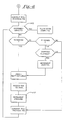
- Figs. 4-6 are sections of a flow chart useful in understanding the manner in which the task dispatching program and task dispatching queue are used to allocate tasks to the processing devices.
- the TDEs are scanned in order of descending priority, and either assigned to one of the processors, bypassed, or reserved for subsequent assignment.
- a secondary scan is performed if necessary to assign any previously reserved tasks to any processing devices not yet associated with a particular task at the end of the primary scan. If necessary, previously bypassed tasks are assigned to any processors not yet associated, to ensure that to the extent possible a task is dispatched to each of the processors.
- IMPI instructions initialize the contents of scratch pad memory 108 to indicate that all of the processing devices are available.
- the scratch pad memory further is initialized to indicate that none of the tasks has been assigned, none of the tasks has been either reserved or assigned, none of the tasks has been bypassed, and none of the tasks has been scanned.
- the highest priority task dispatching element is considered first, as indicated at 132. Before the scan, there is a determination at 134 of whether the previous TDE scan was the end-of-chain or lowest priority TDE, i.e. whether a flag was detected in the previous end-of-chain field 130. If so, there is no "current TDE" and the process proceeds to the reverse scan. If not, the accumulated number of dispatchable tasks (Dispatchable Task Count) is compared to the number of processors at 136. Once the Dispatchable Task Count equals the number of processors, the process proceeds to reverse scan.
- the affinity field of the current TDE is scanned.
- the affinity field of each TDE is scanned at 138 for the presence of a specific affinity indicating one of processing devices 18, 20, 22 and 24; or a general affinity.
- general affinity refers to having affinity for all four of the processing devices, although in a broader sense, general affinity could indicate affinity for any two or more of the processors.
- an appropriate field in scratch pad memory 108 is set to a value "any" to indicate that the task is going to be assigned to a processor, but the particular processor has not yet been determined.
- the Dispatchable Task Count and Scanned Task Count are incremented, and the process returns to the decision at 134 for either a scan of the next TDE or a shift to reverse scan as previously explained.
- scratch pad memory 108 is searched to determine whether the selected processor remains available, i.e. has not yet been assigned to another, higher priority task. If the selected processing device is available, the scratch pad memory is modified to show the processor as associated with the current task, and the current task dispatching element is assigned to the selected processor. When the current TDE with a specific affinity is assigned, the Assigned Processor Count in scratch pad memory 108 is incremented. The identity of the processor also recorded in the scratch pad memory. As before, the Dispatchable Task Count and Scanned Task Count are incremented.
- the scratch pad memory search may yield the result that the selected processing device is not available.
- the accumulated total of bypassed TDEs (Skip Count) is compared to the threshold value in field 122 of TDQ header 94. If the Skip Count is less than the threshold, the current task is identified as bypassed or skipped in the scratch pad memory, and the Skip Count and the Scanned Task Count are incremented. The Dispatchable Task Count is not incremented.
- a final possibility is that a selected processing device is not available to the current task, but the bypass threshold has been reached.
- the specific affinity of the TDE is ignored, and scratch pad memory 108 is modified to indicate that the task will be assigned, although the specific processing device is not yet determined.
- the current TDE is treated as if it originally had general affinity. It is not yet assigned, but reserved for later assignment.
- the Assigned Task Count is compared with a "usable" processing device count (Usable Count) equal to the lesser of (i) the number of processing devices and (ii) the number of tasks in the task dispatching queue. If, in view of the comparison at 140, the Assigned Task Count equals the Usable Count, the allocation of tasks is complete, and the tasks are dispatched, each to its associated one of processing devices 18-24. So long as the number of tasks assigned is less than the usable designation, at least one processing device remains available, and at least one task in the TDQ is not yet assigned.
- the secondary scan begins with the lowest priority task at the end of the chain and proceeds in an order of ascending priority.
- scratch pad memory 108 is searched in connection with the current TDE for the value of "any" in the processor field, indicating that the current TDE was previously reserved but not assigned. If such is the case, the current task is assigned to the next available processor and the processor is identified in the scratch pad memory as associated with the current task and therefore no longer available. The count of assigned processors is incremented at 142, and the scan proceeds to the next, higher priority TDE. The scan proceeds in this manner for all reserved TDEs, whether reserved because of an original general affinity or because the bypass threshold was reached.
- the Dispatchable Task Count is incremented, and the current TDE is assigned to the next available processing device, with such processing device then identified in scratch pad memory 108 as no longer available.
- the Assigned Processor Count is incremented, and the scan proceeds to the next task dispatching element. The reverse scan proceeds until the count of assigned processing devices equals the Usable Count, at which point the allocation process is complete, and tasks are dispatched to their respective processing devices.
- FIG. 7-11 is an example of how a plurality of tasks or data operations, chained in task dispatching queue 92, are allocated in accordance with the primary and secondary scans.
- the task dispatching elements are identified individually as A, B, C, etc., in order of descending priority.
- the affinity of each task at the beginning of the process is listed, indicating one of processing devices 18-24 or "ALL" for a task with general affinity for all of the processors. It is assumed that each of the tasks is eligible for execution on any one of the four processing devices.
- the bypass threshold or skip number is shown at the top of each table.
- Fig. 7 illustrates a basic example of four tasks, each with a specific affinity for a different one of the processing devices. The tasks are assigned directly and in the order shown.
- task A is assigned immediately but task B is bypassed.
- Task C is reserved (its affinity changed to "ALL"), since the bypass threshold has been reached.
- task D is reserved.
- Task E is immediately assigned to processor 20.
- task D is assigned to processor 22 and task C is assigned to processor 24.
- Task B is not allocated until a subsequent scan, usually as part of a succeeding execution of the task dispatcher.
- the reverse scan assures that all of the processors remain busy.
- tasks A, C and E have a general affinity and thus are reserved during the primary scan, task B is assigned to the processing device 18 for which it has specific affinity. Task D is bypassed. During the reverse scan, tasks E, C and A are assigned to processing devices 20, 22 and 24, respectively.
- a primary scan based on processor affinity in combination with a secondary scan of the same tasks but in reverse order, strikes a balance among desirable but sometimes competing objectives of maximizing usage of cache memory, favoring tasks of high priority, and keeping all available processors busy.
- a bypass threshold of either one or two has been found most satisfactory. It is to be understood that beyond the number of processing devices involved, the nature of the tasks being executed and other factors also will influence selection of the bypass threshold.
- One particularly useful feature of the present invention is the dynamic assignment of specific affinity to a given task. More particularly, as a task, previously allocated to a selected processor, is switched into that processor, the affinity field of the corresponding TDE is set to identify that processing device. When the task is switched out of the associated processor, the processor identification remains in the affinity field. Thus, the next time the task is to be allocated, the corresponding TDE exhibits affinity for the selected processor, to maximize the probability of reassignment to the same processing device.
- processor affinity may be identified as having such a high priority that they should never be bypassed during the preliminary scan.
- general affinity for certain high priority tasks might be deemed preferable to the risk of several high priority tasks having the same specific affinity, to avoid a situation of high priority tasks being required to wait while tasks of lower priority are run on other processing devices.
- RPA Reset Processor Affinity
- network 16 utilizes certain "send” and "receive" messages in IMPI instructions to synchronize separate IMPI tasks. For example, a task A, executing on processing device 18, can not be completed until a task B, executing on processor 20, reaches a predetermined stage. Processor 20 issues a send message when task B reaches the predetermined stage. Meanwhile, processor 18 issues a receive instruction, seeking the send message from processor 20, i.e. seeking the indication that task B has reached the predetermined stage.
- Task A is removed from the task dispatching queue, and task dispatching program 32 switches out task A. Task A then waits for reallocation and dispatching. If the wait is sufficiently long, task A loses its natural affinity for processor 18.
- a conditional instruction is included in the IMPI task, specifically to reset the affinity field in the event that the receive message is not satisfied.
- selected IMPI tasks can be configured for general affinity upon being switched out of one of the processing devices, either unconditionally or subject to an event such as a receive instruction not being satisfied. In combination with the previously described primary and secondary scans, this further ensures that task allocation responsive to assigned affinity does not unduly diminish preference for high priority tasks, or efficiency in work load distribution among processors.
Landscapes
- Engineering & Computer Science (AREA)
- Software Systems (AREA)
- Theoretical Computer Science (AREA)
- Physics & Mathematics (AREA)
- General Engineering & Computer Science (AREA)
- General Physics & Mathematics (AREA)
- Memory System Of A Hierarchy Structure (AREA)
- Multi Processors (AREA)
Applications Claiming Priority (2)
| Application Number | Priority Date | Filing Date | Title |
|---|---|---|---|
| US531178 | 1990-05-31 | ||
| US07/531,178 US5109512A (en) | 1990-05-31 | 1990-05-31 | Process for dispatching tasks among multiple information processors |
Publications (2)
| Publication Number | Publication Date |
|---|---|
| EP0459931A2 true EP0459931A2 (de) | 1991-12-04 |
| EP0459931A3 EP0459931A3 (en) | 1992-06-10 |
Family
ID=24116571
Family Applications (1)
| Application Number | Title | Priority Date | Filing Date |
|---|---|---|---|
| EP19910480069 Withdrawn EP0459931A3 (en) | 1990-05-31 | 1991-04-23 | Process for dispatching tasks among multiple information processors |
Country Status (3)
| Country | Link |
|---|---|
| US (1) | US5109512A (de) |
| EP (1) | EP0459931A3 (de) |
| JP (1) | JP2561760B2 (de) |
Cited By (32)
| Publication number | Priority date | Publication date | Assignee | Title |
|---|---|---|---|---|
| EP0557050A1 (de) * | 1992-02-18 | 1993-08-25 | NCR International, Inc. | Verfahren und Anordnung zur Ausführung von Prozessen in einem Multiprozessor-System |
| FR2699304A1 (fr) * | 1992-12-10 | 1994-06-17 | Nec Corp | Procédé de répartition de processus. |
| EP0652513A1 (de) * | 1993-11-04 | 1995-05-10 | International Business Machines Corporation | Taskfolgeplan für ein Multiprozessorsystem |
| EP0825532A1 (de) * | 1996-08-14 | 1998-02-25 | Siemens Nixdorf Informationssysteme AG | Verfahren zum Betreiben einer Mehrprozessor-Datenverarbeitungsanlage und nach diesem Verfahren arbeitenden Mehrprozessor-Datenverarbeitungsanlage |
| GB2380911A (en) * | 2001-10-13 | 2003-04-16 | Hewlett Packard Co | Network printing where document is sent directly to printer or via intermediate pre-processing device in dependence on expected performance |
| WO2005081104A3 (en) * | 2004-02-20 | 2006-03-30 | Sony Computer Entertainment Inc | Methods and apparatus for processor task migration in a multi-processor system |
| EP1672510A3 (de) * | 2004-12-14 | 2006-08-02 | Sap Ag | Schnelle plattformunabhängige Kommunikation zwischen Prozessen |
| WO2005081105A3 (en) * | 2004-02-20 | 2006-08-10 | Sony Computer Entertainment Inc | Methods and apparatus for task management in a multi-processor system |
| CN100421078C (zh) * | 2004-03-12 | 2008-09-24 | 国际商业机器公司 | 用于相似性管理的方法和系统 |
| US7500133B2 (en) | 2004-12-28 | 2009-03-03 | Sap Ag | Connection manager for handling message oriented protocol-based requests |
| US7505157B2 (en) | 2001-01-31 | 2009-03-17 | Hewlett-Packard Development Company, L.P. | Method and apparatus for embodying documents |
| US7523196B2 (en) | 2004-12-28 | 2009-04-21 | Sap Ag | Session monitoring using shared memory |
| US7552153B2 (en) | 2004-12-28 | 2009-06-23 | Sap Ag | Virtual machine monitoring using shared memory |
| US7580915B2 (en) | 2004-12-14 | 2009-08-25 | Sap Ag | Socket-like communication API for C |
| US7591006B2 (en) | 2004-12-29 | 2009-09-15 | Sap Ag | Security for external system management |
| US7593930B2 (en) * | 2004-12-14 | 2009-09-22 | Sap Ag | Fast channel architecture |
| US7600217B2 (en) | 2004-12-14 | 2009-10-06 | Sap Ag | Socket-like communication API for Java |
| US7672949B2 (en) | 2004-12-28 | 2010-03-02 | Sap Ag | Connection manager having a common dispatcher for heterogeneous software suites |
| US7694065B2 (en) | 2004-12-28 | 2010-04-06 | Sap Ag | Distributed cache architecture |
| US7760206B2 (en) | 2005-09-27 | 2010-07-20 | Sony Computer Entertainment Inc. | Processor task and data management |
| US7840760B2 (en) | 2004-12-28 | 2010-11-23 | Sap Ag | Shared closure eviction implementation |
| US7966412B2 (en) | 2005-07-19 | 2011-06-21 | Sap Ag | System and method for a pluggable protocol handler |
| US7971001B2 (en) | 2004-12-28 | 2011-06-28 | Sap Ag | Least recently used eviction implementation |
| US7996615B2 (en) | 2004-12-28 | 2011-08-09 | Sap Ag | Cache region concept |
| US8028292B2 (en) | 2004-02-20 | 2011-09-27 | Sony Computer Entertainment Inc. | Processor task migration over a network in a multi-processor system |
| US8037271B2 (en) | 2005-09-27 | 2011-10-11 | Sony Computer Entertainment Inc. | Method and system for performing memory copy function |
| US8037474B2 (en) * | 2005-09-27 | 2011-10-11 | Sony Computer Entertainment Inc. | Task manager with stored task definition having pointer to a memory address containing required code data related to the task for execution |
| WO2012052775A1 (en) * | 2010-10-21 | 2012-04-26 | Bluwireless Technology Limited | Data processing systems |
| US8589562B2 (en) | 2005-04-29 | 2013-11-19 | Sap Ag | Flexible failover configuration |
| US8595747B2 (en) | 2005-12-29 | 2013-11-26 | Sony Computer Entertainment Inc. | Efficient task scheduling by assigning fixed registers to scheduler |
| US8799359B2 (en) | 2004-12-28 | 2014-08-05 | Sap Ag | Session management within a multi-tiered enterprise network |
| CN110515716A (zh) * | 2019-08-29 | 2019-11-29 | 中国科学院软件研究所 | 一种支持优先级和反亲和的云优化调度方法及系统 |
Families Citing this family (76)
| Publication number | Priority date | Publication date | Assignee | Title |
|---|---|---|---|---|
| US5870602A (en) * | 1987-11-03 | 1999-02-09 | Compaq Computer Corporation | Multi-processor system with system wide reset and partial system reset capabilities |
| JP3155537B2 (ja) * | 1989-01-23 | 2001-04-09 | 株式会社日立製作所 | 実記憶管理方法 |
| US5497497A (en) | 1989-11-03 | 1996-03-05 | Compaq Computer Corp. | Method and apparatus for resetting multiple processors using a common ROM |
| US6463529B1 (en) | 1989-11-03 | 2002-10-08 | Compaq Computer Corporation, Inc. | Processor based system with system wide reset and partial system reset capabilities |
| US5452452A (en) * | 1990-06-11 | 1995-09-19 | Cray Research, Inc. | System having integrated dispatcher for self scheduling processors to execute multiple types of processes |
| JPH04195577A (ja) * | 1990-11-28 | 1992-07-15 | Hitachi Ltd | マルチプロセッサにおけるタスクスケジューリング方式 |
| US5506987A (en) * | 1991-02-01 | 1996-04-09 | Digital Equipment Corporation | Affinity scheduling of processes on symmetric multiprocessing systems |
| US5875464A (en) * | 1991-12-10 | 1999-02-23 | International Business Machines Corporation | Computer system with private and shared partitions in cache |
| US5333319A (en) * | 1992-03-02 | 1994-07-26 | International Business Machines Corporation | Virtual storage data processor with enhanced dispatching priority allocation of CPU resources |
| US5522070A (en) * | 1992-03-19 | 1996-05-28 | Fujitsu Limited | Computer resource distributing method and system for distributing a multiplicity of processes to a plurality of computers connected in a network |
| JP2682770B2 (ja) * | 1992-05-15 | 1997-11-26 | 富士通株式会社 | 仮想計算機システムのcpu制御方式 |
| JP2551312B2 (ja) * | 1992-12-28 | 1996-11-06 | 日本電気株式会社 | ジョブステップ並列実行方式 |
| JP2809962B2 (ja) * | 1993-03-02 | 1998-10-15 | 株式会社東芝 | 資源管理方式 |
| JP2814880B2 (ja) * | 1993-06-04 | 1998-10-27 | 日本電気株式会社 | 異なる命令特性を持つ複数のcpuによって構成される計算機システムの制御装置 |
| US5440741A (en) * | 1993-09-20 | 1995-08-08 | Motorola, Inc. | Software overload control method |
| US5680536A (en) * | 1994-03-25 | 1997-10-21 | Tyuluman; Samuel A. | Dual motherboard computer system |
| US5612865A (en) * | 1995-06-01 | 1997-03-18 | Ncr Corporation | Dynamic hashing method for optimal distribution of locks within a clustered system |
| US5699500A (en) * | 1995-06-01 | 1997-12-16 | Ncr Corporation | Reliable datagram service provider for fast messaging in a clustered environment |
| JPH096633A (ja) * | 1995-06-07 | 1997-01-10 | Internatl Business Mach Corp <Ibm> | データ処理システムに於ける高性能多重論理経路の動作用の方法とシステム |
| US5784614A (en) * | 1995-07-27 | 1998-07-21 | Ncr Corporation | Cache affinity scheduling method for multi-processor nodes in a split transaction bus architecture |
| JPH09101916A (ja) * | 1995-10-06 | 1997-04-15 | Fujitsu Ltd | マルチプロセス処理装置 |
| US7024449B1 (en) | 1996-11-29 | 2006-04-04 | Ellis Iii Frampton E | Global network computers |
| US6167428A (en) * | 1996-11-29 | 2000-12-26 | Ellis; Frampton E. | Personal computer microprocessor firewalls for internet distributed processing |
| US8225003B2 (en) | 1996-11-29 | 2012-07-17 | Ellis Iii Frampton E | Computers and microchips with a portion protected by an internal hardware firewall |
| US7805756B2 (en) | 1996-11-29 | 2010-09-28 | Frampton E Ellis | Microchips with inner firewalls, faraday cages, and/or photovoltaic cells |
| US7506020B2 (en) | 1996-11-29 | 2009-03-17 | Frampton E Ellis | Global network computers |
| US7634529B2 (en) | 1996-11-29 | 2009-12-15 | Ellis Iii Frampton E | Personal and server computers having microchips with multiple processing units and internal firewalls |
| US7035906B1 (en) | 1996-11-29 | 2006-04-25 | Ellis Iii Frampton E | Global network computers |
| US7926097B2 (en) | 1996-11-29 | 2011-04-12 | Ellis Iii Frampton E | Computer or microchip protected from the internet by internal hardware |
| US8312529B2 (en) | 1996-11-29 | 2012-11-13 | Ellis Frampton E | Global network computers |
| US6725250B1 (en) | 1996-11-29 | 2004-04-20 | Ellis, Iii Frampton E. | Global network computers |
| US20050180095A1 (en) * | 1996-11-29 | 2005-08-18 | Ellis Frampton E. | Global network computers |
| US6732141B2 (en) | 1996-11-29 | 2004-05-04 | Frampton Erroll Ellis | Commercial distributed processing by personal computers over the internet |
| US6098091A (en) * | 1996-12-30 | 2000-08-01 | Intel Corporation | Method and system including a central computer that assigns tasks to idle workstations using availability schedules and computational capabilities |
| US6317774B1 (en) * | 1997-01-09 | 2001-11-13 | Microsoft Corporation | Providing predictable scheduling of programs using a repeating precomputed schedule |
| US5918057A (en) * | 1997-03-20 | 1999-06-29 | Industrial Technology Research Institute | Method and apparatus for dispatching multiple interrupt requests simultaneously |
| US5905897A (en) * | 1997-03-20 | 1999-05-18 | Industrial Technology Research Institute | Method and apparatus for selecting a nonblocked interrupt request |
| US5907702A (en) * | 1997-03-28 | 1999-05-25 | International Business Machines Corporation | Method and apparatus for decreasing thread switch latency in a multithread processor |
| TW405090B (en) * | 1997-04-04 | 2000-09-11 | Ibm | Predictive cache loading by program address discontinuity history |
| US6247041B1 (en) * | 1997-08-29 | 2001-06-12 | International Business Machines Corporation | Multiprocessor computer system with user specifiable process placement |
| US6119170A (en) * | 1997-12-29 | 2000-09-12 | Bull Hn Information Systems Inc. | Method and apparatus for TCP/IP multihoming on a host system configured with multiple independent transport provider systems |
| CA2317132A1 (en) * | 1998-01-20 | 1999-07-22 | Jonathan L. Bertoni | Scalable single system image operating software architecture for a multi-processing computer system |
| US7437725B1 (en) * | 1999-01-04 | 2008-10-14 | General Electric Company | Processing techniques for servers handling client/server traffic and communications |
| PE20010308A1 (es) * | 1999-05-10 | 2001-03-14 | Transenda Internat Llc | Aparato y proceso para el archivo electronico de formularios |
| US6732137B1 (en) | 1999-05-12 | 2004-05-04 | International Business Machines Corporation | Performance optimization for data sharing across batch sequential processes and on-line transaction processes |
| JP3092625B2 (ja) | 1999-09-20 | 2000-09-25 | ヤマハ株式会社 | 電子楽器ネットワークシステム |
| US7055144B2 (en) * | 2001-07-12 | 2006-05-30 | International Business Machines Corporation | Method and system for optimizing the use of processors when compiling a program |
| US7178147B2 (en) * | 2001-09-21 | 2007-02-13 | International Business Machines Corporation | Method, system, and program for allocating processor resources to a first and second types of tasks |
| US7725897B2 (en) * | 2004-11-24 | 2010-05-25 | Kabushiki Kaisha Toshiba | Systems and methods for performing real-time processing using multiple processors |
| JP3813930B2 (ja) * | 2002-01-09 | 2006-08-23 | 松下電器産業株式会社 | プロセッサ及びプログラム実行方法 |
| JP4750350B2 (ja) * | 2003-03-13 | 2011-08-17 | パナソニック株式会社 | タスク切換装置、方法及びプログラム |
| US7437726B2 (en) * | 2003-04-23 | 2008-10-14 | Micron Technology, Inc. | Method for rounding values for a plurality of parallel processing elements |
| US7472392B2 (en) * | 2003-04-23 | 2008-12-30 | Micron Technology, Inc. | Method for load balancing an n-dimensional array of parallel processing elements |
| US7437729B2 (en) * | 2003-04-23 | 2008-10-14 | Micron Technology, Inc. | Method for load balancing a loop of parallel processing elements |
| US7448038B2 (en) * | 2003-04-23 | 2008-11-04 | Micron Technology, Inc. | Method for using filtering to load balance a loop of parallel processing elements |
| US7430742B2 (en) * | 2003-04-23 | 2008-09-30 | Micron Technology, Inc. | Method for load balancing a line of parallel processing elements |
| US20050022173A1 (en) * | 2003-05-30 | 2005-01-27 | Codito Technologies Private Limited | Method and system for allocation of special purpose computing resources in a multiprocessor system |
| US8707317B2 (en) * | 2004-04-30 | 2014-04-22 | Microsoft Corporation | Reserving a fixed amount of hardware resources of a multimedia console for system application and controlling the unreserved resources by the multimedia application |
| US7702838B2 (en) * | 2004-05-13 | 2010-04-20 | International Business Machines Corporation | Method and apparatus for configuration space extension bus |
| US20070004501A1 (en) * | 2005-06-29 | 2007-01-04 | Christopher Brewer | Multi-core processing in a wagering game machine |
| US8826228B2 (en) * | 2006-03-27 | 2014-09-02 | Coherent Logix, Incorporated | Programming a multi-processor system |
| JP2009075827A (ja) * | 2007-09-20 | 2009-04-09 | Panasonic Corp | プログラム実行装置 |
| US8125796B2 (en) | 2007-11-21 | 2012-02-28 | Frampton E. Ellis | Devices with faraday cages and internal flexibility sipes |
| US8930946B1 (en) * | 2008-02-14 | 2015-01-06 | Google Inc. | Leasing prioritized tasks |
| WO2009113172A1 (ja) * | 2008-03-13 | 2009-09-17 | 富士通株式会社 | ジョブ割当装置、ジョブ割当装置の制御プログラム及び制御方法 |
| US8676243B2 (en) * | 2008-12-03 | 2014-03-18 | Motorola Solutions, Inc. | Method and apparatus for dual/multi-watch for group PTT services |
| US20110010716A1 (en) * | 2009-06-12 | 2011-01-13 | Arvind Raghuraman | Domain Bounding for Symmetric Multiprocessing Systems |
| US8429735B2 (en) | 2010-01-26 | 2013-04-23 | Frampton E. Ellis | Method of using one or more secure private networks to actively configure the hardware of a computer or microchip |
| US12401619B2 (en) | 2010-01-26 | 2025-08-26 | Frampton E. Ellis | Computer or microchip with a secure system bios having a separate private network connection to a separate private network |
| US10678744B2 (en) * | 2010-05-03 | 2020-06-09 | Wind River Systems, Inc. | Method and system for lockless interprocessor communication |
| US8977677B2 (en) | 2010-12-01 | 2015-03-10 | Microsoft Technology Licensing, Llc | Throttling usage of resources |
| US9329901B2 (en) | 2011-12-09 | 2016-05-03 | Microsoft Technology Licensing, Llc | Resource health based scheduling of workload tasks |
| US9305274B2 (en) | 2012-01-16 | 2016-04-05 | Microsoft Technology Licensing, Llc | Traffic shaping based on request resource usage |
| US8930601B2 (en) * | 2012-02-27 | 2015-01-06 | Arm Limited | Transaction routing device and method for routing transactions in an integrated circuit |
| US9122524B2 (en) | 2013-01-08 | 2015-09-01 | Microsoft Technology Licensing, Llc | Identifying and throttling tasks based on task interactivity |
| US11182205B2 (en) * | 2019-01-02 | 2021-11-23 | Mellanox Technologies, Ltd. | Multi-processor queuing model |
Family Cites Families (11)
| Publication number | Priority date | Publication date | Assignee | Title |
|---|---|---|---|---|
| US3760365A (en) * | 1971-12-30 | 1973-09-18 | Ibm | Multiprocessing computing system with task assignment at the instruction level |
| JPS5841538B2 (ja) * | 1975-12-04 | 1983-09-13 | 株式会社東芝 | マルチプロセツサシステム ノ ユウセンセイギヨホウシキ |
| US4433389A (en) * | 1978-12-26 | 1984-02-21 | Burroughs Corporation | Memory address translation system for accessing memory locations via job names |
| FR2471631B1 (fr) * | 1979-12-11 | 1986-02-21 | Cii Honeywell Bull | Dispositif de synchronisation et d'affectation de processus entre plusieurs processeurs dans un systeme de traitement de l'information |
| US4480304A (en) * | 1980-10-06 | 1984-10-30 | International Business Machines Corporation | Method and means for the retention of locks across system, subsystem, and communication failures in a multiprocessing, multiprogramming, shared data environment |
| US4394727A (en) * | 1981-05-04 | 1983-07-19 | International Business Machines Corporation | Multi-processor task dispatching apparatus |
| US4814982A (en) * | 1984-12-24 | 1989-03-21 | General Electric Company | Reconfigurable, multiprocessor system with protected, multiple, memories |
| US4809157A (en) * | 1985-09-30 | 1989-02-28 | International Business Machines Corp. | Dynamic assignment of affinity for vector tasks |
| US4796178A (en) * | 1985-10-15 | 1989-01-03 | Unisys Corporation | Special purpose processor for off-loading many operating system functions in a large data processing system |
| US4809168A (en) * | 1986-10-17 | 1989-02-28 | International Business Machines Corporation | Passive serialization in a multitasking environment |
| DE3780610D1 (de) * | 1987-01-12 | 1992-08-27 | Siemens Ag | Verfahren zur lastverteilung unter den zentralen prozessoren einer multiprozessor-zentralsteuereinheit eines vermittlungssystems. |
-
1990
- 1990-05-31 US US07/531,178 patent/US5109512A/en not_active Expired - Lifetime
-
1991
- 1991-04-15 JP JP3109803A patent/JP2561760B2/ja not_active Expired - Lifetime
- 1991-04-23 EP EP19910480069 patent/EP0459931A3/en not_active Withdrawn
Cited By (41)
| Publication number | Priority date | Publication date | Assignee | Title |
|---|---|---|---|---|
| EP0557050A1 (de) * | 1992-02-18 | 1993-08-25 | NCR International, Inc. | Verfahren und Anordnung zur Ausführung von Prozessen in einem Multiprozessor-System |
| FR2699304A1 (fr) * | 1992-12-10 | 1994-06-17 | Nec Corp | Procédé de répartition de processus. |
| EP0652513A1 (de) * | 1993-11-04 | 1995-05-10 | International Business Machines Corporation | Taskfolgeplan für ein Multiprozessorsystem |
| EP0825532A1 (de) * | 1996-08-14 | 1998-02-25 | Siemens Nixdorf Informationssysteme AG | Verfahren zum Betreiben einer Mehrprozessor-Datenverarbeitungsanlage und nach diesem Verfahren arbeitenden Mehrprozessor-Datenverarbeitungsanlage |
| US7505157B2 (en) | 2001-01-31 | 2009-03-17 | Hewlett-Packard Development Company, L.P. | Method and apparatus for embodying documents |
| US7230744B2 (en) | 2001-10-13 | 2007-06-12 | Hewlett-Packard Development Company, L.P. | Performance of a multi-stage service within an information technology network |
| GB2380911B (en) * | 2001-10-13 | 2004-09-08 | Hewlett Packard Co | Performance of a multi-stage service within an information technology network |
| GB2380911A (en) * | 2001-10-13 | 2003-04-16 | Hewlett Packard Co | Network printing where document is sent directly to printer or via intermediate pre-processing device in dependence on expected performance |
| WO2005081104A3 (en) * | 2004-02-20 | 2006-03-30 | Sony Computer Entertainment Inc | Methods and apparatus for processor task migration in a multi-processor system |
| US8028292B2 (en) | 2004-02-20 | 2011-09-27 | Sony Computer Entertainment Inc. | Processor task migration over a network in a multi-processor system |
| WO2005081105A3 (en) * | 2004-02-20 | 2006-08-10 | Sony Computer Entertainment Inc | Methods and apparatus for task management in a multi-processor system |
| US7565653B2 (en) | 2004-02-20 | 2009-07-21 | Sony Computer Entertainment Inc. | Methods and apparatus for processor task migration in a multi-processor system |
| US7614053B2 (en) | 2004-02-20 | 2009-11-03 | Sony Computer Entertainment Inc. | Methods and apparatus for task management in a multi-processor system |
| CN100421078C (zh) * | 2004-03-12 | 2008-09-24 | 国际商业机器公司 | 用于相似性管理的方法和系统 |
| US7600217B2 (en) | 2004-12-14 | 2009-10-06 | Sap Ag | Socket-like communication API for Java |
| US8533717B2 (en) | 2004-12-14 | 2013-09-10 | Sap Ag | Fast platform independent inter-process communication |
| US7580915B2 (en) | 2004-12-14 | 2009-08-25 | Sap Ag | Socket-like communication API for C |
| EP1672510A3 (de) * | 2004-12-14 | 2006-08-02 | Sap Ag | Schnelle plattformunabhängige Kommunikation zwischen Prozessen |
| US7593930B2 (en) * | 2004-12-14 | 2009-09-22 | Sap Ag | Fast channel architecture |
| US7500133B2 (en) | 2004-12-28 | 2009-03-03 | Sap Ag | Connection manager for handling message oriented protocol-based requests |
| US7971001B2 (en) | 2004-12-28 | 2011-06-28 | Sap Ag | Least recently used eviction implementation |
| US7672949B2 (en) | 2004-12-28 | 2010-03-02 | Sap Ag | Connection manager having a common dispatcher for heterogeneous software suites |
| US7694065B2 (en) | 2004-12-28 | 2010-04-06 | Sap Ag | Distributed cache architecture |
| US10007608B2 (en) | 2004-12-28 | 2018-06-26 | Sap Se | Cache region concept |
| US7840760B2 (en) | 2004-12-28 | 2010-11-23 | Sap Ag | Shared closure eviction implementation |
| US7552153B2 (en) | 2004-12-28 | 2009-06-23 | Sap Ag | Virtual machine monitoring using shared memory |
| US7523196B2 (en) | 2004-12-28 | 2009-04-21 | Sap Ag | Session monitoring using shared memory |
| US7996615B2 (en) | 2004-12-28 | 2011-08-09 | Sap Ag | Cache region concept |
| US8799359B2 (en) | 2004-12-28 | 2014-08-05 | Sap Ag | Session management within a multi-tiered enterprise network |
| US9009409B2 (en) | 2004-12-28 | 2015-04-14 | Sap Se | Cache region concept |
| US7591006B2 (en) | 2004-12-29 | 2009-09-15 | Sap Ag | Security for external system management |
| US9432240B2 (en) | 2005-04-29 | 2016-08-30 | Sap Se | Flexible failover configuration |
| US8589562B2 (en) | 2005-04-29 | 2013-11-19 | Sap Ag | Flexible failover configuration |
| US7966412B2 (en) | 2005-07-19 | 2011-06-21 | Sap Ag | System and method for a pluggable protocol handler |
| US8037474B2 (en) * | 2005-09-27 | 2011-10-11 | Sony Computer Entertainment Inc. | Task manager with stored task definition having pointer to a memory address containing required code data related to the task for execution |
| US8037271B2 (en) | 2005-09-27 | 2011-10-11 | Sony Computer Entertainment Inc. | Method and system for performing memory copy function |
| US7760206B2 (en) | 2005-09-27 | 2010-07-20 | Sony Computer Entertainment Inc. | Processor task and data management |
| US8595747B2 (en) | 2005-12-29 | 2013-11-26 | Sony Computer Entertainment Inc. | Efficient task scheduling by assigning fixed registers to scheduler |
| WO2012052775A1 (en) * | 2010-10-21 | 2012-04-26 | Bluwireless Technology Limited | Data processing systems |
| CN110515716A (zh) * | 2019-08-29 | 2019-11-29 | 中国科学院软件研究所 | 一种支持优先级和反亲和的云优化调度方法及系统 |
| CN110515716B (zh) * | 2019-08-29 | 2021-11-30 | 中国科学院软件研究所 | 一种支持优先级和反亲和的云优化调度方法及系统 |
Also Published As
| Publication number | Publication date |
|---|---|
| JPH04232560A (ja) | 1992-08-20 |
| JP2561760B2 (ja) | 1996-12-11 |
| US5109512A (en) | 1992-04-28 |
| EP0459931A3 (en) | 1992-06-10 |
Similar Documents
| Publication | Publication Date | Title |
|---|---|---|
| US5109512A (en) | Process for dispatching tasks among multiple information processors | |
| US6633897B1 (en) | Method and system for scheduling threads within a multiprocessor data processing system using an affinity scheduler | |
| US6993767B2 (en) | System for preventing periodic load balancing if processor associated with lightest local run queue has benefited from idle processor load balancing within a determined time period | |
| EP1310872B1 (de) | Steuerungssystem für Schaltungsgruppen | |
| JP3678414B2 (ja) | 多重プロセッサ・システム | |
| CA2107304C (en) | Method and system for single cycle dispatch of multiple instructions in a superscalar processor system | |
| US6779182B1 (en) | Real time thread dispatcher for multiprocessor applications | |
| US5778434A (en) | System and method for processing multiple requests and out of order returns | |
| US5606685A (en) | Computer workstation having demand-paged virtual memory and enhanced prefaulting | |
| US6269391B1 (en) | Multi-processor scheduling kernel | |
| AU628529B2 (en) | Method and means for arbitrating communication requests using a system control unit in a multi-processor system | |
| US5159678A (en) | Method for efficient non-virtual main memory management | |
| US4992938A (en) | Instruction control mechanism for a computing system with register renaming, map table and queues indicating available registers | |
| JP2525997B2 (ja) | I/o割込みサブクラスの認識方法 | |
| EP0488501A2 (de) | Ablauffolgesteuerung von Ein/Ausgabeoperationen in einem multitasking System | |
| EP0605866B1 (de) | Verfahren und System zur Befehlszuteilung in einem superskalaren Prozessorsystem mit unabhängig zugänglichem Zwischenspeicher | |
| US20050071843A1 (en) | Topology aware scheduling for a multiprocessor system | |
| JP2002342163A (ja) | マルチスレッドプロセッサ用キャッシュ制御方式 | |
| EP0605868B1 (de) | Verfahren und System um einen unabhängige Zugriff auf Zwischenspeicherpuffern in einem superskalaren Prozessorsystem zu gewährleisten. | |
| CN112346835A (zh) | 一种基于协程的调度处理方法及系统 | |
| EP0606643A1 (de) | Verfahren und System für nicht-sequentielle Befehlzuteilung und -ausführung in superskalarem Prozessorsystem | |
| EP0297265B1 (de) | Befehlssteuerungsvorrichtung für ein Computersystem | |
| CN1971507A (zh) | 动态地选择存储指令性能方案的处理器和方法 | |
| JP3019317B2 (ja) | プロセススケジューリング方法 | |
| JPH05151064A (ja) | 密結合マルチプロセツサシステム |
Legal Events
| Date | Code | Title | Description |
|---|---|---|---|
| PUAI | Public reference made under article 153(3) epc to a published international application that has entered the european phase |
Free format text: ORIGINAL CODE: 0009012 |
|
| AK | Designated contracting states |
Kind code of ref document: A2 Designated state(s): DE FR GB |
|
| 17P | Request for examination filed |
Effective date: 19911219 |
|
| PUAL | Search report despatched |
Free format text: ORIGINAL CODE: 0009013 |
|
| AK | Designated contracting states |
Kind code of ref document: A3 Designated state(s): DE FR GB |
|
| STAA | Information on the status of an ep patent application or granted ep patent |
Free format text: STATUS: THE APPLICATION IS DEEMED TO BE WITHDRAWN |
|
| 18D | Application deemed to be withdrawn |
Effective date: 19961101 |