EP0458810B1 - Einheit zur befestigung von elementen auf einer basis - Google Patents
Einheit zur befestigung von elementen auf einer basis Download PDFInfo
- Publication number
- EP0458810B1 EP0458810B1 EP90902459A EP90902459A EP0458810B1 EP 0458810 B1 EP0458810 B1 EP 0458810B1 EP 90902459 A EP90902459 A EP 90902459A EP 90902459 A EP90902459 A EP 90902459A EP 0458810 B1 EP0458810 B1 EP 0458810B1
- Authority
- EP
- European Patent Office
- Prior art keywords
- disc
- sleeve
- base
- model
- die
- Prior art date
- Legal status (The legal status is an assumption and is not a legal conclusion. Google has not performed a legal analysis and makes no representation as to the accuracy of the status listed.)
- Expired - Lifetime
Links
- 230000008878 coupling Effects 0.000 title abstract description 10
- 238000010168 coupling process Methods 0.000 title abstract description 10
- 238000005859 coupling reaction Methods 0.000 title abstract description 10
- 239000000463 material Substances 0.000 description 10
- 238000003780 insertion Methods 0.000 description 8
- 230000037431 insertion Effects 0.000 description 7
- 239000004575 stone Substances 0.000 description 6
- 239000011505 plaster Substances 0.000 description 4
- 239000002131 composite material Substances 0.000 description 3
- 230000013011 mating Effects 0.000 description 3
- 238000012986 modification Methods 0.000 description 3
- 230000004048 modification Effects 0.000 description 3
- 210000004513 dentition Anatomy 0.000 description 2
- 238000004519 manufacturing process Methods 0.000 description 2
- 230000036346 tooth eruption Effects 0.000 description 2
- 239000000853 adhesive Substances 0.000 description 1
- 230000001070 adhesive effect Effects 0.000 description 1
- 239000002969 artificial stone Substances 0.000 description 1
- 230000000712 assembly Effects 0.000 description 1
- 238000000429 assembly Methods 0.000 description 1
- 230000015572 biosynthetic process Effects 0.000 description 1
- 238000005266 casting Methods 0.000 description 1
- 239000004568 cement Substances 0.000 description 1
- 238000005520 cutting process Methods 0.000 description 1
- 238000000605 extraction Methods 0.000 description 1
- 230000014759 maintenance of location Effects 0.000 description 1
- 239000007769 metal material Substances 0.000 description 1
- 238000000926 separation method Methods 0.000 description 1
- 230000000087 stabilizing effect Effects 0.000 description 1
- 229940099259 vaseline Drugs 0.000 description 1
Images


Classifications
-
- A—HUMAN NECESSITIES
- A61—MEDICAL OR VETERINARY SCIENCE; HYGIENE
- A61C—DENTISTRY; APPARATUS OR METHODS FOR ORAL OR DENTAL HYGIENE
- A61C9/00—Impression cups, i.e. impression trays; Impression methods
- A61C9/002—Means or methods for correctly replacing a dental model, e.g. dowel pins; Dowel pin positioning means or methods
Definitions
- the present invention relates to models utilized in restorative dentistry in general, and more particularly to an improvement in arrangements which permit coupling and separation as well as replacement of a dental die on a cast base.
- Dowel pins are frequently employed for coupling the dies to the cast base. These pins are initially positioned over an impression tray and maintained suspended over the tray. The material of the model is then poured into the impression tray to form the dental model or full cast of the prepared teeth to be worked on. While the plaster, or other comparable material, is in a soft state this material will fully surround the pins to embed the same in the model. After the model has hardened the stems of the dowel pins will project outwardly from the model. After the model has fully hardened with the pins projecting therefrom, a separator medium, such as "Vaseline" is placed on the lower surface of the model. Thereupon, additional stone or plaster material is poured on or applied to the lower wall of the model to form a cast base.
- a separator medium such as "Vaseline”
- the cast base and the model are fully hardened and cured. As a result, holes are formed in the cast base at the locations of the stems of the dowel pins. These holes conform to the contours of the pins.
- the model is then cut by a saw into segments or dies as described herein above. The dies with the pins can then be separated and removed from the cast base to be worked on and reinserted into the base. When the die is replaced into the base the pins are aligned in the corresponding receiving holes.
- sleeves Prior to pouring the base, sleeves may be placed over the projecting pins and the sleeves are then cast into the base. The segments with the projecting pins can then be inserted and removed from the sleeves.
- the PINDEX R System by the Whaledent Company has been, for example, developed for the orientation of the placement of removable dies into the cast.
- Such system is disclosed in U.S. Patent 3,704,519.
- holes are provided in the removable part of the model. Pins with sleeves or bushings on them are inserted and pressed into the dental model. The stone is then poured on to the bushings as sleeves and the bushings or sleeves are cast into the base. The dies may be removed by pulling the pins from the bushings. At least two pins are necessary, for each die to ensure proper orientation and replacement of the die segments into the cast.
- US-A-4 054 995 discloses a dental pin and sleeve assembly having a pin member the internal portion of which has a substantially triangular or rectangular configuration. Further, the exterior protruding portion of the pin member is only at its distal end received in a sleeve member.
- Another object of the invention is to provide a dental disc and sleeve assembly which ensures a proper orientation of a removable die section of a dental model into a cast base.
- Still another object of the invention is to provide a dental disc and sleeve assembly which facilitates insertion and removal of a die section from a cast base.
- a dental pin and sleeve assembly as defined in claim 1.
- the exterior protruding portion of the pin member and the head portion include cooperating lock means to guide the exterior protruding portion upon insertion thereof into the head portion and also to provide a releasable snap-fit lock of the protruding portion into the head portion.
- the protruding portion has a semi-circular shape and in conjunction with the internal portion of the pin member constitutes a complete disc.
- the head portion has a chamber shaped for matingly receiving the protruding portion of the disc.
- the lock means includes two knobs formed at opposing sides of the disc and correspondingly two grooves provided in the chamber of the head portion for receiving the knobs upon insertion of the protruding portion of the disc into the head portion.
- the head portion includes a hollow frame defining the chamber therein with the grooves forming recesses in opposing interior frame walls.
- the head portion of the external member is formed with outwardly protruding lugs positioned at two opposite ends thereof to retain the external member secured within the cast material of the base.
- Grooves may be formed at the opposing sides of the disc. Those grooves would then receive knobs projecting from opposite walls of the head portion into the disc-receiving chamber of the head portion.
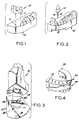
- Fig. 1 illustrates a commonly used dowel pin system, in which two parallel pins 2 extending from the lower surface of a die segment 10 of a dental model are received in two corresponding holes 4 formed in the model base 12.
- two round parallel sided pins would be used and plastic sleeves would be cast in the model base 12 to receive the pins.
- one short pin and one long pin would be used.
- Fig. 2 illustrates a post and sleeve system as is described in copending application Serial No. 076,640 filed and assigned to the assignee of the present invention, which is a form of the PINDEX R system.
- an elongated substantially cylindrical body portion of a pin 14 has two diametrically opposing radially projecting ribs 16 extending along the length of the body portion 14 tangentially thereto.
- the pin 14 is received in a sleeve or bushing 18 which is then cast into the base 12.
- the sleeve has a bore of a shape corresponding to the body portion of the pin 14 so that the pin 14 snugly fits within the bushing 18 to form a composite assembly, which is easily disassembled when die 10 is to be removed from the base 12.
- Ribs 16 form alignment means for the reinsertion of the die section 10 onto the cast base 12 and prevent the die from turning when the latter is remounted on the base.
- the disc and sleeve arrangement includes a disc 20 inserted into the die segment 10 with a part of the disc projecting downwardly from a lower surface 22 of the die 10.
- Two knobs 24 are provided at opposing sides of the disc 20.
- the second part of the coupling arrangement is constituted by a sleeve 26 cast within the base 12 and which snugly receives the projecting portion of disc 20 as will be described in detail below.
- the underside surface 30 of a dental model 40 which will eventually be cut into a number of segments or dies 10 is formed with a plurality of cuts 32 circumferentially spaced apart from each other. Cuts 32 are substantially semi-circular in shape and are made by a tool designed for the task. Discs 20 are then inserted and secured into cuts 32 as shown in Fig. 5. Cuts 32 sawed in the ground plane of the model 40 are maintained vertical and parallel to each other. The number of the cuts is selected such that at least one cut is located in each part or die which would be removable in the model. The disc 20 is then secured in each cut 32 as illustrated in Fig. 5.
- Discs 20 may be fixed in cuts 32 by means of cement or any other adequate adhesive material. Cuts 32 are easy to make and their spacing can be easily selected depending on the segments or dies 10 to be removed from the model to be worked on. Additionally, only one cut per die segment is needed. The discs are formed such that only the semi-circular upper portions fit into the cuts. The bottom portions project from the bottom surface, as shown in Fig. 5. Fig. 6 then illustrates the sleeve 26 snapped on the projecting part of disc 20.
- sleeve 26 includes a substantially cylindrical elongated tail portion 28 which merges into a U-shaped head portion 34 having a concave inner surface 35 and terminated with a housing frame 36.
- Head portion 34 is formed with a semicircular chamber 38 interior of the frame 36 into which the portion of disc 20 protruding from the die 10 is received.
- Two semi-circular recesses 42 of a configuration mating that of the knobs 24 are provided at two longitudinal internal walls of the housing frame 36. Depressions 42 are slightly greater than a semicircle so that the arcuate tips 39,41 provide a reliable snap lock for knobs 24 when the protruding portion of disc 20 is received into the semi-circular chamber 38 of sleeve 26.
- a stone material is poured onto the base of the model 40 with the disc and sleeve assemblies thereon to form a cast base portion which will support the model.
- the model will be later cut into segments or dies and each die will be capable of remounting onto the base with the aid of the disc and sleeve arrangements.
- Housing frame 36 provided at the upper end of sleeve 26 is of a substantially rectangular configuration and has a stabilizing flat enlarged upper flange 44 which in assembly seats onto the cast base and forms part of the smooth planar surface of the cast base. This flange rests on the underside 30 of the cast 40. The flange assists in supporting the sleeve 26 in its vertical position when the stone material or plaster is poured over the model 40 to cast the base 60.
- the U-shaped head portion 34 and its flange 36 have externally protruding lugs 48 and 50, respectively provided at two opposite sides of the sleeve 26 and forming means to securely retain the sleeve within the stone material. Lugs 48, 50 are triangular in shape as shown in Fig. 8 thereby providing a flat upper surface 49, 51 to prevent upward loosening of the sleeve from the stone base. It is, of course, understandable that other shapes of the lugs could be used to ensure the material retention function thereof.
- interior chamber 38 snugly accommodates the portion of disc 20 protruding from the underside 30 of the model 40.
- the thickness of walls 52 of the U-shaped head portion 34 is selected so as to be sufficient to reliably hold the protruding portion 54 of disc 20 when the dies 10 of the model 40 are mounted on the cast base 60. At the same time they must be sufficiently flexible to permit extraction of this protruding portion from the head portion 34 of the sleeve 26 when a die segment 10 is removed from cast base 60.
- the depth of the interior chamber 38 is selected so that approximately three fifths of the disc 20 is inserted in the recess in the assembled position of the arrangement while two fifths of disc 20 is embedded in cast 40. Accordingly, as best seen in Fig. 7, the disc protruding portion 54 snugly fits within the sleeve 26 to form a composite assembly.
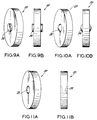
- Figs. 9 to 12 illustrate various modifications of the disc 20.
- disc 20 is of a substantially circular configuration and has two cylindrical knobs 24 formed, preferably by casting, at two diametrically opposing sides of the disc for a snap fit into two correspondingly diametrically opposing depressions 42 of sleeve 26, as has been described above.
- Figs. 10A and 10B differs from that of Figs. 9A and 9B in that knobs 24 are substantially semi-spherical. It is apparent that depressions 42 in the sleeve 26 for accommodating such knobs would also be of semi-spherical configuration mating that of knobs 24.
- Figs. 11A and 11B depict yet another variant of the disc structure.
- Semi-spherical grooves 25 are formed at two diametrically opposing sides of the circular disc 20, which grooves in the assembled state of disc 20 with the sleeve 26 will receive corresponding semi-spherically shaped projections provided at two opposite internal faces of the frame 38 of head portion 34 of sleeve 26
- the semi-spherical projections on the sleeve would snap into the grooves on the disc to provide a snug fit of the disc within the sleeve to form a composite assembly when any die segment is remounted on the cast base 60.
- Fig. 12A shows yet another variation of the disc 20 inserted in the hole 32 of the model 40 and adapted to snugly fit in a corresponding sleeve embedded in the cast base 60.
- Disc 20 in this embodiment is an elongated, substantially flat element, the upper portion 62 of which again has a semi-circular cross-section to fit in the same semi-circular saw cut 32 previously described.
- a semi-circular lower portion which would project from the bottom of the model there is now provided a lower elongated portion 64 which tapers downwardly.
- This elongated tapering portion 64 would be accommodated in a correspondingly shaped recess in a sleeve to be snugly fit therein in the assembled condition and permits easy pulling of elongated portion 64 from the sleeve to remove a respective die segment from the cast base 60.
- the projecting knobs 24 would still be used to snap fit the disc into the sleeve.
- Fig. 12B illustrates a disc element 20 which again includes a disc-shaped upper portion 66 insertable in the semi-circular saw cut 32 (Fig. 4) and now includes an elongated protruding rod-like portion 68 joined with the disc-shaped portion 66 and being of the same thickness therewith.
- the two knobs 24 are provided for fitting in respective depressions of sleeve 26 for snap fitting the disc into the sleeve.
- the sleeve would include a chamber to receive the rod-like projection.
- the internal element 20 of the disc-and-sleeve assembly again includes the disc-shaped portion 70 insertable into the semi-circular saw cut 32 of the model 40, and now includes an elongated portion 72 of a substantially pyramidal configuration sloping towards a distal end 74 which forms an apex of the pyramid.
- Knobs 24 are formed at the upper edge of elongated portion 72 in the manner similar to that of the aforedescribed embodiments.
- Fig. 12D depicts a top plan view of another disc element 20 which includes a disc-shaped portion 80 and a substantially triangular portion 82 which would extend downwardly from the disc in a manner similar to that of Figs. 12A-12C.
- the cross-sectional triangular shape has one end 84 pointed .
- Two knobs 24 of a substantially cylindrical shape are formed at two opposite sides of disc-shaped portion 80.
- Disc-shaped portion 80 would be inserted in saw cut 32 while the triangular piece or portion 82 would be accommodated in a corresponding recess of the sleeve.
- Fig. 12E shows a top plan view of a still another version of the internal disc element 20.
- the element 20 again includes a disc-shaped portion 90 and an elongated element projecting therefrom in a manner similar to Figs. 12A-12C.
- the projection portion has a cross-sectional configuration shown at 92 which is a substantially rectangular configuration with one end 94 being curved.
- the top of portion 92 forms a flange below the disc which is received in a recess of the corresponding sleeve of the assembly.
- Knobs 24 could snap fit in two opposing grooves of the sleeve.
- the disc-shaped portion of each element ensures its easy insertion in the respective semicircular saw cut 32 of the dental model while the protruding portion of this internal element is received in the base.
- the protruding portion may be the remaining part of a circular disc or a vertically extending rod like portion.
- the combination of the disc and sleeve ensures a reliable seating of the segment into the base and permits easy removability of the segments. Nevertheless in each case only a single cut is required in each die segment and into which the semi-circular disc is inserted. This provides orientation for returning the segment. Also, the presence of the knobs provide good lock means for locking of the disc in the sleeve.
- the portion of the internal member 20 received and secured in the saw cut 32 has a semi-circular configuration mating that of each saw cut 32 formed in the underside of model 40.
- disc 20 may be inserted into sleeve 26 in two 180 o opposite positions.
- the vertically extending portions of the embodiments of Figs. 12A - 12E constitute orientation means which ensure the insertion of the internal disc elements 20 into the sleeve 26 in a single insertion position.
- a reliable snap lock of the disc and sleeve assembly is provided to connect the die segment to the said base and an easy disassembling of these two parts to remove the die segment from the cast base.
- Fig. 13 schematically illustrates a rotary saw assembly which can be used for making the saw cuts into the underside of the model 40.
- the rotary saw of Fig. 13 designated at 100 includes a housing 102 which defines a housing compartment 104 in which a motor-driven rotary saw 106 is accommodated.
- a vertically movable work table 110 supports thereon the cast model 40 onto which the saw cuts are to be made
- a slit 112 is provided in a supporting plate 114 of the work table 110 so that the cutter or saw blade 108 can extend upwardly through the slit as the work table descends. In the normal, uppermost position, as shown in solid line in Fig. 13, the blade is completely recessed beneath the work table and directly under the slit 112 in the supporting plate 114.
- Model 40 may then be shifted horizontally to position the model such that a next portion to be segmented is oriented over the saw blade.
- Fig. 14 illustrates a working cast 125 which includes base 60 and model 40 mounted thereon.
- the die 10 (shown in dotted line) carrying the single disc 20 therein can be remounted onto the cast base 60 whereby the disc 20 snap-fits in the sleeve 26 assigned thereto.
- the die section 10 Due to knobs 24 received in the respective depressions of the sleeve 26 the die section 10 will fit snugly on the base 60 as the die section is pushed into place.
- the cylindrical tail 28 of the sleeve 26 projects into a notch 130 cut onto the underside of base 60 of the working cast 125.
- the disc and the sleeve may be made of plastic or metal material as is well known in this field.
Landscapes
- Health & Medical Sciences (AREA)
- Oral & Maxillofacial Surgery (AREA)
- Dentistry (AREA)
- Epidemiology (AREA)
- Life Sciences & Earth Sciences (AREA)
- Animal Behavior & Ethology (AREA)
- General Health & Medical Sciences (AREA)
- Public Health (AREA)
- Veterinary Medicine (AREA)
- Dental Tools And Instruments Or Auxiliary Dental Instruments (AREA)
- Dental Prosthetics (AREA)
Claims (10)
- Zahnstift und Hülseneinheit zum lösbaren Befestigen eines Mundstückabschnittes eines Zahnmodells auf einer Gußbasis, wobei die Einheit folgendes umfaßt:
ein Stiftelement (20), das ein Innenteil zum Befestigen des Mundstückabschnittes und ein Außenteil, das von dem Mundstückabschnitt vorsteht, um daran gebunden zu sein, beinhaltet, wobei das Innenteil eine im wesentlichen halbkreisförmige Konfiguration aufweist; und ein Hülsenelement (26) zum Befestigen innerhalb der Gußbasis, wobei das Hülsenelement ein Kopfteil (34) beinhaltet, das eine Kammer (38) aufweist, die an der oberen Fläche der Gußbasis eine Öffnung aufweist, um das hervorstehende Außenteil des Stiftelementes vollständig aufzunehmen, sobald der Mundstückabschnitt mit der Gußbasis verbunden wird. - Zahnstift und Hülseneinheit nach Anspruch 1, bei dem das Außenteil und das Kopfteil kooperierende Verriegelungsmittel (24, 39, 41, 42) beinhalten, um eine lösbare Schnapprastverriegelung des Außenteils in das Kopfteil zur Verfügung zu stellen, sobald der Mundstückabschnitt mit der Gußbasis verbunden wird.
- Zahnstift und Hülseneinheit nach Anspruch 1, bei dem das Hülsenelement ein im wesentlichen zylindrisches Schwanzteil (28) umfaßt, das an den Kopfteil gebunden ist.
- Zahnstift und Hülseneinheit nach Anspruch 1, bei dem das Außenteil eine im wesentlichen halbkreisförmige Konfiguration aufweist und mit dem halbkreisförmigen Innenteil eine komplette Scheibe bildet.
- Zahnstift und Hülseneinheit nach Anspruch 1, bei dem das Kopfteil (34) ein Rahmen (36) ist, der die innere Kammer (38) aufweist, die das vorstehende Außenteil zusammenpassend aufnimmt.
- Zahnstift und Hülseneinheit nach Anspruch 5, bei dem die Kammer (38) halbkreisförmig ausgebildet ist.
- Zahnstift und Hülseneinheit nach Anspruch 2, bei dem die Verriegelungsmittel zwei Noppen (24) beinhalten, die an zwei gegenüberliegenden Seiten des vorstehenden Außenteils bzw. an zwei entsprechend geformten Vertiefungen (42), die in dem Hülsenelement ausgebildet sind, positioniert sind und die zwei Noppen aufnehmen.
- Zahnstift und Hülseneinheit nach Anspruch 1, bei dem das Kopfteil U-förmig ist.
- Zahnstift und Hülseneinheit nach Anspruch 1, bei dem das Kopfteil (34) mit nach außen vorstehenden Nasen (48, 50) ausgebildet ist, die an zwei gegenüberliegenden Seiten des Kopfes positioniert sind, um die Hülse innerhalb der Gußbasis zurückzuhalten.
- Verfahren zum Erstellen eines Zahnmodells, bei dem die Mundstückabschnitte (10) des Modells von einer Basis (12) entnommen und gelöst werden können, dadurch gekennzeichnet, daß das Verfahren die folgenden Schritte umfaßt: Schneiden einer Vierzahl von im wesentlichen halbkreisförmigen Einschnitten in eine Unterseite (30) des Modells (40), die der Seite mit den geformten Zähnen gegenüberliegt, Befestigen eines scheibenförmigen Elementes (20) innerhalb jedes Einschnittes, so daß ein Abschnitt des Elementes sich senkrecht zu und von der Unterseite des Modells nach außen gerichtet erstreckt, Befestigen von Hülsen (26) auf sich nach außen erstreckenden Abschnitten von schreibenförmigen Elementen, wobnei jede Hülse eine Vertiefung (38) aufweist, die den Abschnitt des entsprechenden halbkreisförmigen Elementes zusammenpassend aufnimmt, Gießen eines Gußmaterials über das Modell mit den darauf befindlichen scheibenförmigen Elementen und Hülsen darauf, um die Basis (12) zu formen, die es dem Material ermöglicht, zum Befestigen jeder Hülse in der Basis auszuhärten, Entnehmen des Modells zusammen mit den Elementen aus der ausgehärteten Basis und Schneiden des Modells (40) in Mundstückabschnitte (10), so daß jeder Mundstückabschnitt mindestens ein scheibenförmiges Element beinhaltet, das von ihm vorsteht, wobei die Mundstückabschnitte lösbar auf der Basis befestigt sind, indem der Abschnitt jedes scheibenförmigen Elementes in die Vertiefung der entsprechenden Hülse gesteckt wird.
Applications Claiming Priority (3)
| Application Number | Priority Date | Filing Date | Title |
|---|---|---|---|
| US306949 | 1989-02-06 | ||
| US07/306,949 US5087197A (en) | 1989-02-06 | 1989-02-06 | Disc and sleeve assembly for coupling die segments of a dental model to a base |
| PCT/US1990/000293 WO1990008515A1 (en) | 1989-02-06 | 1990-01-16 | Assembly for coupling segments to a base |
Publications (3)
| Publication Number | Publication Date |
|---|---|
| EP0458810A1 EP0458810A1 (de) | 1991-12-04 |
| EP0458810A4 EP0458810A4 (en) | 1992-03-18 |
| EP0458810B1 true EP0458810B1 (de) | 1994-09-14 |
Family
ID=23187592
Family Applications (1)
| Application Number | Title | Priority Date | Filing Date |
|---|---|---|---|
| EP90902459A Expired - Lifetime EP0458810B1 (de) | 1989-02-06 | 1990-01-16 | Einheit zur befestigung von elementen auf einer basis |
Country Status (7)
| Country | Link |
|---|---|
| US (1) | US5087197A (de) |
| EP (1) | EP0458810B1 (de) |
| AU (1) | AU628131B2 (de) |
| DE (1) | DE69012553T2 (de) |
| ES (1) | ES2060143T3 (de) |
| FI (1) | FI95767C (de) |
| WO (1) | WO1990008515A1 (de) |
Families Citing this family (6)
| Publication number | Priority date | Publication date | Assignee | Title |
|---|---|---|---|---|
| DE4113651A1 (de) * | 1991-04-26 | 1992-10-29 | Schreiber Hans | Verfahren und vorrichtung zur herstellung insbesondere zahnaerztlicher saegeschnittmodelle |
| USRE35263E (en) * | 1992-06-19 | 1996-06-04 | The Silva Group, Inc. | Method and apparatus for fabricating dental models |
| US5573397A (en) * | 1993-07-06 | 1996-11-12 | S-Tec, Inc. | Method for creating a universal mount for dental articulators |
| US5876204A (en) * | 1997-11-25 | 1999-03-02 | Sulzer Calcitek Inc. | Dental implant positioning guide |
| US20220258322A1 (en) * | 2012-02-21 | 2022-08-18 | Align Technology, Inc. | Dental models and related methods |
| US9375298B2 (en) * | 2012-02-21 | 2016-06-28 | Align Technology, Inc. | Dental models and related methods |
Family Cites Families (3)
| Publication number | Priority date | Publication date | Assignee | Title |
|---|---|---|---|---|
| US2851728A (en) * | 1954-07-14 | 1958-09-16 | Weinstein | Interlockable dental dowel pin and repositioning gauge and method of using |
| US4054995A (en) * | 1976-05-03 | 1977-10-25 | Yoshida Harry Y | Pin with sleeve for making dental prosthesis |
| US4205443A (en) * | 1978-05-08 | 1980-06-03 | Ipco Hospital Supply Corporation | Two-part dowel pin and tool therefor |
-
1989
- 1989-02-06 US US07/306,949 patent/US5087197A/en not_active Expired - Lifetime
-
1990
- 1990-01-16 AU AU49518/90A patent/AU628131B2/en not_active Ceased
- 1990-01-16 ES ES90902459T patent/ES2060143T3/es not_active Expired - Lifetime
- 1990-01-16 DE DE69012553T patent/DE69012553T2/de not_active Expired - Fee Related
- 1990-01-16 WO PCT/US1990/000293 patent/WO1990008515A1/en not_active Ceased
- 1990-01-16 EP EP90902459A patent/EP0458810B1/de not_active Expired - Lifetime
-
1991
- 1991-08-05 FI FI913725A patent/FI95767C/fi active
Also Published As
| Publication number | Publication date |
|---|---|
| FI95767B (fi) | 1995-12-15 |
| ES2060143T3 (es) | 1994-11-16 |
| FI913725A0 (fi) | 1991-08-05 |
| DE69012553T2 (de) | 1995-02-02 |
| FI95767C (fi) | 1996-03-25 |
| AU628131B2 (en) | 1992-09-10 |
| AU4951890A (en) | 1990-08-24 |
| WO1990008515A1 (en) | 1990-08-09 |
| DE69012553D1 (de) | 1994-10-20 |
| US5087197A (en) | 1992-02-11 |
| EP0458810A4 (en) | 1992-03-18 |
| EP0458810A1 (de) | 1991-12-04 |
Similar Documents
| Publication | Publication Date | Title |
|---|---|---|
| CA1171210A (en) | Mold for dental models | |
| US4203219A (en) | Dental model assembly and production method | |
| US4122606A (en) | Method and apparatus for mounting dental die models in dental stone | |
| US4459110A (en) | Dowel pin locator assembly and method of making positive dental models with removable dies | |
| US4127939A (en) | J-Shaped pin for making dental prosthesis with means for debris escape | |
| US6884068B2 (en) | Dental model base configured for customized aperture formation | |
| US6425759B1 (en) | Dental cast tray assembly | |
| US5425636A (en) | Articulator for dental mold | |
| US6106284A (en) | Dental cast tray assembly | |
| US4252523A (en) | Apparatus and method for forming dental models | |
| WO1989000838A1 (en) | Dental pin and bushing assembly | |
| US4997370A (en) | Dental model alignment device | |
| US7338283B2 (en) | Dental prostheses modeling system with symmetric double-well trays slidably mountable to articulator | |
| US4238189A (en) | Method and apparatus for making in a single operation a base and dental model including a tooth die with an integral bayonet type mounting pin | |
| EP0458810B1 (de) | Einheit zur befestigung von elementen auf einer basis | |
| US3521354A (en) | Dowel assembly and method | |
| CA2435766A1 (en) | Improved dental model base assembly | |
| US4054995A (en) | Pin with sleeve for making dental prosthesis | |
| US20030036035A1 (en) | Removable analog | |
| US6439884B1 (en) | Dental cast tray assembly | |
| US20060210944A1 (en) | Dental modeling and articulating system and method | |
| US3875665A (en) | Dual pin for prosthodontic casts | |
| US4129281A (en) | Dowel receiving core for casting dental restorations | |
| US6712609B2 (en) | Supporting structure for a dental model and a method for forming thereof | |
| US20060216667A1 (en) | Dental modeling and articulating system and method |
Legal Events
| Date | Code | Title | Description |
|---|---|---|---|
| PUAI | Public reference made under article 153(3) epc to a published international application that has entered the european phase |
Free format text: ORIGINAL CODE: 0009012 |
|
| AK | Designated contracting states |
Kind code of ref document: A1 Designated state(s): CH DE DK ES FR GB LI NL SE |
|
| 17P | Request for examination filed |
Effective date: 19911008 |
|
| RAP1 | Party data changed (applicant data changed or rights of an application transferred) |
Owner name: COLTENE/WHALEDENT, INC. |
|
| A4 | Supplementary search report drawn up and despatched |
Effective date: 19920128 |
|
| AK | Designated contracting states |
Kind code of ref document: A4 Designated state(s): CH DE DK ES FR GB LI NL SE |
|
| 17Q | First examination report despatched |
Effective date: 19931213 |
|
| RAP1 | Party data changed (applicant data changed or rights of an application transferred) |
Owner name: COLTENE/WHALEDENT, INC. |
|
| GRAA | (expected) grant |
Free format text: ORIGINAL CODE: 0009210 |
|
| AK | Designated contracting states |
Kind code of ref document: B1 Designated state(s): CH DE DK ES FR GB LI NL SE |
|
| PG25 | Lapsed in a contracting state [announced via postgrant information from national office to epo] |
Ref country code: DK Effective date: 19940914 |
|
| ET | Fr: translation filed | ||
| REF | Corresponds to: |
Ref document number: 69012553 Country of ref document: DE Date of ref document: 19941020 |
|
| REG | Reference to a national code |
Ref country code: ES Ref legal event code: FG2A Ref document number: 2060143 Country of ref document: ES Kind code of ref document: T3 |
|
| EAL | Se: european patent in force in sweden |
Ref document number: 90902459.8 |
|
| PLBE | No opposition filed within time limit |
Free format text: ORIGINAL CODE: 0009261 |
|
| STAA | Information on the status of an ep patent application or granted ep patent |
Free format text: STATUS: NO OPPOSITION FILED WITHIN TIME LIMIT |
|
| 26N | No opposition filed | ||
| REG | Reference to a national code |
Ref country code: GB Ref legal event code: IF02 |
|
| PGFP | Annual fee paid to national office [announced via postgrant information from national office to epo] |
Ref country code: NL Payment date: 20041229 Year of fee payment: 16 |
|
| PGFP | Annual fee paid to national office [announced via postgrant information from national office to epo] |
Ref country code: FR Payment date: 20050117 Year of fee payment: 16 |
|
| PGFP | Annual fee paid to national office [announced via postgrant information from national office to epo] |
Ref country code: SE Payment date: 20050120 Year of fee payment: 16 |
|
| PGFP | Annual fee paid to national office [announced via postgrant information from national office to epo] |
Ref country code: CH Payment date: 20050124 Year of fee payment: 16 |
|
| PGFP | Annual fee paid to national office [announced via postgrant information from national office to epo] |
Ref country code: ES Payment date: 20050208 Year of fee payment: 16 |
|
| PGFP | Annual fee paid to national office [announced via postgrant information from national office to epo] |
Ref country code: GB Payment date: 20060113 Year of fee payment: 17 |
|
| PG25 | Lapsed in a contracting state [announced via postgrant information from national office to epo] |
Ref country code: ES Free format text: LAPSE BECAUSE OF NON-PAYMENT OF DUE FEES Effective date: 20060117 Ref country code: SE Free format text: LAPSE BECAUSE OF NON-PAYMENT OF DUE FEES Effective date: 20060117 |
|
| PG25 | Lapsed in a contracting state [announced via postgrant information from national office to epo] |
Ref country code: CH Free format text: LAPSE BECAUSE OF NON-PAYMENT OF DUE FEES Effective date: 20060131 Ref country code: FR Free format text: LAPSE BECAUSE OF NON-PAYMENT OF DUE FEES Effective date: 20060131 Ref country code: LI Free format text: LAPSE BECAUSE OF NON-PAYMENT OF DUE FEES Effective date: 20060131 |
|
| PGFP | Annual fee paid to national office [announced via postgrant information from national office to epo] |
Ref country code: DE Payment date: 20060228 Year of fee payment: 17 |
|
| PG25 | Lapsed in a contracting state [announced via postgrant information from national office to epo] |
Ref country code: NL Free format text: LAPSE BECAUSE OF NON-PAYMENT OF DUE FEES Effective date: 20060801 |
|
| REG | Reference to a national code |
Ref country code: CH Ref legal event code: PL |
|
| EUG | Se: european patent has lapsed | ||
| NLV4 | Nl: lapsed or anulled due to non-payment of the annual fee |
Effective date: 20060801 |
|
| REG | Reference to a national code |
Ref country code: FR Ref legal event code: ST Effective date: 20060929 |
|
| REG | Reference to a national code |
Ref country code: ES Ref legal event code: FD2A Effective date: 20060117 |
|
| PG25 | Lapsed in a contracting state [announced via postgrant information from national office to epo] |
Ref country code: DE Free format text: LAPSE BECAUSE OF NON-PAYMENT OF DUE FEES Effective date: 20070801 |
|
| GBPC | Gb: european patent ceased through non-payment of renewal fee |
Effective date: 20070116 |
|
| PG25 | Lapsed in a contracting state [announced via postgrant information from national office to epo] |
Ref country code: GB Free format text: LAPSE BECAUSE OF NON-PAYMENT OF DUE FEES Effective date: 20070116 |