EP0457899B1 - Produktangepasste verpackung - Google Patents
Produktangepasste verpackung Download PDFInfo
- Publication number
- EP0457899B1 EP0457899B1 EP91902363A EP91902363A EP0457899B1 EP 0457899 B1 EP0457899 B1 EP 0457899B1 EP 91902363 A EP91902363 A EP 91902363A EP 91902363 A EP91902363 A EP 91902363A EP 0457899 B1 EP0457899 B1 EP 0457899B1
- Authority
- EP
- European Patent Office
- Prior art keywords
- sheet
- article
- portions
- central portion
- pairs
- Prior art date
- Legal status (The legal status is an assumption and is not a legal conclusion. Google has not performed a legal analysis and makes no representation as to the accuracy of the status listed.)
- Expired - Lifetime
Links
- 238000004806 packaging method and process Methods 0.000 title abstract description 20
- 239000011087 paperboard Substances 0.000 claims abstract description 31
- 239000000853 adhesive Substances 0.000 claims description 12
- 230000001070 adhesive effect Effects 0.000 claims description 12
- 239000002390 adhesive tape Substances 0.000 claims description 6
- 238000005304 joining Methods 0.000 claims description 5
- 239000000463 material Substances 0.000 claims 6
- 238000005520 cutting process Methods 0.000 abstract description 4
- 239000003292 glue Substances 0.000 description 6
- 239000012943 hotmelt Substances 0.000 description 6
- 230000001681 protective effect Effects 0.000 description 6
- 238000007789 sealing Methods 0.000 description 2
- 230000015572 biosynthetic process Effects 0.000 description 1
- 230000003139 buffering effect Effects 0.000 description 1
- 230000000295 complement effect Effects 0.000 description 1
- 239000000470 constituent Substances 0.000 description 1
- 238000004519 manufacturing process Methods 0.000 description 1
- 238000004513 sizing Methods 0.000 description 1
- 239000007787 solid Substances 0.000 description 1
- 239000011800 void material Substances 0.000 description 1
Images




Classifications
-
- B—PERFORMING OPERATIONS; TRANSPORTING
- B65—CONVEYING; PACKING; STORING; HANDLING THIN OR FILAMENTARY MATERIAL
- B65D—CONTAINERS FOR STORAGE OR TRANSPORT OF ARTICLES OR MATERIALS, e.g. BAGS, BARRELS, BOTTLES, BOXES, CANS, CARTONS, CRATES, DRUMS, JARS, TANKS, HOPPERS, FORWARDING CONTAINERS; ACCESSORIES, CLOSURES, OR FITTINGS THEREFOR; PACKAGING ELEMENTS; PACKAGES
- B65D75/00—Packages comprising articles or materials partially or wholly enclosed in strips, sheets, blanks, tubes or webs of flexible sheet material, e.g. in folded wrappers
- B65D75/04—Articles or materials wholly enclosed in single sheets or wrapper blanks
- B65D75/14—Articles or materials wholly enclosed in single sheets or wrapper blanks in sheets or blanks folded-up around all sides of the contents from a portion on which the contents are placed
-
- B—PERFORMING OPERATIONS; TRANSPORTING
- B65—CONVEYING; PACKING; STORING; HANDLING THIN OR FILAMENTARY MATERIAL
- B65D—CONTAINERS FOR STORAGE OR TRANSPORT OF ARTICLES OR MATERIALS, e.g. BAGS, BARRELS, BOTTLES, BOXES, CANS, CARTONS, CRATES, DRUMS, JARS, TANKS, HOPPERS, FORWARDING CONTAINERS; ACCESSORIES, CLOSURES, OR FITTINGS THEREFOR; PACKAGING ELEMENTS; PACKAGES
- B65D75/00—Packages comprising articles or materials partially or wholly enclosed in strips, sheets, blanks, tubes or webs of flexible sheet material, e.g. in folded wrappers
- B65D75/38—Articles or materials enclosed in two or more wrappers disposed one inside the other
Definitions
- the present invention relates generally to packaging, and particularly to a customized packaging arrangement for securely containing rectanguloid articles that vary in size and aspect ratio.
- U.S. Patent No. 3,227,354 - Discloses a shipping container comprising two corrugated rectangular sheets that are disposed in orthogonal confronting relationship with their medial portions conforming to, and facing, respectively, the top and bottom surfaces of a rectanguloid article to be shipped, each sheet being creased and folded along four parallel lines to provide oppositely extending lateral and flap portions, the first such sheet having its medial portion covering the top surface of the article, its lateral portions covering the two opposite sides of the article, and its flap portions overlapping side marginal areas of the second sheet's medial portion, the second sheet's medial portion covering the bottom surface of the article, its lateral portions covering the two opposite ends of the article, and its flap portions overlapping end marginal areas of the first sheet's medial portion, whereby all six faces of the article are covered by the two sheets.
- U.S. Patent No. 3,281,049 - Discloses a rectanguloid shipping container comprising two rectangular blanks of corrugated paperboard that are disposed in crossed, superposed relation, thereby providing a double-walled bottom, then folded upwardly to form the four container sides, and then folded inwardly in overlapping, abutting relation to provide a double-walled top, the inwardly folded top ends of the lower (outer) blank being folded over (thus outside) the inwardly folded top ends of the upper (inner) blank, the inwardly folded top ends of each of the blanks abutting each other to provide a complete wall (comprising two half-sections) across the container top.
- a rectanguloid shipping container comprising two rectangular corrugated sheets superposed in crossed relationship and glued together at their overlapping medial portions to form a double-walled container bottom, the outward-projecting end portions of each sheet being first folded upwardly to form opposing container side walls and then folded inwardly to form abutting half-sections of a container top wall, the two sheets so folded thus providing a double-walled container top, the underlying (outer) sheet at the bottom being the overlying (outer) sheet at the top so as to constitute the outer wall at each of the double-walled bottom and top, and the overlying (inner) sheet at the bottom being the underlying (inner) sheet at the top so as to constitute the inner wall at the top and bottom.
- U.S. Patent No. 3,666,166 - Discloses a rectanguloid shipping container which is similar to that in U.S. Patent No. 3,445,051, above, but differs therefrom in that (1) the end portions of the inner sheet that, when folded inwardly, form the inner wall at the top are less than half-sections, and therefore do not abut each other but instead are spaced apart, and (2) the outer sheet, which, when folded both upwardly and inwardly, completely surrounds the folded inner sheet, is wider than the distance between the opposing side walls formed by the folded inner sheet, thereby leaving a marginal void along each of those two opposing sides to provide buffering protection against impact.
- An overall objective of this invention therefore, has been to provide a customized packaging arrangement that meets the foregoing need, and to do so in an efficient, cost-effective, and reliable manner.
- the present invention finds utility in an improved packaging arrangement for securely containing a rectanguloid article of given length, width, and height which define opposite sides, opposite ends, and opposite bottom and top surfaces of the article.
- Such an arrangement as improved by this invention comprises, generally, first and second paperboard sheets that are cut and scored according to article dimensions, brought together in crossed relation, and then folded in complementary fashion about the article to form a close-fitting inner package, around which a larger, pre-cut and scored third sheet is folded and secured to provide a protective outer package with enclosed spacing around the inner package to cushion the article against any potentially damaging impact.
- the first sheet is a substantially rectangular sheet of corrugated paperboard having a first-sheet width substantially equal to the article length and a first-sheet length that is greater than the article width plus twice the article height but not greater than twice the article width plus twice the article height.
- the first sheet has transversely oriented, longitudinally spaced pairs of parallel inner and outer scored lines thereon defining a first-sheet rectangular central portion substantially conforming to the article bottom surface, a pair of first-sheet rectangular side portions extending respectively from opposite sides of the first-sheet central portion and substantially conforming to the article sides, and a pair of first-sheet flap portions extending respectively from the first-sheet side portions.
- the first-sheet central portion is adapted to support the article bottom surface thereon, the pairs of first-sheet side and flap portions then being folded about the pairs of first-sheet inner and outer scored lines, respectively, into adjacent confronting relation with the article sides and article top surface, respectively, when the article is supported on the first-sheet central portion.
- the second sheet is a substantially rectangular sheet of corrugated paperboard having a second-sheet width substantially equal to the article width and a second-sheet length that is greater than the article length plus twice the article height but not greater than twice the article length plus twice the article height.
- the second sheet has transversely oriented, longitudinally spaced pairs of parallel inner and outer scored lines thereon defining a second-sheet rectangular central portion substantially conforming to the first-sheet central portion, a pair of second-sheet rectangular end portions extending respectively from opposite ends of the second-sheet central portion and substantially conforming to the article ends, and a pair of second-sheet flap portions extending -respectively from the second-sheet end portions.
- the second sheet underlies the first sheet transversely thereto so that the second-sheet central portion is in registered supporting relation with the first-sheet central portion, the pairs of second-sheet end and flap portions then being folded about the pairs of second-sheet inner and outer scored lines, respectively, into adjacent confronting relation with the article ends and article top surface, respectively, when the article is supported on the first-sheet central portion.
- the third sheet is a sheet of corrugated paperboard that includes a third-sheet rectangular central portion having opposite sides and opposite ends of predetermined length and width, respectively, which are greater than the article length and width, respectively, whereby the third-sheet central portion is larger in area than the first-sheet and second-sheet central portions.
- the third-sheet central portion sides are defined by an inner pair of longitudinal scored lines equal in length to said predetermined length and separated by said predetermined width, while the third-sheet central portion ends are defined by an inner pair of transverse scored lines equal in length to said predetermined width and separated by said predetermined length.
- the third sheet further includes a pair of third-sheet side portions, which extend laterally from the third-sheet central portion sides, respectively, to an outer pair of longitudinal scored lines equal in length to said predetermined length and spaced from the inner pair of longitudinal scored lines by at least the article height, and a pair of third-sheet side-flap portions, which extend laterally from the third-sheet side portions, respectively, to longitudinal edges thereof substantially equal in length to said predetermined length and spaced from the outer pair of longitudinal scored lines by substantially one-half said predetermined width.
- the third sheet further includes a pair of third-sheet end portions, which extend longitudinally from the third-sheet central portion ends, respectively, to an outer pair of transverse scored lines equal in length to said predetermined width and spaced from the inner pair of transverse scored lines by at least the article height, and a pair of third-sheet end-flap portions, which extend longitudinally from the third-sheet end portions, respectively, to transverse edges thereof substantially equal in length to said predetermined width and spaced from the outer pair of transverse scored lines by at most one-half said predetermined length.
- the third sheet underlies the second sheet so that the second-sheet central portion is longitudinally aligned with and centrally disposed on the third-sheet central portion, the pairs of third-sheet side and end portions then being folded about the inner pairs of longitudinal and transverse scored lines, respectively, into spaced confronting relation with the folded pairs of first-sheet side portions and second-sheet end portions, respectively, whereupon the pairs of third-sheet side-flap and end-flap portions are folded about the outer pairs of longitudinal and transverse scored lines, respectively, into adjacent confronting relation with the folded pairs of first-sheet and second-sheet flap portions.
- the first sheet is a substantially rectangular sheet of corrugated paperboard having a first-sheet width substantially equal to the article width and a first-sheet length that is greater than the article length plus twice the article height but not greater than twice the article length plus twice the article height.
- the first sheet has transversely oriented, longitudinally spaced pairs of parallel inner and outer scored lines thereon defining a first-sheet rectangular central portion substantially conforming to the article bottom surface, a pair of first-sheet rectangular end portions extending respectively from opposite ends of the first-sheet central portion and substantially conforming to the article ends, and a pair of first-sheet flap portions extending respectively from the first-sheet end portions.
- the first-sheet central portion is adapted to support the article bottom surface thereon, the pairs of first-sheet end and flap portions then being folded about the pairs of first-sheet inner and outer scored lines, respectively, into adjacent confronting relation with the article ends and article top surface, respectively, when the article is supported on the first-sheet central portion.
- the second sheet is a substantially rectangular sheet of corrugated paperboard having a second-sheet width substantially equal to the article length and a second-sheet length that is greater than the article width plus twice the article height but not greater than twice the article width plus twice the article height.
- the second sheet has transversely oriented, longitudinally spaced pairs of parallel inner and outer scored lines thereon defining a second-sheet rectangular central portion substantially conforming to the first-sheet central portion, a pair of second-sheet rectangular side portions extending respectively from opposite sides of the second-sheet central portion and substantially conforming to the article sides, and a pair of second-sheet flap portions extending respectively from the second-sheet side portions.
- the second sheet underlies the first sheet transversely thereto so that the second-sheet central portion is in registered supporting relation with the first-sheet central portion, the pairs of second-sheet side and flap portions then being folded about the pairs of second-sheet inner and outer scored lines, respectively, into adjacent confronting relation with the article sides and article top surface, respectively, when the article is supported on the first-sheet central portion.
- the third sheet is a sheet of corrugated paperboard that includes a third-sheet rectangular central portion having opposite sides and opposite ends of predetermined length and width, respectively, which are greater than the article length and width, respectively, whereby the third-sheet central portion is larger in area than the first-sheet and second-sheet central portions.
- the third-sheet central portion sides are defined by an inner pair of longitudinal scored lines equal in length to said predetermined length and separated by said predetermined width, while the third-sheet central portion ends are defined by an inner pair of transverse scored lines equal in length to said predetermined width and separated by said predetermined length.
- the third sheet further includes a pair of third-sheet side portions, which extend laterally from the third-sheet central portion sides, respectively, to an outer pair of longitudinal scored lines equal in length to said predetermined length and spaced from the inner pair of longitudinal scored lines by at least the article height, and a pair of third-sheet side-flap portions, which extend laterally from the third-sheet side portions, respectively, to longitudinal edges thereof substantially equal in length to said predetermined length and spaced from the outer pair of longitudinal scored lines by substantially one-half said predetermined width.
- the third sheet further includes a pair of third-sheet end portions, which extend longitudinally from the third-sheet central portion ends, respectively, to an outer pair of transverse scored lines equal in length to said predetermined width and spaced from the inner pair of transverse scored lines by at least the article height, and a pair of third-sheet end-flap portions, which extend longitudinally from the third-sheet end portions, respectively, to transverse edges thereof substantially equal in length to said predetermined width and spaced from the outer pair of transverse scored lines by at most one-half said predetermined length.
- the third sheet underlies the second sheet so that the second-sheet central portion is longitudinally aligned with and centrally disposed on the third-sheet central portion, the pairs of third-sheet end and side portions then being folded about the inner pairs of transverse and longitudinal scored lines, respectively, into spaced confronting relation with the folded pairs of first-sheet end portions and second-sheet side portions, respectively, whereupon the pairs of third-sheet end-flap and side-flap portions are folded about the outer pairs of transverse and longitudinal scored lines, respectively, into adjacent confronting relation with the folded pairs of first-sheet and second-sheet flap portions.
- Fig. 1 illustrates, in perspective, a rectanguloid article A that is to be securely contained by the customized packaging arrangement of this invention.
- the term "rectanguloid" is intended to denote a shape generally conforming to that of a rectangular parallelepiped, or rectangular solid.
- article A may comprise a stack of rectangular photosensitive film sheets, or plates, covered by an opaque wrapper that has been taped closed as shown.
- article A has a given length L , a given width W , and a given height H , which together define opposite sides S , opposite ends E , and opposite bottom and top surfaces B and T respectively.
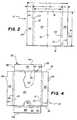
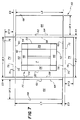
- Figs. 2-8 illustrate three sheets of corrugated paperboard that are sized, scored, joined, folded, and sealed closed around article A so as to form protective inner and outer packages of a packaging arrangement conforming to the first-described embodiment of this invention; while corresponding Figs. 9-15 illustrate, in similar fashion, formation of a packaging arrangement according to the second-described embodiment.
- First sheet 10 also has transversely oriented, longitudinally spaced pairs of parallel inner and outer scored lines 12 and 14 , respectively, that are symmetrically disposed thereon about transverse centerline 16 .
- first-sheet rectangular central portion 20 that substantially conforms, in both shape and size, with the article bottom surface B.
- Each inner scored line 12, the outer scored line 14 nearby, and longitudinal edges 18 together define a first-sheet rectangular side portion 22 that extends longitudinally from central portion 20 and substantially conforms, in both shape and size, with one of the article sides S.
- each outer scored line 14, the nearer one of transverse edges 24 , and longitudinal edges 18 together define a first-sheet rectangular flap portion 26 that extends longitudinally from the adjacent side portion 22 and substantially conforms, in shape and size, to a portion of the article top surface T.
- each flap portion 26 extends from the adjacent side portion 22 by an amount F1 that is between one-tenth and one-half the article width W, i.e., W/10 ⁇ F1 ⁇ W/2.
- the central portion 20 is adapted to support the article bottom surface B thereon, after which the side portions 22 and flap portions 26 are folded about the inner scored lines 12 and outer scored lines 14 respectively, and are thus brought into adjacent confronting relation with the article sides S and article top surface T respectively.
- the inner scored lines 32 and the longitudinal edges 38 of second sheet 30 together define a second-sheet rectangular central portion 40 that substantially conforms, in both shape and size, with the first-sheet central portion 20.
- Each inner scored line 32, the outer scored line 34 nearby, and longitudinal edges 38 together define a second-sheet rectangular end portion 42 that extends longitudinally from central portion 40 and substantially conforms, in both shape and size, with one of the article ends E.
- each outer scored line 34, the nearer one of transverse edges 44 , and longitudinal edges 38 together define a second-sheet rectangular flap portion 46 that extends longitudinally from the adjacent end portion 42 and substantially conforms, in shape and size, with a portion of the article top surface T.
- each flap portion 46 extends from the adjacent end portion 42 by an amount F2 that is between one-tenth and one-half the article length L, i.e., L/10 ⁇ F2 ⁇ L/2.
- the second sheet 30 is positioned to underlie the first sheet 10 transversely thereto so that the second-sheet central portion 40 is in registered supporting relation with the first-sheet central portion 20, after which the second-sheet end portions 42 and flap portions 46 are folded about the second-sheet inner scored lines 32 and outer scored lines 34 respectively, and are thus brought into adjacent confronting relation with the article ends E and article top surface T respectively (when article A is supported on first-sheet central portion 20).
- Fig. 4 shows first sheet 10 superposed transversely upon second sheet 30, with first-sheet central portion 20 secured in registered overlying relation to second-sheet central portion 40 by adhesive means provided at their interface.
- adhesive means may conveniently comprise any commonly used case-sealing hot-melt glue applied to either of the facing surfaces of central portions 20 and 40.
- Fig. 5 illustrates the glued-together first and second sheets 10 and 30 of Fig. 4 with article A of Fig. 1 placed thereon so that the article bottom surface B is in registered overlying relation to first-sheet central portion 20 and the article top surface T is facing upward.
- Fig. 6 portrays an inner package PI comprising the glued-together sheets and article of Fig. 5 with second-sheet end portions 42 and flap portions 46 folded, about scored lines 32 and 34 respectively, into contact with article ends E and end portions of article top surface T respectively, and with first-sheet side portions 22 and flap portions 26 folded, about scored lines 12 and 14 respectively, into contact with article sides S and second-sheet flap portions 46 respectively, flap portions 26 being secured in their overlapping contact with flap portions 46 by adhesive means, such as the aforementioned hot-melt glue, provided at their interfacing surfaces in package corner areas G .
- the resulting inner package PI has an overall height HPI substantially equal to H+2(t1+t2).
- Fig. 7 depicts a third corrugated-paperboard sheet 50 that includes a third-sheet rectangular central portion 52 having opposite sides 54 and opposite ends 56 of predetermined length L3 and width W3 , respectively, which are greater than the article length L and width W, respectively, whereby the third-sheet central portion 52 is larger in area than the first-sheet and second-sheet central portions 20 and 40.
- the predetermined length L3 and width W3 are at least five percent greater than the article length L and width W respectively.
- the third-sheet central portion sides 54 are defined by an inner pair of longitudinal scored lines 58 that are equal in length to the predetermined length L3 and separated from each other by the predetermined width W3.
- Third sheet 50 also includes a pair of third-sheet side portions 62 , which extend laterally from the central portion sides 54, respectively, to an outer pair of longitudinal scored lines 64 .
- Third sheet 50 finally includes a pair of third-sheet end-flap portions 74 , which extend longitudinally from end portions 70, respectively, to transverse edges 76 thereof.
- Edges 76 are substantially equal in length to the predetermined width W3 and are spaced from the outer pair of transverse scored lines 72 by an amount EF3 that preferably is at least one-tenth and at most one-half the predetermined length L3 plus the score-line allowance c, i.e., (L3/10 +c) ⁇ EF3 ⁇ (L3/2 +c).
- EF3 preferably is at least one-tenth and at most one-half the predetermined length L3 plus the score-line allowance c, i.e., (L3/10 +c) ⁇ EF3 ⁇ (L3/2 +c).
- the third sheet 50 is positioned to underlie the inner package PI so that the second-sheet central portion 40 at the bottom of package PI is longitudinally aligned with and centrally disposed on the third-sheet central portion 52, after which the pairs of third-sheet side and end portions 62 and 70 are to be folded about the inner pairs of longitudinal and transverse scored lines 58 and 60 respectively, and thus brought into spaced confronting relation with the folded pairs of first-sheet side portions 22 and second-sheet end portions 42 respectively, whereupon the pairs of third-sheet side-flap and end-flap portions 66 and 74 are folded about the outer pairs of longitudinal and transverse scored lines 64 and 72, respectively, into adjacent confronting relation with the folded pairs of first-sheet and second-sheet flap portions 26 and 46.
- the second-sheet central portion 40 of the inner package is secured to the third-sheet central portion 52 by adhesive means such as the aforementioned hot-melt glue applied to either of their interfacing surfaces.
- Fig. 8 portrays the final outer package PO comprising the glued-together third sheet 50 and inner package PI of Fig. 7 with third-sheet side and end portions 62 and 70 folded, about scored lines 58 and 60 respectively, into spaced confronting relation with folded first-sheet side portions 22 and folded second-sheet end portions 42 respectively, and with third-sheet end-flap and side-flap portions 74 and 66 folded, about scored lines 72 and 64 respectively, into contact with folded first-sheet flap portions 26 and folded third-sheet end-flap portions 74 respectively, the side-flap portions 66 being firmly secured in their overlapping contact with end-flap portions 74 by strips of adhesive tape AT joining side-flap portions 66 to each other and to third-sheet end portions 70 as shown, thereby maintaining the folded third-sheet side-flap and end-flap portions 66 and 74 in their aforementioned adjacent confronting relation with the folded first-sheet and second-sheet flap portions 26 and 46 of the inner package.
- this embodiment is identical to the first embodiment except that the positions and sequence of folding of the first and second sheets, relative to the article, are now reversed.
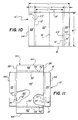
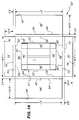
- This embodiment is illustrated in Figs. 9-15, which correspond closely to Figs. 2-8 and bear the same reference characters used therein but with primes (') added to distinguish the second embodiment.
- First sheet 30' also has transversely oriented, longitudinally spaced pairs of parallel inner and outer scored lines 32 ' and 34 ', respectively, that are symmetrically disposed thereon about transverse centerline 36 '.
- the inner scored lines 32' and the longitudinal edges 38 ' of first sheet 30' together define a first-sheet rectangular central portion 40 ' that substantially conforms, in both shape and size, with the article bottom surface B.
- Each inner scored line 32', the outer scored line 34' nearby, and longitudinal edges 38' together define a first-sheet rectangular end portion 42 ' that extends longitudinally from central portion 40' and substantially conforms, in both shape and size, with one of the article ends E.
- each outer scored line 34', the nearer one of transverse edges 44 ', and longitudinal edges 38' together define a first-sheet rectangular flap portion 46 ' that extends longitudinally from the adjacent end portion 42' and substantially conforms, in shape and size, with a portion of the article top surface T.
- each flap portion 46' extends from the adjacent end portion 42' by an amount F2 ' that is between one-tenth and one-half the article length L, i.e., L/10 ⁇ F2' ⁇ L/2.
- the central portion 40' is adapted to support the article bottom surface B thereon, after which the end portions 42' and flap portions 46' are folded about the inner scored lines 32' and outer scored lines 34' respectively, and are thus brought into adjacent confronting relation with the article ends E and article top surface T respectively.
- Second sheet 10' also has transversely oriented, longitudinally spaced pairs of parallel inner and outer scored lines 12 ' and 14 ', respectively, that are symmetrically disposed thereon about transverse centerline 16 '.
- the inner scored lines 12' and the longitudinal edges 18 ' of second sheet 10' together define a second-sheet rectangular central portion 20 ' that substantially conforms, in both shape and size, with the first-sheet central portion 40'.
- Each inner scored line 12', the outer scored line 14' nearby, and longitudinal edges 18' together define a second-sheet rectangular side portion 22 ' that extends longitudinally from central portion 20' and substantially conforms, in both shape and size, with one of the article sides S.
- each outer scored line 14', the nearer one of transverse edges 24 ', and longitudinal edges 18' together define a second-sheet rectangular flap portion 26 ' that extends longitudinally from the adjacent side portion 22' and substantially conforms, in shape and size, with a portion of the article top surface T.
- each flap portion 26' extends from the adjacent side portion 22' by an amount F1 ' that is between one-tenth and one-half the article width W, i.e., W/10 ⁇ F1' ⁇ W/2.
- the second sheet 10' is positioned to underlie the first sheet 30' transversely thereto so that the second-sheet central portion 20' is in registered supporting relation with the first-sheet central portion 40', after which the second-sheet side portions 22' and flap portions 26' are folded about the second-sheet inner scored lines 12' and outer scored lines 14' respectively, and are thus brought into adjacent confronting relation with the article sides S and article top surface T respectively (when article A is supported on first-sheet central portion 40').
- Fig. 11 is similar to Fig. 4 of the first embodiment but shows, for this embodiment, first sheet 30' superposed transversely upon second sheet 10', with first-sheet central portion 40' secured in registered overlying relation to second-sheet central portion 20' by adhesive means provided at their interface.
- adhesive means may conveniently comprise any commonly used case-sealing hot-melt glue applied to either of the facing surfaces of central portions 40' and 20'.
- Fig. 12 is similar to Fig. 5 of the first embodiment but illustrates, for this embodiment, the glued-together first and second sheets 30' and 10' of Fig. 11 with article A of Fig. 1 placed thereon so that the article bottom surface B is in registered overlying relation to first-sheet central portion 40' and the article top surface T is facing upward.
- Fig. 13 is similar to Fig. 6 of the first embodiment but portrays, for this embodiment, an inner package PI ' comprising the glued-together sheets and article of Fig. 12 with second-sheet side portions 22' and flap portions 26' folded, about scored lines 12' and 14' respectively, into contact with article sides S and side portions of article top surface T respectively, and with first-sheet end portions 42' and flap portions 46' folded, about scored lines 32' and 34' respectively, into contact with article ends E and second-sheet flap portions 26' respectively, flap portions 46' being secured in their overlapping contact with flap portions 26' by adhesive means, such as the aforementioned hot-melt glue, provided at their interfacing surfaces in package corner areas G '.
- the resulting inner package PI' has an overall height HPI ' substantially equal to H+2(t1'+t2').
- Fig. 14 is similar to Fig. 7 of the first embodiment but depicts, for this embodiment, a third corrugated-paperboard sheet 50 ' that includes a third-sheet rectangular central portion 52 ' having opposite sides 54 ' and opposite ends 56 ' of predetermined length L3 ' and width W3 ', respectively, which are greater than the article length L and width W, respectively, whereby the third-sheet central portion 52' is larger in area than the first-sheet and second-sheet central portions 40' and 20'.
- the predetermined length L3' and width W3' are at least five percent greater than the article length L and width W respectively.
- the third-sheet central portion sides 54' are defined by an inner pair of longitudinal scored lines 58 ' that are equal in length to the predetermined length L3' and separated from each other by the predetermined width W3'.
- the third-sheet central portion ends 56' are defined by an inner pair of transverse scored lines 60 ' that are equal in length to the predetermined width W3' and separated from each other by the predetermined length L3'.
- Third sheet 50' also includes a pair of third-sheet side portions 62 ', which extend laterally from the central portion sides 54', respectively, to an outer pair of longitudinal scored lines 64 '.
- Third sheet 50' additionally includes a pair of third-sheet side-flap portions 66 ', which extend laterally from side portions 62', respectively, to longitudinal edges 68 ' thereof.
- Third sheet 50' further includes a pair of third-sheet end portions 70 ', which extend longitudinally from the central portion ends 56', respectively, to an outer pair of transverse scored lines 72 '.
- Third sheet 50' finally includes a pair of third-sheet end-flap portions 74 ', which extend longitudinally from end portions 70', respectively, to transverse edges 76 ' thereof.
- Edges 76' are substantially equal in length to the predetermined width W3' and are spaced from the outer pair of transverse scored lines 72' by an amount EF3 ' that preferably is at least one-tenth and at most one-half the predetermined length L3' plus the score-line allowance c', i.e., (L3'/10 +c') ⁇ EF3' ⁇ (L3'/2 +c').
- EF3 ' preferably is at least one-tenth and at most one-half the predetermined length L3' plus the score-line allowance c', i.e., (L3'/10 +c') ⁇ EF3' ⁇ (L3'/2 +c').
- the third sheet 50' is positioned to underlie the inner package PI' so that the second-sheet central portion 20' at the bottom of package PI' is longitudinally aligned with and centrally disposed on the third-sheet central portion 52', after which the pairs of third-sheet end and side portions 70' and 62' are to be folded about the inner pairs of transverse and longitudinal scored lines 60' and 58' respectively, and thus brought into spaced confronting relation with the folded pairs of first-sheet end portions 42' and second-sheet side portions 22' respectively, whereupon the pairs of third-sheet end-flap and side-flap portions 74' and 66' are folded about the outer pairs of transverse and longitudinal scored lines 72' and 64', respectively, into adjacent confronting relation with the folded pairs of first-sheet and second-sheet flap portions 46' and 26'.
- the second-sheet central portion 20' of the inner package is secured to the third-sheet central portion 52' by adhesive means such as the aforementioned hot-melt glue applied to either of their interfacing surfaces.
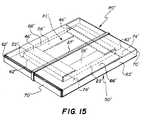
- Fig. 15 is similar to Fig. 8 of the first embodiment but portrays, for this embodiment, the final outer package PO ' comprising the glued-together third sheet 50' and inner package PI' of Fig. 14 with third-sheet end and side portions 70' and 62' folded, about scored lines 60' and 58' respectively, into spaced confronting relation with folded first-sheet end portions 42' and folded second-sheet side portions 22' respectively, and with third-sheet end-flap and side-flap portions 74' and 66' folded, about scored lines 72' and 64' respectively, into contact with folded first-sheet flap portions 46' and folded third-sheet end-flap portions 74' respectively, the side-flap portions 66' being firmly secured in their overlapping contact with end-flap portions 74' by at least one strip of adhesive tape AT ' joining side-flap portions 66' to each other and to third-sheet end portions 70' as shown, thereby maintaining the folded third-sheet end-flap and side-flap portions 74' and 66' in their
- each such arrangement is especially adaptable to customized on-line cutting, scoring, and joining of its constituent paperboard sheets to form such inner and outer packages for a succession of randomly varying articles.
- Standard corrugated-paperboard cutting tools and scoring wheels may be utilized to cut and score hopper-fed sheets in accordance with the dimensions of each succeeding article to be packaged.
- Electronic controls may be used to command needed mechanical drives, sheet pushers, and positioners, for selectively and readily positioning the sheets, cutting knives, and scoring wheels in an automated on-line packaging operation.
Landscapes
- Engineering & Computer Science (AREA)
- Mechanical Engineering (AREA)
- Buffer Packaging (AREA)
- Packages (AREA)
- Cartons (AREA)
Claims (20)
- Packungsanordnung zur sicheren Verpackung eines rechteckförmigen Artikels (A), der eine bestimmte Länge (L), Breite (W) und Höhe (H) besitzt, durch die einander gegenüberliegende Seiten (S), einander gegenüberliegende Enden (E) sowie eine Ober- und eine Unterseite (B und T) des Artikels (A) definiert sind, dadurch gekennzeichnet,
daß ein erstes, im wesentlichen rechteckiges Blatt (10) aus Wellpappe vorgesehen ist, dessen Breite (W1) im wesentlichen gleich der Länge (L) des Artikels ist und dessen Länge (L1) größer ist als die Breite (W) des Artikels, zuzüglich der zweifachen Höhe (H) des Artikels, jedoch nicht größer ist als das Zweifache der Breite (W) des Artikels, zuzüglich der zweifachen Höhe (H) des Artikels, daß das erste Blatt (10) jeweils zwei zur Querseite hin ausgerichtete, längs im Abstand voneinander angeordnete, parallele innere und äußere Kerblinien (12 und 14) aufweist, die einen rechteckigen Mittelteil (20) des ersten Blattes umschließen, der im wesentlichen der Unterseite (B) des Artikels entspricht, daß zwei rechteckige Seitenabschnitte (22) aus gegenüberliegenden Seiten des Mittelteils (20) des ersten Blattes herausragen, die im wesentlichen den Seiten (S) des Artikels entsprechen, und daß zwei Laschenabschnitte (26) aus den entsprechenden Seitenabschnitten (22) des ersten Blattes herausragen, wobei der Mittelteil (20) des ersten Blattes zur Lagerung der Unterseite (B) des Artikels dient und die beiden Seiten- und Laschenabschnitte (22 und 26) des ersten Blattes jeweils um die beiden inneren und äußeren Kerblinien (12 und 14) des ersten Blattes so faltbar sind, daß sie jeweils gegenüber den Seiten (S) bzw. der Oberseite (T) des Artikels dicht anliegend positionierbar sind, wenn der Artikel (A) auf dem Mittelteil (20) des ersten Blattes aufliegt,
daß ein zweites, im wesentlichen rechteckiges Blatt (30) aus Wellpappe vorgesehen ist, dessen Breite (W2) im wesentlichen gleich der Breite (W) des Artikels ist und dessen Länge (L2) größer ist als die Länge (L) des Artikels, zuzüglich der zweifachen Höhe (H) des Artikels, jedoch nicht größer ist als das Zweifache der Länge (L) des Artikels, zuzüglich der zweifachen Höhe (H) des Artikels, daß das zweite Blatt (30) jeweils zwei quer verlaufende parallel im Abstand zueinander angeordnete innere und äußere Kerblinien (32 und 34) besitzt, die ein rechteckiges Mittelteil (40) des zweiten Blattes umgeben, das im wesentlichen dem Mittelteil (20) des ersten Blattes entspricht, daß weiterhin aus den einander gegenüberliegenden Enden des Mittelteils (40) des zweiten Blattes zwei rechteckige Endabschnitte (42) herausragen, die im wesentlichen den Enden (E) des Artikels entsprechen, und aus den Endabschnitten (42) des zweiten Blattes zwei Laschenabschnitte (46) herausragen, wobei das zweite Blatt (30) quer ausgerichtet so unter dem ersten Blatt (10) liegt, daß der Mittelteil (20) des ersten Blattes deckungsgleich auf dem Mittelteil (40) des zweiten Blattes gelagert ist, und wobei die beiden Endabschnitte und Laschenabschnitte (42 und 46) des zweiten Blattes jeweils so um die beiden inneren und äußeren Kerblinien (32 bzw. 34) des zweiten Blattes faltbar sind, daß sie den Enden (E) bzw. der Oberseite (T) des Artikels dicht benachbart gegenüberliegen, wenn der Artikel (A) auf dem Mittelteil (20) des ersten Blattes aufliegt, und
daß ein drittes Blatt (50) aus Wellpappe vorgesehen ist, dessen rechteckiges Mittelteil (52) einander gegenüberliegende Seiten (54) und Enden (56) aufweist, deren vorbestimmte Länge (L3) bzw. Breite (W3) größer ist als die Länge (L) bzw. Breite (W) des Artikels, und das demgemäß eine größere Flächenausdehnung als die Mittelteile (20 und 40) des ersten und des zweiten Blattes hat, daß die Seiten (54) des Mittelteils (52) des dritten Blattes durch zwei innere längs verlaufende Kerblinien (58) begrenzt sind, deren Länge gleich der vorbestimmten Länge (L3) ist und die in einem vorbestimmten Abstand (W3) voneinander liegen, und die Enden (56) des Mittelteils (52) des dritten Blattes von zwei inneren quer verlaufenden Kerblinien (60) begrenzt sind, deren Länge gleich der vorbestimmten Breite (W3) ist und die durch die vorbestimmte Länge (L3) voneinander getrennt sind, daß das dritte Blatt (50) außerdem zwei Seitenabschnitte (62) aufweist, die sich seitlich von je einer Seite (54) des Mittelteils aus zu zwei äußeren längs verlaufenden Kerblinien (64) hin erstrecken, deren Länge gleich der vorbestimmten Länge (L3) ist und die zu den beiden inneren längs verlaufenden Kerblinien (58) in einem Abstand von mindestens (S3) der Höhe (H) des Artikels liegen, daß das dritte Blatt zwei Seitenlaschen (66) besitzt, die seitlich von je einem Seitenabschnitt (62) des dritten Blattes zu Längskanten (68) hin verlaufen, deren Länge im wesentlichen gleich der vorbestimmten Länge (L3) ist und die zu den beiden äußeren längs verlaufenden Kerblinien (64) in einem Abstand liegen, der im wesentlichen der Hälfte (SF3) der vorbestimmten Breite (W3) entspricht, daß das dritte Blatt (50) zwei Endabschnitte (70) aufweist, die sich in Längsrichtung jeweils von den Enden (56) des Mittelteils zu zwei äußeren quer verlaufenden Kerblinien (72) hin erstrecken, deren Länge der vorbestimmten Breite (W3) entspricht und die zu den beiden inneren quer verlaufenden Kerblinien (60) in einem Abstand von mindestens (E3) der Höhe (H) des Artikels angeordnet sind, und daß sich aus den Endabschnitten (70) des dritten Blattes jeweils Endlaschen (74) in Längsrichtung zu Querkanten (76) erstrecken, deren Länge im wesentlichen der vorbestimmten Breite (W3) entspricht und die zu den beiden äußeren quer verlaufenden Kerblinien (72) in einem Abstand von höchstens der Hälfte (EF3) der vorbestimmten Länge (L3) angeordnet sind, wobei das dritte Blatt (50) so unter dem zweiten Blatt (30) liegt, daß der Mittelteil (40) des zweiten Blattes in Längsrichtung ausgerichtet und mittig auf dem Mittelteil (52) des dritten Blattes angeordnet ist, wobei die beiden Seiten- und Endabschnitte (62 und 70) jeweils um die beiden inneren längs und quer verlaufenden Kerblinien (58 bzw. 60) so faltbar sind, daß sie den beiden gefalteten Seitenabschnitten (22) des ersten Blattes bzw. den Endabschnitten (42) des zweiten Blattes im Abstand gegenüberliegen, und wobei die beiden Seitenlaschen (66) und Endlaschen (74) des dritten Blattes um die beiden äußeren längs und quer verlaufenden Kerblinien (64 bzw. 72) so faltbar sind, daß sie den beiden gefalteten Laschenabschnitten (26) des ersten Blattes und den beiden gefalteten Laschenabschnitten (46) des zweiten Blattes dicht benachbart gegenüberliegen. - Packungsanordnung nach Anspruch 1, dadurch gekennzeichnet,
daß einer der beiden Laschenabschnitte (26) des ersten Blattes und einer der beiden Laschenabschnitte (46) des zweiten Blattes beim Falten mit der Oberseite (T) des Artikes in Berührung gelangt, wenn der Artikel (A) auf dem Mittelteil (20) des ersten Blattes aufliegt, und
daß der jeweils andere der beiden Laschenabschnitte (26 und 46) des ersten und des zweiten Blattes beim Falten mit dem jeweils einen der beiden Laschenabschnitte (26 und 46) des ersten und des zweiten Blattes in Berührung gelangt. - Packungsanordnung nach Anspruch 2, dadurch gekennzeichnet,
daß eine der beiden Seitenlaschen des dritten Blattes und eine der beiden Endlaschen (66 und 74) des dritten Blattes beim Falten mit dem jeweils anderen der beiden gefalteten Laschenabschnitte (26 und 46) des ersten und zweiten Blattes in Berührung gelangt und
daß die jeweils andere der beiden Seitenlaschen und Endlaschen (66 und 74) des dritten Blattes beim Falten mit jeweils der einen der beiden Seitenlaschen und Endlaschen (66 und 74) des dritten Blattes in Berührung gelangt. - Packungsanordnung nach Anspruch 3, dadurch gekennzeichnet,
daß sich jeder der Laschenabschnitte (26) des ersten Blattes von dem einen der Seitenabschnitte (22) des ersten Blattes aus über eine Länge (F1) erstreckt, die zwischen einem Zehntel und der Hälfte der Breite (W) des Artikels beträgt, und
daß sich jeder der Laschenabschnitte (46) des zweiten Blattes von dem einen der Endabschnitte (42) des zweiten Blattes aus über eine Länge (F2) erstreckt, die zwischen einem Zehntel und der Hälfte der Länge (L) des Artikels beträgt. - Packungsanordnung nach Anspruch 4, dadurch gekennzeichnet,
daß die Längskante (68) jeder Seitenlasche des dritten Blattes zu einer der äußeren längs verlaufenden Kerblinien (64) jeweils in einem Abstand (SF3) angeordnet ist, der im wesentlichen der Hälfte der vorbestimmten Breite (W3) entspricht, und
daß die Querkante (76) jeder Endlasche des dritten Blattes zu einer der äußeren quer verlaufenden Kerblinien (72) jeweils in einem Abstand (EF3) angeordnet ist, der zwischen einem Zehntel und der Hälfte der vorbestimmten Länge (L3) beträgt. - Packungsanordnung nach Anspruch 5, dadurch gekennzeichnet,
daß die vorbestimmte Länge (L3) des Mittelteils des dritten Blattes mindestens um fünf Prozent größer ist als die Länge (L) des Artikels und
daß die vorbestimmte Breite (W3) des Mittelteils des dritten Blattes mindestens um fünf Prozent größer ist als die Breite (W) des Artikels. - Packungsanordnung nach Anspruch 6, gekennzeichnet durch
erste Mittel, die den Mittelteil (40) des zweiten Blattes deckungsgleich ausgerichtet unter dem Mittelteil (20) des ersten Blattes festhalten,
zweite Mittel, die die beiden gefalteten Laschenabschnitte (26) des ersten Blattes und die beiden gefalteten Laschenabschnitte (46) des zweiten Blattes der Oberseite (T) des Artikels dicht benachbart gegenüberliegend festhalten, wenn der Artikel (A) auf dem Mittelteil (20) des ersten Blattes aufliegt,
dritte Mittel, die den Mittelteil (40) des zweiten Blattes mit dem Mittelteil (52) des dritten Blattes längs ausgerichtet und mittig aufliegend festhalten, und
vierte Mittel, die die beiden gefalteten Seitenlaschen und die beiden gefalteten Endlaschen (66 und 74) des dritten Blattes den beiden gefalteten Laschenabschnitten (26 und 46) des ersten und des zweiten Blattes dicht benachbart gegenüberliegend festhalten. - Packungsanordnung nach Anspruch 7, dadurch gekennzeichnet,
daß die ersten Mittel ein Klebematerial umfassen, das zwischen den Mittelteilen (20 und 40) des ersten und des zweiten Blattes vorgesehen ist,
daß die zweiten Mittel ein Klebematerial umfassen, das bei (G) zwischen den beiden gefalteten Laschenabschnitten (26) des ersten Blattes und den beiden gefalteten Laschenabschnitten (46) des zweiten Blattes vorgesehen ist,
daß die dritten Mittel ein Klebematerial umfassen, das zwischen den Mittelteilen (40 und 52) des zweiten und des dritten Blattes vorgesehen ist, und
daß die vierten Mittel ein Klebeband (AT) umfassen, das die beiden gefalteten Seitenlaschen (66) des dritten Blattes miteinander und mit den beiden gefalteten Endabschnitten (70) des dritten Blattes verbindet. - Packungsanordnung nach Anspruch 2, dadurch gekennzeichnet,
daß jeweils das eine der beiden Paare von Laschenabschnitten (26 und 46) des ersten und des zweiten Blattes die beiden Laschenabschnitte (46) des zweiten Blattes bildet und
daß jeweils das andere der beiden Paare von Laschenabschnitten (26 und 46) des ersten und des zweiten Blattes die beiden Laschenabschnitte (26) des ersten Blattes bildet. - Packungsanordnung nach Anspruch 3, dadurch gekennzeichnet,
daß jeweils das eine der beiden Paare von Seitenlaschen und Endlaschen (66 und 74) des dritten Blattes die beiden Endlaschen (74) des dritten Blattes bildet und
daß jeweils das andere der beiden Paare von Seitenlaschen und Endlaschen (66 und 74) des dritten Blattes die beiden Seitenlaschen (66) des dritten Blattes bildet. - Packungsanordnung zur sicheren Verpackunge eines rechteckförmigen Artikels (A), der eine vorbestimmte Länge (L), Breite (W) und Höhe (H) besitzt, durch die einander gegenüberliegende Seiten (S), einander gegenüberliegende Enden (E) sowie eine Oberseite und eine Unterseite (B und T) des Artikels (A) definiert sind, dadurch gekennzeichnet,
daß ein erstes, im wesentlichen rechteckiges Blatt (30') aus Wellpappe vorgesehen ist, dessen Breite (W2') im wesentlichen gleich der Breite (W) des Artikels ist und dessen Länge (L2') größer ist als die Länge (L) des Artikels, zuzüglich der zweifachen Höhe (H) des Artikels, jedoch nicht größer ist als das Zweifache der Länge (L) des Artikels, zuzüglich dem Zweifachen der Höhe (H) des Artikels, daß das erste Blatt (30') jeweils zwei quer verlaufende, parallel im Abstand voneinander angeordnete innere und äußere Kerblinien (32' und 34') aufweist, die einen rechteckigen Mittelteil (40') des ersten Blattes begrenzen, der sich im wesentlichen deckungsgleich mit der Unterseite (B) des Artikels erstreckt, daß zwei rechteckige Endabschnitte (42') aus jeweils entgegengesetzten Enden des Mittelteils (40') des ersten Blattes herausragen und im wesentlichen den Enden (E) des Artikels entsprechen und zwei Laschenabschnitte (46') jeweils aus den Endabschnitten (42') des ersten Blattes herausragen, wobei der Mittelteil (40') des ersten Blattes zur Lagerung der Unterseite (B) des Artikels dient und die beiden Endabschnitte und Laschenabschnitte (42' und 46') des ersten Blattes jeweils um die beiden inneren und äußeren Kerblinien (32' bzw. 34') faltbar und gegenüber den Enden (E) bzw. auf der Oberseite (T) des Artikels dicht anliegend positionierbar sind, wenn der Artikel (A) auf dem Mittelteil (40') des ersten Blattes aufliegt,
daß ein zweites, im wesentlichen rechteckiges Blatt (10') aus Wellpappe vorgesehen ist, dessen Breite (W1') im wesentlichen gleich der Länge (L) des Artikels ist und dessen Länge (L1') größer ist als die Breite (W) des Artikels, zuzüglich dem Zweifachen der Höhe (H) des Artikels, jedoch nicht größer ist als das Zweifache der Breite (W) des Artikels, zuzüglich dem Zweifachen der Höhe (H) des Artikels, daß das zweite Blatt (10') jeweils zwei zu den Querseiten ausgerichtete, längs im Abstand voneinander liegende parallele innere und äußere Kerblinien (12' und 14') besitzt, die einen rechteckigen Mittelteil (20') des zweiten Blatts begrenzen, der sich im wesentlichen deckungsgleich zu dem Mittelteil (40') des ersten Blatts erstreckt, daß zwei rechteckige Seitenabschnitte (22') sich jeweils aus gegenüberliegenden Seiten des Mittelsteils (20') des zweiten Blattes erstrecken, die im wesentlichen den Seiten (S) des Artikels entsprechen, und zwei Laschenabschnitte (26') des zweiten Blattes jeweils aus den Seitenabschnitten (22') des zweiten Blattes herausragen, wobei das zweite Blatt (10') unter dem ersten Blatt (30') und quer zu diesem so angeordnet ist, daß der Mittelteil (20') des zweiten Blattes deckungsgleich unter dem Mittelteil (40') des ersten Blattes angeordnet ist, und wobei die beiden Seiten- und Laschenabschnitte (22' und 26') des zweiten Blattes jeweils um die beiden inneren und äußeren Kerblinien (12' bzw. 14') faltbar und gegenüber den Seiten (S) bzw. an der Oberseite (T) des Artikels dicht anliegend positionierbar sind, wenn der Artikel (A) auf dem Mittelteil (40') des ersten Blattes aufliegt, und
daß ein drittes Blatt (50') aus Wellpappe vorgesehen ist, das ein rechteckiges Mittelteil (52') mit einander gegenüberliegenden Seiten (54') und Enden (56') besitzt, deren vorbestimmte Länge (L3') bzw. Breite (W3') größer ist als die Länge (L) bzw. Breite (W) des Artikels und einen Mittelteil (52') ergibt, der eine größere Fläche hat als der Mittelteil (40' bzw. 20') des ersten und des zweiten Blattes, daß die Seiten (54') des Mittelteils des dritten Blattes von zwei inneren längs verlaufenden Kerblinien (58') begrenzt sind, deren Länge gleich der vorbestimmten Länge (L3') ist und die durch die vorbestimmte Breite (W3') voneinander getrennt sind, daß die Enden (56') des Mittelteils des dritten Blattes von zwei inneren quer verlaufenden Kerblinien (60') begrenzt sind, deren Länge gleich der vorbestimmten Breite (W3') ist und die durch die vorbestimmte Länge (L3') voneinander getrennt sind, daß das dritte Blatt (50') außerdem zwei Seitenabschnitte (62') aufweist, die sich jeweils seitlich von einer der Seiten (54') des Mittelteils des dritten Blattes aus zu zwei äußeren längs verlaufenden Kerblinien (64') hin erstrecken, deren Länge gleich der vorbestimmten Länge (L3') ist und die von den beiden inneren längs verlaufenden Kerblinien (58') durch mindestens (S3') der Höhe (H) des Artikels getrennt sind, daß zwei Seitenlaschen (66') seitlich aus den Seitenabschnitten (62') des dritten Blattes jeweils zu Längskanten (68') hin ragen, deren Länge im wesentlichen gleich der vorbestimmten Länge (L3') ist und die von den beiden äußeren längs verlaufenden Kerblinien (64') um im wesentlichen die Hälfte (SF3') der vorbestimmten Breite (W3') getrennt sind, daß das dritte Blatt (50') außerdem zwei Endabschnitte (70') besitzt, die sich jeweils in Längsrichtung von den Enden (56') des Mittelteils des dritten Blattes aus zu zwei äußeren quer verlaufenden Kerblinien (72') hin erstrecken, deren Länge gleich der vorbestimmten Breite (W3') ist und die von den beiden inneren quer verlaufenden Kerblinien (60') durch mindestens (E3') der Höhe (H) des Artikels getrennt sind, und daß das dritte Blatt zwei Endlaschen (74') aufweist, die sich in Längsrichtung jeweils von den Endabschnitten (70') des dritten Blattes weg zu Querkanten (76') erstrecken, deren Länge im wesentlichen gleich der vorbestimmten Breite (W3') ist und die von den beiden äußeren quer verlaufenden Kerblinien (72') höchstens durch die Hälfte (EF3') der vorbestimmten Länge (L3') getrennt sind, wobei das dritte Blatt (50') derart unter dem zweiten Blatt (10') liegt, daß der Mittelteil (20') des zweiten Blattes längs ausgerichtet und mittig auf dem Mittelteil (52') des dritten Blattes liegt, und wobei die beiden End- und Seitenabschnitte (70' und 62') des dritten Blattes jeweils um die inneren quer bzw. längs verlaufenden Kerblinien (60' bzw. 58') so faltbar sind, daß sie den beiden gefalteten Endabschnitten (42') des ersten Blattes bzw. den beiden Seitenabschnitten (22') des zweiten Blattes im Abstand gegenüberliegen, und die beiden Endlaschen und Seitenlaschen (74' und 66') des dritten Blattes jeweils um die äußeren quer bzw. längs verlaufenden Kerblinien (72' bzw. 64') so faltbar sind, daß sie gegenüber den beiden gefalteten Laschenabschnitten (46' und 26') des ersten Blattes und des zweiten Blattes dicht anliegend positionierbar sind. - Packungsanordnung nach Anspruch 11, dadurch gekennzeichnet,
daß jeweils das eine der Paare von Laschenabschnitten (46') und Laschenabschnitten (26') des ersten und des zweiten Blattes beim Falten mit der Oberfläche (T) des Artikels in Berührung kommt, wenn der Artikel (A) auf dem Mittelteil (40') des ersten Blattes aufliegt, und
daß jeweils das andere der Paare von Laschenabschnitten (46' und 26') des ersten und des zweiten Blattes beim Falten mit dem jeweils einen Paar der Laschenabschnitte (46' und 26') des ersten und des zweiten Blattes in Berührung gelangt. - Packungsanordnung nach Anspruch 12, dadurch gekennzeichnet,
daß eines der Paare von Laschenabschnitten (46' und 26') des ersten und des zweiten Blattes aus den beiden Laschenabschnitten (26') des zweiten Blattes besteht und
daß das andere der Paare von Laschenabschnitten (46' und 26') des ersten und des zweiten Blattes aus den beiden Laschenabschnitten (46') des ersten Blattes besteht. - Packungsanordnung nach Anspruch 12, dadurch gekennzeichnet,
daß das eine der Paare von Seitenlaschen und Endlaschen (66' und 74') des dritten Blattes beim Falten mit dem jeweils anderen gefalteten Paar von Laschenabschnitten (46' und 26') des ersten und des zweiten Blattes in Berührung gelangt und
daß das andere der Paare von Seitenlaschen und Endlaschen (66' und 74') des dritten Blattes beim Falten mit dem jeweils einen Paar von Seiten- und Endlaschen (66' und 74') des dritten Blattes in Berührung gelangt. - Packungsanordnung nach Anspruch 14, dadurch gekennzeichnet,
daß das eine der Paare von Seitenlaschen und Endlaschen (66' und 74') des dritten Blattes aus den beiden Endlaschen (74') besteht und
daß das andere der Paare von Seitenlaschen und Endlaschen (66' und 74') des dritten Blattes aus den Seitenlaschen (66') besteht. - Packungsanordnung nach Anspruch 14, dadurch gekennzeichnet,
daß jeder der Laschenabschnitte (46') des ersten Blattes aus einem der Endabschnitte (42') des ersten Blattes um einen zwischen einem Zehntel und der Hälfte der Länge (L) des Artikels liegenden Betrag vorragt und
daß jeder der Laschenabschnitte (26') des zweiten Blattes aus einem der Seitenabschnitte (22') des zweiten Blattes um einen zwischen einem Zehntel und der Hälfte der Breite (W) des Artikels liegenden Betrag vorragt. - Packungsanordnung nach Anspruch 16, dadurch gekennzeichnet,
daß jede der Längskanten (68') der Seitenlaschen des dritten Blattes von der einen der beiden äußeren längs verlaufenden Kerblinien (64') im wesentlichen um die Hälfte (SF3') der vorbestimmten Breite (W3') entfernt ist und
daß jede der Querkanten (76') der Endlaschen des dritten Blattes zu der einen der beiden äußeren quer verlaufenden Kerblinien (72') in einem Abstand (EF3') angeordnet ist, der zwischen einem Zehntel und der Hälfte der vorbestimmten Länge (L3') liegt. - Packungsanordnung nach Anspruch 17, dadurch gekennzeichnet,
daß die vorbestimmte Länge (L3') des Mittelteils des dritten Blattes um mindestens fünf Prozent größer ist als die Länge (L) des Artikels und
daß die vorbestimmte Breite (W3') des Mittelteils des dritten Blattes um mindestens fünf Prozent größer ist als die Breite (W) des Artikels. - Packungsanordnung nach Anspruch 18, gekennzeichnet durch
erste Mittel, die den Mittelteil (20') des zweiten Blattes unter dem Mittelteil (40') des ersten Blattes deckungsgleich ausgerichtet halten,
zweite Mittel, die die gefalteten Paare von Laschenabschnitten (46' und 26') des ersten und des zweiten Blattes der Oberseite (T) des Artikels dicht gegenüberliegend festhalten, wenn der Artikel (A) auf dem Mittelteil (40') des ersten Blattes aufliegt,
dritte Mittel, die den Mittelteil (20') des zweiten Blattes auf dem Mittelteil (52') des dritten Blattes längs ausgerichtet und mittig angeordnet halten, und
vierte Mittel, die die gefalteten Paare von Endlaschen und Seitenlaschen (74' und 66') des dritten Blattes den gefalteten Paaren von Laschenabschnitten (46' und 26') des ersten und des zweiten Blattes dicht gegenüberliegend festhalten. - Packungsanordnung nach Anspruch 19, dadurch gekennzeichnet,
daß die ersten Haltemittel ein Klebematerial umfassen, das zwischen den Mittelteilen (40' und 20') des ersten und des zweiten Blattes angeordnet ist,
daß die zweiten Haltemittel ein Klebematerial umfassen, das bei (G') zwischen den beiden gefalteten Laschenabschnitten (46') des ersten Blattes und den beiden gefalteten Laschenabschnitten (26') des zweiten Blattes angeordnet ist,
daß die dritten Haltemittel ein Klebematerial umfassen, das zwischen den Mittelteilen (20' und 52') des zweiten und des dritten Blattes angeordnet ist, und
daß die vierten Haltemittel ein Klebeband (AT') umfassen, das die beiden gefalteten Seitenlaschen (66') des dritten Blattes miteinander und mit den gefalteten Endabschnitten (70') des dritten Blattes verbindet.
Applications Claiming Priority (5)
| Application Number | Priority Date | Filing Date | Title |
|---|---|---|---|
| US44963989A | 1989-12-12 | 1989-12-12 | |
| US449639 | 1989-12-12 | ||
| US07/490,516 US4974770A (en) | 1989-12-12 | 1990-03-01 | Customized packaging |
| US490516 | 1990-03-01 | ||
| PCT/US1990/007251 WO1991008956A1 (en) | 1989-12-12 | 1990-12-11 | Customized packaging |
Publications (2)
| Publication Number | Publication Date |
|---|---|
| EP0457899A1 EP0457899A1 (de) | 1991-11-27 |
| EP0457899B1 true EP0457899B1 (de) | 1994-05-04 |
Family
ID=27035756
Family Applications (1)
| Application Number | Title | Priority Date | Filing Date |
|---|---|---|---|
| EP91902363A Expired - Lifetime EP0457899B1 (de) | 1989-12-12 | 1990-12-11 | Produktangepasste verpackung |
Country Status (5)
| Country | Link |
|---|---|
| US (1) | US4974770A (de) |
| EP (1) | EP0457899B1 (de) |
| JP (1) | JPH0651503B2 (de) |
| DE (1) | DE69008713T2 (de) |
| WO (1) | WO1991008956A1 (de) |
Families Citing this family (5)
| Publication number | Priority date | Publication date | Assignee | Title |
|---|---|---|---|---|
| WO1993004934A1 (en) * | 1991-09-11 | 1993-03-18 | Horsell Graphic Industries Ltd | A box |
| GB9825273D0 (en) * | 1998-11-19 | 1999-01-13 | Moore Alistair F | Improvements in or relating to packaging |
| ES1077714Y (es) * | 2012-07-31 | 2012-12-20 | Gutierrez Jose Ramon Perez | Envase de madera |
| US11377283B2 (en) * | 2019-10-28 | 2022-07-05 | Park Communications, LLC | Hanging pocket with tamper detection |
| US12330845B2 (en) * | 2022-12-07 | 2025-06-17 | Movie Mars, Inc. | Damage-resistant packaging box for shipping planar articles |
Family Cites Families (32)
| Publication number | Priority date | Publication date | Assignee | Title |
|---|---|---|---|---|
| DE1074385B (de) * | 1960-01-28 | |||
| GB131928A (de) * | ||||
| US987958A (en) * | 1909-04-23 | 1911-03-28 | Sefton Mfg Company | Packing or shipping box. |
| FR513270A (fr) * | 1915-07-31 | 1921-02-11 | Gustav Lohoff | Enveloppe pour marchandises angulaires avec deux bandes de carton ondulé placees en croix autour de la marchandise et une ficelle enlacée autour de ces bandes |
| US1399305A (en) * | 1921-03-25 | 1921-12-06 | Molnar Julius | Holder for toilet articles |
| US2005967A (en) * | 1934-03-19 | 1935-06-25 | Michigan Electrotype And Stere | Package |
| US2314951A (en) * | 1936-06-24 | 1943-03-30 | Nat Folding Box Co | Carton |
| US2276128A (en) * | 1937-09-15 | 1942-03-10 | Charles P Wellman | Paperboard carton |
| US2246097A (en) * | 1938-06-11 | 1941-06-17 | Belsinger Inc | Fiberboard container |
| US2387482A (en) * | 1944-03-24 | 1945-10-23 | Vineberg Joseph Hirsch | Box |
| US2703645A (en) * | 1948-04-01 | 1955-03-08 | George W Scrimshaw | Box, package, and wrapper |
| US2589604A (en) * | 1949-03-11 | 1952-03-18 | North American Aviation Inc | Package and method of packaging |
| US3024939A (en) * | 1958-09-22 | 1962-03-13 | Skydyne Inc | Case |
| US3145905A (en) * | 1958-09-26 | 1964-08-25 | Moore George Arlington | Container construction |
| US3057468A (en) * | 1960-04-05 | 1962-10-09 | Flanders Filters | Package for filters |
| US3227354A (en) * | 1961-03-01 | 1966-01-04 | Gunyou John | Corrugated shipping container and the process and materials employed therein |
| DE1197378B (de) * | 1961-10-06 | 1965-07-22 | Gustav Maier Fa | Faltschachtel |
| US3170617A (en) * | 1962-06-06 | 1965-02-23 | Joseph H Vineberg | Packaging box |
| US3279677A (en) * | 1964-10-27 | 1966-10-18 | Int Harvester Co | Article isolating packing construction and the like and blank for making the same |
| US3295741A (en) * | 1965-06-01 | 1967-01-03 | Waldorf Paper Prod Co | Shipping folders |
| US3281049A (en) * | 1965-06-03 | 1966-10-25 | Interstate Container Corp | Pallet container |
| US3445051A (en) * | 1968-01-04 | 1969-05-20 | Logistics Ind Corp | Container |
| US3666166A (en) * | 1970-05-22 | 1972-05-30 | Gen Corrugated Machinery Co In | Wrapping set and package formed therefrom |
| ZA705258B (en) * | 1970-07-29 | 1971-10-27 | J Stegmann | Improvements to blanks for boxes and the manufacture of boxes therefrom |
| US3718275A (en) * | 1971-09-28 | 1973-02-27 | Metaframe Corp | Protective shipping and display wrapper for an aquarium |
| US3952672A (en) * | 1974-12-19 | 1976-04-27 | International Paper Company | Corrugated disposable pallet |
| US3966113A (en) * | 1975-05-14 | 1976-06-29 | Cavalier Packaging Company, Inc. | One piece box folder |
| US4046311A (en) * | 1976-07-16 | 1977-09-06 | Westvaco Corporation | Return mail container |
| US4300679A (en) * | 1980-08-27 | 1981-11-17 | Container Corporation Of America | Self locking folder |
| FI63371C (fi) * | 1982-02-05 | 1983-06-10 | Veikko Ilmari Janhonen | Foerpackningsaemne och foerpackningsfoerfarande |
| FR2563192B1 (fr) * | 1984-04-19 | 1986-08-14 | Chevalier Pierre | Emballage comprenant une bande et des volets lateraux |
| US4880141A (en) * | 1989-03-10 | 1989-11-14 | Gossler Hans K | Pallets supported reinforced container |
-
1990
- 1990-03-01 US US07/490,516 patent/US4974770A/en not_active Expired - Fee Related
- 1990-12-11 EP EP91902363A patent/EP0457899B1/de not_active Expired - Lifetime
- 1990-12-11 JP JP3502741A patent/JPH0651503B2/ja not_active Expired - Lifetime
- 1990-12-11 DE DE69008713T patent/DE69008713T2/de not_active Expired - Fee Related
- 1990-12-11 WO PCT/US1990/007251 patent/WO1991008956A1/en not_active Ceased
Also Published As
| Publication number | Publication date |
|---|---|
| WO1991008956A1 (en) | 1991-06-27 |
| EP0457899A1 (de) | 1991-11-27 |
| DE69008713D1 (de) | 1994-06-09 |
| US4974770A (en) | 1990-12-04 |
| JPH0651503B2 (ja) | 1994-07-06 |
| JPH03505441A (ja) | 1991-11-28 |
| DE69008713T2 (de) | 1994-12-01 |
Similar Documents
| Publication | Publication Date | Title |
|---|---|---|
| KR100314979B1 (ko) | 벤 자국을 낸 u자 형태의 포장 부재 | |
| EP1124735B1 (de) | Verpackungsstrucktur aus karton | |
| US7913896B2 (en) | Board blank for producing a packaging corner, and packaging corner | |
| US7124890B2 (en) | Case ready stackable tray designs | |
| US3250455A (en) | Cushioned container | |
| US3684636A (en) | Paper board corner packing construction | |
| EP0000196B1 (de) | Wellpappschachtel | |
| WO2012172485A1 (en) | Method and package for flat articles | |
| EP1493674B1 (de) | Siegelbare Faltschachtel | |
| US5381948A (en) | Packaging of polygonal section made of a sheet-type material and blank for producing such a packaging | |
| US4883168A (en) | Reinforcing corner flap for group packages | |
| EP0457899B1 (de) | Produktangepasste verpackung | |
| US4921099A (en) | Lamp carton with false, angled trap | |
| US4007836A (en) | Corrugated-paperboard wrapper for packaging electric lamps, and resulting lamp package | |
| US4090608A (en) | Mailing carton with cover for books | |
| US4090607A (en) | Mailing carton for books | |
| US3744703A (en) | Container | |
| US3275216A (en) | Container | |
| US4441650A (en) | Lamp package | |
| EP0553711A1 (de) | Vorgeformte Komponente zur Verpackung und zum Schützen von Produkten, insbesonders industrieller Produkte | |
| JP2928424B2 (ja) | 包装箱用シート | |
| EP0657364A1 (de) | Verpackung für den Postversand und Verfahren zum Verpacken | |
| JP3005783U (ja) | 段ボール箱体の構造 | |
| JPH0622287U (ja) | 生花の輸送用包装箱 | |
| JPH0711591U (ja) | 紙製の搬送用トレー |
Legal Events
| Date | Code | Title | Description |
|---|---|---|---|
| PUAI | Public reference made under article 153(3) epc to a published international application that has entered the european phase |
Free format text: ORIGINAL CODE: 0009012 |
|
| AK | Designated contracting states |
Kind code of ref document: A1 Designated state(s): BE DE FR GB |
|
| 17P | Request for examination filed |
Effective date: 19911128 |
|
| 17Q | First examination report despatched |
Effective date: 19930608 |
|
| GRAA | (expected) grant |
Free format text: ORIGINAL CODE: 0009210 |
|
| AK | Designated contracting states |
Kind code of ref document: B1 Designated state(s): BE DE FR GB |
|
| REF | Corresponds to: |
Ref document number: 69008713 Country of ref document: DE Date of ref document: 19940609 |
|
| ET | Fr: translation filed | ||
| PGFP | Annual fee paid to national office [announced via postgrant information from national office to epo] |
Ref country code: GB Payment date: 19941110 Year of fee payment: 5 |
|
| PGFP | Annual fee paid to national office [announced via postgrant information from national office to epo] |
Ref country code: FR Payment date: 19941209 Year of fee payment: 5 |
|
| PGFP | Annual fee paid to national office [announced via postgrant information from national office to epo] |
Ref country code: BE Payment date: 19941229 Year of fee payment: 5 |
|
| PGFP | Annual fee paid to national office [announced via postgrant information from national office to epo] |
Ref country code: DE Payment date: 19941230 Year of fee payment: 5 |
|
| PLBE | No opposition filed within time limit |
Free format text: ORIGINAL CODE: 0009261 |
|
| STAA | Information on the status of an ep patent application or granted ep patent |
Free format text: STATUS: NO OPPOSITION FILED WITHIN TIME LIMIT |
|
| 26N | No opposition filed | ||
| PG25 | Lapsed in a contracting state [announced via postgrant information from national office to epo] |
Ref country code: GB Effective date: 19951211 |
|
| PG25 | Lapsed in a contracting state [announced via postgrant information from national office to epo] |
Ref country code: BE Effective date: 19951231 |
|
| BERE | Be: lapsed |
Owner name: EASTMAN KODAK CY Effective date: 19951231 |
|
| GBPC | Gb: european patent ceased through non-payment of renewal fee |
Effective date: 19951211 |
|
| PG25 | Lapsed in a contracting state [announced via postgrant information from national office to epo] |
Ref country code: FR Effective date: 19960830 |
|
| PG25 | Lapsed in a contracting state [announced via postgrant information from national office to epo] |
Ref country code: DE Effective date: 19960903 |
|
| REG | Reference to a national code |
Ref country code: FR Ref legal event code: ST |