EP0456877A1 - Methode zur Entfernung von sauren Komponenten aus einem Gas - Google Patents
Methode zur Entfernung von sauren Komponenten aus einem Gas Download PDFInfo
- Publication number
- EP0456877A1 EP0456877A1 EP19900113298 EP90113298A EP0456877A1 EP 0456877 A1 EP0456877 A1 EP 0456877A1 EP 19900113298 EP19900113298 EP 19900113298 EP 90113298 A EP90113298 A EP 90113298A EP 0456877 A1 EP0456877 A1 EP 0456877A1
- Authority
- EP
- European Patent Office
- Prior art keywords
- gas
- solvent
- absorbent
- dehydration
- pressure
- Prior art date
- Legal status (The legal status is an assumption and is not a legal conclusion. Google has not performed a legal analysis and makes no representation as to the accuracy of the status listed.)
- Granted
Links
Images
Classifications
-
- C—CHEMISTRY; METALLURGY
- C10—PETROLEUM, GAS OR COKE INDUSTRIES; TECHNICAL GASES CONTAINING CARBON MONOXIDE; FUELS; LUBRICANTS; PEAT
- C10K—PURIFYING OR MODIFYING THE CHEMICAL COMPOSITION OF COMBUSTIBLE GASES CONTAINING CARBON MONOXIDE
- C10K1/00—Purifying combustible gases containing carbon monoxide
- C10K1/08—Purifying combustible gases containing carbon monoxide by washing with liquids; Reviving the used wash liquors
- C10K1/16—Purifying combustible gases containing carbon monoxide by washing with liquids; Reviving the used wash liquors with non-aqueous liquids
-
- B—PERFORMING OPERATIONS; TRANSPORTING
- B01—PHYSICAL OR CHEMICAL PROCESSES OR APPARATUS IN GENERAL
- B01D—SEPARATION
- B01D53/00—Separation of gases or vapours; Recovering vapours of volatile solvents from gases; Chemical or biological purification of waste gases, e.g. engine exhaust gases, smoke, fumes, flue gases, aerosols
- B01D53/14—Separation of gases or vapours; Recovering vapours of volatile solvents from gases; Chemical or biological purification of waste gases, e.g. engine exhaust gases, smoke, fumes, flue gases, aerosols by absorption
- B01D53/1425—Regeneration of liquid absorbents
-
- B—PERFORMING OPERATIONS; TRANSPORTING
- B01—PHYSICAL OR CHEMICAL PROCESSES OR APPARATUS IN GENERAL
- B01D—SEPARATION
- B01D53/00—Separation of gases or vapours; Recovering vapours of volatile solvents from gases; Chemical or biological purification of waste gases, e.g. engine exhaust gases, smoke, fumes, flue gases, aerosols
- B01D53/14—Separation of gases or vapours; Recovering vapours of volatile solvents from gases; Chemical or biological purification of waste gases, e.g. engine exhaust gases, smoke, fumes, flue gases, aerosols by absorption
- B01D53/1456—Removing acid components
- B01D53/1475—Removing carbon dioxide
-
- Y—GENERAL TAGGING OF NEW TECHNOLOGICAL DEVELOPMENTS; GENERAL TAGGING OF CROSS-SECTIONAL TECHNOLOGIES SPANNING OVER SEVERAL SECTIONS OF THE IPC; TECHNICAL SUBJECTS COVERED BY FORMER USPC CROSS-REFERENCE ART COLLECTIONS [XRACs] AND DIGESTS
- Y02—TECHNOLOGIES OR APPLICATIONS FOR MITIGATION OR ADAPTATION AGAINST CLIMATE CHANGE
- Y02C—CAPTURE, STORAGE, SEQUESTRATION OR DISPOSAL OF GREENHOUSE GASES [GHG]
- Y02C20/00—Capture or disposal of greenhouse gases
- Y02C20/40—Capture or disposal of greenhouse gases of CO2
-
- Y—GENERAL TAGGING OF NEW TECHNOLOGICAL DEVELOPMENTS; GENERAL TAGGING OF CROSS-SECTIONAL TECHNOLOGIES SPANNING OVER SEVERAL SECTIONS OF THE IPC; TECHNICAL SUBJECTS COVERED BY FORMER USPC CROSS-REFERENCE ART COLLECTIONS [XRACs] AND DIGESTS
- Y02—TECHNOLOGIES OR APPLICATIONS FOR MITIGATION OR ADAPTATION AGAINST CLIMATE CHANGE
- Y02P—CLIMATE CHANGE MITIGATION TECHNOLOGIES IN THE PRODUCTION OR PROCESSING OF GOODS
- Y02P20/00—Technologies relating to chemical industry
- Y02P20/151—Reduction of greenhouse gas [GHG] emissions, e.g. CO2
Definitions
- This invention relates to a method of removal of acid components from a gas, and more particularly, a new and improved process for removal of carbon dioxide from gas mixtures.
- the boiling point of dimethyl ether of triethyleneglycol which contains 10 % of water is equal to 120°C), which will cause an accelerated degradation of the organic solvent and, consequently, an increased consumption of reagents as well as additional heat losses while cooling and condensing excessive water vapor.
- the object of this invention is the development of such a method of gas purification which would allow the consumption of power and reagents for obtaining the purified gas to be cut while assuring the stability of its composition.
- This object has been attained by the method of removal of acid components from a gas which includes their absorption with organic solvent based on ethers of polyglycols followed by the regeneration of the absorbent and dehydration of a part of the regenerated absorbent by heating, which according to the invention is characterized in the fact that the dehydration of the absorbent is carried out by the combination of stripping with a gas and heating at the temperatures which are lower than the boiling point of the absorbent approximately at atmospheric pressure by 80 to 150°C, in which a gas such as air, nitrogen, hydrogen, argon, methane or the mixture thereof is used as a stripping agent.
- the temperature shall be increased up to the level higher than 100 °C to remove moisture with no stripping, but in the conditions with stripping the dehydration takes place with success at the temperatures lower than 100°C.
- the inventors of this invention have calculated the power consumption for the dehydration process of dimethyl ether of triethyleneglycol according to the method described in USA Patent No. 2,649,166 developed by the inventors when 200 kg of water per hour is removed from the solvent (see Table 4). TABLE 4 Nos. Description of characteristics Method described in USA Patent No. 2,649,166 Invention proposed 1. Temperature of dehydration, °C 100 90 to 70 2. Power consumption, KW for vacuum 50 - for stripping - 10
- the power consumption in the invention proposed in 5 times as low as that according to the known method.
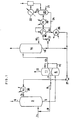
- Natural or process gas which contains carbon dioxide and steam goes through line (1) into absorption zone (2) under an elevated pressure.
- the circulation rate of the absorbent which is necessary to achieve the required degree of gas purification from carbon dioxide may be different depending on the temperature and pressure of the feed gas as well as on the temperature and water content of the solvent.
- the gas purified from carbon dioxide and leaving absorber (2) top is extracted from the unit through line (4).
- the solvent which has absorbed carbon dioxide and water from the gas to be purified is extracted from the absorber through pipeline (5) and is delivered into 1st stage expander (6) where the pressure is maintained at a level lower than that of the absorber. This pressure should preferably be equal to 0.2 to 0.4 of that in the absorber.
- the gas released in the 1st stage expander is exhausted through pipeline (7) and by compresser (8) is delivered through pipeline (9) back into absorber (2).
- the solvent from the lst stage expander is exhausted through pipeline (10) and is delivered into 2nd stage expander (11) where the pressure is maintained at a level lower than that of the 1st stage expander. This pressure should preferably be equal to 1.1 to 1.9 ata.
- the gas released in the 2nd stage expander and consisting mainly of carbon dioxide (98 to 99 vo.% of CO2) is exhausted from the unit through pipeline (12).
- the partly regenerated solvent after removal of the main quantity of carbon dioxide in the 2nd stage expander (11), goes through pipeline (13) into desorber (14) for final regeneration.
- a stripping gas e.g. air or nitrogen
- a stripping gas is delivered in the quantity which corresponds to 5 to 10 volumes of the gas per 1 volume of the incoming liquid, preferably 8 volumes of the gas per 1 volume of the incoming liquid.
- a certain part (o.1 to 2 %) of the regenerated absorbent extracted from desorber (14) bottom through pipeline (16) is delivered by pump (17) into heat exchanger (18) where a heating takes place by the heat of the solvent after dehydration and then into preheater (19) where the absorbent is heated with steam or condensate up to the temperature of dehydration i.e. 80 to 150°C which is lower than the poiling point of the absorbent used for absorption. Then the absorbent is delivered into dehydration vessel (20) where the heated absorbent is stripped by a gas.
- the function of the dehydration vessel consists in evaporation of water from the incoming regenerated solvent. Its design may be either traditional as a packed or plate-type column or as a film-type tubular vessel in which the liquid flows down as a film to meet an upward flow of the stripping gas (21).
- the dehydration is carried out at the pressure near to the atmospheric one, preferably 1.1 ata.
- the operating conditions of the dehydration vessel are determined in such a way that the quantity of moisture in the stripping gas would correspond to that of moisture removed from the system.
- the absorbent after removal of moisture from it, is extracted from dehydration vessel (20) bottom through pipeline (24) after which it enters heat exchanger (18) where it gives the most its heat to the solvent going to dehydration and then through pipeline (25) enters cooler (26) where it is cooled down to the temperature lower than 25°C.
- the cooled dehydrated solvent is mixed with the regenerated absorbent leaving desorber (14) after which the whole absorbent is delivered with pump (27) through ammonia cooler (28) and pipeline (3) into absorber (2) top.
- a gas mixture in the quantity of 200 000 Nm3 at the temperature of 10°C and pressure of 30 ata is introduced into the absorber bottom, this mixture having the composition as follows. Composition of the gas, % vol. Hydrogen - 59 Nitrogen - 20 Carbon dioxide - 18 Argon, methane, and carbon monoxide - 3 Water in the gas mixture - 0.0005 Nm3/Nm3
- Dimethyl ether of triethyleneglycol (boiling point 220°C) which contains 2.5 wt.% of water is pumped at -5°C into the absorber top where the pressure of 30 ata is maintained.
- the absorbent flowrate is 1900 m3/hour.
- the purified gas which contains 0.1 vol.% of CO2 is extracted from the absorber top.
- the saturated solvent which contains carbon dioxide is extracted at +3°C from the absorber bottom and is delivered into the lst stage expander where the pressure of 6 ata is maintained.
- the temperature of the saturated solvent drops and attains + 2°C.
- the gas released in the lst stage expander (2800 Nm3/hour) and containing the most absorbed hydrogen and nitrogen (H2 -25.0, N2 -22.0, CO2 -53.0 vol. %) is delivered to the compressor suction and returns into the absorber.
- the solvent enters then the 2nd stage expander where the pressure of 1.5 ata is maintained.
- the desorption of the main quantity of absorbed carbon dioxide takes place (the composition of the outgoing fraction, % vol., is: CO2 -98.8, H2 -0.5, N2 -0.7, the quantity us 25,000 Nm3/hour).
- the solvent On desorption, the solvent is cooled down to - 1°C and enters the desorber where the pressure of 1.2 ata is maintained.
- 13,000 Nm3 of air is delivered at the ambient temperature.
- the water content of the air is 0.0162 Nm3/Nm3.
- the air and carbon dioxide are extracted from the desorber top.
- the degassed solvent is taken from the desorber bottom.
- this air passes through a condenser where it is cooled down to 60°C.
- the dehydrated solvent (10 m3/hour) goes throgh a heat exchanger, then through a cooler where it is cooled down to 30°C, then is mixed with the main quantity of the regenerated solvent, and is pumped into an ammonia cooler where it is cooled down to - 5°C and then is delivered into the absorber top.
- Dimethyl ether of diethyleneglycol (boiling point 160°C) which contains 2 wt. % of water is pumped at - 10°C into the absorber top where the pressure of 50 ata is maintained.
- the absorbent flowrate is 1,000 m3 /hour.
- the purified gas which contains 0.15 vol. % of CO2 is extracted from the absorber top.
- the saturated solvent which contains carbon dioxide is extracted at 0°C from the absorber bottom and is delivered into the lst stage expander where the pressure of 10 ata is maintained.
- the temperature of the saturated solvent drops and attains -1°C.
- the gas released in the lst stage expander (1.600 Nm3 /hour) and containing the most of absorbed hydrogen and nitrogen (H2 - 27.0, N2 -21.2, CO2 -51.8 vol. %) is delivered to the compressor suction and returns into the absorber.
- the solvent enters then the 2nd stage expander where the pressure of 1.3 ata is maintained.
- the desorption of the main quantity of absorbed carbon dioxide takes place (the composition of the outgoing fraction, % vol., is: CO2 -98.9, H2 - 0.45, N2 -0.65, the quantity is 12,500 Nm3 /hour).
- the solvent On desorption, the solvent is cooled down to - 6°C and enters the desorber where the pressure of 1.15 ata is maintained.
- 9,000 Nm3/hour of nitrogen is delivered at the temperature of 20°C.
- the nitrogen and carbon dioxide are extracted from the desorber top.
- the degassed solvent is taken from the desorber bottom. Its part, in the quantity of 2.5 m3/hour, is delivered into a heat exchanger, then into a preheater where it is preheated up to 80°C, and further into the dehydration vessel where the pressure of 1.05 ata is maintained. While stripping the hot solution with nitrogen, the evaporation and removal of 50 kg/hour of water take place, i.e. the quantity of moisture which enters this system with the gas to be purified.
- this nitrogen passes through a condenser where it is cooled down to 55°C.
- the dehydrated solvent (2.5 m3/hour) goes through a heat exchanger, then through a cooler where it is cooled down to 30°C, then is mixed with the main quantity of the regenerated solvent, and is pumped into an ammonia cooler where it is cooled down to - 10°C and then is delivered into the absorber top.
- a mixture of dimethyl ethers of polyethyleneglycol with the number of glycol residuals in the molecule of 3 to 6 (boiling point 240°C) which contains 3 wt. % of water is pumped at 0°C into the absorber top where the pressure of 40 ata is maintained.
- the absorbent flowrate is 1,600 m3 /hour.
- the purified gas which contains 0.12 vol. % of CO2 is extracted from the absorber top.
- the saturated solvent which contains carbon dioxide is extracted at + 8°C from the absorber bottom and is delivered into the 1st stage expander where the pressure of 8 ata is maintained.
- the temperature of the saturated solvent drops and attains + 7°C.
- the gas released in the 1st stage expander (2,300 Nm3/hour) and containing the most of absorbed hydrogen and nitrogen (H2 - 31.5, N2 -24.3, CO2 -44.2 vol. %) is delivered to the compressor suction and returns into the absorber.
- the solvent enters then the 2nd stage expander where the pressure of 1.6 ata is maintained.
- the desorption of the main quantity of absorbed carbon dioxide takes place (the composition of the outgoing fraction, % vol., is: CO2 -98.7, H2-0.6, N2- 0.7, the quantity is 20,000 Nm3/hour).
- the solvent On desorption, the solvent is cooled down to + 4°C and enters the desorber where the pressure of 1.3 ata is maintained.
- this gas passes through a condenser where it is cooled down to 58°C.
- the dehydrated solvent (1.3 m3 /hour) goes through a heat exchanger, then through a cooler where it is cooled down to 28°C, then is mixed with the main quantity of the regenerated solvent, and is pumped into an ammonia cooler where it is cooled down to 0°C and then is delivered into the absorber top.
Landscapes
- Chemical & Material Sciences (AREA)
- Engineering & Computer Science (AREA)
- General Chemical & Material Sciences (AREA)
- Oil, Petroleum & Natural Gas (AREA)
- Chemical Kinetics & Catalysis (AREA)
- Analytical Chemistry (AREA)
- Combustion & Propulsion (AREA)
- Organic Chemistry (AREA)
- Gas Separation By Absorption (AREA)
- Treating Waste Gases (AREA)
- Degasification And Air Bubble Elimination (AREA)
- Solid-Sorbent Or Filter-Aiding Compositions (AREA)
Priority Applications (1)
| Application Number | Priority Date | Filing Date | Title |
|---|---|---|---|
| AT90113298T ATE98894T1 (de) | 1990-05-14 | 1990-07-12 | Methode zur entfernung von sauren komponenten aus einem gas. |
Applications Claiming Priority (2)
| Application Number | Priority Date | Filing Date | Title |
|---|---|---|---|
| JP2123754A JPH0418911A (ja) | 1990-05-14 | 1990-05-14 | ガスから酸性成分を除去する方法 |
| JP123754/89 | 1990-05-14 |
Publications (2)
| Publication Number | Publication Date |
|---|---|
| EP0456877A1 true EP0456877A1 (de) | 1991-11-21 |
| EP0456877B1 EP0456877B1 (de) | 1993-12-22 |
Family
ID=14868481
Family Applications (1)
| Application Number | Title | Priority Date | Filing Date |
|---|---|---|---|
| EP90113298A Expired - Lifetime EP0456877B1 (de) | 1990-05-14 | 1990-07-12 | Methode zur Entfernung von sauren Komponenten aus einem Gas |
Country Status (7)
| Country | Link |
|---|---|
| US (1) | US5066314A (de) |
| EP (1) | EP0456877B1 (de) |
| JP (1) | JPH0418911A (de) |
| AT (1) | ATE98894T1 (de) |
| CA (1) | CA2022637A1 (de) |
| DE (1) | DE69005446D1 (de) |
| RU (1) | RU2028815C1 (de) |
Cited By (1)
| Publication number | Priority date | Publication date | Assignee | Title |
|---|---|---|---|---|
| EP0770420A3 (de) * | 1995-10-23 | 1997-12-17 | Union Carbide Chemicals & Plastics Technology Corporation | Zusammensetzung und Verfahren zur Behandlung von Säuregasen |
Families Citing this family (11)
| Publication number | Priority date | Publication date | Assignee | Title |
|---|---|---|---|---|
| US5314671A (en) * | 1990-01-19 | 1994-05-24 | Elf Aquitaine Production | Process and device for removal of H2 S |
| FR2760653B1 (fr) * | 1997-03-13 | 1999-04-30 | Inst Francais Du Petrole | Procede de desacidification avec production de gaz acides en phase liquide |
| US6203599B1 (en) * | 1999-07-28 | 2001-03-20 | Union Carbide Chemicals & Plastics Technology Corporation | Process for the removal of gas contaminants from a product gas using polyethylene glycols |
| US6174348B1 (en) * | 1999-08-17 | 2001-01-16 | Praxair Technology, Inc. | Nitrogen system for regenerating chemical solvent |
| DE10136484A1 (de) * | 2001-07-27 | 2003-02-13 | Uhde Gmbh | Verfahren zur Entfernung von Gasbestandteilen aus technischen Gasen mittels Ethylenglykoldimethylethern bei tieferen Temperaturen |
| DE10229750B4 (de) * | 2002-07-03 | 2007-03-29 | Lurgi Ag | Anlageneinheit und Verfahren zur Desorption von Kohlendioxid aus Methanol |
| NL1026537C2 (nl) * | 2004-07-01 | 2006-01-03 | Tno | Membraangasscheiding. |
| WO2007075466A2 (en) * | 2005-12-19 | 2007-07-05 | Fluor Technologies Corporation | Integrated compressor/stripper configurations and methods |
| CN102905772A (zh) | 2010-02-17 | 2013-01-30 | 氟石科技公司 | 在制备超低硫气体中清除高压酸气体的构造和方法 |
| US9671162B2 (en) | 2012-10-24 | 2017-06-06 | Fluor Technologies Corporation | Integration methods of gas processing plant and nitrogen rejection unit for high nitrogen feed gases |
| US10000713B2 (en) | 2013-12-12 | 2018-06-19 | Fluor Technologies Corporation | Configurations and methods of flexible CO2 removal |
Citations (2)
| Publication number | Priority date | Publication date | Assignee | Title |
|---|---|---|---|---|
| GB2133717A (en) * | 1983-01-19 | 1984-08-01 | Snam Progetti | Cryogenic process for the removal of acid gases from gas mixtures by means of a solvent |
| US4749555A (en) * | 1986-10-02 | 1988-06-07 | Shell Oil Company | Process for the selective removal of hydrogen sulphide and carbonyl sulfide from light hydrocarbon gases containing carbon dioxide |
Family Cites Families (14)
| Publication number | Priority date | Publication date | Assignee | Title |
|---|---|---|---|---|
| US2649166A (en) * | 1950-05-02 | 1953-08-18 | Allied Chem & Dye Corp | Absorption of carbon dioxide from gases containing the same |
| US2826266A (en) * | 1956-07-30 | 1958-03-11 | Phillips Petroleum Co | Removal of co2 from natural gas |
| US2926753A (en) * | 1958-10-06 | 1960-03-01 | Fluor Corp | Process for carbon dioxide absorption |
| US3242642A (en) * | 1962-12-11 | 1966-03-29 | Union Oil Co | Process for removing acid constituents from gaseous mixtures |
| US3255572A (en) * | 1962-12-11 | 1966-06-14 | Union Oil Co | Extraction of acidic components from gas mixtures |
| US3383838A (en) * | 1966-06-29 | 1968-05-21 | Universal Oil Prod Co | Hydrogen purification process |
| DE1494809C3 (de) * | 1966-10-25 | 1974-01-17 | Metallgesellschaft Ag, 6000 Frankfurt | Verfahren zum Auswaschen von Kohlendioxid aus schwefelarmen oder schwefelfreien Gasen |
| US3594985A (en) * | 1969-06-11 | 1971-07-27 | Allied Chem | Acid gas removal from gas mixtures |
| US3664091A (en) * | 1969-06-27 | 1972-05-23 | Fish Engineering & Constructio | Process and system for removing acid gas from natural gas |
| DE2226215C3 (de) * | 1972-05-30 | 1975-09-25 | Metallgesellschaft Ag, 6000 Frankfurt | Verfahren zur Regeneration eines beladenen Absorptionsmittels, das beim Auswaschen von sauren Komponenten aus Gasen anfällt |
| US3837143A (en) * | 1973-08-06 | 1974-09-24 | Allied Chem | Simultaneous drying and sweetening of wellhead natural gas |
| DE2923012A1 (de) * | 1979-06-07 | 1980-12-18 | Basf Ag | Verfahren zur gleichzeitigen entfernung von wasser und schwefelwasserstoff aus gasen |
| US4242108A (en) * | 1979-11-07 | 1980-12-30 | Air Products And Chemicals, Inc. | Hydrogen sulfide concentrator for acid gas removal systems |
| DE3709363C1 (de) * | 1987-03-21 | 1988-08-18 | Metallgesellschaft Ag | Verfahren zum Behandeln zweier beladener Waschloesungsstroeme |
-
1990
- 1990-05-14 JP JP2123754A patent/JPH0418911A/ja active Pending
- 1990-07-09 US US07/549,967 patent/US5066314A/en not_active Expired - Fee Related
- 1990-07-12 DE DE90113298T patent/DE69005446D1/de not_active Expired - Lifetime
- 1990-07-12 AT AT90113298T patent/ATE98894T1/de active
- 1990-07-12 EP EP90113298A patent/EP0456877B1/de not_active Expired - Lifetime
- 1990-08-03 CA CA002022637A patent/CA2022637A1/en not_active Abandoned
- 1990-11-27 RU SU904831659A patent/RU2028815C1/ru active
Patent Citations (2)
| Publication number | Priority date | Publication date | Assignee | Title |
|---|---|---|---|---|
| GB2133717A (en) * | 1983-01-19 | 1984-08-01 | Snam Progetti | Cryogenic process for the removal of acid gases from gas mixtures by means of a solvent |
| US4749555A (en) * | 1986-10-02 | 1988-06-07 | Shell Oil Company | Process for the selective removal of hydrogen sulphide and carbonyl sulfide from light hydrocarbon gases containing carbon dioxide |
Cited By (2)
| Publication number | Priority date | Publication date | Assignee | Title |
|---|---|---|---|---|
| EP0770420A3 (de) * | 1995-10-23 | 1997-12-17 | Union Carbide Chemicals & Plastics Technology Corporation | Zusammensetzung und Verfahren zur Behandlung von Säuregasen |
| US6592779B1 (en) | 1995-10-23 | 2003-07-15 | Union Carbide Chemicals & Plastics Technology Corporation | Composition and method for acid gas treatment |
Also Published As
| Publication number | Publication date |
|---|---|
| DE69005446D1 (de) | 1994-02-03 |
| RU2028815C1 (ru) | 1995-02-20 |
| JPH0418911A (ja) | 1992-01-23 |
| EP0456877B1 (de) | 1993-12-22 |
| CA2022637A1 (en) | 1991-11-15 |
| US5066314A (en) | 1991-11-19 |
| ATE98894T1 (de) | 1994-01-15 |
Similar Documents
| Publication | Publication Date | Title |
|---|---|---|
| US2649166A (en) | Absorption of carbon dioxide from gases containing the same | |
| US3531917A (en) | Process for a selective removal mainly of h2s and co2 by scrubbing from fuel and synthesis gases | |
| US4080424A (en) | Process for acid gas removal from gaseous mixtures | |
| US4242108A (en) | Hydrogen sulfide concentrator for acid gas removal systems | |
| SU516410A1 (ru) | Способ очистки аргона | |
| US2250925A (en) | Process for the separation of acetylene from admixture with ethylene | |
| EP1206311B1 (de) | Verfahren zur entfernung von verunreinigungen aus einem gas unter verwendung von polyethylenglykohlen | |
| US4182659A (en) | Method of concentrating a water-containing glycol | |
| EP0456877B1 (de) | Methode zur Entfernung von sauren Komponenten aus einem Gas | |
| EP0029784B1 (de) | Verfahren zur Abtrennung von Äthylenoxid und Dichlordifluormethan aus einem zusätzlich Luft enthaltenden Gemisch | |
| US4384875A (en) | Process and installation for regenerating an absorbent solution containing gaseous compounds | |
| EP0460001B1 (de) | Verfahren zur beseitigung von ammoniak aus einer gasmischung | |
| US4057403A (en) | Gas treating process | |
| WO2005035101A1 (en) | Improved solvent use and regeneration | |
| MY101548A (en) | Cryogenic process for the removal of acid gases from gas mixtures by means of a solvent | |
| US3375639A (en) | Extraction of acidic constituents from gas mixtures with gammabutyrolactone | |
| US4149857A (en) | Process for the two-stage separation of ammonia | |
| RU2695209C1 (ru) | Установка регенерации водного раствора метанола | |
| EP1824585B1 (de) | Verfahren zur dehydrierung von gasen | |
| DK170853B1 (da) | Fremgangsmåde til regeneration af zeolitter. | |
| JPS6138124B2 (de) | ||
| JPH0673387A (ja) | ガス混合物から一酸化炭素を分離する方法 | |
| US3242642A (en) | Process for removing acid constituents from gaseous mixtures | |
| GB1588339A (en) | Method of reconcentrating a watercontaining glycol | |
| KR920001767B1 (ko) | 에틸렌옥사이드의 정제방법 |
Legal Events
| Date | Code | Title | Description |
|---|---|---|---|
| PUAI | Public reference made under article 153(3) epc to a published international application that has entered the european phase |
Free format text: ORIGINAL CODE: 0009012 |
|
| AK | Designated contracting states |
Kind code of ref document: A1 Designated state(s): AT BE CH DE DK ES FR GB GR IT LI LU NL SE |
|
| RBV | Designated contracting states (corrected) |
Designated state(s): AT BE DE ES FR GB IT NL SE |
|
| 17P | Request for examination filed |
Effective date: 19920325 |
|
| 17Q | First examination report despatched |
Effective date: 19930219 |
|
| RAP3 | Party data changed (applicant data changed or rights of an application transferred) |
Owner name: STATE SCIENTIFIC RESEARCH AND DESIGNING INSTITUTE Owner name: TOHO KAGAKU KOGYO CO., LTD. |
|
| GRAA | (expected) grant |
Free format text: ORIGINAL CODE: 0009210 |
|
| AK | Designated contracting states |
Kind code of ref document: B1 Designated state(s): AT BE DE ES FR GB IT NL SE |
|
| PG25 | Lapsed in a contracting state [announced via postgrant information from national office to epo] |
Ref country code: IT Free format text: LAPSE BECAUSE OF FAILURE TO SUBMIT A TRANSLATION OF THE DESCRIPTION OR TO PAY THE FEE WITHIN THE PRE;WARNING: LAPSES OF ITALIAN PATENTS WITH EFFECTIVE DATE BEFORE 2007 MAY HAVE OCCURRED AT ANY TIME BEFORE 2007. THE CORRECT EFFECTIVE DATE MAY BE DIFFERENT FROM THE ONE RECORDED.SCRIBED TIME-LIMIT Effective date: 19931222 Ref country code: FR Effective date: 19931222 Ref country code: AT Effective date: 19931222 Ref country code: DE Effective date: 19931222 Ref country code: BE Effective date: 19931222 Ref country code: ES Free format text: THE PATENT HAS BEEN ANNULLED BY A DECISION OF A NATIONAL AUTHORITY Effective date: 19931222 Ref country code: NL Effective date: 19931222 Ref country code: SE Effective date: 19931222 |
|
| REF | Corresponds to: |
Ref document number: 98894 Country of ref document: AT Date of ref document: 19940115 Kind code of ref document: T |
|
| REF | Corresponds to: |
Ref document number: 69005446 Country of ref document: DE Date of ref document: 19940203 |
|
| EN | Fr: translation not filed | ||
| NLV1 | Nl: lapsed or annulled due to failure to fulfill the requirements of art. 29p and 29m of the patents act | ||
| PG25 | Lapsed in a contracting state [announced via postgrant information from national office to epo] |
Ref country code: GB Effective date: 19940712 |
|
| PLBE | No opposition filed within time limit |
Free format text: ORIGINAL CODE: 0009261 |
|
| STAA | Information on the status of an ep patent application or granted ep patent |
Free format text: STATUS: NO OPPOSITION FILED WITHIN TIME LIMIT |
|
| 26N | No opposition filed | ||
| GBPC | Gb: european patent ceased through non-payment of renewal fee |
Effective date: 19940712 |