EP0456799B1 - Improved method of preparing an intermediate for the manufacture of bambuterol - Google Patents
Improved method of preparing an intermediate for the manufacture of bambuterol Download PDFInfo
- Publication number
- EP0456799B1 EP0456799B1 EP91900394A EP91900394A EP0456799B1 EP 0456799 B1 EP0456799 B1 EP 0456799B1 EP 91900394 A EP91900394 A EP 91900394A EP 91900394 A EP91900394 A EP 91900394A EP 0456799 B1 EP0456799 B1 EP 0456799B1
- Authority
- EP
- European Patent Office
- Prior art keywords
- solvent
- potassium carbonate
- dimethylcarbamoyloxy
- acetophenone
- pct
- Prior art date
- Legal status (The legal status is an assumption and is not a legal conclusion. Google has not performed a legal analysis and makes no representation as to the accuracy of the status listed.)
- Expired - Lifetime
Links
- 238000000034 method Methods 0.000 title claims abstract description 13
- ANZXOIAKUNOVQU-UHFFFAOYSA-N bambuterol Chemical compound CN(C)C(=O)OC1=CC(OC(=O)N(C)C)=CC(C(O)CNC(C)(C)C)=C1 ANZXOIAKUNOVQU-UHFFFAOYSA-N 0.000 title abstract description 4
- 229960003060 bambuterol Drugs 0.000 title abstract description 4
- 238000004519 manufacturing process Methods 0.000 title description 3
- BWHMMNNQKKPAPP-UHFFFAOYSA-L potassium carbonate Chemical compound [K+].[K+].[O-]C([O-])=O BWHMMNNQKKPAPP-UHFFFAOYSA-L 0.000 claims abstract description 38
- XEKOWRVHYACXOJ-UHFFFAOYSA-N Ethyl acetate Chemical compound CCOC(C)=O XEKOWRVHYACXOJ-UHFFFAOYSA-N 0.000 claims abstract description 30
- JUJWROOIHBZHMG-UHFFFAOYSA-N Pyridine Chemical compound C1=CC=NC=C1 JUJWROOIHBZHMG-UHFFFAOYSA-N 0.000 claims abstract description 26
- KWOLFJPFCHCOCG-UHFFFAOYSA-N Acetophenone Chemical compound CC(=O)C1=CC=CC=C1 KWOLFJPFCHCOCG-UHFFFAOYSA-N 0.000 claims abstract description 22
- 229910000027 potassium carbonate Inorganic materials 0.000 claims abstract description 19
- XLYOFNOQVPJJNP-UHFFFAOYSA-N water Substances O XLYOFNOQVPJJNP-UHFFFAOYSA-N 0.000 claims abstract description 17
- 239000002904 solvent Substances 0.000 claims abstract description 15
- YIIMEMSDCNDGTB-UHFFFAOYSA-N Dimethylcarbamoyl chloride Chemical compound CN(C)C(Cl)=O YIIMEMSDCNDGTB-UHFFFAOYSA-N 0.000 claims abstract description 13
- UMJSCPRVCHMLSP-UHFFFAOYSA-N pyridine Natural products COC1=CC=CN=C1 UMJSCPRVCHMLSP-UHFFFAOYSA-N 0.000 claims abstract description 13
- CPELXLSAUQHCOX-UHFFFAOYSA-N Hydrogen bromide Chemical compound Br CPELXLSAUQHCOX-UHFFFAOYSA-N 0.000 claims abstract description 10
- WQXWIKCZNIGMAP-UHFFFAOYSA-N 3',5'-Dihydroxyacetophenone Chemical compound CC(=O)C1=CC(O)=CC(O)=C1 WQXWIKCZNIGMAP-UHFFFAOYSA-N 0.000 claims abstract description 9
- 229940093499 ethyl acetate Drugs 0.000 claims abstract description 9
- GDTBXPJZTBHREO-UHFFFAOYSA-N bromine Substances BrBr GDTBXPJZTBHREO-UHFFFAOYSA-N 0.000 claims abstract description 8
- 239000013078 crystal Substances 0.000 claims abstract description 8
- WKBOTKDWSSQWDR-UHFFFAOYSA-N Bromine atom Chemical compound [Br] WKBOTKDWSSQWDR-UHFFFAOYSA-N 0.000 claims abstract description 7
- 229910052794 bromium Inorganic materials 0.000 claims abstract description 7
- 238000002360 preparation method Methods 0.000 claims abstract description 7
- ZWEHNKRNPOVVGH-UHFFFAOYSA-N 2-Butanone Chemical compound CCC(C)=O ZWEHNKRNPOVVGH-UHFFFAOYSA-N 0.000 claims abstract description 6
- 229910000042 hydrogen bromide Inorganic materials 0.000 claims abstract description 5
- 238000010791 quenching Methods 0.000 claims abstract description 4
- 230000000171 quenching effect Effects 0.000 claims abstract description 4
- DKPFZGUDAPQIHT-UHFFFAOYSA-N Butyl acetate Natural products CCCCOC(C)=O DKPFZGUDAPQIHT-UHFFFAOYSA-N 0.000 claims abstract description 3
- NTIZESTWPVYFNL-UHFFFAOYSA-N Methyl isobutyl ketone Chemical compound CC(C)CC(C)=O NTIZESTWPVYFNL-UHFFFAOYSA-N 0.000 claims abstract description 3
- UIHCLUNTQKBZGK-UHFFFAOYSA-N Methyl isobutyl ketone Natural products CCC(C)C(C)=O UIHCLUNTQKBZGK-UHFFFAOYSA-N 0.000 claims abstract description 3
- 229940043232 butyl acetate Drugs 0.000 claims abstract description 3
- 239000003054 catalyst Substances 0.000 claims abstract description 3
- FUZZWVXGSFPDMH-UHFFFAOYSA-N hexanoic acid Chemical compound CCCCCC(O)=O FUZZWVXGSFPDMH-UHFFFAOYSA-N 0.000 claims abstract description 3
- JMMWKPVZQRWMSS-UHFFFAOYSA-N isopropanol acetate Natural products CC(C)OC(C)=O JMMWKPVZQRWMSS-UHFFFAOYSA-N 0.000 claims abstract description 3
- 229940011051 isopropyl acetate Drugs 0.000 claims abstract description 3
- GWYFCOCPABKNJV-UHFFFAOYSA-N isovaleric acid Chemical compound CC(C)CC(O)=O GWYFCOCPABKNJV-UHFFFAOYSA-N 0.000 claims abstract description 3
- 235000019439 ethyl acetate Nutrition 0.000 claims description 8
- 238000006243 chemical reaction Methods 0.000 claims description 6
- 239000000203 mixture Substances 0.000 claims description 5
- YMWUJEATGCHHMB-UHFFFAOYSA-N Dichloromethane Chemical compound ClCCl YMWUJEATGCHHMB-UHFFFAOYSA-N 0.000 description 9
- LFQSCWFLJHTTHZ-UHFFFAOYSA-N Ethanol Chemical compound CCO LFQSCWFLJHTTHZ-UHFFFAOYSA-N 0.000 description 8
- VEXZGXHMUGYJMC-UHFFFAOYSA-N Hydrochloric acid Chemical compound Cl VEXZGXHMUGYJMC-UHFFFAOYSA-N 0.000 description 8
- 239000012071 phase Substances 0.000 description 6
- 230000031709 bromination Effects 0.000 description 4
- 238000005893 bromination reaction Methods 0.000 description 4
- 230000015572 biosynthetic process Effects 0.000 description 3
- 239000011541 reaction mixture Substances 0.000 description 3
- 238000003756 stirring Methods 0.000 description 3
- QGZKDVFQNNGYKY-UHFFFAOYSA-N Ammonia Chemical compound N QGZKDVFQNNGYKY-UHFFFAOYSA-N 0.000 description 2
- 230000003197 catalytic effect Effects 0.000 description 2
- 238000001704 evaporation Methods 0.000 description 2
- 230000008020 evaporation Effects 0.000 description 2
- 238000000926 separation method Methods 0.000 description 2
- 239000000126 substance Substances 0.000 description 2
- 238000003786 synthesis reaction Methods 0.000 description 2
- 238000010626 work up procedure Methods 0.000 description 2
- RYHBNJHYFVUHQT-UHFFFAOYSA-N 1,4-Dioxane Chemical compound C1COCCO1 RYHBNJHYFVUHQT-UHFFFAOYSA-N 0.000 description 1
- 0 C*c1cc(C)cc(OC=O)c1 Chemical compound C*c1cc(C)cc(OC=O)c1 0.000 description 1
- QAOWNCQODCNURD-UHFFFAOYSA-N Sulfuric acid Chemical compound OS(O)(=O)=O QAOWNCQODCNURD-UHFFFAOYSA-N 0.000 description 1
- 229910021529 ammonia Inorganic materials 0.000 description 1
- 150000001875 compounds Chemical class 0.000 description 1
- 238000001816 cooling Methods 0.000 description 1
- 238000010586 diagram Methods 0.000 description 1
- 239000000839 emulsion Substances 0.000 description 1
- 230000007062 hydrolysis Effects 0.000 description 1
- 238000006460 hydrolysis reaction Methods 0.000 description 1
- 239000012074 organic phase Substances 0.000 description 1
- 239000000376 reactant Substances 0.000 description 1
- 230000035484 reaction time Effects 0.000 description 1
- 239000002002 slurry Substances 0.000 description 1
- 239000001117 sulphuric acid Substances 0.000 description 1
- 235000011149 sulphuric acid Nutrition 0.000 description 1
- 230000001988 toxicity Effects 0.000 description 1
- 231100000419 toxicity Toxicity 0.000 description 1
Classifications
-
- C—CHEMISTRY; METALLURGY
- C07—ORGANIC CHEMISTRY
- C07C—ACYCLIC OR CARBOCYCLIC COMPOUNDS
- C07C269/00—Preparation of derivatives of carbamic acid, i.e. compounds containing any of the groups, the nitrogen atom not being part of nitro or nitroso groups
- C07C269/04—Preparation of derivatives of carbamic acid, i.e. compounds containing any of the groups, the nitrogen atom not being part of nitro or nitroso groups from amines with formation of carbamate groups
Definitions
- the present invention relates to an improved method for the preparation of an intermediate for bambuterol, i.e. for the preparation of 2′-bromo-3,5-di[N,N-dimethylcarbamoyloxy]acetophenone, having the formula
- the object of the invention is to provide an improved method for the preparation of the intermediate 2′-bromo-3,5-di-[N,N-dimethylcarbamoyloxy]acetophenone (1) for the production of bambuterol avoiding the use of pyridine and methylene chloride as solvents and eliminating the separation problems in the work-up step.
- potassium carbonate having a crystal water content of 11 - 13 % is used. This might be achieved by using a mixture of crystallized and calcinated potassium carbonate, resulting in a easily stirred two-phase system.
- Calcinated potassium carbonate (completely dry) gives a slow and non-complete reaction, and the addition of water to the calcinated potassium carbonate results in a sticky mass which is difficult to stir. Further, free water should not be present in the reaction mixture because of the risk of hydrolysis of the reactants.
- the bromination step which according to the invention first involves the addition of HBr, preferably dissolved in ethanol, and a second step charging with bromine, Br2, has the advantage that the bromination will proceed calmly.
- HBr preferably dissolved in ethanol
- Br2 bromine
- the base potassium carbonate
- hydrochloric acid formed In the first step of the process the base, potassium carbonate, will take care of hydrochloric acid formed.
- pyridine will act both as base and solvent.
- pyridine In the process according to the invention however, pyridine will only be present in catalytic amounts. Here the pyridine will initially take up the hydrochloric acid formed, which then will be transferred to the potassium carbonate, which is consumed.
- crystallized potassium carbonate is used as the base.
- the water will released slowly and the base will be slowly consumed by the hydrochloric acid, which is first taken up and then transferred from the catalytic amount of pyridine present in the reaction mixture.
- the crystallized potassium carbonate contains about 1.5 moles of H2O which corresponds to about 16 %.
- the optimum water content is 11 - 13 %, and this content is obtained using a mixture of calcinated potassium carbonate and crystallized potassium carbonate.
- This mixture is stirred and heated to 70 ⁇ 2°C, and after stirring for 2 hours at this temperature 120 kg water is charged at 70°C and the mixture is stirred for 1,5 hours at 70 ⁇ 2°C. After cooling to 20-30°C the reaction mixture is separated and the lower water phase is discarded.
- the crystal slurry is cooled to - 14 ⁇ 2°C and the crystals are collected on a filter and washed with 12 g (15 ml) cold (-14°C) ethanol. The crystals are dried at 40°C in vacuum.
- the yield is about 20.7 g (75 %).
Landscapes
- Chemical & Material Sciences (AREA)
- Organic Chemistry (AREA)
- Organic Low-Molecular-Weight Compounds And Preparation Thereof (AREA)
- Steroid Compounds (AREA)
- Fats And Perfumes (AREA)
Abstract
Description
- The present invention relates to an improved method for the preparation of an intermediate for bambuterol, i.e. for the preparation of 2′-bromo-3,5-di[N,N-dimethylcarbamoyloxy]acetophenone, having the formula

- In US-A-4 451 663 a method of manufacturing the intermediate 2′-bromo-3,5-di[N,N-dimethylcarbamoyloxy]acetophenone of the formula (1) is disclosed, called route A2 therein, according to which 3,5-dihydroxyacetophenone, having the formula

is reacted with N,N-dimethylcarbamoylchloride (DMCC) having the formula
using pyridine as solvent and base for the uptake of hydrochloric acid formed during the reaction. The resulting compound, 3,5-di-[N,N-dimethylcarbamoyloxylacetophenone having the formula
is not isolated but further reacted with bromine in dioxan solvent resulting in the formation of 2′-bromo-3,5-di[N,N-dimethylcarbamoyloxy]acetophenone (1). - There is a great desire to avoid working with pyridine as a solvent. One method was tested in order to avoid using pyridine as a solvent, according to which the reaction was performed in methylene chloride with potassium carbonate as a base with a catalytical amount of pyridine present. The drawbacks with this process was a long reaction time for N,N-dimethylcarbamoylchloride (DMCC), > 24 hours, and a long quenching time for DMCC, > 24 hours, and separation problems in the work-up step (emulsion and small density difference). Methylene chloride is not a preferred solvent either, because of its toxicity.
- The object of the invention is to provide an improved method for the preparation of the intermediate 2′-bromo-3,5-di-[N,N-dimethylcarbamoyloxy]acetophenone (1) for the production of bambuterol avoiding the use of pyridine and methylene chloride as solvents and eliminating the separation problems in the work-up step.
- This is attained according to the present invention by reacting 3,5-dihydroxyacetophenone

with N,N-dimethylcarbamoylchloride, (CH₃)₂NCOCl, in a solvent, quenching with water, removing the solvent and dissolving of the resulting 3,5-di-[N,N-dimethylcarbamoyloxylacetophenone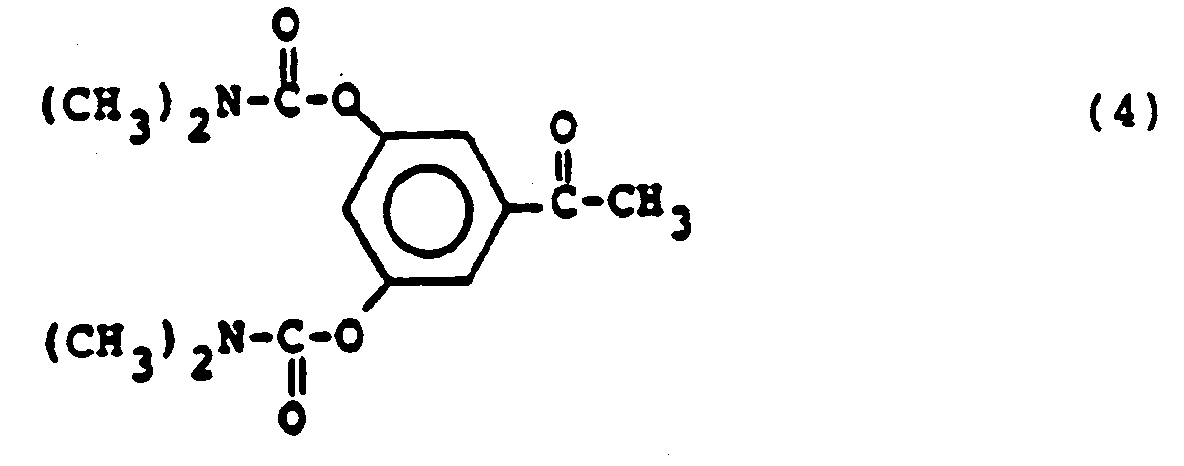
in ethyl acetate, to which is added dissolved hydrogen bromide and then bromine, whereupon the resulting intermediate (1) is collected in the form of crystals, wherein the reaction between said 3,5-dihydroxyacetophenone (2) and N,N-dimethylcarbamoylchloride (3) is carried out in ethylacetate, isopropylacetate, butylacetate, ethylmethylketone or isobutylmethylketone as the solvent with a small amount of pyridine as a catalyst using a base comprising crystallized potassium carbonate. - According to a preferred embodiment of the invention potassium carbonate having a crystal water content of 11 - 13 % is used. This might be achieved by using a mixture of crystallized and calcinated potassium carbonate, resulting in a easily stirred two-phase system.
- Calcinated potassium carbonate (completely dry) gives a slow and non-complete reaction, and the addition of water to the calcinated potassium carbonate results in a sticky mass which is difficult to stir. Further, free water should not be present in the reaction mixture because of the risk of hydrolysis of the reactants.
- The bromination step which according to the invention first involves the addition of HBr, preferably dissolved in ethanol, and a second step charging with bromine, Br₂, has the advantage that the bromination will proceed calmly. When bromination is performed directly with bromine, the reaction will start very slowly and at a certain point it will proceed vigorously and will be hard to control.
- The invention will now be described more in detail.
- In the first step of the process the base, potassium carbonate, will take care of hydrochloric acid formed. According to the prior art process pyridine will act both as base and solvent. In the process according to the invention however, pyridine will only be present in catalytic amounts. Here the pyridine will initially take up the hydrochloric acid formed, which then will be transferred to the potassium carbonate, which is consumed.
- Dry, that is calcinated, potassium carbonate, does not work very well as a base, and the reason is believed to be that it forms a separate phase which is non-miscible with the other phases. If calcinated potassium carbonate and water is used, the water will hydrolyze the N,N-dimethylcarbamoylchloride (DMCC).
- According to the invention crystallized potassium carbonate is used as the base. The water will released slowly and the base will be slowly consumed by the hydrochloric acid, which is first taken up and then transferred from the catalytic amount of pyridine present in the reaction mixture.
- The crystallized potassium carbonate contains about 1.5 moles of H₂O which corresponds to about 16 %. The optimum water content is 11 - 13 %, and this content is obtained using a mixture of calcinated potassium carbonate and crystallized potassium carbonate.
- The synthetic route is described more in detail below.
-

- Synthesis of 3,5-di-[N,N-dimethylcarbamoyloxy)acetophenone 500 litre scale
-

- Into a 500 litre enamelled reactor, connected to a scrubber containing ammonia/ethanol, is charged:
- 24 kg
- 3,5-dihydroxyacetophenone
- 41 kg
- potassium carbonate x 1,5 H₂O
- 9.4 kg
- potassium carbonate calcinated
- 96 kg (150 l)
- ethyl acetate
- 1.0 kg
- pyridine
- 50 kg
- dimethylcarbamoylchloride
- This mixture is stirred and heated to 70 ± 2°C, and after stirring for 2 hours at this temperature 120 kg water is charged at 70°C and the mixture is stirred for 1,5 hours at 70 ± 2°C. After cooling to 20-30°C the reaction mixture is separated and the lower water phase is discarded.
- To the organic phase is charged 60 kg water and pH is adjusted to 2 - 3 with about 1 kg sulphuric acid.
- The phases are separated and the lower water phase is discarded. Ethyl acetate and water are removed by evaporation in the reactor at a jacket temperature of 60°C and vacuum (< 100 mbar). The evaporation residue is dissolved in 40 kg (50 l) ethyl acetate and is used directly in the bromination step.
- Synthesis of 2′-bromo-3,5-di[N,N-dimethylcarbamoyloxy]acetophenone in laboratory scale
-
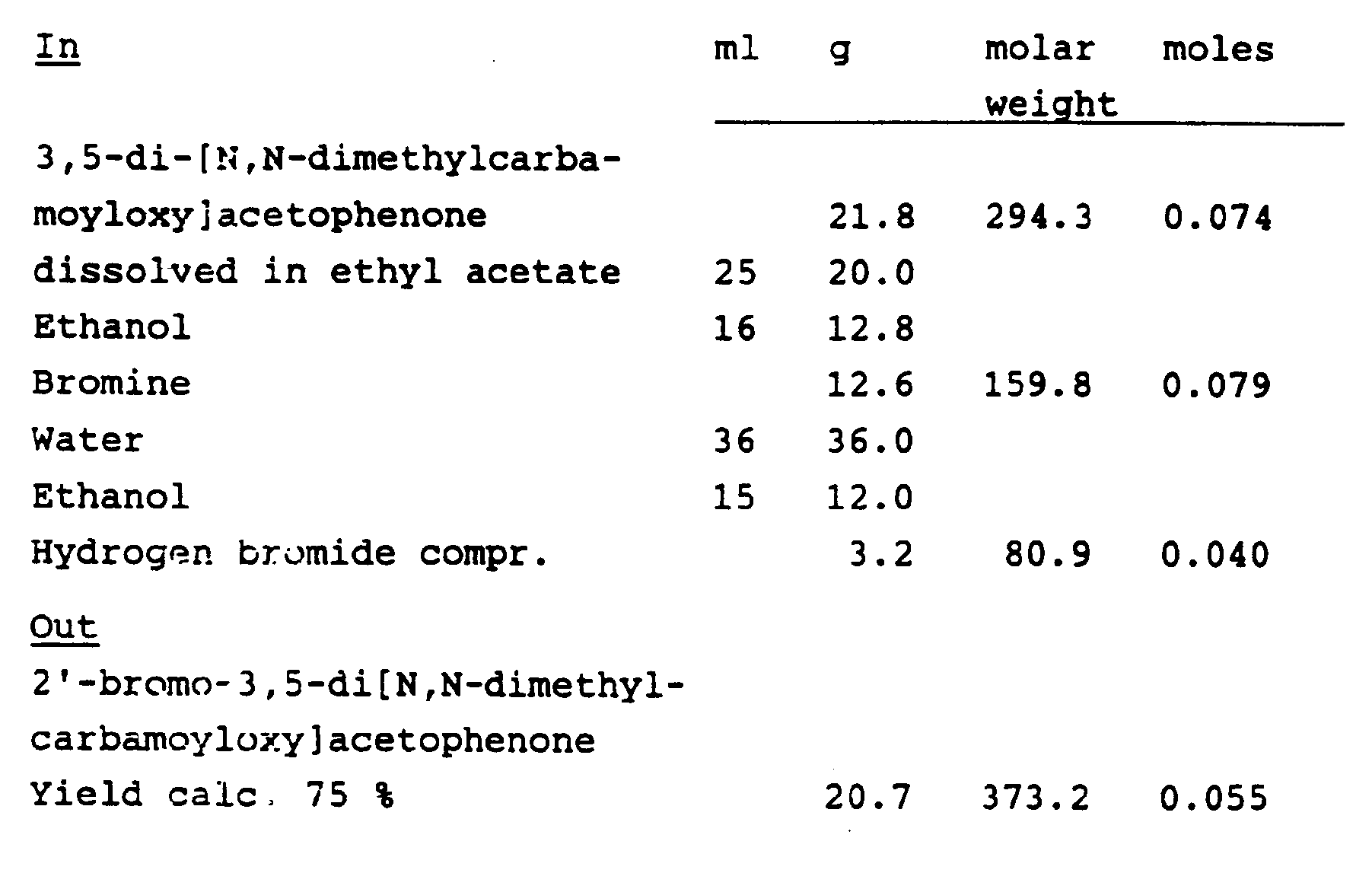
- Into a 100 ml three necked flask is charged 21.8 g 3,5-di[N,N-dimethylcarbamoyloxy]acetophenone dissolved in ethylacetate and 3.2 g hydrogen bromide dissolved in 12.8 g (16 ml) ethanol.
- At 12 ± 2°C is charged 12.6 g bromine in 30-60 minutes.
- After stirring for further 10 minutes at 12 ± 2°C 36 ml (36 g) water is charged in about 15 minutes.
- Thereafter the crystal slurry is cooled to - 14 ± 2°C and the crystals are collected on a filter and washed with 12 g (15 ml) cold (-14°C) ethanol. The crystals are dried at 40°C in vacuum.
- The yield is about 20.7 g (75 %).
Claims (2)
- Process for the preparation of an intermediate for bamuterol, i.e. for the preparation of 2′-bromo-3,5-di-[N,N-dimethylcarbamoyloxy]acetophenone, having the formula
 with N,N-dimethylcarbamoylchloride,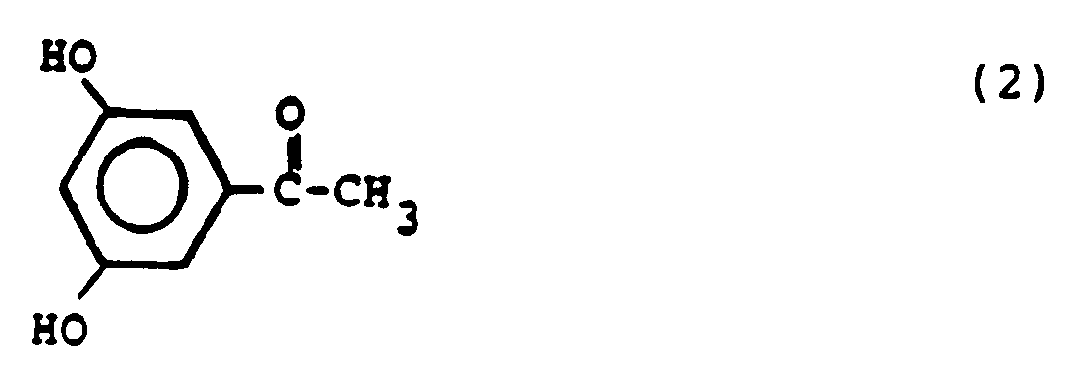


- Process according to claim 1, characterized in that the base is in the form of a mixture of crystallized and calcinated potassium carbonate having a total crystal water content of 11-13 %.
Applications Claiming Priority (3)
| Application Number | Priority Date | Filing Date | Title |
|---|---|---|---|
| SE8904064A SE8904064D0 (en) | 1989-12-01 | 1989-12-01 | IMPROVED METHOD OF PREPARING AND INTERMEDIATE FOR THE MANUFACTURE OF BAMBUTEROL |
| SE8904064 | 1989-12-01 | ||
| PCT/SE1990/000792 WO1991008197A1 (en) | 1989-12-01 | 1990-11-29 | Improved method of preparing an intermediate for the manufacture of bambuterol |
Publications (2)
| Publication Number | Publication Date |
|---|---|
| EP0456799A1 EP0456799A1 (en) | 1991-11-21 |
| EP0456799B1 true EP0456799B1 (en) | 1994-06-01 |
Family
ID=20377664
Family Applications (1)
| Application Number | Title | Priority Date | Filing Date |
|---|---|---|---|
| EP91900394A Expired - Lifetime EP0456799B1 (en) | 1989-12-01 | 1990-11-29 | Improved method of preparing an intermediate for the manufacture of bambuterol |
Country Status (14)
| Country | Link |
|---|---|
| US (1) | US5200551A (en) |
| EP (1) | EP0456799B1 (en) |
| JP (1) | JPH04503218A (en) |
| AT (1) | ATE106388T1 (en) |
| AU (1) | AU630013B2 (en) |
| CA (1) | CA2045554A1 (en) |
| DE (1) | DE69009461T2 (en) |
| DK (1) | DK0456799T3 (en) |
| ES (1) | ES2054483T3 (en) |
| IE (1) | IE65994B1 (en) |
| NO (1) | NO174804B (en) |
| PT (1) | PT96051B (en) |
| SE (1) | SE8904064D0 (en) |
| WO (1) | WO1991008197A1 (en) |
Cited By (1)
| Publication number | Priority date | Publication date | Assignee | Title |
|---|---|---|---|---|
| KR100701743B1 (en) | 2005-10-05 | 2007-03-29 | 주식회사 라이트팜텍 | Novel Method of Making Bambuterol |
Families Citing this family (5)
| Publication number | Priority date | Publication date | Assignee | Title |
|---|---|---|---|---|
| EP1856036B1 (en) * | 2004-11-08 | 2016-12-14 | Emcure Pharmaceuticals Limited | An efficient method for preparation of (s)-3-[(1-dimethyl amino)ethyl]-phenyl-n-ethyl-n-methyl-carbamate |
| ES2301439B1 (en) * | 2005-08-31 | 2009-05-01 | Universidad De Malaga | USE OF MICOSPORINE TYPE AMINO ACID (M-GLY) AS AN ANTIOXIDANT OR ADDITIVE IN FOOD PRODUCTS. |
| CN102617404A (en) * | 2012-04-06 | 2012-08-01 | 张长利 | Preparation processes of bambuterol hydrochloride and intermediate thereof |
| CN104262202B (en) * | 2014-09-12 | 2016-12-07 | 广东东阳光药业有限公司 | The preparation technology of bambuterol intermediate |
| CN106187820B (en) * | 2016-07-02 | 2017-09-19 | 深圳市康立生生物科技有限公司 | A kind of preparation method of bambuterol impurity B |
Family Cites Families (4)
| Publication number | Priority date | Publication date | Assignee | Title |
|---|---|---|---|---|
| US3404975A (en) * | 1964-12-18 | 1968-10-08 | Fmc Corp | m-(carbamoyloxy)-carbanilates as herbicides |
| CY1273A (en) * | 1980-07-09 | 1985-03-08 | Draco Ab | 1-(dihydroxyphenyl)-2-amino-ethanol derivatives;preparation,compositions and intermediates |
| DE3441108A1 (en) * | 1984-11-10 | 1986-05-15 | Basf Ag, 6700 Ludwigshafen | METHOD FOR PRODUCING O- (1-METHOXY-2-CHLORINE) -ETHOXYPHENYL-N-METHYLCARBAMATE |
| US4925971A (en) * | 1987-12-08 | 1990-05-15 | Asahi Kasei Kogyo Kabushiki Kaisha | Method for producing aliphatic o-arylurethanes |
-
1989
- 1989-12-01 SE SE8904064A patent/SE8904064D0/en unknown
-
1990
- 1990-11-20 US US07/741,424 patent/US5200551A/en not_active Expired - Fee Related
- 1990-11-26 IE IE424790A patent/IE65994B1/en not_active IP Right Cessation
- 1990-11-29 DE DE69009461T patent/DE69009461T2/en not_active Expired - Fee Related
- 1990-11-29 CA CA002045554A patent/CA2045554A1/en not_active Abandoned
- 1990-11-29 AU AU68981/91A patent/AU630013B2/en not_active Ceased
- 1990-11-29 EP EP91900394A patent/EP0456799B1/en not_active Expired - Lifetime
- 1990-11-29 WO PCT/SE1990/000792 patent/WO1991008197A1/en not_active Ceased
- 1990-11-29 AT AT91900394T patent/ATE106388T1/en not_active IP Right Cessation
- 1990-11-29 JP JP3501014A patent/JPH04503218A/en active Pending
- 1990-11-29 ES ES91900394T patent/ES2054483T3/en not_active Expired - Lifetime
- 1990-11-29 DK DK91900394.7T patent/DK0456799T3/en active
- 1990-11-30 PT PT96051A patent/PT96051B/en not_active IP Right Cessation
-
1991
- 1991-07-19 NO NO912853A patent/NO174804B/en unknown
Cited By (1)
| Publication number | Priority date | Publication date | Assignee | Title |
|---|---|---|---|---|
| KR100701743B1 (en) | 2005-10-05 | 2007-03-29 | 주식회사 라이트팜텍 | Novel Method of Making Bambuterol |
Also Published As
| Publication number | Publication date |
|---|---|
| EP0456799A1 (en) | 1991-11-21 |
| PT96051B (en) | 1998-02-27 |
| DE69009461D1 (en) | 1994-07-07 |
| NO174804C (en) | 1994-07-13 |
| WO1991008197A1 (en) | 1991-06-13 |
| ES2054483T3 (en) | 1994-08-01 |
| NO174804B (en) | 1994-04-05 |
| SE8904064D0 (en) | 1989-12-01 |
| IE65994B1 (en) | 1995-11-29 |
| CA2045554A1 (en) | 1991-06-02 |
| DK0456799T3 (en) | 1994-10-03 |
| JPH04503218A (en) | 1992-06-11 |
| NO912853L (en) | 1991-07-19 |
| DE69009461T2 (en) | 1994-10-13 |
| IE904247A1 (en) | 1991-06-05 |
| ATE106388T1 (en) | 1994-06-15 |
| NO912853D0 (en) | 1991-07-19 |
| US5200551A (en) | 1993-04-06 |
| AU6898191A (en) | 1991-06-26 |
| PT96051A (en) | 1991-09-13 |
| AU630013B2 (en) | 1992-10-15 |
Similar Documents
| Publication | Publication Date | Title |
|---|---|---|
| AU630013B2 (en) | Improved method of preparing an intermediate for the manufacture of bambuterol | |
| WO2017205622A1 (en) | Method of making benznidazole | |
| JPH0115497B2 (en) | ||
| EP1468983B1 (en) | Process for producing 2,5-bis(trifluoromethyl)nitrobenzene | |
| KR100407720B1 (en) | Preparing Method for N-[3-{3-(1-Piperidinylmethyl)phenoxy}propyl]acetoxyacetamide | |
| JPH04234358A (en) | Process for producing 2,6-t-butyl-4-mercapto- phenol | |
| JP3998076B2 (en) | Demethylation of podophyllotoxin | |
| KR101251625B1 (en) | Novel manufacturing method of dutasteride using novel intermediates | |
| KR100195888B1 (en) | Method for preparing DL-3-methyl-cyclopentadecan-1-one | |
| US4876387A (en) | Process for preparing 2,4,5-trifluorobenzoic acid | |
| JP3998074B2 (en) | Method for demethylation of podophyllotoxin | |
| JP3443584B2 (en) | Method for producing N-tert-butylpyrazinecarboxamides | |
| JP2857402B2 (en) | Method for preparing 2-phenyl-1,3-propanediol dicarbamate | |
| JPS60224670A (en) | Manufacture of c8-c24 alkylbenzenesulfonylazide | |
| JPS6026395B2 (en) | Synthesis method of N-trialkylsilylmethylurea | |
| JP3998075B2 (en) | Demethylation of podophyllotoxin | |
| JP2000198779A (en) | Purification method of 3-alkyl flavanol derivative | |
| US4021437A (en) | 6-Ethylamino-2-picoline from 6-acetamido-2-picoline | |
| CN120365216A (en) | Preparation method of DNDMH nitrifying reagent | |
| CN119591561A (en) | Multi-tenor Synthesis method of thunder | |
| JPH11189588A (en) | Method for producing 2-mercaptothiazole | |
| JPS6355517B2 (en) | ||
| JPH072690B2 (en) | Method for producing 3-methyl-4-nitrophenol | |
| JPH02104571A (en) | Production of n-benzylpyrrolidine derivative | |
| JPH0124787B2 (en) |
Legal Events
| Date | Code | Title | Description |
|---|---|---|---|
| PUAI | Public reference made under article 153(3) epc to a published international application that has entered the european phase |
Free format text: ORIGINAL CODE: 0009012 |
|
| 17P | Request for examination filed |
Effective date: 19910702 |
|
| AK | Designated contracting states |
Kind code of ref document: A1 Designated state(s): AT BE CH DE DK ES FR GB GR IT LI LU NL SE |
|
| 17Q | First examination report despatched |
Effective date: 19930712 |
|
| GRAA | (expected) grant |
Free format text: ORIGINAL CODE: 0009210 |
|
| AK | Designated contracting states |
Kind code of ref document: B1 Designated state(s): AT BE CH DE DK ES FR GB GR IT LI LU NL SE |
|
| REF | Corresponds to: |
Ref document number: 106388 Country of ref document: AT Date of ref document: 19940615 Kind code of ref document: T |
|
| REF | Corresponds to: |
Ref document number: 69009461 Country of ref document: DE Date of ref document: 19940707 |
|
| REG | Reference to a national code |
Ref country code: ES Ref legal event code: FG2A Ref document number: 2054483 Country of ref document: ES Kind code of ref document: T3 |
|
| ITF | It: translation for a ep patent filed | ||
| ET | Fr: translation filed | ||
| REG | Reference to a national code |
Ref country code: DK Ref legal event code: T3 |
|
| REG | Reference to a national code |
Ref country code: GR Ref legal event code: FG4A Free format text: 3013022 |
|
| EAL | Se: european patent in force in sweden |
Ref document number: 91900394.7 |
|
| PLBE | No opposition filed within time limit |
Free format text: ORIGINAL CODE: 0009261 |
|
| STAA | Information on the status of an ep patent application or granted ep patent |
Free format text: STATUS: NO OPPOSITION FILED WITHIN TIME LIMIT |
|
| 26N | No opposition filed | ||
| PGFP | Annual fee paid to national office [announced via postgrant information from national office to epo] |
Ref country code: DK Payment date: 19961107 Year of fee payment: 7 |
|
| PGFP | Annual fee paid to national office [announced via postgrant information from national office to epo] |
Ref country code: FR Payment date: 19961111 Year of fee payment: 7 |
|
| PGFP | Annual fee paid to national office [announced via postgrant information from national office to epo] |
Ref country code: AT Payment date: 19961114 Year of fee payment: 7 |
|
| PGFP | Annual fee paid to national office [announced via postgrant information from national office to epo] |
Ref country code: SE Payment date: 19961118 Year of fee payment: 7 |
|
| PGFP | Annual fee paid to national office [announced via postgrant information from national office to epo] |
Ref country code: GB Payment date: 19961120 Year of fee payment: 7 |
|
| PGFP | Annual fee paid to national office [announced via postgrant information from national office to epo] |
Ref country code: GR Payment date: 19961127 Year of fee payment: 7 |
|
| PGFP | Annual fee paid to national office [announced via postgrant information from national office to epo] |
Ref country code: NL Payment date: 19961128 Year of fee payment: 7 |
|
| PGFP | Annual fee paid to national office [announced via postgrant information from national office to epo] |
Ref country code: LU Payment date: 19961201 Year of fee payment: 7 |
|
| PGFP | Annual fee paid to national office [announced via postgrant information from national office to epo] |
Ref country code: DE Payment date: 19961206 Year of fee payment: 7 |
|
| PGFP | Annual fee paid to national office [announced via postgrant information from national office to epo] |
Ref country code: CH Payment date: 19961209 Year of fee payment: 7 |
|
| PGFP | Annual fee paid to national office [announced via postgrant information from national office to epo] |
Ref country code: BE Payment date: 19970116 Year of fee payment: 7 |
|
| PGFP | Annual fee paid to national office [announced via postgrant information from national office to epo] |
Ref country code: ES Payment date: 19971128 Year of fee payment: 8 |
|
| PG25 | Lapsed in a contracting state [announced via postgrant information from national office to epo] |
Ref country code: LU Free format text: LAPSE BECAUSE OF NON-PAYMENT OF DUE FEES Effective date: 19971129 Ref country code: GB Free format text: LAPSE BECAUSE OF NON-PAYMENT OF DUE FEES Effective date: 19971129 Ref country code: AT Free format text: LAPSE BECAUSE OF NON-PAYMENT OF DUE FEES Effective date: 19971129 |
|
| PG25 | Lapsed in a contracting state [announced via postgrant information from national office to epo] |
Ref country code: SE Free format text: LAPSE BECAUSE OF NON-PAYMENT OF DUE FEES Effective date: 19971130 Ref country code: LI Free format text: LAPSE BECAUSE OF NON-PAYMENT OF DUE FEES Effective date: 19971130 Ref country code: GR Free format text: LAPSE BECAUSE OF NON-PAYMENT OF DUE FEES Effective date: 19971130 Ref country code: FR Free format text: THE PATENT HAS BEEN ANNULLED BY A DECISION OF A NATIONAL AUTHORITY Effective date: 19971130 Ref country code: CH Free format text: LAPSE BECAUSE OF NON-PAYMENT OF DUE FEES Effective date: 19971130 Ref country code: BE Free format text: LAPSE BECAUSE OF NON-PAYMENT OF DUE FEES Effective date: 19971130 |
|
| PG25 | Lapsed in a contracting state [announced via postgrant information from national office to epo] |
Ref country code: DK Free format text: LAPSE BECAUSE OF NON-PAYMENT OF DUE FEES Effective date: 19971231 |
|
| BERE | Be: lapsed |
Owner name: ASTRA A.B. Effective date: 19971130 |
|
| PG25 | Lapsed in a contracting state [announced via postgrant information from national office to epo] |
Ref country code: NL Free format text: LAPSE BECAUSE OF NON-PAYMENT OF DUE FEES Effective date: 19980601 |
|
| REG | Reference to a national code |
Ref country code: CH Ref legal event code: PL |
|
| GBPC | Gb: european patent ceased through non-payment of renewal fee |
Effective date: 19971129 |
|
| PG25 | Lapsed in a contracting state [announced via postgrant information from national office to epo] |
Ref country code: DE Free format text: LAPSE BECAUSE OF NON-PAYMENT OF DUE FEES Effective date: 19980801 |
|
| EUG | Se: european patent has lapsed |
Ref document number: 91900394.7 |
|
| NLV4 | Nl: lapsed or anulled due to non-payment of the annual fee |
Effective date: 19980601 |
|
| REG | Reference to a national code |
Ref country code: FR Ref legal event code: ST |
|
| PG25 | Lapsed in a contracting state [announced via postgrant information from national office to epo] |
Ref country code: ES Free format text: LAPSE BECAUSE OF EXPIRATION OF PROTECTION Effective date: 19981130 |
|
| REG | Reference to a national code |
Ref country code: ES Ref legal event code: FD2A Effective date: 20010301 |
|
| REG | Reference to a national code |
Ref country code: DK Ref legal event code: EBP |
|
| PG25 | Lapsed in a contracting state [announced via postgrant information from national office to epo] |
Ref country code: IT Free format text: LAPSE BECAUSE OF NON-PAYMENT OF DUE FEES;WARNING: LAPSES OF ITALIAN PATENTS WITH EFFECTIVE DATE BEFORE 2007 MAY HAVE OCCURRED AT ANY TIME BEFORE 2007. THE CORRECT EFFECTIVE DATE MAY BE DIFFERENT FROM THE ONE RECORDED. Effective date: 20051129 |