EP0456608A2 - Im wesentlichen lineare Polymere - Google Patents
Im wesentlichen lineare Polymere Download PDFInfo
- Publication number
- EP0456608A2 EP0456608A2 EP91810330A EP91810330A EP0456608A2 EP 0456608 A2 EP0456608 A2 EP 0456608A2 EP 91810330 A EP91810330 A EP 91810330A EP 91810330 A EP91810330 A EP 91810330A EP 0456608 A2 EP0456608 A2 EP 0456608A2
- Authority
- EP
- European Patent Office
- Prior art keywords
- formula
- mol
- unsubstituted
- substituted
- alkyl
- Prior art date
- Legal status (The legal status is an assumption and is not a legal conclusion. Google has not performed a legal analysis and makes no representation as to the accuracy of the status listed.)
- Withdrawn
Links
- MDYQQKZBWLBSAT-UHFFFAOYSA-N Oc(ccc(C([AlH]C(c(cc1-c2ccccc2)ccc1O)=O)=O)c1)c1-c1ccccc1 Chemical compound Oc(ccc(C([AlH]C(c(cc1-c2ccccc2)ccc1O)=O)=O)c1)c1-c1ccccc1 MDYQQKZBWLBSAT-UHFFFAOYSA-N 0.000 description 1
Classifications
-
- C—CHEMISTRY; METALLURGY
- C08—ORGANIC MACROMOLECULAR COMPOUNDS; THEIR PREPARATION OR CHEMICAL WORKING-UP; COMPOSITIONS BASED THEREON
- C08G—MACROMOLECULAR COMPOUNDS OBTAINED OTHERWISE THAN BY REACTIONS ONLY INVOLVING UNSATURATED CARBON-TO-CARBON BONDS
- C08G75/00—Macromolecular compounds obtained by reactions forming a linkage containing sulfur with or without nitrogen, oxygen, or carbon in the main chain of the macromolecule
- C08G75/20—Polysulfones
- C08G75/23—Polyethersulfones
-
- C—CHEMISTRY; METALLURGY
- C07—ORGANIC CHEMISTRY
- C07C—ACYCLIC OR CARBOCYCLIC COMPOUNDS
- C07C45/00—Preparation of compounds having >C = O groups bound only to carbon or hydrogen atoms; Preparation of chelates of such compounds
- C07C45/45—Preparation of compounds having >C = O groups bound only to carbon or hydrogen atoms; Preparation of chelates of such compounds by condensation
- C07C45/46—Friedel-Crafts reactions
-
- C—CHEMISTRY; METALLURGY
- C07—ORGANIC CHEMISTRY
- C07C—ACYCLIC OR CARBOCYCLIC COMPOUNDS
- C07C45/00—Preparation of compounds having >C = O groups bound only to carbon or hydrogen atoms; Preparation of chelates of such compounds
- C07C45/61—Preparation of compounds having >C = O groups bound only to carbon or hydrogen atoms; Preparation of chelates of such compounds by reactions not involving the formation of >C = O groups
- C07C45/67—Preparation of compounds having >C = O groups bound only to carbon or hydrogen atoms; Preparation of chelates of such compounds by reactions not involving the formation of >C = O groups by isomerisation; by change of size of the carbon skeleton
- C07C45/673—Preparation of compounds having >C = O groups bound only to carbon or hydrogen atoms; Preparation of chelates of such compounds by reactions not involving the formation of >C = O groups by isomerisation; by change of size of the carbon skeleton by change of size of the carbon skeleton
-
- C—CHEMISTRY; METALLURGY
- C07—ORGANIC CHEMISTRY
- C07C—ACYCLIC OR CARBOCYCLIC COMPOUNDS
- C07C49/00—Ketones; Ketenes; Dimeric ketenes; Ketonic chelates
- C07C49/76—Ketones containing a keto group bound to a six-membered aromatic ring
- C07C49/80—Ketones containing a keto group bound to a six-membered aromatic ring containing halogen
- C07C49/813—Ketones containing a keto group bound to a six-membered aromatic ring containing halogen polycyclic
-
- C—CHEMISTRY; METALLURGY
- C07—ORGANIC CHEMISTRY
- C07C—ACYCLIC OR CARBOCYCLIC COMPOUNDS
- C07C49/00—Ketones; Ketenes; Dimeric ketenes; Ketonic chelates
- C07C49/76—Ketones containing a keto group bound to a six-membered aromatic ring
- C07C49/82—Ketones containing a keto group bound to a six-membered aromatic ring containing hydroxy groups
- C07C49/83—Ketones containing a keto group bound to a six-membered aromatic ring containing hydroxy groups polycyclic
-
- C—CHEMISTRY; METALLURGY
- C07—ORGANIC CHEMISTRY
- C07C—ACYCLIC OR CARBOCYCLIC COMPOUNDS
- C07C49/00—Ketones; Ketenes; Dimeric ketenes; Ketonic chelates
- C07C49/76—Ketones containing a keto group bound to a six-membered aromatic ring
- C07C49/84—Ketones containing a keto group bound to a six-membered aromatic ring containing ether groups, groups, groups, or groups
-
- C—CHEMISTRY; METALLURGY
- C08—ORGANIC MACROMOLECULAR COMPOUNDS; THEIR PREPARATION OR CHEMICAL WORKING-UP; COMPOSITIONS BASED THEREON
- C08G—MACROMOLECULAR COMPOUNDS OBTAINED OTHERWISE THAN BY REACTIONS ONLY INVOLVING UNSATURATED CARBON-TO-CARBON BONDS
- C08G59/00—Polycondensates containing more than one epoxy group per molecule; Macromolecules obtained by polymerising compounds containing more than one epoxy group per molecule using curing agents or catalysts which react with the epoxy groups
- C08G59/18—Macromolecules obtained by polymerising compounds containing more than one epoxy group per molecule using curing agents or catalysts which react with the epoxy groups ; e.g. general methods of curing
- C08G59/20—Macromolecules obtained by polymerising compounds containing more than one epoxy group per molecule using curing agents or catalysts which react with the epoxy groups ; e.g. general methods of curing characterised by the epoxy compounds used
- C08G59/22—Di-epoxy compounds
- C08G59/24—Di-epoxy compounds carbocyclic
- C08G59/245—Di-epoxy compounds carbocyclic aromatic
-
- C—CHEMISTRY; METALLURGY
- C08—ORGANIC MACROMOLECULAR COMPOUNDS; THEIR PREPARATION OR CHEMICAL WORKING-UP; COMPOSITIONS BASED THEREON
- C08G—MACROMOLECULAR COMPOUNDS OBTAINED OTHERWISE THAN BY REACTIONS ONLY INVOLVING UNSATURATED CARBON-TO-CARBON BONDS
- C08G59/00—Polycondensates containing more than one epoxy group per molecule; Macromolecules obtained by polymerising compounds containing more than one epoxy group per molecule using curing agents or catalysts which react with the epoxy groups
- C08G59/18—Macromolecules obtained by polymerising compounds containing more than one epoxy group per molecule using curing agents or catalysts which react with the epoxy groups ; e.g. general methods of curing
- C08G59/40—Macromolecules obtained by polymerising compounds containing more than one epoxy group per molecule using curing agents or catalysts which react with the epoxy groups ; e.g. general methods of curing characterised by the curing agents used
- C08G59/62—Alcohols or phenols
- C08G59/621—Phenols
-
- C—CHEMISTRY; METALLURGY
- C08—ORGANIC MACROMOLECULAR COMPOUNDS; THEIR PREPARATION OR CHEMICAL WORKING-UP; COMPOSITIONS BASED THEREON
- C08G—MACROMOLECULAR COMPOUNDS OBTAINED OTHERWISE THAN BY REACTIONS ONLY INVOLVING UNSATURATED CARBON-TO-CARBON BONDS
- C08G63/00—Macromolecular compounds obtained by reactions forming a carboxylic ester link in the main chain of the macromolecule
- C08G63/02—Polyesters derived from hydroxycarboxylic acids or from polycarboxylic acids and polyhydroxy compounds
- C08G63/12—Polyesters derived from hydroxycarboxylic acids or from polycarboxylic acids and polyhydroxy compounds derived from polycarboxylic acids and polyhydroxy compounds
- C08G63/16—Dicarboxylic acids and dihydroxy compounds
- C08G63/18—Dicarboxylic acids and dihydroxy compounds the acids or hydroxy compounds containing carbocyclic rings
- C08G63/19—Hydroxy compounds containing aromatic rings
- C08G63/193—Hydroxy compounds containing aromatic rings containing two or more aromatic rings
-
- C—CHEMISTRY; METALLURGY
- C08—ORGANIC MACROMOLECULAR COMPOUNDS; THEIR PREPARATION OR CHEMICAL WORKING-UP; COMPOSITIONS BASED THEREON
- C08G—MACROMOLECULAR COMPOUNDS OBTAINED OTHERWISE THAN BY REACTIONS ONLY INVOLVING UNSATURATED CARBON-TO-CARBON BONDS
- C08G64/00—Macromolecular compounds obtained by reactions forming a carbonic ester link in the main chain of the macromolecule
- C08G64/04—Aromatic polycarbonates
- C08G64/06—Aromatic polycarbonates not containing aliphatic unsaturation
-
- C—CHEMISTRY; METALLURGY
- C08—ORGANIC MACROMOLECULAR COMPOUNDS; THEIR PREPARATION OR CHEMICAL WORKING-UP; COMPOSITIONS BASED THEREON
- C08G—MACROMOLECULAR COMPOUNDS OBTAINED OTHERWISE THAN BY REACTIONS ONLY INVOLVING UNSATURATED CARBON-TO-CARBON BONDS
- C08G65/00—Macromolecular compounds obtained by reactions forming an ether link in the main chain of the macromolecule
- C08G65/34—Macromolecular compounds obtained by reactions forming an ether link in the main chain of the macromolecule from hydroxy compounds or their metallic derivatives
- C08G65/38—Macromolecular compounds obtained by reactions forming an ether link in the main chain of the macromolecule from hydroxy compounds or their metallic derivatives derived from phenols
- C08G65/40—Macromolecular compounds obtained by reactions forming an ether link in the main chain of the macromolecule from hydroxy compounds or their metallic derivatives derived from phenols from phenols (I) and other compounds (II), e.g. OH-Ar-OH + X-Ar-X, where X is halogen atom, i.e. leaving group
- C08G65/4012—Other compound (II) containing a ketone group, e.g. X-Ar-C(=O)-Ar-X for polyetherketones
-
- C—CHEMISTRY; METALLURGY
- C08—ORGANIC MACROMOLECULAR COMPOUNDS; THEIR PREPARATION OR CHEMICAL WORKING-UP; COMPOSITIONS BASED THEREON
- C08G—MACROMOLECULAR COMPOUNDS OBTAINED OTHERWISE THAN BY REACTIONS ONLY INVOLVING UNSATURATED CARBON-TO-CARBON BONDS
- C08G69/00—Macromolecular compounds obtained by reactions forming a carboxylic amide link in the main chain of the macromolecule
- C08G69/02—Polyamides derived from amino-carboxylic acids or from polyamines and polycarboxylic acids
- C08G69/26—Polyamides derived from amino-carboxylic acids or from polyamines and polycarboxylic acids derived from polyamines and polycarboxylic acids
-
- C—CHEMISTRY; METALLURGY
- C08—ORGANIC MACROMOLECULAR COMPOUNDS; THEIR PREPARATION OR CHEMICAL WORKING-UP; COMPOSITIONS BASED THEREON
- C08L—COMPOSITIONS OF MACROMOLECULAR COMPOUNDS
- C08L71/00—Compositions of polyethers obtained by reactions forming an ether link in the main chain; Compositions of derivatives of such polymers
-
- C—CHEMISTRY; METALLURGY
- C08—ORGANIC MACROMOLECULAR COMPOUNDS; THEIR PREPARATION OR CHEMICAL WORKING-UP; COMPOSITIONS BASED THEREON
- C08L—COMPOSITIONS OF MACROMOLECULAR COMPOUNDS
- C08L2205/00—Polymer mixtures characterised by other features
- C08L2205/05—Polymer mixtures characterised by other features containing polymer components which can react with one another
Definitions
- the present invention relates essentially to linear polymers with arylene ether ketone units from new 4,4'-dihalo- or 4,4'-dihydroxy-3,3'-diphenylphthalophenones, processes for their preparation, the molding materials, coatings or films produced from the polymers according to the invention and the use of the polymers according to the invention for modifying matrix resins.
- Polyarylene ether ketones and polyarylene ether sulfones are engineering materials with very good mechanical and thermal properties, which have a high resistance to conventional organic solvents. For some applications, however, this solvent resistance is not desirable; in particular, polymer solutions which are as concentrated as possible in conventional organic solvents should be used in the modification of thermoset matrix resins.
- Polyarylene ether ketones from unsubstituted dihydroxyiso- or terephthalophenone are known from DE-OS 30 14 230. Due to the incorporation of iso- or terephthalophenone units, the polyarylene ether ketones described therein have improved solvent resistance compared to the common organic solvents, for example methylene chloride, acetone or chlorobenzene.
- the present invention thus relates essentially to linear polymers with a reduced viscosity of 0.1 to 2.0 dl / g, measured on a 1% strength by weight solution in N-methylpyrrolidone (NMP) at 25 ° C., containing at least a proportion of structural units of the formula I which increases the solubility of the polymer in organic solvents in which the aromatic rings are unsubstituted or substituted by one or more C1-C4-alkyls, C1-C4-alkoxy or halogen atoms,
- Ar represents a divalent aliphatic, cycloaliphatic, araliphatic or aromatic radical with up to 50 C atoms, X1 for a direct bond, -SO2-, -CO-, -CO-O-, -CO-NH- or in which R2 is an H atom or methyl and Q1 is -O-, -NH-, -S- or -OCO-, Y1 for a direct bond,
- essentially linear is to be understood to mean that the polymers according to the invention either form linear chains or have a low degree of branching, so that they can readily be found in a conventional organic solvent, for example in a chlorinated hydrocarbon or in a polar aprotic solvent. let solve.
- the solubility will generally be influenced by the proportion of the structural units of the formula I.
- the solubility will generally increase with increasing concentration of these structural units.
- “a proportion of structural units of the formula I which increases the solubility of the polymer” is in the To understand within the scope of this description at least a portion which, in comparison to polymers not modified with such structural units (base polymer), either leads to solubility in a particular solvent in the first place or which leads to a noticeable increase in the storage stability of a solution.
- Usual values for the concentration of a polymer solution are in the range of 1-75% by weight, in particular 5-50% by weight, of the polymer, based on the solution.
- the amount of structural units of the formula I required for a particular polymer to achieve a desired solubility in a given solvent can be determined by means of routine experiments.
- the polymers according to the invention contain more than 5 mol%, preferably more than 10 mol%, and in particular more than 20 mol% of these structural units, based on the polymer.
- polymer is also to be understood as meaning oligomers.
- the reduced viscosity of the polymers according to the invention extends over a range from about 0.1 to about 2.0 dl / g. This corresponds to a molecular weight range from about 1,000 to about 100,000 (number average). Polymers with a number average molecular weight of 5,000 to 50,000 are preferred. In the case of diglycidyl ethers based on the bisphenols according to the invention, the oligomers can also have molecular weights significantly below 1,000.
- the radical Ar in the structural unit of the formula I preferably represents an aromatic radical, particularly preferably an unsubstituted radical or a radical of the formulas substituted by one or more C1-C4-alkyls, C1-C4-alkoxy or halogen atoms especially for an unsubstituted radical by definition, very particularly for a 1,3- or 1,4-phenylene radical.
- radicals X1 and Y1 in the structural units of the formula I can have the same or different meanings within the scope of the given definitions. Preferably these radicals have the same meaning, and in particular X1 and Y1 are a direct bond.
- the radical R1 is preferably an unsubstituted or substituted cycloaliphatic or aromatic radical, in particular an aromatic radical.
- the radical Ar or the radical R1 in formula I alkyl substituents can be methyl, ethyl, n-propyl, isopropyl, n-butyl, sec-butyl or tert-butyl .
- alkoxy radicals are methoxy, ethoxy, n-propoxy, isopropoxy, n-butoxy and tert-butoxy.
- radicals are halogen atoms, they are generally chlorine, bromine, fluorine or iodine, preferably chlorine or bromine.
- alkylthio radicals are methylthio, ethylthio, n-propylthio, isopropylthio or n-butylthio.
- alkenyl residues have two to six carbon atoms.
- alkenyl radicals are vinyl, prop-1-enyl, prop-2-enyl, n-but-3-enyl, n-pent-4-enyl or n-hex-5-enyl.
- Straight-chain alkenyl radicals having two or three carbon atoms, in particular vinyl, prop-1-enyl or prop-2-enyl (allyl), are preferred.
- Alkenyl substituents are particularly preferred because they allow the polymers according to the invention to crosslink via the alkenyl groups.
- radicals are cycloalkyl, these are generally groups with five to eight ring carbon atoms. Cyclohexyl is preferred. Examples of cycloalkyl radicals are cyclopentyl, cyclohexyl, cycloheptyl or cyclooctyl.
- aryl radicals are phenyl, naphthyl and biphenyl, preferably phenyl.
- one or more, preferably one, two or three, carbon atoms can also be replaced by oxygen, sulfur and / or nitrogen atoms.
- alkylene chains modified in this way are residues which are derived from polyalkylene glycols.
- it can be aromatic or non-aromatic heterocyclic systems, which are preferably five- or six-membered.
- heterocyclic systems one to three ring carbon atoms are preferably replaced by nitrogen atoms or one or two ring carbon atoms are replaced by oxygen or sulfur atoms.
- Different heteroatoms can also occur in a ring, for example a nitrogen and an oxygen atom.
- heterocyclic radicals are morpholine diyl, piperidinediyl, furandiyl, pyridinediyl, thiophenediyl, triazinediyl and pyridazinediyl.
- one or more carbon atoms are replaced by oxygen, sulfur and / or nitrogen atoms
- the polymers according to the invention either have identical or different recurring structural units or are copolymers which, in addition to the recurring structural unit of the formula I, also have recurring structural units of the formula II ⁇ O-R3-O-X1-R1-Y1 ⁇ (II) have, in which X1, R1 and Y1 have the same meaning as in formula I and R3 is a divalent aliphatic, cycloaliphatic, araliphatic or aromatic radical having up to 50 carbon atoms, that of the rest is different, in which Ar has the same meaning as in formula I.
- the preferred polymers according to the invention contain, based on the total amount of the structural units present in the polymer, 5 to 100 mol%, in particular 10 to 100 mol%, of a recurring structural unit of the formula I and 95 to 0 mol%, in particular 90 to 0 mol -%, a recurring structural unit of the formula II.
- R3 is preferably an unsubstituted or substituted by one or more C1-C4-alkyl, C1-C4-alkoxy or halogen atoms radical of the formulas IIIa to IIIg where a is zero or the number 1, where b is the number 1 or 2, represents in which Z represents -CO-, -SO2-, -SO-, -S-, -O-, -CH2-, is where R is methyl or phenyl, and Q is -CH2-, -O-, or the direct bond is in place.
- R3 means a radical of the formulas
- polymers according to the invention are polyarylene ethers, such as polyarylene ether ketones and polyarylene ether sulfones, polysulfonates, polycarbonates, polyesters, polyurethanes and phenoxy resins, which can also be modified with other monomers which can be copolymerized with the monomers in question of the polymers.
- end groups of the polymers according to the invention such as the hydroxyl or carboxyl groups, can be reacted further in a known manner, for example with epichlorohydrin or ⁇ -methylepichlorohydrin, the corresponding diglycidyl compounds being obtained after the dehydrochlorination.
- the polymers according to the invention can be modified with diamines or dianhydrides.
- Particularly preferred polymers of this invention are predominantly composed of aromatic groups.
- the polyethers and especially the polyether ketones and polyether sulfones are preferred.
- Polymers according to the invention with aromatic groups are generally distinguished by particularly good thermal properties. These are preferably compounds which consist of 10 to 100 mol% of recurring structural units of the formula I.
- Very particularly preferred polymers of this invention are polyarylene ethers, in particular those which, based on the total amount of structural units present in the polyarylene ether resin, contain 5-100 mol% of a recurring structural unit of the formula IV and 95-0 mol% of a recurring structural unit of the formula V ⁇ O-Ar2-O-Ar1 ⁇ (V) contain in which the two carbonyl groups are in the para or meta position to each other, Ar1 an unsubstituted or substituted by one or more C1-C4-alkyl, C1-C4-alkoxy or halogen atoms of the formula IVa to IVe where c is zero or the number 1 or 2, or where d is the number 2 or 3, represents where X is -CO-, -SO2- or -SO-, and Ar2 is an unsubstituted or substituted by one or more C1-C4-alkyl, C1-C4-alkoxy or halogens of the formulas Va-Vg where e
- the structural elements of the formulas IV and V are preferably unsubstituted.
- the polyarylene ethers according to the invention preferably contain 100-10 mol% of a recurring structural unit of the formula IV and 90-0 mol% of a recurring structural unit of the formula V, in which the two carbonyl groups are in the meta or para position to one another, Ar 1 preferably a radical of the formula or means and Ar2 preferably for a rest of the formulas
- equimolar amounts are understood to mean a molar ratio of the diphenol compound of the formula VI or the mixture of diphenol and dihydroxy compound to the compound of the formula VII from 0.9 to 1.1.
- a molar ratio of 0.95 is preferred up to 1.05.
- Ar in formula VI preferably represents an unsubstituted radical of the formulas especially for 1,3- or 1,4-phenylene
- the compounds of formula VI can be prepared by mixing 1 mole of an aromatic dicarboxylic acid or an aromatic dicarboxylic acid dichloride Formula VIII X1-CO-Ar-CO-X1 (VIII), wherein X1 each represents an -OH or a chlorine atom and Ar has the same meaning as in formula I, with 2 moles of an unsubstituted or substituted by one or more C1-C4-alkyls, C1-C4-alkoxy or halogen atoms, 2-alkoxybiphenyls ( 2-methoxybiphenyl) in the presence of FeCl3 as a catalyst in the temperature range of 80-160 ° C and the resulting unsubstituted or substituted compound of formula IX wherein Ar has the same meaning as in formula I and alkyl is a C1-C4-alkyl, with 2 to 6 times the amount by weight of AlCl3, based on the amount by weight of the compound of formula IX, in the temperature range from 40-
- Aliphatic, cycloaliphatic and aromatic dihydroxy compounds are generally suitable as dihydroxy compounds which are different from those of formula VI.
- suitable dihydroxy compounds are: Ethylene glycol, diethylene glycol, propane-1,2-diol, propane-1,3-diol, butane-1,4-diol, poly- (oxyethylene glycol), poly- (oxypropylene glycol), poly- (oxybutylene glycol), pentane-1, 5-diol, hexane-1,6-diol, octane-1,8-diol, 2,2-dimethylpropane-1,3-diol, trans-tetramethylcyclobutanediol and 1,4-bis (hydroxymethyl) cyclohexane, 1, 1-bis (hydroxymethyl) cyclo-hex-3-ene, bis (4-hydroxycyclohexyl) methane, 2,2-bis (4-hydroxycyclohexyl) propane, hydroquinone, chlor
- Suitable polyether-forming halogen compounds of the formula VIII are: 1,3-dibromobenzene, 1,4-dibromobenzene, 4,4'-dibromobiphenyl, 4,4'-dibromobenzophenone, 2,7-dibromo-9-fluorenone, 1,3- Bis (chloromethyl) benzene, 1,4-bis (chloromethyl) benzene, 1,4-bis (bromomethyl) benzene, 1,5-bis (chloromethyl) naphthalene, bis (4-chlorophenyl) ) sulfone, bis (4-fluorophenyl) sulfone, bis (4-chlorophenyl) ketone, bis (4-fluorophenyl) ketone, 2,6-difluorobenzonitrile, 2,6-dichloropydine, 4,6- Di-chloro-2-phenyl-1,3,5-triazine, 4,
- disulfonic acid (derivatives) of the formula VII are: 1,3-benzenedisulfonic acid, 1,4-benzenedisulfonic acid, 4,4'-biphenyidisulfonic acid, 4,4'-oxy-bis- (benzenesulfonic acid), 4,4'-sulfonyl-bis- (benzenesulfonic acid), 4,4'- Methylene bis (benzenesulfonic acid) and 2,2-bis (benzenesulfonic acid) propane and the disulfonic acid dichlorides, the disulfonic acid dialkyl esters with 1 to 4 carbon atoms in the alkyl radical, the disulfonic acid diphenyl ester and the disodium salts of these acids. These connections are also known.
- Suitable polycarbonate-forming compounds of the formula VII are phosgene, alkyl or phenyl chloroformate, dialkyl or diphenyl carbonic acid or Compounds of the formulas Cl-CO-O-R1-O-COCl or R4O-CO-O-R1-O-CO-OR4, wherein R1 and R4 have the same meaning as in formula I. Such compounds are known and some are commercially available.
- dicarboxylic acids or their polyester-forming derivatives of the formula VII are: Adipic acid, azelaic acid, sebacic acid, suberic acid, pimelic acid, hexahydroterephthalic acid, terephthalic acid, isophthalic acid, 2,5-dichloroterephthalic acid, 2,5-dichloroisophthalic acid, 2-phenylisophthalic acid, 5-methylisophthalic acid, 4,4′-biphenyl'-diphenyl-dicarbonic acid dicarboxylic acid, diphenyl ether-4,4'-dicarboxylic acid, diphenyl ether-3,4'-dicarboxylic acid, diazodiphenyl-4,4'-dicarboxylic acid, diphenylmethane-4,4'-dicarboxylic acid, 2,2-bis (4-benzoic acid) - propane, 2,2-bis (4-benzoic acid) hexafluoropropane, trip
- diisocyanates of the formula VII are: Hexamethylene diisocyanate, cyclohexane-1,4-diisocyanate, 2,4- and 2,6-tolylene diisocyanate and their mixtures, isophorone diisocyanate (1-isocyanatomethyl-5-isocyanato-1,3,3-trimethyl-cyclohexane), phorone diisocyanate (2.2 , 4- or 2,4,4-trimethyl-hexamethylene diisocyanate-1,6), 1,5-naphthalene diisocyanate, 1,3-cyclopentylene diisocyanate, m- and p-phenylene diisocyanate, 2,4,6-tolylene triisocyanate, 4,4 ′, 4 ⁇ -triphenylmethane triisocyanate, 1,3- and 1,4-xylylene diisocyanate, 3,3′-dimethyl-4,4′-diphenylmethane diisocyanate,
- Suitable diglycidyl compounds of the formula VII for the preparation of the phenoxy resins are, for example, the diglycidyl ethers and diglycidyl esters of the dihydroxy compounds and dicarboxylic acids listed above.
- di-S-glycidyl compounds such as ethane-1,2-dithiol diglycidyl ether or bis (4-glycidylthiomethylphenyl) ether, or di-N-glycidyl compounds, for example unsubstituted or alkyl-substituted N, N'-diglycidyl-5,5 -dimethylhydantoin, as diglycidyl compounds Formula VII are used.
- a diglycidyl ether of a bisphenol, in particular bisphenol A or F, is preferably used as the diglycidyl compound.
- These diglycidyl compounds are also known and some are commercially available.
- those having different functional groups can also be used as the compound of the formula VII, for example isocyanatocarboxylic acid halides, such as 4-isocyanatophenylcarboxylic acid chloride, isocyanatosulfonic acid halides, such as 4-isocyanatophenylsulfonic acid chloride, or halocarbonyloxycarboxylic acid halides, such as 4-chlorocarbonyloxyphenylcarboxylic acid chloride.
- isocyanatocarboxylic acid halides such as 4-isocyanatophenylcarboxylic acid chloride
- isocyanatosulfonic acid halides such as 4-isocyanatophenylsulfonic acid chloride
- halocarbonyloxycarboxylic acid halides such as 4-chlorocarbonyloxyphenylcarboxylic acid chloride.
- the polymers according to the invention can also be modified with other monomers which can be copolymerized with the monomers of the polymers.
- Such monomers are, for example, hydroxycarboxylic acids, hydroxysulfonic acids or aminophenols.
- Suitable hydroxycarboxylic acids or their polyester-forming derivatives are: 4-hydroxybenzoic acid, 3-chloro-4-hydroxybenzoic acid, 3,5-dichloro-4-hydroxybenzoic acid, 3-methyl-4-hydroxybenzoic acid, 3-bromo-4-hydroxybenzoic acid, 3,5-dimethyl-4-hydroxybenzoic acid, 3- Methoxy-4-hydroxybenzoic acid, 6-hydroxy-2-naphthoic acid, 6-hydroxy-5-chloro-2-naphthoic acid and 6-hydroxy-5-methyl-2-naphthoic acid and the methyl, ethyl or phenyl esters of these acids or their Acid chlorides, as well as the monoesters of these phenols, such as the acetates.
- Suitable hydroxysulfonic acids or their polyester-forming derivatives are the analogs of the above-listed hydroxycarboxylic acid (derivatives) in which the carboxyl group is replaced by a sulfonic acid group.
- suitable aminophenols are: 3-or 4-aminophenol, 2-hydroxy-5-amino-naphthalene, 2-hydroxy-6-amino-naphthalene or 2-hydroxy-7-amino-naphthalene.
- the particularly preferred polyarylene ethers are prepared, for example, by (a) polycondensation of a diphenol of the formula VI, a mixture of a diphenol of the formula VI or its alkali or alkaline earth phenolate and a dihydroxy compound of the formula X contained therein up to 95 mol% HO-Ar2-OH (X) or their alkali or alkaline earth metal salts, in which Ar2 has the same meaning as in formula V, with an equimolar amount of a dihalo compound of formula VII, wherein Z1 and Z2 each represent fluorine or chlorine, in the presence of alkali in an aprotic solvent or by (b) polycondensation of an unsubstituted or substituted by one or more C1-C4-alkyl, C1-C4-alkoxy or halogen atoms dihalogen compound of the formula XI wherein Ar has the same meaning as in formula I and Hal represents a halogen atom, preferably fluorine or chlorine
- Alkali and alkaline earth metal carbonates such as sodium, potassium or calcium carbonate, are generally used as alkali in this process; however, other alkaline reagents such as sodium hydroxide, potassium hydroxide or calcium hydroxide can also be used.
- Polar, aprotic solvents which can be used in the process for the preparation of the polyether resins according to the invention are, for example, dimethyl sulfoxide, dimethylacetamide, diethylacetamide, tetramethylurea, N-methylcaprolactam, N-methylpyirolidone and preferably diphenyl sulfone.
- reaction is expediently carried out at elevated temperature, preferably up to the reflux temperature of the solvent, that is to say up to about 350.degree.
- an entrainer e.g. Chlorobenzene, xylene or toluene in order to be able to azeotropically remove the water formed during the reaction from the reaction mixture.
- the compounds of formula XI can be prepared by mixing 1 mole of an aromatic dicarboxylic acid or an aromatic dicarboxylic acid dichloride of formula VIII X1-CO-Ar-CO-X1 (VIII), wherein X1 each represents -OH or a chlorine atom and Ar has the same meaning as in formula I, with 2 moles of an unsubstituted or substituted by one or more C1-C4-alkyl, C1-C4-alkoxy or halogen atoms in the presence of 2-fluorobiphenyl of FeCl3 as a catalyst in the temperature range of 80-160 ° C to a compound of formula XI.
- the polymers according to the invention which are obtained by reacting a diphenol of the formula VI with a disulfonic acid, a disulfonic acid diester or dichloride, can be produced in the melt or in solution, for example as interfacial polycondensation in an inert solvent and in the presence of a base, for example potassium carbonate or hydroxide.
- a base for example potassium carbonate or hydroxide.
- the polymers according to the invention which are obtained by reacting a diphenol of the formula VI with a dicarboxylic acid or its polyester-forming derivatives and, if appropriate, further dihydroxy compounds and / or amino alcohols and / or hydroxycarboxylic acids and / or hydroxysulfonic acids or the polyester-forming derivatives of these acids can be obtained, for example, by transesterification of suitable dicarboxylic acid esters with diphenols, and by esterification the free acid with diphenol derivatives, such as the diacetates, in the melt and optionally in the presence of basic or acidic catalysts.
- Suitable catalysts are dibutyltin oxide, p-toluenesulfonic acid, boron trifluoride, titanium dioxide, calcium acetate, manganese acetate, zinc acetate or antimony oxide.
- the polyesters can also be prepared by interfacial polycondensation or by polycondensation in an inert solvent. Depending on the activity of the monomers used, the polycondensation can be carried out at elevated temperatures or at temperatures below room temperature.
- the polymers according to the invention which are obtained by polyaddition of a diphenol of the formula VI with a diglycidyl compound, can likewise be produced in the melt or in solution.
- the production of so-called phenoxy resins is known per se and is described, for example, in DE patent 1 935 115.
- the polycarbonates according to the invention are prepared, for example, by transesterification of diphenyl carbonate with bisphenols of the formula VI in the melt and in the presence of basic catalysts, such as LiOH or NaOH, or by reaction of bisphenols of the formula VI with phosgene or a bis-chlorocarbonyl compound in an inert solvent .
- the reaction with phosgene or a bis-chlorocarbonyl compound can also be carried out by interfacial polycondensation of the phenolate in a mixture of water and an inert solvent.
- polymers according to the invention which are obtained by stepwise polyaddition of diisocyanates onto compounds of the formula VI, is carried out by the processes customary in polyurethane chemistry.
- Most of the catalysts used are tert. Amines or organotin compounds.
- Such diglycidyl ethers are obtained in a known manner by reacting a diphenol of the formula VI with epichlorohydrin or ⁇ -methylepichlorohydrin in the presence of sodium hydroxide solution and subsequent dehydrochlorination of the chlorohydrin ether obtained in the intermediate stage.
- Processes for the preparation of diglycidyl ethers are described, for example, in the "Handbook of Epoxy Resins" by H. Lee and K. Neville (Mc Graw-Hill Book Company, 1967), in Chapter 2, page 3 ff.
- polymers according to the invention in particular the aromatic polyethers, polyether ketones or polyether sulfones, can be used in the manner customary for thermoplastics and e.g. are processed into moldings or films, or used as matrix resins, adhesives or coating agents.
- the diglycidyl ethers according to the invention can be used in the manner customary for epoxy resins. They are particularly suitable in combination with conventional hardeners and possibly hardening accelerators for the production of cross-linked products. If appropriate, mixtures of the diglycidyl ethers according to the invention with other epoxy resins which are customary per se are also used.
- epoxy hardeners are polyamines with at least two primary and / or secondary amino groups, amides including the substituted ureas, polyaminoamides, Polyphenols, polythiols, polycarboxylic acids and in particular their anhydrides, catalytic curing agents, such as, for example, tertiary amines, imidazoles or Mannich bases, tin salts of alkanoic acids, Friedel-Crafts catalysts and their complexes and chelates, or amidines, such as, for example, dicyandiamide.
- catalytic curing agents such as, for example, tertiary amines, imidazoles or Mannich bases, tin salts of alkanoic acids, Friedel-Crafts catalysts and their complexes and chelates, or amidines, such as, for example, dicyandiamide.
- curing accelerators are tertiary amines, their salts or quaternary ammonium compounds or substituted ureas. These hardeners and hardening accelerators are known per se to the person skilled in the field of epoxy processing and are described, for example, in the "Handbook of Epoxy Resins" by Lee and Neville.
- polymers for example in the form of press powder, melt or in particular as a solution
- customary additives such as, for example, fillers, pigments, stabilizers or reinforcing agents, such as carbon, boron, metal or glass fibers, can be added.
- the polymers according to the invention can also be processed together with other thermoplastics or thermosets.
- the polymers according to the invention are preferably suitable as matrix resins for the production of fiber composite systems, it being possible to use the fibers normally used for reinforcing industrial materials as reinforcing fibers.
- These can be organic or inorganic fibers, natural fibers or synthetic fibers, and can be present as fiber bundles, as oriented or non-oriented fibers or as continuous fibers.
- polymers according to the invention in particular for the aromatic polyethers, polyether ketones or polyether sulfones, is to modify other plastics.
- plastics can basically be thermoplastics or thermosets.
- Such systems are particularly important as matrix resins, which are used to manufacture composite components.
- Suitable solvents are polar aprotic solvents, such as N-methylpyrrolidone, N, N-dimethylformamide, dimethyl sulfoxide and sulfolane, fluorinated or chlorinated aliphatic and aromatic hydrocarbons, such as methylene chloride, tri- or tetra-chloroethane, 1,2-dichloroethane or chlorobenzene, or cyclic ethers, such as tetrahydrofuran, 1,3-dioxolane or dioxane, and also cyclohexanone or cyclopentanone.
- polar aprotic solvents such as N-methylpyrrolidone, N, N-dimethylformamide, dimethyl sulfoxide and sulfolane
- fluorinated or chlorinated aliphatic and aromatic hydrocarbons such as methylene chloride, tri- or tetra-chloroethane, 1,2-dichloroethan
- the invention therefore also relates to a solution containing about 1 to 75% by weight, preferably 5 to 50% by weight, based on the solution, of a polymer according to the invention, preferably an aromatic polymer according to the invention, in particular a polyarylene ether ketone or polyarylene ether sulfone according to the invention dissolved in an organic solvent .
- reaction mixture is filtered, the filter residue is washed with 150 ml of water and methylene chloride, the two-phase filtrate is separated and the organic phase is washed 6 times with water.
- the methylene chloride phase is dried with sodium sulfate, filtered and the filtrate is then concentrated on a rotary evaporator.
- the excess 2-methoxybiphenyl is distilled off and 97.8 g (65.1% of theory) of an orange-red powder is obtained, which is hot recrystallized in isopropanol.
- 81.32 g (54.2% of theory) of 4,4'-dimethoxy-3,3'-diphenylisophthalphenone are isolated as crystals, the melting point of which is 110 ° C.
- Example A Analogously to Example A, 450.0 g (2.442 mol) of 2-methoxybiphenyl, 49.5 g (0.2442 mol) of terephthalic acid dichloride and 0.92 g (0.0057 mol) of iron (III) chloride are reacted. After the addition of 28.7 g of 2N NaOH, the reaction mixture is 30 minutes heated at 110 ° C for a long time, then cooled to room temperature, the suspension was filtered off and the residue was washed with 200 ml of water and methylene chloride, sucked dry and the moist filter residue was recrystallized from 1 liter of dimethylformamide. 87.0 g (71.5% of theory) of 4,4′-dimethoxy-3,3′-diphenylterephthalophenone with a melting point of 267 ° C. are obtained.
- 150 g (0.3008 mol) of 4,4'-dimethoxy-3,3'-diphenylisophthalophenone, prepared according to Example A, are prepared in a stirring apparatus consisting of a 2.5 liter sulfonation flask, stirrer, thermometer, cooler and nitrogen purge. placed in 1 liter of toluene and 221.4 g (1.6604 mol) of aluminum chloride were added in portions with stirring over the course of 15 minutes at an internal temperature of 24 ° C. -32 ° C. and then allowed to react at 75 ° C. for 2 hours and 5 minutes.
- the reaction mixture is cooled to room temperature, mixed with 10 liters of HCl acidic water, the aqueous phase is extracted 4 times with 400 ml of ethyl acetate, the combined organic phase is washed 5 times with 500 ml of water and separated, the organic phase is dried with sodium sulfate, filtered and the filtrate concentrated on a rotary evaporator at 90 ° C and water jet vacuum and dried at 130 ° C / 0.2 mbar. 141.4 g (99.9% of theory) of 4,4'-dihydroxy-3,3'-diphenylisophthalophenone are obtained as a red, crystalline powder which is recrystallized from ethyl acetate. The purified product is isolated in 72% pure yield and has a melting point of 169 ° C.
- the equivalent weight determined by potentiometric titration is 237.
- the equivalent weight determined by potentiometric titration is 238 (theory: 235.26).
- the purity HPLC is 99.6%.
- Example 1 Polyether ketone sulfone 4,4'-dihydroxy-3,3'-diphenylisophthalophenone and 4,4'-dichlorodiphenyl sulfone
- a mixture of 18.49 g (0.0502 mol) of 4,4'-dihydroxy-3,3'-diphenylisophthalophenone, 49.60 g of diphenylsulfone, 7.38 g (0, 0534 mol) of potassium carbonate and 56 g of xylene are heated at a bath temperature of 200 ° C. and a xylene / water mixture is distilled off. At the end of the distillation process, vacuum (2 mbar) is briefly applied. Then 14.38 g (0.0501 mol) of 4,4'-dichlorodiphenyl sulfone are added to the reaction mixture, the temperature is raised to 250 ° C. in the course of 25 minutes and left there for 1 hour. The temperature is then raised to 275 ° C (1 h) and then to 300 ° C. This temperature is maintained for 4 hours, the reaction mixture becoming increasingly viscous.
- reaction mixture is removed from the flask, pulverized, mixed with dilute acetic acid and extracted first with water and then with a water / acetone mixture (1: 4).
- the polymer is then dissolved in methylene chloride, a small amount of insoluble material is filtered off and precipitated in isopropanol.
- the polymer purified in this way is dried in a vacuum drying cabinet up to a temperature of 240 ° C.
- a polyarylene ether ketone produced in this way has a reduced viscosity (1 g of polymer in 100 ml of NMP at 25 ° C.) of 0.12 dl / g. It is more than 25% by weight soluble in methylene chloride.
- the glass transition temperature determined by differential scanning calorimetry (DSC) is 173 ° C.
- Example 2 Polyether ketone sulfone copolymer 4,4'-dihydroxy-3,3'-diphenylisophthalophenone, 4,4'-dihydroxydiphenyl sulfone and 4,4-dichlorodiphenyl sulfone
- Example 2 In an analogous manner as in Example 1, a polyether sulfone from 4,4'-dihydroxy-3,3'-diphenylisophthalophenone (0.0251 mol), 4,4'-dihydroxydiphenyl sulfone (0.0752 mol) and 4,4'-dichlorodiphenyl sulfone (0.100 mol) with potassium carbonate (0.1050 mol) (reaction conditions: 1 h / 250 ° C., 1 h / 275 ° C, 3 h / 300 ° C). The resulting polymer with a red. Viscosity of 0.42 dl / g has a glass transition temperature of 215 ° C. It is more than 25% soluble in methylene chloride.
- Example 3 Polyether ketone sulfone copolymer 4,4'-dihydroxy-3,3'-diphenylisophthalophenone, 4,4'-dihydroxydiphenyl sulfone and 4,4'-dichlorodiphenyl sulfone
- a polyether sulfone is used as 4,4'-dihydroxy-3,3'-diphenylisophthalophenone (0.0501 mol), 4,4'-dihydroxydiphenyl sulfone (0.0501 mol) and 4,4'-dichlorodiphenyl sulfone (0.1001 mol) with potassium carbonate (0.1050 mol) (reaction conditions: 1 h / 250 ° C, 1 h / 275 ° C, 4 h / 300 ° C).
- the resulting polymer with a red. Viscosity of 0.57 dl / g has a glass transition temperature of 206 ° C. It is more than 25% soluble in methylene chloride.
- Example 4 Polyether ketone sulfone 4,4'-dihydroxy-3,3'-diphenyl terephthalophenone and 4,4'-dichlorodiphenyl sulfone
- Example 2 In a manner analogous to that in Example 1, a polyether sulfone made from 4,4'-dihydroxy-3,3'-diphenylterephthalophenone (0.0502 mol) and 4,4'-dichlorodiphenyl sulfone (0.0501 mol) with potassium carbonate (0.0530 mol ) prepared (reaction conditions: 1 h / 250 ° C, 1 h / 277 ° C, 4 h / 300 ° C). The resulting polymer with a red. Viscosity of 0.40 dl / g has a glass transition temperature of 191 ° C. It is more than 25% soluble in methylene chloride.
- Example 5 Polyether ketone sulfone copolymer 4,4'-dihydroxy-3,3'-diphenyl terephthalophenone, 4,4'-dihydroxydiphenyl sulfone and 4,4'-dichlorodiphenyl sulfone
- a polyether sulfone is made from 4,4'-dihydroxy-3,3'-diphenylterephthalophenone (0.0251 mol), 4,4'-dihydroxydiphenyl sulfone (0.0754 mol) and 4,4'-dichlorodiphenyl sulfone (0.1001 mol) with potassium carbonate (0.1060 mol) (reaction conditions: 1 h / 250 ° C, 4 h / 280 ° C).
- the resulting polymer with a red. Viscosity of 0.38 dl / g has a glass transition temperature of 217 ° C. It is more than 25% soluble in methylene chloride.
- Example 6 Polyether ketone sulfone copolymer 4,4'-dihydroxy-3,3'-diphenyl terephthalophenone, 4,4'-dihydroxydiphenyl sulfone and 4,4'-dichlorodiphenyl sulfone
- Example 7 Polyester from 4,4'-dihydroxy-3,3'-diphenyl terephthalophenone and 4,4'-isophthalic acid dichloride
- a polyester is produced by reverse interfacial polycondensation, a process which is described, for example, in "Methods of Organic Chemistry (Houben / Weyl), Vol. E 20 (Macromolecular Substances), Stuttgart 1987, p. 1420".
- the reaction mixture is diluted with 500 ml of water and precipitated in about 15 liters of water.
- the precipitated polymer is filtered, washed with water and isopropanol and dried at 100 ° C. in a vacuum drying cabinet. It has a red.
- Examples 8-12 compiled in Table 1 below were synthesized analogously to Example 1. The properties of the polyarylene ethers obtained are also shown in Table 1.
Landscapes
- Chemical & Material Sciences (AREA)
- Organic Chemistry (AREA)
- Chemical Kinetics & Catalysis (AREA)
- Health & Medical Sciences (AREA)
- Medicinal Chemistry (AREA)
- Polymers & Plastics (AREA)
- Polyethers (AREA)
- Polyesters Or Polycarbonates (AREA)
Abstract
Im wesentlichen lineare Polymere mit einer reduzierten Viskosität von 0,1 bis 2,0 dl/g, gemessen an einer 1 gew.-%igen Lösung in N-Methylpyrrolidon (NMP) bei 25°C, enthaltend mindestens einen die Löslichkeit des Polymeren in organischen Lösungsmitteln erhöhenden Anteil an Struktureinheiten der Formel I

worin die aromatischen Ringe unsubstituiert oder substituiert sind, Ar einen zweiwertigen aliphatischen, cycloaliphatischen, araliphatischen oder aromatischen Rest mit bis zu 50 C-Aomen bedeutet,
worin die aromatischen Ringe unsubstituiert oder substituiert sind, Ar einen zweiwertigen aliphatischen, cycloaliphatischen, araliphatischen oder aromatischen Rest mit bis zu 50 C-Aomen bedeutet,
X₁ für eine direkte Bindung, -SO₂-, -CO-, -CO-O-, -CO-NH- oder
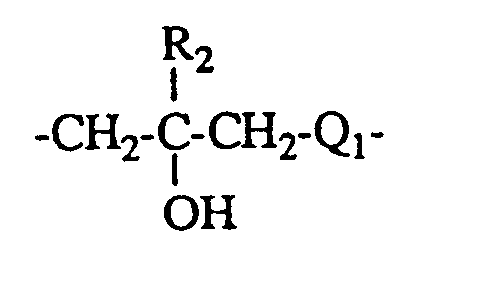
steht, worin R₂ ein H-Atom oder Methyl und Q₁ -O-, -NH-, -S- oder -OCO- bedeuten, Y₁ für eine direkte Bindung, -SO₂-, -CO-, -O-CO-, -NH-CO- oder 
steht, worin R₂ ein H-Atom oder Methyl und Q₂ -O-, -NH-, -S- oder -OCO- bedeuten, R₁ einen zweiwertigen aliphatischen, cycloaliphatischen, aromatischen oder araliphatischen Rest mit bis zu 30 C-Atomen bedeutet, können vorteilhaft aus der Lösung heraus verarbeitet werden und eignen sich zum Modifizieren von Matrixharzen.
steht, worin R₂ ein H-Atom oder Methyl und Q₁ -O-, -NH-, -S- oder -OCO- bedeuten, Y₁ für eine direkte Bindung, -SO₂-, -CO-, -O-CO-, -NH-CO- oder
steht, worin R₂ ein H-Atom oder Methyl und Q₂ -O-, -NH-, -S- oder -OCO- bedeuten, R₁ einen zweiwertigen aliphatischen, cycloaliphatischen, aromatischen oder araliphatischen Rest mit bis zu 30 C-Atomen bedeutet, können vorteilhaft aus der Lösung heraus verarbeitet werden und eignen sich zum Modifizieren von Matrixharzen.
Description
- Die vorliegende Erfindung betrifft im wesentlichen lineare Polymere mit Arylenetherketoneinheiten aus neuen 4,4′-Dihalogen- oder 4,4′-Dihydroxy-3,3′-diphenylphthalophenonen, Verfahren zu deren Herstellung, die aus den erfindungsgemässen Polymeren hergestellten Formstoffe, Beschichtungen oder Folien sowie die Verwendung der erfindungsgemässen Polymeren zum Modifizieren von Matrixharzen.
- Polyarylenetherketone und Polyarylenethersulfone sind technische Werkstoffe mit sehr guten mechanischen und thermischen Eigenschaften, die eine hohe Beständigkeit gegenüber herkömmlichen organischen Lösungsmitteln aufweisen. Für manche Anwendungen ist jedoch diese Lösungsmittelresistenz nicht erwünscht, insbesondere sollen bei der Modifizierung von duromeren Matrixharzen möglichst konzentrierte Polymerlösungen in üblichen organischen Lösungsmitteln zur Verwendung kommen.
- Polyarylenetherketone aus unsubstituierten Dihydroxyiso- oder -terephthalophenon sind aus der DE-OS 30 14 230 bekannt. Aufgrund des Einbaues von Iso- oder Terephthalophenon-Einheiten weisen die dort beschriebenen Polyarylenetherketone eine verbesserte Lösungsmittelbeständigkeit gegenüber den gebräuchlichen organischen Lösungsmitteln, beispielsweise Methylenchlorid, Aceton oder Chlorbenzol, auf.
- Es wurde nun gefunden, dass Polymere mit Arylenetherketoneinheiten aus 4,4′-Dihydroxy-3,3′-diphenylphthalophenonen überraschend in gebräuchlichen organischen Lösungsmitteln, vorzugsweise in halogenierten Kohlenwasserstoffen oder cyclischen Ketonen, gut löslich sind und stabile Lösungen bilden.
- Gegenstand der vorliegenden Erfindung sind somit im wesentlichen lineare Polymere mit einer reduzierten Viskosität von 0,1 bis 2,0 dl/g, gemessen an einer 1 gew.-%igen Lösung in N-Methylpyrrolidon (NMP) bei 25°C, enthaltend mindestens einen die Löslichkeit des Polymeren in organischen Lösungsmitteln erhöhenden Anteil an Struktureinheiten der Formel I

worin die aromatischen Ringe unsubstituiert oder durch ein oder mehrere C₁-C₄-Alkyle, C₁-C₄-Alkoxy oder Halogenatome substituiert sind,
Ar einen zweiwertigen aliphatischen, cycloaliphatischen, araliphatischen oder aromatischen Rest mit bis zu 50 C-Atomen bedeutet,
X₁ für eine direkte Bindung, -SO₂-, -CO-, -CO-O-, -CO-NH- oder
steht, worin R₂ ein H-Atom oder Methyl und Q₁ -O-, -NH-, -S- oder -OCO- bedeuten,
Y₁ für eine direkte Bindung, -SO₂-, -CO-, -O-CO-, -NH-CO- oder
steht, worin R₂ ein H-Atom oder Methyl und Q₂ -O-, -NH-, -S- oder -OCO- bedeuten,
R₁ einen zweiwertigen aliphatischen, cycloaliphatischen, aromatischen oder araliphatischen Rest mit bis zu 30 C-Atomen bedeutet, der unsubstituiert ist oder durch ein oder mehrere C₁-C₄-Alkyle, C₁-C₄-Alkylthio, C₂-C₆-Alkenyle, C₅-C₁₂-Cycloalkyle, C₆-C₁₂-Aryle oder eine oder mehrere Cyano- oder Nitrogruppen substituiert ist und in dem ein oder mehrere Kohlenstoffatome durch Sauerstoff-, Schwefel- oder Stickstoffatome ersetzt sein können. - Der Begriff "im wesentlichen linear" ist so zu verstehen, dass die erfindungsgemässen Polymeren entweder lineare Ketten ausbilden oder einen geringen Verzweigungsgrad aufweisen, so dass sie sich ohne Schwierigkeit in einem herkömmlichen organischen Lösungsmittel, beispielsweise in einem chlorierten Kohlenwasserstoff oder in einem polaren aprotischen Lösungsmittel, lösen lassen.
- Die Löslichkeit wird im allgemeinen vom Anteil der Struktureinheiten der Formel I beeinflusst werden. Dabei wird die Löslichkeit mit zunehmender Konzentration dieser Struktureinheiten in der Regel zunehmen. Unter "einem die Löslichkeit des Polymeren erhöhenden Anteil an Struktureinheiten der Formel I" ist im Falle von Copolymeren im Rahmen dieser Beschreibung zumindest ein solcher Anteil zu verstehen, der im Vergleich zu nicht mit solchen Struktureinheiten modifizerten Polymeren (Basispolymer) entweder überhaupt erst zu einer Löslichkeit in einem bestimmten Lösungsmittel führt oder der zu einer merklichen Erhöhung der Lagerstabilität einer Lösung führt. Uebliche Werte für die Konzentration einer Polymerlösung bewegen sich im Bereich von 1-75 Gew.%, insbesondere von 5-50 Gew.% des Polymeren, bezogen auf die Lösung.
- Die für ein bestimmtes Polymer zum Erzielen einer gewünschten Löslichkeit in einem vorgegebenen Lösungsmittel benötigte Menge an Struktureinheiten der Formel I kann mittels Routineversuchen ermittelt werden. In der Regel enthalten die erfindungsgemässen Polymeren mehr als 5 Mol-%, vorzugsweise mehr als 10 Mol-%, und insbesondere mehr als 20 Mol-% dieser Struktureinheiten, bezogen auf das Polymere.
- Unter dem Begriff "Polymer" sind im Rahmen dieser Beschreibung auch Oligomere zu verstehen. Die reduzierte Viskosität der erfindungsgemässen Polymeren erstreckt sich über einen Bereich von etwa 0,1 bis etwa 2,0 dl/g. Dies entspricht einem Molekulargewichtsbereich von etwa 1'000 bis etwa 100'000 (Zahlenmittel). Bevorzugt werden Polymere mit einem Zahlenmittel des Molekulargewichts von 5'000 bis 50'000. Im Falle der Diglycidylether auf Basis der erfindungsgemässen Bisphenole können die Oligomeren auch Molekulargewichte wesentlich unterhalb von 1'000 aufweisen.
- Der Rest Ar in der Struktureinheit der Formel I steht vorzugsweise für einen aromatischen Rest, besonders bevorzugt für einen unsubstituierten oder durch ein oder mehrere C₁-C₄-Alkyle, C₁-C₄-Alkoxy oder Halogenatome substituierten Rest der Formeln

insbesondere für einen unsubstituierten definitionsgemässen Rest, ganz besonders für einen 1,3- oder 1,4-Phenylenrest. - Die Reste X₁ und Y₁ in den Struktureinheiten der Formel I können im Rahmen der gegebenen Definitionen gleiche oder unterschiedliche Bedeutungen aufweisen. Vorzugsweise haben diese Reste die gleiche Bedeutung, und insbesondere stehen X₁ und Y₁ für eine direkte Bindung.
- Der Rest R₁ bedeutet vorzugsweise einen unsubstituierten oder substituierten cycloalipharischen oder aromatischen Rest, insbesondere einen aromatischen Rest.
- Enthalten die aromatischen Ringe in der Struktureinheit der Formel I, der Rest Ar oder der Rest R₁ in Formel I Alkylsubstituenten, so können diese Methyl, Ethyl, n-Propyl, Isopropyl, n-Butyl, sek.-Butyl oder tert.-Butyl sein.
- Beispiele für Alkoxyreste sind Methoxy, Ethoxy, n-Propoxy, Isopropoxy, n-Butoxy und tert.-Butoxy.
- Bedeuten irgendwelche Reste Halogenatome, so handelt es sich hierbei im allgemeinen um Chlor, Brom, Fluor oder Jod, vorzugsweise um Chlor oder Brom.
- Beispiele für Alkylthioreste sind Methylthio, Ethylthio, n-Propylthio, Isopropylthio oder n-Butylthio.
- Bedeuten irgendwelche Reste Alkenyl, so handelt es sich dabei um verzweigte oder insbesondere um geradkettige Reste. Alkenylreste weisen zwei bis sechs Kohlenstoffatome auf. Beispiele für Alkenylreste sind Vinyl, Prop-1-enyl, Prop-2-enyl, n-But-3-enyl, n-Pent-4-enyl oder n-Hex-5-enyl. Bevorzugt werden geradkettige Alkenylreste mit zwei oder drei Kohlenstoffatomen, insbesondere Vinyl, Prop-1-enyl oder Prop-2-enyl (Allyl). Alkenylsubstituenten werden besonders bevorzugt, da sie eine Vemetzung der erfindungsgemässen Polymeren über die Alkenylgruppen gestatten.
- Bedeuten irgendwelche Reste Cycloalkyl, so handelt es sich dabei im allgemeinen um Gruppen mit fünf bis acht Ringkohlenstoffatomen. Bevorzugt wird Cyclohexyl. Beispiele für Cycloalkylreste sind Cyclopentyl, Cyclohexyl, Cycloheptyl oder Cyclooctyl.
- Beispiele für Arylreste sind Phenyl, Naphthyl und Biphenyl, vorzugsweise handelt es sich hierbei um Phenyl.
- Im Rest R₁ können auch ein oder mehrere, vorzugsweise ein, zwei oder drei Kohlenstoffatome durch Sauerstoff-, Schwefel- und/oder Stickstoffatome ersetzt sein. Beispiele für derartig modifizierte Alkylenketten sind Reste, die sich von Polyalkylenglykolen ableiten. Ferner kann es sich um aromatische oder nicht aromatische heterocyclische Systeme handeln, die vorzugsweise fünf- oder sechsgliedrig sind. Im Falle von heterocyclischen Systemen sind vorzugsweise ein bis drei Ringkohlenstoffatome durch Stickstoffatome oder ein oder zwei Ringkohlenstoffatome durch Sauerstoff- oder Schwefelatome ersetzt. Es können auch unterschiedliche Heteroatome in einem Ring auftreten, beispielsweise ein Stickstoff- und ein Sauerstoffatom.
- Beispiele für heterocyclische Reste sind Morpholindiyl, Piperidindiyl, Furandiyl, Pyridindiyl, Thiophendiyl, Triazindiyl und Pyridazindiyl.
- Die Definition "ein oder mehrere Kohlenstoffatome sind durch Sauerstoff-, Schwefel- und/oder Stickstoffatome ersetzt" umfasst auch solche heterocyclischen Systeme, bei denen die Ringheteroatome neben der Einbindung in das Ringsystem noch ihrerseits zusätzliche Atome oder Substituenten tragen. Beispiele für solche Heterogruppen sind -SO₂-, -NH- oder -NO-.
- Die erfindungsgemässen Polymeren weisen entweder gleiche oder unterschiedliche wiederkehrende Struktureinheiten auf oder es handelt sich um Copolymere, die neben der wiederkehrenden Struktureinheit der Formel I noch wiederkehrende Struktureinheiten der Formel II
⁅O-R₃-O-X₁-R₁-Y₁⁆ (II)
aufweisen, worin X₁, R₁ und Y₁ die gleiche Bedeutung wie in Formel I haben und R₃ einen zweiwertigen aliphatischen, cycloaliphatischen, araliphatischen oder aromatischen Rest mit bis zu 50 C-Atomen bedeutet, der vom Rest
verschieden ist, worin Ar die gleiche Bedeutung wie in Formel I hat. - Die bevorzugten erfindungsgemässen Polymeren enthalten, bezogen auf die Gesamtmenge der im Polymer vorhandenen Struktureinheiten, 5 bis 100 Mol-%, insbesondere 10 bis 100 Mol-%, einer wiederkehrenden Struktureinheit der Formel I und 95 bis 0 Mol-%, insbesondere 90 bis 0 Mol-%, einer wiederkehrenden Struktureinheit der Formel II.
- Vorzugsweise bedeutet R₃ einen unsubstituierten oder durch ein oder mehrere C₁-C₄-Alkyle, C₁-C₄-Alkoxy oder Halogenatome substituierten Rest der Formeln IIIa bis IIIg

wobei a Null oder die Zahl 1 ist,

wobei b die Zahl 1 oder 2 ist,
darstellt, worin Z für -CO-, -SO₂-, -SO-, -S-, -O-,
-CH₂-,
steht, wobei R ein Methyl oder Phenyl bedeutet, und Q für -CH₂-, -O-,
oder die direkte Bindung steht. - Insbesondere bedeutet R₃ einen Rest der Formeln

- Beispiele für erfindungsgemässe Polymere sind Polyarylenether, wie Polyarylenetherketone und Polyarylenethersulfone, Polysulfonate, Polycarbonate, Polyester, Polyurethane und Phenoxyharze, wobei diese noch mit anderen Monomeren, die sich mit den betreffenden Monomeren der Polymeren copolymerisieren lassen, modifiziert werden können. Ausserdem können die Endgruppen der erfindungsgemässen Polymeren, wie beispielsweise die Hydroxyl- oder Carboxylgruppen in bekannter Weise weiter umgesetzt werden, beispielsweise mit Epichlorhydrin oder ß-Methylepichlorhydrin, wobei nach der Dehydrochlorierung die entsprechenden Diglycidylverbindungen erhalten werden. Desgleichen lassen sich die erfindungsgemässen Polymeren mit Diaminen oder Dianhydriden modifizieren.
- Besonders bevorzugte Polymere dieser Erfindung sind überwiegend aus aromatischen Gruppen aufgebaut. Davon sind besonders die Polyether und davon die Polyetherketone und Polyethersulfone bevorzugt. Erfindungsgemässe Polymere mit aromatischen Gruppen zeichnen sich in der Regel durch besonders gute thermische Eigenschaften aus. Dabei handelt es sich bevorzugt um Verbindungen, die zu 10 bis 100 Mol% aus wiederkehrenden Struktureinheiten der Formel I bestehen.
- Ganz besonders bevorzugte Polymere dieser Erfindung sind Polyarylenether, insbesondere solche, die, bezogen auf die Gesamtmenge der im Polyarylenetherharz vorhandenen Struktureinheiten, 5-100 Mol-% einer wiederkehrenden Struktureinheit der Formel IV

und 95-0 Mol-% einer wiederkehrenden Struktureinheit der Formel V
⁅O-Ar₂-O-Ar₁⁆ (V)
enthalten, worin die beiden Carbonylgruppen zueinander in para- oder meta-Stellung stehen, Ar₁ einen unsubstituierten oder durch ein oder mehrere C₁-C₄-Alkyle, C₁-C₄-Alkoxy oder Halogenatome substituierten Rest der Formel IVa bis IVe
wobei c für Null oder die Zahl 1 oder 2 steht, oder
wobei d die Zahl 2 oder 3 bedeutet,
darstellt, worin X für -CO-, -SO₂- oder -SO- steht, und Ar₂ einen unsubstituierten oder durch ein oder mehrere C₁-C₄-Alkyle, C₁-C₄-Alkoxy oder Halogene substituierten Rest der Formeln Va-Vg
wobei e Null oder die Zahl 1 bedeutet,
wobei f Null oder die Zahl 1 ist,
oder
darstellt, worin Z für -CO-, -SO₂-, -SO-, -S-, -O-,
-CH₂-,
steht, worin R ein Methyl oder Phenyl bedeutet und Q für -CH₂-, -O-,
oder die direkte Bindung steht. - In den erfindungsgemässen Polyarylenethern sind die Strukturelemente der Formeln IV und V vorzugsweise unsubstituiert.
- Vorzugsweise enthalten die erfindungsgemässen Polyarylenether 100-10 Mol-% einer wiederkehrenden Struktureinheit der Formel IV und 90-0 Mol-% einer wiederkehrenden Struktweinheit der Formel V, worin die beiden Carbonylgruppen zueinander in meta- oder para-Stellung stehen, Ar₁ vorzugsweise einen Rest der Formel

oder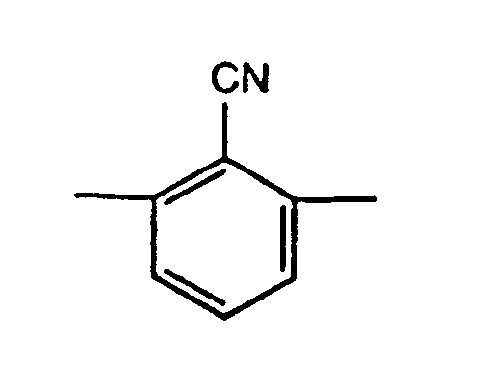
bedeutet und Ar₂ vorzugsweise für einen Rest der Formeln
- Die erfindungsgemässen im wesentlichen linearen Polymeren, enthaltend Struktureinheiten der Formel I, können hergestellt werden, indem man ein unsubstituiertes oder durch ein oder mehrere C₁-C₄-Alkyle, C₁-C₄-Alkoxy oder Halogenatome substituiertes Diphenol der Formel VI

worin Ar die gleiche Bedeutung wie in Formel I hat, oder ein Gemisch aus einem Diphenol der Formel VI und einer darin bis zu 95 Mol-% enthaltenen, vom Diphenol der Formel VI verschiedenen Dihydroxyverbindung in äquimolaren Mengen mit einer Verbindung der Formel VII
Z₁-R₁-Z₂ (VII),
umsetzt, worin R₁ die gleiche Bedeutung wie in Formel I hat und Z₁ und Z₂ unabhängig voneinander je ein Halogenatom, vorzugsweise Fluor- oder Chloratom, oder einen Rest der Formeln -SO₃H, -SO₃R₄, -SO₂Cl, -COOH, -COCl, -COOR₄, -OR₄, -O-COCl, -N=C=O,
bedeuten, worin R₂ für ein H-Atom oder Methyl und R₄ für ein C₁-C₄-Alkyl oder Phenyl stehen und Q₁ und Q₂ -O-, -NH-, -S- oder -OCO- bedeuten. - Unter äquimolaren Mengen versteht man im Zusammenhang mit dem oben angegebenen Verfahren ein Molverhältnis der Diphenolverbindung der Formel VI oder des Gemisches von Diphenol- und Dihydroxyverbindung zu der Verbindung der Formel VII von 0,9 bis 1, 1. Bevorzugt ist ein Molverhältnis von 0,95 bis 1,05.
- Die Verbindungen der Formel VI sind noch nicht in der Literatur beschrieben worden und stellen somit einen weiteren Erfindungsgegenstand dar.
- Vorzugsweise steht Ar in Formel VI für einen unsubstituierten Rest der Formeln

insbesondere für 1,3- oder 1,4-Phenylen - Die Verbindungen der Formel VI können hergestellt werden, indem man 1 Mol einer aromatischen Dicarbonsäure oder eines aromatischen Dicarbonsäuredichlorids der Formel VIII
X₁-CO-Ar-CO-X₁ (VIII),
worin X₁ je für ein -OH oder ein Chloratom steht und Ar die gleiche Bedeutung wie in Formel I hat, mit 2 Mol eines unsubstituierten oder durch ein oder mehrere C₁-C₄-Alkyle, C₁-C₄-Alkoxy oder Halogenatome substituierten 2-Alkoxybiphenyls(2-Methoxybiphenyl) in Gegenwart von FeCl₃ als Katalysator im Temperaturbereich von 80-160°C umsetzt und die erhaltene unsubstituierte oder substituierte Verbindung der Formel IX
worin Ar die gleiche Bedeutung wie in Formel I hat und Alkyl für ein C₁-C₄-Alkyl steht, mit der 2- bis 6-fachen Gewichtsmenge AlCl₃, bezogen auf die Gewichtsmenge der Verbindung der Formel IX, im Temperaturbereich von 40-100°C umsetzt, wobei eine Verbindung der Formel VI erhalten wird. - Die Verbindungen der Formel IX sind ebenfalls noch nicht in der Literatur beschrieben worden und stellen somit einen weiteren Erfindungsgegenstand dar.
- Als Dihydroxyverbindungen, die von denen der Formel VI verschieden sind, eignen sich im allgemeinen aliphatische, cycloaliphatische und aromatische Dihydroxyverbindungen. Beispiele für geeignete Dihydroxyverbindungen sind:
Ethylenglykol, Diethylenglykol, Propan-1,2-diol, Propan- 1,3-diol, Butan-1,4-diol, Poly-(oxyethylenglykol), Poly-(oxypropylenglykol), Poly-(oxybutylenglykol), Pentan-1,5-diol, Hexan-1,6-diol, Octan-1,8-diol, 2,2-Dimethylpropan-1,3-diol, trans-Tetramethylcyclobutandiol und 1,4-Bis-(hydroxymethyl)-cyclohexan, 1,1-Bis-(hydroxymethyl)-cyclo-hex-3-en, Bis-(4-hydroxycyclohexyl)-methan, 2,2-Bis-(4-hydroxycyclohexyl)-propan, Hydrochinon, Chlor-, Methyl-, 2,3-Dimethyl- oder Trimethylhydrochinon, Tetrafluorhydrochinon, Resorcin, 1,2-Bis-(4-hydroxyphenyl)-ethan, 2,2-Bis-(4-hydroxyphenyl)-propan (Bisphenol A), Tetrabrombisphenol A, Hexafluorbisphenol A, Bis-(4-hydroxyphenyl)-ether, Bis-(4-hydroxyphenyl)-sulfid, Bis-(4-hydroxyphenyl)-sulfon, Bis-(hydroxyphenyl)-methan (Bisphenol F), Bis-(4-hydroxy-3,5-dimethylphenyl)-methan, 2,2-Bis-(4-hydroxy-3-methylphenyl)-propan, 2,2-Bis-(4-hydroxy-3,5-dimethylphenyl)-propan, 2,2-Bis-(4-hydroxy-3,5-dichlorphenyl)-propan, Bis-(4-hydroxy-3,5-dimethylphenyl)-sulfid, Bis-(4-hydroxy-3,5-dimethylphenyl)-sulfon, 2,2-Bis-(4-hydroxy-3,5-dibromphenyl)-propan, 4,4′-Dihydroxybiphenyl, 4,4′-Dihydroxy-2,2′-dimethylbiphenyl, 2,2′-Dihydroxybiphenyl, 2,5 -Dihydroxybiphenyl, 4,4′-Dihydroxyterphenyl, 4,4′-Dihydroxybenzophenon, 2,2′-Dihydroxybenzophenon, 4,4′-Dihydroxydiazo-biphenyl, 4,4′-Dihydroxyterephthalophenon, 4,4′-Dihydroxyisophthalophenon, 4,4′-Dihydroxytriphenylmethan, Phenolphthalein, Phenolsulfonphthalein, Fluorescein, 9,9-Bis-(4-hydroxyphenyl)-fluoren, 1,5-Dihydroxyanthrachinon, 2,6-Dihydroxyanthrachinon, 1,5-Dihydroxynaphthalin, 1,6-Dihydroxynaphthalin, 2,6-Dihydroxynaphthalin, 2,7-Dihydroxynaphthalin, 4,5-Bis-(4-hydroxyphenyl)-2-phenylimidazol und 2,3-Bis-(4-hydroxyphenyl)-chinoxalin. Solche Dihydroxyverbindungen sind bekannt und zum Teil im Handel erhältlich. - Beispiele für geeignete polyetherbildende Halogenverbindungen der Formel VIII sind: 1,3-Dibrombenzol, 1,4-Dibrombenzol, 4,4′-Dibrombiphenyl, 4,4′-Dibrombenzophenon, 2,7-Dibrom-9-fluorenon, 1,3-Bis-(chlormethyl)-benzol, 1,4-Bis-(chlormethyl)-benzol, 1,4-Bis-(brommethyl)-benzol, 1,5-Bis-(chlormethyl)-naphthalin, Bis-(4-chlorphenyl)-sulfon, Bis-(4-fluorphenyl)-sulfon, Bis-(4-chlorphenyl)-keton, Bis-(4-fluorphenyl)-keton, 2,6-Difluorbenzonitril, 2,6-Dichlorpydin, 4,6-Di-chlor-2-phenyl-1,3,5-triazin, 4,6-Di-chlor-2-methyl- 1,3,5-triazin, 4,6-Di-chlor-2-methoxy-1,3,5-triazin und 3,6-Dichlorpyridazin. Diese stellen ebenfalls bekannte Verbindung dar und sind kommerziell erhältlich.
- Beispiele für geeignete Disulfonsäure(derivate) der Formel VII sind:
1,3-Benzoldisulfonsäure, 1,4-Benzoldisulfonsäure, 4,4′-Biphenyidisulfonsäure, 4,4′-Oxy-bis-(benzolsulfonsäure), 4,4′-Sulfonyl-bis-(benzolsulfonsäure), 4,4′-Methylen-bis-(benzolsulfonsäure) und 2,2-Bis-(benzolsulfonsäure)-propan und die Disulfonsäuredichloride, die Disulfonsäuredialkylester mit 1 bis 4 C-Atomen im Alkylrest, der Disulfonsäurediphenylester und die Dinatriumsalze dieser Säuren. Auch diese Verbindungen sind bekannt. - Beispiele für geeignete polycarbonatbildende Verbindungen der Formel VII sind Phosgen, Chlorameisensäurealkyl- oder -phenylester, Kohlensäuredialkyl- oder -diphenylester oder Verbindungen der Formeln Cl-CO-O-R₁-O-COCl oder R₄O-CO-O-R₁-O-CO-OR₄, worin R₁ und R₄ die gleiche Bedeutung wie in Formel I haben. Solche Verbindungen sind bekannt und zum Teil im Handel erhältlich.
- Beispiele für geeignete Dicarbonsäuren oder deren Polyester bildende Derivate der Formel VII sind:
Adipinsäure, Azelainsäure, Sebacinsäure, Suberinsäure, Pimelinsäure, Hexahydroterephthalsäure, Terephthalsäure, Isophthalsäure, 2,5-Dichlorterephthalsäure, 2,5-Dichlorisophthalsäure, 2-Phenylisophthalsäure, 5-Methylisophthalsäure, 4,4′-Biphenyldicarbonsäure, Diphenylsulfon-4,4′-dicarbonsäure, Diphenylether-4,4′-dicarbonsäure, Diphenylether-3,4′-dicarbonsäure, Diazodiphenyl-4,4′-dicarbonsäure, Diphenylmethan-4,4′-dicarbonsäure, 2,2-Bis-(4-benzoesäure)-propan, 2,2-Bis-(4-benzoesäure)-hexafluoropropan, Triphenylphosphinoxid-4,4′-dicarbonsäure, Diphenylmethylphosphinoxid-4,4′-dicarbonsäure, Naphthalin-2,6-dicarbonsäure, 1,4-Cyclohexandicarbonsäure, [2.2.2]-Bicyclooctandicarbonsäure und [3.2.2]-Bicyclononandicarbonsäure, sowie die Methyl-, Ethyl- oder Phenylester dieser Säuren oder deren Säurechloride. Auch diese bekannten Verbindungen sind zum Teil im Handel erhältlich. - Beispiele für geeignete Diisocyanate der Formel VII sind:
Hexamethylendiisocyanat, Cyclohexan-1,4-diisocyanat, 2,4- und 2,6-Toluylendiisocyanat und deren Gemische, Isophorondiisocyanat (1-Isocyanatomethyl-5-isocyanato-1,3,3-trimethyl-cyclohexan), Phorondiisocyanat (2,2,4- bzw. 2,4,4-Trimethyl-hexamethylendiisocyanat-1,6), 1,5-Naphthalindiisocyanat, 1,3-Cyclopentylendiisocyanat, m- und p-Phenylendiisocyanat, 2,4,6-Toluylentriisocyanat, 4,4′,4˝-Triphenylmethantriisocyanat, 1,3- und 1,4-Xylylendiisocyanat, 3,3′-Dimethyl-4,4′-diphenylmethandiisocyanat, 4,4′-Diphenyl-methandiisocyanat, 3,3′-Dimethylbiphenylendiisocyanat, 4,4′-Bisphenylendiisocyanat, Durendiisocyanat, 1-Phenoxy-2,4′-phenylendiisocyanat, 1-tert.-Butyl-2,4-phenylendiisocyanat, Methylen-bis-4,4′-cyclohexyldiisocyanat, 1-Chlor-2,4-phenylendiisocyanat und 4,4′-Diphenyletherdiisocyanat, welche bekannte Verbindungen darstellen. - Zur Herstellung der Phenoxyharze eignen sich als Diglycidylverbindungen der Formel VII beispielsweise die Diglycidylether und Diglycidylester der oben aufgezählten Dihydroxyverbindungen und Dicarbonsäuren. Ferner können auch Di-S-glycidylverbindungen, wie beispielsweise Ethan-1,2-dithioldiglycidylether oder Bis-(4-glycidylthiomethylphenyl)-ether, oder Di-N-glycidylverbindungen, beispielsweise unsubstituiertes oder alkylsubstituiertes N,N′-Diglycidyl-5,5-dimethylhydantoin, als Diglycidylverbindungen der Formel VII eingesetzt werden. Vorzugsweise verwendet man als Diglycidylverbindung einen Diglycidylether eines Bisphenols, insbesondere des Bisphenols A oder F. Diese Diglycidylverbindungen sind ebenfalls bekannt und zum Teil im Handel erhältlich.
- Ausserdem können als Verbindung der Formel VII auch solche mit verschiedenen funktionellen Gruppen verwendet werden, beispielsweise Isocyanatocarbonsäurehalogenide, wie 4-Isocyanatophenylcarbonsäurechlorid, Isocyanatosulfonsäurehalogenide, wie 4-Isocyanatophenylsulfonsäurechlorid, oder Halogencarbonyloxycarbonsäurehalogenide, wie 4-Chlorcarbonyloxyphenylcarbonsäurechlorid.
- Wie bereits erwähnt wurde, können die erfindungsgemässen Polymeren noch mit anderen Monomeren, die sich mit den Monomeren der Polymeren copolymerisieren lassen, modifiziert sein. Solche Monomere sind beispielsweise Hydroxycarbonsäuren, Hydroxysulfonsäuren oder Aminophenole.
- Beispiele für geeignete Hydroxycarbonsäuren oder deren polyesterbildende Derivate sind:
4-Hydroxybenzoesäure, 3-Chlor-4-hydroxybenzoesäure, 3,5-Dichlor-4-hydroxybenzoesäure, 3-Methyl-4-hydroxybenzoesäure, 3-Brom-4-hydroxybenzoesäure, 3,5-Dimethyl-4-hydroxybenzoesäure, 3-Methoxy-4-hydroxybenzoesäure, 6-Hydroxy-2-naphthoesäure, 6-Hydroxy-5-chlor-2-naphthoesäure und 6-Hydroxy-5-methyl-2-naphthoesäure sowie die Methyl-, Ethyl- oder Phenylester dieser Säuren oder deren Säurechloride, sowie die Monoester dieser Phenole, wie die Acetate. - Beispiele für geeignete Hydroxysulfonsäuren oder deren polyesterbildende Derivate sind die Analogen der oben aufgezählten Hydroxycarbonsäure(derivate), bei denen die Carboxylgruppe durch eine Sulfonsäuregruppe ersetzt ist.
- Beispiele für geeignete Aminophenole sind:
3-oder 4-Aminophenol, 2-Hydroxy-5-amino-naphthalin, 2-Hydroxy-6-amino-naphthalin oder 2-Hydroxy-7-amino-naphthalin. - Die Herstellung der besonders bevorzugten Polyarylenether erfolgt beispielsweise durch
(a) Polykondensation eines Diphenols der Formel VI, eines Gemisches aus einem Diphenol der Formel VI oder dessen Alkali- oder Erdalkaliphenolat und einer darin bis zu 95 Mol-% enthaltenen Dihydroxyverbindung der Formel X
HO-Ar₂-OH (X)
oder deren Alkali- oder Erdalkalisalze, worin Ar₂ die gleiche Bedeutung wie in Formel V hat, mit einer äquimolaren Menge einer Dihalogenverbindung der Formel VII, worin Z₁ und Z₂ je für Fluor oder Chlor stehen, in Gegenwart von Alkali in einem aprotischen Lösungsmittel oder durch
(b) Polykondensation einer unsubstituierten oder durch ein oder mehrere C₁-C₄-Alkyle, C₁-C₄-Alkoxy oder Halogenatome substituierten Dihalogenverbindung der Formel XI
worin Ar die gleiche Bedeutung wie in Formel I hat und Hal für ein Halogenatom, vorzugsweise Fluor- oder Chloratom, steht, oder eines Gemisches aus einer Dihalogenverbindung der Formel XI und einer darin bis zu 95 Mol-% enthaltenen, von der Dihalogenverbindung der Formel XI verschiedenen Dihalogenverbindung der Formel VII in äquimolaren Mengen mit einer Dihydroxyverbindung der Formel X oder deren Alkalioder Erdalkalisalze in Gegenwart von Alkali in einem aprotischen Lösungsmittel, bis der erhaltene Polyarylenether eine reduzierte Viskosität von 0,1 bis 2,0 dl/g, vorzugsweise von 0,15 bis 1,8 dl/g insbesondere von 0,2 bis 1,5 dl/g, aufweist, gemessen an einer 1 gew.%igen Lösung in N-Methylpyrrolidon (1 g Polyarylenether in 100 ml N-Methylpyrrolidon) bei 25°C. - Als Alkali verwendet man in diesem Verfahren in der Regel Alkali- und Erdalkalicarbonate, wie Natrium-, Kalium- oder Calciumcarbonat; doch können auch andere alkalische Reagentien, wie Natriumhydroxid, Kaliumhydroxid oder Calciumhydroxid, Verwendung finden.
- Polare, aprotische Lösungsmittel, die beim Verfahren zur Herstellung der erfindungsgemässen Polyetherharze eingesetzt werden können, sind beispielsweise Dimethylsulfoxid, Dimethylacetamid, Diethylacetamid, Tetramethylharnstoff, N-Methylcaprolactam, N-Methylpyirolidon und bevorzugt Diphenylsulfon.
- Die Reaktion wird zweckmässig bei erhöhter Temperatur durchgeführt, vorzugsweise bis zur Rückflusstemperatur des Lösungsmittels, also etwa bis 350°C.
- Häufig empfiehlt sich die Mitverwendung eines Schleppmittels, wie z.B. Chlorbenzol, Xylol oder Toluol, um das bei der Umsetzung gebildete Wasser azeotrop aus dem Reaktionsgemisch entfemen zu können.
- Die Verbindungen der Formel XI sind in der Literatur noch nicht beschrieben worden und stellen einen weiteren Erfindungsgegenstand dar.
- Die Verbindungen der Formel XI können hergestellt werden, indem man 1 Mol einer aromatischen Dicarbonsäwe oder eines aromatischen Dicarbonsäuredichlorids der Formel VIII
X₁-CO-Ar-CO-X₁ (VIII),
worin X₁ je für -OH oder ein Chloratom stehen und Ar die gleiche Bedeutung wie in Formel I hat, mit 2 Mol eines unsubstituierten oder durch ein oder mehrere C₁-C₄-Alkyle, C₁-C₄-Alkoxy oder Halogenatome substituierten 2-Fluorbiphenyls in Gegenwart von FeCl₃ als Katalysator im Temperaturbereich von 80-160°C zu einer Verbindung der Formel XI umsetzt. - Die Herstellung der erfindungsgemässen Polymeren, die durch Umsetzung eines Diphenols der Formel VI mit einer Disulfonsäure, einem Disulfonsäurediester oder -dichlorid erhalten werden, kann in der Schmelze oder in Lösung, beispielsweise als Grenzflächenpolykondensation in einem inerten Lösungsmittel und in Gegenwart einer Base, beispielsweise von Kaliumcarbonat oder -hydroxid, erfolgen.
- Die Herstellung der erfindungsgemässen Polymeren, die durch Umsetzung eines Diphenols der Formel VI mit einer Dicarbonsäure oder deren polyesterbildenden Derivaten und gegebenenfalls weiteren Dihydroxyverbindungen und/oder Aminoalkoholen und/oder Hydroxycarbonsäuren und/oder Hydroxysulfonsäuren oder den polyesterbildenden Derivaten dieser Säuren erhalten werden, kann beispielsweise durch Umesterung von geeigneten Dicarbonsäureestern mit Diphenolen, sowie durch Veresterung der freien Säure mit Diphenolderivaten, wie z.B. den Diacetaten, in der Schmelze und gegebenenfalls in Gegenwart von basischen oder sauren Katalysatoren erfolgen. Geeignete Katalysatoren sind Dibutylzinnoxid, p-Toluolsulfonsäure, Bortrifluorid, Titandioxid, Calciumacetat, Manganacetat, Zinkacetat oder Antimonoxid. Die Herstellung der Polyester kann auch durch Grenzflächenpolykondensation oder durch Polykondensation in einem inerten Lösungsmittel erfolgen. Je nach der Aktivität der eingesetzten Monomeren kann die Polykondensation bei erhöhten Temperaturen oder bei Temperaturen bis unterhalb Raumtemperatur durchgeführt werden.
- Die Herstellung der erfindungsgemässen Polymeren, die durch Polyaddition eines Diphenols der Formel VI mit einer Diglycidylverbindung erhalten werden, kann ebenfalls in der Schmelze als auch in Lösung erfolgen. Die Herstellung von sogenannten Phenoxyharzen ist an sich bekannt und wird beispielsweise im DE-Patent 1 935 115 beschrieben.
- Die Herstellung der erfindungsgemässen Polycarbonate erfolgt beispielsweise durch Umesterung von Diphenylcarbonat mit Bisphenolen der Formel VI in der Schmelze und in Gegenwart von basischen Katalysatoren, wie LiOH oder NaOH, oder durch Umsetzung von Bisphenolen der Formel VI mit Phosgen oder einer Bis-chlorcarbonylverbindung in einem inerten Lösungsmittel. Die Umsetzung mit Phosgen oder einer Bis-chlorcarbonylverbindung kann auch durch Grenzflächenpolykondensation des Phenolats in einem Gemisch aus Wasser und einem inerten Lösungsmittel erfolgen.
- Die Herstellung von erfindungsgemässen Polymeren, die durch stufenweise Polyaddition von Diisocyanaten an Verbindungen der Formel VI erhalten werden, wird nach den in der Polyurethanchemie üblichen Verfahren durchgeführt. Als Katalysatoren verwendet man meist tert. Amine oder zinnorganische Verbindungen.
- Weitere erfindungsgemässe Verbindungen, welche sich von dem Diphenol der Formel VI ableiten, stellen die Diglycidylether der Formel XII

dar, worin Ar die gleiche Bedeutung wie in Formel I hat, R₂ für ein H-Atom oder Methyl steht und n Null oder eine Zahl von 1 bis 20 ist. - Solche Diglycidylether werden in bekannter Weise durch Umsetzen eines Diphenols der Formel VI mit Epichlorhydrin oder ß-Methylepichlorhydrin in Gegenwart von Natronlauge und anschliessende Dehydrochlorierung des in Zwischenstufe erhaltenen Chlorhydrinethers erhalten. Verfahren zur Herstellung von Diglycidylethern werden beispielsweise im "Handbook of Epoxy Resins" von H. Lee und K. Neville (Mc Graw-Hill Book Company, 1967), im Kapitel 2, Seite 3 ff näher beschrieben.
- Die erfindungsgemässen Polymeren, insbesondere die aromatischen Polyether, Polyetherketone oder Polyethersulfone, können in der für Thermoplaste üblichen Weise eingesetzt werden und z.B. zu Formkörpern oder Folien verarbeitet werden, oder als Matrixharze, Klebstoffe oder Ueberzugsmittel eingesetzt werden.
- Die erfindungsgemässen Diglycidylether können in der für Epoxidharze üblichen Weise eingesetzt werden. Sie eignen sich vor allem in Kombination mit an sich üblichen Härtern und gegebenenfalls Härtungsbeschleunigern zur Herstellung von vernetzten Produkten. Gegebenenfalls setzt man auch Gemische der erfindungsgemässen Diglycidylether mit anderen an sich üblichen Epoxidharzen ein.
- Beispiele für Epoxidhärter sind Polyamine mit mindestens zwei primären und/oder sekundären Aminogruppen, Amide einschliesslich der substituierten Harnstoffe, Polyaminoamide, Polyphenole, Polythiole, Polycarbonsäuren und insbesondere deren Anhydride, katalytisch wirkende Härtungsmittel, wie beispielsweise tertiäre Amine, Imidazole oder Mannichbasen, Zinnsalze von Alkansäuren, Friedel-Crafts-Katalysatoren und deren Komplexe und Chelate, oder Amidine, wie beispielsweise Dicyandiamid.
- Beispiele für Härtungsbeschleuniger sind tertiäre Amine, deren Salze oder quaternäre Ammoniumverbindungen oder substituierte Harnstoffe. Diese Härter und Härtungsbeschleuniger sind dem Fachmann auf dem Gebiet der Epoxidverarbeitung an sich bekannt und beispielsweise im "Handbook of Epoxy Resins " von Lee and Neville beschrieben.
- Vor der Verarbeitung der beispielsweise als Presspulver, Schmelze oder insbesondere als Lösung vorliegenden Polymeren können übliche Zusatzstoffe, wie beispielsweise Füllstoffe, Pigmente, Stabilisatoren oder Verstärkungsmittel, wie Kohlenstoff-, Bor-, Metall- oder Glasfasern, zugegeben werden. Die erfindungsgemässen Polymeren können auch zusammen mit anderen Thermoplasten oder Duromeren verarbeitet werden.
- Vorzugsweise eignen sich die erfindungsgemässen Polymeren, insbesondere die aromatischen Polyether, Polyetherketone oder Polyethersulfone, als Matrixharze für die Herstellung von Faserverbundsystemen, wobei man als Verstärkungsfasern die üblichen bei der Verstärkung technischer Werkstoffe verwendeten Fasern einsetzen kann. Diese können organische oder anorganische Fasern, Naturfasern oder Synthesefasern sein, und als Faserbündel, als orientierte oder nicht-orientierte Fasern oder als Endlosfasern vorliegen.
- Eine weitere bevorzugte Anwendungsmöglichkeit für die erfindungsgemässen Polymeren, insbesondere für die aromatischen Polyether, Polyetherketone oder Polyethersulfone, besteht in der Modifizierung anderer Kunststoffe. Diese können grundsätzlich Thermoplaste oder Duromere sein. Besondere Bedeutung erlangen solche Systeme als Matrixharze, welche zur Herstellung von Verbundbauteilen zum Einsatz gelangen.
- Besonders hervorzuheben ist die unerwartet hohe Löslichkeit der erfindungsgemässen Polymeren in einer Reihe von herkömmlichen organischen Lösungsmitteln, wie in fluorierten oder chlorierten Kohlenwasserstoffen, und die sehr gute Stabilität dieser Lösungen. Beispiele für geeignete Lösungsmittel sind polare aprotische Lösungsmittel, wie N-Methylpyrrolidon, N,N-Dimethylformamid, Dimethylsulfoxid und Sulfolan, fluorierte oder chlorierte aliphatische und aromatische Kohlenwasserstoffe, wie Methylenchlorid, Tri-oder Tetra-chlorethan, 1,2-Dichlorethan oder Chlorbenzol, oder cyclische Ether, wie Tetrahydrofuran, 1,3-Dioxolan oder Dioxan, sowie auch Cyclohexanon oder Cyclopentanon.
- Die Erfindung betrifft daher auch eine Lösung enthaltend etwa 1 bis 75 Gew.%, vorzugsweise 5 bis 50 Gew.%, bezogen auf die Lösung, eines erfindungsgemässen Polymers, vorzugsweise eines erfindungsgemässen aromatischen Polymers, insbesondere eines erfindungsgemässen Polyarylenetherketons oder Polyarylenethersulfons gelöst in einem organischen Lösungsmittel.
- In einem 1,5 Liter Sulfierkolben, ausgerüstet mit Thermometer, Rührer, Kühler und Stickstoffspülung, werden 555,0 g (3,0124 Mol) 2-Methoxybiphenyl, 61,1 g (0,30124 Mol) Isophthalsäuredichlorid und 1,14 g (0,00708 Mol) Eisen-(III)-chlorid 2 Stunden und 20 Minuten lang bei 150°C zur Reaktion gebracht. Anschliessend werden 35,4 g 2n NaOH innerhalb von 25 Minuten zugetropft, 30 Minuten bei 109°C gerührt und danach auf 40°C abgekühlt. Das Reaktionsgemisch wird filtriert, der Filterrückstand mit je 150 ml Wasser und Methylenchlorid gewaschen, das zweiphasige Filtrat getrennt und die organische Phase 6 mal mit Wasser gewaschen. Man trocknet die Methylenchloridphase mit Natriumsulfat, filtriert und engt das Filtrat anschliessend am Rotationsverdampfer ein. Das überschüssige 2-Methoxybiphenyl wird abdestilliert und man erhält 97,8 g (65,1 % der Theorie) eines orange-roten Pulvers, das heiss in Isopropanol umkristallisiert wird. Es werden 81,32 g (54,2 % der Theorie) 4,4′-Dimethoxy-3,3′-diphenylisophthalphenon als Kristalle isoliert, deren Schmelzpunkt 110°C beträgt.

- Analog Beispiel A werden 450,0 g (2,442 Mol) 2-Methoxybiphenyl, 49,5 g (0,2442 Mol) Terephthalsäuredichlorid und 0,92 g (0,0057 Mol) Eisen-(III)-chlorid zur Reaktion gebracht. Nach der Zugabe von 28,7 g 2n NaOH wird das Reaktionsgemisch 30 Minuten lang bei 110°C erwärmt, danach auf Raumtemperatur abgekühlt, die Suspension abfiltriert und der Rückstand mit je 200 ml Wasser und Methylenchlorid gewaschen, trockengesaugt und der feuchte Filterrückstand in 1 Liter Dimethylformamid umkristallisiert.
Man erhält 87,0 g (71,5 % der Theorie) 4,4′-Dimethoxy-3,3′-diphenylterephthalophenon mit einem Schmelzpunkt von 267°C.
- In einer Rührapparatur, bestehend aus einem 2,5-Liter Sulfierkolben, Rührer, Thermometer, Kühler und Stickstoffspülung, werden 150 g (0,3008 Mol) 4,4′-Dimethoxy-3,3′-diphenylisophthalophenon, hergestellt gemäss Beispiel A, in 1 Liter Toluol vorgelegt und innerhalb von 15 Minuten bei 24°C -32°C Innentemperatur portionenweise unter Rühren mit 221,4 g (1,6604 Mol) Aluminiumchlorid versetzt und anschliessend 2 Stunden und 5 Minuten lang bei 75°C reagieren gelassen. Das Reaktionsgemisch wird auf Raumtemperatur abgekühlt, mit 10 Liter HCl-saurem Wasser vermischt, die wässrige Phase 4 mal mit je 400 ml Essigsäureethylester extrahiert, die vereinigten organischen Phase 5 mal mit je 500 ml Wasser gewaschen und getrennt, die organische Phase mit Natriumsulfat getrocknet, filtriert und das Filtrat am Rotationsverdampfer bei 90°C und Wasserstrahlvakuum eingeengt und bei 130°C/0,2 mbar getrocknet.
Man erhält 141,4 g (99,9 % der Theorie) 4,4′-Dihydroxy-3,3′-diphenylisophthalophenon als rotes, kristallines Pulver, das in Essigester umkristallisiert wird. Das gereinigte Produkt wird in 72 %-iger Reinausbeute isoliert und hat einen Schmelzpunkt von 169°C.
- Das durch potentiometrische Titration ermittelte Aequivalentgewicht beträgt 237.
- 85 g (0,175 Mol)4,4′-Dimethoxy-3,3′-diphenylterephthalophenon, hergestellt gemäss Beispiel B, und 125,5 g (0,9411 Mol) Aliminiumchlorid werden in 580 ml Toluol analog Beispiel C umgesetzt und aufgearbeitet.
Man erhält 80 g Rohprodukt, das in 300 g 5%-iger wässriger NaOH warm gelöst und anschliessend über Hyflo® filtriert wird. Das Filtrat wird unter intensivem Rühren in eine Lösung von 2 Liter Wasser und 37 g 37 %-iger Salzsäure eingetragen, das ausgefällte Produkt wird abfiltriert, mit Wasser gewaschen und der Filterrückstand wird bei 130°C im Vakuum getrocknet.
Es werden 70,5 g (88,1 % der Theorie) 4,4′-Dihydroxy-3,3′-diphenylterephthalophenon als farbloses, kristallines Produkt erhalten, das bei 303°C schmilzt. - Das durch potentiometrische Titration ermittelte Aequivalentgewicht beträgt 238 (Theorie: 235,26). Die Reinheit HPLC) beträgt 99,6 %.
- In einem Rundkolben mit Rührer und Schutzgasanschluss wird unter Stickstoff eine Mischung aus 18,49 g (0,0502 Mol) 4,4′-Dihydroxy-3,3′-diphenylisophthalophenon, 49,60 g Diphenylsulfon, 7,38 g (0,0534 Mol) Kaliumcarbonat und 56 g Xylol bei einer Badtemperatur von 200°C erhitzt und ein Xylol/Wasser-Gemisch abdestilliert. Gegen Ende des Destillationsvorganges wird dabei kurzzeitig Vakuum (2 mbar) angelegt. Sodann werden 14,38 g (0,0501 Mol) 4,4′-Dichlordiphenylsulfon zu der Reaktionsmischung gegeben, die Temperatur innerhalb von 25 Minuten auf 250°C erhöht und dort 1 Stunde belassen. Danach wird die Temperatur auf 275°C (1 h) und anschliessend auf 300°C angehoben. Diese Temperatur wird 4 Stunden beibehalten, wobei die Rektionsmischung in zunehmendem Masse viskos wird.
- Nach Abkühlen wird das Rektionsgemisch dem Kolben entnommen, pulverisiert, mit verdünnter Essigsäure versetzt und zunächst mit Wasser und dann mit einem Wasser/Aceton-Gemisch (1:4) extrahiert. Anschliessend wird das Polymer in Methylenchlorid gelöst, eine geringe Menge unlösliches Material abfiltriert und in Isopropanol ausgefällt. Das so gereinigte Polymer wird im Vakuumtrockenschrank bis zu einer Temperatur von 240°C getrocknet. Ein auf diese Weise hergestelltes Polyarylenetherketon besitzt eine reduzierte Viskosität (1 g Polymeres in 100 ml NMP bei 25°C) von 0, 12 dl/g. Es ist zu mehr als 25 Gew.-% in Methylenchlorid löslich. Die durch Differential Scanning Calorimetry (DSC) bestimmte Glasübergangstemperatur liegt bei 173°C.
- In analoger Weise wie in Beispiel 1 wird ein Polyethersulfon aus 4,4′-Dihydroxy-3,3′-diphenylisophthalophenon (0,0251 Mol), 4,4′-Dihydroxydiphenylsulfon (0,0752 Mol) und 4,4′-Dichlordiphenylsulfon (0,100 Mol) mit Kaliumcarbonat (0,1050 Mol) hergestellt (Reaktionsbedingungen: 1 h/250°C, 1 h/275°C, 3 h/300°C). Das resultierende Polymer mit einer red. Viskosität von 0,42 dl/g besitzt eine Glasübergangstemperatur von 215°C. Es ist zu mehr als 25 % in Methylenchlorid löslich.
- In analoger Weise wie in Beispiel 1 wird ein Polyethersulfon als 4,4′-Dihydroxy-3,3′-diphenylisophthalophenon (0,0501 Mol), 4,4′-Dihydroxydiphenylsulfon (0,0501 Mol) und 4,4′-Dichlordiphenylsulfon (0,1001 Mol) mit Kaliumcarbonat (0,1050 Mol) hergestellt (Reaktionsbedingungen: 1 h/250°C, 1 h/275°C, 4 h/300°C). Das resultierende Polymer mit einer red. Viskosität von 0,57 dl/g besitzt eine Glasübergangstemperatur von 206°C. Es ist zu mehr als 25 % in Methylenchlorid löslich.
- In analoger Weise wie in Beispiel 1 wird ein Polyethersulfon aus 4,4′-Dihydroxy-3,3′-diphenylterephthalophenon (0,0502 Mol) und 4,4′-Dichlordiphenylsulfon (0,0501 Mol) mit Kaliumcarbonat (0,0530 Mol) hergestellt (Reaktionsbedingungen: 1 h/250°C, 1 h/277°C, 4 h/300°C). Das resultierende Polymer mit einer red. Viskosität von 0,40 dl/g besitzt eine Glasübergangstemperatur von 191°C. Es ist zu mehr als 25 % in Methylenchlorid löslich.
- In analoger Weise wie in Beispiel 1 wird ein Polyethersulfon aus 4,4′-Dihydroxy-3,3′-diphenylterephthalophenon (0,0251 Mol), 4,4′-Dihydroxydiphenylsulfon (0,0754 Mol) und 4,4′-Dichlordiphenylsulfon (0,1001 Mol) mit Kaliumcarbonat (0,1060 Mol) hergestellt (Reaktionsbedingungen: 1 h/250°C, 4 h/280°C). Das resultierende Polymer mit einer red. Viskosität von 0,38 dl/g besitzt eine Glasübergangstemperatur von 217°C. Es ist zu mehr als 25 % in Methylenchlorid löslich.
- In analoger Weise wie in Beispiel 1 wird ein Polyethersulfon aus 4,4′-Dihydroxy-3,3′-diphenylterephthalophenon (0,0217 Mol), 4,4′-Dihydroxydiphenylsulfon (0,1946 Mol) und 4,4′-Dichlordiphenylsulfon (0,2163 Mol) mit Kaliumcarbonat (0,2286 Mol) hergestellt (Reaktionsbedingungen: 1 h/253°C, 1 h/272°C und 3,5 h/280°C). Das resultierende Polymer mit einer red. Viskosität von 0,82 dl/g besitzt eine Glasübergangstemperatur von 228°C. Es ist zu mehr als 25 % in Methylenchlorid löslich.
- Die Herstellung eines Polyesters erfolgt durch umgekehrte Grenzflächen-Polykondensation, ein Verfahren, das beispielsweise in "Methoden der organischen Chemie (Houben/Weyl), Bd. E 20 (Makromolekulare Stoffe), Stuttgart 1987, S. 1420" beschrieben ist.
- In einem Rundkolben werden in 250 ml Methylenchlorid 7,15 g (0,0351 Mol) Isophthalsäuredichlorid und 0,23 g (0,001 Mol) Benzyl-triethylammoniumchlorid gelöst. Dazu wird eine Lösung von 16,52 g (0,0351 Mol) 4,4′-Dihydroxy-3,3′-diphenylterephthalophenon in verdünnter Natronlauge (hergestellt aus 3,04 g Natriumhydroxid und 261,3 g dest. Wasser) bei einer Temperatur von -3,5°C unter starkem Rühren im Verlauf von 30 Minuten zugetropft, wobei sich ein weisser Niederschlag bildet. Nach vollständiger Zugabe wird die Mischung bei Raumtemperatur weitere 5 Stunden gerührt und schliesslich über Nacht bei Raumtemperatur stehen gelassen.
Zur Isolierung des Polymeren wird das Reaktionsgemisch mit 500 ml Wasser verdünnt und in etwa 15 Liter Wasser gefällt. Das ausgefallene Polymer wird filtriert, mit Wasser und Isopropanol gewaschen und bei 100°C im Vakuumtrockenschrank getrocknet. Es besitzt eine red. Viskosität (1 g Polymer in 100 NMP bei 25°C) von 0,29 dl/g und eine im Differential Scanning Calorimeter bestimmte Glasübergangstemperatur von 188°C. - Die in der folgenden Tabelle 1 zusammengestellten Beispiele 8-12 wurden analog Beispiel 1 synthetisiert. Die Eigenschaften der erhaltenen Polyarylenether sind ebenfalls in Tabelle 1 angegeben.


- Anwendunpsbeispiel: 30 Gewichtsteile des gemäss Beispiel 6 hergestellten Polyetherketonsulfoncopolymeren werden als Lösung in Methylenchlorid zu einer Mischung, bestehend aus 50 Gewichtsteilen Tetraglycidyldiaminodiphenylmethan und 50 Gewichtsteilen Triglycidyl-p-aminophenol gegeben und das Lösungsmittel wird im Vakuum entfernt. Nach Zugabe von 50 Gewichtsteilen p-Diaminodiphenylsulfon wird das Gemisch in einer Form 2 Stunden bei 160°C sowie 2 Stunden bei 210°C ausgehärtet. Aus einer so hergestellten Platte werden Prüfkörper geschnitten und die Biegefestigkeit und Randfaserdehnung nach ISO 178 bestimmt.
- Biegefestigkeit = 170 N/mm²
- Randfaserdehnung = 6,4 %.
Claims (15)
- Im wesentlichen lineare Polymere mit einer reduzierten Viskosität von 0,1 bis 2,0 dl/g, gemessen an einer 1 gew.-%igen Lösung in N-Methylpyrrolidon (NMP) bei 25°C, enthaltend mindestens einen die Löslichkeit des Polymeren in organischen Lösungsmitteln erhöhenden Anteil an Struktureinheiten der Formel I

Ar einen zweiwertigen aliphatischen, cycloaliphatischen, araliphatischen oder aromatischen Rest mit bis zu 50 C-Atomen bedeutet,
X₁ für eine direkte Bindung, -SO₂-, -CO-, -CO-O-, -CO-NH- oder
Y₁ für eine direkte Bindung, -SO₂-, -CO-, -O-CO-, -NH-CO- oder
R₁ einen zweiwertigen aliphatischen, cycloaliphatischen, aromatischen oder araliphatischen Rest mit bis zu 30 C-Atomen bedeutet, der unsubstituiert ist oder durch ein oder mehrere C₁-C₄-Alkyle, C₁-C₄-Alkylthio, C₂-C₆-Alkenyle, C₅-C₁₂-Cycloalkyle, C₆-C₁₂-Aryle oder eine oder mehrere Cyano- oder Nitrogruppen substituiert ist und in dem ein oder mehrere Kohlenstoffatome durch Sauerstoff-, Schwefel- und/oder Stickstoffatome ersetzt sein können. - Polymere gemäss Anspruch 1, worin Ar in Formel I für einen aromatischen Rest steht.
- Polymere gemäss Anspruch 2, worin Ar einen unsubstituierten oder durch ein oder mehrere C₁-C₄-Alkyle, C₁-C₄-Alkoxy oder Halogenatome substituierten Rest der Formeln

- Polymere gemäss Anspruch 1, enthaltend, bezogen auf die Gesamtmenge der im Polymer vorhandenen Struktureinheiten, 5 bis 100 Mol-% einer wiederkehrenden Struktweinheit der Formel I und 95 bis 0 Mol-% einer wiederkehrenden Struktureinheit der Formel II
⁅O-R₃-O-X₁-R₁-Y₁⁆ (II)
worin X₁, R₁ und Y₁ die gleiche Bedeutung wie in Formel I haben und R₃ einen zweiwertigen aliphatischen, cycloaliphatischen, araliphatischen oder aromatischen Rest mit bis zu 50 C-Atomen bedeutet, der vom Rest
- Polymere gemäss Anspruch 4, worin R₃ in Formel II einen unsubstituierten oder durch ein oder mehrere C₁-C₄-Alkyle, C₁-C₄-Alkoxy oder Halogenatome substituierten Rest der Formeln IIIa bis IIIg bedeutet


- Polymere gemäss Anspruch 1 enthaltend, bezogen auf die Gesamtmenge der im Polyarylenetherharz vorhandenen Struktureinheiten, 5-100 Mol-% einer wiederkehrenden Struktureinheit der Formel IV
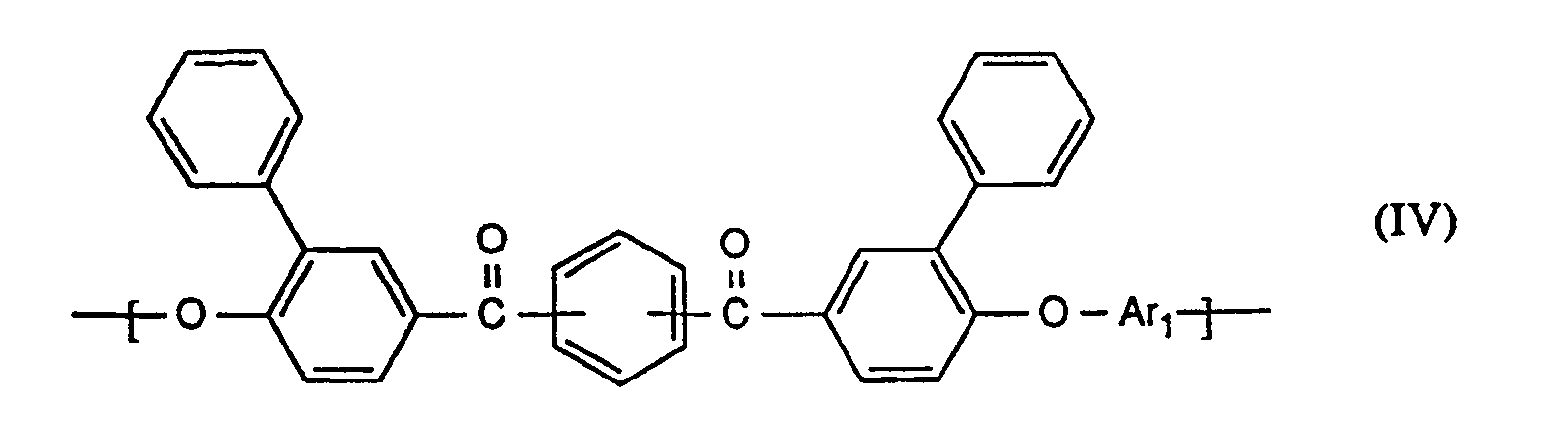
⁅O-Ar₂-O-Ar₁⁆ (V)
worin die beiden Carbonylgruppen zueinander in para- oder meta-Stellung stehen, Ar₁ einen unsubstituierten oder durch ein oder mehrere C₁-C₄-Alkyle, C₁-C₄-Alkoxy oder Halogenatome substituierten Rest der Formel IVa bis IVe


- Polymere gemäss Anspruch 6, enthaltend 10-100 Mol-% einer wiederkehrenden Struktureinheit der Formel IV und 90-0 Mol-% einer wierderkehrenden Struktureinheit der Formel V, worin die beiden Carbonylgruppen zueinander in meta- oder para-Stellung stehen, Ar₁ einen Rest der Formeln


- Lösung enthaltend 1 bis 75 Gew.-%, bezogen auf die Lösung eines Polymeren gemäss Anspruch 1, gelöst in einem organischen Lösungsmittel.
- Verfahren zur Herstellung von Polymeren gemäss Anspruch 1, dadurch gekennzeichnet, dass man ein unsubstituiertes oder durch ein oder mehere C₁-C₄-Alkyle, C₁-C₄-Alkoxy oder Halogenatome substituiertes Diphenol der Formel VI

Z₁-R₁-Z₂ (VII),
umsetzt, worin R₁ die gleiche Bedeutung wie in Formel I hat und Z₁ und Z₂ unabhängig voneinander je ein Halogenatom, vorzugsweise Fluor- oder Chloratom, oder einen Rest der Formeln -SO₃H, -SO₃R₄, -SO₂Cl, -COOH, -COCl, -COOR₄-, -OR₄, -O-COCl, -N=C=O,
- Unsubstituiertes oder durch ein oder mehrere C₁-C₄-Alkyle, C₁-C₄-Alkoxy oder Halogenatome substituiertes Diphenol der Formel VI

- Unsubstituierte oder durch ein oder mehrere C₁-C₄-Alkyle, C₁-C₄-Alkoxy oder Halogenatome substituierte Verbindung der Formel IX
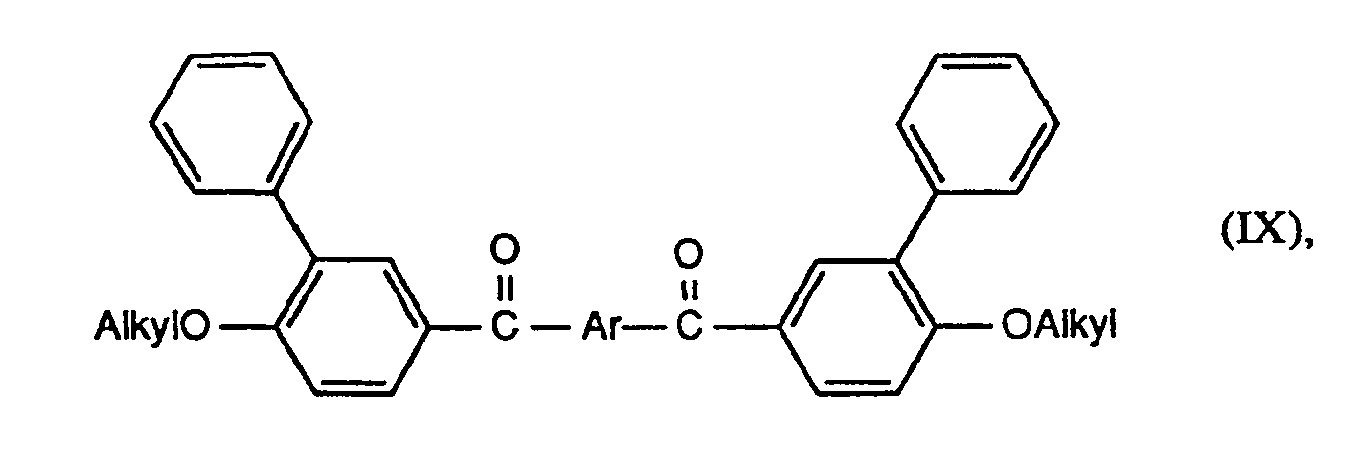
- Unsubstituierte oder durch ein oder mehrere C₁-C₄-Alkyle, C₁-C₄-Alkoxy oder Halogenatome substituierte Dihalogenverbindung der Formel XI

- Verbindungen der Formel XII
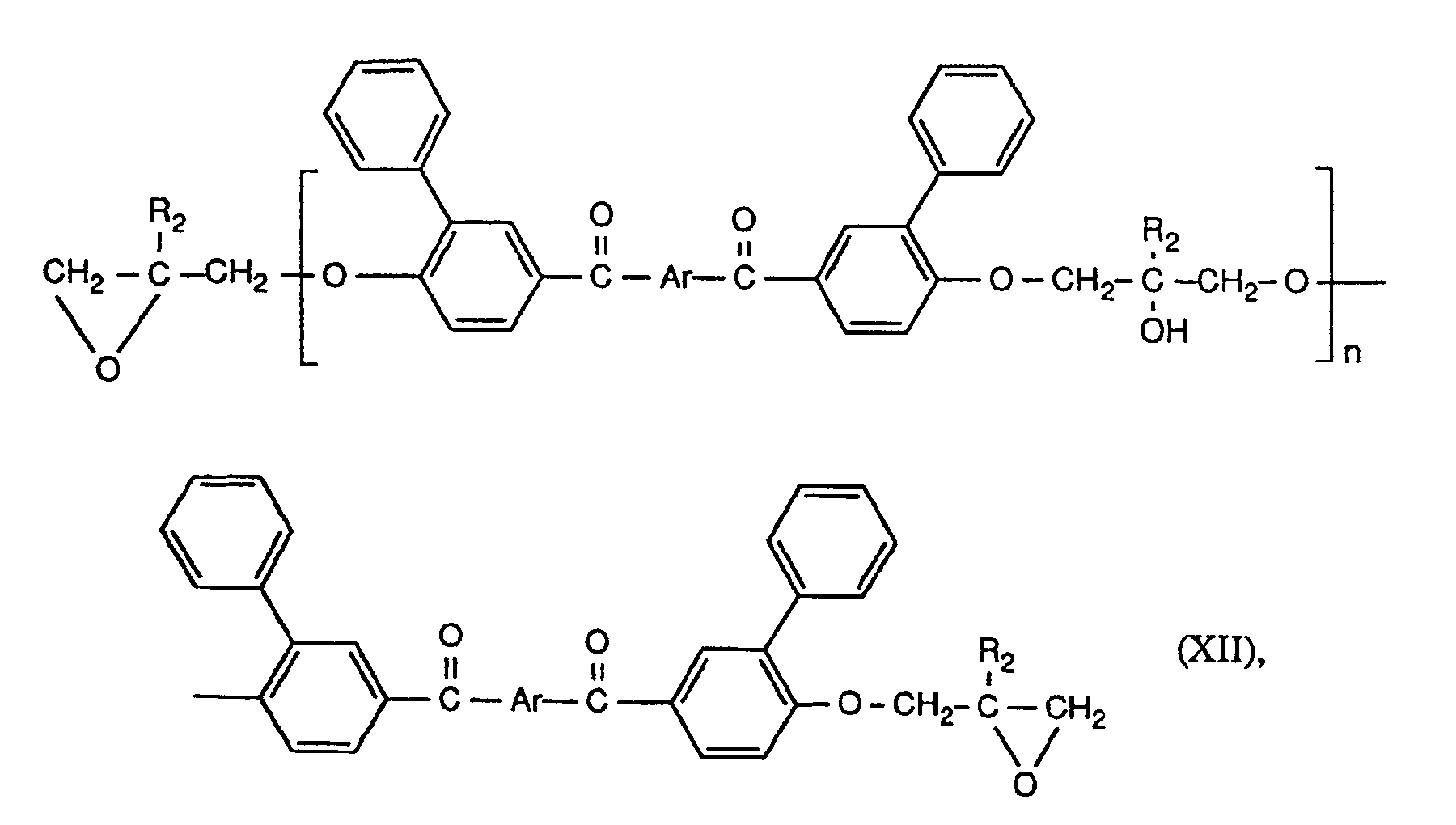
- Formstoffe, Beschichtungen oder Folien enthaltend ein Polymer gemäss Anspruch 1.
- Verwendung der Polymere gemäss Anspruch 1 zum Modifizieren von thermoplastischen und duromeren Matrixharzen.
Applications Claiming Priority (2)
| Application Number | Priority Date | Filing Date | Title |
|---|---|---|---|
| CH155590 | 1990-05-08 | ||
| CH1555/90 | 1990-05-08 |
Publications (2)
| Publication Number | Publication Date |
|---|---|
| EP0456608A2 true EP0456608A2 (de) | 1991-11-13 |
| EP0456608A3 EP0456608A3 (en) | 1992-01-08 |
Family
ID=4213157
Family Applications (1)
| Application Number | Title | Priority Date | Filing Date |
|---|---|---|---|
| EP19910810330 Withdrawn EP0456608A3 (en) | 1990-05-08 | 1991-04-30 | Essentially linear polymers |
Country Status (2)
| Country | Link |
|---|---|
| EP (1) | EP0456608A3 (de) |
| CA (1) | CA2041885A1 (de) |
Cited By (2)
| Publication number | Priority date | Publication date | Assignee | Title |
|---|---|---|---|---|
| US20130245167A1 (en) * | 2010-11-24 | 2013-09-19 | Jsr Corporation | Resin composition, insulating film, film forming method, and electronic part |
| WO2014096269A3 (en) * | 2012-12-20 | 2014-12-04 | Solvay Specialty Polymers Usa, Llc | Poly(ether ketone) polymers comprising cycloaliphatic units |
Family Cites Families (2)
| Publication number | Priority date | Publication date | Assignee | Title |
|---|---|---|---|---|
| DE3014230A1 (de) * | 1980-04-14 | 1981-10-22 | Basf Ag, 6700 Ludwigshafen | Verfahren zur herstellung von ketogruppenhaltigen polyaethern |
| JPH0781005B2 (ja) * | 1987-02-04 | 1995-08-30 | 出光興産株式会社 | ポリホルマ−ル系樹脂とその製造法 |
-
1991
- 1991-04-30 EP EP19910810330 patent/EP0456608A3/de not_active Withdrawn
- 1991-05-06 CA CA002041885A patent/CA2041885A1/en not_active Abandoned
Cited By (3)
| Publication number | Priority date | Publication date | Assignee | Title |
|---|---|---|---|---|
| US20130245167A1 (en) * | 2010-11-24 | 2013-09-19 | Jsr Corporation | Resin composition, insulating film, film forming method, and electronic part |
| WO2014096269A3 (en) * | 2012-12-20 | 2014-12-04 | Solvay Specialty Polymers Usa, Llc | Poly(ether ketone) polymers comprising cycloaliphatic units |
| US9765176B2 (en) | 2012-12-20 | 2017-09-19 | Solvay Specialty Polymers Usa, Llc | Poly(ether ketone) polymers comprising cycloaliphatic units |
Also Published As
| Publication number | Publication date |
|---|---|
| CA2041885A1 (en) | 1991-11-09 |
| EP0456608A3 (en) | 1992-01-08 |
Similar Documents
| Publication | Publication Date | Title |
|---|---|---|
| DE3382700T2 (de) | Verwendung eines amorphen aromatischen thermoplastischen Polymeren. | |
| EP0388358B1 (de) | Neue Polyarylenether | |
| US3305528A (en) | Poly (hydroxyethers) and a method for their preparation | |
| EP0146827B1 (de) | Thermoplastische Polysiloxan-Polyester(carbonat)-Block-copolymere, ihre Herstellung und Verwendung | |
| EP0467826A2 (de) | Lineare Polymere | |
| EP0183143A2 (de) | Aromatische Polyester mit Dimethylmaleinimid-Endgruppen, ihre Herstellung und Verwendung | |
| EP0157732A1 (de) | Vernetzbare, lineare Polyätherharze | |
| DE2734200A1 (de) | Polyharnstoffharzmassen und ihre verwendung | |
| DE1162559B (de) | Verwendung von Polycarbonaten zur Herstellung von Folien, Faeden und Fasern | |
| EP0000396B1 (de) | Verfahren zur Herstellung von flammhemmenden Polycarbonaten | |
| US3579591A (en) | 4,4'-bis-(hydroxyarloxy)-phenylsulfone | |
| DE2915681A1 (de) | Aromatisches, waermehaertendes praepolymeres und sich davon ableitende polymere | |
| US5264538A (en) | Cyclic poly(aryl ether) oligomers | |
| EP0467847A1 (de) | Polyarylenether mit Tetraphenylethylen-Einheiten | |
| US5237062A (en) | Polymers derived from phenolphthaleins | |
| US5254663A (en) | Polymers derived from phenolphthaleins | |
| EP0479192A2 (de) | Modifizierte Polyarylenether-Blockcopolymere | |
| US3498959A (en) | Method of polymerizing 3,3-dimethyl thiacyclobutane and resulting polymer | |
| DE3513715A1 (de) | Polycarbonate mit dichlormaleinimid-endgruppen, ihre herstellung und modifizierung | |
| EP0447358A2 (de) | Lösliche Polyarylenethersulfone | |
| US3824293A (en) | Bisthioethers | |
| EP0412934A2 (de) | Modifizierte Polyarylenethersulfone | |
| EP0161453B1 (de) | Temperaturbeständige aromatische Polyether | |
| EP0410929A2 (de) | Lineare Polymere | |
| EP0206099A1 (de) | Phosphorhaltige Polyarylenäther und Verfahren zu ihrer Herstellung |
Legal Events
| Date | Code | Title | Description |
|---|---|---|---|
| PUAI | Public reference made under article 153(3) epc to a published international application that has entered the european phase |
Free format text: ORIGINAL CODE: 0009012 |
|
| 17P | Request for examination filed |
Effective date: 19910502 |
|
| AK | Designated contracting states |
Kind code of ref document: A2 Designated state(s): DE ES FR GB IT NL SE |
|
| PUAL | Search report despatched |
Free format text: ORIGINAL CODE: 0009013 |
|
| AK | Designated contracting states |
Kind code of ref document: A3 Designated state(s): DE ES FR GB IT NL SE |
|
| 18W | Application withdrawn |
Withdrawal date: 19920630 |
|
| R18W | Application withdrawn (corrected) |
Effective date: 19920630 |