EP0453136B1 - Verfahren und Kontaktlinsen zur Korrektur von Presbyopie - Google Patents
Verfahren und Kontaktlinsen zur Korrektur von Presbyopie Download PDFInfo
- Publication number
- EP0453136B1 EP0453136B1 EP91303002A EP91303002A EP0453136B1 EP 0453136 B1 EP0453136 B1 EP 0453136B1 EP 91303002 A EP91303002 A EP 91303002A EP 91303002 A EP91303002 A EP 91303002A EP 0453136 B1 EP0453136 B1 EP 0453136B1
- Authority
- EP
- European Patent Office
- Prior art keywords
- image
- lens
- far
- diffractive
- corrected
- Prior art date
- Legal status (The legal status is an assumption and is not a legal conclusion. Google has not performed a legal analysis and makes no representation as to the accuracy of the status listed.)
- Expired - Lifetime
Links
- 238000000034 method Methods 0.000 title claims abstract description 15
- 201000010041 presbyopia Diseases 0.000 title claims abstract description 14
- 230000004438 eyesight Effects 0.000 claims abstract description 37
- 230000003287 optical effect Effects 0.000 claims abstract description 20
- 239000000654 additive Substances 0.000 claims abstract description 8
- 230000000996 additive effect Effects 0.000 claims abstract description 8
- 239000000463 material Substances 0.000 claims abstract description 6
- 208000001491 myopia Diseases 0.000 claims description 20
- 210000000695 crystalline len Anatomy 0.000 description 124
- 210000001747 pupil Anatomy 0.000 description 20
- 230000002093 peripheral effect Effects 0.000 description 9
- 230000000694 effects Effects 0.000 description 8
- 210000004556 brain Anatomy 0.000 description 4
- 230000000052 comparative effect Effects 0.000 description 3
- 230000001419 dependent effect Effects 0.000 description 3
- 230000000007 visual effect Effects 0.000 description 2
- 241000282412 Homo Species 0.000 description 1
- 206010027646 Miosis Diseases 0.000 description 1
- 230000032683 aging Effects 0.000 description 1
- 230000001886 ciliary effect Effects 0.000 description 1
- 230000000295 complement effect Effects 0.000 description 1
- 230000006866 deterioration Effects 0.000 description 1
- 210000003205 muscle Anatomy 0.000 description 1
- 230000000750 progressive effect Effects 0.000 description 1
- 230000005476 size effect Effects 0.000 description 1
- 230000004304 visual acuity Effects 0.000 description 1
Images

Classifications
-
- G—PHYSICS
- G02—OPTICS
- G02C—SPECTACLES; SUNGLASSES OR GOGGLES INSOFAR AS THEY HAVE THE SAME FEATURES AS SPECTACLES; CONTACT LENSES
- G02C7/00—Optical parts
- G02C7/02—Lenses; Lens systems ; Methods of designing lenses
- G02C7/04—Contact lenses for the eyes
- G02C7/041—Contact lenses for the eyes bifocal; multifocal
-
- G—PHYSICS
- G02—OPTICS
- G02C—SPECTACLES; SUNGLASSES OR GOGGLES INSOFAR AS THEY HAVE THE SAME FEATURES AS SPECTACLES; CONTACT LENSES
- G02C7/00—Optical parts
- G02C7/02—Lenses; Lens systems ; Methods of designing lenses
- G02C7/024—Methods of designing ophthalmic lenses
- G02C7/027—Methods of designing ophthalmic lenses considering wearer's parameters
-
- G—PHYSICS
- G02—OPTICS
- G02C—SPECTACLES; SUNGLASSES OR GOGGLES INSOFAR AS THEY HAVE THE SAME FEATURES AS SPECTACLES; CONTACT LENSES
- G02C2202/00—Generic optical aspects applicable to one or more of the subgroups of G02C7/00
- G02C2202/20—Diffractive and Fresnel lenses or lens portions
Definitions
- This invention relates to methods of correcting presbyopic vision, and more particularly to methods of correcting presbyopia by the utilisation of contact lenses.
- Presbyopia is a condition of the ageing human eye wherein the eye loses its ability to focus sharply on objects throughout the normal range of vision, i.e. from far to near objects. This condition is the result of a gradual hardening of the crystalline lens which occurs with age and prevents the ciliary muscle from completely adjusting the curvature of the lens, and thereby altering its focal length, as required for viewing far or near objects.
- the condition is progressive, and cannot at present be corrected by any treatment of the eye itself. Accordingly, it is conventional to provide the patient suffering from presbyopia with bifocal corrective lenses, which may be either conventional spectacle lenses or contact lenses.
- one portion of the lens is adapted to provide the proper correction, if necessary, for sharp far vision, while another portion of the lens is adapted to provide sharp near vision.
- the person using the corrective lenses directs his vision through the far vision portion or the near vision portion as necessary.
- the near vision zone is a segment generally located in the lower portion of the lens where the wearer may easily direct his/her vision through it for reading.
- a contact lens it is also possible to have a near vision zone located in the lower portion of the lens. These are known as translating bifocal lenses.
- each eye has been provided with a bifocal lens, whether spectacle lens or contact lens, designed so that the eyes are used together, each eye viewing the object through the far vision or near vision portion as appropriate. Thus each eye sees a focussed image of the object.
- Another method of overcoming the problems described above is fitting a presbyopic person having binocular vision with concentric bifocal contact lenses wherein one eye is provided with a contact lens having a far vision central optic zone and a near vision peripheral optic zone, and the other eye is provided with a contact lens having a near vision central optic zone and a far vision peripheral optic zone.
- the effect of these lenses is dependent on the size of the central optic zone in relation to the size of the pupil of the eye. Often this is made smaller than half the size of the normal pupil.
- EP-A-0201231 discloses a method of correcting presbyopia in humans having binocular vision, comprising fitting a concentric bifocal contact lens having a central far vision zone and a peripheral near vision zone to one eye of the person and a second concentric bifocal contact lens having a central near vision zone and a peripheral far vision zone to the other eye.
- Presbyopic patients fitted with a pair of lenses consisting of one of each type find that they can see far objects with both eyes but usually more clearly in the eye with the near centre lens. Near objects are also seen with both eyes, but usually more clearly in the eye with the far centre lens.
- there is binocular correction of both far and near vision without the annoyance and confusion caused by the image in one eye being completely out of focus (as in monovision). This effect is achieved because each lens provides some correction for both far and near objects, one eye being biased for far (the near centre lens) and one eye being biased for near (the far centre lens).
- Concentric bifocal lenses provide to each of the eyes two simultaneous images, one formed by the central zone and another by the peripheral zone.
- the dominant image is that formed by the zone giving a larger coverage of the pupil area.
- the power of the peripheral zone will be dominant in forming the image.
- either the central or the peripheral zone could be constructed to cover a larger area. If the central zone was of larger area, the focus of the central area would be dominant.
- the eye with the lens which has the larger zone adapted for the visual task at hand is apparently selected by the brain, and the image formed in the other eye by the smaller zone of its contact lens assists in the visual task at hand.
- This method effectively superimposes two images by having two focal lengths on the same axis. Each image is surrounded by the out of focus image of the other component.
- a problem in the wearing of such lenses is the fact that the human pupil size is not constant and varies from person to person. At small pupil sizes very little aperture is available for the far image light and this image may be lost in the out of focus near image. At large pupil sizes the amount of light entering the eye for the near image light is very low and for reading, the near image will tend to be lost in the out of focus far image. At less extreme pupil sizes,i.e. not too large or too small, the two images will receive equal amounts of light thus making it possible to achieve good vision both near and far.
- bifocal contact lens which is not pupil size dependent, and can be considered as a full aperture bifocal
- the diffractive bifocal contact lens In this type of lens, the whole aperture provides rays to both near and far images.
- the diffractive power may be additive to (or subtractive from) the basic refractive power of the lens.
- a lens may have a basic power,e.g. for far vision, provided by the shape, curvature and material of the lens, and a different power, e.g. a greater power for near vision provided by diffractive means on the lens so as to give a diffractive power which adds to the basic refractive power of the lens.
- One way of providing diffractive power is by means of a zone plate.
- a bifocal lens can also be formed in which the basic refractive power is provided for near vision, and the diffractive means is provided to give negative power to the lens and effectively subtract power from the basic power of the lens to provide for far vision.
- a diffractive lens nullifies the effect of pupil size and enables the lens to be designed so that the available light is divided so that about half the light goes into each image.
- the ratio of intensity between the near and far images may be chosen independently of the add power, pupil size or base power.
- Diffractive lenses as available in the marketplace are designed so that in terms of the ratio of intensity between the near and far images are substantially 0.5:0.5 in both eyes in contrast to the so-called monovision condition which is essentially 0:1 in one eye, and 1:0 in the other eye.
- the concentric bifocal contact lens as indicated above provides to each of the eyes two simultaneous images one formed by the central zone and the other by the peripheral zone.
- the dominant image is that formed by the zone giving a larger coverage of pupil area.
- the concentric bifocal is pupil size dependent although it does overcome some of the problems associated with monovision contact lenses.
- a method of correcting presbyopia in a human comprising fitting a contact lens to each of the two eyes, one contact lens having an optical zone adapted to provide a corrected near image and a corrected far image, one of said corrected near and far images being of greater intensity than the other, and the other contact lens being adapted to provide a corrected high intensity image corresponding, in terms of near or far, to the corrected lower intensity image provided by said one contact lens, characterized in that said optical zone is a single zone, and in that a refractive power of the optical zone provides one and a diffractive power of the optical zone provides the other of the corrected near and far images.
- each eye can see a high intensity image and stereoscopy is provided for at least one of the near and far images, i.e. the image which said other contact lens provides at high intensity.
- That high intensity could at least in principle be 100%, i.e. said other contact lens could be a monovision lens, but preferably it is less than 100% but more than 50% (of the total light transmitted through the lens to the eye) with both contact lenses having refractive and diffractive power to provide different intensity images.
- a method of correcting presbyopia in a human wherein said other contact lens has an optical zone adapted to provide a corrected near and far image, each optical zone having a refractive power provided by the shape, curvature and material of the lens to provide one of said near or far corrected images and a diffractive power provided by diffractive means to provide the other of said near or far corrected images, said diffractive power being additive to the refractive power, the diffractive means being arranged so that the amount of the light directed into the near image by one lens is substantially greater than that directed into the far image by that one lens, and the amount of light directed into the far image by the other lens is substantially greater than that directed into the near image by that other lens, whereby each of the two eyes can see an image of relatively high intensity whilst retaining a large amount of stereoscopic vision.
- a pair of diffractive lenses can be manufactured so that a presbyopic subject can be provided with the ability to view both near and far images with a dominant image intensity in each eye substantially greater than 50% of the total light intensity received by that eye, and retaining a large amount of stereoscopic vision. Further little or no deterioration of vision quality related to pupil size is experienced. This is done by considering one eye as a distance eye, and the other eye a near eye, in a similar fashion to standard monovision as mentioned above.
- the near eye could be fitted with a lens with a base power of 3 dioptres and a diffractive add of -2 dioptres having 25% of the light going into the far (diffracted) image, and the far eye with base power of 1.00 dioptres, and a diffractive add of 2.00 dioptres, having 25% of the light going into the near (diffracted) image.
- each of the lenses fitted in accordance with the present invention provides a refractive image and a diffractive image, i.e. the lens fitted to the far eye provides a refractive far image and a diffractive near image and the lens fitted to the near eye provides a refractive near image and a diffractive far image. Therefore, in accordance with the present invention preferably, the contact lenses are fitted to a wearer so that refractive far vision is provided by the dominant eye and refractive near vision is provided by the other eye.
- the present invention further includes a pair of contact lenses for correcting presbyopia in a human, one of which provides a corrected image by refractive power and a corrected image by diffractive power, the two corrected images being near and far images, characterized in that the two corrected images are of different intensities, the other lens providing a corrected high intensity image corresponding (in terms of near or far) to the corrected lower intensity image provided by said one lens.
- the present invention also includes a pair of contact lenses as described above, wherein each lens has a refractive power provided by the shape, curvature and material of the lens to provide one of said near or far corrected images, and a diffractive power provided by diffractive means to provide the other of said near or far corrected images, the lenses being paired so that one lens has diffractive means arranged so that the amount of light directed into the near image by the lens is substantially greater than that directed into the far image, and the other lens has diffractive means arranged so that the amount of light directed into the far image by the lens is substantially greater than that directed into the near image.
- the lenses of the pair can be fitted respectively to a patient's two eyes so that each eye sees an image of relatively high intensity, e.g. more than 50% of the total light intensity received by that eye, whilst maintaining a large amount of stereoscopic vision.
- Our invention also includes a pair of lenses as described above packaged to be sold together, e.g. in a container.
- both eyes can obtain information regarding both far and near objects.
- This also applies to the concentric bifocal contact lens arrangement referred to above.
- the amount of light associated with the image designed to be seen through one lens is consistently substantially greater than that associated with the other image regardless of pupil size, making it easier for the brain to select that image, and associate it with the dimmer image in the other lens to provide binocular vision and good visual acuity.
- lens to wear in which eye will be a matter of wearer preference, and may in fact be related to individual pupil size or eye conditions. Most people prefer to have better far vision, and may find that one eye gives better far vision than the other.
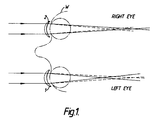
- the wearer W is shown in dotted plan view. In the particular arrangement shown the wearer has a first contact lens 1 fitted to the left eye and a second contact lens 2 fitted to the right eye.
- the first contact lens 1 is designed and constructed so that the refractive image is the near image and the diffractive image is the far image.
- the left eye is designated the far eye and is fitted with a lens having a refractive optical power (base power) of +1 dioptre and a diffractive additive optical power of +2 dioptres with 25% of the light going into the diffractive image. Consequently, the lens has the following characteristics:
- the second contact lens 2 is designed and constructed so that the contrary position is the case, i.e. the refractive image is the far image and the diffractive image is the near image.
- the right eye is designated the near eye and is fitted with a lens having a refractive optical power (base power) of +3 dioptres and a diffractive additive optical power of -2 dioptres with 25% of the light going into the diffractive image.
- base power refractive optical power
- diffractive additive optical power of -2 dioptres
- the refractive images are shown in solid line profile and the diffractive images are shown in dotted line profile.
- Both of the contact lenses have been designed so that the diffractive image is weaker than the refractive image.
- the image is present and provides a significantly increased amount of stereo acuity.
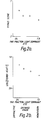
- the comparative data is provided in the form of graphs where Figures 2a and 2b relate to far vision and Figures 2c and 2d relate to near vision.
- the data is shown in two forms for each eye, that is log [Stereo Acuity] and Titmus score, both of which are readily accepted measures of Stereo Acuity.
- the Titmus test is normally administered as a near-vision test and the assessment of the present invention for far vision is carried out in the same way but with the inclusion in a trial frame worn by the subject of positive lenses of power equal to the add of the contact lens modality.
- the data are mean values over eight subjects and the reduction of the Titmus score to log stereo acuity values is taken before the means are calculated for Figures 2b and 2d.
- the arrangement of the present invention provides stereo acuity to the wearer in advance of that which will be present with the standard monovision arrangement, but not as great as with standard diffractive lenses.
- the arrangement of the present invention alleviates the problems concerning light intensity associated with standard diffractive lenses. Consequently, the present invention provides a balance between the standard monovision and standard diffractive lenses which is more readily accepted by the wearer.
- the two lenses are of equal and opposite effect. It will be understood that this, while convenient and often desirable, is not essential and that the image intensity proportion (75:25 in the example) may, while still of opposite effect, not be equal for the two lenses. It will further be understood that the 75:25 ratio is given by way of example and other ratios could be employed.
- one refractive/diffractive contact lens providing two (near and far) images of different intensities could be paired with a monovision contact lens (effectively 100:0 image intensity proportion) providing one high intensity image, that high intensity image corresponding (in terms of near or far) to the low intensity image of the refractive/diffractive lens. That would provide stereoscopy for that image, the other (near or far image) being seen at high intensity by the eye wearing the refractive/diffractive lens.
Landscapes
- Health & Medical Sciences (AREA)
- Ophthalmology & Optometry (AREA)
- Physics & Mathematics (AREA)
- General Health & Medical Sciences (AREA)
- General Physics & Mathematics (AREA)
- Optics & Photonics (AREA)
- Eyeglasses (AREA)
- Prostheses (AREA)
- Lenses (AREA)
- Organic Low-Molecular-Weight Compounds And Preparation Thereof (AREA)
Claims (8)
- Verfahren zum Korrigieren von Presbyopie bei einem Menschen, bei welchem jedes der beiden Augen mit einer Kontaktlinse versehen wird, wobei eine Kontaktlinse eine optische Zone besitzt, die zur Erzeugung eines korrigierten Nahbildes und eines korrigierten Fernbildes geeignet ist, eines der korrigierten Bilder (das nahe oder ferne) größere Intensität besitzt als das andere, und die andere Kontaktlinse zur Erzeugung eines korrigierten Bildes hoher Stärke geeignet ist, welches bezüglich der Nähe oder Ferne dem korrigierten Bild niedrigerer Stärke entspricht, das von der einen Kontaktlinse erzeugt wird, dadurch gekennzeichnet, daß die optische Zone eine einzige Zone ist, und daß eine Brechkraft der optischen Zone eines und eine Beugungszone der optischen Zone das andere der korrigierten Bilder, des nahen oder fernen, erzeugt.
- Verfahren zum Korrigieren von Presbyopie bei einem Menschen nach Anspruch 1, wobei die andere Kontaktlinse eine optische Zone besitzt, die zur Erzeugung eines korrigierten nahen und fernen Bildes geeignet ist, wobei jede optische Zone ihre durch die Form, Krümmung und das Material der Linse erzeugte Brechkraft aufweist, um eines der korrigierten Bilder, das nahe oder ferne, zu erzeugen, sowie ihre durch die Beugungseinrichtung erzeugte Beugungskraft, um das andere der korrigierten Bilder, das nahe oder ferne, zu erzeugen, wobei die Beugungskraft additiv zur Brechkraft ist, die Beugungseinrichtung so ausgebildet und angeordnet wird, daß der Betrag des in das nahe Bild durch eine Linse geleiteten Lichtes wesentlich größer ist als derjenige des in das ferne Bild durch diese eine Linse geleiteten Lichtes, und der Betrag des in das ferne Bild durch die andere Linse geleiteten Lichtes wesentliche größer ist als derjenige des in das nahe Bild durch diese andere Linse geleiteten Lichtes, wobei jedes der zwei Augen ein Bild von verhältnismäßig hoher Stärke sehen kann, während ein großer Betrag stereoskopischer Sicht erhalten bleibt.
- Verfahren nach Anspruch 1 oder 2, bei welchem die Kontaktlinsen einem Träger so angepaßt werden, daß eine brechende Fernsicht durch das dominierende Auge und eine brechende Nahsicht durch das andere Auge vorgesehen wird.
- Verfahren nach Anspruch 2 oder 3, bei welchem ein Auge mit einer Linse versehen wird, die eine Grundbrechkraft für Fernbilder und eine zusätzliche optische Beugungskraft von +2 Dioptrien besitzt, wobei 25% des Lichts in das Beugungsbild für Nahbilder geht, und das andere Auge mit einer Linse versehen wird, die eine Grundbrechkraft für Nahbilder und eine zusätzliche optische Beugungskraft von -2 Dioptrien besitzt, wobei 25% des Lichts in das Beugungsbild für Fernbilder geht.
- Verfahren nach Anspruch 1 oder 2, bei welchem die eine Linse ein fernes Brechungsbild und ein nahes Beugungsbild erzeugt und die andere Linse ein nahes Brechungsbild und ein fernes Beugungsbild erzeugt.
- Paar von Kontaktlinsen zum Korrigieren von Presbyopie bei einem Menschen, wobei eine derselben ein korrigiertes Bild durch Brechkraft und ein korrigiertes Bild durch Beugungskraft erzeugt, und wobei die zwei korrigierten Bilder ein nahes und ein fernes Bild sind, dadurch gekennzeichnet, daß die zwei korrigierten Bilder unterschiedliche Intensität besitzen, wobei die andere Linse ein korrigiertes Bild hoher Stärke erzeugt, welches (bezüglich der Nähe oder Ferne) dem korrigierten Bild niedrigerer Stärke entspricht, das von der einen Linse erzeugt wird.
- Paar von Kontaktlinsen nach Anspruch 6, bei welchem jede Linse ihre durch die Form, Krümmung und das Material der Linse erzeugte Brechkraft besitzt, um eines der korrigierten Bilder zu erzeugen, das nahe oder ferne, sowie seine durch die Beugungseinrichtung erzeugte Beugungskraft, um das andere korrigierte Bild, das nahe oder ferne, zu erzeugen, wobei die Linsen paarweise so zusammengefaßt sind, daß die eine Linse eine Beugungseinrichtung aufweist, die so ausgebildet ist, daß der Betrag an Licht, das von der Linse in das Nahbild geleitet wird, wesentlich größer ist als der Betrag des in das Fernbild geleiteten Lichts, und bei welchem die andere Linse eine Beugungseinrichtung aufweist, die so ausgebildet ist, daß der Betrag des in das Fernbild von der Linse geleiteten Lichts wesentlich größer ist als der Betrag des in das Nahbild geleiteten Lichts.
- Paar von Kontaktlinsen nach Anspruch 6 oder 7, bei welchem die eine Linse ein nahes Brechungsbild und ein fernes Beugungsbild und die andere Linse ein fernes Brechungsbild und ein nahes Beugungsbild erzeugt.
Applications Claiming Priority (2)
| Application Number | Priority Date | Filing Date | Title |
|---|---|---|---|
| GB9008582 | 1990-04-17 | ||
| GB909008582A GB9008582D0 (en) | 1990-04-17 | 1990-04-17 | Method and contact lenses for treating presbyobia |
Publications (3)
| Publication Number | Publication Date |
|---|---|
| EP0453136A2 EP0453136A2 (de) | 1991-10-23 |
| EP0453136A3 EP0453136A3 (en) | 1992-04-15 |
| EP0453136B1 true EP0453136B1 (de) | 1997-09-10 |
Family
ID=10674513
Family Applications (1)
| Application Number | Title | Priority Date | Filing Date |
|---|---|---|---|
| EP91303002A Expired - Lifetime EP0453136B1 (de) | 1990-04-17 | 1991-04-05 | Verfahren und Kontaktlinsen zur Korrektur von Presbyopie |
Country Status (9)
| Country | Link |
|---|---|
| US (1) | US5296881A (de) |
| EP (1) | EP0453136B1 (de) |
| JP (1) | JP3195374B2 (de) |
| AT (1) | ATE158088T1 (de) |
| AU (1) | AU634051B2 (de) |
| CA (1) | CA2040579C (de) |
| DE (1) | DE69127576T2 (de) |
| ES (1) | ES2108705T3 (de) |
| GB (1) | GB9008582D0 (de) |
Families Citing this family (62)
| Publication number | Priority date | Publication date | Assignee | Title |
|---|---|---|---|---|
| SK377492A3 (en) * | 1992-01-28 | 1995-05-10 | Johnson & Johnson Vision Prod | Multifocal refracting lens and method of its manufacture |
| ATE145126T1 (de) * | 1992-04-03 | 1996-11-15 | Adatomed Pharma Chiron | Intraokularlinsenset |
| US5384606A (en) * | 1992-06-22 | 1995-01-24 | Allergan, Inc. | Diffractive/refractive spectacle and intraocular lens system for age-related macular degeneration |
| NZ250359A (en) * | 1992-12-09 | 1996-07-26 | Johnson & Johnson Vision Prod | Multifocal ophthalmic lens pair |
| FR2701770B1 (fr) * | 1993-02-18 | 1995-05-12 | Essilor Int | Lentille ophtalmique à vision simultanée pour la correction de la presbytie et jeu de deux telles lentilles ophtalmiques pour un même porteur . |
| FR2704327B1 (fr) * | 1993-04-23 | 1995-06-23 | Essilor Int | Paire de lentilles ophtalmiques multifocales progressives. |
| US5574518A (en) * | 1995-01-10 | 1996-11-12 | Les Laboratoires Opti-Centre Inc. | System incorporation two different sphero-non-spherical contact lenses for correcting presbytia |
| US20090069817A1 (en) * | 1995-10-20 | 2009-03-12 | Acufocus, Inc. | Intrastromal corneal modification |
| US5835192A (en) * | 1995-12-21 | 1998-11-10 | Johnson & Johnson Vision Products, Inc. | Contact lenses and method of fitting contact lenses |
| US5724258A (en) * | 1996-05-09 | 1998-03-03 | Johnson & Johnson Vision Products, Inc. | Neural network analysis for multifocal contact lens design |
| US6139147A (en) * | 1998-11-20 | 2000-10-31 | Novartis Ag | Actively controllable multifocal lens |
| US5997140A (en) * | 1997-12-29 | 1999-12-07 | Novartis Ag | Actively controllable multifocal lens |
| US6139146A (en) * | 1997-12-29 | 2000-10-31 | Novartis Ag | Programmable corrective lenses |
| DE69932809T2 (de) | 1998-03-04 | 2007-03-29 | Visx Inc., Santa Clara | System zur Laserbehandlung der Altersichtigkeit |
| EP1147448A4 (de) | 1998-12-16 | 2008-12-10 | Novartis Ag | Multifokale kontaktlinsen mit aspherischer oberfläche |
| WO2000052516A2 (en) | 1999-03-01 | 2000-09-08 | Boston Innovative Optics, Inc. | System and method for increasing the depth of focus of the human eye |
| US6179420B1 (en) * | 1999-04-21 | 2001-01-30 | Johnson & Johnson Vision Products, Inc. | Multifocal ophthalmic lenses |
| CH694832A5 (de) * | 1999-04-29 | 2005-07-29 | Patrick Luginbuehl | Verfahren zur Herstellung einer Kontaktlinse und nach diesem Verfahren hergestellte Kontaktlinse. |
| US20060238702A1 (en) | 1999-04-30 | 2006-10-26 | Advanced Medical Optics, Inc. | Ophthalmic lens combinations |
| US6250757B1 (en) * | 1999-12-15 | 2001-06-26 | Johnson & Johnson Vision Products, Inc. | Hybrid refractive birefringent multifocal ophthalmic lenses |
| FR2803921B1 (fr) * | 2000-01-14 | 2002-04-05 | Essilor Int | Jeu de deux lentilles ophtalmiques, gamme et procede pour constituer un tel jeu |
| US7635388B1 (en) | 2000-05-04 | 2009-12-22 | Tyler Thomas D | Device and method for incremental correction of sight disorders and occular diseases |
| US20020093701A1 (en) * | 2000-12-29 | 2002-07-18 | Xiaoxiao Zhang | Holographic multifocal lens |
| US7763069B2 (en) | 2002-01-14 | 2010-07-27 | Abbott Medical Optics Inc. | Accommodating intraocular lens with outer support structure |
| US7662180B2 (en) | 2002-12-05 | 2010-02-16 | Abbott Medical Optics Inc. | Accommodating intraocular lens and method of manufacture thereof |
| US7063422B2 (en) * | 2003-04-16 | 2006-06-20 | Novartis Ag | Multifocal ophthalmic lens |
| US7628810B2 (en) * | 2003-05-28 | 2009-12-08 | Acufocus, Inc. | Mask configured to maintain nutrient transport without producing visible diffraction patterns |
| US6951391B2 (en) * | 2003-06-16 | 2005-10-04 | Apollo Optical Systems Llc | Bifocal multiorder diffractive lenses for vision correction |
| US20050046794A1 (en) | 2003-06-17 | 2005-03-03 | Silvestrini Thomas A. | Method and apparatus for aligning a mask with the visual axis of an eye |
| US20050131535A1 (en) | 2003-12-15 | 2005-06-16 | Randall Woods | Intraocular lens implant having posterior bendable optic |
| WO2006001409A1 (ja) * | 2004-06-29 | 2006-01-05 | Hoya Corporation | 眼鏡レンズの製造方法 |
| US7025456B2 (en) * | 2004-08-20 | 2006-04-11 | Apollo Optical Systems, Llc | Diffractive lenses for vision correction |
| US7156516B2 (en) * | 2004-08-20 | 2007-01-02 | Apollo Optical Systems Llc | Diffractive lenses for vision correction |
| EP1827330A1 (de) * | 2004-10-22 | 2007-09-05 | Acufocus | System und verfahren zum ausrichten einer optik nach der achse eines auges |
| US8377123B2 (en) | 2004-11-10 | 2013-02-19 | Visiogen, Inc. | Method of implanting an intraocular lens |
| US20060113054A1 (en) * | 2004-12-01 | 2006-06-01 | Silvestrini Thomas A | Method of making an ocular implant |
| US7491350B2 (en) * | 2004-12-01 | 2009-02-17 | Acufocus, Inc. | Method of making an ocular implant |
| US7976577B2 (en) | 2005-04-14 | 2011-07-12 | Acufocus, Inc. | Corneal optic formed of degradation resistant polymer |
| US20060235428A1 (en) * | 2005-04-14 | 2006-10-19 | Silvestrini Thomas A | Ocular inlay with locator |
| US9636213B2 (en) | 2005-09-30 | 2017-05-02 | Abbott Medical Optics Inc. | Deformable intraocular lenses and lens systems |
| US20070168027A1 (en) * | 2006-01-13 | 2007-07-19 | Brady Daniel G | Accommodating diffractive intraocular lens |
| AR062067A1 (es) * | 2006-07-17 | 2008-10-15 | Novartis Ag | Lentes de contacto toricas con perfil de potencia optica controlado |
| US20080161914A1 (en) | 2006-12-29 | 2008-07-03 | Advanced Medical Optics, Inc. | Pre-stressed haptic for accommodating intraocular lens |
| JP5026291B2 (ja) * | 2008-01-16 | 2012-09-12 | 株式会社メニコン | 装用方向選択型コンタクトレンズ |
| WO2009093286A1 (ja) * | 2008-01-24 | 2009-07-30 | Menicon Co., Ltd. | 傾斜装用型コンタクトレンズ |
| US8034108B2 (en) | 2008-03-28 | 2011-10-11 | Abbott Medical Optics Inc. | Intraocular lens having a haptic that includes a cap |
| US20090306773A1 (en) * | 2008-06-04 | 2009-12-10 | Acufocus, Inc. | Opaque corneal insert for refractive correction |
| US20100026958A1 (en) * | 2008-08-04 | 2010-02-04 | Wooley C Benjamin | Fitting Method for Multifocal Lenses |
| WO2010151693A2 (en) | 2009-06-26 | 2010-12-29 | Abbott Medical Optics Inc. | Accommodating intraocular lenses |
| US8128222B2 (en) * | 2009-07-27 | 2012-03-06 | Valdemar Portney | Multifocal diffractive contact lens with bi-sign surface shape |
| CA2770074C (en) | 2009-08-03 | 2017-09-05 | Abbott Medical Optics Inc. | Intraocular lens for providing accomodative vision |
| US9492272B2 (en) | 2009-08-13 | 2016-11-15 | Acufocus, Inc. | Masked intraocular implants and lenses |
| US8623083B2 (en) | 2009-11-06 | 2014-01-07 | Amo Groningen B.V. | Diffractive binocular lens systems and methods |
| USD656526S1 (en) | 2009-11-10 | 2012-03-27 | Acufocus, Inc. | Ocular mask |
| US7828435B1 (en) | 2010-02-03 | 2010-11-09 | Denis Rehse | Method for designing an anterior curve of a contact lens |
| EP2785296B1 (de) | 2011-12-02 | 2018-06-20 | AcuFocus, Inc. | Augenmaske mit selektiver spektraler übertragung |
| US9084674B2 (en) | 2012-05-02 | 2015-07-21 | Abbott Medical Optics Inc. | Intraocular lens with shape changing capability to provide enhanced accomodation and visual acuity |
| US9204962B2 (en) | 2013-03-13 | 2015-12-08 | Acufocus, Inc. | In situ adjustable optical mask |
| US9427922B2 (en) | 2013-03-14 | 2016-08-30 | Acufocus, Inc. | Process for manufacturing an intraocular lens with an embedded mask |
| US11707354B2 (en) | 2017-09-11 | 2023-07-25 | Amo Groningen B.V. | Methods and apparatuses to increase intraocular lenses positional stability |
| US11106056B2 (en) | 2019-03-28 | 2021-08-31 | Aizhong Zhang | Subzonal multifocal diffractive lens |
| US12366767B2 (en) | 2020-04-21 | 2025-07-22 | Johnson & Johnson Vision Care, Inc. | Multi-lens system for presbyopia |
Citations (2)
| Publication number | Priority date | Publication date | Assignee | Title |
|---|---|---|---|---|
| US4923296A (en) * | 1988-07-14 | 1990-05-08 | Erickson Paul M | Oriented simultaneous vision bifocal contact lenses or the like utilizing introaocular suppression of blur |
| US5002382A (en) * | 1989-12-07 | 1991-03-26 | Leonard Seidner | Multifocal corneal contact lenses |
Family Cites Families (4)
| Publication number | Priority date | Publication date | Assignee | Title |
|---|---|---|---|---|
| GB2129157B (en) * | 1982-10-27 | 1986-02-05 | Pilkington Perkin Elmer Ltd | Bifocal contact lenses having defractive power |
| EP0201231A3 (de) * | 1985-05-03 | 1989-07-12 | THE COOPER COMPANIES, INC. (formerly called CooperVision, Inc.) | Verfahren zur Behandlung von Alterssichtigkeit mit konzentrischen Bifokalkontaktlinsen |
| US4881804A (en) * | 1987-11-12 | 1989-11-21 | Cohen Allen L | Multifocal phase plate with a pure refractive portion |
| US5024517A (en) * | 1989-12-07 | 1991-06-18 | Leonard Seidner | Monovision corneal contact lenses |
-
1990
- 1990-04-17 GB GB909008582A patent/GB9008582D0/en active Pending
-
1991
- 1991-04-05 ES ES91303002T patent/ES2108705T3/es not_active Expired - Lifetime
- 1991-04-05 AT AT91303002T patent/ATE158088T1/de not_active IP Right Cessation
- 1991-04-05 EP EP91303002A patent/EP0453136B1/de not_active Expired - Lifetime
- 1991-04-05 DE DE69127576T patent/DE69127576T2/de not_active Expired - Fee Related
- 1991-04-12 US US07/684,223 patent/US5296881A/en not_active Expired - Lifetime
- 1991-04-16 JP JP08423791A patent/JP3195374B2/ja not_active Expired - Fee Related
- 1991-04-16 CA CA002040579A patent/CA2040579C/en not_active Expired - Fee Related
- 1991-04-16 AU AU75014/91A patent/AU634051B2/en not_active Ceased
Patent Citations (2)
| Publication number | Priority date | Publication date | Assignee | Title |
|---|---|---|---|---|
| US4923296A (en) * | 1988-07-14 | 1990-05-08 | Erickson Paul M | Oriented simultaneous vision bifocal contact lenses or the like utilizing introaocular suppression of blur |
| US5002382A (en) * | 1989-12-07 | 1991-03-26 | Leonard Seidner | Multifocal corneal contact lenses |
Non-Patent Citations (4)
| Title |
|---|
| EP-A- 0 109 753 * |
| EP-A- 0 201 231 * |
| US-A- 4 923 296 * |
| US-A- 5 002 382 * |
Also Published As
| Publication number | Publication date |
|---|---|
| CA2040579C (en) | 2003-03-18 |
| EP0453136A2 (de) | 1991-10-23 |
| AU634051B2 (en) | 1993-02-11 |
| DE69127576T2 (de) | 1998-02-26 |
| CA2040579A1 (en) | 1991-10-18 |
| JP3195374B2 (ja) | 2001-08-06 |
| DE69127576D1 (de) | 1997-10-16 |
| ES2108705T3 (es) | 1998-01-01 |
| JPH04227258A (ja) | 1992-08-17 |
| GB9008582D0 (en) | 1990-06-13 |
| AU7501491A (en) | 1991-10-24 |
| US5296881A (en) | 1994-03-22 |
| ATE158088T1 (de) | 1997-09-15 |
| EP0453136A3 (en) | 1992-04-15 |
Similar Documents
| Publication | Publication Date | Title |
|---|---|---|
| EP0453136B1 (de) | Verfahren und Kontaktlinsen zur Korrektur von Presbyopie | |
| EP0201231A2 (de) | Verfahren zur Behandlung von Alterssichtigkeit mit konzentrischen Bifokalkontaktlinsen | |
| US5835192A (en) | Contact lenses and method of fitting contact lenses | |
| US5448312A (en) | Pupil-tuned multifocal ophthalmic lens | |
| CA2110847C (en) | Multifocal ophthalmic lens pair | |
| US5485228A (en) | Multifocal ophthalmic lens pair | |
| US5898473A (en) | Multifocal corneal contact lens | |
| EP0756189B1 (de) | Multifokale Linsen mit mittlerer optischer Brechkraft | |
| US5805260A (en) | Combined multifocal toric lens designs | |
| CA2421001C (en) | Ophthalmic lenses useful in correcting astigmatism and presbyopia | |
| US5929969A (en) | Multifocal ophthalmic lens | |
| EP0742463B1 (de) | Methode zur Herstellung einer Multifokallinse mit sphärischen Wirkungen zur Korrektur eines astigmatischen presbyopen Auges | |
| US4923296A (en) | Oriented simultaneous vision bifocal contact lenses or the like utilizing introaocular suppression of blur | |
| US5812235A (en) | Multifocal corneal contact lenses | |
| EP0742464A2 (de) | Multifokale ophthalmische Linse | |
| US6196685B1 (en) | Method of designing and fitting multifocal lenses taking into account material properties of the lenses | |
| Lloyd | Presbyopic contact lens correction—old and new | |
| Wesemann | Design Approaches for Bifocal IOL’s and CL's | |
| Cox et al. | Presbyopic fitting strategies: fitting the lens to the patient, not the patient to the lens | |
| HK1056018A (en) | Method for fitting concentric annular ring contact lenses for presbyopia | |
| HK1003451A (en) | Pupil-tuned multifocal ophthalmic lens | |
| WO2000060403A1 (en) | Multifocal lens designs with front surface and back surface optical powers | |
| MXPA96001673A (en) | Multifo oftalmico lens |
Legal Events
| Date | Code | Title | Description |
|---|---|---|---|
| PUAI | Public reference made under article 153(3) epc to a published international application that has entered the european phase |
Free format text: ORIGINAL CODE: 0009012 |
|
| AK | Designated contracting states |
Kind code of ref document: A2 Designated state(s): AT BE CH DE DK ES FR GB GR IT LI LU NL SE |
|
| PUAL | Search report despatched |
Free format text: ORIGINAL CODE: 0009013 |
|
| AK | Designated contracting states |
Kind code of ref document: A3 Designated state(s): AT BE CH DE DK ES FR GB GR IT LI LU NL SE |
|
| 17P | Request for examination filed |
Effective date: 19920925 |
|
| 17Q | First examination report despatched |
Effective date: 19940316 |
|
| GRAG | Despatch of communication of intention to grant |
Free format text: ORIGINAL CODE: EPIDOS AGRA |
|
| GRAH | Despatch of communication of intention to grant a patent |
Free format text: ORIGINAL CODE: EPIDOS IGRA |
|
| GRAH | Despatch of communication of intention to grant a patent |
Free format text: ORIGINAL CODE: EPIDOS IGRA |
|
| GRAA | (expected) grant |
Free format text: ORIGINAL CODE: 0009210 |
|
| RAP1 | Party data changed (applicant data changed or rights of an application transferred) |
Owner name: PBH DIFFRACTIVE LENSES LIMITED |
|
| AK | Designated contracting states |
Kind code of ref document: B1 Designated state(s): AT BE CH DE DK ES FR GB GR IT LI LU NL SE |
|
| PG25 | Lapsed in a contracting state [announced via postgrant information from national office to epo] |
Ref country code: AT Effective date: 19970910 Ref country code: CH Free format text: LAPSE BECAUSE OF FAILURE TO SUBMIT A TRANSLATION OF THE DESCRIPTION OR TO PAY THE FEE WITHIN THE PRESCRIBED TIME-LIMIT Effective date: 19970910 Ref country code: DK Free format text: LAPSE BECAUSE OF NON-PAYMENT OF DUE FEES Effective date: 19970910 Ref country code: GR Free format text: LAPSE BECAUSE OF FAILURE TO SUBMIT A TRANSLATION OF THE DESCRIPTION OR TO PAY THE FEE WITHIN THE PRESCRIBED TIME-LIMIT Effective date: 19970910 Ref country code: LI Free format text: LAPSE BECAUSE OF FAILURE TO SUBMIT A TRANSLATION OF THE DESCRIPTION OR TO PAY THE FEE WITHIN THE PRESCRIBED TIME-LIMIT Effective date: 19970910 |
|
| REF | Corresponds to: |
Ref document number: 158088 Country of ref document: AT Date of ref document: 19970915 Kind code of ref document: T |
|
| REG | Reference to a national code |
Ref country code: CH Ref legal event code: EP |
|
| RAP2 | Party data changed (patent owner data changed or rights of a patent transferred) |
Owner name: PBH DIFFRACTIVE LENSES LIMITED |
|
| ITF | It: translation for a ep patent filed | ||
| REF | Corresponds to: |
Ref document number: 69127576 Country of ref document: DE Date of ref document: 19971016 |
|
| ET | Fr: translation filed | ||
| NLT2 | Nl: modifications (of names), taken from the european patent patent bulletin |
Owner name: PBH DIFFRACTIVE LENSES LIMITED |
|
| REG | Reference to a national code |
Ref country code: ES Ref legal event code: FG2A Ref document number: 2108705 Country of ref document: ES Kind code of ref document: T3 |
|
| REG | Reference to a national code |
Ref country code: CH Ref legal event code: PL |
|
| PG25 | Lapsed in a contracting state [announced via postgrant information from national office to epo] |
Ref country code: LU Free format text: LAPSE BECAUSE OF NON-PAYMENT OF DUE FEES Effective date: 19980405 |
|
| PLBE | No opposition filed within time limit |
Free format text: ORIGINAL CODE: 0009261 |
|
| STAA | Information on the status of an ep patent application or granted ep patent |
Free format text: STATUS: NO OPPOSITION FILED WITHIN TIME LIMIT |
|
| 26N | No opposition filed | ||
| REG | Reference to a national code |
Ref country code: GB Ref legal event code: IF02 |
|
| PGFP | Annual fee paid to national office [announced via postgrant information from national office to epo] |
Ref country code: BE Payment date: 20040310 Year of fee payment: 14 |
|
| PGFP | Annual fee paid to national office [announced via postgrant information from national office to epo] |
Ref country code: NL Payment date: 20040311 Year of fee payment: 14 |
|
| PGFP | Annual fee paid to national office [announced via postgrant information from national office to epo] |
Ref country code: SE Payment date: 20040316 Year of fee payment: 14 |
|
| PGFP | Annual fee paid to national office [announced via postgrant information from national office to epo] |
Ref country code: ES Payment date: 20040406 Year of fee payment: 14 |
|
| PG25 | Lapsed in a contracting state [announced via postgrant information from national office to epo] |
Ref country code: ES Free format text: LAPSE BECAUSE OF NON-PAYMENT OF DUE FEES Effective date: 20050406 Ref country code: SE Free format text: LAPSE BECAUSE OF NON-PAYMENT OF DUE FEES Effective date: 20050406 |
|
| PG25 | Lapsed in a contracting state [announced via postgrant information from national office to epo] |
Ref country code: BE Free format text: LAPSE BECAUSE OF NON-PAYMENT OF DUE FEES Effective date: 20050430 |
|
| BERE | Be: lapsed |
Owner name: *PBH DIFFRACTIVE LENSES LTD Effective date: 20050430 |
|
| PG25 | Lapsed in a contracting state [announced via postgrant information from national office to epo] |
Ref country code: NL Free format text: LAPSE BECAUSE OF NON-PAYMENT OF DUE FEES Effective date: 20051101 |
|
| EUG | Se: european patent has lapsed | ||
| NLV4 | Nl: lapsed or anulled due to non-payment of the annual fee |
Effective date: 20051101 |
|
| PGFP | Annual fee paid to national office [announced via postgrant information from national office to epo] |
Ref country code: FR Payment date: 20060224 Year of fee payment: 16 |
|
| PGFP | Annual fee paid to national office [announced via postgrant information from national office to epo] |
Ref country code: DE Payment date: 20060317 Year of fee payment: 16 |
|
| PGFP | Annual fee paid to national office [announced via postgrant information from national office to epo] |
Ref country code: IT Payment date: 20060430 Year of fee payment: 16 |
|
| REG | Reference to a national code |
Ref country code: ES Ref legal event code: FD2A Effective date: 20050406 |
|
| PGFP | Annual fee paid to national office [announced via postgrant information from national office to epo] |
Ref country code: GB Payment date: 20070404 Year of fee payment: 17 |
|
| BERE | Be: lapsed |
Owner name: *PBH DIFFRACTIVE LENSES LTD Effective date: 20050430 |
|
| PG25 | Lapsed in a contracting state [announced via postgrant information from national office to epo] |
Ref country code: DE Free format text: LAPSE BECAUSE OF NON-PAYMENT OF DUE FEES Effective date: 20071101 |
|
| PG25 | Lapsed in a contracting state [announced via postgrant information from national office to epo] |
Ref country code: FR Free format text: LAPSE BECAUSE OF NON-PAYMENT OF DUE FEES Effective date: 20070430 |
|
| GBPC | Gb: european patent ceased through non-payment of renewal fee |
Effective date: 20080405 |
|
| PG25 | Lapsed in a contracting state [announced via postgrant information from national office to epo] |
Ref country code: GB Free format text: LAPSE BECAUSE OF NON-PAYMENT OF DUE FEES Effective date: 20080405 |
|
| PG25 | Lapsed in a contracting state [announced via postgrant information from national office to epo] |
Ref country code: IT Free format text: LAPSE BECAUSE OF NON-PAYMENT OF DUE FEES Effective date: 20070405 |